Superstition Vistas Interim Report Presentation June 30 th  2009 A Sustainable Community  for the Next Century
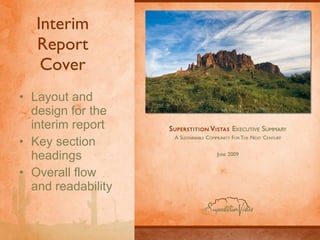
Interim Report Cover Layout and design for the interim report Key section headings Overall flow and readability
 
Intro and Visioning
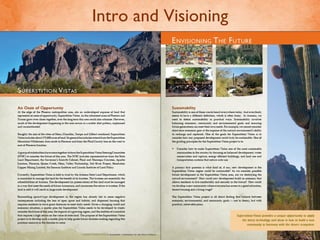
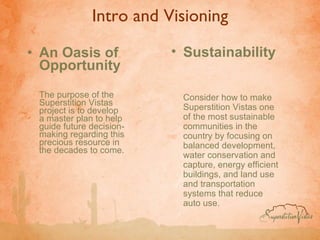
Intro and Visioning An Oasis of Opportunity The purpose of the Superstition Vistas project is to develop a master plan to help guide future decision-making regarding this precious resource in the decades to come.  Sustainability   Consider how to make Superstition Vistas one of the most sustainable communities in the country by focusing on balanced development, water conservation and capture, energy efficient buildings, and land use and transportation systems that reduce auto use.
Recent Trends & Regional Values
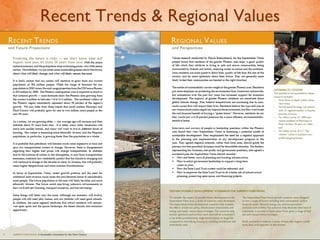
Recent Trends & Regional Values “ In this world nothing can be said to be certain, except death and taxes.” Benjamin Franklin, 1789 The qualitative and quantitative values research included:  Sixty-three in-depth online values interviews;  An Advanced Strategy Lab session with 35 regional leaders in Apache Junction, Arizona;  An online survey of 1,068 year-round residents of Maricopa or Pinal counties 18 years or older; and An online survey of 211 “key citizens” active in business, non-profit and government.
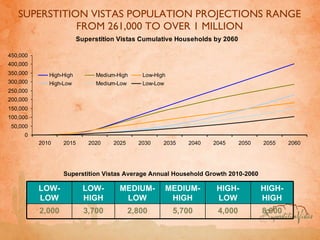
SUPERSTITION VISTAS POPULATION PROJECTIONS RANGE FROM 261,000 TO OVER 1 MILLION Superstition Vistas Average Annual Household Growth 2010-2060 8,000 4,000 5,700 2,800 3,700 2,000 HIGH-LOW HIGH-HIGH MEDIUM-HIGH MEDIUM-LOW LOW-HIGH LOW-LOW
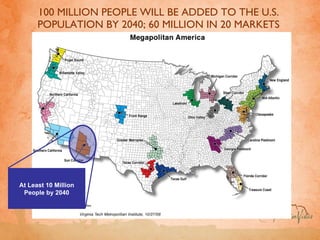
100 MILLION PEOPLE WILL BE ADDED TO THE U.S. POPULATION BY 2040; 60 MILLION IN 20 MARKETS At Least 10 Million People by 2040
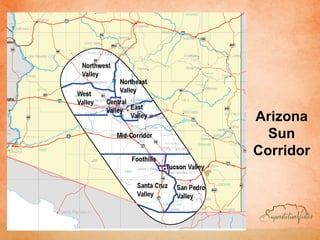
ArizonaSun Corridor
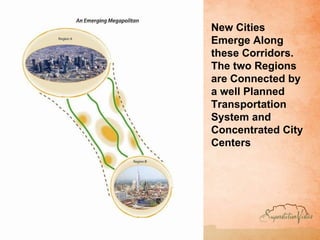
New Cities Emerge Along these Corridors. The two Regions are Connected by a well Planned Transportation System and Concentrated City Centers
Regional Visioning Starts with  Regional Values Values are stable and enduring; life’s “tides” as opposed to the “waves.” Values are widely shared and create consensus among diverse groups. Satisfying ones’ values is the foundation of personal decision making.
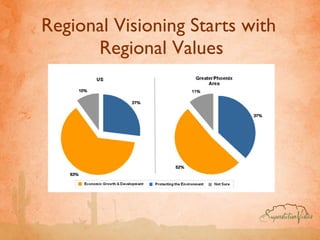
Regional Visioning Starts with  Regional Values
Scenario Overview Testing Possible Development Strategies for Superstition Vistas Each scenario is told as story of how the region could look, feel, and operate in the future.
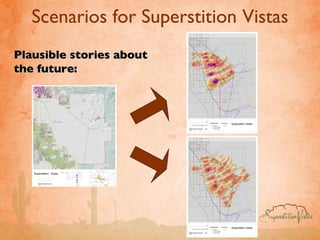
Scenarios for Superstition Vistas Plausible stories about the future:
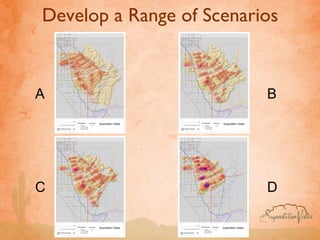
Develop a Range of Scenarios A B C D
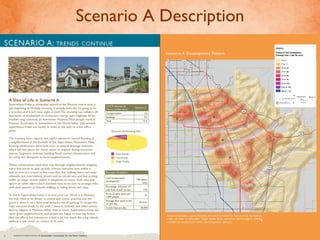
Scenario A Description
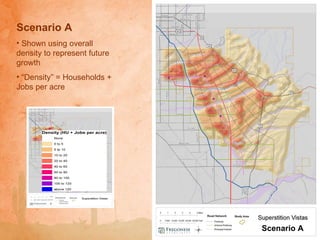
Scenario A Shown using overall density to represent future growth “ Density” = Households + Jobs per acre Scenario A
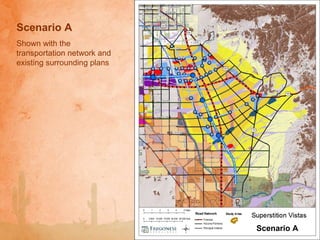
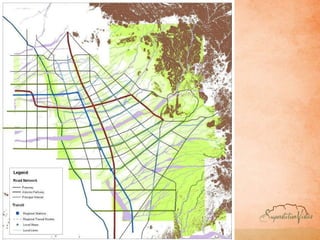
Scenario A Shown with the transportation network and existing surrounding plans Scenario A
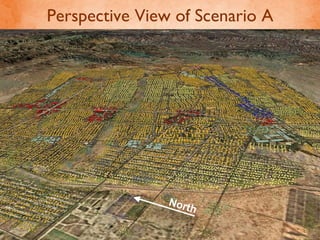
Perspective View of Scenario A North
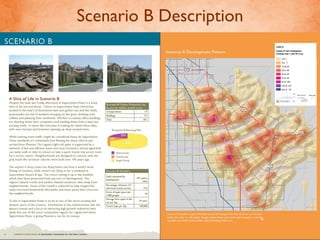
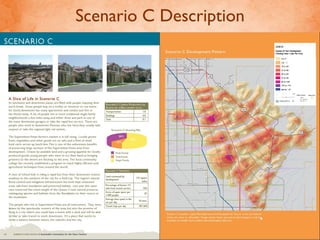
Scenario B Description
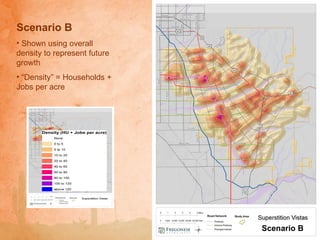
Scenario B Shown using overall density to represent future growth “ Density” = Households + Jobs per acre Scenario B
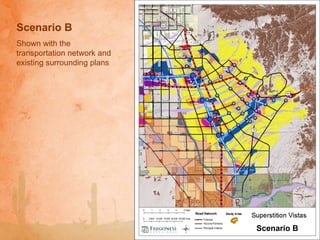
Scenario B Shown with the transportation network and existing surrounding plans Scenario B
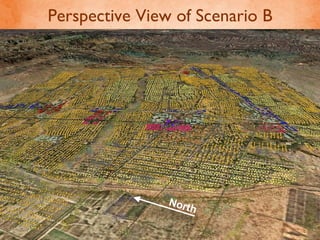
Perspective View of Scenario B North
Scenario C Description
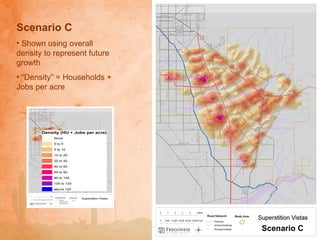
Scenario C Shown using overall density to represent future growth “ Density” = Households + Jobs per acre Scenario C
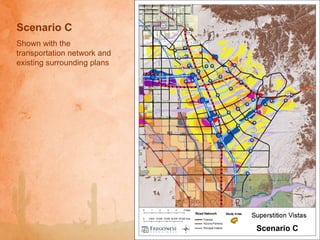
Scenario C Shown with the transportation network and existing surrounding plans Scenario C
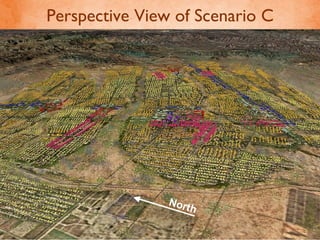
Perspective View of Scenario C North
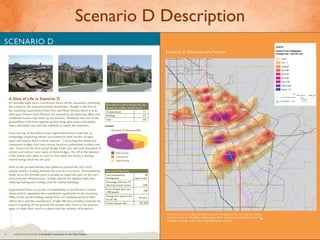
Scenario D Description
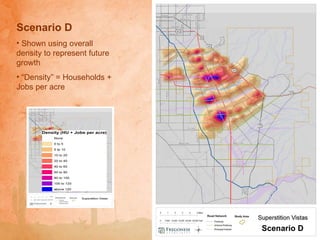
Scenario D Shown using overall density to represent future growth “ Density” = Households + Jobs per acre Scenario D
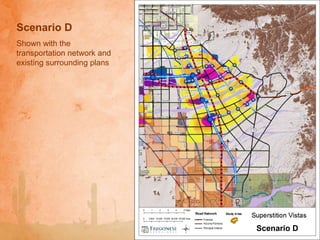
Scenario D Shown with the transportation network and existing surrounding plans Scenario D
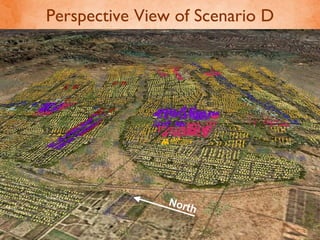
Perspective View of Scenario D North
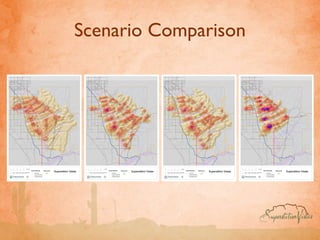
Scenario Comparison
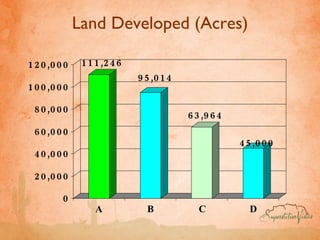
Land Developed (Acres)
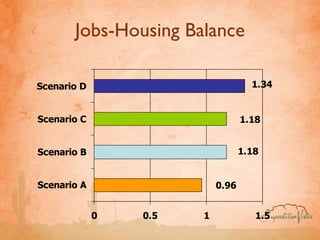
Jobs-Housing Balance
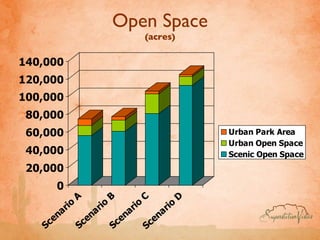
Open Space (acres)
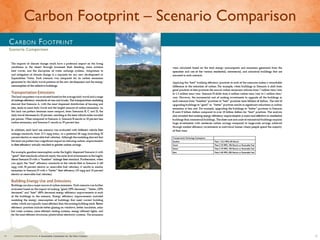
Carbon Footprint – Scenario Comparison
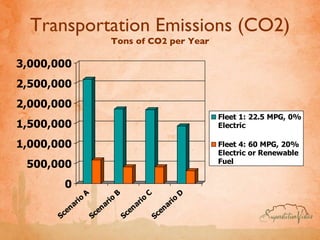
Transportation Emissions (CO2) Tons of CO2 per Year
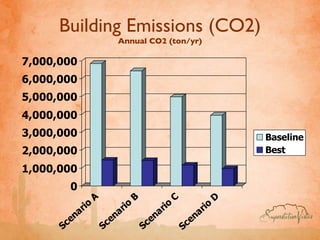
Building Emissions (CO2) Annual CO2 (ton/yr)
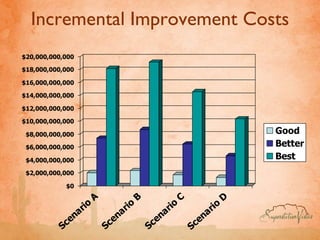
Incremental Improvement Costs
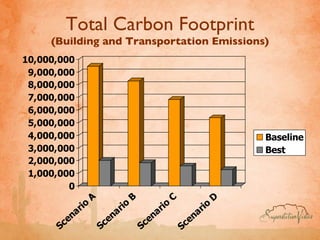
Total Carbon Footprint (Building and Transportation Emissions)
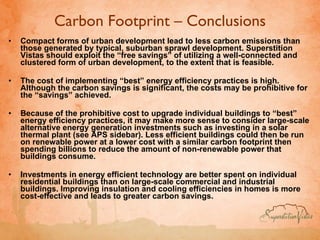
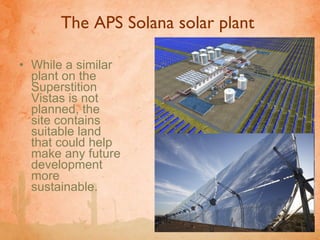
Carbon Footprint – Conclusions Compact forms of urban development lead to less carbon emissions than those generated by typical, suburban sprawl development. Superstition Vistas should exploit the “free savings” of utilizing a well-connected and clustered form of urban development, to the extent that is feasible.  The cost of implementing “best” energy efficiency practices is high. Although the carbon savings is significant, the costs may be prohibitive for the “savings” achieved.  Because of the prohibitive cost to upgrade individual buildings to “best” energy efficiency practices, it may make more sense to consider large-scale alternative energy generation investments such as investing in a solar thermal plant (see APS sidebar). Less efficient buildings could then be run on renewable power at a lower cost with a similar carbon footprint then spending billions to reduce the amount of non-renewable power that buildings consume.  Investments in energy efficient technology are better spent on individual residential buildings than on large-scale commercial and industrial buildings. Improving insulation and cooling efficiencies in homes is more cost-effective and leads to greater carbon savings.
The APS Solana solar plant  While a similar plant on the Superstition Vistas is not planned, the site contains suitable land that could help make any future development more sustainable.
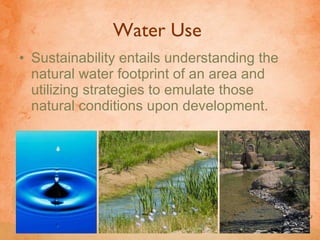
Water Use  Sustainability entails understanding the natural water footprint of an area and utilizing strategies to emulate those natural conditions upon development. 
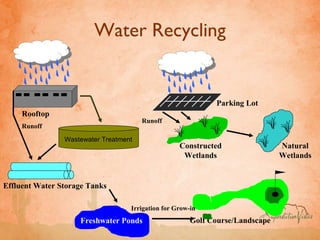
Water Recycling Effluent Water Storage Tanks Rooftop Freshwater Ponds Golf Course/Landscape Irrigation for Grow-in Runoff Natural Wetlands Constructed Wetlands Parking Lot Runoff Wastewater Treatment
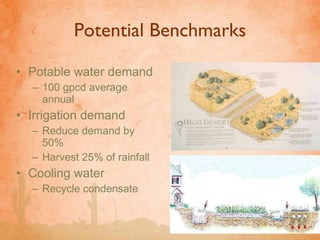
Potential Benchmarks Potable water demand 100 gpcd average annual Irrigation demand Reduce demand by 50% Harvest 25% of rainfall Cooling water Recycle condensate
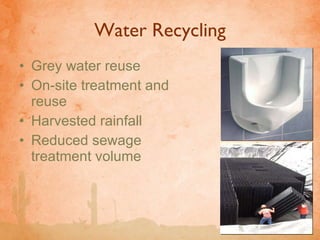
Water Recycling Grey water reuse On-site treatment and reuse Harvested rainfall Reduced sewage treatment volume
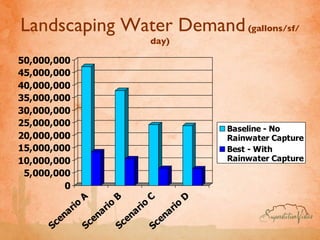
Landscaping Water Demand   (gallons/sf/day)
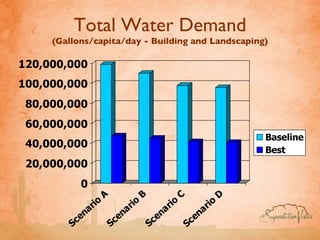
Total Water Demand (Gallons/capita/day - Building and Landscaping)
Water Use - Conclusions When best plumbing and landscaping practices are used in all the scenarios, the water use only differs by a margin of 5 million gallons/ day, a relatively minor difference. Landscape irrigation is the most significant consumptive use of water. Potable water can be used, but its use should be minimized. Changing the landscaping practices to include landscaping practices that promote water retention, xeriscaping, and rainwater capture helps reduce potable water use.  Nonpotable water sources, such as grey water, treated sewage effluent, and raw water are more appropriate for feeding landcaping and can often be supplied at a lower cost. A greater investment may be required for infrastructure to deliver this water, but the increased cost may be offset by lower water and treatment costs.
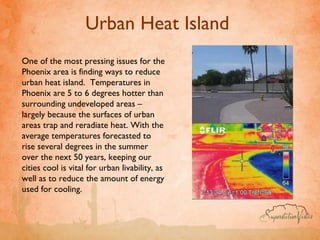
Urban Heat Island  One of the most pressing issues for the Phoenix area is finding ways to reduce urban heat island.  Temperatures in Phoenix are 5 to 6 degrees hotter than surrounding undeveloped areas – largely because the surfaces of urban areas trap and reradiate heat. With the average temperatures forecasted to rise several degrees in the summer over the next 50 years, keeping our cities cool is vital for urban livability, as well as to reduce the amount of energy used for cooling.
Urban Heat Island  Any development proposed for Superstition Vistas must include a comprehensive heat island strategy.  Incorporating light colored buildings, roofs, and streets;  Designing streets so that buildings provide shade during the heat of the day;  Planting drought-resistant shade trees with a large leaf canopy along streets and in public areas (even if it increases water consumption somewhat);  Directing storm water to feed water features and cool the air through evaporation;  and Designing neighborhoods to capture evening breezes.
Economic Development Of all the driving forces that will shape the growth of Superstition Vistas, economic development and job creation will be among the most important.
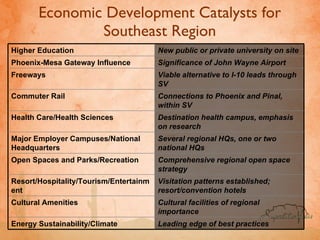
Economic Development Catalysts for Southeast Region Destination health campus, emphasis on research Health Care/Health Sciences Connections to Phoenix and Pinal, within SV Commuter Rail Viable alternative to I-10 leads through SV Freeways Significance of John Wayne Airport Phoenix-Mesa Gateway Influence Comprehensive regional open space strategy Open Spaces and Parks/Recreation Several regional HQs, one or two national HQs Major Employer Campuses/National Headquarters New public or private university on site Higher Education Leading edge of best practices Energy Sustainability/Climate Cultural facilities of regional importance Cultural Amenities Visitation patterns established; resort/convention hotels Resort/Hospitality/Tourism/Entertainment
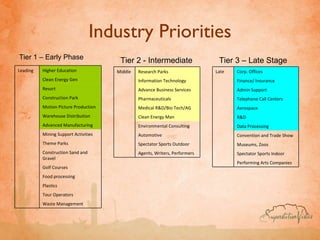
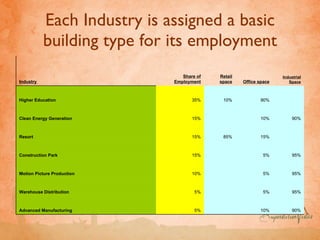
Economic Development We used the EDTAC findings to develop a 3 stage scenario development for Phase B The EDTAC categorized industries into three tiers based on this area’s advantages Industries with greater competitive advantage were assumed to move to the region first We designed Development programs around their needs
Industry Priorities Tier 1 – Early Phase Tier 2 - Intermediate Tier 3 – Late Stage Waste Management   Tour Operators   Plastics   Food processing   Golf Courses   Construction Sand and Gravel   Theme Parks   Mining Support Activities   Advanced Manufacturing   Warehouse Distribution   Motion Picture Production   Construction Park   Resort   Clean Energy Gen   Higher Education Leading Agents, Writers, Performers   Spectator Sports Outdoor   Automotive    Environmental Consulting   Clean Energy Man   Medical R&D/Bio Tech/AG   Pharmaceuticals   Advance Business Services   Information Technology   Research Parks Middle Performing Arts Companies   Spectator Sports Indoor   Museums, Zoos   Convention and Trade Show   Data Processing   R&D   Aerospace   Telephone Call Centers   Admin Support   Finance/ Insurance   Corp. Offices Late
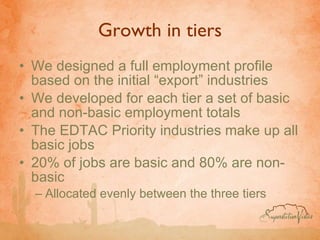
Growth in tiers We designed a full employment profile based on the initial “export” industries We developed for each tier a set of basic and non-basic employment totals The EDTAC Priority industries make up all basic jobs 20% of jobs are basic and 80% are non-basic Allocated evenly between the three tiers
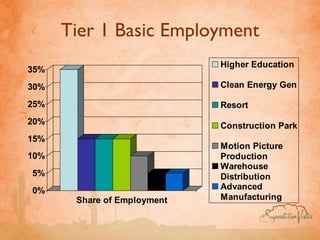
Tier 1 Basic Employment
Each Industry is assigned a basic building type for its employment 90% 10%   5% Advanced Manufacturing 95% 5%   5% Warehouse Distribution 95% 5%   10% Motion Picture Production 95% 5%   15% Construction Park   15% 85% 15% Resort 90% 10%   15% Clean Energy Generation   90% 10% 35% Higher Education Industrial Space Office space Retail space Share of Employment Industry 
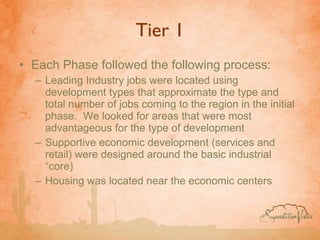
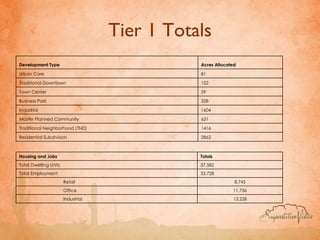
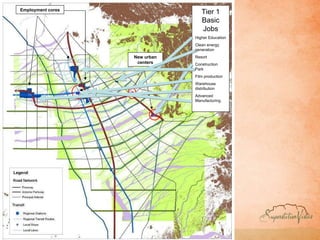
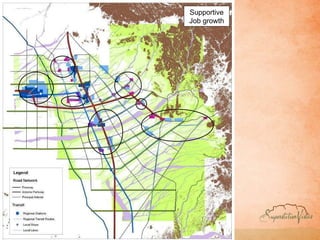
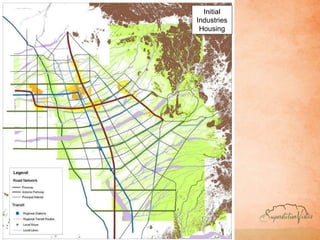
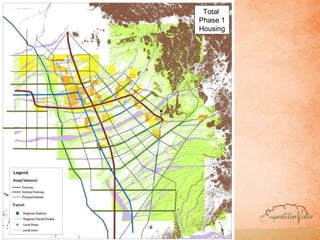
Tier 1 Each Phase followed the following process: Leading Industry jobs were located using development types that approximate the type and total number of jobs coming to the region in the initial phase.  We looked for areas that were most advantageous for the type of development Supportive economic development (services and retail) were designed around the basic industrial “core) Housing was located near the economic centers
Tier 1 Totals 2862 Residential Subdivision 1416 Traditional Neighborhood (TND) 631 Master Planned Community 1604 Industrial 328 Business Park 59 Town Center 152 Traditional Downtown 81 Urban Core Acres Allocated Development Type 13,228 Industrial 11,756 Office  8,745 Retail 33,728 Total Employment 37,582 Total Dwelling Units Totals Housing and Jobs
 
Tier 1 Basic Jobs Higher Education Clean energy generation Resort Construction Park Film production Warehouse distribution Advanced Manufacturing New urban centers Employment cores
Supportive Job growth
Initial Industries Housing
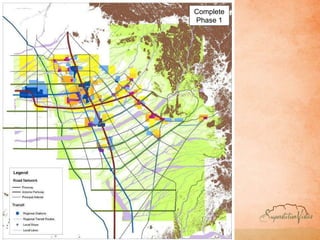
Total  Phase 1 Housing
Complete Phase 1
Superstition Vistas  Overview of Housing Analysis
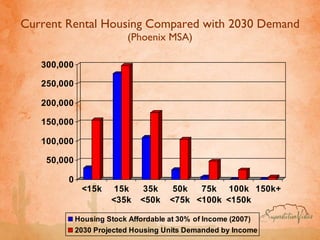
Current Rental Housing Compared with 2030 Demand (Phoenix MSA)
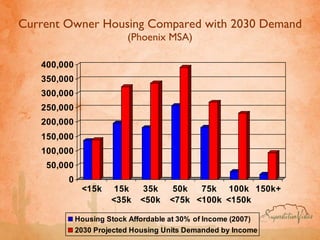
Current Owner Housing Compared with 2030 Demand (Phoenix MSA)
Superstition Vistas’ Balanced Housing Indicator Assumed that Superstition Vistas’ 405,000 unit forecast could accommodate approximately 35% of the Phoenix MSA’s future demand  Created a “Proportional Housing Profile” for Superstition Vistas
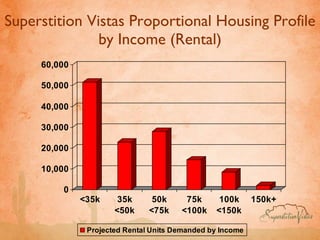
Superstition Vistas Proportional Housing Profile by Income (Rental)
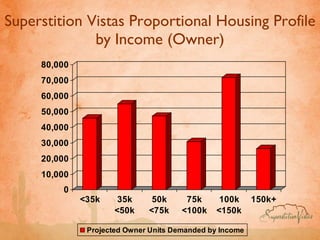
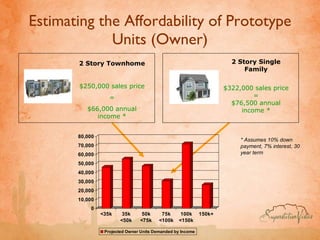
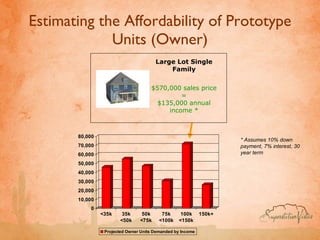
Superstition Vistas Proportional Housing Profile by Income (Owner)
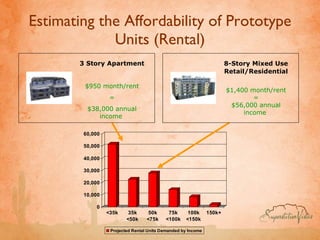
Estimating the Affordability of Prototype Units (Rental) 3 Story Apartment $950 month/rent = $38,000 annual income  8-Story Mixed Use   Retail/Residential $1,400 month/rent = $56,000 annual income
Estimating the Affordability of Prototype Units (Owner) 2 Story Single Family $322,000 sales price = $76,500 annual income * 2 Story Townhome $250,000 sales price = $66,000 annual income * * Assumes 10% down payment, 7% interest, 30 year term
Estimating the Affordability of Prototype Units (Owner) Large Lot Single Family $570,000 sales price = $135,000 annual income * * Assumes 10% down payment, 7% interest, 30 year term
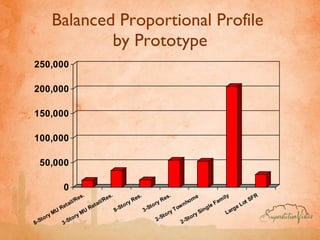
Balanced Proportional Profile  by Prototype
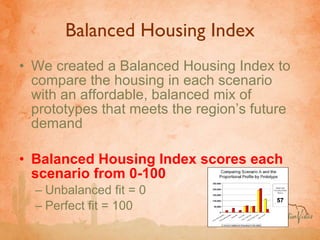
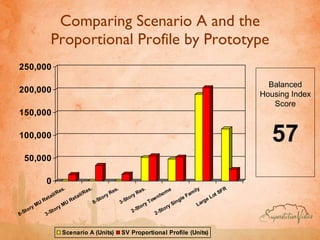
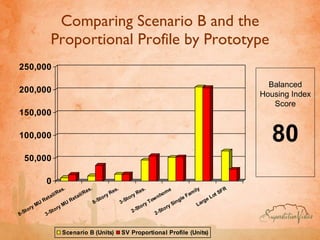
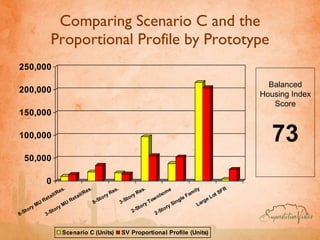
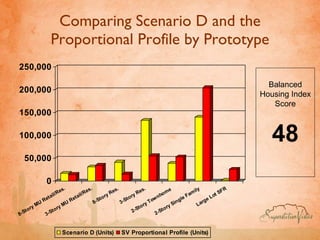
Balanced Housing Index We created a Balanced Housing Index to compare the housing in each scenario with an affordable, balanced mix of prototypes that meets the region’s future demand Balanced Housing Index scores each scenario from 0-100 Unbalanced fit = 0 Perfect fit = 100
Comparing Scenario A and the Proportional Profile by Prototype Balanced Housing Index Score 57
Comparing Scenario B and the Proportional Profile by Prototype Balanced Housing Index Score 80
Comparing Scenario C and the Proportional Profile by Prototype Balanced Housing Index Score 73
Comparing Scenario D and the Proportional Profile by Prototype Balanced Housing Index Score 48
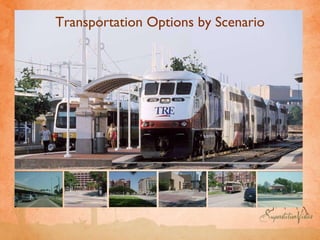
Transportation Options by Scenario
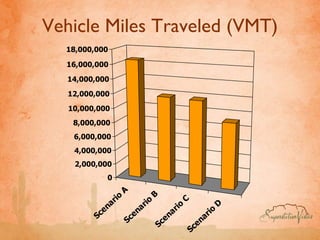
Vehicle Miles Traveled (VMT)
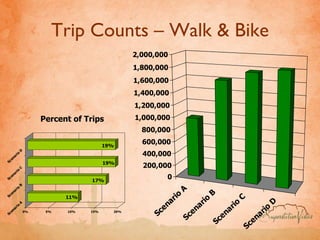
Trip Counts – Walk & Bike Percent of Trips
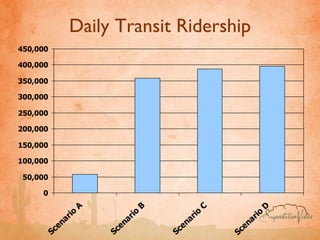
Daily Transit Ridership
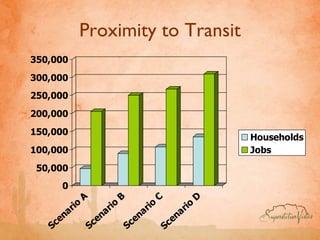
Proximity to Transit
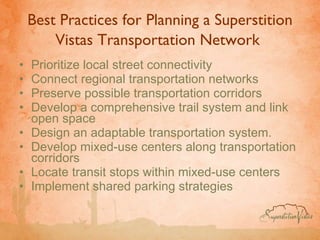
Best Practices for Planning a Superstition Vistas Transportation Network   Prioritize local street connectivity Connect regional transportation networks Preserve possible transportation corridors  Develop a comprehensive trail system and link open space  Design an adaptable transportation system.  Develop mixed-use centers along transportation corridors Locate transit stops within mixed-use centers Implement shared parking strategies
Lessons Learned The scenarios are not plans to follow, but rather alternative futures based a series of assumptions. When compared against each other, the scenario analysis yields some important lessons learned.
Lessons Learned The lifeblood of any sustainable community is a vibrant economy Economic Catalysts are critical ingredients   The key to developing a strong economy is to lead housing with employment Housing needs will change Build green and compact   Superstition Vistas will need a Transit System Walking and biking could be important travel modes Designing a city with appropriately spaced and well designed mixed use centers is more important than just density   All the components of sustainability: a vibrant local economy, equitable and marketable housing, and good environmental design must be balanced
Next Steps Craft the Preferred Scenario Develop a Shared Vision for Superstition Vistas Develop Best Practices and Strategies Strategic Implementation  Open Houses and/or Other Public Events
EXTRA SLIDES Images…


Superstition Vistas - Scenario A-D Comparison

  • 1.
    Superstition Vistas InterimReport Presentation June 30 th 2009 A Sustainable Community for the Next Century
  • 2.
    Interim Report CoverLayout and design for the interim report Key section headings Overall flow and readability
  • 3.
  • 4.
  • 5.
    Intro and VisioningAn Oasis of Opportunity The purpose of the Superstition Vistas project is to develop a master plan to help guide future decision-making regarding this precious resource in the decades to come. Sustainability Consider how to make Superstition Vistas one of the most sustainable communities in the country by focusing on balanced development, water conservation and capture, energy efficient buildings, and land use and transportation systems that reduce auto use.
  • 6.
    Recent Trends &Regional Values
  • 7.
    Recent Trends &Regional Values “ In this world nothing can be said to be certain, except death and taxes.” Benjamin Franklin, 1789 The qualitative and quantitative values research included: Sixty-three in-depth online values interviews; An Advanced Strategy Lab session with 35 regional leaders in Apache Junction, Arizona; An online survey of 1,068 year-round residents of Maricopa or Pinal counties 18 years or older; and An online survey of 211 “key citizens” active in business, non-profit and government.
  • 8.
    SUPERSTITION VISTAS POPULATIONPROJECTIONS RANGE FROM 261,000 TO OVER 1 MILLION Superstition Vistas Average Annual Household Growth 2010-2060 8,000 4,000 5,700 2,800 3,700 2,000 HIGH-LOW HIGH-HIGH MEDIUM-HIGH MEDIUM-LOW LOW-HIGH LOW-LOW
  • 9.
    100 MILLION PEOPLEWILL BE ADDED TO THE U.S. POPULATION BY 2040; 60 MILLION IN 20 MARKETS At Least 10 Million People by 2040
  • 10.
  • 11.
    New Cities EmergeAlong these Corridors. The two Regions are Connected by a well Planned Transportation System and Concentrated City Centers
  • 12.
    Regional Visioning Startswith Regional Values Values are stable and enduring; life’s “tides” as opposed to the “waves.” Values are widely shared and create consensus among diverse groups. Satisfying ones’ values is the foundation of personal decision making.
  • 13.
    Regional Visioning Startswith Regional Values Values are stable and enduring; life’s “tides” as opposed to the “waves.” Values are widely shared and create consensus among diverse groups. Satisfying ones’ values is the foundation of personal decision making.
  • 14.
    Regional Visioning Startswith Regional Values
  • 15.
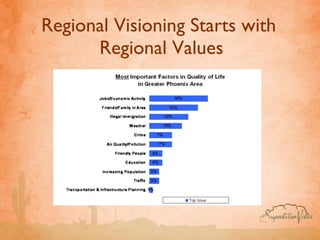
    Regional Visioning Startswith Regional Values
  • 16.
    Scenario Overview TestingPossible Development Strategies for Superstition Vistas Each scenario is told as story of how the region could look, feel, and operate in the future.
  • 17.
    Scenarios for SuperstitionVistas Plausible stories about the future:
  • 18.
    Develop a Rangeof Scenarios A B C D
  • 19.
  • 20.
    Scenario A Shownusing overall density to represent future growth “ Density” = Households + Jobs per acre Scenario A
  • 21.
    Scenario A Shownwith the transportation network and existing surrounding plans Scenario A
  • 22.
    Perspective View ofScenario A North
  • 23.
  • 24.
    Scenario B Shownusing overall density to represent future growth “ Density” = Households + Jobs per acre Scenario B
  • 25.
    Scenario B Shownwith the transportation network and existing surrounding plans Scenario B
  • 26.
    Perspective View ofScenario B North
  • 27.
  • 28.
    Scenario C Shownusing overall density to represent future growth “ Density” = Households + Jobs per acre Scenario C
  • 29.
    Scenario C Shownwith the transportation network and existing surrounding plans Scenario C
  • 30.
    Perspective View ofScenario C North
  • 31.
  • 32.
    Scenario D Shownusing overall density to represent future growth “ Density” = Households + Jobs per acre Scenario D
  • 33.
    Scenario D Shownwith the transportation network and existing surrounding plans Scenario D
  • 34.
    Perspective View ofScenario D North
  • 35.
  • 36.
  • 37.
  • 38.
  • 39.
    Carbon Footprint –Scenario Comparison
  • 40.
    Transportation Emissions (CO2)Tons of CO2 per Year
  • 41.
    Building Emissions (CO2)Annual CO2 (ton/yr)
  • 42.
  • 43.
    Total Carbon Footprint(Building and Transportation Emissions)
  • 44.
    Carbon Footprint –Conclusions Compact forms of urban development lead to less carbon emissions than those generated by typical, suburban sprawl development. Superstition Vistas should exploit the “free savings” of utilizing a well-connected and clustered form of urban development, to the extent that is feasible. The cost of implementing “best” energy efficiency practices is high. Although the carbon savings is significant, the costs may be prohibitive for the “savings” achieved. Because of the prohibitive cost to upgrade individual buildings to “best” energy efficiency practices, it may make more sense to consider large-scale alternative energy generation investments such as investing in a solar thermal plant (see APS sidebar). Less efficient buildings could then be run on renewable power at a lower cost with a similar carbon footprint then spending billions to reduce the amount of non-renewable power that buildings consume. Investments in energy efficient technology are better spent on individual residential buildings than on large-scale commercial and industrial buildings. Improving insulation and cooling efficiencies in homes is more cost-effective and leads to greater carbon savings.
  • 45.
    The APS Solanasolar plant While a similar plant on the Superstition Vistas is not planned, the site contains suitable land that could help make any future development more sustainable.
  • 46.
    Water Use Sustainability entails understanding the natural water footprint of an area and utilizing strategies to emulate those natural conditions upon development. 
  • 47.
    Water Recycling EffluentWater Storage Tanks Rooftop Freshwater Ponds Golf Course/Landscape Irrigation for Grow-in Runoff Natural Wetlands Constructed Wetlands Parking Lot Runoff Wastewater Treatment
  • 48.
    Potential Benchmarks Potablewater demand 100 gpcd average annual Irrigation demand Reduce demand by 50% Harvest 25% of rainfall Cooling water Recycle condensate
  • 49.
    Water Recycling Greywater reuse On-site treatment and reuse Harvested rainfall Reduced sewage treatment volume
  • 50.
    Landscaping Water Demand (gallons/sf/day)
  • 51.
    Total Water Demand(Gallons/capita/day - Building and Landscaping)
  • 52.
    Water Use -Conclusions When best plumbing and landscaping practices are used in all the scenarios, the water use only differs by a margin of 5 million gallons/ day, a relatively minor difference. Landscape irrigation is the most significant consumptive use of water. Potable water can be used, but its use should be minimized. Changing the landscaping practices to include landscaping practices that promote water retention, xeriscaping, and rainwater capture helps reduce potable water use. Nonpotable water sources, such as grey water, treated sewage effluent, and raw water are more appropriate for feeding landcaping and can often be supplied at a lower cost. A greater investment may be required for infrastructure to deliver this water, but the increased cost may be offset by lower water and treatment costs.
  • 53.
    Urban Heat Island One of the most pressing issues for the Phoenix area is finding ways to reduce urban heat island.  Temperatures in Phoenix are 5 to 6 degrees hotter than surrounding undeveloped areas – largely because the surfaces of urban areas trap and reradiate heat. With the average temperatures forecasted to rise several degrees in the summer over the next 50 years, keeping our cities cool is vital for urban livability, as well as to reduce the amount of energy used for cooling.
  • 54.
    Urban Heat Island Any development proposed for Superstition Vistas must include a comprehensive heat island strategy. Incorporating light colored buildings, roofs, and streets; Designing streets so that buildings provide shade during the heat of the day; Planting drought-resistant shade trees with a large leaf canopy along streets and in public areas (even if it increases water consumption somewhat); Directing storm water to feed water features and cool the air through evaporation; and Designing neighborhoods to capture evening breezes.
  • 55.
    Economic Development Ofall the driving forces that will shape the growth of Superstition Vistas, economic development and job creation will be among the most important.
  • 56.
    Economic Development Catalystsfor Southeast Region Destination health campus, emphasis on research Health Care/Health Sciences Connections to Phoenix and Pinal, within SV Commuter Rail Viable alternative to I-10 leads through SV Freeways Significance of John Wayne Airport Phoenix-Mesa Gateway Influence Comprehensive regional open space strategy Open Spaces and Parks/Recreation Several regional HQs, one or two national HQs Major Employer Campuses/National Headquarters New public or private university on site Higher Education Leading edge of best practices Energy Sustainability/Climate Cultural facilities of regional importance Cultural Amenities Visitation patterns established; resort/convention hotels Resort/Hospitality/Tourism/Entertainment
  • 57.
    Economic Development Weused the EDTAC findings to develop a 3 stage scenario development for Phase B The EDTAC categorized industries into three tiers based on this area’s advantages Industries with greater competitive advantage were assumed to move to the region first We designed Development programs around their needs
  • 58.
    Industry Priorities Tier1 – Early Phase Tier 2 - Intermediate Tier 3 – Late Stage Waste Management   Tour Operators   Plastics   Food processing   Golf Courses   Construction Sand and Gravel   Theme Parks   Mining Support Activities   Advanced Manufacturing   Warehouse Distribution   Motion Picture Production   Construction Park   Resort   Clean Energy Gen   Higher Education Leading Agents, Writers, Performers   Spectator Sports Outdoor   Automotive   Environmental Consulting   Clean Energy Man   Medical R&D/Bio Tech/AG   Pharmaceuticals   Advance Business Services   Information Technology   Research Parks Middle Performing Arts Companies   Spectator Sports Indoor   Museums, Zoos   Convention and Trade Show   Data Processing   R&D   Aerospace   Telephone Call Centers   Admin Support   Finance/ Insurance   Corp. Offices Late
  • 59.
    Growth in tiersWe designed a full employment profile based on the initial “export” industries We developed for each tier a set of basic and non-basic employment totals The EDTAC Priority industries make up all basic jobs 20% of jobs are basic and 80% are non-basic Allocated evenly between the three tiers
  • 60.
    Tier 1 BasicEmployment
  • 61.
    Each Industry isassigned a basic building type for its employment 90% 10%   5% Advanced Manufacturing 95% 5%   5% Warehouse Distribution 95% 5%   10% Motion Picture Production 95% 5%   15% Construction Park   15% 85% 15% Resort 90% 10%   15% Clean Energy Generation   90% 10% 35% Higher Education Industrial Space Office space Retail space Share of Employment Industry 
  • 62.
    Tier 1 EachPhase followed the following process: Leading Industry jobs were located using development types that approximate the type and total number of jobs coming to the region in the initial phase. We looked for areas that were most advantageous for the type of development Supportive economic development (services and retail) were designed around the basic industrial “core) Housing was located near the economic centers
  • 63.
    Tier 1 Totals2862 Residential Subdivision 1416 Traditional Neighborhood (TND) 631 Master Planned Community 1604 Industrial 328 Business Park 59 Town Center 152 Traditional Downtown 81 Urban Core Acres Allocated Development Type 13,228 Industrial 11,756 Office 8,745 Retail 33,728 Total Employment 37,582 Total Dwelling Units Totals Housing and Jobs
  • 64.
  • 65.
    Tier 1 BasicJobs Higher Education Clean energy generation Resort Construction Park Film production Warehouse distribution Advanced Manufacturing New urban centers Employment cores
  • 66.
  • 67.
  • 68.
    Total Phase1 Housing
  • 69.
  • 70.
    Superstition Vistas Overview of Housing Analysis
  • 71.
    Current Rental HousingCompared with 2030 Demand (Phoenix MSA)
  • 72.
    Current Owner HousingCompared with 2030 Demand (Phoenix MSA)
  • 73.
    Superstition Vistas’ BalancedHousing Indicator Assumed that Superstition Vistas’ 405,000 unit forecast could accommodate approximately 35% of the Phoenix MSA’s future demand Created a “Proportional Housing Profile” for Superstition Vistas
  • 74.
    Superstition Vistas ProportionalHousing Profile by Income (Rental)
  • 75.
    Superstition Vistas ProportionalHousing Profile by Income (Owner)
  • 76.
    Estimating the Affordabilityof Prototype Units (Rental) 3 Story Apartment $950 month/rent = $38,000 annual income 8-Story Mixed Use Retail/Residential $1,400 month/rent = $56,000 annual income
  • 77.
    Estimating the Affordabilityof Prototype Units (Owner) 2 Story Single Family $322,000 sales price = $76,500 annual income * 2 Story Townhome $250,000 sales price = $66,000 annual income * * Assumes 10% down payment, 7% interest, 30 year term
  • 78.
    Estimating the Affordabilityof Prototype Units (Owner) Large Lot Single Family $570,000 sales price = $135,000 annual income * * Assumes 10% down payment, 7% interest, 30 year term
  • 79.
  • 80.
    Balanced Housing IndexWe created a Balanced Housing Index to compare the housing in each scenario with an affordable, balanced mix of prototypes that meets the region’s future demand Balanced Housing Index scores each scenario from 0-100 Unbalanced fit = 0 Perfect fit = 100
  • 81.
    Comparing Scenario Aand the Proportional Profile by Prototype Balanced Housing Index Score 57
  • 82.
    Comparing Scenario Band the Proportional Profile by Prototype Balanced Housing Index Score 80
  • 83.
    Comparing Scenario Cand the Proportional Profile by Prototype Balanced Housing Index Score 73
  • 84.
    Comparing Scenario Dand the Proportional Profile by Prototype Balanced Housing Index Score 48
  • 85.
  • 86.
  • 87.
    Trip Counts –Walk & Bike Percent of Trips
  • 88.
  • 89.
  • 90.
    Best Practices forPlanning a Superstition Vistas Transportation Network Prioritize local street connectivity Connect regional transportation networks Preserve possible transportation corridors Develop a comprehensive trail system and link open space Design an adaptable transportation system. Develop mixed-use centers along transportation corridors Locate transit stops within mixed-use centers Implement shared parking strategies
  • 91.
    Lessons Learned Thescenarios are not plans to follow, but rather alternative futures based a series of assumptions. When compared against each other, the scenario analysis yields some important lessons learned.
  • 92.
    Lessons Learned Thelifeblood of any sustainable community is a vibrant economy Economic Catalysts are critical ingredients The key to developing a strong economy is to lead housing with employment Housing needs will change Build green and compact Superstition Vistas will need a Transit System Walking and biking could be important travel modes Designing a city with appropriately spaced and well designed mixed use centers is more important than just density All the components of sustainability: a vibrant local economy, equitable and marketable housing, and good environmental design must be balanced
  • 93.
    Next Steps Craftthe Preferred Scenario Develop a Shared Vision for Superstition Vistas Develop Best Practices and Strategies Strategic Implementation Open Houses and/or Other Public Events
  • 94.
  • 95.
  • 96.
  • 97.
  • 98.

Editor's Notes

  • #97 update with latest plan
  • #98 update with latest plan
  • #99 update with latest plan