‘Drama for Learning and
                 Creativity’
  [September 2005 – July 2006]


An evaluation for National Drama, NESTA and Norfolk
                  County Council
  Dr. D A Simpson (University of Brighton, School of
                     Education)
Foreword


‘Drama for Learning and Creativity’ has been a learning journey for all the
teachers and consultants involved. The success of the project is due to their
individual and collective energy. There is a passionate commitment to whole
class Drama as a teaching and learning medium throughout the three phases
of the fieldwork period. Without exception, there is a determination to move
children’s learning forward. The participants recognise that the project also
represents a way to improve their own and others’ understanding of what it
is to be a teacher in the early part of the twenty-first century.


‘Drama for Learning and Creativity’


‘Drama for Learning and Creativity’ is successful in meeting the criteria set
out in the Bid Document.


The findings to support this judgement are presented in the following groups
of bullet points.


       The management of ‘Drama for Learning and Creativity’


   •   The management and structure of the action research ensures there is a
       clearly identified, evidence-oriented and manageable core for each of
       the schools’ projects. It is a very strong feature of the project.


       Use of funding


   •   The use made of the funds available is entirely appropriate to the
       demands and needs of a research project.
   •   There is evidence of careful forward planning for the dissemination of
       the project’s findings.


                                                                                2
Research methodology


•   The research methodology that underpins the school-based action
    research enables teachers and consultants to collaborate in sustained,
    thoughtful ways. It sees the teachers assume responsibility for the
    direction of their fieldwork. There is consistent evidence that this
    responsibility has a profound effect on the teachers’ thinking about
    whole class Drama teaching, and its practice in the classroom.
•   Two related parts of the school-based action research are highly
    effective. The seminars to bring together teachers and consultants help
    both parties to realise their roles. They are a major contribution to the
    excellent working relationships between teachers and consultants.
    Second, the precise allocation of consultants makes sure that expertise
    is matched with schools. This deepens the first two school-based
    phases of the fieldwork.
•   The teachers’ initial research questions are adapted, discussed with
    consultants and developed in ways which add depth to the action
    research. The evidence available shows that one outcome of such
    deliberation is whole class teaching which stimulates and engages
    pupils of all ages and abilities.


    The impact of ‘Drama for Learning and Creativity’


•   The entry and exit questionnaires are evidence that an increasing
    number of schools now use Drama regularly as a methodology. Over
    90% of schools surveyed state that Drama is influencing their
    development plans. Drama is now a significant priority for over half
    the schools in the survey, an increase of over 15%.
•   The exit questionnaire shows that all schools in the survey (100%) now
    have Drama in their improvement plans.


                                                                                3
•   ‘Drama for Learning and Creativity’ influences head-teachers as well
    as teachers. This suggests that the schools in the survey are developing
    both the policy and practice of whole class Drama teaching, with over
    80% of the primary and middle schools surveyed now having a teacher
    responsible for Drama.
•   Over 90% of the teachers surveyed report an increase in their
    confidence to teach Drama.
•   The data points to a connection between confidence, knowledge and
    skill that has implications for the future of Drama teaching, especially
    at Key Stages One and Two.
•   The teachers’ journals show that pupils respond positively to what
    whole class Drama offers them as learners. There is consistent evidence
    that pupils think that it provides them with opportunities for affective
    and cognitive engagement with their learning.
•   By the time of the end of the project over 95% of the teachers surveyed
    are working with Drama in an increasing number of subjects.
•   There are equally firm quantitative indicators that the increase in the
    curriculum areas which feature Drama is matched by a rise in the time
    allocated on a regular basis to Drama. Over a third of schools now
    allocate more than an hour a week to Drama.
•   Teachers now work in the classroom with a significantly increased
    range of Drama conventions. Teacher in role, Hot seating and Thought
    tracking are far more evident in teacher’s work. As a result there is a
    different Drama ‘diet’ emerging which has the potential to broaden
    significantly children’s learning opportunities.
•   Drama is now viewed to be a means to develop pupils’ thinking.
    Teachers associate it with creative thinking, communication and
    expressive skills. Examples from three projects show that pupils take
    part in speculation, hypothesis making and testing, searching for
    reasons and making justifications rather than looking for the ‘right’


                                                                               4
answer. They experience standing in another person’s shoes and the
       exploration of other viewpoints than their own.


       Publications


   •   The project is meeting its targets of producing high-quality
       publications directed at a range of audiences. For example, there has
       been print media coverage in the Times Educational Supplement, a
       web site became operational in January 2006 and an academic paper is
       to be presented at a major European conference on creativity. A CD
       ROM, which has accompanying materials, has been completed.


Communication with the management group of ‘Drama for Learning and
Creativity’ during the period September 2005 – July 2006


The ease of communication with the project management group means there
is no difficulty with gaining access to any material necessary for the three
phase evaluations. One result is the availability of a substantial body of data
for this report. There are, therefore, quotations from teachers and pupils as
well as references from teachers and consultants’ writing in the main body of
the report.


Regular contact with the project management team not only makes writing
the fieldwork’s three phase evaluations easier but it also enables me to act
more as a critical friend to the project. This gives me an opportunity to
undertake a learning journey too. It encourages me to think about how I see
the role and shape of Drama teaching, especially in the light of government
proposals for initial teacher education, and the school curriculum more
generally.


                                                                                  5
As with the three phase evaluations, the writing of this report is actively
encouraged and supported by Lorraine Harrison, Head of the School of
Education.


D A Simpson
University of Brighton, School of Education,
Falmer, Brighton BN1 9PH
ds116@bton.ac.uk
01273 643376                                                   October 2006


                                                                              6
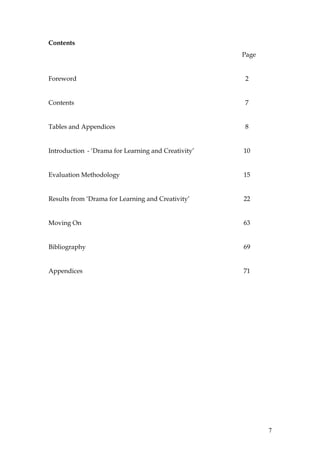
Contents
                                                     Page


Foreword                                             2


Contents                                             7


Tables and Appendices                                8


Introduction - ‘Drama for Learning and Creativity’   10


Evaluation Methodology                               15


Results from ‘Drama for Learning and Creativity’     22


Moving On                                            63


Bibliography                                         69


Appendices                                           71


                                                            7
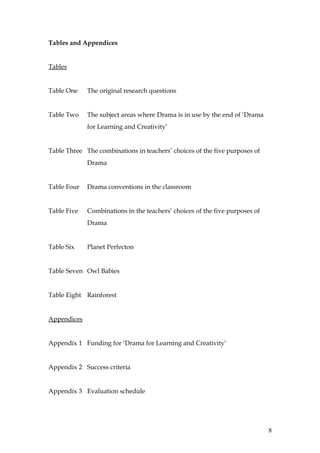
Tables and Appendices


Tables


Table One    The original research questions


Table Two    The subject areas where Drama is in use by the end of ‘Drama
             for Learning and Creativity’


Table Three The combinations in teachers’ choices of the five purposes of
             Drama


Table Four   Drama conventions in the classroom


Table Five   Combinations in the teachers’ choices of the five purposes of
             Drama


Table Six    Planet Perfecton


Table Seven Owl Babies


Table Eight Rainforest


Appendices


Appendix 1 Funding for ‘Drama for Learning and Creativity’


Appendix 2 Success criteria


Appendix 3 Evaluation schedule


                                                                             8
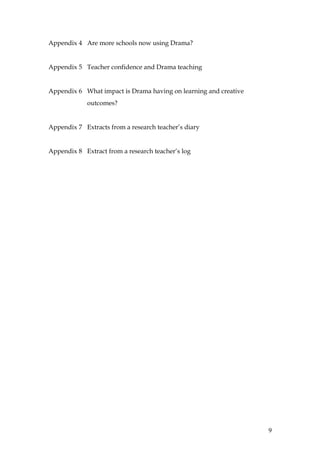
Appendix 4 Are more schools now using Drama?


Appendix 5 Teacher confidence and Drama teaching


Appendix 6 What impact is Drama having on learning and creative
             outcomes?


Appendix 7 Extracts from a research teacher’s diary


Appendix 8 Extract from a research teacher’s log


                                                                  9
1. Introduction - ‘Drama for Learning and Creativity’


Introduction


‘Drama for Learning and Creativity’ is initiated by Norfolk LEA. NESTA
provides a major source of financial support. There is assistance on a much
smaller scale from the University of Brighton School of Education who fund
release from teaching for its evaluation and dissemination.


The project investigates the capacity of whole class Drama to initiate, sustain
and enhance children’s creativity and learning. It involves 60 schools in
Norfolk LEA during the academic year 2005/6, with evaluation and
dissemination running from June 2006 to May 2007. At its centre there are 14
schools which are designated as research schools. In these primary, middle
and secondary schools, teachers work with consultants on a variety of whole
class, teacher-initiated and managed projects. They are designed to stimulate
creativity through Drama-based teaching and learning.


The project’s structure and organisation


‘Drama for Learning and Creativity’ is a collaborative venture. Teachers and
consultants concentrate on how Drama can develop children’s creative
capabilities. There is a management group of three, all of whom act as
consultants to the schools in the project. It is led by Patrice Baldwin, Advisor
for the Arts (Norfolk LEA) and Chair of National Drama, with two
consultants, Pam Bowell (Kingston University and a former Chair of National
Drama) and Kate Fleming (Drama Consultant and Vice Chair of National
Drama). All three are experienced, highly-regarded Drama teachers with
substantial classroom backgrounds. All have taken part in small-scale Drama
and Arts projects before and are published widely in this field. Advice and
support for the project management team comes from the Executive


                                                                               10
Committee of National Drama, the principal subject organisation for Drama
in the United Kingdom.


The funding allows for two levels of involvement, an inner group of 14
chosen research schools and an outer looser grouping of over 50 schools
(fuller details of the funding and expenditure are in Appendix 1). The inner
group is made up of schools from Key Stages One to Four, with pupils from
Reception to Year 10 taking part. Both the inner and outer levels of
involvement work on investigations into Drama teaching and learning. The
first seminar for the inner group of research schools (November 2005)
emphasises the collaborative nature of the project. Teachers from the
research schools work with the consultants to shape the wording and form of
their project. Following the seminar the consultants spend half a day in each
school on the research school’s chosen investigation. This takes several
patterns. For example, in some schools a consultant leads a teaching session
whilst in others the teaching is shared or the consultant joins the Drama in an
agreed role. In the period from January to May 2006 the consultants make a
second visit to their delegated schools, and both teachers and consultants
meet for a further twilight seminar. Throughout the fieldwork teachers and
consultants are in regular contact via email, phone and the exchange of longer
documents.


The outer group, which comprises over 50 more schools, are also visited twice
between November 2005 and May 2006. Visits are made by either Patrice
Baldwin, a Drama consultant or a local authority advanced skills teacher. Like
the inner group, the outer group have two visits and are offered help and
advice. However, they do not work to an agreed research question.


The project management team meets on a number of occasions. It also meets
with the executive of National Drama which enables reports on work in
progress, as well as questions about the fieldwork, to be discussed fully with


                                                                               11
leading members of the Drama subject community. As each phase of the
fieldwork finishes, the project evaluator reports on how far and to what
extent the project is meeting its targets (see Appendix 2). This sets up a
dialogue between the evaluator and project management team that lasts for
the length of the fieldwork.


Background to ‘Drama for Learning and Creativity’


The project is the first in depth, classroom based Drama research project
initiated by a national drama subject association – National Drama – in
partnership with a local education authority.


The project focuses on the relationships between whole class Drama teaching,
creativity and learning. It comes from the project management group’s belief
in Drama as something which is highly engaging to pupils. In their view
Drama:
   •   Develops pupils’ inter-thinking and learning;
   •   Stimulates creativity through role play and sustained imaginative
       experience;
   •   Enables visual, auditory and kinaesthetic access, understanding
       and expression;
   •   Focuses on engaging empathically in ways that combine the
       cognitive and affective.
                                          [Bid Document, Section B4]
Drama is seen as an inclusive, multi-faceted agency for the holistic
development of children as learners. For the project management team, it is a
learning medium that utilises a range of intelligences. They believe these
engage all learners in ways which often go beyond the prescribed methods
and formal teaching that dominate the current curriculum [Bid Document,
Section B4].


                                                                             12
The management team’s view of Drama is in sympathy with ‘All Our
Futures,’ the 1999 government report into the Arts. This report provides a
definition of creativity which they support and use in their bid application.
Creativity [NACCE 1999: 12] is:
        “Imaginative activity fashioned so as to produce outcomes
        that are both original and of value.”
The management group adopt this definition for two reasons. The local
authority’s schools work within a curriculum framework that endorses this
report. The ‘Every Child Matters’ policy [DfES 2005] draws on ‘All Our
Futures’ and shares its commitment to a creative curriculum in which
imaginative enquiry are part of all pupils’ entitlement. ‘All Our Futures’ itself
refers to its description of creativity as a democratic one. This is in keeping
with two key, related areas of the project, what happens in the classroom and
the sharing of ideas between teachers and consultants. The interplay between
classroom and discussion - which is led by ideas rather than by either
teachers or consultants - is a sharing, supportive one that is part of the
approach to the Arts championed by ‘All Our Futures.’ It relies upon equal
voices in and out of the classroom.


‘All Our Futures’ goes on to state that creative thinking and behaviour is
always imaginative, purposeful, original and valuable. The management
group take this further in order to identify what they consider to be the
”features” of drama within a context of creativity and learning [Bid
Document, Section B5]. They choose five features of creative thinking and
behaviour from the QCA document ’Creativity: Find it, Promote it’ [QCA
2005]. These are:
   •   Questioning and challenging;
   •   Exploring ideas, keeping options open;
   •   Making connections and seeing relationships;
   •   Envisaging what might be;
   •   Reflecting critically on ideas, actions and outcomes.


                                                                                  13
The five “types of behaviour” are to be exemplified by the processes and
outcomes of the research schools’ projects [Bid Document, Section B5].


The success criteria for ‘Drama for Learning and Creativity’


The success criteria come from the Bid Document. They are arranged under
three headings, Classroom Centred, Drama Subject Community and
Influence on Government Curriculum Policy (Appendix 2).


The QCA Creativity Criteria [QCA 2005] are referred to extensively in Section
3.6. This Section is where the impact of Drama on learning and creative
outcomes is analysed in detail. The QCA criteria are assumed to be part of the
success criteria.


The production of high quality publications is seen as an important
contribution to debates about Drama and learning at the start of the twenty-
first century, and a way to influence government curriculum policy. The
management team feel that whole class Drama does not have the profile
which it deserves within education. They believe there is a need to raise the
profile of Drama overall, both as a subject and an area for research.
Consequently they attach importance to the quality of the written outcomes,
as well as recognising that there are a number of audiences who may well
require different publications.


                                                                                14
2. Evaluation Methodology


‘Drama for Learning and Creativity’ seeks to explore how whole class Drama
enriches teaching and learning. At the same time it aims to raise the
educational profile of drama.


The evaluation of ‘Drama for Learning and Creativity’


‘Drama for Learning and Creativity’ is scheduled to run from September 2005
until May 2007. The school-based action research, which is the fieldwork part
of the project, takes up the academic year 2005/6. This length of time, coupled
with the diversity of activities that take place during the fieldwork, leads to a
two-stage evaluation. In stage one, each phase of the school-based action
research – evaluative, formative, and summative - is evaluated immediately it
finishes. The phase evaluations focus on how the work proceeds, as well as
providing information for the funding agencies. They also show the
management group how much has been achieved (Appendix 3 is an overview
of the evaluation schedule).


The second stage of the evaluation is based on data analysis. There are two
sources of data; replies and responses from questionnaires and teachers’
writing undertaken as part of the action research. An entry questionnaire is
completed at the start of ‘Drama for Learning and Creativity’ in September
2005 and an exit one at the finish of the classroom-centred action research in
the summer of 2006. The entry questionnaire is a snap-shot of drama teaching
with separate questionnaires for head-teachers and teachers. The head-teacher
questionnaire concentrates on the overall presence and organisation of Drama
in the school and its wider curriculum. 45 replies are received by the end of
October 2005. The teacher questionnaire looks at the classroom and use of
Drama by teachers. 76 replies are received in the same period. The exit
questionnaire has a number of different questions. It follows up issues raised


                                                                                 15
by the entry questionnaire (for example, the time allocated to Drama within
the school). This is because one purpose is to give comparative data to enable
‘before’ and ‘after’ to be included in this evaluation. But it is also designed to
be a response to both the on-going action research in schools and the entry
questionnaire. A number of ideas from the second and third phases of the
fieldwork do feed into the action research. They provide information that
helps to re-formulate a number of the exit questionnaire’s items, in particular
those which ask for written replies of one or two sentences or longer. 43 head-
teachers and 45 teachers reply to this questionnaire.


The second source of data is an extensive sample of written materials
collected from the research school teachers and consultants. The qualitative
data from the teacher logs and diaries is coded and categorised using
standard research approaches [for example Mason 1996; Riley 1992]. An
identical method is used with the teachers’ replies to the open ended
responses from both questionnaires. It ensures that all prose is analysed in the
same way and makes it more likely that the final writing is accurate and
reliable. All the categorised data is then read against the quantitative data for
comparative purposes.


The qualitative and quantitative data are brought together in the evaluation.
The intention is to present a rounded analysis that captures a sense of the
daily life of contemporary whole class Drama teaching. It is also a way to
work with data whereby the voice of teachers and pupils can be heard. This is
necessary if the evaluation is to capture the flavour of how the project meets
its stipulated criteria.


The technique brings with it matters of permission and confidentiality.
Participating teachers and head-teachers are expected to return the
questionnaires, and – as far as possible – are guaranteed confidentiality. A
similar assurance is given for the teachers’ logs and diaries. However,


                                                                                 16
individual, informed consent from pupils to use what they say or write in the
documents written by the teachers is implicit and assumed to be included
within the explicit teacher permission. An assumption is made about
permission to quote from the pupil work that is submitted by a teacher as part
of their action research. Questions about such assumptions are ethical issues
that confront any writer who wants to portray the lived experience of a school
[Hammersley and Atkinson 1995]. Mason [1996: 31] warns against using the
“least stringent set of moral criteria” in order to justify a duplicitous action.
For Hammersley and Atkinson [1995] what is appropriate and inappropriate
depends on the context. A writer has to decide if there are necessary and
sufficient grounds for believing that he has, in good faith, permission to print
quotations from children’s written and spoken words.


There is also uncertainty about confidentiality. Although teachers and pupils
are not identified in the evaluation, there are indications of the location of
schools and teachers within the data. For example, a school’s project may be
known to the parents and possibly, via the school’s web site, to a literally
universal audience. For this reason the extracts from the teachers’ logs and
diaries which are to be found in the Appendices are edited to remove as much
identification as possible. It is the reason why the pupils’ comments are
excluded from the Appendices. Therefore, direct references to pupils and
teachers are kept to a minimum to avoid invalidating the evaluation or
breaching the moral code expected of a writer who deals with material that is
confidential. It would be easy to refer to the quantitative data alone, and so
avoid some of the features of the debates about permission and
confidentiality. To do so would present an incomplete as well as false picture
of what the project sets out to achieve.


It is hoped that readers of the evaluation bear these issues in mind, and
understand the reasons for the limited presence of supporting extracts from
teachers’ logs and diaries.


                                                                                    17
Research Methodology of ‘Drama for Learning and Creativity’


The principal methodology of ‘Drama for Learning and Creativity’ is
classroom-based action research. Data collection and interpretation are
carried out by teachers and consultants who work together on whole class
teaching and the reflection that stems from this teaching.


Action research is a group of research methodologies that simultaneously
pursue action (or change) and research (or understanding)
[http://www.scu.edu.au/schools]. They are methodologies based upon a
Plan-Act-Observe-Reflect cycle or “spiral process which alternates between
action and critical reflection.” Action research:
     “….tries to work towards effective action through good processes
     and appropriate participation. It tries also to collect adequate data,
     and interpret it well. At its best, action research is done so that the
     action and the research enhance each other.”
                                    [Dick: http: //www.scu.edu.au/schools]
Action research is a continual interplay between action and reflection [Searle
2004]. McNiff refers to this inter-relationship as a form of self reflective
practice [http://www.jeanmcniff.com/booklet1]. As those working on an
action research project begin to effect change, so the data collection methods,
the data itself and earlier interpretations are reviewed and revised [Cohen
and Mannion 2002] ‘in the light of understandings developed in the earlier
cycles of the process’ [http://www.scu.edu.au/schools/]. The collaboration
between teachers and consultants in this project relies on action research to
inter-relate action and reflection; teachers and consultants, action and
reflection all guide and shape each other in a mutually responsive as well as
dynamic manner. The active and the reflective are central, equal elements of a
collaborative research process that underpins the project.


                                                                                18
Three issues in the evaluation of ‘Drama for Learning and Creativity’


In addition to debates about permission and confidentiality, a further issue
for an evaluator of an action research project is whether it is possible to
remain an outsider during the period of data collection. In any project where
data gathering and reflection are combined, the direction the work takes may
well be determined by a combination of “accident and happenstance” as well
as planning [Von Mannen 1988:2]. McKeganey and Barnard [1996: 15] write
about a comparable situation:
        “Looking back at this period of field research it is apparent
        that a good deal of what was achieved was arrived at
        through a process of trial and error. There was no blueprint
        for us to follow….The mix of research methods was largely a
        response to the particularities of gathering information in
        the context of street prostitution.”
McKeganey and Barnard’s discussions about the data collection resonate with
the action research cycle for ‘Drama for Learning and Creativity.’ The planned
combination of the active and the reflective may initiate changes to the
individual school’s research question, methods of data collection and thus
their eventual analysis. Like any research project, the action research that
forms a central part of ‘Drama for Learning and Creativity’ can be influenced
by everyday circumstances (for example, unexpected time constraints in
school) as well as things like potential changes in patterns of teacher co-
operation (for instance, creating times to meet a consultant or attend the
twilight seminars). The “happenstance” factors in any research project have
the potential to affect the scope, content and outcomes of the drama teaching
at the heart of the project, and, as a result, influence the substance of some of
the reflection of the teachers and consultants. To have access to the inside of
this part of the fieldwork process is, therefore, an important part of an
evaluation. It helps an evaluator to gain a fuller insight into the thinking
behind the decisions, thoughts and feelings of the teachers and consultants as


                                                                                19
they plan, carry out and review their drama teaching. To evaluate a project
like ‘Drama for Learning and Creativity,’ with such a pronounced
commitment to action research requires an evaluator to work from within the
project.


One way in which evaluation from the inside of ‘Drama for Learning and
Creativity’ manifests itself is through what can be called the evaluator’s
stance. In this case, to adapt Schon’s term, the evaluator is a “critical friend”
[Schon 1985: 27]. Such a role helps an evaluator avoid becoming too near to a
project because to become so closely identified with the participants in a
project can invalidate any findings [Silverman 1992]. Writing about
ethnographic research, Hammersley and Atkinson [1995: 75] argue that rather
than engage in “futile attempts to eliminate the effects of the researcher we
should set about understanding them.” An evaluator can be part of a project
but has to retain a sense of detachment to write a report which is based upon
published criteria. This stance gives an evaluator the opportunity to meet the
consultants during the action research. It allows the evaluator to put forward
ideas about issues like data collection, teacher researcher diaries and how to
record reflective discussions. For ’Drama for Learning and Creativity’ “critical
friend” is more to do with the processes of data collection than content. It
enables the evaluator to offer support over questions about the overall
methodology of the action research. It is one way to help the project maintain
sight of issues which have the potential to take it forward.


An evaluator also has to respect the personal involvement of those doing the
action research. McNiff [http://www.jeanmcniff.com/booklet1] argues that
action researchers “enquire into their own lives” as an investigation such as
that undertaken for ‘Drama for Learning and Creativity’ is “an enquiry
conducted by the self into the self.” The action researcher has to think about
her/his own life, something that asks her/him to think about their own life,
why they do the things they do and why they are the way they are. To


                                                                                    20
evaluate a project with action research as the chosen methodology is to place
an evaluator in the position of having to recognise that professional
judgements and decisions are personal ones as well. What teachers,
consultants and an evaluator bring to the project is not just their expertise as
teachers and lecturers but, to adapt McNiff’s phrase, their ‘selves’ as well.


                                                                                21
3. Results from ‘Drama for Learning and Creativity’


Introduction


This section reports on how the success criteria are met (Appendix 2). The
results are organised under seven headings. They are:


1. Use of funding and allocation of expenditure;
2. Appropriateness and effectiveness of the project’s action research
   methodology;
3. Are an increasing number of schools using Drama as a methodology?
4. Teacher confidence and Drama teaching;
5. Pupil attitudes towards Drama;
6. What impact is Drama having on learning and creative outcomes?
7. Publications


1. Use of funding and allocation of expenditure


The use made of the funds available is appropriate to the demands and needs
of ‘Drama for Learning and Creativity.’ In particular the seminars and
deployment of the consultants are thought by both teachers and head-
teachers to be very effective.


The seminars which bring together the teachers and consultants for sustained,
focussed discussion and on-going review of the classroom projects help both
parties to realise their roles. They are also a telling contribution to the
excellent working relationships between the teachers and consultants. The
match of consultant to school enables them to work in their specialist fields,
something that adds weight to the fieldwork and the resultant writings by
teachers and consultants. The visits to schools are seen as highlights and
benefits of the project by teachers. A number of head-teachers see these visits


                                                                                 22
as catalysts for change and comment on how the consultants’ expertise feeds
into the research teachers in their schools. For example, it allows a speedy,
non-threatening cascading of ideas to colleagues previously reluctant to use
Drama.


The next phase of the project is a dissemination phase. Conferences and
publications are planned as part of a concerted drive to publicise the project
and demonstrate the effectiveness of Drama as a learning medium. Given the
volume of research and teaching materials, ideas and approaches produced
by teachers and consultants during the school-based action research, they are
both necessary and important for project’s success. Furthermore, the
preparation for the proposed conferences and meetings is careful and justifies
the costs attached to them.


2. Appropriateness and effectiveness of the project’s action research
   methodology


The choice of action research as the research paradigm is appropriate for three
reasons. It matches the management team’s insistence on the creation and
maintenance of collaborative relationships between teachers and consultants.
Second, it makes it possible for the schools’ research questions to be kept
under continual review and revised to meet any changes that arise during the
fieldwork. Third, the use of this research paradigm with all 14 research
schools makes certain that there is a clearly identified, evidence-oriented and
manageable core for all the school-based work.


It is the research school teachers who work with consultants on the questions
identified at a research seminar held in November 2005 (Table 1). The further
40 schools who also take part in the project are supported differently. They
are not asked to devise a research question but are entitled to visits from a
consultant or local authority advanced skills teacher. From the beginning


                                                                                 23
there are two clearly defined levels of participation. The support allotted to
the research schools, and that available to the outer layer of schools, is
appropriate to their respective levels of participation in the project.


The first seminar for the research schools generates revised questions that
match up with the project’s criteria on creativity and learning. It also
encourages the teachers to explore their question in ways they think are
suited to their schools. The emphasis in the initial questions is writing, with
10 proposals referring explicitly to En 3 Writing in National Curriculum
English (for example ‘Can the use of drama strategies impact on the quality of
different genres of writing?) or the development of literacy skills (in the role
play area, for instance). Although the project management group are uneasy
at this tendency, discussion with the research teachers leads to an agreed
decision to make the questions tentative. The consultants stress the need for
the continual revision of priorities in the action research as it develops in
school.


There is evidence of the success of this approach in Appendix 7. A teacher
writes:
          “So I changed my research question into “How does drama
          influence children’s creativity?” I felt this was much more
          manageable. But what is creativity? Is it just as complicated
          as writing? A product of a long process? The work we have
          done this year provides some answers to these questions but
          it also raises more questions.”
For this teacher, an original question moves towards a broader issue,
creativity, which she sees as a further question in itself (“But what is
creativity?”) that makes her eventually reach a further, specific issue that joins
creativity with writing (“Is it just as complicated as writing? A product of a
long process?). By accepting the need for the continuous review of the
question as a way to direct the action research this teacher recognises the


                                                                                   24
perpetual cycle that is at the heart of action research (“The work we have
done this year provides some answers to these questions but it also raises
more questions.”). This is an example of how reflection modifies the content
and direction of action research. It confirms that the on-going review of the
fieldwork has to be initiated by teachers for teachers.


Other research questions show different emphases. For instance, one question
brings together aspects of motivation and engagement with features of
successful learning (“Can drama empower children to become self motivated
learners (cross curricula drama)?”). It is directed to the whole curriculum,
unlike the questions that focus on English and literacy. Another question
(“Does drama extend children’s ability to solve problems and articulate their
methods and reasoning in maths?) concentrates on the connections between
the pedagogy of problem solving and whole class Drama in mathematics
teaching. The questions reflect a diversity of interests and concerns, with an
understandable focus on writing which is, in one teacher’s words in the entry
questionnaire, “at the forefront of our minds.” There are broader questions
that aim to investigate Drama’s potential for the curriculum and its capacity
to engage children fully in their learning.


To support the research school teachers, funding is used to secure teacher-
release, two visits from a consultant and finance for further research seminars
in Spring and Summer 2006. It is a level of support that extends as well as
deepens the teachers’ contact with their consultant. The consultants work
within the action research framework, offering encouragement, help and
guidance where they are wanted and needed. One result is the development
of learning partnerships which the teachers believe are a valuable
contribution to their action research.


The use of action research is both appropriate and effective. It gives the
teachers a dynamic and reflective way to devise and develop their initial


                                                                                 25
questions. Because their questions evolve as the project continues, teachers
own their research questions and feel able to adapt them as they see fit. One
of the project’s strengths is that there is no single question which the teachers
feel obliged to answer. They can, and do, direct their energies, enthusiasms
and skills towards something they believe is important for their school. In this
respect, the consultants are seen as part of the action research methodology
and not an addition to it. The relationship between teacher and consultant is
based on equality and a shared desire to develop Drama teaching within the
context of each individual school’s needs. It is another strong feature of
‘Drama for Learning and Creativity,’ as well as an appropriate, effective
research methodology.


3. Are an increasing number of schools using Drama as a methodology?


Appendix 4.1 shows that 22.1% of primary schools taught Drama as a
timetabled lesson in 2004/5. Over three quarters of schools choose not to use
Drama in this way, preferring to use it in Literacy, as well as part of a
curriculum “carousel” or in cross curricula work (Appendix 4.2). More
broadly, schools also see its role in terms of public events like assemblies or
seasonal presentations (for example, Nativity plays or pantomimes). It
indicates that Drama is considered to be a learning medium whose role and
value relates to the teaching of Literacy and, more broadly, to the curriculum
as a whole, including the corporate life of the school. Furthermore, Drama is
more likely to be envisaged as cross-curricula rather than to be thought of as a
separate, defined subject. At the start of ‘Drama for Learning and Creativity’
qualitative and quantitative data shows that Drama is present as a classroom-
centred learning medium which has an active part in the corporate life of
schools.
Rather than repeat this question in the exit questionnaire, head-teachers are
asked for their views about the extent Drama influences their development
plans for 2006/7, the year following the project. The entry questionnaire


                                                                                  26
(Appendix 4.3) shows that for 2004/5 drama is part of 67.5% of primary
school development plans. Following the project, 92.3% of primary schools
state that Drama is influencing their development plans (Appendix 4.4) and
become a significant priority for over half the schools in the survey (Appendix
4.5). As Appendix 4.5 shows further that all schools in the survey see Drama
as part of their improvement plans, there is evidence that Drama is now part
of the curriculum in all the authority’s primary schools and that, therefore, the
project meets this criteria.


Nearly half of the replies to open-ended questions in both the entry and exit
questionnaires refer to the same two things. They are the expertise and
knowledge to teach Drama and confidence. In the entry questionnaire, head-
teachers and teachers alike express worries about their professional abilities in
Drama. Comments like “I’m not very good at Drama” and “I’m not confident
because I don’t have the same knowledge that I have in Maths or R.E”
indicate their concerns. At the same time, the entry questionnaire reveals that
there are already a number of teachers who have strong backgrounds in
Drama (“I’ve always been involved with Drama both in and out of school”),
believe in its potential (“Drama is a way to unlock children’s learning”) and
want to use it more in the classroom (“It has potential for everything we
teach”). There is a duality of worry about and commitment to Drama which is
an expression of a tension in teachers’ views about their capabilities to teach
Drama.


One factor here may be that, prior to the start of the project, only a third of the
primary and middle schools have a teacher with school-wide responsibility
for Drama. Appendices 4.6 and 4.7 indicate one way in which primary and
middle schools are addressing the combined issues of expertise, knowledge
and confidence. Appendix 4.7, which comes from the exit questionnaire,
shows that from September 2006 the number of primary and middle schools
with a named teacher responsible for Drama will have more than doubled. It


                                                                                  27
is anticipated that from this date, 80% of such schools will have a teacher with
an explicit remit for Drama.


Some of the increase in the number of teachers who are willing to take on a
responsibility for Drama may stem directly from the project. In an email sent
to a consultant after the teacher-led action research in his school one primary
head-teacher writes:
        “We’re really excited and enthusiastic about drama – thanks
        to you and the project – if only we had received good quality
        drama education during teacher training and at school I’m
        sure it would have been an integral part of my teaching –
        but I’ll make sure it is from now on. Who said ‘you can’t
        teach old dogs new tricks?’ rubbish !!!!”

The comment indicates that part of the success of ‘Drama for Learning and
Creativity’ lies with its commitment to a combination of increasing teacher
knowledge and expertise and raising confidence, together with the project’s
action research methodology. Personal contact between consultant, head-
teacher and teacher which is established through action research (“you and
the project”) is seen to be a powerful influence by an experienced teacher
(“Who said ‘you can’t teach old dogs new tricks?’ rubbish !!!!”). At the same
time the head-teacher’s statement is further evidence that action research is
an appropriate methodology for the project.


The quotation also echoes a criticism from teachers and head-teachers which
occurs throughout the entry and exit questionnaires. Appendix 4.8 shows that
although two-thirds of teachers receive Drama as part of their initial teacher
education, one third does not have Drama in their course. Two recently
qualified teachers write in the entry questionnaire how Drama is “one
afternoon” of their course and how it is “something that was added on more
or less at the end.” A number of other teachers, who attend short and year-
long local authority Drama courses, write of the “inspirational courses” which


                                                                                 28
they “wished had been part of their (teacher) training.” “We need courses like
this all the time” is how another teacher writes in the exit questionnaire to
summarise her/his need for continuous professional development in Drama.


The evidence in this Section confirms that ‘Drama for Learning and
Creativity’ is meeting its criteria about ensuring an increasing number of
schools use Drama as a methodology. There are also indications that it is
influencing head-teachers as well as teachers. Increasingly, Drama is part of
school development plans. To accompany the change, over four fifths of the
primary and middle schools in the survey are putting in place a post of
responsibility for Drama.


4. Teacher confidence and Drama teaching


The entry questionnaire provides limited evidence about teacher’s confidence
to teach Drama. The question has a ‘middle’ reply which indicates that just
over half of the teachers (55.6%) are confident to teach their own class some
aspects of Drama (see Appendix 5.1). The 9.7% of teachers who are confident
to lead Drama confirms the previous Section’s view of the existence of a core
of teachers with the capacity to lead Drama in their school. When the
percentage of teachers who indicate they are confident only with play-scripts
is added to those who say they have no confidence to teach Drama, a total of
more than 12% of teachers express a lack of confidence in their ability to teach
Drama. It supports further the idea of a duality between worry and
commitment that is reported in the previous Section. What is more, there are,
at the start of ‘Drama for Learning and Creativity,’ more teachers who are
concerned about having to teach Drama than those who think they have the
skills and confidence to lead their colleagues in Drama teaching.


The influence of the project on teacher confidence can be gauged by data
collected from three items in the exit questionnaire. In total over 90% of the


                                                                                 29
teachers involved as either research schools or as part of the project’s outer
layer report an increase in their confidence to teach Drama (Appendix 5.2).
There are no negative returns for this question. When asked about their
confidence to teach classes other than their own, over 60% of the teachers
believe that they can. If this is placed alongside the indication that 88.7% of
teachers believe they have a range of new Drama teaching ideas and
approaches (Appendix 5.3), it suggests that the development of confidence is
allied with the acquisition of knowledge and skill. One primary school
teacher writes:
        “It’s much more rewarding working with the whole class in
        the hall than I expected. I’m becoming more confident each
        time.”
Working in the way that Drama demands can surprise teachers and take
them aback (“It’s much more rewarding working with the whole class in the
hall than I expected”). With her newly acquired knowledge and skills this
teacher is “becoming more confident each time” she teaches Drama. Writing
about the duality of worry and enthusiasm another teacher writes:
        “I am covering more along with excitement, fun and
        developing imagination. I am feeling less and less anxious
        each time. I am feeling more successful each time.”
With confidence comes a sense of relaxation (“I am feeling less and less
anxious each time”) that creates a potent learning context for children that
brings together “excitement, fun and developing imagination.” With the
continuous use of Drama this teacher is “feeling more successful each time.”
Again there is reference to how long it takes to acquire confidence. It is seen
as a gradual process. But as she continues to use whole class Drama, and her
confidence to do so grows, this teacher thinks Drama enables her to exceed
the prescribed curriculum (“I am covering more “). Some of the rewards for
working more frequently with whole class Drama teachers include increased
feelings of confidence and success. There is less concern with covering


                                                                                  30
objectives and more belief in the role of Drama to generate an imaginative,
broader curriculum.


The project gives the teachers who take part the confidence to work
effectively with whole class Drama. Although there remain a number of
anxieties for teachers, the data contains clear indications that the enjoyment
experienced by teachers and pupils can outweigh the worries that accompany
teaching Drama.


5. Pupil attitudes towards Drama


The teachers’ journals from two of the research schools have the following
pupil comments about Drama.
        “When is our next History lesson? (because we do drama)”
        “When I read it I don’t get it, but when I do it, it sticks.”
        “I love it when you pretend to be someone else, Miss.”
        “Can we do drama, today?”
        “I think Drama is important because it grabs people’s
        attention. It’s a fun way to learn.”
Another teacher writes:
        “The children like drama….a lot. It’s nice to be stopped in
        the corridor nearly every day and have conversations like
        this –
        Pupil: When’s our next drama lesson?
        Teacher: Thursday
        Pupil: Cool
        Teacher: Do you like Drama?
        Pupil: It’s wicked”
The data in the fieldwork journals read for the preparation of this evaluation
all show that pupils like Drama. They respond positively to al that it offers
them as learners. There is a sense of anticipation (“Can we do drama, today?”)


                                                                                 31
that their learning is to be different in Drama (“It’s a fun way to learn”). They
enjoy Drama (“It’s wicked”), find that it makes the retention of what is being
learned more accessible and long-lasting (“When I read it I don’t get it, but
when I do it, it sticks”) and see their teacher as someone who does more than
set them work to do (“I love it when you pretend to be someone else, Miss.”).


The data also shows that pupils see Drama as a positive influence on the way
they retain ideas. For example, one teacher asks her/his class to think of a
lesson “where drama was used and where you really learnt something.” Pupil
replies include:
        “The rainforest…now I know that the rainforest got
        destroyed…and we learnt that there are animals dying and
        losing their homes.”
         “Literacy. Often it is used when we are writing a story and I
        don’t understand it.”
        “Yes, during History we have done drama and it helps stick
        in my memory because of the fun actions.”
        “In History because we are learning about the Black Death
        and I can remember a lot of information because we did it in
        drama not in books.”
The comments suggest a certainty and security of the knowledge learned
through Drama (“now I know that the rainforest got destroyed”) along with a
number of the inter-connections that lie within that knowledge (“there are
animals dying and losing their homes.”). Drama also helps with the
clarification that is part of the meaning making which is integral to writing
(“Often it is used when we are writing a story and I don’t understand it.”).
For a content-heavy topic like the Black Death it helps pupils to recall a
volume of ideas (“I can remember a lot of information”) as well as the details
(“it helps stick it in my memory”). From the pupils’ point of view Drama has
the potential to develop the knowledge retention and application that they
think is necessary for successful learning in content-heavy subjects.


                                                                                32
Data from one school provides an insight into the inclusive nature of Drama.
When asked if Drama “is important to do in schools” a pupil responds with:
        “Yes, it is because the children will teach the children to
        come out of the dark and into the light.”
When asked to explain what this means the pupil adds:
        “When I first did drama I was really nervous but now I
        really like it. It helps you express yourself and not hide
        away.”
Pupil gain the confidence to find their voice through Drama (“It helps you
express yourself and not hide away.”) and the encouragement to express as
well as share ideas and opinions with his/her peers. Another pupil in the
same school thinks one of the benefits of Drama is that “you get to mix with
other people and share their ideas.” Drama has both cognitive and affective
roles in learning. The pupils’ views indicate that cognitive-led knowledge
acquisition is enhanced and made more enjoyable because it is bound up with
an affective engagement with what is being studied. Drama blends the
cognitive and affective domains successfully and, by doing so, makes pupils
more responsive to the knowledge they have to learn.


One pupil’s reply to the question whether Drama is an important thing to do
is:
        “Yes, I think it is because I think I learn more. The reason
        why is because I get into it more, but when we are doing it I
        do not think I am learning but when we have finished then I
        realise.”
Pupil attitudes towards Drama are positive. There is evidence that pupils
think they “learn more” because of a depth of engagement (“I get into it
more”) in which they are not aware they are learning (“when we are doing it I
do not think I am learning”). It is afterwards that pupils begin to grasp they
have been learning throughout the Drama (“when we have finished then I


                                                                                 33
realise.”). The evidence gathered for this section of the evaluation suggests
that pupils think that Drama is equally significant for the processes of
learning as it is for the outcome. Their enjoyment of learning is clear, and
indicates that the project is doing much more than just meeting its criteria.


Pupils have positive attitudes towards Drama. They think that Drama helps
them to learn information and be able to retain knowledge securely within
their working memory. They believe it also helps them with the volume of
material they have to learn. In addition, pupils are aware of how Drama
encourages all to contribute, no matter how much they lack self- belief and
self- confidence.


6. What impact is Drama having on learning and creative outcomes?


Appendix 6.1 confirms the extent Drama is found in one subject, English. The
figure of just over a third of schools having Drama lessons is higher in this
table than Appendix 4.1, but this may be because 4.1 refers to “lesson” whilst
the question in Appendix 6.1 is directed more towards the wider curriculum,
including clubs and school plays.


A comparison between Appendices 6.2 and 6.3 indicates that teachers,
particularly those in Reception, Key Stage One and Two and Year 7 classes in
middle schools, now work with Drama in an increasing range of subjects.
Table 2 shows the curriculum areas where Drama gains substantially. It also
shows that there are gains across the primary and Year 7 curriculum. The
nearly 50% gain for Citizenship may also reflect the broad scope of recent
government materials, some of which include Drama, as well as local
authority curriculum initiatives. However, the figures for P.E. and I.C.T. may
be distorted. The difference between Appendix 6.2 and 6.3 shows P.E. to gain
just over 1.0%. National Curriculum P.E. Key Stages One and Two [DfEE
1999: 128 – 133] has Dance as part of P.E. Appendix 6.3 has Drama connected


                                                                                34
with Dance in over half the schools in the exit survey. When this is added to
the P.E. figure in the same survey, it suggests that over three-quarters of the
schools (77.1%) join P.E., Dance and Drama.


Even if there is an overlap between P.E and Dance in the figures, it appears
likely that Drama is perceived to have a marked curriculum connection with
National Curriculum P.E. If this is accurate, then the gains of over 20% in the
subject areas studying Drama at the end of the school-based action research
are Citizenship, Geography, Visual Arts and P.E., all of which can be
associated more with ‘Arts’ than ‘Sciences.’ This is confirmed by Appendix
6.3. It shows Literacy, Citizenship, History, Dance/P.E and Geography to be
the curriculum areas where Drama is used by more than 50% of the schools
surveyed. Appendix 6.6, also from the exit questionnaire, supports this
finding as it shows that 64.3% and 61.0% of teachers think Drama is of either
“some importance” or no importance for children’s learning in Science and
Maths respectively. The scores imply that almost two thirds of teachers do
not, at present, make curriculum connections between Drama and
mathematical or scientific thinking.


The entry and exit questionnaire returns for I.C.T. in Appendix 6.3, 6.4 and
6.6 also have significance for Drama. At the start of the action research only
1% of respondents reply that they use I.C.T. with Drama. Although this rises
by nearly 15% it still means that four fifths of teachers do not associate Drama
with I.C.T. Appendix 6.6 shows that 70.0% of teachers think that Drama has
only some or no importance for children’s learning in I.C.T. By the end of the
fieldwork a maximum of only one-third of teachers are working with Drama
in I.C.T.


Appendix 6.4 is evidence that by the time of the exit survey over 95% of the
teachers work with Drama in an increasing number of subjects. A comparison
between Appendices 6.7 and 6.8 shows that the increase in those curriculum


                                                                                  35
areas where Drama occurs is matched by an increase in the time allocated to
Drama on a regular basis. Over a third of schools surveyed now commit more
than one hour a week to Drama, either within English/Literacy or across the
curriculum. This is in contrast with less than 5% at the start of the project. The
rise is over 25%. The number of schools who expect to work with Drama for
between 30 minutes and one hour a week increases by a similar percentage to
60%. Drama now occupies a much more secure as well as prominent place in
the whole primary curriculum.


The range of subjects where drama is used and the amount of time allocated
to it on a weekly basis are both part of a larger picture in which Drama is
increasingly a priority for the primary and middle school curriculum. Over
half the schools see it as a priority and four fifths of all the schools surveyed
want to have a teacher responsible for it. The exit questionnaire findings in
Appendix 6.6 show that Drama is thought to be very important or important
for children’s learning in English, Citizenship, History, R.E. and possibly P.E/
Dance by over four fifths of the primary and middle school teachers in the
survey. For Geography and Music, Drama is very important or important for
60% of schools, with half the teachers seeing Drama as having a similar role in
Art and Design. The areas with least exposure to Drama are Mathematics,
Science and I.C.T. Even with the figures for these last three subjects, whole
class Drama now features regularly in two thirds of the curriculum and is
likely to make up over one hour a week of a child’s learning. There is,
therefore, far greater cross curricula use of whole class Drama than at the start
of the fieldwork.
Further evidence of the project’s impact on learning and creative outcomes
comes from data on the teaching activities found in whole class Drama. Table
3.1 is from the entry questionnaire. It shows that at the beginning of the
project over a fifth of teachers use Hot seating, Role play and Enacting (which
includes ‘Acting out’ and ‘Act out’). When the scores for Role play and
Enacting are added together they make up 42%, which is twice the figure for


                                                                                    36
Hot seating and 35.4% more than the next dramatic activity, Freeze framing.
At the start of the project, the data indicates that teachers connect Drama
strongly with Role play and Enacting but far less with conventions like Hot
seating and Thought tracking.


The extent that Enacting and Role play are prominent in whole class Drama at
the opening of the fieldwork is found in examples in the entry questionnaire.
For instance “Acting out the Fire of London” is to “help improve descriptive
writing especially extending vocabulary”; “Acting out the story of Rama and
Sita” is “to enter into and relate to another religious story” and “to promote
questions.” In a History activity called ‘Wifey wifey’ the children are “in role
as Henry VIII’s wives” and “have to defend their case” to “improve
questioning skills, empathy and improvisation.” An example from Numeracy
has children “playing the role of the greedy shop keeper” so that they learn to
“increase prices by (the) set amount” and “total amounts.” The same teacher
has an example from Literacy in which “children take on a character from a
traditional tale” “to generate words that describe their character, their looks,
movements and behaviour.” Although these examples come from across the
curriculum, over 22% are from History, 18% from PHSE, 15.2% from R.E. and
20% from Literacy. Enacting and Role play are most likely to be found in
primarily four curriculum areas when the project begins.


Table 3.2 has a different slant. The same entry questionnaire data as before is
divided into ‘illustrative’ and ‘narrative.’ There is a distinction between
Drama teaching to illustrate ideas or points and Drama as a means to make a
narrative. 80% of the Drama teaching appears to be geared to showing, for
instance, how language works (“help improve descriptive writing especially
extending vocabulary”), how to reason and question (“improve questioning
skills, empathy and improvisation”) and how to calculate (“increase prices by
(the) set amount” and “total amounts.”). In these examples, Role play and
Acting out illustrate procedures associated with a body of knowledge. By


                                                                                 37
contrast only 20% of the responses describe teaching in which the pupils
make narratives, from either non-fiction or fiction.


The finding about the illustrative use of Drama can be matched up with the
uses of dramatic conventions like Mantle of the expert, Hot seating and
Freeze framing. In an example from Geography teaching, Mantle of the expert
aims to help the pupils to “find relevant information and present it to others.”
In a History Role play, Freeze framing and Hot seating combine with the aim
of ensuring pupils “understand situation and emotions of different people
during the 1930s.” When ‘Drama for Learning and Creativity’ begins,
conventions like Hot seating, as well as Acting out and Role play, are all
connected more with the illustration of ideas, concepts and moments than
with the construction of a narrative.


Table 3.3 points to a change between the start and end of the fieldwork part of
the project. Although it is not possible to make a direct comparison between
Tables 4.1 and 4.3, it is clear that by the end of the fieldwork teachers are
working more consistently with a broader array of drama conventions. For
example, the replies show Acting out, Freeze frame and Teacher in role have
become part of all the teachers’ work at some point in the fieldwork (Table
3.3). Conventions like Hot seating and Build an environment have a more
than 90% chance of being used in this period. This is different from the
beginning of the project in which there is a reliance on a narrow range and
infrequent use of Drama strategies (Table 3.1). At that time Hot seating is in
21.3% of the examples, Freeze framing in less than 5% and Conscience alley in
just over 2%. By the end of the fieldwork, four more Drama conventions
(Build an environment, Conscience Alley, Mantle of the expert and Teacher in
role) are regular teaching strategies for over 50% of the teachers. The previous
reliance on Acting out and Role play is in the process of being replaced. The
diet of activity has extended so that Enacting and Role play are now


                                                                                 38
partnered by a variety of Drama conventions like Teacher in role and Mantle
of the expert.


While two Drama strategies, Acting out and Freeze framing, continue to be
prominent, the pronounced emergence of Teacher in role is a significant
alteration to the landscape of whole class Drama teaching. Unlike other
dramatic conventions, Teacher in role places the teacher as a character within
the dramatic context. It works through representation [Ackroyd 2004] as the
teacher becomes part of what is to unfold. A teacher mediates the “teaching
purpose” through her/his involvement in the drama [Neelands 1990: 32]. As
the Drama continues, “teachers in role are also writing as they go, because
they have to respond to the moment” [Ackroyd 2004: 161]. It is a strategy,
amongst other things, to provoke thoughts and feelings, direct the course of
the narrative, create possibilities as well as uncertainties, question pupils’
stereotypical thinking and stimulate their involvement. The entry
questionnaire records that 2.2% of the teachers’ examples use this strategy.
However, the exit survey shows that just over half of the teachers say they use
it all or most of the time, and 48.8% some of the time. During the course of
‘Drama for Learning and Creativity’ over nine-tenths of the teachers in the
survey experience working with Teacher in role in whole class Drama, which
is an increase of more than 90%.


The nature of the change is evident in two of the case studies submitted by
teachers. For example ‘Owl Babies’ (Table 7) has shared reading and talk
groups framed by a sequence of five Drama conventions. The teacher is in
role as a baby owl and is questioned (hot seated) by the pupils. The questions
and answers are integral to the pupils’ creation of an alternative, speculative
text. Teacher in role takes two forms which are integral to a non-fiction based
whole class Drama, Rainforest (Table 8). In the first form, Teacher in role is a
guide who creates the rainforest through the visual and tactile (“we took the
class on an expedition into the rainforest….to explore and feedback on sights


                                                                                 39
and smells”). In the second form, when in role as Professor X, the teacher
controls access to the forest. ‘Rainforest’ and ‘Owl Babies’ have teachers in
roles which are powerful or dominant (as a Professor), equal (a guide to the
rain forest) and weak or sub-ordinate (one of the baby owls). A teacher who
steps into teacher in role moves from spectator to participant in imaginative
work that is narrative or illustrative. They become part of the Drama as
characters (baby owls or a professor, for instance), as writers (replying to
questions when being hot seated) and as narrators (being a guide). Teacher in
role is a way to verbalise the thinking and feeling that lie inside all narrative
and non-fiction writing. This has implications for the teaching of writing, and
thus the raising of standards in schools. The evidence from the end of the
fieldwork suggests that when teachers work as Teacher in role their
interactions with the pupils are verbal models of the cognitive and affective
thought processes that generate the ideas that are at the heart of successful
writing.


Teacher in role is part of the gradual expansion of the conventions that make
up whole class Drama teaching. By the end of the classroom-based action
research, there is evidence that Hot seating, Mantle of the expert and Thought
tracking are an increasing part of teachers’ work in Drama. This perceptible
change is found in the teachers’ combinations of Drama conventions (Table 4).
The two most frequently used pairs of Drama activities (Table 4.1) are:
       Acting Out and Freeze
and
       Acting out and Build an environment.
As a combination, Acting Out and Freeze is in two fifths of all Drama work,
which is nearly 9% more than Acting out and Build an environment. Teacher
in role appears in three out of the succeeding six combinations. When it is put
together with Hot seating, Mantle of the expert and Thought tracking,
Teacher in role is now found in over 15% of whole class Drama teaching.
Table 4.2, which details the combinations of three Drama strategies, shows the


                                                                                40
start of a change. Freeze framing is in all four of the combinations that score
above 10% with Teacher in role in three of the same combinations and Hot
seating in two. Acting out does not appear in these combinations. This adds
weight to the view that the teaching sequences in whole class Drama teaching
now use a greater variety of activities than at the start of the project. In
particular, Teacher in role is combined with opportunities for pupils to
engage with their learning as questioners and respondents (Hot seating) and
experts (Mantle of the expert) whose points of view as thinkers are valued as
well as respected (Thought tracking). The emphasis on Drama as making
through activities like Acting out and Role play starts to be challenged by
Drama conventions that allow for the internal elaboration of ideas and
conscious reflection.


Table 4.3 shows that a combination of Acting out, Freeze, Movement and
Teacher in role is found in a fifth of whole class Drama. The blend of physical
movement, stillness and making is still prominent, therefore, in whole class
Drama teaching. But the presence of Teacher in role and Conscience Alley in
tandem with Acting Out is a further indication of a movement in how
teachers work in the classroom. With over 10% of Drama teaching now
bringing together making, elaboration and reflection there is more support for
the view that its overall shape is changing. The role of pupil thinking is
coming more to the forefront of whole class Drama teaching.


The idea that teachers may be attaching significance to connections between
whole class Drama and thinking is both denied and confirmed by the initial
focus of the research schools’ projects. Almost two thirds of the research
schools’ projects begin by focussing on writing (Table 1). Appendix 6.5
reveals that over 97% of the teachers think Drama is either central or
important to the development of Listening and Speaking (En1) and Writing
(En3). The same items for Reading (En2) give 53.3%, which indicates that
teachers make much less of a connection between reading and Drama than


                                                                                  41
they do between speaking and listening and writing. When this finding is
taken further it shows that over four-fifths of the teachers think Drama is
central to the development of Listening and Speaking, whilst the same reply
for Reading is 15.6% and 37.7% for Writing. Thus the data implies that Drama
is not considered to be significant for the development of reading by over 85%
of the teachers in the survey. For them, Drama is more closely associated with
the English listening and speaking programmes of study. It can be argued
that this denies a connection between En1, Drama and thinking. For example
there is only one reference to problem-solving as a “key skill” [DfEE 1999: 8].
The “Group discussion and interaction” for Key Stage 2 has in its “purposes”
investigating, editing, sorting; planning, predicting, exploring; explaining,
reporting and evaluating. They all seem to be present in Drama conventions
like Teacher in role and Conscience Alley.


There is firmer evidence for the view that teachers are making a connection
between whole class Drama and the development of thinking. It comes from
data collected for questions that cover teachers’ ideas about the purposes of
Drama. Appendices 6.10 to 6.13 show consistently high scores for “Creative
and thinking skills.” This may be caused partly by teachers knowing that the
project’s title of ‘Drama for Learning and Creativity’ carries with it notions of
creativity, learning and thinking. All three are terms found in the title and
publicity. If allowance is made for this, then the data suggest that teachers
may value Drama because it promotes a cluster of verbal, thinking and
collaborative skills.


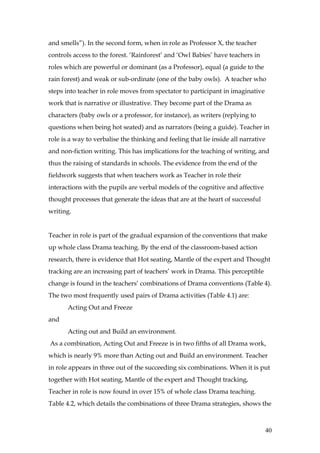
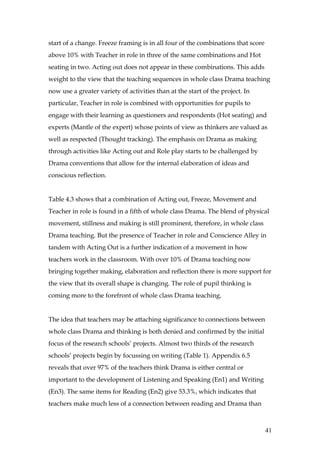
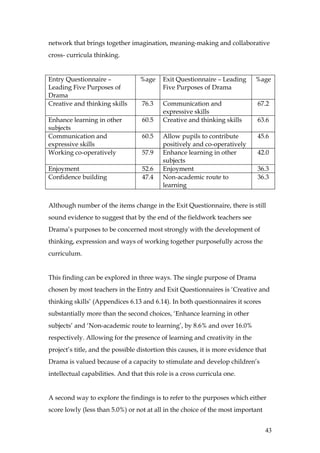
In the following diagram the Entry Questionnaire returns have ‘Creative and
thinking skills’ as over 15% more than the following two purposes, ‘Enhance
learning in other subjects’ and ‘Communication and expressive skills.’ With
‘Working co-operatively’ less than 3% behind them it implies that - at the start
of ‘Drama for Learning and Creativity’ - teachers see Drama in terms of a


                                                                                42
network that brings together imagination, meaning-making and collaborative
cross- curricula thinking.


Entry Questionnaire –             %age     Exit Questionnaire – Leading      %age
Leading Five Purposes of                   Five Purposes of Drama
Drama
Creative and thinking skills       76.3    Communication and                  67.2
                                           expressive skills
Enhance learning in other          60.5    Creative and thinking skills       63.6
subjects
Communication and                  60.5    Allow pupils to contribute         45.6
expressive skills                          positively and co-operatively
Working co-operatively             57.9    Enhance learning in other          42.0
                                           subjects
Enjoyment                          52.6    Enjoyment                          36.3
Confidence building                47.4    Non-academic route to              36.3
                                           learning


Although number of the items change in the Exit Questionnaire, there is still
sound evidence to suggest that by the end of the fieldwork teachers see
Drama’s purposes to be concerned most strongly with the development of
thinking, expression and ways of working together purposefully across the
curriculum.


This finding can be explored in three ways. The single purpose of Drama
chosen by most teachers in the Entry and Exit Questionnaires is ‘Creative and
thinking skills’ (Appendices 6.13 and 6.14). In both questionnaires it scores
substantially more than the second choices, ‘Enhance learning in other
subjects’ and ‘Non-academic route to learning’, by 8.6% and over 16.0%
respectively. Allowing for the presence of learning and creativity in the
project’s title, and the possible distortion this causes, it is more evidence that
Drama is valued because of a capacity to stimulate and develop children’s
intellectual capabilities. And that this role is a cross curricula one.


A second way to explore the findings is to refer to the purposes which either
score lowly (less than 5.0%) or not at all in the choice of the most important


                                                                                 43
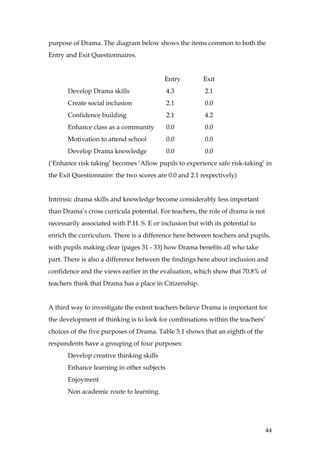
purpose of Drama. The diagram below shows the items common to both the
Entry and Exit Questionnaires.


                                          Entry         Exit
       Develop Drama skills                 4.3          2.1
       Create social inclusion              2.1          0.0
       Confidence building                  2.1          4.2
       Enhance class as a community         0.0          0.0
       Motivation to attend school          0.0          0.0
       Develop Drama knowledge              0.0          0.0
(‘Enhance risk taking’ becomes ‘Allow pupils to experience safe risk-taking’ in
the Exit Questionnaire: the two scores are 0.0 and 2.1 respectively)


Intrinsic drama skills and knowledge become considerably less important
than Drama’s cross curricula potential. For teachers, the role of drama is not
necessarily associated with P.H. S. E or inclusion but with its potential to
enrich the curriculum. There is a difference here between teachers and pupils,
with pupils making clear (pages 31 - 33) how Drama benefits all who take
part. There is also a difference between the findings here about inclusion and
confidence and the views earlier in the evaluation, which show that 70.8% of
teachers think that Drama has a place in Citizenship.


A third way to investigate the extent teachers believe Drama is important for
the development of thinking is to look for combinations within the teachers’
choices of the five purposes of Drama. Table 5.1 shows that an eighth of the
respondents have a grouping of four purposes:
       Develop creative thinking skills
       Enhance learning in other subjects
       Enjoyment
       Non academic route to learning.


                                                                                 44
Just over 10% of respondents have the following two groupings of four
purposes:
       Develop communication and expressive skills
       Develop creative thinking skills
       Enjoyment
       Non academic route to learning
and:
       Allow pupils to contribute positively and co-operatively
       Develop communication and expressive skills
       Develop creative thinking skills
       Non academic route to learning
These three groupings are a cluster of thinking, communication and
expressive skills dominate teachers’ views of the principal purposes for
Drama. Two items, ‘Develop creative thinking skills’ and ‘Develop
communication and expressive skills’ appear in three quarters of the
groupings of three purposes of Drama (Table 5.3). The quantitative data
indicates that, for teachers, a combination of creative thinking,
communication and expressive skills are now the most important purposes of
Drama.


How far teachers believe Drama is associated with thinking is clarified further
in Appendices 6.14 and 6.15. These rank the teachers’ choices of the most
important engagements in a Drama activity. Appendix 6.14 shows the five
choices of engagements. The first five in rank order bring together purposeful
thinking, forming their own questions and generating ideas. The presence of
these as a cluster, together with the choice of purposeful thinking as the most
important engagement, is an example of the extent teachers value Drama
because of its potential to help children become thinkers. Purposeful thinking
is the highest scoring individual engagement (Appendix 6.15); it is chosen by
nearly a quarter of the respondents, with empathy as the second choice and
scoring 19.5%, or nearly a fifth. These two engagements score nearly half as


                                                                               45
much again as the next grouping of engagements. Collaboration, forming
their own questions and generating ideas are chosen by only just over a tenth
of the respondents.


Three school based projects illustrate the impact of whole class Drama on
learning and creative outcomes. They are another perspective on the
quantitative findings about teachers’ ideas about the connections between
whole class Drama and thinking. The projects show teachers making
relationships between the development of thinking, expression and ways of
collaborative working. There is extended use of whole class Drama as a cross
curricula means to stimulate and develop children’s intellectual capabilities.
Pupils participate in teaching and learning that fosters purposeful thinking,
empathy, collaboration and the generation and formation of ideas.


At the same time, the projects are evidence of how differently three teachers
work with the idea of purposeful thinking in whole class Drama. Each is
distinctive: one shows how mathematical thinking within Drama benefit each
other; a second looks at speculation and hypotheses making in a Reception
class and a third generates affective response to non fiction. All three are
matched against the QCA Creativity Criteria (see Tables 6, 7 and 8) to show
that ‘Drama for Learning and Creativity’ meets these criteria as stipulated in
the Bid Specification and the ‘Drama for Learning and Creativity’ Success
Criteria (Appendix 2).


The projects also demonstrate the significance of a developed, imagined
context for whole class Drama. In each project the sense of setting is integral
to the Drama: place is realised as part of the thinking, expression and working
together that propel the whole class activities. To adapt Heathcote’s terms,
[1980] the foreground of the intellectual and emotional engagement that is the
whole class Drama has a realised sense of life background without which pupil
engagement fails.


                                                                                  46
The first project is Planet Perfecton. Mathematical thinking is integral to a
whole class Drama which is set on an imagined planet. Table 6 shows pupils
and their teacher as they move in role between the five QCA Creativity
Criteria. Episodes 1 and 2 encourage pupils to continually refocus and refine
their ideas before the mathematical thinking introduces a detailed discussion
of the planet’s ecology. The four episodes show that, in this project, the
Creativity Criteria are not a sequence or hierarchy. The process of creativity is
a flux: in role work sees children continuously revise their ideas as they share
and recognise different opinions in structured, collaborative group work. The
pupils’ thinking collects and questions ideas. They gather and marshal
thoughts to connect what is emerging with what is known. The internal
sorting and manipulation is an example of purposeful thinking in which
pupils search for explanations, reasons and justifications as opposed to a
single answer. It is thinking that helps them begin to gain access to the
underlying principles of their arguments.


In a second sequence of lessons from Planet Perfecton (Table 6, Lesson 2)
mathematical thinking enables children to visualise one of the planet’s
creatures. After seeing some footprints, “taking photos, swabs and samples in
role” and feeding back to the class – all done in role – the children receive
information in the form of a ratio. This gives them a way to assess the
animal’s height. Staying in role, they return to measure the footprints and
then report back with their calculations. Once the measuring is done, an out
of role discussion leads into an extended sequence of language-based
movement. This creates a whole class sculpture of the wounded animal. The
teacher comments how repetition of:
        “weak, weak, weak acted as a pulse…. cold sounded like
        chattering teeth…anxious was a shusshing sound like blood
        pumping and … agony formed a moan.”


                                                                                47
In her diary the teacher records how one pupil comments, “This is amazing.
It’s like we’re inside its mind.” In Heathcote’s terms [1980], mathematical
thinking provides background that enables the foreground of the planet to be
sharpened in the children’s imagination. Ratio, calculation and measurement
are necessary to the children’s envisioning of Perfecton. Numerical thinking
intertwines with the verbal and physical to create a context in which thought
and feeling are equal. The substance of the planet, and thus the children’s
engagement, comes from all areas of human thinking and not solely the
verbal.


Planet Perfecton illustrates the potential of whole class Drama to produce
creative outcomes through cognitive and affective learning which merges
verbal with numerical thinking. In this example, purposeful thinking
includes measurement, calculation, movement and the emotive response to
and use of language. A realisation of the animal’s shape and size is how the
children come to share the wounded animal’s perspective (“It’s like we’re
inside its mind”). As the narrative continues, the children’s thinking
addresses successive problems through a mixture of the physical and mental.
They collaborate in different ways of thinking to generate ideas and feelings,
including a sense of implications. The continuous re-shaping of their ideas
and feelings develops the children as thinkers. They communicate in as well
as out of role, expressing themselves across a spectrum of different medium
in a way that allows extensive collaborative working.


In Planet Perfecton, whole class Drama makes a narrative in which
mathematical thinking is inseparable from the explanation, justification and
prediction that underpin the work. It depends on a collaborative approach to
learning. At one point in her diary the teacher writes:
          “…the class are, although well-behaved and essentially
          polite, very poor at listening to others. They all want to be
          heard (or most of them anyway).”


                                                                               48
The issue of listening helps her decide to have labelled pebbles in jars, with
each group having one jar. Whoever’s pebble is drawn leads the current
“working party.” As well as making the pupils aware of “the convention of
addressing the chair and canvassing opinion” which they need for the
forthcoming School’s Council, the pebbles also give the children different
status roles in the missions. They have to lead and be led. The teacher
records:
           “’But we have no voice now.’ [When their leader was out of
           the room. There was a palpable sense of frustration at this
           but not a negative feeling, more one of (the) value of their
           leader when he/she returned.]”
On a further occasion she notes:
           “Shall I speak for you?” - on spotting that group had lost
           their leader on a “mission” – another meeting leader sought
           the group’s opinions and was in a position to feed back.”
The pebbles give pupils ways of working collaboratively in which they have
to take on roles of different status. The roles see the pupils coming to
understand deeper responsibilities of leadership (“another meeting leader
sought the group’s opinions and was in a position to feed back”) as well as
the effects of being led (“(“(the) value of their leader when he/she
returned.]”). Whole class Drama allows children to identify, articulate and
assess the implications as well as consequences of successful collaboration.
Purposeful thinking includes children learning about how they learn
collaboratively, which is an important but often unrecognised contribution to
their knowledge of themselves as learners.
A consultant writes in her journal about the impact on the teacher of action
research in whole class Drama. The consultant describes what happens to the
teacher’s thinking when she combines Maths and Drama:
           “Whereas the teacher had set out to explore how Maths and
           Drama could be brought together through the use of a
           problem-solving pedagogy, she found herself working


                                                                                 49
across the curriculum and valuing the potency of this cross
         curricula approach. Drama was serving as a link between
         literacy and numeracy, enriching both areas, and developing
         children’s thinking, social and communication skills.”
The teacher allows learning to lead the action research. The original plan is to
connect Maths and Drama through “a problem-solving pedagogy.” It initiates
cross curricula work which blends literacy and numeracy in a way that
deepens the children’s learning (“enriching both areas”). At the same time it
extends children’s capacity as thinkers and increases their “social and
communication skills.”


The teacher’s view of Drama and Maths change as her action research
continues (“she found herself working across the curriculum and valuing the
potency of this cross curricula approach”). She begins to transform her ideas
about subject boundaries as she works with Drama on action research that
brings together two subjects, Drama and Maths, which are not often
connected. It is an instance of how ‘Drama for Learning and Creativity’
research teachers work in an almost subconscious way with the QCA
Creativity criteria. In this example, a teacher questions and explores (“found
herself working across the curriculum”), makes connections and sees
relationships (“explore how Maths and Drama could be brought together
through the use of a problem-solving pedagogy”). The research seminars
encourage critical reflection that challenge as well as extend their ideas about
the curriculum. The action research undertaken for ‘Drama for Learning and
Creativity’ is a scaffold for the teacher. It helps her to think how the
combination of Drama with subjects like Mathematics takes much further her
own interpretations of creativity.


Owl Babies is a literacy-centred project in a Reception class. The shared
reading of the book up to the point where Mummy Owl disappears is the
start of their whole class Drama activities. Through the Drama, the pupils


                                                                              50
build an internalised alternative text as a basis for writing in role. The Drama
centres on speculative thinking: the children predict what might happen by
looking back at what has happened. In talk groups their speculations and
hypotheses are a framework for discussions about their own and others’
readings of Owl Babies. The teacher writes about another concern. She
comments how she is not convinced that the class:
         “…had developed their speaking and listening skills to the
         extent where they could build on each others’ ideas
         creatively.”
As with Planet Perfecton, collaboration is important. In this project
collaboration is thought to be part of the children’s thinking and listening
development, with the inter-change of imaginative ideas (“build on each
others’ ideas creatively”) seen as essential for their progress as writers.


Table 7 is the sequence for the Owl Babies work. In the Drama the focus is
speculation about the fate of Mummy Owl. The pupils’ thinking is supported
by extended work on the setting. There is whole class movement and stillness
to establish an imagined place in which children can locate the characters
with precision. Verbal language and movement combine to create a mental
space for their hypotheses about what might be happening to Mummy Owl.
At the start of Lessons One and Two the children freeze to “form the shape of
a tree with one point of contact with the nearest person.” Next, the children
hot seat the teachers, who are in role as the three baby owls Sarah, Percy and
Bill. Physical whole class Drama creates a setting; Hot seating places them in
role within the setting. The foreground of the search for Mummy Owl works
with a background that the children experience and realise imaginatively
through movement.


The questioning, challenging and exploring of ideas about Mummy Owl
keeps the book open and starts the pupils’ hypotheses making. Their talk
groups then “gave more children a chance to give an opinion and to build on


                                                                                51
each others’ thoughts.” The inter-change of ideas is how they test their
hypotheses. This leads into:
         “… electing a group to walk through the wood. This will
        give the children the idea of the setting when it comes to
        searching the wood.”
The children carry the setting in their minds as they take part in a Decision
alley (an “Opinion Wood,” see Table 7 Lesson 2). In role they voice their
hypotheses and listen to those of others. As trees, the children are
“whispering what might have happened to Mummy Owl”; as police officers
they are “listening to their ideas.” The Decision alley makes the children
bring their hypotheses about Mummy Owl to a point. The teacher records
how:
        “…by the time the children came to draw the wood they had
        been in it, saw it, described it and heard other children’s
        descriptions of it.”
Later, when the children draw the wood, the teacher writes:
        “…the images are powerful and striking in that unusually
        for this age group they do not contain characters in the
        setting. T’s picture almost exactly matches ‘The tall trees were
        scary. They were like spiky monsters.’
The forest is alive for T. The purposeful thinking creates a foreground and
background that enable him to visualise the setting verbally and in drawing.
The forest is where, in role, he tests his hypotheses about what happens to
Mummy Owl. Afterwards, out of role, collective talk encourages him to
speculate in a reasoned way. He builds and shares possible alternatives that
come out of what he knows, thinks he knows and would like to know about
Mummy Owl. The speculative thinking that encourages his hypotheses
testing and revision draws him further into the book world, where he
pursues his ideas through movement, stillness, and being in role. When he
writes and draws he is inside the forest and inside one of the baby owls.


                                                                                52
In Lessons One and Two, the pupils’ collaborative talk is part of a transition
from Drama to scribed writing. In the first lesson the pupils discuss what the
baby owls would say to each other, make still pictures of them and then write
speech bubbles of what they think Sarah, Percy and Bill say. The teacher
records the impact on the children’s language of this prolonged work on the
setting. They begin to show an understanding of how to express reasons:
           Pupil A
           “Bill’s important because he’s the baby and babies need
           looking after.”
           Pupil B
           “Sarah is important because she did the looking after, she’s
           the oldest next to Mum and was the biggest.”
The speculations that pupils try out, elaborate and refine are formed
gradually into hypotheses about Mummy Owl. Pupil A connects reasons;
“because he’s the baby” and “babies need looking after”express cause and
effect that bring together knowledge of the book with her/his knowledge of
the world.


Pupil B does the same but also elaborates their reasons. The first reason
(“because she did the looking after”) connects with the second (“she’s the
oldest next to Mum and was the biggest”). There is a chain of reasoning as the
first and second reasons leads to the third (“and was the biggest”). The first
reasons is supported by a second and then joined to the third (“was the
biggest”) by a conjunction - “and”- that suggests that they have equality for
the pupil. The making and testing of hypotheses enable Reception class
pupils to produce language which contain purposeful thinking that shows an
understanding of cause and effect and how to build up a chain of equal
reasons.


The writing the pupils produce leads this teacher to include the following
from one pupil in her log:


                                                                                 53
“’IWonMIMUMNoM IWonMuM Rire. Ples’
        He read it back in role as ‘I want my mum. I want my mum.
        Really. Please.
        This is the first piece of writing that he had done
        independently, both in the thinking and the writing. He was
        very keen to say what he thought and it was the first time
        that I have observed him settle on task at the same time as
        the other children.”
The ‘Owl Babies’ classroom-based research indicates the potential for writing
of whole class Drama. T’s exposure to Drama, which requires him to be in
role in a setting he visualises, engages him intellectually and emotionally in
the lives of the baby owls. In his imagination he carries a character within a
place. When he writes he moves beyond making marks on the page to become
a meaning maker who draws on the setting he sees and his feelings for the
baby owls, verbally and in writing. The whole class Drama pushes forward
this child’s intellectual capabilities through participation in purposeful
thinking. His reasoned speculations embrace empathy, collaboration and the
formation and generation of ideas. When he writes, T is a writer who thinks
and feels as he experiences the need to communicate meaning.


Table 8 and Appendix 7 are from a cross-curricula project called Rainforest. It
integrates Geography with Drama and is an instance of how purposeful
thinking generates an affective response to non-fiction. An introductory
video leads into whole class Drama where the teachers create a setting. They
take the children “on an expedition (through) the rainforest” in which they
“explore and feedback on sights and smells etc.” Like Planet Perfecton and
Owl Babies, a visualised, imaginary setting becomes more than a background
for the Drama. There is a joining of the intellectual and emotional through a
closely observed environment.


The children have a reason to research information about rainforests:


                                                                                 54
“The children were told by Professor X (teacher in role) that
        they were not allowed back to the rainforest without some
        facts to share.”
The background is given the status of foreground: the information collected
by pupils is to be shared by everyone to develop the setting. From the
beginning there is collaborative, purposeful thinking. Their “facts” are to
become part of a multi sensory foreground in which the internal collection,
sorting and preparation of ideas continues mentally and physically.


The whole class Drama continues with Hot-seating:
        “…plants, creatures and tribal people [teacher in role first]
        and then the children became living things in the forest and
        they were hot seated.”
Hot seating includes questioning, challenging and becoming “living things in
the forest.” Through their roles, the pupils make connections with previous
learning and step outside themselves to compare and contrast others’ lives
with their own. In these episodes the teacher moves the children through the
QCA Creativity criteria in a manner that confirms that in whole class Drama
they can be neither a sequence nor a hierarchy. For example, there is a cyclical
inter-relationship between the exploration of ideas and making connections
throughout the ‘Rainforest’ activities.


The teacher writes:

        “The drama techniques really involved the children in the
        topic because they were there in the rainforest. They had a
        reason to research facts because their interest had been
        captured and they knew they couldn’t go back to the
        rainforest without more facts.”

The pupils’ emotional engagement (“they were there in the rainforest”) is the
cognitive basis for questioning, challenging and exploring. The cognitive and
affective demands are a mixture of the sensory, physical and intellectual


                                                                              55
(“brushing past people and whispering in their ears,” “think for themselves”
and “they had to think on their feet to ask questions and when questions were
fired at them”) in which the five specified criteria for creativity are all in
evidence. The multi-sensory movement that underpins this teaching episode
harnesses the cognitive and affective to take children out of themselves. As it
does so it broadens their intellectual and emotional horizons.


The Rainforest project illustrates how whole class Drama develops specific
subject knowledge through a strong identification with issues:
         “The children really felt the loss. You can try to make the
         children understand the impact humans have had on the
         rainforests through books, discussion and video but the
         drama put them into the situation.”
The learning means something to the children. The Drama “put them into the
situation” and helps them towards a deeper understanding than one based on
more traditional curriculum approaches. Similarly, pupils who take part in a
History activity write about how Drama helps them learn.
         “It helps me remember instead of just writing about it. Also
         it is fun”
         “It feels like you’re at that time”
         “It puts me in their shoes so I know how that feels”
Two things happen. The Drama positions pupils within the emotional life of
another (“It puts me in their shoes so I know how that feels”). They are in the
moment of another time (“It feels like you’re at that time”). A teacher writes
how in Drama pupils:
         “…become totally focussed and engrossed and really believe
         in the situation – remember the activities – can relate
         incidents many weeks later! Many children go on to do their
         own research. Encourages empathy and awareness of
         situations they would never experience.”


                                                                                 56
The creation of another world which requires a suspension of belief as well as
emotional attachment is seen to be a valuable learning experience. It takes
children beyond their horizons (“awareness of situations they would never
experience”), motivates them to become independent learners (“Many
children go on to do their own research”) and improves their ability to
accurately recall their involvement (“can relate incidents many weeks later!”).


In the Rainforest and History examples the cognitive and affective are
inseparable partners in children’s purposeful thinking. As a result, they
become engrossed with their work at a deep cognitive and affective level that
enables them to recall significant learning on future occasions. There is a
sustained emotional engagement with learning. It results in children retaining
more of the content of a topic. Simultaneously, they are willing to be more
connected - as well as involved - with their learning on a personal level.
Furthermore the Rainforest and History examples are evidence of how whole
class Drama encourages and values creative outcomes that that are held
within the individual and are not just for presentation in external, assessable
forms.


The shared characteristics of Planet Perfecton, Owl Babies and Rainforest
confirm the quantitative finding that teachers attach considerable importance
to purposeful thinking (including the formation and generation of ideas),
empathy and collaboration. They show the contribution made to whole class
Drama by a carefully thought out setting in which the foreground and
background work together.


The three action research projects are different perspectives on purposeful
thinking. The mathematical thinking in Planet Perfecton is embedded in the
setting: ratio, calculation and measurement blend with movement and the
emotive use of language to encourage the pupils’ poetry writing. The
formation and generation of ideas is cognitive and affective. Numerical and


                                                                              57
verbal thinking are not separate but seen as co-dependent in the whole class
Drama. As a result, the poetry comes from the wholeness of the pupils’
thinking, and not the verbal or the numerical separately. In Owl Babies the
pupils’ informed speculations into what may or may not be happening to
Mummy Owl involves making and testing hypotheses. All this takes place
within an imaginary forest which the pupils explore collaboratively. Their
ideas become reasons which have the accuracy and power to explain where
Mummy Owl is. Their cognitive and affective engagement with character and
setting enables them to step simultaneously into the forest and the life of the
three baby owls.


The Rainforest example is different again. A setting places the pupils inside a
contemporary environmental issue. Video and information resources support
whole class Drama in which emotional engagement (“they were there in the
rainforest”) is brought about by a combination of the sensory, physical and
intellectual. The setting is the issue: emotional attachment to the setting gives
strength to the pupils’ cognitive questioning, challenging and exploring. The
settings for Planet Perfecton, Owl Babies and Rainforest are more than a
backdrop. The inter-dependence of foreground and background is a complex
mental construction with which the pupils engage to adapt and transform
their thoughts and ideas.


A second shared characteristic of the three projects is an explicit commitment
to the affective. The pupils interiorise what it is to inhabit the life of another;
for instance in Rainforest to step into another’s shoes covers human, animal
and plant life. In Owl Babies it is the separation of baby birds from their
mother. Through their roles, the pupils make connections with previous
learning and step outside themselves to compare and contrast others’ lives
with their own. In Planet Perfecton, the pupils experience roles of different
status. They interiorise what it is to lead and be led; the whole class Drama
creates the opportunity for the pupils to be on the affective ‘inside’ of at least


                                                                                  58
two different perspectives. In Bruner’s terms [1960], the reflection that forms
part of the collaboration on Planet Perfecton enables pupils to turn round and
tell themselves what they know about a number of perspectives, each with its
own uniqueness. There is not a final answer. In all three projects, the pupils’
emotional engagement involves personal interpretations of issues, ideas and
characters. The projects bring out the value of and need for pupils to compare
and contrast the fullness of a lived moment from both their and other peoples’
world views. Whole class Drama has an impact on cross curricula learning
and creative outcomes through making every child feel their voice is part of
the issues which are brought out by communal, shared work.


There is extensive qualitative and quantitative evidence that ‘Drama for
Learning and Creativity’ is influencing learning and creative outcomes in
schools. Whole class Drama is now in use in 20% more of the curriculum than
at the start of the fieldwork. There is evidence from schools to show that
Literacy, Citizenship, History, Geography, Dance/P.E. and the Visual Arts
now include Drama as a recognised teaching methodology. The involvement
of Maths and Science in Drama remains low, suggesting that the project has
had far less an impact on approaches to mathematical and scientific thinking.
A similar figure for I.C.T. suggests that teachers’ perceptions of creativity do
not, as yet, extend to include the bringing together of I.C.T. and Drama.


On average, schools surveyed now spend over 20% more time teaching
through whole class Drama compared with the start of the fieldwork. Over
one third of schools now use Drama explicitly for more than an hour a week.
This figure has to be read in conjunction with the rise in the curriculum areas
where Drama is used and the extension in the range of Drama conventions
which teachers use in order to gain an understanding of the change in
classroom practice. Pupils now have far more regular cross curricula
opportunities to speculate, stand in another person’s shoes and take an active
as well as reflective part in imaginary experience.


                                                                                  59
This rise in the chance for pupils to take part in whole class Drama occurs at a
moment when there is a shift in what teachers see as the purposes of Drama.
At the start of ‘Drama for Learning and Creativity’ teachers see Drama in
terms of a network that brings together imagination, meaning-making,
collaborative cross-curricula thinking. The Drama activities that support this
emphasis feature Drama as making through acting out, role play and freeze
frame. By the finish of the fieldwork two changes are taking place. First,
teachers begin to see whole class Drama as a means to foster pupils’ thinking
and develop expression through collaborative, purposeful work. Second, the
more widespread use of an increasing number of conventions like Teacher in
role and Hot seating encourages the internal sorting and elaboration of ideas
as well as conscious reflection.


The three action research projects make clear the two-fold movement in
whole-class Drama teaching. They also show the diversity of approaches in
the research schools as a whole. The mathematics-based project Planet
Perfecton uses in role work based on an imaginary planet. It helps children to
see the importance of the continual adaptation of ideas when they are
involved in the sharing and recognising of different opinions. Here,
structured, collaborative group work enables pupils to gather and marshal
what is emerging with what is known. For this teacher, purposeful thinking
involves pupils in the shared search for explanations, reasons and
justifications and not the one answer.


The Rainforest project is an example of whole class Drama that develops
subject knowledge through a strong identification with the issues that
surround an environmental topic. Thinking has a multi-sensory dimension:
movement is a way to bring together the cognitive and affective to take
children beyond their immediate selves. To place them so clearly and
evocatively in another place broadens their intellectual and emotional


                                                                              60
horizons. This project highlights the necessary role of the affective in thinking.
Emotional involvement helps pupils to retain more of a topic’s underlying
ideas for use in the future, something that has a bearing for pupil
performance in standardised tests and examinations.


In common with Planet Perfecton and Rainforest, Teacher in role is a basis for
the Owl Babies project. Like them it also features collaborative work. The
whole class Drama stretches the pupils’ intellectual capabilities as they
speculate about the fate of Mummy Owl. Such reasoning involves empathy,
collaboration and the generation of ideas. The regular exchange of ideas is
viewed as essential to becoming a writer who thinks and feels that they have
a genuine need to communicate meaning.


The evidence points to ‘Drama for Learning and Creativity’ having a
significant effect on whole class Drama teaching. As teachers gain confidence
in their abilities they begin to explore a broader range of Drama conventions
with their classes and spend longer each week working with Drama. One
result of the increase in time and curriculum expertise is a perceptible move
in teachers’ ideas about Drama. They now see it to be important for the
development of pupils’ cognitive and affective thinking.


Publications


Between the start of the project and now several publications have come out
of the project. Although the time-scale is demanding, the following have been
achieved. This is a further example of how the project is meeting its stated
intentions and justifying its financial support:


In November 2005, The Times Educational Supplement runs a full-page
feature.


                                                                                61
The NESTA web site hosts a section that covers ‘Drama for Learning and
Creativity’. The National Drama web site also has an active link to the project
and the QCA web site for English 21 Playback shows it supports the project
and is interested in its findings. All these came into place in January 2006.


A seminar at the National Drama Conference in April 2006 attracts a large
audience from both Great Britain and abroad. The professional journal of
National Drama is to run an issue in which the project is to feature
prominently.


A research paper is to be presented to an international Arts and Creativity
conference to be held in Paris in January 2007. The status of the conference
can be gauged by the presence of Howard Gardner as a key note speaker.
Education officers from European Union government, along with senior
academics from major European universities are attending. Further research
seminars in the United Kingdom are anticipated, with one already confirmed
for November at the University of Brighton, School of Education.


A CD ROM and accompanying teacher resource materials, including ideas for
lessons and longer projects is near completion as this evaluation is written.


Moving On


The ways in which ‘Drama for Learning and Creativity’ meets the criteria in
the Bid Document are listed in the Foreword on pages two to five.


                                                                                62
This Section also comes out of the evaluation. It has a different purpose as it
puts forward possibilities for future work. They come from the data reviewed
for the preparation of this report and the process of writing it.


1. The project management team should give thought to how to continue to
   work with the research schools during 2006/7 and onwards. For example,
   the possibility of research school teachers themselves setting up their own
   group of schools in a similar way to ‘Drama for Learning and Creativity’ is
   one possibility to help maintain the project’s impetus. This requires a level
   of support from the consultants, something which has cost implications.
   One advantage in its favour is that it represents an opportunity for the
   research school teachers to initiate and manage a small-scale research
   project by and for themselves. This is a potentially valuable part of an
   individual teacher’s as well as a school’s collective continuing professional
   development.


2. To follow on from (1), the project management group should consider
   ways in which teachers in the research schools can receive credits for ‘M’
   level or other professional qualifications for their work on ‘Drama for
   Learning and Creativity.’ There is a level of expertise that may be lost if it
   is not seen to be valued as part of the teachers’ continuing professional
   development. One step would be the creation of a nationally recognised
   qualification in Drama. Teachers could produce portfolios of evidence
   which demonstrate their classroom practice and its theoretical
   underpinnings.


3. As part of their own development, the project management group need to
   reflect on how and why action research works in the ways it does in
   ‘Drama for Learning and Creativity.’ There is evidence within the data to
   suggest that the inter-connection between teachers working on their own
   research question (and not on an imposed or centrally agreed one), a


                                                                                  63
planned consultant’s role and the shared review with a teacher (backed up
   with high-quality seminars which reflect critically on the action research)
   has implications for future patterns of continuing professional
   development.


      This is especially relevant if the project’s dissemination stage is to work
      with the educational infrastructure, including literacy consultants,
      members of subject associations and bodies connected with school
      management and leadership. A study programme, that includes
      extracts from the CD ROM and materials from the action research,
      would be a basis that would have relevance for a much larger
      audience. In turn, this has the scope to be expanded to cover North
      America and Australia, where Drama already has a place in the school
      curriculum.


4. Points 2 and 3 are an argument for a broader examination, probably at
   national level, of what is needed to make sure that teachers across the
   curriculum have the knowledge and skills to implement whole class
   Drama teaching. Within this are two further issues for Drama.


      First, Drama may need a more prominent place in initial teacher
      education. As one teacher writes:
          “If drama does have a significant impact on children’s learning and
         creativity should it be highlighted as a specific area for teacher
         training??”
      Second, local authority courses remain significant for maintaining and
      enhancing the skill levels of the teaching profession and retaining the
      sense of enthusiasm that is necessary for successful Drama teaching.
      For example, the data from this evaluation suggests that there is an
      evident need for the current year-long course in the sponsoring local


                                                                              64
authority to be taken further and validated by an awarding body such
       as a university or professional association.


5. Allied to 4 (above) is the question of confidence. The project is very
   successful in raising teachers’ confidence to work with whole class Drama.
   But this has to be put into perspective. One primary teacher writes:
           “Having gained confidence with the Drama course and
          the D4LC project I felt I wanted to give this a go and
          prepared a skeleton of three sessions with a view to being
          quite flexible as to where it would go. I adopted a planning
          grid, which I found useful in that it reminded me of the
          different drama conventions at the start. I was a little
          uneasy about this set of lessons as I knew that the children
          would [and was half prepared for it] move the Drama on
          in a different direction that they chose and I felt insecure
          about letting go.”
       The training, action research methodology and support for ‘Drama for
       Learning and Creativity’ both motivate this teacher (“I felt I wanted to
       give this a go”) and give her the confidence to teach Drama. There are
       two things that worry her. There is a possibility that the children and
       their learning would lead the lesson, not her plan (“the children would
       [and was half prepared for it] move the Drama on in a different
       direction”). The feeling that goes with this is unsettling (“I felt insecure
       about letting go”). The teacher’s concerns highlight that an essential
       part of teaching Drama is a willingness to accept that the lesson may go
       beyond a teacher’s plan. It is something for further investigation.
       Feeling confident, being well-prepared and supported by a research
       project may not be enough by themselves for teachers. In Appendix 7,
       a teacher comments how “Some still do not feel confident using drama
       and feel that children may be wary of it too.” If a teacher is not
       confident in teaching Drama then the pupils, too, are not confident or


                                                                                 65
secure. Learning more about teachers’ thoughts and feelings about the
      confidence to take risks, work with the unexpected and value what
      happens - and how this compares and contrasts with their experiences
      of teaching other subjects - may help to clarify why Drama is thought
      to be so demanding and, for a minority of the teachers in this survey,
      something that is extremely difficult to teach.


6. A number of factors beyond the immediate scope of this evaluation may
   be relevant to the I.C.T. return reported in Section 6. Turkel [1998] argues
   that the original 1980s conception of I.C.T. in schools is as a
   mathematically-oriented way of thinking. This legacy may still influence
   teachers, particularly those whose careers embrace both before and after
   the emergence of new technologies. A second influence, and which may be
   related to the first, is the Curriculum 2000 Programme of Study for Key
   Stages 1 and 2 in I.C.T. During Key Stage 2 [DfEE 1999: 100]:
          “…pupils use a wider range of ICT tools and information
          sources to support their work in other subjects. They
          develop their research skills and decide what information
          is appropriate for their work. They begin to question the
          plausibility and quality of information.”
      The National Curriculum offers an information-based view of I.C.T. It
      might be that teachers’ conceptions of creativity in Drama are
      incompatible with their conception of creativity in I.C.T. Any
      difference in their expectations for Drama and I.C.T may reduce the
      possibilities for their creative integration in the classroom. This is an
      important point. With the QCA mapping future curriculum
      possibilities which are based less on subjects and more on finding the
      common ground between ways of thinking, there is a need to identify
      reasons for this perceived difference between I.C.T. and Drama. The
      aim would be to find ways in which they can be brought together to
      benefit the whole curriculum.


                                                                                  66
Similar comments are applicable to Mathematics and Science. The
      findings from the surveys point to gaps similar to that found between
      I.C.T. and Drama. The exception of a project like Planet Perfecton
      shows the possibilities for relationships between mathematical and
      scientific thinking and the thinking that is part of whole class Drama.


7. ‘Drama for Learning and Creativity’ is evidence for further work into
   whole class teaching. One line of thinking about the National Literacy
   Strategy is that teachers have become “very successful in making their
   literacy teaching more interactive” since its inception [English et al 2002:
   22]. However, although it “increases the rate of pupil contributions” it
   reduces the opportunities for extended interactions; a “rapid pace of
   interaction does not engender cognitive advance” [English et al 2002: 24].
   There are fewer opportunities for pupils to question or explore ideas as
   teachers show little variation in their discourse style [Mroz et al 2000].
   Hardman et al [2003: 212] argue there is “an increase of whole class
   teaching which is dominated by teacher-led recitation.”


      The findings of this project suggest the contrary. They show that
      cognitive advance is made through whole class teaching and that
      pupils have opportunities to question as well as explore ideas. Two
      features of whole class Drama teaching are relevant here. The first is
      Teacher in role. There is little work on the discourse of teachers who
      are in role in whole class Drama. A comparison and contrast between
      teacher discourses in teaching episodes in a literacy lesson (for
      example, whole class shared text work and guided reading or writing,
      for example) and a whole class Drama lesson with Teacher in role is an
      example of a research area which would take further understanding
      both literacy and Drama teaching.


                                                                                  67
A second feature for exploration is the sequence of activities in whole
       class Drama teaching episodes. Freeze – pupils in role - Hot seating is
       an example of a combination of three strategies which is found within
       ‘Drama for Learning and Creativity,’ and in schools more generally.
       The question is whether certain combinations of Drama activities,
       rather than others, are more likely to lead to improvement in writing.
       Barrs [2000] uses t unit analysis to measure improvement following
       Drama that came out of reading polysemic texts. This is one of the few
       systematic, classroom-based studies which acknowledges and
       demonstrates the role of Drama. But there is a gap in the research into
       writing. Drama is often assumed to lead to rising standards of
       performance. The action research projects in ‘Drama for Learning and
       Creativity’ offer further evidence that Drama does improve writing
       and further investigation into Drama strategies, supported by t unit
       analysis, is a way to see if measurable improvement in writing can be
       attributed to particular Drama conventions.


Bibliography


Ackroyd J, 2004, Role Reconsidered: A re-evaluation of the relationship between
teacher in role and acting, Stoke on Trent, Trentham Books
Barrs M and Cork V, 2000, The Reader in the Writer, London, C.L.P.E.
Bruner J, 1960, The Process of Education (first edition), Cambridge,
Massachusetts, Harvard University Press


                                                                                  68
Cohen L and Mannion L, 2002, Research Methods in Education (Third edition),
Routledge, London
DfEE, 1999, The National Curriculum: Handbook for primary teachers in England
London DfEE/QCA
DfES, 2005, Every Child Matters, London, DfES
Dick A, Accessed July 29th 2006, Your action research project,
http: //www.scu.edu.au/schools
English E, Hargreaves L and Hislam J, 2002, ‘Pedagogical Dilemmas in the
National Literacy Strategy: primary teachers’ perceptions, reflections and
classroom behaviour’, Cambridge Journal of Education, Vol 32, No 1
Hammersley M and Atkinson P, 1995, Ethnography: Principles in Practice,
London, Routledge
Hardman F, Smith F and Wall K, 2003, ‘Interactive Whole Class Teaching in
the National Literacy Strategy’, Cambridge Journal of Education, Vol 33, No 2
Heathcote D, 1980, Drama as Context, Huddersfield, NATE
McKeganey N and Barnard 1996 M, 1996, Sex Work on the Streets: Prostitutes
and their Clients, Buckingham, Open University Press
McNiff J, Accessed July 29th 2006, Guide to Action Research,
http://www.jeanmcniff.com/booklet1
Mason J, 1996, Qualitative Researching, London, Sage
Mroz M, Smith F and Hardman F, 2000, ‘The Discourse of the Literacy Hour’,
Cambridge Journal of Education, Vol 30, No 3
NACCE, 1999, All Our Futures: Creativity, Culture and Education, London DfEE
(The Robinson Report)
Neelands J, 1990, Structuring Drama Work, Cambridge, Cambridge University
Press
QCA , 2005, Creativity: Find it; Promote It, London, QCA
Riley J, 1992, Getting the most from your data: A handbook of practical ideas on how
to analyse qualitative data, Bristol, Technical and Educational Services Ltd
Schon D, 1985, Educating the Reflective Practitioner, London, Sage
Silverman D, 1993, Interpreting Qualitative Data, London, Sage


                                                                                  69
Turkel S, 1995, Life on the Screen, London, Orion
Van Maanen J, 1998, Tales of the Field: On Writing Ethnography, Chicago,
University of Chicago Press


Appendices


                                                                           70

D4LC first external valuation - 2005

  • 1.
    ‘Drama for Learningand Creativity’ [September 2005 – July 2006] An evaluation for National Drama, NESTA and Norfolk County Council Dr. D A Simpson (University of Brighton, School of Education)
  • 2.
    Foreword ‘Drama for Learningand Creativity’ has been a learning journey for all the teachers and consultants involved. The success of the project is due to their individual and collective energy. There is a passionate commitment to whole class Drama as a teaching and learning medium throughout the three phases of the fieldwork period. Without exception, there is a determination to move children’s learning forward. The participants recognise that the project also represents a way to improve their own and others’ understanding of what it is to be a teacher in the early part of the twenty-first century. ‘Drama for Learning and Creativity’ ‘Drama for Learning and Creativity’ is successful in meeting the criteria set out in the Bid Document. The findings to support this judgement are presented in the following groups of bullet points. The management of ‘Drama for Learning and Creativity’ • The management and structure of the action research ensures there is a clearly identified, evidence-oriented and manageable core for each of the schools’ projects. It is a very strong feature of the project. Use of funding • The use made of the funds available is entirely appropriate to the demands and needs of a research project. • There is evidence of careful forward planning for the dissemination of the project’s findings. 2
  • 3.
    Research methodology • The research methodology that underpins the school-based action research enables teachers and consultants to collaborate in sustained, thoughtful ways. It sees the teachers assume responsibility for the direction of their fieldwork. There is consistent evidence that this responsibility has a profound effect on the teachers’ thinking about whole class Drama teaching, and its practice in the classroom. • Two related parts of the school-based action research are highly effective. The seminars to bring together teachers and consultants help both parties to realise their roles. They are a major contribution to the excellent working relationships between teachers and consultants. Second, the precise allocation of consultants makes sure that expertise is matched with schools. This deepens the first two school-based phases of the fieldwork. • The teachers’ initial research questions are adapted, discussed with consultants and developed in ways which add depth to the action research. The evidence available shows that one outcome of such deliberation is whole class teaching which stimulates and engages pupils of all ages and abilities. The impact of ‘Drama for Learning and Creativity’ • The entry and exit questionnaires are evidence that an increasing number of schools now use Drama regularly as a methodology. Over 90% of schools surveyed state that Drama is influencing their development plans. Drama is now a significant priority for over half the schools in the survey, an increase of over 15%. • The exit questionnaire shows that all schools in the survey (100%) now have Drama in their improvement plans. 3
  • 4.
    ‘Drama for Learning and Creativity’ influences head-teachers as well as teachers. This suggests that the schools in the survey are developing both the policy and practice of whole class Drama teaching, with over 80% of the primary and middle schools surveyed now having a teacher responsible for Drama. • Over 90% of the teachers surveyed report an increase in their confidence to teach Drama. • The data points to a connection between confidence, knowledge and skill that has implications for the future of Drama teaching, especially at Key Stages One and Two. • The teachers’ journals show that pupils respond positively to what whole class Drama offers them as learners. There is consistent evidence that pupils think that it provides them with opportunities for affective and cognitive engagement with their learning. • By the time of the end of the project over 95% of the teachers surveyed are working with Drama in an increasing number of subjects. • There are equally firm quantitative indicators that the increase in the curriculum areas which feature Drama is matched by a rise in the time allocated on a regular basis to Drama. Over a third of schools now allocate more than an hour a week to Drama. • Teachers now work in the classroom with a significantly increased range of Drama conventions. Teacher in role, Hot seating and Thought tracking are far more evident in teacher’s work. As a result there is a different Drama ‘diet’ emerging which has the potential to broaden significantly children’s learning opportunities. • Drama is now viewed to be a means to develop pupils’ thinking. Teachers associate it with creative thinking, communication and expressive skills. Examples from three projects show that pupils take part in speculation, hypothesis making and testing, searching for reasons and making justifications rather than looking for the ‘right’ 4
  • 5.
    answer. They experiencestanding in another person’s shoes and the exploration of other viewpoints than their own. Publications • The project is meeting its targets of producing high-quality publications directed at a range of audiences. For example, there has been print media coverage in the Times Educational Supplement, a web site became operational in January 2006 and an academic paper is to be presented at a major European conference on creativity. A CD ROM, which has accompanying materials, has been completed. Communication with the management group of ‘Drama for Learning and Creativity’ during the period September 2005 – July 2006 The ease of communication with the project management group means there is no difficulty with gaining access to any material necessary for the three phase evaluations. One result is the availability of a substantial body of data for this report. There are, therefore, quotations from teachers and pupils as well as references from teachers and consultants’ writing in the main body of the report. Regular contact with the project management team not only makes writing the fieldwork’s three phase evaluations easier but it also enables me to act more as a critical friend to the project. This gives me an opportunity to undertake a learning journey too. It encourages me to think about how I see the role and shape of Drama teaching, especially in the light of government proposals for initial teacher education, and the school curriculum more generally. 5
  • 6.
    As with thethree phase evaluations, the writing of this report is actively encouraged and supported by Lorraine Harrison, Head of the School of Education. D A Simpson University of Brighton, School of Education, Falmer, Brighton BN1 9PH ds116@bton.ac.uk 01273 643376 October 2006 6
  • 7.
    Contents Page Foreword 2 Contents 7 Tables and Appendices 8 Introduction - ‘Drama for Learning and Creativity’ 10 Evaluation Methodology 15 Results from ‘Drama for Learning and Creativity’ 22 Moving On 63 Bibliography 69 Appendices 71 7
  • 8.
    Tables and Appendices Tables TableOne The original research questions Table Two The subject areas where Drama is in use by the end of ‘Drama for Learning and Creativity’ Table Three The combinations in teachers’ choices of the five purposes of Drama Table Four Drama conventions in the classroom Table Five Combinations in the teachers’ choices of the five purposes of Drama Table Six Planet Perfecton Table Seven Owl Babies Table Eight Rainforest Appendices Appendix 1 Funding for ‘Drama for Learning and Creativity’ Appendix 2 Success criteria Appendix 3 Evaluation schedule 8
  • 9.
    Appendix 4 Aremore schools now using Drama? Appendix 5 Teacher confidence and Drama teaching Appendix 6 What impact is Drama having on learning and creative outcomes? Appendix 7 Extracts from a research teacher’s diary Appendix 8 Extract from a research teacher’s log 9
  • 10.
    1. Introduction -‘Drama for Learning and Creativity’ Introduction ‘Drama for Learning and Creativity’ is initiated by Norfolk LEA. NESTA provides a major source of financial support. There is assistance on a much smaller scale from the University of Brighton School of Education who fund release from teaching for its evaluation and dissemination. The project investigates the capacity of whole class Drama to initiate, sustain and enhance children’s creativity and learning. It involves 60 schools in Norfolk LEA during the academic year 2005/6, with evaluation and dissemination running from June 2006 to May 2007. At its centre there are 14 schools which are designated as research schools. In these primary, middle and secondary schools, teachers work with consultants on a variety of whole class, teacher-initiated and managed projects. They are designed to stimulate creativity through Drama-based teaching and learning. The project’s structure and organisation ‘Drama for Learning and Creativity’ is a collaborative venture. Teachers and consultants concentrate on how Drama can develop children’s creative capabilities. There is a management group of three, all of whom act as consultants to the schools in the project. It is led by Patrice Baldwin, Advisor for the Arts (Norfolk LEA) and Chair of National Drama, with two consultants, Pam Bowell (Kingston University and a former Chair of National Drama) and Kate Fleming (Drama Consultant and Vice Chair of National Drama). All three are experienced, highly-regarded Drama teachers with substantial classroom backgrounds. All have taken part in small-scale Drama and Arts projects before and are published widely in this field. Advice and support for the project management team comes from the Executive 10
  • 11.
    Committee of NationalDrama, the principal subject organisation for Drama in the United Kingdom. The funding allows for two levels of involvement, an inner group of 14 chosen research schools and an outer looser grouping of over 50 schools (fuller details of the funding and expenditure are in Appendix 1). The inner group is made up of schools from Key Stages One to Four, with pupils from Reception to Year 10 taking part. Both the inner and outer levels of involvement work on investigations into Drama teaching and learning. The first seminar for the inner group of research schools (November 2005) emphasises the collaborative nature of the project. Teachers from the research schools work with the consultants to shape the wording and form of their project. Following the seminar the consultants spend half a day in each school on the research school’s chosen investigation. This takes several patterns. For example, in some schools a consultant leads a teaching session whilst in others the teaching is shared or the consultant joins the Drama in an agreed role. In the period from January to May 2006 the consultants make a second visit to their delegated schools, and both teachers and consultants meet for a further twilight seminar. Throughout the fieldwork teachers and consultants are in regular contact via email, phone and the exchange of longer documents. The outer group, which comprises over 50 more schools, are also visited twice between November 2005 and May 2006. Visits are made by either Patrice Baldwin, a Drama consultant or a local authority advanced skills teacher. Like the inner group, the outer group have two visits and are offered help and advice. However, they do not work to an agreed research question. The project management team meets on a number of occasions. It also meets with the executive of National Drama which enables reports on work in progress, as well as questions about the fieldwork, to be discussed fully with 11
  • 12.
    leading members ofthe Drama subject community. As each phase of the fieldwork finishes, the project evaluator reports on how far and to what extent the project is meeting its targets (see Appendix 2). This sets up a dialogue between the evaluator and project management team that lasts for the length of the fieldwork. Background to ‘Drama for Learning and Creativity’ The project is the first in depth, classroom based Drama research project initiated by a national drama subject association – National Drama – in partnership with a local education authority. The project focuses on the relationships between whole class Drama teaching, creativity and learning. It comes from the project management group’s belief in Drama as something which is highly engaging to pupils. In their view Drama: • Develops pupils’ inter-thinking and learning; • Stimulates creativity through role play and sustained imaginative experience; • Enables visual, auditory and kinaesthetic access, understanding and expression; • Focuses on engaging empathically in ways that combine the cognitive and affective. [Bid Document, Section B4] Drama is seen as an inclusive, multi-faceted agency for the holistic development of children as learners. For the project management team, it is a learning medium that utilises a range of intelligences. They believe these engage all learners in ways which often go beyond the prescribed methods and formal teaching that dominate the current curriculum [Bid Document, Section B4]. 12
  • 13.
    The management team’sview of Drama is in sympathy with ‘All Our Futures,’ the 1999 government report into the Arts. This report provides a definition of creativity which they support and use in their bid application. Creativity [NACCE 1999: 12] is: “Imaginative activity fashioned so as to produce outcomes that are both original and of value.” The management group adopt this definition for two reasons. The local authority’s schools work within a curriculum framework that endorses this report. The ‘Every Child Matters’ policy [DfES 2005] draws on ‘All Our Futures’ and shares its commitment to a creative curriculum in which imaginative enquiry are part of all pupils’ entitlement. ‘All Our Futures’ itself refers to its description of creativity as a democratic one. This is in keeping with two key, related areas of the project, what happens in the classroom and the sharing of ideas between teachers and consultants. The interplay between classroom and discussion - which is led by ideas rather than by either teachers or consultants - is a sharing, supportive one that is part of the approach to the Arts championed by ‘All Our Futures.’ It relies upon equal voices in and out of the classroom. ‘All Our Futures’ goes on to state that creative thinking and behaviour is always imaginative, purposeful, original and valuable. The management group take this further in order to identify what they consider to be the ”features” of drama within a context of creativity and learning [Bid Document, Section B5]. They choose five features of creative thinking and behaviour from the QCA document ’Creativity: Find it, Promote it’ [QCA 2005]. These are: • Questioning and challenging; • Exploring ideas, keeping options open; • Making connections and seeing relationships; • Envisaging what might be; • Reflecting critically on ideas, actions and outcomes. 13
  • 14.
    The five “typesof behaviour” are to be exemplified by the processes and outcomes of the research schools’ projects [Bid Document, Section B5]. The success criteria for ‘Drama for Learning and Creativity’ The success criteria come from the Bid Document. They are arranged under three headings, Classroom Centred, Drama Subject Community and Influence on Government Curriculum Policy (Appendix 2). The QCA Creativity Criteria [QCA 2005] are referred to extensively in Section 3.6. This Section is where the impact of Drama on learning and creative outcomes is analysed in detail. The QCA criteria are assumed to be part of the success criteria. The production of high quality publications is seen as an important contribution to debates about Drama and learning at the start of the twenty- first century, and a way to influence government curriculum policy. The management team feel that whole class Drama does not have the profile which it deserves within education. They believe there is a need to raise the profile of Drama overall, both as a subject and an area for research. Consequently they attach importance to the quality of the written outcomes, as well as recognising that there are a number of audiences who may well require different publications. 14
  • 15.
    2. Evaluation Methodology ‘Dramafor Learning and Creativity’ seeks to explore how whole class Drama enriches teaching and learning. At the same time it aims to raise the educational profile of drama. The evaluation of ‘Drama for Learning and Creativity’ ‘Drama for Learning and Creativity’ is scheduled to run from September 2005 until May 2007. The school-based action research, which is the fieldwork part of the project, takes up the academic year 2005/6. This length of time, coupled with the diversity of activities that take place during the fieldwork, leads to a two-stage evaluation. In stage one, each phase of the school-based action research – evaluative, formative, and summative - is evaluated immediately it finishes. The phase evaluations focus on how the work proceeds, as well as providing information for the funding agencies. They also show the management group how much has been achieved (Appendix 3 is an overview of the evaluation schedule). The second stage of the evaluation is based on data analysis. There are two sources of data; replies and responses from questionnaires and teachers’ writing undertaken as part of the action research. An entry questionnaire is completed at the start of ‘Drama for Learning and Creativity’ in September 2005 and an exit one at the finish of the classroom-centred action research in the summer of 2006. The entry questionnaire is a snap-shot of drama teaching with separate questionnaires for head-teachers and teachers. The head-teacher questionnaire concentrates on the overall presence and organisation of Drama in the school and its wider curriculum. 45 replies are received by the end of October 2005. The teacher questionnaire looks at the classroom and use of Drama by teachers. 76 replies are received in the same period. The exit questionnaire has a number of different questions. It follows up issues raised 15
  • 16.
    by the entryquestionnaire (for example, the time allocated to Drama within the school). This is because one purpose is to give comparative data to enable ‘before’ and ‘after’ to be included in this evaluation. But it is also designed to be a response to both the on-going action research in schools and the entry questionnaire. A number of ideas from the second and third phases of the fieldwork do feed into the action research. They provide information that helps to re-formulate a number of the exit questionnaire’s items, in particular those which ask for written replies of one or two sentences or longer. 43 head- teachers and 45 teachers reply to this questionnaire. The second source of data is an extensive sample of written materials collected from the research school teachers and consultants. The qualitative data from the teacher logs and diaries is coded and categorised using standard research approaches [for example Mason 1996; Riley 1992]. An identical method is used with the teachers’ replies to the open ended responses from both questionnaires. It ensures that all prose is analysed in the same way and makes it more likely that the final writing is accurate and reliable. All the categorised data is then read against the quantitative data for comparative purposes. The qualitative and quantitative data are brought together in the evaluation. The intention is to present a rounded analysis that captures a sense of the daily life of contemporary whole class Drama teaching. It is also a way to work with data whereby the voice of teachers and pupils can be heard. This is necessary if the evaluation is to capture the flavour of how the project meets its stipulated criteria. The technique brings with it matters of permission and confidentiality. Participating teachers and head-teachers are expected to return the questionnaires, and – as far as possible – are guaranteed confidentiality. A similar assurance is given for the teachers’ logs and diaries. However, 16
  • 17.
    individual, informed consentfrom pupils to use what they say or write in the documents written by the teachers is implicit and assumed to be included within the explicit teacher permission. An assumption is made about permission to quote from the pupil work that is submitted by a teacher as part of their action research. Questions about such assumptions are ethical issues that confront any writer who wants to portray the lived experience of a school [Hammersley and Atkinson 1995]. Mason [1996: 31] warns against using the “least stringent set of moral criteria” in order to justify a duplicitous action. For Hammersley and Atkinson [1995] what is appropriate and inappropriate depends on the context. A writer has to decide if there are necessary and sufficient grounds for believing that he has, in good faith, permission to print quotations from children’s written and spoken words. There is also uncertainty about confidentiality. Although teachers and pupils are not identified in the evaluation, there are indications of the location of schools and teachers within the data. For example, a school’s project may be known to the parents and possibly, via the school’s web site, to a literally universal audience. For this reason the extracts from the teachers’ logs and diaries which are to be found in the Appendices are edited to remove as much identification as possible. It is the reason why the pupils’ comments are excluded from the Appendices. Therefore, direct references to pupils and teachers are kept to a minimum to avoid invalidating the evaluation or breaching the moral code expected of a writer who deals with material that is confidential. It would be easy to refer to the quantitative data alone, and so avoid some of the features of the debates about permission and confidentiality. To do so would present an incomplete as well as false picture of what the project sets out to achieve. It is hoped that readers of the evaluation bear these issues in mind, and understand the reasons for the limited presence of supporting extracts from teachers’ logs and diaries. 17
  • 18.
    Research Methodology of‘Drama for Learning and Creativity’ The principal methodology of ‘Drama for Learning and Creativity’ is classroom-based action research. Data collection and interpretation are carried out by teachers and consultants who work together on whole class teaching and the reflection that stems from this teaching. Action research is a group of research methodologies that simultaneously pursue action (or change) and research (or understanding) [http://www.scu.edu.au/schools]. They are methodologies based upon a Plan-Act-Observe-Reflect cycle or “spiral process which alternates between action and critical reflection.” Action research: “….tries to work towards effective action through good processes and appropriate participation. It tries also to collect adequate data, and interpret it well. At its best, action research is done so that the action and the research enhance each other.” [Dick: http: //www.scu.edu.au/schools] Action research is a continual interplay between action and reflection [Searle 2004]. McNiff refers to this inter-relationship as a form of self reflective practice [http://www.jeanmcniff.com/booklet1]. As those working on an action research project begin to effect change, so the data collection methods, the data itself and earlier interpretations are reviewed and revised [Cohen and Mannion 2002] ‘in the light of understandings developed in the earlier cycles of the process’ [http://www.scu.edu.au/schools/]. The collaboration between teachers and consultants in this project relies on action research to inter-relate action and reflection; teachers and consultants, action and reflection all guide and shape each other in a mutually responsive as well as dynamic manner. The active and the reflective are central, equal elements of a collaborative research process that underpins the project. 18
  • 19.
    Three issues inthe evaluation of ‘Drama for Learning and Creativity’ In addition to debates about permission and confidentiality, a further issue for an evaluator of an action research project is whether it is possible to remain an outsider during the period of data collection. In any project where data gathering and reflection are combined, the direction the work takes may well be determined by a combination of “accident and happenstance” as well as planning [Von Mannen 1988:2]. McKeganey and Barnard [1996: 15] write about a comparable situation: “Looking back at this period of field research it is apparent that a good deal of what was achieved was arrived at through a process of trial and error. There was no blueprint for us to follow….The mix of research methods was largely a response to the particularities of gathering information in the context of street prostitution.” McKeganey and Barnard’s discussions about the data collection resonate with the action research cycle for ‘Drama for Learning and Creativity.’ The planned combination of the active and the reflective may initiate changes to the individual school’s research question, methods of data collection and thus their eventual analysis. Like any research project, the action research that forms a central part of ‘Drama for Learning and Creativity’ can be influenced by everyday circumstances (for example, unexpected time constraints in school) as well as things like potential changes in patterns of teacher co- operation (for instance, creating times to meet a consultant or attend the twilight seminars). The “happenstance” factors in any research project have the potential to affect the scope, content and outcomes of the drama teaching at the heart of the project, and, as a result, influence the substance of some of the reflection of the teachers and consultants. To have access to the inside of this part of the fieldwork process is, therefore, an important part of an evaluation. It helps an evaluator to gain a fuller insight into the thinking behind the decisions, thoughts and feelings of the teachers and consultants as 19
  • 20.
    they plan, carryout and review their drama teaching. To evaluate a project like ‘Drama for Learning and Creativity,’ with such a pronounced commitment to action research requires an evaluator to work from within the project. One way in which evaluation from the inside of ‘Drama for Learning and Creativity’ manifests itself is through what can be called the evaluator’s stance. In this case, to adapt Schon’s term, the evaluator is a “critical friend” [Schon 1985: 27]. Such a role helps an evaluator avoid becoming too near to a project because to become so closely identified with the participants in a project can invalidate any findings [Silverman 1992]. Writing about ethnographic research, Hammersley and Atkinson [1995: 75] argue that rather than engage in “futile attempts to eliminate the effects of the researcher we should set about understanding them.” An evaluator can be part of a project but has to retain a sense of detachment to write a report which is based upon published criteria. This stance gives an evaluator the opportunity to meet the consultants during the action research. It allows the evaluator to put forward ideas about issues like data collection, teacher researcher diaries and how to record reflective discussions. For ’Drama for Learning and Creativity’ “critical friend” is more to do with the processes of data collection than content. It enables the evaluator to offer support over questions about the overall methodology of the action research. It is one way to help the project maintain sight of issues which have the potential to take it forward. An evaluator also has to respect the personal involvement of those doing the action research. McNiff [http://www.jeanmcniff.com/booklet1] argues that action researchers “enquire into their own lives” as an investigation such as that undertaken for ‘Drama for Learning and Creativity’ is “an enquiry conducted by the self into the self.” The action researcher has to think about her/his own life, something that asks her/him to think about their own life, why they do the things they do and why they are the way they are. To 20
  • 21.
    evaluate a projectwith action research as the chosen methodology is to place an evaluator in the position of having to recognise that professional judgements and decisions are personal ones as well. What teachers, consultants and an evaluator bring to the project is not just their expertise as teachers and lecturers but, to adapt McNiff’s phrase, their ‘selves’ as well. 21
  • 22.
    3. Results from‘Drama for Learning and Creativity’ Introduction This section reports on how the success criteria are met (Appendix 2). The results are organised under seven headings. They are: 1. Use of funding and allocation of expenditure; 2. Appropriateness and effectiveness of the project’s action research methodology; 3. Are an increasing number of schools using Drama as a methodology? 4. Teacher confidence and Drama teaching; 5. Pupil attitudes towards Drama; 6. What impact is Drama having on learning and creative outcomes? 7. Publications 1. Use of funding and allocation of expenditure The use made of the funds available is appropriate to the demands and needs of ‘Drama for Learning and Creativity.’ In particular the seminars and deployment of the consultants are thought by both teachers and head- teachers to be very effective. The seminars which bring together the teachers and consultants for sustained, focussed discussion and on-going review of the classroom projects help both parties to realise their roles. They are also a telling contribution to the excellent working relationships between the teachers and consultants. The match of consultant to school enables them to work in their specialist fields, something that adds weight to the fieldwork and the resultant writings by teachers and consultants. The visits to schools are seen as highlights and benefits of the project by teachers. A number of head-teachers see these visits 22
  • 23.
    as catalysts forchange and comment on how the consultants’ expertise feeds into the research teachers in their schools. For example, it allows a speedy, non-threatening cascading of ideas to colleagues previously reluctant to use Drama. The next phase of the project is a dissemination phase. Conferences and publications are planned as part of a concerted drive to publicise the project and demonstrate the effectiveness of Drama as a learning medium. Given the volume of research and teaching materials, ideas and approaches produced by teachers and consultants during the school-based action research, they are both necessary and important for project’s success. Furthermore, the preparation for the proposed conferences and meetings is careful and justifies the costs attached to them. 2. Appropriateness and effectiveness of the project’s action research methodology The choice of action research as the research paradigm is appropriate for three reasons. It matches the management team’s insistence on the creation and maintenance of collaborative relationships between teachers and consultants. Second, it makes it possible for the schools’ research questions to be kept under continual review and revised to meet any changes that arise during the fieldwork. Third, the use of this research paradigm with all 14 research schools makes certain that there is a clearly identified, evidence-oriented and manageable core for all the school-based work. It is the research school teachers who work with consultants on the questions identified at a research seminar held in November 2005 (Table 1). The further 40 schools who also take part in the project are supported differently. They are not asked to devise a research question but are entitled to visits from a consultant or local authority advanced skills teacher. From the beginning 23
  • 24.
    there are twoclearly defined levels of participation. The support allotted to the research schools, and that available to the outer layer of schools, is appropriate to their respective levels of participation in the project. The first seminar for the research schools generates revised questions that match up with the project’s criteria on creativity and learning. It also encourages the teachers to explore their question in ways they think are suited to their schools. The emphasis in the initial questions is writing, with 10 proposals referring explicitly to En 3 Writing in National Curriculum English (for example ‘Can the use of drama strategies impact on the quality of different genres of writing?) or the development of literacy skills (in the role play area, for instance). Although the project management group are uneasy at this tendency, discussion with the research teachers leads to an agreed decision to make the questions tentative. The consultants stress the need for the continual revision of priorities in the action research as it develops in school. There is evidence of the success of this approach in Appendix 7. A teacher writes: “So I changed my research question into “How does drama influence children’s creativity?” I felt this was much more manageable. But what is creativity? Is it just as complicated as writing? A product of a long process? The work we have done this year provides some answers to these questions but it also raises more questions.” For this teacher, an original question moves towards a broader issue, creativity, which she sees as a further question in itself (“But what is creativity?”) that makes her eventually reach a further, specific issue that joins creativity with writing (“Is it just as complicated as writing? A product of a long process?). By accepting the need for the continuous review of the question as a way to direct the action research this teacher recognises the 24
  • 25.
    perpetual cycle thatis at the heart of action research (“The work we have done this year provides some answers to these questions but it also raises more questions.”). This is an example of how reflection modifies the content and direction of action research. It confirms that the on-going review of the fieldwork has to be initiated by teachers for teachers. Other research questions show different emphases. For instance, one question brings together aspects of motivation and engagement with features of successful learning (“Can drama empower children to become self motivated learners (cross curricula drama)?”). It is directed to the whole curriculum, unlike the questions that focus on English and literacy. Another question (“Does drama extend children’s ability to solve problems and articulate their methods and reasoning in maths?) concentrates on the connections between the pedagogy of problem solving and whole class Drama in mathematics teaching. The questions reflect a diversity of interests and concerns, with an understandable focus on writing which is, in one teacher’s words in the entry questionnaire, “at the forefront of our minds.” There are broader questions that aim to investigate Drama’s potential for the curriculum and its capacity to engage children fully in their learning. To support the research school teachers, funding is used to secure teacher- release, two visits from a consultant and finance for further research seminars in Spring and Summer 2006. It is a level of support that extends as well as deepens the teachers’ contact with their consultant. The consultants work within the action research framework, offering encouragement, help and guidance where they are wanted and needed. One result is the development of learning partnerships which the teachers believe are a valuable contribution to their action research. The use of action research is both appropriate and effective. It gives the teachers a dynamic and reflective way to devise and develop their initial 25
  • 26.
    questions. Because theirquestions evolve as the project continues, teachers own their research questions and feel able to adapt them as they see fit. One of the project’s strengths is that there is no single question which the teachers feel obliged to answer. They can, and do, direct their energies, enthusiasms and skills towards something they believe is important for their school. In this respect, the consultants are seen as part of the action research methodology and not an addition to it. The relationship between teacher and consultant is based on equality and a shared desire to develop Drama teaching within the context of each individual school’s needs. It is another strong feature of ‘Drama for Learning and Creativity,’ as well as an appropriate, effective research methodology. 3. Are an increasing number of schools using Drama as a methodology? Appendix 4.1 shows that 22.1% of primary schools taught Drama as a timetabled lesson in 2004/5. Over three quarters of schools choose not to use Drama in this way, preferring to use it in Literacy, as well as part of a curriculum “carousel” or in cross curricula work (Appendix 4.2). More broadly, schools also see its role in terms of public events like assemblies or seasonal presentations (for example, Nativity plays or pantomimes). It indicates that Drama is considered to be a learning medium whose role and value relates to the teaching of Literacy and, more broadly, to the curriculum as a whole, including the corporate life of the school. Furthermore, Drama is more likely to be envisaged as cross-curricula rather than to be thought of as a separate, defined subject. At the start of ‘Drama for Learning and Creativity’ qualitative and quantitative data shows that Drama is present as a classroom- centred learning medium which has an active part in the corporate life of schools. Rather than repeat this question in the exit questionnaire, head-teachers are asked for their views about the extent Drama influences their development plans for 2006/7, the year following the project. The entry questionnaire 26
  • 27.
    (Appendix 4.3) showsthat for 2004/5 drama is part of 67.5% of primary school development plans. Following the project, 92.3% of primary schools state that Drama is influencing their development plans (Appendix 4.4) and become a significant priority for over half the schools in the survey (Appendix 4.5). As Appendix 4.5 shows further that all schools in the survey see Drama as part of their improvement plans, there is evidence that Drama is now part of the curriculum in all the authority’s primary schools and that, therefore, the project meets this criteria. Nearly half of the replies to open-ended questions in both the entry and exit questionnaires refer to the same two things. They are the expertise and knowledge to teach Drama and confidence. In the entry questionnaire, head- teachers and teachers alike express worries about their professional abilities in Drama. Comments like “I’m not very good at Drama” and “I’m not confident because I don’t have the same knowledge that I have in Maths or R.E” indicate their concerns. At the same time, the entry questionnaire reveals that there are already a number of teachers who have strong backgrounds in Drama (“I’ve always been involved with Drama both in and out of school”), believe in its potential (“Drama is a way to unlock children’s learning”) and want to use it more in the classroom (“It has potential for everything we teach”). There is a duality of worry about and commitment to Drama which is an expression of a tension in teachers’ views about their capabilities to teach Drama. One factor here may be that, prior to the start of the project, only a third of the primary and middle schools have a teacher with school-wide responsibility for Drama. Appendices 4.6 and 4.7 indicate one way in which primary and middle schools are addressing the combined issues of expertise, knowledge and confidence. Appendix 4.7, which comes from the exit questionnaire, shows that from September 2006 the number of primary and middle schools with a named teacher responsible for Drama will have more than doubled. It 27
  • 28.
    is anticipated thatfrom this date, 80% of such schools will have a teacher with an explicit remit for Drama. Some of the increase in the number of teachers who are willing to take on a responsibility for Drama may stem directly from the project. In an email sent to a consultant after the teacher-led action research in his school one primary head-teacher writes: “We’re really excited and enthusiastic about drama – thanks to you and the project – if only we had received good quality drama education during teacher training and at school I’m sure it would have been an integral part of my teaching – but I’ll make sure it is from now on. Who said ‘you can’t teach old dogs new tricks?’ rubbish !!!!” The comment indicates that part of the success of ‘Drama for Learning and Creativity’ lies with its commitment to a combination of increasing teacher knowledge and expertise and raising confidence, together with the project’s action research methodology. Personal contact between consultant, head- teacher and teacher which is established through action research (“you and the project”) is seen to be a powerful influence by an experienced teacher (“Who said ‘you can’t teach old dogs new tricks?’ rubbish !!!!”). At the same time the head-teacher’s statement is further evidence that action research is an appropriate methodology for the project. The quotation also echoes a criticism from teachers and head-teachers which occurs throughout the entry and exit questionnaires. Appendix 4.8 shows that although two-thirds of teachers receive Drama as part of their initial teacher education, one third does not have Drama in their course. Two recently qualified teachers write in the entry questionnaire how Drama is “one afternoon” of their course and how it is “something that was added on more or less at the end.” A number of other teachers, who attend short and year- long local authority Drama courses, write of the “inspirational courses” which 28
  • 29.
    they “wished hadbeen part of their (teacher) training.” “We need courses like this all the time” is how another teacher writes in the exit questionnaire to summarise her/his need for continuous professional development in Drama. The evidence in this Section confirms that ‘Drama for Learning and Creativity’ is meeting its criteria about ensuring an increasing number of schools use Drama as a methodology. There are also indications that it is influencing head-teachers as well as teachers. Increasingly, Drama is part of school development plans. To accompany the change, over four fifths of the primary and middle schools in the survey are putting in place a post of responsibility for Drama. 4. Teacher confidence and Drama teaching The entry questionnaire provides limited evidence about teacher’s confidence to teach Drama. The question has a ‘middle’ reply which indicates that just over half of the teachers (55.6%) are confident to teach their own class some aspects of Drama (see Appendix 5.1). The 9.7% of teachers who are confident to lead Drama confirms the previous Section’s view of the existence of a core of teachers with the capacity to lead Drama in their school. When the percentage of teachers who indicate they are confident only with play-scripts is added to those who say they have no confidence to teach Drama, a total of more than 12% of teachers express a lack of confidence in their ability to teach Drama. It supports further the idea of a duality between worry and commitment that is reported in the previous Section. What is more, there are, at the start of ‘Drama for Learning and Creativity,’ more teachers who are concerned about having to teach Drama than those who think they have the skills and confidence to lead their colleagues in Drama teaching. The influence of the project on teacher confidence can be gauged by data collected from three items in the exit questionnaire. In total over 90% of the 29
  • 30.
    teachers involved aseither research schools or as part of the project’s outer layer report an increase in their confidence to teach Drama (Appendix 5.2). There are no negative returns for this question. When asked about their confidence to teach classes other than their own, over 60% of the teachers believe that they can. If this is placed alongside the indication that 88.7% of teachers believe they have a range of new Drama teaching ideas and approaches (Appendix 5.3), it suggests that the development of confidence is allied with the acquisition of knowledge and skill. One primary school teacher writes: “It’s much more rewarding working with the whole class in the hall than I expected. I’m becoming more confident each time.” Working in the way that Drama demands can surprise teachers and take them aback (“It’s much more rewarding working with the whole class in the hall than I expected”). With her newly acquired knowledge and skills this teacher is “becoming more confident each time” she teaches Drama. Writing about the duality of worry and enthusiasm another teacher writes: “I am covering more along with excitement, fun and developing imagination. I am feeling less and less anxious each time. I am feeling more successful each time.” With confidence comes a sense of relaxation (“I am feeling less and less anxious each time”) that creates a potent learning context for children that brings together “excitement, fun and developing imagination.” With the continuous use of Drama this teacher is “feeling more successful each time.” Again there is reference to how long it takes to acquire confidence. It is seen as a gradual process. But as she continues to use whole class Drama, and her confidence to do so grows, this teacher thinks Drama enables her to exceed the prescribed curriculum (“I am covering more “). Some of the rewards for working more frequently with whole class Drama teachers include increased feelings of confidence and success. There is less concern with covering 30
  • 31.
    objectives and morebelief in the role of Drama to generate an imaginative, broader curriculum. The project gives the teachers who take part the confidence to work effectively with whole class Drama. Although there remain a number of anxieties for teachers, the data contains clear indications that the enjoyment experienced by teachers and pupils can outweigh the worries that accompany teaching Drama. 5. Pupil attitudes towards Drama The teachers’ journals from two of the research schools have the following pupil comments about Drama. “When is our next History lesson? (because we do drama)” “When I read it I don’t get it, but when I do it, it sticks.” “I love it when you pretend to be someone else, Miss.” “Can we do drama, today?” “I think Drama is important because it grabs people’s attention. It’s a fun way to learn.” Another teacher writes: “The children like drama….a lot. It’s nice to be stopped in the corridor nearly every day and have conversations like this – Pupil: When’s our next drama lesson? Teacher: Thursday Pupil: Cool Teacher: Do you like Drama? Pupil: It’s wicked” The data in the fieldwork journals read for the preparation of this evaluation all show that pupils like Drama. They respond positively to al that it offers them as learners. There is a sense of anticipation (“Can we do drama, today?”) 31
  • 32.
    that their learningis to be different in Drama (“It’s a fun way to learn”). They enjoy Drama (“It’s wicked”), find that it makes the retention of what is being learned more accessible and long-lasting (“When I read it I don’t get it, but when I do it, it sticks”) and see their teacher as someone who does more than set them work to do (“I love it when you pretend to be someone else, Miss.”). The data also shows that pupils see Drama as a positive influence on the way they retain ideas. For example, one teacher asks her/his class to think of a lesson “where drama was used and where you really learnt something.” Pupil replies include: “The rainforest…now I know that the rainforest got destroyed…and we learnt that there are animals dying and losing their homes.” “Literacy. Often it is used when we are writing a story and I don’t understand it.” “Yes, during History we have done drama and it helps stick in my memory because of the fun actions.” “In History because we are learning about the Black Death and I can remember a lot of information because we did it in drama not in books.” The comments suggest a certainty and security of the knowledge learned through Drama (“now I know that the rainforest got destroyed”) along with a number of the inter-connections that lie within that knowledge (“there are animals dying and losing their homes.”). Drama also helps with the clarification that is part of the meaning making which is integral to writing (“Often it is used when we are writing a story and I don’t understand it.”). For a content-heavy topic like the Black Death it helps pupils to recall a volume of ideas (“I can remember a lot of information”) as well as the details (“it helps stick it in my memory”). From the pupils’ point of view Drama has the potential to develop the knowledge retention and application that they think is necessary for successful learning in content-heavy subjects. 32
  • 33.
    Data from oneschool provides an insight into the inclusive nature of Drama. When asked if Drama “is important to do in schools” a pupil responds with: “Yes, it is because the children will teach the children to come out of the dark and into the light.” When asked to explain what this means the pupil adds: “When I first did drama I was really nervous but now I really like it. It helps you express yourself and not hide away.” Pupil gain the confidence to find their voice through Drama (“It helps you express yourself and not hide away.”) and the encouragement to express as well as share ideas and opinions with his/her peers. Another pupil in the same school thinks one of the benefits of Drama is that “you get to mix with other people and share their ideas.” Drama has both cognitive and affective roles in learning. The pupils’ views indicate that cognitive-led knowledge acquisition is enhanced and made more enjoyable because it is bound up with an affective engagement with what is being studied. Drama blends the cognitive and affective domains successfully and, by doing so, makes pupils more responsive to the knowledge they have to learn. One pupil’s reply to the question whether Drama is an important thing to do is: “Yes, I think it is because I think I learn more. The reason why is because I get into it more, but when we are doing it I do not think I am learning but when we have finished then I realise.” Pupil attitudes towards Drama are positive. There is evidence that pupils think they “learn more” because of a depth of engagement (“I get into it more”) in which they are not aware they are learning (“when we are doing it I do not think I am learning”). It is afterwards that pupils begin to grasp they have been learning throughout the Drama (“when we have finished then I 33
  • 34.
    realise.”). The evidencegathered for this section of the evaluation suggests that pupils think that Drama is equally significant for the processes of learning as it is for the outcome. Their enjoyment of learning is clear, and indicates that the project is doing much more than just meeting its criteria. Pupils have positive attitudes towards Drama. They think that Drama helps them to learn information and be able to retain knowledge securely within their working memory. They believe it also helps them with the volume of material they have to learn. In addition, pupils are aware of how Drama encourages all to contribute, no matter how much they lack self- belief and self- confidence. 6. What impact is Drama having on learning and creative outcomes? Appendix 6.1 confirms the extent Drama is found in one subject, English. The figure of just over a third of schools having Drama lessons is higher in this table than Appendix 4.1, but this may be because 4.1 refers to “lesson” whilst the question in Appendix 6.1 is directed more towards the wider curriculum, including clubs and school plays. A comparison between Appendices 6.2 and 6.3 indicates that teachers, particularly those in Reception, Key Stage One and Two and Year 7 classes in middle schools, now work with Drama in an increasing range of subjects. Table 2 shows the curriculum areas where Drama gains substantially. It also shows that there are gains across the primary and Year 7 curriculum. The nearly 50% gain for Citizenship may also reflect the broad scope of recent government materials, some of which include Drama, as well as local authority curriculum initiatives. However, the figures for P.E. and I.C.T. may be distorted. The difference between Appendix 6.2 and 6.3 shows P.E. to gain just over 1.0%. National Curriculum P.E. Key Stages One and Two [DfEE 1999: 128 – 133] has Dance as part of P.E. Appendix 6.3 has Drama connected 34
  • 35.
    with Dance inover half the schools in the exit survey. When this is added to the P.E. figure in the same survey, it suggests that over three-quarters of the schools (77.1%) join P.E., Dance and Drama. Even if there is an overlap between P.E and Dance in the figures, it appears likely that Drama is perceived to have a marked curriculum connection with National Curriculum P.E. If this is accurate, then the gains of over 20% in the subject areas studying Drama at the end of the school-based action research are Citizenship, Geography, Visual Arts and P.E., all of which can be associated more with ‘Arts’ than ‘Sciences.’ This is confirmed by Appendix 6.3. It shows Literacy, Citizenship, History, Dance/P.E and Geography to be the curriculum areas where Drama is used by more than 50% of the schools surveyed. Appendix 6.6, also from the exit questionnaire, supports this finding as it shows that 64.3% and 61.0% of teachers think Drama is of either “some importance” or no importance for children’s learning in Science and Maths respectively. The scores imply that almost two thirds of teachers do not, at present, make curriculum connections between Drama and mathematical or scientific thinking. The entry and exit questionnaire returns for I.C.T. in Appendix 6.3, 6.4 and 6.6 also have significance for Drama. At the start of the action research only 1% of respondents reply that they use I.C.T. with Drama. Although this rises by nearly 15% it still means that four fifths of teachers do not associate Drama with I.C.T. Appendix 6.6 shows that 70.0% of teachers think that Drama has only some or no importance for children’s learning in I.C.T. By the end of the fieldwork a maximum of only one-third of teachers are working with Drama in I.C.T. Appendix 6.4 is evidence that by the time of the exit survey over 95% of the teachers work with Drama in an increasing number of subjects. A comparison between Appendices 6.7 and 6.8 shows that the increase in those curriculum 35
  • 36.
    areas where Dramaoccurs is matched by an increase in the time allocated to Drama on a regular basis. Over a third of schools surveyed now commit more than one hour a week to Drama, either within English/Literacy or across the curriculum. This is in contrast with less than 5% at the start of the project. The rise is over 25%. The number of schools who expect to work with Drama for between 30 minutes and one hour a week increases by a similar percentage to 60%. Drama now occupies a much more secure as well as prominent place in the whole primary curriculum. The range of subjects where drama is used and the amount of time allocated to it on a weekly basis are both part of a larger picture in which Drama is increasingly a priority for the primary and middle school curriculum. Over half the schools see it as a priority and four fifths of all the schools surveyed want to have a teacher responsible for it. The exit questionnaire findings in Appendix 6.6 show that Drama is thought to be very important or important for children’s learning in English, Citizenship, History, R.E. and possibly P.E/ Dance by over four fifths of the primary and middle school teachers in the survey. For Geography and Music, Drama is very important or important for 60% of schools, with half the teachers seeing Drama as having a similar role in Art and Design. The areas with least exposure to Drama are Mathematics, Science and I.C.T. Even with the figures for these last three subjects, whole class Drama now features regularly in two thirds of the curriculum and is likely to make up over one hour a week of a child’s learning. There is, therefore, far greater cross curricula use of whole class Drama than at the start of the fieldwork. Further evidence of the project’s impact on learning and creative outcomes comes from data on the teaching activities found in whole class Drama. Table 3.1 is from the entry questionnaire. It shows that at the beginning of the project over a fifth of teachers use Hot seating, Role play and Enacting (which includes ‘Acting out’ and ‘Act out’). When the scores for Role play and Enacting are added together they make up 42%, which is twice the figure for 36
  • 37.
    Hot seating and35.4% more than the next dramatic activity, Freeze framing. At the start of the project, the data indicates that teachers connect Drama strongly with Role play and Enacting but far less with conventions like Hot seating and Thought tracking. The extent that Enacting and Role play are prominent in whole class Drama at the opening of the fieldwork is found in examples in the entry questionnaire. For instance “Acting out the Fire of London” is to “help improve descriptive writing especially extending vocabulary”; “Acting out the story of Rama and Sita” is “to enter into and relate to another religious story” and “to promote questions.” In a History activity called ‘Wifey wifey’ the children are “in role as Henry VIII’s wives” and “have to defend their case” to “improve questioning skills, empathy and improvisation.” An example from Numeracy has children “playing the role of the greedy shop keeper” so that they learn to “increase prices by (the) set amount” and “total amounts.” The same teacher has an example from Literacy in which “children take on a character from a traditional tale” “to generate words that describe their character, their looks, movements and behaviour.” Although these examples come from across the curriculum, over 22% are from History, 18% from PHSE, 15.2% from R.E. and 20% from Literacy. Enacting and Role play are most likely to be found in primarily four curriculum areas when the project begins. Table 3.2 has a different slant. The same entry questionnaire data as before is divided into ‘illustrative’ and ‘narrative.’ There is a distinction between Drama teaching to illustrate ideas or points and Drama as a means to make a narrative. 80% of the Drama teaching appears to be geared to showing, for instance, how language works (“help improve descriptive writing especially extending vocabulary”), how to reason and question (“improve questioning skills, empathy and improvisation”) and how to calculate (“increase prices by (the) set amount” and “total amounts.”). In these examples, Role play and Acting out illustrate procedures associated with a body of knowledge. By 37
  • 38.
    contrast only 20%of the responses describe teaching in which the pupils make narratives, from either non-fiction or fiction. The finding about the illustrative use of Drama can be matched up with the uses of dramatic conventions like Mantle of the expert, Hot seating and Freeze framing. In an example from Geography teaching, Mantle of the expert aims to help the pupils to “find relevant information and present it to others.” In a History Role play, Freeze framing and Hot seating combine with the aim of ensuring pupils “understand situation and emotions of different people during the 1930s.” When ‘Drama for Learning and Creativity’ begins, conventions like Hot seating, as well as Acting out and Role play, are all connected more with the illustration of ideas, concepts and moments than with the construction of a narrative. Table 3.3 points to a change between the start and end of the fieldwork part of the project. Although it is not possible to make a direct comparison between Tables 4.1 and 4.3, it is clear that by the end of the fieldwork teachers are working more consistently with a broader array of drama conventions. For example, the replies show Acting out, Freeze frame and Teacher in role have become part of all the teachers’ work at some point in the fieldwork (Table 3.3). Conventions like Hot seating and Build an environment have a more than 90% chance of being used in this period. This is different from the beginning of the project in which there is a reliance on a narrow range and infrequent use of Drama strategies (Table 3.1). At that time Hot seating is in 21.3% of the examples, Freeze framing in less than 5% and Conscience alley in just over 2%. By the end of the fieldwork, four more Drama conventions (Build an environment, Conscience Alley, Mantle of the expert and Teacher in role) are regular teaching strategies for over 50% of the teachers. The previous reliance on Acting out and Role play is in the process of being replaced. The diet of activity has extended so that Enacting and Role play are now 38
  • 39.
    partnered by avariety of Drama conventions like Teacher in role and Mantle of the expert. While two Drama strategies, Acting out and Freeze framing, continue to be prominent, the pronounced emergence of Teacher in role is a significant alteration to the landscape of whole class Drama teaching. Unlike other dramatic conventions, Teacher in role places the teacher as a character within the dramatic context. It works through representation [Ackroyd 2004] as the teacher becomes part of what is to unfold. A teacher mediates the “teaching purpose” through her/his involvement in the drama [Neelands 1990: 32]. As the Drama continues, “teachers in role are also writing as they go, because they have to respond to the moment” [Ackroyd 2004: 161]. It is a strategy, amongst other things, to provoke thoughts and feelings, direct the course of the narrative, create possibilities as well as uncertainties, question pupils’ stereotypical thinking and stimulate their involvement. The entry questionnaire records that 2.2% of the teachers’ examples use this strategy. However, the exit survey shows that just over half of the teachers say they use it all or most of the time, and 48.8% some of the time. During the course of ‘Drama for Learning and Creativity’ over nine-tenths of the teachers in the survey experience working with Teacher in role in whole class Drama, which is an increase of more than 90%. The nature of the change is evident in two of the case studies submitted by teachers. For example ‘Owl Babies’ (Table 7) has shared reading and talk groups framed by a sequence of five Drama conventions. The teacher is in role as a baby owl and is questioned (hot seated) by the pupils. The questions and answers are integral to the pupils’ creation of an alternative, speculative text. Teacher in role takes two forms which are integral to a non-fiction based whole class Drama, Rainforest (Table 8). In the first form, Teacher in role is a guide who creates the rainforest through the visual and tactile (“we took the class on an expedition into the rainforest….to explore and feedback on sights 39
  • 40.
    and smells”). Inthe second form, when in role as Professor X, the teacher controls access to the forest. ‘Rainforest’ and ‘Owl Babies’ have teachers in roles which are powerful or dominant (as a Professor), equal (a guide to the rain forest) and weak or sub-ordinate (one of the baby owls). A teacher who steps into teacher in role moves from spectator to participant in imaginative work that is narrative or illustrative. They become part of the Drama as characters (baby owls or a professor, for instance), as writers (replying to questions when being hot seated) and as narrators (being a guide). Teacher in role is a way to verbalise the thinking and feeling that lie inside all narrative and non-fiction writing. This has implications for the teaching of writing, and thus the raising of standards in schools. The evidence from the end of the fieldwork suggests that when teachers work as Teacher in role their interactions with the pupils are verbal models of the cognitive and affective thought processes that generate the ideas that are at the heart of successful writing. Teacher in role is part of the gradual expansion of the conventions that make up whole class Drama teaching. By the end of the classroom-based action research, there is evidence that Hot seating, Mantle of the expert and Thought tracking are an increasing part of teachers’ work in Drama. This perceptible change is found in the teachers’ combinations of Drama conventions (Table 4). The two most frequently used pairs of Drama activities (Table 4.1) are: Acting Out and Freeze and Acting out and Build an environment. As a combination, Acting Out and Freeze is in two fifths of all Drama work, which is nearly 9% more than Acting out and Build an environment. Teacher in role appears in three out of the succeeding six combinations. When it is put together with Hot seating, Mantle of the expert and Thought tracking, Teacher in role is now found in over 15% of whole class Drama teaching. Table 4.2, which details the combinations of three Drama strategies, shows the 40
  • 41.
    start of achange. Freeze framing is in all four of the combinations that score above 10% with Teacher in role in three of the same combinations and Hot seating in two. Acting out does not appear in these combinations. This adds weight to the view that the teaching sequences in whole class Drama teaching now use a greater variety of activities than at the start of the project. In particular, Teacher in role is combined with opportunities for pupils to engage with their learning as questioners and respondents (Hot seating) and experts (Mantle of the expert) whose points of view as thinkers are valued as well as respected (Thought tracking). The emphasis on Drama as making through activities like Acting out and Role play starts to be challenged by Drama conventions that allow for the internal elaboration of ideas and conscious reflection. Table 4.3 shows that a combination of Acting out, Freeze, Movement and Teacher in role is found in a fifth of whole class Drama. The blend of physical movement, stillness and making is still prominent, therefore, in whole class Drama teaching. But the presence of Teacher in role and Conscience Alley in tandem with Acting Out is a further indication of a movement in how teachers work in the classroom. With over 10% of Drama teaching now bringing together making, elaboration and reflection there is more support for the view that its overall shape is changing. The role of pupil thinking is coming more to the forefront of whole class Drama teaching. The idea that teachers may be attaching significance to connections between whole class Drama and thinking is both denied and confirmed by the initial focus of the research schools’ projects. Almost two thirds of the research schools’ projects begin by focussing on writing (Table 1). Appendix 6.5 reveals that over 97% of the teachers think Drama is either central or important to the development of Listening and Speaking (En1) and Writing (En3). The same items for Reading (En2) give 53.3%, which indicates that teachers make much less of a connection between reading and Drama than 41
  • 42.
    they do betweenspeaking and listening and writing. When this finding is taken further it shows that over four-fifths of the teachers think Drama is central to the development of Listening and Speaking, whilst the same reply for Reading is 15.6% and 37.7% for Writing. Thus the data implies that Drama is not considered to be significant for the development of reading by over 85% of the teachers in the survey. For them, Drama is more closely associated with the English listening and speaking programmes of study. It can be argued that this denies a connection between En1, Drama and thinking. For example there is only one reference to problem-solving as a “key skill” [DfEE 1999: 8]. The “Group discussion and interaction” for Key Stage 2 has in its “purposes” investigating, editing, sorting; planning, predicting, exploring; explaining, reporting and evaluating. They all seem to be present in Drama conventions like Teacher in role and Conscience Alley. There is firmer evidence for the view that teachers are making a connection between whole class Drama and the development of thinking. It comes from data collected for questions that cover teachers’ ideas about the purposes of Drama. Appendices 6.10 to 6.13 show consistently high scores for “Creative and thinking skills.” This may be caused partly by teachers knowing that the project’s title of ‘Drama for Learning and Creativity’ carries with it notions of creativity, learning and thinking. All three are terms found in the title and publicity. If allowance is made for this, then the data suggest that teachers may value Drama because it promotes a cluster of verbal, thinking and collaborative skills. In the following diagram the Entry Questionnaire returns have ‘Creative and thinking skills’ as over 15% more than the following two purposes, ‘Enhance learning in other subjects’ and ‘Communication and expressive skills.’ With ‘Working co-operatively’ less than 3% behind them it implies that - at the start of ‘Drama for Learning and Creativity’ - teachers see Drama in terms of a 42
  • 43.
    network that bringstogether imagination, meaning-making and collaborative cross- curricula thinking. Entry Questionnaire – %age Exit Questionnaire – Leading %age Leading Five Purposes of Five Purposes of Drama Drama Creative and thinking skills 76.3 Communication and 67.2 expressive skills Enhance learning in other 60.5 Creative and thinking skills 63.6 subjects Communication and 60.5 Allow pupils to contribute 45.6 expressive skills positively and co-operatively Working co-operatively 57.9 Enhance learning in other 42.0 subjects Enjoyment 52.6 Enjoyment 36.3 Confidence building 47.4 Non-academic route to 36.3 learning Although number of the items change in the Exit Questionnaire, there is still sound evidence to suggest that by the end of the fieldwork teachers see Drama’s purposes to be concerned most strongly with the development of thinking, expression and ways of working together purposefully across the curriculum. This finding can be explored in three ways. The single purpose of Drama chosen by most teachers in the Entry and Exit Questionnaires is ‘Creative and thinking skills’ (Appendices 6.13 and 6.14). In both questionnaires it scores substantially more than the second choices, ‘Enhance learning in other subjects’ and ‘Non-academic route to learning’, by 8.6% and over 16.0% respectively. Allowing for the presence of learning and creativity in the project’s title, and the possible distortion this causes, it is more evidence that Drama is valued because of a capacity to stimulate and develop children’s intellectual capabilities. And that this role is a cross curricula one. A second way to explore the findings is to refer to the purposes which either score lowly (less than 5.0%) or not at all in the choice of the most important 43
  • 44.
    purpose of Drama.The diagram below shows the items common to both the Entry and Exit Questionnaires. Entry Exit Develop Drama skills 4.3 2.1 Create social inclusion 2.1 0.0 Confidence building 2.1 4.2 Enhance class as a community 0.0 0.0 Motivation to attend school 0.0 0.0 Develop Drama knowledge 0.0 0.0 (‘Enhance risk taking’ becomes ‘Allow pupils to experience safe risk-taking’ in the Exit Questionnaire: the two scores are 0.0 and 2.1 respectively) Intrinsic drama skills and knowledge become considerably less important than Drama’s cross curricula potential. For teachers, the role of drama is not necessarily associated with P.H. S. E or inclusion but with its potential to enrich the curriculum. There is a difference here between teachers and pupils, with pupils making clear (pages 31 - 33) how Drama benefits all who take part. There is also a difference between the findings here about inclusion and confidence and the views earlier in the evaluation, which show that 70.8% of teachers think that Drama has a place in Citizenship. A third way to investigate the extent teachers believe Drama is important for the development of thinking is to look for combinations within the teachers’ choices of the five purposes of Drama. Table 5.1 shows that an eighth of the respondents have a grouping of four purposes: Develop creative thinking skills Enhance learning in other subjects Enjoyment Non academic route to learning. 44
  • 45.
    Just over 10%of respondents have the following two groupings of four purposes: Develop communication and expressive skills Develop creative thinking skills Enjoyment Non academic route to learning and: Allow pupils to contribute positively and co-operatively Develop communication and expressive skills Develop creative thinking skills Non academic route to learning These three groupings are a cluster of thinking, communication and expressive skills dominate teachers’ views of the principal purposes for Drama. Two items, ‘Develop creative thinking skills’ and ‘Develop communication and expressive skills’ appear in three quarters of the groupings of three purposes of Drama (Table 5.3). The quantitative data indicates that, for teachers, a combination of creative thinking, communication and expressive skills are now the most important purposes of Drama. How far teachers believe Drama is associated with thinking is clarified further in Appendices 6.14 and 6.15. These rank the teachers’ choices of the most important engagements in a Drama activity. Appendix 6.14 shows the five choices of engagements. The first five in rank order bring together purposeful thinking, forming their own questions and generating ideas. The presence of these as a cluster, together with the choice of purposeful thinking as the most important engagement, is an example of the extent teachers value Drama because of its potential to help children become thinkers. Purposeful thinking is the highest scoring individual engagement (Appendix 6.15); it is chosen by nearly a quarter of the respondents, with empathy as the second choice and scoring 19.5%, or nearly a fifth. These two engagements score nearly half as 45
  • 46.
    much again asthe next grouping of engagements. Collaboration, forming their own questions and generating ideas are chosen by only just over a tenth of the respondents. Three school based projects illustrate the impact of whole class Drama on learning and creative outcomes. They are another perspective on the quantitative findings about teachers’ ideas about the connections between whole class Drama and thinking. The projects show teachers making relationships between the development of thinking, expression and ways of collaborative working. There is extended use of whole class Drama as a cross curricula means to stimulate and develop children’s intellectual capabilities. Pupils participate in teaching and learning that fosters purposeful thinking, empathy, collaboration and the generation and formation of ideas. At the same time, the projects are evidence of how differently three teachers work with the idea of purposeful thinking in whole class Drama. Each is distinctive: one shows how mathematical thinking within Drama benefit each other; a second looks at speculation and hypotheses making in a Reception class and a third generates affective response to non fiction. All three are matched against the QCA Creativity Criteria (see Tables 6, 7 and 8) to show that ‘Drama for Learning and Creativity’ meets these criteria as stipulated in the Bid Specification and the ‘Drama for Learning and Creativity’ Success Criteria (Appendix 2). The projects also demonstrate the significance of a developed, imagined context for whole class Drama. In each project the sense of setting is integral to the Drama: place is realised as part of the thinking, expression and working together that propel the whole class activities. To adapt Heathcote’s terms, [1980] the foreground of the intellectual and emotional engagement that is the whole class Drama has a realised sense of life background without which pupil engagement fails. 46
  • 47.
    The first projectis Planet Perfecton. Mathematical thinking is integral to a whole class Drama which is set on an imagined planet. Table 6 shows pupils and their teacher as they move in role between the five QCA Creativity Criteria. Episodes 1 and 2 encourage pupils to continually refocus and refine their ideas before the mathematical thinking introduces a detailed discussion of the planet’s ecology. The four episodes show that, in this project, the Creativity Criteria are not a sequence or hierarchy. The process of creativity is a flux: in role work sees children continuously revise their ideas as they share and recognise different opinions in structured, collaborative group work. The pupils’ thinking collects and questions ideas. They gather and marshal thoughts to connect what is emerging with what is known. The internal sorting and manipulation is an example of purposeful thinking in which pupils search for explanations, reasons and justifications as opposed to a single answer. It is thinking that helps them begin to gain access to the underlying principles of their arguments. In a second sequence of lessons from Planet Perfecton (Table 6, Lesson 2) mathematical thinking enables children to visualise one of the planet’s creatures. After seeing some footprints, “taking photos, swabs and samples in role” and feeding back to the class – all done in role – the children receive information in the form of a ratio. This gives them a way to assess the animal’s height. Staying in role, they return to measure the footprints and then report back with their calculations. Once the measuring is done, an out of role discussion leads into an extended sequence of language-based movement. This creates a whole class sculpture of the wounded animal. The teacher comments how repetition of: “weak, weak, weak acted as a pulse…. cold sounded like chattering teeth…anxious was a shusshing sound like blood pumping and … agony formed a moan.” 47
  • 48.
    In her diarythe teacher records how one pupil comments, “This is amazing. It’s like we’re inside its mind.” In Heathcote’s terms [1980], mathematical thinking provides background that enables the foreground of the planet to be sharpened in the children’s imagination. Ratio, calculation and measurement are necessary to the children’s envisioning of Perfecton. Numerical thinking intertwines with the verbal and physical to create a context in which thought and feeling are equal. The substance of the planet, and thus the children’s engagement, comes from all areas of human thinking and not solely the verbal. Planet Perfecton illustrates the potential of whole class Drama to produce creative outcomes through cognitive and affective learning which merges verbal with numerical thinking. In this example, purposeful thinking includes measurement, calculation, movement and the emotive response to and use of language. A realisation of the animal’s shape and size is how the children come to share the wounded animal’s perspective (“It’s like we’re inside its mind”). As the narrative continues, the children’s thinking addresses successive problems through a mixture of the physical and mental. They collaborate in different ways of thinking to generate ideas and feelings, including a sense of implications. The continuous re-shaping of their ideas and feelings develops the children as thinkers. They communicate in as well as out of role, expressing themselves across a spectrum of different medium in a way that allows extensive collaborative working. In Planet Perfecton, whole class Drama makes a narrative in which mathematical thinking is inseparable from the explanation, justification and prediction that underpin the work. It depends on a collaborative approach to learning. At one point in her diary the teacher writes: “…the class are, although well-behaved and essentially polite, very poor at listening to others. They all want to be heard (or most of them anyway).” 48
  • 49.
    The issue oflistening helps her decide to have labelled pebbles in jars, with each group having one jar. Whoever’s pebble is drawn leads the current “working party.” As well as making the pupils aware of “the convention of addressing the chair and canvassing opinion” which they need for the forthcoming School’s Council, the pebbles also give the children different status roles in the missions. They have to lead and be led. The teacher records: “’But we have no voice now.’ [When their leader was out of the room. There was a palpable sense of frustration at this but not a negative feeling, more one of (the) value of their leader when he/she returned.]” On a further occasion she notes: “Shall I speak for you?” - on spotting that group had lost their leader on a “mission” – another meeting leader sought the group’s opinions and was in a position to feed back.” The pebbles give pupils ways of working collaboratively in which they have to take on roles of different status. The roles see the pupils coming to understand deeper responsibilities of leadership (“another meeting leader sought the group’s opinions and was in a position to feed back”) as well as the effects of being led (“(“(the) value of their leader when he/she returned.]”). Whole class Drama allows children to identify, articulate and assess the implications as well as consequences of successful collaboration. Purposeful thinking includes children learning about how they learn collaboratively, which is an important but often unrecognised contribution to their knowledge of themselves as learners. A consultant writes in her journal about the impact on the teacher of action research in whole class Drama. The consultant describes what happens to the teacher’s thinking when she combines Maths and Drama: “Whereas the teacher had set out to explore how Maths and Drama could be brought together through the use of a problem-solving pedagogy, she found herself working 49
  • 50.
    across the curriculumand valuing the potency of this cross curricula approach. Drama was serving as a link between literacy and numeracy, enriching both areas, and developing children’s thinking, social and communication skills.” The teacher allows learning to lead the action research. The original plan is to connect Maths and Drama through “a problem-solving pedagogy.” It initiates cross curricula work which blends literacy and numeracy in a way that deepens the children’s learning (“enriching both areas”). At the same time it extends children’s capacity as thinkers and increases their “social and communication skills.” The teacher’s view of Drama and Maths change as her action research continues (“she found herself working across the curriculum and valuing the potency of this cross curricula approach”). She begins to transform her ideas about subject boundaries as she works with Drama on action research that brings together two subjects, Drama and Maths, which are not often connected. It is an instance of how ‘Drama for Learning and Creativity’ research teachers work in an almost subconscious way with the QCA Creativity criteria. In this example, a teacher questions and explores (“found herself working across the curriculum”), makes connections and sees relationships (“explore how Maths and Drama could be brought together through the use of a problem-solving pedagogy”). The research seminars encourage critical reflection that challenge as well as extend their ideas about the curriculum. The action research undertaken for ‘Drama for Learning and Creativity’ is a scaffold for the teacher. It helps her to think how the combination of Drama with subjects like Mathematics takes much further her own interpretations of creativity. Owl Babies is a literacy-centred project in a Reception class. The shared reading of the book up to the point where Mummy Owl disappears is the start of their whole class Drama activities. Through the Drama, the pupils 50
  • 51.
    build an internalisedalternative text as a basis for writing in role. The Drama centres on speculative thinking: the children predict what might happen by looking back at what has happened. In talk groups their speculations and hypotheses are a framework for discussions about their own and others’ readings of Owl Babies. The teacher writes about another concern. She comments how she is not convinced that the class: “…had developed their speaking and listening skills to the extent where they could build on each others’ ideas creatively.” As with Planet Perfecton, collaboration is important. In this project collaboration is thought to be part of the children’s thinking and listening development, with the inter-change of imaginative ideas (“build on each others’ ideas creatively”) seen as essential for their progress as writers. Table 7 is the sequence for the Owl Babies work. In the Drama the focus is speculation about the fate of Mummy Owl. The pupils’ thinking is supported by extended work on the setting. There is whole class movement and stillness to establish an imagined place in which children can locate the characters with precision. Verbal language and movement combine to create a mental space for their hypotheses about what might be happening to Mummy Owl. At the start of Lessons One and Two the children freeze to “form the shape of a tree with one point of contact with the nearest person.” Next, the children hot seat the teachers, who are in role as the three baby owls Sarah, Percy and Bill. Physical whole class Drama creates a setting; Hot seating places them in role within the setting. The foreground of the search for Mummy Owl works with a background that the children experience and realise imaginatively through movement. The questioning, challenging and exploring of ideas about Mummy Owl keeps the book open and starts the pupils’ hypotheses making. Their talk groups then “gave more children a chance to give an opinion and to build on 51
  • 52.
    each others’ thoughts.”The inter-change of ideas is how they test their hypotheses. This leads into: “… electing a group to walk through the wood. This will give the children the idea of the setting when it comes to searching the wood.” The children carry the setting in their minds as they take part in a Decision alley (an “Opinion Wood,” see Table 7 Lesson 2). In role they voice their hypotheses and listen to those of others. As trees, the children are “whispering what might have happened to Mummy Owl”; as police officers they are “listening to their ideas.” The Decision alley makes the children bring their hypotheses about Mummy Owl to a point. The teacher records how: “…by the time the children came to draw the wood they had been in it, saw it, described it and heard other children’s descriptions of it.” Later, when the children draw the wood, the teacher writes: “…the images are powerful and striking in that unusually for this age group they do not contain characters in the setting. T’s picture almost exactly matches ‘The tall trees were scary. They were like spiky monsters.’ The forest is alive for T. The purposeful thinking creates a foreground and background that enable him to visualise the setting verbally and in drawing. The forest is where, in role, he tests his hypotheses about what happens to Mummy Owl. Afterwards, out of role, collective talk encourages him to speculate in a reasoned way. He builds and shares possible alternatives that come out of what he knows, thinks he knows and would like to know about Mummy Owl. The speculative thinking that encourages his hypotheses testing and revision draws him further into the book world, where he pursues his ideas through movement, stillness, and being in role. When he writes and draws he is inside the forest and inside one of the baby owls. 52
  • 53.
    In Lessons Oneand Two, the pupils’ collaborative talk is part of a transition from Drama to scribed writing. In the first lesson the pupils discuss what the baby owls would say to each other, make still pictures of them and then write speech bubbles of what they think Sarah, Percy and Bill say. The teacher records the impact on the children’s language of this prolonged work on the setting. They begin to show an understanding of how to express reasons: Pupil A “Bill’s important because he’s the baby and babies need looking after.” Pupil B “Sarah is important because she did the looking after, she’s the oldest next to Mum and was the biggest.” The speculations that pupils try out, elaborate and refine are formed gradually into hypotheses about Mummy Owl. Pupil A connects reasons; “because he’s the baby” and “babies need looking after”express cause and effect that bring together knowledge of the book with her/his knowledge of the world. Pupil B does the same but also elaborates their reasons. The first reason (“because she did the looking after”) connects with the second (“she’s the oldest next to Mum and was the biggest”). There is a chain of reasoning as the first and second reasons leads to the third (“and was the biggest”). The first reasons is supported by a second and then joined to the third (“was the biggest”) by a conjunction - “and”- that suggests that they have equality for the pupil. The making and testing of hypotheses enable Reception class pupils to produce language which contain purposeful thinking that shows an understanding of cause and effect and how to build up a chain of equal reasons. The writing the pupils produce leads this teacher to include the following from one pupil in her log: 53
  • 54.
    “’IWonMIMUMNoM IWonMuM Rire.Ples’ He read it back in role as ‘I want my mum. I want my mum. Really. Please. This is the first piece of writing that he had done independently, both in the thinking and the writing. He was very keen to say what he thought and it was the first time that I have observed him settle on task at the same time as the other children.” The ‘Owl Babies’ classroom-based research indicates the potential for writing of whole class Drama. T’s exposure to Drama, which requires him to be in role in a setting he visualises, engages him intellectually and emotionally in the lives of the baby owls. In his imagination he carries a character within a place. When he writes he moves beyond making marks on the page to become a meaning maker who draws on the setting he sees and his feelings for the baby owls, verbally and in writing. The whole class Drama pushes forward this child’s intellectual capabilities through participation in purposeful thinking. His reasoned speculations embrace empathy, collaboration and the formation and generation of ideas. When he writes, T is a writer who thinks and feels as he experiences the need to communicate meaning. Table 8 and Appendix 7 are from a cross-curricula project called Rainforest. It integrates Geography with Drama and is an instance of how purposeful thinking generates an affective response to non-fiction. An introductory video leads into whole class Drama where the teachers create a setting. They take the children “on an expedition (through) the rainforest” in which they “explore and feedback on sights and smells etc.” Like Planet Perfecton and Owl Babies, a visualised, imaginary setting becomes more than a background for the Drama. There is a joining of the intellectual and emotional through a closely observed environment. The children have a reason to research information about rainforests: 54
  • 55.
    “The children weretold by Professor X (teacher in role) that they were not allowed back to the rainforest without some facts to share.” The background is given the status of foreground: the information collected by pupils is to be shared by everyone to develop the setting. From the beginning there is collaborative, purposeful thinking. Their “facts” are to become part of a multi sensory foreground in which the internal collection, sorting and preparation of ideas continues mentally and physically. The whole class Drama continues with Hot-seating: “…plants, creatures and tribal people [teacher in role first] and then the children became living things in the forest and they were hot seated.” Hot seating includes questioning, challenging and becoming “living things in the forest.” Through their roles, the pupils make connections with previous learning and step outside themselves to compare and contrast others’ lives with their own. In these episodes the teacher moves the children through the QCA Creativity criteria in a manner that confirms that in whole class Drama they can be neither a sequence nor a hierarchy. For example, there is a cyclical inter-relationship between the exploration of ideas and making connections throughout the ‘Rainforest’ activities. The teacher writes: “The drama techniques really involved the children in the topic because they were there in the rainforest. They had a reason to research facts because their interest had been captured and they knew they couldn’t go back to the rainforest without more facts.” The pupils’ emotional engagement (“they were there in the rainforest”) is the cognitive basis for questioning, challenging and exploring. The cognitive and affective demands are a mixture of the sensory, physical and intellectual 55
  • 56.
    (“brushing past peopleand whispering in their ears,” “think for themselves” and “they had to think on their feet to ask questions and when questions were fired at them”) in which the five specified criteria for creativity are all in evidence. The multi-sensory movement that underpins this teaching episode harnesses the cognitive and affective to take children out of themselves. As it does so it broadens their intellectual and emotional horizons. The Rainforest project illustrates how whole class Drama develops specific subject knowledge through a strong identification with issues: “The children really felt the loss. You can try to make the children understand the impact humans have had on the rainforests through books, discussion and video but the drama put them into the situation.” The learning means something to the children. The Drama “put them into the situation” and helps them towards a deeper understanding than one based on more traditional curriculum approaches. Similarly, pupils who take part in a History activity write about how Drama helps them learn. “It helps me remember instead of just writing about it. Also it is fun” “It feels like you’re at that time” “It puts me in their shoes so I know how that feels” Two things happen. The Drama positions pupils within the emotional life of another (“It puts me in their shoes so I know how that feels”). They are in the moment of another time (“It feels like you’re at that time”). A teacher writes how in Drama pupils: “…become totally focussed and engrossed and really believe in the situation – remember the activities – can relate incidents many weeks later! Many children go on to do their own research. Encourages empathy and awareness of situations they would never experience.” 56
  • 57.
    The creation ofanother world which requires a suspension of belief as well as emotional attachment is seen to be a valuable learning experience. It takes children beyond their horizons (“awareness of situations they would never experience”), motivates them to become independent learners (“Many children go on to do their own research”) and improves their ability to accurately recall their involvement (“can relate incidents many weeks later!”). In the Rainforest and History examples the cognitive and affective are inseparable partners in children’s purposeful thinking. As a result, they become engrossed with their work at a deep cognitive and affective level that enables them to recall significant learning on future occasions. There is a sustained emotional engagement with learning. It results in children retaining more of the content of a topic. Simultaneously, they are willing to be more connected - as well as involved - with their learning on a personal level. Furthermore the Rainforest and History examples are evidence of how whole class Drama encourages and values creative outcomes that that are held within the individual and are not just for presentation in external, assessable forms. The shared characteristics of Planet Perfecton, Owl Babies and Rainforest confirm the quantitative finding that teachers attach considerable importance to purposeful thinking (including the formation and generation of ideas), empathy and collaboration. They show the contribution made to whole class Drama by a carefully thought out setting in which the foreground and background work together. The three action research projects are different perspectives on purposeful thinking. The mathematical thinking in Planet Perfecton is embedded in the setting: ratio, calculation and measurement blend with movement and the emotive use of language to encourage the pupils’ poetry writing. The formation and generation of ideas is cognitive and affective. Numerical and 57
  • 58.
    verbal thinking arenot separate but seen as co-dependent in the whole class Drama. As a result, the poetry comes from the wholeness of the pupils’ thinking, and not the verbal or the numerical separately. In Owl Babies the pupils’ informed speculations into what may or may not be happening to Mummy Owl involves making and testing hypotheses. All this takes place within an imaginary forest which the pupils explore collaboratively. Their ideas become reasons which have the accuracy and power to explain where Mummy Owl is. Their cognitive and affective engagement with character and setting enables them to step simultaneously into the forest and the life of the three baby owls. The Rainforest example is different again. A setting places the pupils inside a contemporary environmental issue. Video and information resources support whole class Drama in which emotional engagement (“they were there in the rainforest”) is brought about by a combination of the sensory, physical and intellectual. The setting is the issue: emotional attachment to the setting gives strength to the pupils’ cognitive questioning, challenging and exploring. The settings for Planet Perfecton, Owl Babies and Rainforest are more than a backdrop. The inter-dependence of foreground and background is a complex mental construction with which the pupils engage to adapt and transform their thoughts and ideas. A second shared characteristic of the three projects is an explicit commitment to the affective. The pupils interiorise what it is to inhabit the life of another; for instance in Rainforest to step into another’s shoes covers human, animal and plant life. In Owl Babies it is the separation of baby birds from their mother. Through their roles, the pupils make connections with previous learning and step outside themselves to compare and contrast others’ lives with their own. In Planet Perfecton, the pupils experience roles of different status. They interiorise what it is to lead and be led; the whole class Drama creates the opportunity for the pupils to be on the affective ‘inside’ of at least 58
  • 59.
    two different perspectives.In Bruner’s terms [1960], the reflection that forms part of the collaboration on Planet Perfecton enables pupils to turn round and tell themselves what they know about a number of perspectives, each with its own uniqueness. There is not a final answer. In all three projects, the pupils’ emotional engagement involves personal interpretations of issues, ideas and characters. The projects bring out the value of and need for pupils to compare and contrast the fullness of a lived moment from both their and other peoples’ world views. Whole class Drama has an impact on cross curricula learning and creative outcomes through making every child feel their voice is part of the issues which are brought out by communal, shared work. There is extensive qualitative and quantitative evidence that ‘Drama for Learning and Creativity’ is influencing learning and creative outcomes in schools. Whole class Drama is now in use in 20% more of the curriculum than at the start of the fieldwork. There is evidence from schools to show that Literacy, Citizenship, History, Geography, Dance/P.E. and the Visual Arts now include Drama as a recognised teaching methodology. The involvement of Maths and Science in Drama remains low, suggesting that the project has had far less an impact on approaches to mathematical and scientific thinking. A similar figure for I.C.T. suggests that teachers’ perceptions of creativity do not, as yet, extend to include the bringing together of I.C.T. and Drama. On average, schools surveyed now spend over 20% more time teaching through whole class Drama compared with the start of the fieldwork. Over one third of schools now use Drama explicitly for more than an hour a week. This figure has to be read in conjunction with the rise in the curriculum areas where Drama is used and the extension in the range of Drama conventions which teachers use in order to gain an understanding of the change in classroom practice. Pupils now have far more regular cross curricula opportunities to speculate, stand in another person’s shoes and take an active as well as reflective part in imaginary experience. 59
  • 60.
    This rise inthe chance for pupils to take part in whole class Drama occurs at a moment when there is a shift in what teachers see as the purposes of Drama. At the start of ‘Drama for Learning and Creativity’ teachers see Drama in terms of a network that brings together imagination, meaning-making, collaborative cross-curricula thinking. The Drama activities that support this emphasis feature Drama as making through acting out, role play and freeze frame. By the finish of the fieldwork two changes are taking place. First, teachers begin to see whole class Drama as a means to foster pupils’ thinking and develop expression through collaborative, purposeful work. Second, the more widespread use of an increasing number of conventions like Teacher in role and Hot seating encourages the internal sorting and elaboration of ideas as well as conscious reflection. The three action research projects make clear the two-fold movement in whole-class Drama teaching. They also show the diversity of approaches in the research schools as a whole. The mathematics-based project Planet Perfecton uses in role work based on an imaginary planet. It helps children to see the importance of the continual adaptation of ideas when they are involved in the sharing and recognising of different opinions. Here, structured, collaborative group work enables pupils to gather and marshal what is emerging with what is known. For this teacher, purposeful thinking involves pupils in the shared search for explanations, reasons and justifications and not the one answer. The Rainforest project is an example of whole class Drama that develops subject knowledge through a strong identification with the issues that surround an environmental topic. Thinking has a multi-sensory dimension: movement is a way to bring together the cognitive and affective to take children beyond their immediate selves. To place them so clearly and evocatively in another place broadens their intellectual and emotional 60
  • 61.
    horizons. This projecthighlights the necessary role of the affective in thinking. Emotional involvement helps pupils to retain more of a topic’s underlying ideas for use in the future, something that has a bearing for pupil performance in standardised tests and examinations. In common with Planet Perfecton and Rainforest, Teacher in role is a basis for the Owl Babies project. Like them it also features collaborative work. The whole class Drama stretches the pupils’ intellectual capabilities as they speculate about the fate of Mummy Owl. Such reasoning involves empathy, collaboration and the generation of ideas. The regular exchange of ideas is viewed as essential to becoming a writer who thinks and feels that they have a genuine need to communicate meaning. The evidence points to ‘Drama for Learning and Creativity’ having a significant effect on whole class Drama teaching. As teachers gain confidence in their abilities they begin to explore a broader range of Drama conventions with their classes and spend longer each week working with Drama. One result of the increase in time and curriculum expertise is a perceptible move in teachers’ ideas about Drama. They now see it to be important for the development of pupils’ cognitive and affective thinking. Publications Between the start of the project and now several publications have come out of the project. Although the time-scale is demanding, the following have been achieved. This is a further example of how the project is meeting its stated intentions and justifying its financial support: In November 2005, The Times Educational Supplement runs a full-page feature. 61
  • 62.
    The NESTA website hosts a section that covers ‘Drama for Learning and Creativity’. The National Drama web site also has an active link to the project and the QCA web site for English 21 Playback shows it supports the project and is interested in its findings. All these came into place in January 2006. A seminar at the National Drama Conference in April 2006 attracts a large audience from both Great Britain and abroad. The professional journal of National Drama is to run an issue in which the project is to feature prominently. A research paper is to be presented to an international Arts and Creativity conference to be held in Paris in January 2007. The status of the conference can be gauged by the presence of Howard Gardner as a key note speaker. Education officers from European Union government, along with senior academics from major European universities are attending. Further research seminars in the United Kingdom are anticipated, with one already confirmed for November at the University of Brighton, School of Education. A CD ROM and accompanying teacher resource materials, including ideas for lessons and longer projects is near completion as this evaluation is written. Moving On The ways in which ‘Drama for Learning and Creativity’ meets the criteria in the Bid Document are listed in the Foreword on pages two to five. 62
  • 63.
    This Section alsocomes out of the evaluation. It has a different purpose as it puts forward possibilities for future work. They come from the data reviewed for the preparation of this report and the process of writing it. 1. The project management team should give thought to how to continue to work with the research schools during 2006/7 and onwards. For example, the possibility of research school teachers themselves setting up their own group of schools in a similar way to ‘Drama for Learning and Creativity’ is one possibility to help maintain the project’s impetus. This requires a level of support from the consultants, something which has cost implications. One advantage in its favour is that it represents an opportunity for the research school teachers to initiate and manage a small-scale research project by and for themselves. This is a potentially valuable part of an individual teacher’s as well as a school’s collective continuing professional development. 2. To follow on from (1), the project management group should consider ways in which teachers in the research schools can receive credits for ‘M’ level or other professional qualifications for their work on ‘Drama for Learning and Creativity.’ There is a level of expertise that may be lost if it is not seen to be valued as part of the teachers’ continuing professional development. One step would be the creation of a nationally recognised qualification in Drama. Teachers could produce portfolios of evidence which demonstrate their classroom practice and its theoretical underpinnings. 3. As part of their own development, the project management group need to reflect on how and why action research works in the ways it does in ‘Drama for Learning and Creativity.’ There is evidence within the data to suggest that the inter-connection between teachers working on their own research question (and not on an imposed or centrally agreed one), a 63
  • 64.
    planned consultant’s roleand the shared review with a teacher (backed up with high-quality seminars which reflect critically on the action research) has implications for future patterns of continuing professional development. This is especially relevant if the project’s dissemination stage is to work with the educational infrastructure, including literacy consultants, members of subject associations and bodies connected with school management and leadership. A study programme, that includes extracts from the CD ROM and materials from the action research, would be a basis that would have relevance for a much larger audience. In turn, this has the scope to be expanded to cover North America and Australia, where Drama already has a place in the school curriculum. 4. Points 2 and 3 are an argument for a broader examination, probably at national level, of what is needed to make sure that teachers across the curriculum have the knowledge and skills to implement whole class Drama teaching. Within this are two further issues for Drama. First, Drama may need a more prominent place in initial teacher education. As one teacher writes: “If drama does have a significant impact on children’s learning and creativity should it be highlighted as a specific area for teacher training??” Second, local authority courses remain significant for maintaining and enhancing the skill levels of the teaching profession and retaining the sense of enthusiasm that is necessary for successful Drama teaching. For example, the data from this evaluation suggests that there is an evident need for the current year-long course in the sponsoring local 64
  • 65.
    authority to betaken further and validated by an awarding body such as a university or professional association. 5. Allied to 4 (above) is the question of confidence. The project is very successful in raising teachers’ confidence to work with whole class Drama. But this has to be put into perspective. One primary teacher writes: “Having gained confidence with the Drama course and the D4LC project I felt I wanted to give this a go and prepared a skeleton of three sessions with a view to being quite flexible as to where it would go. I adopted a planning grid, which I found useful in that it reminded me of the different drama conventions at the start. I was a little uneasy about this set of lessons as I knew that the children would [and was half prepared for it] move the Drama on in a different direction that they chose and I felt insecure about letting go.” The training, action research methodology and support for ‘Drama for Learning and Creativity’ both motivate this teacher (“I felt I wanted to give this a go”) and give her the confidence to teach Drama. There are two things that worry her. There is a possibility that the children and their learning would lead the lesson, not her plan (“the children would [and was half prepared for it] move the Drama on in a different direction”). The feeling that goes with this is unsettling (“I felt insecure about letting go”). The teacher’s concerns highlight that an essential part of teaching Drama is a willingness to accept that the lesson may go beyond a teacher’s plan. It is something for further investigation. Feeling confident, being well-prepared and supported by a research project may not be enough by themselves for teachers. In Appendix 7, a teacher comments how “Some still do not feel confident using drama and feel that children may be wary of it too.” If a teacher is not confident in teaching Drama then the pupils, too, are not confident or 65
  • 66.
    secure. Learning moreabout teachers’ thoughts and feelings about the confidence to take risks, work with the unexpected and value what happens - and how this compares and contrasts with their experiences of teaching other subjects - may help to clarify why Drama is thought to be so demanding and, for a minority of the teachers in this survey, something that is extremely difficult to teach. 6. A number of factors beyond the immediate scope of this evaluation may be relevant to the I.C.T. return reported in Section 6. Turkel [1998] argues that the original 1980s conception of I.C.T. in schools is as a mathematically-oriented way of thinking. This legacy may still influence teachers, particularly those whose careers embrace both before and after the emergence of new technologies. A second influence, and which may be related to the first, is the Curriculum 2000 Programme of Study for Key Stages 1 and 2 in I.C.T. During Key Stage 2 [DfEE 1999: 100]: “…pupils use a wider range of ICT tools and information sources to support their work in other subjects. They develop their research skills and decide what information is appropriate for their work. They begin to question the plausibility and quality of information.” The National Curriculum offers an information-based view of I.C.T. It might be that teachers’ conceptions of creativity in Drama are incompatible with their conception of creativity in I.C.T. Any difference in their expectations for Drama and I.C.T may reduce the possibilities for their creative integration in the classroom. This is an important point. With the QCA mapping future curriculum possibilities which are based less on subjects and more on finding the common ground between ways of thinking, there is a need to identify reasons for this perceived difference between I.C.T. and Drama. The aim would be to find ways in which they can be brought together to benefit the whole curriculum. 66
  • 67.
    Similar comments areapplicable to Mathematics and Science. The findings from the surveys point to gaps similar to that found between I.C.T. and Drama. The exception of a project like Planet Perfecton shows the possibilities for relationships between mathematical and scientific thinking and the thinking that is part of whole class Drama. 7. ‘Drama for Learning and Creativity’ is evidence for further work into whole class teaching. One line of thinking about the National Literacy Strategy is that teachers have become “very successful in making their literacy teaching more interactive” since its inception [English et al 2002: 22]. However, although it “increases the rate of pupil contributions” it reduces the opportunities for extended interactions; a “rapid pace of interaction does not engender cognitive advance” [English et al 2002: 24]. There are fewer opportunities for pupils to question or explore ideas as teachers show little variation in their discourse style [Mroz et al 2000]. Hardman et al [2003: 212] argue there is “an increase of whole class teaching which is dominated by teacher-led recitation.” The findings of this project suggest the contrary. They show that cognitive advance is made through whole class teaching and that pupils have opportunities to question as well as explore ideas. Two features of whole class Drama teaching are relevant here. The first is Teacher in role. There is little work on the discourse of teachers who are in role in whole class Drama. A comparison and contrast between teacher discourses in teaching episodes in a literacy lesson (for example, whole class shared text work and guided reading or writing, for example) and a whole class Drama lesson with Teacher in role is an example of a research area which would take further understanding both literacy and Drama teaching. 67
  • 68.
    A second featurefor exploration is the sequence of activities in whole class Drama teaching episodes. Freeze – pupils in role - Hot seating is an example of a combination of three strategies which is found within ‘Drama for Learning and Creativity,’ and in schools more generally. The question is whether certain combinations of Drama activities, rather than others, are more likely to lead to improvement in writing. Barrs [2000] uses t unit analysis to measure improvement following Drama that came out of reading polysemic texts. This is one of the few systematic, classroom-based studies which acknowledges and demonstrates the role of Drama. But there is a gap in the research into writing. Drama is often assumed to lead to rising standards of performance. The action research projects in ‘Drama for Learning and Creativity’ offer further evidence that Drama does improve writing and further investigation into Drama strategies, supported by t unit analysis, is a way to see if measurable improvement in writing can be attributed to particular Drama conventions. Bibliography Ackroyd J, 2004, Role Reconsidered: A re-evaluation of the relationship between teacher in role and acting, Stoke on Trent, Trentham Books Barrs M and Cork V, 2000, The Reader in the Writer, London, C.L.P.E. Bruner J, 1960, The Process of Education (first edition), Cambridge, Massachusetts, Harvard University Press 68
  • 69.
    Cohen L andMannion L, 2002, Research Methods in Education (Third edition), Routledge, London DfEE, 1999, The National Curriculum: Handbook for primary teachers in England London DfEE/QCA DfES, 2005, Every Child Matters, London, DfES Dick A, Accessed July 29th 2006, Your action research project, http: //www.scu.edu.au/schools English E, Hargreaves L and Hislam J, 2002, ‘Pedagogical Dilemmas in the National Literacy Strategy: primary teachers’ perceptions, reflections and classroom behaviour’, Cambridge Journal of Education, Vol 32, No 1 Hammersley M and Atkinson P, 1995, Ethnography: Principles in Practice, London, Routledge Hardman F, Smith F and Wall K, 2003, ‘Interactive Whole Class Teaching in the National Literacy Strategy’, Cambridge Journal of Education, Vol 33, No 2 Heathcote D, 1980, Drama as Context, Huddersfield, NATE McKeganey N and Barnard 1996 M, 1996, Sex Work on the Streets: Prostitutes and their Clients, Buckingham, Open University Press McNiff J, Accessed July 29th 2006, Guide to Action Research, http://www.jeanmcniff.com/booklet1 Mason J, 1996, Qualitative Researching, London, Sage Mroz M, Smith F and Hardman F, 2000, ‘The Discourse of the Literacy Hour’, Cambridge Journal of Education, Vol 30, No 3 NACCE, 1999, All Our Futures: Creativity, Culture and Education, London DfEE (The Robinson Report) Neelands J, 1990, Structuring Drama Work, Cambridge, Cambridge University Press QCA , 2005, Creativity: Find it; Promote It, London, QCA Riley J, 1992, Getting the most from your data: A handbook of practical ideas on how to analyse qualitative data, Bristol, Technical and Educational Services Ltd Schon D, 1985, Educating the Reflective Practitioner, London, Sage Silverman D, 1993, Interpreting Qualitative Data, London, Sage 69
  • 70.
    Turkel S, 1995,Life on the Screen, London, Orion Van Maanen J, 1998, Tales of the Field: On Writing Ethnography, Chicago, University of Chicago Press Appendices 70