Modes of Reproduction
in Animals
WEEK 3-DAY 1
Who has a pet at home?
What is your pet?
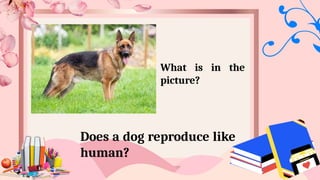
What is in the
picture?
Does a dog reproduce like
human?
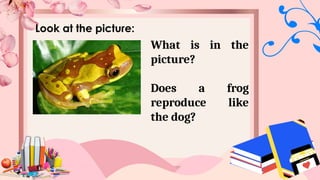
Look at the picture:
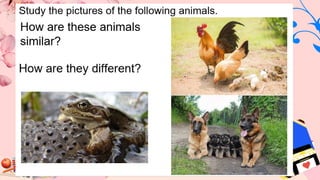
What is in the
picture?
Does a frog
reproduce like
the dog?
Like humans, animals also
need to reproduce. They
have also their own
reproductive system that
makes them able to do such
life processes.
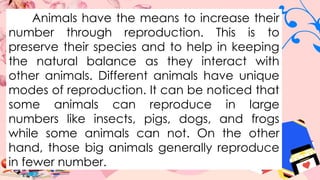
Animals have the means to increase their
number through reproduction. This is to
preserve their species and to help in keeping
the natural balance as they interact with
other animals. Different animals have unique
modes of reproduction. It can be noticed that
some animals can reproduce in large
numbers like insects, pigs, dogs, and frogs
while some animals can not. On the other
hand, those big animals generally reproduce
in fewer number.
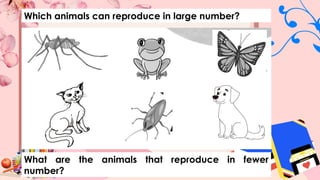
Which animals can reproduce in large number?
What are the animals that reproduce in fewer
number?
Reproduction involves the transfer of
characteristics of parents to their offspring
or young. During fertilization (meeting of
egg and sperm cell), genetic materials like
DNA (deoxyribonucleic acid) are shared by
the parents to produce new organism that
may either be possessing unique
characteristics or having an exact copy of
what the parent has.
Most of the animals like cats, dogs, butterflies,
frogs, and the like need a male and a female
to reproduce. This is called sexual
reproduction.
Sexual reproduction is a process
of creating offspring with the
participation of a sperm cells
from the male parent and an
egg cells from the female
parent.
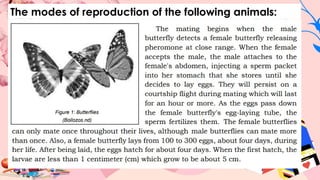
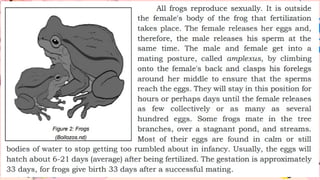
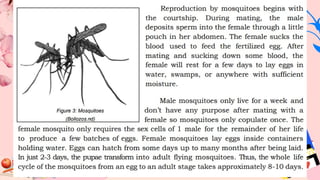
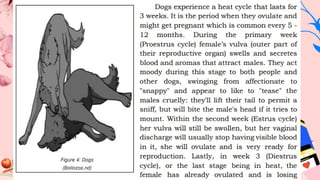
The modes of reproduction of the following animals:
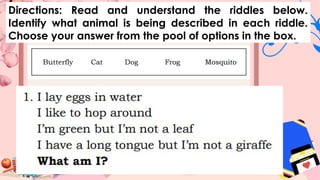
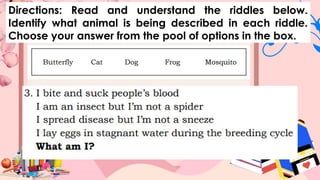
Directions: Read and understand the riddles below.
Identify what animal is being described in each riddle.
Choose your answer from the pool of options in the box.
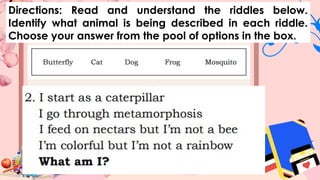
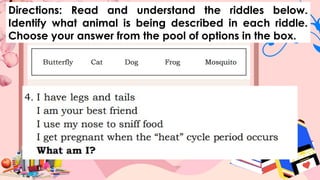
Directions: Read and understand the riddles below.
Identify what animal is being described in each riddle.
Choose your answer from the pool of options in the box.
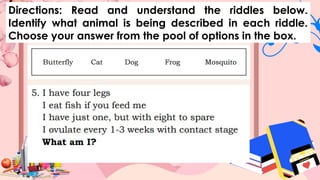
Directions: Read and understand the riddles below.
Identify what animal is being described in each riddle.
Choose your answer from the pool of options in the box.
Directions: Read and understand the riddles below.
Identify what animal is being described in each riddle.
Choose your answer from the pool of options in the box.
Directions: Read and understand the riddles below.
Identify what animal is being described in each riddle.
Choose your answer from the pool of options in the box.
If you have pet at home, how will
you take good care of it?
What process is responsible in creating
an offspring with the participation of a
sperm cells from male parent and an
egg cell from female parent?
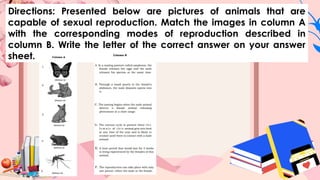
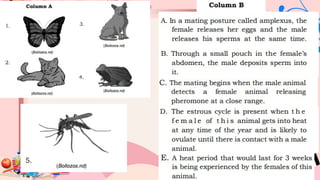
Directions: Presented below are pictures of animals that are
capable of sexual reproduction. Match the images in column A
with the corresponding modes of reproduction described in
column B. Write the letter of the correct answer on your answer
sheet.
Modes of Reproduction
in Animals
WEEK 4-DAY 2
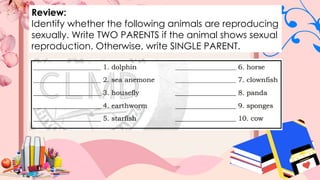
Review:
Identify whether the following animals are reproducing
sexually. Write TWO PARENTS if the animal shows sexual
reproduction. Otherwise, write SINGLE PARENT.
How do animals reproduce?
Most animals can only produce a
new individual when two parents
are present.
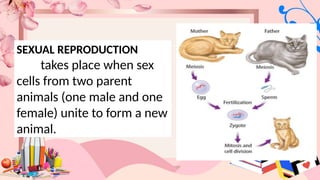
SEXUAL REPRODUCTION
takes place when sex
cells from two parent
animals (one male and one
female) unite to form a new
animal.
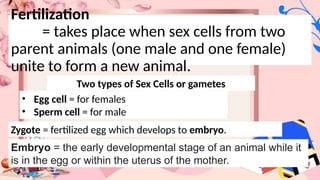
Fertilization
= takes place when sex cells from two
parent animals (one male and one female)
unite to form a new animal.
Two types of Sex Cells or gametes
• Egg cell = for females
• Sperm cell = for male
Zygote = fertilized egg which develops to embryo.
Embryo = the early developmental stage of an animal while it
is in the egg or within the uterus of the mother.
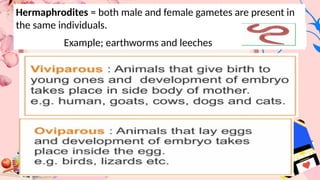
Hermaphrodites = both male and female gametes are present in
the same individuals.
Example; earthworms and leeches
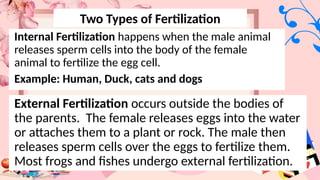
Internal Fertilization happens when the male animal
releases sperm cells into the body of the female
animal to fertilize the egg cell.
Example: Human, Duck, cats and dogs
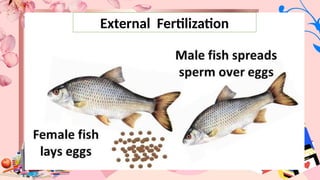
External Fertilization occurs outside the bodies of
the parents. The female releases eggs into the water
or attaches them to a plant or rock. The male then
releases sperm cells over the eggs to fertilize them.
Most frogs and fishes undergo external fertilization.
Two Types of Fertilization
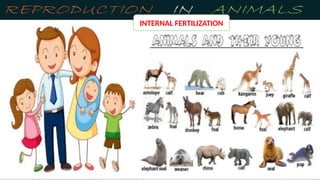
INTERNAL FERTILIZATION
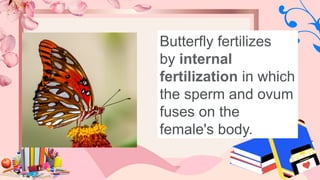
Butterfly fertilizes
by internal
fertilization in which
the sperm and ovum
fuses on the
female's body.
External Fertilization
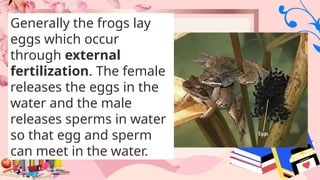
Generally the frogs lay
eggs which occur
through external
fertilization. The female
releases the eggs in the
water and the male
releases sperms in water
so that egg and sperm
can meet in the water.
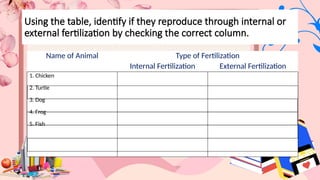
Using the table, identify if they reproduce through internal or
external fertilization by checking the correct column.
Name of Animal Type of Fertilization
Internal Fertilization External Fertilization
1. Chicken
2. Turtle
3. Dog
4. Frog
5. Fish
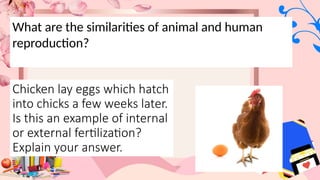
Chicken lay eggs which hatch
into chicks a few weeks later.
Is this an example of internal
or external fertilization?
Explain your answer.
What are the similarities of animal and human
reproduction?
Name animals that reproduce internally and
externally.
What type of fertilization when the male
animal releases sperm cells into the body of
the female animal to fertilize the egg cell?
How do frogs reproduce?
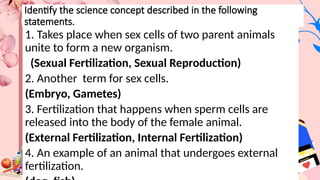
Identify the science concept described in the following
statements.
1. Takes place when sex cells of two parent animals
unite to form a new organism.
(Sexual Fertilization, Sexual Reproduction)
2. Another term for sex cells.
(Embryo, Gametes)
3. Fertilization that happens when sperm cells are
released into the body of the female animal.
(External Fertilization, Internal Fertilization)
4. An example of an animal that undergoes external
fertilization.
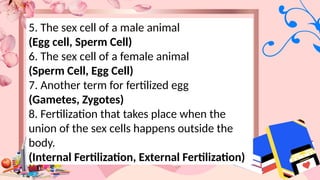
5. The sex cell of a male animal
(Egg cell, Sperm Cell)
6. The sex cell of a female animal
(Sperm Cell, Egg Cell)
7. Another term for fertilized egg
(Gametes, Zygotes)
8. Fertilization that takes place when the
union of the sex cells happens outside the
body.
(Internal Fertilization, External Fertilization)
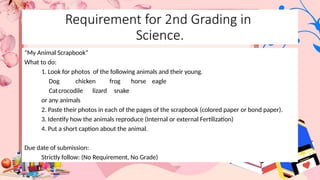
“My Animal Scrapbook”
What to do:
1. Look for photos of the following animals and their young.
Dog chicken frog horse eagle
Catcrocodile lizard snake
or any animals
2. Paste their photos in each of the pages of the scrapbook (colored paper or bond paper).
3. Identify how the animals reproduce (Internal or external Fertilization)
4. Put a short caption about the animal.
Due date of submission:
Strictly follow: (No Requirement, No Grade)
Requirement for 2nd Grading in
Science.
Requirement
in
Science
“My Animal Scrapbook”
Submitted by:
Student
Grade V-Sapphire
Submitted to:
Mr. Teacher
Science Teacher
Modes of Reproduction
in Animals
WEEK 4-DAY 3
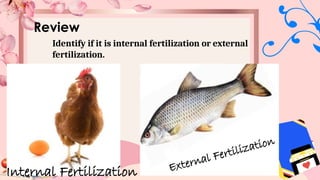
Review
Identify if it is internal fertilization or external
fertilization.
External Fertilization
Internal Fertilization
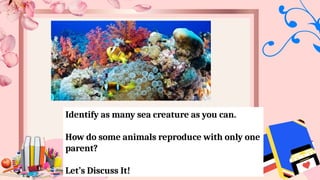
Identify as many sea creature as you can.
How do some animals reproduce with only one
parent?
Let’s Discuss It!
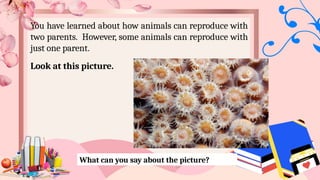
You have learned about how animals can reproduce with
two parents. However, some animals can reproduce with
just one parent.
Look at this picture.
What can you say about the picture?
Asexual Reproduction in Animals
Asexual Reproduction does not need one male and
one female parent to reproduce an offspring. A single
parent organism simply makes identical copies of itself.
Methods of Asexual reproduction:
Binary Fission
Budding
Asexual Reproduction in Animals
Binary Fission Budding
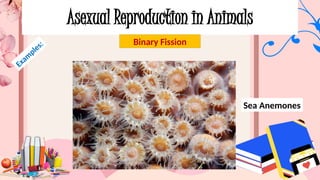
Occurs when a parent animal
divides itself into two. Each half grows
into a new individual. Binary Fission is
also called Splitting. The sea anemone
is able to reproduce by binary fission.
This allows them to quickly grow
clusters of closely living groups or
colonies. The sea anemone splits its
polyps or body into halves, then it
grow into two new sea anemone.
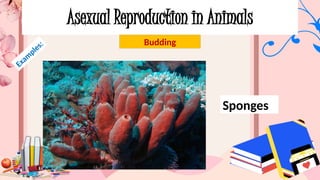
Happens when an outgrowth of the
parent animal develops into a new animal.
Plants also develop a new plant through
budding. A bulge appears on the parent’s
body, grow into a bud, and eventually
becomes a miniature copy of the parents.
The young continues to grow while still
attached to the parent and eventually
detaches when it is mature enough to
survive by it self.
Asexual Reproduction in Animals
Binary Fission
Exam
ples:
Sea Anemones
Asexual Reproduction in Animals
Budding
Exam
ples:
Sponges
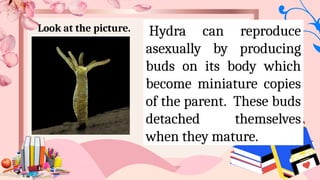
Look at the picture. Hydra can reproduce
asexually by producing
buds on its body which
become miniature copies
of the parent. These buds
detached themselves
when they mature.
Advantages and disadvantages of asexual
reproduction in animals.
Advantages
1. The organism does not need a partner for it to
reproduce.
2. The organism develops faster than those
produced in sexual reproduction.
Disadvantages
1. Any disease or negative characteristics of the
parent will be passed onto the offspring since it is
very identical to the parent.
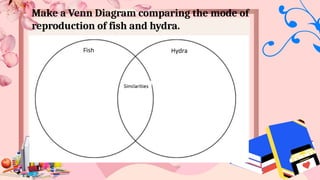
Make a Venn Diagram comparing the mode of
reproduction of fish and hydra.
How many parents is needed in
asexual reproduction?
In human, does asexual reproduction
applicable? Why?
Why is it said that Reproduction in
animals is best described as the
process of producing its own kind.
What are the two types of asexual
reproduction?
True or false: Write T if the statement is true and F false if
not.
1. Asexual reproduction is making a copy of the organism
with a single parent.
2. Some tiny animals and marine animals, like sea
anemone, reproduce by binary fission.
3. Reproduction is the ability of a living thing to make
copies of itself.
4. Budding happens when the parent animal divides itself
into two.
5. Fission happens when an outgrowth of the parent
animal develops into new animal.
Modes of Reproduction
in Animals
WEEK 4-DAY 4
Review:
True or false: Write T if the statement is true and F false if
not.
1. Asexual reproduction is making a copy of the organism
with a single parent.
2. Some tiny animals and marine animals, like sea
anemone, reproduce by binary fission.
3. Reproduction is the ability of a living thing to make
copies of itself.
4. Budding happens when the parent animal divides itself
into two.
5. Fission happens when an outgrowth of the parent
animal develops into new animal.
Observe the following pictures:
Which animal were born alive?
Which is hatched from egg?
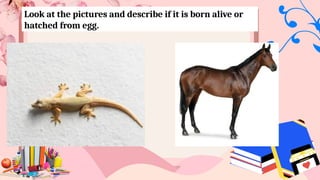
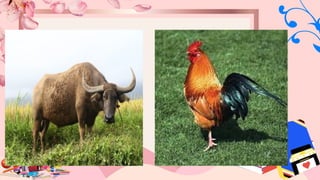
Look at the pictures and describe if it is born alive or
hatched from egg.
Animals have different modes of
reproduction. Some animals are egg-
laying while some are born alive.
Egg-laying animals = animals that lay
their eggs to the environment. The
laid eggs by the female are
developed outside her body.
Incubation period
= time between the laying of the egg and the
hatching of the young.
Born alive animals = animals that retain and nourish
the fertilized egg inside the body of the female parent.
The fertilized egg develops into an embryo that grows
while receiving the nourishment from the mother
through the placenta.
Gestation = the time between fertilization and birth of
the live young animal.
What do you think is the advantage of born
alive animal?
Advantage of an animal that is born alive:
The mother can concentrate on taking care
of only few young. Even in the womb, one
or two young will be able to receive proper
nourishment from the mother.
Describe whether the following
animals are born alive or hatched
from an egg.
1.duck
2. pig
3. horse
4. Maya
5. Cat
Can you name other animals
that are born alive and hatched
from egg?
Describe the difference between
animals that are born alive and
animals that are hatched from eggs.
Draw a star if the statement described animals that
born alive and circle if it’s hatched from eggs.
1. Insects develop outside their mother’s body.
2. Elephants are born alive, looking like their mother.
3. It is a mode of reproduction where animals
develop inside their mother’s body.
4. It is a mode of reproduction where animals are
hatch from shell.
5. Unborn monkeys get nourishment from their
mother while they are still developing.
Quiz Day
WEEK 5-DAY 5

W3-SCIENCE-1.grade 5 second quarter 2024

  • 1.
    Modes of Reproduction inAnimals WEEK 3-DAY 1
  • 2.
    Who has apet at home? What is your pet?
  • 3.
    What is inthe picture? Does a dog reproduce like human?
  • 4.
    Look at thepicture: What is in the picture? Does a frog reproduce like the dog?
  • 5.
    Like humans, animalsalso need to reproduce. They have also their own reproductive system that makes them able to do such life processes.
  • 6.
    Animals have themeans to increase their number through reproduction. This is to preserve their species and to help in keeping the natural balance as they interact with other animals. Different animals have unique modes of reproduction. It can be noticed that some animals can reproduce in large numbers like insects, pigs, dogs, and frogs while some animals can not. On the other hand, those big animals generally reproduce in fewer number.
  • 7.
    Which animals canreproduce in large number? What are the animals that reproduce in fewer number?
  • 8.
    Reproduction involves thetransfer of characteristics of parents to their offspring or young. During fertilization (meeting of egg and sperm cell), genetic materials like DNA (deoxyribonucleic acid) are shared by the parents to produce new organism that may either be possessing unique characteristics or having an exact copy of what the parent has.
  • 9.
    Most of theanimals like cats, dogs, butterflies, frogs, and the like need a male and a female to reproduce. This is called sexual reproduction. Sexual reproduction is a process of creating offspring with the participation of a sperm cells from the male parent and an egg cells from the female parent.
  • 10.
    The modes ofreproduction of the following animals:
  • 16.
    Directions: Read andunderstand the riddles below. Identify what animal is being described in each riddle. Choose your answer from the pool of options in the box.
  • 17.
    Directions: Read andunderstand the riddles below. Identify what animal is being described in each riddle. Choose your answer from the pool of options in the box.
  • 18.
    Directions: Read andunderstand the riddles below. Identify what animal is being described in each riddle. Choose your answer from the pool of options in the box.
  • 19.
    Directions: Read andunderstand the riddles below. Identify what animal is being described in each riddle. Choose your answer from the pool of options in the box.
  • 20.
    Directions: Read andunderstand the riddles below. Identify what animal is being described in each riddle. Choose your answer from the pool of options in the box.
  • 21.
    If you havepet at home, how will you take good care of it? What process is responsible in creating an offspring with the participation of a sperm cells from male parent and an egg cell from female parent?
  • 22.
    Directions: Presented beloware pictures of animals that are capable of sexual reproduction. Match the images in column A with the corresponding modes of reproduction described in column B. Write the letter of the correct answer on your answer sheet.
  • 24.
    Modes of Reproduction inAnimals WEEK 4-DAY 2
  • 25.
    Review: Identify whether thefollowing animals are reproducing sexually. Write TWO PARENTS if the animal shows sexual reproduction. Otherwise, write SINGLE PARENT.
  • 27.
    How do animalsreproduce? Most animals can only produce a new individual when two parents are present.
  • 28.
    SEXUAL REPRODUCTION takes placewhen sex cells from two parent animals (one male and one female) unite to form a new animal.
  • 29.
    Fertilization = takes placewhen sex cells from two parent animals (one male and one female) unite to form a new animal. Two types of Sex Cells or gametes • Egg cell = for females • Sperm cell = for male Zygote = fertilized egg which develops to embryo. Embryo = the early developmental stage of an animal while it is in the egg or within the uterus of the mother.
  • 30.
    Hermaphrodites = bothmale and female gametes are present in the same individuals. Example; earthworms and leeches
  • 31.
    Internal Fertilization happenswhen the male animal releases sperm cells into the body of the female animal to fertilize the egg cell. Example: Human, Duck, cats and dogs External Fertilization occurs outside the bodies of the parents. The female releases eggs into the water or attaches them to a plant or rock. The male then releases sperm cells over the eggs to fertilize them. Most frogs and fishes undergo external fertilization. Two Types of Fertilization
  • 32.
  • 33.
    Butterfly fertilizes by internal fertilizationin which the sperm and ovum fuses on the female's body.
  • 34.
  • 35.
    Generally the frogslay eggs which occur through external fertilization. The female releases the eggs in the water and the male releases sperms in water so that egg and sperm can meet in the water.
  • 36.
    Using the table,identify if they reproduce through internal or external fertilization by checking the correct column. Name of Animal Type of Fertilization Internal Fertilization External Fertilization 1. Chicken 2. Turtle 3. Dog 4. Frog 5. Fish
  • 37.
    Chicken lay eggswhich hatch into chicks a few weeks later. Is this an example of internal or external fertilization? Explain your answer. What are the similarities of animal and human reproduction?
  • 38.
    Name animals thatreproduce internally and externally. What type of fertilization when the male animal releases sperm cells into the body of the female animal to fertilize the egg cell? How do frogs reproduce?
  • 39.
    Identify the scienceconcept described in the following statements. 1. Takes place when sex cells of two parent animals unite to form a new organism. (Sexual Fertilization, Sexual Reproduction) 2. Another term for sex cells. (Embryo, Gametes) 3. Fertilization that happens when sperm cells are released into the body of the female animal. (External Fertilization, Internal Fertilization) 4. An example of an animal that undergoes external fertilization.
  • 40.
    5. The sexcell of a male animal (Egg cell, Sperm Cell) 6. The sex cell of a female animal (Sperm Cell, Egg Cell) 7. Another term for fertilized egg (Gametes, Zygotes) 8. Fertilization that takes place when the union of the sex cells happens outside the body. (Internal Fertilization, External Fertilization)
  • 41.
    “My Animal Scrapbook” Whatto do: 1. Look for photos of the following animals and their young. Dog chicken frog horse eagle Catcrocodile lizard snake or any animals 2. Paste their photos in each of the pages of the scrapbook (colored paper or bond paper). 3. Identify how the animals reproduce (Internal or external Fertilization) 4. Put a short caption about the animal. Due date of submission: Strictly follow: (No Requirement, No Grade) Requirement for 2nd Grading in Science.
  • 42.
    Requirement in Science “My Animal Scrapbook” Submittedby: Student Grade V-Sapphire Submitted to: Mr. Teacher Science Teacher
  • 43.
    Modes of Reproduction inAnimals WEEK 4-DAY 3
  • 44.
    Review Identify if itis internal fertilization or external fertilization. External Fertilization Internal Fertilization
  • 45.
    Identify as manysea creature as you can. How do some animals reproduce with only one parent? Let’s Discuss It!
  • 46.
    You have learnedabout how animals can reproduce with two parents. However, some animals can reproduce with just one parent. Look at this picture. What can you say about the picture?
  • 47.
    Asexual Reproduction inAnimals Asexual Reproduction does not need one male and one female parent to reproduce an offspring. A single parent organism simply makes identical copies of itself. Methods of Asexual reproduction: Binary Fission Budding
  • 48.
    Asexual Reproduction inAnimals Binary Fission Budding Occurs when a parent animal divides itself into two. Each half grows into a new individual. Binary Fission is also called Splitting. The sea anemone is able to reproduce by binary fission. This allows them to quickly grow clusters of closely living groups or colonies. The sea anemone splits its polyps or body into halves, then it grow into two new sea anemone. Happens when an outgrowth of the parent animal develops into a new animal. Plants also develop a new plant through budding. A bulge appears on the parent’s body, grow into a bud, and eventually becomes a miniature copy of the parents. The young continues to grow while still attached to the parent and eventually detaches when it is mature enough to survive by it self.
  • 49.
    Asexual Reproduction inAnimals Binary Fission Exam ples: Sea Anemones
  • 50.
    Asexual Reproduction inAnimals Budding Exam ples: Sponges
  • 51.
    Look at thepicture. Hydra can reproduce asexually by producing buds on its body which become miniature copies of the parent. These buds detached themselves when they mature.
  • 52.
    Advantages and disadvantagesof asexual reproduction in animals. Advantages 1. The organism does not need a partner for it to reproduce. 2. The organism develops faster than those produced in sexual reproduction. Disadvantages 1. Any disease or negative characteristics of the parent will be passed onto the offspring since it is very identical to the parent.
  • 53.
    Make a VennDiagram comparing the mode of reproduction of fish and hydra.
  • 54.
    How many parentsis needed in asexual reproduction? In human, does asexual reproduction applicable? Why?
  • 55.
    Why is itsaid that Reproduction in animals is best described as the process of producing its own kind. What are the two types of asexual reproduction?
  • 56.
    True or false:Write T if the statement is true and F false if not. 1. Asexual reproduction is making a copy of the organism with a single parent. 2. Some tiny animals and marine animals, like sea anemone, reproduce by binary fission. 3. Reproduction is the ability of a living thing to make copies of itself. 4. Budding happens when the parent animal divides itself into two. 5. Fission happens when an outgrowth of the parent animal develops into new animal.
  • 57.
    Modes of Reproduction inAnimals WEEK 4-DAY 4
  • 58.
    Review: True or false:Write T if the statement is true and F false if not. 1. Asexual reproduction is making a copy of the organism with a single parent. 2. Some tiny animals and marine animals, like sea anemone, reproduce by binary fission. 3. Reproduction is the ability of a living thing to make copies of itself. 4. Budding happens when the parent animal divides itself into two. 5. Fission happens when an outgrowth of the parent animal develops into new animal.
  • 59.
    Observe the followingpictures: Which animal were born alive? Which is hatched from egg?
  • 60.
    Look at thepictures and describe if it is born alive or hatched from egg.
  • 62.
    Animals have differentmodes of reproduction. Some animals are egg- laying while some are born alive. Egg-laying animals = animals that lay their eggs to the environment. The laid eggs by the female are developed outside her body.
  • 63.
    Incubation period = timebetween the laying of the egg and the hatching of the young. Born alive animals = animals that retain and nourish the fertilized egg inside the body of the female parent. The fertilized egg develops into an embryo that grows while receiving the nourishment from the mother through the placenta. Gestation = the time between fertilization and birth of the live young animal.
  • 64.
    What do youthink is the advantage of born alive animal? Advantage of an animal that is born alive: The mother can concentrate on taking care of only few young. Even in the womb, one or two young will be able to receive proper nourishment from the mother.
  • 65.
    Describe whether thefollowing animals are born alive or hatched from an egg. 1.duck 2. pig 3. horse 4. Maya 5. Cat
  • 66.
    Can you nameother animals that are born alive and hatched from egg?
  • 67.
    Describe the differencebetween animals that are born alive and animals that are hatched from eggs.
  • 68.
    Draw a starif the statement described animals that born alive and circle if it’s hatched from eggs. 1. Insects develop outside their mother’s body. 2. Elephants are born alive, looking like their mother. 3. It is a mode of reproduction where animals develop inside their mother’s body. 4. It is a mode of reproduction where animals are hatch from shell. 5. Unborn monkeys get nourishment from their mother while they are still developing.
  • 69.