ANIMAL
REPRODCUTION
KIP AIZA F. GABAWA, MAED - SCIENCE
Pre - test
1. What type of reproduction involves the fusion of gametes or sex cells?
a. Sexual b. Asexual c. both A & B d. None of the above
2. What type of reproduction produces an offspring which genetically
identical to its parent cell?
a. Sexual b. Asexual c. both A & B d. None of the above
3. Sexual reproduction leads to _____ in organisms?
a. Similarities b. variation c. duplication c. resemblanc
4. What is the ideal duration of pregnancy among humans?
a. 32 weeks b. 34 weeks c. 36 weeks d. 38 week
5.
1/3/2023 2
ANIMAL
REPRODUCTIO
N
BY: KIP AIZA F. GABAWA,
MAED-SCIE
WHAT IS
REPRODUCTIO
N?
Is one of the key
survivals of a
species – it is a
way to continue
life
The male and
female
organisms will
mate and
produce
offspring.
WAYS OF HOW
REPRESENTATI
VE ANIMALS
REPRODUCE
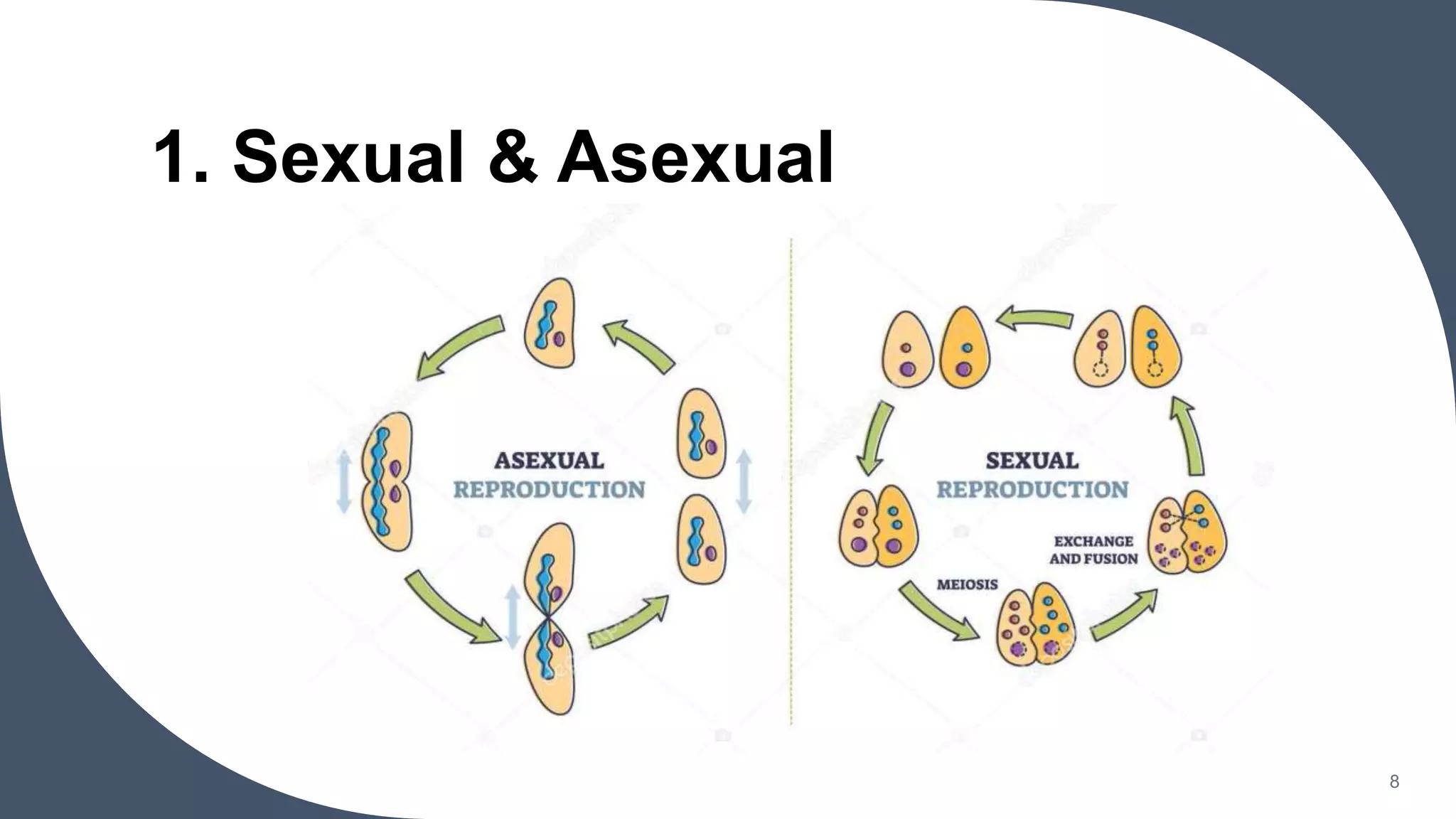
1. Sexual & Asexual
8
1. Sexual & Asexual
9
Sexual reproduction
1/3/2023 ANIMAL REPRODUCTION 10
In sexual reproduction, a male and female
gamete is needed to produce the offspring. In
most instances, there is male and female
organisms to produce the gametes but, this
isn’t always the case. Finding a partner for
sexual animals can sometimes prove difficult,
and so, an adaptive mechanism and
evolutionary solution, some animal exhibit
HERMAPHRODITISM.
1/3/2023 ANIMAL REPRODUCTION 11
HERMAPHRODITISM this is when an
organism has both the male and female
reproductive systems. This common
among sessile (stationary animals). In
hermaphroditism, the organism may or
may not have a partner for fertilization to
occur.
Asexual reproduction
1/3/2023 ANIMAL REPRODUCTION 12
Asexual reproduction is a mode of reproduction
in which a new offspring is produced by a single
parent. The new individuals produced are genetically
and physically identical to each other, i.e., they are
the clones of their parents.
Asexual reproduction is observed in both
multicellular and unicellular organisms. This process
does not involve any kind of gamete fusion and there
won’t be any change in the number of chromosomes
either. It will inherit the same genes as the parent,
except for some cases where there is a chance of a
rare mutation occurring.
TYPES OF
ASEXUAL
REPRODUCTION
1/3/2023 ANIMAL REPRODUCTION 13
1. BINARY FISSION
1/3/2023 ANIMAL REPRODUCTION 14
occurs in single-
celled organisms. It
is when a parent cell
divides itself into two
equal parts and
creates offspring.
This type of
reproduction is like
cloning
2. FRAGMENTATION
1/3/2023 ANIMAL REPRODUCTION 15
occurs when an
organism breaks a
part of itself into a
fragment, and the
fragment develops
into a new organism.
Ex. Starfish & acoel
flatworms
3. BUDDING
1/3/2023 ANIMAL REPRODUCTION 16
budding happens
when a parent organism
grows a bud attached to
the body. When the bud is
developed it will detach
itself from the parent and
form a new organism.
Ex. Yeast & Jellyfish
4. PARTHENOGENESIS
1/3/2023 ANIMAL REPRODUCTION 17
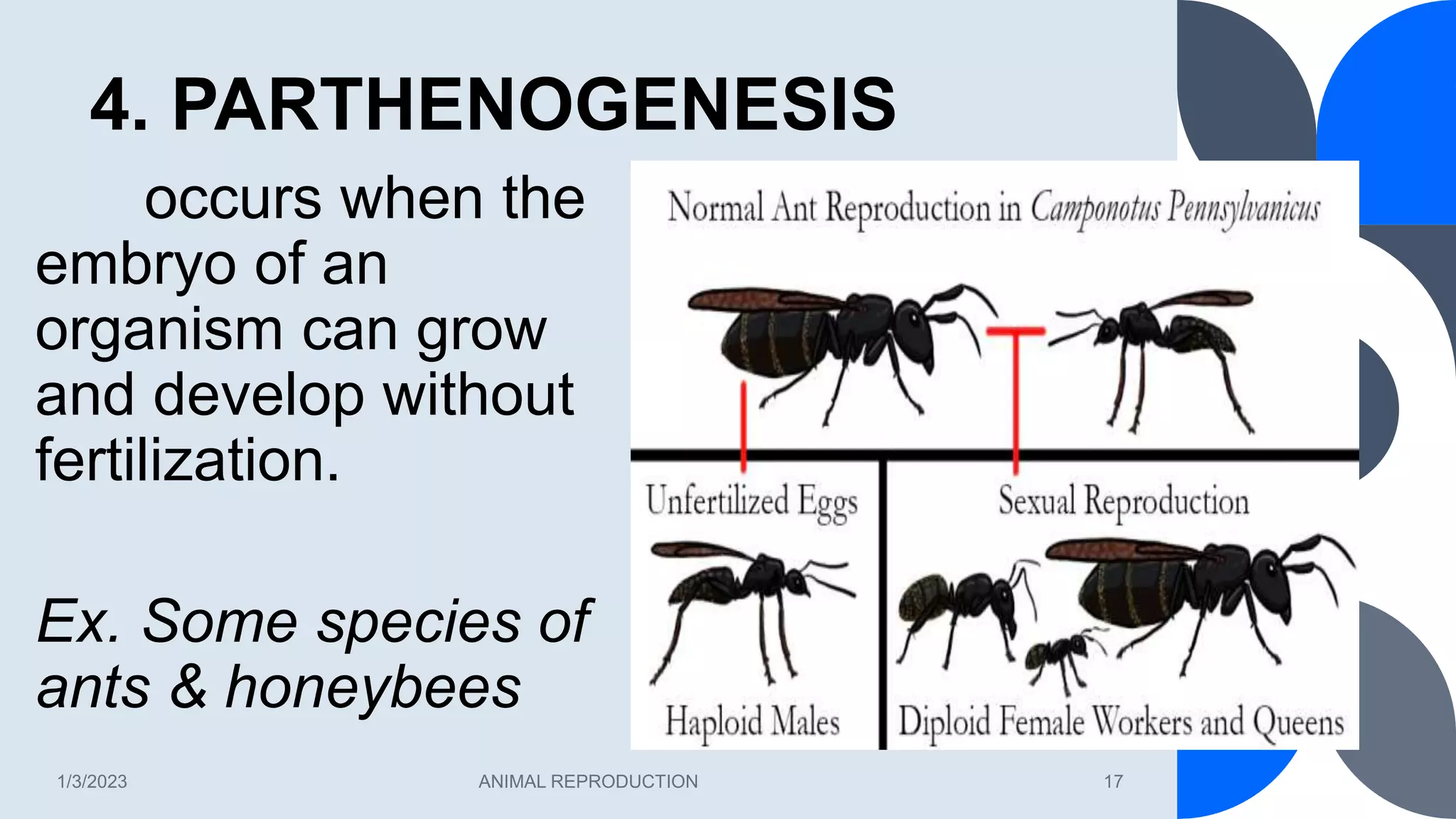
occurs when the
embryo of an
organism can grow
and develop without
fertilization.
Ex. Some species of
ants & honeybees
MECHANICS OF
FERTILIZATION
1/3/2023 ANIMAL REPRODUCTION 18
MECHANICS OF
FERTILIZATION
1/3/2023 ANIMAL REPRODUCTION 19
2 TYPES OF
FERTILIZATION
1. INTERNAL
FERTILIZATION
1/3/2023 ANIMAL REPRODUCTION 21
occurs when the fusion of gametes is inside
the female body.
2. EXTERNAL
FERTILIZATION
occurs when the fusion of gametes is outside
the female body.
3 TYPES OF
INTERNAL
FERTILIZATION
1. OVIPARITY
1/3/2023 ANIMAL REPRODUCTION 23
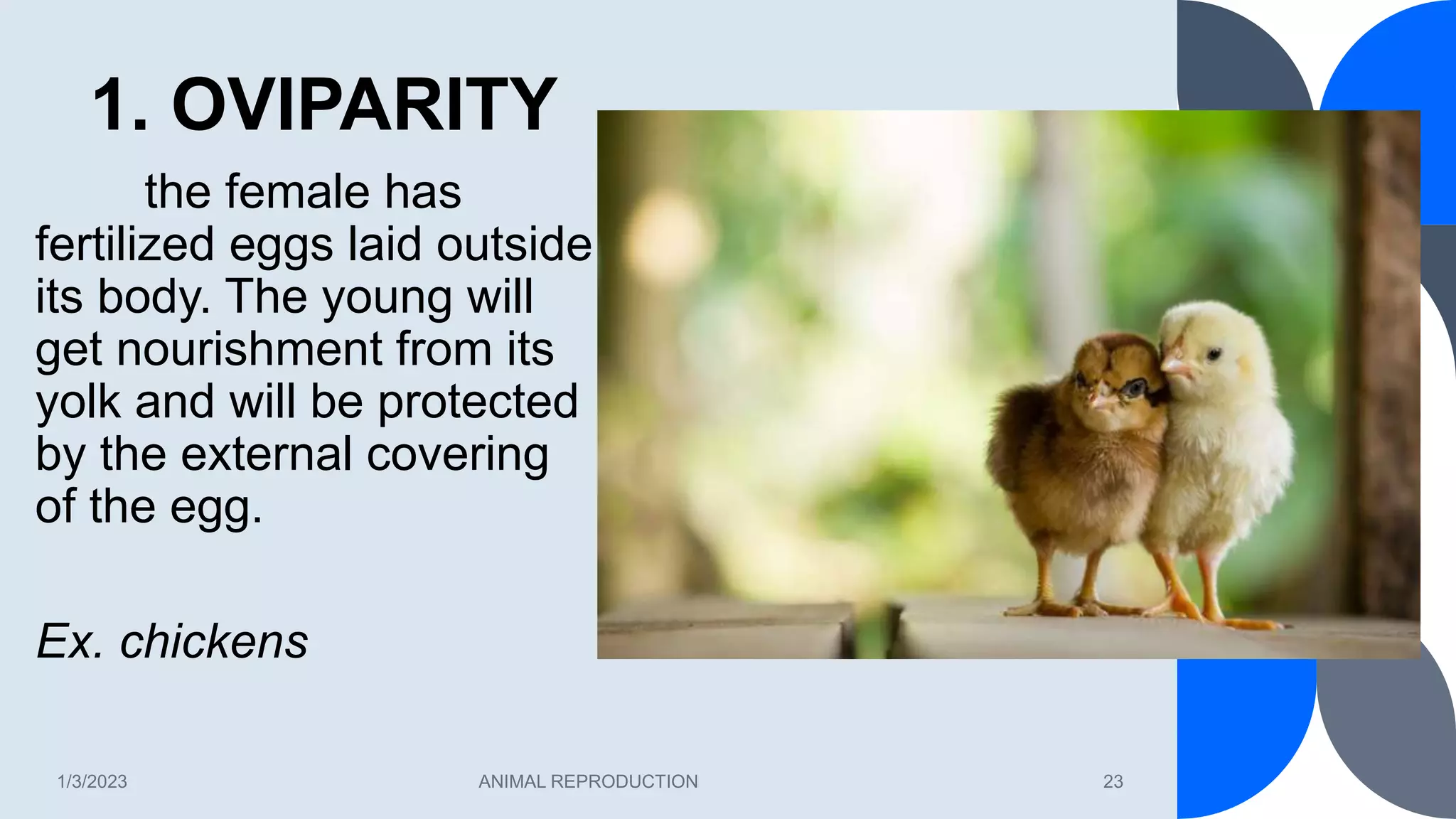
the female has
fertilized eggs laid outside
its body. The young will
get nourishment from its
yolk and will be protected
by the external covering
of the egg.
Ex. chickens
2. VIVIPARITY
1/3/2023 ANIMAL REPRODUCTION 24
most common in
mammals, the offspring
develops within the
female and is nourished
by the mother’s blood in
the placenta.
Ex. Bears
3. OVOVIVIPARITY
1/3/2023 ANIMAL REPRODUCTION 25
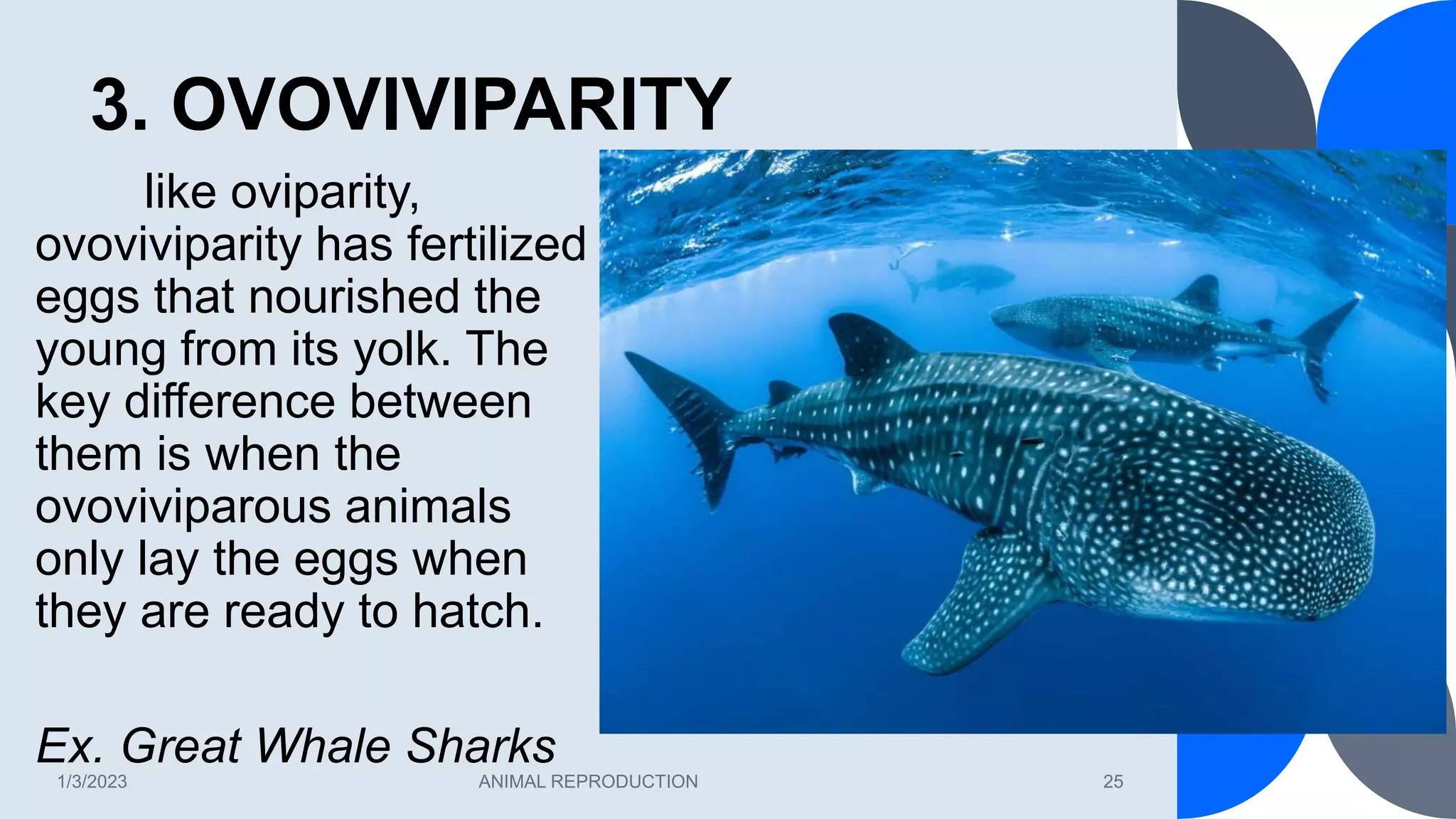
like oviparity,
ovoviviparity has fertilized
eggs that nourished the
young from its yolk. The
key difference between
them is when the
ovoviviparous animals
only lay the eggs when
they are ready to hatch.
Ex. Great Whale Sharks
Thank you

ANIMAL REPRODUCTION.pptx

  • 1.
    ANIMAL REPRODCUTION KIP AIZA F.GABAWA, MAED - SCIENCE
  • 2.
    Pre - test 1.What type of reproduction involves the fusion of gametes or sex cells? a. Sexual b. Asexual c. both A & B d. None of the above 2. What type of reproduction produces an offspring which genetically identical to its parent cell? a. Sexual b. Asexual c. both A & B d. None of the above 3. Sexual reproduction leads to _____ in organisms? a. Similarities b. variation c. duplication c. resemblanc 4. What is the ideal duration of pregnancy among humans? a. 32 weeks b. 34 weeks c. 36 weeks d. 38 week 5. 1/3/2023 2
  • 3.
  • 4.
  • 5.
    Is one ofthe key survivals of a species – it is a way to continue life
  • 6.
    The male and female organismswill mate and produce offspring.
  • 7.
    WAYS OF HOW REPRESENTATI VEANIMALS REPRODUCE
  • 8.
    1. Sexual &Asexual 8
  • 9.
    1. Sexual &Asexual 9
  • 10.
    Sexual reproduction 1/3/2023 ANIMALREPRODUCTION 10 In sexual reproduction, a male and female gamete is needed to produce the offspring. In most instances, there is male and female organisms to produce the gametes but, this isn’t always the case. Finding a partner for sexual animals can sometimes prove difficult, and so, an adaptive mechanism and evolutionary solution, some animal exhibit HERMAPHRODITISM.
  • 11.
    1/3/2023 ANIMAL REPRODUCTION11 HERMAPHRODITISM this is when an organism has both the male and female reproductive systems. This common among sessile (stationary animals). In hermaphroditism, the organism may or may not have a partner for fertilization to occur.
  • 12.
    Asexual reproduction 1/3/2023 ANIMALREPRODUCTION 12 Asexual reproduction is a mode of reproduction in which a new offspring is produced by a single parent. The new individuals produced are genetically and physically identical to each other, i.e., they are the clones of their parents. Asexual reproduction is observed in both multicellular and unicellular organisms. This process does not involve any kind of gamete fusion and there won’t be any change in the number of chromosomes either. It will inherit the same genes as the parent, except for some cases where there is a chance of a rare mutation occurring.
  • 13.
  • 14.
    1. BINARY FISSION 1/3/2023ANIMAL REPRODUCTION 14 occurs in single- celled organisms. It is when a parent cell divides itself into two equal parts and creates offspring. This type of reproduction is like cloning
  • 15.
    2. FRAGMENTATION 1/3/2023 ANIMALREPRODUCTION 15 occurs when an organism breaks a part of itself into a fragment, and the fragment develops into a new organism. Ex. Starfish & acoel flatworms
  • 16.
    3. BUDDING 1/3/2023 ANIMALREPRODUCTION 16 budding happens when a parent organism grows a bud attached to the body. When the bud is developed it will detach itself from the parent and form a new organism. Ex. Yeast & Jellyfish
  • 17.
    4. PARTHENOGENESIS 1/3/2023 ANIMALREPRODUCTION 17 occurs when the embryo of an organism can grow and develop without fertilization. Ex. Some species of ants & honeybees
  • 18.
  • 19.
  • 20.
  • 21.
    1. INTERNAL FERTILIZATION 1/3/2023 ANIMALREPRODUCTION 21 occurs when the fusion of gametes is inside the female body. 2. EXTERNAL FERTILIZATION occurs when the fusion of gametes is outside the female body.
  • 22.
  • 23.
    1. OVIPARITY 1/3/2023 ANIMALREPRODUCTION 23 the female has fertilized eggs laid outside its body. The young will get nourishment from its yolk and will be protected by the external covering of the egg. Ex. chickens
  • 24.
    2. VIVIPARITY 1/3/2023 ANIMALREPRODUCTION 24 most common in mammals, the offspring develops within the female and is nourished by the mother’s blood in the placenta. Ex. Bears
  • 25.
    3. OVOVIVIPARITY 1/3/2023 ANIMALREPRODUCTION 25 like oviparity, ovoviviparity has fertilized eggs that nourished the young from its yolk. The key difference between them is when the ovoviviparous animals only lay the eggs when they are ready to hatch. Ex. Great Whale Sharks
  • 26.

Editor's Notes

  • #4 REPRODUCTION
  • #5 REPRODUCTION
  • #6 REPRODUCTION
  • #7 REPRODUCTION
  • #8 REPRODUCTION
  • #9 In asexual reproduction a parent organism will not need a mate or partner for it to produce the offspring. The offspring of asexual organism are the exact same copy of its parents organism.
  • #10 In sexual reproduction, a male and female gamete is needed to produce the offspring. In most instances, there is male and female organisms to produce the gametes but, this isn’t always the case. Finding a partner for sexual animals can sometimes prove difficult, and so, an adaptive mechanism and evolutionary solution, some anima HERMAPHRODITISM.
  • #19 Organisms are diverse, unique and have equally unique features that help them survive in their environment. These features have something to do with the animal’s environment, size, habitat, and so many more factors.
  • #20 One unique features is the way these organisms undergo fertilization