Research Through Technology:New Strategies in English EducationLeilani FreemanW200 Final ProjectApril 29, 2011
New Strategies in English Education ArticlesWriting for the Instant Messaging and Text Messaging Generation: Using New Literacies to Support Writing InstructionTeaching Flexibly with Leveled Texts: More Power for your Reading BlockMotivating Students to Use Newly Learned Study Strategies
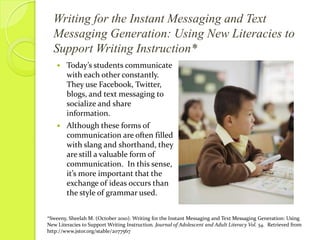
Writing for the Instant Messaging and Text Messaging Generation: Using New Literacies to Support Writing Instruction*Today’s students communicate with each other constantly.  They use Facebook, Twitter, blogs, and text messaging to socialize and share information.  Although these forms of communication are often filled with slang and shorthand, they are still a valuable form of communication.  In this sense, it’s more important that the exchange of ideas occurs than the style of grammar used.*Sweeny, Sheelah M. (October 2010). Writing for the Instant Messaging and Text Messaging Generation: Using New Literacies to Support Writing Instruction. Journal of Adolescent and Adult Literacy Vol. 54.  Retrieved from http://www.jstor.org/stable/2077567
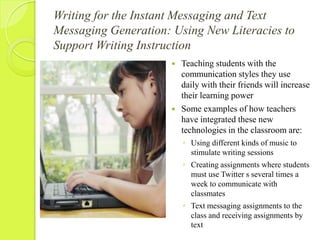
Writing for the Instant Messaging and Text Messaging Generation: Using New Literacies to Support Writing InstructionTeaching students with the communication styles they use daily with their friends will increase their learning powerSome examples of how teachers have integrated these new technologies in the classroom are:Using different kinds of music to stimulate writing sessionsCreating assignments where students must use Twitter s several times a week to communicate with classmatesText messaging assignments to the class and receiving assignments by text
Writing for the Instant Messaging and Text Messaging Generation: Using New Literacies to Support Writing InstructionI think using new technology in the classroom should be required for teachers.  Today more than ever, teachers need to connect with students in areas they are most comfortable in.  The more teachers engage with students, the more students will learn.I think the example of using Twitter to discuss a reading assignment is really valuable.  I like the idea of creating a digital dialogue with students.  To find out more about Twitter, go to http://www.twitter.com.Other resources for new teaching strategies:http://www.writesite.org
http://www.thescriptorium.net
http://www.enchantedlearning.comTeaching Flexibly with Leveled Texts: More Power for Your Reading Block*Teachers rely too heavily on Leveled Texts to classify reading groups.New methods show educators that reading is not one size fits allThe focus should be on student needs’, not teacher organizationNot all students can use the same types of readers.  Diversity is key in gaining interest and continued learning.Not all groups will require the same level of instructional support.  Be creative when entering the reading group.  * Glasswell, K., & Ford M. (September 2010).  Teaching Flexibly with Leveled Texts for Your Reading Block.  The Reading Teacher, Vol. 64.  Retrieved from http://www.jstor.org/stable/27867523
Teaching Flexibly with Leveled Texts: More Power for Your Reading BlockReaders need variety in the levels of text available.  Choose texts above and below grade levels. Build confidence in students.Use additional type of materials:MagazinesNewspapersPlaysPoetry anthologiesDigital and Online Texts
Teaching Flexibly with Leveled Texts: More Power for Your Reading BlockOften, I think students are grouped together by a perceived level.  I like the idea in this article that students of all levels should be grouped together, but I wonder if the higher level students will be held back by their lower level counterparts.  I think diversity in the classroom is key, but it does not come before learning.  Teachers who use this approach should tread carefully and use check points to clarify student’s progress.I think the most important part of English Education is to teach a love of reading.  Education is the door to improvement and it starts with reading.  Giving a child a book is the first step in their future.  More areas to explore:http://www.readwritethink.orghttp://www.readingrockets.org
Motivating Students to Use Newly Learned Study Strategies*When teaching new study strategies, teachers must make an effort to show how the new strategies may be appliedStudents must see the value in trying a new strategy, particularly if their current strategies are already successful.  Ease of learning and use are the keys to success*Rauch M., & Fillenworth C. (April 1995).  Motivating Students to Use Newly Learned Study Strategies.  International Reading Association, Volume 38.  Retrieved from http://www.jstor.org/stable/40016665
Motivating Students to Use Newly Learned Study StrategiesMotivation factors for using new strategiesFoster a positive, friendly classroomMake strategies relevant to coursesConfer with studentsHave students keep journalsGive more assignmentsShare your own experiencesCreate goal listsOffer Extra Credit
Motivating Students to Use Newly Learned Study StrategiesI think, as an educator, one of the most important aspects is constant improvement.  Motivating students to use new, better study strategies might prove difficult, especially if students are already successful.  I think the new strategies would have to show better efficiency, be easier to remember, or offer some other type of reward.I’m not sure I agree with the authors that new is always better; I think it depends on what is being taught.  If I were the student, I would be skeptical of any new study strategy.  Usually, students have a system that works for them.  I think sharing these within the classroom and providing personal testimonies might be better than using unproven methods.

W200 final presentation

  • 1.
    Research Through Technology:NewStrategies in English EducationLeilani FreemanW200 Final ProjectApril 29, 2011
  • 2.
    New Strategies inEnglish Education ArticlesWriting for the Instant Messaging and Text Messaging Generation: Using New Literacies to Support Writing InstructionTeaching Flexibly with Leveled Texts: More Power for your Reading BlockMotivating Students to Use Newly Learned Study Strategies
  • 3.
    Writing for theInstant Messaging and Text Messaging Generation: Using New Literacies to Support Writing Instruction*Today’s students communicate with each other constantly. They use Facebook, Twitter, blogs, and text messaging to socialize and share information. Although these forms of communication are often filled with slang and shorthand, they are still a valuable form of communication. In this sense, it’s more important that the exchange of ideas occurs than the style of grammar used.*Sweeny, Sheelah M. (October 2010). Writing for the Instant Messaging and Text Messaging Generation: Using New Literacies to Support Writing Instruction. Journal of Adolescent and Adult Literacy Vol. 54. Retrieved from http://www.jstor.org/stable/2077567
  • 4.
    Writing for theInstant Messaging and Text Messaging Generation: Using New Literacies to Support Writing InstructionTeaching students with the communication styles they use daily with their friends will increase their learning powerSome examples of how teachers have integrated these new technologies in the classroom are:Using different kinds of music to stimulate writing sessionsCreating assignments where students must use Twitter s several times a week to communicate with classmatesText messaging assignments to the class and receiving assignments by text
  • 5.
    Writing for theInstant Messaging and Text Messaging Generation: Using New Literacies to Support Writing InstructionI think using new technology in the classroom should be required for teachers. Today more than ever, teachers need to connect with students in areas they are most comfortable in. The more teachers engage with students, the more students will learn.I think the example of using Twitter to discuss a reading assignment is really valuable. I like the idea of creating a digital dialogue with students. To find out more about Twitter, go to http://www.twitter.com.Other resources for new teaching strategies:http://www.writesite.org
  • 6.
  • 7.
    http://www.enchantedlearning.comTeaching Flexibly withLeveled Texts: More Power for Your Reading Block*Teachers rely too heavily on Leveled Texts to classify reading groups.New methods show educators that reading is not one size fits allThe focus should be on student needs’, not teacher organizationNot all students can use the same types of readers. Diversity is key in gaining interest and continued learning.Not all groups will require the same level of instructional support. Be creative when entering the reading group. * Glasswell, K., & Ford M. (September 2010). Teaching Flexibly with Leveled Texts for Your Reading Block. The Reading Teacher, Vol. 64. Retrieved from http://www.jstor.org/stable/27867523
  • 8.
    Teaching Flexibly withLeveled Texts: More Power for Your Reading BlockReaders need variety in the levels of text available. Choose texts above and below grade levels. Build confidence in students.Use additional type of materials:MagazinesNewspapersPlaysPoetry anthologiesDigital and Online Texts
  • 9.
    Teaching Flexibly withLeveled Texts: More Power for Your Reading BlockOften, I think students are grouped together by a perceived level. I like the idea in this article that students of all levels should be grouped together, but I wonder if the higher level students will be held back by their lower level counterparts. I think diversity in the classroom is key, but it does not come before learning. Teachers who use this approach should tread carefully and use check points to clarify student’s progress.I think the most important part of English Education is to teach a love of reading. Education is the door to improvement and it starts with reading. Giving a child a book is the first step in their future. More areas to explore:http://www.readwritethink.orghttp://www.readingrockets.org
  • 10.
    Motivating Students toUse Newly Learned Study Strategies*When teaching new study strategies, teachers must make an effort to show how the new strategies may be appliedStudents must see the value in trying a new strategy, particularly if their current strategies are already successful. Ease of learning and use are the keys to success*Rauch M., & Fillenworth C. (April 1995). Motivating Students to Use Newly Learned Study Strategies. International Reading Association, Volume 38. Retrieved from http://www.jstor.org/stable/40016665
  • 11.
    Motivating Students toUse Newly Learned Study StrategiesMotivation factors for using new strategiesFoster a positive, friendly classroomMake strategies relevant to coursesConfer with studentsHave students keep journalsGive more assignmentsShare your own experiencesCreate goal listsOffer Extra Credit
  • 12.
    Motivating Students toUse Newly Learned Study StrategiesI think, as an educator, one of the most important aspects is constant improvement. Motivating students to use new, better study strategies might prove difficult, especially if students are already successful. I think the new strategies would have to show better efficiency, be easier to remember, or offer some other type of reward.I’m not sure I agree with the authors that new is always better; I think it depends on what is being taught. If I were the student, I would be skeptical of any new study strategy. Usually, students have a system that works for them. I think sharing these within the classroom and providing personal testimonies might be better than using unproven methods.