WEEK 2 AUTHORS
AND READINGS
Exclusion from the American Dream
As explained in this week’s American Dream lecture, women were traditionally
considered to be keepers of culture. Much of the writing of early American women
had to do with moral instruction or documentation of culture for future generations.
As you also learned in this week’s American Dream lecture, women also wrote to
bring awareness of other social issues. Charlotte Perkins Gilman (1860-1935) wrote
about themes of inequality and the traditional gender role of women.
“TheYellow Wall-paper” is a story of a woman’s
struggles with post-partum depression, women’s role
in society and marriage, and the expectation that
women needed to rely on men to know what was best
for them. Women had very little authority to make
decisions for themselves, and this story shows what
effects this lack of autonomy has on women.
Exclusion from the American Dream
Other writers portrayed strong women in their work. Kate Chopin (1850-1904)
wrote about women who acted in ways that did not adhere to societal norms.
In The Awakening, Chopin writes about a woman named
Edna, who moves out of her husband’s home and
begins an adulterous affair. As the title suggests, it is a
story of self-discovery. However, the novella was
considered scandalous and was not well received in the
19th century. Today, however, it is seen as a significant
work of feminism in American literature.
In her short stories “Désirée's Baby” and “The Story of an Hour,” Chopin portrays
women who seem to have achieved autonomy, only to have this independence
taken away, leading to tragic consequences. As you read “Desiree’s Baby” this
week, look for ways Désirée and the other characters are limited by their gender
and their racial identity.
Exclusion from the American Dream
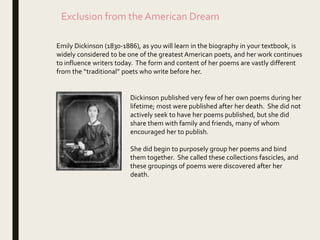
Emily Dickinson (1830-1886), as you will learn in the biography in your textbook, is
widely considered to be one of the greatest American poets, and her work continues
to influence writers today. The form and content of her poems are vastly different
from the “traditional” poets who write before her.
Dickinson published very few of her own poems during her
lifetime; most were published after her death. She did not
actively seek to have her poems published, but she did
share them with family and friends, many of whom
encouraged her to publish.
She did begin to purposely group her poems and bind
them together. She called these collections fascicles, and
these groupings of poems were discovered after her
death.
Dickinson is often thought of as a recluse or an “old
maid.” While her poetry includes themes of nature,
spirituality and religion, and death, she also wrote
about love—not just the emotional element, but the
physical one as well. The underlying themes of lust
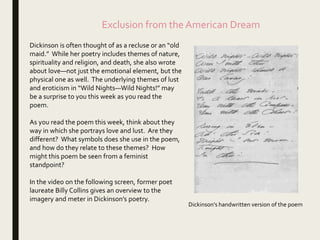
and eroticism in “Wild Nights—Wild Nights!” may
be a surprise to you this week as you read the
poem.
As you read the poem this week, think about they
way in which she portrays love and lust. Are they
different? What symbols does she use in the poem,
and how do they relate to these themes? How
might this poem be seen from a feminist
standpoint?
In the video on the following screen, former poet
laureate Billy Collins gives an overview to the
imagery and meter in Dickinson’s poetry.
Exclusion from the American Dream
Dickinson’s handwritten version of the poem
Exclusion from the American Dream
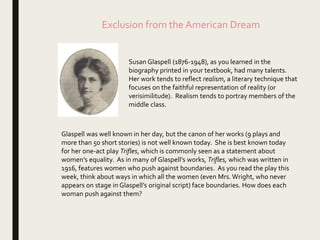
Susan Glaspell (1876-1948), as you learned in the
biography printed in your textbook, had many talents.
Her work tends to reflect realism, a literary technique that
focuses on the faithful representation of reality (or
verisimilitude). Realism tends to portray members of the
middle class.
Glaspell was well known in her day, but the canon of her works (9 plays and
more than 50 short stories) is not well known today. She is best known today
for her one-act play Trifles, which is commonly seen as a statement about
women’s equality. As in many of Glaspell’s works, Trifles, which was written in
1916, features women who push against boundaries. As you read the play this
week, think about ways in which all the women (even Mrs. Wright, who never
appears on stage in Glaspell’s original script) face boundaries. How does each
woman push against them?
Exclusion from the American Dream
Women’s roles continued to evolve from keepers of culture to shapers of culture.
Women like Susan Glaspell wrote about women who did not have a voice to
stand up against violence.
In the decades that followed, women such as Audre Lorde embraced their voices
and used them to speak out.
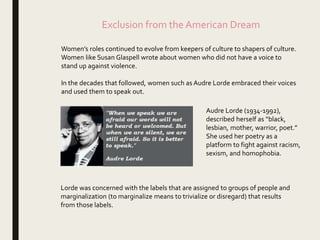
Audre Lorde (1934-1992),
described herself as “black,
lesbian, mother, warrior, poet.”
She used her poetry as a
platform to fight against racism,
sexism, and homophobia.
Lorde was concerned with the labels that are assigned to groups of people and
marginalization (to marginalize means to trivialize or disregard) that results
from those labels.
Exclusion from the American Dream
Lucille Clifton (1936-2010), as the editors of your textbook explain, “allow[s] us
to hear the language of our daily lives as poetry and to experience the poetry
in our ordinary lives” (Levine, 2017,Vol. 1 p. 1494).
We’re reading a poem from Clifton this
week called “homage to my hips.” How
does this poem include the language of
our daily lives?
On the surface level, the poem is clearly
about hips, but ask yourself as you are
reading what else the poem is about. How
might this poem relate to the status of
African American women, or of all women?
Exclusion from the American Dream
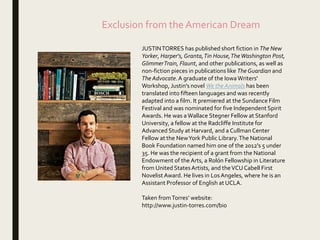
JUSTINTORRES has published short fiction in The New
Yorker, Harper's, Granta,Tin House,TheWashington Post,
GlimmerTrain, Flaunt, and other publications, as well as
non-fiction pieces in publications like The Guardian and
The Advocate.A graduate of the Iowa Writers'
Workshop, Justin's novel We the Animals has been
translated into fifteen languages and was recently
adapted into a film. It premiered at the Sundance Film
Festival and was nominated for five Independent Spirit
Awards. He was aWallace Stegner Fellow at Stanford
University, a fellow at the Radcliffe Institute for
Advanced Study at Harvard, and a CullmanCenter
Fellow at the NewYork Public Library.The National
Book Foundation named him one of the 2012's 5 under
35. He was the recipient of a grant from the National
Endowment of the Arts, a Rolón Fellowship in Literature
from United StatesArtists, and theVCUCabell First
Novelist Award. He lives in LosAngeles, where he is an
Assistant Professor of English at UCLA.
Taken fromTorres’ website:
http://www.justin-torres.com/bio
Exclusion from the American Dream
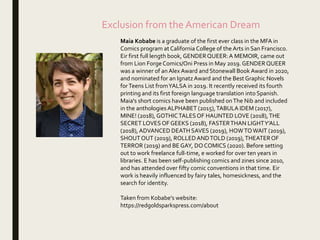
Maia Kobabe is a graduate of the first ever class in the MFA in
Comics program at California College of the Arts in San Francisco.
Eir first full length book, GENDERQUEER:A MEMOIR, came out
from Lion ForgeComics/Oni Press in May 2019. GENDERQUEER
was a winner of anAlex Award and Stonewall Book Award in 2020,
and nominated for an IgnatzAward and the Best Graphic Novels
forTeens List fromYALSA in 2019. It recently received its fourth
printing and its first foreign language translation into Spanish.
Maia's short comics have been published onThe Nib and included
in the anthologies ALPHABET (2015),TABULA IDEM (2017),
MINE! (2018), GOTHICTALESOF HAUNTED LOVE (2018),THE
SECRET LOVESOF GEEKS (2018), FASTERTHAN LIGHTY’ALL
(2018), ADVANCED DEATH SAVES (2019), HOWTOWAIT (2019),
SHOUTOUT (2019), ROLLEDANDTOLD (2019),THEATEROF
TERROR (2019) and BEGAY, DOCOMICS (2020). Before setting
out to work freelance full-time, e worked for over ten years in
libraries. E has been self-publishing comics and zines since 2010,
and has attended over fifty comic conventions in that time. Eir
work is heavily influenced by fairy tales, homesickness, and the
search for identity.
Taken from Kobabe’s website:
https://redgoldsparkspress.com/about
Exclusion from the American Dream
We have explored in what ways people have been excluded from the American
Dream because of their gender or sexuality. Various laws have been written and
enacted to make the American Dream more accessible to women and gays and
lesbians. Has that helped? What happens when people don’t fit into categories?
What impact does that have on their ability to achieve the American Dream?
Exclusion from the American Dream
There are two additional authors to consider this week to help you
select your topic for your literary analysis essay.
F. Scott Fitzgerald (1896-1940) is best known for his novel The
Great Gatsby, which is often viewed as the finest example of
American modernism. He is also the author of many short stories,
including “Babylon Revisited” and “Winter Dreams.”
Fitzgerald’s writing chronicled the 1920s, which he called “The Jazz
Age.”
Exclusion from the American Dream
The other writer to consider this week for your literary analysis
essay is AliceWalker (b. 1944). Walker, the author of The Color
Purple and short stories such as “Everyday Use,” was born in
Eatonton,Georgia, into a family of sharecroppers.
She was educated in the North but returned to the South after
college to work in the civil rights movement. Her work often
focuses on the need for strength.
Exclusion from the American Dream:
A Note about Creative Nonfiction
“Truth” with a capitalT indicates complete adherence to actual facts. The lower-case “truth” indicates an
emotional truth where the writer may change some details, but the story conveys the emotions that the
writer wants to focus on while mostly adhering to facts. An example might be consolidating multiple
conversations between people and turning it into one conversation. The conversation still happened, just
not all at once.
Some writers, like Annie Dillard and David Sedaris, admit to fudging some details or embellishing certain
events to create a certain effect or establish a dramatic arc. There is a lot of controversy about this; can
such stories still be called nonfiction?
What do you think? Is it ever possible to tell theTruth?
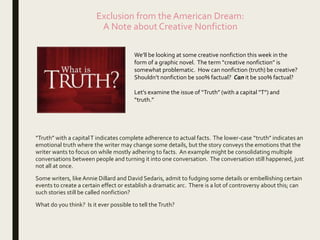
We’ll be looking at some creative nonfiction this week in the
form of a graphic novel. The term “creative nonfiction” is
somewhat problematic. How can nonfiction (truth) be creative?
Shouldn’t nonfiction be 100% factual? Can it be 100% factual?
Let’s examine the issue of “Truth” (with a capital “T”) and
“truth.”

W2 readings and authors

  • 1.
  • 2.
    Exclusion from theAmerican Dream As explained in this week’s American Dream lecture, women were traditionally considered to be keepers of culture. Much of the writing of early American women had to do with moral instruction or documentation of culture for future generations. As you also learned in this week’s American Dream lecture, women also wrote to bring awareness of other social issues. Charlotte Perkins Gilman (1860-1935) wrote about themes of inequality and the traditional gender role of women. “TheYellow Wall-paper” is a story of a woman’s struggles with post-partum depression, women’s role in society and marriage, and the expectation that women needed to rely on men to know what was best for them. Women had very little authority to make decisions for themselves, and this story shows what effects this lack of autonomy has on women.
  • 3.
    Exclusion from theAmerican Dream Other writers portrayed strong women in their work. Kate Chopin (1850-1904) wrote about women who acted in ways that did not adhere to societal norms. In The Awakening, Chopin writes about a woman named Edna, who moves out of her husband’s home and begins an adulterous affair. As the title suggests, it is a story of self-discovery. However, the novella was considered scandalous and was not well received in the 19th century. Today, however, it is seen as a significant work of feminism in American literature. In her short stories “Désirée's Baby” and “The Story of an Hour,” Chopin portrays women who seem to have achieved autonomy, only to have this independence taken away, leading to tragic consequences. As you read “Desiree’s Baby” this week, look for ways Désirée and the other characters are limited by their gender and their racial identity.
  • 4.
    Exclusion from theAmerican Dream Emily Dickinson (1830-1886), as you will learn in the biography in your textbook, is widely considered to be one of the greatest American poets, and her work continues to influence writers today. The form and content of her poems are vastly different from the “traditional” poets who write before her. Dickinson published very few of her own poems during her lifetime; most were published after her death. She did not actively seek to have her poems published, but she did share them with family and friends, many of whom encouraged her to publish. She did begin to purposely group her poems and bind them together. She called these collections fascicles, and these groupings of poems were discovered after her death.
  • 5.
    Dickinson is oftenthought of as a recluse or an “old maid.” While her poetry includes themes of nature, spirituality and religion, and death, she also wrote about love—not just the emotional element, but the physical one as well. The underlying themes of lust and eroticism in “Wild Nights—Wild Nights!” may be a surprise to you this week as you read the poem. As you read the poem this week, think about they way in which she portrays love and lust. Are they different? What symbols does she use in the poem, and how do they relate to these themes? How might this poem be seen from a feminist standpoint? In the video on the following screen, former poet laureate Billy Collins gives an overview to the imagery and meter in Dickinson’s poetry. Exclusion from the American Dream Dickinson’s handwritten version of the poem
  • 6.
    Exclusion from theAmerican Dream Susan Glaspell (1876-1948), as you learned in the biography printed in your textbook, had many talents. Her work tends to reflect realism, a literary technique that focuses on the faithful representation of reality (or verisimilitude). Realism tends to portray members of the middle class. Glaspell was well known in her day, but the canon of her works (9 plays and more than 50 short stories) is not well known today. She is best known today for her one-act play Trifles, which is commonly seen as a statement about women’s equality. As in many of Glaspell’s works, Trifles, which was written in 1916, features women who push against boundaries. As you read the play this week, think about ways in which all the women (even Mrs. Wright, who never appears on stage in Glaspell’s original script) face boundaries. How does each woman push against them?
  • 7.
    Exclusion from theAmerican Dream Women’s roles continued to evolve from keepers of culture to shapers of culture. Women like Susan Glaspell wrote about women who did not have a voice to stand up against violence. In the decades that followed, women such as Audre Lorde embraced their voices and used them to speak out. Audre Lorde (1934-1992), described herself as “black, lesbian, mother, warrior, poet.” She used her poetry as a platform to fight against racism, sexism, and homophobia. Lorde was concerned with the labels that are assigned to groups of people and marginalization (to marginalize means to trivialize or disregard) that results from those labels.
  • 8.
    Exclusion from theAmerican Dream Lucille Clifton (1936-2010), as the editors of your textbook explain, “allow[s] us to hear the language of our daily lives as poetry and to experience the poetry in our ordinary lives” (Levine, 2017,Vol. 1 p. 1494). We’re reading a poem from Clifton this week called “homage to my hips.” How does this poem include the language of our daily lives? On the surface level, the poem is clearly about hips, but ask yourself as you are reading what else the poem is about. How might this poem relate to the status of African American women, or of all women?
  • 9.
    Exclusion from theAmerican Dream JUSTINTORRES has published short fiction in The New Yorker, Harper's, Granta,Tin House,TheWashington Post, GlimmerTrain, Flaunt, and other publications, as well as non-fiction pieces in publications like The Guardian and The Advocate.A graduate of the Iowa Writers' Workshop, Justin's novel We the Animals has been translated into fifteen languages and was recently adapted into a film. It premiered at the Sundance Film Festival and was nominated for five Independent Spirit Awards. He was aWallace Stegner Fellow at Stanford University, a fellow at the Radcliffe Institute for Advanced Study at Harvard, and a CullmanCenter Fellow at the NewYork Public Library.The National Book Foundation named him one of the 2012's 5 under 35. He was the recipient of a grant from the National Endowment of the Arts, a Rolón Fellowship in Literature from United StatesArtists, and theVCUCabell First Novelist Award. He lives in LosAngeles, where he is an Assistant Professor of English at UCLA. Taken fromTorres’ website: http://www.justin-torres.com/bio
  • 10.
    Exclusion from theAmerican Dream Maia Kobabe is a graduate of the first ever class in the MFA in Comics program at California College of the Arts in San Francisco. Eir first full length book, GENDERQUEER:A MEMOIR, came out from Lion ForgeComics/Oni Press in May 2019. GENDERQUEER was a winner of anAlex Award and Stonewall Book Award in 2020, and nominated for an IgnatzAward and the Best Graphic Novels forTeens List fromYALSA in 2019. It recently received its fourth printing and its first foreign language translation into Spanish. Maia's short comics have been published onThe Nib and included in the anthologies ALPHABET (2015),TABULA IDEM (2017), MINE! (2018), GOTHICTALESOF HAUNTED LOVE (2018),THE SECRET LOVESOF GEEKS (2018), FASTERTHAN LIGHTY’ALL (2018), ADVANCED DEATH SAVES (2019), HOWTOWAIT (2019), SHOUTOUT (2019), ROLLEDANDTOLD (2019),THEATEROF TERROR (2019) and BEGAY, DOCOMICS (2020). Before setting out to work freelance full-time, e worked for over ten years in libraries. E has been self-publishing comics and zines since 2010, and has attended over fifty comic conventions in that time. Eir work is heavily influenced by fairy tales, homesickness, and the search for identity. Taken from Kobabe’s website: https://redgoldsparkspress.com/about
  • 11.
    Exclusion from theAmerican Dream We have explored in what ways people have been excluded from the American Dream because of their gender or sexuality. Various laws have been written and enacted to make the American Dream more accessible to women and gays and lesbians. Has that helped? What happens when people don’t fit into categories? What impact does that have on their ability to achieve the American Dream?
  • 12.
    Exclusion from theAmerican Dream There are two additional authors to consider this week to help you select your topic for your literary analysis essay. F. Scott Fitzgerald (1896-1940) is best known for his novel The Great Gatsby, which is often viewed as the finest example of American modernism. He is also the author of many short stories, including “Babylon Revisited” and “Winter Dreams.” Fitzgerald’s writing chronicled the 1920s, which he called “The Jazz Age.”
  • 13.
    Exclusion from theAmerican Dream The other writer to consider this week for your literary analysis essay is AliceWalker (b. 1944). Walker, the author of The Color Purple and short stories such as “Everyday Use,” was born in Eatonton,Georgia, into a family of sharecroppers. She was educated in the North but returned to the South after college to work in the civil rights movement. Her work often focuses on the need for strength.
  • 14.
    Exclusion from theAmerican Dream: A Note about Creative Nonfiction “Truth” with a capitalT indicates complete adherence to actual facts. The lower-case “truth” indicates an emotional truth where the writer may change some details, but the story conveys the emotions that the writer wants to focus on while mostly adhering to facts. An example might be consolidating multiple conversations between people and turning it into one conversation. The conversation still happened, just not all at once. Some writers, like Annie Dillard and David Sedaris, admit to fudging some details or embellishing certain events to create a certain effect or establish a dramatic arc. There is a lot of controversy about this; can such stories still be called nonfiction? What do you think? Is it ever possible to tell theTruth? We’ll be looking at some creative nonfiction this week in the form of a graphic novel. The term “creative nonfiction” is somewhat problematic. How can nonfiction (truth) be creative? Shouldn’t nonfiction be 100% factual? Can it be 100% factual? Let’s examine the issue of “Truth” (with a capital “T”) and “truth.”