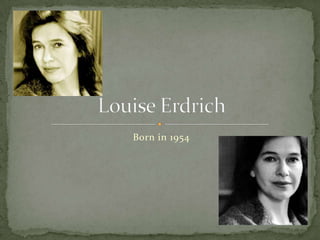
Born in 1954Louise Erdrich
Erdrich was born in Little Falls, MinnesotaShe grew up in Wahpeton, NDMother was French Chippewa or French Ojibwa(e)Father was German-AmericanMaternal grandmother was tribal chairman on the Turtle Mountain ReservationBoth of her grandparents worked in the Bureau of Indian Affairs boarding school in WahpetonEldest of seven childrenEncouraged by her father to write stories as a childMother  would create book covers for her manuscriptsEarly Life
Attended a Catholic school in WahpetonEntered Dartmouth College in 1972Participated in a Native American Study run by future husband Michael Dorris (who was part American Indian and a writer)In her undergraduate years she won prizes for poetry and fictionWorked a variety of jobsAfter deciding she wanted to write as a career she earned a Masters Degree at Johns HopkinsSchooling
Married Michael Dorris in 1981He had 3 adopted children alreadyTogether they had 3 daughtersSeemed to be the perfect couple and were even called the “poster couple of multicultural literature”Personal Life
Early in marriage they published romantic fiction under the name “Milou North” in order to make moneyMichael Louise, they lived in the North (MN)Later, they collaborated on every project, but whoever wrote the entire, initial draft would be the official authorThe one exception, The Crown of Columbus, was published in 1991 under both of their namesStarting in the 1990’s, Erdrich started writing solo and most of her work from that decade were entirely her ownCollaborating with Michael Dorris
Dorris and Erdrich separated in 1995Dorris committed suicide in 1997, before their divorce was finalErdrich now lives in Minneapolis, MN with her 3 children and owns the bookstore Birchbark BooksPersonal Life Cont.
She was named one of People Magazine’s “Most Beautiful People” in 1990Since the late 1990’s she has focused on learning the Ojibwe language and studying her tribe’s culture, traditions and mysticismInteresting tid-bits about Louise
Novels:Love Medicine, 1984The Beet Queen, 1986Tracks, 1988The Crown of Columbus (with husband), 1991The Bingo Palace, 1994Tales of Burning Love, 1996The Antelope Wife, 1998The Last Report on the Miracles at Little No Horse, 2001The Master Butchers Singing Club, 2003Four Souls, 2004A Plague of Doves, 2008Writings
PoetryJacklight, 1984Baptism of Desire, 1989Original Fire: New and Selected Poems, 2003Children’s BooksGrandmother’s Pigeon, 1996The Birchbark House, 1999The Game of Silence, 2004Writings Cont.
AwardsAcademy of American Poets Prize, 1975 Best First Fiction Award from the American Academy and Institute of Arts& LettersNelson Algren Fiction Award for "The World's Greatest Fishermen," 1982 National Endowment for the Arts Fellowship, 1982 Pushcart Prize for "Indian Boarding School," 1983 National Magazine Award for Fiction, 1983 National Book Critics Circle Award for Best Work of Fiction, 1984 Sue Kaufman Prize for Best First Fiction from The American Academy and Institute of Arts and Letters, 1984 Virginia McCormick Scully Award for Best Book, 1984 John Simon Guggenheim Award, 1985 Los Angeles Times Award for Fiction, 1985 American Book Award from the Before Columbus Foundation, 1985 Great Lakes Colleges Association Award for Best First Work of fiction for Love Medicine, 1985 O. Henry Prize and National Magazine Award for "Fleur," 1987 Western Literary Association Award, 1992
She explores Native American themes in her writing but her major characters represent both sides of her heritage“Her style is easy, offhand, quietly unostentatious, but her language often has an unpredictability and sense of surprise”The lyrical descriptions in her fiction resemble the language of her poems and the characterizations and narratives in her poetry resemble the ones in her fictionShe sometimes puts realistic stories of small-t0wn life in her works and sometimes retells mythical storiesWork reflects her awareness of historical events and ongoing events of Native American lifeErdrich’s Writing and Techniques
Characters: Fleur, Pauline, townspeople, Pete Kozka and wife Fritzie, Lily, Tor, Dutch (Pauline’s Stepfather)Starts with background information on Fleur: Chippewa Indian that almost drowned twice; instead the person who saved her or the first person to get close to her died. This led to the townspeople being scared of her and caused them to believe many things about her. They wanted to drive her off the reservation, but no one had the guts to. Then one day, she left on her own for the summer.This is where the story begins. Fleur Summary
Goes to the town ArgusGets a job at Pete Kozka’s butcher shopSits down and plays cards with the men; which is unheard ofEvery night she wins exactly a dollarMen are getting very angry and save up all of their moneyOne night they played so long all of their money was on the table; on the last hand Fleur wonLily, Dutch, Tor, Fleur and Pauline are presentLily flipped out and went after herFleur hides while Lily is wrestling a pig (with the other men watching) and when he is pinned down she runsThe men catch her and assault herDuring all of this Pauline is watching in the shadows too scared to come outSummary Cont.
The next day a tornado hitsThe three men hide in the freezer; leaving Pauline behindShe ends up locking the door from the outsideAftermath: nothing is really damaged much except for the places in the butcher shop where the three men worked; the back rooms where Pete and his wife lived were unharmed; even the last cigarette that Fritzie had sitting in an astray was undisturbedIt was a few days before they realized the men were missingThey found them frozen to death huddled up together in the freezerSummary Cont.
Fleur returned to the reservation where she had a child; she lives down on Lake TurcotNo one goes to visit her or even sees her other than PaulineSome say the child is the waterman, Misshepshu’s or that it is a white man’s Everyone talks and tells stories but no one really knows the truthSummary Cont.
What is Erdrich’s nationality?Where did Erdrich go to school?In the story Fleur, what happened to the man she cursed after she almost drowned the second time?What event led to the men attacking Fleur?What are some of the things the townspeople believed about Fleur?Questions
http://www.gale.cengage.com/free_resources/whm/bio/erdrich_l.htmhttp://www.geocities.com/tonnelso/http://www.answers.com/topic/louise-erdrichhttp://www.english.illinois.edu/MAPS/poets/a_f/erdrich/about.htmThe Norton Anthology: American Literature Volume ESources

Louise Erdrich

  • 1.
  • 2.
    Erdrich was bornin Little Falls, MinnesotaShe grew up in Wahpeton, NDMother was French Chippewa or French Ojibwa(e)Father was German-AmericanMaternal grandmother was tribal chairman on the Turtle Mountain ReservationBoth of her grandparents worked in the Bureau of Indian Affairs boarding school in WahpetonEldest of seven childrenEncouraged by her father to write stories as a childMother would create book covers for her manuscriptsEarly Life
  • 3.
    Attended a Catholicschool in WahpetonEntered Dartmouth College in 1972Participated in a Native American Study run by future husband Michael Dorris (who was part American Indian and a writer)In her undergraduate years she won prizes for poetry and fictionWorked a variety of jobsAfter deciding she wanted to write as a career she earned a Masters Degree at Johns HopkinsSchooling
  • 4.
    Married Michael Dorrisin 1981He had 3 adopted children alreadyTogether they had 3 daughtersSeemed to be the perfect couple and were even called the “poster couple of multicultural literature”Personal Life
  • 5.
    Early in marriagethey published romantic fiction under the name “Milou North” in order to make moneyMichael Louise, they lived in the North (MN)Later, they collaborated on every project, but whoever wrote the entire, initial draft would be the official authorThe one exception, The Crown of Columbus, was published in 1991 under both of their namesStarting in the 1990’s, Erdrich started writing solo and most of her work from that decade were entirely her ownCollaborating with Michael Dorris
  • 6.
    Dorris and Erdrichseparated in 1995Dorris committed suicide in 1997, before their divorce was finalErdrich now lives in Minneapolis, MN with her 3 children and owns the bookstore Birchbark BooksPersonal Life Cont.
  • 7.
    She was namedone of People Magazine’s “Most Beautiful People” in 1990Since the late 1990’s she has focused on learning the Ojibwe language and studying her tribe’s culture, traditions and mysticismInteresting tid-bits about Louise
  • 8.
    Novels:Love Medicine, 1984TheBeet Queen, 1986Tracks, 1988The Crown of Columbus (with husband), 1991The Bingo Palace, 1994Tales of Burning Love, 1996The Antelope Wife, 1998The Last Report on the Miracles at Little No Horse, 2001The Master Butchers Singing Club, 2003Four Souls, 2004A Plague of Doves, 2008Writings
  • 9.
    PoetryJacklight, 1984Baptism ofDesire, 1989Original Fire: New and Selected Poems, 2003Children’s BooksGrandmother’s Pigeon, 1996The Birchbark House, 1999The Game of Silence, 2004Writings Cont.
  • 10.
    AwardsAcademy of AmericanPoets Prize, 1975 Best First Fiction Award from the American Academy and Institute of Arts& LettersNelson Algren Fiction Award for "The World's Greatest Fishermen," 1982 National Endowment for the Arts Fellowship, 1982 Pushcart Prize for "Indian Boarding School," 1983 National Magazine Award for Fiction, 1983 National Book Critics Circle Award for Best Work of Fiction, 1984 Sue Kaufman Prize for Best First Fiction from The American Academy and Institute of Arts and Letters, 1984 Virginia McCormick Scully Award for Best Book, 1984 John Simon Guggenheim Award, 1985 Los Angeles Times Award for Fiction, 1985 American Book Award from the Before Columbus Foundation, 1985 Great Lakes Colleges Association Award for Best First Work of fiction for Love Medicine, 1985 O. Henry Prize and National Magazine Award for "Fleur," 1987 Western Literary Association Award, 1992
  • 11.
    She explores NativeAmerican themes in her writing but her major characters represent both sides of her heritage“Her style is easy, offhand, quietly unostentatious, but her language often has an unpredictability and sense of surprise”The lyrical descriptions in her fiction resemble the language of her poems and the characterizations and narratives in her poetry resemble the ones in her fictionShe sometimes puts realistic stories of small-t0wn life in her works and sometimes retells mythical storiesWork reflects her awareness of historical events and ongoing events of Native American lifeErdrich’s Writing and Techniques
  • 12.
    Characters: Fleur, Pauline,townspeople, Pete Kozka and wife Fritzie, Lily, Tor, Dutch (Pauline’s Stepfather)Starts with background information on Fleur: Chippewa Indian that almost drowned twice; instead the person who saved her or the first person to get close to her died. This led to the townspeople being scared of her and caused them to believe many things about her. They wanted to drive her off the reservation, but no one had the guts to. Then one day, she left on her own for the summer.This is where the story begins. Fleur Summary
  • 13.
    Goes to thetown ArgusGets a job at Pete Kozka’s butcher shopSits down and plays cards with the men; which is unheard ofEvery night she wins exactly a dollarMen are getting very angry and save up all of their moneyOne night they played so long all of their money was on the table; on the last hand Fleur wonLily, Dutch, Tor, Fleur and Pauline are presentLily flipped out and went after herFleur hides while Lily is wrestling a pig (with the other men watching) and when he is pinned down she runsThe men catch her and assault herDuring all of this Pauline is watching in the shadows too scared to come outSummary Cont.
  • 14.
    The next daya tornado hitsThe three men hide in the freezer; leaving Pauline behindShe ends up locking the door from the outsideAftermath: nothing is really damaged much except for the places in the butcher shop where the three men worked; the back rooms where Pete and his wife lived were unharmed; even the last cigarette that Fritzie had sitting in an astray was undisturbedIt was a few days before they realized the men were missingThey found them frozen to death huddled up together in the freezerSummary Cont.
  • 15.
    Fleur returned tothe reservation where she had a child; she lives down on Lake TurcotNo one goes to visit her or even sees her other than PaulineSome say the child is the waterman, Misshepshu’s or that it is a white man’s Everyone talks and tells stories but no one really knows the truthSummary Cont.
  • 16.
    What is Erdrich’snationality?Where did Erdrich go to school?In the story Fleur, what happened to the man she cursed after she almost drowned the second time?What event led to the men attacking Fleur?What are some of the things the townspeople believed about Fleur?Questions
  • 17.

Editor's Notes

  • #3 Wahpeton is on the Minnesota border, father paid her a nickel for each story (she later joked that these were her first royalties), book covers made out of woven strips of construction paper and staples
  • #4 Grandfather worshiped the traditional Ojibwa religion while at the same time was a devout Catholic, 1972 was the first year the college began admitting women and the year the Native-American studies dept was established, Jobs– teaching poetry in prisons, editing a Boston Indian Council newspaper, flag-signaling on a construction site
  • #7 Separation was result of allegations of sexual abuse brought against him by some of his children, She moved six blocks down the street so they could still raise their children together
  • #12 In quotes because it is straight out of the book,