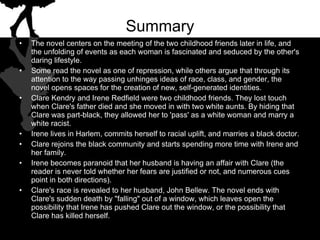
Summary The novel centers on the meeting of the two childhood friends later in life, and the unfolding of events as each woman is fascinated and seduced by the other's daring lifestyle. Some read the novel as one of repression, while others argue that through its attention to the way passing unhinges ideas of race, class, and gender, the novel opens spaces for the creation of new, self-generated identities. Clare Kendry and Irene Redfield were two childhood friends. They lost touch when Clare's father died and she moved in with two white aunts. By hiding that Clare was part-black, they allowed her to 'pass' as a white woman and marry a white racist. Irene lives in Harlem, commits herself to racial uplift, and marries a black doctor. Clare rejoins the black community and starts spending more time with Irene and her family. Irene becomes paranoid that her husband is having an affair with Clare (the reader is never told whether her fears are justified or not, and numerous cues point in both directions).  Clare's race is revealed to her husband, John Bellew. The novel ends with Clare's sudden death by "falling" out of a window, which leaves open the possibility that Irene has pushed Clare out the window, or the possibility that Clare has killed herself.  
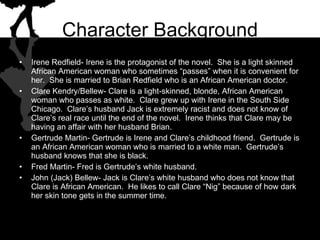
Character Background Irene Redfield- Irene is the protagonist of the novel.  She is a light skinned African American woman who sometimes “passes” when it is convenient for her.  She is married to Brian Redfield who is an African American doctor.  Clare Kendry/Bellew- Clare is a light-skinned, blonde, African American woman who passes as white.  Clare grew up with Irene in the South Side Chicago.  Clare’s husband Jack is extremely racist and does not know of Clare’s real race until the end of the novel.  Irene thinks that Clare may be having an affair with her husband Brian.  Gertrude Martin- Gertrude is Irene and Clare’s childhood friend.  Gertrude is an African American woman who is married to a white man.  Gertrude’s husband knows that she is black.  Fred Martin- Fred is Gertrude’s white husband.  John (Jack) Bellew- Jack is Clare’s white husband who does not know that Clare is African American.  He likes to call Clare “Nig” because of how dark her skin tone gets in the summer time.
Author Background Nella Larsen was born Nellie Walker on April 13, 1891 in Chicago, Illinois Was considered to be one of the most influential novelists of the Harlem Renaissance, a cultural movement in the United States between the early 1900s and 1930s, then referred to as the New Negro Movement Moved to New York in the early 20 th  century to work as a nurse and librarian Published her first novel, Quicksand, in 1928 Passing was published in 1929 Awarded the William E. Harmon Bronze Award for Distinguished Achievement Among Negroes Unable to have third novel published due to marital issues and professional problems Stopped writing completely in the 1930s Worked as a nurse full time until her death on March 30, 1964 at age 72
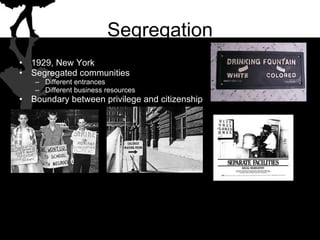
Segregation 1929, New York Segregated communities Different entrances Different business resources Boundary between privilege and citizenship
The Process of Passing African-American women had two choices Accommodate Protest Fair-skinned African American women had a third choice Passing Passing was the elimination of African-American culture and assimilating into white culture Start at a young age and live with a white family Marry a white man and hope to have all white children It was seen as an opportunity to gain the same treatment as white women It embodied a survival strategy The disadvantage was the elimination of one’s culture, which led to release of their rights as a woman
 

Passing

  • 1.
  • 2.
    Summary The novelcenters on the meeting of the two childhood friends later in life, and the unfolding of events as each woman is fascinated and seduced by the other's daring lifestyle. Some read the novel as one of repression, while others argue that through its attention to the way passing unhinges ideas of race, class, and gender, the novel opens spaces for the creation of new, self-generated identities. Clare Kendry and Irene Redfield were two childhood friends. They lost touch when Clare's father died and she moved in with two white aunts. By hiding that Clare was part-black, they allowed her to 'pass' as a white woman and marry a white racist. Irene lives in Harlem, commits herself to racial uplift, and marries a black doctor. Clare rejoins the black community and starts spending more time with Irene and her family. Irene becomes paranoid that her husband is having an affair with Clare (the reader is never told whether her fears are justified or not, and numerous cues point in both directions). Clare's race is revealed to her husband, John Bellew. The novel ends with Clare's sudden death by "falling" out of a window, which leaves open the possibility that Irene has pushed Clare out the window, or the possibility that Clare has killed herself.  
  • 3.
    Character Background IreneRedfield- Irene is the protagonist of the novel. She is a light skinned African American woman who sometimes “passes” when it is convenient for her. She is married to Brian Redfield who is an African American doctor.  Clare Kendry/Bellew- Clare is a light-skinned, blonde, African American woman who passes as white. Clare grew up with Irene in the South Side Chicago. Clare’s husband Jack is extremely racist and does not know of Clare’s real race until the end of the novel. Irene thinks that Clare may be having an affair with her husband Brian.  Gertrude Martin- Gertrude is Irene and Clare’s childhood friend. Gertrude is an African American woman who is married to a white man. Gertrude’s husband knows that she is black.  Fred Martin- Fred is Gertrude’s white husband.  John (Jack) Bellew- Jack is Clare’s white husband who does not know that Clare is African American. He likes to call Clare “Nig” because of how dark her skin tone gets in the summer time.
  • 4.
    Author Background NellaLarsen was born Nellie Walker on April 13, 1891 in Chicago, Illinois Was considered to be one of the most influential novelists of the Harlem Renaissance, a cultural movement in the United States between the early 1900s and 1930s, then referred to as the New Negro Movement Moved to New York in the early 20 th century to work as a nurse and librarian Published her first novel, Quicksand, in 1928 Passing was published in 1929 Awarded the William E. Harmon Bronze Award for Distinguished Achievement Among Negroes Unable to have third novel published due to marital issues and professional problems Stopped writing completely in the 1930s Worked as a nurse full time until her death on March 30, 1964 at age 72
  • 5.
    Segregation 1929, NewYork Segregated communities Different entrances Different business resources Boundary between privilege and citizenship
  • 6.
    The Process ofPassing African-American women had two choices Accommodate Protest Fair-skinned African American women had a third choice Passing Passing was the elimination of African-American culture and assimilating into white culture Start at a young age and live with a white family Marry a white man and hope to have all white children It was seen as an opportunity to gain the same treatment as white women It embodied a survival strategy The disadvantage was the elimination of one’s culture, which led to release of their rights as a woman
  • 7.