USING
PARAPHRASES
A Guide to Selecting, Integrating, and Citing in APA Style (7th
ed.)
Step 1: Choose a Passage that
Supports Your Position
Just like when using
quotations, the most
important part of the process
is finding a passage that
effectively supports your
position, idea, or statement.
Depending on the
assignment, you may need
one, two, or several sources
to support your ideas.
Sometimes these sources
have many lines that you
want to use. This is a good
time to paraphrase.
Step 1:
Choose a
Passage that
Supports
Your Position
(continued)
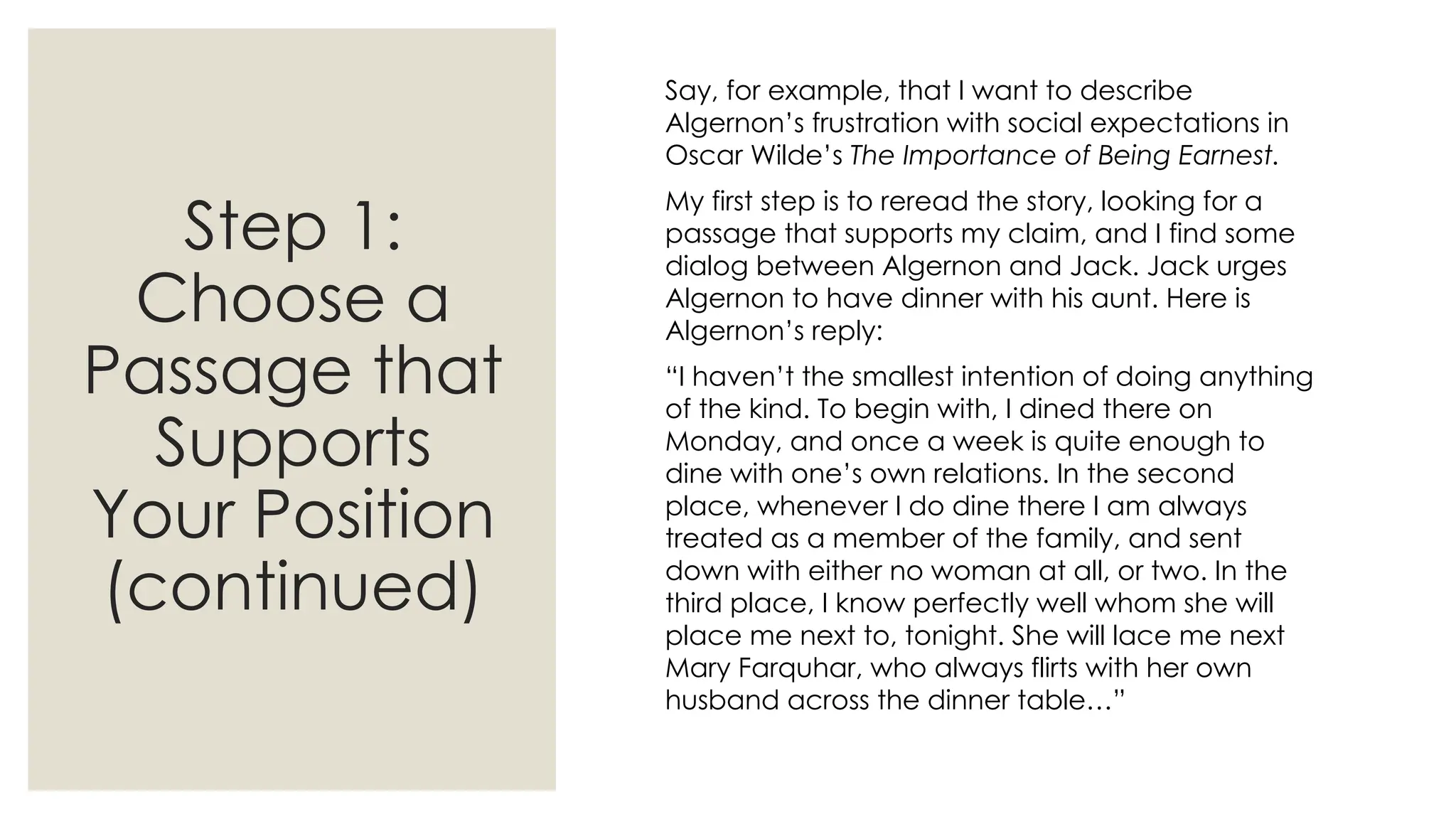
Say, for example, that I want to describe
Algernon’s frustration with social expectations in
Oscar Wilde’s The Importance of Being Earnest.
My first step is to reread the story, looking for a
passage that supports my claim, and I find some
dialog between Algernon and Jack. Jack urges
Algernon to have dinner with his aunt. Here is
Algernon’s reply:
“I haven’t the smallest intention of doing anything
of the kind. To begin with, I dined there on
Monday, and once a week is quite enough to
dine with one’s own relations. In the second
place, whenever I do dine there I am always
treated as a member of the family, and sent
down with either no woman at all, or two. In the
third place, I know perfectly well whom she will
place me next to, tonight. She will lace me next
Mary Farquhar, who always flirts with her own
husband across the dinner table…”
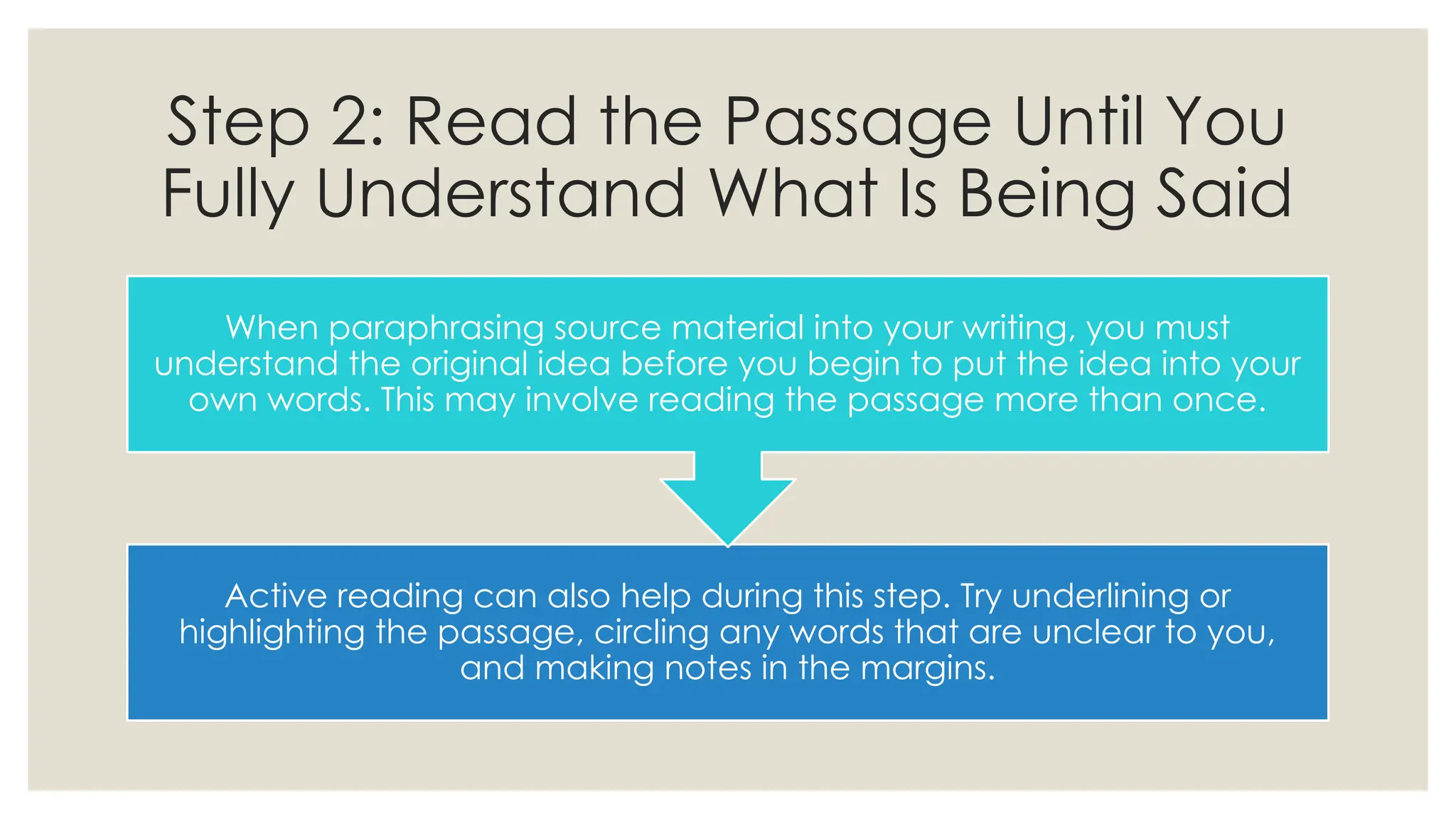
Step 2: Read the Passage Until You
Fully Understand What Is Being Said
Active reading can also help during this step. Try underlining or
highlighting the passage, circling any words that are unclear to you,
and making notes in the margins.
When paraphrasing source material into your writing, you must
understand the original idea before you begin to put the idea into your
own words. This may involve reading the passage more than once.
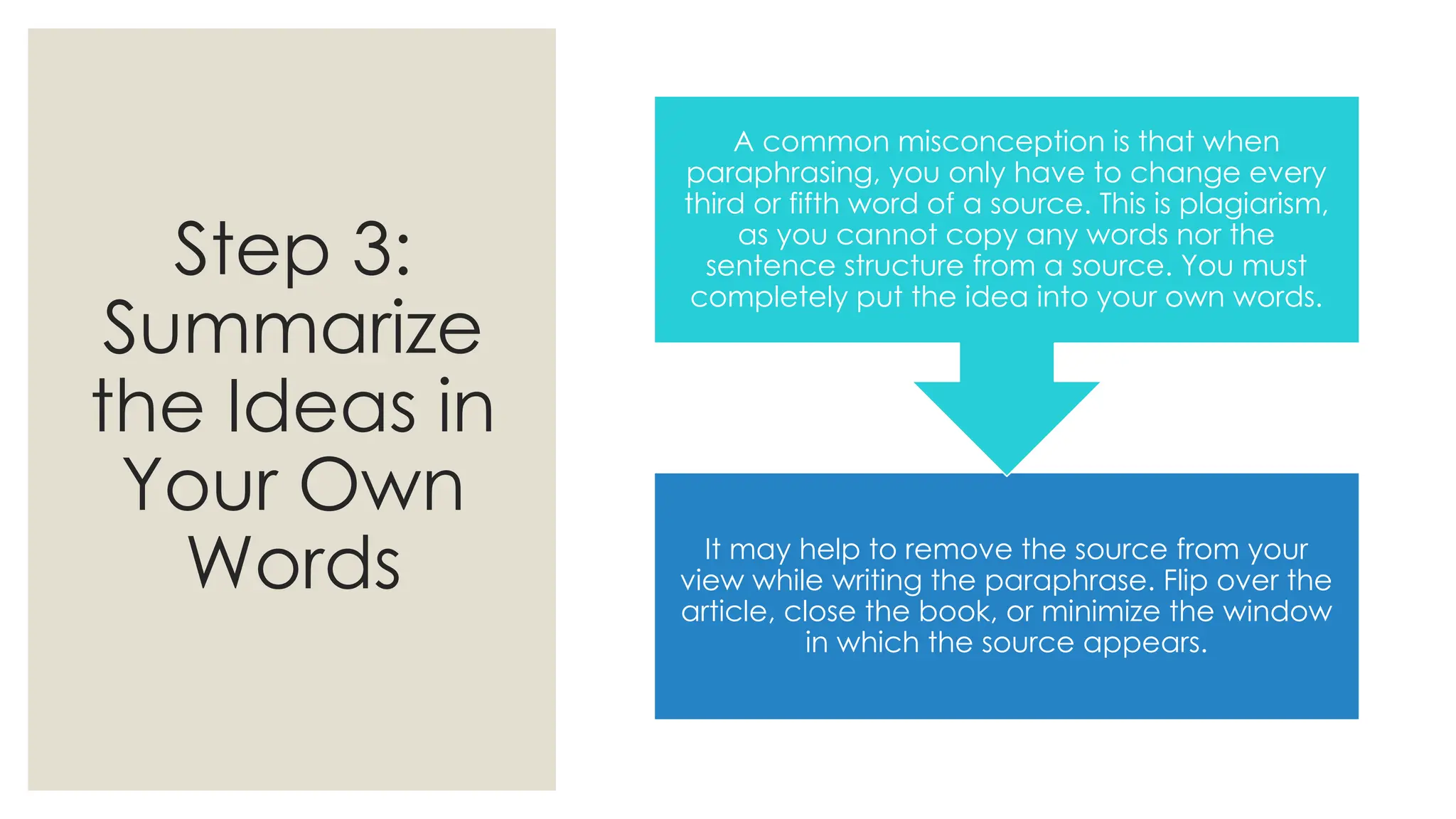
Step 3:
Summarize
the Ideas in
Your Own
Words It may help to remove the source from your
view while writing the paraphrase. Flip over the
article, close the book, or minimize the window
in which the source appears.
A common misconception is that when
paraphrasing, you only have to change every
third or fifth word of a source. This is plagiarism,
as you cannot copy any words nor the
sentence structure from a source. You must
completely put the idea into your own words.
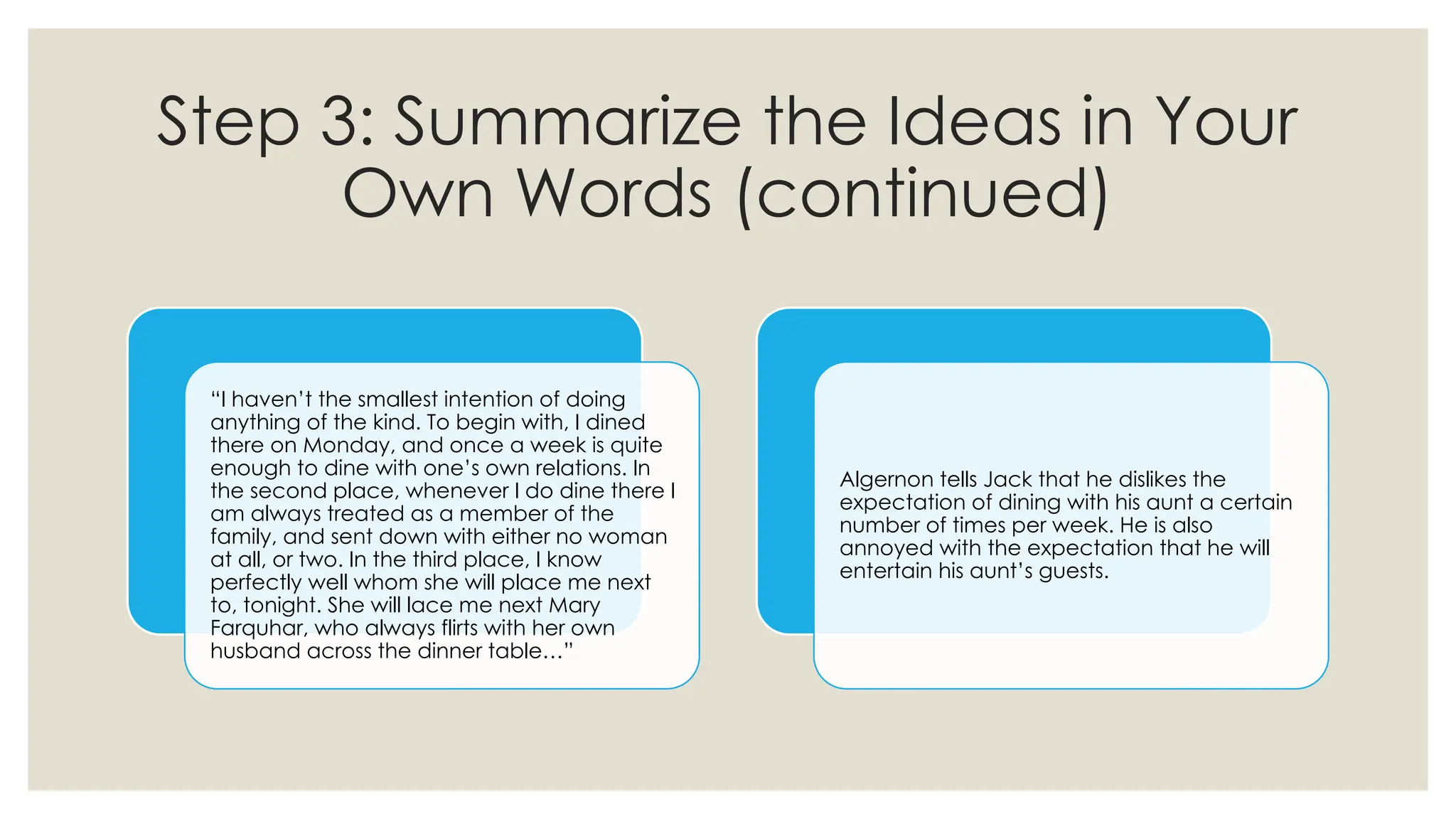
Step 3: Summarize the Ideas in Your
Own Words (continued)
“I haven’t the smallest intention of doing
anything of the kind. To begin with, I dined
there on Monday, and once a week is quite
enough to dine with one’s own relations. In
the second place, whenever I do dine there I
am always treated as a member of the
family, and sent down with either no woman
at all, or two. In the third place, I know
perfectly well whom she will place me next
to, tonight. She will lace me next Mary
Farquhar, who always flirts with her own
husband across the dinner table…”
Algernon tells Jack that he dislikes the
expectation of dining with his aunt a certain
number of times per week. He is also
annoyed with the expectation that he will
entertain his aunt’s guests.
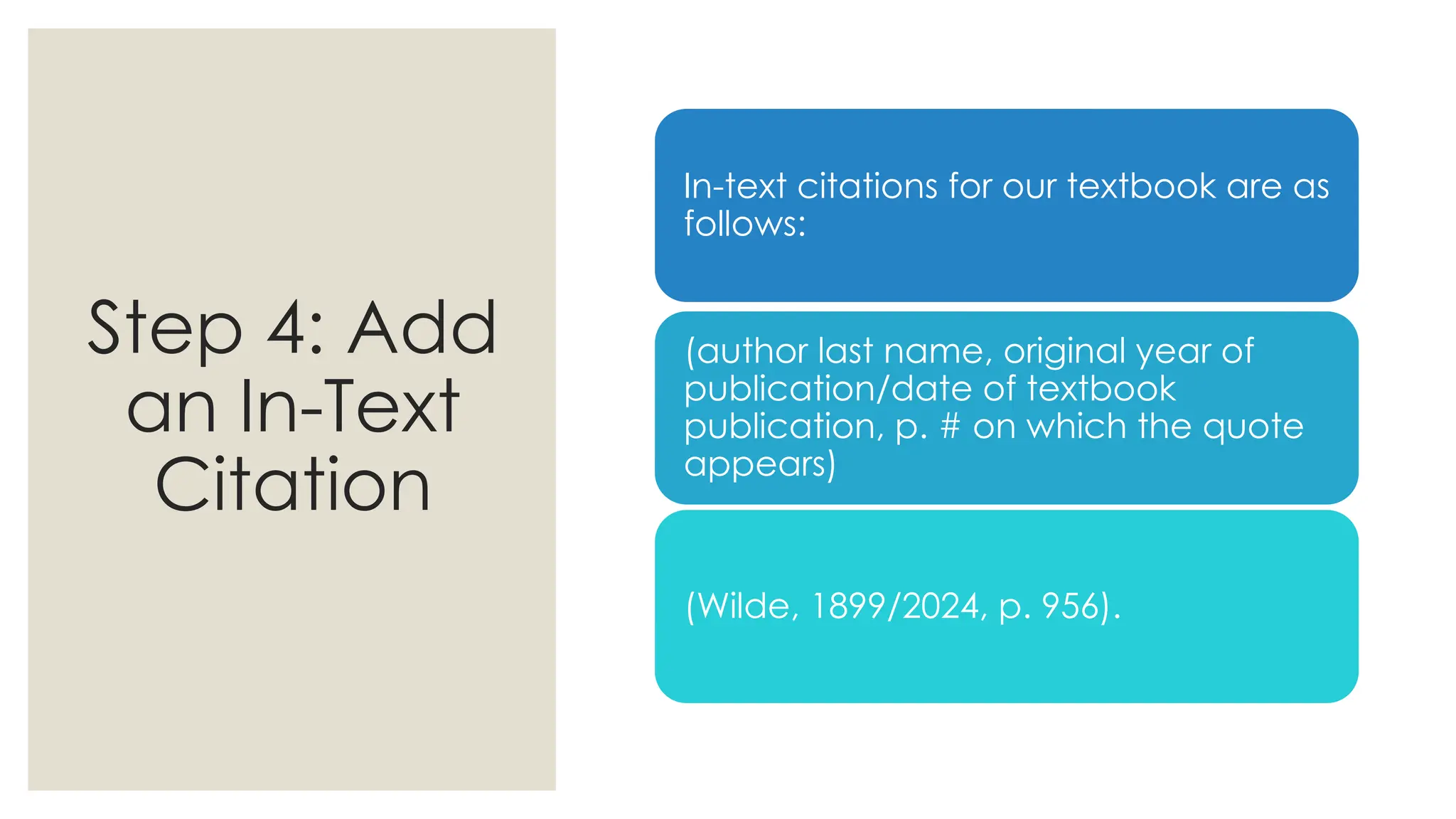
Step 4: Add
an In-Text
Citation
In-text citations for our textbook are as
follows:
(author last name, original year of
publication/date of textbook
publication, p. # on which the quote
appears)
(Wilde, 1899/2024, p. 956).
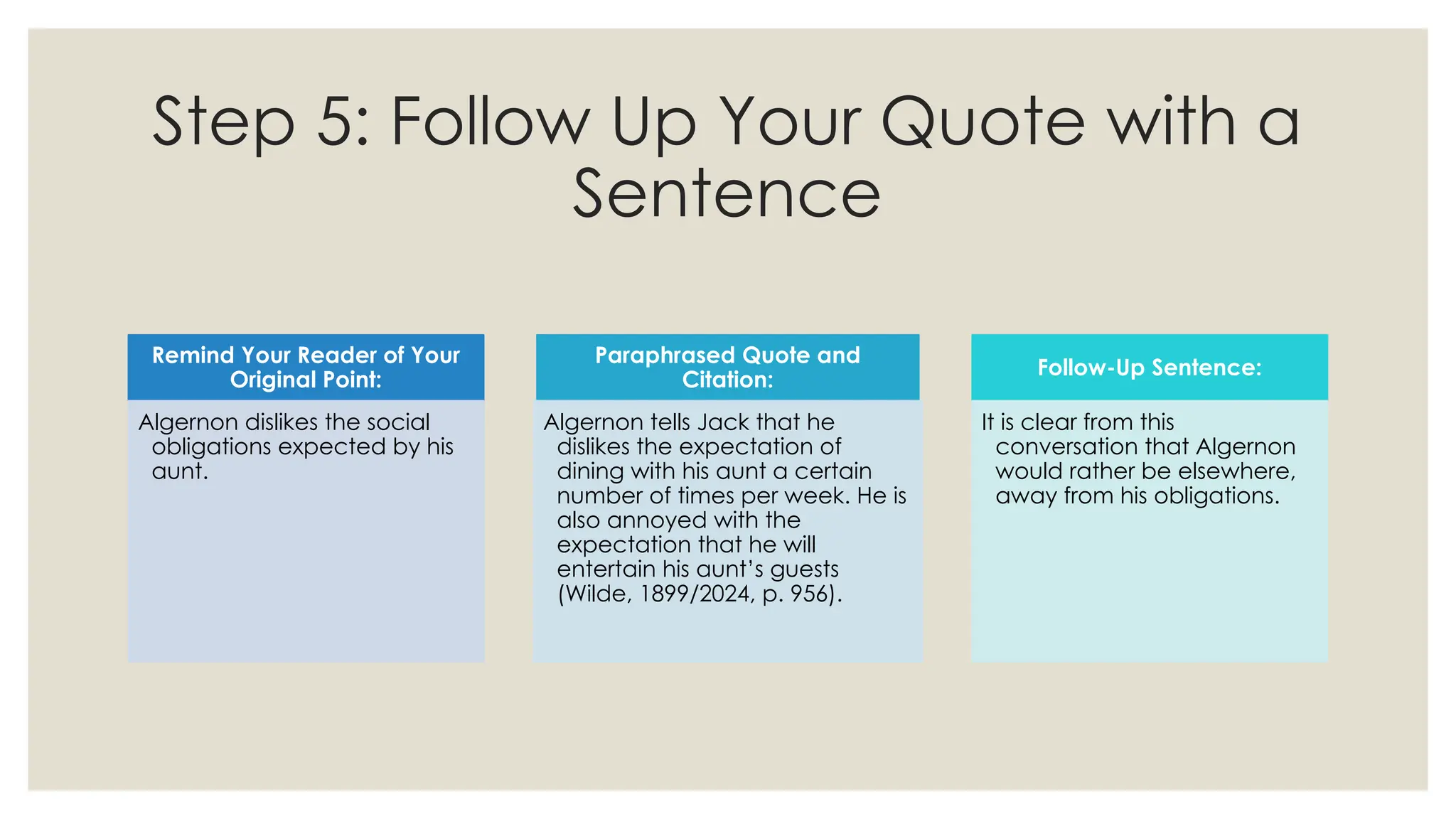
Step 5: Follow Up Your Quote with a
Sentence
Remind Your Reader of Your
Original Point:
Algernon dislikes the social
obligations expected by his
aunt.
Paraphrased Quote and
Citation:
Algernon tells Jack that he
dislikes the expectation of
dining with his aunt a certain
number of times per week. He is
also annoyed with the
expectation that he will
entertain his aunt’s guests
(Wilde, 1899/2024, p. 956).
Follow-Up Sentence:
It is clear from this
conversation that Algernon
would rather be elsewhere,
away from his obligations.
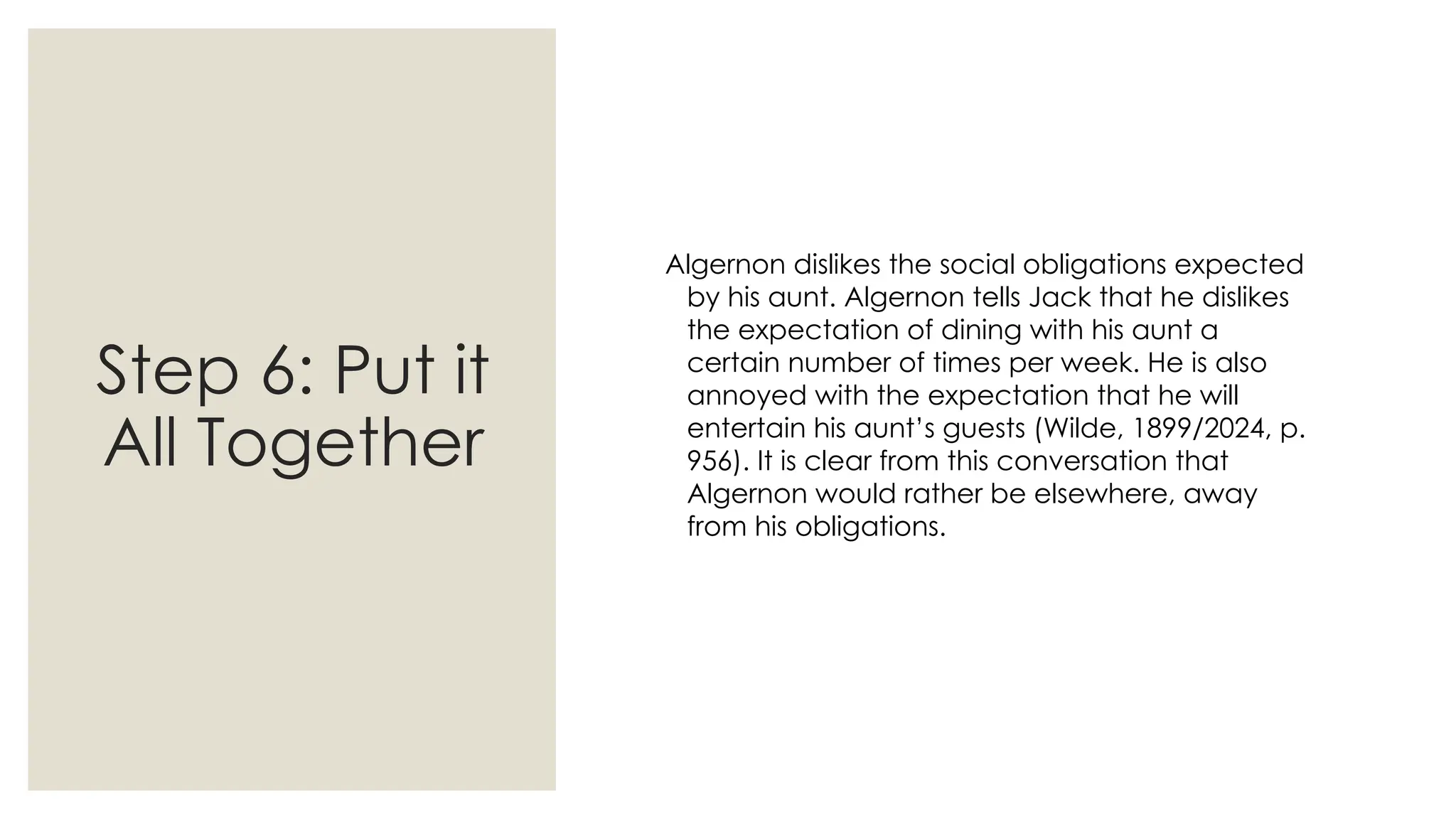
Step 6: Put it
All Together
Algernon dislikes the social obligations expected
by his aunt. Algernon tells Jack that he dislikes
the expectation of dining with his aunt a
certain number of times per week. He is also
annoyed with the expectation that he will
entertain his aunt’s guests (Wilde, 1899/2024, p.
956). It is clear from this conversation that
Algernon would rather be elsewhere, away
from his obligations.
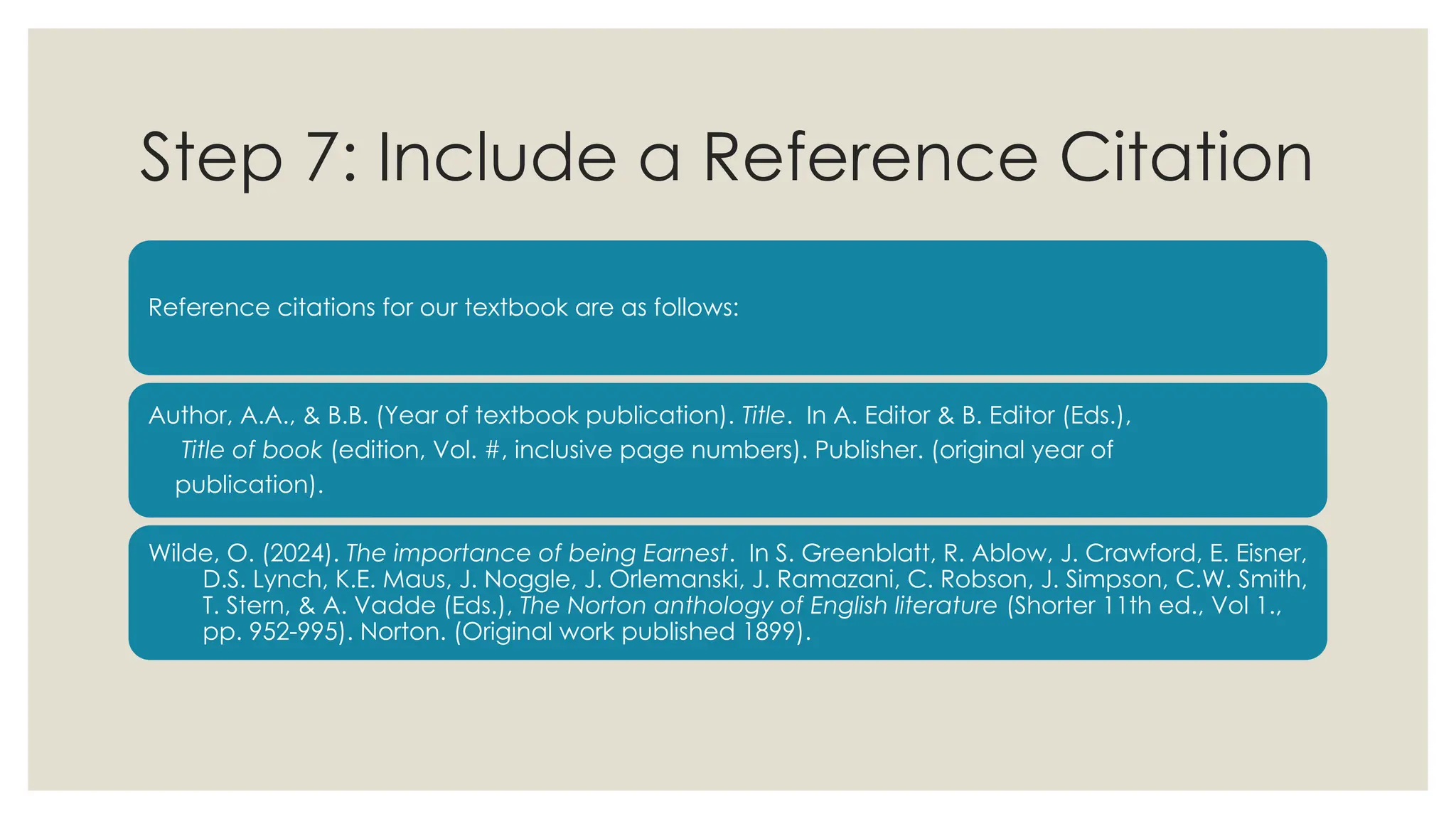
Step 7: Include a Reference Citation
Reference citations for our textbook are as follows:
Author, A.A., & B.B. (Year of textbook publication). Title. In A. Editor & B. Editor (Eds.),
Title of book (edition, Vol. #, inclusive page numbers). Publisher. (original year of
publication).
Wilde, O. (2024). The importance of being Earnest. In S. Greenblatt, R. Ablow, J. Crawford, E. Eisner,
D.S. Lynch, K.E. Maus, J. Noggle, J. Orlemanski, J. Ramazani, C. Robson, J. Simpson, C.W. Smith,
T. Stern, & A. Vadde (Eds.), The Norton anthology of English literature (Shorter 11th ed., Vol 1.,
pp. 952-995). Norton. (Original work published 1899).
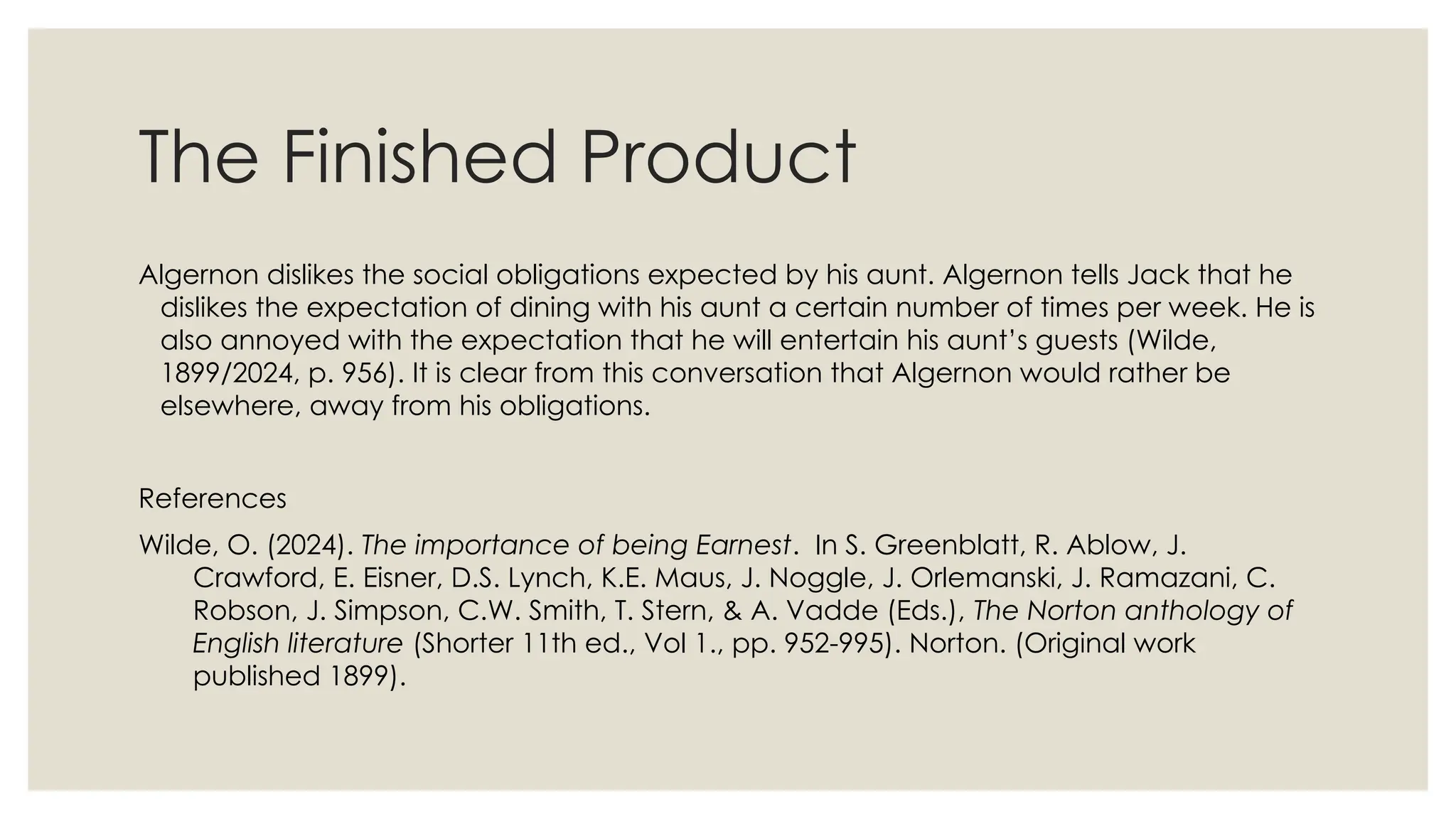
The Finished Product
Algernon dislikes the social obligations expected by his aunt. Algernon tells Jack that he
dislikes the expectation of dining with his aunt a certain number of times per week. He is
also annoyed with the expectation that he will entertain his aunt’s guests (Wilde,
1899/2024, p. 956). It is clear from this conversation that Algernon would rather be
elsewhere, away from his obligations.
References
Wilde, O. (2024). The importance of being Earnest. In S. Greenblatt, R. Ablow, J.
Crawford, E. Eisner, D.S. Lynch, K.E. Maus, J. Noggle, J. Orlemanski, J. Ramazani, C.
Robson, J. Simpson, C.W. Smith, T. Stern, & A. Vadde (Eds.), The Norton anthology of
English literature (Shorter 11th ed., Vol 1., pp. 952-995). Norton. (Original work
published 1899).
KU ENL1000 Using and Citing Paraphrases 2025

  • 1.
    USING PARAPHRASES A Guide toSelecting, Integrating, and Citing in APA Style (7th ed.)
  • 2.
    Step 1: Choosea Passage that Supports Your Position Just like when using quotations, the most important part of the process is finding a passage that effectively supports your position, idea, or statement. Depending on the assignment, you may need one, two, or several sources to support your ideas. Sometimes these sources have many lines that you want to use. This is a good time to paraphrase.
  • 3.
    Step 1: Choose a Passagethat Supports Your Position (continued) Say, for example, that I want to describe Algernon’s frustration with social expectations in Oscar Wilde’s The Importance of Being Earnest. My first step is to reread the story, looking for a passage that supports my claim, and I find some dialog between Algernon and Jack. Jack urges Algernon to have dinner with his aunt. Here is Algernon’s reply: “I haven’t the smallest intention of doing anything of the kind. To begin with, I dined there on Monday, and once a week is quite enough to dine with one’s own relations. In the second place, whenever I do dine there I am always treated as a member of the family, and sent down with either no woman at all, or two. In the third place, I know perfectly well whom she will place me next to, tonight. She will lace me next Mary Farquhar, who always flirts with her own husband across the dinner table…”
  • 4.
    Step 2: Readthe Passage Until You Fully Understand What Is Being Said Active reading can also help during this step. Try underlining or highlighting the passage, circling any words that are unclear to you, and making notes in the margins. When paraphrasing source material into your writing, you must understand the original idea before you begin to put the idea into your own words. This may involve reading the passage more than once.
  • 5.
    Step 3: Summarize the Ideasin Your Own Words It may help to remove the source from your view while writing the paraphrase. Flip over the article, close the book, or minimize the window in which the source appears. A common misconception is that when paraphrasing, you only have to change every third or fifth word of a source. This is plagiarism, as you cannot copy any words nor the sentence structure from a source. You must completely put the idea into your own words.
  • 6.
    Step 3: Summarizethe Ideas in Your Own Words (continued) “I haven’t the smallest intention of doing anything of the kind. To begin with, I dined there on Monday, and once a week is quite enough to dine with one’s own relations. In the second place, whenever I do dine there I am always treated as a member of the family, and sent down with either no woman at all, or two. In the third place, I know perfectly well whom she will place me next to, tonight. She will lace me next Mary Farquhar, who always flirts with her own husband across the dinner table…” Algernon tells Jack that he dislikes the expectation of dining with his aunt a certain number of times per week. He is also annoyed with the expectation that he will entertain his aunt’s guests.
  • 7.
    Step 4: Add anIn-Text Citation In-text citations for our textbook are as follows: (author last name, original year of publication/date of textbook publication, p. # on which the quote appears) (Wilde, 1899/2024, p. 956).
  • 8.
    Step 5: FollowUp Your Quote with a Sentence Remind Your Reader of Your Original Point: Algernon dislikes the social obligations expected by his aunt. Paraphrased Quote and Citation: Algernon tells Jack that he dislikes the expectation of dining with his aunt a certain number of times per week. He is also annoyed with the expectation that he will entertain his aunt’s guests (Wilde, 1899/2024, p. 956). Follow-Up Sentence: It is clear from this conversation that Algernon would rather be elsewhere, away from his obligations.
  • 9.
    Step 6: Putit All Together Algernon dislikes the social obligations expected by his aunt. Algernon tells Jack that he dislikes the expectation of dining with his aunt a certain number of times per week. He is also annoyed with the expectation that he will entertain his aunt’s guests (Wilde, 1899/2024, p. 956). It is clear from this conversation that Algernon would rather be elsewhere, away from his obligations.
  • 10.
    Step 7: Includea Reference Citation Reference citations for our textbook are as follows: Author, A.A., & B.B. (Year of textbook publication). Title. In A. Editor & B. Editor (Eds.), Title of book (edition, Vol. #, inclusive page numbers). Publisher. (original year of publication). Wilde, O. (2024). The importance of being Earnest. In S. Greenblatt, R. Ablow, J. Crawford, E. Eisner, D.S. Lynch, K.E. Maus, J. Noggle, J. Orlemanski, J. Ramazani, C. Robson, J. Simpson, C.W. Smith, T. Stern, & A. Vadde (Eds.), The Norton anthology of English literature (Shorter 11th ed., Vol 1., pp. 952-995). Norton. (Original work published 1899).
  • 11.
    The Finished Product Algernondislikes the social obligations expected by his aunt. Algernon tells Jack that he dislikes the expectation of dining with his aunt a certain number of times per week. He is also annoyed with the expectation that he will entertain his aunt’s guests (Wilde, 1899/2024, p. 956). It is clear from this conversation that Algernon would rather be elsewhere, away from his obligations. References Wilde, O. (2024). The importance of being Earnest. In S. Greenblatt, R. Ablow, J. Crawford, E. Eisner, D.S. Lynch, K.E. Maus, J. Noggle, J. Orlemanski, J. Ramazani, C. Robson, J. Simpson, C.W. Smith, T. Stern, & A. Vadde (Eds.), The Norton anthology of English literature (Shorter 11th ed., Vol 1., pp. 952-995). Norton. (Original work published 1899).