CREATING IN-TEXT
CITATIONS
A Guide to Selecting, Integrating, and Citing in APA Style (7th ed.)
Keiser University eCampus Literature Faculty
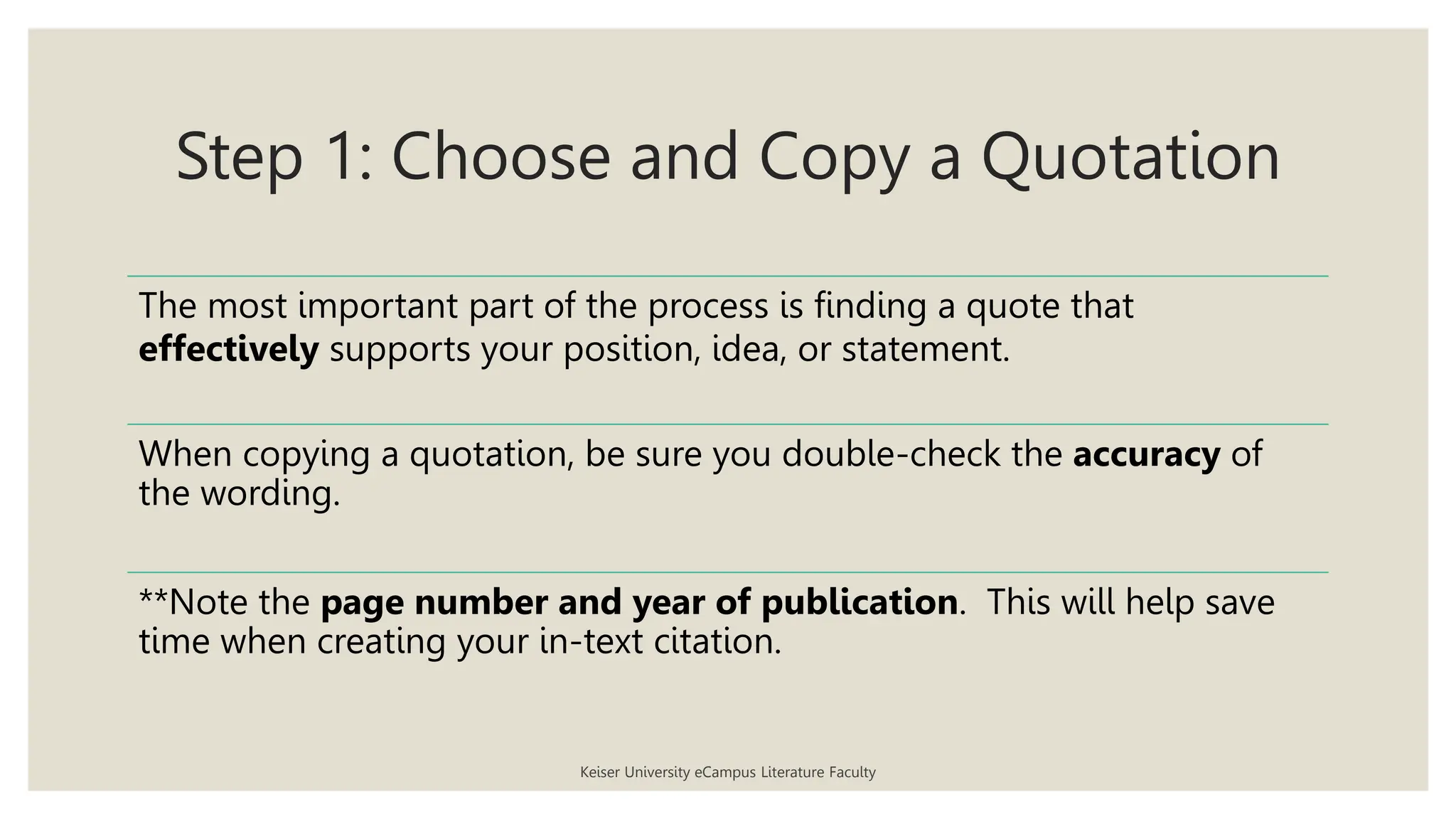
Step 1: Choose and Copy a Quotation
Keiser University eCampus Literature Faculty
The most important part of the process is finding a quote that
effectively supports your position, idea, or statement.
When copying a quotation, be sure you double-check the accuracy of
the wording.
**Note the page number and year of publication. This will help save
time when creating your in-text citation.
Step 2: Attach a Signal Phrase to the
Quotation
Keiser University eCampus Literature Faculty
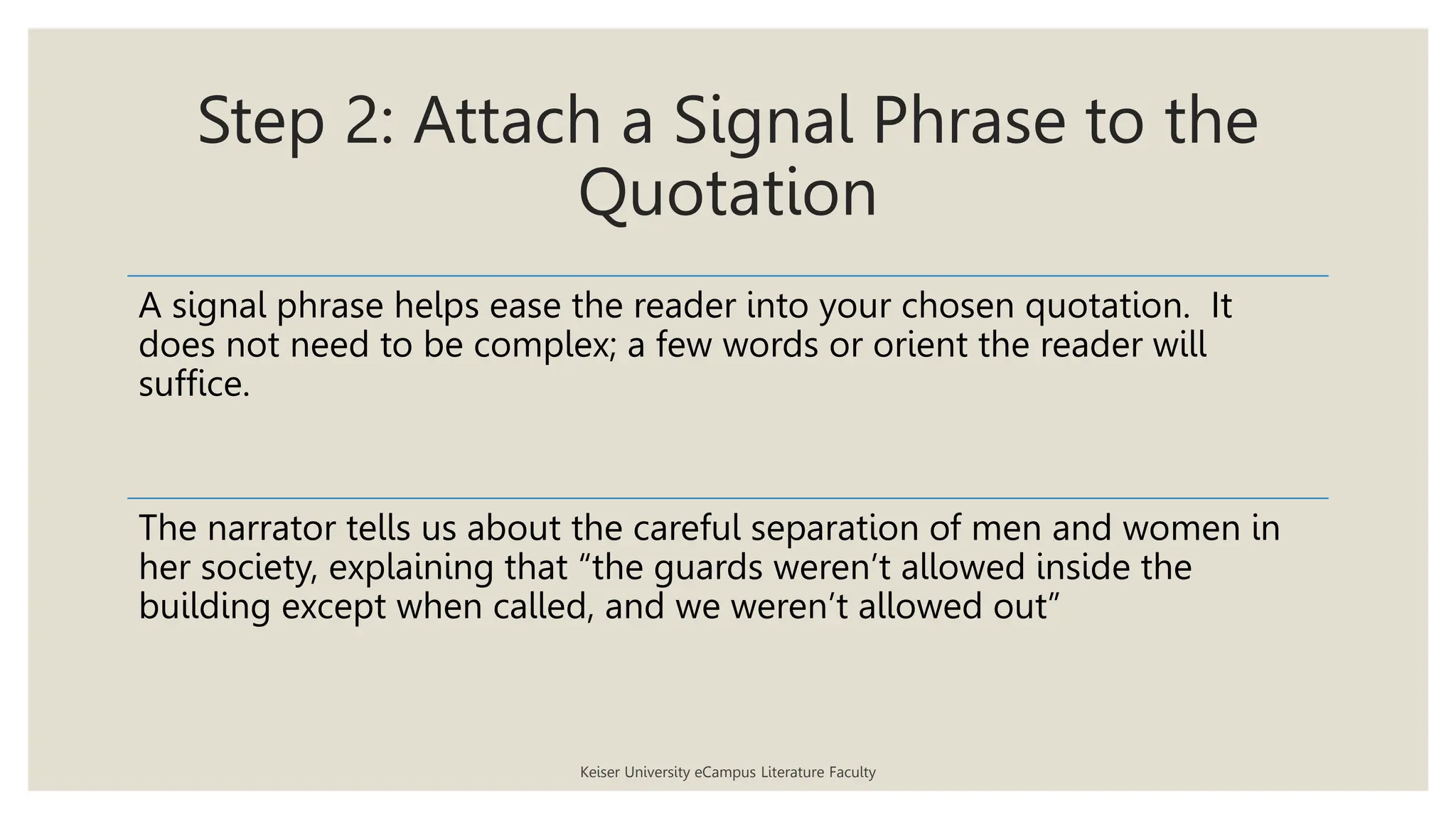
A signal phrase helps ease the reader into your chosen quotation. It
does not need to be complex; a few words or orient the reader will
suffice.
The narrator tells us about the careful separation of men and women in
her society, explaining that “the guards weren’t allowed inside the
building except when called, and we weren’t allowed out”
Step 3: Create a Parenthetical Citation – Using the
Textbook
Keiser University eCampus Literature Faculty
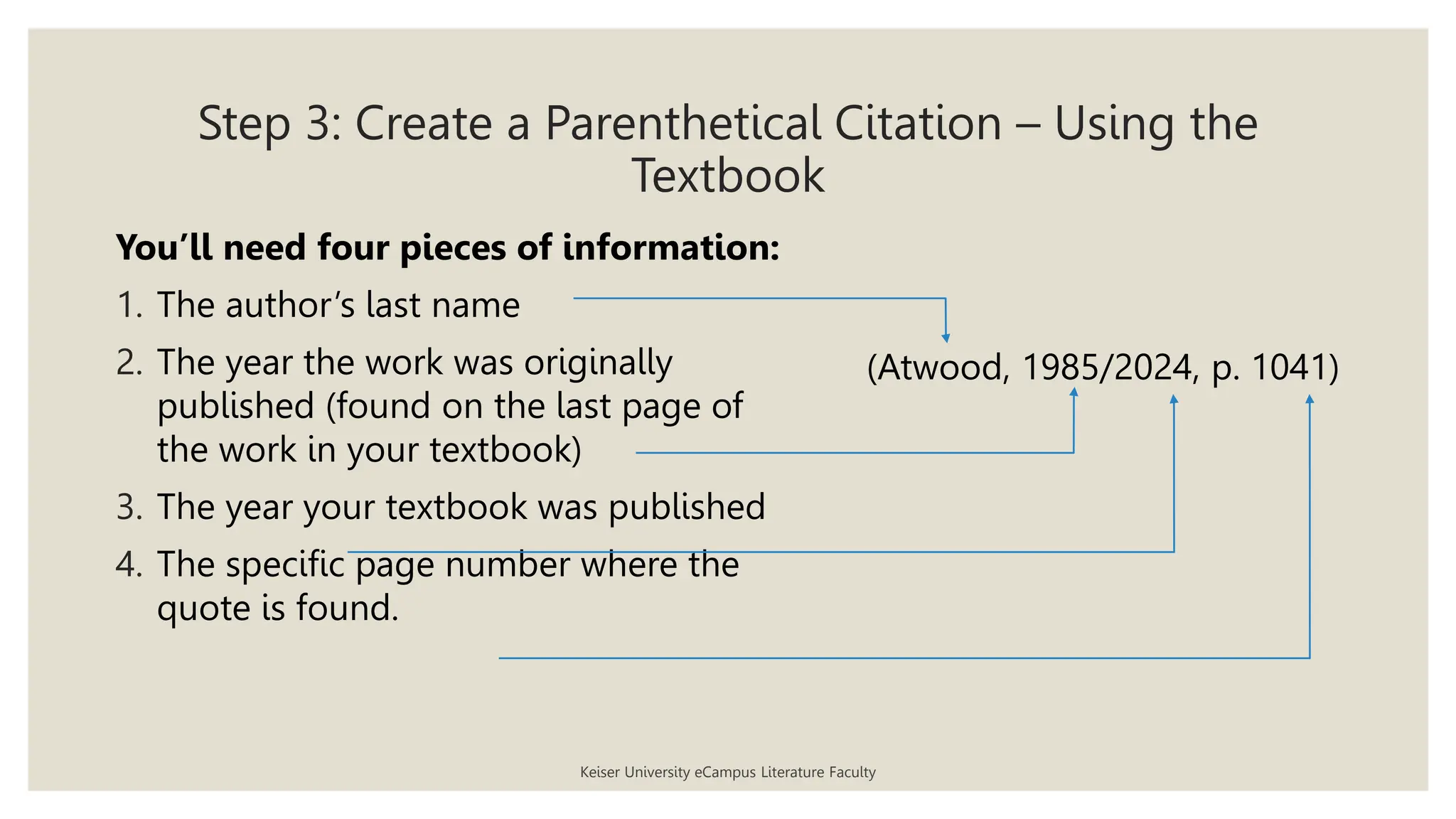
You’ll need four pieces of information:
1. The author’s last name
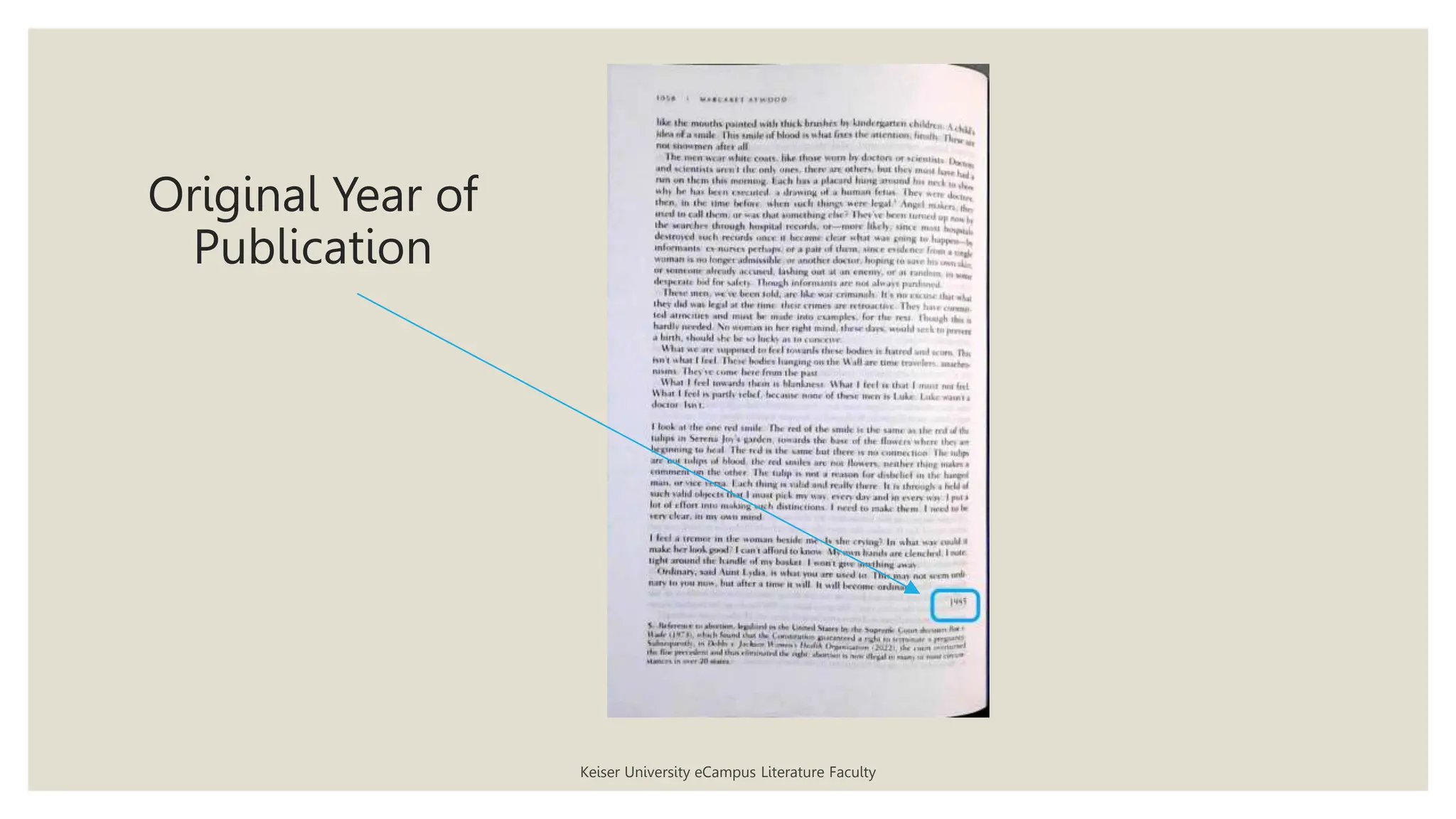
2. The year the work was originally
published (found on the last page of
the work in your textbook)
3. The year your textbook was published
4. The specific page number where the
quote is found.
(Atwood, 1985/2024, p. 1041)
Original Year of
Publication
Keiser University eCampus Literature Faculty
Step 3: Create a Parenthetical Citation – Using an
eBook
Keiser University eCampus Literature Faculty
You’ll need three pieces of information:
1. The author’s last name
2. The year the book was published
3. The specific page number where the
quote is found.
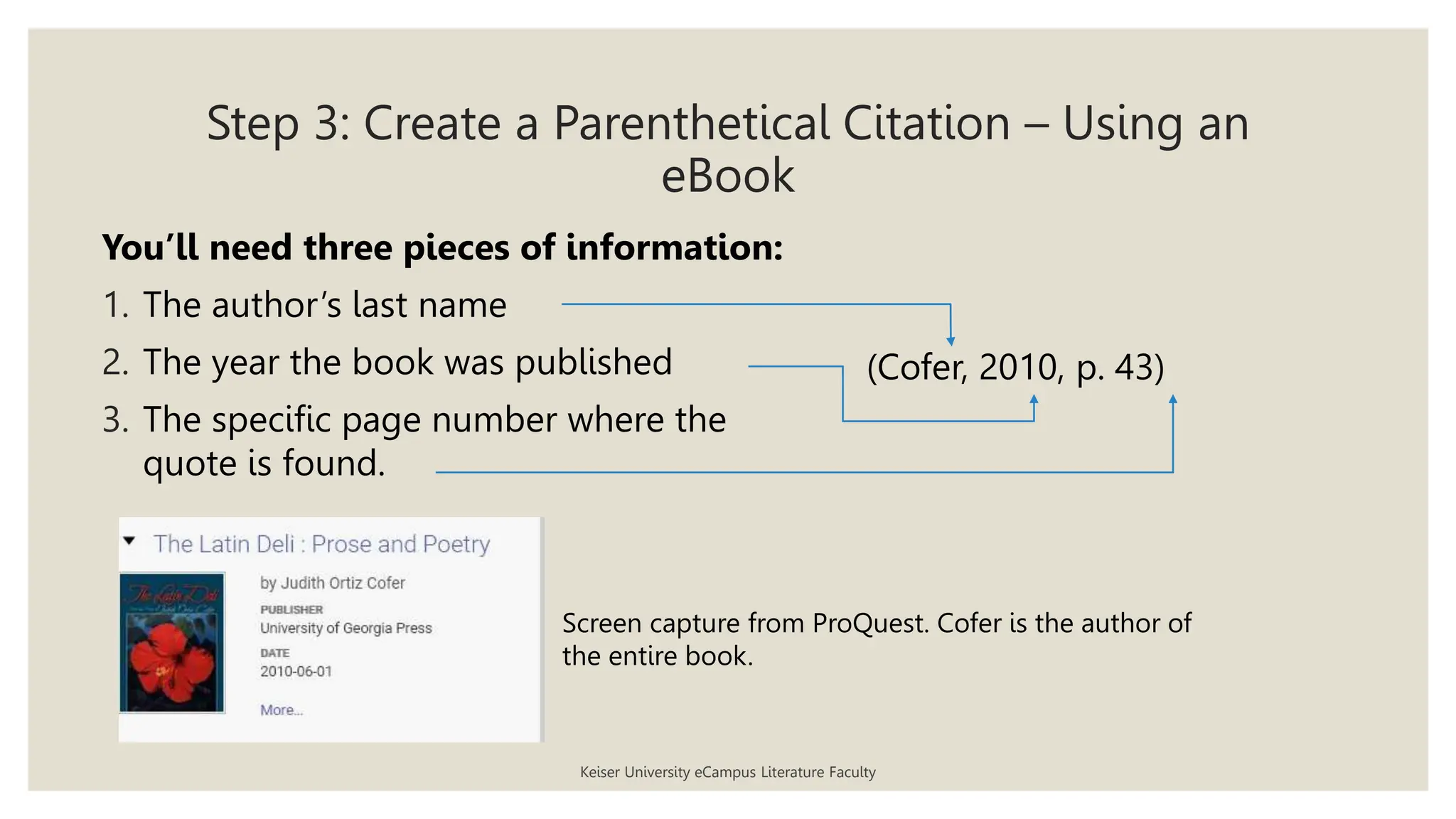
(Cofer, 2010, p. 43)
Screen capture from ProQuest. Cofer is the author of
the entire book.
Step 3: Create a Parenthetical Citation – Using an
eBook
Keiser University eCampus Literature Faculty
You’ll need three pieces of information:
1. The author’s last name
2. The year the book was published
3. The specific page number where the
quote is found.
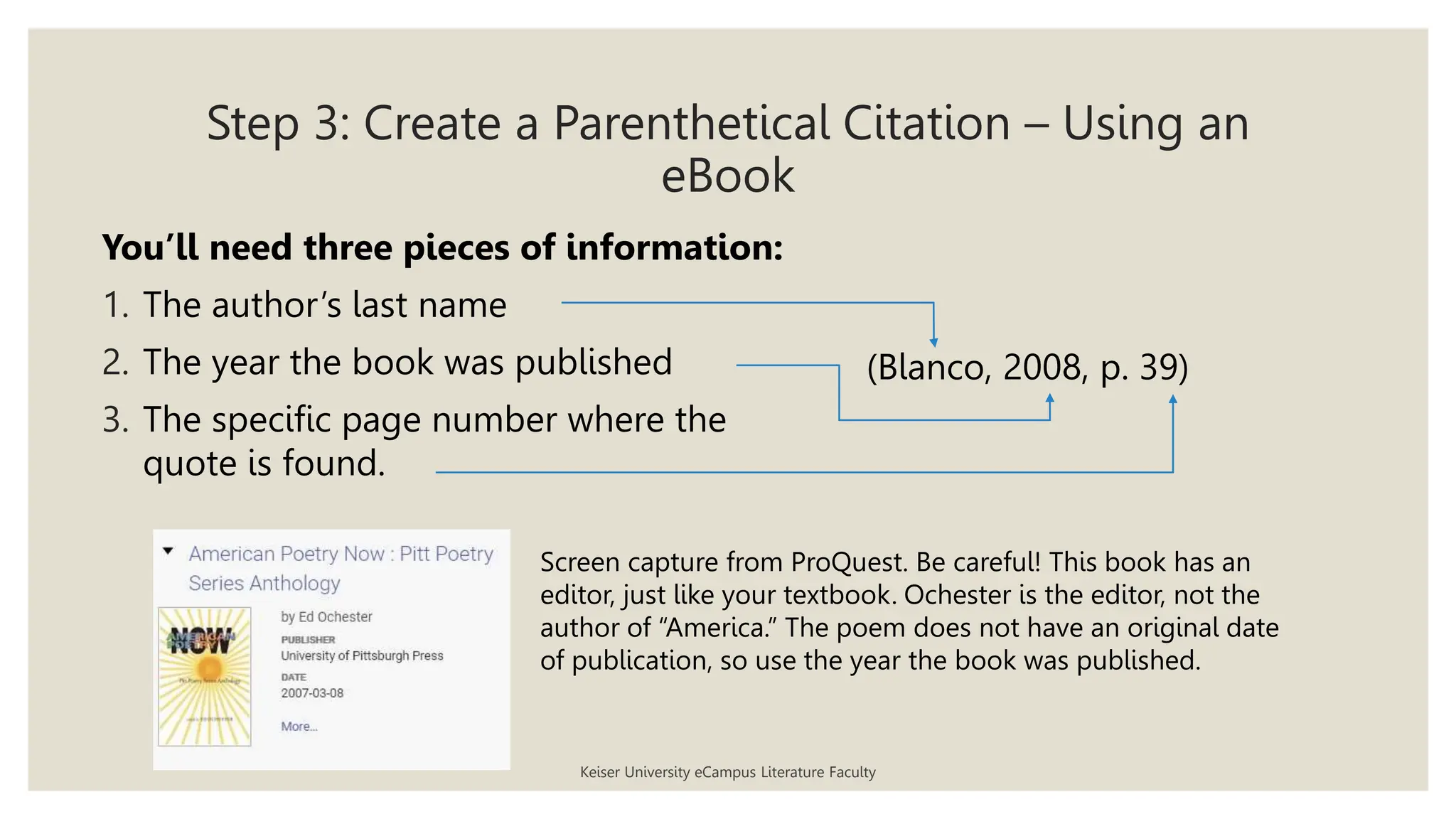
(Blanco, 2008, p. 39)
Screen capture from ProQuest. Be careful! This book has an
editor, just like your textbook. Ochester is the editor, not the
author of “America.” The poem does not have an original date
of publication, so use the year the book was published.
More About Parenthetical Citations
Keiser University eCampus Literature Faculty
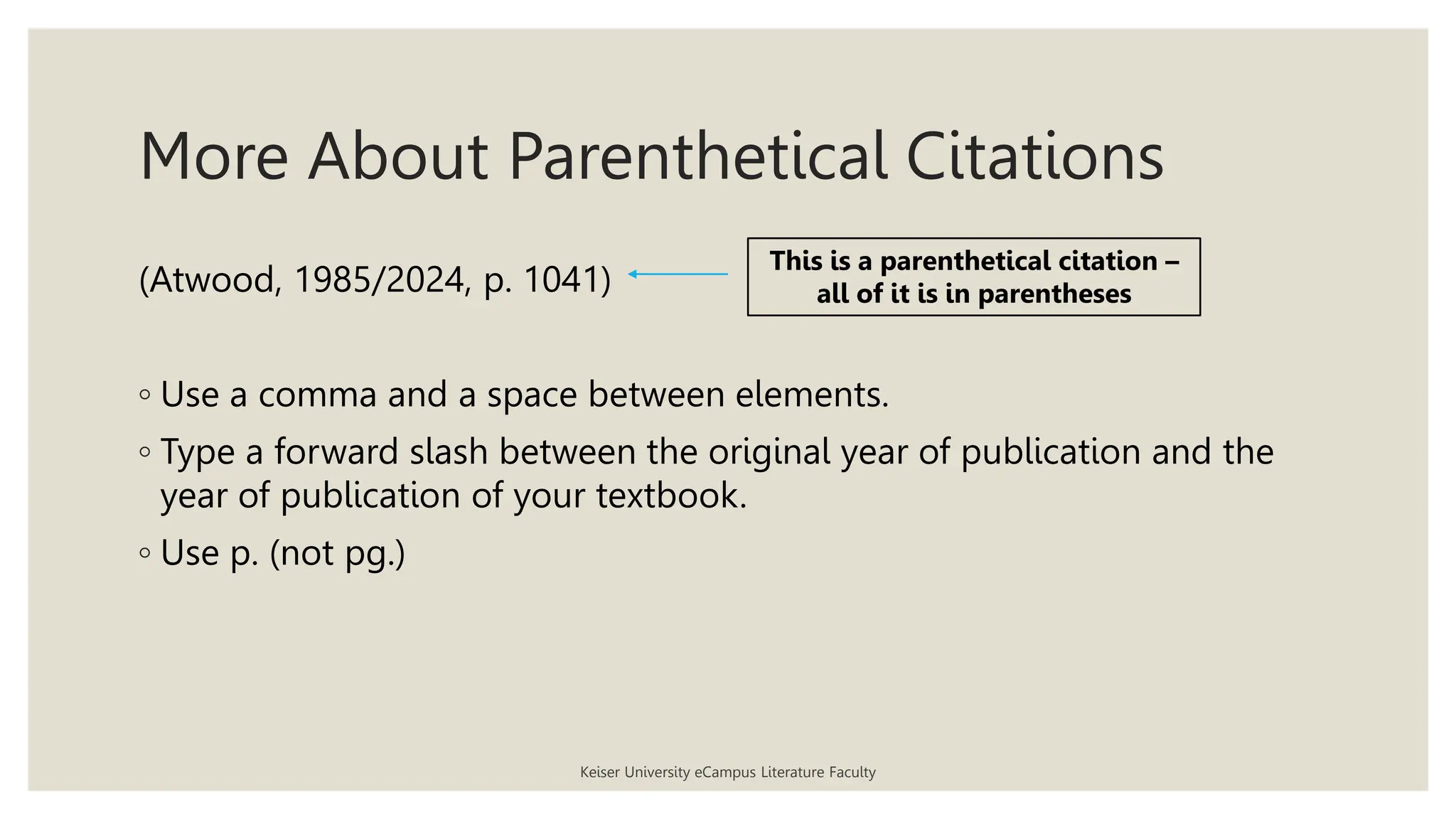
(Atwood, 1985/2024, p. 1041)
◦ Use a comma and a space between elements.
◦ Type a forward slash between the original year of publication and the
year of publication of your textbook.
◦ Use p. (not pg.)
This is a parenthetical citation –
all of it is in parentheses
More About In-Text Citations
When the signal phrase contains author’s last name, use a narrative citation.
Include the year of publication directly after the author’s name.
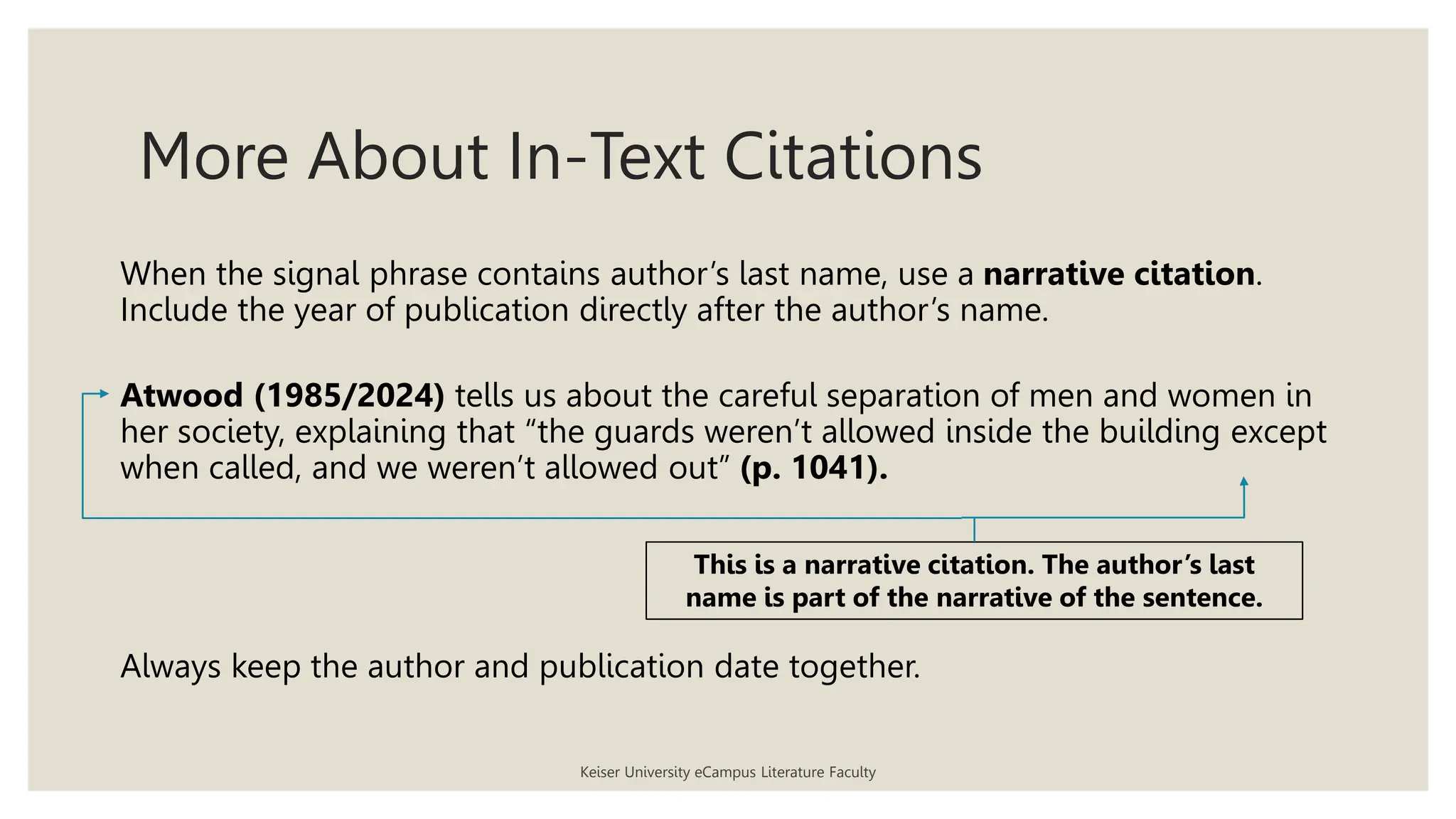
Atwood (1985/2024) tells us about the careful separation of men and women in
her society, explaining that “the guards weren’t allowed inside the building except
when called, and we weren’t allowed out” (p. 1041).
Always keep the author and publication date together.
Keiser University eCampus Literature Faculty
This is a narrative citation. The author’s last
name is part of the narrative of the sentence.
More About In-Text Citations
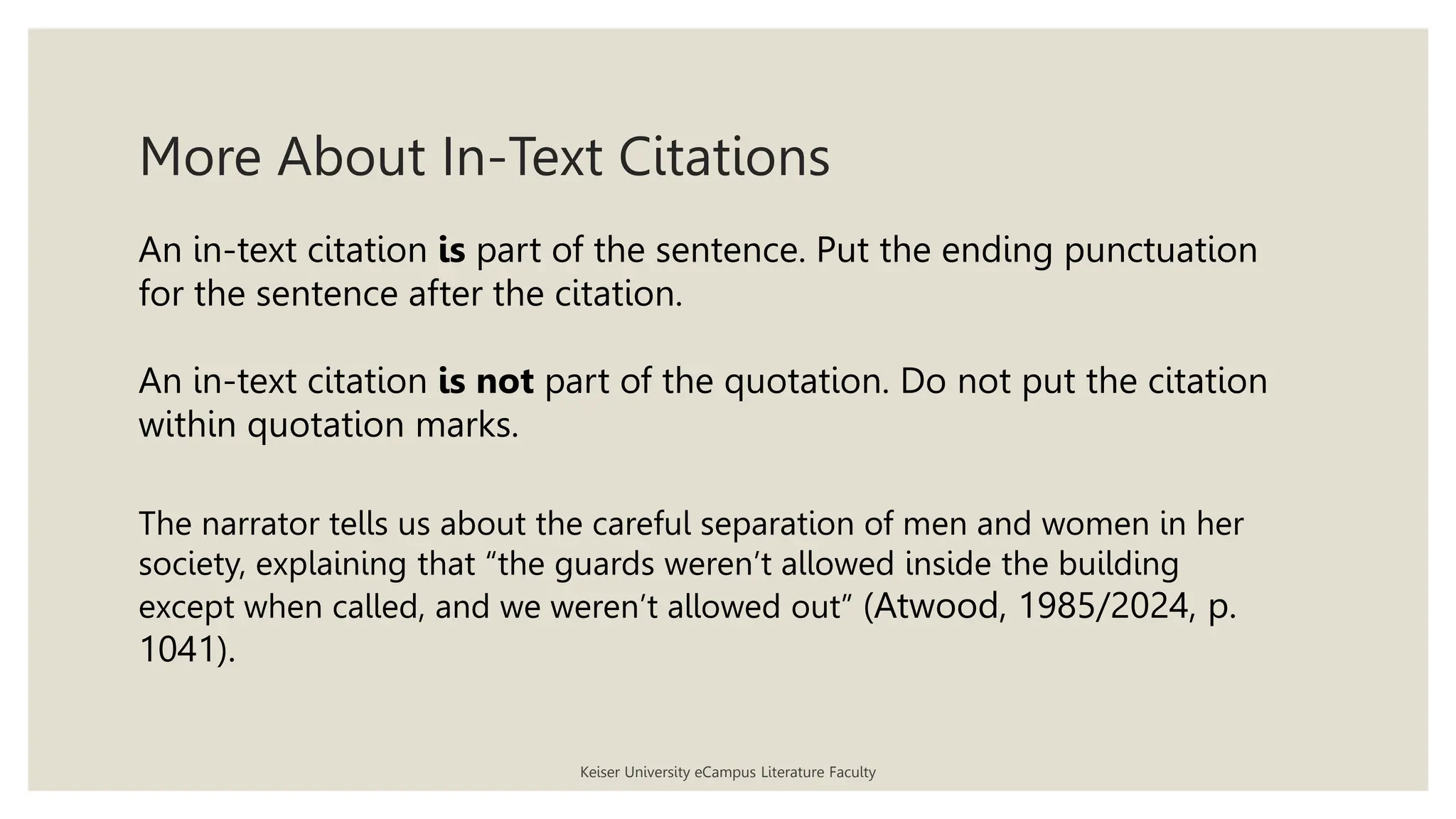
An in-text citation is part of the sentence. Put the ending punctuation
for the sentence after the citation.
An in-text citation is not part of the quotation. Do not put the citation
within quotation marks.
The narrator tells us about the careful separation of men and women in her
society, explaining that “the guards weren’t allowed inside the building
except when called, and we weren’t allowed out” (Atwood, 1985/2024, p.
1041).
Keiser University eCampus Literature Faculty
More About
Citations
Keiser University eCampus Literature Faculty
A frequent error is using the editor’s last name
instead of the author’s last name. Martin
Puchner is one of the editors of your textbook,
not the author of any of the individual works
in your textbook. The author of The
Handmaid’s Tale is Margaret Atwood.
Caution!
How To Cite Editorial Information
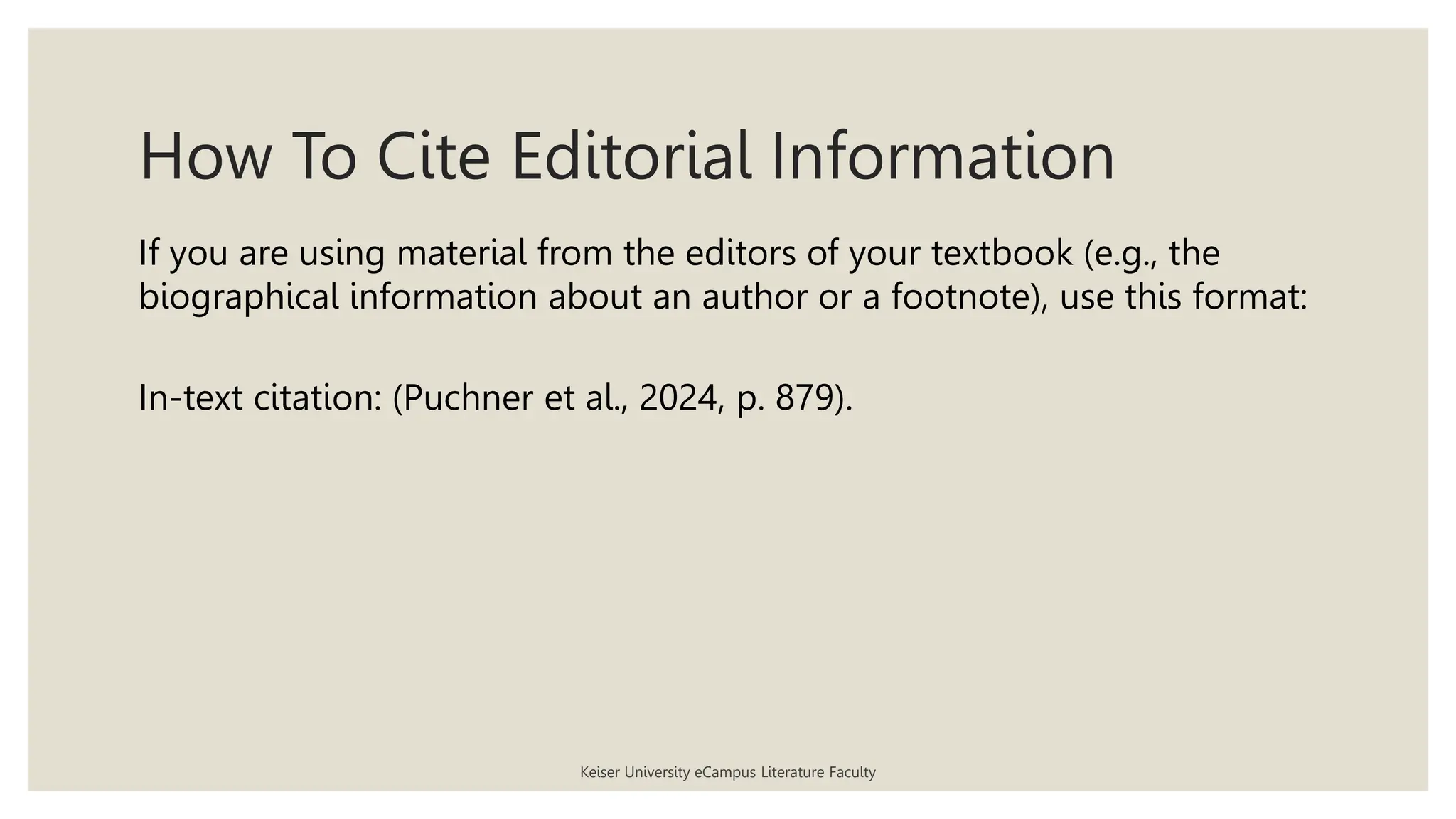
If you are using material from the editors of your textbook (e.g., the
biographical information about an author or a footnote), use this format:
In-text citation: (Puchner et al., 2024, p. 879).
Keiser University eCampus Literature Faculty
Quick Review
Keiser University eCampus Literature Faculty
For direct quotes,
copy information
exactly from the
original source and
use quotation marks
Use a signal phrase to
put quotes into
context. A quote
should never be a
sentence all by itself
In-text citations have
three elements:
• author’s last name
• year of publication
• page number
Citations are not part
of the quotation; do
not put them inside
quotation marks
Citations are part of
the sentence; insert
them before the
ending punctuation
of a sentence
Additional
Resources
Keiser University eCampus Literature Faculty
THE KEISER WRITING STUDIO YOUR PROFESSOR
THE APA STYLE BLOG
(HTTPS://APASTYLE.APA.ORG/BL
OG)

KU eCampus - CWL Using Direct Quotations

  • 1.
    CREATING IN-TEXT CITATIONS A Guideto Selecting, Integrating, and Citing in APA Style (7th ed.) Keiser University eCampus Literature Faculty
  • 2.
    Step 1: Chooseand Copy a Quotation Keiser University eCampus Literature Faculty The most important part of the process is finding a quote that effectively supports your position, idea, or statement. When copying a quotation, be sure you double-check the accuracy of the wording. **Note the page number and year of publication. This will help save time when creating your in-text citation.
  • 3.
    Step 2: Attacha Signal Phrase to the Quotation Keiser University eCampus Literature Faculty A signal phrase helps ease the reader into your chosen quotation. It does not need to be complex; a few words or orient the reader will suffice. The narrator tells us about the careful separation of men and women in her society, explaining that “the guards weren’t allowed inside the building except when called, and we weren’t allowed out”
  • 4.
    Step 3: Createa Parenthetical Citation – Using the Textbook Keiser University eCampus Literature Faculty You’ll need four pieces of information: 1. The author’s last name 2. The year the work was originally published (found on the last page of the work in your textbook) 3. The year your textbook was published 4. The specific page number where the quote is found. (Atwood, 1985/2024, p. 1041)
  • 5.
    Original Year of Publication KeiserUniversity eCampus Literature Faculty
  • 6.
    Step 3: Createa Parenthetical Citation – Using an eBook Keiser University eCampus Literature Faculty You’ll need three pieces of information: 1. The author’s last name 2. The year the book was published 3. The specific page number where the quote is found. (Cofer, 2010, p. 43) Screen capture from ProQuest. Cofer is the author of the entire book.
  • 7.
    Step 3: Createa Parenthetical Citation – Using an eBook Keiser University eCampus Literature Faculty You’ll need three pieces of information: 1. The author’s last name 2. The year the book was published 3. The specific page number where the quote is found. (Blanco, 2008, p. 39) Screen capture from ProQuest. Be careful! This book has an editor, just like your textbook. Ochester is the editor, not the author of “America.” The poem does not have an original date of publication, so use the year the book was published.
  • 8.
    More About ParentheticalCitations Keiser University eCampus Literature Faculty (Atwood, 1985/2024, p. 1041) ◦ Use a comma and a space between elements. ◦ Type a forward slash between the original year of publication and the year of publication of your textbook. ◦ Use p. (not pg.) This is a parenthetical citation – all of it is in parentheses
  • 9.
    More About In-TextCitations When the signal phrase contains author’s last name, use a narrative citation. Include the year of publication directly after the author’s name. Atwood (1985/2024) tells us about the careful separation of men and women in her society, explaining that “the guards weren’t allowed inside the building except when called, and we weren’t allowed out” (p. 1041). Always keep the author and publication date together. Keiser University eCampus Literature Faculty This is a narrative citation. The author’s last name is part of the narrative of the sentence.
  • 10.
    More About In-TextCitations An in-text citation is part of the sentence. Put the ending punctuation for the sentence after the citation. An in-text citation is not part of the quotation. Do not put the citation within quotation marks. The narrator tells us about the careful separation of men and women in her society, explaining that “the guards weren’t allowed inside the building except when called, and we weren’t allowed out” (Atwood, 1985/2024, p. 1041). Keiser University eCampus Literature Faculty
  • 11.
    More About Citations Keiser UniversityeCampus Literature Faculty A frequent error is using the editor’s last name instead of the author’s last name. Martin Puchner is one of the editors of your textbook, not the author of any of the individual works in your textbook. The author of The Handmaid’s Tale is Margaret Atwood. Caution!
  • 12.
    How To CiteEditorial Information If you are using material from the editors of your textbook (e.g., the biographical information about an author or a footnote), use this format: In-text citation: (Puchner et al., 2024, p. 879). Keiser University eCampus Literature Faculty
  • 13.
    Quick Review Keiser UniversityeCampus Literature Faculty For direct quotes, copy information exactly from the original source and use quotation marks Use a signal phrase to put quotes into context. A quote should never be a sentence all by itself In-text citations have three elements: • author’s last name • year of publication • page number Citations are not part of the quotation; do not put them inside quotation marks Citations are part of the sentence; insert them before the ending punctuation of a sentence
  • 14.
    Additional Resources Keiser University eCampusLiterature Faculty THE KEISER WRITING STUDIO YOUR PROFESSOR THE APA STYLE BLOG (HTTPS://APASTYLE.APA.ORG/BL OG)