You wait ages for reform, then three come along at once – driving better local bus services Presentation to L G Group Annual Conference - ‘Localism Works’ David Brown, SYPTE Lead DG for pteg on bus issues 29 June 2011
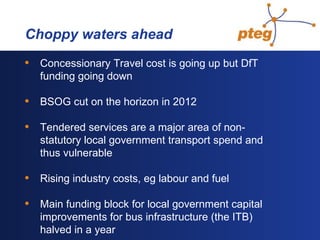
  Choppy waters ahead Concessionary Travel cost is going up but DfT funding going down BSOG cut on the horizon in 2012 Tendered services are a major area of non-statutory local government transport spend and thus vulnerable Rising industry costs, eg labour and fuel Main funding block for local government capital improvements for bus infrastructure (the ITB) halved in a year
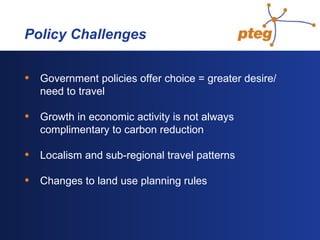
  Policy Challenges Government policies offer choice = greater desire/need to travel Growth in economic activity is not always complimentary to carbon reduction Localism and sub-regional travel patterns Changes to land use planning rules
  How is local government  responding? Some Shires and Counties disposing of their supported networks – or nearly Bus networks in Met Areas are more extensive and enjoy more cross party political support - so big reductions in tendered networks are a last resort we generally haven’t reached yet Where efficiency savings don’t bridge the gap – then PTEs are turning to changes to CT fares and charging for services where they can But this is year one – and year two gets tougher and budgets less able to cope with unforeseen shocks (eg higher levels of commercial de-registrations) Are we moving to three Englands for buses – London, the Mets and cities, the rest?
  Lifting our eyes to the horizon Getting through the next few years will be tough but… Funding levels do begin to pick up again in a few years’ time The essential advantages of the bus as a key tool of urban transport policy remain   The planning for a smartcard revolution is picking up speed  – transformatory potential in a few years’ time Buses getting more politically resonant – as the recent BSOG and Save our Buses campaign shows Buses recognised as essential to social mobility and addressing worklessness
  LTA 2008 bus powers LTA 2008 was a big breakthrough by making VPAs, SQPs and QCs more effective tools We have been making good use of these tools – in partnership with operators wherever we can In any review of bus policy following on from the Competition Commission investigation we want to see these powers retained and strengthened Reducing or removing any of these powers will take the bus sector backwards
  Making more of less funding Financial support for the industry is falling so we need to do more for less Better targeting of that funding is key  In the Met areas we think we can work with operators to make sure the funding is targeted on local priorities We need to collectively look at total resources – Commercial, Tenders, CT, BSOG Devolved BSOG could be targeted on bus priority (to reducing operating costs and increase patronage), on supporting smart ticketing, travel planning or on vehicle standards Window of opportunity for operators / PTEs on BSOG reform – before something is done to us
  Competition Commission  Investigation Provisional Findings: Some features of local bus markets which “prevent, restrict or distort competition” These features are present in a large proportion of local markets They have ‘an adverse effect on competition’ (AEC) CC estimate detriment to consumers and tax-payers in excess of £70m per annum
  Competition Commission  Investigation Potential Remedies: Market opening measures: - Ticketing - Regulation of operator behaviour - Service frequency - Fares changes - Access to bus stations LTA–led initiatives - Franchise approach – QCs - Partnership approach Tendered services Other remedies - Ruled out divestment and direct control of  outcomes
  Conclusions The key advantages of the bus in urban transport policy are as strong as ever We need to ensure that bus policy is quick to take advantage of new and wider policies on smart travel, sustainability and economic growth But we can’t wish away the fact that the story of the bus in urban areas in recent decades has been one mainly of decline – and the funding climate is not encouraging Empty platitudes about partnership won’t change that - practical application will Instead we need to redouble our efforts using the tools in the LTA 08 – as appropriate
  Conclusions That means: “ Crunchy” Partnerships based on an evidence base and real measurable and delivered commitments SQPs that deliver better services using more bus priority The QC option retained in legislation and tried out on the ground    Government to reduce transition risk? Devolution of BSOG It also means making the best use of the available funding (through better targeting)  A more cohesive and effective structure for understanding, monitoring and where necessary enforcing performance improvements
 

W15 driving better local bus services - david brown

  • 1.
  • 2.
      You waitages for reform, then three come along at once – driving better local bus services Presentation to L G Group Annual Conference - ‘Localism Works’ David Brown, SYPTE Lead DG for pteg on bus issues 29 June 2011
  • 3.
      Choppy watersahead Concessionary Travel cost is going up but DfT funding going down BSOG cut on the horizon in 2012 Tendered services are a major area of non-statutory local government transport spend and thus vulnerable Rising industry costs, eg labour and fuel Main funding block for local government capital improvements for bus infrastructure (the ITB) halved in a year
  • 4.
      Policy ChallengesGovernment policies offer choice = greater desire/need to travel Growth in economic activity is not always complimentary to carbon reduction Localism and sub-regional travel patterns Changes to land use planning rules
  • 5.
      How islocal government responding? Some Shires and Counties disposing of their supported networks – or nearly Bus networks in Met Areas are more extensive and enjoy more cross party political support - so big reductions in tendered networks are a last resort we generally haven’t reached yet Where efficiency savings don’t bridge the gap – then PTEs are turning to changes to CT fares and charging for services where they can But this is year one – and year two gets tougher and budgets less able to cope with unforeseen shocks (eg higher levels of commercial de-registrations) Are we moving to three Englands for buses – London, the Mets and cities, the rest?
  • 6.
      Lifting oureyes to the horizon Getting through the next few years will be tough but… Funding levels do begin to pick up again in a few years’ time The essential advantages of the bus as a key tool of urban transport policy remain The planning for a smartcard revolution is picking up speed – transformatory potential in a few years’ time Buses getting more politically resonant – as the recent BSOG and Save our Buses campaign shows Buses recognised as essential to social mobility and addressing worklessness
  • 7.
      LTA 2008bus powers LTA 2008 was a big breakthrough by making VPAs, SQPs and QCs more effective tools We have been making good use of these tools – in partnership with operators wherever we can In any review of bus policy following on from the Competition Commission investigation we want to see these powers retained and strengthened Reducing or removing any of these powers will take the bus sector backwards
  • 8.
      Making moreof less funding Financial support for the industry is falling so we need to do more for less Better targeting of that funding is key In the Met areas we think we can work with operators to make sure the funding is targeted on local priorities We need to collectively look at total resources – Commercial, Tenders, CT, BSOG Devolved BSOG could be targeted on bus priority (to reducing operating costs and increase patronage), on supporting smart ticketing, travel planning or on vehicle standards Window of opportunity for operators / PTEs on BSOG reform – before something is done to us
  • 9.
      Competition Commission Investigation Provisional Findings: Some features of local bus markets which “prevent, restrict or distort competition” These features are present in a large proportion of local markets They have ‘an adverse effect on competition’ (AEC) CC estimate detriment to consumers and tax-payers in excess of £70m per annum
  • 10.
      Competition Commission Investigation Potential Remedies: Market opening measures: - Ticketing - Regulation of operator behaviour - Service frequency - Fares changes - Access to bus stations LTA–led initiatives - Franchise approach – QCs - Partnership approach Tendered services Other remedies - Ruled out divestment and direct control of outcomes
  • 11.
      Conclusions Thekey advantages of the bus in urban transport policy are as strong as ever We need to ensure that bus policy is quick to take advantage of new and wider policies on smart travel, sustainability and economic growth But we can’t wish away the fact that the story of the bus in urban areas in recent decades has been one mainly of decline – and the funding climate is not encouraging Empty platitudes about partnership won’t change that - practical application will Instead we need to redouble our efforts using the tools in the LTA 08 – as appropriate
  • 12.
      Conclusions Thatmeans: “ Crunchy” Partnerships based on an evidence base and real measurable and delivered commitments SQPs that deliver better services using more bus priority The QC option retained in legislation and tried out on the ground  Government to reduce transition risk? Devolution of BSOG It also means making the best use of the available funding (through better targeting) A more cohesive and effective structure for understanding, monitoring and where necessary enforcing performance improvements
  • 13.