JoAnn Difede, Ph.D.
Professor, Department of Psychiatry, Director of Program for
Anxiety and Traumatic Stress Studies
Weill Cornell Medical College of Cornell University
On the precipice of a paradigm shift: transforming the way we
treat trauma(and phobias) using virtual reality simulations
Innovations in the Treatment of PTSD:
On the Precipice of a Paradigm Shift?
1. Delivering empirically-validated treatments
2. Virtual Reality treatment for PTSD
3. Novel pharmacotherapeutic interventions for PTSD
4. Genetics: Toward precision medicine
5. From the laboratory to your home: is virtual reality technology almost “turnkey”?
“Practice two things in your dealings with
disease: either help or do not harm the
patient”
Epidemics, Book 1, Hippocratic School of Medicine
September 10th, 2001: The State of PTSD Treatment
• One evidence-based treatment with persuasive evidence:
Prolonged exposure (PE) therapy (Foa, 1999)
• Recommended by Expert Consensus Guidelines
• No controlled clinical trials for PTSD in first responders
• One FDA approved medication for PTSD: Zoloft
CORNELLU N I V E R S I T Y
16% of 71,000 people in WTC registry had
probable PTSD six years after the event
(Thorpe, et al., JAMA, 2009)
Rates of combat-related PTSD in U.S. soldiers
returning from Iraq and Afghanistan are
estimated at up to 20.7% in active duty and
30.5% in National Guard (Thomas, 2010)
At first, there was the Word
• Established psychotherapies rely on verbal communication of
experience
• Virtual Reality Therapy incorporates many of the non-verbal or
sensory elements of experience
• May allow for the emotional processing of non-verbal elements of
experience (sight, sound, olfaction, kinesthesis)
• Bypasses personal sense of “agency” or effortful recall (esp. useful
for those who are avoidant)
Rationale for Using VR
• VR enhances emotional involvement
• VR provides multisensory cues that help the patient to engage
with the story.VR affords opportunities to enhance patients’
normal narrative capacities with visual, auditory, and haptic
computer-generated experiences. These multi-sensory cues can
facilitate emotional engagement for exposure treatment
• VR makes it possible to have graded exposure
Rationale for VR Treatment
• VR as a tool to enhance emotional learning
• In vivo exposure often impractical or impossible
• Manipulate environment without the constraints of the “real” world
• Cost
• Patient preference: studies suggest patients prefer VR to imaginal or in
vivo
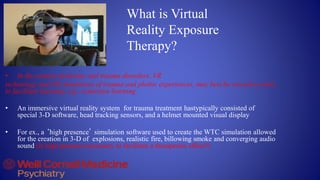
What is Virtual
Reality Exposure
Therapy?
• In the context of anxiety and trauma disorders, VR
technology and VR simulations of trauma and phobic experiences, may best be viewed as tools
to facilitate learning, e.g., extinction learning
• An immersive virtual reality system for trauma treatment hastypically consisted of
special 3-D software, head tracking sensors, and a helmet mounted visual display
• For ex., a ‘high presence’ simulation software used to create the WTC simulation allowed
for the creation in 3-D of explosions, realistic fire, billowing smoke and converging audio
sound (Is high presence necessary to facilitate a therapeutic effect?)
A marriage of the modern and the classical
Virtual Reality Therapy integrates cutting edge technology with
established and well validated principles of behavioral
psychotherapies
Fear Conditioning in Humans: Escape down a
stairwell at the WTC 9/11/01
Virtual Reality Exposure Therapy for the Treatment of PTSD
Following the World Trade Center Attack (Difede, Cukor,
Jayasinghe, Hoffman J Clinical Psychiatry, 2007, Cyberpsychology, 2002)
Battalion Chief
Naval reserve pilot
No prior psychiatric history
Second patient in VR study when it was very
much still an experiment
VR Exposure Hierarchy
1. WTC and surrounding buildings, clear, blue skies
2. Plane flies overhead, no crash
3. Plane crashes, no explosion
4. Plane crashes, explosion, no sound
5. Plane crashes, explosion, with sound
6. Building burns, no screams
7. Building burns, screams heard
8. Building burns, screams heard, people jumping
9. Second plane hits, full visual effects with sound
10. Second tower falls
11. First tower falls
12. Full sequence
Results: Significant decrease in PTSD Severity in
the VR group but not in the waitlist group(Difede, Hofman,
et al, J Clin Psychiatry, 2007, Cyberpsychology, 2002)
•Main effect of time: ns
•Time by Group interaction: p < .01
•Between groups effect size: 1.54
•Interaction effect size=.40
Translational Study Design: From Bench to
Bedside
• 100 mg D-Cycloserine (DCS) or placebo taken orally 90 minutes before
exposure sessions
• D-Cycloserine (DCS)
• Anti-tuberculosis drug for 50 years
• Recognized as an NMDA partial agonist, and potential cognitive
enhancer in late ’80s
• Facilitates extinction of fear response
• Genotyping for the BDNF SNP (Val66Met) by standard PCR methods from
saliva samples
• To assess for polymorphism associated with higher trait anxiety/resistance
to extinction
RCT VR +/-DCS for WTC Related PTSD: Mean
Caps Scores over Time (Difede, et al., 2013, Neuropsychopharmacology)
PTSD Remission Rates
 Defined as CAPS total score of ≤ 20 and minimal or no
impairment in social, occupational and other important
areas of functioning (CAPS Items F21 and F22 ≤ 1)
(Difede, et al., 2013, Neuropsychopharmacology)
p<.05
VRE-DCS VRE-Placebo
Posttreatment 6/13 (46%) 1/12 (8%)
6 month Follow-up 9/13 (69%) 2/12 (17%)
Enhancing Exposure Therapy for
PTSD: Virtual Reality and
Imaginal Exposure with a
Cognitive Enhancer
DoD Award #: W81XWH-10-1-1045 (Lead PI: Difede)
The Foundation of the Virtual Reality Treatment
Protocol for Combat-Related PTSD
Virtual Vietnam 1998
• Rothbaum, B. O., Hodges, L., Alarcon, R.,
Ready, D., Shahar, F. Graap, K. Pair, J.,
Hebert, P., Gotz, D., Wills, B. & Baltzell,
D. (1999). Virtual reality exposure
therapy for PTSD Vietnam veterans: A case
study. Journal of Traumatic Stress,12,
263-271.
• Rothbaum, B. O., Hodges, L. F., Ready, D.,
Graap, K., & Alarcon, R. (2001). Virtual
reality exposure therapy for Vietnam
veterans with posttraumatic stress disorder.
Journal of Clinical Psychiatry, 62, 617-
622.
Virtual WTC 2001
• Difede, J., & Hoffman, H. (2002). Virtual
reality exposure therapy for PTSD following
the WTC: A case report. Cyberpsychol
Behav, 5(6): 529-535.
• Difede, J., Cukor, J., Patt, I., Giosan, C., &
Hoffman, H. (2006). The application of
virtual reality to the treatment of PTSD
following the WTC attack. Ann NY Acad Sci,
1071: 500-501.
• Difede, J., Cukor, J., Jayasinghe, N., Patt, I.,
Jedel, S., Giosan, C., & Hoffman, H. (2007).
Virtual reality exposure therapy for the
treatment of posttraumatic stress disorder
following September 11, 2001. Journal of
Clinical Psychiatry, 68: 1639-1647.
Design and Methodology
• Multi-site, randomized, controlled clinical trial
• 2 x 2 design
• VRE or IE protocol
• 50 mg D-Cycloserine (DCS) or placebo given 30 minutes prior to
session only
• 9 weekly sessions, including 7 exposure therapy sessions
• Genotyping for the BDNF SNP (Val66Met) by standard PCR
methods from saliva samples
• Psychophysiological assessment including laboratory startle
assessment and fear conditioning
VR Iraq
Combat-related PTSD video
VR Iraq: Desert Scene
Market_Ambient_Prayer_Call
• Other VR “worlds” for the treatment of
PTSD
Burn World: “The Grandmother Burn” (Design by Difede, Biosan, et al.)
Hurricane Katrina (Design by Ken Graap, Mirtha Ferrer, JoAnn Difede,
Hurricane Katrina:Attic entrance(Design by Ken Graap, Mirtha
Ferrer, JoAnn Difede, and the Virtually Better Team)
Virtual Vietnam
(Hodges, Rothbaum, Pair, et al.)
This occurred over 20 years
following the end of the
Vietnam War
35%-45% decrease in PTSD
VR PTSD Examples
• Terrorist Bus Bombing - U. of Haifa/U of Wash.
HIT Lab
Future Directions: Developing a third-person
perspective (3PP) in Virtual Reality
– Existing VR applications in PTSD and phobias are
implemented exclusively in first-person perspective
(1PP)
• Traditionally rooted in exposure, which requires this
• 3PP and 1PP are cognitively, emotionally, and
neurobiologically distinct
• Though 1PP is generally more immersive (which is why it is used in exposure), 3PP may
enhance certain learning tasks
- In depressive rumination, self-distancing by adopting 3PP narrative enhances learning
• Using a 3PP in VR is specifically hypothesized to be useful in:
- Cognitive processing of traumatic events (developing new insights)
- For cases of PTSD with comorbid depression (addressing rumination)
- When VR 1PP is emotionally overwhelming for patients
Challenges in wide-spread adoption of VR
technology for trauma and anxiety disorder
treatment
• Cost (25K HMD in 2001)
• Technology not yet “turn-key”
• Need platform that is web-based and flexible to be
used across multiple brain-based disorders
(neurologic, psychiatric)
• Healthcare inherently conservative professions
March 2014:
Facebook purchases Oculus VR
(creator of Oculus Rift) for $2 Billion
Treatment of phobias
Current Virtual Worlds for Phobias:
• Airplane
• Bridges
• Elevators
• Heights
• Job Interview
• Public Speaking
• Thunderstorms
Journal of Journal of
Behavior Therapy
VR Anxiety Disorders
Meta-Analysis
2008
Other psychological/psychiatric
disorders
• Eating Disorders
• ADHD
• Autism
• Pain
• Personality Disorders?
VR and the Health Sciences

VR and the Health Sciences

  • 1.
    JoAnn Difede, Ph.D. Professor,Department of Psychiatry, Director of Program for Anxiety and Traumatic Stress Studies Weill Cornell Medical College of Cornell University On the precipice of a paradigm shift: transforming the way we treat trauma(and phobias) using virtual reality simulations
  • 2.
    Innovations in theTreatment of PTSD: On the Precipice of a Paradigm Shift? 1. Delivering empirically-validated treatments 2. Virtual Reality treatment for PTSD 3. Novel pharmacotherapeutic interventions for PTSD 4. Genetics: Toward precision medicine 5. From the laboratory to your home: is virtual reality technology almost “turnkey”?
  • 3.
    “Practice two thingsin your dealings with disease: either help or do not harm the patient” Epidemics, Book 1, Hippocratic School of Medicine
  • 4.
    September 10th, 2001:The State of PTSD Treatment • One evidence-based treatment with persuasive evidence: Prolonged exposure (PE) therapy (Foa, 1999) • Recommended by Expert Consensus Guidelines • No controlled clinical trials for PTSD in first responders • One FDA approved medication for PTSD: Zoloft
  • 5.
    CORNELLU N IV E R S I T Y 16% of 71,000 people in WTC registry had probable PTSD six years after the event (Thorpe, et al., JAMA, 2009) Rates of combat-related PTSD in U.S. soldiers returning from Iraq and Afghanistan are estimated at up to 20.7% in active duty and 30.5% in National Guard (Thomas, 2010)
  • 6.
    At first, therewas the Word • Established psychotherapies rely on verbal communication of experience • Virtual Reality Therapy incorporates many of the non-verbal or sensory elements of experience • May allow for the emotional processing of non-verbal elements of experience (sight, sound, olfaction, kinesthesis) • Bypasses personal sense of “agency” or effortful recall (esp. useful for those who are avoidant)
  • 7.
    Rationale for UsingVR • VR enhances emotional involvement • VR provides multisensory cues that help the patient to engage with the story.VR affords opportunities to enhance patients’ normal narrative capacities with visual, auditory, and haptic computer-generated experiences. These multi-sensory cues can facilitate emotional engagement for exposure treatment • VR makes it possible to have graded exposure
  • 8.
    Rationale for VRTreatment • VR as a tool to enhance emotional learning • In vivo exposure often impractical or impossible • Manipulate environment without the constraints of the “real” world • Cost • Patient preference: studies suggest patients prefer VR to imaginal or in vivo
  • 9.
    What is Virtual RealityExposure Therapy? • In the context of anxiety and trauma disorders, VR technology and VR simulations of trauma and phobic experiences, may best be viewed as tools to facilitate learning, e.g., extinction learning • An immersive virtual reality system for trauma treatment hastypically consisted of special 3-D software, head tracking sensors, and a helmet mounted visual display • For ex., a ‘high presence’ simulation software used to create the WTC simulation allowed for the creation in 3-D of explosions, realistic fire, billowing smoke and converging audio sound (Is high presence necessary to facilitate a therapeutic effect?)
  • 10.
    A marriage ofthe modern and the classical Virtual Reality Therapy integrates cutting edge technology with established and well validated principles of behavioral psychotherapies
  • 11.
    Fear Conditioning inHumans: Escape down a stairwell at the WTC 9/11/01
  • 12.
    Virtual Reality ExposureTherapy for the Treatment of PTSD Following the World Trade Center Attack (Difede, Cukor, Jayasinghe, Hoffman J Clinical Psychiatry, 2007, Cyberpsychology, 2002) Battalion Chief Naval reserve pilot No prior psychiatric history Second patient in VR study when it was very much still an experiment
  • 14.
    VR Exposure Hierarchy 1.WTC and surrounding buildings, clear, blue skies 2. Plane flies overhead, no crash 3. Plane crashes, no explosion 4. Plane crashes, explosion, no sound 5. Plane crashes, explosion, with sound 6. Building burns, no screams 7. Building burns, screams heard 8. Building burns, screams heard, people jumping 9. Second plane hits, full visual effects with sound 10. Second tower falls 11. First tower falls 12. Full sequence
  • 15.
    Results: Significant decreasein PTSD Severity in the VR group but not in the waitlist group(Difede, Hofman, et al, J Clin Psychiatry, 2007, Cyberpsychology, 2002) •Main effect of time: ns •Time by Group interaction: p < .01 •Between groups effect size: 1.54 •Interaction effect size=.40
  • 16.
    Translational Study Design:From Bench to Bedside • 100 mg D-Cycloserine (DCS) or placebo taken orally 90 minutes before exposure sessions • D-Cycloserine (DCS) • Anti-tuberculosis drug for 50 years • Recognized as an NMDA partial agonist, and potential cognitive enhancer in late ’80s • Facilitates extinction of fear response • Genotyping for the BDNF SNP (Val66Met) by standard PCR methods from saliva samples • To assess for polymorphism associated with higher trait anxiety/resistance to extinction
  • 17.
    RCT VR +/-DCSfor WTC Related PTSD: Mean Caps Scores over Time (Difede, et al., 2013, Neuropsychopharmacology)
  • 18.
    PTSD Remission Rates Defined as CAPS total score of ≤ 20 and minimal or no impairment in social, occupational and other important areas of functioning (CAPS Items F21 and F22 ≤ 1) (Difede, et al., 2013, Neuropsychopharmacology) p<.05 VRE-DCS VRE-Placebo Posttreatment 6/13 (46%) 1/12 (8%) 6 month Follow-up 9/13 (69%) 2/12 (17%)
  • 20.
    Enhancing Exposure Therapyfor PTSD: Virtual Reality and Imaginal Exposure with a Cognitive Enhancer DoD Award #: W81XWH-10-1-1045 (Lead PI: Difede)
  • 21.
    The Foundation ofthe Virtual Reality Treatment Protocol for Combat-Related PTSD Virtual Vietnam 1998 • Rothbaum, B. O., Hodges, L., Alarcon, R., Ready, D., Shahar, F. Graap, K. Pair, J., Hebert, P., Gotz, D., Wills, B. & Baltzell, D. (1999). Virtual reality exposure therapy for PTSD Vietnam veterans: A case study. Journal of Traumatic Stress,12, 263-271. • Rothbaum, B. O., Hodges, L. F., Ready, D., Graap, K., & Alarcon, R. (2001). Virtual reality exposure therapy for Vietnam veterans with posttraumatic stress disorder. Journal of Clinical Psychiatry, 62, 617- 622. Virtual WTC 2001 • Difede, J., & Hoffman, H. (2002). Virtual reality exposure therapy for PTSD following the WTC: A case report. Cyberpsychol Behav, 5(6): 529-535. • Difede, J., Cukor, J., Patt, I., Giosan, C., & Hoffman, H. (2006). The application of virtual reality to the treatment of PTSD following the WTC attack. Ann NY Acad Sci, 1071: 500-501. • Difede, J., Cukor, J., Jayasinghe, N., Patt, I., Jedel, S., Giosan, C., & Hoffman, H. (2007). Virtual reality exposure therapy for the treatment of posttraumatic stress disorder following September 11, 2001. Journal of Clinical Psychiatry, 68: 1639-1647.
  • 22.
    Design and Methodology •Multi-site, randomized, controlled clinical trial • 2 x 2 design • VRE or IE protocol • 50 mg D-Cycloserine (DCS) or placebo given 30 minutes prior to session only • 9 weekly sessions, including 7 exposure therapy sessions • Genotyping for the BDNF SNP (Val66Met) by standard PCR methods from saliva samples • Psychophysiological assessment including laboratory startle assessment and fear conditioning
  • 23.
  • 24.
  • 25.
  • 26.
  • 27.
    • Other VR“worlds” for the treatment of PTSD
  • 28.
    Burn World: “TheGrandmother Burn” (Design by Difede, Biosan, et al.)
  • 29.
    Hurricane Katrina (Designby Ken Graap, Mirtha Ferrer, JoAnn Difede,
  • 30.
    Hurricane Katrina:Attic entrance(Designby Ken Graap, Mirtha Ferrer, JoAnn Difede, and the Virtually Better Team)
  • 31.
    Virtual Vietnam (Hodges, Rothbaum,Pair, et al.) This occurred over 20 years following the end of the Vietnam War 35%-45% decrease in PTSD
  • 32.
    VR PTSD Examples •Terrorist Bus Bombing - U. of Haifa/U of Wash. HIT Lab
  • 33.
    Future Directions: Developinga third-person perspective (3PP) in Virtual Reality – Existing VR applications in PTSD and phobias are implemented exclusively in first-person perspective (1PP) • Traditionally rooted in exposure, which requires this • 3PP and 1PP are cognitively, emotionally, and neurobiologically distinct
  • 34.
    • Though 1PPis generally more immersive (which is why it is used in exposure), 3PP may enhance certain learning tasks - In depressive rumination, self-distancing by adopting 3PP narrative enhances learning • Using a 3PP in VR is specifically hypothesized to be useful in: - Cognitive processing of traumatic events (developing new insights) - For cases of PTSD with comorbid depression (addressing rumination) - When VR 1PP is emotionally overwhelming for patients
  • 35.
    Challenges in wide-spreadadoption of VR technology for trauma and anxiety disorder treatment • Cost (25K HMD in 2001) • Technology not yet “turn-key” • Need platform that is web-based and flexible to be used across multiple brain-based disorders (neurologic, psychiatric) • Healthcare inherently conservative professions
  • 36.
    March 2014: Facebook purchasesOculus VR (creator of Oculus Rift) for $2 Billion
  • 37.
  • 38.
    Current Virtual Worldsfor Phobias: • Airplane • Bridges • Elevators • Heights • Job Interview • Public Speaking • Thunderstorms
  • 39.
    Journal of Journalof Behavior Therapy VR Anxiety Disorders Meta-Analysis 2008
  • 41.
    Other psychological/psychiatric disorders • EatingDisorders • ADHD • Autism • Pain • Personality Disorders?