Talking	with	virtual	humans	
Willem-Paul	Brinkman	
Interac(ve	Intelligence	Group	
Del3	University	of	Technology
Mission:	Developing	and	understanding	empirically	grounded	
computer	models	that	generate	effec(ve	and	acceptable	computer	
behaviour	for	behaviour	change
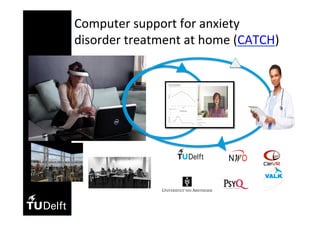
Computer	support	for	anxiety	
disorder	treatment	at	home	(CATCH)
1.
Human	controlled	versus	automa0c	
dialogue
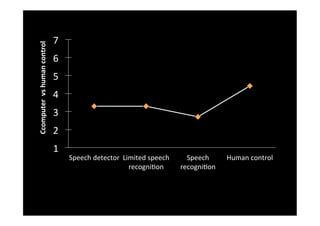
Social phobia – speech recognition
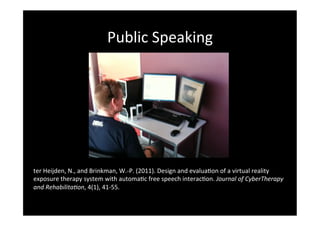
Public	Speaking	
ter	Heijden,	N.,	and	Brinkman,	W.-P.	(2011).	Design	and	evalua(on	of	a	virtual	reality	
exposure	therapy	system	with	automa(c	free	speech	interac(on.	Journal	of	CyberTherapy	
and	Rehabilita0on,	4(1),	41-55.
1	
2	
3	
4	
5	
6	
7	
Speech	detector	 Limited	speech	
recogni(on	
Speech	
recogni(on	
Human	control	
Ccomputer		vs	human	control
2.
Priming	and	dialogues	with	a	virtual	
human
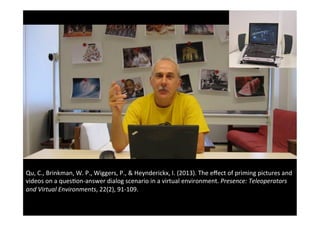
Qu,	C.,	Brinkman,	W.	P.,	Wiggers,	P.,	&	Heynderickx,	I.	(2013).	The	effect	of	priming	pictures	and	
videos	on	a	ques(on-answer	dialog	scenario	in	a	virtual	environment.	Presence:	Teleoperators	
and	Virtual	Environments,	22(2),	91-109.
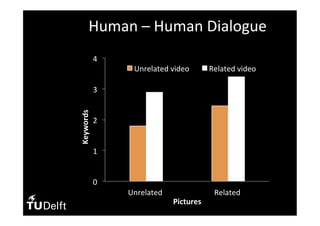
Human	–	Human	Dialogue	
0	
1	
2	
3	
4	
Unrelated		 Related		
Keywords	
Pictures	
Unrelated	video	 Related	video
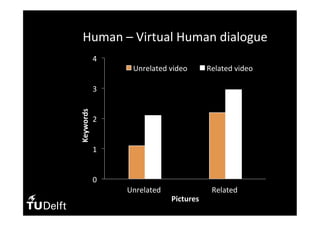
Human	–	Virtual	Human	dialogue	
0	
1	
2	
3	
4	
Unrelated		 Related		
Keywords	
Pictures	
Unrelated	video	 Related	video
3.
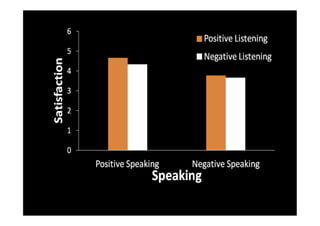
Listening	versus	speaking
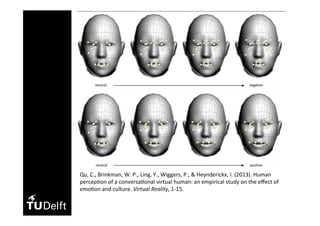
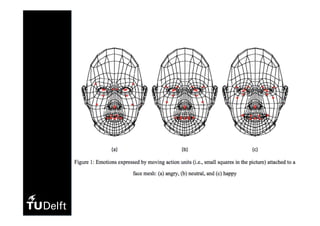
Qu,	C.,	Brinkman,	W.	P.,	Ling,	Y.,	Wiggers,	P.,	&	Heynderickx,	I.	(2013).	Human	
percep(on	of	a	conversa(onal	virtual	human:	an	empirical	study	on	the	effect	of	
emo(on	and	culture.	Virtual	Reality,	1-15.
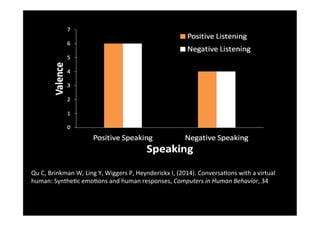
Speaking	and	listening
Qu	C,	Brinkman	W,	Ling	Y,	Wiggers	P,	Heynderickx	I,	(2014).	Conversa(ons	with	a	virtual	
human:	Synthe(c	emo(ons	and	human	responses,	Computers	in	Human	Behavior,	34
4.
Virtual	Reality	Exposure	therapy
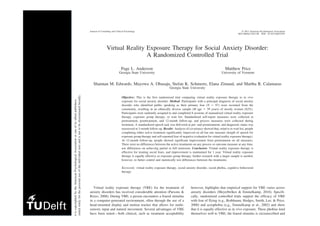
Virtual Reality Exposure Therapy for Social Anxiety Disorder:
A Randomized Controlled Trial
Page L. Anderson
Georgia State University
Matthew Price
University of Vermont
Shannan M. Edwards, Mayowa A. Obasaju, Stefan K. Schmertz, Elana Zimand, and Martha R. Calamaras
Georgia State University
Objective: This is the first randomized trial comparing virtual reality exposure therapy to in vivo
exposure for social anxiety disorder. Method: Participants with a principal diagnosis of social anxiety
disorder who identified public speaking as their primary fear (N ϭ 97) were recruited from the
community, resulting in an ethnically diverse sample (M age ϭ 39 years) of mostly women (62%).
Participants were randomly assigned to and completed 8 sessions of manualized virtual reality exposure
therapy, exposure group therapy, or wait list. Standardized self-report measures were collected at
pretreatment, posttreatment, and 12-month follow-up, and process measures were collected during
treatment. A standardized speech task was delivered at pre- and posttreatment, and diagnostic status was
reassessed at 3-month follow-up. Results: Analysis of covariance showed that, relative to wait list, people
completing either active treatment significantly improved on all but one measure (length of speech for
exposure group therapy and self-reported fear of negative evaluation for virtual reality exposure therapy).
At 12-month follow-up, people showed significant improvement from pretreatment on all measures.
There were no differences between the active treatments on any process or outcome measure at any time,
nor differences on achieving partial or full remission. Conclusion: Virtual reality exposure therapy is
effective for treating social fears, and improvement is maintained for 1 year. Virtual reality exposure
therapy is equally effective as exposure group therapy; further research with a larger sample is needed,
however, to better control and statistically test differences between the treatments.
Keywords: virtual reality exposure therapy, social anxiety disorder, social phobia, cognitive behavioral
therapy
Virtual reality exposure therapy (VRE) for the treatment of
anxiety disorders has received considerable attention (Parsons &
Rizzo, 2008). During VRE, a person encounters a feared stimulus
in a computer-generated environment, often through the use of a
head-mounted display and motion tracker that allows for multi-
sensory input and natural movement. Several advantages of VRE
have been noted—both clinical, such as treatment acceptability
(Emmelkamp, 2005), and methodological, such as the ability to
conduct exposure in a tightly controlled environment (Shiban,
however, highlights that empirical support for VRE varies across
anxiety disorders (Meyerbröker & Emmelkamp, 2010). Specifi-
cally, randomized controlled trials support the efficacy of VRE
with fear of flying (e.g., Rothbaum, Hodges, Smith, Lee, & Price,
2000) and acrophobia (e.g., Emmelkamp et al., 2002) and show
that it is equally effective as in vivo exposure. These phobias lend
themselves well to VRE; the feared stimulus is circumscribed and
contains powerful physical cues that can be produced within a
virtual environment. There is less controlled research on the use of
ocumentiscopyrightedbytheAmericanPsychologicalAssociationoroneofitsalliedpublishers.
leisintendedsolelyforthepersonaluseoftheindividualuserandisnottobedisseminatedbroadly.
Journal of Consulting and Clinical Psychology © 2013 American Psychological Association
2013, Vol. 81, No. 5, 000 0022-006X/13/$12.00 DOI: 10.1037/a0033559
Exposure to virtual social interactions in the treatment of social
anxiety disorder: A randomized controlled trial
Isabel L. Kampmann a, *
, Paul M.G. Emmelkamp c, d
, Dwi Hartanto b
,
Willem-Paul Brinkman b
, Bonne J.H. Zijlstra e
, Nexhmedin Morina a
a
Department of Clinical Psychology, University of Amsterdam, Weesperplein 4, 1018 XA, Amsterdam, The Netherlands
b
Interactive Intelligence Group, Delft University of Technology, Mekelweg 4, 2628 CD, Delft, The Netherlands
c
Netherlands Institute for Advanced Study, Meijboomlaan 1, 2242 PR, Wassenaar, The Netherlands
d
King Abdulaziz University, Abdullah Sulayman, 22254, Jeddah, Saudi Arabia
e
Department of Educational Sciences, University of Amsterdam, Nieuwe Achtergracht 127, 1018 WS, Amsterdam, The Netherlands
a r t i c l e i n f o
Article history:
Received 4 September 2015
Received in revised form
19 December 2015
Accepted 23 December 2015
Available online 29 December 2015
Keywords:
Virtual reality
Exposure therapy
Social anxiety disorder
Social phobia
Social interaction
a b s t r a c t
This randomized controlled trial investigated the efficacy of a stand-alone virtual reality exposure
intervention comprising verbal interaction with virtual humans to target heterogeneous social fears in
participants with social anxiety disorder. Sixty participants (Mage ¼ 36.9 years; 63.3% women) diagnosed
with social anxiety disorder were randomly assigned to individual virtual reality exposure therapy
(VRET), individual in vivo exposure therapy (iVET), or waiting-list. Multilevel regression analyses
revealed that both treatment groups improved from pre-to postassessment on social anxiety symptoms,
speech duration, perceived stress, and avoidant personality disorder related beliefs when compared to
the waiting-list. Participants receiving iVET, but not VRET, improved on fear of negative evaluation,
speech performance, general anxiety, depression, and quality of life relative to those on waiting-list. The
iVET condition was further superior to the VRET condition regarding decreases in social anxiety symp-
toms at post- and follow-up assessments, and avoidant personality disorder related beliefs at follow-up.
At follow-up, all improvements were significant for iVET. For VRET, only the effect for perceived stress
was significant. VRET containing extensive verbal interaction without any cognitive components can
effectively reduce complaints of generalized social anxiety disorder. Future technological and psycho-
logical improvements of virtual social interactions might further enhance the efficacy of VRET for social
anxiety disorder.
© 2015 Elsevier Ltd. All rights reserved.
Social anxiety disorder (SAD) is defined as the fear of one or
more social situations in which one might behave embarrassingly
and be negatively evaluated by others (DSM-V; American
therapy (CBT). CBT aims at modifying maladaptive cognitions and
behavior using both cognitive (e.g., cognitive restructuring) and
behavioural (e.g., exposure) strategies (Hofmann & Smits, 2008;
Contents lists available at ScienceDirect
Behaviour Research and Therapy
journal homepage: www.elsevier.com/locate/brat
Behaviour Research and Therapy 77 (2016) 147e156
•  Virtual	social	
scenarios	
•  Dialogue	
techniques	
•  Phobic	stressors	
	
•  Anxiety	feedback	
loop	
Virtual	reality	system	
•  19	scenario’s	
•  Each	las(ng	around	18	minutes	
	
•  Free	speech	
•  Automa(c	response	virtual	human
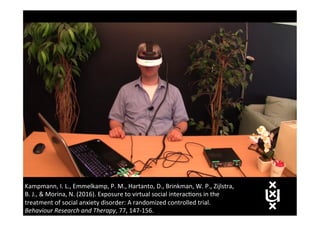
Kampmann,	I.	L.,	Emmelkamp,	P.	M.,	Hartanto,	D.,	Brinkman,	W.	P.,	Zijlstra,	
B.	J.,	&	Morina,	N.	(2016).	Exposure	to	virtual	social	interac(ons	in	the	
treatment	of	social	anxiety	disorder:	A	randomized	controlled	trial.	
Behaviour	Research	and	Therapy,	77,	147-156.
•  Virtual	social	
scenarios	
•  Dialogue	
techniques	
•  Phobic	stressors	
	
•  Anxiety	feedback	
loop	
Virtual	reality	system	
Dialogue	Unit:	
1.  [avatar’s	ques(on]	
2.  [pa(ent’s	answer]	
3.  [avatar’s	response]	
		
•  Each	dialogue	on	average	78	dialogue	
units	
•  Speech	detec(on	
•  Keyword	detec(on
•  Virtual	social	
scenarios	
•  Dialogue	
techniques	
•  Phobic	stressors	
	
•  Anxiety	feedback	
loop	
Virtual	reality	system	
8	general	strategies	to	responses	
without	keyword	detec(on	
	
Example	1:	generic	response	that	fits	to	
any	answer	
	
[shop	assistance]	“Can	you	also	specify	
to	me	the	price	range	that	you’re	aiming	
for?”	
	
[pa(ent]	blah	blah	blah….		
		
[shop	assistance]	“Well,	that’s	fine”.
•  Virtual	social	
scenarios	
•  Dialogue	
techniques	
•  Phobic	stressors	
	
•  Anxiety	feedback	
loop	
Virtual	reality	system	
Example	2:	State	an	opinion	based	on	
your	beliefs,	emo(on	or	percep(on	
	
[avatar]	“What	makes	you	a	good	team	
leader?”	
	
[pa(ent]	blah	blah	blah….		
		
[avatar]	“Yeah,	but	honestly	I	feel	that	
you’re	not	ready	yet	to	become	a	good	
team	leader	by	judging	your	answer	and	
your	current	experience”.
•  Virtual	social	
scenarios	
•  Dialogue	
techniques	
•  Phobic	stressors	
	
•  Anxiety	feedback	
loop	
Virtual	reality	system	
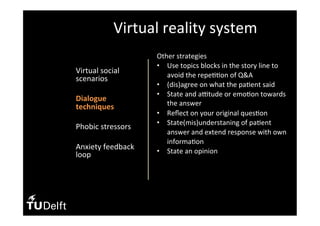
Other	strategies	
•  Use	topics	blocks	in	the	story	line	to	
avoid	the	repe((on	of	Q&A	
•  (dis)agree	on	what	the	pa(ent	said	
•  State	and	aptude	or	emo(on	towards	
the	answer	
•  Reflect	on	your	original	ques(on	
•  State(mis)understaning	of	pa(ent	
answer	and	extend	response	with	own	
informa(on	
•  State	an	opinion
•  Virtual	social	
scenarios	
•  Dialogue	
techniques	
•  Phobic	stressors	
	
•  Anxiety	feedback	
loop	
Virtual	reality	system	
Dialogue	Unit:	
1.  [Posi>ve	|	Nega>ve	avatar’s	
ques(on]	
2.  [pa(ent’s	answer]	
3.  [Posi>ve	|	Nega>ve	avatar’s	
response]	
		
	
Example	Posi>ve	Unit	
[avatar]	“I	like	to	know	your	taste	music,	
what	kind	of	music	do	you	like?”	
	
[pa(ent]	blah	blah	blah…..	
	
[avatar]	“Cool!	Nice	taste	of	music!”
•  Virtual	social	
scenarios	
•  Dialogue	
techniques	
•  Phobic	stressors	
	
•  Anxiety	feedback	
loop	
Virtual	reality	system	
Dialogue	Unit:	
1.  [Posi>ve	|	Nega>ve	avatar’s	ques(on]	
2.  [pa(ent’s	answer]	
3.  [Posi>ve	|	Nega>ve	avatar’s	response]	
		
	
Example	Nega>ve	Unit	
[avatar]	“I	don’t	think	that	you	have	a	good	
taste	of	music,	but	in	case	I’m	wrong,	can	
you	tell	me	what	type	of	music	you	like?”	
	
[pa(ent]	blah	blah	blah…..	
	
[avatar]	“Mmm…	as	I	have	expected,	you	
know	nothing	about	good	music!”
Controlling Social Stress in Virtual Reality Environments
Dwi Hartanto1
*, Isabel L. Kampmann2
, Nexhmedin Morina2
, Paul G. M. Emmelkamp2,3
,
Mark A. Neerincx1,4
, Willem-Paul Brinkman1
1 Department of Intelligent Systems, Delft University of Technology, Delft, The Netherlands, 2 Department of Clinical Psychology, University of Amsterdam, Amsterdam,
The Netherlands, 3 Department of Psychology, King Abdulaziz University, Jeddah, Saudi Arabia, 4 TNO Human Factors, Soesterberg, The Netherlands
Abstract
Virtual reality exposure therapy has been proposed as a viable alternative in the treatment of anxiety disorders, including
social anxiety disorder. Therapists could benefit from extensive control of anxiety eliciting stimuli during virtual exposure.
Two stimuli controls are studied in this study: the social dialogue situation, and the dialogue feedback responses (negative
or positive) between a human and a virtual character. In the first study, 16 participants were exposed in three virtual reality
scenarios: a neutral virtual world, blind date scenario, and job interview scenario. Results showed a significant difference
between the three virtual scenarios in the level of self-reported anxiety and heart rate. In the second study, 24 participants
were exposed to a job interview scenario in a virtual environment where the ratio between negative and positive dialogue
feedback responses of a virtual character was systematically varied on-the-fly. Results yielded that within a dialogue the
more positive dialogue feedback resulted in less self-reported anxiety, lower heart rate, and longer answers, while more
negative dialogue feedback of the virtual character resulted in the opposite. The correlations between on the one hand the
dialogue stressor ratio and on the other hand the means of SUD score, heart rate and audio length in the eight dialogue
conditions showed a strong relationship: r(6) = 0.91, p = 0.002; r(6) = 0.76, p = 0.028 and r(6) = 20.94, p = 0.001 respectively.
Furthermore, more anticipatory anxiety reported before exposure was found to coincide with more self-reported anxiety,
and shorter answers during the virtual exposure. These results demonstrate that social dialogues in a virtual environment
can be effectively manipulated for therapeutic purposes.
Citation: Hartanto D, Kampmann IL, Morina N, Emmelkamp PGM, Neerincx MA, et al. (2014) Controlling Social Stress in Virtual Reality Environments. PLoS
ONE 9(3): e92804. doi:10.1371/journal.pone.0092804
Editor: Mel Slater, ICREA-University of Barcelona, Spain
Received November 26, 2013; Accepted February 25, 2014; Published March 26, 2014
Copyright: ß 2014 Hartanto et al. This is an open-access article distributed under the terms of the Creative Commons Attribution License, which permits
unrestricted use, distribution, and reproduction in any medium, provided the original author and source are credited.
Funding: This research is supported by the Netherlands Organization for Scientific Research (NWO), grant number 655.010.207. The funders had no role in study
design, data collection and analysis, decision to publish, or preparation of the manuscript.
Competing Interests: The authors have declared that no competing interest exist.
* E-mail: d.hartanto@tudelft.nl
Introduction
Social anxiety disorder, also commonly referred as social
phobia, is one of the most prevalent mental disorders [1]. People
with social phobia experience a strong fear of being judged
negatively by others and of being embarrassed in social situations
(e.g., talking to other people or eating or drinking in front of other
people). The gold standard to treat patients with social phobia is
cognitive behaviour therapy with the central component being
transport, or restaurants. At the start of the treatment, an anxiety
hierarchy of anxiety-arousing social situations is established. This
hierarchy is then used to order the VR situations the patient will
be gradually exposed to, starting with less anxiety-arousing
situations and eventually moving to more anxiety-arousing
situations as treatment progresses.
Even though several studies [3,4,10,11] have reported promis-
ing initial efficacy findings for VRET for social phobia, the used
VR systems mainly allow the therapist to control social anxiety
80	
85	
90	
95	
0%	 25%	 50%	 75%	 100%	
Heart	rate	
Nega1ve	ques1ons
•  Virtual	social	
scenarios	
•  Dialogue	
techniques	
•  Phobic	stressors	
	
•  Anxiety	feedback	
loop	
Virtual	reality	system	
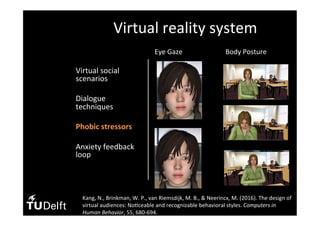
Eye	Gaze																									Body	Posture	
	
Kang,	N.,	Brinkman,	W.	P.,	van	Riemsdijk,	M.	B.,	&	Neerincx,	M.	(2016).	The	design	of	
virtual	audiences:	No(ceable	and	recognizable	behavioral	styles.	Computers	in	
Human	Behavior,	55,	680-694.
•  Virtual	social	
scenarios	
•  Dialogue	
techniques	
•  Phobic	stressors	
	
•  Anxiety	feedback	
loop	
Virtual	reality	system	
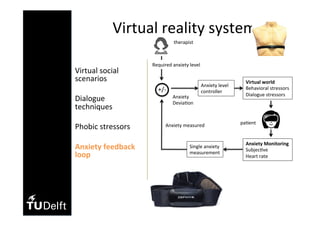
Virtual	world	
Behavioral	stressors	
Dialogue	stressors	
Anxiety	Monitoring	
Subjec(ve	
Heart	rate	
Anxiety	level	
controller	
Anxiety	
Devia(on	
+/-	
Required	anxiety	level	
Anxiety	measured	
Single	anxiety	
measurement	
therapist	
pa(ent
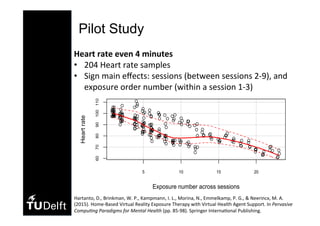
5 10 15 20
60708090100110
Exposure number across sessions
Heartrate
	
Heart	rate	even	4	minutes		
•  204	Heart	rate	samples	
•  Sign	main	effects:	sessions	(between	sessions	2-9),	and	
exposure	order	number	(within	a	session	1-3)		
Pilot Study
Hartanto,	D.,	Brinkman,	W.	P.,	Kampmann,	I.	L.,	Morina,	N.,	Emmelkamp,	P.	G.,	&	Neerincx,	M.	A.	
(2015).	Home-Based	Virtual	Reality	Exposure	Therapy	with	Virtual	Health	Agent	Support.	In	Pervasive	
Compu0ng	Paradigms	for	Mental	Health	(pp.	85-98).	Springer	Interna(onal	Publishing.
Thanks	for	your	awen(on	
	
ICT	is	successful	when	it	supports	your	need	
for	change,	and	fails	when	you	need	to	
change	for	its	support

Behavior Design AMS - Willem-Paul Brinkman

  • 1.
  • 2.
  • 3.
  • 4.
  • 5.
    Social phobia –speech recognition
  • 6.
  • 7.
  • 8.
  • 9.
  • 10.
  • 12.
  • 13.
  • 14.
  • 16.
  • 18.
  • 20.
  • 21.
    Virtual Reality ExposureTherapy for Social Anxiety Disorder: A Randomized Controlled Trial Page L. Anderson Georgia State University Matthew Price University of Vermont Shannan M. Edwards, Mayowa A. Obasaju, Stefan K. Schmertz, Elana Zimand, and Martha R. Calamaras Georgia State University Objective: This is the first randomized trial comparing virtual reality exposure therapy to in vivo exposure for social anxiety disorder. Method: Participants with a principal diagnosis of social anxiety disorder who identified public speaking as their primary fear (N ϭ 97) were recruited from the community, resulting in an ethnically diverse sample (M age ϭ 39 years) of mostly women (62%). Participants were randomly assigned to and completed 8 sessions of manualized virtual reality exposure therapy, exposure group therapy, or wait list. Standardized self-report measures were collected at pretreatment, posttreatment, and 12-month follow-up, and process measures were collected during treatment. A standardized speech task was delivered at pre- and posttreatment, and diagnostic status was reassessed at 3-month follow-up. Results: Analysis of covariance showed that, relative to wait list, people completing either active treatment significantly improved on all but one measure (length of speech for exposure group therapy and self-reported fear of negative evaluation for virtual reality exposure therapy). At 12-month follow-up, people showed significant improvement from pretreatment on all measures. There were no differences between the active treatments on any process or outcome measure at any time, nor differences on achieving partial or full remission. Conclusion: Virtual reality exposure therapy is effective for treating social fears, and improvement is maintained for 1 year. Virtual reality exposure therapy is equally effective as exposure group therapy; further research with a larger sample is needed, however, to better control and statistically test differences between the treatments. Keywords: virtual reality exposure therapy, social anxiety disorder, social phobia, cognitive behavioral therapy Virtual reality exposure therapy (VRE) for the treatment of anxiety disorders has received considerable attention (Parsons & Rizzo, 2008). During VRE, a person encounters a feared stimulus in a computer-generated environment, often through the use of a head-mounted display and motion tracker that allows for multi- sensory input and natural movement. Several advantages of VRE have been noted—both clinical, such as treatment acceptability (Emmelkamp, 2005), and methodological, such as the ability to conduct exposure in a tightly controlled environment (Shiban, however, highlights that empirical support for VRE varies across anxiety disorders (Meyerbröker & Emmelkamp, 2010). Specifi- cally, randomized controlled trials support the efficacy of VRE with fear of flying (e.g., Rothbaum, Hodges, Smith, Lee, & Price, 2000) and acrophobia (e.g., Emmelkamp et al., 2002) and show that it is equally effective as in vivo exposure. These phobias lend themselves well to VRE; the feared stimulus is circumscribed and contains powerful physical cues that can be produced within a virtual environment. There is less controlled research on the use of ocumentiscopyrightedbytheAmericanPsychologicalAssociationoroneofitsalliedpublishers. leisintendedsolelyforthepersonaluseoftheindividualuserandisnottobedisseminatedbroadly. Journal of Consulting and Clinical Psychology © 2013 American Psychological Association 2013, Vol. 81, No. 5, 000 0022-006X/13/$12.00 DOI: 10.1037/a0033559
  • 22.
    Exposure to virtualsocial interactions in the treatment of social anxiety disorder: A randomized controlled trial Isabel L. Kampmann a, * , Paul M.G. Emmelkamp c, d , Dwi Hartanto b , Willem-Paul Brinkman b , Bonne J.H. Zijlstra e , Nexhmedin Morina a a Department of Clinical Psychology, University of Amsterdam, Weesperplein 4, 1018 XA, Amsterdam, The Netherlands b Interactive Intelligence Group, Delft University of Technology, Mekelweg 4, 2628 CD, Delft, The Netherlands c Netherlands Institute for Advanced Study, Meijboomlaan 1, 2242 PR, Wassenaar, The Netherlands d King Abdulaziz University, Abdullah Sulayman, 22254, Jeddah, Saudi Arabia e Department of Educational Sciences, University of Amsterdam, Nieuwe Achtergracht 127, 1018 WS, Amsterdam, The Netherlands a r t i c l e i n f o Article history: Received 4 September 2015 Received in revised form 19 December 2015 Accepted 23 December 2015 Available online 29 December 2015 Keywords: Virtual reality Exposure therapy Social anxiety disorder Social phobia Social interaction a b s t r a c t This randomized controlled trial investigated the efficacy of a stand-alone virtual reality exposure intervention comprising verbal interaction with virtual humans to target heterogeneous social fears in participants with social anxiety disorder. Sixty participants (Mage ¼ 36.9 years; 63.3% women) diagnosed with social anxiety disorder were randomly assigned to individual virtual reality exposure therapy (VRET), individual in vivo exposure therapy (iVET), or waiting-list. Multilevel regression analyses revealed that both treatment groups improved from pre-to postassessment on social anxiety symptoms, speech duration, perceived stress, and avoidant personality disorder related beliefs when compared to the waiting-list. Participants receiving iVET, but not VRET, improved on fear of negative evaluation, speech performance, general anxiety, depression, and quality of life relative to those on waiting-list. The iVET condition was further superior to the VRET condition regarding decreases in social anxiety symp- toms at post- and follow-up assessments, and avoidant personality disorder related beliefs at follow-up. At follow-up, all improvements were significant for iVET. For VRET, only the effect for perceived stress was significant. VRET containing extensive verbal interaction without any cognitive components can effectively reduce complaints of generalized social anxiety disorder. Future technological and psycho- logical improvements of virtual social interactions might further enhance the efficacy of VRET for social anxiety disorder. © 2015 Elsevier Ltd. All rights reserved. Social anxiety disorder (SAD) is defined as the fear of one or more social situations in which one might behave embarrassingly and be negatively evaluated by others (DSM-V; American therapy (CBT). CBT aims at modifying maladaptive cognitions and behavior using both cognitive (e.g., cognitive restructuring) and behavioural (e.g., exposure) strategies (Hofmann & Smits, 2008; Contents lists available at ScienceDirect Behaviour Research and Therapy journal homepage: www.elsevier.com/locate/brat Behaviour Research and Therapy 77 (2016) 147e156
  • 23.
    •  Virtual social scenarios •  Dialogue techniques • Phobic stressors •  Anxiety feedback loop Virtual reality system •  19 scenario’s •  Each las(ng around 18 minutes •  Free speech •  Automa(c response virtual human
  • 26.
  • 27.
    •  Virtual social scenarios •  Dialogue techniques • Phobic stressors •  Anxiety feedback loop Virtual reality system Dialogue Unit: 1.  [avatar’s ques(on] 2.  [pa(ent’s answer] 3.  [avatar’s response] •  Each dialogue on average 78 dialogue units •  Speech detec(on •  Keyword detec(on
  • 28.
    •  Virtual social scenarios •  Dialogue techniques • Phobic stressors •  Anxiety feedback loop Virtual reality system 8 general strategies to responses without keyword detec(on Example 1: generic response that fits to any answer [shop assistance] “Can you also specify to me the price range that you’re aiming for?” [pa(ent] blah blah blah…. [shop assistance] “Well, that’s fine”.
  • 29.
    •  Virtual social scenarios •  Dialogue techniques • Phobic stressors •  Anxiety feedback loop Virtual reality system Example 2: State an opinion based on your beliefs, emo(on or percep(on [avatar] “What makes you a good team leader?” [pa(ent] blah blah blah…. [avatar] “Yeah, but honestly I feel that you’re not ready yet to become a good team leader by judging your answer and your current experience”.
  • 30.
    •  Virtual social scenarios •  Dialogue techniques • Phobic stressors •  Anxiety feedback loop Virtual reality system Other strategies •  Use topics blocks in the story line to avoid the repe((on of Q&A •  (dis)agree on what the pa(ent said •  State and aptude or emo(on towards the answer •  Reflect on your original ques(on •  State(mis)understaning of pa(ent answer and extend response with own informa(on •  State an opinion
  • 31.
    •  Virtual social scenarios •  Dialogue techniques • Phobic stressors •  Anxiety feedback loop Virtual reality system Dialogue Unit: 1.  [Posi>ve | Nega>ve avatar’s ques(on] 2.  [pa(ent’s answer] 3.  [Posi>ve | Nega>ve avatar’s response] Example Posi>ve Unit [avatar] “I like to know your taste music, what kind of music do you like?” [pa(ent] blah blah blah….. [avatar] “Cool! Nice taste of music!”
  • 32.
    •  Virtual social scenarios •  Dialogue techniques • Phobic stressors •  Anxiety feedback loop Virtual reality system Dialogue Unit: 1.  [Posi>ve | Nega>ve avatar’s ques(on] 2.  [pa(ent’s answer] 3.  [Posi>ve | Nega>ve avatar’s response] Example Nega>ve Unit [avatar] “I don’t think that you have a good taste of music, but in case I’m wrong, can you tell me what type of music you like?” [pa(ent] blah blah blah….. [avatar] “Mmm… as I have expected, you know nothing about good music!”
  • 34.
    Controlling Social Stressin Virtual Reality Environments Dwi Hartanto1 *, Isabel L. Kampmann2 , Nexhmedin Morina2 , Paul G. M. Emmelkamp2,3 , Mark A. Neerincx1,4 , Willem-Paul Brinkman1 1 Department of Intelligent Systems, Delft University of Technology, Delft, The Netherlands, 2 Department of Clinical Psychology, University of Amsterdam, Amsterdam, The Netherlands, 3 Department of Psychology, King Abdulaziz University, Jeddah, Saudi Arabia, 4 TNO Human Factors, Soesterberg, The Netherlands Abstract Virtual reality exposure therapy has been proposed as a viable alternative in the treatment of anxiety disorders, including social anxiety disorder. Therapists could benefit from extensive control of anxiety eliciting stimuli during virtual exposure. Two stimuli controls are studied in this study: the social dialogue situation, and the dialogue feedback responses (negative or positive) between a human and a virtual character. In the first study, 16 participants were exposed in three virtual reality scenarios: a neutral virtual world, blind date scenario, and job interview scenario. Results showed a significant difference between the three virtual scenarios in the level of self-reported anxiety and heart rate. In the second study, 24 participants were exposed to a job interview scenario in a virtual environment where the ratio between negative and positive dialogue feedback responses of a virtual character was systematically varied on-the-fly. Results yielded that within a dialogue the more positive dialogue feedback resulted in less self-reported anxiety, lower heart rate, and longer answers, while more negative dialogue feedback of the virtual character resulted in the opposite. The correlations between on the one hand the dialogue stressor ratio and on the other hand the means of SUD score, heart rate and audio length in the eight dialogue conditions showed a strong relationship: r(6) = 0.91, p = 0.002; r(6) = 0.76, p = 0.028 and r(6) = 20.94, p = 0.001 respectively. Furthermore, more anticipatory anxiety reported before exposure was found to coincide with more self-reported anxiety, and shorter answers during the virtual exposure. These results demonstrate that social dialogues in a virtual environment can be effectively manipulated for therapeutic purposes. Citation: Hartanto D, Kampmann IL, Morina N, Emmelkamp PGM, Neerincx MA, et al. (2014) Controlling Social Stress in Virtual Reality Environments. PLoS ONE 9(3): e92804. doi:10.1371/journal.pone.0092804 Editor: Mel Slater, ICREA-University of Barcelona, Spain Received November 26, 2013; Accepted February 25, 2014; Published March 26, 2014 Copyright: ß 2014 Hartanto et al. This is an open-access article distributed under the terms of the Creative Commons Attribution License, which permits unrestricted use, distribution, and reproduction in any medium, provided the original author and source are credited. Funding: This research is supported by the Netherlands Organization for Scientific Research (NWO), grant number 655.010.207. The funders had no role in study design, data collection and analysis, decision to publish, or preparation of the manuscript. Competing Interests: The authors have declared that no competing interest exist. * E-mail: d.hartanto@tudelft.nl Introduction Social anxiety disorder, also commonly referred as social phobia, is one of the most prevalent mental disorders [1]. People with social phobia experience a strong fear of being judged negatively by others and of being embarrassed in social situations (e.g., talking to other people or eating or drinking in front of other people). The gold standard to treat patients with social phobia is cognitive behaviour therapy with the central component being transport, or restaurants. At the start of the treatment, an anxiety hierarchy of anxiety-arousing social situations is established. This hierarchy is then used to order the VR situations the patient will be gradually exposed to, starting with less anxiety-arousing situations and eventually moving to more anxiety-arousing situations as treatment progresses. Even though several studies [3,4,10,11] have reported promis- ing initial efficacy findings for VRET for social phobia, the used VR systems mainly allow the therapist to control social anxiety 80 85 90 95 0% 25% 50% 75% 100% Heart rate Nega1ve ques1ons
  • 35.
    •  Virtual social scenarios •  Dialogue techniques • Phobic stressors •  Anxiety feedback loop Virtual reality system Eye Gaze Body Posture Kang, N., Brinkman, W. P., van Riemsdijk, M. B., & Neerincx, M. (2016). The design of virtual audiences: No(ceable and recognizable behavioral styles. Computers in Human Behavior, 55, 680-694.
  • 36.
    •  Virtual social scenarios •  Dialogue techniques • Phobic stressors •  Anxiety feedback loop Virtual reality system Virtual world Behavioral stressors Dialogue stressors Anxiety Monitoring Subjec(ve Heart rate Anxiety level controller Anxiety Devia(on +/- Required anxiety level Anxiety measured Single anxiety measurement therapist pa(ent
  • 37.
    5 10 1520 60708090100110 Exposure number across sessions Heartrate Heart rate even 4 minutes •  204 Heart rate samples •  Sign main effects: sessions (between sessions 2-9), and exposure order number (within a session 1-3) Pilot Study Hartanto, D., Brinkman, W. P., Kampmann, I. L., Morina, N., Emmelkamp, P. G., & Neerincx, M. A. (2015). Home-Based Virtual Reality Exposure Therapy with Virtual Health Agent Support. In Pervasive Compu0ng Paradigms for Mental Health (pp. 85-98). Springer Interna(onal Publishing.
  • 38.