Votes for women,Votes for women,
1900-19181900-1918
What is the
message of
this poster?
The status of women before 1900 …
Before 1870 most working-class girls did not go to
school, their duty was to obey their husband and do
everything to make sure his life was as easy as
possible. Any girl’s education reinforced this view
Occupations open to women were mainly menial –
domestic servants, small workshops, sewing, textile
factories, working at home
By the start of the 20th
C, other opportunities were
opening up for women …
Further work opportunities …
Jobs in shops, as typists, on telephone switchboards but
…
Hours were long (as much as 80 per week)
Women often had to leave if they got married
Women were often paid a great deal less than men doing
similar jobs
New employment opportunities were opening up for
middle-class women, who may have at least had some
education at home, or been lucky enough to have had some
schooling … discrimination was still possible
In 1870s Sophia Jex-Blake
completed a medical
degree at Edinburgh
University, but was
refused her degree ! Her
case caused some
Universities to change
their attitude to women –
Oxford and Cambridge
opened Women’s colleges,
there were also some
teacher training colleges
opened …
Teaching – female
teachers had to be single
Nursing – but had to
resign when they married
Clerical work - answering
telephones and typing …
In marriages, women were in a very inferior
position to their husbands …
Before 1900 - when they
married all their property
went to their husbands; even
they became their husband’s
property !
Wives were often treated
with violence and assaulted
by husbands
Women could not start
divorce proceedings
By 1900 women could bring
divorce cases against their
husbands for cruelty,
desertion and bigamy
They could keep their own
property after marriage
Women could leave the
marital home voluntarily if
in danger
But, some things did not change…
Wife-battering and marital sexual assaults were still legal
Husbands could divorce wives for adultery, but wives
would have to prove violence or cruelty in similar cases
If a divorce occurred, a mother would lose her rights over
her children
Summary …
Women were stopped from entering many professions,
despite the improvement in their educational position by
1900
Women were still regarded as inferior to men
The law was still biased in favour of men
The pace of social change was slow
Change was finally on the way …
In the 19th
Century, women had not been allowed to
vote in parliamentary elections, or be MPs
By 1900 ‘votes for women’ was becoming an
important issue, and arguments were being advanced
for and against the idea
Two groups campaigned for votes – the NUWSS
(National Union of Women’s Suffrage Societies) and
the WSPU (Women’s Social and Political Union)
Focus … on the NUWSS
Founded in 1897 by Millicent Fawcett
Brought together a series of disparate groups, all with
the same objective
By 1914, over 400 branches all over the country, over
100000 members
Democratic organisation which used peaceful means
such as discussion and persuasion
Members were mainly middle-class and working-
class, and some men were allowed to join
Focus … on the WSPU
Founded by Emmeline Pankhurst and her two
daughters Christabel and Sylvia in 1903
Branches all over the country, but this was not a
democratic organisation – it was closely controlled
by the Pankhursts
Formed because they were impatient with the
peaceful, and slow methods of the NUWSS
Often used violent and abusive methods, many
members went to prison for their actions
Men were not allowed to join; members were
mainly middle and upper-class women
Arguments supporting votes for
women …
The vote is the way to get rid of other inequalities
The vote will improve men’s moral and sexual
behaviour
Women are capable of being involved in politics
There have been many changes in women’s roles
Look at what is happening in other countries
Voting is a ‘right’ to which women are entitled
Britain is not a true democracy until women have
the vote
Arguments opposing votes for
women …
Women and men have ‘separate spheres’
Most women do not want the vote
‘A woman’s role is in local affairs’
Women are already represented by their husbands
It is dangerous to change a system that works
Women do not fight to defend their country
Methods used to win the vote …
Propaganda – the WSPU
published a newspaper
called Votes for Women –
circulation of 40,000 by
1914
Pin badges, belts, jewellery
Posters, leaflets, postcards
Meetings and
demonstrations all over
Britain, some attracted
20,000 women
Lobbying Parliament –
petitions and letters - in
1910 one gained over
250,000 signatures
Civil disobedience – refusal
to pay taxes etc
Attacking property –
window smashing, arson,
bombs, works of art in
galleries, telegraph lines
were cut, recreational parks
were vandalised
Methods used to win the vote …
Attacks on prominent
people – doctors who force-
fed suffragettes in prison
Axe thrown at the Prime
Minister
Heckling politicians at
meetings
Disrupting political
meetings with publicity
stunts such as abseiling into
a Liberal Party meeting
Hunger strikes – began in
1909 as a way of forcing
the authorities to recognise
suffragettes prisoners as
political prisoners
The authorities decided to
force-feed some of them.
Some suffragettes
barricaded themselves in
their cells to avoid this
The government hit back
with the ‘Cat and Mouse
Act’
How did women win the vote ?
By 1916 many men who were eligible to vote had lost
that right as they were out of the country for more than
a year
The NUWSS put pressure on the government to
consider giving women the vote
In 1917 the House of Commons voted by 385-55 that
women should have the vote.
In February 1918 the Bill became law
What did the Bill say ?
The Bill said that …
women over the age of 30 could have the vote
Women over 30 could become MPs
All men over 21 were given the vote
Out of an electorate of 21 million, some 8 million
were now women, though there was still no proper
equality … it was believed that younger women
might not be responsible enough to exercise their
vote, and the government was worried in case there
were more women voters than men …
PURPOSEPURPOSE
AUTHORAUTHOR
CONTEXTCONTEXT
TONETONE
Key pointsKey points
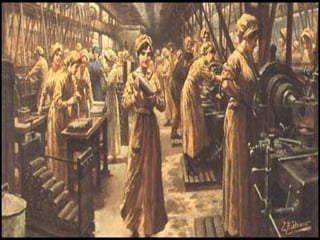
The shell shortage crisis in 1915The shell shortage crisis in 1915
began to change the situation.began to change the situation.
Women were taken on to work inWomen were taken on to work in
munitions factories. The governmentmunitions factories. The government
did a deal with the trade unions,did a deal with the trade unions,
known as the Treasury Agreements.known as the Treasury Agreements.
The unions agreed to accept femaleThe unions agreed to accept female
labour in place of menlabour in place of men ‘for the‘for the
duration of the war’duration of the war’..
Key pointsKey points
The introduction of conscription inThe introduction of conscription in
1916 led to an increase in the1916 led to an increase in the
number of women employed in allnumber of women employed in all
sectors of the economy.sectors of the economy.
Key pointsKey points
Many women were paid good wages,Many women were paid good wages,
especially in munitions factories, butespecially in munitions factories, but
in most cases they were paid lowerin most cases they were paid lower
rates than men.rates than men.
Improved wages did permit greaterImproved wages did permit greater
independence for some women.independence for some women.
Key pointsKey points
Women became more visible in theWomen became more visible in the
world of work. They were seen to beworld of work. They were seen to be
doing important jobs.doing important jobs.
Key pointsKey points
The armed forces also employedThe armed forces also employed
women, but the jobs were mainly ofwomen, but the jobs were mainly of
a clerical and domestic nature.a clerical and domestic nature.
After the WarAfter the War
11 Women were expected to give way to men returningWomen were expected to give way to men returning
from the forces and return to pre-war ‘women’sfrom the forces and return to pre-war ‘women’s
work’.work’.
22 The assumption that ‘a woman’s place is in the home’The assumption that ‘a woman’s place is in the home’
returned.returned.
33 The percentage of women at work returned to pre-The percentage of women at work returned to pre-
war levels.war levels.
44 More women than before worked in offices.More women than before worked in offices.
After the WarAfter the War
55 Shorter skirts and hair became fashionable.Shorter skirts and hair became fashionable.
66 Women went out with men without a chaperone.Women went out with men without a chaperone.
77 Women smoked and wore make-up in public for theWomen smoked and wore make-up in public for the
first time.first time.
88 In 1919: being female or married was no longerIn 1919: being female or married was no longer
allowed to disqualify someone from holding a job inallowed to disqualify someone from holding a job in
the professions or civil service.the professions or civil service.
•
USE THE SOURCE!!!!!!!!!!!!!!!

Votes for women

  • 1.
    Votes for women,Votesfor women, 1900-19181900-1918
  • 2.
    What is the messageof this poster?
  • 3.
    The status ofwomen before 1900 … Before 1870 most working-class girls did not go to school, their duty was to obey their husband and do everything to make sure his life was as easy as possible. Any girl’s education reinforced this view Occupations open to women were mainly menial – domestic servants, small workshops, sewing, textile factories, working at home By the start of the 20th C, other opportunities were opening up for women …
  • 4.
    Further work opportunities… Jobs in shops, as typists, on telephone switchboards but … Hours were long (as much as 80 per week) Women often had to leave if they got married Women were often paid a great deal less than men doing similar jobs
  • 5.
    New employment opportunitieswere opening up for middle-class women, who may have at least had some education at home, or been lucky enough to have had some schooling … discrimination was still possible In 1870s Sophia Jex-Blake completed a medical degree at Edinburgh University, but was refused her degree ! Her case caused some Universities to change their attitude to women – Oxford and Cambridge opened Women’s colleges, there were also some teacher training colleges opened … Teaching – female teachers had to be single Nursing – but had to resign when they married Clerical work - answering telephones and typing …
  • 6.
    In marriages, womenwere in a very inferior position to their husbands … Before 1900 - when they married all their property went to their husbands; even they became their husband’s property ! Wives were often treated with violence and assaulted by husbands Women could not start divorce proceedings By 1900 women could bring divorce cases against their husbands for cruelty, desertion and bigamy They could keep their own property after marriage Women could leave the marital home voluntarily if in danger
  • 7.
    But, some thingsdid not change… Wife-battering and marital sexual assaults were still legal Husbands could divorce wives for adultery, but wives would have to prove violence or cruelty in similar cases If a divorce occurred, a mother would lose her rights over her children
  • 8.
    Summary … Women werestopped from entering many professions, despite the improvement in their educational position by 1900 Women were still regarded as inferior to men The law was still biased in favour of men The pace of social change was slow
  • 9.
    Change was finallyon the way … In the 19th Century, women had not been allowed to vote in parliamentary elections, or be MPs By 1900 ‘votes for women’ was becoming an important issue, and arguments were being advanced for and against the idea Two groups campaigned for votes – the NUWSS (National Union of Women’s Suffrage Societies) and the WSPU (Women’s Social and Political Union)
  • 10.
    Focus … onthe NUWSS Founded in 1897 by Millicent Fawcett Brought together a series of disparate groups, all with the same objective By 1914, over 400 branches all over the country, over 100000 members Democratic organisation which used peaceful means such as discussion and persuasion Members were mainly middle-class and working- class, and some men were allowed to join
  • 11.
    Focus … onthe WSPU Founded by Emmeline Pankhurst and her two daughters Christabel and Sylvia in 1903 Branches all over the country, but this was not a democratic organisation – it was closely controlled by the Pankhursts Formed because they were impatient with the peaceful, and slow methods of the NUWSS Often used violent and abusive methods, many members went to prison for their actions Men were not allowed to join; members were mainly middle and upper-class women
  • 12.
    Arguments supporting votesfor women … The vote is the way to get rid of other inequalities The vote will improve men’s moral and sexual behaviour Women are capable of being involved in politics There have been many changes in women’s roles Look at what is happening in other countries Voting is a ‘right’ to which women are entitled Britain is not a true democracy until women have the vote
  • 13.
    Arguments opposing votesfor women … Women and men have ‘separate spheres’ Most women do not want the vote ‘A woman’s role is in local affairs’ Women are already represented by their husbands It is dangerous to change a system that works Women do not fight to defend their country
  • 14.
    Methods used towin the vote … Propaganda – the WSPU published a newspaper called Votes for Women – circulation of 40,000 by 1914 Pin badges, belts, jewellery Posters, leaflets, postcards Meetings and demonstrations all over Britain, some attracted 20,000 women Lobbying Parliament – petitions and letters - in 1910 one gained over 250,000 signatures Civil disobedience – refusal to pay taxes etc Attacking property – window smashing, arson, bombs, works of art in galleries, telegraph lines were cut, recreational parks were vandalised
  • 15.
    Methods used towin the vote … Attacks on prominent people – doctors who force- fed suffragettes in prison Axe thrown at the Prime Minister Heckling politicians at meetings Disrupting political meetings with publicity stunts such as abseiling into a Liberal Party meeting Hunger strikes – began in 1909 as a way of forcing the authorities to recognise suffragettes prisoners as political prisoners The authorities decided to force-feed some of them. Some suffragettes barricaded themselves in their cells to avoid this The government hit back with the ‘Cat and Mouse Act’
  • 16.
    How did womenwin the vote ? By 1916 many men who were eligible to vote had lost that right as they were out of the country for more than a year The NUWSS put pressure on the government to consider giving women the vote In 1917 the House of Commons voted by 385-55 that women should have the vote. In February 1918 the Bill became law
  • 17.
    What did theBill say ? The Bill said that … women over the age of 30 could have the vote Women over 30 could become MPs All men over 21 were given the vote Out of an electorate of 21 million, some 8 million were now women, though there was still no proper equality … it was believed that younger women might not be responsible enough to exercise their vote, and the government was worried in case there were more women voters than men …
  • 18.
  • 19.
    Key pointsKey points Theshell shortage crisis in 1915The shell shortage crisis in 1915 began to change the situation.began to change the situation. Women were taken on to work inWomen were taken on to work in munitions factories. The governmentmunitions factories. The government did a deal with the trade unions,did a deal with the trade unions, known as the Treasury Agreements.known as the Treasury Agreements. The unions agreed to accept femaleThe unions agreed to accept female labour in place of menlabour in place of men ‘for the‘for the duration of the war’duration of the war’..
  • 20.
    Key pointsKey points Theintroduction of conscription inThe introduction of conscription in 1916 led to an increase in the1916 led to an increase in the number of women employed in allnumber of women employed in all sectors of the economy.sectors of the economy.
  • 21.
    Key pointsKey points Manywomen were paid good wages,Many women were paid good wages, especially in munitions factories, butespecially in munitions factories, but in most cases they were paid lowerin most cases they were paid lower rates than men.rates than men. Improved wages did permit greaterImproved wages did permit greater independence for some women.independence for some women.
  • 22.
    Key pointsKey points Womenbecame more visible in theWomen became more visible in the world of work. They were seen to beworld of work. They were seen to be doing important jobs.doing important jobs.
  • 23.
    Key pointsKey points Thearmed forces also employedThe armed forces also employed women, but the jobs were mainly ofwomen, but the jobs were mainly of a clerical and domestic nature.a clerical and domestic nature.
  • 25.
    After the WarAfterthe War 11 Women were expected to give way to men returningWomen were expected to give way to men returning from the forces and return to pre-war ‘women’sfrom the forces and return to pre-war ‘women’s work’.work’. 22 The assumption that ‘a woman’s place is in the home’The assumption that ‘a woman’s place is in the home’ returned.returned. 33 The percentage of women at work returned to pre-The percentage of women at work returned to pre- war levels.war levels. 44 More women than before worked in offices.More women than before worked in offices.
  • 26.
    After the WarAfterthe War 55 Shorter skirts and hair became fashionable.Shorter skirts and hair became fashionable. 66 Women went out with men without a chaperone.Women went out with men without a chaperone. 77 Women smoked and wore make-up in public for theWomen smoked and wore make-up in public for the first time.first time. 88 In 1919: being female or married was no longerIn 1919: being female or married was no longer allowed to disqualify someone from holding a job inallowed to disqualify someone from holding a job in the professions or civil service.the professions or civil service. •
  • 27.