DC MOTOR
An electric motor is a machine which converts
electrical energy into mechanical energy.
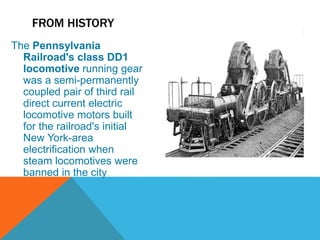
The Pennsylvania
Railroad's class DD1
locomotive running gear
was a semi-permanently
coupled pair of third rail
direct current electric
locomotive motors built
for the railroad's initial
New York-area
electrification when
steam locomotives were
banned in the city
FROM HISTORY
PRINCIPLE OF DC MOTOR
When a current carrying conductor is placed in a magnetic field, it
experiences a torque and has a tendency to move known as motoring
action.
If the direction of current in the wire is reversed, the direction of
rotation also reverses.
When magnetic field and electric field interact they produce a
mechanical force, and based on that the working principle of dc
motor established.
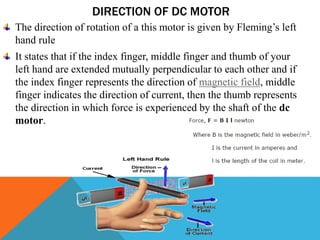
DIRECTION OF DC MOTOR
The direction of rotation of a this motor is given by Fleming’s left
hand rule
It states that if the index finger, middle finger and thumb of your
left hand are extended mutually perpendicular to each other and if
the index finger represents the direction of magnetic field, middle
finger indicates the direction of current, then the thumb represents
the direction in which force is experienced by the shaft of the dc
motor.
FACTORS AFFECTING DC MOTOR
Where, P = no of poles
φ = flux per pole
Z= No. of conductors
A = No. of parallel paths
and N is the speed of the DC Motor.
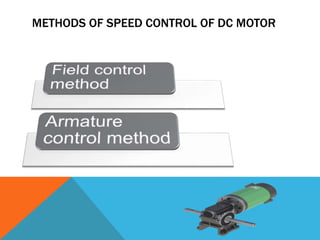
METHODS OF SPEED CONTROL OF DC MOTOR
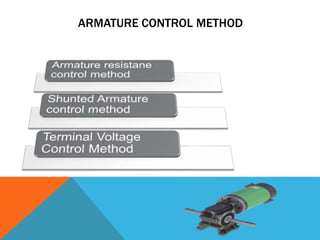
ARMATURE CONTROL METHOD
VOLTAGE CONTROL METHOD
Multiple voltage control: In this method the, shunt filed is
connected to a fixed exciting voltage, and armature is
supplied with different voltages. Voltage across armature
is changed with the help of a suitable switchgear. The
speed is approximately proportional to the voltage across
the armature.
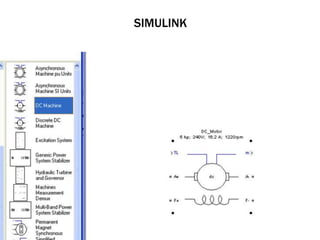
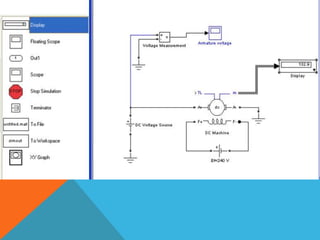
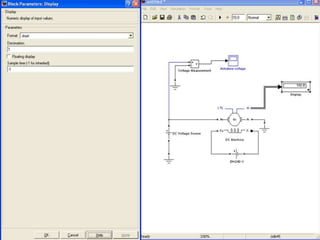
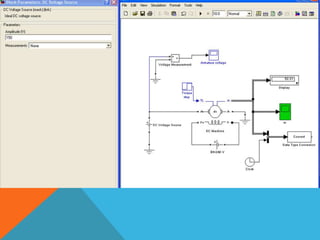
SIMULINK
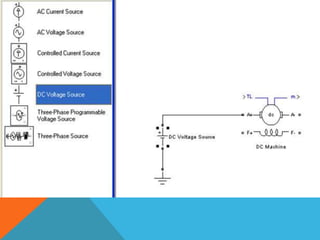
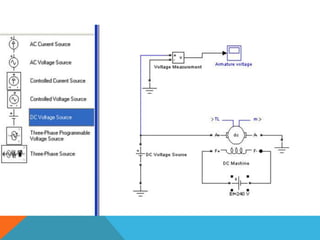
Voltage Controlled D.C Motor Using MATLAB

Voltage Controlled D.C Motor Using MATLAB

  • 2.
    DC MOTOR An electricmotor is a machine which converts electrical energy into mechanical energy.
  • 3.
    The Pennsylvania Railroad's classDD1 locomotive running gear was a semi-permanently coupled pair of third rail direct current electric locomotive motors built for the railroad's initial New York-area electrification when steam locomotives were banned in the city FROM HISTORY
  • 4.
    PRINCIPLE OF DCMOTOR When a current carrying conductor is placed in a magnetic field, it experiences a torque and has a tendency to move known as motoring action. If the direction of current in the wire is reversed, the direction of rotation also reverses. When magnetic field and electric field interact they produce a mechanical force, and based on that the working principle of dc motor established.
  • 5.
    DIRECTION OF DCMOTOR The direction of rotation of a this motor is given by Fleming’s left hand rule It states that if the index finger, middle finger and thumb of your left hand are extended mutually perpendicular to each other and if the index finger represents the direction of magnetic field, middle finger indicates the direction of current, then the thumb represents the direction in which force is experienced by the shaft of the dc motor.
  • 7.
    FACTORS AFFECTING DCMOTOR Where, P = no of poles φ = flux per pole Z= No. of conductors A = No. of parallel paths and N is the speed of the DC Motor.
  • 8.
    METHODS OF SPEEDCONTROL OF DC MOTOR
  • 9.
  • 10.
    VOLTAGE CONTROL METHOD Multiplevoltage control: In this method the, shunt filed is connected to a fixed exciting voltage, and armature is supplied with different voltages. Voltage across armature is changed with the help of a suitable switchgear. The speed is approximately proportional to the voltage across the armature.
  • 11.