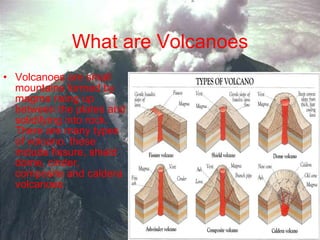
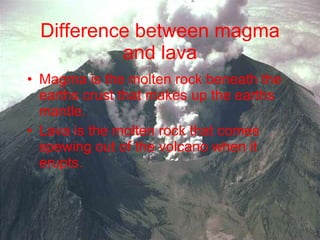
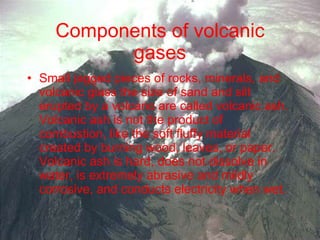
Volcanoes are formed by magma rising up between tectonic plates and solidifying. There are several types of volcanoes defined by their shape. Most volcanoes occur near plate boundaries where plates are subducting or spreading apart. Magma lies below the earth's crust while lava is molten rock emitted during an eruption. Igneous rocks form when lava solidifies, and can be plutonic or volcanic depending on where they solidify. Eruptions emit gases, liquids, and solids ranging from ash to blocks of the volcanic cone. Volcanic ash is abrasive rock and mineral fragments ejected during an eruption, not combustion products. Eruptions can damage the environment through toxic gases