VoIP Technology Developments [email_address] Co-leaders: José A. Domínguez (University of  Oregon) [email_address]   http://ns.uoregon.edu/~jad/Net@EDU/
Several Uses for VoIP Voice Trunk Replacement End-user Appliances Computer Telephony & VoIP
Elements of the Current Technology Switching Devices (unPBX/IP PBX) End-user Devices (IP Telephones, Ethernet Telephones, Computer Telephony Apps, Regular Analog/Digital Telephones) Access Gateways (Analog/Digital) Wireless VoIP
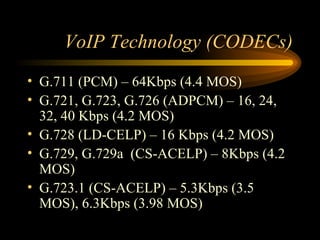
VoIP Technology (CODECs) G.711 (PCM) – 64Kbps (4.4 MOS) G.721, G.723, G.726 (ADPCM) – 16, 24, 32, 40 Kbps (4.2 MOS) G.728 (LD-CELP) – 16 Kbps (4.2 MOS) G.729, G.729a  (CS-ACELP) – 8Kbps (4.2 MOS) G.723.1 (CS-ACELP) – 5.3Kbps (3.5 MOS), 6.3Kbps (3.98 MOS)
VoIP Technology (Delays) Fixed Delay Components: Propagation Delay Serialization Delay Processing Delay Variable Delays: Queuing Delay
VoIP Technology (Call Setup) H.323 Standard (Video conferencing over Packet/Data Networks) H.225 H.245 Real-Time Transport Protocol (RTP)/Real-Time Transport Control Protocol (RTCP) Session Initiation Protocol (SIP) Multimedia Gateway Control Protocol (MGCP)
VoIP Technology (QoS) Dejitter Buffer Type of Service (TOS) Weighted Fair Queuing (WFQ) Random Early Detection (RED) Weighted RED (WRED) Multilink PPP (MLPPP) Resource Reservation Protocol (RSVP)
Concerns To Be Addressed Powering for End-user Devices Reliability Troubleshooting VoIP Services Access to Emergency Services and related issues (Liability)
What has changed? IP Telephones powered by proprietary switching devices Converters for Current devices Some more layers of reliability have been added New services added to IP PBXs and gateways
Things that we are still missing Device location. Similar to cell phone triangulation. How about GPS? Standardization for power provisioning Plan for an open environment similar to the current data and voice networks Management platforms
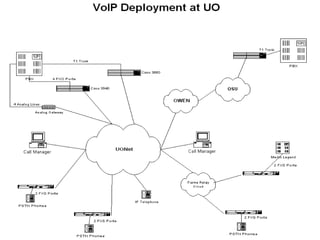
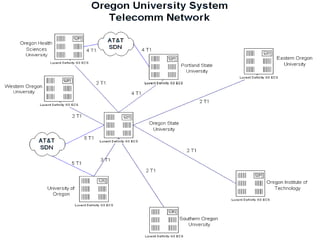
UO VoIP Services Equipment: Redundant IP/PBX Call Manager Cisco Digital/Analog Gateways Cisco’s IP Telephones Services Offered: VoIP Trunks to Remote Sites On Campus Mobility via IP Telephones


Tracking Technology Changes Mailing Lists IETF’s IP Telephony WG ( [email_address] ) IETF’s PSTN & Internet Internetworking WG ( [email_address] ) IETF’s Media Gateway Control WG ( [email_address] ) Session Initiation Protocol WG ( [email_address] ) Other IETF WGs (SPIRITS, ENUM, RSVP, DIFFSERV, AVT, INTSERV) Computer Telephony Newsletter ( [email_address] )
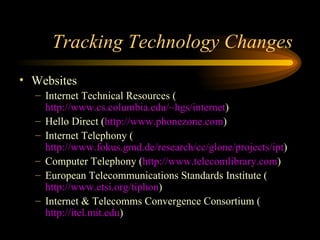
Tracking Technology Changes Websites Internet Technical Resources ( http://www.cs.columbia.edu/~hgs/internet ) Hello Direct ( http://www.phonezone.com ) Internet Telephony ( http://www.fokus.gmd.de/research/cc/glone/projects/ipt ) Computer Telephony ( http://www.telecomlibrary.com ) European Telecommunications Standards Institute ( http://www.etsi.org/tiphon ) Internet & Telecomms Convergence Consortium ( http://itel.mit.edu )
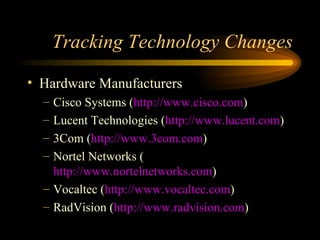
Tracking Technology Changes Hardware Manufacturers Cisco Systems ( http://www.cisco.com ) Lucent Technologies ( http://www.lucent.com ) 3Com ( http://www.3com.com ) Nortel Networks ( http://www.nortelnetworks.com ) Vocaltec ( http://www.vocaltec.com ) RadVision ( http://www.radvision.com )
Books in the market IP Telephony (Bill Douskalis) Voice over IP (???) Voice over Data Networks (???)

VoIP Technology Developments Net@EDU

  • 1.
    VoIP Technology Developments[email_address] Co-leaders: José A. Domínguez (University of Oregon) [email_address] http://ns.uoregon.edu/~jad/Net@EDU/
  • 2.
    Several Uses forVoIP Voice Trunk Replacement End-user Appliances Computer Telephony & VoIP
  • 3.
    Elements of theCurrent Technology Switching Devices (unPBX/IP PBX) End-user Devices (IP Telephones, Ethernet Telephones, Computer Telephony Apps, Regular Analog/Digital Telephones) Access Gateways (Analog/Digital) Wireless VoIP
  • 4.
    VoIP Technology (CODECs)G.711 (PCM) – 64Kbps (4.4 MOS) G.721, G.723, G.726 (ADPCM) – 16, 24, 32, 40 Kbps (4.2 MOS) G.728 (LD-CELP) – 16 Kbps (4.2 MOS) G.729, G.729a (CS-ACELP) – 8Kbps (4.2 MOS) G.723.1 (CS-ACELP) – 5.3Kbps (3.5 MOS), 6.3Kbps (3.98 MOS)
  • 5.
    VoIP Technology (Delays)Fixed Delay Components: Propagation Delay Serialization Delay Processing Delay Variable Delays: Queuing Delay
  • 6.
    VoIP Technology (CallSetup) H.323 Standard (Video conferencing over Packet/Data Networks) H.225 H.245 Real-Time Transport Protocol (RTP)/Real-Time Transport Control Protocol (RTCP) Session Initiation Protocol (SIP) Multimedia Gateway Control Protocol (MGCP)
  • 7.
    VoIP Technology (QoS)Dejitter Buffer Type of Service (TOS) Weighted Fair Queuing (WFQ) Random Early Detection (RED) Weighted RED (WRED) Multilink PPP (MLPPP) Resource Reservation Protocol (RSVP)
  • 8.
    Concerns To BeAddressed Powering for End-user Devices Reliability Troubleshooting VoIP Services Access to Emergency Services and related issues (Liability)
  • 9.
    What has changed?IP Telephones powered by proprietary switching devices Converters for Current devices Some more layers of reliability have been added New services added to IP PBXs and gateways
  • 10.
    Things that weare still missing Device location. Similar to cell phone triangulation. How about GPS? Standardization for power provisioning Plan for an open environment similar to the current data and voice networks Management platforms
  • 11.
    UO VoIP ServicesEquipment: Redundant IP/PBX Call Manager Cisco Digital/Analog Gateways Cisco’s IP Telephones Services Offered: VoIP Trunks to Remote Sites On Campus Mobility via IP Telephones
  • 12.
  • 13.
  • 14.
  • 15.
    Tracking Technology ChangesMailing Lists IETF’s IP Telephony WG ( [email_address] ) IETF’s PSTN & Internet Internetworking WG ( [email_address] ) IETF’s Media Gateway Control WG ( [email_address] ) Session Initiation Protocol WG ( [email_address] ) Other IETF WGs (SPIRITS, ENUM, RSVP, DIFFSERV, AVT, INTSERV) Computer Telephony Newsletter ( [email_address] )
  • 16.
    Tracking Technology ChangesWebsites Internet Technical Resources ( http://www.cs.columbia.edu/~hgs/internet ) Hello Direct ( http://www.phonezone.com ) Internet Telephony ( http://www.fokus.gmd.de/research/cc/glone/projects/ipt ) Computer Telephony ( http://www.telecomlibrary.com ) European Telecommunications Standards Institute ( http://www.etsi.org/tiphon ) Internet & Telecomms Convergence Consortium ( http://itel.mit.edu )
  • 17.
    Tracking Technology ChangesHardware Manufacturers Cisco Systems ( http://www.cisco.com ) Lucent Technologies ( http://www.lucent.com ) 3Com ( http://www.3com.com ) Nortel Networks ( http://www.nortelnetworks.com ) Vocaltec ( http://www.vocaltec.com ) RadVision ( http://www.radvision.com )
  • 18.
    Books in themarket IP Telephony (Bill Douskalis) Voice over IP (???) Voice over Data Networks (???)

Editor's Notes

  • #5 PCM – Pulse Code Modulation ADPCM – Adaptive Differential PCM LD-CELP – Low-delay Code Excited Linear Predictors CS-ACELP – Conjugate-Structure Algebraic CELP