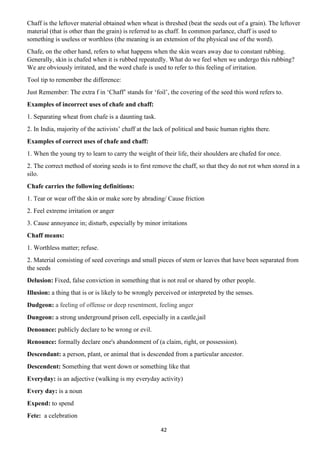
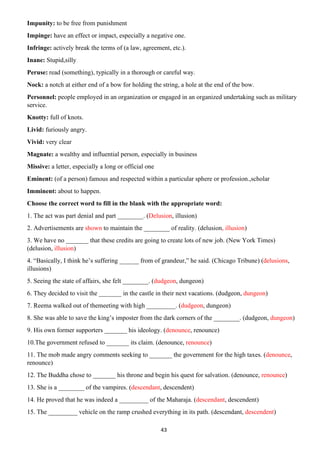
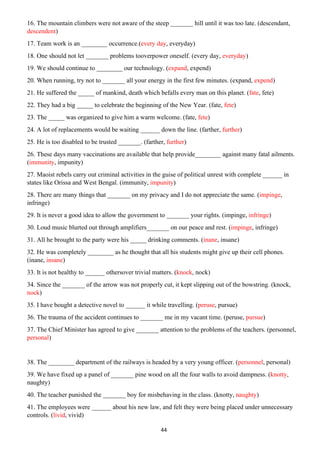
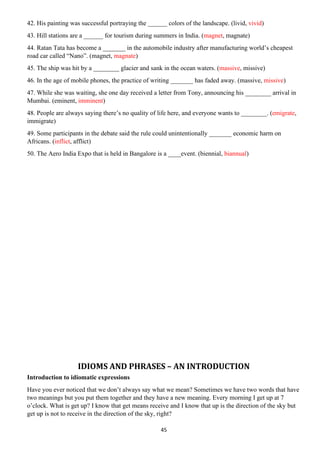
1
CAREER DEVELOPMENT CENTRE, SRMIST
15PD214 - APTITUDE-III (FOUNDATION)
EVEN SEMESTER (2018-2019)
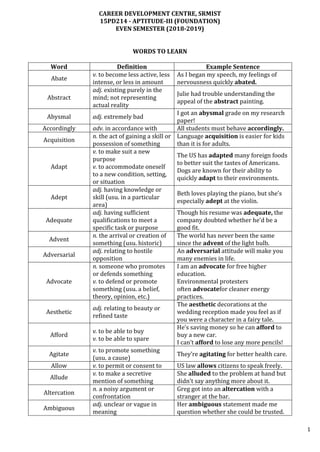
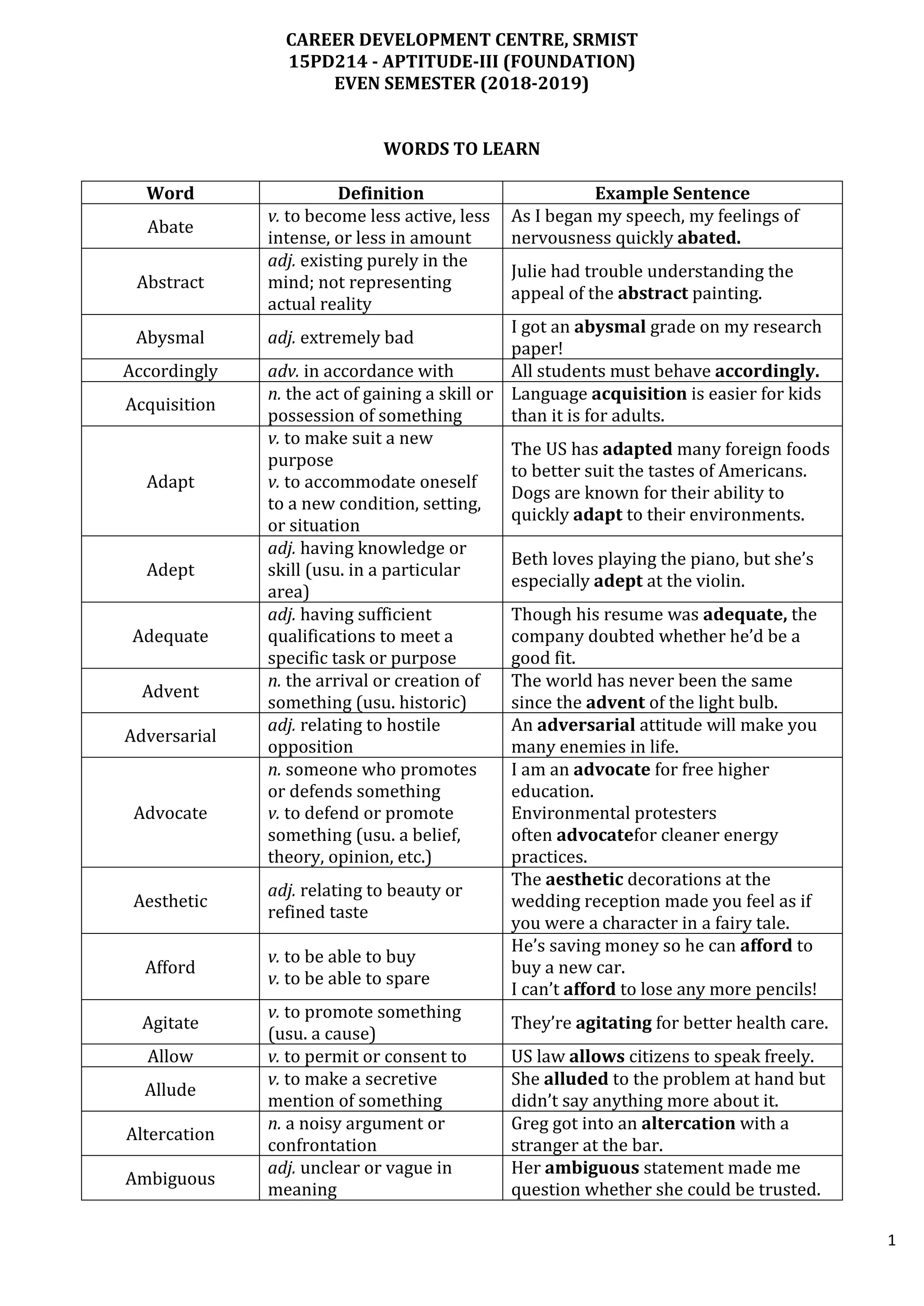
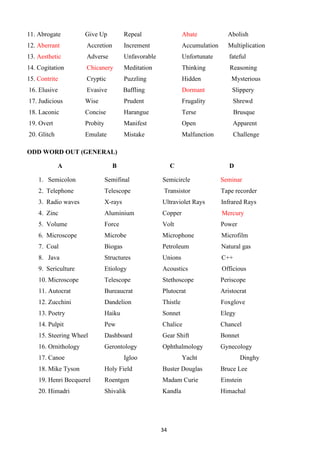
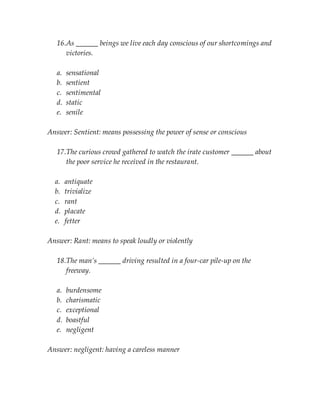
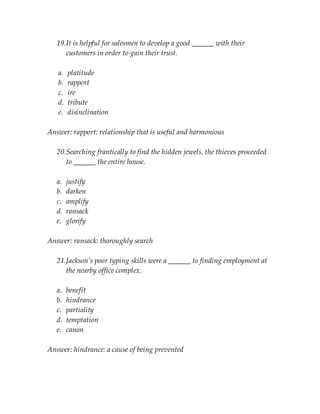
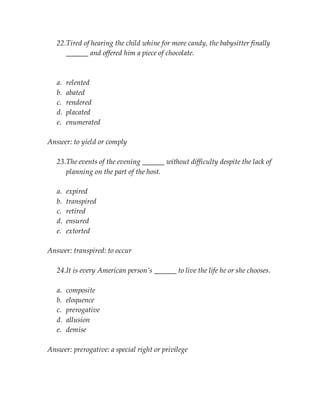
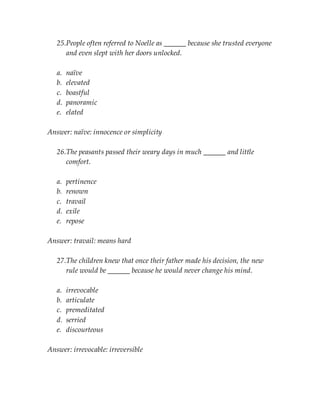
WORDS TO LEARN
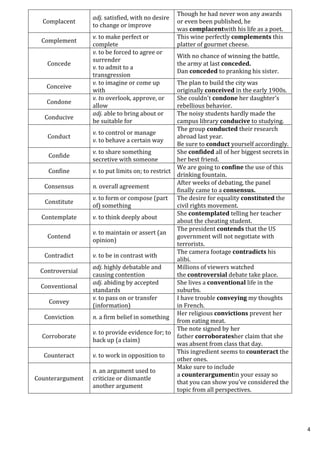
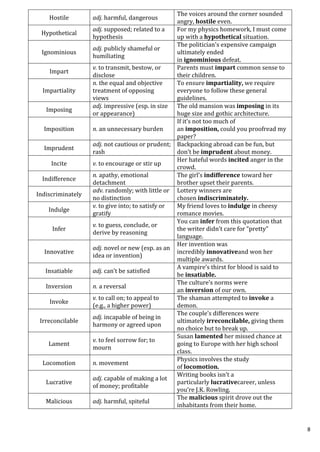
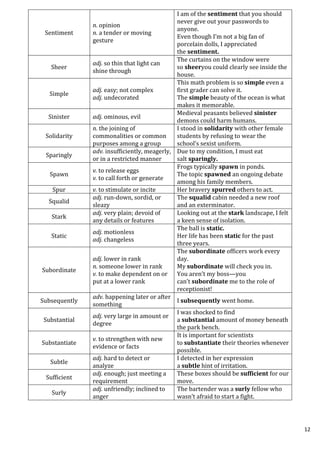
Word Definition Example Sentence
Abate
v. to become less active, less
intense, or less in amount
As I began my speech, my feelings of
nervousness quickly abated.
Abstract
adj. existing purely in the
mind; not representing
actual reality
Julie had trouble understanding the
appeal of the abstract painting.
Abysmal adj. extremely bad
I got an abysmal grade on my research
paper!
Accordingly adv. in accordance with All students must behave accordingly.
Acquisition
n. the act of gaining a skill or
possession of something
Language acquisition is easier for kids
than it is for adults.
Adapt
v. to make suit a new
purpose
v. to accommodate oneself
to a new condition, setting,
or situation
The US has adapted many foreign foods
to better suit the tastes of Americans.
Dogs are known for their ability to
quickly adapt to their environments.
Adept
adj. having knowledge or
skill (usu. in a particular
area)
Beth loves playing the piano, but she’s
especially adept at the violin.
Adequate
adj. having sufficient
qualifications to meet a
specific task or purpose
Though his resume was adequate, the
company doubted whether he’d be a
good fit.
Advent
n. the arrival or creation of
something (usu. historic)
The world has never been the same
since the advent of the light bulb.
Adversarial
adj. relating to hostile
opposition
An adversarial attitude will make you
many enemies in life.
Advocate
n. someone who promotes
or defends something
v. to defend or promote
something (usu. a belief,
theory, opinion, etc.)
I am an advocate for free higher
education.
Environmental protesters
often advocatefor cleaner energy
practices.
Aesthetic
adj. relating to beauty or
refined taste
The aesthetic decorations at the
wedding reception made you feel as if
you were a character in a fairy tale.
Afford
v. to be able to buy
v. to be able to spare
He’s saving money so he can afford to
buy a new car.
I can’t afford to lose any more pencils!
Agitate
v. to promote something
(usu. a cause)
They’re agitating for better health care.
Allow v. to permit or consent to US law allows citizens to speak freely.
Allude
v. to make a secretive
mention of something
She alluded to the problem at hand but
didn’t say anything more about it.
Altercation
n. a noisy argument or
confrontation
Greg got into an altercation with a
stranger at the bar.
Ambiguous
adj. unclear or vague in
meaning
Her ambiguous statement made me
question whether she could be trusted.
2
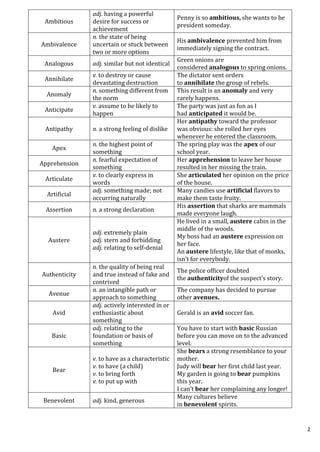
Ambitious
adj. having a powerful
desire for success or
achievement
Penny is so ambitious, she wants to be
president someday.
Ambivalence
n. the state of being
uncertain or stuck between
two or more options
His ambivalence prevented him from
immediately signing the contract.
Analogous adj. similar but not identical
Green onions are
considered analogous to spring onions.
Annihilate
v. to destroy or cause
devastating destruction
The dictator sent orders
to annihilate the group of rebels.
Anomaly
n. something different from
the norm
This result is an anomaly and very
rarely happens.
Anticipate
v. assume to be likely to
happen
The party was just as fun as I
had anticipated it would be.
Antipathy n. a strong feeling of dislike
Her antipathy toward the professor
was obvious: she rolled her eyes
whenever he entered the classroom.
Apex
n. the highest point of
something
The spring play was the apex of our
school year.
Apprehension
n. fearful expectation of
something
Her apprehension to leave her house
resulted in her missing the train.
Articulate
v. to clearly express in
words
She articulated her opinion on the price
of the house.
Artificial
adj. something made; not
occurring naturally
Many candies use artificial flavors to
make them taste fruity.
Assertion n. a strong declaration
His assertion that sharks are mammals
made everyone laugh.
Austere
adj. extremely plain
adj. stern and forbidding
adj. relating to self-denial
He lived in a small, austere cabin in the
middle of the woods.
My boss had an austere expression on
her face.
An austere lifestyle, like that of monks,
isn’t for everybody.
Authenticity
n. the quality of being real
and true instead of fake and
contrived
The police officer doubted
the authenticityof the suspect’s story.
Avenue
n. an intangible path or
approach to something
The company has decided to pursue
other avenues.
Avid
adj. actively interested in or
enthusiastic about
something
Gerald is an avid soccer fan.
Basic
adj. relating to the
foundation or basis of
something
You have to start with basic Russian
before you can move on to the advanced
level.
Bear
v. to have as a characteristic
v. to have (a child)
v. to bring forth
v. to put up with
She bears a strong resemblance to your
mother.
Judy will bear her first child last year.
My garden is going to bear pumpkins
this year.
I can’t bear her complaining any longer!
Benevolent adj. kind, generous
Many cultures believe
in benevolent spirits.
3
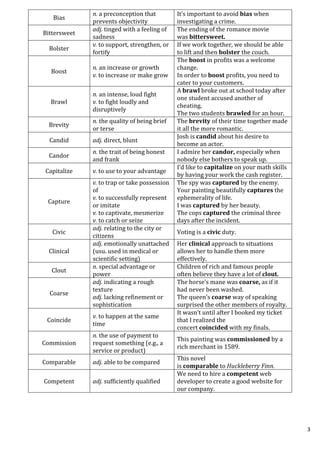
Bias
n. a preconception that
prevents objectivity
It’s important to avoid bias when
investigating a crime.
Bittersweet
adj. tinged with a feeling of
sadness
The ending of the romance movie
was bittersweet.
Bolster
v. to support, strengthen, or
fortify
If we work together, we should be able
to lift and then bolster the couch.
Boost
n. an increase or growth
v. to increase or make grow
The boost in profits was a welcome
change.
In order to boost profits, you need to
cater to your customers.
Brawl
n. an intense, loud fight
v. to fight loudly and
disruptively
A brawl broke out at school today after
one student accused another of
cheating.
The two students brawled for an hour.
Brevity
n. the quality of being brief
or terse
The brevity of their time together made
it all the more romantic.
Candid adj. direct, blunt
Josh is candid about his desire to
become an actor.
Candor
n. the trait of being honest
and frank
I admire her candor, especially when
nobody else bothers to speak up.
Capitalize v. to use to your advantage
I’d like to capitalize on your math skills
by having your work the cash register.
Capture
v. to trap or take possession
of
v. to successfully represent
or imitate
v. to captivate, mesmerize
v. to catch or seize
The spy was captured by the enemy.
Your painting beautifully captures the
ephemerality of life.
I was captured by her beauty.
The cops captured the criminal three
days after the incident.
Civic
adj. relating to the city or
citizens
Voting is a civic duty.
Clinical
adj. emotionally unattached
(usu. used in medical or
scientific setting)

Her clinical approach to situations
allows her to handle them more
effectively.
Clout
n. special advantage or
power
Children of rich and famous people
often believe they have a lot of clout.
Coarse
adj. indicating a rough
texture
adj. lacking refinement or
sophistication
The horse’s mane was coarse, as if it
had never been washed.
The queen’s coarse way of speaking
surprised the other members of royalty.
Coincide
v. to happen at the same
time
It wasn’t until after I booked my ticket
that I realized the
concert coincided with my finals.
Commission
n. the use of payment to
request something (e.g., a
service or product)
This painting was commissioned by a
rich merchant in 1589.
Comparable adj. able to be compared
This novel
is comparable to Huckleberry Finn.
Competent adj. sufficiently qualified
We need to hire a competent web
developer to create a good website for
our company.
4
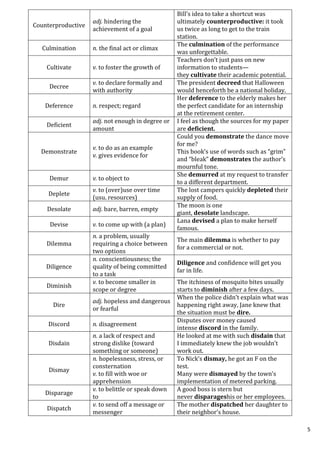
Complacent
adj. satisfied, with no desire
to change or improve
Though he had never won any awards
or even been published, he
was complacentwith his life as a poet.
Complement
v. to make perfect or
complete
This wine perfectly complements this
platter of gourmet cheese.
Concede
v. to be forced to agree or
surrender
v. to admit to a
transgression
With no chance of winning the battle,
the army at last conceded.
Dan conceded to pranking his sister.
Conceive
v. to imagine or come up
with
The plan to build the city was
originally conceived in the early 1900s.
Condone
v. to overlook, approve, or
allow
She couldn't condone her daughter's
rebellious behavior.
Conducive
adj. able to bring about or
be suitable for
The noisy students hardly made the
campus library conducive to studying.
Conduct
v. to control or manage
v. to behave a certain way
The group conducted their research
abroad last year.
Be sure to conduct yourself accordingly.
Confide
v. to share something
secretive with someone
She confided all of her biggest secrets in
her best friend.
Confine v. to put limits on; to restrict
We are going to confine the use of this
drinking fountain.
Consensus n. overall agreement
After weeks of debating, the panel
finally came to a consensus.
Constitute
v. to form or compose (part
of) something
The desire for equality constituted the
civil rights movement.
Contemplate v. to think deeply about
She contemplated telling her teacher
about the cheating student.
Contend
v. to maintain or assert (an
opinion)
The president contends that the US
government will not negotiate with
terrorists.
Contradict v. to be in contrast with
The camera footage contradicts his
alibi.
Controversial
adj. highly debatable and
causing contention
Millions of viewers watched
the controversial debate take place.
Conventional
adj. abiding by accepted
standards
She lives a conventional life in the
suburbs.
Convey
v. to pass on or transfer
(information)
I have trouble conveying my thoughts
in French.
Conviction n. a firm belief in something
Her religious convictions prevent her
from eating meat.
Corroborate
v. to provide evidence for; to
back up (a claim)
The note signed by her
father corroboratesher claim that she
was absent from class that day.
Counteract v. to work in opposition to
This ingredient seems to counteract the
other ones.
Counterargument
n. an argument used to
criticize or dismantle
another argument
Make sure to include
a counterargumentin your essay so
that you can show you’ve considered the
topic from all perspectives.
5
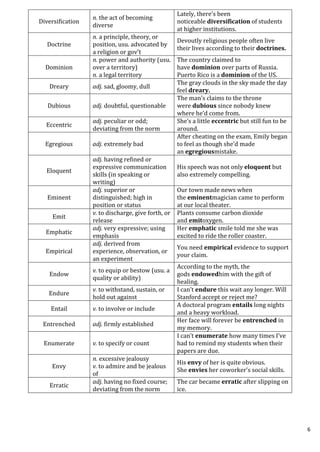
Counterproductive
adj. hindering the
achievement of a goal
Bill’s idea to take a shortcut was
ultimately counterproductive: it took
us twice as long to get to the train
station.
Culmination n. the final act or climax
The culmination of the performance
was unforgettable.
Cultivate v. to foster the growth of
Teachers don’t just pass on new
information to students—
they cultivate their academic potential.
Decree
v. to declare formally and
with authority
The president decreed that Halloween
would henceforth be a national holiday.
Deference n. respect; regard
Her deference to the elderly makes her
the perfect candidate for an internship
at the retirement center.
Deficient
adj. not enough in degree or
amount
I feel as though the sources for my paper
are deficient.
Demonstrate
v. to do as an example
v. gives evidence for
Could you demonstrate the dance move
for me?
This book’s use of words such as “grim”
and “bleak” demonstrates the author’s
mournful tone.
Demur v. to object to
She demurred at my request to transfer
to a different department.
Deplete
v. to (over)use over time
(usu. resources)
The lost campers quickly depleted their
supply of food.
Desolate adj. bare, barren, empty
The moon is one
giant, desolate landscape.
Devise v. to come up with (a plan)
Lana devised a plan to make herself
famous.
Dilemma
n. a problem, usually
requiring a choice between
two options
The main dilemma is whether to pay
for a commercial or not.
Diligence
n. conscientiousness; the
quality of being committed
to a task
Diligence and confidence will get you
far in life.
Diminish
v. to become smaller in
scope or degree
The itchiness of mosquito bites usually
starts to diminish after a few days.
Dire
adj. hopeless and dangerous
or fearful
When the police didn’t explain what was
happening right away, Jane knew that
the situation must be dire.
Discord n. disagreement
Disputes over money caused
intense discord in the family.
Disdain
n. a lack of respect and
strong dislike (toward
something or someone)
He looked at me with such disdain that
I immediately knew the job wouldn’t
work out.
Dismay
n. hopelessness, stress, or
consternation
v. to fill with woe or
apprehension
To Nick’s dismay, he got an F on the
test.
Many were dismayed by the town’s
implementation of metered parking.
Disparage
v. to belittle or speak down
to
A good boss is stern but
never disparageshis or her employees.
Dispatch
v. to send off a message or
messenger
The mother dispatched her daughter to
their neighbor’s house.
6
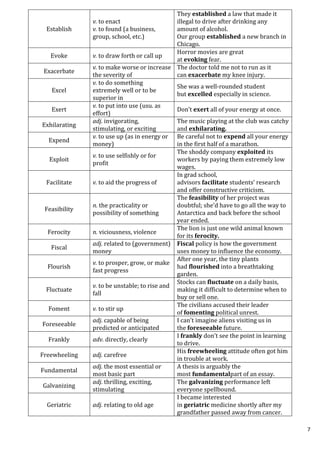
Diversification
n. the act of becoming
diverse
Lately, there’s been
noticeable diversification of students
at higher institutions.
Doctrine
n. a principle, theory, or
position, usu. advocated by
a religion or gov’t
Devoutly religious people often live
their lives according to their doctrines.
Dominion
n. power and authority (usu.
over a territory)
n. a legal territory
The country claimed to
have dominion over parts of Russia.
Puerto Rico is a dominion of the US.
Dreary adj. sad, gloomy, dull
The gray clouds in the sky made the day
feel dreary.
Dubious adj. doubtful, questionable
The man’s claims to the throne
were dubious since nobody knew
where he’d come from.
Eccentric
adj. peculiar or odd;
deviating from the norm
She’s a little eccentric but still fun to be
around.
Egregious adj. extremely bad
After cheating on the exam, Emily began
to feel as though she’d made
an egregiousmistake.
Eloquent
adj. having refined or
expressive communication
skills (in speaking or
writing)
His speech was not only eloquent but
also extremely compelling.
Eminent
adj. superior or
distinguished; high in
position or status
Our town made news when
the eminentmagician came to perform
at our local theater.
Emit
v. to discharge, give forth, or
release
Plants consume carbon dioxide
and emitoxygen.
Emphatic
adj. very expressive; using
emphasis
Her emphatic smile told me she was
excited to ride the roller coaster.
Empirical
adj. derived from
experience, observation, or
an experiment
You need empirical evidence to support
your claim.
Endow
v. to equip or bestow (usu. a
quality or ability)
According to the myth, the
gods endowedhim with the gift of
healing.
Endure
v. to withstand, sustain, or
hold out against
I can’t endure this wait any longer. Will
Stanford accept or reject me?
Entail v. to involve or include
A doctoral program entails long nights
and a heavy workload.
Entrenched adj. firmly established
Her face will forever be entrenched in
my memory.
Enumerate v. to specify or count
I can’t enumerate how many times I’ve
had to remind my students when their
papers are due.
Envy
n. excessive jealousy
v. to admire and be jealous
of
His envy of her is quite obvious.
She envies her coworker's social skills.
Erratic
adj. having no fixed course;
deviating from the norm
The car became erratic after slipping on
ice.
7
Establish
v. to enact
v. to found (a business,
group, school, etc.)
They established a law that made it
illegal to drive after drinking any
amount of alcohol.
Our group established a new branch in
Chicago.
Evoke v. to draw forth or call up
Horror movies are great
at evoking fear.
Exacerbate
v. to make worse or increase
the severity of
The doctor told me not to run as it
can exacerbate my knee injury.
Excel
v. to do something
extremely well or to be
superior in
She was a well-rounded student
but excelled especially in science.
Exert
v. to put into use (usu. as
effort)
Don’t exert all of your energy at once.
Exhilarating
adj. invigorating,
stimulating, or exciting
The music playing at the club was catchy
and exhilarating.
Expend
v. to use up (as in energy or
money)
Be careful not to expend all your energy
in the first half of a marathon.
Exploit
v. to use selfishly or for
profit
The shoddy company exploited its
workers by paying them extremely low
wages.
Facilitate v. to aid the progress of
In grad school,
advisors facilitate students’ research
and offer constructive criticism.
Feasibility
n. the practicality or
possibility of something
The feasibility of her project was
doubtful; she’d have to go all the way to
Antarctica and back before the school
year ended.
Ferocity n. viciousness, violence
The lion is just one wild animal known
for its ferocity.
Fiscal
adj. related to (government)
money
Fiscal policy is how the government
uses money to influence the economy.
Flourish
v. to prosper, grow, or make
fast progress
After one year, the tiny plants
had flourished into a breathtaking
garden.
Fluctuate
v. to be unstable; to rise and
fall
Stocks can fluctuate on a daily basis,
making it difficult to determine when to
buy or sell one.
Foment v. to stir up
The civilians accused their leader
of fomenting political unrest.
Foreseeable
adj. capable of being
predicted or anticipated
I can't imagine aliens visiting us in
the foreseeable future.
Frankly adv. directly, clearly
I frankly don’t see the point in learning
to drive.
Freewheeling adj. carefree
His freewheeling attitude often got him
in trouble at work.
Fundamental
adj. the most essential or
most basic part
A thesis is arguably the
most fundamentalpart of an essay.
Galvanizing
adj. thrilling, exciting,
stimulating
The galvanizing performance left
everyone spellbound.
Geriatric adj. relating to old age
I became interested
in geriatric medicine shortly after my
grandfather passed away from cancer.
8
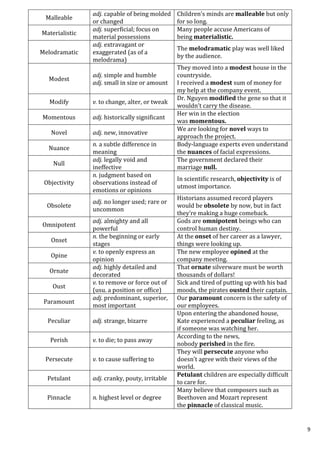
Hostile adj. harmful, dangerous
The voices around the corner sounded
angry, hostile even.
Hypothetical
adj. supposed; related to a
hypothesis
For my physics homework, I must come
up with a hypothetical situation.
Ignominious
adj. publicly shameful or
humiliating
The politician's expensive campaign
ultimately ended
in ignominious defeat.
Impart
v. to transmit, bestow, or
disclose
Parents must impart common sense to
their children.
Impartiality
n. the equal and objective
treatment of opposing
views
To ensure impartiality, we require
everyone to follow these general
guidelines.
Imposing
adj. impressive (esp. in size
or appearance)
The old mansion was imposing in its
huge size and gothic architecture.
Imposition n. an unnecessary burden
If it’s not too much of
an imposition, could you proofread my
paper?
Imprudent
adj. not cautious or prudent;
rash
Backpacking abroad can be fun, but
don’t be imprudent about money.
Incite v. to encourage or stir up
Her hateful words incited anger in the
crowd.
Indifference
n. apathy, emotional
detachment
The girl’s indifference toward her
brother upset their parents.
Indiscriminately
adv. randomly; with little or
no distinction
Lottery winners are
chosen indiscriminately.
Indulge
v. to give into; to satisfy or
gratify
My friend loves to indulge in cheesy
romance movies.
Infer
v. to guess, conclude, or
derive by reasoning
You can infer from this quotation that
the writer didn’t care for “pretty”
language.
Innovative
adj. novel or new (esp. as an
idea or invention)
Her invention was
incredibly innovativeand won her
multiple awards.
Insatiable adj. can’t be satisfied
A vampire’s thirst for blood is said to
be insatiable.
Inversion n. a reversal
The culture’s norms were
an inversion of our own.
Invoke
v. to call on; to appeal to
(e.g., a higher power)
The shaman attempted to invoke a
demon.
Irreconcilable
adj. incapable of being in
harmony or agreed upon
The couple’s differences were
ultimately irreconcilable, giving them
no choice but to break up.
Lament
v. to feel sorrow for; to
mourn
Susan lamented her missed chance at
going to Europe with her high school
class.
Locomotion n. movement
Physics involves the study
of locomotion.
Lucrative
adj. capable of making a lot
of money; profitable
Writing books isn’t a
particularly lucrativecareer, unless
you’re J.K. Rowling.
Malicious adj. harmful, spiteful
The malicious spirit drove out the
inhabitants from their home.
9
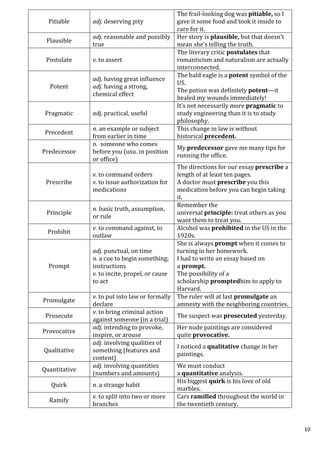
Malleable
adj. capable of being molded
or changed
Children’s minds are malleable but only
for so long.
Materialistic
adj. superficial; focus on
material possessions
Many people accuse Americans of
being materialistic.
Melodramatic
adj. extravagant or
exaggerated (as of a
melodrama)
The melodramatic play was well liked
by the audience.
Modest
adj. simple and humble
adj. small in size or amount
They moved into a modest house in the
countryside.
I received a modest sum of money for
my help at the company event.
Modify v. to change, alter, or tweak
Dr. Nguyen modified the gene so that it
wouldn’t carry the disease.
Momentous adj. historically significant
Her win in the election
was momentous.
Novel adj. new, innovative
We are looking for novel ways to
approach the project.
Nuance
n. a subtle difference in
meaning
Body-language experts even understand
the nuances of facial expressions.
Null
adj. legally void and
ineffective
The government declared their
marriage null.
Objectivity
n. judgment based on
observations instead of
emotions or opinions
In scientific research, objectivity is of
utmost importance.
Obsolete
adj. no longer used; rare or
uncommon
Historians assumed record players
would be obsolete by now, but in fact
they’re making a huge comeback.
Omnipotent
adj. almighty and all
powerful
Gods are omnipotent beings who can
control human destiny.
Onset
n. the beginning or early
stages
At the onset of her career as a lawyer,
things were looking up.
Opine
v. to openly express an
opinion
The new employee opined at the
company meeting.
Ornate
adj. highly detailed and
decorated
That ornate silverware must be worth
thousands of dollars!
Oust
v. to remove or force out of
(usu. a position or office)
Sick and tired of putting up with his bad
moods, the pirates ousted their captain.
Paramount
adj. predominant, superior,
most important
Our paramount concern is the safety of
our employees.
Peculiar adj. strange, bizarre
Upon entering the abandoned house,
Kate experienced a peculiar feeling, as
if someone was watching her.
Perish v. to die; to pass away
According to the news,
nobody perished in the fire.
Persecute v. to cause suffering to
They will persecute anyone who
doesn’t agree with their views of the
world.
Petulant adj. cranky, pouty, irritable
Petulant children are especially difficult
to care for.
Pinnacle n. highest level or degree
Many believe that composers such as
Beethoven and Mozart represent
the pinnacle of classical music.
10
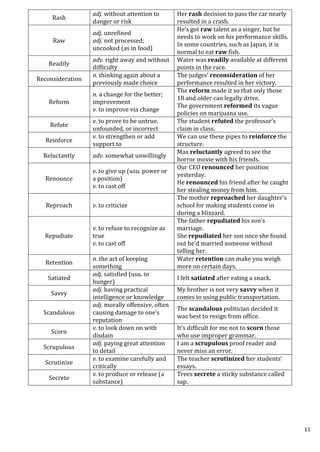
Pitiable adj. deserving pity
The frail-looking dog was pitiable, so I
gave it some food and took it inside to
care for it.
Plausible
adj. reasonable and possibly
true
Her story is plausible, but that doesn’t
mean she’s telling the truth.
Postulate v. to assert
The literary critic postulates that
romanticism and naturalism are actually
interconnected.
Potent
adj. having great influence
adj. having a strong,
chemical effect
The bald eagle is a potent symbol of the
US.
The potion was definitely potent—it
healed my wounds immediately!
Pragmatic adj. practical, useful
It’s not necessarily more pragmatic to
study engineering than it is to study
philosophy.
Precedent
n. an example or subject
from earlier in time
This change in law is without
historical precedent.
Predecessor
n. someone who comes
before you (usu. in position
or office)
My predecessor gave me many tips for
running the office.
Prescribe
v. to command orders
v. to issue authorization for
medications
The directions for our essay prescribe a
length of at least ten pages.
A doctor must prescribe you this
medication before you can begin taking
it.
Principle
n. basic truth, assumption,
or rule
Remember the
universal principle: treat others as you
want them to treat you.
Prohibit
v. to command against, to
outlaw
Alcohol was prohibited in the US in the
1920s.
Prompt
adj. punctual, on time
n. a cue to begin something;
instructions
v. to incite, propel, or cause
to act
She is always prompt when it comes to
turning in her homework.
I had to write an essay based on
a prompt.
The possibility of a
scholarship promptedhim to apply to
Harvard.
Promulgate
v. to put into law or formally
declare
The ruler will at last promulgate an
amnesty with the neighboring countries.
Prosecute
v. to bring criminal action
against someone (in a trial)
The suspect was prosecuted yesterday.
Provocative
adj. intending to provoke,
inspire, or arouse
Her nude paintings are considered
quite provocative.
Qualitative
adj. involving qualities of
something (features and
content)
I noticed a qualitative change in her
paintings.
Quantitative
adj. involving quantities
(numbers and amounts)
We must conduct
a quantitative analysis.
Quirk n. a strange habit
His biggest quirk is his love of old
marbles.
Ramify
v. to split into two or more
branches
Cars ramified throughout the world in
the twentieth century.
11
Rash
adj. without attention to
danger or risk
Her rash decision to pass the car nearly
resulted in a crash.
Raw
adj. unrefined
adj. not processed;
uncooked (as in food)
He’s got raw talent as a singer, but he
needs to work on his performance skills.
In some countries, such as Japan, it is
normal to eat raw fish.
Readily
adv. right away and without
difficulty
Water was readily available at different
points in the race.
Reconsideration
n. thinking again about a
previously made choice
The judges’ reconsideration of her
performance resulted in her victory.
Reform
n. a change for the better;
improvement
v. to improve via change
The reform made it so that only those
18 and older can legally drive.
The government reformed its vague
policies on marijuana use.
Refute
v. to prove to be untrue,
unfounded, or incorrect
The student refuted the professor’s
claim in class.
Reinforce
v. to strengthen or add
support to
We can use these pipes to reinforce the
structure.
Reluctantly adv. somewhat unwillingly
Max reluctantly agreed to see the
horror movie with his friends.
Renounce
v. to give up (usu. power or
a position)
v. to cast off
Our CEO renounced her position
yesterday.
He renounced his friend after he caught
her stealing money from him.
Reproach v. to criticize
The mother reproached her daughter’s
school for making students come in
during a blizzard.
Repudiate
v. to refuse to recognize as
true
v. to cast off
The father repudiated his son’s
marriage.
She repudiated her son once she found
out he’d married someone without
telling her.
Retention
n. the act of keeping
something
Water retention can make you weigh
more on certain days.
Satiated
adj. satisfied (usu. in
hunger)
I felt satiated after eating a snack.
Savvy
adj. having practical
intelligence or knowledge
My brother is not very savvy when it
comes to using public transportation.
Scandalous
adj. morally offensive, often
causing damage to one’s
reputation
The scandalous politician decided it
was best to resign from office.
Scorn
v. to look down on with
disdain
It’s difficult for me not to scorn those
who use improper grammar.
Scrupulous
adj. paying great attention
to detail
I am a scrupulous proof reader and
never miss an error.
Scrutinize
v. to examine carefully and
critically
The teacher scrutinized her students’
essays.
Secrete
v. to produce or release (a
substance)
Trees secrete a sticky substance called
sap.
12
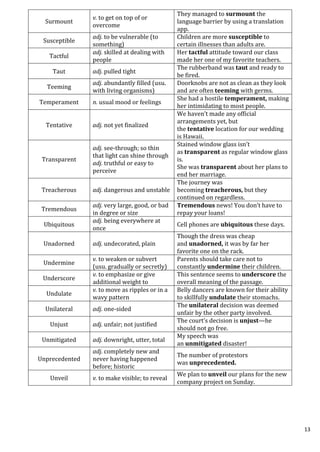
Sentiment
n. opinion
n. a tender or moving
gesture
I am of the sentiment that you should
never give out your passwords to
anyone.
Even though I’m not a big fan of
porcelain dolls, I appreciated
the sentiment.
Sheer
adj. so thin that light can
shine through
The curtains on the window were
so sheeryou could clearly see inside the
house.
Simple
adj. easy; not complex
adj. undecorated
This math problem is so simple even a
first grader can solve it.
The simple beauty of the ocean is what
makes it memorable.
Sinister adj. ominous, evil
Medieval peasants believed sinister
demons could harm humans.
Solidarity
n. the joining of
commonalities or common
purposes among a group
I stood in solidarity with other female
students by refusing to wear the
school’s sexist uniform.
Sparingly
adv. insufficiently, meagerly,
or in a restricted manner
Due to my condition, I must eat
salt sparingly.
Spawn
v. to release eggs
v. to call forth or generate
Frogs typically spawn in ponds.
The topic spawned an ongoing debate
among his family members.
Spur v. to stimulate or incite Her bravery spurred others to act.
Squalid
adj. run-down, sordid, or
sleazy
The squalid cabin needed a new roof
and an exterminator.
Stark
adj. very plain; devoid of
any details or features
Looking out at the stark landscape, I felt
a keen sense of isolation.
Static
adj. motionless
adj. changeless
The ball is static.
Her life has been static for the past
three years.
Subordinate
adj. lower in rank
n. someone lower in rank
v. to make dependent on or
put at a lower rank
The subordinate officers work every
day.
My subordinate will check you in.
You aren’t my boss—you
can’t subordinate me to the role of
receptionist!
Subsequently
adv. happening later or after
something
I subsequently went home.
Substantial
adj. very large in amount or
degree
I was shocked to find
a substantial amount of money beneath
the park bench.
Substantiate
v. to strengthen with new
evidence or facts
It is important for scientists
to substantiate their theories whenever
possible.
Subtle
adj. hard to detect or
analyze
I detected in her expression
a subtle hint of irritation.
Sufficient
adj. enough; just meeting a
requirement
These boxes should be sufficient for our
move.
Surly
adj. unfriendly; inclined to
anger
The bartender was a surly fellow who
wasn’t afraid to start a fight.
13
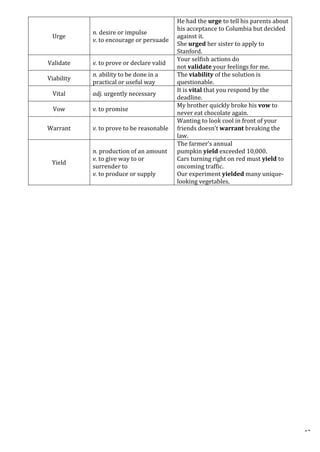
Surmount
v. to get on top of or
overcome
They managed to surmount the
language barrier by using a translation
app.
Susceptible
adj. to be vulnerable (to
something)
Children are more susceptible to
certain illnesses than adults are.
Tactful
adj. skilled at dealing with
people
Her tactful attitude toward our class
made her one of my favorite teachers.
Taut adj. pulled tight
The rubberband was taut and ready to
be fired.
Teeming
adj. abundantly filled (usu.
with living organisms)
Doorknobs are not as clean as they look
and are often teeming with germs.
Temperament n. usual mood or feelings
She had a hostile temperament, making
her intimidating to most people.
Tentative adj. not yet finalized
We haven’t made any official
arrangements yet, but
the tentative location for our wedding
is Hawaii.
Transparent
adj. see-through; so thin
that light can shine through
adj. truthful or easy to
perceive
Stained window glass isn’t
as transparent as regular window glass
is.
She was transparent about her plans to
end her marriage.
Treacherous adj. dangerous and unstable
The journey was
becoming treacherous, but they
continued on regardless.
Tremendous
adj. very large, good, or bad
in degree or size
Tremendous news! You don’t have to
repay your loans!
Ubiquitous
adj. being everywhere at
once
Cell phones are ubiquitous these days.
Unadorned adj. undecorated, plain
Though the dress was cheap
and unadorned, it was by far her
favorite one on the rack.
Undermine
v. to weaken or subvert
(usu. gradually or secretly)
Parents should take care not to
constantly undermine their children.
Underscore
v. to emphasize or give
additional weight to
This sentence seems to underscore the
overall meaning of the passage.
Undulate
v. to move as ripples or in a
wavy pattern
Belly dancers are known for their ability
to skillfully undulate their stomachs.
Unilateral adj. one-sided
The unilateral decision was deemed
unfair by the other party involved.
Unjust adj. unfair; not justified
The court’s decision is unjust—he
should not go free.
Unmitigated adj. downright, utter, total
My speech was
an unmitigated disaster!
Unprecedented
adj. completely new and
never having happened
before; historic
The number of protestors
was unprecedented.
Unveil v. to make visible; to reveal
We plan to unveil our plans for the new
company project on Sunday.
14
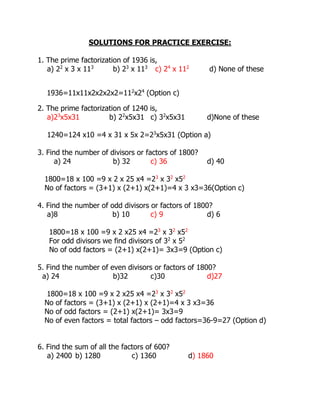
Urge
n. desire or impulse
v. to encourage or persuade
He had the urge to tell his parents about
his acceptance to Columbia but decided
against it.
She urged her sister to apply to
Stanford.
Validate v. to prove or declare valid
Your selfish actions do
not validate your feelings for me.
Viability
n. ability to be done in a
practical or useful way
The viability of the solution is
questionable.
Vital adj. urgently necessary
It is vital that you respond by the
deadline.
Vow v. to promise
My brother quickly broke his vow to
never eat chocolate again.
Warrant v. to prove to be reasonable
Wanting to look cool in front of your
friends doesn’t warrant breaking the
law.
Yield
n. production of an amount
v. to give way to or
surrender to
v. to produce or supply
The farmer’s annual
pumpkin yield exceeded 10,000.
Cars turning right on red must yield to
oncoming traffic.
Our experiment yielded many unique-
looking vegetables.
SOLUTIONS FOR PRACTICE EXERCISE:
1. The prime factorization of 1936 is,
a) 22
x 3 x 113
b) 23
x 113
c) 24
x 112
d) None of these
1936=11x11x2x2x2x2=112
x24
(Option c)
2. The prime factorization of 1240 is,
a)23
x5x31 b) 22
x5x31 c) 32
x5x31 d)None of these
1240=124 x10 =4 x 31 x 5x 2=23
x5x31 (Option a)
3. Find the number of divisors or factors of 1800?
a) 24 b) 32 c) 36 d) 40
1800=18 x 100 =9 x 2 x 25 x4 =23
x 32
x52
No of factors = (3+1) x (2+1) x(2+1)=4 x 3 x3=36(Option c)
4. Find the number of odd divisors or factors of 1800?
a)8 b) 10 c) 9 d) 6
1800=18 x 100 =9 x 2 x25 x4 =23
x 32
x52
For odd divisors we find divisors of 32
x 52
No of odd factors = (2+1) x(2+1)= 3x3=9 (Option c)
5. Find the number of even divisors or factors of 1800?
a) 24 b)32 c)30 d)27
1800=18 x 100 =9 x 2 x25 x4 =23
x 32
x52
No of factors = (3+1) x (2+1) x (2+1)=4 x 3 x3=36
No of odd factors = (2+1) x(2+1)= 3x3=9
No of even factors = total factors – odd factors=36-9=27 (Option d)
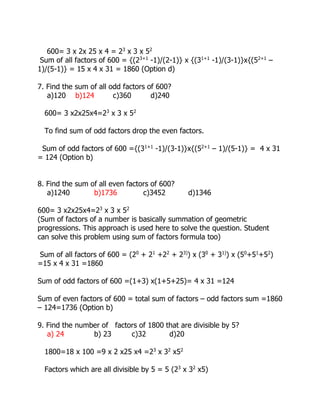
6. Find the sum of all the factors of 600?
a) 2400 b) 1280 c) 1360 d) 1860
600= 3 x 2x 25 x 4 = 23
x 3 x 52
Sum of all factors of 600 = {(23+1
-1)/(2-1)} x {(31+1
-1)/(3-1)}x{(52+1
–
1)/(5-1)} = 15 x 4 x 31 = 1860 (Option d)
7. Find the sum of all odd factors of 600?
a)120 b)124 c)360 d)240
600= 3 x2x25x4=23
x 3 x 52
To find sum of odd factors drop the even factors.
Sum of odd factors of 600 ={(31+1
-1)/(3-1)}x{(52+1
– 1)/(5-1)} = 4 x 31
= 124 (Option b)
8. Find the sum of all even factors of 600?
a)1240 b)1736 c)3452 d)1346
600= 3 x2x25x4=23
x 3 x 52
(Sum of factors of a number is basically summation of geometric
progressions. This approach is used here to solve the question. Student
can solve this problem using sum of factors formula too)
Sum of all factors of 600 = (20
+ 21
+22
+ 23)
) x (30
+ 31)
) x (50
+51
+52
)
=15 x 4 x 31 =1860
Sum of odd factors of 600 =(1+3) x(1+5+25)= 4 x 31 =124
Sum of even factors of 600 = total sum of factors – odd factors sum =1860
– 124=1736 (Option b)
9. Find the number of factors of 1800 that are divisible by 5?
a) 24 b) 23 c)32 d)20
1800=18 x 100 =9 x 2 x25 x4 =23
x 32
x52
Factors which are all divisible by 5 = 5 (23
x 32
x5)
Factors which are all divided by 5 = (3+1) x (2+1) x (1+1) =4x3x2=24
(Option a)
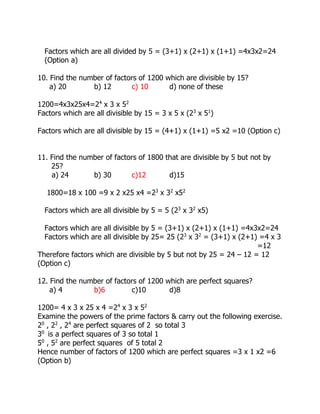
10. Find the number of factors of 1200 which are divisible by 15?
a) 20 b) 12 c) 10 d) none of these
1200=4x3x25x4=24
x 3 x 52
Factors which are all divisible by 15 = 3 x 5 x (23
x 51
)
Factors which are all divisible by 15 = (4+1) x (1+1) =5 x2 =10 (Option c)
11. Find the number of factors of 1800 that are divisible by 5 but not by
25?
a) 24 b) 30 c)12 d)15
1800=18 x 100 =9 x 2 x25 x4 =23
x 32
x52
Factors which are all divisible by 5 = 5 (23
x 32
x5)
Factors which are all divisible by 5 = (3+1) x (2+1) x (1+1) =4x3x2=24
Factors which are all divisible by 25= 25 (23
x 32
= (3+1) x (2+1) =4 x 3
=12
Therefore factors which are divisible by 5 but not by 25 = 24 – 12 = 12
(Option c)
12. Find the number of factors of 1200 which are perfect squares?
a) 4 b)6 c)10 d)8
1200= 4 x 3 x 25 x 4 =24
x 3 x 52
Examine the powers of the prime factors & carry out the following exercise.
20
, 22
, 24
are perfect squares of 2 so total 3
30
is a perfect squares of 3 so total 1
50
, 52
are perfect squares of 5 total 2
Hence number of factors of 1200 which are perfect squares =3 x 1 x2 =6
(Option b)
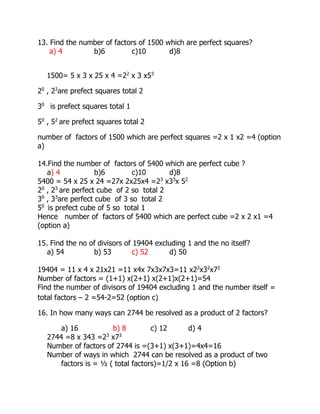
13. Find the number of factors of 1500 which are perfect squares?
a) 4 b)6 c)10 d)8
1500= 5 x 3 x 25 x 4 =22
x 3 x53
20
, 22
are prefect squares total 2
30
is prefect squares total 1
50
, 52
are prefect squares total 2
number of factors of 1500 which are perfect squares =2 x 1 x2 =4 (option
a)
14.Find the number of factors of 5400 which are perfect cube ?
a) 4 b)6 c)10 d)8
5400 = 54 x 25 x 24 =27x 2x25x4 =23
x33
x 52
20
, 23
are perfect cube of 2 so total 2
30
, 33
are perfect cube of 3 so total 2
50
is prefect cube of 5 so total 1
Hence number of factors of 5400 which are perfect cube =2 x 2 x1 =4
(option a)
15. Find the no of divisors of 19404 excluding 1 and the no itself?
a) 54 b) 53 c) 52 d) 50
19404 = 11 x 4 x 21x21 =11 x4x 7x3x7x3=11 x22
x32
x72
Number of factors = (1+1) x(2+1) x(2+1)x(2+1)=54
Find the number of divisors of 19404 excluding 1 and the number itself =
total factors – 2 =54-2=52 (option c)
16. In how many ways can 2744 be resolved as a product of 2 factors?
a) 16 b) 8 c) 12 d) 4
2744 =8 x 343 =23
x73
Number of factors of 2744 is =(3+1) x(3+1)=4x4=16
Number of ways in which 2744 can be resolved as a product of two
factors is = ½ ( total factors)=1/2 x 16 =8 (Option b)
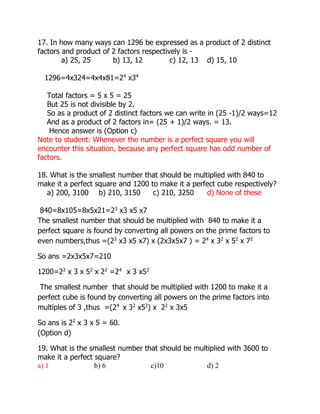
17. In how many ways can 1296 be expressed as a product of 2 distinct
factors and product of 2 factors respectively is -
a) 25, 25 b) 13, 12 c) 12, 13 d) 15, 10
1296=4x324=4x4x81=24
x34
Total factors = 5 x 5 = 25
But 25 is not divisible by 2.
So as a product of 2 distinct factors we can write in (25 -1)/2 ways=12
And as a product of 2 factors in= (25 + 1)/2 ways. = 13.
Hence answer is (Option c)
Note to student: Whenever the number is a perfect square you will
encounter this situation, because any perfect square has odd number of
factors.
18. What is the smallest number that should be multiplied with 840 to
make it a perfect square and 1200 to make it a perfect cube respectively?
a) 200, 3100 b) 210, 3150 c) 210, 3250 d) None of these
840=8x105=8x5x21=23
x3 x5 x7
The smallest number that should be multiplied with 840 to make it a
perfect square is found by converting all powers on the prime factors to
even numbers,thus =(23
x3 x5 x7) x (2x3x5x7 ) = 24
x 32
x 52
x 72
So ans =2x3x5x7=210
1200=22
x 3 x 52
x 22
=24
x 3 x52
The smallest number that should be multiplied with 1200 to make it a
perfect cube is found by converting all powers on the prime factors into
multiples of 3 ,thus =(24
x 32
x52
) x 22
x 3x5
So ans is 22
x 3 x 5 = 60.
(Option d)
19. What is the smallest number that should be multiplied with 3600 to
make it a perfect square?
a) 1 b) 6 c)10 d) 2
3600=9x4x25x4=24
x32
x52
To make it a perfect square = (24
x32
x52
) x 1 we have to multiply it with 1
,because the powers of prime factors are already even. Also note that 3600
is already a perfect square.
(Option a)
20. What is the smallest number that should be multiplied with 3600 to
make it a perfect square and perfect cube?
a) 60 b) 6 c) 10 d) 8
To make prefect cube = (24
x32
x52
) 22
x 3 x 5.
We have to multiply it with 60 to make cube (Option a)
21. Express 0.81818181…….= 0.81(bold faced to denote
repetition,read as 0.81 bar) in form of a fraction?
a) 9/11 b)6/11 c)10/11 d)8/11
0.81818181……. = 81/99 = 9/11
(Two digits repeat after decimal point so put two 9’s in denominator.
Remove decimal point and bar you are left with the number 81 which is
numerator.
(Simplify in cases where it is possible & then report the answer)
(Option a)
22. Express 0.27777777……=0.27 (read as 0.27 with bar on 7) in form of a
fraction?
a) 5/18 b)6/17 c) 7/18 d)8/18
0.27777777… = (27 – 2)/(90) = 25/90 = 5/18
[(Numerator: Remove decimal & bar you end up with 27.From this
subtract the non repeating digit which is 2 . )
[Denominator: One digit repeats after decimal so put one 9 in
denominator. One digit doesn’t repeat after the decimal point hence put
one 0 in the denominator correspondingly] (Option a)
23. Express 0.279797979…….= 0.279 in form of a fraction?
a) 277/990 b) 377/990 c) 277/999 d) 377/999
0.279797979……. = (279 – 2)/(990) = 277/990 (Option a)
24. Express 1. 116161616……. in form of a fraction?
a) 223/198 b) 367/330 c) 62/55 d) 221/198
1. 116161616……= 1.116 = 1 +[ (116 – 1)/(990)] = (990 +115)/(990)
= 223/990 (Option a)
25. Which of the following is a prime number?
a) 429 b) 307 c) 428 d) 851
a) 429, sum of the digits = 15, divisible by 3
b) 307, approximate square root of 307 is 18.
List out all primes below 18, i.e 2, 3, 5, 7, 11, 13 and 17
We observe that 307 is not divisible by any one of these primes.
So it is a prime number (if it is divisible by any one of these primes
then it is not a prime)
c) Divisible by 4
d) Divisible by 23. Using the same method as described in option b.
(Option b)
26. Which of the following is not a prime?
a) 113 b) 161 c) 223 d) 181
a) 113 is not divisible by 2,3,5,7 and 11. So it is a prime.
b) 161 is divisible by 7
c) 223 is not divisible by 2,3,5,7,11,13.So it is prime
d) 181 is not divisible by 2,3,5,7,11,13.So it is prime.
(Option b)
27. Find the value of 50+51+52+53+………+99
a) 3627 b) 8510 c) 3725 d) 3075
50+51+52+53+………+99, an AP
Sum of n terms = (n/2) [a + l], a & l are first and last terms
= (50/20 [50 + 99]
= 3725
Alternate method:
50+51+52+53+………+99 = (1+2+3+……..+99) – (1+2+…..+49)
Then apply sum of first n terms formula (Option c)
28. What is the sum of first 80 natural numbers?
a) 3140 b) 3240 c) 3340 d) 3440
Sum = [n (n+1)]/2 = (80) (80+1)/2 =3240 (Option b)
29. What is the sum of the squares of first 20 even natural numbers?
a) 9480 b) 10480 c) 11480 d) 12480
22
+42
+62
+82
+……. + 402
= 22
(12
+22
+32
+……..+202
)
= 4 x [n (n+1)(2n+1)]/6
= 4 x (20 x 21 x 41)/6 = 11480 (Option c)
30. A wants to type first 1000 natural numbers on a desk top. How
many times he has to press the keys of the computer key board?
a) 2893 b) 2987 c) 3000 d) 2500
To enter 1 to 9, number of times key to be pressed = 9
To enter10 to 99, number of times keys to be pressed = 90 x 2 =
180
To enter 100 to 999, number of times keys to be pressed = 900 x 3
= 2700
To enter 1000, number of times keys to be pressed = 4
Hence total = 9+180+2700+4 = 2893 (Option a)
31. A printer numbers the pages of a book starting with 1 and uses
3089 digits in all. How many pages does the book have?
a) 1040 b) 1048 c) 1049 d) 1050
For pages 1 to 9, number of digits used by printer = 9
For pages 10 to 99, number of digits used by printer = 90 x 2 =
180
For pages 100 to 999, number of digits used by printer = 900 x 3
= 2700
So far the digits used = 9+180+2700 = 2889
The remaining digits to be used = 3089 – 2889 = 200, with these
next 50 pages can be numbered.
So total = 999+ 50 = 1049 pages can be numbered. (Option c)
32. One sheet is torn from a book ,in which both sides of the sheet
have page numbers, starting from page number 1. The sum of the
numbers on the remaining pages is 195. The sheet that is removed
contains which of the following page numbers?
a) 5, 6 b) 7, 8 c) 9, 10 d) 11, 12
Here, basically, our sum of first n natural numbers should be slightly
greater than 195.
By trial and error, if n = 10, then [n (n+1)]/2 = (10 x 11)/2 = 55
if n = 15, then [n (n+1)]/2 = (15 x 16)/2 = 120
if n = 20, then [n (n+1)]/2 = (20 x 21)/2 = 210
So, 210 – 195=15. ,i.e, the removed sheet contains pages 7 and 8
(Option b)
33. If 6896x45 is divisible by 9 then x is ,
a) 4 b) 5 c) 6 d) 7
Here sum of the digits = 38+x = 45, so x= 7 (Option d)
34. If 481A769B is divisible by 5, 6 and 9 then A+B is,
a) 0 b) 1 c) 2 d) 3
Given, 481A769B is divisible by 5 and 6, implies B = 0
For 9, sum of the digits = 35+ A = 36, so A = 1 and A+B = 1
(Option b)
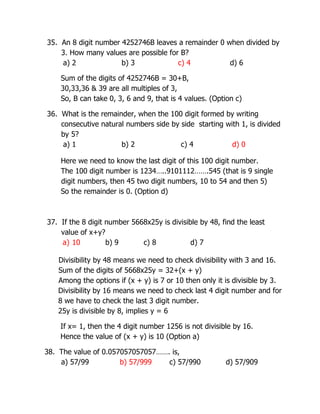
35. An 8 digit number 4252746B leaves a remainder 0 when divided by
3. How many values are possible for B?
a) 2 b) 3 c) 4 d) 6
Sum of the digits of 4252746B = 30+B,
30,33,36 & 39 are all multiples of 3,
So, B can take 0, 3, 6 and 9, that is 4 values. (Option c)
36. What is the remainder, when the 100 digit formed by writing
consecutive natural numbers side by side starting with 1, is divided
by 5?
a) 1 b) 2 c) 4 d) 0
Here we need to know the last digit of this 100 digit number.
The 100 digit number is 1234…..9101112…….545 (that is 9 single
digit numbers, then 45 two digit numbers, 10 to 54 and then 5)
So the remainder is 0. (Option d)
37. If the 8 digit number 5668x25y is divisible by 48, find the least
value of x+y?
a) 10 b) 9 c) 8 d) 7
Divisibility by 48 means we need to check divisibility with 3 and 16.
Sum of the digits of 5668x25y = 32+(x + y)
Among the options if (x + y) is 7 or 10 then only it is divisible by 3.
Divisibility by 16 means we need to check last 4 digit number and for
8 we have to check the last 3 digit number.
25y is divisible by 8, implies y = 6
If x= 1, then the 4 digit number 1256 is not divisible by 16.
Hence the value of (x + y) is 10 (Option a)
38. The value of 0.057057057057……. is,
a) 57/99 b) 57/999 c) 57/990 d) 57/909
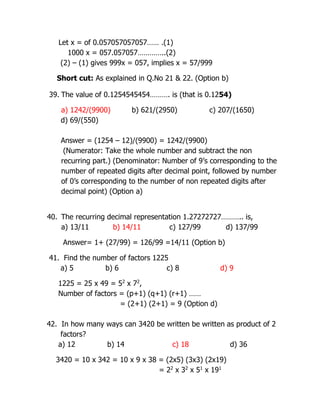
Let x = of 0.057057057057…… .(1)
1000 x = 057.057057…………..(2)
(2) – (1) gives 999x = 057, implies x = 57/999
Short cut: As explained in Q.No 21 & 22. (Option b)
39. The value of 0.1254545454………. is (that is 0.1254)
a) 1242/(9900) b) 621/(2950) c) 207/(1650)
d) 69/(550)
Answer = (1254 – 12)/(9900) = 1242/(9900)
(Numerator: Take the whole number and subtract the non
recurring part.) (Denominator: Number of 9’s corresponding to the
number of repeated digits after decimal point, followed by number
of 0’s corresponding to the number of non repeated digits after
decimal point) (Option a)
40. The recurring decimal representation 1.27272727……….. is,
a) 13/11 b) 14/11 c) 127/99 d) 137/99
Answer= 1+ (27/99) = 126/99 =14/11 (Option b)
41. Find the number of factors 1225
a) 5 b) 6 c) 8 d) 9
1225 = 25 x 49 = 52
x 72
,
Number of factors = (p+1) (q+1) (r+1) ……
= (2+1) (2+1) = 9 (Option d)
42. In how many ways can 3420 be written be written as product of 2
factors?
a) 12 b) 14 c) 18 d) 36
3420 = 10 x 342 = 10 x 9 x 38 = (2x5) (3x3) (2x19)
= 22
x 32
x 51
x 191
Answer = (1/2) [(p+1) (q+1) (r+1)….]
= (1/2) [3 x 3 x 2 x 2 ] = 18 (Option c)
43. Find the number of odd & even number of factors of 1680?
a) 8, 32 b) 8, 9 c) 10, 9 d) none
1680 = 10 x 168 = 10 x 4 x 42 = (2x5)(2x2)(2x3x7) = 24
x 51
x31
x 71
a) Number of odd factors = All the factors of (51
x31
x 71
) = 2x2x2 =
8
b) For even factors
24
x 51
x31
x 71
= 2 [23
x 51
x31
x 71
]
Number of even factors = All the factors of [23
x 51
x31
x 71
]
= 4x2x2x2 = 32
Answer is (Option a)
44. Find the number of factors of 243243 which are multiples of 21?
a) 20 b) 23 c) 25 d) none
243243 = 243 (1001) = 35
x 11 x 13 x7 = 21[34
x 11 x 13]
=5 x 2 x 2
= 20 (Option a)
45. Find the sum of all the factors of 120?
a) 240 b) 280 c) 360 d) 400
120 = 40 x 3 = 8 x 5 x 3 = 23
x 51
x 31
Sum of all the factors = [ ap+1
– 1] / (a-1) x [bq+1
– 1] / (b-1) x ..
= (24
– 1)/(2-1) x (52
– 1)/(5-1) x (32
– 1)/(3-1)
= 360 (Option c)
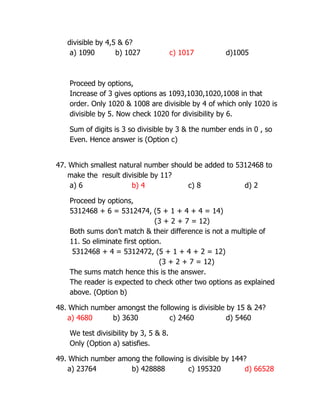
46. Find the smallest four digit number which when increased by 3 is
divisible by 4,5 & 6?
a) 1090 b) 1027 c) 1017 d)1005
Proceed by options,
Increase of 3 gives options as 1093,1030,1020,1008 in that
order. Only 1020 & 1008 are divisible by 4 of which only 1020 is
divisible by 5. Now check 1020 for divisibility by 6.
Sum of digits is 3 so divisible by 3 & the number ends in 0 , so
Even. Hence answer is (Option c)
47. Which smallest natural number should be added to 5312468 to
make the result divisible by 11?
a) 6 b) 4 c) 8 d) 2
Proceed by options,
5312468 + 6 = 5312474, (5 + 1 + 4 + 4 = 14)
(3 + 2 + 7 = 12)
Both sums don’t match & their difference is not a multiple of
11. So eliminate first option.
5312468 + 4 = 5312472, (5 + 1 + 4 + 2 = 12)
(3 + 2 + 7 = 12)
The sums match hence this is the answer.
The reader is expected to check other two options as explained
above. (Option b)
48. Which number amongst the following is divisible by 15 & 24?
a) 4680 b) 3630 c) 2460 d) 5460
We test divisibility by 3, 5 & 8.
Only (Option a) satisfies.
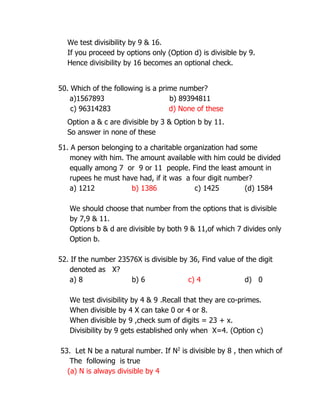
49. Which number among the following is divisible by 144?
a) 23764 b) 428888 c) 195320 d) 66528
We test divisibility by 9 & 16.
If you proceed by options only (Option d) is divisible by 9.
Hence divisibility by 16 becomes an optional check.
50. Which of the following is a prime number?
a)1567893 b) 89394811
c) 96314283 d) None of these
Option a & c are divisible by 3 & Option b by 11.
So answer in none of these
51. A person belonging to a charitable organization had some
money with him. The amount available with him could be divided
equally among 7 or 9 or 11 people. Find the least amount in
rupees he must have had, if it was a four digit number?
a) 1212 b) 1386 c) 1425 (d) 1584
We should choose that number from the options that is divisible
by 7,9 & 11.
Options b & d are divisible by both 9 & 11,of which 7 divides only
Option b.
52. If the number 23576X is divisible by 36, Find value of the digit
denoted as X?
a) 8 b) 6 c) 4 d) 0
We test divisibility by 4 & 9 .Recall that they are co-primes.
When divisible by 4 X can take 0 or 4 or 8.
When divisible by 9 ,check sum of digits = 23 + x.
Divisibility by 9 gets established only when X=4. (Option c)
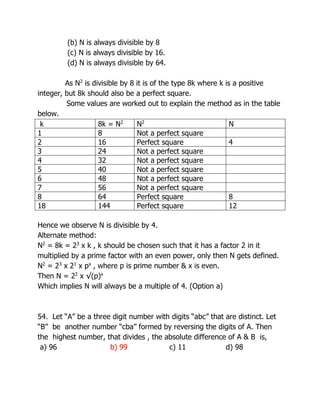
53. Let N be a natural number. If N2
is divisible by 8 , then which of
The following is true
(a) N is always divisible by 4
(b) N is always divisible by 8
(c) N is always divisible by 16.
(d) N is always divisible by 64.
As N2
is divisible by 8 it is of the type 8k where k is a positive
integer, but 8k should also be a perfect square.
Some values are worked out to explain the method as in the table
below.
k 8k = N2
N2
N
1 8 Not a perfect square
2 16 Perfect square 4
3 24 Not a perfect square
4 32 Not a perfect square
5 40 Not a perfect square
6 48 Not a perfect square
7 56 Not a perfect square
8 64 Perfect square 8
18 144 Perfect square 12
Hence we observe N is divisible by 4.
Alternate method:
N2
= 8k = 23
x k , k should be chosen such that it has a factor 2 in it
multiplied by a prime factor with an even power, only then N gets defined.
N2
= 23
x 21
x px
, where p is prime number & x is even.
Then N = 22
x √(p)x
Which implies N will always be a multiple of 4. (Option a)
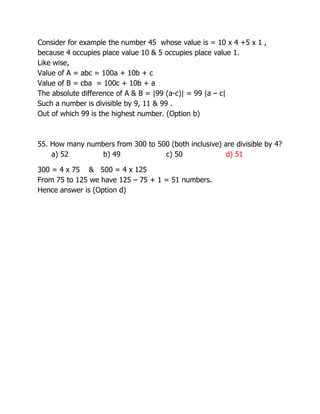
54. Let “A” be a three digit number with digits “abc” that are distinct. Let
“B” be another number “cba” formed by reversing the digits of A. Then
the highest number, that divides , the absolute difference of A & B is,
a) 96 b) 99 c) 11 d) 98
Consider for example the number 45 whose value is = 10 x 4 +5 x 1 ,
because 4 occupies place value 10 & 5 occupies place value 1.
Like wise,
Value of A = abc = 100a + 10b + c
Value of B = cba = 100c + 10b + a
The absolute difference of A & B = |99 (a-c)| = 99 |a – c|
Such a number is divisible by 9, 11 & 99 .
Out of which 99 is the highest number. (Option b)
55. How many numbers from 300 to 500 (both inclusive) are divisible by 4?
a) 52 b) 49 c) 50 d) 51
300 = 4 x 75 & 500 = 4 x 125
From 75 to 125 we have 125 – 75 + 1 = 51 numbers.
Hence answer is (Option d)
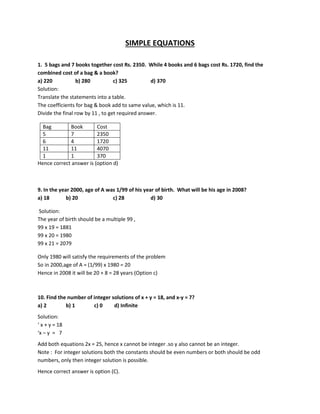
SIMPLE EQUATIONS
1. 5 bags and 7 books together cost Rs. 2350. While 4 books and 6 bags cost Rs. 1720, find the
combined cost of a bag & a book?
a) 220 b) 280 c) 325 d) 370
Solution:
Translate the statements into a table.
The coefficients for bag & book add to same value, which is 11.
Divide the final row by 11 , to get required answer.
Bag Book Cost
5 7 2350
6 4 1720
11 11 4070
1 1 370
Hence correct answer is (option d)
9. In the year 2000, age of A was 1/99 of his year of birth. What will be his age in 2008?
a) 18 b) 20 c) 28 d) 30
Solution:
The year of birth should be a multiple 99 ,
99 x 19 = 1881
99 x 20 = 1980
99 x 21 = 2079
Only 1980 will satisfy the requirements of the problem
So in 2000,age of A = (1/99) x 1980 = 20
Hence in 2008 it will be 20 + 8 = 28 years (Option c)
10. Find the number of integer solutions of x + y = 18, and x-y = 7?
a) 2 b) 1 c) 0 d) Infinite
Solution:
‘ x + y = 18
‘x – y = 7
Add both equations 2x = 25, hence x cannot be integer .so y also cannot be an integer.
Note : For integer solutions both the constants should be even numbers or both should be odd
numbers, only then integer solution is possible.
Hence correct answer is option (C).
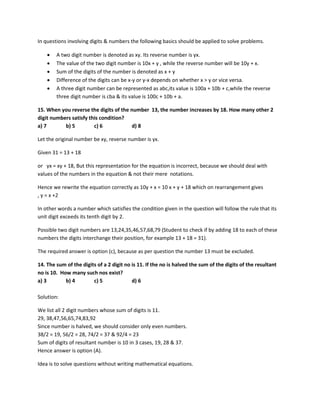
In questions involving digits & numbers the following basics should be applied to solve problems.
• A two digit number is denoted as xy. Its reverse number is yx.
• The value of the two digit number is 10x + y , while the reverse number will be 10y + x.
• Sum of the digits of the number is denoted as x + y
• Difference of the digits can be x-y or y-x depends on whether x > y or vice versa.
• A three digit number can be represented as abc,its value is 100a + 10b + c,while the reverse
three digit number is cba & its value is 100c + 10b + a.
15. When you reverse the digits of the number 13, the number increases by 18. How many other 2
digit numbers satisfy this condition?
a) 7 b) 5 c) 6 d) 8
Let the original number be xy, reverse number is yx.
Given 31 = 13 + 18
or yx = xy + 18, But this representation for the equation is incorrect, because we should deal with
values of the numbers in the equation & not their mere notations.
Hence we rewrite the equation correctly as 10y + x = 10 x + y + 18 which on rearrangement gives
, y = x +2
In other words a number which satisfies the condition given in the question will follow the rule that its
unit digit exceeds its tenth digit by 2.
Possible two digit numbers are 13,24,35,46,57,68,79 (Student to check if by adding 18 to each of these
numbers the digits interchange their position, for example 13 + 18 = 31).
The required answer is option (c), because as per question the number 13 must be excluded.
14. The sum of the digits of a 2 digit no is 11. If the no is halved the sum of the digits of the resultant
no is 10. How many such nos exist?
a) 3 b) 4 c) 5 d) 6
Solution:
We list all 2 digit numbers whose sum of digits is 11.
29, 38,47,56,65,74,83,92
Since number is halved, we should consider only even numbers.
38/2 = 19, 56/2 = 28, 74/2 = 37 & 92/4 = 23
Sum of digits of resultant number is 10 in 3 cases, 19, 28 & 37.
Hence answer is option (A).
Idea is to solve questions without writing mathematical equations.
I
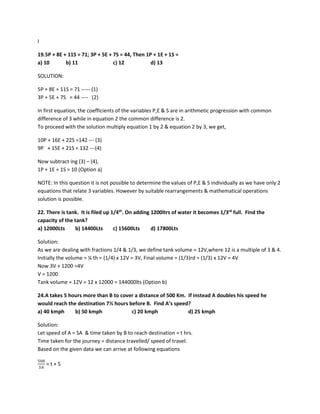
19.5P + 8E + 11S = 71; 3P + 5E + 7S = 44, Then 1P + 1E + 1S =
a) 10 b) 11 c) 12 d) 13
SOLUTION:
5P + 8E + 11S = 71 ----- (1)
3P + 5E + 7S = 44 ---- (2)
In first equation, the coefficients of the variables P,E & S are in arithmetic progression with common
difference of 3 while in equation 2 the common difference is 2.
To proceed with the solution multiply equation 1 by 2 & equation 2 by 3, we get,
10P + 16E + 22S =142 --- (3)
9P + 15E + 21S = 132 ---(4)
Now subtract ing (3) – (4),
1P + 1E + 1S = 10 (Option a)
NOTE: In this question it is not possible to determine the values of P,E & S individually as we have only 2
equations that relate 3 variables. However by suitable rearrangements & mathematical operations
solution is possible.
22. There is tank. It is filed up 1/4th
. On adding 1200ltrs of water it becomes 1/3rd
full. Find the
capacity of the tank?
a) 12000Lts b) 14400Lts c) 15600Lts d) 17800Lts
Solution:
As we are dealing with fractions 1/4 & 1/3, we define tank volume = 12V,where 12 is a multiple of 3 & 4.
Initially the volume = ¼ th = (1/4) x 12V = 3V, Final volume = (1/3)rd = (1/3) x 12V = 4V
Now 3V + 1200 =4V
V = 1200
Tank volume = 12V = 12 x 12000 = 144000lts (Option b)
24.A takes 5 hours more than B to cover a distance of 500 Km. If instead A doubles his speed he
would reach the destination 7½ hours before B. Find A’s speed?
a) 40 kmph b) 50 kmph c) 20 kmph d) 25 kmph
Solution:
Let speed of A = SA & time taken by B to reach destination = t hrs.
Time taken for the journey = distance travelled/ speed of travel.
Based on the given data we can arrive at following equations
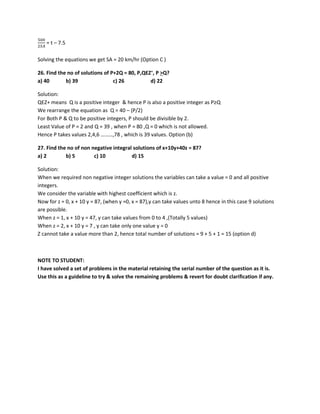
500
𝑆𝑆𝑆𝑆
= t + 5
500
2𝑆𝑆𝑆𝑆
= t – 7.5
Solving the equations we get SA = 20 km/hr (Option C )
26. Find the no of solutions of P+2Q = 80, P,QEZ+
, P >Q?
a) 40 b) 39 c) 26 d) 22
Solution:
QEZ+ means Q is a positive integer & hence P is also a positive integer as P≥Q
We rearrange the equation as Q = 40 – (P/2)
For Both P & Q to be positive integers, P should be divisible by 2.
Least Value of P = 2 and Q = 39 , when P = 80 ,Q = 0 which is not allowed.
Hence P takes values 2,4,6 ………,78 , which is 39 values. Option (b)
27. Find the no of non negative integral solutions of x+10y+40z = 87?
a) 2 b) 5 c) 10 d) 15
Solution:
When we required non negative integer solutions the variables can take a value = 0 and all positive
integers.
We consider the variable with highest coefficient which is z.
Now for z = 0, x + 10 y = 87, (when y =0, x = 87),y can take values unto 8 hence in this case 9 solutions
are possible.
When z = 1, x + 10 y = 47, y can take values from 0 to 4 ,(Totally 5 values)
When z = 2, x + 10 y = 7 , y can take only one value y = 0
Z cannot take a value more than 2, hence total number of solutions = 9 + 5 + 1 = 15 (option d)
NOTE TO STUDENT:
I have solved a set of problems in the material retaining the serial number of the question as it is.
Use this as a guideline to try & solve the remaining problems & revert for doubt clarification if any.
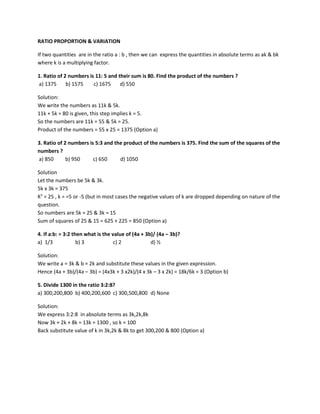
RATIO PROPORTION & VARIATION
If two quantities are in the ratio a : b , then we can express the quantities in absolute terms as ak & bk
where k is a multiplying factor.
1. Ratio of 2 numbers is 11: 5 and their sum is 80. Find the product of the numbers ?
a) 1375 b) 1575 c) 1675 d) 550
Solution:
We write the numbers as 11k & 5k.
11k + 5k = 80 is given, this step implies k = 5.
So the numbers are 11k = 55 & 5k = 25.
Product of the numbers = 55 x 25 = 1375 (Option a)
3. Ratio of 2 numbers is 5:3 and the product of the numbers is 375. Find the sum of the squares of the
numbers ?
a) 850 b) 950 c) 650 d) 1050
Solution
Let the numbers be 5k & 3k.
5k x 3k = 375
K2
= 25 , k = =5 or -5 (but in most cases the negative values of k are dropped depending on nature of the
question.
So numbers are 5k = 25 & 3k = 15
Sum of squares of 25 & 15 = 625 + 225 = 850 (Option a)
4. If a:b: = 3:2 then what is the value of (4a + 3b)/ (4a – 3b)?
a) 1/3 b) 3 c) 2 d) ½
Solution:
We write a = 3k & b = 2k and substitute these values in the given expression.
Hence (4a + 3b)/(4a – 3b) = (4x3k + 3 x2k)/(4 x 3k – 3 x 2k) = 18k/6k = 3 (Option b)
5. Divide 1300 in the ratio 3:2:8?
a) 300,200,800 b) 400,200,600 c) 300,500,800 d) None
Solution:
We express 3:2:8 in absolute terms as 3k,2k,8k
Now 3k + 2k + 8k = 13k = 1300 , so k = 100
Back substitute value of k in 3k,2k & 8k to get 300,200 & 800 (Option a)
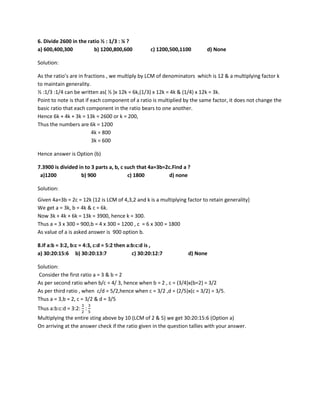
6. Divide 2600 in the ratio ½ : 1/3 : ¼ ?
a) 600,400,300 b) 1200,800,600 c) 1200,500,1100 d) None
Solution:
As the ratio’s are in fractions , we multiply by LCM of denominators which is 12 & a multiplying factor k
to maintain generality.
½ :1/3 :1/4 can be written as( ½ )x 12k = 6k,(1/3) x 12k = 4k & (1/4) x 12k = 3k.
Point to note is that if each component of a ratio is multiplied by the same factor, it does not change the
basic ratio that each component in the ratio bears to one another.
Hence 6k + 4k + 3k = 13k = 2600 or k = 200,
Thus the numbers are 6k = 1200
4k = 800
3k = 600
Hence answer is Option (b)
7.3900 is divided in to 3 parts a, b, c such that 4a=3b=2c.Find a ?
a)1200 b) 900 c) 1800 d) none
Solution:
Given 4a=3b = 2c = 12k (12 is LCM of 4,3,2 and k is a multiplying factor to retain generality}
We get a = 3k, b = 4k & c = 6k.
Now 3k + 4k + 6k = 13k = 3900, hence k = 300.
Thus a = 3 x 300 = 900,b = 4 x 300 = 1200 , c = 6 x 300 = 1800
As value of a is asked answer is 900 option b.
8.If a:b = 3:2, b:c = 4:3, c:d = 5:2 then a:b:c:d is ,
a) 30:20:15:6 b) 30:20:13:7 c) 30:20:12:7 d) None
Solution:
Consider the first ratio a = 3 & b = 2
As per second ratio when b/c = 4/ 3, hence when b = 2 , c = (3/4)x(b=2) = 3/2
As per third ratio , when c/d = 5/2,hence when c = 3/2 ,d = (2/5)x(c = 3/2) = 3/5.
Thus a = 3,b = 2, c = 3/2 & d = 3/5
Thus a:b:c:d = 3:2:
3
2
:
3
5
Multiplying the entire sting above by 10 (LCM of 2 & 5) we get 30:20:15:6 (Option a)
On arriving at the answer check if the ratio given in the question tallies with your answer.
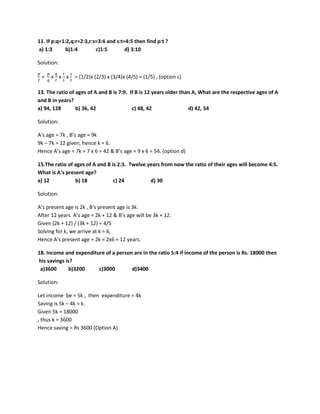
11. If p:q=1:2,q:r=2:3,r:s=3:4 and s:t=4:5 then find p:t ?
a) 1:3 b)1:4 c)1:5 d) 3:10
Solution:
𝑝𝑝
𝑡𝑡
=
𝑝𝑝
𝑞𝑞
x
𝑞𝑞
𝑟𝑟
x
𝑟𝑟
𝑠𝑠
x
𝑠𝑠
𝑡𝑡
= (1/2)x (2/3) x (3/4)x (4/5) = (1/5) , (option c)
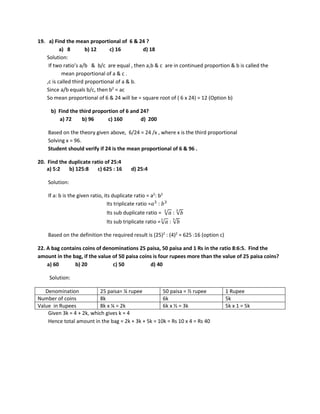
13. The ratio of ages of A and B is 7:9. If B is 12 years older than A, What are the respective ages of A
and B in years?
a) 94, 128 b) 36, 42 c) 48, 42 d) 42, 54
Solution:
A’s age = 7k , B’s age = 9k
9k – 7k = 12 given, hence k = 6.
Hence A’s age = 7k = 7 x 6 = 42 & B’s age = 9 x 6 = 54. (option d)
15.The ratio of ages of A and B is 2:3. Twelve years from now the ratio of their ages will become 4:5.
What is A’s present age?
a) 12 b) 18 c) 24 d) 30
Solution:
A’s present age is 2k , B’s present age is 3k.
After 12 years A’s age = 2k + 12 & B’s age will be 3k + 12.
Given (2k + 12) / (3k + 12) = 4/5
Solving for k, we arrive at k = 6,
Hence A’s present age = 2k = 2x6 = 12 years.
18. Income and expenditure of a person are in the ratio 5:4 if income of the person is Rs. 18000 then
his savings is?
a)3600 b)3200 c)3000 d)3400
Solution:
Let income be = 5k , then expenditure = 4k
Saving is 5k – 4k = k.
Given 5k = 18000
, thus k = 3600
Hence saving = Rs 3600 (Option A)
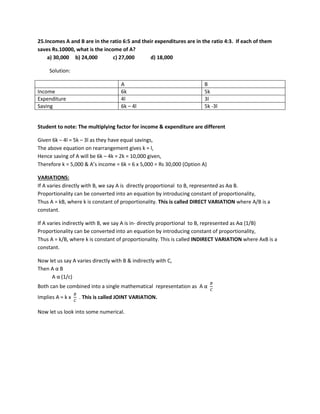
19. a) Find the mean proportional of 6 & 24 ?
a) 8 b) 12 c) 16 d) 18
Solution:
If two ratio’s a/b & b/c are equal , then a,b & c are in continued proportion & b is called the
mean proportional of a & c .
,c is called third proportional of a & b.
Since a/b equals b/c, then b2
= ac
So mean proportional of 6 & 24 will be = square root of ( 6 x 24) = 12 (Option b)
b) Find the third proportion of 6 and 24?
a) 72 b) 96 c) 160 d) 200
Based on the theory given above, 6/24 = 24 /x , where x is the third proportional
Solving x = 96.
Student should verify if 24 is the mean proportional of 6 & 96 .
20. Find the duplicate ratio of 25:4
a) 5:2 b) 125:8 c) 625 : 16 d) 25:4
Solution:
If a: b is the given ratio, its duplicate ratio = a2
: b2
Its triplicate ratio =𝑎𝑎3
: 𝑏𝑏3
Its sub duplicate ratio = √𝑎𝑎
2
: √𝑏𝑏
2
Its sub triplicate ratio =√𝑎𝑎
3
: √𝑏𝑏
3
Based on the definition the required result is (25)2
: (4)2
= 625 :16 (option c)
22. A bag contains coins of denominations 25 paisa, 50 paisa and 1 Rs in the ratio 8:6:5. Find the
amount in the bag, if the value of 50 paisa coins is four rupees more than the value of 25 paisa coins?
a) 60 b) 20 c) 50 d) 40
Solution:
Denomination 25 paisa= ¼ rupee 50 paisa = ½ rupee 1 Rupee
Number of coins 8k 6k 5k
Value in Rupees 8k x ¼ = 2k 6k x ½ = 3k 5k x 1 = 5k
Given 3k = 4 + 2k, which gives k = 4
Hence total amount in the bag = 2k + 3k + 5k = 10k = Rs 10 x 4 = Rs 40
25.Incomes A and B are in the ratio 6:5 and their expenditures are in the ratio 4:3. If each of them
saves Rs.10000, what is the income of A?
a) 30,000 b) 24,000 c) 27,000 d) 18,000
Solution:
A B
Income 6k 5k
Expenditure 4l 3l
Saving 6k – 4l 5k -3l
Student to note: The multiplying factor for income & expenditure are different
Given 6k – 4l = 5k – 3l as they have equal savings,
The above equation on rearrangement gives k = l,
Hence saving of A will be 6k – 4k = 2k = 10,000 given,
Therefore k = 5,000 & A’s income = 6k = 6 x 5,000 = Rs 30,000 (Option A)
VARIATIONS:
If A varies directly with B, we say A is directly proportional to B, represented as Aα B.
Proportionality can be converted into an equation by introducing constant of proportionality,
Thus A = kB, where k is constant of proportionality. This is called DIRECT VARIATION where A/B is a
constant.
If A varies indirectly with B, we say A is in- directly proportional to B, represented as Aα (1/B)
Proportionality can be converted into an equation by introducing constant of proportionality,
Thus A = k/B, where k is constant of proportionality. This is called INDIRECT VARIATION where AxB is a
constant.
Now let us say A varies directly with B & indirectly with C,
Then A α B
A α (1/c)
Both can be combined into a single mathematical representation as A α
𝐵𝐵
𝐶𝐶
Implies A = k x
𝐵𝐵
𝐶𝐶
. This is called JOINT VARIATION.
Now let us look into some numerical.
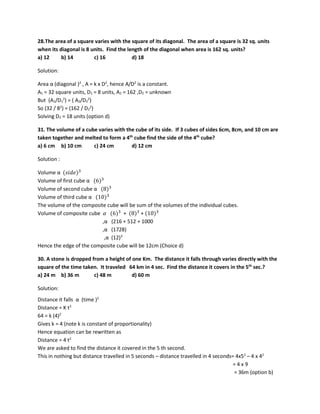
28.The area of a square varies with the square of its diagonal. The area of a square is 32 sq. units
when its diagonal is 8 units. Find the length of the diagonal when area is 162 sq. units?
a) 12 b) 14 c) 16 d) 18
Solution:
Area α (diagonal )2
, A = k x D2
, hence A/D2
is a constant.
A1 = 32 square units, D1 = 8 units, A2 = 162 ,D2 = unknown
But (A1/D1
2
) = ( A2/D2
2
)
So (32 / 82
) = (162 / D2
2
)
Solving D2 = 18 units (option d)
31. The volume of a cube varies with the cube of its side. If 3 cubes of sides 6cm, 8cm, and 10 cm are
taken together and melted to form a 4th
cube find the side of the 4th
cube?
a) 6 cm b) 10 cm c) 24 cm d) 12 cm
Solution :
Volume α (𝑠𝑠𝑠𝑠𝑠𝑠𝑠𝑠)3
Volume of first cube α (6)3
Volume of second cube α (8)3
Volume of third cube α (10)3
The volume of the composite cube will be sum of the volumes of the individual cubes.
Volume of composite cube 𝛼𝛼 (6)3
+ (8)3
+ (10)3
,α (216 + 512 + 1000
,α (1728)
,α (12)3
Hence the edge of the composite cube will be 12cm (Choice d)
30. A stone is dropped from a height of one Km. The distance it falls through varies directly with the
square of the time taken. It traveled 64 km in 4 sec. Find the distance it covers in the 5th
sec.?
a) 24 m b) 36 m c) 48 m d) 60 m
Solution:
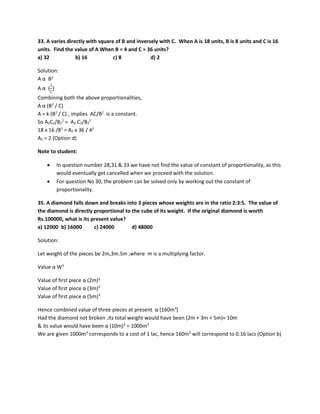
Distance it falls α (time )2
Distance = K t2
64 = k (4)2
Gives k = 4 (note k is constant of proportionality)
Hence equation can be rewritten as
Distance = 4 t2
We are asked to find the distance it covered in the 5 th second.
This in nothing but distance travelled in 5 seconds – distance travelled in 4 seconds= 4x52
– 4 x 42
= 4 x 9
= 36m (option b)
33. A varies directly with square of B and inversely with C. When A is 18 units, B is 8 units and C is 16
units. Find the value of A When B = 4 and C = 36 units?
a) 32 b) 16 c) 8 d) 2
Solution:
A α B2
A α (
1
𝐶𝐶
)
Combining both the above proportionalities,
A α (B2
/ C)
A = k (B2
/ C) , implies AC/B2
is a constant.
So A1C1/B1
2
= A2 C2/B2
2
18 x 16 /82
= A2 x 36 / 42
A2 = 2 (Option d)
Note to student:
• In question number 28,31 & 33 we have not find the value of constant of proportionality, as this
would eventually get cancelled when we proceed with the solution.
• For question No 30, the problem can be solved only by working out the constant of
proportionality.
35. A diamond falls down and breaks into 3 pieces whose weights are in the ratio 2:3:5. The value of
the diamond is directly proportional to the cube of its weight. If the original diamond is worth
Rs.100000, what is its present value?
a) 12000 b) 16000 c) 24000 d) 48000
Solution:
Let weight of the pieces be 2m,3m.5m ,where m is a multiplying factor.
Value α W3
Value of first piece α (2m)3
Value of first piece α (3m)3
Value of first piece α (5m)3
Hence combined value of three pieces at present α (160m3
)
Had the diamond not broken ,its total weight would have been (2m + 3m + 5m)= 10m
& its value would have been α (10m)3
= 1000m3
We are given 1000m3
corresponds to a cost of 1 lac, hence 160m3
will correspond to 0.16 lacs (Option b)
SIMPLE INTEREST & COMPOUND INTEREST
Definition of basic terms:
Principal (P): is the amount that is invested or sum that is lent
Amount (A): is what the invested sum or lent sum eventually becomes after a certain number of years.
Time (n) or (t): Time for which the money is lent or invested
Rate (r): The factor by which the principal multiplies usually expressed in percentage.
At any point in time during the lock in period till the completion of the term the following relation holds
good,
AMOUNT = PRINCIPAL + INTEREST
Interest (I) : The extra sum that is earned on the principal that is lent or invested at the end of the time
Interest is calculated in two modes Simple & Compound interest.
Simple interest is calculated using the formula, I = Prt/100,
Amount under compound interest is calculated as A = P (1 +
𝑟𝑟
100
)n
, thus compound interest earned in
“n “years = A – P .
EXAMPLE: Find the simple interest & compound interest on a Sum of Rs1000 , for 2 years lent at 10 %
per annum.
Simple interest (SI) = 1000 x 10 x 2/100 = Rs 200/-
Amount under compound interest = 1000 (1 +
10
100
)2
= 1000 (1.1)2
= Rs 1210/.
Hence compound interest for 2 years = Amount at the end of 2 years – Principal
= Rs 1210 – Rs 1000 = Rs 210/-
Using the same example we now proceed to understand how SI & CI operate and draw certain
inferences.
Simple interest: For first year = 1000 x 1 x 10/100 = Rs 100
Simple interest for 2 years = Rs 200 as calculated above , this means Simple interest for second year was
also Rs 100/.
THUS SIMPLE INTEREST IS THE SAME EVERY YEAR on a certain sum of money at a certain rate of
interest invested for a certain time period
Amount at the end of first year is Rs1100 and at the end of second year is Rs 1200.
We started with Rs 1000, this Amounted to Rs 1100/- in one year & Rs 1200 in second year.
THIS MEANS AMOUNTS UNDER SIMPLE INTEREST ARE IN ARITHMETIC PROGRESSION.
Compound Interest: For first year = 1000 x 1 x 10/100 = Rs 100,
Amount at the end of first year = 1000 + 100 = 1100
Compound interest for second year = 1100 x 1 x 10/100 = 110
Compound interest for 2 years =100 + 110 = 210
Amount at the end of 2 years = 1000 + 210 = Rs 1210 as calculated using formula.
The calculation for simple & compound interest is basically the same, except that in case of compound
interest, the interest earned in that year is added to the principal (this process is called compounding),to
compute interest for the next year.
If this happens at the end of each year we say interest is compounded annually.
If this happens every six months we say interest is compounded semi annually.
The rate or interest is usually specified for per annum base unless otherwise explicitly stated.
We know that A = P ( 1 +
𝑟𝑟
100
)n
, for a given value of r, 1 +
𝑟𝑟
100
= R which is a constant.
So A = P(R)n
, A1 = PR, A2 = PR2
, A3 = PR3
………… we observe amounts under compound interest will be in
geometric progression with common ratio = R.
• For first year Simple interest & Compound interest are equal.
• For Simple interest Principal remains the same every year while for Compound interest the
principal changes due to compounding.
Solved Examples
3. If Rs. 2000 amounts to Rs. 2200 in 2 years under SI, the rate of interest is?
a) 5% b) 10% c) 8% d) 15%
Solution:
Interest = Amount – Principal = Rs 2200 – Rs 2000 = Rs 200 earned in 2 years ,hence per year interest is
Rs 100 on Rs 2000 as principal ,
So rate of interest should be 5%, because 100 = 5% of 2000.
5. A sum becomes Rs 2400 in 6 years under SI at 10% p.a. What is its present value?
a) 1500 b) 1600 c) 1800 d) 2000
Solution:
Under simple interest Amount (A) = Principal + Interest = P + (Pnr/100) = P( 1 + (nr/100))
Meaning of the question is, if one has to pay Rs 2400 after six year, interest computed at the rate of 10%
per annum, what should have been the amount borrowed, which is nothing but starting principal.
P = A/( 1 + (nr/100))
= 2400 /(1 + (6 x 10/100)) = Rs 1500 (Option a)
6. Find the amount obtained by investing Rs. 24000 at 18% p.a. SI for 5 years?
a) 21600 b) 44000 c) 48000 d) 45600
Solution:
Simple interest for one year= 18% of 24000 = Rs 4320
Simple interest for 5 years = 5 x 4320 = 21600
Amount after 5 years = 24000 + 21600 = Rs 45600 (Option d)
7. Find the rate % p.a., if a sum doubles itself in 12 years at SI?
a) 6¼% b) 8 1/3% c) 10% d) 9 1/11%
Solution:
If principal = P then amount = 2p, hence interest earned is = p
,p = p x 12 x r/100
Which gives r/100 = 1/12 ,or r = 100/12 = 25/3= 8-1/3% (Option b)
10.If a certain sum doubles in 3 years under SI, in how many years would it become 5 times itself at
same rate of interest?
a) 12 b) 15 c) 9 d) 18
Solution:
Principal Amount Interest time
p 2p p 3
p 5p 4p ?
Based on statement 1, interest earned per year = p/3
As interest earned per year is same under simple interest , to earn an interest of 4p, time required =
4p/(p/3) = 12 years (option a)
11. What annual installment will discharge a debt of Rs. 4600 due in 4 years at 10% SI?
A) 800 b) 1000 c) 1250 d) 1175
Solution:
The installment paid at the end of first year = Rs x
This will fetch interest for next 3 years = x * 3 * 10/100 = 3x/10
The second installment = Rs x, this will fetch interest for 2 years = x * 2 * 10/100 = 2x/10
The third installment = Rs x, this will fetch interest for 1 year = x * 1 * 10/100= x/10
The fourth installment closes the loan at the end of the fourth year = x
Now ( x + (3x/10)) + (x + ( 2x/10)) + (x + (x/10)) + x = 4600
4x + 0.6x = 4600
,x = Rs 1000 (option b)
13. Find the CI on Rs. 3000 at 10% p.a. for 3 years?
a) 900 b) 933 c) 963 d) 993
Solution:
Principal for first year = Rs 3000
Interest for first year = 10% of Rs 3000 = Rs 300
Amount at the end of first year = Rs 3300
Principal for second year = Rs 3300
Interest for second year = 10 % of Rs 3300 = Rs 330
Amount at the end of second year = Rs 3300 + Rs 330 = Rs 3630
Principal for third year = Rs 3630
Interest for third year = 10% of Rs 3630 = Rs 363
Amount at end of third year = Rs 3630 + Rs 363 = Rs 3993
Interest earned for 3 years = Amount at the end of 3 years – Starting principal,
= Rs 3993 – Rs 3000 = Rs 993 = sum of interest s earned in each year
= Rs 300 + Rs 330 + Rs 363
Hence answer is option d.
Students can also approach the same sum, by formula method.
But approaching it using formula cannot give you a feel of the topic.
Observe that compound interest for the year under consideration are also in GP.
300,330,363
The common ratio is ( 1 + (10/100)) = 1.1
15.P = 6000, R = 10% Find 4th
year CI?
a) 700 b) 698.60 c) 728.60 d) 798.60
Solution:
I st year interest = 10% of Rs6000 = Rs 600
2nd
year interest = 600 x( 1 +(10/100)) = 600 x 1.1 = Rs 660
3rd
year interest = Rs 660 x 1.1 = Rs 726
4 th year interest = Rs 726 x 1.1 = Rs 798.6 (Option d)
17.Find the amount obtained by investing Rs. 48000, at 25% p.a. CI for 1 year compounded half
yearly?
a) 54000 b) 80000 c) 75000 d) 60750
Solution:
Since compounding is done half yearly ,principal is added to interest every six months. Rate of interest
for six monthly computation = 25%/2 = 12.5%
Starting principal = Rs Rs 48000
Interest for first six months = 12.5% of 48000 = 1/8 x 48000 = Rs 6000
Amount at the end of six months = Rs 54000
Interest for next six months = 12.5% of 54000 = 1/8 x 54000 = Rs 6750
Amount at the end of one year = 54000 + 6750 = Rs 60750 (option d)
18.Find the CI on Rs. 80000 at 40% p.a. for 9 months, compounded quarterly?
a) 25480 b) 26480 c) 25680 d) 26280
Solution:
Compounding is done every 3 months.
So quarterly rate of interest = 40%/4 = 10 %,
Amount after 9 months = 80000 x(1.1)(1.1)(1.1) = Rs 106480 (Recall that amounts are in GP with
common ratio (1+(10/100))
Hence compound interest earned for 9 months = Rs 106480 – Rs 80000 = Rs 26,480 (option b)
22. A sum becomes 3 times itself at CI in 8 years. In how many years will the sum become 81 times
itself?
a) 30 b) 32 c) 34 d) 36
Solution:
3P = PR8
, implies R = (3)1/8
---- (1)
81P =PRn
,implies R = (81)1/n
---- (2)
In the above steps we use the formula A = P (1 +
𝑟𝑟
100
)n
, where R = 1 +
𝑟𝑟
100
Equating value of R in the above equations,
(3)1/8
= (81)1/n
= (34
)1/n
= (3)4/n
As base is common we equate the powers 1/8 = 4/n or n = 32 years (choice b)
Short method:
Principal Amout No of years
P ap n
P ak
p kn
Principal Amout No of years
P 3p 8
P 81p = 34
p Kn= 4 x 8 = 32 years
This short method works here because we can express 81 as a power of 3.
23. Find the difference between the CI and SI on Rs 500 at 10% p.a. for 2 years?
a) 50 b) 30 c) 10 d) 5
Solution:
Difference between SI & CI for 2 years on the same principal P , at the same rate of interest = r%, can
be derived as CI – SI = Pr2
/1002
,
Directly substituting the values we get CI – SI = 500 x (10)2
/(100)2
= Rs 5 (option d).
24. Find the difference between the CI and SI on Rs. 25000 for 3 years at 20% p.a.?
a) 2200 b) 3200 c) 3700 d) 4200
Solution:
Difference between SI & CI for 3 years on the same principal P , at the same rate of interest = r%, can
be derived as CI – SI = Pr2
/1002
[ 3 + ( r /100)]
Substitute the values in the equation to get diff = 25000 (20)2
/(100)2
[ 3 + (20/100)]
= Rs 3200 (option b)
25. The SI and CI on a sum for 2 years are Rs. 800 and Rs. 864 respectively. Find the sum and rate%
p.a.?
a) 3600, 8% b) 4000, 16% c) 2500, 16% d) 5000, 12%
Solution:
SI CI REMARKS
FIRST YEAR 400 400 SI & CI are same for the first year
SECOND YEAR 400 464
TOTAL 800 864
464 = [(1 + (r/100)] x 400
Hence r = 16%
Now pr/100 = 400 ,which is simple interest for one year.
P = 400 x 100/16 = Rs 2500 ,
Hence answer is option C.
NOTE: This question cannot be solved using the formula given in question 23 , as both p & r are
unknown .
27. A man borrowed Rs. 10000 at 10% CI. He repaid Rs. 5000 at the end of 1st
year. What amount
shall he repay at the end of 2nd
year to clear his loan?
a) 6000 b) 6600 c) 7200 d) 7600
Solution:
We can solve the question in two ways as shown.
Method 1:
(1)Find the amount that the borrowed sum becomes after 2 years.
(2)Rs 5000 paid at the end of first year will fetch interest upto end of second year.
(3)The amount paid at end of 2nd
year = x
(1) = (2) + (3)
10000 (1 + (10/100))2
= 5000 + (5000 x 1 x 10/100) + x
12100 = 5500 + x
,x = 6600 (option b)
Method 2:
We use concept of present value as explained in Question Number 5.
Present value under compound interest is P = A/ (1 + (r/100))n
(1)Amount borrowed presently = 10,000
(2) Present value of Rs 5000 paid at the end of one year = 5000/ (1 +(10/100))1
(3)Present value of second installment,Say Rs x,paid at the end of second year = x/(1 + (10/100))2
(1)= (2) + (3)
10,000 = 5000/ (1 +(10/100))1
+ x/(1 + (10/100))2
,
10,000 = (5000/1.1) + (x/1.21)
Multiply throughout by 1.21.
,x = Rs 6600/.
Note : Method 2 is usually the procedure used to calculate installments whenever a loan is offered
with a fixed recovery period at a certain rate of interest.
Difference between SI & CI on the same principal (P) at the same rate of interest(r%)
(DERIVATION)
SI = p x 2 x r/100
CI = p (1 + (r/100))2
- p
CI – SI = p ( 1 + 2r/100 + r2
/1002
) –p – 2pr/100 = pr2
/1002
When compounding is done more than once in a year.
A = P {1 + (r/(k x 100))}nk
Where P is principal
‘r = rate of interest per annum
‘n = number of years
‘k = number of times compounding is done per year
ODD WORD
Odd Word deals with finding a single word from among the given bunch of words. This tests
one’s general knowledge and familiarity with vocabulary.
This activity nurtures one’s ability to group the given set of words based on the category they
belong to and hence identify the word that stands out..
Example:1 (General based)
A B C D E
Dermatology Odontology Osteology Philology Ophthalmology
Ans: D
Explanation:
A, B, C and E - study related to human body parts whereas D – study of languages
Example: 2 (Vocabulary based)
A B C D
Beseech plead decreed request
Ans: C
Explanation:
A, B and D are synonyms while C is their antonym
ODD WORD OUT (VOCABULARY)
In each question, choose the word that is different from the others in meaning.
A B C D E
1. Cover Mask Facade Cavern Front
2. Filthy Stingy Dirty Grimy Unclean
3. Hint Clue Warranty Implication Suggestion
4. Reduce Demolish Diminish Decrease Abate
skin teeth bones eyes
Linguistics
command
front wall cave
imply
weaken
5. Educated Learned Erudite Advocated Knowledgeable
6. Miserable Despondent Forlorn Depressed Determined
7. Permission Commission Consent Approval Clearance
8. Pledge Prize Award Trophy Medal
9. Skinny Slim Dense Slender Lean
10. Explain Clarify Illustrate Elucidate Eradicate
11. Abrogate Give Up Repeal Abate Abolish
12. Aberrant Accretion Increment Accumulation Multiplication
13. Aesthetic Adverse Unfavorable Unfortunate fateful
14. Cogitation Chicanery Meditation Thinking Reasoning
15. Contrite Cryptic Puzzling Hidden Mysterious
16. Elusive Evasive Baffling Dormant Slippery
17. Judicious Wise Prudent Frugality Shrewd
hopeless lonely
revoke diminish
deviant
concerned with art, beauty
deception
meditation
remorse, repentant
inactive
not wasting
18. Laconic Concise Harangue Terse Brusque
19. Overt Probity Manifest Open Apparent
20. Glitch Emulate Mistake Malfunction Blip
lecture
curt blunt -rude
integrity
apparent
imitate
ODD WORD OUT (GENERAL)
A B C D
1. Semicolon Semifinal Semicircle Seminar
2. Telephone Telescope Transistor Tape recorder
3. Radio waves X-rays Ultraviolet Rays Infrared Rays
4. Zinc Aluminum Copper Mercury
5. Volume Force Volt Power
6. Microscope Microbe Microphone Microfilm
7. Coal Biogas Petroleum Natural gas
8. Java Structures Unions C++
9. Sericulture Etiology Acoustics Officious
10. Microscope Telescope Stethoscope Periscope
11. Autocrat Bureaucrat Plutocrat Aristocrat
12. Zucchini Dandelion Thistle Foxglove
13. Poetry Haiku Sonnet Elegy
14. Pulpit Pew Chalice Chancel
15. Steering Wheel Dashboard Gear Shift Bonnet
16. Ornithology Gerontology Ophthalmology Gynecology
17. Canoe Igloo Yacht Dinghy
18. Mike Tyson Holy Field Buster Douglas Bruce Lee
19. Henri Becquerel Roentgen Madam Curie Einstein
20. Himadri Shivalik Kandla Himachal
General Aptitude
18PDH101T
Semester-II
Career Development Centre
SRM Institute of Science and Technology
Kattankulathur, Chennai.
Table of Contents
VOCABULARY...........................................................................................................................................5
TENSES......................................................................................................................................................11
VOICE ........................................................................................................................................................13
PHRASAL VERBS.....................................................................................................................................16
PHRASES CLAUSES AND KINDS OF SENTENCES............................................................................20
SENTENCE ARRANGEMENT.................................................................................................................29
ODD WORD...............................................................................................................................................33
QUESTION TAGS .....................................................................................................................................35
COMMON CONFUSING WORDS – (CAT) ............................................................................................38
IDIOMS AND PHRASES – AN INTRODUCTION .................................................................................45
READING COMPREHENSION................................................................................................................50
5
VOCABULARY
Decide whether the word in column B is the same (orapproximately the same) in meaning as the
word in column A;opposite (or approximately opposite) in meaning; or whether thetwo words are
merely different.
Circle S for same, 0 for opposite, and D for different.
COLUMN A COLUMN B
1. sweet sour S 0 D
2. crazy insane S 0 D
3. stout fat S 0 D
4. big angry S 0 D
5. danger peril S 0 D
6. help hinder S 0 D
7. splendid magnificent S 0 D
8. love hate S 0 D
9. Stand rise S 0 D
10. furious violent S 0 D
11. tree apple S 0 D
12. doubtful certain S 0 D
13. handsome ugly S 0 D
14. begin start S 0 D
15. strange familiar S 0 D
16. male female S 0 D
17. powerful weak S 0 D
18. beyond under S 0 D
19. live die S 0 D
20. go get S 0 D
21. return replace S 0 D
22. growl weep S 0 D
6
23. open close S 0 D
24. nest home S 0 D
25. chair table S 0 D
26. want desire S 0 D
27. can container S 0 D
28. idle working S 0 D
29. rich luxurious S 0 D
30. building structure S 0 D
Write in the blank in column B a word starting with the letter P that is the same, or approximately
the same, in meaning as the word given in column A.
Example: look peer------
INSTRUCTION: Every answer must start with the letter P.
A B
1. bucket 15. stone
2. trousers 16. inactive
3. maybe 17. fussy
4. forgive 18. suffering
5. separate 19. castle
6. likely 20. gasp
7. annoy 21. fear
8. good-looking 22. twosome
9. picture 23. artist
10. choose 24. sheet
11. ugly 25. collection
12. go
13. dish
14. location
7
Match each personality with the appropriate characteristic, action, or attitude.
1. egoist a. turns thoughts inward
2. egotist · b. hates marriage
3. altruist c. talks about accomplishments
4. introvert d. hates people
5. extrovert e. does not pursue pleasures of the flesh
6. ambivert f. is interested in the welfare of others
7. misanthrope g. believes in self-advancement
8. misogynist h. turns thoughts both inward and outward
9. misogamist i. hates women
10. ascetic j. turns thoughts outward
Can you recall each word, now, without further reference to previous material? And can you spell
it correctly?
1. Who lives a lonely, austere life? 1.
2. Whose interests are turned outward? 2.
3. Who is supremely selfish? 3.
4. Who hates people? 4.
5. Whose interests are turned both inward and outward? 5.
6. Who is incredibly conceited? 6.
7. Who is more interested in the welfare of others than in his own? 7.
8. Who hates women? 8.
9. ·Whose interests are turned inward? 9.
10. Who hates marriage? 10.
Notice how efficiently you can master words by understanding their etymological structure. Stop
for a moment to review the roots, prefixes, and suffixes you have studied. Can you recall a word we
have discussed in this chapter that is built on the indicated prefix, root, or suffix?
PREFIX, ROOT, SUFFIX MEANING EXAMPLE
1. ego self, I
2. alter other
3. intro- inside
4. extro- outside
5. verto turn
6. ambi- both
7. misein hate
8. anthropos mankind
9. gyne woman
10. gamos marriage
8
11. asketes monk
12. centrum centre
13. mania madness
14. dexter right hand
15. sinister left hand
16. monos one
17. bi two
18. droit right hand
19. polys many
20. Andros male
Directions: Choose the word that is most nearly opposite in meaning to the word in capital letters.
1. VACATE
A. abandon B. charter C. sever D. occupy E. discharge
2. AMASS (Gather)
A. disperse B. meld C. muster D. compile E. infuse
3. ENAMOR (attraction for something)
A. entice B. enlighten C. loathe D. subdue E. fascinate
4. RENOWN
A. acclaim B. obscurity C. villainy D. infamy E. prestige
5. AMPLIFY
A. magnify B. intensify C. allay D. withdraw E. lessen
6. FESTIVE
A. serene B. hearty C. gruesome D. jaunty E. dreary
7. WAN
A. pale B. drab C. anemic D. glowing E. kaleidoscopic
8. FORGO
A. despise B. revere C. indulge D. abstain E. waive
9. POROUS
A. fragile B. waterproof C. consolidated D. dense E. spongy
10. EXPEND
A. stash B. dispatch C. splurge D. exhaust E. smother
9
Directions: Choose the word that is most nearly opposite in meaning to the word in capital letters.
1. CHIDE
A. notice B. admonish C. laud D. scold E. allow
2. DENY
A. corroborate B. commend C. renounce D. verbalize E. muffle
3. AVERT
A. abide B. preclude C. divert D. gaze E. skipper
4. MUTILATE
A. deface B. adapt C. augment D. mar E. mend
5. LUMINOUS
A. brilliant B. mournful C. pessimistic D. gloomy E. radiant
6. BARREN
A. moist B. parched C. sterile D. dewy E. fertile
7. IRRITATE
A. mollify B. acknowledge C. appreciate D. peeve E. vex
8. BEWITCH
A. invite B. revolt C. ravage D. inflict E. allure
9. INGENIOUS
A. crafty B. inane C. incompetent D. inventive E. skillful
10. VERIFY
A. justify B. equivocate C. invalidate D. corroborate E. approximate
Directions: Choose the best synonym for the following words.
1) ABANDON
A. desert B. deter C. help D. endure E. reach
2) SMASH
A. crush B. flex C. hurt D. mold E. mend
3) NAME
A. announce B. number C. say D. label E. attach
4) CRACK
A. unify B. fix C. separate D. break E. split
5) BOAST
A. tell B. brag C. tag D. declare E. bring
10
6) SWELL
A. pulse B. exterminate C. know D. exceed E. enlarge
7) PRECIOUS
A. necessary B. valuable C. irregular D. simple E. usual
8) UNIQUE
A. simple B. allowed C. typical D. special E. alike
9) BULKY
A. skinny B. simple C. tender D. sick E. immense
10) cogent
A. tentative B. forced C. convincing D. truculent E. brusque
11) ponderous
A. contemplative B. compact C. unwieldy D. dreamy E. abstract
12) tenuous
A. salubrious B. lengthy C. delicate D. significant E. ponderous
13) contrite
A. stolid B. disheartened C. fascist D. apologetic E. defeated
14) juvenile
A. apathetic B. immature C. fawning D. painful E. nascent
15) austere
A. destitute B. ostentatious C. lavish D. strict E. prodigal
16) egregious
A. obnoxious B. toxic C. noxious D. social E. flagrant
17) indignant
A. terrified B. seditious C. disgruntled D. uptight E. helpful
18) assiduous
A. lovable B. diligent C. pedantic D. cursory E. superficial
19) convivial
A. terse B. laconic C. excited D. genial E. sad
20) ebullient
A. distraught B. seditious C. lively D. irascible E. melancholy
11
TENSES
Tenses are forms of a verb that show the time, continuance or completion of an action or a state that is
expressed in connection with the moment at which a statement is made about it. There are three main
tenses: the present, the past, and the future.
The present tense is used to refer to something that happens or exists now. The present tense is also called
the present simple or simple present.
The past tense is used to refer to something that happened or existed in the past. The past tense is also
called the past simple or simple past.
The future tense refers to something that hasn’t happened at the time of speaking. The future tense makes
use of the words will and shall.
The chapter provides the necessary practise sessions to refresh the knowledge of this topic.
Tense Example
Simple Present I play basketball every week.
Present Progressive I’m playing basketball now.
Simple Past I played basketball yesterday.
Past Progressive I was playing basketball the whole evening.
Present Perfect I have just played basketball.
Present Perfect Progressive I have been playing basketball for 3 hours.
Past Perfect I had played basketball before mary came.
Past Perfect Progressive I had been playing basketball when Mary came.
Future I will play basketball next week.
Future I’m going to play basketball this afternoon.
Future Progressive I will be playing basketball next Sunday.
Future Perfect I will have played basketball by tomorrow.
Complete this interview involving a student (She) and a professor (He), using appropriate forms of
these verbs.
(Get go have live not think not visit prefer teach think)
Her: How long (1) _____________ you ___________ in England ?
Him: Oh, I (2) _______________ about that recently. Erm, I ___________ back that I (4)
_______________________ at the university for about twenty years.
Her: Wow, That’s a long time, (5) _____________ you ever ____________ back to Italy?
Him: Oh, of course. But I (6) ________________ my home town since about 2004.
Her: So, (7), ____________ you ___________ living in England?
Him: Well, after such a long time I (8) __________________ used to life here, I (9)___________
a lot of friends here and I (10) ______________ my job a lot.
12
Correct the mistakes in these sentences.
1. What you think about people who are owning lots of guns?
What do you think about people who own lots of guns?
2. All of us supporting our team tomorrow when they trying to win the championship.
All of us will be supporting our team tomorrow when they are trying to win the
championship.
3. The grass not looking so green now because it isn’t raining since last month.
The grass isn’t looking so green now because it hasn’t rained since last month.
4. Before the new girl was joined our group, everybody been getting along really well.
Before the new girl joined our group, everybody was getting along really well.
5. If they hadn’t worked over the weekend, they wouldn’t completed the job in time.
If they hadn’t worked over the weekend, they wouldn’t have completed the job in time.
Match the following / Which goes with which?
1. When I got to the cafe a .when she was living in Rome.
2 .We fell asleep b. she was working in a clothes shop.
3 .Amy learnt Italian c .when I was driving home.
4 .Tom didn’t come out with us d. but nobody was watching it.
5 .The car began to make a strange noise e. while we were watching a film.
6 .The TV was on f. my friends were waiting for me.
7 .When I first met Jessica g. because he wasn’t feeling well.
13
VOICE
Meaning of voice
The voice of a verb tells whether the subject of the sentence performs or receives the action. Voices are
of two types: active and passive.
Active Voice: In the active voice, the subject performs the action expressed by the verb.
Eg.- Ram sings a song.
Here ‘Ram” is the subject and the verb is ‘sing’ and ‘song’ is the object. Here the action of ‘singing’ is
being done by the subject i.e. ‘Ram’.
Passive Voice: In passive voice subject receives the action expressed by the verb.
Eg.- A song is sung by Ram.
Here the ‘song’ is subject ‘sing’ is the verb and ‘Ram’ is the entity who did the action of singing and
‘song’ is the entity on whom action has been done.
Simple Present A novel is read. .
Present Progressive A novel is being read.
Simple Past I played basketball yesterday.
Past Progressive A novel was being read.
Present Perfect A novel has been read..
Present Perfect Progressive Not Applicable.
Past Perfect A novel had been read..
Past Perfect Progressive Not Applicable
Future A novel will be read.
Future Progressive Not Applicable
Future Perfect A novel will have been read
Frame questions using the Passive voice. Some are in Present Tense and some are in Past Tense
1. Ask about glass. (how / make?)
A: How is glass made?
2. Ask about television. (when / invent?)
A: When was television invented?
3. Ask about mountains. (how / form?)
A: How are mountains formed?
14
4. Ask about DNA. (when / discover?)
A: When was DNA discovered?
5. Ask about silver. (what / use for?)
A; What is silver used for?
Make sentences from the words in brackets. Sometimes the verb is active, sometimes passive.
1. There’s somebody behind us. (We / follow)
A: We are being followed by somebody.
2. This door is a different colour, isn’t it? (you / paint?)
A: Have you painted this door in a different colour?
3. My bike has disappeared. (It / steal!)
A: It has been disappeared.
4. My umbrella has disappeared. (Somebody / take)
A: Somebody had taken my umbrella.
5 .A neighbour of mine disappeared six months ago.(He / not / see / since then)
A: He has not been seen since then.
Complete the sentences. Use the words in brackets and any other necessary words.
1 a: What’s the City Hotel like? Can you recommend it?
b: I’ve never stayed there, but ___it is supposed to be__________________ (it / supposed) very good.
2 a: How much are these paintings worth?
b: I’m not sure, but _______they are supposed___________________ (they / supposed) very valuable.
15
3 a: I heard that Laura has gone away.
b: Yes, _____she is supposed to be living_____________ (she / supposed / living) in London now.
4 a: Is it true that your neighbours were lucky in the lottery?
b: Yes, ___they are supposed to have won_________________ (they / supposed / win) a lot of money.
5 a: Is it possible to climb to the top of the tower?
b: Yes, ____the view is supposed to be_________________________ (the view / supposed) very nice.
Complete the sentence by using one of the options
1. The knowledge of a scholar
A. is gained through arduous tasks. B. gains through arduous tasks
C. is been gained through arduous D. is gaining through arduous task
2. The obstacle course
A. was running by me in record time. B. was being ran by me in record time.
C. was run by me in record time. D. was ran by me in record time
3. All the reservations
A. are being made by the wedding planner B. are making by wedding planner
C. are being make by the wedding planner D. were making by the wedding planner
4. The whole suburb
A. was being destroying by the forest fire. B. was destroyed by a forest fire.
C. were destroyed by a forest fire D. was destroying by a forest fire
5. The students' questions
A. are always answered by the teacher. B. are always answering by the teacher
C. is always answered by the teacher D. were always answering by the teacher
16
PHRASAL VERBS
A phrasal verb is a combination of a verb and an adverb or preposition, which has particular meaning,
such as ‘look after’, ‘hurry up’, ‘give in’, ‘chill out’, ‘get away with’ and ‘bring up’.
For example, in the sentence ‘Don’t tell me how to bring up my children!’, bring up’ means ‘raise’.
An adverb or preposition in a phrasal verb is sometimes called a particle.
There are five types of phrasal verb. These are:
1. Intransitive (with no object):
You're driving too fast – you ought to slow down.
2. Transitive verbs whose object can come in two positions – after the verb or after the particle:
I think I'll put my jacket on OR I think I'll put on my jacket.
If the object is a pronoun, however, it must come between the verb and the particle:
I think I'll put it on (NOT I think I'll put on it).
3. Transitive verbs whose object must come between the verb and the particle:
Its high-quality designs set the company apart from its rivals.
4. Transitive verbs whose object must come after the particle:
The baby takes after his mother.
Why do you put up with the way he treats you?
Verbs with two objects – one after the verb, the other after the particle:
They put their success down to good planning.
Phrasal verbs are very common in English, especially in more informal contexts. They are made up of a
verb and a particle or, sometimes, two particles. The particle often changes the meaning of the verb.
I called Jen to see how she was. (call = to telephone)
They've called off the meeting. (call off = to cancel)
In terms of word order, there are two main types of phrasal verb: separable and inseparable.
17
Separable
With separable phrasal verbs, the verb and particle can be apart or together.
They've called the meeting off.
OR
They've called off the meeting.
However, separable phrasal verbs must be separated when you use a pronoun.
The meeting? They've called it off.
Here are some common separable phrasal verbs:
I didn't want to bring the situation up at the meeting.
(bring up = start talking about a particular subject)
Please can you fill this form in?
(fill in = write information in a form or document)
I'll pick you up from the station at 8 p.m.
(pick up = collect someone in a car or other vehicle to take them somewhere)
She turned the job down because she didn't want to move to Glasgow.
(turn down = to not accept an offer)
Non-separable
Some phrasal verbs cannot be separated.
Who looks after the baby when you're at work?
Even when there is a pronoun, the verb and particle remain together.
Who looks after her when you're at work?
Here are some common non-separable phrasal verbs:
I came across your email when I was clearing my inbox.
(come across = to find something by chance)
The caterpillar turned into a beautiful butterfly.
(turn into = become)
18
It was quite a major operation. It took months to get over it and feel normal again.
(get over = recover from something)
We are aware of the problem and we are looking into it.
(look into = investigate)
Some multi-word verbs are inseparable simply because they don't take an object.
I get up at 7 a.m.
With two particles
Phrasal verbs with two particles are also inseparable. Even if you use a pronoun, you put it after the
particles.
Who came up with that idea?
(come up with = think of an idea or plan)
Let's get rid of these old magazines to make more space.
(get rid of = remove or become free of something that you don't want)
I didn't really get on with my stepbrother when I was a teenager.
(get on with = like and be friendly towards someone)
Can you hear that noise all the time? I don't know how you put up with it.
(put up with = tolerate something difficult or annoying)
The concert's on Friday. I'm really looking forward to it.
(Look forward to = await something eagerly)
phrasal verb meaning example sentence
ask somebody out invite on a date Brian asked Judy out to dinner and a
movie.
ask around ask many people the
same question
I asked around but nobody has seen my
wallet.
add up to something equal Your purchases add up to $205.32.
back something up reverse You'll have to back up your car so that I
can get out.
back somebody up support My wife backed me up over my decision
to quit my job.
blow up explode The racing car blew up after it crashed into
the fence.
19
phrasal verb meaning example sentence
blow something up add air We have to blow 50 balloons up for the
party.
break down stop functioning
(vehicle, machine)
Our car broke down at the side of the
highway in the snowstorm.
break down get upset The woman broke down when the police
told her that her son had died.
break something down divide into smaller
parts
Our teacher broke the final
project down into three separate parts.
break in force entry to a
building
Somebody broke in last night and stole
our stereo.
break into something enter forcibly The firemen had to break into the room to
rescue the children.
break something in wear something a few
times so that it doesn't
look/feel new
I need to break these shoes in before we
run next week.
break in interrupt The TV station broke in to report the news
of the president's death.
break up end a relationship My boyfriend and I broke up before I
moved to America.
break up start laughing
(informal)
The kids just broke up as soon as the
clown started talking.
break out escape The prisoners broke out of jail when the
guards weren't looking.
break out
in something
develop a skin
condition
I broke out in a rash after our camping
trip.
bring somebody down make unhappy This sad music is bringing me down.
bring somebody up raise a child My grandparents brought me up after my
parents died.
bring something up start talking about a
subject
My mother walks out of the room when
my father brings up sports.
bring something up vomit He drank so much that he brought his
dinner up in the toilet.
20
Complete the sentences.
[passed away, do without, look forward to, called off, made up, carried away, break out, run out, put
up with, keep up]
1. Don't smoke in the forest. Fires _break out_____ easily at this time of the year.
2. I __look forward to_____ seeing my friends again.
3. I'm afraid; we have ___run out____ of apple juice. Will an orange juice do?
4. Your website has helped me a lot to ___keep up_______ the good work.
5. A friend of mine has __called of______ her wedding.
6. His mother can't ___put up with______ his terrible behavior anymore.
7. As an excuse for being late, she ___made up______ a whole story.
8. I got __carried away_____ by his enthusiasm.
9. I just cannot __do without________ my mobile. I always keep it with me.
10. She was very sad because her father __passed away_______ last week.
Choose the correct phrasal verb: [go on (to continue) / pick up (to start/pick something) / come
back (rebounce/return) / come up with (a new idea)/ go back (didn’t speak up his words) / find
out / come out / go out / point out / grow up / set up / turn out (result of something)/ get out / come
in(to) / take on (to accept)]
1. Can you _____come up with_______________________________ (think of an idea) a better idea?
2. She __________pointed our_________________________ (showed / mentioned) that the shops
would already be closed.
3. I wish I hadn’t ________taken on______________________ (become responsible for) so much work!
4. I __________went out________________________ (went to an event) for dinner with my husband
last night.
5. He _______came into__________________________ (entered a place where the speaker is) the
kitchen and made some tea.
6. Where did you _____grow up________________________________ (become an adult)?
7. I’d love to _____set up________________________________ (arrange / create) my own business.
8. I really want to ___________get out____________ (leave a building) of this office and go for a walk.
9. As I arrived, he ________came out________________________ (appeared from a place) of the door.
10. She ____________picked up________ (got something from a place) some dinner on the way home.
PHRASES CLAUSES AND KINDS OF SENTENCES
What is a Phrase?
21
A group of two or more words in a sentence related to each other or acting as a single unit but does not have a subject or a predicate.
What is a Clause?
These are also a group of words in a sentence that have a subject and a predicate (or verb).
Read the detailed Comparison of phrase and Clause given below-
Difference Between Phrase & Clause
Phrase Clause
A group of words standing together as a conceptual
unit and do not have a subject and a verb
A grammatical arrangement that
contains a set of words having a
subject and a verb.
Phrase is component of a clause Clause is a component of a complete
sentence
Each word of a phrase has a meaning but collectively
it does not form complete sense like a sentence. i.e. it
does not give a complete meaning when standalone
Clause gives complete meaning and
can even be a complete sentence
when standalone
A part of sentence without the two parts of speech i.e.
Sentence and Predicate and (does not convey any
idea)
A part of sentence having the two
parts of speech i.e. Subject and
Predicate (gives complete idea)
Phrase Example –
• Fish Swims in the Water
• She is sleeping on the floor
• They will meet at the concert
• Over the horizon
• She is sketching on the Wall
Clause Example –
• Fish Swims in the water
• She is sleeping on the floor
• They will meet at the concert
• He smiled
• She is sketching on the Wall
Kinds of Sentences:
A simple sentence consists of only one clause. A compound sentence consists of two or more
independent clauses. A complex sentence has at least one independent clause plus at least one dependent
clause.[1] A set of words with no independent clause may be an incomplete sentence, also called a
sentence fragment.
A sentence consisting of at least one dependent clause and at least two independent clauses may be called
a complex-compound sentence or compound-complex sentence.
Simple Sentence:
22
A Simple sentence is a sentence that consists of just one independent clause. A simple sentence has no
dependent clauses. (An independent clause (unlike a dependent clause) can stand alone as a sentence.)
Examples:
I run
I cannot drink warm milk.
A day without sunshine is like night.
The girl ran into her bedroom.
Compound Sentence
A Compound Sentence has at least two independent clauses.
For example:
I used to jog, but the ice cubes kept falling out of my glass. (Singer David Lee Roth)
Only two things are infinite, the universe and human stupidity, and I'm not sure about the former.
Any fool can criticize, condemn, and complain - and most fools do.
Complex Sentence
A complex sentence has one independent clause and at least one dependent clause.
Examples
Both the cockroach and the bird would get along very well without us, although the cockroach would
miss us most.
The human brain never stops working until you stand up to speak in public.
When I lost all my friends, I became a people-watcher.
Fragments are sentences that are incomplete. A sentence can be considered a fragment if:
It begins with the words
which, because, although, before, while,
whether, whenever, unless, if, after, since,
when, until, by, as long as, even though, whereas,
AND is a DEPENDENT CLAUSE. A DEPENDENT CLAUSE is a sentence that can have a subject and
a verb, but does not express a complete thought.
The words in the box are called SUBORDINATORS because they render a sentence subordinate or
unable to stand on its own.
Here are a few examples of fragments (or, dependent clauses with subordinators) at the beginning
Fragment Correct Way (Not a fragment)
If I go to school today. If I go to school today, then I will take the test.
Unless love finds me. Unless love finds me, I will always be unhappy.
After you leave. After you leave, I will be sad.
It is missing a subject or verb
23
Here are a few fragments that are missing the subject or the verb
Fragment Correct Way (Not a fragment)
Lilies from the valley. I can smell the lilies from the valley
Plays in the dark. The theater puts on plays in the dark.
Pumpkins in the grass. Let me see the pumpkins in the grass.
If the noun is followed by the words who, which, or that
Here are a few examples of fragments that have the words which, that or who following the noun
FragmentCorrect Way (Not a fragment)
Children that sing. The children that sing in the choir will be over for dinner.
A dancer who steals. A dancer who steals the show will impress the audience.
People that laugh. People who laugh tend to be happy.
How can one turn a fragment into a complete sentence? One may simply add to the sentence what is
lacking. For example
As long as I have you. As long as I have you, nothing can stand in our way.
This fragment can be fixed by adding an INDEPENDENT CLAUSE. An independent clause is a
sentence that can stand alone because it has a subject and a verb and conveys a complete thought.
Independent clauses are basically regular sentences.
Running in the streets. Sam is running in the streets.
We can fix this fragment by adding what it is lacking, a subject. In the corrected sentence, the subject is
Sam.
Papers from the office. Please put away these papers from the office.
This fragment can be fixed by adding what is lacking. In this example, a verb is what is lacking. In the
corrected sentence, the verb is put.
Identify if the sentence is a fragment, and then circle it. Then rewrite the fragment as a complete
sentence.
1. Sarah likes to play cards.
2. Playing cards at night.
3. Fairy princesses from the sky.
4. Pecan pie is my favorite kind of pie.
5. Nothing makes sense anymore.
7. Please tell the teacher to go away.
8. If I go to the florist.
9. Teachers who don’t like to read.
10. Tell me why you feel this way.
11. Flowers on the grave.
12. While she was sleeping.
RUN-ON SENTENCES AND COMMA SPLICES
24
Before you begin this lesson, it would be helpful to know what the words INDEPENDENT CLAUSE
mean. An INDEPENDENT CLAUSE is simply normal sentence. This means it has a subject, verb and
expresses a complete thought
Here are a few examples of independent clauses.
I went to the store today.
The football game was fun.
Please make sure she doesn’t forget her keys.
A sentence can be considered a RUN-ON if it joins two independent clauses with a comma or no
punctuation at all. A run-on sentence that has two independent clauses joined by a comma is called a
COMMA SPLICE.
Here are a few examples of sentences with comma splices.
My head hurts, I took some Advil.
Mary went to the market, she bought some apples.
I went the part last night, I need to sleep in this mornings.
Here are a few more examples of run-on sentences
We showed up late and the hostess was mad, but she let us in anyway.
Alyssa picked up the new vampire romance book from the library she read it as soon as she got home.
Greg likes football all he does is watch football all the time.
Run-on sentences can be confusing to a reader because they put too many ideas into one sentence. How
can one fix a run-on sentence? Here are a few ways to do just that.
One way is join the two independent clauses with a COORDINATOR. The following words are
coordinators.
For And Nor But Or Yet So
The acronym FANBOYS is an easy way to remember these words. Always be sure to put a comma
before the coordinator.
Here are a few examples of run-on sentences joined by a coordinator.
RUN-ON
Mary needed to tell him the truth she refused to speak a word.
Peeta likes to bake Katniss likes to shoot arrows
Corrected with a coordinator
Mary needed to tell him the truth, but she refused to speak a word.
Peeta likes to bake, and Katniss likes to shoot arrows.
Another way to repair a run-on sentence is to join the two independent clauses with a SUBORDINATOR.
Here are a few common subordinators.
although, after, as if, because, even though ,
25
that, until, unless, wherever, whether, which,
while, since, if, as long as
Here are a few examples of run-on sentences fixed by using a subordinator
RUN-ON
Alex can play outside he has to finish his dinner.
Michael wasn’t paying attention the teacher was looking right at him.
Corrected by adding a subordinator
Alex can play outside, as long as he finishes his dinner.
James wasn’t paying attention, even though the teacher was looking right at him.
Run-on sentences can separated by a semicolon. A semicolon may work best if an adequate word cannot
be found to join the two sentences.
Here are a few examples.
RUN-ON
Michael followed Alyssa into her room he closed the door behind them
Stefan had run away Elena refused to follow him
Corrected with a semicolon
Michael followed Alyssa into her room; he closed the door behind them.
Stefan had run away; Elena refused to follow him.
Lastly, a run-on sentence can be broken up by a period. The independent clauses are then separated into
their own sentences. Here are a few examples of run-on sentences broken up by a period.
RUN-ON
The milkman came earlier he left the milk bottle on the porch.
I had to pick up my son from daycare he was sick.
Sookie wanted to be with Bill she wanted to be with Eric too
Corrected by separating the clauses with a period
The milkman came earlier. He left the milk on the porch.
I had to pick up my son from daycare. He was sick.
Sookie wanted to be with Bill. She wanted to be with Eric too.
26
Identify whether or not the sentence is a run-on. If it is, rewrite the correct way using one of the
methods given above.
1. I can’t wait I have to get to school now I’m going to be late.
2. Let’s go to the park after the movie, and then we can watch the sunset.
3. I’m going to make spaghetti, but I’m all out of pasta.
4. Please stop bothering me you are really getting on my nerves.
5. Ashley worked for more than eight hours she didn’t receive the overtime pay she deserved.
6. Sarah asked the teacher if she could bring her pet frog to school, but the teacher said no.
7. You can go to the park, after you put on your shoes.
8. I didn’t want her at the party, so we asked her to leave.
9. Alex needed to finish a paper he stayed at the library all night.
10. The professor reminded her students of the importance of studying for the final she did not want her
students to fail.
Read the following sentences. Check the box marked “simple” if it is a simple sentence. Check the
box marked “compound” if it is a compound sentence. Check the box marked “complex” if it is a
complex sentence.
1. We have to go to bed when the clock chimes ten o’clock. ❑ Simple ❑ Compound ❑ Complex
2. Jennifer liked William’s friend, and she also liked his cousin. ❑ Simple ❑ Compound ❑ Complex
3. The big brown dog ran after the blue and red ball. ❑ Simple ❑ Compound ❑ Complex
4. James and Eve rode their bicycles after they ate lunch. ❑ Simple ❑ Compound ❑ Complex
5. The teacher and the principal met in the hall near the library. ❑ Simple ❑ Compound ❑ Complex
6. Many brave soldiers fought in the war, and they received medals. ❑ Simple ❑ Compound ❑ complex
7. The drummers played a long time, but the piano players stopped early. ❑ Simple ❑ Compound ❑
Complex
8. Before the queen rode in the parade, she gave a speech. ❑ Simple ❑ Compound ❑ Complex
9. After midnight the ghosts will come out of the haunted attic. ❑ Simple ❑ Compound ❑ Complex
10. She dropped the pan and the plate, but she held on to the spoon. ❑ Simple ❑ Compound ❑
Complex.
27
Transformation of Sentences
Rewrite the following Simple Sentences as Compound Sentences:
1. The old man being weak could not walk properly.
2. His father in spite of being poor is a contended man.
3. She must work hard to be successful in the examination.
4. Our teacher is popular among students for his diligence.
5. But for his faults he would have progressed immensely.
6. Visualizing a danger ahead, the traveler became cautious.
7. The student must accept his fault to escape his punishment.
8. The culprit ran away to escape his arrest.
9. Taking off their clothes the children jumped into the river.
10. In the event of being late you will not be allowed entry.
Rewrite the following Simple Sentences as Complex Sentences:
1. Nobody could find out the place of their stay.
2. The purpose of his visit to this place is not known.
3. All the laborers set out for their homes at sunset.
4. On seeing the policeman, the thief fled away.
5. You cannot succeed without working hard.
6. Pious women are always respected by all.
7. I do not know the way leading to his house.
8. The guests sitting in the room could not hear his voice.
9. She hoped to be successful in the examination.
10. A man fair in his dealings is always trusted
Rewrite the following Complex Sentences as Compound Sentences:
1. I am confident that he is innocent in this matter.
2. Unless he works hard, he cannot pass the examination.
3. However hard work she may do she cannot pass the examination.
4. She is sure that he has stolen her purse.
5. As the shopkeeper quarrels with every customer, nobody likes him.
6. If he does not improve his behavior, he will lose all his friends.
7. Unless the culprit accepts his fault, he will not be spared.
8. She did not attend the office because she felt unwell today.
9. She has lost the book that she had purchased.
10. If you do not attend the class you will not be allowed to sit in the examination.
28
Rewrite the following Compound Sentences as Complex Sentences:
1. Let me reach my office and then I shall talk to him.
2. Spare the rod and spoil the child.
3. The thief saw the police man, so he ran away.
4. She is feeling unwell so she cannot attend her office today.
5. The child felt hungry, so he started weeping.
6. The news is very good but it is not true.
7. Eat less and you will remain healthy.
8. The old man is very rich but he is a miser.
9. Children put on new clothes and went to see the fair.
10. Keep quiet or you will repent.
29
SENTENCE ARRANGEMENT
Sentence Arrangement requires a sound knowledge of grammar, sentence structure and ability to form a
logical sequence of given parts to create a coherent meaningful sentence.
Extensive reading helps one acquire the necessary skills to perform well in Sentence Arrangement
exercise.
Example:
P) My work here
Q) I shall go to Kolkata
R) I have finished
S) After
(A) PQRS (B) QSRP (C) RPQS (D) RSPQ
Ans: (B)
Rearrange the lettered parts to make a meaningful sentence
1. A) And the sinners is that / B) Every saint has a past, and every sinner has a future./ C) We must
understand very clearly that / D) The only difference between the saints
(A) ACDB (B) CDAB (C) BDAC (D) BDCA
2. A) Way by moonlight and his punishment / B) A dreamer is one who can only find his / C) The rest of
the world. / D) Is that he sees the dawn before
(A) ACDB (B) BADC (C) BDAC (D) BDCA
3. A) Our ambition should be to rule ourselves, / B) And be more, and to do more / C) And true progress
is to know more, / D) The true kingdom for each one of us;
(A) BACD (B) BDAC (C) DACB (D) BCDA
4. A) The world takes you very seriously, / B) If you pretend to be good, / C) The astounding stupidity of
optimism is that / D) But if you pretend to be bad, it doesn't.
(A) ADCB (B) BACD (C) BDAC (D) CBAD
5. A) And I like persons with no principles / B) I like persons better than principles, / C) Better than
anything else in the world/ D) The world might not understand when I say that
(A) DBAC (B) DCAB (C) DBCA (D) DACB
6. A) That thinks more about money than the rich , / B) And that is the poor./ C) There is only one class
in the community / D) It is really pathetic to know that
(A) DCBA (B) BADC (C) DCAB (D) ACDB
7. A) To give romance to realism, / B) Which is equally a tough job. / C) While we look to the cinema
directors/ D) We ask of the actor to give realism to romance,
(A) CADB (B) CBDA (C) CDBA (D) CDAB
30
8. A) action, words or decision, we feel / B) That no one else has the right to blame us/ C) When we
blame ourselves for a particular / D) That is the luxury in self-reproach.
(A) ADCB (B) BDAC (C) CABD (D) DBAC
9.( A) Is more a matter of shame / B) In fact, to have it pointed out / C) A military man can scarcely pride
himself / D) On having ‘smitten a sleeping enemy’;
(A) CDBA (B) ABDC (C) DBAC (D) BDAC
10. A) Of men, and through this cooperation his ability to find greatness / B) The World Trade Centre
should, because of its importance/ C) Humanity, his need for individual dignity, his belief in the
cooperation / D) Become a living representation of man’s belief in
(A) CDAB (B) BDCA (C) ACBD (D) CBAD
11. (A) In some degree a slave /B) The nation which indulges / C) Or an habitual fondness is / D) Toward
another an habitual hatred
(A) BDAC (B) BCDA (C) BDCA (D) ACBD
12. A) Solemn manner against / B) I think it is my responsibility /C) To warn you in the most / D) The
baneful effects of the spirit of the party
(A) BCAD (B) ACBD (C) DACB (D) BCDA
13. A) Students are unteachable and it is / B) Do not follow the moral values they teach / C) Still more
shocking that many teachers / D) It is shocking that many
(A) DACB (B) ADCB (C) BDAC (D) DABC
14. A) Is not about being a true and benevolent administrator / B) The modern incapable and cunning
people / C) But a dictator with a pleasant mask / D) Are of the opinion that administration
(A) BDAC (B) BADC (C) DCAB (D) DACB
15. A) Due to which, learning them has become very tough / B) Is what has become an unpleasant
obsession/ C) Know as many English words as possible / D) The compulsion that students should
(A) DCAB (B) DCBA (C) BADC (D) BACD
Rearrange the following parts to make a meaningful sentence
1. (A) With the growing conviction that the individual had rights against
(B) Of the latter to safeguard those rights
(C) The state and that it was the proper function
(D) Between 1600 and 1900 the laws of Britain slowly caught up
(A) DACB (B) ABDC (C) ACDB (D) DCB A
2. (A) Thanks to which he had been a laughing-stock to his friends
(B) The perambulation that he had last night
(C) And an excruciating mystery to himself
(D) Bestowed upon him a glimpse of his psychological infirmity
(A) ABC D (B) BDAC (C) CADB (D) CDB A
31
3. (A) The confidence of a person strangulates the innate heavenly clemency
(B) Which is the cradle of Mephistophelean doings
(C) The nefarious attitude of extirpating
(D) And it is pernicious to the roots of the time-honored human ethics.
(A) CAB D (B) ABCD (C) DCBA (D) BDAC
4. (A) Practical conclusions from his basic convictions
(B) His frustration betrays a distorted perception of
(C) For it is precisely his diagnosis of man
(D) His own rhetorical gifts and a striking incapacity to draw
(A) BDAC (B) ABCD (C) DCBA (D) CADB
5. (A) By commanding himself, he commands the whole of which he is a part
(B) Combing the creativity of the biblical God and the reflexivity of Aristotle’s divine being
(C) Activities, the objects of its exertions and
(D) The child rises to divinity as he possesses a purified, uncorrupted will that makes its own
(A) BDCA (B) ABCD (D) DBC A (D) BCAD
6. (A) Is necessarily an affirmation of the idea of eternal recurrence
(B) The removal of the opposition between the real and
(C) Structures derived from this opposition
(D) The utopian worlds, and of all the moral and metaphysical
(A) ABC D (B) BDCA (C) CDAB (D) DCAB
7. (A) A human being’s essential capabilities, distinguishing attributes and highest task
(B) Nevertheless the author’s revaluation of virtue remains within the domain of the traditional
(C) He openly and unabashedly relies on a definite opinion about
(D) Conception of virtue it presumes to supplant inasmuch as
(A) BDCA (B) ABCD (C) BCAD (D) ACDB
8. (A) In the cruel heat of May and June
(B) Succeeding would be when foreign investors start trekking to Delhi
(C) Used to say a sure indication that the new economic policy was
(D) A senior economist associated with the reforms programme
(A) ABCD (B) DCBA (C) DAC B (D) DCAB
32
9. (A) For products made in their European and American plants
(B) The Indian country side looking for suppliers of cheap components
(C) Ranging from Daimler Benz to General Motors, have been scouring
(D) The fact is that executives from companies
(A) ACDB (B) ABCD (C) DCBA (D) BDC A
10. (A) Clean sheets in the league
(B) Their record of 12 consecutive
(C) West Ham United is a stern test of
(D) Manchester united match against
(A) ABC D (B) DCBA (C) BCAD (D) CDAB
33
ODD WORD
Odd Word deals with finding a single word from among the given bunch of words. This tests one’s
general knowledge and familiarity with vocabulary.
This activity nurtures one’s ability to group the given set of words based on the category they belong to
and hence identify the word that stands out..
Example:1 (General based)
A B C D E
Dermatology Odontology Osteology Philology Ophthalmology
Ans: D
Explanation:
A, B, C and E - study related to human body parts whereas D – study of languages
Example: 2 (Vocabulary based)
A B C D
Beseech plead decreed request
Ans: C
Explanation:
A, B and D are synonyms while C is their antonym
ODD WORD OUT (VOCABULARY)
In each question, choose the word that is different from the others in meaning.
A B C D E
1. Cover Mask Facade Cavern Front
2. Filthy Stingy Dirty Grimy Unclean
3. Hint Clue Warranty Implication Suggestion
4. Reduce Demolish Diminish Decrease Abate (ab[away from]-ate)
5. Educated Learned Erudite Advocated Knowledgeable
6. Miserable Despondent Forlorn Depressed Determined
7. Permission Commission Consent Approval Clearance
8. Pledge Prize Award Trophy Medal
9. Skinny Slim Dense Slender Lean
10. Explain Clarify Illustrate Elucidate Eradicate
34
11. Abrogate Give Up Repeal Abate Abolish
12. Aberrant Accretion Increment Accumulation Multiplication
13. Aesthetic Adverse Unfavorable Unfortunate fateful
14. Cogitation Chicanery Meditation Thinking Reasoning
15. Contrite Cryptic Puzzling Hidden Mysterious
16. Elusive Evasive Baffling Dormant Slippery
17. Judicious Wise Prudent Frugality Shrewd
18. Laconic Concise Harangue Terse Brusque
19. Overt Probity Manifest Open Apparent
20. Glitch Emulate Mistake Malfunction Challenge
ODD WORD OUT (GENERAL)
A B C D
1. Semicolon Semifinal Semicircle Seminar
2. Telephone Telescope Transistor Tape recorder
3. Radio waves X-rays Ultraviolet Rays Infrared Rays
4. Zinc Aluminium Copper Mercury
5. Volume Force Volt Power
6. Microscope Microbe Microphone Microfilm
7. Coal Biogas Petroleum Natural gas
8. Java Structures Unions C++
9. Sericulture Etiology Acoustics Officious
10. Microscope Telescope Stethoscope Periscope
11. Autocrat Bureaucrat Plutocrat Aristocrat
12. Zucchini Dandelion Thistle Foxglove
13. Poetry Haiku Sonnet Elegy
14. Pulpit Pew Chalice Chancel
15. Steering Wheel Dashboard Gear Shift Bonnet
16. Ornithology Gerontology Ophthalmology Gynecology
17. Canoe Igloo Yacht Dinghy
18. Mike Tyson Holy Field Buster Douglas Bruce Lee
19. Henri Becquerel Roentgen Madam Curie Einstein
20. Himadri Shivalik Kandla Himachal
35
QUESTION TAGS
Learn about the basics of question tags and rules for their correct usage.
It is a common practice in conversation to make a statement and ask for confirmation at the end of it.
Here comes the role of question tags. Question tags are generally used in spoken English.
What are Question Tags?
Question tags are short questions used at the end of the statements to confirm if the statement is true or
not. It may also be used to evoke a reply from the person you are speaking to. The subject of a question
tag is always a pronoun.
E.g. It’s very hot, isn’t it?
Question tags are used in a number of ways: negative or positive, with or without auxiliary verb, with
modal verb, etc.
1. Negative question tag
If the main sentence is positive, the question tag should be negative. The pattern followed by a negative
question tag is:
auxiliary + n’t + subject
Examples of Negative question tag:
You are free, aren’t you?
George broke the glass, didn’t he?
Your sister cooks well, doesn’t she?
She can swim well, can’t she?
2. Positive question tag
If the main sentence is negative, the question tag should be positive. The pattern followed by a positive
question tag is:
auxiliary + subject
Examples of Positive question tag:
You aren’t busy, are you?
He can’t drive, can he?
Mohit doesn’t work hard, does he?
They haven’t come yet, have they?
3. Question tags with auxiliary verb
If there is an auxiliary verb (be, have, do, is, etc.) in the main sentence, the question tag also contains the
same auxiliary verb.
E.g. It’s raining, isn’t it?
Similarly, if there is a modal verb (could, can, should, etc.) in the main sentence, the question tag is also
constructed with the same modal verb.
E.g. They couldn’t hear him, could they?
36
4. Question tags without auxiliary verb
In case, the main part of the sentence doesn’t contain an auxiliary verb, the question tag is constructed
with the relevant form of ‘do’. E.g. He eats fish, doesn’t he?
Exceptions in question tags:
There are certain peculiarities in the usage of question tags that doesn’t follow the above-mentioned
rules. Examples:
I am right, aren’t I?
Let’s go to the beach, shall we?
Wait a minute, can you?
Have some more rice, will you?
Somebody has called, haven’t they?
There is a mosque in that street, isn’t there?
Additionally, the intonation of question tags in spoken English varies. In case of a real question, you
speak with a rising intonation while if you already know the answer, you speak with a falling intonation.
Exercises:
DIRECTIONS for questions: Put a question tag on the end of these sentences.
1.There are a lot of people here, ___aren’t there__________ ?
2.Let’s go out tonight, _______shall we____________ ?
3.This isn’t very interesting, ______is it_______ ?
4.I’m too impatient, _____ain’t I_________ ?
5.You wouldn’t tell anyone, ___would you_____ ?
6.Listen, ____will you__________ ?
7.I shouldn’t have lost my temper, ____should I_________ ?
8.Don’t drop that vase, ______will you_______ ?
9.He’d never met her before, _____had you_______ ?
DIRECTIONS for questions: Read the situation and write a sentence with a question tag. In each
situation you are asking your friend to agree with you.
10.You’re with a friend outside a restaurant. You’re looking at the prices, which are very high.
What do you say? (expensive) It __________________
11.You’ve just come out of the cinema with a friend. You really enjoyed the film. What do you say to
your friend? (great) The film ___is interesting, isn’t it?______
12.You and a friend are listening to a woman singing. You like her voice very much. What do you say to
you friend? (a lovely voice) She _____has a lovely voice, doesn’t she?__________
13.You are trying on a jacket. You look in the mirror and you don’t like what you see. What do you say
to your friend? (not/ look/ very good) It _____doesn’t look very good, does it? ______
37
14.Your friend’s hair is much shorter than when you last met. What do you say to her / him?
(have / your hair / cut) You ____have cut you hair, haven’t you?_______________
15.You and a friend are walking over a wooden bridge. It is very old and some parts are broken. What do
you say? (not / very safe) This bridge ____doesn’t look very safe, does it?____________
DIRECTIONS for questions: In these situations, you are asking for information and asking people to do
things. Make sentences like those in Section C.
16.You need a pen. Perhaps Jane has got one. Ask her _Jane give me your pen will you?______
17.Jack is just going out. You want him to get you some stamps. Ask him.
Jack, you ___are going out get me some stamps, will you?________________________
18.You’re looking for Ann. Perhaps Kate knows where she is. Ask her.
Kate, you ___know where ann is tell me where she is, will you?__________
19.You need a bicycle pump. Perhaps Helen has got one. Ask her.
Helen, ___you have a bicycle pump give it to me, will you?____________
20.You’re looking for your keys. Perhaps Robin has seen them. Ask him.
___Robin, you have seen my keys tell me where they are, will you?__
38
COMMON CONFUSING WORDS – (CAT)
Good communication involves using words appropriately to articulate your ideas and support your
assertions. Using words correctly will also ensure that your reader will not be distracted from the content
of your writing. Below are some of the most commonly confused English word pairs and their meanings.
‘Common Confusable’ are pairs of words that have the potential of leaving us in a tangle. The tangle can
be pretty embarrassing at times, and we can make a fool out of ourselves if we spell out the incorrect
word in front of the correct audience. Keeping that in mind, and the fact that this section is pretty much a
constant on the CAT exam, we bring to you this section of ‘Common Confusing Words in English’.
Consisting of Homonyms, Homophones and words often bungled-up, this section is a synthesis of our
‘Usage Tips’ section. Here, you would find the most common blunders in English explained, and tips
would be given so as to avoid these harrowing errors.
1. Auger & Augur
One is a tool, and the other is a prediction about the future. When you use an auger, you use a tool to drill
a hole. Augur, on the other hand, always relates to premonition. As a verb, it means to predict or foretell.
As a noun, augur indicates something that is ominous.
The word augur actually has an interesting derivation. Augurs were Roman priests who predicted the
future by interpreting the flights of birds and by other natural occurrences; such as, examining their
entrails, etc.
Tool tip to remember the difference:
Just Remember: A tool-man without his auger does not augur well for the job.
Examples of incorrect uses of Auger and Augur:
1. But the fact the club was not even given a First Division license would not auger well for its chances of
overturning the decision at appeal.
2. But anyone who glanced at the stat sheet saw another number that augered well for the pro-legislation
lobby.
Examples of correct uses of Auger and Augur:
1. Augers are effective tools for the machine man.
2. The current state of democracy in our country does not augur well for the future.
Difference between Auger and Augur. Auger is a tool for boring holes into wood, leather, etc.: “He used
an auger to make holes in the shoes for the shoelaces.”
Augur means to foretell, predict, forewarn: “Dark clouds augur the coming of the thunderstorm.”
Augur is also used to refer to a prophet, a prognosticator, an oracle: “An ancient Roman augur told Julius
Caesar to ‘Beware the Ides of March’.”
1. Bridal & Bridle
One word is about weddings and brides, and the other about horses!
Although the sounds of these two words is the same, they are actually used in different contexts and
setting unless the bride, dressed in her bridal gown, is waiting for the groom, seated on a bridled horse, to
arrive!
39
Bridal refers to something to do with a bride or a wedding. It is derived from the Old English word
brudealo, which means wedding feast. This is further formed by combining ‘bryd’ and ‘ealo/ale’, which
is what people drink at weddings, don’t they?
The word bridle, on the other hand, comes from the old English word bridal, meaning “to move quickly”.
As a verb, it means restrain. Imagine how horses are bridled?
Tool tip to remember the difference:
Just Remember: Brides, in their bridal gowns, wait for grooms to arrive, on their bridled horses.
Examples of incorrect uses of Bridal and Bridle:
1. Services are tailored to the needs and desires of the bridle couple.
2. We should all welcome the new attempts to bridle the beast.
Examples of correct uses of Bridal and Bridle:
1. A lot of budget calculations are available on a bridal website.
2. I saw her on the bridle path near us.
Bridal means referring to a bride or a wedding: “Ritu Kumar is the best designer of bridal gowns.”
Bridle, on the other hand, refers to the head harness, including bit and reins used to guide or to restrain a
horse.
By extension, it also means the act of restraining power or action or limiting excess: ‘his common sense
is a bridle to his quick temper”
2. Bidding & Biding
The difference is actually not between bidding and biding, it is between bid and bide. The latter means to
dwell on something, and hence its usage in the phrase: bide one’s time.
Bide is actually an archaic term now and is not used commonly other than in the phrase given above.
Tool tip to remember the difference:
Just Remember: Bidding comes from ‘bid’ and biding comes from ‘bide’.
Examples of incorrect uses of bidding and biding:
1. People were amazed to see how a low cost won the biding.
2. He is very honest and law bidding.
Examples of correct uses of bidding and biding:
1. I went there because of her bidding.
2. He was biding his time in the hope for a change.
Difference Between Bidding and Biding. Bidding means to offer to pay a particular amount of money for
something that is being sold: “He plans to stop bidding on his house by making a counter offer.”
Biding means waiting for the right time before doing something: “He is biding his time so that he can
enter the bidding process at the right time and stop bidding on his house by making a counter offer.”
40
3. Breach & Breech
Breach is an opening made by breaking down something solid; such as, a gap made in a wall or
fortification: “There was a breach in several places of the levee due to the floods.”
It also refers to a breaking or the neglect (of a law, a trust, etc.); an infraction or infringement: “For the
guard to leave now would be a breach of duty.”
Breech refers to the lower rear portion of the human trunk; the behind, posterior; hind part: “A breech is
an old-fashioned word for the ‘backside’ of the body.” It also refers to opening in the rear of the barrel of
a gun where bullets can be loaded
Tool tip to remember the difference:
Just Remember: Substitute a K for the CH in “breach” to remind you that the word has to do with
breakage.
Examples of incorrect uses of Breach and Breech:
1. Anything beyond that was considered a breech of duty.
2. Breach of the gun had to be loaded frequently.
Examples of correct uses of Breach and Breech:
1. The suit is claiming breach of contract.
2. Shells must be loaded with hands into the breech of the gun.
Difference Between Breach and Breech. Breach is an opening made by breaking down something solid;
such as, a gap made in a wall or fortification: “There was a breach in several places of the levee due to
the floods.”
Breech refers to the lower rear portion of the human trunk; the behind, posterior; hind part: “A breech is
an old-fashioned word for the ‘backside’ of the body.”
4. Calvary & Cavalry
These are two words that are actually anagrams; anagrams are words or phrases spelled by rearranging
the letters of another word or phrase.
Calvary is actually a biblical term and a quick search on Wikipedia returns this as the result: Calvary or
Golgotha, was according to the Gospels, a site immediately outside Jerusalem’s walls where Jesus was
crucified.
As a word in the language, Calvary is used to represent an open-air representation of the Crucifixion of
Christ. As a noun, the word calvary is used to represent a great mental ordeal. Look carefully: calvary,
the noun referring to mental suffering, will be spelled with a lowercase c. Calvary, the place where Jesus
was crucified, will be spelled with a capital C.
Now that does the job for calvary, but what does cavalry mean? Cavalry is a word used for troops who
are trained to fight on horseback.
Tool tip to remember the difference:
Just Remember: The cavalry, on their horses, went to Calvary, the site of Jesus’s Crucifixion, to pay
respect to Jesus.
41
Examples of incorrect uses of Calvary and Cavalry:
1. Major Tom wants the fire department’s “calvary” to respond to life-threatening emergencies.
2. There was zero coverage all over the field and send the calvary on blitzes.
Examples of correct uses of Calvary and Cavalry:
1. The priest and the lad reached Calvary early morning.
2. The place was occupied by both cavalry and infantry, waiting for the orders of the senior command
about when to press forward.
Difference between Calvary and Cavalry. ‘Calvary’, always capitalized, is the hill on which Jesus was
crucified. It means ‘hill of skulls. Cavalry is a term used to refer to ‘troops trained to fight on horseback’
5. Critic & Critique
Well, what is the job of a critic? To provide a critique!
A critic is a person, a critique is piece of work. A critique is an in-depth evaluation of a subject,
examining it from all critical angles.
Always remember the critical nature of these words; important you do not make a critical mistake while
deciding which one of the above two to use.
Word Origin:
The word critic comes from Greek kritikós, “able to discern”, which is a Greek derivation from the word
krités, meaning a person who offers reasoned judgment or analysis, value judgment, interpretation, or
observation. -Wikipedia
Tool tip to remember the difference:
Just Remember: The job of a critic is to provide a critique.
Examples of incorrect uses of Critic and Critique:
1. Both critique and subject resist identification on the sole basis of gender.
2. Pointing out all of the physics problems is a critique with the longest possible beards.
Examples of correct uses of Critic and Critique:
1. He found that there wasn’t enough meat on the bones for this critic.
2. He was trained efficiently to evaluate and critique texts.
Difference Between Critic and Critique. A critic is someone who forms and expresses judgments of the
merits, faults, value, or truth of a matter: “He is his own worst critic when it comes to analyzing his
writing.”
A critique is an evaluation by using a review or commentary, especially one dealing with works of art or
literature: “The critique of the new film in Times of India was very positive.”
6. Chafe & Chaff
Two words with similar spelling and similar pronunciation, but when it comes to their meaning, they
have a sea of difference.
42
Chaff is the leftover material obtained when wheat is threshed (beat the seeds out of a grain). The leftover
material (that is other than the grain) is referred to as chaff. In common parlance, chaff is used to
something is useless or worthless (the meaning is an extension of the physical use of the word).
Chafe, on the other hand, refers to what happens when the skin wears away due to constant rubbing.
Generally, skin is chafed when it is rubbed repeatedly. What do we feel when we undergo this rubbing?
We are obviously irritated, and the word chafe is used to refer to this feeling of irritation.
Tool tip to remember the difference:
Just Remember: The extra f in ‘Chaff’ stands for ‘foil’, the covering of the seed this word refers to.
Examples of incorrect uses of chafe and chaff:
1. Separating wheat from chafe is a daunting task.
2. In India, majority of the activists’ chaff at the lack of political and basic human rights there.
Examples of correct uses of chafe and chaff:
1. When the young try to learn to carry the weight of their life, their shoulders are chafed for once.
2. The correct method of storing seeds is to first remove the chaff, so that they do not rot when stored in a
silo.
Chafe carries the following definitions:
1. Tear or wear off the skin or make sore by abrading/ Cause friction
2. Feel extreme irritation or anger
3. Cause annoyance in; disturb, especially by minor irritations
Chaff means:
1. Worthless matter; refuse.
2. Material consisting of seed coverings and small pieces of stem or leaves that have been separated from
the seeds
Delusion: Fixed, false conviction in something that is not real or shared by other people.
Illusion: a thing that is or is likely to be wrongly perceived or interpreted by the senses.
Dudgeon: a feeling of offense or deep resentment, feeling anger
Dungeon: a strong underground prison cell, especially in a castle,jail
Denounce: publicly declare to be wrong or evil.
Renounce: formally declare one's abandonment of (a claim, right, or possession).
Descendant: a person, plant, or animal that is descended from a particular ancestor.
Descendent: Something that went down or something like that
Everyday: is an adjective (walking is my everyday activity)
Every day: is a noun
Expend: to spend
Fete: a celebration
43
Impunity: to be free from punishment
Impinge: have an effect or impact, especially a negative one.
Infringe: actively break the terms of (a law, agreement, etc.).
Inane: Stupid,silly
Peruse: read (something), typically in a thorough or careful way.
Nock: a notch at either end of a bow for holding the string, a hole at the end of the bow.
Personnel: people employed in an organization or engaged in an organized undertaking such as military
service.
Knotty: full of knots.
Livid: furiously angry.
Vivid: very clear
Magnate: a wealthy and influential person, especially in business
Missive: a letter, especially a long or official one
Eminent: (of a person) famous and respected within a particular sphere or profession.,scholar
Imminent: about to happen.
Choose the correct word to fill in the blank with the appropriate word:
1. The act was part denial and part ________. (Delusion, illusion)
2. Advertisements are shown to maintain the ________ of reality. (delusion, illusion)
3. We have no _______ that these credits are going to create lots of new job. (New York Times)
(delusion, illusion)
4. “Basically, I think he’s suffering ______ from of grandeur,” he said. (Chicago Tribune) (delusions,
illusions)
5. Seeing the state of affairs, she felt ________. (dudgeon, dungeon)
6. They decided to visit the _______ in the castle in their next vacations. (dudgeon, dungeon)
7. Reema walked out of themeeting with high _________. (dudgeon, dungeon)
8. She was able to save the king’s imposter from the dark corners of the ________. (dudgeon, dungeon)
9. His own former supporters _______ his ideology. (denounce, renounce)
10.The government refused to _______ its claim. (denounce, renounce)
11. The mob made angry comments seeking to _______ the government for the high taxes. (denounce,
renounce)
12. The Buddha chose to _______ his throne and begin his quest for salvation. (denounce, renounce)
13. She is a ________ of the vampires. (descendant, descendent)
14. He proved that he was indeed a _________ of the Maharaja. (descendant, descendent)
15. The _________ vehicle on the ramp crushed everything in its path. (descendant, descendent)
44
16. The mountain climbers were not aware of the steep _______ hill until it was too late. (descendant,
descendent)
17. Team work is an ________ occurrence.(every day, everyday)
18. One should not let _______ problems tooverpower oneself. (every day, everyday)
19. We should continue to ________ our technology. (expand, expend)
20. When running, try not to _______ all your energy in the first few minutes. (expand, expend)
21. He suffered the _____ of mankind, death which befalls every man on this planet. (fate, fete)
22. They had a big _____ to celebrate the beginning of the New Year. (fate, fete)
23. The _____ was organized to give him a warm welcome. (fate, fete)
24. A lot of replacements would be waiting ______ down the line. (farther, further)
25. He is too disabled to be trusted _______. (farther, further)
26. These days many vaccinations are available that help provide________ against many fatal ailments.
(immunity, impunity)
27. Maoist rebels carry out criminal activities in the guise of political unrest with complete ______ in
states like Orissa and West Bengal. (immunity, impunity)
28. There are many things that _______ on my privacy and I do not appreciate the same. (impinge,
infringe)
29. It is never a good idea to allow the government to _______ your rights. (impinge, infringe)
30. Loud music blurted out through amplifiers_______ on our peace and rest. (impinge, infringe)
31. All he brought to the party were his _____ drinking comments. (inane, insane)
32. He was completely ________ as he thought that all his students might give up their cell phones.
(inane, insane)
33. It is not healthy to ______ othersover trivial matters. (knock, nock)
34. Since the _______ of the arrow was not properly cut, it kept slipping out of the bowstring. (knock,
nock)
35. I have bought a detective novel to ______ it while travelling. (peruse, pursue)
36. The trauma of the accident continues to _______ me in my vacant time. (peruse, pursue)
37. The Chief Minister has agreed to give _______ attention to the problems of the teachers. (personnel,
personal)
38. The ________ department of the railways is headed by a very young officer. (personnel, personal)
39. We have fixed up a panel of _______ pine wood on all the four walls to avoid dampness. (knotty,
naughty)
40. The teacher punished the _______ boy for misbehaving in the class. (knotty, naughty)
41. The employees were ______ about his new law, and felt they were being placed under unnecessary
controls. (livid, vivid)
45
42. His painting was successful portraying the ______ colors of the landscape. (livid, vivid)
43. Hill stations are a ______ for tourism during summers in India. (magnet, magnate)
44. Ratan Tata has become a _______ in the automobile industry after manufacturing world’s cheapest
road car called “Nano”. (magnet, magnate)
45. The ship was hit by a ________ glacier and sank in the ocean waters. (massive, missive)
46. In the age of mobile phones, the practice of writing _______ has faded away. (massive, missive)
47. While she was waiting, she one day received a letter from Tony, announcing his ________ arrival in
Mumbai. (eminent, imminent)
48. People are always saying there’s no quality of life here, and everyone wants to ________. (emigrate,
immigrate)
49. Some participants in the debate said the rule could unintentionally _______ economic harm on
Africans. (inflict, afflict)
50. The Aero India Expo that is held in Bangalore is a ____event. (biennial, biannual)
IDIOMS AND PHRASES – AN INTRODUCTION
Introduction to idiomatic expressions
Have you ever noticed that we don’t always say what we mean? Sometimes we have two words that have
two meanings but you put them together and they have a new meaning. Every morning I get up at 7
o’clock. What is get up? I know that get means receive and I know that up is the direction of the sky but
get up is not to receive in the direction of the sky, right?
46
What is an idiom expression?
When you put words together to create a meaning that is different to the meaning of the individual words,
we create what we call an idiomatic expression or an idiom. Idioms come from spoken language and they
are basically new vocabulary that we create using old vocabulary because we are too lazy or
unimaginative to think of new words. Or perhaps because by using words that already exist, we can give
a clue to the meaning.
Why Learn Idioms?
An idiom is a phrase that has a meaning which is different from the meanings of each individual word in
it. For example, if someone says to you “I’m pulling your leg”, you might think it is strange because you
would definitely be able to feel if someone was holding your leg and pulling it! This idiom actually
means that they are teasing you or playing a joke on you. There are hundreds of common English idioms
in the English language which we use every day. In fact, most English people do not even realise they are
using them! As the meanings are usually completely different to the meanings of the actual words, it can
be very difficult to learn them – you need to learn them in the same way you learn new vocabulary.
Understanding idiomatic expressions
Some idioms are easy to guess because of the words that make them. For example, get up (get out of
bed), look around (browse), eat out (eat at a restaurant). But beware; they may have some hidden
meaning that you cannot guess. Eat out means to go out (to a restaurant) and eat but it does not mean to
eat outside (you don’t have to be under the stars). If you eat at a table just outside your house, we say eat
outside not eat out.
The meanings of other idioms are harder to guess. For example, work out (exercise), kick the bucket (to
die), give up (quit).
Idioms are usually unique to a language so it is important that you do not try to translate an idiom into
your first language or you will get confused. Try it. Translate kick, the and bucket into your own
language. Do you get the meaning of to die?
Idioms are fun to learn and they make the language much more colorful so if you are interested to learn
more, I recommend picking up a good dictionary for idiomatic expressions or Googling every time you
hear a combination of words that seems to make no sense. Enjoy.
Use the idioms you’ve learned
If you think you’ve mastered the meaning of an idiom and the correct context in which to use it, then
don’t be shy! If you see an opportunity, then use it, whether in conversation or in writing. It can be nerve-
wracking to use a phrase you’re not used to, especially if you’re not completely certain whether you’re
using it correctly, but biting the bullet and doing it is the only way to really learn its usage.
So, let us quickly go through a list of some common idioms and phrases and understand what they mean
and how they are used in sentences.
Bring Home the Bacon
Meaning: To earn a living/earn enough money to live on and provide for yourself or your family.
Origin: The idiom bringing home the bacon started in the 1100s in a small town in Essex. The legend
goes that the vicar of the church of Dunmow would reward the couple that hadn’t argued for a whole year
and a day with “a side of bacon”. The winners were considered to be role models for the community and
the competition was designed to create harmony in the family unit. However, there are others who
47
believe that the idiom started in the 1500s. In those days one of the most fascinating fairground
attractions was to try and catch a greased pig with your bare hands, and whoever managed to do so would
be able to 4 take the prized animal home. So, if you won you would literally be bringing home the bacon.
But where does the connection to money come from? Well, if you consider that in both stories you had to
earn your prize and that money was probably short at the time, it would be fair to say that the side of
bacon represented a cash prize of sorts.
Examples • “This is ridiculous! I work all hours under the sun and I still can’t seem to bring home the
bacon.”
• My husband stays home and looks after the children, and I bring home the bacon.
• I always tell my children to follow their passions, but that bringinghome the bacon is also important.
A Catch-22 Situation
Meaning: A frustrating situation in which someone is trapped by contradictory rules. Often this is a
situation in which the rules and regulations actually stop a problem from being solved. For example, a
homeless person needs to find a job so that they can afford somewhere to live, but they cannot apply for a
job because they have nowhere to live – this is aCatch-22 situation.
Origin: “Catch-22” comes from the title of Joseph Heller's 1961 novel. In the story, “Catch-22” was a
rule followed by army doctors in The Second World War. If a frightened pilot tried to avoid a dangerous
mission 3 by claiming he was “insane”, this was seen as healthy and the doctor would diagnose him as
“sane” and eligible to fly. In contrast, any pilot who actually wanted to fly was marked as “insane” and
would not be allowed to do so. So “Catch 22” was the perfect example of an illogical rule which made
everyone unhappy. After the release of a film based on the book in 1970, the phrase “a Catch-22
situation” or “a Catch-22 fix” became widely used to mean a paradoxical problem.
Examples: The Sunday Times: “Catch-22 Property Crisis: Young people don’t have enough money to get
on the property ladder, but banks will only lend money to property owners.”
Rob: “I’ve been looking everywhere for a job, but no-one will give me an interview because I don’t have
any work experience.”
Rachel: It’s a Catch-22 situation– until someone offers you a job, you won’t be ableto get any
experience.”
Eat my Hat
Meaning: People say “I’ll eat my hat” when they are sure something will not happen.
Origin: No-one would want to literally eat their hat so this expression is only used when someone is very
sure about something. One of the earliest appearances of this phrase was in Charles Dickens’ ‘The
Pickwick Papers’ in 1837: “If I knew as little of life as that, I'd eat my hat and swallow the buckle
whole”. There are many things that would be very difficult to eat so it is not known why a hat was
chosen. However, some people think that it is because the king and his companions used to wear large
and elaborate hats that would have beenespecially difficult to eat!
Examples:
“He's always late. If he gets here on time, I’ll eat my hat!” “My friends said they'll eat their hats if I pass
my driving test!”
“I’ll eat my hat if you can eat 20 burgers in one hour!”
48
“My mum said she would eat her hat if I didn’t pass the exam but I got top marks! I'm going to put her
hat in the oven when I get home!”
Pull a Fast One (on Somebody)
Meaning: To lie or deceive somebody, to play a trick / prank / practical joke on somebody. Origin This
idiom may have originated with magicians. Many magicians practise deception by “sleight of hand”,
where they fool an audience by making movements which are too fast to see.
The idiom can also be used for other kinds of trick or lie where deception is involved.
Examples
• Don't try to pull a fast one on me! I know what you're doing. • I paid him for six bottles of champagne,
but he pulled a fast one on me and gave me six bottles of cheap wine.
• She said she had a headache and went home; he must have been pulling a fast one because I saw her
laughing as she walked out the door.
Quit your Bellyaching
Meaning: You can say this to someone if you want them to stop complaining or moaning.
Origin: The origin of this idiom is unknown. ‘Bellyaching’ was first used as slang for ‘complaining’ in
the 1880s but no-one is sure why. It is possible that it started being used as people who have belly aches
often complain about them! The phrase ‘quit it’ is often used if you want to tell someone to stop doing
something; so ‘quit your bellyaching’ combines ‘quit it’ and the slag word‘bellyaching’ to mean ‘stop
your complaining’!
Examples:
“Quit your bellyaching! You’ve been moaning all day!”
“I know she doesn’t have any money but I wish she would quit her bellyaching and get a job.”
Steve: “Hi Julie. How are you today?”
Julie: “Not good actually. I have a headache, my back hurts, I’m exhausted, I have no money, I hate my
job… Hey, Steve, where areyou going? Why doesn’t anyone wantto talk to me?”
To Talk Someone’s Ear Off
Meaning: To talk so much to cause someone to be bored to death; to talk excessively or far more than is
wanted or appreciated.
Origin: This idiom dates back to the beginning of the 1900s'. It is thought that it originated from a
Yiddish saying that implies that if someone talks to you too much and too long, you get so bored that
your ear will eventually fall off. The idiom has slight negative connotations as the topic of the
conversation might not be as interesting or important to the listener as it is to the speaker, causing (mild)
irritation and annoyance. In English, we can also use the idiom to bend someone’s ear in the same way,
but the expression to talk someone’s ear off is far more emphatic and indicates a higher level of
annoyance. Other variations: to talk someone’s’ head off; to talk the hind legs off a donkey.
Examples:
▪ I had a drink with an old school friend I found on Facebook and we had so much to catch up on that she
talked my ear off! ▪ I warned my colleague not to spend too much time in the boss’ office as he has a
tendency to talk your ear off!
▪ My mother will talk your ear off, if you give her a chance!
49
Complete the sentences below with the correct idiom.
a. Can’t change its spots
b. A piece of cake
c. Sleep on it
d. Once in a blue moon
e. Play it by ear
f. Bite the bullet
g. On cloud nine
h. Take a rain check
i. Under the weather
j. Stole my thunder
k. Come rain or shine
l. Do a runner
1. “I can’t believe Sarah just _____ __ _______! I just announced that I passed my exam and Sarah came
in and told everyone she was pregnant!”
2. “Tony and Michelle just got engaged and they’re both __ _____ ____.”
3. “I’ve been feeling a little _____ ___ _______ today. I had to wait outside in the rain for 2 hours last
night and I think I may have caught a cold.”
4. “Can we ___ _ ____ _____ on the cinema? I’m completely ______ _____ andcan’t leave work at the
moment.”
5. “I know that Monday is a very important day for you. ____ ____ __ _____ I will be there!”
6. He thought he would have to _________________ if he did not find the money to pay the landlord his
rent.
7. “I know it will be difficult seeing Julie tonight but if you don’t ______________ you’ll regret it
tomorrow.”
8. Jane: “Thank you so much for changing my tyre. I had no idea how to do it!” Pete: “No problem.
When you’ve been a mechanic for 30 years, changing a tyre is ___________________!”
9. “I don’t think Tom will ever order pasta instead of a pizza. A leopard _________________________
you know.”
10. Carley: “Are you coming to the party tonight?” Robyn: “I don’t think I should. I’ve been feeling
__________________ allweek.”
11. “She told me she would _________________ and let me know her decision but it’s been 3 days now
and she still hasn’t called!”
12. I don’t have time to prepare for my meeting tomorrow. I’m just going to have to
____________________ and see what happens.”
13. “My teacher knew I cheated so I had to ________________and admit it.”
50
14. “I only see my brother _____________________ because he lives in New York.”
READING COMPREHENSION
Read the following paragraphs and carefully determine what the main idea is for each. The best
way to approach these questions is to first read the paragraph and then, in your own words, restate
what you think the author is trying to say. From the five choices, select the one statement that best
supports the author’s point.
51
1.. One New York publisher has estimated that 50,000 to 60,000 people in the United States want an
anthology that includes the complete works of William Shakespeare. And what accounts for this renewed
interest in Shakespeare? As scholars point out, the psychological insights he portrays in both male and
female characters are amazing even today.
This paragraph best supports the statement that
A. Shakespeare’s characters are more interesting than fictional characters today.
B. people today are interested in Shakespeare’s work because of the characters.
C. academic scholars are putting together an anthology of Shakespeare’s work.
D. New Yorkers have a renewed interested in the work of Shakespeare.
E. Shakespeare was a psychiatrist as well as a playwright.
2. Critical reading is a demanding process. To read critically, you must slow down your reading and, with
pencil in hand, perform specific operations on the text. Mark up the text with your reactions, conclusions,
and questions. When you read, become an active participant.
This paragraph best supports the statement that
A. critical reading is a slow, dull, but essential process.
B. the best critical reading happens at critical times in a person’s life.
C. readers should get in the habit of questioning the truth of what they read.
D. critical reading requires thoughtful and careful attention. e. critical reading should take place at the
same time each day.
3. There are no effective boundaries when it comes to pollutants. Studies have shown that toxic
insecticides that have been banned in many countries are riding the wind from countries where they
remain legal. Compounds such as DDT and toxaphene have been found in remote places like the Yukon
and other Arctic regions.
This paragraph best supports the statement that
A. toxic insecticides such as DDT have not been banned throughout the world.
B. more pollutants find their way into polar climates than they do into warmer areas.
C. studies have proven that many countries have ignored their own anti-pollution laws.
D. DDT and toxaphene are the two most toxic insecticides in the world.
E. even a worldwide ban on toxic insecticides would not stop the spread of DDT pollution.
4. The Fourth Amendment to the Constitution protects citizens against unreasonable searches and
seizures. No search of a person’s home or personal effects may be conducted without a written search
warrant issued on probable cause. This means that a neutral judge must approve the factual basis
justifying a search before it can be conducted.
52
This paragraph best supports the statement that the police cannot search a person’s home or private
papers unless they have
A. legal authorization. B. direct evidence of a crime.
C. read the person his or her constitutional rights. D. a reasonable belief that a crime has occurred.
E. requested that a judge be present.
5. Mathematics allows us to expand our consciousness. Mathematics tells us about economic trends,
patterns of disease, and the growth of populations. Math is good at exposing the truth, but it can also
perpetuate misunderstandings and untruths. Figures have the power to mislead people.
This paragraph best supports the statement that
A. the study of mathematics is dangerous.
B. words are more truthful than figures.
C. the study of mathematics is more important than other disciplines.
D. the power of numbers is that they cannot lie.
E. figures are sometimes used to deceive people.
6. Black-and-white camera film, in the old days of film photography, was very sensitive to blue light but
not to red light. Blue skies would often show very little detail, because the film couldn’t record all that it
was seeing. To compensate, photographers would put a red filter on the lens, darkening the sky enough
that the film could record its fluffy clouds.
This paragraph best supports the statement that
A. red filters were very popular in the old days of photography.
B. infrared rays are invisible to the naked eye.
C. black-and-white photography used to be very popular.
D. red filters cut out some blue light on black and white film.
E. blue filters cut out red light
7. Today’s postal service is more efficient than ever. Mail that once took months to move by horse and
foot now moves around the country in days or hours by truck, train, and plane. If your letter or package is
urgent, the U.S. Postal Service offers Priority Mail and Express Mail services. Priority Mail is guaranteed
to go anywhere in the United States in two days or less. Express Mail will get your package there
overnight.
This paragraph best supports the statement that
A. more people use the post office for urgent deliveries than any other delivery service.
B. Express Mail is a good way to send urgent mail.
C. Priority Mail usually takes two days or less.
D. mail service today is more effective and dependable.
E. mail was once delivered by horse and foot.
8. Reality TV shows will have an adverse effect on traditional dramas and comedies. As reality TV
increases in popularity, network executives will begin canceling more traditional programs and replacing
them with the latest in reality TV.
53
This paragraph best supports the statement that
A. reality TV is low quality.
B. reality TV shows get the highest ratings.
C. more and more people love to watch and participate in reality TV.
D. as reality TV gets more popular, more traditional television shows may be threatened.
E. network executives make hasty and unwise decisions.
9. When winding an old clock, it is important not to overwind it. Overwinding occurs when the
mainspring is almost fully wound, but the operator continues to turn the winding key. This causes the
main spring to coil too tightly, and might even break it.
This paragraph best supports the statement that
A. clocks have changed over the years.
B. old-fashioned clocks become fragile with age.
C. old-fashioned clocks were operated by an internal spring.
D. overwinding clocks used to be a common mistake.
E. time flies when you’re having fun
10.The best recipes for clam chowder all include onions and a bay leaf. The onions add a sharpness and
zest to the blandness of the clams, and also help remove their slimy texture. The bay leaf complements
the onion’s strong flavor.
This paragraph best supports the statement that
A. onions were once thought to be poisonous.
B. bay leaves are essential in many soups.
C. clam chowder is very nutritious.
D. onions and bay leaves go well with clams.
E. clams should not be overcooked.
Antonyms
1.She detests government jobs.
A. Adores
B .Approves of
C.Is fond of
D.Is interested in
Ans: A
2.His brother was a brave soldier.
A. Noble
B. Clever
C. Coward
D. Courageous
Ans : C
Coward
3. The new officer is a brash young man.
A. Arrogant
B. Handsome
C. Kind
D.Polite
Ans: D
4. Many snakes are innocuous.
A. Harmful
B. Deadly
C. Ferocious
D. Poisonous
Ans : A Harmful
5. He has a delicate constitution.
A. Rugged
B. Strong
C. Ungainly
D. Fit
Ans : B
Strong
6.She is slender in figure.
A. Slim
B. Stout
C. Strong
D. Well-built
Ans : B
Stout
7. It was a voluntary gesture.
A. Valuable
B. Deliberate
C. Violent
D. Compulsory
Ans : D Compulsory
8. Suganya is a smart girl.
A. Active
B. Lazy
C. Indecent
D. Casual
Ans : B
Lazy
9.Life in the villages is very dull.
A. Pleasant
B. Bluffing
C. Wasteful
D. Serious
Ans : A
Pleasant
10.Beauty is to ugliness as adversity is to
________.
–happiness
–Prosperity
–Cowardice
–Misery
SENTENCE COMPLETION
TODAY’S CLASS
▪ Introduction
▪ Why?
▪ Types
▪ Techniques
▪ Practice questions
Introduction
SENTENCE COMPLETION
Fill in the blanks
(Sentence)
Why?
▪Its checks your
–Vocabulary skills
–Comprehension ability
–Grammar
–Knowledge
Why comprehension ability?
Tom and Jerry were both _____ , so they decided to
purchase ______ to share.
A. hungry….a soda
B. exhausted ….. A meal
C. starving…medicine
D. confused… a snack
E. thristy…a beverage
Types
▪ Single fillers
▪ Double fillers
▪ Triple fillers
STRATEGIES
Transitional words
▪ Contrast indicators
–But, yet , despite, although, however
▪ Support indicators
–And , also, furthermore, likewise, inaddition, for
▪ Cause and effect indicators
–Because, for, thus, hence, therefore, if, then
Apposition
▪ Apposition and not opposition.
▪ Two noun phrases next to each other in a clause,
and they refer to the same person or thing.
–Eg- The biggest room in the house, the living
room, looks out on to a beautiful garden.
Grammar
▪ Noun
▪ Adjective
▪ Adverb
▪ Tense
Support Indicators
▪ Virat Kohli played the match well and India _____ the match.
▪ A. lost
▪ B. won
▪ In addition to Sheela being an outstanding student ,she was also a
_______vocalist.
▪ A.Talented
▪ B. Inept
Contrast Indicators
▪ Virat Kohli played the match well but India _____ the match.
▪ A. lost
▪ B. won
▪ Despite Sheela’s preparation she ____________ the interview
▪ A. aced
▪ B. Flunked
Contrast Indicators
▪ Rahul looks a noble person but he always becomes ________ any
good deed.
▪ A supporter of
▪ B . obstacle for
▪ C. swift to do
▪ D. promoter for
Single fillers
1) Levina unknowingly ______ the thief by holding open
the elevator doors and ensuring his escape.
a) coerced
b) proclaimed
c) abetted
d) sanctioned
e) solicited
2) His suit of armor made the knight ______ to his
enemy’s attack, and he was able to escape safely to his
castle.
a) vulnerable
b) churlish
c) invulnerable
d) static
e) imprudent
3) The ______ townspeople celebrated the soldier’s
return to his home by adorning trees with yellow ribbons
and balloons.
a) somber
b) jubilant
c) pitiless
d) cunning
e) unsullied
4) Searching frantically to find the hidden jewels, the
thieves proceeded to ______ the entire house.
a) justify
b) darken
c) amplify
d) ransack
e) glorify
5)Lauren’s ______ features, what you first noticed about
her, were her stunning black hair and large, dark eyes.
a) savvy
b) affluent
c) predominant
d) universal
e) malicious
Double filler
1) The police arrested Ramesh on a _______ of theft but
for lack of evidence ________him.
a) crime…imprisoned
b) punished…complaint
c) left…condition
d) tip…absconding
e) charge…released
2) In some government offices, people are __________ to
‘high tea’ and given a _________ samosa, a couple of
biscuits and a cup of tea.
a) oasis…roved
b) opaque… delightful
c) interested… creeping
d) invited… stale
e) promoted… tasty
3) With women participation ______ sharply in the labour
force over the past decade, there is a need to improve _____
for them.
a) dipping…opportunities
b) reducing…ways
c) withdrawing…convenience
d) stressing…circumstance
e) steeping…excuses
4) I) For years people thought Raja had turned into ghost and ___________
the peepul tree that still grows outside the Gate.
II) After a late-night horror movie, a group of college students went to de
Monte Colony to see if the place was indeed __________.
a) formidable
b) accrued
c) wanted
d) untroubled
e) haunted
In this question there are two blank spaces followed by five words
denoted by a), b), c), d) ande). Find out ONE word that fits
appropriatelyin both the sentencesI andII to make it meaningfully
complete.
Sentence Equivalence
For each of the following questions, select the two answer choices that,
when used to complete the sentence, fit the meaning of the sentence
as a whole and produce completed sentences that are alike in meaning
1) In the simple soybean, the author is much less restrained in his
enthusiasm for the bean’s medical efficacy than he is in his technical
writings, but he still cautions against treating soy as a_______
A) staple
B) Supplement
C) Messenger
D) panacea
E) cure-all
F) Forerunner
2) Some analysts worry about consumers’ perception that the electronics
industry is always on the verge of major breakthroughs; that perception could
hurt the industry by making consumers reluctant to buy products they believe
will soon be _______
A) incompatible
B) devalued
C) obsolete
D) Omnipresent
E) everywhere
CLOZE TEST
Introduction
CLOZE TEST
Fill in the blanks
(Passage)
Question-1
More treasured than the bullion in its vaults are the data a bank has stored on
its servers. Bankers know what their customers eat, where they shop and,
increasingly, what they ___ (1) ___ to online. It is possible for customers to
share these data with others, but the process is cumbersome. In effect, banks
enjoy a monopoly over data that has helped them ____ (2) ___ with lousy
service and ____ (3) ___ newcomers with better ideas. In Europe, at least, that
is all about to change. The source of this upheaval is a new set of regulations,
snappily named the Second Payment Service Directive, or “PSD2”.
Q. 1) a) roll out , b) get up , c) ask out , d) chop down , e) get ahead
Q. 2) a) make out , b) yammer on , c) get away . d) jack up , e) hang out
Q. 3) a) take back , b) bring around . c) take away from , d) think through , e)
fend off
The rules, which are being finalised and will be ____ (4) ___ from
January next year, will compel banks to share data easily with
licensed third parties. Bankers in Europe squeal that their profits
and customer relationships are ____ (5) ___. Fearing they could
be next, America’s bankers are already lobbying their regulators
to keep their data monopoly intact. Such reactions are predictable
and wrong.
Q. 4) a) tire out , b) settle on , c) spell out , d) in force , e) iron out
Q. 5) a) under threat , b) name after , c) back out , d) quiet down
Question-2
Early every morning, a shepherd took his flock of sheep out in the field to
graze. He would sit by __(1)__ as the sheep lazily __(2)__ on fresh grass.
After they had eaten he would round them up and walk back home. Sometimes
while watching his flock, he would curl up in a quiet corner an go off to sleep.
One day, the shepherd __(3)__ a wolf which had strayed in the field, eyeing
his sheep. However, it was some distance away and it made no effort to come
nearer. The shepherd at first stood on guard against the wolf, as against an
enemy and kept a __(4)__ watch over its movement.
Q1. a) Servicing , b) watching , c) overhauling , d) examining , e) securitizing
Q2. a) observed , b) walked , c) munched , d) groping , e) viewing
Q3. a) caught , b) sought , c) knocked , d) tapped , e) kicked
Q4. a) gently , b) kindly , c) recent , d) strict , e) shield
But the wolf did not do anything. When shepherd herded the sheep and
__(5)__ home with his flock, the wolf quietly followed them at a distance. This
continued for a while. The shepherd would find the wolf waiting at the edge of
the field every morning. But it made not the __(6)__ effort to seize the sheep
and would just watch. So, by and by, the shepherd let down his guard a bit. A
few days later, he began to actually look forward to the wolf’s __(7)__. The
wolf, generally sat on a larger piece of rock, looked like a big sheep dog from
afar.
Q5. a) dropped , b) returns , c) stayed , d)walk , e) headed
Q6. a) slightest , b) strict , c) precious , d) severe , e) exact
Q7. a) activity , b) observance , c) adherence , d) presence , e) action
The shepherd thought that other wild animals or mischief – makers would be
__(8)__ of the dog’s presence and not harm his flock while it was around. Now,
he began to look upon the wolf as a guardian of his flock. One day, in the
middle of grazing his sheep, the shepherd was called back home __(9)__.
Leaving the sheep entirely in charge of the wolf, he left. When he came back,
what did he find? That the wolf had eaten most of his flock with only a few
sheep __(10)___ about. Carcasses of the dead sheep lay around, everywhere.
The shepherd sat down in shock after witnessing the slaughter “Serves me
right”, he moaned to himself, “after all, I entrusted the welfare of my flock to a
wolf”
Q8. a) fear , b) horror , c) scared , d) panic , e) fright
Q9. a) hardly , b) urgently , c) eventually , d)evidently , e) severely
Q10. a) felled , b) fuelled , c) cornered , d) deepened , e) wandering
Question-3
The cavalier view some members of President Donald Trump’s inner circle take of
the chaos they have ____(1)____ since January 20th has ____(2)____ both their
opponents and many of their Republican colleagues. It should not. The insiders are doing
things that Mr. Trump promised to do on the campaign trail, and that they have long wait
to see done. And if they are doing it in a way that ____(3)_____ other people’s
sensibilities, then all the better; it is what their supporters would want. Take the executive
order of January 27th that barred citizens of seven mostly Muslim nations from entering
America for 90 days, and halted all refugee arrivals for 120 days. So what if it was put
together amid such secrecy that Mr.Trump’s new secretaries for defence and homeland
security were reportedly taken by surprise?
Q1. a) acquiesced , b) peculated, c) fluctuated, d) unleashed, e) brandished
Q2. a) startled , b) perforated, c) assimilated , d) ravaged , e) trisected
Q3. a) Frivolous , b) bumptious , c) achromatic , d) cadaverous , e) tramples
Who cares what if it was __(4)__ drafted in a way that saw travelers __(5)__ visas and even
green cards denoting legal permanent residency detained by customs officers until federal judges
ordered their release ? Billionaires from silicon valley __(6)__that their innovation, is built on
immigration? Protesters, at airports and thronging the streets of foreign capitals ? bring it on.
Even case like that of Hameed Khalid Darweesh, an interpreter for the American Government in
Iraq, detained for nearly 19 hours at JFK airport in New York seemed to make no matter. Mr.
Darweesh cried as he told the reporters he had been __(7)__, asking “You know how many
soldiers I touch by this hand?” hardliners close to Mr. Trump did not __(8)__ when their
President was forced to fire his acting attorney-general after she refused to comply with the
travel ban.
Q4. a) ghastly , b) shoddily , c) obliquely , d) hastily , e) diagonally
Q5. a) persisting , b) overeating , c) clutching , d) appertaining , e) hoarding
Q6. a) misruling , b) structuring , c) wandering , d) obligating , e) complaining
Q7. a) implicated , b) acquainted , c) handcuffed , d) gyrated , e) mesmerized
Q8. a) aberration , b) flinch , c) florist , d) amorphous , e) imminence
And they showed no sign of worrying that a policy nominally designed to reduce terrorism
has little prospect of doing so. The reason for this bullshit __(9)__ is both straightforward
and alarming. The President’s currently most influential advisers believe that he has a
mandate to blow up norms of good governance. When he fires bureaucrats who stand in his
way, bullies business bosses into keeping jobs in America, browbeats members of congress
and -most deliciously- provokes __(10)__ dismay journalism, many of the voters who gave
him that mandate applaud. With no interest in converting those who oppose him, such
support is the best sort of strength.
Q9. a) abhorrent , b) immerse , c) implicit , d) insouciance , e) furtive
Q10. a) abridging , b) meliorating , c) swooning , d) imperiling , e) muffling
Sentence Completion
TODAY’S CLASS
 Introduction
 Why?
 Types
 Techniques
 Practice Questions
Definition:
Sentence Completion form an important part of the section on Verbal
Ability in every competitive exam. Each question contains one or
two blanks. And you have to find the best answer choice to make the
sentence complete sense. We have to study the sentence carefully so
that we notice all the clues built into the sentence.
The concepts and tricks of this topic are based not only on
Fundamentals of Grammar but also on correct usage of various
words.
Strategies for sentence completion:
Read the Sentence:
Use the sentence clues by reading the sentence thoroughly. If you cannot
dissect a sentence to figure out what fits the best, you CANNOT crack the
question though you know the word meanings. We need to properly take
apart the sentences and improve our vocabulary.
Hints:
The hints indicates what should go into the blank for the sentence to make
sense. Here’s a test to locate the right hint: If you can change the hint, the
choice in the blank MUST be changed. Often, you can use the hint by
putting that word or phrase into the blank itself.
Structure Words:
Look for words like but, rather, although, however, and, while, therefore
They reveal the sentence organization and the hint- blank relationship. They
tell you what kind of words to look for as they change the thought process
in the sentence.
Visualize:
Before you go to the choices, think of the possible words for the blanks. It will
save you from wrong choices. If you know roughly the KIND of words
needed, the elimination is much easier. The word you visualize doesn’t have
to be fancy----- a general idea is fine.
Why?
 It checks your
 Vocabulary Skills
 Comprehension Ability
 Grammar
 Knowledge
Examples:
1. Neem has _______qualities and in many clinical trials, doctor have saved
countless lives by using raw Neem leaves on serious wounds.
A. Remedial
B. Flavoring
C. Inferior
D. Doubtful
E. Notorious
Explanation:
We need a positive word with a “life-saving”-like meaning. Choices C,D and E
are negative and are ruled out. You may be unaware of remedial but you
know that “flavoring” doesn’t mean anything like life saving. Therefore,
the answer is remedial.
Improve Your Vocabulary:
Improving your vocabulary and usage can help you do better as the words
meaning help you find the right answer.
Transitional Words:
Transitional words tell you what is coming up. They indicate that the author
is now going to draw a contrast with something stated previously, or
support something stated previously.
I. Contrast Indicators
II. Support Indicators
III. Cause and Effect Indicators
I. Contrast Indicators:
To contrast two things is to point out how they differ. In this type of sentence
completion, we look for a word that has the opposite meaning (an
antonym) of some key word or phrase in the sentence.
Common Indicators:
But
Yet
Despite
Although
However
Nevertheless
Examples:
1. Virat Kohli played the match well but India ______ the match
A. Lost B. Won
2. Despite Sheela’s preparation she _________ the interview.
A. Aced B. Flunked
II. Support Indicators:
Supporting words further support or further explain what has already
synonyms for words else been said..
And
Also
Furthermore
Likewise
In Addition
For
Examples:
1. Virat Kohli played the match well and India _______ the match.
A. Lost
B. Won
2. In addition to Sheela being an outstanding student, she was also a ______
vocalist.
A. Talented
B. Inept
III. Cause and Effect Indicators:
These words indicate that one thing causes another to occur.
Common Cause & Effect Indicators:
 Because
 For
 Thus
 Hence
 Therefore
 If Then
Example:
Because the House has the votes to override a presidential veto, the President
has no choice but to ……..
A. Object
B. Abdicate
C. Abstain
D. Capitulate
E. Compromise
Explanation:
 Since the House has the votes to pass the bill or motion, the President
would be wise to compromise and make the best of the situation.
 The answer is (E).
Apposition (not opposition):
 Words or phrases in apposition are placed next to each other, and the
second word or phrase defines, clarifies, or gives evidence to the first word
or phrase.
 The second word or phrase will be set off from the first by a comma, semi-
colon, hyphen, or parentheses.
 Note: (If a comma is not followed by a linking word –such as and, for, yet–
then the following phrase is obviously appositional)
Example:
His novels are ……… ; he uses a long circumlocution when a direct coupling
of a simple subject and verb would be the best.
A. Prolix
B. Pedestrian
C. Succinct
C. Vapid
C. Risqué
Explanation:
 The sentence has no linking words (such as because, although etc;). Hence,
the phrase following the semicolon is in apposition to the missing word– it
defines or further clarifies the missing word. Now, writing filled with
circumlocutions is aptly described as prolix.
 The answer is (A).
Process of Elimination (POE):
 This helps you to eliminate all other options that are wrong or eliminate
through the positive/negative flow.
 Suppose if you have a blank in the sentence for which the answer is
positive, then you can eliminate all the options which are negative. In this
way you can eliminate options and have very less options.
 The probability of you getting right answer from two options is much
higher than you getting right from 5 options.
Strategies:
 Identify the type of sentence and bisect the sentence into two
separate parts.
 Then from reading from one of the parts, determine whether
the missing word should have a positive or a negative
connotation.
 By using this technique, discard two or three choices as
inappropriate.
 Fill the whole sentence with words from the chosen choices.
 By this you can eliminate all but one sentence as meaningless.
 Then choose the answer.
Examples:
1. The officer who had neglected to file his income tax returns had to ………
A. Return the files
B. Pay a fine
C. Be rewarded
D. Play mischief
E. Give warning
2. Martin is not old enough to vote, live alone, oe even drive , since he is still
___________
A. An employee
B. A minor
C. An heir
D. An adult
3. The classroom seems ________ today, because of all the desks are in an
unusual arrangement and everything feels mysterious.
A. Luxurious
B. Miniature
C. Peculiar
D. ordinary
4. People always say that I look just like my mother, but I think I ________
my father.
A. Resemble
B. Imitate
C. Match
D. duplicate
5. Small cars are ________ for large families; they don’t have enough seating
or space to be useful.
A. Successful
B. Profitable
C. Impractical
D. Damaging
6. At first my parents did not allow me to ever play video games after school,
but now they _________ it sometimes.
A. Encourage
B. Ban
C. Permit
D. expect
7. When you need __________ count, it is not okay to estimate.
A. An accurate
B. A guessed
C. A gigantic
D. A truthful
8. Alexis was excited to begin her new job, and we were impressed by how
________ she was.
A. Entertained
B. Eager
C. Experienced
D. Essential
9. The book’s _________ was shocking; I never thought the book would end
with a major death.
A. Beginning
B. Conclusion
C. Impression
D. section
10. In order to _________ her weight, Bernice decided to go on a diet.
A. Reduce
B. Expand
C. Release
D. Extend
11. This spinach omelet makes for _________ breakfast; it has the vegetables
and protein needed for a healthy diet.
A. A delicious
B. A filling
C. An edible
D. A nutritious
12. My younger brother constantly misbehaves and is always causing ______
A. Hostility
B. Violence
C. Courtesy
D. Mischief
13. The attorney suggested that the witness’s testimony was _________
because the witness was a known liar.
A. Sincere
B. Amazing
C. Insane
D. Unreliable
14. Despite his growing wealth and power, Teddy remains ________ man.
A. A humble
B. An irritable
C. A greedy
D. An intelligent
15. Billy cannot play the piano very well, since he _______ practices.
A. Sometimes
B. Usually
C. Always
D. never
Spotting errors
• Which are the areas we make Mistakes /
Errors while we speak or write.
• 1. Tenses
• 2. Extra Baggage of words ( Next to Verb)
• 3. Preposition
• 4. Zig Zagging of words.
• Related Verb ( Living being / Non living being)
• Subject / Verb agreement.
• Articles
• A. We discussed about the problem so
thoroughly
B. on the eve of the examination
C. that I found it very easy to work it out
D.No error.
• A. An Indian ship
B.laden with merchandise
C. got drowned in the Pacific Ocean
D. No error.
• A.I could not put up in a hotel
B.because the boarding and lodging charges
C.were exorbitant.
D.No error.
• A.The Indian radio
B.which was previously controlled by the
British rulers
C.is free now from the narrow vested
interests.
D.No error
• A. If I had known
B .this yesterday
C.I will have helped him.
D. No error.
• A.A lot of travel delay is caused
B.due to the inefficiency and lack of good
management
C.on behalf of the railways.
D.No error.
• A.One of the members
B.expressed doubt if
C.the Minister was an atheist.
D.No error.
• A.I have got
B.my M.Sc. Degree
C.in 1988.
D.No error.
• A.Having received your letter
B.this morning, we are writing
C.to thank you for the same.
D.No error.
• A.If you lend him a book
B.he will lend it to some one else
C.and never you will get it back.
D.No error.
• A.According to the Bible
B.it is meek and humble
C.who shall inherit the earth.
D.No error.
• A.Do the roses in your garden smell
B.more sweetly
C.than those in ours?
D.No error.
• A.Block of Residential flats
B.are coming up
C.near our house.
D.No error
• A.Block of Residential flats
B.are coming up
C.near our house.
D.No error
• A.The students were
B.awaiting for
C.the arrival of the chief guest.
D.No error.
SYNONYMS
1. Her character is very mild.
A. Rude
B. Bad
C. Gentle
D. Angry
• 2. Suganya spends her leisure time reading
novels.
• (A) Thin
• (B) Free
• (C) Spare
• (D) Relaxed
• Ans : C
3.The newspapers carried the news about the
murder with a large caption.
• (A) Heading
• (B) Beginning
• (C) Venturing
• (D) Starting
• Ans: A
4. His was the only remark which was pertinent
to the topic.
• (A) Observation
• (B) View
• (C) Border
• (D) Notice
• Ans: A
5.The stadium is so big that it can seat more
than one lakh spectators.
• (A) Arrange
• (B) Accommodate
• (C) Participate
• (D) Hold
• Ans: B
6.His understanding of the subject was really
good.
• A) Grasp
• (B) Make
• (C) Power
• (D) Pull
Ans: A
7. Our country is witnessing a steady fall in the
moral standards of political leaders.
• (A) Decline
• (B) Retrograde
• (C) Refute
• (D) Droop
• Ans: A
8. I found it difficult to find the man for I was
not acquainted to the place.
• (A) Resembling
• (B) Familiar
• (C) Similar
• (D) Known
Ans: B
9.The offer for the job is still available.
• (A) Plain
• (B) Honest
• (C) Due
• (D) Open
Ans: D
10. I expected you to rush to the place as soon
as you heard the news.
• (A) Bustle
• (B) Dash
• (C) Void
• (D) Blank
• Ans: B
1. The laboratory of physics is (1)/ not only equipped with (2)/ all state of the art
instruments (3)/ but also with outstanding physicists (4)/ No error (5)
Answer: This laboratory of physics is equipped not only with all state of art instruments
but also with outstanding physicists.
2. Which dress is the best of (1)/ the two that I (2)/ have shown you (3)/ No error (4)
Answer: Which dress is the better of the two that I have shown you?
3. I did not like his (1)/ comments on my paper (2)/ but I had no alternative (3)/ as I had
agreed to keep quiet (4)/ No error (5)
Answer: No error
4. The report is candid in admitting (1)/ that the investment by the government (2)/ in
health and family planning (3)/ have been eroded considerably (4) /No error (5)
Answer: The report is candid in admitting that the investment by the government is health
and family planning has been eroded considerably.
5. I live on a top floor (1)/ of an old house (2)/ when the wind blows (3)/ all the windows
rattle (4)/ No error (5)
Answer: I live on the top floor of an old house. When the wind blows all the windows
rattle.
6. Had he not reached in time (1)/ he would have missed (2)/ a golden opportunity which
comes (3)/ once in a while (4)/ No error (5)
Answer: No error
7. Stories have always been used (1)/ as a powerful tool for (2)/ communicating vital
information from (3)/ one generation to an other (4)/ No error (5)
Answer: No error
8. We all are indebted to him (1)/ for holding not only high moral values (2)/ but also
rendering dedicated service (3)/ for the betterment of human race (4)/ No error (5)
Answer: We all are indebted to him for not only holding high values but also rendering
dedicated service for the betterments of human race.
9. The Ministry of labor conducts its basic survey (1)/ on trade unions each year (2)/
gathering information with all (3)/ labor unions as of June 30 (4)/ No error (5)
Answer: The Ministry of labor conducts its basic survey gathering information with all
labor unions as of June 30.
10. We are trying to (1)/ find out the root cause (2)/ of this recurring problem (3)/ since
the last 4 days (4)/ No error (5)
Answer: We are trying to find the out the root cause of this recurring problem from the
last 4 days.
11. I told him bluntly (1)/ that he is a lazy fellow (2)/ and that he had done (3)/ his work
very badly (4)/ No error (5)
Answer: I told him bluntly that he was a lazy fellow and that he had done his work very
badly.
12. It had been a delightful discovery (1)/ on their wedding night (2)/ that she has been
frightened and unsure (3)/ No error (4)
Answer: It had been a delightful discovery on their wedding night that she was frightened
and unsure.
13. I need to get to (1)/ the house in Lansdowne (2)/ road by ten’o clock (3)/ No error (4)
Answer: I need to get to the house on Lansdowne road by ten’o clock.
14. It is essential that (1)/ you study well but (2)/ we might have to fail you (3)/ No error
(4)
Answer: It is essential that you study well or we might have to fail you.
15. David and me (1)/ are like brothers but (2)/ from different brothers (3)/ No error (4)
Answer: David and I are like brothers but from different mothers.
Complete the sentence using the word or set of words for each blank that
fits the meaning of the sentence as a whole.
1. Chris and Mackenzie were both ___________, so they decided to purchase
___________ to share.
a. thirsty, a beverage b. hungry, a soda c. exhausted, a meal d. starving, a
medicine
Answer: A
2. Martin is not old enough to vote, live alone, or even drive, since he is still
___________.
a. an employee b. a minor c. an heir d. an adult
Answer: B
3. The classroom seems _______ today, because all of the desks are in an
unusual arrangement and everything feels mysterious.
a. luxurious b. miniature c. peculiar d. ordinary
Answer: C
4. People always say that I look just like my mother, but I think I _________ my
father.
a. resemble b. imitate c. match d. duplicate
Answer: B
5. Small cars are _________ for large families; they don’t have enough seating
or space to be useful.
a. successful b. profitable c. impractical d. damaging
Answer: C
6. Unlike Bermuda, which has a __________ climate, Minnesota is often
_________ especially in winter.
a. breezy, windy b. tropical, frigid c. warm, humid d. cold, chilly
Answer: B
7. _________ contains list of words that have similar meanings; a student can
use one to find ________ to use in his or her writing.
a. A thesaurus, synonyms b. a dictionary, locations c. a textbook, translations
d. an encyclopedia, homonyms
Answer: A
8. Neither team had enough players to compete in the tournament, but when the
teams __________ , there were enough players to compete in it at one team
instead of two.
a. bungled b. combined c. separated d. participated
Answer: B
9 At first my parents did not allow me to ever play video games after school, but
now they ________ it sometimes.
a. encourage b. ban c. permit d. expect
Answer: C
10. When you need _______ count, it is not okay to estimate.
a. an accurate b. a guessed c. a gigantic d. a truthful
Answer: A
11. Alexis was excited to begin her new job, and we were impressed by how
_________ she was.
a. entertained b. eager c. experienced d. essential
Answer: B
12. The actor always wore a mask and ________ his face, so it was exciting to
see what he looked like when he finally _________ himself.
a. decorated, cleansed b. covered, concealed c. exposed, disguised
d. hid, revealed
Answer: D
13. The book’s ___________ was shocking; I never thought the book would end
with a major death.
a. beginning b. conclusion c. impression d. section
Answer: B
14. Before I knew the rules, the game seemed __________, but now it seems so
__________.
a. straightforward, easy b. complex, bizarre c. fun, thrilling d. complicated, simple
Answer: D
15. In order to _________ her weight, Bernice decided to go on a diet.
a. reduce b. expand c. release d. extend
Answer: A
16. The coach just wanted Sara to _________ the new technique, so she was
upset when Sara refused to __________ it.
a. explain, learn b. perform, enjoy c. try, attempt d. examine, understand
Answer: C
17. Unlike hippos, which I find ugly, flamingoes are _________.
a. interesting b. graceful c. awful d. attractive
Answer: D
18. If I had gone to university, I _____________ business administration.
a. will study b. would study c. would have studied d. will have to
Answer: C
19. This spinach omelet makes for __________ breakfast; it has the vegetables
and protein needed for a healthy diet.
a. a delicious b. a filling c. an edible d. a nutritious
Answer: D
20. Jerry’s grandfather house is full of ___________ technology such as rotary-
dial phones and other devices that are no longer in use.
a. prehistoric b. obsolete c. current c. broken
Answer: B
21. My younger brother constantly misbehaves and is always causing
_________.
a. hostility b. violence c. courtesy d. mischief
Answer: D
22. The teacher has only one copy of the worksheet right now, so she is going to
_____________ to it and give the new copy to her student.
a. translate b. multiply c. duplicate d. expand
Answer: C
23. Montero was __________ about the upcoming investigation, and he was only
made more ___________ by the newspaper accounts of it.
a. upset, easygoing b. angry, frightened c. relaxed, stressed d. anxious, nervous
Answer: D
24. Almost no one actually believes that the god Zeus lives on top of Mount
Olympus; most people understand that this is just a ________ , not a reality.
a. poem b. sonnet c. myth d. counterfeit
Answer: C
25. The carpenter ant is ____________ critter and is not at all _________.
a. an immense, gigantic b. an industrious, lazy c. a stupid, ignorant
d. a tireless, hardworking
Answer: B
26. The attorney suggested that the witness’s testimony was _________
because the witness was a known liar.
a. sincere b. amazing c. insane d. unreliable
Answer: D
27. Despite his growing wealth and power, Teddy remains __________ man.
a. a humble b. an irritable c. a greedy d. an intelligent
Answer: A
28. Some snakes are very __________, so you should take caution if you see
one.
a. dangerous b. slippery c. careful d. favorable
Answer: B
29. Donald was not __________ and had to go to the doctor so that he wouldn’t
be __________ anymore.
a. tall, smooth b. beautiful, pretty c. healthy, sick d. rich, poor
Answer: C
30. Billy cannot play the piano very well, since he _________ practices.
a. sometimes b. usually c. always d. never
Answer: D
Sentence Completion Exercise I
1. She hadn’t eaten all day, and by the time she got home she was
______.
a. blighted
b. confutative
c. ravenous
d. ostentations
e. blissful
2. The movie offended many of the parents of its younger viewers
by including unnecessary ______ in the dialogue.
a. vulgarity
b. verbosity
c. vocalizations
d. garishness
e. tonality
3. Candace would ______ her little sister into an argument by
teasing her and calling her names.
a. advocate
b. provoke
c. perforate
d. lament
e. expunge
4. I had the ______ experience of sitting next to an over-talkative
passenger on my flight home from Brussels
a. satisfactory
b. commendable
c. galling
d. acceptable
e. acute
5. Phillip’s ______ tone endeared him to his comical friends, but
irritated his serious father.
a. aloof
b. jesting
c. grave
d. earnest
e. conservative
6. Brian’s pale Irish skin was ______ to burn if he spent too much
time in the sun.
a. prone
b. urbane
c. eminent
d. erect
e. daunted
7. Mary became ______ at typing because she practiced every day
for six months.
a. proficient
b. reflective
c. dormant
d. redundant
e. valiant
8. Juan’s friends found him in a ______ mood after he learned he
would be homecoming king.
a. jovial
b. stealthy
c. paltry
d. gullible
e. depleted
9. With all of the recent negative events in her life, she felt ______
forces must be at work
a. resurgent
b. premature
c. malignant
d. punctilious
e. antecedent
10.When her schoolwork got to be too much, Pam had a tendency
to ______, which always put her further behind.
a. dedicate
b. rejuvenate
c. ponder
d. excel
e. procrastinate
11.Rachana’s glance was a ______ invitation to speak later in
private about events of the meeting.
a. treacherous
b. scintillating
c. tactful
d. tacit
e. taboo
12.The children were ______ by the seemingly nonsensical clues
until Kinan pointed out that the messages were in code.
a. censured
b. striated
c. feigned
d. prevaricated
e. flummoxed
13.I have always admired Seymour’s ______; I’ve never seen him
rattled by anything.
a. aplomb
b. confluence
c. propriety
d. compunction
e. nostalgia
14.The soldiers received a military ______ to inspect all their
vehicles before traveling.
a. allotment
b. dominion
c. affectation
d. calculation
e. mandate
15.As ______ beings we live each day conscious of our
shortcomings and victories.
a. sensational
b. sentient
c. sentimental
d. static
e. senile
16.The curious crowd gathered to watch the irate customer ______
about the poor service he received in the restaurant.
a. antiquate
b. trivialize
c. rant
d. placate
e. fetter
17.The man’s ______ driving resulted in a four-car pile-up on the
freeway.
a. burdensome
b. charismatic
c. exceptional
d. boastful
e. negligent
18.It is helpful for salesmen to develop a good ______ with their
customers in order to gain their trust.
a. platitude
b. rapport
c. ire
d. tribute
e. disinclination
19.Searching frantically to find the hidden jewels, the thieves
proceeded to ______ the entire house.
a. justify
b. darken
c. amplify
d. ransack
e. glorify
20.Jackson’s poor typing skills were a ______ to finding
employment at the nearby office complex.
a. benefit
b. hindrance
c. partiality
d. temptation
e. canon
21.Tired of hearing the child whine for more candy, the babysitter
finally ______ and offered him a piece of chocolate.
a. relented
b. abated
c. rendered
d. placated
e. enumerated
22.The events of the evening ______ without difficulty despite the
lack of planning on the part of the host.
a. expired
b. transpired
c. retired
d. ensured
e. extorted
23.It is every American person’s ______ to live the life he or she
chooses.
a. composite
b. eloquence
c. prerogative
d. allusion
e. demise
24.People often referred to Noelle as ______ because she trusted
everyone and even slept with her doors unlocked.
a. naïve
b. elevated
c. boastful
d. panoramic
e. elated
25.The peasants passed their weary days in much ______ and little
comfort.
a. pertinence
b. renown
c. travail
d. exile
e. repose
26.The children knew that once their father made his decision, the
new rule would be ______ because he would never change his
mind.
a. irrevocable
b. articulate
c. premeditated
d. serried
e. discourteous
27.The ______ employee decided to complain publicly about the
unacceptable working conditions.
a. discreet
b. prudent
c. precarious
d. malcontent
e. stupendous
28.The castaway’s hut was ______ by the natives curious to see
who the intruder was upon their island.
a. beset
b. surmised
c. precluded
d. garnered
e. lauded
29.Sometimes my grandmother would ______ all different types of
thread so she could include more colors in the clothes she
sewed.
a. daunt
b. raddle
c. scrabble
d. thrush
e. empower
30.Henley’s ______ remarks about my presentation did not bother
me because I knew I’d done a good job.
a. derogatory
b. voracious
c. tactile
d. capricious
e. amiable
1. She hadn’t eaten all day, and by the time she got home she was
______.
a. blighted
b. confutative
c. ravenous
d. ostentations
e. blissful
Answer: Ravenous: which means hungry
2. The movie offended many of the parents of its younger viewers by
including unnecessary ______ in the dialogue.
a. vulgarity
b. verbosity
c. vocalizations
d. garishness
e. tonality
Answer: Vulgarity: means offensive speech or conduct
3. Steven is always ______ about showing up for work because he feels
that tardiness is a sign of irresponsibility
a. legible
b. tolerable
c. punctual
d. literal
e. belligerent
Answer: Punctual: means arriving exactly on time
4. Candace would ______ her little sister into an argument by teasing
her and calling her names.
a. advocate
b. provoke
c. perforate
d. lament
e. expunge
Answer: Provoke: is to incite anger or resentment; to call forth a feeling or
action
5. I had the ______ experience of sitting next to an over-talkative
passenger on my flight home from Brussels
a. satisfactory
b. commendable
c. galling
d. acceptable
e. acute
Answer: galling: means irritating, annoying or exasperating.
6. Phillip’s ______ tone endeared him to his comical friends, but
irritated his serious father.
a. aloof
b. jesting
c. grave
d. earnest
e. conservative
Answer: Jesting: joking
7. Brian’s pale Irish skin was ______ to burn if he spent too much time
in the sun.
a. prone
b. urbane
c. eminent
d. erect
e. daunted
Answer: Prone: tendency or inclination towards something
8. Mary became ______ at typing because she practiced every day for six
months.
a. proficient
b. reflective
c. dormant
d. redundant
e. valiant
Answer: Proficient: well versed in any business or branch of learning
9. Juan’s friends found him in a ______ mood after he learned he would
be homecoming king.
a. jovial
b. stealthy
c. paltry
d. gullible
e. depleted
Answer: Jovial: showing hearty good cheer
10.With all of the recent negative events in her life, she felt ______ forces
must be at work
a. resurgent
b. premature
c. malignant
d. punctilious
e. antecedent
Answer: Malignant: disposed to cause distress or inflict suffering
intentionally
11.When her schoolwork got to be too much, Pam had a tendency to
______, which always put her further behind.
a. dedicate
b. rejuvenate
c. ponder
d. excel
e. procrastinate
Answer: Procrastinate: is to put off from day to day
12.Rachana’s glance was a ______ invitation to speak later in private
about events of the meeting.
a. treacherous
b. scintillating
c. tactful
d. tacit
e. taboo
Answer: Tacit: means unspoken yet understood
13.The children were ______ by the seemingly nonsensical clues until
Kinan pointed out that the messages were in code.
a. censured
b. striated
c. feigned
d. prevaricated
e. flummoxed
Answer: Flummoxed: is to confuse, perplex, bewilder
14.I have always admired Seymour’s ______; I’ve never seen him rattled
by anything.
a. aplomb
b. confluence
c. propriety
d. compunction
e. nostalgia
Answer: Aplomb: self- assurance, composure, poise, especially under strain
15.The soldiers received a military ______ to inspect all their vehicles
before traveling.
a. allotment
b. dominion
c. affectation
d. calculation
e. mandate
Answer: Mandate: is a command or authoritative instruction.
16.As ______ beings we live each day conscious of our shortcomings and
victories.
a. sensational
b. sentient
c. sentimental
d. static
e. senile
Answer: Sentient: means possessing the power of sense or conscious
17.The curious crowd gathered to watch the irate customer ______ about
the poor service he received in the restaurant.
a. antiquate
b. trivialize
c. rant
d. placate
e. fetter
Answer: Rant: means to speak loudly or violently
18.The man’s ______ driving resulted in a four-car pile-up on the
freeway.
a. burdensome
b. charismatic
c. exceptional
d. boastful
e. negligent
Answer: negligent: having a careless manner
19.It is helpful for salesmen to develop a good ______ with their
customers in order to gain their trust.
a. platitude
b. rapport
c. ire
d. tribute
e. disinclination
Answer: rapport: relationship that is useful and harmonious
20.Searching frantically to find the hidden jewels, the thieves proceeded
to ______ the entire house.
a. justify
b. darken
c. amplify
d. ransack
e. glorify
Answer: ransack: thoroughly search
21.Jackson’s poor typing skills were a ______ to finding employment at
the nearby office complex.
a. benefit
b. hindrance
c. partiality
d. temptation
e. canon
Answer: hindrance: a cause of being prevented
22.Tired of hearing the child whine for more candy, the babysitter finally
______ and offered him a piece of chocolate.
a. relented
b. abated
c. rendered
d. placated
e. enumerated
Answer: to yield or comply
23.The events of the evening ______ without difficulty despite the lack of
planning on the part of the host.
a. expired
b. transpired
c. retired
d. ensured
e. extorted
Answer: transpired: to occur
24.It is every American person’s ______ to live the life he or she chooses.
a. composite
b. eloquence
c. prerogative
d. allusion
e. demise
Answer: prerogative: a special right or privilege
25.People often referred to Noelle as ______ because she trusted everyone
and even slept with her doors unlocked.
a. naïve
b. elevated
c. boastful
d. panoramic
e. elated
Answer: naïve: innocence or simplicity
26.The peasants passed their weary days in much ______ and little
comfort.
a. pertinence
b. renown
c. travail
d. exile
e. repose
Answer: travail: means hard
27.The children knew that once their father made his decision, the new
rule would be ______ because he would never change his mind.
a. irrevocable
b. articulate
c. premeditated
d. serried
e. discourteous
Answer: irrevocable: irreversible
28.The ______ employee decided to complain publicly about the
unacceptable working conditions.
a. discreet
b. prudent
c. precarious
d. malcontent
e. stupendous
Answer: malcontent: dissatisfied or discontent
29.The castaway’s hut was ______ by the natives curious to see who the
intruder was upon their island.
a. beset
b. surmised
c. precluded
d. garnered
e. lauded
Answer: beset: to surround on all sides
30.Sometimes my grandmother would ______ all different types of
thread so she could include more colors in the clothes she sewed.
a. daunt
b. raddle
c. scrabble
d. thrush
e. empower
Answer: raddle: means to twist together
31. Henley’s ______ remarks about my presentation did not bother me
because I knew I’d done a good job.
a. derogatory
b. voracious
c. tactile
d. capricious
e. amiable
Answer: belittle
1. She hadn’t eaten all day, and by the time she got home she was
______.
a. blighted
b. confutative
c. ravenous
d. ostentations
e. blissful
Answer: Ravenous: which means hungry
2. The movie offended many of the parents of its younger viewers by
including unnecessary ______ in the dialogue.
a. vulgarity
b. verbosity
c. vocalizations
d. garishness
e. tonality
Answer: Vulgarity: means offensive speech or conduct
3. Steven is always ______ about showing up for work because he feels
that tardiness is a sign of irresponsibility
a. legible
b. tolerable
c. punctual
d. literal
e. belligerent
Answer: Punctual: means arriving exactly on time
4. Candace would ______ her little sister into an argument by teasing
her and calling her names.
a. advocate
b. provoke
c. perforate
d. lament
e. expunge
Answer: Provoke: is to incite anger or resentment; to call forth a feeling or
action
5. I had the ______ experience of sitting next to an over-talkative
passenger on my flight home from Brussels
a. satisfactory
b. commendable
c. galling
d. acceptable
e. acute
Answer: galling: means irritating, annoying or exasperating.
6. Phillip’s ______ tone endeared him to his comical friends, but
irritated his serious father.
a. aloof
b. jesting
c. grave
d. earnest
e. conservative
Answer: Jesting: joking
7. Brian’s pale Irish skin was ______ to burn if he spent too much time
in the sun.
a. prone
b. urbane
c. eminent
d. erect
e. daunted
Answer: Prone: tendency or inclination towards something
8. Mary became ______ at typing because she practiced every day for six
months.
a. proficient
b. reflective
c. dormant
d. redundant
e. valiant
Answer: Proficient: well versed in any business or branch of learning
9. Juan’s friends found him in a ______ mood after he learned he would
be homecoming king.
a. jovial
b. stealthy
c. paltry
d. gullible
e. depleted
Answer: Jovial: showing hearty good cheer
10.With all of the recent negative events in her life, she felt ______ forces
must be at work
a. resurgent
b. premature
c. malignant
d. punctilious
e. antecedent
Answer: Malignant: disposed to cause distress or inflict suffering
intentionally
11.When her schoolwork got to be too much, Pam had a tendency to
______, which always put her further behind.
a. dedicate
b. rejuvenate
c. ponder
d. excel
e. procrastinate
Answer: Procrastinate: is to put off from day to day
12.Rachana’s glance was a ______ invitation to speak later in private
about events of the meeting.
a. treacherous
b. scintillating
c. tactful
d. tacit
e. taboo
Answer: Tacit: means unspoken yet understood
13.The children were ______ by the seemingly nonsensical clues until
Kinan pointed out that the messages were in code.
a. censured
b. striated
c. feigned
d. prevaricated
e. flummoxed
Answer: Flummoxed: is to confuse, perplex, bewilder
14.I have always admired Seymour’s ______; I’ve never seen him rattled
by anything.
a. aplomb
b. confluence
c. propriety
d. compunction
e. nostalgia
Answer: Aplomb: self- assurance, composure, poise, especially under strain
15.The soldiers received a military ______ to inspect all their vehicles
before traveling.
a. allotment
b. dominion
c. affectation
d. calculation
e. mandate
Answer: Mandate: is a command or authoritative instruction.
16.As ______ beings we live each day conscious of our shortcomings and
victories.
a. sensational
b. sentient
c. sentimental
d. static
e. senile
Answer: Sentient: means possessing the power of sense or conscious
17.The curious crowd gathered to watch the irate customer ______ about
the poor service he received in the restaurant.
a. antiquate
b. trivialize
c. rant
d. placate
e. fetter
Answer: Rant: means to speak loudly or violently
18.The man’s ______ driving resulted in a four-car pile-up on the
freeway.
a. burdensome
b. charismatic
c. exceptional
d. boastful
e. negligent
Answer: negligent: having a careless manner
19.It is helpful for salesmen to develop a good ______ with their
customers in order to gain their trust.
a. platitude
b. rapport
c. ire
d. tribute
e. disinclination
Answer: rapport: relationship that is useful and harmonious
20.Searching frantically to find the hidden jewels, the thieves proceeded
to ______ the entire house.
a. justify
b. darken
c. amplify
d. ransack
e. glorify
Answer: ransack: thoroughly search
21.Jackson’s poor typing skills were a ______ to finding employment at
the nearby office complex.
a. benefit
b. hindrance
c. partiality
d. temptation
e. canon
Answer: hindrance: a cause of being prevented
22.Tired of hearing the child whine for more candy, the babysitter finally
______ and offered him a piece of chocolate.
a. relented
b. abated
c. rendered
d. placated
e. enumerated
Answer: to yield or comply
23.The events of the evening ______ without difficulty despite the lack of
planning on the part of the host.
a. expired
b. transpired
c. retired
d. ensured
e. extorted
Answer: transpired: to occur
24.It is every American person’s ______ to live the life he or she chooses.
a. composite
b. eloquence
c. prerogative
d. allusion
e. demise
Answer: prerogative: a special right or privilege
25.People often referred to Noelle as ______ because she trusted everyone
and even slept with her doors unlocked.
a. naïve
b. elevated
c. boastful
d. panoramic
e. elated
Answer: naïve: innocence or simplicity
26.The peasants passed their weary days in much ______ and little
comfort.
a. pertinence
b. renown
c. travail
d. exile
e. repose
Answer: travail: means hard
27.The children knew that once their father made his decision, the new
rule would be ______ because he would never change his mind.
a. irrevocable
b. articulate
c. premeditated
d. serried
e. discourteous
Answer: irrevocable: irreversible
28.The ______ employee decided to complain publicly about the
unacceptable working conditions.
a. discreet
b. prudent
c. precarious
d. malcontent
e. stupendous
Answer: malcontent: dissatisfied or discontent
29.The castaway’s hut was ______ by the natives curious to see who the
intruder was upon their island.
a. beset
b. surmised
c. precluded
d. garnered
e. lauded
Answer: beset: to surround on all sides
30.Sometimes my grandmother would ______ all different types of
thread so she could include more colors in the clothes she sewed.
a. daunt
b. raddle
c. scrabble
d. thrush
e. empower
Answer: raddle: means to twist together
31. Henley’s ______ remarks about my presentation did not bother me
because I knew I’d done a good job.
a. derogatory
b. voracious
c. tactile
d. capricious
e. amiable
Answer: belittle
SRM Axis Intellects – Placement And Training
VERBAL ABILITY AND SOFT SKILLS
YEAR/ SEM: II/IV SUBTOPICS: SENTENCE COMPLETION
UNIT: 02 WEEK: 05
For any query- CONTACT: 9962266227|| Write us: mail@srmaxisintellects.com||Visit:www.srmaxisintellects.com Page 1
Complete the sentence using the word or set of words for each blank that fits the
meaning of the sentence as a whole.
1. Chris and Mackenzie were both ___________, so they decided to purchase ___________ to
share.
a. thirsty, a beverage b. hungry, a soda c. exhausted, a meal d. starving, a medicine
2. Martin is not old enough to vote, live alone, or even drive, since he is still ___________.
a. an employee b. a minor c. an heir d. an adult
3. The classroom seems _______ today, because all of the desks are in an unusual
arrangement and everything feels mysterious.
a. luxurious b. miniature c. peculiar d. ordinary
4. People always say that I look just like my mother, but I think I _________ my father.
a. resemble b. imitate c. match d. duplicate
5. Small cars are _________ for large families; they don’t have enough seating or space to be
useful.
a. successful b. profitable c. impractical d. damaging
6. Unlike Bermuda, which has a __________ climate, Minnesota is often _________ especially
in winter.
a. breezy, windy b. tropical, frigid c. warm, humid d. cold, chilly
7. _________ contains list of words that have similar meanings; a student can use one to find
________ to use in his or her writing.
a. A thesaurus, synonyms b. a dictionary, locations c. a textbook, translations
d. an encyclopedia, homonyms
8. Neither team had enough players to compete in the tournament, but when the teams
__________ , there were enough players to compete in it at one team instead of two.
a. bungled b. combined c. separated d. participated
9 At first my parents did not allow me to ever play video games after school, but now they
________ it sometimes.
SRM Axis Intellects – Placement And Training
VERBAL ABILITY AND SOFT SKILLS
YEAR/ SEM: II/IV SUBTOPICS: SENTENCE COMPLETION
UNIT: 02 WEEK: 05
For any query- CONTACT: 9962266227|| Write us: mail@srmaxisintellects.com||Visit:www.srmaxisintellects.com Page 2
a. encourage b. ban c. permit d. expect
10. When you need _______ count, it is not okay to estimate.
a. an accurate b. a guessed c. a gigantic d. a truthful
11. Alexis was excited to begin her new job, and we were impressed by how _________ she
was.
a. entertained b. eager c. experienced d. essential
12. The actor always wore a mask and ________ his face, so it was exciting to see what he
looked like when he finally _________ himself.
a. decorated, cleansed b. covered, concealed c. exposed, disguised
d. hid, revealed
13. The book’s ___________ was shocking, I never thought the book would end with a major
death.
a. beginning b. conclusion c. impression d. section
14. Before I knew the rules, the game seemed __________, but now it seems so __________.
a. straightforward, easy b. complex, bizarre c. fun, thrilling d. complicated, simple
15. In order to _________ her weight, Bernice decided to go on a diet.
a. reduce b. expand c. release d. extend
16. The coach just wanted Sara to _________ the new technique, so she was upset when Sara
refused to __________ it.
a. explain, learn b. perform, enjoy c. try, attempt d. examine, understand
17. Unlike hippos, which I find ugly, flamingoes are _________.
a. interesting b. graceful c. awful d. attractive
18. If I had gone to university, I _____________ business administration.
a. will study b. would study c. would have studied d. will have to
19. This spinach omelet makes for __________ breakfast; it has the vegetables and protein
needed for a healthy diet.
SRM Axis Intellects – Placement And Training
VERBAL ABILITY AND SOFT SKILLS
YEAR/ SEM: II/IV SUBTOPICS: SENTENCE COMPLETION
UNIT: 02 WEEK: 05
For any query- CONTACT: 9962266227|| Write us: mail@srmaxisintellects.com||Visit:www.srmaxisintellects.com Page 3
a. a delicious b. a filling c. an edible d. a nutritious
20. Jerry’s grandfather house is full of ___________ technology such as rotary-dial phones and
other devices that are no longer in use.
a. prehistoric b. obsolete c. current c. broken
21. My younger brother constantly misbehaves and is always causing _________.
a. hostility b. violence c. courtesy d. mischief
22. The teacher has only one copy of the worksheet right now, so she is going to
_____________ to it and give the new copy to her student.
a. translate b. multiply c. duplicate d. expand
23. Montero was __________ about the upcoming investigation, and he was only made more
___________ by the newspaper accounts of it.
a. upset, easygoing b. angry, frightened c. relaxed, stressed d. anxious, nervous
24. Almost no one actually believes that the god Zeus lives on top of Mount Olympus; most
people understand that this is just a ________ , not a reality.
a. poem b. sonnet c. myth d. counterfeit
25. The carpenter ant is ____________ critter and is not at all _________.
a. an immense, gigantic b. an industrious, lazy c. a stupid, ignorant
d. a tireless, hardworking
26. The attorney suggested that the witness’s testimony was _________ because the witness
was a known liar.
a. sincere b. amazing c. insane d. unreliable
27. Despite his growing wealth and power, Teddy remains __________ man.
a. a humble b. an irritable c. a greedy d. an intelligent
28. Some snakes are very __________, so you should take caution if you see one.
a. dangerous b. slippery c. careful d. favorable
SRM Axis Intellects – Placement And Training
VERBAL ABILITY AND SOFT SKILLS
YEAR/ SEM: II/IV SUBTOPICS: SENTENCE COMPLETION
UNIT: 02 WEEK: 05
For any query- CONTACT: 9962266227|| Write us: mail@srmaxisintellects.com||Visit:www.srmaxisintellects.com Page 4
29. Donald was not __________ and had to go to the doctor so that he wouldn’t be __________
anymore.
a. tall, smooth b. beautiful, pretty c. healthy, sick d. rich, poor
30. Billy cannot play the piano very well, since he _________ practices.
a. sometimes b. usually c. always d. never
Spotting errors
In each of the following questions, find out which part of the sentence has an
error. If there is no mistake the answer is 'no error'
1. Our is the only / country in the world / that can boast of / unity in diversity
/
A B C D
no error
E
Ans:
2. May I know/who you want / to see please / No error
A B C D
Ans:
3. Due to me being a newcomer / I was unable to get a house / suitable for
my
A B C
wife and me / No error
D
4. This is the boy / whom I think had won / the gold medal in the dance
A B C
competition / No error
D
5. The number of vehicles /plying on this road /is more than on the main road
/
A B C
No error
D
6. There has not been any rainfall / in this part of the country / since the last
two
A B C
years / No error
D
7. My father is / in bad mood / today. / No error
A B C D
8. Both the civilians/ and army men / joined the First World War / today. /
No error
A B C D E
9. The school is / with in hundred yards / from my house / no error
A B C D
10. As soon as the teacher entered / everyone fell /in a silence / no error
A B C D
11. He took to / reading Times / for better knowledge / of the
A B C D
decision./ no error
12 (A) I was so surprised that (B) I told me I was imagining things
(C)but later other confirmed that they too had seen the same sight.
13)(A) Fathimah is a girl of principle, and she (B) would never go against
her values (C) to get admission in that institute.
14)(A) Yauhan do not understand (B) the importance of money as
(C) he never had to earn himself.
15) (A) Harish likes to play cricket (B) and riding bicycle besides
(C) Playing Videogames.
16) (A) Guilt and self pleasure are (B) two most strong drivers (C) of
any human act.
Worksheet 2 – Synonyms with Answers
1. Baffling
a. Difficult
b. Simple
c. Puzzling
d. Long
Answer: c
2. Repulsive
a. Disgusting
b. Attractive
c. Normal
d. Confused
Answer: a
3. Audacious
a. Useless
b. Bold
c. Foolish
d. Crazy
Answer: b
4. Ominous
a. Love
b. Threatening
c. Untrue
d. Serious
Answer: b
5. Incredible
a. True
b. Interesting
c. Well known
d. Unbelievable
Answer: b
6. Magnanimous
a. Puzzling
b. Generous
c. Foolish
d. Unnecessary
Answer: b
7. Clandestine
a. Rearranged
b. Hurried
c. Important
d. Secret
Answer: d
8. Malign
a. Accuse
b. Help
c. Slander
d. Introduce
Answer: c
9. Laconic
a. Unintelligible
b. Immediate
c. Assured
d. Concise
Answer: d
10.Gourmet
a. Seasoned traveler
b. Greedy Eater
c. Skillful Chef
d. Connoisseur of good food
Answer: d
11.Nostalgic
a. Nauseated
b. Home sick
c. Sharp
d. Painful
Answer: b
12.Indefatigable
a. Well paid
b. Tired
c. Skillful
d. Tireless
Answer: d
13.Stentorian
a. violent
b. misbegotten
c. loud
d. stealthy
Answer: c
14.Sacrosanct
a. prayer
b. sanctuary
c. pious
d. sacred
Answer: d
15.Dexterous
a. adroit
b. avaricious
c. insightful
d. assiduous
e. clumsy
Answer: a
16.Dissipate
a. prevent
b. withhold
c. postpone
d. dissolve
e. cancel
Answer: d
17.Agnostic
a. theist
b. conjuror
c. conformist
d. sceptic
e. survivor
Answer: d
18.Nimble
a. weary
b. agile
c. inactive
d. skilled
e. cordial
Answer: b
19.Loquacious
a. talkative
b. thirsty
c. beautiful
d. complicated
Answer: a
20.Sumptuous
a. delirious
b. gorgeous
c. perilous
d. luxurious
Answer: d

General Aptitude.pdf

  • 1.
    1 CAREER DEVELOPMENT CENTRE,SRMIST 15PD214 - APTITUDE-III (FOUNDATION) EVEN SEMESTER (2018-2019) WORDS TO LEARN Word Definition Example Sentence Abate v. to become less active, less intense, or less in amount As I began my speech, my feelings of nervousness quickly abated. Abstract adj. existing purely in the mind; not representing actual reality Julie had trouble understanding the appeal of the abstract painting. Abysmal adj. extremely bad I got an abysmal grade on my research paper! Accordingly adv. in accordance with All students must behave accordingly. Acquisition n. the act of gaining a skill or possession of something Language acquisition is easier for kids than it is for adults. Adapt v. to make suit a new purpose v. to accommodate oneself to a new condition, setting, or situation The US has adapted many foreign foods to better suit the tastes of Americans. Dogs are known for their ability to quickly adapt to their environments. Adept adj. having knowledge or skill (usu. in a particular area) Beth loves playing the piano, but she’s especially adept at the violin. Adequate adj. having sufficient qualifications to meet a specific task or purpose Though his resume was adequate, the company doubted whether he’d be a good fit. Advent n. the arrival or creation of something (usu. historic) The world has never been the same since the advent of the light bulb. Adversarial adj. relating to hostile opposition An adversarial attitude will make you many enemies in life. Advocate n. someone who promotes or defends something v. to defend or promote something (usu. a belief, theory, opinion, etc.) I am an advocate for free higher education. Environmental protesters often advocatefor cleaner energy practices. Aesthetic adj. relating to beauty or refined taste The aesthetic decorations at the wedding reception made you feel as if you were a character in a fairy tale. Afford v. to be able to buy v. to be able to spare He’s saving money so he can afford to buy a new car. I can’t afford to lose any more pencils! Agitate v. to promote something (usu. a cause) They’re agitating for better health care. Allow v. to permit or consent to US law allows citizens to speak freely. Allude v. to make a secretive mention of something She alluded to the problem at hand but didn’t say anything more about it. Altercation n. a noisy argument or confrontation Greg got into an altercation with a stranger at the bar. Ambiguous adj. unclear or vague in meaning Her ambiguous statement made me question whether she could be trusted.
  • 2.
    2 Ambitious adj. having apowerful desire for success or achievement Penny is so ambitious, she wants to be president someday. Ambivalence n. the state of being uncertain or stuck between two or more options His ambivalence prevented him from immediately signing the contract. Analogous adj. similar but not identical Green onions are considered analogous to spring onions. Annihilate v. to destroy or cause devastating destruction The dictator sent orders to annihilate the group of rebels. Anomaly n. something different from the norm This result is an anomaly and very rarely happens. Anticipate v. assume to be likely to happen The party was just as fun as I had anticipated it would be. Antipathy n. a strong feeling of dislike Her antipathy toward the professor was obvious: she rolled her eyes whenever he entered the classroom. Apex n. the highest point of something The spring play was the apex of our school year. Apprehension n. fearful expectation of something Her apprehension to leave her house resulted in her missing the train. Articulate v. to clearly express in words She articulated her opinion on the price of the house. Artificial adj. something made; not occurring naturally Many candies use artificial flavors to make them taste fruity. Assertion n. a strong declaration His assertion that sharks are mammals made everyone laugh. Austere adj. extremely plain adj. stern and forbidding adj. relating to self-denial He lived in a small, austere cabin in the middle of the woods. My boss had an austere expression on her face. An austere lifestyle, like that of monks, isn’t for everybody. Authenticity n. the quality of being real and true instead of fake and contrived The police officer doubted the authenticityof the suspect’s story. Avenue n. an intangible path or approach to something The company has decided to pursue other avenues. Avid adj. actively interested in or enthusiastic about something Gerald is an avid soccer fan. Basic adj. relating to the foundation or basis of something You have to start with basic Russian before you can move on to the advanced level. Bear v. to have as a characteristic v. to have (a child) v. to bring forth v. to put up with She bears a strong resemblance to your mother. Judy will bear her first child last year. My garden is going to bear pumpkins this year. I can’t bear her complaining any longer! Benevolent adj. kind, generous Many cultures believe in benevolent spirits.
  • 3.
    3 Bias n. a preconceptionthat prevents objectivity It’s important to avoid bias when investigating a crime. Bittersweet adj. tinged with a feeling of sadness The ending of the romance movie was bittersweet. Bolster v. to support, strengthen, or fortify If we work together, we should be able to lift and then bolster the couch. Boost n. an increase or growth v. to increase or make grow The boost in profits was a welcome change. In order to boost profits, you need to cater to your customers. Brawl n. an intense, loud fight v. to fight loudly and disruptively A brawl broke out at school today after one student accused another of cheating. The two students brawled for an hour. Brevity n. the quality of being brief or terse The brevity of their time together made it all the more romantic. Candid adj. direct, blunt Josh is candid about his desire to become an actor. Candor n. the trait of being honest and frank I admire her candor, especially when nobody else bothers to speak up. Capitalize v. to use to your advantage I’d like to capitalize on your math skills by having your work the cash register. Capture v. to trap or take possession of v. to successfully represent or imitate v. to captivate, mesmerize v. to catch or seize The spy was captured by the enemy. Your painting beautifully captures the ephemerality of life. I was captured by her beauty. The cops captured the criminal three days after the incident. Civic adj. relating to the city or citizens Voting is a civic duty. Clinical adj. emotionally unattached (usu. used in medical or scientific setting) Her clinical approach to situations allows her to handle them more effectively. Clout n. special advantage or power Children of rich and famous people often believe they have a lot of clout. Coarse adj. indicating a rough texture adj. lacking refinement or sophistication The horse’s mane was coarse, as if it had never been washed. The queen’s coarse way of speaking surprised the other members of royalty. Coincide v. to happen at the same time It wasn’t until after I booked my ticket that I realized the concert coincided with my finals. Commission n. the use of payment to request something (e.g., a service or product) This painting was commissioned by a rich merchant in 1589. Comparable adj. able to be compared This novel is comparable to Huckleberry Finn. Competent adj. sufficiently qualified We need to hire a competent web developer to create a good website for our company.
  • 4.
    4 Complacent adj. satisfied, withno desire to change or improve Though he had never won any awards or even been published, he was complacentwith his life as a poet. Complement v. to make perfect or complete This wine perfectly complements this platter of gourmet cheese. Concede v. to be forced to agree or surrender v. to admit to a transgression With no chance of winning the battle, the army at last conceded. Dan conceded to pranking his sister. Conceive v. to imagine or come up with The plan to build the city was originally conceived in the early 1900s. Condone v. to overlook, approve, or allow She couldn't condone her daughter's rebellious behavior. Conducive adj. able to bring about or be suitable for The noisy students hardly made the campus library conducive to studying. Conduct v. to control or manage v. to behave a certain way The group conducted their research abroad last year. Be sure to conduct yourself accordingly. Confide v. to share something secretive with someone She confided all of her biggest secrets in her best friend. Confine v. to put limits on; to restrict We are going to confine the use of this drinking fountain. Consensus n. overall agreement After weeks of debating, the panel finally came to a consensus. Constitute v. to form or compose (part of) something The desire for equality constituted the civil rights movement. Contemplate v. to think deeply about She contemplated telling her teacher about the cheating student. Contend v. to maintain or assert (an opinion) The president contends that the US government will not negotiate with terrorists. Contradict v. to be in contrast with The camera footage contradicts his alibi. Controversial adj. highly debatable and causing contention Millions of viewers watched the controversial debate take place. Conventional adj. abiding by accepted standards She lives a conventional life in the suburbs. Convey v. to pass on or transfer (information) I have trouble conveying my thoughts in French. Conviction n. a firm belief in something Her religious convictions prevent her from eating meat. Corroborate v. to provide evidence for; to back up (a claim) The note signed by her father corroboratesher claim that she was absent from class that day. Counteract v. to work in opposition to This ingredient seems to counteract the other ones. Counterargument n. an argument used to criticize or dismantle another argument Make sure to include a counterargumentin your essay so that you can show you’ve considered the topic from all perspectives.
  • 5.
    5 Counterproductive adj. hindering the achievementof a goal Bill’s idea to take a shortcut was ultimately counterproductive: it took us twice as long to get to the train station. Culmination n. the final act or climax The culmination of the performance was unforgettable. Cultivate v. to foster the growth of Teachers don’t just pass on new information to students— they cultivate their academic potential. Decree v. to declare formally and with authority The president decreed that Halloween would henceforth be a national holiday. Deference n. respect; regard Her deference to the elderly makes her the perfect candidate for an internship at the retirement center. Deficient adj. not enough in degree or amount I feel as though the sources for my paper are deficient. Demonstrate v. to do as an example v. gives evidence for Could you demonstrate the dance move for me? This book’s use of words such as “grim” and “bleak” demonstrates the author’s mournful tone. Demur v. to object to She demurred at my request to transfer to a different department. Deplete v. to (over)use over time (usu. resources) The lost campers quickly depleted their supply of food. Desolate adj. bare, barren, empty The moon is one giant, desolate landscape. Devise v. to come up with (a plan) Lana devised a plan to make herself famous. Dilemma n. a problem, usually requiring a choice between two options The main dilemma is whether to pay for a commercial or not. Diligence n. conscientiousness; the quality of being committed to a task Diligence and confidence will get you far in life. Diminish v. to become smaller in scope or degree The itchiness of mosquito bites usually starts to diminish after a few days. Dire adj. hopeless and dangerous or fearful When the police didn’t explain what was happening right away, Jane knew that the situation must be dire. Discord n. disagreement Disputes over money caused intense discord in the family. Disdain n. a lack of respect and strong dislike (toward something or someone) He looked at me with such disdain that I immediately knew the job wouldn’t work out. Dismay n. hopelessness, stress, or consternation v. to fill with woe or apprehension To Nick’s dismay, he got an F on the test. Many were dismayed by the town’s implementation of metered parking. Disparage v. to belittle or speak down to A good boss is stern but never disparageshis or her employees. Dispatch v. to send off a message or messenger The mother dispatched her daughter to their neighbor’s house.
  • 6.
    6 Diversification n. the actof becoming diverse Lately, there’s been noticeable diversification of students at higher institutions. Doctrine n. a principle, theory, or position, usu. advocated by a religion or gov’t Devoutly religious people often live their lives according to their doctrines. Dominion n. power and authority (usu. over a territory) n. a legal territory The country claimed to have dominion over parts of Russia. Puerto Rico is a dominion of the US. Dreary adj. sad, gloomy, dull The gray clouds in the sky made the day feel dreary. Dubious adj. doubtful, questionable The man’s claims to the throne were dubious since nobody knew where he’d come from. Eccentric adj. peculiar or odd; deviating from the norm She’s a little eccentric but still fun to be around. Egregious adj. extremely bad After cheating on the exam, Emily began to feel as though she’d made an egregiousmistake. Eloquent adj. having refined or expressive communication skills (in speaking or writing) His speech was not only eloquent but also extremely compelling. Eminent adj. superior or distinguished; high in position or status Our town made news when the eminentmagician came to perform at our local theater. Emit v. to discharge, give forth, or release Plants consume carbon dioxide and emitoxygen. Emphatic adj. very expressive; using emphasis Her emphatic smile told me she was excited to ride the roller coaster. Empirical adj. derived from experience, observation, or an experiment You need empirical evidence to support your claim. Endow v. to equip or bestow (usu. a quality or ability) According to the myth, the gods endowedhim with the gift of healing. Endure v. to withstand, sustain, or hold out against I can’t endure this wait any longer. Will Stanford accept or reject me? Entail v. to involve or include A doctoral program entails long nights and a heavy workload. Entrenched adj. firmly established Her face will forever be entrenched in my memory. Enumerate v. to specify or count I can’t enumerate how many times I’ve had to remind my students when their papers are due. Envy n. excessive jealousy v. to admire and be jealous of His envy of her is quite obvious. She envies her coworker's social skills. Erratic adj. having no fixed course; deviating from the norm The car became erratic after slipping on ice.
  • 7.
    7 Establish v. to enact v.to found (a business, group, school, etc.) They established a law that made it illegal to drive after drinking any amount of alcohol. Our group established a new branch in Chicago. Evoke v. to draw forth or call up Horror movies are great at evoking fear. Exacerbate v. to make worse or increase the severity of The doctor told me not to run as it can exacerbate my knee injury. Excel v. to do something extremely well or to be superior in She was a well-rounded student but excelled especially in science. Exert v. to put into use (usu. as effort) Don’t exert all of your energy at once. Exhilarating adj. invigorating, stimulating, or exciting The music playing at the club was catchy and exhilarating. Expend v. to use up (as in energy or money) Be careful not to expend all your energy in the first half of a marathon. Exploit v. to use selfishly or for profit The shoddy company exploited its workers by paying them extremely low wages. Facilitate v. to aid the progress of In grad school, advisors facilitate students’ research and offer constructive criticism. Feasibility n. the practicality or possibility of something The feasibility of her project was doubtful; she’d have to go all the way to Antarctica and back before the school year ended. Ferocity n. viciousness, violence The lion is just one wild animal known for its ferocity. Fiscal adj. related to (government) money Fiscal policy is how the government uses money to influence the economy. Flourish v. to prosper, grow, or make fast progress After one year, the tiny plants had flourished into a breathtaking garden. Fluctuate v. to be unstable; to rise and fall Stocks can fluctuate on a daily basis, making it difficult to determine when to buy or sell one. Foment v. to stir up The civilians accused their leader of fomenting political unrest. Foreseeable adj. capable of being predicted or anticipated I can't imagine aliens visiting us in the foreseeable future. Frankly adv. directly, clearly I frankly don’t see the point in learning to drive. Freewheeling adj. carefree His freewheeling attitude often got him in trouble at work. Fundamental adj. the most essential or most basic part A thesis is arguably the most fundamentalpart of an essay. Galvanizing adj. thrilling, exciting, stimulating The galvanizing performance left everyone spellbound. Geriatric adj. relating to old age I became interested in geriatric medicine shortly after my grandfather passed away from cancer.
  • 8.
    8 Hostile adj. harmful,dangerous The voices around the corner sounded angry, hostile even. Hypothetical adj. supposed; related to a hypothesis For my physics homework, I must come up with a hypothetical situation. Ignominious adj. publicly shameful or humiliating The politician's expensive campaign ultimately ended in ignominious defeat. Impart v. to transmit, bestow, or disclose Parents must impart common sense to their children. Impartiality n. the equal and objective treatment of opposing views To ensure impartiality, we require everyone to follow these general guidelines. Imposing adj. impressive (esp. in size or appearance) The old mansion was imposing in its huge size and gothic architecture. Imposition n. an unnecessary burden If it’s not too much of an imposition, could you proofread my paper? Imprudent adj. not cautious or prudent; rash Backpacking abroad can be fun, but don’t be imprudent about money. Incite v. to encourage or stir up Her hateful words incited anger in the crowd. Indifference n. apathy, emotional detachment The girl’s indifference toward her brother upset their parents. Indiscriminately adv. randomly; with little or no distinction Lottery winners are chosen indiscriminately. Indulge v. to give into; to satisfy or gratify My friend loves to indulge in cheesy romance movies. Infer v. to guess, conclude, or derive by reasoning You can infer from this quotation that the writer didn’t care for “pretty” language. Innovative adj. novel or new (esp. as an idea or invention) Her invention was incredibly innovativeand won her multiple awards. Insatiable adj. can’t be satisfied A vampire’s thirst for blood is said to be insatiable. Inversion n. a reversal The culture’s norms were an inversion of our own. Invoke v. to call on; to appeal to (e.g., a higher power) The shaman attempted to invoke a demon. Irreconcilable adj. incapable of being in harmony or agreed upon The couple’s differences were ultimately irreconcilable, giving them no choice but to break up. Lament v. to feel sorrow for; to mourn Susan lamented her missed chance at going to Europe with her high school class. Locomotion n. movement Physics involves the study of locomotion. Lucrative adj. capable of making a lot of money; profitable Writing books isn’t a particularly lucrativecareer, unless you’re J.K. Rowling. Malicious adj. harmful, spiteful The malicious spirit drove out the inhabitants from their home.
  • 9.
    9 Malleable adj. capable ofbeing molded or changed Children’s minds are malleable but only for so long. Materialistic adj. superficial; focus on material possessions Many people accuse Americans of being materialistic. Melodramatic adj. extravagant or exaggerated (as of a melodrama) The melodramatic play was well liked by the audience. Modest adj. simple and humble adj. small in size or amount They moved into a modest house in the countryside. I received a modest sum of money for my help at the company event. Modify v. to change, alter, or tweak Dr. Nguyen modified the gene so that it wouldn’t carry the disease. Momentous adj. historically significant Her win in the election was momentous. Novel adj. new, innovative We are looking for novel ways to approach the project. Nuance n. a subtle difference in meaning Body-language experts even understand the nuances of facial expressions. Null adj. legally void and ineffective The government declared their marriage null. Objectivity n. judgment based on observations instead of emotions or opinions In scientific research, objectivity is of utmost importance. Obsolete adj. no longer used; rare or uncommon Historians assumed record players would be obsolete by now, but in fact they’re making a huge comeback. Omnipotent adj. almighty and all powerful Gods are omnipotent beings who can control human destiny. Onset n. the beginning or early stages At the onset of her career as a lawyer, things were looking up. Opine v. to openly express an opinion The new employee opined at the company meeting. Ornate adj. highly detailed and decorated That ornate silverware must be worth thousands of dollars! Oust v. to remove or force out of (usu. a position or office) Sick and tired of putting up with his bad moods, the pirates ousted their captain. Paramount adj. predominant, superior, most important Our paramount concern is the safety of our employees. Peculiar adj. strange, bizarre Upon entering the abandoned house, Kate experienced a peculiar feeling, as if someone was watching her. Perish v. to die; to pass away According to the news, nobody perished in the fire. Persecute v. to cause suffering to They will persecute anyone who doesn’t agree with their views of the world. Petulant adj. cranky, pouty, irritable Petulant children are especially difficult to care for. Pinnacle n. highest level or degree Many believe that composers such as Beethoven and Mozart represent the pinnacle of classical music.
  • 10.
    10 Pitiable adj. deservingpity The frail-looking dog was pitiable, so I gave it some food and took it inside to care for it. Plausible adj. reasonable and possibly true Her story is plausible, but that doesn’t mean she’s telling the truth. Postulate v. to assert The literary critic postulates that romanticism and naturalism are actually interconnected. Potent adj. having great influence adj. having a strong, chemical effect The bald eagle is a potent symbol of the US. The potion was definitely potent—it healed my wounds immediately! Pragmatic adj. practical, useful It’s not necessarily more pragmatic to study engineering than it is to study philosophy. Precedent n. an example or subject from earlier in time This change in law is without historical precedent. Predecessor n. someone who comes before you (usu. in position or office) My predecessor gave me many tips for running the office. Prescribe v. to command orders v. to issue authorization for medications The directions for our essay prescribe a length of at least ten pages. A doctor must prescribe you this medication before you can begin taking it. Principle n. basic truth, assumption, or rule Remember the universal principle: treat others as you want them to treat you. Prohibit v. to command against, to outlaw Alcohol was prohibited in the US in the 1920s. Prompt adj. punctual, on time n. a cue to begin something; instructions v. to incite, propel, or cause to act She is always prompt when it comes to turning in her homework. I had to write an essay based on a prompt. The possibility of a scholarship promptedhim to apply to Harvard. Promulgate v. to put into law or formally declare The ruler will at last promulgate an amnesty with the neighboring countries. Prosecute v. to bring criminal action against someone (in a trial) The suspect was prosecuted yesterday. Provocative adj. intending to provoke, inspire, or arouse Her nude paintings are considered quite provocative. Qualitative adj. involving qualities of something (features and content) I noticed a qualitative change in her paintings. Quantitative adj. involving quantities (numbers and amounts) We must conduct a quantitative analysis. Quirk n. a strange habit His biggest quirk is his love of old marbles. Ramify v. to split into two or more branches Cars ramified throughout the world in the twentieth century.
  • 11.
    11 Rash adj. without attentionto danger or risk Her rash decision to pass the car nearly resulted in a crash. Raw adj. unrefined adj. not processed; uncooked (as in food) He’s got raw talent as a singer, but he needs to work on his performance skills. In some countries, such as Japan, it is normal to eat raw fish. Readily adv. right away and without difficulty Water was readily available at different points in the race. Reconsideration n. thinking again about a previously made choice The judges’ reconsideration of her performance resulted in her victory. Reform n. a change for the better; improvement v. to improve via change The reform made it so that only those 18 and older can legally drive. The government reformed its vague policies on marijuana use. Refute v. to prove to be untrue, unfounded, or incorrect The student refuted the professor’s claim in class. Reinforce v. to strengthen or add support to We can use these pipes to reinforce the structure. Reluctantly adv. somewhat unwillingly Max reluctantly agreed to see the horror movie with his friends. Renounce v. to give up (usu. power or a position) v. to cast off Our CEO renounced her position yesterday. He renounced his friend after he caught her stealing money from him. Reproach v. to criticize The mother reproached her daughter’s school for making students come in during a blizzard. Repudiate v. to refuse to recognize as true v. to cast off The father repudiated his son’s marriage. She repudiated her son once she found out he’d married someone without telling her. Retention n. the act of keeping something Water retention can make you weigh more on certain days. Satiated adj. satisfied (usu. in hunger) I felt satiated after eating a snack. Savvy adj. having practical intelligence or knowledge My brother is not very savvy when it comes to using public transportation. Scandalous adj. morally offensive, often causing damage to one’s reputation The scandalous politician decided it was best to resign from office. Scorn v. to look down on with disdain It’s difficult for me not to scorn those who use improper grammar. Scrupulous adj. paying great attention to detail I am a scrupulous proof reader and never miss an error. Scrutinize v. to examine carefully and critically The teacher scrutinized her students’ essays. Secrete v. to produce or release (a substance) Trees secrete a sticky substance called sap.
  • 12.
    12 Sentiment n. opinion n. atender or moving gesture I am of the sentiment that you should never give out your passwords to anyone. Even though I’m not a big fan of porcelain dolls, I appreciated the sentiment. Sheer adj. so thin that light can shine through The curtains on the window were so sheeryou could clearly see inside the house. Simple adj. easy; not complex adj. undecorated This math problem is so simple even a first grader can solve it. The simple beauty of the ocean is what makes it memorable. Sinister adj. ominous, evil Medieval peasants believed sinister demons could harm humans. Solidarity n. the joining of commonalities or common purposes among a group I stood in solidarity with other female students by refusing to wear the school’s sexist uniform. Sparingly adv. insufficiently, meagerly, or in a restricted manner Due to my condition, I must eat salt sparingly. Spawn v. to release eggs v. to call forth or generate Frogs typically spawn in ponds. The topic spawned an ongoing debate among his family members. Spur v. to stimulate or incite Her bravery spurred others to act. Squalid adj. run-down, sordid, or sleazy The squalid cabin needed a new roof and an exterminator. Stark adj. very plain; devoid of any details or features Looking out at the stark landscape, I felt a keen sense of isolation. Static adj. motionless adj. changeless The ball is static. Her life has been static for the past three years. Subordinate adj. lower in rank n. someone lower in rank v. to make dependent on or put at a lower rank The subordinate officers work every day. My subordinate will check you in. You aren’t my boss—you can’t subordinate me to the role of receptionist! Subsequently adv. happening later or after something I subsequently went home. Substantial adj. very large in amount or degree I was shocked to find a substantial amount of money beneath the park bench. Substantiate v. to strengthen with new evidence or facts It is important for scientists to substantiate their theories whenever possible. Subtle adj. hard to detect or analyze I detected in her expression a subtle hint of irritation. Sufficient adj. enough; just meeting a requirement These boxes should be sufficient for our move. Surly adj. unfriendly; inclined to anger The bartender was a surly fellow who wasn’t afraid to start a fight.
  • 13.
    13 Surmount v. to geton top of or overcome They managed to surmount the language barrier by using a translation app. Susceptible adj. to be vulnerable (to something) Children are more susceptible to certain illnesses than adults are. Tactful adj. skilled at dealing with people Her tactful attitude toward our class made her one of my favorite teachers. Taut adj. pulled tight The rubberband was taut and ready to be fired. Teeming adj. abundantly filled (usu. with living organisms) Doorknobs are not as clean as they look and are often teeming with germs. Temperament n. usual mood or feelings She had a hostile temperament, making her intimidating to most people. Tentative adj. not yet finalized We haven’t made any official arrangements yet, but the tentative location for our wedding is Hawaii. Transparent adj. see-through; so thin that light can shine through adj. truthful or easy to perceive Stained window glass isn’t as transparent as regular window glass is. She was transparent about her plans to end her marriage. Treacherous adj. dangerous and unstable The journey was becoming treacherous, but they continued on regardless. Tremendous adj. very large, good, or bad in degree or size Tremendous news! You don’t have to repay your loans! Ubiquitous adj. being everywhere at once Cell phones are ubiquitous these days. Unadorned adj. undecorated, plain Though the dress was cheap and unadorned, it was by far her favorite one on the rack. Undermine v. to weaken or subvert (usu. gradually or secretly) Parents should take care not to constantly undermine their children. Underscore v. to emphasize or give additional weight to This sentence seems to underscore the overall meaning of the passage. Undulate v. to move as ripples or in a wavy pattern Belly dancers are known for their ability to skillfully undulate their stomachs. Unilateral adj. one-sided The unilateral decision was deemed unfair by the other party involved. Unjust adj. unfair; not justified The court’s decision is unjust—he should not go free. Unmitigated adj. downright, utter, total My speech was an unmitigated disaster! Unprecedented adj. completely new and never having happened before; historic The number of protestors was unprecedented. Unveil v. to make visible; to reveal We plan to unveil our plans for the new company project on Sunday.
  • 14.
    14 Urge n. desire orimpulse v. to encourage or persuade He had the urge to tell his parents about his acceptance to Columbia but decided against it. She urged her sister to apply to Stanford. Validate v. to prove or declare valid Your selfish actions do not validate your feelings for me. Viability n. ability to be done in a practical or useful way The viability of the solution is questionable. Vital adj. urgently necessary It is vital that you respond by the deadline. Vow v. to promise My brother quickly broke his vow to never eat chocolate again. Warrant v. to prove to be reasonable Wanting to look cool in front of your friends doesn’t warrant breaking the law. Yield n. production of an amount v. to give way to or surrender to v. to produce or supply The farmer’s annual pumpkin yield exceeded 10,000. Cars turning right on red must yield to oncoming traffic. Our experiment yielded many unique- looking vegetables.
  • 15.
    SOLUTIONS FOR PRACTICEEXERCISE: 1. The prime factorization of 1936 is, a) 22 x 3 x 113 b) 23 x 113 c) 24 x 112 d) None of these 1936=11x11x2x2x2x2=112 x24 (Option c) 2. The prime factorization of 1240 is, a)23 x5x31 b) 22 x5x31 c) 32 x5x31 d)None of these 1240=124 x10 =4 x 31 x 5x 2=23 x5x31 (Option a) 3. Find the number of divisors or factors of 1800? a) 24 b) 32 c) 36 d) 40 1800=18 x 100 =9 x 2 x 25 x4 =23 x 32 x52 No of factors = (3+1) x (2+1) x(2+1)=4 x 3 x3=36(Option c) 4. Find the number of odd divisors or factors of 1800? a)8 b) 10 c) 9 d) 6 1800=18 x 100 =9 x 2 x25 x4 =23 x 32 x52 For odd divisors we find divisors of 32 x 52 No of odd factors = (2+1) x(2+1)= 3x3=9 (Option c) 5. Find the number of even divisors or factors of 1800? a) 24 b)32 c)30 d)27 1800=18 x 100 =9 x 2 x25 x4 =23 x 32 x52 No of factors = (3+1) x (2+1) x (2+1)=4 x 3 x3=36 No of odd factors = (2+1) x(2+1)= 3x3=9 No of even factors = total factors – odd factors=36-9=27 (Option d) 6. Find the sum of all the factors of 600? a) 2400 b) 1280 c) 1360 d) 1860
  • 16.
    600= 3 x2x 25 x 4 = 23 x 3 x 52 Sum of all factors of 600 = {(23+1 -1)/(2-1)} x {(31+1 -1)/(3-1)}x{(52+1 – 1)/(5-1)} = 15 x 4 x 31 = 1860 (Option d) 7. Find the sum of all odd factors of 600? a)120 b)124 c)360 d)240 600= 3 x2x25x4=23 x 3 x 52 To find sum of odd factors drop the even factors. Sum of odd factors of 600 ={(31+1 -1)/(3-1)}x{(52+1 – 1)/(5-1)} = 4 x 31 = 124 (Option b) 8. Find the sum of all even factors of 600? a)1240 b)1736 c)3452 d)1346 600= 3 x2x25x4=23 x 3 x 52 (Sum of factors of a number is basically summation of geometric progressions. This approach is used here to solve the question. Student can solve this problem using sum of factors formula too) Sum of all factors of 600 = (20 + 21 +22 + 23) ) x (30 + 31) ) x (50 +51 +52 ) =15 x 4 x 31 =1860 Sum of odd factors of 600 =(1+3) x(1+5+25)= 4 x 31 =124 Sum of even factors of 600 = total sum of factors – odd factors sum =1860 – 124=1736 (Option b) 9. Find the number of factors of 1800 that are divisible by 5? a) 24 b) 23 c)32 d)20 1800=18 x 100 =9 x 2 x25 x4 =23 x 32 x52 Factors which are all divisible by 5 = 5 (23 x 32 x5)
  • 17.
    Factors which areall divided by 5 = (3+1) x (2+1) x (1+1) =4x3x2=24 (Option a) 10. Find the number of factors of 1200 which are divisible by 15? a) 20 b) 12 c) 10 d) none of these 1200=4x3x25x4=24 x 3 x 52 Factors which are all divisible by 15 = 3 x 5 x (23 x 51 ) Factors which are all divisible by 15 = (4+1) x (1+1) =5 x2 =10 (Option c) 11. Find the number of factors of 1800 that are divisible by 5 but not by 25? a) 24 b) 30 c)12 d)15 1800=18 x 100 =9 x 2 x25 x4 =23 x 32 x52 Factors which are all divisible by 5 = 5 (23 x 32 x5) Factors which are all divisible by 5 = (3+1) x (2+1) x (1+1) =4x3x2=24 Factors which are all divisible by 25= 25 (23 x 32 = (3+1) x (2+1) =4 x 3 =12 Therefore factors which are divisible by 5 but not by 25 = 24 – 12 = 12 (Option c) 12. Find the number of factors of 1200 which are perfect squares? a) 4 b)6 c)10 d)8 1200= 4 x 3 x 25 x 4 =24 x 3 x 52 Examine the powers of the prime factors & carry out the following exercise. 20 , 22 , 24 are perfect squares of 2 so total 3 30 is a perfect squares of 3 so total 1 50 , 52 are perfect squares of 5 total 2 Hence number of factors of 1200 which are perfect squares =3 x 1 x2 =6 (Option b)
  • 18.
    13. Find thenumber of factors of 1500 which are perfect squares? a) 4 b)6 c)10 d)8 1500= 5 x 3 x 25 x 4 =22 x 3 x53 20 , 22 are prefect squares total 2 30 is prefect squares total 1 50 , 52 are prefect squares total 2 number of factors of 1500 which are perfect squares =2 x 1 x2 =4 (option a) 14.Find the number of factors of 5400 which are perfect cube ? a) 4 b)6 c)10 d)8 5400 = 54 x 25 x 24 =27x 2x25x4 =23 x33 x 52 20 , 23 are perfect cube of 2 so total 2 30 , 33 are perfect cube of 3 so total 2 50 is prefect cube of 5 so total 1 Hence number of factors of 5400 which are perfect cube =2 x 2 x1 =4 (option a) 15. Find the no of divisors of 19404 excluding 1 and the no itself? a) 54 b) 53 c) 52 d) 50 19404 = 11 x 4 x 21x21 =11 x4x 7x3x7x3=11 x22 x32 x72 Number of factors = (1+1) x(2+1) x(2+1)x(2+1)=54 Find the number of divisors of 19404 excluding 1 and the number itself = total factors – 2 =54-2=52 (option c) 16. In how many ways can 2744 be resolved as a product of 2 factors? a) 16 b) 8 c) 12 d) 4 2744 =8 x 343 =23 x73 Number of factors of 2744 is =(3+1) x(3+1)=4x4=16 Number of ways in which 2744 can be resolved as a product of two factors is = ½ ( total factors)=1/2 x 16 =8 (Option b)
  • 19.
    17. In howmany ways can 1296 be expressed as a product of 2 distinct factors and product of 2 factors respectively is - a) 25, 25 b) 13, 12 c) 12, 13 d) 15, 10 1296=4x324=4x4x81=24 x34 Total factors = 5 x 5 = 25 But 25 is not divisible by 2. So as a product of 2 distinct factors we can write in (25 -1)/2 ways=12 And as a product of 2 factors in= (25 + 1)/2 ways. = 13. Hence answer is (Option c) Note to student: Whenever the number is a perfect square you will encounter this situation, because any perfect square has odd number of factors. 18. What is the smallest number that should be multiplied with 840 to make it a perfect square and 1200 to make it a perfect cube respectively? a) 200, 3100 b) 210, 3150 c) 210, 3250 d) None of these 840=8x105=8x5x21=23 x3 x5 x7 The smallest number that should be multiplied with 840 to make it a perfect square is found by converting all powers on the prime factors to even numbers,thus =(23 x3 x5 x7) x (2x3x5x7 ) = 24 x 32 x 52 x 72 So ans =2x3x5x7=210 1200=22 x 3 x 52 x 22 =24 x 3 x52 The smallest number that should be multiplied with 1200 to make it a perfect cube is found by converting all powers on the prime factors into multiples of 3 ,thus =(24 x 32 x52 ) x 22 x 3x5 So ans is 22 x 3 x 5 = 60. (Option d) 19. What is the smallest number that should be multiplied with 3600 to make it a perfect square? a) 1 b) 6 c)10 d) 2
  • 20.
    3600=9x4x25x4=24 x32 x52 To make ita perfect square = (24 x32 x52 ) x 1 we have to multiply it with 1 ,because the powers of prime factors are already even. Also note that 3600 is already a perfect square. (Option a) 20. What is the smallest number that should be multiplied with 3600 to make it a perfect square and perfect cube? a) 60 b) 6 c) 10 d) 8 To make prefect cube = (24 x32 x52 ) 22 x 3 x 5. We have to multiply it with 60 to make cube (Option a) 21. Express 0.81818181…….= 0.81(bold faced to denote repetition,read as 0.81 bar) in form of a fraction? a) 9/11 b)6/11 c)10/11 d)8/11 0.81818181……. = 81/99 = 9/11 (Two digits repeat after decimal point so put two 9’s in denominator. Remove decimal point and bar you are left with the number 81 which is numerator. (Simplify in cases where it is possible & then report the answer) (Option a) 22. Express 0.27777777……=0.27 (read as 0.27 with bar on 7) in form of a fraction? a) 5/18 b)6/17 c) 7/18 d)8/18 0.27777777… = (27 – 2)/(90) = 25/90 = 5/18 [(Numerator: Remove decimal & bar you end up with 27.From this subtract the non repeating digit which is 2 . ) [Denominator: One digit repeats after decimal so put one 9 in denominator. One digit doesn’t repeat after the decimal point hence put one 0 in the denominator correspondingly] (Option a) 23. Express 0.279797979…….= 0.279 in form of a fraction?
  • 21.
    a) 277/990 b)377/990 c) 277/999 d) 377/999 0.279797979……. = (279 – 2)/(990) = 277/990 (Option a) 24. Express 1. 116161616……. in form of a fraction? a) 223/198 b) 367/330 c) 62/55 d) 221/198 1. 116161616……= 1.116 = 1 +[ (116 – 1)/(990)] = (990 +115)/(990) = 223/990 (Option a) 25. Which of the following is a prime number? a) 429 b) 307 c) 428 d) 851 a) 429, sum of the digits = 15, divisible by 3 b) 307, approximate square root of 307 is 18. List out all primes below 18, i.e 2, 3, 5, 7, 11, 13 and 17 We observe that 307 is not divisible by any one of these primes. So it is a prime number (if it is divisible by any one of these primes then it is not a prime) c) Divisible by 4 d) Divisible by 23. Using the same method as described in option b. (Option b) 26. Which of the following is not a prime? a) 113 b) 161 c) 223 d) 181 a) 113 is not divisible by 2,3,5,7 and 11. So it is a prime. b) 161 is divisible by 7 c) 223 is not divisible by 2,3,5,7,11,13.So it is prime d) 181 is not divisible by 2,3,5,7,11,13.So it is prime. (Option b) 27. Find the value of 50+51+52+53+………+99 a) 3627 b) 8510 c) 3725 d) 3075 50+51+52+53+………+99, an AP Sum of n terms = (n/2) [a + l], a & l are first and last terms = (50/20 [50 + 99]
  • 22.
    = 3725 Alternate method: 50+51+52+53+………+99= (1+2+3+……..+99) – (1+2+…..+49) Then apply sum of first n terms formula (Option c) 28. What is the sum of first 80 natural numbers? a) 3140 b) 3240 c) 3340 d) 3440 Sum = [n (n+1)]/2 = (80) (80+1)/2 =3240 (Option b) 29. What is the sum of the squares of first 20 even natural numbers? a) 9480 b) 10480 c) 11480 d) 12480 22 +42 +62 +82 +……. + 402 = 22 (12 +22 +32 +……..+202 ) = 4 x [n (n+1)(2n+1)]/6 = 4 x (20 x 21 x 41)/6 = 11480 (Option c) 30. A wants to type first 1000 natural numbers on a desk top. How many times he has to press the keys of the computer key board? a) 2893 b) 2987 c) 3000 d) 2500 To enter 1 to 9, number of times key to be pressed = 9 To enter10 to 99, number of times keys to be pressed = 90 x 2 = 180 To enter 100 to 999, number of times keys to be pressed = 900 x 3 = 2700 To enter 1000, number of times keys to be pressed = 4 Hence total = 9+180+2700+4 = 2893 (Option a) 31. A printer numbers the pages of a book starting with 1 and uses 3089 digits in all. How many pages does the book have? a) 1040 b) 1048 c) 1049 d) 1050 For pages 1 to 9, number of digits used by printer = 9
  • 23.
    For pages 10to 99, number of digits used by printer = 90 x 2 = 180 For pages 100 to 999, number of digits used by printer = 900 x 3 = 2700 So far the digits used = 9+180+2700 = 2889 The remaining digits to be used = 3089 – 2889 = 200, with these next 50 pages can be numbered. So total = 999+ 50 = 1049 pages can be numbered. (Option c) 32. One sheet is torn from a book ,in which both sides of the sheet have page numbers, starting from page number 1. The sum of the numbers on the remaining pages is 195. The sheet that is removed contains which of the following page numbers? a) 5, 6 b) 7, 8 c) 9, 10 d) 11, 12 Here, basically, our sum of first n natural numbers should be slightly greater than 195. By trial and error, if n = 10, then [n (n+1)]/2 = (10 x 11)/2 = 55 if n = 15, then [n (n+1)]/2 = (15 x 16)/2 = 120 if n = 20, then [n (n+1)]/2 = (20 x 21)/2 = 210 So, 210 – 195=15. ,i.e, the removed sheet contains pages 7 and 8 (Option b) 33. If 6896x45 is divisible by 9 then x is , a) 4 b) 5 c) 6 d) 7 Here sum of the digits = 38+x = 45, so x= 7 (Option d) 34. If 481A769B is divisible by 5, 6 and 9 then A+B is, a) 0 b) 1 c) 2 d) 3 Given, 481A769B is divisible by 5 and 6, implies B = 0 For 9, sum of the digits = 35+ A = 36, so A = 1 and A+B = 1 (Option b)
  • 24.
    35. An 8digit number 4252746B leaves a remainder 0 when divided by 3. How many values are possible for B? a) 2 b) 3 c) 4 d) 6 Sum of the digits of 4252746B = 30+B, 30,33,36 & 39 are all multiples of 3, So, B can take 0, 3, 6 and 9, that is 4 values. (Option c) 36. What is the remainder, when the 100 digit formed by writing consecutive natural numbers side by side starting with 1, is divided by 5? a) 1 b) 2 c) 4 d) 0 Here we need to know the last digit of this 100 digit number. The 100 digit number is 1234…..9101112…….545 (that is 9 single digit numbers, then 45 two digit numbers, 10 to 54 and then 5) So the remainder is 0. (Option d) 37. If the 8 digit number 5668x25y is divisible by 48, find the least value of x+y? a) 10 b) 9 c) 8 d) 7 Divisibility by 48 means we need to check divisibility with 3 and 16. Sum of the digits of 5668x25y = 32+(x + y) Among the options if (x + y) is 7 or 10 then only it is divisible by 3. Divisibility by 16 means we need to check last 4 digit number and for 8 we have to check the last 3 digit number. 25y is divisible by 8, implies y = 6 If x= 1, then the 4 digit number 1256 is not divisible by 16. Hence the value of (x + y) is 10 (Option a) 38. The value of 0.057057057057……. is, a) 57/99 b) 57/999 c) 57/990 d) 57/909
  • 25.
    Let x =of 0.057057057057…… .(1) 1000 x = 057.057057…………..(2) (2) – (1) gives 999x = 057, implies x = 57/999 Short cut: As explained in Q.No 21 & 22. (Option b) 39. The value of 0.1254545454………. is (that is 0.1254) a) 1242/(9900) b) 621/(2950) c) 207/(1650) d) 69/(550) Answer = (1254 – 12)/(9900) = 1242/(9900) (Numerator: Take the whole number and subtract the non recurring part.) (Denominator: Number of 9’s corresponding to the number of repeated digits after decimal point, followed by number of 0’s corresponding to the number of non repeated digits after decimal point) (Option a) 40. The recurring decimal representation 1.27272727……….. is, a) 13/11 b) 14/11 c) 127/99 d) 137/99 Answer= 1+ (27/99) = 126/99 =14/11 (Option b) 41. Find the number of factors 1225 a) 5 b) 6 c) 8 d) 9 1225 = 25 x 49 = 52 x 72 , Number of factors = (p+1) (q+1) (r+1) …… = (2+1) (2+1) = 9 (Option d) 42. In how many ways can 3420 be written be written as product of 2 factors? a) 12 b) 14 c) 18 d) 36 3420 = 10 x 342 = 10 x 9 x 38 = (2x5) (3x3) (2x19) = 22 x 32 x 51 x 191
  • 26.
    Answer = (1/2)[(p+1) (q+1) (r+1)….] = (1/2) [3 x 3 x 2 x 2 ] = 18 (Option c) 43. Find the number of odd & even number of factors of 1680? a) 8, 32 b) 8, 9 c) 10, 9 d) none 1680 = 10 x 168 = 10 x 4 x 42 = (2x5)(2x2)(2x3x7) = 24 x 51 x31 x 71 a) Number of odd factors = All the factors of (51 x31 x 71 ) = 2x2x2 = 8 b) For even factors 24 x 51 x31 x 71 = 2 [23 x 51 x31 x 71 ] Number of even factors = All the factors of [23 x 51 x31 x 71 ] = 4x2x2x2 = 32 Answer is (Option a) 44. Find the number of factors of 243243 which are multiples of 21? a) 20 b) 23 c) 25 d) none 243243 = 243 (1001) = 35 x 11 x 13 x7 = 21[34 x 11 x 13] =5 x 2 x 2 = 20 (Option a) 45. Find the sum of all the factors of 120? a) 240 b) 280 c) 360 d) 400 120 = 40 x 3 = 8 x 5 x 3 = 23 x 51 x 31 Sum of all the factors = [ ap+1 – 1] / (a-1) x [bq+1 – 1] / (b-1) x .. = (24 – 1)/(2-1) x (52 – 1)/(5-1) x (32 – 1)/(3-1) = 360 (Option c) 46. Find the smallest four digit number which when increased by 3 is
  • 27.
    divisible by 4,5& 6? a) 1090 b) 1027 c) 1017 d)1005 Proceed by options, Increase of 3 gives options as 1093,1030,1020,1008 in that order. Only 1020 & 1008 are divisible by 4 of which only 1020 is divisible by 5. Now check 1020 for divisibility by 6. Sum of digits is 3 so divisible by 3 & the number ends in 0 , so Even. Hence answer is (Option c) 47. Which smallest natural number should be added to 5312468 to make the result divisible by 11? a) 6 b) 4 c) 8 d) 2 Proceed by options, 5312468 + 6 = 5312474, (5 + 1 + 4 + 4 = 14) (3 + 2 + 7 = 12) Both sums don’t match & their difference is not a multiple of 11. So eliminate first option. 5312468 + 4 = 5312472, (5 + 1 + 4 + 2 = 12) (3 + 2 + 7 = 12) The sums match hence this is the answer. The reader is expected to check other two options as explained above. (Option b) 48. Which number amongst the following is divisible by 15 & 24? a) 4680 b) 3630 c) 2460 d) 5460 We test divisibility by 3, 5 & 8. Only (Option a) satisfies. 49. Which number among the following is divisible by 144? a) 23764 b) 428888 c) 195320 d) 66528
  • 28.
    We test divisibilityby 9 & 16. If you proceed by options only (Option d) is divisible by 9. Hence divisibility by 16 becomes an optional check. 50. Which of the following is a prime number? a)1567893 b) 89394811 c) 96314283 d) None of these Option a & c are divisible by 3 & Option b by 11. So answer in none of these 51. A person belonging to a charitable organization had some money with him. The amount available with him could be divided equally among 7 or 9 or 11 people. Find the least amount in rupees he must have had, if it was a four digit number? a) 1212 b) 1386 c) 1425 (d) 1584 We should choose that number from the options that is divisible by 7,9 & 11. Options b & d are divisible by both 9 & 11,of which 7 divides only Option b. 52. If the number 23576X is divisible by 36, Find value of the digit denoted as X? a) 8 b) 6 c) 4 d) 0 We test divisibility by 4 & 9 .Recall that they are co-primes. When divisible by 4 X can take 0 or 4 or 8. When divisible by 9 ,check sum of digits = 23 + x. Divisibility by 9 gets established only when X=4. (Option c) 53. Let N be a natural number. If N2 is divisible by 8 , then which of The following is true (a) N is always divisible by 4
  • 29.
    (b) N isalways divisible by 8 (c) N is always divisible by 16. (d) N is always divisible by 64. As N2 is divisible by 8 it is of the type 8k where k is a positive integer, but 8k should also be a perfect square. Some values are worked out to explain the method as in the table below. k 8k = N2 N2 N 1 8 Not a perfect square 2 16 Perfect square 4 3 24 Not a perfect square 4 32 Not a perfect square 5 40 Not a perfect square 6 48 Not a perfect square 7 56 Not a perfect square 8 64 Perfect square 8 18 144 Perfect square 12 Hence we observe N is divisible by 4. Alternate method: N2 = 8k = 23 x k , k should be chosen such that it has a factor 2 in it multiplied by a prime factor with an even power, only then N gets defined. N2 = 23 x 21 x px , where p is prime number & x is even. Then N = 22 x √(p)x Which implies N will always be a multiple of 4. (Option a) 54. Let “A” be a three digit number with digits “abc” that are distinct. Let “B” be another number “cba” formed by reversing the digits of A. Then the highest number, that divides , the absolute difference of A & B is, a) 96 b) 99 c) 11 d) 98
  • 30.
    Consider for examplethe number 45 whose value is = 10 x 4 +5 x 1 , because 4 occupies place value 10 & 5 occupies place value 1. Like wise, Value of A = abc = 100a + 10b + c Value of B = cba = 100c + 10b + a The absolute difference of A & B = |99 (a-c)| = 99 |a – c| Such a number is divisible by 9, 11 & 99 . Out of which 99 is the highest number. (Option b) 55. How many numbers from 300 to 500 (both inclusive) are divisible by 4? a) 52 b) 49 c) 50 d) 51 300 = 4 x 75 & 500 = 4 x 125 From 75 to 125 we have 125 – 75 + 1 = 51 numbers. Hence answer is (Option d)
  • 31.
    SIMPLE EQUATIONS 1. 5bags and 7 books together cost Rs. 2350. While 4 books and 6 bags cost Rs. 1720, find the combined cost of a bag & a book? a) 220 b) 280 c) 325 d) 370 Solution: Translate the statements into a table. The coefficients for bag & book add to same value, which is 11. Divide the final row by 11 , to get required answer. Bag Book Cost 5 7 2350 6 4 1720 11 11 4070 1 1 370 Hence correct answer is (option d) 9. In the year 2000, age of A was 1/99 of his year of birth. What will be his age in 2008? a) 18 b) 20 c) 28 d) 30 Solution: The year of birth should be a multiple 99 , 99 x 19 = 1881 99 x 20 = 1980 99 x 21 = 2079 Only 1980 will satisfy the requirements of the problem So in 2000,age of A = (1/99) x 1980 = 20 Hence in 2008 it will be 20 + 8 = 28 years (Option c) 10. Find the number of integer solutions of x + y = 18, and x-y = 7? a) 2 b) 1 c) 0 d) Infinite Solution: ‘ x + y = 18 ‘x – y = 7 Add both equations 2x = 25, hence x cannot be integer .so y also cannot be an integer. Note : For integer solutions both the constants should be even numbers or both should be odd numbers, only then integer solution is possible. Hence correct answer is option (C).
  • 32.
    In questions involvingdigits & numbers the following basics should be applied to solve problems. • A two digit number is denoted as xy. Its reverse number is yx. • The value of the two digit number is 10x + y , while the reverse number will be 10y + x. • Sum of the digits of the number is denoted as x + y • Difference of the digits can be x-y or y-x depends on whether x > y or vice versa. • A three digit number can be represented as abc,its value is 100a + 10b + c,while the reverse three digit number is cba & its value is 100c + 10b + a. 15. When you reverse the digits of the number 13, the number increases by 18. How many other 2 digit numbers satisfy this condition? a) 7 b) 5 c) 6 d) 8 Let the original number be xy, reverse number is yx. Given 31 = 13 + 18 or yx = xy + 18, But this representation for the equation is incorrect, because we should deal with values of the numbers in the equation & not their mere notations. Hence we rewrite the equation correctly as 10y + x = 10 x + y + 18 which on rearrangement gives , y = x +2 In other words a number which satisfies the condition given in the question will follow the rule that its unit digit exceeds its tenth digit by 2. Possible two digit numbers are 13,24,35,46,57,68,79 (Student to check if by adding 18 to each of these numbers the digits interchange their position, for example 13 + 18 = 31). The required answer is option (c), because as per question the number 13 must be excluded. 14. The sum of the digits of a 2 digit no is 11. If the no is halved the sum of the digits of the resultant no is 10. How many such nos exist? a) 3 b) 4 c) 5 d) 6 Solution: We list all 2 digit numbers whose sum of digits is 11. 29, 38,47,56,65,74,83,92 Since number is halved, we should consider only even numbers. 38/2 = 19, 56/2 = 28, 74/2 = 37 & 92/4 = 23 Sum of digits of resultant number is 10 in 3 cases, 19, 28 & 37. Hence answer is option (A). Idea is to solve questions without writing mathematical equations.
  • 33.
    I 19.5P + 8E+ 11S = 71; 3P + 5E + 7S = 44, Then 1P + 1E + 1S = a) 10 b) 11 c) 12 d) 13 SOLUTION: 5P + 8E + 11S = 71 ----- (1) 3P + 5E + 7S = 44 ---- (2) In first equation, the coefficients of the variables P,E & S are in arithmetic progression with common difference of 3 while in equation 2 the common difference is 2. To proceed with the solution multiply equation 1 by 2 & equation 2 by 3, we get, 10P + 16E + 22S =142 --- (3) 9P + 15E + 21S = 132 ---(4) Now subtract ing (3) – (4), 1P + 1E + 1S = 10 (Option a) NOTE: In this question it is not possible to determine the values of P,E & S individually as we have only 2 equations that relate 3 variables. However by suitable rearrangements & mathematical operations solution is possible. 22. There is tank. It is filed up 1/4th . On adding 1200ltrs of water it becomes 1/3rd full. Find the capacity of the tank? a) 12000Lts b) 14400Lts c) 15600Lts d) 17800Lts Solution: As we are dealing with fractions 1/4 & 1/3, we define tank volume = 12V,where 12 is a multiple of 3 & 4. Initially the volume = ¼ th = (1/4) x 12V = 3V, Final volume = (1/3)rd = (1/3) x 12V = 4V Now 3V + 1200 =4V V = 1200 Tank volume = 12V = 12 x 12000 = 144000lts (Option b) 24.A takes 5 hours more than B to cover a distance of 500 Km. If instead A doubles his speed he would reach the destination 7½ hours before B. Find A’s speed? a) 40 kmph b) 50 kmph c) 20 kmph d) 25 kmph Solution: Let speed of A = SA & time taken by B to reach destination = t hrs. Time taken for the journey = distance travelled/ speed of travel. Based on the given data we can arrive at following equations 500 𝑆𝑆𝑆𝑆 = t + 5
  • 34.
    500 2𝑆𝑆𝑆𝑆 = t –7.5 Solving the equations we get SA = 20 km/hr (Option C ) 26. Find the no of solutions of P+2Q = 80, P,QEZ+ , P >Q? a) 40 b) 39 c) 26 d) 22 Solution: QEZ+ means Q is a positive integer & hence P is also a positive integer as P≥Q We rearrange the equation as Q = 40 – (P/2) For Both P & Q to be positive integers, P should be divisible by 2. Least Value of P = 2 and Q = 39 , when P = 80 ,Q = 0 which is not allowed. Hence P takes values 2,4,6 ………,78 , which is 39 values. Option (b) 27. Find the no of non negative integral solutions of x+10y+40z = 87? a) 2 b) 5 c) 10 d) 15 Solution: When we required non negative integer solutions the variables can take a value = 0 and all positive integers. We consider the variable with highest coefficient which is z. Now for z = 0, x + 10 y = 87, (when y =0, x = 87),y can take values unto 8 hence in this case 9 solutions are possible. When z = 1, x + 10 y = 47, y can take values from 0 to 4 ,(Totally 5 values) When z = 2, x + 10 y = 7 , y can take only one value y = 0 Z cannot take a value more than 2, hence total number of solutions = 9 + 5 + 1 = 15 (option d) NOTE TO STUDENT: I have solved a set of problems in the material retaining the serial number of the question as it is. Use this as a guideline to try & solve the remaining problems & revert for doubt clarification if any.
  • 35.
    RATIO PROPORTION &VARIATION If two quantities are in the ratio a : b , then we can express the quantities in absolute terms as ak & bk where k is a multiplying factor. 1. Ratio of 2 numbers is 11: 5 and their sum is 80. Find the product of the numbers ? a) 1375 b) 1575 c) 1675 d) 550 Solution: We write the numbers as 11k & 5k. 11k + 5k = 80 is given, this step implies k = 5. So the numbers are 11k = 55 & 5k = 25. Product of the numbers = 55 x 25 = 1375 (Option a) 3. Ratio of 2 numbers is 5:3 and the product of the numbers is 375. Find the sum of the squares of the numbers ? a) 850 b) 950 c) 650 d) 1050 Solution Let the numbers be 5k & 3k. 5k x 3k = 375 K2 = 25 , k = =5 or -5 (but in most cases the negative values of k are dropped depending on nature of the question. So numbers are 5k = 25 & 3k = 15 Sum of squares of 25 & 15 = 625 + 225 = 850 (Option a) 4. If a:b: = 3:2 then what is the value of (4a + 3b)/ (4a – 3b)? a) 1/3 b) 3 c) 2 d) ½ Solution: We write a = 3k & b = 2k and substitute these values in the given expression. Hence (4a + 3b)/(4a – 3b) = (4x3k + 3 x2k)/(4 x 3k – 3 x 2k) = 18k/6k = 3 (Option b) 5. Divide 1300 in the ratio 3:2:8? a) 300,200,800 b) 400,200,600 c) 300,500,800 d) None Solution: We express 3:2:8 in absolute terms as 3k,2k,8k Now 3k + 2k + 8k = 13k = 1300 , so k = 100 Back substitute value of k in 3k,2k & 8k to get 300,200 & 800 (Option a)
  • 36.
    6. Divide 2600in the ratio ½ : 1/3 : ¼ ? a) 600,400,300 b) 1200,800,600 c) 1200,500,1100 d) None Solution: As the ratio’s are in fractions , we multiply by LCM of denominators which is 12 & a multiplying factor k to maintain generality. ½ :1/3 :1/4 can be written as( ½ )x 12k = 6k,(1/3) x 12k = 4k & (1/4) x 12k = 3k. Point to note is that if each component of a ratio is multiplied by the same factor, it does not change the basic ratio that each component in the ratio bears to one another. Hence 6k + 4k + 3k = 13k = 2600 or k = 200, Thus the numbers are 6k = 1200 4k = 800 3k = 600 Hence answer is Option (b) 7.3900 is divided in to 3 parts a, b, c such that 4a=3b=2c.Find a ? a)1200 b) 900 c) 1800 d) none Solution: Given 4a=3b = 2c = 12k (12 is LCM of 4,3,2 and k is a multiplying factor to retain generality} We get a = 3k, b = 4k & c = 6k. Now 3k + 4k + 6k = 13k = 3900, hence k = 300. Thus a = 3 x 300 = 900,b = 4 x 300 = 1200 , c = 6 x 300 = 1800 As value of a is asked answer is 900 option b. 8.If a:b = 3:2, b:c = 4:3, c:d = 5:2 then a:b:c:d is , a) 30:20:15:6 b) 30:20:13:7 c) 30:20:12:7 d) None Solution: Consider the first ratio a = 3 & b = 2 As per second ratio when b/c = 4/ 3, hence when b = 2 , c = (3/4)x(b=2) = 3/2 As per third ratio , when c/d = 5/2,hence when c = 3/2 ,d = (2/5)x(c = 3/2) = 3/5. Thus a = 3,b = 2, c = 3/2 & d = 3/5 Thus a:b:c:d = 3:2: 3 2 : 3 5 Multiplying the entire sting above by 10 (LCM of 2 & 5) we get 30:20:15:6 (Option a) On arriving at the answer check if the ratio given in the question tallies with your answer.
  • 37.
    11. If p:q=1:2,q:r=2:3,r:s=3:4and s:t=4:5 then find p:t ? a) 1:3 b)1:4 c)1:5 d) 3:10 Solution: 𝑝𝑝 𝑡𝑡 = 𝑝𝑝 𝑞𝑞 x 𝑞𝑞 𝑟𝑟 x 𝑟𝑟 𝑠𝑠 x 𝑠𝑠 𝑡𝑡 = (1/2)x (2/3) x (3/4)x (4/5) = (1/5) , (option c) 13. The ratio of ages of A and B is 7:9. If B is 12 years older than A, What are the respective ages of A and B in years? a) 94, 128 b) 36, 42 c) 48, 42 d) 42, 54 Solution: A’s age = 7k , B’s age = 9k 9k – 7k = 12 given, hence k = 6. Hence A’s age = 7k = 7 x 6 = 42 & B’s age = 9 x 6 = 54. (option d) 15.The ratio of ages of A and B is 2:3. Twelve years from now the ratio of their ages will become 4:5. What is A’s present age? a) 12 b) 18 c) 24 d) 30 Solution: A’s present age is 2k , B’s present age is 3k. After 12 years A’s age = 2k + 12 & B’s age will be 3k + 12. Given (2k + 12) / (3k + 12) = 4/5 Solving for k, we arrive at k = 6, Hence A’s present age = 2k = 2x6 = 12 years. 18. Income and expenditure of a person are in the ratio 5:4 if income of the person is Rs. 18000 then his savings is? a)3600 b)3200 c)3000 d)3400 Solution: Let income be = 5k , then expenditure = 4k Saving is 5k – 4k = k. Given 5k = 18000 , thus k = 3600 Hence saving = Rs 3600 (Option A)
  • 38.
    19. a) Findthe mean proportional of 6 & 24 ? a) 8 b) 12 c) 16 d) 18 Solution: If two ratio’s a/b & b/c are equal , then a,b & c are in continued proportion & b is called the mean proportional of a & c . ,c is called third proportional of a & b. Since a/b equals b/c, then b2 = ac So mean proportional of 6 & 24 will be = square root of ( 6 x 24) = 12 (Option b) b) Find the third proportion of 6 and 24? a) 72 b) 96 c) 160 d) 200 Based on the theory given above, 6/24 = 24 /x , where x is the third proportional Solving x = 96. Student should verify if 24 is the mean proportional of 6 & 96 . 20. Find the duplicate ratio of 25:4 a) 5:2 b) 125:8 c) 625 : 16 d) 25:4 Solution: If a: b is the given ratio, its duplicate ratio = a2 : b2 Its triplicate ratio =𝑎𝑎3 : 𝑏𝑏3 Its sub duplicate ratio = √𝑎𝑎 2 : √𝑏𝑏 2 Its sub triplicate ratio =√𝑎𝑎 3 : √𝑏𝑏 3 Based on the definition the required result is (25)2 : (4)2 = 625 :16 (option c) 22. A bag contains coins of denominations 25 paisa, 50 paisa and 1 Rs in the ratio 8:6:5. Find the amount in the bag, if the value of 50 paisa coins is four rupees more than the value of 25 paisa coins? a) 60 b) 20 c) 50 d) 40 Solution: Denomination 25 paisa= ¼ rupee 50 paisa = ½ rupee 1 Rupee Number of coins 8k 6k 5k Value in Rupees 8k x ¼ = 2k 6k x ½ = 3k 5k x 1 = 5k Given 3k = 4 + 2k, which gives k = 4 Hence total amount in the bag = 2k + 3k + 5k = 10k = Rs 10 x 4 = Rs 40
  • 39.
    25.Incomes A andB are in the ratio 6:5 and their expenditures are in the ratio 4:3. If each of them saves Rs.10000, what is the income of A? a) 30,000 b) 24,000 c) 27,000 d) 18,000 Solution: A B Income 6k 5k Expenditure 4l 3l Saving 6k – 4l 5k -3l Student to note: The multiplying factor for income & expenditure are different Given 6k – 4l = 5k – 3l as they have equal savings, The above equation on rearrangement gives k = l, Hence saving of A will be 6k – 4k = 2k = 10,000 given, Therefore k = 5,000 & A’s income = 6k = 6 x 5,000 = Rs 30,000 (Option A) VARIATIONS: If A varies directly with B, we say A is directly proportional to B, represented as Aα B. Proportionality can be converted into an equation by introducing constant of proportionality, Thus A = kB, where k is constant of proportionality. This is called DIRECT VARIATION where A/B is a constant. If A varies indirectly with B, we say A is in- directly proportional to B, represented as Aα (1/B) Proportionality can be converted into an equation by introducing constant of proportionality, Thus A = k/B, where k is constant of proportionality. This is called INDIRECT VARIATION where AxB is a constant. Now let us say A varies directly with B & indirectly with C, Then A α B A α (1/c) Both can be combined into a single mathematical representation as A α 𝐵𝐵 𝐶𝐶 Implies A = k x 𝐵𝐵 𝐶𝐶 . This is called JOINT VARIATION. Now let us look into some numerical.
  • 40.
    28.The area ofa square varies with the square of its diagonal. The area of a square is 32 sq. units when its diagonal is 8 units. Find the length of the diagonal when area is 162 sq. units? a) 12 b) 14 c) 16 d) 18 Solution: Area α (diagonal )2 , A = k x D2 , hence A/D2 is a constant. A1 = 32 square units, D1 = 8 units, A2 = 162 ,D2 = unknown But (A1/D1 2 ) = ( A2/D2 2 ) So (32 / 82 ) = (162 / D2 2 ) Solving D2 = 18 units (option d) 31. The volume of a cube varies with the cube of its side. If 3 cubes of sides 6cm, 8cm, and 10 cm are taken together and melted to form a 4th cube find the side of the 4th cube? a) 6 cm b) 10 cm c) 24 cm d) 12 cm Solution : Volume α (𝑠𝑠𝑠𝑠𝑠𝑠𝑠𝑠)3 Volume of first cube α (6)3 Volume of second cube α (8)3 Volume of third cube α (10)3 The volume of the composite cube will be sum of the volumes of the individual cubes. Volume of composite cube 𝛼𝛼 (6)3 + (8)3 + (10)3 ,α (216 + 512 + 1000 ,α (1728) ,α (12)3 Hence the edge of the composite cube will be 12cm (Choice d) 30. A stone is dropped from a height of one Km. The distance it falls through varies directly with the square of the time taken. It traveled 64 km in 4 sec. Find the distance it covers in the 5th sec.? a) 24 m b) 36 m c) 48 m d) 60 m Solution: Distance it falls α (time )2 Distance = K t2 64 = k (4)2 Gives k = 4 (note k is constant of proportionality) Hence equation can be rewritten as Distance = 4 t2 We are asked to find the distance it covered in the 5 th second. This in nothing but distance travelled in 5 seconds – distance travelled in 4 seconds= 4x52 – 4 x 42 = 4 x 9 = 36m (option b)
  • 41.
    33. A variesdirectly with square of B and inversely with C. When A is 18 units, B is 8 units and C is 16 units. Find the value of A When B = 4 and C = 36 units? a) 32 b) 16 c) 8 d) 2 Solution: A α B2 A α ( 1 𝐶𝐶 ) Combining both the above proportionalities, A α (B2 / C) A = k (B2 / C) , implies AC/B2 is a constant. So A1C1/B1 2 = A2 C2/B2 2 18 x 16 /82 = A2 x 36 / 42 A2 = 2 (Option d) Note to student: • In question number 28,31 & 33 we have not find the value of constant of proportionality, as this would eventually get cancelled when we proceed with the solution. • For question No 30, the problem can be solved only by working out the constant of proportionality. 35. A diamond falls down and breaks into 3 pieces whose weights are in the ratio 2:3:5. The value of the diamond is directly proportional to the cube of its weight. If the original diamond is worth Rs.100000, what is its present value? a) 12000 b) 16000 c) 24000 d) 48000 Solution: Let weight of the pieces be 2m,3m.5m ,where m is a multiplying factor. Value α W3 Value of first piece α (2m)3 Value of first piece α (3m)3 Value of first piece α (5m)3 Hence combined value of three pieces at present α (160m3 ) Had the diamond not broken ,its total weight would have been (2m + 3m + 5m)= 10m & its value would have been α (10m)3 = 1000m3 We are given 1000m3 corresponds to a cost of 1 lac, hence 160m3 will correspond to 0.16 lacs (Option b)
  • 43.
    SIMPLE INTEREST &COMPOUND INTEREST Definition of basic terms: Principal (P): is the amount that is invested or sum that is lent Amount (A): is what the invested sum or lent sum eventually becomes after a certain number of years. Time (n) or (t): Time for which the money is lent or invested Rate (r): The factor by which the principal multiplies usually expressed in percentage. At any point in time during the lock in period till the completion of the term the following relation holds good, AMOUNT = PRINCIPAL + INTEREST Interest (I) : The extra sum that is earned on the principal that is lent or invested at the end of the time Interest is calculated in two modes Simple & Compound interest. Simple interest is calculated using the formula, I = Prt/100, Amount under compound interest is calculated as A = P (1 + 𝑟𝑟 100 )n , thus compound interest earned in “n “years = A – P . EXAMPLE: Find the simple interest & compound interest on a Sum of Rs1000 , for 2 years lent at 10 % per annum. Simple interest (SI) = 1000 x 10 x 2/100 = Rs 200/- Amount under compound interest = 1000 (1 + 10 100 )2 = 1000 (1.1)2 = Rs 1210/. Hence compound interest for 2 years = Amount at the end of 2 years – Principal = Rs 1210 – Rs 1000 = Rs 210/- Using the same example we now proceed to understand how SI & CI operate and draw certain inferences. Simple interest: For first year = 1000 x 1 x 10/100 = Rs 100 Simple interest for 2 years = Rs 200 as calculated above , this means Simple interest for second year was also Rs 100/. THUS SIMPLE INTEREST IS THE SAME EVERY YEAR on a certain sum of money at a certain rate of interest invested for a certain time period Amount at the end of first year is Rs1100 and at the end of second year is Rs 1200.
  • 44.
    We started withRs 1000, this Amounted to Rs 1100/- in one year & Rs 1200 in second year. THIS MEANS AMOUNTS UNDER SIMPLE INTEREST ARE IN ARITHMETIC PROGRESSION. Compound Interest: For first year = 1000 x 1 x 10/100 = Rs 100, Amount at the end of first year = 1000 + 100 = 1100 Compound interest for second year = 1100 x 1 x 10/100 = 110 Compound interest for 2 years =100 + 110 = 210 Amount at the end of 2 years = 1000 + 210 = Rs 1210 as calculated using formula. The calculation for simple & compound interest is basically the same, except that in case of compound interest, the interest earned in that year is added to the principal (this process is called compounding),to compute interest for the next year. If this happens at the end of each year we say interest is compounded annually. If this happens every six months we say interest is compounded semi annually. The rate or interest is usually specified for per annum base unless otherwise explicitly stated. We know that A = P ( 1 + 𝑟𝑟 100 )n , for a given value of r, 1 + 𝑟𝑟 100 = R which is a constant. So A = P(R)n , A1 = PR, A2 = PR2 , A3 = PR3 ………… we observe amounts under compound interest will be in geometric progression with common ratio = R. • For first year Simple interest & Compound interest are equal. • For Simple interest Principal remains the same every year while for Compound interest the principal changes due to compounding. Solved Examples 3. If Rs. 2000 amounts to Rs. 2200 in 2 years under SI, the rate of interest is? a) 5% b) 10% c) 8% d) 15% Solution: Interest = Amount – Principal = Rs 2200 – Rs 2000 = Rs 200 earned in 2 years ,hence per year interest is Rs 100 on Rs 2000 as principal , So rate of interest should be 5%, because 100 = 5% of 2000. 5. A sum becomes Rs 2400 in 6 years under SI at 10% p.a. What is its present value? a) 1500 b) 1600 c) 1800 d) 2000 Solution: Under simple interest Amount (A) = Principal + Interest = P + (Pnr/100) = P( 1 + (nr/100))
  • 45.
    Meaning of thequestion is, if one has to pay Rs 2400 after six year, interest computed at the rate of 10% per annum, what should have been the amount borrowed, which is nothing but starting principal. P = A/( 1 + (nr/100)) = 2400 /(1 + (6 x 10/100)) = Rs 1500 (Option a) 6. Find the amount obtained by investing Rs. 24000 at 18% p.a. SI for 5 years? a) 21600 b) 44000 c) 48000 d) 45600 Solution: Simple interest for one year= 18% of 24000 = Rs 4320 Simple interest for 5 years = 5 x 4320 = 21600 Amount after 5 years = 24000 + 21600 = Rs 45600 (Option d) 7. Find the rate % p.a., if a sum doubles itself in 12 years at SI? a) 6¼% b) 8 1/3% c) 10% d) 9 1/11% Solution: If principal = P then amount = 2p, hence interest earned is = p ,p = p x 12 x r/100 Which gives r/100 = 1/12 ,or r = 100/12 = 25/3= 8-1/3% (Option b) 10.If a certain sum doubles in 3 years under SI, in how many years would it become 5 times itself at same rate of interest? a) 12 b) 15 c) 9 d) 18 Solution: Principal Amount Interest time p 2p p 3 p 5p 4p ? Based on statement 1, interest earned per year = p/3 As interest earned per year is same under simple interest , to earn an interest of 4p, time required = 4p/(p/3) = 12 years (option a) 11. What annual installment will discharge a debt of Rs. 4600 due in 4 years at 10% SI? A) 800 b) 1000 c) 1250 d) 1175 Solution: The installment paid at the end of first year = Rs x This will fetch interest for next 3 years = x * 3 * 10/100 = 3x/10
  • 46.
    The second installment= Rs x, this will fetch interest for 2 years = x * 2 * 10/100 = 2x/10 The third installment = Rs x, this will fetch interest for 1 year = x * 1 * 10/100= x/10 The fourth installment closes the loan at the end of the fourth year = x Now ( x + (3x/10)) + (x + ( 2x/10)) + (x + (x/10)) + x = 4600 4x + 0.6x = 4600 ,x = Rs 1000 (option b) 13. Find the CI on Rs. 3000 at 10% p.a. for 3 years? a) 900 b) 933 c) 963 d) 993 Solution: Principal for first year = Rs 3000 Interest for first year = 10% of Rs 3000 = Rs 300 Amount at the end of first year = Rs 3300 Principal for second year = Rs 3300 Interest for second year = 10 % of Rs 3300 = Rs 330 Amount at the end of second year = Rs 3300 + Rs 330 = Rs 3630 Principal for third year = Rs 3630 Interest for third year = 10% of Rs 3630 = Rs 363 Amount at end of third year = Rs 3630 + Rs 363 = Rs 3993 Interest earned for 3 years = Amount at the end of 3 years – Starting principal, = Rs 3993 – Rs 3000 = Rs 993 = sum of interest s earned in each year = Rs 300 + Rs 330 + Rs 363 Hence answer is option d. Students can also approach the same sum, by formula method. But approaching it using formula cannot give you a feel of the topic. Observe that compound interest for the year under consideration are also in GP. 300,330,363 The common ratio is ( 1 + (10/100)) = 1.1 15.P = 6000, R = 10% Find 4th year CI? a) 700 b) 698.60 c) 728.60 d) 798.60 Solution: I st year interest = 10% of Rs6000 = Rs 600 2nd year interest = 600 x( 1 +(10/100)) = 600 x 1.1 = Rs 660
  • 47.
    3rd year interest =Rs 660 x 1.1 = Rs 726 4 th year interest = Rs 726 x 1.1 = Rs 798.6 (Option d) 17.Find the amount obtained by investing Rs. 48000, at 25% p.a. CI for 1 year compounded half yearly? a) 54000 b) 80000 c) 75000 d) 60750 Solution: Since compounding is done half yearly ,principal is added to interest every six months. Rate of interest for six monthly computation = 25%/2 = 12.5% Starting principal = Rs Rs 48000 Interest for first six months = 12.5% of 48000 = 1/8 x 48000 = Rs 6000 Amount at the end of six months = Rs 54000 Interest for next six months = 12.5% of 54000 = 1/8 x 54000 = Rs 6750 Amount at the end of one year = 54000 + 6750 = Rs 60750 (option d) 18.Find the CI on Rs. 80000 at 40% p.a. for 9 months, compounded quarterly? a) 25480 b) 26480 c) 25680 d) 26280 Solution: Compounding is done every 3 months. So quarterly rate of interest = 40%/4 = 10 %, Amount after 9 months = 80000 x(1.1)(1.1)(1.1) = Rs 106480 (Recall that amounts are in GP with common ratio (1+(10/100)) Hence compound interest earned for 9 months = Rs 106480 – Rs 80000 = Rs 26,480 (option b) 22. A sum becomes 3 times itself at CI in 8 years. In how many years will the sum become 81 times itself? a) 30 b) 32 c) 34 d) 36 Solution: 3P = PR8 , implies R = (3)1/8 ---- (1) 81P =PRn ,implies R = (81)1/n ---- (2) In the above steps we use the formula A = P (1 + 𝑟𝑟 100 )n , where R = 1 + 𝑟𝑟 100 Equating value of R in the above equations, (3)1/8 = (81)1/n = (34 )1/n = (3)4/n As base is common we equate the powers 1/8 = 4/n or n = 32 years (choice b)
  • 48.
    Short method: Principal AmoutNo of years P ap n P ak p kn Principal Amout No of years P 3p 8 P 81p = 34 p Kn= 4 x 8 = 32 years This short method works here because we can express 81 as a power of 3. 23. Find the difference between the CI and SI on Rs 500 at 10% p.a. for 2 years? a) 50 b) 30 c) 10 d) 5 Solution: Difference between SI & CI for 2 years on the same principal P , at the same rate of interest = r%, can be derived as CI – SI = Pr2 /1002 , Directly substituting the values we get CI – SI = 500 x (10)2 /(100)2 = Rs 5 (option d). 24. Find the difference between the CI and SI on Rs. 25000 for 3 years at 20% p.a.? a) 2200 b) 3200 c) 3700 d) 4200 Solution: Difference between SI & CI for 3 years on the same principal P , at the same rate of interest = r%, can be derived as CI – SI = Pr2 /1002 [ 3 + ( r /100)] Substitute the values in the equation to get diff = 25000 (20)2 /(100)2 [ 3 + (20/100)] = Rs 3200 (option b) 25. The SI and CI on a sum for 2 years are Rs. 800 and Rs. 864 respectively. Find the sum and rate% p.a.? a) 3600, 8% b) 4000, 16% c) 2500, 16% d) 5000, 12% Solution: SI CI REMARKS FIRST YEAR 400 400 SI & CI are same for the first year SECOND YEAR 400 464 TOTAL 800 864 464 = [(1 + (r/100)] x 400 Hence r = 16%
  • 49.
    Now pr/100 =400 ,which is simple interest for one year. P = 400 x 100/16 = Rs 2500 , Hence answer is option C. NOTE: This question cannot be solved using the formula given in question 23 , as both p & r are unknown . 27. A man borrowed Rs. 10000 at 10% CI. He repaid Rs. 5000 at the end of 1st year. What amount shall he repay at the end of 2nd year to clear his loan? a) 6000 b) 6600 c) 7200 d) 7600 Solution: We can solve the question in two ways as shown. Method 1: (1)Find the amount that the borrowed sum becomes after 2 years. (2)Rs 5000 paid at the end of first year will fetch interest upto end of second year. (3)The amount paid at end of 2nd year = x (1) = (2) + (3) 10000 (1 + (10/100))2 = 5000 + (5000 x 1 x 10/100) + x 12100 = 5500 + x ,x = 6600 (option b) Method 2: We use concept of present value as explained in Question Number 5. Present value under compound interest is P = A/ (1 + (r/100))n (1)Amount borrowed presently = 10,000 (2) Present value of Rs 5000 paid at the end of one year = 5000/ (1 +(10/100))1 (3)Present value of second installment,Say Rs x,paid at the end of second year = x/(1 + (10/100))2 (1)= (2) + (3) 10,000 = 5000/ (1 +(10/100))1 + x/(1 + (10/100))2 , 10,000 = (5000/1.1) + (x/1.21) Multiply throughout by 1.21. ,x = Rs 6600/. Note : Method 2 is usually the procedure used to calculate installments whenever a loan is offered with a fixed recovery period at a certain rate of interest.
  • 50.
    Difference between SI& CI on the same principal (P) at the same rate of interest(r%) (DERIVATION) SI = p x 2 x r/100 CI = p (1 + (r/100))2 - p CI – SI = p ( 1 + 2r/100 + r2 /1002 ) –p – 2pr/100 = pr2 /1002 When compounding is done more than once in a year. A = P {1 + (r/(k x 100))}nk Where P is principal ‘r = rate of interest per annum ‘n = number of years ‘k = number of times compounding is done per year
  • 51.
    ODD WORD Odd Worddeals with finding a single word from among the given bunch of words. This tests one’s general knowledge and familiarity with vocabulary. This activity nurtures one’s ability to group the given set of words based on the category they belong to and hence identify the word that stands out.. Example:1 (General based) A B C D E Dermatology Odontology Osteology Philology Ophthalmology Ans: D Explanation: A, B, C and E - study related to human body parts whereas D – study of languages Example: 2 (Vocabulary based) A B C D Beseech plead decreed request Ans: C Explanation: A, B and D are synonyms while C is their antonym ODD WORD OUT (VOCABULARY) In each question, choose the word that is different from the others in meaning. A B C D E 1. Cover Mask Facade Cavern Front 2. Filthy Stingy Dirty Grimy Unclean 3. Hint Clue Warranty Implication Suggestion 4. Reduce Demolish Diminish Decrease Abate skin teeth bones eyes Linguistics command front wall cave imply weaken
  • 52.
    5. Educated LearnedErudite Advocated Knowledgeable 6. Miserable Despondent Forlorn Depressed Determined 7. Permission Commission Consent Approval Clearance 8. Pledge Prize Award Trophy Medal 9. Skinny Slim Dense Slender Lean 10. Explain Clarify Illustrate Elucidate Eradicate 11. Abrogate Give Up Repeal Abate Abolish 12. Aberrant Accretion Increment Accumulation Multiplication 13. Aesthetic Adverse Unfavorable Unfortunate fateful 14. Cogitation Chicanery Meditation Thinking Reasoning 15. Contrite Cryptic Puzzling Hidden Mysterious 16. Elusive Evasive Baffling Dormant Slippery 17. Judicious Wise Prudent Frugality Shrewd hopeless lonely revoke diminish deviant concerned with art, beauty deception meditation remorse, repentant inactive not wasting
  • 53.
    18. Laconic ConciseHarangue Terse Brusque 19. Overt Probity Manifest Open Apparent 20. Glitch Emulate Mistake Malfunction Blip lecture curt blunt -rude integrity apparent imitate
  • 54.
    ODD WORD OUT(GENERAL) A B C D 1. Semicolon Semifinal Semicircle Seminar 2. Telephone Telescope Transistor Tape recorder 3. Radio waves X-rays Ultraviolet Rays Infrared Rays 4. Zinc Aluminum Copper Mercury 5. Volume Force Volt Power 6. Microscope Microbe Microphone Microfilm 7. Coal Biogas Petroleum Natural gas 8. Java Structures Unions C++ 9. Sericulture Etiology Acoustics Officious 10. Microscope Telescope Stethoscope Periscope 11. Autocrat Bureaucrat Plutocrat Aristocrat 12. Zucchini Dandelion Thistle Foxglove 13. Poetry Haiku Sonnet Elegy 14. Pulpit Pew Chalice Chancel 15. Steering Wheel Dashboard Gear Shift Bonnet 16. Ornithology Gerontology Ophthalmology Gynecology 17. Canoe Igloo Yacht Dinghy 18. Mike Tyson Holy Field Buster Douglas Bruce Lee 19. Henri Becquerel Roentgen Madam Curie Einstein 20. Himadri Shivalik Kandla Himachal
  • 55.
    General Aptitude 18PDH101T Semester-II Career DevelopmentCentre SRM Institute of Science and Technology Kattankulathur, Chennai.
  • 57.
    Table of Contents VOCABULARY...........................................................................................................................................5 TENSES......................................................................................................................................................11 VOICE........................................................................................................................................................13 PHRASAL VERBS.....................................................................................................................................16 PHRASES CLAUSES AND KINDS OF SENTENCES............................................................................20 SENTENCE ARRANGEMENT.................................................................................................................29 ODD WORD...............................................................................................................................................33 QUESTION TAGS .....................................................................................................................................35 COMMON CONFUSING WORDS – (CAT) ............................................................................................38 IDIOMS AND PHRASES – AN INTRODUCTION .................................................................................45 READING COMPREHENSION................................................................................................................50
  • 59.
    5 VOCABULARY Decide whether theword in column B is the same (orapproximately the same) in meaning as the word in column A;opposite (or approximately opposite) in meaning; or whether thetwo words are merely different. Circle S for same, 0 for opposite, and D for different. COLUMN A COLUMN B 1. sweet sour S 0 D 2. crazy insane S 0 D 3. stout fat S 0 D 4. big angry S 0 D 5. danger peril S 0 D 6. help hinder S 0 D 7. splendid magnificent S 0 D 8. love hate S 0 D 9. Stand rise S 0 D 10. furious violent S 0 D 11. tree apple S 0 D 12. doubtful certain S 0 D 13. handsome ugly S 0 D 14. begin start S 0 D 15. strange familiar S 0 D 16. male female S 0 D 17. powerful weak S 0 D 18. beyond under S 0 D 19. live die S 0 D 20. go get S 0 D 21. return replace S 0 D 22. growl weep S 0 D
  • 60.
    6 23. open closeS 0 D 24. nest home S 0 D 25. chair table S 0 D 26. want desire S 0 D 27. can container S 0 D 28. idle working S 0 D 29. rich luxurious S 0 D 30. building structure S 0 D Write in the blank in column B a word starting with the letter P that is the same, or approximately the same, in meaning as the word given in column A. Example: look peer------ INSTRUCTION: Every answer must start with the letter P. A B 1. bucket 15. stone 2. trousers 16. inactive 3. maybe 17. fussy 4. forgive 18. suffering 5. separate 19. castle 6. likely 20. gasp 7. annoy 21. fear 8. good-looking 22. twosome 9. picture 23. artist 10. choose 24. sheet 11. ugly 25. collection 12. go 13. dish 14. location
  • 61.
    7 Match each personalitywith the appropriate characteristic, action, or attitude. 1. egoist a. turns thoughts inward 2. egotist · b. hates marriage 3. altruist c. talks about accomplishments 4. introvert d. hates people 5. extrovert e. does not pursue pleasures of the flesh 6. ambivert f. is interested in the welfare of others 7. misanthrope g. believes in self-advancement 8. misogynist h. turns thoughts both inward and outward 9. misogamist i. hates women 10. ascetic j. turns thoughts outward Can you recall each word, now, without further reference to previous material? And can you spell it correctly? 1. Who lives a lonely, austere life? 1. 2. Whose interests are turned outward? 2. 3. Who is supremely selfish? 3. 4. Who hates people? 4. 5. Whose interests are turned both inward and outward? 5. 6. Who is incredibly conceited? 6. 7. Who is more interested in the welfare of others than in his own? 7. 8. Who hates women? 8. 9. ·Whose interests are turned inward? 9. 10. Who hates marriage? 10. Notice how efficiently you can master words by understanding their etymological structure. Stop for a moment to review the roots, prefixes, and suffixes you have studied. Can you recall a word we have discussed in this chapter that is built on the indicated prefix, root, or suffix? PREFIX, ROOT, SUFFIX MEANING EXAMPLE 1. ego self, I 2. alter other 3. intro- inside 4. extro- outside 5. verto turn 6. ambi- both 7. misein hate 8. anthropos mankind 9. gyne woman 10. gamos marriage
  • 62.
    8 11. asketes monk 12.centrum centre 13. mania madness 14. dexter right hand 15. sinister left hand 16. monos one 17. bi two 18. droit right hand 19. polys many 20. Andros male Directions: Choose the word that is most nearly opposite in meaning to the word in capital letters. 1. VACATE A. abandon B. charter C. sever D. occupy E. discharge 2. AMASS (Gather) A. disperse B. meld C. muster D. compile E. infuse 3. ENAMOR (attraction for something) A. entice B. enlighten C. loathe D. subdue E. fascinate 4. RENOWN A. acclaim B. obscurity C. villainy D. infamy E. prestige 5. AMPLIFY A. magnify B. intensify C. allay D. withdraw E. lessen 6. FESTIVE A. serene B. hearty C. gruesome D. jaunty E. dreary 7. WAN A. pale B. drab C. anemic D. glowing E. kaleidoscopic 8. FORGO A. despise B. revere C. indulge D. abstain E. waive 9. POROUS A. fragile B. waterproof C. consolidated D. dense E. spongy 10. EXPEND A. stash B. dispatch C. splurge D. exhaust E. smother
  • 63.
    9 Directions: Choose theword that is most nearly opposite in meaning to the word in capital letters. 1. CHIDE A. notice B. admonish C. laud D. scold E. allow 2. DENY A. corroborate B. commend C. renounce D. verbalize E. muffle 3. AVERT A. abide B. preclude C. divert D. gaze E. skipper 4. MUTILATE A. deface B. adapt C. augment D. mar E. mend 5. LUMINOUS A. brilliant B. mournful C. pessimistic D. gloomy E. radiant 6. BARREN A. moist B. parched C. sterile D. dewy E. fertile 7. IRRITATE A. mollify B. acknowledge C. appreciate D. peeve E. vex 8. BEWITCH A. invite B. revolt C. ravage D. inflict E. allure 9. INGENIOUS A. crafty B. inane C. incompetent D. inventive E. skillful 10. VERIFY A. justify B. equivocate C. invalidate D. corroborate E. approximate Directions: Choose the best synonym for the following words. 1) ABANDON A. desert B. deter C. help D. endure E. reach 2) SMASH A. crush B. flex C. hurt D. mold E. mend 3) NAME A. announce B. number C. say D. label E. attach 4) CRACK A. unify B. fix C. separate D. break E. split 5) BOAST A. tell B. brag C. tag D. declare E. bring
  • 64.
    10 6) SWELL A. pulseB. exterminate C. know D. exceed E. enlarge 7) PRECIOUS A. necessary B. valuable C. irregular D. simple E. usual 8) UNIQUE A. simple B. allowed C. typical D. special E. alike 9) BULKY A. skinny B. simple C. tender D. sick E. immense 10) cogent A. tentative B. forced C. convincing D. truculent E. brusque 11) ponderous A. contemplative B. compact C. unwieldy D. dreamy E. abstract 12) tenuous A. salubrious B. lengthy C. delicate D. significant E. ponderous 13) contrite A. stolid B. disheartened C. fascist D. apologetic E. defeated 14) juvenile A. apathetic B. immature C. fawning D. painful E. nascent 15) austere A. destitute B. ostentatious C. lavish D. strict E. prodigal 16) egregious A. obnoxious B. toxic C. noxious D. social E. flagrant 17) indignant A. terrified B. seditious C. disgruntled D. uptight E. helpful 18) assiduous A. lovable B. diligent C. pedantic D. cursory E. superficial 19) convivial A. terse B. laconic C. excited D. genial E. sad 20) ebullient A. distraught B. seditious C. lively D. irascible E. melancholy
  • 65.
    11 TENSES Tenses are formsof a verb that show the time, continuance or completion of an action or a state that is expressed in connection with the moment at which a statement is made about it. There are three main tenses: the present, the past, and the future. The present tense is used to refer to something that happens or exists now. The present tense is also called the present simple or simple present. The past tense is used to refer to something that happened or existed in the past. The past tense is also called the past simple or simple past. The future tense refers to something that hasn’t happened at the time of speaking. The future tense makes use of the words will and shall. The chapter provides the necessary practise sessions to refresh the knowledge of this topic. Tense Example Simple Present I play basketball every week. Present Progressive I’m playing basketball now. Simple Past I played basketball yesterday. Past Progressive I was playing basketball the whole evening. Present Perfect I have just played basketball. Present Perfect Progressive I have been playing basketball for 3 hours. Past Perfect I had played basketball before mary came. Past Perfect Progressive I had been playing basketball when Mary came. Future I will play basketball next week. Future I’m going to play basketball this afternoon. Future Progressive I will be playing basketball next Sunday. Future Perfect I will have played basketball by tomorrow. Complete this interview involving a student (She) and a professor (He), using appropriate forms of these verbs. (Get go have live not think not visit prefer teach think) Her: How long (1) _____________ you ___________ in England ? Him: Oh, I (2) _______________ about that recently. Erm, I ___________ back that I (4) _______________________ at the university for about twenty years. Her: Wow, That’s a long time, (5) _____________ you ever ____________ back to Italy? Him: Oh, of course. But I (6) ________________ my home town since about 2004. Her: So, (7), ____________ you ___________ living in England? Him: Well, after such a long time I (8) __________________ used to life here, I (9)___________ a lot of friends here and I (10) ______________ my job a lot.
  • 66.
    12 Correct the mistakesin these sentences. 1. What you think about people who are owning lots of guns? What do you think about people who own lots of guns? 2. All of us supporting our team tomorrow when they trying to win the championship. All of us will be supporting our team tomorrow when they are trying to win the championship. 3. The grass not looking so green now because it isn’t raining since last month. The grass isn’t looking so green now because it hasn’t rained since last month. 4. Before the new girl was joined our group, everybody been getting along really well. Before the new girl joined our group, everybody was getting along really well. 5. If they hadn’t worked over the weekend, they wouldn’t completed the job in time. If they hadn’t worked over the weekend, they wouldn’t have completed the job in time. Match the following / Which goes with which? 1. When I got to the cafe a .when she was living in Rome. 2 .We fell asleep b. she was working in a clothes shop. 3 .Amy learnt Italian c .when I was driving home. 4 .Tom didn’t come out with us d. but nobody was watching it. 5 .The car began to make a strange noise e. while we were watching a film. 6 .The TV was on f. my friends were waiting for me. 7 .When I first met Jessica g. because he wasn’t feeling well.
  • 67.
    13 VOICE Meaning of voice Thevoice of a verb tells whether the subject of the sentence performs or receives the action. Voices are of two types: active and passive. Active Voice: In the active voice, the subject performs the action expressed by the verb. Eg.- Ram sings a song. Here ‘Ram” is the subject and the verb is ‘sing’ and ‘song’ is the object. Here the action of ‘singing’ is being done by the subject i.e. ‘Ram’. Passive Voice: In passive voice subject receives the action expressed by the verb. Eg.- A song is sung by Ram. Here the ‘song’ is subject ‘sing’ is the verb and ‘Ram’ is the entity who did the action of singing and ‘song’ is the entity on whom action has been done. Simple Present A novel is read. . Present Progressive A novel is being read. Simple Past I played basketball yesterday. Past Progressive A novel was being read. Present Perfect A novel has been read.. Present Perfect Progressive Not Applicable. Past Perfect A novel had been read.. Past Perfect Progressive Not Applicable Future A novel will be read. Future Progressive Not Applicable Future Perfect A novel will have been read Frame questions using the Passive voice. Some are in Present Tense and some are in Past Tense 1. Ask about glass. (how / make?) A: How is glass made? 2. Ask about television. (when / invent?) A: When was television invented? 3. Ask about mountains. (how / form?) A: How are mountains formed?
  • 68.
    14 4. Ask aboutDNA. (when / discover?) A: When was DNA discovered? 5. Ask about silver. (what / use for?) A; What is silver used for? Make sentences from the words in brackets. Sometimes the verb is active, sometimes passive. 1. There’s somebody behind us. (We / follow) A: We are being followed by somebody. 2. This door is a different colour, isn’t it? (you / paint?) A: Have you painted this door in a different colour? 3. My bike has disappeared. (It / steal!) A: It has been disappeared. 4. My umbrella has disappeared. (Somebody / take) A: Somebody had taken my umbrella. 5 .A neighbour of mine disappeared six months ago.(He / not / see / since then) A: He has not been seen since then. Complete the sentences. Use the words in brackets and any other necessary words. 1 a: What’s the City Hotel like? Can you recommend it? b: I’ve never stayed there, but ___it is supposed to be__________________ (it / supposed) very good. 2 a: How much are these paintings worth? b: I’m not sure, but _______they are supposed___________________ (they / supposed) very valuable.
  • 69.
    15 3 a: Iheard that Laura has gone away. b: Yes, _____she is supposed to be living_____________ (she / supposed / living) in London now. 4 a: Is it true that your neighbours were lucky in the lottery? b: Yes, ___they are supposed to have won_________________ (they / supposed / win) a lot of money. 5 a: Is it possible to climb to the top of the tower? b: Yes, ____the view is supposed to be_________________________ (the view / supposed) very nice. Complete the sentence by using one of the options 1. The knowledge of a scholar A. is gained through arduous tasks. B. gains through arduous tasks C. is been gained through arduous D. is gaining through arduous task 2. The obstacle course A. was running by me in record time. B. was being ran by me in record time. C. was run by me in record time. D. was ran by me in record time 3. All the reservations A. are being made by the wedding planner B. are making by wedding planner C. are being make by the wedding planner D. were making by the wedding planner 4. The whole suburb A. was being destroying by the forest fire. B. was destroyed by a forest fire. C. were destroyed by a forest fire D. was destroying by a forest fire 5. The students' questions A. are always answered by the teacher. B. are always answering by the teacher C. is always answered by the teacher D. were always answering by the teacher
  • 70.
    16 PHRASAL VERBS A phrasalverb is a combination of a verb and an adverb or preposition, which has particular meaning, such as ‘look after’, ‘hurry up’, ‘give in’, ‘chill out’, ‘get away with’ and ‘bring up’. For example, in the sentence ‘Don’t tell me how to bring up my children!’, bring up’ means ‘raise’. An adverb or preposition in a phrasal verb is sometimes called a particle. There are five types of phrasal verb. These are: 1. Intransitive (with no object): You're driving too fast – you ought to slow down. 2. Transitive verbs whose object can come in two positions – after the verb or after the particle: I think I'll put my jacket on OR I think I'll put on my jacket. If the object is a pronoun, however, it must come between the verb and the particle: I think I'll put it on (NOT I think I'll put on it). 3. Transitive verbs whose object must come between the verb and the particle: Its high-quality designs set the company apart from its rivals. 4. Transitive verbs whose object must come after the particle: The baby takes after his mother. Why do you put up with the way he treats you? Verbs with two objects – one after the verb, the other after the particle: They put their success down to good planning. Phrasal verbs are very common in English, especially in more informal contexts. They are made up of a verb and a particle or, sometimes, two particles. The particle often changes the meaning of the verb. I called Jen to see how she was. (call = to telephone) They've called off the meeting. (call off = to cancel) In terms of word order, there are two main types of phrasal verb: separable and inseparable.
  • 71.
    17 Separable With separable phrasalverbs, the verb and particle can be apart or together. They've called the meeting off. OR They've called off the meeting. However, separable phrasal verbs must be separated when you use a pronoun. The meeting? They've called it off. Here are some common separable phrasal verbs: I didn't want to bring the situation up at the meeting. (bring up = start talking about a particular subject) Please can you fill this form in? (fill in = write information in a form or document) I'll pick you up from the station at 8 p.m. (pick up = collect someone in a car or other vehicle to take them somewhere) She turned the job down because she didn't want to move to Glasgow. (turn down = to not accept an offer) Non-separable Some phrasal verbs cannot be separated. Who looks after the baby when you're at work? Even when there is a pronoun, the verb and particle remain together. Who looks after her when you're at work? Here are some common non-separable phrasal verbs: I came across your email when I was clearing my inbox. (come across = to find something by chance) The caterpillar turned into a beautiful butterfly. (turn into = become)
  • 72.
    18 It was quitea major operation. It took months to get over it and feel normal again. (get over = recover from something) We are aware of the problem and we are looking into it. (look into = investigate) Some multi-word verbs are inseparable simply because they don't take an object. I get up at 7 a.m. With two particles Phrasal verbs with two particles are also inseparable. Even if you use a pronoun, you put it after the particles. Who came up with that idea? (come up with = think of an idea or plan) Let's get rid of these old magazines to make more space. (get rid of = remove or become free of something that you don't want) I didn't really get on with my stepbrother when I was a teenager. (get on with = like and be friendly towards someone) Can you hear that noise all the time? I don't know how you put up with it. (put up with = tolerate something difficult or annoying) The concert's on Friday. I'm really looking forward to it. (Look forward to = await something eagerly) phrasal verb meaning example sentence ask somebody out invite on a date Brian asked Judy out to dinner and a movie. ask around ask many people the same question I asked around but nobody has seen my wallet. add up to something equal Your purchases add up to $205.32. back something up reverse You'll have to back up your car so that I can get out. back somebody up support My wife backed me up over my decision to quit my job. blow up explode The racing car blew up after it crashed into the fence.
  • 73.
    19 phrasal verb meaningexample sentence blow something up add air We have to blow 50 balloons up for the party. break down stop functioning (vehicle, machine) Our car broke down at the side of the highway in the snowstorm. break down get upset The woman broke down when the police told her that her son had died. break something down divide into smaller parts Our teacher broke the final project down into three separate parts. break in force entry to a building Somebody broke in last night and stole our stereo. break into something enter forcibly The firemen had to break into the room to rescue the children. break something in wear something a few times so that it doesn't look/feel new I need to break these shoes in before we run next week. break in interrupt The TV station broke in to report the news of the president's death. break up end a relationship My boyfriend and I broke up before I moved to America. break up start laughing (informal) The kids just broke up as soon as the clown started talking. break out escape The prisoners broke out of jail when the guards weren't looking. break out in something develop a skin condition I broke out in a rash after our camping trip. bring somebody down make unhappy This sad music is bringing me down. bring somebody up raise a child My grandparents brought me up after my parents died. bring something up start talking about a subject My mother walks out of the room when my father brings up sports. bring something up vomit He drank so much that he brought his dinner up in the toilet.
  • 74.
    20 Complete the sentences. [passedaway, do without, look forward to, called off, made up, carried away, break out, run out, put up with, keep up] 1. Don't smoke in the forest. Fires _break out_____ easily at this time of the year. 2. I __look forward to_____ seeing my friends again. 3. I'm afraid; we have ___run out____ of apple juice. Will an orange juice do? 4. Your website has helped me a lot to ___keep up_______ the good work. 5. A friend of mine has __called of______ her wedding. 6. His mother can't ___put up with______ his terrible behavior anymore. 7. As an excuse for being late, she ___made up______ a whole story. 8. I got __carried away_____ by his enthusiasm. 9. I just cannot __do without________ my mobile. I always keep it with me. 10. She was very sad because her father __passed away_______ last week. Choose the correct phrasal verb: [go on (to continue) / pick up (to start/pick something) / come back (rebounce/return) / come up with (a new idea)/ go back (didn’t speak up his words) / find out / come out / go out / point out / grow up / set up / turn out (result of something)/ get out / come in(to) / take on (to accept)] 1. Can you _____come up with_______________________________ (think of an idea) a better idea? 2. She __________pointed our_________________________ (showed / mentioned) that the shops would already be closed. 3. I wish I hadn’t ________taken on______________________ (become responsible for) so much work! 4. I __________went out________________________ (went to an event) for dinner with my husband last night. 5. He _______came into__________________________ (entered a place where the speaker is) the kitchen and made some tea. 6. Where did you _____grow up________________________________ (become an adult)? 7. I’d love to _____set up________________________________ (arrange / create) my own business. 8. I really want to ___________get out____________ (leave a building) of this office and go for a walk. 9. As I arrived, he ________came out________________________ (appeared from a place) of the door. 10. She ____________picked up________ (got something from a place) some dinner on the way home. PHRASES CLAUSES AND KINDS OF SENTENCES What is a Phrase?
  • 75.
    21 A group oftwo or more words in a sentence related to each other or acting as a single unit but does not have a subject or a predicate. What is a Clause? These are also a group of words in a sentence that have a subject and a predicate (or verb). Read the detailed Comparison of phrase and Clause given below- Difference Between Phrase & Clause Phrase Clause A group of words standing together as a conceptual unit and do not have a subject and a verb A grammatical arrangement that contains a set of words having a subject and a verb. Phrase is component of a clause Clause is a component of a complete sentence Each word of a phrase has a meaning but collectively it does not form complete sense like a sentence. i.e. it does not give a complete meaning when standalone Clause gives complete meaning and can even be a complete sentence when standalone A part of sentence without the two parts of speech i.e. Sentence and Predicate and (does not convey any idea) A part of sentence having the two parts of speech i.e. Subject and Predicate (gives complete idea) Phrase Example – • Fish Swims in the Water • She is sleeping on the floor • They will meet at the concert • Over the horizon • She is sketching on the Wall Clause Example – • Fish Swims in the water • She is sleeping on the floor • They will meet at the concert • He smiled • She is sketching on the Wall Kinds of Sentences: A simple sentence consists of only one clause. A compound sentence consists of two or more independent clauses. A complex sentence has at least one independent clause plus at least one dependent clause.[1] A set of words with no independent clause may be an incomplete sentence, also called a sentence fragment. A sentence consisting of at least one dependent clause and at least two independent clauses may be called a complex-compound sentence or compound-complex sentence. Simple Sentence:
  • 76.
    22 A Simple sentenceis a sentence that consists of just one independent clause. A simple sentence has no dependent clauses. (An independent clause (unlike a dependent clause) can stand alone as a sentence.) Examples: I run I cannot drink warm milk. A day without sunshine is like night. The girl ran into her bedroom. Compound Sentence A Compound Sentence has at least two independent clauses. For example: I used to jog, but the ice cubes kept falling out of my glass. (Singer David Lee Roth) Only two things are infinite, the universe and human stupidity, and I'm not sure about the former. Any fool can criticize, condemn, and complain - and most fools do. Complex Sentence A complex sentence has one independent clause and at least one dependent clause. Examples Both the cockroach and the bird would get along very well without us, although the cockroach would miss us most. The human brain never stops working until you stand up to speak in public. When I lost all my friends, I became a people-watcher. Fragments are sentences that are incomplete. A sentence can be considered a fragment if: It begins with the words which, because, although, before, while, whether, whenever, unless, if, after, since, when, until, by, as long as, even though, whereas, AND is a DEPENDENT CLAUSE. A DEPENDENT CLAUSE is a sentence that can have a subject and a verb, but does not express a complete thought. The words in the box are called SUBORDINATORS because they render a sentence subordinate or unable to stand on its own. Here are a few examples of fragments (or, dependent clauses with subordinators) at the beginning Fragment Correct Way (Not a fragment) If I go to school today. If I go to school today, then I will take the test. Unless love finds me. Unless love finds me, I will always be unhappy. After you leave. After you leave, I will be sad. It is missing a subject or verb
  • 77.
    23 Here are afew fragments that are missing the subject or the verb Fragment Correct Way (Not a fragment) Lilies from the valley. I can smell the lilies from the valley Plays in the dark. The theater puts on plays in the dark. Pumpkins in the grass. Let me see the pumpkins in the grass. If the noun is followed by the words who, which, or that Here are a few examples of fragments that have the words which, that or who following the noun FragmentCorrect Way (Not a fragment) Children that sing. The children that sing in the choir will be over for dinner. A dancer who steals. A dancer who steals the show will impress the audience. People that laugh. People who laugh tend to be happy. How can one turn a fragment into a complete sentence? One may simply add to the sentence what is lacking. For example As long as I have you. As long as I have you, nothing can stand in our way. This fragment can be fixed by adding an INDEPENDENT CLAUSE. An independent clause is a sentence that can stand alone because it has a subject and a verb and conveys a complete thought. Independent clauses are basically regular sentences. Running in the streets. Sam is running in the streets. We can fix this fragment by adding what it is lacking, a subject. In the corrected sentence, the subject is Sam. Papers from the office. Please put away these papers from the office. This fragment can be fixed by adding what is lacking. In this example, a verb is what is lacking. In the corrected sentence, the verb is put. Identify if the sentence is a fragment, and then circle it. Then rewrite the fragment as a complete sentence. 1. Sarah likes to play cards. 2. Playing cards at night. 3. Fairy princesses from the sky. 4. Pecan pie is my favorite kind of pie. 5. Nothing makes sense anymore. 7. Please tell the teacher to go away. 8. If I go to the florist. 9. Teachers who don’t like to read. 10. Tell me why you feel this way. 11. Flowers on the grave. 12. While she was sleeping. RUN-ON SENTENCES AND COMMA SPLICES
  • 78.
    24 Before you beginthis lesson, it would be helpful to know what the words INDEPENDENT CLAUSE mean. An INDEPENDENT CLAUSE is simply normal sentence. This means it has a subject, verb and expresses a complete thought Here are a few examples of independent clauses. I went to the store today. The football game was fun. Please make sure she doesn’t forget her keys. A sentence can be considered a RUN-ON if it joins two independent clauses with a comma or no punctuation at all. A run-on sentence that has two independent clauses joined by a comma is called a COMMA SPLICE. Here are a few examples of sentences with comma splices. My head hurts, I took some Advil. Mary went to the market, she bought some apples. I went the part last night, I need to sleep in this mornings. Here are a few more examples of run-on sentences We showed up late and the hostess was mad, but she let us in anyway. Alyssa picked up the new vampire romance book from the library she read it as soon as she got home. Greg likes football all he does is watch football all the time. Run-on sentences can be confusing to a reader because they put too many ideas into one sentence. How can one fix a run-on sentence? Here are a few ways to do just that. One way is join the two independent clauses with a COORDINATOR. The following words are coordinators. For And Nor But Or Yet So The acronym FANBOYS is an easy way to remember these words. Always be sure to put a comma before the coordinator. Here are a few examples of run-on sentences joined by a coordinator. RUN-ON Mary needed to tell him the truth she refused to speak a word. Peeta likes to bake Katniss likes to shoot arrows Corrected with a coordinator Mary needed to tell him the truth, but she refused to speak a word. Peeta likes to bake, and Katniss likes to shoot arrows. Another way to repair a run-on sentence is to join the two independent clauses with a SUBORDINATOR. Here are a few common subordinators. although, after, as if, because, even though ,
  • 79.
    25 that, until, unless,wherever, whether, which, while, since, if, as long as Here are a few examples of run-on sentences fixed by using a subordinator RUN-ON Alex can play outside he has to finish his dinner. Michael wasn’t paying attention the teacher was looking right at him. Corrected by adding a subordinator Alex can play outside, as long as he finishes his dinner. James wasn’t paying attention, even though the teacher was looking right at him. Run-on sentences can separated by a semicolon. A semicolon may work best if an adequate word cannot be found to join the two sentences. Here are a few examples. RUN-ON Michael followed Alyssa into her room he closed the door behind them Stefan had run away Elena refused to follow him Corrected with a semicolon Michael followed Alyssa into her room; he closed the door behind them. Stefan had run away; Elena refused to follow him. Lastly, a run-on sentence can be broken up by a period. The independent clauses are then separated into their own sentences. Here are a few examples of run-on sentences broken up by a period. RUN-ON The milkman came earlier he left the milk bottle on the porch. I had to pick up my son from daycare he was sick. Sookie wanted to be with Bill she wanted to be with Eric too Corrected by separating the clauses with a period The milkman came earlier. He left the milk on the porch. I had to pick up my son from daycare. He was sick. Sookie wanted to be with Bill. She wanted to be with Eric too.
  • 80.
    26 Identify whether ornot the sentence is a run-on. If it is, rewrite the correct way using one of the methods given above. 1. I can’t wait I have to get to school now I’m going to be late. 2. Let’s go to the park after the movie, and then we can watch the sunset. 3. I’m going to make spaghetti, but I’m all out of pasta. 4. Please stop bothering me you are really getting on my nerves. 5. Ashley worked for more than eight hours she didn’t receive the overtime pay she deserved. 6. Sarah asked the teacher if she could bring her pet frog to school, but the teacher said no. 7. You can go to the park, after you put on your shoes. 8. I didn’t want her at the party, so we asked her to leave. 9. Alex needed to finish a paper he stayed at the library all night. 10. The professor reminded her students of the importance of studying for the final she did not want her students to fail. Read the following sentences. Check the box marked “simple” if it is a simple sentence. Check the box marked “compound” if it is a compound sentence. Check the box marked “complex” if it is a complex sentence. 1. We have to go to bed when the clock chimes ten o’clock. ❑ Simple ❑ Compound ❑ Complex 2. Jennifer liked William’s friend, and she also liked his cousin. ❑ Simple ❑ Compound ❑ Complex 3. The big brown dog ran after the blue and red ball. ❑ Simple ❑ Compound ❑ Complex 4. James and Eve rode their bicycles after they ate lunch. ❑ Simple ❑ Compound ❑ Complex 5. The teacher and the principal met in the hall near the library. ❑ Simple ❑ Compound ❑ Complex 6. Many brave soldiers fought in the war, and they received medals. ❑ Simple ❑ Compound ❑ complex 7. The drummers played a long time, but the piano players stopped early. ❑ Simple ❑ Compound ❑ Complex 8. Before the queen rode in the parade, she gave a speech. ❑ Simple ❑ Compound ❑ Complex 9. After midnight the ghosts will come out of the haunted attic. ❑ Simple ❑ Compound ❑ Complex 10. She dropped the pan and the plate, but she held on to the spoon. ❑ Simple ❑ Compound ❑ Complex.
  • 81.
    27 Transformation of Sentences Rewritethe following Simple Sentences as Compound Sentences: 1. The old man being weak could not walk properly. 2. His father in spite of being poor is a contended man. 3. She must work hard to be successful in the examination. 4. Our teacher is popular among students for his diligence. 5. But for his faults he would have progressed immensely. 6. Visualizing a danger ahead, the traveler became cautious. 7. The student must accept his fault to escape his punishment. 8. The culprit ran away to escape his arrest. 9. Taking off their clothes the children jumped into the river. 10. In the event of being late you will not be allowed entry. Rewrite the following Simple Sentences as Complex Sentences: 1. Nobody could find out the place of their stay. 2. The purpose of his visit to this place is not known. 3. All the laborers set out for their homes at sunset. 4. On seeing the policeman, the thief fled away. 5. You cannot succeed without working hard. 6. Pious women are always respected by all. 7. I do not know the way leading to his house. 8. The guests sitting in the room could not hear his voice. 9. She hoped to be successful in the examination. 10. A man fair in his dealings is always trusted Rewrite the following Complex Sentences as Compound Sentences: 1. I am confident that he is innocent in this matter. 2. Unless he works hard, he cannot pass the examination. 3. However hard work she may do she cannot pass the examination. 4. She is sure that he has stolen her purse. 5. As the shopkeeper quarrels with every customer, nobody likes him. 6. If he does not improve his behavior, he will lose all his friends. 7. Unless the culprit accepts his fault, he will not be spared. 8. She did not attend the office because she felt unwell today. 9. She has lost the book that she had purchased. 10. If you do not attend the class you will not be allowed to sit in the examination.
  • 82.
    28 Rewrite the followingCompound Sentences as Complex Sentences: 1. Let me reach my office and then I shall talk to him. 2. Spare the rod and spoil the child. 3. The thief saw the police man, so he ran away. 4. She is feeling unwell so she cannot attend her office today. 5. The child felt hungry, so he started weeping. 6. The news is very good but it is not true. 7. Eat less and you will remain healthy. 8. The old man is very rich but he is a miser. 9. Children put on new clothes and went to see the fair. 10. Keep quiet or you will repent.
  • 83.
    29 SENTENCE ARRANGEMENT Sentence Arrangementrequires a sound knowledge of grammar, sentence structure and ability to form a logical sequence of given parts to create a coherent meaningful sentence. Extensive reading helps one acquire the necessary skills to perform well in Sentence Arrangement exercise. Example: P) My work here Q) I shall go to Kolkata R) I have finished S) After (A) PQRS (B) QSRP (C) RPQS (D) RSPQ Ans: (B) Rearrange the lettered parts to make a meaningful sentence 1. A) And the sinners is that / B) Every saint has a past, and every sinner has a future./ C) We must understand very clearly that / D) The only difference between the saints (A) ACDB (B) CDAB (C) BDAC (D) BDCA 2. A) Way by moonlight and his punishment / B) A dreamer is one who can only find his / C) The rest of the world. / D) Is that he sees the dawn before (A) ACDB (B) BADC (C) BDAC (D) BDCA 3. A) Our ambition should be to rule ourselves, / B) And be more, and to do more / C) And true progress is to know more, / D) The true kingdom for each one of us; (A) BACD (B) BDAC (C) DACB (D) BCDA 4. A) The world takes you very seriously, / B) If you pretend to be good, / C) The astounding stupidity of optimism is that / D) But if you pretend to be bad, it doesn't. (A) ADCB (B) BACD (C) BDAC (D) CBAD 5. A) And I like persons with no principles / B) I like persons better than principles, / C) Better than anything else in the world/ D) The world might not understand when I say that (A) DBAC (B) DCAB (C) DBCA (D) DACB 6. A) That thinks more about money than the rich , / B) And that is the poor./ C) There is only one class in the community / D) It is really pathetic to know that (A) DCBA (B) BADC (C) DCAB (D) ACDB 7. A) To give romance to realism, / B) Which is equally a tough job. / C) While we look to the cinema directors/ D) We ask of the actor to give realism to romance, (A) CADB (B) CBDA (C) CDBA (D) CDAB
  • 84.
    30 8. A) action,words or decision, we feel / B) That no one else has the right to blame us/ C) When we blame ourselves for a particular / D) That is the luxury in self-reproach. (A) ADCB (B) BDAC (C) CABD (D) DBAC 9.( A) Is more a matter of shame / B) In fact, to have it pointed out / C) A military man can scarcely pride himself / D) On having ‘smitten a sleeping enemy’; (A) CDBA (B) ABDC (C) DBAC (D) BDAC 10. A) Of men, and through this cooperation his ability to find greatness / B) The World Trade Centre should, because of its importance/ C) Humanity, his need for individual dignity, his belief in the cooperation / D) Become a living representation of man’s belief in (A) CDAB (B) BDCA (C) ACBD (D) CBAD 11. (A) In some degree a slave /B) The nation which indulges / C) Or an habitual fondness is / D) Toward another an habitual hatred (A) BDAC (B) BCDA (C) BDCA (D) ACBD 12. A) Solemn manner against / B) I think it is my responsibility /C) To warn you in the most / D) The baneful effects of the spirit of the party (A) BCAD (B) ACBD (C) DACB (D) BCDA 13. A) Students are unteachable and it is / B) Do not follow the moral values they teach / C) Still more shocking that many teachers / D) It is shocking that many (A) DACB (B) ADCB (C) BDAC (D) DABC 14. A) Is not about being a true and benevolent administrator / B) The modern incapable and cunning people / C) But a dictator with a pleasant mask / D) Are of the opinion that administration (A) BDAC (B) BADC (C) DCAB (D) DACB 15. A) Due to which, learning them has become very tough / B) Is what has become an unpleasant obsession/ C) Know as many English words as possible / D) The compulsion that students should (A) DCAB (B) DCBA (C) BADC (D) BACD Rearrange the following parts to make a meaningful sentence 1. (A) With the growing conviction that the individual had rights against (B) Of the latter to safeguard those rights (C) The state and that it was the proper function (D) Between 1600 and 1900 the laws of Britain slowly caught up (A) DACB (B) ABDC (C) ACDB (D) DCB A 2. (A) Thanks to which he had been a laughing-stock to his friends (B) The perambulation that he had last night (C) And an excruciating mystery to himself (D) Bestowed upon him a glimpse of his psychological infirmity (A) ABC D (B) BDAC (C) CADB (D) CDB A
  • 85.
    31 3. (A) Theconfidence of a person strangulates the innate heavenly clemency (B) Which is the cradle of Mephistophelean doings (C) The nefarious attitude of extirpating (D) And it is pernicious to the roots of the time-honored human ethics. (A) CAB D (B) ABCD (C) DCBA (D) BDAC 4. (A) Practical conclusions from his basic convictions (B) His frustration betrays a distorted perception of (C) For it is precisely his diagnosis of man (D) His own rhetorical gifts and a striking incapacity to draw (A) BDAC (B) ABCD (C) DCBA (D) CADB 5. (A) By commanding himself, he commands the whole of which he is a part (B) Combing the creativity of the biblical God and the reflexivity of Aristotle’s divine being (C) Activities, the objects of its exertions and (D) The child rises to divinity as he possesses a purified, uncorrupted will that makes its own (A) BDCA (B) ABCD (D) DBC A (D) BCAD 6. (A) Is necessarily an affirmation of the idea of eternal recurrence (B) The removal of the opposition between the real and (C) Structures derived from this opposition (D) The utopian worlds, and of all the moral and metaphysical (A) ABC D (B) BDCA (C) CDAB (D) DCAB 7. (A) A human being’s essential capabilities, distinguishing attributes and highest task (B) Nevertheless the author’s revaluation of virtue remains within the domain of the traditional (C) He openly and unabashedly relies on a definite opinion about (D) Conception of virtue it presumes to supplant inasmuch as (A) BDCA (B) ABCD (C) BCAD (D) ACDB 8. (A) In the cruel heat of May and June (B) Succeeding would be when foreign investors start trekking to Delhi (C) Used to say a sure indication that the new economic policy was (D) A senior economist associated with the reforms programme (A) ABCD (B) DCBA (C) DAC B (D) DCAB
  • 86.
    32 9. (A) Forproducts made in their European and American plants (B) The Indian country side looking for suppliers of cheap components (C) Ranging from Daimler Benz to General Motors, have been scouring (D) The fact is that executives from companies (A) ACDB (B) ABCD (C) DCBA (D) BDC A 10. (A) Clean sheets in the league (B) Their record of 12 consecutive (C) West Ham United is a stern test of (D) Manchester united match against (A) ABC D (B) DCBA (C) BCAD (D) CDAB
  • 87.
    33 ODD WORD Odd Worddeals with finding a single word from among the given bunch of words. This tests one’s general knowledge and familiarity with vocabulary. This activity nurtures one’s ability to group the given set of words based on the category they belong to and hence identify the word that stands out.. Example:1 (General based) A B C D E Dermatology Odontology Osteology Philology Ophthalmology Ans: D Explanation: A, B, C and E - study related to human body parts whereas D – study of languages Example: 2 (Vocabulary based) A B C D Beseech plead decreed request Ans: C Explanation: A, B and D are synonyms while C is their antonym ODD WORD OUT (VOCABULARY) In each question, choose the word that is different from the others in meaning. A B C D E 1. Cover Mask Facade Cavern Front 2. Filthy Stingy Dirty Grimy Unclean 3. Hint Clue Warranty Implication Suggestion 4. Reduce Demolish Diminish Decrease Abate (ab[away from]-ate) 5. Educated Learned Erudite Advocated Knowledgeable 6. Miserable Despondent Forlorn Depressed Determined 7. Permission Commission Consent Approval Clearance 8. Pledge Prize Award Trophy Medal 9. Skinny Slim Dense Slender Lean 10. Explain Clarify Illustrate Elucidate Eradicate
  • 88.
    34 11. Abrogate GiveUp Repeal Abate Abolish 12. Aberrant Accretion Increment Accumulation Multiplication 13. Aesthetic Adverse Unfavorable Unfortunate fateful 14. Cogitation Chicanery Meditation Thinking Reasoning 15. Contrite Cryptic Puzzling Hidden Mysterious 16. Elusive Evasive Baffling Dormant Slippery 17. Judicious Wise Prudent Frugality Shrewd 18. Laconic Concise Harangue Terse Brusque 19. Overt Probity Manifest Open Apparent 20. Glitch Emulate Mistake Malfunction Challenge ODD WORD OUT (GENERAL) A B C D 1. Semicolon Semifinal Semicircle Seminar 2. Telephone Telescope Transistor Tape recorder 3. Radio waves X-rays Ultraviolet Rays Infrared Rays 4. Zinc Aluminium Copper Mercury 5. Volume Force Volt Power 6. Microscope Microbe Microphone Microfilm 7. Coal Biogas Petroleum Natural gas 8. Java Structures Unions C++ 9. Sericulture Etiology Acoustics Officious 10. Microscope Telescope Stethoscope Periscope 11. Autocrat Bureaucrat Plutocrat Aristocrat 12. Zucchini Dandelion Thistle Foxglove 13. Poetry Haiku Sonnet Elegy 14. Pulpit Pew Chalice Chancel 15. Steering Wheel Dashboard Gear Shift Bonnet 16. Ornithology Gerontology Ophthalmology Gynecology 17. Canoe Igloo Yacht Dinghy 18. Mike Tyson Holy Field Buster Douglas Bruce Lee 19. Henri Becquerel Roentgen Madam Curie Einstein 20. Himadri Shivalik Kandla Himachal
  • 89.
    35 QUESTION TAGS Learn aboutthe basics of question tags and rules for their correct usage. It is a common practice in conversation to make a statement and ask for confirmation at the end of it. Here comes the role of question tags. Question tags are generally used in spoken English. What are Question Tags? Question tags are short questions used at the end of the statements to confirm if the statement is true or not. It may also be used to evoke a reply from the person you are speaking to. The subject of a question tag is always a pronoun. E.g. It’s very hot, isn’t it? Question tags are used in a number of ways: negative or positive, with or without auxiliary verb, with modal verb, etc. 1. Negative question tag If the main sentence is positive, the question tag should be negative. The pattern followed by a negative question tag is: auxiliary + n’t + subject Examples of Negative question tag: You are free, aren’t you? George broke the glass, didn’t he? Your sister cooks well, doesn’t she? She can swim well, can’t she? 2. Positive question tag If the main sentence is negative, the question tag should be positive. The pattern followed by a positive question tag is: auxiliary + subject Examples of Positive question tag: You aren’t busy, are you? He can’t drive, can he? Mohit doesn’t work hard, does he? They haven’t come yet, have they? 3. Question tags with auxiliary verb If there is an auxiliary verb (be, have, do, is, etc.) in the main sentence, the question tag also contains the same auxiliary verb. E.g. It’s raining, isn’t it? Similarly, if there is a modal verb (could, can, should, etc.) in the main sentence, the question tag is also constructed with the same modal verb. E.g. They couldn’t hear him, could they?
  • 90.
    36 4. Question tagswithout auxiliary verb In case, the main part of the sentence doesn’t contain an auxiliary verb, the question tag is constructed with the relevant form of ‘do’. E.g. He eats fish, doesn’t he? Exceptions in question tags: There are certain peculiarities in the usage of question tags that doesn’t follow the above-mentioned rules. Examples: I am right, aren’t I? Let’s go to the beach, shall we? Wait a minute, can you? Have some more rice, will you? Somebody has called, haven’t they? There is a mosque in that street, isn’t there? Additionally, the intonation of question tags in spoken English varies. In case of a real question, you speak with a rising intonation while if you already know the answer, you speak with a falling intonation. Exercises: DIRECTIONS for questions: Put a question tag on the end of these sentences. 1.There are a lot of people here, ___aren’t there__________ ? 2.Let’s go out tonight, _______shall we____________ ? 3.This isn’t very interesting, ______is it_______ ? 4.I’m too impatient, _____ain’t I_________ ? 5.You wouldn’t tell anyone, ___would you_____ ? 6.Listen, ____will you__________ ? 7.I shouldn’t have lost my temper, ____should I_________ ? 8.Don’t drop that vase, ______will you_______ ? 9.He’d never met her before, _____had you_______ ? DIRECTIONS for questions: Read the situation and write a sentence with a question tag. In each situation you are asking your friend to agree with you. 10.You’re with a friend outside a restaurant. You’re looking at the prices, which are very high. What do you say? (expensive) It __________________ 11.You’ve just come out of the cinema with a friend. You really enjoyed the film. What do you say to your friend? (great) The film ___is interesting, isn’t it?______ 12.You and a friend are listening to a woman singing. You like her voice very much. What do you say to you friend? (a lovely voice) She _____has a lovely voice, doesn’t she?__________ 13.You are trying on a jacket. You look in the mirror and you don’t like what you see. What do you say to your friend? (not/ look/ very good) It _____doesn’t look very good, does it? ______
  • 91.
    37 14.Your friend’s hairis much shorter than when you last met. What do you say to her / him? (have / your hair / cut) You ____have cut you hair, haven’t you?_______________ 15.You and a friend are walking over a wooden bridge. It is very old and some parts are broken. What do you say? (not / very safe) This bridge ____doesn’t look very safe, does it?____________ DIRECTIONS for questions: In these situations, you are asking for information and asking people to do things. Make sentences like those in Section C. 16.You need a pen. Perhaps Jane has got one. Ask her _Jane give me your pen will you?______ 17.Jack is just going out. You want him to get you some stamps. Ask him. Jack, you ___are going out get me some stamps, will you?________________________ 18.You’re looking for Ann. Perhaps Kate knows where she is. Ask her. Kate, you ___know where ann is tell me where she is, will you?__________ 19.You need a bicycle pump. Perhaps Helen has got one. Ask her. Helen, ___you have a bicycle pump give it to me, will you?____________ 20.You’re looking for your keys. Perhaps Robin has seen them. Ask him. ___Robin, you have seen my keys tell me where they are, will you?__
  • 92.
    38 COMMON CONFUSING WORDS– (CAT) Good communication involves using words appropriately to articulate your ideas and support your assertions. Using words correctly will also ensure that your reader will not be distracted from the content of your writing. Below are some of the most commonly confused English word pairs and their meanings. ‘Common Confusable’ are pairs of words that have the potential of leaving us in a tangle. The tangle can be pretty embarrassing at times, and we can make a fool out of ourselves if we spell out the incorrect word in front of the correct audience. Keeping that in mind, and the fact that this section is pretty much a constant on the CAT exam, we bring to you this section of ‘Common Confusing Words in English’. Consisting of Homonyms, Homophones and words often bungled-up, this section is a synthesis of our ‘Usage Tips’ section. Here, you would find the most common blunders in English explained, and tips would be given so as to avoid these harrowing errors. 1. Auger & Augur One is a tool, and the other is a prediction about the future. When you use an auger, you use a tool to drill a hole. Augur, on the other hand, always relates to premonition. As a verb, it means to predict or foretell. As a noun, augur indicates something that is ominous. The word augur actually has an interesting derivation. Augurs were Roman priests who predicted the future by interpreting the flights of birds and by other natural occurrences; such as, examining their entrails, etc. Tool tip to remember the difference: Just Remember: A tool-man without his auger does not augur well for the job. Examples of incorrect uses of Auger and Augur: 1. But the fact the club was not even given a First Division license would not auger well for its chances of overturning the decision at appeal. 2. But anyone who glanced at the stat sheet saw another number that augered well for the pro-legislation lobby. Examples of correct uses of Auger and Augur: 1. Augers are effective tools for the machine man. 2. The current state of democracy in our country does not augur well for the future. Difference between Auger and Augur. Auger is a tool for boring holes into wood, leather, etc.: “He used an auger to make holes in the shoes for the shoelaces.” Augur means to foretell, predict, forewarn: “Dark clouds augur the coming of the thunderstorm.” Augur is also used to refer to a prophet, a prognosticator, an oracle: “An ancient Roman augur told Julius Caesar to ‘Beware the Ides of March’.” 1. Bridal & Bridle One word is about weddings and brides, and the other about horses! Although the sounds of these two words is the same, they are actually used in different contexts and setting unless the bride, dressed in her bridal gown, is waiting for the groom, seated on a bridled horse, to arrive!
  • 93.
    39 Bridal refers tosomething to do with a bride or a wedding. It is derived from the Old English word brudealo, which means wedding feast. This is further formed by combining ‘bryd’ and ‘ealo/ale’, which is what people drink at weddings, don’t they? The word bridle, on the other hand, comes from the old English word bridal, meaning “to move quickly”. As a verb, it means restrain. Imagine how horses are bridled? Tool tip to remember the difference: Just Remember: Brides, in their bridal gowns, wait for grooms to arrive, on their bridled horses. Examples of incorrect uses of Bridal and Bridle: 1. Services are tailored to the needs and desires of the bridle couple. 2. We should all welcome the new attempts to bridle the beast. Examples of correct uses of Bridal and Bridle: 1. A lot of budget calculations are available on a bridal website. 2. I saw her on the bridle path near us. Bridal means referring to a bride or a wedding: “Ritu Kumar is the best designer of bridal gowns.” Bridle, on the other hand, refers to the head harness, including bit and reins used to guide or to restrain a horse. By extension, it also means the act of restraining power or action or limiting excess: ‘his common sense is a bridle to his quick temper” 2. Bidding & Biding The difference is actually not between bidding and biding, it is between bid and bide. The latter means to dwell on something, and hence its usage in the phrase: bide one’s time. Bide is actually an archaic term now and is not used commonly other than in the phrase given above. Tool tip to remember the difference: Just Remember: Bidding comes from ‘bid’ and biding comes from ‘bide’. Examples of incorrect uses of bidding and biding: 1. People were amazed to see how a low cost won the biding. 2. He is very honest and law bidding. Examples of correct uses of bidding and biding: 1. I went there because of her bidding. 2. He was biding his time in the hope for a change. Difference Between Bidding and Biding. Bidding means to offer to pay a particular amount of money for something that is being sold: “He plans to stop bidding on his house by making a counter offer.” Biding means waiting for the right time before doing something: “He is biding his time so that he can enter the bidding process at the right time and stop bidding on his house by making a counter offer.”
  • 94.
    40 3. Breach &Breech Breach is an opening made by breaking down something solid; such as, a gap made in a wall or fortification: “There was a breach in several places of the levee due to the floods.” It also refers to a breaking or the neglect (of a law, a trust, etc.); an infraction or infringement: “For the guard to leave now would be a breach of duty.” Breech refers to the lower rear portion of the human trunk; the behind, posterior; hind part: “A breech is an old-fashioned word for the ‘backside’ of the body.” It also refers to opening in the rear of the barrel of a gun where bullets can be loaded Tool tip to remember the difference: Just Remember: Substitute a K for the CH in “breach” to remind you that the word has to do with breakage. Examples of incorrect uses of Breach and Breech: 1. Anything beyond that was considered a breech of duty. 2. Breach of the gun had to be loaded frequently. Examples of correct uses of Breach and Breech: 1. The suit is claiming breach of contract. 2. Shells must be loaded with hands into the breech of the gun. Difference Between Breach and Breech. Breach is an opening made by breaking down something solid; such as, a gap made in a wall or fortification: “There was a breach in several places of the levee due to the floods.” Breech refers to the lower rear portion of the human trunk; the behind, posterior; hind part: “A breech is an old-fashioned word for the ‘backside’ of the body.” 4. Calvary & Cavalry These are two words that are actually anagrams; anagrams are words or phrases spelled by rearranging the letters of another word or phrase. Calvary is actually a biblical term and a quick search on Wikipedia returns this as the result: Calvary or Golgotha, was according to the Gospels, a site immediately outside Jerusalem’s walls where Jesus was crucified. As a word in the language, Calvary is used to represent an open-air representation of the Crucifixion of Christ. As a noun, the word calvary is used to represent a great mental ordeal. Look carefully: calvary, the noun referring to mental suffering, will be spelled with a lowercase c. Calvary, the place where Jesus was crucified, will be spelled with a capital C. Now that does the job for calvary, but what does cavalry mean? Cavalry is a word used for troops who are trained to fight on horseback. Tool tip to remember the difference: Just Remember: The cavalry, on their horses, went to Calvary, the site of Jesus’s Crucifixion, to pay respect to Jesus.
  • 95.
    41 Examples of incorrectuses of Calvary and Cavalry: 1. Major Tom wants the fire department’s “calvary” to respond to life-threatening emergencies. 2. There was zero coverage all over the field and send the calvary on blitzes. Examples of correct uses of Calvary and Cavalry: 1. The priest and the lad reached Calvary early morning. 2. The place was occupied by both cavalry and infantry, waiting for the orders of the senior command about when to press forward. Difference between Calvary and Cavalry. ‘Calvary’, always capitalized, is the hill on which Jesus was crucified. It means ‘hill of skulls. Cavalry is a term used to refer to ‘troops trained to fight on horseback’ 5. Critic & Critique Well, what is the job of a critic? To provide a critique! A critic is a person, a critique is piece of work. A critique is an in-depth evaluation of a subject, examining it from all critical angles. Always remember the critical nature of these words; important you do not make a critical mistake while deciding which one of the above two to use. Word Origin: The word critic comes from Greek kritikós, “able to discern”, which is a Greek derivation from the word krités, meaning a person who offers reasoned judgment or analysis, value judgment, interpretation, or observation. -Wikipedia Tool tip to remember the difference: Just Remember: The job of a critic is to provide a critique. Examples of incorrect uses of Critic and Critique: 1. Both critique and subject resist identification on the sole basis of gender. 2. Pointing out all of the physics problems is a critique with the longest possible beards. Examples of correct uses of Critic and Critique: 1. He found that there wasn’t enough meat on the bones for this critic. 2. He was trained efficiently to evaluate and critique texts. Difference Between Critic and Critique. A critic is someone who forms and expresses judgments of the merits, faults, value, or truth of a matter: “He is his own worst critic when it comes to analyzing his writing.” A critique is an evaluation by using a review or commentary, especially one dealing with works of art or literature: “The critique of the new film in Times of India was very positive.” 6. Chafe & Chaff Two words with similar spelling and similar pronunciation, but when it comes to their meaning, they have a sea of difference.
  • 96.
    42 Chaff is theleftover material obtained when wheat is threshed (beat the seeds out of a grain). The leftover material (that is other than the grain) is referred to as chaff. In common parlance, chaff is used to something is useless or worthless (the meaning is an extension of the physical use of the word). Chafe, on the other hand, refers to what happens when the skin wears away due to constant rubbing. Generally, skin is chafed when it is rubbed repeatedly. What do we feel when we undergo this rubbing? We are obviously irritated, and the word chafe is used to refer to this feeling of irritation. Tool tip to remember the difference: Just Remember: The extra f in ‘Chaff’ stands for ‘foil’, the covering of the seed this word refers to. Examples of incorrect uses of chafe and chaff: 1. Separating wheat from chafe is a daunting task. 2. In India, majority of the activists’ chaff at the lack of political and basic human rights there. Examples of correct uses of chafe and chaff: 1. When the young try to learn to carry the weight of their life, their shoulders are chafed for once. 2. The correct method of storing seeds is to first remove the chaff, so that they do not rot when stored in a silo. Chafe carries the following definitions: 1. Tear or wear off the skin or make sore by abrading/ Cause friction 2. Feel extreme irritation or anger 3. Cause annoyance in; disturb, especially by minor irritations Chaff means: 1. Worthless matter; refuse. 2. Material consisting of seed coverings and small pieces of stem or leaves that have been separated from the seeds Delusion: Fixed, false conviction in something that is not real or shared by other people. Illusion: a thing that is or is likely to be wrongly perceived or interpreted by the senses. Dudgeon: a feeling of offense or deep resentment, feeling anger Dungeon: a strong underground prison cell, especially in a castle,jail Denounce: publicly declare to be wrong or evil. Renounce: formally declare one's abandonment of (a claim, right, or possession). Descendant: a person, plant, or animal that is descended from a particular ancestor. Descendent: Something that went down or something like that Everyday: is an adjective (walking is my everyday activity) Every day: is a noun Expend: to spend Fete: a celebration
  • 97.
    43 Impunity: to befree from punishment Impinge: have an effect or impact, especially a negative one. Infringe: actively break the terms of (a law, agreement, etc.). Inane: Stupid,silly Peruse: read (something), typically in a thorough or careful way. Nock: a notch at either end of a bow for holding the string, a hole at the end of the bow. Personnel: people employed in an organization or engaged in an organized undertaking such as military service. Knotty: full of knots. Livid: furiously angry. Vivid: very clear Magnate: a wealthy and influential person, especially in business Missive: a letter, especially a long or official one Eminent: (of a person) famous and respected within a particular sphere or profession.,scholar Imminent: about to happen. Choose the correct word to fill in the blank with the appropriate word: 1. The act was part denial and part ________. (Delusion, illusion) 2. Advertisements are shown to maintain the ________ of reality. (delusion, illusion) 3. We have no _______ that these credits are going to create lots of new job. (New York Times) (delusion, illusion) 4. “Basically, I think he’s suffering ______ from of grandeur,” he said. (Chicago Tribune) (delusions, illusions) 5. Seeing the state of affairs, she felt ________. (dudgeon, dungeon) 6. They decided to visit the _______ in the castle in their next vacations. (dudgeon, dungeon) 7. Reema walked out of themeeting with high _________. (dudgeon, dungeon) 8. She was able to save the king’s imposter from the dark corners of the ________. (dudgeon, dungeon) 9. His own former supporters _______ his ideology. (denounce, renounce) 10.The government refused to _______ its claim. (denounce, renounce) 11. The mob made angry comments seeking to _______ the government for the high taxes. (denounce, renounce) 12. The Buddha chose to _______ his throne and begin his quest for salvation. (denounce, renounce) 13. She is a ________ of the vampires. (descendant, descendent) 14. He proved that he was indeed a _________ of the Maharaja. (descendant, descendent) 15. The _________ vehicle on the ramp crushed everything in its path. (descendant, descendent)
  • 98.
    44 16. The mountainclimbers were not aware of the steep _______ hill until it was too late. (descendant, descendent) 17. Team work is an ________ occurrence.(every day, everyday) 18. One should not let _______ problems tooverpower oneself. (every day, everyday) 19. We should continue to ________ our technology. (expand, expend) 20. When running, try not to _______ all your energy in the first few minutes. (expand, expend) 21. He suffered the _____ of mankind, death which befalls every man on this planet. (fate, fete) 22. They had a big _____ to celebrate the beginning of the New Year. (fate, fete) 23. The _____ was organized to give him a warm welcome. (fate, fete) 24. A lot of replacements would be waiting ______ down the line. (farther, further) 25. He is too disabled to be trusted _______. (farther, further) 26. These days many vaccinations are available that help provide________ against many fatal ailments. (immunity, impunity) 27. Maoist rebels carry out criminal activities in the guise of political unrest with complete ______ in states like Orissa and West Bengal. (immunity, impunity) 28. There are many things that _______ on my privacy and I do not appreciate the same. (impinge, infringe) 29. It is never a good idea to allow the government to _______ your rights. (impinge, infringe) 30. Loud music blurted out through amplifiers_______ on our peace and rest. (impinge, infringe) 31. All he brought to the party were his _____ drinking comments. (inane, insane) 32. He was completely ________ as he thought that all his students might give up their cell phones. (inane, insane) 33. It is not healthy to ______ othersover trivial matters. (knock, nock) 34. Since the _______ of the arrow was not properly cut, it kept slipping out of the bowstring. (knock, nock) 35. I have bought a detective novel to ______ it while travelling. (peruse, pursue) 36. The trauma of the accident continues to _______ me in my vacant time. (peruse, pursue) 37. The Chief Minister has agreed to give _______ attention to the problems of the teachers. (personnel, personal) 38. The ________ department of the railways is headed by a very young officer. (personnel, personal) 39. We have fixed up a panel of _______ pine wood on all the four walls to avoid dampness. (knotty, naughty) 40. The teacher punished the _______ boy for misbehaving in the class. (knotty, naughty) 41. The employees were ______ about his new law, and felt they were being placed under unnecessary controls. (livid, vivid)
  • 99.
    45 42. His paintingwas successful portraying the ______ colors of the landscape. (livid, vivid) 43. Hill stations are a ______ for tourism during summers in India. (magnet, magnate) 44. Ratan Tata has become a _______ in the automobile industry after manufacturing world’s cheapest road car called “Nano”. (magnet, magnate) 45. The ship was hit by a ________ glacier and sank in the ocean waters. (massive, missive) 46. In the age of mobile phones, the practice of writing _______ has faded away. (massive, missive) 47. While she was waiting, she one day received a letter from Tony, announcing his ________ arrival in Mumbai. (eminent, imminent) 48. People are always saying there’s no quality of life here, and everyone wants to ________. (emigrate, immigrate) 49. Some participants in the debate said the rule could unintentionally _______ economic harm on Africans. (inflict, afflict) 50. The Aero India Expo that is held in Bangalore is a ____event. (biennial, biannual) IDIOMS AND PHRASES – AN INTRODUCTION Introduction to idiomatic expressions Have you ever noticed that we don’t always say what we mean? Sometimes we have two words that have two meanings but you put them together and they have a new meaning. Every morning I get up at 7 o’clock. What is get up? I know that get means receive and I know that up is the direction of the sky but get up is not to receive in the direction of the sky, right?
  • 100.
    46 What is anidiom expression? When you put words together to create a meaning that is different to the meaning of the individual words, we create what we call an idiomatic expression or an idiom. Idioms come from spoken language and they are basically new vocabulary that we create using old vocabulary because we are too lazy or unimaginative to think of new words. Or perhaps because by using words that already exist, we can give a clue to the meaning. Why Learn Idioms? An idiom is a phrase that has a meaning which is different from the meanings of each individual word in it. For example, if someone says to you “I’m pulling your leg”, you might think it is strange because you would definitely be able to feel if someone was holding your leg and pulling it! This idiom actually means that they are teasing you or playing a joke on you. There are hundreds of common English idioms in the English language which we use every day. In fact, most English people do not even realise they are using them! As the meanings are usually completely different to the meanings of the actual words, it can be very difficult to learn them – you need to learn them in the same way you learn new vocabulary. Understanding idiomatic expressions Some idioms are easy to guess because of the words that make them. For example, get up (get out of bed), look around (browse), eat out (eat at a restaurant). But beware; they may have some hidden meaning that you cannot guess. Eat out means to go out (to a restaurant) and eat but it does not mean to eat outside (you don’t have to be under the stars). If you eat at a table just outside your house, we say eat outside not eat out. The meanings of other idioms are harder to guess. For example, work out (exercise), kick the bucket (to die), give up (quit). Idioms are usually unique to a language so it is important that you do not try to translate an idiom into your first language or you will get confused. Try it. Translate kick, the and bucket into your own language. Do you get the meaning of to die? Idioms are fun to learn and they make the language much more colorful so if you are interested to learn more, I recommend picking up a good dictionary for idiomatic expressions or Googling every time you hear a combination of words that seems to make no sense. Enjoy. Use the idioms you’ve learned If you think you’ve mastered the meaning of an idiom and the correct context in which to use it, then don’t be shy! If you see an opportunity, then use it, whether in conversation or in writing. It can be nerve- wracking to use a phrase you’re not used to, especially if you’re not completely certain whether you’re using it correctly, but biting the bullet and doing it is the only way to really learn its usage. So, let us quickly go through a list of some common idioms and phrases and understand what they mean and how they are used in sentences. Bring Home the Bacon Meaning: To earn a living/earn enough money to live on and provide for yourself or your family. Origin: The idiom bringing home the bacon started in the 1100s in a small town in Essex. The legend goes that the vicar of the church of Dunmow would reward the couple that hadn’t argued for a whole year and a day with “a side of bacon”. The winners were considered to be role models for the community and the competition was designed to create harmony in the family unit. However, there are others who
  • 101.
    47 believe that theidiom started in the 1500s. In those days one of the most fascinating fairground attractions was to try and catch a greased pig with your bare hands, and whoever managed to do so would be able to 4 take the prized animal home. So, if you won you would literally be bringing home the bacon. But where does the connection to money come from? Well, if you consider that in both stories you had to earn your prize and that money was probably short at the time, it would be fair to say that the side of bacon represented a cash prize of sorts. Examples • “This is ridiculous! I work all hours under the sun and I still can’t seem to bring home the bacon.” • My husband stays home and looks after the children, and I bring home the bacon. • I always tell my children to follow their passions, but that bringinghome the bacon is also important. A Catch-22 Situation Meaning: A frustrating situation in which someone is trapped by contradictory rules. Often this is a situation in which the rules and regulations actually stop a problem from being solved. For example, a homeless person needs to find a job so that they can afford somewhere to live, but they cannot apply for a job because they have nowhere to live – this is aCatch-22 situation. Origin: “Catch-22” comes from the title of Joseph Heller's 1961 novel. In the story, “Catch-22” was a rule followed by army doctors in The Second World War. If a frightened pilot tried to avoid a dangerous mission 3 by claiming he was “insane”, this was seen as healthy and the doctor would diagnose him as “sane” and eligible to fly. In contrast, any pilot who actually wanted to fly was marked as “insane” and would not be allowed to do so. So “Catch 22” was the perfect example of an illogical rule which made everyone unhappy. After the release of a film based on the book in 1970, the phrase “a Catch-22 situation” or “a Catch-22 fix” became widely used to mean a paradoxical problem. Examples: The Sunday Times: “Catch-22 Property Crisis: Young people don’t have enough money to get on the property ladder, but banks will only lend money to property owners.” Rob: “I’ve been looking everywhere for a job, but no-one will give me an interview because I don’t have any work experience.” Rachel: It’s a Catch-22 situation– until someone offers you a job, you won’t be ableto get any experience.” Eat my Hat Meaning: People say “I’ll eat my hat” when they are sure something will not happen. Origin: No-one would want to literally eat their hat so this expression is only used when someone is very sure about something. One of the earliest appearances of this phrase was in Charles Dickens’ ‘The Pickwick Papers’ in 1837: “If I knew as little of life as that, I'd eat my hat and swallow the buckle whole”. There are many things that would be very difficult to eat so it is not known why a hat was chosen. However, some people think that it is because the king and his companions used to wear large and elaborate hats that would have beenespecially difficult to eat! Examples: “He's always late. If he gets here on time, I’ll eat my hat!” “My friends said they'll eat their hats if I pass my driving test!” “I’ll eat my hat if you can eat 20 burgers in one hour!”
  • 102.
    48 “My mum saidshe would eat her hat if I didn’t pass the exam but I got top marks! I'm going to put her hat in the oven when I get home!” Pull a Fast One (on Somebody) Meaning: To lie or deceive somebody, to play a trick / prank / practical joke on somebody. Origin This idiom may have originated with magicians. Many magicians practise deception by “sleight of hand”, where they fool an audience by making movements which are too fast to see. The idiom can also be used for other kinds of trick or lie where deception is involved. Examples • Don't try to pull a fast one on me! I know what you're doing. • I paid him for six bottles of champagne, but he pulled a fast one on me and gave me six bottles of cheap wine. • She said she had a headache and went home; he must have been pulling a fast one because I saw her laughing as she walked out the door. Quit your Bellyaching Meaning: You can say this to someone if you want them to stop complaining or moaning. Origin: The origin of this idiom is unknown. ‘Bellyaching’ was first used as slang for ‘complaining’ in the 1880s but no-one is sure why. It is possible that it started being used as people who have belly aches often complain about them! The phrase ‘quit it’ is often used if you want to tell someone to stop doing something; so ‘quit your bellyaching’ combines ‘quit it’ and the slag word‘bellyaching’ to mean ‘stop your complaining’! Examples: “Quit your bellyaching! You’ve been moaning all day!” “I know she doesn’t have any money but I wish she would quit her bellyaching and get a job.” Steve: “Hi Julie. How are you today?” Julie: “Not good actually. I have a headache, my back hurts, I’m exhausted, I have no money, I hate my job… Hey, Steve, where areyou going? Why doesn’t anyone wantto talk to me?” To Talk Someone’s Ear Off Meaning: To talk so much to cause someone to be bored to death; to talk excessively or far more than is wanted or appreciated. Origin: This idiom dates back to the beginning of the 1900s'. It is thought that it originated from a Yiddish saying that implies that if someone talks to you too much and too long, you get so bored that your ear will eventually fall off. The idiom has slight negative connotations as the topic of the conversation might not be as interesting or important to the listener as it is to the speaker, causing (mild) irritation and annoyance. In English, we can also use the idiom to bend someone’s ear in the same way, but the expression to talk someone’s ear off is far more emphatic and indicates a higher level of annoyance. Other variations: to talk someone’s’ head off; to talk the hind legs off a donkey. Examples: ▪ I had a drink with an old school friend I found on Facebook and we had so much to catch up on that she talked my ear off! ▪ I warned my colleague not to spend too much time in the boss’ office as he has a tendency to talk your ear off! ▪ My mother will talk your ear off, if you give her a chance!
  • 103.
    49 Complete the sentencesbelow with the correct idiom. a. Can’t change its spots b. A piece of cake c. Sleep on it d. Once in a blue moon e. Play it by ear f. Bite the bullet g. On cloud nine h. Take a rain check i. Under the weather j. Stole my thunder k. Come rain or shine l. Do a runner 1. “I can’t believe Sarah just _____ __ _______! I just announced that I passed my exam and Sarah came in and told everyone she was pregnant!” 2. “Tony and Michelle just got engaged and they’re both __ _____ ____.” 3. “I’ve been feeling a little _____ ___ _______ today. I had to wait outside in the rain for 2 hours last night and I think I may have caught a cold.” 4. “Can we ___ _ ____ _____ on the cinema? I’m completely ______ _____ andcan’t leave work at the moment.” 5. “I know that Monday is a very important day for you. ____ ____ __ _____ I will be there!” 6. He thought he would have to _________________ if he did not find the money to pay the landlord his rent. 7. “I know it will be difficult seeing Julie tonight but if you don’t ______________ you’ll regret it tomorrow.” 8. Jane: “Thank you so much for changing my tyre. I had no idea how to do it!” Pete: “No problem. When you’ve been a mechanic for 30 years, changing a tyre is ___________________!” 9. “I don’t think Tom will ever order pasta instead of a pizza. A leopard _________________________ you know.” 10. Carley: “Are you coming to the party tonight?” Robyn: “I don’t think I should. I’ve been feeling __________________ allweek.” 11. “She told me she would _________________ and let me know her decision but it’s been 3 days now and she still hasn’t called!” 12. I don’t have time to prepare for my meeting tomorrow. I’m just going to have to ____________________ and see what happens.” 13. “My teacher knew I cheated so I had to ________________and admit it.”
  • 104.
    50 14. “I onlysee my brother _____________________ because he lives in New York.” READING COMPREHENSION Read the following paragraphs and carefully determine what the main idea is for each. The best way to approach these questions is to first read the paragraph and then, in your own words, restate what you think the author is trying to say. From the five choices, select the one statement that best supports the author’s point.
  • 105.
    51 1.. One NewYork publisher has estimated that 50,000 to 60,000 people in the United States want an anthology that includes the complete works of William Shakespeare. And what accounts for this renewed interest in Shakespeare? As scholars point out, the psychological insights he portrays in both male and female characters are amazing even today. This paragraph best supports the statement that A. Shakespeare’s characters are more interesting than fictional characters today. B. people today are interested in Shakespeare’s work because of the characters. C. academic scholars are putting together an anthology of Shakespeare’s work. D. New Yorkers have a renewed interested in the work of Shakespeare. E. Shakespeare was a psychiatrist as well as a playwright. 2. Critical reading is a demanding process. To read critically, you must slow down your reading and, with pencil in hand, perform specific operations on the text. Mark up the text with your reactions, conclusions, and questions. When you read, become an active participant. This paragraph best supports the statement that A. critical reading is a slow, dull, but essential process. B. the best critical reading happens at critical times in a person’s life. C. readers should get in the habit of questioning the truth of what they read. D. critical reading requires thoughtful and careful attention. e. critical reading should take place at the same time each day. 3. There are no effective boundaries when it comes to pollutants. Studies have shown that toxic insecticides that have been banned in many countries are riding the wind from countries where they remain legal. Compounds such as DDT and toxaphene have been found in remote places like the Yukon and other Arctic regions. This paragraph best supports the statement that A. toxic insecticides such as DDT have not been banned throughout the world. B. more pollutants find their way into polar climates than they do into warmer areas. C. studies have proven that many countries have ignored their own anti-pollution laws. D. DDT and toxaphene are the two most toxic insecticides in the world. E. even a worldwide ban on toxic insecticides would not stop the spread of DDT pollution. 4. The Fourth Amendment to the Constitution protects citizens against unreasonable searches and seizures. No search of a person’s home or personal effects may be conducted without a written search warrant issued on probable cause. This means that a neutral judge must approve the factual basis justifying a search before it can be conducted.
  • 106.
    52 This paragraph bestsupports the statement that the police cannot search a person’s home or private papers unless they have A. legal authorization. B. direct evidence of a crime. C. read the person his or her constitutional rights. D. a reasonable belief that a crime has occurred. E. requested that a judge be present. 5. Mathematics allows us to expand our consciousness. Mathematics tells us about economic trends, patterns of disease, and the growth of populations. Math is good at exposing the truth, but it can also perpetuate misunderstandings and untruths. Figures have the power to mislead people. This paragraph best supports the statement that A. the study of mathematics is dangerous. B. words are more truthful than figures. C. the study of mathematics is more important than other disciplines. D. the power of numbers is that they cannot lie. E. figures are sometimes used to deceive people. 6. Black-and-white camera film, in the old days of film photography, was very sensitive to blue light but not to red light. Blue skies would often show very little detail, because the film couldn’t record all that it was seeing. To compensate, photographers would put a red filter on the lens, darkening the sky enough that the film could record its fluffy clouds. This paragraph best supports the statement that A. red filters were very popular in the old days of photography. B. infrared rays are invisible to the naked eye. C. black-and-white photography used to be very popular. D. red filters cut out some blue light on black and white film. E. blue filters cut out red light 7. Today’s postal service is more efficient than ever. Mail that once took months to move by horse and foot now moves around the country in days or hours by truck, train, and plane. If your letter or package is urgent, the U.S. Postal Service offers Priority Mail and Express Mail services. Priority Mail is guaranteed to go anywhere in the United States in two days or less. Express Mail will get your package there overnight. This paragraph best supports the statement that A. more people use the post office for urgent deliveries than any other delivery service. B. Express Mail is a good way to send urgent mail. C. Priority Mail usually takes two days or less. D. mail service today is more effective and dependable. E. mail was once delivered by horse and foot. 8. Reality TV shows will have an adverse effect on traditional dramas and comedies. As reality TV increases in popularity, network executives will begin canceling more traditional programs and replacing them with the latest in reality TV.
  • 107.
    53 This paragraph bestsupports the statement that A. reality TV is low quality. B. reality TV shows get the highest ratings. C. more and more people love to watch and participate in reality TV. D. as reality TV gets more popular, more traditional television shows may be threatened. E. network executives make hasty and unwise decisions. 9. When winding an old clock, it is important not to overwind it. Overwinding occurs when the mainspring is almost fully wound, but the operator continues to turn the winding key. This causes the main spring to coil too tightly, and might even break it. This paragraph best supports the statement that A. clocks have changed over the years. B. old-fashioned clocks become fragile with age. C. old-fashioned clocks were operated by an internal spring. D. overwinding clocks used to be a common mistake. E. time flies when you’re having fun 10.The best recipes for clam chowder all include onions and a bay leaf. The onions add a sharpness and zest to the blandness of the clams, and also help remove their slimy texture. The bay leaf complements the onion’s strong flavor. This paragraph best supports the statement that A. onions were once thought to be poisonous. B. bay leaves are essential in many soups. C. clam chowder is very nutritious. D. onions and bay leaves go well with clams. E. clams should not be overcooked.
  • 108.
  • 109.
    1.She detests governmentjobs. A. Adores B .Approves of C.Is fond of D.Is interested in Ans: A
  • 110.
    2.His brother wasa brave soldier. A. Noble B. Clever C. Coward D. Courageous Ans : C Coward
  • 111.
    3. The newofficer is a brash young man. A. Arrogant B. Handsome C. Kind D.Polite Ans: D
  • 112.
    4. Many snakesare innocuous. A. Harmful B. Deadly C. Ferocious D. Poisonous Ans : A Harmful
  • 113.
    5. He hasa delicate constitution. A. Rugged B. Strong C. Ungainly D. Fit Ans : B Strong
  • 114.
    6.She is slenderin figure. A. Slim B. Stout C. Strong D. Well-built Ans : B Stout
  • 115.
    7. It wasa voluntary gesture. A. Valuable B. Deliberate C. Violent D. Compulsory Ans : D Compulsory
  • 116.
    8. Suganya isa smart girl. A. Active B. Lazy C. Indecent D. Casual Ans : B Lazy
  • 117.
    9.Life in thevillages is very dull. A. Pleasant B. Bluffing C. Wasteful D. Serious Ans : A Pleasant
  • 118.
    10.Beauty is tougliness as adversity is to ________. –happiness –Prosperity –Cowardice –Misery
  • 119.
  • 120.
    TODAY’S CLASS ▪ Introduction ▪Why? ▪ Types ▪ Techniques ▪ Practice questions
  • 121.
  • 122.
    Why? ▪Its checks your –Vocabularyskills –Comprehension ability –Grammar –Knowledge
  • 123.
    Why comprehension ability? Tomand Jerry were both _____ , so they decided to purchase ______ to share. A. hungry….a soda B. exhausted ….. A meal C. starving…medicine D. confused… a snack E. thristy…a beverage
  • 124.
    Types ▪ Single fillers ▪Double fillers ▪ Triple fillers
  • 125.
  • 126.
    Transitional words ▪ Contrastindicators –But, yet , despite, although, however ▪ Support indicators –And , also, furthermore, likewise, inaddition, for ▪ Cause and effect indicators –Because, for, thus, hence, therefore, if, then
  • 127.
    Apposition ▪ Apposition andnot opposition. ▪ Two noun phrases next to each other in a clause, and they refer to the same person or thing. –Eg- The biggest room in the house, the living room, looks out on to a beautiful garden.
  • 128.
  • 129.
    Support Indicators ▪ ViratKohli played the match well and India _____ the match. ▪ A. lost ▪ B. won ▪ In addition to Sheela being an outstanding student ,she was also a _______vocalist. ▪ A.Talented ▪ B. Inept
  • 130.
    Contrast Indicators ▪ ViratKohli played the match well but India _____ the match. ▪ A. lost ▪ B. won ▪ Despite Sheela’s preparation she ____________ the interview ▪ A. aced ▪ B. Flunked
  • 131.
    Contrast Indicators ▪ Rahullooks a noble person but he always becomes ________ any good deed. ▪ A supporter of ▪ B . obstacle for ▪ C. swift to do ▪ D. promoter for
  • 132.
  • 133.
    1) Levina unknowingly______ the thief by holding open the elevator doors and ensuring his escape. a) coerced b) proclaimed c) abetted d) sanctioned e) solicited
  • 134.
    2) His suitof armor made the knight ______ to his enemy’s attack, and he was able to escape safely to his castle. a) vulnerable b) churlish c) invulnerable d) static e) imprudent
  • 135.
    3) The ______townspeople celebrated the soldier’s return to his home by adorning trees with yellow ribbons and balloons. a) somber b) jubilant c) pitiless d) cunning e) unsullied
  • 136.
    4) Searching franticallyto find the hidden jewels, the thieves proceeded to ______ the entire house. a) justify b) darken c) amplify d) ransack e) glorify
  • 137.
    5)Lauren’s ______ features,what you first noticed about her, were her stunning black hair and large, dark eyes. a) savvy b) affluent c) predominant d) universal e) malicious
  • 138.
  • 139.
    1) The policearrested Ramesh on a _______ of theft but for lack of evidence ________him. a) crime…imprisoned b) punished…complaint c) left…condition d) tip…absconding e) charge…released
  • 140.
    2) In somegovernment offices, people are __________ to ‘high tea’ and given a _________ samosa, a couple of biscuits and a cup of tea. a) oasis…roved b) opaque… delightful c) interested… creeping d) invited… stale e) promoted… tasty
  • 141.
    3) With womenparticipation ______ sharply in the labour force over the past decade, there is a need to improve _____ for them. a) dipping…opportunities b) reducing…ways c) withdrawing…convenience d) stressing…circumstance e) steeping…excuses
  • 142.
    4) I) Foryears people thought Raja had turned into ghost and ___________ the peepul tree that still grows outside the Gate. II) After a late-night horror movie, a group of college students went to de Monte Colony to see if the place was indeed __________. a) formidable b) accrued c) wanted d) untroubled e) haunted In this question there are two blank spaces followed by five words denoted by a), b), c), d) ande). Find out ONE word that fits appropriatelyin both the sentencesI andII to make it meaningfully complete.
  • 143.
    Sentence Equivalence For eachof the following questions, select the two answer choices that, when used to complete the sentence, fit the meaning of the sentence as a whole and produce completed sentences that are alike in meaning
  • 144.
    1) In thesimple soybean, the author is much less restrained in his enthusiasm for the bean’s medical efficacy than he is in his technical writings, but he still cautions against treating soy as a_______ A) staple B) Supplement C) Messenger D) panacea E) cure-all F) Forerunner
  • 145.
    2) Some analystsworry about consumers’ perception that the electronics industry is always on the verge of major breakthroughs; that perception could hurt the industry by making consumers reluctant to buy products they believe will soon be _______ A) incompatible B) devalued C) obsolete D) Omnipresent E) everywhere
  • 146.
  • 147.
    Introduction CLOZE TEST Fill inthe blanks (Passage)
  • 148.
  • 149.
    More treasured thanthe bullion in its vaults are the data a bank has stored on its servers. Bankers know what their customers eat, where they shop and, increasingly, what they ___ (1) ___ to online. It is possible for customers to share these data with others, but the process is cumbersome. In effect, banks enjoy a monopoly over data that has helped them ____ (2) ___ with lousy service and ____ (3) ___ newcomers with better ideas. In Europe, at least, that is all about to change. The source of this upheaval is a new set of regulations, snappily named the Second Payment Service Directive, or “PSD2”. Q. 1) a) roll out , b) get up , c) ask out , d) chop down , e) get ahead Q. 2) a) make out , b) yammer on , c) get away . d) jack up , e) hang out Q. 3) a) take back , b) bring around . c) take away from , d) think through , e) fend off
  • 150.
    The rules, whichare being finalised and will be ____ (4) ___ from January next year, will compel banks to share data easily with licensed third parties. Bankers in Europe squeal that their profits and customer relationships are ____ (5) ___. Fearing they could be next, America’s bankers are already lobbying their regulators to keep their data monopoly intact. Such reactions are predictable and wrong. Q. 4) a) tire out , b) settle on , c) spell out , d) in force , e) iron out Q. 5) a) under threat , b) name after , c) back out , d) quiet down
  • 151.
  • 152.
    Early every morning,a shepherd took his flock of sheep out in the field to graze. He would sit by __(1)__ as the sheep lazily __(2)__ on fresh grass. After they had eaten he would round them up and walk back home. Sometimes while watching his flock, he would curl up in a quiet corner an go off to sleep. One day, the shepherd __(3)__ a wolf which had strayed in the field, eyeing his sheep. However, it was some distance away and it made no effort to come nearer. The shepherd at first stood on guard against the wolf, as against an enemy and kept a __(4)__ watch over its movement. Q1. a) Servicing , b) watching , c) overhauling , d) examining , e) securitizing Q2. a) observed , b) walked , c) munched , d) groping , e) viewing Q3. a) caught , b) sought , c) knocked , d) tapped , e) kicked Q4. a) gently , b) kindly , c) recent , d) strict , e) shield
  • 153.
    But the wolfdid not do anything. When shepherd herded the sheep and __(5)__ home with his flock, the wolf quietly followed them at a distance. This continued for a while. The shepherd would find the wolf waiting at the edge of the field every morning. But it made not the __(6)__ effort to seize the sheep and would just watch. So, by and by, the shepherd let down his guard a bit. A few days later, he began to actually look forward to the wolf’s __(7)__. The wolf, generally sat on a larger piece of rock, looked like a big sheep dog from afar. Q5. a) dropped , b) returns , c) stayed , d)walk , e) headed Q6. a) slightest , b) strict , c) precious , d) severe , e) exact Q7. a) activity , b) observance , c) adherence , d) presence , e) action
  • 154.
    The shepherd thoughtthat other wild animals or mischief – makers would be __(8)__ of the dog’s presence and not harm his flock while it was around. Now, he began to look upon the wolf as a guardian of his flock. One day, in the middle of grazing his sheep, the shepherd was called back home __(9)__. Leaving the sheep entirely in charge of the wolf, he left. When he came back, what did he find? That the wolf had eaten most of his flock with only a few sheep __(10)___ about. Carcasses of the dead sheep lay around, everywhere. The shepherd sat down in shock after witnessing the slaughter “Serves me right”, he moaned to himself, “after all, I entrusted the welfare of my flock to a wolf” Q8. a) fear , b) horror , c) scared , d) panic , e) fright Q9. a) hardly , b) urgently , c) eventually , d)evidently , e) severely Q10. a) felled , b) fuelled , c) cornered , d) deepened , e) wandering
  • 155.
  • 156.
    The cavalier viewsome members of President Donald Trump’s inner circle take of the chaos they have ____(1)____ since January 20th has ____(2)____ both their opponents and many of their Republican colleagues. It should not. The insiders are doing things that Mr. Trump promised to do on the campaign trail, and that they have long wait to see done. And if they are doing it in a way that ____(3)_____ other people’s sensibilities, then all the better; it is what their supporters would want. Take the executive order of January 27th that barred citizens of seven mostly Muslim nations from entering America for 90 days, and halted all refugee arrivals for 120 days. So what if it was put together amid such secrecy that Mr.Trump’s new secretaries for defence and homeland security were reportedly taken by surprise? Q1. a) acquiesced , b) peculated, c) fluctuated, d) unleashed, e) brandished Q2. a) startled , b) perforated, c) assimilated , d) ravaged , e) trisected Q3. a) Frivolous , b) bumptious , c) achromatic , d) cadaverous , e) tramples
  • 157.
    Who cares whatif it was __(4)__ drafted in a way that saw travelers __(5)__ visas and even green cards denoting legal permanent residency detained by customs officers until federal judges ordered their release ? Billionaires from silicon valley __(6)__that their innovation, is built on immigration? Protesters, at airports and thronging the streets of foreign capitals ? bring it on. Even case like that of Hameed Khalid Darweesh, an interpreter for the American Government in Iraq, detained for nearly 19 hours at JFK airport in New York seemed to make no matter. Mr. Darweesh cried as he told the reporters he had been __(7)__, asking “You know how many soldiers I touch by this hand?” hardliners close to Mr. Trump did not __(8)__ when their President was forced to fire his acting attorney-general after she refused to comply with the travel ban. Q4. a) ghastly , b) shoddily , c) obliquely , d) hastily , e) diagonally Q5. a) persisting , b) overeating , c) clutching , d) appertaining , e) hoarding Q6. a) misruling , b) structuring , c) wandering , d) obligating , e) complaining Q7. a) implicated , b) acquainted , c) handcuffed , d) gyrated , e) mesmerized Q8. a) aberration , b) flinch , c) florist , d) amorphous , e) imminence
  • 158.
    And they showedno sign of worrying that a policy nominally designed to reduce terrorism has little prospect of doing so. The reason for this bullshit __(9)__ is both straightforward and alarming. The President’s currently most influential advisers believe that he has a mandate to blow up norms of good governance. When he fires bureaucrats who stand in his way, bullies business bosses into keeping jobs in America, browbeats members of congress and -most deliciously- provokes __(10)__ dismay journalism, many of the voters who gave him that mandate applaud. With no interest in converting those who oppose him, such support is the best sort of strength. Q9. a) abhorrent , b) immerse , c) implicit , d) insouciance , e) furtive Q10. a) abridging , b) meliorating , c) swooning , d) imperiling , e) muffling
  • 159.
  • 160.
    TODAY’S CLASS  Introduction Why?  Types  Techniques  Practice Questions
  • 161.
    Definition: Sentence Completion forman important part of the section on Verbal Ability in every competitive exam. Each question contains one or two blanks. And you have to find the best answer choice to make the sentence complete sense. We have to study the sentence carefully so that we notice all the clues built into the sentence. The concepts and tricks of this topic are based not only on Fundamentals of Grammar but also on correct usage of various words.
  • 162.
    Strategies for sentencecompletion: Read the Sentence: Use the sentence clues by reading the sentence thoroughly. If you cannot dissect a sentence to figure out what fits the best, you CANNOT crack the question though you know the word meanings. We need to properly take apart the sentences and improve our vocabulary. Hints: The hints indicates what should go into the blank for the sentence to make sense. Here’s a test to locate the right hint: If you can change the hint, the choice in the blank MUST be changed. Often, you can use the hint by putting that word or phrase into the blank itself.
  • 163.
    Structure Words: Look forwords like but, rather, although, however, and, while, therefore They reveal the sentence organization and the hint- blank relationship. They tell you what kind of words to look for as they change the thought process in the sentence. Visualize: Before you go to the choices, think of the possible words for the blanks. It will save you from wrong choices. If you know roughly the KIND of words needed, the elimination is much easier. The word you visualize doesn’t have to be fancy----- a general idea is fine.
  • 164.
    Why?  It checksyour  Vocabulary Skills  Comprehension Ability  Grammar  Knowledge
  • 165.
    Examples: 1. Neem has_______qualities and in many clinical trials, doctor have saved countless lives by using raw Neem leaves on serious wounds. A. Remedial B. Flavoring C. Inferior D. Doubtful E. Notorious Explanation: We need a positive word with a “life-saving”-like meaning. Choices C,D and E are negative and are ruled out. You may be unaware of remedial but you know that “flavoring” doesn’t mean anything like life saving. Therefore, the answer is remedial.
  • 166.
    Improve Your Vocabulary: Improvingyour vocabulary and usage can help you do better as the words meaning help you find the right answer. Transitional Words: Transitional words tell you what is coming up. They indicate that the author is now going to draw a contrast with something stated previously, or support something stated previously. I. Contrast Indicators II. Support Indicators III. Cause and Effect Indicators
  • 167.
    I. Contrast Indicators: Tocontrast two things is to point out how they differ. In this type of sentence completion, we look for a word that has the opposite meaning (an antonym) of some key word or phrase in the sentence. Common Indicators: But Yet Despite Although However Nevertheless
  • 168.
    Examples: 1. Virat Kohliplayed the match well but India ______ the match A. Lost B. Won 2. Despite Sheela’s preparation she _________ the interview. A. Aced B. Flunked
  • 169.
    II. Support Indicators: Supportingwords further support or further explain what has already synonyms for words else been said.. And Also Furthermore Likewise In Addition For
  • 170.
    Examples: 1. Virat Kohliplayed the match well and India _______ the match. A. Lost B. Won 2. In addition to Sheela being an outstanding student, she was also a ______ vocalist. A. Talented B. Inept
  • 171.
    III. Cause andEffect Indicators: These words indicate that one thing causes another to occur. Common Cause & Effect Indicators:  Because  For  Thus  Hence  Therefore  If Then
  • 172.
    Example: Because the Househas the votes to override a presidential veto, the President has no choice but to …….. A. Object B. Abdicate C. Abstain D. Capitulate E. Compromise
  • 173.
    Explanation:  Since theHouse has the votes to pass the bill or motion, the President would be wise to compromise and make the best of the situation.  The answer is (E).
  • 174.
    Apposition (not opposition): Words or phrases in apposition are placed next to each other, and the second word or phrase defines, clarifies, or gives evidence to the first word or phrase.  The second word or phrase will be set off from the first by a comma, semi- colon, hyphen, or parentheses.  Note: (If a comma is not followed by a linking word –such as and, for, yet– then the following phrase is obviously appositional)
  • 175.
    Example: His novels are……… ; he uses a long circumlocution when a direct coupling of a simple subject and verb would be the best. A. Prolix B. Pedestrian C. Succinct C. Vapid C. Risqué
  • 176.
    Explanation:  The sentencehas no linking words (such as because, although etc;). Hence, the phrase following the semicolon is in apposition to the missing word– it defines or further clarifies the missing word. Now, writing filled with circumlocutions is aptly described as prolix.  The answer is (A).
  • 177.
    Process of Elimination(POE):  This helps you to eliminate all other options that are wrong or eliminate through the positive/negative flow.  Suppose if you have a blank in the sentence for which the answer is positive, then you can eliminate all the options which are negative. In this way you can eliminate options and have very less options.  The probability of you getting right answer from two options is much higher than you getting right from 5 options.
  • 178.
    Strategies:  Identify thetype of sentence and bisect the sentence into two separate parts.  Then from reading from one of the parts, determine whether the missing word should have a positive or a negative connotation.  By using this technique, discard two or three choices as inappropriate.  Fill the whole sentence with words from the chosen choices.  By this you can eliminate all but one sentence as meaningless.  Then choose the answer.
  • 179.
    Examples: 1. The officerwho had neglected to file his income tax returns had to ……… A. Return the files B. Pay a fine C. Be rewarded D. Play mischief E. Give warning
  • 180.
    2. Martin isnot old enough to vote, live alone, oe even drive , since he is still ___________ A. An employee B. A minor C. An heir D. An adult
  • 181.
    3. The classroomseems ________ today, because of all the desks are in an unusual arrangement and everything feels mysterious. A. Luxurious B. Miniature C. Peculiar D. ordinary
  • 182.
    4. People alwayssay that I look just like my mother, but I think I ________ my father. A. Resemble B. Imitate C. Match D. duplicate
  • 183.
    5. Small carsare ________ for large families; they don’t have enough seating or space to be useful. A. Successful B. Profitable C. Impractical D. Damaging
  • 184.
    6. At firstmy parents did not allow me to ever play video games after school, but now they _________ it sometimes. A. Encourage B. Ban C. Permit D. expect
  • 185.
    7. When youneed __________ count, it is not okay to estimate. A. An accurate B. A guessed C. A gigantic D. A truthful
  • 186.
    8. Alexis wasexcited to begin her new job, and we were impressed by how ________ she was. A. Entertained B. Eager C. Experienced D. Essential
  • 187.
    9. The book’s_________ was shocking; I never thought the book would end with a major death. A. Beginning B. Conclusion C. Impression D. section
  • 188.
    10. In orderto _________ her weight, Bernice decided to go on a diet. A. Reduce B. Expand C. Release D. Extend
  • 189.
    11. This spinachomelet makes for _________ breakfast; it has the vegetables and protein needed for a healthy diet. A. A delicious B. A filling C. An edible D. A nutritious
  • 190.
    12. My youngerbrother constantly misbehaves and is always causing ______ A. Hostility B. Violence C. Courtesy D. Mischief
  • 191.
    13. The attorneysuggested that the witness’s testimony was _________ because the witness was a known liar. A. Sincere B. Amazing C. Insane D. Unreliable
  • 192.
    14. Despite hisgrowing wealth and power, Teddy remains ________ man. A. A humble B. An irritable C. A greedy D. An intelligent
  • 193.
    15. Billy cannotplay the piano very well, since he _______ practices. A. Sometimes B. Usually C. Always D. never
  • 194.
  • 195.
    • Which arethe areas we make Mistakes / Errors while we speak or write.
  • 196.
    • 1. Tenses •2. Extra Baggage of words ( Next to Verb) • 3. Preposition • 4. Zig Zagging of words. • Related Verb ( Living being / Non living being) • Subject / Verb agreement. • Articles
  • 197.
    • A. Wediscussed about the problem so thoroughly B. on the eve of the examination C. that I found it very easy to work it out D.No error.
  • 198.
    • A. AnIndian ship B.laden with merchandise C. got drowned in the Pacific Ocean D. No error.
  • 199.
    • A.I couldnot put up in a hotel B.because the boarding and lodging charges C.were exorbitant. D.No error.
  • 200.
    • A.The Indianradio B.which was previously controlled by the British rulers C.is free now from the narrow vested interests. D.No error
  • 201.
    • A. IfI had known B .this yesterday C.I will have helped him. D. No error.
  • 202.
    • A.A lotof travel delay is caused B.due to the inefficiency and lack of good management C.on behalf of the railways. D.No error.
  • 203.
    • A.One ofthe members B.expressed doubt if C.the Minister was an atheist. D.No error.
  • 204.
    • A.I havegot B.my M.Sc. Degree C.in 1988. D.No error.
  • 205.
    • A.Having receivedyour letter B.this morning, we are writing C.to thank you for the same. D.No error.
  • 206.
    • A.If youlend him a book B.he will lend it to some one else C.and never you will get it back. D.No error.
  • 207.
    • A.According tothe Bible B.it is meek and humble C.who shall inherit the earth. D.No error.
  • 208.
    • A.Do theroses in your garden smell B.more sweetly C.than those in ours? D.No error.
  • 209.
    • A.Block ofResidential flats B.are coming up C.near our house. D.No error
  • 210.
    • A.Block ofResidential flats B.are coming up C.near our house. D.No error
  • 211.
    • A.The studentswere B.awaiting for C.the arrival of the chief guest. D.No error.
  • 212.
  • 213.
    1. Her characteris very mild. A. Rude B. Bad C. Gentle D. Angry
  • 214.
    • 2. Suganyaspends her leisure time reading novels. • (A) Thin • (B) Free • (C) Spare • (D) Relaxed • Ans : C
  • 215.
    3.The newspapers carriedthe news about the murder with a large caption. • (A) Heading • (B) Beginning • (C) Venturing • (D) Starting • Ans: A
  • 216.
    4. His wasthe only remark which was pertinent to the topic. • (A) Observation • (B) View • (C) Border • (D) Notice • Ans: A
  • 217.
    5.The stadium isso big that it can seat more than one lakh spectators. • (A) Arrange • (B) Accommodate • (C) Participate • (D) Hold • Ans: B
  • 218.
    6.His understanding ofthe subject was really good. • A) Grasp • (B) Make • (C) Power • (D) Pull Ans: A
  • 219.
    7. Our countryis witnessing a steady fall in the moral standards of political leaders. • (A) Decline • (B) Retrograde • (C) Refute • (D) Droop • Ans: A
  • 220.
    8. I foundit difficult to find the man for I was not acquainted to the place. • (A) Resembling • (B) Familiar • (C) Similar • (D) Known Ans: B
  • 221.
    9.The offer forthe job is still available. • (A) Plain • (B) Honest • (C) Due • (D) Open Ans: D
  • 222.
    10. I expectedyou to rush to the place as soon as you heard the news. • (A) Bustle • (B) Dash • (C) Void • (D) Blank • Ans: B
  • 223.
    1. The laboratoryof physics is (1)/ not only equipped with (2)/ all state of the art instruments (3)/ but also with outstanding physicists (4)/ No error (5) Answer: This laboratory of physics is equipped not only with all state of art instruments but also with outstanding physicists. 2. Which dress is the best of (1)/ the two that I (2)/ have shown you (3)/ No error (4) Answer: Which dress is the better of the two that I have shown you? 3. I did not like his (1)/ comments on my paper (2)/ but I had no alternative (3)/ as I had agreed to keep quiet (4)/ No error (5) Answer: No error 4. The report is candid in admitting (1)/ that the investment by the government (2)/ in health and family planning (3)/ have been eroded considerably (4) /No error (5) Answer: The report is candid in admitting that the investment by the government is health and family planning has been eroded considerably. 5. I live on a top floor (1)/ of an old house (2)/ when the wind blows (3)/ all the windows rattle (4)/ No error (5) Answer: I live on the top floor of an old house. When the wind blows all the windows rattle. 6. Had he not reached in time (1)/ he would have missed (2)/ a golden opportunity which comes (3)/ once in a while (4)/ No error (5) Answer: No error 7. Stories have always been used (1)/ as a powerful tool for (2)/ communicating vital information from (3)/ one generation to an other (4)/ No error (5) Answer: No error 8. We all are indebted to him (1)/ for holding not only high moral values (2)/ but also rendering dedicated service (3)/ for the betterment of human race (4)/ No error (5) Answer: We all are indebted to him for not only holding high values but also rendering dedicated service for the betterments of human race. 9. The Ministry of labor conducts its basic survey (1)/ on trade unions each year (2)/ gathering information with all (3)/ labor unions as of June 30 (4)/ No error (5)
  • 224.
    Answer: The Ministryof labor conducts its basic survey gathering information with all labor unions as of June 30. 10. We are trying to (1)/ find out the root cause (2)/ of this recurring problem (3)/ since the last 4 days (4)/ No error (5) Answer: We are trying to find the out the root cause of this recurring problem from the last 4 days. 11. I told him bluntly (1)/ that he is a lazy fellow (2)/ and that he had done (3)/ his work very badly (4)/ No error (5) Answer: I told him bluntly that he was a lazy fellow and that he had done his work very badly. 12. It had been a delightful discovery (1)/ on their wedding night (2)/ that she has been frightened and unsure (3)/ No error (4) Answer: It had been a delightful discovery on their wedding night that she was frightened and unsure. 13. I need to get to (1)/ the house in Lansdowne (2)/ road by ten’o clock (3)/ No error (4) Answer: I need to get to the house on Lansdowne road by ten’o clock. 14. It is essential that (1)/ you study well but (2)/ we might have to fail you (3)/ No error (4) Answer: It is essential that you study well or we might have to fail you. 15. David and me (1)/ are like brothers but (2)/ from different brothers (3)/ No error (4) Answer: David and I are like brothers but from different mothers.
  • 225.
    Complete the sentenceusing the word or set of words for each blank that fits the meaning of the sentence as a whole. 1. Chris and Mackenzie were both ___________, so they decided to purchase ___________ to share. a. thirsty, a beverage b. hungry, a soda c. exhausted, a meal d. starving, a medicine Answer: A 2. Martin is not old enough to vote, live alone, or even drive, since he is still ___________. a. an employee b. a minor c. an heir d. an adult Answer: B 3. The classroom seems _______ today, because all of the desks are in an unusual arrangement and everything feels mysterious. a. luxurious b. miniature c. peculiar d. ordinary Answer: C 4. People always say that I look just like my mother, but I think I _________ my father. a. resemble b. imitate c. match d. duplicate Answer: B 5. Small cars are _________ for large families; they don’t have enough seating or space to be useful. a. successful b. profitable c. impractical d. damaging Answer: C 6. Unlike Bermuda, which has a __________ climate, Minnesota is often _________ especially in winter. a. breezy, windy b. tropical, frigid c. warm, humid d. cold, chilly Answer: B
  • 226.
    7. _________ containslist of words that have similar meanings; a student can use one to find ________ to use in his or her writing. a. A thesaurus, synonyms b. a dictionary, locations c. a textbook, translations d. an encyclopedia, homonyms Answer: A 8. Neither team had enough players to compete in the tournament, but when the teams __________ , there were enough players to compete in it at one team instead of two. a. bungled b. combined c. separated d. participated Answer: B 9 At first my parents did not allow me to ever play video games after school, but now they ________ it sometimes. a. encourage b. ban c. permit d. expect Answer: C 10. When you need _______ count, it is not okay to estimate. a. an accurate b. a guessed c. a gigantic d. a truthful Answer: A 11. Alexis was excited to begin her new job, and we were impressed by how _________ she was. a. entertained b. eager c. experienced d. essential Answer: B 12. The actor always wore a mask and ________ his face, so it was exciting to see what he looked like when he finally _________ himself. a. decorated, cleansed b. covered, concealed c. exposed, disguised d. hid, revealed Answer: D 13. The book’s ___________ was shocking; I never thought the book would end with a major death.
  • 227.
    a. beginning b.conclusion c. impression d. section Answer: B 14. Before I knew the rules, the game seemed __________, but now it seems so __________. a. straightforward, easy b. complex, bizarre c. fun, thrilling d. complicated, simple Answer: D 15. In order to _________ her weight, Bernice decided to go on a diet. a. reduce b. expand c. release d. extend Answer: A 16. The coach just wanted Sara to _________ the new technique, so she was upset when Sara refused to __________ it. a. explain, learn b. perform, enjoy c. try, attempt d. examine, understand Answer: C 17. Unlike hippos, which I find ugly, flamingoes are _________. a. interesting b. graceful c. awful d. attractive Answer: D 18. If I had gone to university, I _____________ business administration. a. will study b. would study c. would have studied d. will have to Answer: C 19. This spinach omelet makes for __________ breakfast; it has the vegetables and protein needed for a healthy diet. a. a delicious b. a filling c. an edible d. a nutritious Answer: D 20. Jerry’s grandfather house is full of ___________ technology such as rotary- dial phones and other devices that are no longer in use.
  • 228.
    a. prehistoric b.obsolete c. current c. broken Answer: B 21. My younger brother constantly misbehaves and is always causing _________. a. hostility b. violence c. courtesy d. mischief Answer: D 22. The teacher has only one copy of the worksheet right now, so she is going to _____________ to it and give the new copy to her student. a. translate b. multiply c. duplicate d. expand Answer: C 23. Montero was __________ about the upcoming investigation, and he was only made more ___________ by the newspaper accounts of it. a. upset, easygoing b. angry, frightened c. relaxed, stressed d. anxious, nervous Answer: D 24. Almost no one actually believes that the god Zeus lives on top of Mount Olympus; most people understand that this is just a ________ , not a reality. a. poem b. sonnet c. myth d. counterfeit Answer: C 25. The carpenter ant is ____________ critter and is not at all _________. a. an immense, gigantic b. an industrious, lazy c. a stupid, ignorant d. a tireless, hardworking Answer: B 26. The attorney suggested that the witness’s testimony was _________ because the witness was a known liar. a. sincere b. amazing c. insane d. unreliable Answer: D
  • 229.
    27. Despite hisgrowing wealth and power, Teddy remains __________ man. a. a humble b. an irritable c. a greedy d. an intelligent Answer: A 28. Some snakes are very __________, so you should take caution if you see one. a. dangerous b. slippery c. careful d. favorable Answer: B 29. Donald was not __________ and had to go to the doctor so that he wouldn’t be __________ anymore. a. tall, smooth b. beautiful, pretty c. healthy, sick d. rich, poor Answer: C 30. Billy cannot play the piano very well, since he _________ practices. a. sometimes b. usually c. always d. never Answer: D
  • 230.
    Sentence Completion ExerciseI 1. She hadn’t eaten all day, and by the time she got home she was ______. a. blighted b. confutative c. ravenous d. ostentations e. blissful 2. The movie offended many of the parents of its younger viewers by including unnecessary ______ in the dialogue. a. vulgarity b. verbosity c. vocalizations d. garishness e. tonality 3. Candace would ______ her little sister into an argument by teasing her and calling her names. a. advocate b. provoke c. perforate d. lament e. expunge 4. I had the ______ experience of sitting next to an over-talkative passenger on my flight home from Brussels a. satisfactory b. commendable
  • 231.
    c. galling d. acceptable e.acute 5. Phillip’s ______ tone endeared him to his comical friends, but irritated his serious father. a. aloof b. jesting c. grave d. earnest e. conservative 6. Brian’s pale Irish skin was ______ to burn if he spent too much time in the sun. a. prone b. urbane c. eminent d. erect e. daunted 7. Mary became ______ at typing because she practiced every day for six months. a. proficient b. reflective c. dormant d. redundant e. valiant
  • 232.
    8. Juan’s friendsfound him in a ______ mood after he learned he would be homecoming king. a. jovial b. stealthy c. paltry d. gullible e. depleted 9. With all of the recent negative events in her life, she felt ______ forces must be at work a. resurgent b. premature c. malignant d. punctilious e. antecedent 10.When her schoolwork got to be too much, Pam had a tendency to ______, which always put her further behind. a. dedicate b. rejuvenate c. ponder d. excel e. procrastinate 11.Rachana’s glance was a ______ invitation to speak later in private about events of the meeting. a. treacherous b. scintillating c. tactful d. tacit
  • 233.
    e. taboo 12.The childrenwere ______ by the seemingly nonsensical clues until Kinan pointed out that the messages were in code. a. censured b. striated c. feigned d. prevaricated e. flummoxed 13.I have always admired Seymour’s ______; I’ve never seen him rattled by anything. a. aplomb b. confluence c. propriety d. compunction e. nostalgia 14.The soldiers received a military ______ to inspect all their vehicles before traveling. a. allotment b. dominion c. affectation d. calculation e. mandate 15.As ______ beings we live each day conscious of our shortcomings and victories. a. sensational
  • 234.
    b. sentient c. sentimental d.static e. senile 16.The curious crowd gathered to watch the irate customer ______ about the poor service he received in the restaurant. a. antiquate b. trivialize c. rant d. placate e. fetter 17.The man’s ______ driving resulted in a four-car pile-up on the freeway. a. burdensome b. charismatic c. exceptional d. boastful e. negligent 18.It is helpful for salesmen to develop a good ______ with their customers in order to gain their trust. a. platitude b. rapport c. ire d. tribute e. disinclination 19.Searching frantically to find the hidden jewels, the thieves proceeded to ______ the entire house.
  • 235.
    a. justify b. darken c.amplify d. ransack e. glorify 20.Jackson’s poor typing skills were a ______ to finding employment at the nearby office complex. a. benefit b. hindrance c. partiality d. temptation e. canon 21.Tired of hearing the child whine for more candy, the babysitter finally ______ and offered him a piece of chocolate. a. relented b. abated c. rendered d. placated e. enumerated 22.The events of the evening ______ without difficulty despite the lack of planning on the part of the host. a. expired b. transpired c. retired d. ensured
  • 236.
    e. extorted 23.It isevery American person’s ______ to live the life he or she chooses. a. composite b. eloquence c. prerogative d. allusion e. demise 24.People often referred to Noelle as ______ because she trusted everyone and even slept with her doors unlocked. a. naïve b. elevated c. boastful d. panoramic e. elated 25.The peasants passed their weary days in much ______ and little comfort. a. pertinence b. renown c. travail d. exile e. repose 26.The children knew that once their father made his decision, the new rule would be ______ because he would never change his mind. a. irrevocable
  • 237.
    b. articulate c. premeditated d.serried e. discourteous 27.The ______ employee decided to complain publicly about the unacceptable working conditions. a. discreet b. prudent c. precarious d. malcontent e. stupendous 28.The castaway’s hut was ______ by the natives curious to see who the intruder was upon their island. a. beset b. surmised c. precluded d. garnered e. lauded 29.Sometimes my grandmother would ______ all different types of thread so she could include more colors in the clothes she sewed. a. daunt b. raddle c. scrabble d. thrush e. empower
  • 238.
    30.Henley’s ______ remarksabout my presentation did not bother me because I knew I’d done a good job. a. derogatory b. voracious c. tactile d. capricious e. amiable
  • 239.
    1. She hadn’teaten all day, and by the time she got home she was ______. a. blighted b. confutative c. ravenous d. ostentations e. blissful Answer: Ravenous: which means hungry 2. The movie offended many of the parents of its younger viewers by including unnecessary ______ in the dialogue. a. vulgarity b. verbosity c. vocalizations d. garishness e. tonality Answer: Vulgarity: means offensive speech or conduct 3. Steven is always ______ about showing up for work because he feels that tardiness is a sign of irresponsibility a. legible b. tolerable c. punctual d. literal e. belligerent Answer: Punctual: means arriving exactly on time
  • 240.
    4. Candace would______ her little sister into an argument by teasing her and calling her names. a. advocate b. provoke c. perforate d. lament e. expunge Answer: Provoke: is to incite anger or resentment; to call forth a feeling or action 5. I had the ______ experience of sitting next to an over-talkative passenger on my flight home from Brussels a. satisfactory b. commendable c. galling d. acceptable e. acute Answer: galling: means irritating, annoying or exasperating. 6. Phillip’s ______ tone endeared him to his comical friends, but irritated his serious father. a. aloof b. jesting c. grave d. earnest e. conservative Answer: Jesting: joking
  • 241.
    7. Brian’s paleIrish skin was ______ to burn if he spent too much time in the sun. a. prone b. urbane c. eminent d. erect e. daunted Answer: Prone: tendency or inclination towards something 8. Mary became ______ at typing because she practiced every day for six months. a. proficient b. reflective c. dormant d. redundant e. valiant Answer: Proficient: well versed in any business or branch of learning 9. Juan’s friends found him in a ______ mood after he learned he would be homecoming king. a. jovial b. stealthy c. paltry d. gullible e. depleted Answer: Jovial: showing hearty good cheer
  • 242.
    10.With all ofthe recent negative events in her life, she felt ______ forces must be at work a. resurgent b. premature c. malignant d. punctilious e. antecedent Answer: Malignant: disposed to cause distress or inflict suffering intentionally 11.When her schoolwork got to be too much, Pam had a tendency to ______, which always put her further behind. a. dedicate b. rejuvenate c. ponder d. excel e. procrastinate Answer: Procrastinate: is to put off from day to day 12.Rachana’s glance was a ______ invitation to speak later in private about events of the meeting. a. treacherous b. scintillating c. tactful d. tacit e. taboo Answer: Tacit: means unspoken yet understood
  • 243.
    13.The children were______ by the seemingly nonsensical clues until Kinan pointed out that the messages were in code. a. censured b. striated c. feigned d. prevaricated e. flummoxed Answer: Flummoxed: is to confuse, perplex, bewilder 14.I have always admired Seymour’s ______; I’ve never seen him rattled by anything. a. aplomb b. confluence c. propriety d. compunction e. nostalgia Answer: Aplomb: self- assurance, composure, poise, especially under strain 15.The soldiers received a military ______ to inspect all their vehicles before traveling. a. allotment b. dominion c. affectation d. calculation e. mandate Answer: Mandate: is a command or authoritative instruction.
  • 244.
    16.As ______ beingswe live each day conscious of our shortcomings and victories. a. sensational b. sentient c. sentimental d. static e. senile Answer: Sentient: means possessing the power of sense or conscious 17.The curious crowd gathered to watch the irate customer ______ about the poor service he received in the restaurant. a. antiquate b. trivialize c. rant d. placate e. fetter Answer: Rant: means to speak loudly or violently 18.The man’s ______ driving resulted in a four-car pile-up on the freeway. a. burdensome b. charismatic c. exceptional d. boastful e. negligent Answer: negligent: having a careless manner
  • 245.
    19.It is helpfulfor salesmen to develop a good ______ with their customers in order to gain their trust. a. platitude b. rapport c. ire d. tribute e. disinclination Answer: rapport: relationship that is useful and harmonious 20.Searching frantically to find the hidden jewels, the thieves proceeded to ______ the entire house. a. justify b. darken c. amplify d. ransack e. glorify Answer: ransack: thoroughly search 21.Jackson’s poor typing skills were a ______ to finding employment at the nearby office complex. a. benefit b. hindrance c. partiality d. temptation e. canon Answer: hindrance: a cause of being prevented
  • 246.
    22.Tired of hearingthe child whine for more candy, the babysitter finally ______ and offered him a piece of chocolate. a. relented b. abated c. rendered d. placated e. enumerated Answer: to yield or comply 23.The events of the evening ______ without difficulty despite the lack of planning on the part of the host. a. expired b. transpired c. retired d. ensured e. extorted Answer: transpired: to occur 24.It is every American person’s ______ to live the life he or she chooses. a. composite b. eloquence c. prerogative d. allusion e. demise Answer: prerogative: a special right or privilege
  • 247.
    25.People often referredto Noelle as ______ because she trusted everyone and even slept with her doors unlocked. a. naïve b. elevated c. boastful d. panoramic e. elated Answer: naïve: innocence or simplicity 26.The peasants passed their weary days in much ______ and little comfort. a. pertinence b. renown c. travail d. exile e. repose Answer: travail: means hard 27.The children knew that once their father made his decision, the new rule would be ______ because he would never change his mind. a. irrevocable b. articulate c. premeditated d. serried e. discourteous Answer: irrevocable: irreversible
  • 248.
    28.The ______ employeedecided to complain publicly about the unacceptable working conditions. a. discreet b. prudent c. precarious d. malcontent e. stupendous Answer: malcontent: dissatisfied or discontent 29.The castaway’s hut was ______ by the natives curious to see who the intruder was upon their island. a. beset b. surmised c. precluded d. garnered e. lauded Answer: beset: to surround on all sides 30.Sometimes my grandmother would ______ all different types of thread so she could include more colors in the clothes she sewed. a. daunt b. raddle c. scrabble d. thrush e. empower Answer: raddle: means to twist together
  • 249.
    31. Henley’s ______remarks about my presentation did not bother me because I knew I’d done a good job. a. derogatory b. voracious c. tactile d. capricious e. amiable Answer: belittle
  • 250.
    1. She hadn’teaten all day, and by the time she got home she was ______. a. blighted b. confutative c. ravenous d. ostentations e. blissful Answer: Ravenous: which means hungry 2. The movie offended many of the parents of its younger viewers by including unnecessary ______ in the dialogue. a. vulgarity b. verbosity c. vocalizations d. garishness e. tonality Answer: Vulgarity: means offensive speech or conduct 3. Steven is always ______ about showing up for work because he feels that tardiness is a sign of irresponsibility a. legible b. tolerable c. punctual d. literal e. belligerent Answer: Punctual: means arriving exactly on time
  • 251.
    4. Candace would______ her little sister into an argument by teasing her and calling her names. a. advocate b. provoke c. perforate d. lament e. expunge Answer: Provoke: is to incite anger or resentment; to call forth a feeling or action 5. I had the ______ experience of sitting next to an over-talkative passenger on my flight home from Brussels a. satisfactory b. commendable c. galling d. acceptable e. acute Answer: galling: means irritating, annoying or exasperating. 6. Phillip’s ______ tone endeared him to his comical friends, but irritated his serious father. a. aloof b. jesting c. grave d. earnest e. conservative Answer: Jesting: joking
  • 252.
    7. Brian’s paleIrish skin was ______ to burn if he spent too much time in the sun. a. prone b. urbane c. eminent d. erect e. daunted Answer: Prone: tendency or inclination towards something 8. Mary became ______ at typing because she practiced every day for six months. a. proficient b. reflective c. dormant d. redundant e. valiant Answer: Proficient: well versed in any business or branch of learning 9. Juan’s friends found him in a ______ mood after he learned he would be homecoming king. a. jovial b. stealthy c. paltry d. gullible e. depleted Answer: Jovial: showing hearty good cheer
  • 253.
    10.With all ofthe recent negative events in her life, she felt ______ forces must be at work a. resurgent b. premature c. malignant d. punctilious e. antecedent Answer: Malignant: disposed to cause distress or inflict suffering intentionally 11.When her schoolwork got to be too much, Pam had a tendency to ______, which always put her further behind. a. dedicate b. rejuvenate c. ponder d. excel e. procrastinate Answer: Procrastinate: is to put off from day to day 12.Rachana’s glance was a ______ invitation to speak later in private about events of the meeting. a. treacherous b. scintillating c. tactful d. tacit e. taboo Answer: Tacit: means unspoken yet understood
  • 254.
    13.The children were______ by the seemingly nonsensical clues until Kinan pointed out that the messages were in code. a. censured b. striated c. feigned d. prevaricated e. flummoxed Answer: Flummoxed: is to confuse, perplex, bewilder 14.I have always admired Seymour’s ______; I’ve never seen him rattled by anything. a. aplomb b. confluence c. propriety d. compunction e. nostalgia Answer: Aplomb: self- assurance, composure, poise, especially under strain 15.The soldiers received a military ______ to inspect all their vehicles before traveling. a. allotment b. dominion c. affectation d. calculation e. mandate Answer: Mandate: is a command or authoritative instruction.
  • 255.
    16.As ______ beingswe live each day conscious of our shortcomings and victories. a. sensational b. sentient c. sentimental d. static e. senile Answer: Sentient: means possessing the power of sense or conscious 17.The curious crowd gathered to watch the irate customer ______ about the poor service he received in the restaurant. a. antiquate b. trivialize c. rant d. placate e. fetter Answer: Rant: means to speak loudly or violently 18.The man’s ______ driving resulted in a four-car pile-up on the freeway. a. burdensome b. charismatic c. exceptional d. boastful e. negligent Answer: negligent: having a careless manner
  • 256.
    19.It is helpfulfor salesmen to develop a good ______ with their customers in order to gain their trust. a. platitude b. rapport c. ire d. tribute e. disinclination Answer: rapport: relationship that is useful and harmonious 20.Searching frantically to find the hidden jewels, the thieves proceeded to ______ the entire house. a. justify b. darken c. amplify d. ransack e. glorify Answer: ransack: thoroughly search 21.Jackson’s poor typing skills were a ______ to finding employment at the nearby office complex. a. benefit b. hindrance c. partiality d. temptation e. canon Answer: hindrance: a cause of being prevented
  • 257.
    22.Tired of hearingthe child whine for more candy, the babysitter finally ______ and offered him a piece of chocolate. a. relented b. abated c. rendered d. placated e. enumerated Answer: to yield or comply 23.The events of the evening ______ without difficulty despite the lack of planning on the part of the host. a. expired b. transpired c. retired d. ensured e. extorted Answer: transpired: to occur 24.It is every American person’s ______ to live the life he or she chooses. a. composite b. eloquence c. prerogative d. allusion e. demise Answer: prerogative: a special right or privilege
  • 258.
    25.People often referredto Noelle as ______ because she trusted everyone and even slept with her doors unlocked. a. naïve b. elevated c. boastful d. panoramic e. elated Answer: naïve: innocence or simplicity 26.The peasants passed their weary days in much ______ and little comfort. a. pertinence b. renown c. travail d. exile e. repose Answer: travail: means hard 27.The children knew that once their father made his decision, the new rule would be ______ because he would never change his mind. a. irrevocable b. articulate c. premeditated d. serried e. discourteous Answer: irrevocable: irreversible
  • 259.
    28.The ______ employeedecided to complain publicly about the unacceptable working conditions. a. discreet b. prudent c. precarious d. malcontent e. stupendous Answer: malcontent: dissatisfied or discontent 29.The castaway’s hut was ______ by the natives curious to see who the intruder was upon their island. a. beset b. surmised c. precluded d. garnered e. lauded Answer: beset: to surround on all sides 30.Sometimes my grandmother would ______ all different types of thread so she could include more colors in the clothes she sewed. a. daunt b. raddle c. scrabble d. thrush e. empower Answer: raddle: means to twist together
  • 260.
    31. Henley’s ______remarks about my presentation did not bother me because I knew I’d done a good job. a. derogatory b. voracious c. tactile d. capricious e. amiable Answer: belittle
  • 261.
    SRM Axis Intellects– Placement And Training VERBAL ABILITY AND SOFT SKILLS YEAR/ SEM: II/IV SUBTOPICS: SENTENCE COMPLETION UNIT: 02 WEEK: 05 For any query- CONTACT: 9962266227|| Write us: mail@srmaxisintellects.com||Visit:www.srmaxisintellects.com Page 1 Complete the sentence using the word or set of words for each blank that fits the meaning of the sentence as a whole. 1. Chris and Mackenzie were both ___________, so they decided to purchase ___________ to share. a. thirsty, a beverage b. hungry, a soda c. exhausted, a meal d. starving, a medicine 2. Martin is not old enough to vote, live alone, or even drive, since he is still ___________. a. an employee b. a minor c. an heir d. an adult 3. The classroom seems _______ today, because all of the desks are in an unusual arrangement and everything feels mysterious. a. luxurious b. miniature c. peculiar d. ordinary 4. People always say that I look just like my mother, but I think I _________ my father. a. resemble b. imitate c. match d. duplicate 5. Small cars are _________ for large families; they don’t have enough seating or space to be useful. a. successful b. profitable c. impractical d. damaging 6. Unlike Bermuda, which has a __________ climate, Minnesota is often _________ especially in winter. a. breezy, windy b. tropical, frigid c. warm, humid d. cold, chilly 7. _________ contains list of words that have similar meanings; a student can use one to find ________ to use in his or her writing. a. A thesaurus, synonyms b. a dictionary, locations c. a textbook, translations d. an encyclopedia, homonyms 8. Neither team had enough players to compete in the tournament, but when the teams __________ , there were enough players to compete in it at one team instead of two. a. bungled b. combined c. separated d. participated 9 At first my parents did not allow me to ever play video games after school, but now they ________ it sometimes.
  • 262.
    SRM Axis Intellects– Placement And Training VERBAL ABILITY AND SOFT SKILLS YEAR/ SEM: II/IV SUBTOPICS: SENTENCE COMPLETION UNIT: 02 WEEK: 05 For any query- CONTACT: 9962266227|| Write us: mail@srmaxisintellects.com||Visit:www.srmaxisintellects.com Page 2 a. encourage b. ban c. permit d. expect 10. When you need _______ count, it is not okay to estimate. a. an accurate b. a guessed c. a gigantic d. a truthful 11. Alexis was excited to begin her new job, and we were impressed by how _________ she was. a. entertained b. eager c. experienced d. essential 12. The actor always wore a mask and ________ his face, so it was exciting to see what he looked like when he finally _________ himself. a. decorated, cleansed b. covered, concealed c. exposed, disguised d. hid, revealed 13. The book’s ___________ was shocking, I never thought the book would end with a major death. a. beginning b. conclusion c. impression d. section 14. Before I knew the rules, the game seemed __________, but now it seems so __________. a. straightforward, easy b. complex, bizarre c. fun, thrilling d. complicated, simple 15. In order to _________ her weight, Bernice decided to go on a diet. a. reduce b. expand c. release d. extend 16. The coach just wanted Sara to _________ the new technique, so she was upset when Sara refused to __________ it. a. explain, learn b. perform, enjoy c. try, attempt d. examine, understand 17. Unlike hippos, which I find ugly, flamingoes are _________. a. interesting b. graceful c. awful d. attractive 18. If I had gone to university, I _____________ business administration. a. will study b. would study c. would have studied d. will have to 19. This spinach omelet makes for __________ breakfast; it has the vegetables and protein needed for a healthy diet.
  • 263.
    SRM Axis Intellects– Placement And Training VERBAL ABILITY AND SOFT SKILLS YEAR/ SEM: II/IV SUBTOPICS: SENTENCE COMPLETION UNIT: 02 WEEK: 05 For any query- CONTACT: 9962266227|| Write us: mail@srmaxisintellects.com||Visit:www.srmaxisintellects.com Page 3 a. a delicious b. a filling c. an edible d. a nutritious 20. Jerry’s grandfather house is full of ___________ technology such as rotary-dial phones and other devices that are no longer in use. a. prehistoric b. obsolete c. current c. broken 21. My younger brother constantly misbehaves and is always causing _________. a. hostility b. violence c. courtesy d. mischief 22. The teacher has only one copy of the worksheet right now, so she is going to _____________ to it and give the new copy to her student. a. translate b. multiply c. duplicate d. expand 23. Montero was __________ about the upcoming investigation, and he was only made more ___________ by the newspaper accounts of it. a. upset, easygoing b. angry, frightened c. relaxed, stressed d. anxious, nervous 24. Almost no one actually believes that the god Zeus lives on top of Mount Olympus; most people understand that this is just a ________ , not a reality. a. poem b. sonnet c. myth d. counterfeit 25. The carpenter ant is ____________ critter and is not at all _________. a. an immense, gigantic b. an industrious, lazy c. a stupid, ignorant d. a tireless, hardworking 26. The attorney suggested that the witness’s testimony was _________ because the witness was a known liar. a. sincere b. amazing c. insane d. unreliable 27. Despite his growing wealth and power, Teddy remains __________ man. a. a humble b. an irritable c. a greedy d. an intelligent 28. Some snakes are very __________, so you should take caution if you see one. a. dangerous b. slippery c. careful d. favorable
  • 264.
    SRM Axis Intellects– Placement And Training VERBAL ABILITY AND SOFT SKILLS YEAR/ SEM: II/IV SUBTOPICS: SENTENCE COMPLETION UNIT: 02 WEEK: 05 For any query- CONTACT: 9962266227|| Write us: mail@srmaxisintellects.com||Visit:www.srmaxisintellects.com Page 4 29. Donald was not __________ and had to go to the doctor so that he wouldn’t be __________ anymore. a. tall, smooth b. beautiful, pretty c. healthy, sick d. rich, poor 30. Billy cannot play the piano very well, since he _________ practices. a. sometimes b. usually c. always d. never
  • 265.
    Spotting errors In eachof the following questions, find out which part of the sentence has an error. If there is no mistake the answer is 'no error' 1. Our is the only / country in the world / that can boast of / unity in diversity / A B C D no error E Ans: 2. May I know/who you want / to see please / No error A B C D Ans: 3. Due to me being a newcomer / I was unable to get a house / suitable for my A B C wife and me / No error D 4. This is the boy / whom I think had won / the gold medal in the dance A B C competition / No error D
  • 266.
    5. The numberof vehicles /plying on this road /is more than on the main road / A B C No error D 6. There has not been any rainfall / in this part of the country / since the last two A B C years / No error D 7. My father is / in bad mood / today. / No error A B C D 8. Both the civilians/ and army men / joined the First World War / today. / No error A B C D E 9. The school is / with in hundred yards / from my house / no error A B C D 10. As soon as the teacher entered / everyone fell /in a silence / no error A B C D
  • 267.
    11. He tookto / reading Times / for better knowledge / of the A B C D decision./ no error 12 (A) I was so surprised that (B) I told me I was imagining things (C)but later other confirmed that they too had seen the same sight. 13)(A) Fathimah is a girl of principle, and she (B) would never go against her values (C) to get admission in that institute. 14)(A) Yauhan do not understand (B) the importance of money as (C) he never had to earn himself. 15) (A) Harish likes to play cricket (B) and riding bicycle besides (C) Playing Videogames. 16) (A) Guilt and self pleasure are (B) two most strong drivers (C) of any human act.
  • 268.
    Worksheet 2 –Synonyms with Answers 1. Baffling a. Difficult b. Simple c. Puzzling d. Long Answer: c 2. Repulsive a. Disgusting b. Attractive c. Normal d. Confused Answer: a 3. Audacious a. Useless b. Bold c. Foolish d. Crazy Answer: b 4. Ominous a. Love b. Threatening c. Untrue d. Serious Answer: b 5. Incredible a. True b. Interesting c. Well known d. Unbelievable Answer: b 6. Magnanimous a. Puzzling b. Generous c. Foolish d. Unnecessary Answer: b 7. Clandestine a. Rearranged
  • 269.
    b. Hurried c. Important d.Secret Answer: d 8. Malign a. Accuse b. Help c. Slander d. Introduce Answer: c 9. Laconic a. Unintelligible b. Immediate c. Assured d. Concise Answer: d 10.Gourmet a. Seasoned traveler b. Greedy Eater c. Skillful Chef d. Connoisseur of good food Answer: d 11.Nostalgic a. Nauseated b. Home sick c. Sharp d. Painful Answer: b 12.Indefatigable a. Well paid b. Tired c. Skillful d. Tireless Answer: d 13.Stentorian a. violent b. misbegotten
  • 270.
    c. loud d. stealthy Answer:c 14.Sacrosanct a. prayer b. sanctuary c. pious d. sacred Answer: d 15.Dexterous a. adroit b. avaricious c. insightful d. assiduous e. clumsy Answer: a 16.Dissipate a. prevent b. withhold c. postpone d. dissolve
  • 271.
    e. cancel Answer: d 17.Agnostic a.theist b. conjuror c. conformist d. sceptic e. survivor Answer: d 18.Nimble a. weary b. agile c. inactive d. skilled e. cordial Answer: b 19.Loquacious a. talkative b. thirsty c. beautiful d. complicated
  • 272.
    Answer: a 20.Sumptuous a. delirious b.gorgeous c. perilous d. luxurious Answer: d