Workstation User’s Manual
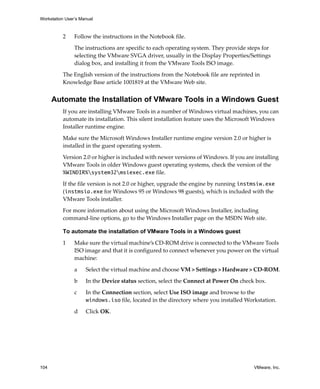
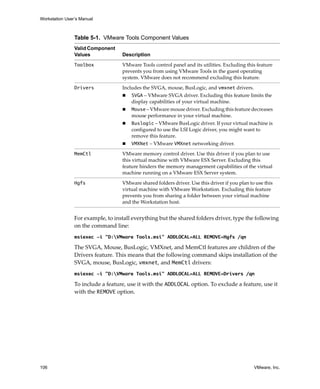
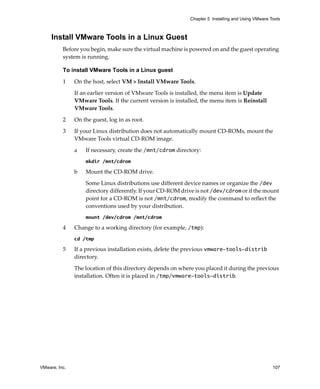
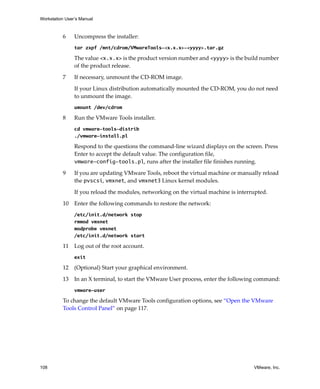
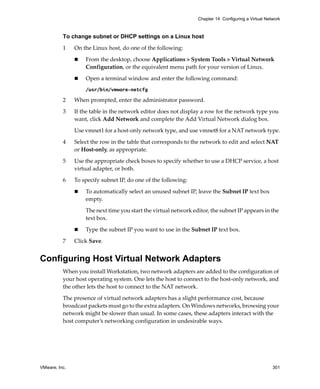
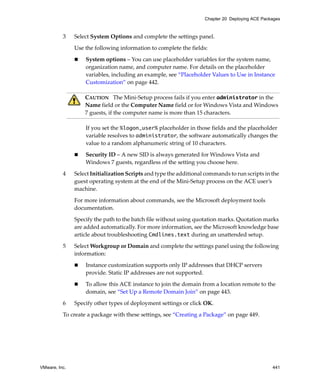
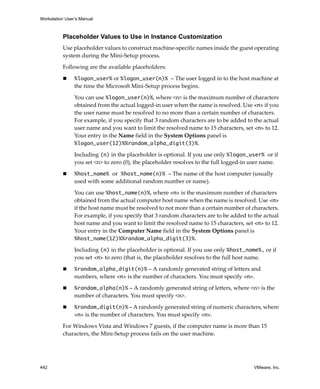
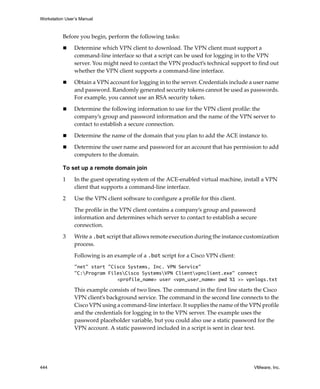
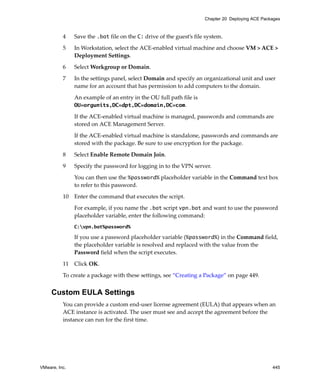
VMware Workstation 7.1
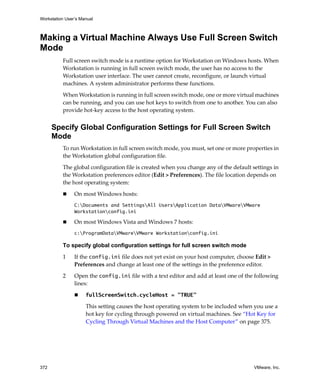
This document supports the version of each product listed and
supports all subsequent versions until the document is replaced
by a new edition. To check for more recent editions of this
document, see http://www.vmware.com/support/pubs.
EN-000358-00
VMware, Inc.
3401 Hillview Ave.
Palo Alto, CA 94304
www.vmware.com
2 VMware, Inc.
Workstation User’s Manual
You can find the most up-to-date technical documentation on the VMware Web site at:
http://www.vmware.com/support/
The VMware Web site also provides the latest product updates.
If you have comments about this documentation, submit your feedback to:
docfeedback@vmware.com 
Copyright © 1998–2010 VMware, Inc. All rights reserved. This product is protected by U.S. and
international copyright and intellectual property laws. VMware products are covered by one or more
patents listed at http://www.vmware.com/go/patents.
VMware is a registered trademark or trademark of VMware, Inc. in the United States and/or other
jurisdictions. All other marks and names mentioned herein may be trademarks of their respective
companies.
VMware, Inc. 3
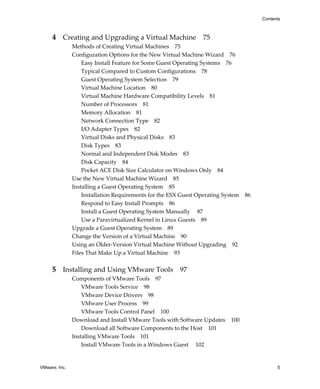
Contents
About This Book 19
1 Introduction and System Requirements 21
Product Benefits 21
Overview of This Manual 22
Host System Requirements 23
PC Hardware 23
Memory 23
Display 24
Disk Drives 25
Local Area Networking 25
Host Operating System 25
Virtual Machine Specifications 26
Processor 26
Chip Set 26
BIOS 26
Memory 26
Graphics 27
IDE Drives 27
SCSI Devices 27
Floppy Drives 27
Serial (COM) Ports 27
Parallel (LPT) Ports 28
USB Ports 28
Keyboard 28
Mouse and Drawing Tablets 28
Ethernet Card 28
Sound 28
Virtual Networking 29
Supported Guest Operating Systems 29
Support for 64‐Bit Guest Operating Systems 29
Workstation User’s Manual
4 VMware, Inc.
2 Installing and Upgrading VMware Workstation 31
Installation Prerequisites 31
Sharing a Workstation Host with Other VMware Products 32
Install Workstation on a Windows Host 33
Install Workstation Silently 35
Uninstall Workstation from a Windows Host 37
Install Workstation on a Linux Host 37
Using Command‐Line Installation Options 39
Uninstall Workstation from a Linux Host 40
Preparing for an Upgrade 40
Upgrade Workstation on a Windows Host 41
Upgrading to a Windows Vista and Windows 7 Host 42
Upgrade Workstation on a Linux Host 44
3 Learning Workstation Basics 47
Start Workstation on a Windows Host 47
Start Workstation on a Linux Host 48
Overview of the Workstation Window 48
Home Page and Views 50
Toolbar Buttons 53
View the Sidebar 56
Favorites List in the Sidebar 57
Check for Product Updates 59
Quickly Create a Virtual Machine and Install an Operating System 60
Introduction to Workstation Preferences 61
Introduction to Virtual Machine Settings  63
Hardware Tab 64
Options Tab 65
Closing Virtual Machines and Exiting Workstation 66
Set a Virtual Machine to Run in the Background 66
Keyboard Shortcuts  67
Change the Hot‐Key Combination 68
Gathering Information for VMware Technical Support 69
Register and Create a Support Request 69
Gather Debugging Information for a Virtual Machine 70
Running the Support Script 71
VMware, Inc. 5
Contents
4 Creating and Upgrading a Virtual Machine 75
Methods of Creating Virtual Machines 75
Configuration Options for the New Virtual Machine Wizard 76
Easy Install Feature for Some Guest Operating Systems 76
Typical Compared to Custom Configurations 78
Guest Operating System Selection 79
Virtual Machine Location 80
Virtual Machine Hardware Compatibility Levels 81
Number of Processors 81
Memory Allocation 81
Network Connection Type 82
I/O Adapter Types 82
Virtual Disks and Physical Disks 83
Disk Types 83
Normal and Independent Disk Modes 83
Disk Capacity 84
Pocket ACE Disk Size Calculator on Windows Only 84
Use the New Virtual Machine Wizard 85
Installing a Guest Operating System 85
Installation Requirements for the ESX Guest Operating System 86
Respond to Easy Install Prompts 86
Install a Guest Operating System Manually  87
Use a Paravirtualized Kernel in Linux Guests 89
Upgrade a Guest Operating System 89
Change the Version of a Virtual Machine 90
Using an Older‐Version Virtual Machine Without Upgrading 92
Files That Make Up a Virtual Machine 93
5 Installing and Using VMware Tools 97
Components of VMware Tools 97
VMware Tools Service 98
VMware Device Drivers 98
VMware User Process 99
VMware Tools Control Panel 100
Download and Install VMware Tools with Software Updates 100
Download all Software Components to the Host 101
Installing VMware Tools 101
Install VMware Tools in a Windows Guest  102
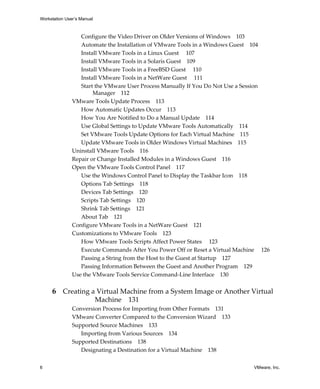
Workstation User’s Manual
6 VMware, Inc.
Configure the Video Driver on Older Versions of Windows 103
Automate the Installation of VMware Tools in a Windows Guest 104
Install VMware Tools in a Linux Guest 107
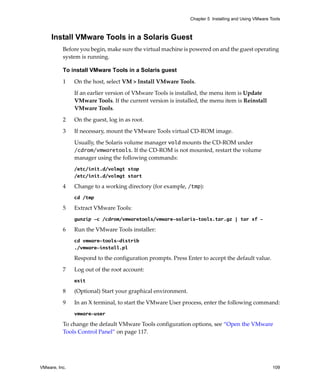
Install VMware Tools in a Solaris Guest 109
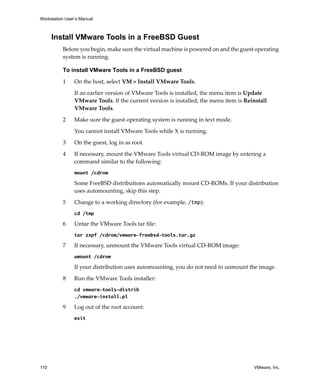
Install VMware Tools in a FreeBSD Guest 110
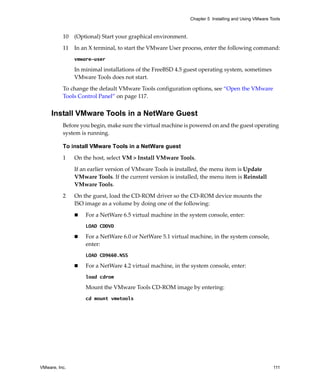
Install VMware Tools in a NetWare Guest 111
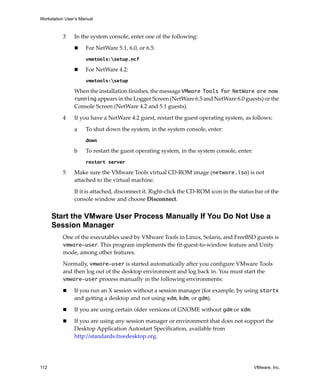
Start the VMware User Process Manually If You Do Not Use a Session 
Manager 112
VMware Tools Update Process 113
How Automatic Updates Occur 113
How You Are Notified to Do a Manual Update 114
Use Global Settings to Update VMware Tools Automatically 114
Set VMware Tools Update Options for Each Virtual Machine 115
Update VMware Tools in Older Windows Virtual Machines 115
Uninstall VMware Tools 116
Repair or Change Installed Modules in a Windows Guest 116
Open the VMware Tools Control Panel 117
Use the Windows Control Panel to Display the Taskbar Icon 118
Options Tab Settings 118
Devices Tab Settings 120
Scripts Tab Settings 120
Shrink Tab Settings 121
About Tab 121
Configure VMware Tools in a NetWare Guest 121
Customizations to VMware Tools 123
How VMware Tools Scripts Affect Power States  123
Execute Commands After You Power Off or Reset a Virtual Machine  126
Passing a String from the Host to the Guest at Startup 127
Passing Information Between the Guest and Another Program 129
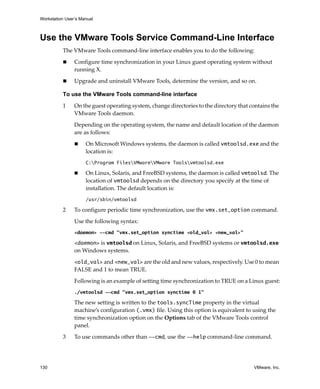
Use the VMware Tools Service Command‐Line Interface 130
6 Creating a Virtual Machine from a System Image or Another Virtual 
Machine 131
Conversion Process for Importing from Other Formats 131
VMware Converter Compared to the Conversion Wizard 133
Supported Source Machines 133
Importing from Various Sources 134
Supported Destinations 138
Designating a Destination for a Virtual Machine 138
VMware, Inc. 7
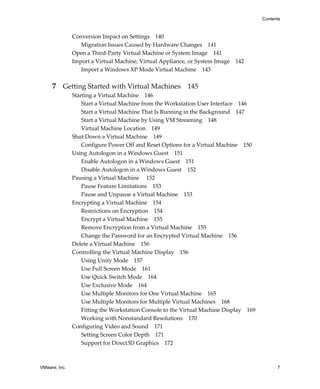
Contents
Conversion Impact on Settings 140
Migration Issues Caused by Hardware Changes 141
Open a Third‐Party Virtual Machine or System Image 141
Import a Virtual Machine, Virtual Appliance, or System Image 142
Import a Windows XP Mode Virtual Machine 143
7 Getting Started with Virtual Machines 145
Starting a Virtual Machine 146
Start a Virtual Machine from the Workstation User Interface 146
Start a Virtual Machine That Is Running in the Background 147
Start a Virtual Machine by Using VM Streaming 148
Virtual Machine Location 149
Shut Down a Virtual Machine 149
Configure Power Off and Reset Options for a Virtual Machine 150
Using Autologon in a Windows Guest 151
Enable Autologon in a Windows Guest 151
Disable Autologon in a Windows Guest 152
Pausing a Virtual Machine  152
Pause Feature Limitations 153
Pause and Unpause a Virtual Machine 153
Encrypting a Virtual Machine 154
Restrictions on Encryption 154
Encrypt a Virtual Machine 155
Remove Encryption from a Virtual Machine 155
Change the Password for an Encrypted Virtual Machine 156
Delete a Virtual Machine 156
Controlling the Virtual Machine Display 156
Using Unity Mode 157
Use Full Screen Mode 161
Use Quick Switch Mode 164
Use Exclusive Mode 164
Use Multiple Monitors for One Virtual Machine 165
Use Multiple Monitors for Multiple Virtual Machines 168
Fitting the Workstation Console to the Virtual Machine Display 169
Working with Nonstandard Resolutions 170
Configuring Video and Sound 171
Setting Screen Color Depth 171
Support for Direct3D Graphics 172
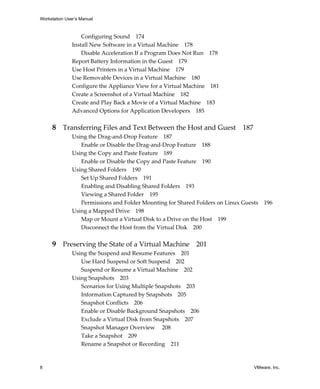
Workstation User’s Manual
8 VMware, Inc.
Configuring Sound 174
Install New Software in a Virtual Machine 178
Disable Acceleration If a Program Does Not Run 178
Report Battery Information in the Guest 179
Use Host Printers in a Virtual Machine 179
Use Removable Devices in a Virtual Machine 180
Configure the Appliance View for a Virtual Machine 181
Create a Screenshot of a Virtual Machine 182
Create and Play Back a Movie of a Virtual Machine 183
Advanced Options for Application Developers 185
8 Transferring Files and Text Between the Host and Guest 187
Using the Drag‐and‐Drop Feature 187
Enable or Disable the Drag‐and‐Drop Feature 188
Using the Copy and Paste Feature 189
Enable or Disable the Copy and Paste Feature 190
Using Shared Folders 190
Set Up Shared Folders 191
Enabling and Disabling Shared Folders 193
Viewing a Shared Folder 195
Permissions and Folder Mounting for Shared Folders on Linux Guests 196
Using a Mapped Drive 198
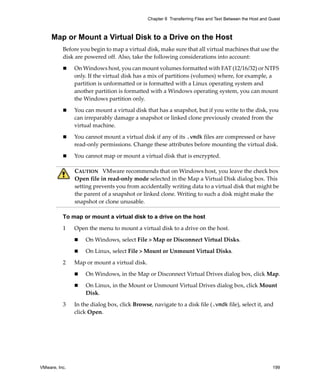
Map or Mount a Virtual Disk to a Drive on the Host 199
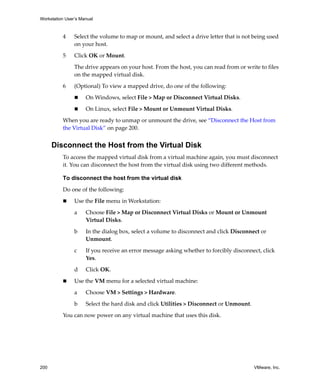
Disconnect the Host from the Virtual Disk 200
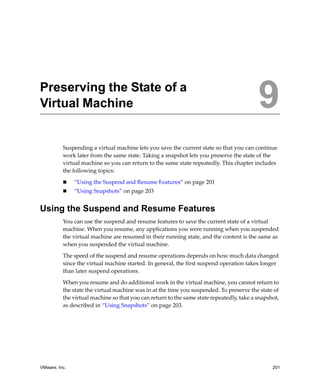
9 Preserving the State of a Virtual Machine 201
Using the Suspend and Resume Features 201
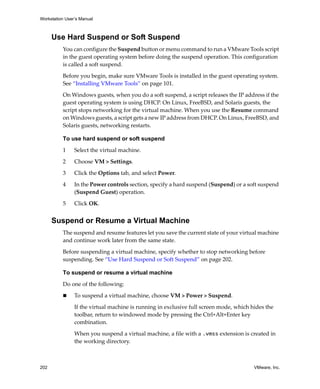
Use Hard Suspend or Soft Suspend 202
Suspend or Resume a Virtual Machine 202
Using Snapshots 203
Scenarios for Using Multiple Snapshots 203
Information Captured by Snapshots 205
Snapshot Conflicts 206
Enable or Disable Background Snapshots 206
Exclude a Virtual Disk from Snapshots 207
Snapshot Manager Overview 208
Take a Snapshot 209
Rename a Snapshot or Recording 211
VMware, Inc. 9
Contents
Restore an Earlier State from a Snapshot 211
Delete a Snapshot or a Recording 212
Take or Revert to a Snapshot at Power Off 213
Using AutoProtect Snapshots 214
Snapshots and Workstation 4 Virtual Machines 215
10 Cloning, Moving, and Sharing Virtual Machines 217
The Virtual Machine’s Universal Unique Identifier 217
UUID Options When You Move a Virtual Machine 218
Specify a UUID for a Virtual Machine 218
Cloning a Virtual Machine 219
Types of Clones 220
Creating Clones 221
Moving a Virtual Machine 223
Hosts with Different Hardware 223
Move a Virtual Machine to a New Location or a New Host 224
Moving an Older Virtual Machine 225
Moving Linked Clones 226
Sharing Virtual Machines with Other Users 226
Using VNC for Remote Connections to a Virtual Machine 227
Configure a Virtual Machine as a VNC Server 227
Use a VNC Client to Connect to a Virtual Machine 228
Make Virtual Machines Available for Streaming from a Web Server 229
Sharing Virtual Machines with VMware Player 230
Start and Exit VMware Player 231
Setting Up Virtual Machines for Use with VMware Player 232
11 Using Disks and Disk Drives 235
Virtual Machine Disk Storage 235
Benefits of Using Virtual Disks 236
Physical Disks 238
Virtual Disk Maintenance Tasks 238
Defragment Virtual Disks 239
Compact a Virtual Disk 240
Expand a Virtual Disk 240
Adding Virtual and Physical Disks to a Virtual Machine 241
Add a New Virtual Disk to a Virtual Machine 242
Add an Existing Virtual Disk to a Virtual Machine 243
Workstation User’s Manual
10 VMware, Inc.
Remove a Virtual Disk from a Virtual Machine 243
Using Physical Disks in a Virtual Machine  244
Adding DVD/CD‐ROM and Floppy Drives to a Virtual Machine 250
Add DVD or CD Drives to a Virtual Machine 250
Add a Floppy Drive to a Virtual Machine 252
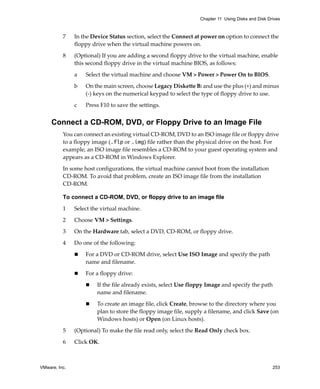
Connect a CD‐ROM, DVD, or Floppy Drive to an Image File 253
Using VMware Virtual Disk Manager 254
Using Dual‐Boot Computers with Virtual Machines 254
Legacy Virtual Disks 255
12 Recording and Replaying Virtual Machine Activity  257
Using the Record/Replay Feature 257
Hardware, Operating System, and Virtual Machine Requirements 258
Configure Record/Replay for a Virtual Machine 259
Options of the Record Control Dialog Box 261
Options of the Replay Control Dialog Box 262
Create a Recording 264
Replay a Recording 265
Browse a Recording 266
Using Trace File of a Recording 267
Enable Tracing for a Recording 267
Create a Trace File of a Recording 268
Managing Recordings 268
Delete a Recording 269
Disable Periodic Screenshots 269
13 Configuring Teams 271
Benefits of Using Teams 271
Managing Teams 272
Create a Team 272
Open a Team and Add It to the Favorites List 273
Rename a Team 274
Power Off or Close a Team 274
Delete a Team 275
Summary and Console Views for Teams and Their Virtual Machines 276
Managing the Members of a Team 276
Add a Virtual Machine to a Team 277
Remove a Virtual Machine from a Team 277
VMware, Inc. 11
Contents
Specify the Startup Sequence for a Team 278
Power Operations for Teams and Their Members 279
Power On a Team 279
Suspend or Resume a Team 279
Perform Power Operations on One Team Member 280
Working with Team Networks 280
LAN Segment Requirements Regarding IP Addresses 280
Create a Team LAN Segment 281
Configure LAN Segments 281
Add or Remove Network Adapters 282
Delete a LAN Segment 283
Cloning and Taking Snapshots of Team Virtual Machines 283
14 Configuring a Virtual Network 285
Components of the Virtual Network 285
Virtual Switch 285
DHCP Server 286
Network Adapter 286
Common Networking Configurations 286
Bridged Networking 287
Network Address Translation (NAT) 289
Host‐Only Networking 290
Example of a Custom Networking Configuration 291
Set Up a Custom Networking Configuration 292
Changing a Networking Configuration 295
Find the Network Type of a Virtual Machine 295
Add Virtual Network Adapters 295
Modify Existing Virtual Network Adapters 296
Configuring Bridged Networking 297
Configure VMnet0 Automatic Bridged Networking on a Windows Host 297
Configure vmnet0 Automatic Bridged Networking on a Linux Host 298
Setting Up a Second Automatic Bridged Network Interface 299
Changing the Subnet or DHCP Settings for a Virtual Network 299
Change Subnet or DHCP Settings on a Windows Host 300
Change Subnet or DHCP Settings on a Linux Host 300
Configuring Host Virtual Network Adapters 301
Connect or Disconnect a Host Virtual Network Adapter 301
Setting Up Two Separate Host‐Only Networks 302
Workstation User’s Manual
12 VMware, Inc.
15 Advanced Virtual Networking 303
Selecting IP Addresses on a Host‐Only Network or NAT Configuration 304
How the Subnet Number Is Assigned 304
Determining Whether to Use DHCP or Statically Assign Addresses 305
DHCP Conventions for Assigning IP Addresses 305
Configure the DHCP Server on a Windows Host 306
Configure the DHCP Server on a Linux Host 306
Avoiding IP Packet Leakage in a Host‐Only Network 306
Disable Packet Forwarding on Windows Hosts 307
Disable Packet Forwarding on Linux Hosts 308
Maintaining and Changing the MAC Address of a Virtual Machine 308
Avoiding MAC Address Changes 308
Assign the Same MAC Address to Any Virtual Machine Manually 309
Controlling Routing Information for a Host‐Only Network on Linux 310
Potential Issues with Host‐Only Networking on Linux 311
DHCPD on the Linux Host Does Not Work After Installing Workstation 311
DHCP and DDNS 312
Configuring Host‐Only Virtual Machines 312
Set Up Using Configuration 1 or 2 313
Set Up Using Configuration 3 313
Complete Configuring the Virtual Network Adapters 314
Set Up Routing Between Two Host‐Only Networks 314
Using Virtual Network Adapters in Promiscuous Mode on a Linux Host 316
Using NAT 317
How the NAT Device Uses the VMnet8 Virtual Switch 317
DHCP on the NAT Network 318
DNS on the NAT Network 318
External Access from the NAT Network 319
Advanced NAT Configuration 320
Configure NAT on a Windows Host 320
Custom NAT and DHCP Configuration on a Windows Host 320
Specifying Connections from Ports Below 1024 321
Configuring NAT on a Linux Host 322
Considerations for Using NAT 324
Using NAT with NetLogon 325
Sample Linux nat.conf File 327
Using Samba with Workstation 329
Add Users to the Samba Password File 329
VMware, Inc. 13
Contents
Using a Samba Server for Bridged and Host‐Only Networks 330
Use Samba Without Network Access 330
16 Connecting Devices 331
Using Parallel Ports 331
Add a Virtual Parallel Port to a Virtual Machine 332
Troubleshoot ECR Errors for Parallel Ports 332
Configuring a Parallel Port on a Linux Host 333
Using Serial Ports 335
Add a Virtual Serial Port to a Virtual Machine 335
Change the Input Speed of the Serial Connection 337
Debugging over a Virtual Serial Port 338
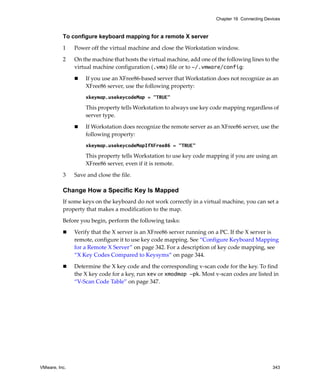
Configuring Keyboard Features 339
Use the Enhanced Virtual Keyboard for Windows Hosts 339
Hot Keys for Virtual Machines 340
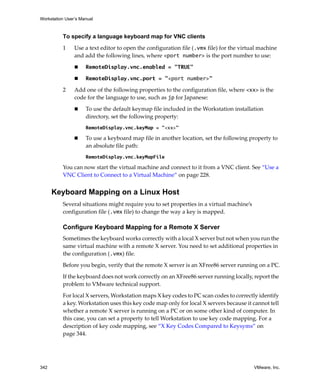
Specify a Language Keyboard Map for VNC Clients 341
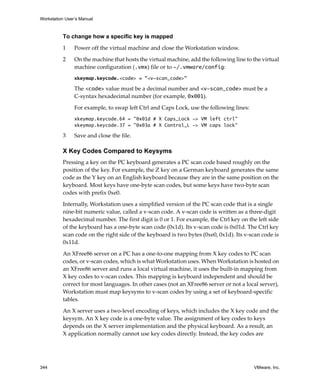
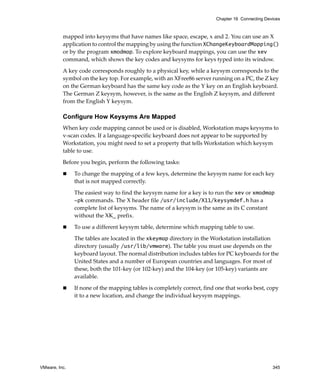
Keyboard Mapping on a Linux Host 342
Using USB Devices in a Virtual Machine 351
Enable the USB 2.0 Controller for a Virtual Machine 352
Add a USB Controller to a Virtual Machine 352
Connecting USB Devices 353
USB Driver Installation on a Windows Host 355
Access and Use a USB Device on a Linux Host 356
How Device Control Is Shared Between Host and Guest 356
Disconnecting USB Devices from a Virtual Machine 357
Use Smart Cards with Virtual Machines 358
Switch to Using the Virtual Smart Card Reader on Linux Hosts 360
Disable Smart Card Sharing 360
Support for Generic SCSI Devices 361
Installing Required Adapters or Drivers for Some Windows Guests 362
Avoiding Concurrent Access on Linux Hosts 363
Add a Generic SCSI Device to a Virtual Machine 363
Troubleshoot Problems Detecting Generic SCSI Devices 364
Use Eight‐Way Virtual Symmetric Multiprocessing 366
Use a Virtual Machine That Originally Had More Than Eight Virtual 
Processors 367
Workstation User’s Manual
14 VMware, Inc.
17 Special‐Purpose Configuration Options for Windows Hosts 369
Restricting the User Interface 369
Enable the Restricted User Interface 370
Restrict the User Interface and Return to a Snapshot 370
Disable the Restricted User Interface 371
Making a Virtual Machine Always Use Full Screen Switch Mode 372
Specify Global Configuration Settings for Full Screen Switch Mode 372
Virtual Key Codes 373
Hot Key for Cycling Through Virtual Machines and the Host Computer 375
Hot Keys for Switching Directly to Virtual Machines and the Host 
Computer 375
Other Entries in the Global Configuration File 376
Using vmware‐fullscreen to Run a Virtual Machine 377
Guest ACPI S1 Sleep  380
18 Learning the Basics of VMware ACE 381
Benefits of Using VMware ACE  381
Key Features of VMware ACE 382
VMware ACE Terminology 383
Network and Disk Space Requirements for the Administrative Workstation 384
Overview of Creating and Deploying ACE Packages 385
Overview of the ACE User Interface 386
Troubleshooting Users’ Problems 387
19 Setting and Using Policies and Customizing VMware Player 389
Benefits of Using Policies 390
Set Policies for ACE Instances 390
Setting Access Control Policies 391
Create or Edit an Access Control Policy 392
Activation Settings 392
Authentication Settings 393
Using an Authentication Script 394
Include a Power‐On and Power‐Off Script in the Package 394
Set a Recovery Key for Encrypted ACE Instances 396
Set Activation Limit 396
Active Directory Password Change Proxying 397
Setting Host to Guest Data Script Policies 397
Specify a Script and a Command to Run It 398
VMware, Inc. 15
Contents
Setting Expiration Policies 399
Setting Copy Protection Policies 400
Setting Resource Signing Policies 401
Setting Network Access Policies 402
Before You Begin Setting Host Policies 402
Use the Network Access Wizard to Configure Network Access 403
Guidelines for Specifying Zone Conditions 404
Using the Ruleset Editor to Configure Host and Guest Access 407
Change NAT Settings 409
Configure Which Physical Network Adapter to Use 410
Understanding the Interaction of Host and Guest Access Filters with Tunneling 
Protocols 411
Updating a Network Access Policy 411
Setting Removable Devices Policies 411
Setting USB Device Policies 412
Access Levels for USB Devices 412
Set an Access Policy for USB Devices 413
Setting Virtual Printer Policies 414
Setting Runtime Preferences Policies 415
Runtime Preferences Settings 415
Enhanced Virtual Keyboard Settings 416
Exit Behavior Settings 416
Pocket ACE Cache Settings 417
Setting Snapshot Policies 418
Setting Administrator Mode Policies 419
Use Administrator Mode on an ACE Instance 419
Setting Kiosk Mode Policies 420
Change the Key Combination for Exiting Kiosk Mode 420
Setting Hot‐Fix Policies for Standalone ACE Instances 421
Setting the Policy Update Frequency for Managed ACE Instances 421
Control Which ACE Instances Run on a Host 422
Writing Plug‐In Policy Scripts 424
Examples of Policy Scripts 425
Customizing the VMware Player Interface on Windows Hosts Only 429
Create and Specify a Skin File 429
Customizing the VMware Player Icons 430
Customizing the Title Bar Text 430
Customizing the Removable Device Display 431
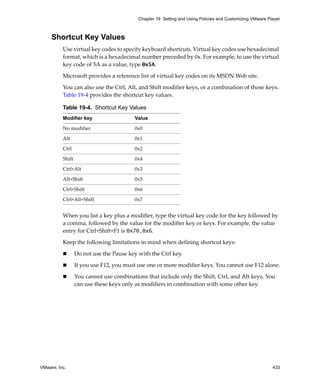
Shortcut Key Values 433
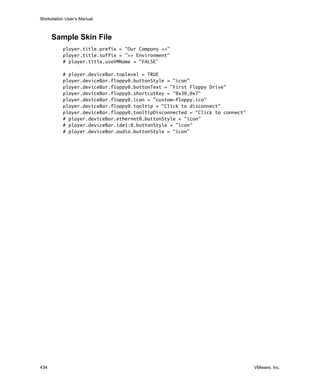
Sample Skin File 434
Workstation User’s Manual
16 VMware, Inc.
20 Deploying ACE Packages 435
Edit Deployment Settings 435
Encryption Settings 436
Package Lifetime Settings 436
Instance Customization on Windows Guests Only 437
Custom EULA Settings 445
Deployment Platform Settings 446
ACE Resources Directory 446
Review the Configuration of an ACE‐Enabled Virtual Machine  447
Use Preview Mode to Test Policy and Deployment Settings 448
Creating a Package 449
Overview of Package Creation and Validation 450
Turn Off the VMware Tools Check for Test Deployments 451
Prerequisites for Using the Packaging Wizards 452
Use the New Package Wizard 453
View Package Properties and Add Notes 454
Perform an End‐to‐End Deployment Test 455
Deploy Packages 456
21 Pocket ACE 457
Use Cases for Pocket ACE 458
Portable Device Requirements 459
Policies and Deployment Settings for Pocket ACE 460
Create a Pocket ACE Package 460
Deploying the ACE Package on a Portable Device 461
Use the Graphical Utility to Deploy Pocket ACE Packages 461
Use the Command‐Line Utility to Deploy Pocket ACE Packages 462
Run the Pocket ACE Instance 463
22 Installing ACE Packages 465
Installing an ACE Package on a Windows Host 465
Install an ACE Instance on a Single Windows Host 466
Installing an ACE Package Silently on Multiple Windows Hosts 466
Uninstall VMware Player or an ACE Instance from a Windows Host 468
Installing an ACE Package on a Linux Host 469
Manually Install VMware Player on a Linux Host 469
Install the ACE Instance on a Single Linux Host 470
Install an ACE Package Silently on Multiple Linux Hosts 471
VMware, Inc. 17
Contents
Prepare a Linux Host for Running in Kiosk Mode 472
Uninstall VMware Player or an ACE Instance from a Linux Host 473
Upgrading ACE Instances to ACE 2.7 473
Start and Use an ACE Instance 474
Change Default Kiosk Mode Startup Behavior 475
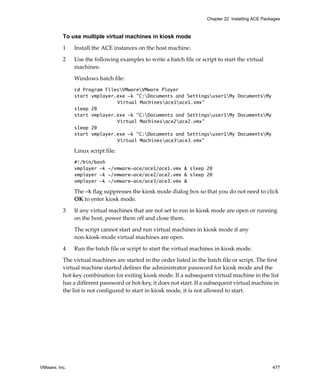
Use Multiple Virtual Machines in Kiosk Mode 476
Install an ACE Client License 478
Change the ACE Client License 478
Quit VMware Player 479
Troubleshooting Tools 479
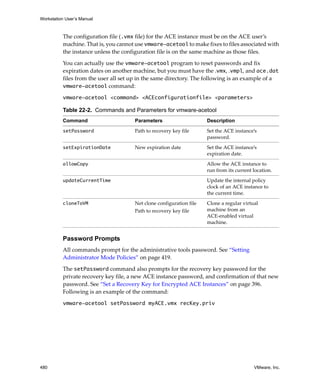
Using the vmware‐acetool Command‐Line Tool 479
Respond to Hot Fix Requests 481
Troubleshooting Setup Issues 482
Appendix: Workstation Command‐Line Reference 485
Startup Options for Workstation and Virtual Machines 485
Using Startup Options in a Windows Shortcut 487
Glossary 489
Index 497
Workstation User’s Manual
18 VMware, Inc.
VMware, Inc. 19
This manual, the Workstation User’s Manual, provides information about installing and 
using VMware®
 Workstation 7.1. With Workstation, you can convert an existing 
physical PC into a VMware virtual machine or create a new virtual machine. Each 
virtual machine represents a complete PC, including the processor, memory, network 
connections and peripheral ports. Use Workstation to do the following:
 Host legacy applications and overcome platform migration issues.
 Configure and test new software or patches in an isolated environment.
 Automate tasks for software development and testing.
 Demonstrate multi‐tier configurations on a single PC.
Intended Audience
This book is intended for anyone who needs to install, upgrade, or use VMware 
Workstation. Workstation users typically include people who do software development 
and testing or work with multiple operating systems or computing environments: 
software developers, QA engineers, trainers, salespeople who run demos, and anyone 
who wants to create virtual machines.
Document Feedback
VMware welcomes your suggestions for improving our documentation. If you have 
comments, send your feedback to docfeedback@vmware.com.
About This Book
Workstation User’s Manual
20 VMware, Inc.
Technical Support and Education Resources
The following sections describe the technical support resources available to you. To 
access the current version of this book and other books, go to 
http://www.vmware.com/support/pubs.
Online and Telephone Support
To use online support to submit technical support requests, view your product and 
contract information, and register your products, go to 
http://www.vmware.com/support.
Customers with appropriate support contracts should use telephone support for the 
fastest response on priority 1 issues. Go to 
http://www.vmware.com/support/phone_support.html.
Support Offerings
To find out how VMware support offerings can help meet your business needs, go to 
http://www.vmware.com/support/services.
VMware Professional Services
VMware Education Services courses offer extensive hands‐on labs, case study 
examples, and course materials designed to be used as on‐the‐job reference tools. 
Courses are available onsite, in the classroom, and live online. For onsite pilot 
programs and implementation best practices, VMware Consulting Services provides 
offerings to help you assess, plan, build, and manage your virtual environment. To 
access information about education classes, certification programs, and consulting 
services, go to http://www.vmware.com/services. 
VMware, Inc. 21
1
VMware Workstation is a desktop software that allows you to run multiple x86 and 
x64‐compatible desktop and server operating systems simultaneously on a single PC, 
in fully networked, portable virtual machines—with no rebooting or hard drive 
partitioning required. This chapter includes the following topics:
 “Product Benefits” on page 21
 “Overview of This Manual” on page 22
 “Host System Requirements” on page 23
 “Virtual Machine Specifications” on page 26
 “Supported Guest Operating Systems” on page 29
Product Benefits
Workstation is used in the software development, quality assurance, training, sales, and 
IT fields.
Workstation streamlines software development and testing:
 Develop and test multiple operating systems and applications on a single PC.
 Connect virtual machines to simulate and test multitier configurations.
 Use multiple snapshots and debugging support to facilitate testing.
 Archive test environments on file servers where they can be easily restored or 
shared.
Introduction and System
Requirements 1
Workstation User’s Manual
22 VMware, Inc.
Workstation enhances productivity of IT professionals:
 Configure and test desktops and servers as virtual machines before deploying 
them to production.
 Test new multitier applications, application updates, and operating system 
patches on a single PC.
 Host legacy applications within virtual machines, facilitating operating system 
migrations and eliminating the need to port legacy applications.
 Create a virtual library of end‐user configurations on a shared drive.
Workstation facilitates computer‐based training and software demos:
 Package and deploy classroom material in virtual machines.
 Allow students to experiment with multiple operating systems, applications, and 
tools in secure, isolated virtual machines.
 Configure virtual machines to undo all changes at shutdown.
 Demo complex or multitier configurations on a single laptop.
Overview of This Manual
If you are a veteran Workstation user, see the Workstation Release Notes for a list of 
new features. For upgrade instructions, see “Preparing for an Upgrade” on page 40.
If you are new to Workstation, the first chapters of this manual—through Chapter 7, 
“Getting Started with Virtual Machines,” on page 145—guide you through the key 
steps for installing the software and provide an introduction to using Workstation. 
Later chapters provide in‐depth information about the sophisticated features of 
Workstation. These chapters are intended for expert users.
Chapter 18, “Learning the Basics of VMware ACE,” on page 381 through Chapter 22, 
“Installing ACE Packages,” on page 465 describe how to use the ACE features included 
with the version of Workstation that runs on Windows hosts. VMware ACE authoring 
features enable you to package and deploy Pocket ACE and desktop virtual machines 
with encryption, restricted network access, and device control.
VMware, Inc. 23
Chapter 1 Introduction and System Requirements
Host System Requirements
Like physical computers, the virtual machines running under Workstation perform 
better if they have faster processors and more memory. 
The terms host and guest describe physical and virtual machines:
 Host – The physical computer on which you install the Workstation software is 
called the host computer, and its operating system is the host operating system.
 Guest – The operating system running inside a virtual machine is called a guest 
operating system.
For definitions of these and other special terms, see “Glossary” on page 489.
PC Hardware
 Standard x86‐compatible or x86‐64‐compatible personal computer.
 1.3GHz or faster CPU minimum.
Compatible processors include the following:
 Intel – Pentium 4, Pentium M (with PAE), Core, Core 2, Core i3, Core i5, and 
Core i7 processors
 AMD – Athlon, Athlon MP, Athlon XP, Athlon 64, Athlon X2, Duron, Opteron, 
Turion X2, Turion 64, Sempron, Phenom, and Phenom II
 Multiprocessor systems are supported.
 Support for 64‐bit guest operating systems is available with Intel VT compatible 
PC with Intel™
 Virtualization Technology feature turned on or most AMD64 
processors (except the earliest revision C Opteron processors).
For hardware requirements to support Windows 7 Aero graphics, see 
“Recommendations for Windows 7 Aero Graphics Support” on page 24.
Memory
You need enough memory to run the host operating system, plus the memory required 
for each guest operating system and for applications on the host and guest. The 
minimum memory requirement is 1GB, VMware recommends to have 2GB and above. 
For more information on memory requirements, see your guest operating system and 
application documentation.
Workstation User’s Manual
24 VMware, Inc.
The total amount of memory you can assign to all virtual machines running on a single 
host is limited only by the amount of RAM on the host. The maximum amount of 
memory for each virtual machine on 32‐bit hosts is 8GB and on 64‐bit hosts is 32GB. 
Workstation does not allow powering on virtual machines that are configured to use 
more than 8GB of memory on 32‐bit hosts. Memory management limitations on 32‐bit 
operating systems cause virtual machine memory to overcommit, which severely 
affects system performance.
For memory requirements to support Windows 7 Aero graphics, see 
“Recommendations for Windows 7 Aero Graphics Support” on page 24.
Display
16‐bit or 32‐bit display adapter is recommended. For display requirements to support 
Windows 7 Aero graphics, see “Recommendations for Windows 7 Aero Graphics 
Support” on page 24.
3D benchmarks, such as 3DMark ʹ06, might not render correctly or at all when running 
Windows Vista or Windows 7 virtual machines on some graphics hardware.
Recommendations for Windows 7 Aero Graphics Support
To support Windows 7 Aero graphics, VMware recommends the following 
configuration:
 CPU
 Intel Dual Core, 2.2GHz and above
 AMD Athlon 4200+ and above
 Host GCPU
 nVidia GeForce 8800GT and above
 ATI Radeon HD 2600 and above
 Memory – At least 3GB of host system memory, 1GB of memory allocated to the 
guest operating system, and 256MB graphics memory.
NOTE   Use the latest graphics driver recommended for your host.
VMware, Inc. 25
Chapter 1 Introduction and System Requirements
Disk Drives
Guest operating systems can reside on physical disk partitions or in virtual disk files.
Hard Disks
 IDE and SCSI hard drives are supported.
 VMware recommends at least 1GB free disk space for each guest operating system 
and the application software used with it. If you use a default setup, the actual disk 
space needs are approximately the same as those for installing and running the 
guest operating system and applications on a physical computer.
 200MB (Linux) or 1.5GB (Windows) free disk space is required for basic 
installation. Delete the installer afterwards to reclaim disk space.
Optical CD-ROM/DVD-ROM Drives
 IDE and SCSI optical drives are supported.
 CD‐ROM and DVD‐ROM drives are supported.
 ISO disk image files are supported.
Floppy Drives
Virtual machines can connect to the host’s disk drives. Floppy disk image files are also 
supported.
Local Area Networking
 You can use any Ethernet controller that the host operating system supports.
 Non‐Ethernet networks are supported by using built‐in network address 
translation (NAT) or using a combination of host‐only networking plus routing 
software on the host operating system.
Host Operating System
VMware Workstation is available for Windows and Linux host operating systems. 
VMware ACE features are included only in the version of Workstation that runs on 
Windows hosts. 
For host operating system support and known issues, go to the VMware Web site, and 
click the Support & Downloads tab. Under Support Resources, click the Compatibility 
Guides link.
Workstation User’s Manual
26 VMware, Inc.
Virtual Machine Specifications
The following sections describe the devices that Workstation virtual machines support. 
Processor
 Same processor as that on host computer.
 One virtual processor on a host with one or more logical processors.
 Up to eight virtual processors (eight‐way virtual symmetric multiprocessing, or 
Virtual SMP) on a host with at least two logical processors. 
The following are considered to have two logical processors:
 A multiprocessor host with two or more physical CPUs.
 A single‐processor host with a multicore CPU.
 A single‐processor host with hyperthreading enabled.
See “Use Eight‐Way Virtual Symmetric Multiprocessing” on page 366.
Chip Set
 Intel 440BX‐based motherboard 
 NS338 SIO
 82093AA IOAPIC
BIOS
Phoenix BIOS 4.0 Release 6 with VESA BIOS 
Memory
The total amount of memory you can assign to all virtual machines running on a single 
host is limited only by the amount of RAM on the host. 
The maximum amount of memory for each virtual machine on 32‐bit hosts is 8GB and 
on 64‐bit hosts is 32GB. Workstation does not allow powering on virtual machines that 
are configured to use more than 8GB of memory on 32‐bit hosts. Memory management 
limitations on 32‐bit operating systems cause virtual machine memory to overcommit, 
which severely affects system performance.
VMware, Inc. 27
Chapter 1 Introduction and System Requirements
Graphics
VGA and SVGA are supported.
IDE Drives
 Up to four devices – Disks, CD‐ROM or DVD‐ROM (DVD drives can be used to 
read data DVD‐ROM discs; DVD video is not supported).
 Hard disks can be virtual disks or physical disks.
 IDE virtual disks up to 2TB.
 CD‐ROM can be a physical device or an ISO image file.
SCSI Devices
 Up to 60 devices.
 SCSI virtual disks up to 2TB.
 Hard disks can be virtual disks or physical disks.
 Generic SCSI support allows devices to be used without need for drivers in the 
host operating system. Works with scanners, CD‐ROM, DVD‐ROM, tape drives 
and other SCSI devices.
 LSI Logic LSI53C10xx Ultra320 SCSI I/O controller.
 Mylex (BusLogic) BT‐958 compatible host bus adapter (requires add‐on driver 
from VMware for Windows XP and Windows Server 2003).
Floppy Drives
 Up to two 2.88MB floppy devices.
 Physical drives or floppy image files.
Serial (COM) Ports
 Up to four serial (COM) ports.
 Output to serial ports, Windows or Linux files, or named pipes.
Workstation User’s Manual
28 VMware, Inc.
Parallel (LPT) Ports
 Up to three bidirectional parallel (LPT) ports.
 Output to parallel ports or host operating system files.
USB Ports
 USB 1.1 UHCI (Universal Host Controller Interface) controller.
 USB 2.0 EHCI (Enhanced Host Controller Interface) controller. (Use the virtual 
machine settings editor to enable USB 2.0 support. See “Enable the USB 2.0 
Controller for a Virtual Machine” on page 352.)
 Supports most devices, including USB printers, scanners, PDAs, hard disk drives, 
memory card readers, and digital cameras, as well as streaming devices such as 
webcams, speakers, and microphones.
Keyboard
104‐key Windows 95/98 enhanced. 
Mouse and Drawing Tablets
 PS/2 and USB mouse. 
 Serial tablets supported.
 USB tablets supported.
Ethernet Card
 Up to 10 virtual Ethernet cards. 
 AMD PCnet‐PCI II compatible.
 For 64‐bit guests: Intel Pro/1000 MT Server Adapter compatible.
Sound
 Sound output and input.
 Emulates Creative Labs Sound Blaster AudioPCI. (Does not support MIDI input or 
game port controller/joysticks.) 
VMware, Inc. 29
Chapter 1 Introduction and System Requirements
Virtual Networking
 Support for 10 virtual Ethernet switches on Microsoft Windows host operating 
systems. Support for 255 virtual Ethernet switches on Linux hosts. Three switches 
are configured by default for bridged, host‐only, and NAT networking.
 Support for most Ethernet‐based protocols, including TCP/IP, NetBEUI, Microsoft 
Networking, Samba, Novell NetWare, and Network File System.
 Built‐in NAT supports client software using TCP/IP, FTP, DNS, HTTP, and Telnet, 
including VPN support for PPTP over NAT.
Supported Guest Operating Systems
VMware Workstation supports Windows, Linux, and other commonly used guest 
operating systems. For guest operating system support and known issues, go to the 
VMware Web site, and click the Support & Downloads tab. Under Support Resources, 
click the Compatibility Guides link.
The VMware Guest Operating System Installation Guide provides notes on installing the 
most common guest operating systems.
Support for 64-Bit Guest Operating Systems
Workstation supports virtual machines with 64‐bit guest operating systems only on 
host machines that have one of the supported 64‐bit processors. When you power on a 
virtual machine with a 64‐bit guest operating system, Workstation performs an internal 
check. If the host CPU is not a supported 64‐bit processor, you cannot power on the 
virtual machine.
Workstation supports virtual machines with 64‐bit guest operating systems, running 
on host machines with the following processors:
 Most AMD64 processors (except the earliest revision C Opteron processors)
 Intel Pentium 4 and Core 2, and Core i7 processors with EM64T and Intel 
Virtualization Technology
VMware also provides a standalone utility that you can use without Workstation to 
perform the same check and determine whether your CPU is supported for 
Workstation virtual machines with 64‐bit guest operating systems. Download the 64‐bit 
processor check utility from the downloads area of the VMware Web site. 
A virtual machine created in Workstation version 5.5 and later with a 64‐bit operating 
system cannot be powered on or resumed in Workstation versions 5.0 and earlier. 
Workstation User’s Manual
30 VMware, Inc.
VMware, Inc. 31
2
This chapter discusses how to install Workstation on your Linux or Windows host. 
This chapter contains the following topics:
 “Installation Prerequisites” on page 31
 “Sharing a Workstation Host with Other VMware Products” on page 32
 “Install Workstation on a Windows Host” on page 33
 “Install Workstation on a Linux Host” on page 37
 “Preparing for an Upgrade” on page 40
 “Upgrade Workstation on a Windows Host” on page 41
 “Upgrade Workstation on a Linux Host” on page 44
Installation Prerequisites
Installing VMware Workstation is usually a simple process of running a standard 
installation wizard. 
Before you run the installation program, be sure you have the following:
 A compatible host – Verify that the computer and host operating system meet the 
system requirements for running Workstation. See “Host System Requirements” 
on page 23.
 Workstation installation software – If you have the packaged distribution of 
Workstation, the installation software is on the installation media in your package. 
If you have the electronic distribution, the installation software is in the file you 
downloaded.
Workstation is available for Windows and Linux host computers. The installation 
files for both host platforms are included in the packaged distribution.
Installing and Upgrading
VMware Workstation 2
Workstation User’s Manual
32 VMware, Inc.
 Workstation or VMware ACE license key – Your license key is on the registration 
card in your package. If you purchased Workstation or VMware ACE online, the 
license key is sent by email.
You can use the Workstation 7.0 and later license key on the Windows and Linux 
versions. You need one license for every host system.
To purchase a license on the VMware Web site, select the Enter License Key option 
under the Help menu and follow the instructions in the VMware Workstation 
Activation dialog box. You can also obtain an evaluation license at no charge for a 
30‐day evaluation of the software. If you obtain an evaluation license, you can view 
the status of your license from the VMware Workstation Activation dialog box. For 
more information, go to the VMware Web site. 
If you did not enter the Workstation license key at installation time, select the Enter 
License Key option under the Help menu. If you have an invalid license, you are 
prompted to enter a valid license key every time you try to power on a virtual 
machine.
 A guest operating system – After Workstation is installed, you need the operating 
system installation CDs, DVDs, or ISO image files to set up a guest in a virtual 
machine.
 (Optional) Eclipse or Microsoft Visual Studio – To install the Integrated Virtual 
Debugger for Eclipse or Visual Studio plug‐ins included with Workstation, Eclipse 
or Visual Studio must be installed on the host before you run the Workstation 
installer. If you install one or both of these programs after you install Workstation, 
run the Workstation installer again and select the Modify option to install the 
plug‐ins at that time.
For more information about supported versions of Visual Studio and Eclipse, see 
the following guides on the VMware Web site:
 Integrated Virtual Debugger for Eclipse Developer’s Guide
 Integrated Virtual Debugger for Visual Studio Developer’s Guide
Sharing a Workstation Host with Other VMware Products
You cannot have VMware Workstation installed on the same host machine with another 
VMware product, such as VMware Player, VMware Server, or the VMware Virtual 
Machine Console. The only VMware products that can share a host machine with 
Workstation are the VMware VirtualCenter client software and VMware Converter. If 
you plan to install VMware Workstation on a host machine that already contains 
another VMware product, you must uninstall that product first.
VMware, Inc. 33
Chapter 2 Installing and Upgrading VMware Workstation
After you complete the prerequisites and determine which computer you want to use 
for hosting Workstation, see the appropriate platform‐specific installation topic.
Install Workstation on a Windows Host
Before you begin, make sure you have the items listed in “Installation Prerequisites” on 
page 31. Although you can enter the license key after installation, VMware 
recommends entering it at installation time.
This topic describes how to use an installation wizard to install Workstation. To instead 
use the command‐line interface to perform a silent installation on many computers, see 
“Install Workstation Silently” on page 35.
To install Workstation on a Windows host
1 Log in to your Microsoft Windows host as the Administrator user or as a user who 
is a member of the Windows Administrators group. 
Log in as local administrator (that is, do not log in to the domain, unless your 
domain account is also a local administrator).
Although an administrator must install Workstation, a user without 
administrative privileges can run the program after it is installed. 
2 From the Start menu, choose Run and specify the path to either the CD/DVD drive 
or the downloaded installer file:
 If you are installing from the installation media, enter D:setup.exe, where 
D: is the drive letter for your CD/DVD drive.
 If you are installing from a downloaded file, browse to the directory where 
you saved the downloaded installer file, and run the installer. 
The filename is similar to VMware-workstation-<xxxx-xxxx>.exe, where 
<xxxx-xxxx> is a series of numbers representing the version and build 
numbers.
On Windows Vista and Windows 7, when the User Account Control dialog box 
prompts you for permission to run the installer, click Continue.
If you have an earlier version of Workstation installed on your system, the installer 
removes that version before installing the new version. After the uninstallation is 
complete, you might be prompted to restart your computer before the installer can 
install the new version.
Workstation User’s Manual
34 VMware, Inc.
3 When the wizard opens and finishes computing space requirements, click Next.
4 On the Setup Type page, select Typical unless you do not want to install the 
applicable Workstation IDE plug‐ins, or if you have Eclipse or Visual Studio 
installed in a non‐standard location.
If you have Visual Studio or Eclipse installed, the installer installs an integrated 
virtual debugger. If you do not want a plug‐in installed, select the Custom setup, 
and select not to install that component. 
If you select Custom, you can use the Space button to find out how much disk 
space is required for each component of the installation. Click Help for a 
description of what each type of icon in the list means.
5 (Optional) On the Destination Folder page (for typical setups) or the Custom Setup 
page (for custom setups), if you do not want Workstation installed in the directory 
that is shown, click Change and specify a different directory. 
If you specify a directory that does not exist, the installer creates it for you. 
You cannot install Workstation on a network drive.
6 (Optional) Select or deselect Check for product updates at startup to allow 
Workstation to check for product updates when you start Workstation.
Product updates include new releases of Workstation. 
Click Learn More to review details of the information collected to provide 
software product updates.
7 (Optional) To change product updates settings, select Edit > Preferences > Updates 
tab. 
8 (Optional) Confirm whether VMware can collect anonymous system data and 
usage statistics for product improvement.
The data collection process does not affect the performance of your computer. 
Click Learn More to review details of the information that VMware collects.
9 (Optional) To change User experience improvement program settings, select Edit 
> Preferences > Feedback tab. 
10 Follow the wizard prompts to complete the installation.
Some installations might require that you reboot your computer. When you restart, you 
do not need to log in as a user with Administrator privileges.
VMware, Inc. 35
Chapter 2 Installing and Upgrading VMware Workstation
Install Workstation Silently
If you are installing Workstation on several Windows host computers and do not want 
to respond to wizard prompts, you can use the silent installation feature of the 
Microsoft Windows Installer (MSI). This feature is convenient, for example, in a large 
enterprise.
Before you begin, ensure that the host computer has version 2.0 or higher of the MSI 
runtime engine. This version of the installer is available in versions of Windows 
beginning with Windows XP and is available separately from Microsoft. For additional 
details on using the Microsoft Windows Installer, see the Microsoft Web site.
To install Workstation silently
1 Open a command prompt and enter the following command to silently extract the 
administrative installation image from the VMware Workstation installer:
setup.exe /s /e <install_temp_path>
setup.exe is the name of the installer on the installation media. If you are using a 
downloaded installer, the filename is similar to 
VMwareWorkstation-<xxxx>.exe, where <xxxx> is a series of numbers 
representing the version and build numbers.
<install_temp_path> is the full path to the folder where you want to store the 
administrative installation image.
2 Enter the following command on one line to run a silent installation using msiexec 
and the administrative installation image you extracted in the previous step:
msiexec -i "<install_temp_path>VMware Workstation.msi"
[INSTALLDIR="<path_to_program_directory>"] ADDLOCAL=ALL
[REMOVE=<feature_name,feature_name>] /qn
To install Workstation in a location other than the default, change the path that 
follows INSTALLDIR= to specify the location.
Workstation User’s Manual
36 VMware, Inc.
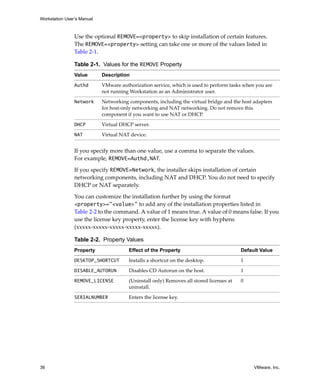
Use the optional REMOVE=<property> to skip installation of certain features. 
The REMOVE=<property> setting can take one or more of the values listed in 
Table 2‐1.
If you specify more than one value, use a comma to separate the values. 
For example, REMOVE=Authd,NAT.
If you specify REMOVE=Network, the installer skips installation of certain 
networking components, including NAT and DHCP. You do not need to specify 
DHCP or NAT separately.
You can customize the installation further by using the format 
<property>="<value>" to add any of the installation properties listed in 
Table 2‐2 to the command. A value of 1 means true. A value of 0 means false. If you 
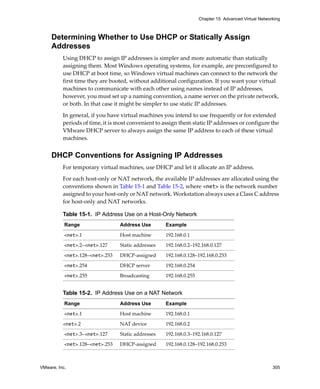
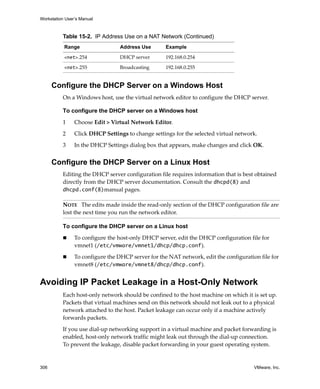
use the license key property, enter the license key with hyphens 
(xxxxx‐xxxxx‐xxxxx‐xxxxx‐xxxxx).
 
Table 2-1. Values for the REMOVE Property
Value Description
Authd VMware authorization service, which is used to perform tasks when you are 
not running Workstation as an Administrator user.
Network Networking components, including the virtual bridge and the host adapters 
for host‐only networking and NAT networking. Do not remove this 
component if you want to use NAT or DHCP.
DHCP Virtual DHCP server.
NAT Virtual NAT device.
Table 2-2. Property Values
Property Effect of the Property Default Value
DESKTOP_SHORTCUT Installs a shortcut on the desktop. 1
DISABLE_AUTORUN Disables CD Autorun on the host. 1
REMOVE_LICENSE (Uninstall only) Removes all stored licenses at 
uninstall.
0
SERIALNUMBER Enters the license key.
VMware, Inc. 37
Chapter 2 Installing and Upgrading VMware Workstation
Uninstall Workstation from a Windows Host
Use the Windows Control Panel to uninstall Workstation. Virtual machines are not 
removed, virtual network settings are removed, and Workstation licenses and 
preference settings might be uninstalled.
To uninstall Workstation from a Windows host
Do one of the following:
 On Windows 7 hosts, go to Start > Control Panel > Programs > Uninstall a 
program and uninstall VMware Workstation.
 On Windows Vista hosts, go to Start > Control Panel > Programs and Features > 
Uninstall a program and uninstall VMware Workstation.
 On other Windows hosts, use the Add/Remove Programs item in the control panel 
and remove VMware Workstation.
Install Workstation on a Linux Host
Before you begin, read the following notes and make adjustments to your host system:
 Make sure you have the items listed in “Installation Prerequisites” on page 31. 
 The real‐time clock function must be compiled into your Linux kernel. 
 Workstation for Linux requires that the parallel port PC‐style hardware option 
(CONFIG_PARPORT_PC) be built and loaded as a kernel module (that is, it must 
be set to m when the kernel is compiled). 
 To use the Workstation Help system, you must have a Web browser installed on 
the host computer.
The installation topic describes an installation from the installation media included in 
the Workstation media kit. If you downloaded the software, the steps are the same 
except that you start from the directory where you saved the downloaded installer file, 
not from the Linux directory on the installation media.
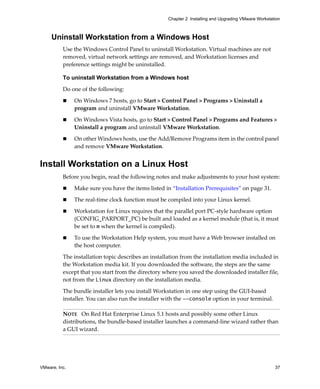
The bundle installer lets you install Workstation in one step using the GUI‐based 
installer. You can also run the installer with the --console option in your terminal.
NOTE   On Red Hat Enterprise Linux 5.1 hosts and possibly some other Linux 
distributions, the bundle‐based installer launches a command‐line wizard rather than 
a GUI wizard. 
Workstation User’s Manual
38 VMware, Inc.
VMware-Workstation-<xxxx-xxxx>.<architecture>.bundle is the name of the 
installer file. In the name, <xxxx-xxxx> is a series of numbers that represent the version 
and build numbers, and <architecture> is i386 or x86_64.
To install Workstation on a Linux host
1 Log in to your Linux host with the user name you plan to use when running 
Workstation.
2 In a terminal window, become root to perform the initial installation steps:
su or sudo
The command you use depends on your Linux distribution and configuration.
3 If you are installing from the installation media instead of a downloaded file, 
mount the Workstation installation media.
4 Change directories to the directory where the installer file is located and run the 
following command:
sh VMware-Workstation-<xxxx-xxxx>.<architecture>.bundle
If you are using the Workstation installation media, this file is in the Linux 
directory.
5 Accept the VIX EULA to continue.
6 (Optional) If you are using the --console option or running a host that does not 
support the GUI installation do one of the following:
 To scroll through the VIX EULA, press spacebar and at the end of EULA the 
Do you agree? [yes/no] prompt appears.
 To exit the VIX EULA, press q. The Do you agree? [yes/no] prompt appears.
7 (Optional) Select either Yes or No to allow Workstation to check for product 
updates when you start Workstation.
Product updates include new releases of Workstation. 
Click Learn More to review details of the information collected to provide product 
updates.
8 (Optional) To change product updates settings, select Edit > Preferences > Updates 
tab. 
VMware, Inc. 39
Chapter 2 Installing and Upgrading VMware Workstation
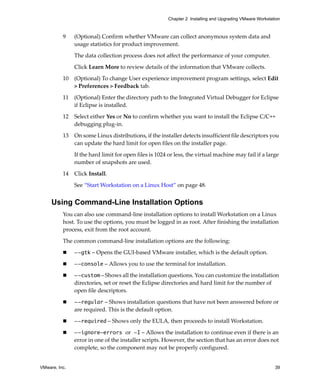
9 (Optional) Confirm whether VMware can collect anonymous system data and 
usage statistics for product improvement.
The data collection process does not affect the performance of your computer. 
Click Learn More to review details of the information that VMware collects.
10 (Optional) To change User experience improvement program settings, select Edit 
> Preferences > Feedback tab. 
11 (Optional) Enter the directory path to the Integrated Virtual Debugger for Eclipse 
if Eclipse is installed.
12 Select either Yes or No to confirm whether you want to install the Eclipse C/C++ 
debugging plug‐in.
13 On some Linux distributions, if the installer detects insufficient file descriptors you 
can update the hard limit for open files on the installer page.
If the hard limit for open files is 1024 or less, the virtual machine may fail if a large 
number of snapshots are used.
14 Click Install.
See “Start Workstation on a Linux Host” on page 48.
Using Command-Line Installation Options
You can also use command‐line installation options to install Workstation on a Linux 
host. To use the options, you must be logged in as root. After finishing the installation 
process, exit from the root account.
The common command‐line installation options are the following:
 --gtk – Opens the GUI‐based VMware installer, which is the default option.
 --console – Allows you to use the terminal for installation. 
 --custom – Shows all the installation questions. You can customize the installation 
directories, set or reset the Eclipse directories and hard limit for the number of 
open file descriptors.
 --regular – Shows installation questions that have not been answered before or 
are required. This is the default option.
 --required – Shows only the EULA, then proceeds to install Workstation.
 --ignore-errors or -I – Allows the installation to continue even if there is an 
error in one of the installer scripts. However, the section that has an error does not 
complete, so the component may not be properly configured. 
Workstation User’s Manual
40 VMware, Inc.
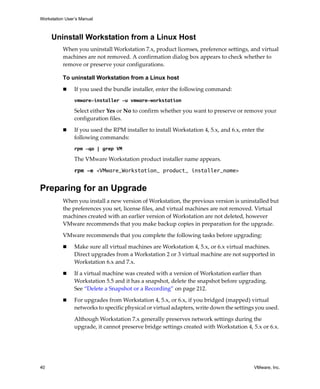
Uninstall Workstation from a Linux Host
When you uninstall Workstation 7.x, product licenses, preference settings, and virtual 
machines are not removed. A confirmation dialog box appears to check whether to 
remove or preserve your configurations.
To uninstall Workstation from a Linux host
 If you used the bundle installer, enter the following command:
vmware-installer -u vmware-workstation
Select either Yes or No to confirm whether you want to preserve or remove your 
configuration files.
 If you used the RPM installer to install Workstation 4, 5.x, and 6.x, enter the 
following commands:
rpm -qa | grep VM
The VMware Workstation product installer name appears. 
rpm -e <VMware_Workstation_ product_ installer_name>
Preparing for an Upgrade
When you install a new version of Workstation, the previous version is uninstalled but 
the preferences you set, license files, and virtual machines are not removed. Virtual 
machines created with an earlier version of Workstation are not deleted, however 
VMware recommends that you make backup copies in preparation for the upgrade.
VMware recommends that you complete the following tasks before upgrading:
 Make sure all virtual machines are Workstation 4, 5.x, or 6.x virtual machines. 
Direct upgrades from a Workstation 2 or 3 virtual machine are not supported in 
Workstation 6.x and 7.x. 
 If a virtual machine was created with a version of Workstation earlier than 
Workstation 5.5 and it has a snapshot, delete the snapshot before upgrading. 
See “Delete a Snapshot or a Recording” on page 212. 
 For upgrades from Workstation 4, 5.x, or 6.x, if you bridged (mapped) virtual 
networks to specific physical or virtual adapters, write down the settings you used. 
Although Workstation 7.x generally preserves network settings during the 
upgrade, it cannot preserve bridge settings created with Workstation 4, 5.x or 6.x.
VMware, Inc. 41
Chapter 2 Installing and Upgrading VMware Workstation
 If any virtual machines are suspended, resume them, shut down the guest 
operating systems, and power them off.
 If any virtual machines are running in the background, start them in Workstation 
and power them off. See “Start a Virtual Machine That Is Running in the 
Background” on page 147.
 Back up the virtual machines by making backup copies of all the files in the virtual 
machine directories. 
This includes .vmdk or .dsk files, .vmx or .cfg files, and .nvram files. Depending 
on your upgrade path, you might not be able to run your virtual machines under 
both Workstation 7.x and your previous version of Workstation.
 Power off all running virtual machines.
You can now use one of the following platform‐specific tasks to install Workstation:
 “Upgrade Workstation on a Windows Host” on page 41
 “Upgrade Workstation on a Linux Host” on page 44
Upgrade Workstation on a Windows Host
You can upgrade from Workstation version 4, 5.x or 6.x to Workstation 7.x by running 
the VMware Workstation 7.x installation program. 
Before you begin, make sure that you have a Workstation 7.x license key. Also perform 
the tasks described in “Preparing for an Upgrade” on page 40.
To upgrade Workstation and upgrade the host operating system to Windows Vista and 
Windows 7, see “Upgrading to a Windows Vista and Windows 7 Host” on page 42.
To upgrade Workstation on a Windows host
1 Log in to your Microsoft Windows host as the Administrator user or as a user who 
is a member of the Windows Administrators group. 
2 Launch the Workstation 7.x installer from your download directory or CD/DVD 
drive.
Workstation automatically uninstalls the previous version but saves all the 
network settings except for bridged settings used to map individual virtual 
networks to specific physical or virtual adapters.
Workstation User’s Manual
42 VMware, Inc.
3 Reboot your computer if you are prompted to do so, and log in again as the 
Administrator user or as a user who is a member of the Windows Administrators 
group. 
4 Follow the installation wizard prompts to complete the installation. 
5 Reboot your computer if you are prompted to do so. 
You can now log in as you normally do. You do not need to log in as an 
Administrator now that Workstation is installed. 
6 If you used bridged settings to map virtual networks to specific physical or virtual 
adapters, re‐create the mappings. 
Although Workstation 7.x generally preserves network settings during the 
upgrade, it cannot preserve mappings created with Workstation 4, 5.x or 6.x.
To use Workstation 7.x to upgrade virtual machines, see “Change the Version of a 
Virtual Machine” on page 90.
Upgrading to a Windows Vista and Windows 7 Host
This topic provides instructions for various upgrade scenarios that involve 
Windows Vista and Windows 7. 
During the upgrade from Windows XP to Windows Vista or Windows 7, the location 
of virtual machines might change. The Windows Vista and Windows 7 upgrade use the 
registry to map the virtual machines to a new location by using the following paths:
 On Windows XP, the default virtual machine location before the upgrade is: 
C:Documents and Settings<username>My DocumentsMy Virtual
Machines.
 On Windows Vista and Windows 7, the default virtual machine location after the 
upgrade is: C:Users<username>DocumentsVirtual
Machines<guestOSname>.
After the upgrade is complete, if the Favorites list in Workstation does not work 
correctly, you can remove the virtual machines from it and add them again. 
VMware, Inc. 43
Chapter 2 Installing and Upgrading VMware Workstation
Upgrade Workstation 5.x on Windows XP to Workstation 7.x on
Windows Vista or Windows 7
As part of the upgrade, you must uninstall the Workstation 5.x application, however 
the Workstation 5.x virtual machines are not deleted.
To upgrade Workstation 5.x on Windows XP to Workstation 7.x on Windows Vista
or Windows 7
1 On the Windows XP host, use the Control Panel’s Add/Remove Programs item to 
uninstall Workstation 5.x.
2 Upgrade the operating system to Windows Vista or Windows 7, as described in the 
Microsoft documentation.
3 Install Workstation 7.x.
4 (Optional) To upgrade the virtual machines, use the Change Version wizard in 
Workstation 7.x.
See “Change the Version of a Virtual Machine” on page 90.
Upgrade Workstation 5.x on Windows Vista to Workstation 7.x on
Windows Vista
Because Workstation 5.x was only experimentally supported on Windows Vista, 
VMware recommends manually uninstalling Workstation 5.x before installing 
Workstation 7.x.
As part of the upgrade, you must uninstall the Workstation 5.x application, however 
the Workstation 5.x virtual machines are not deleted.
To upgrade Workstation 5.x on Windows Vista to Workstation 7.x on
Windows Vista
1 Go to Start > Control Panel > Programs > Programs and Features > Uninstall a 
program. 
2 Select VMware Workstation and click Uninstall. 
3 Install Workstation 7.x.
See “Install Workstation on a Windows Host” on page 33.
4 (Optional) To upgrade the virtual machines, use the Change Version wizard in 
Workstation 7.x.
See “Change the Version of a Virtual Machine” on page 90.
Workstation User’s Manual
44 VMware, Inc.
Upgrade Workstation 6.x on Windows XP to Workstation 7.x on
Windows Vista or Windows 7
Before you begin, make sure that you have Windows XP with Service Pack 2.
To upgrade Workstation 6.x from Windows XP to Workstation 7.x on Windows
Vista or Windows 7
1 Log in as the Administrator user or as a user who is a member of the Windows 
Administrators group. 
2 Make sure that Workstation is not running and that no virtual machines are 
running in the background.
3 Upgrade the host operating system to Windows Vista and Windows 7, as 
described in the Microsoft documentation.
4 Run the Workstation 7.x installer.
5 (Optional) To upgrade the virtual machines, use the Change Version wizard in 
Workstation 7.x.
See “Change the Version of a Virtual Machine” on page 90.
Upgrade Workstation on a Linux Host
You can upgrade from Workstation version 4, 5.x or 6.x to version 7.x by running the 
VMware Workstation 7.x installation program.
Before you begin, complete the following:
 Make sure that you have a Workstation 7.x license key. You are prompted to enter 
the license key after installation is complete, the first time you power on a virtual 
machine. Also perform the tasks described in “Preparing for an Upgrade” on 
page 40.
 If your previous installation was from an RPM installer and you want to install 
Workstation 7.x, manually uninstall the previous version of Workstation. To 
manually uninstall Workstation, see “Uninstall Workstation from a Linux Host” on 
page 40.
VMware, Inc. 45
Chapter 2 Installing and Upgrading VMware Workstation
If you currently have Workstation 4, 5.x, or 6.x installed on your system, the older 
version will be uninstalled automatically before the latest version of Workstation is 
installed. Workstation 7.x saves network settings except for bridged settings used to 
map individual virtual networks to specific physical or virtual adapters.
To upgrade Workstation on a Linux host
1 Run the Workstation bundle installer as you would for a new installation.
2 If you used bridged settings to map virtual networks to specific physical or virtual 
adapters, re‐create the mappings. 
Although Workstation 7.x generally preserves network settings during the 
upgrade, it cannot preserve mappings created with Workstation 4, 5.x or 6.x.
3 (Optional) To upgrade the virtual machines, use the Change Version wizard in 
Workstation 7.x.
See “Change the Version of a Virtual Machine” on page 90.
NOTE   Starting with Workstation 5.x, Samba is no longer automatically configured 
during installation.
Workstation User’s Manual
46 VMware, Inc.
VMware, Inc. 47
3
This chapter discusses launching the Workstation program and introduces the VMware 
Workstation window. This chapter includes the following topics:
 “Start Workstation on a Windows Host” on page 47
 “Start Workstation on a Linux Host” on page 48
 “Overview of the Workstation Window” on page 48
 “Check for Product Updates” on page 59
 “Quickly Create a Virtual Machine and Install an Operating System” on page 60
 “Introduction to Workstation Preferences” on page 61
 “Introduction to Virtual Machine Settings” on page 63
 “Closing Virtual Machines and Exiting Workstation” on page 66
 “Keyboard Shortcuts” on page 67
 “Gathering Information for VMware Technical Support” on page 69
Start Workstation on a Windows Host
Depending on the options you selected during installation, you might have a desktop 
shortcut, a Start menu item, a quick launch shortcut, or some combination of these for 
launching Workstation.
To start Workstation on a Windows host
1 From the Start menu, choose Start > Programs > VMware > VMware Workstation.
2 If this is the first time you are launching Workstation, read and accept the end user 
license agreement (EULA). 
Learning Workstation
Basics 3
Workstation User’s Manual
48 VMware, Inc.
Start Workstation on a Linux Host
Whether you can start Workstation from a Linux user interface depends on the Linux 
distribution. For example, on Red Hat Enterprise Linux 5.1, the VMware Workstation 
menu item is in the Applications > System Tools menu. 
You can always start Workstation from the command line. Although you must become 
root to install Workstation, you do not have to be root to start and run Workstation.
To start Workstation on a Linux host
1 Open a terminal window.
2 Do one of the following:
 If /usr/bin is in your default path, enter the following command:
vmware &
 If /usr/bin is not in your default path, enter the following command:
/usr/bin/vmware &
3 Read and accept the end user license agreement (EULA). 
Overview of the Workstation Window
A Workstation virtual machine is like a separate computer that runs in a window on 
your physical computer. However, Workstation displays more than the screen of 
another computer. From the Workstation window, you can access and run virtual 
machines and teams of virtual machines. You can also switch easily from one virtual 
machine to another.
VMware, Inc. 49
Chapter 3 Learning Workstation Basics
Figure 3-1. VMware Workstation Window
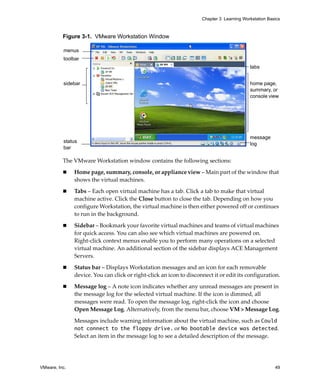
The VMware Workstation window contains the following sections: 
 Home page, summary, console, or appliance view – Main part of the window that 
shows the virtual machines.
 Tabs – Each open virtual machine has a tab. Click a tab to make that virtual 
machine active. Click the Close button to close the tab. Depending on how you 
configure Workstation, the virtual machine is then either powered off or continues 
to run in the background.
 Sidebar – Bookmark your favorite virtual machines and teams of virtual machines 
for quick access. You can also see which virtual machines are powered on. 
Right‐click context menus enable you to perform many operations on a selected 
virtual machine. An additional section of the sidebar displays ACE Management 
Servers. 
 Status bar – Displays Workstation messages and an icon for each removable 
device. You can click or right‐click an icon to disconnect it or edit its configuration.
 Message log – A note icon indicates whether any unread messages are present in 
the message log for the selected virtual machine. If the icon is dimmed, all 
messages were read. To open the message log, right‐click the icon and choose 
Open Message Log. Alternatively, from the menu bar, choose VM > Message Log.
Messages include warning information about the virtual machine, such as Could
not connect to the floppy drive. or No bootable device was detected. 
Select an item in the message log to see a detailed description of the message. 
,
menus
toolbar
sidebar
status
bar
tabs
home page,
summary, or
console view
message
log
Workstation User’s Manual
50 VMware, Inc.
Home Page and Views
Workstation displays one of four views in the main part of the window: the home page, 
the summary view, the console view, or the appliance view.
Home Page
Click the Home tab to display the Workstation home page. Use the icons on the home 
page to start creating a new virtual machine or open an existing virtual machine.
To close the home page, click the X to the right of the tabs on a Windows host or the X 
on the tab on a Linux host. To display the home page again, choose View > Go to Home 
Tab.
Summary View
When you select a tab for a powered‐off virtual machine or team of machines, 
Workstation displays only a summary of the configuration information about that item. 
Workstation also displays a summary for a suspended virtual machine or team. Click 
the Summary button in the toolbar at any time to examine settings in the summary 
view.
Summary views appear only for virtual machines that are currently open. See “Starting 
a Virtual Machine” on page 146. The summary or console view remains visible as long 
as the virtual machine remains open.
Figure 3‐2 shows an example of the summary view. 
VMware, Inc. 51
Chapter 3 Learning Workstation Basics
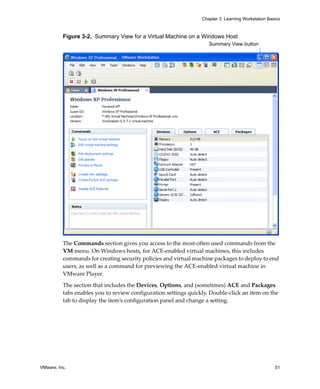
Figure 3-2. Summary View for a Virtual Machine on a Windows Host
The Commands section gives you access to the most‐often used commands from the 
VM menu. On Windows hosts, for ACE‐enabled virtual machines, this includes 
commands for creating security policies and virtual machine packages to deploy to end 
users, as well as a command for previewing the ACE‐enabled virtual machine in 
VMware Player.
The section that includes the Devices, Options, and (sometimes) ACE and Packages 
tabs enables you to review configuration settings quickly. Double‐click an item on the 
tab to display the item’s configuration panel and change a setting.
Summary View button
Workstation User’s Manual
52 VMware, Inc.
Console View
The console view for an active virtual machine is like the monitor display of a physical 
computer. 
Figure 3-3. Console View on a Windows Host
When a virtual machine is active, the name of the virtual machine or team of 
virtual machines appears in a tab at the top of the console. To switch from the active 
virtual machine or team, click the tab of another virtual machine or team. You can use 
the console tabs in the window mode and also in the quick switch mode.
Appliance View
If you set up the virtual machine to act as an appliance, such as a Web server with a 
browser‐based console, you can specify that the default view is an appliance view. 
The appliance view gives a brief description of the type of server or appliance. It also 
provides a link that opens the browser on the host system and connects to the 
appliance’s management console.
The appliance view is available only for virtual machines that you designate as 
appliances. See “Configure the Appliance View for a Virtual Machine” on page 181. 
Console View button
VMware, Inc. 53
Chapter 3 Learning Workstation Basics
Displaying Multiple Virtual Machines at the Same Time
To simultaneously view more than one virtual machine when they are not all on the 
same team, open multiple Workstation windows and launch one or more virtual 
machines in each Workstation window. 
Use a team of virtual machines to coordinate and use multiple virtual machines within 
a single console window. See “Summary and Console Views for Teams and Their 
Virtual Machines” on page 276.
Toolbar Buttons
The toolbar area at the top of the VMware Workstation window contains buttons to 
power virtual machines on and off, change the Workstation display, manage snapshots, 
and record virtual machine activity. 
Figure 3-4. Workstation Toolbars
Figure 3-5. ACE Toolbar (Windows Hosts Only)
If you point to a toolbar button, a tooltip appears and displays the name of the button. 
To change which buttons appear, see “Customize the Toolbar on a Windows Host” on 
page 56 and “Customize the Toolbar on a Linux Host” on page 55.
The Power toolbar contains the following buttons:
 Power Off – Turns off the active virtual machine or team like the power button on 
a physical PC. You can configure Workstation for a soft power off (called shut 
down) or a hard power off (called power off). See “Shut Down a Virtual Machine” 
on page 149 or “Power Off or Close a Team” on page 274.
 Suspend – Stops a virtual machine or team in a manner that allows you to resume 
your work later. See “Using the Suspend and Resume Features” on page 201.
Power toolbar Snapshot toolbar Replay toolbar View toolbar
ACE toolbar
Workstation User’s Manual
54 VMware, Inc.
 Power On or Resume – Powers on a selected virtual machine or team that is 
powered off, or resumes a virtual machine or team that is suspended. See “Starting 
a Virtual Machine” on page 146, “Power On a Team” on page 279, and “Using the 
Suspend and Resume Features” on page 201.
 Reset – Resets a virtual machine or team like the reset button on a physical PC. 
See “Configure Power Off and Reset Options for a Virtual Machine” on page 150.
The Snapshot toolbar contains the following buttons:
 Take Snapshot – Enables you to save the state of a virtual machine in the same 
manner you might save a word‐processing document. You can return to that state 
if you make a mistake by using the Revert button. See “Using Snapshots” on 
page 203.
 Revert – Allows you to return a virtual machine to the parent state, a state 
previously preserved by taking a snapshot. See “Using Snapshots” on page 203.
 Manage Snapshots – Opens the snapshot manager, where you can view the virtual 
machine’s existing snapshots, revert to a snapshot, take a new snapshot, and make 
a clone from a snapshot. See “Snapshot Manager Overview” on page 208.
The View toolbar contains the following buttons:
 Show or Hide Sidebar – Toggles between showing and hiding the sidebar. 
See “View the Sidebar” on page 56.
 Quick Switch – Enlarges the Workstation console to cover the entire host monitor. 
Console tabs enable you to switch between virtual machines and teams with a 
single click. See “Use Quick Switch Mode” on page 164.
 Full Screen – Enlarges the virtual machine display to cover the entire host monitor. 
The virtual machine no longer appears in a window. See “Use Full Screen Mode” 
on page 161.
 Unity – Integrates your favorite guest applications with your host’s desktop so that 
guest application windows look just like host application windows, but with 
color‐coded borders. See “Using Unity Mode” on page 157.
 Summary View – Displays the summary view. See “Summary View” on page 50.
 Appliance View – Displays the appliance view. See “Appliance View” on page 52.
 Console View – Displays the console view. See “Console View” on page 52.
VMware, Inc. 55
Chapter 3 Learning Workstation Basics
The Replay toolbar contains the following buttons:
 Replay Last Recording – Plays the last recording made for this virtual machine. 
 Record – Begins recording the activity of this virtual machine.
For information about the record/replay feature, see Chapter 12, “Recording and 
Replaying Virtual Machine Activity,” on page 257.
The ACE toolbar, which is available on Windows hosts only, contains the following 
buttons:
 Edit Policies – Opens the policy editor. 
 Edit Deployment Settings – Opens the deployment settings editor.
 Create New Package – Opens the New Package wizard.
 Create Pocket ACE Package – Opens the Pocket ACE Package wizard.
 Preview in Player – Allows you to run an ACE instance as it will run on the user’s 
machine. Using preview mode also allows you to view the effects of changed 
policies as they will appear on the user’s machine.
See Chapter 18, “Learning the Basics of VMware ACE,” on page 381.
Customize the Toolbar on a Linux Host
You can customize the Workstation toolbar by adding, removing, and rearranging 
toolbar buttons. On a Linux host, all the buttons are contained in a single toolbar.
To customize the toolbar on a Linux host
1 Right‐click the far‐right side of the toolbar to display a Toolbar menu. 
2 Click Power, Snapshot, View, or Replay to add or remove that toolbar. 
When a toolbar name is checked, the corresponding buttons appear in the 
interface.
3 In the Desktop Style part of the menu, choose the display style for toolbar buttons.
Workstation User’s Manual
56 VMware, Inc.
Customize the Toolbar on a Windows Host
You can customize the Workstation toolbar by adding, removing, and rearranging 
toolbar buttons. 
To customize the toolbar on a Windows host
1 Right‐click any part of the toolbar to display a Toolbar menu. 
2 Click Power, Snapshot, ACE, View, or Replay to add or remove that toolbar. 
When a toolbar is checked, it appears in the interface.
To change which buttons appear in a toolbar or the order in which they appear, 
display that toolbar and continue with the following steps.
3 Right‐click the Power, Snapshot, ACE, View, or Replay toolbar to open the 
Customize Toolbar dialog box.
Buttons listed under Current Toolbar Buttons appear in the toolbar, in the order 
shown in the Customize Toolbars dialog box. 
4 Do any of the following:
 To add or remove a button from the toolbar, select the button and click Add or 
Remove. Add a separator to display a vertical line between the buttons.
 To change the order of the buttons, select any button under Current Toolbar 
Buttons and click Move Up or Move Down. 
 To change the order of the currently displayed buttons without opening the 
Customize Toolbar window, hold down the Shift key while you drag a button 
to a different location in the toolbar.
 To restore the default setup, with all buttons displayed, click Reset.
5 Click Close.
View the Sidebar
The sidebar contains a list of favorites and shows which virtual machines or teams of 
virtual machines are currently powered on. On Windows hosts, an additional section 
of the sidebar displays ACE Management Servers. For more information, see the 
VMware ACE Management Server Administrator’s Manual.
To view the Sidebar
Choose View > Sidebar.
If the sidebar was hidden, it becomes visible. If it was visible, it is hidden.
VMware, Inc. 57
Chapter 3 Learning Workstation Basics
Favorites List in the Sidebar
The Favorites list lets you organize and access frequently used items. 
The Favorites list provides the following benefits:
 Fast access – Quickly access frequently used items. With your virtual machines 
and teams on the Favorites list, you can open them without browsing the host file 
system. Also like browser bookmarks, Favorites list icons can be organized in 
folders, added, rearranged, or deleted.
 Status – Different icons indicate the status of virtual machines and teams. A 
Favorites list icon indicates whether the team or virtual machine is powered off, 
powered on, or suspended. A brown (rather than blue) virtual machine icon 
indicates that the virtual machine is a Workstation 4 virtual machine.
 Right‐click commands – Right‐click on a Favorites icon to display a menu of 
commands you can use for that virtual machine or team. You can click elsewhere 
in the Favorites list (that is, not on a virtual machine or team) to display a context 
menu from which you can choose to create a new virtual machine, team, or folder. 
You can also open an existing virtual machine, team, Microsoft Virtual PC or 
Virtual Server virtual machine, StorageCraft, or Symantec Backup Exec System 
Recovery system image. 
Table 3-1. Icon Status in the Favorites List
Icon Description
Powered off Workstation 5.x, 6.x, or 7.x virtual machine or full clone. To 
determine the exact version, use the summary view’s Version field.
Powered off virtual machine created as a linked clone of another virtual 
machine.
Powered off team of virtual machines.
Powered off Workstation 4 virtual machine.
Powered on indicator can appear for virtual machines and teams.
Suspended indicator can appear for virtual machines and teams.
Unavailable indicator can appear if a virtual machine or team gets corrupted 
or moved from the location that was used to create the favorites item. The 
indicator also appears if the virtual machine is already open in VMware 
Player or is opened by another user.
Workstation User’s Manual
58 VMware, Inc.
Use Folders for Organizing Favorites
You can organize favorites into folders and nest folders inside other folders.
To use folders for organizing favorites
1 Right‐click Favorites (or any item in the Favorites list), and choose New Folder.
2 Complete the New Folder dialog box that appears.
3 (Optional) Drag and drop folders to place one inside another.
4 Drag and drop Favorites items in the desired folder.
5 (Optional) To hide or view the Favorites list, choose View > Sidebar.
Add Virtual Machines and Teams to the Favorites List
Virtual machines and teams are automatically added to the Favorites list when you 
complete the New Virtual Machine wizard. You can also add them manually.
To add virtual machines and teams to the Favorites list
1 Choose File > Open and browse to the location of the virtual machine (.vmx file) 
or team (.vmtm file).
2 Click Open.
3 Choose File > Add to Favorites.
Remove an Item from the Favorites List
You can remove the name of a virtual machine or team from the Favorites list 
regardless of whether the virtual machine or team is open or powered on. Removing 
the name does not affect the virtual machine’s files or operation.
To remove an item from the Favorites list
1 Click a name in the Favorites list to select it.
2 Choose File > Remove from Favorites.
VMware, Inc. 59
Chapter 3 Learning Workstation Basics
Rename an Item in the Favorites List
Renaming an item in the Favorites list also renames the virtual machine or team.
To rename a Favorite list entry for a virtual machine or a team
1 Right‐click the Favorites item to rename.
2 Choose Rename from the context menu.
3 Type the new name for the item and press Enter.
Powered On List
This list in the sidebar enables you to find out which virtual machines or teams are 
currently powered on. Right‐click items in the Powered On list to display a menu of 
commands you can use for that virtual machine or team.
Check for Product Updates
Workstation automatically checks for product updates every three days. If an update 
check fails on two consecutive attempts, you receive a notification.
To check for product updates
1 (Optional) To check for software updates immediately, choose Help > Check for 
Software Updates Now. 
2 To configure Workstation to periodically check for updates, choose Edit > 
Preferences > Updates. 
3 In the Software updates section, select Check for product update on startup and 
click OK.
NOTE   Checking for product updates works only if the host computer is connected to 
the Internet.
Workstation User’s Manual
60 VMware, Inc.
Quickly Create a Virtual Machine and Install an Operating
System
The instructions in this section get you started quickly with creating a virtual machine 
and installing a guest operating system. After you create a virtual machine, you will 
find the information in the rest of this chapter easier to understand.
The instructions tell you to accept the default settings so that you can complete the New 
Virtual Machine wizard quickly. The purpose is to learn about Workstation. Later, 
when you want to create virtual machines that you actually use in your work or 
production environment, you can learn about all the options available. This 
information is provided in Chapter 4, “Creating and Upgrading a Virtual Machine,” on 
page 75.
For simplicity, use a Windows installation CD or ISO image file for the operating 
system you install in the virtual machine. Most Windows operating systems fit on one 
CD, whereas Linux requires multiple CDs. If you want to use a Linux guest operating 
system, use installation media for one of the newer versions of Red Hat, SUSE Linux, 
or Ubuntu. The easy install feature is supported for these operating systems.
To quickly create a virtual machine
1 To use an installation CD or DVD for the operating system, rather than an ISO 
image file, insert the CD or DVD in the host CD‐ROM drive.
2 Start VMware Workstation. 
For instructions, see “Start Workstation on a Windows Host” on page 47 or “Start 
Workstation on a Linux Host” on page 48.
3 Choose File > New > Virtual Machine. 
4 On the Welcome page, select Typical and click Next.
5 On the Guest Operating system Installation page, select Installer disc or Installer 
disc image file, as appropriate, and click Next.
6 Complete the fields on the Easy Install Information page.
Specifying a password is optional for Windows guests and required for Linux 
guests. On Windows, the password you enter is used for an account with 
Administrator permissions. On Windows 2000, the password is used for the 
Administrator account.
VMware, Inc. 61
Chapter 3 Learning Workstation Basics
7 Accept the defaults on the rest of the wizard pages.
The virtual machine is created and its name is added to the Favorites list.
The console view for the virtual machine appears. Soon the boot device (such as the 
CD‐ROM) is detected and installation of the operating system begins.
On Windows 2000 guests, if you entered a password when completing the New Virtual 
Machine wizard, then when the operating system starts up, it might prompt you to 
enter an Administrator password. Use the password that you created when completing 
the New Virtual Machine wizard.
After installation is finished, VMware Tools is automatically installed.
Now that you have a virtual machine with a guest operating system installed, you can 
refer to it as you read the rest of the topics in this chapter. 
Introduction to Workstation Preferences
The Preferences dialog box appears when you choose Edit > Preferences. It lets you 
change a number of settings that apply to Workstation, no matter which virtual 
machine you are running. 
The default settings for Workstation preferences are correct for most cases. Do not 
change settings unless you are an experienced user.
Following is a list of the tabs in the Preferences dialog box, along with cross‐references 
to the sections of this manual that pertain to each tab:
 Workspace tab – Lets you configure the following settings:
 Default location for virtual machines and teams section – Lets you change 
the directory in which newly created virtual machines and teams are stored. 
See “Virtual Machine Location” on page 80 and “Files That Make Up a Virtual 
Machine” on page 93.
 Virtual Machines section – Several of these options have to do with exiting 
Workstation while leaving some virtual machines powered on. See “Closing 
Virtual Machines and Exiting Workstation” on page 66. For information about 
enabling shared folders, see “Set Up Shared Folders” on page 191.
NOTE   On a Linux host, you must be logged in as root to save global preference 
changes.
Workstation User’s Manual
62 VMware, Inc.
 Input tab – Lets you adjust the way the virtual machine captures control of 
keyboard and mouse. For example, by default the virtual machine grabs keyboard 
and mouse input when you click in the virtual machine window.
 Hot Keys tab – Lets you specify the key combination that is used with hot‐key 
sequences for all your virtual machines. Use hot‐key combinations to enter and 
leave full screen mode, ungrab mouse and keyboard input, and so on. See 
“Keyboard Shortcuts” on page 67.
 Display tab – Lets you adjust the manner in which the console and the host display 
accommodate a different guest operating system display resolution.
Also see “Fitting the Workstation Console to the Virtual Machine Display” on 
page 169 and “Use Full Screen Mode” on page 161.
 Memory tab – For details on adjusting memory settings in Workstation, click Help 
on this tab. On Linux hosts, you must be running Workstation as root in order to 
change these settings.
 Priority tab – For information about the snapshot settings on this tab, see “Enable 
or Disable Background Snapshots” on page 206. On Linux hosts, you must be 
running Workstation as root in order to change this setting.
For information about the process priority settings available on Windows hosts, 
click Help on this tab.
Updates tab – Lets you specify whether to automatically update software 
components such as, VMware Tools and download other components on 
Windows and Linux guest systems when a new version becomes available. On 
Linux hosts, you must be running Workstation as root in order to change the 
VMware Tools updates settings. You can also configure proxy settings to connect 
to the VMware Update Server. For information about software components, 
product updates, and configuring proxy settings, click Help on this tab.
VMware Tools is a suite of utilities that enhances the performance of the virtual 
machine’s guest operating system and improves management of the virtual 
machine. See Chapter 5, “Installing and Using VMware Tools,” on page 97.
 Devices tab – (Windows hosts only) By default, the Autorun feature on the host is 
disabled. Therefore, when you insert a CD or DVD in the CD/ DVD‐ROM drive, 
the Autorun feature is not available. You can open the CD or DVD on the host 
using Windows Explorer.
VMware, Inc. 63
Chapter 3 Learning Workstation Basics
 Unity tab – Lets you set hot‐key preferences for the Unity application menu. For 
information about changing the default hot‐key combination, see “Change the 
Hot‐Key Combination” on page 68.
 Feedback tab – Lets VMware collect anonymous system data and usage statistics 
for product improvement. Click Learn More to review details of information 
collected, how VMware protects your privacy, and handles the information.
For information about the process priority settings available on Windows hosts, 
click Help on this tab.
In addition to the cross‐references mentioned in this list, more information about the 
settings on each tab is available in the Workstation online help. Click Help in the 
Preferences dialog box.
The settings on the following tabs apply only to the user currently logged on to the host 
computer: Workspace tab, Input tab, Hot Keys tab, Priority tab, and Update tab.
The settings on the following tabs apply no matter which virtual machine is running or 
which user is logged on to the host computer: Display tab, Memory tab, Devices tab, 
Unity tab, and Feedback tab.
Introduction to Virtual Machine Settings
Workstation configures a new virtual machine based on the guest operating system you 
select in the New Virtual Machine wizard. After the virtual machine is created, you can 
use the virtual machine settings editor to change many configuration options set by the 
wizard. The virtual machine settings editor appears when you select a virtual machine 
and choose VM > Settings. 
On guests with Windows XP and later versions, if you make changes to the virtual 
machine configuration after activating the guest you might have to reactivate it. To 
minimize the changes, set the final memory size for the virtual machine and install 
VMware Tools before you activate the guest. 
Workstation User’s Manual
64 VMware, Inc.
Hardware Tab
Use the Hardware tab to add, remove, and configure virtual devices for the selected 
virtual machine. 
Figure 3-6. Virtual Machine Settings Hardware Tab
When you select an item in the Hardware list, the options that correspond to the item 
appear on the right side of the dialog box. For example, in Figure 3‐6, memory options 
appear because the Memory item is selected.
Topics and chapters related to each of the virtual devices in the Hardware list are 
provided later in this manual. To display online help for an item you select in the 
Hardware list, click Help.
memory
device
Help button
VMware, Inc. 65
Chapter 3 Learning Workstation Basics
Options Tab
The Options tab lets you adjust characteristics of the selected virtual machine:
 Many options control interactions between the host and the guest operating 
system, such as how folders can be shared, how files are transferred, and what 
happens to a guest operating system when you exit Workstation. 
 Some options let you override similar Preferences dialog box options, which are 
global preferences set for all virtual machines. For example, you can use the 
Advanced option to override the process priorities set on the Priority tab in the 
Preferences dialog box.
 Some options let you change settings you might initially make when running the 
New Virtual Machine wizard to create a virtual machine. For example, you can use 
the General options to change the name of the virtual machine.
Figure 3-7. Virtual Machine Settings Options Tab
The settings for the virtual machine Options tab are discussed later in this manual, in 
the task‐specific topics and procedures where you would use them. To display online 
help for an item you select in the Options list, click Help. 
General
options
Workstation User’s Manual
66 VMware, Inc.
Closing Virtual Machines and Exiting Workstation
When you close a virtual machine or team, and when you exit Workstation, if any 
virtual machines are still powered on, you are prompted to specify one of the following 
actions to take:
 Continue running the virtual machine in the background. If a virtual machine 
continues running after you exit Workstation, you can still interact with it through 
virtual network computing (VNC) or some other service. 
 Suspend the virtual machine. The suspend operation saves the state of the virtual 
machine. See “Using the Suspend and Resume Features” on page 201. 
 Power the virtual machine off. If you configured the power operation to do a “soft” 
power‐off, a VMware Tools script runs in order to cleanly shut down the guest 
operating system before powering off. See “Configure Power Off and Reset 
Options for a Virtual Machine” on page 150.
To avoid receiving a prompt every time you exit Workstation or close a virtual machine 
or team, set a preference for virtual machines to always run in the background when 
you exit. 
Set a Virtual Machine to Run in the Background
You can set a virtual machine that is powered on to continue running in the background 
when you close a virtual machine or team tab, or when you exit Workstation. You can 
still interact with it through VNC or another service. 
By default, when virtual machines run in the background, a status icon appears in the 
notification area of the taskbar. Point to the icon to display a a tooltip that shows the 
number of virtual machines and teams that are running in the background. These are 
the virtual machines and teams that belong to the user who is logged in.
To set a virtual machine to run in the background
Do one of the following:
 Click Run in Background at the prompt when you close the virtual machine or exit 
Workstation.
 Set a Workstation preference:
a From the VMware Workstation menu bar, choose Edit > Preferences.
b On the Workspace tab, select Keep VMs running after Workstation closes 
and click OK.
When you close a tab or exit Workstation, you no longer receive a prompt.
VMware, Inc. 67
Chapter 3 Learning Workstation Basics
Keyboard Shortcuts
You can use keyboard shortcuts to interact with Workstation and with virtual 
machines. Most of the available keyboard shortcuts for Workstation are listed next to 
their associated commands in Workstation menus. 
Hot keys, or keyboard shortcuts for interactions with virtual machines, are shown in 
Table 3‐2. Hot‐key combinations can be used to do the following:
 Switch between virtual machines 
 Enter and exit full screen mode
 Ungrab input 
 Send Ctrl+Alt+Del to the virtual machine only (and not to the host)
 Send commands to the virtual machine only (and not to the host)
By default, most hot‐key combinations include Ctrl+Alt, but you can change this 
combination. See “Change the Hot‐Key Combination” on page 68.
If you change the Preferences setting for the hot‐key combination, substitute your new 
setting for Ctrl+Alt as needed in the shortcuts listed in Table 3‐2. For example, if you 
change the hot‐key combination to Ctrl+Shift+Alt, you must press 
Ctrl+Shift+Alt+spacebar to have Workstation not process a command. 
 
Table 3-2. Hot-Key Combinations
Shortcut Action
Ctrl+G Grab input from keyboard and mouse.
Ctrl+Alt Release the mouse cursor. If the virtual machine is in the type of full 
screen mode called exclusive mode, pressing Ctrl+Alt changes the virtual 
machine from exclusive mode to windowed mode.
Ctrl+Alt+Insert Shuts down or (depending upon the guest operating system) logs out of 
the guest. This command is received solely by the virtual machine. 
Note: For this and all shortcuts that include Ctrl+Alt, changing the 
hot‐key combination changes the sequence you need to use. For instance, 
if you change the hot‐key combination to Ctrl+Shift+Alt, you must press 
Ctrl+Shift+Alt+Insert to end the guest operating system session.
Ctrl+Alt+Delete Shuts down or (depending upon the operating system) logs out of the 
guest operating system. 
On Windows hosts, if you are not using the enhanced virtual keyboard 
feature, this command is received by both the host operating system and 
the virtual machine, even when Workstation has control of input. You can 
cancel the ending of the host operating system’s session and return to the 
virtual machine to log out or shut down or perform administrative tasks. 
Workstation User’s Manual
68 VMware, Inc.
Change the Hot-Key Combination
Hot‐key combinations, or shortcut keys, are key combinations you press to interact 
with virtual machines. For a list of actions you can invoke by using hot keys, see 
Table 3‐2.
By default, most hot‐key combinations include Ctrl+Alt, but you can change this 
combination. For example, you can change the setting so that all hot‐key combinations 
use Ctrl+Shift+Alt. This is useful if you want to prevent certain key combinations (such 
as Ctrl+Alt+Del) from being intercepted by Workstation instead of being sent to the 
guest operating system.
The hot‐key preferences you set in the preferences editor apply to virtual machines you 
access from within Workstation. These settings do not affect virtual machines or ACE 
instances distributed to other users.
To change the hot-key combination
1 Choose Edit > Preferences.
2 Click the Hot Keys tab.
Ctrl+Alt+spacebar Sends any command to the virtual machine so that Workstation does not 
process it. Hold down Ctrl+Alt as you press and release the spacebar, and 
continue to hold the Ctrl+Alt keys down as you press the next key in the 
combination. 
Ctrl+Alt+Tab Switch among open virtual machines while mouse and keyboard input 
are grabbed.
Ctrl+Tab
Ctrl+Shift+Tab
On Windows hosts, switch among open virtual machines while mouse 
and keyboard input are not grabbed. Workstation must be the active 
application.
Ctrl+Alt+right 
arrow
In full screen mode, switch to the next powered‐on virtual machine.
Ctrl+Alt+left 
arrow
In full screen mode, switch to the previous powered‐on virtual machine.
Ctrl+Shift+U In Unity mode, the default hot‐key combination gives access to the 
virtual machine Start or Applications menu. You can configure the key 
combination from the Unity tab in the Preferences menu.
Table 3-2. Hot-Key Combinations (Continued)
Shortcut Action
VMware, Inc. 69
Chapter 3 Learning Workstation Basics
3 Use the following information to help you choose a key combination:
Custom key combinations involve using a combination of the Ctrl, Shift, Alt, and 
Windows keys. The Windows key is the key between the Ctrl and Alt keys on your 
keyboard. The modifiers for the custom combination are:
 Down – The key must be pressed to use the hot‐key sequence.
 Up – The key must not be pressed to use the hot‐key sequence.
 Either – The key can be up or down. This modifier is useful to allow users a 
variety of keystrokes to leave full screen mode. For example, selecting Either 
for the Shift key means that both Ctrl+Alt+Enter and Ctrl+Shift+Alt+Enter 
cause Workstation to exit full screen mode.
If you select Either for all of the keys (Ctrl, Alt, Shift, and Win) in the custom 
combination, you can use the Esc key to release the cursor.
4 (Optional) Set a hot‐key preference for the Unity application menu.
a Click the Unity tab.
b Enter your custom key combination in the Unity applications menu hot key 
field or use the default combination Ctrl + Shift + U.
c (Optional) If you plan to have multiple virtual machines running, with some 
in Unity mode and some accessible only in the Workstation window, do not 
select the Minimize Workstation when entering Unity check box.
5 Click OK. 
Gathering Information for VMware Technical Support
When you need help from VMware technical support, VMware recommends that you 
create a support request. For some problems, the representative will ask you to turn on 
debugging, run a script to collect log files, and send the logs to VMware.
Register and Create a Support Request
Before you can report problems to the VMware support team, you must register for a 
VMware account. 
Before you begin, locate the license key. It is on the registration card in your package. If 
you purchased Workstation online, the license key is sent by email.
Workstation User’s Manual
70 VMware, Inc.
To register and create a support request
1 From the Workstation menu bar, choose Help > Enter License Key > Register. 
2 Follow the instructions on the Web site.
3 To report problems, from the Workstation menu bar, choose Help > VMware on 
the Web > Request Support.
Gather Debugging Information for a Virtual Machine
Workstation provides several levels of logging to help diagnose and troubleshoot 
various types of problems.
You can use full debugging mode to gather the greatest amount of data, which is useful 
when a virtual machine freezes or powers off unexpectedly. You can use statistics mode 
to gather performance statistics when virtual machines run slowly. You can also 
increase logging without going into full debugging mode. A VMware technical support 
representative can tell you which level to use.
After you gather debugging information, you can send the log files to VMware 
technical support.
To gather debugging information for a virtual machine
1 Select the virtual machine.
2 Make sure the virtual machine is powered off or suspended.
3 Choose VM > Settings.
4 On the Options tab, select Advanced.
5 Select from the Gather debugging information drop‐down menu or the Log 
virtual machine progress periodically check box, as directed by VMware technical 
support.
Using full debugging mode and logging progress periodically cause a decrease in 
performance.
6 In the File locations section, note the directory path to the log file.
To view the complete path, click in the read‐only text box and use the right arrow 
key to scroll through the path.
7 Click OK.
VMware, Inc. 71
Chapter 3 Learning Workstation Basics
Running the Support Script
To help diagnose a problem, the VMware support team might ask you to run a support 
script to gather information. For example, if a virtual machine exits abnormally or fails, 
run the support script to collect the appropriate log files and system information.
In Workstation 7.x, you can run the support script by selecting Help > Collect Support 
Data. You can also run the script from the command line. 
Run the Support Script from the Workstation User Interface
Run the support script only when requested to do so by VMware technical support. 
The support collection script collects data from all of the virtual machines you select 
and from your host machine, and stores all of the data in a single file. On Windows 
hosts, after the script finishes running, it creates a .ZIP file of the collected data and 
displays the file in an open Windows Explorer window. The default location of the .ZIP
file:
 On Windows XP is
C:Documents and Settings<user>Local Settings
Tempvmware-support
 On Windows Vista and Windows 7 is 
C:Users<user>AppDataLocalTempvmware-support
On Linux hosts, the script creates a compressed .TGZ file in the user’s home directory. 
Because the script is not run as root, the script displays messages indicating that it 
cannot collect some information. This is normal. If the VMware support team needs 
that information, a support representative asks you to run the script from the command 
line as root. For instructions, see “Run the Support Script from a Linux Terminal 
Window” on page 73.
Before you begin, create a support request. See “Register and Create a Support 
Request” on page 69. Increase the level of logging, as described in “Gather Debugging 
Information for a Virtual Machine” on page 70. Make sure that the latest VMware Tools 
is installed in the virtual machines to collect support data from the guest and that the 
virtual machines are powered on.
Workstation User’s Manual
72 VMware, Inc.
To run the support script from the Workstation user interface
1 Select Help > Collect Support Data.
A dialog box displays all your open Workstation virtual machines. 
2 Check the boxes for the virtual machines to collect support data from and select 
Collect. 
 If you select Collect with no virtual machines selected, the support collection 
script collects data only from your host machine.
 If you select a check box for a virtual machine and select Collect, the support 
collection script collects the current data from the your guest and host 
machines.
The virtual machine must be powered on and have the latest VMware Tools 
running. VMware recommends that you use this option to collect the current 
data for your guest machine.
3 Add the .ZIP or .TGZ data file to your support request. 
Run the Support Script from a Windows Command Prompt
Run this script only when requested to do so by VMware technical support. 
Before you begin, create a support request. See “Register and Create a Support 
Request” on page 69. Increase the level of logging, as described in “Gather Debugging 
Information for a Virtual Machine” on page 70.
To run the support script from a Windows command prompt
1 Open a command prompt.
2 Change to the VMware Workstation program directory:
C:
cd Program FilesVMwareVMware Workstation
If you did not install the program in the default directory, use the appropriate drive 
letter and path in the cd command above.
3 Run the support script:
cscript vm-support.vbs
After the script runs, it displays the name of the directory where it has stored its 
output. 
VMware, Inc. 73
Chapter 3 Learning Workstation Basics
4 Use a file compression utility such as WinZip or PKZIP to zip the script output 
directory, and include the zip file with your support request.
If you are reporting a problem you encountered while installing VMware 
Workstation, also include the installation log file. 
On a Windows host, the file is VMInst.log. It is saved in the Temp folder. On a 
Windows XP or Windows Server 2003 host, the default location is C:Documents
and Settings<username>Local SettingsTemp.
You can use the command cd %temp% to locate the Local Settings folder, which 
is hidden by default. To see its contents, open My Computer, go to Tools > Folder 
Options, click the View tab and select Show Hidden Files and Folders.
Run the Support Script from a Linux Terminal Window
Run this script only when requested to do so by VMware technical support. 
Before you begin, create a support request. See “Register and Create a Support 
Request” on page 69. Increase the level of logging, as described in “Gather Debugging 
Information for a Virtual Machine” on page 70.
To run the support script from a Linux terminal window
1 Open a terminal window.
2 Run the support script as the user who is running the virtual machine:
vm-support
If you are not running the script as root, the script displays messages indicating 
that it cannot collect some information. This is normal. If the VMware support 
team needs that information, a support representative will ask you to run the script 
again as root.
The script creates a compressed .TGZ file in the user’s home directory. 
3 Include that output file with your support request.
If you are reporting a problem you encountered while installing Workstation, also 
include the installation log file. 
Workstation User’s Manual
74 VMware, Inc.
VMware, Inc. 75
4
This chapter describes how to create a virtual machine by using the New Virtual 
Machine wizard. It also provides general information about installing guest operating 
systems. 
This chapter includes the following topics:
 “Methods of Creating Virtual Machines” on page 75
 “Configuration Options for the New Virtual Machine Wizard” on page 76
 “Use the New Virtual Machine Wizard” on page 85
 “Installing a Guest Operating System” on page 85
 “Upgrade a Guest Operating System” on page 89
 “Change the Version of a Virtual Machine” on page 90
 “Using an Older‐Version Virtual Machine Without Upgrading” on page 92
 “Files That Make Up a Virtual Machine” on page 93
Methods of Creating Virtual Machines
Workstation gives you several options for creating virtual machines:
 Create a virtual machine. 
If you do not have any virtual machines or system images, you must use this 
method. Use the New Virtual Machine wizard to create a virtual machine. Next, 
you must install an operating system. The process is the same as installing it on a 
physical computer. 
The rest of this chapter describes this method of creating a virtual machine.
Creating and Upgrading a
Virtual Machine 4
Workstation User’s Manual
76 VMware, Inc.
 Clone a virtual machine from an existing VMware virtual machine or virtual 
machine template. 
Clones are useful when you must deploy many identical virtual machines to a 
group. Cloning is preferable to copying a virtual machine because a clone’s MAC 
address and UUID are different from the original virtual machine, to avoid 
network conflicts. Use the Clone Virtual Machine wizard to create a clone.
See “Cloning a Virtual Machine” on page 219.
 On Windows hosts, convert a physical machine, virtual machine, or system image 
that was created by using another VMware product or a third‐party product.
This process creates a clone of the original virtual machine or system image. Use 
the Conversion wizard to convert a physical or virtual machine or a system image.
See Chapter 6, “Creating a Virtual Machine from a System Image or Another 
Virtual Machine,” on page 131.
Configuration Options for the New Virtual Machine
Wizard
As you complete the New Virtual Machine wizard, you are prompted to make 
decisions about many aspects of the virtual machine. The topics in this section provide 
information about the issues involved so that you can determine which choices you 
want to make before running the wizard.
Easy Install Feature for Some Guest Operating Systems
The easy install features enable you to perform an unattended installation of the guest 
operating system after you complete the New Virtual Machine wizard. You can use this 
feature regardless of whether you choose a typical or a custom configuration in the 
wizard.
On Windows guests, the easy install feature is available for the following operating 
systems:
 Windows Vista, Windows 7, Windows XP, and Windows 2000
 Windows Server 2008, Windows Server 2003, and Windows 2000 Server
VMware, Inc. 77
Chapter 4 Creating and Upgrading a Virtual Machine
On Linux guests, the easy install feature is available for the following operating 
systems:
 Ubuntu Desktop 7.10 and later
 Ubuntu Server 8.10 and later
 Red Hat Enterprise Linux 3 through 5
 Asianux Server 3
 Fedora Core 4 through 12 with the exception of Fedora Core 8
 SUSE Linux Enterprise Server 10 SP3
 SUSE Linux Enterprise Desktop 10 SP3
 SUSE Linux Enterprise Server 11 GA
 SUSE Linux Enterprise Desktop 11 GA
 openSUSE 11.3 GA
If you specify an installer disc (DVD or CD) or ISO image file and if the wizard detects 
an operating system that supports the easy install feature, you are prompted to supply 
the following information:
 For Windows guests:
 (Optional) Windows product key – If you specify a product key, you are not 
prompted for it later, during installation of the operating system. Enter a 
product key unless the installation media already contains a volume license 
product key.
 Version of Windows to install – If you are installing the Windows Vista, 
Windows 7, or Windows Server 2008 guest operating system, you can specify 
the operating system edition from this drop‐down menu.
 Full name – This name is used for registering the operating system. Do not use 
the name Administrator or Guest. If you use one of these names, you receive 
an error message during installation of the operating system and be prompted 
to enter a different name.
 (Optional) Password – On Windows operating systems other than Windows 
2000, the password you enter here is used for an account with Administrator 
permissions. On Windows 2000, the password you enter here is used for the 
Administrator account. On Windows XP Home, an Administrator account 
without a password is created, and you are automatically logged in the guest.
Workstation User’s Manual
78 VMware, Inc.
 (Optional) Log on automatically – Save your login credentials and bypass the 
login dialog box when you power on the virtual machine. You must complete 
the Full name and Password fields for this option to work. See “Using 
Autologon in a Windows Guest” on page 151.
On Windows XP Home, the Autologon option is disabled in the New Virtual 
Machine wizard. After the operating system is installed you can change the 
Autologon settings. 
 For Linux guests:
 Full name – This name is used for registering the operating system, if 
registration is required. The first name is used as the host name for the virtual 
machine.
 User name – You can use lowercase letters and numbers, with no spaces. Do 
not use the name root. Some operating systems set up sudo access for this user, 
and some require this user to use su to get root privileges.
 Password – The password you enter here is used for both the user name you 
supply and the root user.
This feature also installs VMware Tools in the guest operating system. For more 
information about VMware Tools, see “Components of VMware Tools” on page 97. 
If you plan to use a CD, DVD, or ISO image that contains a product key number and is 
already set up to perform an unattended installation, the only benefit you gain by using 
the easy install feature is the automatic installation of VMware Tools.
Typical Compared to Custom Configurations
The New Virtual Machine wizard prompts you to choose between doing a typical 
configuration and a custom configuration. If you select Typical, the wizard prompts 
you to specify or accept defaults for the following choices:
 Medium for installing the guest operating system (CD, image file, or neither)
 Guest operating system
 Virtual machine name and the location of the virtual machine files
 Size of the virtual disk and whether to split the disk into 2GB files
 Hardware customization, for advanced users
VMware, Inc. 79
Chapter 4 Creating and Upgrading a Virtual Machine
You are not prompted to specify the virtual machine version. The virtual machine 
version (Workstation 4, 5.x, 6, 6.5, or 7.x) is assumed to be the one specified in the 
preferences editor. From the Workstation menu bar, choose Edit > Preferences, and see 
the setting for Default hardware compatibility.
On the last page of the wizard, you can click Customize Hardware to change the 
defaults for memory allocation, number of virtual CPUs, network connection type, and 
so on.
Many circumstances require you to select a custom installation. Select Custom if you 
want to do any of the following:
 Make a different version of virtual machine than what is specified in the 
preferences editor.
 Specify the I/O adapter type for SCSI adapters: BusLogic, LSI Logic, or 
LSI Logic SAS.
 Specify whether you want to create an IDE or a SCSI virtual disk, regardless of the 
default that is usually used for the guest operating system.
 Use a physical disk rather than a virtual disk (for expert users). 
 Use an existing virtual disk rather than create a virtual disk.
 Allocate all virtual disk space rather than allowing the disk space to gradually 
grow to the maximum.
Guest Operating System Selection
If you specify that the source media for installing the operating system is Installer disc 
or Installer disc image file and if the wizard can detect the operating system, you 
might not see a wizard page for selecting the operating system.
After you specify an operating system or after the wizard detects it from the installation 
media, Workstation uses this information to do the following:
 Select appropriate default values, such as the amount of memory to allocate.
 Name files associated with the virtual machine.
 Adjust settings for optimal performance.
 Work around special behaviors and bugs within a guest operating system.
If the operating system you plan to use is not listed, select Other for both guest 
operating system and version. 
Workstation User’s Manual
80 VMware, Inc.
For some operating systems, the operating system and VMware Tools are installed 
automatically after the virtual machine is created. See “Easy Install Feature for Some 
Guest Operating Systems” on page 76.
Virtual Machine Location
The following examples show the default locations suggested for virtual machines:
 On Windows XP and Windows Server 2003 hosts, the default location is:
C:Documents and Settings<username>My DocumentsMy Virtual
Machines<guestOSname>
 On Windows Vista and Windows 7 hosts, the default location is:
C:Users<username>DocumentsVirtual Machines<guestOSname>
 On Linux hosts, the default location is:
<homedir>/vmware/<guestOSname>
The <homedir> value is the home directory of the user who is currently logged in. 
Virtual machine performance might be slower if your virtual hard disk is on a network 
drive. For best performance, be sure the virtual machine’s folder is on a local drive. 
However, if other users need to access this virtual machine, consider placing the virtual 
machine files in a location that is accessible to them. See “Sharing Virtual Machines 
with Other Users” on page 226.
For information about the files stored in the virtual machine folder, see “Files That 
Make Up a Virtual Machine” on page 93.
NOTE   Workstation supports 64‐bit guest operating systems only in Workstation 
versions 5.5 and later, and only on host machines with supported processors. For the 
list of processors Workstation supports for 64‐bit guest operating systems, see “PC 
Hardware” on page 23.
NOTE   If you plan to deploy the virtual machine on a USB drive, first, create the virtual 
machine on your local hard disk. You can then use Pocket ACE features to deploy the 
virtual machine.
VMware, Inc. 81
Chapter 4 Creating and Upgrading a Virtual Machine
Virtual Machine Hardware Compatibility Levels
This option is available for custom configurations only. 
When you make a selection from the Hardware compatibility list, you see a list of other 
VMware products and versions that are compatible with your selection. You also see a 
list of features that are not available for that version.
If one of the feature compatibility check boxes is available for the version you select, you 
can select the check box to see a list of the additional limitations.
Number of Processors
This option is available for custom configurations only. Setting the virtual machine to 
have multiple virtual CPUs (up to eight for VMware Workstation 7.x) is supported only 
for host machines with at least two logical processors. (If you are creating a 
Workstation 4 virtual machine, you do not see this panel.)
The following are all considered to have two logical processors:
 A single‐processor host with hyperthreading enabled
 A single‐processor host with a dual‐core CPU
 A multiprocessor host with two CPUs, regardless of whether they are dual‐core or 
have hyperthreading enabled
Memory Allocation
This option is available for custom configurations or if you click Customize Hardware 
on the last page of the New Virtual Machine wizard. 
The total amount of memory you can assign to all virtual machines running on a single 
host is limited only by the amount of RAM on the host. 
The maximum amount of memory for each virtual machine on 32‐bit hosts is 8GB and 
on 64‐bit hosts is 32GB. Workstation does not allow powering on virtual machines that 
are configured to use more than 8GB of memory on 32‐bit hosts. Memory management 
limitations on 32‐bit operating systems cause virtual machine memory to overcommit, 
which severely affects system performance.
A color‐coded icon corresponds to each value. To use one of these amounts, move the 
slider to the corresponding icon. The high end of the range that appears is determined 
by the amount of memory allocated to all running virtual machines. If you allow virtual 
machine memory to be swapped, this value changes to reflect the amount of swapping 
that was specified. To change the amount of memory available to all virtual machines, 
use the Workstation preferences editor (Edit > Preferences).
Workstation User’s Manual
82 VMware, Inc.
Network Connection Type
This option is available for custom configurations or if you click Customize Hardware 
on the last page of the New Virtual Machine wizard. You have several options for 
connecting the virtual machine to the network:
 Bridged networking – If your host computer is on a network and you have a 
separate IP address for your virtual machine (or can get one automatically from a 
DHCP server), select Bridged. Other computers on the network can then 
communicate directly with the virtual machine. 
 NAT (Network Address Translation) – If you do not have a separate IP address for 
your virtual machine but you want to be able to connect to the Internet, select NAT. 
The virtual machine and the host share a single network identity that is not visible 
outside the network. 
 Host‐only – Host‐only networking provides a network connection between the 
virtual machine and the host computer, using a virtual network adapter that is 
visible to the host operating system. With host‐only networking, the virtual 
machine can communicate only with the host and other virtual machines in the 
host‐only network. Select Host‐only to set up an isolated virtual network.
See “Common Networking Configurations” on page 286.
I/O Adapter Types
This option is available for custom configurations only. An IDE and a SCSI adapter are 
installed in the virtual machine. The IDE adapter is always ATAPI. For the SCSI 
adapter, you can choose BusLogic, LSI Logic, or LSI Logic SAS. BusLogic and LSI Logic 
adapters have parallel interfaces. LSI Logic SAS has a serial interface. 
The recommended adapter for your guest operating system is selected by default.
Your choice of SCSI adapter does not affect your decision to make your virtual disk an 
IDE or SCSI disk. However, some guest operating systems, such as 32‐bit Windows XP, 
do not include a driver for the LSI Logic or LSI Logic SAS adapter. You must download 
the driver from the LSI Logic Web site. 
NOTE   The LSI Logic adapter has improved performance and works better with generic 
SCSI devices. The LSI Logic adapter is also supported by ESX Server 2.0 and higher. 
NOTE   Drivers for a Mylex (BusLogic) compatible host bus adapter are not obvious on 
the LSI Logic Web site. Search the support area for the numeric string in the model 
number. For example, search for “958” for BT/KT‐958 drivers.
VMware, Inc. 83
Chapter 4 Creating and Upgrading a Virtual Machine
The VMware Guest Operating System Installation Guide includes driver support 
information where appropriate. For guest operating system support and known issues, 
go to the VMware Web site, and click the Support & Downloads tab. Under Support 
Resources, click the Compatibility Guides link. 
Virtual Disks and Physical Disks
This option is available for custom configurations only. If you use a typical 
configuration, a new virtual disk is created and used for the virtual machine. Virtual 
disks are the best choice for most virtual machines. They are easy to set up and can be 
moved to new locations on the same host computer or to different host computers. 
Even for custom configurations, you usually choose the option Create a New Virtual 
Disk. In some cases you might want to choose Use an Existing Virtual Disk, to use a 
virtual disk you created previously. The wizard displays a page for you to enter the 
path or browse to the existing virtual disk (.vmdk) file.
It is possible to use a physical hard disk (a “raw” disk) or disk partition in a virtual 
machine. Do not use a physical disk configuration unless you are an expert user. See 
“Using Physical Disks in a Virtual Machine” on page 244.
Disk Types
This option is available for custom configurations only. The recommended disk for your 
guest operating system is already selected by default.
On Linux hosts, and in the Add Hardware wizard, you can select a disk mode on the 
Select a Disk Type page. See “Normal and Independent Disk Modes” on page 83.
Normal and Independent Disk Modes
The option to select normal or independent mode is available on Linux hosts for custom 
configurations only. Normal mode means you want to include disks in any snapshots 
you take. If you do not want data on the disk to be recorded when you take a snapshot 
of the virtual machine, you can configure the disk to be independent. 
If you configure the disk to be independent, you can further specify whether changes 
you make to the disk are to persist or be discarded when you power off the virtual 
machine or restore it to a snapshot.
Although for Windows hosts, this configuration setting is not available in the New 
Virtual Machine wizard, you can exclude virtual disks from snapshots by using the 
virtual machine settings editor. See “Exclude a Virtual Disk from Snapshots” on 
page 207.
Workstation User’s Manual
84 VMware, Inc.
Disk Capacity
The wizard prompts you to set a size between 0.1GB and 2TB for a virtual disk. 
On Windows hosts, the Pocket ACE size calculator control can help determine the disk 
size for an ACE instance that fits on a portable device.
You can select whether you want to store a virtual disk as a single file or split into 
multiple files on a file system.
Select the option Split virtual disk as a multiple file if your virtual disk is stored on a 
file system that has a file size limitation. When you split a virtual disk less than 950GB, 
a series of 2GB virtual disk files are created. When you split a virtual disk greater than 
950GB, two virtual disk files are created. The maximum size of the first virtual disk file 
is 1.9TB and the second virtual disk file stores the rest of the data.
For custom configurations, you are also given the option Allocate all disk space now. 
VMware recommends that you allow the disk to grow. Allocating all disk space now 
gives somewhat better performance, but it is a time‐consuming operation. Also it 
requires as much physical disk space as you specify for the virtual disk. If you allocate 
all the disk space now, you cannot use the shrink disk feature later. 
Pocket ACE Disk Size Calculator on Windows Only
The Pocket ACE feature allows you to store ACE instances on portable devices such as 
USB keys (flash memory drives), Apple iPod mobile digital devices, and portable hard 
drives. ACE users attach these portable devices to x86 host computers and run their 
ACE instances with VMware Player. 
On the Specify Disk Capacity page of the New Virtual Machine wizard, you can use the 
Pocket ACE size calculator button to determine what number to use in the Disk size 
text box. Disk size refers only to the size of the virtual hard disk. If you plan to create 
Pocket ACEs, you must also consider the amount of disk space required for memory, 
installers, and other files related to virtual machine overhead.
Select the Fast synchronize cache check box to reserve space for writing changes from 
the Pocket ACE cache on the host. Having this space available reduces the time it takes 
to synchronize files with the host.
To determine what number to enter in the Virtual hard disk size text box of the 
calculator, you need to know how much disk space is available on the device. Plug the 
USB device in to your host computer and use the My Computer item to display its 
properties. This number cannot be less than the amount shown for Space required on 
USB device in the calculator. If necessary reduce the number in the Virtual hard disk 
size text box until the amount of total space required is correct for the device.
VMware, Inc. 85
Chapter 4 Creating and Upgrading a Virtual Machine
Use the New Virtual Machine Wizard
The New Virtual Machine wizard guides you through the key steps for setting up a new 
virtual machine, helping you set various options and parameters. 
Many of the settings you specify in the New Virtual Machine can be changed later, if 
necessary. You can use the virtual machine settings editor if you need to make changes 
after the initial creation. (From the menu bar, choose VM > Settings.)
Before you begin, determine what type of media to use for installing the operating 
system in the virtual machine and do one of the following:
 If you plan to use an installation CD or DVD for installing the guest operating 
system, insert the CD or DVD in the host’s CD‐ROM drive.
 If you plan to use an ISO image file, make sure the file is accessible to the host.
To use the New Virtual Machine wizard
1 From the Workstation menu bar, choose File > New > Virtual Machine.
2 Follow the prompts.
For more information about the fields on a wizard page, click Help on that page.
After the wizard creates the virtual machine, the next step is installing the guest 
operating system. See “Installing a Guest Operating System” on page 85.
Installing a Guest Operating System
Installation of a guest operating system can be automated or manual:
 If you specified an installer disc or image (.iso) file and if the wizard detected an 
operating system that supports the easy install feature, installation is automated. 
An unattended installation of the operating system and VMware Tools begins 
when the virtual machine is powered on. 
The installation process usually runs without requiring input from you. 
See “Respond to Easy Install Prompts” on page 86.
 If you did not use the easy install feature, see “Install a Guest Operating System 
Manually” on page 87. 
Workstation User’s Manual
86 VMware, Inc.
Installation Requirements for the ESX Guest Operating System
You can use the easy install feature to install ESX 4.0 and ESXi 4.0 guests on 
Workstation. Before you begin, make sure you fulfill the following requirements:
 Hardware‐assisted virtualization must be enabled for the ESX 4.0 and ESXi 4.0 
guests. The host system must have Intel EM64T processors with VT‐x or AMD64 
Family 10H and later processors with AMD‐V. Where applicable, VT‐x or AMD‐V 
must be enabled in the BIOS (or other firmware). Power off and restart Intel hosts 
after changing the BIOS settings to enable hardware virtualization.
 ESX 4.0 guests must be configured with two or more cores. VMware recommends 
that the host system should have at least as many cores as the guest.
 Only 32‐bit guests may be installed to run as nested virtual machines inside an ESX 
guest. These virtual machines can only be configured to use binary translation.
 VMware Tools are not available for ESX 4.0 or ESXi 4.0 guests. Do not install the 
Linux version of VMware Tools in an ESX guest.
 For instructions on how to set the virtual Ethernet adapter on a Linux host to run 
in promiscuous mode, see the VMware knowledge base article 287 available on the 
VMware Web site.
For more information on how to configure ESX 4.0 and ESXi 4.0, see the VMware 
vSphere documentation set available on the VMware Web site. 
Respond to Easy Install Prompts
Usually you are not prompted for input during operating system installation if the easy 
install feature runs. If, however, you did not enter all the easy install information in the 
New Virtual Machine wizard, you might be prompted for a product key, user name, or 
password.
Also, if the operating system installation disc or image spans multiple CDs, DVDs, or 
image files, you might be prompted when the installer requires the next disk. 
To respond to easy install prompts
1 If you are prompted to supply a product key, user name, or password, do the 
following:
a Click in the virtual machine window to allow mouse and keyboard input to 
be grabbed by the virtual machine.
b Type in the required information.
VMware, Inc. 87
Chapter 4 Creating and Upgrading a Virtual Machine
2 If you are using CDs or DVDs and are prompted to insert the next CD or DVD, use 
the CD or DVD drive attached to the host.
3 If you are using image files and are prompted to insert the next disc, do the 
following:
 On Windows hosts, click Change Disk, browse to the image file for the next 
CD, and click OK.
 On Linux hosts, from the Workstation menu bar, choose VM > Removable 
Devices > CD/DVD > Settings, browse to the image file for the next CD, check 
the Connected option, and click Save.
Install a Guest Operating System Manually
You must install an operating system manually if you did not or were not able to use 
the easy install feature when completing the New Virtual Machine wizard.
Before you begin, use the following documents to determine additional requirements 
for the specific operating system and version you plan to install:
 For guest operating system support and known issues, go to the VMware Web site, 
and click the Support & Downloads tab. Under Support Resources, click the 
Compatibility Guides link. 
 For information about installing a Linux operating system that has a VMware VMI 
(Virtual Machine Interface) enabled kernel in the guest operating system, see “Use 
a Paravirtualized Kernel in Linux Guests” on page 89.
A new virtual machine is like a physical computer with a blank hard disk. Before you 
can use it, you need to partition and format the virtual disk and install an operating 
system. The operating system’s installation program might handle the partitioning and 
formatting steps for you.
Installing a guest operating system inside a virtual machine is essentially the same as 
installing it on a physical computer. 
NOTE   Workstation supports 64‐bit guest operating systems only in Workstation 5.5 
and higher, and only on host machines with supported processors. For the list of 
processors Workstation supports for 64‐bit guest operating systems, see “PC 
Hardware” on page 23.
Workstation User’s Manual
88 VMware, Inc.
To install a guest operating system manually
1 Start Workstation. 
2 Do one of the following so that the virtual machine can access the installation 
media for the guest operating system:
 For a CD or DVD, if necessary, configure the virtual machine to use the host’s 
CD‐ROM/DVD drive, and insert the operating system media in the drive.
In some host configurations, the virtual machine cannot boot from the 
installation CD‐ROM. You can work around that problem by creating an ISO 
image file from the installation CD‐ROM. Use the virtual machine settings 
editor (choose VM > Settings) to connect the virtual machine’s CD drive to the 
ISO image file, and power on the virtual machine. 
 For an ISO image, connect the CD‐ROM drive to an ISO image file of an 
installation disk. 
To use a PXE server to install the guest operating system over a network 
connection, you do not need the operating system installation media. When you 
power on the virtual machine, the virtual machine detects the PXE server.
3 Click the Power On button.
4 Follow the instructions provided by the operating system vendor.
5 If the operating system spans several CDs, follow these steps when you are 
prompted to insert the second CD:
a Disconnect from the current image by choosing VM > Removable Devices > 
CD‐ROM > Disconnect.
b Edit the CD settings by choosing VM > Removable Devices > CD‐ROM > 
Settings.
c For Use ISO image file, click Browse, and select the ISO image for the second 
CD. 
d In the Device Status area, select the Connected check box and click OK.
e In the guest operating system, click OK or respond to the prompt so that 
installation can continue. 
f Repeat this process for additional CDs.
After the guest operating system is installed, you can use the standard tools within the 
operating system to configure its settings. VMware recommends that you install 
VMware Tools before you activate the license for the operating system. See “Installing 
VMware Tools” on page 101.
VMware, Inc. 89
Chapter 4 Creating and Upgrading a Virtual Machine
Use a Paravirtualized Kernel in Linux Guests
Since 2005, VMware has been collaborating with the Linux community to develop a 
common paravirtualization interface. In 2006, VMware released its VMI specification as 
an open specification. It allows VMware virtual machines to support various 
paravirtualized operating systems from popular Linux distributions. 
Before you begin, obtain installation media (CD or ISO image) for the operating system. 
Paravirtualized kernel support is available for 32‐bit versions of Ubuntu 7.04, 7.10, or 
8.04 and SUSE Linux Enterprise Server 10 SP2.
The 64‐bit version of SUSE Linux Enterprise Server 10 SP2 already contains 
paravirtualization. You do not need to use a Workstation setting to enable it.
For more information about paravirtualization in general, see the following VMware 
Web site at:
http://www.vmware.com/interfaces/paravirtualization.html
If you have a VMware VMI (Virtual Machine Interface) enabled kernel in the guest 
operating system, you will see improved performance if you enable paravirtual 
support in the virtual machine.
To use a paravirtualized kernel in Linux guests
1 Use the New Virtual Machine wizard to create virtual machine for one of the 
supported 32‐bit guest operating systems.
2 After you finish creating the virtual machine, enable paravirtual kernel support, as 
follows:
a Choose VM > Settings. 
b On the Hardware tab, select Processors, and in the Execution Mode section, 
select the VMware kernel paravirtualization check box.
Upgrade a Guest Operating System
When you use the New Virtual Machine wizard to create a virtual machine, one of the 
settings you specify is the guest operating system type and version. Workstation 
chooses configuration defaults based on the guest type and version you choose.
If you upgrade a guest operating system to a newer version, also update the guest 
operating system version for the virtual machine.
Workstation User’s Manual
90 VMware, Inc.
To upgrade a guest operating system
1 Start Workstation and select the virtual machine. 
2 Make sure the virtual machine is powered off. 
3 Choose VM > Settings. 
4 Click the Options tab.
5 On the General settings panel, in the Version field, select the version to which you 
plan to upgrade and click OK.
The setting you specify here is written to the virtual machine’s configuration file. 
This setting does not actually change the guest operating system itself. 
6 Power on the virtual machine.
7 To upgrade the guest operating system, follow the upgrade instructions provided 
by the operating system vendor.
Change the Version of a Virtual Machine
If you created virtual machines with an earlier version of Workstation, you must 
upgrade to the latest version to use the newest features. For information about new 
features, see the release notes.
If you created Workstation 6.5 or 7.x virtual machines and you want to deploy those 
virtual machines to run on a different VMware product, you might need to downgrade 
to a version that is compatible with that product.
Using Workstation 7.x, you can downgrade to versions 4, 5.x, 6, or 6.5.
You can also determine which virtual hardware version to use.
Consider the following when changing the virtual hardware version of a virtual 
machine:
 For Workstation 4, 5.x, 6, 6.5 and 7.x virtual machines, you can change the version 
of the original virtual machine or create a full clone, so that the original remains 
unaltered. For Workstation 4 virtual machines, Workstation changes the original 
virtual machine.
 If you upgrade a Workstation 4 or 5.x virtual machine that is compatible with 
ESX Server to Workstation 6, 6.5, or 7.x you cannot use the Change Version wizard 
to later downgrade it again to an ESX‐compatible virtual machine. 
On Windows hosts, however, you can use the Conversion wizard (choose File > 
Import) to perform such a downgrade.
VMware, Inc. 91
Chapter 4 Creating and Upgrading a Virtual Machine
 When you upgrade a Windows XP, Windows Server 2003, Windows Vista, or 
Windows 7 virtual machine, the Microsoft product activation feature might 
require you to reactivate the guest operating system.
To change the version of a virtual machine
1 Make backup copies of the virtual disks (.vmdk files).
2 If you are upgrading from a Workstation 4 or 5.x virtual machine, or downgrading 
to a Workstation 4 or 5.x virtual machine, make a note of the NIC settings in the 
guest.
Specifically, if you specified a static IP address for this virtual machine, after the 
upgrade, that setting might be changed to automatic assignment by DHCP.
To check the NIC settings, use the method appropriate for your operating system. 
For example, on Windows XP, you can use the Control Panel’s Network 
Connections item to find information about the TCP/IP address for the virtual 
machine.
3 Shut down the guest operating system and power off the virtual machine.
4 Select the virtual machine and choose VM > Upgrade or Change Version.
5 Follow the prompts.
When you select a hardware compatibility version, you see a list of the VMware 
products that are compatible with that version. If you select Workstation 4, 5 or 6 
you also see a list of Workstation 6.5 and 7.x features that are not supported for that 
version.
6 Power on the virtual machine.
If you upgrade a virtual machine that contains a Windows 98 operating system to 
a Workstation 6.5 or 7.x virtual machine, you are prompted to install a PCI‐PCI 
bridge driver when you power on the virtual machine. Because Workstation 6.5 
and 7.x has 32 more PCI‐PCI bridges than Workstation 6, you might need to 
respond to the prompt 32 or 33 times.
Workstation User’s Manual
92 VMware, Inc.
7 If applicable, in the guest operating system, check the NIC settings and adjust them 
if they changed, as described in Step 2.
8 If the virtual machine does not have the latest version of VMware Tools installed, 
update VMware Tools.
Even if, for example, you upgraded a Workstation 5.x virtual machine to 
Workstation 6.x rather than 7.x, be sure to update VMware Tools to the version 
included with Workstation 7.x. See “VMware Tools Update Process” on page 113. 
Do not remove the older version of VMware Tools before installing the new 
version.
If you are upgrading a virtual machine that runs from a physical (raw) disk, you 
can safely ignore the message, Unable to upgrade <drive_name>. One of the
supplied parameters is invalid. Click OK.
Using an Older-Version Virtual Machine Without
Upgrading
You might not want to upgrade a virtual machine because you want it to remain 
compatible with other VMware products you are using. Following is a brief summary 
of VMware product version compatibility.
You can run older versions of virtual machines in Workstation 7.x, but you will not have 
the benefits of the new features of Workstation 7.x. 
For more information about compatibility between VMware products, see the 
VMware Virtual Machine Mobility Planning Guide. 
Version of Workstation Compatible VMware Products
4.x ACE 1.x, 2.0, 2.5, and 2.6, ESX 4.0, VMware Fusion 1.1, 2.0, and 3.0, 
GSX Server 3.x, VMware Server 1.x and 2.0, and Workstation 4.x, 
5.x, 6.x, and 7.0
5.x ACE 2.0, 2.5, and 2.6, ESX 4.0, VMware Fusion 1.1, 2.0, and 3.0, GSX 
Server 3.x, VMware Server 1.x and 2.0, and Workstation 5.x, 6.x, 
and 7.0
6.0 ACE  2.0, 2.5, and 2.6, ESX 4.0, VMware Fusion 1.1, 2.0, and 3.0, 
VMware Server 2.0, and Workstation 6.0, 6.5, and 7.x
6.5‐7.x ACE 2.5 and 2.6, ESX 4.0, VMware Fusion  2.0 and 3.0, 
VMware Server  2.0, and Workstation 6.5 and 7.x
VMware, Inc. 93
Chapter 4 Creating and Upgrading a Virtual Machine
If you decide not to upgrade a virtual machine, you still need to upgrade VMware Tools 
to the new version. Follow the instructions for your guest operating system in 
“VMware Tools Update Process” on page 113. Do not remove the older version of 
VMware Tools before installing the new version.
Files That Make Up a Virtual Machine
You might never need to know the filenames or locations for your virtual machine files. 
Virtual machine file management is performed by Workstation. 
A virtual machine typically is stored on the host computer in a set of files, usually in a 
directory created by Workstation for that specific virtual machine. See “Virtual 
Machine Location” on page 80.
The key files are listed in Table 4‐1 by extension. In these examples, <vmname> is the 
name of your virtual machine.
Table 4-1. Virtual Machine Files
Extension File Name Description
.log <vmname>.log
or 
vmware.log
The log file of key Workstation activity. This file is 
useful for troubleshooting. This file is stored in the 
directory that holds the configuration (.vmx) file of 
the virtual machine.
.nvram <vmname>.nvram
or
nvram
The NVRAM file, which stores the state of the virtual 
machine’s BIOS.
Workstation User’s Manual
94 VMware, Inc.
.vmdk <vmname>.vmdk VMDK files, which store the contents of the virtual 
machine’s hard disk drive. 
A virtual disk is made up of one or more virtual disk 
(.vmdk) files. The virtual machine settings editor 
shows the name of the first file in the set. This file 
contains pointers to the other files in the set. 
(If you specify that all space should be allocated 
when you create the disk, these files start at the 
maximum size and do not grow.) Almost all of a 
.vmdk file’s content is the virtual machine’s data, 
with a small portion allotted to virtual machine 
overhead. 
If the virtual machine is connected directly to a 
physical disk, the .vmdk file stores information about 
the partitions the virtual machine is allowed to 
access.
Earlier VMware products used the extension .dsk 
for virtual disk files.
<vmname>-s<###>.vmdk If you specified that the files can grow, the filenames 
include an s in the file number (for example, 
Windows XP Professional-s001.vmdk).
If you specified that the virtual disk is split into 2GB 
chunks, the number of .vmdk files depends on the 
size of the virtual disk. As data is added to a virtual 
disk, the .vmdk files grow, to a maximum of 2GB 
each.
<vmname>-f<###>.vmdk If the disk space was allocated when the disk was 
created, the names include an f instead of an s (for 
example, Windows XP Professional-f001.vmdk).
<vmname>-<disk>-<###>.vmdk If the virtual machine has one or more snapshots, 
some files are redo‐log files. They store changes 
made to a virtual disk while the virtual machine is 
running. The ### indicates a unique suffix added by 
Workstation to avoid duplicate file names.
.vmem <uuid>.vmem The virtual machine’s paging file, which backs up the 
guest main memory on the host file system. This file 
exists only when the virtual machine is running or if 
the virtual machine fails.
<snapshot_name_number>.vmem Each snapshot of a virtual machine that is powered 
on has an associated .vmem file, which contains the 
guest’s main memory, saved as part of the snapshot.
Table 4-1. Virtual Machine Files (Continued)
Extension File Name Description
VMware, Inc. 95
Chapter 4 Creating and Upgrading a Virtual Machine
Other files might be present in the directory. Some are present only while a virtual 
machine is running. See “Lock Files” on page 236. 
.vmsd <vmname>.vmsd A centralized file for storing information and 
metadata about snapshots.
.vmsn <vmname>-Snapshot.vmsn The snapshot state file, which stores the running 
state of a virtual machine at the time you take that 
snapshot.
<vmname>-Snapshot<###>.vmsn The file that stores the state of a snapshot.
.vmss <vmname>.vmss The suspended state file, which stores the state of a 
suspended virtual machine.
Some earlier VMware products used the extension 
.std for suspended state files.
.vmtm <vmname>.vmtm The configuration file containing team data.
.vmx <vmname>.vmx The primary configuration file, which stores settings 
chosen in the New Virtual Machine wizard or virtual 
machine settings editor. If you created the virtual 
machine with an earlier version of Workstation on a 
Linux host, this file might have a .cfg extension.
.vmxf <vmname>.vmxf A supplemental configuration file for virtual 
machines that are in a team. This .vmxf file remains 
if a virtual machine is removed from the team.
Table 4-1. Virtual Machine Files (Continued)
Extension File Name Description
Workstation User’s Manual
96 VMware, Inc.
VMware, Inc. 97
5
This chapter discusses how to install, update, and run VMware Tools. This chapter 
includes the following topics:
 “Components of VMware Tools” on page 97
 “Download and Install VMware Tools with Software Updates” on page 100
 “Installing VMware Tools” on page 101
 “VMware Tools Update Process” on page 113
 “Uninstall VMware Tools” on page 116
 “Repair or Change Installed Modules in a Windows Guest” on page 116
 “Open the VMware Tools Control Panel” on page 117
 “Configure VMware Tools in a NetWare Guest” on page 121
 “Customizations to VMware Tools” on page 123
 “Use the VMware Tools Service Command‐Line Interface” on page 130
Components of VMware Tools
VMware Tools is a suite of utilities that enhances the performance of the virtual 
machine’s guest operating system and improves management of the virtual machine. 
Although the guest operating system can run without VMware Tools, you lose 
important functionality and convenience.
VMware Tools includes the following components:
 VMware Tools service
 VMware device drivers
 VMware user process
 VMware Tools control panel
Installing and Using
VMware Tools 5
Workstation User’s Manual
98 VMware, Inc.
VMware Tools Service
The program file is called vmtoolsd.exe on Windows guest operating systems and 
vmtoolsd on Linux, FreeBSD, and Solaris guests.
This service starts when the guest operating system boots and performs various duties 
within the guest operating system:
 Passes messages from the host operating system to the guest operating system.
 Executes commands in the operating system to cleanly shut down or restart a 
Linux, FreeBSD, or Solaris system when you select power operations in 
Workstation.
 On Windows guests, allows the mouse cursor to move freely between the guest 
and host operating systems.
 On Windows guests, matches the guest’s screen resolution to the host’s screen 
resolution and the reverse.
 Synchronizes the time in the guest operating system with the time in the host 
operating system.
 Runs scripts that help automate guest operating system operations. The scripts run 
when the virtual machine’s power state changes.
The VMware Tools service is not installed on NetWare operating systems. Instead, the 
vmwtool program is installed. It synchronizes time and allows you to turn the CPU 
idler on or off. 
VMware Device Drivers
These device drivers include:
 SVGA display driver that provides high display resolution and significantly faster 
overall graphics performance.
 An audio driver that is required for all 64‐bit Windows guests and 32‐bit Windows 
Server 2003, Windows Server 2008, Windows Vista, and Windows 7 guests.
 VMXNet networking drivers for some guest operating systems.
 BusLogic SCSI driver for some guest operating systems.
 VMware mouse driver.
 A kernel module for handling shared folders, called hgfs.sys on Windows and 
.vmhgfs on Linux and Solaris.
VMware, Inc. 99
Chapter 5 Installing and Using VMware Tools
 The Virtual Machine Communication Interface (VMCI) driver for creating 
client‐server applications that are optimized for fast and efficient communication 
between virtual machines.
 A paravirtual SCSI driver for PVSCSI adapters, which enhance the performance of 
some virtualized applications.
VMware User Process
The program file is called VMwareUser.exe on Windows guests and vmware-user on 
Linux, Solaris, and FreeBSD guests. On NetWare guests, the vmwtool program is 
installed instead of vmware-user.
The VMware user process performs the following tasks within the guest operating 
system:
 Lets you copy and paste text and files between host operating systems and 
Windows, Linux, Solaris, and FreeBSD guest operating systems.
 Lets you drag and drop files between host operating systems and Windows, Linux, 
Solaris, and FreeBSD guest operating systems.
 Lets you use the Unity feature with Windows and Linux guests.
 On Linux, Solaris, and FreeBSD guests, grabs and releases the mouse cursor when 
the SVGA driver is not installed.
 On Linux, Solaris, and FreeBSD guests, matches the guest’s screen resolution to the 
host’s.
This process starts when you begin an X11 session. To use a different mechanism to 
start the process, see “Start the VMware User Process Manually If You Do Not Use a 
Session Manager” on page 112.
On NetWare operating systems, the vmwtool program controls the grabbing and 
releasing of the mouse cursor. It also lets you copy and paste text. You cannot drag and 
drop or copy and paste files between hosts and NetWare guest operating systems.
Workstation User’s Manual
100 VMware, Inc.
VMware Tools Control Panel
The VMware Tools control panel lets you modify settings, shrink virtual disks, and 
connect and disconnect virtual devices. See “Open the VMware Tools Control Panel” 
on page 117.
Download and Install VMware Tools with Software
Updates
Component Software updates ensure that your system includes the latest support for 
guest operating systems. On Workstation 7.x and later, this feature allows you to 
download the latest version of components such as VMware Tools.
Under the Software updates section, you can download all components, set Software 
update options, and configure proxy options to access the VMware Update Server from 
the Updates tab in the Workstation Preferences menu. To download all components see 
“Download all Software Components to the Host” on page 101.
Before you begin, complete the following tasks:
 Enable the Check for software components as needed option in the Updates tab.
 If you are using proxy to access the Internet, configure the proxy settings in the 
Connection Settings dialog box to connect to the VMware Update Server. 
 Verify that you have network connectivity.
To download and install VMware Tools with software updates
1 Start Workstation. 
2 Power on a virtual machine.
If an update is available, you receive a prompt to download the latest VMware 
Tools. 
3 Select a method to download VMware Tools.
 Select Download and Install to install VMware Tools now.
Click Hide to minimize the Downloads dialog box in the Workstation status 
bar. You can click the arrow in the status bar to reopen the dialog box.
 Select Remind Me Later to bypass downloading VMware Tools now and 
receive a reminder later.
VMware, Inc. 101
Chapter 5 Installing and Using VMware Tools
4 Select VM > Install or Update VMware Tools and proceed with the installation.
For more information on installing VMware Tools on various guest operating 
systems, see “Installing VMware Tools” on page 101.
Download all Software Components to the Host
You can download all of the available software components such as VMware Tools to 
the host if you are planning to use a virtual machine at a later time when you do not 
have access to the Internet.
If you install a version of Workstation without VMware Tools, you must download and 
install VMware Tools for the VMware Tools service, VMware device drivers, VMware 
user process, and VMware Tools control panel to function properly. See “Components 
of VMware Tools” on page 97.
To download all software components to the host
1 Start Workstation.
2 From the Workstation menu, select Edit > Preferences.
3 Select the Updates tab and click Download All Components Now to start the 
download.
4 (Optional) Click Hide to minimize the Downloads dialog box in the Workstation 
status bar. You can click the arrow in the status bar to reopen the dialog box.
5 Click OK to close the Preferences dialog box.
Installing VMware Tools
The installers for VMware Tools are stored with Workstation as ISO image files. 
Workstation downloads the most recent version of these files from a VMware Web site. 
When you select VM > Install VMware Tools, Workstation determines whether it has 
downloaded the most recent version of the ISO file for the specific operating system. If 
Workstation does not have the most recent version, or if Workstation has never 
downloaded an image file for that operating system, you are prompted to download 
the file. 
When Workstation has the most recent version of the ISO image file, Workstation 
temporarily connects the virtual machine’s first virtual CD‐ROM drive to the correct 
ISO image file. 
Workstation User’s Manual
102 VMware, Inc.
The installation procedure varies depending on the operating system:
 “Install VMware Tools in a Windows Guest” on page 102
 “Install VMware Tools in a Linux Guest” on page 107
 “Install VMware Tools in a Solaris Guest” on page 109
 “Install VMware Tools in a FreeBSD Guest” on page 110
 “Install VMware Tools in a NetWare Guest” on page 111
Install VMware Tools in a Windows Guest
VMware Tools is supported on all Windows guest operating systems except Windows 
3.x. Before you use the menu command to install VMware Tools, perform the following 
tasks, as necessary:
 Make sure the virtual machine is powered on.
 If you are running Workstation on a Windows host and your virtual machine has 
only one CD‐ROM drive, make sure the CD‐ROM drive is configured as an IDE or 
SCSI CD‐ROM drive. It cannot be configured as a generic SCSI device. If necessary, 
add an IDE or SCSI CD‐ROM drive to the virtual machine. See “Adding 
DVD/CD‐ROM and Floppy Drives to a Virtual Machine” on page 250.
 Make sure the virtual CD‐ROM drive is configured to auto‐detect a physical drive. 
This task is necessary if you connected the virtual machine’s CD drive to an ISO 
image file when you installed the operating system. Change the connection from 
the ISO image to auto‐detect a physical drive. (With the virtual machine powered 
off, choose VM > Settings > CD/DVD > Use Physical Drive > Auto‐detect.)
 If the guest operating system is a Windows NT, Windows 2000, Windows XP, 
Windows Server 2003, Windows Vista, or Window 7 operating system, log in as an 
administrator. Any user can install VMware Tools in a Windows 95, Windows 98, 
or Windows Me guest operating system.
VMware, Inc. 103
Chapter 5 Installing and Using VMware Tools
To install VMware Tools
1 On the host, from the Workstation menu bar, choose VM > Install VMware Tools.
If an earlier version of VMware Tools is installed, the menu item is 
Update VMware Tools.
Depending on whether Autorun is enabled, one of the following occurs inside the 
guest operating system:
 If Autorun is enabled in the guest operating system, a dialog box appears after 
a few seconds. You receive a prompt to confirm whether you want to install 
VMware Tools.
 If Autorun is not enabled, the dialog box does not appear automatically. 
Click Start > Run and enter D:setupsetup.exe where D: is your first 
virtual CD‐ROM drive.
2 Click Yes to launch the InstallShield wizard.
3 Follow the on‐screen instructions.
On some Windows operating systems, after the SVGA driver is installed, you are 
prompted to reboot to use this new driver.
4 Reboot the virtual machine if necessary.
To change the default configuration options, see “Open the VMware Tools Control 
Panel” on page 117.
Configure the Video Driver on Older Versions of Windows
If you are installing VMware Tools in a virtual machine that has a Windows NT, 
Windows Me, Windows 98, or Windows 95 operating system, you might need to 
configure the video driver manually. When you click Finish in the VMware Tools 
installation wizard, a message appears indicating that VMware Tools failed to install 
the SVGA driver. 
A Notebook window, the Display Properties/Settings dialog box, and a message box 
appear, prompting you to reboot the machine. 
To configure the video driver on older versions of Windows
1 In the message box that prompts you to reboot, click No.
If you click Yes, after the virtual machine reboots, run the VMware Tools installer 
again (choose VM > Reinstall VMware Tools). Select the Repair option. 
The Repair option allows the Notebook window to appear again so that the 
installer can access the SVGA driver.
Workstation User’s Manual
104 VMware, Inc.
2 Follow the instructions in the Notebook file. 
The instructions are specific to each operating system. They provide steps for 
selecting the VMware SVGA driver, usually in the Display Properties/Settings 
dialog box, and installing it from the VMware Tools ISO image.
The English version of the instructions from the Notebook file are reprinted in 
Knowledge Base article 1001819 at the VMware Web site.
Automate the Installation of VMware Tools in a Windows Guest
If you are installing VMware Tools in a number of Windows virtual machines, you can 
automate its installation. This silent installation feature uses the Microsoft Windows 
Installer runtime engine.
Make sure the Microsoft Windows Installer runtime engine version 2.0 or higher is 
installed in the guest operating system. 
Version 2.0 or higher is included with newer versions of Windows. If you are installing 
VMware Tools in older Windows guest operating systems, check the version of the 
%WINDIR%system32msiexec.exe file.
If the file version is not 2.0 or higher, upgrade the engine by running instmsiw.exe 
(instmsia.exe for Windows 95 or Windows 98 guests), which is included with the 
VMware Tools installer.
For more information about using the Microsoft Windows Installer, including 
command‐line options, go to the Windows Installer page on the MSDN Web site.
To automate the installation of VMware Tools in a Windows guest
1 Make sure the virtual machine’s CD‐ROM drive is connected to the VMware Tools 
ISO image and that it is configured to connect whenever you power on the virtual 
machine:
a Select the virtual machine and choose VM > Settings > Hardware > CD‐ROM.
b In the Device status section, select the Connect at Power On check box.
c In the Connection section, select Use ISO image and browse to the 
windows.iso file, located in the directory where you installed Workstation.
d Click OK.
VMware, Inc. 105
Chapter 5 Installing and Using VMware Tools
2 (Optional) In the guest operating system, suppress prompts about installing 
unsigned drivers.
If you are installing VMware Tools from a beta or release candidate version of 
Workstation, you are asked to confirm the installation of unsigned drivers. Follow 
these steps to suppress these confirmation prompts.
For all Windows systems except Windows Vista and Windows 7:
a On the virtual machine’s desktop or Start menu, right‐click My Computer and 
choose Properties.
b Click the Hardware tab and click Driver Signing.
c In the Driver Signing Options dialog box, click Ignore and click OK.
d Click OK in the System Properties dialog box.
For Windows Vista:
a On the Start menu, right‐click Computer and choose Properties.
b Select Advanced system settings > Hardware > Windows Update Driver 
Settings.
c Click Never check for drivers when I connect a device and click OK.
d Click OK in the System Properties dialog box.
For Windows 7:
a On the Start menu, right‐click Computer and choose Properties.
b Select Advanced system settings > Hardware > Device Installation Settings 
> No, let me choose what to do > Never install driver software from 
Windows Update.
c Click Save Changes.
d Click OK in the System Properties dialog box.
3 Open a command prompt and use the following command to install some or all of 
the VMware Tools components:
msiexec -i "D:VMware Tools.msi" ADDLOCAL=ALL [REMOVE=<component>] /qn
TRANSFORMS= <path>1041.msi
In this command, you can optionally use REMOVE=<component> if you do not 
want to install a particular component.
Workstation User’s Manual
106 VMware, Inc.
For example, to install everything but the shared folders driver, type the following 
on the command line:
msiexec -i "D:VMware Tools.msi" ADDLOCAL=ALL REMOVE=Hgfs /qn
The SVGA, Mouse, BusLogic, VMXnet, and MemCtl features are children of the 
Drivers feature. This means that the following command skips installation of the 
SVGA, mouse, BusLogic, vmxnet, and MemCtl drivers:
msiexec -i "D:VMware Tools.msi" ADDLOCAL=ALL REMOVE=Drivers /qn
To include a feature, use it with the ADDLOCAL option. To exclude a feature, use it 
with the REMOVE option.
Table 5-1. VMware Tools Component Values
Valid Component
Values Description
Toolbox VMware Tools control panel and its utilities. Excluding this feature 
prevents you from using VMware Tools in the guest operating 
system. VMware does not recommend excluding this feature.
Drivers Includes the SVGA, mouse, BusLogic, and vmxnet drivers.
 SVGA – VMware SVGA driver. Excluding this feature limits the 
display capabilities of your virtual machine.
 Mouse – VMware mouse driver. Excluding this feature decreases 
mouse performance in your virtual machine.
 Buslogic – VMware BusLogic driver. If your virtual machine is 
configured to use the LSI Logic driver, you might want to 
remove this feature.
 VMXNet – VMware VMXnet networking driver. 
MemCtl VMware memory control driver. Use this driver if you plan to use 
this virtual machine with VMware ESX Server. Excluding this 
feature hinders the memory management capabilities of the virtual 
machine running on a VMware ESX Server system.
Hgfs VMware shared folders driver. Use this driver if you plan to use this 
virtual machine with VMware Workstation. Excluding this feature 
prevents you from sharing a folder between your virtual machine 
and the Workstation host.
VMware, Inc. 107
Chapter 5 Installing and Using VMware Tools
Install VMware Tools in a Linux Guest
Before you begin, make sure the virtual machine is powered on and the guest operating 
system is running.
To install VMware Tools in a Linux guest
1 On the host, select VM > Install VMware Tools.
If an earlier version of VMware Tools is installed, the menu item is Update 
VMware Tools. If the current version is installed, the menu item is Reinstall 
VMware Tools.
2 On the guest, log in as root.
3 If your Linux distribution does not automatically mount CD‐ROMs, mount the 
VMware Tools virtual CD‐ROM image.
a If necessary, create the /mnt/cdrom directory:
mkdir /mnt/cdrom
b Mount the CD‐ROM drive.
Some Linux distributions use different device names or organize the /dev 
directory differently. If your CD‐ROM drive is not /dev/cdrom or if the mount 
point for a CD‐ROM is not /mnt/cdrom, modify the command to reflect the 
conventions used by your distribution.
mount /dev/cdrom /mnt/cdrom
4 Change to a working directory (for example, /tmp):
cd /tmp
5 If a previous installation exists, delete the previous vmware-tools-distrib 
directory. 
The location of this directory depends on where you placed it during the previous 
installation. Often it is placed in /tmp/vmware-tools-distrib.
Workstation User’s Manual
108 VMware, Inc.
6 Uncompress the installer:
tar zxpf /mnt/cdrom/VMwareTools-<x.x.x>-<yyyy>.tar.gz
The value <x.x.x> is the product version number and <yyyy> is the build number 
of the product release. 
7 If necessary, unmount the CD‐ROM image.
If your Linux distribution automatically mounted the CD‐ROM, you do not need 
to unmount the image.
umount /dev/cdrom
8 Run the VMware Tools installer.
cd vmware-tools-distrib
./vmware-install.pl
Respond to the questions the command‐line wizard displays on the screen. Press 
Enter to accept the default value. The configuration file, 
vmware-config-tools.pl, runs after the installer file finishes running.
9 If you are updating VMware Tools, reboot the virtual machine or manually reload 
the pvscsi, vmxnet, and vmxnet3 Linux kernel modules.
If you reload the modules, networking on the virtual machine is interrupted.
10 Enter the following commands to restore the network:
/etc/init.d/network stop
rmmod vmxnet
modprobe vmxnet
/etc/init.d/network start
11 Log out of the root account.
exit
12 (Optional) Start your graphical environment.
13 In an X terminal, to start the VMware User process, enter the following command:
vmware-user
To change the default VMware Tools configuration options, see “Open the VMware 
Tools Control Panel” on page 117.
VMware, Inc. 109
Chapter 5 Installing and Using VMware Tools
Install VMware Tools in a Solaris Guest
Before you begin, make sure the virtual machine is powered on and the guest operating 
system is running.
To install VMware Tools in a Solaris guest
1 On the host, select VM > Install VMware Tools.
If an earlier version of VMware Tools is installed, the menu item is Update 
VMware Tools. If the current version is installed, the menu item is Reinstall 
VMware Tools.
2 On the guest, log in as root.
3 If necessary, mount the VMware Tools virtual CD‐ROM image.
Usually, the Solaris volume manager vold mounts the CD‐ROM under 
/cdrom/vmwaretools. If the CD‐ROM is not mounted, restart the volume 
manager using the following commands:
/etc/init.d/volmgt stop
/etc/init.d/volmgt start
4 Change to a working directory (for example, /tmp):
cd /tmp
5 Extract VMware Tools:
gunzip -c /cdrom/vmwaretools/vmware-solaris-tools.tar.gz | tar xf -
6 Run the VMware Tools installer:
cd vmware-tools-distrib
./vmware-install.pl
Respond to the configuration prompts. Press Enter to accept the default value. 
7 Log out of the root account:
exit
8 (Optional) Start your graphical environment.
9 In an X terminal, to start the VMware User process, enter the following command:
vmware-user
To change the default VMware Tools configuration options, see “Open the VMware 
Tools Control Panel” on page 117.
Workstation User’s Manual
110 VMware, Inc.
Install VMware Tools in a FreeBSD Guest
Before you begin, make sure the virtual machine is powered on and the guest operating 
system is running.
To install VMware Tools in a FreeBSD guest
1 On the host, select VM > Install VMware Tools.
If an earlier version of VMware Tools is installed, the menu item is Update 
VMware Tools. If the current version is installed, the menu item is Reinstall 
VMware Tools.
2 Make sure the guest operating system is running in text mode.
You cannot install VMware Tools while X is running.
3 On the guest, log in as root.
4 If necessary, mount the VMware Tools virtual CD‐ROM image by entering a 
command similar to the following:
mount /cdrom
Some FreeBSD distributions automatically mount CD‐ROMs. If your distribution 
uses automounting, skip this step.
5 Change to a working directory (for example, /tmp):
cd /tmp
6 Untar the VMware Tools tar file:
tar zxpf /cdrom/vmware-freebsd-tools.tar.gz
7 If necessary, unmount the VMware Tools virtual CD‐ROM image:
umount /cdrom
If your distribution uses automounting, you do not need to unmount the image.
8 Run the VMware Tools installer:
cd vmware-tools-distrib
./vmware-install.pl
9 Log out of the root account:
exit
VMware, Inc. 111
Chapter 5 Installing and Using VMware Tools
10 (Optional) Start your graphical environment.
11 In an X terminal, to start the VMware User process, enter the following command:
vmware-user
In minimal installations of the FreeBSD 4.5 guest operating system, sometimes 
VMware Tools does not start. 
To change the default VMware Tools configuration options, see “Open the VMware 
Tools Control Panel” on page 117.
Install VMware Tools in a NetWare Guest
Before you begin, make sure the virtual machine is powered on and the guest operating 
system is running.
To install VMware Tools in a NetWare guest
1 On the host, select VM > Install VMware Tools.
If an earlier version of VMware Tools is installed, the menu item is Update 
VMware Tools. If the current version is installed, the menu item is Reinstall 
VMware Tools.
2 On the guest, load the CD‐ROM driver so the CD‐ROM device mounts the 
ISO image as a volume by doing one of the following:
 For a NetWare 6.5 virtual machine in the system console, enter:
LOAD CDDVD
 For a NetWare 6.0 or NetWare 5.1 virtual machine, in the system console, 
enter:
LOAD CD9660.NSS
 For a NetWare 4.2 virtual machine, in the system console, enter:
load cdrom
Mount the VMware Tools CD‐ROM image by entering:
cd mount vmwtools
Workstation User’s Manual
112 VMware, Inc.
3 In the system console, enter one of the following:
 For NetWare 5.1, 6.0, or 6.5: 
vmwtools:setup.ncf
 For NetWare 4.2:
vmwtools:setup
When the installation finishes, the message VMware Tools for NetWare are now
running appears in the Logger Screen (NetWare 6.5 and NetWare 6.0 guests) or the 
Console Screen (NetWare 4.2 and 5.1 guests). 
4 If you have a NetWare 4.2 guest, restart the guest operating system, as follows:
a To shut down the system, in the system console, enter:
down
b To restart the guest operating system, in the system console, enter:
restart server
5 Make sure the VMware Tools virtual CD‐ROM image (netware.iso) is not 
attached to the virtual machine. 
If it is attached, disconnect it. Right‐click the CD‐ROM icon in the status bar of the 
console window and choose Disconnect.
Start the VMware User Process Manually If You Do Not Use a
Session Manager
One of the executables used by VMware Tools in Linux, Solaris, and FreeBSD guests is 
vmware-user. This program implements the fit‐guest‐to‐window feature and Unity 
mode, among other features. 
Normally, vmware-user is started automatically after you configure VMware Tools 
and then log out of the desktop environment and log back in. You must start the 
vmware-user process manually in the following environments:
 If you run an X session without a session manager (for example, by using startx 
and getting a desktop and not using xdm, kdm, or gdm).
 If you are using certain older versions of GNOME without gdm or xdm.
 If you are using any session manager or environment that does not support the 
Desktop Application Autostart Specification, available from 
http://standards.freedesktop.org.
VMware, Inc. 113
Chapter 5 Installing and Using VMware Tools
To start the VMware User process manually if you do not use a session manager
Do one of the following:
 To have vmware-user start when you start an X session, add vmware-user to the 
appropriate X startup script, such as the .xsession or .xinitrc file.
The vmware-user program is located in the directory where you selected to install 
binary programs, which defaults to /usr/bin. The startup script that needs to be 
modified depends on your particular system.
 To start vmware-user after a VMware Tools software update or if you notice 
certain features are not working, open a terminal window and enter the following 
command:
vmware-user
VMware Tools Update Process
Workstation checks for VMware Tools updates when you power on a virtual machine. 
If a newer version is available, the Software Updates dialog box prompts you to 
download the latest VMware Tools. See “Download and Install VMware Tools with 
Software Updates” on page 100.
When you update from a version of VMware Tools included with Workstation 4.x, 5.x 
and 6.x, the previous version of VMware Tools might be uninstalled.
For VMware Tools updates on Linux and Windows guests, you can set the guest to 
update automatically, or you can perform a manual update. On other guests, you must 
manually update.
When you update VMware Tools, any changes you made to the default scripts are 
overwritten. Any custom scripts you created remain untouched, but do not benefit 
from any underlying changes that enhance the default scripts.
How Automatic Updates Occur
On Windows and Linux guest systems, you can set VMware Tools to update itself when 
the virtual machine is powered on. The status bar displays the message Installing
VMware Tools ... when an update is in progress. After the update is complete, if you 
are logged in to a Windows guest, a restart prompt appears for 30 seconds. If you are 
not logged in, the operating system restarts without prompting. 
Workstation User’s Manual
114 VMware, Inc.
An auto‐update check is performed as part of the boot sequence when you power on a 
virtual machine. If the virtual machine was suspended and you resume it or restore it 
to a snapshot during the boot sequence before this check occurs, the automatic update 
occurs as planned. 
If you resume the virtual machine or restore it to a snapshot after the auto‐update check 
occurs, the automatic update does not occur.
For more information about automatic updates, see “Use Global Settings to Update 
VMware Tools Automatically” on page 114 and “Set VMware Tools Update Options for 
Each Virtual Machine” on page 115.
How You Are Notified to Do a Manual Update
On Windows and Linux guests, you can specify that you want to do manual updates. 
On other operating systems, performing manual updates is the only option. 
The status bar of the guest system displays a message when a new version is available. 
To install the update, use the same procedure that you used for installing VMware Tools 
the first time. On Linux guests, the VMware User process (vmware-user) does not 
restart following an update until you launch it manually or log out of your window 
manager and log in again.
On Windows, you can alternatively open the VMware Tools control panel (double‐click 
the VMware Tools icon in the notification area of the taskbar), and on the Options tab, 
click Update.
Use Global Settings to Update VMware Tools Automatically
To automatically update VMware Tools for most or all Windows or Linux guests when 
the virtual machine starts, configure the global preference first and then configure the 
per‐virtual‐machine update option to use that global preference. 
Before you begin, if you use a Linux host, become root before starting Workstation. On 
Linux systems, nonroot users are not allowed to modify the preference setting for 
VMware Tools updates.
To use global settings to update VMware Tools automatically
1 Start Workstation.
2 Select Edit > Preferences and click the Updates tab.
VMware, Inc. 115
Chapter 5 Installing and Using VMware Tools
3 Under the VMware Tools updates section, select the check box and click OK.
4 For each of your virtual machines, do the following:
a Select the virtual machine.
b Select VM > Settings.
c Click the Options tab and select Tools.
d Verify that the virtual machine is set to use the global preference and click 
OK.
Set VMware Tools Update Options for Each Virtual Machine
Use this procedure to override global settings for automatically updating VMware 
Tools on Linux and Windows guests.
Automatic updates work for versions of VMware Tools included in Workstation 5.5 and 
higher (build 29772 and above). Automatic updates do not work for versions of 
VMware Tools included in virtual machines created with VMware Server 1.x.
To set VMware Tools update options for each virtual machine
1 Select the Linux or Windows virtual machine. 
2 Select VM > Settings. 
3 Click the Options tab and select Tools. 
4 Select an update option and click OK.
To install the update, use the same procedure that you used for installing VMware 
Tools the first time. For the platform‐specific installation instructions, see 
“Installing VMware Tools” on page 101.
Update VMware Tools in Older Windows Virtual Machines
When a Microsoft installer performs an update, it updates only the components that it 
finds already installed. It does not add new components. If you update VMware Tools 
in a Windows virtual machine that was created with Workstation 4 or 5.x, some new 
components are not installed. Specifically, the Workstation 6.x and higher component 
for file sharing and dragging and dropping files is not installed. 
To get the new components, you must uninstall the old version of VMware Tools and 
install the new version of VMware Tools.
Workstation User’s Manual
116 VMware, Inc.
To update VMware Tools in older Windows virtual machines
1 To uninstall the old version of VMware Tools, use the Add/Remove Programs item 
in the guest’s Control Panel.
2 To install the new version of VMware Tools, see “Installing VMware Tools” on 
page 101.
Uninstall VMware Tools
Occasionally, an update of VMware Tools is incomplete. You can usually solve the 
problem by uninstalling VMware Tools and then reinstalling.
To uninstall VMware Tools
Depending on the guest operating system, do one of the following:
 On most Windows guests, log in as an Administrator user use the guest operating 
system’s Add/Remove Programs item to remove VMware Tools.
On Windows Vista, Windows 7, and Server 2008 guests, use the guest operating 
system’s Programs and Features > Uninstall a program item to remove VMware 
Tools.
 On Linux, Solaris, FreeBSD, and NetWare guests, log in as root and enter the 
following command:
vmware-uninstall-tools.pl
 On a Linux guest where VMware Tools was installed by using an RPM installer, 
log in as root and enter the following command:
rpm -e VMwareTools
Workstation 4, 5, and 6 included RPM and tar installers for VMware Tools. 
Workstation 7 and later releases include only tar installers.
Repair or Change Installed Modules in a Windows Guest
If features like enhanced file sharing do not work after a VMware Tools update, you 
might need to change or repair installed modules. Be sure to follow these steps. Do not 
use the guest’s Add/Remove Programs item in the Windows Control Panel.
VMware, Inc. 117
Chapter 5 Installing and Using VMware Tools
To repair or change installed modules
1 In Workstation, select the virtual machine and choose VM > Reinstall VMware 
Tools.
2 On the Welcome page, click Next and do one of the following:
 Click Repair to repair the files, registry settings, and so on of components that 
are already installed.
 Click Modify to specify which modules are installed.
Occasionally, some new modules are not installed during an update. You can 
manually install new modules by using the Modify option. 
3 Complete the rest of the pages of the wizard.
If features still do not work, uninstall VMware Tools and reinstall.
Open the VMware Tools Control Panel
Use the VMware Tools control panel to modify VMware Tools configuration settings, 
shrink virtual disks, and connect and disconnect virtual devices. 
Before you begin, make sure VMware Tools is installed in the guest operating system.
On Windows Vista and Windows 7 guests, log in to the operating system as an 
Administrator user.
To open the VMware Tools control panel
Do one of the following:
 On Windows guests, double‐click VMware Tools icon in the notification area of 
the guest’s Windows taskbar. 
If you cannot find the VMware Tools icon in the notification area, use the guest’s 
Windows Control Panel to display it.
 On Linux, FreeBSD, and Solaris guests, open a terminal window and enter the 
following command:
/usr/bin/vmware-toolbox
 On NetWare guests, do one of the following:
 In a NetWare 5.1 or higher guest, choose Novell > Settings > VMware Tools 
for NetWare. 
 In a NetWare 4.2 guest, use VMware Tools commands in the system console. 
The VMware Tools program is called vmwtool.
Workstation User’s Manual
118 VMware, Inc.
Use the Windows Control Panel to Display the Taskbar Icon
If VMware Tools is installed in a Windows guest operating system but the 
VMware Tools icon does not appear in the notification area of the Windows taskbar, 
you can use the Windows Control Panel to display it.
To use the Windows Control Panel to display the taskbar icon
1 Go to Start > Control Panel.
2 Double‐click the VMware Tools icon.
3 On the Options tab, select Show VMware Tools in the taskbar and click Apply.
Options Tab Settings
The Options tab of the VMware Tools control panel provides the following options:
 Time synchronization between the virtual machine and the host operating 
system – Sets the time of the guest operating system to be the same as the time of 
the host and then periodically (every minute) checks whether the guest operating 
system’s time matches that of the host’s. If not, the clock on the guest is 
synchronized to match the clock on the host.
If the clock on the guest falls behind the clock on the host, VMware Tools moves 
the clock on the guest forward to match the clock on the host. If the clock on the 
guest is ahead of that on the host, VMware Tools causes the clock on the guest to 
run more slowly until the clocks are synchronized.
If you use this option, disable all other time synchronization mechanisms. For 
example, some guests might have NTP or CMOS clock synchronization turned on 
by default.
Regardless of whether you turn on VMware Tools periodic time synchronization, 
time synchronization occurs when the VMware Tools daemon is started (such as 
during a reboot or power on operation), when resuming a virtual machine from a 
suspend operation, after reverting to a snapshot, and after shrinking a disk. When 
the operating system starts or reboots, and when you first turn on periodic time 
synchronization, synchronization can be either forward or backward in time. 
For other events, synchronization is forward in time. 
To disable time synchronization completely, see “Disable Time Synchronization by 
Editing the Virtual Machine Configuration File” on page 119.
 Show VMware Tools in the taskbar – (Windows guests only) Displays the 
VMware Tools icon in the notification area of the taskbar. The icon indicates 
whether VMware Tools is running and whether an update is available.
VMware, Inc. 119
Chapter 5 Installing and Using VMware Tools
 Notify if update is available – (Windows guests only) Displays the VMware Tools 
icon with a yellow caution icon when an update is available.
 Update button – (Windows guests only) Becomes enabled when an update is 
available. Clicking this button has the same effect as choosing VM > Update 
VMware Tools from the Workstation menu bar.
Disable Time Synchronization by Editing the Virtual Machine
Configuration File
A virtual machine occasionally synchronizes time with the host even if you use the 
VMware Tools control panel (Options tab) to disable periodic time synchronization. 
You can disable time synchronization completely by editing the virtual machine 
configuration file.
You can follow these steps to keep a fictitious time in your guest, so that the guest is 
never synchronized with the host.
To disable time synchronization by editing the virtual machine configuration file
1 Power off the virtual machine. 
2 Open the virtual machine’s configuration file (.vmx) in a text editor and set the 
following options to FALSE.
3 Save and close the file.
Table 5-2. Time Synchronization Options
Option Name
Synchronization Occurs During the
Following Event
tools.syncTime Periodically (normally once per minute). 
Time synchronization is only forward in time.
time.synchronize.continue Taking a snapshot. Time synchronization is only 
forward in time.
time.synchronize.restore Reverting to a snapshot. Time synchronization 
is only forward in time.
time.synchronize.resume.disk Resuming a suspended virtual machine. 
Time synchronization is only forward in time.
time.synchronize.shrink Shrinking a virtual disk. Time synchronization 
is only forward in time.
time.synchronize.tools.startup Booting the guest operating system. 
Time synchronization can be either forward or 
backward in time. 
Workstation User’s Manual
120 VMware, Inc.
Devices Tab Settings
The Devices tab of the VMware Tools control panel provides options for enabling and 
connecting to removable devices such as floppy drives, DVD/CD‐ROM drives, 
ISO images, USB devices, sound cards, and network adapters. By default, floppy drive 
is not connected when the virtual machine powers on.
The controls for connecting and disconnecting devices might not be available, 
depending on whether your system administrator enabled them.
You might not see a particular network adapter listed that should appear in the list. 
If this happens, edit the virtual machine settings to remove all network adapters from 
the list and then add them back to the list.
Besides using the VMware Tools control panel to connect or disconnect a device, you 
can right‐click the device icon in the status bar of the virtual machine window. See “Use 
Removable Devices in a Virtual Machine” on page 180.
Scripts Tab Settings
From the Scripts tab of the VMware Tools control panel, you can edit, disable, or run 
scripts that help automate guest operating system operations when you change the 
virtual machine’s power state.
From this tab, you can also specify the location of custom scripts for the Suspend, 
Resume, Power On, Power Off, and Reset buttons. On Linux, Solaris, and FreeBSD 
guests, you must be logged in as root to use this tab.
On most guest operating systems, if VMware Tools is installed and if you configure a 
virtual machine’s power controls to use the guest options, one or more default scripts 
run on the guest whenever you change the power state of the virtual machine. 
For example, if you use the virtual machine settings editor (choose VM > Settings > 
Options > Power) and set the Power Off control to use Shutdown Guest, then the 
poweroff-vm-default script runs when you click the Power Off button in the 
Workstation toolbar. This script causes the guest operating system to shut down 
gracefully.
Scripts can be run on most guest operating systems, but not on Windows 95 and 
NetWare guests. See “Run or Disable a Script” on page 126. 
VMware, Inc. 121
Chapter 5 Installing and Using VMware Tools
Shrink Tab Settings
The Shrink tab of the VMware Tools control panel provides options for reclaiming 
unused space in a virtual disk. If your virtual machine cannot be shrunk, this tab 
displays information explaining why you cannot shrink your virtual disks.
Shrinking a disk is a two‐step process: a preparation step and the shrink step. In the first 
step, VMware Tools reclaims all unused portions of disk partitions (such as deleted 
files) and prepares them for shrinking. This step takes place in the guest operating 
system.
The shrink process is the second step, and it takes place outside the virtual machine. 
The VMware application reduces the size of the disk based on the disk space reclaimed 
during the preparation step. If the disk has empty space, this process reduces the 
amount of space the virtual disk occupies on the host drive. See “Compact a Virtual 
Disk” on page 240.
On Linux, Solaris, and FreeBSD guests, run VMware Tools as the root user to shrink 
virtual disks. If you shrink the virtual disk as a nonroot user, you cannot prepare to 
shrink the parts of the virtual disk that require root‐level permissions.
About Tab
The About tab displays version (build number) and copyright information. 
In Windows guests, this tab also shows the status of the VMware Tools service.
Configure VMware Tools in a NetWare Guest
In a NetWare virtual machine, using the system console, you can configure certain 
virtual machine options such as time synchronization, CPU idling, and device 
configuration with VMware Tools. The VMware Tools command‐line program is called 
vmwtool. 
To configure VMware Tools in a NetWare Guest
1 Open a terminal window (system console) in the NetWare guest.
2 Enter a command that uses the following format:
vmwtool <command>
<command> is one of the commands listed in Table 5‐3.
Workstation User’s Manual
122 VMware, Inc.
Table 5-3. vmwtool Commands
vmwtool Command Description
help Displays a summary of VMware Tools commands and 
options in a NetWare guest.
partitonlist Displays a list of all disk partitions in the virtual disk 
and whether or not a partition can be shrunk. 
shrink [<partition>] Shrinks the listed partitions. If no partitions are 
specified, all partitions in the virtual disk are shrunk.
The status of the shrink process appears at the bottom 
of the system console.
devicelist Lists each removable device in the virtual machine, its 
device ID, and whether the device is enabled or 
disabled. Removable devices include the virtual 
network adapter, CD‐ROM, and floppy drives. By 
default, floppy drive is not connected when the virtual 
machine powers on. 
disabledevice [<device
name>]
Disables the specified device or devices in the virtual 
machine. If no device is specified, all removable devices 
in the virtual machine are disabled.
enabledevice [<device
name>]
Enables the specified device or devices in the virtual 
machine. If no device is specified, all removable devices 
in the virtual machine are enabled.
synctime [on|off] Lets you turn on or off synchronization of time in the 
guest operating system with time on the host operating 
system. By default, time synchronization is turned off. 
Use this command without any options to view the 
current time synchronization status.
idle [on|off] Lets you turn the CPU idler on or off. By default, the 
idler is turned on. The CPU idler program is included 
in VMware Tools for NetWare guests.
The idler program is needed because NetWare servers 
do not idle the CPU when the operating system is idle. 
As a result, a virtual machine takes CPU time from the 
host regardless of whether the NetWare server 
software is idle or busy. 
VMware, Inc. 123
Chapter 5 Installing and Using VMware Tools
Customizations to VMware Tools
Customizations include modifying or writing scripts that run when a virtual machine’s 
power state changes, executing commands when you shut down or restart a Linux, 
Solaris, or FreeBSD guest, and passing commands in strings that run in startup scripts.
How VMware Tools Scripts Affect Power States
When VMware Tools is installed, if you configure a virtual machine’s power controls to 
use the guest, or soft, power options, one or more default scripts run on the guest 
whenever you change the power state of the virtual machine. You change the power 
state by using menu commands or by clicking the Suspend, Resume, Power On, and 
Power Off buttons.
What the default scripts do depends in part on the guest operating system:
 On most Microsoft Windows guests, except Windows NT and Windows Me, the 
default script executed when you suspend a virtual machine releases the IP 
address of the virtual machine. The default script executed when you resume a 
virtual machine renews the IP address of the virtual machine (this affects only 
virtual machines configured to use DHCP). Scripts cannot be run on Windows 95 
guests. 
In Windows guests, the default scripts are located in the Program
FilesVMwareVMware Tools folder. 
 On most Linux, Solaris, and FreeBSD guests, the default script executed when you 
suspend a virtual machine stops networking for the virtual machine. The default 
script executed when you resume a virtual machine starts networking for the 
virtual machine. Scripts cannot be run on NetWare and FreeBSD guests.
On Linux, Solaris, and FreeBSD guests, the default scripts are located in the 
/etc/vmware-tools directory.
You can create your own scripts and use them instead of the default scripts shown in 
Table 5‐4.
Workstation User’s Manual
124 VMware, Inc.
Create Scripts to Override Default VMware Tools Scripts
You can create your own scripts to override the default VMware Tools scripts that 
control power state changes.
Scripts are run by the VMware Tools daemon (vmtoolsd.exe on Windows and 
vmtoolsd on Linux, Solaris, and FreeBSD). Because vmtoolsd is run as root on Linux, 
Solaris, and FreeBSD and as System on Windows, the scripts are run in a separate 
session from the logged‐in user’s session. The VMware Tools daemon has no 
knowledge of desktop sessions, which means that it cannot display graphical 
applications. Do not attempt to use custom scripts to display graphical applications.
Table 5-4. Default VMware Tools Scripts
Script Name Description
poweroff-vm-default If you configured the power‐off operation to shut down the guest, 
this script runs when the virtual machine is being powered off.
If you configured the reset operation to restart the guest, this script 
runs when the virtual machine is being reset.
This script has no effect on networking for the virtual machine.
poweron-vm-default If you configured the power‐on operation to start the guest, this 
script runs when the virtual machine is being powered on rather 
than resumed. 
If you configured the reset operation to restart the guest, this script 
runs after virtual machine restarts.
This script has no effect on networking for the virtual machine.
resume-vm-default If you configured the power‐on operation to start the guest, or the 
reset operation to restart the guest, this script runs when the virtual 
machine is resumed after it was suspended.
On Windows guests, if the virtual machine is configured to use 
DHCP, this script renews the IP address of the virtual machine.
On Linux, FreeBSD, and Solaris guests, this script starts networking 
for the virtual machine.
suspend-vm-default If you configured the suspend operation to suspend the guest, this 
script runs when the virtual machine is being suspended.
On Windows guests, if the virtual machine is configured to use 
DHCP, this script releases the IP address of the virtual machine.
On Linux, FreeBSD, and Solaris guests, this script stops networking 
for the virtual machine.
VMware, Inc. 125
Chapter 5 Installing and Using VMware Tools
Before creating custom scripts, make sure that the following conditions are met in the 
guest operating system:
 The virtual machine is using the latest version of VMware Tools.
 The VMware Tools service is running in the virtual machine. 
 Depending on the operation the script performs, the virtual machine has a virtual 
network adapter connected. If not, the power operation fails.
 (Linux, Solaris, and FreeBSD guests only) To edit a script by using the Edit button 
on the Scripts tab, xterm and vi must be installed in the guest operating system 
and must be in your PATH. You must be a root user to edit the script.
To create scripts to override default VMware Tools scripts
1 Determine whether you want to create your custom script by making changes to 
the default script and saving it to a new location.
In Windows guests, the default scripts are located in the Program
FilesVMwareVMware Tools folder. 
On Linux, Solaris, and FreeBSD, the default scripts are located in the 
/etc/vmware-tools directory.
2 Modify the default script and save it with a different name or write a different 
script.
On Windows guests, if you write a new script, create the script as a batch file. 
For Linux, Solaris, and FreeBSD, create the script in any executable format (such as 
shell or Perl scripts). 
You can also use the Edit button on the Scripts tab of the VMware Tools control 
panel to edit a custom script. You can also edit scripts manually using any text 
editor.
3 Associate each custom script with its particular power operation:
a On the Scripts tab of the VMware Tools control panel, select the appropriate 
script event.
b Select the Use Script check box, select Custom script, and use the Browse 
button to point to the script you want to use.
c Click OK.
When you reinstall VMware Tools after you update the Workstation software, any 
changes you made to the default scripts are overwritten. Any custom scripts you 
created remain untouched, but do not benefit from any underlying changes that 
enhance the default scripts.
Workstation User’s Manual
126 VMware, Inc.
Run or Disable a Script
If you are creating a custom script, run the script before associating it with a power 
operation. 
To run or disable a script
1 On the Scripts tab of the VMware Tools control panel, select the appropriate script 
event.
2 Do one of the following:
 To disable the script, clear the Use Script check box and click OK.
Default scripts for suspending and resuming work together. If you disable the 
script of one of these actions, disable the script for the other action as well.
 To run a script immediately, click Run Now.
You can successfully run a script by clicking the Run Now button in the 
VMware Tools control panel, but this same script can fail when run as part of 
a Workstation power operation. This is because scripts run by clicking Run 
Now are run as the logged‐in user and have a different working directory than 
when scripts are run by the VMware Tools daemon during a power 
operation.
Execute Commands After You Power Off or Reset a Virtual
Machine
In a Linux, Solaris, or FreeBSD guest, you can use the VMware Tools service to execute 
specific commands when you shut down or restart the guest operating system. This is 
in addition to any script that you specified to run when you shut down the guest 
operating system. 
1 Use a text editor to open the following file:
/etc/vmware-tools/tools.conf
2 Add one or both of the following commands to the file:
 halt-command = <command>
<command> is the command to execute when you shut down the guest 
operating system.
 reboot-command = <command>
<command> is the command to execute when you restart the guest operating 
system.
VMware, Inc. 127
Chapter 5 Installing and Using VMware Tools
Passing a String from the Host to the Guest at Startup
To pass a string from the host to the guest at startup, you pass the string from your 
virtual machine’s configuration file in the host to the guest operating system when you 
power on the virtual machine.
You can pass items like the Windows system ID (SID), a machine name, or an 
IP address. Inside the guest operating system startup script, you can have the service 
retrieve this string. The string can then be used in another script to set your virtual 
machine’s system ID, machine name, or IP address.
Use this strategy, for example, to make copies of the same configuration file, add a 
different string to each (either in the configuration file itself or at the command line), 
and use these variations of the same configuration file to launch the same virtual disk 
in nonpersistent mode multiple times in a training or testing environment.
Passing a string is also useful when you want to deploy virtual machines on a network 
using a common configuration file while providing each machine with its own unique 
identity. 
You can pass strings to a virtual machine’s guest operating system in one of two ways: 
placing the string in the virtual machine’s configuration file or passing the string to the 
guest from the command line.
Use this feature only if you have a good understanding of a scripting language (for 
example, Perl or NetShell) and know how to modify system startup scripts.
String in a Configuration File
Place a string in the virtual machine’s configuration file (.vmx file) by setting the string 
to the machine.id parameter. For example, you can set this string: 
machine.id = "Hello World."
Following is an example of portions of two configuration files that point to the same 
virtual disk. Each configuration file contains its own unique string set for the 
machine.id parameter. 
config_file_1.vmx contains: 
ide0:0.present = TRUE
ide0:0.fileName = "my_common_virtual_hard_drive.vmdk"
machine.id = "the_string_for_my_first_vm"
config_file_2.vmx contains: 
ide0:0.present = TRUE
ide0:0.fileName = "my_common_virtual_hard_drive.vmdk"
machine.id = "the_string_for_my_second_vm"
Workstation User’s Manual
128 VMware, Inc.
To prevent a string from being passed from the host to the guest through the service, 
set the following line in your virtual machine’s configuration file:
isolation.tools.getMachineID.disable = "TRUE"
String in a Startup Command
Rather than setting the machine.id parameter in the configuration file, you can pass 
the string to the guest operating system from the command line when you power on 
the virtual machine. Following is an example of such a startup command (entered on 
one line):
“C:Program FilesVMwareVMware Workstationvmware -s
'machine.id=Hello World'
C:Virtual Machineswin2000win2000.vmx”
Use this method to deploy virtual machines on a network using a common 
configuration file while providing each machine with its own unique identity. 
Launch each virtual machine with the vmware -s command. Each virtual machine disk 
file must be copied into its own directory if it shares its filename with another virtual 
machine disk file. 
On a Linux host, the machine ID passed on the command line takes precedence and is 
passed to the guest operating system if the following conditions are met:
 A virtual machine ID is specified in the virtual machine’s configuration (.vmx) file 
which is used to open the virtual machine.
 You specify a machine ID on the command line.
Use a String in a Startup Script to Set a Name and IP Address
The following example uses a Windows host to illustrate how you can use the service 
to retrieve a string containing what becomes the virtual machine’s machine name and 
IP address. In this example, W2K‐VM is the machine name and 148.30.16.24 is the 
IP address.
VMware, Inc. 129
Chapter 5 Installing and Using VMware Tools
To use a string in a startup script to set a name and IP address
1 Define the string by using one of the following methods: 
 On the host machine, add the following line to your virtual machine’s 
configuration file (.vmx file):
machine.id = "W2K-VM 148.30.16.24"
Open the virtual machine using this configuration file. 
 Open the virtual machine from the command line by entering the following 
on one line: 
“C:Program FilesVMwareVMware Workstationvmware -s
'machine.id=W2K-VM 148.30.16.24' C:Virtual
Machineswin2000win2000.vmx”
2 Do one of the following to retrieve the string in the virtual machine:
 In a Windows guest, enter the following command to retrieve the string:
vmtoolsd --cmd machine.id.get
 In a Linux guest, in the operating system’s startup script, add the following 
command before the network startup section. For example:
/usr/sbin/vmtoolsd --cmd 'machine.id.get'
The location of vmtoolsd depends on the directory you specify at the time of 
installation.
3 Further customize this startup script so that it uses the string the service retrieved 
during startup to set the virtual machine’s network name to W2K‐VM and its 
IP address to 148.30.16.24.
4 Place this string in the script before the command to start the network services. 
If you’re using a Windows 2000 guest operating system, for example, you can call 
the NetShell utility (netsh) and pass it the contents of the string, which uses the 
string accordingly. That is, it can set a new IP address for the virtual machine, if 
that is what was passed in the string originally. 
Passing Information Between the Guest and Another Program
The VMware Tools service allows you to use VMware programmatic interfaces to 
manage virtual machines from your own independent programs and from existing 
frameworks developed by partners and third parties.
For more information about the VMware Infrastructure SDK, go to the VMware APIs 
and SDKs Documentation page of the VMware Web site.
Workstation User’s Manual
130 VMware, Inc.
Use the VMware Tools Service Command-Line Interface
The VMware Tools command‐line interface enables you to do the following:
 Configure time synchronization in your Linux guest operating system without 
running X.
 Upgrade and uninstall VMware Tools, determine the version, and so on.
To use the VMware Tools command-line interface
1 On the guest operating system, change directories to the directory that contains the 
VMware Tools daemon.
Depending on the operating system, the name and default location of the daemon 
are as follows:
 On Microsoft Windows systems, the daemon is called vmtoolsd.exe and the 
location is:
C:Program FilesVMwareVMware Toolsvmtoolsd.exe
 On Linux, Solaris, and FreeBSD systems, the daemon is called vmtoolsd. The 
location of vmtoolsd depends on the directory you specify at the time of 
installation. The default location is:
/usr/sbin/vmtoolsd
2 To configure periodic time synchronization, use the vmx.set_option command. 
Use the following syntax:
<daemon> --cmd "vmx.set_option synctime <old_val> <new_val>"
<daemon> is vmtoolsd on Linux, Solaris, and FreeBSD systems or vmtoolsd.exe 
on Windows systems.
<old_val> and <new_val> are the old and new values, respectively. Use 0 to mean 
FALSE and 1 to mean TRUE.
Following is an example of setting time synchronization to TRUE on a Linux guest:
./vmtoolsd --cmd "vmx.set_option synctime 0 1"
The new setting is written to the tools.syncTime property in the virtual 
machine’s configuration (.vmx) file. Using this option is equivalent to using the 
time synchronization option on the Options tab of the VMware Tools control 
panel.
3 To use commands other than --cmd, use the --help command‐line command.
VMware, Inc. 131
6
This chapter describes how to convert a physical machine, virtual machine, or system 
image to a VMware virtual machine. On Windows hosts, you can convert a virtual 
machine that was created by using a third‐party product.
This chapter includes the following topics:
 “Conversion Process for Importing from Other Formats” on page 131
 “VMware Converter Compared to the Conversion Wizard” on page 133
 “Supported Source Machines” on page 133
 “Supported Destinations” on page 138
 “Conversion Impact on Settings” on page 140
 “Open a Third‐Party Virtual Machine or System Image” on page 141
 “Import a Virtual Machine, Virtual Appliance, or System Image” on page 142
Conversion Process for Importing from Other Formats
On Windows hosts, Workstation 7.x incorporates the Conversion wizard from the 
VMware Converter product. Using the Conversion wizard to perform a conversion to 
VMware virtual machines enables you to do the following:
 Avoid reinstalling operating systems and applications for system configurations 
you use often.
 Overcome legacy migration barriers. Certain legacy systems might be impossible 
to recreate through reinstallation.
 Convert a physical machine into a virtual machine.
Creating a Virtual Machine
from a System Image or
Another Virtual Machine 6
Workstation User’s Manual
132 VMware, Inc.
 Use virtual machines or system images created with products from other 
companies such as Norton, Symantec, and StorageCraft.
 Convert virtual appliances that use open virtualization format (OVF). See OVF Tool 
User Guide on the VMware Web site.
Workstation provides three ways to convert a virtual machine or system image:
 Using the File > Open command converts and opens a virtual machine or system 
image quickly. Workstation uses default settings to make the conversion 
automatically, with no input required from you. The original Microsoft Virtual PC, 
Symantec Backup Exec System Recovery, StorageCraft ShadowProtect, or Acronis 
True Image (.vmc, .spf, .sv2i, or .tib) file is unchanged. 
For all supported file types except .ovf and .ova files, the File > Open command 
creates a linked clone when it opens the file. If you open a virtual appliance that 
uses .ovf or .ova files, Workstation creates a full clone.
If you attempt to open a virtual machine or system image that is password 
protected, you are prompted for the password, and Workstation creates a full 
clone.
 Using the File > Import or Export command starts the Conversion wizard. It lets 
you specify the converted virtual machine’s location, whether or not the converted 
virtual machine shares virtual disks with the original virtual machine or system 
image, and which versions of VMware products the converted virtual machine is 
to be compatible with.
 Using the File > Import Windows XP Mode VM command imports a Windows XP 
Mode virtual machine on Windows 7 hosts. See “Import a Windows XP Mode 
Virtual Machine” on page 143. 
The wizard creates a VMware virtual machine based on the input virtual machine or 
system image. The newly migrated VMware virtual machine retains the configuration 
of the original virtual machine or image.
The migration process can be nondestructive, so you can continue to use the original 
virtual machine with Microsoft Virtual PC, or the original system image with Symantec 
Backup Exec System Recovery. However, to run a new VMware virtual machine on the 
same network as the original Virtual PC virtual machine, you must modify the network 
name and IP address on one of the virtual machines so the original and new virtual 
machines can coexist.
For Microsoft Virtual PC and Microsoft Virtual Server virtual machines, you have the 
option of sharing the source virtual hard disk (.vhd) files. This means that the VMware 
virtual machine can write directly to the original .vhd files instead of VMware virtual 
hard disk (.vmdk) files.
VMware, Inc. 133
Chapter 6 Creating a Virtual Machine from a System Image or Another Virtual Machine
VMware Converter Compared to the Conversion Wizard
Workstation 7.x incorporates the Conversion wizard from the VMware Converter 
product. VMware Converter is a separate downloadable application for Windows hosts 
that provides an easy‐to‐use, scalable solution for migrations of machines, both 
physical to virtual and virtual to virtual. In addition to the Conversion wizard, VMware 
Converter provides a task manager that lets you schedule migrations of many machines. 
The Conversion wizard included with Workstation lets you create VMware virtual 
machines from a local or remote physical machine or from virtual machines and system 
images that were originally created by using other products than VMware products. 
You can also use the wizard to change a virtual machine using one VMware format to 
that using another. For example, you can copy a VMware Server virtual machine and 
use it to create an ESX virtual machine.
To use other features of VMware Converter, such as its task manager, or the ability to 
import more than one virtual machine at a time, download the VMware Converter. 
Supported Source Machines
The VMware Conversion wizard in Workstation allows you to import the following 
types of physical and virtual machines:
 Physical machines
 Windows Server 2003 32‐bit and 64‐bit
 Windows XP Professional 32‐bit and 64‐bit
 Windows Vista 32‐bit and 64‐bit
 VMware virtual machines (.vmx and .vmtn files)
 Workstation 4.5, 5.x, 6.x, and 7.x
 VMware ACE 2.x
 VMware Fusion 1.x
 VMware Player 1.x, 2.x, and 3.x
 ESX Server 3.x
 ESX Server 2.5.x (if the virtual machine is managed with VirtualCenter 2.x)
 VMware Server 1.x and 2.0. x (if the virtual machine is on the local file system)
 VirtualCenter 2.x
Workstation User’s Manual
134 VMware, Inc.
 Virtual appliances
Appliances that use open virtualization format (.ovf and .ova files) and that use 
VMware virtual hard disks (.vmdk files).
 Other virtual machines and system images
 Acronis True Image 9 (.tib files)
 StorageCraft ShadowProtect (.spf files)
 Microsoft Virtual PC 7.x and higher (.vmc files)
 Any version of Microsoft Virtual Server (.vmc files)
 Symantec Backup Exec System Recovery (formerly LiveState Recovery) 6.5 
and 7.0, LiveState Recovery 3.0 and 6.0 (.sv2i files)
 Norton Ghost images 9.x and higher (.sv2i files)
For guest operating system support and known issues, go to the VMware Web site, 
and click the Support & Downloads tab. Under Support Resources, click the 
Compatibility Guides link.
Importing from Various Sources
Consider these points when using the Conversion wizard.
Physical Machine Source
To import a remote machine, you are prompted to supply the computer name or 
IP address and the user name and password for logging in to the machine with 
administrative privileges. The user name must take the form <DOMAIN><user_name>.
Microsoft Virtual PC and Virtual Server Virtual Hard Disks
As of Workstation 7.x, a converted virtual machine can share the source Microsoft 
virtual hard disk (.vhd files). This means that the VMware virtual machine can write 
directly to the original .vhd files instead of VMware virtual hard disk (.vmdk) files.
NOTE   Virtual machines from Macintosh versions of Microsoft Virtual PC are not 
supported.
NOTE   Remote physical machines cannot be imported into an ESX‐compatible format 
by the wizard.
VMware, Inc. 135
Chapter 6 Creating a Virtual Machine from a System Image or Another Virtual Machine
If you select Share source the converted virtual machine consists of a VMware virtual 
machine configuration file (.vmx file) and the original .vhd file, which remains in its 
original location. VMware modifies the .vhd file, installing VMware‐specific video 
drivers, device drivers for virtual network cards, and so on. The VMware ‐specific 
drivers replace the Microsoft drivers.
ShadowProtect and Backup Exec System Recovery Images
You can import ShadowProtect and Backup Exec System Recovery images, but keep the 
following limitations in mind:
 Dynamic disks are not supported.
 All images for the backup of a machine should be in a single folder, with no other 
images placed there.
 All volumes in the disk up to the active and system volumes must be backed up. 
For example, if a disk has four partitions, 1–4, with partition 2 as the active volume 
and partition 3 as the system volume, the backup must include 1 through 3.
 If it is an incremental image, up to 16 incremental backups are supported.
 For ShadowProtect, images of systems with logical drives are not supported if the 
logical drive is also a system or active volume.
Appliances That Use Open Virtualization Format
Open virtualization format (OVF) is a platform‐neutral, secure, and portable format for 
packaging and distributing virtual appliances. Although OVF does not rely on a 
specific virtualization platform, the Conversion wizard supports only OVF appliances 
that use VMware virtual hard disks (.vmdk files). See OVF Tool User Guide on the 
VMware Web site.
In the Conversion wizard, you can select .ovf files, which are the OVF equivalent of a 
VMware virtual machine configuration file (.vmx file), or you can select .ova files 
(open virtual appliance files). An .ova file stores the configuration file and virtual hard 
disk file together, like a .zip file, for easy distribution.
When specifying the location of the OVF appliance, you can browse to a directory or 
use a URL to download the appliance from a Web server. You can also download the 
appliance from a secure (HTTPS) Web server.
NOTE   When you use a URL, the virtual appliance is downloaded before the conversion 
process starts. Downloading can take 15 minutes or longer, depending on the size of the 
file.
Workstation User’s Manual
136 VMware, Inc.
The Conversion wizard always makes a full clone when it converts an OVF appliance 
to a virtual machine. See “Full or Linked Clones” on page 137. 
Dual-Boot System Source
When you import a physical machine that is part of a dual‐boot system, you can import 
only the default operating system to which boot.ini points. To import the nondefault 
operating system, change boot.ini to point to the other operating system and reboot 
before attempting to import. Even if boot.ini points to the correct operating system, 
occasionally, the virtual machine might not be bootable in the default operating system.
Windows NT Virtual Machine Source
If the source virtual machine is Windows NT SMP, the wizard might require files from 
service packs or hot fixes. The wizard shows which files it requires. You must browse 
to the required files. They can be on a disk, your local system, or the network.
On Windows NT machines, during the import process, a snapshot driver is 
downloaded to the machine. This driver handles the copying and moving of files and 
registry settings. The driver requires a reboot to complete its tasks. When it is finished, 
the driver is uninstalled.
ESX Virtual Machine Source
You must supply the name of the ESX server and the user name and password for 
logging in. 
Password-Protected Virtual Machines
If the virtual machine you want to import is password protected, you must supply the 
password.
About Page Files and Hibernation Files
You can import all the disks for the physical or virtual machine or, to save space, you 
can select some of the volumes and leave out others. If you select specific volumes, you 
can also ignore the page and hibernation files. These files are large and, for 
volume‐based cloning, do not provide information that you need to copy.
NOTE   Although Windows NT virtual machines are supported as a source, 
Windows NT physical machines are not supported.
VMware, Inc. 137
Chapter 6 Creating a Virtual Machine from a System Image or Another Virtual Machine
Supported Volume Types
Some types of source volumes, or partitions, are unsupported and are skipped during 
cloning. Virtual machine importing supports basic volumes and all types of dynamic 
volumes except RAID. Only Master Boot Record (MBR) disks are supported. GUID 
Partition Table (GPT) disks are not supported.
Disk Space Allocation
As is the case when you use the New Virtual Machine wizard, you must specify 
whether to allocate all the space at creation time or allow the files to grow. Allocating 
space at creation time gives you better performance but is a time‐consuming process. 
VMware recommends that you allow the disk to grow.
Select the option Split disk into 2GB files if your virtual disk is stored on a file system 
that does not support files larger than 2GB.
Full or Linked Clones
If the source is a virtual machine, you can create a full or linked clone. On the Virtual 
Machines Options page of the Conversion wizard, select Import and Convert to create 
a full clone. Select Share source and store changes separately to create a linked clone.
Linked clones can be created from VMware virtual machines, Symantec Backup Exec 
System Recovery virtual machines (.sv2i files), Microsoft Virtual PC and Virtual 
Server virtual machines, Acronis True Image (.tib files), and StorageCraft files (.spf 
files). Creating a linked clone of a VMware virtual machine requires that the virtual 
hardware version of the destination machine not be higher than the hardware version 
of the source.
NOTE   For Microsoft Virtual PC and Virtual Server virtual machines, you have a third 
option. Instead of creating a full or linked clone, you can have the converted virtual 
machine use the original Microsoft virtual hard disk. This option modifies the source 
virtual machine. See “Microsoft Virtual PC and Virtual Server Virtual Hard Disks” on 
page 134.
CAUTION   For linked clones, the virtual machine created by the wizard becomes 
corrupted if the source is modified after the import. This is true for linked clones 
imported from Virtual PC and Virtual Server machines and from Symantec backup 
images. In the case of Virtual PC and Virtual Server source virtual machines, powering 
them on in Virtual PC or Virtual Server modifies them.
Workstation User’s Manual
138 VMware, Inc.
Supported Destinations
The Conversion wizard can create virtual machines that are compatible with the 
following products:
 Workstation 4.5, 5.x, 6.x, and 7.x
 VMware ACE 1.x, 2.x, and 2.6
 VMware Fusion 1.x, 2.x, and 3.0
 VMware Player 1.x, 2.x, and 3.x
 ESX Server 3.x (This destination is not supported if you are importing a remote 
physical machine.)
 ESX Server 2.5.x (This destination is supported only by importing through a 
VirtualCenter 2.x server that manages the 2.5.x ESX Server.) 
 VMware Server 1.x and 2.0.x (if the virtual machine is on the local file system)
 VirtualCenter 2.x
Designating a Destination for a Virtual Machine
Consider these points when using the Conversion wizard to specify a destination for a 
newly created virtual machine. 
ESX Virtual Machine Destination
You must supply the name of the ESX server and the user name and password for 
logging in. 
VirtualCenter Virtual Machine Destination
You must provide the following information:
 Name of the VirtualCenter server and the user name and password for logging in. 
 Name of the folder in the VirtualCenter inventory where you want to store the 
virtual machine.
NOTE   Workstation 4 virtual machines are compatible with VMware GSX Server 3.0, 
ESX Server 2.x, and ACE 1.x.
VMware, Inc. 139
Chapter 6 Creating a Virtual Machine from a System Image or Another Virtual Machine
 Name of the host, cluster, or resource pool within a host or cluster from which the 
virtual machine is to be run. If you select a cluster in manual mode, you must also 
choose a specific host.
 Name of the datastore for the virtual machine’s configuration files and disks. Use 
the advanced setting to distribute the virtual machine’s disks over multiple 
datastores.
Network Adapters
You are prompted to choose from the available networks at the destination location. For 
more information about networking choices for virtual machines used with 
Workstation rather than ESX or Virtual Center, see “Common Networking 
Configurations” on page 286.
Optional Guest Operating System Customization
You can make changes to the identity of the virtual machine (such as computer name 
and security ID), networking information, and so on with the wizard. For virtual 
machines that are converted to ESX virtual machines, you can have the wizard install 
VMware Tools if the guest operating system is Windows 2000 or later. 
You can make the following customizations:
 Computer information
 Computer name – Alphanumeric name up to 63 characters. Hyphens and 
underscores are allowed.
 Security ID (SID) – Optionally, generate a new security ID.
 Sysprep file location – If the wizard can detect the location, the wizard page 
displays it. Otherwise, you need to supply the location. 
 Windows licensing information
 Product ID – Optional.
 Windows Server license information – For Microsoft Windows 2000 Server 
and 2003 Server only.
 Time zone
Workstation User’s Manual
140 VMware, Inc.
 Network information
 Network adapter (interfaces) – Reset to default or make changes.
 DHCP – Choose between using DHCP to obtain IP addresses or entering them 
manually. You can also use DHCP to obtain a DNS server address or enter it 
manually.
 DNS – Enter DNS suffixes and customize their order to specify the order in 
which a virtual machine uses them to make connections.
 WINS – Specify primary and secondary WINS addresses.
 Workgroup or domain – For workgroups, specify the workgroup name, up to 
15 characters. For domains, specify the Windows Server domain, along with 
the appropriate user name and password.
Conversion Impact on Settings
The VMware virtual machine created by the Conversion wizard contains an exact copy 
of the disk state from your source virtual machine or system image, with the exception 
of some hardware‐dependent drivers and, sometimes, the mapped drive letters. 
The following settings from the source computer remain identical:
 Operating system configuration (computer name, security ID, user accounts, 
profiles and preferences, and so forth)
 Applications and data files
 Each disk partition’s volume license key
Because the target and the source virtual machines or system images have the same 
identities (name, SID, and so on), running both on the same network can result in 
conflicts. If you plan to redeploy the source virtual machine or system image, do not 
run both the source and target images or virtual machines on the same network at the 
same time.
Alternatively, you can resolve the duplicate ID problem by using additional tools, such 
as the Windows XP System Preparation Tool (Sysprep). For example, if you use the 
Conversion to test the viability of running a Virtual PC virtual machine as a VMware 
virtual machine without first decommissioning the original Virtual PC machine, you 
need to resolve the duplicate ID problem.
VMware, Inc. 141
Chapter 6 Creating a Virtual Machine from a System Image or Another Virtual Machine
Migration Issues Caused by Hardware Changes
Most migrated applications function correctly in the VMware virtual machine because 
their configuration and data files have the same location as the source virtual machine. 
However, applications might not work if they depend on specific characteristics of the 
underlying hardware such as the serial number or the device manufacturer.
When troubleshooting after virtual machine migration, consider the following 
potential hardware changes:
 The CPU model and serial numbers (if activated) can be different after the 
migration. They correspond to the physical computer hosting the VMware virtual 
machine. 
 The network adapter can be different (AMD PCNet or VMXnet) with a different 
MAC address. Each interface’s IP address must be individually reconfigured.
 The graphics card can be different (VMware SVGA card).
 The numbers of disks and partitions are the same, but each disk device can have a 
different model and different manufacturer strings.
 The primary disk controllers can be different from the source machine’s 
controllers.
 Applications might not work if they depend on devices that are not available from 
within a virtual machine.
Open a Third-Party Virtual Machine or System Image
The File > Open command lets you convert a virtual appliance, system image, or 
virtual machine created with software from another company into a VMware virtual 
machine. 
To open a third-party virtual machine or system image
1 From the Workstation menu bar, choose File > Open.
2 In the File name field, browse to and open the configuration (.vmx, .vmc, .spf, 
.ovf, .ova, or .sv2i) file for the virtual appliance, virtual machine, or system 
image to convert. 
You can use the field Files of type to filter the files displayed by file extension. 
Workstation User’s Manual
142 VMware, Inc.
3 Click Open. 
Workstation creates a VMware virtual machine, with a VMware configuration file 
(.vmx) for the converted virtual machine or system image. The converted virtual 
machine links to the virtual disks of the original virtual machine or system image 
unless the source uses open virtualization format (.ovf or .ova files). The original 
Virtual PC, Symantec Backup Exec System Recovery, or StorageCraft 
configuration (.vmc, .spf, or .sv2i) file is unchanged. 
If you open a virtual appliance that uses .ovf or .ova files, Workstation creates a 
full clone.
If you attempt to open a virtual machine or system image that is password 
protected, you are prompted for the password, and Workstation creates a full 
clone.
Import a Virtual Machine, Virtual Appliance, or System
Image
The File > Import or Export command enables you to convert a system image or virtual 
machine into a VMware virtual machine. 
Before you begin, review the restrictions and requirements for source and destination 
virtual machines. See “Supported Source Machines” on page 133 and “Supported 
Destinations” on page 138.
To import a virtual machine, virtual appliance, or system image
1 If you are importing a virtual machine, make sure the virtual machine is powered 
off.
2 Choose File > Import or Export to launch the VMware Conversion wizard. 
3 Complete the wizard pages. 
The text on the wizard pages changes, depending on the selections you make. 
For example, on the Source Type page, when you select a source type from the 
drop‐down list, the text below the list changes to describe which types of virtual 
machines are included in that source type.
As you proceed through the wizard, the navigation pane on the left side of the 
wizard helps track your progress.
Whenever you start a new phase or step, a list expands to display the names of the 
wizard pages included in that step. When you complete an entire step, the next 
step expands.
4 (Optional) To go back to a previous page, click its name in the navigation pane.
VMware, Inc. 143
Chapter 6 Creating a Virtual Machine from a System Image or Another Virtual Machine
Import a Windows XP Mode Virtual Machine
When you import a Windows XP Mode virtual machine, Workstation creates a linked 
clone from the parent virtual machine. You cannot use the linked clone if you delete the 
parent Windows XP Mode virtual machine. 
For more information on cloning, see “Cloning a Virtual Machine” on page 219. 
Changes made to the original Windows XP Mode virtual machine through Virtual PC 
do not affect the virtual machine imported in VMware Workstation. Before you begin 
to import a Windows XP Mode virtual machine, complete the following tasks:
 Review the restrictions and requirements for source and destination virtual 
machines and importing from different sources. See “Supported Source Machines” 
on page 133 and “Supported Destinations” on page 138.
 Verify that you have a Windows 7 Professional, Enterprise, or Ultimate version of 
operating system running on your host. Windows XP Mode does not work on 
unsupported hosts.
 Download and install the Windows XP Mode virtual machine.
To import a Windows XP Mode virtual machine
Select File > Import Windows XP Mode VM.
A virtual machine is created in the default virtual machine directory. You can power on 
only one Windows XP Mode virtual machine at a time.
Workstation User’s Manual
144 VMware, Inc.
VMware, Inc. 145
7
After you create a virtual machine you can configure several settings such as display 
settings, removable devices, printers, video, and sound. This chapter includes the 
following topics:
 “Starting a Virtual Machine” on page 146
 “Shut Down a Virtual Machine” on page 149
 “Using Autologon in a Windows Guest” on page 151
 “Pausing a Virtual Machine” on page 152
 “Encrypting a Virtual Machine” on page 154
 “Delete a Virtual Machine” on page 156
 “Controlling the Virtual Machine Display” on page 156
 “Configuring Video and Sound” on page 171
 “Install New Software in a Virtual Machine” on page 178
 “Use Host Printers in a Virtual Machine” on page 179
 “Use Removable Devices in a Virtual Machine” on page 180
 “Configure the Appliance View for a Virtual Machine” on page 181
 “Create a Screenshot of a Virtual Machine” on page 182
 “Create and Play Back a Movie of a Virtual Machine” on page 183
 “Advanced Options for Application Developers” on page 185
Getting Started with Virtual
Machines 7
Workstation User’s Manual
146 VMware, Inc.
Starting a Virtual Machine
Starting a virtual machine means displaying its running console so that you can interact 
with it. Depending on the situation, starting a virtual machine can involve any of the 
following:
 To start a virtual machine from the Workstation user interface, you must open the 
virtual machine and power it on. 
 To start a virtual machine that is running in the background when Workstation is 
not running, you must open its console from the taskbar on the host.
 To start a virtual machine that is available from a Web server, you must use a 
command‐line command to begin streaming the virtual machine and then start it 
from the Workstation window.
 To start a virtual machine from the command line, you must use the 
platform‐specific program and startup options. See “Startup Options for 
Workstation and Virtual Machines” on page 485.
Start a Virtual Machine from the Workstation User Interface
Before you begin, make sure that all of the virtual machine files are accessible to the host 
where Workstation is installed.
You can add the name of the virtual machine to the Favorites list so that you do not 
need to browse to the file to open the virtual machine. See “Favorites List in the 
Sidebar” on page 57.
To start a virtual machine from the Workstation user interface
1 Start Workstation. 
For instructions, see “Start Workstation on a Windows Host” on page 47.
2 Choose File > Open and browse to the configuration file (.vmx file) for the virtual 
machine.
See “Virtual Machine Location” on page 149.
3 Choose VM > Power > Power On.
4 (Optional) If you need to enter the BIOS setup for the guest operating system, 
choose VM > Power > Power On to BIOS.
VMware, Inc. 147
Chapter 7 Getting Started with Virtual Machines
5 Click anywhere inside the virtual machine console to give the virtual machine 
control of your mouse and keyboard.
6 To log on to the operating system in the virtual machine, type your name and 
password. 
Start a Virtual Machine That Is Running in the Background
If you do not power off a virtual machine when you exit Workstation, the virtual 
machine continues to run in the background. 
By default, Workstation is configured to display the tray icon in the notification area of 
the host’s taskbar even when Workstation is not running. 
If this icon is not visible, before you begin, use the Workspace tab of the Workstation 
preferences editor to display it. See “Introduction to Workstation Preferences” on 
page 61.
To start a virtual machine that is running in the background
1 Click the tray icon in the notification area of the host’s taskbar.
2 Select a virtual machine from the list that appears in the tooltip.
The list contains the virtual machines and teams that belong to the user who is 
logged in.
Workstation starts and displays the console view of the virtual machine.
3 (Optional) Right‐click the tray icon to open, pause, suspend, or shut down all 
virtual machines running in the background.
4 (Optional) Right‐click the tray icon to open or close Workstation. 
5 (Optional) On Windows, right‐click the tray icon to hide the tray icon permanently 
or temporarily. 
If you set the tray icon to hide temporarily, the tray icon appears when you restart 
Workstation.
Workstation User’s Manual
148 VMware, Inc.
Start a Virtual Machine by Using VM Streaming
You can stream a virtual machine from a Web server and start the virtual machine 
shortly after the download process begins.
Before you begin, determine the URL of the virtual machine and verify that the Web 
server on which it resides is correctly configured. See “Make Virtual Machines 
Available for Streaming from a Web Server” on page 229.
To start a virtual machine by using VM streaming
1 Open a command prompt or terminal window.
2 Use the platform‐specific command with the URL of the virtual machine:
 On Windows hosts, use vmware.exe http://<path_to_vm>.vmx.
 On Linux hosts, use vmware http://<path_to_vm>.vmx.
HTTPS is also supported.
3 When a tab for the virtual machine opens in the Workstation window, choose 
VM > Power > Power On.
Virtual disk data is fetched on demand so that you can begin using the virtual 
machine before the download completes. 
The status bar indicates the progress of the download. Point to the icon on the 
status bar for VM streaming and a tooltip indicates whether streaming is active and 
provides the URL of the Web server.
4 (Optional) To save the virtual machine so that you can use it when you do not have 
access to the Web server, choose VM > Save for Offline Use.
Using this setting also allows you to pause downloading by powering off the 
virtual machine before streaming is finished. You can restart later by powering on 
the virtual machine. It also allows you to use the File > Open command to open the 
virtual machine after you close it. 
When you power off a streamed virtual machine, you are prompted to save or discard 
changes. If you discard changes, the directory that was created on your local machine 
and all the virtual machine data are deleted.
VMware, Inc. 149
Chapter 7 Getting Started with Virtual Machines
Virtual Machine Location
By default, virtual machine files are stored in the virtual machine’s working directory:
 On Windows hosts, Workstation stores virtual machines in the My Documents 
folder of the user who is logged in at the time the virtual machine is created. 
On Windows Server 2003 and Windows XP, the default folder is:
C:Documents and Settings<username>My DocumentsMy Virtual
Machines<guestOSname>
On Windows Vista and Windows 7, the default folder is:
C:Users<username>DocumentsVirtual Machines<guestOSname>
 On Linux hosts, Workstation stores virtual machines in:
<homedir>/vmware/<guestOSname>
Here <homedir> is the home directory of the user who is logged in at the time the 
virtual machine is created. 
The working directory is also where Workstation stores suspended state (.vmss), 
snapshot (.vmsn), and redo log files. The General tab of the virtual machine settings 
editor displays the path to the working directory. See “Introduction to Virtual Machine 
Settings” on page 63.
Shut Down a Virtual Machine
As with physical computers, you can shut down a guest operating system before you 
power off the virtual machine or team. 
You are not required to shut down the guest before you exit Workstation. To exit 
Workstation but leave the virtual machine running in the background, see “Closing 
Virtual Machines and Exiting Workstation” on page 66.
To shut down a virtual machine
1 In the guest system, shut down the operating system as you would if you were 
using a physical machine rather than a virtual machine. 
For example, in Windows XP, click Start > Shut Down.
2 In the Workstation menu bar, choose VM > Power Options > Power Off to turn off 
the virtual machine. 
Workstation User’s Manual
150 VMware, Inc.
If you use the Power Off command before you shut down the guest operating system, 
the virtual machine is powered off abruptly. The effect is like using the power button 
on a physical machine. You can, however, configure the Power Off button in the toolbar 
to shut down the operating system before powering off. See “Configure Power Off and 
Reset Options for a Virtual Machine” on page 150.
Configure Power Off and Reset Options for a Virtual Machine
You can configure the Power Off toolbar button to power off the virtual machine 
abruptly or to send a signal that gracefully shuts down the guest operating system.
Before you begin, make sure VMware Tools is installed in the guest operating system. 
To perform a graceful shutdown, the VMware Tools service component issues a 
Shutdown Guest command and runs a script to shut down gracefully.
Similarly, you can configure the Reset button to work the same way as a reset switch, 
so that it resets the virtual machine abruptly. Or you can configure the Reset button so 
that the VMware Tools service sends a restart signal to the guest operating system. 
It then shuts down gracefully and restarts.
Not all guest operating systems respond to a shutdown signal from the Power Off 
button or to a restart signal from the Reset button. If your operating system does not 
respond to the signal, shut down or restart from the operating system, as you would 
with a physical machine.
To configure the Power Off and Reset options for a virtual machine
1 Select the virtual machine. 
The virtual machine can be powered on or off.
2 Choose VM > Settings. 
3 Click the Options tab and select Power.
4 In the Power Controls section of the dialog box, set the Power Off button to shut 
down the guest gracefully or to abruptly power the virtual machine off. 
The selection you make is reflected in the tooltip you see when you point to the 
Power Off button.
CAUTION   Powering off abruptly works the same way a power switch works on a power 
supply. The power is cut off with no consideration for work in progress. If a virtual 
machine is writing to disk when it receives a Power Off command, data corruption 
might occur.
VMware, Inc. 151
Chapter 7 Getting Started with Virtual Machines
5 Specify how you want the Reset button to work. 
6 If you want to change any of the other settings and need more information, click 
Help.
For UNIX guests, to pass X toolkit options when you power on a virtual machine, 
see “Appendix: Workstation Command‐Line Reference” on page 485.
Using Autologon in a Windows Guest
With Autologon, you can save your login credentials and bypass the login dialog box 
when you power on a Windows guest. The Windows guest securely stores the 
password.
Use the Autologon feature if you restart the guest frequently and want to avoid 
entering your login credentials. You can also use the feature to grant users access to the 
guest without sharing your password. 
You can enable Autologon during easy install of a Windows guest or manually in the 
virtual machine settings editor. See “Configuration Options for the New Virtual 
Machine Wizard” on page 76 and “Enable Autologon in a Windows Guest” on 
page 151.
Enable Autologon in a Windows Guest
When you enable Autologon or change the login credentials, the Autologon settings are 
saved immediately. Clicking Cancel in the Virtual Machine Settings dialog box does not 
affect the changes applied to the Autologon settings.
Before you begin, complete the following tasks:
 Verify that your guest operating system is Windows 2000 or higher.
 Have an existing user account to enable Autologon.
 Verify that the user account is a local machine account and not a domain account.
 Power on the virtual machine.
 Verify that the latest version of VMware Tools is running in the guest.
To enable Autologon in a Windows guest
1 Select VM > Settings > Options > Autologon.
2 In the Autologon section, select Enable.
Workstation User’s Manual
152 VMware, Inc.
3 In the dialog box, type your login credential and click OK.
If you type an incorrect or expired password, Workstation does not display an 
error message. When you power on the guest you are required to type your login 
credentials.
4 (Optional) Change your login credential.
a Select Change User.
b In the dialog box, type a different login credential and click OK.
The new user name appears in the Autologon section.
Disable Autologon in a Windows Guest
If you have sensitive information saved on your virtual machine and users can access 
your host, disable the Autologon feature in the guest.
Before you begin, complete the following tasks:
 Power on the virtual machine.
 Verify that the latest version of VMware Tools is running in the guest.
To disable Autologon in a Windows guest
1 Select VM > Settings > Options > Autologon.
2 In the Autologon section, select Disable.
The user name is removed from the Autologon section.
Pausing a Virtual Machine
The pause feature causes a virtual machine to cease operation temporarily, without 
powering off or suspending. Use the pause feature when a virtual machine is engaged 
in an lengthy, processor‐intensive activity that prevents you from using the host to do 
a more immediate task. 
When you pause a virtual machine, the display dims and a play button appears, which 
you can click to unpause the virtual machine. On paused virtual machines that are 
configured to display on more than one monitor, each monitor has a play button. 
For virtual machines that belong to a team, you must pause and unpause each virtual 
machine separately, while it is active. The play button appears just as it does in virtual 
machines that do not belong to a team. The play button also appears in the thumbnail 
images of paused team virtual machines that are not currently active.
VMware, Inc. 153
Chapter 7 Getting Started with Virtual Machines
Pause Feature Limitations
The pause feature has the following restrictions:
 The pause feature does not work when a virtual machine is in Unity mode. You 
cannot switch to Unity mode when a virtual machine is paused.
 On Windows, you cannot switch to exclusive mode when a virtual machine is 
paused.
 The pause feature does not work when you are using the record/replay feature or 
when the replay debugger is attached. The record/replay feature does not work 
when a virtual machine is paused.
 When paused, a virtual machine does not send or receive network packets. If a 
virtual machine is paused for more than a few minutes, some network connections 
might be interrupted. 
 If you take a snapshot when the virtual machine is paused, the virtual machine is 
not paused when you restore that snapshot. Similarly, if you suspend a virtual 
machine while it is paused, it is not paused when you resume the virtual machine. 
 If you initiate soft power operations when a virtual machine is paused, those 
operations do not take effect until the virtual machine is unpaused. 
 While a virtual machine is paused, LEDs and devices remain enabled, but device 
connection changes do not take effect until the virtual machine is unpaused. 
Pause and Unpause a Virtual Machine
You can pause a virtual machine multiple times ranging from a few seconds to several 
minutes. Before you begin, make sure you read the feature limitations. For more 
information, see “Pause Feature Limitations” on page 153.
To pause and unpause a virtual machine
 Select VM > Pause to pause the virtual machine.
The virtual machine display dims and a play button appears over the display.
 Click the play button on the virtual machine display, or deselect VM > Pause to 
unpause the virtual machine.
 (Optional) To pause all the powered on virtual machines without interacting with 
the Workstation user interface, right‐click the tray icon located in the host’s task bar 
and select Pause all Virtual Machines.
For more information about the tray icon, see “Start a Virtual Machine That Is 
Running in the Background” on page 147.
Workstation User’s Manual
154 VMware, Inc.
Encrypting a Virtual Machine
You can secure a virtual machine from unauthorized use by encrypting it and assigning 
a password to it. After the virtual machine is encrypted, you must enter the password 
to open the encrypted virtual machine, or to remove encryption from it.
In the virtual machine summary tab and in Favorites, encrypted virtual machines are 
displayed with a lock icon until you enter the password to open the virtual machine.
Encryption applies to all snapshots in a virtual machine. If you restore a snapshot in an 
encrypted virtual machine, the virtual machine remains encrypted, whether or not it 
was encrypted when the snapshot was taken. If you change the password for an 
encrypted virtual machine, the new password applies to any snapshot you restore, 
regardless of the password in effect when the snapshot was taken. 
Restrictions on Encryption
The encryption feature has the following restrictions:
 A virtual machine must be powered off before you can add or remove encryption, 
or change the encryption password.
 The encryption feature works only with virtual machines of virtual hardware 
version 5.x or later. 
 You can create a linked clone from an encrypted virtual machine, but you cannot 
encrypt or remove encryption from a virtual machine that is the parent of a linked 
clone. 
There is one exception to this restriction. If you use the Conversion wizard (File > 
Import or Export) to create a linked clone, you can create a linked clone without 
disabling the encryption feature for the parent virtual machine. If you create a 
linked clone this way and then encrypt the parent virtual machine, the linked clone 
cannot read data from the virtual disk of the encrypted parent virtual machine. To 
fix this problem, unencrypt the parent virtual machine.
If you plan to use the encryption feature, VMware recommends that you avoid this 
potential problem by using VM > Clone to create a linked clone. Workstation 
disables the encryption feature for the parent of a linked clone that is created with 
the VM > Clone option.
CAUTION   Be sure to record the password you assign to an encrypted virtual machine. 
To ensure the security of encrypted virtual machines, Workstation does not provide a 
way to retrieve a password. 
VMware, Inc. 155
Chapter 7 Getting Started with Virtual Machines
 You cannot encrypt virtual machines that are members of a team, and you cannot 
add an encrypted virtual machine to a team.
 If more than one unencrypted virtual machines share the same virtual disk, and 
you encrypt one of the virtual machines, the virtual disk becomes unusable for the 
unencrypted virtual machines.
 You cannot encrypt a virtual machines that has a recording.
 You cannot encrypt ACE virtual machines. If you have an encrypted virtual 
machine you cannot enable ACE features.
Encrypt a Virtual Machine
If you forget your password, Workstation does not provide a way to retrieve it. Before 
you begin, power off the virtual machine. Make sure you read the feature limitations. 
For more information, see “Restrictions on Encryption” on page 154.
To encrypt a virtual machine
1 Select VM > Settings.
2 Click the Options tab, and select Encryption.
3 Select Encrypt.
4 Enter the password, and enter the password again to confirm it.
Be sure to record the password.
5 Select Encrypt.
Remove Encryption from a Virtual Machine
Removing encryption from a virtual machine authorizes users who log in to the host 
with your credentials to start the virtual machine. Before you begin, power off the 
virtual machine. Make sure that you remove any sensitive information from the virtual 
machine.
To remove encryption from a virtual machine
1 Select VM > Settings.
2 Click the Options tab, and select Encryption.
3 Select Remove Encryption.
4 Enter your password.
5 Select Remove Encryption.
Workstation User’s Manual
156 VMware, Inc.
Change the Password for an Encrypted Virtual Machine
If you forget your new password, Workstation does not provide a way to retrieve it. 
Before you begin, power off the virtual machine. 
To change the password for an encrypted virtual machine
1 Select VM > Settings.
2 Click the Options tab, and select Encryption.
3 Select Change Password.
4 Enter your current password and the new password, and enter the new password 
again to confirm it.
Be sure to record the new password.
Delete a Virtual Machine
You can use a Workstation command to delete a virtual machine and all of its files from 
the host file system.
If, instead of deleting the virtual machine altogether, you want to remove it from the 
Favorites list or from a team, see “Remove an Item from the Favorites List” on page 58 
or “Remove a Virtual Machine from a Team” on page 277.
To delete a virtual machine
1 Select the virtual machine. 
2 Make sure the virtual machine is powered off.
3 Choose VM > Delete from Disk. 
Controlling the Virtual Machine Display
You can control the way Workstation displays virtual machines and their applications. 
For example, you can use full screen mode to hide the host user interface altogether, or 
you can use Unity mode so that applications from the virtual machine appear on the 
host desktop and hide the rest of the virtual machine user interface. 
CAUTION   Do not delete a virtual machine if it was used to make a linked clone virtual 
machine and you still want to use the linked clone. If the linked clone cannot find the 
virtual disk files from the parent virtual machine, the linked clone stops working.
VMware, Inc. 157
Chapter 7 Getting Started with Virtual Machines
Using Unity Mode
In virtual machines with Linux or Windows 2000 or later guest operating systems, you 
can switch to Unity mode to display applications directly on the host desktop. 
The taskbar displays items for open applications in Unity mode just as it does for open 
host applications. 
The virtual machine console view is hidden, and you can minimize the Workstation 
window. 
You can use keyboard shortcuts to copy, cut, and paste images, plain text, formatted 
text, and email attachments between applications on your host machine and virtual 
machine applications displayed in Unity mode. You can also drag and drop and copy 
and paste files between host and guest. See “Using the Copy and Paste Feature” on 
page 189 and “Using the Drag‐and‐Drop Feature” on page 187.
When a virtual machine is in Unity mode, you can access the virtual machine’s Start 
menu (for Windows virtual machines) or Applications menu (for Linux virtual 
machines) by pointing to one of the following locations:
 On Windows hosts, point to the Start button.
 On Linux hosts, point to the upper‐left corner of the primary monitor.
For some guest and host operating systems, if you have multiple monitors, application 
windows in Unity mode can appear only on the monitor that is set as the primary 
display. If the host and guest are Windows XP or later, the application windows can 
appear on additional monitors.
On Windows, Unity mode is not available in the full screen mode. When you cycle 
through virtual machines, all the virtual machines that are in Unity mode do not 
appear.
Set Preferences for Unity Mode
You can configure Unity mode so that you can access a virtual machine’s Start or 
Applications menu from the host’s desktop. You can also specify the border color 
around applications that run in Unity mode on the desktop. 
NOTE   If you save a file or attempt to open a file from an application in Unity mode, the 
file system you see is the file system inside the virtual machine. You cannot open a file 
from the host operating system or save a file to the host operating system.
Workstation User’s Manual
158 VMware, Inc.
Accessing a virtual machine’s Start or Applications menu from the host’s desktop 
enables you to start applications in the virtual machine that are not open in Unity mode. 
If you do not enable this feature, you must exit Unity mode to display the virtual 
machine’s Start or Applications menu in the console view.
To help distinguish between the application windows that belong to various virtual 
machines, you can give them different colors. For example, you can set the applications 
for one virtual machine to have a blue border and set the applications for another 
virtual machine to have a yellow border.
You can also set a Workstation preference to minimize the Workstation window when 
you enter Unity mode.
To set preferences for Unity mode
1 Select the virtual machine. 
2 Choose VM > Settings. 
3 Click the Options tab and select Unity.
4 Complete the settings panel and click OK.
Use the following information to determine which features to enable:
 To identify the application as belonging to this virtual machine rather than the 
host, use the Show borders check box to set a window border. Use the Show 
badges check box to display a logo in the title bar.
 To use a custom color, click the colored rectangle to access the color chooser 
on Linux hosts. On Windows hosts, click Choose color.
 If you select the Enable applications menu check box, the virtual machine 
Start or Applications menu appears in the host’s desktop.
On Windows hosts, point to the Start button. On Linux hosts, point to the 
upper‐left corner of the primary monitor. The menu has the same color border 
as the virtual machine application window.
5 Repeat this process for each virtual machine that you plan to use in Unity mode.
6 (Optional) To automatically minimize the Workstation window when you enter 
Unity mode, do the following:
a Choose Edit > Preferences.
b Click the Unity tab.
c Select Minimize Workstation when entering Unity and click OK.
This Workstation preference is used for all virtual machines.
VMware, Inc. 159
Chapter 7 Getting Started with Virtual Machines
Enter and Exit Unity Mode
In Unity mode, a virtual machine’s applications look like other application windows on 
the host, except that they have a colored window border and a badge in the window’s 
title bar.
Before you begin, make sure the virtual machine meets these requirements:
 The virtual machine must be a Workstation 6.x or higher virtual machine.
 VMware Tools must be installed and running in the virtual machine’s guest 
operating system. The version of VMware Tools must be the version included in 
Workstation 6.5 and later. For instructions, see “Installing VMware Tools” on 
page 101.
 The guest operating system in the virtual machine must be Linux or Windows 2000 
or later.
 For Linux guests and hosts, VMware recommends that you use a modern version 
of Metacity or KDE. Performance on Linux depends on a combination of variables 
such as the system, the applications that are running, and the amount of RAM.
To enter and exit Unity mode
1 In the virtual machine, open the applications to use in Unity mode.
2 From the Workstation menu bar, select View > Unity.
A check mark appears next to Unity in the menu.
The virtual machine’s console view in the Workstation window is hidden, and the 
guest’s open applications appear in application windows on the host’s desktop.
3 To exit Unity mode, display the Workstation window and select View > Unity to 
remove the check mark next to Unity, or click Exit Unity in the virtual machine’s 
console view.
Access a Virtual Machine’s Start or Applications Menu in Unity Mode
If it is configured, a virtual machine in Unity mode can display the virtual machine’s 
Start or Applications menu above the host’s Start or Applications menu. 
With this feature, you have easy access to applications in the virtual machine that are 
not open in Unity mode. 
Workstation User’s Manual
160 VMware, Inc.
Before you begin, complete the following tasks:
 Verify that the virtual machine is configured to use this feature. See “Set 
Preferences for Unity Mode” on page 157. 
 Power on the virtual machine.
To access a virtual machine’s Start or Applications menu in Unity mode
1 From the Workstation menu bar, select View > Unity.
2 Point to the Start menu on Windows hosts or to the upper‐left corner of the 
primary monitor on Linux hosts to display the virtual machine’s Start or 
Applications menu on the host.
3 (Optional) Use the default option, Ctrl+Shift+U.
4 (Optional) If you have multiple virtual machines in Unity mode, you can navigate 
between multiple Start and Applications menus.
a Press the arrow keys, Tab, or Shift+Tab to cycle through the virtual machine 
menus. 
b Press Enter and the space bar to select a virtual machine.
Create Virtual Machine Application Shortcuts on the Host in Unity Mode
You can create a shortcut for applications in a virtual machine on the host in Unity 
mode and open them like you open any application on your host.
Before you begin, complete the following tasks:
 Verify that the virtual machine is configured to use this feature. See “Set 
Preferences for Unity Mode” on page 157. 
 Verify that the latest version of VMware Tools is running in the guest.
 Power on the virtual machine.
To create virtual machine application shortcuts on the host in Unity mode
1 From the Workstation menu bar, select View > Unity.
2 Point to the Start button on Windows hosts or to the upper‐left corner of the 
primary monitor on Linux hosts to display the virtual machine’s Start or 
Applications menu on the host.
3 Click the virtual machine’s Start or Application menu.
A list of virtual machine application menus appear.
VMware, Inc. 161
Chapter 7 Getting Started with Virtual Machines
4 Create a shortcut on the host.
 On Windows, right‐click any application and select Create Shortcut on 
Desktop.
A shortcut for the application appears on the host.
 On Linux, drag the application to the host.
Open the Application Shortcut for a Virtual Machine Application
You can open a virtual machine application shortcut from the host even when the 
virtual machine is powered off or suspended.
On Windows guests, you can save your login credentials in the Autologon settings and 
open the virtual machine application without having to enter a password. See “Enable 
Autologon in a Windows Guest” on page 151.
Before you begin, verify that the virtual machine application shortcut is available on the 
host. See “Create Virtual Machine Application Shortcuts on the Host in Unity Mode” 
on page 160.
To open the application shortcut for a virtual machine application
1 Double‐click the shortcut to open the virtual machine’s application from the host.
2 (Optional) On Windows guests, enable Autologon.
Use Full Screen Mode
In full screen mode, the virtual machine display fills the screen, so that you cannot see 
the borders of the Workstation window.
Figure 7-1. Full Screen Toolbar on a Windows Host
Cycle multiple monitors button
Next VM button
Selector arrowSystem menu
Workstation User’s Manual
162 VMware, Inc.
Before you begin, make sure the guest operating system has VMware Tools installed. 
See “Installing VMware Tools” on page 101.
To use full screen mode
1 Select the virtual machine and make sure it is powered on. 
2 If you have multiple monitors, move the Workstation window into the monitor to 
use for full screen mode.
3 Choose View > Full Screen.
If you cannot enter full screen mode when the guest’s display mode is smaller than 
the host’s display mode, try adding the following line to the virtual machine’s 
configuration (.vmx) file:
mks.maxRefreshRate=1000
For more information about the configuration file, see “Files That Make Up a 
Virtual Machine” on page 93.
4 (Optional) You can perform the following optional tasks:
 To switch from full screen mode back to windowed mode, which shows the 
virtual machine inside a Workstation window again, press Ctrl+Alt+Enter.
 To hide the full screen toolbar and menus while you are using full screen 
mode, click the push pin icon and move the mouse pointer off of the toolbar. 
This action unpins the toolbar. The toolbar slides up to the top of the monitor 
and disappears. To display the toolbar again, point to the top of the screen 
until the toolbar appears. 
If you cannot display the full screen toolbar, see “Set Preferences for Autofit, 
Full Screen Mode, and Unity Mode” on page 163.
 To switch from one powered‐on virtual machine to another while in full 
screen mode, do one of the following:
 To go to a specific powered‐on virtual machine, click the virtual machine 
arrow, as shown in Figure 7‐1, and select the virtual machine.
 To go to the next virtual machine, press Ctrl+Alt+right arrow, or press 
Ctrl+Alt+left arrow to go to the previous virtual machine.
NOTE   If you plan to run the virtual machine in full screen mode on a laptop computer, 
also set the guest to report battery information. See “Report Battery Information in the 
Guest” on page 179.
VMware, Inc. 163
Chapter 7 Getting Started with Virtual Machines
 Use the VM menu on the toolbar to access the Workstation VM menu 
commands.
 Use the System menu to switch to exclusive mode or to use the autofit 
command to adjust screen resolution on Windows hosts. Use the View menu 
to switch to Unity mode or exclusive mode, or to use the autofit command to 
adjust screen resolution on Linux hosts. 
 To display the virtual machine across two or more monitors in full screen 
mode, see “Use Multiple Monitors for One Virtual Machine” on page 165.
Set Preferences for Autofit, Full Screen Mode, and Unity Mode
You can set preferences for how the display settings of all virtual machines adjust to fit 
the Workstation window. These adjustments occur when you resize the Workstation 
window or when you change the display settings inside the guest.
You can also configure how the host and guest display settings interact when you enter 
full screen mode and Unity mode. 
Before you begin, make sure that VMware Tools is installed in the guest operating 
systems in the virtual machines.
To set preferences for autofit, full screen mode, and Unity mode
1 Choose Edit > Preferences.
2 Click the Display tab.
3 Select one or more check boxes in the Autofit section.
4 Use the following information to help you complete the Full Screen section:
 Select Autofit guest to change the guest’s resolution settings to match the 
display settings of the host while you are in full screen mode.
 Select Stretch guest to retain the guest’s resolution settings but still have the 
display fill the full screen. 
This setting is useful if you need to retain a guest’s low‐resolution settings. 
For example, use this setting to play older computer games that run only at 
low resolutions.
Workstation User’s Manual
164 VMware, Inc.
 Select Center guest to have both host and guest retain their own display 
settings while you are in full screen mode.
 If you deselect Show toolbar edge when unpinned, the edge of the full screen 
toolbar does not appear. When you place your pointer cursor near the top of 
the screen the full screen toolbar appears for a few seconds. To display the 
edge of the full screen toolbar, use the preferences editor and select Show 
toolbar edge when unpinned again.
5 Click OK.
Use Quick Switch Mode
In quick switch mode, the virtual machine’s screen is resized to fill the screen 
completely, except for the space that the tabs occupy.
Before you begin, make sure the guest operating system has VMware Tools installed. 
See “Installing VMware Tools” on page 101.
Quick switch mode is similar to full screen mode with the addition of tabs at the top of 
the screen for switching from one virtual machine to another. The other difference is 
that you can use quick switch mode with virtual machines that are powered on or off. 
To use quick switch mode
1 Select the virtual machine.
2 Choose View > Quick Switch.
3 (Optional) To view the Workstation menu and toolbar while using quick switch 
mode, point to the top of the screen. 
4 (Optional) To resize a guest operating system’s display so that it fills as much of the 
screen as possible in quick switch mode, choose View > Fit Guest Now.
5 To exit quick switch mode, point to the top of the screen and choose View > Quick 
Switch.
Use Exclusive Mode
You might want to use exclusive mode to run graphics‐intensive applications, such as 
games, in full screen mode.
Before you begin, make sure the guest operating system has VMware Tools installed. 
See “Installing VMware Tools” on page 101.
VMware, Inc. 165
Chapter 7 Getting Started with Virtual Machines
Like full screen mode, exclusive mode causes the Workstation virtual machine display 
to fill the screen. Drawbacks to using exclusive mode include the following:
 The full screen toolbar is not available in exclusive mode. To configure any virtual 
machine settings, you need to exit exclusive mode (press Ctrl+Alt).
 On Windows, exclusive mode does not use multiple monitors.
 Exclusive mode causes the host resolution to resize, which can cause items on the 
host desktop to be moved.
To use exclusive mode
1 Select the virtual machine.
2 Make sure the virtual machine is powered on. 
3 If you have multiple monitors, move the Workstation window onto the monitor 
you want to use.
4 Press Ctrl+Alt+Enter.
5 On the full screen toolbar, do one of the following:
 On Windows hosts, click the Workstation icon to display the system menu 
and choose Exclusive Mode.
 On Linux hosts, click the View menu on the full screen toolbar and choose 
Exclusive Mode.
6 To exit exclusive mode and return to windowed mode, do the following:
a Press Ctrl+Alt to exit exclusive mode and return to full screen mode.
b Press Ctrl+Alt+Enter to exit full screen mode and return to the windowed 
mode.
Use Multiple Monitors for One Virtual Machine
If your host has a multiple‐monitor display, you can configure a virtual machine to use 
two or more monitors.
On Windows guests, you do not need to use the Windows display properties settings 
to configure multiple monitors.
Workstation User’s Manual
166 VMware, Inc.
Before you begin, make sure the virtual machine meets these requirements:
 The virtual machine is a Workstation 6.x or higher virtual machine. 
 VMware Tools is installed and running in the virtual machine’s guest operating 
system. The version of VMware Tools must be the version included in 
Workstation 7.x. For instructions, see “Installing VMware Tools” on page 101.
 The guest operating system in the virtual machine is Windows XP, Windows Vista, 
Windows 7, or Linux.
 On the host, the display settings for monitors must be set in a compatible topology. 
For example, the left‐most monitor cannot be placed lower than any other monitor 
in the display topology. It does not matter if the monitors have different resolutions 
or orientations. When entering full screen mode, the monitor that contains the 
Workstation window cannot be lower than another monitor.
Put another way: When you use the Windows display properties controls, if you 
select a monitor icon and begin to drag it to a new location, a tooltip displays the 
coordinates. If a coordinate shown for the new location of the icon is a negative 
number, that location will not work.
To use multiple monitors for one virtual machine
1 Choose Edit > Preferences. 
2 Click the Display tab and in the Full Screen section, select Autofit guest and click 
OK. 
3 Select a virtual machine. 
4 Make sure the virtual machine is powered off. 
5 Choose VM > Settings. 
6 On the Hardware tab, select Display.
If Display does not appear in the list on the Hardware tab, it probably means that 
the virtual machine is a Workstation 4 or 5.x virtual machine. Only Workstation 6.x 
or higher virtual machines have this feature.
VMware, Inc. 167
Chapter 7 Getting Started with Virtual Machines
7 On the settings panel for the Display tab, specify how to determine the number of 
monitors.
In most cases, select Use host setting for monitors. If the virtual machine is run on 
a host that is using one monitor, the virtual machine detects only one monitor. But 
if the same virtual machine is moved to a host that is using two monitors, the 
virtual machine detects two monitors. 
The number of monitors depends on the number of monitors that the host 
recognizes at startup. For example, if you power on a laptop that is undocked, the 
host setting is one monitor, even if you later place the running laptop in a docking 
station that uses two monitors. 
Similarly, if the host has one monitor and you suspend the virtual machine and 
change the host to have two monitors, when you resume the virtual machine, it is 
still configured to use one monitor. You must restart the virtual machine to detect 
the new settings.
You might want to set a specific number of monitors if, for example, you are 
writing an application to be displayed on multiple monitors but the host you are 
using has only one monitor.
8 If you set a specific number of monitors, specify a sufficient maximum resolution.
The resolution of a host monitor that you use to display the virtual machine must 
not exceed the Maximum resolution setting that you specify.
9 Power on the virtual machine and choose View > Full Screen.
For more information, see “Use Full Screen Mode” on page 161.
Make sure the virtual machine is completely powered on. If when you power on 
the virtual machine, it is set to be restored from a snapshot and if background 
snapshots are enabled, powering on might take longer. In this case, displaying the 
virtual machine to two monitors might not work correctly at first. If you see this 
issue, go to Edit > Preferences > Priority and deselect the check box called 
Take and restore snapshots in the background.
10 On the full screen toolbar, click the Cycle Multiple Monitors button.
This button is available only if the host has multiple monitors. This button is shown 
in Figure 7‐1, “Full Screen Toolbar on a Windows Host,” on page 161.
Clicking the Cycle Multiple Monitors button causes the guest operating system’s 
desktop to extend to the additional monitor or monitors. 
If the virtual machine does not appear correctly, use the system menu (on 
Windows hosts) or the View menu (on Linux hosts) and select Autofit Guest.
Workstation User’s Manual
168 VMware, Inc.
11 If you have more than two monitors, and you want the virtual machine to use 
them, click the Cycle Multiple Monitors button again.
The order in which the monitors are used depends on the order in which the 
monitors were added to the host operating system.
12 To return to using only one monitor, click the Cycle Multiple Monitors button 
until the display returns to one monitor.
Use Multiple Monitors for Multiple Virtual Machines
If your host has a multiple‐monitor display, you can run a different virtual machine on 
each monitor.
Before you begin, make sure the guest operating system has VMware Tools installed. 
See “Installing VMware Tools” on page 101.
To use multiple monitors for multiple virtual machines
1 To open multiple Workstation windows, choose File > New > Window.
On Linux hosts, although you can have multiple Workstation windows, the 
windows operate in a single Workstation process, which saves memory and allows 
preferences and Favorites list items to be shared.
2 (Optional) On Linux hosts, to run separate Workstation processes in different 
X servers, start the second instance of Workstation with the -W flag. 
In a terminal window, enter the following command:
vmware -W &
3 Start one or more virtual machines in each Workstation window.
If you have a virtual machine running in one window and you want to run that 
virtual machine in another Workstation window, close the virtual machine in the 
first window before you attempt to open it in another.
4 Drag each Workstation window to the monitor on which you want to use it. 
5 To switch mouse and keyboard input from the virtual machine on the first monitor 
to the virtual machine on the second monitor, move the mouse pointer from one 
screen to the other and click inside the second monitor. 
VMware, Inc. 169
Chapter 7 Getting Started with Virtual Machines
Fitting the Workstation Console to the Virtual Machine Display
The Autofit and Fit commands in the View menu allow you to match the Workstation 
console with the guest operating system display size.
With both Autofit commands toggled off, Workstation does not automatically match 
window sizes as you work. Scroll bars appear in the console when the Workstation 
console is smaller than the guest operating system display. A black border appears in 
the console when the console is larger than the guest operating system display.
The Autofit and Fit commands are described in Table 7‐1.
An Autofit command is toggled on or off each time you select it. If Autofit Window 
and Autofit Guest are toggled on, you can manually resize the Workstation console, 
but the guest operating system can also resize the Workstation console.
The Fit Window Now or Fit Guest Now command is redundant if the corresponding 
Autofit command is active because the console and the guest operating system display 
are the same size.
Display Resizing in Linux Guests
For Linux guests, the following considerations apply to display resizing:
 If you have virtual machines that were suspended under a version of 
VMware Tools earlier than version 5.5, display resizing does not work until the 
virtual machines are completely powered off and powered on again. (Rebooting 
the guest operating system is not sufficient.) 
 Update VMware Tools to the latest version in the guest for the display resizing 
options to work.
Table 7-1. Autofit and Fit Commands
View Menu
Command Description
Autofit Window Causes the Workstation console to maintain the size of the virtual 
machine’s display resolution. If the guest operating system changes its 
resolution, the Workstation console resizes to match the new resolution.
Autofit Guest Causes the virtual machine to resize the guest display resolution to 
match the size of the Workstation console.
Fit Window Now Causes the Workstation console to match the current display size of the 
guest operating system. 
Fit Guest Now Causes the guest operating system display size to match the current 
Workstation console.
Workstation User’s Manual
170 VMware, Inc.
 Before you can use the Autofit Guest and Fit Guest Now options, VMware Tools 
must be running.
 All the restrictions for resizing that the X11 Windows system imposes on physical 
hosts apply to guests:
 You cannot resize to a mode that is not defined. The VMware Tools 
configuration script can add a large number of mode lines, but you cannot 
resize in 1‐pixel increments as you can in Windows. VMware Tools adds 
modelines in 100‐pixel increments. This means you cannot resize a guest 
larger than the largest mode defined in your X11 configuration file. If you 
attempt to resize larger than that mode, a black border appears and the guest 
stops increasing.
 The X server always starts up in the largest resolution that is defined. 
You cannot avoid this restriction. The XDM/KDM/GDM login screen always 
appears at the largest size. But Gnome and KDE allow you to specify your 
preferred resolution, so that you can reduce the guest display size after you 
log in.
Display Resizing in Solaris Guests
For Solaris 10 guests, the following considerations apply to display resizing:
 Update VMware Tools to the latest version in the guest for the display resizing 
options to work.
 Before you can use the Autofit Guest and Fit Guest Now options, VMware Tools 
must be running.
 Solaris 10 guests must be running an Xorg X server and JDS/Gnome.
Working with Nonstandard Resolutions
A guest operating system and its applications might react unexpectedly when the 
Workstation console size is not a standard VESA resolution (640×480, 800×600, 
1024×768, and so on). 
For example, the Autofit Guest and Fit Guest Now commands allow your guest 
operating system screen resolution to be set smaller than 640×480, but some installers 
do not run at resolutions smaller than 640×480. Programs might refuse to run. Error 
messages might include such phrases as VGA Required to Install or You must
have VGA to install.
VMware, Inc. 171
Chapter 7 Getting Started with Virtual Machines
Use one of the following strategies to work around this problem with nonstandard 
resolutions:
 If your host computer’s screen resolution is high enough, you can enlarge the 
window and choose Fit Guest Now.
 If your host computer’s screen resolution does not allow you to enlarge the 
Workstation console sufficiently, you can manually set the guest operating 
system’s screen resolution to 640×480 or larger.
Configuring Video and Sound
For best color and graphics display, you must coordinate host and guest color settings. 
Workstation also supports games and applications that use DirectX 9 accelerated 
graphics, but you must perform some 3‐D preparation tasks on the host and guest.
With regards to sound support, Workstation usually installs the necessary drivers, but 
on some of the oldest and newest guest operating systems, you must manually install 
a driver.
Setting Screen Color Depth
The number of screen colors available in the guest operating system depends on the 
screen color setting of the host operating system. 
Virtual machines support:
 16‐color (VGA) mode
 8‐bit pseudocolor 
 16 bits per pixel (16 significant bits per pixel)
 32 bits per pixel (24 significant bits per pixel)
If the host is in 15‐bit color mode, the guest operating system’s color setting controls 
offer 15‐bit mode in place of 16‐bit mode.
If the host is in 24‐bit color mode, the guest operating system’s color setting controls 
offer 24‐bit mode in place of 32‐bit mode.
If you run a guest operating system set for a greater number of colors than your host 
operating system is using, you can encounter problems. In some cases, for example, the 
colors in the guest are not correct. In others, the guest operating system cannot use a 
graphical interface. 
Workstation User’s Manual
172 VMware, Inc.
You can try either of the following solutions:
 Increase the number of colors available on the host.
 Decrease the number of colors used in the guest.
For best performance, use the same number of colors in the guest and on the host.
Changing Screen Color Depth on the Host
If you choose to change the color settings on the host operating system, shut down all 
guest operating systems, power off the virtual machines, and close Workstation.
Follow standard procedures for changing the color settings on your host operating 
system and restart Workstation and the virtual machines.
Changing Screen Color Depth in the Guest
The approach you take to change the color settings in the guest operating system 
depends on the guest operating system.
Follow the process for changing screen colors in the guest operating system:
 In a Windows guest, the Display Properties control panel offers only those settings 
that are supported.
 In a Linux or FreeBSD guest, you must change the color depth before you start the 
X server, or you must restart the X server after making the changes.
Support for Direct3D Graphics
To take advantage of the 3‐D capabilities of Workstation, the virtual machine must be 
running the latest version of VMware Tools. If you move the virtual machine and want 
to use the 3‐D capabilities, be sure you have the correct version of VMware Tools 
installed.
Accelerated 3-D Restrictions
Support for applications that use DirectX 9 accelerated graphics applies only to 
Windows XP guests, on hosts running Windows XP, Windows Vista, Windows 7, or 
Linux.
This feature currently has the following restrictions:
 Workstation now offers support for DirectX games and applications with DirectX 
versions 9 and lower. 
 Support for 3‐D applications is not optimized for performance. 
VMware, Inc. 173
Chapter 7 Getting Started with Virtual Machines
 OpenGL applications run in software emulation mode.
 You cannot use the record/replay feature to record a 3‐D application.
Prepare a Host for Accelerated 3-D
By default, Direct3D technology is enabled for Workstation 6.x and later virtual 
machines. You must prepare the host first, the virtual machine second, and the guest 
operating system last.
Before you begin, make sure the host operating system is Windows XP, Windows Vista, 
Windows 7, or Linux. For Windows hosts, make sure you have a video card that 
supports DirectX 9 and the latest DirectX Runtime. For Linux hosts, make sure the host 
has a video card that can run accelerated OpenGL 2.0. If you are unsure, check with 
your hardware manufacturer.
To prepare a host for accelerated 3-D
1 Upgrade the host’s video drivers to the latest version available:
a ATI Graphics drivers are available from the AMD Web site.
b NVIDIA drivers are available from the NVIDIA Web site.
2 If you are using a Windows host, turn up hardware acceleration in the display 
properties:
 On Windows XP, right‐click the desktop and choose Properties > Settings > 
Advanced > Troubleshoot.
 On Windows Vista, right‐click the desktop and choose Personalize > Display 
Settings > Advanced Settings > Troubleshoot > Change settings.
 On Windows 7, right‐click the desktop and choose Personalize > Screen 
resolution > Advanced Settings > Troubleshoot > Change settings.
Move the Hardware Acceleration slider all the way to the Full position.
3 If you are using Linux, test your Linux host for compatibility:
a To verify that direct rendering is enabled, run:
glxinfo | grep direct
b To ensure that 3‐D applications work on your host, run:
glxgears
After your host is configured, configure a virtual machine for accelerated 3‐D.
Workstation User’s Manual
174 VMware, Inc.
Prepare a Virtual Machine for Accelerated 3-D
Before you begin, make sure the guest operating system is Windows XP, Windows 
Vista, or Windows 7.
To prepare a virtual machine for accelerated 3-D
1 Select the virtual machine.
2 Make sure the virtual machine is powered off rather than suspended.
3 Choose VM > Settings.
4 On the Hardware tab, select Display.
5 In the Monitors section, if the virtual machine is set to use more than one monitor, 
set it to use only one monitor.
6 In the 3D Graphics section, make sure the check box is selected and click OK.
Prepare the Guest Operating System for Accelerated 3-D
Before you begin, make sure the guest operating system is Windows XP, Windows 
Vista, or Windows 7 and make sure the latest version of VMware Tools is installed. See 
“Installing VMware Tools” on page 101.
To prepare the guest operating system for accelerated 3-D
1 Power on the virtual machine.
2 Install DirectX 9.0c End User Runtime.
This download is available from Microsoft Download Center.
3 Install and run your 3‐D applications.
Configuring Sound
Workstation provides a sound device compatible with the Sound Blaster AudioPCI and 
supports sound in Windows 95, Windows 98, Windows Me, Windows NT, Windows 
XP, Windows Vista, Windows 7, Windows Server 2003, Windows Server 2008, and 
Linux guest operating systems. The Workstation sound device is enabled by default.
Sound support includes pulse code modulation (PCM) output and input. For example, 
you can play .wav files, MP3 audio, and Real Media audio. MIDI output from Windows 
guests is supported by the Windows software synthesizer. MIDI input is not supported, 
and no MIDI support is available for Linux guests.
VMware, Inc. 175
Chapter 7 Getting Started with Virtual Machines
Workstation 7.x for Linux supports Advanced Linux Sound Architecture (ALSA).
Windows XP, Windows Vista, Windows 7 and most recent Linux distributions detect 
the sound device and install appropriate drivers for it.
For Windows Vista or Windows 7, when you install VMware Tools in a 64‐bit Windows 
Vista or Windows 7 guest operating system, a sound driver is installed. For 32‐bit 
Windows Vista, Windows 7, Windows 2003 Server, and Windows Server 2008 guests, 
use Windows Update to install a 32‐bit driver. 
Installing Sound Drivers in Windows 9x and NT Guests
Windows 95, Windows 98, Windows 98SE, and Windows NT 4.0 do not have drivers 
for the Sound Blaster AudioPCI adapter. To use sound in these guest operating systems, 
download the driver from the Creative Labs Web site and install it in the guest 
operating systems.
Creative Labs has Web sites that serve different regions of the world. The adapter name 
varies, depending on the region, but usually includes PCI 128. 
Using Advanced Linux Sound Architecture (ALSA)
Workstation 7.x supports Advanced Linux Sound Architecture (ALSA). Earlier 
versions of Workstation used the Open Sound System (OSS) interface for sound 
playback and recording in virtual machines running on Linux hosts. Unlike OSS, ALSA 
does not require exclusive access to the sound device. The host machine and multiple 
virtual machines can play sound at the same time.
Before you can use ALSA in a VMware virtual machine, your system must meet the 
following requirements.
 The ALSA library version on the host system must be version 1.0.16 or later. 
 The sound card on your host machine must support ALSA.The alsa‐project.org 
Web site maintains a current listing of sound cards and chipsets that support 
ALSA.
 The current user must have the appropriate permissions to access the sound 
device.
 The sound device on the host must not be muted. You can use the alsamixer 
graphical mixer program to ensure that the sound device is not muted. Enter 
alsmixer from a command prompt. Documentation for the alsamixer program 
is available on the Internet.
Workstation User’s Manual
176 VMware, Inc.
Obtaining Sound Card Information
You can obtain information about the sound cards on your Linux host system from the 
command line.
To obtain sound card information by using the command line
At a command prompt, enter one of the following commands.
If the current user does not have permissions, an error similar to the following message 
appears:
alsamixer: function snd_ctl_open failed for default: No such device.
Give the user read, write, and execute permissions to the directory containing the 
ASLA sound device. Typically, the ALSA sound device is found in /dev/snd/, but this 
location may vary, depending on your distribution of Linux.
Using ALSA in a Virtual Machine
You can configure your virtual machine to use ALSA in the Virtual Machine Settings 
dialog box.
To use ALSA in a virtual machine
1 Select VM > Settings.
2 On the Hardware tab, select Sound Card.
3 Make sure that the Connected and Connect at power on check boxes are checked.
4 Select one of the Connection check boxes.
5 Click Save.
Command Description
lspci | grep -i audio To list the name and type of the sound chipset on your host 
machine
cat /proc/asound/cards To list the sound cards on your host machine
alsamixer To determine whether the current user has the appropriate 
permissions to access the sound device
Command Description
Use default host sound card To have Workstation detect the host sound card.
Specify host sound card To choose a sound card. Make a selection from the 
drop‐down menu. The drop‐down menu displays 
PCM devices for every sound card on the host system.
VMware, Inc. 177
Chapter 7 Getting Started with Virtual Machines
Using an ALSA Sound Device that Does Not Appear in Virtual Machine Settings
Follow this procedure to use an ALSA sound device that does not appear in Virtual 
Machine Settings.
To use an ALSA sound device that does not appear in Virtual Machine Settings
1 Determine the name of the ALSA sound device. 
Using the alsa-utils package, at a command prompt, enter aplay -L to list 
ALSA sound devices on your system.
2 Select VM > Settings.
3 On the Hardware tab, select Sound Card.
4 Make sure the Connected and Connect at power on check boxes are checked. 
5 Select Specify host sound card and enter the name of the ALSA sound device to 
use, for example front:CARD=Intel,DEV=0.
6 Click Save.
Overriding the ALS Library Version Requirement
If your host system does not meet ALSA requirements or for some other reason cannot 
use ALSA, Workstation uses the OSS API for sound playback and recording.
Depending on the sound card in the host computer, the sound quality might not be as 
good with an older version of the ALSA library. VMware recommends that you 
upgrade the host system to use newer sound drivers and libraries.
If the host system has an older version of the ALSA library, you can override the 
requirement for version 1.0.16.
To override the ALSA library version requirement
1 Open the .vmx virtual machine configuration file with a text editor.
2 Add the option sound.skipAlsaVersionCheck = "TRUE". 
Workstation User’s Manual
178 VMware, Inc.
Install New Software in a Virtual Machine
Installing new software in a virtual machine is like installing it on a physical computer. 
Only a few additional steps are required.
To install new software in a virtual machine
1 Select the virtual machine.
2 Choose VM > Removable Devices and verify that the virtual machine has access 
to the CD‐ROM drive, ISO image file, or floppy drive where the installation 
software is located. 
For more information, see “Add DVD or CD Drives to a Virtual Machine” on 
page 250.
3 Choose VM > Settings and use the Memory settings panel on the Hardware tab to 
set the final memory size for the virtual machine. 
Some applications use a product activation feature that creates a key based on the 
virtual hardware in the virtual machine where it is installed. Changes in the 
configuration of the virtual machine might require you to reactivate the software. 
To minimize the number of significant changes, set the memory size.
4 Install VMware Tools in the guest operating system.
See “Installing VMware Tools” on page 101. Installing VMware Tools before 
installing the new application also minimizes the likelihood of requiring you to 
reactivate the software.
5 Install the new application according to the manufacturer’s instructions.
Disable Acceleration If a Program Does Not Run
Occasionally, when you install or run software inside a virtual machine, Workstation 
appears to stop responding. In many cases, you can get past the problem by 
temporarily disabling acceleration in the virtual machine.
If this problem occurs, it usually occurs early in the program’s execution. 
To disable acceleration
1 Select the virtual machine. 
The virtual machine can be powered off or on. 
2 Choose VM > Settings. 
VMware, Inc. 179
Chapter 7 Getting Started with Virtual Machines
3 On the Hardware tab, select Processors.
4 In the Execution Mode section, select Disable acceleration for binary translation 
and click OK.
This setting slows down virtual machine performance. VMware recommends that 
you use the setting only for getting past the problem with running the program. 
5 After you pass the point where the program encountered problems, repeat Step 2 
through Step 4 and deselect Disable acceleration for binary translation.
Report Battery Information in the Guest
If you run a virtual machine on a laptop in full screen mode, configure the option to 
report battery information in the guest. This way, you can determine when the battery 
is running low.
To report battery information in the guest
1 Select the virtual machine. 
2 Make sure the virtual machine is powered off. 
3 Choose VM > Settings. 
4 Click the Options tab and select Power.
5 Select the Report battery information to guest check box and click OK.
Use Host Printers in a Virtual Machine
You can print from the virtual machine to any printer available to the host computer 
without installing additional drivers in the virtual machine. The Workstation printer 
feature uses ThinPrint technology to replicate the host machine printer mapping in the 
virtual machine. When you enable the virtual machine printer, Workstation configures 
a virtual serial port to communicate with the host printers.
Workstation User’s Manual
180 VMware, Inc.
To use host printers in a virtual machine
1 Select the virtual machine. 
2 Select VM > Settings.
3 On the Hardware tab, select Add.
4 In the Add Hardware Wizard dialog box, select Printer and Finish.
The default device setting is to connect the virtual machine printer when the 
virtual machine is powered on.
When the ACE Virtual Printer policy is enabled, Printer is available and cannot be 
removed until the ACE Virtual Printer policy is disabled.
Use Removable Devices in a Virtual Machine
You can configure a number of removable devices for use in a virtual machine, 
including floppy drives, DVD/CD‐ROM drives, USB devices, smart card readers, and 
network adapters. 
Some devices cannot be used by the host and guest or by multiple guests at the same 
time. For example, if the host is using a floppy drive, you must connect it to the virtual 
machine before you can use it in the virtual machine. To use it on the host again, you 
must disconnect it from the virtual machine. By default, floppy drive is not connected 
when the virtual machine powers on. 
For information about how to add or configure specific devices, see Chapter 16, 
“Connecting Devices,” on page 331 and Chapter 11, “Using Disks and Disk Drives,” on 
page 235.
To use removable devices in a virtual machine
1 Select the virtual machine. 
2 Make sure the virtual machine is powered on.
3 Choose VM > Removable Devices > <Device_Name> and then Connect, 
Disconnect, or one of the other choices.
If you choose Settings, a dialog box appears. Make the needed changes and click 
OK. If you need assistance, click Help to display online help.
If the device is a USB device, you can change which icon is used to represent this 
device in the status bar. You can also choose not to display an icon for this device.
VMware, Inc. 181
Chapter 7 Getting Started with Virtual Machines
4 (Optional) To connect, disconnect, or change settings for a device, click or 
right‐click the device icon in the notification area of the taskbar and choose a 
command from the context menu.
Using the device icon in the virtual machine taskbar is especially useful if you run 
the virtual machine in full screen mode.
Configure the Appliance View for a Virtual Machine
To have a virtual machine function as an appliance, such as a Web server with a 
browser‐based interface, set the virtual machine to display its appliance view when 
starting up.
Before you begin, verify that the virtual machine is a Workstation 6.x or higher virtual 
machine. For instructions on upgrading, see “Change the Version of a Virtual Machine” 
on page 90. 
The appliance view does the following:
 Displays a brief description of the type of server or appliance
 Provides a link that opens the browser on the host system and connects to the 
appliance’s management console
To configure the appliance view for a virtual machine
1 (Optional) To use a logo in the appliance view, create a PNG or BMP image file that 
is no larger than 256 x 256 pixels and place it in the directory that contains the .vmx 
file for the virtual machine.
2 Select the virtual machine. 
The virtual machine can be powered on or off.
3 Choose VM > Settings. 
4 Click the Options tab and select Appliance View. 
5 Select the Enable appliance view check box.
NOTE   The appliance view cannot be displayed for virtual machines that are part of a 
team, just as the summary view is not displayed for individual members of a team.
Workstation User’s Manual
182 VMware, Inc.
6 Complete the fields on this settings panel to create the text and images that users 
see when the virtual machine starts up.
Use the following information to configure the settings on this panel:
 Only the Name field is required.
 Specify the TCP/IP port number for the appliance to use to serve HTTP 
content.
 If you do not select Switch to appliance view at power on, the console view 
appears instead of the appliance view. Often the console view shows only a 
simple display of the virtual machine’s IP address and tells the user to open a 
browser.
7 Click OK.
When a user starts this virtual machine, the appliance view appears. A “powering on” 
message appears, followed by a link to access the appliance’s management console.
Create a Screenshot of a Virtual Machine
You can capture a screenshot of a virtual machine and save it to the clipboard, to a file, 
or both. On Linux hosts, saving to the clipboard works only on systems running 
Gnome 2.12 or higher. 
By default, the image is saved as a portable network graphics (.png) file. On Windows 
hosts, you can also save it as a bitmap (.bmp) file.
To create a screenshot of a virtual machine
1 Specify your preferences for taking screenshots:
a From the Workstation menu bar, choose Edit > Preferences.
b On the Workspace tab, use the Save screenshots to check boxes to specify 
whether to save the screenshot to the clipboard, a file, or both.
c If you select File, specify whether to save the file to your desktop or to be 
prompted for the location when you take the screenshot.
If you select Save to desktop, the filename is generated automatically from the 
virtual machine name and the time at which the screenshot is taken. The file 
format is .png file.
On Windows hosts, if you select Ask for location, when you are prompted for 
the filename and path, you can also change the file format to bitmap.
d Click OK.
VMware, Inc. 183
Chapter 7 Getting Started with Virtual Machines
2 To take the screenshot, do one of the following:
 From the Workstation menu bar, choose VM > Capture Screen.
 Press Ctrl+Alt+PrtScr (on Windows hosts) or Shift+Ctrl+PrtScr (on Linux 
hosts). 
The keyboard shortcut works regardless of whether mouse and keyboard 
input is currently grabbed by the virtual machine or the host.
The key combination Ctrl+Alt+PrtScr assumes that your virtual machine is 
configured to ungrab keyboard and mouse input if you press Ctrl+Alt. If you 
configured a different shortcut for ungrabbing input, use that shortcut with 
the PrtScr key. See “Change the Hot‐Key Combination” on page 68.
Create and Play Back a Movie of a Virtual Machine
You can capture a movie of your screen activity within a virtual machine.
Before you begin, make sure you have the VMware movie decoder. Although you can 
capture a movie on Linux, you need to play it back on a Windows machine. The 
VMware CODEC (coder‐decoder) is automatically installed with Workstation on 
Windows hosts. A separately downloadable installer is also available to play back 
movies on Windows machines without Workstation. Go to the Downloads page on the 
VMware Web site and click the Tools & Drivers tab on the VMware Workstation 
download page.
To create and play back a movie of a virtual machine
1 Select the virtual machine.
2 Make sure the virtual machine is powered on.
3 Choose VM > Capture Movie.
NOTE   To actually record the execution of the virtual machine instead of creating a 
movie, see Chapter 12, “Recording and Replaying Virtual Machine Activity,” on 
page 257. You might want to record virtual machine execution for debugging purposes 
or to exactly reproduce the steps that cause a certain behavior.
Workstation User’s Manual
184 VMware, Inc.
4 In the Save File dialog box, enter information for your movie and click Save. 
Use the following guidelines:
 The Quality setting determines the compression and therefore the file size of 
the resulting movie.
 If you select Omit frames in which nothing occurs, the movie includes only 
those periods when something is actually happening in the virtual machine. 
This reduces the file size and length of the movie.
While movie capture is active, a red circle (a virtual LED) appears in the 
notification area of the taskbar.
5 In the virtual machine, perform the actions to appear in the movie.
6 To stop the movie, choose VM > Stop Movie Capture.
If you do not want to use the menu bar or if you are using the virtual machine in 
full screen mode, right‐click the movie capture icon and choose Stop Movie 
Capture.
Workstation saves this image as an .avi file on the host. 
7 Play the movie back in any compatible media player.
VMware, Inc. 185
Chapter 7 Getting Started with Virtual Machines
Advanced Options for Application Developers
Application developers can use the following APIs, SDKs, and IDEs when writing and 
debugging applications that run in virtual machines:
 VIX API for writing programs to automate virtual machine operations – The API 
is high‐level, easy to use, and practical for both script writers and application 
programmers. API functions allow you to register, power on or off virtual 
machines, and run programs in the guest operating systems. Additional language 
bindings are available for Perl, COM, and shell scripts (vmrun). For more 
information, see the VMware VIX API Release Notes.
 VAssert API for inserting replay‐only code to debug applications – The 
experimental VAssert feature enables you to use virtual assertions as you would 
regular assertions in the applications you develop. VAsserts appear only when you 
replay a recording of using the application and so are overhead free. This API is 
currently available only for Windows guests. See the VAssert Programming Guide.
 VProbes tool for investigating guest behavior – You can write VProbes scripts 
that inspect and record activities in the guest, VMM, VMX, and virtual device state, 
without modifying that state. For example, VProbes can track which applications 
are running or indicate which processes are causing page faults. See the VProbes 
Programming Reference.
 VMCI Sockets interface – This feature is a sockets interface for the Virtual 
Machine Communication Interface, which provides a faster means of 
communication among applications running on the host and in virtual machines. 
This feature is well‐suited for developers who want to write client‐server 
applications. See the VMCI Sockets Programming Guide. 
 Integrated Virtual Debuggers for Visual Studio and Eclipse – The integrated 
development environment (IDE) plug‐ins provide a configurable interface 
between virtual machines and Visual Studio or Eclipse that lets you test, run, and 
debug programs in virtual machines. See the Integrated Virtual Debugger for Eclipse 
Developer’s Guide and Integrated Virtual Debugger for Visual Studio Developer’s Guide.
Workstation User’s Manual
186 VMware, Inc.
VMware, Inc. 187
8
This chapter discusses how to transfer files between the host and guest. This chapter 
includes the following topics:
 “Using the Drag‐and‐Drop Feature” on page 187
 “Using the Copy and Paste Feature” on page 189
 “Using Shared Folders” on page 190
 “Using a Mapped Drive” on page 198
Using the Drag-and-Drop Feature
Using the drag‐and‐drop feature, you can move files and directories, email 
attachments, plain text, and formatted text between Linux and Windows hosts and 
Linux, Windows, and Solaris 10 guests. You can also move images between Windows 
hosts and guests. To use the drag‐and‐drop feature, VMware Tools must be installed on 
the virtual machine. This feature requires Linux hosts and guests to run X Windows 
and Solaris 10 guests to run an Xorg X server and JDS/Gnome. 
You can drag files or directories between the following locations:
 A file manager, such as Windows Explorer, on the host to a file manager in the 
virtual machine and the reverse. 
 A file manager to an application that supports drag‐and‐drop. 
 Applications such as zip file managers that support drag‐and‐drop extraction of 
individual files. 
 One virtual machine to another. 
Transferring Files and Text
Between the Host and
Guest 8
Workstation User’s Manual
188 VMware, Inc.
When you drag a file or folder from host to virtual machine or the reverse, Workstation 
copies the file or folder to the location where you drop it. For example, if you drop a file 
on the desktop icon of a word processor, the word processor opens with a copy of the 
original file. The original file does not reflect any changes you make to the copy.
Initially, the application opens using a copy of the file that is stored in your temp 
directory. On Windows, this is the directory specified in the %TEMP% environment 
variable, and on Linux and Solaris, it is the /tmp/VMwareDnD directory. To protect any 
changes you make, select File > Save As from the application menu and save the file in 
a different directory. 
You can drag images between applications on Windows hosts and applications only on 
Windows guests, in either direction. You can also drag plain text, formatted text, and 
email attachments between applications on Windows and Linux hosts and guests in 
any combination, in either direction. Dragging email attachments is especially useful in 
Unity mode.
The drag‐and‐drop feature has the following restrictions:
 Dragging email attachments is restricted to images or files smaller than 4MB. 
 Dragging plain text and formatted text (including the formatting) is restricted to 
amounts less than 4MB.
 Dragging text is restricted to text in languages that can be represented by Unicode 
characters.
 Workstation uses the PNG format to encode images that are dragged. Dragging 
images is restricted to images smaller than 4MB after conversion to PNG format.
 Dragging images is not supported for Linux hosts or guests.
 On Windows 95 and Windows 98 guests, the drag‐and‐drop feature is supported 
only for files and directories.
Enable or Disable the Drag-and-Drop Feature
To prevent dragging and dropping between virtual machines and the host, disable the 
drag‐and‐drop feature. Before you begin, make sure VMware Tools is installed on the 
virtual machine.
To enable or disable the drag-and-drop feature
1 Start Workstation and select the virtual machine. 
2 Choose VM > Settings. 
VMware, Inc. 189
Chapter 8 Transferring Files and Text Between the Host and Guest
3 Click the Options tab and select Guest Isolation. 
4 Select or deselect the Enable drag and drop check box and click OK.
Using the Copy and Paste Feature
To use the copy and paste feature, VMware Tools must be installed on the virtual 
machine. This feature requires Linux hosts and guests to run X Windows and Solaris 10 
guests to run an Xorg X server and JDS/Gnome. The copy and paste feature works with 
Linux and Windows hosts and Linux, Windows, and Solaris 10 guests. 
You can cut, copy, and paste text from one virtual machine to another, and you can cut, 
copy, and paste text between applications in two virtual machines. You can also cut, 
copy, and paste images, plain text, formatted text, and email attachments between 
applications on Windows and Linux hosts and guests in any combination, in either 
direction. Copying and pasting email attachments is especially useful in Unity mode. 
Use the normal hot keys or menu choices to cut or copy and paste.
The copy and paste feature has the following restrictions:
 Copying and pasting email attachments is restricted to images or files smaller than 
4MB.
 Copying and pasting plain text and formatted text (including the formatting) is 
restricted to amounts less than 4MB.
 Copying and pasting text is restricted to text in languages that can be represented 
by Unicode characters.
 Workstation uses the PNG format to encode images that are copied and pasted. 
Copying and pasting images is restricted to images smaller than 4MB after 
conversion to PNG format.
 You cannot copy and paste files between virtual machines.
 On Windows 95 and Windows 98 guests, copying and pasting is restricted to plain 
text in amounts less than 64KB.
Workstation User’s Manual
190 VMware, Inc.
Enable or Disable the Copy and Paste Feature
To prevent copying and pasting between virtual machines and the host, disable the 
copy and paste feature. Before you begin, VMware Tools must be installed on the 
virtual machine.
To enable or disable the copy and paste feature
1 Select the virtual machine. 
2 Select VM > Settings. 
3 Click the Options tab and select Guest Isolation. 
4 Select or deselect the Enable copy and paste check box and click OK.
Using Shared Folders
With shared folders you can share files among virtual machines and the host computer. 
You choose a directory on the host or on a network directory that is accessible to the 
host, and you give it the name you want to use on the guest.
You can use shared folders with virtual machines running the following guest 
operating systems and on all supported host systems:
 Windows Server 2003
 Windows XP
 Windows 2000
 Windows NT 4.0
 Windows Vista
 Windows 7
 Linux with a kernel version of 2.6 or higher
 Solaris x86 10
 Solaris x86 10 Update 1 and higher
VMware, Inc. 191
Chapter 8 Transferring Files and Text Between the Host and Guest
Set Up Shared Folders
Shared folders provide an easy way to share files among virtual machines, and between 
virtual machines and the host. The directories you add as shared folders can be on the 
host computer or they can be network directories accessible from the host computer. 
Before you begin, make sure the following prerequisites are satisfied:
 Make sure the virtual machines use a guest operating system that supports shared 
folders. For a list of supported guest operating systems, see “Using Shared 
Folders” on page 190.
 Verify that the current version of VMware Tools is installed in the guest. See 
“Installing VMware Tools” on page 101.
 Check permission settings. Access to files in the shared folder is governed by 
permission settings on the host computer. For example, if you are running 
Workstation as a user named User, the virtual machine can read and write files in 
the shared folder only if User has permission to read and write them. For 
information about how permission setting are mapped between Linux and 
Windows, see “Improved Handling of Permissions” on page 198.
To set up a folder for sharing between virtual machines, configure each virtual machine 
to use the same directory on the host system (or on the network).
To set up shared folders
1 Start Workstation and select a virtual machine. 
2 Choose VM > Settings. 
3 Click the Options tab and select Shared Folders.
4 Select Always enabled or Enabled until next power off or suspend.
You can select Enabled until next power off or suspend only when the virtual 
machine is powered on. This setting disables folder sharing temporarily, until you 
shut down, suspend, or power off the virtual machine. If you select this option and 
restart the virtual machine, shared folders are not disabled. You must select this 
option or Always enabled to enable or disable specific folders in the Folders 
section.
5 (Optional) For easy access, select the Map as a network drive in Windows guests 
check box to map a drive to the Shared Folders directory.
This directory contains all the shared folders you enable. The drive letter is selected 
automatically.
Workstation User’s Manual
192 VMware, Inc.
6 Click Add.
On Windows, clicking Add starts the Add Shared Folder wizard. On Linux, it 
opens the Shared Folder Properties dialog box.
7 Use the following information to complete the wizard or Properties dialog box:
 Host path – Path on the host to the directory that you want to share.
If you specify a directory on a network share, such as D:share, Workstation 
always attempts to use that path. If the directory is later connected to the host 
on a different drive letter, the shared folder cannot be located.
 Name – Name that appears inside the virtual machine. 
Characters that the guest operating system considers illegal in a share name 
appear differently when viewed inside the guest. For example, if you use an 
asterisk in a share name, you see %002A instead of * in the share name on the 
guest. Illegal characters are converted to their ASCII hexadecimal value.
 Enable this share – Deselect this option to disable a shared folder without 
deleting it from the virtual machine configuration. You can enable the folder 
by selecting the check box next to its name in the list. 
To enable a folder at a later time select its name in the list, click Properties, and 
enable the folder in the Properties dialog box.
 Read‐only – Select this option to prevent the virtual machine from changing 
the contents of the shared folder in the host file system. Access to files in the 
shared folder is also governed by permission settings on the host computer. 
To change these properties, use the Properties dialog box. On Windows, after you 
select Shared Folders on the Options tab, click Properties.
8 (Optional) To enable shared folders for a virtual machine after a shared folder is 
created, on the Shared Folders settings panel, use the Folder Sharing section:
 Select Enabled until next power off or suspend to enable folder sharing 
temporarily, until you power off, suspend, or shut down the virtual machine. 
If you select Enabled until next power off or suspend and restart the virtual 
machine, shared folders are not disabled.
 Select Always enabled to enable or disable specific folders in the Folders 
section.
VMware, Inc. 193
Chapter 8 Transferring Files and Text Between the Host and Guest
9 Access the enabled shared folder:
 For Windows guests, see “View Shared Folders in a Windows Guest” on 
page 195.
 On Linux guests, shared folders appear under /mnt/hgfs. 
 On Solaris guests, shared folders appear under /hgfs.
Enabling and Disabling Shared Folders
You can enable shared folders for virtual machines created by other users, enable or 
disable all folder sharing for a specific virtual machine, and enable a specific shared 
folder for a virtual machine.
Enable Shared Folders for Virtual Machines Created By Other Users
A shared folder is disabled by default if it was not created by the user who powers on 
the virtual machine. This is a security precaution. 
Folder sharing is also disabled by default for Workstation 4 and 5.x virtual machines 
regardless of who created the folder.
To enable shared folders for virtual machines created by other users
1 Choose Edit > Preferences.
2 On the Workspace tab, in the Virtual Machines section, select Enable all shared 
folders by default.
This setting applies to shared folders on all virtual machines that are created by 
other users, such as appliance developers.
You can now specify which virtual machines can share folders and which folders can 
be shared.
Enable or Disable Folder Sharing for Specific Virtual Machines
To reduce the security threat of enabling all shared folders, you must specify whether 
a specific virtual machine is allowed to share folders and then specify which folders to 
share.
CAUTION   Enabling all shared folders can pose a security risk because a shared folder 
might enable existing programs inside the virtual machine to access the host file system 
without your knowledge.
Workstation User’s Manual
194 VMware, Inc.
To enable or disable folder sharing for specific virtual machines
1 Select a virtual machine. 
2 Choose VM > Settings. 
3 Click the Options tab and select Shared Folders. 
4 Use the buttons in the Folder Sharing section to enable or disable shared folders 
and click OK. 
You can select Enabled until next power off or suspend only when the virtual 
machine is powered on. This setting disables folder sharing temporarily, until you 
shut down, suspend, or power off the virtual machine. If you select this option and 
restart the virtual machine, shared folders are not disabled. You must select this 
option or Always enabled to enable or disable specific folders in the Folders 
section.
5 If the virtual machine has a Windows operating system, select whether to map a 
network drive.
On Windows, if you disable shared folders, after you power on a virtual machine 
and attempt to select a mapped drive to the shared folder, you receive a message 
that the connection cannot be made.
After you enable folder sharing for a virtual machine, specify which folders can be 
shared.
Specify Which Folders to Share
Before you begin, make sure the virtual machine is allowed to share folders. See 
“Enable or Disable Folder Sharing for Specific Virtual Machines” on page 193.
To specify which folders to share
1 Select the virtual machine. 
2 Choose VM > Settings > Options > Shared Folders. 
3 In the Folders list for the virtual machine, select the check box next to the name of 
the shared folder that you want to enable.
4 (Optional) To make the shared folder read‐only, select the shared folder and click 
Properties, select the read‐only check box and click OK. 
VMware, Inc. 195
Chapter 8 Transferring Files and Text Between the Host and Guest
Viewing a Shared Folder
Viewing shared folders in a guest varies based on whether the guest operating system 
is Windows, Solaris, or Linux. You can use shared folders to share any type of files.
To determine which folders on the host are being shared with a virtual machine, choose 
VM > Settings > Options > Shared Folders to see a list of the shared folders and the 
directory paths to them.
View Shared Folders in a Windows Guest
In a Windows guest operating system, you can view shared folders using desktop 
icons. 
To view shared folders in a Windows guest
 Look in My Network Places > Entire Network (Network Neighborhood for a 
Windows NT guest, or Network for Windows Vista and Windows 7) under 
VMware Shared Folders.
If you have trouble finding a shared folder using the desktop icon, open Windows 
Explorer and look in My Network Places (or Network Neighborhood).
 To view a specific shared folder, do one of the following:
 Navigate to it on the guest system by opening My Network Places > Entire 
Network > VMware Shared Folders > vmware‐host > Shared Folders > 
<shared_ folder_ name>. 
 Go directly to the folder using the UNC path 
vmware-hostShared Folders<shared_folder_name>. 
CAUTION   Do not open a file in a shared folder from more than one application at a time. 
For example, do not open the same file using an application on the host operating 
system and another application in the guest operating system. If one of the applications 
writes to the file, data corruption can occur.
NOTE   If your guest operating system has VMware Tools from Workstation 4.0, shared 
folders appear as folders on a designated drive letter.
Workstation User’s Manual
196 VMware, Inc.
View Shared Folders in a Linux or Solaris 10 Guest
For information about permission settings on the files you view, also see “Permissions 
and Folder Mounting for Shared Folders on Linux Guests” on page 196.
To view shared folders in a Linux or Solaris 10 guest
 On a Linux virtual machine, shared folders appear under /mnt/hgfs. 
 On a Solaris virtual machine, shared folders appear under /hgfs. 
Permissions and Folder Mounting for Shared Folders on Linux
Guests
The latest version of VMware Tools included in Workstation contains performance 
improvements, support for symbolic links if you use a Linux host, a new mechanism 
for mounting shared folders, and permissions enhancements.
Performance Improvements
Host‐guest file sharing is integrated with the guest page cache. Files in shared folders 
are cached for reading and can be written to asynchronously. However, you do not 
experience the read caching benefits on files that are being actively written to from the 
guest. 
To speed performance, use the ttl (time to live) option to the mount command. Use 
this option to specify the interval used by the hgfs (host‐guest file system) driver for 
validating file attributes. For example, if you use the following command, attributes are 
validated every 3 seconds instead of every 1 second, which is the default:
mount -o ttl=3 -t vmhgfs .host:/<share> <mountpoint>
NOTE   Lengthening the interval involves some risk. If a process in the host modifies a 
file’s attributes, the guest might not get the modifications as quickly, and the file can 
become corrupted.
VMware, Inc. 197
Chapter 8 Transferring Files and Text Between the Host and Guest
Folder Mounting
This mechanism allows you to mount one or more directories or subdirectories in a 
shared folder to any location in your file system in addition to the default location of 
/mnt/hgfs. You can use the mount program to mount all shares, one share, or a 
subdirectory within a share to any location in your file system. The following table 
provides examples.
When you use the mount program, you can use VMware‐specific options in addition to 
the standard mount syntax. To see usage information for the host‐guest file system 
options, enter this command:
/sbin/mount.vmhgfs -h
To use mount in this way, you must use the virtual machine settings editor in 
Workstation to set up and enable a shared folder. After the share exists, you can mount 
the shared folder to other locations besides the default.
In previous versions of VMware Tools, when a Linux guest attempted to mount a 
shared folder, the vmware-guestd program attempted to perform the mount. If it 
failed, the only evidence of the failure was an empty folder.
With the new version of VMware Tools, the Tools services script loads a driver that 
performs the mount. If the mount fails, a message appears regarding mounting HGFS 
shares. 
The mount can fail if shared folders are disabled or if the share does not exist. You are 
not prompted to re‐run the VMware Tools configurator (the 
vmware-config-tools.pl file). 
Command Description
mount -t vmhgfs .host:/ /home/user1/shares Mounts all shares to 
/home/user1/shares
mount -t vmhgfs .host:/foo /tmp/foo Mounts the share named foo to 
/tmp/foo
mount -t vmhgfs .host:/foo/bar /var/lib/bar Mounts the subdirectory bar within 
the share foo to /var/lib/bar
NOTE   When you install VMware Tools, an entry is made to etc/fstab to specify the 
location of shared folders. You can edit this file to change or add entries.
Workstation User’s Manual
198 VMware, Inc.
Improved Handling of Permissions
Many refinements have been made for Linux guests on both Linux and Windows hosts:
 If you use a Linux host and create files that you want to share with a Linux guest, 
the file permissions shown on the guest are exactly the same as those on the host.
Use fmask and dmask to mask permissions bits for files and directories.
 If you use a Windows host and create files that you want to share with a Linux 
guest, read‐only files are displayed as having read and execute permission for 
everyone, and other files are shown as fully writable by everyone.
 If you use a Linux guest to create files for which you want to restrict permissions, 
use the mount program with the following options in the guest: uid, gid, fmask, 
dmask, ro (read‐only), and rw (read‐write). Note that rw is the default.
If you are using a virtual machine created with the Windows version of 
Workstation or a previous release of the Linux version of Workstation, you can 
change only the owner permissions. This behavior is the same as in previous 
releases.
Using a Mapped Drive
You can map a virtual disk to a host instead of using shared folders or copying data 
between a guest and host. In this case, you can map a virtual disk in a host file system 
as a separate mapped drive. Using a mapped drive lets you connect to the virtual disk 
without going into a virtual machine.
After you map the virtual disk to a drive on the host, you cannot power on any virtual 
machine that uses that disk until you disconnect it from the host. 
You can use Workstation to map the disk to a drive on the host, and to disconnect the 
drive. On Windows, if you attempt to use the host’s My Computer > Tools > 
Disconnect Network Drive command, you will not see the mapped drive letter in the 
list of network drives.
VMware, Inc. 199
Chapter 8 Transferring Files and Text Between the Host and Guest
Map or Mount a Virtual Disk to a Drive on the Host
Before you begin to map a virtual disk, make sure that all virtual machines that use the 
disk are powered off. Also, take the following considerations into account:
 On Windows host, you can mount volumes formatted with FAT (12/16/32) or NTFS 
only. If the virtual disk has a mix of partitions (volumes) where, for example, a 
partition is unformatted or is formatted with a Linux operating system and 
another partition is formatted with a Windows operating system, you can mount 
the Windows partition only.
 You can mount a virtual disk that has a snapshot, but if you write to the disk, you 
can irreparably damage a snapshot or linked clone previously created from the 
virtual machine.
 You cannot mount a virtual disk if any of its .vmdk files are compressed or have 
read‐only permissions. Change these attributes before mounting the virtual disk.
 You cannot map or mount a virtual disk that is encrypted.
To map or mount a virtual disk to a drive on the host
1 Open the menu to mount a virtual disk to a drive on the host.
 On Windows, select File > Map or Disconnect Virtual Disks.
 On Linux, select File > Mount or Unmount Virtual Disks.
2 Map or mount a virtual disk.
 On Windows, in the Map or Disconnect Virtual Drives dialog box, click Map.
 On Linux, in the Mount or Unmount Virtual Drives dialog box, click Mount 
Disk.
3 In the dialog box, click Browse, navigate to a disk file (.vmdk file), select it, and 
click Open.
CAUTION   VMware recommends that on Windows host, you leave the check box 
Open file in read‐only mode selected in the Map a Virtual Disk dialog box. This 
setting prevents you from accidentally writing data to a virtual disk that might be 
the parent of a snapshot or linked clone. Writing to such a disk might make the 
snapshot or clone unusable.
Workstation User’s Manual
200 VMware, Inc.
4 Select the volume to map or mount, and select a drive letter that is not being used 
on your host. 
5 Click OK or Mount.
The drive appears on your host. From the host, you can read from or write to files 
on the mapped virtual disk. 
6 (Optional) To view a mapped drive, do one of the following:
 On Windows, select File > Map or Disconnect Virtual Disks.
 On Linux, select File > Mount or Unmount Virtual Disks.
When you are ready to unmap or unmount the drive, see “Disconnect the Host from 
the Virtual Disk” on page 200.
Disconnect the Host from the Virtual Disk
To access the mapped virtual disk from a virtual machine again, you must disconnect 
it. You can disconnect the host from the virtual disk using two different methods.
To disconnect the host from the virtual disk
Do one of the following:
 Use the File menu in Workstation:
a Choose File > Map or Disconnect Virtual Disks or Mount or Unmount 
Virtual Disks. 
b In the dialog box, select a volume to disconnect and click Disconnect or 
Unmount.
c If you receive an error message asking whether to forcibly disconnect, click 
Yes.
d Click OK.
 Use the VM menu for a selected virtual machine:
a Choose VM > Settings > Hardware.
b Select the hard disk and click Utilities > Disconnect or Unmount.
You can now power on any virtual machine that uses this disk.
VMware, Inc. 201
9
Suspending a virtual machine lets you save the current state so that you can continue 
work later from the same state. Taking a snapshot lets you preserve the state of the 
virtual machine so you can return to the same state repeatedly. This chapter includes 
the following topics:
 “Using the Suspend and Resume Features” on page 201
 “Using Snapshots” on page 203
Using the Suspend and Resume Features
You can use the suspend and resume features to save the current state of a virtual 
machine. When you resume, any applications you were running when you suspended 
the virtual machine are resumed in their running state, and the content is the same as 
when you suspended the virtual machine.
The speed of the suspend and resume operations depends on how much data changed 
since the virtual machine started. In general, the first suspend operation takes longer 
than later suspend operations. 
When you resume and do additional work in the virtual machine, you cannot return to 
the state the virtual machine was in at the time you suspended. To preserve the state of 
the virtual machine so that you can return to the same state repeatedly, take a snapshot, 
as described in “Using Snapshots” on page 203.
Preserving the State of a
Virtual Machine 9
Workstation User’s Manual
202 VMware, Inc.
Use Hard Suspend or Soft Suspend
You can configure the Suspend button or menu command to run a VMware Tools script 
in the guest operating system before doing the suspend operation. This configuration 
is called a soft suspend. 
Before you begin, make sure VMware Tools is installed in the guest operating system. 
See “Installing VMware Tools” on page 101.
On Windows guests, when you do a soft suspend, a script releases the IP address if the 
guest operating system is using DHCP. On Linux, FreeBSD, and Solaris guests, the 
script stops networking for the virtual machine. When you use the Resume command 
on Windows guests, a script gets a new IP address from DHCP. On Linux, FreeBSD, and 
Solaris guests, networking restarts.
To use hard suspend or soft suspend
1 Select the virtual machine.
2 Choose VM > Settings. 
3 Click the Options tab, and select Power.
4 In the Power controls section, specify a hard suspend (Suspend) or a soft suspend 
(Suspend Guest) operation.
5 Click OK.
Suspend or Resume a Virtual Machine
The suspend and resume features let you save the current state of your virtual machine 
and continue work later from the same state. 
Before suspending a virtual machine, specify whether to stop networking before 
suspending. See “Use Hard Suspend or Soft Suspend” on page 202.
To suspend or resume a virtual machine
Do one of the following:
 To suspend a virtual machine, choose VM > Power > Suspend.
If the virtual machine is running in exclusive full screen mode, which hides the 
toolbar, return to windowed mode by pressing the Ctrl+Alt+Enter key 
combination.
When you suspend a virtual machine, a file with a .vmss extension is created in 
the working directory. 
VMware, Inc. 203
Chapter 9 Preserving the State of a Virtual Machine
 To resume a suspended virtual machine, select the virtual machine and choose VM 
> Power > Resume.
When you resume the virtual machine, its state is restored from the .vmss file.
Using Snapshots
Taking snapshots lets you preserve the state of the virtual machine so that you can 
return to the same state repeatedly. 
Scenarios for Using Multiple Snapshots
You can take multiple snapshots of a virtual machine. 
Snapshots in a Linear Process
Taking snapshots in a linear process means taking a snapshot, continuing to use the 
virtual machine from that point, taking another snapshot at a later point, and so on. 
Each snapshot is a restoration point in a single long sequence. 
Figure 9-1. Snapshots as Restoration Points in a Linear Process
Workstation supports more than 100 snapshots for each linear process.
Use snapshots in a linear process for the following situations:
 You plan to make risky changes in a virtual machine, such as by testing new 
software or examining a virus. Before adding new, untested code to a project, take 
a snapshot. 
You can always revert to a previous known working state of the project if the new 
code does not work as expected. If the new code causes no problems, you can take 
another snapshot of the virtual machine in its new state. 
NOTE   You can configure a virtual machine to take a snapshot any time it is 
powered off, preserving a virtual audit trail as work progresses. See “Take or 
Revert to a Snapshot at Power Off” on page 213.
lesson 1Windows
operating system
lesson 2 lesson 3 lesson 4 lesson 5
Workstation User’s Manual
204 VMware, Inc.
 You create a training course and want to save the state of the virtual machine in a 
snapshot at each lesson’s starting point. You can use the snapshots to skip lengthy 
computer preparation time. 
You can also configure the virtual machine to revert to a snapshot any time it is 
powered off. Each time a new class begins a lesson, the previous student’s work is 
discarded. See “Revert at Power Off” on page 212.
Snapshots in a Process Tree
You can save a number of sequences as branches from a single baseline, as Figure 9‐2 
shows. This strategy is often used in testing software. You can take a snapshot before 
installing different versions of a program to ensure that each installation begins from 
an identical baseline. 
Figure 9-2. Snapshots as Restoration Points in a Process Tree
Although Workstation supports more than 100 snapshots for each branch in a process 
tree, keeping more than 99 might cause the guest operating system to have problems 
booting. Delete some snapshots or make a full clone of the virtual machine.
Windows
operating
system
baseline IE base
Firefox base
SP1 IE base1 You Are
Here
Firefox base1
SP2 IE base2
Firefox base2
VMware, Inc. 205
Chapter 9 Preserving the State of a Virtual Machine
Snapshot Relationships
The relationship between snapshots is like a parent‐child relationship:
 In a linear process, each snapshot has one parent and one child, except for the last 
snapshot, which has no children.
 In a process tree, each snapshot has one parent, but one snapshot can have more 
than one child. Many snapshots have no children.
The parent snapshot of a virtual machine is the snapshot on which the current state (the 
You Are Here position in Figure 9‐3) is based. After you take a snapshot, that stored 
state is the parent snapshot of the virtual machine. If you revert or go to an earlier 
snapshot, the earlier snapshot becomes the parent snapshot of the virtual machine.
Figure 9-3. Parent-Child Relationship Between Snapshots
Information Captured by Snapshots
A snapshot captures the entire state of the virtual machine at the time you take the 
snapshot which includes the following configurations.
 Memory state – Contents of the virtual machine memory
 Settings state – Virtual machine settings
 Disk state – State of all the virtual disks
The state of a physical disk is not preserved when you take a snapshot. However, the 
state of an independent disk is not affected by snapshots. 
Snapshots operate on individual virtual machines. If you select a team of virtual 
machines and take a snapshot, only the state of the active virtual machine is preserved. 
See “Summary and Console Views for Teams and Their Virtual Machines” on page 276.
Snapshots 2, 3, and 4
are all children of Snapshot1.
Snapshot 4 is the parent of
the You Are Here position
and therefore the parent
of the virtual machine.
Workstation User’s Manual
206 VMware, Inc.
When you revert to a snapshot, you return the memory, settings, and virtual disks of 
the virtual machine to the state they were in when you took the snapshot. To suspend, 
power on, or power off the virtual machine when you launch it, be sure it is in that state 
when you take the snapshot.
Snapshot Conflicts
Avoid taking a snapshot when applications in the virtual machine are communicating 
with other computers, especially in production environments.
Suppose you take a snapshot while the virtual machine is downloading a file from a 
server on the network. After you take the snapshot, the virtual machine continues 
downloading the file, communicating its progress to the server. If you revert to the 
snapshot, communications between the virtual machine and the server are confused 
and the file transfer fails.
Or consider a case in which you take a snapshot while an application in the virtual 
machine is sending a transaction to a database on a separate machine. If you revert to 
that snapshot after the transaction starts but before it is committed, the database is 
likely to be confused.
Enable or Disable Background Snapshots
When you set a preference to take snapshots in the background, you can continue 
working while the state of the virtual machine is being preserved. A progress indicator 
for the background snapshot is displayed in one of the corners of the Workstation 
window.
Before you begin, on Linux hosts, run Workstation as the root user. Only root users are 
allowed to change this preference setting.
If you take another snapshot or revert to a snapshot before Workstation completes a 
pending snapshot operation, a progress dialog box appears. You must wait for the 
pending snapshot operation to finish before the next snapshot or resume operation 
begins.
Enabling background snapshots for a host with slow hard disks can adversely affect 
performance. If you experience significant performance problems when taking or 
restoring snapshots, disable background snapshots.
VMware, Inc. 207
Chapter 9 Preserving the State of a Virtual Machine
To enable or disable background snapshots
1 Choose Edit > Preferences.
2 Click the Priority tab.
3 Use the check box in the Snapshots section to enable or disable background 
snapshots.
4 Click OK and restart the virtual machine.
Exclude a Virtual Disk from Snapshots
In certain configurations, you might want to revert some disks to a snapshot while 
other disks retain all changes. For example, you might want a snapshot to preserve a 
disk with your operating system and applications, while always keeping the changes 
to a disk with your documents. 
You can exclude virtual disks from a snapshot by changing the disk mode. Before you 
begin, power off the virtual machine and delete any existing snapshots.
To exclude a virtual disk from snapshots
1 Select the virtual machine. 
2 Choose VM > Settings. 
3 On the Hardware tab, select the drive to exclude and click Advanced. 
4 Select Independent and select one of the following options:
 Persistent – Disks in persistent mode behave like conventional disks on a 
physical computer. All data written to a disk in persistent mode is written 
permanently to the disk.
 Nonpersistent – Changes to disks in nonpersistent mode are discarded when 
you power off or reset the virtual machine. Nonpersistent mode enables you 
to restart the virtual machine with a virtual disk in the same state every time. 
Changes to the disk are written to and read from a redo log file that is deleted 
when you power off or reset.
Workstation User’s Manual
208 VMware, Inc.
Snapshot Manager Overview
You can review all snapshots for the active virtual machine and act on them directly in 
the snapshot manager. 
Table 9‐1 identifies the icons that you might see in the snapshot tree of the snapshot 
manager. 
The snapshot tree shows all snapshots for the virtual machine and the relationship 
between snapshots. The You Are Here icon is not a snapshot. It shows the current state 
of the virtual machine. See “Snapshot Relationships” on page 205.
Table 9-1. Snapshot Manager Icons
Icon Description
Snapshot of a virtual machine that is powered off
Snapshot of a virtual machine that is powered on
Snapshot used to create a linked clone
Recording of a virtual machine
AutoProtect snapshot
You Are Here icon
NOTE   Point to a snapshot (without clicking) to display the complete name of that 
snapshot.
VMware, Inc. 209
Chapter 9 Preserving the State of a Virtual Machine
Most snapshot manager actions are available as menu commands from the VM > 
Snapshot menu. The following actions, however, are available only from the snapshot 
manager:
 Renaming a snapshot – The Name text box is editable. If you rename a snapshot 
for a cloned virtual machine, use the Description field for future identification.
 Changing or adding a description – The Description text box is editable. 
 Deleting a snapshot – See “Delete a Snapshot or a Recording” on page 212.
On Linux hosts, the snapshot manager has a slightly different appearance. On Linux 
hosts, right‐click the toolbar to change the icon style. You can display icons and text, 
icons only, text only, and so on.
Open and Use the Snapshot Manager
Use the snapshot manager to review all snapshots for the active virtual machine and 
work on them directly.
To open and use the snapshot manager
1 Select the virtual machine.
2 Choose VM > Snapshot > Snapshot Manager.
3 Select a snapshot or recording and click the button for the needed action. 
To select more than one snapshot or recording, Ctrl+click the needed snapshots 
and recordings. 
If the Take Snapshot button is disabled, it might be because the virtual machine 
has multiple disks in different disk modes. For example, if you have a special 
purpose configuration that requires you to use an independent disk, you must 
power off the virtual machine before taking a snapshot.
Take a Snapshot
You can usually take a snapshot while a virtual machine is powered on, powered off, 
or suspended. 
Following are the prerequisites for taking a snapshot:
 Any suspend operations must be complete. 
 The virtual machine is not communicating with another computer. See “Snapshot 
Conflicts” on page 206.
Workstation User’s Manual
210 VMware, Inc.
 If your use of virtual machines is strongly performance oriented, the guest 
operating system’s drives are defragmented. See “Defragment Virtual Disks” on 
page 239. 
 If the virtual machine has multiple disks in different disk modes, the virtual 
machine is powered off. For example, if a special purpose configuration requires 
you to use an independent disk, you must power off the virtual machine before 
taking a snapshot. 
 If the virtual machine was created with Workstation 4 delete any existing 
snapshots or upgrade the virtual machine to Workstation 5.x or higher. See 
“Change the Version of a Virtual Machine” on page 90.
 To create a child snapshot, you must revert to an earlier snapshot. With the creation 
of a child snapshot, the linear process becomes a process tree. See “Restore an 
Earlier State from a Snapshot” on page 211 and “Snapshot Relationships” on 
page 205.
To take a snapshot
1 Choose VM > Snapshot > Take Snapshot.
2 Enter a unique name. 
3 (Optional) Enter a description. 
Use this field to record notes about the virtual machine state captured in the 
snapshot.
4 Click OK.
The stored snapshot is the parent snapshot of the virtual machine.
5 (Optional) To create a child snapshot you must revert to an earlier snapshot from 
the Snapshot Manager.
a Choose VM > Snapshot Manager.
b Choose a snapshot to revert to and click Go To.
The current state of the virtual machine is lost and a child snapshot is created. 
VMware, Inc. 211
Chapter 9 Preserving the State of a Virtual Machine
Rename a Snapshot or Recording
Use the snapshot manager to change the name of a snapshot or its description at any 
time.
To rename a snapshot or recording
1 Choose VM > Snapshot > Snapshot Manager.
2 Select the snapshot or recording.
3 Edit the text in the Name text box and click Close.
If you rename a snapshot for a cloned virtual machine, use the Description field to 
specify which virtual machine was cloned.
Restore an Earlier State from a Snapshot
Restore a snapshot in Workstation by using the Revert and Go to commands. 
The Revert command has the same effect as using the Go to command and selecting 
the parent snapshot of the virtual machine. It reverts to the parent snapshot of the 
current state. This state corresponds to the You Are Here position in the snapshot 
manager. See “Snapshot Relationships” on page 205. 
The Go to command is not limited to the parent snapshot of the current state. You can 
choose any existing snapshot of the virtual machine. 
To restore an earlier state from a snapshot
Do one of the following:
 To revert to the parent snapshot, choose VM > Snapshot > Revert to Snapshot.
 To revert to a snapshot that is not the parent, choose VM > Snapshot and select the 
snapshot name. 
CAUTION   If you add an independent disk to a virtual machine and take a snapshot, 
reverting to the snapshot will not affect the state of the independent disk.
But if you take a snapshot of a virtual machine and then add any kind of disk, reverting 
to the snapshot will remove the disk from the virtual machine. If associated disk 
(.vmdk) files are not used by another snapshot, the disk files are deleted.
Workstation User’s Manual
212 VMware, Inc.
 To set the virtual machine to revert to the parent snapshot every time the virtual 
machine is powered off, see “Revert at Power Off” on page 212.
Revert at Power Off
You can set the virtual machine to revert to the parent snapshot any time it is powered 
off. The parent snapshot of a virtual machine is the snapshot on which the current state 
(the You Are Here position) is based. 
To set a virtual machine to revert to a snapshot at power off
1 Select the virtual machine. 
2 Choose VM > Settings. 
3 Click the Options tab and select Snapshot/Replay. 
4 In the When powering off section, select Revert to snapshot.
Delete a Snapshot or a Recording
In most cases, deleting a snapshot or recording does not affect other snapshots, 
recordings, or the current state of the virtual machine. Use the snapshot manager to 
delete a snapshot.
You cannot delete a snapshot if the associated virtual machine is designated as a 
template for cloning. See “Enable Template Mode for a Parent Virtual Machine of 
Linked Clones” on page 221.
To delete a snapshot or recording
1 Select VM > Snapshot > Snapshot Manager.
2 (Optional) To delete AutoProtect snapshots, make sure that Show AutoProtect 
snapshots is selected.
NOTE   The list of snapshots in VM > Snapshot does not show an AutoProtect 
snapshot until you restore that snapshot in the snapshot manager. Use the 
snapshot manager (VM > Snapshot > Snapshot Manager) to display and restore 
AutoProtect snapshots. 
CAUTION   If a snapshot is used to create a clone, the snapshot becomes locked. If you 
delete a locked snapshot, the clones created from that snapshot no longer operate. 
VMware, Inc. 213
Chapter 9 Preserving the State of a Virtual Machine
3 Select an option to delete a snapshot or recording:
 To delete a single snapshot or recording, select it and click Delete.
 To delete a snapshot or recording and all of its children, right‐click it and select 
Delete Snapshot/Recording and Children. 
If the children of the snapshot include AutoProtect snapshots, the AutoProtect 
snapshots are deleted only if Show AutoProtect snapshots is selected.
 To delete all snapshots and recordings, right‐click a snapshot or recording, 
select Select All, and click Delete.
4 When prompted to confirm the deletion, click OK, and click Close in the snapshot 
manager.
Take or Revert to a Snapshot at Power Off
You can set a virtual machine to automatically revert to a snapshot or to take a new 
snapshot whenever you power off the virtual machine. 
To take a snapshot or revert to one at power off
1 Select the virtual machine. 
2 Choose VM > Settings. 
3 Click the Options tab and select Snapshot/Replay. 
4 Select an option in the When powering off section:
 Just power off – Powers off without making any changes to snapshots. 
 Revert to snapshot – Reverts to the parent snapshot of the current state of the 
virtual machine (that is, the parent snapshot of the You Are Here position in 
the Snapshot Manager window). 
An instructor might use this setting to discard student answers for a computer 
lesson when a virtual machine is powered off at the end of class.
 Take a new snapshot – Takes a snapshot of the virtual machine state after it is 
powered off. This is useful to preserve milestones automatically. The snapshot 
appears in the snapshot manager. The name of this snapshot is the date and 
time the virtual machine was powered off. The description is “Automatic 
snapshot created when powering off.”
 Ask me – Prompts you, every time you power off a virtual machine, to choose 
to power off, revert, or take a snapshot. 
5 Click OK.
Workstation User’s Manual
214 VMware, Inc.
Using AutoProtect Snapshots
The AutoProtect feature preserves the state of your virtual machine by taking 
snapshots at regular intervals that you specify. This process is in addition to manual 
snapshots, which you can take at any time. 
You can set AutoProtect options in the Options tab of the Virtual Machine Settings 
window (VM > Settings). You select the interval of time between AutoProtect 
snapshots and the maximum number of snapshots that will be retained. After the 
maximum number of AutoProtect snapshots is reached, Workstation deletes the oldest 
AutoProtect snapshot each time a new AutoProtect snapshot is taken. Based on the 
settings you enter, Workstation retains a selection of AutoProtect snapshots over a 
range of time. Workstation displays this selection in the Virtual Machine Settings 
window, along with an estimate of the minimum amount of disk space taken by 
AutoProtect snapshots. This minimum is affected by the Memory setting in Virtual 
Machine Settings. The more virtual memory your virtual machine has, the more disk 
space is available for AutoProtect snapshots.
The interval between AutoProtect snapshots is measured only when the virtual 
machine is powered on. For example, suppose you set AutoProtect to take snapshots 
hourly, and then power off the virtual machine five minutes later. The next AutoProtect 
snapshot takes place 55 minutes after you power on the virtual machine again, 
regardless of the length of time the virtual machine was powered off.
AutoProtect Restrictions
The AutoProtect feature has the following restrictions:
 Because AutoProtect takes snapshots only while a virtual machine is powered on, 
AutoProtect snapshots cannot be cloned. You can clone a virtual machine only if it 
is powered off.
 AutoProtect snapshots are not taken in VMware Player, even if AutoProtect was 
enabled for the virtual machine in Workstation.
 AutoProtect snapshots are not taken while you are using the Record/Replay 
feature.
VMware, Inc. 215
Chapter 9 Preserving the State of a Virtual Machine
Set Up Automatic Snapshots with AutoProtect
You can set Workstation to take snapshots of your virtual machine at regular intervals, 
with the AutoProtect feature. 
To set up automatic snapshots with AutoProtect
1 Select the virtual machine. 
2 Select VM > Settings.
3 On the Options tab, under Settings, select AutoProtect.
4 Select Enable AutoProtect.
5 Select the interval between snapshots.
6 Select the maximum number of AutoProtect snapshots to retain. 
This setting does not affect the number of regular snapshots you can take and keep. 
7 Select OK.
Preserve AutoProtect Snapshots from Being Deleted
After Workstation has taken the maximum number of AutoProtect snapshots that you 
specify when you set up AutoProtect, Workstation deletes the oldest AutoProtect 
snapshot each time a new AutoProtect snapshot is taken. In the snapshot manager, you 
can preserve AutoProtect snapshots from this deletion.
To preserve AutoProtect snapshots from being deleted
1 Select VM > Snapshot Manager.
2 Select Show AutoProtect snapshots.
3 Select the AutoProtect snapshot to preserve.
4 Select Keep.
Snapshots and Workstation 4 Virtual Machines
Workstation 4 virtual machines do not support multiple snapshots. For full 
Workstation 7.x functionality, you must upgrade the virtual machine. See “Change the 
Version of a Virtual Machine” on page 90.
If a Workstation 4 virtual machine has a snapshot, you must remove the snapshot 
before you upgrade. Use your earlier, Workstation 4 application to remove the 
snapshot, and then upgrade to Workstation 7.x.
Workstation User’s Manual
216 VMware, Inc.
VMware, Inc. 217
10
Cloning a virtual machine is faster and easier than copying it. This chapter provides 
instructions and information on how to move your virtual machines from one host to 
another, or elsewhere on the same host, plus recommendations on how to share virtual 
machines with other users. This chapter includes the following topics:
 “The Virtual Machine’s Universal Unique Identifier” on page 217
 “Cloning a Virtual Machine” on page 219
 “Moving a Virtual Machine” on page 223
 “Moving an Older Virtual Machine” on page 225
 “Moving Linked Clones” on page 226
 “Sharing Virtual Machines with Other Users” on page 226
 “Using VNC for Remote Connections to a Virtual Machine” on page 227
 “Make Virtual Machines Available for Streaming from a Web Server” on page 229
 “Sharing Virtual Machines with VMware Player” on page 230
The Virtual Machine’s Universal Unique Identifier
To ensure all virtual machines are identified properly, each virtual machine is 
automatically assigned a universal unique identifier (UUID). 
Use the UUID of a virtual machine for system management in the same way you use 
the UUID of a physical computer. The UUID is stored in the SMBIOS system 
information descriptor. It can be accessed by standard SMBIOS scanning software, such 
as SiSoftware Sandra or the IBM utility smbios2. 
Cloning, Moving, and
Sharing Virtual Machines 10
Workstation User’s Manual
218 VMware, Inc.
This UUID is generated when you initially power on the virtual machine. As long as 
you do not move or copy the virtual machine to another location, the UUID remains 
constant. To set a specific UUID, see “Specify a UUID for a Virtual Machine” on 
page 218.
UUID Options When You Move a Virtual Machine
When you power on a virtual machine that was moved or copied to a new location, a 
message appears, asking whether you moved or copied the virtual machine. If you 
indicate that you copied the virtual machine, a new UUID is generated.
Suspending and resuming a virtual machine does not trigger the process that generates 
a UUID. The UUID in use at the time the virtual machine was suspended remains in use 
when the virtual machine is resumed, even if it was copied or moved. The next time the 
virtual machine is rebooted, the message appears.
Set the Virtual Machine to Always Keep or Always Create a UUID
If a virtual machine is set to always keep or always create a UUID, users are not 
prompted when a virtual machine is moved or copied. You can set this property by 
editing the virtual machine’s configuration file.
To set the virtual machine to always keep or always create a UUID
1 Power off the virtual machine.
2 Open the configuration (.vmx) file with a text editor.
3 Add the following line:
uuid.action = "<action>"
The value for <action> can be either create, to always generate a new UUID, or 
keep, to always retain the UUID.
Specify a UUID for a Virtual Machine
Although UUIDs are automatically assigned to virtual machines, you can override the 
generated UUID value and assign a specific UUID.
The UUID is a 128‐bit integer. The 16 bytes of this value are separated by spaces, except 
for a dash between the eighth and ninth hexadecimal pairs. Following is an example of 
a UUID:
00 11 22 33 44 55 66 77-88 99 aa bb cc dd ee ff
VMware, Inc. 219
Chapter 10 Cloning, Moving, and Sharing Virtual Machines
To specify a UUID for a virtual machine
1 Power off the virtual machine.
2 Open the configuration (.vmx) file with a text editor.
3 Search for the line that contains uuid.bios.
The format of the line is uuid.bios = "<uuid_value>", with quotation marks 
around the parameter value. Following is an example of the configuration setting: 
uuid.bios = "00 11 22 33 44 55 66 77-88 99 aa bb cc dd ee ff"
4 Replace the existing UUID value with the specific UUID value. 
5 Save and close the file.
6 Power on the virtual machine.
The new UUID is used when the virtual machine boots. 
Cloning a Virtual Machine
Installing a guest operating system and applications can be time consuming. With 
clones, you can make many copies of a virtual machine from a single installation and 
configuration process.
Clones are useful when you must deploy many identical virtual machines to a group. 
For example:
 An MIS department can clone a virtual machine for each employee, with a suite of 
preconfigured office applications.
 A virtual machine can be configured with a complete development environment 
and then cloned repeatedly as a baseline configuration for software testing.
 A teacher can clone a virtual machine for each student, with all the lessons and labs 
required for the term.
Workstation User’s Manual
220 VMware, Inc.
 With clones you can make copies of a virtual machine without browsing a host file 
system or worrying if you have located all the configuration files. The existing 
virtual machine is called the parent of the clone. When the cloning operation is 
complete, the clone becomes a separate virtual machine. These are the main 
characteristics of a clone:
 Changes made to a clone do not affect the parent virtual machine. Changes 
made to the parent virtual machine do not appear in a clone. 
 A clone’s MAC address and UUID are different from the parent virtual 
machine.
Although a clone is a separate virtual machine, if the clone is a linked clone, it shares 
virtual disks with the parent virtual machine. See “Types of Clones” on page 220 and 
“Creating Clones” on page 221.
Types of Clones
Two types of clones are available: full and linked.
Full Clones
A full clone is a complete and independent copy of a virtual machine. It shares nothing 
with the parent virtual machine after the cloning operation. Ongoing operation of a full 
clone is entirely separate from the parent virtual machine.
Because a full clone does not share virtual disks with the parent virtual machine, full 
clones generally perform better than linked clones. However, full clones take longer to 
create than linked clones. Creating a full clone can take several minutes if the files 
involved are large. 
The full clone duplicates only the state of the virtual machine at the instant of the 
cloning operation. Thus the full clone does not have access to any snapshots that might 
exist of the parent virtual machine.
Linked Clones
A linked clone is a copy of a virtual machine that shares virtual disks with the parent 
virtual machine in an ongoing manner. A linked clone is made from a snapshot of the 
parent. See “Scenarios for Using Multiple Snapshots” on page 203. This conserves disk 
space and allows multiple virtual machines to use the same software installation.
CAUTION   You cannot delete the linked clone snapshot without destroying the linked 
clone. You can safely delete this snapshot only if you also delete the clone that depends 
on it.
VMware, Inc. 221
Chapter 10 Cloning, Moving, and Sharing Virtual Machines
All files available on the parent at the moment you take the snapshot continue to 
remain available to the linked clone. Ongoing changes to the virtual disk of the parent 
do not affect the linked clone, and changes to the disk of the linked clone do not affect 
the parent.
A linked clone must have access to the parent. Without access to the parent, you cannot 
use a linked clone. You can make a linked clone from a linked clone, but keep in mind 
that the performance of the linked clone degrades. When possible, make a linked clone 
of the parent virtual machine. 
If you make a full clone from a linked clone, however, the full clone is an independent 
virtual machine that does not require access to the linked clone or its parent.
Linked clones are created swiftly, so you can easily create a unique virtual machine for 
each task. You can also easily share a virtual machine with other users by storing the 
virtual machine on your local network, where other users can quickly make a linked 
clone. This facilitates collaboration. For example, a support team can reproduce a bug 
in a virtual machine, and an engineer can quickly make a linked clone of that virtual 
machine to work on the bug.
Creating Clones
If you decide to create a linked clone and you want to prevent the parent virtual 
machine from being accidentally deleted, enable template mode before using the Clone 
Virtual Machine wizard.
Enable Template Mode for a Parent Virtual Machine of Linked Clones
To prevent anyone from deleting the parent virtual machine for a linked clone, 
designate the parent as a template. When template mode is enabled, a virtual machine 
cannot be deleted or added to a team, and the virtual machine’s snapshots cannot be 
deleted.
To enable template mode for a parent virtual machine of linked clones
1 Select the virtual machine to use as a parent of your linked clone. 
2 Verify that the parent has at least one snapshot. 
Open the snapshot manager and create a snapshot if none exists. See “Snapshot 
Manager Overview” on page 208.
3 Choose VM > Settings. 
Workstation User’s Manual
222 VMware, Inc.
4 Click the Options tab, and select Advanced.
5 In the Settings section, click Enable Template mode (to be used for cloning) and 
click OK.
Use the Clone Virtual Machine Wizard
The Clone Virtual Machine wizard guides you through the process of making a clone. 
You do not need to locate and manually copy the parent virtual machine files.
Before making a linked clone, defragment the guest operating system’s drives on the 
parent virtual machine. Use the tools in the guest operating system to run a 
defragmentation utility. See “Defragment Virtual Disks” on page 239. 
For information about preventing a linked clone’s parent virtual machine from being 
deleted, see “Enable Template Mode for a Parent Virtual Machine of Linked Clones” on 
page 221.
To use the Clone Virtual Machine wizard
1 Select the virtual machine. 
2 Make sure the virtual machine is powered off.
3 Choose VM > Clone to open the Clone Virtual Machine wizard. 
4 On the Welcome page, click Next.
5 On the Clone Source page, select the state of the parent from which you want to 
create a clone and click Next. 
You can choose to create a clone from the parent’s current state or from any existing 
snapshot of the parent. If you select the current state, Workstation creates a 
snapshot of the virtual machine before cloning it.
The wizard does not allow you to clone from the current state when template mode 
is enabled.
6 On the Clone Type page, specify whether to create a linked clone or a full clone and 
click Next. 
NOTE   Workstation 4.x virtual machines, and virtual machines created with other 
VMware products that are compatible with Workstation 4.x, must be upgraded to at 
least Workstation 5.x virtual machines before you can clone them. See “Change the 
Version of a Virtual Machine” on page 90.
VMware, Inc. 223
Chapter 10 Cloning, Moving, and Sharing Virtual Machines
7 On the Name of the New Virtual Machine page, enter a name and a path for the 
cloned virtual machine and click Finish. 
A full clone can take many minutes to create, depending on the size of the virtual 
disk that is being duplicated.
8 Click Close to exit the Clone Virtual Machine wizard.
The Clone Virtual Machine wizard automatically creates a new MAC address and 
UUID for the clone. Other configuration information is identical to that of the 
parent virtual machine. For example, a machine’s name and static IP address 
configuration are not altered by the Clone Virtual Machine wizard.
9 To prevent conflict with static IP addressing, change the clone‘s static IP address 
before the clone connects to the network. 
See “Selecting IP Addresses on a Host‐Only Network or NAT Configuration” on 
page 304.
Moving a Virtual Machine
You can take a virtual machine that was created by using Workstation and move it to a 
different computer or to a different location on the same computer. You can even move 
a virtual machine to a host with a different operating system. For example, you can 
move a virtual machine from a Windows host to a Linux or ESX Server host. 
In general, moving a virtual machine means moving the files that make up the virtual 
machine. The path names for all files associated with a Workstation virtual machine are 
relative, meaning the path to each file is relative to the virtual machine directory. For 
example, if you are in the virtual machine directory, the relative path to the virtual disk 
file is <machine_name>.vmdk. 
Hosts with Different Hardware
The guest operating system might not work correctly if you move a virtual machine to 
a host with significant hardware differences, such as from a 64‐bit host to a 32‐bit host 
or from a multiprocessor host to a uniprocessor host.
CAUTION   Always make backup copies of all the files in a virtual machine’s directory 
before you move a virtual machine. 
Workstation User’s Manual
224 VMware, Inc.
Moving Between 64-Bit and 32-Bit Hosts
You can move a virtual machine from a 32‐bit host to a 64‐bit host but not from a 64‐bit 
host to a 32‐bit host unless the 32‐bit host has a supported 64‐bit processor.
Moving Between Multiprocessor and Uniprocessor Hosts
For all supported configurations of 32‐bit and 64‐bit host and guest operating systems 
running on multiprocessor host machines, Workstation 7.x virtual machines support 
up to eight‐way virtual symmetric multiprocessing (SMP). This support enables you to 
assign up to eight virtual processors to a virtual machine. This is supported only for 
host machines with at least two logical processors. See “Use Eight‐Way Virtual 
Symmetric Multiprocessing” on page 366 and “Use a Virtual Machine That Originally 
Had More Than Eight Virtual Processors” on page 367.
Move a Virtual Machine to a New Location or a New Host
You can move the virtual machine to a different location on the same host or move it to 
a new host.
For more information about compatibility between VMware products, see the VMware 
Virtual Machine Mobility Planning Guide. 
To move a virtual machine to a new location or a new host
1 Make sure that all the virtual machine files are stored in the virtual machine 
directory.
If the virtual machine you want to move is a linked clone, see “Moving Linked 
Clones” on page 226.
2 Shut down the guest operating system and power off the virtual machine.
NOTE   Workstation supports 64‐bit guest operating systems only in Workstation 5.5 
and higher, and only on host machines with supported processors. When you power on 
a virtual machine with a 64‐bit guest operating system, Workstation performs an 
internal check. If the host CPU is not a supported 64‐bit processor, you cannot power 
on the virtual machine. For the list of processors Workstation supports for 64‐bit guest 
operating systems, see “PC Hardware” on page 23. 
NOTE   If the host is a uniprocessor machine, assigning two processors is not supported. 
A warning message appears. You can disregard this message and assign two processors 
to the virtual machine, but when you finish creating the virtual machine, you cannot 
power it on unless you move it to a host machine with at least two logical processors. 
VMware, Inc. 225
Chapter 10 Cloning, Moving, and Sharing Virtual Machines
3 Copy all the files in the virtual machine directory to the new location. 
To move the virtual machine’s files to another host, if you do not have a network 
connection to the new host, use a shared network directory, burn the files onto a 
DVD, or use some other storage media that has enough disk space. 
For more information about the files that you are moving, see “Files That Make Up 
a Virtual Machine” on page 93.
4 On the new host, start Workstation, choose File > Open, and browse to the virtual 
machine’s configuration (.vmx) file in its new location.
5 (Optional) If you are moving the virtual machine to a different location on the same 
host, remove the virtual machine from the Favorites list and add it again using the 
new location.
6 When you are certain that the virtual machine in the new location works correctly, 
delete the virtual machine files from the old location, if needed.
If the virtual machine in the new location is not working correctly, examine the 
virtual machine in the original location to determine if you missed copying some 
files. Some files might reside outside of the virtual machine directory. 
Use the virtual machine settings editor (VM > Settings > Hardware) to select 
devices and determine whether any associated files point to locations that cannot 
be accessed from the new location.
Workstation generates a different MAC address for the virtual network adapter when 
you move a virtual machine to a new host computer or to a different directory on the 
same host computer. A new MAC address is also generated when you rename a 
directory in the path to the virtual machine’s configuration file. See “Maintaining and 
Changing the MAC Address of a Virtual Machine” on page 308.
Moving an Older Virtual Machine
If you created a virtual machine by using Workstation 2.x or 3.x, you must upgrade it 
to at least Workstation 4. Workstation 7.x does not support Workstation 2, 3, or 4 virtual 
machines. 
Workstation User’s Manual
226 VMware, Inc.
Moving Linked Clones
You can move a linked clone as you do an ordinary Workstation virtual machine. 
However, if you move a linked clone (or if you move its parent virtual machine), make 
sure the clone can access the parent virtual machine. Place the parent in shared 
directory or on a networked file server.
For example, if you put a linked clone on a laptop and the parent remains on another 
machine, you can use the clone only when the laptop connects to the network or drive 
where the parent is stored. To use a cloned virtual machine on a disconnected laptop, 
you must use a full clone or you must move the parent virtual machine to the laptop.
You cannot power on a linked clone if Workstation cannot locate the original virtual 
machine.
Sharing Virtual Machines with Other Users
If you want other users to be able to access your virtual machines, consider the 
following points:
 Only one user can run a virtual machine at a time. Other users can also share a 
virtual machine by making a linked clone of it. A linked clone is a copy that uses 
the same virtual disks as the parent virtual machine it was copied from. See 
“Cloning a Virtual Machine” on page 219.
 On Windows hosts, relocate the virtual machine files to a directory that is 
accessible to all appropriate users. The default location for a Windows host is not 
typically accessible to other users:
 On Windows XP: C:Documents and Settings<user_name>My
DocumentsMy Virtual Machines
 On Windows Vista and Windows 7: 
C:Users<user_name>DocumentsVirtual Machines
When you configure the virtual machine in the New Virtual Machine wizard, you 
can specify a location for the virtual machine elsewhere on your system or on a 
network volume.
 On Linux hosts, set permissions for the virtual machine files appropriately.
Permissions settings are especially important for the configuration file (.vmx) and 
virtual disks (.vmdk). For example, if you want users to run a virtual machine but 
not be able to modify its configuration, do not make the configuration file writable.
VMware, Inc. 227
Chapter 10 Cloning, Moving, and Sharing Virtual Machines
Using VNC for Remote Connections to a Virtual Machine
Virtual network computing (VNC) software enables you to view and interact with one 
computer from any other computer or mobile device anywhere on the Internet.
VNC software is cross‐platform, allowing remote control between different types of 
computers. For example, you can use VNC to view a Linux machine on your Windows 
PC. Open‐source versions of VNC are freely and publicly available.
You can use Workstation to set a virtual machine to act as a VNC server, and users on 
other computers can install a VNC client (also called a VNC viewer) to connect to the 
virtual machine. After you set up a virtual machine as a VNC server, you can see a list 
of users who are remotely connected to the virtual machine and find out how long they 
have been connected.
Workstation does not need to be running when VNC connections are made. Only the 
virtual machine needs to be running, and it can be running in the background.
Configure a Virtual Machine as a VNC Server
You do not need to install specialized VNC software in a virtual machine to set it up as 
a VNC server.
To configure a virtual machine as a VNC server
1 Select the virtual machine and choose VM > Settings. 
2 Click the Options tab and select Remote Display.
3 Click Enable remote display.
After remote display is enabled and users connect to the virtual machine with a 
VNC client, use the View Connected Users button on Remote Display settings 
panel to see a list of the connected users.
4 (Optional) Change the port number.
To connect to multiple virtual machines on the same host with a VNC client, 
specify a unique port number for each virtual machine. VMware suggests that you 
use a port number in the range from 5901 to 6001.
Keep in mind that other applications use certain port numbers, and some port 
numbers are privileged (only the root or Administrator user can listen). For 
example, the VMware Management Interface uses ports 8333 and 8222. On Linux, 
only the root user can listen to ports up to port number 1024. 
Workstation User’s Manual
228 VMware, Inc.
5 (Optional) Set a password for connecting to the virtual machine from a VNC client. 
The password can be up to 8 characters long. Because it is not encrypted when the 
VNC client sends it, do not use a password that you use for other systems.
6 Click OK.
After you set up a virtual machine as a VNC server, you can see a list of users who are 
remotely connected to the virtual machine and find out how long they have been 
connected. To see the list, right‐click the VNC icon in the status bar and choose 
Connected Users.
Use a VNC Client to Connect to a Virtual Machine
You can install a VNC client on your host and connect to a running virtual machine.
Before you begin, determine the machine name or IP address of the host on which the 
virtual machine is running and, if applicable, the VNC port number and password. See 
“Configure a Virtual Machine as a VNC Server” on page 227.
For information about mapping the keyboard to languages other than U.S. English, see 
“Specify a Language Keyboard Map for VNC Clients” on page 341.
The following issues are known to occur when you connect to virtual machines with a 
VNC client:
 You cannot take or revert to snapshots.
 You cannot change the power state of the virtual machine. That is, you cannot 
power on, power off, suspend, or resume. Although you cannot power off, you can 
shut down the guest operating system, and shutting down might power off the 
virtual machine.
 You cannot copy and paste text between the host and guest operating system.
 You cannot configure the virtual machine with the virtual machine settings editor.
 Remote display does not work well if you are also using the 3‐D feature. This 
feature is described in “Support for Direct3D Graphics” on page 172.
VMware, Inc. 229
Chapter 10 Cloning, Moving, and Sharing Virtual Machines
To use a VNC client to connect to a virtual machine
1 On a local or remote computer, start a VNC client.
You can use any VNC client, but not a Java viewer in a browser. To download and 
install a VNC client, check one of the many Web sites where you can buy or get one 
for free.
2 Make sure the client is set for hextile encoding.
For example, if you use RealVNC Viewer, under the Preferred Encoding option, 
select Hextile.
3 Set the client to use all colors.
For example, if you use RealVNC Viewer, under the Colour Level option, select 
Full (all available colours).
4 When prompted for the VNC server name, enter the name or IP address of the host 
computer and the port number. 
Use the format:
<machine_name>:<port_number>
5 Enter a password if you are prompted to do so. 
Make Virtual Machines Available for Streaming from a
Web Server
With virtual machine (VM) streaming, virtual disk data is fetched on demand. You can 
power on a virtual machine soon after you begin downloading it from a Web server.
Downloading a virtual machine in a .zip or .tar file from a Web server can take a 
considerable amount of time, depending on the size of the virtual machine. To use VM 
streaming, you place the virtual machine directory on the Web server without zipping 
it. VMware recommends that you configure the Web server to support persistent 
connections (HTTP keep‐alive connections).
To make virtual machines available for streaming from a Web server
1 If the virtual machine has any snapshots, delete them. 
See “Delete a Snapshot or a Recording” on page 212.
2 (Optional) To improve streaming performance, use Virtual Disk Manager to 
compress the virtual disk files (.vmdk files) for a virtual machine.
See the Virtual Disk Manager User’s Guide, in the Virtual Disk Development Kit.
Workstation User’s Manual
230 VMware, Inc.
3 Depending on the type of Web server, use the following keep‐alive settings:
 For Apache HTTP Server 1.2 and higher, turn the KeepAlive option on, set 
MaxKeepAliveRequest to 2000 to 5000, and set KeepAliveTimeout to 2000 to 
5000 seconds, depending on server load.
 For Microsoft Internet Information Services (IIS) 6.0 and higher, set the 
connection timeout to a value above 300 seconds and load HTTP 
Keep‐Alives.
4 On proxy servers, set the proxy connection to Keep‐alive.
5 Upload the virtual machine directory to the Web server.
After a virtual machine is placed on a Web server, users can use a URL to stream it and 
start it with Workstation or VMware Player. See “Start a Virtual Machine by Using VM 
Streaming” on page 148.
Sharing Virtual Machines with VMware Player
VMware Player is a free application that opens and plays virtual machines created with 
other VMware products. On Windows hosts, VMware Player also opens and plays 
Microsoft Virtual PC and Virtual Server virtual machines and Symantec LiveState 
Recovery and system images. 
VMware Player is included with Workstation 5.5 and higher. “Standalone” Player is 
also freely available for download at http://www.vmware.com/products/player/.
With VMware Player you can create virtual machines and make your VMware virtual 
machines accessible to colleagues, partners, customers, and clients who do not own 
other VMware products. 
NOTE   Use of VMware Player is subject to the VMware Player End User License terms, 
and VMware does not provide technical support for VMware Player. 
VMware, Inc. 231
Chapter 10 Cloning, Moving, and Sharing Virtual Machines
Start and Exit VMware Player
VMware Player is included in the Workstation distribution. When you install 
Workstation, the application file (vmplayer.exe on Windows or vmplayer on Linux), 
is stored with the rest of your Workstation program files. 
To start and exit VMware Player
1 Open VMware Player, either from the graphical user interface (GUI) or from the 
command line:
 From the GUI, on Windows, choose VMware Player from the Start > 
Programs > VMware menu. 
In a Linux X session, choose VMware Player from the corresponding program 
menu, such as the System Tools menu.
 From the command line, open a command prompt, and enter one of the 
following commands: 
 On Windows, enter <path>vmplayer.exe.
The <path> value is the path on your system to the application file.
 On Linux, enter vmplayer &.
 To stream the virtual machine, use the command with the virtual machine 
URL (for example, vmplayer http://server.acme.com/myVM.vmx).
For more information, see “Make Virtual Machines Available for 
Streaming from a Web Server” on page 229.
From the Welcome page, you can:
 Browse to a virtual machine file.
 Open a recently used virtual machine.
 Download a virtual appliance from the VMTN (VMware Technology 
Network) Web site. 
2 Open a virtual machine. 
For instructions on using and configuring VMware Player, see the online help 
provided in VMware Player. From the VMware Player menu bar, choose Help > 
Help Topics.
Workstation User’s Manual
232 VMware, Inc.
3 To exit VMware Player, do one of the following:
 Shut down the guest operating system in the virtual machine. 
VMware Player closes after the guest operating system shuts down.
 In VMware Player, choose File > Exit (Windows) or File > Quit (Linux). 
VMware Player either suspends or powers off the virtual machine, depending on 
the preference you set for exit behavior in File > Preferences.
When you exit VMware Player that is using a streamed virtual machine, you are 
prompted to save or discard changes. If you discard changes, the directory that 
was created on your local machine and all the virtual machine data are deleted.
Setting Up Virtual Machines for Use with VMware Player
When you create a virtual machine that you intend to distribute to other users, 
configure the virtual machine for maximum compatibility with all expected host 
systems. Because the configuration options for VMware Player are limited, users are 
limited in their ability to make changes in a virtual machine so that it is compatible with 
their host systems.
Following are recommendations to help you configure virtual machines for maximum 
compatibility with VMware Player and with the widest range of host machines:
 Determine which virtual devices are actually required, and do not include any that 
are not needed or useful for the software you are distributing with the virtual 
machine and VMware Player. For example, generic SCSI devices are typically not 
appropriate.
 To connect a physical device to a virtual device, use the Auto detect options when 
configuring the virtual machine. The Auto detect options allow the virtual 
machine to adapt to the user’s system, and they work whether the host operating 
system is Windows or Linux. Users who have no physical device receive a warning 
message.
 To connect a CD‐ROM or floppy to an image file that you ship with the virtual 
machine, make sure the image file is in the same directory as the virtual machine. 
This way, a relative path, rather than an absolute path, is used.
 For both a physical CD‐ROM and an image, provide two virtual CD‐ROM devices 
in the virtual machine. VMware Player does not provide an option in the user 
interface to switch a single CD‐ROM device between a physical CD‐ROM and an 
image. This also means that if you want to ship multiple images, the user cannot 
switch between them. 
VMware, Inc. 233
Chapter 10 Cloning, Moving, and Sharing Virtual Machines
 Choose a reasonable amount of memory to allocate to the virtual machine. If the 
user’s host machine does not have enough physical memory to support the 
memory allocation, VMware Player cannot power on the virtual machine.
 Install VMware Tools in the virtual machine. VMware Tools significantly improves 
the user’s experience working with the virtual machine.
 Choose a reasonable screen resolution for the guest. A user is likely to find it easier 
to increase the resolution manually than to deal with a display that exceeds the 
user’s physical screen size.
 Some host operating systems do not support CD‐ROMs in non‐legacy mode. To 
ensure that CD‐ROMs work properly in virtual machines that you intend to 
distribute and play on VMware Player, configure CD‐ROM devices in legacy 
mode. See “Legacy Emulation for DVD and CD Drives” on page 252.
 Select an appropriate setting in VM > Settings > Options > Snapshots > When 
powering off. Set this option to Just power off or Revert to snapshot. VMware 
Player does not allow taking snapshots. 
The option Revert to snapshot is useful if you want to distribute a demo that resets 
itself to a clean state when powered off.
Workstation User’s Manual
234 VMware, Inc.
VMware, Inc. 235
11
This chapter provides information about how to configure virtual hard disk storage to 
best meet your needs. This chapter includes the following topics:
 “Virtual Machine Disk Storage” on page 235
 “Virtual Disk Maintenance Tasks” on page 238
 “Adding Virtual and Physical Disks to a Virtual Machine” on page 241
 “Adding DVD/CD‐ROM and Floppy Drives to a Virtual Machine” on page 250
 “Using VMware Virtual Disk Manager” on page 254
 “Using Dual‐Boot Computers with Virtual Machines” on page 254
 “Legacy Virtual Disks” on page 255
Virtual Machine Disk Storage
Like a physical computer, a VMware Workstation virtual machine stores its operating 
system, programs, and data files on one or more hard disks. Unlike a physical 
computer, Workstation provides ways to undo changes to the virtual machine’s hard 
disk.
The New Virtual Machine wizard creates a virtual machine with one disk drive. Use the 
virtual machine settings editor (choose VM > Settings) to add more disk drives to your 
virtual machine, to remove disk drives from your virtual machine, and to change 
certain settings for the existing disk drives.
Using Disks and Disk Drives 11
Workstation User’s Manual
236 VMware, Inc.
Benefits of Using Virtual Disks
In most cases, it is best to configure virtual machines to use virtual hard disks rather 
than physical hard disks. A virtual disk is a file or set of files that appears as a physical 
disk drive to a guest operating system. The files can be on the host machine or on a 
remote computer. When you configure a virtual machine with a virtual disk, you can 
install a new operating system onto the virtual disk without repartitioning a physical 
disk or rebooting the host.
Portability
A key advantage of virtual disks is their portability. Because the virtual disks are stored 
as files on the host machine or a remote computer, you can move them easily to a new 
location on the same computer or to a different computer. You can also use Workstation 
on a Windows host to create virtual disks, move them to a Linux computer, and use 
them with Workstation for Linux, and the reverse. See “Moving a Virtual Machine” on 
page 223.
Disk Size and Files
Virtual disks can be as large as 2TB (IDE or SCSI). Depending on the size of the virtual 
disk and the host operating system, Workstation creates one or more files to hold each 
virtual disk. These files include information such as the operating system, program 
files, and data files. The virtual disk files have a .vmdk extension. 
By default, the actual files that the virtual disk uses start small and grow to their 
maximum size as needed. The main advantage of this approach is the smaller file size. 
Smaller files require less storage space and are easier to move to a new location. 
However, it takes longer to write data to a disk configured in this way.
You can also configure virtual disks so that all of the disk space is allocated when the 
virtual disk is created. This approach provides enhanced performance and is useful if 
you are running performance‐sensitive applications in the virtual machine. 
Regardless of whether you allocate all disk space in advance, you can configure the 
virtual disk to use a set of files limited to 2GB per file. Use this option if you plan to 
move the virtual disk to a file system that does not support files larger than 2GB. 
Lock Files
A running virtual machine creates lock files to prevent consistency problems on virtual 
disks. Without locks, multiple virtual machines might read and write to the disk, 
causing data corruption.
VMware, Inc. 237
Chapter 11 Using Disks and Disk Drives
Lock files are created in subdirectories with a .lck suffix. The locking subdirectories 
reside in the same directory as the virtual machine’s .vmdk files. A locking subdirectory 
and lock file are created for .vmdk files, .vmx files, and .vmem files.
Since the Workstation 6.0 release, a unified locking method is used on all host operating 
systems, so files shared between them are fully protected. For example, if one user on 
a Linux host tries to power on a virtual machine that is already powered on by another 
user with a Windows host, the lock files prevent the second user from powering on the 
virtual machine.
When a virtual machine powers off, it removes the locking subdirectories and their lock 
files. If it cannot remove these locking controls, one or more stale lock files might 
remain. For example, if the host machine fails before the virtual machine removes its 
locking controls, stale lock files remain.
When the virtual machine restarts, it scans any locking subdirectories for stale lock files 
and, when possible, removes them. A lock file is considered stale if both of the 
following conditions are true:
 The lock file was created on the same host that is now running the virtual machine.
 The process that created the lock is no longer running.
If either of these conditions is not true, a dialog box warns you that the virtual machine 
cannot be powered on. You can delete the locking directories and their lock files 
manually. 
Locks also protect physical disk partitions. However, the host operating system is not 
aware of this locking convention and thus does not recognize it. For this reason, 
VMware recommends that the physical disk for a virtual machine not be installed on 
the same physical disk as the host operating system.
IDE and SCSI Disk Types
Virtual disks can be set up as IDE disks for any guest operating system. They can be set 
up as SCSI disks for any guest operating system with a driver for the LSI Logic or 
BusLogic SCSI adapter available in a Workstation virtual machine. You determine 
which SCSI adapter to use at the time you create the virtual machine.
A virtual disk of either type can be stored on either type of physical hard disk. That is, 
the files that make up an IDE or SCSI virtual disk can be stored on an IDE hard disk or 
a SCSI hard disk. They can also be stored on other types of fast‐access storage media.
NOTE   To use SCSI disks in a 32‐bit Windows XP virtual machine, download a special 
SCSI driver from the Downloads page of the VMware Web site. Follow the instructions 
on the Web site to use the driver with a fresh installation of Windows XP. 
Workstation User’s Manual
238 VMware, Inc.
Physical Disks
In some circumstances, you might need to give your virtual machine direct access to a 
physical hard drive on the host computer. A physical disk directly accesses an existing 
local disk or partition. You can use physical disks to run one or more guest operating 
systems from existing disk partitions.
Workstation supports physical disks up to 2TB capacity. Booting from an operating 
system already set up on an existing SCSI disk or partition is currently not supported.
You can also create a new virtual machine that uses a physical disk. See “Using Physical 
Disks in a Virtual Machine” on page 244. In most cases, however, it is better to use a 
virtual disk. If you use a physical disk, the .vmdk file stores information about the 
physical disk or partition that the virtual machine uses.
After you configure a virtual machine to use one or more partitions on a physical disk, 
do not modify the partition tables by running fdisk or a similar utility in the guest 
operating system.
If you use fdisk or a similar utility on the host operating system to modify the partition 
table of the physical disk, you must re‐create the virtual machine’s physical disk. All 
files that were on the physical disk are lost when you modify the partition table.
Virtual Disk Maintenance Tasks
Defragmenting virtual disks can improve performance. Compacting virtual disks 
reclaims any unused space. Expanding virtual disks adds storage space to your virtual 
machine.
CAUTION   Do not attempt physical disk configurations unless you are an expert user.
CAUTION   Running an operating system natively on the host computer and switching 
to running it inside a virtual machine is like pulling the hard drive out of one computer 
and installing it in a second computer with a different motherboard and hardware. The 
steps you take depend on the operating system you want to use inside the virtual 
machine. See the VMware technical note Dual‐Boot Computers and Virtual Machines on 
the VMware Web site. 
VMware, Inc. 239
Chapter 11 Using Disks and Disk Drives
Defragment Virtual Disks
Like physical disk drives, virtual disks can become fragmented. Defragmenting disks 
rearranges files, programs, and unused space on the virtual disk so that programs run 
faster and files open more quickly. 
Before you defragment a virtual disk, make sure you have adequate free working space 
on the host computer. If your virtual disk is contained in a single file, for example, you 
need free space equal to the size of the virtual disk file. Other virtual disk 
configurations require less free space. 
Make sure the virtual disk is not mapped (on Windows guests) or mounted (on Linux 
guests). You cannot defragment a virtual disk while it is mapped or mounted. 
Defragmenting does not reclaim unused space on a virtual disk. To reclaim unused 
space, compact the disk. See “Compact a Virtual Disk” on page 240.
To defragment a virtual disk
1 Run a disk defragmentation utility inside the guest operating system.
For example, in a virtual machine with a Windows XP guest operating system, use 
the Windows XP Disk Defragmenter tool from within the virtual machine.
Defragmenting disks can take considerable time.
2 If the virtual disk is “growable” rather than preallocated, defragment it by using 
the Workstation defragmentation tool:
a Select the virtual machine. 
b Make sure the virtual machine is powered off.
c Select VM > Settings.
d On the Hardware tab, select Hard Disk.
e Select Utilities > Defragment.
f When the process is finished, click OK.
3 Run a disk defragmentation utility on the host computer.
Defragmenting disks can take considerable time.
Workstation User’s Manual
240 VMware, Inc.
Compact a Virtual Disk
Compacting a virtual disk reclaims unused space in the virtual disk. If a disk has empty 
space, this process reduces the amount of space the virtual disk occupies on the host 
drive. 
Make sure the following prerequisites are met:
 The virtual machine is powered off.
 The virtual disk is not mapped (on Windows guests) or mounted (on Linux 
guests). You cannot compact a virtual disk while it is mapped or mounted.
 The disk space is not preallocated for the virtual hard disk. Use the virtual machine 
settings editor to view the disk information for this virtual hard disk. If the disk 
space was preallocated, you cannot compact the disk.
 If the virtual hard disk is an independent disk, it is in persistent mode.
To change the mode, see “Exclude a Virtual Disk from Snapshots” on page 207 for 
a description of independent disks.
To compact a virtual disk
1 Select VM > Settings.
2 On the Hardware tab, select Hard Disk for the virtual hard disk you want to 
compact.
3 Select Utilities > Compact.
4 Click OK after the disk compacting process is complete.
Expand a Virtual Disk
Expanding a virtual disk adds storage space to your virtual machine. However, the 
added space is not available to your virtual machine immediately. To make the added 
space available, you must use a disk management tool to increase the size of the existing 
partition on your virtual disk to match the expanded virtual disk size. The disk 
management tool you use depends on the operating system of your virtual machine. 
Many operating systems, including Windows Vista, Windows 7, and some versions of 
Linux, provide built‐in disk management tools that can resize partitions. A number of 
third‐party disk management tools are also available, such as Symantec/Norton 
PartitionMagic, EASEUS Partition Master, Acronis Disk Director, and the open‐source 
tool GParted.
As an alternative to expanding your virtual disk, you can add a new virtual disk to your 
virtual machine. See “Add a New Virtual Disk to a Virtual Machine” on page 242.
VMware, Inc. 241
Chapter 11 Using Disks and Disk Drives
Make sure the following prerequisites are met:
 The virtual machine is powered off.
 The virtual disk is not mapped (on Windows guests) or mounted (on Linux 
guests). You cannot expand a virtual disk while it is mapped or mounted.
 The virtual machine has no snapshots. 
 The virtual machine is not a linked clone or the parent of a linked clone. 
To determine whether the virtual machine has snapshots, is a linked clone, or is the 
parent of a linked clone, check the information at the top of the Summary tab for the 
virtual machine.
To expand a virtual disk
1 Select VM > Settings.
2 On the Hardware tab, select Hard Disk for the virtual hard disk to expand.
3 Select Utilities > Expand.
4 Set the new maximum size for the virtual disk.
5 Select Expand.
6 Click OK after the disk expansion process is complete.
After you expand the virtual disk, you must use a disk management tool to increase the 
disk partition size to match the expanded virtual disk size.
Adding Virtual and Physical Disks to a Virtual Machine
This provides instructions for creating virtual disks, removing disks, adding existing 
disks to virtual machines, and using physical disks in a virtual machine.
You can connect other SCSI devices to a virtual machine by using the generic SCSI 
driver for the host operating system. See “Add a Generic SCSI Device to a Virtual 
Machine” on page 363.
Workstation User’s Manual
242 VMware, Inc.
Add a New Virtual Disk to a Virtual Machine
To increase storage space, you can add a new virtual disk to a virtual machine. Virtual 
disks are stored as files on the host computer or on a network file server. A virtual IDE 
drive or SCSI drive can be stored on a physical IDE drive or SCSI drive.
As an alternative to adding a new virtual disk to your virtual machine, you can expand 
your existing virtual disk. See “Expand a Virtual Disk” on page 240.
To add a new virtual disk to a virtual machine
1 Select the virtual machine and choose VM > Settings. 
2 On the Hardware tab, click Add to start the Add Hardware wizard.
3 On the Hardware Type page, select Hard Disk and click Next.
4 On the Select a Disk page, select Create a new virtual disk and click Next.
5 On the Select a Disk Type page, choose IDE disk or SCSI.
See “IDE and SCSI Disk Types” on page 237.
Workstation 7.x virtual machines can use up to 4 IDE devices and up to 60 SCSI 
devices. Any of these devices can be a virtual or physical hard disk or DVD or 
CD‐ROM drive. 
6 (Optional) To exclude disks from snapshots, in the Mode section, select 
Independent for the mode and choose one of the following options:
 Persistent – Disks in persistent mode behave like conventional disks on a 
physical computer. All data written to a disk in persistent mode is written 
permanently to the disk.
 Nonpersistent – Changes to disks in nonpersistent mode are discarded when 
you power off or reset the virtual machine. Nonpersistent mode enables you 
to restart the virtual machine with a virtual disk in the same state every time. 
Changes to the disk are written to and read from a redo log file that is deleted 
when you power off or reset the virtual machine.
See “Information Captured by Snapshots” on page 205.
7 On the Specify Disk Capacity page, set the capacity for the new virtual disk. 
You can set a size between 0.1GB and 2TB for a virtual disk. See “Disk Size and 
Files” on page 236.
NOTE   If you have a Windows NT 4.0 guest with a SCSI virtual disk, you cannot add 
both an additional SCSI disk and an IDE disk to the configuration.
VMware, Inc. 243
Chapter 11 Using Disks and Disk Drives
8 On the Specify Disk File page, accept the default filename and location or browse 
to and select a different location and click Finish.
The wizard creates the new virtual disk. It appears to your guest operating system 
as a new, blank hard disk. 
9 In the virtual machine settings editor, click OK.
10 Use the guest operating system tools to partition and format the new drive for use.
Add an Existing Virtual Disk to a Virtual Machine
You can reconnect an existing virtual disk that was removed from a virtual machine. 
Workstation 7.x virtual machines can use up to 4 IDE devices and up to 60 SCSI devices. 
Any of these devices can be a virtual or physical hard disk or DVD or CD‐ROM drive. 
To map an existing virtual disk drive to a Windows host machine, rather than adding 
it to a virtual machine, see “Using a Mapped Drive” on page 198.
To add an existing virtual disk to a virtual machine
1 Select the virtual machine. 
2 Choose VM > Settings. 
3 On the Hardware tab, click Add to start the Add Hardware wizard.
4 On the Hardware Type page, select Hard Disk and click Next.
5 On the Select a Disk page, select Use an existing virtual disk and click Next.
6 On the Select an Existing Disk page, specify the path name and filename for the 
existing disk file and click Finish.
7 In the virtual machine settings editor, click OK.
Remove a Virtual Disk from a Virtual Machine
Removing a virtual disk disconnects it from a virtual machine. Removing the virtual 
disk does not delete files from the host file system. 
After you remove the disk from the virtual machine, you can map or mount it to a host 
and copy data from the guest to the host without powering on the virtual machine or 
starting Workstation. 
Workstation User’s Manual
244 VMware, Inc.
To remove a virtual disk from a virtual machine
1 Select the virtual machine. 
2 Choose VM > Settings. 
3 On the Hardware tab, select a virtual disk and click Remove.
After you remove the disk from the virtual machine, you can do either of the following:
 Map the disk to the host. See “Using a Mapped Drive” on page 198.
 Add the disk to another virtual machine. See “Add an Existing Virtual Disk to a 
Virtual Machine” on page 243.
Using Physical Disks in a Virtual Machine
You can install a guest operating system directly on an unused physical disk or unused 
partition. However, an operating system installed in this setting probably cannot boot 
outside of the virtual machine, even though the data is available to the host. 
For information about using an operating system that can also boot outside of the 
virtual machine, see the VMware Dual‐Boot Computers and Virtual Machines technical 
note on the VMware Web site.
Physical disks are an advanced feature. Do not configure them unless you are an expert 
user. To use a physical disk in a virtual machine, you can add the physical disk to an 
existing virtual machine, or create a virtual machine and specify which physical disk 
the virtual machine uses. 
CAUTION   Do not use a physical disk to share files between host and guest operating 
systems. It is not safe to make the same partition visible to both host and guest. You can 
cause data corruption if you do this. To share files between host and guest operating 
systems, use shared folders. See “Using Shared Folders” on page 190.
NOTE   Using a physical disk rather than a virtual disk is not an appropriate option for 
a virtual machine you intend to distribute as an ACE instance. 
VMware, Inc. 245
Chapter 11 Using Disks and Disk Drives
Prerequisites for Using a Physical Disk
Before you run the New Virtual Machine wizard or use the virtual machine settings 
editor to add a physical (raw) disk, perform the following tasks:
 Because the virtual machine and guest operating system access a physical disk 
partition while the host continues to run its operating system, verify that the 
partition is not mounted by the host or in use by another virtual machine.
Corruption is possible if you allow the virtual machine to modify a partition that 
is simultaneously mounted on the host operating system.
 Check the guest operating system documentation regarding the type of partition 
on which the operating system can be installed. 
 On Windows Vista and Windows 7 hosts, you cannot use the system partition 
or the physical disk that contains it in a virtual machine.
 DOS, Windows 95, and Windows 98 operating systems must be installed on 
the first primary partition.
 Other operating systems, such as Linux, can be installed on a primary or an 
extended partition on any part of the drive. 
 Make sure the physical partition or disk does not have data you need in the future. 
If it does, back up the data. 
 On Windows hosts:
 If you use a Windows host’s IDE disk in a physical disk configuration, make 
sure it is not configured as the slave on the secondary IDE channel if the 
master on that channel is a CD‐ROM drive.
 If your host is running Windows XP or Windows Server 2003, do not use a 
dynamic disk as a physical disk in a virtual machine. Use the disk 
management tool to check the disk type and change a dynamic disk to a basic 
disk, which destroys all data. See “Change a Windows Disk Type from 
Dynamic to Basic” on page 246.
 On Linux hosts, set the device group membership or device ownership 
appropriately. See “Set Permissions on Linux Hosts” on page 247.
After you determine that the physical disk meets these prerequisites, use either of the 
following strategies to use the physical disk in a virtual machine:
 “Create a Virtual Machine That Uses a Physical Disk” on page 247
 “Add a Physical Disk to an Existing Virtual Machine” on page 249
Workstation User’s Manual
246 VMware, Inc.
Change a Windows Disk Type from Dynamic to Basic
To use a hard disk in a virtual machine whose host is running Windows XP or Windows 
Server 2003, the virtual machine must use a basic disk. 
To change a Windows disk type from dynamic to basic
1 On the host, choose Start > Settings > Control Panel > Administrative Tools > 
Computer Management > Disk Management.
The disk management tool opens.
2 Delete all logical volumes on the disk. 
This action destroys all data on the disk. 
3 Right‐click the disk icon and select Revert to Basic Disk. 
4 Partition the disk. 
Unmap a Partition That Is Mapped to a Windows Server 2003 or Windows XP Host
Corruption can occur if you allow the virtual machine to modify a physical disk 
partition that is simultaneously used as a mapped drive on the host.
To unmap a partition that is mapped to a Windows Server 2003 or Windows XP
host
1 Choose Start > Settings > Control Panel > Administrative Tools > Computer 
Management > Storage > Disk Management. 
2 Select a partition and choose Action > All Tasks > Change Drive Letter and Paths. 
3 Click Remove.
Unmap a Partition That Is Mapped to a Windows Vista Host
Corruption can occur if you allow the virtual machine to modify a physical disk 
partition that is simultaneously used as a mapped drive on the host.
To unmap a partition that is mapped to a Windows Vista host
1 Select Start > Control Panel (Classic View) > Administrative Tools > Computer 
Management > Storage > Disk Management. 
2 Right‐click a partition and choose Change Drive Letter and Paths. 
3 Click Remove and OK. 
VMware, Inc. 247
Chapter 11 Using Disks and Disk Drives
Unmap a Partition That Is Mapped to a Windows 7 Host
Corruption can occur if you allow the virtual machine to modify a physical disk 
partition that is simultaneously used as a mapped drive on the host.
To unmap a partition that is mapped to a Windows 7 host
1 Select Start > Control Panel.
2 In the menu bar, click the arrow next to Control Panel.
3 From the drop‐down menu, select All Control Panel Items > Administrative 
Tools > Computer Management > Storage > Disk Management(Local).
4 Right‐click a partition and choose Change Drive Letter and Paths. 
5 Click Remove and OK. 
Set Permissions on Linux Hosts
If permissions are set correctly, the physical disk configuration files in Workstation 
control access. This reliability provides boot managers access to configuration files and 
other files they might need to boot operating systems. For example, LILO needs to read 
/boot on a Linux partition to boot a non‐Linux operating system that might be on 
another drive. 
To set permissions on Linux hosts
1 Make sure the master physical disk device or devices are readable and writable by 
the user who runs Workstation. 
 Physical devices, such as /dev/hda (IDE physical disk) and /dev/sdb (SCSI 
physical disk), belong to group‐id disk on most distributions. If this is the 
case, you can add VMware Workstation users to the disk group. 
 Another option is to change the owner of the device. Consider all the security 
issues involved in this option. 
2 Grant VMware Workstation users access to all /dev/hd[abcd] physical devices 
that contain operating systems or boot managers. 
Create a Virtual Machine That Uses a Physical Disk
Use the New Virtual Machine wizard to create a new virtual machine that uses a 
physical disk rather than adding a physical disk to an existing virtual machine.
Before you begin, complete the tasks described in “Prerequisites for Using a Physical 
Disk” on page 245.
Workstation User’s Manual
248 VMware, Inc.
To create a virtual machine that uses a physical disk
1 Use the Custom setup in the New Virtual Machine wizard to create a virtual 
machine that uses a physical disk.
2 On the Select a Disk page of the wizard, select Use a physical disk, and choose to 
use individual partitions or the entire disk.
If you use individual partitions, only the partitions you select are accessible to the 
virtual machine. The other partitions might be visible to the guest operating 
system, but you cannot mount, access, or format them.
3 (Optional) To specify a device node for the virtual disk or exclude disks from 
snapshots, do the following:
a Select the virtual machine and choose VM > Settings. 
b On the Hardware tab, select the physical disk and click Advanced.
c To change the device node, select from the Virtual device node list.
d To exclude disks from snapshots, select Independent for the mode and choose 
one of the following options:
 Persistent – Disks in persistent mode behave like conventional disks on a 
physical computer. All data written to a disk in persistent mode is written 
permanently to the disk.
 Nonpersistent – Changes to disks in nonpersistent mode are discarded when 
you power off or reset the virtual machine. Nonpersistent mode enables you 
to restart the virtual machine with a virtual disk in the same state every time. 
Changes to the disk are written to and read from a redo log file that is deleted 
when you power off or reset the virtual machine.
See “Information Captured by Snapshots” on page 205.
4 Install the guest operating system on the physical disk. 
For guest operating system support and known issues, go to the VMware Web site, 
and click the Support & Downloads tab. Under Support Resources, click the 
Compatibility Guides link.
VMware, Inc. 249
Chapter 11 Using Disks and Disk Drives
Add a Physical Disk to an Existing Virtual Machine
Use the virtual machine settings editor, rather than the New Virtual Machine wizard, 
to add a physical disk to an existing virtual machine.
Before you begin, complete the tasks described in “Prerequisites for Using a Physical 
Disk” on page 245.
To add a physical disk to an existing virtual machine
1 Select the virtual machine. 
2 Make sure the virtual machine is powered off.
3 Choose VM > Settings. 
4 On the Hardware tab, click Add.
5 On the Hardware Type page, select Hard Disk and click Next.
6 On the Select a Disk page, select Use a physical disk and click Next. 
7 If a warning appears, click OK.
8 On the Select a Physical Disk page, do the following:
a Choose the physical hard disk to use from the drop‐down list. 
Workstation supports physical disks up to 2TB.
b Select whether you want to use the entire disk or only individual partitions on 
the disk and click Next.
9 If you selected Use individual partitions, select the partitions you want to use in 
the virtual machine and click Next.
The virtual machine can access only the partitions you select. The guest operating 
system might be able to detect other partitions, but you cannot mount, access, or 
format them.
10 On the Specify Disk File page, accept the default filename and location or browse 
to a different location.
CAUTION   After you add a virtual machine disk by using one or more partitions on a 
physical disk, never modify the partition tables by running fdisk or a similar utility in 
the guest operating system. If you do so, you must re‐create the virtual machine’s 
physical disk. 
Workstation User’s Manual
250 VMware, Inc.
11 (Optional) To specify a device node for the virtual disk or exclude disks from 
snapshots, do the following:
a On the Specify Disk File page, click Advanced.
b To change the device node, select from the Virtual device node list.
c To exclude disks from snapshots, select Independent for the mode and choose 
one of the following options:
 Persistent – Disks in persistent mode behave like conventional disks on a 
physical computer. All data written to a disk in persistent mode is written 
permanently to the disk.
 Nonpersistent – Changes to disks in nonpersistent mode are discarded 
when you power off or reset the virtual machine. Nonpersistent mode 
enables you to restart the virtual machine with a virtual disk in the same 
state every time. Changes to the disk are written to and read from a redo 
log file that is deleted when you power off or reset the virtual machine.
See “Information Captured by Snapshots” on page 205.
12 Click Finish.
13 Use the guest operating system’s tools to format any partitions on the physical disk 
that are not formatted for your guest operating system.
Adding DVD/CD-ROM and Floppy Drives to a Virtual
Machine
Workstation 7.x virtual machines can use up to 4 IDE devices and up to 60 SCSI devices. 
Any of these devices can be a virtual or physical hard disk or DVD or CD‐ROM drive. 
By default, floppy drive is not connected when the virtual machine powers on.
A virtual machine can read data from a DVD disc. Workstation does not support 
playing DVD movies in a virtual machine. You might be able to play a movie if you use 
a DVD player application that does not require video overlay support in the video card.
Add DVD or CD Drives to a Virtual Machine
You can add one or more DVD or CD drives to your virtual machine. You can connect 
the virtual DVD or CD drive to a physical drive on the host machine or to an ISO image 
file. 
VMware, Inc. 251
Chapter 11 Using Disks and Disk Drives
You can configure the virtual DVD or CD drive as either IDE or SCSI regardless of the 
type of physical drive you connect it to. For example, if your host computer has an IDE 
CD drive, you can set up the virtual machine drive as either SCSI or IDE and connect it 
to the host drive. The same is true if the physical drive on the host is a SCSI drive.
To add a DVD or CD drive to a virtual machine
1 Select the virtual machine. 
2 Choose VM > Settings. 
3 On the Hardware tab, click Add.
4 On the Hardware Type page, select DVD/CD‐ROM Drive and click Next.
5 Make a selection on the Select a Drive Connection page and click Next.
6 (Optional) If you select Use physical drive:
a Choose a drive from the drop‐down list or choose Auto detect.
b To avoid connecting the CD drive when the virtual machine starts, deselect 
Connect at power on. 
c To specify which device node the drive uses in the virtual machine, click 
Advanced.
Select Legacy emulation only if you experienced problems using normal 
mode. See “Legacy Emulation for DVD and CD Drives” on page 252.
d Click Finish.
7 (Optional) If you select Use ISO image:
a Enter the path and filename for the image file or browse to the file.
b To avoid connecting the CD drive when the virtual machine starts, deselect 
Connect at power on. 
c To specify which device node the drive uses in the virtual machine, click 
Advanced.
d Click Finish.
The drive is set up initially so that it appears as an IDE drive to the guest operating 
system. 
8 (Optional) To make the drive appear to the guest operating system as a SCSI drive, 
click the entry for that drive in the virtual machine settings editor and edit the 
settings in the panel on the right.
Workstation User’s Manual
252 VMware, Inc.
Legacy Emulation for DVD and CD Drives
In normal mode (that is, not legacy emulation mode), the guest operating system 
communicates directly with the CD or DVD drive. This direct communication enables 
you to read multisession CDs, perform digital audio extraction, view videos, and use 
CD and DVD writers to burn discs.
Legacy emulation mode enables you to read only from data discs in the DVD or CD 
drive. It does not provide the other capabilities of normal mode. Use legacy emulation 
mode to work around direct communication problems between a guest operating 
system and a DVD or CD drive.
Use the virtual machine settings editor (VM > Settings > Advanced) to set the Legacy 
emulation option for DVD and CD drives attached to the virtual machine:
 On Windows hosts, this option is deselected by default.
 On Linux hosts with IDE drives, the default setting depends on whether the 
ide-scsi module is loaded in your kernel. The ide-scsi module must be loaded, 
or you must be using a physical SCSI drive to connect directly to the DVD or CD 
drive. 
If you run more than one virtual machine at a time, and if their CD drives are in legacy 
emulation mode, start the virtual machines with their CD drives disconnected. This 
ensures that multiple virtual machines are not connected to the CD drive at the same 
time.
Add a Floppy Drive to a Virtual Machine
You can add up to two floppy drives to a virtual machine. A virtual floppy drive can 
connect to a physical floppy drive on the host computer, to an existing floppy image 
file, or to a blank floppy image file. By default, floppy drive is not connected when the 
virtual machine powers on.
To add a floppy drive to a virtual machine
1 Select the virtual machine. 
2 Make sure the virtual machine is powered off.
3 Choose VM > Settings. 
4 On the Hardware tab, click Add.
5 On the Hardware Type page, select Floppy Drive and click Next.
6 Follow the instructions to complete the wizard.
VMware, Inc. 253
Chapter 11 Using Disks and Disk Drives
7 In the Device Status section, select the Connect at power on option to connect the 
floppy drive when the virtual machine powers on.
8 (Optional) If you are adding a second floppy drive to the virtual machine, enable 
this second floppy drive in the virtual machine BIOS, as follows:
a Select the virtual machine and choose VM > Power > Power On to BIOS. 
b On the main screen, choose Legacy Diskette B: and use the plus (+) and minus 
(‐) keys on the numerical keypad to select the type of floppy drive to use. 
c Press F10 to save the settings.
Connect a CD-ROM, DVD, or Floppy Drive to an Image File
You can connect an existing virtual CD‐ROM, DVD to an ISO image file or floppy drive 
to a floppy image (.flp or .img) file rather than the physical drive on the host. For 
example, an ISO image file resembles a CD‐ROM to your guest operating system and 
appears as a CD‐ROM in Windows Explorer.
In some host configurations, the virtual machine cannot boot from the installation 
CD‐ROM. To avoid that problem, create an ISO image file from the installation 
CD‐ROM. 
To connect a CD-ROM, DVD, or floppy drive to an image file
1 Select the virtual machine. 
2 Choose VM > Settings. 
3 On the Hardware tab, select a DVD, CD‐ROM, or floppy drive.
4 Do one of the following:
 For a DVD or CD‐ROM drive, select Use ISO Image and specify the path 
name and filename.
 For a floppy drive:
 If the file already exists, select Use floppy Image and specify the path 
name and filename.
 To create an image file, click Create, browse to the directory where you 
plan to store the floppy image file, supply a filename, and click Save (on 
Windows hosts) or Open (on Linux hosts).
5 (Optional) To make the file read only, select the Read Only check box.
6 Click OK. 
Workstation User’s Manual
254 VMware, Inc.
Using VMware Virtual Disk Manager
VMware Virtual Disk Manager is a Workstation utility that allows you to create, 
manage, and modify virtual disk files from the command line or in scripts.
You can enlarge a virtual disk so that its maximum capacity is larger than it was when 
you created it. This is useful if you need more disk space in a given virtual machine, but 
do not want to add another virtual disk or use ghosting software to transfer the data on 
a virtual disk to a larger virtual disk. You cannot do this with physical hard drives.
You can also change disk types. When you create a virtual machine, you specify how 
disk space is allocated, as follows:
 All space for the virtual disk is allocated in advance. This corresponds to the 
preallocated disk type for Virtual Disk Manager.
 Space allocated for the virtual disk begins small and grows as needed. This 
corresponds to the growable disk type for Virtual Disk Manager.
If you allocate all the disk space for a virtual disk but later need to reclaim some hard 
disk space on the host, you can convert the preallocated virtual disk into a growable 
disk. The new virtual disk is still large enough to contain all the data in the original 
virtual disk.
You can also change whether the virtual disk is stored in a single file or split into 2GB 
files.
These features and the ability to use scripting to automate management of virtual disks 
were added to Workstation in version 5.0. For more information on using Virtual Disk 
Manager, see the Virtual Disk Manager Userʹs Guide on the VMware Web site.
Using Dual-Boot Computers with Virtual Machines
Some users install Workstation on a dual‐boot or multiple‐boot computer so that they 
can run one or more of the existing operating systems in a virtual machine. For more 
information about using dual‐boot computers with Workstation, see the VMware 
Dual‐Boot Computers and Virtual Machines technical note on the VMware Web site.
VMware, Inc. 255
Chapter 11 Using Disks and Disk Drives
Legacy Virtual Disks
You have several options for using Workstation 7.x in a mixed environment with virtual 
machines that were created with earlier versions of Workstation or created with other 
VMware products.
For compatibility information, see the VMware Virtual Machine Mobility Planning Guide. 
You can use Workstation 7.x to power on virtual machines created with older versions 
of Workstation or other VMware products. However, many new features of 
Workstation are not available in older virtual machines. To upgrade your virtual 
machines to Workstation 7.x, see “Change the Version of a Virtual Machine” on page 90.
If you decide not to upgrade a virtual machine, VMware recommends that you upgrade 
VMware Tools to the latest version. See “VMware Tools Update Process” on page 113. 
Do not remove the older version of VMware Tools before installing the new version.
You can also use Workstation to create a version 4, 5.x, or 6.x virtual machine. See “Use 
the New Virtual Machine Wizard” on page 85. Use the Custom setup in the wizard.
NOTE   If you have Workstation 2, 3, or 4 virtual machines that you want to use with 
Workstation 7.x, upgrade the virtual machines to at least Workstation version 5 before 
you attempt to power them on with Workstation 7.x.
Workstation User’s Manual
256 VMware, Inc.
VMware, Inc. 257
12
The record/replay feature allows you to record all of the activity of a Workstation 5.x, 
6.x, or 7.x virtual machine over a period of time. Unlike the Workstation movie capture 
feature, record/replay records all the processor instructions of the virtual machine 
throughout the time of the recording. This feature helps software developers and QA 
engineers to record a bug and attach a debugger while replaying the recording.
This chapter includes the following topics:
 “Using the Record/Replay Feature” on page 257
 “Hardware, Operating System, and Virtual Machine Requirements” on page 258
 “Configure Record/Replay for a Virtual Machine” on page 259
 “Create a Recording” on page 264
 “Replay a Recording” on page 265
 “Using Trace File of a Recording” on page 267
 “Managing Recordings” on page 268
Using the Record/Replay Feature
With the record/replay feature you can create a recording. You can make multiple 
recordings and use the snapshot manager to name, delete, and play them. While you 
are making a recording you can insert replay snapshots to return to specific events and 
replay them. To mark a point of interest in a recording you can add a marker. You can 
also create a trace file, to record events that occur during the recording.
Recording and Replaying
Virtual Machine Activity 12
Workstation User’s Manual
258 VMware, Inc.
Playing a recording is similar to a snapshot. When you play a recording, you switch 
from the current state of the virtual machine to the recording. At any time when the 
recording is playing, you can click the Go Live button and resume interacting with the 
virtual machine.
Hardware, Operating System, and Virtual Machine
Requirements
To use the record/replay feature, your host and guest need to meet the certain 
hardware, operating system, and virtual machine requirements.
 Host CPUs – Supported processors include Intel Pentium 4, Intel Core 2 and later 
versions, Next‐Generation Intel Microarchitecture ‐ Nehalem, and 
Penryn/Harpertown, and AMD Barcelona and later versions. Other processors 
might operate more slowly during recording and replaying. 
Do not use the record/replay feature on a host that does not have the supported 
processor. Otherwise when you attempt to create a recording, an error message 
appears, informing you that recording is not supported on your processor.
When hyperthreading and logical processors are enabled in the BIOS, other 
applications using performance counters might interfere with the virtual machine 
running in the record/replay mode. An example of an application using 
performance counters is the performance profiling tool.
 Unsupported virtual hardware – SMP and paravirtualization on VMI are not 
supported with record/replay. 
 Disk space – The amount of disk space a recording uses depends on the type of 
activity that occurs on the virtual machine and the duration of the recording 
session. By default, a screenshot is created every 15 seconds. Assume that you need 
several megabytes of disk space for one minute of recording. Multiple virtual 
machines with high‐resolution display settings open consume more disk space.
NOTE   Virtual machine recordings are not interchangeable between different versions 
of Workstation. Recordings created using earlier Workstation or beta releases cannot be 
replayed using the current version of Workstation.
NOTE   If the record/replay feature is unstable on your P4 system, disable 
hyperthreading and logical processors in the BIOS. 
VMware, Inc. 259
Chapter 12 Recording and Replaying Virtual Machine Activity
 Disk mode – You cannot use the record/replay feature if the virtual machine’s 
virtual hard disk is set to independent mode. Recording virtual machine activity 
requires writing data about the disk onto a continual snapshot. Use the Advanced 
option in the virtual machine settings editor to change the hard disk mode.
 Supported operating systems – You can use the record/replay feature on the 
following guest operating systems:
 Windows 2000, XP, 2003, Vista, 7.
 Red Hat Enterprise Linux 3 and 4.
 SUSE Linux 9.3 and 10.x.
 64‐bit versions of the these guest operating systems might not work with some 
old host CPUs.
 Virtual machine version – Workstation 5.x, 6.x, and 7.x virtual machines can be 
recorded.
Configure Record/Replay for a Virtual Machine
Depending on your host, you might have to configure your virtual machine to ensure 
that the processor configuration is compatible with record/replay. You can also 
configure the replay and run settings and enable or disable VMware debugging 
applications. 
For many combinations of CPU and guest operating system, you can select Automatic 
and still use the record/replay feature. If not, an error message directs you to select 
Automatic with Replay.
Before you begin, complete the following tasks.
 Verify that the host and guest meet the requirements listed in “Hardware, 
Operating System, and Virtual Machine Requirements” on page 258.
 Power off the virtual machine.
To configure record/replay for a virtual machine
1 Select the virtual machine and select VM > Settings.
2 To set processor configuration for record/replay, select VM > Settings > Hardware 
> Processors and select 1 processor with 1 core for each processor. 
Workstation User’s Manual
260 VMware, Inc.
3 In the Preferred mode drop‐down menu, select Automatic or Automatic with 
Replay to let Workstation select the run mode based on the guest operating system 
and the host CPU. 
 Binary translation – Uses a mix of directly executing guest code and binary 
translation to run the guest. Uses shadow page tables to map guest memory.
 Intel VT‐x or AMD‐V – Uses hardware extensions to run and isolate guest 
code. Uses shadow page tables to map guest memory.
 Intel VT‐x/EPT or AMD‐V/RVI – Uses hardware extensions to run and isolate 
guest code. Uses hardware paging support to map guest memory.
4 Click the Options tab and select Replay.
5 (Optional) On the Replay settings panel, as a safety precaution, use the When 
Recording controls to limit the disk space a recording can use.
 Maximum disk space – Sets the disk space for a recording. The Unlimited 
option uses much more disk space than 2GB. 
 Save the last – Sets the duration to save the recording. 
 Snapshot frequency – Sets the snapshot frequency. The 5 min option uses 
much more disk space than Never.
6 (Optional) Select the Enable VAssert (experimental) check box to use VMware 
VAssert to debug applications.
VAssert enables developers and support engineers to take advantage of traditional 
assertion and logging capabilities to debug errors in replay logs. The assertions 
appear only during replay of a recording.
7 (Optional) Select the Enable Visual Studio debugger (experimental) check box to 
use the Integrated Virtual Debugger for Visual Studio on Windows only.
Developers can use record/replay to record when an application runs and debug 
the recorded form of the application. Recorded bugs can be replayed repeatedly 
and exhibit the same behavior.
8 Click OK to save your configuration settings.
VMware, Inc. 261
Chapter 12 Recording and Replaying Virtual Machine Activity
Options of the Record Control Dialog Box
On Windows, a record control dialog box appears when you click the Record button in 
the toolbar. On Linux, the record options are located in the toolbar. For more 
information on how to create a recording see “Create a Recording” on page 264.
Table 12‐1 describes the available options in the record control dialog box.
NOTE   On Linux, you cannot add markers to a recording.
Table 12-1. Record Control Dialog Box Options
Record Control
Option Description
Stop Stops the recording that is in progress.
Add Snapshot  Takes a replay snapshot at the current location within the recording. You 
can use this snapshot during replay to skip ahead in a recording or replay 
a specific event.
Add Marker Adds a marker in the recording without taking a replay snapshot. You can 
add and label a marker as a reminder of a point of interest in the recording.
Minimize Minimizes (‐) the record control dialog box to the bottom left of the status 
bar. In the minimized mode you can work on the virtual machine and use 
the controls in the status bar to either stop a recording or add a marker. You 
cannot close the record control dialog box.
Maximum disk 
space
Shows the maximum disk space quota allocated for the recording.
Saving the last  Displays the approximate duration where the end of a recording is saved. 
For example, if you select to save the last 30 minutes of the recording, as the 
recording continues, only the last 30 minutes of the virtual machine activity 
is saved at any given time.
Snapshot 
Frequency
Shows the frequency at which an automatic replay snapshot is added to the 
recording.
Next auto 
snapshot
Displays when the next automatic replay snapshot is going to be added to 
the recording.
Last snapshot  Indicates when the last replay snapshot was added to the recording.
Workstation User’s Manual
262 VMware, Inc.
Options of the Replay Control Dialog Box
The replay control dialog box appears when you replay a recording. For more 
information see “Replay a Recording” on page 265.
Figure 12-1. Windows Replay Control Dialog Box
Figure 12-2. Linux Replay Control Dialog Box
Table 12‐2 describes the available options in the replay control dialog box.
NOTE   On Linux, you cannot add markers to a recording.
replay
speed
control
zoom
controls
Go to Beginning Go to Next SnapshotGo to Previous Snapshot
current replay position slider replay snapshot marker
current replay position slider
replay speed controlpause replay snapshots
VMware, Inc. 263
Chapter 12 Recording and Replaying Virtual Machine Activity
Table 12-2. Replay Control Dialog Box Options
Replay Control
Options Description
Play/Pause Plays the last recording you made for the selected virtual machine. If the 
virtual machine is powered off, the recording resumes as if it had been 
suspended. Click once to pause the replay. The button switches to a Play 
button. Click Play again to resume replay.
Go Live Stops the replay in progress and reverts to the current state of the virtual 
machine.
Add Snapshot Takes a replay snapshot at the current location within the recording. You 
can use this snapshot during replay to skip ahead in a recording or replay 
a specific event.
Add Marker Adds a marker in the recording without taking a replay snapshot. You can 
add and label a marker as a reminder of a point of interest in the recording.
Go to Beginning Returns to the beginning of the recording.
Go to Previous 
Snapshot
Replays the recording to the point where the previous replay snapshot is 
located and pauses the playback.
Go to Next 
Snapshot
Replays the recording to the point where the next replay snapshot is 
located and pauses the playback.
Go to This 
Snapshot
Recording jumps to the selected replay snapshot and replays from the 
specific replay snapshot. Right‐click the replay snapshot icon to use this 
option.
Rename This 
Snapshot
Renames the selected replay snapshot. Right‐click the replay snapshot 
icon to use this option.
Delete Up to 
This Snapshot 
Deletes the portion of the recording up to the selected replay snapshot. All 
the markers and replay snapshots up to the selected replay snapshot are 
deleted and cannot be recovered. Right‐click the replay snapshot icon to 
use this option. 
Delete After 
This Snapshot
Deletes the remaining portion of the recording after the selected replay 
snapshot. All the markers and replay snapshots after the selected replay 
snapshot are deleted and cannot be recovered. Right‐click the replay 
snapshot icon to use this option.
Rename This 
Marker
Renames the selected marker. Right‐click the marker icon to use this 
option.
Delete This 
Marker
Deletes the selected marker. Right‐click the marker icon to use this option.
Current Replay 
Position Slider
Previews a replay. You can drag the slider to the nearest previous marker 
or replay snapshot and start replaying. On Linux, the auto‐scroll function 
of the zoomed‐in portion is enabled. The Current Replay Position Slider 
is a red arrow located in the progress timeline.
Workstation User’s Manual
264 VMware, Inc.
Create a Recording
To record all the processor instructions of the virtual machine, create a recording. 
While you are creating a recording you cannot pause or reverse it. For more 
information about configuring record/replay see “Configure Record/Replay for a 
Virtual Machine” on page 259.
Before you begin, complete the following tasks.
 Verify the screen resolution settings. The existing screen resolution is used in the 
virtual machine while replaying a recording. The resolution cannot be changed 
during replay. 
 Verify that the hard disk is not set to independent mode. Use the Advanced option 
in the virtual machine settings editor to change the hard disk mode.
To create a recording
1 Power on the virtual machine.
2 To begin recording, select VM > Replay > Record.
A recording‐specific snapshot is taken, and the record dialog box indicates that 
recording is in progress. 
Zoom control Controls the zoom in and out function during replay.
Minimize Minimizes (‐) the record control dialog box to the bottom‐left of the status 
bar. In the minimized mode you can view the recording in the virtual 
machine and use the controls in the status bar. The progress indicator in 
the status bar shows the timeline of the recording. You cannot close the 
record control dialog box.
Replay speed 
control
Controls the replay speed of a recording. On Windows, click the right 
button to increase the replay speed to the maximum. Click the left button 
to decrease the replay speed to normal. On Linux, click the button to 
switch between speeds. The speed of a playback depends on the host 
activity and workload of the guest.
Table 12-2. Replay Control Dialog Box Options (Continued)
Replay Control
Options Description
NOTE   If you hot remove a virtual device from the guest by using the Windows Safely 
Remove Hardware option while you are creating a recording, the recording terminates 
unexpectedly.
VMware, Inc. 265
Chapter 12 Recording and Replaying Virtual Machine Activity
3 (Optional) To add a replay snapshot during recording, click Add Snapshot and 
label the replay snapshot in the Add Replay Snapshot dialog box.
Taking a snapshot pauses the virtual machine for a few seconds. In addition to the 
manually added replay snapshots, they are also automatically added according to 
the frequency you set with the virtual machine settings editor.
4 (Optional) To add a marker during recording, click Add Marker and label the 
marker in the Add Marker dialog box.
Adding markers does not pause the virtual machine.
5 To stop recording, click Stop in the record control dialog box.
6 (Optional) On Windows, while you are creating a recording, you can minimize the 
record control and use the minimized control icons to stop a recording, add a 
replay snapshot, or add a marker.
7 Label the recording and click Save.
Use the description field to record notes about the virtual machine state captured 
in the recording.
8 (Optional) If you do not want to save the recording, select Discard and click Yes in 
the confirmation dialog box.
Replay a Recording
To review the processor instructions of the virtual machine, add, rename, or remove 
replay snapshots or markers, you must replay the recording. 
Before you begin, if the virtual machine is powered on and you do not want to lose the 
current state, take a snapshot of it. For more information see “Take a Snapshot” on 
page 209 and Table 9‐1, “Snapshot Manager Icons,” on page 208.
To replay a recording
1 From the Favorites list, select the virtual machine to replay.
2 To play the latest recording of the virtual machine select VM > Replay > Replay 
<name_of _recording>.
3 (Optional) On Windows, while you are replaying a recording minimize the replay 
control and use the minimized control icons to pause, play, go to the previous 
snapshot, or go to the next snapshot.
NOTE   If you change from the windowed mode to full screen mode during replay, the 
auto‐fit feature does not work.
Workstation User’s Manual
266 VMware, Inc.
4 In the dialog box that appears, confirm that you want to start replaying the 
recording.
5 To play an earlier recording, change the name of the recording, add or change the 
description, or delete the recording use the snapshot manager.
a Select VM > Snapshot > Snapshot Manager.
b Select the recording snapshot to play and click Replay.
If you click Go Live while the recording is replaying and replay the recording 
again, the recording starts from the beginning rather than the point at which 
you clicked Go Live.
6 To suspend the replay, click the Pause button in the replay control dialog box. 
The button switches to a Play button. 
7 (Optional) Click Play to resume replay.
8 (Optional) You can make a trace file of events that occurred during recording.
9 (Optional) To stop the replay and resume interacting with the virtual machine, 
click Go Live.
When you replay the recording again, the recording starts from the beginning 
rather than the point at which you clicked Go Live.
You can rename, remove markers, or select any of the other options in the replay control 
dialog box while you are replaying a recording. See “Replay Control Options” on 
page 263.
Browse a Recording
The length of a recording can vary from a few minutes to several hours. When the 
recording is several hours long, use the current replay position slider to browse the 
recording at random intervals. Use either the zoom controls to zoom in and out of the 
recording or the zoomed in auto‐scroll function to browse the recording.
To browse a recording
1 Open a recording.
2 Drag the current replay position slider from one area in the recording to another.
When you drag the current replay position slider, a confirmation dialog box 
appears. There must be at least a 16‐second interval between the current replay 
position slider.
VMware, Inc. 267
Chapter 12 Recording and Replaying Virtual Machine Activity
3 (Optional) In the confirmation dialog box, select the Never show this again check 
box.
The dialog box stops reappearing every time you browse a recording.
4 Click OK.
The virtual machine reverts to the nearest previous replay snapshot and starts 
replaying until it reaches the target location. During the replay, the slider remains at the 
same point, and the remaining playback time appears in red above the current replay 
position slider. When the recording reaches the slider’s location, the recording is 
paused. For more information, see Figure 12‐1.
Using Trace File of a Recording
Trace files are detailed logs that are helpful for debugging. When you make a trace file 
of a recording, you can view all the events that occurred during the recording. 
Enable Tracing for a Recording
Tracing is disabled by default. To create trace files for a recording, you must enable it.
Before you begin, complete the following tasks.
 Power off the virtual machine.
 Open the preferences file in a text editor. The preference file is in the following 
location:
 On Windows Server 2003 and Windows XP hosts, C:Documents and
Settings<username>Application DataVMware
 On Windows Vista and Windows 7 hosts, 
%USERPROFILE%AppDataRoamingVMware
 On Linux hosts, <homedir>/<username>/.vmware/
Here <homedir> is the home directory of the user logged in at the time the 
virtual machine is created.
To enable tracing
1 To write trace files to the vmware.log, add the trace command to the preferences 
file.
pref.replay.enableTrace = "TRUE"
2 Select VM > Settings.
Workstation User’s Manual
268 VMware, Inc.
3 On the Options tab, select Advanced.
4 In the Settings option, set Gather debugging information to Full from the 
drop‐down menu. 
5 Click OK.
6 (Optional) To write trace files to a separate .gz file, add the trace command to the 
.vmx file.
replay.nogzTrace = false
7 While you are replaying a recording, press the t key with the pointer grabbed by 
the guest operating system windows to turn instruction tracing on and off. 
The Trace button appears in the replay dialog box.
Create a Trace File of a Recording
After enabling tracing, you can create an execution file of a recording for debugging 
purposes. 
To create a trace file of a recording
1 Replay a recording.
2 In the replay dialog box, click Trace to start the trace file.
The play back speed of the recording slows considerably while the trace file is 
created.
3 To end the trace file, click Trace again.
If you do not select to end the trace file, the trace file ends when the recording 
finishes replaying.
Managing Recordings
Long recordings generate a significant number of periodic screenshots that are 
automatically created in the virtual machine directory. A few long recordings can 
consume a substantial amount of disk space. When you create recordings, Workstation 
enters full debugging mode, which requires disk space. To efficiently manage disk 
space, remove unwanted recordings and disable periodic screenshots for long 
recordings. 
VMware, Inc. 269
Chapter 12 Recording and Replaying Virtual Machine Activity
Delete a Recording
To regain free disk space, delete old and unwanted recordings.
To delete a recording
1 Select the virtual machine.
2 Select VM > Snapshot > Snapshot Manager.
3 Select the recording to delete.
4 Remove a recording.
 Remove with corresponding snapshots, right‐click on a recording and select 
Delete Recording and Children.
 Remove and leave the corresponding snapshots in the recording intact, select 
a recording and click the Delete.
Disable Periodic Screenshots
Disabling periodic screenshots for long recordings frees hard disk space. Even when 
periodic screenshots are disabled, one screenshot is taken at the end of every recording. 
For more information see “Create a Recording” on page 264.
To disable periodic screenshots
1 Add a periodic screenshot command line to the configuration (.vmx) file for the 
virtual machine. 
snapshot.periodicScreenshots = "X"
Where X denotes the interval of screenshots taken in seconds.The default value for 
X is 15 seconds.
2 To disable periodic screenshots, change the value of X to 0.
3 Save and close the configuration file.
4 Create a recording.
Workstation User’s Manual
270 VMware, Inc.
VMware, Inc. 271
13
This chapter describes what virtual machine teams are used for, how to create them, 
and how to configure them. This chapter includes the following topics:
 “Benefits of Using Teams” on page 271
 “Managing Teams” on page 272
 “Summary and Console Views for Teams and Their Virtual Machines” on page 276
 “Managing the Members of a Team” on page 276
 “Power Operations for Teams and Their Members” on page 279
 “Working with Team Networks” on page 280
 “Cloning and Taking Snapshots of Team Virtual Machines” on page 283
Benefits of Using Teams
Workstation teams allow you to set up a virtual computer lab on one host computer. 
Use a team to power on multiple associated virtual machines with a single click. 
You can use teams to do the following:
 Virtualize‐multitier environments – Start separate client, server, and database 
virtual machines with one click. Configure startup delay times so clients do not 
submit queries before the server is ready. 
Setting a startup delay between the booting of virtual machines also avoids 
overloading the CPU of the host.
 Virtualize multiple‐machine testing environments – Set up a software package 
for QA on a virtual machine and configure automation on other virtual machines 
to test the first.
Configuring Teams 13
Workstation User’s Manual
272 VMware, Inc.
 Virtualize network performance and security – Team virtual machines can use 
networking just as other virtual machines can. In addition, team members can 
communicate in private networks called LAN segments. Team networking lets you 
to do the following:
 Isolate a team completely from the host network. A team LAN segment is 
undetectable and inaccessible from any other network. 
 Create a virtual DMZ or proxy server to securely bridge the team members to 
the outside network.
 Allow specific network bandwidth and packet loss to each virtual machine on 
the team.
 Connect all team members fully to host resources.
You control all traffic allowed between the host network and team virtual 
machines.
 Monitor multiple virtual machines – Use thumbnail views of the virtual machine 
displays to review activity on team virtual machines simultaneously.
Managing Teams
Managing teams requires creating, deleting, opening, closing, and changing the names 
of teams.
Create a Team
Use the New Team wizard to create a team and add virtual machines.
Before creating a team, if you plan to add virtual machines to the team while 
completing the New Team wizard, take these actions:
 Power off any virtual machines that you want to add to the team.
 Power off any virtual machines that you want to clone if you intend to create a 
clone and add it to the team.
You can instead add virtual machines after you create the team, by using the Team 
menu.
NOTE   Workstation 4 virtual machines cannot be added to teams.
VMware, Inc. 273
Chapter 13 Configuring Teams
To create a team
1 From the Workstation menu bar, choose File > New > Team.
2 In the New Team wizard, supply the following information:
a Enter a name for the team and specify the location of the virtual team files. 
By default, the team files are stored in the same directory as virtual machines. 
See “Virtual Machine Location” on page 80.
b Specify whether to add virtual machines to the team now or later. 
If you want to add virtual machines now, you have the following options:
 New Virtual Machine – Launches the New Virtual Machine wizard. See 
“Use the New Virtual Machine Wizard” on page 85.
 Existing Virtual Machine – Opens a file browser from which you can 
navigate the host file system to locate an existing .vmx file.
When you add a virtual machine to a team, it can no longer be accessed 
outside the team. See “Add a Virtual Machine to a Team” on page 277.
 New Clone of Virtual Machine – Opens a file browser from which you 
can navigate the host file system to locate an existing .vmx file. After you 
select a virtual machine, Workstation launches the Clone Virtual Machine 
wizard. See “Creating Clones” on page 221.
c Specify whether to add one or more LAN segments. 
You can add LAN segments after you create the team by using the Team 
menu. If you add LAN segments while creating the team, you can change 
default names and bandwidth later. See “Working with Team Networks” on 
page 280.
After the team is created, you can add it to the Favorites list. Use the Team menu to 
configure the team further or to add and remove virtual machines.
Open a Team and Add It to the Favorites List
Opening a team displays its summary tab but does not power on the virtual machines 
included in the team. 
To open a team and add it to the Favorites list
1 From the Workstation menu bar, choose File > Open.
2 Browse to the location of the .vmtm file for the team you want.
Workstation User’s Manual
274 VMware, Inc.
3 Select the file and click Open.
4 (Optional) To add the team to the Favorites list, choose File > Add to Favorites.
After a team is added to the Favorites list, you can open it by clicking it in the 
Favorites list rather than using the menu bar.
You can now power on one or more of the virtual machines in the team. See “Power On 
a Team” on page 279.
Rename a Team
When you create a team, the name of the directory where the team (.vmtm) file is stored 
is based on the name you originally give the team. Although you can change the name 
of the team, the name of this file does not change.
To rename a team
Do one of the following:
 If the team is in the Favorites list, right‐click it and choose Rename. Type the new 
name and press Enter.
 Select the team and choose Team > Settings > Options. Type a new name in the 
Team name field and click OK.
Power Off or Close a Team
Powering off a team means shutting down all the virtual machines in the team. 
The virtual machines are powered off in reverse order of that shown in the startup 
sequence. See “Specify the Startup Sequence for a Team” on page 278.
Closing a team removes its summary tab from the Workstation window. Depending on 
how you set Workstation preferences, closing a team might require powering off the 
team.
To power off or close a team
Depending on which operation you want to perform, do one of the following:
 To power off the team, select it and choose Team > Power > Power Off.
Depending on how you configured power operations, the guest operating system 
might be shut down before the virtual machine is powered off. See “Configure 
Power Off and Reset Options for a Virtual Machine” on page 150.
VMware, Inc. 275
Chapter 13 Configuring Teams
 To close the team, select it and choose File > Close.
Depending on how Workstation preferences are set, if any of the team’s virtual 
machines are still powered on, you might see a prompt. For information about the 
options shown in the prompt, see “Closing Virtual Machines and Exiting 
Workstation” on page 66.
Delete a Team
Before you can delete a team, you must power off all virtual machines that are members 
of the team. See “Power Off or Close a Team” on page 274.
When you delete a team, you can choose to delete:
 Only the team (retaining the virtual machines in the team)
 The team and the virtual machines in the team
To remove a team from the Workstation window rather than deleting it, see “Remove a 
Virtual Machine from a Team” on page 277.
To delete a team
1 Select the team and choose Team > Delete from Disk.
2 Complete the dialog box that appears:
 To delete the team without deleting the virtual machines in it, choose Delete. 
 To delete the team and the virtual machines in it, choose Delete Team and 
VMs.
When you delete a team, you also delete all team LAN segments. The virtual 
network adapters associated with deleted LAN segments become disconnected. 
Bridged, host‐only, NAT, and custom configurations remain unchanged.
3 Click OK.
CAUTION   Deleting a team permanently removes the team files from the host file system 
and removes associated LAN segments from all virtual machines. Deleting the team’s 
virtual machines along with the team removes the virtual machine files permanently.
Workstation User’s Manual
276 VMware, Inc.
Summary and Console Views for Teams and Their Virtual
Machines
Workstation displays teams in a summary view or console view:
 The summary view is available at any time. See “Summary View” on page 50.
 The console view is available only when a team is powered on. A grab bar allows 
you to resize the areas. This view displays a large console view of the selected 
virtual machine and thumbnail console views of the other virtual machines in the 
team. Thumbnail views show the order of the startup sequence from left to right 
and top to bottom.
If the team contains many virtual machines, you might need to scroll the thumbnails to 
view all the virtual machines. The thumbnails are displayed in the same order as the 
team’s startup sequence. The left‐most virtual machine is the first one in the sequence.
Workstation updates thumbnails in real time to display the actual content of the virtual 
machine screens. The active virtual machine is the one you select or switch to by using 
the Team > Switch To menu. It appears in the lower pane of the console. Its thumbnail 
is represented by the VMware icon.
Workstation menus and commands directly affect only the active virtual machine, and 
you can use the mouse and keyboard to interact directly with the active virtual 
machine.
In full screen mode, Workstation displays only the active virtual machine. See “Use Full 
Screen Mode” on page 161.
Managing the Members of a Team
Managing members of a team requires adding virtual machines to a team, removing 
them from a team, and setting the order in which members of a team start and stop.
VMware, Inc. 277
Chapter 13 Configuring Teams
Add a Virtual Machine to a Team
Before you add a virtual machine to a team, consider these issues:
 A virtual machine is not powered on when you add it to a running team. You must 
power on the added virtual machine manually to use it during the current session. 
The added virtual machine is thereafter powered on or off with the rest of the team.
 When you add a virtual machine to a team, you can no longer operate the virtual 
machine outside the team. Adding a virtual machine to a team removes it from the 
Favorites list.
To add a virtual machine to a team
Select the team, choose Team > Add, and choose one of the following options:
 New Virtual Machine – Launches the New Virtual Machine wizard. See “Use the 
New Virtual Machine Wizard” on page 85.
 Existing Virtual Machine – Opens a file browser from which you can navigate the 
host file system to locate an existing .vmx file.
When you add a virtual machine to a team it can no longer be accessed outside the 
team.
 New Clone of Virtual Machine – Opens a file browser from which you can 
navigate the host file system to locate an existing .vmx file. After you select a 
virtual machine, Workstation launches the Clone Virtual Machine wizard. See 
“Creating Clones” on page 221.
Remove a Virtual Machine from a Team
Remove a virtual machine from a team when you want to use the virtual machine 
independently. That is, it does not need to be started up or shut down before or after 
any other virtual machine. It also does not need to be in a private team network.
NOTE   Workstation 4 virtual machines cannot be added to teams.
NOTE   When you remove a virtual machine from a team, you also remove it from team 
LAN segments. Virtual network adapters associated with LAN segments become 
disconnected. Bridged, host‐only, NAT, and custom configurations remain unchanged.
Workstation User’s Manual
278 VMware, Inc.
To remove a virtual machine from a team
1 Power off the virtual machine that you want to remove.
2 Select the team and choose Team > Remove > <virtual machine name>.
The selected virtual machine is removed from the team.
You can perform these tasks after removing the virtual machine:
 Add the virtual machine to the Favorites list. See “To add virtual machines and 
teams to the Favorites list” on page 58.
 Delete the virtual machine and erase its files from the host file system. See “Delete 
a Virtual Machine” on page 156.
Specify the Startup Sequence for a Team
Use a startup sequence to specify the order in which virtual machines start and stop and 
the delay, in seconds, between starting and stopping the next virtual machine in the 
sequence. 
Power on and resume operations occur in the order of the sequence shown in the team 
settings list. Power off operations occur in reverse order. The default sequence, is the 
order in which you added the virtual machines to the team. The default delay is 
10 seconds.
Setting a startup sequence is useful, for example, if you have a virtual machine that runs 
an application to be tested and you want it to start before the virtual machines running 
an automated testing script.
Setting a delay avoids overloading the CPU when multiple virtual machines start and 
allows applications on a virtual machine to launch before another team virtual machine 
attempts to connect. 
To specify a startup sequence for a team
1 Select the team.
2 Choose Team > Settings and click the Virtual Machines tab.
3 Use the up and down arrow buttons to arrange the virtual machines in the list. 
The virtual machine at the top of the list is the first in the startup sequence.
VMware, Inc. 279
Chapter 13 Configuring Teams
4 Select each virtual machine and specify how many seconds you want it to wait 
before starting the next virtual machine. 
If the virtual machine team depends on precise startup timing, experiment to 
determine how much time the host and guest operating environments and 
applications need to launch.
5 Click OK to save your changes.
Power Operations for Teams and Their Members
Power operations for teams are much the same as those for an individual virtual 
machine. However, for a team, you can also change the sequence in which the members 
of a team power on and off. See “Specify the Startup Sequence for a Team” on page 278.
You can also use Workstation’s command‐line application for team power operations. 
See “Appendix: Workstation Command‐Line Reference” on page 485.
Power On a Team
When you power on a team, the virtual machines in the team power on in the startup 
sequence specified in the team settings editor. See “Specify the Startup Sequence for a 
Team” on page 278.
To power on a team
Do one of the following:
 To use the Workstation GUI, select the team and choose Team > Power > 
Power On.
 To use the command line, see “Startup Options for Workstation and Virtual 
Machines” on page 485.
Suspend or Resume a Team
When you suspend a team, all team virtual machines are suspended simultaneously. 
The startup sequence determines the order in which virtual machines are resumed and 
how much time elapses before resuming the next team member. See “Specify the 
Startup Sequence for a Team” on page 278.
If you attempt to close Workstation while a team suspend or resume operation is still in 
progress, a warning dialog box appears.
Workstation User’s Manual
280 VMware, Inc.
To suspend or resume a team
1 To suspend or resume a team, select the team and choose one of the Team > Power 
options.
All team virtual machines are suspended simultaneously.
2 To see the progress of a particular team member, choose Team > Switch To > 
<virtual_machine_name>.
The time to complete the operation varies with the size of the virtual machines.
Perform Power Operations on One Team Member
Performing a power operation for one member of a team is similar to performing the 
operation for a virtual machine that is not part of the team, except that instead of 
selecting the machine from the Favorites list, you select it from the team’s console tab.
To perform power operations on one team member
1 Select the virtual machine from the team’s console tab.
2 Choose the appropriate command from the VM > Power menu. 
Working with Team Networks
One of the advantages of teams is the ability to isolate virtual machines in private 
virtual networks, called LAN segments. This can be useful with multitier testing, 
network performance analysis, and situations where isolation and packet loss are 
important. 
For information about other aspects of networking than LAN segments, see Chapter 14, 
“Configuring a Virtual Network,” on page 285.
LAN Segment Requirements Regarding IP Addresses
When you add an existing virtual machine to a team, the virtual machine might be 
configured to expect an IP address from a DHCP server. Unlike host‐only and NAT 
networking, LAN segments have no DHCP server provided automatically by 
Workstation. 
VMware, Inc. 281
Chapter 13 Configuring Teams
Each network client must have an IP address for TCP/IP networking. Therefore you 
must manually configure IP addressing for team virtual machines on a LAN segment. 
Two choices are available:
 DHCP – Configure a DHCP server on your LAN segment to allocate IP addresses 
to your virtual machines. 
 Static IP – Configure a fixed IP address for each virtual machine on the LAN 
segment. 
Create a Team LAN Segment
The first step to creating a virtual network for a team is to add and name a LAN 
segment. You can then configure connections to this segment.
To create a team LAN segment
1 Select the team and choose Team > Add > LAN Segment.
2 Enter a name for the private network and click OK. 
You can configure the other settings in this dialog box later.
You can perform these tasks after creating a LAN segment:
 Configure network transmission properties for the segment. See “Configure LAN 
Segments” on page 281.
 Create a network adapter and connect it to the segment. See “Add or Remove 
Network Adapters” on page 282.
Configure LAN Segments
You can configure network transmission properties for a team LAN segment, including 
bandwidth settings such as connection type and speed, as well as percentage of packet 
loss allowed.
To configure LAN segments
1 Select the team and choose Team > Settings.
2 Click the LAN Segments tab, and complete the fields.
From this tab you can add, remove, and rename the LAN segments configured for 
the team. 
The list in the left pane displays LAN segments associated with the team. 
Workstation User’s Manual
282 VMware, Inc.
3 Click a name to select the LAN segment you want to configure.
The right pane displays parameters for the physical properties of the emulated 
LAN segment link:
 Name – Name of the LAN segment. To change the name, type a new name in 
the Name field.
 Bandwidth – Drop‐down menu of bandwidths for typical network links. To 
change the bandwidth, choose another connection type from the drop‐down 
menu.
 Kbps – Field to set a custom bandwidth, in kilobits per second. Changes here 
are overwritten when you make a selection from the Bandwidth menu. To 
change the bandwidth, type a number into the field.
 Packet Loss – Specification of the efficiency or faultiness of the link, measured 
in the percentage of packets lost from the total number of packets transmitted. 
To change the packet loss setting, type a number into the field.
4 Click OK to save your changes. 
5 (Optional) If virtual machines are currently running and you want them to adopt 
these configuration changes, power on, reset, or resume the virtual machines, as 
appropriate.
Add or Remove Network Adapters
A physical PC must have a network adapter or NIC (network interface controller), for 
each physical network connection. Similarly, a virtual machine must be configured 
with a virtual network adapter for each LAN segment it interacts with. 
To connect a virtual machine to multiple LAN segments simultaneously, you must 
configure that virtual machine with multiple network adapters.
To add or remove network adapters
1 Power off the virtual machine that you want to add a network adapter to or 
remove an adapter from.
2 Select the team and choose Team > Settings.
VMware, Inc. 283
Chapter 13 Configuring Teams
3 On the Connections tab, select the virtual machine and do one of the following:
 To add a network adapter, click Add Adapter. 
The added adapter is displayed in the Adapters column. By default, the 
adapter connects to the bridged LAN segment, but you can change the setting 
by clicking a check box for another segment. If the segment you want to use is 
not listed, create it. See “Create a Team LAN Segment” on page 281.
NICs configured with connections through a DHCP server cannot connect to 
a team LAN segment.
 To remove an adapter, select the adapter you want to remove and click 
Remove Adapter. 
4 Click OK.
Delete a LAN Segment
Deleting a LAN segment disconnects all virtual network adapters that are configured 
for that LAN segment. When you remove a virtual machine from a team, you must 
manually configure its disconnected virtual network adapter if you want to reconnect 
the virtual machine to a network.
To delete a LAN segment
1 Select the team and choose Team > Settings.
2 Click the LAN Segments tab and select the LAN segment you want to delete.
3 Click Remove and click OK.
Cloning and Taking Snapshots of Team Virtual Machines
You can clone a virtual machine in a team in the same way you clone any other virtual 
machine. See “Creating Clones” on page 221. 
When you clone a virtual machine in a team:
 The resulting clone is not part of the team.
 The clone appears on the Favorites list as well as in a summary window.
 If the parent virtual machine is configured for a LAN segment, the virtual network 
adapter for that LAN segment on the clone is disconnected. To connect to a 
network, you must reconfigure the virtual Ethernet adapter manually.
Workstation User’s Manual
284 VMware, Inc.
Snapshots operate only on virtual machines and not on the whole team. When a team 
is active, you can use the Snapshot button on the toolbar to take a snapshot of only the 
active virtual machine.
To preserve the state of all virtual machines on a team, power off the team, and take a 
snapshot of each virtual machine before you power on the team again.
VMware, Inc. 285
14
This chapter previews the virtual networking components that VMware Workstation 
provides and shows how to use them with your virtual machine. This chapter includes 
the following topics:
 “Components of the Virtual Network” on page 285
 “Common Networking Configurations” on page 286
 “Example of a Custom Networking Configuration” on page 291
 “Changing a Networking Configuration” on page 295
 “Configuring Bridged Networking” on page 297
 “Changing the Subnet or DHCP Settings for a Virtual Network” on page 299
 “Configuring Host Virtual Network Adapters” on page 301
Components of the Virtual Network
Workstation provides the bridged, network address translation (NAT), host‐only 
networking, and custom networking options to configure a virtual machine for virtual 
networking. 
Virtual Switch
Like a physical switch, a virtual switch lets you connect other networking components 
together. Virtual switches are created as needed by Workstation, up to a total of 10 
virtual switches on Windows and 255 on Linux. You can connect one or more virtual 
machines to a switch. By default, a few of the virtual switches are mapped to specific 
networks.
Configuring a Virtual
Network 14
Workstation User’s Manual
286 VMware, Inc.
The other available networks are named VMnet2, VMnet3, VMnet4, and so on. 
DHCP Server
The dynamic host configuration protocol (DHCP) server provides IP network 
addresses to virtual machines in configurations that are not bridged to an external 
network. For example, host‐only and NAT configurations use the DHCP server.
Network Adapter
A virtual network adapter is set up for your virtual machine when you use any type of 
networking to create it with the New Virtual Machine wizard. It appears in the guest 
operating system as an AMD PCNET PCI adapter or as an Intel Pro/1000 MT Server 
Adapter. On Windows Vista and Windows 7 guests, it is an Intel Pro/1000 MT Server 
Adapter.
Use the virtual machine settings editor to create and configure up to 10 network 
adapters in each Workstation 6.0 and higher virtual machine. The limit is three adapters 
for Workstation 4 or 5.x virtual machines. For more information, see “Changing a 
Networking Configuration” on page 295.
Common Networking Configurations
When you choose the standard networking options in the New Virtual Machine wizard 
or the virtual machine settings editor, the networking configurations are set up for you 
automatically. 
If you select the Typical setup path in the New Virtual Machine wizard, the wizard sets 
up network address translation (NAT) for the virtual machine. Select the Custom setup 
path to choose any of the common configurations: bridged networking, NAT, or 
host‐only networking. The wizard connects the virtual machine to the appropriate 
virtual network. 
Table 14-1. Default Virtual Network Switches
Network Type Switch Name Reference
Bridged VMnet0 “Bridged Networking” on page 287
NAT VMnet8 “Network Address Translation (NAT)” on page 289
Host‐only VMnet1 “Host‐Only Networking” on page 290
VMware, Inc. 287
Chapter 14 Configuring a Virtual Network
You can set up more specialized configurations by choosing the appropriate settings in 
the virtual machine settings editor, in the virtual network editor (on Windows and 
Linux hosts), and on your host computer. On all hosts, the software needed for all 
networking configurations is installed when you install Workstation. 
You can connect multiple virtual machines to the same virtual Ethernet switch. On a 
Windows host, you can connect an unlimited number of virtual network devices to a 
virtual switch. On a Linux host, you can connect up to 32 devices.
If you have set your virtual network settings on a previous version of Workstation and 
upgrade to a new version, your previous network settings might be fully or partially 
preserved. For more information, see “Preparing for an Upgrade” on page 40.
Bridged Networking
Bridged networking connects a virtual machine to a network by using the host 
computer’s network adapter. If your host computer is on a network, this is often the 
easiest way to give your virtual machine access to that network. The virtual network 
adapter in the virtual machine connects to the physical network adapter in your host 
computer, allowing it to connect to the LAN the host computer uses. 
Bridged networking configures your virtual machine as a unique identity on the 
network, separate from and unrelated to its host. It makes the virtual machine visible 
to other computers on the network, and they can communicate directly with the virtual 
machine. Bridged networking works with both wired and wireless physical host 
network cards.
Figure 14-1. Bridged Networking Setup
host
network
adapter
virtual
network
adapter
virtual network switch
(VMnet0)
virtual machine
virtual bridge
Workstation User’s Manual
288 VMware, Inc.
Set Up Bridged Networking
Windows and Linux hosts can use bridged networking to connect to wired and wireless 
networks.
To set up bridged networking
Do one of the following:
 For a new virtual machine, choose File > New > Virtual Machine > Custom 
(advanced) and select Use bridged networking in the New Virtual Machine 
wizard.
 For an existing virtual machine, choose VM > Settings.
a On the Hardware tab select Network Adapter.
b In the Network connection section select Bridged: Connected directly to the 
physical network.
c (Optional) Select Replicate physical network connection state if you use the 
virtual machine on a laptop or other mobile device. 
As you move from one wired or wireless network to another, the IP address is 
automatically renewed.
Setup Requirements for IP Addresses
If you use bridged networking, your virtual machine must have its own identity on the 
network. For example, on a TCP/IP network, the virtual machine needs its own 
IP address. Your network administrator can tell you whether IP addresses are available 
for your virtual machine and which networking settings you should use in the guest 
operating system. Generally, your guest operating system can acquire an IP address 
and other network details automatically from a DHCP server, or you might need to set 
the IP address and other details manually in the guest operating system.
If you use bridged networking, the virtual machine is a full participant in the network. 
It has access to other machines on the network and other machines on the network can 
contact it as if it were a physical computer on the network.
Users who boot multiple operating systems often assign the same address to all 
systems, because they assume that only one operating system will be running at a time. 
NOTE   If the host computer is set up to boot multiple operating systems and you run 
one or more of them in virtual machines, configure each operating system with a 
unique network address.
VMware, Inc. 289
Chapter 14 Configuring a Virtual Network
Network Address Translation (NAT)
NAT configures a virtual machine to share the IP and MAC addresses of the host. 
The virtual machine and the host share a single network identity that is not visible 
outside the network. NAT can be useful when your network administrator lets you use 
a single IP address or MAC address. If cannot give your virtual machine an IP address 
on the external network, you can use NAT to give your virtual machine access to the 
Internet or another TCP/IP network. NAT uses the host computer’s network 
connection. NAT works with Ethernet, DSL, and phone modems. 
Figure 14-2. NAT Setup
If you select NAT, the virtual machine can use many standard TCP/IP protocols to 
connect to other machines on the external network. For example, you can use HTTP to 
browse Web sites, FTP to transfer files, and Telnet to log on to other computers. 
NAT also lets you to connect to a TCP/IP network by using a Token Ring adapter on the 
host computer. 
In the default configuration, computers on the external network cannot initiate 
connections to the virtual machine. That means, for example, that the default 
configuration does not let you use the virtual machine as a Web server to send Web 
pages to computers on the external network. This configuration protects the guest 
operating system from being compromised before you have a chance to install security 
software. For more information on NAT, see “Using NAT” on page 317.
network
virtual
network
adapter
virtual network switch
(VMnet8)virtual machine
DHCP server
NAT
device
Workstation User’s Manual
290 VMware, Inc.
Setting Up NAT
By default, NAT is used when you use the Typical setup to create a virtual machine in 
the New Virtual Machine wizard.
Setup Requirements for IP Addresses
If you use NAT, your virtual machine does not have its own IP address on the external 
network. Instead, a separate private network is set up on the host computer. Your 
virtual machine gets an address on that network from the VMware virtual DHCP 
server. The VMware NAT device passes network data between one or more virtual 
machines and the external network. It identifies incoming data packets intended for 
each virtual machine and sends them to the correct destination.
Host-Only Networking
Host‐only networking creates a network that is completely contained within the host 
computer. Host‐only networking provides a network connection between the virtual 
machine and the host computer, using a virtual network adapter that is visible to the 
host operating system. This approach can be useful if you need to set up an isolated 
virtual network. In this configuration, the virtual machine cannot connect to the 
Internet. For more information on host‐only networking, see “Selecting IP Addresses 
on a Host‐Only Network or NAT Configuration” on page 304.
Figure 14-3. Host-Only Networking Setup
host
network
adapter
virtual
network
adapter
virtual network switch
(VMnet1)virtual machine
DHCP server
VMware, Inc. 291
Chapter 14 Configuring a Virtual Network
Set Up Host-Only Networking
You can set up host‐only networking while creating a virtual machine or after a virtual 
machine is created.
To set up host-only networking
Do one of the following:
 For a new virtual machine, choose File > New > Virtual Machine > Custom 
(advanced) and select Use host‐only networking in the New Virtual Machine 
wizard.
 For an existing virtual machine, choose VM > Settings.
a On the Hardware tab select Network Adapter.
b In the Network connection section click Host‐only: A private network shared 
with the host.
Setup Requirements for IP Addresses
If you use host‐only networking, your virtual machine and the host virtual adapter are 
connected to a private Ethernet network. The VMware DHCP server provides 
addresses on this network.
Routing and Connection Sharing
If you install the proper routing or proxy software on your host computer, you can 
establish a connection between the host virtual network adapter and a physical 
network adapter on the host computer. This lets you connect the virtual machine to a 
Token Ring or other non‐Ethernet network.
On a Windows XP or Windows Server 2003 host computer, you can use host‐only 
networking in combination with the Internet connection sharing feature in Windows to 
allow a virtual machine to use the host’s dial‐up networking adapter or other 
connection to the Internet. For details on how to configure Internet connection sharing, 
see your Windows documentation. 
Example of a Custom Networking Configuration
With the Workstation virtual networking components, you can create sophisticated 
virtual networks. The virtual networks can be connected to one or more external 
networks, or they can run entirely on the host computer. On Windows hosts, you can 
use the virtual network editor to access multiple network cards in your host and create 
multiple virtual networks.
Workstation User’s Manual
292 VMware, Inc.
Before you attempt to set up complex virtual networks, you need a good understanding 
of how to configure network devices in your host and guest operating systems. 
Figure 14‐4 shows most of the ways you can combine devices on a virtual network. In 
this example, a Web server connects through a firewall to an external network. An 
administrator’s computer connects to the Web server through a second firewall.
Figure 14-4. Custom Configuration with Two Firewalls
Other custom configurations are described in “Advanced Virtual Networking” on 
page 303 and “Using NAT” on page 317.
Set Up a Custom Networking Configuration
To set up the custom networking configuration, create four virtual machines and use 
the virtual machine settings editor to adjust the settings for their virtual network 
adapters. Install the appropriate guest operating systems and application software in 
each virtual machine and make the appropriate networking settings in each virtual 
machine. 
virtual
network
adapter
virtual network switch
(VMnet2)
virtual network switch
(VMnet3)
virtual network switch
(VMnet0)
virtual machine 4
“internal” PC
virtual
network
adapter
virtual
network
adapter
virtual
network
adapter
virtual machine 1
firewall
virtual
network
adapter
virtual
network
adapter
virtual machine 3
firewall
virtual machine 2
Web server
host
network
adapter
virtual bridge
VMware, Inc. 293
Chapter 14 Configuring a Virtual Network
To set up a custom networking configuration
1 Set up four virtual machines using the New Virtual Machine wizard:
a Choose File > New > Virtual Machine.
b Create the first virtual machine with bridged networking so that it can connect 
to an external network by using the host computer’s network adapter.
c Create the other three virtual machines without networking. 
Setting up virtual network adapters and installation of the operating systems 
are performed in Step 7.
2 Configure network settings for the first virtual machine:
a Open the first virtual machine, but do not power it on.
b Use the virtual machine settings editor to add a second virtual network 
adapter. 
See “Changing a Networking Configuration” on page 295. 
c Connect the second adapter to Custom (VMnet2).
3 Configure network settings for the second virtual machine.
a Open a virtual machine, but do not power it on.
b Use the virtual machine settings editor to add a virtual network adapter.
c Connect the adapter to Custom (VMnet2).
4 Configure network settings for the third virtual machine:
a Open virtual machine 3, but do not power it on.
b Use the virtual machine settings editor to add a virtual network adapter.
c Connect the adapter to Custom (VMnet2).
d Use the virtual machine settings editor to add a second virtual network 
adapter. 
e Connect the second adapter to Custom (VMnet3).
5 Configure network settings for the fourth virtual machine:
a Open virtual machine 4, but do not power it on.
b Use the virtual machine settings editor to add a virtual network adapter.
c Connect the adapter to Custom (VMnet3).
Workstation User’s Manual
294 VMware, Inc.
6 Determine the network addresses used for VMnet2 and VMnet3:
 On Windows hosts, open a command prompt and run the following 
command:
ipconfig /all
Note the network addresses that each virtual adapter uses.
 On Linux hosts, open a terminal and run the following command:
ifconfig
Note the network addresses that each virtual switch uses.
7 Power on each virtual machine in turn and install the appropriate guest operating 
system.
8 On Windows and Linux hosts, to configure network addresses using the DHCP 
server, do the following:
a Choose Edit > Virtual Network Editor.
On Linux, choose Applications > System Tools > Virtual Network Editor, or 
the equivalent menu path for your version of Linux.
b Select VMnet2 and check the Use local DHCP service to distribute IP address 
to VMs option. 
For more information on changing subnets, see “Change Subnet or DHCP 
Settings on a Windows Host” on page 300 and “Change Subnet or DHCP 
Settings on a Linux Host” on page 300.
9 Configure the networking in each guest operating system:
 Machine 1 – For the bridged network adapter in virtual machine 1, use the 
networking settings needed for a connection to the external network. If the 
virtual machine receives its IP address from a DHCP server on the external 
network, the default settings should work.
For the second network adapter in virtual machine 1, manually assign an 
IP address in the range you are using with VMnet2.
 Machine 2 – Assign an IP address in the range you are using with VMnet2.
 Machine 3 – Network adapters are connected to VMnet2 and VMnet3. Assign 
an IP address in the virtual networkʹs range it is connected to.
 Machine 4 – Assign an IP address in the range you are using with VMnet3.
10 Install the necessary application software in each virtual machine.
VMware, Inc. 295
Chapter 14 Configuring a Virtual Network
Changing a Networking Configuration
You can use the virtual machine settings editor to add virtual network adapters to your 
virtual machine and change the networking configuration of existing adapters. 
Find the Network Type of a Virtual Machine
Unless you set up a custom network connection, a virtual machine uses a bridged, NAT, 
or host‐only network connection. If you use the Typical setup path in the New Virtual 
Machine wizard to create a virtual machine, the new virtual machine uses the NAT 
network type.
For more information, see “Common Networking Configurations” on page 286.
To find the network type of a virtual machine
1 Select the virtual machine.
2 Choose VM > Settings > Hardware.
3 Select the network adapter. 
The Network Connection section displays the details that lets you to change the 
settings. 
To change the network type, see “Modify Existing Virtual Network Adapters” on 
page 296.
Add Virtual Network Adapters
You can add up to 10 virtual network adapters to a virtual machine.
To add virtual network adapters
1 Select the virtual machine to which you want to add the adapter.
2 Choose VM > Settings.
3 On the Hardware tab, click Add.
4 Select Network Adapter and click Next.
5 Select the network type to use. 
Workstation User’s Manual
296 VMware, Inc.
6 (Optional) If you select Custom, choose the VMnet network to use from the 
drop‐down menu.
Although VMnet0, VMnet1, and VMnet8 are technically available in this list, they 
are usually used for bridged, host‐only, and NAT configurations, respectively. You 
must perform another procedure to make them available for use in custom 
configurations. Choose one of the other VMnet switches.
7 Click Finish.
The new adapter is added.
8 Click OK to save your configuration.
Modify Existing Virtual Network Adapters
Before you begin modifying the virtual network adapters, determine the network type 
you want to assign. See “Common Networking Configurations” on page 286.
To modify existing virtual network adapters
1 Select the virtual machine. 
2 Choose VM > Settings.
3 On the Hardware tab, select the adapter to modify.
4 Select the network type to use. 
5 (Optional) If you select Custom, choose the VMnet virtual network to use for the 
network from the drop‐down menu. 
Although VMnet0, VMnet1, and VMnet8 are technically available in this menu, 
they are usually used for bridged, host‐only, and NAT configurations, respectively. 
You must perform another procedure to make them available for use in custom 
configurations. Choose one of the other VMnet switches.
6 Click OK.
7 Be sure the guest operating system is configured to use an appropriate IP address 
on the new network.
If the guest is using DHCP, release and renew the lease. If the IP address is set 
statically, be sure the guest has an address on the correct virtual network.
VMware, Inc. 297
Chapter 14 Configuring a Virtual Network
Configuring Bridged Networking
Windows and Linux hosts allow you to configure bridged networking. You can view 
and change the settings for bridged networking on your host, determine which 
network adapters on your host to use for bridged networking, and map specific 
network adapters to specific virtual networks, called VMnets. 
Configure VMnet0 Automatic Bridged Networking on a Windows
Host
When you configure VMnet0 bridged networking the change you make affects all the 
virtual machines that use bridged networking on the host.
To configure VMnet0 bridged networking on a Windows host
1 Choose Edit > Virtual Network Editor. 
By default, VMnet0 is set to use automatic bridging mode and bridges to all of the 
active network adapters on the host computer. 
2 Click the Automatic Settings, and select the check box for the available physical 
network adapter(s) to automatically bridge to VMnet0.
To place restrictions on a network adapter, see “Add or Remove a Host Network 
Adapter from the List of Included Adapters.”
3 Click OK.
Add or Remove a Host Network Adapter from the List of Included
Adapters
On host systems with multiple physical network adapters, the choice of which adapter 
Workstation uses is arbitrary. Therefore, you can place or remove restrictions on a 
network adapter of your choice. 
To add or remove a host network adapter from the list of included adapters
1 Choose Edit > Virtual Network Editor. 
2 Click Automatic Settings.
3 In the Include adapters section, do one of the following:
 To remove an adapter, deselect the adapter.
 To add an adapter, select the adapter. 
4 Click OK.
Workstation User’s Manual
298 VMware, Inc.
Designate a Physical Network Adapter to Bridge to Custom Virtual
Switches
Before you change the bridged adapter mappings, check which virtual network the 
physical network adapter is going to be assigned to.
To designate a physical network adapter to bridge to custom virtual switches
1 Choose Edit > Virtual Network Editor. 
2 Choose an adapter from the Bridged to drop‐down menu.
You can create a custom bridged network on virtual switches VMnet2 to VMnet7. 
On Windows, you can also use VMnet9. On Linux, you can also use vmnet10 
through vmnet255.
3 Click OK.
Configure vmnet0 Automatic Bridged Networking on a Linux
Host
By default, vmnet0 is set to use automatic bridging mode and bridges to one of the 
active network adapters on the host computer.
To configure vmnet0 automatic bridged networking on a Linux host
1 On the Linux host, do one of the following:
 From the desktop, select Applications > System Tools > VMware Network
Editor, or the equivalent menu path for your version of Linux.
 Open a terminal window and enter the following command:
/usr/bin/vmware-netcfg
2 When prompted, enter the administrator password.
CAUTION   If you reassign a physical network adapter to a different virtual network, any 
virtual machine that is using the original network loses its network connectivity 
through that network. You must then change the setting for each affected virtual 
machine’s network adapter individually. 
This can be especially troublesome if your host has only one physical network adapter 
and you reassign it to a VMnet other than VMnet0. In this case, even though the VMnet 
still appears to be bridged to an automatically chosen adapter, the only adapter it can 
use was assigned to another VMnet.
VMware, Inc. 299
Chapter 14 Configuring a Virtual Network
3 If the table in the network editor does not display a row for vmnet0, click 
Add Network and complete the Add Virtual Network dialog box.
4 Select the vmnet0 row in the table and select Bridged.
5 Do one of the following:
 To use automatic bridging, click Automatic Settings and complete the dialog 
box.
If you select multiple check boxes, the virtual machine bridges to the first 
available host network adapter. If an item in the list is disabled, the adapter is 
not available because it is already being used to bridge to another vmnet.
 To specify one host network adapter, use the Bridge to list box.
6 Click Save.
Setting Up a Second Automatic Bridged Network Interface
If you have two network adapters installed on your host computer that are connected 
to two different networks, you might want your virtual machines on that host computer 
to bridge to both network adapters so that the virtual machines can access either or both 
physical networks. 
When you install Workstation on a host computer with multiple network adapters, you 
can configure multiple bridged networks. On a Windows host, to set up multiple 
bridged networks see “Configure VMnet0 Automatic Bridged Networking on a 
Windows Host” on page 297. On a Linux host, to set up multiple bridged networks see 
“Configure vmnet0 Automatic Bridged Networking on a Linux Host” on page 298.
Changing the Subnet or DHCP Settings for a Virtual
Network
On Windows and Linux hosts, you can use the virtual network editor to make changes 
to subnet and DHCP settings. 
IP networks are divided using subnet masks. When you modify the subnet mask, 
Workstation automatically updates the IP address settings for other components such 
as DHCP, NAT, and host virtual adapter if the default settings were never changed. 
The specific settings that are automatically updated include DHCP lease range, DHCP 
server address, NAT gateway address, and host virtual adapter IP address. 
Workstation User’s Manual
300 VMware, Inc.
However, if you changed any of these settings from their default value, Workstation 
does not update that setting automatically if the value is in the valid range. If the value 
exceeds the valid range, Workstation resets the settings based on the subnet range. 
Workstation presumes that custom settings are not to be modified. This is the case even 
if you later changed the setting back to the default.
Change Subnet or DHCP Settings on a Windows Host
To change the subnet settings, configure the subnet mask. The default subnet mask is 
255.255.255.0 (a Class C address). Typically, this means you should modify only the 
third number in the IP address, for example, x in 192.168.x.0 or 198.16.x.0. In general, 
do not change the subnet mask. Certain virtual network services might not work as well 
with a customized subnet mask.
To change subnet or DHCP settings on a Windows host
1 Choose Edit > Virtual Network Editor. 
2 Change the subnet IP address in the Subnet IP field and modify the subnet mask 
in the Subnet mask field.
The address should specify a valid network address that is suitable for use with the 
subnet mask. 
3 Click OK.
4 In the DHCP settings dialog box, you can change the range of IP addresses 
provided by the Workstation DHCP server on a particular virtual network. 
You can also set the duration of DHCP leases provided to clients on the virtual 
network.
5 Click OK.
Change Subnet or DHCP Settings on a Linux Host
NAT and host‐only network types can have settings for subnet IP. You can use the 
virtual network editor to change subnet settings for a virtual network on a Linux host.
You can also use the virtual network editor to specify that a local DHCP service 
distributes IP addresses to virtual machines. To change DHCP settings further, edit the 
dhcp.conf file. See “Configure the DHCP Server on a Linux Host” on page 306.
VMware, Inc. 301
Chapter 14 Configuring a Virtual Network
To change subnet or DHCP settings on a Linux host
1 On the Linux host, do one of the following:
 From the desktop, choose Applications > System Tools > Virtual Network 
Configuration, or the equivalent menu path for your version of Linux.
 Open a terminal window and enter the following command:
/usr/bin/vmware-netcfg
2 When prompted, enter the administrator password.
3 If the table in the network editor does not display a row for the network type you 
want, click Add Network and complete the Add Virtual Network dialog box.
Use vmnet1 for a host‐only network type, and use vmnet8 for a NAT network type.
4 Select the row in the table that corresponds to the network to edit and select NAT 
or Host‐only, as appropriate.
5 Use the appropriate check boxes to specify whether to use a DHCP service, a host 
virtual adapter, or both.
6 To specify subnet IP, do one of the following:
 To automatically select an unused subnet IP, leave the Subnet IP text box 
empty.
The next time you start the virtual network editor, the subnet IP appears in the 
text box.
 Type the subnet IP you want to use in the Subnet IP text box.
7 Click Save.
Configuring Host Virtual Network Adapters
When you install Workstation, two network adapters are added to the configuration of 
your host operating system. One lets the host to connect to the host‐only network, and 
the other lets the host to connect to the NAT network. 
The presence of virtual network adapters has a slight performance cost, because 
broadcast packets must go to the extra adapters. On Windows networks, browsing your 
network might be slower than usual. In some cases, these adapters interact with the 
host computer’s networking configuration in undesirable ways.
Workstation User’s Manual
302 VMware, Inc.
Connect or Disconnect a Host Virtual Network Adapter
Before you disconnect a host virtual network adapter determine whether you are going 
to use the virtual network adapter. 
To connect or disconnect a host virtual network adapter
1 Choose Edit > Virtual Network Editor. 
2 Click the Connect a host virtual adapter to this network option to connect.
3 Deselect the Connect a host virtual adapter to this network option to disconnect.
Setting Up Two Separate Host-Only Networks
Set up multiple host‐only networks on the same host computer in situations such as the 
following:
 To have two virtual machines connected to one host‐only network, and other 
virtual machines connected to another host‐only network to isolate the network 
traffic on each network.
 To test routing between two virtual networks.
 To test a virtual machine with multiple network interface cards, without using any 
physical network adapters.
On Windows and Linux hosts, the first host‐only network is set up automatically when 
you install Workstation. To set up multiple host‐only networks on Windows and Linux 
hosts see “Connect or Disconnect a Host Virtual Network Adapter” on page 302.
On a Linux host, after the host‐only networks are set up, at least four network interfaces 
appear: eth0, lo, vmnet1, and vmnet2. These four interfaces should have different 
IP addresses on separate subnets.
VMware, Inc. 303
15
This chapter provides detailed information about networking capabilities and 
specialized configurations for expert users. This chapter includes the following 
advanced virtual networking topics:
 “Selecting IP Addresses on a Host‐Only Network or NAT Configuration” on 
page 304
 “Avoiding IP Packet Leakage in a Host‐Only Network” on page 306
 “Maintaining and Changing the MAC Address of a Virtual Machine” on page 308
 “Controlling Routing Information for a Host‐Only Network on Linux” on page 310
 “Potential Issues with Host‐Only Networking on Linux” on page 311
 “Configuring Host‐Only Virtual Machines” on page 312
 “Set Up Routing Between Two Host‐Only Networks” on page 314
 “Using Virtual Network Adapters in Promiscuous Mode on a Linux Host” on 
page 316
 “Using NAT” on page 317
 “Advanced NAT Configuration” on page 320
 “Using Samba with Workstation” on page 329
Advanced Virtual
Networking 15
Workstation User’s Manual
304 VMware, Inc.
Selecting IP Addresses on a Host-Only Network or NAT
Configuration
The host and all virtual machines configured for host‐only networking are connected 
to the network through a virtual switch. Typically, all the parties on this network use 
the TCP/IP protocol suite, although other communication protocols can be used. 
A network address translation (NAT) configuration also sets up a private network, 
which must be a TCP/IP network. The virtual machines configured for NAT are 
connected to that network through a virtual switch. A host virtual adapter connects the 
host computer to the private network used for NAT.
Each virtual machine and the host must be assigned addresses on the private network. 
This is typically done by using the DHCP server included with Workstation. This server 
does not service virtual or physical machines residing on bridged networks. 
Addresses can also be assigned statically from a pool of addresses that the DHCP server 
does not assign.
How the Subnet Number Is Assigned
When host‐only networking is enabled at the time Workstation is installed, the subnet 
IP address for the virtual network is automatically selected as an unused private subnet 
IP address. A NAT configuration also uses an unused private network automatically 
selected when you install Workstation. 
Find the Network Type Used on a Virtual Machine
Before you assign a subnet number, determine the network type used on the virtual 
machine.
To find the network type used on a virtual machine
Choose Edit > Virtual Network Editor. 
The subnet number associated with the virtual network is listed in the Subnet Address 
column.
VMware, Inc. 305
Chapter 15 Advanced Virtual Networking
Determining Whether to Use DHCP or Statically Assign
Addresses
Using DHCP to assign IP addresses is simpler and more automatic than statically 
assigning them. Most Windows operating systems, for example, are preconfigured to 
use DHCP at boot time, so Windows virtual machines can connect to the network the 
first time they are booted, without additional configuration. If you want your virtual 
machines to communicate with each other using names instead of IP addresses, 
however, you must set up a naming convention, a name server on the private network, 
or both. In that case it might be simpler to use static IP addresses.
In general, if you have virtual machines you intend to use frequently or for extended 
periods of time, it is most convenient to assign them static IP addresses or configure the 
VMware DHCP server to always assign the same IP address to each of these virtual 
machines. 
DHCP Conventions for Assigning IP Addresses
For temporary virtual machines, use DHCP and let it allocate an IP address. 
For each host‐only or NAT network, the available IP addresses are allocated using the 
conventions shown in Table 15‐1 and Table 15‐2, where <net> is the network number 
assigned to your host‐only or NAT network. Workstation always uses a Class C address 
for host‐only and NAT networks.
Table 15-1. IP Address Use on a Host-Only Network
Range Address Use Example
 <net>.1  Host machine  192.168.0.1 
 <net>.2–<net>.127  Static addresses  192.168.0.2–192.168.0.127 
 <net>.128–<net>.253  DHCP‐assigned  192.168.0.128–192.168.0.253 
 <net>.254 DHCP server 192.168.0.254 
 <net>.255  Broadcasting  192.168.0.255 
Table 15-2. IP Address Use on a NAT Network
Range Address Use Example
 <net>.1  Host machine  192.168.0.1 
<net>.2 NAT device 192.168.0.2
 <net>.3–<net>.127  Static addresses  192.168.0.3–192.168.0.127 
 <net>.128–<net>.253 DHCP‐assigned  192.168.0.128–192.168.0.253
Workstation User’s Manual
306 VMware, Inc.
Configure the DHCP Server on a Windows Host
On a Windows host, use the virtual network editor to configure the DHCP server.
To configure the DHCP server on a Windows host
1 Choose Edit > Virtual Network Editor. 
2 Click DHCP Settings to change settings for the selected virtual network.
3 In the DHCP Settings dialog box that appears, make changes and click OK.
Configure the DHCP Server on a Linux Host
Editing the DHCP server configuration file requires information that is best obtained 
directly from the DHCP server documentation. Consult the dhcpd(8) and 
dhcpd.conf(8)manual pages.
To configure the DHCP server on a Linux host
 To configure the host‐only DHCP server, edit the DHCP configuration file for 
vmnet1 (/etc/vmware/vmnet1/dhcp/dhcp.conf). 
 To configure the DHCP server for the NAT network, edit the configuration file for 
vmnet8 (/etc/vmware/vmnet8/dhcp/dhcp.conf). 
Avoiding IP Packet Leakage in a Host-Only Network
Each host‐only network should be confined to the host machine on which it is set up. 
Packets that virtual machines send on this network should not leak out to a physical 
network attached to the host. Packet leakage can occur only if a machine actively 
forwards packets. 
If you use dial‐up networking support in a virtual machine and packet forwarding is 
enabled, host‐only network traffic might leak out through the dial‐up connection. 
To prevent the leakage, disable packet forwarding in your guest operating system.
 <net>.254  DHCP server 192.168.0.254 
 <net>.255  Broadcasting  192.168.0.255 
Table 15-2. IP Address Use on a NAT Network (Continued)
Range Address Use Example
NOTE   The edits made inside the read‐only section of the DHCP configuration file are 
lost the next time you run the network editor.
VMware, Inc. 307
Chapter 15 Advanced Virtual Networking
If the host computer has multiple network adapters, it might be intentionally 
configured to use IP forwarding. If that is the case, you do not want to disable 
forwarding. To avoid packet leakage, you must enable a packet filtering facility and 
specify that packets from the host‐only network should not be sent outside the host 
computer. Consult your operating system documentation for details on how to 
configure packet filtering. 
Disable Packet Forwarding on Windows Hosts
Systems using server versions of Windows operating systems can forward IP packets 
that are not addressed to them. By default, these systems and Windows Vista and 
Windows 7 systems have IP packet forwarding disabled. IP forwarding is not a 
problem on Windows XP Professional or Windows XP Home Edition hosts.
If you find packets leaking from a host‐only network on a Windows host computer, 
check whether forwarding was enabled on the host machine. If it is enabled, disable it.
To disable packet forwarding on Windows hosts
Do one of the following:
 Stop the Routing and Remote Access service:
a Choose Start > Run and enter services.msc in the Run dialog box.
b In the Services window that appears, disable the Routing and Remote Access 
service.
 Use Windows Administrative Tools to disable routing and remote access:
a On a Windows 2003 Server host, choose Start > Programs > Administrative 
Tools > Routing and Remote Access. 
An icon on the left is labeled with the host name. If a green dot appears over 
the icon, IP forwarding is turned on. 
b To turn off IP forwarding, right‐click the icon and disable Routing and 
Remote Access. 
A red dot appears, indicating that IP forwarding is disabled. 
Workstation User’s Manual
308 VMware, Inc.
Disable Packet Forwarding on Linux Hosts
If you find packets leaking from a host‐only network on a Linux host computer, check 
whether forwarding was mistakenly enabled on the host machine. If it is enabled, 
disable it. 
To disable packet forwarding on Linux hosts
Depending on which type of Linux system you have, use one of the following methods:
 Disable forwarding by writing a 0 (zero) to the special file 
/proc/sys/net/ipv4/ip_forward. As root (su-), enter the following command:
echo "0" > /proc/sys/net/ipv4/ip_forward
 Use a configuration option that is appropriate for your Linux distribution. 
For example, you might use a control panel, specify a setting at the time you 
compile your kernel, or enter a specification when you boot your system. 
For details about the method to use with your distribution, consult your operating 
system documentation.
Maintaining and Changing the MAC Address of a Virtual
Machine
When a virtual machine is powered on, Workstation assigns each of its virtual network 
adapters an Ethernet media access control (MAC) address. A MAC address is the 
unique address assigned to each Ethernet network device. 
The software guarantees that virtual machines are assigned unique MAC addresses 
within a given host system. The virtual machine is assigned the same MAC address 
every time it is powered on if both of the following conditions are true:
 The virtual machine is not moved. That is, the path name and filename for the 
virtual machine’s configuration file remain the same.
 No changes are made to certain settings in the configuration file.
However, Workstation cannot guarantee to automatically assign unique MAC 
addresses for virtual machines that run on multiple host systems. 
Avoiding MAC Address Changes
To avoid changes in the MAC address automatically assigned to a virtual machine, do 
not move the virtual machine’s configuration file. Moving it to a different host 
computer or even moving it to a different location on the same host computer changes 
the MAC address.
VMware, Inc. 309
Chapter 15 Advanced Virtual Networking
Do not change certain settings in the virtual machine’s configuration (.vmx) file. If you 
never edit the configuration file by hand and do not remove the virtual network 
adapter, these settings remain unchanged. If you do edit the configuration file by hand, 
do not remove or change the following options:
ethernet[n].generatedAddress
ethernet[n].addressType
ethernet[n].generatedAddressOffset
uuid.location
uuid.bios
ethernet[n].present
In these options, [n] is the number of the virtual network adapter, for example 0.
Assign the Same MAC Address to Any Virtual Machine Manually
Assign the MAC address manually instead of allowing Workstation to assign it to 
guarantee the following:
 The same MAC address is assigned to a given virtual machine every time you 
power it on, even if the virtual machine is moved.
 A unique MAC address is provided for each virtual machine within a networked 
environment.
To assign the same MAC address to any virtual machine manually
1 Use a text editor to remove from the configuration (.vmx) file the three lines that 
begin with the following: 
ethernet[n].generatedAddress
ethernet[n].addressType
ethernet[n].generatedAddressOffset
In these options, [n] is the number of the virtual network adapter, for example, 0.
On a Linux host, a virtual machine created with an earlier VMware product might 
have a configuration file with a .cfg extension.
NOTE   To preserve a virtual network adapter’s MAC address, you must be careful not 
to remove the adapter. If you remove the adapter but later re‐create it, the adapter 
might receive a different MAC address.
Workstation User’s Manual
310 VMware, Inc.
2 Add the following line to the configuration file above the UUID lines in the file:
ethernet[n].address = 00:50:56:XX:YY:ZZ
In this line, the fourth pair of numbers, XX, must be a valid hexadecimal number 
between 00h and 3Fh, and YY and ZZ must be valid hexadecimal numbers between 
00h and FFh. You must use the above format because Workstation virtual 
machines do not support arbitrary MAC addresses. 
A value for XX:YY:ZZ that is unique among your hard‐coded addresses avoids 
conflicts between the automatically assigned MAC addresses and the manually 
assigned addresses. 
Controlling Routing Information for a Host-Only Network
on Linux
A host‐only network is a full‐fledged network. It has a network interface associated 
with it (vmnet1) that is marked up at the time the host operating system is booted. 
Routing server processes that operate on the host operating system, such as routed and 
gated, automatically discover the host‐only network and propagate information on 
how to reach the network unless you explicitly configure them not to do so. 
If either of these processes is being run only to receive routing information, the easiest 
solution is to run the routing configuration with a -q option so that the host‐only 
network does not supply but only receives routing information. 
If, however, routing services are running because they are to supply routing 
information, configure them so that they do not advertise routes to the host‐only 
network.
The version of routed included with many distributions of Linux has no support for 
specifying that an interface should not be advertised. Consult the routed(8) manual 
page for your system. 
For gated, configuration you must explicitly exclude the vmnet1 interface from any 
protocol activity. If you need to run virtual machines on a host‐only network on a 
multihomed system where gated is used and have problems doing so, contact VMware 
technical support by submitting a support request on the VMware Web site.
VMware, Inc. 311
Chapter 15 Advanced Virtual Networking
Potential Issues with Host-Only Networking on Linux
The following are common issues you might encounter when you are configuring a 
host‐only network on Linux.
DHCPD on the Linux Host Does Not Work After Installing
Workstation
If you were running the DHCP server dhcpd utility on your machine before you 
installed Workstation, it probably was configured to respond to DHCP requests from 
clients on any network interface present on the machine. When host‐only networking 
is configured, an additional network interface, vmnet1, is marked up and available for 
use, and dhcpd might notice this. 
In such cases, some dhcpd implementations abort if their configuration files do not 
include a subnet specification for the interface. This can happen even if dhcpd is not 
supposed to respond to messages that arrive through the interface. 
The best solution is to add a line to the dhcpd configuration file in the following format:
subnet <net>.0 netmask 255.255.255.0 {}
Here <net> is the network number assigned to your host‐only network, for example, 
192.168.0. This line in the configuration file informs dhcpd about the host‐only network 
and tells it explicitly not to respond to any DHCP requests arriving from it. 
An alternative solution is to explicitly state the set of network interfaces for dhcpd to 
monitor each time you start the program. For example, if your machine has one 
Ethernet interface, eth0, each time you start dhcpd, list the interface on the command 
line:
dhcpd eth0
This prevents dhcpd from searching for all available network interfaces. 
If these solutions do not work for your DHCP server program, it might be an old DHCP 
server. You can try upgrading to a more current version of DHCP available from the 
Internet Systems Consortium (ISC) Web site. 
Workstation User’s Manual
312 VMware, Inc.
DHCP and DDNS
Use DHCP to supply IP addresses as well as other information, such as the identity of 
a host running a name server and the nearest router or gateway. The DHCP server in 
Workstation does not provide a means to dynamically establish a relationship between 
the IP address it assigns and a client’s name (that is, to update a DNS server using 
dynamic domain name service (DDNS).
To use names to communicate with other virtual machines, you must either edit the 
DHCP configuration file for vmnet1 (/etc/vmware/vmnet1/dhcpd/dhcpd.conf), or 
use IP addresses that are statically bound to a host name. Editing the DHCP server 
configuration file requires information that is best obtained directly from the DHCP 
server documentation. Consult the dhcpd(8) and dhcpd.conf(8)manual pages. 
Configuring Host-Only Virtual Machines
If you have already created two host‐only interfaces (VMnet1 and VMnet2), you can set 
up your virtual machines for one of the following configurations:
 Configuration 1 – The virtual machine is configured with one virtual network 
adapter, and that virtual adapter is connected to the default host‐only interface 
(VMnet1). To use this configuration, see “Set Up Using Configuration 1 or 2” on 
page 313.
 Configuration 2 – The virtual machine is configured with one virtual network 
adapter, and that virtual adapter is connected to the newly created host‐only 
interface (VMnet2). To use this configuration, see “Set Up Using Configuration 1 
or 2” on page 313.
 Configuration 3 – The virtual machine is configured with two virtual network 
adapters. One virtual adapter is connected to the default host‐only interface 
(VMnet1) and the other virtual adapter is connected to the newly created host‐only 
interface (VMnet2). To use this configuration, see “Set Up Using Configuration 3” 
on page 313.
NOTE   The edits made inside the read‐only section of the DHCP configuration file are 
lost the next time you run the network editor.
VMware, Inc. 313
Chapter 15 Advanced Virtual Networking
Set Up Using Configuration 1 or 2
Use the virtual machine settings editor to connect the virtual machine to the default 
host‐only adapter or a custom host‐only adapter.
To set up using configuration 1 or 2
1 Select the virtual machine. 
2 Choose VM > Settings. 
3 On the Hardware tab, select Network Adapter.
4 In the Network Connection section, do one of the following:
 To connect to the default host‐only interface (VMnet1), select Host‐only.
 To connect to the newly created host‐only interface, select Custom, and choose 
VMnet2 from the drop‐down menu on the right. 
5 (Optional) If no network adapter is shown in the list of devices, add one, as 
described in “Add Virtual Network Adapters” on page 295.
Set Up Using Configuration 3
Make sure that there are two network devices for this virtual machine. For more 
information on adding virtual network adapters, see “Add Virtual Network Adapters” 
on page 295.
To set up using configuration 3
1 Select the virtual machine. 
2 Make sure the virtual machine is powered off.
3 Choose VM > Settings. 
4 On the Hardware tab, select the first Network Adapter.
5 In the Network Connection section, select Host‐only. 
This adapter is connected to the default host‐only interface (VMnet1). 
6 Select the second network adapter in the list, and in the Network Connection 
section, select Custom and choose VMnet2 from the drop‐down menu.
Workstation User’s Manual
314 VMware, Inc.
Complete Configuring the Virtual Network Adapters
To complete the configuration you must assign an IP address on the appropriate VMnet 
subnet to each virtual network adapter as you would for physical adapters on a 
physical computer.
To complete configuring the virtual network adapters
1 Power on the virtual machine and install your guest operating system. 
In configurations 1 and 2, you see one network adapter. In configuration 3, you see 
two network adapters within the guest. 
2 Assign IP addresses to the virtual network adapters.
3 (Optional) To see the IP address that a host‐only network is using:
 On Windows hosts, open a command prompt and run the following 
command:
ipconfig /all
 On Linux hosts, open a terminal and run the following command:
ifconfig
Set Up Routing Between Two Host-Only Networks
If you are setting up a complex test network that uses virtual machines, you might want 
to have two independent host‐only networks with a router between them.
Use one of the following methods. In both cases, you need two host‐only interfaces:
 The router software runs on the host computer.
 The router software runs on its own virtual machine. 
The examples described here outline the simplest case, with one virtual machine on 
each of the host‐only networks. For more complex configurations, you can add more 
virtual machines and host‐only networks, as appropriate.
To set up routing between two host-only networks
1 Set up the connection to the first (default) host‐only interface, as described in “Set 
Up Using Configuration 1 or 2” on page 313.
2 Set up the connection to the second (VMnet2) host‐only interface, as described in 
“Set Up Using Configuration 1 or 2” on page 313.
VMware, Inc. 315
Chapter 15 Advanced Virtual Networking
3 (Optional) To run the router software on a virtual machine, set up a third virtual 
machine with connections to the two host only interfaces, as described in “Set Up 
Using Configuration 3” on page 313.
To run the router software on your host computer, skip this step.
4 Stop the VMnet DHCP server service:
 On a Windows host, choose Edit > Virtual Network Editor > DHCP, select the 
service and click Stop.
 On a Linux host, open a terminal and use the following command to stop the 
vmnet-dhcpd service:
killall -TERM vmnet-dhcpd
5 Install guest operating systems in each of the virtual machines.
6 Install the router software, either on the host computer or in the third virtual 
machine, depending on the approach you are using.
7 Configure networking in the first two virtual machines to use addresses on the 
appropriate host‐only network:
 On Windows hosts, open a command prompt and run the ipconfig /all
command to determine which IP addresses each host‐only network is using.
 On Linux hosts, open a terminal and run the ifconfig command to 
determine which IP addresses each host‐only network is using. 
8 Assign IP addresses by doing one of the following:
 If you are running the router on the host computer, assign default router 
addresses based on the addresses of the host‐only adapters on the host 
computer. 
In the first virtual machine’s networking configuration, the default router 
address should be the IP address for the host‐only adapter connected to 
VMnet1. In the second virtual machine’s networking configuration, the 
default router address should be the IP address for the host‐only adapter 
connected to VMnet2. 
Workstation User’s Manual
316 VMware, Inc.
 If you are running the router software in a third virtual machine, set the 
default router addresses in the first two virtual machines based on the 
addresses that the third virtual machine uses. 
In the first virtual machine’s networking configuration, the default router 
address should be the IP address for the third virtual machine’s network 
adapter connected to VMnet1. In the second virtual machine’s networking 
configuration, the default router address should be the IP address for the third 
virtual machine’s network adapter connected to VMnet2. 
You can now ping the router machine from virtual machines 1 and 2. If the router 
software is set up correctly, you can communicate between the first and second 
virtual machines.
Using Virtual Network Adapters in Promiscuous Mode on
a Linux Host
Workstation does not allow the virtual network adapter to go into promiscuous mode 
unless the user running Workstation has permission to make that setting. This 
restriction follows the standard Linux practice that only the root user can put a network 
interface into promiscuous mode.
When you install and configure Workstation, you must run the installation as the root 
user. Workstation creates the vmnet devices with root ownership and root group 
ownership, which means that only the root user has read and write permissions to the 
devices.
To set the virtual machine’s network adapter to promiscuous mode, you must launch 
Workstation as the root user because you must have read and write access to the vmnet 
device. For example, if you are using bridged networking, you must have access to 
/dev/vmnet0.
To grant selected other users read and write access to the vmnet device, you can create 
a new group, add the appropriate users to the group, and grant that group read and 
write access to the appropriate device. You must make these changes on the host 
operating system as the root user (su -). For example, you can enter the following 
commands:
chgrp <newgroup> /dev/vmnet0
chmod g+rw /dev/vmnet0
Here <newgroup> is the group that should be able to set vmnet0 to promiscuous mode.
VMware, Inc. 317
Chapter 15 Advanced Virtual Networking
For all users to be able to set the virtual network adapter (/dev/vmnet0 in the example) 
to promiscuous mode, run the following command on the host operating system as the 
root user:
chmod a+rw /dev/vmnet0
Using NAT
NAT provides a way for virtual machines to use most client applications over almost 
any type of network connection available to the host. The only requirement is that the 
network connection must support TCP/IP. 
NAT is useful when you have a limited supply of IP addresses or are connected to the 
network through a non‐Ethernet network adapter. NAT works by translating addresses 
of virtual machines in a private VMnet network to the address of the host machine. 
When a virtual machine sends a request to access a network resource, it appears to the 
network resource as if the request is coming from the host machine.
The host computer has a host virtual adapter on the NAT network identical to the host 
virtual adapter on the host‐only network. This adapter allows the host and the virtual 
machines to communicate with each other for such purposes as file sharing. The NAT 
device never forwards traffic from the host virtual adapter.
How the NAT Device Uses the VMnet8 Virtual Switch
The NAT device is connected to the VMnet8 virtual switch. Virtual machines connected 
to the NAT network also use the VMnet8 virtual switch. 
The NAT device waits for packets coming from virtual machines on the VMnet8 virtual 
network. When a packet arrives, the NAT device translates the address of the virtual 
machine to the address of the host before forwarding the packet to the external 
network. When data arrives from the external network for the virtual machine on the 
private network, the NAT device receives the data, replaces the network address with 
the address of the virtual machine and forwards the data to the virtual machine on the 
virtual network. This translation occurs automatically and requires minimal 
configuration on the guest and the host.
Workstation User’s Manual
318 VMware, Inc.
DHCP on the NAT Network
To make networking configuration easy, a DHCP server is installed when you install 
Workstation. Virtual machines running on the network with the NAT device can send 
out DHCP requests to dynamically obtain their IP addresses. 
The DHCP server on the NAT network, which is also used in host‐only networking 
configurations, dynamically allocates IP addresses in the range of <net>.128 through 
<net>.254, where <net> is the network number assigned to your NAT network. 
Workstation always uses a Class C address for NAT networks. IP addresses <net>.3 
through <net>.127 can be used for static IP addresses. IP address <net>.1 is reserved 
for the host adapter and<net>.2 is reserved for the NAT device. For more information, 
see “DHCP Conventions for Assigning IP Addresses” on page 305.
In addition to the IP address, the DHCP server on the NAT network sends out 
configuration information that enables the virtual machine to operate. This information 
includes the default gateway and the DNS server. In the DHCP response, the NAT 
device instructs the virtual machine to use the IP address <net>.2 as the default 
gateway and DNS server. This routing causes all IP packets destined for the external 
network and DNS requests to be forwarded to the NAT device.
DNS on the NAT Network
The NAT device acts as a DNS server for the virtual machines on the NAT network. 
The NAT device is a DNS proxy and forwards DNS requests from the virtual machines 
to a DNS server that the host knows. Responses return to the NAT device, which then 
forwards them to the virtual machines.
If they get their configuration information from DHCP, the virtual machines on the 
NAT network automatically use the NAT device as the DNS server. However, the 
virtual machines can be statically configured to use another DNS server.
The virtual machines in the private NAT network are not accessible through DNS. To 
have the virtual machines running on the NAT network access each other by DNS 
names, you must set up a private DNS server connected to the NAT network.
VMware, Inc. 319
Chapter 15 Advanced Virtual Networking
External Access from the NAT Network
A virtual machine on the NAT network can use any protocol using TCP or UDP as long 
as the virtual machine initiates the network connection. This is true for most client 
applications such as Web browsing, Telnet, passive‐mode FTP, and downloading 
streaming video. Additional protocol support is built into the NAT device to allow FTP 
and ICMP echo (ping) to work transparently through the NAT.
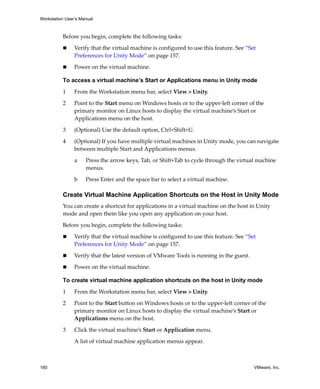
On the external network to which the host is connected, any virtual machine on the 
NAT network appears to be the host itself, because its network traffic uses the host’s 
IP address. The virtual machine can send and receive data using TCP/IP to any machine 
that is accessible from the host. 
Before any communication can occur, the NAT device must set up a map between the 
virtual machine’s address on the private NAT network and the host’s network address 
on the external network. 
When a virtual machine initiates a network connection with another network resource, 
this map is created automatically. The operation is transparent to the user of the virtual 
machine on the NAT network. No additional work needs to be done.
Network connections that are initiated from outside the NAT network to a virtual 
machine on the NAT network are not transparent. When a machine on the external 
network attempts to initiate a connection with a virtual machine on the NAT network, 
it cannot reach the virtual machine because the NAT device does not forward the 
request. 
However, you can configure port forwarding manually on the NAT device so that 
network traffic destined for a certain port can still be forwarded automatically to a 
virtual machine on the NAT network. See “Advanced NAT Configuration” on page 320.
File sharing of the type used by Windows operating systems and Samba is possible 
among computers on the NAT network, including virtual machines and the host 
computer. If you are using WINS servers on your network, a virtual machine using 
NAT networking can access shared files and folders on the host that the WINS server 
knows if those shared files and folders are in the same workgroup or domain.
Workstation User’s Manual
320 VMware, Inc.
Advanced NAT Configuration
You can configure NAT to make custom configuration settings for Windows and Linux. 
Configure NAT on a Windows Host
Use the virtual network settings to configure NAT on a Windows host. To edit the NAT 
configuration file, see “Custom NAT and DHCP Configuration on a Windows Host” on 
page 320.
To configure NAT on a Windows host
1 Choose Edit > Virtual Network Editor.
2 Use the controls in the NAT Settings menu to configure NAT:
 To stop and start the virtual NAT device, click the appropriate buttons.
 To edit NAT settings for a virtual network, choose the VMnet network from 
the drop‐down menu and click Edit. 
3 Click DNS Settings to set up or change port forwarding or to specify DNS servers 
that the virtual NAT device should use.
4 Click OK.
Custom NAT and DHCP Configuration on a Windows Host
If you are an advanced user on a Windows host computer, you can edit the NAT and 
DHCP configuration files to make custom configuration settings. If your host operating 
system is installed on the C drive, the configuration files for NAT and DHCP are in the 
following locations:
Table 15-3. NAT and DHCP File Locations
File Type Location
NAT On Windows XP: C:Documents and SettingsAll
UsersApplication DataVMwarevmnetnat.conf
On Windows Vista and Windows 7: 
C:ProgramDataVMwarevmnetnat.conf
For more information about this file, see “Contents of the NAT 
Configuration File” on page 322.
DHCP On Windows XP: C:Documents and SettingsAll
UsersApplication DataVMwarevmnetdhcp.conf
On Windows Vista and Windows 7:
C:ProgramDataVMwarevmnetdhcp.conf
VMware, Inc. 321
Chapter 15 Advanced Virtual Networking
Use the virtual network editor (Edit > Virtual Network Editor) to change many key 
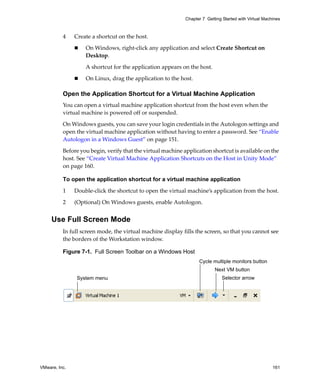
NAT and DCHP settings. 
If you make manual changes to the configuration files, those changes might be lost 
when you use the virtual network editor. Make backup copies of the files before you 
change any settings in the virtual network editor. You can then copy your manual 
changes back into the appropriate configuration files.
Specifying Connections from Ports Below 1024
When a client machine makes a TCP or UDP connection to a server, the connection 
comes from a particular port on the client (the source port) and connects to a particular 
port on the server (the destination port). For security reasons, some servers accept 
connections only from source ports below 1024. You might see this configuration on 
machines used as NFS file servers, for example.
If a virtual machine using NAT attempts to connect to a server that requires the client 
to use a source port below 1024, the NAT device must forward the request from a port 
below 1024. You can specify this behavior in the vmnetnat.conf file.
This behavior is controlled by entries in sections headed [privilegedUDP] and 
[privilegedTCP]. You might need to add settings to or modify settings in either or 
both of these sections, depending on the kind of connection you need to make.
You can set two parameters, each of which appears on a separate line.
Table 15-4. Parameters to Map Virtual Machine Source and Destination Ports
Parameter Description
autodetect = <n> The autodetect setting determines whether the VMware NAT device 
automatically attempts to map virtual machine source ports below 
1024 to NAT source ports below 1024. A setting of 1 means true. A 
setting of 0 means false. On a Windows host, the default is 1 (true). 
On a Linux host, the default is 0 (false).
port = <n> The port setting specifies a destination port (where <n> is the port on 
the server that accepts the connection from the client). Whenever a 
virtual machine connects to the specified port on any server, the NAT 
device attempts to make the connection from a source port below 
1024. You can include one or more port settings in the 
[privilegedUDP] or [privilegedTCP] section or in both sections, 
as required for the connections you need to make. Enter each port 
setting on a separate line.
Workstation User’s Manual
322 VMware, Inc.
Configuring NAT on a Linux Host
Use the default NAT configuration file on the host to configure the NAT device. 
This file is located in /etc/vmware/vmnet8/nat/nat.conf.
For an example of a NAT configuration file, see “Sample Linux nat.conf File” on 
page 327. 
Contents of the NAT Configuration File
The NAT configuration file is in the following locations:
 On a Windows host:
C:Documents and SettingsAll UsersApplication DataVMwarevmnetnat.conf
If you edit this file and then use the virtual network editor (Edit > Virtual Network 
Editor) your edits might be lost.
 On a Linux host:
/etc/vmware/vmnet8/nat/nat.conf
The NAT configuration file is divided into sections. Each section configures a part of the 
NAT device. Text surrounded by square brackets, such as [dns], marks the beginning 
of a section. In each section is a configuration parameter that can be set. 
The configuration parameters take the form ip = 192.168.27.1/24. The NAT 
configuration file contains the following sections.
The [host] Section
The [host] section includes parameters to configure the NAT connection.
 ip – The IP address that the NAT device should use. It can be followed by a slash 
and the number of bits in the subnet.
 netmask – The subnet mask to use for the NAT network. DHCP addresses are 
allocated from this range of addresses.
 configport – A port that can be used to access status information about the NAT 
device.
 device – The VMnet device to use. Windows devices are of the form vmnet<x> 
where <x> is the number of the VMnet. Linux devices are of the form 
/dev/vmnet<x>.
 activeFTP – Flag to indicate if active FTP is to be allowed. Active FTP allows 
incoming connections to be opened by the remote FTP server. Turning this off 
means that only passive mode FTP works. Set this flag to 0 to turn it off.
VMware, Inc. 323
Chapter 15 Advanced Virtual Networking
The [udp] Section
timeout – Number of seconds to keep the UDP mapping for the NAT network.
The [dns] Section
The [dns] section is for Windows hosts only. Linux does not use this section.
 policy – Policy to use for DNS forwarding. Accepted values include:
 order – Send one DNS request at a time in the order of the name servers.
 rotate – Send one DNS request at a time and rotate through the DNS servers.
 burst – Send to three servers and wait for the first one to respond.
 timeout – Time in seconds before retrying a DNS request.
 retries – Number of retries before the NAT device stops trying to respond to a 
DNS request.
 autodetect – Flag to indicate whether the NAT device should detect the DNS 
servers available to the host.
 nameserver1 – IP address of a DNS server to use.
 nameserver2 – IP address of a DNS server to use.
 nameserver3 – IP address of a DNS server to use.
If autodetect is on and some name servers are specified, the DNS servers specified 
in nameserver1, nameserver2, and nameserver3 are added before the list of 
detected DNS servers.
The [netbios] Section
The [netbios] section applies to Windows hosts only. Linux does not use this section.
 nbnsTimeout = 2 – Timeout, in seconds, for NBNS queries.
 nbnsRetries = 3 – Number of retries for each NBNS query.
 nbdsTimeout = 3 – Timeout, in seconds, for NBDS queries.
The [incomingtcp] Section
Use the [incomingtcp] section to configure TCP port forwarding for NAT. In this 
section, you can assign a port number to an IP address and port number on a virtual 
machine. 
Workstation User’s Manual
324 VMware, Inc.
The following line shows the format used in this section:
8887 = 192.168.27.128:21
This example creates a map from port 8887 on the host to the IP address 192.168.27.128 
and port 21. When this map is set and an external machine connects to the host at port 
8887, the network packets are forwarded to port 21 (the standard port for FTP) on the 
virtual machine with IP address 192.168.27.128.
The [incomingudp] Section
Use the [incomingudp] section to configure UDP port forwarding for NAT. In this 
section, you can assign a port number to an IP address and port number on a virtual 
machine. 
The following line shows the format used in this section. It illustrates a way to forward 
X server traffic from the host port 6000 to the virtual machine’s port 6001:
6000 = 192.168.27.128:6001
This example creates a map from port 6000 on the host to the IP address 192.168.27.128 
and port 6001. When this map is set and an external machine connects to the host at port 
6000, the network packets are forwarded to port 6001 on the virtual machine with 
IP address 192.168.27.128.
Considerations for Using NAT
Consider the following items when you use NAT:
 NAT causes some performance loss.
Because NAT requires that every packet sent to and received from a virtual 
machine must be in the NAT network, an unavoidable performance penalty 
occurs. 
 NAT is not perfectly transparent.
NAT does not usually allow connections to be initiated from outside the network, 
although you can manually configure the NAT device to set up server connections. 
The practical result is that some TCP and UDP protocols that require a connection 
be initiated from the server machine, some peer to peer applications, for example, 
do not work automatically, and some might not work at all.
 NAT provides some firewall protection.
A standard NAT configuration provides basic‐level firewall protection because the 
NAT device can initiate connections from the private NAT network, but devices on 
the external network usually cannot initiate connections to the private NAT 
network.
VMware, Inc. 325
Chapter 15 Advanced Virtual Networking
Using NAT with NetLogon
When you use NAT networking in a virtual machine with a Windows guest operating 
system running on a Windows host, you can use NetLogon to log in to a Windows 
domain from the virtual machine. You can then access file shares that the WINS server 
knows. 
To use NetLogon, you need to know how WINS servers and Windows domain 
controllers work. This section explains how to set up the virtual machine to use 
NetLogon. The setup process is similar to the way you set up a physical computer on 
one LAN that is using a domain controller on another LAN. 
To log in to a Windows domain outside the virtual NAT network, the virtual machine 
needs access to a WINS server for that domain. You can connect the virtual machine to 
a WINS server in the following ways:
 Connect to the WINS server that the DHCP server used on the NAT network 
provides, if the WINS server is already set up on the host. 
 Manually enter the IP address of the WINS server to connect from the virtual 
machine to a WINS server not set up on the host.
Use NAT to Connect to an Existing WINS Server Set Up on the Host
To use NAT to connect, a WINS server in the same workgroup or domain must be set 
up on the host. This procedure applies to the Windows 2000, XP, 2003 Server, NT, Me, 
and 9x guest versions.
Differences for Windows Vista and Windows 7, are noted in the specific steps. 
To use NAT to connect to an existing WINS server set up on the host
1 In the virtual machine, right‐click My Network Places and choose Properties.
 For Windows Vista, open the Network and Sharing Center and click the View 
Status link for the connection that uses the needed virtual network adapter.
 For Windows 7, open the Network and Sharing Center and click one of the 
Local Area Connection links for the connection that uses the needed virtual 
network adapter.
2 In the Network Connections window, right‐click the virtual network adapter and 
choose Properties.
 For Windows Vista, in the Local Area Connection Status window, click 
Properties and click Continue when prompted for permission.
 For Windows 7, in the Local Area Connection Status window, click Properties.
Workstation User’s Manual
326 VMware, Inc.
3 In the Properties dialog box, select Internet Protocol (TCP/IPv4) and click 
Properties. 
4 In the TCP/IP Properties dialog box, click Advanced.
5 On the WINS tab, under NetBIOS setting, select Default: Use NetBIOS setting 
from DHCP Server. 
6 Click OK twice and click Close.
Enter the IP Address of a WINS Server Manually
Use the IP address to connect to a WINS server in the same workgroup or domain that 
is not already set up on the host.
To enter the IP address of a WINS server manually
1 In the virtual machine, right‐click My Network Places and choose Properties.
 For Windows Vista, open the Network and Sharing Center and click the View 
Status link for the connection that uses the needed virtual network adapter.
 For Windows 7, open the Network and Sharing Center and click one of the 
Local Area Connection link for the connection that uses the needed virtual 
network adapter.
2 In the Network Connections window, right‐click the virtual network adapter and 
choose Properties.
 For Windows Vista, in the Local Area Connection Status window, click 
Properties and click Continue when prompted for permission.
 For Windows 7, in the Local Area Connection Status window, click Properties.
3 In the Properties dialog box, select Internet Protocol (TCP/IPv4) and click 
Properties. 
4 In the TCP/IP Properties dialog box, click Advanced.
5 On the WINS tab, click Add. 
6 In the TCP/IP WINS Server dialog box, enter the IP address for the WINS server in 
the WINS server field and click Add. 
The IP address of the WINS server appears in the WINS addresses list on the WINS 
tab.
7 Repeat Step 5 and Step 6 for each WINS server to which you want to connect from 
this virtual machine.
VMware, Inc. 327
Chapter 15 Advanced Virtual Networking
8 Click OK twice and click Close.
Now that the virtual machine has an IP address for a WINS server, you can use 
NetLogon in the virtual machine to log in to a domain and access shares in that 
domain. However, your access is limited to shares of virtual machines that are on 
the same NAT network or are bridged on the same domain.
For example, if the WINS server covers a domain with a domain controller, you can 
access that domain controller from the virtual machine and add the virtual 
machine to the domain. You need the Administrator user ID and password for the 
domain controller.
Sample Linux nat.conf File
# Linux NAT configuration file
[host]
# NAT gateway address
ip = 192.168.237.2/24
hostMAC = 00:50:56:C0:00:08
# enable configuration; disabled by default for security reasons
#configport = 33445
# vmnet device if not specified on command line
device = vmnet8
# Allow PORT/EPRT FTP commands (they need incoming TCP stream...)
activeFTP = 1
# Allows the source to have any OUI. Turn this one if you change the OUI
# in the MAC address of your virtual machines.
#allowAnyOUI = 1
[udp]
# Timeout in seconds, 0 = no timeout, default = 60; real value might
# be up to 100% longer
timeout = 30
[dns]
# This section applies only to Windows.
#
# Policy to use for DNS forwarding. Accepted values include order,
# rotate, burst.
#
Workstation User’s Manual
328 VMware, Inc.
# order: send one DNS request at a time in order of the name servers
# rotate: send one DNS request at a time, rotate through the DNS servers
# burst: send to three servers and wait for the first one to respond
policy = order;
# Timeout in seconds before retrying DNS request.
timeout = 2
# Retries before giving up on DNS request
retries = 3
# Automatically detect the DNS servers (not supported in Windows NT)
autodetect = 1
# List of DNS servers to use. Up to three may be specified
#nameserver1 = 208.23.14.2
#nameserver2 = 63.93.12.3
#nameserver3 = 208.23.14.4
[netbios]
# This section applies only to Windows.
# Timeout for NBNS queries.
nbnsTimeout = 2
# Number of retries for each NBNS query.
nbnsRetries = 3
# Timeout for NBDS queries.
nbdsTimeout = 3
[incomingtcp]
# Use these with care - anyone can enter into your virtual machine through
# these...
# FTP (both active and passive FTP is always enabled)
# ftp localhost 8887
#8887 = 192.168.27.128:21
# WEB (make sure that if you are using named webhosting, names point to
# your host, not to guest... And if you are forwarding port other
# than 80 make sure that your server copes with mismatched port
# number in Host: header)
# lynx http://localhost:8888
#8888 = 192.168.27.128:80
# SSH
# ssh -p 8889 root@localhost
#8889 = 192.168.27.128:22
VMware, Inc. 329
Chapter 15 Advanced Virtual Networking
[incomingudp]
# UDP port forwarding example
#6000 = 192.168.27.128:6001
Using Samba with Workstation
If you have Samba on your Linux host, you can configure Samba so that it works with 
Workstation.
Modify your Samba configuration so that it includes the IP subnet that the vmnet1 
Workstation virtual network adapter uses. To determine which subnet vmnet1 is using, 
run the following command:
/sbin/ifconfig vmnet1
Make sure the Samba password file includes entries for all users of the virtual machine 
who will access the host’s file system. The user names and passwords in the Samba 
password file must match those used for logging on to the guest operating system.
Add Users to the Samba Password File
You can add user names and passwords to the Samba password file at any time from a 
terminal window on your Linux host computer. 
To add users to the Samba password file
1 Log in to the root account:
su
2 Run the Samba password command:
smbpasswd -a <username>
Here <username> is the user name to add. 
3 Follow the instructions on the screen. 
4 Log out of the root account:
exit
Workstation User’s Manual
330 VMware, Inc.
Using a Samba Server for Bridged and Host-Only Networks
To use your Samba server for host‐only and bridged networking, you must modify one 
parameter in the smb.conf file. You can define the interface parameter so that your 
Samba server serves multiple interfaces. An example of this is the following:
interface = eth0 vmnet1
This example tells the Samba server to monitor and use both the eth0 and vmnet1 
interfaces, which are the interfaces that bridged and host‐only networking use, 
respectively.
Use Samba Without Network Access
To make Samba inaccessible from your physical network interface, you must configure 
the configuration file. 
To use Samba without network access
1 Open the configuration file:
/etc/samba/smb.conf
2 Add the following line to the configuration file and save the changes.
interfaces = vmnet*
3 Restart Samba.
VMware, Inc. 331
16
This chapter describes how to use various devices with a virtual machine.
This chapter includes the following topics:
 “Using Parallel Ports” on page 331
 “Using Serial Ports” on page 335
 “Configuring Keyboard Features” on page 339
 “Using USB Devices in a Virtual Machine” on page 351
 “Use Smart Cards with Virtual Machines” on page 358
 “Support for Generic SCSI Devices” on page 361
 “Use Eight‐Way Virtual Symmetric Multiprocessing” on page 366
Using Parallel Ports
Parallel ports are used by a variety of devices, including printers, scanners, dongles, 
and disk drives. Although these devices can connect to the host without problems, only 
printers can reliably connect to virtual machines by using parallel ports.
Currently, Workstation provides only partial emulation of PS/2 hardware. Interrupts 
that a device connected to the physical port requests are not passed to the virtual 
machine. The guest operating system cannot use DMA (direct memory access) to move 
data to or from the port. For this reason, not all devices that attach to the parallel port 
are guaranteed to work correctly. Do not use parallel port storage devices in a virtual 
machine.
Connecting Devices 16
Workstation User’s Manual
332 VMware, Inc.
Add a Virtual Parallel Port to a Virtual Machine
If the virtual machine is configured with a parallel port, most guest operating systems 
detect the port at installation time and install the required drivers. Some operating 
systems, including Linux, Windows NT, and Windows 2000, automatically detect the 
ports at boot time. Others, like Windows 95 and Windows 98, do not. 
To add a virtual parallel port to a virtual machine
1 Select the virtual machine. 
2 Make sure the virtual machine is powered off. 
3 Choose VM > Settings. 
4 On the Hardware tab, click Add.
5 In the New Hardware wizard, select Parallel Port and click Next.
6 Specify which option to use for the parallel port:
 If you select Use physical parallel port, click Next and choose the port from 
the drop‐down menu.
 If you select Output file, click Next and enter the path and filename or browse 
to the location of the file.
7 Under Device status, if you do not want the parallel port to connect at power on, 
deselect the check box.
8 Click Finish.
9 If the guest operating system is Windows 95 or Windows 98, run the guest 
operating system’s Add New Hardware wizard to let Windows detect the new 
device. 
To display this wizard, choose Start > Settings > Control Panel > Add New 
Hardware. 
Troubleshoot ECR Errors for Parallel Ports
When you power on the virtual machine after adding a parallel port, you might see an 
error message stating that the parallel port on the host does not have an Extended 
Control Register (ECR). If so, it is possible the hardware supports ECR but it has been 
disabled in the BIOS.
VMware, Inc. 333
Chapter 16 Connecting Devices
To troubleshoot ECR errors for parallel ports
1 Reboot the host.
2 Early in the boot process, press and hold down the Delete key to enter the host 
computer’s BIOS configuration editor.
3 Find the parallel port field and enable Extended Capability Port (ECP) mode or a 
combination of modes that includes ECP. 
Most modern computers support ECP mode.
Configuring a Parallel Port on a Linux Host
For a parallel port to work properly in a guest, it must first be configured properly on 
the host. Most problems with parallel ports are caused by mistakes in the host 
configuration.
Linux kernels in the 2.6.x series use a special arbitrator for access to the parallel port 
hardware. If the host is using the parallel port, the virtual machine cannot use it. If a 
virtual machine is using the parallel port, the host and any users accessing the host are 
denied access to the device. You must use the VM > Removable Devices menu to 
disconnect the parallel port from the virtual machine to access the device from the host.
Configure Parallel Ports for Linux 2.6.x Kernels
The 2.6.x kernels that support parallel ports use the modprobe <modulename> and
modprobe parport_pc modules. Workstation requires that the parallel port PC‐style 
hardware option (CONFIG_PARPORT_PC) be built and loaded as a kernel module. 
That is, it must be set to m. 
To configure parallel ports for Linux 2.6.x kernels
1 To determine whether the modprobe <modulename> and modprobe parport_pc 
modules are installed and loaded on your system, run the lsmod command as the 
root user. 
You can also look at the /proc/modules file for the list. 
With 2.6.x, loading parport_pc does not load all modules. 
2 If none of the listed parallel port modules is loaded, use the following command:
modprobe parport_pc && modprobe ppdev
This command inserts the modules needed for a parallel port. 
If problems persist, the lp module might be loaded. If it is, the virtual machine 
cannot use the parallel port correctly. 
Workstation User’s Manual
334 VMware, Inc.
3 If the lp module is loaded, run the following command as root to remove it:
rmmod lp
4 To verify that the line referring to the lp module in the /etc/modules.conf or 
/etc/conf.modules file is removed or commented out, insert a pound sign (#) at 
the beginning of the line. 
The name of the configuration file depends on the Linux distribution you are 
using. When you reboot the host after removing this line, the configuration file no 
longer starts the lp module.
5 To ensure that the proper modules for the parallel port are loaded at boot time, add 
the following line to the /etc/modules.conf or /etc/conf.modules file:
alias parport_lowlevel parport_pc
Configure Device Permissions for Parallel Ports
Some Linux distributions by default do not grant the virtual machine access to the lp 
and parport devices. You must add the VMware user to the group that has permission 
to access these devices.
To configure device permissions for parallel ports
1 Run the following command to determine the owner and group for the device:
ls –la /dev/parport0
The third and fourth columns of the output show the owner and group, 
respectively. In most cases, the owner of the device is root and the associated 
group is lp.
2 To add the user to the device group, become the root user and open the 
/etc/group file with a text editor. 
3 On the line starting with lp, which defines the lp group, add the Workstation 
user’s user name. 
The following line provides an example for a user whose user name is userj.
lp::7:daemon,lp,userj
The next time the user logs on to the host, the changes take effect.
VMware, Inc. 335
Chapter 16 Connecting Devices
Using Serial Ports
A Workstation virtual machine can use up to four virtual serial ports. The virtual serial 
ports can be configured in several ways:
 Connect a virtual serial port to a physical serial port on the host computer.
 Connect a virtual serial port to a file on the host computer.
 Make a direct connection between two virtual machines or between a virtual 
machine and an application running on the host computer.
For each of these choices, you can also select whether to connect the virtual serial port 
when you power on the virtual machine.
Add a Virtual Serial Port to a Virtual Machine
Use virtual serial ports to make devices such as modems and printers available to 
virtual machines or to send debugging data from a virtual machine to the host or to 
another virtual machine.
You can use virtual serial ports to send data to the following:
 Physical serial port – Enables you to use a device such as an external modem or 
hand‐held device in a virtual machine. Workstation creates a virtual serial port 
automatically when you enable the virtual printer feature.
 Output file on the host – Captures the data that a program running in the virtual 
machine sends to the virtual serial port.
 An application on the host – Enables you to use an application on the host to 
capture debugging information sent from the virtual machine’s serial port.
 Another virtual machine – Enables you to use an application in one virtual 
machine (the client) to capture debugging information sent from the other 
(the server) virtual machine’s serial port.
To add a virtual serial port to a virtual machine
1 Select the virtual machine. 
2 Make sure the virtual machine is powered off. 
NOTE   The virtual printer feature automatically configures a serial port to make host 
printers available to the guest without installing additional drivers in the virtual 
machine. See “Use Host Printers in a Virtual Machine” on page 179.
Workstation User’s Manual
336 VMware, Inc.
3 Choose VM > Settings. 
4 On the Hardware tab, click Add.
5 In the Add Hardware wizard, select Serial Port and click Next.
6 On the Serial Port Type page, do one of the following:
 For physical devices such as modems, select Use physical serial port on the 
host, click Next, and choose the port on the host computer that you want to 
use for this serial connection.
 To capture data from an application in an output file, select Output file, click 
Next, and enter the path and filename or browse to the location of the file on 
the host.
 To connect to a debugging application on the host or in another virtual 
machine, select Output to Named Pipe and click Next. 
7 If you selected Output to Named Pipe, do one of the following:
 For a Windows host, on the Specify Named Pipe page, specify the pipe name. 
The pipe name must follow the form .pipe<namedpipe>. That is, it must 
begin with .pipe.
 For a Linux host, in the Path field, enter /tmp/<socket> or another UNIX 
socket name. 
8 Also if you selected Output to Named Pipe, do one of the following:
 To send debugging information to an application on the host:
i In the first drop‐down menu, select This end is the server or This end is 
the client. 
Select This end is the server to start this end of the connection first.
ii In the second drop‐down menu, select The other end is an application. 
 To send debugging information to another virtual machine:
i In the first drop‐down menu, select This end is the server. 
ii In the second drop‐down menu, select The other end is a virtual 
machine. 
9 Make sure the Connect at power on check box is selected if desired.
10 Click Finish.
VMware, Inc. 337
Chapter 16 Connecting Devices
11 (Optional) On the Hardware tab of the virtual machine settings editor, to configure 
this serial port to use polled mode, select Yield CPU on poll. 
This option is of interest to developers who are using debugging tools that 
communicate over a serial connection. If the serial port in the guest is being used 
in polled mode rather than interrupt mode, you might notice performance issues. 
This option forces the virtual machine to yield processor time if the only task it is 
trying to do is poll the virtual serial port.
If you are setting up a connection between two virtual machines, you now have the first 
virtual machine set up as the server. Repeat this procedure for the second virtual 
machine, but set it up as the client by selecting This end is the client when configuring 
the named pipe.
Change the Input Speed of the Serial Connection
You can increase the speed of a serial connection over a pipe to a virtual machine. 
Before you begin, use the guest operating system to configure the serial port for the 
highest setting supported by the application you are running in the virtual machine.
In principle, the output speed, which is the speed at which the virtual machine sends 
data through the virtual serial port, is unlimited. In practice, the output speed depends 
on how fast the application at the other end of the pipe reads inbound data.
To change the input speed of the serial connection
1 Power off the virtual machine and close the Workstation window.
2 Use a text editor to add the following line to your virtual machine’s configuration 
(.vmx) file:
serial<n>.pipe.charTimePercent = "<x>"
<n> is the number of the serial port, starting from 0. The first serial port is serial0. 
The <x> value is a positive integer that specifies the time taken to transmit a 
character, expressed as a percentage of the default speed set for the serial port in 
the guest. For example, a setting of 200 forces the port to take twice as long for each 
character, or send data at half the default speed. A setting of 50 forces the port to 
take only half as long for each character, or send data at twice the default speed.
Assuming that the serial port speed is set appropriately in the guest operating 
system, experiment with this setting. Start with a value of 100 and gradually 
decrease it until you find the highest speed at which your connection works 
reliably.
Workstation User’s Manual
338 VMware, Inc.
Debugging over a Virtual Serial Port
Using virtual machines, you can debug kernel code on one system without the need for 
two physical computers, a modem, or a serial cable. You can use Debugging Tools for 
Windows (WinDbg) or Kernel Debugger (KD) to debug kernel code in a virtual machine 
over a virtual serial port. 
You can Download Debugging Tools for Windows from the Windows Hardware 
Developer Central (WHDC) Web site.
Debug an Application in a Virtual Machine from a Windows Host
In this configuration, you have kernel code to debug in a virtual machine (called the 
target virtual machine) and are running Debugging Tools for Windows (WinDbg) or 
Kernel Debugger (KD) on a Windows host.
Before you begin, on the host, make sure you have a recent version of Debugging Tools 
for Windows, which supports debugging over a pipe. You need version 5.0.18.0 or 
higher.
To debug an application in a virtual machine from a Windows host
1 Prepare the target virtual machine as described in “Add a Virtual Serial Port to a 
Virtual Machine” on page 335. 
Make sure you select This end is the server when configuring the named pipe.
2 Power on the virtual machine.
3 Choose VM > Removable Devices menu to make sure the serial port is connected. 
If Serial<n> is not reported as .pipe<namedpipe>, choose the virtual serial 
port and click Connect.
4 On the host, open a command prompt window and enter the following command:
<debugger> -k com:port=.pipe<namedpipe>,pipe
<debugger> is WinDbg or KD.
5 Press Enter to start debugging.
Debug an Application in a Virtual Machine from Another Virtual Machine
This configuration is useful if you use Workstation on a Linux host. In this situation, 
you have kernel code to debug in the target virtual machine and are running 
Debugging Tools for Windows (WinDbg) or Kernel Debugger (KD) in the debugger 
virtual machine on the same host. 
VMware, Inc. 339
Chapter 16 Connecting Devices
Before you begin, download and install WinDbg or KD in the Windows guest that you 
plan to use as the debugger virtual machine.
To debug an application from another virtual machine
1 Prepare the virtual machines as described in “Add a Virtual Serial Port to a Virtual 
Machine” on page 335. 
2 Power on both virtual machines.
3 Use the VM > Removable Devices menu to make sure the serial port is connected. 
If the serial port is not connected, choose the virtual serial port and click Connect.
4 In the debugger virtual machine, start debugging with WinDbg or KD. 
Configuring Keyboard Features
You can change which key combinations you use for hot‐key sequences in Workstation 
and which language to use for the keyboard that virtual network computing (VNC) 
clients use. In addition, you can configure platform‐specific keyboard features for 
Windows and Linux hosts.
Use the Enhanced Virtual Keyboard for Windows Hosts
The enhanced virtual keyboard feature provides better handling of international 
keyboards and keyboards with extra keys. It also offers security improvements because 
it processes raw keyboard input as soon as possible, bypassing Windows keystroke 
processing and any malware that is not already at a lower layer.
If you use the enhanced virtual keyboard, when you press Ctrl+Alt+Delete, the guest 
system only, rather than both guest and host, acts on the command.
Before you begin, if you just installed or upgraded to Workstation 7.x and have not yet 
restarted your computer, do so. 
To use the enhanced virtual keyboard for Windows hosts
1 Select the virtual machine. 
2 Make sure the virtual machine is powered off. 
3 Choose VM > Settings. 
4 Click the Options tab, and select General. 
5 To enable or disable the setting, select or deselect the Use enhanced virtual 
keyboard check box and click OK.
Workstation User’s Manual
340 VMware, Inc.
Hot Keys for Virtual Machines
Hot keys let you specify the key combination that is used with hot‐key sequences for 
virtual machines. For example, you can require that all hot‐key sequences use 
Ctrl+Shift+Alt. 
Configuring hot keys is useful to prevent certain key combinations (such as 
Ctrl+Alt+Del) from being intercepted by Workstation instead of being sent to the guest 
operating system. Use hot‐key sequences to:
 Switch between virtual machines 
 Enter and leave full screen mode 
 Release (ungrab) input 
 Send Ctrl+Alt+Del to the virtual machine only (not to the host machine) 
 Send commands to the virtual machine only (not to the host machine) 
The default settings for hot keys are listed in the preferences editor (choose Edit > 
Preferences > Hot Keys). Use the preferences editor to change them.
Use Ctrl+Alt in a Key Combination
Because Ctrl+Alt tells Workstation to release (ungrab) mouse and keyboard input, 
combinations that include Ctrl+Alt are not passed to the guest operating system. You 
must use the Space key if the key combination includes Ctrl+Alt.
To use Ctrl+Alt in a key combination
1 Press Ctrl+Alt+spacebar.
2 Release the spacebar without releasing Ctrl and Alt.
3 Press the third key of the key combination you want to send to the guest. 
VMware, Inc. 341
Chapter 16 Connecting Devices
Specify a Language Keyboard Map for VNC Clients
If you set a virtual machine to act as a VNC server, you can specify which language to 
use for the keyboard that VNC clients use. By default, the US101 keyboard map (U.S. 
English) is used.
Before you begin, set the virtual machine to act as a VNC server. See “Configure a 
Virtual Machine as a VNC Server” on page 227.
Also, determine the location of the keymap file to use. Default keymap files are 
included in the Workstation installation directory:
 On Windows XP hosts, this directory is in C:Documents and SettingsAll
UsersApplication DataVMwarevnckeymap.
 On Windows Vista and Windows 7 hosts, this directory is in 
C:ProgramDataVMwarevnckeymap.
 On Linux hosts, this directory is in /usr/lib/vmware/vnckeymap.
If the keymap file you want to use is in another location, determine the path to the file.
Also determine the language code. Use the following list:
 de: German
 de-ch: German (Switzerland)
 es: Spanish 
 fi: Finnish
 fr: French
 fr-be: French (Belgium)
 fr-ch: French (Switzerland)
 is: Icelandic
 it: Italian
 jp: Japanese
 nl-be: Dutch (Belgium)
 no: Norwegian
 pt: Polish
 uk: UK English
 us: US English
Workstation User’s Manual
342 VMware, Inc.
To specify a language keyboard map for VNC clients
1 Use a text editor to open the configuration file (.vmx file) for the virtual machine 
and add the following lines, where <port number> is the port number to use:
 RemoteDisplay.vnc.enabled = "TRUE"
 RemoteDisplay.vnc.port = "<port number>"
2 Add one of the following properties to the configuration file, where <xx> is the 
code for the language to use, such as jp for Japanese:
 To use the default keymap file included in the Workstation installation 
directory, set the following property:
RemoteDisplay.vnc.keyMap = "<xx>"
 To use a keyboard map file in another location, set the following property to 
an absolute file path:
RemoteDisplay.vnc.keyMapFile
You can now start the virtual machine and connect to it from a VNC client. See “Use a 
VNC Client to Connect to a Virtual Machine” on page 228.
Keyboard Mapping on a Linux Host
Several situations might require you to set properties in a virtual machine’s 
configuration file (.vmx file) to change the way a key is mapped.
Configure Keyboard Mapping for a Remote X Server
Sometimes the keyboard works correctly with a local X server but not when you run the 
same virtual machine with a remote X server. You need to set additional properties in 
the configuration (.vmx) file.
Before you begin, verify that the remote X server is an XFree86 server running on a PC.
If the keyboard does not work correctly on an XFree86 server running locally, report the 
problem to VMware technical support.
For local X servers, Workstation maps X key codes to PC scan codes to correctly identify 
a key. Workstation uses this key code map only for local X servers because it cannot tell 
whether a remote X server is running on a PC or on some other kind of computer. In 
this case, you can set a property to tell Workstation to use key code mapping. For a 
description of key code mapping, see “X Key Codes Compared to Keysyms” on 
page 344.
VMware, Inc. 343
Chapter 16 Connecting Devices
To configure keyboard mapping for a remote X server
1 Power off the virtual machine and close the Workstation window. 
2 On the machine that hosts the virtual machine, add one of the following lines to the 
virtual machine configuration (.vmx) file or to ~/.vmware/config:
 If you use an XFree86‐based server that Workstation does not recognize as an 
XFree86 server, use the following property: 
xkeymap.usekeycodeMap = "TRUE"
This property tells Workstation to always use key code mapping regardless of 
server type. 
 If Workstation does recognize the remote server as an XFree86 server, use the 
following property: 
xkeymap.usekeycodeMapIfXFree86 = "TRUE"
This property tells Workstation to use key code mapping if you are using an 
XFree86 server, even if it is remote. 
3 Save and close the file.
Change How a Specific Key Is Mapped
If some keys on the keyboard do not work correctly in a virtual machine, you can set a 
property that makes a modification to the map. 
Before you begin, perform the following tasks:
 Verify that the X server is an XFree86 server running on a PC. If the X server is 
remote, configure it to use key code mapping. See “Configure Keyboard Mapping 
for a Remote X Server” on page 342. For a description of key code mapping, see 
“X Key Codes Compared to Keysyms” on page 344.
 Determine the X key code and the corresponding v‐scan code for the key. To find 
the X key code for a key, run xev or xmodmap -pk. Most v‐scan codes are listed in 
“V‐Scan Code Table” on page 347. 
Workstation User’s Manual
344 VMware, Inc.
To change how a specific key is mapped
1 Power off the virtual machine and close the Workstation window. 
2 On the machine that hosts the virtual machine, add the following line to the virtual 
machine configuration (.vmx) file or to ~/.vmware/config:
xkeymap.keycode.<code> = "<v-scan_code>"
The <code> value must be a decimal number and <v-scan_code> must be a 
C‐syntax hexadecimal number (for example, 0x001). 
For example, to swap left Ctrl and Caps Lock, use the following lines:
xkeymap.keycode.64 = "0x01d # X Caps_Lock -> VM left ctrl"
xkeymap.keycode.37 = "0x03a # X Control_L -> VM caps lock"
3 Save and close the file.
X Key Codes Compared to Keysyms
Pressing a key on the PC keyboard generates a PC scan code based roughly on the 
position of the key. For example, the Z key on a German keyboard generates the same 
code as the Y key on an English keyboard because they are in the same position on the 
keyboard. Most keys have one‐byte scan codes, but some keys have two‐byte scan 
codes with prefix 0xe0.
Internally, Workstation uses a simplified version of the PC scan code that is a single 
nine‐bit numeric value, called a v‐scan code. A v‐scan code is written as a three‐digit 
hexadecimal number. The first digit is 0 or 1. For example, the Ctrl key on the left side 
of the keyboard has a one‐byte scan code (0x1d). Its v‐scan code is 0x01d. The Ctrl key 
scan code on the right side of the keyboard is two bytes (0xe0, 0x1d). Its v‐scan code is 
0x11d. 
An XFree86 server on a PC has a one‐to‐one mapping from X key codes to PC scan 
codes, or v‐scan codes, which is what Workstation uses. When Workstation is hosted on 
an XFree86 server and runs a local virtual machine, it uses the built‐in mapping from 
X key codes to v‐scan codes. This mapping is keyboard independent and should be 
correct for most languages. In other cases (not an XFree86 server or not a local server), 
Workstation must map keysyms to v‐scan codes by using a set of keyboard‐specific 
tables.
An X server uses a two‐level encoding of keys, which includes the X key code and the 
keysym. An X key code is a one‐byte value. The assignment of key codes to keys 
depends on the X server implementation and the physical keyboard. As a result, an 
X application normally cannot use key codes directly. Instead, the key codes are 
VMware, Inc. 345
Chapter 16 Connecting Devices
mapped into keysyms that have names like space, escape, x and 2. You can use an X 
application to control the mapping by using the function XChangeKeyboardMapping() 
or by the program xmodmap. To explore keyboard mappings, you can use the xev 
command, which shows the key codes and keysyms for keys typed into its window. 
A key code corresponds roughly to a physical key, while a keysym corresponds to the 
symbol on the key top. For example, with an XFree86 server running on a PC, the Z key 
on the German keyboard has the same key code as the Y key on an English keyboard. 
The German Z keysym, however, is the same as the English Z keysym, and different 
from the English Y keysym.
Configure How Keysyms Are Mapped
When key code mapping cannot be used or is disabled, Workstation maps keysyms to 
v‐scan codes. If a language‐specific keyboard does not appear to be supported by 
Workstation, you might need to set a property that tells Workstation which keysym 
table to use. 
Before you begin, perform the following tasks:
 To change the mapping of a few keys, determine the keysym name for each key 
that is not mapped correctly. 
The easiest way to find the keysym name for a key is to run the xev or xmodmap
-pk commands. The X header file /usr/include/X11/keysymdef.h has a 
complete list of keysyms. The name of a keysym is the same as its C constant 
without the XK_ prefix. 
 To use a different keysym table, determine which mapping table to use.
The tables are located in the xkeymap directory in the Workstation installation 
directory (usually /usr/lib/vmware). The table you must use depends on the 
keyboard layout. The normal distribution includes tables for PC keyboards for the 
United States and a number of European countries and languages. For most of 
these, both the 101‐key (or 102‐key) and the 104‐key (or 105‐key) variants are 
available.
 If none of the mapping tables is completely correct, find one that works best, copy 
it to a new location, and change the individual keysym mappings.
Workstation User’s Manual
346 VMware, Inc.
Workstation determines which table to use by examining the current X keymap. 
However, its decision‐making process can sometimes fail. In addition, each mapping is 
fixed and might not be completely correct for any given keyboard and X key 
code‐to‐keysym mapping. For example, a user might have swapped Ctrl and Caps 
Lock using xmodmap. This means the keys are swapped in the virtual machine when 
using a remote server (keysym mapping) but are unswapped when using a local server 
(key code mapping). To correct this situation, use configuration settings.
To configure how keysyms are mapped
1 Power off the virtual machine and close the Workstation window. 
2 On the machine that hosts the virtual machine, add one or more of the following 
lines to the virtual machine configuration (.vmx) file or to ~/.vmware/config:
 To disable X key code mapping to map keysyms rather than key codes to 
v‐scan codes, set the following property:
xkeymap.nokeycodeMap = "TRUE"
For more information, see “X Key Codes Compared to Keysyms” on page 344.
 If Workstation has a table in the xkeymap directory for your keyboard but 
cannot detect it, set the following property:
xkeymap.language = "<keyboard_type>"
The value <keyboard_type> must specify one of the tables in the xkeymap 
directory. However, the failure to detect the keyboard probably means the 
table is not completely correct for you. You might need to create a modified 
table and use the xkeymap.fileName property, described next.
 To use a different keysym mapping table that is not in the xkeymap directory, 
set the following property, where <file_path> is the path to the table:
xkeymap.fileName = "<file_path>"
The table must list a keysym for each key by using the following form:
<sym> = "<v-scan_code>"
The <sym> value is an X keysym name, and <v-scan_code> is a C‐syntax 
hexadecimal number (for example, 0x001). Use a new line for each keysym. 
Compiling a complete keysym mapping is difficult. VMware recommends 
editing an existing table and making small changes.
VMware, Inc. 347
Chapter 16 Connecting Devices
 To change the keysym mapping of a few keys, set the following property for 
each key, on separate lines:
xkeymap.keysym.<sym> = "<v-scan_code>"
The value <sym> must be an X keysym name and <v-scan_code> is a 
C‐syntax hexadecimal number (for example, 0x001). 
Most v‐scan codes are listed in “V‐Scan Code Table” on page 347. The 
xkeymap tables themselves are also helpful.
3 Save and close the file.
V-Scan Code Table
Table 16‐1 shows the v‐scan codes for the 104‐key U.S. keyboard.
Table 16-1. V-Scan Codes for the 104-Key U.S. Keyboard
Symbol Shifted Symbol Location V-Scan Code
Esc 0x001
1 ! 0x002
2 @ 0x003
3 # 0x004
4 $ 0x005
5 % 0x006
6 ^ 0x007
7 & 0x008
8 * 0x009
9 ( 0x00a
0 ) 0x00b
‐ _ 0x00c
= + 0x00d
Backspace 0x00e
Tab 0x00f
Q 0x010
W 0x011
E 0x012
R 0x013
Workstation User’s Manual
348 VMware, Inc.
T 0x014
Y 0x015
U 0x016
I 0x017
O 0x018
P 0x019
[ { 0x01a
] } 0x01b
Enter 0x01c
Ctrl left 0x01d
A 0x01e
S 0x01f
D 0x020
F 0x021
G 0x022
H 0x023
J 0x024
K 0x025
L 0x026
; 0x027
ʹ 0x028
` 0x029
Shift left 0x02a
 | 0x02b
Z 0x02c
X 0x02d
C 0x02e
V 0x02f
B 0x030
Table 16-1. V-Scan Codes for the 104-Key U.S. Keyboard (Continued)
Symbol Shifted Symbol Location V-Scan Code
VMware, Inc. 349
Chapter 16 Connecting Devices
N 0x031
M 0x032
, < 0x033
. > 0x034
/ ? 0x035
Shift right 0x036
* numeric pad 0x037
Alt left 0x038
Space bar 0x039
Caps Lock 0x03a
F1 0x03b
F2 0x03c
F3 0x03d
F4 0x03e
F5 0x03f
F6 0x040
F7 0x041
F8 0x042
F9 0x043
F10 0x044
Num Lock numeric pad 0x045
Scroll Lock 0x046
Home 7 numeric pad 0x047
Up arrow 8 numeric pad 0x048
PgUp 9 numeric pad 0x049
‐ numeric pad 0x04a
Left arrow 4 numeric pad 0x04b
5 numeric pad 0x04c
Right arrow 6 numeric pad 0x04d
Table 16-1. V-Scan Codes for the 104-Key U.S. Keyboard (Continued)
Symbol Shifted Symbol Location V-Scan Code
Workstation User’s Manual
350 VMware, Inc.
+ numeric pad 0x04e
End 1 numeric pad 0x04f
Down arrow 2 numeric pad 0x050
PgDn 3 numeric pad 0x051
Ins 0 numeric pad 0x052
Del numeric pad 0x053
F11 0x057
F12 0x058
Break Pause 0x100
Enter numeric pad 0x11c
Ctrl right 0x11d
/ numeric pad 0x135
SysRq Print Scrn 0x137
Alt right 0x138
Home function pad 0x147
Up arrow function pad 0x148
Page Up function pad 0x149
Left arrow function pad 0x14b
Right arrow function pad 0x14d
End function pad 0x14f
Down arrow function pad 0x150
Page Down function pad 0x151
Insert function pad 0x152
Delete function pad 0x153
Windows left 0x15b
Windows right 0x15c
Menu 0x15d
Table 16-1. V-Scan Codes for the 104-Key U.S. Keyboard (Continued)
Symbol Shifted Symbol Location V-Scan Code
VMware, Inc. 351
Chapter 16 Connecting Devices
The 84‐key keyboard has a Sys Req key on the numeric pad. Its v‐scan code is 0x054.
Keyboards outside the U.S. usually have an extra key (often < > or < > |) next to the left 
Shift key. The v‐scan code for this key is 0x056.
Using USB Devices in a Virtual Machine
You can connect up to 20 USB devices to one virtual machine simultaneously. 
Workstation provides a dual interface USB controller per virtual machine, a UHCI for 
USB 1.1 devices and an EHCI for USB 2.0 devices.
For USB 2.0 support, your host must support USB 2.0, and you must enable USB 2.0 
support in Workstation. USB 2.0 support is available only for Workstation 6.x and 
higher virtual machines. USB 2.0 devices are high‐speed devices which include the 
latest models of USB flash drives, USB hard drives, iPods, and iPhone.
On the host, when a USB 2.0 device connects to a USB port, the device is automatically 
connected to EHCI controller and operates in USB 2.0 mode. A USB 1.1 device is 
connected to UHCI controller and operates in USB 1.1 mode. A virtual machine with 
USB 2.0 support enabled, simulates this behavior. See “Enable the USB 2.0 Controller 
for a Virtual Machine” on page 352.
Although your host operating system must support USB, you do not need to install 
device‐specific drivers for USB devices in the host operating system to use those 
devices only in the virtual machine. Windows NT and Linux kernels earlier than 2.2.17 
do not support USB. 
VMware has tested a variety of USB devices with Workstation 7.x. If the guest operating 
system has appropriate drivers, you can use a wide variety of USB devices, for example, 
PDAs, Smart phones, printers, storage (disk) devices, scanners, MP3 players, digital 
cameras, memory card readers, and isochronous transfer devices, such as webcams, 
speakers, and microphones.
USB human interface devices, such as the keyboard and mouse, can be connected to the 
virtual machine by enabling the Show all USB input devices option. If you do not select 
the option to Show all USB input devices as removable devices, these devices do not 
appear as Removable Devices available to connect to the virtual machine, even though 
they are plugged into USB ports on the host. This option is enables users to use special 
USB human interface devices (HIDs) inside a virtual machine.
Workstation User’s Manual
352 VMware, Inc.
Enable the USB 2.0 Controller for a Virtual Machine
The virtual machineʹs USB controller and high‐speed USB 2.0 devices are enabled by 
default. Modems and certain streaming data devices, such as speakers and webcams, 
do not work properly unless you enable USB 2.0 support.
If your virtual machine was created using an older version of Workstation the USB 2.0 
device support is not enabled. You can enable the USB controller in the virtual machine 
settings editor of Workstation 7.x. 
Before you begin, perform one of the following tasks that apply to your configuration:
 Verify that the virtual machine is a Workstation 6.x or higher virtual machine.
 Verify that the guest supports USB 2.0 devices.
 On Windows XP guests, verify that the latest service pack is installed to use 
USB 2.0. 
If you use Windows XP with no service packs, the driver for the EHCI controller 
cannot be loaded.
If you do not plan to use USB 2.0 devices in a virtual machine, you can use the virtual 
machine settings editor to disable USB 2.0 support.
To enable the USB 2.0 Controller for a virtual machine
1 Select the virtual machine.
2 Choose VM > Settings.
3 On the Hardware tab, select USB Controller. 
4 Select the Enable high‐speed support for USB 2.0 devices check box and click 
OK.
Add a USB Controller to a Virtual Machine
By default, a USB controller is included when you create a virtual machine. If you 
remove the USB controller, you can add it back.
This controller is required to use a smart card in a virtual machine regardless of 
whether the smart card reader is a USB device.
To add a USB controller to a virtual machine
1 Select the virtual machine.
2 Make sure the virtual machine is powered off.
VMware, Inc. 353
Chapter 16 Connecting Devices
3 Choose VM > Settings. 
4 On the Hardware tab, click Add to start the Add Hardware wizard.
5 On the Hardware Type page, select USB Controller and click Next.
6 On the USB page, click Finish.
7 In the virtual machine settings editor, click OK.
You can now start the virtual machine and automatically or manually connect USB 
devices and smart card readers.
Connecting USB Devices
When a virtual machine is running, its window is the active window. If you plug a USB 
device into the host, by default, the device connects to the virtual machine instead of 
the host. 
If you manually connect a USB device to a virtual machine (choose VM > Removable 
Devices), Workstation retains the virtual machine’s connection to the affected port on 
the host. You can suspend or power off the virtual machine, or unplug the device. When 
you plug the device back in or resume the virtual machine, Workstation reconnects the 
device. Workstation retains the connection by writing an autoconnect entry to the 
virtual machine’s configuration (.vmx) file. 
If Workstation cannot reconnect to the device (for example, because you disconnect the 
device), the device is removed and a message is displayed, indicating that Workstation 
cannot connect to the device. You can connect manually to the device if it is still 
available. 
Enable or Disable Automatic Connection of USB Devices
You can disable the autoconnect feature if you do not want USB devices to 
automatically connect to the virtual machine when you power it on.
To enable or disable automatic connection of USB devices
1 Select the virtual machine.
The virtual machine can be powered on or off unless you plan to change the setting 
for connecting to USB mouse and keyboard devices. In this case, the virtual 
machine must be powered off.
2 Choose VM > Settings.
Workstation User’s Manual
354 VMware, Inc.
3 On the Hardware tab, select USB Controller.
4 Select or deselect the Automatically connect new USB devices check box to enable 
or disable the setting and click OK.
Enable or Disable Show All USB Input Devices
The Show all USB input devices option is disabled by default. This option enables users 
to use special USB HIDs inside a virtual machine exclusively. 
VMware recommends disabling automatic connection of USB device when using a 
KVM switch for a mouse or keyboard. 
Before you begin, make sure that the virtual machine is powered off.
To enable or disable Show all USB input devices
1 Select VM > Settings.
2 On the Hardware tab, select USB Controller.
3 Select the Show all USB input devices check box to enable or disable the setting 
and click OK.
If the Show all USB input devices check box is enabled, all the HIDs, such as 
USB 1.1 and 2.0 mouse and keyboard devices, appear as Removable Devices when 
the virtual machine is powered on.
Connect a USB Device Manually
If a device that is connected to the host does not automatically connect to a virtual 
machine at power on, you can connect the device manually. 
Before you begin, for USB mouse, keyboard, and other input devices, you must enable 
showing these devices. See “Enable or Disable Show All USB Input Devices” on 
page 354.
Also, when you are using a virtual machine, if you plug a device in to the host, the 
autoconnect feature usually connects the device to the virtual machine. If this action 
does not occur, you can connect the device manually.
NOTE   An HID that is connected to the guest is not available to the host. 
VMware, Inc. 355
Chapter 16 Connecting Devices
To connect a USB device manually
1 Select the virtual machine. 
2 Make sure the virtual machine is powered on.
3 Choose VM > Removable Devices > <device_name>. 
Here <device_name> specifies the USB device that is plugged in to the host. 
A check mark appears next to the device’s name, indicating that it is connected.
If the physical USB devices are connected to the host through a hub, the virtual 
machine sees only the USB devices, not the hub.
USB Driver Installation on a Windows Host
When a particular USB device is connected to a virtual machine for the first time, the 
host detects it as a new device named VMware USB Device and installs the appropriate 
VMware driver. 
On Windows XP and Windows Server 2003 hosts, the Microsoft Windows Found New 
Hardware wizard prompts you to run it. Select the default action, Install the software 
automatically. After the software is installed, the guest operating system detects the 
USB device and searches for a suitable driver.
Synchronize a PDA to Install a PDA Driver
When you synchronize a PDA to a virtual machine for the first time, the total time 
required to load the VMware USB device driver in the host and the PDA driver in the 
guest might exceed the device’s connection timeout value. This causes the device to 
disconnect itself from the computer before the guest can synchronize with it. 
To synchronize a PDA to install a PDA driver
1 Connect the USB device to the computer that hosts the virtual machine.
2 Synchronize the PDA with the host.
3 Let the guest finish installing the PDA driver.
4 Dismiss any connection error warnings.
5 Synchronize the PDA again. 
This second attempt usually succeeds.
Workstation User’s Manual
356 VMware, Inc.
Access and Use a USB Device on a Linux Host
On Linux hosts, Workstation uses the USB device file system to connect to USB devices. 
If the USB device file system is not located in /proc/bus/usb, you must mount the USB 
file system to that location. 
Before you begin, add a USB controller to the virtual machine if the virtual machine 
does not have one. See “Add a USB Controller to a Virtual Machine” on page 352.
Do not attempt to add a USB drive’s device node directory (for example, /dev/sda) to 
the virtual machine as a hard disk.
To access and use a USB device on a Linux host
1 Run the following command as root:
mount -t usbfs none /proc/bus/usb
2 Connect the USB device to the host and begin using it.
How Device Control Is Shared Between Host and Guest
Only the host or the guest can have control of a USB device at any one time. Device 
control operates differently, depending on whether the host is a Linux or a Windows 
computer.
Device Control on a Windows Host
When you connect a device to a virtual machine, it is disconnected from the host or 
from the virtual machine that previously had control of the device. When you 
disconnect a device from a virtual machine, it is returned to the host.
Under some circumstances, if a USB storage device is in use on the host (for example, 
one or more files stored on the device are open on the host), an error appears in the 
virtual machine when you try to connect to the device. You must let the host complete 
its operation or close any application connected to the device on the host, and connect 
to the device in the virtual machine again.
On Windows XP and Windows Server 2003 hosts, when you connect a USB network or 
storage device to a virtual machine, a message might appear on the host that says the 
device can be removed safely. This is normal behavior, and you can dismiss the dialog 
box. However, do not remove the device from your physical computer. 
If the network or storage device does not disconnect from the host, use the appropriate 
system tray icon to disconnect it. On Windows XP and Windows Server 2003, it is called 
Safely Remove Hardware.
VMware, Inc. 357
Chapter 16 Connecting Devices
Troubleshoot Device Control Issues on a Linux Host
On Linux hosts, guest operating systems can use devices that are not already in use by 
the host, that is, devices that are not claimed by a host operating system driver.
If the device is in use by the host and you try to choose VM > Removable Devices to 
connect it to the guest, a dialog box appears, asking whether you want to disconnect the 
driver on the host. Occasionally, disconnecting the device fails.
A related issue sometimes affects devices that rely on automatic connection (as PDAs 
often do). Occasionally, even if you successfully used autoconnection to connect the 
device to the virtual machine, you might experience problems with the connection to 
the device.
To troubleshoot device control issues on a Linux host
1 If you have problems with automatic connections, choose VM > Removable 
Devices to disconnect the device and reconnect it.
2 If the problem persists, unplug the device physically and plug it in again.
3 If a warning appears that the device is in use, disable the device in the hotplug 
configuration files in the /etc/hotplug directory.
For details on editing these configuration files, see your Linux distribution’s 
documentation.
4 If a disconnection fails, do one of the following:
 If the driver was automatically loaded by hotplug, disable it in the hotplug 
configuration files in the /etc/hotplug directory.
For details on editing these configuration files, see your Linux distribution’s 
documentation.
 To unload the device driver manually, become root (su -) and use the rmmod 
command. 
Disconnecting USB Devices from a Virtual Machine
Before you unplug a USB device or choose VM > Removable Devices to disconnect it 
from a virtual machine, be sure it is in a safe state. 
Follow the procedures the device manufacturer specifies for unplugging the device 
from a physical computer. This is true whether you are physically unplugging it, 
moving it from host to virtual machine, moving it between virtual machines, or moving 
it from virtual machine to host. 
Workstation User’s Manual
358 VMware, Inc.
This is important with data storage devices (a Zip drive, for example). If you move a 
data storage device too soon after saving a file and the operating system did not 
actually write the data to the disk, you can lose data.
Use Smart Cards with Virtual Machines
A smart card is a plastic card about the size of a credit card but embedded with a 
computer chip. Many government agencies and large enterprises use smart cards to 
send secure communication, digitally sign documents, and authenticate users who 
access their computer networks. Users plug a smart card reader into their computer 
and insert their smart card in the reader. They are then prompted for their PIN to log on.
The virtual machine considers smart card readers to be a type of USB device. You can 
choose VM > Removable Devices to access them. Virtual machines can connect to 
smart card readers that interface to serial ports, parallel ports, USB ports, PCMCIA 
slots, and PCI slots.
A smart card can be shared between virtual machines or between the host and one or 
more virtual machines. Sharing is enabled by default. To disable sharing, see “Disable 
Smart Card Sharing” on page 360.
When you plug a smart card reader into the computer the reader appears as two 
separate USB devices in the Workstation interface. This is because you can use smart 
cards in one of two mutually exclusive modes: virtual mode or USB passthrough mode. 
You must select one or the other. 
 Virtual mode (Recommended) – The smart card reader device is available as 
Virtual <smart_card_reader_model> under Removable Devices. After the 
virtual reader is connected to the virtual machine, it is visible as USB Smart Card 
Reader on Windows XP guests. On Windows Vista and Windows 7 guests the 
generic smart card reader device name appears under the Windows Device 
Manager list. In virtual mode, the smart card reader can be shared among 
applications on the host and among applications within different guests on the 
host. 
 USB passthrough mode – The smart card reader device is available as 
<smart_card_reader_model> under Removable Devices. In USB passthrough 
mode, a single virtual machine directly controls the physical smart card reader. A 
USB passthrough smart card reader cannot be used by applications on the host or 
by applications within other virtual machines. You should use USB passthrough 
mode only if connection in virtual mode does not work well for your scenario. If 
you are using the USB passthrough mode you may need to install the driver 
provided by the manufacturer. 
VMware, Inc. 359
Chapter 16 Connecting Devices
Smart cards can be used with many Linux distributions. VMware provides full smart 
card support for Windows guests running on Linux hosts. However, using smart cards 
within Linux, typically requires third party software to effectively authenticate to a 
domain or enable secure communications. Smart cards should work with common 
Linux browsers, email applications, and directory services however, these products 
have not been tested or certified by VMware.
To use a host’s smart card reader in a virtual machine, make sure the following 
prerequisites are satisfied:
 On Windows hosts, start the service called SCardSvr.exe if it is not already 
running.
 On Linux hosts, make sure the libpcsclite library is installed. Most recent Linux 
distributions include this library. Also make sure the pcscd daemon is running.
 Make sure the virtual machine has a USB controller. 
A USB controller is required regardless of whether the smart card reader itself is a 
USB device. By default, USB controllers are included when you create a virtual 
machine. If you removed the USB controller, you must add it back. See “Add a USB 
Controller to a Virtual Machine” on page 352.
To use smart cards with virtual machines
1 Connect the smart card reader to the host machine.
2 Start the virtual machine.
3 To connect the smart card reader to a virtual machine, choose VM > Removable 
Devices > Virtual <smart_card_reader_model> > Connect.
If the smart card reader is a USB smart card reader, two items appear for it in the 
Removable Devices menu. Both items use the model name of the reader, but one 
item name begins with Virtual.
On Linux hosts, if you select the wrong item and then want to select the Virtual 
smart card item, see “Switch to Using the Virtual Smart Card Reader on Linux 
Hosts” on page 360.
4 To disconnect the smart card reader from the virtual machine, choose VM > 
Removable Devices > Virtual <smart_card_reader_model> > Disconnect.
Workstation User’s Manual
360 VMware, Inc.
5 To remove the smart card from the virtual machine, choose VM > Removable 
Devices > Virtual <smart_card_reader_model> > Remove Smart Card. 
The smart card is removed from the virtual machine but stays connected on the 
host. If the smart card is physically removed from the smart card reader then this 
option is disabled.
6 To insert the smart card to the virtual machine, choose VM > Removable Devices 
> Virtual <smart_card_reader_model> > Insert Smart Card.
If the smart card is physically inserted in the smart card reader then the smart card 
is also inserted in the virtual machine.
Switch to Using the Virtual Smart Card Reader on Linux Hosts
Because of the way smart card reader functionality is implemented on Linux hosts, you 
must exit Workstation and restart the pcscd daemon on the host before switching from 
the non‐virtual smart card reader to the virtual smart card reader.
To switch to using the virtual smart card reader on Linux hosts
1 To disconnect from the non‐virtual smart card reader, use the Removable Devices 
menu and select Disconnect.
2 Power off the virtual machine and exit Workstation.
3 Physically disconnect the smart card reader from the host.
4 Restart the pcscd daemon on the host.
5 Physically connect the smart card reader to the host.
6 Start Workstation, power on the virtual machine, and connect to the virtual smart 
card reader.
See “Use Smart Cards with Virtual Machines” on page 358.
Disable Smart Card Sharing
By default, you can share a smart card between virtual machines or between the host 
and one or more virtual machines. You might want to disable smart card sharing if you 
are using a PCMCIA smart card reader, deploying virtual machines for enterprise use 
and do not want to support drivers for various smart card readers, and your host has 
drivers but not the guest.
VMware, Inc. 361
Chapter 16 Connecting Devices
The setting that controls smart card sharing is located in the global configuration file. 
The global configuration file is created when you change any of the default settings in 
the Workstation preferences editor (Edit > Preferences). The file location depends on 
the host operating system:
 On most Windows hosts:
C:Documents and SettingsAll UsersApplication DataVMwareVMware
Workstationconfig.ini
 On Windows Vista and Windows 7 hosts:
C:ProgramDataVMwareVMware Workstationconfig.ini
 On Linux hosts:
/etc/vmware/config
To disable smart card sharing
1 If the config.ini file does not yet exist on your host computer, choose Edit > 
Preferences and change at least one of the settings in the preference editor.
2 Open the config.ini file with a text editor and add the following line:
usb.ccid.useSharedMode = "FALSE"
3 Save and close the file.
4 Set permissions on this file so that other users cannot change it.
Support for Generic SCSI Devices
Generic SCSI gives the guest operating system direct access to SCSI devices connected 
to the host, such as scanners, tape drives, and other data storage devices. Using the SCSI 
generic driver, Workstation allows a virtual machine to run any SCSI device that is 
supported by the guest operating system.
In theory, generic SCSI is completely device independent, but VMware has discovered 
it is sensitive to the guest operating system, device class, and specific SCSI hardware. 
Try any SCSI hardware and report problems to VMware technical support. 
On Windows hosts, to access host SCSI devices from within a virtual machine, you 
must run Workstation as a user with administrator access.
On Linux hosts, you must have read and write permissions on a given generic SCSI 
device to use the device within a virtual machine, even if the device is a read‐only 
device such as a CD‐ROM drive. These devices typically default to root‐only 
permissions. Your administrator can create a group with access to read and write to 
these devices and add the appropriate users to that group. 
Workstation User’s Manual
362 VMware, Inc.
Installing Required Adapters or Drivers for Some Windows
Guests
On older Windows guest operating systems, you might need to install special host bus 
adapters. To use a SCSI device with 32‐bit Windows XP guests, you must install a 
special driver that VMware provides.
Installing a SCSI Adapter on Windows 9.x and Me Guests
If you use generic SCSI devices in a Windows 95, Windows 98, or Windows Me guest 
operating system and are experiencing problems with the devices, download the latest 
Mylex (BusLogic) BT/KT‐958 compatible host bus adapter from LSI Web site. To install 
the driver, follow the instructions on the Web site.
This driver overrides what Windows chooses as the best driver, but it corrects known 
problems. 
Installing a SCSI Driver for 32-Bit Windows XP Guests
To use SCSI devices in a 32‐bit Windows XP virtual machine, you need a special SCSI 
driver available from the Downloads page of the VMware Web site. 
Install the BusLogic Driver in a Windows NT 4.0 Guest
Generic SCSI devices use the virtual Mylex (BusLogic) BT/KT‐958 compatible host bus 
adapter provided by the virtual machine. On Windows NT 4.0, you might need to 
install the driver manually if it is not already installed for a virtual SCSI disk. Do so 
before you add a generic SCSI device.
Before you begin, have your Windows NT installation CD available.
To install the BusLogic driver in a Windows NT 4.0 guest
1 To open the SCSI Adapters control panel, choose Start > Settings > Control Panel 
> SCSI Adapters.
2 On the Drivers tab, click Add.
3 In the list of vendors on the left, select BusLogic.
4 In the list of drivers on the right, select BusLogic MultiMaster PCI SCSI Host 
Adapters and click OK.
5 Insert the Windows NT CD when you are prompted and click OK.
6 Reboot when you are prompted.
VMware, Inc. 363
Chapter 16 Connecting Devices
Avoiding Concurrent Access on Linux Hosts
The SCSI generic driver sets up a mapping for each SCSI device in /dev. Each entry 
starts with sg (for the SCSI generic driver) followed by a number. For example, 
/dev/sg0 is the first generic SCSI device. Each entry corresponds to a SCSI device in 
the order specified in /proc/scsi/scsi, from the lowest device ID on the lowest 
adapter to the highest device ID on the lowest adapter, and so on to the highest device 
ID on the highest adapter. 
Some Linux devices such as tape drives, disk drives, and CD‐ROM drives already have 
a designated /dev entry (st, sd, and sr, respectively). When the SCSI generic driver is 
installed, Linux identifies these devices with corresponding sg entries in /dev in 
addition to their traditional entries. Workstation ensures that multiple programs are 
not using the same /dev/sg entry at the same time but cannot always ensure that 
multiple programs are not using the /dev/sg entry and the traditional /dev entry at 
the same time. When you specify which SCSI device to use in a virtual machine, do not 
specify /dev/st0 or /dev/sr0.
Add a Generic SCSI Device to a Virtual Machine
To map virtual SCSI devices on a virtual machine to physical generic SCSI devices on 
the host, you must add a generic SCSI device to the virtual machine. 
Before you begin, make sure you have the following required permissions:
 On Windows hosts, to access host SCSI devices as generic SCSI devices, you must 
run Workstation as a user with administrator access.
 On Linux hosts, generic SCSI requires version 2.1.36 or higher of the SCSI Generic 
(sg.o) driver, which comes with kernel 2.2.14 and higher. Also, you must be 
logged on as a user who has permissions to use the device (that is, read and write 
permissions).
To add a generic SCSI device to a virtual machine
1 Select the virtual machine. 
2 Choose VM > Settings. 
3 On the Hardware tab, click Add to start the Add Hardware wizard.
4 On the Hardware Type page, select Generic SCSI Device and click Next.
CAUTION   Do not attempt to use the same generic SCSI device in both host and guest. 
This can cause unexpected behavior and might cause loss or corruption of data.
Workstation User’s Manual
364 VMware, Inc.
5 On the Choose SCSI Device page, from the drop‐down menu of SCSI devices, 
select the physical device to map.
If you do not see the device you want in the list, see “Troubleshoot Problems 
Detecting Generic SCSI Devices” on page 364. 
On Linux hosts, if you type in the path to the SCSI device, do not enter /dev/st0 
or /dev/sr0.
6 Select the Connect at power on check box to configure automatic connection 
behavior and click Finish.
7 On the Hardware tab, in the Virtual device node section, select the SCSI device 
identifier to use for the drive and click OK. 
For example, if you select SCSI 0:2, the guest operating system sees the drive as 
ID 2 on controller 0. 
Troubleshoot Problems Detecting Generic SCSI Devices
When you use the virtual machine settings editor to add a generic SCSI device to a 
virtual machine, occasionally the device does not appear in the list of available SCSI 
devices. 
Before you begin troubleshooting this problem, you might need to know the following:
 The SCSI bus number that the device uses on the host system. The SCSI bus is 
assigned a number by the host operating system after all IDE buses are assigned 
numbers. For example, if you have two IDE buses, they are numbered 0 and 1. The 
first SCSI bus is assigned bus number 2. 
If you cannot determine the SCSI bus number, try using a third‐party tool such as 
winobj to determine this information. You can download winobj for free from the 
Windows Sysinternals Web site.
 The target ID the device uses in the virtual machine and on the host. This ID is 
usually set by some jumpers or switches on the device. To determine the target ID, 
see the owner’s manual for the device.
VMware, Inc. 365
Chapter 16 Connecting Devices
The main reasons Workstation cannot detect a device include the following:
 A driver for that device is not installed on the host. 
 A driver on the host prevents the device from being detected.
 The virtual machine uses a device for which there are no drivers available to the 
host operating system. In this case, add the device manually to the virtual 
machine’s configuration (.vmx) file. Adding a device in this manner is 
recommended for advanced users only. 
To troubleshoot problems detecting generic SCSI devices
1 Find out whether the device driver for this device is installed on the host.
2 If the device driver is not installed and you want to install it, do so and see if the 
device appears correctly in the virtual machine settings editor. 
You might not want to install the driver on the host if you want to avoid a 
device‐in‐use conflict between the host and guest.
If a driver is installed but does not appear correctly, if you cannot install the driver 
on the host, or if you do not want to install the driver on the host, continue with the 
rest of this procedure.
3 If an original SCSI device driver is already installed on the host, disable it. 
Some Windows operating systems do not process the send command from the 
adapter if the device driver owns the device.
4 Power off the virtual machine and open the virtual machine’s configuration (.vmx) 
file in a text editor.
5 Add or change the following line in the .vmx file, where X is the SCSI bus number 
the device uses on the host system, and Y is the target ID the device uses both in 
the virtual machine and on the host:
scsiZ:Y.fileName = "<deviceName>"
For "<deviceName>" use:
"scsiX:Y"
The following is an example of how to set the option. The problematic device is a 
CD‐ROM drive, and the existing entry in the configuration file is:
scsi0:4.fileName = "CdRom0"
Workstation User’s Manual
366 VMware, Inc.
If the device on the host is located on bus 2 with target ID 4, change this line to:
scsi0:4.fileName = "scsi2:4"
If your problem was that the virtual machine has a SCSI adapter and generic SCSI 
device, but Workstation did not recognize the device when the virtual machine 
was powered on, you can stop at this point. 
6 If the virtual machine does not contain any SCSI devices, to add a generic SCSI 
device to a new virtual SCSI adapter, or to use an existing SCSI device as a generic 
SCSI device, add the following line in the .vmx file:
scsiZ:Y.deviceType = "scsi-passthru"
If you wanted to use an existing SCSI device as a generic SCSI device, you can stop 
at this point.
7 If the virtual machine does not contain any SCSI devices, or to add a generic SCSI 
device to a new virtual SCSI adapter, add the following lines in the .vmx file, where 
Z is the SCSI bus number the device uses in the virtual machine:
scsiZ:Y.present = "true"
scsiZ.present = "true"
If the virtual machine settings editor still does not include this device in the list of 
available SCSI devices for this virtual machine, contact VMware technical support.
Use Eight-Way Virtual Symmetric Multiprocessing
With Virtual SMP, you can assign processors and cores per processor to a virtual 
machine on any host machine that has at least two logical processors. 
The following are all considered to have two or more logical processors:
 A multiprocessor host with two or more physical CPUs
 A single‐processor host with a multicore CPU
 A single‐processor host with hyperthreading enabled
 You can power on and run multiple dual‐processor virtual machines concurrently.
The number of processors for a given virtual machine appears in the summary view of 
the virtual machine.
NOTE   On hyperthreaded uniprocessor hosts, performance of virtual machines with 
Virtual SMP might be below normal. Even on multiprocessor hosts, performance is 
affected if you overcommit by running multiple workloads that require more total CPU 
resources than are physically available.
VMware, Inc. 367
Chapter 16 Connecting Devices
To use eight-way virtual symmetric multiprocessing
Do one of the following:
 For a new virtual machine, choose the custom configuration in the New Virtual 
Machine wizard. On the Processor Configuration page, specify the number. 
 For an existing virtual machine, choose VM > Settings and on the Hardware tab, 
select Processors and specify the number. 
Use a Virtual Machine That Originally Had More Than Eight
Virtual Processors
You can use Workstation 7.x, running on a multiprocessor host machine, to open a 
virtual machine created in ESX Server. You cannot use Workstation, however, to power 
on a virtual machine that has more than eight virtual processors assigned, even if more 
processors were assigned when the virtual machine was created in ESX Server. 
You can see the number of processors in the virtual machine’s summary view or by 
using the virtual machine settings editor. To use a virtual machine that has more than 
eight virtual processors assigned, you must change the number of processors before 
powering it on.
To use a virtual machine that originally had more than eight virtual processors
1 Select the virtual machine.
2 Make sure the virtual machine is powered off.
3 Choose VM > Settings.
4 On the Hardware tab, select Processors, and note that Number of processors is set 
to Other (x), where x is the number of processors originally assigned in ESX Server.
Workstation preserves this original configuration setting for the number of 
processors, even though eight is the maximum number of processors supported.
After you commit a change to this setting, the original setting for the number of 
processors is discarded and no longer appears as an option in the virtual machine 
settings editor.
5 Change the Number of processors setting to 1, 2, 4, or 8 and click OK.
Workstation User’s Manual
368 VMware, Inc.
VMware, Inc. 369
17
You can use configuration options for tasks, such as restricting the operations a user can 
perform with a virtual machine or simplifying the user interface for inexperienced 
users. In a classroom, for example, you can ensure that virtual machine configurations 
remain consistent from one class session to the next.
This chapter includes the following topics:
 “Restricting the User Interface” on page 369
 “Making a Virtual Machine Always Use Full Screen Switch Mode” on page 372
 “Guest ACPI S1 Sleep” on page 380
Restricting the User Interface
To enable the restricted user interface, a user must have sufficient privileges to edit the 
virtual machine’s configuration file and to set file permissions. The restricted user 
interface affects only the specific virtual machines for which the setting is created.
The following changes occur when you enable the restricted user interface:
 The toolbar is always hidden.
 All functions on the VM > Power menu, Snapshot menu, Replay menu, and 
Removable Devices menu are disabled.
 No access is provided to the virtual machine settings editor (VM > Settings).
Special-Purpose
Configuration Options for
Windows Hosts 17
Workstation User’s Manual
370 VMware, Inc.
 The user cannot change virtual networking settings (Edit > Virtual Network 
Editor).
 The user starts the virtual machine by double‐clicking the configuration (.vmx) file 
or a desktop shortcut. The user shuts down by closing the virtual machine (File > 
Exit). It is also possible to launch Workstation and open a restricted‐interface 
virtual machine from the Favorites list or File menu.
Enable the Restricted User Interface
Although the restricted user interface provides no access to menu and toolbar controls 
for a snapshot, you can give users limited snapshot control. If you set up a snapshot for 
the restricted virtual machine and set the power‐off option to Ask Me, the standard 
dialog box appears when a virtual machine shuts down and the user can choose 
Just Power Off, Take Snapshot, or Revert to Snapshot.
To enable the restricted user interface
1 Power off the virtual machine and close the VMware Workstation window.
2 Open the virtual machine’s configuration file (.vmx file) in a text editor. 
3 Add the following line anywhere in the file:
gui.restricted = "TRUE"
4 (Optional) Set file permissions on the configuration file to give normal users of the 
system only read access to the file. 
5 Create a shortcut to the configuration file on the desktop and give it an appropriate 
name.
Restrict the User Interface and Return to a Snapshot
You can combine a restricted user interface with a snapshot to ensure that users’ virtual 
machines always start in the same state. Typically, users running a virtual machine with 
a restricted user interface can only power it on and off, and the virtual machine boots 
when powered on. When the virtual machine has a snapshot set and is configured to 
return to that snapshot when powered off, the user can only start and power off the 
virtual machine. The virtual machine always starts from the snapshot.
To restrict the user interface and return to a snapshot
1 Power on the virtual machine and be sure it is in the appropriate state. 
2 Create a snapshot. 
See “Take a Snapshot” on page 209.
VMware, Inc. 371
Chapter 17 Special-Purpose Configuration Options for Windows Hosts
3 Configure the virtual machine to return to the snapshot any time it is powered off: 
Choose VM > Settings > Options > Snapshot/Replay and select After Powering 
Off and Revert to Snapshot. 
4 With the virtual machine powered off, restrict the user interface, as follows: 
a Close the VMware Workstation window.
b Open the virtual machine’s configuration file (.vmx file) in a text editor. 
c Add the following line anywhere in the file.
gui.restricted = "TRUE"
5 (Optional) Set file permissions on the configuration file to give normal users of the 
system read‐only access to the file.
6 Create a shortcut to the configuration file on the desktop and name it.
7 Run this virtual machine by double‐clicking the shortcut to the configuration file.
The virtual machine starts at the snapshot, with the user interface restricted. Users 
do not have a toolbar or access to the VM > Power menu or the virtual machine 
settings editor.
8 Choose File > Close.
The virtual machine powers off, and the next time a user powers it on, it returns to 
the snapshot.
Disable the Restricted User Interface
Disable the restricted user interface to make items in the VM menu available to users 
again.
To disable the restricted user interface
1 Power off the virtual machine and close the VMware Workstation window. 
2 Open the configuration file (.vmx) file and do one of the following:
 Set gui.restricted = "FALSE".
 Remove or comment out the gui.restricted = "TRUE" line. 
3 Save the changes to the configuration file and close it.
4 Start the virtual machine by double‐clicking the shortcut. 
The virtual machine starts at the snapshot, and the interface is not restricted.
Workstation User’s Manual
372 VMware, Inc.
Making a Virtual Machine Always Use Full Screen Switch
Mode
Full screen switch mode is a runtime option for Workstation on Windows hosts. When 
Workstation is running in full screen switch mode, the user has no access to the 
Workstation user interface. The user cannot create, reconfigure, or launch virtual 
machines. A system administrator performs these functions. 
When Workstation is running in full screen switch mode, one or more virtual machines 
can be running, and you can use hot keys to switch from one to another. You can also 
provide hot‐key access to the host operating system.
Specify Global Configuration Settings for Full Screen Switch
Mode
To run Workstation in full screen switch mode, you must, set one or more properties in 
the Workstation global configuration file. 
The global configuration file is created when you change any of the default settings in 
the Workstation preferences editor (Edit > Preferences). The file location depends on 
the host operating system:
 On most Windows hosts:
C:Documents and SettingsAll UsersApplication DataVMwareVMware
Workstationconfig.ini
 On most Windows Vista and Windows 7 hosts:
c:ProgramDataVMwareVMware Workstationconfig.ini
To specify global configuration settings for full screen switch mode
1 If the config.ini file does not yet exist on your host computer, choose Edit > 
Preferences and change at least one of the settings in the preference editor.
2 Open the config.ini file with a text editor and add at least one of the following 
lines:
 fullScreenSwitch.cycleHost = "TRUE"
This setting causes the host operating system to be included when you use a 
hot key for cycling through powered on virtual machines. See “Hot Key for 
Cycling Through Virtual Machines and the Host Computer” on page 375.
VMware, Inc. 373
Chapter 17 Special-Purpose Configuration Options for Windows Hosts
 FullScreenSwitch.hostDirectKey = "<value>"
Use this setting to define a hot key for switching directly to the host operating 
system. See “Host Operating System Hot Key” on page 376.
3 (Optional) Specify other full screen switch mode settings you want to use.
To specify hot keys for switching to other virtual machines or the host computer, 
first, see the following sections, in the order listed:
 “Virtual Key Codes” on page 373
 “Other Entries in the Global Configuration File” on page 376
4 Save and close the file.
5 Set permissions on this file so that other users cannot change it.
6 Open the preferences.ini file with a text editor and add the following lines:
pref.fullScreen.v5 = "TRUE"
pref.autoFitFullScreen = "fitGuestToHost"
On most Windows hosts, this file is located in:
%USERPROFILE%Application DataVMwarepreferences.ini
On Windows Vista and Windows 7 hosts, this file is located in:
%USERPROFILE%AppDataRoamingVMwarepreferences.ini
To specify a hot key for switching to a specific virtual machine, see “Virtual Machine 
Hot Key” on page 376.
Virtual Key Codes
To configure hot keys for use when running Workstation in full screen switch mode, 
you must specify the virtual key code for each hot key. Virtual key codes use 
hexadecimal format, which is a hexadecimal number preceded by 0x. For example, to 
use the virtual key code of 5A as a value, type 0x5A.
Microsoft provides a reference list of virtual key codes. To access this reference list, 
enter the keyword virtual key codes on the MSDN Web site. 
The hot‐key entries also include modifier keys. The modifier keys are Ctrl, Alt, Shift, 
and Windows keys. The Windows key is the key between the Ctrl and Alt keys. You can 
also use a combination of those keys. Table 17‐1 lists the key codes for modifier keys.
Workstation User’s Manual
374 VMware, Inc.
Keep the following limitations in mind when defining cycle keys and switch keys:
 Do not use the Pause key with the Ctrl key. You can use the Pause key with other 
modifier keys.
 If you use the F12 key, you must use one or more modifier keys. You cannot use the 
F12 key alone.
 You cannot use combinations that include only the Shift, Ctrl, and Alt keys. These 
keys can be used only as modifiers in combination with some other key. 
When listing a key plus a modifier, type the virtual key code for the key followed by a 
comma and type the value for the modifier key or keys. For example, the value entry 
for Ctrl+Shift+F1 is 0x70,0x6.
Table 17-1. Modifier Keys for Hot-Key Entries
Modifier Key Hexadecimal Value
No modifier 0x0
Alt 0x1
Ctrl 0x2
Shift 0x4
Win (Windows) 0x8
Ctrl+Alt 0x3
Alt+Shift 0x5
Ctrl+Shift 0x6
Ctrl+Alt+Shift 0x7
Win+Alt 0x9
Win+Ctrl 0xa
Win+Ctrl+Alt 0xb
Win+Shift 0xc
Win+Shift+Alt 0xd
Win+Shift+Ctrl 0xe
Win+Shift+Ctrl+Alt 0xf
VMware, Inc. 375
Chapter 17 Special-Purpose Configuration Options for Windows Hosts
Hot Key for Cycling Through Virtual Machines and the Host
Computer
You can specify a hot key or hot‐key combination for cycling through the available 
virtual machines on a host computer when running Workstation in full screen switch 
mode. Hot keys behave in the following manner:
 Each time you press the specified hot key, the next virtual machine appears in 
order. You can also include the host operating system in the cycle.
 If any particular virtual machine is not running, it is skipped. 
 If only one virtual machine is running and the host operating system is not 
included in the cycle, pressing the hot key has no effect.
The hot key for cycling through virtual machines is defined in the global configuration 
file (config.ini). Two options control cycling:
 FullScreenSwitch.cycleKey
The value of this option defines the hot key. It is specified as <key>,<modifier>. 
It has no default. For example, to use the Pause key with no modifier to cycle 
through virtual machines, add the following line to the config.ini file, or modify 
its value if the option is already listed:
FullScreenSwitch.cycleKey = "0x13,0x0"
 FullScreenSwitch.cycleHost
Set this option to TRUE to include the host operating system in the cycle. The 
default is FALSE. For example, to include the host operating system in the cycle, 
add the following line to the config.ini file, or modify its value if the option is 
already listed:
FullScreenSwitch.cycleHost = "TRUE"
Hot Keys for Switching Directly to Virtual Machines and the Host
Computer
You can specify a hot key or combination of hot keys for switching directly to any 
available virtual machine on a host computer when running Workstation in full screen 
switch mode. Each time you press the specified hot key, the screen display switches to 
that of the specified virtual machine. You can also specify a hot key for switching 
directly to the host operating system.
Workstation User’s Manual
376 VMware, Inc.
Virtual Machine Hot Key
You define the hot key used to switch to a virtual machine by adding a local 
configuration setting in the virtual machine’s .vmx file.
Use the following format:
<option> = "<value>"
Entries in the configuration files can appear in any order. The value of this option 
defines the hot key. It is specified as <key>,<modifier>. It has no default. 
For example, to use Ctrl+Shift+F1 to switch to a particular virtual machine, add the 
following line to that virtual machine’s .vmx file or modify its value if the option is 
already listed:
FullScreenSwitch.directKey = "0x70,0x6"
If any particular virtual machine is not running, pressing the hot key for that virtual 
machine has no effect.
Host Operating System Hot Key
You define the hot key used to switch to the host operating system by adding a line to 
the global configuration file (config.ini). The value of this option defines the hot key. 
It is specified as <key>,<modifier>. It has no default. 
For example, to use Ctrl+Shift+F9 to switch to the host operating system, add the 
following line to the config.ini file, or modify its value if the option is already listed:
FullScreenSwitch.hostDirectKey = "0x78,0x6"
Other Entries in the Global Configuration File
The global configuration file (config.ini) entries in Table 17‐2 are optional. They 
enable you to control certain functions of the virtual machine that are important in 
work environments where virtual machines need to be isolated from each other and 
from the host computer.
VMware, Inc. 377
Chapter 17 Special-Purpose Configuration Options for Windows Hosts
Using vmware-fullscreen to Run a Virtual Machine
Use the vmware-fullscreen command to run Workstation in full screen switch mode 
and to start and stop virtual machines on a user’s computer. The command can pass 
certain information to the virtual machine when it starts. 
As administrator, you must decide how to issue the command. For example, you can 
use a custom application or script running on the host operating system to issue one or 
more vmware-fullscreen commands. Or you can include the command to start a 
virtual machine in a shortcut in the host operating system’s startup group, so the virtual 
machine starts when the user logs in to the host computer.
Table 17-2. Optional Global Configuration File Entries
Option Description
Default
Setting
Isolation.tools.copy.disable This option determines whether data in 
one virtual machine or the host operating 
system can be copied to another virtual 
machine or to the host operating system. 
TRUE
Isolation.tools.paste.disable This option determines whether data 
copied in one virtual machine or the host 
operating system can be pasted into 
another virtual machine or the host 
operating system. 
TRUE
Isolation.tools.HGFS.disable When set to TRUE, this option specifies that 
folder sharing is disabled by default. 
Folder sharing is one method of sharing 
files among virtual machines and with the 
host computer. 
TRUE
mks.CtlAltDel.ignore Set this property to TRUE so that dialog 
boxes usually generated by Microsoft 
Windows Secure Attention Sequence (SAS) 
are not displayed but are passed on to the 
guest if the guest has keyboard focus.
mks.fullscreen.allScreenSaver Set this property to TRUE to allow the host 
operating system to run its screen saver 
when it determines that the machine is 
idle.
msg.autoAnswer Set this property to TRUE to suppress any 
Workstation dialog boxes that otherwise 
appear. The default answer is selected in 
these dialog boxes.
Workstation User’s Manual
378 VMware, Inc.
Issue the vmware-fullscreen command once for each virtual machine you want to 
start or stop. The syntax for this command is:
C:Program FilesVMwareVMware Workstationvmware-fullscreen.exe [-poweron
<parameters> | -poweroff <parameters> | -exit | -switchto
<paramters> | -query | -listvms]
You can type these commands at the Windows command prompt or create scripts to 
run multiple commands.
Table 17‐3 describes the available options and parameters. 
Table 17-3. Command-Line Options for the vmware-fullscreen Program
Option Parameters Description
-poweron
or
-fullscreen
"<config-file>" Powers on the virtual machine, where "<config-file>" 
is required and specifies the full path to the virtual 
machine’s configuration (.vmx) file. 
With -poweron, the user sees no immediate indication 
when the virtual machine starts, but the user can switch to 
the virtual machine with its direct‐switch key or with the 
cycle key.
With -fullscreen, the virtual machine goes to full screen 
mode immediately instead of running invisibly until the 
user switches to it later.
-s <variable>=<value> (Optional) Sets the specified variable to the specified 
value. Any variable names and values that are valid in the 
configuration file can be specified on the command line 
with the -s switch.
-name=<alias> (Optional) Gives an alias to the virtual machine. You can 
the use that alias in -switchto and -poweroff 
commands.
-directkey=<keyspec> (Optional) Specifies the virtual machine’s direct‐switch 
key. If a direct‐switch key is specified in the virtual 
machine’s configuration file, the command line overrides 
the configuration file. The following is an example of this 
switch:
‐directkey=0x70,0x6
-poweroff "<config-file>"
or
<alias>
Powers off the specified virtual machine. To specify the 
virtual machine, use either the full path to the virtual 
machine’s configuration (.vmx) file or the alias if you 
defined one by using the -name switch.
-exit Powers off all virtual machines and exits Workstation. 
VMware, Inc. 379
Chapter 17 Special-Purpose Configuration Options for Windows Hosts
vmware-fullscreen Log File
The vmware-fullscreen program writes to a log file. This log file records errors 
reported by vmware-fullscreen as it starts, stops, and passes other commands to 
Workstation. It is separate from the vmware.log file, which stores information on the 
running virtual machines.
The name of the vmware-fullscreen log file is vmware-<username>-<pid>.log. By 
default, the vmware-fullscreen log file is in the temp directory for the user logged in 
to the host computer. This location might be specified in the TEMP environment 
variable. The default location is:
 On Windows XP hosts:
C:Documents and Settings<username>Local SettingsTemp
 On Windows Vista and Windows 7 hosts:
C:Users<username>AppDataLocalTemp
The administrator can specify a different location for this log file by adding the 
following line to the Workstation global configuration file (config.ini):
fullScreenSwitch.log.filename="<path>"
-switchto Depending on the parameter you use, switches to the 
specified virtual machine, host operating system, or next 
machine (virtual machine or host) in the cycling order. A 
virtual machine must be powered on before you can 
switch to it.
"<config-file>" Switches to the virtual machine, where 
"<config-file>"specifies the full path to the virtual 
machine’s configuration (.vmx) file.
<alias> Switches to the virtual machine, where <alias> specifies 
the alias you defined by using the -name switch.
host Switches to the host operating system.
next -qu Switches to the next machine in the cycling order.
-query Determines whether Workstation is running in full screen 
switch mode. If so, also displays the process ID and 
window handle.
-listvms Lists all virtual machines that are currently powered on. 
The list is added to the vmware-fullscreen log file.
Table 17-3. Command-Line Options for the vmware-fullscreen Program (Continued)
Option Parameters Description
Workstation User’s Manual
380 VMware, Inc.
VMware recommends using a full path. If you use a relative path, the location is relative 
to the directory that is active when the vmware-fullscreen command is issued for the 
first time after the host computer reboots.
Guest ACPI S1 Sleep
Workstation provides experimental support for guest operating system ACPI S1 sleep. 
Not all guest operating systems support this feature. Common guest operating system 
interfaces for entering standby are supported.
By default, ACPI S1 sleep is implemented in Workstation as suspend. You can use the 
Workstation Resume button to wake the guest.
With the following entry in the configuration (.vmx) file for a virtual machine, ACPI S1 
sleep is instead implemented as power‐on suspend:
chipset.onlineStandby = TRUE
The guest operating system is not fully powered down. You can awaken the virtual 
machine in the following ways:
 Keyboard input
 Mouse input
 Programming the CMOS external timer
This feature can be useful for test and development scenarios.
VMware, Inc. 381
18
This chapter provides an overview of how to use Workstation to create and deploy 
virtual machines for end users. ACE (Assured Computing Environment) features are 
available only in the version of Workstation that runs on Windows hosts. This chapter 
includes the following topics:
 “Benefits of Using VMware ACE” on page 381
 “Network and Disk Space Requirements for the Administrative Workstation” on 
page 384
 “Overview of Creating and Deploying ACE Packages” on page 385
 “Overview of the ACE User Interface” on page 386
 “Troubleshooting Users’ Problems” on page 387
Benefits of Using VMware ACE
VMware ACE is a software solution that enables organizations to deploy and manage 
secure, platform‐independent virtual machines that end users can use on their work 
PC, personal computer, or even a portable USB media device. End users can be either 
connected to or disconnected from the enterprise network.
VMware ACE enables safe access to enterprise resources from assured computing 
environments. These isolated PC environments run on top of existing PCs. The assured 
computing environment (ACE) contains an operating system, enterprise applications, 
and preconfigured security settings. 
Learning the Basics of
VMware ACE 18
Workstation User’s Manual
382 VMware, Inc.
With virtual rights management, built‐in copy protection controls, and automatic 
encryption, VMware ACE helps prevent theft, tampering, and unauthorized copying of 
applications, data, system settings, and files. Administrators can protect data and 
ensure compliance with IT policies, including software life‐cycle management and 
access to data and applications. 
Key Features of VMware ACE
The key features of VMware ACE include manageability, security, and usability.
Manageability
 Create standardized hardware‐independent PC environments and deploy them to 
any PC throughout the extended enterprise.
 Control the virtual machine’s life‐cycle, security settings, network settings, system 
configuration, and user interface capabilities.
 Track instances through the user interface. View and manage the activation, 
expiration, and other policies of instances managed with ACE Management 
Server.
Security
 Rules‐based network access lets you identify and quarantine unauthorized or 
out‐of‐date ACE instances. Enable access to the network once the ACE instance 
complies with IT policies.
 Tamper‐resistant computing environment protects the entire ACE instance and 
package, including data and system configuration, with seamless encryption.
 Copy‐protected computing environment prevents users from copying enterprise 
information.
 Roles‐based SSL communication provides a secure protocol between the ACE 
Management Server and client.
 Resource signing lets you specify that ACE Resource files be protected from all 
tampering.
VMware, Inc. 383
Chapter 18 Learning the Basics of VMware ACE
Usability
 The customizable interface lets you customize the behavior and look and feel for 
users. 
 Pocket ACE lets you store a computing environment on portable devices such as 
USB keys (flash memory drives), Apple iPod mobile digital devices, and portable 
hard drives. You can plug the portable device into any x86 PC.
 The flexible computing environment lets users revert to a previous state within 
seconds and can work when connected or disconnected from the enterprise 
network.
VMware ACE Terminology
The following terms are used frequently in the chapters describing VMware ACE 
features:
 ACE‐enabled virtual machine – A virtual machine template that the ACE 
administrator creates. The ACE‐enabled virtual machine can be configured with 
various policies, devices, and deployment settings and then used as the basis for 
creating any number of packages to be sent to ACE users.
 ACE instance – The virtual machine that ACE administrators create, associate with 
policies, and activate on end users’ computers. An ACE instance that is managed 
by ACE Management Server is a managed ACE instance. An ACE instance that is 
not managed by ACE Management Server is a standalone ACE instance.
 (Optional) ACE Management Server – The ACE Management Server enables you 
to manage ACE instances, to publish policy changes to dynamically update those 
instances, and to test and deploy packages more easily. ACE Management Server 
adds new integration with Active Directory setups and provides secure Active 
Directory and LDAP integration, with role‐based secure SSL communication.
For more information, see the VMware ACE Management Server Administrator’s 
Guide.
 Pocket ACE – Enables an administrator to bundle and deploy an ACE instance 
onto a USB portable media device, including USB flash drives, Apple iPod mobile 
digital devices, and portable hard drives.
Workstation User’s Manual
384 VMware, Inc.
Network and Disk Space Requirements for the
Administrative Workstation
As an administrator, you use Workstation to create and manage the virtual machines 
you distribute to end users. Following is a list of prerequisites for the machine that hosts 
Workstation:
 If your company already has a library of standard virtual machines, you need 
network access to that library from your host computer.
 If you are creating virtual machines, you need access to installers for the guest 
operating systems and application software that you plan to install in the virtual 
machines. 
You can install operating systems from CDs, DVDs, ISO image files on a local drive 
or on the network, or a PXE server. You can install application software from CDs, 
DVDs, or installers on a local drive or on the network. 
 You need to provide adequate disk space for virtual machine files and package 
files. The files for each virtual machine can be as large as several gigabytes. The 
package files can also be large. The default location for the package files is the 
Packages folder inside the virtual machine’s folder.
 Workstation needs a substantial amount of temporary working space when it 
creates a package. The total disk space required is about twice the combined sizes 
of all the components of the package. The New Package wizard displays 
information about the amount of space needed and the locations where the space 
is needed.
 Workstation must be installed on a Windows host.
VMware, Inc. 385
Chapter 18 Learning the Basics of VMware ACE
Overview of Creating and Deploying ACE Packages
The following is an overview of the tasks you must perform to create, deploy, and 
manage ACE instances.
1 With Workstation on a Windows host, create or clone a virtual machine that meets 
the requirements of your end users. 
The procedures are the same as for any virtual machine. For the network type, 
VMware recommends using Network Address Translation (NAT) or bridged 
networking with an IP address a DHCP server provides.
2 Make sure the virtual machine is powered off, display the summary view for the 
virtual machine, and click Enable ACE Features in the Commands list. 
ACE‐specific commands are added to the Commands list in the summary view, 
and the VM > ACE menu is enabled.
3 Use the VM > Settings menu to configure the virtual machine.
(Optional) Use the ACE Options settings panel to associate the virtual machine 
with an ACE Management Server. You can then use the server to activate and track 
instances and make changes to policies, instance customization data, and other 
data for each ACE instance. 
Because managed ACE instances check periodically for updates, the updates are 
dynamic. You do not need to create and deploy new update packages. See the 
VMware ACE Management Server Administrator’s Guide.
4 Install a guest operating system, VMware Tools, and other software in the virtual 
machine. 
The procedures are the same as for any virtual machine. For guest operating 
system support and known issues, go to the VMware Web site, and click the 
Support & Downloads tab. Under Support Resources, click the Compatibility 
Guides link.
5 Set policies for the ACE instance. 
Policies control such things as what network access end users have from ACE 
instances and what devices on their host computers they may use in the instances. 
See Chapter 19, “Setting and Using Policies and Customizing VMware Player,” on 
page 389. 
6 Specify deployment settings for the ACE instance. 
Deployment settings control such things as encryption, package lifetime, and 
security IDs. See Chapter 20, “Deploying ACE Packages,” on page 435.
Workstation User’s Manual
386 VMware, Inc.
7 Create packages to deploy to end users. 
Workstation guides you through the process. See “Creating a Package” on 
page 449 or Chapter 21, “Pocket ACE,” on page 457.
8 Distribute packages to end users.
Distribute the packages on CD, DVD, or portable media, or make them available 
on a network. See “Deploy Packages” on page 456 or “Deploying the ACE Package 
on a Portable Device” on page 461.
9 Install ACE instances on end users’ machines.
See “Installing ACE Packages” on page 465 or “Run the Pocket ACE Instance” on 
page 463.
You can install multiple ACE instances on the same machine. They can be from 
different vendors and be governed by different policies. You can also uninstall 
individual ACE instances or Workstation while leaving other ACE instances 
installed.
10 Keep users up‐to‐date.
If you need to update the guest operating system, update a program running 
inside the ACE instance, or change policies set for the ACE package, you can create 
and distribute a new package. 
Package updates do not upgrade the virtual machine version. You can use a package 
update to provide end users with VMware ACE 2.7 policies, but the update package 
does not update ACE Player or the virtual machine to version 2.7.
Overview of the ACE User Interface
Use any of the following methods to access the policy editor, deployment settings 
editor, and packaging wizards:
 Select the ACE‐enabled virtual machine and choose a command from the 
VM > ACE menu.
 In the summary view for the ACE‐enabled virtual machine, click an ACE‐related 
command in the Commands list.
The ACE tab in the summary view lists the current settings for policies and 
deployment. 
 Click a button in the ACE toolbar.
 Right‐click the ACE‐enabled virtual machine in the sidebar and choose an 
ACE‐related command. 
VMware, Inc. 387
Chapter 18 Learning the Basics of VMware ACE
ACE Management Server has two interfaces:
 In Workstation, select an ACE Management Server in the sidebar to display the 
instance view. 
 Use the VMware Help Desk application. Because this interface is browser‐based, 
you can use it from machines that do not have Workstation installed.
Both interfaces offer the same basic functionality. Administrators can view and control 
all managed ACE instances. An advanced search function allows you to locate 
instances in the database quickly. You can customize the interface by adding searchable 
custom fields. See the VMware ACE Management Server Administrator’s Guide.
Troubleshooting Users’ Problems
End users might need help with lost passwords, expired ACE instances, or 
copy‐protected ACE instances that they have moved to a different location. 
Use one of the following methods to fix those problems:
 Managed ACE instances – Use ACE Management Server. See the VMware ACE 
Management Server Administrator’s Guide.
 Standalone ACE instances – Use the vmware-acetool command‐line program to 
fix those problems directly on the users’ machines. See “Using the vmware‐acetool 
Command‐Line Tool” on page 479. 
You can also use the hot‐fix feature to respond to these problems. See “Setting 
Hot‐Fix Policies for Standalone ACE Instances” on page 421 and “Respond to Hot 
Fix Requests” on page 481.
You might find it useful to modify the configuration of an ACE instance on an 
end‐user’s computer. Administrator mode enables you to access and use the virtual 
machine settings editor when running the ACE instance with VMware Player on the 
user’s computer. See “Setting Administrator Mode Policies” on page 419.
Workstation User’s Manual
388 VMware, Inc.
VMware, Inc. 389
19
This chapter describes how to set policies for an ACE‐enabled virtual machine and 
customize the VMware Player interface for end users. This chapter includes the 
following topics:
 “Benefits of Using Policies” on page 390
 “Set Policies for ACE Instances” on page 390
 “Setting Access Control Policies” on page 391
 “Setting Host to Guest Data Script Policies” on page 397
 “Setting Expiration Policies” on page 399
 “Setting Copy Protection Policies” on page 400
 “Setting Resource Signing Policies” on page 401
 “Setting Network Access Policies” on page 402
 “Setting Removable Devices Policies” on page 411
 “Setting USB Device Policies” on page 412
 “Setting Virtual Printer Policies” on page 414
 “Setting Runtime Preferences Policies” on page 415
 “Setting Snapshot Policies” on page 418
 “Setting Administrator Mode Policies” on page 419
 “Setting Kiosk Mode Policies” on page 420
 “Setting Hot‐Fix Policies for Standalone ACE Instances” on page 421
 “Setting the Policy Update Frequency for Managed ACE Instances” on page 421
 “Control Which ACE Instances Run on a Host” on page 422
 “Writing Plug‐In Policy Scripts” on page 424
 “Customizing the VMware Player Interface on Windows Hosts Only” on page 429
Setting and Using Policies
and Customizing VMware
Player 19
Workstation User’s Manual
390 VMware, Inc.
Benefits of Using Policies
Policies give you control over many aspects of the ACE instances you distribute to end 
users. For example, you can set policies for the following security purposes:
 Permit the ACE instance to be used only by certain users and groups defined in an 
Active Directory domain.
 Specify which network resources end users may access from the virtual machine.
 Permit users to connect and disconnect certain removable devices configured for 
the virtual machine.
 Set an expiration date for an ACE instance.
You set policies with the policy editor. You can change some or all of the policies for an 
ACE instance at any time by editing the policies and creating and distributing a new 
package that contains only the policies. 
For ACE‐enabled virtual machines that ACE Management Server manages, you can 
dynamically change some policies and deploy those changes to the ACE instances on 
users’ machines. 
Set Policies for ACE Instances
Policy settings offer several levels of security for daily use of ACE instances. For 
information about the encryption aspect of security, see “Edit Deployment Settings” on 
page 435.
Before you can use the policy editor on a virtual machine, you must enable ACE 
features for that virtual machine. See “Overview of Creating and Deploying ACE 
Packages” on page 385.
To set policies for ACE instances
1 Select the ACE‐enabled virtual machine and choose VM > ACE > Policies.
2 In the policy editor, select an item in the Policy list.
3 Complete the settings panel for that policy and either click OK or select another 
policy to edit.
For assistance with the fields on a settings panel, click Help.
VMware, Inc. 391
Chapter 19 Setting and Using Policies and Customizing VMware Player
Setting Access Control Policies
Activation and authentication policies control access to installed ACE packages and the 
instances created from those packages. The activation policy specifies who can access 
an installed ACE package and turn it into an ACE instance. The authentication policy 
specifies who can run an ACE instance.
The settings you choose for these policies determine the default settings for package 
and encryption policies, which protect the ACE packages and files in transit. See 
“Encryption Settings” on page 436.
The settings for these policies and how they are implemented vary depending on how 
your ACE instances are managed and (optionally) tracked. The possible management 
setups are:
 Server, with Active Directory – ACE instances are managed by an ACE 
Management Server, and the server is integrated with Active Directory.
An end user must enter Active Directory user credentials each time the ACE 
instance is run. Only the user who activates the instance can authenticate (run) the 
instance. The activation step is performed whenever an ACE package is installed.
 Server, no Active Directory – ACE instances are managed by an ACE 
Management Server, and the server is not integrated with Active Directory.
The administrator chooses whether the end user must enter a password to activate 
the ACE instance and run it.
 Standalone – ACE instances are standalone, which means they are not managed 
by a server. 
The administrator chooses whether the end user must enter a password to activate 
the ACE instance and run it.
If you use ACE Management Server, the server also verifies the following items before 
the instance is allowed to run: 
 The revocation flag is not set and the instance is not blocked from running because 
of any policy errors. 
 The expiration date set for the instance, if any, has not been reached. See “Setting 
Expiration Policies” on page 399.
Workstation User’s Manual
392 VMware, Inc.
Create or Edit an Access Control Policy
After you enable ACE features for a virtual machine, you can create a policy to control 
which end users can access an installed ACE package and turn it into an ACE instance. 
This policy also controls which users can power on an ACE instance. 
To create or edit an access control policy
1 Select the ACE‐enabled virtual machine and choose VM > ACE > Policies.
2 In the policy editor, select Access Control and complete the fields in the settings 
panel.
3 Click OK.
4 Verify that the new settings appear correctly on the ACE tab in the virtual 
machine’s summary view.
If you change an activation setting, the policy takes effect when a new instance 
from this package is installed and activated. You can also edit an imported 
keyword list.
5 (Optional) To change the authentication setting from one type to another, create a 
policy update package and distribute it to the user.
Activation Settings
Use activation settings to control which users can activate an ACE instance after it is 
installed. The activation date is used for the expiration policy.
If you use an ACE Management Server with Active Directory, the controls in the 
Activation section enable you to open the Active Directory Users and Groups dialog 
box. The machine on which Workstation runs must be in the same domain for which 
the ACE Management Server is configured. User‐list changes are effective at the next 
startup of the instance.
If you do not use Active Directory or if you are creating standalone ACE instances, the 
settings panel includes the following options for activation passwords or keys:
 None – No password or key is required. Any user can activate this instance.
 Password – The user must enter the password that the administrator uses to 
activate this ACE instance. You must provide the user with the password through 
email or other means.
For standalone ACE‐enabled virtual machines, you set the password during the 
packaging process.
VMware, Inc. 393
Chapter 19 Setting and Using Policies and Customizing VMware Player
 Activation key – This option is available if you use ACE Management Server 
without Active Directory integration. You specify one or more keys and the end 
user must enter a key that is in that list. 
Activation keys are license keys (free‐form strings) that can be tracked as used or 
unused by the server. You can enter the keys or import them from a text file. 
To import keys, you need a text file that contains the list of activation tokens. Each 
token is one line in the file. Blank lines are ignored.
For an ACE‐enabled virtual machine, Allow multiple activations per key is 
selected by default. To restrict allowing multiple activation of an ACE‐enabled 
virtual machine per key, deselect this option. 
Authentication Settings
The authentication step is performed whenever the user runs the instance, unless 
Authentication is set to None.
If you use ACE Management Server with Active Directory, the controls in the 
Authentication section enable you to open the Active Directory Users and Groups 
dialog box. The machine on which Workstation runs must be in the same domain that 
which ACE Management Server is configured for.
If you do not use Active Directory or if you are creating standalone ACE instances, the 
settings panel includes the following options for authentication control:
 None – No password is required. Any user can run this instance after it is 
activated.
 User‐specified password – The instance does not run until the user enters the 
correct password. Each user must set a password during activation, the first time 
the instance is powered on. 
You can create password policies to control such things as the minimum number 
of characters, types of characters, and number of password attempts before the 
user is locked out for a specified amount of time.
 Script – A custom authentication script is run to determine who can use the 
instance. See “Using an Authentication Script” on page 394.
 Authenticate again when host resumes from suspend state – Enables or disables 
authentication for ACE instances if the host is resumed from a suspended state. 
This option is available for standalone ACE instance, managed ACE instance 
without Active directory, and managed ACE instance with Active directory.
Workstation User’s Manual
394 VMware, Inc.
Using an Authentication Script
You can create a custom authentication script that runs on the end user’s computer to 
determine who can use the instance.
To require that the user signs the script before deployment to prevent tampering, set a 
resource signing policy. See “Setting Resource Signing Policies” on page 401.
For instructions on creating and deploying the script, see “Specify a Script and a 
Command to Run It” on page 398.
Include a Power-On and Power-Off Script in the Package
You can provide a script that runs when an ACE instance powers on that determines 
whether the ACE instance can be run. You can provide a script that runs when an ACE 
instance powers off to reset any changes made to the host from a power‐on script, reset 
authentication settings, or perform other procedures as the instance powers off. 
To require that the user signs the script before deployment to prevent tampering, set a 
resource signing policy. See “Setting Resource Signing Policies” on page 401.
The power‐on or power‐off script provides a customizable way of controlling access to 
an ACE instance in addition to the authentication policy.
To include a power-on and power-off script in the package
1 Create the script and save it in the ACE Resources folder. 
2 On the access control policy page, select Script and click Power‐on/off scripts.
3 Select one or both check boxes for the scripts you want to run.
4 Click Set to specify the path to the script and enter the command to run the script.
5 If you are enabling a power‐on or power‐off script after you deployed packages, 
provide an update package or a custom package for the ACE Resources directory.
When the script runs on the user’s system, the script prints “TRUE” for power on or 
“FALSE” for power off. It must also conform to standard script exit code rules. The 
following is an example of a power‐on script:
# VMware Sample Script
#
# Sample script for ACE power-on hook
#
# Description:
# This sample script implements a power-on hook for ACE. This can be used
# in addition to authentication to control the circumstances under which an
# ACE is allowed to run.
VMware, Inc. 395
Chapter 19 Setting and Using Policies and Customizing VMware Player
#
# This script assumes that the username is defined in the environment
# variable TEST_USERNAME (a ficticious environment variable used for this
# sample) and returns TRUE if the user is allowed to run, and FALSE
# otherwise.
#
# Input to script:
# None.
#
# Returns:
# TRUE if username is on white list.
# FALSE if username is not on white list or is undefined.
#
# Expected output:
# One of the strings "TRUE" or "FALSE"
#
my @white_list = ("alan", "bob", "mary", "sonia", "chris");
my $username = $ENV{TEST_USERNAME};
if (! defined $username) {
print "FALSE";
exit(0);
}
my @grepNames = grep(/$username/, @white_list);
if (@grepNames == 1) {
print "TRUE";
exit(0);
}
print "FALSE";
exit(0);
Scripts can be in any language. For example, you can use a .bat file on Windows 
operating systems or perl or sh on Linux operating systems. A script provides 
Workstation with a command‐line executable file or a script file in the ACE Resources 
directory. The guidelines a script must follow depend on which policy the script is 
implementing. 
The script must exit with a 0 (zero) value to be considered a success. Any other output 
results in failure. Upon success, the stdout output of the script is examined. For a given 
policy, this should be a specific value such as TRUE or FALSE. For a power‐on script, 
output should be TRUE or FALSE. The authentication script output is used as a 
password. The host to guest data script is a string in a particular format such as 
guestinfo.var1="value1"nguestinof.var2="value2".
Workstation User’s Manual
396 VMware, Inc.
Set a Recovery Key for Encrypted ACE Instances
You can specify the key to be used for access to encrypted ACE instances. This key 
enables you to reset the password for a deployed ACE instance, activate an expired 
instance, and run a copy‐protected instance.
To set a recovery key for encrypted ACE instances
1 On the access control policy page, click Recovery key. 
2 In the Recovery Key dialog box, select Use recovery key.
3 Do one of the following:
 To use an existing PEM‐format key pair, click Browse for Existing Key and 
navigate to the public key of the pair to use. 
 To create a PEM‐format key pair, click Create New Recovery Key and 
complete the dialog box that appears.
4 Click OK to generate the keys. 
After several seconds, the newly generated public key is listed in the field on the 
Recovery Key tab. The two parts of the key are stored in the location you indicated, 
with the names you specified followed by the extensions .pub for the public key 
and .priv for the private key. 
5 Record the private key password and location of the private key file so that you can 
supply it if you need to reset a password.
Set Activation Limit
The activation limit is the maximum number of ACE instances that can be activated 
from the specified ACE‐enabled virtual machine. This option is available if you use 
ACE Management Server.
To set an activation limit
1 On the access control policy page, under Activation limit, in Total number of 
activations, choose how many instances can be activated from this ACE‐enabled 
virtual machine. 
You can use the drop‐down menu or type in a number.
2 Select Allow multiple activation per user to allow users multiple activation of the 
ACE‐enabled virtual machine. 
This option is available for an ACE instance managed by ACE Management Server 
with Active Directory.
VMware, Inc. 397
Chapter 19 Setting and Using Policies and Customizing VMware Player
Active Directory Password Change Proxying
You can provide additional security for your ACE instances by integrating with Active 
Directory.
You can specify password expiration and change requirements, set up the domain to 
expire passwords, and require password changes periodically. These settings are in 
addition to ACE access control policy settings. 
In cases in which Active Directory users need to change their passwords, you can 
configure ACE Management Server as an Active Directory password change proxy. In 
this mode, ACE Management Server makes the password change request to the Active 
Directory domain controller on the user’s behalf.
Setting Host to Guest Data Script Policies
You can provide a host to guest data script that runs when the ACE instance is powered 
on. It passes values to the guest. Use this policy setting to share specific host 
information with the guest operating system when the ACE instance is powered on.
The script, which runs on the host, should output a set of key‐value pairs, which 
become available to the applications that are running inside the guest. The VMware 
Tools service provides this ability. The set of acceptable keys consists of machine.id 
and keys prefixed with guestinfo, such as guestinfo.ipAddress.
Keys can contain alphanumeric characters and symbols, including the period (.), 
underscore (_), backslash() and pipe (|) characters. The new line, #, space, and 
forward slash (/) characters are invalid for the key. Values can contain alphanumeric 
characters. The #, space, and pipe (|) characters are invalid for the key. Any key‐value 
pair that contains invalid characters is ignored silently. 
Since spaces are invalid, using a phrase like My Documents as part of a folder path value 
does not work. Instead, enclose the phrase in quotation marks: ʺMy Documentsʺ
Alternatively, you can use the short 8.3 DOS name (in this case, mydoc~1), which does 
not contain a space. To obtain the short 8.3 DOS names for the subdirectories in a 
directory, enter dir /x at the command prompt.
Workstation User’s Manual
398 VMware, Inc.
To query key values that have already been set
Do one of the following:
 From a Windows guest, enter the following at a command prompt:
cd "C:Program FilesVMwareVMware Tools"
vmtoolsd.exe --cmd "machine.id.get"
vmtoolsd.exe --cmd "info-get guestinfo.<key_to_query>"
vmtoolsd.exe --cmd "info-get guestinfo.script_status"
 From a Linux guest, enter the following at a command prompt:
vmtoolsd --cmd "machine.id.get"
vmtoolsd --cmd "info-get guestinfo.<key_to_query>"
vmtoolsd --cmd "info-get guestinfo.script_status"
If the ACE‐enabled virtual machine for an instance is configured for both Windows and 
Linux platforms, you can provide scripts for both Windows and Linux systems.
Changes to a script require that you deploy an update package that includes the new 
script.
For instructions on creating and deploying the script, see “Specify a Script and a 
Command to Run It” on page 398.
Specify a Script and a Command to Run It
The procedure for using authentication scripts and host‐guest data scripts is identical. 
Use this procedure for the following scripts:
 Access control authentication script – Custom authentication script that runs on 
the end user’s computer to determine who can use the ACE instance.
If you plan to use the script with a Pocket ACE that will run on both Windows and 
Linux hosts, make sure that the script outputs on both platforms are exactly the 
same, including characters for line endings or new lines.
 Host‐guest data script – Script for sharing host information such as the host 
machine ID and IP address with applications that run on the guest. 
To specify a script and a command to run it
1 Create the script and save it in the ACE Resources directory inside the virtual 
machine’s directory.
2 In Workstation, select the ACE‐enabled virtual machine and choose VM > ACE > 
Policies.
VMware, Inc. 399
Chapter 19 Setting and Using Policies and Customizing VMware Player
3 In the policy editor, do one of the following:
 If the script is a custom authentication script, select Access Control and in the 
Authentication section, select Script and click Set Script. 
 If the script is for passing host information to the guest, select Host‐Guest 
Data Script, select Run a host‐guest script at power on, and click Set. 
4 In the dialog box that appears, browse to the script file and click Open. 
If the deployment platform setting in the deployment settings editor is set to Both 
Windows and Linux, this dialog box contains text fields for both Windows and 
Linux. 
5 Type the command for running the script. 
Include the script file in the command line, as well as any needed executable file 
for running the script and any arguments to the script.
6 (Optional) Select Timeout and type a timeout interval in seconds, in case the script 
does not run to completion. 
The user is denied access if the timeout interval elapses before the script runs to 
completion.
7 Click OK.
8 If you are enabling this script for an ACE‐enabled virtual machine that you already 
deployed, do one of the following:
 For standalone instances, include the script in the update package you 
distribute to end users.
 For managed instances, use a policy and server update package or a custom 
package that includes the ACE Resources directory to provide end users with 
the script.
Setting Expiration Policies
Expiration policies are useful, for instance, if you want to prevent a contract employee 
from using a virtual machine past a certain date or for more than a certain number of 
days. 
When an instance expires, the files remain on the user’s computer, but the instance 
cannot be used. This way, the user can request an extension to the expiration date.
If you specify a date range, the instance can be powered on and run no earlier or later 
than the start and end dates. You can deploy ACE instances with expired date ranges.
Workstation User’s Manual
400 VMware, Inc.
You can also set and customize a warning message that appears each time an instance 
powers on as the expiration date approaches. An expiration message appears when the 
instance expires and the instance can no longer be powered on.
A standalone ACE instance has the same expiration policy as all instances created from 
the corresponding ACE package. The fixed expiration date or the fixed date range is 
established at activation time. Each time the user powers on the instance, the date or 
date range is checked. Expiration checks are also performed while the instance is 
running. If the expiration is reached, an expiration message appears and the instance is 
suspended. 
With a managed ACE instance, the expiration policy works similarly as for standalone 
instances, but the expiration policy value can be specified for individual instances. A 
valid date range for an ACE‐enabled virtual machine applies to each of its associated 
ACE instances until an instance is individually configured with its own date range. 
After that configuration, any changes to the ACE‐enabled virtual machine’s expiration 
policy do not affect the instance. All expiration values, both for ACE‐enabled virtual 
machines and for all ACE instances, are dynamic. This means that after you change the 
value and publish the policy update to ACE Management Server, ACE instances get the 
new value the next time they check for policy updates.
Setting Copy Protection Policies
Copy protection policies ensure that an ACE instance runs only from the location 
where it was originally installed. If you copy‐protect an ACE instance, its files can be 
moved or copied, but the instance cannot run from the new location.
For standalone ACE instances, you can specify whether copying and moving are 
allowed. For managed ACE instances, you can specify whether both copying and 
moving are allowed or whether only moving is allowed. In this case, only one copy of 
the ACE instance is allowed to run at a time.
If the user moves or copies a copy‐protected ACE instance and tries to run it, an error 
message appears. It lists an alphanumeric string that the user can send to the system 
administrator or help desk assistant to get the copy protection changed.
For managed instances, you can also dynamically change the copy protection settings, 
switching the settings so that moved or copied instances will run or not run. This means 
that after you change the value and publish the policy update to ACE Management 
Server, ACE instances get the new value the next time they check for policy updates.
VMware, Inc. 401
Chapter 19 Setting and Using Policies and Customizing VMware Player
Every ACE instance has a copy protection identifier (CPID) that contains the path to the 
ACE instance on the host file system. For standard ACE instances, the CPID also 
contains the system’s BIOS ID. For Pocket ACE instances, the CPID contains the file 
system ID. If copy protection is on, Workstation compares the current CPID with the 
stored CPID. If they do not match, the instance was moved or copied. 
For standalone ACE instances, you can set the CPID by using vmware-acetool or by 
sending hot fixes (on Windows systems, if hot fixes are enabled). See “Using the 
vmware‐acetool Command‐Line Tool” on page 479 and “Respond to Hot Fix Requests” 
on page 481.
For managed ACE instances, the CPID is stored on the server and the administrator can 
update it. See the VMware ACE Management Server Administrator’s Guide.
Setting Resource Signing Policies
You can set the resource signing policy so that an ACE instance cannot be run if 
resource files, such as policy scripts or custom EULA text files, are tampered with. 
A resource is considered any file in the ACE Resources subdirectory in the virtual 
machine directory on the Workstation host. Files that are put in this directory on the 
end user’s machine are not resources in this sense and are not signature checked.
Signature checking is performed on the end user’s machine at power on and then every 
time a script is run. You can specify whether to verify all files in the ACE Resources 
directory or just the policy scripts in that directory.
If you are creating a package that has substantial resources, such as large files or large 
numbers of files, signature checking might take a long time. In this case, consider 
verifying scripts only or not using resource signing.
NOTE   If you set the encryption package setting options to None, any verification 
specified in the resource signing policy is not performed. The encryption package 
setting overrides the resource signing policy. See “Encryption Settings” on page 436.
Workstation User’s Manual
402 VMware, Inc.
Setting Network Access Policies
The network access feature uses a packet‐filtering firewall to enable you to specify 
which machines or subnets an ACE instance or its host system may access. This means 
that you can, for example, configure the instance so that it is allowed to connect only to 
your VPN server, which then controls access to other resources.
You can also customize the network access settings to filter on the basis of network 
addresses, traffic direction, protocol, and ports. You can set the following types of 
network access restriction definitions:
 Network zones
 Network access for an ACE instance’s host machine (also known as “host network 
access”)
 Network access for an ACE instance’s guest operating system (also known as 
“guest network access”)
Network access policies can be dynamic if the ACE instance is associated with an ACE 
Management Server. This means that after you publish a policy update to ACE 
Management Server, ACE instances get the new policy the next time they check for 
policy updates. You can quickly lock ACE instances out of all or part of your network 
to help combat the spread of a worm or virus without deploying update packages. See 
the VMware ACE Management Server Administrator’s Guide.
Before You Begin Setting Host Policies
Use the following guidelines as you plan network access policies:
 A host machine for ACE instances can have only one host policy file. If you try to 
install an ACE package with a host policy file on a machine that already has a 
different host policy file, installation of the new package fails.
 A host policy is in effect even when no ACE instances are running. The policy starts 
immediately after installation and starts working every time the host system boots.
 Any restrictions on the host’s network access also restrict network access for an 
ACE instance that uses NAT networking, because the NAT connection is affected 
by all the policies you apply to the host. If you set up restricted host access by using 
the ACE ruleset editor and rules editor rather than the Network Access wizard, 
configure the ACE‐enabled virtual machine’s virtual NICs to use bridged 
networking.
 If you are setting up a managed ACE‐enabled virtual machine, you must allow the 
host to access ACE Management Server, communicating through TCP over the 
appropriate port that you configure.
VMware, Inc. 403
Chapter 19 Setting and Using Policies and Customizing VMware Player
 Host policies do not apply to Pocket ACE instances. If you specify a restricted host 
policy for an ACE‐enabled virtual machine and then create a Pocket ACE package 
with that ACE‐enabled virtual machine, the package is created but the host policy 
is not included in the package.
 You cannot view changes to host policies in the preview mode. If you want to test 
the effects of such changes, you must perform a test deployment. See Chapter 20, 
“Deploying ACE Packages,” on page 435.
Use the Network Access Wizard to Configure Network Access
VMware recommends that you use the Network Access wizard to configure basic 
settings and then use the zone editor and ruleset editor to fine‐tune the settings if 
necessary. The Network Access wizard is initiated when you click Quick Setup.
The Network Access wizard creates or changes rules for the following zones:
 If you choose the Desktop Configuration option, the wizard creates a new guest 
access ruleset for the Everywhere zone. This ruleset restricts ACE instance access 
to your VPN or other specified network hosts.
 If you choose the Laptop Configuration option, the wizard creates a new internal 
zone that restricts the network address and, optionally, the domain on which the 
ACE instance can run. It can also create a new host access ruleset for this zone to 
restrict access to the internal network. For example, you can specify a proxy server. 
Finally, you can configure the same remote access for the Desktop Configuration 
option.
If you use this option and you do not modify any of the default settings that the 
wizard provides, the host is still allowed to communicate with DNS and DHCP 
servers so that the zone‐detection mechanism can function properly. 
To use the Network Access wizard to configure network access
1 In the policy editor, select Network Access.
2 Select Restrict network access of the ACE instance and/or its host and click 
Quick Setup.
Workstation User’s Manual
404 VMware, Inc.
3 Complete the wizard.
Depending on which configuration type you choose, a new zone might be added 
to the Network Access settings panel, and new rulesets might appear in the 
Host Network Access and Guest Network Access columns in the table.
4 (Optional) To view or edit the zones or rulesets you created with the wizard, click 
the zone or ruleset name in the table on the Network Access settings panel.
When you use the Network Access wizard to create an internal zone, choosing the 
Laptop Configuration option enables you to specify the network address, domain, and 
subdomains. If you want to also configure DNS, DHCP, WINS, or gateway servers, use 
the zone editor. See “Guidelines for Specifying Zone Conditions” on page 404.
Guidelines for Specifying Zone Conditions
Zone conditions describe the characteristics of a network zone. Workstation examines 
the networks that are directly connected to network adapters on the host computer to 
see if a match exists for all the criteria for any adapter in any of the zone definitions. 
The zone editor appears when you click a name in the Zones column of the Network 
Access policy page. It shows the following details about the zone:
 You can specify a zone by using up to six conditions:
 Domain
 Subnet
 DNS servers
 DHCP servers
 Gateway servers
 WINS servers
For a match to occur, all specified conditions must be met. 
 All zone conditions except the domain condition allow users to specify a list of 
addresses. The match is made if the host’s address matches any of the address‐list 
entries in a specified condition.
When the host connects to a network, a check is performed to determine whether the 
network matches the conditions for a zone. The checking starts with the topmost zone 
in the table and continues down the table until a match is made or the Everywhere Else 
zone is reached. When a match is made, the zone checking stops and filter rules for that 
zone are applied.
VMware, Inc. 405
Chapter 19 Setting and Using Policies and Customizing VMware Player
There are trade‐offs between using shorter and longer lists of conditions. If you use a 
longer list, you minimize the chances of a false‐positive result or a misidentification. 
Minimizing the chance of a false‐positive result or a misidentification can be important 
if you are providing an ACE package to someone who connects a host computer to 
multiple networks at different times. If one of the other networks matches the 
characteristics you define in the zone definition, the host and instance access policies 
are applied, even if the host is not connected to your network.
In some cases, however, using a longer list might also increase the likelihood that a user 
could circumvent the detection mechanism. For example, such an error might be made 
if you switch the host to use a static IP address instead of DHCP and configure the host 
with only a subset of the characteristics defined for your zone, such as only network 
address, or network address and DNS server information. 
Also consider that the addresses or names of certain servers can change over time. 
Such changes can also introduce detection issues.
Using a smaller set of information in a zone description, such as only the network 
address and the subnet mask, is safer. The disadvantage is that it increases the chance 
that a false positive or misidentification can occur. Such false positives are especially 
likely if your network is using a common netblock, such as 10/8, 172.16/12, or 
192.168/16, that is also used by other networks. 
Descriptions of the Zone Condition Settings
Each zone description must contain one or more of the following setting options 
describing the conditions of the zone:
 Domain – Specifies the domain name of the network, such as mycompany.com. 
Enter only one domain name. The value of Allow subdomains of this domain 
governs the interpretation of this option.
 Allow subdomains of this domain – Modifies the Domain option. It specifies 
whether, for the Domain zone condition to be met, a domain name must exactly 
match the domain name specified in the Domain box or whether a match of the 
domain name is made any time the string contains <domain_name>. For example, 
if this option is selected, corp.mycompany.com is considered a match for 
mycompany.com. If this option is not selected, corp.mycompany.com is not 
considered a match for mycompany.com.
 Network address – Specifies an IP address or subnet range that the network uses. 
The value of <subnet>, if you include a subnet range, must be the number of bits 
in the netmask. A network adapter matches this condition if it is using an 
IP address that lies within any of the specified ranges.
Workstation User’s Manual
406 VMware, Inc.
 DNS servers – Specifies one or more IP addresses or host names for DNS servers 
on the network. A network adapter matches this condition if it is using at least one 
of these servers.
If the value of the Match at least option is greater than 1, the host must be using 
the specified number of DNS servers on the list before a network adapter is 
considered to be on the defined network. 
Because multiple methods exist for assigning DNS domain names to a Linux host, 
using just the DNS domain name to define a zone can be error prone. To define a 
zone for a Linux host, use criteria in addition to the DNS domain names. 
For Web sites, a DNS domain name might resolve to more than one address. To 
ensure that the zone is defined exactly as you intend, enter each IP address, rather 
than just the DNS domain name. 
 DHCP servers – Specifies one or more IP addresses or host names for DHCP 
servers on the network. A network adapter matches this condition if it is using at 
least one of these servers.
 Gateway servers – Specifies one or more IP addresses or host names for default 
gateways on the network. A network adapter matches this condition if it is using 
at least one of these gateways.
 WINS servers – Specifies one or more IP addresses or host names for WINS servers 
on the network. A network adapter matches this condition if it is using at least one 
of these servers. Linux hosts ignore WINS server settings during zone detection.
If the value of the Match at least option is greater than 1, the host must be using 
the specified number of WINS servers on the list before a network adapter is 
considered to be on the defined network. 
Add or Edit a Network Zone
Use the zone editor to configure the network address, domain, DNS, DHCP, WINS, or 
gateway servers that an ACE instance can use for network connections. 
Before you open the zone editor, determine what criteria to use for connecting to 
internal and external networks. See “Guidelines for Specifying Zone Conditions” on 
page 404 and “Descriptions of the Zone Condition Settings” on page 405.
VMware, Inc. 407
Chapter 19 Setting and Using Policies and Customizing VMware Player
To add or edit a network zone
1 In the policy editor, select Network Access and do one of the following:
 To add a zone, click Add Zone and click the New Zone entry that appears in 
the table.
 To edit a zone, click the name of the zone in the Zones column of the table.
2 Complete the fields in the zone editor that appears and click OK.
Using the Ruleset Editor to Configure Host and Guest Access
Each access setting for an ACE instance’s host machine and for the ACE instance’s guest 
system is based on a set of access rules. Whenever you use the Network Access wizard, 
a default ruleset is used for host and guest network access. You can use the ruleset 
editor to change the parameters of those rules.
Network access policies are applied by filtering on the IP address, the protocol number 
from the IP header, the direction of traffic, and TCP and UDP port values. The filtering 
does not involve deep packet inspection. For DNS and DHCP access, the TCP and UDP 
ports on which those services traditionally reside are opened. 
Consider the following aspects of the filtering actions:
 If you move your services to different ports, the network access rules for those 
services no longer work.
 The host or instance is open to all traffic on these protocols and ports. 
To understand the particulars of how traffic is being blocked or allowed for DNS, 
DHCP, and ICMP protocols and ports, see the rules displayed in the ruleset editor.
Add or Edit Rulesets and Rules for Network Access
The rules in the ruleset editor are listed in the order in which they are to be evaluated. 
When a network traffic packet arrives or is to be sent from the host or guest, it is 
compared with each rule in the ruleset, in order from the top down. If the following 
packet settings match the rule conditions, the packet is allowed or blocked according to 
the rule’s action:
 Source address for incoming packets
 Destination address for outgoing packets, protocol, and ports
Workstation User’s Manual
408 VMware, Inc.
The packet is compared to each rule in order until it matches a rule or it was compared 
with all of the rules. When a match is made, the packet‐to‐rule comparison ends. 
The packet is not compared to subsequent rules in the ordered list. If it was compared 
to all rules without a match, the default rule action is applied. 
To add and edit rulesets and rules for network access
1 In the policy editor, select Network Access, and click the link in the table column 
that applies to the access setting to edit.
The Zone and Access Type information just below the Ruleset Name text box 
shows the name of the zone and whether the access setting applies to host network 
access or to the network access for ACE instances (guest access).
2 Use the ruleset editor to change the order of rules in the set, edit rules, and specify 
whether the host or guest is allowed to use DNS, DHCP, or ICMP.
By default, DNS, DHCP, and ICMP are included in the network access setup for 
both host and instance access. VMware recommends that you keep DHCP and 
DNS selected because they are important for zone detection.
Whether the following settings apply to the host or to the ACE instance (guest 
access) depends on whether you are editing a host network access ruleset or a 
guest network access ruleset:
 DNS – Allows the guest or host to use a DNS server to resolve IP addresses. 
Select this option if the DNS server is not included in any other network access 
setting for this host or ACE instance.
 DHCP – Allows the host or guest to obtain its IP address from a DHCP server. 
Select this option if the DHCP server is not included in any other network 
access setting for the host or ACE instance.
 ICMP – Enables you to use the ping command. For guests, ping enables you 
to check network connectivity to and from the ACE instance. For hosts, it 
enables you to check network connectivity with other hosts in the network 
and with the ACE instance.
3 (Optional) To add or edit a rule, do one of the following:
 To change a specific rule’s settings, click the row for that rule in the table in the 
ruleset editor and click Edit.
 To add a rule, click Add. 
VMware, Inc. 409
Chapter 19 Setting and Using Policies and Customizing VMware Player
4 (Optional) Use the Rule Editor dialog box to specify the type of traffic, whether to 
block or allow traffic from specified network locations, the protocol, and ports or 
port ranges.
 Addresses – To edit an existing host name or address, double‐click that item 
and edit it. The wildcard setting for all IP addresses is 0.0.0.0/0. 
 Protocol – To allow or block communication for a specific protocol, select 
Custom from the Protocol list. The protocol number is in the packet. If that 
number matches the number supplied in the Custom field, the packet is 
allowed or blocked as the rule specifies. The protocol number is used in the 
protocol field of IPv4 packets. 
For a list of protocol numbers, see the Internet Assigned Numbers 
Authority (IANA) organization’s Web site. Most protocol numbers are 
permanently assigned. 
 Remote Ports and Local Ports – If you are using either TCP or UDP and want 
to qualify the rule with specific port numbers for this type of traffic, type the 
port numbers or port‐number ranges. 
The wildcard port setting is ʺʺ (double quotation marks).
Usually you specify filtering on either local or remote ports, not both, because 
both specifications have to match for the rule to be applied. (DHCP represents 
an exception to this general rule.)
The local port is the source port for outgoing packets and the destination port 
for incoming packets. Typically you specify a local port when the host or guest 
is being used as a server obtaining remote connections on some port.
The remote port is the source port for incoming packets and the destination 
port for outgoing packets. Typically you specify a remote port when the host 
or guest is a client and is contacting a remote server on some port.
Change NAT Settings
You can use the NAT feature of the network access policy to specify the IP address 
range for the virtual network VMnet8 on the ACE instance’s host system. You deploy 
this network properties setting with the ACE package. 
CAUTION   If you set this property, the setting affects all of the ACE instances and virtual 
machines on this instance’s host system.
Workstation User’s Manual
410 VMware, Inc.
To change NAT settings
1 In the policy editor, select Network Access.
2 Click Host Virtual Network on the policy page.
3 In the NAT section of the dialog box, select Assign IP addresses from this subnet.
4 Type the subnet IP address to use, enter zero (0) as the last byte in the address, and 
click OK.
5 Create an ACE package and deploy the package.
The NAT setting is not a dynamic policy setting. This means that simply 
publishing a policy update to ACE Management Server does not cause ACE 
instances to change NAT settings. You can change the setting for a deployed ACE 
instance only by changing it in the policy and then creating and deploying a new 
ACE package.
Configure Which Physical Network Adapter to Use
If the host is likely to have multiple network adapters, you can specify which one to use 
for a bridged network connection. For example, you can specify that only the wireless 
adapter or only a VPN is to be used.
To configure which physical network adapter to use
1 In the policy editor, select Network Access.
2 Click Host Virtual Network on the policy page.
3 Select one of the radio buttons in the Automatic Bridging section.
4 If you select Device name, also enter part or all of the device name.
For example, if device name of the local area connection is Broadcom NetXtreme 
57xx Gigabit Controller #2, you might enter Broadcom or broadcom netxtreme. 
On Windows hosts, to determine the device name, go to the Network Connections 
item in the Control Panel.
CAUTION   If you set this property, the setting affects all of the ACE instances and virtual 
machines on this instance’s host system.
VMware, Inc. 411
Chapter 19 Setting and Using Policies and Customizing VMware Player
5 Click OK.
6 Create an ACE package and deploy the package.
This automatic bridging setting is a host policy, which means that you can change 
the setting for a deployed ACE instance only by changing it in the policy and then 
creating and deploying a new ACE package. 
Understanding the Interaction of Host and Guest Access Filters
with Tunneling Protocols
Host and guest access filters can differ in their interactions with tunneling protocols.
A host network access filter sees traffic before packets are encapsulated in the tunneling 
protocol (for example, VPN). A guest network access filter sees traffic after the packets 
are encapsulated in the tunneling protocol. 
Because of this guest access filter behavior, a user might be able to circumvent guest 
access restrictions by using tunneling protocols or proxies.
Updating a Network Access Policy
You must create and deploy a new package for the host policy to take effect.
If you use a managed ACE‐enabled virtual machine to create packages that do not 
contain a host policy and later edit the ACE‐enabled virtual machine’s network access 
policy to include a host policy and publish the change, instances created from packages 
of that ACE‐enabled virtual machine do not have a host policy applied. A warning 
appears on the network access policy page if you attempt to apply a host policy in this 
way. 
You can package just the host policy in a custom package, keeping the package size 
small.
Setting Removable Devices Policies
Removable devices policies allow you to control whether users can connect and 
disconnect removable devices from their ACE instances. 
A removable devices policy is applied to an ACE‐enabled virtual machine and affects 
all users of all instances created from that ACE‐enabled virtual machine.
When you select Removable Devices in the policy editor, all removable device types 
for this ACE‐enabled virtual machine are displayed in a list. You can specify which 
devices to allow end users to access.
Workstation User’s Manual
412 VMware, Inc.
Setting USB Device Policies
You can set USB device policies to restrict the ACE user’s access to USB devices. The 
policies are dynamic. This means that you can change the settings on deployed ACE 
instances by publishing a policy update to ACE Management Server. 
Access Levels for USB Devices
You can set restrictions at various levels of specificity, and you can mix levels of 
restriction in a policy setting. The levels of restriction are:
 Specific USB device – For example, allow use of a specific type of digital camera 
but disallow use of iPod mobile digital devices.
If a rule exists for a specific device, that rule overrides any rules set for device 
classes in which the device belongs.
All entries in the list of specific USB devices are maintained in a device database 
that is included with the files for this ACE‐enabled virtual machine. You can copy 
and share the database. It is not write‐protected. The default location for the file is:
On Windows XP: C:Documents and SettingsAll UsersApplication
DataVMwareVMware Workstationusbhistory.ini
On Windows Vista and Windows 7: C:ProgramDataVMwareVMware
Workstationusbhistory.ini
 Device class – For example, allow use of human input devices (HIDs), such as mice 
and keyboards, but disallow use of communications devices, such as modems and 
cell phones.
If no specific device rule exists for a device and more than one device class rule 
applies to that device, the most restrictive rule is applied. For example, a device 
might include both a fax function and a print function and therefore can belong to 
more than one class. If one rule blocks a fax device but another rule allows a print 
device, the combination fax and print device is blocked.
 All USB devices – Allow or deny access to all connected USB devices. Device class 
rules and specific device rules override general access rules.
VMware, Inc. 413
Chapter 19 Setting and Using Policies and Customizing VMware Player
Set an Access Policy for USB Devices
You might want to set a policy that prevents end users from connecting such USB 
devices as mass storage devices, printers, or modems to the ACE instance. 
Before you use the policy editor, determine a strategy for setting the policy. If you want 
a restricted environment, you can plan to generally block access to all USB devices and 
then specify exactly which classes or specific devices to allow. See “Access Levels for 
USB Devices” on page 412.
To set an access policy for USB devices
1 In the policy editor, select USB Devices.
2 Use the General access to all USB devices radio buttons to specify whether to 
allow or block general access to USB devices.
3 To specify a USB policy by device class:
a If the device does not appear in the Access to specific types of USB devices 
list, click Add, select the device in the USB Device Classes dialog box, and click 
OK.
You can Ctrl‐click and Shift‐click items to select more than one class.
b Select the Allow and Block check boxes in the Access to specific types of USB 
devices list to specify the rule for each device in the list.
4 To specify a USB policy by specific device:
a If the device does not appear in the Access to individual USB device models 
list, click Add, select the device in the USB Device List dialog box, and click 
OK.
If the device does not appear in the USB Device List dialog box, do one of the 
following:
 Connect the device to the host and click Refresh. 
 Determine the device’s vendor ID (VID) and product ID (PID) and click 
Manual Add to enter the information. This information is available from 
the Windows Device Manager when you connect the USB device to a 
Windows computer.
b Select the Allow and Block check boxes in the Access to individual USB 
device models list to specify the rule for each device in the list.
c (Optional) To change the information for a device, click Remove and add the 
device again with the new information.
5 Click OK in the policy editor.
Workstation User’s Manual
414 VMware, Inc.
Setting Virtual Printer Policies
VMware ACE includes a virtual printer that allows users to print to any printer 
available to the host computer without installing additional drivers in the virtual 
machine.
The virtual printer feature is available for ACE instances running with these Windows 
host and guest operating systems:
 Host – Windows XP, 2003, or Vista, 7 32‐bit only
 Guest – Windows 2000, XP, 2003, Vista, 7 (32‐ and 64‐bit), Red Hat Enterprise Linux 
4 (32 bit only), Ubuntu, and SUSE
After you enable the virtual printer policy, a serial port is added to the virtual machine. 
This serial port appears on the Hardware tab of the virtual machine settings editor, with 
the summary Used by Virtual Printer. You cannot add or remove this serial port by 
using the virtual machine settings editor. To add or remove it, you must enable or 
disable the option in the virtual printer policy.
After end users install the ACE instance, they can use the VM > Virtual Printers menu 
command to specify which printers from the host are available to the guest. If end users 
on Windows hosts have problems, make sure the TP AutoConnect Service Windows 
service is started.
NOTE   If the ACE‐enabled virtual machine already has four serial ports, you cannot 
add another serial port for the virtual printer. To enable the virtual printer, delete an 
existing serial port.
NOTE   When the ACE Virtual Printer policy is enabled, Virtual Printer is available in 
VM > Settings > Hardware, and cannot be deselected until the ACE Virtual Printer 
policy is disabled.
VMware, Inc. 415
Chapter 19 Setting and Using Policies and Customizing VMware Player
Setting Runtime Preferences Policies
You can set options on the Runtime Preferences policy page to specify which 
Workstation runtime attributes the user can choose.
Runtime Preferences Settings
Use the following information to decide which features to enable:
 Always run in full screen – VMware Player fills the full screen when it starts, 
hiding the host operating system. You might find this useful, for example, to avoid 
confusion about the differences between the host system environment and that of 
the ACE instance.
Users can return to the host operating system by clicking the minimize button on 
the toolbar. If the mouse pointer is not available, pressing Ctrl+Alt minimizes the 
display.
 Always hide the full screen toolbar – End users cannot display the toolbar that 
usually appears at the top of the screen when in full screen mode. 
 Always run in appliance view – The ACE instance opens in appliance view and 
the user cannot change to console view. 
To use this setting, you must also enable appliance view for the virtual machine. 
See “Configure the Appliance View for a Virtual Machine” on page 181. If you 
attempt to use this policy without enabling appliance view, an error message 
appears when the user attempts to start the ACE instance. 
 Allow users to modify the memory allocation – The Change Memory Allocation 
command appears in the VM menu of VMware Player.
 Reduce virtual machine memory size if needed when powering on – The virtual 
machine powers on even if the amount of available memory is less than the amount 
configured for the virtual machine. If you do not use this feature and the required 
amount of memory is not available, users need to modify the memory allocation to 
power on the virtual machine.
Workstation User’s Manual
416 VMware, Inc.
Enhanced Virtual Keyboard Settings
Use the following information to decide which features to enable:
 Require enhanced virtual keyboard for secure input – This setting applies only to 
Windows hosts running Windows guests. This feature provides better handling of 
international keyboards and keyboards with extra keys. It also provides security 
improvements because it processes raw keyboard input as soon as possible, 
bypassing Windows keystroke processing and any malware that is not already at 
a lower layer.
If an ACE instance uses this feature, when end users press Ctrl+Alt+Delete, the 
guest system only, rather than both guest and host, responds to the command.
Before you create a runtime policy for this feature, turn on the enhanced keyboard 
filter with the virtual machine settings editor. See “Use the Enhanced Virtual 
Keyboard for Windows Hosts” on page 339.
When the ACE instance is installed and the guest operating system starts for the 
first time, a special keyboard filter driver is installed on the host. After installation, 
the end user must restart the host computer. Keyboard filtering is then enabled.
 When a suspected keylogger is detected – Keystroke logging is a method of 
recording user keystrokes, including determining user passwords. VMware ACE 
now includes a feature that can detect (but not disable) keyloggers. 
If you select Ask user, end users can exit or continue using the virtual machine and 
only log that the keylogger was detected. If you allow end users to continue using 
the virtual machine when a keylogger is detected, the keylogger still records the 
users’ keystrokes. To avoid this possibility, select Exit.
Exit Behavior Settings
Use the following information to decide which features to enable:
 When closing a non‐Pocket ACE instance – If you select User Preference, the user 
has access to Suspend and Power off in the Preferences dialog box in VMware 
Player (File > Preferences). If you select one of the other choices, the end user’s 
virtual machine is suspended or powered off when the user chooses File > Exit or 
clicks the close box in VMware Player.
VMware, Inc. 417
Chapter 19 Setting and Using Policies and Customizing VMware Player
 When closing a Pocket ACE instance – If you select User Preference, the user has 
access to Go mobile and Ask to go mobile or stay connected to the computer in 
the Preferences dialog box in VMware Player (File > Preferences).
 Always Go – The virtual machine is powered off and synchronized to the 
host. After synchronization, the user can unplug the USB device and use it in 
another machine. 
 Always Stay – The user wants to exit VMware Player but does not want to 
unplug the device. The virtual machine is suspended and no synchronization 
occurs. 
 Always Discard – The user wants to exit VMware Player but does not want to 
synchronize. All changes are lost.
 Allow users to manually power off or reset the virtual machine – The Reset and 
Power off and Exit commands will appear in the VM > Power menu. If you do not 
select this option, the user must exit VMware Player to power off or suspend the 
ACE instance.
Pocket ACE Cache Settings
For performance reasons, when you use Pocket ACE, files from the USB device are 
cached as needed on the host. When you are finished using the Pocket ACE, you 
synchronize changes so that the updated files are written to the USB device. 
You can disable this caching if you do not have enough disk space on the host. For 
example, if the virtual disk on the Pocket ACE has 8GB, you might potentially need 8 
GB of disk space on the host for caching. You can also disable caching for security 
reasons if you do not want to create a cache on the host. 
If you disable caching, the exit behavior in the When closing a Pocket ACE instance list 
changes to Always Go but synchronization does not occur because it is not necessary. 
Workstation User’s Manual
418 VMware, Inc.
Setting Snapshot Policies
You can set policy options for two types of snapshots:
 Reimage snapshots – At installation time, a snapshot is taken after all of the 
required instance setup steps are complete, including, if applicable, encryption, 
instance customization, and domain join. The snapshot is taken before the virtual 
machine runs for the first time.
Reimage snapshots allow the ACE administrator, or the user if the administrator 
enables reimage snapshot options for the user, to revert the ACE instance to its 
known good starting state or to the known good updated reimage state. 
If you enable reimage snapshot options, commands for the options appear in the 
VM > Snapshot menu. 
If you choose not to enable the reimage snapshot options for the user, you can 
replace the reimage snapshot or revert to it on the user’s machine by providing 
administrator mode access through the Administrator Mode policy. See “Setting 
Administrator Mode Policies” on page 419. 
 User snapshots – You can enable users to take a snapshot of the ACE instance 
either when the instance is running or immediately after powering it off. You can 
also enable them to delete that user snapshot. 
User snapshots enable the user to return the virtual machine to a known stable 
state. User snapshots can be taken, reverted to, and deleted without affecting the 
reimage snapshot. Only one user snapshot can be saved at a time.
If you enable user snapshot options, commands for the options appear in the VM 
> Snapshot menu.
NOTE   Manually disable the automatic reimage snapshot by editing the 
ACE‐enabled virtual machine’s aceMaster.dat file. Edit the 
packaging.takeReimageSnapshot option.
NOTE   You cannot take snapshots of a Pocket ACE instance. For more about Pocket 
ACEs, see Chapter 21, “Pocket ACE,” on page 457.
VMware, Inc. 419
Chapter 19 Setting and Using Policies and Customizing VMware Player
Setting Administrator Mode Policies
You can use the administrator mode policy to set an administrative password so that 
you can do any of the following:
 Run the ACE instance on the user’s machine and enter administrator mode to 
access the virtual machine settings and make changes to the instance’s 
configuration. You can only edit the settings. You cannot add or remove virtual 
hardware devices.
 Run the ACE instance on the user’s machine and enter administrative mode to 
access all the snapshot commands. See “Setting Snapshot Policies” on page 418.
 Use the vmware-acetool command‐line program on an ACE user’s system to fix 
a limited set of problems for standalone ACE instances. 
Use Administrator Mode on an ACE Instance
Using administrator mode on an end user’s virtual machine enables you to 
troubleshoot and access features and commands that might not be available to the end 
user.
To use administrator mode on an ACE instance
1 Start VMware Player on the end user’s machine and choose VM > ACE > Enter 
Administrator Mode.
2 Enter the password for administrator access.
3 Choose the appropriate commands as follows:
 To edit virtual machine settings from the user’s machine, choose VM > 
Settings. This command is available only on Windows hosts.
 To use the user snapshot commands, choose VM > Snapshot.
 To use the reimage snapshot commands, choose VM > Snapshot > Revert to 
Reimage Snapshot.
 To use the ACE Tools, see “Using the vmware‐acetool Command‐Line Tool” 
on page 479. 
4 When you finish changing the virtual machine settings or using the snapshot 
commands, choose VM > ACE > Exit Administrator Mode.
Workstation User’s Manual
420 VMware, Inc.
Setting Kiosk Mode Policies
When an ACE instance runs in kiosk mode, the user cannot access the host system at 
all. For example, the user cannot shut down the host machine. The virtual machine runs 
in full screen mode and does not display the ACE menu bar or ACE Player online help.
If an ACE instance has the kiosk mode policy turned on, by default, a message appears 
at startup to provide the following information:
 Warns the user that the virtual machine is about to go into kiosk mode. 
 Tells the user which key combination to use to exit kiosk mode. The default is the 
hot‐key combination for ungrabbing input from a virtual machine (often Ctrl+Alt). 
See “Change the Key Combination for Exiting Kiosk Mode” on page 420.
 If the policy includes an administrator password, tells the user that host access is 
available only if the user enters the password after pressing the key combination 
to exit kiosk mode.
When a user exits kiosk mode, the virtual machine is powered off or suspended, 
according to the runtime preference policy for exit behavior. Pocket ACE instances are 
powered off and synchronized. When the virtual machine is powered off, the ACE 
Player prompts the user to exit kiosk mode.
On Linux hosts, you must set some additional properties after installing the ACE 
instance. See “Prepare a Linux Host for Running in Kiosk Mode” on page 472.
For information about startup options for kiosk mode, see “Change Default Kiosk 
Mode Startup Behavior” on page 475 and “Use Multiple Virtual Machines in Kiosk 
Mode” on page 476.
Change the Key Combination for Exiting Kiosk Mode
You can use Ctrl, Alt, Shift, the Windows key, or a combination of these keys with a 
regular key. 
To change the key combination for exiting kiosk mode
1 In the policy editor, select Kiosk Mode.
2 Select Always run in kiosk mode and select Custom hot key to exit kiosk mode.
3 Click in the Type hot key here field and press a key combination.
For example, press Alt+X rather than typing the characters Alt+X.
VMware, Inc. 421
Chapter 19 Setting and Using Policies and Customizing VMware Player
Setting Hot-Fix Policies for Standalone ACE Instances
This policy enables users of standalone ACE instances to request hot fixes if they lose 
or forget the ACE password, try to run an expired ACE instance, or move a 
copy‐protected ACE instance to a new location.
To address these types of problems for managed rather than standalone ACE instances, 
use the VMware Help Desk Web application or the instance view in Workstation. For 
more information, see the VMware ACE Management Server Administrator’s Guide.
The hot‐ fix request is a file that the user must submit to an administrator for action. You 
configure whether the user submits the file to an administrator manually or through 
email generated by the Hot Fix Request wizard.
For automatically generated email, the Hot Fix Request wizard on the user’s computer 
attempts to use a MAPI email client on the host operating system. The hot‐fix request 
file is included as an attachment to the email message. The message uses the email 
address and subject line that you specify.
If you choose email and the automatic submission fails, the Hot Fix Request wizard 
allows the user to save the hot‐fix request as a file. The user must then send the file to 
an administrator manually.
The administrator uses Workstation to respond to hot‐fix requests. See “Respond to 
Hot Fix Requests” on page 481.
Setting the Policy Update Frequency for Managed ACE
Instances
This policy controls how often an ACE instance connects to ACE Management Server 
to download policy updates while it is running. It also controls how long a managed 
ACE instance can be used if it cannot connect to ACE Management Server.
This policy applies only to managed ACE instances. To deploy policy updates for 
standalone ACE instances, you must create policy update packages. Policy changes are 
applied when the instance is started after the update package is installed.
The settings for offline usage include text for warning and timeout messages. You can 
customize messages by adding text to them. You cannot edit the existing standard text 
except by using the controls on the panel to change the number of minutes, hours, or 
days shown.
Workstation User’s Manual
422 VMware, Inc.
Policy updates take effect while the instance is running, with the following exceptions:
 Updates to access control policies, which include user and group lists, passwords, 
and scripts, take effect the next time the instance is powered on.
 Updates to policy update frequency policies, if set to Only when the ACE instance 
powers on, take effect the next time the instance is powered on.
Control Which ACE Instances Run on a Host
You can set restrictions such as the following:
 Specify whether virtual machines that are not ACE instances can run on the 
machine. This is a host‐wide policy, which requires an administrator to install the 
package.
 Specify that only ACE instances with a specific creator ID can run on the machine.
You can control which virtual machines and ACE instances can be run on a host by 
editing the aceMaster.dat file in the virtual machine directory.
Before you begin, if you plan to run multiple ACE instances on the end user’s machine, 
determine which ACE‐enabled virtual machine you want to use for setting host‐wide 
policies.
To control which ACE instances run on a host
1 On the administrator machine where Workstation is installed, power off and close 
the ACE‐enabled virtual machine.
2 Use a text editor to open the aceMaster.dat file for the ACE‐enabled virtual 
machine.
This file is located in the same directory as the configuration file (.vmx file) for the 
ACE‐enabled virtual machine.
3 (Optional) To specify that non‐ACE virtual machines cannot run on the host, find 
the allowVMs property and change it from 1 to 0.
4 Find the requiredCreatorID property and set it to an identifier. 
For example, to set the required creator ID to creator1, edit the line as follows:
requiredCreatorID = "creator1"
You set requiredCreatorID once for each host. You do not need to set this 
property on other ACE instances that run on the same host.
This is a host‐wide policy, which requires an administrator to install the package.
VMware, Inc. 423
Chapter 19 Setting and Using Policies and Customizing VMware Player
5 Find the creatorID property and set it to the same identifier. 
For example, to set the creator ID to creator1, edit the line as follows:
creatorID = "creator1"
Only ACE instances with this creator ID can run on the same host.
The ID string is in plain text in the aceMaster.dat file on the administrator’s 
machine, but it is hidden in the policy file. 
If you publish the policy set of an ACE instance to 
requiredCreator=yourPolicySetting and install it on a host, only you (or 
others with access to the administrator files) know what the creator ID is. Without 
knowing the requiredCreator policy setting, you cannot create your own ACE 
instance that can run on the host.
6 Do one of the following:
 If you are creating a new ACE instance, create a package for this ACE‐enabled 
virtual machine and install it on the end user’s host.
 If you are creating an update for a standalone ACE instance, create an update 
package.
 If you are creating an update for a managed ACE instance, open the virtual 
machine and publish the changes to ACE Management Server.
Changes to the allowVMs property or the requiredCreatorID property represent 
changes to host‐wide policies. Packages that include these host policies require 
administrator privileges to install.
7 (Optional) If you plan to run multiple ACE instances on the end user’s machine, do 
the following:
a Edit the aceMaster.dat file for the other ACE‐enabled virtual machines and 
set the creatorID property to the same value that you used in Step 5.
Set only the creatorID property and not the requiredCreatorID property 
for these other virtual machines.
b Repeat Step 6.
Workstation User’s Manual
424 VMware, Inc.
Writing Plug-In Policy Scripts
You can write scripts to control certain policies in VMware Player. You may use any 
language that is supported on the user’s computer.
For security reasons, scripts must be deployed as part of a package and installed by the 
package installer. Users cannot modify these scripts. 
When scripts run, they must write the appropriate values to the StdOut file. Output to 
the StdOut file might be up to 4096 bytes long.
Place any scripts you want to use for a package in the ACE Resources directory in the 
virtual machine directory. Do not place them in a subdirectory of the ACE Resources 
directory. If the scripts need any additional resource files, place those files in the main 
ACE Resources directory. Make sure the script uses relative paths to reference those 
resources.
Scripts can also write messages to the StdErr file. Output to the StdErr file may be up 
to 4096 bytes long. Any messages generated on the StdErr file are captured in the log 
file on the end user’s machine at the following location:
<UserAppData>VMwareVMware ACE<package_name>Virtual
Machines<VM_name>vmware.log
The exit code of a script indicates whether the script succeeded or failed.
Table 19‐1 describes the environment variables set in the script execution environment.
All scripts run each time the end user starts VMware Player or resets the virtual 
machine. Some might run more often. For example, an expiration script is run every 24 
hours.
The sample scripts presented in “Examples of Policy Scripts” on page 425 are installed 
with VMware Player in the following location:
C:Program FilesVMwareVMware PlayerSamples
The topics that follow show the format for the output that your scripts must write to the 
StdOut file to control various policies.
Table 19-1. Environment Variables
Variable Description
VMWARE_MASTER_ID The ID of the ACE‐enabled virtual machine (ACE master).
VMWARE_PACKAGE_ID  The ID of the package the virtual machine was instantiated 
from.
VMWARE_INSTANCE_ID  A Boolean value that is set to TRUE the first time the virtual 
machine is powered on. Otherwise, it is set to FALSE.
VMware, Inc. 425
Chapter 19 Setting and Using Policies and Customizing VMware Player
Examples of Policy Scripts
Examples include an authentication script, a host to guest data script, and a power‐on 
hook script.
Sample scripts are installed with VMware Player in the following location:
C:Program FilesVMwareVMware PlayerSamples
Example of an Authentication Script
This script example includes the basic elements required for any authentication script. 
The purpose of an authentication script is to do one of the following: 
 If the user is to be granted access to the virtual machine, generate the data used to 
create the key for this user and send it as output. The data must be unique for each 
user. If access is granted, the exit code is 0.
 If the user is to be denied access to the virtual machine, the script exits with a 
non‐zero exit code. This is a reference to the exit code, not the output value.
The output of the script is hashed to create a key to encrypt and decrypt virtual machine 
files. The first time this script is run, the output is hashed to encrypt the virtual machine. 
When a virtual machine is decrypted, the script must return the same value. If the script 
returns a different value, the virtual machine is not decrypted and the user sees an error 
message.
The script may return any value. To ensure best security, a value that includes only 
printable characters should be at least 32 bytes long. For binary data, the value should 
be at least 16 bytes long to ensure proper entropy. The output is sent to the StdOut file.
The following example is written in Perl. It is installed by Workstation as 
sample_auth.pl. Compile it with a Perl interpreter to run it.
#
# VMware Sample Script
#
# Sample script for ACE script authentication
#
# Description:
# This sample script looks up the user as defined in the environment
# variable TEST_USERNAME and returns seed data that is used to make a key
# for authenticationpurposes.
#
# It assumes that the username is defined in the environment variable
# TEST_USERNAME (a ficticious environment variable used for this sample)
# and returns the seed data from a harcoded map of username to seed data.
#
Workstation User’s Manual
426 VMware, Inc.
# Input to script:
# None.
#
# Returns:
# 0 if successful (user is correctly authenticated).
# -1 if TEST_USERNAME is not set, or the user is unrecognized.
#
# Expected output:
# Seed data for creating script authentication key on stdout.
#
# Notes:
# If the script returns success, its output will be used to create a key.
# Therefore, it is important that the output of this script be unique for
# each user, and that there is enough data to make a meaningful key (at
# least 16 bytes).
#
#
my %user_map= ( 'charlie' => 'E1C4F612135B4D98A33B2C9BD595025D',
'kathy' => 'C79AFFEF773D61225751C2566858DB08',
'beth' => '05B169B439B26AAB2EA4F755B7E3800C',
'ernie' => '8CE63D4AA2068BD8AFF2D1B05F3495A5',
'bert' => '"172B1619B2EFBE0E4F381AA1C428F049'
);
my $username = $ENV{TEST_USERNAME};
if (! defined $username) {
print "You should set the TEST_USERNAME environment variable.n";
exit(-1);
}
my $key_seed = $user_map{$username};
if (! defined $key_seed) {
print "Unrecognized username.n";
exit(-1);
}
print $key_seed;
exit(0);
VMware, Inc. 427
Chapter 19 Setting and Using Policies and Customizing VMware Player
Example of a Host to Guest Data Script
The following example is written in Perl. It is installed by Workstation as 
sample_hostdata.pl. You need a Perl interpreter to run this script.
#
# VMware Sample Script
#
# Sample script for ACE Host-Guest Data script
#
# Description:
# This sample script passes information defined on the host to the guest.
# It assumes that the machine name is defined in the environment variable
# TEST_MACHINENAME and that the asset tag is defined in the environment
# variable TEST_ASSETTAG. (These are fictitious variables used for this # #
sample).
#
# Input to script:
# None.
#
# Returns:
# 0 if successful.
#
# Expected output:
# Set of acceptable key/value pairs where the values are fetched from the
# environment variables. These values can be retrieved from within the
# Guest operating system using the VMware Tools.
my $machine_name = $ENV{TEST_MACHINENAME};
my $asset_tag = $ENV{TEST_ASSETTAG};
my $host_mac = $ENV{TEST_MACHINEMAC};
if (defined $machine_name) {
print "machine.id = " . $machine_name . "n";
}
if (defined $asset_tag) {
print "guestinfo.assetTag = " . $asset_tag . "n";
}
if (defined $host_mac) {
printf "guestinfo.mac = " . $host_mac . "n";
}
exit(0);
Workstation User’s Manual
428 VMware, Inc.
Example of a Power-On Hook Script
The following example is written in Perl. It is installed by Workstation as 
sample_poweron.pl. You need a Perl interpreter to run this script.
#
# VMware Sample Script
#
# Sample script for ACE power-on hook
#
# Description:
# This sample script implements a power-on hook for ACE. This can be used
# in addition to authentication to control the circumstances under which an
# ACE is allowed to run.
# This script assumes that the username is defined in the environment
# variable TEST_USERNAME (a ficticious environment variable used for this
# sample) and returns TRUE if the user is allowed to run, and FALSE
# otherwise.
# Input to script:
# None.
#
# Returns:
# TRUE if username is on white list.
# FALSE if username is not on white list or is undefined.
#
# Expected output:
# One of the strings "TRUE" or "FALSE"
#
#
my @white_list = ("alan", "bob", "mary", "sonia", "chris");
my $username = $ENV{TEST_USERNAME};
if (! defined $username) {
print "FALSE";
exit(0);
}
my @grepNames = grep(/$username/, @white_list);
if (@grepNames == 1) {
print "TRUE";
exit(0);
}
print "FALSE";
exit(0);
VMware, Inc. 429
Chapter 19 Setting and Using Policies and Customizing VMware Player
Customizing the VMware Player Interface on Windows
Hosts Only
You can customize several aspects of the VMware Player user interface for ACE 
instances that run on Windows hosts. You save these customizations in a text file and 
identify that text file, called the skin file.
Create and Specify a Skin File
A skin file contains parameter settings for customizing the VMware Player user 
interface. Use this file to change application icons, the text that appears in the title bar, 
and to change the way removable devices are presented.
This feature is available only for VMware Player running on Windows hosts.
To create and specify a skin file
1 Use a text editor to create a skin file that includes the parameters to customize.
Use one line for each parameter and use the following form:
<parameter> = "<value>"
For a list of values to use in parameters, see Table 19‐2, Table 19‐3, and Table 19‐4.
To comment out a line in the skin file, begin the line with the pound (#) sign.
2 Save the skin file with the filename skin.txt in the ACE Resources directory in 
the virtual machine directory for the ACE‐enabled virtual machine.
The filename must be skin.txt. 
3 (Optional) To display application icons other than the VMware Player icon, place 
the new .ico icon files in the ACE Resources directory.
For icons sizes and skin file parameters, see “Customizing the VMware Player 
Icons” on page 430.
4 In Workstation, close the ACE‐enabled virtual machine.
5 Use a text editor to open the aceMaster.dat file in the virtual machine directory 
and add the following line:
vmplayer.skin = "skin.txt"
Because the skin file is in the ACE Resources directory, you do not need to specify 
the directory path to the file.
Workstation User’s Manual
430 VMware, Inc.
6 Save and close the aceMaster.dat file.
7 (Optional) To determine whether the parameters are set correctly, preview the 
virtual machine in VMware Player.
See “Use Preview Mode to Test Policy and Deployment Settings” on page 448.
Customizing the VMware Player Icons
VMware Player has separate large and small application icons. The large icon is used 
in the application switching interface (visible when you press Alt+Tab). The size of the 
large icon is usually 32x32 pixels, but VMware Player uses whatever size is specified for 
icon size in the system preference. The small (16x16 pixels) icon is used in the VMware 
Player title bar and on the Windows taskbar button for VMware Player.
The icons used for these purposes must be in .ico file format and located in the ACE
Resources subdirectory in the virtual machine directory. The applicable parameters in 
the skin file include the following:
player.iconSmall = "<filename>"
player.iconLarge = "<filename>"
One .ico file can contain multiple icons of different sizes. You can specify the same 
.ico file for player.iconSmall and player.iconLarge. VMware Player extracts the 
icon of the appropriate size for each use.
Customizing the Title Bar Text
You can specify what text appears in the VMware Player title bar. You can also specify 
the font and font size used to display the text.
The text displayed in the title bar consists of three sections: a prefix, the virtual machine 
name, and a suffix. The parameters listed in Table 19‐2 allow you to set any prefix and 
suffix, or to omit the prefix, the suffix, or both. They also allow you to include or omit 
the virtual machine name.
If you leave the defaults for all values, the title bar displays only the virtual machine 
name at 32 points in the MS Shell Dlg font.
VMware, Inc. 431
Chapter 19 Setting and Using Policies and Customizing VMware Player
Table 19‐2 describes the VMware Player title text parameters.
Customizing the Removable Device Display
Removable devices are represented in the VMware Player interface either by buttons 
on a toolbar or by menu items on a Devices menu. You can specify the type of display. 
You can also specify text, icon, or a combination of the two and specify custom icons.
If you use custom icons, copy the icon files to the ACE Resources directory in the 
virtual machine directory for the ACE‐enabled virtual machine.
Settings you make in the skin file override any settings the user makes in the VMware 
Player preferences dialog box.
Use the following parameter to control whether devices are shown as toolbar items:
player.deviceBar.toplevel = [TRUE | FALSE]
Set the parameter to TRUE for a toolbar or FALSE for a menu.
Table 19-2. VMware Player Title Text Parameters
Parameter Type Default Controls
player.title.prefix string ʺʺ Title bar prefix
player.title.useVMName Boolean  ʺTRUEʺ Whether the virtual 
machine name is displayed
player.title.suffix string ʺʺ Title bar suffix
player.title.font.face string ʺMS Shell Dlgʺ Font name (the font must be 
on the user’s computer)
player.title.font.size integer 32 Point size for the text
Workstation User’s Manual
432 VMware, Inc.
Use the parameters shown in Table 19‐3 to customize the display for each removable 
device configured in the virtual machine.
Following are the device names you can use for <deviceName> in the parameter name:
 floppy0, floppy1
 serial0, serial1, serial2, serial3
 parallel0, parallel1, parallel2
 ide0:0, ide0:1, ide1:0, ide1:1 (IDE CD‐ROM or hard drives)
 scsi0:0 – scsi0:7 (SCSI CD‐ROM or hard drives)
Table 19-3. Removable Devices Parameters
Parameter Type Default Controls
player.deviceBar.
<deviceName>.buttonStyle
string (text, icon, 
texticon)
ʺtextʺ Appearance of toolbar 
button or menu item
player.deviceBar.
<deviceName>.buttonText
string User‐friendly 
device name
Text that appears on the 
toolbar button or menu 
item when device is 
connected
player.deviceBar.
<deviceName>.buttonTextD
isconnected
string (optional) Normal button text Text that appears on the 
toolbar button or menu 
item when device is 
disconnected
player.deviceBar.
<deviceName>.tooltip
string ʺʺ Text that appears in the 
tooltip when device is 
connected
player.deviceBar.
<deviceName>.tooltipDisc
onnected
string (optional) Normal tooltip Text that appears in the 
tooltip when device is 
disconnected
player.deviceBar.
<deviceName>.icon
filename Icon representing 
this type of device
Custom icon file when 
device is connected
player.deviceBar.
<deviceName>iconDisconne
cted
filename (optional) Normal icon Custom icon file when 
device is disconnected
player.deviceBar.
<deviceName>.shortcutKey
keySpec Shortcut key combination 
to switch the device 
between connected and 
disconnected (see 
“Shortcut Key Values” on 
page 433)
VMware, Inc. 433
Chapter 19 Setting and Using Policies and Customizing VMware Player
Shortcut Key Values
Use virtual key codes to specify keyboard shortcuts. Virtual key codes use hexadecimal 
format, which is a hexadecimal number preceded by 0x. For example, to use the virtual 
key code of 5A as a value, type 0x5A.
Microsoft provides a reference list of virtual key codes on its MSDN Web site. 
You can also use the Ctrl, Alt, and Shift modifier keys, or a combination of those keys. 
Table 19‐4 provides the shortcut key values.
.
When you list a key plus a modifier, type the virtual key code for the key followed by 
a comma, followed by the value for the modifier key or keys. For example, the value 
entry for Ctrl+Shift+F1 is 0x70,0x6.
Keep the following limitations in mind when defining shortcut keys:
 Do not use the Pause key with the Ctrl key. 
 If you use F12, you must use one or more modifier keys. You cannot use F12 alone.
 You cannot use combinations that include only the Shift, Ctrl, and Alt keys. You 
can use these keys only as modifiers in combination with some other key.
Table 19-4. Shortcut Key Values
Modifier key Value
No modifier 0x0
Alt 0x1
Ctrl 0x2
Shift 0x4
Ctrl+Alt 0x3
Alt+Shift 0x5
Ctrl+Shift 0x6
Ctrl+Alt+Shift 0x7
Workstation User’s Manual
434 VMware, Inc.
Sample Skin File
player.title.prefix = "Our Company <<"
player.title.suffix = ">> Environment"
# player.title.useVMName = "FALSEʺ
# player.deviceBar.toplevel = TRUE
player.deviceBar.floppy0.buttonStyle = "icon"
player.deviceBar.floppy0.buttonText = "First Floppy Drive"
player.deviceBar.floppy0.shortcutKey = "0x30,0x7"
player.deviceBar.floppy0.icon = "custom-floppy.ico"
player.deviceBar.floppy0.tooltip = "Click to disconnect"
player.deviceBar.floppy0.tooltipDisconnected = "Click to connect"
# player.deviceBar.ethernet0.buttonStyle = "icon"
# player.deviceBar.ide1:0.buttonStyle = "icon"
# player.deviceBar.audio.buttonStyle = "icon"
VMware, Inc. 435
20
This chapter provides instructions for specifying deployment settings for ACE 
packages, creating ACE packages, and deploying packages to end users. This chapter 
includes the following topics:
 “Edit Deployment Settings” on page 435
 “ACE Resources Directory” on page 446
 “Review the Configuration of an ACE‐Enabled Virtual Machine” on page 447
 “Use Preview Mode to Test Policy and Deployment Settings” on page 448
 “Creating a Package” on page 449
 “Perform an End‐to‐End Deployment Test” on page 455
 “Deploy Packages” on page 456
Edit Deployment Settings
Deployment settings enable you to configure package characteristics, such as instance 
customization and encryption, and then apply those settings to as many packages as 
you choose. Changes to deployment settings affect only packages created after the 
changes are made. They do not apply to existing packages.
Before you can use the deployment settings editor on a virtual machine, you must 
enable ACE features for that virtual machine. See “Overview of Creating and 
Deploying ACE Packages” on page 385.
Deploying ACE Packages 20
Workstation User’s Manual
436 VMware, Inc.
To edit deployment settings
1 Select the ACE‐enabled virtual machine and choose VM > ACE > Deployment 
Settings.
2 In the deployment settings editor, select an item in the Setting list.
3 Complete the settings panel for that deployment setting and click OK or select 
another setting to edit.
For assistance with the fields on a settings panel, click Help.
Encryption Settings
Encryption settings are of two types: 
 Package protection – Protects package files from being copied or altered while in 
transit. If you set package protection to Encrypted, the New Package wizard 
encrypts the virtual machine when a package is created.
 Instance protection – Protects ACE instance files from being copied or altered after 
installation and activation. You must specify an authentication method if you want 
the installer to encrypt the ACE instance.
The activation and authentication policies you choose determine which default 
encryption settings are applied to the package and files. See “Setting Access Control 
Policies” on page 391. VMware recommends these default settings for production 
environments. The files do not need to be encrypted when you deploy a package in a 
test environment. 
Package Lifetime Settings
You can specify a time period during which an ACE package is installable. If a user 
attempts to install a package outside of this time period, an error message appears and 
the package is not installed.
The administrator can change the package lifetime settings on managed packages even 
after package creation. 
NOTE   If you set the encryption settings to None, any verification specified in the 
resource signing policy is not performed. The encryption package setting overrides the 
resource signing policy setting. See “Setting Resource Signing Policies” on page 401.
VMware, Inc. 437
Chapter 20 Deploying ACE Packages
Change Package Lifetime Settings for a Managed Package
If you use the ACE Management Server, you can change the package lifetime settings 
or deactivate a package immediately.
Before you begin, make sure Workstation is connected to the ACE Management Server. 
For information about installing and setting up the server, see the VMware ACE 
Management Server Administrator’s Guide.
To change package lifetime settings for a managed package
1 Select the ACE‐enabled virtual machine and choose View > Current View > 
Summary.
2 Click the Packages section tab. 
3 Right‐click the package and do one of the following:
 To change the package lifetime settings choose Properties > Settings.
 To deactivate the package immediately choose Deactivate.
Instance Customization on Windows Guests Only
Instance customization applies only to ACE instances that have a Windows guest 
operating system installed. The instance customization process is built around the 
standard Microsoft Sysprep deployment tools. It provides the following benefits:
 Automates the Sysprep process (the use of the Microsoft Sysprep deployment 
tools). It gives you better control of some Sysprep parameters, such as computer 
name. 
 Automates joining ACE instances to a domain from a remote site. See “Set Up a 
Remote Domain Join” on page 443.
 For managed ACE instances, the instance customization process on the user’s 
machine reports the success or failure of the process to the server. The information 
is available in the instance view of Workstation. Besides status, the process also 
reports the MAC address and the new computer name.
Workstation User’s Manual
438 VMware, Inc.
Instance Customization Process During Packaging
If you specify instance customization deployment settings, the following events occur 
when you complete the New Package wizard:
1 A snapshot of the ACE‐enabled virtual machine is taken and saved.
2 The ACE‐enabled virtual machine is powered on, and all the required deployment 
tools and files, including the appropriate Microsoft Sysprep tools, are copied into 
the guest. 
There is no visible indication showing the copying process. See “Download the 
Microsoft Sysprep Deployment Tools” on page 440. 
3 The Microsoft deployment tools run inside the guest operating system to seal the 
guest and prepare for deployment.
4 The guest operating system shuts down.
5 The ACE‐enabled virtual machine is cloned into the package directory.
The virtual machine files are copied into the directory, encrypted if set to do so, and 
divided to be put on media if set to do so.
6 The ACE‐enabled virtual machine reverts to the snapshot.
7 The snapshot is deleted.
8 The installer files are copied into the package directory.
Instance Customization on the End User’s Machine
On the ACE user’s machine, after the installation and instance activation, the following 
events occur:
1 All information required for resolving placeholder variables is obtained.
2 Placeholder variables are resolved and replaced with the actual values for the ACE 
instance. 
See “Placeholder Values to Use in Instance Customization” on page 442.
3 The Microsoft Mini‐Setup process runs unattended. 
If the Mini‐Setup process fails, the ACE instance shuts down.
4 (Optional) Additional commands to execute other scripts that you specified in the 
instance customization deployment settings are executed. 
VMware, Inc. 439
Chapter 20 Deploying ACE Packages
5 (Optional) If you configured a remote domain join, the software executes the script 
you specified, connects the ACE instance to the VPN server, and joins the virtual 
machine to the domain.
See “Set Up a Remote Domain Join” on page 443.
6 For managed instances, instance customization is reported to the server if it is 
successful. 
Prerequisites for Using Instance Customization
Instance customization is available for both managed and standalone ACE instances.
Before you specify instance customization settings, perform the following tasks:
 Install a Windows 2000, 32‐bit or 64‐bit XP Professional, Server 2003, Vista, or 7 
guest operating system on an ACE‐enabled virtual machine.
 Install the latest version of VMware Tools on the guest operating system. See 
“Installing VMware Tools” on page 101.
 Download the Microsoft Sysprep tools. See “Download the Microsoft Sysprep 
Deployment Tools” on page 440. 
 Gather the following information:
 The Windows product ID for the guest operating system installation.
 If the ACE instance will be joined to a domain (whether the instance is local or 
remote to the domain), the user name and password for an account that has 
permission to add computers to the domain.
 Remote domain join parameters if a remote ACE instance will be joined to a 
domain. See “Set Up a Remote Domain Join” on page 443.
Workstation User’s Manual
440 VMware, Inc.
Download the Microsoft Sysprep Deployment Tools
You do not need to download Microsoft Sysprep deployment tools if you have a 
Windows Vista and Windows 7 operating system. They are included with the Windows 
Vista and Windows 7 installation.
To download the Microsoft Sysprep deployment tools
1 Go to the Microsoft Web site and search for Sysprep deployment tools.
2 Follow the instructions on the site for downloading the Sysprep deployment tools.
Download all versions that correspond to the guest operating systems that you 
plan to deploy. These tools include Sysprep deployment tools for Windows 2000, 
Windows 2003, and Windows XP Professional SP1 and SP2. The SP1 version works 
with Windows XP Professional with no service pack and Windows XP Professional 
SP1.
3 Unzip the files into the corresponding version‐specific directory in the 
ResourcesSysprepTools directory.
For example, for Windows XP SP3, unzip the files to:
C:Program FilesVMwareVMware WorkstationResourcesSysprepToolsxpsp3
Specify Deployment Settings for Instance Customization
Before you begin, install all required files for customization scripts. See “Prerequisites 
for Using Instance Customization” on page 439.
To specify deployment settings for instance customization
1 Select the ACE‐enabled virtual machine and choose VM > ACE > Deployment 
Settings.
2 Select Instance Customization and complete the settings panel.
VMware, Inc. 441
Chapter 20 Deploying ACE Packages
3 Select System Options and complete the settings panel.
Use the following information to complete the fields:
 System options – You can use placeholder variables for the system name, 
organization name, and computer name. For details on the placeholder 
variables, including an example, see “Placeholder Values to Use in Instance 
Customization” on page 442.
If you set the %logon_user% placeholder in those fields and the placeholder 
variable resolves to administrator, the software automatically changes the 
value to a random alphanumeric string of 10 characters.
 Security ID – A new SID is always generated for Windows Vista and 
Windows 7 guests, regardless of the setting you choose here.
4 Select Initialization Scripts and type the additional commands to run scripts in the 
guest operating system at the end of the Mini‐Setup process on the ACE user’s 
machine. 
For more information about commands, see the Microsoft deployment tools 
documentation.
Specify the path to the batch file without using quotation marks. Quotation marks 
are added automatically. For more information, see the Microsoft knowledge base 
article about troubleshooting Cmdlines.text during an unattended setup.
5 Select Workgroup or Domain and complete the settings panel using the following 
information: 
 Instance customization supports only IP addresses that DHCP servers 
provide. Static IP addresses are not supported.
 To allow this ACE instance to join the domain from a location remote to the 
domain, see “Set Up a Remote Domain Join” on page 443. 
6 Specify other types of deployment settings or click OK.
To create a package with these settings, see “Creating a Package” on page 449.
CAUTION   The Mini‐Setup process fails if you enter administrator in the 
Name field or the Computer Name field or for Windows Vista and Windows 
7 guests, if the computer name is more than 15 characters.
Workstation User’s Manual
442 VMware, Inc.
Placeholder Values to Use in Instance Customization
Use placeholder values to construct machine‐specific names inside the guest operating 
system during the Mini‐Setup process. 
Following are the available placeholders:
 %logon_user% or %logon_user(n)% – The user logged in to the host machine at 
the time the Microsoft Mini‐Setup process begins. 
You can use %logon_user(n)%, where <n> is the maximum number of characters 
obtained from the actual logged‐in user when the name is resolved. Use <n> if you 
the user name must be resolved to no more than a certain number of characters. 
For example, if you specify that 3 random characters are to be added to the actual 
user name and you want to limit the resolved name to 15 characters, set <n> to 12. 
Your entry in the Name field in the System Options panel is 
%logon_user(12)%%random_alpha_digit(3)%.
Including (n) in the placeholder is optional. If you use only %logon_user% or if 
you set <n> to zero (0), the placeholder resolves to the full logged‐in user name.
 %host_name% or %host_name(n)% – The name of the host computer (usually 
used with some additional random number or name). 
You can use %host_name(n)%, where <n> is the maximum number of characters 
obtained from the actual computer host name when the name is resolved. Use <n> 
if the host name must be resolved to not more than a certain number of characters. 
For example, if you specify that 3 random characters are to be added to the actual 
host name and you want to limit the resolved name to 15 characters, set <n> to 12. 
Your entry in the Computer Name field in the System Options panel is 
%host_name(12)%%random_alpha_digit(3)%.
Including (n) in the placeholder is optional. If you use only %host_name%, or if 
you set <n> to zero (that is, the placeholder resolves to the full host name.
 %random_alpha_digit(n)% – A randomly generated string of letters and 
numbers, where <n> is the number of characters. You must specify <n>.
 %random_alpha(n)% – A randomly generated string of letters, where <n> is the 
number of characters. You must specify <n>.
 %random_digit(n)% – A randomly generated string of numeric characters, where 
<n> is the number of characters. You must specify <n>.
For Windows Vista and Windows 7 guests, if the computer name is more than 15 
characters, the Mini‐Setup process fails on the user machine.
VMware, Inc. 443
Chapter 20 Deploying ACE Packages
Specify Additional License Information for Windows Server Products
To supply additional license information for Windows Server products, you can add a 
file named sysprep_license.txt to the ACE‐enabled virtual machine directory. 
To specify additional license information for Windows Server products
1 Use a text editor to create a file named sysprep_license.txt in the virtual 
machine directory for the ACE‐enabled virtual machine.
2 Add the following line to the file:
AutoMode=[PerSeat | PerServer]
This line indicates whether the license is for one client license or for a certain 
number of client licenses for a server.
3 If AutoMode is set to PerServer, add the following line to the file, where <n> 
indicates the number of client licenses for the server:
AutoUsers=<n>
4 Save and close the file.
For more information, go to the Microsoft TechNet Web site and in the Windows Server 
Library, search for [LicenseFilePrintData] (Sysprep).
If this file is not found in the virtual machine directory, a default is used. AutoMode is 
set to PerServer with 5 client licenses. 
If you supply this file, the license portion of the Mini‐Setup process appears unchanged 
during preview. You always see AutoMode=PerServer and AutoUsers=5 in the 
Mini‐Setup user interface. The license information you supply is nevertheless set 
correctly by the Mini‐Setup process.
Set Up a Remote Domain Join
The remote domain join feature provides an automated way to join ACE instances to a 
domain from a remote site.
After the ACE package is installed on the end user’s machine and the ACE instance is 
activated and authenticated, the Microsoft Mini‐Setup process runs. The script for 
joining the remote ACE instance to the domain executes at the end of that process, and 
the machine is joined to the domain. 
Workstation User’s Manual
444 VMware, Inc.
Before you begin, perform the following tasks:
 Determine which VPN client to download. The VPN client must support a 
command‐line interface so that a script can be used for logging in to the VPN 
server. You might need to contact the VPN product’s technical support to find out 
whether the VPN client supports a command‐line interface.
 Obtain a VPN account for logging in to the server. Credentials include a user name 
and password. Randomly generated security tokens cannot be used as passwords. 
For example, you cannot use an RSA security token.
 Determine the following information to use for the VPN client profile: the 
company’s group and password information and the name of the VPN server to 
contact to establish a secure connection.
 Determine the name of the domain that you plan to add the ACE instance to.
 Determine the user name and password for an account that has permission to add 
computers to the domain. 
To set up a remote domain join
1 In the guest operating system of the ACE‐enabled virtual machine, install a VPN 
client that supports a command‐line interface.
2 Use the VPN client software to configure a profile for this client.
The profile in the VPN client contains a company’s group and password 
information and determines which server to contact to establish a secure 
connection. 
3 Write a .bat script that allows remote execution during the instance customization 
process.
Following is an example of a .bat script for a Cisco VPN client:
"net" start "Cisco Systems, Inc. VPN Service"
"C:Program FilesCisco SystemsVPN Clientvpnclient.exe" connect
<profile_name> user <vpn_user_name> pwd %1 >> vpnlogs.txt
This example consists of two lines. The command in the first line starts the Cisco 
VPN client’s background service. The command in the second line connects to the 
Cisco VPN using a command‐line interface. It supplies the name of the VPN profile 
and the credentials for logging in to the VPN server. The example uses the 
password placeholder variable, but you could also use a static password for the 
VPN account. A static password included in a script is sent in clear text.
VMware, Inc. 445
Chapter 20 Deploying ACE Packages
4 Save the .bat file on the C: drive of the guest’s file system.
5 In Workstation, select the ACE‐enabled virtual machine and choose VM > ACE > 
Deployment Settings.
6 Select Workgroup or Domain.
7 In the settings panel, select Domain and specify an organizational unit and user 
name for an account that has permission to add computers to the domain.
An example of an entry in the OU full path file is 
OU=orgunits,DC=dpt,DC=domain,DC=com.
If the ACE‐enabled virtual machine is managed, passwords and commands are 
stored on ACE Management Server. 
If the ACE‐enabled virtual machine is standalone, passwords and commands are 
stored with the package. Be sure to use encryption for the package.
8 Select Enable Remote Domain Join.
9 Specify the password for logging in to the VPN server.
You can then use the %password% placeholder variable in the Command text box 
to refer to this password.
10 Enter the command that executes the script.
For example, if you name the .bat script vpn.bat and want to use the password 
placeholder variable, enter the following command:
C:vpn.bat%password%
If you use a password placeholder variable (%password%) in the Command field, 
the placeholder variable is resolved and replaced with the value from the 
Password field when the script executes.
11 Click OK.
To create a package with these settings, see “Creating a Package” on page 449.
Custom EULA Settings
You can provide a custom end‐user license agreement (EULA) that appears when an 
ACE instance is activated. The user must see and accept the agreement before the 
instance can run for the first time.
Workstation User’s Manual
446 VMware, Inc.
The custom EULA must be a text file located in the ACE Resources directory for the 
ACE‐enabled virtual machine. The file can use the following formats:
 For Windows hosts, use a .txt or .rtf file.
 For Linux hosts, use a .txt file.
 If you plan to deploy the package to both Windows and Linux computers, use a 
.txt file.
To specify whether to deploy to Windows hosts, Linux hosts, or both, use the 
Deployment Platform setting in the deployment settings editor.
Deployment Platform Settings
By default, ACE packages are created for Windows hosts. Change this setting to deploy 
to Linux or both Linux and Windows hosts.
ACE Resources Directory
The ACE Resources directory is a subdirectory of the ACE‐enabled virtual machine’s 
directory. All files placed in this directory are copied into the ACE package so that they 
can be used in end users’ virtual machines.
Place the following types of files in the ACE Resources directory:
 Authentication scripts
See “Using an Authentication Script” on page 394.
 Power‐on and power‐off scripts
See “Include a Power‐On and Power‐Off Script in the Package” on page 394.
 Other resource files that authentication, power‐on, or power‐off scripts call
 Device files such as ISO images or FLP images that the virtual machine is 
configured to point to
 The skin file, which you can create to customize the VMware Player icons, 
removable device icons, and title bar text used in the VMware Player user interface 
on Windows guests
See “Create and Specify a Skin File” on page 429.
VMware, Inc. 447
Chapter 20 Deploying ACE Packages
 Icon files for removable devices or the VMware Player application
See “Customizing the VMware Player Icons” on page 430 and “Customizing the 
Removable Device Display” on page 431.
 Custom EULAs
See “Custom EULA Settings” on page 445.
When you use the ACE Resources directory, take the following considerations into 
account:
 Do not place files in a subdirectory of the ACE Resources directory. If scripts or 
skin files reference other files, place those other files in the main ACE Resources 
directory. Make sure the script uses relative paths to reference those resources.
A resource is considered any file in the ACE Resources directory. You can specify 
whether to verify all files in the ACE Resources directory or just the policy scripts 
in that directory. For more information, see “Setting Resource Signing Policies” on 
page 401.
 If you change a policy or package setting that requires the ACE Resources 
directory, you must create an update package to deploy the change to end users.
Review the Configuration of an ACE-Enabled Virtual
Machine
To finish preparing your ACE‐enabled virtual machine and its files for packaging, 
review its configuration and policies and ensure that the appropriate operating system 
and software are installed in it.
To review the configuration of an ACE-enabled virtual machine
1 Verify that the ACE‐enabled virtual machine has the necessary operating system, 
application software, and VMware Tools installed.
See “Installing VMware Tools” on page 101. For operating system support and 
known issues, go to the VMware Web site, and click the Support & Downloads 
tab. Under Support Resources, click the Compatibility Guides link. 
2 To review configuration settings, select the ACE‐enabled virtual machine and 
choose View > Current View > Summary.
3 To review virtual machine devices and virtual hardware, click the Devices tab in 
the summary view.
4 To review virtual machine configuration options, click the Options tab.
Workstation User’s Manual
448 VMware, Inc.
5 To make changes to devices or options, click Edit virtual machine settings in the 
Commands list.
6 To review policies and deployment settings, click the ACE tab.
7 To make changes to policies or deployment settings, click Edit policies or Edit 
deployment settings in the Commands list.
Use Preview Mode to Test Policy and Deployment
Settings
Preview mode enables you to see the effects of changed policies without having to 
package and deploy them. Preview mode also enables you to see the effects of setup 
choices without having to create, deploy, and install a full package. 
Before you begin, verify that the settings and deployment platforms you want to test 
are appropriate for preview mode. Because ACE features are available only in the 
Windows version of Workstation, you cannot use preview mode to run ACE instances 
created for Linux hosts. You also cannot test a host policy in preview mode. To test ACE 
instances that you plan to deploy on Linux hosts, or for which you want to test a host 
policy, see “Perform an End‐to‐End Deployment Test” on page 455.
You can run the ACE instance in preview mode in VMware Player and also run the 
ACE‐enabled virtual machine in Workstation without having to shut down the 
preview. 
To use preview mode to test policy and deployment settings
1 Open the ACE‐enabled virtual machine to test.
2 In the summary view, click Edit policies in the Commands list.
3 In the Policy list, select the policy to change, complete the settings panel for that 
policy, and click OK.
NOTE   You can run any ACE‐enabled virtual machine directly in Workstation to be sure 
that the guest operating system and applications perform as expected. However, an 
ACE‐enabled virtual machine running in Workstation does not respect any policies that 
restrict its functionality. 
VMware, Inc. 449
Chapter 20 Deploying ACE Packages
4 In the summary view, click the Preview in Player in the Commands list. 
A package based on a linked clone is created in a new directory, Preview
Deployment, inside the ACE‐enabled virtual machine’s directory. The linked clone 
is created from a snapshot of the virtual machine’s current state. Unlike a package 
that is deployed to an ACE user’s machine, this package is not installed. 
VMware Player allows you to activate and authenticate the ACE instance (if those 
policies are set). If configured, instance customization is also performed. The guest 
operating system starts.
5 Test the policy change in the running ACE instance to ensure that it is the one you 
want to make.
Preview mode enables VMware Player to run interactively so that you can see any 
instance customization errors and make corrections as needed.
6 (Optional) To make additional changes to policies or deployment settings, shut 
down the virtual machine and repeat this procedure.
You can have only one preview instance per ACE‐enabled virtual machine. When 
you click Preview in Player a second or subsequent time, a message asks if you 
want to replace the current preview instance with a new deployment or use the 
existing deployment.
To change only policies and not repeat the activation and instance customization 
steps, use the existing deployment.
7 If ACE Management Server is managing the virtual machine, click Publish 
Policies to Server.
Creating a Package
After you create an ACE‐enabled virtual machine and configure policies, devices, and 
deployment settings, use the New Package wizard to create a package that you can 
deploy to users. 
For packages that you plan to deploy to Windows hosts, you can specify that the 
package be distributed through a network image or through DVDs or CDs. For DVD 
and CD distribution, the package is divided into files that fit on standard discs.
NOTE   To create a Pocket ACE package for distribution on portable devices, use the 
Pocket ACE Package wizard rather than the New Package wizard. See “Create a Pocket 
ACE Package” on page 460.
Workstation User’s Manual
450 VMware, Inc.
Overview of Package Creation and Validation
Depending on whether you want to deploy a new ACE instance or update an installed 
one, you can create any of the following types of packages:
 Full – Includes an installer and the additional files needed to install an ACE 
package and the VMware Player application that runs the ACE instance. A full 
package allows you to create a completely new ACE instance. 
 Policy Update or Server Update – Includes just the policy‐related files. 
 For standalone ACE‐enabled virtual machines, the option is Policy Update. 
 For managed virtual machines, the option is Server Update. 
Among other policies, a server update package allows you to change the 
server that the ACE‐enabled virtual machine is associated with or change an 
activation‐only server setup to an activation and tracking setup.
 Custom – Allows you to choose specific items to deploy.
 Pocket ACE – The components for a Pocket ACE package vary slightly from those 
for the full package. For information about the Pocket ACE package, see “Create a 
Pocket ACE Package” on page 460.
The deployment settings and device settings that you already set for an ACE‐enabled 
virtual machine allow you to create multiple packages quickly. You can use the same 
settings again and again. 
Package validation occurs after you complete the New Package wizard. Package 
validation does the following: 
 Checks that all files that the ACE‐enabled virtual machine requires are present. 
Those files include:
 Disk and snapshot files 
 Script files (if any policy is using scripts) 
CAUTION   If you replace an existing ACE instance by supplying a new full 
package, end users lose any data or custom settings stored in the older ACE 
instance.
NOTE   Package validation does not check for device files (ISO images, FLP images, 
and so on). To include device files in the package, put the files in the ACE
Resources folder for the ACE‐enabled virtual machine and set the devices to point 
to that location.
VMware, Inc. 451
Chapter 20 Deploying ACE Packages
 Checks that the ACE‐enabled virtual machine can be cloned: that it is powered off, 
multiple snapshots are enabled, and it is not read‐only. 
 Checks that the latest version of VMware Tools is installed.
 If instance customization is enabled, checks that the SysprepTools directory for 
the ACE‐enabled virtual machine’s guest operating system is not empty. 
 If the guest operating system is Windows 2000, Windows XP, or Windows 2003, 
checks that the folders in the Program FilesVMwareVMware
WorkstationResourcesSysprepTools folder are not empty. 
You can deploy a package over a network or on DVD or CD. If you deploy the package 
on discs, the first disc of the set includes the Autorun files needed to start the installer 
automatically when the user inserts the disc in the host computer’s drive.
Turn Off the VMware Tools Check for Test Deployments
If you do not have the latest version of VMware Tools installed in the guest operating 
system, the wizard fails to create the package. To create packages without installing the 
latest VMware Tools version each time—for example, if you want to perform a test 
deployment—you can turn off the VMware Tools check. 
To turn off the VMware Tools check for test deployments
1 Close Workstation.
Use a text editor to open the preferences.ini file, which is located in the 
following directory:
 On Windows XP: C:Documents and Settings<user>Application
DataVMware
 On Windows Vista and Windows 7: 
C:Users<test>AppDataRoamingVMware
2 Add the following line to the file:
pref.ignoreToolsPkgCheck = "TRUE"
Setting this line to FALSE reinstates the VMware Tools check.
3 Save and close the preferences.ini file.
Before you create packages that you plan to deploy in production environments, 
reinstate the VMware Tools check. 
Workstation User’s Manual
452 VMware, Inc.
Prerequisites for Using the Packaging Wizards
The following prerequisites apply to the New Package wizard and the Pocket ACE 
Package wizard:
 Ensure that the guest operating system and the most recent version of VMware 
Tools are installed in the ACE‐enabled virtual machine. See “Installing VMware 
Tools” on page 101.
 Defragment virtual disks to ensure that the package is as compact as possible. See 
“Defragment Virtual Disks” on page 239.
 Preview the ACE instance to verify that all settings are working correctly. See “Use 
Preview Mode to Test Policy and Deployment Settings” on page 448.
 Determine the passwords used for the policies and deployment settings. These can 
include the following:
 Activation password – Access control policy is set to Password. 
 Domain join credentials – Access control policy for the ACE instance is set to 
Password, and the Instance Customization deployment setting for Domain 
is enabled. This password is for the user account that has permission to add 
computers to this domain. 
 Remote domain join credentials and VPN credentials – The Instance 
Customization deployment settings for Domain and Enable remote domain 
join are enabled. The domain password is for the user account that has 
permission to add computers to this domain. The password in the Remote 
domain join section is for the user account that has permission to access the 
VPN server.
 Verify that you have enough disk space for temporary files created during 
packaging. You must have twice the combined sizes of all the components of the 
package.
The wizard displays information about the amount of space needed and the 
locations where the space is needed. If you do not have enough free space, you can 
move or delete files on the target drives to make room for the wizard’s working 
files.
 Determine the type of package you want to deploy: full, update, or custom. See 
“Overview of Package Creation and Validation” on page 450.
 To distribute the package on DVDs or CDs, determine how much disk space is 
available. You can then specify the maximum file size used when the package is 
divided into multiple files.
VMware, Inc. 453
Chapter 20 Deploying ACE Packages
To use instance customization, verify that the following prerequisites are satisfied:
 Make sure that the guest operating system is Windows XP, Windows 2000, or 
Windows Server 2003, Windows Vista, or Windows 7. 
 Copy the Microsoft Sysprep Deployment Tools into the correct folder for the 
virtual machine. See “Download the Microsoft Sysprep Deployment Tools” on 
page 440.
If these tools are not available, the packaging operation fails. The failure might not 
occur until well into the packaging process and might cause you to lose substantial 
time.
 Use preview mode to test whether instance customization runs unattended. 
For example, verify that a valid Windows product ID is used so that no dialog box 
prompts for the product ID during the Mini‐Setup process.
 If you configured automatic login, use preview mode to verify that automatic login 
works correctly. If it fails, instance customization fails.
Use the New Package Wizard
The New Package wizard creates an executable file that contains an ACE‐enabled 
virtual machine, its policies, deployment settings, scripts, and a copy of VMware 
Player. You can easily deploy and install the package on end user’s machines.
Before you begin, verify that the packaging prerequisites are satisfied. See 
“Prerequisites for Using the Packaging Wizards” on page 452.
To use the New Package wizard
1 Open the ACE‐enabled virtual machine to use as the basis for the package.
2 Make sure the virtual machine is powered off rather than suspended.
When you exit preview mode, by default VMware Player suspends the virtual 
machine. If necessary, use Workstation to power off the virtual machine.
3 Choose VM > ACE > New Package.
4 Complete the New Package wizard.
5 (Optional) If you are prompted to select a package distribution format and you 
select Multiple folders for creating DVDs or CDs, write down the disc label prefix 
you specify.
When you later use disc‐burning software to create the discs, the name you enter 
for each disc must be the same as the name of the folder the wizard creates to hold 
that disc’s contents (for example, DISC1, DISC2).
Workstation User’s Manual
454 VMware, Inc.
6 To begin the packaging process, click Next on the Package Summary page.
Package creation takes a substantial amount of time, especially for packages that 
include large virtual machines or instance customization settings.
During the instance customization stage, if the guest operating system does not 
shut down after approximately 10 minutes, the problem might be that the Sysprep 
tools were not in place. The operation is cancelled and an error message tells you 
that instance customization failed.
The Package Creation Complete page appears when the process is complete. It lists 
the location of the newly created package and provides a link to the package 
directory.
7 Depending on which distribution method you chose, do one of the following:
 If you created a single file for network distribution, copy the file to the 
appropriate location on a network.
 If you created one or more files for distribution on CD or DVD, use 
disc‐burning software to create the discs. Follow these guidelines:
 The disc label you enter in your disc‐burning software for each disc must 
be the same as the name of the folder the wizard creates to hold that disc’s 
contents. 
 Burn the contents of each disc onto the top level of the disc. 
The package installer expects to find only the contents of the folder, and 
not the folder itself, at the root level on the disc. If you burn the folder 
itself onto the disc, when you attempt to install the contents of the second 
or subsequent discs on the user’s machine, the error 1309, “Error
reading from file <filename>”, appears.
View Package Properties and Add Notes
Use the Package Properties dialog box to view properties of the packages that you 
created. Also add or edit notes that appear in the summary view of the ACE‐enabled 
virtual machine.
To view package properties and add notes
1 Open the ACE‐enabled virtual machine.
2 Choose View > Current View > Summary.
VMware, Inc. 455
Chapter 20 Deploying ACE Packages
3 On the Packages tab, double‐click the package name.
4 In the Package Properties dialog box, click the tabs to view the properties.
5 Click the Notes tab to add or edit notes.
Existing notes might have been added when the package was created using the 
New Package wizard. These notes are not be seen by end users. They are visible 
only in the Workstation window.
Perform an End-to-End Deployment Test
Perform an end‐to‐end test to deploy a new ACE package rather than a package update. 
Also use an end‐to‐end test if using preview mode is not appropriate.
Because Workstation runs only on Windows hosts, you cannot use preview mode to 
run ACE instances as they will run on Linux hosts. You also cannot test a host policy in 
preview mode.
Before you begin, if you plan to use an ACE Management Server to manage the ACE 
instances, install and configure a test ACE Management Server. See the VMware ACE 
Management Server Administrator’s Guide.
To perform an end-to-end deployment test
1 If you use the ACE Management Server, select the ACE‐enabled virtual machine, 
choose File > Connect to ACE Management Server, and connect to the test server.
2 In the virtual machine’s summary view, click Create new package in the 
Commands list.
3 Complete the New Package wizard.
4 Navigate to the package location and copy the package directory to a client test 
machine. 
5 On the client test machine, run the ACE instance’s setup.exe file and complete the 
pages of the installation wizard.
NOTE   This test might take a substantial amount of time because packaging and 
encryption processes can be lengthy.
Workstation User’s Manual
456 VMware, Inc.
6 Start the ACE instance and activate it when prompted.
Depending on how you configured the package, a Start menu item or a desktop 
shortcut or both are created on the client machine. Depending on the runtime 
preferences you set, the ACE instance might start in full screen mode when the 
host system starts.
7 Verify that the ACE instance is configured as you intended and runs as you expect.
8 If you use ACE Management Server, connect the ACE‐enabled virtual machine to 
the production server.
On the administrator machine, in Workstation, select the ACE‐enabled virtual 
machine and choose File > Connect to ACE Management Server, and connect to 
the production server.
9 If you use ACE Management Server, create a new package.
The package you created for the test refers to the server you used for testing. 
Instances created from that package refer to the test server.
Deploy Packages
Deploying packages means making the ACE package available to end users. You 
specify the distribution method when you create the package.
To deploy packages
Depending on the type of package, do one of the following:
 For a full, policy update, server update, or custom package, distribute the package 
on CD or DVD, or make the package available on a network.
 For a Pocket ACE package, see “Deploying the ACE Package on a Portable Device” 
on page 461. 
VMware, Inc. 457
21
The Pocket ACE feature enables you to store ACE instances on portable devices such as 
USB keys (flash memory drives), Apple iPod mobile digital devices, and portable hard 
drives. ACE users attach these portable devices to x86 host computers, run their ACE 
instances with VMware Player, and then detach the portable devices. The next time 
they need access to their ACE instances, they can attach the devices to the same host 
computers or to different computers. 
Use Pocket ACE to package a daily computing environment and allow end users to take 
that environment—including documents, settings, applications, and VPN 
access—wherever they need to go.
This chapter includes the following topics:
 “Use Cases for Pocket ACE” on page 458
 “Portable Device Requirements” on page 459
 “Policies and Deployment Settings for Pocket ACE” on page 460
 “Create a Pocket ACE Package” on page 460
 “Deploying the ACE Package on a Portable Device” on page 461
 “Run the Pocket ACE Instance” on page 463
Pocket ACE 21
Workstation User’s Manual
458 VMware, Inc.
Use Cases for Pocket ACE
Use the following scenarios to determine when to use Pocket ACE and which kinds of 
policies to set for various situations:
 Providing access to employees working remotely – Employees often use their 
own home computer for accessing enterprise resources remotely. Unmanaged 
clients can be infected by malware or spyware. In addition, there is a risk of lost 
data if a remote user downloads sensitive data to a personal computer. There is 
also the added burden of deploying and managing the software needed by remote 
users. 
Using Pocket ACE, IT administrators can deploy a trusted, managed, and more 
secure virtual desktop instance to remote users. The virtual disk of the Pocket ACE 
can be encrypted to minimize the risk of lost data. By setting specific network 
quarantine policies, administrators can strictly control traffic between the 
untrusted client and Pocket ACE instance, protecting the enterprise from creating 
a compromised host. 
 Increasing the security and mobility of mobile users – Mobile users often access 
or carry sensitive data outside the enterprise using laptops or other mobile devices. 
The question for IT organizations is not if, but when, a mobile user’s laptop will be 
lost or stolen, leading to the loss of sensitive or confidential data. 
Using Pocket ACE to deploy a desktop environment to mobile users, IT 
administrators can reduce the risk of lost data while also increasing users’ mobility 
because Pocket ACE instance can be used with any supported x86 system. A 
desktop instance with an encrypted disk can be deployed to mobile users. Using 
ACE Management Server, a lost or stolen Pocket ACE can be disabled remotely. 
 Providing temporary access to contract workers using untrusted hosts – 
Contractors and business partners often connect to the enterprise network from 
unknown or untrusted clients. Pocket ACE can be used to provide a standardized, 
trusted, and managed environment to these users while enabling safe connectivity 
to enterprise resources. 
For contractors, the Pocket ACE instance can be configured to be available only 
during the length of the contract. When the expiration date is reached, the 
contractor can no longer use the Pocket ACE instance.
VMware, Inc. 459
Chapter 21 Pocket ACE
 Providing access to offshore outsource partners – Typically, offshore partners 
manage and own the desktop systems they use. Because these resources are owned 
by an outside organization, they do not fall under standard IT policy. In some 
cases, desktop systems are purchased, imaged, and shipped to an offshore partner 
for accessing the enterprise. This is often a lengthy and costly process. 
With Pocket ACE, IT administrators can easily deploy a trusted, managed, and 
more secure virtual desktop instance to offshore partners. The virtual desktop 
instances can be distributed using portable media or download. Security features 
include the data encryption feature and the network quarantine and restriction 
features already mentioned.   
 Providing disaster recovery – Using Pocket ACE, organizations can easily package 
desktop instances with all the necessary enterprise applications for use in the case 
of a disaster. These instances can be deployed to portable media devices and stored 
safely in a secure offsite facility. If a disaster occurs, the Pocket ACE instances can 
be quickly distributed and used. 
 Distributing beta or trial software – Using Pocket ACE, ISVs can distribute 
software preinstalled as a virtual appliance either by download or on a portable 
media device. An ISV can provide a complete working environment, ensuring no 
compatibility issues. Custom EULAs can be created and used to ensure that a user 
accepts the agreement prior to using an ACE instance. In addition, an expiration 
period can be set that disables an ACE instance after an allotted period of time. 
Portable Device Requirements
You can install ACE packages on the following types of devices:
 Flash memory drives (USB keys)
 Flash‐based Apple iPod mobile digital devices
 Hard drive–based Apple iPod mobile digital devices
 Portable hard drives
For USB devices, use USB 2 high‐speed devices only.
When a Pocket ACE package is deployed to a removable device, the virtual disk is 
preallocated to full capacity for enhanced performance. Make sure that the removable 
device has enough disk space to store the virtual disk’s total capacity, memory, and 
approximately 300MB for overhead. See “Use the New Virtual Machine Wizard” on 
page 85.
Workstation User’s Manual
460 VMware, Inc.
Policies and Deployment Settings for Pocket ACE
Some policies apply only to Pocket ACE. You can set Pocket ACE close behavior by 
editing the runtime preferences policy. 
Close behavior determines whether the ACE instance is powered off or suspended 
when the user exits and whether changes are synchronized on the removable device. 
See “Pocket ACE Cache Settings” on page 417.
Pocket ACE ignores some policies. Although you can set host and snapshot policies and 
create a package that includes them, Pocket ACE instances ignore these policies. 
Administrators cannot revert to reimage snapshots when running a Pocket ACE in 
administrator mode in VMware Player.
Create a Pocket ACE Package
Before you begin, determine the following information, which is specific to Pocket 
ACE:
 Make sure the portable device meets the hardware and disk space requirements for 
Pocket ACE. See “Portable Device Requirements” on page 459.
 Determine whether you want to deploy the Pocket ACE to Windows machines, 
32‐bit Linux machines, 64‐bit Linux machines, or some combination. Your choices 
affect the disk space requirements.
 Determine the password you want to use for anyone who attempts to deploy the 
package to a portable device. 
If you do not want to require a password, make sure the access control policy’s 
authentication type is set to None. Make sure the encryption deployment setting 
for package protection is set to None.
In addition, complete the tasks listed in “Prerequisites for Using the Packaging 
Wizards” on page 452.
To create a Pocket ACE package
1 Open the ACE‐enabled virtual machine to use as the basis for the package.
2 Make sure the virtual machine is powered off rather than suspended.
When you exit preview mode, by default VMware Player suspends the virtual 
machine. If necessary, use Workstation to power off the virtual machine.
VMware, Inc. 461
Chapter 21 Pocket ACE
3 To create a new Pocket ACE or an update package, choose VM > ACE > New 
Pocket ACE Package.
4 Complete the wizard.
When you specify a location on the Name the Package page, choose a location on 
the administrator machine. Do not specify a location on the portable device. You 
deploy the package to the device after the package is created.
The Completing the Pocket ACE Package Wizard page appears when the process 
is complete. 
5 (Optional) To deploy the package immediately, select Deploy to a portable device 
now.
If you do not deploy the package immediately, see “Deploying the ACE Package on a 
Portable Device.”
Deploying the ACE Package on a Portable Device
You can deploy multiple ACE packages on a single portable device. The only limitation 
on the number of packages is the amount of available space on the device. 
Run the deploy.exe file to use the GUI deployment utility. Use the bulkDeploy.exe 
program to use the command‐line deployment utility. You can create a batch file that 
contains multiple bulkDeploy commands to deploy multiple ACE packages to a 
portable device.
The wizard automatically preallocates disk space and splits the disk into 2GB 
segments.
The Pocket ACE instance is reencrypted during the deployment instead of after the 
user’s first run of the instance. For this reencryption, the policy applied is the package 
protection policy that was in place at the time of packaging. 
Use the Graphical Utility to Deploy Pocket ACE Packages
Before you begin, make sure the removable device meets the hardware and disk space 
requirements. See “Portable Device Requirements” on page 459.
To use the graphical utility to deploy Pocket ACE packages
1 Navigate to the package location you specified in the New Pocket ACE Package 
wizard.
2 Double‐click the deploy.exe file. 
Workstation User’s Manual
462 VMware, Inc.
3 If the Enter Password dialog box appears, enter the deployment password.
4 Complete the VMware Pocket ACE Deploy Utility dialog box and click Deploy.
When you distribute the Pocket ACE, give it directly to the user and tell the user to keep 
the Pocket ACE secure until the user runs the ACE and changes the user password.
Use the Command-Line Utility to Deploy Pocket ACE Packages
The bulkDeploy.exe utility is a command‐line version of the VMware Pocket ACE 
Deploy Utility dialog box (deploy.exe). Use bulkDeploy.exe commands in a batch 
file to deploy one or more Pocket ACE packages to the same or multiple target 
directories or removable devices.
Before you begin, make sure the removable device meets the hardware and disk space 
requirements. See “Portable Device Requirements” on page 459. 
If you plan to deploy the Pocket ACE package to a custom folder rather than a 
removable drive, create the folder.
To use the command-line utility to deploy Pocket ACE packages
1 Open a command prompt and change directories to the package location you 
specified in the New Pocket ACE Package wizard.
For example, enter the following command:
cd C:Documents and SettingsAdministratorMy Documents
Virtual MachinesACE-Enabled Virtual MachinePackagesPocket ACE Package
2 Enter the following bulk deployment command and specify the necessary 
parameters:
bulkDeploy.exe <deployment_directory> <parameters>
The <deployment_directory> value can specify a removable drive or a custom 
folder.
Table 21-1. Deployment Commands
Parameter Usage
-p Deployment password. Required when the package is password protected.
-s Path to the .vmx file on the host. Use this parameter only if you use a 
bulkDeploy.exe file that is not located inside the same Pocket ACE 
package as the .vmx file you want to deploy.
VMware, Inc. 463
Chapter 21 Pocket ACE
For example, 
bulkDeploy.exe E: -p password -s C:pocketACEPackageVMpackagedVMX.vmx
-q -t
3 (Optional) To deploy a Pocket ACE package to multiple locations, or to deploy 
multiple packages to the same or multiple locations, create a batch file with a 
bulkDeploy.exe command on each line.
Use quotation marks for paths that contain spaces. Following is an example of a 
batch file:
"C:My VMsvm_1PackagesPkg_1bulkDeploy.exe" E: -p password -q -t
"C:My VMsvm_1PackagesPkg_1bulkDeploy.exe" F: -p password -s
"C:My VMsvm_2PackagesPkg_2VMPkg_2.vmx" -q -t
"C:My VMsvm_1PackagesPkg_1bulkDeploy.exe" F: -p password -s
"C:My VMsvm_3PackagesPkg_3VMPkg_3.vmx" -q -t
Run the Pocket ACE Instance
After you deploy a Pocket ACE package to a removable device, running it usually 
involves only plugging it in.
Before you begin, make sure that the host computer’s clock is set to the correct time. If 
you move a Pocket ACE from one host computer to another and the clock of the second 
host is earlier than the clock of the first, the Pocket ACE does not run.
When the ACE instance runs, its disk and checkpoint caches are initialized. If the Pocket 
ACE has a session on this host, that session continues. Otherwise a new session is 
started. 
The checkpoint state and virtual disk are cached on the host during use and 
synchronized back to the portable device later. The checkpoint state and virtual disk are 
protected with the same encryption level used for the ACE instance on the portable 
device.
-q Parameter to turn off reporting the progress of the bulk deployment.
-t Performs a speed test to determine whether the USB device and the host 
USB stack are fast enough for Pocket ACE. If the test is successful, 0 is 
returned. If it fails, a negative number is returned. This test is always done 
at runtime when the Pocket ACE is opened. It is done when you use the 
bulkDeploy command only if you use the -t parameter.
Table 21-1. Deployment Commands (Continued)
Parameter Usage
Workstation User’s Manual
464 VMware, Inc.
The Pocket ACE runs primarily from the host cache, although it occasionally reads from 
the parent disk on the portable device. The ACE instance does not write to the parent 
disk until synchronization.
To run a pocket ACE instance
1 Plug the portable device into the host computer.
2 If the host system’s Autorun configuration is not set to start the ACE instance 
automatically, do one of the following:
 On Windows hosts, navigate to the removable device and run the Pocket ACE.
Usually, starting the Pocket ACE manually is not necessary. The Autorun 
program is included in the package and checks whether VMware Player is 
installed. If not, VMware Player is installed automatically. 
 On Linux systems, install VMware Player from the Player directory on the 
USB drive.
For example, if the USB drive is mounted at /media/USBFLASH, navigate to 
/media/USBFLASH/player.
 Install VMware Player as described in “Manually Install VMware Player 
on a Linux Host” on page 469. 
 Use VMware Player to open the .vmx file and start the ACE instance (see 
“Install the ACE Instance on a Single Linux Host” on page 470).
VMware, Inc. 465
22
This chapter includes the following topics:
 “Installing an ACE Package on a Windows Host” on page 465
 “Installing an ACE Package on a Linux Host” on page 469
 “Upgrading ACE Instances to ACE 2.7” on page 473
 “Start and Use an ACE Instance” on page 474
 “Install an ACE Client License” on page 478
 “Quit VMware Player” on page 479
 “Troubleshooting Tools” on page 479
Installing an ACE Package on a Windows Host
If an end user’s computer does not already have VMware ACE or VMware Player 
installed, the first time you install an ACE package, VMware Player is installed along 
with the ACE instance.
You can install ACE instances on one host at a time, or you can use the silent installation 
features of the Microsoft Windows Installer to quickly install an ACE instance on 
multiple computers.
Installing ACE Packages 22
Workstation User’s Manual
466 VMware, Inc.
Install an ACE Instance on a Single Windows Host
If VMware Player is not already installed on the machine, the installation program 
installs it before installing the virtual machine files that make up the ACE instance.
Before you begin, consider the following prerequisites:
 Make sure the host computer has enough disk space for the ACE instance.
 If this is the first installation of an ACE instance on the user’s machine, a user with 
administrative privileges must run the installation. Only a user with 
administrative privileges can install and uninstall VMware Player. 
 If the ACE instance includes a host policy, a user with administrative privileges 
must run the installation. A host policy is a host network access policy or a policy 
that restricts which virtual machines can run on a host. See “Setting Network 
Access Policies” on page 402 and “Control Which ACE Instances Run on a Host” 
on page 422.
Only one set of host policies can be deployed to a particular host. If a package 
contains host policies and the host already contains host policies from another 
package, installation of the second package fails.
To install an ACE instance on a single Windows host
1 If VMware Player is not yet installed on the user’s machine, log in to the host 
computer as the Administrator user or as a user who is a member of the Windows 
Administrators group. 
2 Depending on whether you are installing from a CD, DVD, or network location, do 
one of the following:
 For CDs and DVDs, insert the first disc. 
 For a network location, navigate to the location of the installer.
3 Find the setup.exe file and double‐click it.
4 Follow the prompts.
Installing an ACE Package Silently on Multiple Windows Hosts
If you are installing a VMware ACE package on a number of Windows host computers, 
you might want to use the silent installation features of the Microsoft Windows 
Installer. This type of installation requires that the host computers have version 2.0 or 
later of the MSI runtime engine. This version of the installer is available in versions of 
Windows beginning with Windows XP. If the runtime engine is not installed, see 
“Install the MSI 2.0 Runtime Engine from an ACE Package” on page 467.
VMware, Inc. 467
Chapter 22 Installing ACE Packages
Install the MSI 2.0 Runtime Engine from an ACE Package
The installer for the MSI 2.0 runtime engine is included in the VMware ACE package 
as the instmsiw.exe file.
To install the MSI 2.0 runtime engine from an ACE package
1 On the host computer, open a command prompt.
2 Enter the following command:
instmsiw.exe /Q
For additional details on how to use the Microsoft Windows Installer, see the Microsoft 
Web site.
Install an ACE Instance on Multiple Hosts
You can use the Microsoft Windows Installer command‐line interface to silently install 
an ACE instance on many computers. End users are not prompted for information 
during the installation process.
Before you begin, verify that the host computers have version 2.0 or later of the MSI 
runtime engine.
You can customize the basic package installation command to specify one or more of 
the following:
 Installation directory for the ACE instance
 Installation directory for VMware Player
 Installation without a desktop icon
You can also install an upgrade silently. An upgrade is always installed in the same 
directory or directories as the previous package. 
To install the ACE instance on multiple hosts
1 On the host computer, open a command prompt.
2 Enter the following command:
setup.exe /s/v"/qn"
This command installs the package and VMware Player (if included) into the 
default locations and creates a shortcut for the ACE instance on the desktop. The 
default location for the VMware Player application is C:Program
FilesVMwareVMware Player.
Workstation User’s Manual
468 VMware, Inc.
The default location for the virtual machine files:
 On Windows XP is C:Documents and SettingsAll UsersApplication
DataVMwareVMware ACE<ACE_name>.
 On Windows Vista and Windows 7 is C:ProgramDataVMwareVMware
ACE.
3 To customize the package, enter the following command:
msiexec -i package.msi <installation_options>
Enter the command on one line. The installation options follow.
The following example command illustrates the options and their usage:
msiexec -i package.msi DESKTOP_SHORTCUTS=0
INSTALLDIR="G:packages"
PLAYER_INSTALLDIR="C:VMwareVMware Player" /qn
Uninstall VMware Player or an ACE Instance from a Windows
Host
Uninstalling VMware Player does not uninstall the ACE instance. Only the 
Administrator user or a user who is a member of the Windows Administrators group 
can uninstall VMware Player.
Uninstalling an ACE instance does not uninstall the VMware Player application. When 
you remove an ACE instance, the ACE instance’s data files, shortcuts, and registry 
entries are removed. You do not need to be an Administrator user to uninstall an ACE 
instance.
To uninstall VMware Player or an ACE instance from a Windows host
1 Go to Start > Control Panel > Add or Remove Programs > Change or Remove 
Programs. 
2 Select the VMware Player program or the ACE instance and click Remove.
Table 22-1. Installation Options
Option Description
DESKTOP_SHORTCUTS When set to 0, skips installation of the ACE instance shortcut on 
the desktop. The default is 1.
INSTALLDIR Sets the root installation directory for the ACE instance.
PLAYER_INSTALLDIR Sets the root installation directory for the VMware Player 
application.
VMware, Inc. 469
Chapter 22 Installing ACE Packages
3 Follow the instructions in the wizard.
4 (Optional) If you used Pocket ACE on this host and want to remove the Pocket ACE 
cache to conserve disk space, delete the following folder:
 On Windows XP: C:Documents and Settings<user>Local
SettingsApplication DataVMwareRoaming VM cache
 On Windows Vista and Windows 7: 
C:Users<USER>AppDataLocalVMwareRoaming VM cache
In this path, <user> represents a user‐specific directory. If more than one user used 
Pocket ACE on the host, you must remove the directory for each user.
Installing an ACE Package on a Linux Host
If an end user’s computer does not already have VMware ACE or VMware Player 
installed, VMware Player is automatically installed when you run the ACE package’s 
VMware-Player.bundle file as root or sudo. 
You can install ACE instances on one host at a time, or you can silently install an ACE 
instance on multiple computers.
Manually Install VMware Player on a Linux Host
Manually install VMware Player on systems where the end user does not have root 
access and does not already have VMware ACE or VMware Player installed. 
To manually install VMware Player on a Linux host
1 In a terminal window, enter the following command to become the root user: 
su
2 Mount the ACE package, and locate the VMware Player installer in the package 
directory.
Depending on whether the host is a 32‐bit computer or a 64‐bit computer, you see 
one of the following filenames:
 VMware-Player-i386.bundle
 VMware-Player-x86_64.bundle
Workstation User’s Manual
470 VMware, Inc.
3 Copy the .bundle file to a temporary directory on the hard drive.
For example, if you have a 64‐bit computer and you want to put the file in the /tmp 
directory, enter the following command:
cp VMware-Player-x86_64.bundle /tmp
4 Enter the following command to change to the directory to which you copied the 
file:
cd /tmp
5 Enter the following command to run the installation program:
sh VMware-Player-<architecture>.bundle
The <architecture> value is either i386, for 32‐bit systems, or x86_64, for 64‐bit 
systems.
6 Follow the wizard prompts that appear.
On most Linux distributions, a GUI wizard appears. On Red Hat Enterprise Linux 
5.1 and some other distributions, a command‐line wizard appears. In the 
command‐line wizard, to quickly scroll to the end of the license agreement 
prompt, press q and accept the agreement.
7 When installation is completed, enter the following command to exit from the 
root account:
exit
Install the ACE Instance on a Single Linux Host
Only the user who installs the ACE instance or a user with necessary permissions (such 
as root) is allowed to run that ACE instance. If VMware Player is not already installed 
on the machine, it is automatically installed when you run the ACE package’s sh
VMware-Player-<architecture>.bundle as root or sudo. 
Before you begin, consider the following prerequisites:
 Make sure the host computer has enough disk space for the ACE instance.
 The ACE package must be accessible to the Linux user machines for installation.
VMware, Inc. 471
Chapter 22 Installing ACE Packages
 If this is the first installation of an ACE instance on the user machine, a root user 
must run the installation. Only a root user can install and uninstall VMware Player. 
 If the ACE instance includes a host policy, a root user must run the installation. A 
host policy is a host network access policy or a policy that restricts which virtual 
machines can run on a host. See “Setting Network Access Policies” on page 402 and 
“Control Which ACE Instances Run on a Host” on page 422.
Only one set of host policies can be deployed to a particular host. If a package 
contains host policies and the host already contains host policies from another 
package, installation of the second package fails.
To install an ACE instance on a single Linux host
1 Copy the .bundle file for the package to the host computer.
2 Open a terminal window and change to the package directory.
3 Enter the following command to run the installation program:
./vmware-install.pl
4 Follow the wizard prompts that appear.
On most Linux distributions, a GUI wizard does not appear. On Red Hat 
Enterprise Linux 5.1 and some other distributions, a command‐line wizard 
appears. In the command‐line wizard, to quickly scroll to the end of the license 
agreement prompt, press q and accept the agreement.
Install an ACE Package Silently on Multiple Linux Hosts
You can silently install an ACE instance on many computers. End users are not 
prompted for information during the installation process.
To install the ACE instance on multiple Linux hosts
1 Copy the .bundle file for the package to the first host computer.
2 Open a terminal window and enter the following command:
./vmware-install.pl
3 Repeat this procedure for other hosts.
Workstation User’s Manual
472 VMware, Inc.
Prepare a Linux Host for Running in Kiosk Mode
On Linux hosts, if you plan to use kiosk mode to prevent users from accessing the host 
operating system, you must set some additional properties. If you do not prepare the 
host, users might be able to use keyboard shortcuts or other mechanisms to access the 
host when in kiosk mode.
Before you begin, create an ACE instance that uses a kiosk mode policy and install it on 
a Linux host. See “Setting Kiosk Mode Policies” on page 420 and “Installing an ACE 
Package on a Linux Host” on page 469.
The preferred window managers for running ACE instances in kiosk mode are 
F Virtual Window Manager (FVWM) and Metacity.
To prepare a Linux host for running in kiosk mode
1 Use a text editor to add the following lines to the host’s ~/.vmware/preferences 
file:
pref.grabOnKeyPress = "TRUE"
pref.grabOnMouseClick = "TRUE"
2 Add the following lines to create a ServerFlags section in the 
/etc/X11/xorg.conf file:
Section "ServerFlags"
Option "DontZoom" "true"
Option "DontZap" "true"
Option "DontVTSwitch" "true"
EndSection
3 Restart the X session.
4 Manually disable all keyboard shortcuts in host’s window manager.
5 If the Deskbar applet program is used in the panel on the host, remove it by 
right‐clicking it and selecting Remove from Panel.
If you do not remove this applet, a user can press the keyboard combination for 
exiting kiosk mode and then press Alt+F3 to access the host file system.
6 To prevent the host’s file browser from opening when a removable device is 
connected to the host, disable the applicable options in the host’s system 
preferences and file browser preferences.
For example, open a file browser on the host and select Edit > Preferences > Media 
and deselect the Browse media when inserted check box. Also, from the host’s 
System menu, select Preferences > Removable Devices, or similarly named tabs, 
and deselect the check boxes.
VMware, Inc. 473
Chapter 22 Installing ACE Packages
Uninstall VMware Player or an ACE Instance from a Linux Host
ACE users can uninstall only the ACE instances that they installed. Only the root user 
can uninstall others’ ACE instances. Uninstalling an ACE instance does not uninstall 
the VMware Player application. When you uninstall an ACE instance, the ACE 
instance’s data files, shortcuts, and registry entries are uninstalled.
Uninstalling VMware Player does not uninstall the ACE instance. Only the root user 
can uninstall VMware Player.
To uninstall VMware Player or an ACE instance from a Linux host
1 On the host computer, open a terminal window.
2 Do one or both of the following:
 To uninstall an ACE instance, enter the following command:
<path_to_instance_directory>./vmware-uninstall-ace.pl
 To uninstall VMware Player, enter the following command:
vmware-installer -u vmware-player
3 (Optional) If you used Pocket ACE on this host and want to remove the Pocket ACE 
cache to conserve disk space, delete the following directory:
/home/<user>/.vmware/roamcache
In this path, <user> represents a user‐specific directory. If more than one user used 
Pocket ACE on the host, you must remove the directory for each user.
Upgrading ACE Instances to ACE 2.7
If you have ACE 2.6 instances, you can use Workstation 7.x and ACE Management 
Server 2.7 to send new ACE 2.7 policies to end users. 
Although new policies, such as Pocket ACE cache settings and network adapter 
settings can be used on ACE 2.6 endpoints, the virtual machine version is not changed. 
To upgrade end users’ virtual machine hardware version, you must create a full 
package and use it to replace the existing ACE instance.
When you uninstall the older ACE instance and VMware Player from the user’s 
computer, the end user loses any data or custom settings stored in the old ACE instance. 
Take this consideration into account when choosing between upgrading the hardware 
version and continuing with the current hardware version but adding new ACE 2.7 
policies.
Workstation User’s Manual
474 VMware, Inc.
Start and Use an ACE Instance
When you run an ACE instance, VMware Player starts and opens the instance. You start 
the instance in the same way that you start other applications on the host. 
One exception is if the administrator configures the ACE instance to start and run in full 
screen mode when the host system starts. See “Setting Runtime Preferences Policies” 
on page 415.
Depending on how the ACE instance is configured, end users might be required to 
enter no password, one, or two passwords when they run the instance for the first time. 
The possibilities are:
 No passwords are required at the first run of the instance or on subsequent runs.
 You must enter one password at the first run, and that password is supplied to you 
by the administrator. On subsequent runs of the instance, no passwords are 
required.
 You must create a password at the first run. On subsequent runs, you must enter 
that password.
 You must enter an administrator‐supplied password at the first run and also create 
a password. On subsequent runs, you must enter only the password that you 
created.
The administrator can also restrict how many characters or which characters can be 
used in passwords that end users create. See “Authentication Settings” on page 393.
To start and use an ACE instance
1 Depending on the host operating system, do one of the following:
 On Windows hosts, use the desktop icon or the Start menu to start the ACE 
instance. 
 On Linux hosts, use the Applications menu or enter the following command 
in a terminal window:
vmplayer <path_to__package_directory>/<name_of_ACE_vmx_file>.vmx
2 If prompted to enter or create a password, do so.
3 If the Enter License Key dialog box appears, enter the license key your 
administrator provided.
VMware, Inc. 475
Chapter 22 Installing ACE Packages
4 Click inside the VMware Player window to begin using the guest operating system 
and the applications installed in the ACE instance. 
You can use the operating system and applications just as you would if they were 
running directly on a physical computer.
5 (Optional) To change a password that you created, choose VM > ACE > Change 
Password.
6 (Optional) For more information about using VMware Player, choose Help > Help 
Topics.
Change Default Kiosk Mode Startup Behavior
If an ACE instance is configured to run in kiosk mode, the virtual machine runs in full 
screen mode and does not display the ACE menu bar or ACE Player online help. 
Before going into kiosk mode, a dialog box appears, requiring the user to consent to 
entering kiosk mode. For more information, see “Setting Kiosk Mode Policies” on 
page 420.
You can use a command‐line command to start an ACE instance in kiosk mode without 
displaying the usual warning message. 
You can also start the ACE instance so that it is not in kiosk mode. You can then use the 
VMware Player menus to change preference settings or enter administrator mode if the 
ACE instance is configured for that mode.
To change default kiosk mode startup behavior
1 Open a command prompt on Windows hosts or a terminal window on Linux hosts.
2 To suppress the dialog box usually shown at startup, do one of the following:
 On Windows, enter the following command:
<path>vmplayer.exe -k "<config-file>"
In this command, <path> is the path on your system to the VMware Player 
application file and <config-file> is the path to the virtual machine 
configuration (.vmx) file.
 On Linux, enter one of the following commands:
 vmplayer -k "<config-file>" 
 vmplayer --noKioskWarning "<config-file>" 
In these commands, <config-file> is the path to the virtual machine 
configuration (.vmx) file.
Workstation User’s Manual
476 VMware, Inc.
3 To start the ACE instance without entering kiosk mode, do one of the following:
 On Windows, enter the following command:
<path>vmplayer.exe -K "<config-file>"
Notice the capital K. In this command, <path> is the path on your system to 
the VMware Player application file and <config-file> is the path to the 
virtual machine configuration (.vmx) file.
 On Linux, enter one of the following commands:
 vmplayer -K "<config-file>" 
 vmplayer --forceNoKiosk "<config-file>" 
In these commands, <config-file> is the path to the virtual machine 
configuration (.vmx) file.
4 If you use a command to start the instance without entering kiosk mode, enter the 
administrator password when prompted.
This procedure describes typing the command at the command line, but you can also 
use the command to create a batch file or a desktop shortcut. See “Using Startup 
Options in a Windows Shortcut” on page 487.
Use Multiple Virtual Machines in Kiosk Mode
You can start multiple ACE instances that are configured to run in kiosk mode. You can 
then switch between virtual machines by using a keyboard shortcut.
Before you begin, create and package multiple ACE instances that use the same 
administrator password for kiosk mode and the same hot‐key combination for exiting 
kiosk mode. See “Setting Kiosk Mode Policies” on page 420.
When multiple virtual machines run in kiosk mode, end users can press the hot‐key 
combination along with the right arrow or left arrow key to switch to the next or 
previous virtual machine. For example, if the hot‐key combination is Ctrl+Alt, users can 
press Ctrl+Alt+right arrow to switch to the next virtual machine or Ctrl+Alt+left arrow 
to switch to the previous virtual machine.
VMware, Inc. 477
Chapter 22 Installing ACE Packages
To use multiple virtual machines in kiosk mode
1 Install the ACE instances on the host machine.
2 Use the following examples to write a batch file or script to start the virtual 
machines:
Windows batch file:
cd Program FilesVMwareVMware Player
start vmplayer.exe -k "C:Documents and Settingsuser1My DocumentsMy
Virtual Machinesace1ace1.vmx"
sleep 20
start vmplayer.exe -k "C:Documents and Settingsuser1My DocumentsMy
Virtual Machinesace2ace2.vmx"
sleep 20
start vmplayer.exe -k "C:Documents and Settingsuser1My DocumentsMy
Virtual Machinesace3ace3.vmx"
Linux script file:
#!/bin/bash
vmplayer -k ~/vmware-ace/ace1/ace1.vmx & sleep 20
vmplayer -k ~/vmware-ace/ace2/ace2.vmx & sleep 20
vmplayer -k ~/vmware-ace/ace3/ace3.vmx &
The -k flag suppresses the kiosk mode dialog box so that you do not need to click 
OK to enter kiosk mode.
3 If any virtual machines that are not set to run in kiosk mode are open or running 
on the host, power them off and close them.
The script cannot start and run virtual machines in kiosk mode if any 
non‐kiosk‐mode virtual machines are open.
4 Run the batch file or script to start the virtual machines in kiosk mode.
The virtual machines are started in the order listed in the batch file or script. The first 
virtual machine started defines the administrator password for kiosk mode and the 
hot‐key combination for exiting kiosk mode. If a subsequent virtual machine in the list 
has a different password or hot‐key, it does not start. If a subsequent virtual machine in 
the list is not configured to start in kiosk mode, it is not allowed to start.
Workstation User’s Manual
478 VMware, Inc.
Install an ACE Client License
An ACE client license is a device‐specific license. Devices include PCs, laptops, and 
portable media devices such as USB flash drives (storing a Pocket ACE). The details of 
the licensing terms are provided in the end user license agreement (EULA) for ACE 
published on www.vmware.com. 
A licensed device can run any number of ACE instances. The ACE client license is 
associated with the device it is installed on and is not restricted to a specific ACE 
instance.
If you purchase a volume license, you do not need to install client licenses.
To install an ACE client license
1 Obtain the ACE client license key from your ACE administrator.
2 Double‐click the desktop shortcut for the installed ACE instance.
3 At the prompt, enter the license key in the appropriate field and enter your name 
and the organization name in the dialog box.
4 Click OK.
Change the ACE Client License
You can use a VMware Player menu command to change or update a license.
To change the ACE Client License
1 Choose Help > Enter ACE Client License.
2 Do one of the following:
 Enter the license key in the dialog box. 
 If you need to purchase a license, click Get License Key.
3 Click OK.
NOTE   If you are not using an ACE volume license key, be aware that when you deploy 
a Pocket ACE to a portable media device, you should enter an ACE client license 
immediately. The Pocket ACE will run locally on that copy of Workstation, but if it is 
moved to another unlicensed device without having the ACE client license entered, it 
will not power on. 
VMware, Inc. 479
Chapter 22 Installing ACE Packages
Quit VMware Player
As a best practice, quit VMware Player before you shut down the host computer. 
To quit VMware Player
Choose File > Exit on Windows hosts or File > Quit on Linux hosts.
Depending on the configured exit behavior, the ACE instance is suspended or shuts 
down and the window closes. 
Also depending on the configuration, end users might be able to change the exit 
behavior in the Preferences dialog box (File > Preferences).
Troubleshooting Tools
VMware ACE includes some troubleshooting tools that allow administrators and help 
desk assistants to fix some common problems that users have with ACE instances, such 
as forgotten user passwords. The tools are:
 For standalone ACE instances:
 The ACE Tools, which is a command‐line tool. See “Using the vmware‐acetool 
Command‐Line Tool” on page 479.
 The hot fix feature, which users access from buttons in dialog boxes. See 
“Respond to Hot Fix Requests” on page 481.
 For managed ACE instances, see the VMware ACE Management Server 
Administrator’s Guide. 
Using the vmware-acetool Command-Line Tool
The vmware-acetool command‐line tool is a troubleshooting tool that enables ACE 
administrators to fix a limited set of problems for standalone ACE instances directly on 
an ACE user’s system. 
You can provide the following solutions with vmware-acetool:
 Set the user’s password, so the user can run the ACE instance.
 Set copy protection, so the user can run the ACE instance in a new location.
 Set the expiration date, so the user can continue to use an ACE instance that is past 
its scheduled expiration date.
Workstation User’s Manual
480 VMware, Inc.
The configuration file (.vmx file) for the ACE instance must be on the ACE user’s 
machine. That is, you cannot use vmware-acetool to make fixes to files associated with 
the instance unless the configuration file is on the same machine as those files. 
You can actually use the vmware-acetool program to reset passwords and fix 
expiration dates on another machine, but you must have the .vmx, .vmpl, and ace.dat 
files from the user all set up in the same directory. The following is an example of a 
vmware-acetool command:
vmware-acetool <command> <ACEconfigurationfile> <parameters>
Password Prompts
All commands prompt for the administrative tools password. See “Setting 
Administrator Mode Policies” on page 419.
The setPassword command also prompts for the recovery key password for the 
private recovery key file, a new ACE instance password, and confirmation of that new 
password. See “Set a Recovery Key for Encrypted ACE Instances” on page 396. 
Following is an example of the command:
vmware-acetool setPassword myACE.vmx recKey.priv
Table 22-2. Commands and Parameters for vmware-acetool
Command Parameters Description
setPassword Path to recovery key file Set the ACE instance’s 
password.
setExpirationDate New expiration date Set the ACE instance’s 
expiration date.
allowCopy Allow the ACE instance to 
run from its current location.
updateCurrentTime Update the internal policy 
clock of an ACE instance to 
the current time.
cloneToVM Net clone configuration file
Path to recovery key file
Clone a regular virtual 
machine from an 
ACE‐enabled virtual 
machine.
VMware, Inc. 481
Chapter 22 Installing ACE Packages
Expiration Dates
The new expiration date can be passed as one of the following:
 A number of days from the current date
 An absolute date in the format YYYY-MM-DD
 A start date and an end date in the format YYYY-MM-DD YYYY-MM-DD
 The special value "never", so that the instance never expires
 The special value "expired", so that the instance expires immediately
Following are examples of the command:
vmware-acetool setExpirationDate myACE.vmx 30
vmware-acetool setExpirationDate myACE.vmx 2007-06-16
vmware-acetool setExpirationDate myACE.vmx "never"
vmware-acetool allowCopy myACE.vmx 30
Respond to Hot Fix Requests
If you enable the hot fix feature for standalone ACE instances, users can easily request 
help to resolve the following problems:
 Lost or forgotten password
 Expired ACE instance 
 Copy‐protected ACE instance run from a new location
For information about enabling the hot fix feature, see “Setting Hot‐Fix Policies for 
Standalone ACE Instances” on page 421. For information about setting a recovery key, 
which you must have to send a hot fix for a lost or forgotten user password, see “Set a 
Recovery Key for Encrypted ACE Instances” on page 396.
When the hot fix feature is enabled, if an end user sees a notification that the ACE 
instance is expired or copy protected, a Request Hot Fix button appears in the dialog 
box. The user clicks this button, which launches the Hot Fix Request wizard. This 
wizard generates a hot fix request file. The user can submit this file to the administrator 
as an email attachment or in some other way.
Workstation User’s Manual
482 VMware, Inc.
To respond to a hot fix request
1 When you receive the hot fix request file, save it to a location that you can access 
from the administrator machine where Workstation is installed. 
2 Open the ACE‐enabled virtual machine for the instance that requires the hot fix.
3 Choose File > Open.
4 Navigate to the location of the hot fix request file and click Open.
A hot fix tab opens in the Workstation window. The hot fix tab displays the user’s 
name and email address, the problem that led to the hot fix request, and any 
additional note the user entered.
5 Click Approve hot fix. 
6 Enter the appropriate information in the dialog box.
7 Select one of the following methods for sending the response:
 Click Send hot fix on the hot fix tab and click OK.
 Send the hot fix file. It is in the same folder as the hot fix request. The file 
extension for the fix file is .vmhf.
The display on the hot fix tab shows the status of the hot fix request, approved or 
denied, and the date on which you took action.
The user applies the hot fix by double‐clicking the hot fix file. 
Troubleshooting Setup Issues
Occasionally ACE end users have problems logging in to a domain after running the 
Revert to Reimage Snapshot command. They might sometimes also have problems 
with domain validation and name resolution. 
Login Issues After Reverting to a Reimage Snapshot
Problem: The ACE user cannot log the ACE instance back in to a domain after choosing 
VM > Snapshot > Revert to Reimage Snapshot.
Description: The ACE instance has a Windows guest operating system installed and 
the machine account password for the domain is periodically renewed by default. If the 
password is renewed by the time the user reverts the ACE instance to the snapshot, the 
snapshot’s password is invalid and login fails. 
Solution: To avoid this problem, ensure that the following security policy is enabled: 
Refuse machine account password changes.
VMware, Inc. 483
Chapter 22 Installing ACE Packages
You can enable this policy on the ACE‐enabled virtual machine (affecting all instances 
created from it) or on the primary domain controller. For details about how to change 
the policy, see the following Microsoft articles:
 Local Security Policies – Go to the Microsoft Support site, enter the Microsoft 
knowledge base article ID 175468 in the search criteria, and click the first search 
result. 
 PDC Security Policies – Go to the Microsoft TechNet Web site and enter Domain 
controller: Refuse machine account password changes, in the search criteria.
Issues with Domain Validation or Name Resolution
Problem: When you try to join an ACE‐enabled virtual machine to a domain, domain 
validation or name resolution does not work.
Description: Some ACE‐enabled virtual machines with certain network configurations 
might demonstrate these problems. 
Solution: Consult the Microsoft knowledge base article. Go to the Microsoft Support 
Web site, enter the Microsoft knowledge base article ID 314108 in the search criteria, 
and click the first search result.
Issues with Domain Joins for Windows Vista and Windows 7 Guests
Problem: The Windows Vista and Windows 7 ACE instances cannot join the local 
domain and instance customization failed with the message “NetDomainJoin
function Error 1722: Could not join domain.”
Description: Windows Vista and Windows 7 ACE instances might have this problem.
Solution: Tell the user to power off the instance and power it on again to retry instance 
customization. The problem is intermittent and restarting might solve the problem.
Workstation User’s Manual
484 VMware, Inc.
VMware, Inc. 485
This appendix discusses the command‐line options that are available for the vmware 
program. 
For information about using the vmware-fullscreen command to use full screen 
switch mode, see “Using vmware‐fullscreen to Run a Virtual Machine” on page 377.
For information about using the vmrun program to operate teams or virtual machines 
from the command line, see manual called Using vmrun to Control Virtual Machines.
This appendix includes the following topics:
 “Startup Options for Workstation and Virtual Machines” on page 485
 “Using Startup Options in a Windows Shortcut” on page 487
Startup Options for Workstation and Virtual Machines
Table A‐1 describes options available when you run Workstation from the command 
line. You can type these commands in a Linux terminal window or at the Windows 
command prompt. You can also create scripts to run multiple commands.
Appendix: Workstation
Command-Line Reference
Workstation User’s Manual
486 VMware, Inc.
The syntax for this command is:
 On a Linux host operating system:
/usr/bin/vmware [-n] [-x] [-X] [-m] [-t] [-q] [-s <variablename>=<value>]
[-v]
[/<path_to_virtual_machine>/<virtual_machine_name>.vmx]
[X toolkit options]
 On a Windows host operating system: 
C:Program FilesVMwareVMware Workstationvmware.exe [-B] [-n] [-x] [-X]
[-t] [-q] [-s <variablename>=<value>] [-v]
[<path_to_virtual_machine><virtual_machine_name>.vmx]
Table A-1. Command-Line Options for the vmware Program
Option Description
-n Opens a new Workstation window.
-B (Windows hosts only) Opens a new Workstation window but 
hides the sidebar and toolbars. Only the tabs of open virtual 
machines are shown. Using this option has the same effect as 
clicking the Workstation icon in the upper‐left corner of the 
Workstation window and choosing Hide Controls from the 
menu that appears.
-t Opens a virtual machine or team in a new tab in the existing 
Workstation window.
-x Powers on the virtual machine when Workstation starts. This 
is equivalent to clicking the Power On button in the 
Workstation toolbar.
-X Powers on the virtual machine and switches the Workstation 
window to full screen mode.
-m Starts the program in quick switch mode.
-q Closes the virtual machine’s tab when the virtual machine 
powers off. If no other virtual machine is open, it also exits 
Workstation. This option is useful when the guest operating 
system can power off the virtual machine.
-s Sets the specified variable to the specified value. Any variable 
names and values that are valid in the configuration file can 
be specified on the command line with the -s switch.
-v Displays the product name, version, and build number.
<path_to_VM_or_team> Launches a virtual machine by using the specified virtual 
machine or team configuration file (.vmx or .vmtm file).
VMware, Inc. 487
Appendix: Workstation Command-Line Reference
On Linux hosts, X toolkit options can be passed as arguments, although some of them 
(most notably the size and title of the Workstation window) cannot be overridden.
X toolkit options are not relevant on a Windows host.
Using Startup Options in a Windows Shortcut
The most convenient way to use the startup options is to incorporate them into the 
command that a Windows shortcut generates.
To create the shortcut, right‐click the shortcut and click Properties. In the Target field, 
add any switches to use after the vmware.exe filename. The following sample 
command launches a virtual machine, powers it on, and switches to full screen mode:
"C:Program FilesVMwareVMware Workstationvmware.exe -X <vmx_file_path>"
Enclose the entire command string in quotation marks.
The configuration file has a .vmx extension by default. Where <vmx_file_path> is the 
location of the .vmx file. You can view the default .vmx location from the Workspace 
tab in the Workstation Preferences menu.
Workstation User’s Manual
488 VMware, Inc.
VMware, Inc. 489
A Autologon
This feature lets you save your login credentials and bypass the login dialog box 
when you power on a Windows guest.
AutoProtect 
This feature preserves the state of your virtual machine by taking snapshots at 
regular intervals that you specify. This process is in addition to manual snapshots, 
which you can take at any time. See also snapshot.
B bridged networking
A type of network connection between a virtual machine and the host’s physical 
network. With bridged networking, a virtual machine appears as an additional 
computer on the same physical network as the host. See also host‐only networking.
C clone
A duplicate of a virtual machine. See also full clone, linked clone.
custom networking
Any type of network connection between virtual machines and the host that does 
not use the default bridged, host‐only, or network address translation (NAT) 
networking configurations. For example, virtual machines can be connected to the 
host by separate networks or connected to each other and not to the host. 
Glossary
Workstation User’s Manual
490 VMware, Inc.
D–E disk mode
A property of a virtual disk that defines its external behavior (how the 
virtualization layer treats its data). The disk mode is invisible to the guest 
operating system. Available modes include persistent mode (changes to the disk 
are always preserved across sessions), nonpersistent mode (changes are never 
preserved), and undoable mode (changes are preserved at the user’s discretion).
F Favorites 
A list in the left panel of the main Workstation window that shows the names of 
virtual machines that a user has added. You can use the Favorites list to open a 
virtual machine or to connect to the virtual machine’s configuration file and make 
changes in the virtual machine settings.
full clone
A complete copy of the original virtual machine, including all associated virtual 
disks. See also linked clone.
full screen switch mode
A display mode in which the virtual machine’s display fills the entire screen, and 
the user has no access to the Workstation user interface. The user cannot create, 
reconfigure, or open virtual machines. A system administrator performs those 
functions. 
G Go to Snapshot
A command that allows you to restore any snapshot of the active virtual machine. 
See also Revert to Snapshot.
guest operating system
An operating system that runs in a virtual machine. See also “host operating 
system” on page 491.
H host
A computer that uses virtualization software to run virtual machines. Also called 
the host machine or host computer. The physical computer on which the 
virtualization (or other) software is installed.
host‐only networking
A type of network connection between a virtual machine and the host. With 
host‐only networking, a virtual machine is connected to the host on a private 
network, which normally is not visible outside the host. Multiple virtual machines 
configured with host‐only networking on the same host are on the same network. 
See also bridged networking, custom networking.
VMware, Inc. 491
Glossary
host operating system
An operating system that runs on the host machine. See also guest operating 
system.
I–K independent disk
A type of virtual disk that is not affected by snapshots. You can configure 
independent disks in persistent and nonpersistent modes. See also nonpersistent 
mode, persistent mode, snapshot.
L–M LAN segment
A private virtual network that is available only to virtual machines within the same 
team. See also virtual network, team.
linked clone
A copy of the original virtual machine that must have access to the parent virtual 
machine’s virtual disks. The linked clone stores changes to the virtual disks in a 
separate set of files. See also full clone.
N–O nonpersistent mode
A disk mode in which all disk writes issued by software running in a virtual 
machine appear to be written to the independent disk but are in fact discarded 
after the virtual machine is powered off. As a result, a virtual disk or physical disk 
in independent‐nonpersistent mode is not modified by activity in the virtual 
machine. See also disk mode, persistent mode, undoable mode.
P parent
The source virtual machine from which you take a snapshot or make a clone. A full 
clone has no continued link to its parent, but a linked clone and a snapshot must 
have access to the parent’s virtual disk files. If you delete the parent virtual 
machine, any linked clone or snapshot becomes permanently disabled. To prevent 
deletion, you can make the parent a template virtual machine. See also full clone, 
linked clone, snapshot.
pause feature
The pause feature causes a virtual machine to cease operation temporarily, without 
powering off or suspending.
Workstation User’s Manual
492 VMware, Inc.
persistent mode
A disk mode in which all disk writes issued by software running in a virtual 
machine are immediately and permanently written to a virtual disk that has been 
configured as an independent disk. As a result, a virtual disk or physical disk in 
independent‐persistent mode behaves like a conventional disk drive on a physical 
computer. See also disk mode, nonpersistent mode, undoable mode.
physical disk
A hard disk in a virtual machine that is mapped to a physical disk drive or partition 
on the host machine. A physical disk is also called a raw disk. A virtual machine’s 
disk can be stored as a file on the host file system or on a local hard disk. When a 
virtual machine is configured to use a physical disk, Workstation directly accesses 
the local disk or partition as a physical device (not as a file on a file system). See also 
virtual disk.
Q quick switch mode
A display mode in which the virtual machine’s display fills most of the screen. In 
this mode, tabs at the top of the screen allow you to switch quickly from one 
running virtual machine to another. See also full screen switch mode.
R raw disk
See physical disk.
record/replay feature
This feature lets you record all of a Workstation 5.x, 6.x, or 7.x virtual machine’s 
activity over a period of time. Unlike Workstation’s movie‐capture feature, the 
record/replay feature lets you exactly duplicate the operations and state of the 
virtual machine throughout the time of the recording.
redo‐log file
The file that stores changes made to a disk in all modes except the persistent and 
independent‐persistent modes. For a disk in nonpersistent mode, the redo‐log file 
is deleted when you power off or reset the virtual machine without writing any 
changes to the disk. You can permanently apply the changes saved in the redo‐log 
to a disk in undoable mode so that they become part of the main disk files. See also 
disk mode.
Revert to Snapshot
To restore the status of the active virtual machine to its immediate parent snapshot. 
This parent is represented in the snapshot manager by the snapshot appearing to 
the immediate left of the You Are Here icon. See also Go to Snapshot, Snapshot 
Manager.
VMware, Inc. 493
Glossary
S shared folder
A folder on a host computer—or on a network drive accessible from the host—that 
can be used by both the host and one or more virtual machines. It provides a way 
of sharing files between host and guest or among virtual machines. In a Windows 
virtual machine, shared folders appear as folders on a drive letter. In a Linux or 
Solaris virtual machine, shared folders appear under a specified mount point.
snapshot
A reproduction of the virtual machine just as it was when you took the snapshot, 
including the virtual machine’s power state (on, off, or suspended). If the virtual 
hard disks are not set to independent mode, a snapshot also includes the state of 
the data on all the virtual machine’s disks. You can take a snapshot when a virtual 
machine is powered on, powered off, or suspended. See also independent disk, 
AutoProtect.
Snapshot Manager
A control panel that enables you to take actions on any of the snapshots and 
recordings associated with the selected virtual machine. See also record/replay 
feature, snapshot.
T team
A group of virtual machines that are configured to operate as one object. You can 
power on, power off, and suspend a team with one command. You can configure 
a team to communicate independently of any other virtual or real network by 
setting up a LAN segment. See also LAN segment, virtual network.
U undoable mode
A disk mode in which all write operations that are issued by software running 
inside the virtual machines appear to be written to the disk, but, in fact, are stored 
in a temporary file (.REDO) for the duration of the session. When the virtual 
machine is powered off, the user has these choices: permanently apply all changes 
to the disk; discard the changes, and restore the disk to its previous state; or keep 
the changes, so that further changes from future sessions can be added to the log. 
See also disk mode, nonpersistent mode, persistent mode.
Unity mode
A display mode in which a virtual machine’s applications are displayed in 
application windows directly on the host’s desktop. The virtual machine console 
view is hidden, and you can minimize the Workstation window. In this mode, a 
virtual machine’s applications look like other application windows on the host.
Workstation User’s Manual
494 VMware, Inc.
V–X virtual disk
A file or set of files that appears as a physical disk drive to a guest operating 
system. These files can be on the host machine or on a remote file system. See also 
physical disk.
virtual hardware
The devices that make up a virtual machine. The virtual hardware includes the 
virtual disk, removable devices such as the DVD‐ROM/CD‐ROM and floppy 
drives, and the virtual Ethernet adapter. See also virtual machine settings editor.
virtual machine
A virtual machine is a software computer that, like a physical computer, runs an 
operating system and applications. Multiple virtual machines can operate on the 
same host system concurrently.
virtual machine configuration
The specification of which virtual devices, such as disks and memory, are present 
in a virtual machine and how they are mapped to host files and devices.
virtual machine configuration file
A file containing a virtual machine configuration. This .vmx file is created when 
you create the virtual machine. It is used to identify and run a specific virtual 
machine.
virtual machine settings editor
A point‐and‐click control panel used to view and modify a virtual machine’s 
settings.
virtual network
A network connecting virtual machines that does not depend on physical 
hardware connections. For example, you can create a virtual network between a 
virtual machine and a host that has no external network connections. You can also 
create a LAN segment for communication between virtual machines on a team. See 
also LAN segment, team.
virtual network editor
A point‐and‐click editor used to view and modify the networking settings for the 
virtual networks created by Workstation.
VMware, Inc. 495
Glossary
VMware Player
Free software that enables PC users to create and run any virtual machine on a 
Windows or Linux PC. VMware Player runs virtual machines created by VMware 
Workstation, VMware Server, or ESX Server and supports Microsoft virtual 
machines and Symantec Backup Exec System Recovery disk formats.
VMware Tools
A suite of utilities and drivers that enhances the performance and functionality of 
your guest operating system. Key features of VMware Tools include some or all of 
the following, depending on your guest operating system: an SVGA driver, a 
mouse driver, the VMware Tools control panel and support for such features as 
shared folders, drag‐and‐drop in Windows and Linux guests, shrinking virtual 
disks, time synchronization with the host, VMware Tools scripts, and connecting 
and disconnecting devices while the virtual machine is running. See also shared 
folder.
Workstation User’s Manual
496 VMware, Inc.
VMware, Inc. 497VMware, Inc. 497
Index
Numerics
3D support 172
A
About tab
VMware Tools 121
access control policies, ACE 391, 397
ACE instance
defined 383
installing on a Linux host 470
installing on a Windows host 466
offline usage 421
removable device policy 411
running a Pocket ACE 463
setting policies for 390
uninstalling from a Linux host 473
uninstalling from a Windows
host 468
upgrading 473
ACE Management Server
and Active Directory 397
defined 383
ACE New Package wizard 449
ACE Resources directory 446
ACE tools, using 479
ACE-enabled virtual machine
configuring 447
creating packages for 450
defined 383
deployment platform 446
ACPI S1 sleep feature 380
activation policy, ACE 391
Active Directory
password change proxying 397
adapter
host virtual adapters 301, 410
in promiscuous mode on a Linux
host 316
specifying physical, for ACE 410
virtual Ethernet 295
Add Hardware wizard 332, 363
Add Shared Folder wizard 191
address
assigning IP 305
assigning MAC manually 309
IP on virtual network 304
MAC 308
network address translation 317
using DHCP to assign 304
administrative tools policy, ACE 419
Advanced Linux Sound Architecture,
using 175
ALSA See Advanced Linux Sound
Architecture
appliance view
for virtual machines 181
policy for ACE instances 415
assign
IP address 304
network port number in NAT 323
audio 28, 174, 175
AudioPCI 175
authentication policy, ACE 391
autofit settings 163
Autologon feature 151
Workstation User’s Manual
498 VMware, Inc.
automatic bridging 297, 410
AutoProtect
restrictions 214
setting up 215
AutoProtect feature
See also snapshot, AutoProtect 214
B
background, running virtual machines
in 66, 264
bandwidth
controlling, in team networks 271
LAN segment 281
battery information, reporting in
guest 179
BIOS
file in virtual machine 93
provided in virtual machine 26
setup, entering 146
.bmp files for screen captures 182
bridged networking
ACE policy for network
adapters 410
and Samba servers 330
configuring options 297
browser
and appliance views 181
configuring on Linux host 37
BT/KT-958 drivers 82, 83
bulkDeploy.exe program 462
bundle installer for Workstation 37
BusLogic 27, 362
C
capacity, disk 236, 249
capture
screenshot 182
snapshot of virtual machine 203
virtual machine activity 257
CD
adding drive to virtual machine 250
CD-ROM image file 27
legacy emulation mode for 252
package delivery for ACE 453
.cfg file 93
change
hot-key combinations 68
team name 274
virtual machine name 59
Change Version wizard 90
clock
real-time on Linux host 37
synchronize guest and host 118
clone template 221
Clone Virtual Machine wizard 222
clones
creating, for teams 272, 277, 283
creating, in Clone Virtual Machine
wizard 221
enable template mode 221
full 220
IP address 222
linked 220, 226
MAC address and UUID of 219
network identity of 222
overview 219
static IP address 222
color
display on VNC clients 227
screen, in a virtual machine 171
comm port
See serial connection, serial port
command-line interface
for VMware Tools 130
for Workstation 485
commands
keyboard shortcuts 67
VMware, Inc. 499
Index
startup, on the command line 378,
485
startup, on Windows hosts 487
compacting virtual disks 240
configure record/replay 259
connect
CD/DVDs and floppies to ISO
images 253
USB devices 353
Conversion wizard 131, 140, 141
converting virtual machines 131
copy and paste feature 189
copy protection policy for ACE
instances 400
copy virtual machine 224
CPU
host requirement 23
provided in virtual machine 26
creating
ACE packages 449
policies for an ACE instance 390
virtual disks 242
Creative Labs 175
Creative Labs Sound Blaster 28
Ctrl+Alt hot-key combination 340
custom EULA ACE package setting 445
D
DDNS (dynamic domain name
service) 312
debugging
using serial connection 338
default scripts for VMware Tools 123
defragmenting virtual disks 239
deleting
recordings of virtual machine
activity 212, 269
snapshots 208, 212
virtual machines 156
deploy.exe program 461
deployment settings, ACE
deployment platform 446
encryption 436
EULA 445
instance customization 437
package lifetime 436
destinations for imported virtual
machines 138
device connection policy 411
device drivers
for generic SCSI devices 363
VMware Tools 98
devices
ACE policies for USB 412
adding a generic SCSI device 363,
364
connecting and disconnecting 120,
180
disconnecting from USB
controller 357
processor 26
removable, ACE policies for 411
USB 351
Devices tab
in Preferences dialog box 61
VMware Tools 120
DHCP
assigning IP addresses on a virtual
network 304
changing settings 300
configuring on a Linux host 306
configuring on a Windows host 306
DHCPD 311
lease 300
on a virtual network with NAT 318
server 286, 300
server on virtual network 290, 291
stopping 315
dial-up connection 306
Workstation User’s Manual
500 VMware, Inc.
directories, shared 195, 196
disable
acceleration 178
copying and pasting text and
files 190
drag-and-drop of files and
folders 188
folder sharing 192
interface features 369
disc labels for packages 453
disk
See also virtual disk
IDE drive supported in host 25
IDE drives in virtual machine 27
independent 207
mapping to a drive 199
optical drives supported in host 25
SCSI drive supported in host 25
size 236, 249
space required on host computer 25
.vmdk virtual disk file 93
display
autofit settings for 163
color depth 171
fitting window to virtual machine 169
full screen 161, 163
multiple monitor 165, 168
requirements on hosts 24
switching virtual machines 164
Display tab in preferences editor 169
distributing ACE packages 449
DMZ 271
DNS
on a NAT network 318
setup issues, troubleshooting 482
domain join, remote 443
domain problems 482
domain setting, in ACE instance
customization 440
downgrading virtual machines 90
download 101
download components 100
drag-and-drop feature 187
dragging and dropping
images, text, and file contents
between host and
guest 188
drivers
SCSI 362
sound 175
video, in older versions of
Windows 103
drives
CD/DVD-ROM 27, 250
floppy 27, 250
IDE 27
tape 361
virtual IDE 242
virtual SCSI 242
dual-boot computers and virtual
machines 254
dual-monitor display 165, 168
DVD
adding drive to virtual machine 250
legacy emulation mode for 252
optical, supported 25
package delivery for ACE 453
dynamic domain name service 312
E
Eclipse
installing the Workstation plug-in
for 33
EHCI controller 28
EM64T processor 29
encrypt
restrictions 154
encrypting a virtual machine 154
VMware, Inc. 501
Index
encryption for ACE packages and
instances 436
enhanced virtual keyboard 339, 416
Ethernet adapter
adding to virtual machine 295
for teams 282
promiscuous mode 316
virtual network adapters 286
Ethernet controller 25
Ethernet switches 29
exclusive mode 164
expand
virtual disk 240
expiration policy for ACE instances 399
F
Favorites list
creating folders in 58
overview 57
removing virtual machines from 58
files
BIOS in virtual machine 93
redo log 93
Samba and file sharing on a Linux
host 329
sharing among virtual machines and
host 187
snapshot 93
suspended state 93
used by a virtual machine 93
used by snapshot 93
virtual machine 149
firewall 324
fit to guest and fit to window 169
floppy
drives in virtual machine 27, 252
image file 27, 253
folders
in the Favorites list 58
shared, See shared folder
FreeBSD
VMware Tools for 110
FTP 319
full screen mode 161
full screen settings 163
full screen switch mode 372, 379
full screen toolbar 163, 415
G
gated host network 310
global configuration file 372
graphics
See also display
support in virtual machine 27, 171
guest
autofit 169
defined 22
fit command 169
guest network access policies, ACE 402,
411
guest operating system
for ACE instance customization 439
installing 87
support for 64-bit 29
supported 29
upgrades 89
GUID Partition Table (GPT) disks 137
H
Hardware tab in virtual machine settings
editor 64
headless virtual machines (run in the
background) 66, 264
HIDs (human interface devices) 353
host
defined 22
hard disk space required 25
network access policies, ACE 411
Workstation User’s Manual
502 VMware, Inc.
optical drives supported 25
policies, ACE 402, 466
system requirements 23
virtual adapters 301
host-guest data script policies 397
host-only networking
basic configuration 290
selecting IP addresses 304
hot fix, ACE
policies 421
responding 481
hot keys
for full screen switch mode 373, 375
hexadecimal values for 373
in Workstation preferences 340
setting 68
using Ctrl+Alt+Insert and
Ctrl+Alt+Delete 67
Hot Keys tab 61
I
ICMP 319
IDE
drive supported in host 25
drives in virtual machine 27
optical drive supported in host 25
IDESCSI, setting up virtual disk as 237
image file
floppy 27, 253
ISO 27, 250, 253
import 143
importing virtual machines 131, 133
independent disk 207
initialization scripts for instance
customization 440
install components 100
install ESX 4.0 and ESXi 4.0 on
Workstation 86
installation requirement
ESX 4.0 and ESXi 4.0 86
installing
ACE instance on a Linux host 470
ACE instance on a Windows
host 466
guest operating systems 87
Pocket ACE on portable device 461
software in a virtual machine 178
VMware Player on a Linux host 469
VMware Tools silently on Windows
guests 104
Workstation on Linux host 37
Workstation on Windows host 33
Workstation silently on Windows
hosts 35
instance customization, ACE
deployment settings for 440
guest operating systems for 439
initialization scripts 440
Microsoft Sysprep deployment tools
for 439
package settings, overview 437
packages with 453
placeholder values 442
specifying license information for
Windows servers 443
workgroup or domain setting 440
Intel EM64T processor 29
IP address
assigning 305
clone 222
static 305
IP packet forwarding 307
ISO image file 27, 250, 253
K
Kbps, for LAN segment 281
kernel
paravirtual, support for 89
VMware, Inc. 503
Index
key code mapping 345
keyboard
enhanced virtual, ACE policy 416
enhanced virtual, on Windows 339
language keymaps for VNC
clients 341
mapping on a Linux host 342
shortcuts 67, 157
USB 351
keyloggers 416
keysym
defined 344
mapping 345
kiosk mode, ACE
policies 420
preparing Linux hosts for 472
starting multiple virtual machines
in 476
startup behavior 475
L
LAN segments
and teams 280
changing name 281
configuring connections to 282
deleting 283
setting bandwidth 281
setting Kbps 281
setting packet loss 281
leaks, IP packet 306
legacy emulation for DVD/CD-ROM
drives 252
license key
for ACE instances 474
licensing, license key and 474
linked clones 226
Linux
installing on Linux host 37
uninstalling Workstation on Linux
host 40
upgrading on Linux host 44
LiveState system image, importing 133
local area networking 25
location of virtual machine files 80, 149
lock files 236
log files 93, 379
LSI Logic 27, 82, 83, 362
M
MAC address
and clones 219
assigning manually 309
of virtual Ethernet adapter 308
map
key code 345
keyboard 342
keysym 345
mapped drives, for virtual disks 198
mapping virtual disks to a drive 199
master boot record (MBR) disks 137
memory
amount required on host 23
settings 415
Microsoft Sysprep deployment tools 440
MIDI 174
mode
exclusive 164
full screen 161
preview 448
promiscuous 316
quick switch 164
Unity 157
modifier keys 373
Workstation User’s Manual
504 VMware, Inc.
monitors
specifying the number of 165, 168
using multiple 165, 168
mouse
driver, installed by VMware
Tools 98
USB 351
movie capture 183
moving a virtual machine 223
MP3 174
multiple monitors, using 165, 168
Mylex 27, 82, 83, 362
N
name
changing team name 274
changing virtual machine name 59
NAT
ACE policies for 409
advanced configuration 320
and DHCP 318
and DNS 318
and the host computer 318
external access from a NAT
network 319
on virtual network 289, 317
port forwarding 323, 324, 328, 329
sample configuration file for Linux
host 327
selecting IP addresses 304
specifying connection from port
below 1024 321
NAT.conf file 322, 327
NetLogon 325
NetWare, Novell 111, 121
network
adding and modifying virtual
Ethernet adapters 295
automatic bridging 297
automatic bridging for ACE
instances 410
changing DHCP settings 300
changing subnet settings 300
changing the configuration 295
components 285
configuring bridged networking
options 297
DHCP 304
DHCP server 286
dial-up connection 306
dynamic domain name service 312
hardware address 308
host-only 290
host-only subnet 304
identity, clone 222
IP forwarding 307
IP packet leaks 306
MAC address 308
NAT 289, 317
NAT as firewall 324
NAT subnet 304
packet filtering 307
promiscuous mode on a Linux
host 316
routing between two host-only
networks 314
Samba 329
second bridged network on a Linux
host 299
switch 285
token ring 289
two host-only networks 302
virtual DHCP server 290, 291
virtual Ethernet adapter 286
virtual network editor 297, 301, 306
virtual switch 285
virtualizing in a team 271
network access policies, ACE 402, 410
VMware, Inc. 505
Index
network adapters
creating, for team networks 282
virtual, adding 295
virtual, overview of 286
network image package delivery for
ACE 453
New Package wizard 449
New Virtual Machine wizard 60, 76, 85,
235
NFS ports 321
Novell NetWare
VMware Tools for 111
NVRAM 93
O
offline usage of ACE instances,
policy 421
open virtual machine format (.ovf and
.ova files) 135
operating system
installing guest 87
support for 64-bit guest 29
optical drive supported in host 25
Options tab
virtual machine settings editor 65
VMware Tools 118
.ovf and .ova files 135
P
P2V (physical-to-virtual) conversion 131
Package Properties dialog box 454
package settings, ACE
custom EULA 445
deployment platform 446
encryption 436
instance customization 437
package lifetime 436
placeholder values in instance
customization 442
remote domain join 443
workgroup or domain in instance
customization 440
Packages tab 454
packages, ACE
burning files onto discs 453
changing lifetime setting 436
creating 449
creation progress 453
deployment for Pocket ACE 461
deployment platform for 446
disc labels for 453
disk space required for 452
distribution format 453
Pocket ACE installation 461
pre-deployment test for 455
previewing before deployment 455
registration 453
testing before deployment 455
viewing history of 454
packet
filtering 307
leaks 306
packet loss, configuring, for LAN
segments 281
parallel ports
configuring on a Linux host 333
in a virtual machine 331
installing in virtual machines 332
paravirtualized kernels in Linux
guests 89
parent snapshot 205
pause
restrictions 153
pause feature 152
physical disk
adding physical disks 244
capacity 238
storing virtual disks on 237
using in a virtual machine 238
Workstation User’s Manual
506 VMware, Inc.
ping 319
placeholder values in instance
customization 442
platform deployment settings, ACE 446
Player policy, ACE 415
plug-ins
writing, for ACE instances 424
.png files for screen captures 182
Pocket ACE
deleting the cache 468, 473
deploying 461
description 84, 457
Disk Size Calculator 84
installing on portable device 461
instructions for running 463
portable device requirements 459
Pocket ACE Deploy Utility dialog
box 461
policies, ACE
access control 391
activation 391
administrative tools 419
authentication 391
copy protection 400
device connection 411
expiration 399
host 402, 466
host-guest data script 397
hot fix 421
kiosk mode 420
network access 402
Player runtime 415
removable device 411
resource signing 401
runtime preferences 415
setting for an ACE instance 390
snapshot 418
update frequency 421
USB device 412
using scripts 424
virtual printer policy 414
policy editor, using 390
policy update frequency, ACE 421
port
TCP and UDP below 1024 321
VNC 227
port forwarding 323, 324, 328, 329
Power menu
disable functions 369
using, for teams 280
power off
snapshot options 213
team 279
Power Off button 150
power on
a virtual machine 146
team 279
to BIOS 146
Powered On list 59
power-on script for ACE instances 394
preferences
display 169
hot keys 340
setting, for Workstation 61
VMware Tools upgrade options 113
workspace 61
Preview in Player icon 448
preview mode, ACE 448, 455
previewing ACE packages 455
printer feature 179
printers
ACE virtual printer policy 414
using host printers in a virtual
machine 179
processor
host requirement 23
provided in virtual machine 26
supported for 64-bit guest 23, 29
VMware, Inc. 507
Index
promiscuous mode 316
publishing ACE policy changes 455
Q
quick switch mode 164
quiet mode, install VMware Tools 104
quitting ACE Player 479
R
RAM
amount required on host 23
raw disk 238
Real Media 174
real-time clock requirement on Linux
host 37
record/replay feature 257, 259
recordings of virtual machine execution
deleting 212
renaming 211
.REDO file 93
registration
of ACE packages 453
of VMware Workstation 69
reimage snapshots 418
remote connections to a virtual
machine 227
remote domain join 443
RemoteDisplay.vnc.keyMap
property 341
removable devices
ACE policies for 411
deploying Pocket ACE packages
to 461
disconnecting 357
removable drive for Pocket ACE 461
removing
a virtual disk 243
devices from a virtual machine 180
Repair option
for VMware Tools installations 103
repairing VMware Tools
installations 112, 116
Replay toolbar 261, 262
reporting problems to VMware 71
Reset button 150
resizing
Linux guests 169
Solaris guests 170
resolution, screen 163
resource signing policy for ACE
instances 401
restricted user interface 369
resume
team 279
virtual machine 201
reverting to snapshot 211, 212
routing
between host-only networks 314
host only 310
runtime preferences policy, ACE 415
S
Samba
and file sharing on a Linux host 329
modifying configuration for
Workstation 329
on both bridged and host-only
networks 330
scan code 344
scanner 361
screen captures 182
screen colors
for VNC clients 227
setting, for virtual machines 171
screen modes
full screen 161
quick switch 164
screen resolution 170
screenshot capture 182
Workstation User’s Manual
508 VMware, Inc.
screenshots 182
scripts
creating custom VMware Tools 124
enabling, disabling, and
running 120
for ACE instance customization 440
power on, for ACE instances 394
running and disabling 126
running during power state
changes 123
startup, for ACE kiosk mode 476
writing, for ACE instances 424
Scripts tab in VMware Tools 120
SCSI
adding a generic SCSI device 363,
364
avoiding concurrent access on a
Linux host 363
connecting to generic 361
devices in virtual machine 27
drive supported in host 25
driver for Windows NT guest 362
driver for Windows Server 2003
guest 362
driver for Windows XP guest 362
drivers 82, 83, 362
generic SCSI on a Linux host 363
generic SCSI on a Windows
host 361
optical drives 25
permissions for a generic SCSI
device on a Linux host 361
setting up virtual disk as 237
serial connection
between host application and virtual
machine 335
between two virtual machines 335
for debugging 338
to a serial port on the host 335
serial port, installing and using 335
server
DHCP 286, 306, 318, 325
DNS 312, 318, 320
WINS 319
setting up AutoProtect 215
share
files on a Linux host with
Samba 329
shared folder
enable and disable 192
mounting, on Linux 196
on Linux and Solaris guests 196
permissions on Linux 196
using 190
viewing 195
sharing virtual machines 226
shortcuts, keyboard 61, 67, 340
shrink
virtual disks 121, 240
virtual disks in Netware 121
Shrink tab, VMware Tools 121
sidebar panel 56
size
disk 236, 249
virtual disk 27
sleep, ACPI 380
smart cards in virtual machines 358
SMP
See virtual SMP
snapshot 215
and Workstation 4 virtual
machines 215
as background activity 206
AutoProtect 214
deleting 208, 212
disabling menu functions 369
excluding virtual disks from 207
files 93
linear process 203
VMware, Inc. 509
Index
parent 205
policies 418
power-off options 213
preserving AutoProtect 215
process tree 204
renaming 208, 211
restoring 211
reverting to 211
reverting to at power off 212
taking 209
team 283
using 203
snapshot manager 208
software components 101
Solaris
resizing guests 170
VMware Tools for 109
sound
configuring 174
drivers for Windows 9x and NT
guests 175
Sound Blaster 175
support in guest 28
.spf file, importing 133
starting
ACE Player 474, 475
Workstation 47
startup commands
used by VMware Tools 128
startup scripts
for ACE kiosk mode 476
using VMware Tools 127
static IP addresses
clone 222
range of 318
.std file 93
stopping
ACE Player 479
recording virtual machine
activity 264
StorageCraft images, importing 133
streaming virtual machines 148, 229
stretch guest display setting 163
subnet
changing settings 300
in NAT configuration 304
on host-only network 304
substring matching, for configuring which
physical network adapter to
use 410
support scripts, running 71
suspend
files 93
team 279
virtual machine 201
.sv2i file, importing 133
SVGA drivers
installing, in older Windows
guests 103
switch
virtual network 285
workspaces in Linux guest 340
symmetric multiprocessing
See virtual SMP
system requirements 23
for guests 29
host 23
T
tabs
in Preferences dialog box 61
in VMware Tools control panel 117
virtual machine 48
tape drive 361
.tar file for installing VMware Tools 107
team
adding virtual machine to 277
Workstation User’s Manual
510 VMware, Inc.
and LAN segments 280
cloning virtual machine from 283
closing 274
creating clone in New Team
wizard 272, 277
deleting 275
Ethernet adapters for 282
name change 274
network 271
new 272
no clone template 221
opening 273
overview 271
power off 279
powering on 279
removing virtual machine from 277
resume 279
snapshot 283
suspend 279
Telnet 319
template mode for clones 221
3D support 172
time, synchronizing, between guest and
host 118
time.synchronize options for VMware
Tools 119
token ring 289
toolbar
customizing 55, 56
hide 369
Tools panel in the virtual machine
settings editor 115
Tools upgrade options 113
troubleshooting
responding to ACE hot fix
requests 481
with vmware-acetool 479
two-way virtual SMP 366
U
UHCI controller 28
uninstalling
an ACE instance from a Linux
host 473
an ACE instance from a Windows
host 468
host virtual adapters 301
VMware Tools 116
Workstation on Linux host 40
Workstation on Windows host 37
Unity mode 157
update frequency 421
updates, checking for Workstation 59
updating VMware Tools 115
upgrade
ACE instances 473
guest operating systems 89
on Linux host 44
on Windows host 41
on Windows Vista host 42
removing snapshots before virtual
machine upgrades 40
virtual machines 90, 91
VMware Tools 113, 115
USB
connecting devices 353
control of devices by host and
guest 356
controller, enabling and
disabling 352
device policies, ACE 411, 412
devices in a virtual machine 351
disconnecting devices 357
keyboard and mouse 351
on a Linux host 356
on a Windows host 355
port specifications 28
supported device types 351
VMware, Inc. 511
Index
user interface
overview 48
restricted 369
UUID (universal unique identifier)
and clones 219
location 217
options for when you move a virtual
machine 218
specifying 218
V
VAssert API 185
version, changing virtual machine 90
VGA 170
virtual adapters
host virtual adapters 301
specifications for 29
virtual appliances
open virtual machine format
(OVF) 135
virtual disk
See also disk
adding to virtual machine 242, 243
allocating disk space 84
compacting 240
defined 236
defragmenting 239
expanding 240
IDE, size 27
legacy 255
mapping, to a Windows drive 198,
199
setting up as IDE or SCSI 237
shrinking 121, 240
shrinking in Netware 121
size 27
storing on physical disks 237
using in a new virtual machine 78
Virtual Disk Manager 254
.vmdk file 93
Virtual Disk Manager 254
virtual hardware
CPU issues 141
disk device issues 141
Ethernet adapter issues 141
graphics card issues 141
virtual keyboard 339
virtual machine
adding a virtual disk 242, 243
adding floppy drive 252
adding or modifying an Ethernet
adapter 295
adding physical disk 244
adding to team 277
and SMP 366
Autologon 151
cloning from team 283
constituent files 93
conversion 131
creating 75, 131
creating a clone 221
default location of 80
delete 156
encrypting 154
files 149
IDE drives in 27
installing software in 178
migrating 225
moving 217, 223
moving SMP virtual machines 367
name change 59
pausing 152
platform specifications 26
portability 236
power off vs. shut down 150
removing from Favorites list 58
removing from team 277
reset vs. restart 150
Workstation User’s Manual
512 VMware, Inc.
resuming 201
running in the background 66, 264
settings 63
shutting down 149
starting 146
starting in full screen mode 377
suspending 201
upgrade or downgrade 90
upgrading procedure 91
using snapshots 203
Virtual Machine Communication
Interface (VMCI) 98
virtual machine settings editor
restricting access 369
VMware Tools panel 115
Virtual PC, importing 133
virtual printer policy, ACE 414
virtual SMP 366, 367
virtual switch 285
virtual symmetric multiprocessing
See virtual SMP
Visual Studio
installing the Workstation plug-in
for 33
VIX API 185
VM streaming 148, 229
.vmc file, importing 133
VMCI Sockets interface 185
.vmdk file 93
.vmem file 93
VMI (Virtual Machine Interface) enabled
kernels 89
VMnet1 312
VMnet8 317
.vmsd file 93
.vmsn file 93
.vmss file 93
.vmtm file 93
vmtoolsd program 98, 124, 128, 130
VMware ACE, key features of 382
vmware command for VM
streaming 148, 229
vmware command-line program 485
VMware Converter 131, 133
VMware Player
installing on a Linux host 469
quitting ACE 479
running 231
sharing virtual machines with 230
starting ACE 474
VMware Tools
About tab 121
automated install 104
command-line interface 130
configuring 117
configuring in a Netware virtual
machine 121
control panel 117
device drivers 98
Devices tab 120
for FreeBSD guests 110
for NetWare guests 111
for Solaris guests 109
installing from the command line
with the RPM installer 107
installing from the command line
with the tar installer 107
installing on Windows guests 102
modifying installation 116
Options tab 118
running scripts during power state
changes 123
Scripts tab 120
Shrink tab 121
silent install 104
taskbar icon, displaying 118
uninstalling 116
updating 113, 115
VMware, Inc. 513
Index
using from command line 121
VMware user process 99
vmwtool commands 121
VMware Tools service
executing commands on halt or
reboot 126
overview of 98
passing strings from the host 127
VMware user process, in VMware
Tools 99
vmware-user, starting manually 112
vmware-acetool, using 479
vmware-fullscreen log file 379
vmwtool program 121
.vmx file 93
.vmxf file 93
VNC
setting a keyboard map for 341
setting a virtual machine to act as a
VNC server 227
VProbes 185
v-scan code
defined 344
table of codes 347
W
.wav file 174
Windows
uninstalling on Windows host 37
upgrading on Windows host 41
upgrading to Windows Vista 42
VMware Tools for 102
Windows 95 sound driver 175
Windows 98 sound driver 175
Windows NT
SCSI driver for guest 362
sound driver 175
Windows Server 2003
SCSI driver for guest 362
Windows XP
SCSI driver for guest 362
Windows XP Mode 143
wizard
Add Hardware 332, 363
Add Shared Folder 191
Change Version 90
Clone Virtual Machine 222
Conversion 131
New Package 449
New Team 272
New Virtual Machine 60, 76, 85
Workspace tab in preferences editor 61
workspaces
location of 61
switching in Linux guest 340
Workstation
checking for updates for 59
starting 47
X
X server and keyboard mapping 342
X toolkit options 487
xFree86 and keyboard mapping 342
Z
zip drives 357
Workstation User’s Manual
514 VMware, Inc.

vmware workstation 7.1

  • 1.
    Workstation User’s Manual VMwareWorkstation 7.1 This document supports the version of each product listed and supports all subsequent versions until the document is replaced by a new edition. To check for more recent editions of this document, see http://www.vmware.com/support/pubs. EN-000358-00
  • 2.
    VMware, Inc. 3401 HillviewAve. Palo Alto, CA 94304 www.vmware.com 2 VMware, Inc. Workstation User’s Manual You can find the most up-to-date technical documentation on the VMware Web site at: http://www.vmware.com/support/ The VMware Web site also provides the latest product updates. If you have comments about this documentation, submit your feedback to: docfeedback@vmware.com  Copyright © 1998–2010 VMware, Inc. All rights reserved. This product is protected by U.S. and international copyright and intellectual property laws. VMware products are covered by one or more patents listed at http://www.vmware.com/go/patents. VMware is a registered trademark or trademark of VMware, Inc. in the United States and/or other jurisdictions. All other marks and names mentioned herein may be trademarks of their respective companies.
  • 3.
    VMware, Inc. 3 Contents About This Book19 1 Introduction and System Requirements 21 Product Benefits 21 Overview of This Manual 22 Host System Requirements 23 PC Hardware 23 Memory 23 Display 24 Disk Drives 25 Local Area Networking 25 Host Operating System 25 Virtual Machine Specifications 26 Processor 26 Chip Set 26 BIOS 26 Memory 26 Graphics 27 IDE Drives 27 SCSI Devices 27 Floppy Drives 27 Serial (COM) Ports 27 Parallel (LPT) Ports 28 USB Ports 28 Keyboard 28 Mouse and Drawing Tablets 28 Ethernet Card 28 Sound 28 Virtual Networking 29 Supported Guest Operating Systems 29 Support for 64‐Bit Guest Operating Systems 29
  • 4.
    Workstation User’s Manual 4VMware, Inc. 2 Installing and Upgrading VMware Workstation 31 Installation Prerequisites 31 Sharing a Workstation Host with Other VMware Products 32 Install Workstation on a Windows Host 33 Install Workstation Silently 35 Uninstall Workstation from a Windows Host 37 Install Workstation on a Linux Host 37 Using Command‐Line Installation Options 39 Uninstall Workstation from a Linux Host 40 Preparing for an Upgrade 40 Upgrade Workstation on a Windows Host 41 Upgrading to a Windows Vista and Windows 7 Host 42 Upgrade Workstation on a Linux Host 44 3 Learning Workstation Basics 47 Start Workstation on a Windows Host 47 Start Workstation on a Linux Host 48 Overview of the Workstation Window 48 Home Page and Views 50 Toolbar Buttons 53 View the Sidebar 56 Favorites List in the Sidebar 57 Check for Product Updates 59 Quickly Create a Virtual Machine and Install an Operating System 60 Introduction to Workstation Preferences 61 Introduction to Virtual Machine Settings  63 Hardware Tab 64 Options Tab 65 Closing Virtual Machines and Exiting Workstation 66 Set a Virtual Machine to Run in the Background 66 Keyboard Shortcuts  67 Change the Hot‐Key Combination 68 Gathering Information for VMware Technical Support 69 Register and Create a Support Request 69 Gather Debugging Information for a Virtual Machine 70 Running the Support Script 71
  • 5.
    VMware, Inc. 5 Contents 4Creating and Upgrading a Virtual Machine 75 Methods of Creating Virtual Machines 75 Configuration Options for the New Virtual Machine Wizard 76 Easy Install Feature for Some Guest Operating Systems 76 Typical Compared to Custom Configurations 78 Guest Operating System Selection 79 Virtual Machine Location 80 Virtual Machine Hardware Compatibility Levels 81 Number of Processors 81 Memory Allocation 81 Network Connection Type 82 I/O Adapter Types 82 Virtual Disks and Physical Disks 83 Disk Types 83 Normal and Independent Disk Modes 83 Disk Capacity 84 Pocket ACE Disk Size Calculator on Windows Only 84 Use the New Virtual Machine Wizard 85 Installing a Guest Operating System 85 Installation Requirements for the ESX Guest Operating System 86 Respond to Easy Install Prompts 86 Install a Guest Operating System Manually  87 Use a Paravirtualized Kernel in Linux Guests 89 Upgrade a Guest Operating System 89 Change the Version of a Virtual Machine 90 Using an Older‐Version Virtual Machine Without Upgrading 92 Files That Make Up a Virtual Machine 93 5 Installing and Using VMware Tools 97 Components of VMware Tools 97 VMware Tools Service 98 VMware Device Drivers 98 VMware User Process 99 VMware Tools Control Panel 100 Download and Install VMware Tools with Software Updates 100 Download all Software Components to the Host 101 Installing VMware Tools 101 Install VMware Tools in a Windows Guest  102
  • 6.
    Workstation User’s Manual 6VMware, Inc. Configure the Video Driver on Older Versions of Windows 103 Automate the Installation of VMware Tools in a Windows Guest 104 Install VMware Tools in a Linux Guest 107 Install VMware Tools in a Solaris Guest 109 Install VMware Tools in a FreeBSD Guest 110 Install VMware Tools in a NetWare Guest 111 Start the VMware User Process Manually If You Do Not Use a Session  Manager 112 VMware Tools Update Process 113 How Automatic Updates Occur 113 How You Are Notified to Do a Manual Update 114 Use Global Settings to Update VMware Tools Automatically 114 Set VMware Tools Update Options for Each Virtual Machine 115 Update VMware Tools in Older Windows Virtual Machines 115 Uninstall VMware Tools 116 Repair or Change Installed Modules in a Windows Guest 116 Open the VMware Tools Control Panel 117 Use the Windows Control Panel to Display the Taskbar Icon 118 Options Tab Settings 118 Devices Tab Settings 120 Scripts Tab Settings 120 Shrink Tab Settings 121 About Tab 121 Configure VMware Tools in a NetWare Guest 121 Customizations to VMware Tools 123 How VMware Tools Scripts Affect Power States  123 Execute Commands After You Power Off or Reset a Virtual Machine  126 Passing a String from the Host to the Guest at Startup 127 Passing Information Between the Guest and Another Program 129 Use the VMware Tools Service Command‐Line Interface 130 6 Creating a Virtual Machine from a System Image or Another Virtual  Machine 131 Conversion Process for Importing from Other Formats 131 VMware Converter Compared to the Conversion Wizard 133 Supported Source Machines 133 Importing from Various Sources 134 Supported Destinations 138 Designating a Destination for a Virtual Machine 138
  • 7.
    VMware, Inc. 7 Contents Conversion Impact on Settings140 Migration Issues Caused by Hardware Changes 141 Open a Third‐Party Virtual Machine or System Image 141 Import a Virtual Machine, Virtual Appliance, or System Image 142 Import a Windows XP Mode Virtual Machine 143 7 Getting Started with Virtual Machines 145 Starting a Virtual Machine 146 Start a Virtual Machine from the Workstation User Interface 146 Start a Virtual Machine That Is Running in the Background 147 Start a Virtual Machine by Using VM Streaming 148 Virtual Machine Location 149 Shut Down a Virtual Machine 149 Configure Power Off and Reset Options for a Virtual Machine 150 Using Autologon in a Windows Guest 151 Enable Autologon in a Windows Guest 151 Disable Autologon in a Windows Guest 152 Pausing a Virtual Machine  152 Pause Feature Limitations 153 Pause and Unpause a Virtual Machine 153 Encrypting a Virtual Machine 154 Restrictions on Encryption 154 Encrypt a Virtual Machine 155 Remove Encryption from a Virtual Machine 155 Change the Password for an Encrypted Virtual Machine 156 Delete a Virtual Machine 156 Controlling the Virtual Machine Display 156 Using Unity Mode 157 Use Full Screen Mode 161 Use Quick Switch Mode 164 Use Exclusive Mode 164 Use Multiple Monitors for One Virtual Machine 165 Use Multiple Monitors for Multiple Virtual Machines 168 Fitting the Workstation Console to the Virtual Machine Display 169 Working with Nonstandard Resolutions 170 Configuring Video and Sound 171 Setting Screen Color Depth 171 Support for Direct3D Graphics 172
  • 8.
    Workstation User’s Manual 8VMware, Inc. Configuring Sound 174 Install New Software in a Virtual Machine 178 Disable Acceleration If a Program Does Not Run 178 Report Battery Information in the Guest 179 Use Host Printers in a Virtual Machine 179 Use Removable Devices in a Virtual Machine 180 Configure the Appliance View for a Virtual Machine 181 Create a Screenshot of a Virtual Machine 182 Create and Play Back a Movie of a Virtual Machine 183 Advanced Options for Application Developers 185 8 Transferring Files and Text Between the Host and Guest 187 Using the Drag‐and‐Drop Feature 187 Enable or Disable the Drag‐and‐Drop Feature 188 Using the Copy and Paste Feature 189 Enable or Disable the Copy and Paste Feature 190 Using Shared Folders 190 Set Up Shared Folders 191 Enabling and Disabling Shared Folders 193 Viewing a Shared Folder 195 Permissions and Folder Mounting for Shared Folders on Linux Guests 196 Using a Mapped Drive 198 Map or Mount a Virtual Disk to a Drive on the Host 199 Disconnect the Host from the Virtual Disk 200 9 Preserving the State of a Virtual Machine 201 Using the Suspend and Resume Features 201 Use Hard Suspend or Soft Suspend 202 Suspend or Resume a Virtual Machine 202 Using Snapshots 203 Scenarios for Using Multiple Snapshots 203 Information Captured by Snapshots 205 Snapshot Conflicts 206 Enable or Disable Background Snapshots 206 Exclude a Virtual Disk from Snapshots 207 Snapshot Manager Overview 208 Take a Snapshot 209 Rename a Snapshot or Recording 211
  • 9.
    VMware, Inc. 9 Contents Restore an Earlier State from a Snapshot211 Delete a Snapshot or a Recording 212 Take or Revert to a Snapshot at Power Off 213 Using AutoProtect Snapshots 214 Snapshots and Workstation 4 Virtual Machines 215 10 Cloning, Moving, and Sharing Virtual Machines 217 The Virtual Machine’s Universal Unique Identifier 217 UUID Options When You Move a Virtual Machine 218 Specify a UUID for a Virtual Machine 218 Cloning a Virtual Machine 219 Types of Clones 220 Creating Clones 221 Moving a Virtual Machine 223 Hosts with Different Hardware 223 Move a Virtual Machine to a New Location or a New Host 224 Moving an Older Virtual Machine 225 Moving Linked Clones 226 Sharing Virtual Machines with Other Users 226 Using VNC for Remote Connections to a Virtual Machine 227 Configure a Virtual Machine as a VNC Server 227 Use a VNC Client to Connect to a Virtual Machine 228 Make Virtual Machines Available for Streaming from a Web Server 229 Sharing Virtual Machines with VMware Player 230 Start and Exit VMware Player 231 Setting Up Virtual Machines for Use with VMware Player 232 11 Using Disks and Disk Drives 235 Virtual Machine Disk Storage 235 Benefits of Using Virtual Disks 236 Physical Disks 238 Virtual Disk Maintenance Tasks 238 Defragment Virtual Disks 239 Compact a Virtual Disk 240 Expand a Virtual Disk 240 Adding Virtual and Physical Disks to a Virtual Machine 241 Add a New Virtual Disk to a Virtual Machine 242 Add an Existing Virtual Disk to a Virtual Machine 243
  • 10.
    Workstation User’s Manual 10VMware, Inc. Remove a Virtual Disk from a Virtual Machine 243 Using Physical Disks in a Virtual Machine  244 Adding DVD/CD‐ROM and Floppy Drives to a Virtual Machine 250 Add DVD or CD Drives to a Virtual Machine 250 Add a Floppy Drive to a Virtual Machine 252 Connect a CD‐ROM, DVD, or Floppy Drive to an Image File 253 Using VMware Virtual Disk Manager 254 Using Dual‐Boot Computers with Virtual Machines 254 Legacy Virtual Disks 255 12 Recording and Replaying Virtual Machine Activity  257 Using the Record/Replay Feature 257 Hardware, Operating System, and Virtual Machine Requirements 258 Configure Record/Replay for a Virtual Machine 259 Options of the Record Control Dialog Box 261 Options of the Replay Control Dialog Box 262 Create a Recording 264 Replay a Recording 265 Browse a Recording 266 Using Trace File of a Recording 267 Enable Tracing for a Recording 267 Create a Trace File of a Recording 268 Managing Recordings 268 Delete a Recording 269 Disable Periodic Screenshots 269 13 Configuring Teams 271 Benefits of Using Teams 271 Managing Teams 272 Create a Team 272 Open a Team and Add It to the Favorites List 273 Rename a Team 274 Power Off or Close a Team 274 Delete a Team 275 Summary and Console Views for Teams and Their Virtual Machines 276 Managing the Members of a Team 276 Add a Virtual Machine to a Team 277 Remove a Virtual Machine from a Team 277
  • 11.
    VMware, Inc. 11 Contents Specify the Startup Sequence for a Team278 Power Operations for Teams and Their Members 279 Power On a Team 279 Suspend or Resume a Team 279 Perform Power Operations on One Team Member 280 Working with Team Networks 280 LAN Segment Requirements Regarding IP Addresses 280 Create a Team LAN Segment 281 Configure LAN Segments 281 Add or Remove Network Adapters 282 Delete a LAN Segment 283 Cloning and Taking Snapshots of Team Virtual Machines 283 14 Configuring a Virtual Network 285 Components of the Virtual Network 285 Virtual Switch 285 DHCP Server 286 Network Adapter 286 Common Networking Configurations 286 Bridged Networking 287 Network Address Translation (NAT) 289 Host‐Only Networking 290 Example of a Custom Networking Configuration 291 Set Up a Custom Networking Configuration 292 Changing a Networking Configuration 295 Find the Network Type of a Virtual Machine 295 Add Virtual Network Adapters 295 Modify Existing Virtual Network Adapters 296 Configuring Bridged Networking 297 Configure VMnet0 Automatic Bridged Networking on a Windows Host 297 Configure vmnet0 Automatic Bridged Networking on a Linux Host 298 Setting Up a Second Automatic Bridged Network Interface 299 Changing the Subnet or DHCP Settings for a Virtual Network 299 Change Subnet or DHCP Settings on a Windows Host 300 Change Subnet or DHCP Settings on a Linux Host 300 Configuring Host Virtual Network Adapters 301 Connect or Disconnect a Host Virtual Network Adapter 301 Setting Up Two Separate Host‐Only Networks 302
  • 12.
    Workstation User’s Manual 12VMware, Inc. 15 Advanced Virtual Networking 303 Selecting IP Addresses on a Host‐Only Network or NAT Configuration 304 How the Subnet Number Is Assigned 304 Determining Whether to Use DHCP or Statically Assign Addresses 305 DHCP Conventions for Assigning IP Addresses 305 Configure the DHCP Server on a Windows Host 306 Configure the DHCP Server on a Linux Host 306 Avoiding IP Packet Leakage in a Host‐Only Network 306 Disable Packet Forwarding on Windows Hosts 307 Disable Packet Forwarding on Linux Hosts 308 Maintaining and Changing the MAC Address of a Virtual Machine 308 Avoiding MAC Address Changes 308 Assign the Same MAC Address to Any Virtual Machine Manually 309 Controlling Routing Information for a Host‐Only Network on Linux 310 Potential Issues with Host‐Only Networking on Linux 311 DHCPD on the Linux Host Does Not Work After Installing Workstation 311 DHCP and DDNS 312 Configuring Host‐Only Virtual Machines 312 Set Up Using Configuration 1 or 2 313 Set Up Using Configuration 3 313 Complete Configuring the Virtual Network Adapters 314 Set Up Routing Between Two Host‐Only Networks 314 Using Virtual Network Adapters in Promiscuous Mode on a Linux Host 316 Using NAT 317 How the NAT Device Uses the VMnet8 Virtual Switch 317 DHCP on the NAT Network 318 DNS on the NAT Network 318 External Access from the NAT Network 319 Advanced NAT Configuration 320 Configure NAT on a Windows Host 320 Custom NAT and DHCP Configuration on a Windows Host 320 Specifying Connections from Ports Below 1024 321 Configuring NAT on a Linux Host 322 Considerations for Using NAT 324 Using NAT with NetLogon 325 Sample Linux nat.conf File 327 Using Samba with Workstation 329 Add Users to the Samba Password File 329
  • 13.
    VMware, Inc. 13 Contents Using a Samba Server for Bridged and Host‐Only Networks330 Use Samba Without Network Access 330 16 Connecting Devices 331 Using Parallel Ports 331 Add a Virtual Parallel Port to a Virtual Machine 332 Troubleshoot ECR Errors for Parallel Ports 332 Configuring a Parallel Port on a Linux Host 333 Using Serial Ports 335 Add a Virtual Serial Port to a Virtual Machine 335 Change the Input Speed of the Serial Connection 337 Debugging over a Virtual Serial Port 338 Configuring Keyboard Features 339 Use the Enhanced Virtual Keyboard for Windows Hosts 339 Hot Keys for Virtual Machines 340 Specify a Language Keyboard Map for VNC Clients 341 Keyboard Mapping on a Linux Host 342 Using USB Devices in a Virtual Machine 351 Enable the USB 2.0 Controller for a Virtual Machine 352 Add a USB Controller to a Virtual Machine 352 Connecting USB Devices 353 USB Driver Installation on a Windows Host 355 Access and Use a USB Device on a Linux Host 356 How Device Control Is Shared Between Host and Guest 356 Disconnecting USB Devices from a Virtual Machine 357 Use Smart Cards with Virtual Machines 358 Switch to Using the Virtual Smart Card Reader on Linux Hosts 360 Disable Smart Card Sharing 360 Support for Generic SCSI Devices 361 Installing Required Adapters or Drivers for Some Windows Guests 362 Avoiding Concurrent Access on Linux Hosts 363 Add a Generic SCSI Device to a Virtual Machine 363 Troubleshoot Problems Detecting Generic SCSI Devices 364 Use Eight‐Way Virtual Symmetric Multiprocessing 366 Use a Virtual Machine That Originally Had More Than Eight Virtual  Processors 367
  • 14.
    Workstation User’s Manual 14VMware, Inc. 17 Special‐Purpose Configuration Options for Windows Hosts 369 Restricting the User Interface 369 Enable the Restricted User Interface 370 Restrict the User Interface and Return to a Snapshot 370 Disable the Restricted User Interface 371 Making a Virtual Machine Always Use Full Screen Switch Mode 372 Specify Global Configuration Settings for Full Screen Switch Mode 372 Virtual Key Codes 373 Hot Key for Cycling Through Virtual Machines and the Host Computer 375 Hot Keys for Switching Directly to Virtual Machines and the Host  Computer 375 Other Entries in the Global Configuration File 376 Using vmware‐fullscreen to Run a Virtual Machine 377 Guest ACPI S1 Sleep  380 18 Learning the Basics of VMware ACE 381 Benefits of Using VMware ACE  381 Key Features of VMware ACE 382 VMware ACE Terminology 383 Network and Disk Space Requirements for the Administrative Workstation 384 Overview of Creating and Deploying ACE Packages 385 Overview of the ACE User Interface 386 Troubleshooting Users’ Problems 387 19 Setting and Using Policies and Customizing VMware Player 389 Benefits of Using Policies 390 Set Policies for ACE Instances 390 Setting Access Control Policies 391 Create or Edit an Access Control Policy 392 Activation Settings 392 Authentication Settings 393 Using an Authentication Script 394 Include a Power‐On and Power‐Off Script in the Package 394 Set a Recovery Key for Encrypted ACE Instances 396 Set Activation Limit 396 Active Directory Password Change Proxying 397 Setting Host to Guest Data Script Policies 397 Specify a Script and a Command to Run It 398
  • 15.
    VMware, Inc. 15 Contents Setting Expiration Policies399 Setting Copy Protection Policies 400 Setting Resource Signing Policies 401 Setting Network Access Policies 402 Before You Begin Setting Host Policies 402 Use the Network Access Wizard to Configure Network Access 403 Guidelines for Specifying Zone Conditions 404 Using the Ruleset Editor to Configure Host and Guest Access 407 Change NAT Settings 409 Configure Which Physical Network Adapter to Use 410 Understanding the Interaction of Host and Guest Access Filters with Tunneling  Protocols 411 Updating a Network Access Policy 411 Setting Removable Devices Policies 411 Setting USB Device Policies 412 Access Levels for USB Devices 412 Set an Access Policy for USB Devices 413 Setting Virtual Printer Policies 414 Setting Runtime Preferences Policies 415 Runtime Preferences Settings 415 Enhanced Virtual Keyboard Settings 416 Exit Behavior Settings 416 Pocket ACE Cache Settings 417 Setting Snapshot Policies 418 Setting Administrator Mode Policies 419 Use Administrator Mode on an ACE Instance 419 Setting Kiosk Mode Policies 420 Change the Key Combination for Exiting Kiosk Mode 420 Setting Hot‐Fix Policies for Standalone ACE Instances 421 Setting the Policy Update Frequency for Managed ACE Instances 421 Control Which ACE Instances Run on a Host 422 Writing Plug‐In Policy Scripts 424 Examples of Policy Scripts 425 Customizing the VMware Player Interface on Windows Hosts Only 429 Create and Specify a Skin File 429 Customizing the VMware Player Icons 430 Customizing the Title Bar Text 430 Customizing the Removable Device Display 431 Shortcut Key Values 433 Sample Skin File 434
  • 16.
    Workstation User’s Manual 16VMware, Inc. 20 Deploying ACE Packages 435 Edit Deployment Settings 435 Encryption Settings 436 Package Lifetime Settings 436 Instance Customization on Windows Guests Only 437 Custom EULA Settings 445 Deployment Platform Settings 446 ACE Resources Directory 446 Review the Configuration of an ACE‐Enabled Virtual Machine  447 Use Preview Mode to Test Policy and Deployment Settings 448 Creating a Package 449 Overview of Package Creation and Validation 450 Turn Off the VMware Tools Check for Test Deployments 451 Prerequisites for Using the Packaging Wizards 452 Use the New Package Wizard 453 View Package Properties and Add Notes 454 Perform an End‐to‐End Deployment Test 455 Deploy Packages 456 21 Pocket ACE 457 Use Cases for Pocket ACE 458 Portable Device Requirements 459 Policies and Deployment Settings for Pocket ACE 460 Create a Pocket ACE Package 460 Deploying the ACE Package on a Portable Device 461 Use the Graphical Utility to Deploy Pocket ACE Packages 461 Use the Command‐Line Utility to Deploy Pocket ACE Packages 462 Run the Pocket ACE Instance 463 22 Installing ACE Packages 465 Installing an ACE Package on a Windows Host 465 Install an ACE Instance on a Single Windows Host 466 Installing an ACE Package Silently on Multiple Windows Hosts 466 Uninstall VMware Player or an ACE Instance from a Windows Host 468 Installing an ACE Package on a Linux Host 469 Manually Install VMware Player on a Linux Host 469 Install the ACE Instance on a Single Linux Host 470 Install an ACE Package Silently on Multiple Linux Hosts 471
  • 17.
    VMware, Inc. 17 Contents Prepare a Linux Host for Running in Kiosk Mode472 Uninstall VMware Player or an ACE Instance from a Linux Host 473 Upgrading ACE Instances to ACE 2.7 473 Start and Use an ACE Instance 474 Change Default Kiosk Mode Startup Behavior 475 Use Multiple Virtual Machines in Kiosk Mode 476 Install an ACE Client License 478 Change the ACE Client License 478 Quit VMware Player 479 Troubleshooting Tools 479 Using the vmware‐acetool Command‐Line Tool 479 Respond to Hot Fix Requests 481 Troubleshooting Setup Issues 482 Appendix: Workstation Command‐Line Reference 485 Startup Options for Workstation and Virtual Machines 485 Using Startup Options in a Windows Shortcut 487 Glossary 489 Index 497
  • 18.
  • 19.
    VMware, Inc. 19 This manual, the Workstation User’s Manual, provides information about installing and  using VMware®  Workstation 7.1. With Workstation, you can convert an existing  physical PC into a VMware virtual machine or create a new virtual machine. Each  virtual machine represents a complete PC, including the processor, memory, network  connections and peripheral ports. Use Workstation to do the following: Host legacy applications and overcome platform migration issues.  Configure and test new software or patches in an isolated environment.  Automate tasks for software development and testing.  Demonstrate multi‐tier configurations on a single PC. Intended Audience This book is intended for anyone who needs to install, upgrade, or use VMware  Workstation. Workstation users typically include people who do software development  and testing or work with multiple operating systems or computing environments:  software developers, QA engineers, trainers, salespeople who run demos, and anyone  who wants to create virtual machines. Document Feedback VMware welcomes your suggestions for improving our documentation. If you have  comments, send your feedback to docfeedback@vmware.com. About This Book
  • 20.
    Workstation User’s Manual 20VMware, Inc. Technical Support and Education Resources The following sections describe the technical support resources available to you. To  access the current version of this book and other books, go to  http://www.vmware.com/support/pubs. Online and Telephone Support To use online support to submit technical support requests, view your product and  contract information, and register your products, go to  http://www.vmware.com/support. Customers with appropriate support contracts should use telephone support for the  fastest response on priority 1 issues. Go to  http://www.vmware.com/support/phone_support.html. Support Offerings To find out how VMware support offerings can help meet your business needs, go to  http://www.vmware.com/support/services. VMware Professional Services VMware Education Services courses offer extensive hands‐on labs, case study  examples, and course materials designed to be used as on‐the‐job reference tools.  Courses are available onsite, in the classroom, and live online. For onsite pilot  programs and implementation best practices, VMware Consulting Services provides  offerings to help you assess, plan, build, and manage your virtual environment. To  access information about education classes, certification programs, and consulting  services, go to http://www.vmware.com/services. 
  • 21.
    VMware, Inc. 21 1 VMware Workstation is a desktop software that allows you to run multiple x86 and  x64‐compatible desktop and server operating systems simultaneously on a single PC,  in fully networked, portable virtual machines—with no rebooting or hard drive  partitioning required. This chapter includes the following topics: “Product Benefits” on page 21  “Overview of This Manual” on page 22  “Host System Requirements” on page 23  “Virtual Machine Specifications” on page 26  “Supported Guest Operating Systems” on page 29 Product Benefits Workstation is used in the software development, quality assurance, training, sales, and  IT fields. Workstation streamlines software development and testing:  Develop and test multiple operating systems and applications on a single PC.  Connect virtual machines to simulate and test multitier configurations.  Use multiple snapshots and debugging support to facilitate testing.  Archive test environments on file servers where they can be easily restored or  shared. Introduction and System Requirements 1
  • 22.
    Workstation User’s Manual 22VMware, Inc. Workstation enhances productivity of IT professionals:  Configure and test desktops and servers as virtual machines before deploying  them to production.  Test new multitier applications, application updates, and operating system  patches on a single PC.  Host legacy applications within virtual machines, facilitating operating system  migrations and eliminating the need to port legacy applications.  Create a virtual library of end‐user configurations on a shared drive. Workstation facilitates computer‐based training and software demos:  Package and deploy classroom material in virtual machines.  Allow students to experiment with multiple operating systems, applications, and  tools in secure, isolated virtual machines.  Configure virtual machines to undo all changes at shutdown.  Demo complex or multitier configurations on a single laptop. Overview of This Manual If you are a veteran Workstation user, see the Workstation Release Notes for a list of  new features. For upgrade instructions, see “Preparing for an Upgrade” on page 40. If you are new to Workstation, the first chapters of this manual—through Chapter 7,  “Getting Started with Virtual Machines,” on page 145—guide you through the key  steps for installing the software and provide an introduction to using Workstation.  Later chapters provide in‐depth information about the sophisticated features of  Workstation. These chapters are intended for expert users. Chapter 18, “Learning the Basics of VMware ACE,” on page 381 through Chapter 22,  “Installing ACE Packages,” on page 465 describe how to use the ACE features included  with the version of Workstation that runs on Windows hosts. VMware ACE authoring  features enable you to package and deploy Pocket ACE and desktop virtual machines  with encryption, restricted network access, and device control.
  • 23.
    VMware, Inc. 23 Chapter1 Introduction and System Requirements Host System Requirements Like physical computers, the virtual machines running under Workstation perform  better if they have faster processors and more memory.  The terms host and guest describe physical and virtual machines:  Host – The physical computer on which you install the Workstation software is  called the host computer, and its operating system is the host operating system.  Guest – The operating system running inside a virtual machine is called a guest  operating system. For definitions of these and other special terms, see “Glossary” on page 489. PC Hardware  Standard x86‐compatible or x86‐64‐compatible personal computer.  1.3GHz or faster CPU minimum. Compatible processors include the following:  Intel – Pentium 4, Pentium M (with PAE), Core, Core 2, Core i3, Core i5, and  Core i7 processors  AMD – Athlon, Athlon MP, Athlon XP, Athlon 64, Athlon X2, Duron, Opteron,  Turion X2, Turion 64, Sempron, Phenom, and Phenom II  Multiprocessor systems are supported.  Support for 64‐bit guest operating systems is available with Intel VT compatible  PC with Intel™  Virtualization Technology feature turned on or most AMD64  processors (except the earliest revision C Opteron processors). For hardware requirements to support Windows 7 Aero graphics, see  “Recommendations for Windows 7 Aero Graphics Support” on page 24. Memory You need enough memory to run the host operating system, plus the memory required  for each guest operating system and for applications on the host and guest. The  minimum memory requirement is 1GB, VMware recommends to have 2GB and above.  For more information on memory requirements, see your guest operating system and  application documentation.
  • 24.
    Workstation User’s Manual 24VMware, Inc. The total amount of memory you can assign to all virtual machines running on a single  host is limited only by the amount of RAM on the host. The maximum amount of  memory for each virtual machine on 32‐bit hosts is 8GB and on 64‐bit hosts is 32GB.  Workstation does not allow powering on virtual machines that are configured to use  more than 8GB of memory on 32‐bit hosts. Memory management limitations on 32‐bit  operating systems cause virtual machine memory to overcommit, which severely  affects system performance. For memory requirements to support Windows 7 Aero graphics, see  “Recommendations for Windows 7 Aero Graphics Support” on page 24. Display 16‐bit or 32‐bit display adapter is recommended. For display requirements to support  Windows 7 Aero graphics, see “Recommendations for Windows 7 Aero Graphics  Support” on page 24. 3D benchmarks, such as 3DMark ʹ06, might not render correctly or at all when running  Windows Vista or Windows 7 virtual machines on some graphics hardware. Recommendations for Windows 7 Aero Graphics Support To support Windows 7 Aero graphics, VMware recommends the following  configuration:  CPU  Intel Dual Core, 2.2GHz and above  AMD Athlon 4200+ and above  Host GCPU  nVidia GeForce 8800GT and above  ATI Radeon HD 2600 and above  Memory – At least 3GB of host system memory, 1GB of memory allocated to the  guest operating system, and 256MB graphics memory. NOTE   Use the latest graphics driver recommended for your host.
  • 25.
    VMware, Inc. 25 Chapter1 Introduction and System Requirements Disk Drives Guest operating systems can reside on physical disk partitions or in virtual disk files. Hard Disks  IDE and SCSI hard drives are supported.  VMware recommends at least 1GB free disk space for each guest operating system  and the application software used with it. If you use a default setup, the actual disk  space needs are approximately the same as those for installing and running the  guest operating system and applications on a physical computer.  200MB (Linux) or 1.5GB (Windows) free disk space is required for basic  installation. Delete the installer afterwards to reclaim disk space. Optical CD-ROM/DVD-ROM Drives  IDE and SCSI optical drives are supported.  CD‐ROM and DVD‐ROM drives are supported.  ISO disk image files are supported. Floppy Drives Virtual machines can connect to the host’s disk drives. Floppy disk image files are also  supported. Local Area Networking  You can use any Ethernet controller that the host operating system supports.  Non‐Ethernet networks are supported by using built‐in network address  translation (NAT) or using a combination of host‐only networking plus routing  software on the host operating system. Host Operating System VMware Workstation is available for Windows and Linux host operating systems.  VMware ACE features are included only in the version of Workstation that runs on  Windows hosts.  For host operating system support and known issues, go to the VMware Web site, and  click the Support & Downloads tab. Under Support Resources, click the Compatibility  Guides link.
  • 26.
    Workstation User’s Manual 26VMware, Inc. Virtual Machine Specifications The following sections describe the devices that Workstation virtual machines support.  Processor  Same processor as that on host computer.  One virtual processor on a host with one or more logical processors.  Up to eight virtual processors (eight‐way virtual symmetric multiprocessing, or  Virtual SMP) on a host with at least two logical processors.  The following are considered to have two logical processors:  A multiprocessor host with two or more physical CPUs.  A single‐processor host with a multicore CPU.  A single‐processor host with hyperthreading enabled. See “Use Eight‐Way Virtual Symmetric Multiprocessing” on page 366. Chip Set  Intel 440BX‐based motherboard   NS338 SIO  82093AA IOAPIC BIOS Phoenix BIOS 4.0 Release 6 with VESA BIOS  Memory The total amount of memory you can assign to all virtual machines running on a single  host is limited only by the amount of RAM on the host.  The maximum amount of memory for each virtual machine on 32‐bit hosts is 8GB and  on 64‐bit hosts is 32GB. Workstation does not allow powering on virtual machines that  are configured to use more than 8GB of memory on 32‐bit hosts. Memory management  limitations on 32‐bit operating systems cause virtual machine memory to overcommit,  which severely affects system performance.
  • 27.
    VMware, Inc. 27 Chapter1 Introduction and System Requirements Graphics VGA and SVGA are supported. IDE Drives  Up to four devices – Disks, CD‐ROM or DVD‐ROM (DVD drives can be used to  read data DVD‐ROM discs; DVD video is not supported).  Hard disks can be virtual disks or physical disks.  IDE virtual disks up to 2TB.  CD‐ROM can be a physical device or an ISO image file. SCSI Devices  Up to 60 devices.  SCSI virtual disks up to 2TB.  Hard disks can be virtual disks or physical disks.  Generic SCSI support allows devices to be used without need for drivers in the  host operating system. Works with scanners, CD‐ROM, DVD‐ROM, tape drives  and other SCSI devices.  LSI Logic LSI53C10xx Ultra320 SCSI I/O controller.  Mylex (BusLogic) BT‐958 compatible host bus adapter (requires add‐on driver  from VMware for Windows XP and Windows Server 2003). Floppy Drives  Up to two 2.88MB floppy devices.  Physical drives or floppy image files. Serial (COM) Ports  Up to four serial (COM) ports.  Output to serial ports, Windows or Linux files, or named pipes.
  • 28.
    Workstation User’s Manual 28VMware, Inc. Parallel (LPT) Ports  Up to three bidirectional parallel (LPT) ports.  Output to parallel ports or host operating system files. USB Ports  USB 1.1 UHCI (Universal Host Controller Interface) controller.  USB 2.0 EHCI (Enhanced Host Controller Interface) controller. (Use the virtual  machine settings editor to enable USB 2.0 support. See “Enable the USB 2.0  Controller for a Virtual Machine” on page 352.)  Supports most devices, including USB printers, scanners, PDAs, hard disk drives,  memory card readers, and digital cameras, as well as streaming devices such as  webcams, speakers, and microphones. Keyboard 104‐key Windows 95/98 enhanced.  Mouse and Drawing Tablets  PS/2 and USB mouse.   Serial tablets supported.  USB tablets supported. Ethernet Card  Up to 10 virtual Ethernet cards.   AMD PCnet‐PCI II compatible.  For 64‐bit guests: Intel Pro/1000 MT Server Adapter compatible. Sound  Sound output and input.  Emulates Creative Labs Sound Blaster AudioPCI. (Does not support MIDI input or  game port controller/joysticks.) 
  • 29.
    VMware, Inc. 29 Chapter1 Introduction and System Requirements Virtual Networking  Support for 10 virtual Ethernet switches on Microsoft Windows host operating  systems. Support for 255 virtual Ethernet switches on Linux hosts. Three switches  are configured by default for bridged, host‐only, and NAT networking.  Support for most Ethernet‐based protocols, including TCP/IP, NetBEUI, Microsoft  Networking, Samba, Novell NetWare, and Network File System.  Built‐in NAT supports client software using TCP/IP, FTP, DNS, HTTP, and Telnet,  including VPN support for PPTP over NAT. Supported Guest Operating Systems VMware Workstation supports Windows, Linux, and other commonly used guest  operating systems. For guest operating system support and known issues, go to the  VMware Web site, and click the Support & Downloads tab. Under Support Resources,  click the Compatibility Guides link. The VMware Guest Operating System Installation Guide provides notes on installing the  most common guest operating systems. Support for 64-Bit Guest Operating Systems Workstation supports virtual machines with 64‐bit guest operating systems only on  host machines that have one of the supported 64‐bit processors. When you power on a  virtual machine with a 64‐bit guest operating system, Workstation performs an internal  check. If the host CPU is not a supported 64‐bit processor, you cannot power on the  virtual machine. Workstation supports virtual machines with 64‐bit guest operating systems, running  on host machines with the following processors:  Most AMD64 processors (except the earliest revision C Opteron processors)  Intel Pentium 4 and Core 2, and Core i7 processors with EM64T and Intel  Virtualization Technology VMware also provides a standalone utility that you can use without Workstation to  perform the same check and determine whether your CPU is supported for  Workstation virtual machines with 64‐bit guest operating systems. Download the 64‐bit  processor check utility from the downloads area of the VMware Web site.  A virtual machine created in Workstation version 5.5 and later with a 64‐bit operating  system cannot be powered on or resumed in Workstation versions 5.0 and earlier. 
  • 30.
  • 31.
    VMware, Inc. 31 2 This chapter discusses how to install Workstation on your Linux or Windows host.  Thischapter contains the following topics:  “Installation Prerequisites” on page 31  “Sharing a Workstation Host with Other VMware Products” on page 32  “Install Workstation on a Windows Host” on page 33  “Install Workstation on a Linux Host” on page 37  “Preparing for an Upgrade” on page 40  “Upgrade Workstation on a Windows Host” on page 41  “Upgrade Workstation on a Linux Host” on page 44 Installation Prerequisites Installing VMware Workstation is usually a simple process of running a standard  installation wizard.  Before you run the installation program, be sure you have the following:  A compatible host – Verify that the computer and host operating system meet the  system requirements for running Workstation. See “Host System Requirements”  on page 23.  Workstation installation software – If you have the packaged distribution of  Workstation, the installation software is on the installation media in your package.  If you have the electronic distribution, the installation software is in the file you  downloaded. Workstation is available for Windows and Linux host computers. The installation  files for both host platforms are included in the packaged distribution. Installing and Upgrading VMware Workstation 2
  • 32.
    Workstation User’s Manual 32VMware, Inc.  Workstation or VMware ACE license key – Your license key is on the registration  card in your package. If you purchased Workstation or VMware ACE online, the  license key is sent by email. You can use the Workstation 7.0 and later license key on the Windows and Linux  versions. You need one license for every host system. To purchase a license on the VMware Web site, select the Enter License Key option  under the Help menu and follow the instructions in the VMware Workstation  Activation dialog box. You can also obtain an evaluation license at no charge for a  30‐day evaluation of the software. If you obtain an evaluation license, you can view  the status of your license from the VMware Workstation Activation dialog box. For  more information, go to the VMware Web site.  If you did not enter the Workstation license key at installation time, select the Enter  License Key option under the Help menu. If you have an invalid license, you are  prompted to enter a valid license key every time you try to power on a virtual  machine.  A guest operating system – After Workstation is installed, you need the operating  system installation CDs, DVDs, or ISO image files to set up a guest in a virtual  machine.  (Optional) Eclipse or Microsoft Visual Studio – To install the Integrated Virtual  Debugger for Eclipse or Visual Studio plug‐ins included with Workstation, Eclipse  or Visual Studio must be installed on the host before you run the Workstation  installer. If you install one or both of these programs after you install Workstation,  run the Workstation installer again and select the Modify option to install the  plug‐ins at that time. For more information about supported versions of Visual Studio and Eclipse, see  the following guides on the VMware Web site:  Integrated Virtual Debugger for Eclipse Developer’s Guide  Integrated Virtual Debugger for Visual Studio Developer’s Guide Sharing a Workstation Host with Other VMware Products You cannot have VMware Workstation installed on the same host machine with another  VMware product, such as VMware Player, VMware Server, or the VMware Virtual  Machine Console. The only VMware products that can share a host machine with  Workstation are the VMware VirtualCenter client software and VMware Converter. If  you plan to install VMware Workstation on a host machine that already contains  another VMware product, you must uninstall that product first.
  • 33.
    VMware, Inc. 33 Chapter2 Installing and Upgrading VMware Workstation After you complete the prerequisites and determine which computer you want to use  for hosting Workstation, see the appropriate platform‐specific installation topic. Install Workstation on a Windows Host Before you begin, make sure you have the items listed in “Installation Prerequisites” on  page 31. Although you can enter the license key after installation, VMware  recommends entering it at installation time. This topic describes how to use an installation wizard to install Workstation. To instead  use the command‐line interface to perform a silent installation on many computers, see  “Install Workstation Silently” on page 35. To install Workstation on a Windows host 1 Log in to your Microsoft Windows host as the Administrator user or as a user who  is a member of the Windows Administrators group.  Log in as local administrator (that is, do not log in to the domain, unless your  domain account is also a local administrator). Although an administrator must install Workstation, a user without  administrative privileges can run the program after it is installed.  2 From the Start menu, choose Run and specify the path to either the CD/DVD drive  or the downloaded installer file:  If you are installing from the installation media, enter D:setup.exe, where  D: is the drive letter for your CD/DVD drive.  If you are installing from a downloaded file, browse to the directory where  you saved the downloaded installer file, and run the installer.  The filename is similar to VMware-workstation-<xxxx-xxxx>.exe, where  <xxxx-xxxx> is a series of numbers representing the version and build  numbers. On Windows Vista and Windows 7, when the User Account Control dialog box  prompts you for permission to run the installer, click Continue. If you have an earlier version of Workstation installed on your system, the installer  removes that version before installing the new version. After the uninstallation is  complete, you might be prompted to restart your computer before the installer can  install the new version.
  • 34.
    Workstation User’s Manual 34VMware, Inc. 3 When the wizard opens and finishes computing space requirements, click Next. 4 On the Setup Type page, select Typical unless you do not want to install the  applicable Workstation IDE plug‐ins, or if you have Eclipse or Visual Studio  installed in a non‐standard location. If you have Visual Studio or Eclipse installed, the installer installs an integrated  virtual debugger. If you do not want a plug‐in installed, select the Custom setup,  and select not to install that component.  If you select Custom, you can use the Space button to find out how much disk  space is required for each component of the installation. Click Help for a  description of what each type of icon in the list means. 5 (Optional) On the Destination Folder page (for typical setups) or the Custom Setup  page (for custom setups), if you do not want Workstation installed in the directory  that is shown, click Change and specify a different directory.  If you specify a directory that does not exist, the installer creates it for you.  You cannot install Workstation on a network drive. 6 (Optional) Select or deselect Check for product updates at startup to allow  Workstation to check for product updates when you start Workstation. Product updates include new releases of Workstation.  Click Learn More to review details of the information collected to provide  software product updates. 7 (Optional) To change product updates settings, select Edit > Preferences > Updates  tab.  8 (Optional) Confirm whether VMware can collect anonymous system data and  usage statistics for product improvement. The data collection process does not affect the performance of your computer.  Click Learn More to review details of the information that VMware collects. 9 (Optional) To change User experience improvement program settings, select Edit  > Preferences > Feedback tab.  10 Follow the wizard prompts to complete the installation. Some installations might require that you reboot your computer. When you restart, you  do not need to log in as a user with Administrator privileges.
  • 35.
    VMware, Inc. 35 Chapter2 Installing and Upgrading VMware Workstation Install Workstation Silently If you are installing Workstation on several Windows host computers and do not want  to respond to wizard prompts, you can use the silent installation feature of the  Microsoft Windows Installer (MSI). This feature is convenient, for example, in a large  enterprise. Before you begin, ensure that the host computer has version 2.0 or higher of the MSI  runtime engine. This version of the installer is available in versions of Windows  beginning with Windows XP and is available separately from Microsoft. For additional  details on using the Microsoft Windows Installer, see the Microsoft Web site. To install Workstation silently 1 Open a command prompt and enter the following command to silently extract the  administrative installation image from the VMware Workstation installer: setup.exe /s /e <install_temp_path> setup.exe is the name of the installer on the installation media. If you are using a  downloaded installer, the filename is similar to  VMwareWorkstation-<xxxx>.exe, where <xxxx> is a series of numbers  representing the version and build numbers. <install_temp_path> is the full path to the folder where you want to store the  administrative installation image. 2 Enter the following command on one line to run a silent installation using msiexec  and the administrative installation image you extracted in the previous step: msiexec -i "<install_temp_path>VMware Workstation.msi" [INSTALLDIR="<path_to_program_directory>"] ADDLOCAL=ALL [REMOVE=<feature_name,feature_name>] /qn To install Workstation in a location other than the default, change the path that  follows INSTALLDIR= to specify the location.
  • 36.
    Workstation User’s Manual 36VMware, Inc. Use the optional REMOVE=<property> to skip installation of certain features.  The REMOVE=<property> setting can take one or more of the values listed in  Table 2‐1. If you specify more than one value, use a comma to separate the values.  For example, REMOVE=Authd,NAT. If you specify REMOVE=Network, the installer skips installation of certain  networking components, including NAT and DHCP. You do not need to specify  DHCP or NAT separately. You can customize the installation further by using the format  <property>="<value>" to add any of the installation properties listed in  Table 2‐2 to the command. A value of 1 means true. A value of 0 means false. If you  use the license key property, enter the license key with hyphens  (xxxxx‐xxxxx‐xxxxx‐xxxxx‐xxxxx).   Table 2-1. Values for the REMOVE Property Value Description Authd VMware authorization service, which is used to perform tasks when you are  not running Workstation as an Administrator user. Network Networking components, including the virtual bridge and the host adapters  for host‐only networking and NAT networking. Do not remove this  component if you want to use NAT or DHCP. DHCP Virtual DHCP server. NAT Virtual NAT device. Table 2-2. Property Values Property Effect of the Property Default Value DESKTOP_SHORTCUT Installs a shortcut on the desktop. 1 DISABLE_AUTORUN Disables CD Autorun on the host. 1 REMOVE_LICENSE (Uninstall only) Removes all stored licenses at  uninstall. 0 SERIALNUMBER Enters the license key.
  • 37.
    VMware, Inc. 37 Chapter2 Installing and Upgrading VMware Workstation Uninstall Workstation from a Windows Host Use the Windows Control Panel to uninstall Workstation. Virtual machines are not  removed, virtual network settings are removed, and Workstation licenses and  preference settings might be uninstalled. To uninstall Workstation from a Windows host Do one of the following:  On Windows 7 hosts, go to Start > Control Panel > Programs > Uninstall a  program and uninstall VMware Workstation.  On Windows Vista hosts, go to Start > Control Panel > Programs and Features >  Uninstall a program and uninstall VMware Workstation.  On other Windows hosts, use the Add/Remove Programs item in the control panel  and remove VMware Workstation. Install Workstation on a Linux Host Before you begin, read the following notes and make adjustments to your host system:  Make sure you have the items listed in “Installation Prerequisites” on page 31.   The real‐time clock function must be compiled into your Linux kernel.   Workstation for Linux requires that the parallel port PC‐style hardware option  (CONFIG_PARPORT_PC) be built and loaded as a kernel module (that is, it must  be set to m when the kernel is compiled).   To use the Workstation Help system, you must have a Web browser installed on  the host computer. The installation topic describes an installation from the installation media included in  the Workstation media kit. If you downloaded the software, the steps are the same  except that you start from the directory where you saved the downloaded installer file,  not from the Linux directory on the installation media. The bundle installer lets you install Workstation in one step using the GUI‐based  installer. You can also run the installer with the --console option in your terminal. NOTE   On Red Hat Enterprise Linux 5.1 hosts and possibly some other Linux  distributions, the bundle‐based installer launches a command‐line wizard rather than  a GUI wizard. 
  • 38.
    Workstation User’s Manual 38VMware, Inc. VMware-Workstation-<xxxx-xxxx>.<architecture>.bundle is the name of the  installer file. In the name, <xxxx-xxxx> is a series of numbers that represent the version  and build numbers, and <architecture> is i386 or x86_64. To install Workstation on a Linux host 1 Log in to your Linux host with the user name you plan to use when running  Workstation. 2 In a terminal window, become root to perform the initial installation steps: su or sudo The command you use depends on your Linux distribution and configuration. 3 If you are installing from the installation media instead of a downloaded file,  mount the Workstation installation media. 4 Change directories to the directory where the installer file is located and run the  following command: sh VMware-Workstation-<xxxx-xxxx>.<architecture>.bundle If you are using the Workstation installation media, this file is in the Linux  directory. 5 Accept the VIX EULA to continue. 6 (Optional) If you are using the --console option or running a host that does not  support the GUI installation do one of the following:  To scroll through the VIX EULA, press spacebar and at the end of EULA the  Do you agree? [yes/no] prompt appears.  To exit the VIX EULA, press q. The Do you agree? [yes/no] prompt appears. 7 (Optional) Select either Yes or No to allow Workstation to check for product  updates when you start Workstation. Product updates include new releases of Workstation.  Click Learn More to review details of the information collected to provide product  updates. 8 (Optional) To change product updates settings, select Edit > Preferences > Updates  tab. 
  • 39.
    VMware, Inc. 39 Chapter2 Installing and Upgrading VMware Workstation 9 (Optional) Confirm whether VMware can collect anonymous system data and  usage statistics for product improvement. The data collection process does not affect the performance of your computer.  Click Learn More to review details of the information that VMware collects. 10 (Optional) To change User experience improvement program settings, select Edit  > Preferences > Feedback tab.  11 (Optional) Enter the directory path to the Integrated Virtual Debugger for Eclipse  if Eclipse is installed. 12 Select either Yes or No to confirm whether you want to install the Eclipse C/C++  debugging plug‐in. 13 On some Linux distributions, if the installer detects insufficient file descriptors you  can update the hard limit for open files on the installer page. If the hard limit for open files is 1024 or less, the virtual machine may fail if a large  number of snapshots are used. 14 Click Install. See “Start Workstation on a Linux Host” on page 48. Using Command-Line Installation Options You can also use command‐line installation options to install Workstation on a Linux  host. To use the options, you must be logged in as root. After finishing the installation  process, exit from the root account. The common command‐line installation options are the following:  --gtk – Opens the GUI‐based VMware installer, which is the default option.  --console – Allows you to use the terminal for installation.   --custom – Shows all the installation questions. You can customize the installation  directories, set or reset the Eclipse directories and hard limit for the number of  open file descriptors.  --regular – Shows installation questions that have not been answered before or  are required. This is the default option.  --required – Shows only the EULA, then proceeds to install Workstation.  --ignore-errors or -I – Allows the installation to continue even if there is an  error in one of the installer scripts. However, the section that has an error does not  complete, so the component may not be properly configured. 
  • 40.
    Workstation User’s Manual 40VMware, Inc. Uninstall Workstation from a Linux Host When you uninstall Workstation 7.x, product licenses, preference settings, and virtual  machines are not removed. A confirmation dialog box appears to check whether to  remove or preserve your configurations. To uninstall Workstation from a Linux host  If you used the bundle installer, enter the following command: vmware-installer -u vmware-workstation Select either Yes or No to confirm whether you want to preserve or remove your  configuration files.  If you used the RPM installer to install Workstation 4, 5.x, and 6.x, enter the  following commands: rpm -qa | grep VM The VMware Workstation product installer name appears.  rpm -e <VMware_Workstation_ product_ installer_name> Preparing for an Upgrade When you install a new version of Workstation, the previous version is uninstalled but  the preferences you set, license files, and virtual machines are not removed. Virtual  machines created with an earlier version of Workstation are not deleted, however  VMware recommends that you make backup copies in preparation for the upgrade. VMware recommends that you complete the following tasks before upgrading:  Make sure all virtual machines are Workstation 4, 5.x, or 6.x virtual machines.  Direct upgrades from a Workstation 2 or 3 virtual machine are not supported in  Workstation 6.x and 7.x.   If a virtual machine was created with a version of Workstation earlier than  Workstation 5.5 and it has a snapshot, delete the snapshot before upgrading.  See “Delete a Snapshot or a Recording” on page 212.   For upgrades from Workstation 4, 5.x, or 6.x, if you bridged (mapped) virtual  networks to specific physical or virtual adapters, write down the settings you used.  Although Workstation 7.x generally preserves network settings during the  upgrade, it cannot preserve bridge settings created with Workstation 4, 5.x or 6.x.
  • 41.
    VMware, Inc. 41 Chapter2 Installing and Upgrading VMware Workstation  If any virtual machines are suspended, resume them, shut down the guest  operating systems, and power them off.  If any virtual machines are running in the background, start them in Workstation  and power them off. See “Start a Virtual Machine That Is Running in the  Background” on page 147.  Back up the virtual machines by making backup copies of all the files in the virtual  machine directories.  This includes .vmdk or .dsk files, .vmx or .cfg files, and .nvram files. Depending  on your upgrade path, you might not be able to run your virtual machines under  both Workstation 7.x and your previous version of Workstation.  Power off all running virtual machines. You can now use one of the following platform‐specific tasks to install Workstation:  “Upgrade Workstation on a Windows Host” on page 41  “Upgrade Workstation on a Linux Host” on page 44 Upgrade Workstation on a Windows Host You can upgrade from Workstation version 4, 5.x or 6.x to Workstation 7.x by running  the VMware Workstation 7.x installation program.  Before you begin, make sure that you have a Workstation 7.x license key. Also perform  the tasks described in “Preparing for an Upgrade” on page 40. To upgrade Workstation and upgrade the host operating system to Windows Vista and  Windows 7, see “Upgrading to a Windows Vista and Windows 7 Host” on page 42. To upgrade Workstation on a Windows host 1 Log in to your Microsoft Windows host as the Administrator user or as a user who  is a member of the Windows Administrators group.  2 Launch the Workstation 7.x installer from your download directory or CD/DVD  drive. Workstation automatically uninstalls the previous version but saves all the  network settings except for bridged settings used to map individual virtual  networks to specific physical or virtual adapters.
  • 42.
    Workstation User’s Manual 42VMware, Inc. 3 Reboot your computer if you are prompted to do so, and log in again as the  Administrator user or as a user who is a member of the Windows Administrators  group.  4 Follow the installation wizard prompts to complete the installation.  5 Reboot your computer if you are prompted to do so.  You can now log in as you normally do. You do not need to log in as an  Administrator now that Workstation is installed.  6 If you used bridged settings to map virtual networks to specific physical or virtual  adapters, re‐create the mappings.  Although Workstation 7.x generally preserves network settings during the  upgrade, it cannot preserve mappings created with Workstation 4, 5.x or 6.x. To use Workstation 7.x to upgrade virtual machines, see “Change the Version of a  Virtual Machine” on page 90. Upgrading to a Windows Vista and Windows 7 Host This topic provides instructions for various upgrade scenarios that involve  Windows Vista and Windows 7.  During the upgrade from Windows XP to Windows Vista or Windows 7, the location  of virtual machines might change. The Windows Vista and Windows 7 upgrade use the  registry to map the virtual machines to a new location by using the following paths:  On Windows XP, the default virtual machine location before the upgrade is:  C:Documents and Settings<username>My DocumentsMy Virtual Machines.  On Windows Vista and Windows 7, the default virtual machine location after the  upgrade is: C:Users<username>DocumentsVirtual Machines<guestOSname>. After the upgrade is complete, if the Favorites list in Workstation does not work  correctly, you can remove the virtual machines from it and add them again. 
  • 43.
    VMware, Inc. 43 Chapter2 Installing and Upgrading VMware Workstation Upgrade Workstation 5.x on Windows XP to Workstation 7.x on Windows Vista or Windows 7 As part of the upgrade, you must uninstall the Workstation 5.x application, however  the Workstation 5.x virtual machines are not deleted. To upgrade Workstation 5.x on Windows XP to Workstation 7.x on Windows Vista or Windows 7 1 On the Windows XP host, use the Control Panel’s Add/Remove Programs item to  uninstall Workstation 5.x. 2 Upgrade the operating system to Windows Vista or Windows 7, as described in the  Microsoft documentation. 3 Install Workstation 7.x. 4 (Optional) To upgrade the virtual machines, use the Change Version wizard in  Workstation 7.x. See “Change the Version of a Virtual Machine” on page 90. Upgrade Workstation 5.x on Windows Vista to Workstation 7.x on Windows Vista Because Workstation 5.x was only experimentally supported on Windows Vista,  VMware recommends manually uninstalling Workstation 5.x before installing  Workstation 7.x. As part of the upgrade, you must uninstall the Workstation 5.x application, however  the Workstation 5.x virtual machines are not deleted. To upgrade Workstation 5.x on Windows Vista to Workstation 7.x on Windows Vista 1 Go to Start > Control Panel > Programs > Programs and Features > Uninstall a  program.  2 Select VMware Workstation and click Uninstall.  3 Install Workstation 7.x. See “Install Workstation on a Windows Host” on page 33. 4 (Optional) To upgrade the virtual machines, use the Change Version wizard in  Workstation 7.x. See “Change the Version of a Virtual Machine” on page 90.
  • 44.
    Workstation User’s Manual 44VMware, Inc. Upgrade Workstation 6.x on Windows XP to Workstation 7.x on Windows Vista or Windows 7 Before you begin, make sure that you have Windows XP with Service Pack 2. To upgrade Workstation 6.x from Windows XP to Workstation 7.x on Windows Vista or Windows 7 1 Log in as the Administrator user or as a user who is a member of the Windows  Administrators group.  2 Make sure that Workstation is not running and that no virtual machines are  running in the background. 3 Upgrade the host operating system to Windows Vista and Windows 7, as  described in the Microsoft documentation. 4 Run the Workstation 7.x installer. 5 (Optional) To upgrade the virtual machines, use the Change Version wizard in  Workstation 7.x. See “Change the Version of a Virtual Machine” on page 90. Upgrade Workstation on a Linux Host You can upgrade from Workstation version 4, 5.x or 6.x to version 7.x by running the  VMware Workstation 7.x installation program. Before you begin, complete the following:  Make sure that you have a Workstation 7.x license key. You are prompted to enter  the license key after installation is complete, the first time you power on a virtual  machine. Also perform the tasks described in “Preparing for an Upgrade” on  page 40.  If your previous installation was from an RPM installer and you want to install  Workstation 7.x, manually uninstall the previous version of Workstation. To  manually uninstall Workstation, see “Uninstall Workstation from a Linux Host” on  page 40.
  • 45.
    VMware, Inc. 45 Chapter2 Installing and Upgrading VMware Workstation If you currently have Workstation 4, 5.x, or 6.x installed on your system, the older  version will be uninstalled automatically before the latest version of Workstation is  installed. Workstation 7.x saves network settings except for bridged settings used to  map individual virtual networks to specific physical or virtual adapters. To upgrade Workstation on a Linux host 1 Run the Workstation bundle installer as you would for a new installation. 2 If you used bridged settings to map virtual networks to specific physical or virtual  adapters, re‐create the mappings.  Although Workstation 7.x generally preserves network settings during the  upgrade, it cannot preserve mappings created with Workstation 4, 5.x or 6.x. 3 (Optional) To upgrade the virtual machines, use the Change Version wizard in  Workstation 7.x. See “Change the Version of a Virtual Machine” on page 90. NOTE   Starting with Workstation 5.x, Samba is no longer automatically configured  during installation.
  • 46.
  • 47.
    VMware, Inc. 47 3 This chapter discusses launching the Workstation program and introduces the VMware  Workstation window. This chapter includes the following topics: “Start Workstation on a Windows Host” on page 47  “Start Workstation on a Linux Host” on page 48  “Overview of the Workstation Window” on page 48  “Check for Product Updates” on page 59  “Quickly Create a Virtual Machine and Install an Operating System” on page 60  “Introduction to Workstation Preferences” on page 61  “Introduction to Virtual Machine Settings” on page 63  “Closing Virtual Machines and Exiting Workstation” on page 66  “Keyboard Shortcuts” on page 67  “Gathering Information for VMware Technical Support” on page 69 Start Workstation on a Windows Host Depending on the options you selected during installation, you might have a desktop  shortcut, a Start menu item, a quick launch shortcut, or some combination of these for  launching Workstation. To start Workstation on a Windows host 1 From the Start menu, choose Start > Programs > VMware > VMware Workstation. 2 If this is the first time you are launching Workstation, read and accept the end user  license agreement (EULA).  Learning Workstation Basics 3
  • 48.
    Workstation User’s Manual 48VMware, Inc. Start Workstation on a Linux Host Whether you can start Workstation from a Linux user interface depends on the Linux  distribution. For example, on Red Hat Enterprise Linux 5.1, the VMware Workstation  menu item is in the Applications > System Tools menu.  You can always start Workstation from the command line. Although you must become  root to install Workstation, you do not have to be root to start and run Workstation. To start Workstation on a Linux host 1 Open a terminal window. 2 Do one of the following:  If /usr/bin is in your default path, enter the following command: vmware &  If /usr/bin is not in your default path, enter the following command: /usr/bin/vmware & 3 Read and accept the end user license agreement (EULA).  Overview of the Workstation Window A Workstation virtual machine is like a separate computer that runs in a window on  your physical computer. However, Workstation displays more than the screen of  another computer. From the Workstation window, you can access and run virtual  machines and teams of virtual machines. You can also switch easily from one virtual  machine to another.
  • 49.
    VMware, Inc. 49 Chapter3 Learning Workstation Basics Figure 3-1. VMware Workstation Window The VMware Workstation window contains the following sections:   Home page, summary, console, or appliance view – Main part of the window that  shows the virtual machines.  Tabs – Each open virtual machine has a tab. Click a tab to make that virtual  machine active. Click the Close button to close the tab. Depending on how you  configure Workstation, the virtual machine is then either powered off or continues  to run in the background.  Sidebar – Bookmark your favorite virtual machines and teams of virtual machines  for quick access. You can also see which virtual machines are powered on.  Right‐click context menus enable you to perform many operations on a selected  virtual machine. An additional section of the sidebar displays ACE Management  Servers.   Status bar – Displays Workstation messages and an icon for each removable  device. You can click or right‐click an icon to disconnect it or edit its configuration.  Message log – A note icon indicates whether any unread messages are present in  the message log for the selected virtual machine. If the icon is dimmed, all  messages were read. To open the message log, right‐click the icon and choose  Open Message Log. Alternatively, from the menu bar, choose VM > Message Log. Messages include warning information about the virtual machine, such as Could not connect to the floppy drive. or No bootable device was detected.  Select an item in the message log to see a detailed description of the message.  , menus toolbar sidebar status bar tabs home page, summary, or console view message log
  • 50.
    Workstation User’s Manual 50VMware, Inc. Home Page and Views Workstation displays one of four views in the main part of the window: the home page,  the summary view, the console view, or the appliance view. Home Page Click the Home tab to display the Workstation home page. Use the icons on the home  page to start creating a new virtual machine or open an existing virtual machine. To close the home page, click the X to the right of the tabs on a Windows host or the X  on the tab on a Linux host. To display the home page again, choose View > Go to Home  Tab. Summary View When you select a tab for a powered‐off virtual machine or team of machines,  Workstation displays only a summary of the configuration information about that item.  Workstation also displays a summary for a suspended virtual machine or team. Click  the Summary button in the toolbar at any time to examine settings in the summary  view. Summary views appear only for virtual machines that are currently open. See “Starting  a Virtual Machine” on page 146. The summary or console view remains visible as long  as the virtual machine remains open. Figure 3‐2 shows an example of the summary view. 
  • 51.
    VMware, Inc. 51 Chapter3 Learning Workstation Basics Figure 3-2. Summary View for a Virtual Machine on a Windows Host The Commands section gives you access to the most‐often used commands from the  VM menu. On Windows hosts, for ACE‐enabled virtual machines, this includes  commands for creating security policies and virtual machine packages to deploy to end  users, as well as a command for previewing the ACE‐enabled virtual machine in  VMware Player. The section that includes the Devices, Options, and (sometimes) ACE and Packages  tabs enables you to review configuration settings quickly. Double‐click an item on the  tab to display the item’s configuration panel and change a setting. Summary View button
  • 52.
    Workstation User’s Manual 52VMware, Inc. Console View The console view for an active virtual machine is like the monitor display of a physical  computer.  Figure 3-3. Console View on a Windows Host When a virtual machine is active, the name of the virtual machine or team of  virtual machines appears in a tab at the top of the console. To switch from the active  virtual machine or team, click the tab of another virtual machine or team. You can use  the console tabs in the window mode and also in the quick switch mode. Appliance View If you set up the virtual machine to act as an appliance, such as a Web server with a  browser‐based console, you can specify that the default view is an appliance view.  The appliance view gives a brief description of the type of server or appliance. It also  provides a link that opens the browser on the host system and connects to the  appliance’s management console. The appliance view is available only for virtual machines that you designate as  appliances. See “Configure the Appliance View for a Virtual Machine” on page 181.  Console View button
  • 53.
    VMware, Inc. 53 Chapter3 Learning Workstation Basics Displaying Multiple Virtual Machines at the Same Time To simultaneously view more than one virtual machine when they are not all on the  same team, open multiple Workstation windows and launch one or more virtual  machines in each Workstation window.  Use a team of virtual machines to coordinate and use multiple virtual machines within  a single console window. See “Summary and Console Views for Teams and Their  Virtual Machines” on page 276. Toolbar Buttons The toolbar area at the top of the VMware Workstation window contains buttons to  power virtual machines on and off, change the Workstation display, manage snapshots,  and record virtual machine activity.  Figure 3-4. Workstation Toolbars Figure 3-5. ACE Toolbar (Windows Hosts Only) If you point to a toolbar button, a tooltip appears and displays the name of the button.  To change which buttons appear, see “Customize the Toolbar on a Windows Host” on  page 56 and “Customize the Toolbar on a Linux Host” on page 55. The Power toolbar contains the following buttons:  Power Off – Turns off the active virtual machine or team like the power button on  a physical PC. You can configure Workstation for a soft power off (called shut  down) or a hard power off (called power off). See “Shut Down a Virtual Machine”  on page 149 or “Power Off or Close a Team” on page 274.  Suspend – Stops a virtual machine or team in a manner that allows you to resume  your work later. See “Using the Suspend and Resume Features” on page 201. Power toolbar Snapshot toolbar Replay toolbar View toolbar ACE toolbar
  • 54.
    Workstation User’s Manual 54VMware, Inc.  Power On or Resume – Powers on a selected virtual machine or team that is  powered off, or resumes a virtual machine or team that is suspended. See “Starting  a Virtual Machine” on page 146, “Power On a Team” on page 279, and “Using the  Suspend and Resume Features” on page 201.  Reset – Resets a virtual machine or team like the reset button on a physical PC.  See “Configure Power Off and Reset Options for a Virtual Machine” on page 150. The Snapshot toolbar contains the following buttons:  Take Snapshot – Enables you to save the state of a virtual machine in the same  manner you might save a word‐processing document. You can return to that state  if you make a mistake by using the Revert button. See “Using Snapshots” on  page 203.  Revert – Allows you to return a virtual machine to the parent state, a state  previously preserved by taking a snapshot. See “Using Snapshots” on page 203.  Manage Snapshots – Opens the snapshot manager, where you can view the virtual  machine’s existing snapshots, revert to a snapshot, take a new snapshot, and make  a clone from a snapshot. See “Snapshot Manager Overview” on page 208. The View toolbar contains the following buttons:  Show or Hide Sidebar – Toggles between showing and hiding the sidebar.  See “View the Sidebar” on page 56.  Quick Switch – Enlarges the Workstation console to cover the entire host monitor.  Console tabs enable you to switch between virtual machines and teams with a  single click. See “Use Quick Switch Mode” on page 164.  Full Screen – Enlarges the virtual machine display to cover the entire host monitor.  The virtual machine no longer appears in a window. See “Use Full Screen Mode”  on page 161.  Unity – Integrates your favorite guest applications with your host’s desktop so that  guest application windows look just like host application windows, but with  color‐coded borders. See “Using Unity Mode” on page 157.  Summary View – Displays the summary view. See “Summary View” on page 50.  Appliance View – Displays the appliance view. See “Appliance View” on page 52.  Console View – Displays the console view. See “Console View” on page 52.
  • 55.
    VMware, Inc. 55 Chapter3 Learning Workstation Basics The Replay toolbar contains the following buttons:  Replay Last Recording – Plays the last recording made for this virtual machine.   Record – Begins recording the activity of this virtual machine. For information about the record/replay feature, see Chapter 12, “Recording and  Replaying Virtual Machine Activity,” on page 257. The ACE toolbar, which is available on Windows hosts only, contains the following  buttons:  Edit Policies – Opens the policy editor.   Edit Deployment Settings – Opens the deployment settings editor.  Create New Package – Opens the New Package wizard.  Create Pocket ACE Package – Opens the Pocket ACE Package wizard.  Preview in Player – Allows you to run an ACE instance as it will run on the user’s  machine. Using preview mode also allows you to view the effects of changed  policies as they will appear on the user’s machine. See Chapter 18, “Learning the Basics of VMware ACE,” on page 381. Customize the Toolbar on a Linux Host You can customize the Workstation toolbar by adding, removing, and rearranging  toolbar buttons. On a Linux host, all the buttons are contained in a single toolbar. To customize the toolbar on a Linux host 1 Right‐click the far‐right side of the toolbar to display a Toolbar menu.  2 Click Power, Snapshot, View, or Replay to add or remove that toolbar.  When a toolbar name is checked, the corresponding buttons appear in the  interface. 3 In the Desktop Style part of the menu, choose the display style for toolbar buttons.
  • 56.
    Workstation User’s Manual 56VMware, Inc. Customize the Toolbar on a Windows Host You can customize the Workstation toolbar by adding, removing, and rearranging  toolbar buttons.  To customize the toolbar on a Windows host 1 Right‐click any part of the toolbar to display a Toolbar menu.  2 Click Power, Snapshot, ACE, View, or Replay to add or remove that toolbar.  When a toolbar is checked, it appears in the interface. To change which buttons appear in a toolbar or the order in which they appear,  display that toolbar and continue with the following steps. 3 Right‐click the Power, Snapshot, ACE, View, or Replay toolbar to open the  Customize Toolbar dialog box. Buttons listed under Current Toolbar Buttons appear in the toolbar, in the order  shown in the Customize Toolbars dialog box.  4 Do any of the following:  To add or remove a button from the toolbar, select the button and click Add or  Remove. Add a separator to display a vertical line between the buttons.  To change the order of the buttons, select any button under Current Toolbar  Buttons and click Move Up or Move Down.   To change the order of the currently displayed buttons without opening the  Customize Toolbar window, hold down the Shift key while you drag a button  to a different location in the toolbar.  To restore the default setup, with all buttons displayed, click Reset. 5 Click Close. View the Sidebar The sidebar contains a list of favorites and shows which virtual machines or teams of  virtual machines are currently powered on. On Windows hosts, an additional section  of the sidebar displays ACE Management Servers. For more information, see the  VMware ACE Management Server Administrator’s Manual. To view the Sidebar Choose View > Sidebar. If the sidebar was hidden, it becomes visible. If it was visible, it is hidden.
  • 57.
    VMware, Inc. 57 Chapter3 Learning Workstation Basics Favorites List in the Sidebar The Favorites list lets you organize and access frequently used items.  The Favorites list provides the following benefits:  Fast access – Quickly access frequently used items. With your virtual machines  and teams on the Favorites list, you can open them without browsing the host file  system. Also like browser bookmarks, Favorites list icons can be organized in  folders, added, rearranged, or deleted.  Status – Different icons indicate the status of virtual machines and teams. A  Favorites list icon indicates whether the team or virtual machine is powered off,  powered on, or suspended. A brown (rather than blue) virtual machine icon  indicates that the virtual machine is a Workstation 4 virtual machine.  Right‐click commands – Right‐click on a Favorites icon to display a menu of  commands you can use for that virtual machine or team. You can click elsewhere  in the Favorites list (that is, not on a virtual machine or team) to display a context  menu from which you can choose to create a new virtual machine, team, or folder.  You can also open an existing virtual machine, team, Microsoft Virtual PC or  Virtual Server virtual machine, StorageCraft, or Symantec Backup Exec System  Recovery system image.  Table 3-1. Icon Status in the Favorites List Icon Description Powered off Workstation 5.x, 6.x, or 7.x virtual machine or full clone. To  determine the exact version, use the summary view’s Version field. Powered off virtual machine created as a linked clone of another virtual  machine. Powered off team of virtual machines. Powered off Workstation 4 virtual machine. Powered on indicator can appear for virtual machines and teams. Suspended indicator can appear for virtual machines and teams. Unavailable indicator can appear if a virtual machine or team gets corrupted  or moved from the location that was used to create the favorites item. The  indicator also appears if the virtual machine is already open in VMware  Player or is opened by another user.
  • 58.
    Workstation User’s Manual 58VMware, Inc. Use Folders for Organizing Favorites You can organize favorites into folders and nest folders inside other folders. To use folders for organizing favorites 1 Right‐click Favorites (or any item in the Favorites list), and choose New Folder. 2 Complete the New Folder dialog box that appears. 3 (Optional) Drag and drop folders to place one inside another. 4 Drag and drop Favorites items in the desired folder. 5 (Optional) To hide or view the Favorites list, choose View > Sidebar. Add Virtual Machines and Teams to the Favorites List Virtual machines and teams are automatically added to the Favorites list when you  complete the New Virtual Machine wizard. You can also add them manually. To add virtual machines and teams to the Favorites list 1 Choose File > Open and browse to the location of the virtual machine (.vmx file)  or team (.vmtm file). 2 Click Open. 3 Choose File > Add to Favorites. Remove an Item from the Favorites List You can remove the name of a virtual machine or team from the Favorites list  regardless of whether the virtual machine or team is open or powered on. Removing  the name does not affect the virtual machine’s files or operation. To remove an item from the Favorites list 1 Click a name in the Favorites list to select it. 2 Choose File > Remove from Favorites.
  • 59.
    VMware, Inc. 59 Chapter3 Learning Workstation Basics Rename an Item in the Favorites List Renaming an item in the Favorites list also renames the virtual machine or team. To rename a Favorite list entry for a virtual machine or a team 1 Right‐click the Favorites item to rename. 2 Choose Rename from the context menu. 3 Type the new name for the item and press Enter. Powered On List This list in the sidebar enables you to find out which virtual machines or teams are  currently powered on. Right‐click items in the Powered On list to display a menu of  commands you can use for that virtual machine or team. Check for Product Updates Workstation automatically checks for product updates every three days. If an update  check fails on two consecutive attempts, you receive a notification. To check for product updates 1 (Optional) To check for software updates immediately, choose Help > Check for  Software Updates Now.  2 To configure Workstation to periodically check for updates, choose Edit >  Preferences > Updates.  3 In the Software updates section, select Check for product update on startup and  click OK. NOTE   Checking for product updates works only if the host computer is connected to  the Internet.
  • 60.
    Workstation User’s Manual 60VMware, Inc. Quickly Create a Virtual Machine and Install an Operating System The instructions in this section get you started quickly with creating a virtual machine  and installing a guest operating system. After you create a virtual machine, you will  find the information in the rest of this chapter easier to understand. The instructions tell you to accept the default settings so that you can complete the New  Virtual Machine wizard quickly. The purpose is to learn about Workstation. Later,  when you want to create virtual machines that you actually use in your work or  production environment, you can learn about all the options available. This  information is provided in Chapter 4, “Creating and Upgrading a Virtual Machine,” on  page 75. For simplicity, use a Windows installation CD or ISO image file for the operating  system you install in the virtual machine. Most Windows operating systems fit on one  CD, whereas Linux requires multiple CDs. If you want to use a Linux guest operating  system, use installation media for one of the newer versions of Red Hat, SUSE Linux,  or Ubuntu. The easy install feature is supported for these operating systems. To quickly create a virtual machine 1 To use an installation CD or DVD for the operating system, rather than an ISO  image file, insert the CD or DVD in the host CD‐ROM drive. 2 Start VMware Workstation.  For instructions, see “Start Workstation on a Windows Host” on page 47 or “Start  Workstation on a Linux Host” on page 48. 3 Choose File > New > Virtual Machine.  4 On the Welcome page, select Typical and click Next. 5 On the Guest Operating system Installation page, select Installer disc or Installer  disc image file, as appropriate, and click Next. 6 Complete the fields on the Easy Install Information page. Specifying a password is optional for Windows guests and required for Linux  guests. On Windows, the password you enter is used for an account with  Administrator permissions. On Windows 2000, the password is used for the  Administrator account.
  • 61.
    VMware, Inc. 61 Chapter3 Learning Workstation Basics 7 Accept the defaults on the rest of the wizard pages. The virtual machine is created and its name is added to the Favorites list. The console view for the virtual machine appears. Soon the boot device (such as the  CD‐ROM) is detected and installation of the operating system begins. On Windows 2000 guests, if you entered a password when completing the New Virtual  Machine wizard, then when the operating system starts up, it might prompt you to  enter an Administrator password. Use the password that you created when completing  the New Virtual Machine wizard. After installation is finished, VMware Tools is automatically installed. Now that you have a virtual machine with a guest operating system installed, you can  refer to it as you read the rest of the topics in this chapter.  Introduction to Workstation Preferences The Preferences dialog box appears when you choose Edit > Preferences. It lets you  change a number of settings that apply to Workstation, no matter which virtual  machine you are running.  The default settings for Workstation preferences are correct for most cases. Do not  change settings unless you are an experienced user. Following is a list of the tabs in the Preferences dialog box, along with cross‐references  to the sections of this manual that pertain to each tab:  Workspace tab – Lets you configure the following settings:  Default location for virtual machines and teams section – Lets you change  the directory in which newly created virtual machines and teams are stored.  See “Virtual Machine Location” on page 80 and “Files That Make Up a Virtual  Machine” on page 93.  Virtual Machines section – Several of these options have to do with exiting  Workstation while leaving some virtual machines powered on. See “Closing  Virtual Machines and Exiting Workstation” on page 66. For information about  enabling shared folders, see “Set Up Shared Folders” on page 191. NOTE   On a Linux host, you must be logged in as root to save global preference  changes.
  • 62.
    Workstation User’s Manual 62VMware, Inc.  Input tab – Lets you adjust the way the virtual machine captures control of  keyboard and mouse. For example, by default the virtual machine grabs keyboard  and mouse input when you click in the virtual machine window.  Hot Keys tab – Lets you specify the key combination that is used with hot‐key  sequences for all your virtual machines. Use hot‐key combinations to enter and  leave full screen mode, ungrab mouse and keyboard input, and so on. See  “Keyboard Shortcuts” on page 67.  Display tab – Lets you adjust the manner in which the console and the host display  accommodate a different guest operating system display resolution. Also see “Fitting the Workstation Console to the Virtual Machine Display” on  page 169 and “Use Full Screen Mode” on page 161.  Memory tab – For details on adjusting memory settings in Workstation, click Help  on this tab. On Linux hosts, you must be running Workstation as root in order to  change these settings.  Priority tab – For information about the snapshot settings on this tab, see “Enable  or Disable Background Snapshots” on page 206. On Linux hosts, you must be  running Workstation as root in order to change this setting. For information about the process priority settings available on Windows hosts,  click Help on this tab. Updates tab – Lets you specify whether to automatically update software  components such as, VMware Tools and download other components on  Windows and Linux guest systems when a new version becomes available. On  Linux hosts, you must be running Workstation as root in order to change the  VMware Tools updates settings. You can also configure proxy settings to connect  to the VMware Update Server. For information about software components,  product updates, and configuring proxy settings, click Help on this tab. VMware Tools is a suite of utilities that enhances the performance of the virtual  machine’s guest operating system and improves management of the virtual  machine. See Chapter 5, “Installing and Using VMware Tools,” on page 97.  Devices tab – (Windows hosts only) By default, the Autorun feature on the host is  disabled. Therefore, when you insert a CD or DVD in the CD/ DVD‐ROM drive,  the Autorun feature is not available. You can open the CD or DVD on the host  using Windows Explorer.
  • 63.
    VMware, Inc. 63 Chapter3 Learning Workstation Basics  Unity tab – Lets you set hot‐key preferences for the Unity application menu. For  information about changing the default hot‐key combination, see “Change the  Hot‐Key Combination” on page 68.  Feedback tab – Lets VMware collect anonymous system data and usage statistics  for product improvement. Click Learn More to review details of information  collected, how VMware protects your privacy, and handles the information. For information about the process priority settings available on Windows hosts,  click Help on this tab. In addition to the cross‐references mentioned in this list, more information about the  settings on each tab is available in the Workstation online help. Click Help in the  Preferences dialog box. The settings on the following tabs apply only to the user currently logged on to the host  computer: Workspace tab, Input tab, Hot Keys tab, Priority tab, and Update tab. The settings on the following tabs apply no matter which virtual machine is running or  which user is logged on to the host computer: Display tab, Memory tab, Devices tab,  Unity tab, and Feedback tab. Introduction to Virtual Machine Settings Workstation configures a new virtual machine based on the guest operating system you  select in the New Virtual Machine wizard. After the virtual machine is created, you can  use the virtual machine settings editor to change many configuration options set by the  wizard. The virtual machine settings editor appears when you select a virtual machine  and choose VM > Settings.  On guests with Windows XP and later versions, if you make changes to the virtual  machine configuration after activating the guest you might have to reactivate it. To  minimize the changes, set the final memory size for the virtual machine and install  VMware Tools before you activate the guest. 
  • 64.
    Workstation User’s Manual 64VMware, Inc. Hardware Tab Use the Hardware tab to add, remove, and configure virtual devices for the selected  virtual machine.  Figure 3-6. Virtual Machine Settings Hardware Tab When you select an item in the Hardware list, the options that correspond to the item  appear on the right side of the dialog box. For example, in Figure 3‐6, memory options  appear because the Memory item is selected. Topics and chapters related to each of the virtual devices in the Hardware list are  provided later in this manual. To display online help for an item you select in the  Hardware list, click Help. memory device Help button
  • 65.
    VMware, Inc. 65 Chapter3 Learning Workstation Basics Options Tab The Options tab lets you adjust characteristics of the selected virtual machine:  Many options control interactions between the host and the guest operating  system, such as how folders can be shared, how files are transferred, and what  happens to a guest operating system when you exit Workstation.   Some options let you override similar Preferences dialog box options, which are  global preferences set for all virtual machines. For example, you can use the  Advanced option to override the process priorities set on the Priority tab in the  Preferences dialog box.  Some options let you change settings you might initially make when running the  New Virtual Machine wizard to create a virtual machine. For example, you can use  the General options to change the name of the virtual machine. Figure 3-7. Virtual Machine Settings Options Tab The settings for the virtual machine Options tab are discussed later in this manual, in  the task‐specific topics and procedures where you would use them. To display online  help for an item you select in the Options list, click Help.  General options
  • 66.
    Workstation User’s Manual 66VMware, Inc. Closing Virtual Machines and Exiting Workstation When you close a virtual machine or team, and when you exit Workstation, if any  virtual machines are still powered on, you are prompted to specify one of the following  actions to take:  Continue running the virtual machine in the background. If a virtual machine  continues running after you exit Workstation, you can still interact with it through  virtual network computing (VNC) or some other service.   Suspend the virtual machine. The suspend operation saves the state of the virtual  machine. See “Using the Suspend and Resume Features” on page 201.   Power the virtual machine off. If you configured the power operation to do a “soft”  power‐off, a VMware Tools script runs in order to cleanly shut down the guest  operating system before powering off. See “Configure Power Off and Reset  Options for a Virtual Machine” on page 150. To avoid receiving a prompt every time you exit Workstation or close a virtual machine  or team, set a preference for virtual machines to always run in the background when  you exit.  Set a Virtual Machine to Run in the Background You can set a virtual machine that is powered on to continue running in the background  when you close a virtual machine or team tab, or when you exit Workstation. You can  still interact with it through VNC or another service.  By default, when virtual machines run in the background, a status icon appears in the  notification area of the taskbar. Point to the icon to display a a tooltip that shows the  number of virtual machines and teams that are running in the background. These are  the virtual machines and teams that belong to the user who is logged in. To set a virtual machine to run in the background Do one of the following:  Click Run in Background at the prompt when you close the virtual machine or exit  Workstation.  Set a Workstation preference: a From the VMware Workstation menu bar, choose Edit > Preferences. b On the Workspace tab, select Keep VMs running after Workstation closes  and click OK. When you close a tab or exit Workstation, you no longer receive a prompt.
  • 67.
    VMware, Inc. 67 Chapter3 Learning Workstation Basics Keyboard Shortcuts You can use keyboard shortcuts to interact with Workstation and with virtual  machines. Most of the available keyboard shortcuts for Workstation are listed next to  their associated commands in Workstation menus.  Hot keys, or keyboard shortcuts for interactions with virtual machines, are shown in  Table 3‐2. Hot‐key combinations can be used to do the following:  Switch between virtual machines   Enter and exit full screen mode  Ungrab input   Send Ctrl+Alt+Del to the virtual machine only (and not to the host)  Send commands to the virtual machine only (and not to the host) By default, most hot‐key combinations include Ctrl+Alt, but you can change this  combination. See “Change the Hot‐Key Combination” on page 68. If you change the Preferences setting for the hot‐key combination, substitute your new  setting for Ctrl+Alt as needed in the shortcuts listed in Table 3‐2. For example, if you  change the hot‐key combination to Ctrl+Shift+Alt, you must press  Ctrl+Shift+Alt+spacebar to have Workstation not process a command.    Table 3-2. Hot-Key Combinations Shortcut Action Ctrl+G Grab input from keyboard and mouse. Ctrl+Alt Release the mouse cursor. If the virtual machine is in the type of full  screen mode called exclusive mode, pressing Ctrl+Alt changes the virtual  machine from exclusive mode to windowed mode. Ctrl+Alt+Insert Shuts down or (depending upon the guest operating system) logs out of  the guest. This command is received solely by the virtual machine.  Note: For this and all shortcuts that include Ctrl+Alt, changing the  hot‐key combination changes the sequence you need to use. For instance,  if you change the hot‐key combination to Ctrl+Shift+Alt, you must press  Ctrl+Shift+Alt+Insert to end the guest operating system session. Ctrl+Alt+Delete Shuts down or (depending upon the operating system) logs out of the  guest operating system.  On Windows hosts, if you are not using the enhanced virtual keyboard  feature, this command is received by both the host operating system and  the virtual machine, even when Workstation has control of input. You can  cancel the ending of the host operating system’s session and return to the  virtual machine to log out or shut down or perform administrative tasks. 
  • 68.
    Workstation User’s Manual 68VMware, Inc. Change the Hot-Key Combination Hot‐key combinations, or shortcut keys, are key combinations you press to interact  with virtual machines. For a list of actions you can invoke by using hot keys, see  Table 3‐2. By default, most hot‐key combinations include Ctrl+Alt, but you can change this  combination. For example, you can change the setting so that all hot‐key combinations  use Ctrl+Shift+Alt. This is useful if you want to prevent certain key combinations (such  as Ctrl+Alt+Del) from being intercepted by Workstation instead of being sent to the  guest operating system. The hot‐key preferences you set in the preferences editor apply to virtual machines you  access from within Workstation. These settings do not affect virtual machines or ACE  instances distributed to other users. To change the hot-key combination 1 Choose Edit > Preferences. 2 Click the Hot Keys tab. Ctrl+Alt+spacebar Sends any command to the virtual machine so that Workstation does not  process it. Hold down Ctrl+Alt as you press and release the spacebar, and  continue to hold the Ctrl+Alt keys down as you press the next key in the  combination.  Ctrl+Alt+Tab Switch among open virtual machines while mouse and keyboard input  are grabbed. Ctrl+Tab Ctrl+Shift+Tab On Windows hosts, switch among open virtual machines while mouse  and keyboard input are not grabbed. Workstation must be the active  application. Ctrl+Alt+right  arrow In full screen mode, switch to the next powered‐on virtual machine. Ctrl+Alt+left  arrow In full screen mode, switch to the previous powered‐on virtual machine. Ctrl+Shift+U In Unity mode, the default hot‐key combination gives access to the  virtual machine Start or Applications menu. You can configure the key  combination from the Unity tab in the Preferences menu. Table 3-2. Hot-Key Combinations (Continued) Shortcut Action
  • 69.
    VMware, Inc. 69 Chapter3 Learning Workstation Basics 3 Use the following information to help you choose a key combination: Custom key combinations involve using a combination of the Ctrl, Shift, Alt, and  Windows keys. The Windows key is the key between the Ctrl and Alt keys on your  keyboard. The modifiers for the custom combination are:  Down – The key must be pressed to use the hot‐key sequence.  Up – The key must not be pressed to use the hot‐key sequence.  Either – The key can be up or down. This modifier is useful to allow users a  variety of keystrokes to leave full screen mode. For example, selecting Either  for the Shift key means that both Ctrl+Alt+Enter and Ctrl+Shift+Alt+Enter  cause Workstation to exit full screen mode. If you select Either for all of the keys (Ctrl, Alt, Shift, and Win) in the custom  combination, you can use the Esc key to release the cursor. 4 (Optional) Set a hot‐key preference for the Unity application menu. a Click the Unity tab. b Enter your custom key combination in the Unity applications menu hot key  field or use the default combination Ctrl + Shift + U. c (Optional) If you plan to have multiple virtual machines running, with some  in Unity mode and some accessible only in the Workstation window, do not  select the Minimize Workstation when entering Unity check box. 5 Click OK.  Gathering Information for VMware Technical Support When you need help from VMware technical support, VMware recommends that you  create a support request. For some problems, the representative will ask you to turn on  debugging, run a script to collect log files, and send the logs to VMware. Register and Create a Support Request Before you can report problems to the VMware support team, you must register for a  VMware account.  Before you begin, locate the license key. It is on the registration card in your package. If  you purchased Workstation online, the license key is sent by email.
  • 70.
    Workstation User’s Manual 70VMware, Inc. To register and create a support request 1 From the Workstation menu bar, choose Help > Enter License Key > Register.  2 Follow the instructions on the Web site. 3 To report problems, from the Workstation menu bar, choose Help > VMware on  the Web > Request Support. Gather Debugging Information for a Virtual Machine Workstation provides several levels of logging to help diagnose and troubleshoot  various types of problems. You can use full debugging mode to gather the greatest amount of data, which is useful  when a virtual machine freezes or powers off unexpectedly. You can use statistics mode  to gather performance statistics when virtual machines run slowly. You can also  increase logging without going into full debugging mode. A VMware technical support  representative can tell you which level to use. After you gather debugging information, you can send the log files to VMware  technical support. To gather debugging information for a virtual machine 1 Select the virtual machine. 2 Make sure the virtual machine is powered off or suspended. 3 Choose VM > Settings. 4 On the Options tab, select Advanced. 5 Select from the Gather debugging information drop‐down menu or the Log  virtual machine progress periodically check box, as directed by VMware technical  support. Using full debugging mode and logging progress periodically cause a decrease in  performance. 6 In the File locations section, note the directory path to the log file. To view the complete path, click in the read‐only text box and use the right arrow  key to scroll through the path. 7 Click OK.
  • 71.
    VMware, Inc. 71 Chapter3 Learning Workstation Basics Running the Support Script To help diagnose a problem, the VMware support team might ask you to run a support  script to gather information. For example, if a virtual machine exits abnormally or fails,  run the support script to collect the appropriate log files and system information. In Workstation 7.x, you can run the support script by selecting Help > Collect Support  Data. You can also run the script from the command line.  Run the Support Script from the Workstation User Interface Run the support script only when requested to do so by VMware technical support.  The support collection script collects data from all of the virtual machines you select  and from your host machine, and stores all of the data in a single file. On Windows  hosts, after the script finishes running, it creates a .ZIP file of the collected data and  displays the file in an open Windows Explorer window. The default location of the .ZIP file:  On Windows XP is C:Documents and Settings<user>Local Settings Tempvmware-support  On Windows Vista and Windows 7 is  C:Users<user>AppDataLocalTempvmware-support On Linux hosts, the script creates a compressed .TGZ file in the user’s home directory.  Because the script is not run as root, the script displays messages indicating that it  cannot collect some information. This is normal. If the VMware support team needs  that information, a support representative asks you to run the script from the command  line as root. For instructions, see “Run the Support Script from a Linux Terminal  Window” on page 73. Before you begin, create a support request. See “Register and Create a Support  Request” on page 69. Increase the level of logging, as described in “Gather Debugging  Information for a Virtual Machine” on page 70. Make sure that the latest VMware Tools  is installed in the virtual machines to collect support data from the guest and that the  virtual machines are powered on.
  • 72.
    Workstation User’s Manual 72VMware, Inc. To run the support script from the Workstation user interface 1 Select Help > Collect Support Data. A dialog box displays all your open Workstation virtual machines.  2 Check the boxes for the virtual machines to collect support data from and select  Collect.   If you select Collect with no virtual machines selected, the support collection  script collects data only from your host machine.  If you select a check box for a virtual machine and select Collect, the support  collection script collects the current data from the your guest and host  machines. The virtual machine must be powered on and have the latest VMware Tools  running. VMware recommends that you use this option to collect the current  data for your guest machine. 3 Add the .ZIP or .TGZ data file to your support request.  Run the Support Script from a Windows Command Prompt Run this script only when requested to do so by VMware technical support.  Before you begin, create a support request. See “Register and Create a Support  Request” on page 69. Increase the level of logging, as described in “Gather Debugging  Information for a Virtual Machine” on page 70. To run the support script from a Windows command prompt 1 Open a command prompt. 2 Change to the VMware Workstation program directory: C: cd Program FilesVMwareVMware Workstation If you did not install the program in the default directory, use the appropriate drive  letter and path in the cd command above. 3 Run the support script: cscript vm-support.vbs After the script runs, it displays the name of the directory where it has stored its  output. 
  • 73.
    VMware, Inc. 73 Chapter3 Learning Workstation Basics 4 Use a file compression utility such as WinZip or PKZIP to zip the script output  directory, and include the zip file with your support request. If you are reporting a problem you encountered while installing VMware  Workstation, also include the installation log file.  On a Windows host, the file is VMInst.log. It is saved in the Temp folder. On a  Windows XP or Windows Server 2003 host, the default location is C:Documents and Settings<username>Local SettingsTemp. You can use the command cd %temp% to locate the Local Settings folder, which  is hidden by default. To see its contents, open My Computer, go to Tools > Folder  Options, click the View tab and select Show Hidden Files and Folders. Run the Support Script from a Linux Terminal Window Run this script only when requested to do so by VMware technical support.  Before you begin, create a support request. See “Register and Create a Support  Request” on page 69. Increase the level of logging, as described in “Gather Debugging  Information for a Virtual Machine” on page 70. To run the support script from a Linux terminal window 1 Open a terminal window. 2 Run the support script as the user who is running the virtual machine: vm-support If you are not running the script as root, the script displays messages indicating  that it cannot collect some information. This is normal. If the VMware support  team needs that information, a support representative will ask you to run the script  again as root. The script creates a compressed .TGZ file in the user’s home directory.  3 Include that output file with your support request. If you are reporting a problem you encountered while installing Workstation, also  include the installation log file. 
  • 74.
  • 75.
    VMware, Inc. 75 4 This chapter describes how to create a virtual machine by using the New Virtual  Machine wizard. It also provides general information about installing guest operating  systems.  This chapter includes the following topics: “Methods of Creating Virtual Machines” on page 75  “Configuration Options for the New Virtual Machine Wizard” on page 76  “Use the New Virtual Machine Wizard” on page 85  “Installing a Guest Operating System” on page 85  “Upgrade a Guest Operating System” on page 89  “Change the Version of a Virtual Machine” on page 90  “Using an Older‐Version Virtual Machine Without Upgrading” on page 92  “Files That Make Up a Virtual Machine” on page 93 Methods of Creating Virtual Machines Workstation gives you several options for creating virtual machines:  Create a virtual machine.  If you do not have any virtual machines or system images, you must use this  method. Use the New Virtual Machine wizard to create a virtual machine. Next,  you must install an operating system. The process is the same as installing it on a  physical computer.  The rest of this chapter describes this method of creating a virtual machine. Creating and Upgrading a Virtual Machine 4
  • 76.
    Workstation User’s Manual 76VMware, Inc.  Clone a virtual machine from an existing VMware virtual machine or virtual  machine template.  Clones are useful when you must deploy many identical virtual machines to a  group. Cloning is preferable to copying a virtual machine because a clone’s MAC  address and UUID are different from the original virtual machine, to avoid  network conflicts. Use the Clone Virtual Machine wizard to create a clone. See “Cloning a Virtual Machine” on page 219.  On Windows hosts, convert a physical machine, virtual machine, or system image  that was created by using another VMware product or a third‐party product. This process creates a clone of the original virtual machine or system image. Use  the Conversion wizard to convert a physical or virtual machine or a system image. See Chapter 6, “Creating a Virtual Machine from a System Image or Another  Virtual Machine,” on page 131. Configuration Options for the New Virtual Machine Wizard As you complete the New Virtual Machine wizard, you are prompted to make  decisions about many aspects of the virtual machine. The topics in this section provide  information about the issues involved so that you can determine which choices you  want to make before running the wizard. Easy Install Feature for Some Guest Operating Systems The easy install features enable you to perform an unattended installation of the guest  operating system after you complete the New Virtual Machine wizard. You can use this  feature regardless of whether you choose a typical or a custom configuration in the  wizard. On Windows guests, the easy install feature is available for the following operating  systems:  Windows Vista, Windows 7, Windows XP, and Windows 2000  Windows Server 2008, Windows Server 2003, and Windows 2000 Server
  • 77.
    VMware, Inc. 77 Chapter4 Creating and Upgrading a Virtual Machine On Linux guests, the easy install feature is available for the following operating  systems:  Ubuntu Desktop 7.10 and later  Ubuntu Server 8.10 and later  Red Hat Enterprise Linux 3 through 5  Asianux Server 3  Fedora Core 4 through 12 with the exception of Fedora Core 8  SUSE Linux Enterprise Server 10 SP3  SUSE Linux Enterprise Desktop 10 SP3  SUSE Linux Enterprise Server 11 GA  SUSE Linux Enterprise Desktop 11 GA  openSUSE 11.3 GA If you specify an installer disc (DVD or CD) or ISO image file and if the wizard detects  an operating system that supports the easy install feature, you are prompted to supply  the following information:  For Windows guests:  (Optional) Windows product key – If you specify a product key, you are not  prompted for it later, during installation of the operating system. Enter a  product key unless the installation media already contains a volume license  product key.  Version of Windows to install – If you are installing the Windows Vista,  Windows 7, or Windows Server 2008 guest operating system, you can specify  the operating system edition from this drop‐down menu.  Full name – This name is used for registering the operating system. Do not use  the name Administrator or Guest. If you use one of these names, you receive  an error message during installation of the operating system and be prompted  to enter a different name.  (Optional) Password – On Windows operating systems other than Windows  2000, the password you enter here is used for an account with Administrator  permissions. On Windows 2000, the password you enter here is used for the  Administrator account. On Windows XP Home, an Administrator account  without a password is created, and you are automatically logged in the guest.
  • 78.
    Workstation User’s Manual 78VMware, Inc.  (Optional) Log on automatically – Save your login credentials and bypass the  login dialog box when you power on the virtual machine. You must complete  the Full name and Password fields for this option to work. See “Using  Autologon in a Windows Guest” on page 151. On Windows XP Home, the Autologon option is disabled in the New Virtual  Machine wizard. After the operating system is installed you can change the  Autologon settings.   For Linux guests:  Full name – This name is used for registering the operating system, if  registration is required. The first name is used as the host name for the virtual  machine.  User name – You can use lowercase letters and numbers, with no spaces. Do  not use the name root. Some operating systems set up sudo access for this user,  and some require this user to use su to get root privileges.  Password – The password you enter here is used for both the user name you  supply and the root user. This feature also installs VMware Tools in the guest operating system. For more  information about VMware Tools, see “Components of VMware Tools” on page 97.  If you plan to use a CD, DVD, or ISO image that contains a product key number and is  already set up to perform an unattended installation, the only benefit you gain by using  the easy install feature is the automatic installation of VMware Tools. Typical Compared to Custom Configurations The New Virtual Machine wizard prompts you to choose between doing a typical  configuration and a custom configuration. If you select Typical, the wizard prompts  you to specify or accept defaults for the following choices:  Medium for installing the guest operating system (CD, image file, or neither)  Guest operating system  Virtual machine name and the location of the virtual machine files  Size of the virtual disk and whether to split the disk into 2GB files  Hardware customization, for advanced users
  • 79.
    VMware, Inc. 79 Chapter4 Creating and Upgrading a Virtual Machine You are not prompted to specify the virtual machine version. The virtual machine  version (Workstation 4, 5.x, 6, 6.5, or 7.x) is assumed to be the one specified in the  preferences editor. From the Workstation menu bar, choose Edit > Preferences, and see  the setting for Default hardware compatibility. On the last page of the wizard, you can click Customize Hardware to change the  defaults for memory allocation, number of virtual CPUs, network connection type, and  so on. Many circumstances require you to select a custom installation. Select Custom if you  want to do any of the following:  Make a different version of virtual machine than what is specified in the  preferences editor.  Specify the I/O adapter type for SCSI adapters: BusLogic, LSI Logic, or  LSI Logic SAS.  Specify whether you want to create an IDE or a SCSI virtual disk, regardless of the  default that is usually used for the guest operating system.  Use a physical disk rather than a virtual disk (for expert users).   Use an existing virtual disk rather than create a virtual disk.  Allocate all virtual disk space rather than allowing the disk space to gradually  grow to the maximum. Guest Operating System Selection If you specify that the source media for installing the operating system is Installer disc  or Installer disc image file and if the wizard can detect the operating system, you  might not see a wizard page for selecting the operating system. After you specify an operating system or after the wizard detects it from the installation  media, Workstation uses this information to do the following:  Select appropriate default values, such as the amount of memory to allocate.  Name files associated with the virtual machine.  Adjust settings for optimal performance.  Work around special behaviors and bugs within a guest operating system. If the operating system you plan to use is not listed, select Other for both guest  operating system and version. 
  • 80.
    Workstation User’s Manual 80VMware, Inc. For some operating systems, the operating system and VMware Tools are installed  automatically after the virtual machine is created. See “Easy Install Feature for Some  Guest Operating Systems” on page 76. Virtual Machine Location The following examples show the default locations suggested for virtual machines:  On Windows XP and Windows Server 2003 hosts, the default location is: C:Documents and Settings<username>My DocumentsMy Virtual Machines<guestOSname>  On Windows Vista and Windows 7 hosts, the default location is: C:Users<username>DocumentsVirtual Machines<guestOSname>  On Linux hosts, the default location is: <homedir>/vmware/<guestOSname> The <homedir> value is the home directory of the user who is currently logged in.  Virtual machine performance might be slower if your virtual hard disk is on a network  drive. For best performance, be sure the virtual machine’s folder is on a local drive.  However, if other users need to access this virtual machine, consider placing the virtual  machine files in a location that is accessible to them. See “Sharing Virtual Machines  with Other Users” on page 226. For information about the files stored in the virtual machine folder, see “Files That  Make Up a Virtual Machine” on page 93. NOTE   Workstation supports 64‐bit guest operating systems only in Workstation  versions 5.5 and later, and only on host machines with supported processors. For the  list of processors Workstation supports for 64‐bit guest operating systems, see “PC  Hardware” on page 23. NOTE   If you plan to deploy the virtual machine on a USB drive, first, create the virtual  machine on your local hard disk. You can then use Pocket ACE features to deploy the  virtual machine.
  • 81.
    VMware, Inc. 81 Chapter4 Creating and Upgrading a Virtual Machine Virtual Machine Hardware Compatibility Levels This option is available for custom configurations only.  When you make a selection from the Hardware compatibility list, you see a list of other  VMware products and versions that are compatible with your selection. You also see a  list of features that are not available for that version. If one of the feature compatibility check boxes is available for the version you select, you  can select the check box to see a list of the additional limitations. Number of Processors This option is available for custom configurations only. Setting the virtual machine to  have multiple virtual CPUs (up to eight for VMware Workstation 7.x) is supported only  for host machines with at least two logical processors. (If you are creating a  Workstation 4 virtual machine, you do not see this panel.) The following are all considered to have two logical processors:  A single‐processor host with hyperthreading enabled  A single‐processor host with a dual‐core CPU  A multiprocessor host with two CPUs, regardless of whether they are dual‐core or  have hyperthreading enabled Memory Allocation This option is available for custom configurations or if you click Customize Hardware  on the last page of the New Virtual Machine wizard.  The total amount of memory you can assign to all virtual machines running on a single  host is limited only by the amount of RAM on the host.  The maximum amount of memory for each virtual machine on 32‐bit hosts is 8GB and  on 64‐bit hosts is 32GB. Workstation does not allow powering on virtual machines that  are configured to use more than 8GB of memory on 32‐bit hosts. Memory management  limitations on 32‐bit operating systems cause virtual machine memory to overcommit,  which severely affects system performance. A color‐coded icon corresponds to each value. To use one of these amounts, move the  slider to the corresponding icon. The high end of the range that appears is determined  by the amount of memory allocated to all running virtual machines. If you allow virtual  machine memory to be swapped, this value changes to reflect the amount of swapping  that was specified. To change the amount of memory available to all virtual machines,  use the Workstation preferences editor (Edit > Preferences).
  • 82.
    Workstation User’s Manual 82VMware, Inc. Network Connection Type This option is available for custom configurations or if you click Customize Hardware  on the last page of the New Virtual Machine wizard. You have several options for  connecting the virtual machine to the network:  Bridged networking – If your host computer is on a network and you have a  separate IP address for your virtual machine (or can get one automatically from a  DHCP server), select Bridged. Other computers on the network can then  communicate directly with the virtual machine.   NAT (Network Address Translation) – If you do not have a separate IP address for  your virtual machine but you want to be able to connect to the Internet, select NAT.  The virtual machine and the host share a single network identity that is not visible  outside the network.   Host‐only – Host‐only networking provides a network connection between the  virtual machine and the host computer, using a virtual network adapter that is  visible to the host operating system. With host‐only networking, the virtual  machine can communicate only with the host and other virtual machines in the  host‐only network. Select Host‐only to set up an isolated virtual network. See “Common Networking Configurations” on page 286. I/O Adapter Types This option is available for custom configurations only. An IDE and a SCSI adapter are  installed in the virtual machine. The IDE adapter is always ATAPI. For the SCSI  adapter, you can choose BusLogic, LSI Logic, or LSI Logic SAS. BusLogic and LSI Logic  adapters have parallel interfaces. LSI Logic SAS has a serial interface.  The recommended adapter for your guest operating system is selected by default. Your choice of SCSI adapter does not affect your decision to make your virtual disk an  IDE or SCSI disk. However, some guest operating systems, such as 32‐bit Windows XP,  do not include a driver for the LSI Logic or LSI Logic SAS adapter. You must download  the driver from the LSI Logic Web site.  NOTE   The LSI Logic adapter has improved performance and works better with generic  SCSI devices. The LSI Logic adapter is also supported by ESX Server 2.0 and higher.  NOTE   Drivers for a Mylex (BusLogic) compatible host bus adapter are not obvious on  the LSI Logic Web site. Search the support area for the numeric string in the model  number. For example, search for “958” for BT/KT‐958 drivers.
  • 83.
    VMware, Inc. 83 Chapter4 Creating and Upgrading a Virtual Machine The VMware Guest Operating System Installation Guide includes driver support  information where appropriate. For guest operating system support and known issues,  go to the VMware Web site, and click the Support & Downloads tab. Under Support  Resources, click the Compatibility Guides link.  Virtual Disks and Physical Disks This option is available for custom configurations only. If you use a typical  configuration, a new virtual disk is created and used for the virtual machine. Virtual  disks are the best choice for most virtual machines. They are easy to set up and can be  moved to new locations on the same host computer or to different host computers.  Even for custom configurations, you usually choose the option Create a New Virtual  Disk. In some cases you might want to choose Use an Existing Virtual Disk, to use a  virtual disk you created previously. The wizard displays a page for you to enter the  path or browse to the existing virtual disk (.vmdk) file. It is possible to use a physical hard disk (a “raw” disk) or disk partition in a virtual  machine. Do not use a physical disk configuration unless you are an expert user. See  “Using Physical Disks in a Virtual Machine” on page 244. Disk Types This option is available for custom configurations only. The recommended disk for your  guest operating system is already selected by default. On Linux hosts, and in the Add Hardware wizard, you can select a disk mode on the  Select a Disk Type page. See “Normal and Independent Disk Modes” on page 83. Normal and Independent Disk Modes The option to select normal or independent mode is available on Linux hosts for custom  configurations only. Normal mode means you want to include disks in any snapshots  you take. If you do not want data on the disk to be recorded when you take a snapshot  of the virtual machine, you can configure the disk to be independent.  If you configure the disk to be independent, you can further specify whether changes  you make to the disk are to persist or be discarded when you power off the virtual  machine or restore it to a snapshot. Although for Windows hosts, this configuration setting is not available in the New  Virtual Machine wizard, you can exclude virtual disks from snapshots by using the  virtual machine settings editor. See “Exclude a Virtual Disk from Snapshots” on  page 207.
  • 84.
    Workstation User’s Manual 84VMware, Inc. Disk Capacity The wizard prompts you to set a size between 0.1GB and 2TB for a virtual disk.  On Windows hosts, the Pocket ACE size calculator control can help determine the disk  size for an ACE instance that fits on a portable device. You can select whether you want to store a virtual disk as a single file or split into  multiple files on a file system. Select the option Split virtual disk as a multiple file if your virtual disk is stored on a  file system that has a file size limitation. When you split a virtual disk less than 950GB,  a series of 2GB virtual disk files are created. When you split a virtual disk greater than  950GB, two virtual disk files are created. The maximum size of the first virtual disk file  is 1.9TB and the second virtual disk file stores the rest of the data. For custom configurations, you are also given the option Allocate all disk space now.  VMware recommends that you allow the disk to grow. Allocating all disk space now  gives somewhat better performance, but it is a time‐consuming operation. Also it  requires as much physical disk space as you specify for the virtual disk. If you allocate  all the disk space now, you cannot use the shrink disk feature later.  Pocket ACE Disk Size Calculator on Windows Only The Pocket ACE feature allows you to store ACE instances on portable devices such as  USB keys (flash memory drives), Apple iPod mobile digital devices, and portable hard  drives. ACE users attach these portable devices to x86 host computers and run their  ACE instances with VMware Player.  On the Specify Disk Capacity page of the New Virtual Machine wizard, you can use the  Pocket ACE size calculator button to determine what number to use in the Disk size  text box. Disk size refers only to the size of the virtual hard disk. If you plan to create  Pocket ACEs, you must also consider the amount of disk space required for memory,  installers, and other files related to virtual machine overhead. Select the Fast synchronize cache check box to reserve space for writing changes from  the Pocket ACE cache on the host. Having this space available reduces the time it takes  to synchronize files with the host. To determine what number to enter in the Virtual hard disk size text box of the  calculator, you need to know how much disk space is available on the device. Plug the  USB device in to your host computer and use the My Computer item to display its  properties. This number cannot be less than the amount shown for Space required on  USB device in the calculator. If necessary reduce the number in the Virtual hard disk  size text box until the amount of total space required is correct for the device.
  • 85.
    VMware, Inc. 85 Chapter4 Creating and Upgrading a Virtual Machine Use the New Virtual Machine Wizard The New Virtual Machine wizard guides you through the key steps for setting up a new  virtual machine, helping you set various options and parameters.  Many of the settings you specify in the New Virtual Machine can be changed later, if  necessary. You can use the virtual machine settings editor if you need to make changes  after the initial creation. (From the menu bar, choose VM > Settings.) Before you begin, determine what type of media to use for installing the operating  system in the virtual machine and do one of the following:  If you plan to use an installation CD or DVD for installing the guest operating  system, insert the CD or DVD in the host’s CD‐ROM drive.  If you plan to use an ISO image file, make sure the file is accessible to the host. To use the New Virtual Machine wizard 1 From the Workstation menu bar, choose File > New > Virtual Machine. 2 Follow the prompts. For more information about the fields on a wizard page, click Help on that page. After the wizard creates the virtual machine, the next step is installing the guest  operating system. See “Installing a Guest Operating System” on page 85. Installing a Guest Operating System Installation of a guest operating system can be automated or manual:  If you specified an installer disc or image (.iso) file and if the wizard detected an  operating system that supports the easy install feature, installation is automated.  An unattended installation of the operating system and VMware Tools begins  when the virtual machine is powered on.  The installation process usually runs without requiring input from you.  See “Respond to Easy Install Prompts” on page 86.  If you did not use the easy install feature, see “Install a Guest Operating System  Manually” on page 87. 
  • 86.
    Workstation User’s Manual 86VMware, Inc. Installation Requirements for the ESX Guest Operating System You can use the easy install feature to install ESX 4.0 and ESXi 4.0 guests on  Workstation. Before you begin, make sure you fulfill the following requirements:  Hardware‐assisted virtualization must be enabled for the ESX 4.0 and ESXi 4.0  guests. The host system must have Intel EM64T processors with VT‐x or AMD64  Family 10H and later processors with AMD‐V. Where applicable, VT‐x or AMD‐V  must be enabled in the BIOS (or other firmware). Power off and restart Intel hosts  after changing the BIOS settings to enable hardware virtualization.  ESX 4.0 guests must be configured with two or more cores. VMware recommends  that the host system should have at least as many cores as the guest.  Only 32‐bit guests may be installed to run as nested virtual machines inside an ESX  guest. These virtual machines can only be configured to use binary translation.  VMware Tools are not available for ESX 4.0 or ESXi 4.0 guests. Do not install the  Linux version of VMware Tools in an ESX guest.  For instructions on how to set the virtual Ethernet adapter on a Linux host to run  in promiscuous mode, see the VMware knowledge base article 287 available on the  VMware Web site. For more information on how to configure ESX 4.0 and ESXi 4.0, see the VMware  vSphere documentation set available on the VMware Web site.  Respond to Easy Install Prompts Usually you are not prompted for input during operating system installation if the easy  install feature runs. If, however, you did not enter all the easy install information in the  New Virtual Machine wizard, you might be prompted for a product key, user name, or  password. Also, if the operating system installation disc or image spans multiple CDs, DVDs, or  image files, you might be prompted when the installer requires the next disk.  To respond to easy install prompts 1 If you are prompted to supply a product key, user name, or password, do the  following: a Click in the virtual machine window to allow mouse and keyboard input to  be grabbed by the virtual machine. b Type in the required information.
  • 87.
    VMware, Inc. 87 Chapter4 Creating and Upgrading a Virtual Machine 2 If you are using CDs or DVDs and are prompted to insert the next CD or DVD, use  the CD or DVD drive attached to the host. 3 If you are using image files and are prompted to insert the next disc, do the  following:  On Windows hosts, click Change Disk, browse to the image file for the next  CD, and click OK.  On Linux hosts, from the Workstation menu bar, choose VM > Removable  Devices > CD/DVD > Settings, browse to the image file for the next CD, check  the Connected option, and click Save. Install a Guest Operating System Manually You must install an operating system manually if you did not or were not able to use  the easy install feature when completing the New Virtual Machine wizard. Before you begin, use the following documents to determine additional requirements  for the specific operating system and version you plan to install:  For guest operating system support and known issues, go to the VMware Web site,  and click the Support & Downloads tab. Under Support Resources, click the  Compatibility Guides link.   For information about installing a Linux operating system that has a VMware VMI  (Virtual Machine Interface) enabled kernel in the guest operating system, see “Use  a Paravirtualized Kernel in Linux Guests” on page 89. A new virtual machine is like a physical computer with a blank hard disk. Before you  can use it, you need to partition and format the virtual disk and install an operating  system. The operating system’s installation program might handle the partitioning and  formatting steps for you. Installing a guest operating system inside a virtual machine is essentially the same as  installing it on a physical computer.  NOTE   Workstation supports 64‐bit guest operating systems only in Workstation 5.5  and higher, and only on host machines with supported processors. For the list of  processors Workstation supports for 64‐bit guest operating systems, see “PC  Hardware” on page 23.
  • 88.
    Workstation User’s Manual 88VMware, Inc. To install a guest operating system manually 1 Start Workstation.  2 Do one of the following so that the virtual machine can access the installation  media for the guest operating system:  For a CD or DVD, if necessary, configure the virtual machine to use the host’s  CD‐ROM/DVD drive, and insert the operating system media in the drive. In some host configurations, the virtual machine cannot boot from the  installation CD‐ROM. You can work around that problem by creating an ISO  image file from the installation CD‐ROM. Use the virtual machine settings  editor (choose VM > Settings) to connect the virtual machine’s CD drive to the  ISO image file, and power on the virtual machine.   For an ISO image, connect the CD‐ROM drive to an ISO image file of an  installation disk.  To use a PXE server to install the guest operating system over a network  connection, you do not need the operating system installation media. When you  power on the virtual machine, the virtual machine detects the PXE server. 3 Click the Power On button. 4 Follow the instructions provided by the operating system vendor. 5 If the operating system spans several CDs, follow these steps when you are  prompted to insert the second CD: a Disconnect from the current image by choosing VM > Removable Devices >  CD‐ROM > Disconnect. b Edit the CD settings by choosing VM > Removable Devices > CD‐ROM >  Settings. c For Use ISO image file, click Browse, and select the ISO image for the second  CD.  d In the Device Status area, select the Connected check box and click OK. e In the guest operating system, click OK or respond to the prompt so that  installation can continue.  f Repeat this process for additional CDs. After the guest operating system is installed, you can use the standard tools within the  operating system to configure its settings. VMware recommends that you install  VMware Tools before you activate the license for the operating system. See “Installing  VMware Tools” on page 101.
  • 89.
    VMware, Inc. 89 Chapter4 Creating and Upgrading a Virtual Machine Use a Paravirtualized Kernel in Linux Guests Since 2005, VMware has been collaborating with the Linux community to develop a  common paravirtualization interface. In 2006, VMware released its VMI specification as  an open specification. It allows VMware virtual machines to support various  paravirtualized operating systems from popular Linux distributions.  Before you begin, obtain installation media (CD or ISO image) for the operating system.  Paravirtualized kernel support is available for 32‐bit versions of Ubuntu 7.04, 7.10, or  8.04 and SUSE Linux Enterprise Server 10 SP2. The 64‐bit version of SUSE Linux Enterprise Server 10 SP2 already contains  paravirtualization. You do not need to use a Workstation setting to enable it. For more information about paravirtualization in general, see the following VMware  Web site at: http://www.vmware.com/interfaces/paravirtualization.html If you have a VMware VMI (Virtual Machine Interface) enabled kernel in the guest  operating system, you will see improved performance if you enable paravirtual  support in the virtual machine. To use a paravirtualized kernel in Linux guests 1 Use the New Virtual Machine wizard to create virtual machine for one of the  supported 32‐bit guest operating systems. 2 After you finish creating the virtual machine, enable paravirtual kernel support, as  follows: a Choose VM > Settings.  b On the Hardware tab, select Processors, and in the Execution Mode section,  select the VMware kernel paravirtualization check box. Upgrade a Guest Operating System When you use the New Virtual Machine wizard to create a virtual machine, one of the  settings you specify is the guest operating system type and version. Workstation  chooses configuration defaults based on the guest type and version you choose. If you upgrade a guest operating system to a newer version, also update the guest  operating system version for the virtual machine.
  • 90.
    Workstation User’s Manual 90VMware, Inc. To upgrade a guest operating system 1 Start Workstation and select the virtual machine.  2 Make sure the virtual machine is powered off.  3 Choose VM > Settings.  4 Click the Options tab. 5 On the General settings panel, in the Version field, select the version to which you  plan to upgrade and click OK. The setting you specify here is written to the virtual machine’s configuration file.  This setting does not actually change the guest operating system itself.  6 Power on the virtual machine. 7 To upgrade the guest operating system, follow the upgrade instructions provided  by the operating system vendor. Change the Version of a Virtual Machine If you created virtual machines with an earlier version of Workstation, you must  upgrade to the latest version to use the newest features. For information about new  features, see the release notes. If you created Workstation 6.5 or 7.x virtual machines and you want to deploy those  virtual machines to run on a different VMware product, you might need to downgrade  to a version that is compatible with that product. Using Workstation 7.x, you can downgrade to versions 4, 5.x, 6, or 6.5. You can also determine which virtual hardware version to use. Consider the following when changing the virtual hardware version of a virtual  machine:  For Workstation 4, 5.x, 6, 6.5 and 7.x virtual machines, you can change the version  of the original virtual machine or create a full clone, so that the original remains  unaltered. For Workstation 4 virtual machines, Workstation changes the original  virtual machine.  If you upgrade a Workstation 4 or 5.x virtual machine that is compatible with  ESX Server to Workstation 6, 6.5, or 7.x you cannot use the Change Version wizard  to later downgrade it again to an ESX‐compatible virtual machine.  On Windows hosts, however, you can use the Conversion wizard (choose File >  Import) to perform such a downgrade.
  • 91.
    VMware, Inc. 91 Chapter4 Creating and Upgrading a Virtual Machine  When you upgrade a Windows XP, Windows Server 2003, Windows Vista, or  Windows 7 virtual machine, the Microsoft product activation feature might  require you to reactivate the guest operating system. To change the version of a virtual machine 1 Make backup copies of the virtual disks (.vmdk files). 2 If you are upgrading from a Workstation 4 or 5.x virtual machine, or downgrading  to a Workstation 4 or 5.x virtual machine, make a note of the NIC settings in the  guest. Specifically, if you specified a static IP address for this virtual machine, after the  upgrade, that setting might be changed to automatic assignment by DHCP. To check the NIC settings, use the method appropriate for your operating system.  For example, on Windows XP, you can use the Control Panel’s Network  Connections item to find information about the TCP/IP address for the virtual  machine. 3 Shut down the guest operating system and power off the virtual machine. 4 Select the virtual machine and choose VM > Upgrade or Change Version. 5 Follow the prompts. When you select a hardware compatibility version, you see a list of the VMware  products that are compatible with that version. If you select Workstation 4, 5 or 6  you also see a list of Workstation 6.5 and 7.x features that are not supported for that  version. 6 Power on the virtual machine. If you upgrade a virtual machine that contains a Windows 98 operating system to  a Workstation 6.5 or 7.x virtual machine, you are prompted to install a PCI‐PCI  bridge driver when you power on the virtual machine. Because Workstation 6.5  and 7.x has 32 more PCI‐PCI bridges than Workstation 6, you might need to  respond to the prompt 32 or 33 times.
  • 92.
    Workstation User’s Manual 92VMware, Inc. 7 If applicable, in the guest operating system, check the NIC settings and adjust them  if they changed, as described in Step 2. 8 If the virtual machine does not have the latest version of VMware Tools installed,  update VMware Tools. Even if, for example, you upgraded a Workstation 5.x virtual machine to  Workstation 6.x rather than 7.x, be sure to update VMware Tools to the version  included with Workstation 7.x. See “VMware Tools Update Process” on page 113.  Do not remove the older version of VMware Tools before installing the new  version. If you are upgrading a virtual machine that runs from a physical (raw) disk, you  can safely ignore the message, Unable to upgrade <drive_name>. One of the supplied parameters is invalid. Click OK. Using an Older-Version Virtual Machine Without Upgrading You might not want to upgrade a virtual machine because you want it to remain  compatible with other VMware products you are using. Following is a brief summary  of VMware product version compatibility. You can run older versions of virtual machines in Workstation 7.x, but you will not have  the benefits of the new features of Workstation 7.x.  For more information about compatibility between VMware products, see the  VMware Virtual Machine Mobility Planning Guide.  Version of Workstation Compatible VMware Products 4.x ACE 1.x, 2.0, 2.5, and 2.6, ESX 4.0, VMware Fusion 1.1, 2.0, and 3.0,  GSX Server 3.x, VMware Server 1.x and 2.0, and Workstation 4.x,  5.x, 6.x, and 7.0 5.x ACE 2.0, 2.5, and 2.6, ESX 4.0, VMware Fusion 1.1, 2.0, and 3.0, GSX  Server 3.x, VMware Server 1.x and 2.0, and Workstation 5.x, 6.x,  and 7.0 6.0 ACE  2.0, 2.5, and 2.6, ESX 4.0, VMware Fusion 1.1, 2.0, and 3.0,  VMware Server 2.0, and Workstation 6.0, 6.5, and 7.x 6.5‐7.x ACE 2.5 and 2.6, ESX 4.0, VMware Fusion  2.0 and 3.0,  VMware Server  2.0, and Workstation 6.5 and 7.x
  • 93.
    VMware, Inc. 93 Chapter4 Creating and Upgrading a Virtual Machine If you decide not to upgrade a virtual machine, you still need to upgrade VMware Tools  to the new version. Follow the instructions for your guest operating system in  “VMware Tools Update Process” on page 113. Do not remove the older version of  VMware Tools before installing the new version. Files That Make Up a Virtual Machine You might never need to know the filenames or locations for your virtual machine files.  Virtual machine file management is performed by Workstation.  A virtual machine typically is stored on the host computer in a set of files, usually in a  directory created by Workstation for that specific virtual machine. See “Virtual  Machine Location” on page 80. The key files are listed in Table 4‐1 by extension. In these examples, <vmname> is the  name of your virtual machine. Table 4-1. Virtual Machine Files Extension File Name Description .log <vmname>.log or  vmware.log The log file of key Workstation activity. This file is  useful for troubleshooting. This file is stored in the  directory that holds the configuration (.vmx) file of  the virtual machine. .nvram <vmname>.nvram or nvram The NVRAM file, which stores the state of the virtual  machine’s BIOS.
  • 94.
    Workstation User’s Manual 94VMware, Inc. .vmdk <vmname>.vmdk VMDK files, which store the contents of the virtual  machine’s hard disk drive.  A virtual disk is made up of one or more virtual disk  (.vmdk) files. The virtual machine settings editor  shows the name of the first file in the set. This file  contains pointers to the other files in the set.  (If you specify that all space should be allocated  when you create the disk, these files start at the  maximum size and do not grow.) Almost all of a  .vmdk file’s content is the virtual machine’s data,  with a small portion allotted to virtual machine  overhead.  If the virtual machine is connected directly to a  physical disk, the .vmdk file stores information about  the partitions the virtual machine is allowed to  access. Earlier VMware products used the extension .dsk  for virtual disk files. <vmname>-s<###>.vmdk If you specified that the files can grow, the filenames  include an s in the file number (for example,  Windows XP Professional-s001.vmdk). If you specified that the virtual disk is split into 2GB  chunks, the number of .vmdk files depends on the  size of the virtual disk. As data is added to a virtual  disk, the .vmdk files grow, to a maximum of 2GB  each. <vmname>-f<###>.vmdk If the disk space was allocated when the disk was  created, the names include an f instead of an s (for  example, Windows XP Professional-f001.vmdk). <vmname>-<disk>-<###>.vmdk If the virtual machine has one or more snapshots,  some files are redo‐log files. They store changes  made to a virtual disk while the virtual machine is  running. The ### indicates a unique suffix added by  Workstation to avoid duplicate file names. .vmem <uuid>.vmem The virtual machine’s paging file, which backs up the  guest main memory on the host file system. This file  exists only when the virtual machine is running or if  the virtual machine fails. <snapshot_name_number>.vmem Each snapshot of a virtual machine that is powered  on has an associated .vmem file, which contains the  guest’s main memory, saved as part of the snapshot. Table 4-1. Virtual Machine Files (Continued) Extension File Name Description
  • 95.
    VMware, Inc. 95 Chapter4 Creating and Upgrading a Virtual Machine Other files might be present in the directory. Some are present only while a virtual  machine is running. See “Lock Files” on page 236.  .vmsd <vmname>.vmsd A centralized file for storing information and  metadata about snapshots. .vmsn <vmname>-Snapshot.vmsn The snapshot state file, which stores the running  state of a virtual machine at the time you take that  snapshot. <vmname>-Snapshot<###>.vmsn The file that stores the state of a snapshot. .vmss <vmname>.vmss The suspended state file, which stores the state of a  suspended virtual machine. Some earlier VMware products used the extension  .std for suspended state files. .vmtm <vmname>.vmtm The configuration file containing team data. .vmx <vmname>.vmx The primary configuration file, which stores settings  chosen in the New Virtual Machine wizard or virtual  machine settings editor. If you created the virtual  machine with an earlier version of Workstation on a  Linux host, this file might have a .cfg extension. .vmxf <vmname>.vmxf A supplemental configuration file for virtual  machines that are in a team. This .vmxf file remains  if a virtual machine is removed from the team. Table 4-1. Virtual Machine Files (Continued) Extension File Name Description
  • 96.
  • 97.
    VMware, Inc. 97 5 This chapter discusses how to install, update, and run VMware Tools. This chapter  includes the following topics: “Components of VMware Tools” on page 97  “Download and Install VMware Tools with Software Updates” on page 100  “Installing VMware Tools” on page 101  “VMware Tools Update Process” on page 113  “Uninstall VMware Tools” on page 116  “Repair or Change Installed Modules in a Windows Guest” on page 116  “Open the VMware Tools Control Panel” on page 117  “Configure VMware Tools in a NetWare Guest” on page 121  “Customizations to VMware Tools” on page 123  “Use the VMware Tools Service Command‐Line Interface” on page 130 Components of VMware Tools VMware Tools is a suite of utilities that enhances the performance of the virtual  machine’s guest operating system and improves management of the virtual machine.  Although the guest operating system can run without VMware Tools, you lose  important functionality and convenience. VMware Tools includes the following components:  VMware Tools service  VMware device drivers  VMware user process  VMware Tools control panel Installing and Using VMware Tools 5
  • 98.
    Workstation User’s Manual 98VMware, Inc. VMware Tools Service The program file is called vmtoolsd.exe on Windows guest operating systems and  vmtoolsd on Linux, FreeBSD, and Solaris guests. This service starts when the guest operating system boots and performs various duties  within the guest operating system:  Passes messages from the host operating system to the guest operating system.  Executes commands in the operating system to cleanly shut down or restart a  Linux, FreeBSD, or Solaris system when you select power operations in  Workstation.  On Windows guests, allows the mouse cursor to move freely between the guest  and host operating systems.  On Windows guests, matches the guest’s screen resolution to the host’s screen  resolution and the reverse.  Synchronizes the time in the guest operating system with the time in the host  operating system.  Runs scripts that help automate guest operating system operations. The scripts run  when the virtual machine’s power state changes. The VMware Tools service is not installed on NetWare operating systems. Instead, the  vmwtool program is installed. It synchronizes time and allows you to turn the CPU  idler on or off.  VMware Device Drivers These device drivers include:  SVGA display driver that provides high display resolution and significantly faster  overall graphics performance.  An audio driver that is required for all 64‐bit Windows guests and 32‐bit Windows  Server 2003, Windows Server 2008, Windows Vista, and Windows 7 guests.  VMXNet networking drivers for some guest operating systems.  BusLogic SCSI driver for some guest operating systems.  VMware mouse driver.  A kernel module for handling shared folders, called hgfs.sys on Windows and  .vmhgfs on Linux and Solaris.
  • 99.
    VMware, Inc. 99 Chapter5 Installing and Using VMware Tools  The Virtual Machine Communication Interface (VMCI) driver for creating  client‐server applications that are optimized for fast and efficient communication  between virtual machines.  A paravirtual SCSI driver for PVSCSI adapters, which enhance the performance of  some virtualized applications. VMware User Process The program file is called VMwareUser.exe on Windows guests and vmware-user on  Linux, Solaris, and FreeBSD guests. On NetWare guests, the vmwtool program is  installed instead of vmware-user. The VMware user process performs the following tasks within the guest operating  system:  Lets you copy and paste text and files between host operating systems and  Windows, Linux, Solaris, and FreeBSD guest operating systems.  Lets you drag and drop files between host operating systems and Windows, Linux,  Solaris, and FreeBSD guest operating systems.  Lets you use the Unity feature with Windows and Linux guests.  On Linux, Solaris, and FreeBSD guests, grabs and releases the mouse cursor when  the SVGA driver is not installed.  On Linux, Solaris, and FreeBSD guests, matches the guest’s screen resolution to the  host’s. This process starts when you begin an X11 session. To use a different mechanism to  start the process, see “Start the VMware User Process Manually If You Do Not Use a  Session Manager” on page 112. On NetWare operating systems, the vmwtool program controls the grabbing and  releasing of the mouse cursor. It also lets you copy and paste text. You cannot drag and  drop or copy and paste files between hosts and NetWare guest operating systems.
  • 100.
    Workstation User’s Manual 100VMware, Inc. VMware Tools Control Panel The VMware Tools control panel lets you modify settings, shrink virtual disks, and  connect and disconnect virtual devices. See “Open the VMware Tools Control Panel”  on page 117. Download and Install VMware Tools with Software Updates Component Software updates ensure that your system includes the latest support for  guest operating systems. On Workstation 7.x and later, this feature allows you to  download the latest version of components such as VMware Tools. Under the Software updates section, you can download all components, set Software  update options, and configure proxy options to access the VMware Update Server from  the Updates tab in the Workstation Preferences menu. To download all components see  “Download all Software Components to the Host” on page 101. Before you begin, complete the following tasks:  Enable the Check for software components as needed option in the Updates tab.  If you are using proxy to access the Internet, configure the proxy settings in the  Connection Settings dialog box to connect to the VMware Update Server.   Verify that you have network connectivity. To download and install VMware Tools with software updates 1 Start Workstation.  2 Power on a virtual machine. If an update is available, you receive a prompt to download the latest VMware  Tools.  3 Select a method to download VMware Tools.  Select Download and Install to install VMware Tools now. Click Hide to minimize the Downloads dialog box in the Workstation status  bar. You can click the arrow in the status bar to reopen the dialog box.  Select Remind Me Later to bypass downloading VMware Tools now and  receive a reminder later.
  • 101.
    VMware, Inc. 101 Chapter5 Installing and Using VMware Tools 4 Select VM > Install or Update VMware Tools and proceed with the installation. For more information on installing VMware Tools on various guest operating  systems, see “Installing VMware Tools” on page 101. Download all Software Components to the Host You can download all of the available software components such as VMware Tools to  the host if you are planning to use a virtual machine at a later time when you do not  have access to the Internet. If you install a version of Workstation without VMware Tools, you must download and  install VMware Tools for the VMware Tools service, VMware device drivers, VMware  user process, and VMware Tools control panel to function properly. See “Components  of VMware Tools” on page 97. To download all software components to the host 1 Start Workstation. 2 From the Workstation menu, select Edit > Preferences. 3 Select the Updates tab and click Download All Components Now to start the  download. 4 (Optional) Click Hide to minimize the Downloads dialog box in the Workstation  status bar. You can click the arrow in the status bar to reopen the dialog box. 5 Click OK to close the Preferences dialog box. Installing VMware Tools The installers for VMware Tools are stored with Workstation as ISO image files.  Workstation downloads the most recent version of these files from a VMware Web site.  When you select VM > Install VMware Tools, Workstation determines whether it has  downloaded the most recent version of the ISO file for the specific operating system. If  Workstation does not have the most recent version, or if Workstation has never  downloaded an image file for that operating system, you are prompted to download  the file.  When Workstation has the most recent version of the ISO image file, Workstation  temporarily connects the virtual machine’s first virtual CD‐ROM drive to the correct  ISO image file. 
  • 102.
    Workstation User’s Manual 102VMware, Inc. The installation procedure varies depending on the operating system:  “Install VMware Tools in a Windows Guest” on page 102  “Install VMware Tools in a Linux Guest” on page 107  “Install VMware Tools in a Solaris Guest” on page 109  “Install VMware Tools in a FreeBSD Guest” on page 110  “Install VMware Tools in a NetWare Guest” on page 111 Install VMware Tools in a Windows Guest VMware Tools is supported on all Windows guest operating systems except Windows  3.x. Before you use the menu command to install VMware Tools, perform the following  tasks, as necessary:  Make sure the virtual machine is powered on.  If you are running Workstation on a Windows host and your virtual machine has  only one CD‐ROM drive, make sure the CD‐ROM drive is configured as an IDE or  SCSI CD‐ROM drive. It cannot be configured as a generic SCSI device. If necessary,  add an IDE or SCSI CD‐ROM drive to the virtual machine. See “Adding  DVD/CD‐ROM and Floppy Drives to a Virtual Machine” on page 250.  Make sure the virtual CD‐ROM drive is configured to auto‐detect a physical drive.  This task is necessary if you connected the virtual machine’s CD drive to an ISO  image file when you installed the operating system. Change the connection from  the ISO image to auto‐detect a physical drive. (With the virtual machine powered  off, choose VM > Settings > CD/DVD > Use Physical Drive > Auto‐detect.)  If the guest operating system is a Windows NT, Windows 2000, Windows XP,  Windows Server 2003, Windows Vista, or Window 7 operating system, log in as an  administrator. Any user can install VMware Tools in a Windows 95, Windows 98,  or Windows Me guest operating system.
  • 103.
    VMware, Inc. 103 Chapter5 Installing and Using VMware Tools To install VMware Tools 1 On the host, from the Workstation menu bar, choose VM > Install VMware Tools. If an earlier version of VMware Tools is installed, the menu item is  Update VMware Tools. Depending on whether Autorun is enabled, one of the following occurs inside the  guest operating system:  If Autorun is enabled in the guest operating system, a dialog box appears after  a few seconds. You receive a prompt to confirm whether you want to install  VMware Tools.  If Autorun is not enabled, the dialog box does not appear automatically.  Click Start > Run and enter D:setupsetup.exe where D: is your first  virtual CD‐ROM drive. 2 Click Yes to launch the InstallShield wizard. 3 Follow the on‐screen instructions. On some Windows operating systems, after the SVGA driver is installed, you are  prompted to reboot to use this new driver. 4 Reboot the virtual machine if necessary. To change the default configuration options, see “Open the VMware Tools Control  Panel” on page 117. Configure the Video Driver on Older Versions of Windows If you are installing VMware Tools in a virtual machine that has a Windows NT,  Windows Me, Windows 98, or Windows 95 operating system, you might need to  configure the video driver manually. When you click Finish in the VMware Tools  installation wizard, a message appears indicating that VMware Tools failed to install  the SVGA driver.  A Notebook window, the Display Properties/Settings dialog box, and a message box  appear, prompting you to reboot the machine.  To configure the video driver on older versions of Windows 1 In the message box that prompts you to reboot, click No. If you click Yes, after the virtual machine reboots, run the VMware Tools installer  again (choose VM > Reinstall VMware Tools). Select the Repair option.  The Repair option allows the Notebook window to appear again so that the  installer can access the SVGA driver.
  • 104.
    Workstation User’s Manual 104VMware, Inc. 2 Follow the instructions in the Notebook file.  The instructions are specific to each operating system. They provide steps for  selecting the VMware SVGA driver, usually in the Display Properties/Settings  dialog box, and installing it from the VMware Tools ISO image. The English version of the instructions from the Notebook file are reprinted in  Knowledge Base article 1001819 at the VMware Web site. Automate the Installation of VMware Tools in a Windows Guest If you are installing VMware Tools in a number of Windows virtual machines, you can  automate its installation. This silent installation feature uses the Microsoft Windows  Installer runtime engine. Make sure the Microsoft Windows Installer runtime engine version 2.0 or higher is  installed in the guest operating system.  Version 2.0 or higher is included with newer versions of Windows. If you are installing  VMware Tools in older Windows guest operating systems, check the version of the  %WINDIR%system32msiexec.exe file. If the file version is not 2.0 or higher, upgrade the engine by running instmsiw.exe  (instmsia.exe for Windows 95 or Windows 98 guests), which is included with the  VMware Tools installer. For more information about using the Microsoft Windows Installer, including  command‐line options, go to the Windows Installer page on the MSDN Web site. To automate the installation of VMware Tools in a Windows guest 1 Make sure the virtual machine’s CD‐ROM drive is connected to the VMware Tools  ISO image and that it is configured to connect whenever you power on the virtual  machine: a Select the virtual machine and choose VM > Settings > Hardware > CD‐ROM. b In the Device status section, select the Connect at Power On check box. c In the Connection section, select Use ISO image and browse to the  windows.iso file, located in the directory where you installed Workstation. d Click OK.
  • 105.
    VMware, Inc. 105 Chapter5 Installing and Using VMware Tools 2 (Optional) In the guest operating system, suppress prompts about installing  unsigned drivers. If you are installing VMware Tools from a beta or release candidate version of  Workstation, you are asked to confirm the installation of unsigned drivers. Follow  these steps to suppress these confirmation prompts. For all Windows systems except Windows Vista and Windows 7: a On the virtual machine’s desktop or Start menu, right‐click My Computer and  choose Properties. b Click the Hardware tab and click Driver Signing. c In the Driver Signing Options dialog box, click Ignore and click OK. d Click OK in the System Properties dialog box. For Windows Vista: a On the Start menu, right‐click Computer and choose Properties. b Select Advanced system settings > Hardware > Windows Update Driver  Settings. c Click Never check for drivers when I connect a device and click OK. d Click OK in the System Properties dialog box. For Windows 7: a On the Start menu, right‐click Computer and choose Properties. b Select Advanced system settings > Hardware > Device Installation Settings  > No, let me choose what to do > Never install driver software from  Windows Update. c Click Save Changes. d Click OK in the System Properties dialog box. 3 Open a command prompt and use the following command to install some or all of  the VMware Tools components: msiexec -i "D:VMware Tools.msi" ADDLOCAL=ALL [REMOVE=<component>] /qn TRANSFORMS= <path>1041.msi In this command, you can optionally use REMOVE=<component> if you do not  want to install a particular component.
  • 106.
    Workstation User’s Manual 106VMware, Inc. For example, to install everything but the shared folders driver, type the following  on the command line: msiexec -i "D:VMware Tools.msi" ADDLOCAL=ALL REMOVE=Hgfs /qn The SVGA, Mouse, BusLogic, VMXnet, and MemCtl features are children of the  Drivers feature. This means that the following command skips installation of the  SVGA, mouse, BusLogic, vmxnet, and MemCtl drivers: msiexec -i "D:VMware Tools.msi" ADDLOCAL=ALL REMOVE=Drivers /qn To include a feature, use it with the ADDLOCAL option. To exclude a feature, use it  with the REMOVE option. Table 5-1. VMware Tools Component Values Valid Component Values Description Toolbox VMware Tools control panel and its utilities. Excluding this feature  prevents you from using VMware Tools in the guest operating  system. VMware does not recommend excluding this feature. Drivers Includes the SVGA, mouse, BusLogic, and vmxnet drivers.  SVGA – VMware SVGA driver. Excluding this feature limits the  display capabilities of your virtual machine.  Mouse – VMware mouse driver. Excluding this feature decreases  mouse performance in your virtual machine.  Buslogic – VMware BusLogic driver. If your virtual machine is  configured to use the LSI Logic driver, you might want to  remove this feature.  VMXNet – VMware VMXnet networking driver.  MemCtl VMware memory control driver. Use this driver if you plan to use  this virtual machine with VMware ESX Server. Excluding this  feature hinders the memory management capabilities of the virtual  machine running on a VMware ESX Server system. Hgfs VMware shared folders driver. Use this driver if you plan to use this  virtual machine with VMware Workstation. Excluding this feature  prevents you from sharing a folder between your virtual machine  and the Workstation host.
  • 107.
    VMware, Inc. 107 Chapter5 Installing and Using VMware Tools Install VMware Tools in a Linux Guest Before you begin, make sure the virtual machine is powered on and the guest operating  system is running. To install VMware Tools in a Linux guest 1 On the host, select VM > Install VMware Tools. If an earlier version of VMware Tools is installed, the menu item is Update  VMware Tools. If the current version is installed, the menu item is Reinstall  VMware Tools. 2 On the guest, log in as root. 3 If your Linux distribution does not automatically mount CD‐ROMs, mount the  VMware Tools virtual CD‐ROM image. a If necessary, create the /mnt/cdrom directory: mkdir /mnt/cdrom b Mount the CD‐ROM drive. Some Linux distributions use different device names or organize the /dev  directory differently. If your CD‐ROM drive is not /dev/cdrom or if the mount  point for a CD‐ROM is not /mnt/cdrom, modify the command to reflect the  conventions used by your distribution. mount /dev/cdrom /mnt/cdrom 4 Change to a working directory (for example, /tmp): cd /tmp 5 If a previous installation exists, delete the previous vmware-tools-distrib  directory.  The location of this directory depends on where you placed it during the previous  installation. Often it is placed in /tmp/vmware-tools-distrib.
  • 108.
    Workstation User’s Manual 108VMware, Inc. 6 Uncompress the installer: tar zxpf /mnt/cdrom/VMwareTools-<x.x.x>-<yyyy>.tar.gz The value <x.x.x> is the product version number and <yyyy> is the build number  of the product release.  7 If necessary, unmount the CD‐ROM image. If your Linux distribution automatically mounted the CD‐ROM, you do not need  to unmount the image. umount /dev/cdrom 8 Run the VMware Tools installer. cd vmware-tools-distrib ./vmware-install.pl Respond to the questions the command‐line wizard displays on the screen. Press  Enter to accept the default value. The configuration file,  vmware-config-tools.pl, runs after the installer file finishes running. 9 If you are updating VMware Tools, reboot the virtual machine or manually reload  the pvscsi, vmxnet, and vmxnet3 Linux kernel modules. If you reload the modules, networking on the virtual machine is interrupted. 10 Enter the following commands to restore the network: /etc/init.d/network stop rmmod vmxnet modprobe vmxnet /etc/init.d/network start 11 Log out of the root account. exit 12 (Optional) Start your graphical environment. 13 In an X terminal, to start the VMware User process, enter the following command: vmware-user To change the default VMware Tools configuration options, see “Open the VMware  Tools Control Panel” on page 117.
  • 109.
    VMware, Inc. 109 Chapter5 Installing and Using VMware Tools Install VMware Tools in a Solaris Guest Before you begin, make sure the virtual machine is powered on and the guest operating  system is running. To install VMware Tools in a Solaris guest 1 On the host, select VM > Install VMware Tools. If an earlier version of VMware Tools is installed, the menu item is Update  VMware Tools. If the current version is installed, the menu item is Reinstall  VMware Tools. 2 On the guest, log in as root. 3 If necessary, mount the VMware Tools virtual CD‐ROM image. Usually, the Solaris volume manager vold mounts the CD‐ROM under  /cdrom/vmwaretools. If the CD‐ROM is not mounted, restart the volume  manager using the following commands: /etc/init.d/volmgt stop /etc/init.d/volmgt start 4 Change to a working directory (for example, /tmp): cd /tmp 5 Extract VMware Tools: gunzip -c /cdrom/vmwaretools/vmware-solaris-tools.tar.gz | tar xf - 6 Run the VMware Tools installer: cd vmware-tools-distrib ./vmware-install.pl Respond to the configuration prompts. Press Enter to accept the default value.  7 Log out of the root account: exit 8 (Optional) Start your graphical environment. 9 In an X terminal, to start the VMware User process, enter the following command: vmware-user To change the default VMware Tools configuration options, see “Open the VMware  Tools Control Panel” on page 117.
  • 110.
    Workstation User’s Manual 110VMware, Inc. Install VMware Tools in a FreeBSD Guest Before you begin, make sure the virtual machine is powered on and the guest operating  system is running. To install VMware Tools in a FreeBSD guest 1 On the host, select VM > Install VMware Tools. If an earlier version of VMware Tools is installed, the menu item is Update  VMware Tools. If the current version is installed, the menu item is Reinstall  VMware Tools. 2 Make sure the guest operating system is running in text mode. You cannot install VMware Tools while X is running. 3 On the guest, log in as root. 4 If necessary, mount the VMware Tools virtual CD‐ROM image by entering a  command similar to the following: mount /cdrom Some FreeBSD distributions automatically mount CD‐ROMs. If your distribution  uses automounting, skip this step. 5 Change to a working directory (for example, /tmp): cd /tmp 6 Untar the VMware Tools tar file: tar zxpf /cdrom/vmware-freebsd-tools.tar.gz 7 If necessary, unmount the VMware Tools virtual CD‐ROM image: umount /cdrom If your distribution uses automounting, you do not need to unmount the image. 8 Run the VMware Tools installer: cd vmware-tools-distrib ./vmware-install.pl 9 Log out of the root account: exit
  • 111.
    VMware, Inc. 111 Chapter5 Installing and Using VMware Tools 10 (Optional) Start your graphical environment. 11 In an X terminal, to start the VMware User process, enter the following command: vmware-user In minimal installations of the FreeBSD 4.5 guest operating system, sometimes  VMware Tools does not start.  To change the default VMware Tools configuration options, see “Open the VMware  Tools Control Panel” on page 117. Install VMware Tools in a NetWare Guest Before you begin, make sure the virtual machine is powered on and the guest operating  system is running. To install VMware Tools in a NetWare guest 1 On the host, select VM > Install VMware Tools. If an earlier version of VMware Tools is installed, the menu item is Update  VMware Tools. If the current version is installed, the menu item is Reinstall  VMware Tools. 2 On the guest, load the CD‐ROM driver so the CD‐ROM device mounts the  ISO image as a volume by doing one of the following:  For a NetWare 6.5 virtual machine in the system console, enter: LOAD CDDVD  For a NetWare 6.0 or NetWare 5.1 virtual machine, in the system console,  enter: LOAD CD9660.NSS  For a NetWare 4.2 virtual machine, in the system console, enter: load cdrom Mount the VMware Tools CD‐ROM image by entering: cd mount vmwtools
  • 112.
    Workstation User’s Manual 112VMware, Inc. 3 In the system console, enter one of the following:  For NetWare 5.1, 6.0, or 6.5:  vmwtools:setup.ncf  For NetWare 4.2: vmwtools:setup When the installation finishes, the message VMware Tools for NetWare are now running appears in the Logger Screen (NetWare 6.5 and NetWare 6.0 guests) or the  Console Screen (NetWare 4.2 and 5.1 guests).  4 If you have a NetWare 4.2 guest, restart the guest operating system, as follows: a To shut down the system, in the system console, enter: down b To restart the guest operating system, in the system console, enter: restart server 5 Make sure the VMware Tools virtual CD‐ROM image (netware.iso) is not  attached to the virtual machine.  If it is attached, disconnect it. Right‐click the CD‐ROM icon in the status bar of the  console window and choose Disconnect. Start the VMware User Process Manually If You Do Not Use a Session Manager One of the executables used by VMware Tools in Linux, Solaris, and FreeBSD guests is  vmware-user. This program implements the fit‐guest‐to‐window feature and Unity  mode, among other features.  Normally, vmware-user is started automatically after you configure VMware Tools  and then log out of the desktop environment and log back in. You must start the  vmware-user process manually in the following environments:  If you run an X session without a session manager (for example, by using startx  and getting a desktop and not using xdm, kdm, or gdm).  If you are using certain older versions of GNOME without gdm or xdm.  If you are using any session manager or environment that does not support the  Desktop Application Autostart Specification, available from  http://standards.freedesktop.org.
  • 113.
    VMware, Inc. 113 Chapter5 Installing and Using VMware Tools To start the VMware User process manually if you do not use a session manager Do one of the following:  To have vmware-user start when you start an X session, add vmware-user to the  appropriate X startup script, such as the .xsession or .xinitrc file. The vmware-user program is located in the directory where you selected to install  binary programs, which defaults to /usr/bin. The startup script that needs to be  modified depends on your particular system.  To start vmware-user after a VMware Tools software update or if you notice  certain features are not working, open a terminal window and enter the following  command: vmware-user VMware Tools Update Process Workstation checks for VMware Tools updates when you power on a virtual machine.  If a newer version is available, the Software Updates dialog box prompts you to  download the latest VMware Tools. See “Download and Install VMware Tools with  Software Updates” on page 100. When you update from a version of VMware Tools included with Workstation 4.x, 5.x  and 6.x, the previous version of VMware Tools might be uninstalled. For VMware Tools updates on Linux and Windows guests, you can set the guest to  update automatically, or you can perform a manual update. On other guests, you must  manually update. When you update VMware Tools, any changes you made to the default scripts are  overwritten. Any custom scripts you created remain untouched, but do not benefit  from any underlying changes that enhance the default scripts. How Automatic Updates Occur On Windows and Linux guest systems, you can set VMware Tools to update itself when  the virtual machine is powered on. The status bar displays the message Installing VMware Tools ... when an update is in progress. After the update is complete, if you  are logged in to a Windows guest, a restart prompt appears for 30 seconds. If you are  not logged in, the operating system restarts without prompting. 
  • 114.
    Workstation User’s Manual 114VMware, Inc. An auto‐update check is performed as part of the boot sequence when you power on a  virtual machine. If the virtual machine was suspended and you resume it or restore it  to a snapshot during the boot sequence before this check occurs, the automatic update  occurs as planned.  If you resume the virtual machine or restore it to a snapshot after the auto‐update check  occurs, the automatic update does not occur. For more information about automatic updates, see “Use Global Settings to Update  VMware Tools Automatically” on page 114 and “Set VMware Tools Update Options for  Each Virtual Machine” on page 115. How You Are Notified to Do a Manual Update On Windows and Linux guests, you can specify that you want to do manual updates.  On other operating systems, performing manual updates is the only option.  The status bar of the guest system displays a message when a new version is available.  To install the update, use the same procedure that you used for installing VMware Tools  the first time. On Linux guests, the VMware User process (vmware-user) does not  restart following an update until you launch it manually or log out of your window  manager and log in again. On Windows, you can alternatively open the VMware Tools control panel (double‐click  the VMware Tools icon in the notification area of the taskbar), and on the Options tab,  click Update. Use Global Settings to Update VMware Tools Automatically To automatically update VMware Tools for most or all Windows or Linux guests when  the virtual machine starts, configure the global preference first and then configure the  per‐virtual‐machine update option to use that global preference.  Before you begin, if you use a Linux host, become root before starting Workstation. On  Linux systems, nonroot users are not allowed to modify the preference setting for  VMware Tools updates. To use global settings to update VMware Tools automatically 1 Start Workstation. 2 Select Edit > Preferences and click the Updates tab.
  • 115.
    VMware, Inc. 115 Chapter5 Installing and Using VMware Tools 3 Under the VMware Tools updates section, select the check box and click OK. 4 For each of your virtual machines, do the following: a Select the virtual machine. b Select VM > Settings. c Click the Options tab and select Tools. d Verify that the virtual machine is set to use the global preference and click  OK. Set VMware Tools Update Options for Each Virtual Machine Use this procedure to override global settings for automatically updating VMware  Tools on Linux and Windows guests. Automatic updates work for versions of VMware Tools included in Workstation 5.5 and  higher (build 29772 and above). Automatic updates do not work for versions of  VMware Tools included in virtual machines created with VMware Server 1.x. To set VMware Tools update options for each virtual machine 1 Select the Linux or Windows virtual machine.  2 Select VM > Settings.  3 Click the Options tab and select Tools.  4 Select an update option and click OK. To install the update, use the same procedure that you used for installing VMware  Tools the first time. For the platform‐specific installation instructions, see  “Installing VMware Tools” on page 101. Update VMware Tools in Older Windows Virtual Machines When a Microsoft installer performs an update, it updates only the components that it  finds already installed. It does not add new components. If you update VMware Tools  in a Windows virtual machine that was created with Workstation 4 or 5.x, some new  components are not installed. Specifically, the Workstation 6.x and higher component  for file sharing and dragging and dropping files is not installed.  To get the new components, you must uninstall the old version of VMware Tools and  install the new version of VMware Tools.
  • 116.
    Workstation User’s Manual 116VMware, Inc. To update VMware Tools in older Windows virtual machines 1 To uninstall the old version of VMware Tools, use the Add/Remove Programs item  in the guest’s Control Panel. 2 To install the new version of VMware Tools, see “Installing VMware Tools” on  page 101. Uninstall VMware Tools Occasionally, an update of VMware Tools is incomplete. You can usually solve the  problem by uninstalling VMware Tools and then reinstalling. To uninstall VMware Tools Depending on the guest operating system, do one of the following:  On most Windows guests, log in as an Administrator user use the guest operating  system’s Add/Remove Programs item to remove VMware Tools. On Windows Vista, Windows 7, and Server 2008 guests, use the guest operating  system’s Programs and Features > Uninstall a program item to remove VMware  Tools.  On Linux, Solaris, FreeBSD, and NetWare guests, log in as root and enter the  following command: vmware-uninstall-tools.pl  On a Linux guest where VMware Tools was installed by using an RPM installer,  log in as root and enter the following command: rpm -e VMwareTools Workstation 4, 5, and 6 included RPM and tar installers for VMware Tools.  Workstation 7 and later releases include only tar installers. Repair or Change Installed Modules in a Windows Guest If features like enhanced file sharing do not work after a VMware Tools update, you  might need to change or repair installed modules. Be sure to follow these steps. Do not  use the guest’s Add/Remove Programs item in the Windows Control Panel.
  • 117.
    VMware, Inc. 117 Chapter5 Installing and Using VMware Tools To repair or change installed modules 1 In Workstation, select the virtual machine and choose VM > Reinstall VMware  Tools. 2 On the Welcome page, click Next and do one of the following:  Click Repair to repair the files, registry settings, and so on of components that  are already installed.  Click Modify to specify which modules are installed. Occasionally, some new modules are not installed during an update. You can  manually install new modules by using the Modify option.  3 Complete the rest of the pages of the wizard. If features still do not work, uninstall VMware Tools and reinstall. Open the VMware Tools Control Panel Use the VMware Tools control panel to modify VMware Tools configuration settings,  shrink virtual disks, and connect and disconnect virtual devices.  Before you begin, make sure VMware Tools is installed in the guest operating system. On Windows Vista and Windows 7 guests, log in to the operating system as an  Administrator user. To open the VMware Tools control panel Do one of the following:  On Windows guests, double‐click VMware Tools icon in the notification area of  the guest’s Windows taskbar.  If you cannot find the VMware Tools icon in the notification area, use the guest’s  Windows Control Panel to display it.  On Linux, FreeBSD, and Solaris guests, open a terminal window and enter the  following command: /usr/bin/vmware-toolbox  On NetWare guests, do one of the following:  In a NetWare 5.1 or higher guest, choose Novell > Settings > VMware Tools  for NetWare.   In a NetWare 4.2 guest, use VMware Tools commands in the system console.  The VMware Tools program is called vmwtool.
  • 118.
    Workstation User’s Manual 118VMware, Inc. Use the Windows Control Panel to Display the Taskbar Icon If VMware Tools is installed in a Windows guest operating system but the  VMware Tools icon does not appear in the notification area of the Windows taskbar,  you can use the Windows Control Panel to display it. To use the Windows Control Panel to display the taskbar icon 1 Go to Start > Control Panel. 2 Double‐click the VMware Tools icon. 3 On the Options tab, select Show VMware Tools in the taskbar and click Apply. Options Tab Settings The Options tab of the VMware Tools control panel provides the following options:  Time synchronization between the virtual machine and the host operating  system – Sets the time of the guest operating system to be the same as the time of  the host and then periodically (every minute) checks whether the guest operating  system’s time matches that of the host’s. If not, the clock on the guest is  synchronized to match the clock on the host. If the clock on the guest falls behind the clock on the host, VMware Tools moves  the clock on the guest forward to match the clock on the host. If the clock on the  guest is ahead of that on the host, VMware Tools causes the clock on the guest to  run more slowly until the clocks are synchronized. If you use this option, disable all other time synchronization mechanisms. For  example, some guests might have NTP or CMOS clock synchronization turned on  by default. Regardless of whether you turn on VMware Tools periodic time synchronization,  time synchronization occurs when the VMware Tools daemon is started (such as  during a reboot or power on operation), when resuming a virtual machine from a  suspend operation, after reverting to a snapshot, and after shrinking a disk. When  the operating system starts or reboots, and when you first turn on periodic time  synchronization, synchronization can be either forward or backward in time.  For other events, synchronization is forward in time.  To disable time synchronization completely, see “Disable Time Synchronization by  Editing the Virtual Machine Configuration File” on page 119.  Show VMware Tools in the taskbar – (Windows guests only) Displays the  VMware Tools icon in the notification area of the taskbar. The icon indicates  whether VMware Tools is running and whether an update is available.
  • 119.
    VMware, Inc. 119 Chapter5 Installing and Using VMware Tools  Notify if update is available – (Windows guests only) Displays the VMware Tools  icon with a yellow caution icon when an update is available.  Update button – (Windows guests only) Becomes enabled when an update is  available. Clicking this button has the same effect as choosing VM > Update  VMware Tools from the Workstation menu bar. Disable Time Synchronization by Editing the Virtual Machine Configuration File A virtual machine occasionally synchronizes time with the host even if you use the  VMware Tools control panel (Options tab) to disable periodic time synchronization.  You can disable time synchronization completely by editing the virtual machine  configuration file. You can follow these steps to keep a fictitious time in your guest, so that the guest is  never synchronized with the host. To disable time synchronization by editing the virtual machine configuration file 1 Power off the virtual machine.  2 Open the virtual machine’s configuration file (.vmx) in a text editor and set the  following options to FALSE. 3 Save and close the file. Table 5-2. Time Synchronization Options Option Name Synchronization Occurs During the Following Event tools.syncTime Periodically (normally once per minute).  Time synchronization is only forward in time. time.synchronize.continue Taking a snapshot. Time synchronization is only  forward in time. time.synchronize.restore Reverting to a snapshot. Time synchronization  is only forward in time. time.synchronize.resume.disk Resuming a suspended virtual machine.  Time synchronization is only forward in time. time.synchronize.shrink Shrinking a virtual disk. Time synchronization  is only forward in time. time.synchronize.tools.startup Booting the guest operating system.  Time synchronization can be either forward or  backward in time. 
  • 120.
    Workstation User’s Manual 120VMware, Inc. Devices Tab Settings The Devices tab of the VMware Tools control panel provides options for enabling and  connecting to removable devices such as floppy drives, DVD/CD‐ROM drives,  ISO images, USB devices, sound cards, and network adapters. By default, floppy drive  is not connected when the virtual machine powers on. The controls for connecting and disconnecting devices might not be available,  depending on whether your system administrator enabled them. You might not see a particular network adapter listed that should appear in the list.  If this happens, edit the virtual machine settings to remove all network adapters from  the list and then add them back to the list. Besides using the VMware Tools control panel to connect or disconnect a device, you  can right‐click the device icon in the status bar of the virtual machine window. See “Use  Removable Devices in a Virtual Machine” on page 180. Scripts Tab Settings From the Scripts tab of the VMware Tools control panel, you can edit, disable, or run  scripts that help automate guest operating system operations when you change the  virtual machine’s power state. From this tab, you can also specify the location of custom scripts for the Suspend,  Resume, Power On, Power Off, and Reset buttons. On Linux, Solaris, and FreeBSD  guests, you must be logged in as root to use this tab. On most guest operating systems, if VMware Tools is installed and if you configure a  virtual machine’s power controls to use the guest options, one or more default scripts  run on the guest whenever you change the power state of the virtual machine.  For example, if you use the virtual machine settings editor (choose VM > Settings >  Options > Power) and set the Power Off control to use Shutdown Guest, then the  poweroff-vm-default script runs when you click the Power Off button in the  Workstation toolbar. This script causes the guest operating system to shut down  gracefully. Scripts can be run on most guest operating systems, but not on Windows 95 and  NetWare guests. See “Run or Disable a Script” on page 126. 
  • 121.
    VMware, Inc. 121 Chapter5 Installing and Using VMware Tools Shrink Tab Settings The Shrink tab of the VMware Tools control panel provides options for reclaiming  unused space in a virtual disk. If your virtual machine cannot be shrunk, this tab  displays information explaining why you cannot shrink your virtual disks. Shrinking a disk is a two‐step process: a preparation step and the shrink step. In the first  step, VMware Tools reclaims all unused portions of disk partitions (such as deleted  files) and prepares them for shrinking. This step takes place in the guest operating  system. The shrink process is the second step, and it takes place outside the virtual machine.  The VMware application reduces the size of the disk based on the disk space reclaimed  during the preparation step. If the disk has empty space, this process reduces the  amount of space the virtual disk occupies on the host drive. See “Compact a Virtual  Disk” on page 240. On Linux, Solaris, and FreeBSD guests, run VMware Tools as the root user to shrink  virtual disks. If you shrink the virtual disk as a nonroot user, you cannot prepare to  shrink the parts of the virtual disk that require root‐level permissions. About Tab The About tab displays version (build number) and copyright information.  In Windows guests, this tab also shows the status of the VMware Tools service. Configure VMware Tools in a NetWare Guest In a NetWare virtual machine, using the system console, you can configure certain  virtual machine options such as time synchronization, CPU idling, and device  configuration with VMware Tools. The VMware Tools command‐line program is called  vmwtool.  To configure VMware Tools in a NetWare Guest 1 Open a terminal window (system console) in the NetWare guest. 2 Enter a command that uses the following format: vmwtool <command> <command> is one of the commands listed in Table 5‐3.
  • 122.
    Workstation User’s Manual 122VMware, Inc. Table 5-3. vmwtool Commands vmwtool Command Description help Displays a summary of VMware Tools commands and  options in a NetWare guest. partitonlist Displays a list of all disk partitions in the virtual disk  and whether or not a partition can be shrunk.  shrink [<partition>] Shrinks the listed partitions. If no partitions are  specified, all partitions in the virtual disk are shrunk. The status of the shrink process appears at the bottom  of the system console. devicelist Lists each removable device in the virtual machine, its  device ID, and whether the device is enabled or  disabled. Removable devices include the virtual  network adapter, CD‐ROM, and floppy drives. By  default, floppy drive is not connected when the virtual  machine powers on.  disabledevice [<device name>] Disables the specified device or devices in the virtual  machine. If no device is specified, all removable devices  in the virtual machine are disabled. enabledevice [<device name>] Enables the specified device or devices in the virtual  machine. If no device is specified, all removable devices  in the virtual machine are enabled. synctime [on|off] Lets you turn on or off synchronization of time in the  guest operating system with time on the host operating  system. By default, time synchronization is turned off.  Use this command without any options to view the  current time synchronization status. idle [on|off] Lets you turn the CPU idler on or off. By default, the  idler is turned on. The CPU idler program is included  in VMware Tools for NetWare guests. The idler program is needed because NetWare servers  do not idle the CPU when the operating system is idle.  As a result, a virtual machine takes CPU time from the  host regardless of whether the NetWare server  software is idle or busy. 
  • 123.
    VMware, Inc. 123 Chapter5 Installing and Using VMware Tools Customizations to VMware Tools Customizations include modifying or writing scripts that run when a virtual machine’s  power state changes, executing commands when you shut down or restart a Linux,  Solaris, or FreeBSD guest, and passing commands in strings that run in startup scripts. How VMware Tools Scripts Affect Power States When VMware Tools is installed, if you configure a virtual machine’s power controls to  use the guest, or soft, power options, one or more default scripts run on the guest  whenever you change the power state of the virtual machine. You change the power  state by using menu commands or by clicking the Suspend, Resume, Power On, and  Power Off buttons. What the default scripts do depends in part on the guest operating system:  On most Microsoft Windows guests, except Windows NT and Windows Me, the  default script executed when you suspend a virtual machine releases the IP  address of the virtual machine. The default script executed when you resume a  virtual machine renews the IP address of the virtual machine (this affects only  virtual machines configured to use DHCP). Scripts cannot be run on Windows 95  guests.  In Windows guests, the default scripts are located in the Program FilesVMwareVMware Tools folder.   On most Linux, Solaris, and FreeBSD guests, the default script executed when you  suspend a virtual machine stops networking for the virtual machine. The default  script executed when you resume a virtual machine starts networking for the  virtual machine. Scripts cannot be run on NetWare and FreeBSD guests. On Linux, Solaris, and FreeBSD guests, the default scripts are located in the  /etc/vmware-tools directory. You can create your own scripts and use them instead of the default scripts shown in  Table 5‐4.
  • 124.
    Workstation User’s Manual 124VMware, Inc. Create Scripts to Override Default VMware Tools Scripts You can create your own scripts to override the default VMware Tools scripts that  control power state changes. Scripts are run by the VMware Tools daemon (vmtoolsd.exe on Windows and  vmtoolsd on Linux, Solaris, and FreeBSD). Because vmtoolsd is run as root on Linux,  Solaris, and FreeBSD and as System on Windows, the scripts are run in a separate  session from the logged‐in user’s session. The VMware Tools daemon has no  knowledge of desktop sessions, which means that it cannot display graphical  applications. Do not attempt to use custom scripts to display graphical applications. Table 5-4. Default VMware Tools Scripts Script Name Description poweroff-vm-default If you configured the power‐off operation to shut down the guest,  this script runs when the virtual machine is being powered off. If you configured the reset operation to restart the guest, this script  runs when the virtual machine is being reset. This script has no effect on networking for the virtual machine. poweron-vm-default If you configured the power‐on operation to start the guest, this  script runs when the virtual machine is being powered on rather  than resumed.  If you configured the reset operation to restart the guest, this script  runs after virtual machine restarts. This script has no effect on networking for the virtual machine. resume-vm-default If you configured the power‐on operation to start the guest, or the  reset operation to restart the guest, this script runs when the virtual  machine is resumed after it was suspended. On Windows guests, if the virtual machine is configured to use  DHCP, this script renews the IP address of the virtual machine. On Linux, FreeBSD, and Solaris guests, this script starts networking  for the virtual machine. suspend-vm-default If you configured the suspend operation to suspend the guest, this  script runs when the virtual machine is being suspended. On Windows guests, if the virtual machine is configured to use  DHCP, this script releases the IP address of the virtual machine. On Linux, FreeBSD, and Solaris guests, this script stops networking  for the virtual machine.
  • 125.
    VMware, Inc. 125 Chapter5 Installing and Using VMware Tools Before creating custom scripts, make sure that the following conditions are met in the  guest operating system:  The virtual machine is using the latest version of VMware Tools.  The VMware Tools service is running in the virtual machine.   Depending on the operation the script performs, the virtual machine has a virtual  network adapter connected. If not, the power operation fails.  (Linux, Solaris, and FreeBSD guests only) To edit a script by using the Edit button  on the Scripts tab, xterm and vi must be installed in the guest operating system  and must be in your PATH. You must be a root user to edit the script. To create scripts to override default VMware Tools scripts 1 Determine whether you want to create your custom script by making changes to  the default script and saving it to a new location. In Windows guests, the default scripts are located in the Program FilesVMwareVMware Tools folder.  On Linux, Solaris, and FreeBSD, the default scripts are located in the  /etc/vmware-tools directory. 2 Modify the default script and save it with a different name or write a different  script. On Windows guests, if you write a new script, create the script as a batch file.  For Linux, Solaris, and FreeBSD, create the script in any executable format (such as  shell or Perl scripts).  You can also use the Edit button on the Scripts tab of the VMware Tools control  panel to edit a custom script. You can also edit scripts manually using any text  editor. 3 Associate each custom script with its particular power operation: a On the Scripts tab of the VMware Tools control panel, select the appropriate  script event. b Select the Use Script check box, select Custom script, and use the Browse  button to point to the script you want to use. c Click OK. When you reinstall VMware Tools after you update the Workstation software, any  changes you made to the default scripts are overwritten. Any custom scripts you  created remain untouched, but do not benefit from any underlying changes that  enhance the default scripts.
  • 126.
    Workstation User’s Manual 126VMware, Inc. Run or Disable a Script If you are creating a custom script, run the script before associating it with a power  operation.  To run or disable a script 1 On the Scripts tab of the VMware Tools control panel, select the appropriate script  event. 2 Do one of the following:  To disable the script, clear the Use Script check box and click OK. Default scripts for suspending and resuming work together. If you disable the  script of one of these actions, disable the script for the other action as well.  To run a script immediately, click Run Now. You can successfully run a script by clicking the Run Now button in the  VMware Tools control panel, but this same script can fail when run as part of  a Workstation power operation. This is because scripts run by clicking Run  Now are run as the logged‐in user and have a different working directory than  when scripts are run by the VMware Tools daemon during a power  operation. Execute Commands After You Power Off or Reset a Virtual Machine In a Linux, Solaris, or FreeBSD guest, you can use the VMware Tools service to execute  specific commands when you shut down or restart the guest operating system. This is  in addition to any script that you specified to run when you shut down the guest  operating system.  1 Use a text editor to open the following file: /etc/vmware-tools/tools.conf 2 Add one or both of the following commands to the file:  halt-command = <command> <command> is the command to execute when you shut down the guest  operating system.  reboot-command = <command> <command> is the command to execute when you restart the guest operating  system.
  • 127.
    VMware, Inc. 127 Chapter5 Installing and Using VMware Tools Passing a String from the Host to the Guest at Startup To pass a string from the host to the guest at startup, you pass the string from your  virtual machine’s configuration file in the host to the guest operating system when you  power on the virtual machine. You can pass items like the Windows system ID (SID), a machine name, or an  IP address. Inside the guest operating system startup script, you can have the service  retrieve this string. The string can then be used in another script to set your virtual  machine’s system ID, machine name, or IP address. Use this strategy, for example, to make copies of the same configuration file, add a  different string to each (either in the configuration file itself or at the command line),  and use these variations of the same configuration file to launch the same virtual disk  in nonpersistent mode multiple times in a training or testing environment. Passing a string is also useful when you want to deploy virtual machines on a network  using a common configuration file while providing each machine with its own unique  identity.  You can pass strings to a virtual machine’s guest operating system in one of two ways:  placing the string in the virtual machine’s configuration file or passing the string to the  guest from the command line. Use this feature only if you have a good understanding of a scripting language (for  example, Perl or NetShell) and know how to modify system startup scripts. String in a Configuration File Place a string in the virtual machine’s configuration file (.vmx file) by setting the string  to the machine.id parameter. For example, you can set this string:  machine.id = "Hello World." Following is an example of portions of two configuration files that point to the same  virtual disk. Each configuration file contains its own unique string set for the  machine.id parameter.  config_file_1.vmx contains:  ide0:0.present = TRUE ide0:0.fileName = "my_common_virtual_hard_drive.vmdk" machine.id = "the_string_for_my_first_vm" config_file_2.vmx contains:  ide0:0.present = TRUE ide0:0.fileName = "my_common_virtual_hard_drive.vmdk" machine.id = "the_string_for_my_second_vm"
  • 128.
    Workstation User’s Manual 128VMware, Inc. To prevent a string from being passed from the host to the guest through the service,  set the following line in your virtual machine’s configuration file: isolation.tools.getMachineID.disable = "TRUE" String in a Startup Command Rather than setting the machine.id parameter in the configuration file, you can pass  the string to the guest operating system from the command line when you power on  the virtual machine. Following is an example of such a startup command (entered on  one line): “C:Program FilesVMwareVMware Workstationvmware -s 'machine.id=Hello World' C:Virtual Machineswin2000win2000.vmx” Use this method to deploy virtual machines on a network using a common  configuration file while providing each machine with its own unique identity.  Launch each virtual machine with the vmware -s command. Each virtual machine disk  file must be copied into its own directory if it shares its filename with another virtual  machine disk file.  On a Linux host, the machine ID passed on the command line takes precedence and is  passed to the guest operating system if the following conditions are met:  A virtual machine ID is specified in the virtual machine’s configuration (.vmx) file  which is used to open the virtual machine.  You specify a machine ID on the command line. Use a String in a Startup Script to Set a Name and IP Address The following example uses a Windows host to illustrate how you can use the service  to retrieve a string containing what becomes the virtual machine’s machine name and  IP address. In this example, W2K‐VM is the machine name and 148.30.16.24 is the  IP address.
  • 129.
    VMware, Inc. 129 Chapter5 Installing and Using VMware Tools To use a string in a startup script to set a name and IP address 1 Define the string by using one of the following methods:   On the host machine, add the following line to your virtual machine’s  configuration file (.vmx file): machine.id = "W2K-VM 148.30.16.24" Open the virtual machine using this configuration file.   Open the virtual machine from the command line by entering the following  on one line:  “C:Program FilesVMwareVMware Workstationvmware -s 'machine.id=W2K-VM 148.30.16.24' C:Virtual Machineswin2000win2000.vmx” 2 Do one of the following to retrieve the string in the virtual machine:  In a Windows guest, enter the following command to retrieve the string: vmtoolsd --cmd machine.id.get  In a Linux guest, in the operating system’s startup script, add the following  command before the network startup section. For example: /usr/sbin/vmtoolsd --cmd 'machine.id.get' The location of vmtoolsd depends on the directory you specify at the time of  installation. 3 Further customize this startup script so that it uses the string the service retrieved  during startup to set the virtual machine’s network name to W2K‐VM and its  IP address to 148.30.16.24. 4 Place this string in the script before the command to start the network services.  If you’re using a Windows 2000 guest operating system, for example, you can call  the NetShell utility (netsh) and pass it the contents of the string, which uses the  string accordingly. That is, it can set a new IP address for the virtual machine, if  that is what was passed in the string originally.  Passing Information Between the Guest and Another Program The VMware Tools service allows you to use VMware programmatic interfaces to  manage virtual machines from your own independent programs and from existing  frameworks developed by partners and third parties. For more information about the VMware Infrastructure SDK, go to the VMware APIs  and SDKs Documentation page of the VMware Web site.
  • 130.
    Workstation User’s Manual 130VMware, Inc. Use the VMware Tools Service Command-Line Interface The VMware Tools command‐line interface enables you to do the following:  Configure time synchronization in your Linux guest operating system without  running X.  Upgrade and uninstall VMware Tools, determine the version, and so on. To use the VMware Tools command-line interface 1 On the guest operating system, change directories to the directory that contains the  VMware Tools daemon. Depending on the operating system, the name and default location of the daemon  are as follows:  On Microsoft Windows systems, the daemon is called vmtoolsd.exe and the  location is: C:Program FilesVMwareVMware Toolsvmtoolsd.exe  On Linux, Solaris, and FreeBSD systems, the daemon is called vmtoolsd. The  location of vmtoolsd depends on the directory you specify at the time of  installation. The default location is: /usr/sbin/vmtoolsd 2 To configure periodic time synchronization, use the vmx.set_option command.  Use the following syntax: <daemon> --cmd "vmx.set_option synctime <old_val> <new_val>" <daemon> is vmtoolsd on Linux, Solaris, and FreeBSD systems or vmtoolsd.exe  on Windows systems. <old_val> and <new_val> are the old and new values, respectively. Use 0 to mean  FALSE and 1 to mean TRUE. Following is an example of setting time synchronization to TRUE on a Linux guest: ./vmtoolsd --cmd "vmx.set_option synctime 0 1" The new setting is written to the tools.syncTime property in the virtual  machine’s configuration (.vmx) file. Using this option is equivalent to using the  time synchronization option on the Options tab of the VMware Tools control  panel. 3 To use commands other than --cmd, use the --help command‐line command.
  • 131.
    VMware, Inc. 131 6 This chapter describes how to convert a physical machine, virtual machine, or system  image to a VMware virtual machine. On Windows hosts, you can convert a virtual  machine that was created by using a third‐party product. This chapter includes the following topics: “Conversion Process for Importing from Other Formats” on page 131  “VMware Converter Compared to the Conversion Wizard” on page 133  “Supported Source Machines” on page 133  “Supported Destinations” on page 138  “Conversion Impact on Settings” on page 140  “Open a Third‐Party Virtual Machine or System Image” on page 141  “Import a Virtual Machine, Virtual Appliance, or System Image” on page 142 Conversion Process for Importing from Other Formats On Windows hosts, Workstation 7.x incorporates the Conversion wizard from the  VMware Converter product. Using the Conversion wizard to perform a conversion to  VMware virtual machines enables you to do the following:  Avoid reinstalling operating systems and applications for system configurations  you use often.  Overcome legacy migration barriers. Certain legacy systems might be impossible  to recreate through reinstallation.  Convert a physical machine into a virtual machine. Creating a Virtual Machine from a System Image or Another Virtual Machine 6
  • 132.
    Workstation User’s Manual 132VMware, Inc.  Use virtual machines or system images created with products from other  companies such as Norton, Symantec, and StorageCraft.  Convert virtual appliances that use open virtualization format (OVF). See OVF Tool  User Guide on the VMware Web site. Workstation provides three ways to convert a virtual machine or system image:  Using the File > Open command converts and opens a virtual machine or system  image quickly. Workstation uses default settings to make the conversion  automatically, with no input required from you. The original Microsoft Virtual PC,  Symantec Backup Exec System Recovery, StorageCraft ShadowProtect, or Acronis  True Image (.vmc, .spf, .sv2i, or .tib) file is unchanged.  For all supported file types except .ovf and .ova files, the File > Open command  creates a linked clone when it opens the file. If you open a virtual appliance that  uses .ovf or .ova files, Workstation creates a full clone. If you attempt to open a virtual machine or system image that is password  protected, you are prompted for the password, and Workstation creates a full  clone.  Using the File > Import or Export command starts the Conversion wizard. It lets  you specify the converted virtual machine’s location, whether or not the converted  virtual machine shares virtual disks with the original virtual machine or system  image, and which versions of VMware products the converted virtual machine is  to be compatible with.  Using the File > Import Windows XP Mode VM command imports a Windows XP  Mode virtual machine on Windows 7 hosts. See “Import a Windows XP Mode  Virtual Machine” on page 143.  The wizard creates a VMware virtual machine based on the input virtual machine or  system image. The newly migrated VMware virtual machine retains the configuration  of the original virtual machine or image. The migration process can be nondestructive, so you can continue to use the original  virtual machine with Microsoft Virtual PC, or the original system image with Symantec  Backup Exec System Recovery. However, to run a new VMware virtual machine on the  same network as the original Virtual PC virtual machine, you must modify the network  name and IP address on one of the virtual machines so the original and new virtual  machines can coexist. For Microsoft Virtual PC and Microsoft Virtual Server virtual machines, you have the  option of sharing the source virtual hard disk (.vhd) files. This means that the VMware  virtual machine can write directly to the original .vhd files instead of VMware virtual  hard disk (.vmdk) files.
  • 133.
    VMware, Inc. 133 Chapter6 Creating a Virtual Machine from a System Image or Another Virtual Machine VMware Converter Compared to the Conversion Wizard Workstation 7.x incorporates the Conversion wizard from the VMware Converter  product. VMware Converter is a separate downloadable application for Windows hosts  that provides an easy‐to‐use, scalable solution for migrations of machines, both  physical to virtual and virtual to virtual. In addition to the Conversion wizard, VMware  Converter provides a task manager that lets you schedule migrations of many machines.  The Conversion wizard included with Workstation lets you create VMware virtual  machines from a local or remote physical machine or from virtual machines and system  images that were originally created by using other products than VMware products.  You can also use the wizard to change a virtual machine using one VMware format to  that using another. For example, you can copy a VMware Server virtual machine and  use it to create an ESX virtual machine. To use other features of VMware Converter, such as its task manager, or the ability to  import more than one virtual machine at a time, download the VMware Converter.  Supported Source Machines The VMware Conversion wizard in Workstation allows you to import the following  types of physical and virtual machines:  Physical machines  Windows Server 2003 32‐bit and 64‐bit  Windows XP Professional 32‐bit and 64‐bit  Windows Vista 32‐bit and 64‐bit  VMware virtual machines (.vmx and .vmtn files)  Workstation 4.5, 5.x, 6.x, and 7.x  VMware ACE 2.x  VMware Fusion 1.x  VMware Player 1.x, 2.x, and 3.x  ESX Server 3.x  ESX Server 2.5.x (if the virtual machine is managed with VirtualCenter 2.x)  VMware Server 1.x and 2.0. x (if the virtual machine is on the local file system)  VirtualCenter 2.x
  • 134.
    Workstation User’s Manual 134VMware, Inc.  Virtual appliances Appliances that use open virtualization format (.ovf and .ova files) and that use  VMware virtual hard disks (.vmdk files).  Other virtual machines and system images  Acronis True Image 9 (.tib files)  StorageCraft ShadowProtect (.spf files)  Microsoft Virtual PC 7.x and higher (.vmc files)  Any version of Microsoft Virtual Server (.vmc files)  Symantec Backup Exec System Recovery (formerly LiveState Recovery) 6.5  and 7.0, LiveState Recovery 3.0 and 6.0 (.sv2i files)  Norton Ghost images 9.x and higher (.sv2i files) For guest operating system support and known issues, go to the VMware Web site,  and click the Support & Downloads tab. Under Support Resources, click the  Compatibility Guides link. Importing from Various Sources Consider these points when using the Conversion wizard. Physical Machine Source To import a remote machine, you are prompted to supply the computer name or  IP address and the user name and password for logging in to the machine with  administrative privileges. The user name must take the form <DOMAIN><user_name>. Microsoft Virtual PC and Virtual Server Virtual Hard Disks As of Workstation 7.x, a converted virtual machine can share the source Microsoft  virtual hard disk (.vhd files). This means that the VMware virtual machine can write  directly to the original .vhd files instead of VMware virtual hard disk (.vmdk) files. NOTE   Virtual machines from Macintosh versions of Microsoft Virtual PC are not  supported. NOTE   Remote physical machines cannot be imported into an ESX‐compatible format  by the wizard.
  • 135.
    VMware, Inc. 135 Chapter6 Creating a Virtual Machine from a System Image or Another Virtual Machine If you select Share source the converted virtual machine consists of a VMware virtual  machine configuration file (.vmx file) and the original .vhd file, which remains in its  original location. VMware modifies the .vhd file, installing VMware‐specific video  drivers, device drivers for virtual network cards, and so on. The VMware ‐specific  drivers replace the Microsoft drivers. ShadowProtect and Backup Exec System Recovery Images You can import ShadowProtect and Backup Exec System Recovery images, but keep the  following limitations in mind:  Dynamic disks are not supported.  All images for the backup of a machine should be in a single folder, with no other  images placed there.  All volumes in the disk up to the active and system volumes must be backed up.  For example, if a disk has four partitions, 1–4, with partition 2 as the active volume  and partition 3 as the system volume, the backup must include 1 through 3.  If it is an incremental image, up to 16 incremental backups are supported.  For ShadowProtect, images of systems with logical drives are not supported if the  logical drive is also a system or active volume. Appliances That Use Open Virtualization Format Open virtualization format (OVF) is a platform‐neutral, secure, and portable format for  packaging and distributing virtual appliances. Although OVF does not rely on a  specific virtualization platform, the Conversion wizard supports only OVF appliances  that use VMware virtual hard disks (.vmdk files). See OVF Tool User Guide on the  VMware Web site. In the Conversion wizard, you can select .ovf files, which are the OVF equivalent of a  VMware virtual machine configuration file (.vmx file), or you can select .ova files  (open virtual appliance files). An .ova file stores the configuration file and virtual hard  disk file together, like a .zip file, for easy distribution. When specifying the location of the OVF appliance, you can browse to a directory or  use a URL to download the appliance from a Web server. You can also download the  appliance from a secure (HTTPS) Web server. NOTE   When you use a URL, the virtual appliance is downloaded before the conversion  process starts. Downloading can take 15 minutes or longer, depending on the size of the  file.
  • 136.
    Workstation User’s Manual 136VMware, Inc. The Conversion wizard always makes a full clone when it converts an OVF appliance  to a virtual machine. See “Full or Linked Clones” on page 137.  Dual-Boot System Source When you import a physical machine that is part of a dual‐boot system, you can import  only the default operating system to which boot.ini points. To import the nondefault  operating system, change boot.ini to point to the other operating system and reboot  before attempting to import. Even if boot.ini points to the correct operating system,  occasionally, the virtual machine might not be bootable in the default operating system. Windows NT Virtual Machine Source If the source virtual machine is Windows NT SMP, the wizard might require files from  service packs or hot fixes. The wizard shows which files it requires. You must browse  to the required files. They can be on a disk, your local system, or the network. On Windows NT machines, during the import process, a snapshot driver is  downloaded to the machine. This driver handles the copying and moving of files and  registry settings. The driver requires a reboot to complete its tasks. When it is finished,  the driver is uninstalled. ESX Virtual Machine Source You must supply the name of the ESX server and the user name and password for  logging in.  Password-Protected Virtual Machines If the virtual machine you want to import is password protected, you must supply the  password. About Page Files and Hibernation Files You can import all the disks for the physical or virtual machine or, to save space, you  can select some of the volumes and leave out others. If you select specific volumes, you  can also ignore the page and hibernation files. These files are large and, for  volume‐based cloning, do not provide information that you need to copy. NOTE   Although Windows NT virtual machines are supported as a source,  Windows NT physical machines are not supported.
  • 137.
    VMware, Inc. 137 Chapter6 Creating a Virtual Machine from a System Image or Another Virtual Machine Supported Volume Types Some types of source volumes, or partitions, are unsupported and are skipped during  cloning. Virtual machine importing supports basic volumes and all types of dynamic  volumes except RAID. Only Master Boot Record (MBR) disks are supported. GUID  Partition Table (GPT) disks are not supported. Disk Space Allocation As is the case when you use the New Virtual Machine wizard, you must specify  whether to allocate all the space at creation time or allow the files to grow. Allocating  space at creation time gives you better performance but is a time‐consuming process.  VMware recommends that you allow the disk to grow. Select the option Split disk into 2GB files if your virtual disk is stored on a file system  that does not support files larger than 2GB. Full or Linked Clones If the source is a virtual machine, you can create a full or linked clone. On the Virtual  Machines Options page of the Conversion wizard, select Import and Convert to create  a full clone. Select Share source and store changes separately to create a linked clone. Linked clones can be created from VMware virtual machines, Symantec Backup Exec  System Recovery virtual machines (.sv2i files), Microsoft Virtual PC and Virtual  Server virtual machines, Acronis True Image (.tib files), and StorageCraft files (.spf  files). Creating a linked clone of a VMware virtual machine requires that the virtual  hardware version of the destination machine not be higher than the hardware version  of the source. NOTE   For Microsoft Virtual PC and Virtual Server virtual machines, you have a third  option. Instead of creating a full or linked clone, you can have the converted virtual  machine use the original Microsoft virtual hard disk. This option modifies the source  virtual machine. See “Microsoft Virtual PC and Virtual Server Virtual Hard Disks” on  page 134. CAUTION   For linked clones, the virtual machine created by the wizard becomes  corrupted if the source is modified after the import. This is true for linked clones  imported from Virtual PC and Virtual Server machines and from Symantec backup  images. In the case of Virtual PC and Virtual Server source virtual machines, powering  them on in Virtual PC or Virtual Server modifies them.
  • 138.
    Workstation User’s Manual 138VMware, Inc. Supported Destinations The Conversion wizard can create virtual machines that are compatible with the  following products:  Workstation 4.5, 5.x, 6.x, and 7.x  VMware ACE 1.x, 2.x, and 2.6  VMware Fusion 1.x, 2.x, and 3.0  VMware Player 1.x, 2.x, and 3.x  ESX Server 3.x (This destination is not supported if you are importing a remote  physical machine.)  ESX Server 2.5.x (This destination is supported only by importing through a  VirtualCenter 2.x server that manages the 2.5.x ESX Server.)   VMware Server 1.x and 2.0.x (if the virtual machine is on the local file system)  VirtualCenter 2.x Designating a Destination for a Virtual Machine Consider these points when using the Conversion wizard to specify a destination for a  newly created virtual machine.  ESX Virtual Machine Destination You must supply the name of the ESX server and the user name and password for  logging in.  VirtualCenter Virtual Machine Destination You must provide the following information:  Name of the VirtualCenter server and the user name and password for logging in.   Name of the folder in the VirtualCenter inventory where you want to store the  virtual machine. NOTE   Workstation 4 virtual machines are compatible with VMware GSX Server 3.0,  ESX Server 2.x, and ACE 1.x.
  • 139.
    VMware, Inc. 139 Chapter6 Creating a Virtual Machine from a System Image or Another Virtual Machine  Name of the host, cluster, or resource pool within a host or cluster from which the  virtual machine is to be run. If you select a cluster in manual mode, you must also  choose a specific host.  Name of the datastore for the virtual machine’s configuration files and disks. Use  the advanced setting to distribute the virtual machine’s disks over multiple  datastores. Network Adapters You are prompted to choose from the available networks at the destination location. For  more information about networking choices for virtual machines used with  Workstation rather than ESX or Virtual Center, see “Common Networking  Configurations” on page 286. Optional Guest Operating System Customization You can make changes to the identity of the virtual machine (such as computer name  and security ID), networking information, and so on with the wizard. For virtual  machines that are converted to ESX virtual machines, you can have the wizard install  VMware Tools if the guest operating system is Windows 2000 or later.  You can make the following customizations:  Computer information  Computer name – Alphanumeric name up to 63 characters. Hyphens and  underscores are allowed.  Security ID (SID) – Optionally, generate a new security ID.  Sysprep file location – If the wizard can detect the location, the wizard page  displays it. Otherwise, you need to supply the location.   Windows licensing information  Product ID – Optional.  Windows Server license information – For Microsoft Windows 2000 Server  and 2003 Server only.  Time zone
  • 140.
    Workstation User’s Manual 140VMware, Inc.  Network information  Network adapter (interfaces) – Reset to default or make changes.  DHCP – Choose between using DHCP to obtain IP addresses or entering them  manually. You can also use DHCP to obtain a DNS server address or enter it  manually.  DNS – Enter DNS suffixes and customize their order to specify the order in  which a virtual machine uses them to make connections.  WINS – Specify primary and secondary WINS addresses.  Workgroup or domain – For workgroups, specify the workgroup name, up to  15 characters. For domains, specify the Windows Server domain, along with  the appropriate user name and password. Conversion Impact on Settings The VMware virtual machine created by the Conversion wizard contains an exact copy  of the disk state from your source virtual machine or system image, with the exception  of some hardware‐dependent drivers and, sometimes, the mapped drive letters.  The following settings from the source computer remain identical:  Operating system configuration (computer name, security ID, user accounts,  profiles and preferences, and so forth)  Applications and data files  Each disk partition’s volume license key Because the target and the source virtual machines or system images have the same  identities (name, SID, and so on), running both on the same network can result in  conflicts. If you plan to redeploy the source virtual machine or system image, do not  run both the source and target images or virtual machines on the same network at the  same time. Alternatively, you can resolve the duplicate ID problem by using additional tools, such  as the Windows XP System Preparation Tool (Sysprep). For example, if you use the  Conversion to test the viability of running a Virtual PC virtual machine as a VMware  virtual machine without first decommissioning the original Virtual PC machine, you  need to resolve the duplicate ID problem.
  • 141.
    VMware, Inc. 141 Chapter6 Creating a Virtual Machine from a System Image or Another Virtual Machine Migration Issues Caused by Hardware Changes Most migrated applications function correctly in the VMware virtual machine because  their configuration and data files have the same location as the source virtual machine.  However, applications might not work if they depend on specific characteristics of the  underlying hardware such as the serial number or the device manufacturer. When troubleshooting after virtual machine migration, consider the following  potential hardware changes:  The CPU model and serial numbers (if activated) can be different after the  migration. They correspond to the physical computer hosting the VMware virtual  machine.   The network adapter can be different (AMD PCNet or VMXnet) with a different  MAC address. Each interface’s IP address must be individually reconfigured.  The graphics card can be different (VMware SVGA card).  The numbers of disks and partitions are the same, but each disk device can have a  different model and different manufacturer strings.  The primary disk controllers can be different from the source machine’s  controllers.  Applications might not work if they depend on devices that are not available from  within a virtual machine. Open a Third-Party Virtual Machine or System Image The File > Open command lets you convert a virtual appliance, system image, or  virtual machine created with software from another company into a VMware virtual  machine.  To open a third-party virtual machine or system image 1 From the Workstation menu bar, choose File > Open. 2 In the File name field, browse to and open the configuration (.vmx, .vmc, .spf,  .ovf, .ova, or .sv2i) file for the virtual appliance, virtual machine, or system  image to convert.  You can use the field Files of type to filter the files displayed by file extension. 
  • 142.
    Workstation User’s Manual 142VMware, Inc. 3 Click Open.  Workstation creates a VMware virtual machine, with a VMware configuration file  (.vmx) for the converted virtual machine or system image. The converted virtual  machine links to the virtual disks of the original virtual machine or system image  unless the source uses open virtualization format (.ovf or .ova files). The original  Virtual PC, Symantec Backup Exec System Recovery, or StorageCraft  configuration (.vmc, .spf, or .sv2i) file is unchanged.  If you open a virtual appliance that uses .ovf or .ova files, Workstation creates a  full clone. If you attempt to open a virtual machine or system image that is password  protected, you are prompted for the password, and Workstation creates a full  clone. Import a Virtual Machine, Virtual Appliance, or System Image The File > Import or Export command enables you to convert a system image or virtual  machine into a VMware virtual machine.  Before you begin, review the restrictions and requirements for source and destination  virtual machines. See “Supported Source Machines” on page 133 and “Supported  Destinations” on page 138. To import a virtual machine, virtual appliance, or system image 1 If you are importing a virtual machine, make sure the virtual machine is powered  off. 2 Choose File > Import or Export to launch the VMware Conversion wizard.  3 Complete the wizard pages.  The text on the wizard pages changes, depending on the selections you make.  For example, on the Source Type page, when you select a source type from the  drop‐down list, the text below the list changes to describe which types of virtual  machines are included in that source type. As you proceed through the wizard, the navigation pane on the left side of the  wizard helps track your progress. Whenever you start a new phase or step, a list expands to display the names of the  wizard pages included in that step. When you complete an entire step, the next  step expands. 4 (Optional) To go back to a previous page, click its name in the navigation pane.
  • 143.
    VMware, Inc. 143 Chapter6 Creating a Virtual Machine from a System Image or Another Virtual Machine Import a Windows XP Mode Virtual Machine When you import a Windows XP Mode virtual machine, Workstation creates a linked  clone from the parent virtual machine. You cannot use the linked clone if you delete the  parent Windows XP Mode virtual machine.  For more information on cloning, see “Cloning a Virtual Machine” on page 219.  Changes made to the original Windows XP Mode virtual machine through Virtual PC  do not affect the virtual machine imported in VMware Workstation. Before you begin  to import a Windows XP Mode virtual machine, complete the following tasks:  Review the restrictions and requirements for source and destination virtual  machines and importing from different sources. See “Supported Source Machines”  on page 133 and “Supported Destinations” on page 138.  Verify that you have a Windows 7 Professional, Enterprise, or Ultimate version of  operating system running on your host. Windows XP Mode does not work on  unsupported hosts.  Download and install the Windows XP Mode virtual machine. To import a Windows XP Mode virtual machine Select File > Import Windows XP Mode VM. A virtual machine is created in the default virtual machine directory. You can power on  only one Windows XP Mode virtual machine at a time.
  • 144.
  • 145.
    VMware, Inc. 145 7 After you create a virtual machine you can configure several settings such as display  settings, removable devices, printers, video, and sound. This chapter includes the  following topics: “Starting a Virtual Machine” on page 146  “Shut Down a Virtual Machine” on page 149  “Using Autologon in a Windows Guest” on page 151  “Pausing a Virtual Machine” on page 152  “Encrypting a Virtual Machine” on page 154  “Delete a Virtual Machine” on page 156  “Controlling the Virtual Machine Display” on page 156  “Configuring Video and Sound” on page 171  “Install New Software in a Virtual Machine” on page 178  “Use Host Printers in a Virtual Machine” on page 179  “Use Removable Devices in a Virtual Machine” on page 180  “Configure the Appliance View for a Virtual Machine” on page 181  “Create a Screenshot of a Virtual Machine” on page 182  “Create and Play Back a Movie of a Virtual Machine” on page 183  “Advanced Options for Application Developers” on page 185 Getting Started with Virtual Machines 7
  • 146.
    Workstation User’s Manual 146VMware, Inc. Starting a Virtual Machine Starting a virtual machine means displaying its running console so that you can interact  with it. Depending on the situation, starting a virtual machine can involve any of the  following:  To start a virtual machine from the Workstation user interface, you must open the  virtual machine and power it on.   To start a virtual machine that is running in the background when Workstation is  not running, you must open its console from the taskbar on the host.  To start a virtual machine that is available from a Web server, you must use a  command‐line command to begin streaming the virtual machine and then start it  from the Workstation window.  To start a virtual machine from the command line, you must use the  platform‐specific program and startup options. See “Startup Options for  Workstation and Virtual Machines” on page 485. Start a Virtual Machine from the Workstation User Interface Before you begin, make sure that all of the virtual machine files are accessible to the host  where Workstation is installed. You can add the name of the virtual machine to the Favorites list so that you do not  need to browse to the file to open the virtual machine. See “Favorites List in the  Sidebar” on page 57. To start a virtual machine from the Workstation user interface 1 Start Workstation.  For instructions, see “Start Workstation on a Windows Host” on page 47. 2 Choose File > Open and browse to the configuration file (.vmx file) for the virtual  machine. See “Virtual Machine Location” on page 149. 3 Choose VM > Power > Power On. 4 (Optional) If you need to enter the BIOS setup for the guest operating system,  choose VM > Power > Power On to BIOS.
  • 147.
    VMware, Inc. 147 Chapter7 Getting Started with Virtual Machines 5 Click anywhere inside the virtual machine console to give the virtual machine  control of your mouse and keyboard. 6 To log on to the operating system in the virtual machine, type your name and  password.  Start a Virtual Machine That Is Running in the Background If you do not power off a virtual machine when you exit Workstation, the virtual  machine continues to run in the background.  By default, Workstation is configured to display the tray icon in the notification area of  the host’s taskbar even when Workstation is not running.  If this icon is not visible, before you begin, use the Workspace tab of the Workstation  preferences editor to display it. See “Introduction to Workstation Preferences” on  page 61. To start a virtual machine that is running in the background 1 Click the tray icon in the notification area of the host’s taskbar. 2 Select a virtual machine from the list that appears in the tooltip. The list contains the virtual machines and teams that belong to the user who is  logged in. Workstation starts and displays the console view of the virtual machine. 3 (Optional) Right‐click the tray icon to open, pause, suspend, or shut down all  virtual machines running in the background. 4 (Optional) Right‐click the tray icon to open or close Workstation.  5 (Optional) On Windows, right‐click the tray icon to hide the tray icon permanently  or temporarily.  If you set the tray icon to hide temporarily, the tray icon appears when you restart  Workstation.
  • 148.
    Workstation User’s Manual 148VMware, Inc. Start a Virtual Machine by Using VM Streaming You can stream a virtual machine from a Web server and start the virtual machine  shortly after the download process begins. Before you begin, determine the URL of the virtual machine and verify that the Web  server on which it resides is correctly configured. See “Make Virtual Machines  Available for Streaming from a Web Server” on page 229. To start a virtual machine by using VM streaming 1 Open a command prompt or terminal window. 2 Use the platform‐specific command with the URL of the virtual machine:  On Windows hosts, use vmware.exe http://<path_to_vm>.vmx.  On Linux hosts, use vmware http://<path_to_vm>.vmx. HTTPS is also supported. 3 When a tab for the virtual machine opens in the Workstation window, choose  VM > Power > Power On. Virtual disk data is fetched on demand so that you can begin using the virtual  machine before the download completes.  The status bar indicates the progress of the download. Point to the icon on the  status bar for VM streaming and a tooltip indicates whether streaming is active and  provides the URL of the Web server. 4 (Optional) To save the virtual machine so that you can use it when you do not have  access to the Web server, choose VM > Save for Offline Use. Using this setting also allows you to pause downloading by powering off the  virtual machine before streaming is finished. You can restart later by powering on  the virtual machine. It also allows you to use the File > Open command to open the  virtual machine after you close it.  When you power off a streamed virtual machine, you are prompted to save or discard  changes. If you discard changes, the directory that was created on your local machine  and all the virtual machine data are deleted.
  • 149.
    VMware, Inc. 149 Chapter7 Getting Started with Virtual Machines Virtual Machine Location By default, virtual machine files are stored in the virtual machine’s working directory:  On Windows hosts, Workstation stores virtual machines in the My Documents  folder of the user who is logged in at the time the virtual machine is created.  On Windows Server 2003 and Windows XP, the default folder is: C:Documents and Settings<username>My DocumentsMy Virtual Machines<guestOSname> On Windows Vista and Windows 7, the default folder is: C:Users<username>DocumentsVirtual Machines<guestOSname>  On Linux hosts, Workstation stores virtual machines in: <homedir>/vmware/<guestOSname> Here <homedir> is the home directory of the user who is logged in at the time the  virtual machine is created.  The working directory is also where Workstation stores suspended state (.vmss),  snapshot (.vmsn), and redo log files. The General tab of the virtual machine settings  editor displays the path to the working directory. See “Introduction to Virtual Machine  Settings” on page 63. Shut Down a Virtual Machine As with physical computers, you can shut down a guest operating system before you  power off the virtual machine or team.  You are not required to shut down the guest before you exit Workstation. To exit  Workstation but leave the virtual machine running in the background, see “Closing  Virtual Machines and Exiting Workstation” on page 66. To shut down a virtual machine 1 In the guest system, shut down the operating system as you would if you were  using a physical machine rather than a virtual machine.  For example, in Windows XP, click Start > Shut Down. 2 In the Workstation menu bar, choose VM > Power Options > Power Off to turn off  the virtual machine. 
  • 150.
    Workstation User’s Manual 150VMware, Inc. If you use the Power Off command before you shut down the guest operating system,  the virtual machine is powered off abruptly. The effect is like using the power button  on a physical machine. You can, however, configure the Power Off button in the toolbar  to shut down the operating system before powering off. See “Configure Power Off and  Reset Options for a Virtual Machine” on page 150. Configure Power Off and Reset Options for a Virtual Machine You can configure the Power Off toolbar button to power off the virtual machine  abruptly or to send a signal that gracefully shuts down the guest operating system. Before you begin, make sure VMware Tools is installed in the guest operating system.  To perform a graceful shutdown, the VMware Tools service component issues a  Shutdown Guest command and runs a script to shut down gracefully. Similarly, you can configure the Reset button to work the same way as a reset switch,  so that it resets the virtual machine abruptly. Or you can configure the Reset button so  that the VMware Tools service sends a restart signal to the guest operating system.  It then shuts down gracefully and restarts. Not all guest operating systems respond to a shutdown signal from the Power Off  button or to a restart signal from the Reset button. If your operating system does not  respond to the signal, shut down or restart from the operating system, as you would  with a physical machine. To configure the Power Off and Reset options for a virtual machine 1 Select the virtual machine.  The virtual machine can be powered on or off. 2 Choose VM > Settings.  3 Click the Options tab and select Power. 4 In the Power Controls section of the dialog box, set the Power Off button to shut  down the guest gracefully or to abruptly power the virtual machine off.  The selection you make is reflected in the tooltip you see when you point to the  Power Off button. CAUTION   Powering off abruptly works the same way a power switch works on a power  supply. The power is cut off with no consideration for work in progress. If a virtual  machine is writing to disk when it receives a Power Off command, data corruption  might occur.
  • 151.
    VMware, Inc. 151 Chapter7 Getting Started with Virtual Machines 5 Specify how you want the Reset button to work.  6 If you want to change any of the other settings and need more information, click  Help. For UNIX guests, to pass X toolkit options when you power on a virtual machine,  see “Appendix: Workstation Command‐Line Reference” on page 485. Using Autologon in a Windows Guest With Autologon, you can save your login credentials and bypass the login dialog box  when you power on a Windows guest. The Windows guest securely stores the  password. Use the Autologon feature if you restart the guest frequently and want to avoid  entering your login credentials. You can also use the feature to grant users access to the  guest without sharing your password.  You can enable Autologon during easy install of a Windows guest or manually in the  virtual machine settings editor. See “Configuration Options for the New Virtual  Machine Wizard” on page 76 and “Enable Autologon in a Windows Guest” on  page 151. Enable Autologon in a Windows Guest When you enable Autologon or change the login credentials, the Autologon settings are  saved immediately. Clicking Cancel in the Virtual Machine Settings dialog box does not  affect the changes applied to the Autologon settings. Before you begin, complete the following tasks:  Verify that your guest operating system is Windows 2000 or higher.  Have an existing user account to enable Autologon.  Verify that the user account is a local machine account and not a domain account.  Power on the virtual machine.  Verify that the latest version of VMware Tools is running in the guest. To enable Autologon in a Windows guest 1 Select VM > Settings > Options > Autologon. 2 In the Autologon section, select Enable.
  • 152.
    Workstation User’s Manual 152VMware, Inc. 3 In the dialog box, type your login credential and click OK. If you type an incorrect or expired password, Workstation does not display an  error message. When you power on the guest you are required to type your login  credentials. 4 (Optional) Change your login credential. a Select Change User. b In the dialog box, type a different login credential and click OK. The new user name appears in the Autologon section. Disable Autologon in a Windows Guest If you have sensitive information saved on your virtual machine and users can access  your host, disable the Autologon feature in the guest. Before you begin, complete the following tasks:  Power on the virtual machine.  Verify that the latest version of VMware Tools is running in the guest. To disable Autologon in a Windows guest 1 Select VM > Settings > Options > Autologon. 2 In the Autologon section, select Disable. The user name is removed from the Autologon section. Pausing a Virtual Machine The pause feature causes a virtual machine to cease operation temporarily, without  powering off or suspending. Use the pause feature when a virtual machine is engaged  in an lengthy, processor‐intensive activity that prevents you from using the host to do  a more immediate task.  When you pause a virtual machine, the display dims and a play button appears, which  you can click to unpause the virtual machine. On paused virtual machines that are  configured to display on more than one monitor, each monitor has a play button.  For virtual machines that belong to a team, you must pause and unpause each virtual  machine separately, while it is active. The play button appears just as it does in virtual  machines that do not belong to a team. The play button also appears in the thumbnail  images of paused team virtual machines that are not currently active.
  • 153.
    VMware, Inc. 153 Chapter7 Getting Started with Virtual Machines Pause Feature Limitations The pause feature has the following restrictions:  The pause feature does not work when a virtual machine is in Unity mode. You  cannot switch to Unity mode when a virtual machine is paused.  On Windows, you cannot switch to exclusive mode when a virtual machine is  paused.  The pause feature does not work when you are using the record/replay feature or  when the replay debugger is attached. The record/replay feature does not work  when a virtual machine is paused.  When paused, a virtual machine does not send or receive network packets. If a  virtual machine is paused for more than a few minutes, some network connections  might be interrupted.   If you take a snapshot when the virtual machine is paused, the virtual machine is  not paused when you restore that snapshot. Similarly, if you suspend a virtual  machine while it is paused, it is not paused when you resume the virtual machine.   If you initiate soft power operations when a virtual machine is paused, those  operations do not take effect until the virtual machine is unpaused.   While a virtual machine is paused, LEDs and devices remain enabled, but device  connection changes do not take effect until the virtual machine is unpaused.  Pause and Unpause a Virtual Machine You can pause a virtual machine multiple times ranging from a few seconds to several  minutes. Before you begin, make sure you read the feature limitations. For more  information, see “Pause Feature Limitations” on page 153. To pause and unpause a virtual machine  Select VM > Pause to pause the virtual machine. The virtual machine display dims and a play button appears over the display.  Click the play button on the virtual machine display, or deselect VM > Pause to  unpause the virtual machine.  (Optional) To pause all the powered on virtual machines without interacting with  the Workstation user interface, right‐click the tray icon located in the host’s task bar  and select Pause all Virtual Machines. For more information about the tray icon, see “Start a Virtual Machine That Is  Running in the Background” on page 147.
  • 154.
    Workstation User’s Manual 154VMware, Inc. Encrypting a Virtual Machine You can secure a virtual machine from unauthorized use by encrypting it and assigning  a password to it. After the virtual machine is encrypted, you must enter the password  to open the encrypted virtual machine, or to remove encryption from it. In the virtual machine summary tab and in Favorites, encrypted virtual machines are  displayed with a lock icon until you enter the password to open the virtual machine. Encryption applies to all snapshots in a virtual machine. If you restore a snapshot in an  encrypted virtual machine, the virtual machine remains encrypted, whether or not it  was encrypted when the snapshot was taken. If you change the password for an  encrypted virtual machine, the new password applies to any snapshot you restore,  regardless of the password in effect when the snapshot was taken.  Restrictions on Encryption The encryption feature has the following restrictions:  A virtual machine must be powered off before you can add or remove encryption,  or change the encryption password.  The encryption feature works only with virtual machines of virtual hardware  version 5.x or later.   You can create a linked clone from an encrypted virtual machine, but you cannot  encrypt or remove encryption from a virtual machine that is the parent of a linked  clone.  There is one exception to this restriction. If you use the Conversion wizard (File >  Import or Export) to create a linked clone, you can create a linked clone without  disabling the encryption feature for the parent virtual machine. If you create a  linked clone this way and then encrypt the parent virtual machine, the linked clone  cannot read data from the virtual disk of the encrypted parent virtual machine. To  fix this problem, unencrypt the parent virtual machine. If you plan to use the encryption feature, VMware recommends that you avoid this  potential problem by using VM > Clone to create a linked clone. Workstation  disables the encryption feature for the parent of a linked clone that is created with  the VM > Clone option. CAUTION   Be sure to record the password you assign to an encrypted virtual machine.  To ensure the security of encrypted virtual machines, Workstation does not provide a  way to retrieve a password. 
  • 155.
    VMware, Inc. 155 Chapter7 Getting Started with Virtual Machines  You cannot encrypt virtual machines that are members of a team, and you cannot  add an encrypted virtual machine to a team.  If more than one unencrypted virtual machines share the same virtual disk, and  you encrypt one of the virtual machines, the virtual disk becomes unusable for the  unencrypted virtual machines.  You cannot encrypt a virtual machines that has a recording.  You cannot encrypt ACE virtual machines. If you have an encrypted virtual  machine you cannot enable ACE features. Encrypt a Virtual Machine If you forget your password, Workstation does not provide a way to retrieve it. Before  you begin, power off the virtual machine. Make sure you read the feature limitations.  For more information, see “Restrictions on Encryption” on page 154. To encrypt a virtual machine 1 Select VM > Settings. 2 Click the Options tab, and select Encryption. 3 Select Encrypt. 4 Enter the password, and enter the password again to confirm it. Be sure to record the password. 5 Select Encrypt. Remove Encryption from a Virtual Machine Removing encryption from a virtual machine authorizes users who log in to the host  with your credentials to start the virtual machine. Before you begin, power off the  virtual machine. Make sure that you remove any sensitive information from the virtual  machine. To remove encryption from a virtual machine 1 Select VM > Settings. 2 Click the Options tab, and select Encryption. 3 Select Remove Encryption. 4 Enter your password. 5 Select Remove Encryption.
  • 156.
    Workstation User’s Manual 156VMware, Inc. Change the Password for an Encrypted Virtual Machine If you forget your new password, Workstation does not provide a way to retrieve it.  Before you begin, power off the virtual machine.  To change the password for an encrypted virtual machine 1 Select VM > Settings. 2 Click the Options tab, and select Encryption. 3 Select Change Password. 4 Enter your current password and the new password, and enter the new password  again to confirm it. Be sure to record the new password. Delete a Virtual Machine You can use a Workstation command to delete a virtual machine and all of its files from  the host file system. If, instead of deleting the virtual machine altogether, you want to remove it from the  Favorites list or from a team, see “Remove an Item from the Favorites List” on page 58  or “Remove a Virtual Machine from a Team” on page 277. To delete a virtual machine 1 Select the virtual machine.  2 Make sure the virtual machine is powered off. 3 Choose VM > Delete from Disk.  Controlling the Virtual Machine Display You can control the way Workstation displays virtual machines and their applications.  For example, you can use full screen mode to hide the host user interface altogether, or  you can use Unity mode so that applications from the virtual machine appear on the  host desktop and hide the rest of the virtual machine user interface.  CAUTION   Do not delete a virtual machine if it was used to make a linked clone virtual  machine and you still want to use the linked clone. If the linked clone cannot find the  virtual disk files from the parent virtual machine, the linked clone stops working.
  • 157.
    VMware, Inc. 157 Chapter7 Getting Started with Virtual Machines Using Unity Mode In virtual machines with Linux or Windows 2000 or later guest operating systems, you  can switch to Unity mode to display applications directly on the host desktop.  The taskbar displays items for open applications in Unity mode just as it does for open  host applications.  The virtual machine console view is hidden, and you can minimize the Workstation  window.  You can use keyboard shortcuts to copy, cut, and paste images, plain text, formatted  text, and email attachments between applications on your host machine and virtual  machine applications displayed in Unity mode. You can also drag and drop and copy  and paste files between host and guest. See “Using the Copy and Paste Feature” on  page 189 and “Using the Drag‐and‐Drop Feature” on page 187. When a virtual machine is in Unity mode, you can access the virtual machine’s Start  menu (for Windows virtual machines) or Applications menu (for Linux virtual  machines) by pointing to one of the following locations:  On Windows hosts, point to the Start button.  On Linux hosts, point to the upper‐left corner of the primary monitor. For some guest and host operating systems, if you have multiple monitors, application  windows in Unity mode can appear only on the monitor that is set as the primary  display. If the host and guest are Windows XP or later, the application windows can  appear on additional monitors. On Windows, Unity mode is not available in the full screen mode. When you cycle  through virtual machines, all the virtual machines that are in Unity mode do not  appear. Set Preferences for Unity Mode You can configure Unity mode so that you can access a virtual machine’s Start or  Applications menu from the host’s desktop. You can also specify the border color  around applications that run in Unity mode on the desktop.  NOTE   If you save a file or attempt to open a file from an application in Unity mode, the  file system you see is the file system inside the virtual machine. You cannot open a file  from the host operating system or save a file to the host operating system.
  • 158.
    Workstation User’s Manual 158VMware, Inc. Accessing a virtual machine’s Start or Applications menu from the host’s desktop  enables you to start applications in the virtual machine that are not open in Unity mode.  If you do not enable this feature, you must exit Unity mode to display the virtual  machine’s Start or Applications menu in the console view. To help distinguish between the application windows that belong to various virtual  machines, you can give them different colors. For example, you can set the applications  for one virtual machine to have a blue border and set the applications for another  virtual machine to have a yellow border. You can also set a Workstation preference to minimize the Workstation window when  you enter Unity mode. To set preferences for Unity mode 1 Select the virtual machine.  2 Choose VM > Settings.  3 Click the Options tab and select Unity. 4 Complete the settings panel and click OK. Use the following information to determine which features to enable:  To identify the application as belonging to this virtual machine rather than the  host, use the Show borders check box to set a window border. Use the Show  badges check box to display a logo in the title bar.  To use a custom color, click the colored rectangle to access the color chooser  on Linux hosts. On Windows hosts, click Choose color.  If you select the Enable applications menu check box, the virtual machine  Start or Applications menu appears in the host’s desktop. On Windows hosts, point to the Start button. On Linux hosts, point to the  upper‐left corner of the primary monitor. The menu has the same color border  as the virtual machine application window. 5 Repeat this process for each virtual machine that you plan to use in Unity mode. 6 (Optional) To automatically minimize the Workstation window when you enter  Unity mode, do the following: a Choose Edit > Preferences. b Click the Unity tab. c Select Minimize Workstation when entering Unity and click OK. This Workstation preference is used for all virtual machines.
  • 159.
    VMware, Inc. 159 Chapter7 Getting Started with Virtual Machines Enter and Exit Unity Mode In Unity mode, a virtual machine’s applications look like other application windows on  the host, except that they have a colored window border and a badge in the window’s  title bar. Before you begin, make sure the virtual machine meets these requirements:  The virtual machine must be a Workstation 6.x or higher virtual machine.  VMware Tools must be installed and running in the virtual machine’s guest  operating system. The version of VMware Tools must be the version included in  Workstation 6.5 and later. For instructions, see “Installing VMware Tools” on  page 101.  The guest operating system in the virtual machine must be Linux or Windows 2000  or later.  For Linux guests and hosts, VMware recommends that you use a modern version  of Metacity or KDE. Performance on Linux depends on a combination of variables  such as the system, the applications that are running, and the amount of RAM. To enter and exit Unity mode 1 In the virtual machine, open the applications to use in Unity mode. 2 From the Workstation menu bar, select View > Unity. A check mark appears next to Unity in the menu. The virtual machine’s console view in the Workstation window is hidden, and the  guest’s open applications appear in application windows on the host’s desktop. 3 To exit Unity mode, display the Workstation window and select View > Unity to  remove the check mark next to Unity, or click Exit Unity in the virtual machine’s  console view. Access a Virtual Machine’s Start or Applications Menu in Unity Mode If it is configured, a virtual machine in Unity mode can display the virtual machine’s  Start or Applications menu above the host’s Start or Applications menu.  With this feature, you have easy access to applications in the virtual machine that are  not open in Unity mode. 
  • 160.
    Workstation User’s Manual 160VMware, Inc. Before you begin, complete the following tasks:  Verify that the virtual machine is configured to use this feature. See “Set  Preferences for Unity Mode” on page 157.   Power on the virtual machine. To access a virtual machine’s Start or Applications menu in Unity mode 1 From the Workstation menu bar, select View > Unity. 2 Point to the Start menu on Windows hosts or to the upper‐left corner of the  primary monitor on Linux hosts to display the virtual machine’s Start or  Applications menu on the host. 3 (Optional) Use the default option, Ctrl+Shift+U. 4 (Optional) If you have multiple virtual machines in Unity mode, you can navigate  between multiple Start and Applications menus. a Press the arrow keys, Tab, or Shift+Tab to cycle through the virtual machine  menus.  b Press Enter and the space bar to select a virtual machine. Create Virtual Machine Application Shortcuts on the Host in Unity Mode You can create a shortcut for applications in a virtual machine on the host in Unity  mode and open them like you open any application on your host. Before you begin, complete the following tasks:  Verify that the virtual machine is configured to use this feature. See “Set  Preferences for Unity Mode” on page 157.   Verify that the latest version of VMware Tools is running in the guest.  Power on the virtual machine. To create virtual machine application shortcuts on the host in Unity mode 1 From the Workstation menu bar, select View > Unity. 2 Point to the Start button on Windows hosts or to the upper‐left corner of the  primary monitor on Linux hosts to display the virtual machine’s Start or  Applications menu on the host. 3 Click the virtual machine’s Start or Application menu. A list of virtual machine application menus appear.
  • 161.
    VMware, Inc. 161 Chapter7 Getting Started with Virtual Machines 4 Create a shortcut on the host.  On Windows, right‐click any application and select Create Shortcut on  Desktop. A shortcut for the application appears on the host.  On Linux, drag the application to the host. Open the Application Shortcut for a Virtual Machine Application You can open a virtual machine application shortcut from the host even when the  virtual machine is powered off or suspended. On Windows guests, you can save your login credentials in the Autologon settings and  open the virtual machine application without having to enter a password. See “Enable  Autologon in a Windows Guest” on page 151. Before you begin, verify that the virtual machine application shortcut is available on the  host. See “Create Virtual Machine Application Shortcuts on the Host in Unity Mode”  on page 160. To open the application shortcut for a virtual machine application 1 Double‐click the shortcut to open the virtual machine’s application from the host. 2 (Optional) On Windows guests, enable Autologon. Use Full Screen Mode In full screen mode, the virtual machine display fills the screen, so that you cannot see  the borders of the Workstation window. Figure 7-1. Full Screen Toolbar on a Windows Host Cycle multiple monitors button Next VM button Selector arrowSystem menu
  • 162.
    Workstation User’s Manual 162VMware, Inc. Before you begin, make sure the guest operating system has VMware Tools installed.  See “Installing VMware Tools” on page 101. To use full screen mode 1 Select the virtual machine and make sure it is powered on.  2 If you have multiple monitors, move the Workstation window into the monitor to  use for full screen mode. 3 Choose View > Full Screen. If you cannot enter full screen mode when the guest’s display mode is smaller than  the host’s display mode, try adding the following line to the virtual machine’s  configuration (.vmx) file: mks.maxRefreshRate=1000 For more information about the configuration file, see “Files That Make Up a  Virtual Machine” on page 93. 4 (Optional) You can perform the following optional tasks:  To switch from full screen mode back to windowed mode, which shows the  virtual machine inside a Workstation window again, press Ctrl+Alt+Enter.  To hide the full screen toolbar and menus while you are using full screen  mode, click the push pin icon and move the mouse pointer off of the toolbar.  This action unpins the toolbar. The toolbar slides up to the top of the monitor  and disappears. To display the toolbar again, point to the top of the screen  until the toolbar appears.  If you cannot display the full screen toolbar, see “Set Preferences for Autofit,  Full Screen Mode, and Unity Mode” on page 163.  To switch from one powered‐on virtual machine to another while in full  screen mode, do one of the following:  To go to a specific powered‐on virtual machine, click the virtual machine  arrow, as shown in Figure 7‐1, and select the virtual machine.  To go to the next virtual machine, press Ctrl+Alt+right arrow, or press  Ctrl+Alt+left arrow to go to the previous virtual machine. NOTE   If you plan to run the virtual machine in full screen mode on a laptop computer,  also set the guest to report battery information. See “Report Battery Information in the  Guest” on page 179.
  • 163.
    VMware, Inc. 163 Chapter7 Getting Started with Virtual Machines  Use the VM menu on the toolbar to access the Workstation VM menu  commands.  Use the System menu to switch to exclusive mode or to use the autofit  command to adjust screen resolution on Windows hosts. Use the View menu  to switch to Unity mode or exclusive mode, or to use the autofit command to  adjust screen resolution on Linux hosts.   To display the virtual machine across two or more monitors in full screen  mode, see “Use Multiple Monitors for One Virtual Machine” on page 165. Set Preferences for Autofit, Full Screen Mode, and Unity Mode You can set preferences for how the display settings of all virtual machines adjust to fit  the Workstation window. These adjustments occur when you resize the Workstation  window or when you change the display settings inside the guest. You can also configure how the host and guest display settings interact when you enter  full screen mode and Unity mode.  Before you begin, make sure that VMware Tools is installed in the guest operating  systems in the virtual machines. To set preferences for autofit, full screen mode, and Unity mode 1 Choose Edit > Preferences. 2 Click the Display tab. 3 Select one or more check boxes in the Autofit section. 4 Use the following information to help you complete the Full Screen section:  Select Autofit guest to change the guest’s resolution settings to match the  display settings of the host while you are in full screen mode.  Select Stretch guest to retain the guest’s resolution settings but still have the  display fill the full screen.  This setting is useful if you need to retain a guest’s low‐resolution settings.  For example, use this setting to play older computer games that run only at  low resolutions.
  • 164.
    Workstation User’s Manual 164VMware, Inc.  Select Center guest to have both host and guest retain their own display  settings while you are in full screen mode.  If you deselect Show toolbar edge when unpinned, the edge of the full screen  toolbar does not appear. When you place your pointer cursor near the top of  the screen the full screen toolbar appears for a few seconds. To display the  edge of the full screen toolbar, use the preferences editor and select Show  toolbar edge when unpinned again. 5 Click OK. Use Quick Switch Mode In quick switch mode, the virtual machine’s screen is resized to fill the screen  completely, except for the space that the tabs occupy. Before you begin, make sure the guest operating system has VMware Tools installed.  See “Installing VMware Tools” on page 101. Quick switch mode is similar to full screen mode with the addition of tabs at the top of  the screen for switching from one virtual machine to another. The other difference is  that you can use quick switch mode with virtual machines that are powered on or off.  To use quick switch mode 1 Select the virtual machine. 2 Choose View > Quick Switch. 3 (Optional) To view the Workstation menu and toolbar while using quick switch  mode, point to the top of the screen.  4 (Optional) To resize a guest operating system’s display so that it fills as much of the  screen as possible in quick switch mode, choose View > Fit Guest Now. 5 To exit quick switch mode, point to the top of the screen and choose View > Quick  Switch. Use Exclusive Mode You might want to use exclusive mode to run graphics‐intensive applications, such as  games, in full screen mode. Before you begin, make sure the guest operating system has VMware Tools installed.  See “Installing VMware Tools” on page 101.
  • 165.
    VMware, Inc. 165 Chapter7 Getting Started with Virtual Machines Like full screen mode, exclusive mode causes the Workstation virtual machine display  to fill the screen. Drawbacks to using exclusive mode include the following:  The full screen toolbar is not available in exclusive mode. To configure any virtual  machine settings, you need to exit exclusive mode (press Ctrl+Alt).  On Windows, exclusive mode does not use multiple monitors.  Exclusive mode causes the host resolution to resize, which can cause items on the  host desktop to be moved. To use exclusive mode 1 Select the virtual machine. 2 Make sure the virtual machine is powered on.  3 If you have multiple monitors, move the Workstation window onto the monitor  you want to use. 4 Press Ctrl+Alt+Enter. 5 On the full screen toolbar, do one of the following:  On Windows hosts, click the Workstation icon to display the system menu  and choose Exclusive Mode.  On Linux hosts, click the View menu on the full screen toolbar and choose  Exclusive Mode. 6 To exit exclusive mode and return to windowed mode, do the following: a Press Ctrl+Alt to exit exclusive mode and return to full screen mode. b Press Ctrl+Alt+Enter to exit full screen mode and return to the windowed  mode. Use Multiple Monitors for One Virtual Machine If your host has a multiple‐monitor display, you can configure a virtual machine to use  two or more monitors. On Windows guests, you do not need to use the Windows display properties settings  to configure multiple monitors.
  • 166.
    Workstation User’s Manual 166VMware, Inc. Before you begin, make sure the virtual machine meets these requirements:  The virtual machine is a Workstation 6.x or higher virtual machine.   VMware Tools is installed and running in the virtual machine’s guest operating  system. The version of VMware Tools must be the version included in  Workstation 7.x. For instructions, see “Installing VMware Tools” on page 101.  The guest operating system in the virtual machine is Windows XP, Windows Vista,  Windows 7, or Linux.  On the host, the display settings for monitors must be set in a compatible topology.  For example, the left‐most monitor cannot be placed lower than any other monitor  in the display topology. It does not matter if the monitors have different resolutions  or orientations. When entering full screen mode, the monitor that contains the  Workstation window cannot be lower than another monitor. Put another way: When you use the Windows display properties controls, if you  select a monitor icon and begin to drag it to a new location, a tooltip displays the  coordinates. If a coordinate shown for the new location of the icon is a negative  number, that location will not work. To use multiple monitors for one virtual machine 1 Choose Edit > Preferences.  2 Click the Display tab and in the Full Screen section, select Autofit guest and click  OK.  3 Select a virtual machine.  4 Make sure the virtual machine is powered off.  5 Choose VM > Settings.  6 On the Hardware tab, select Display. If Display does not appear in the list on the Hardware tab, it probably means that  the virtual machine is a Workstation 4 or 5.x virtual machine. Only Workstation 6.x  or higher virtual machines have this feature.
  • 167.
    VMware, Inc. 167 Chapter7 Getting Started with Virtual Machines 7 On the settings panel for the Display tab, specify how to determine the number of  monitors. In most cases, select Use host setting for monitors. If the virtual machine is run on  a host that is using one monitor, the virtual machine detects only one monitor. But  if the same virtual machine is moved to a host that is using two monitors, the  virtual machine detects two monitors.  The number of monitors depends on the number of monitors that the host  recognizes at startup. For example, if you power on a laptop that is undocked, the  host setting is one monitor, even if you later place the running laptop in a docking  station that uses two monitors.  Similarly, if the host has one monitor and you suspend the virtual machine and  change the host to have two monitors, when you resume the virtual machine, it is  still configured to use one monitor. You must restart the virtual machine to detect  the new settings. You might want to set a specific number of monitors if, for example, you are  writing an application to be displayed on multiple monitors but the host you are  using has only one monitor. 8 If you set a specific number of monitors, specify a sufficient maximum resolution. The resolution of a host monitor that you use to display the virtual machine must  not exceed the Maximum resolution setting that you specify. 9 Power on the virtual machine and choose View > Full Screen. For more information, see “Use Full Screen Mode” on page 161. Make sure the virtual machine is completely powered on. If when you power on  the virtual machine, it is set to be restored from a snapshot and if background  snapshots are enabled, powering on might take longer. In this case, displaying the  virtual machine to two monitors might not work correctly at first. If you see this  issue, go to Edit > Preferences > Priority and deselect the check box called  Take and restore snapshots in the background. 10 On the full screen toolbar, click the Cycle Multiple Monitors button. This button is available only if the host has multiple monitors. This button is shown  in Figure 7‐1, “Full Screen Toolbar on a Windows Host,” on page 161. Clicking the Cycle Multiple Monitors button causes the guest operating system’s  desktop to extend to the additional monitor or monitors.  If the virtual machine does not appear correctly, use the system menu (on  Windows hosts) or the View menu (on Linux hosts) and select Autofit Guest.
  • 168.
    Workstation User’s Manual 168VMware, Inc. 11 If you have more than two monitors, and you want the virtual machine to use  them, click the Cycle Multiple Monitors button again. The order in which the monitors are used depends on the order in which the  monitors were added to the host operating system. 12 To return to using only one monitor, click the Cycle Multiple Monitors button  until the display returns to one monitor. Use Multiple Monitors for Multiple Virtual Machines If your host has a multiple‐monitor display, you can run a different virtual machine on  each monitor. Before you begin, make sure the guest operating system has VMware Tools installed.  See “Installing VMware Tools” on page 101. To use multiple monitors for multiple virtual machines 1 To open multiple Workstation windows, choose File > New > Window. On Linux hosts, although you can have multiple Workstation windows, the  windows operate in a single Workstation process, which saves memory and allows  preferences and Favorites list items to be shared. 2 (Optional) On Linux hosts, to run separate Workstation processes in different  X servers, start the second instance of Workstation with the -W flag.  In a terminal window, enter the following command: vmware -W & 3 Start one or more virtual machines in each Workstation window. If you have a virtual machine running in one window and you want to run that  virtual machine in another Workstation window, close the virtual machine in the  first window before you attempt to open it in another. 4 Drag each Workstation window to the monitor on which you want to use it.  5 To switch mouse and keyboard input from the virtual machine on the first monitor  to the virtual machine on the second monitor, move the mouse pointer from one  screen to the other and click inside the second monitor. 
  • 169.
    VMware, Inc. 169 Chapter7 Getting Started with Virtual Machines Fitting the Workstation Console to the Virtual Machine Display The Autofit and Fit commands in the View menu allow you to match the Workstation  console with the guest operating system display size. With both Autofit commands toggled off, Workstation does not automatically match  window sizes as you work. Scroll bars appear in the console when the Workstation  console is smaller than the guest operating system display. A black border appears in  the console when the console is larger than the guest operating system display. The Autofit and Fit commands are described in Table 7‐1. An Autofit command is toggled on or off each time you select it. If Autofit Window  and Autofit Guest are toggled on, you can manually resize the Workstation console,  but the guest operating system can also resize the Workstation console. The Fit Window Now or Fit Guest Now command is redundant if the corresponding  Autofit command is active because the console and the guest operating system display  are the same size. Display Resizing in Linux Guests For Linux guests, the following considerations apply to display resizing:  If you have virtual machines that were suspended under a version of  VMware Tools earlier than version 5.5, display resizing does not work until the  virtual machines are completely powered off and powered on again. (Rebooting  the guest operating system is not sufficient.)   Update VMware Tools to the latest version in the guest for the display resizing  options to work. Table 7-1. Autofit and Fit Commands View Menu Command Description Autofit Window Causes the Workstation console to maintain the size of the virtual  machine’s display resolution. If the guest operating system changes its  resolution, the Workstation console resizes to match the new resolution. Autofit Guest Causes the virtual machine to resize the guest display resolution to  match the size of the Workstation console. Fit Window Now Causes the Workstation console to match the current display size of the  guest operating system.  Fit Guest Now Causes the guest operating system display size to match the current  Workstation console.
  • 170.
    Workstation User’s Manual 170VMware, Inc.  Before you can use the Autofit Guest and Fit Guest Now options, VMware Tools  must be running.  All the restrictions for resizing that the X11 Windows system imposes on physical  hosts apply to guests:  You cannot resize to a mode that is not defined. The VMware Tools  configuration script can add a large number of mode lines, but you cannot  resize in 1‐pixel increments as you can in Windows. VMware Tools adds  modelines in 100‐pixel increments. This means you cannot resize a guest  larger than the largest mode defined in your X11 configuration file. If you  attempt to resize larger than that mode, a black border appears and the guest  stops increasing.  The X server always starts up in the largest resolution that is defined.  You cannot avoid this restriction. The XDM/KDM/GDM login screen always  appears at the largest size. But Gnome and KDE allow you to specify your  preferred resolution, so that you can reduce the guest display size after you  log in. Display Resizing in Solaris Guests For Solaris 10 guests, the following considerations apply to display resizing:  Update VMware Tools to the latest version in the guest for the display resizing  options to work.  Before you can use the Autofit Guest and Fit Guest Now options, VMware Tools  must be running.  Solaris 10 guests must be running an Xorg X server and JDS/Gnome. Working with Nonstandard Resolutions A guest operating system and its applications might react unexpectedly when the  Workstation console size is not a standard VESA resolution (640×480, 800×600,  1024×768, and so on).  For example, the Autofit Guest and Fit Guest Now commands allow your guest  operating system screen resolution to be set smaller than 640×480, but some installers  do not run at resolutions smaller than 640×480. Programs might refuse to run. Error  messages might include such phrases as VGA Required to Install or You must have VGA to install.
  • 171.
    VMware, Inc. 171 Chapter7 Getting Started with Virtual Machines Use one of the following strategies to work around this problem with nonstandard  resolutions:  If your host computer’s screen resolution is high enough, you can enlarge the  window and choose Fit Guest Now.  If your host computer’s screen resolution does not allow you to enlarge the  Workstation console sufficiently, you can manually set the guest operating  system’s screen resolution to 640×480 or larger. Configuring Video and Sound For best color and graphics display, you must coordinate host and guest color settings.  Workstation also supports games and applications that use DirectX 9 accelerated  graphics, but you must perform some 3‐D preparation tasks on the host and guest. With regards to sound support, Workstation usually installs the necessary drivers, but  on some of the oldest and newest guest operating systems, you must manually install  a driver. Setting Screen Color Depth The number of screen colors available in the guest operating system depends on the  screen color setting of the host operating system.  Virtual machines support:  16‐color (VGA) mode  8‐bit pseudocolor   16 bits per pixel (16 significant bits per pixel)  32 bits per pixel (24 significant bits per pixel) If the host is in 15‐bit color mode, the guest operating system’s color setting controls  offer 15‐bit mode in place of 16‐bit mode. If the host is in 24‐bit color mode, the guest operating system’s color setting controls  offer 24‐bit mode in place of 32‐bit mode. If you run a guest operating system set for a greater number of colors than your host  operating system is using, you can encounter problems. In some cases, for example, the  colors in the guest are not correct. In others, the guest operating system cannot use a  graphical interface. 
  • 172.
    Workstation User’s Manual 172VMware, Inc. You can try either of the following solutions:  Increase the number of colors available on the host.  Decrease the number of colors used in the guest. For best performance, use the same number of colors in the guest and on the host. Changing Screen Color Depth on the Host If you choose to change the color settings on the host operating system, shut down all  guest operating systems, power off the virtual machines, and close Workstation. Follow standard procedures for changing the color settings on your host operating  system and restart Workstation and the virtual machines. Changing Screen Color Depth in the Guest The approach you take to change the color settings in the guest operating system  depends on the guest operating system. Follow the process for changing screen colors in the guest operating system:  In a Windows guest, the Display Properties control panel offers only those settings  that are supported.  In a Linux or FreeBSD guest, you must change the color depth before you start the  X server, or you must restart the X server after making the changes. Support for Direct3D Graphics To take advantage of the 3‐D capabilities of Workstation, the virtual machine must be  running the latest version of VMware Tools. If you move the virtual machine and want  to use the 3‐D capabilities, be sure you have the correct version of VMware Tools  installed. Accelerated 3-D Restrictions Support for applications that use DirectX 9 accelerated graphics applies only to  Windows XP guests, on hosts running Windows XP, Windows Vista, Windows 7, or  Linux. This feature currently has the following restrictions:  Workstation now offers support for DirectX games and applications with DirectX  versions 9 and lower.   Support for 3‐D applications is not optimized for performance. 
  • 173.
    VMware, Inc. 173 Chapter7 Getting Started with Virtual Machines  OpenGL applications run in software emulation mode.  You cannot use the record/replay feature to record a 3‐D application. Prepare a Host for Accelerated 3-D By default, Direct3D technology is enabled for Workstation 6.x and later virtual  machines. You must prepare the host first, the virtual machine second, and the guest  operating system last. Before you begin, make sure the host operating system is Windows XP, Windows Vista,  Windows 7, or Linux. For Windows hosts, make sure you have a video card that  supports DirectX 9 and the latest DirectX Runtime. For Linux hosts, make sure the host  has a video card that can run accelerated OpenGL 2.0. If you are unsure, check with  your hardware manufacturer. To prepare a host for accelerated 3-D 1 Upgrade the host’s video drivers to the latest version available: a ATI Graphics drivers are available from the AMD Web site. b NVIDIA drivers are available from the NVIDIA Web site. 2 If you are using a Windows host, turn up hardware acceleration in the display  properties:  On Windows XP, right‐click the desktop and choose Properties > Settings >  Advanced > Troubleshoot.  On Windows Vista, right‐click the desktop and choose Personalize > Display  Settings > Advanced Settings > Troubleshoot > Change settings.  On Windows 7, right‐click the desktop and choose Personalize > Screen  resolution > Advanced Settings > Troubleshoot > Change settings. Move the Hardware Acceleration slider all the way to the Full position. 3 If you are using Linux, test your Linux host for compatibility: a To verify that direct rendering is enabled, run: glxinfo | grep direct b To ensure that 3‐D applications work on your host, run: glxgears After your host is configured, configure a virtual machine for accelerated 3‐D.
  • 174.
    Workstation User’s Manual 174VMware, Inc. Prepare a Virtual Machine for Accelerated 3-D Before you begin, make sure the guest operating system is Windows XP, Windows  Vista, or Windows 7. To prepare a virtual machine for accelerated 3-D 1 Select the virtual machine. 2 Make sure the virtual machine is powered off rather than suspended. 3 Choose VM > Settings. 4 On the Hardware tab, select Display. 5 In the Monitors section, if the virtual machine is set to use more than one monitor,  set it to use only one monitor. 6 In the 3D Graphics section, make sure the check box is selected and click OK. Prepare the Guest Operating System for Accelerated 3-D Before you begin, make sure the guest operating system is Windows XP, Windows  Vista, or Windows 7 and make sure the latest version of VMware Tools is installed. See  “Installing VMware Tools” on page 101. To prepare the guest operating system for accelerated 3-D 1 Power on the virtual machine. 2 Install DirectX 9.0c End User Runtime. This download is available from Microsoft Download Center. 3 Install and run your 3‐D applications. Configuring Sound Workstation provides a sound device compatible with the Sound Blaster AudioPCI and  supports sound in Windows 95, Windows 98, Windows Me, Windows NT, Windows  XP, Windows Vista, Windows 7, Windows Server 2003, Windows Server 2008, and  Linux guest operating systems. The Workstation sound device is enabled by default. Sound support includes pulse code modulation (PCM) output and input. For example,  you can play .wav files, MP3 audio, and Real Media audio. MIDI output from Windows  guests is supported by the Windows software synthesizer. MIDI input is not supported,  and no MIDI support is available for Linux guests.
  • 175.
    VMware, Inc. 175 Chapter7 Getting Started with Virtual Machines Workstation 7.x for Linux supports Advanced Linux Sound Architecture (ALSA). Windows XP, Windows Vista, Windows 7 and most recent Linux distributions detect  the sound device and install appropriate drivers for it. For Windows Vista or Windows 7, when you install VMware Tools in a 64‐bit Windows  Vista or Windows 7 guest operating system, a sound driver is installed. For 32‐bit  Windows Vista, Windows 7, Windows 2003 Server, and Windows Server 2008 guests,  use Windows Update to install a 32‐bit driver.  Installing Sound Drivers in Windows 9x and NT Guests Windows 95, Windows 98, Windows 98SE, and Windows NT 4.0 do not have drivers  for the Sound Blaster AudioPCI adapter. To use sound in these guest operating systems,  download the driver from the Creative Labs Web site and install it in the guest  operating systems. Creative Labs has Web sites that serve different regions of the world. The adapter name  varies, depending on the region, but usually includes PCI 128.  Using Advanced Linux Sound Architecture (ALSA) Workstation 7.x supports Advanced Linux Sound Architecture (ALSA). Earlier  versions of Workstation used the Open Sound System (OSS) interface for sound  playback and recording in virtual machines running on Linux hosts. Unlike OSS, ALSA  does not require exclusive access to the sound device. The host machine and multiple  virtual machines can play sound at the same time. Before you can use ALSA in a VMware virtual machine, your system must meet the  following requirements.  The ALSA library version on the host system must be version 1.0.16 or later.   The sound card on your host machine must support ALSA.The alsa‐project.org  Web site maintains a current listing of sound cards and chipsets that support  ALSA.  The current user must have the appropriate permissions to access the sound  device.  The sound device on the host must not be muted. You can use the alsamixer  graphical mixer program to ensure that the sound device is not muted. Enter  alsmixer from a command prompt. Documentation for the alsamixer program  is available on the Internet.
  • 176.
    Workstation User’s Manual 176VMware, Inc. Obtaining Sound Card Information You can obtain information about the sound cards on your Linux host system from the  command line. To obtain sound card information by using the command line At a command prompt, enter one of the following commands. If the current user does not have permissions, an error similar to the following message  appears: alsamixer: function snd_ctl_open failed for default: No such device. Give the user read, write, and execute permissions to the directory containing the  ASLA sound device. Typically, the ALSA sound device is found in /dev/snd/, but this  location may vary, depending on your distribution of Linux. Using ALSA in a Virtual Machine You can configure your virtual machine to use ALSA in the Virtual Machine Settings  dialog box. To use ALSA in a virtual machine 1 Select VM > Settings. 2 On the Hardware tab, select Sound Card. 3 Make sure that the Connected and Connect at power on check boxes are checked. 4 Select one of the Connection check boxes. 5 Click Save. Command Description lspci | grep -i audio To list the name and type of the sound chipset on your host  machine cat /proc/asound/cards To list the sound cards on your host machine alsamixer To determine whether the current user has the appropriate  permissions to access the sound device Command Description Use default host sound card To have Workstation detect the host sound card. Specify host sound card To choose a sound card. Make a selection from the  drop‐down menu. The drop‐down menu displays  PCM devices for every sound card on the host system.
  • 177.
    VMware, Inc. 177 Chapter7 Getting Started with Virtual Machines Using an ALSA Sound Device that Does Not Appear in Virtual Machine Settings Follow this procedure to use an ALSA sound device that does not appear in Virtual  Machine Settings. To use an ALSA sound device that does not appear in Virtual Machine Settings 1 Determine the name of the ALSA sound device.  Using the alsa-utils package, at a command prompt, enter aplay -L to list  ALSA sound devices on your system. 2 Select VM > Settings. 3 On the Hardware tab, select Sound Card. 4 Make sure the Connected and Connect at power on check boxes are checked.  5 Select Specify host sound card and enter the name of the ALSA sound device to  use, for example front:CARD=Intel,DEV=0. 6 Click Save. Overriding the ALS Library Version Requirement If your host system does not meet ALSA requirements or for some other reason cannot  use ALSA, Workstation uses the OSS API for sound playback and recording. Depending on the sound card in the host computer, the sound quality might not be as  good with an older version of the ALSA library. VMware recommends that you  upgrade the host system to use newer sound drivers and libraries. If the host system has an older version of the ALSA library, you can override the  requirement for version 1.0.16. To override the ALSA library version requirement 1 Open the .vmx virtual machine configuration file with a text editor. 2 Add the option sound.skipAlsaVersionCheck = "TRUE". 
  • 178.
    Workstation User’s Manual 178VMware, Inc. Install New Software in a Virtual Machine Installing new software in a virtual machine is like installing it on a physical computer.  Only a few additional steps are required. To install new software in a virtual machine 1 Select the virtual machine. 2 Choose VM > Removable Devices and verify that the virtual machine has access  to the CD‐ROM drive, ISO image file, or floppy drive where the installation  software is located.  For more information, see “Add DVD or CD Drives to a Virtual Machine” on  page 250. 3 Choose VM > Settings and use the Memory settings panel on the Hardware tab to  set the final memory size for the virtual machine.  Some applications use a product activation feature that creates a key based on the  virtual hardware in the virtual machine where it is installed. Changes in the  configuration of the virtual machine might require you to reactivate the software.  To minimize the number of significant changes, set the memory size. 4 Install VMware Tools in the guest operating system. See “Installing VMware Tools” on page 101. Installing VMware Tools before  installing the new application also minimizes the likelihood of requiring you to  reactivate the software. 5 Install the new application according to the manufacturer’s instructions. Disable Acceleration If a Program Does Not Run Occasionally, when you install or run software inside a virtual machine, Workstation  appears to stop responding. In many cases, you can get past the problem by  temporarily disabling acceleration in the virtual machine. If this problem occurs, it usually occurs early in the program’s execution.  To disable acceleration 1 Select the virtual machine.  The virtual machine can be powered off or on.  2 Choose VM > Settings. 
  • 179.
    VMware, Inc. 179 Chapter7 Getting Started with Virtual Machines 3 On the Hardware tab, select Processors. 4 In the Execution Mode section, select Disable acceleration for binary translation  and click OK. This setting slows down virtual machine performance. VMware recommends that  you use the setting only for getting past the problem with running the program.  5 After you pass the point where the program encountered problems, repeat Step 2  through Step 4 and deselect Disable acceleration for binary translation. Report Battery Information in the Guest If you run a virtual machine on a laptop in full screen mode, configure the option to  report battery information in the guest. This way, you can determine when the battery  is running low. To report battery information in the guest 1 Select the virtual machine.  2 Make sure the virtual machine is powered off.  3 Choose VM > Settings.  4 Click the Options tab and select Power. 5 Select the Report battery information to guest check box and click OK. Use Host Printers in a Virtual Machine You can print from the virtual machine to any printer available to the host computer  without installing additional drivers in the virtual machine. The Workstation printer  feature uses ThinPrint technology to replicate the host machine printer mapping in the  virtual machine. When you enable the virtual machine printer, Workstation configures  a virtual serial port to communicate with the host printers.
  • 180.
    Workstation User’s Manual 180VMware, Inc. To use host printers in a virtual machine 1 Select the virtual machine.  2 Select VM > Settings. 3 On the Hardware tab, select Add. 4 In the Add Hardware Wizard dialog box, select Printer and Finish. The default device setting is to connect the virtual machine printer when the  virtual machine is powered on. When the ACE Virtual Printer policy is enabled, Printer is available and cannot be  removed until the ACE Virtual Printer policy is disabled. Use Removable Devices in a Virtual Machine You can configure a number of removable devices for use in a virtual machine,  including floppy drives, DVD/CD‐ROM drives, USB devices, smart card readers, and  network adapters.  Some devices cannot be used by the host and guest or by multiple guests at the same  time. For example, if the host is using a floppy drive, you must connect it to the virtual  machine before you can use it in the virtual machine. To use it on the host again, you  must disconnect it from the virtual machine. By default, floppy drive is not connected  when the virtual machine powers on.  For information about how to add or configure specific devices, see Chapter 16,  “Connecting Devices,” on page 331 and Chapter 11, “Using Disks and Disk Drives,” on  page 235. To use removable devices in a virtual machine 1 Select the virtual machine.  2 Make sure the virtual machine is powered on. 3 Choose VM > Removable Devices > <Device_Name> and then Connect,  Disconnect, or one of the other choices. If you choose Settings, a dialog box appears. Make the needed changes and click  OK. If you need assistance, click Help to display online help. If the device is a USB device, you can change which icon is used to represent this  device in the status bar. You can also choose not to display an icon for this device.
  • 181.
    VMware, Inc. 181 Chapter7 Getting Started with Virtual Machines 4 (Optional) To connect, disconnect, or change settings for a device, click or  right‐click the device icon in the notification area of the taskbar and choose a  command from the context menu. Using the device icon in the virtual machine taskbar is especially useful if you run  the virtual machine in full screen mode. Configure the Appliance View for a Virtual Machine To have a virtual machine function as an appliance, such as a Web server with a  browser‐based interface, set the virtual machine to display its appliance view when  starting up. Before you begin, verify that the virtual machine is a Workstation 6.x or higher virtual  machine. For instructions on upgrading, see “Change the Version of a Virtual Machine”  on page 90.  The appliance view does the following:  Displays a brief description of the type of server or appliance  Provides a link that opens the browser on the host system and connects to the  appliance’s management console To configure the appliance view for a virtual machine 1 (Optional) To use a logo in the appliance view, create a PNG or BMP image file that  is no larger than 256 x 256 pixels and place it in the directory that contains the .vmx  file for the virtual machine. 2 Select the virtual machine.  The virtual machine can be powered on or off. 3 Choose VM > Settings.  4 Click the Options tab and select Appliance View.  5 Select the Enable appliance view check box. NOTE   The appliance view cannot be displayed for virtual machines that are part of a  team, just as the summary view is not displayed for individual members of a team.
  • 182.
    Workstation User’s Manual 182VMware, Inc. 6 Complete the fields on this settings panel to create the text and images that users  see when the virtual machine starts up. Use the following information to configure the settings on this panel:  Only the Name field is required.  Specify the TCP/IP port number for the appliance to use to serve HTTP  content.  If you do not select Switch to appliance view at power on, the console view  appears instead of the appliance view. Often the console view shows only a  simple display of the virtual machine’s IP address and tells the user to open a  browser. 7 Click OK. When a user starts this virtual machine, the appliance view appears. A “powering on”  message appears, followed by a link to access the appliance’s management console. Create a Screenshot of a Virtual Machine You can capture a screenshot of a virtual machine and save it to the clipboard, to a file,  or both. On Linux hosts, saving to the clipboard works only on systems running  Gnome 2.12 or higher.  By default, the image is saved as a portable network graphics (.png) file. On Windows  hosts, you can also save it as a bitmap (.bmp) file. To create a screenshot of a virtual machine 1 Specify your preferences for taking screenshots: a From the Workstation menu bar, choose Edit > Preferences. b On the Workspace tab, use the Save screenshots to check boxes to specify  whether to save the screenshot to the clipboard, a file, or both. c If you select File, specify whether to save the file to your desktop or to be  prompted for the location when you take the screenshot. If you select Save to desktop, the filename is generated automatically from the  virtual machine name and the time at which the screenshot is taken. The file  format is .png file. On Windows hosts, if you select Ask for location, when you are prompted for  the filename and path, you can also change the file format to bitmap. d Click OK.
  • 183.
    VMware, Inc. 183 Chapter7 Getting Started with Virtual Machines 2 To take the screenshot, do one of the following:  From the Workstation menu bar, choose VM > Capture Screen.  Press Ctrl+Alt+PrtScr (on Windows hosts) or Shift+Ctrl+PrtScr (on Linux  hosts).  The keyboard shortcut works regardless of whether mouse and keyboard  input is currently grabbed by the virtual machine or the host. The key combination Ctrl+Alt+PrtScr assumes that your virtual machine is  configured to ungrab keyboard and mouse input if you press Ctrl+Alt. If you  configured a different shortcut for ungrabbing input, use that shortcut with  the PrtScr key. See “Change the Hot‐Key Combination” on page 68. Create and Play Back a Movie of a Virtual Machine You can capture a movie of your screen activity within a virtual machine. Before you begin, make sure you have the VMware movie decoder. Although you can  capture a movie on Linux, you need to play it back on a Windows machine. The  VMware CODEC (coder‐decoder) is automatically installed with Workstation on  Windows hosts. A separately downloadable installer is also available to play back  movies on Windows machines without Workstation. Go to the Downloads page on the  VMware Web site and click the Tools & Drivers tab on the VMware Workstation  download page. To create and play back a movie of a virtual machine 1 Select the virtual machine. 2 Make sure the virtual machine is powered on. 3 Choose VM > Capture Movie. NOTE   To actually record the execution of the virtual machine instead of creating a  movie, see Chapter 12, “Recording and Replaying Virtual Machine Activity,” on  page 257. You might want to record virtual machine execution for debugging purposes  or to exactly reproduce the steps that cause a certain behavior.
  • 184.
    Workstation User’s Manual 184VMware, Inc. 4 In the Save File dialog box, enter information for your movie and click Save.  Use the following guidelines:  The Quality setting determines the compression and therefore the file size of  the resulting movie.  If you select Omit frames in which nothing occurs, the movie includes only  those periods when something is actually happening in the virtual machine.  This reduces the file size and length of the movie. While movie capture is active, a red circle (a virtual LED) appears in the  notification area of the taskbar. 5 In the virtual machine, perform the actions to appear in the movie. 6 To stop the movie, choose VM > Stop Movie Capture. If you do not want to use the menu bar or if you are using the virtual machine in  full screen mode, right‐click the movie capture icon and choose Stop Movie  Capture. Workstation saves this image as an .avi file on the host.  7 Play the movie back in any compatible media player.
  • 185.
    VMware, Inc. 185 Chapter7 Getting Started with Virtual Machines Advanced Options for Application Developers Application developers can use the following APIs, SDKs, and IDEs when writing and  debugging applications that run in virtual machines:  VIX API for writing programs to automate virtual machine operations – The API  is high‐level, easy to use, and practical for both script writers and application  programmers. API functions allow you to register, power on or off virtual  machines, and run programs in the guest operating systems. Additional language  bindings are available for Perl, COM, and shell scripts (vmrun). For more  information, see the VMware VIX API Release Notes.  VAssert API for inserting replay‐only code to debug applications – The  experimental VAssert feature enables you to use virtual assertions as you would  regular assertions in the applications you develop. VAsserts appear only when you  replay a recording of using the application and so are overhead free. This API is  currently available only for Windows guests. See the VAssert Programming Guide.  VProbes tool for investigating guest behavior – You can write VProbes scripts  that inspect and record activities in the guest, VMM, VMX, and virtual device state,  without modifying that state. For example, VProbes can track which applications  are running or indicate which processes are causing page faults. See the VProbes  Programming Reference.  VMCI Sockets interface – This feature is a sockets interface for the Virtual  Machine Communication Interface, which provides a faster means of  communication among applications running on the host and in virtual machines.  This feature is well‐suited for developers who want to write client‐server  applications. See the VMCI Sockets Programming Guide.   Integrated Virtual Debuggers for Visual Studio and Eclipse – The integrated  development environment (IDE) plug‐ins provide a configurable interface  between virtual machines and Visual Studio or Eclipse that lets you test, run, and  debug programs in virtual machines. See the Integrated Virtual Debugger for Eclipse  Developer’s Guide and Integrated Virtual Debugger for Visual Studio Developer’s Guide.
  • 186.
  • 187.
    VMware, Inc. 187 8 This chapter discusses how to transfer files between the host and guest. This chapter  includes the following topics: “Using the Drag‐and‐Drop Feature” on page 187  “Using the Copy and Paste Feature” on page 189  “Using Shared Folders” on page 190  “Using a Mapped Drive” on page 198 Using the Drag-and-Drop Feature Using the drag‐and‐drop feature, you can move files and directories, email  attachments, plain text, and formatted text between Linux and Windows hosts and  Linux, Windows, and Solaris 10 guests. You can also move images between Windows  hosts and guests. To use the drag‐and‐drop feature, VMware Tools must be installed on  the virtual machine. This feature requires Linux hosts and guests to run X Windows  and Solaris 10 guests to run an Xorg X server and JDS/Gnome.  You can drag files or directories between the following locations:  A file manager, such as Windows Explorer, on the host to a file manager in the  virtual machine and the reverse.   A file manager to an application that supports drag‐and‐drop.   Applications such as zip file managers that support drag‐and‐drop extraction of  individual files.   One virtual machine to another.  Transferring Files and Text Between the Host and Guest 8
  • 188.
    Workstation User’s Manual 188VMware, Inc. When you drag a file or folder from host to virtual machine or the reverse, Workstation  copies the file or folder to the location where you drop it. For example, if you drop a file  on the desktop icon of a word processor, the word processor opens with a copy of the  original file. The original file does not reflect any changes you make to the copy. Initially, the application opens using a copy of the file that is stored in your temp  directory. On Windows, this is the directory specified in the %TEMP% environment  variable, and on Linux and Solaris, it is the /tmp/VMwareDnD directory. To protect any  changes you make, select File > Save As from the application menu and save the file in  a different directory.  You can drag images between applications on Windows hosts and applications only on  Windows guests, in either direction. You can also drag plain text, formatted text, and  email attachments between applications on Windows and Linux hosts and guests in  any combination, in either direction. Dragging email attachments is especially useful in  Unity mode. The drag‐and‐drop feature has the following restrictions:  Dragging email attachments is restricted to images or files smaller than 4MB.   Dragging plain text and formatted text (including the formatting) is restricted to  amounts less than 4MB.  Dragging text is restricted to text in languages that can be represented by Unicode  characters.  Workstation uses the PNG format to encode images that are dragged. Dragging  images is restricted to images smaller than 4MB after conversion to PNG format.  Dragging images is not supported for Linux hosts or guests.  On Windows 95 and Windows 98 guests, the drag‐and‐drop feature is supported  only for files and directories. Enable or Disable the Drag-and-Drop Feature To prevent dragging and dropping between virtual machines and the host, disable the  drag‐and‐drop feature. Before you begin, make sure VMware Tools is installed on the  virtual machine. To enable or disable the drag-and-drop feature 1 Start Workstation and select the virtual machine.  2 Choose VM > Settings. 
  • 189.
    VMware, Inc. 189 Chapter8 Transferring Files and Text Between the Host and Guest 3 Click the Options tab and select Guest Isolation.  4 Select or deselect the Enable drag and drop check box and click OK. Using the Copy and Paste Feature To use the copy and paste feature, VMware Tools must be installed on the virtual  machine. This feature requires Linux hosts and guests to run X Windows and Solaris 10  guests to run an Xorg X server and JDS/Gnome. The copy and paste feature works with  Linux and Windows hosts and Linux, Windows, and Solaris 10 guests.  You can cut, copy, and paste text from one virtual machine to another, and you can cut,  copy, and paste text between applications in two virtual machines. You can also cut,  copy, and paste images, plain text, formatted text, and email attachments between  applications on Windows and Linux hosts and guests in any combination, in either  direction. Copying and pasting email attachments is especially useful in Unity mode.  Use the normal hot keys or menu choices to cut or copy and paste. The copy and paste feature has the following restrictions:  Copying and pasting email attachments is restricted to images or files smaller than  4MB.  Copying and pasting plain text and formatted text (including the formatting) is  restricted to amounts less than 4MB.  Copying and pasting text is restricted to text in languages that can be represented  by Unicode characters.  Workstation uses the PNG format to encode images that are copied and pasted.  Copying and pasting images is restricted to images smaller than 4MB after  conversion to PNG format.  You cannot copy and paste files between virtual machines.  On Windows 95 and Windows 98 guests, copying and pasting is restricted to plain  text in amounts less than 64KB.
  • 190.
    Workstation User’s Manual 190VMware, Inc. Enable or Disable the Copy and Paste Feature To prevent copying and pasting between virtual machines and the host, disable the  copy and paste feature. Before you begin, VMware Tools must be installed on the  virtual machine. To enable or disable the copy and paste feature 1 Select the virtual machine.  2 Select VM > Settings.  3 Click the Options tab and select Guest Isolation.  4 Select or deselect the Enable copy and paste check box and click OK. Using Shared Folders With shared folders you can share files among virtual machines and the host computer.  You choose a directory on the host or on a network directory that is accessible to the  host, and you give it the name you want to use on the guest. You can use shared folders with virtual machines running the following guest  operating systems and on all supported host systems:  Windows Server 2003  Windows XP  Windows 2000  Windows NT 4.0  Windows Vista  Windows 7  Linux with a kernel version of 2.6 or higher  Solaris x86 10  Solaris x86 10 Update 1 and higher
  • 191.
    VMware, Inc. 191 Chapter8 Transferring Files and Text Between the Host and Guest Set Up Shared Folders Shared folders provide an easy way to share files among virtual machines, and between  virtual machines and the host. The directories you add as shared folders can be on the  host computer or they can be network directories accessible from the host computer.  Before you begin, make sure the following prerequisites are satisfied:  Make sure the virtual machines use a guest operating system that supports shared  folders. For a list of supported guest operating systems, see “Using Shared  Folders” on page 190.  Verify that the current version of VMware Tools is installed in the guest. See  “Installing VMware Tools” on page 101.  Check permission settings. Access to files in the shared folder is governed by  permission settings on the host computer. For example, if you are running  Workstation as a user named User, the virtual machine can read and write files in  the shared folder only if User has permission to read and write them. For  information about how permission setting are mapped between Linux and  Windows, see “Improved Handling of Permissions” on page 198. To set up a folder for sharing between virtual machines, configure each virtual machine  to use the same directory on the host system (or on the network). To set up shared folders 1 Start Workstation and select a virtual machine.  2 Choose VM > Settings.  3 Click the Options tab and select Shared Folders. 4 Select Always enabled or Enabled until next power off or suspend. You can select Enabled until next power off or suspend only when the virtual  machine is powered on. This setting disables folder sharing temporarily, until you  shut down, suspend, or power off the virtual machine. If you select this option and  restart the virtual machine, shared folders are not disabled. You must select this  option or Always enabled to enable or disable specific folders in the Folders  section. 5 (Optional) For easy access, select the Map as a network drive in Windows guests  check box to map a drive to the Shared Folders directory. This directory contains all the shared folders you enable. The drive letter is selected  automatically.
  • 192.
    Workstation User’s Manual 192VMware, Inc. 6 Click Add. On Windows, clicking Add starts the Add Shared Folder wizard. On Linux, it  opens the Shared Folder Properties dialog box. 7 Use the following information to complete the wizard or Properties dialog box:  Host path – Path on the host to the directory that you want to share. If you specify a directory on a network share, such as D:share, Workstation  always attempts to use that path. If the directory is later connected to the host  on a different drive letter, the shared folder cannot be located.  Name – Name that appears inside the virtual machine.  Characters that the guest operating system considers illegal in a share name  appear differently when viewed inside the guest. For example, if you use an  asterisk in a share name, you see %002A instead of * in the share name on the  guest. Illegal characters are converted to their ASCII hexadecimal value.  Enable this share – Deselect this option to disable a shared folder without  deleting it from the virtual machine configuration. You can enable the folder  by selecting the check box next to its name in the list.  To enable a folder at a later time select its name in the list, click Properties, and  enable the folder in the Properties dialog box.  Read‐only – Select this option to prevent the virtual machine from changing  the contents of the shared folder in the host file system. Access to files in the  shared folder is also governed by permission settings on the host computer.  To change these properties, use the Properties dialog box. On Windows, after you  select Shared Folders on the Options tab, click Properties. 8 (Optional) To enable shared folders for a virtual machine after a shared folder is  created, on the Shared Folders settings panel, use the Folder Sharing section:  Select Enabled until next power off or suspend to enable folder sharing  temporarily, until you power off, suspend, or shut down the virtual machine.  If you select Enabled until next power off or suspend and restart the virtual  machine, shared folders are not disabled.  Select Always enabled to enable or disable specific folders in the Folders  section.
  • 193.
    VMware, Inc. 193 Chapter8 Transferring Files and Text Between the Host and Guest 9 Access the enabled shared folder:  For Windows guests, see “View Shared Folders in a Windows Guest” on  page 195.  On Linux guests, shared folders appear under /mnt/hgfs.   On Solaris guests, shared folders appear under /hgfs. Enabling and Disabling Shared Folders You can enable shared folders for virtual machines created by other users, enable or  disable all folder sharing for a specific virtual machine, and enable a specific shared  folder for a virtual machine. Enable Shared Folders for Virtual Machines Created By Other Users A shared folder is disabled by default if it was not created by the user who powers on  the virtual machine. This is a security precaution.  Folder sharing is also disabled by default for Workstation 4 and 5.x virtual machines  regardless of who created the folder. To enable shared folders for virtual machines created by other users 1 Choose Edit > Preferences. 2 On the Workspace tab, in the Virtual Machines section, select Enable all shared  folders by default. This setting applies to shared folders on all virtual machines that are created by  other users, such as appliance developers. You can now specify which virtual machines can share folders and which folders can  be shared. Enable or Disable Folder Sharing for Specific Virtual Machines To reduce the security threat of enabling all shared folders, you must specify whether  a specific virtual machine is allowed to share folders and then specify which folders to  share. CAUTION   Enabling all shared folders can pose a security risk because a shared folder  might enable existing programs inside the virtual machine to access the host file system  without your knowledge.
  • 194.
    Workstation User’s Manual 194VMware, Inc. To enable or disable folder sharing for specific virtual machines 1 Select a virtual machine.  2 Choose VM > Settings.  3 Click the Options tab and select Shared Folders.  4 Use the buttons in the Folder Sharing section to enable or disable shared folders  and click OK.  You can select Enabled until next power off or suspend only when the virtual  machine is powered on. This setting disables folder sharing temporarily, until you  shut down, suspend, or power off the virtual machine. If you select this option and  restart the virtual machine, shared folders are not disabled. You must select this  option or Always enabled to enable or disable specific folders in the Folders  section. 5 If the virtual machine has a Windows operating system, select whether to map a  network drive. On Windows, if you disable shared folders, after you power on a virtual machine  and attempt to select a mapped drive to the shared folder, you receive a message  that the connection cannot be made. After you enable folder sharing for a virtual machine, specify which folders can be  shared. Specify Which Folders to Share Before you begin, make sure the virtual machine is allowed to share folders. See  “Enable or Disable Folder Sharing for Specific Virtual Machines” on page 193. To specify which folders to share 1 Select the virtual machine.  2 Choose VM > Settings > Options > Shared Folders.  3 In the Folders list for the virtual machine, select the check box next to the name of  the shared folder that you want to enable. 4 (Optional) To make the shared folder read‐only, select the shared folder and click  Properties, select the read‐only check box and click OK. 
  • 195.
    VMware, Inc. 195 Chapter8 Transferring Files and Text Between the Host and Guest Viewing a Shared Folder Viewing shared folders in a guest varies based on whether the guest operating system  is Windows, Solaris, or Linux. You can use shared folders to share any type of files. To determine which folders on the host are being shared with a virtual machine, choose  VM > Settings > Options > Shared Folders to see a list of the shared folders and the  directory paths to them. View Shared Folders in a Windows Guest In a Windows guest operating system, you can view shared folders using desktop  icons.  To view shared folders in a Windows guest  Look in My Network Places > Entire Network (Network Neighborhood for a  Windows NT guest, or Network for Windows Vista and Windows 7) under  VMware Shared Folders. If you have trouble finding a shared folder using the desktop icon, open Windows  Explorer and look in My Network Places (or Network Neighborhood).  To view a specific shared folder, do one of the following:  Navigate to it on the guest system by opening My Network Places > Entire  Network > VMware Shared Folders > vmware‐host > Shared Folders >  <shared_ folder_ name>.   Go directly to the folder using the UNC path  vmware-hostShared Folders<shared_folder_name>.  CAUTION   Do not open a file in a shared folder from more than one application at a time.  For example, do not open the same file using an application on the host operating  system and another application in the guest operating system. If one of the applications  writes to the file, data corruption can occur. NOTE   If your guest operating system has VMware Tools from Workstation 4.0, shared  folders appear as folders on a designated drive letter.
  • 196.
    Workstation User’s Manual 196VMware, Inc. View Shared Folders in a Linux or Solaris 10 Guest For information about permission settings on the files you view, also see “Permissions  and Folder Mounting for Shared Folders on Linux Guests” on page 196. To view shared folders in a Linux or Solaris 10 guest  On a Linux virtual machine, shared folders appear under /mnt/hgfs.   On a Solaris virtual machine, shared folders appear under /hgfs.  Permissions and Folder Mounting for Shared Folders on Linux Guests The latest version of VMware Tools included in Workstation contains performance  improvements, support for symbolic links if you use a Linux host, a new mechanism  for mounting shared folders, and permissions enhancements. Performance Improvements Host‐guest file sharing is integrated with the guest page cache. Files in shared folders  are cached for reading and can be written to asynchronously. However, you do not  experience the read caching benefits on files that are being actively written to from the  guest.  To speed performance, use the ttl (time to live) option to the mount command. Use  this option to specify the interval used by the hgfs (host‐guest file system) driver for  validating file attributes. For example, if you use the following command, attributes are  validated every 3 seconds instead of every 1 second, which is the default: mount -o ttl=3 -t vmhgfs .host:/<share> <mountpoint> NOTE   Lengthening the interval involves some risk. If a process in the host modifies a  file’s attributes, the guest might not get the modifications as quickly, and the file can  become corrupted.
  • 197.
    VMware, Inc. 197 Chapter8 Transferring Files and Text Between the Host and Guest Folder Mounting This mechanism allows you to mount one or more directories or subdirectories in a  shared folder to any location in your file system in addition to the default location of  /mnt/hgfs. You can use the mount program to mount all shares, one share, or a  subdirectory within a share to any location in your file system. The following table  provides examples. When you use the mount program, you can use VMware‐specific options in addition to  the standard mount syntax. To see usage information for the host‐guest file system  options, enter this command: /sbin/mount.vmhgfs -h To use mount in this way, you must use the virtual machine settings editor in  Workstation to set up and enable a shared folder. After the share exists, you can mount  the shared folder to other locations besides the default. In previous versions of VMware Tools, when a Linux guest attempted to mount a  shared folder, the vmware-guestd program attempted to perform the mount. If it  failed, the only evidence of the failure was an empty folder. With the new version of VMware Tools, the Tools services script loads a driver that  performs the mount. If the mount fails, a message appears regarding mounting HGFS  shares.  The mount can fail if shared folders are disabled or if the share does not exist. You are  not prompted to re‐run the VMware Tools configurator (the  vmware-config-tools.pl file).  Command Description mount -t vmhgfs .host:/ /home/user1/shares Mounts all shares to  /home/user1/shares mount -t vmhgfs .host:/foo /tmp/foo Mounts the share named foo to  /tmp/foo mount -t vmhgfs .host:/foo/bar /var/lib/bar Mounts the subdirectory bar within  the share foo to /var/lib/bar NOTE   When you install VMware Tools, an entry is made to etc/fstab to specify the  location of shared folders. You can edit this file to change or add entries.
  • 198.
    Workstation User’s Manual 198VMware, Inc. Improved Handling of Permissions Many refinements have been made for Linux guests on both Linux and Windows hosts:  If you use a Linux host and create files that you want to share with a Linux guest,  the file permissions shown on the guest are exactly the same as those on the host. Use fmask and dmask to mask permissions bits for files and directories.  If you use a Windows host and create files that you want to share with a Linux  guest, read‐only files are displayed as having read and execute permission for  everyone, and other files are shown as fully writable by everyone.  If you use a Linux guest to create files for which you want to restrict permissions,  use the mount program with the following options in the guest: uid, gid, fmask,  dmask, ro (read‐only), and rw (read‐write). Note that rw is the default. If you are using a virtual machine created with the Windows version of  Workstation or a previous release of the Linux version of Workstation, you can  change only the owner permissions. This behavior is the same as in previous  releases. Using a Mapped Drive You can map a virtual disk to a host instead of using shared folders or copying data  between a guest and host. In this case, you can map a virtual disk in a host file system  as a separate mapped drive. Using a mapped drive lets you connect to the virtual disk  without going into a virtual machine. After you map the virtual disk to a drive on the host, you cannot power on any virtual  machine that uses that disk until you disconnect it from the host.  You can use Workstation to map the disk to a drive on the host, and to disconnect the  drive. On Windows, if you attempt to use the host’s My Computer > Tools >  Disconnect Network Drive command, you will not see the mapped drive letter in the  list of network drives.
  • 199.
    VMware, Inc. 199 Chapter8 Transferring Files and Text Between the Host and Guest Map or Mount a Virtual Disk to a Drive on the Host Before you begin to map a virtual disk, make sure that all virtual machines that use the  disk are powered off. Also, take the following considerations into account:  On Windows host, you can mount volumes formatted with FAT (12/16/32) or NTFS  only. If the virtual disk has a mix of partitions (volumes) where, for example, a  partition is unformatted or is formatted with a Linux operating system and  another partition is formatted with a Windows operating system, you can mount  the Windows partition only.  You can mount a virtual disk that has a snapshot, but if you write to the disk, you  can irreparably damage a snapshot or linked clone previously created from the  virtual machine.  You cannot mount a virtual disk if any of its .vmdk files are compressed or have  read‐only permissions. Change these attributes before mounting the virtual disk.  You cannot map or mount a virtual disk that is encrypted. To map or mount a virtual disk to a drive on the host 1 Open the menu to mount a virtual disk to a drive on the host.  On Windows, select File > Map or Disconnect Virtual Disks.  On Linux, select File > Mount or Unmount Virtual Disks. 2 Map or mount a virtual disk.  On Windows, in the Map or Disconnect Virtual Drives dialog box, click Map.  On Linux, in the Mount or Unmount Virtual Drives dialog box, click Mount  Disk. 3 In the dialog box, click Browse, navigate to a disk file (.vmdk file), select it, and  click Open. CAUTION   VMware recommends that on Windows host, you leave the check box  Open file in read‐only mode selected in the Map a Virtual Disk dialog box. This  setting prevents you from accidentally writing data to a virtual disk that might be  the parent of a snapshot or linked clone. Writing to such a disk might make the  snapshot or clone unusable.
  • 200.
    Workstation User’s Manual 200VMware, Inc. 4 Select the volume to map or mount, and select a drive letter that is not being used  on your host.  5 Click OK or Mount. The drive appears on your host. From the host, you can read from or write to files  on the mapped virtual disk.  6 (Optional) To view a mapped drive, do one of the following:  On Windows, select File > Map or Disconnect Virtual Disks.  On Linux, select File > Mount or Unmount Virtual Disks. When you are ready to unmap or unmount the drive, see “Disconnect the Host from  the Virtual Disk” on page 200. Disconnect the Host from the Virtual Disk To access the mapped virtual disk from a virtual machine again, you must disconnect  it. You can disconnect the host from the virtual disk using two different methods. To disconnect the host from the virtual disk Do one of the following:  Use the File menu in Workstation: a Choose File > Map or Disconnect Virtual Disks or Mount or Unmount  Virtual Disks.  b In the dialog box, select a volume to disconnect and click Disconnect or  Unmount. c If you receive an error message asking whether to forcibly disconnect, click  Yes. d Click OK.  Use the VM menu for a selected virtual machine: a Choose VM > Settings > Hardware. b Select the hard disk and click Utilities > Disconnect or Unmount. You can now power on any virtual machine that uses this disk.
  • 201.
    VMware, Inc. 201 9 Suspending a virtual machine lets you save the current state so that you can continue  work later from the same state. Taking a snapshot lets you preserve the state of the  virtual machine so you can return to the same state repeatedly. This chapter includes  the following topics: “Using the Suspend and Resume Features” on page 201  “Using Snapshots” on page 203 Using the Suspend and Resume Features You can use the suspend and resume features to save the current state of a virtual  machine. When you resume, any applications you were running when you suspended  the virtual machine are resumed in their running state, and the content is the same as  when you suspended the virtual machine. The speed of the suspend and resume operations depends on how much data changed  since the virtual machine started. In general, the first suspend operation takes longer  than later suspend operations.  When you resume and do additional work in the virtual machine, you cannot return to  the state the virtual machine was in at the time you suspended. To preserve the state of  the virtual machine so that you can return to the same state repeatedly, take a snapshot,  as described in “Using Snapshots” on page 203. Preserving the State of a Virtual Machine 9
  • 202.
    Workstation User’s Manual 202VMware, Inc. Use Hard Suspend or Soft Suspend You can configure the Suspend button or menu command to run a VMware Tools script  in the guest operating system before doing the suspend operation. This configuration  is called a soft suspend.  Before you begin, make sure VMware Tools is installed in the guest operating system.  See “Installing VMware Tools” on page 101. On Windows guests, when you do a soft suspend, a script releases the IP address if the  guest operating system is using DHCP. On Linux, FreeBSD, and Solaris guests, the  script stops networking for the virtual machine. When you use the Resume command  on Windows guests, a script gets a new IP address from DHCP. On Linux, FreeBSD, and  Solaris guests, networking restarts. To use hard suspend or soft suspend 1 Select the virtual machine. 2 Choose VM > Settings.  3 Click the Options tab, and select Power. 4 In the Power controls section, specify a hard suspend (Suspend) or a soft suspend  (Suspend Guest) operation. 5 Click OK. Suspend or Resume a Virtual Machine The suspend and resume features let you save the current state of your virtual machine  and continue work later from the same state.  Before suspending a virtual machine, specify whether to stop networking before  suspending. See “Use Hard Suspend or Soft Suspend” on page 202. To suspend or resume a virtual machine Do one of the following:  To suspend a virtual machine, choose VM > Power > Suspend. If the virtual machine is running in exclusive full screen mode, which hides the  toolbar, return to windowed mode by pressing the Ctrl+Alt+Enter key  combination. When you suspend a virtual machine, a file with a .vmss extension is created in  the working directory. 
  • 203.
    VMware, Inc. 203 Chapter9 Preserving the State of a Virtual Machine  To resume a suspended virtual machine, select the virtual machine and choose VM  > Power > Resume. When you resume the virtual machine, its state is restored from the .vmss file. Using Snapshots Taking snapshots lets you preserve the state of the virtual machine so that you can  return to the same state repeatedly.  Scenarios for Using Multiple Snapshots You can take multiple snapshots of a virtual machine.  Snapshots in a Linear Process Taking snapshots in a linear process means taking a snapshot, continuing to use the  virtual machine from that point, taking another snapshot at a later point, and so on.  Each snapshot is a restoration point in a single long sequence.  Figure 9-1. Snapshots as Restoration Points in a Linear Process Workstation supports more than 100 snapshots for each linear process. Use snapshots in a linear process for the following situations:  You plan to make risky changes in a virtual machine, such as by testing new  software or examining a virus. Before adding new, untested code to a project, take  a snapshot.  You can always revert to a previous known working state of the project if the new  code does not work as expected. If the new code causes no problems, you can take  another snapshot of the virtual machine in its new state.  NOTE   You can configure a virtual machine to take a snapshot any time it is  powered off, preserving a virtual audit trail as work progresses. See “Take or  Revert to a Snapshot at Power Off” on page 213. lesson 1Windows operating system lesson 2 lesson 3 lesson 4 lesson 5
  • 204.
    Workstation User’s Manual 204VMware, Inc.  You create a training course and want to save the state of the virtual machine in a  snapshot at each lesson’s starting point. You can use the snapshots to skip lengthy  computer preparation time.  You can also configure the virtual machine to revert to a snapshot any time it is  powered off. Each time a new class begins a lesson, the previous student’s work is  discarded. See “Revert at Power Off” on page 212. Snapshots in a Process Tree You can save a number of sequences as branches from a single baseline, as Figure 9‐2  shows. This strategy is often used in testing software. You can take a snapshot before  installing different versions of a program to ensure that each installation begins from  an identical baseline.  Figure 9-2. Snapshots as Restoration Points in a Process Tree Although Workstation supports more than 100 snapshots for each branch in a process  tree, keeping more than 99 might cause the guest operating system to have problems  booting. Delete some snapshots or make a full clone of the virtual machine. Windows operating system baseline IE base Firefox base SP1 IE base1 You Are Here Firefox base1 SP2 IE base2 Firefox base2
  • 205.
    VMware, Inc. 205 Chapter9 Preserving the State of a Virtual Machine Snapshot Relationships The relationship between snapshots is like a parent‐child relationship:  In a linear process, each snapshot has one parent and one child, except for the last  snapshot, which has no children.  In a process tree, each snapshot has one parent, but one snapshot can have more  than one child. Many snapshots have no children. The parent snapshot of a virtual machine is the snapshot on which the current state (the  You Are Here position in Figure 9‐3) is based. After you take a snapshot, that stored  state is the parent snapshot of the virtual machine. If you revert or go to an earlier  snapshot, the earlier snapshot becomes the parent snapshot of the virtual machine. Figure 9-3. Parent-Child Relationship Between Snapshots Information Captured by Snapshots A snapshot captures the entire state of the virtual machine at the time you take the  snapshot which includes the following configurations.  Memory state – Contents of the virtual machine memory  Settings state – Virtual machine settings  Disk state – State of all the virtual disks The state of a physical disk is not preserved when you take a snapshot. However, the  state of an independent disk is not affected by snapshots.  Snapshots operate on individual virtual machines. If you select a team of virtual  machines and take a snapshot, only the state of the active virtual machine is preserved.  See “Summary and Console Views for Teams and Their Virtual Machines” on page 276. Snapshots 2, 3, and 4 are all children of Snapshot1. Snapshot 4 is the parent of the You Are Here position and therefore the parent of the virtual machine.
  • 206.
    Workstation User’s Manual 206VMware, Inc. When you revert to a snapshot, you return the memory, settings, and virtual disks of  the virtual machine to the state they were in when you took the snapshot. To suspend,  power on, or power off the virtual machine when you launch it, be sure it is in that state  when you take the snapshot. Snapshot Conflicts Avoid taking a snapshot when applications in the virtual machine are communicating  with other computers, especially in production environments. Suppose you take a snapshot while the virtual machine is downloading a file from a  server on the network. After you take the snapshot, the virtual machine continues  downloading the file, communicating its progress to the server. If you revert to the  snapshot, communications between the virtual machine and the server are confused  and the file transfer fails. Or consider a case in which you take a snapshot while an application in the virtual  machine is sending a transaction to a database on a separate machine. If you revert to  that snapshot after the transaction starts but before it is committed, the database is  likely to be confused. Enable or Disable Background Snapshots When you set a preference to take snapshots in the background, you can continue  working while the state of the virtual machine is being preserved. A progress indicator  for the background snapshot is displayed in one of the corners of the Workstation  window. Before you begin, on Linux hosts, run Workstation as the root user. Only root users are  allowed to change this preference setting. If you take another snapshot or revert to a snapshot before Workstation completes a  pending snapshot operation, a progress dialog box appears. You must wait for the  pending snapshot operation to finish before the next snapshot or resume operation  begins. Enabling background snapshots for a host with slow hard disks can adversely affect  performance. If you experience significant performance problems when taking or  restoring snapshots, disable background snapshots.
  • 207.
    VMware, Inc. 207 Chapter9 Preserving the State of a Virtual Machine To enable or disable background snapshots 1 Choose Edit > Preferences. 2 Click the Priority tab. 3 Use the check box in the Snapshots section to enable or disable background  snapshots. 4 Click OK and restart the virtual machine. Exclude a Virtual Disk from Snapshots In certain configurations, you might want to revert some disks to a snapshot while  other disks retain all changes. For example, you might want a snapshot to preserve a  disk with your operating system and applications, while always keeping the changes  to a disk with your documents.  You can exclude virtual disks from a snapshot by changing the disk mode. Before you  begin, power off the virtual machine and delete any existing snapshots. To exclude a virtual disk from snapshots 1 Select the virtual machine.  2 Choose VM > Settings.  3 On the Hardware tab, select the drive to exclude and click Advanced.  4 Select Independent and select one of the following options:  Persistent – Disks in persistent mode behave like conventional disks on a  physical computer. All data written to a disk in persistent mode is written  permanently to the disk.  Nonpersistent – Changes to disks in nonpersistent mode are discarded when  you power off or reset the virtual machine. Nonpersistent mode enables you  to restart the virtual machine with a virtual disk in the same state every time.  Changes to the disk are written to and read from a redo log file that is deleted  when you power off or reset.
  • 208.
    Workstation User’s Manual 208VMware, Inc. Snapshot Manager Overview You can review all snapshots for the active virtual machine and act on them directly in  the snapshot manager.  Table 9‐1 identifies the icons that you might see in the snapshot tree of the snapshot  manager.  The snapshot tree shows all snapshots for the virtual machine and the relationship  between snapshots. The You Are Here icon is not a snapshot. It shows the current state  of the virtual machine. See “Snapshot Relationships” on page 205. Table 9-1. Snapshot Manager Icons Icon Description Snapshot of a virtual machine that is powered off Snapshot of a virtual machine that is powered on Snapshot used to create a linked clone Recording of a virtual machine AutoProtect snapshot You Are Here icon NOTE   Point to a snapshot (without clicking) to display the complete name of that  snapshot.
  • 209.
    VMware, Inc. 209 Chapter9 Preserving the State of a Virtual Machine Most snapshot manager actions are available as menu commands from the VM >  Snapshot menu. The following actions, however, are available only from the snapshot  manager:  Renaming a snapshot – The Name text box is editable. If you rename a snapshot  for a cloned virtual machine, use the Description field for future identification.  Changing or adding a description – The Description text box is editable.   Deleting a snapshot – See “Delete a Snapshot or a Recording” on page 212. On Linux hosts, the snapshot manager has a slightly different appearance. On Linux  hosts, right‐click the toolbar to change the icon style. You can display icons and text,  icons only, text only, and so on. Open and Use the Snapshot Manager Use the snapshot manager to review all snapshots for the active virtual machine and  work on them directly. To open and use the snapshot manager 1 Select the virtual machine. 2 Choose VM > Snapshot > Snapshot Manager. 3 Select a snapshot or recording and click the button for the needed action.  To select more than one snapshot or recording, Ctrl+click the needed snapshots  and recordings.  If the Take Snapshot button is disabled, it might be because the virtual machine  has multiple disks in different disk modes. For example, if you have a special  purpose configuration that requires you to use an independent disk, you must  power off the virtual machine before taking a snapshot. Take a Snapshot You can usually take a snapshot while a virtual machine is powered on, powered off,  or suspended.  Following are the prerequisites for taking a snapshot:  Any suspend operations must be complete.   The virtual machine is not communicating with another computer. See “Snapshot  Conflicts” on page 206.
  • 210.
    Workstation User’s Manual 210VMware, Inc.  If your use of virtual machines is strongly performance oriented, the guest  operating system’s drives are defragmented. See “Defragment Virtual Disks” on  page 239.   If the virtual machine has multiple disks in different disk modes, the virtual  machine is powered off. For example, if a special purpose configuration requires  you to use an independent disk, you must power off the virtual machine before  taking a snapshot.   If the virtual machine was created with Workstation 4 delete any existing  snapshots or upgrade the virtual machine to Workstation 5.x or higher. See  “Change the Version of a Virtual Machine” on page 90.  To create a child snapshot, you must revert to an earlier snapshot. With the creation  of a child snapshot, the linear process becomes a process tree. See “Restore an  Earlier State from a Snapshot” on page 211 and “Snapshot Relationships” on  page 205. To take a snapshot 1 Choose VM > Snapshot > Take Snapshot. 2 Enter a unique name.  3 (Optional) Enter a description.  Use this field to record notes about the virtual machine state captured in the  snapshot. 4 Click OK. The stored snapshot is the parent snapshot of the virtual machine. 5 (Optional) To create a child snapshot you must revert to an earlier snapshot from  the Snapshot Manager. a Choose VM > Snapshot Manager. b Choose a snapshot to revert to and click Go To. The current state of the virtual machine is lost and a child snapshot is created. 
  • 211.
    VMware, Inc. 211 Chapter9 Preserving the State of a Virtual Machine Rename a Snapshot or Recording Use the snapshot manager to change the name of a snapshot or its description at any  time. To rename a snapshot or recording 1 Choose VM > Snapshot > Snapshot Manager. 2 Select the snapshot or recording. 3 Edit the text in the Name text box and click Close. If you rename a snapshot for a cloned virtual machine, use the Description field to  specify which virtual machine was cloned. Restore an Earlier State from a Snapshot Restore a snapshot in Workstation by using the Revert and Go to commands.  The Revert command has the same effect as using the Go to command and selecting  the parent snapshot of the virtual machine. It reverts to the parent snapshot of the  current state. This state corresponds to the You Are Here position in the snapshot  manager. See “Snapshot Relationships” on page 205.  The Go to command is not limited to the parent snapshot of the current state. You can  choose any existing snapshot of the virtual machine.  To restore an earlier state from a snapshot Do one of the following:  To revert to the parent snapshot, choose VM > Snapshot > Revert to Snapshot.  To revert to a snapshot that is not the parent, choose VM > Snapshot and select the  snapshot name.  CAUTION   If you add an independent disk to a virtual machine and take a snapshot,  reverting to the snapshot will not affect the state of the independent disk. But if you take a snapshot of a virtual machine and then add any kind of disk, reverting  to the snapshot will remove the disk from the virtual machine. If associated disk  (.vmdk) files are not used by another snapshot, the disk files are deleted.
  • 212.
    Workstation User’s Manual 212VMware, Inc.  To set the virtual machine to revert to the parent snapshot every time the virtual  machine is powered off, see “Revert at Power Off” on page 212. Revert at Power Off You can set the virtual machine to revert to the parent snapshot any time it is powered  off. The parent snapshot of a virtual machine is the snapshot on which the current state  (the You Are Here position) is based.  To set a virtual machine to revert to a snapshot at power off 1 Select the virtual machine.  2 Choose VM > Settings.  3 Click the Options tab and select Snapshot/Replay.  4 In the When powering off section, select Revert to snapshot. Delete a Snapshot or a Recording In most cases, deleting a snapshot or recording does not affect other snapshots,  recordings, or the current state of the virtual machine. Use the snapshot manager to  delete a snapshot. You cannot delete a snapshot if the associated virtual machine is designated as a  template for cloning. See “Enable Template Mode for a Parent Virtual Machine of  Linked Clones” on page 221. To delete a snapshot or recording 1 Select VM > Snapshot > Snapshot Manager. 2 (Optional) To delete AutoProtect snapshots, make sure that Show AutoProtect  snapshots is selected. NOTE   The list of snapshots in VM > Snapshot does not show an AutoProtect  snapshot until you restore that snapshot in the snapshot manager. Use the  snapshot manager (VM > Snapshot > Snapshot Manager) to display and restore  AutoProtect snapshots.  CAUTION   If a snapshot is used to create a clone, the snapshot becomes locked. If you  delete a locked snapshot, the clones created from that snapshot no longer operate. 
  • 213.
    VMware, Inc. 213 Chapter9 Preserving the State of a Virtual Machine 3 Select an option to delete a snapshot or recording:  To delete a single snapshot or recording, select it and click Delete.  To delete a snapshot or recording and all of its children, right‐click it and select  Delete Snapshot/Recording and Children.  If the children of the snapshot include AutoProtect snapshots, the AutoProtect  snapshots are deleted only if Show AutoProtect snapshots is selected.  To delete all snapshots and recordings, right‐click a snapshot or recording,  select Select All, and click Delete. 4 When prompted to confirm the deletion, click OK, and click Close in the snapshot  manager. Take or Revert to a Snapshot at Power Off You can set a virtual machine to automatically revert to a snapshot or to take a new  snapshot whenever you power off the virtual machine.  To take a snapshot or revert to one at power off 1 Select the virtual machine.  2 Choose VM > Settings.  3 Click the Options tab and select Snapshot/Replay.  4 Select an option in the When powering off section:  Just power off – Powers off without making any changes to snapshots.   Revert to snapshot – Reverts to the parent snapshot of the current state of the  virtual machine (that is, the parent snapshot of the You Are Here position in  the Snapshot Manager window).  An instructor might use this setting to discard student answers for a computer  lesson when a virtual machine is powered off at the end of class.  Take a new snapshot – Takes a snapshot of the virtual machine state after it is  powered off. This is useful to preserve milestones automatically. The snapshot  appears in the snapshot manager. The name of this snapshot is the date and  time the virtual machine was powered off. The description is “Automatic  snapshot created when powering off.”  Ask me – Prompts you, every time you power off a virtual machine, to choose  to power off, revert, or take a snapshot.  5 Click OK.
  • 214.
    Workstation User’s Manual 214VMware, Inc. Using AutoProtect Snapshots The AutoProtect feature preserves the state of your virtual machine by taking  snapshots at regular intervals that you specify. This process is in addition to manual  snapshots, which you can take at any time.  You can set AutoProtect options in the Options tab of the Virtual Machine Settings  window (VM > Settings). You select the interval of time between AutoProtect  snapshots and the maximum number of snapshots that will be retained. After the  maximum number of AutoProtect snapshots is reached, Workstation deletes the oldest  AutoProtect snapshot each time a new AutoProtect snapshot is taken. Based on the  settings you enter, Workstation retains a selection of AutoProtect snapshots over a  range of time. Workstation displays this selection in the Virtual Machine Settings  window, along with an estimate of the minimum amount of disk space taken by  AutoProtect snapshots. This minimum is affected by the Memory setting in Virtual  Machine Settings. The more virtual memory your virtual machine has, the more disk  space is available for AutoProtect snapshots. The interval between AutoProtect snapshots is measured only when the virtual  machine is powered on. For example, suppose you set AutoProtect to take snapshots  hourly, and then power off the virtual machine five minutes later. The next AutoProtect  snapshot takes place 55 minutes after you power on the virtual machine again,  regardless of the length of time the virtual machine was powered off. AutoProtect Restrictions The AutoProtect feature has the following restrictions:  Because AutoProtect takes snapshots only while a virtual machine is powered on,  AutoProtect snapshots cannot be cloned. You can clone a virtual machine only if it  is powered off.  AutoProtect snapshots are not taken in VMware Player, even if AutoProtect was  enabled for the virtual machine in Workstation.  AutoProtect snapshots are not taken while you are using the Record/Replay  feature.
  • 215.
    VMware, Inc. 215 Chapter9 Preserving the State of a Virtual Machine Set Up Automatic Snapshots with AutoProtect You can set Workstation to take snapshots of your virtual machine at regular intervals,  with the AutoProtect feature.  To set up automatic snapshots with AutoProtect 1 Select the virtual machine.  2 Select VM > Settings. 3 On the Options tab, under Settings, select AutoProtect. 4 Select Enable AutoProtect. 5 Select the interval between snapshots. 6 Select the maximum number of AutoProtect snapshots to retain.  This setting does not affect the number of regular snapshots you can take and keep.  7 Select OK. Preserve AutoProtect Snapshots from Being Deleted After Workstation has taken the maximum number of AutoProtect snapshots that you  specify when you set up AutoProtect, Workstation deletes the oldest AutoProtect  snapshot each time a new AutoProtect snapshot is taken. In the snapshot manager, you  can preserve AutoProtect snapshots from this deletion. To preserve AutoProtect snapshots from being deleted 1 Select VM > Snapshot Manager. 2 Select Show AutoProtect snapshots. 3 Select the AutoProtect snapshot to preserve. 4 Select Keep. Snapshots and Workstation 4 Virtual Machines Workstation 4 virtual machines do not support multiple snapshots. For full  Workstation 7.x functionality, you must upgrade the virtual machine. See “Change the  Version of a Virtual Machine” on page 90. If a Workstation 4 virtual machine has a snapshot, you must remove the snapshot  before you upgrade. Use your earlier, Workstation 4 application to remove the  snapshot, and then upgrade to Workstation 7.x.
  • 216.
  • 217.
    VMware, Inc. 217 10 Cloning a virtual machine is faster and easier than copying it. This chapter provides  instructions and information on how to move your virtual machines from one host to  another, or elsewhere on the same host, plus recommendations on how to share virtual  machines with other users. This chapter includes the following topics: “The Virtual Machine’s Universal Unique Identifier” on page 217  “Cloning a Virtual Machine” on page 219  “Moving a Virtual Machine” on page 223  “Moving an Older Virtual Machine” on page 225  “Moving Linked Clones” on page 226  “Sharing Virtual Machines with Other Users” on page 226  “Using VNC for Remote Connections to a Virtual Machine” on page 227  “Make Virtual Machines Available for Streaming from a Web Server” on page 229  “Sharing Virtual Machines with VMware Player” on page 230 The Virtual Machine’s Universal Unique Identifier To ensure all virtual machines are identified properly, each virtual machine is  automatically assigned a universal unique identifier (UUID).  Use the UUID of a virtual machine for system management in the same way you use  the UUID of a physical computer. The UUID is stored in the SMBIOS system  information descriptor. It can be accessed by standard SMBIOS scanning software, such  as SiSoftware Sandra or the IBM utility smbios2.  Cloning, Moving, and Sharing Virtual Machines 10
  • 218.
    Workstation User’s Manual 218VMware, Inc. This UUID is generated when you initially power on the virtual machine. As long as  you do not move or copy the virtual machine to another location, the UUID remains  constant. To set a specific UUID, see “Specify a UUID for a Virtual Machine” on  page 218. UUID Options When You Move a Virtual Machine When you power on a virtual machine that was moved or copied to a new location, a  message appears, asking whether you moved or copied the virtual machine. If you  indicate that you copied the virtual machine, a new UUID is generated. Suspending and resuming a virtual machine does not trigger the process that generates  a UUID. The UUID in use at the time the virtual machine was suspended remains in use  when the virtual machine is resumed, even if it was copied or moved. The next time the  virtual machine is rebooted, the message appears. Set the Virtual Machine to Always Keep or Always Create a UUID If a virtual machine is set to always keep or always create a UUID, users are not  prompted when a virtual machine is moved or copied. You can set this property by  editing the virtual machine’s configuration file. To set the virtual machine to always keep or always create a UUID 1 Power off the virtual machine. 2 Open the configuration (.vmx) file with a text editor. 3 Add the following line: uuid.action = "<action>" The value for <action> can be either create, to always generate a new UUID, or  keep, to always retain the UUID. Specify a UUID for a Virtual Machine Although UUIDs are automatically assigned to virtual machines, you can override the  generated UUID value and assign a specific UUID. The UUID is a 128‐bit integer. The 16 bytes of this value are separated by spaces, except  for a dash between the eighth and ninth hexadecimal pairs. Following is an example of  a UUID: 00 11 22 33 44 55 66 77-88 99 aa bb cc dd ee ff
  • 219.
    VMware, Inc. 219 Chapter10 Cloning, Moving, and Sharing Virtual Machines To specify a UUID for a virtual machine 1 Power off the virtual machine. 2 Open the configuration (.vmx) file with a text editor. 3 Search for the line that contains uuid.bios. The format of the line is uuid.bios = "<uuid_value>", with quotation marks  around the parameter value. Following is an example of the configuration setting:  uuid.bios = "00 11 22 33 44 55 66 77-88 99 aa bb cc dd ee ff" 4 Replace the existing UUID value with the specific UUID value.  5 Save and close the file. 6 Power on the virtual machine. The new UUID is used when the virtual machine boots.  Cloning a Virtual Machine Installing a guest operating system and applications can be time consuming. With  clones, you can make many copies of a virtual machine from a single installation and  configuration process. Clones are useful when you must deploy many identical virtual machines to a group.  For example:  An MIS department can clone a virtual machine for each employee, with a suite of  preconfigured office applications.  A virtual machine can be configured with a complete development environment  and then cloned repeatedly as a baseline configuration for software testing.  A teacher can clone a virtual machine for each student, with all the lessons and labs  required for the term.
  • 220.
    Workstation User’s Manual 220VMware, Inc.  With clones you can make copies of a virtual machine without browsing a host file  system or worrying if you have located all the configuration files. The existing  virtual machine is called the parent of the clone. When the cloning operation is  complete, the clone becomes a separate virtual machine. These are the main  characteristics of a clone:  Changes made to a clone do not affect the parent virtual machine. Changes  made to the parent virtual machine do not appear in a clone.   A clone’s MAC address and UUID are different from the parent virtual  machine. Although a clone is a separate virtual machine, if the clone is a linked clone, it shares  virtual disks with the parent virtual machine. See “Types of Clones” on page 220 and  “Creating Clones” on page 221. Types of Clones Two types of clones are available: full and linked. Full Clones A full clone is a complete and independent copy of a virtual machine. It shares nothing  with the parent virtual machine after the cloning operation. Ongoing operation of a full  clone is entirely separate from the parent virtual machine. Because a full clone does not share virtual disks with the parent virtual machine, full  clones generally perform better than linked clones. However, full clones take longer to  create than linked clones. Creating a full clone can take several minutes if the files  involved are large.  The full clone duplicates only the state of the virtual machine at the instant of the  cloning operation. Thus the full clone does not have access to any snapshots that might  exist of the parent virtual machine. Linked Clones A linked clone is a copy of a virtual machine that shares virtual disks with the parent  virtual machine in an ongoing manner. A linked clone is made from a snapshot of the  parent. See “Scenarios for Using Multiple Snapshots” on page 203. This conserves disk  space and allows multiple virtual machines to use the same software installation. CAUTION   You cannot delete the linked clone snapshot without destroying the linked  clone. You can safely delete this snapshot only if you also delete the clone that depends  on it.
  • 221.
    VMware, Inc. 221 Chapter10 Cloning, Moving, and Sharing Virtual Machines All files available on the parent at the moment you take the snapshot continue to  remain available to the linked clone. Ongoing changes to the virtual disk of the parent  do not affect the linked clone, and changes to the disk of the linked clone do not affect  the parent. A linked clone must have access to the parent. Without access to the parent, you cannot  use a linked clone. You can make a linked clone from a linked clone, but keep in mind  that the performance of the linked clone degrades. When possible, make a linked clone  of the parent virtual machine.  If you make a full clone from a linked clone, however, the full clone is an independent  virtual machine that does not require access to the linked clone or its parent. Linked clones are created swiftly, so you can easily create a unique virtual machine for  each task. You can also easily share a virtual machine with other users by storing the  virtual machine on your local network, where other users can quickly make a linked  clone. This facilitates collaboration. For example, a support team can reproduce a bug  in a virtual machine, and an engineer can quickly make a linked clone of that virtual  machine to work on the bug. Creating Clones If you decide to create a linked clone and you want to prevent the parent virtual  machine from being accidentally deleted, enable template mode before using the Clone  Virtual Machine wizard. Enable Template Mode for a Parent Virtual Machine of Linked Clones To prevent anyone from deleting the parent virtual machine for a linked clone,  designate the parent as a template. When template mode is enabled, a virtual machine  cannot be deleted or added to a team, and the virtual machine’s snapshots cannot be  deleted. To enable template mode for a parent virtual machine of linked clones 1 Select the virtual machine to use as a parent of your linked clone.  2 Verify that the parent has at least one snapshot.  Open the snapshot manager and create a snapshot if none exists. See “Snapshot  Manager Overview” on page 208. 3 Choose VM > Settings. 
  • 222.
    Workstation User’s Manual 222VMware, Inc. 4 Click the Options tab, and select Advanced. 5 In the Settings section, click Enable Template mode (to be used for cloning) and  click OK. Use the Clone Virtual Machine Wizard The Clone Virtual Machine wizard guides you through the process of making a clone.  You do not need to locate and manually copy the parent virtual machine files. Before making a linked clone, defragment the guest operating system’s drives on the  parent virtual machine. Use the tools in the guest operating system to run a  defragmentation utility. See “Defragment Virtual Disks” on page 239.  For information about preventing a linked clone’s parent virtual machine from being  deleted, see “Enable Template Mode for a Parent Virtual Machine of Linked Clones” on  page 221. To use the Clone Virtual Machine wizard 1 Select the virtual machine.  2 Make sure the virtual machine is powered off. 3 Choose VM > Clone to open the Clone Virtual Machine wizard.  4 On the Welcome page, click Next. 5 On the Clone Source page, select the state of the parent from which you want to  create a clone and click Next.  You can choose to create a clone from the parent’s current state or from any existing  snapshot of the parent. If you select the current state, Workstation creates a  snapshot of the virtual machine before cloning it. The wizard does not allow you to clone from the current state when template mode  is enabled. 6 On the Clone Type page, specify whether to create a linked clone or a full clone and  click Next.  NOTE   Workstation 4.x virtual machines, and virtual machines created with other  VMware products that are compatible with Workstation 4.x, must be upgraded to at  least Workstation 5.x virtual machines before you can clone them. See “Change the  Version of a Virtual Machine” on page 90.
  • 223.
    VMware, Inc. 223 Chapter10 Cloning, Moving, and Sharing Virtual Machines 7 On the Name of the New Virtual Machine page, enter a name and a path for the  cloned virtual machine and click Finish.  A full clone can take many minutes to create, depending on the size of the virtual  disk that is being duplicated. 8 Click Close to exit the Clone Virtual Machine wizard. The Clone Virtual Machine wizard automatically creates a new MAC address and  UUID for the clone. Other configuration information is identical to that of the  parent virtual machine. For example, a machine’s name and static IP address  configuration are not altered by the Clone Virtual Machine wizard. 9 To prevent conflict with static IP addressing, change the clone‘s static IP address  before the clone connects to the network.  See “Selecting IP Addresses on a Host‐Only Network or NAT Configuration” on  page 304. Moving a Virtual Machine You can take a virtual machine that was created by using Workstation and move it to a  different computer or to a different location on the same computer. You can even move  a virtual machine to a host with a different operating system. For example, you can  move a virtual machine from a Windows host to a Linux or ESX Server host.  In general, moving a virtual machine means moving the files that make up the virtual  machine. The path names for all files associated with a Workstation virtual machine are  relative, meaning the path to each file is relative to the virtual machine directory. For  example, if you are in the virtual machine directory, the relative path to the virtual disk  file is <machine_name>.vmdk.  Hosts with Different Hardware The guest operating system might not work correctly if you move a virtual machine to  a host with significant hardware differences, such as from a 64‐bit host to a 32‐bit host  or from a multiprocessor host to a uniprocessor host. CAUTION   Always make backup copies of all the files in a virtual machine’s directory  before you move a virtual machine. 
  • 224.
    Workstation User’s Manual 224VMware, Inc. Moving Between 64-Bit and 32-Bit Hosts You can move a virtual machine from a 32‐bit host to a 64‐bit host but not from a 64‐bit  host to a 32‐bit host unless the 32‐bit host has a supported 64‐bit processor. Moving Between Multiprocessor and Uniprocessor Hosts For all supported configurations of 32‐bit and 64‐bit host and guest operating systems  running on multiprocessor host machines, Workstation 7.x virtual machines support  up to eight‐way virtual symmetric multiprocessing (SMP). This support enables you to  assign up to eight virtual processors to a virtual machine. This is supported only for  host machines with at least two logical processors. See “Use Eight‐Way Virtual  Symmetric Multiprocessing” on page 366 and “Use a Virtual Machine That Originally  Had More Than Eight Virtual Processors” on page 367. Move a Virtual Machine to a New Location or a New Host You can move the virtual machine to a different location on the same host or move it to  a new host. For more information about compatibility between VMware products, see the VMware  Virtual Machine Mobility Planning Guide.  To move a virtual machine to a new location or a new host 1 Make sure that all the virtual machine files are stored in the virtual machine  directory. If the virtual machine you want to move is a linked clone, see “Moving Linked  Clones” on page 226. 2 Shut down the guest operating system and power off the virtual machine. NOTE   Workstation supports 64‐bit guest operating systems only in Workstation 5.5  and higher, and only on host machines with supported processors. When you power on  a virtual machine with a 64‐bit guest operating system, Workstation performs an  internal check. If the host CPU is not a supported 64‐bit processor, you cannot power  on the virtual machine. For the list of processors Workstation supports for 64‐bit guest  operating systems, see “PC Hardware” on page 23.  NOTE   If the host is a uniprocessor machine, assigning two processors is not supported.  A warning message appears. You can disregard this message and assign two processors  to the virtual machine, but when you finish creating the virtual machine, you cannot  power it on unless you move it to a host machine with at least two logical processors. 
  • 225.
    VMware, Inc. 225 Chapter10 Cloning, Moving, and Sharing Virtual Machines 3 Copy all the files in the virtual machine directory to the new location.  To move the virtual machine’s files to another host, if you do not have a network  connection to the new host, use a shared network directory, burn the files onto a  DVD, or use some other storage media that has enough disk space.  For more information about the files that you are moving, see “Files That Make Up  a Virtual Machine” on page 93. 4 On the new host, start Workstation, choose File > Open, and browse to the virtual  machine’s configuration (.vmx) file in its new location. 5 (Optional) If you are moving the virtual machine to a different location on the same  host, remove the virtual machine from the Favorites list and add it again using the  new location. 6 When you are certain that the virtual machine in the new location works correctly,  delete the virtual machine files from the old location, if needed. If the virtual machine in the new location is not working correctly, examine the  virtual machine in the original location to determine if you missed copying some  files. Some files might reside outside of the virtual machine directory.  Use the virtual machine settings editor (VM > Settings > Hardware) to select  devices and determine whether any associated files point to locations that cannot  be accessed from the new location. Workstation generates a different MAC address for the virtual network adapter when  you move a virtual machine to a new host computer or to a different directory on the  same host computer. A new MAC address is also generated when you rename a  directory in the path to the virtual machine’s configuration file. See “Maintaining and  Changing the MAC Address of a Virtual Machine” on page 308. Moving an Older Virtual Machine If you created a virtual machine by using Workstation 2.x or 3.x, you must upgrade it  to at least Workstation 4. Workstation 7.x does not support Workstation 2, 3, or 4 virtual  machines. 
  • 226.
    Workstation User’s Manual 226VMware, Inc. Moving Linked Clones You can move a linked clone as you do an ordinary Workstation virtual machine.  However, if you move a linked clone (or if you move its parent virtual machine), make  sure the clone can access the parent virtual machine. Place the parent in shared  directory or on a networked file server. For example, if you put a linked clone on a laptop and the parent remains on another  machine, you can use the clone only when the laptop connects to the network or drive  where the parent is stored. To use a cloned virtual machine on a disconnected laptop,  you must use a full clone or you must move the parent virtual machine to the laptop. You cannot power on a linked clone if Workstation cannot locate the original virtual  machine. Sharing Virtual Machines with Other Users If you want other users to be able to access your virtual machines, consider the  following points:  Only one user can run a virtual machine at a time. Other users can also share a  virtual machine by making a linked clone of it. A linked clone is a copy that uses  the same virtual disks as the parent virtual machine it was copied from. See  “Cloning a Virtual Machine” on page 219.  On Windows hosts, relocate the virtual machine files to a directory that is  accessible to all appropriate users. The default location for a Windows host is not  typically accessible to other users:  On Windows XP: C:Documents and Settings<user_name>My DocumentsMy Virtual Machines  On Windows Vista and Windows 7:  C:Users<user_name>DocumentsVirtual Machines When you configure the virtual machine in the New Virtual Machine wizard, you  can specify a location for the virtual machine elsewhere on your system or on a  network volume.  On Linux hosts, set permissions for the virtual machine files appropriately. Permissions settings are especially important for the configuration file (.vmx) and  virtual disks (.vmdk). For example, if you want users to run a virtual machine but  not be able to modify its configuration, do not make the configuration file writable.
  • 227.
    VMware, Inc. 227 Chapter10 Cloning, Moving, and Sharing Virtual Machines Using VNC for Remote Connections to a Virtual Machine Virtual network computing (VNC) software enables you to view and interact with one  computer from any other computer or mobile device anywhere on the Internet. VNC software is cross‐platform, allowing remote control between different types of  computers. For example, you can use VNC to view a Linux machine on your Windows  PC. Open‐source versions of VNC are freely and publicly available. You can use Workstation to set a virtual machine to act as a VNC server, and users on  other computers can install a VNC client (also called a VNC viewer) to connect to the  virtual machine. After you set up a virtual machine as a VNC server, you can see a list  of users who are remotely connected to the virtual machine and find out how long they  have been connected. Workstation does not need to be running when VNC connections are made. Only the  virtual machine needs to be running, and it can be running in the background. Configure a Virtual Machine as a VNC Server You do not need to install specialized VNC software in a virtual machine to set it up as  a VNC server. To configure a virtual machine as a VNC server 1 Select the virtual machine and choose VM > Settings.  2 Click the Options tab and select Remote Display. 3 Click Enable remote display. After remote display is enabled and users connect to the virtual machine with a  VNC client, use the View Connected Users button on Remote Display settings  panel to see a list of the connected users. 4 (Optional) Change the port number. To connect to multiple virtual machines on the same host with a VNC client,  specify a unique port number for each virtual machine. VMware suggests that you  use a port number in the range from 5901 to 6001. Keep in mind that other applications use certain port numbers, and some port  numbers are privileged (only the root or Administrator user can listen). For  example, the VMware Management Interface uses ports 8333 and 8222. On Linux,  only the root user can listen to ports up to port number 1024. 
  • 228.
    Workstation User’s Manual 228VMware, Inc. 5 (Optional) Set a password for connecting to the virtual machine from a VNC client.  The password can be up to 8 characters long. Because it is not encrypted when the  VNC client sends it, do not use a password that you use for other systems. 6 Click OK. After you set up a virtual machine as a VNC server, you can see a list of users who are  remotely connected to the virtual machine and find out how long they have been  connected. To see the list, right‐click the VNC icon in the status bar and choose  Connected Users. Use a VNC Client to Connect to a Virtual Machine You can install a VNC client on your host and connect to a running virtual machine. Before you begin, determine the machine name or IP address of the host on which the  virtual machine is running and, if applicable, the VNC port number and password. See  “Configure a Virtual Machine as a VNC Server” on page 227. For information about mapping the keyboard to languages other than U.S. English, see  “Specify a Language Keyboard Map for VNC Clients” on page 341. The following issues are known to occur when you connect to virtual machines with a  VNC client:  You cannot take or revert to snapshots.  You cannot change the power state of the virtual machine. That is, you cannot  power on, power off, suspend, or resume. Although you cannot power off, you can  shut down the guest operating system, and shutting down might power off the  virtual machine.  You cannot copy and paste text between the host and guest operating system.  You cannot configure the virtual machine with the virtual machine settings editor.  Remote display does not work well if you are also using the 3‐D feature. This  feature is described in “Support for Direct3D Graphics” on page 172.
  • 229.
    VMware, Inc. 229 Chapter10 Cloning, Moving, and Sharing Virtual Machines To use a VNC client to connect to a virtual machine 1 On a local or remote computer, start a VNC client. You can use any VNC client, but not a Java viewer in a browser. To download and  install a VNC client, check one of the many Web sites where you can buy or get one  for free. 2 Make sure the client is set for hextile encoding. For example, if you use RealVNC Viewer, under the Preferred Encoding option,  select Hextile. 3 Set the client to use all colors. For example, if you use RealVNC Viewer, under the Colour Level option, select  Full (all available colours). 4 When prompted for the VNC server name, enter the name or IP address of the host  computer and the port number.  Use the format: <machine_name>:<port_number> 5 Enter a password if you are prompted to do so.  Make Virtual Machines Available for Streaming from a Web Server With virtual machine (VM) streaming, virtual disk data is fetched on demand. You can  power on a virtual machine soon after you begin downloading it from a Web server. Downloading a virtual machine in a .zip or .tar file from a Web server can take a  considerable amount of time, depending on the size of the virtual machine. To use VM  streaming, you place the virtual machine directory on the Web server without zipping  it. VMware recommends that you configure the Web server to support persistent  connections (HTTP keep‐alive connections). To make virtual machines available for streaming from a Web server 1 If the virtual machine has any snapshots, delete them.  See “Delete a Snapshot or a Recording” on page 212. 2 (Optional) To improve streaming performance, use Virtual Disk Manager to  compress the virtual disk files (.vmdk files) for a virtual machine. See the Virtual Disk Manager User’s Guide, in the Virtual Disk Development Kit.
  • 230.
    Workstation User’s Manual 230VMware, Inc. 3 Depending on the type of Web server, use the following keep‐alive settings:  For Apache HTTP Server 1.2 and higher, turn the KeepAlive option on, set  MaxKeepAliveRequest to 2000 to 5000, and set KeepAliveTimeout to 2000 to  5000 seconds, depending on server load.  For Microsoft Internet Information Services (IIS) 6.0 and higher, set the  connection timeout to a value above 300 seconds and load HTTP  Keep‐Alives. 4 On proxy servers, set the proxy connection to Keep‐alive. 5 Upload the virtual machine directory to the Web server. After a virtual machine is placed on a Web server, users can use a URL to stream it and  start it with Workstation or VMware Player. See “Start a Virtual Machine by Using VM  Streaming” on page 148. Sharing Virtual Machines with VMware Player VMware Player is a free application that opens and plays virtual machines created with  other VMware products. On Windows hosts, VMware Player also opens and plays  Microsoft Virtual PC and Virtual Server virtual machines and Symantec LiveState  Recovery and system images.  VMware Player is included with Workstation 5.5 and higher. “Standalone” Player is  also freely available for download at http://www.vmware.com/products/player/. With VMware Player you can create virtual machines and make your VMware virtual  machines accessible to colleagues, partners, customers, and clients who do not own  other VMware products.  NOTE   Use of VMware Player is subject to the VMware Player End User License terms,  and VMware does not provide technical support for VMware Player. 
  • 231.
    VMware, Inc. 231 Chapter10 Cloning, Moving, and Sharing Virtual Machines Start and Exit VMware Player VMware Player is included in the Workstation distribution. When you install  Workstation, the application file (vmplayer.exe on Windows or vmplayer on Linux),  is stored with the rest of your Workstation program files.  To start and exit VMware Player 1 Open VMware Player, either from the graphical user interface (GUI) or from the  command line:  From the GUI, on Windows, choose VMware Player from the Start >  Programs > VMware menu.  In a Linux X session, choose VMware Player from the corresponding program  menu, such as the System Tools menu.  From the command line, open a command prompt, and enter one of the  following commands:   On Windows, enter <path>vmplayer.exe. The <path> value is the path on your system to the application file.  On Linux, enter vmplayer &.  To stream the virtual machine, use the command with the virtual machine  URL (for example, vmplayer http://server.acme.com/myVM.vmx). For more information, see “Make Virtual Machines Available for  Streaming from a Web Server” on page 229. From the Welcome page, you can:  Browse to a virtual machine file.  Open a recently used virtual machine.  Download a virtual appliance from the VMTN (VMware Technology  Network) Web site.  2 Open a virtual machine.  For instructions on using and configuring VMware Player, see the online help  provided in VMware Player. From the VMware Player menu bar, choose Help >  Help Topics.
  • 232.
    Workstation User’s Manual 232VMware, Inc. 3 To exit VMware Player, do one of the following:  Shut down the guest operating system in the virtual machine.  VMware Player closes after the guest operating system shuts down.  In VMware Player, choose File > Exit (Windows) or File > Quit (Linux).  VMware Player either suspends or powers off the virtual machine, depending on  the preference you set for exit behavior in File > Preferences. When you exit VMware Player that is using a streamed virtual machine, you are  prompted to save or discard changes. If you discard changes, the directory that  was created on your local machine and all the virtual machine data are deleted. Setting Up Virtual Machines for Use with VMware Player When you create a virtual machine that you intend to distribute to other users,  configure the virtual machine for maximum compatibility with all expected host  systems. Because the configuration options for VMware Player are limited, users are  limited in their ability to make changes in a virtual machine so that it is compatible with  their host systems. Following are recommendations to help you configure virtual machines for maximum  compatibility with VMware Player and with the widest range of host machines:  Determine which virtual devices are actually required, and do not include any that  are not needed or useful for the software you are distributing with the virtual  machine and VMware Player. For example, generic SCSI devices are typically not  appropriate.  To connect a physical device to a virtual device, use the Auto detect options when  configuring the virtual machine. The Auto detect options allow the virtual  machine to adapt to the user’s system, and they work whether the host operating  system is Windows or Linux. Users who have no physical device receive a warning  message.  To connect a CD‐ROM or floppy to an image file that you ship with the virtual  machine, make sure the image file is in the same directory as the virtual machine.  This way, a relative path, rather than an absolute path, is used.  For both a physical CD‐ROM and an image, provide two virtual CD‐ROM devices  in the virtual machine. VMware Player does not provide an option in the user  interface to switch a single CD‐ROM device between a physical CD‐ROM and an  image. This also means that if you want to ship multiple images, the user cannot  switch between them. 
  • 233.
    VMware, Inc. 233 Chapter10 Cloning, Moving, and Sharing Virtual Machines  Choose a reasonable amount of memory to allocate to the virtual machine. If the  user’s host machine does not have enough physical memory to support the  memory allocation, VMware Player cannot power on the virtual machine.  Install VMware Tools in the virtual machine. VMware Tools significantly improves  the user’s experience working with the virtual machine.  Choose a reasonable screen resolution for the guest. A user is likely to find it easier  to increase the resolution manually than to deal with a display that exceeds the  user’s physical screen size.  Some host operating systems do not support CD‐ROMs in non‐legacy mode. To  ensure that CD‐ROMs work properly in virtual machines that you intend to  distribute and play on VMware Player, configure CD‐ROM devices in legacy  mode. See “Legacy Emulation for DVD and CD Drives” on page 252.  Select an appropriate setting in VM > Settings > Options > Snapshots > When  powering off. Set this option to Just power off or Revert to snapshot. VMware  Player does not allow taking snapshots.  The option Revert to snapshot is useful if you want to distribute a demo that resets  itself to a clean state when powered off.
  • 234.
  • 235.
    VMware, Inc. 235 11 This chapter provides information about how to configure virtual hard disk storage to  best meet your needs. This chapter includes the following topics: “Virtual Machine Disk Storage” on page 235  “Virtual Disk Maintenance Tasks” on page 238  “Adding Virtual and Physical Disks to a Virtual Machine” on page 241  “Adding DVD/CD‐ROM and Floppy Drives to a Virtual Machine” on page 250  “Using VMware Virtual Disk Manager” on page 254  “Using Dual‐Boot Computers with Virtual Machines” on page 254  “Legacy Virtual Disks” on page 255 Virtual Machine Disk Storage Like a physical computer, a VMware Workstation virtual machine stores its operating  system, programs, and data files on one or more hard disks. Unlike a physical  computer, Workstation provides ways to undo changes to the virtual machine’s hard  disk. The New Virtual Machine wizard creates a virtual machine with one disk drive. Use the  virtual machine settings editor (choose VM > Settings) to add more disk drives to your  virtual machine, to remove disk drives from your virtual machine, and to change  certain settings for the existing disk drives. Using Disks and Disk Drives 11
  • 236.
    Workstation User’s Manual 236VMware, Inc. Benefits of Using Virtual Disks In most cases, it is best to configure virtual machines to use virtual hard disks rather  than physical hard disks. A virtual disk is a file or set of files that appears as a physical  disk drive to a guest operating system. The files can be on the host machine or on a  remote computer. When you configure a virtual machine with a virtual disk, you can  install a new operating system onto the virtual disk without repartitioning a physical  disk or rebooting the host. Portability A key advantage of virtual disks is their portability. Because the virtual disks are stored  as files on the host machine or a remote computer, you can move them easily to a new  location on the same computer or to a different computer. You can also use Workstation  on a Windows host to create virtual disks, move them to a Linux computer, and use  them with Workstation for Linux, and the reverse. See “Moving a Virtual Machine” on  page 223. Disk Size and Files Virtual disks can be as large as 2TB (IDE or SCSI). Depending on the size of the virtual  disk and the host operating system, Workstation creates one or more files to hold each  virtual disk. These files include information such as the operating system, program  files, and data files. The virtual disk files have a .vmdk extension.  By default, the actual files that the virtual disk uses start small and grow to their  maximum size as needed. The main advantage of this approach is the smaller file size.  Smaller files require less storage space and are easier to move to a new location.  However, it takes longer to write data to a disk configured in this way. You can also configure virtual disks so that all of the disk space is allocated when the  virtual disk is created. This approach provides enhanced performance and is useful if  you are running performance‐sensitive applications in the virtual machine.  Regardless of whether you allocate all disk space in advance, you can configure the  virtual disk to use a set of files limited to 2GB per file. Use this option if you plan to  move the virtual disk to a file system that does not support files larger than 2GB.  Lock Files A running virtual machine creates lock files to prevent consistency problems on virtual  disks. Without locks, multiple virtual machines might read and write to the disk,  causing data corruption.
  • 237.
    VMware, Inc. 237 Chapter11 Using Disks and Disk Drives Lock files are created in subdirectories with a .lck suffix. The locking subdirectories  reside in the same directory as the virtual machine’s .vmdk files. A locking subdirectory  and lock file are created for .vmdk files, .vmx files, and .vmem files. Since the Workstation 6.0 release, a unified locking method is used on all host operating  systems, so files shared between them are fully protected. For example, if one user on  a Linux host tries to power on a virtual machine that is already powered on by another  user with a Windows host, the lock files prevent the second user from powering on the  virtual machine. When a virtual machine powers off, it removes the locking subdirectories and their lock  files. If it cannot remove these locking controls, one or more stale lock files might  remain. For example, if the host machine fails before the virtual machine removes its  locking controls, stale lock files remain. When the virtual machine restarts, it scans any locking subdirectories for stale lock files  and, when possible, removes them. A lock file is considered stale if both of the  following conditions are true:  The lock file was created on the same host that is now running the virtual machine.  The process that created the lock is no longer running. If either of these conditions is not true, a dialog box warns you that the virtual machine  cannot be powered on. You can delete the locking directories and their lock files  manually.  Locks also protect physical disk partitions. However, the host operating system is not  aware of this locking convention and thus does not recognize it. For this reason,  VMware recommends that the physical disk for a virtual machine not be installed on  the same physical disk as the host operating system. IDE and SCSI Disk Types Virtual disks can be set up as IDE disks for any guest operating system. They can be set  up as SCSI disks for any guest operating system with a driver for the LSI Logic or  BusLogic SCSI adapter available in a Workstation virtual machine. You determine  which SCSI adapter to use at the time you create the virtual machine. A virtual disk of either type can be stored on either type of physical hard disk. That is,  the files that make up an IDE or SCSI virtual disk can be stored on an IDE hard disk or  a SCSI hard disk. They can also be stored on other types of fast‐access storage media. NOTE   To use SCSI disks in a 32‐bit Windows XP virtual machine, download a special  SCSI driver from the Downloads page of the VMware Web site. Follow the instructions  on the Web site to use the driver with a fresh installation of Windows XP. 
  • 238.
    Workstation User’s Manual 238VMware, Inc. Physical Disks In some circumstances, you might need to give your virtual machine direct access to a  physical hard drive on the host computer. A physical disk directly accesses an existing  local disk or partition. You can use physical disks to run one or more guest operating  systems from existing disk partitions. Workstation supports physical disks up to 2TB capacity. Booting from an operating  system already set up on an existing SCSI disk or partition is currently not supported. You can also create a new virtual machine that uses a physical disk. See “Using Physical  Disks in a Virtual Machine” on page 244. In most cases, however, it is better to use a  virtual disk. If you use a physical disk, the .vmdk file stores information about the  physical disk or partition that the virtual machine uses. After you configure a virtual machine to use one or more partitions on a physical disk,  do not modify the partition tables by running fdisk or a similar utility in the guest  operating system. If you use fdisk or a similar utility on the host operating system to modify the partition  table of the physical disk, you must re‐create the virtual machine’s physical disk. All  files that were on the physical disk are lost when you modify the partition table. Virtual Disk Maintenance Tasks Defragmenting virtual disks can improve performance. Compacting virtual disks  reclaims any unused space. Expanding virtual disks adds storage space to your virtual  machine. CAUTION   Do not attempt physical disk configurations unless you are an expert user. CAUTION   Running an operating system natively on the host computer and switching  to running it inside a virtual machine is like pulling the hard drive out of one computer  and installing it in a second computer with a different motherboard and hardware. The  steps you take depend on the operating system you want to use inside the virtual  machine. See the VMware technical note Dual‐Boot Computers and Virtual Machines on  the VMware Web site. 
  • 239.
    VMware, Inc. 239 Chapter11 Using Disks and Disk Drives Defragment Virtual Disks Like physical disk drives, virtual disks can become fragmented. Defragmenting disks  rearranges files, programs, and unused space on the virtual disk so that programs run  faster and files open more quickly.  Before you defragment a virtual disk, make sure you have adequate free working space  on the host computer. If your virtual disk is contained in a single file, for example, you  need free space equal to the size of the virtual disk file. Other virtual disk  configurations require less free space.  Make sure the virtual disk is not mapped (on Windows guests) or mounted (on Linux  guests). You cannot defragment a virtual disk while it is mapped or mounted.  Defragmenting does not reclaim unused space on a virtual disk. To reclaim unused  space, compact the disk. See “Compact a Virtual Disk” on page 240. To defragment a virtual disk 1 Run a disk defragmentation utility inside the guest operating system. For example, in a virtual machine with a Windows XP guest operating system, use  the Windows XP Disk Defragmenter tool from within the virtual machine. Defragmenting disks can take considerable time. 2 If the virtual disk is “growable” rather than preallocated, defragment it by using  the Workstation defragmentation tool: a Select the virtual machine.  b Make sure the virtual machine is powered off. c Select VM > Settings. d On the Hardware tab, select Hard Disk. e Select Utilities > Defragment. f When the process is finished, click OK. 3 Run a disk defragmentation utility on the host computer. Defragmenting disks can take considerable time.
  • 240.
    Workstation User’s Manual 240VMware, Inc. Compact a Virtual Disk Compacting a virtual disk reclaims unused space in the virtual disk. If a disk has empty  space, this process reduces the amount of space the virtual disk occupies on the host  drive.  Make sure the following prerequisites are met:  The virtual machine is powered off.  The virtual disk is not mapped (on Windows guests) or mounted (on Linux  guests). You cannot compact a virtual disk while it is mapped or mounted.  The disk space is not preallocated for the virtual hard disk. Use the virtual machine  settings editor to view the disk information for this virtual hard disk. If the disk  space was preallocated, you cannot compact the disk.  If the virtual hard disk is an independent disk, it is in persistent mode. To change the mode, see “Exclude a Virtual Disk from Snapshots” on page 207 for  a description of independent disks. To compact a virtual disk 1 Select VM > Settings. 2 On the Hardware tab, select Hard Disk for the virtual hard disk you want to  compact. 3 Select Utilities > Compact. 4 Click OK after the disk compacting process is complete. Expand a Virtual Disk Expanding a virtual disk adds storage space to your virtual machine. However, the  added space is not available to your virtual machine immediately. To make the added  space available, you must use a disk management tool to increase the size of the existing  partition on your virtual disk to match the expanded virtual disk size. The disk  management tool you use depends on the operating system of your virtual machine.  Many operating systems, including Windows Vista, Windows 7, and some versions of  Linux, provide built‐in disk management tools that can resize partitions. A number of  third‐party disk management tools are also available, such as Symantec/Norton  PartitionMagic, EASEUS Partition Master, Acronis Disk Director, and the open‐source  tool GParted. As an alternative to expanding your virtual disk, you can add a new virtual disk to your  virtual machine. See “Add a New Virtual Disk to a Virtual Machine” on page 242.
  • 241.
    VMware, Inc. 241 Chapter11 Using Disks and Disk Drives Make sure the following prerequisites are met:  The virtual machine is powered off.  The virtual disk is not mapped (on Windows guests) or mounted (on Linux  guests). You cannot expand a virtual disk while it is mapped or mounted.  The virtual machine has no snapshots.   The virtual machine is not a linked clone or the parent of a linked clone.  To determine whether the virtual machine has snapshots, is a linked clone, or is the  parent of a linked clone, check the information at the top of the Summary tab for the  virtual machine. To expand a virtual disk 1 Select VM > Settings. 2 On the Hardware tab, select Hard Disk for the virtual hard disk to expand. 3 Select Utilities > Expand. 4 Set the new maximum size for the virtual disk. 5 Select Expand. 6 Click OK after the disk expansion process is complete. After you expand the virtual disk, you must use a disk management tool to increase the  disk partition size to match the expanded virtual disk size. Adding Virtual and Physical Disks to a Virtual Machine This provides instructions for creating virtual disks, removing disks, adding existing  disks to virtual machines, and using physical disks in a virtual machine. You can connect other SCSI devices to a virtual machine by using the generic SCSI  driver for the host operating system. See “Add a Generic SCSI Device to a Virtual  Machine” on page 363.
  • 242.
    Workstation User’s Manual 242VMware, Inc. Add a New Virtual Disk to a Virtual Machine To increase storage space, you can add a new virtual disk to a virtual machine. Virtual  disks are stored as files on the host computer or on a network file server. A virtual IDE  drive or SCSI drive can be stored on a physical IDE drive or SCSI drive. As an alternative to adding a new virtual disk to your virtual machine, you can expand  your existing virtual disk. See “Expand a Virtual Disk” on page 240. To add a new virtual disk to a virtual machine 1 Select the virtual machine and choose VM > Settings.  2 On the Hardware tab, click Add to start the Add Hardware wizard. 3 On the Hardware Type page, select Hard Disk and click Next. 4 On the Select a Disk page, select Create a new virtual disk and click Next. 5 On the Select a Disk Type page, choose IDE disk or SCSI. See “IDE and SCSI Disk Types” on page 237. Workstation 7.x virtual machines can use up to 4 IDE devices and up to 60 SCSI  devices. Any of these devices can be a virtual or physical hard disk or DVD or  CD‐ROM drive.  6 (Optional) To exclude disks from snapshots, in the Mode section, select  Independent for the mode and choose one of the following options:  Persistent – Disks in persistent mode behave like conventional disks on a  physical computer. All data written to a disk in persistent mode is written  permanently to the disk.  Nonpersistent – Changes to disks in nonpersistent mode are discarded when  you power off or reset the virtual machine. Nonpersistent mode enables you  to restart the virtual machine with a virtual disk in the same state every time.  Changes to the disk are written to and read from a redo log file that is deleted  when you power off or reset the virtual machine. See “Information Captured by Snapshots” on page 205. 7 On the Specify Disk Capacity page, set the capacity for the new virtual disk.  You can set a size between 0.1GB and 2TB for a virtual disk. See “Disk Size and  Files” on page 236. NOTE   If you have a Windows NT 4.0 guest with a SCSI virtual disk, you cannot add  both an additional SCSI disk and an IDE disk to the configuration.
  • 243.
    VMware, Inc. 243 Chapter11 Using Disks and Disk Drives 8 On the Specify Disk File page, accept the default filename and location or browse  to and select a different location and click Finish. The wizard creates the new virtual disk. It appears to your guest operating system  as a new, blank hard disk.  9 In the virtual machine settings editor, click OK. 10 Use the guest operating system tools to partition and format the new drive for use. Add an Existing Virtual Disk to a Virtual Machine You can reconnect an existing virtual disk that was removed from a virtual machine.  Workstation 7.x virtual machines can use up to 4 IDE devices and up to 60 SCSI devices.  Any of these devices can be a virtual or physical hard disk or DVD or CD‐ROM drive.  To map an existing virtual disk drive to a Windows host machine, rather than adding  it to a virtual machine, see “Using a Mapped Drive” on page 198. To add an existing virtual disk to a virtual machine 1 Select the virtual machine.  2 Choose VM > Settings.  3 On the Hardware tab, click Add to start the Add Hardware wizard. 4 On the Hardware Type page, select Hard Disk and click Next. 5 On the Select a Disk page, select Use an existing virtual disk and click Next. 6 On the Select an Existing Disk page, specify the path name and filename for the  existing disk file and click Finish. 7 In the virtual machine settings editor, click OK. Remove a Virtual Disk from a Virtual Machine Removing a virtual disk disconnects it from a virtual machine. Removing the virtual  disk does not delete files from the host file system.  After you remove the disk from the virtual machine, you can map or mount it to a host  and copy data from the guest to the host without powering on the virtual machine or  starting Workstation. 
  • 244.
    Workstation User’s Manual 244VMware, Inc. To remove a virtual disk from a virtual machine 1 Select the virtual machine.  2 Choose VM > Settings.  3 On the Hardware tab, select a virtual disk and click Remove. After you remove the disk from the virtual machine, you can do either of the following:  Map the disk to the host. See “Using a Mapped Drive” on page 198.  Add the disk to another virtual machine. See “Add an Existing Virtual Disk to a  Virtual Machine” on page 243. Using Physical Disks in a Virtual Machine You can install a guest operating system directly on an unused physical disk or unused  partition. However, an operating system installed in this setting probably cannot boot  outside of the virtual machine, even though the data is available to the host.  For information about using an operating system that can also boot outside of the  virtual machine, see the VMware Dual‐Boot Computers and Virtual Machines technical  note on the VMware Web site. Physical disks are an advanced feature. Do not configure them unless you are an expert  user. To use a physical disk in a virtual machine, you can add the physical disk to an  existing virtual machine, or create a virtual machine and specify which physical disk  the virtual machine uses.  CAUTION   Do not use a physical disk to share files between host and guest operating  systems. It is not safe to make the same partition visible to both host and guest. You can  cause data corruption if you do this. To share files between host and guest operating  systems, use shared folders. See “Using Shared Folders” on page 190. NOTE   Using a physical disk rather than a virtual disk is not an appropriate option for  a virtual machine you intend to distribute as an ACE instance. 
  • 245.
    VMware, Inc. 245 Chapter11 Using Disks and Disk Drives Prerequisites for Using a Physical Disk Before you run the New Virtual Machine wizard or use the virtual machine settings  editor to add a physical (raw) disk, perform the following tasks:  Because the virtual machine and guest operating system access a physical disk  partition while the host continues to run its operating system, verify that the  partition is not mounted by the host or in use by another virtual machine. Corruption is possible if you allow the virtual machine to modify a partition that  is simultaneously mounted on the host operating system.  Check the guest operating system documentation regarding the type of partition  on which the operating system can be installed.   On Windows Vista and Windows 7 hosts, you cannot use the system partition  or the physical disk that contains it in a virtual machine.  DOS, Windows 95, and Windows 98 operating systems must be installed on  the first primary partition.  Other operating systems, such as Linux, can be installed on a primary or an  extended partition on any part of the drive.   Make sure the physical partition or disk does not have data you need in the future.  If it does, back up the data.   On Windows hosts:  If you use a Windows host’s IDE disk in a physical disk configuration, make  sure it is not configured as the slave on the secondary IDE channel if the  master on that channel is a CD‐ROM drive.  If your host is running Windows XP or Windows Server 2003, do not use a  dynamic disk as a physical disk in a virtual machine. Use the disk  management tool to check the disk type and change a dynamic disk to a basic  disk, which destroys all data. See “Change a Windows Disk Type from  Dynamic to Basic” on page 246.  On Linux hosts, set the device group membership or device ownership  appropriately. See “Set Permissions on Linux Hosts” on page 247. After you determine that the physical disk meets these prerequisites, use either of the  following strategies to use the physical disk in a virtual machine:  “Create a Virtual Machine That Uses a Physical Disk” on page 247  “Add a Physical Disk to an Existing Virtual Machine” on page 249
  • 246.
    Workstation User’s Manual 246VMware, Inc. Change a Windows Disk Type from Dynamic to Basic To use a hard disk in a virtual machine whose host is running Windows XP or Windows  Server 2003, the virtual machine must use a basic disk.  To change a Windows disk type from dynamic to basic 1 On the host, choose Start > Settings > Control Panel > Administrative Tools >  Computer Management > Disk Management. The disk management tool opens. 2 Delete all logical volumes on the disk.  This action destroys all data on the disk.  3 Right‐click the disk icon and select Revert to Basic Disk.  4 Partition the disk.  Unmap a Partition That Is Mapped to a Windows Server 2003 or Windows XP Host Corruption can occur if you allow the virtual machine to modify a physical disk  partition that is simultaneously used as a mapped drive on the host. To unmap a partition that is mapped to a Windows Server 2003 or Windows XP host 1 Choose Start > Settings > Control Panel > Administrative Tools > Computer  Management > Storage > Disk Management.  2 Select a partition and choose Action > All Tasks > Change Drive Letter and Paths.  3 Click Remove. Unmap a Partition That Is Mapped to a Windows Vista Host Corruption can occur if you allow the virtual machine to modify a physical disk  partition that is simultaneously used as a mapped drive on the host. To unmap a partition that is mapped to a Windows Vista host 1 Select Start > Control Panel (Classic View) > Administrative Tools > Computer  Management > Storage > Disk Management.  2 Right‐click a partition and choose Change Drive Letter and Paths.  3 Click Remove and OK. 
  • 247.
    VMware, Inc. 247 Chapter11 Using Disks and Disk Drives Unmap a Partition That Is Mapped to a Windows 7 Host Corruption can occur if you allow the virtual machine to modify a physical disk  partition that is simultaneously used as a mapped drive on the host. To unmap a partition that is mapped to a Windows 7 host 1 Select Start > Control Panel. 2 In the menu bar, click the arrow next to Control Panel. 3 From the drop‐down menu, select All Control Panel Items > Administrative  Tools > Computer Management > Storage > Disk Management(Local). 4 Right‐click a partition and choose Change Drive Letter and Paths.  5 Click Remove and OK.  Set Permissions on Linux Hosts If permissions are set correctly, the physical disk configuration files in Workstation  control access. This reliability provides boot managers access to configuration files and  other files they might need to boot operating systems. For example, LILO needs to read  /boot on a Linux partition to boot a non‐Linux operating system that might be on  another drive.  To set permissions on Linux hosts 1 Make sure the master physical disk device or devices are readable and writable by  the user who runs Workstation.   Physical devices, such as /dev/hda (IDE physical disk) and /dev/sdb (SCSI  physical disk), belong to group‐id disk on most distributions. If this is the  case, you can add VMware Workstation users to the disk group.   Another option is to change the owner of the device. Consider all the security  issues involved in this option.  2 Grant VMware Workstation users access to all /dev/hd[abcd] physical devices  that contain operating systems or boot managers.  Create a Virtual Machine That Uses a Physical Disk Use the New Virtual Machine wizard to create a new virtual machine that uses a  physical disk rather than adding a physical disk to an existing virtual machine. Before you begin, complete the tasks described in “Prerequisites for Using a Physical  Disk” on page 245.
  • 248.
    Workstation User’s Manual 248VMware, Inc. To create a virtual machine that uses a physical disk 1 Use the Custom setup in the New Virtual Machine wizard to create a virtual  machine that uses a physical disk. 2 On the Select a Disk page of the wizard, select Use a physical disk, and choose to  use individual partitions or the entire disk. If you use individual partitions, only the partitions you select are accessible to the  virtual machine. The other partitions might be visible to the guest operating  system, but you cannot mount, access, or format them. 3 (Optional) To specify a device node for the virtual disk or exclude disks from  snapshots, do the following: a Select the virtual machine and choose VM > Settings.  b On the Hardware tab, select the physical disk and click Advanced. c To change the device node, select from the Virtual device node list. d To exclude disks from snapshots, select Independent for the mode and choose  one of the following options:  Persistent – Disks in persistent mode behave like conventional disks on a  physical computer. All data written to a disk in persistent mode is written  permanently to the disk.  Nonpersistent – Changes to disks in nonpersistent mode are discarded when  you power off or reset the virtual machine. Nonpersistent mode enables you  to restart the virtual machine with a virtual disk in the same state every time.  Changes to the disk are written to and read from a redo log file that is deleted  when you power off or reset the virtual machine. See “Information Captured by Snapshots” on page 205. 4 Install the guest operating system on the physical disk.  For guest operating system support and known issues, go to the VMware Web site,  and click the Support & Downloads tab. Under Support Resources, click the  Compatibility Guides link.
  • 249.
    VMware, Inc. 249 Chapter11 Using Disks and Disk Drives Add a Physical Disk to an Existing Virtual Machine Use the virtual machine settings editor, rather than the New Virtual Machine wizard,  to add a physical disk to an existing virtual machine. Before you begin, complete the tasks described in “Prerequisites for Using a Physical  Disk” on page 245. To add a physical disk to an existing virtual machine 1 Select the virtual machine.  2 Make sure the virtual machine is powered off. 3 Choose VM > Settings.  4 On the Hardware tab, click Add. 5 On the Hardware Type page, select Hard Disk and click Next. 6 On the Select a Disk page, select Use a physical disk and click Next.  7 If a warning appears, click OK. 8 On the Select a Physical Disk page, do the following: a Choose the physical hard disk to use from the drop‐down list.  Workstation supports physical disks up to 2TB. b Select whether you want to use the entire disk or only individual partitions on  the disk and click Next. 9 If you selected Use individual partitions, select the partitions you want to use in  the virtual machine and click Next. The virtual machine can access only the partitions you select. The guest operating  system might be able to detect other partitions, but you cannot mount, access, or  format them. 10 On the Specify Disk File page, accept the default filename and location or browse  to a different location. CAUTION   After you add a virtual machine disk by using one or more partitions on a  physical disk, never modify the partition tables by running fdisk or a similar utility in  the guest operating system. If you do so, you must re‐create the virtual machine’s  physical disk. 
  • 250.
    Workstation User’s Manual 250VMware, Inc. 11 (Optional) To specify a device node for the virtual disk or exclude disks from  snapshots, do the following: a On the Specify Disk File page, click Advanced. b To change the device node, select from the Virtual device node list. c To exclude disks from snapshots, select Independent for the mode and choose  one of the following options:  Persistent – Disks in persistent mode behave like conventional disks on a  physical computer. All data written to a disk in persistent mode is written  permanently to the disk.  Nonpersistent – Changes to disks in nonpersistent mode are discarded  when you power off or reset the virtual machine. Nonpersistent mode  enables you to restart the virtual machine with a virtual disk in the same  state every time. Changes to the disk are written to and read from a redo  log file that is deleted when you power off or reset the virtual machine. See “Information Captured by Snapshots” on page 205. 12 Click Finish. 13 Use the guest operating system’s tools to format any partitions on the physical disk  that are not formatted for your guest operating system. Adding DVD/CD-ROM and Floppy Drives to a Virtual Machine Workstation 7.x virtual machines can use up to 4 IDE devices and up to 60 SCSI devices.  Any of these devices can be a virtual or physical hard disk or DVD or CD‐ROM drive.  By default, floppy drive is not connected when the virtual machine powers on. A virtual machine can read data from a DVD disc. Workstation does not support  playing DVD movies in a virtual machine. You might be able to play a movie if you use  a DVD player application that does not require video overlay support in the video card. Add DVD or CD Drives to a Virtual Machine You can add one or more DVD or CD drives to your virtual machine. You can connect  the virtual DVD or CD drive to a physical drive on the host machine or to an ISO image  file. 
  • 251.
    VMware, Inc. 251 Chapter11 Using Disks and Disk Drives You can configure the virtual DVD or CD drive as either IDE or SCSI regardless of the  type of physical drive you connect it to. For example, if your host computer has an IDE  CD drive, you can set up the virtual machine drive as either SCSI or IDE and connect it  to the host drive. The same is true if the physical drive on the host is a SCSI drive. To add a DVD or CD drive to a virtual machine 1 Select the virtual machine.  2 Choose VM > Settings.  3 On the Hardware tab, click Add. 4 On the Hardware Type page, select DVD/CD‐ROM Drive and click Next. 5 Make a selection on the Select a Drive Connection page and click Next. 6 (Optional) If you select Use physical drive: a Choose a drive from the drop‐down list or choose Auto detect. b To avoid connecting the CD drive when the virtual machine starts, deselect  Connect at power on.  c To specify which device node the drive uses in the virtual machine, click  Advanced. Select Legacy emulation only if you experienced problems using normal  mode. See “Legacy Emulation for DVD and CD Drives” on page 252. d Click Finish. 7 (Optional) If you select Use ISO image: a Enter the path and filename for the image file or browse to the file. b To avoid connecting the CD drive when the virtual machine starts, deselect  Connect at power on.  c To specify which device node the drive uses in the virtual machine, click  Advanced. d Click Finish. The drive is set up initially so that it appears as an IDE drive to the guest operating  system.  8 (Optional) To make the drive appear to the guest operating system as a SCSI drive,  click the entry for that drive in the virtual machine settings editor and edit the  settings in the panel on the right.
  • 252.
    Workstation User’s Manual 252VMware, Inc. Legacy Emulation for DVD and CD Drives In normal mode (that is, not legacy emulation mode), the guest operating system  communicates directly with the CD or DVD drive. This direct communication enables  you to read multisession CDs, perform digital audio extraction, view videos, and use  CD and DVD writers to burn discs. Legacy emulation mode enables you to read only from data discs in the DVD or CD  drive. It does not provide the other capabilities of normal mode. Use legacy emulation  mode to work around direct communication problems between a guest operating  system and a DVD or CD drive. Use the virtual machine settings editor (VM > Settings > Advanced) to set the Legacy  emulation option for DVD and CD drives attached to the virtual machine:  On Windows hosts, this option is deselected by default.  On Linux hosts with IDE drives, the default setting depends on whether the  ide-scsi module is loaded in your kernel. The ide-scsi module must be loaded,  or you must be using a physical SCSI drive to connect directly to the DVD or CD  drive.  If you run more than one virtual machine at a time, and if their CD drives are in legacy  emulation mode, start the virtual machines with their CD drives disconnected. This  ensures that multiple virtual machines are not connected to the CD drive at the same  time. Add a Floppy Drive to a Virtual Machine You can add up to two floppy drives to a virtual machine. A virtual floppy drive can  connect to a physical floppy drive on the host computer, to an existing floppy image  file, or to a blank floppy image file. By default, floppy drive is not connected when the  virtual machine powers on. To add a floppy drive to a virtual machine 1 Select the virtual machine.  2 Make sure the virtual machine is powered off. 3 Choose VM > Settings.  4 On the Hardware tab, click Add. 5 On the Hardware Type page, select Floppy Drive and click Next. 6 Follow the instructions to complete the wizard.
  • 253.
    VMware, Inc. 253 Chapter11 Using Disks and Disk Drives 7 In the Device Status section, select the Connect at power on option to connect the  floppy drive when the virtual machine powers on. 8 (Optional) If you are adding a second floppy drive to the virtual machine, enable  this second floppy drive in the virtual machine BIOS, as follows: a Select the virtual machine and choose VM > Power > Power On to BIOS.  b On the main screen, choose Legacy Diskette B: and use the plus (+) and minus  (‐) keys on the numerical keypad to select the type of floppy drive to use.  c Press F10 to save the settings. Connect a CD-ROM, DVD, or Floppy Drive to an Image File You can connect an existing virtual CD‐ROM, DVD to an ISO image file or floppy drive  to a floppy image (.flp or .img) file rather than the physical drive on the host. For  example, an ISO image file resembles a CD‐ROM to your guest operating system and  appears as a CD‐ROM in Windows Explorer. In some host configurations, the virtual machine cannot boot from the installation  CD‐ROM. To avoid that problem, create an ISO image file from the installation  CD‐ROM.  To connect a CD-ROM, DVD, or floppy drive to an image file 1 Select the virtual machine.  2 Choose VM > Settings.  3 On the Hardware tab, select a DVD, CD‐ROM, or floppy drive. 4 Do one of the following:  For a DVD or CD‐ROM drive, select Use ISO Image and specify the path  name and filename.  For a floppy drive:  If the file already exists, select Use floppy Image and specify the path  name and filename.  To create an image file, click Create, browse to the directory where you  plan to store the floppy image file, supply a filename, and click Save (on  Windows hosts) or Open (on Linux hosts). 5 (Optional) To make the file read only, select the Read Only check box. 6 Click OK. 
  • 254.
    Workstation User’s Manual 254VMware, Inc. Using VMware Virtual Disk Manager VMware Virtual Disk Manager is a Workstation utility that allows you to create,  manage, and modify virtual disk files from the command line or in scripts. You can enlarge a virtual disk so that its maximum capacity is larger than it was when  you created it. This is useful if you need more disk space in a given virtual machine, but  do not want to add another virtual disk or use ghosting software to transfer the data on  a virtual disk to a larger virtual disk. You cannot do this with physical hard drives. You can also change disk types. When you create a virtual machine, you specify how  disk space is allocated, as follows:  All space for the virtual disk is allocated in advance. This corresponds to the  preallocated disk type for Virtual Disk Manager.  Space allocated for the virtual disk begins small and grows as needed. This  corresponds to the growable disk type for Virtual Disk Manager. If you allocate all the disk space for a virtual disk but later need to reclaim some hard  disk space on the host, you can convert the preallocated virtual disk into a growable  disk. The new virtual disk is still large enough to contain all the data in the original  virtual disk. You can also change whether the virtual disk is stored in a single file or split into 2GB  files. These features and the ability to use scripting to automate management of virtual disks  were added to Workstation in version 5.0. For more information on using Virtual Disk  Manager, see the Virtual Disk Manager Userʹs Guide on the VMware Web site. Using Dual-Boot Computers with Virtual Machines Some users install Workstation on a dual‐boot or multiple‐boot computer so that they  can run one or more of the existing operating systems in a virtual machine. For more  information about using dual‐boot computers with Workstation, see the VMware  Dual‐Boot Computers and Virtual Machines technical note on the VMware Web site.
  • 255.
    VMware, Inc. 255 Chapter11 Using Disks and Disk Drives Legacy Virtual Disks You have several options for using Workstation 7.x in a mixed environment with virtual  machines that were created with earlier versions of Workstation or created with other  VMware products. For compatibility information, see the VMware Virtual Machine Mobility Planning Guide.  You can use Workstation 7.x to power on virtual machines created with older versions  of Workstation or other VMware products. However, many new features of  Workstation are not available in older virtual machines. To upgrade your virtual  machines to Workstation 7.x, see “Change the Version of a Virtual Machine” on page 90. If you decide not to upgrade a virtual machine, VMware recommends that you upgrade  VMware Tools to the latest version. See “VMware Tools Update Process” on page 113.  Do not remove the older version of VMware Tools before installing the new version. You can also use Workstation to create a version 4, 5.x, or 6.x virtual machine. See “Use  the New Virtual Machine Wizard” on page 85. Use the Custom setup in the wizard. NOTE   If you have Workstation 2, 3, or 4 virtual machines that you want to use with  Workstation 7.x, upgrade the virtual machines to at least Workstation version 5 before  you attempt to power them on with Workstation 7.x.
  • 256.
  • 257.
    VMware, Inc. 257 12 The record/replay feature allows you to record all of the activity of a Workstation 5.x,  6.x, or 7.x virtual machine over a period of time. Unlike the Workstation movie capture  feature, record/replay records all the processor instructions of the virtual machine  throughout the time of the recording. This feature helps software developers and QA  engineers to record a bug and attach a debugger while replaying the recording. This chapter includes the following topics: “Using the Record/Replay Feature” on page 257  “Hardware, Operating System, and Virtual Machine Requirements” on page 258  “Configure Record/Replay for a Virtual Machine” on page 259  “Create a Recording” on page 264  “Replay a Recording” on page 265  “Using Trace File of a Recording” on page 267  “Managing Recordings” on page 268 Using the Record/Replay Feature With the record/replay feature you can create a recording. You can make multiple  recordings and use the snapshot manager to name, delete, and play them. While you  are making a recording you can insert replay snapshots to return to specific events and  replay them. To mark a point of interest in a recording you can add a marker. You can  also create a trace file, to record events that occur during the recording. Recording and Replaying Virtual Machine Activity 12
  • 258.
    Workstation User’s Manual 258VMware, Inc. Playing a recording is similar to a snapshot. When you play a recording, you switch  from the current state of the virtual machine to the recording. At any time when the  recording is playing, you can click the Go Live button and resume interacting with the  virtual machine. Hardware, Operating System, and Virtual Machine Requirements To use the record/replay feature, your host and guest need to meet the certain  hardware, operating system, and virtual machine requirements.  Host CPUs – Supported processors include Intel Pentium 4, Intel Core 2 and later  versions, Next‐Generation Intel Microarchitecture ‐ Nehalem, and  Penryn/Harpertown, and AMD Barcelona and later versions. Other processors  might operate more slowly during recording and replaying.  Do not use the record/replay feature on a host that does not have the supported  processor. Otherwise when you attempt to create a recording, an error message  appears, informing you that recording is not supported on your processor. When hyperthreading and logical processors are enabled in the BIOS, other  applications using performance counters might interfere with the virtual machine  running in the record/replay mode. An example of an application using  performance counters is the performance profiling tool.  Unsupported virtual hardware – SMP and paravirtualization on VMI are not  supported with record/replay.   Disk space – The amount of disk space a recording uses depends on the type of  activity that occurs on the virtual machine and the duration of the recording  session. By default, a screenshot is created every 15 seconds. Assume that you need  several megabytes of disk space for one minute of recording. Multiple virtual  machines with high‐resolution display settings open consume more disk space. NOTE   Virtual machine recordings are not interchangeable between different versions  of Workstation. Recordings created using earlier Workstation or beta releases cannot be  replayed using the current version of Workstation. NOTE   If the record/replay feature is unstable on your P4 system, disable  hyperthreading and logical processors in the BIOS. 
  • 259.
    VMware, Inc. 259 Chapter12 Recording and Replaying Virtual Machine Activity  Disk mode – You cannot use the record/replay feature if the virtual machine’s  virtual hard disk is set to independent mode. Recording virtual machine activity  requires writing data about the disk onto a continual snapshot. Use the Advanced  option in the virtual machine settings editor to change the hard disk mode.  Supported operating systems – You can use the record/replay feature on the  following guest operating systems:  Windows 2000, XP, 2003, Vista, 7.  Red Hat Enterprise Linux 3 and 4.  SUSE Linux 9.3 and 10.x.  64‐bit versions of the these guest operating systems might not work with some  old host CPUs.  Virtual machine version – Workstation 5.x, 6.x, and 7.x virtual machines can be  recorded. Configure Record/Replay for a Virtual Machine Depending on your host, you might have to configure your virtual machine to ensure  that the processor configuration is compatible with record/replay. You can also  configure the replay and run settings and enable or disable VMware debugging  applications.  For many combinations of CPU and guest operating system, you can select Automatic  and still use the record/replay feature. If not, an error message directs you to select  Automatic with Replay. Before you begin, complete the following tasks.  Verify that the host and guest meet the requirements listed in “Hardware,  Operating System, and Virtual Machine Requirements” on page 258.  Power off the virtual machine. To configure record/replay for a virtual machine 1 Select the virtual machine and select VM > Settings. 2 To set processor configuration for record/replay, select VM > Settings > Hardware  > Processors and select 1 processor with 1 core for each processor. 
  • 260.
    Workstation User’s Manual 260VMware, Inc. 3 In the Preferred mode drop‐down menu, select Automatic or Automatic with  Replay to let Workstation select the run mode based on the guest operating system  and the host CPU.   Binary translation – Uses a mix of directly executing guest code and binary  translation to run the guest. Uses shadow page tables to map guest memory.  Intel VT‐x or AMD‐V – Uses hardware extensions to run and isolate guest  code. Uses shadow page tables to map guest memory.  Intel VT‐x/EPT or AMD‐V/RVI – Uses hardware extensions to run and isolate  guest code. Uses hardware paging support to map guest memory. 4 Click the Options tab and select Replay. 5 (Optional) On the Replay settings panel, as a safety precaution, use the When  Recording controls to limit the disk space a recording can use.  Maximum disk space – Sets the disk space for a recording. The Unlimited  option uses much more disk space than 2GB.   Save the last – Sets the duration to save the recording.   Snapshot frequency – Sets the snapshot frequency. The 5 min option uses  much more disk space than Never. 6 (Optional) Select the Enable VAssert (experimental) check box to use VMware  VAssert to debug applications. VAssert enables developers and support engineers to take advantage of traditional  assertion and logging capabilities to debug errors in replay logs. The assertions  appear only during replay of a recording. 7 (Optional) Select the Enable Visual Studio debugger (experimental) check box to  use the Integrated Virtual Debugger for Visual Studio on Windows only. Developers can use record/replay to record when an application runs and debug  the recorded form of the application. Recorded bugs can be replayed repeatedly  and exhibit the same behavior. 8 Click OK to save your configuration settings.
  • 261.
    VMware, Inc. 261 Chapter12 Recording and Replaying Virtual Machine Activity Options of the Record Control Dialog Box On Windows, a record control dialog box appears when you click the Record button in  the toolbar. On Linux, the record options are located in the toolbar. For more  information on how to create a recording see “Create a Recording” on page 264. Table 12‐1 describes the available options in the record control dialog box. NOTE   On Linux, you cannot add markers to a recording. Table 12-1. Record Control Dialog Box Options Record Control Option Description Stop Stops the recording that is in progress. Add Snapshot  Takes a replay snapshot at the current location within the recording. You  can use this snapshot during replay to skip ahead in a recording or replay  a specific event. Add Marker Adds a marker in the recording without taking a replay snapshot. You can  add and label a marker as a reminder of a point of interest in the recording. Minimize Minimizes (‐) the record control dialog box to the bottom left of the status  bar. In the minimized mode you can work on the virtual machine and use  the controls in the status bar to either stop a recording or add a marker. You  cannot close the record control dialog box. Maximum disk  space Shows the maximum disk space quota allocated for the recording. Saving the last  Displays the approximate duration where the end of a recording is saved.  For example, if you select to save the last 30 minutes of the recording, as the  recording continues, only the last 30 minutes of the virtual machine activity  is saved at any given time. Snapshot  Frequency Shows the frequency at which an automatic replay snapshot is added to the  recording. Next auto  snapshot Displays when the next automatic replay snapshot is going to be added to  the recording. Last snapshot  Indicates when the last replay snapshot was added to the recording.
  • 262.
    Workstation User’s Manual 262VMware, Inc. Options of the Replay Control Dialog Box The replay control dialog box appears when you replay a recording. For more  information see “Replay a Recording” on page 265. Figure 12-1. Windows Replay Control Dialog Box Figure 12-2. Linux Replay Control Dialog Box Table 12‐2 describes the available options in the replay control dialog box. NOTE   On Linux, you cannot add markers to a recording. replay speed control zoom controls Go to Beginning Go to Next SnapshotGo to Previous Snapshot current replay position slider replay snapshot marker current replay position slider replay speed controlpause replay snapshots
  • 263.
    VMware, Inc. 263 Chapter12 Recording and Replaying Virtual Machine Activity Table 12-2. Replay Control Dialog Box Options Replay Control Options Description Play/Pause Plays the last recording you made for the selected virtual machine. If the  virtual machine is powered off, the recording resumes as if it had been  suspended. Click once to pause the replay. The button switches to a Play  button. Click Play again to resume replay. Go Live Stops the replay in progress and reverts to the current state of the virtual  machine. Add Snapshot Takes a replay snapshot at the current location within the recording. You  can use this snapshot during replay to skip ahead in a recording or replay  a specific event. Add Marker Adds a marker in the recording without taking a replay snapshot. You can  add and label a marker as a reminder of a point of interest in the recording. Go to Beginning Returns to the beginning of the recording. Go to Previous  Snapshot Replays the recording to the point where the previous replay snapshot is  located and pauses the playback. Go to Next  Snapshot Replays the recording to the point where the next replay snapshot is  located and pauses the playback. Go to This  Snapshot Recording jumps to the selected replay snapshot and replays from the  specific replay snapshot. Right‐click the replay snapshot icon to use this  option. Rename This  Snapshot Renames the selected replay snapshot. Right‐click the replay snapshot  icon to use this option. Delete Up to  This Snapshot  Deletes the portion of the recording up to the selected replay snapshot. All  the markers and replay snapshots up to the selected replay snapshot are  deleted and cannot be recovered. Right‐click the replay snapshot icon to  use this option.  Delete After  This Snapshot Deletes the remaining portion of the recording after the selected replay  snapshot. All the markers and replay snapshots after the selected replay  snapshot are deleted and cannot be recovered. Right‐click the replay  snapshot icon to use this option. Rename This  Marker Renames the selected marker. Right‐click the marker icon to use this  option. Delete This  Marker Deletes the selected marker. Right‐click the marker icon to use this option. Current Replay  Position Slider Previews a replay. You can drag the slider to the nearest previous marker  or replay snapshot and start replaying. On Linux, the auto‐scroll function  of the zoomed‐in portion is enabled. The Current Replay Position Slider  is a red arrow located in the progress timeline.
  • 264.
    Workstation User’s Manual 264VMware, Inc. Create a Recording To record all the processor instructions of the virtual machine, create a recording.  While you are creating a recording you cannot pause or reverse it. For more  information about configuring record/replay see “Configure Record/Replay for a  Virtual Machine” on page 259. Before you begin, complete the following tasks.  Verify the screen resolution settings. The existing screen resolution is used in the  virtual machine while replaying a recording. The resolution cannot be changed  during replay.   Verify that the hard disk is not set to independent mode. Use the Advanced option  in the virtual machine settings editor to change the hard disk mode. To create a recording 1 Power on the virtual machine. 2 To begin recording, select VM > Replay > Record. A recording‐specific snapshot is taken, and the record dialog box indicates that  recording is in progress.  Zoom control Controls the zoom in and out function during replay. Minimize Minimizes (‐) the record control dialog box to the bottom‐left of the status  bar. In the minimized mode you can view the recording in the virtual  machine and use the controls in the status bar. The progress indicator in  the status bar shows the timeline of the recording. You cannot close the  record control dialog box. Replay speed  control Controls the replay speed of a recording. On Windows, click the right  button to increase the replay speed to the maximum. Click the left button  to decrease the replay speed to normal. On Linux, click the button to  switch between speeds. The speed of a playback depends on the host  activity and workload of the guest. Table 12-2. Replay Control Dialog Box Options (Continued) Replay Control Options Description NOTE   If you hot remove a virtual device from the guest by using the Windows Safely  Remove Hardware option while you are creating a recording, the recording terminates  unexpectedly.
  • 265.
    VMware, Inc. 265 Chapter12 Recording and Replaying Virtual Machine Activity 3 (Optional) To add a replay snapshot during recording, click Add Snapshot and  label the replay snapshot in the Add Replay Snapshot dialog box. Taking a snapshot pauses the virtual machine for a few seconds. In addition to the  manually added replay snapshots, they are also automatically added according to  the frequency you set with the virtual machine settings editor. 4 (Optional) To add a marker during recording, click Add Marker and label the  marker in the Add Marker dialog box. Adding markers does not pause the virtual machine. 5 To stop recording, click Stop in the record control dialog box. 6 (Optional) On Windows, while you are creating a recording, you can minimize the  record control and use the minimized control icons to stop a recording, add a  replay snapshot, or add a marker. 7 Label the recording and click Save. Use the description field to record notes about the virtual machine state captured  in the recording. 8 (Optional) If you do not want to save the recording, select Discard and click Yes in  the confirmation dialog box. Replay a Recording To review the processor instructions of the virtual machine, add, rename, or remove  replay snapshots or markers, you must replay the recording.  Before you begin, if the virtual machine is powered on and you do not want to lose the  current state, take a snapshot of it. For more information see “Take a Snapshot” on  page 209 and Table 9‐1, “Snapshot Manager Icons,” on page 208. To replay a recording 1 From the Favorites list, select the virtual machine to replay. 2 To play the latest recording of the virtual machine select VM > Replay > Replay  <name_of _recording>. 3 (Optional) On Windows, while you are replaying a recording minimize the replay  control and use the minimized control icons to pause, play, go to the previous  snapshot, or go to the next snapshot. NOTE   If you change from the windowed mode to full screen mode during replay, the  auto‐fit feature does not work.
  • 266.
    Workstation User’s Manual 266VMware, Inc. 4 In the dialog box that appears, confirm that you want to start replaying the  recording. 5 To play an earlier recording, change the name of the recording, add or change the  description, or delete the recording use the snapshot manager. a Select VM > Snapshot > Snapshot Manager. b Select the recording snapshot to play and click Replay. If you click Go Live while the recording is replaying and replay the recording  again, the recording starts from the beginning rather than the point at which  you clicked Go Live. 6 To suspend the replay, click the Pause button in the replay control dialog box.  The button switches to a Play button.  7 (Optional) Click Play to resume replay. 8 (Optional) You can make a trace file of events that occurred during recording. 9 (Optional) To stop the replay and resume interacting with the virtual machine,  click Go Live. When you replay the recording again, the recording starts from the beginning  rather than the point at which you clicked Go Live. You can rename, remove markers, or select any of the other options in the replay control  dialog box while you are replaying a recording. See “Replay Control Options” on  page 263. Browse a Recording The length of a recording can vary from a few minutes to several hours. When the  recording is several hours long, use the current replay position slider to browse the  recording at random intervals. Use either the zoom controls to zoom in and out of the  recording or the zoomed in auto‐scroll function to browse the recording. To browse a recording 1 Open a recording. 2 Drag the current replay position slider from one area in the recording to another. When you drag the current replay position slider, a confirmation dialog box  appears. There must be at least a 16‐second interval between the current replay  position slider.
  • 267.
    VMware, Inc. 267 Chapter12 Recording and Replaying Virtual Machine Activity 3 (Optional) In the confirmation dialog box, select the Never show this again check  box. The dialog box stops reappearing every time you browse a recording. 4 Click OK. The virtual machine reverts to the nearest previous replay snapshot and starts  replaying until it reaches the target location. During the replay, the slider remains at the  same point, and the remaining playback time appears in red above the current replay  position slider. When the recording reaches the slider’s location, the recording is  paused. For more information, see Figure 12‐1. Using Trace File of a Recording Trace files are detailed logs that are helpful for debugging. When you make a trace file  of a recording, you can view all the events that occurred during the recording.  Enable Tracing for a Recording Tracing is disabled by default. To create trace files for a recording, you must enable it. Before you begin, complete the following tasks.  Power off the virtual machine.  Open the preferences file in a text editor. The preference file is in the following  location:  On Windows Server 2003 and Windows XP hosts, C:Documents and Settings<username>Application DataVMware  On Windows Vista and Windows 7 hosts,  %USERPROFILE%AppDataRoamingVMware  On Linux hosts, <homedir>/<username>/.vmware/ Here <homedir> is the home directory of the user logged in at the time the  virtual machine is created. To enable tracing 1 To write trace files to the vmware.log, add the trace command to the preferences  file. pref.replay.enableTrace = "TRUE" 2 Select VM > Settings.
  • 268.
    Workstation User’s Manual 268VMware, Inc. 3 On the Options tab, select Advanced. 4 In the Settings option, set Gather debugging information to Full from the  drop‐down menu.  5 Click OK. 6 (Optional) To write trace files to a separate .gz file, add the trace command to the  .vmx file. replay.nogzTrace = false 7 While you are replaying a recording, press the t key with the pointer grabbed by  the guest operating system windows to turn instruction tracing on and off.  The Trace button appears in the replay dialog box. Create a Trace File of a Recording After enabling tracing, you can create an execution file of a recording for debugging  purposes.  To create a trace file of a recording 1 Replay a recording. 2 In the replay dialog box, click Trace to start the trace file. The play back speed of the recording slows considerably while the trace file is  created. 3 To end the trace file, click Trace again. If you do not select to end the trace file, the trace file ends when the recording  finishes replaying. Managing Recordings Long recordings generate a significant number of periodic screenshots that are  automatically created in the virtual machine directory. A few long recordings can  consume a substantial amount of disk space. When you create recordings, Workstation  enters full debugging mode, which requires disk space. To efficiently manage disk  space, remove unwanted recordings and disable periodic screenshots for long  recordings. 
  • 269.
    VMware, Inc. 269 Chapter12 Recording and Replaying Virtual Machine Activity Delete a Recording To regain free disk space, delete old and unwanted recordings. To delete a recording 1 Select the virtual machine. 2 Select VM > Snapshot > Snapshot Manager. 3 Select the recording to delete. 4 Remove a recording.  Remove with corresponding snapshots, right‐click on a recording and select  Delete Recording and Children.  Remove and leave the corresponding snapshots in the recording intact, select  a recording and click the Delete. Disable Periodic Screenshots Disabling periodic screenshots for long recordings frees hard disk space. Even when  periodic screenshots are disabled, one screenshot is taken at the end of every recording.  For more information see “Create a Recording” on page 264. To disable periodic screenshots 1 Add a periodic screenshot command line to the configuration (.vmx) file for the  virtual machine.  snapshot.periodicScreenshots = "X" Where X denotes the interval of screenshots taken in seconds.The default value for  X is 15 seconds. 2 To disable periodic screenshots, change the value of X to 0. 3 Save and close the configuration file. 4 Create a recording.
  • 270.
  • 271.
    VMware, Inc. 271 13 This chapter describes what virtual machine teams are used for, how to create them,  and how to configure them. This chapter includes the following topics: “Benefits of Using Teams” on page 271  “Managing Teams” on page 272  “Summary and Console Views for Teams and Their Virtual Machines” on page 276  “Managing the Members of a Team” on page 276  “Power Operations for Teams and Their Members” on page 279  “Working with Team Networks” on page 280  “Cloning and Taking Snapshots of Team Virtual Machines” on page 283 Benefits of Using Teams Workstation teams allow you to set up a virtual computer lab on one host computer.  Use a team to power on multiple associated virtual machines with a single click.  You can use teams to do the following:  Virtualize‐multitier environments – Start separate client, server, and database  virtual machines with one click. Configure startup delay times so clients do not  submit queries before the server is ready.  Setting a startup delay between the booting of virtual machines also avoids  overloading the CPU of the host.  Virtualize multiple‐machine testing environments – Set up a software package  for QA on a virtual machine and configure automation on other virtual machines  to test the first. Configuring Teams 13
  • 272.
    Workstation User’s Manual 272VMware, Inc.  Virtualize network performance and security – Team virtual machines can use  networking just as other virtual machines can. In addition, team members can  communicate in private networks called LAN segments. Team networking lets you  to do the following:  Isolate a team completely from the host network. A team LAN segment is  undetectable and inaccessible from any other network.   Create a virtual DMZ or proxy server to securely bridge the team members to  the outside network.  Allow specific network bandwidth and packet loss to each virtual machine on  the team.  Connect all team members fully to host resources. You control all traffic allowed between the host network and team virtual  machines.  Monitor multiple virtual machines – Use thumbnail views of the virtual machine  displays to review activity on team virtual machines simultaneously. Managing Teams Managing teams requires creating, deleting, opening, closing, and changing the names  of teams. Create a Team Use the New Team wizard to create a team and add virtual machines. Before creating a team, if you plan to add virtual machines to the team while  completing the New Team wizard, take these actions:  Power off any virtual machines that you want to add to the team.  Power off any virtual machines that you want to clone if you intend to create a  clone and add it to the team. You can instead add virtual machines after you create the team, by using the Team  menu. NOTE   Workstation 4 virtual machines cannot be added to teams.
  • 273.
    VMware, Inc. 273 Chapter13 Configuring Teams To create a team 1 From the Workstation menu bar, choose File > New > Team. 2 In the New Team wizard, supply the following information: a Enter a name for the team and specify the location of the virtual team files.  By default, the team files are stored in the same directory as virtual machines.  See “Virtual Machine Location” on page 80. b Specify whether to add virtual machines to the team now or later.  If you want to add virtual machines now, you have the following options:  New Virtual Machine – Launches the New Virtual Machine wizard. See  “Use the New Virtual Machine Wizard” on page 85.  Existing Virtual Machine – Opens a file browser from which you can  navigate the host file system to locate an existing .vmx file. When you add a virtual machine to a team, it can no longer be accessed  outside the team. See “Add a Virtual Machine to a Team” on page 277.  New Clone of Virtual Machine – Opens a file browser from which you  can navigate the host file system to locate an existing .vmx file. After you  select a virtual machine, Workstation launches the Clone Virtual Machine  wizard. See “Creating Clones” on page 221. c Specify whether to add one or more LAN segments.  You can add LAN segments after you create the team by using the Team  menu. If you add LAN segments while creating the team, you can change  default names and bandwidth later. See “Working with Team Networks” on  page 280. After the team is created, you can add it to the Favorites list. Use the Team menu to  configure the team further or to add and remove virtual machines. Open a Team and Add It to the Favorites List Opening a team displays its summary tab but does not power on the virtual machines  included in the team.  To open a team and add it to the Favorites list 1 From the Workstation menu bar, choose File > Open. 2 Browse to the location of the .vmtm file for the team you want.
  • 274.
    Workstation User’s Manual 274VMware, Inc. 3 Select the file and click Open. 4 (Optional) To add the team to the Favorites list, choose File > Add to Favorites. After a team is added to the Favorites list, you can open it by clicking it in the  Favorites list rather than using the menu bar. You can now power on one or more of the virtual machines in the team. See “Power On  a Team” on page 279. Rename a Team When you create a team, the name of the directory where the team (.vmtm) file is stored  is based on the name you originally give the team. Although you can change the name  of the team, the name of this file does not change. To rename a team Do one of the following:  If the team is in the Favorites list, right‐click it and choose Rename. Type the new  name and press Enter.  Select the team and choose Team > Settings > Options. Type a new name in the  Team name field and click OK. Power Off or Close a Team Powering off a team means shutting down all the virtual machines in the team.  The virtual machines are powered off in reverse order of that shown in the startup  sequence. See “Specify the Startup Sequence for a Team” on page 278. Closing a team removes its summary tab from the Workstation window. Depending on  how you set Workstation preferences, closing a team might require powering off the  team. To power off or close a team Depending on which operation you want to perform, do one of the following:  To power off the team, select it and choose Team > Power > Power Off. Depending on how you configured power operations, the guest operating system  might be shut down before the virtual machine is powered off. See “Configure  Power Off and Reset Options for a Virtual Machine” on page 150.
  • 275.
    VMware, Inc. 275 Chapter13 Configuring Teams  To close the team, select it and choose File > Close. Depending on how Workstation preferences are set, if any of the team’s virtual  machines are still powered on, you might see a prompt. For information about the  options shown in the prompt, see “Closing Virtual Machines and Exiting  Workstation” on page 66. Delete a Team Before you can delete a team, you must power off all virtual machines that are members  of the team. See “Power Off or Close a Team” on page 274. When you delete a team, you can choose to delete:  Only the team (retaining the virtual machines in the team)  The team and the virtual machines in the team To remove a team from the Workstation window rather than deleting it, see “Remove a  Virtual Machine from a Team” on page 277. To delete a team 1 Select the team and choose Team > Delete from Disk. 2 Complete the dialog box that appears:  To delete the team without deleting the virtual machines in it, choose Delete.   To delete the team and the virtual machines in it, choose Delete Team and  VMs. When you delete a team, you also delete all team LAN segments. The virtual  network adapters associated with deleted LAN segments become disconnected.  Bridged, host‐only, NAT, and custom configurations remain unchanged. 3 Click OK. CAUTION   Deleting a team permanently removes the team files from the host file system  and removes associated LAN segments from all virtual machines. Deleting the team’s  virtual machines along with the team removes the virtual machine files permanently.
  • 276.
    Workstation User’s Manual 276VMware, Inc. Summary and Console Views for Teams and Their Virtual Machines Workstation displays teams in a summary view or console view:  The summary view is available at any time. See “Summary View” on page 50.  The console view is available only when a team is powered on. A grab bar allows  you to resize the areas. This view displays a large console view of the selected  virtual machine and thumbnail console views of the other virtual machines in the  team. Thumbnail views show the order of the startup sequence from left to right  and top to bottom. If the team contains many virtual machines, you might need to scroll the thumbnails to  view all the virtual machines. The thumbnails are displayed in the same order as the  team’s startup sequence. The left‐most virtual machine is the first one in the sequence. Workstation updates thumbnails in real time to display the actual content of the virtual  machine screens. The active virtual machine is the one you select or switch to by using  the Team > Switch To menu. It appears in the lower pane of the console. Its thumbnail  is represented by the VMware icon. Workstation menus and commands directly affect only the active virtual machine, and  you can use the mouse and keyboard to interact directly with the active virtual  machine. In full screen mode, Workstation displays only the active virtual machine. See “Use Full  Screen Mode” on page 161. Managing the Members of a Team Managing members of a team requires adding virtual machines to a team, removing  them from a team, and setting the order in which members of a team start and stop.
  • 277.
    VMware, Inc. 277 Chapter13 Configuring Teams Add a Virtual Machine to a Team Before you add a virtual machine to a team, consider these issues:  A virtual machine is not powered on when you add it to a running team. You must  power on the added virtual machine manually to use it during the current session.  The added virtual machine is thereafter powered on or off with the rest of the team.  When you add a virtual machine to a team, you can no longer operate the virtual  machine outside the team. Adding a virtual machine to a team removes it from the  Favorites list. To add a virtual machine to a team Select the team, choose Team > Add, and choose one of the following options:  New Virtual Machine – Launches the New Virtual Machine wizard. See “Use the  New Virtual Machine Wizard” on page 85.  Existing Virtual Machine – Opens a file browser from which you can navigate the  host file system to locate an existing .vmx file. When you add a virtual machine to a team it can no longer be accessed outside the  team.  New Clone of Virtual Machine – Opens a file browser from which you can  navigate the host file system to locate an existing .vmx file. After you select a  virtual machine, Workstation launches the Clone Virtual Machine wizard. See  “Creating Clones” on page 221. Remove a Virtual Machine from a Team Remove a virtual machine from a team when you want to use the virtual machine  independently. That is, it does not need to be started up or shut down before or after  any other virtual machine. It also does not need to be in a private team network. NOTE   Workstation 4 virtual machines cannot be added to teams. NOTE   When you remove a virtual machine from a team, you also remove it from team  LAN segments. Virtual network adapters associated with LAN segments become  disconnected. Bridged, host‐only, NAT, and custom configurations remain unchanged.
  • 278.
    Workstation User’s Manual 278VMware, Inc. To remove a virtual machine from a team 1 Power off the virtual machine that you want to remove. 2 Select the team and choose Team > Remove > <virtual machine name>. The selected virtual machine is removed from the team. You can perform these tasks after removing the virtual machine:  Add the virtual machine to the Favorites list. See “To add virtual machines and  teams to the Favorites list” on page 58.  Delete the virtual machine and erase its files from the host file system. See “Delete  a Virtual Machine” on page 156. Specify the Startup Sequence for a Team Use a startup sequence to specify the order in which virtual machines start and stop and  the delay, in seconds, between starting and stopping the next virtual machine in the  sequence.  Power on and resume operations occur in the order of the sequence shown in the team  settings list. Power off operations occur in reverse order. The default sequence, is the  order in which you added the virtual machines to the team. The default delay is  10 seconds. Setting a startup sequence is useful, for example, if you have a virtual machine that runs  an application to be tested and you want it to start before the virtual machines running  an automated testing script. Setting a delay avoids overloading the CPU when multiple virtual machines start and  allows applications on a virtual machine to launch before another team virtual machine  attempts to connect.  To specify a startup sequence for a team 1 Select the team. 2 Choose Team > Settings and click the Virtual Machines tab. 3 Use the up and down arrow buttons to arrange the virtual machines in the list.  The virtual machine at the top of the list is the first in the startup sequence.
  • 279.
    VMware, Inc. 279 Chapter13 Configuring Teams 4 Select each virtual machine and specify how many seconds you want it to wait  before starting the next virtual machine.  If the virtual machine team depends on precise startup timing, experiment to  determine how much time the host and guest operating environments and  applications need to launch. 5 Click OK to save your changes. Power Operations for Teams and Their Members Power operations for teams are much the same as those for an individual virtual  machine. However, for a team, you can also change the sequence in which the members  of a team power on and off. See “Specify the Startup Sequence for a Team” on page 278. You can also use Workstation’s command‐line application for team power operations.  See “Appendix: Workstation Command‐Line Reference” on page 485. Power On a Team When you power on a team, the virtual machines in the team power on in the startup  sequence specified in the team settings editor. See “Specify the Startup Sequence for a  Team” on page 278. To power on a team Do one of the following:  To use the Workstation GUI, select the team and choose Team > Power >  Power On.  To use the command line, see “Startup Options for Workstation and Virtual  Machines” on page 485. Suspend or Resume a Team When you suspend a team, all team virtual machines are suspended simultaneously.  The startup sequence determines the order in which virtual machines are resumed and  how much time elapses before resuming the next team member. See “Specify the  Startup Sequence for a Team” on page 278. If you attempt to close Workstation while a team suspend or resume operation is still in  progress, a warning dialog box appears.
  • 280.
    Workstation User’s Manual 280VMware, Inc. To suspend or resume a team 1 To suspend or resume a team, select the team and choose one of the Team > Power  options. All team virtual machines are suspended simultaneously. 2 To see the progress of a particular team member, choose Team > Switch To >  <virtual_machine_name>. The time to complete the operation varies with the size of the virtual machines. Perform Power Operations on One Team Member Performing a power operation for one member of a team is similar to performing the  operation for a virtual machine that is not part of the team, except that instead of  selecting the machine from the Favorites list, you select it from the team’s console tab. To perform power operations on one team member 1 Select the virtual machine from the team’s console tab. 2 Choose the appropriate command from the VM > Power menu.  Working with Team Networks One of the advantages of teams is the ability to isolate virtual machines in private  virtual networks, called LAN segments. This can be useful with multitier testing,  network performance analysis, and situations where isolation and packet loss are  important.  For information about other aspects of networking than LAN segments, see Chapter 14,  “Configuring a Virtual Network,” on page 285. LAN Segment Requirements Regarding IP Addresses When you add an existing virtual machine to a team, the virtual machine might be  configured to expect an IP address from a DHCP server. Unlike host‐only and NAT  networking, LAN segments have no DHCP server provided automatically by  Workstation. 
  • 281.
    VMware, Inc. 281 Chapter13 Configuring Teams Each network client must have an IP address for TCP/IP networking. Therefore you  must manually configure IP addressing for team virtual machines on a LAN segment.  Two choices are available:  DHCP – Configure a DHCP server on your LAN segment to allocate IP addresses  to your virtual machines.   Static IP – Configure a fixed IP address for each virtual machine on the LAN  segment.  Create a Team LAN Segment The first step to creating a virtual network for a team is to add and name a LAN  segment. You can then configure connections to this segment. To create a team LAN segment 1 Select the team and choose Team > Add > LAN Segment. 2 Enter a name for the private network and click OK.  You can configure the other settings in this dialog box later. You can perform these tasks after creating a LAN segment:  Configure network transmission properties for the segment. See “Configure LAN  Segments” on page 281.  Create a network adapter and connect it to the segment. See “Add or Remove  Network Adapters” on page 282. Configure LAN Segments You can configure network transmission properties for a team LAN segment, including  bandwidth settings such as connection type and speed, as well as percentage of packet  loss allowed. To configure LAN segments 1 Select the team and choose Team > Settings. 2 Click the LAN Segments tab, and complete the fields. From this tab you can add, remove, and rename the LAN segments configured for  the team.  The list in the left pane displays LAN segments associated with the team. 
  • 282.
    Workstation User’s Manual 282VMware, Inc. 3 Click a name to select the LAN segment you want to configure. The right pane displays parameters for the physical properties of the emulated  LAN segment link:  Name – Name of the LAN segment. To change the name, type a new name in  the Name field.  Bandwidth – Drop‐down menu of bandwidths for typical network links. To  change the bandwidth, choose another connection type from the drop‐down  menu.  Kbps – Field to set a custom bandwidth, in kilobits per second. Changes here  are overwritten when you make a selection from the Bandwidth menu. To  change the bandwidth, type a number into the field.  Packet Loss – Specification of the efficiency or faultiness of the link, measured  in the percentage of packets lost from the total number of packets transmitted.  To change the packet loss setting, type a number into the field. 4 Click OK to save your changes.  5 (Optional) If virtual machines are currently running and you want them to adopt  these configuration changes, power on, reset, or resume the virtual machines, as  appropriate. Add or Remove Network Adapters A physical PC must have a network adapter or NIC (network interface controller), for  each physical network connection. Similarly, a virtual machine must be configured  with a virtual network adapter for each LAN segment it interacts with.  To connect a virtual machine to multiple LAN segments simultaneously, you must  configure that virtual machine with multiple network adapters. To add or remove network adapters 1 Power off the virtual machine that you want to add a network adapter to or  remove an adapter from. 2 Select the team and choose Team > Settings.
  • 283.
    VMware, Inc. 283 Chapter13 Configuring Teams 3 On the Connections tab, select the virtual machine and do one of the following:  To add a network adapter, click Add Adapter.  The added adapter is displayed in the Adapters column. By default, the  adapter connects to the bridged LAN segment, but you can change the setting  by clicking a check box for another segment. If the segment you want to use is  not listed, create it. See “Create a Team LAN Segment” on page 281. NICs configured with connections through a DHCP server cannot connect to  a team LAN segment.  To remove an adapter, select the adapter you want to remove and click  Remove Adapter.  4 Click OK. Delete a LAN Segment Deleting a LAN segment disconnects all virtual network adapters that are configured  for that LAN segment. When you remove a virtual machine from a team, you must  manually configure its disconnected virtual network adapter if you want to reconnect  the virtual machine to a network. To delete a LAN segment 1 Select the team and choose Team > Settings. 2 Click the LAN Segments tab and select the LAN segment you want to delete. 3 Click Remove and click OK. Cloning and Taking Snapshots of Team Virtual Machines You can clone a virtual machine in a team in the same way you clone any other virtual  machine. See “Creating Clones” on page 221.  When you clone a virtual machine in a team:  The resulting clone is not part of the team.  The clone appears on the Favorites list as well as in a summary window.  If the parent virtual machine is configured for a LAN segment, the virtual network  adapter for that LAN segment on the clone is disconnected. To connect to a  network, you must reconfigure the virtual Ethernet adapter manually.
  • 284.
    Workstation User’s Manual 284VMware, Inc. Snapshots operate only on virtual machines and not on the whole team. When a team  is active, you can use the Snapshot button on the toolbar to take a snapshot of only the  active virtual machine. To preserve the state of all virtual machines on a team, power off the team, and take a  snapshot of each virtual machine before you power on the team again.
  • 285.
    VMware, Inc. 285 14 This chapter previews the virtual networking components that VMware Workstation  provides and shows how to use them with your virtual machine. This chapter includes  the following topics: “Components of the Virtual Network” on page 285  “Common Networking Configurations” on page 286  “Example of a Custom Networking Configuration” on page 291  “Changing a Networking Configuration” on page 295  “Configuring Bridged Networking” on page 297  “Changing the Subnet or DHCP Settings for a Virtual Network” on page 299  “Configuring Host Virtual Network Adapters” on page 301 Components of the Virtual Network Workstation provides the bridged, network address translation (NAT), host‐only  networking, and custom networking options to configure a virtual machine for virtual  networking.  Virtual Switch Like a physical switch, a virtual switch lets you connect other networking components  together. Virtual switches are created as needed by Workstation, up to a total of 10  virtual switches on Windows and 255 on Linux. You can connect one or more virtual  machines to a switch. By default, a few of the virtual switches are mapped to specific  networks. Configuring a Virtual Network 14
  • 286.
    Workstation User’s Manual 286VMware, Inc. The other available networks are named VMnet2, VMnet3, VMnet4, and so on.  DHCP Server The dynamic host configuration protocol (DHCP) server provides IP network  addresses to virtual machines in configurations that are not bridged to an external  network. For example, host‐only and NAT configurations use the DHCP server. Network Adapter A virtual network adapter is set up for your virtual machine when you use any type of  networking to create it with the New Virtual Machine wizard. It appears in the guest  operating system as an AMD PCNET PCI adapter or as an Intel Pro/1000 MT Server  Adapter. On Windows Vista and Windows 7 guests, it is an Intel Pro/1000 MT Server  Adapter. Use the virtual machine settings editor to create and configure up to 10 network  adapters in each Workstation 6.0 and higher virtual machine. The limit is three adapters  for Workstation 4 or 5.x virtual machines. For more information, see “Changing a  Networking Configuration” on page 295. Common Networking Configurations When you choose the standard networking options in the New Virtual Machine wizard  or the virtual machine settings editor, the networking configurations are set up for you  automatically.  If you select the Typical setup path in the New Virtual Machine wizard, the wizard sets  up network address translation (NAT) for the virtual machine. Select the Custom setup  path to choose any of the common configurations: bridged networking, NAT, or  host‐only networking. The wizard connects the virtual machine to the appropriate  virtual network.  Table 14-1. Default Virtual Network Switches Network Type Switch Name Reference Bridged VMnet0 “Bridged Networking” on page 287 NAT VMnet8 “Network Address Translation (NAT)” on page 289 Host‐only VMnet1 “Host‐Only Networking” on page 290
  • 287.
    VMware, Inc. 287 Chapter14 Configuring a Virtual Network You can set up more specialized configurations by choosing the appropriate settings in  the virtual machine settings editor, in the virtual network editor (on Windows and  Linux hosts), and on your host computer. On all hosts, the software needed for all  networking configurations is installed when you install Workstation.  You can connect multiple virtual machines to the same virtual Ethernet switch. On a  Windows host, you can connect an unlimited number of virtual network devices to a  virtual switch. On a Linux host, you can connect up to 32 devices. If you have set your virtual network settings on a previous version of Workstation and  upgrade to a new version, your previous network settings might be fully or partially  preserved. For more information, see “Preparing for an Upgrade” on page 40. Bridged Networking Bridged networking connects a virtual machine to a network by using the host  computer’s network adapter. If your host computer is on a network, this is often the  easiest way to give your virtual machine access to that network. The virtual network  adapter in the virtual machine connects to the physical network adapter in your host  computer, allowing it to connect to the LAN the host computer uses.  Bridged networking configures your virtual machine as a unique identity on the  network, separate from and unrelated to its host. It makes the virtual machine visible  to other computers on the network, and they can communicate directly with the virtual  machine. Bridged networking works with both wired and wireless physical host  network cards. Figure 14-1. Bridged Networking Setup host network adapter virtual network adapter virtual network switch (VMnet0) virtual machine virtual bridge
  • 288.
    Workstation User’s Manual 288VMware, Inc. Set Up Bridged Networking Windows and Linux hosts can use bridged networking to connect to wired and wireless  networks. To set up bridged networking Do one of the following:  For a new virtual machine, choose File > New > Virtual Machine > Custom  (advanced) and select Use bridged networking in the New Virtual Machine  wizard.  For an existing virtual machine, choose VM > Settings. a On the Hardware tab select Network Adapter. b In the Network connection section select Bridged: Connected directly to the  physical network. c (Optional) Select Replicate physical network connection state if you use the  virtual machine on a laptop or other mobile device.  As you move from one wired or wireless network to another, the IP address is  automatically renewed. Setup Requirements for IP Addresses If you use bridged networking, your virtual machine must have its own identity on the  network. For example, on a TCP/IP network, the virtual machine needs its own  IP address. Your network administrator can tell you whether IP addresses are available  for your virtual machine and which networking settings you should use in the guest  operating system. Generally, your guest operating system can acquire an IP address  and other network details automatically from a DHCP server, or you might need to set  the IP address and other details manually in the guest operating system. If you use bridged networking, the virtual machine is a full participant in the network.  It has access to other machines on the network and other machines on the network can  contact it as if it were a physical computer on the network. Users who boot multiple operating systems often assign the same address to all  systems, because they assume that only one operating system will be running at a time.  NOTE   If the host computer is set up to boot multiple operating systems and you run  one or more of them in virtual machines, configure each operating system with a  unique network address.
  • 289.
    VMware, Inc. 289 Chapter14 Configuring a Virtual Network Network Address Translation (NAT) NAT configures a virtual machine to share the IP and MAC addresses of the host.  The virtual machine and the host share a single network identity that is not visible  outside the network. NAT can be useful when your network administrator lets you use  a single IP address or MAC address. If cannot give your virtual machine an IP address  on the external network, you can use NAT to give your virtual machine access to the  Internet or another TCP/IP network. NAT uses the host computer’s network  connection. NAT works with Ethernet, DSL, and phone modems.  Figure 14-2. NAT Setup If you select NAT, the virtual machine can use many standard TCP/IP protocols to  connect to other machines on the external network. For example, you can use HTTP to  browse Web sites, FTP to transfer files, and Telnet to log on to other computers.  NAT also lets you to connect to a TCP/IP network by using a Token Ring adapter on the  host computer.  In the default configuration, computers on the external network cannot initiate  connections to the virtual machine. That means, for example, that the default  configuration does not let you use the virtual machine as a Web server to send Web  pages to computers on the external network. This configuration protects the guest  operating system from being compromised before you have a chance to install security  software. For more information on NAT, see “Using NAT” on page 317. network virtual network adapter virtual network switch (VMnet8)virtual machine DHCP server NAT device
  • 290.
    Workstation User’s Manual 290VMware, Inc. Setting Up NAT By default, NAT is used when you use the Typical setup to create a virtual machine in  the New Virtual Machine wizard. Setup Requirements for IP Addresses If you use NAT, your virtual machine does not have its own IP address on the external  network. Instead, a separate private network is set up on the host computer. Your  virtual machine gets an address on that network from the VMware virtual DHCP  server. The VMware NAT device passes network data between one or more virtual  machines and the external network. It identifies incoming data packets intended for  each virtual machine and sends them to the correct destination. Host-Only Networking Host‐only networking creates a network that is completely contained within the host  computer. Host‐only networking provides a network connection between the virtual  machine and the host computer, using a virtual network adapter that is visible to the  host operating system. This approach can be useful if you need to set up an isolated  virtual network. In this configuration, the virtual machine cannot connect to the  Internet. For more information on host‐only networking, see “Selecting IP Addresses  on a Host‐Only Network or NAT Configuration” on page 304. Figure 14-3. Host-Only Networking Setup host network adapter virtual network adapter virtual network switch (VMnet1)virtual machine DHCP server
  • 291.
    VMware, Inc. 291 Chapter14 Configuring a Virtual Network Set Up Host-Only Networking You can set up host‐only networking while creating a virtual machine or after a virtual  machine is created. To set up host-only networking Do one of the following:  For a new virtual machine, choose File > New > Virtual Machine > Custom  (advanced) and select Use host‐only networking in the New Virtual Machine  wizard.  For an existing virtual machine, choose VM > Settings. a On the Hardware tab select Network Adapter. b In the Network connection section click Host‐only: A private network shared  with the host. Setup Requirements for IP Addresses If you use host‐only networking, your virtual machine and the host virtual adapter are  connected to a private Ethernet network. The VMware DHCP server provides  addresses on this network. Routing and Connection Sharing If you install the proper routing or proxy software on your host computer, you can  establish a connection between the host virtual network adapter and a physical  network adapter on the host computer. This lets you connect the virtual machine to a  Token Ring or other non‐Ethernet network. On a Windows XP or Windows Server 2003 host computer, you can use host‐only  networking in combination with the Internet connection sharing feature in Windows to  allow a virtual machine to use the host’s dial‐up networking adapter or other  connection to the Internet. For details on how to configure Internet connection sharing,  see your Windows documentation.  Example of a Custom Networking Configuration With the Workstation virtual networking components, you can create sophisticated  virtual networks. The virtual networks can be connected to one or more external  networks, or they can run entirely on the host computer. On Windows hosts, you can  use the virtual network editor to access multiple network cards in your host and create  multiple virtual networks.
  • 292.
    Workstation User’s Manual 292VMware, Inc. Before you attempt to set up complex virtual networks, you need a good understanding  of how to configure network devices in your host and guest operating systems.  Figure 14‐4 shows most of the ways you can combine devices on a virtual network. In  this example, a Web server connects through a firewall to an external network. An  administrator’s computer connects to the Web server through a second firewall. Figure 14-4. Custom Configuration with Two Firewalls Other custom configurations are described in “Advanced Virtual Networking” on  page 303 and “Using NAT” on page 317. Set Up a Custom Networking Configuration To set up the custom networking configuration, create four virtual machines and use  the virtual machine settings editor to adjust the settings for their virtual network  adapters. Install the appropriate guest operating systems and application software in  each virtual machine and make the appropriate networking settings in each virtual  machine.  virtual network adapter virtual network switch (VMnet2) virtual network switch (VMnet3) virtual network switch (VMnet0) virtual machine 4 “internal” PC virtual network adapter virtual network adapter virtual network adapter virtual machine 1 firewall virtual network adapter virtual network adapter virtual machine 3 firewall virtual machine 2 Web server host network adapter virtual bridge
  • 293.
    VMware, Inc. 293 Chapter14 Configuring a Virtual Network To set up a custom networking configuration 1 Set up four virtual machines using the New Virtual Machine wizard: a Choose File > New > Virtual Machine. b Create the first virtual machine with bridged networking so that it can connect  to an external network by using the host computer’s network adapter. c Create the other three virtual machines without networking.  Setting up virtual network adapters and installation of the operating systems  are performed in Step 7. 2 Configure network settings for the first virtual machine: a Open the first virtual machine, but do not power it on. b Use the virtual machine settings editor to add a second virtual network  adapter.  See “Changing a Networking Configuration” on page 295.  c Connect the second adapter to Custom (VMnet2). 3 Configure network settings for the second virtual machine. a Open a virtual machine, but do not power it on. b Use the virtual machine settings editor to add a virtual network adapter. c Connect the adapter to Custom (VMnet2). 4 Configure network settings for the third virtual machine: a Open virtual machine 3, but do not power it on. b Use the virtual machine settings editor to add a virtual network adapter. c Connect the adapter to Custom (VMnet2). d Use the virtual machine settings editor to add a second virtual network  adapter.  e Connect the second adapter to Custom (VMnet3). 5 Configure network settings for the fourth virtual machine: a Open virtual machine 4, but do not power it on. b Use the virtual machine settings editor to add a virtual network adapter. c Connect the adapter to Custom (VMnet3).
  • 294.
    Workstation User’s Manual 294VMware, Inc. 6 Determine the network addresses used for VMnet2 and VMnet3:  On Windows hosts, open a command prompt and run the following  command: ipconfig /all Note the network addresses that each virtual adapter uses.  On Linux hosts, open a terminal and run the following command: ifconfig Note the network addresses that each virtual switch uses. 7 Power on each virtual machine in turn and install the appropriate guest operating  system. 8 On Windows and Linux hosts, to configure network addresses using the DHCP  server, do the following: a Choose Edit > Virtual Network Editor. On Linux, choose Applications > System Tools > Virtual Network Editor, or  the equivalent menu path for your version of Linux. b Select VMnet2 and check the Use local DHCP service to distribute IP address  to VMs option.  For more information on changing subnets, see “Change Subnet or DHCP  Settings on a Windows Host” on page 300 and “Change Subnet or DHCP  Settings on a Linux Host” on page 300. 9 Configure the networking in each guest operating system:  Machine 1 – For the bridged network adapter in virtual machine 1, use the  networking settings needed for a connection to the external network. If the  virtual machine receives its IP address from a DHCP server on the external  network, the default settings should work. For the second network adapter in virtual machine 1, manually assign an  IP address in the range you are using with VMnet2.  Machine 2 – Assign an IP address in the range you are using with VMnet2.  Machine 3 – Network adapters are connected to VMnet2 and VMnet3. Assign  an IP address in the virtual networkʹs range it is connected to.  Machine 4 – Assign an IP address in the range you are using with VMnet3. 10 Install the necessary application software in each virtual machine.
  • 295.
    VMware, Inc. 295 Chapter14 Configuring a Virtual Network Changing a Networking Configuration You can use the virtual machine settings editor to add virtual network adapters to your  virtual machine and change the networking configuration of existing adapters.  Find the Network Type of a Virtual Machine Unless you set up a custom network connection, a virtual machine uses a bridged, NAT,  or host‐only network connection. If you use the Typical setup path in the New Virtual  Machine wizard to create a virtual machine, the new virtual machine uses the NAT  network type. For more information, see “Common Networking Configurations” on page 286. To find the network type of a virtual machine 1 Select the virtual machine. 2 Choose VM > Settings > Hardware. 3 Select the network adapter.  The Network Connection section displays the details that lets you to change the  settings.  To change the network type, see “Modify Existing Virtual Network Adapters” on  page 296. Add Virtual Network Adapters You can add up to 10 virtual network adapters to a virtual machine. To add virtual network adapters 1 Select the virtual machine to which you want to add the adapter. 2 Choose VM > Settings. 3 On the Hardware tab, click Add. 4 Select Network Adapter and click Next. 5 Select the network type to use. 
  • 296.
    Workstation User’s Manual 296VMware, Inc. 6 (Optional) If you select Custom, choose the VMnet network to use from the  drop‐down menu. Although VMnet0, VMnet1, and VMnet8 are technically available in this list, they  are usually used for bridged, host‐only, and NAT configurations, respectively. You  must perform another procedure to make them available for use in custom  configurations. Choose one of the other VMnet switches. 7 Click Finish. The new adapter is added. 8 Click OK to save your configuration. Modify Existing Virtual Network Adapters Before you begin modifying the virtual network adapters, determine the network type  you want to assign. See “Common Networking Configurations” on page 286. To modify existing virtual network adapters 1 Select the virtual machine.  2 Choose VM > Settings. 3 On the Hardware tab, select the adapter to modify. 4 Select the network type to use.  5 (Optional) If you select Custom, choose the VMnet virtual network to use for the  network from the drop‐down menu.  Although VMnet0, VMnet1, and VMnet8 are technically available in this menu,  they are usually used for bridged, host‐only, and NAT configurations, respectively.  You must perform another procedure to make them available for use in custom  configurations. Choose one of the other VMnet switches. 6 Click OK. 7 Be sure the guest operating system is configured to use an appropriate IP address  on the new network. If the guest is using DHCP, release and renew the lease. If the IP address is set  statically, be sure the guest has an address on the correct virtual network.
  • 297.
    VMware, Inc. 297 Chapter14 Configuring a Virtual Network Configuring Bridged Networking Windows and Linux hosts allow you to configure bridged networking. You can view  and change the settings for bridged networking on your host, determine which  network adapters on your host to use for bridged networking, and map specific  network adapters to specific virtual networks, called VMnets.  Configure VMnet0 Automatic Bridged Networking on a Windows Host When you configure VMnet0 bridged networking the change you make affects all the  virtual machines that use bridged networking on the host. To configure VMnet0 bridged networking on a Windows host 1 Choose Edit > Virtual Network Editor.  By default, VMnet0 is set to use automatic bridging mode and bridges to all of the  active network adapters on the host computer.  2 Click the Automatic Settings, and select the check box for the available physical  network adapter(s) to automatically bridge to VMnet0. To place restrictions on a network adapter, see “Add or Remove a Host Network  Adapter from the List of Included Adapters.” 3 Click OK. Add or Remove a Host Network Adapter from the List of Included Adapters On host systems with multiple physical network adapters, the choice of which adapter  Workstation uses is arbitrary. Therefore, you can place or remove restrictions on a  network adapter of your choice.  To add or remove a host network adapter from the list of included adapters 1 Choose Edit > Virtual Network Editor.  2 Click Automatic Settings. 3 In the Include adapters section, do one of the following:  To remove an adapter, deselect the adapter.  To add an adapter, select the adapter.  4 Click OK.
  • 298.
    Workstation User’s Manual 298VMware, Inc. Designate a Physical Network Adapter to Bridge to Custom Virtual Switches Before you change the bridged adapter mappings, check which virtual network the  physical network adapter is going to be assigned to. To designate a physical network adapter to bridge to custom virtual switches 1 Choose Edit > Virtual Network Editor.  2 Choose an adapter from the Bridged to drop‐down menu. You can create a custom bridged network on virtual switches VMnet2 to VMnet7.  On Windows, you can also use VMnet9. On Linux, you can also use vmnet10  through vmnet255. 3 Click OK. Configure vmnet0 Automatic Bridged Networking on a Linux Host By default, vmnet0 is set to use automatic bridging mode and bridges to one of the  active network adapters on the host computer. To configure vmnet0 automatic bridged networking on a Linux host 1 On the Linux host, do one of the following:  From the desktop, select Applications > System Tools > VMware Network Editor, or the equivalent menu path for your version of Linux.  Open a terminal window and enter the following command: /usr/bin/vmware-netcfg 2 When prompted, enter the administrator password. CAUTION   If you reassign a physical network adapter to a different virtual network, any  virtual machine that is using the original network loses its network connectivity  through that network. You must then change the setting for each affected virtual  machine’s network adapter individually.  This can be especially troublesome if your host has only one physical network adapter  and you reassign it to a VMnet other than VMnet0. In this case, even though the VMnet  still appears to be bridged to an automatically chosen adapter, the only adapter it can  use was assigned to another VMnet.
  • 299.
    VMware, Inc. 299 Chapter14 Configuring a Virtual Network 3 If the table in the network editor does not display a row for vmnet0, click  Add Network and complete the Add Virtual Network dialog box. 4 Select the vmnet0 row in the table and select Bridged. 5 Do one of the following:  To use automatic bridging, click Automatic Settings and complete the dialog  box. If you select multiple check boxes, the virtual machine bridges to the first  available host network adapter. If an item in the list is disabled, the adapter is  not available because it is already being used to bridge to another vmnet.  To specify one host network adapter, use the Bridge to list box. 6 Click Save. Setting Up a Second Automatic Bridged Network Interface If you have two network adapters installed on your host computer that are connected  to two different networks, you might want your virtual machines on that host computer  to bridge to both network adapters so that the virtual machines can access either or both  physical networks.  When you install Workstation on a host computer with multiple network adapters, you  can configure multiple bridged networks. On a Windows host, to set up multiple  bridged networks see “Configure VMnet0 Automatic Bridged Networking on a  Windows Host” on page 297. On a Linux host, to set up multiple bridged networks see  “Configure vmnet0 Automatic Bridged Networking on a Linux Host” on page 298. Changing the Subnet or DHCP Settings for a Virtual Network On Windows and Linux hosts, you can use the virtual network editor to make changes  to subnet and DHCP settings.  IP networks are divided using subnet masks. When you modify the subnet mask,  Workstation automatically updates the IP address settings for other components such  as DHCP, NAT, and host virtual adapter if the default settings were never changed.  The specific settings that are automatically updated include DHCP lease range, DHCP  server address, NAT gateway address, and host virtual adapter IP address. 
  • 300.
    Workstation User’s Manual 300VMware, Inc. However, if you changed any of these settings from their default value, Workstation  does not update that setting automatically if the value is in the valid range. If the value  exceeds the valid range, Workstation resets the settings based on the subnet range.  Workstation presumes that custom settings are not to be modified. This is the case even  if you later changed the setting back to the default. Change Subnet or DHCP Settings on a Windows Host To change the subnet settings, configure the subnet mask. The default subnet mask is  255.255.255.0 (a Class C address). Typically, this means you should modify only the  third number in the IP address, for example, x in 192.168.x.0 or 198.16.x.0. In general,  do not change the subnet mask. Certain virtual network services might not work as well  with a customized subnet mask. To change subnet or DHCP settings on a Windows host 1 Choose Edit > Virtual Network Editor.  2 Change the subnet IP address in the Subnet IP field and modify the subnet mask  in the Subnet mask field. The address should specify a valid network address that is suitable for use with the  subnet mask.  3 Click OK. 4 In the DHCP settings dialog box, you can change the range of IP addresses  provided by the Workstation DHCP server on a particular virtual network.  You can also set the duration of DHCP leases provided to clients on the virtual  network. 5 Click OK. Change Subnet or DHCP Settings on a Linux Host NAT and host‐only network types can have settings for subnet IP. You can use the  virtual network editor to change subnet settings for a virtual network on a Linux host. You can also use the virtual network editor to specify that a local DHCP service  distributes IP addresses to virtual machines. To change DHCP settings further, edit the  dhcp.conf file. See “Configure the DHCP Server on a Linux Host” on page 306.
  • 301.
    VMware, Inc. 301 Chapter14 Configuring a Virtual Network To change subnet or DHCP settings on a Linux host 1 On the Linux host, do one of the following:  From the desktop, choose Applications > System Tools > Virtual Network  Configuration, or the equivalent menu path for your version of Linux.  Open a terminal window and enter the following command: /usr/bin/vmware-netcfg 2 When prompted, enter the administrator password. 3 If the table in the network editor does not display a row for the network type you  want, click Add Network and complete the Add Virtual Network dialog box. Use vmnet1 for a host‐only network type, and use vmnet8 for a NAT network type. 4 Select the row in the table that corresponds to the network to edit and select NAT  or Host‐only, as appropriate. 5 Use the appropriate check boxes to specify whether to use a DHCP service, a host  virtual adapter, or both. 6 To specify subnet IP, do one of the following:  To automatically select an unused subnet IP, leave the Subnet IP text box  empty. The next time you start the virtual network editor, the subnet IP appears in the  text box.  Type the subnet IP you want to use in the Subnet IP text box. 7 Click Save. Configuring Host Virtual Network Adapters When you install Workstation, two network adapters are added to the configuration of  your host operating system. One lets the host to connect to the host‐only network, and  the other lets the host to connect to the NAT network.  The presence of virtual network adapters has a slight performance cost, because  broadcast packets must go to the extra adapters. On Windows networks, browsing your  network might be slower than usual. In some cases, these adapters interact with the  host computer’s networking configuration in undesirable ways.
  • 302.
    Workstation User’s Manual 302VMware, Inc. Connect or Disconnect a Host Virtual Network Adapter Before you disconnect a host virtual network adapter determine whether you are going  to use the virtual network adapter.  To connect or disconnect a host virtual network adapter 1 Choose Edit > Virtual Network Editor.  2 Click the Connect a host virtual adapter to this network option to connect. 3 Deselect the Connect a host virtual adapter to this network option to disconnect. Setting Up Two Separate Host-Only Networks Set up multiple host‐only networks on the same host computer in situations such as the  following:  To have two virtual machines connected to one host‐only network, and other  virtual machines connected to another host‐only network to isolate the network  traffic on each network.  To test routing between two virtual networks.  To test a virtual machine with multiple network interface cards, without using any  physical network adapters. On Windows and Linux hosts, the first host‐only network is set up automatically when  you install Workstation. To set up multiple host‐only networks on Windows and Linux  hosts see “Connect or Disconnect a Host Virtual Network Adapter” on page 302. On a Linux host, after the host‐only networks are set up, at least four network interfaces  appear: eth0, lo, vmnet1, and vmnet2. These four interfaces should have different  IP addresses on separate subnets.
  • 303.
    VMware, Inc. 303 15 This chapter provides detailed information about networking capabilities and  specialized configurations for expert users. This chapter includes the following  advanced virtual networking topics: “Selecting IP Addresses on a Host‐Only Network or NAT Configuration” on  page 304  “Avoiding IP Packet Leakage in a Host‐Only Network” on page 306  “Maintaining and Changing the MAC Address of a Virtual Machine” on page 308  “Controlling Routing Information for a Host‐Only Network on Linux” on page 310  “Potential Issues with Host‐Only Networking on Linux” on page 311  “Configuring Host‐Only Virtual Machines” on page 312  “Set Up Routing Between Two Host‐Only Networks” on page 314  “Using Virtual Network Adapters in Promiscuous Mode on a Linux Host” on  page 316  “Using NAT” on page 317  “Advanced NAT Configuration” on page 320  “Using Samba with Workstation” on page 329 Advanced Virtual Networking 15
  • 304.
    Workstation User’s Manual 304VMware, Inc. Selecting IP Addresses on a Host-Only Network or NAT Configuration The host and all virtual machines configured for host‐only networking are connected  to the network through a virtual switch. Typically, all the parties on this network use  the TCP/IP protocol suite, although other communication protocols can be used.  A network address translation (NAT) configuration also sets up a private network,  which must be a TCP/IP network. The virtual machines configured for NAT are  connected to that network through a virtual switch. A host virtual adapter connects the  host computer to the private network used for NAT. Each virtual machine and the host must be assigned addresses on the private network.  This is typically done by using the DHCP server included with Workstation. This server  does not service virtual or physical machines residing on bridged networks.  Addresses can also be assigned statically from a pool of addresses that the DHCP server  does not assign. How the Subnet Number Is Assigned When host‐only networking is enabled at the time Workstation is installed, the subnet  IP address for the virtual network is automatically selected as an unused private subnet  IP address. A NAT configuration also uses an unused private network automatically  selected when you install Workstation.  Find the Network Type Used on a Virtual Machine Before you assign a subnet number, determine the network type used on the virtual  machine. To find the network type used on a virtual machine Choose Edit > Virtual Network Editor.  The subnet number associated with the virtual network is listed in the Subnet Address  column.
  • 305.
    VMware, Inc. 305 Chapter15 Advanced Virtual Networking Determining Whether to Use DHCP or Statically Assign Addresses Using DHCP to assign IP addresses is simpler and more automatic than statically  assigning them. Most Windows operating systems, for example, are preconfigured to  use DHCP at boot time, so Windows virtual machines can connect to the network the  first time they are booted, without additional configuration. If you want your virtual  machines to communicate with each other using names instead of IP addresses,  however, you must set up a naming convention, a name server on the private network,  or both. In that case it might be simpler to use static IP addresses. In general, if you have virtual machines you intend to use frequently or for extended  periods of time, it is most convenient to assign them static IP addresses or configure the  VMware DHCP server to always assign the same IP address to each of these virtual  machines.  DHCP Conventions for Assigning IP Addresses For temporary virtual machines, use DHCP and let it allocate an IP address.  For each host‐only or NAT network, the available IP addresses are allocated using the  conventions shown in Table 15‐1 and Table 15‐2, where <net> is the network number  assigned to your host‐only or NAT network. Workstation always uses a Class C address  for host‐only and NAT networks. Table 15-1. IP Address Use on a Host-Only Network Range Address Use Example  <net>.1  Host machine  192.168.0.1   <net>.2–<net>.127  Static addresses  192.168.0.2–192.168.0.127   <net>.128–<net>.253  DHCP‐assigned  192.168.0.128–192.168.0.253   <net>.254 DHCP server 192.168.0.254   <net>.255  Broadcasting  192.168.0.255  Table 15-2. IP Address Use on a NAT Network Range Address Use Example  <net>.1  Host machine  192.168.0.1  <net>.2 NAT device 192.168.0.2  <net>.3–<net>.127  Static addresses  192.168.0.3–192.168.0.127   <net>.128–<net>.253 DHCP‐assigned  192.168.0.128–192.168.0.253
  • 306.
    Workstation User’s Manual 306VMware, Inc. Configure the DHCP Server on a Windows Host On a Windows host, use the virtual network editor to configure the DHCP server. To configure the DHCP server on a Windows host 1 Choose Edit > Virtual Network Editor.  2 Click DHCP Settings to change settings for the selected virtual network. 3 In the DHCP Settings dialog box that appears, make changes and click OK. Configure the DHCP Server on a Linux Host Editing the DHCP server configuration file requires information that is best obtained  directly from the DHCP server documentation. Consult the dhcpd(8) and  dhcpd.conf(8)manual pages. To configure the DHCP server on a Linux host  To configure the host‐only DHCP server, edit the DHCP configuration file for  vmnet1 (/etc/vmware/vmnet1/dhcp/dhcp.conf).   To configure the DHCP server for the NAT network, edit the configuration file for  vmnet8 (/etc/vmware/vmnet8/dhcp/dhcp.conf).  Avoiding IP Packet Leakage in a Host-Only Network Each host‐only network should be confined to the host machine on which it is set up.  Packets that virtual machines send on this network should not leak out to a physical  network attached to the host. Packet leakage can occur only if a machine actively  forwards packets.  If you use dial‐up networking support in a virtual machine and packet forwarding is  enabled, host‐only network traffic might leak out through the dial‐up connection.  To prevent the leakage, disable packet forwarding in your guest operating system.  <net>.254  DHCP server 192.168.0.254   <net>.255  Broadcasting  192.168.0.255  Table 15-2. IP Address Use on a NAT Network (Continued) Range Address Use Example NOTE   The edits made inside the read‐only section of the DHCP configuration file are  lost the next time you run the network editor.
  • 307.
    VMware, Inc. 307 Chapter15 Advanced Virtual Networking If the host computer has multiple network adapters, it might be intentionally  configured to use IP forwarding. If that is the case, you do not want to disable  forwarding. To avoid packet leakage, you must enable a packet filtering facility and  specify that packets from the host‐only network should not be sent outside the host  computer. Consult your operating system documentation for details on how to  configure packet filtering.  Disable Packet Forwarding on Windows Hosts Systems using server versions of Windows operating systems can forward IP packets  that are not addressed to them. By default, these systems and Windows Vista and  Windows 7 systems have IP packet forwarding disabled. IP forwarding is not a  problem on Windows XP Professional or Windows XP Home Edition hosts. If you find packets leaking from a host‐only network on a Windows host computer,  check whether forwarding was enabled on the host machine. If it is enabled, disable it. To disable packet forwarding on Windows hosts Do one of the following:  Stop the Routing and Remote Access service: a Choose Start > Run and enter services.msc in the Run dialog box. b In the Services window that appears, disable the Routing and Remote Access  service.  Use Windows Administrative Tools to disable routing and remote access: a On a Windows 2003 Server host, choose Start > Programs > Administrative  Tools > Routing and Remote Access.  An icon on the left is labeled with the host name. If a green dot appears over  the icon, IP forwarding is turned on.  b To turn off IP forwarding, right‐click the icon and disable Routing and  Remote Access.  A red dot appears, indicating that IP forwarding is disabled. 
  • 308.
    Workstation User’s Manual 308VMware, Inc. Disable Packet Forwarding on Linux Hosts If you find packets leaking from a host‐only network on a Linux host computer, check  whether forwarding was mistakenly enabled on the host machine. If it is enabled,  disable it.  To disable packet forwarding on Linux hosts Depending on which type of Linux system you have, use one of the following methods:  Disable forwarding by writing a 0 (zero) to the special file  /proc/sys/net/ipv4/ip_forward. As root (su-), enter the following command: echo "0" > /proc/sys/net/ipv4/ip_forward  Use a configuration option that is appropriate for your Linux distribution.  For example, you might use a control panel, specify a setting at the time you  compile your kernel, or enter a specification when you boot your system.  For details about the method to use with your distribution, consult your operating  system documentation. Maintaining and Changing the MAC Address of a Virtual Machine When a virtual machine is powered on, Workstation assigns each of its virtual network  adapters an Ethernet media access control (MAC) address. A MAC address is the  unique address assigned to each Ethernet network device.  The software guarantees that virtual machines are assigned unique MAC addresses  within a given host system. The virtual machine is assigned the same MAC address  every time it is powered on if both of the following conditions are true:  The virtual machine is not moved. That is, the path name and filename for the  virtual machine’s configuration file remain the same.  No changes are made to certain settings in the configuration file. However, Workstation cannot guarantee to automatically assign unique MAC  addresses for virtual machines that run on multiple host systems.  Avoiding MAC Address Changes To avoid changes in the MAC address automatically assigned to a virtual machine, do  not move the virtual machine’s configuration file. Moving it to a different host  computer or even moving it to a different location on the same host computer changes  the MAC address.
  • 309.
    VMware, Inc. 309 Chapter15 Advanced Virtual Networking Do not change certain settings in the virtual machine’s configuration (.vmx) file. If you  never edit the configuration file by hand and do not remove the virtual network  adapter, these settings remain unchanged. If you do edit the configuration file by hand,  do not remove or change the following options: ethernet[n].generatedAddress ethernet[n].addressType ethernet[n].generatedAddressOffset uuid.location uuid.bios ethernet[n].present In these options, [n] is the number of the virtual network adapter, for example 0. Assign the Same MAC Address to Any Virtual Machine Manually Assign the MAC address manually instead of allowing Workstation to assign it to  guarantee the following:  The same MAC address is assigned to a given virtual machine every time you  power it on, even if the virtual machine is moved.  A unique MAC address is provided for each virtual machine within a networked  environment. To assign the same MAC address to any virtual machine manually 1 Use a text editor to remove from the configuration (.vmx) file the three lines that  begin with the following:  ethernet[n].generatedAddress ethernet[n].addressType ethernet[n].generatedAddressOffset In these options, [n] is the number of the virtual network adapter, for example, 0. On a Linux host, a virtual machine created with an earlier VMware product might  have a configuration file with a .cfg extension. NOTE   To preserve a virtual network adapter’s MAC address, you must be careful not  to remove the adapter. If you remove the adapter but later re‐create it, the adapter  might receive a different MAC address.
  • 310.
    Workstation User’s Manual 310VMware, Inc. 2 Add the following line to the configuration file above the UUID lines in the file: ethernet[n].address = 00:50:56:XX:YY:ZZ In this line, the fourth pair of numbers, XX, must be a valid hexadecimal number  between 00h and 3Fh, and YY and ZZ must be valid hexadecimal numbers between  00h and FFh. You must use the above format because Workstation virtual  machines do not support arbitrary MAC addresses.  A value for XX:YY:ZZ that is unique among your hard‐coded addresses avoids  conflicts between the automatically assigned MAC addresses and the manually  assigned addresses.  Controlling Routing Information for a Host-Only Network on Linux A host‐only network is a full‐fledged network. It has a network interface associated  with it (vmnet1) that is marked up at the time the host operating system is booted.  Routing server processes that operate on the host operating system, such as routed and  gated, automatically discover the host‐only network and propagate information on  how to reach the network unless you explicitly configure them not to do so.  If either of these processes is being run only to receive routing information, the easiest  solution is to run the routing configuration with a -q option so that the host‐only  network does not supply but only receives routing information.  If, however, routing services are running because they are to supply routing  information, configure them so that they do not advertise routes to the host‐only  network. The version of routed included with many distributions of Linux has no support for  specifying that an interface should not be advertised. Consult the routed(8) manual  page for your system.  For gated, configuration you must explicitly exclude the vmnet1 interface from any  protocol activity. If you need to run virtual machines on a host‐only network on a  multihomed system where gated is used and have problems doing so, contact VMware  technical support by submitting a support request on the VMware Web site.
  • 311.
    VMware, Inc. 311 Chapter15 Advanced Virtual Networking Potential Issues with Host-Only Networking on Linux The following are common issues you might encounter when you are configuring a  host‐only network on Linux. DHCPD on the Linux Host Does Not Work After Installing Workstation If you were running the DHCP server dhcpd utility on your machine before you  installed Workstation, it probably was configured to respond to DHCP requests from  clients on any network interface present on the machine. When host‐only networking  is configured, an additional network interface, vmnet1, is marked up and available for  use, and dhcpd might notice this.  In such cases, some dhcpd implementations abort if their configuration files do not  include a subnet specification for the interface. This can happen even if dhcpd is not  supposed to respond to messages that arrive through the interface.  The best solution is to add a line to the dhcpd configuration file in the following format: subnet <net>.0 netmask 255.255.255.0 {} Here <net> is the network number assigned to your host‐only network, for example,  192.168.0. This line in the configuration file informs dhcpd about the host‐only network  and tells it explicitly not to respond to any DHCP requests arriving from it.  An alternative solution is to explicitly state the set of network interfaces for dhcpd to  monitor each time you start the program. For example, if your machine has one  Ethernet interface, eth0, each time you start dhcpd, list the interface on the command  line: dhcpd eth0 This prevents dhcpd from searching for all available network interfaces.  If these solutions do not work for your DHCP server program, it might be an old DHCP  server. You can try upgrading to a more current version of DHCP available from the  Internet Systems Consortium (ISC) Web site. 
  • 312.
    Workstation User’s Manual 312VMware, Inc. DHCP and DDNS Use DHCP to supply IP addresses as well as other information, such as the identity of  a host running a name server and the nearest router or gateway. The DHCP server in  Workstation does not provide a means to dynamically establish a relationship between  the IP address it assigns and a client’s name (that is, to update a DNS server using  dynamic domain name service (DDNS). To use names to communicate with other virtual machines, you must either edit the  DHCP configuration file for vmnet1 (/etc/vmware/vmnet1/dhcpd/dhcpd.conf), or  use IP addresses that are statically bound to a host name. Editing the DHCP server  configuration file requires information that is best obtained directly from the DHCP  server documentation. Consult the dhcpd(8) and dhcpd.conf(8)manual pages.  Configuring Host-Only Virtual Machines If you have already created two host‐only interfaces (VMnet1 and VMnet2), you can set  up your virtual machines for one of the following configurations:  Configuration 1 – The virtual machine is configured with one virtual network  adapter, and that virtual adapter is connected to the default host‐only interface  (VMnet1). To use this configuration, see “Set Up Using Configuration 1 or 2” on  page 313.  Configuration 2 – The virtual machine is configured with one virtual network  adapter, and that virtual adapter is connected to the newly created host‐only  interface (VMnet2). To use this configuration, see “Set Up Using Configuration 1  or 2” on page 313.  Configuration 3 – The virtual machine is configured with two virtual network  adapters. One virtual adapter is connected to the default host‐only interface  (VMnet1) and the other virtual adapter is connected to the newly created host‐only  interface (VMnet2). To use this configuration, see “Set Up Using Configuration 3”  on page 313. NOTE   The edits made inside the read‐only section of the DHCP configuration file are  lost the next time you run the network editor.
  • 313.
    VMware, Inc. 313 Chapter15 Advanced Virtual Networking Set Up Using Configuration 1 or 2 Use the virtual machine settings editor to connect the virtual machine to the default  host‐only adapter or a custom host‐only adapter. To set up using configuration 1 or 2 1 Select the virtual machine.  2 Choose VM > Settings.  3 On the Hardware tab, select Network Adapter. 4 In the Network Connection section, do one of the following:  To connect to the default host‐only interface (VMnet1), select Host‐only.  To connect to the newly created host‐only interface, select Custom, and choose  VMnet2 from the drop‐down menu on the right.  5 (Optional) If no network adapter is shown in the list of devices, add one, as  described in “Add Virtual Network Adapters” on page 295. Set Up Using Configuration 3 Make sure that there are two network devices for this virtual machine. For more  information on adding virtual network adapters, see “Add Virtual Network Adapters”  on page 295. To set up using configuration 3 1 Select the virtual machine.  2 Make sure the virtual machine is powered off. 3 Choose VM > Settings.  4 On the Hardware tab, select the first Network Adapter. 5 In the Network Connection section, select Host‐only.  This adapter is connected to the default host‐only interface (VMnet1).  6 Select the second network adapter in the list, and in the Network Connection  section, select Custom and choose VMnet2 from the drop‐down menu.
  • 314.
    Workstation User’s Manual 314VMware, Inc. Complete Configuring the Virtual Network Adapters To complete the configuration you must assign an IP address on the appropriate VMnet  subnet to each virtual network adapter as you would for physical adapters on a  physical computer. To complete configuring the virtual network adapters 1 Power on the virtual machine and install your guest operating system.  In configurations 1 and 2, you see one network adapter. In configuration 3, you see  two network adapters within the guest.  2 Assign IP addresses to the virtual network adapters. 3 (Optional) To see the IP address that a host‐only network is using:  On Windows hosts, open a command prompt and run the following  command: ipconfig /all  On Linux hosts, open a terminal and run the following command: ifconfig Set Up Routing Between Two Host-Only Networks If you are setting up a complex test network that uses virtual machines, you might want  to have two independent host‐only networks with a router between them. Use one of the following methods. In both cases, you need two host‐only interfaces:  The router software runs on the host computer.  The router software runs on its own virtual machine.  The examples described here outline the simplest case, with one virtual machine on  each of the host‐only networks. For more complex configurations, you can add more  virtual machines and host‐only networks, as appropriate. To set up routing between two host-only networks 1 Set up the connection to the first (default) host‐only interface, as described in “Set  Up Using Configuration 1 or 2” on page 313. 2 Set up the connection to the second (VMnet2) host‐only interface, as described in  “Set Up Using Configuration 1 or 2” on page 313.
  • 315.
    VMware, Inc. 315 Chapter15 Advanced Virtual Networking 3 (Optional) To run the router software on a virtual machine, set up a third virtual  machine with connections to the two host only interfaces, as described in “Set Up  Using Configuration 3” on page 313. To run the router software on your host computer, skip this step. 4 Stop the VMnet DHCP server service:  On a Windows host, choose Edit > Virtual Network Editor > DHCP, select the  service and click Stop.  On a Linux host, open a terminal and use the following command to stop the  vmnet-dhcpd service: killall -TERM vmnet-dhcpd 5 Install guest operating systems in each of the virtual machines. 6 Install the router software, either on the host computer or in the third virtual  machine, depending on the approach you are using. 7 Configure networking in the first two virtual machines to use addresses on the  appropriate host‐only network:  On Windows hosts, open a command prompt and run the ipconfig /all command to determine which IP addresses each host‐only network is using.  On Linux hosts, open a terminal and run the ifconfig command to  determine which IP addresses each host‐only network is using.  8 Assign IP addresses by doing one of the following:  If you are running the router on the host computer, assign default router  addresses based on the addresses of the host‐only adapters on the host  computer.  In the first virtual machine’s networking configuration, the default router  address should be the IP address for the host‐only adapter connected to  VMnet1. In the second virtual machine’s networking configuration, the  default router address should be the IP address for the host‐only adapter  connected to VMnet2. 
  • 316.
    Workstation User’s Manual 316VMware, Inc.  If you are running the router software in a third virtual machine, set the  default router addresses in the first two virtual machines based on the  addresses that the third virtual machine uses.  In the first virtual machine’s networking configuration, the default router  address should be the IP address for the third virtual machine’s network  adapter connected to VMnet1. In the second virtual machine’s networking  configuration, the default router address should be the IP address for the third  virtual machine’s network adapter connected to VMnet2.  You can now ping the router machine from virtual machines 1 and 2. If the router  software is set up correctly, you can communicate between the first and second  virtual machines. Using Virtual Network Adapters in Promiscuous Mode on a Linux Host Workstation does not allow the virtual network adapter to go into promiscuous mode  unless the user running Workstation has permission to make that setting. This  restriction follows the standard Linux practice that only the root user can put a network  interface into promiscuous mode. When you install and configure Workstation, you must run the installation as the root  user. Workstation creates the vmnet devices with root ownership and root group  ownership, which means that only the root user has read and write permissions to the  devices. To set the virtual machine’s network adapter to promiscuous mode, you must launch  Workstation as the root user because you must have read and write access to the vmnet  device. For example, if you are using bridged networking, you must have access to  /dev/vmnet0. To grant selected other users read and write access to the vmnet device, you can create  a new group, add the appropriate users to the group, and grant that group read and  write access to the appropriate device. You must make these changes on the host  operating system as the root user (su -). For example, you can enter the following  commands: chgrp <newgroup> /dev/vmnet0 chmod g+rw /dev/vmnet0 Here <newgroup> is the group that should be able to set vmnet0 to promiscuous mode.
  • 317.
    VMware, Inc. 317 Chapter15 Advanced Virtual Networking For all users to be able to set the virtual network adapter (/dev/vmnet0 in the example)  to promiscuous mode, run the following command on the host operating system as the  root user: chmod a+rw /dev/vmnet0 Using NAT NAT provides a way for virtual machines to use most client applications over almost  any type of network connection available to the host. The only requirement is that the  network connection must support TCP/IP.  NAT is useful when you have a limited supply of IP addresses or are connected to the  network through a non‐Ethernet network adapter. NAT works by translating addresses  of virtual machines in a private VMnet network to the address of the host machine.  When a virtual machine sends a request to access a network resource, it appears to the  network resource as if the request is coming from the host machine. The host computer has a host virtual adapter on the NAT network identical to the host  virtual adapter on the host‐only network. This adapter allows the host and the virtual  machines to communicate with each other for such purposes as file sharing. The NAT  device never forwards traffic from the host virtual adapter. How the NAT Device Uses the VMnet8 Virtual Switch The NAT device is connected to the VMnet8 virtual switch. Virtual machines connected  to the NAT network also use the VMnet8 virtual switch.  The NAT device waits for packets coming from virtual machines on the VMnet8 virtual  network. When a packet arrives, the NAT device translates the address of the virtual  machine to the address of the host before forwarding the packet to the external  network. When data arrives from the external network for the virtual machine on the  private network, the NAT device receives the data, replaces the network address with  the address of the virtual machine and forwards the data to the virtual machine on the  virtual network. This translation occurs automatically and requires minimal  configuration on the guest and the host.
  • 318.
    Workstation User’s Manual 318VMware, Inc. DHCP on the NAT Network To make networking configuration easy, a DHCP server is installed when you install  Workstation. Virtual machines running on the network with the NAT device can send  out DHCP requests to dynamically obtain their IP addresses.  The DHCP server on the NAT network, which is also used in host‐only networking  configurations, dynamically allocates IP addresses in the range of <net>.128 through  <net>.254, where <net> is the network number assigned to your NAT network.  Workstation always uses a Class C address for NAT networks. IP addresses <net>.3  through <net>.127 can be used for static IP addresses. IP address <net>.1 is reserved  for the host adapter and<net>.2 is reserved for the NAT device. For more information,  see “DHCP Conventions for Assigning IP Addresses” on page 305. In addition to the IP address, the DHCP server on the NAT network sends out  configuration information that enables the virtual machine to operate. This information  includes the default gateway and the DNS server. In the DHCP response, the NAT  device instructs the virtual machine to use the IP address <net>.2 as the default  gateway and DNS server. This routing causes all IP packets destined for the external  network and DNS requests to be forwarded to the NAT device. DNS on the NAT Network The NAT device acts as a DNS server for the virtual machines on the NAT network.  The NAT device is a DNS proxy and forwards DNS requests from the virtual machines  to a DNS server that the host knows. Responses return to the NAT device, which then  forwards them to the virtual machines. If they get their configuration information from DHCP, the virtual machines on the  NAT network automatically use the NAT device as the DNS server. However, the  virtual machines can be statically configured to use another DNS server. The virtual machines in the private NAT network are not accessible through DNS. To  have the virtual machines running on the NAT network access each other by DNS  names, you must set up a private DNS server connected to the NAT network.
  • 319.
    VMware, Inc. 319 Chapter15 Advanced Virtual Networking External Access from the NAT Network A virtual machine on the NAT network can use any protocol using TCP or UDP as long  as the virtual machine initiates the network connection. This is true for most client  applications such as Web browsing, Telnet, passive‐mode FTP, and downloading  streaming video. Additional protocol support is built into the NAT device to allow FTP  and ICMP echo (ping) to work transparently through the NAT. On the external network to which the host is connected, any virtual machine on the  NAT network appears to be the host itself, because its network traffic uses the host’s  IP address. The virtual machine can send and receive data using TCP/IP to any machine  that is accessible from the host.  Before any communication can occur, the NAT device must set up a map between the  virtual machine’s address on the private NAT network and the host’s network address  on the external network.  When a virtual machine initiates a network connection with another network resource,  this map is created automatically. The operation is transparent to the user of the virtual  machine on the NAT network. No additional work needs to be done. Network connections that are initiated from outside the NAT network to a virtual  machine on the NAT network are not transparent. When a machine on the external  network attempts to initiate a connection with a virtual machine on the NAT network,  it cannot reach the virtual machine because the NAT device does not forward the  request.  However, you can configure port forwarding manually on the NAT device so that  network traffic destined for a certain port can still be forwarded automatically to a  virtual machine on the NAT network. See “Advanced NAT Configuration” on page 320. File sharing of the type used by Windows operating systems and Samba is possible  among computers on the NAT network, including virtual machines and the host  computer. If you are using WINS servers on your network, a virtual machine using  NAT networking can access shared files and folders on the host that the WINS server  knows if those shared files and folders are in the same workgroup or domain.
  • 320.
    Workstation User’s Manual 320VMware, Inc. Advanced NAT Configuration You can configure NAT to make custom configuration settings for Windows and Linux.  Configure NAT on a Windows Host Use the virtual network settings to configure NAT on a Windows host. To edit the NAT  configuration file, see “Custom NAT and DHCP Configuration on a Windows Host” on  page 320. To configure NAT on a Windows host 1 Choose Edit > Virtual Network Editor. 2 Use the controls in the NAT Settings menu to configure NAT:  To stop and start the virtual NAT device, click the appropriate buttons.  To edit NAT settings for a virtual network, choose the VMnet network from  the drop‐down menu and click Edit.  3 Click DNS Settings to set up or change port forwarding or to specify DNS servers  that the virtual NAT device should use. 4 Click OK. Custom NAT and DHCP Configuration on a Windows Host If you are an advanced user on a Windows host computer, you can edit the NAT and  DHCP configuration files to make custom configuration settings. If your host operating  system is installed on the C drive, the configuration files for NAT and DHCP are in the  following locations: Table 15-3. NAT and DHCP File Locations File Type Location NAT On Windows XP: C:Documents and SettingsAll UsersApplication DataVMwarevmnetnat.conf On Windows Vista and Windows 7:  C:ProgramDataVMwarevmnetnat.conf For more information about this file, see “Contents of the NAT  Configuration File” on page 322. DHCP On Windows XP: C:Documents and SettingsAll UsersApplication DataVMwarevmnetdhcp.conf On Windows Vista and Windows 7: C:ProgramDataVMwarevmnetdhcp.conf
  • 321.
    VMware, Inc. 321 Chapter15 Advanced Virtual Networking Use the virtual network editor (Edit > Virtual Network Editor) to change many key  NAT and DCHP settings.  If you make manual changes to the configuration files, those changes might be lost  when you use the virtual network editor. Make backup copies of the files before you  change any settings in the virtual network editor. You can then copy your manual  changes back into the appropriate configuration files. Specifying Connections from Ports Below 1024 When a client machine makes a TCP or UDP connection to a server, the connection  comes from a particular port on the client (the source port) and connects to a particular  port on the server (the destination port). For security reasons, some servers accept  connections only from source ports below 1024. You might see this configuration on  machines used as NFS file servers, for example. If a virtual machine using NAT attempts to connect to a server that requires the client  to use a source port below 1024, the NAT device must forward the request from a port  below 1024. You can specify this behavior in the vmnetnat.conf file. This behavior is controlled by entries in sections headed [privilegedUDP] and  [privilegedTCP]. You might need to add settings to or modify settings in either or  both of these sections, depending on the kind of connection you need to make. You can set two parameters, each of which appears on a separate line. Table 15-4. Parameters to Map Virtual Machine Source and Destination Ports Parameter Description autodetect = <n> The autodetect setting determines whether the VMware NAT device  automatically attempts to map virtual machine source ports below  1024 to NAT source ports below 1024. A setting of 1 means true. A  setting of 0 means false. On a Windows host, the default is 1 (true).  On a Linux host, the default is 0 (false). port = <n> The port setting specifies a destination port (where <n> is the port on  the server that accepts the connection from the client). Whenever a  virtual machine connects to the specified port on any server, the NAT  device attempts to make the connection from a source port below  1024. You can include one or more port settings in the  [privilegedUDP] or [privilegedTCP] section or in both sections,  as required for the connections you need to make. Enter each port  setting on a separate line.
  • 322.
    Workstation User’s Manual 322VMware, Inc. Configuring NAT on a Linux Host Use the default NAT configuration file on the host to configure the NAT device.  This file is located in /etc/vmware/vmnet8/nat/nat.conf. For an example of a NAT configuration file, see “Sample Linux nat.conf File” on  page 327.  Contents of the NAT Configuration File The NAT configuration file is in the following locations:  On a Windows host: C:Documents and SettingsAll UsersApplication DataVMwarevmnetnat.conf If you edit this file and then use the virtual network editor (Edit > Virtual Network  Editor) your edits might be lost.  On a Linux host: /etc/vmware/vmnet8/nat/nat.conf The NAT configuration file is divided into sections. Each section configures a part of the  NAT device. Text surrounded by square brackets, such as [dns], marks the beginning  of a section. In each section is a configuration parameter that can be set.  The configuration parameters take the form ip = 192.168.27.1/24. The NAT  configuration file contains the following sections. The [host] Section The [host] section includes parameters to configure the NAT connection.  ip – The IP address that the NAT device should use. It can be followed by a slash  and the number of bits in the subnet.  netmask – The subnet mask to use for the NAT network. DHCP addresses are  allocated from this range of addresses.  configport – A port that can be used to access status information about the NAT  device.  device – The VMnet device to use. Windows devices are of the form vmnet<x>  where <x> is the number of the VMnet. Linux devices are of the form  /dev/vmnet<x>.  activeFTP – Flag to indicate if active FTP is to be allowed. Active FTP allows  incoming connections to be opened by the remote FTP server. Turning this off  means that only passive mode FTP works. Set this flag to 0 to turn it off.
  • 323.
    VMware, Inc. 323 Chapter15 Advanced Virtual Networking The [udp] Section timeout – Number of seconds to keep the UDP mapping for the NAT network. The [dns] Section The [dns] section is for Windows hosts only. Linux does not use this section.  policy – Policy to use for DNS forwarding. Accepted values include:  order – Send one DNS request at a time in the order of the name servers.  rotate – Send one DNS request at a time and rotate through the DNS servers.  burst – Send to three servers and wait for the first one to respond.  timeout – Time in seconds before retrying a DNS request.  retries – Number of retries before the NAT device stops trying to respond to a  DNS request.  autodetect – Flag to indicate whether the NAT device should detect the DNS  servers available to the host.  nameserver1 – IP address of a DNS server to use.  nameserver2 – IP address of a DNS server to use.  nameserver3 – IP address of a DNS server to use. If autodetect is on and some name servers are specified, the DNS servers specified  in nameserver1, nameserver2, and nameserver3 are added before the list of  detected DNS servers. The [netbios] Section The [netbios] section applies to Windows hosts only. Linux does not use this section.  nbnsTimeout = 2 – Timeout, in seconds, for NBNS queries.  nbnsRetries = 3 – Number of retries for each NBNS query.  nbdsTimeout = 3 – Timeout, in seconds, for NBDS queries. The [incomingtcp] Section Use the [incomingtcp] section to configure TCP port forwarding for NAT. In this  section, you can assign a port number to an IP address and port number on a virtual  machine. 
  • 324.
    Workstation User’s Manual 324VMware, Inc. The following line shows the format used in this section: 8887 = 192.168.27.128:21 This example creates a map from port 8887 on the host to the IP address 192.168.27.128  and port 21. When this map is set and an external machine connects to the host at port  8887, the network packets are forwarded to port 21 (the standard port for FTP) on the  virtual machine with IP address 192.168.27.128. The [incomingudp] Section Use the [incomingudp] section to configure UDP port forwarding for NAT. In this  section, you can assign a port number to an IP address and port number on a virtual  machine.  The following line shows the format used in this section. It illustrates a way to forward  X server traffic from the host port 6000 to the virtual machine’s port 6001: 6000 = 192.168.27.128:6001 This example creates a map from port 6000 on the host to the IP address 192.168.27.128  and port 6001. When this map is set and an external machine connects to the host at port  6000, the network packets are forwarded to port 6001 on the virtual machine with  IP address 192.168.27.128. Considerations for Using NAT Consider the following items when you use NAT:  NAT causes some performance loss. Because NAT requires that every packet sent to and received from a virtual  machine must be in the NAT network, an unavoidable performance penalty  occurs.   NAT is not perfectly transparent. NAT does not usually allow connections to be initiated from outside the network,  although you can manually configure the NAT device to set up server connections.  The practical result is that some TCP and UDP protocols that require a connection  be initiated from the server machine, some peer to peer applications, for example,  do not work automatically, and some might not work at all.  NAT provides some firewall protection. A standard NAT configuration provides basic‐level firewall protection because the  NAT device can initiate connections from the private NAT network, but devices on  the external network usually cannot initiate connections to the private NAT  network.
  • 325.
    VMware, Inc. 325 Chapter15 Advanced Virtual Networking Using NAT with NetLogon When you use NAT networking in a virtual machine with a Windows guest operating  system running on a Windows host, you can use NetLogon to log in to a Windows  domain from the virtual machine. You can then access file shares that the WINS server  knows.  To use NetLogon, you need to know how WINS servers and Windows domain  controllers work. This section explains how to set up the virtual machine to use  NetLogon. The setup process is similar to the way you set up a physical computer on  one LAN that is using a domain controller on another LAN.  To log in to a Windows domain outside the virtual NAT network, the virtual machine  needs access to a WINS server for that domain. You can connect the virtual machine to  a WINS server in the following ways:  Connect to the WINS server that the DHCP server used on the NAT network  provides, if the WINS server is already set up on the host.   Manually enter the IP address of the WINS server to connect from the virtual  machine to a WINS server not set up on the host. Use NAT to Connect to an Existing WINS Server Set Up on the Host To use NAT to connect, a WINS server in the same workgroup or domain must be set  up on the host. This procedure applies to the Windows 2000, XP, 2003 Server, NT, Me,  and 9x guest versions. Differences for Windows Vista and Windows 7, are noted in the specific steps.  To use NAT to connect to an existing WINS server set up on the host 1 In the virtual machine, right‐click My Network Places and choose Properties.  For Windows Vista, open the Network and Sharing Center and click the View  Status link for the connection that uses the needed virtual network adapter.  For Windows 7, open the Network and Sharing Center and click one of the  Local Area Connection links for the connection that uses the needed virtual  network adapter. 2 In the Network Connections window, right‐click the virtual network adapter and  choose Properties.  For Windows Vista, in the Local Area Connection Status window, click  Properties and click Continue when prompted for permission.  For Windows 7, in the Local Area Connection Status window, click Properties.
  • 326.
    Workstation User’s Manual 326VMware, Inc. 3 In the Properties dialog box, select Internet Protocol (TCP/IPv4) and click  Properties.  4 In the TCP/IP Properties dialog box, click Advanced. 5 On the WINS tab, under NetBIOS setting, select Default: Use NetBIOS setting  from DHCP Server.  6 Click OK twice and click Close. Enter the IP Address of a WINS Server Manually Use the IP address to connect to a WINS server in the same workgroup or domain that  is not already set up on the host. To enter the IP address of a WINS server manually 1 In the virtual machine, right‐click My Network Places and choose Properties.  For Windows Vista, open the Network and Sharing Center and click the View  Status link for the connection that uses the needed virtual network adapter.  For Windows 7, open the Network and Sharing Center and click one of the  Local Area Connection link for the connection that uses the needed virtual  network adapter. 2 In the Network Connections window, right‐click the virtual network adapter and  choose Properties.  For Windows Vista, in the Local Area Connection Status window, click  Properties and click Continue when prompted for permission.  For Windows 7, in the Local Area Connection Status window, click Properties. 3 In the Properties dialog box, select Internet Protocol (TCP/IPv4) and click  Properties.  4 In the TCP/IP Properties dialog box, click Advanced. 5 On the WINS tab, click Add.  6 In the TCP/IP WINS Server dialog box, enter the IP address for the WINS server in  the WINS server field and click Add.  The IP address of the WINS server appears in the WINS addresses list on the WINS  tab. 7 Repeat Step 5 and Step 6 for each WINS server to which you want to connect from  this virtual machine.
  • 327.
    VMware, Inc. 327 Chapter15 Advanced Virtual Networking 8 Click OK twice and click Close. Now that the virtual machine has an IP address for a WINS server, you can use  NetLogon in the virtual machine to log in to a domain and access shares in that  domain. However, your access is limited to shares of virtual machines that are on  the same NAT network or are bridged on the same domain. For example, if the WINS server covers a domain with a domain controller, you can  access that domain controller from the virtual machine and add the virtual  machine to the domain. You need the Administrator user ID and password for the  domain controller. Sample Linux nat.conf File # Linux NAT configuration file [host] # NAT gateway address ip = 192.168.237.2/24 hostMAC = 00:50:56:C0:00:08 # enable configuration; disabled by default for security reasons #configport = 33445 # vmnet device if not specified on command line device = vmnet8 # Allow PORT/EPRT FTP commands (they need incoming TCP stream...) activeFTP = 1 # Allows the source to have any OUI. Turn this one if you change the OUI # in the MAC address of your virtual machines. #allowAnyOUI = 1 [udp] # Timeout in seconds, 0 = no timeout, default = 60; real value might # be up to 100% longer timeout = 30 [dns] # This section applies only to Windows. # # Policy to use for DNS forwarding. Accepted values include order, # rotate, burst. #
  • 328.
    Workstation User’s Manual 328VMware, Inc. # order: send one DNS request at a time in order of the name servers # rotate: send one DNS request at a time, rotate through the DNS servers # burst: send to three servers and wait for the first one to respond policy = order; # Timeout in seconds before retrying DNS request. timeout = 2 # Retries before giving up on DNS request retries = 3 # Automatically detect the DNS servers (not supported in Windows NT) autodetect = 1 # List of DNS servers to use. Up to three may be specified #nameserver1 = 208.23.14.2 #nameserver2 = 63.93.12.3 #nameserver3 = 208.23.14.4 [netbios] # This section applies only to Windows. # Timeout for NBNS queries. nbnsTimeout = 2 # Number of retries for each NBNS query. nbnsRetries = 3 # Timeout for NBDS queries. nbdsTimeout = 3 [incomingtcp] # Use these with care - anyone can enter into your virtual machine through # these... # FTP (both active and passive FTP is always enabled) # ftp localhost 8887 #8887 = 192.168.27.128:21 # WEB (make sure that if you are using named webhosting, names point to # your host, not to guest... And if you are forwarding port other # than 80 make sure that your server copes with mismatched port # number in Host: header) # lynx http://localhost:8888 #8888 = 192.168.27.128:80 # SSH # ssh -p 8889 root@localhost #8889 = 192.168.27.128:22
  • 329.
    VMware, Inc. 329 Chapter15 Advanced Virtual Networking [incomingudp] # UDP port forwarding example #6000 = 192.168.27.128:6001 Using Samba with Workstation If you have Samba on your Linux host, you can configure Samba so that it works with  Workstation. Modify your Samba configuration so that it includes the IP subnet that the vmnet1  Workstation virtual network adapter uses. To determine which subnet vmnet1 is using,  run the following command: /sbin/ifconfig vmnet1 Make sure the Samba password file includes entries for all users of the virtual machine  who will access the host’s file system. The user names and passwords in the Samba  password file must match those used for logging on to the guest operating system. Add Users to the Samba Password File You can add user names and passwords to the Samba password file at any time from a  terminal window on your Linux host computer.  To add users to the Samba password file 1 Log in to the root account: su 2 Run the Samba password command: smbpasswd -a <username> Here <username> is the user name to add.  3 Follow the instructions on the screen.  4 Log out of the root account: exit
  • 330.
    Workstation User’s Manual 330VMware, Inc. Using a Samba Server for Bridged and Host-Only Networks To use your Samba server for host‐only and bridged networking, you must modify one  parameter in the smb.conf file. You can define the interface parameter so that your  Samba server serves multiple interfaces. An example of this is the following: interface = eth0 vmnet1 This example tells the Samba server to monitor and use both the eth0 and vmnet1  interfaces, which are the interfaces that bridged and host‐only networking use,  respectively. Use Samba Without Network Access To make Samba inaccessible from your physical network interface, you must configure  the configuration file.  To use Samba without network access 1 Open the configuration file: /etc/samba/smb.conf 2 Add the following line to the configuration file and save the changes. interfaces = vmnet* 3 Restart Samba.
  • 331.
    VMware, Inc. 331 16 This chapter describes how to use various devices with a virtual machine. This chapter includes the following topics: “Using Parallel Ports” on page 331  “Using Serial Ports” on page 335  “Configuring Keyboard Features” on page 339  “Using USB Devices in a Virtual Machine” on page 351  “Use Smart Cards with Virtual Machines” on page 358  “Support for Generic SCSI Devices” on page 361  “Use Eight‐Way Virtual Symmetric Multiprocessing” on page 366 Using Parallel Ports Parallel ports are used by a variety of devices, including printers, scanners, dongles,  and disk drives. Although these devices can connect to the host without problems, only  printers can reliably connect to virtual machines by using parallel ports. Currently, Workstation provides only partial emulation of PS/2 hardware. Interrupts  that a device connected to the physical port requests are not passed to the virtual  machine. The guest operating system cannot use DMA (direct memory access) to move  data to or from the port. For this reason, not all devices that attach to the parallel port  are guaranteed to work correctly. Do not use parallel port storage devices in a virtual  machine. Connecting Devices 16
  • 332.
    Workstation User’s Manual 332VMware, Inc. Add a Virtual Parallel Port to a Virtual Machine If the virtual machine is configured with a parallel port, most guest operating systems  detect the port at installation time and install the required drivers. Some operating  systems, including Linux, Windows NT, and Windows 2000, automatically detect the  ports at boot time. Others, like Windows 95 and Windows 98, do not.  To add a virtual parallel port to a virtual machine 1 Select the virtual machine.  2 Make sure the virtual machine is powered off.  3 Choose VM > Settings.  4 On the Hardware tab, click Add. 5 In the New Hardware wizard, select Parallel Port and click Next. 6 Specify which option to use for the parallel port:  If you select Use physical parallel port, click Next and choose the port from  the drop‐down menu.  If you select Output file, click Next and enter the path and filename or browse  to the location of the file. 7 Under Device status, if you do not want the parallel port to connect at power on,  deselect the check box. 8 Click Finish. 9 If the guest operating system is Windows 95 or Windows 98, run the guest  operating system’s Add New Hardware wizard to let Windows detect the new  device.  To display this wizard, choose Start > Settings > Control Panel > Add New  Hardware.  Troubleshoot ECR Errors for Parallel Ports When you power on the virtual machine after adding a parallel port, you might see an  error message stating that the parallel port on the host does not have an Extended  Control Register (ECR). If so, it is possible the hardware supports ECR but it has been  disabled in the BIOS.
  • 333.
    VMware, Inc. 333 Chapter16 Connecting Devices To troubleshoot ECR errors for parallel ports 1 Reboot the host. 2 Early in the boot process, press and hold down the Delete key to enter the host  computer’s BIOS configuration editor. 3 Find the parallel port field and enable Extended Capability Port (ECP) mode or a  combination of modes that includes ECP.  Most modern computers support ECP mode. Configuring a Parallel Port on a Linux Host For a parallel port to work properly in a guest, it must first be configured properly on  the host. Most problems with parallel ports are caused by mistakes in the host  configuration. Linux kernels in the 2.6.x series use a special arbitrator for access to the parallel port  hardware. If the host is using the parallel port, the virtual machine cannot use it. If a  virtual machine is using the parallel port, the host and any users accessing the host are  denied access to the device. You must use the VM > Removable Devices menu to  disconnect the parallel port from the virtual machine to access the device from the host. Configure Parallel Ports for Linux 2.6.x Kernels The 2.6.x kernels that support parallel ports use the modprobe <modulename> and modprobe parport_pc modules. Workstation requires that the parallel port PC‐style  hardware option (CONFIG_PARPORT_PC) be built and loaded as a kernel module.  That is, it must be set to m.  To configure parallel ports for Linux 2.6.x kernels 1 To determine whether the modprobe <modulename> and modprobe parport_pc  modules are installed and loaded on your system, run the lsmod command as the  root user.  You can also look at the /proc/modules file for the list.  With 2.6.x, loading parport_pc does not load all modules.  2 If none of the listed parallel port modules is loaded, use the following command: modprobe parport_pc && modprobe ppdev This command inserts the modules needed for a parallel port.  If problems persist, the lp module might be loaded. If it is, the virtual machine  cannot use the parallel port correctly. 
  • 334.
    Workstation User’s Manual 334VMware, Inc. 3 If the lp module is loaded, run the following command as root to remove it: rmmod lp 4 To verify that the line referring to the lp module in the /etc/modules.conf or  /etc/conf.modules file is removed or commented out, insert a pound sign (#) at  the beginning of the line.  The name of the configuration file depends on the Linux distribution you are  using. When you reboot the host after removing this line, the configuration file no  longer starts the lp module. 5 To ensure that the proper modules for the parallel port are loaded at boot time, add  the following line to the /etc/modules.conf or /etc/conf.modules file: alias parport_lowlevel parport_pc Configure Device Permissions for Parallel Ports Some Linux distributions by default do not grant the virtual machine access to the lp  and parport devices. You must add the VMware user to the group that has permission  to access these devices. To configure device permissions for parallel ports 1 Run the following command to determine the owner and group for the device: ls –la /dev/parport0 The third and fourth columns of the output show the owner and group,  respectively. In most cases, the owner of the device is root and the associated  group is lp. 2 To add the user to the device group, become the root user and open the  /etc/group file with a text editor.  3 On the line starting with lp, which defines the lp group, add the Workstation  user’s user name.  The following line provides an example for a user whose user name is userj. lp::7:daemon,lp,userj The next time the user logs on to the host, the changes take effect.
  • 335.
    VMware, Inc. 335 Chapter16 Connecting Devices Using Serial Ports A Workstation virtual machine can use up to four virtual serial ports. The virtual serial  ports can be configured in several ways:  Connect a virtual serial port to a physical serial port on the host computer.  Connect a virtual serial port to a file on the host computer.  Make a direct connection between two virtual machines or between a virtual  machine and an application running on the host computer. For each of these choices, you can also select whether to connect the virtual serial port  when you power on the virtual machine. Add a Virtual Serial Port to a Virtual Machine Use virtual serial ports to make devices such as modems and printers available to  virtual machines or to send debugging data from a virtual machine to the host or to  another virtual machine. You can use virtual serial ports to send data to the following:  Physical serial port – Enables you to use a device such as an external modem or  hand‐held device in a virtual machine. Workstation creates a virtual serial port  automatically when you enable the virtual printer feature.  Output file on the host – Captures the data that a program running in the virtual  machine sends to the virtual serial port.  An application on the host – Enables you to use an application on the host to  capture debugging information sent from the virtual machine’s serial port.  Another virtual machine – Enables you to use an application in one virtual  machine (the client) to capture debugging information sent from the other  (the server) virtual machine’s serial port. To add a virtual serial port to a virtual machine 1 Select the virtual machine.  2 Make sure the virtual machine is powered off.  NOTE   The virtual printer feature automatically configures a serial port to make host  printers available to the guest without installing additional drivers in the virtual  machine. See “Use Host Printers in a Virtual Machine” on page 179.
  • 336.
    Workstation User’s Manual 336VMware, Inc. 3 Choose VM > Settings.  4 On the Hardware tab, click Add. 5 In the Add Hardware wizard, select Serial Port and click Next. 6 On the Serial Port Type page, do one of the following:  For physical devices such as modems, select Use physical serial port on the  host, click Next, and choose the port on the host computer that you want to  use for this serial connection.  To capture data from an application in an output file, select Output file, click  Next, and enter the path and filename or browse to the location of the file on  the host.  To connect to a debugging application on the host or in another virtual  machine, select Output to Named Pipe and click Next.  7 If you selected Output to Named Pipe, do one of the following:  For a Windows host, on the Specify Named Pipe page, specify the pipe name.  The pipe name must follow the form .pipe<namedpipe>. That is, it must  begin with .pipe.  For a Linux host, in the Path field, enter /tmp/<socket> or another UNIX  socket name.  8 Also if you selected Output to Named Pipe, do one of the following:  To send debugging information to an application on the host: i In the first drop‐down menu, select This end is the server or This end is  the client.  Select This end is the server to start this end of the connection first. ii In the second drop‐down menu, select The other end is an application.   To send debugging information to another virtual machine: i In the first drop‐down menu, select This end is the server.  ii In the second drop‐down menu, select The other end is a virtual  machine.  9 Make sure the Connect at power on check box is selected if desired. 10 Click Finish.
  • 337.
    VMware, Inc. 337 Chapter16 Connecting Devices 11 (Optional) On the Hardware tab of the virtual machine settings editor, to configure  this serial port to use polled mode, select Yield CPU on poll.  This option is of interest to developers who are using debugging tools that  communicate over a serial connection. If the serial port in the guest is being used  in polled mode rather than interrupt mode, you might notice performance issues.  This option forces the virtual machine to yield processor time if the only task it is  trying to do is poll the virtual serial port. If you are setting up a connection between two virtual machines, you now have the first  virtual machine set up as the server. Repeat this procedure for the second virtual  machine, but set it up as the client by selecting This end is the client when configuring  the named pipe. Change the Input Speed of the Serial Connection You can increase the speed of a serial connection over a pipe to a virtual machine.  Before you begin, use the guest operating system to configure the serial port for the  highest setting supported by the application you are running in the virtual machine. In principle, the output speed, which is the speed at which the virtual machine sends  data through the virtual serial port, is unlimited. In practice, the output speed depends  on how fast the application at the other end of the pipe reads inbound data. To change the input speed of the serial connection 1 Power off the virtual machine and close the Workstation window. 2 Use a text editor to add the following line to your virtual machine’s configuration  (.vmx) file: serial<n>.pipe.charTimePercent = "<x>" <n> is the number of the serial port, starting from 0. The first serial port is serial0.  The <x> value is a positive integer that specifies the time taken to transmit a  character, expressed as a percentage of the default speed set for the serial port in  the guest. For example, a setting of 200 forces the port to take twice as long for each  character, or send data at half the default speed. A setting of 50 forces the port to  take only half as long for each character, or send data at twice the default speed. Assuming that the serial port speed is set appropriately in the guest operating  system, experiment with this setting. Start with a value of 100 and gradually  decrease it until you find the highest speed at which your connection works  reliably.
  • 338.
    Workstation User’s Manual 338VMware, Inc. Debugging over a Virtual Serial Port Using virtual machines, you can debug kernel code on one system without the need for  two physical computers, a modem, or a serial cable. You can use Debugging Tools for  Windows (WinDbg) or Kernel Debugger (KD) to debug kernel code in a virtual machine  over a virtual serial port.  You can Download Debugging Tools for Windows from the Windows Hardware  Developer Central (WHDC) Web site. Debug an Application in a Virtual Machine from a Windows Host In this configuration, you have kernel code to debug in a virtual machine (called the  target virtual machine) and are running Debugging Tools for Windows (WinDbg) or  Kernel Debugger (KD) on a Windows host. Before you begin, on the host, make sure you have a recent version of Debugging Tools  for Windows, which supports debugging over a pipe. You need version 5.0.18.0 or  higher. To debug an application in a virtual machine from a Windows host 1 Prepare the target virtual machine as described in “Add a Virtual Serial Port to a  Virtual Machine” on page 335.  Make sure you select This end is the server when configuring the named pipe. 2 Power on the virtual machine. 3 Choose VM > Removable Devices menu to make sure the serial port is connected.  If Serial<n> is not reported as .pipe<namedpipe>, choose the virtual serial  port and click Connect. 4 On the host, open a command prompt window and enter the following command: <debugger> -k com:port=.pipe<namedpipe>,pipe <debugger> is WinDbg or KD. 5 Press Enter to start debugging. Debug an Application in a Virtual Machine from Another Virtual Machine This configuration is useful if you use Workstation on a Linux host. In this situation,  you have kernel code to debug in the target virtual machine and are running  Debugging Tools for Windows (WinDbg) or Kernel Debugger (KD) in the debugger  virtual machine on the same host. 
  • 339.
    VMware, Inc. 339 Chapter16 Connecting Devices Before you begin, download and install WinDbg or KD in the Windows guest that you  plan to use as the debugger virtual machine. To debug an application from another virtual machine 1 Prepare the virtual machines as described in “Add a Virtual Serial Port to a Virtual  Machine” on page 335.  2 Power on both virtual machines. 3 Use the VM > Removable Devices menu to make sure the serial port is connected.  If the serial port is not connected, choose the virtual serial port and click Connect. 4 In the debugger virtual machine, start debugging with WinDbg or KD.  Configuring Keyboard Features You can change which key combinations you use for hot‐key sequences in Workstation  and which language to use for the keyboard that virtual network computing (VNC)  clients use. In addition, you can configure platform‐specific keyboard features for  Windows and Linux hosts. Use the Enhanced Virtual Keyboard for Windows Hosts The enhanced virtual keyboard feature provides better handling of international  keyboards and keyboards with extra keys. It also offers security improvements because  it processes raw keyboard input as soon as possible, bypassing Windows keystroke  processing and any malware that is not already at a lower layer. If you use the enhanced virtual keyboard, when you press Ctrl+Alt+Delete, the guest  system only, rather than both guest and host, acts on the command. Before you begin, if you just installed or upgraded to Workstation 7.x and have not yet  restarted your computer, do so.  To use the enhanced virtual keyboard for Windows hosts 1 Select the virtual machine.  2 Make sure the virtual machine is powered off.  3 Choose VM > Settings.  4 Click the Options tab, and select General.  5 To enable or disable the setting, select or deselect the Use enhanced virtual  keyboard check box and click OK.
  • 340.
    Workstation User’s Manual 340VMware, Inc. Hot Keys for Virtual Machines Hot keys let you specify the key combination that is used with hot‐key sequences for  virtual machines. For example, you can require that all hot‐key sequences use  Ctrl+Shift+Alt.  Configuring hot keys is useful to prevent certain key combinations (such as  Ctrl+Alt+Del) from being intercepted by Workstation instead of being sent to the guest  operating system. Use hot‐key sequences to:  Switch between virtual machines   Enter and leave full screen mode   Release (ungrab) input   Send Ctrl+Alt+Del to the virtual machine only (not to the host machine)   Send commands to the virtual machine only (not to the host machine)  The default settings for hot keys are listed in the preferences editor (choose Edit >  Preferences > Hot Keys). Use the preferences editor to change them. Use Ctrl+Alt in a Key Combination Because Ctrl+Alt tells Workstation to release (ungrab) mouse and keyboard input,  combinations that include Ctrl+Alt are not passed to the guest operating system. You  must use the Space key if the key combination includes Ctrl+Alt. To use Ctrl+Alt in a key combination 1 Press Ctrl+Alt+spacebar. 2 Release the spacebar without releasing Ctrl and Alt. 3 Press the third key of the key combination you want to send to the guest. 
  • 341.
    VMware, Inc. 341 Chapter16 Connecting Devices Specify a Language Keyboard Map for VNC Clients If you set a virtual machine to act as a VNC server, you can specify which language to  use for the keyboard that VNC clients use. By default, the US101 keyboard map (U.S.  English) is used. Before you begin, set the virtual machine to act as a VNC server. See “Configure a  Virtual Machine as a VNC Server” on page 227. Also, determine the location of the keymap file to use. Default keymap files are  included in the Workstation installation directory:  On Windows XP hosts, this directory is in C:Documents and SettingsAll UsersApplication DataVMwarevnckeymap.  On Windows Vista and Windows 7 hosts, this directory is in  C:ProgramDataVMwarevnckeymap.  On Linux hosts, this directory is in /usr/lib/vmware/vnckeymap. If the keymap file you want to use is in another location, determine the path to the file. Also determine the language code. Use the following list:  de: German  de-ch: German (Switzerland)  es: Spanish   fi: Finnish  fr: French  fr-be: French (Belgium)  fr-ch: French (Switzerland)  is: Icelandic  it: Italian  jp: Japanese  nl-be: Dutch (Belgium)  no: Norwegian  pt: Polish  uk: UK English  us: US English
  • 342.
    Workstation User’s Manual 342VMware, Inc. To specify a language keyboard map for VNC clients 1 Use a text editor to open the configuration file (.vmx file) for the virtual machine  and add the following lines, where <port number> is the port number to use:  RemoteDisplay.vnc.enabled = "TRUE"  RemoteDisplay.vnc.port = "<port number>" 2 Add one of the following properties to the configuration file, where <xx> is the  code for the language to use, such as jp for Japanese:  To use the default keymap file included in the Workstation installation  directory, set the following property: RemoteDisplay.vnc.keyMap = "<xx>"  To use a keyboard map file in another location, set the following property to  an absolute file path: RemoteDisplay.vnc.keyMapFile You can now start the virtual machine and connect to it from a VNC client. See “Use a  VNC Client to Connect to a Virtual Machine” on page 228. Keyboard Mapping on a Linux Host Several situations might require you to set properties in a virtual machine’s  configuration file (.vmx file) to change the way a key is mapped. Configure Keyboard Mapping for a Remote X Server Sometimes the keyboard works correctly with a local X server but not when you run the  same virtual machine with a remote X server. You need to set additional properties in  the configuration (.vmx) file. Before you begin, verify that the remote X server is an XFree86 server running on a PC. If the keyboard does not work correctly on an XFree86 server running locally, report the  problem to VMware technical support. For local X servers, Workstation maps X key codes to PC scan codes to correctly identify  a key. Workstation uses this key code map only for local X servers because it cannot tell  whether a remote X server is running on a PC or on some other kind of computer. In  this case, you can set a property to tell Workstation to use key code mapping. For a  description of key code mapping, see “X Key Codes Compared to Keysyms” on  page 344.
  • 343.
    VMware, Inc. 343 Chapter16 Connecting Devices To configure keyboard mapping for a remote X server 1 Power off the virtual machine and close the Workstation window.  2 On the machine that hosts the virtual machine, add one of the following lines to the  virtual machine configuration (.vmx) file or to ~/.vmware/config:  If you use an XFree86‐based server that Workstation does not recognize as an  XFree86 server, use the following property:  xkeymap.usekeycodeMap = "TRUE" This property tells Workstation to always use key code mapping regardless of  server type.   If Workstation does recognize the remote server as an XFree86 server, use the  following property:  xkeymap.usekeycodeMapIfXFree86 = "TRUE" This property tells Workstation to use key code mapping if you are using an  XFree86 server, even if it is remote.  3 Save and close the file. Change How a Specific Key Is Mapped If some keys on the keyboard do not work correctly in a virtual machine, you can set a  property that makes a modification to the map.  Before you begin, perform the following tasks:  Verify that the X server is an XFree86 server running on a PC. If the X server is  remote, configure it to use key code mapping. See “Configure Keyboard Mapping  for a Remote X Server” on page 342. For a description of key code mapping, see  “X Key Codes Compared to Keysyms” on page 344.  Determine the X key code and the corresponding v‐scan code for the key. To find  the X key code for a key, run xev or xmodmap -pk. Most v‐scan codes are listed in  “V‐Scan Code Table” on page 347. 
  • 344.
    Workstation User’s Manual 344VMware, Inc. To change how a specific key is mapped 1 Power off the virtual machine and close the Workstation window.  2 On the machine that hosts the virtual machine, add the following line to the virtual  machine configuration (.vmx) file or to ~/.vmware/config: xkeymap.keycode.<code> = "<v-scan_code>" The <code> value must be a decimal number and <v-scan_code> must be a  C‐syntax hexadecimal number (for example, 0x001).  For example, to swap left Ctrl and Caps Lock, use the following lines: xkeymap.keycode.64 = "0x01d # X Caps_Lock -> VM left ctrl" xkeymap.keycode.37 = "0x03a # X Control_L -> VM caps lock" 3 Save and close the file. X Key Codes Compared to Keysyms Pressing a key on the PC keyboard generates a PC scan code based roughly on the  position of the key. For example, the Z key on a German keyboard generates the same  code as the Y key on an English keyboard because they are in the same position on the  keyboard. Most keys have one‐byte scan codes, but some keys have two‐byte scan  codes with prefix 0xe0. Internally, Workstation uses a simplified version of the PC scan code that is a single  nine‐bit numeric value, called a v‐scan code. A v‐scan code is written as a three‐digit  hexadecimal number. The first digit is 0 or 1. For example, the Ctrl key on the left side  of the keyboard has a one‐byte scan code (0x1d). Its v‐scan code is 0x01d. The Ctrl key  scan code on the right side of the keyboard is two bytes (0xe0, 0x1d). Its v‐scan code is  0x11d.  An XFree86 server on a PC has a one‐to‐one mapping from X key codes to PC scan  codes, or v‐scan codes, which is what Workstation uses. When Workstation is hosted on  an XFree86 server and runs a local virtual machine, it uses the built‐in mapping from  X key codes to v‐scan codes. This mapping is keyboard independent and should be  correct for most languages. In other cases (not an XFree86 server or not a local server),  Workstation must map keysyms to v‐scan codes by using a set of keyboard‐specific  tables. An X server uses a two‐level encoding of keys, which includes the X key code and the  keysym. An X key code is a one‐byte value. The assignment of key codes to keys  depends on the X server implementation and the physical keyboard. As a result, an  X application normally cannot use key codes directly. Instead, the key codes are 
  • 345.
    VMware, Inc. 345 Chapter16 Connecting Devices mapped into keysyms that have names like space, escape, x and 2. You can use an X  application to control the mapping by using the function XChangeKeyboardMapping()  or by the program xmodmap. To explore keyboard mappings, you can use the xev  command, which shows the key codes and keysyms for keys typed into its window.  A key code corresponds roughly to a physical key, while a keysym corresponds to the  symbol on the key top. For example, with an XFree86 server running on a PC, the Z key  on the German keyboard has the same key code as the Y key on an English keyboard.  The German Z keysym, however, is the same as the English Z keysym, and different  from the English Y keysym. Configure How Keysyms Are Mapped When key code mapping cannot be used or is disabled, Workstation maps keysyms to  v‐scan codes. If a language‐specific keyboard does not appear to be supported by  Workstation, you might need to set a property that tells Workstation which keysym  table to use.  Before you begin, perform the following tasks:  To change the mapping of a few keys, determine the keysym name for each key  that is not mapped correctly.  The easiest way to find the keysym name for a key is to run the xev or xmodmap -pk commands. The X header file /usr/include/X11/keysymdef.h has a  complete list of keysyms. The name of a keysym is the same as its C constant  without the XK_ prefix.   To use a different keysym table, determine which mapping table to use. The tables are located in the xkeymap directory in the Workstation installation  directory (usually /usr/lib/vmware). The table you must use depends on the  keyboard layout. The normal distribution includes tables for PC keyboards for the  United States and a number of European countries and languages. For most of  these, both the 101‐key (or 102‐key) and the 104‐key (or 105‐key) variants are  available.  If none of the mapping tables is completely correct, find one that works best, copy  it to a new location, and change the individual keysym mappings.
  • 346.
    Workstation User’s Manual 346VMware, Inc. Workstation determines which table to use by examining the current X keymap.  However, its decision‐making process can sometimes fail. In addition, each mapping is  fixed and might not be completely correct for any given keyboard and X key  code‐to‐keysym mapping. For example, a user might have swapped Ctrl and Caps  Lock using xmodmap. This means the keys are swapped in the virtual machine when  using a remote server (keysym mapping) but are unswapped when using a local server  (key code mapping). To correct this situation, use configuration settings. To configure how keysyms are mapped 1 Power off the virtual machine and close the Workstation window.  2 On the machine that hosts the virtual machine, add one or more of the following  lines to the virtual machine configuration (.vmx) file or to ~/.vmware/config:  To disable X key code mapping to map keysyms rather than key codes to  v‐scan codes, set the following property: xkeymap.nokeycodeMap = "TRUE" For more information, see “X Key Codes Compared to Keysyms” on page 344.  If Workstation has a table in the xkeymap directory for your keyboard but  cannot detect it, set the following property: xkeymap.language = "<keyboard_type>" The value <keyboard_type> must specify one of the tables in the xkeymap  directory. However, the failure to detect the keyboard probably means the  table is not completely correct for you. You might need to create a modified  table and use the xkeymap.fileName property, described next.  To use a different keysym mapping table that is not in the xkeymap directory,  set the following property, where <file_path> is the path to the table: xkeymap.fileName = "<file_path>" The table must list a keysym for each key by using the following form: <sym> = "<v-scan_code>" The <sym> value is an X keysym name, and <v-scan_code> is a C‐syntax  hexadecimal number (for example, 0x001). Use a new line for each keysym.  Compiling a complete keysym mapping is difficult. VMware recommends  editing an existing table and making small changes.
  • 347.
    VMware, Inc. 347 Chapter16 Connecting Devices  To change the keysym mapping of a few keys, set the following property for  each key, on separate lines: xkeymap.keysym.<sym> = "<v-scan_code>" The value <sym> must be an X keysym name and <v-scan_code> is a  C‐syntax hexadecimal number (for example, 0x001).  Most v‐scan codes are listed in “V‐Scan Code Table” on page 347. The  xkeymap tables themselves are also helpful. 3 Save and close the file. V-Scan Code Table Table 16‐1 shows the v‐scan codes for the 104‐key U.S. keyboard. Table 16-1. V-Scan Codes for the 104-Key U.S. Keyboard Symbol Shifted Symbol Location V-Scan Code Esc 0x001 1 ! 0x002 2 @ 0x003 3 # 0x004 4 $ 0x005 5 % 0x006 6 ^ 0x007 7 & 0x008 8 * 0x009 9 ( 0x00a 0 ) 0x00b ‐ _ 0x00c = + 0x00d Backspace 0x00e Tab 0x00f Q 0x010 W 0x011 E 0x012 R 0x013
  • 348.
    Workstation User’s Manual 348VMware, Inc. T 0x014 Y 0x015 U 0x016 I 0x017 O 0x018 P 0x019 [ { 0x01a ] } 0x01b Enter 0x01c Ctrl left 0x01d A 0x01e S 0x01f D 0x020 F 0x021 G 0x022 H 0x023 J 0x024 K 0x025 L 0x026 ; 0x027 ʹ 0x028 ` 0x029 Shift left 0x02a | 0x02b Z 0x02c X 0x02d C 0x02e V 0x02f B 0x030 Table 16-1. V-Scan Codes for the 104-Key U.S. Keyboard (Continued) Symbol Shifted Symbol Location V-Scan Code
  • 349.
    VMware, Inc. 349 Chapter16 Connecting Devices N 0x031 M 0x032 , < 0x033 . > 0x034 / ? 0x035 Shift right 0x036 * numeric pad 0x037 Alt left 0x038 Space bar 0x039 Caps Lock 0x03a F1 0x03b F2 0x03c F3 0x03d F4 0x03e F5 0x03f F6 0x040 F7 0x041 F8 0x042 F9 0x043 F10 0x044 Num Lock numeric pad 0x045 Scroll Lock 0x046 Home 7 numeric pad 0x047 Up arrow 8 numeric pad 0x048 PgUp 9 numeric pad 0x049 ‐ numeric pad 0x04a Left arrow 4 numeric pad 0x04b 5 numeric pad 0x04c Right arrow 6 numeric pad 0x04d Table 16-1. V-Scan Codes for the 104-Key U.S. Keyboard (Continued) Symbol Shifted Symbol Location V-Scan Code
  • 350.
    Workstation User’s Manual 350VMware, Inc. + numeric pad 0x04e End 1 numeric pad 0x04f Down arrow 2 numeric pad 0x050 PgDn 3 numeric pad 0x051 Ins 0 numeric pad 0x052 Del numeric pad 0x053 F11 0x057 F12 0x058 Break Pause 0x100 Enter numeric pad 0x11c Ctrl right 0x11d / numeric pad 0x135 SysRq Print Scrn 0x137 Alt right 0x138 Home function pad 0x147 Up arrow function pad 0x148 Page Up function pad 0x149 Left arrow function pad 0x14b Right arrow function pad 0x14d End function pad 0x14f Down arrow function pad 0x150 Page Down function pad 0x151 Insert function pad 0x152 Delete function pad 0x153 Windows left 0x15b Windows right 0x15c Menu 0x15d Table 16-1. V-Scan Codes for the 104-Key U.S. Keyboard (Continued) Symbol Shifted Symbol Location V-Scan Code
  • 351.
    VMware, Inc. 351 Chapter16 Connecting Devices The 84‐key keyboard has a Sys Req key on the numeric pad. Its v‐scan code is 0x054. Keyboards outside the U.S. usually have an extra key (often < > or < > |) next to the left  Shift key. The v‐scan code for this key is 0x056. Using USB Devices in a Virtual Machine You can connect up to 20 USB devices to one virtual machine simultaneously.  Workstation provides a dual interface USB controller per virtual machine, a UHCI for  USB 1.1 devices and an EHCI for USB 2.0 devices. For USB 2.0 support, your host must support USB 2.0, and you must enable USB 2.0  support in Workstation. USB 2.0 support is available only for Workstation 6.x and  higher virtual machines. USB 2.0 devices are high‐speed devices which include the  latest models of USB flash drives, USB hard drives, iPods, and iPhone. On the host, when a USB 2.0 device connects to a USB port, the device is automatically  connected to EHCI controller and operates in USB 2.0 mode. A USB 1.1 device is  connected to UHCI controller and operates in USB 1.1 mode. A virtual machine with  USB 2.0 support enabled, simulates this behavior. See “Enable the USB 2.0 Controller  for a Virtual Machine” on page 352. Although your host operating system must support USB, you do not need to install  device‐specific drivers for USB devices in the host operating system to use those  devices only in the virtual machine. Windows NT and Linux kernels earlier than 2.2.17  do not support USB.  VMware has tested a variety of USB devices with Workstation 7.x. If the guest operating  system has appropriate drivers, you can use a wide variety of USB devices, for example,  PDAs, Smart phones, printers, storage (disk) devices, scanners, MP3 players, digital  cameras, memory card readers, and isochronous transfer devices, such as webcams,  speakers, and microphones. USB human interface devices, such as the keyboard and mouse, can be connected to the  virtual machine by enabling the Show all USB input devices option. If you do not select  the option to Show all USB input devices as removable devices, these devices do not  appear as Removable Devices available to connect to the virtual machine, even though  they are plugged into USB ports on the host. This option is enables users to use special  USB human interface devices (HIDs) inside a virtual machine.
  • 352.
    Workstation User’s Manual 352VMware, Inc. Enable the USB 2.0 Controller for a Virtual Machine The virtual machineʹs USB controller and high‐speed USB 2.0 devices are enabled by  default. Modems and certain streaming data devices, such as speakers and webcams,  do not work properly unless you enable USB 2.0 support. If your virtual machine was created using an older version of Workstation the USB 2.0  device support is not enabled. You can enable the USB controller in the virtual machine  settings editor of Workstation 7.x.  Before you begin, perform one of the following tasks that apply to your configuration:  Verify that the virtual machine is a Workstation 6.x or higher virtual machine.  Verify that the guest supports USB 2.0 devices.  On Windows XP guests, verify that the latest service pack is installed to use  USB 2.0.  If you use Windows XP with no service packs, the driver for the EHCI controller  cannot be loaded. If you do not plan to use USB 2.0 devices in a virtual machine, you can use the virtual  machine settings editor to disable USB 2.0 support. To enable the USB 2.0 Controller for a virtual machine 1 Select the virtual machine. 2 Choose VM > Settings. 3 On the Hardware tab, select USB Controller.  4 Select the Enable high‐speed support for USB 2.0 devices check box and click  OK. Add a USB Controller to a Virtual Machine By default, a USB controller is included when you create a virtual machine. If you  remove the USB controller, you can add it back. This controller is required to use a smart card in a virtual machine regardless of  whether the smart card reader is a USB device. To add a USB controller to a virtual machine 1 Select the virtual machine. 2 Make sure the virtual machine is powered off.
  • 353.
    VMware, Inc. 353 Chapter16 Connecting Devices 3 Choose VM > Settings.  4 On the Hardware tab, click Add to start the Add Hardware wizard. 5 On the Hardware Type page, select USB Controller and click Next. 6 On the USB page, click Finish. 7 In the virtual machine settings editor, click OK. You can now start the virtual machine and automatically or manually connect USB  devices and smart card readers. Connecting USB Devices When a virtual machine is running, its window is the active window. If you plug a USB  device into the host, by default, the device connects to the virtual machine instead of  the host.  If you manually connect a USB device to a virtual machine (choose VM > Removable  Devices), Workstation retains the virtual machine’s connection to the affected port on  the host. You can suspend or power off the virtual machine, or unplug the device. When  you plug the device back in or resume the virtual machine, Workstation reconnects the  device. Workstation retains the connection by writing an autoconnect entry to the  virtual machine’s configuration (.vmx) file.  If Workstation cannot reconnect to the device (for example, because you disconnect the  device), the device is removed and a message is displayed, indicating that Workstation  cannot connect to the device. You can connect manually to the device if it is still  available.  Enable or Disable Automatic Connection of USB Devices You can disable the autoconnect feature if you do not want USB devices to  automatically connect to the virtual machine when you power it on. To enable or disable automatic connection of USB devices 1 Select the virtual machine. The virtual machine can be powered on or off unless you plan to change the setting  for connecting to USB mouse and keyboard devices. In this case, the virtual  machine must be powered off. 2 Choose VM > Settings.
  • 354.
    Workstation User’s Manual 354VMware, Inc. 3 On the Hardware tab, select USB Controller. 4 Select or deselect the Automatically connect new USB devices check box to enable  or disable the setting and click OK. Enable or Disable Show All USB Input Devices The Show all USB input devices option is disabled by default. This option enables users  to use special USB HIDs inside a virtual machine exclusively.  VMware recommends disabling automatic connection of USB device when using a  KVM switch for a mouse or keyboard.  Before you begin, make sure that the virtual machine is powered off. To enable or disable Show all USB input devices 1 Select VM > Settings. 2 On the Hardware tab, select USB Controller. 3 Select the Show all USB input devices check box to enable or disable the setting  and click OK. If the Show all USB input devices check box is enabled, all the HIDs, such as  USB 1.1 and 2.0 mouse and keyboard devices, appear as Removable Devices when  the virtual machine is powered on. Connect a USB Device Manually If a device that is connected to the host does not automatically connect to a virtual  machine at power on, you can connect the device manually.  Before you begin, for USB mouse, keyboard, and other input devices, you must enable  showing these devices. See “Enable or Disable Show All USB Input Devices” on  page 354. Also, when you are using a virtual machine, if you plug a device in to the host, the  autoconnect feature usually connects the device to the virtual machine. If this action  does not occur, you can connect the device manually. NOTE   An HID that is connected to the guest is not available to the host. 
  • 355.
    VMware, Inc. 355 Chapter16 Connecting Devices To connect a USB device manually 1 Select the virtual machine.  2 Make sure the virtual machine is powered on. 3 Choose VM > Removable Devices > <device_name>.  Here <device_name> specifies the USB device that is plugged in to the host.  A check mark appears next to the device’s name, indicating that it is connected. If the physical USB devices are connected to the host through a hub, the virtual  machine sees only the USB devices, not the hub. USB Driver Installation on a Windows Host When a particular USB device is connected to a virtual machine for the first time, the  host detects it as a new device named VMware USB Device and installs the appropriate  VMware driver.  On Windows XP and Windows Server 2003 hosts, the Microsoft Windows Found New  Hardware wizard prompts you to run it. Select the default action, Install the software  automatically. After the software is installed, the guest operating system detects the  USB device and searches for a suitable driver. Synchronize a PDA to Install a PDA Driver When you synchronize a PDA to a virtual machine for the first time, the total time  required to load the VMware USB device driver in the host and the PDA driver in the  guest might exceed the device’s connection timeout value. This causes the device to  disconnect itself from the computer before the guest can synchronize with it.  To synchronize a PDA to install a PDA driver 1 Connect the USB device to the computer that hosts the virtual machine. 2 Synchronize the PDA with the host. 3 Let the guest finish installing the PDA driver. 4 Dismiss any connection error warnings. 5 Synchronize the PDA again.  This second attempt usually succeeds.
  • 356.
    Workstation User’s Manual 356VMware, Inc. Access and Use a USB Device on a Linux Host On Linux hosts, Workstation uses the USB device file system to connect to USB devices.  If the USB device file system is not located in /proc/bus/usb, you must mount the USB  file system to that location.  Before you begin, add a USB controller to the virtual machine if the virtual machine  does not have one. See “Add a USB Controller to a Virtual Machine” on page 352. Do not attempt to add a USB drive’s device node directory (for example, /dev/sda) to  the virtual machine as a hard disk. To access and use a USB device on a Linux host 1 Run the following command as root: mount -t usbfs none /proc/bus/usb 2 Connect the USB device to the host and begin using it. How Device Control Is Shared Between Host and Guest Only the host or the guest can have control of a USB device at any one time. Device  control operates differently, depending on whether the host is a Linux or a Windows  computer. Device Control on a Windows Host When you connect a device to a virtual machine, it is disconnected from the host or  from the virtual machine that previously had control of the device. When you  disconnect a device from a virtual machine, it is returned to the host. Under some circumstances, if a USB storage device is in use on the host (for example,  one or more files stored on the device are open on the host), an error appears in the  virtual machine when you try to connect to the device. You must let the host complete  its operation or close any application connected to the device on the host, and connect  to the device in the virtual machine again. On Windows XP and Windows Server 2003 hosts, when you connect a USB network or  storage device to a virtual machine, a message might appear on the host that says the  device can be removed safely. This is normal behavior, and you can dismiss the dialog  box. However, do not remove the device from your physical computer.  If the network or storage device does not disconnect from the host, use the appropriate  system tray icon to disconnect it. On Windows XP and Windows Server 2003, it is called  Safely Remove Hardware.
  • 357.
    VMware, Inc. 357 Chapter16 Connecting Devices Troubleshoot Device Control Issues on a Linux Host On Linux hosts, guest operating systems can use devices that are not already in use by  the host, that is, devices that are not claimed by a host operating system driver. If the device is in use by the host and you try to choose VM > Removable Devices to  connect it to the guest, a dialog box appears, asking whether you want to disconnect the  driver on the host. Occasionally, disconnecting the device fails. A related issue sometimes affects devices that rely on automatic connection (as PDAs  often do). Occasionally, even if you successfully used autoconnection to connect the  device to the virtual machine, you might experience problems with the connection to  the device. To troubleshoot device control issues on a Linux host 1 If you have problems with automatic connections, choose VM > Removable  Devices to disconnect the device and reconnect it. 2 If the problem persists, unplug the device physically and plug it in again. 3 If a warning appears that the device is in use, disable the device in the hotplug  configuration files in the /etc/hotplug directory. For details on editing these configuration files, see your Linux distribution’s  documentation. 4 If a disconnection fails, do one of the following:  If the driver was automatically loaded by hotplug, disable it in the hotplug  configuration files in the /etc/hotplug directory. For details on editing these configuration files, see your Linux distribution’s  documentation.  To unload the device driver manually, become root (su -) and use the rmmod  command.  Disconnecting USB Devices from a Virtual Machine Before you unplug a USB device or choose VM > Removable Devices to disconnect it  from a virtual machine, be sure it is in a safe state.  Follow the procedures the device manufacturer specifies for unplugging the device  from a physical computer. This is true whether you are physically unplugging it,  moving it from host to virtual machine, moving it between virtual machines, or moving  it from virtual machine to host. 
  • 358.
    Workstation User’s Manual 358VMware, Inc. This is important with data storage devices (a Zip drive, for example). If you move a  data storage device too soon after saving a file and the operating system did not  actually write the data to the disk, you can lose data. Use Smart Cards with Virtual Machines A smart card is a plastic card about the size of a credit card but embedded with a  computer chip. Many government agencies and large enterprises use smart cards to  send secure communication, digitally sign documents, and authenticate users who  access their computer networks. Users plug a smart card reader into their computer  and insert their smart card in the reader. They are then prompted for their PIN to log on. The virtual machine considers smart card readers to be a type of USB device. You can  choose VM > Removable Devices to access them. Virtual machines can connect to  smart card readers that interface to serial ports, parallel ports, USB ports, PCMCIA  slots, and PCI slots. A smart card can be shared between virtual machines or between the host and one or  more virtual machines. Sharing is enabled by default. To disable sharing, see “Disable  Smart Card Sharing” on page 360. When you plug a smart card reader into the computer the reader appears as two  separate USB devices in the Workstation interface. This is because you can use smart  cards in one of two mutually exclusive modes: virtual mode or USB passthrough mode.  You must select one or the other.   Virtual mode (Recommended) – The smart card reader device is available as  Virtual <smart_card_reader_model> under Removable Devices. After the  virtual reader is connected to the virtual machine, it is visible as USB Smart Card  Reader on Windows XP guests. On Windows Vista and Windows 7 guests the  generic smart card reader device name appears under the Windows Device  Manager list. In virtual mode, the smart card reader can be shared among  applications on the host and among applications within different guests on the  host.   USB passthrough mode – The smart card reader device is available as  <smart_card_reader_model> under Removable Devices. In USB passthrough  mode, a single virtual machine directly controls the physical smart card reader. A  USB passthrough smart card reader cannot be used by applications on the host or  by applications within other virtual machines. You should use USB passthrough  mode only if connection in virtual mode does not work well for your scenario. If  you are using the USB passthrough mode you may need to install the driver  provided by the manufacturer. 
  • 359.
    VMware, Inc. 359 Chapter16 Connecting Devices Smart cards can be used with many Linux distributions. VMware provides full smart  card support for Windows guests running on Linux hosts. However, using smart cards  within Linux, typically requires third party software to effectively authenticate to a  domain or enable secure communications. Smart cards should work with common  Linux browsers, email applications, and directory services however, these products  have not been tested or certified by VMware. To use a host’s smart card reader in a virtual machine, make sure the following  prerequisites are satisfied:  On Windows hosts, start the service called SCardSvr.exe if it is not already  running.  On Linux hosts, make sure the libpcsclite library is installed. Most recent Linux  distributions include this library. Also make sure the pcscd daemon is running.  Make sure the virtual machine has a USB controller.  A USB controller is required regardless of whether the smart card reader itself is a  USB device. By default, USB controllers are included when you create a virtual  machine. If you removed the USB controller, you must add it back. See “Add a USB  Controller to a Virtual Machine” on page 352. To use smart cards with virtual machines 1 Connect the smart card reader to the host machine. 2 Start the virtual machine. 3 To connect the smart card reader to a virtual machine, choose VM > Removable  Devices > Virtual <smart_card_reader_model> > Connect. If the smart card reader is a USB smart card reader, two items appear for it in the  Removable Devices menu. Both items use the model name of the reader, but one  item name begins with Virtual. On Linux hosts, if you select the wrong item and then want to select the Virtual  smart card item, see “Switch to Using the Virtual Smart Card Reader on Linux  Hosts” on page 360. 4 To disconnect the smart card reader from the virtual machine, choose VM >  Removable Devices > Virtual <smart_card_reader_model> > Disconnect.
  • 360.
    Workstation User’s Manual 360VMware, Inc. 5 To remove the smart card from the virtual machine, choose VM > Removable  Devices > Virtual <smart_card_reader_model> > Remove Smart Card.  The smart card is removed from the virtual machine but stays connected on the  host. If the smart card is physically removed from the smart card reader then this  option is disabled. 6 To insert the smart card to the virtual machine, choose VM > Removable Devices  > Virtual <smart_card_reader_model> > Insert Smart Card. If the smart card is physically inserted in the smart card reader then the smart card  is also inserted in the virtual machine. Switch to Using the Virtual Smart Card Reader on Linux Hosts Because of the way smart card reader functionality is implemented on Linux hosts, you  must exit Workstation and restart the pcscd daemon on the host before switching from  the non‐virtual smart card reader to the virtual smart card reader. To switch to using the virtual smart card reader on Linux hosts 1 To disconnect from the non‐virtual smart card reader, use the Removable Devices  menu and select Disconnect. 2 Power off the virtual machine and exit Workstation. 3 Physically disconnect the smart card reader from the host. 4 Restart the pcscd daemon on the host. 5 Physically connect the smart card reader to the host. 6 Start Workstation, power on the virtual machine, and connect to the virtual smart  card reader. See “Use Smart Cards with Virtual Machines” on page 358. Disable Smart Card Sharing By default, you can share a smart card between virtual machines or between the host  and one or more virtual machines. You might want to disable smart card sharing if you  are using a PCMCIA smart card reader, deploying virtual machines for enterprise use  and do not want to support drivers for various smart card readers, and your host has  drivers but not the guest.
  • 361.
    VMware, Inc. 361 Chapter16 Connecting Devices The setting that controls smart card sharing is located in the global configuration file.  The global configuration file is created when you change any of the default settings in  the Workstation preferences editor (Edit > Preferences). The file location depends on  the host operating system:  On most Windows hosts: C:Documents and SettingsAll UsersApplication DataVMwareVMware Workstationconfig.ini  On Windows Vista and Windows 7 hosts: C:ProgramDataVMwareVMware Workstationconfig.ini  On Linux hosts: /etc/vmware/config To disable smart card sharing 1 If the config.ini file does not yet exist on your host computer, choose Edit >  Preferences and change at least one of the settings in the preference editor. 2 Open the config.ini file with a text editor and add the following line: usb.ccid.useSharedMode = "FALSE" 3 Save and close the file. 4 Set permissions on this file so that other users cannot change it. Support for Generic SCSI Devices Generic SCSI gives the guest operating system direct access to SCSI devices connected  to the host, such as scanners, tape drives, and other data storage devices. Using the SCSI  generic driver, Workstation allows a virtual machine to run any SCSI device that is  supported by the guest operating system. In theory, generic SCSI is completely device independent, but VMware has discovered  it is sensitive to the guest operating system, device class, and specific SCSI hardware.  Try any SCSI hardware and report problems to VMware technical support.  On Windows hosts, to access host SCSI devices from within a virtual machine, you  must run Workstation as a user with administrator access. On Linux hosts, you must have read and write permissions on a given generic SCSI  device to use the device within a virtual machine, even if the device is a read‐only  device such as a CD‐ROM drive. These devices typically default to root‐only  permissions. Your administrator can create a group with access to read and write to  these devices and add the appropriate users to that group. 
  • 362.
    Workstation User’s Manual 362VMware, Inc. Installing Required Adapters or Drivers for Some Windows Guests On older Windows guest operating systems, you might need to install special host bus  adapters. To use a SCSI device with 32‐bit Windows XP guests, you must install a  special driver that VMware provides. Installing a SCSI Adapter on Windows 9.x and Me Guests If you use generic SCSI devices in a Windows 95, Windows 98, or Windows Me guest  operating system and are experiencing problems with the devices, download the latest  Mylex (BusLogic) BT/KT‐958 compatible host bus adapter from LSI Web site. To install  the driver, follow the instructions on the Web site. This driver overrides what Windows chooses as the best driver, but it corrects known  problems.  Installing a SCSI Driver for 32-Bit Windows XP Guests To use SCSI devices in a 32‐bit Windows XP virtual machine, you need a special SCSI  driver available from the Downloads page of the VMware Web site.  Install the BusLogic Driver in a Windows NT 4.0 Guest Generic SCSI devices use the virtual Mylex (BusLogic) BT/KT‐958 compatible host bus  adapter provided by the virtual machine. On Windows NT 4.0, you might need to  install the driver manually if it is not already installed for a virtual SCSI disk. Do so  before you add a generic SCSI device. Before you begin, have your Windows NT installation CD available. To install the BusLogic driver in a Windows NT 4.0 guest 1 To open the SCSI Adapters control panel, choose Start > Settings > Control Panel  > SCSI Adapters. 2 On the Drivers tab, click Add. 3 In the list of vendors on the left, select BusLogic. 4 In the list of drivers on the right, select BusLogic MultiMaster PCI SCSI Host  Adapters and click OK. 5 Insert the Windows NT CD when you are prompted and click OK. 6 Reboot when you are prompted.
  • 363.
    VMware, Inc. 363 Chapter16 Connecting Devices Avoiding Concurrent Access on Linux Hosts The SCSI generic driver sets up a mapping for each SCSI device in /dev. Each entry  starts with sg (for the SCSI generic driver) followed by a number. For example,  /dev/sg0 is the first generic SCSI device. Each entry corresponds to a SCSI device in  the order specified in /proc/scsi/scsi, from the lowest device ID on the lowest  adapter to the highest device ID on the lowest adapter, and so on to the highest device  ID on the highest adapter.  Some Linux devices such as tape drives, disk drives, and CD‐ROM drives already have  a designated /dev entry (st, sd, and sr, respectively). When the SCSI generic driver is  installed, Linux identifies these devices with corresponding sg entries in /dev in  addition to their traditional entries. Workstation ensures that multiple programs are  not using the same /dev/sg entry at the same time but cannot always ensure that  multiple programs are not using the /dev/sg entry and the traditional /dev entry at  the same time. When you specify which SCSI device to use in a virtual machine, do not  specify /dev/st0 or /dev/sr0. Add a Generic SCSI Device to a Virtual Machine To map virtual SCSI devices on a virtual machine to physical generic SCSI devices on  the host, you must add a generic SCSI device to the virtual machine.  Before you begin, make sure you have the following required permissions:  On Windows hosts, to access host SCSI devices as generic SCSI devices, you must  run Workstation as a user with administrator access.  On Linux hosts, generic SCSI requires version 2.1.36 or higher of the SCSI Generic  (sg.o) driver, which comes with kernel 2.2.14 and higher. Also, you must be  logged on as a user who has permissions to use the device (that is, read and write  permissions). To add a generic SCSI device to a virtual machine 1 Select the virtual machine.  2 Choose VM > Settings.  3 On the Hardware tab, click Add to start the Add Hardware wizard. 4 On the Hardware Type page, select Generic SCSI Device and click Next. CAUTION   Do not attempt to use the same generic SCSI device in both host and guest.  This can cause unexpected behavior and might cause loss or corruption of data.
  • 364.
    Workstation User’s Manual 364VMware, Inc. 5 On the Choose SCSI Device page, from the drop‐down menu of SCSI devices,  select the physical device to map. If you do not see the device you want in the list, see “Troubleshoot Problems  Detecting Generic SCSI Devices” on page 364.  On Linux hosts, if you type in the path to the SCSI device, do not enter /dev/st0  or /dev/sr0. 6 Select the Connect at power on check box to configure automatic connection  behavior and click Finish. 7 On the Hardware tab, in the Virtual device node section, select the SCSI device  identifier to use for the drive and click OK.  For example, if you select SCSI 0:2, the guest operating system sees the drive as  ID 2 on controller 0.  Troubleshoot Problems Detecting Generic SCSI Devices When you use the virtual machine settings editor to add a generic SCSI device to a  virtual machine, occasionally the device does not appear in the list of available SCSI  devices.  Before you begin troubleshooting this problem, you might need to know the following:  The SCSI bus number that the device uses on the host system. The SCSI bus is  assigned a number by the host operating system after all IDE buses are assigned  numbers. For example, if you have two IDE buses, they are numbered 0 and 1. The  first SCSI bus is assigned bus number 2.  If you cannot determine the SCSI bus number, try using a third‐party tool such as  winobj to determine this information. You can download winobj for free from the  Windows Sysinternals Web site.  The target ID the device uses in the virtual machine and on the host. This ID is  usually set by some jumpers or switches on the device. To determine the target ID,  see the owner’s manual for the device.
  • 365.
    VMware, Inc. 365 Chapter16 Connecting Devices The main reasons Workstation cannot detect a device include the following:  A driver for that device is not installed on the host.   A driver on the host prevents the device from being detected.  The virtual machine uses a device for which there are no drivers available to the  host operating system. In this case, add the device manually to the virtual  machine’s configuration (.vmx) file. Adding a device in this manner is  recommended for advanced users only.  To troubleshoot problems detecting generic SCSI devices 1 Find out whether the device driver for this device is installed on the host. 2 If the device driver is not installed and you want to install it, do so and see if the  device appears correctly in the virtual machine settings editor.  You might not want to install the driver on the host if you want to avoid a  device‐in‐use conflict between the host and guest. If a driver is installed but does not appear correctly, if you cannot install the driver  on the host, or if you do not want to install the driver on the host, continue with the  rest of this procedure. 3 If an original SCSI device driver is already installed on the host, disable it.  Some Windows operating systems do not process the send command from the  adapter if the device driver owns the device. 4 Power off the virtual machine and open the virtual machine’s configuration (.vmx)  file in a text editor. 5 Add or change the following line in the .vmx file, where X is the SCSI bus number  the device uses on the host system, and Y is the target ID the device uses both in  the virtual machine and on the host: scsiZ:Y.fileName = "<deviceName>" For "<deviceName>" use: "scsiX:Y" The following is an example of how to set the option. The problematic device is a  CD‐ROM drive, and the existing entry in the configuration file is: scsi0:4.fileName = "CdRom0"
  • 366.
    Workstation User’s Manual 366VMware, Inc. If the device on the host is located on bus 2 with target ID 4, change this line to: scsi0:4.fileName = "scsi2:4" If your problem was that the virtual machine has a SCSI adapter and generic SCSI  device, but Workstation did not recognize the device when the virtual machine  was powered on, you can stop at this point.  6 If the virtual machine does not contain any SCSI devices, to add a generic SCSI  device to a new virtual SCSI adapter, or to use an existing SCSI device as a generic  SCSI device, add the following line in the .vmx file: scsiZ:Y.deviceType = "scsi-passthru" If you wanted to use an existing SCSI device as a generic SCSI device, you can stop  at this point. 7 If the virtual machine does not contain any SCSI devices, or to add a generic SCSI  device to a new virtual SCSI adapter, add the following lines in the .vmx file, where  Z is the SCSI bus number the device uses in the virtual machine: scsiZ:Y.present = "true" scsiZ.present = "true" If the virtual machine settings editor still does not include this device in the list of  available SCSI devices for this virtual machine, contact VMware technical support. Use Eight-Way Virtual Symmetric Multiprocessing With Virtual SMP, you can assign processors and cores per processor to a virtual  machine on any host machine that has at least two logical processors.  The following are all considered to have two or more logical processors:  A multiprocessor host with two or more physical CPUs  A single‐processor host with a multicore CPU  A single‐processor host with hyperthreading enabled  You can power on and run multiple dual‐processor virtual machines concurrently. The number of processors for a given virtual machine appears in the summary view of  the virtual machine. NOTE   On hyperthreaded uniprocessor hosts, performance of virtual machines with  Virtual SMP might be below normal. Even on multiprocessor hosts, performance is  affected if you overcommit by running multiple workloads that require more total CPU  resources than are physically available.
  • 367.
    VMware, Inc. 367 Chapter16 Connecting Devices To use eight-way virtual symmetric multiprocessing Do one of the following:  For a new virtual machine, choose the custom configuration in the New Virtual  Machine wizard. On the Processor Configuration page, specify the number.   For an existing virtual machine, choose VM > Settings and on the Hardware tab,  select Processors and specify the number.  Use a Virtual Machine That Originally Had More Than Eight Virtual Processors You can use Workstation 7.x, running on a multiprocessor host machine, to open a  virtual machine created in ESX Server. You cannot use Workstation, however, to power  on a virtual machine that has more than eight virtual processors assigned, even if more  processors were assigned when the virtual machine was created in ESX Server.  You can see the number of processors in the virtual machine’s summary view or by  using the virtual machine settings editor. To use a virtual machine that has more than  eight virtual processors assigned, you must change the number of processors before  powering it on. To use a virtual machine that originally had more than eight virtual processors 1 Select the virtual machine. 2 Make sure the virtual machine is powered off. 3 Choose VM > Settings. 4 On the Hardware tab, select Processors, and note that Number of processors is set  to Other (x), where x is the number of processors originally assigned in ESX Server. Workstation preserves this original configuration setting for the number of  processors, even though eight is the maximum number of processors supported. After you commit a change to this setting, the original setting for the number of  processors is discarded and no longer appears as an option in the virtual machine  settings editor. 5 Change the Number of processors setting to 1, 2, 4, or 8 and click OK.
  • 368.
  • 369.
    VMware, Inc. 369 17 You can use configuration options for tasks, such as restricting the operations a user can  perform with a virtual machine or simplifying the user interface for inexperienced  users. In a classroom, for example, you can ensure that virtual machine configurations  remain consistent from one class session to the next. This chapter includes the following topics: “Restricting the User Interface” on page 369  “Making a Virtual Machine Always Use Full Screen Switch Mode” on page 372  “Guest ACPI S1 Sleep” on page 380 Restricting the User Interface To enable the restricted user interface, a user must have sufficient privileges to edit the  virtual machine’s configuration file and to set file permissions. The restricted user  interface affects only the specific virtual machines for which the setting is created. The following changes occur when you enable the restricted user interface:  The toolbar is always hidden.  All functions on the VM > Power menu, Snapshot menu, Replay menu, and  Removable Devices menu are disabled.  No access is provided to the virtual machine settings editor (VM > Settings). Special-Purpose Configuration Options for Windows Hosts 17
  • 370.
    Workstation User’s Manual 370VMware, Inc.  The user cannot change virtual networking settings (Edit > Virtual Network  Editor).  The user starts the virtual machine by double‐clicking the configuration (.vmx) file  or a desktop shortcut. The user shuts down by closing the virtual machine (File >  Exit). It is also possible to launch Workstation and open a restricted‐interface  virtual machine from the Favorites list or File menu. Enable the Restricted User Interface Although the restricted user interface provides no access to menu and toolbar controls  for a snapshot, you can give users limited snapshot control. If you set up a snapshot for  the restricted virtual machine and set the power‐off option to Ask Me, the standard  dialog box appears when a virtual machine shuts down and the user can choose  Just Power Off, Take Snapshot, or Revert to Snapshot. To enable the restricted user interface 1 Power off the virtual machine and close the VMware Workstation window. 2 Open the virtual machine’s configuration file (.vmx file) in a text editor.  3 Add the following line anywhere in the file: gui.restricted = "TRUE" 4 (Optional) Set file permissions on the configuration file to give normal users of the  system only read access to the file.  5 Create a shortcut to the configuration file on the desktop and give it an appropriate  name. Restrict the User Interface and Return to a Snapshot You can combine a restricted user interface with a snapshot to ensure that users’ virtual  machines always start in the same state. Typically, users running a virtual machine with  a restricted user interface can only power it on and off, and the virtual machine boots  when powered on. When the virtual machine has a snapshot set and is configured to  return to that snapshot when powered off, the user can only start and power off the  virtual machine. The virtual machine always starts from the snapshot. To restrict the user interface and return to a snapshot 1 Power on the virtual machine and be sure it is in the appropriate state.  2 Create a snapshot.  See “Take a Snapshot” on page 209.
  • 371.
    VMware, Inc. 371 Chapter17 Special-Purpose Configuration Options for Windows Hosts 3 Configure the virtual machine to return to the snapshot any time it is powered off:  Choose VM > Settings > Options > Snapshot/Replay and select After Powering  Off and Revert to Snapshot.  4 With the virtual machine powered off, restrict the user interface, as follows:  a Close the VMware Workstation window. b Open the virtual machine’s configuration file (.vmx file) in a text editor.  c Add the following line anywhere in the file. gui.restricted = "TRUE" 5 (Optional) Set file permissions on the configuration file to give normal users of the  system read‐only access to the file. 6 Create a shortcut to the configuration file on the desktop and name it. 7 Run this virtual machine by double‐clicking the shortcut to the configuration file. The virtual machine starts at the snapshot, with the user interface restricted. Users  do not have a toolbar or access to the VM > Power menu or the virtual machine  settings editor. 8 Choose File > Close. The virtual machine powers off, and the next time a user powers it on, it returns to  the snapshot. Disable the Restricted User Interface Disable the restricted user interface to make items in the VM menu available to users  again. To disable the restricted user interface 1 Power off the virtual machine and close the VMware Workstation window.  2 Open the configuration file (.vmx) file and do one of the following:  Set gui.restricted = "FALSE".  Remove or comment out the gui.restricted = "TRUE" line.  3 Save the changes to the configuration file and close it. 4 Start the virtual machine by double‐clicking the shortcut.  The virtual machine starts at the snapshot, and the interface is not restricted.
  • 372.
    Workstation User’s Manual 372VMware, Inc. Making a Virtual Machine Always Use Full Screen Switch Mode Full screen switch mode is a runtime option for Workstation on Windows hosts. When  Workstation is running in full screen switch mode, the user has no access to the  Workstation user interface. The user cannot create, reconfigure, or launch virtual  machines. A system administrator performs these functions.  When Workstation is running in full screen switch mode, one or more virtual machines  can be running, and you can use hot keys to switch from one to another. You can also  provide hot‐key access to the host operating system. Specify Global Configuration Settings for Full Screen Switch Mode To run Workstation in full screen switch mode, you must, set one or more properties in  the Workstation global configuration file.  The global configuration file is created when you change any of the default settings in  the Workstation preferences editor (Edit > Preferences). The file location depends on  the host operating system:  On most Windows hosts: C:Documents and SettingsAll UsersApplication DataVMwareVMware Workstationconfig.ini  On most Windows Vista and Windows 7 hosts: c:ProgramDataVMwareVMware Workstationconfig.ini To specify global configuration settings for full screen switch mode 1 If the config.ini file does not yet exist on your host computer, choose Edit >  Preferences and change at least one of the settings in the preference editor. 2 Open the config.ini file with a text editor and add at least one of the following  lines:  fullScreenSwitch.cycleHost = "TRUE" This setting causes the host operating system to be included when you use a  hot key for cycling through powered on virtual machines. See “Hot Key for  Cycling Through Virtual Machines and the Host Computer” on page 375.
  • 373.
    VMware, Inc. 373 Chapter17 Special-Purpose Configuration Options for Windows Hosts  FullScreenSwitch.hostDirectKey = "<value>" Use this setting to define a hot key for switching directly to the host operating  system. See “Host Operating System Hot Key” on page 376. 3 (Optional) Specify other full screen switch mode settings you want to use. To specify hot keys for switching to other virtual machines or the host computer,  first, see the following sections, in the order listed:  “Virtual Key Codes” on page 373  “Other Entries in the Global Configuration File” on page 376 4 Save and close the file. 5 Set permissions on this file so that other users cannot change it. 6 Open the preferences.ini file with a text editor and add the following lines: pref.fullScreen.v5 = "TRUE" pref.autoFitFullScreen = "fitGuestToHost" On most Windows hosts, this file is located in: %USERPROFILE%Application DataVMwarepreferences.ini On Windows Vista and Windows 7 hosts, this file is located in: %USERPROFILE%AppDataRoamingVMwarepreferences.ini To specify a hot key for switching to a specific virtual machine, see “Virtual Machine  Hot Key” on page 376. Virtual Key Codes To configure hot keys for use when running Workstation in full screen switch mode,  you must specify the virtual key code for each hot key. Virtual key codes use  hexadecimal format, which is a hexadecimal number preceded by 0x. For example, to  use the virtual key code of 5A as a value, type 0x5A. Microsoft provides a reference list of virtual key codes. To access this reference list,  enter the keyword virtual key codes on the MSDN Web site.  The hot‐key entries also include modifier keys. The modifier keys are Ctrl, Alt, Shift,  and Windows keys. The Windows key is the key between the Ctrl and Alt keys. You can  also use a combination of those keys. Table 17‐1 lists the key codes for modifier keys.
  • 374.
    Workstation User’s Manual 374VMware, Inc. Keep the following limitations in mind when defining cycle keys and switch keys:  Do not use the Pause key with the Ctrl key. You can use the Pause key with other  modifier keys.  If you use the F12 key, you must use one or more modifier keys. You cannot use the  F12 key alone.  You cannot use combinations that include only the Shift, Ctrl, and Alt keys. These  keys can be used only as modifiers in combination with some other key.  When listing a key plus a modifier, type the virtual key code for the key followed by a  comma and type the value for the modifier key or keys. For example, the value entry  for Ctrl+Shift+F1 is 0x70,0x6. Table 17-1. Modifier Keys for Hot-Key Entries Modifier Key Hexadecimal Value No modifier 0x0 Alt 0x1 Ctrl 0x2 Shift 0x4 Win (Windows) 0x8 Ctrl+Alt 0x3 Alt+Shift 0x5 Ctrl+Shift 0x6 Ctrl+Alt+Shift 0x7 Win+Alt 0x9 Win+Ctrl 0xa Win+Ctrl+Alt 0xb Win+Shift 0xc Win+Shift+Alt 0xd Win+Shift+Ctrl 0xe Win+Shift+Ctrl+Alt 0xf
  • 375.
    VMware, Inc. 375 Chapter17 Special-Purpose Configuration Options for Windows Hosts Hot Key for Cycling Through Virtual Machines and the Host Computer You can specify a hot key or hot‐key combination for cycling through the available  virtual machines on a host computer when running Workstation in full screen switch  mode. Hot keys behave in the following manner:  Each time you press the specified hot key, the next virtual machine appears in  order. You can also include the host operating system in the cycle.  If any particular virtual machine is not running, it is skipped.   If only one virtual machine is running and the host operating system is not  included in the cycle, pressing the hot key has no effect. The hot key for cycling through virtual machines is defined in the global configuration  file (config.ini). Two options control cycling:  FullScreenSwitch.cycleKey The value of this option defines the hot key. It is specified as <key>,<modifier>.  It has no default. For example, to use the Pause key with no modifier to cycle  through virtual machines, add the following line to the config.ini file, or modify  its value if the option is already listed: FullScreenSwitch.cycleKey = "0x13,0x0"  FullScreenSwitch.cycleHost Set this option to TRUE to include the host operating system in the cycle. The  default is FALSE. For example, to include the host operating system in the cycle,  add the following line to the config.ini file, or modify its value if the option is  already listed: FullScreenSwitch.cycleHost = "TRUE" Hot Keys for Switching Directly to Virtual Machines and the Host Computer You can specify a hot key or combination of hot keys for switching directly to any  available virtual machine on a host computer when running Workstation in full screen  switch mode. Each time you press the specified hot key, the screen display switches to  that of the specified virtual machine. You can also specify a hot key for switching  directly to the host operating system.
  • 376.
    Workstation User’s Manual 376VMware, Inc. Virtual Machine Hot Key You define the hot key used to switch to a virtual machine by adding a local  configuration setting in the virtual machine’s .vmx file. Use the following format: <option> = "<value>" Entries in the configuration files can appear in any order. The value of this option  defines the hot key. It is specified as <key>,<modifier>. It has no default.  For example, to use Ctrl+Shift+F1 to switch to a particular virtual machine, add the  following line to that virtual machine’s .vmx file or modify its value if the option is  already listed: FullScreenSwitch.directKey = "0x70,0x6" If any particular virtual machine is not running, pressing the hot key for that virtual  machine has no effect. Host Operating System Hot Key You define the hot key used to switch to the host operating system by adding a line to  the global configuration file (config.ini). The value of this option defines the hot key.  It is specified as <key>,<modifier>. It has no default.  For example, to use Ctrl+Shift+F9 to switch to the host operating system, add the  following line to the config.ini file, or modify its value if the option is already listed: FullScreenSwitch.hostDirectKey = "0x78,0x6" Other Entries in the Global Configuration File The global configuration file (config.ini) entries in Table 17‐2 are optional. They  enable you to control certain functions of the virtual machine that are important in  work environments where virtual machines need to be isolated from each other and  from the host computer.
  • 377.
    VMware, Inc. 377 Chapter17 Special-Purpose Configuration Options for Windows Hosts Using vmware-fullscreen to Run a Virtual Machine Use the vmware-fullscreen command to run Workstation in full screen switch mode  and to start and stop virtual machines on a user’s computer. The command can pass  certain information to the virtual machine when it starts.  As administrator, you must decide how to issue the command. For example, you can  use a custom application or script running on the host operating system to issue one or  more vmware-fullscreen commands. Or you can include the command to start a  virtual machine in a shortcut in the host operating system’s startup group, so the virtual  machine starts when the user logs in to the host computer. Table 17-2. Optional Global Configuration File Entries Option Description Default Setting Isolation.tools.copy.disable This option determines whether data in  one virtual machine or the host operating  system can be copied to another virtual  machine or to the host operating system.  TRUE Isolation.tools.paste.disable This option determines whether data  copied in one virtual machine or the host  operating system can be pasted into  another virtual machine or the host  operating system.  TRUE Isolation.tools.HGFS.disable When set to TRUE, this option specifies that  folder sharing is disabled by default.  Folder sharing is one method of sharing  files among virtual machines and with the  host computer.  TRUE mks.CtlAltDel.ignore Set this property to TRUE so that dialog  boxes usually generated by Microsoft  Windows Secure Attention Sequence (SAS)  are not displayed but are passed on to the  guest if the guest has keyboard focus. mks.fullscreen.allScreenSaver Set this property to TRUE to allow the host  operating system to run its screen saver  when it determines that the machine is  idle. msg.autoAnswer Set this property to TRUE to suppress any  Workstation dialog boxes that otherwise  appear. The default answer is selected in  these dialog boxes.
  • 378.
    Workstation User’s Manual 378VMware, Inc. Issue the vmware-fullscreen command once for each virtual machine you want to  start or stop. The syntax for this command is: C:Program FilesVMwareVMware Workstationvmware-fullscreen.exe [-poweron <parameters> | -poweroff <parameters> | -exit | -switchto <paramters> | -query | -listvms] You can type these commands at the Windows command prompt or create scripts to  run multiple commands. Table 17‐3 describes the available options and parameters.  Table 17-3. Command-Line Options for the vmware-fullscreen Program Option Parameters Description -poweron or -fullscreen "<config-file>" Powers on the virtual machine, where "<config-file>"  is required and specifies the full path to the virtual  machine’s configuration (.vmx) file.  With -poweron, the user sees no immediate indication  when the virtual machine starts, but the user can switch to  the virtual machine with its direct‐switch key or with the  cycle key. With -fullscreen, the virtual machine goes to full screen  mode immediately instead of running invisibly until the  user switches to it later. -s <variable>=<value> (Optional) Sets the specified variable to the specified  value. Any variable names and values that are valid in the  configuration file can be specified on the command line  with the -s switch. -name=<alias> (Optional) Gives an alias to the virtual machine. You can  the use that alias in -switchto and -poweroff  commands. -directkey=<keyspec> (Optional) Specifies the virtual machine’s direct‐switch  key. If a direct‐switch key is specified in the virtual  machine’s configuration file, the command line overrides  the configuration file. The following is an example of this  switch: ‐directkey=0x70,0x6 -poweroff "<config-file>" or <alias> Powers off the specified virtual machine. To specify the  virtual machine, use either the full path to the virtual  machine’s configuration (.vmx) file or the alias if you  defined one by using the -name switch. -exit Powers off all virtual machines and exits Workstation. 
  • 379.
    VMware, Inc. 379 Chapter17 Special-Purpose Configuration Options for Windows Hosts vmware-fullscreen Log File The vmware-fullscreen program writes to a log file. This log file records errors  reported by vmware-fullscreen as it starts, stops, and passes other commands to  Workstation. It is separate from the vmware.log file, which stores information on the  running virtual machines. The name of the vmware-fullscreen log file is vmware-<username>-<pid>.log. By  default, the vmware-fullscreen log file is in the temp directory for the user logged in  to the host computer. This location might be specified in the TEMP environment  variable. The default location is:  On Windows XP hosts: C:Documents and Settings<username>Local SettingsTemp  On Windows Vista and Windows 7 hosts: C:Users<username>AppDataLocalTemp The administrator can specify a different location for this log file by adding the  following line to the Workstation global configuration file (config.ini): fullScreenSwitch.log.filename="<path>" -switchto Depending on the parameter you use, switches to the  specified virtual machine, host operating system, or next  machine (virtual machine or host) in the cycling order. A  virtual machine must be powered on before you can  switch to it. "<config-file>" Switches to the virtual machine, where  "<config-file>"specifies the full path to the virtual  machine’s configuration (.vmx) file. <alias> Switches to the virtual machine, where <alias> specifies  the alias you defined by using the -name switch. host Switches to the host operating system. next -qu Switches to the next machine in the cycling order. -query Determines whether Workstation is running in full screen  switch mode. If so, also displays the process ID and  window handle. -listvms Lists all virtual machines that are currently powered on.  The list is added to the vmware-fullscreen log file. Table 17-3. Command-Line Options for the vmware-fullscreen Program (Continued) Option Parameters Description
  • 380.
    Workstation User’s Manual 380VMware, Inc. VMware recommends using a full path. If you use a relative path, the location is relative  to the directory that is active when the vmware-fullscreen command is issued for the  first time after the host computer reboots. Guest ACPI S1 Sleep Workstation provides experimental support for guest operating system ACPI S1 sleep.  Not all guest operating systems support this feature. Common guest operating system  interfaces for entering standby are supported. By default, ACPI S1 sleep is implemented in Workstation as suspend. You can use the  Workstation Resume button to wake the guest. With the following entry in the configuration (.vmx) file for a virtual machine, ACPI S1  sleep is instead implemented as power‐on suspend: chipset.onlineStandby = TRUE The guest operating system is not fully powered down. You can awaken the virtual  machine in the following ways:  Keyboard input  Mouse input  Programming the CMOS external timer This feature can be useful for test and development scenarios.
  • 381.
    VMware, Inc. 381 18 This chapter provides an overview of how to use Workstation to create and deploy  virtual machines for end users. ACE (Assured Computing Environment) features are  available only in the version of Workstation that runs on Windows hosts. This chapter  includes the following topics: “Benefits of Using VMware ACE” on page 381  “Network and Disk Space Requirements for the Administrative Workstation” on  page 384  “Overview of Creating and Deploying ACE Packages” on page 385  “Overview of the ACE User Interface” on page 386  “Troubleshooting Users’ Problems” on page 387 Benefits of Using VMware ACE VMware ACE is a software solution that enables organizations to deploy and manage  secure, platform‐independent virtual machines that end users can use on their work  PC, personal computer, or even a portable USB media device. End users can be either  connected to or disconnected from the enterprise network. VMware ACE enables safe access to enterprise resources from assured computing  environments. These isolated PC environments run on top of existing PCs. The assured  computing environment (ACE) contains an operating system, enterprise applications,  and preconfigured security settings.  Learning the Basics of VMware ACE 18
  • 382.
    Workstation User’s Manual 382VMware, Inc. With virtual rights management, built‐in copy protection controls, and automatic  encryption, VMware ACE helps prevent theft, tampering, and unauthorized copying of  applications, data, system settings, and files. Administrators can protect data and  ensure compliance with IT policies, including software life‐cycle management and  access to data and applications.  Key Features of VMware ACE The key features of VMware ACE include manageability, security, and usability. Manageability  Create standardized hardware‐independent PC environments and deploy them to  any PC throughout the extended enterprise.  Control the virtual machine’s life‐cycle, security settings, network settings, system  configuration, and user interface capabilities.  Track instances through the user interface. View and manage the activation,  expiration, and other policies of instances managed with ACE Management  Server. Security  Rules‐based network access lets you identify and quarantine unauthorized or  out‐of‐date ACE instances. Enable access to the network once the ACE instance  complies with IT policies.  Tamper‐resistant computing environment protects the entire ACE instance and  package, including data and system configuration, with seamless encryption.  Copy‐protected computing environment prevents users from copying enterprise  information.  Roles‐based SSL communication provides a secure protocol between the ACE  Management Server and client.  Resource signing lets you specify that ACE Resource files be protected from all  tampering.
  • 383.
    VMware, Inc. 383 Chapter18 Learning the Basics of VMware ACE Usability  The customizable interface lets you customize the behavior and look and feel for  users.   Pocket ACE lets you store a computing environment on portable devices such as  USB keys (flash memory drives), Apple iPod mobile digital devices, and portable  hard drives. You can plug the portable device into any x86 PC.  The flexible computing environment lets users revert to a previous state within  seconds and can work when connected or disconnected from the enterprise  network. VMware ACE Terminology The following terms are used frequently in the chapters describing VMware ACE  features:  ACE‐enabled virtual machine – A virtual machine template that the ACE  administrator creates. The ACE‐enabled virtual machine can be configured with  various policies, devices, and deployment settings and then used as the basis for  creating any number of packages to be sent to ACE users.  ACE instance – The virtual machine that ACE administrators create, associate with  policies, and activate on end users’ computers. An ACE instance that is managed  by ACE Management Server is a managed ACE instance. An ACE instance that is  not managed by ACE Management Server is a standalone ACE instance.  (Optional) ACE Management Server – The ACE Management Server enables you  to manage ACE instances, to publish policy changes to dynamically update those  instances, and to test and deploy packages more easily. ACE Management Server  adds new integration with Active Directory setups and provides secure Active  Directory and LDAP integration, with role‐based secure SSL communication. For more information, see the VMware ACE Management Server Administrator’s  Guide.  Pocket ACE – Enables an administrator to bundle and deploy an ACE instance  onto a USB portable media device, including USB flash drives, Apple iPod mobile  digital devices, and portable hard drives.
  • 384.
    Workstation User’s Manual 384VMware, Inc. Network and Disk Space Requirements for the Administrative Workstation As an administrator, you use Workstation to create and manage the virtual machines  you distribute to end users. Following is a list of prerequisites for the machine that hosts  Workstation:  If your company already has a library of standard virtual machines, you need  network access to that library from your host computer.  If you are creating virtual machines, you need access to installers for the guest  operating systems and application software that you plan to install in the virtual  machines.  You can install operating systems from CDs, DVDs, ISO image files on a local drive  or on the network, or a PXE server. You can install application software from CDs,  DVDs, or installers on a local drive or on the network.   You need to provide adequate disk space for virtual machine files and package  files. The files for each virtual machine can be as large as several gigabytes. The  package files can also be large. The default location for the package files is the  Packages folder inside the virtual machine’s folder.  Workstation needs a substantial amount of temporary working space when it  creates a package. The total disk space required is about twice the combined sizes  of all the components of the package. The New Package wizard displays  information about the amount of space needed and the locations where the space  is needed.  Workstation must be installed on a Windows host.
  • 385.
    VMware, Inc. 385 Chapter18 Learning the Basics of VMware ACE Overview of Creating and Deploying ACE Packages The following is an overview of the tasks you must perform to create, deploy, and  manage ACE instances. 1 With Workstation on a Windows host, create or clone a virtual machine that meets  the requirements of your end users.  The procedures are the same as for any virtual machine. For the network type,  VMware recommends using Network Address Translation (NAT) or bridged  networking with an IP address a DHCP server provides. 2 Make sure the virtual machine is powered off, display the summary view for the  virtual machine, and click Enable ACE Features in the Commands list.  ACE‐specific commands are added to the Commands list in the summary view,  and the VM > ACE menu is enabled. 3 Use the VM > Settings menu to configure the virtual machine. (Optional) Use the ACE Options settings panel to associate the virtual machine  with an ACE Management Server. You can then use the server to activate and track  instances and make changes to policies, instance customization data, and other  data for each ACE instance.  Because managed ACE instances check periodically for updates, the updates are  dynamic. You do not need to create and deploy new update packages. See the  VMware ACE Management Server Administrator’s Guide. 4 Install a guest operating system, VMware Tools, and other software in the virtual  machine.  The procedures are the same as for any virtual machine. For guest operating  system support and known issues, go to the VMware Web site, and click the  Support & Downloads tab. Under Support Resources, click the Compatibility  Guides link. 5 Set policies for the ACE instance.  Policies control such things as what network access end users have from ACE  instances and what devices on their host computers they may use in the instances.  See Chapter 19, “Setting and Using Policies and Customizing VMware Player,” on  page 389.  6 Specify deployment settings for the ACE instance.  Deployment settings control such things as encryption, package lifetime, and  security IDs. See Chapter 20, “Deploying ACE Packages,” on page 435.
  • 386.
    Workstation User’s Manual 386VMware, Inc. 7 Create packages to deploy to end users.  Workstation guides you through the process. See “Creating a Package” on  page 449 or Chapter 21, “Pocket ACE,” on page 457. 8 Distribute packages to end users. Distribute the packages on CD, DVD, or portable media, or make them available  on a network. See “Deploy Packages” on page 456 or “Deploying the ACE Package  on a Portable Device” on page 461. 9 Install ACE instances on end users’ machines. See “Installing ACE Packages” on page 465 or “Run the Pocket ACE Instance” on  page 463. You can install multiple ACE instances on the same machine. They can be from  different vendors and be governed by different policies. You can also uninstall  individual ACE instances or Workstation while leaving other ACE instances  installed. 10 Keep users up‐to‐date. If you need to update the guest operating system, update a program running  inside the ACE instance, or change policies set for the ACE package, you can create  and distribute a new package.  Package updates do not upgrade the virtual machine version. You can use a package  update to provide end users with VMware ACE 2.7 policies, but the update package  does not update ACE Player or the virtual machine to version 2.7. Overview of the ACE User Interface Use any of the following methods to access the policy editor, deployment settings  editor, and packaging wizards:  Select the ACE‐enabled virtual machine and choose a command from the  VM > ACE menu.  In the summary view for the ACE‐enabled virtual machine, click an ACE‐related  command in the Commands list. The ACE tab in the summary view lists the current settings for policies and  deployment.   Click a button in the ACE toolbar.  Right‐click the ACE‐enabled virtual machine in the sidebar and choose an  ACE‐related command. 
  • 387.
    VMware, Inc. 387 Chapter18 Learning the Basics of VMware ACE ACE Management Server has two interfaces:  In Workstation, select an ACE Management Server in the sidebar to display the  instance view.   Use the VMware Help Desk application. Because this interface is browser‐based,  you can use it from machines that do not have Workstation installed. Both interfaces offer the same basic functionality. Administrators can view and control  all managed ACE instances. An advanced search function allows you to locate  instances in the database quickly. You can customize the interface by adding searchable  custom fields. See the VMware ACE Management Server Administrator’s Guide. Troubleshooting Users’ Problems End users might need help with lost passwords, expired ACE instances, or  copy‐protected ACE instances that they have moved to a different location.  Use one of the following methods to fix those problems:  Managed ACE instances – Use ACE Management Server. See the VMware ACE  Management Server Administrator’s Guide.  Standalone ACE instances – Use the vmware-acetool command‐line program to  fix those problems directly on the users’ machines. See “Using the vmware‐acetool  Command‐Line Tool” on page 479.  You can also use the hot‐fix feature to respond to these problems. See “Setting  Hot‐Fix Policies for Standalone ACE Instances” on page 421 and “Respond to Hot  Fix Requests” on page 481. You might find it useful to modify the configuration of an ACE instance on an  end‐user’s computer. Administrator mode enables you to access and use the virtual  machine settings editor when running the ACE instance with VMware Player on the  user’s computer. See “Setting Administrator Mode Policies” on page 419.
  • 388.
  • 389.
    VMware, Inc. 389 19 This chapter describes how to set policies for an ACE‐enabled virtual machine and  customize the VMware Player interface for end users. This chapter includes the  following topics: “Benefits of Using Policies” on page 390  “Set Policies for ACE Instances” on page 390  “Setting Access Control Policies” on page 391  “Setting Host to Guest Data Script Policies” on page 397  “Setting Expiration Policies” on page 399  “Setting Copy Protection Policies” on page 400  “Setting Resource Signing Policies” on page 401  “Setting Network Access Policies” on page 402  “Setting Removable Devices Policies” on page 411  “Setting USB Device Policies” on page 412  “Setting Virtual Printer Policies” on page 414  “Setting Runtime Preferences Policies” on page 415  “Setting Snapshot Policies” on page 418  “Setting Administrator Mode Policies” on page 419  “Setting Kiosk Mode Policies” on page 420  “Setting Hot‐Fix Policies for Standalone ACE Instances” on page 421  “Setting the Policy Update Frequency for Managed ACE Instances” on page 421  “Control Which ACE Instances Run on a Host” on page 422  “Writing Plug‐In Policy Scripts” on page 424  “Customizing the VMware Player Interface on Windows Hosts Only” on page 429 Setting and Using Policies and Customizing VMware Player 19
  • 390.
    Workstation User’s Manual 390VMware, Inc. Benefits of Using Policies Policies give you control over many aspects of the ACE instances you distribute to end  users. For example, you can set policies for the following security purposes:  Permit the ACE instance to be used only by certain users and groups defined in an  Active Directory domain.  Specify which network resources end users may access from the virtual machine.  Permit users to connect and disconnect certain removable devices configured for  the virtual machine.  Set an expiration date for an ACE instance. You set policies with the policy editor. You can change some or all of the policies for an  ACE instance at any time by editing the policies and creating and distributing a new  package that contains only the policies.  For ACE‐enabled virtual machines that ACE Management Server manages, you can  dynamically change some policies and deploy those changes to the ACE instances on  users’ machines.  Set Policies for ACE Instances Policy settings offer several levels of security for daily use of ACE instances. For  information about the encryption aspect of security, see “Edit Deployment Settings” on  page 435. Before you can use the policy editor on a virtual machine, you must enable ACE  features for that virtual machine. See “Overview of Creating and Deploying ACE  Packages” on page 385. To set policies for ACE instances 1 Select the ACE‐enabled virtual machine and choose VM > ACE > Policies. 2 In the policy editor, select an item in the Policy list. 3 Complete the settings panel for that policy and either click OK or select another  policy to edit. For assistance with the fields on a settings panel, click Help.
  • 391.
    VMware, Inc. 391 Chapter19 Setting and Using Policies and Customizing VMware Player Setting Access Control Policies Activation and authentication policies control access to installed ACE packages and the  instances created from those packages. The activation policy specifies who can access  an installed ACE package and turn it into an ACE instance. The authentication policy  specifies who can run an ACE instance. The settings you choose for these policies determine the default settings for package  and encryption policies, which protect the ACE packages and files in transit. See  “Encryption Settings” on page 436. The settings for these policies and how they are implemented vary depending on how  your ACE instances are managed and (optionally) tracked. The possible management  setups are:  Server, with Active Directory – ACE instances are managed by an ACE  Management Server, and the server is integrated with Active Directory. An end user must enter Active Directory user credentials each time the ACE  instance is run. Only the user who activates the instance can authenticate (run) the  instance. The activation step is performed whenever an ACE package is installed.  Server, no Active Directory – ACE instances are managed by an ACE  Management Server, and the server is not integrated with Active Directory. The administrator chooses whether the end user must enter a password to activate  the ACE instance and run it.  Standalone – ACE instances are standalone, which means they are not managed  by a server.  The administrator chooses whether the end user must enter a password to activate  the ACE instance and run it. If you use ACE Management Server, the server also verifies the following items before  the instance is allowed to run:   The revocation flag is not set and the instance is not blocked from running because  of any policy errors.   The expiration date set for the instance, if any, has not been reached. See “Setting  Expiration Policies” on page 399.
  • 392.
    Workstation User’s Manual 392VMware, Inc. Create or Edit an Access Control Policy After you enable ACE features for a virtual machine, you can create a policy to control  which end users can access an installed ACE package and turn it into an ACE instance.  This policy also controls which users can power on an ACE instance.  To create or edit an access control policy 1 Select the ACE‐enabled virtual machine and choose VM > ACE > Policies. 2 In the policy editor, select Access Control and complete the fields in the settings  panel. 3 Click OK. 4 Verify that the new settings appear correctly on the ACE tab in the virtual  machine’s summary view. If you change an activation setting, the policy takes effect when a new instance  from this package is installed and activated. You can also edit an imported  keyword list. 5 (Optional) To change the authentication setting from one type to another, create a  policy update package and distribute it to the user. Activation Settings Use activation settings to control which users can activate an ACE instance after it is  installed. The activation date is used for the expiration policy. If you use an ACE Management Server with Active Directory, the controls in the  Activation section enable you to open the Active Directory Users and Groups dialog  box. The machine on which Workstation runs must be in the same domain for which  the ACE Management Server is configured. User‐list changes are effective at the next  startup of the instance. If you do not use Active Directory or if you are creating standalone ACE instances, the  settings panel includes the following options for activation passwords or keys:  None – No password or key is required. Any user can activate this instance.  Password – The user must enter the password that the administrator uses to  activate this ACE instance. You must provide the user with the password through  email or other means. For standalone ACE‐enabled virtual machines, you set the password during the  packaging process.
  • 393.
    VMware, Inc. 393 Chapter19 Setting and Using Policies and Customizing VMware Player  Activation key – This option is available if you use ACE Management Server  without Active Directory integration. You specify one or more keys and the end  user must enter a key that is in that list.  Activation keys are license keys (free‐form strings) that can be tracked as used or  unused by the server. You can enter the keys or import them from a text file.  To import keys, you need a text file that contains the list of activation tokens. Each  token is one line in the file. Blank lines are ignored. For an ACE‐enabled virtual machine, Allow multiple activations per key is  selected by default. To restrict allowing multiple activation of an ACE‐enabled  virtual machine per key, deselect this option.  Authentication Settings The authentication step is performed whenever the user runs the instance, unless  Authentication is set to None. If you use ACE Management Server with Active Directory, the controls in the  Authentication section enable you to open the Active Directory Users and Groups  dialog box. The machine on which Workstation runs must be in the same domain that  which ACE Management Server is configured for. If you do not use Active Directory or if you are creating standalone ACE instances, the  settings panel includes the following options for authentication control:  None – No password is required. Any user can run this instance after it is  activated.  User‐specified password – The instance does not run until the user enters the  correct password. Each user must set a password during activation, the first time  the instance is powered on.  You can create password policies to control such things as the minimum number  of characters, types of characters, and number of password attempts before the  user is locked out for a specified amount of time.  Script – A custom authentication script is run to determine who can use the  instance. See “Using an Authentication Script” on page 394.  Authenticate again when host resumes from suspend state – Enables or disables  authentication for ACE instances if the host is resumed from a suspended state.  This option is available for standalone ACE instance, managed ACE instance  without Active directory, and managed ACE instance with Active directory.
  • 394.
    Workstation User’s Manual 394VMware, Inc. Using an Authentication Script You can create a custom authentication script that runs on the end user’s computer to  determine who can use the instance. To require that the user signs the script before deployment to prevent tampering, set a  resource signing policy. See “Setting Resource Signing Policies” on page 401. For instructions on creating and deploying the script, see “Specify a Script and a  Command to Run It” on page 398. Include a Power-On and Power-Off Script in the Package You can provide a script that runs when an ACE instance powers on that determines  whether the ACE instance can be run. You can provide a script that runs when an ACE  instance powers off to reset any changes made to the host from a power‐on script, reset  authentication settings, or perform other procedures as the instance powers off.  To require that the user signs the script before deployment to prevent tampering, set a  resource signing policy. See “Setting Resource Signing Policies” on page 401. The power‐on or power‐off script provides a customizable way of controlling access to  an ACE instance in addition to the authentication policy. To include a power-on and power-off script in the package 1 Create the script and save it in the ACE Resources folder.  2 On the access control policy page, select Script and click Power‐on/off scripts. 3 Select one or both check boxes for the scripts you want to run. 4 Click Set to specify the path to the script and enter the command to run the script. 5 If you are enabling a power‐on or power‐off script after you deployed packages,  provide an update package or a custom package for the ACE Resources directory. When the script runs on the user’s system, the script prints “TRUE” for power on or  “FALSE” for power off. It must also conform to standard script exit code rules. The  following is an example of a power‐on script: # VMware Sample Script # # Sample script for ACE power-on hook # # Description: # This sample script implements a power-on hook for ACE. This can be used # in addition to authentication to control the circumstances under which an # ACE is allowed to run.
  • 395.
    VMware, Inc. 395 Chapter19 Setting and Using Policies and Customizing VMware Player # # This script assumes that the username is defined in the environment # variable TEST_USERNAME (a ficticious environment variable used for this # sample) and returns TRUE if the user is allowed to run, and FALSE # otherwise. # # Input to script: # None. # # Returns: # TRUE if username is on white list. # FALSE if username is not on white list or is undefined. # # Expected output: # One of the strings "TRUE" or "FALSE" # my @white_list = ("alan", "bob", "mary", "sonia", "chris"); my $username = $ENV{TEST_USERNAME}; if (! defined $username) { print "FALSE"; exit(0); } my @grepNames = grep(/$username/, @white_list); if (@grepNames == 1) { print "TRUE"; exit(0); } print "FALSE"; exit(0); Scripts can be in any language. For example, you can use a .bat file on Windows  operating systems or perl or sh on Linux operating systems. A script provides  Workstation with a command‐line executable file or a script file in the ACE Resources  directory. The guidelines a script must follow depend on which policy the script is  implementing.  The script must exit with a 0 (zero) value to be considered a success. Any other output  results in failure. Upon success, the stdout output of the script is examined. For a given  policy, this should be a specific value such as TRUE or FALSE. For a power‐on script,  output should be TRUE or FALSE. The authentication script output is used as a  password. The host to guest data script is a string in a particular format such as  guestinfo.var1="value1"nguestinof.var2="value2".
  • 396.
    Workstation User’s Manual 396VMware, Inc. Set a Recovery Key for Encrypted ACE Instances You can specify the key to be used for access to encrypted ACE instances. This key  enables you to reset the password for a deployed ACE instance, activate an expired  instance, and run a copy‐protected instance. To set a recovery key for encrypted ACE instances 1 On the access control policy page, click Recovery key.  2 In the Recovery Key dialog box, select Use recovery key. 3 Do one of the following:  To use an existing PEM‐format key pair, click Browse for Existing Key and  navigate to the public key of the pair to use.   To create a PEM‐format key pair, click Create New Recovery Key and  complete the dialog box that appears. 4 Click OK to generate the keys.  After several seconds, the newly generated public key is listed in the field on the  Recovery Key tab. The two parts of the key are stored in the location you indicated,  with the names you specified followed by the extensions .pub for the public key  and .priv for the private key.  5 Record the private key password and location of the private key file so that you can  supply it if you need to reset a password. Set Activation Limit The activation limit is the maximum number of ACE instances that can be activated  from the specified ACE‐enabled virtual machine. This option is available if you use  ACE Management Server. To set an activation limit 1 On the access control policy page, under Activation limit, in Total number of  activations, choose how many instances can be activated from this ACE‐enabled  virtual machine.  You can use the drop‐down menu or type in a number. 2 Select Allow multiple activation per user to allow users multiple activation of the  ACE‐enabled virtual machine.  This option is available for an ACE instance managed by ACE Management Server  with Active Directory.
  • 397.
    VMware, Inc. 397 Chapter19 Setting and Using Policies and Customizing VMware Player Active Directory Password Change Proxying You can provide additional security for your ACE instances by integrating with Active  Directory. You can specify password expiration and change requirements, set up the domain to  expire passwords, and require password changes periodically. These settings are in  addition to ACE access control policy settings.  In cases in which Active Directory users need to change their passwords, you can  configure ACE Management Server as an Active Directory password change proxy. In  this mode, ACE Management Server makes the password change request to the Active  Directory domain controller on the user’s behalf. Setting Host to Guest Data Script Policies You can provide a host to guest data script that runs when the ACE instance is powered  on. It passes values to the guest. Use this policy setting to share specific host  information with the guest operating system when the ACE instance is powered on. The script, which runs on the host, should output a set of key‐value pairs, which  become available to the applications that are running inside the guest. The VMware  Tools service provides this ability. The set of acceptable keys consists of machine.id  and keys prefixed with guestinfo, such as guestinfo.ipAddress. Keys can contain alphanumeric characters and symbols, including the period (.),  underscore (_), backslash() and pipe (|) characters. The new line, #, space, and  forward slash (/) characters are invalid for the key. Values can contain alphanumeric  characters. The #, space, and pipe (|) characters are invalid for the key. Any key‐value  pair that contains invalid characters is ignored silently.  Since spaces are invalid, using a phrase like My Documents as part of a folder path value  does not work. Instead, enclose the phrase in quotation marks: ʺMy Documentsʺ Alternatively, you can use the short 8.3 DOS name (in this case, mydoc~1), which does  not contain a space. To obtain the short 8.3 DOS names for the subdirectories in a  directory, enter dir /x at the command prompt.
  • 398.
    Workstation User’s Manual 398VMware, Inc. To query key values that have already been set Do one of the following:  From a Windows guest, enter the following at a command prompt: cd "C:Program FilesVMwareVMware Tools" vmtoolsd.exe --cmd "machine.id.get" vmtoolsd.exe --cmd "info-get guestinfo.<key_to_query>" vmtoolsd.exe --cmd "info-get guestinfo.script_status"  From a Linux guest, enter the following at a command prompt: vmtoolsd --cmd "machine.id.get" vmtoolsd --cmd "info-get guestinfo.<key_to_query>" vmtoolsd --cmd "info-get guestinfo.script_status" If the ACE‐enabled virtual machine for an instance is configured for both Windows and  Linux platforms, you can provide scripts for both Windows and Linux systems. Changes to a script require that you deploy an update package that includes the new  script. For instructions on creating and deploying the script, see “Specify a Script and a  Command to Run It” on page 398. Specify a Script and a Command to Run It The procedure for using authentication scripts and host‐guest data scripts is identical.  Use this procedure for the following scripts:  Access control authentication script – Custom authentication script that runs on  the end user’s computer to determine who can use the ACE instance. If you plan to use the script with a Pocket ACE that will run on both Windows and  Linux hosts, make sure that the script outputs on both platforms are exactly the  same, including characters for line endings or new lines.  Host‐guest data script – Script for sharing host information such as the host  machine ID and IP address with applications that run on the guest.  To specify a script and a command to run it 1 Create the script and save it in the ACE Resources directory inside the virtual  machine’s directory. 2 In Workstation, select the ACE‐enabled virtual machine and choose VM > ACE >  Policies.
  • 399.
    VMware, Inc. 399 Chapter19 Setting and Using Policies and Customizing VMware Player 3 In the policy editor, do one of the following:  If the script is a custom authentication script, select Access Control and in the  Authentication section, select Script and click Set Script.   If the script is for passing host information to the guest, select Host‐Guest  Data Script, select Run a host‐guest script at power on, and click Set.  4 In the dialog box that appears, browse to the script file and click Open.  If the deployment platform setting in the deployment settings editor is set to Both  Windows and Linux, this dialog box contains text fields for both Windows and  Linux.  5 Type the command for running the script.  Include the script file in the command line, as well as any needed executable file  for running the script and any arguments to the script. 6 (Optional) Select Timeout and type a timeout interval in seconds, in case the script  does not run to completion.  The user is denied access if the timeout interval elapses before the script runs to  completion. 7 Click OK. 8 If you are enabling this script for an ACE‐enabled virtual machine that you already  deployed, do one of the following:  For standalone instances, include the script in the update package you  distribute to end users.  For managed instances, use a policy and server update package or a custom  package that includes the ACE Resources directory to provide end users with  the script. Setting Expiration Policies Expiration policies are useful, for instance, if you want to prevent a contract employee  from using a virtual machine past a certain date or for more than a certain number of  days.  When an instance expires, the files remain on the user’s computer, but the instance  cannot be used. This way, the user can request an extension to the expiration date. If you specify a date range, the instance can be powered on and run no earlier or later  than the start and end dates. You can deploy ACE instances with expired date ranges.
  • 400.
    Workstation User’s Manual 400VMware, Inc. You can also set and customize a warning message that appears each time an instance  powers on as the expiration date approaches. An expiration message appears when the  instance expires and the instance can no longer be powered on. A standalone ACE instance has the same expiration policy as all instances created from  the corresponding ACE package. The fixed expiration date or the fixed date range is  established at activation time. Each time the user powers on the instance, the date or  date range is checked. Expiration checks are also performed while the instance is  running. If the expiration is reached, an expiration message appears and the instance is  suspended.  With a managed ACE instance, the expiration policy works similarly as for standalone  instances, but the expiration policy value can be specified for individual instances. A  valid date range for an ACE‐enabled virtual machine applies to each of its associated  ACE instances until an instance is individually configured with its own date range.  After that configuration, any changes to the ACE‐enabled virtual machine’s expiration  policy do not affect the instance. All expiration values, both for ACE‐enabled virtual  machines and for all ACE instances, are dynamic. This means that after you change the  value and publish the policy update to ACE Management Server, ACE instances get the  new value the next time they check for policy updates. Setting Copy Protection Policies Copy protection policies ensure that an ACE instance runs only from the location  where it was originally installed. If you copy‐protect an ACE instance, its files can be  moved or copied, but the instance cannot run from the new location. For standalone ACE instances, you can specify whether copying and moving are  allowed. For managed ACE instances, you can specify whether both copying and  moving are allowed or whether only moving is allowed. In this case, only one copy of  the ACE instance is allowed to run at a time. If the user moves or copies a copy‐protected ACE instance and tries to run it, an error  message appears. It lists an alphanumeric string that the user can send to the system  administrator or help desk assistant to get the copy protection changed. For managed instances, you can also dynamically change the copy protection settings,  switching the settings so that moved or copied instances will run or not run. This means  that after you change the value and publish the policy update to ACE Management  Server, ACE instances get the new value the next time they check for policy updates.
  • 401.
    VMware, Inc. 401 Chapter19 Setting and Using Policies and Customizing VMware Player Every ACE instance has a copy protection identifier (CPID) that contains the path to the  ACE instance on the host file system. For standard ACE instances, the CPID also  contains the system’s BIOS ID. For Pocket ACE instances, the CPID contains the file  system ID. If copy protection is on, Workstation compares the current CPID with the  stored CPID. If they do not match, the instance was moved or copied.  For standalone ACE instances, you can set the CPID by using vmware-acetool or by  sending hot fixes (on Windows systems, if hot fixes are enabled). See “Using the  vmware‐acetool Command‐Line Tool” on page 479 and “Respond to Hot Fix Requests”  on page 481. For managed ACE instances, the CPID is stored on the server and the administrator can  update it. See the VMware ACE Management Server Administrator’s Guide. Setting Resource Signing Policies You can set the resource signing policy so that an ACE instance cannot be run if  resource files, such as policy scripts or custom EULA text files, are tampered with.  A resource is considered any file in the ACE Resources subdirectory in the virtual  machine directory on the Workstation host. Files that are put in this directory on the  end user’s machine are not resources in this sense and are not signature checked. Signature checking is performed on the end user’s machine at power on and then every  time a script is run. You can specify whether to verify all files in the ACE Resources  directory or just the policy scripts in that directory. If you are creating a package that has substantial resources, such as large files or large  numbers of files, signature checking might take a long time. In this case, consider  verifying scripts only or not using resource signing. NOTE   If you set the encryption package setting options to None, any verification  specified in the resource signing policy is not performed. The encryption package  setting overrides the resource signing policy. See “Encryption Settings” on page 436.
  • 402.
    Workstation User’s Manual 402VMware, Inc. Setting Network Access Policies The network access feature uses a packet‐filtering firewall to enable you to specify  which machines or subnets an ACE instance or its host system may access. This means  that you can, for example, configure the instance so that it is allowed to connect only to  your VPN server, which then controls access to other resources. You can also customize the network access settings to filter on the basis of network  addresses, traffic direction, protocol, and ports. You can set the following types of  network access restriction definitions:  Network zones  Network access for an ACE instance’s host machine (also known as “host network  access”)  Network access for an ACE instance’s guest operating system (also known as  “guest network access”) Network access policies can be dynamic if the ACE instance is associated with an ACE  Management Server. This means that after you publish a policy update to ACE  Management Server, ACE instances get the new policy the next time they check for  policy updates. You can quickly lock ACE instances out of all or part of your network  to help combat the spread of a worm or virus without deploying update packages. See  the VMware ACE Management Server Administrator’s Guide. Before You Begin Setting Host Policies Use the following guidelines as you plan network access policies:  A host machine for ACE instances can have only one host policy file. If you try to  install an ACE package with a host policy file on a machine that already has a  different host policy file, installation of the new package fails.  A host policy is in effect even when no ACE instances are running. The policy starts  immediately after installation and starts working every time the host system boots.  Any restrictions on the host’s network access also restrict network access for an  ACE instance that uses NAT networking, because the NAT connection is affected  by all the policies you apply to the host. If you set up restricted host access by using  the ACE ruleset editor and rules editor rather than the Network Access wizard,  configure the ACE‐enabled virtual machine’s virtual NICs to use bridged  networking.  If you are setting up a managed ACE‐enabled virtual machine, you must allow the  host to access ACE Management Server, communicating through TCP over the  appropriate port that you configure.
  • 403.
    VMware, Inc. 403 Chapter19 Setting and Using Policies and Customizing VMware Player  Host policies do not apply to Pocket ACE instances. If you specify a restricted host  policy for an ACE‐enabled virtual machine and then create a Pocket ACE package  with that ACE‐enabled virtual machine, the package is created but the host policy  is not included in the package.  You cannot view changes to host policies in the preview mode. If you want to test  the effects of such changes, you must perform a test deployment. See Chapter 20,  “Deploying ACE Packages,” on page 435. Use the Network Access Wizard to Configure Network Access VMware recommends that you use the Network Access wizard to configure basic  settings and then use the zone editor and ruleset editor to fine‐tune the settings if  necessary. The Network Access wizard is initiated when you click Quick Setup. The Network Access wizard creates or changes rules for the following zones:  If you choose the Desktop Configuration option, the wizard creates a new guest  access ruleset for the Everywhere zone. This ruleset restricts ACE instance access  to your VPN or other specified network hosts.  If you choose the Laptop Configuration option, the wizard creates a new internal  zone that restricts the network address and, optionally, the domain on which the  ACE instance can run. It can also create a new host access ruleset for this zone to  restrict access to the internal network. For example, you can specify a proxy server.  Finally, you can configure the same remote access for the Desktop Configuration  option. If you use this option and you do not modify any of the default settings that the  wizard provides, the host is still allowed to communicate with DNS and DHCP  servers so that the zone‐detection mechanism can function properly.  To use the Network Access wizard to configure network access 1 In the policy editor, select Network Access. 2 Select Restrict network access of the ACE instance and/or its host and click  Quick Setup.
  • 404.
    Workstation User’s Manual 404VMware, Inc. 3 Complete the wizard. Depending on which configuration type you choose, a new zone might be added  to the Network Access settings panel, and new rulesets might appear in the  Host Network Access and Guest Network Access columns in the table. 4 (Optional) To view or edit the zones or rulesets you created with the wizard, click  the zone or ruleset name in the table on the Network Access settings panel. When you use the Network Access wizard to create an internal zone, choosing the  Laptop Configuration option enables you to specify the network address, domain, and  subdomains. If you want to also configure DNS, DHCP, WINS, or gateway servers, use  the zone editor. See “Guidelines for Specifying Zone Conditions” on page 404. Guidelines for Specifying Zone Conditions Zone conditions describe the characteristics of a network zone. Workstation examines  the networks that are directly connected to network adapters on the host computer to  see if a match exists for all the criteria for any adapter in any of the zone definitions.  The zone editor appears when you click a name in the Zones column of the Network  Access policy page. It shows the following details about the zone:  You can specify a zone by using up to six conditions:  Domain  Subnet  DNS servers  DHCP servers  Gateway servers  WINS servers For a match to occur, all specified conditions must be met.   All zone conditions except the domain condition allow users to specify a list of  addresses. The match is made if the host’s address matches any of the address‐list  entries in a specified condition. When the host connects to a network, a check is performed to determine whether the  network matches the conditions for a zone. The checking starts with the topmost zone  in the table and continues down the table until a match is made or the Everywhere Else  zone is reached. When a match is made, the zone checking stops and filter rules for that  zone are applied.
  • 405.
    VMware, Inc. 405 Chapter19 Setting and Using Policies and Customizing VMware Player There are trade‐offs between using shorter and longer lists of conditions. If you use a  longer list, you minimize the chances of a false‐positive result or a misidentification.  Minimizing the chance of a false‐positive result or a misidentification can be important  if you are providing an ACE package to someone who connects a host computer to  multiple networks at different times. If one of the other networks matches the  characteristics you define in the zone definition, the host and instance access policies  are applied, even if the host is not connected to your network. In some cases, however, using a longer list might also increase the likelihood that a user  could circumvent the detection mechanism. For example, such an error might be made  if you switch the host to use a static IP address instead of DHCP and configure the host  with only a subset of the characteristics defined for your zone, such as only network  address, or network address and DNS server information.  Also consider that the addresses or names of certain servers can change over time.  Such changes can also introduce detection issues. Using a smaller set of information in a zone description, such as only the network  address and the subnet mask, is safer. The disadvantage is that it increases the chance  that a false positive or misidentification can occur. Such false positives are especially  likely if your network is using a common netblock, such as 10/8, 172.16/12, or  192.168/16, that is also used by other networks.  Descriptions of the Zone Condition Settings Each zone description must contain one or more of the following setting options  describing the conditions of the zone:  Domain – Specifies the domain name of the network, such as mycompany.com.  Enter only one domain name. The value of Allow subdomains of this domain  governs the interpretation of this option.  Allow subdomains of this domain – Modifies the Domain option. It specifies  whether, for the Domain zone condition to be met, a domain name must exactly  match the domain name specified in the Domain box or whether a match of the  domain name is made any time the string contains <domain_name>. For example,  if this option is selected, corp.mycompany.com is considered a match for  mycompany.com. If this option is not selected, corp.mycompany.com is not  considered a match for mycompany.com.  Network address – Specifies an IP address or subnet range that the network uses.  The value of <subnet>, if you include a subnet range, must be the number of bits  in the netmask. A network adapter matches this condition if it is using an  IP address that lies within any of the specified ranges.
  • 406.
    Workstation User’s Manual 406VMware, Inc.  DNS servers – Specifies one or more IP addresses or host names for DNS servers  on the network. A network adapter matches this condition if it is using at least one  of these servers. If the value of the Match at least option is greater than 1, the host must be using  the specified number of DNS servers on the list before a network adapter is  considered to be on the defined network.  Because multiple methods exist for assigning DNS domain names to a Linux host,  using just the DNS domain name to define a zone can be error prone. To define a  zone for a Linux host, use criteria in addition to the DNS domain names.  For Web sites, a DNS domain name might resolve to more than one address. To  ensure that the zone is defined exactly as you intend, enter each IP address, rather  than just the DNS domain name.   DHCP servers – Specifies one or more IP addresses or host names for DHCP  servers on the network. A network adapter matches this condition if it is using at  least one of these servers.  Gateway servers – Specifies one or more IP addresses or host names for default  gateways on the network. A network adapter matches this condition if it is using  at least one of these gateways.  WINS servers – Specifies one or more IP addresses or host names for WINS servers  on the network. A network adapter matches this condition if it is using at least one  of these servers. Linux hosts ignore WINS server settings during zone detection. If the value of the Match at least option is greater than 1, the host must be using  the specified number of WINS servers on the list before a network adapter is  considered to be on the defined network.  Add or Edit a Network Zone Use the zone editor to configure the network address, domain, DNS, DHCP, WINS, or  gateway servers that an ACE instance can use for network connections.  Before you open the zone editor, determine what criteria to use for connecting to  internal and external networks. See “Guidelines for Specifying Zone Conditions” on  page 404 and “Descriptions of the Zone Condition Settings” on page 405.
  • 407.
    VMware, Inc. 407 Chapter19 Setting and Using Policies and Customizing VMware Player To add or edit a network zone 1 In the policy editor, select Network Access and do one of the following:  To add a zone, click Add Zone and click the New Zone entry that appears in  the table.  To edit a zone, click the name of the zone in the Zones column of the table. 2 Complete the fields in the zone editor that appears and click OK. Using the Ruleset Editor to Configure Host and Guest Access Each access setting for an ACE instance’s host machine and for the ACE instance’s guest  system is based on a set of access rules. Whenever you use the Network Access wizard,  a default ruleset is used for host and guest network access. You can use the ruleset  editor to change the parameters of those rules. Network access policies are applied by filtering on the IP address, the protocol number  from the IP header, the direction of traffic, and TCP and UDP port values. The filtering  does not involve deep packet inspection. For DNS and DHCP access, the TCP and UDP  ports on which those services traditionally reside are opened.  Consider the following aspects of the filtering actions:  If you move your services to different ports, the network access rules for those  services no longer work.  The host or instance is open to all traffic on these protocols and ports.  To understand the particulars of how traffic is being blocked or allowed for DNS,  DHCP, and ICMP protocols and ports, see the rules displayed in the ruleset editor. Add or Edit Rulesets and Rules for Network Access The rules in the ruleset editor are listed in the order in which they are to be evaluated.  When a network traffic packet arrives or is to be sent from the host or guest, it is  compared with each rule in the ruleset, in order from the top down. If the following  packet settings match the rule conditions, the packet is allowed or blocked according to  the rule’s action:  Source address for incoming packets  Destination address for outgoing packets, protocol, and ports
  • 408.
    Workstation User’s Manual 408VMware, Inc. The packet is compared to each rule in order until it matches a rule or it was compared  with all of the rules. When a match is made, the packet‐to‐rule comparison ends.  The packet is not compared to subsequent rules in the ordered list. If it was compared  to all rules without a match, the default rule action is applied.  To add and edit rulesets and rules for network access 1 In the policy editor, select Network Access, and click the link in the table column  that applies to the access setting to edit. The Zone and Access Type information just below the Ruleset Name text box  shows the name of the zone and whether the access setting applies to host network  access or to the network access for ACE instances (guest access). 2 Use the ruleset editor to change the order of rules in the set, edit rules, and specify  whether the host or guest is allowed to use DNS, DHCP, or ICMP. By default, DNS, DHCP, and ICMP are included in the network access setup for  both host and instance access. VMware recommends that you keep DHCP and  DNS selected because they are important for zone detection. Whether the following settings apply to the host or to the ACE instance (guest  access) depends on whether you are editing a host network access ruleset or a  guest network access ruleset:  DNS – Allows the guest or host to use a DNS server to resolve IP addresses.  Select this option if the DNS server is not included in any other network access  setting for this host or ACE instance.  DHCP – Allows the host or guest to obtain its IP address from a DHCP server.  Select this option if the DHCP server is not included in any other network  access setting for the host or ACE instance.  ICMP – Enables you to use the ping command. For guests, ping enables you  to check network connectivity to and from the ACE instance. For hosts, it  enables you to check network connectivity with other hosts in the network  and with the ACE instance. 3 (Optional) To add or edit a rule, do one of the following:  To change a specific rule’s settings, click the row for that rule in the table in the  ruleset editor and click Edit.  To add a rule, click Add. 
  • 409.
    VMware, Inc. 409 Chapter19 Setting and Using Policies and Customizing VMware Player 4 (Optional) Use the Rule Editor dialog box to specify the type of traffic, whether to  block or allow traffic from specified network locations, the protocol, and ports or  port ranges.  Addresses – To edit an existing host name or address, double‐click that item  and edit it. The wildcard setting for all IP addresses is 0.0.0.0/0.   Protocol – To allow or block communication for a specific protocol, select  Custom from the Protocol list. The protocol number is in the packet. If that  number matches the number supplied in the Custom field, the packet is  allowed or blocked as the rule specifies. The protocol number is used in the  protocol field of IPv4 packets.  For a list of protocol numbers, see the Internet Assigned Numbers  Authority (IANA) organization’s Web site. Most protocol numbers are  permanently assigned.   Remote Ports and Local Ports – If you are using either TCP or UDP and want  to qualify the rule with specific port numbers for this type of traffic, type the  port numbers or port‐number ranges.  The wildcard port setting is ʺʺ (double quotation marks). Usually you specify filtering on either local or remote ports, not both, because  both specifications have to match for the rule to be applied. (DHCP represents  an exception to this general rule.) The local port is the source port for outgoing packets and the destination port  for incoming packets. Typically you specify a local port when the host or guest  is being used as a server obtaining remote connections on some port. The remote port is the source port for incoming packets and the destination  port for outgoing packets. Typically you specify a remote port when the host  or guest is a client and is contacting a remote server on some port. Change NAT Settings You can use the NAT feature of the network access policy to specify the IP address  range for the virtual network VMnet8 on the ACE instance’s host system. You deploy  this network properties setting with the ACE package.  CAUTION   If you set this property, the setting affects all of the ACE instances and virtual  machines on this instance’s host system.
  • 410.
    Workstation User’s Manual 410VMware, Inc. To change NAT settings 1 In the policy editor, select Network Access. 2 Click Host Virtual Network on the policy page. 3 In the NAT section of the dialog box, select Assign IP addresses from this subnet. 4 Type the subnet IP address to use, enter zero (0) as the last byte in the address, and  click OK. 5 Create an ACE package and deploy the package. The NAT setting is not a dynamic policy setting. This means that simply  publishing a policy update to ACE Management Server does not cause ACE  instances to change NAT settings. You can change the setting for a deployed ACE  instance only by changing it in the policy and then creating and deploying a new  ACE package. Configure Which Physical Network Adapter to Use If the host is likely to have multiple network adapters, you can specify which one to use  for a bridged network connection. For example, you can specify that only the wireless  adapter or only a VPN is to be used. To configure which physical network adapter to use 1 In the policy editor, select Network Access. 2 Click Host Virtual Network on the policy page. 3 Select one of the radio buttons in the Automatic Bridging section. 4 If you select Device name, also enter part or all of the device name. For example, if device name of the local area connection is Broadcom NetXtreme  57xx Gigabit Controller #2, you might enter Broadcom or broadcom netxtreme.  On Windows hosts, to determine the device name, go to the Network Connections  item in the Control Panel. CAUTION   If you set this property, the setting affects all of the ACE instances and virtual  machines on this instance’s host system.
  • 411.
    VMware, Inc. 411 Chapter19 Setting and Using Policies and Customizing VMware Player 5 Click OK. 6 Create an ACE package and deploy the package. This automatic bridging setting is a host policy, which means that you can change  the setting for a deployed ACE instance only by changing it in the policy and then  creating and deploying a new ACE package.  Understanding the Interaction of Host and Guest Access Filters with Tunneling Protocols Host and guest access filters can differ in their interactions with tunneling protocols. A host network access filter sees traffic before packets are encapsulated in the tunneling  protocol (for example, VPN). A guest network access filter sees traffic after the packets  are encapsulated in the tunneling protocol.  Because of this guest access filter behavior, a user might be able to circumvent guest  access restrictions by using tunneling protocols or proxies. Updating a Network Access Policy You must create and deploy a new package for the host policy to take effect. If you use a managed ACE‐enabled virtual machine to create packages that do not  contain a host policy and later edit the ACE‐enabled virtual machine’s network access  policy to include a host policy and publish the change, instances created from packages  of that ACE‐enabled virtual machine do not have a host policy applied. A warning  appears on the network access policy page if you attempt to apply a host policy in this  way.  You can package just the host policy in a custom package, keeping the package size  small. Setting Removable Devices Policies Removable devices policies allow you to control whether users can connect and  disconnect removable devices from their ACE instances.  A removable devices policy is applied to an ACE‐enabled virtual machine and affects  all users of all instances created from that ACE‐enabled virtual machine. When you select Removable Devices in the policy editor, all removable device types  for this ACE‐enabled virtual machine are displayed in a list. You can specify which  devices to allow end users to access.
  • 412.
    Workstation User’s Manual 412VMware, Inc. Setting USB Device Policies You can set USB device policies to restrict the ACE user’s access to USB devices. The  policies are dynamic. This means that you can change the settings on deployed ACE  instances by publishing a policy update to ACE Management Server.  Access Levels for USB Devices You can set restrictions at various levels of specificity, and you can mix levels of  restriction in a policy setting. The levels of restriction are:  Specific USB device – For example, allow use of a specific type of digital camera  but disallow use of iPod mobile digital devices. If a rule exists for a specific device, that rule overrides any rules set for device  classes in which the device belongs. All entries in the list of specific USB devices are maintained in a device database  that is included with the files for this ACE‐enabled virtual machine. You can copy  and share the database. It is not write‐protected. The default location for the file is: On Windows XP: C:Documents and SettingsAll UsersApplication DataVMwareVMware Workstationusbhistory.ini On Windows Vista and Windows 7: C:ProgramDataVMwareVMware Workstationusbhistory.ini  Device class – For example, allow use of human input devices (HIDs), such as mice  and keyboards, but disallow use of communications devices, such as modems and  cell phones. If no specific device rule exists for a device and more than one device class rule  applies to that device, the most restrictive rule is applied. For example, a device  might include both a fax function and a print function and therefore can belong to  more than one class. If one rule blocks a fax device but another rule allows a print  device, the combination fax and print device is blocked.  All USB devices – Allow or deny access to all connected USB devices. Device class  rules and specific device rules override general access rules.
  • 413.
    VMware, Inc. 413 Chapter19 Setting and Using Policies and Customizing VMware Player Set an Access Policy for USB Devices You might want to set a policy that prevents end users from connecting such USB  devices as mass storage devices, printers, or modems to the ACE instance.  Before you use the policy editor, determine a strategy for setting the policy. If you want  a restricted environment, you can plan to generally block access to all USB devices and  then specify exactly which classes or specific devices to allow. See “Access Levels for  USB Devices” on page 412. To set an access policy for USB devices 1 In the policy editor, select USB Devices. 2 Use the General access to all USB devices radio buttons to specify whether to  allow or block general access to USB devices. 3 To specify a USB policy by device class: a If the device does not appear in the Access to specific types of USB devices  list, click Add, select the device in the USB Device Classes dialog box, and click  OK. You can Ctrl‐click and Shift‐click items to select more than one class. b Select the Allow and Block check boxes in the Access to specific types of USB  devices list to specify the rule for each device in the list. 4 To specify a USB policy by specific device: a If the device does not appear in the Access to individual USB device models  list, click Add, select the device in the USB Device List dialog box, and click  OK. If the device does not appear in the USB Device List dialog box, do one of the  following:  Connect the device to the host and click Refresh.   Determine the device’s vendor ID (VID) and product ID (PID) and click  Manual Add to enter the information. This information is available from  the Windows Device Manager when you connect the USB device to a  Windows computer. b Select the Allow and Block check boxes in the Access to individual USB  device models list to specify the rule for each device in the list. c (Optional) To change the information for a device, click Remove and add the  device again with the new information. 5 Click OK in the policy editor.
  • 414.
    Workstation User’s Manual 414VMware, Inc. Setting Virtual Printer Policies VMware ACE includes a virtual printer that allows users to print to any printer  available to the host computer without installing additional drivers in the virtual  machine. The virtual printer feature is available for ACE instances running with these Windows  host and guest operating systems:  Host – Windows XP, 2003, or Vista, 7 32‐bit only  Guest – Windows 2000, XP, 2003, Vista, 7 (32‐ and 64‐bit), Red Hat Enterprise Linux  4 (32 bit only), Ubuntu, and SUSE After you enable the virtual printer policy, a serial port is added to the virtual machine.  This serial port appears on the Hardware tab of the virtual machine settings editor, with  the summary Used by Virtual Printer. You cannot add or remove this serial port by  using the virtual machine settings editor. To add or remove it, you must enable or  disable the option in the virtual printer policy. After end users install the ACE instance, they can use the VM > Virtual Printers menu  command to specify which printers from the host are available to the guest. If end users  on Windows hosts have problems, make sure the TP AutoConnect Service Windows  service is started. NOTE   If the ACE‐enabled virtual machine already has four serial ports, you cannot  add another serial port for the virtual printer. To enable the virtual printer, delete an  existing serial port. NOTE   When the ACE Virtual Printer policy is enabled, Virtual Printer is available in  VM > Settings > Hardware, and cannot be deselected until the ACE Virtual Printer  policy is disabled.
  • 415.
    VMware, Inc. 415 Chapter19 Setting and Using Policies and Customizing VMware Player Setting Runtime Preferences Policies You can set options on the Runtime Preferences policy page to specify which  Workstation runtime attributes the user can choose. Runtime Preferences Settings Use the following information to decide which features to enable:  Always run in full screen – VMware Player fills the full screen when it starts,  hiding the host operating system. You might find this useful, for example, to avoid  confusion about the differences between the host system environment and that of  the ACE instance. Users can return to the host operating system by clicking the minimize button on  the toolbar. If the mouse pointer is not available, pressing Ctrl+Alt minimizes the  display.  Always hide the full screen toolbar – End users cannot display the toolbar that  usually appears at the top of the screen when in full screen mode.   Always run in appliance view – The ACE instance opens in appliance view and  the user cannot change to console view.  To use this setting, you must also enable appliance view for the virtual machine.  See “Configure the Appliance View for a Virtual Machine” on page 181. If you  attempt to use this policy without enabling appliance view, an error message  appears when the user attempts to start the ACE instance.   Allow users to modify the memory allocation – The Change Memory Allocation  command appears in the VM menu of VMware Player.  Reduce virtual machine memory size if needed when powering on – The virtual  machine powers on even if the amount of available memory is less than the amount  configured for the virtual machine. If you do not use this feature and the required  amount of memory is not available, users need to modify the memory allocation to  power on the virtual machine.
  • 416.
    Workstation User’s Manual 416VMware, Inc. Enhanced Virtual Keyboard Settings Use the following information to decide which features to enable:  Require enhanced virtual keyboard for secure input – This setting applies only to  Windows hosts running Windows guests. This feature provides better handling of  international keyboards and keyboards with extra keys. It also provides security  improvements because it processes raw keyboard input as soon as possible,  bypassing Windows keystroke processing and any malware that is not already at  a lower layer. If an ACE instance uses this feature, when end users press Ctrl+Alt+Delete, the  guest system only, rather than both guest and host, responds to the command. Before you create a runtime policy for this feature, turn on the enhanced keyboard  filter with the virtual machine settings editor. See “Use the Enhanced Virtual  Keyboard for Windows Hosts” on page 339. When the ACE instance is installed and the guest operating system starts for the  first time, a special keyboard filter driver is installed on the host. After installation,  the end user must restart the host computer. Keyboard filtering is then enabled.  When a suspected keylogger is detected – Keystroke logging is a method of  recording user keystrokes, including determining user passwords. VMware ACE  now includes a feature that can detect (but not disable) keyloggers.  If you select Ask user, end users can exit or continue using the virtual machine and  only log that the keylogger was detected. If you allow end users to continue using  the virtual machine when a keylogger is detected, the keylogger still records the  users’ keystrokes. To avoid this possibility, select Exit. Exit Behavior Settings Use the following information to decide which features to enable:  When closing a non‐Pocket ACE instance – If you select User Preference, the user  has access to Suspend and Power off in the Preferences dialog box in VMware  Player (File > Preferences). If you select one of the other choices, the end user’s  virtual machine is suspended or powered off when the user chooses File > Exit or  clicks the close box in VMware Player.
  • 417.
    VMware, Inc. 417 Chapter19 Setting and Using Policies and Customizing VMware Player  When closing a Pocket ACE instance – If you select User Preference, the user has  access to Go mobile and Ask to go mobile or stay connected to the computer in  the Preferences dialog box in VMware Player (File > Preferences).  Always Go – The virtual machine is powered off and synchronized to the  host. After synchronization, the user can unplug the USB device and use it in  another machine.   Always Stay – The user wants to exit VMware Player but does not want to  unplug the device. The virtual machine is suspended and no synchronization  occurs.   Always Discard – The user wants to exit VMware Player but does not want to  synchronize. All changes are lost.  Allow users to manually power off or reset the virtual machine – The Reset and  Power off and Exit commands will appear in the VM > Power menu. If you do not  select this option, the user must exit VMware Player to power off or suspend the  ACE instance. Pocket ACE Cache Settings For performance reasons, when you use Pocket ACE, files from the USB device are  cached as needed on the host. When you are finished using the Pocket ACE, you  synchronize changes so that the updated files are written to the USB device.  You can disable this caching if you do not have enough disk space on the host. For  example, if the virtual disk on the Pocket ACE has 8GB, you might potentially need 8  GB of disk space on the host for caching. You can also disable caching for security  reasons if you do not want to create a cache on the host.  If you disable caching, the exit behavior in the When closing a Pocket ACE instance list  changes to Always Go but synchronization does not occur because it is not necessary. 
  • 418.
    Workstation User’s Manual 418VMware, Inc. Setting Snapshot Policies You can set policy options for two types of snapshots:  Reimage snapshots – At installation time, a snapshot is taken after all of the  required instance setup steps are complete, including, if applicable, encryption,  instance customization, and domain join. The snapshot is taken before the virtual  machine runs for the first time. Reimage snapshots allow the ACE administrator, or the user if the administrator  enables reimage snapshot options for the user, to revert the ACE instance to its  known good starting state or to the known good updated reimage state.  If you enable reimage snapshot options, commands for the options appear in the  VM > Snapshot menu.  If you choose not to enable the reimage snapshot options for the user, you can  replace the reimage snapshot or revert to it on the user’s machine by providing  administrator mode access through the Administrator Mode policy. See “Setting  Administrator Mode Policies” on page 419.   User snapshots – You can enable users to take a snapshot of the ACE instance  either when the instance is running or immediately after powering it off. You can  also enable them to delete that user snapshot.  User snapshots enable the user to return the virtual machine to a known stable  state. User snapshots can be taken, reverted to, and deleted without affecting the  reimage snapshot. Only one user snapshot can be saved at a time. If you enable user snapshot options, commands for the options appear in the VM  > Snapshot menu. NOTE   Manually disable the automatic reimage snapshot by editing the  ACE‐enabled virtual machine’s aceMaster.dat file. Edit the  packaging.takeReimageSnapshot option. NOTE   You cannot take snapshots of a Pocket ACE instance. For more about Pocket  ACEs, see Chapter 21, “Pocket ACE,” on page 457.
  • 419.
    VMware, Inc. 419 Chapter19 Setting and Using Policies and Customizing VMware Player Setting Administrator Mode Policies You can use the administrator mode policy to set an administrative password so that  you can do any of the following:  Run the ACE instance on the user’s machine and enter administrator mode to  access the virtual machine settings and make changes to the instance’s  configuration. You can only edit the settings. You cannot add or remove virtual  hardware devices.  Run the ACE instance on the user’s machine and enter administrative mode to  access all the snapshot commands. See “Setting Snapshot Policies” on page 418.  Use the vmware-acetool command‐line program on an ACE user’s system to fix  a limited set of problems for standalone ACE instances.  Use Administrator Mode on an ACE Instance Using administrator mode on an end user’s virtual machine enables you to  troubleshoot and access features and commands that might not be available to the end  user. To use administrator mode on an ACE instance 1 Start VMware Player on the end user’s machine and choose VM > ACE > Enter  Administrator Mode. 2 Enter the password for administrator access. 3 Choose the appropriate commands as follows:  To edit virtual machine settings from the user’s machine, choose VM >  Settings. This command is available only on Windows hosts.  To use the user snapshot commands, choose VM > Snapshot.  To use the reimage snapshot commands, choose VM > Snapshot > Revert to  Reimage Snapshot.  To use the ACE Tools, see “Using the vmware‐acetool Command‐Line Tool”  on page 479.  4 When you finish changing the virtual machine settings or using the snapshot  commands, choose VM > ACE > Exit Administrator Mode.
  • 420.
    Workstation User’s Manual 420VMware, Inc. Setting Kiosk Mode Policies When an ACE instance runs in kiosk mode, the user cannot access the host system at  all. For example, the user cannot shut down the host machine. The virtual machine runs  in full screen mode and does not display the ACE menu bar or ACE Player online help. If an ACE instance has the kiosk mode policy turned on, by default, a message appears  at startup to provide the following information:  Warns the user that the virtual machine is about to go into kiosk mode.   Tells the user which key combination to use to exit kiosk mode. The default is the  hot‐key combination for ungrabbing input from a virtual machine (often Ctrl+Alt).  See “Change the Key Combination for Exiting Kiosk Mode” on page 420.  If the policy includes an administrator password, tells the user that host access is  available only if the user enters the password after pressing the key combination  to exit kiosk mode. When a user exits kiosk mode, the virtual machine is powered off or suspended,  according to the runtime preference policy for exit behavior. Pocket ACE instances are  powered off and synchronized. When the virtual machine is powered off, the ACE  Player prompts the user to exit kiosk mode. On Linux hosts, you must set some additional properties after installing the ACE  instance. See “Prepare a Linux Host for Running in Kiosk Mode” on page 472. For information about startup options for kiosk mode, see “Change Default Kiosk  Mode Startup Behavior” on page 475 and “Use Multiple Virtual Machines in Kiosk  Mode” on page 476. Change the Key Combination for Exiting Kiosk Mode You can use Ctrl, Alt, Shift, the Windows key, or a combination of these keys with a  regular key.  To change the key combination for exiting kiosk mode 1 In the policy editor, select Kiosk Mode. 2 Select Always run in kiosk mode and select Custom hot key to exit kiosk mode. 3 Click in the Type hot key here field and press a key combination. For example, press Alt+X rather than typing the characters Alt+X.
  • 421.
    VMware, Inc. 421 Chapter19 Setting and Using Policies and Customizing VMware Player Setting Hot-Fix Policies for Standalone ACE Instances This policy enables users of standalone ACE instances to request hot fixes if they lose  or forget the ACE password, try to run an expired ACE instance, or move a  copy‐protected ACE instance to a new location. To address these types of problems for managed rather than standalone ACE instances,  use the VMware Help Desk Web application or the instance view in Workstation. For  more information, see the VMware ACE Management Server Administrator’s Guide. The hot‐ fix request is a file that the user must submit to an administrator for action. You  configure whether the user submits the file to an administrator manually or through  email generated by the Hot Fix Request wizard. For automatically generated email, the Hot Fix Request wizard on the user’s computer  attempts to use a MAPI email client on the host operating system. The hot‐fix request  file is included as an attachment to the email message. The message uses the email  address and subject line that you specify. If you choose email and the automatic submission fails, the Hot Fix Request wizard  allows the user to save the hot‐fix request as a file. The user must then send the file to  an administrator manually. The administrator uses Workstation to respond to hot‐fix requests. See “Respond to  Hot Fix Requests” on page 481. Setting the Policy Update Frequency for Managed ACE Instances This policy controls how often an ACE instance connects to ACE Management Server  to download policy updates while it is running. It also controls how long a managed  ACE instance can be used if it cannot connect to ACE Management Server. This policy applies only to managed ACE instances. To deploy policy updates for  standalone ACE instances, you must create policy update packages. Policy changes are  applied when the instance is started after the update package is installed. The settings for offline usage include text for warning and timeout messages. You can  customize messages by adding text to them. You cannot edit the existing standard text  except by using the controls on the panel to change the number of minutes, hours, or  days shown.
  • 422.
    Workstation User’s Manual 422VMware, Inc. Policy updates take effect while the instance is running, with the following exceptions:  Updates to access control policies, which include user and group lists, passwords,  and scripts, take effect the next time the instance is powered on.  Updates to policy update frequency policies, if set to Only when the ACE instance  powers on, take effect the next time the instance is powered on. Control Which ACE Instances Run on a Host You can set restrictions such as the following:  Specify whether virtual machines that are not ACE instances can run on the  machine. This is a host‐wide policy, which requires an administrator to install the  package.  Specify that only ACE instances with a specific creator ID can run on the machine. You can control which virtual machines and ACE instances can be run on a host by  editing the aceMaster.dat file in the virtual machine directory. Before you begin, if you plan to run multiple ACE instances on the end user’s machine,  determine which ACE‐enabled virtual machine you want to use for setting host‐wide  policies. To control which ACE instances run on a host 1 On the administrator machine where Workstation is installed, power off and close  the ACE‐enabled virtual machine. 2 Use a text editor to open the aceMaster.dat file for the ACE‐enabled virtual  machine. This file is located in the same directory as the configuration file (.vmx file) for the  ACE‐enabled virtual machine. 3 (Optional) To specify that non‐ACE virtual machines cannot run on the host, find  the allowVMs property and change it from 1 to 0. 4 Find the requiredCreatorID property and set it to an identifier.  For example, to set the required creator ID to creator1, edit the line as follows: requiredCreatorID = "creator1" You set requiredCreatorID once for each host. You do not need to set this  property on other ACE instances that run on the same host. This is a host‐wide policy, which requires an administrator to install the package.
  • 423.
    VMware, Inc. 423 Chapter19 Setting and Using Policies and Customizing VMware Player 5 Find the creatorID property and set it to the same identifier.  For example, to set the creator ID to creator1, edit the line as follows: creatorID = "creator1" Only ACE instances with this creator ID can run on the same host. The ID string is in plain text in the aceMaster.dat file on the administrator’s  machine, but it is hidden in the policy file.  If you publish the policy set of an ACE instance to  requiredCreator=yourPolicySetting and install it on a host, only you (or  others with access to the administrator files) know what the creator ID is. Without  knowing the requiredCreator policy setting, you cannot create your own ACE  instance that can run on the host. 6 Do one of the following:  If you are creating a new ACE instance, create a package for this ACE‐enabled  virtual machine and install it on the end user’s host.  If you are creating an update for a standalone ACE instance, create an update  package.  If you are creating an update for a managed ACE instance, open the virtual  machine and publish the changes to ACE Management Server. Changes to the allowVMs property or the requiredCreatorID property represent  changes to host‐wide policies. Packages that include these host policies require  administrator privileges to install. 7 (Optional) If you plan to run multiple ACE instances on the end user’s machine, do  the following: a Edit the aceMaster.dat file for the other ACE‐enabled virtual machines and  set the creatorID property to the same value that you used in Step 5. Set only the creatorID property and not the requiredCreatorID property  for these other virtual machines. b Repeat Step 6.
  • 424.
    Workstation User’s Manual 424VMware, Inc. Writing Plug-In Policy Scripts You can write scripts to control certain policies in VMware Player. You may use any  language that is supported on the user’s computer. For security reasons, scripts must be deployed as part of a package and installed by the  package installer. Users cannot modify these scripts.  When scripts run, they must write the appropriate values to the StdOut file. Output to  the StdOut file might be up to 4096 bytes long. Place any scripts you want to use for a package in the ACE Resources directory in the  virtual machine directory. Do not place them in a subdirectory of the ACE Resources  directory. If the scripts need any additional resource files, place those files in the main  ACE Resources directory. Make sure the script uses relative paths to reference those  resources. Scripts can also write messages to the StdErr file. Output to the StdErr file may be up  to 4096 bytes long. Any messages generated on the StdErr file are captured in the log  file on the end user’s machine at the following location: <UserAppData>VMwareVMware ACE<package_name>Virtual Machines<VM_name>vmware.log The exit code of a script indicates whether the script succeeded or failed. Table 19‐1 describes the environment variables set in the script execution environment. All scripts run each time the end user starts VMware Player or resets the virtual  machine. Some might run more often. For example, an expiration script is run every 24  hours. The sample scripts presented in “Examples of Policy Scripts” on page 425 are installed  with VMware Player in the following location: C:Program FilesVMwareVMware PlayerSamples The topics that follow show the format for the output that your scripts must write to the  StdOut file to control various policies. Table 19-1. Environment Variables Variable Description VMWARE_MASTER_ID The ID of the ACE‐enabled virtual machine (ACE master). VMWARE_PACKAGE_ID  The ID of the package the virtual machine was instantiated  from. VMWARE_INSTANCE_ID  A Boolean value that is set to TRUE the first time the virtual  machine is powered on. Otherwise, it is set to FALSE.
  • 425.
    VMware, Inc. 425 Chapter19 Setting and Using Policies and Customizing VMware Player Examples of Policy Scripts Examples include an authentication script, a host to guest data script, and a power‐on  hook script. Sample scripts are installed with VMware Player in the following location: C:Program FilesVMwareVMware PlayerSamples Example of an Authentication Script This script example includes the basic elements required for any authentication script.  The purpose of an authentication script is to do one of the following:   If the user is to be granted access to the virtual machine, generate the data used to  create the key for this user and send it as output. The data must be unique for each  user. If access is granted, the exit code is 0.  If the user is to be denied access to the virtual machine, the script exits with a  non‐zero exit code. This is a reference to the exit code, not the output value. The output of the script is hashed to create a key to encrypt and decrypt virtual machine  files. The first time this script is run, the output is hashed to encrypt the virtual machine.  When a virtual machine is decrypted, the script must return the same value. If the script  returns a different value, the virtual machine is not decrypted and the user sees an error  message. The script may return any value. To ensure best security, a value that includes only  printable characters should be at least 32 bytes long. For binary data, the value should  be at least 16 bytes long to ensure proper entropy. The output is sent to the StdOut file. The following example is written in Perl. It is installed by Workstation as  sample_auth.pl. Compile it with a Perl interpreter to run it. # # VMware Sample Script # # Sample script for ACE script authentication # # Description: # This sample script looks up the user as defined in the environment # variable TEST_USERNAME and returns seed data that is used to make a key # for authenticationpurposes. # # It assumes that the username is defined in the environment variable # TEST_USERNAME (a ficticious environment variable used for this sample) # and returns the seed data from a harcoded map of username to seed data. #
  • 426.
    Workstation User’s Manual 426VMware, Inc. # Input to script: # None. # # Returns: # 0 if successful (user is correctly authenticated). # -1 if TEST_USERNAME is not set, or the user is unrecognized. # # Expected output: # Seed data for creating script authentication key on stdout. # # Notes: # If the script returns success, its output will be used to create a key. # Therefore, it is important that the output of this script be unique for # each user, and that there is enough data to make a meaningful key (at # least 16 bytes). # # my %user_map= ( 'charlie' => 'E1C4F612135B4D98A33B2C9BD595025D', 'kathy' => 'C79AFFEF773D61225751C2566858DB08', 'beth' => '05B169B439B26AAB2EA4F755B7E3800C', 'ernie' => '8CE63D4AA2068BD8AFF2D1B05F3495A5', 'bert' => '"172B1619B2EFBE0E4F381AA1C428F049' ); my $username = $ENV{TEST_USERNAME}; if (! defined $username) { print "You should set the TEST_USERNAME environment variable.n"; exit(-1); } my $key_seed = $user_map{$username}; if (! defined $key_seed) { print "Unrecognized username.n"; exit(-1); } print $key_seed; exit(0);
  • 427.
    VMware, Inc. 427 Chapter19 Setting and Using Policies and Customizing VMware Player Example of a Host to Guest Data Script The following example is written in Perl. It is installed by Workstation as  sample_hostdata.pl. You need a Perl interpreter to run this script. # # VMware Sample Script # # Sample script for ACE Host-Guest Data script # # Description: # This sample script passes information defined on the host to the guest. # It assumes that the machine name is defined in the environment variable # TEST_MACHINENAME and that the asset tag is defined in the environment # variable TEST_ASSETTAG. (These are fictitious variables used for this # # sample). # # Input to script: # None. # # Returns: # 0 if successful. # # Expected output: # Set of acceptable key/value pairs where the values are fetched from the # environment variables. These values can be retrieved from within the # Guest operating system using the VMware Tools. my $machine_name = $ENV{TEST_MACHINENAME}; my $asset_tag = $ENV{TEST_ASSETTAG}; my $host_mac = $ENV{TEST_MACHINEMAC}; if (defined $machine_name) { print "machine.id = " . $machine_name . "n"; } if (defined $asset_tag) { print "guestinfo.assetTag = " . $asset_tag . "n"; } if (defined $host_mac) { printf "guestinfo.mac = " . $host_mac . "n"; } exit(0);
  • 428.
    Workstation User’s Manual 428VMware, Inc. Example of a Power-On Hook Script The following example is written in Perl. It is installed by Workstation as  sample_poweron.pl. You need a Perl interpreter to run this script. # # VMware Sample Script # # Sample script for ACE power-on hook # # Description: # This sample script implements a power-on hook for ACE. This can be used # in addition to authentication to control the circumstances under which an # ACE is allowed to run. # This script assumes that the username is defined in the environment # variable TEST_USERNAME (a ficticious environment variable used for this # sample) and returns TRUE if the user is allowed to run, and FALSE # otherwise. # Input to script: # None. # # Returns: # TRUE if username is on white list. # FALSE if username is not on white list or is undefined. # # Expected output: # One of the strings "TRUE" or "FALSE" # # my @white_list = ("alan", "bob", "mary", "sonia", "chris"); my $username = $ENV{TEST_USERNAME}; if (! defined $username) { print "FALSE"; exit(0); } my @grepNames = grep(/$username/, @white_list); if (@grepNames == 1) { print "TRUE"; exit(0); } print "FALSE"; exit(0);
  • 429.
    VMware, Inc. 429 Chapter19 Setting and Using Policies and Customizing VMware Player Customizing the VMware Player Interface on Windows Hosts Only You can customize several aspects of the VMware Player user interface for ACE  instances that run on Windows hosts. You save these customizations in a text file and  identify that text file, called the skin file. Create and Specify a Skin File A skin file contains parameter settings for customizing the VMware Player user  interface. Use this file to change application icons, the text that appears in the title bar,  and to change the way removable devices are presented. This feature is available only for VMware Player running on Windows hosts. To create and specify a skin file 1 Use a text editor to create a skin file that includes the parameters to customize. Use one line for each parameter and use the following form: <parameter> = "<value>" For a list of values to use in parameters, see Table 19‐2, Table 19‐3, and Table 19‐4. To comment out a line in the skin file, begin the line with the pound (#) sign. 2 Save the skin file with the filename skin.txt in the ACE Resources directory in  the virtual machine directory for the ACE‐enabled virtual machine. The filename must be skin.txt.  3 (Optional) To display application icons other than the VMware Player icon, place  the new .ico icon files in the ACE Resources directory. For icons sizes and skin file parameters, see “Customizing the VMware Player  Icons” on page 430. 4 In Workstation, close the ACE‐enabled virtual machine. 5 Use a text editor to open the aceMaster.dat file in the virtual machine directory  and add the following line: vmplayer.skin = "skin.txt" Because the skin file is in the ACE Resources directory, you do not need to specify  the directory path to the file.
  • 430.
    Workstation User’s Manual 430VMware, Inc. 6 Save and close the aceMaster.dat file. 7 (Optional) To determine whether the parameters are set correctly, preview the  virtual machine in VMware Player. See “Use Preview Mode to Test Policy and Deployment Settings” on page 448. Customizing the VMware Player Icons VMware Player has separate large and small application icons. The large icon is used  in the application switching interface (visible when you press Alt+Tab). The size of the  large icon is usually 32x32 pixels, but VMware Player uses whatever size is specified for  icon size in the system preference. The small (16x16 pixels) icon is used in the VMware  Player title bar and on the Windows taskbar button for VMware Player. The icons used for these purposes must be in .ico file format and located in the ACE Resources subdirectory in the virtual machine directory. The applicable parameters in  the skin file include the following: player.iconSmall = "<filename>" player.iconLarge = "<filename>" One .ico file can contain multiple icons of different sizes. You can specify the same  .ico file for player.iconSmall and player.iconLarge. VMware Player extracts the  icon of the appropriate size for each use. Customizing the Title Bar Text You can specify what text appears in the VMware Player title bar. You can also specify  the font and font size used to display the text. The text displayed in the title bar consists of three sections: a prefix, the virtual machine  name, and a suffix. The parameters listed in Table 19‐2 allow you to set any prefix and  suffix, or to omit the prefix, the suffix, or both. They also allow you to include or omit  the virtual machine name. If you leave the defaults for all values, the title bar displays only the virtual machine  name at 32 points in the MS Shell Dlg font.
  • 431.
    VMware, Inc. 431 Chapter19 Setting and Using Policies and Customizing VMware Player Table 19‐2 describes the VMware Player title text parameters. Customizing the Removable Device Display Removable devices are represented in the VMware Player interface either by buttons  on a toolbar or by menu items on a Devices menu. You can specify the type of display.  You can also specify text, icon, or a combination of the two and specify custom icons. If you use custom icons, copy the icon files to the ACE Resources directory in the  virtual machine directory for the ACE‐enabled virtual machine. Settings you make in the skin file override any settings the user makes in the VMware  Player preferences dialog box. Use the following parameter to control whether devices are shown as toolbar items: player.deviceBar.toplevel = [TRUE | FALSE] Set the parameter to TRUE for a toolbar or FALSE for a menu. Table 19-2. VMware Player Title Text Parameters Parameter Type Default Controls player.title.prefix string ʺʺ Title bar prefix player.title.useVMName Boolean  ʺTRUEʺ Whether the virtual  machine name is displayed player.title.suffix string ʺʺ Title bar suffix player.title.font.face string ʺMS Shell Dlgʺ Font name (the font must be  on the user’s computer) player.title.font.size integer 32 Point size for the text
  • 432.
    Workstation User’s Manual 432VMware, Inc. Use the parameters shown in Table 19‐3 to customize the display for each removable  device configured in the virtual machine. Following are the device names you can use for <deviceName> in the parameter name:  floppy0, floppy1  serial0, serial1, serial2, serial3  parallel0, parallel1, parallel2  ide0:0, ide0:1, ide1:0, ide1:1 (IDE CD‐ROM or hard drives)  scsi0:0 – scsi0:7 (SCSI CD‐ROM or hard drives) Table 19-3. Removable Devices Parameters Parameter Type Default Controls player.deviceBar. <deviceName>.buttonStyle string (text, icon,  texticon) ʺtextʺ Appearance of toolbar  button or menu item player.deviceBar. <deviceName>.buttonText string User‐friendly  device name Text that appears on the  toolbar button or menu  item when device is  connected player.deviceBar. <deviceName>.buttonTextD isconnected string (optional) Normal button text Text that appears on the  toolbar button or menu  item when device is  disconnected player.deviceBar. <deviceName>.tooltip string ʺʺ Text that appears in the  tooltip when device is  connected player.deviceBar. <deviceName>.tooltipDisc onnected string (optional) Normal tooltip Text that appears in the  tooltip when device is  disconnected player.deviceBar. <deviceName>.icon filename Icon representing  this type of device Custom icon file when  device is connected player.deviceBar. <deviceName>iconDisconne cted filename (optional) Normal icon Custom icon file when  device is disconnected player.deviceBar. <deviceName>.shortcutKey keySpec Shortcut key combination  to switch the device  between connected and  disconnected (see  “Shortcut Key Values” on  page 433)
  • 433.
    VMware, Inc. 433 Chapter19 Setting and Using Policies and Customizing VMware Player Shortcut Key Values Use virtual key codes to specify keyboard shortcuts. Virtual key codes use hexadecimal  format, which is a hexadecimal number preceded by 0x. For example, to use the virtual  key code of 5A as a value, type 0x5A. Microsoft provides a reference list of virtual key codes on its MSDN Web site.  You can also use the Ctrl, Alt, and Shift modifier keys, or a combination of those keys.  Table 19‐4 provides the shortcut key values. . When you list a key plus a modifier, type the virtual key code for the key followed by  a comma, followed by the value for the modifier key or keys. For example, the value  entry for Ctrl+Shift+F1 is 0x70,0x6. Keep the following limitations in mind when defining shortcut keys:  Do not use the Pause key with the Ctrl key.   If you use F12, you must use one or more modifier keys. You cannot use F12 alone.  You cannot use combinations that include only the Shift, Ctrl, and Alt keys. You  can use these keys only as modifiers in combination with some other key. Table 19-4. Shortcut Key Values Modifier key Value No modifier 0x0 Alt 0x1 Ctrl 0x2 Shift 0x4 Ctrl+Alt 0x3 Alt+Shift 0x5 Ctrl+Shift 0x6 Ctrl+Alt+Shift 0x7
  • 434.
    Workstation User’s Manual 434VMware, Inc. Sample Skin File player.title.prefix = "Our Company <<" player.title.suffix = ">> Environment" # player.title.useVMName = "FALSEʺ # player.deviceBar.toplevel = TRUE player.deviceBar.floppy0.buttonStyle = "icon" player.deviceBar.floppy0.buttonText = "First Floppy Drive" player.deviceBar.floppy0.shortcutKey = "0x30,0x7" player.deviceBar.floppy0.icon = "custom-floppy.ico" player.deviceBar.floppy0.tooltip = "Click to disconnect" player.deviceBar.floppy0.tooltipDisconnected = "Click to connect" # player.deviceBar.ethernet0.buttonStyle = "icon" # player.deviceBar.ide1:0.buttonStyle = "icon" # player.deviceBar.audio.buttonStyle = "icon"
  • 435.
    VMware, Inc. 435 20 This chapter provides instructions for specifying deployment settings for ACE  packages, creating ACE packages, and deploying packages to end users. This chapter  includes the following topics: “Edit Deployment Settings” on page 435  “ACE Resources Directory” on page 446  “Review the Configuration of an ACE‐Enabled Virtual Machine” on page 447  “Use Preview Mode to Test Policy and Deployment Settings” on page 448  “Creating a Package” on page 449  “Perform an End‐to‐End Deployment Test” on page 455  “Deploy Packages” on page 456 Edit Deployment Settings Deployment settings enable you to configure package characteristics, such as instance  customization and encryption, and then apply those settings to as many packages as  you choose. Changes to deployment settings affect only packages created after the  changes are made. They do not apply to existing packages. Before you can use the deployment settings editor on a virtual machine, you must  enable ACE features for that virtual machine. See “Overview of Creating and  Deploying ACE Packages” on page 385. Deploying ACE Packages 20
  • 436.
    Workstation User’s Manual 436VMware, Inc. To edit deployment settings 1 Select the ACE‐enabled virtual machine and choose VM > ACE > Deployment  Settings. 2 In the deployment settings editor, select an item in the Setting list. 3 Complete the settings panel for that deployment setting and click OK or select  another setting to edit. For assistance with the fields on a settings panel, click Help. Encryption Settings Encryption settings are of two types:   Package protection – Protects package files from being copied or altered while in  transit. If you set package protection to Encrypted, the New Package wizard  encrypts the virtual machine when a package is created.  Instance protection – Protects ACE instance files from being copied or altered after  installation and activation. You must specify an authentication method if you want  the installer to encrypt the ACE instance. The activation and authentication policies you choose determine which default  encryption settings are applied to the package and files. See “Setting Access Control  Policies” on page 391. VMware recommends these default settings for production  environments. The files do not need to be encrypted when you deploy a package in a  test environment.  Package Lifetime Settings You can specify a time period during which an ACE package is installable. If a user  attempts to install a package outside of this time period, an error message appears and  the package is not installed. The administrator can change the package lifetime settings on managed packages even  after package creation.  NOTE   If you set the encryption settings to None, any verification specified in the  resource signing policy is not performed. The encryption package setting overrides the  resource signing policy setting. See “Setting Resource Signing Policies” on page 401.
  • 437.
    VMware, Inc. 437 Chapter20 Deploying ACE Packages Change Package Lifetime Settings for a Managed Package If you use the ACE Management Server, you can change the package lifetime settings  or deactivate a package immediately. Before you begin, make sure Workstation is connected to the ACE Management Server.  For information about installing and setting up the server, see the VMware ACE  Management Server Administrator’s Guide. To change package lifetime settings for a managed package 1 Select the ACE‐enabled virtual machine and choose View > Current View >  Summary. 2 Click the Packages section tab.  3 Right‐click the package and do one of the following:  To change the package lifetime settings choose Properties > Settings.  To deactivate the package immediately choose Deactivate. Instance Customization on Windows Guests Only Instance customization applies only to ACE instances that have a Windows guest  operating system installed. The instance customization process is built around the  standard Microsoft Sysprep deployment tools. It provides the following benefits:  Automates the Sysprep process (the use of the Microsoft Sysprep deployment  tools). It gives you better control of some Sysprep parameters, such as computer  name.   Automates joining ACE instances to a domain from a remote site. See “Set Up a  Remote Domain Join” on page 443.  For managed ACE instances, the instance customization process on the user’s  machine reports the success or failure of the process to the server. The information  is available in the instance view of Workstation. Besides status, the process also  reports the MAC address and the new computer name.
  • 438.
    Workstation User’s Manual 438VMware, Inc. Instance Customization Process During Packaging If you specify instance customization deployment settings, the following events occur  when you complete the New Package wizard: 1 A snapshot of the ACE‐enabled virtual machine is taken and saved. 2 The ACE‐enabled virtual machine is powered on, and all the required deployment  tools and files, including the appropriate Microsoft Sysprep tools, are copied into  the guest.  There is no visible indication showing the copying process. See “Download the  Microsoft Sysprep Deployment Tools” on page 440.  3 The Microsoft deployment tools run inside the guest operating system to seal the  guest and prepare for deployment. 4 The guest operating system shuts down. 5 The ACE‐enabled virtual machine is cloned into the package directory. The virtual machine files are copied into the directory, encrypted if set to do so, and  divided to be put on media if set to do so. 6 The ACE‐enabled virtual machine reverts to the snapshot. 7 The snapshot is deleted. 8 The installer files are copied into the package directory. Instance Customization on the End User’s Machine On the ACE user’s machine, after the installation and instance activation, the following  events occur: 1 All information required for resolving placeholder variables is obtained. 2 Placeholder variables are resolved and replaced with the actual values for the ACE  instance.  See “Placeholder Values to Use in Instance Customization” on page 442. 3 The Microsoft Mini‐Setup process runs unattended.  If the Mini‐Setup process fails, the ACE instance shuts down. 4 (Optional) Additional commands to execute other scripts that you specified in the  instance customization deployment settings are executed. 
  • 439.
    VMware, Inc. 439 Chapter20 Deploying ACE Packages 5 (Optional) If you configured a remote domain join, the software executes the script  you specified, connects the ACE instance to the VPN server, and joins the virtual  machine to the domain. See “Set Up a Remote Domain Join” on page 443. 6 For managed instances, instance customization is reported to the server if it is  successful.  Prerequisites for Using Instance Customization Instance customization is available for both managed and standalone ACE instances. Before you specify instance customization settings, perform the following tasks:  Install a Windows 2000, 32‐bit or 64‐bit XP Professional, Server 2003, Vista, or 7  guest operating system on an ACE‐enabled virtual machine.  Install the latest version of VMware Tools on the guest operating system. See  “Installing VMware Tools” on page 101.  Download the Microsoft Sysprep tools. See “Download the Microsoft Sysprep  Deployment Tools” on page 440.   Gather the following information:  The Windows product ID for the guest operating system installation.  If the ACE instance will be joined to a domain (whether the instance is local or  remote to the domain), the user name and password for an account that has  permission to add computers to the domain.  Remote domain join parameters if a remote ACE instance will be joined to a  domain. See “Set Up a Remote Domain Join” on page 443.
  • 440.
    Workstation User’s Manual 440VMware, Inc. Download the Microsoft Sysprep Deployment Tools You do not need to download Microsoft Sysprep deployment tools if you have a  Windows Vista and Windows 7 operating system. They are included with the Windows  Vista and Windows 7 installation. To download the Microsoft Sysprep deployment tools 1 Go to the Microsoft Web site and search for Sysprep deployment tools. 2 Follow the instructions on the site for downloading the Sysprep deployment tools. Download all versions that correspond to the guest operating systems that you  plan to deploy. These tools include Sysprep deployment tools for Windows 2000,  Windows 2003, and Windows XP Professional SP1 and SP2. The SP1 version works  with Windows XP Professional with no service pack and Windows XP Professional  SP1. 3 Unzip the files into the corresponding version‐specific directory in the  ResourcesSysprepTools directory. For example, for Windows XP SP3, unzip the files to: C:Program FilesVMwareVMware WorkstationResourcesSysprepToolsxpsp3 Specify Deployment Settings for Instance Customization Before you begin, install all required files for customization scripts. See “Prerequisites  for Using Instance Customization” on page 439. To specify deployment settings for instance customization 1 Select the ACE‐enabled virtual machine and choose VM > ACE > Deployment  Settings. 2 Select Instance Customization and complete the settings panel.
  • 441.
    VMware, Inc. 441 Chapter20 Deploying ACE Packages 3 Select System Options and complete the settings panel. Use the following information to complete the fields:  System options – You can use placeholder variables for the system name,  organization name, and computer name. For details on the placeholder  variables, including an example, see “Placeholder Values to Use in Instance  Customization” on page 442. If you set the %logon_user% placeholder in those fields and the placeholder  variable resolves to administrator, the software automatically changes the  value to a random alphanumeric string of 10 characters.  Security ID – A new SID is always generated for Windows Vista and  Windows 7 guests, regardless of the setting you choose here. 4 Select Initialization Scripts and type the additional commands to run scripts in the  guest operating system at the end of the Mini‐Setup process on the ACE user’s  machine.  For more information about commands, see the Microsoft deployment tools  documentation. Specify the path to the batch file without using quotation marks. Quotation marks  are added automatically. For more information, see the Microsoft knowledge base  article about troubleshooting Cmdlines.text during an unattended setup. 5 Select Workgroup or Domain and complete the settings panel using the following  information:   Instance customization supports only IP addresses that DHCP servers  provide. Static IP addresses are not supported.  To allow this ACE instance to join the domain from a location remote to the  domain, see “Set Up a Remote Domain Join” on page 443.  6 Specify other types of deployment settings or click OK. To create a package with these settings, see “Creating a Package” on page 449. CAUTION   The Mini‐Setup process fails if you enter administrator in the  Name field or the Computer Name field or for Windows Vista and Windows  7 guests, if the computer name is more than 15 characters.
  • 442.
    Workstation User’s Manual 442VMware, Inc. Placeholder Values to Use in Instance Customization Use placeholder values to construct machine‐specific names inside the guest operating  system during the Mini‐Setup process.  Following are the available placeholders:  %logon_user% or %logon_user(n)% – The user logged in to the host machine at  the time the Microsoft Mini‐Setup process begins.  You can use %logon_user(n)%, where <n> is the maximum number of characters  obtained from the actual logged‐in user when the name is resolved. Use <n> if you  the user name must be resolved to no more than a certain number of characters.  For example, if you specify that 3 random characters are to be added to the actual  user name and you want to limit the resolved name to 15 characters, set <n> to 12.  Your entry in the Name field in the System Options panel is  %logon_user(12)%%random_alpha_digit(3)%. Including (n) in the placeholder is optional. If you use only %logon_user% or if  you set <n> to zero (0), the placeholder resolves to the full logged‐in user name.  %host_name% or %host_name(n)% – The name of the host computer (usually  used with some additional random number or name).  You can use %host_name(n)%, where <n> is the maximum number of characters  obtained from the actual computer host name when the name is resolved. Use <n>  if the host name must be resolved to not more than a certain number of characters.  For example, if you specify that 3 random characters are to be added to the actual  host name and you want to limit the resolved name to 15 characters, set <n> to 12.  Your entry in the Computer Name field in the System Options panel is  %host_name(12)%%random_alpha_digit(3)%. Including (n) in the placeholder is optional. If you use only %host_name%, or if  you set <n> to zero (that is, the placeholder resolves to the full host name.  %random_alpha_digit(n)% – A randomly generated string of letters and  numbers, where <n> is the number of characters. You must specify <n>.  %random_alpha(n)% – A randomly generated string of letters, where <n> is the  number of characters. You must specify <n>.  %random_digit(n)% – A randomly generated string of numeric characters, where  <n> is the number of characters. You must specify <n>. For Windows Vista and Windows 7 guests, if the computer name is more than 15  characters, the Mini‐Setup process fails on the user machine.
  • 443.
    VMware, Inc. 443 Chapter20 Deploying ACE Packages Specify Additional License Information for Windows Server Products To supply additional license information for Windows Server products, you can add a  file named sysprep_license.txt to the ACE‐enabled virtual machine directory.  To specify additional license information for Windows Server products 1 Use a text editor to create a file named sysprep_license.txt in the virtual  machine directory for the ACE‐enabled virtual machine. 2 Add the following line to the file: AutoMode=[PerSeat | PerServer] This line indicates whether the license is for one client license or for a certain  number of client licenses for a server. 3 If AutoMode is set to PerServer, add the following line to the file, where <n>  indicates the number of client licenses for the server: AutoUsers=<n> 4 Save and close the file. For more information, go to the Microsoft TechNet Web site and in the Windows Server  Library, search for [LicenseFilePrintData] (Sysprep). If this file is not found in the virtual machine directory, a default is used. AutoMode is  set to PerServer with 5 client licenses.  If you supply this file, the license portion of the Mini‐Setup process appears unchanged  during preview. You always see AutoMode=PerServer and AutoUsers=5 in the  Mini‐Setup user interface. The license information you supply is nevertheless set  correctly by the Mini‐Setup process. Set Up a Remote Domain Join The remote domain join feature provides an automated way to join ACE instances to a  domain from a remote site. After the ACE package is installed on the end user’s machine and the ACE instance is  activated and authenticated, the Microsoft Mini‐Setup process runs. The script for  joining the remote ACE instance to the domain executes at the end of that process, and  the machine is joined to the domain. 
  • 444.
    Workstation User’s Manual 444VMware, Inc. Before you begin, perform the following tasks:  Determine which VPN client to download. The VPN client must support a  command‐line interface so that a script can be used for logging in to the VPN  server. You might need to contact the VPN product’s technical support to find out  whether the VPN client supports a command‐line interface.  Obtain a VPN account for logging in to the server. Credentials include a user name  and password. Randomly generated security tokens cannot be used as passwords.  For example, you cannot use an RSA security token.  Determine the following information to use for the VPN client profile: the  company’s group and password information and the name of the VPN server to  contact to establish a secure connection.  Determine the name of the domain that you plan to add the ACE instance to.  Determine the user name and password for an account that has permission to add  computers to the domain.  To set up a remote domain join 1 In the guest operating system of the ACE‐enabled virtual machine, install a VPN  client that supports a command‐line interface. 2 Use the VPN client software to configure a profile for this client. The profile in the VPN client contains a company’s group and password  information and determines which server to contact to establish a secure  connection.  3 Write a .bat script that allows remote execution during the instance customization  process. Following is an example of a .bat script for a Cisco VPN client: "net" start "Cisco Systems, Inc. VPN Service" "C:Program FilesCisco SystemsVPN Clientvpnclient.exe" connect <profile_name> user <vpn_user_name> pwd %1 >> vpnlogs.txt This example consists of two lines. The command in the first line starts the Cisco  VPN client’s background service. The command in the second line connects to the  Cisco VPN using a command‐line interface. It supplies the name of the VPN profile  and the credentials for logging in to the VPN server. The example uses the  password placeholder variable, but you could also use a static password for the  VPN account. A static password included in a script is sent in clear text.
  • 445.
    VMware, Inc. 445 Chapter20 Deploying ACE Packages 4 Save the .bat file on the C: drive of the guest’s file system. 5 In Workstation, select the ACE‐enabled virtual machine and choose VM > ACE >  Deployment Settings. 6 Select Workgroup or Domain. 7 In the settings panel, select Domain and specify an organizational unit and user  name for an account that has permission to add computers to the domain. An example of an entry in the OU full path file is  OU=orgunits,DC=dpt,DC=domain,DC=com. If the ACE‐enabled virtual machine is managed, passwords and commands are  stored on ACE Management Server.  If the ACE‐enabled virtual machine is standalone, passwords and commands are  stored with the package. Be sure to use encryption for the package. 8 Select Enable Remote Domain Join. 9 Specify the password for logging in to the VPN server. You can then use the %password% placeholder variable in the Command text box  to refer to this password. 10 Enter the command that executes the script. For example, if you name the .bat script vpn.bat and want to use the password  placeholder variable, enter the following command: C:vpn.bat%password% If you use a password placeholder variable (%password%) in the Command field,  the placeholder variable is resolved and replaced with the value from the  Password field when the script executes. 11 Click OK. To create a package with these settings, see “Creating a Package” on page 449. Custom EULA Settings You can provide a custom end‐user license agreement (EULA) that appears when an  ACE instance is activated. The user must see and accept the agreement before the  instance can run for the first time.
  • 446.
    Workstation User’s Manual 446VMware, Inc. The custom EULA must be a text file located in the ACE Resources directory for the  ACE‐enabled virtual machine. The file can use the following formats:  For Windows hosts, use a .txt or .rtf file.  For Linux hosts, use a .txt file.  If you plan to deploy the package to both Windows and Linux computers, use a  .txt file. To specify whether to deploy to Windows hosts, Linux hosts, or both, use the  Deployment Platform setting in the deployment settings editor. Deployment Platform Settings By default, ACE packages are created for Windows hosts. Change this setting to deploy  to Linux or both Linux and Windows hosts. ACE Resources Directory The ACE Resources directory is a subdirectory of the ACE‐enabled virtual machine’s  directory. All files placed in this directory are copied into the ACE package so that they  can be used in end users’ virtual machines. Place the following types of files in the ACE Resources directory:  Authentication scripts See “Using an Authentication Script” on page 394.  Power‐on and power‐off scripts See “Include a Power‐On and Power‐Off Script in the Package” on page 394.  Other resource files that authentication, power‐on, or power‐off scripts call  Device files such as ISO images or FLP images that the virtual machine is  configured to point to  The skin file, which you can create to customize the VMware Player icons,  removable device icons, and title bar text used in the VMware Player user interface  on Windows guests See “Create and Specify a Skin File” on page 429.
  • 447.
    VMware, Inc. 447 Chapter20 Deploying ACE Packages  Icon files for removable devices or the VMware Player application See “Customizing the VMware Player Icons” on page 430 and “Customizing the  Removable Device Display” on page 431.  Custom EULAs See “Custom EULA Settings” on page 445. When you use the ACE Resources directory, take the following considerations into  account:  Do not place files in a subdirectory of the ACE Resources directory. If scripts or  skin files reference other files, place those other files in the main ACE Resources  directory. Make sure the script uses relative paths to reference those resources. A resource is considered any file in the ACE Resources directory. You can specify  whether to verify all files in the ACE Resources directory or just the policy scripts  in that directory. For more information, see “Setting Resource Signing Policies” on  page 401.  If you change a policy or package setting that requires the ACE Resources  directory, you must create an update package to deploy the change to end users. Review the Configuration of an ACE-Enabled Virtual Machine To finish preparing your ACE‐enabled virtual machine and its files for packaging,  review its configuration and policies and ensure that the appropriate operating system  and software are installed in it. To review the configuration of an ACE-enabled virtual machine 1 Verify that the ACE‐enabled virtual machine has the necessary operating system,  application software, and VMware Tools installed. See “Installing VMware Tools” on page 101. For operating system support and  known issues, go to the VMware Web site, and click the Support & Downloads  tab. Under Support Resources, click the Compatibility Guides link.  2 To review configuration settings, select the ACE‐enabled virtual machine and  choose View > Current View > Summary. 3 To review virtual machine devices and virtual hardware, click the Devices tab in  the summary view. 4 To review virtual machine configuration options, click the Options tab.
  • 448.
    Workstation User’s Manual 448VMware, Inc. 5 To make changes to devices or options, click Edit virtual machine settings in the  Commands list. 6 To review policies and deployment settings, click the ACE tab. 7 To make changes to policies or deployment settings, click Edit policies or Edit  deployment settings in the Commands list. Use Preview Mode to Test Policy and Deployment Settings Preview mode enables you to see the effects of changed policies without having to  package and deploy them. Preview mode also enables you to see the effects of setup  choices without having to create, deploy, and install a full package.  Before you begin, verify that the settings and deployment platforms you want to test  are appropriate for preview mode. Because ACE features are available only in the  Windows version of Workstation, you cannot use preview mode to run ACE instances  created for Linux hosts. You also cannot test a host policy in preview mode. To test ACE  instances that you plan to deploy on Linux hosts, or for which you want to test a host  policy, see “Perform an End‐to‐End Deployment Test” on page 455. You can run the ACE instance in preview mode in VMware Player and also run the  ACE‐enabled virtual machine in Workstation without having to shut down the  preview.  To use preview mode to test policy and deployment settings 1 Open the ACE‐enabled virtual machine to test. 2 In the summary view, click Edit policies in the Commands list. 3 In the Policy list, select the policy to change, complete the settings panel for that  policy, and click OK. NOTE   You can run any ACE‐enabled virtual machine directly in Workstation to be sure  that the guest operating system and applications perform as expected. However, an  ACE‐enabled virtual machine running in Workstation does not respect any policies that  restrict its functionality. 
  • 449.
    VMware, Inc. 449 Chapter20 Deploying ACE Packages 4 In the summary view, click the Preview in Player in the Commands list.  A package based on a linked clone is created in a new directory, Preview Deployment, inside the ACE‐enabled virtual machine’s directory. The linked clone  is created from a snapshot of the virtual machine’s current state. Unlike a package  that is deployed to an ACE user’s machine, this package is not installed.  VMware Player allows you to activate and authenticate the ACE instance (if those  policies are set). If configured, instance customization is also performed. The guest  operating system starts. 5 Test the policy change in the running ACE instance to ensure that it is the one you  want to make. Preview mode enables VMware Player to run interactively so that you can see any  instance customization errors and make corrections as needed. 6 (Optional) To make additional changes to policies or deployment settings, shut  down the virtual machine and repeat this procedure. You can have only one preview instance per ACE‐enabled virtual machine. When  you click Preview in Player a second or subsequent time, a message asks if you  want to replace the current preview instance with a new deployment or use the  existing deployment. To change only policies and not repeat the activation and instance customization  steps, use the existing deployment. 7 If ACE Management Server is managing the virtual machine, click Publish  Policies to Server. Creating a Package After you create an ACE‐enabled virtual machine and configure policies, devices, and  deployment settings, use the New Package wizard to create a package that you can  deploy to users.  For packages that you plan to deploy to Windows hosts, you can specify that the  package be distributed through a network image or through DVDs or CDs. For DVD  and CD distribution, the package is divided into files that fit on standard discs. NOTE   To create a Pocket ACE package for distribution on portable devices, use the  Pocket ACE Package wizard rather than the New Package wizard. See “Create a Pocket  ACE Package” on page 460.
  • 450.
    Workstation User’s Manual 450VMware, Inc. Overview of Package Creation and Validation Depending on whether you want to deploy a new ACE instance or update an installed  one, you can create any of the following types of packages:  Full – Includes an installer and the additional files needed to install an ACE  package and the VMware Player application that runs the ACE instance. A full  package allows you to create a completely new ACE instance.   Policy Update or Server Update – Includes just the policy‐related files.   For standalone ACE‐enabled virtual machines, the option is Policy Update.   For managed virtual machines, the option is Server Update.  Among other policies, a server update package allows you to change the  server that the ACE‐enabled virtual machine is associated with or change an  activation‐only server setup to an activation and tracking setup.  Custom – Allows you to choose specific items to deploy.  Pocket ACE – The components for a Pocket ACE package vary slightly from those  for the full package. For information about the Pocket ACE package, see “Create a  Pocket ACE Package” on page 460. The deployment settings and device settings that you already set for an ACE‐enabled  virtual machine allow you to create multiple packages quickly. You can use the same  settings again and again.  Package validation occurs after you complete the New Package wizard. Package  validation does the following:   Checks that all files that the ACE‐enabled virtual machine requires are present.  Those files include:  Disk and snapshot files   Script files (if any policy is using scripts)  CAUTION   If you replace an existing ACE instance by supplying a new full  package, end users lose any data or custom settings stored in the older ACE  instance. NOTE   Package validation does not check for device files (ISO images, FLP images,  and so on). To include device files in the package, put the files in the ACE Resources folder for the ACE‐enabled virtual machine and set the devices to point  to that location.
  • 451.
    VMware, Inc. 451 Chapter20 Deploying ACE Packages  Checks that the ACE‐enabled virtual machine can be cloned: that it is powered off,  multiple snapshots are enabled, and it is not read‐only.   Checks that the latest version of VMware Tools is installed.  If instance customization is enabled, checks that the SysprepTools directory for  the ACE‐enabled virtual machine’s guest operating system is not empty.   If the guest operating system is Windows 2000, Windows XP, or Windows 2003,  checks that the folders in the Program FilesVMwareVMware WorkstationResourcesSysprepTools folder are not empty.  You can deploy a package over a network or on DVD or CD. If you deploy the package  on discs, the first disc of the set includes the Autorun files needed to start the installer  automatically when the user inserts the disc in the host computer’s drive. Turn Off the VMware Tools Check for Test Deployments If you do not have the latest version of VMware Tools installed in the guest operating  system, the wizard fails to create the package. To create packages without installing the  latest VMware Tools version each time—for example, if you want to perform a test  deployment—you can turn off the VMware Tools check.  To turn off the VMware Tools check for test deployments 1 Close Workstation. Use a text editor to open the preferences.ini file, which is located in the  following directory:  On Windows XP: C:Documents and Settings<user>Application DataVMware  On Windows Vista and Windows 7:  C:Users<test>AppDataRoamingVMware 2 Add the following line to the file: pref.ignoreToolsPkgCheck = "TRUE" Setting this line to FALSE reinstates the VMware Tools check. 3 Save and close the preferences.ini file. Before you create packages that you plan to deploy in production environments,  reinstate the VMware Tools check. 
  • 452.
    Workstation User’s Manual 452VMware, Inc. Prerequisites for Using the Packaging Wizards The following prerequisites apply to the New Package wizard and the Pocket ACE  Package wizard:  Ensure that the guest operating system and the most recent version of VMware  Tools are installed in the ACE‐enabled virtual machine. See “Installing VMware  Tools” on page 101.  Defragment virtual disks to ensure that the package is as compact as possible. See  “Defragment Virtual Disks” on page 239.  Preview the ACE instance to verify that all settings are working correctly. See “Use  Preview Mode to Test Policy and Deployment Settings” on page 448.  Determine the passwords used for the policies and deployment settings. These can  include the following:  Activation password – Access control policy is set to Password.   Domain join credentials – Access control policy for the ACE instance is set to  Password, and the Instance Customization deployment setting for Domain  is enabled. This password is for the user account that has permission to add  computers to this domain.   Remote domain join credentials and VPN credentials – The Instance  Customization deployment settings for Domain and Enable remote domain  join are enabled. The domain password is for the user account that has  permission to add computers to this domain. The password in the Remote  domain join section is for the user account that has permission to access the  VPN server.  Verify that you have enough disk space for temporary files created during  packaging. You must have twice the combined sizes of all the components of the  package. The wizard displays information about the amount of space needed and the  locations where the space is needed. If you do not have enough free space, you can  move or delete files on the target drives to make room for the wizard’s working  files.  Determine the type of package you want to deploy: full, update, or custom. See  “Overview of Package Creation and Validation” on page 450.  To distribute the package on DVDs or CDs, determine how much disk space is  available. You can then specify the maximum file size used when the package is  divided into multiple files.
  • 453.
    VMware, Inc. 453 Chapter20 Deploying ACE Packages To use instance customization, verify that the following prerequisites are satisfied:  Make sure that the guest operating system is Windows XP, Windows 2000, or  Windows Server 2003, Windows Vista, or Windows 7.   Copy the Microsoft Sysprep Deployment Tools into the correct folder for the  virtual machine. See “Download the Microsoft Sysprep Deployment Tools” on  page 440. If these tools are not available, the packaging operation fails. The failure might not  occur until well into the packaging process and might cause you to lose substantial  time.  Use preview mode to test whether instance customization runs unattended.  For example, verify that a valid Windows product ID is used so that no dialog box  prompts for the product ID during the Mini‐Setup process.  If you configured automatic login, use preview mode to verify that automatic login  works correctly. If it fails, instance customization fails. Use the New Package Wizard The New Package wizard creates an executable file that contains an ACE‐enabled  virtual machine, its policies, deployment settings, scripts, and a copy of VMware  Player. You can easily deploy and install the package on end user’s machines. Before you begin, verify that the packaging prerequisites are satisfied. See  “Prerequisites for Using the Packaging Wizards” on page 452. To use the New Package wizard 1 Open the ACE‐enabled virtual machine to use as the basis for the package. 2 Make sure the virtual machine is powered off rather than suspended. When you exit preview mode, by default VMware Player suspends the virtual  machine. If necessary, use Workstation to power off the virtual machine. 3 Choose VM > ACE > New Package. 4 Complete the New Package wizard. 5 (Optional) If you are prompted to select a package distribution format and you  select Multiple folders for creating DVDs or CDs, write down the disc label prefix  you specify. When you later use disc‐burning software to create the discs, the name you enter  for each disc must be the same as the name of the folder the wizard creates to hold  that disc’s contents (for example, DISC1, DISC2).
  • 454.
    Workstation User’s Manual 454VMware, Inc. 6 To begin the packaging process, click Next on the Package Summary page. Package creation takes a substantial amount of time, especially for packages that  include large virtual machines or instance customization settings. During the instance customization stage, if the guest operating system does not  shut down after approximately 10 minutes, the problem might be that the Sysprep  tools were not in place. The operation is cancelled and an error message tells you  that instance customization failed. The Package Creation Complete page appears when the process is complete. It lists  the location of the newly created package and provides a link to the package  directory. 7 Depending on which distribution method you chose, do one of the following:  If you created a single file for network distribution, copy the file to the  appropriate location on a network.  If you created one or more files for distribution on CD or DVD, use  disc‐burning software to create the discs. Follow these guidelines:  The disc label you enter in your disc‐burning software for each disc must  be the same as the name of the folder the wizard creates to hold that disc’s  contents.   Burn the contents of each disc onto the top level of the disc.  The package installer expects to find only the contents of the folder, and  not the folder itself, at the root level on the disc. If you burn the folder  itself onto the disc, when you attempt to install the contents of the second  or subsequent discs on the user’s machine, the error 1309, “Error reading from file <filename>”, appears. View Package Properties and Add Notes Use the Package Properties dialog box to view properties of the packages that you  created. Also add or edit notes that appear in the summary view of the ACE‐enabled  virtual machine. To view package properties and add notes 1 Open the ACE‐enabled virtual machine. 2 Choose View > Current View > Summary.
  • 455.
    VMware, Inc. 455 Chapter20 Deploying ACE Packages 3 On the Packages tab, double‐click the package name. 4 In the Package Properties dialog box, click the tabs to view the properties. 5 Click the Notes tab to add or edit notes. Existing notes might have been added when the package was created using the  New Package wizard. These notes are not be seen by end users. They are visible  only in the Workstation window. Perform an End-to-End Deployment Test Perform an end‐to‐end test to deploy a new ACE package rather than a package update.  Also use an end‐to‐end test if using preview mode is not appropriate. Because Workstation runs only on Windows hosts, you cannot use preview mode to  run ACE instances as they will run on Linux hosts. You also cannot test a host policy in  preview mode. Before you begin, if you plan to use an ACE Management Server to manage the ACE  instances, install and configure a test ACE Management Server. See the VMware ACE  Management Server Administrator’s Guide. To perform an end-to-end deployment test 1 If you use the ACE Management Server, select the ACE‐enabled virtual machine,  choose File > Connect to ACE Management Server, and connect to the test server. 2 In the virtual machine’s summary view, click Create new package in the  Commands list. 3 Complete the New Package wizard. 4 Navigate to the package location and copy the package directory to a client test  machine.  5 On the client test machine, run the ACE instance’s setup.exe file and complete the  pages of the installation wizard. NOTE   This test might take a substantial amount of time because packaging and  encryption processes can be lengthy.
  • 456.
    Workstation User’s Manual 456VMware, Inc. 6 Start the ACE instance and activate it when prompted. Depending on how you configured the package, a Start menu item or a desktop  shortcut or both are created on the client machine. Depending on the runtime  preferences you set, the ACE instance might start in full screen mode when the  host system starts. 7 Verify that the ACE instance is configured as you intended and runs as you expect. 8 If you use ACE Management Server, connect the ACE‐enabled virtual machine to  the production server. On the administrator machine, in Workstation, select the ACE‐enabled virtual  machine and choose File > Connect to ACE Management Server, and connect to  the production server. 9 If you use ACE Management Server, create a new package. The package you created for the test refers to the server you used for testing.  Instances created from that package refer to the test server. Deploy Packages Deploying packages means making the ACE package available to end users. You  specify the distribution method when you create the package. To deploy packages Depending on the type of package, do one of the following:  For a full, policy update, server update, or custom package, distribute the package  on CD or DVD, or make the package available on a network.  For a Pocket ACE package, see “Deploying the ACE Package on a Portable Device”  on page 461. 
  • 457.
    VMware, Inc. 457 21 The Pocket ACE feature enables you to store ACE instances on portable devices such as  USB keys (flash memory drives), Apple iPod mobile digital devices, and portable hard  drives. ACE users attach these portable devices to x86 host computers, run their ACE  instances with VMware Player, and then detach the portable devices. The next time  they need access to their ACE instances, they can attach the devices to the same host  computers or to different computers.  Use Pocket ACE to package a daily computing environment and allow end users to take  that environment—including documents, settings, applications, and VPN  access—wherever they need to go. This chapter includes the following topics: “Use Cases for Pocket ACE” on page 458  “Portable Device Requirements” on page 459  “Policies and Deployment Settings for Pocket ACE” on page 460  “Create a Pocket ACE Package” on page 460  “Deploying the ACE Package on a Portable Device” on page 461  “Run the Pocket ACE Instance” on page 463 Pocket ACE 21
  • 458.
    Workstation User’s Manual 458VMware, Inc. Use Cases for Pocket ACE Use the following scenarios to determine when to use Pocket ACE and which kinds of  policies to set for various situations:  Providing access to employees working remotely – Employees often use their  own home computer for accessing enterprise resources remotely. Unmanaged  clients can be infected by malware or spyware. In addition, there is a risk of lost  data if a remote user downloads sensitive data to a personal computer. There is  also the added burden of deploying and managing the software needed by remote  users.  Using Pocket ACE, IT administrators can deploy a trusted, managed, and more  secure virtual desktop instance to remote users. The virtual disk of the Pocket ACE  can be encrypted to minimize the risk of lost data. By setting specific network  quarantine policies, administrators can strictly control traffic between the  untrusted client and Pocket ACE instance, protecting the enterprise from creating  a compromised host.   Increasing the security and mobility of mobile users – Mobile users often access  or carry sensitive data outside the enterprise using laptops or other mobile devices.  The question for IT organizations is not if, but when, a mobile user’s laptop will be  lost or stolen, leading to the loss of sensitive or confidential data.  Using Pocket ACE to deploy a desktop environment to mobile users, IT  administrators can reduce the risk of lost data while also increasing users’ mobility  because Pocket ACE instance can be used with any supported x86 system. A  desktop instance with an encrypted disk can be deployed to mobile users. Using  ACE Management Server, a lost or stolen Pocket ACE can be disabled remotely.   Providing temporary access to contract workers using untrusted hosts –  Contractors and business partners often connect to the enterprise network from  unknown or untrusted clients. Pocket ACE can be used to provide a standardized,  trusted, and managed environment to these users while enabling safe connectivity  to enterprise resources.  For contractors, the Pocket ACE instance can be configured to be available only  during the length of the contract. When the expiration date is reached, the  contractor can no longer use the Pocket ACE instance.
  • 459.
    VMware, Inc. 459 Chapter21 Pocket ACE  Providing access to offshore outsource partners – Typically, offshore partners  manage and own the desktop systems they use. Because these resources are owned  by an outside organization, they do not fall under standard IT policy. In some  cases, desktop systems are purchased, imaged, and shipped to an offshore partner  for accessing the enterprise. This is often a lengthy and costly process.  With Pocket ACE, IT administrators can easily deploy a trusted, managed, and  more secure virtual desktop instance to offshore partners. The virtual desktop  instances can be distributed using portable media or download. Security features  include the data encryption feature and the network quarantine and restriction  features already mentioned.     Providing disaster recovery – Using Pocket ACE, organizations can easily package  desktop instances with all the necessary enterprise applications for use in the case  of a disaster. These instances can be deployed to portable media devices and stored  safely in a secure offsite facility. If a disaster occurs, the Pocket ACE instances can  be quickly distributed and used.   Distributing beta or trial software – Using Pocket ACE, ISVs can distribute  software preinstalled as a virtual appliance either by download or on a portable  media device. An ISV can provide a complete working environment, ensuring no  compatibility issues. Custom EULAs can be created and used to ensure that a user  accepts the agreement prior to using an ACE instance. In addition, an expiration  period can be set that disables an ACE instance after an allotted period of time.  Portable Device Requirements You can install ACE packages on the following types of devices:  Flash memory drives (USB keys)  Flash‐based Apple iPod mobile digital devices  Hard drive–based Apple iPod mobile digital devices  Portable hard drives For USB devices, use USB 2 high‐speed devices only. When a Pocket ACE package is deployed to a removable device, the virtual disk is  preallocated to full capacity for enhanced performance. Make sure that the removable  device has enough disk space to store the virtual disk’s total capacity, memory, and  approximately 300MB for overhead. See “Use the New Virtual Machine Wizard” on  page 85.
  • 460.
    Workstation User’s Manual 460VMware, Inc. Policies and Deployment Settings for Pocket ACE Some policies apply only to Pocket ACE. You can set Pocket ACE close behavior by  editing the runtime preferences policy.  Close behavior determines whether the ACE instance is powered off or suspended  when the user exits and whether changes are synchronized on the removable device.  See “Pocket ACE Cache Settings” on page 417. Pocket ACE ignores some policies. Although you can set host and snapshot policies and  create a package that includes them, Pocket ACE instances ignore these policies.  Administrators cannot revert to reimage snapshots when running a Pocket ACE in  administrator mode in VMware Player. Create a Pocket ACE Package Before you begin, determine the following information, which is specific to Pocket  ACE:  Make sure the portable device meets the hardware and disk space requirements for  Pocket ACE. See “Portable Device Requirements” on page 459.  Determine whether you want to deploy the Pocket ACE to Windows machines,  32‐bit Linux machines, 64‐bit Linux machines, or some combination. Your choices  affect the disk space requirements.  Determine the password you want to use for anyone who attempts to deploy the  package to a portable device.  If you do not want to require a password, make sure the access control policy’s  authentication type is set to None. Make sure the encryption deployment setting  for package protection is set to None. In addition, complete the tasks listed in “Prerequisites for Using the Packaging  Wizards” on page 452. To create a Pocket ACE package 1 Open the ACE‐enabled virtual machine to use as the basis for the package. 2 Make sure the virtual machine is powered off rather than suspended. When you exit preview mode, by default VMware Player suspends the virtual  machine. If necessary, use Workstation to power off the virtual machine.
  • 461.
    VMware, Inc. 461 Chapter21 Pocket ACE 3 To create a new Pocket ACE or an update package, choose VM > ACE > New  Pocket ACE Package. 4 Complete the wizard. When you specify a location on the Name the Package page, choose a location on  the administrator machine. Do not specify a location on the portable device. You  deploy the package to the device after the package is created. The Completing the Pocket ACE Package Wizard page appears when the process  is complete.  5 (Optional) To deploy the package immediately, select Deploy to a portable device  now. If you do not deploy the package immediately, see “Deploying the ACE Package on a  Portable Device.” Deploying the ACE Package on a Portable Device You can deploy multiple ACE packages on a single portable device. The only limitation  on the number of packages is the amount of available space on the device.  Run the deploy.exe file to use the GUI deployment utility. Use the bulkDeploy.exe  program to use the command‐line deployment utility. You can create a batch file that  contains multiple bulkDeploy commands to deploy multiple ACE packages to a  portable device. The wizard automatically preallocates disk space and splits the disk into 2GB  segments. The Pocket ACE instance is reencrypted during the deployment instead of after the  user’s first run of the instance. For this reencryption, the policy applied is the package  protection policy that was in place at the time of packaging.  Use the Graphical Utility to Deploy Pocket ACE Packages Before you begin, make sure the removable device meets the hardware and disk space  requirements. See “Portable Device Requirements” on page 459. To use the graphical utility to deploy Pocket ACE packages 1 Navigate to the package location you specified in the New Pocket ACE Package  wizard. 2 Double‐click the deploy.exe file. 
  • 462.
    Workstation User’s Manual 462VMware, Inc. 3 If the Enter Password dialog box appears, enter the deployment password. 4 Complete the VMware Pocket ACE Deploy Utility dialog box and click Deploy. When you distribute the Pocket ACE, give it directly to the user and tell the user to keep  the Pocket ACE secure until the user runs the ACE and changes the user password. Use the Command-Line Utility to Deploy Pocket ACE Packages The bulkDeploy.exe utility is a command‐line version of the VMware Pocket ACE  Deploy Utility dialog box (deploy.exe). Use bulkDeploy.exe commands in a batch  file to deploy one or more Pocket ACE packages to the same or multiple target  directories or removable devices. Before you begin, make sure the removable device meets the hardware and disk space  requirements. See “Portable Device Requirements” on page 459.  If you plan to deploy the Pocket ACE package to a custom folder rather than a  removable drive, create the folder. To use the command-line utility to deploy Pocket ACE packages 1 Open a command prompt and change directories to the package location you  specified in the New Pocket ACE Package wizard. For example, enter the following command: cd C:Documents and SettingsAdministratorMy Documents Virtual MachinesACE-Enabled Virtual MachinePackagesPocket ACE Package 2 Enter the following bulk deployment command and specify the necessary  parameters: bulkDeploy.exe <deployment_directory> <parameters> The <deployment_directory> value can specify a removable drive or a custom  folder. Table 21-1. Deployment Commands Parameter Usage -p Deployment password. Required when the package is password protected. -s Path to the .vmx file on the host. Use this parameter only if you use a  bulkDeploy.exe file that is not located inside the same Pocket ACE  package as the .vmx file you want to deploy.
  • 463.
    VMware, Inc. 463 Chapter21 Pocket ACE For example,  bulkDeploy.exe E: -p password -s C:pocketACEPackageVMpackagedVMX.vmx -q -t 3 (Optional) To deploy a Pocket ACE package to multiple locations, or to deploy  multiple packages to the same or multiple locations, create a batch file with a  bulkDeploy.exe command on each line. Use quotation marks for paths that contain spaces. Following is an example of a  batch file: "C:My VMsvm_1PackagesPkg_1bulkDeploy.exe" E: -p password -q -t "C:My VMsvm_1PackagesPkg_1bulkDeploy.exe" F: -p password -s "C:My VMsvm_2PackagesPkg_2VMPkg_2.vmx" -q -t "C:My VMsvm_1PackagesPkg_1bulkDeploy.exe" F: -p password -s "C:My VMsvm_3PackagesPkg_3VMPkg_3.vmx" -q -t Run the Pocket ACE Instance After you deploy a Pocket ACE package to a removable device, running it usually  involves only plugging it in. Before you begin, make sure that the host computer’s clock is set to the correct time. If  you move a Pocket ACE from one host computer to another and the clock of the second  host is earlier than the clock of the first, the Pocket ACE does not run. When the ACE instance runs, its disk and checkpoint caches are initialized. If the Pocket  ACE has a session on this host, that session continues. Otherwise a new session is  started.  The checkpoint state and virtual disk are cached on the host during use and  synchronized back to the portable device later. The checkpoint state and virtual disk are  protected with the same encryption level used for the ACE instance on the portable  device. -q Parameter to turn off reporting the progress of the bulk deployment. -t Performs a speed test to determine whether the USB device and the host  USB stack are fast enough for Pocket ACE. If the test is successful, 0 is  returned. If it fails, a negative number is returned. This test is always done  at runtime when the Pocket ACE is opened. It is done when you use the  bulkDeploy command only if you use the -t parameter. Table 21-1. Deployment Commands (Continued) Parameter Usage
  • 464.
    Workstation User’s Manual 464VMware, Inc. The Pocket ACE runs primarily from the host cache, although it occasionally reads from  the parent disk on the portable device. The ACE instance does not write to the parent  disk until synchronization. To run a pocket ACE instance 1 Plug the portable device into the host computer. 2 If the host system’s Autorun configuration is not set to start the ACE instance  automatically, do one of the following:  On Windows hosts, navigate to the removable device and run the Pocket ACE. Usually, starting the Pocket ACE manually is not necessary. The Autorun  program is included in the package and checks whether VMware Player is  installed. If not, VMware Player is installed automatically.   On Linux systems, install VMware Player from the Player directory on the  USB drive. For example, if the USB drive is mounted at /media/USBFLASH, navigate to  /media/USBFLASH/player.  Install VMware Player as described in “Manually Install VMware Player  on a Linux Host” on page 469.   Use VMware Player to open the .vmx file and start the ACE instance (see  “Install the ACE Instance on a Single Linux Host” on page 470).
  • 465.
    VMware, Inc. 465 22 This chapter includes the following topics: “Installing an ACE Package on a Windows Host” on page 465  “Installing an ACE Package on a Linux Host” on page 469  “Upgrading ACE Instances to ACE 2.7” on page 473  “Start and Use an ACE Instance” on page 474  “Install an ACE Client License” on page 478  “Quit VMware Player” on page 479  “Troubleshooting Tools” on page 479 Installing an ACE Package on a Windows Host If an end user’s computer does not already have VMware ACE or VMware Player  installed, the first time you install an ACE package, VMware Player is installed along  with the ACE instance. You can install ACE instances on one host at a time, or you can use the silent installation  features of the Microsoft Windows Installer to quickly install an ACE instance on  multiple computers. Installing ACE Packages 22
  • 466.
    Workstation User’s Manual 466VMware, Inc. Install an ACE Instance on a Single Windows Host If VMware Player is not already installed on the machine, the installation program  installs it before installing the virtual machine files that make up the ACE instance. Before you begin, consider the following prerequisites:  Make sure the host computer has enough disk space for the ACE instance.  If this is the first installation of an ACE instance on the user’s machine, a user with  administrative privileges must run the installation. Only a user with  administrative privileges can install and uninstall VMware Player.   If the ACE instance includes a host policy, a user with administrative privileges  must run the installation. A host policy is a host network access policy or a policy  that restricts which virtual machines can run on a host. See “Setting Network  Access Policies” on page 402 and “Control Which ACE Instances Run on a Host”  on page 422. Only one set of host policies can be deployed to a particular host. If a package  contains host policies and the host already contains host policies from another  package, installation of the second package fails. To install an ACE instance on a single Windows host 1 If VMware Player is not yet installed on the user’s machine, log in to the host  computer as the Administrator user or as a user who is a member of the Windows  Administrators group.  2 Depending on whether you are installing from a CD, DVD, or network location, do  one of the following:  For CDs and DVDs, insert the first disc.   For a network location, navigate to the location of the installer. 3 Find the setup.exe file and double‐click it. 4 Follow the prompts. Installing an ACE Package Silently on Multiple Windows Hosts If you are installing a VMware ACE package on a number of Windows host computers,  you might want to use the silent installation features of the Microsoft Windows  Installer. This type of installation requires that the host computers have version 2.0 or  later of the MSI runtime engine. This version of the installer is available in versions of  Windows beginning with Windows XP. If the runtime engine is not installed, see  “Install the MSI 2.0 Runtime Engine from an ACE Package” on page 467.
  • 467.
    VMware, Inc. 467 Chapter22 Installing ACE Packages Install the MSI 2.0 Runtime Engine from an ACE Package The installer for the MSI 2.0 runtime engine is included in the VMware ACE package  as the instmsiw.exe file. To install the MSI 2.0 runtime engine from an ACE package 1 On the host computer, open a command prompt. 2 Enter the following command: instmsiw.exe /Q For additional details on how to use the Microsoft Windows Installer, see the Microsoft  Web site. Install an ACE Instance on Multiple Hosts You can use the Microsoft Windows Installer command‐line interface to silently install  an ACE instance on many computers. End users are not prompted for information  during the installation process. Before you begin, verify that the host computers have version 2.0 or later of the MSI  runtime engine. You can customize the basic package installation command to specify one or more of  the following:  Installation directory for the ACE instance  Installation directory for VMware Player  Installation without a desktop icon You can also install an upgrade silently. An upgrade is always installed in the same  directory or directories as the previous package.  To install the ACE instance on multiple hosts 1 On the host computer, open a command prompt. 2 Enter the following command: setup.exe /s/v"/qn" This command installs the package and VMware Player (if included) into the  default locations and creates a shortcut for the ACE instance on the desktop. The  default location for the VMware Player application is C:Program FilesVMwareVMware Player.
  • 468.
    Workstation User’s Manual 468VMware, Inc. The default location for the virtual machine files:  On Windows XP is C:Documents and SettingsAll UsersApplication DataVMwareVMware ACE<ACE_name>.  On Windows Vista and Windows 7 is C:ProgramDataVMwareVMware ACE. 3 To customize the package, enter the following command: msiexec -i package.msi <installation_options> Enter the command on one line. The installation options follow. The following example command illustrates the options and their usage: msiexec -i package.msi DESKTOP_SHORTCUTS=0 INSTALLDIR="G:packages" PLAYER_INSTALLDIR="C:VMwareVMware Player" /qn Uninstall VMware Player or an ACE Instance from a Windows Host Uninstalling VMware Player does not uninstall the ACE instance. Only the  Administrator user or a user who is a member of the Windows Administrators group  can uninstall VMware Player. Uninstalling an ACE instance does not uninstall the VMware Player application. When  you remove an ACE instance, the ACE instance’s data files, shortcuts, and registry  entries are removed. You do not need to be an Administrator user to uninstall an ACE  instance. To uninstall VMware Player or an ACE instance from a Windows host 1 Go to Start > Control Panel > Add or Remove Programs > Change or Remove  Programs.  2 Select the VMware Player program or the ACE instance and click Remove. Table 22-1. Installation Options Option Description DESKTOP_SHORTCUTS When set to 0, skips installation of the ACE instance shortcut on  the desktop. The default is 1. INSTALLDIR Sets the root installation directory for the ACE instance. PLAYER_INSTALLDIR Sets the root installation directory for the VMware Player  application.
  • 469.
    VMware, Inc. 469 Chapter22 Installing ACE Packages 3 Follow the instructions in the wizard. 4 (Optional) If you used Pocket ACE on this host and want to remove the Pocket ACE  cache to conserve disk space, delete the following folder:  On Windows XP: C:Documents and Settings<user>Local SettingsApplication DataVMwareRoaming VM cache  On Windows Vista and Windows 7:  C:Users<USER>AppDataLocalVMwareRoaming VM cache In this path, <user> represents a user‐specific directory. If more than one user used  Pocket ACE on the host, you must remove the directory for each user. Installing an ACE Package on a Linux Host If an end user’s computer does not already have VMware ACE or VMware Player  installed, VMware Player is automatically installed when you run the ACE package’s  VMware-Player.bundle file as root or sudo.  You can install ACE instances on one host at a time, or you can silently install an ACE  instance on multiple computers. Manually Install VMware Player on a Linux Host Manually install VMware Player on systems where the end user does not have root  access and does not already have VMware ACE or VMware Player installed.  To manually install VMware Player on a Linux host 1 In a terminal window, enter the following command to become the root user:  su 2 Mount the ACE package, and locate the VMware Player installer in the package  directory. Depending on whether the host is a 32‐bit computer or a 64‐bit computer, you see  one of the following filenames:  VMware-Player-i386.bundle  VMware-Player-x86_64.bundle
  • 470.
    Workstation User’s Manual 470VMware, Inc. 3 Copy the .bundle file to a temporary directory on the hard drive. For example, if you have a 64‐bit computer and you want to put the file in the /tmp  directory, enter the following command: cp VMware-Player-x86_64.bundle /tmp 4 Enter the following command to change to the directory to which you copied the  file: cd /tmp 5 Enter the following command to run the installation program: sh VMware-Player-<architecture>.bundle The <architecture> value is either i386, for 32‐bit systems, or x86_64, for 64‐bit  systems. 6 Follow the wizard prompts that appear. On most Linux distributions, a GUI wizard appears. On Red Hat Enterprise Linux  5.1 and some other distributions, a command‐line wizard appears. In the  command‐line wizard, to quickly scroll to the end of the license agreement  prompt, press q and accept the agreement. 7 When installation is completed, enter the following command to exit from the  root account: exit Install the ACE Instance on a Single Linux Host Only the user who installs the ACE instance or a user with necessary permissions (such  as root) is allowed to run that ACE instance. If VMware Player is not already installed  on the machine, it is automatically installed when you run the ACE package’s sh VMware-Player-<architecture>.bundle as root or sudo.  Before you begin, consider the following prerequisites:  Make sure the host computer has enough disk space for the ACE instance.  The ACE package must be accessible to the Linux user machines for installation.
  • 471.
    VMware, Inc. 471 Chapter22 Installing ACE Packages  If this is the first installation of an ACE instance on the user machine, a root user  must run the installation. Only a root user can install and uninstall VMware Player.   If the ACE instance includes a host policy, a root user must run the installation. A  host policy is a host network access policy or a policy that restricts which virtual  machines can run on a host. See “Setting Network Access Policies” on page 402 and  “Control Which ACE Instances Run on a Host” on page 422. Only one set of host policies can be deployed to a particular host. If a package  contains host policies and the host already contains host policies from another  package, installation of the second package fails. To install an ACE instance on a single Linux host 1 Copy the .bundle file for the package to the host computer. 2 Open a terminal window and change to the package directory. 3 Enter the following command to run the installation program: ./vmware-install.pl 4 Follow the wizard prompts that appear. On most Linux distributions, a GUI wizard does not appear. On Red Hat  Enterprise Linux 5.1 and some other distributions, a command‐line wizard  appears. In the command‐line wizard, to quickly scroll to the end of the license  agreement prompt, press q and accept the agreement. Install an ACE Package Silently on Multiple Linux Hosts You can silently install an ACE instance on many computers. End users are not  prompted for information during the installation process. To install the ACE instance on multiple Linux hosts 1 Copy the .bundle file for the package to the first host computer. 2 Open a terminal window and enter the following command: ./vmware-install.pl 3 Repeat this procedure for other hosts.
  • 472.
    Workstation User’s Manual 472VMware, Inc. Prepare a Linux Host for Running in Kiosk Mode On Linux hosts, if you plan to use kiosk mode to prevent users from accessing the host  operating system, you must set some additional properties. If you do not prepare the  host, users might be able to use keyboard shortcuts or other mechanisms to access the  host when in kiosk mode. Before you begin, create an ACE instance that uses a kiosk mode policy and install it on  a Linux host. See “Setting Kiosk Mode Policies” on page 420 and “Installing an ACE  Package on a Linux Host” on page 469. The preferred window managers for running ACE instances in kiosk mode are  F Virtual Window Manager (FVWM) and Metacity. To prepare a Linux host for running in kiosk mode 1 Use a text editor to add the following lines to the host’s ~/.vmware/preferences  file: pref.grabOnKeyPress = "TRUE" pref.grabOnMouseClick = "TRUE" 2 Add the following lines to create a ServerFlags section in the  /etc/X11/xorg.conf file: Section "ServerFlags" Option "DontZoom" "true" Option "DontZap" "true" Option "DontVTSwitch" "true" EndSection 3 Restart the X session. 4 Manually disable all keyboard shortcuts in host’s window manager. 5 If the Deskbar applet program is used in the panel on the host, remove it by  right‐clicking it and selecting Remove from Panel. If you do not remove this applet, a user can press the keyboard combination for  exiting kiosk mode and then press Alt+F3 to access the host file system. 6 To prevent the host’s file browser from opening when a removable device is  connected to the host, disable the applicable options in the host’s system  preferences and file browser preferences. For example, open a file browser on the host and select Edit > Preferences > Media  and deselect the Browse media when inserted check box. Also, from the host’s  System menu, select Preferences > Removable Devices, or similarly named tabs,  and deselect the check boxes.
  • 473.
    VMware, Inc. 473 Chapter22 Installing ACE Packages Uninstall VMware Player or an ACE Instance from a Linux Host ACE users can uninstall only the ACE instances that they installed. Only the root user  can uninstall others’ ACE instances. Uninstalling an ACE instance does not uninstall  the VMware Player application. When you uninstall an ACE instance, the ACE  instance’s data files, shortcuts, and registry entries are uninstalled. Uninstalling VMware Player does not uninstall the ACE instance. Only the root user  can uninstall VMware Player. To uninstall VMware Player or an ACE instance from a Linux host 1 On the host computer, open a terminal window. 2 Do one or both of the following:  To uninstall an ACE instance, enter the following command: <path_to_instance_directory>./vmware-uninstall-ace.pl  To uninstall VMware Player, enter the following command: vmware-installer -u vmware-player 3 (Optional) If you used Pocket ACE on this host and want to remove the Pocket ACE  cache to conserve disk space, delete the following directory: /home/<user>/.vmware/roamcache In this path, <user> represents a user‐specific directory. If more than one user used  Pocket ACE on the host, you must remove the directory for each user. Upgrading ACE Instances to ACE 2.7 If you have ACE 2.6 instances, you can use Workstation 7.x and ACE Management  Server 2.7 to send new ACE 2.7 policies to end users.  Although new policies, such as Pocket ACE cache settings and network adapter  settings can be used on ACE 2.6 endpoints, the virtual machine version is not changed.  To upgrade end users’ virtual machine hardware version, you must create a full  package and use it to replace the existing ACE instance. When you uninstall the older ACE instance and VMware Player from the user’s  computer, the end user loses any data or custom settings stored in the old ACE instance.  Take this consideration into account when choosing between upgrading the hardware  version and continuing with the current hardware version but adding new ACE 2.7  policies.
  • 474.
    Workstation User’s Manual 474VMware, Inc. Start and Use an ACE Instance When you run an ACE instance, VMware Player starts and opens the instance. You start  the instance in the same way that you start other applications on the host.  One exception is if the administrator configures the ACE instance to start and run in full  screen mode when the host system starts. See “Setting Runtime Preferences Policies”  on page 415. Depending on how the ACE instance is configured, end users might be required to  enter no password, one, or two passwords when they run the instance for the first time.  The possibilities are:  No passwords are required at the first run of the instance or on subsequent runs.  You must enter one password at the first run, and that password is supplied to you  by the administrator. On subsequent runs of the instance, no passwords are  required.  You must create a password at the first run. On subsequent runs, you must enter  that password.  You must enter an administrator‐supplied password at the first run and also create  a password. On subsequent runs, you must enter only the password that you  created. The administrator can also restrict how many characters or which characters can be  used in passwords that end users create. See “Authentication Settings” on page 393. To start and use an ACE instance 1 Depending on the host operating system, do one of the following:  On Windows hosts, use the desktop icon or the Start menu to start the ACE  instance.   On Linux hosts, use the Applications menu or enter the following command  in a terminal window: vmplayer <path_to__package_directory>/<name_of_ACE_vmx_file>.vmx 2 If prompted to enter or create a password, do so. 3 If the Enter License Key dialog box appears, enter the license key your  administrator provided.
  • 475.
    VMware, Inc. 475 Chapter22 Installing ACE Packages 4 Click inside the VMware Player window to begin using the guest operating system  and the applications installed in the ACE instance.  You can use the operating system and applications just as you would if they were  running directly on a physical computer. 5 (Optional) To change a password that you created, choose VM > ACE > Change  Password. 6 (Optional) For more information about using VMware Player, choose Help > Help  Topics. Change Default Kiosk Mode Startup Behavior If an ACE instance is configured to run in kiosk mode, the virtual machine runs in full  screen mode and does not display the ACE menu bar or ACE Player online help.  Before going into kiosk mode, a dialog box appears, requiring the user to consent to  entering kiosk mode. For more information, see “Setting Kiosk Mode Policies” on  page 420. You can use a command‐line command to start an ACE instance in kiosk mode without  displaying the usual warning message.  You can also start the ACE instance so that it is not in kiosk mode. You can then use the  VMware Player menus to change preference settings or enter administrator mode if the  ACE instance is configured for that mode. To change default kiosk mode startup behavior 1 Open a command prompt on Windows hosts or a terminal window on Linux hosts. 2 To suppress the dialog box usually shown at startup, do one of the following:  On Windows, enter the following command: <path>vmplayer.exe -k "<config-file>" In this command, <path> is the path on your system to the VMware Player  application file and <config-file> is the path to the virtual machine  configuration (.vmx) file.  On Linux, enter one of the following commands:  vmplayer -k "<config-file>"   vmplayer --noKioskWarning "<config-file>"  In these commands, <config-file> is the path to the virtual machine  configuration (.vmx) file.
  • 476.
    Workstation User’s Manual 476VMware, Inc. 3 To start the ACE instance without entering kiosk mode, do one of the following:  On Windows, enter the following command: <path>vmplayer.exe -K "<config-file>" Notice the capital K. In this command, <path> is the path on your system to  the VMware Player application file and <config-file> is the path to the  virtual machine configuration (.vmx) file.  On Linux, enter one of the following commands:  vmplayer -K "<config-file>"   vmplayer --forceNoKiosk "<config-file>"  In these commands, <config-file> is the path to the virtual machine  configuration (.vmx) file. 4 If you use a command to start the instance without entering kiosk mode, enter the  administrator password when prompted. This procedure describes typing the command at the command line, but you can also  use the command to create a batch file or a desktop shortcut. See “Using Startup  Options in a Windows Shortcut” on page 487. Use Multiple Virtual Machines in Kiosk Mode You can start multiple ACE instances that are configured to run in kiosk mode. You can  then switch between virtual machines by using a keyboard shortcut. Before you begin, create and package multiple ACE instances that use the same  administrator password for kiosk mode and the same hot‐key combination for exiting  kiosk mode. See “Setting Kiosk Mode Policies” on page 420. When multiple virtual machines run in kiosk mode, end users can press the hot‐key  combination along with the right arrow or left arrow key to switch to the next or  previous virtual machine. For example, if the hot‐key combination is Ctrl+Alt, users can  press Ctrl+Alt+right arrow to switch to the next virtual machine or Ctrl+Alt+left arrow  to switch to the previous virtual machine.
  • 477.
    VMware, Inc. 477 Chapter22 Installing ACE Packages To use multiple virtual machines in kiosk mode 1 Install the ACE instances on the host machine. 2 Use the following examples to write a batch file or script to start the virtual  machines: Windows batch file: cd Program FilesVMwareVMware Player start vmplayer.exe -k "C:Documents and Settingsuser1My DocumentsMy Virtual Machinesace1ace1.vmx" sleep 20 start vmplayer.exe -k "C:Documents and Settingsuser1My DocumentsMy Virtual Machinesace2ace2.vmx" sleep 20 start vmplayer.exe -k "C:Documents and Settingsuser1My DocumentsMy Virtual Machinesace3ace3.vmx" Linux script file: #!/bin/bash vmplayer -k ~/vmware-ace/ace1/ace1.vmx & sleep 20 vmplayer -k ~/vmware-ace/ace2/ace2.vmx & sleep 20 vmplayer -k ~/vmware-ace/ace3/ace3.vmx & The -k flag suppresses the kiosk mode dialog box so that you do not need to click  OK to enter kiosk mode. 3 If any virtual machines that are not set to run in kiosk mode are open or running  on the host, power them off and close them. The script cannot start and run virtual machines in kiosk mode if any  non‐kiosk‐mode virtual machines are open. 4 Run the batch file or script to start the virtual machines in kiosk mode. The virtual machines are started in the order listed in the batch file or script. The first  virtual machine started defines the administrator password for kiosk mode and the  hot‐key combination for exiting kiosk mode. If a subsequent virtual machine in the list  has a different password or hot‐key, it does not start. If a subsequent virtual machine in  the list is not configured to start in kiosk mode, it is not allowed to start.
  • 478.
    Workstation User’s Manual 478VMware, Inc. Install an ACE Client License An ACE client license is a device‐specific license. Devices include PCs, laptops, and  portable media devices such as USB flash drives (storing a Pocket ACE). The details of  the licensing terms are provided in the end user license agreement (EULA) for ACE  published on www.vmware.com.  A licensed device can run any number of ACE instances. The ACE client license is  associated with the device it is installed on and is not restricted to a specific ACE  instance. If you purchase a volume license, you do not need to install client licenses. To install an ACE client license 1 Obtain the ACE client license key from your ACE administrator. 2 Double‐click the desktop shortcut for the installed ACE instance. 3 At the prompt, enter the license key in the appropriate field and enter your name  and the organization name in the dialog box. 4 Click OK. Change the ACE Client License You can use a VMware Player menu command to change or update a license. To change the ACE Client License 1 Choose Help > Enter ACE Client License. 2 Do one of the following:  Enter the license key in the dialog box.   If you need to purchase a license, click Get License Key. 3 Click OK. NOTE   If you are not using an ACE volume license key, be aware that when you deploy  a Pocket ACE to a portable media device, you should enter an ACE client license  immediately. The Pocket ACE will run locally on that copy of Workstation, but if it is  moved to another unlicensed device without having the ACE client license entered, it  will not power on. 
  • 479.
    VMware, Inc. 479 Chapter22 Installing ACE Packages Quit VMware Player As a best practice, quit VMware Player before you shut down the host computer.  To quit VMware Player Choose File > Exit on Windows hosts or File > Quit on Linux hosts. Depending on the configured exit behavior, the ACE instance is suspended or shuts  down and the window closes.  Also depending on the configuration, end users might be able to change the exit  behavior in the Preferences dialog box (File > Preferences). Troubleshooting Tools VMware ACE includes some troubleshooting tools that allow administrators and help  desk assistants to fix some common problems that users have with ACE instances, such  as forgotten user passwords. The tools are:  For standalone ACE instances:  The ACE Tools, which is a command‐line tool. See “Using the vmware‐acetool  Command‐Line Tool” on page 479.  The hot fix feature, which users access from buttons in dialog boxes. See  “Respond to Hot Fix Requests” on page 481.  For managed ACE instances, see the VMware ACE Management Server  Administrator’s Guide.  Using the vmware-acetool Command-Line Tool The vmware-acetool command‐line tool is a troubleshooting tool that enables ACE  administrators to fix a limited set of problems for standalone ACE instances directly on  an ACE user’s system.  You can provide the following solutions with vmware-acetool:  Set the user’s password, so the user can run the ACE instance.  Set copy protection, so the user can run the ACE instance in a new location.  Set the expiration date, so the user can continue to use an ACE instance that is past  its scheduled expiration date.
  • 480.
    Workstation User’s Manual 480VMware, Inc. The configuration file (.vmx file) for the ACE instance must be on the ACE user’s  machine. That is, you cannot use vmware-acetool to make fixes to files associated with  the instance unless the configuration file is on the same machine as those files.  You can actually use the vmware-acetool program to reset passwords and fix  expiration dates on another machine, but you must have the .vmx, .vmpl, and ace.dat  files from the user all set up in the same directory. The following is an example of a  vmware-acetool command: vmware-acetool <command> <ACEconfigurationfile> <parameters> Password Prompts All commands prompt for the administrative tools password. See “Setting  Administrator Mode Policies” on page 419. The setPassword command also prompts for the recovery key password for the  private recovery key file, a new ACE instance password, and confirmation of that new  password. See “Set a Recovery Key for Encrypted ACE Instances” on page 396.  Following is an example of the command: vmware-acetool setPassword myACE.vmx recKey.priv Table 22-2. Commands and Parameters for vmware-acetool Command Parameters Description setPassword Path to recovery key file Set the ACE instance’s  password. setExpirationDate New expiration date Set the ACE instance’s  expiration date. allowCopy Allow the ACE instance to  run from its current location. updateCurrentTime Update the internal policy  clock of an ACE instance to  the current time. cloneToVM Net clone configuration file Path to recovery key file Clone a regular virtual  machine from an  ACE‐enabled virtual  machine.
  • 481.
    VMware, Inc. 481 Chapter22 Installing ACE Packages Expiration Dates The new expiration date can be passed as one of the following:  A number of days from the current date  An absolute date in the format YYYY-MM-DD  A start date and an end date in the format YYYY-MM-DD YYYY-MM-DD  The special value "never", so that the instance never expires  The special value "expired", so that the instance expires immediately Following are examples of the command: vmware-acetool setExpirationDate myACE.vmx 30 vmware-acetool setExpirationDate myACE.vmx 2007-06-16 vmware-acetool setExpirationDate myACE.vmx "never" vmware-acetool allowCopy myACE.vmx 30 Respond to Hot Fix Requests If you enable the hot fix feature for standalone ACE instances, users can easily request  help to resolve the following problems:  Lost or forgotten password  Expired ACE instance   Copy‐protected ACE instance run from a new location For information about enabling the hot fix feature, see “Setting Hot‐Fix Policies for  Standalone ACE Instances” on page 421. For information about setting a recovery key,  which you must have to send a hot fix for a lost or forgotten user password, see “Set a  Recovery Key for Encrypted ACE Instances” on page 396. When the hot fix feature is enabled, if an end user sees a notification that the ACE  instance is expired or copy protected, a Request Hot Fix button appears in the dialog  box. The user clicks this button, which launches the Hot Fix Request wizard. This  wizard generates a hot fix request file. The user can submit this file to the administrator  as an email attachment or in some other way.
  • 482.
    Workstation User’s Manual 482VMware, Inc. To respond to a hot fix request 1 When you receive the hot fix request file, save it to a location that you can access  from the administrator machine where Workstation is installed.  2 Open the ACE‐enabled virtual machine for the instance that requires the hot fix. 3 Choose File > Open. 4 Navigate to the location of the hot fix request file and click Open. A hot fix tab opens in the Workstation window. The hot fix tab displays the user’s  name and email address, the problem that led to the hot fix request, and any  additional note the user entered. 5 Click Approve hot fix.  6 Enter the appropriate information in the dialog box. 7 Select one of the following methods for sending the response:  Click Send hot fix on the hot fix tab and click OK.  Send the hot fix file. It is in the same folder as the hot fix request. The file  extension for the fix file is .vmhf. The display on the hot fix tab shows the status of the hot fix request, approved or  denied, and the date on which you took action. The user applies the hot fix by double‐clicking the hot fix file.  Troubleshooting Setup Issues Occasionally ACE end users have problems logging in to a domain after running the  Revert to Reimage Snapshot command. They might sometimes also have problems  with domain validation and name resolution.  Login Issues After Reverting to a Reimage Snapshot Problem: The ACE user cannot log the ACE instance back in to a domain after choosing  VM > Snapshot > Revert to Reimage Snapshot. Description: The ACE instance has a Windows guest operating system installed and  the machine account password for the domain is periodically renewed by default. If the  password is renewed by the time the user reverts the ACE instance to the snapshot, the  snapshot’s password is invalid and login fails.  Solution: To avoid this problem, ensure that the following security policy is enabled:  Refuse machine account password changes.
  • 483.
    VMware, Inc. 483 Chapter22 Installing ACE Packages You can enable this policy on the ACE‐enabled virtual machine (affecting all instances  created from it) or on the primary domain controller. For details about how to change  the policy, see the following Microsoft articles:  Local Security Policies – Go to the Microsoft Support site, enter the Microsoft  knowledge base article ID 175468 in the search criteria, and click the first search  result.   PDC Security Policies – Go to the Microsoft TechNet Web site and enter Domain  controller: Refuse machine account password changes, in the search criteria. Issues with Domain Validation or Name Resolution Problem: When you try to join an ACE‐enabled virtual machine to a domain, domain  validation or name resolution does not work. Description: Some ACE‐enabled virtual machines with certain network configurations  might demonstrate these problems.  Solution: Consult the Microsoft knowledge base article. Go to the Microsoft Support  Web site, enter the Microsoft knowledge base article ID 314108 in the search criteria,  and click the first search result. Issues with Domain Joins for Windows Vista and Windows 7 Guests Problem: The Windows Vista and Windows 7 ACE instances cannot join the local  domain and instance customization failed with the message “NetDomainJoin function Error 1722: Could not join domain.” Description: Windows Vista and Windows 7 ACE instances might have this problem. Solution: Tell the user to power off the instance and power it on again to retry instance  customization. The problem is intermittent and restarting might solve the problem.
  • 484.
  • 485.
    VMware, Inc. 485 This appendix discusses the command‐line options that are available for the vmware  program.  For information about using the vmware-fullscreen command to use full screen  switch mode, see “Using vmware‐fullscreen to Run a Virtual Machine” on page377. For information about using the vmrun program to operate teams or virtual machines  from the command line, see manual called Using vmrun to Control Virtual Machines. This appendix includes the following topics:  “Startup Options for Workstation and Virtual Machines” on page 485  “Using Startup Options in a Windows Shortcut” on page 487 Startup Options for Workstation and Virtual Machines Table A‐1 describes options available when you run Workstation from the command  line. You can type these commands in a Linux terminal window or at the Windows  command prompt. You can also create scripts to run multiple commands. Appendix: Workstation Command-Line Reference
  • 486.
    Workstation User’s Manual 486VMware, Inc. The syntax for this command is:  On a Linux host operating system: /usr/bin/vmware [-n] [-x] [-X] [-m] [-t] [-q] [-s <variablename>=<value>] [-v] [/<path_to_virtual_machine>/<virtual_machine_name>.vmx] [X toolkit options]  On a Windows host operating system:  C:Program FilesVMwareVMware Workstationvmware.exe [-B] [-n] [-x] [-X] [-t] [-q] [-s <variablename>=<value>] [-v] [<path_to_virtual_machine><virtual_machine_name>.vmx] Table A-1. Command-Line Options for the vmware Program Option Description -n Opens a new Workstation window. -B (Windows hosts only) Opens a new Workstation window but  hides the sidebar and toolbars. Only the tabs of open virtual  machines are shown. Using this option has the same effect as  clicking the Workstation icon in the upper‐left corner of the  Workstation window and choosing Hide Controls from the  menu that appears. -t Opens a virtual machine or team in a new tab in the existing  Workstation window. -x Powers on the virtual machine when Workstation starts. This  is equivalent to clicking the Power On button in the  Workstation toolbar. -X Powers on the virtual machine and switches the Workstation  window to full screen mode. -m Starts the program in quick switch mode. -q Closes the virtual machine’s tab when the virtual machine  powers off. If no other virtual machine is open, it also exits  Workstation. This option is useful when the guest operating  system can power off the virtual machine. -s Sets the specified variable to the specified value. Any variable  names and values that are valid in the configuration file can  be specified on the command line with the -s switch. -v Displays the product name, version, and build number. <path_to_VM_or_team> Launches a virtual machine by using the specified virtual  machine or team configuration file (.vmx or .vmtm file).
  • 487.
    VMware, Inc. 487 Appendix:Workstation Command-Line Reference On Linux hosts, X toolkit options can be passed as arguments, although some of them  (most notably the size and title of the Workstation window) cannot be overridden. X toolkit options are not relevant on a Windows host. Using Startup Options in a Windows Shortcut The most convenient way to use the startup options is to incorporate them into the  command that a Windows shortcut generates. To create the shortcut, right‐click the shortcut and click Properties. In the Target field,  add any switches to use after the vmware.exe filename. The following sample  command launches a virtual machine, powers it on, and switches to full screen mode: "C:Program FilesVMwareVMware Workstationvmware.exe -X <vmx_file_path>" Enclose the entire command string in quotation marks. The configuration file has a .vmx extension by default. Where <vmx_file_path> is the  location of the .vmx file. You can view the default .vmx location from the Workspace  tab in the Workstation Preferences menu.
  • 488.
  • 489.
    VMware, Inc. 489 AAutologon This feature lets you save your login credentials and bypass the login dialog box  when you power on a Windows guest. AutoProtect  This feature preserves the state of your virtual machine by taking snapshots at  regular intervals that you specify. This process is in addition to manual snapshots,  which you can take at any time. See also snapshot. B bridged networking A type of network connection between a virtual machine and the host’s physical  network. With bridged networking, a virtual machine appears as an additional  computer on the same physical network as the host. See also host‐only networking. C clone A duplicate of a virtual machine. See also full clone, linked clone. custom networking Any type of network connection between virtual machines and the host that does  not use the default bridged, host‐only, or network address translation (NAT)  networking configurations. For example, virtual machines can be connected to the  host by separate networks or connected to each other and not to the host.  Glossary
  • 490.
    Workstation User’s Manual 490VMware, Inc. D–E disk mode A property of a virtual disk that defines its external behavior (how the  virtualization layer treats its data). The disk mode is invisible to the guest  operating system. Available modes include persistent mode (changes to the disk  are always preserved across sessions), nonpersistent mode (changes are never  preserved), and undoable mode (changes are preserved at the user’s discretion). F Favorites  A list in the left panel of the main Workstation window that shows the names of  virtual machines that a user has added. You can use the Favorites list to open a  virtual machine or to connect to the virtual machine’s configuration file and make  changes in the virtual machine settings. full clone A complete copy of the original virtual machine, including all associated virtual  disks. See also linked clone. full screen switch mode A display mode in which the virtual machine’s display fills the entire screen, and  the user has no access to the Workstation user interface. The user cannot create,  reconfigure, or open virtual machines. A system administrator performs those  functions.  G Go to Snapshot A command that allows you to restore any snapshot of the active virtual machine.  See also Revert to Snapshot. guest operating system An operating system that runs in a virtual machine. See also “host operating  system” on page 491. H host A computer that uses virtualization software to run virtual machines. Also called  the host machine or host computer. The physical computer on which the  virtualization (or other) software is installed. host‐only networking A type of network connection between a virtual machine and the host. With  host‐only networking, a virtual machine is connected to the host on a private  network, which normally is not visible outside the host. Multiple virtual machines  configured with host‐only networking on the same host are on the same network.  See also bridged networking, custom networking.
  • 491.
    VMware, Inc. 491 Glossary host operating system An operating system that runs on the host machine. See also guest operating  system. I–Kindependent disk A type of virtual disk that is not affected by snapshots. You can configure  independent disks in persistent and nonpersistent modes. See also nonpersistent  mode, persistent mode, snapshot. L–M LAN segment A private virtual network that is available only to virtual machines within the same  team. See also virtual network, team. linked clone A copy of the original virtual machine that must have access to the parent virtual  machine’s virtual disks. The linked clone stores changes to the virtual disks in a  separate set of files. See also full clone. N–O nonpersistent mode A disk mode in which all disk writes issued by software running in a virtual  machine appear to be written to the independent disk but are in fact discarded  after the virtual machine is powered off. As a result, a virtual disk or physical disk  in independent‐nonpersistent mode is not modified by activity in the virtual  machine. See also disk mode, persistent mode, undoable mode. P parent The source virtual machine from which you take a snapshot or make a clone. A full  clone has no continued link to its parent, but a linked clone and a snapshot must  have access to the parent’s virtual disk files. If you delete the parent virtual  machine, any linked clone or snapshot becomes permanently disabled. To prevent  deletion, you can make the parent a template virtual machine. See also full clone,  linked clone, snapshot. pause feature The pause feature causes a virtual machine to cease operation temporarily, without  powering off or suspending.
  • 492.
    Workstation User’s Manual 492VMware, Inc. persistent mode A disk mode in which all disk writes issued by software running in a virtual  machine are immediately and permanently written to a virtual disk that has been  configured as an independent disk. As a result, a virtual disk or physical disk in  independent‐persistent mode behaves like a conventional disk drive on a physical  computer. See also disk mode, nonpersistent mode, undoable mode. physical disk A hard disk in a virtual machine that is mapped to a physical disk drive or partition  on the host machine. A physical disk is also called a raw disk. A virtual machine’s  disk can be stored as a file on the host file system or on a local hard disk. When a  virtual machine is configured to use a physical disk, Workstation directly accesses  the local disk or partition as a physical device (not as a file on a file system). See also  virtual disk. Q quick switch mode A display mode in which the virtual machine’s display fills most of the screen. In  this mode, tabs at the top of the screen allow you to switch quickly from one  running virtual machine to another. See also full screen switch mode. R raw disk See physical disk. record/replay feature This feature lets you record all of a Workstation 5.x, 6.x, or 7.x virtual machine’s  activity over a period of time. Unlike Workstation’s movie‐capture feature, the  record/replay feature lets you exactly duplicate the operations and state of the  virtual machine throughout the time of the recording. redo‐log file The file that stores changes made to a disk in all modes except the persistent and  independent‐persistent modes. For a disk in nonpersistent mode, the redo‐log file  is deleted when you power off or reset the virtual machine without writing any  changes to the disk. You can permanently apply the changes saved in the redo‐log  to a disk in undoable mode so that they become part of the main disk files. See also  disk mode. Revert to Snapshot To restore the status of the active virtual machine to its immediate parent snapshot.  This parent is represented in the snapshot manager by the snapshot appearing to  the immediate left of the You Are Here icon. See also Go to Snapshot, Snapshot  Manager.
  • 493.
    VMware, Inc. 493 Glossary Sshared folder A folder on a host computer—or on a network drive accessible from the host—that  can be used by both the host and one or more virtual machines. It provides a way  of sharing files between host and guest or among virtual machines. In a Windows  virtual machine, shared folders appear as folders on a drive letter. In a Linux or  Solaris virtual machine, shared folders appear under a specified mount point. snapshot A reproduction of the virtual machine just as it was when you took the snapshot,  including the virtual machine’s power state (on, off, or suspended). If the virtual  hard disks are not set to independent mode, a snapshot also includes the state of  the data on all the virtual machine’s disks. You can take a snapshot when a virtual  machine is powered on, powered off, or suspended. See also independent disk,  AutoProtect. Snapshot Manager A control panel that enables you to take actions on any of the snapshots and  recordings associated with the selected virtual machine. See also record/replay  feature, snapshot. T team A group of virtual machines that are configured to operate as one object. You can  power on, power off, and suspend a team with one command. You can configure  a team to communicate independently of any other virtual or real network by  setting up a LAN segment. See also LAN segment, virtual network. U undoable mode A disk mode in which all write operations that are issued by software running  inside the virtual machines appear to be written to the disk, but, in fact, are stored  in a temporary file (.REDO) for the duration of the session. When the virtual  machine is powered off, the user has these choices: permanently apply all changes  to the disk; discard the changes, and restore the disk to its previous state; or keep  the changes, so that further changes from future sessions can be added to the log.  See also disk mode, nonpersistent mode, persistent mode. Unity mode A display mode in which a virtual machine’s applications are displayed in  application windows directly on the host’s desktop. The virtual machine console  view is hidden, and you can minimize the Workstation window. In this mode, a  virtual machine’s applications look like other application windows on the host.
  • 494.
    Workstation User’s Manual 494VMware, Inc. V–X virtual disk A file or set of files that appears as a physical disk drive to a guest operating  system. These files can be on the host machine or on a remote file system. See also  physical disk. virtual hardware The devices that make up a virtual machine. The virtual hardware includes the  virtual disk, removable devices such as the DVD‐ROM/CD‐ROM and floppy  drives, and the virtual Ethernet adapter. See also virtual machine settings editor. virtual machine A virtual machine is a software computer that, like a physical computer, runs an  operating system and applications. Multiple virtual machines can operate on the  same host system concurrently. virtual machine configuration The specification of which virtual devices, such as disks and memory, are present  in a virtual machine and how they are mapped to host files and devices. virtual machine configuration file A file containing a virtual machine configuration. This .vmx file is created when  you create the virtual machine. It is used to identify and run a specific virtual  machine. virtual machine settings editor A point‐and‐click control panel used to view and modify a virtual machine’s  settings. virtual network A network connecting virtual machines that does not depend on physical  hardware connections. For example, you can create a virtual network between a  virtual machine and a host that has no external network connections. You can also  create a LAN segment for communication between virtual machines on a team. See  also LAN segment, team. virtual network editor A point‐and‐click editor used to view and modify the networking settings for the  virtual networks created by Workstation.
  • 495.
    VMware, Inc. 495 Glossary VMware Player Free software that enables PC users to create and run any virtual machine on a  Windows or Linux PC. VMware Player runs virtual machines created by VMware  Workstation, VMware Server, or ESX Server and supports Microsoft virtual  machines and Symantec Backup Exec System Recovery disk formats. VMware Tools A suite of utilities and drivers that enhances the performance and functionality of  your guest operating system. Key features of VMware Tools include some or all of  the following, depending on your guest operating system: an SVGA driver, a  mouse driver, the VMware Tools control panel and support for such features as  shared folders, drag‐and‐drop in Windows and Linux guests, shrinking virtual  disks, time synchronization with the host, VMware Tools scripts, and connecting  and disconnecting devices while the virtual machine is running. See also shared  folder.
  • 496.
  • 497.
    VMware, Inc. 497VMware,Inc. 497 Index Numerics 3D support 172 A About tab VMware Tools 121 access control policies, ACE 391, 397 ACE instance defined 383 installing on a Linux host 470 installing on a Windows host 466 offline usage 421 removable device policy 411 running a Pocket ACE 463 setting policies for 390 uninstalling from a Linux host 473 uninstalling from a Windows host 468 upgrading 473 ACE Management Server and Active Directory 397 defined 383 ACE New Package wizard 449 ACE Resources directory 446 ACE tools, using 479 ACE-enabled virtual machine configuring 447 creating packages for 450 defined 383 deployment platform 446 ACPI S1 sleep feature 380 activation policy, ACE 391 Active Directory password change proxying 397 adapter host virtual adapters 301, 410 in promiscuous mode on a Linux host 316 specifying physical, for ACE 410 virtual Ethernet 295 Add Hardware wizard 332, 363 Add Shared Folder wizard 191 address assigning IP 305 assigning MAC manually 309 IP on virtual network 304 MAC 308 network address translation 317 using DHCP to assign 304 administrative tools policy, ACE 419 Advanced Linux Sound Architecture, using 175 ALSA See Advanced Linux Sound Architecture appliance view for virtual machines 181 policy for ACE instances 415 assign IP address 304 network port number in NAT 323 audio 28, 174, 175 AudioPCI 175 authentication policy, ACE 391 autofit settings 163 Autologon feature 151
  • 498.
    Workstation User’s Manual 498VMware, Inc. automatic bridging 297, 410 AutoProtect restrictions 214 setting up 215 AutoProtect feature See also snapshot, AutoProtect 214 B background, running virtual machines in 66, 264 bandwidth controlling, in team networks 271 LAN segment 281 battery information, reporting in guest 179 BIOS file in virtual machine 93 provided in virtual machine 26 setup, entering 146 .bmp files for screen captures 182 bridged networking ACE policy for network adapters 410 and Samba servers 330 configuring options 297 browser and appliance views 181 configuring on Linux host 37 BT/KT-958 drivers 82, 83 bulkDeploy.exe program 462 bundle installer for Workstation 37 BusLogic 27, 362 C capacity, disk 236, 249 capture screenshot 182 snapshot of virtual machine 203 virtual machine activity 257 CD adding drive to virtual machine 250 CD-ROM image file 27 legacy emulation mode for 252 package delivery for ACE 453 .cfg file 93 change hot-key combinations 68 team name 274 virtual machine name 59 Change Version wizard 90 clock real-time on Linux host 37 synchronize guest and host 118 clone template 221 Clone Virtual Machine wizard 222 clones creating, for teams 272, 277, 283 creating, in Clone Virtual Machine wizard 221 enable template mode 221 full 220 IP address 222 linked 220, 226 MAC address and UUID of 219 network identity of 222 overview 219 static IP address 222 color display on VNC clients 227 screen, in a virtual machine 171 comm port See serial connection, serial port command-line interface for VMware Tools 130 for Workstation 485 commands keyboard shortcuts 67
  • 499.
    VMware, Inc. 499 Index startup,on the command line 378, 485 startup, on Windows hosts 487 compacting virtual disks 240 configure record/replay 259 connect CD/DVDs and floppies to ISO images 253 USB devices 353 Conversion wizard 131, 140, 141 converting virtual machines 131 copy and paste feature 189 copy protection policy for ACE instances 400 copy virtual machine 224 CPU host requirement 23 provided in virtual machine 26 creating ACE packages 449 policies for an ACE instance 390 virtual disks 242 Creative Labs 175 Creative Labs Sound Blaster 28 Ctrl+Alt hot-key combination 340 custom EULA ACE package setting 445 D DDNS (dynamic domain name service) 312 debugging using serial connection 338 default scripts for VMware Tools 123 defragmenting virtual disks 239 deleting recordings of virtual machine activity 212, 269 snapshots 208, 212 virtual machines 156 deploy.exe program 461 deployment settings, ACE deployment platform 446 encryption 436 EULA 445 instance customization 437 package lifetime 436 destinations for imported virtual machines 138 device connection policy 411 device drivers for generic SCSI devices 363 VMware Tools 98 devices ACE policies for USB 412 adding a generic SCSI device 363, 364 connecting and disconnecting 120, 180 disconnecting from USB controller 357 processor 26 removable, ACE policies for 411 USB 351 Devices tab in Preferences dialog box 61 VMware Tools 120 DHCP assigning IP addresses on a virtual network 304 changing settings 300 configuring on a Linux host 306 configuring on a Windows host 306 DHCPD 311 lease 300 on a virtual network with NAT 318 server 286, 300 server on virtual network 290, 291 stopping 315 dial-up connection 306
  • 500.
    Workstation User’s Manual 500VMware, Inc. directories, shared 195, 196 disable acceleration 178 copying and pasting text and files 190 drag-and-drop of files and folders 188 folder sharing 192 interface features 369 disc labels for packages 453 disk See also virtual disk IDE drive supported in host 25 IDE drives in virtual machine 27 independent 207 mapping to a drive 199 optical drives supported in host 25 SCSI drive supported in host 25 size 236, 249 space required on host computer 25 .vmdk virtual disk file 93 display autofit settings for 163 color depth 171 fitting window to virtual machine 169 full screen 161, 163 multiple monitor 165, 168 requirements on hosts 24 switching virtual machines 164 Display tab in preferences editor 169 distributing ACE packages 449 DMZ 271 DNS on a NAT network 318 setup issues, troubleshooting 482 domain join, remote 443 domain problems 482 domain setting, in ACE instance customization 440 downgrading virtual machines 90 download 101 download components 100 drag-and-drop feature 187 dragging and dropping images, text, and file contents between host and guest 188 drivers SCSI 362 sound 175 video, in older versions of Windows 103 drives CD/DVD-ROM 27, 250 floppy 27, 250 IDE 27 tape 361 virtual IDE 242 virtual SCSI 242 dual-boot computers and virtual machines 254 dual-monitor display 165, 168 DVD adding drive to virtual machine 250 legacy emulation mode for 252 optical, supported 25 package delivery for ACE 453 dynamic domain name service 312 E Eclipse installing the Workstation plug-in for 33 EHCI controller 28 EM64T processor 29 encrypt restrictions 154 encrypting a virtual machine 154
  • 501.
    VMware, Inc. 501 Index encryptionfor ACE packages and instances 436 enhanced virtual keyboard 339, 416 Ethernet adapter adding to virtual machine 295 for teams 282 promiscuous mode 316 virtual network adapters 286 Ethernet controller 25 Ethernet switches 29 exclusive mode 164 expand virtual disk 240 expiration policy for ACE instances 399 F Favorites list creating folders in 58 overview 57 removing virtual machines from 58 files BIOS in virtual machine 93 redo log 93 Samba and file sharing on a Linux host 329 sharing among virtual machines and host 187 snapshot 93 suspended state 93 used by a virtual machine 93 used by snapshot 93 virtual machine 149 firewall 324 fit to guest and fit to window 169 floppy drives in virtual machine 27, 252 image file 27, 253 folders in the Favorites list 58 shared, See shared folder FreeBSD VMware Tools for 110 FTP 319 full screen mode 161 full screen settings 163 full screen switch mode 372, 379 full screen toolbar 163, 415 G gated host network 310 global configuration file 372 graphics See also display support in virtual machine 27, 171 guest autofit 169 defined 22 fit command 169 guest network access policies, ACE 402, 411 guest operating system for ACE instance customization 439 installing 87 support for 64-bit 29 supported 29 upgrades 89 GUID Partition Table (GPT) disks 137 H Hardware tab in virtual machine settings editor 64 headless virtual machines (run in the background) 66, 264 HIDs (human interface devices) 353 host defined 22 hard disk space required 25 network access policies, ACE 411
  • 502.
    Workstation User’s Manual 502VMware, Inc. optical drives supported 25 policies, ACE 402, 466 system requirements 23 virtual adapters 301 host-guest data script policies 397 host-only networking basic configuration 290 selecting IP addresses 304 hot fix, ACE policies 421 responding 481 hot keys for full screen switch mode 373, 375 hexadecimal values for 373 in Workstation preferences 340 setting 68 using Ctrl+Alt+Insert and Ctrl+Alt+Delete 67 Hot Keys tab 61 I ICMP 319 IDE drive supported in host 25 drives in virtual machine 27 optical drive supported in host 25 IDESCSI, setting up virtual disk as 237 image file floppy 27, 253 ISO 27, 250, 253 import 143 importing virtual machines 131, 133 independent disk 207 initialization scripts for instance customization 440 install components 100 install ESX 4.0 and ESXi 4.0 on Workstation 86 installation requirement ESX 4.0 and ESXi 4.0 86 installing ACE instance on a Linux host 470 ACE instance on a Windows host 466 guest operating systems 87 Pocket ACE on portable device 461 software in a virtual machine 178 VMware Player on a Linux host 469 VMware Tools silently on Windows guests 104 Workstation on Linux host 37 Workstation on Windows host 33 Workstation silently on Windows hosts 35 instance customization, ACE deployment settings for 440 guest operating systems for 439 initialization scripts 440 Microsoft Sysprep deployment tools for 439 package settings, overview 437 packages with 453 placeholder values 442 specifying license information for Windows servers 443 workgroup or domain setting 440 Intel EM64T processor 29 IP address assigning 305 clone 222 static 305 IP packet forwarding 307 ISO image file 27, 250, 253 K Kbps, for LAN segment 281 kernel paravirtual, support for 89
  • 503.
    VMware, Inc. 503 Index keycode mapping 345 keyboard enhanced virtual, ACE policy 416 enhanced virtual, on Windows 339 language keymaps for VNC clients 341 mapping on a Linux host 342 shortcuts 67, 157 USB 351 keyloggers 416 keysym defined 344 mapping 345 kiosk mode, ACE policies 420 preparing Linux hosts for 472 starting multiple virtual machines in 476 startup behavior 475 L LAN segments and teams 280 changing name 281 configuring connections to 282 deleting 283 setting bandwidth 281 setting Kbps 281 setting packet loss 281 leaks, IP packet 306 legacy emulation for DVD/CD-ROM drives 252 license key for ACE instances 474 licensing, license key and 474 linked clones 226 Linux installing on Linux host 37 uninstalling Workstation on Linux host 40 upgrading on Linux host 44 LiveState system image, importing 133 local area networking 25 location of virtual machine files 80, 149 lock files 236 log files 93, 379 LSI Logic 27, 82, 83, 362 M MAC address and clones 219 assigning manually 309 of virtual Ethernet adapter 308 map key code 345 keyboard 342 keysym 345 mapped drives, for virtual disks 198 mapping virtual disks to a drive 199 master boot record (MBR) disks 137 memory amount required on host 23 settings 415 Microsoft Sysprep deployment tools 440 MIDI 174 mode exclusive 164 full screen 161 preview 448 promiscuous 316 quick switch 164 Unity 157 modifier keys 373
  • 504.
    Workstation User’s Manual 504VMware, Inc. monitors specifying the number of 165, 168 using multiple 165, 168 mouse driver, installed by VMware Tools 98 USB 351 movie capture 183 moving a virtual machine 223 MP3 174 multiple monitors, using 165, 168 Mylex 27, 82, 83, 362 N name changing team name 274 changing virtual machine name 59 NAT ACE policies for 409 advanced configuration 320 and DHCP 318 and DNS 318 and the host computer 318 external access from a NAT network 319 on virtual network 289, 317 port forwarding 323, 324, 328, 329 sample configuration file for Linux host 327 selecting IP addresses 304 specifying connection from port below 1024 321 NAT.conf file 322, 327 NetLogon 325 NetWare, Novell 111, 121 network adding and modifying virtual Ethernet adapters 295 automatic bridging 297 automatic bridging for ACE instances 410 changing DHCP settings 300 changing subnet settings 300 changing the configuration 295 components 285 configuring bridged networking options 297 DHCP 304 DHCP server 286 dial-up connection 306 dynamic domain name service 312 hardware address 308 host-only 290 host-only subnet 304 identity, clone 222 IP forwarding 307 IP packet leaks 306 MAC address 308 NAT 289, 317 NAT as firewall 324 NAT subnet 304 packet filtering 307 promiscuous mode on a Linux host 316 routing between two host-only networks 314 Samba 329 second bridged network on a Linux host 299 switch 285 token ring 289 two host-only networks 302 virtual DHCP server 290, 291 virtual Ethernet adapter 286 virtual network editor 297, 301, 306 virtual switch 285 virtualizing in a team 271 network access policies, ACE 402, 410
  • 505.
    VMware, Inc. 505 Index networkadapters creating, for team networks 282 virtual, adding 295 virtual, overview of 286 network image package delivery for ACE 453 New Package wizard 449 New Virtual Machine wizard 60, 76, 85, 235 NFS ports 321 Novell NetWare VMware Tools for 111 NVRAM 93 O offline usage of ACE instances, policy 421 open virtual machine format (.ovf and .ova files) 135 operating system installing guest 87 support for 64-bit guest 29 optical drive supported in host 25 Options tab virtual machine settings editor 65 VMware Tools 118 .ovf and .ova files 135 P P2V (physical-to-virtual) conversion 131 Package Properties dialog box 454 package settings, ACE custom EULA 445 deployment platform 446 encryption 436 instance customization 437 package lifetime 436 placeholder values in instance customization 442 remote domain join 443 workgroup or domain in instance customization 440 Packages tab 454 packages, ACE burning files onto discs 453 changing lifetime setting 436 creating 449 creation progress 453 deployment for Pocket ACE 461 deployment platform for 446 disc labels for 453 disk space required for 452 distribution format 453 Pocket ACE installation 461 pre-deployment test for 455 previewing before deployment 455 registration 453 testing before deployment 455 viewing history of 454 packet filtering 307 leaks 306 packet loss, configuring, for LAN segments 281 parallel ports configuring on a Linux host 333 in a virtual machine 331 installing in virtual machines 332 paravirtualized kernels in Linux guests 89 parent snapshot 205 pause restrictions 153 pause feature 152 physical disk adding physical disks 244 capacity 238 storing virtual disks on 237 using in a virtual machine 238
  • 506.
    Workstation User’s Manual 506VMware, Inc. ping 319 placeholder values in instance customization 442 platform deployment settings, ACE 446 Player policy, ACE 415 plug-ins writing, for ACE instances 424 .png files for screen captures 182 Pocket ACE deleting the cache 468, 473 deploying 461 description 84, 457 Disk Size Calculator 84 installing on portable device 461 instructions for running 463 portable device requirements 459 Pocket ACE Deploy Utility dialog box 461 policies, ACE access control 391 activation 391 administrative tools 419 authentication 391 copy protection 400 device connection 411 expiration 399 host 402, 466 host-guest data script 397 hot fix 421 kiosk mode 420 network access 402 Player runtime 415 removable device 411 resource signing 401 runtime preferences 415 setting for an ACE instance 390 snapshot 418 update frequency 421 USB device 412 using scripts 424 virtual printer policy 414 policy editor, using 390 policy update frequency, ACE 421 port TCP and UDP below 1024 321 VNC 227 port forwarding 323, 324, 328, 329 Power menu disable functions 369 using, for teams 280 power off snapshot options 213 team 279 Power Off button 150 power on a virtual machine 146 team 279 to BIOS 146 Powered On list 59 power-on script for ACE instances 394 preferences display 169 hot keys 340 setting, for Workstation 61 VMware Tools upgrade options 113 workspace 61 Preview in Player icon 448 preview mode, ACE 448, 455 previewing ACE packages 455 printer feature 179 printers ACE virtual printer policy 414 using host printers in a virtual machine 179 processor host requirement 23 provided in virtual machine 26 supported for 64-bit guest 23, 29
  • 507.
    VMware, Inc. 507 Index promiscuousmode 316 publishing ACE policy changes 455 Q quick switch mode 164 quiet mode, install VMware Tools 104 quitting ACE Player 479 R RAM amount required on host 23 raw disk 238 Real Media 174 real-time clock requirement on Linux host 37 record/replay feature 257, 259 recordings of virtual machine execution deleting 212 renaming 211 .REDO file 93 registration of ACE packages 453 of VMware Workstation 69 reimage snapshots 418 remote connections to a virtual machine 227 remote domain join 443 RemoteDisplay.vnc.keyMap property 341 removable devices ACE policies for 411 deploying Pocket ACE packages to 461 disconnecting 357 removable drive for Pocket ACE 461 removing a virtual disk 243 devices from a virtual machine 180 Repair option for VMware Tools installations 103 repairing VMware Tools installations 112, 116 Replay toolbar 261, 262 reporting problems to VMware 71 Reset button 150 resizing Linux guests 169 Solaris guests 170 resolution, screen 163 resource signing policy for ACE instances 401 restricted user interface 369 resume team 279 virtual machine 201 reverting to snapshot 211, 212 routing between host-only networks 314 host only 310 runtime preferences policy, ACE 415 S Samba and file sharing on a Linux host 329 modifying configuration for Workstation 329 on both bridged and host-only networks 330 scan code 344 scanner 361 screen captures 182 screen colors for VNC clients 227 setting, for virtual machines 171 screen modes full screen 161 quick switch 164 screen resolution 170 screenshot capture 182
  • 508.
    Workstation User’s Manual 508VMware, Inc. screenshots 182 scripts creating custom VMware Tools 124 enabling, disabling, and running 120 for ACE instance customization 440 power on, for ACE instances 394 running and disabling 126 running during power state changes 123 startup, for ACE kiosk mode 476 writing, for ACE instances 424 Scripts tab in VMware Tools 120 SCSI adding a generic SCSI device 363, 364 avoiding concurrent access on a Linux host 363 connecting to generic 361 devices in virtual machine 27 drive supported in host 25 driver for Windows NT guest 362 driver for Windows Server 2003 guest 362 driver for Windows XP guest 362 drivers 82, 83, 362 generic SCSI on a Linux host 363 generic SCSI on a Windows host 361 optical drives 25 permissions for a generic SCSI device on a Linux host 361 setting up virtual disk as 237 serial connection between host application and virtual machine 335 between two virtual machines 335 for debugging 338 to a serial port on the host 335 serial port, installing and using 335 server DHCP 286, 306, 318, 325 DNS 312, 318, 320 WINS 319 setting up AutoProtect 215 share files on a Linux host with Samba 329 shared folder enable and disable 192 mounting, on Linux 196 on Linux and Solaris guests 196 permissions on Linux 196 using 190 viewing 195 sharing virtual machines 226 shortcuts, keyboard 61, 67, 340 shrink virtual disks 121, 240 virtual disks in Netware 121 Shrink tab, VMware Tools 121 sidebar panel 56 size disk 236, 249 virtual disk 27 sleep, ACPI 380 smart cards in virtual machines 358 SMP See virtual SMP snapshot 215 and Workstation 4 virtual machines 215 as background activity 206 AutoProtect 214 deleting 208, 212 disabling menu functions 369 excluding virtual disks from 207 files 93 linear process 203
  • 509.
    VMware, Inc. 509 Index parent205 policies 418 power-off options 213 preserving AutoProtect 215 process tree 204 renaming 208, 211 restoring 211 reverting to 211 reverting to at power off 212 taking 209 team 283 using 203 snapshot manager 208 software components 101 Solaris resizing guests 170 VMware Tools for 109 sound configuring 174 drivers for Windows 9x and NT guests 175 Sound Blaster 175 support in guest 28 .spf file, importing 133 starting ACE Player 474, 475 Workstation 47 startup commands used by VMware Tools 128 startup scripts for ACE kiosk mode 476 using VMware Tools 127 static IP addresses clone 222 range of 318 .std file 93 stopping ACE Player 479 recording virtual machine activity 264 StorageCraft images, importing 133 streaming virtual machines 148, 229 stretch guest display setting 163 subnet changing settings 300 in NAT configuration 304 on host-only network 304 substring matching, for configuring which physical network adapter to use 410 support scripts, running 71 suspend files 93 team 279 virtual machine 201 .sv2i file, importing 133 SVGA drivers installing, in older Windows guests 103 switch virtual network 285 workspaces in Linux guest 340 symmetric multiprocessing See virtual SMP system requirements 23 for guests 29 host 23 T tabs in Preferences dialog box 61 in VMware Tools control panel 117 virtual machine 48 tape drive 361 .tar file for installing VMware Tools 107 team adding virtual machine to 277
  • 510.
    Workstation User’s Manual 510VMware, Inc. and LAN segments 280 cloning virtual machine from 283 closing 274 creating clone in New Team wizard 272, 277 deleting 275 Ethernet adapters for 282 name change 274 network 271 new 272 no clone template 221 opening 273 overview 271 power off 279 powering on 279 removing virtual machine from 277 resume 279 snapshot 283 suspend 279 Telnet 319 template mode for clones 221 3D support 172 time, synchronizing, between guest and host 118 time.synchronize options for VMware Tools 119 token ring 289 toolbar customizing 55, 56 hide 369 Tools panel in the virtual machine settings editor 115 Tools upgrade options 113 troubleshooting responding to ACE hot fix requests 481 with vmware-acetool 479 two-way virtual SMP 366 U UHCI controller 28 uninstalling an ACE instance from a Linux host 473 an ACE instance from a Windows host 468 host virtual adapters 301 VMware Tools 116 Workstation on Linux host 40 Workstation on Windows host 37 Unity mode 157 update frequency 421 updates, checking for Workstation 59 updating VMware Tools 115 upgrade ACE instances 473 guest operating systems 89 on Linux host 44 on Windows host 41 on Windows Vista host 42 removing snapshots before virtual machine upgrades 40 virtual machines 90, 91 VMware Tools 113, 115 USB connecting devices 353 control of devices by host and guest 356 controller, enabling and disabling 352 device policies, ACE 411, 412 devices in a virtual machine 351 disconnecting devices 357 keyboard and mouse 351 on a Linux host 356 on a Windows host 355 port specifications 28 supported device types 351
  • 511.
    VMware, Inc. 511 Index userinterface overview 48 restricted 369 UUID (universal unique identifier) and clones 219 location 217 options for when you move a virtual machine 218 specifying 218 V VAssert API 185 version, changing virtual machine 90 VGA 170 virtual adapters host virtual adapters 301 specifications for 29 virtual appliances open virtual machine format (OVF) 135 virtual disk See also disk adding to virtual machine 242, 243 allocating disk space 84 compacting 240 defined 236 defragmenting 239 expanding 240 IDE, size 27 legacy 255 mapping, to a Windows drive 198, 199 setting up as IDE or SCSI 237 shrinking 121, 240 shrinking in Netware 121 size 27 storing on physical disks 237 using in a new virtual machine 78 Virtual Disk Manager 254 .vmdk file 93 Virtual Disk Manager 254 virtual hardware CPU issues 141 disk device issues 141 Ethernet adapter issues 141 graphics card issues 141 virtual keyboard 339 virtual machine adding a virtual disk 242, 243 adding floppy drive 252 adding or modifying an Ethernet adapter 295 adding physical disk 244 adding to team 277 and SMP 366 Autologon 151 cloning from team 283 constituent files 93 conversion 131 creating 75, 131 creating a clone 221 default location of 80 delete 156 encrypting 154 files 149 IDE drives in 27 installing software in 178 migrating 225 moving 217, 223 moving SMP virtual machines 367 name change 59 pausing 152 platform specifications 26 portability 236 power off vs. shut down 150 removing from Favorites list 58 removing from team 277 reset vs. restart 150
  • 512.
    Workstation User’s Manual 512VMware, Inc. resuming 201 running in the background 66, 264 settings 63 shutting down 149 starting 146 starting in full screen mode 377 suspending 201 upgrade or downgrade 90 upgrading procedure 91 using snapshots 203 Virtual Machine Communication Interface (VMCI) 98 virtual machine settings editor restricting access 369 VMware Tools panel 115 Virtual PC, importing 133 virtual printer policy, ACE 414 virtual SMP 366, 367 virtual switch 285 virtual symmetric multiprocessing See virtual SMP Visual Studio installing the Workstation plug-in for 33 VIX API 185 VM streaming 148, 229 .vmc file, importing 133 VMCI Sockets interface 185 .vmdk file 93 .vmem file 93 VMI (Virtual Machine Interface) enabled kernels 89 VMnet1 312 VMnet8 317 .vmsd file 93 .vmsn file 93 .vmss file 93 .vmtm file 93 vmtoolsd program 98, 124, 128, 130 VMware ACE, key features of 382 vmware command for VM streaming 148, 229 vmware command-line program 485 VMware Converter 131, 133 VMware Player installing on a Linux host 469 quitting ACE 479 running 231 sharing virtual machines with 230 starting ACE 474 VMware Tools About tab 121 automated install 104 command-line interface 130 configuring 117 configuring in a Netware virtual machine 121 control panel 117 device drivers 98 Devices tab 120 for FreeBSD guests 110 for NetWare guests 111 for Solaris guests 109 installing from the command line with the RPM installer 107 installing from the command line with the tar installer 107 installing on Windows guests 102 modifying installation 116 Options tab 118 running scripts during power state changes 123 Scripts tab 120 Shrink tab 121 silent install 104 taskbar icon, displaying 118 uninstalling 116 updating 113, 115
  • 513.
    VMware, Inc. 513 Index usingfrom command line 121 VMware user process 99 vmwtool commands 121 VMware Tools service executing commands on halt or reboot 126 overview of 98 passing strings from the host 127 VMware user process, in VMware Tools 99 vmware-user, starting manually 112 vmware-acetool, using 479 vmware-fullscreen log file 379 vmwtool program 121 .vmx file 93 .vmxf file 93 VNC setting a keyboard map for 341 setting a virtual machine to act as a VNC server 227 VProbes 185 v-scan code defined 344 table of codes 347 W .wav file 174 Windows uninstalling on Windows host 37 upgrading on Windows host 41 upgrading to Windows Vista 42 VMware Tools for 102 Windows 95 sound driver 175 Windows 98 sound driver 175 Windows NT SCSI driver for guest 362 sound driver 175 Windows Server 2003 SCSI driver for guest 362 Windows XP SCSI driver for guest 362 Windows XP Mode 143 wizard Add Hardware 332, 363 Add Shared Folder 191 Change Version 90 Clone Virtual Machine 222 Conversion 131 New Package 449 New Team 272 New Virtual Machine 60, 76, 85 Workspace tab in preferences editor 61 workspaces location of 61 switching in Linux guest 340 Workstation checking for updates for 59 starting 47 X X server and keyboard mapping 342 X toolkit options 487 xFree86 and keyboard mapping 342 Z zip drives 357
  • 514.