11/26/2018
Chemical peel
American board of Aesthetic medicine.
Chemical peel
✤ Repairs damaged skin.
✤ Slow the aging process.
✤ Rejuvenation, optimal skin for chronological age.
Rejuvenation of skin
✤ Smooth
✤ Firm
✤ Radiant
✤ Even color tone.
Exfoliation
✤ Removal of outer layer of skin.
✤ Promotes quicker turnover of skin.
✤ Baby turnover in <1 month.
✤ 18-20’s turnover skin in 28 days.
✤ Stimulated fibroblasts activity.
Mechanism of chemical peeling.
✤ New outer layer of skin is formed.
✤ Smoother.
✤ Radiant.
✤ Uniform texture.
✤ Even color tone.
✤ More taut.
Indications
✤ Photo damage, dyschromia, and hyperpigmentation.
✤ Solar lentigines.
✤ Sun spots/agespots/liverspots and freckles.
✤ Melasma
✤ Actinic keratosis.
✤ Fine lines and wrinkles.
✤ Large pores.
✤ Uneven skin tone/color.
Indications
✤ Laxity.
✤ Dryness
✤ Roughness
✤ Keratosis pyloris.
Where
✤ Can peel practically anywhere’s!
Depth of peeling.
✤ Superficial epidermis
✤ Medium superficial to mid dermis.
✤ Deep, mid dermis to deeper.
Depth of peel
✤ Deeper peel has quicker effects. Increase complications and
side effects.
✤ PIH.
✤ Prolonged redness.
✤ Increase swelling.
✤ Scaring
✤ Hypopigmentation.
Depth of peel
✤ Factors affecting depth of peel.
✤ Chemical or chemical mixture.
✤ Concentration
✤ pH
✤ Contact time.
✤ Skin thickness.
✤ Skin preparation.
Depth of penetration
✤ Epidermis glycolic, salicylic, TCA and phenol.
✤ Upper dermis Glycolic, salicylic, TCA and phenol.
✤ Mid dermis TCA and phenol.
✤ Deep dermis
✤ TCA, phenol.
What to tell your patients.
✤ Superficial peel.
✤ Mild to moderate burning sensation.
✤ Medium moderate to severe burning sensation and pain.
✤ Tolerable for most patients with encouragement.
✤ Deep, severe pain for 2 days and may require IV
sedation or even GA.
Chemical peel agents
✤ Glycolic acid.
✤ TCA trichloroacetic acid.
✤ Salicylic acid.
✤ Lactic acid usually in a mixture
✤ Resorcinol usually in a mixture.
Chemical peeling agents
✤ Alpha hydroxy acid AHA derived from plant sources.
✤ Glycolic acid sugar cane.
✤ Malic acid Apple.
✤ Tartaric acid grape.
✤ Citric acid, citrus
✤ Lactic acid sour milk
✤ Beta hydroxy acid salicylic acid.
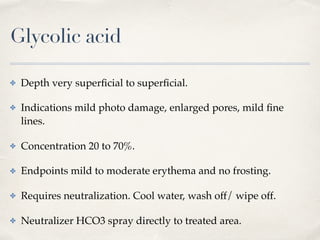
Glycolic acid
✤ Depth very superficial to superficial.
✤ Indications mild photo damage, enlarged pores, mild fine
lines.
✤ Concentration 20 to 70%.
✤ Endpoints mild to moderate erythema and no frosting.
✤ Requires neutralization. Cool water, wash off/ wipe off.
✤ Neutralizer HCO3 spray directly to treated area.
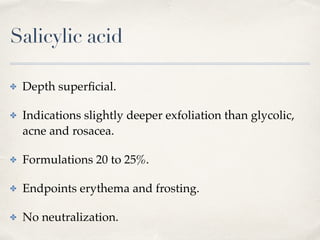
Salicylic acid
✤ Depth superficial.
✤ Indications slightly deeper exfoliation than glycolic,
acne and rosacea.
✤ Formulations 20 to 25%.
✤ Endpoints erythema and frosting.
✤ No neutralization.
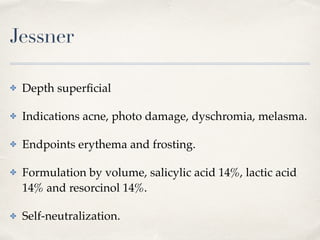
Jessner
✤ Depth superficial
✤ Indications acne, photo damage, dyschromia, melasma.
✤ Endpoints erythema and frosting.
✤ Formulation by volume, salicylic acid 14%, lactic acid
14% and resorcinol 14%.
✤ Self-neutralization.
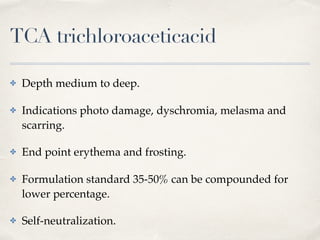
TCA trichloroaceticacid
✤ Depth medium to deep.
✤ Indications photo damage, dyschromia, melasma and
scarring.
✤ End point erythema and frosting.
✤ Formulation standard 35-50% can be compounded for
lower percentage.
✤ Self-neutralization.
Frosting
✤ Healing process
✤ Duration 1-2 weeks.
✤ Management, dryness, itching(hydrocortisone
ointment), swelling and scratching.
TCA
✤ Standard TCA 35-50%
✤ Very fast penetration.
✤ Easily reaches dermis layer.
✤ Penetration can be uneven depending on skin preparation.
✤ Not for novice.
✤ 15-20% TCA can achieve same result with more control.
Aftercare
✤ No picking, pulling or scratching.
✤ Sunblock at all times.
✤ Avoids prolonged, direct sun exposure.
✤ Sunblock and moisturizer only until healed.
✤ Aquaphor or similar for mid to deep peel.
✤ Repeat chemical peel in 2 weeks for superficial peel.
✤ Repeat chemical peel in 4 weeks for deep peel.
Aftercare
✤ Restart prep regiment and skin regiment after healing
skin back to normal.
✤ Call immediately for possible burns.
✤ Blistering or heavy scabbing or crusting.
Complications
✤ PIH
✤ Use appropriate peel or concentration.
✤ Skin preparation essential type 3 to 5 skin.
✤ Sun avoidance.
✤ Herpes , Prophylactic antiviral, acyclovir or similar 1
day prior 3 days after.
Complications
✤ Bacterial infection.
✤ Scarring
✤ Prolonged redness.
✤ Dry/swollen skin hydrocortisone ointment.
Contraindications
✤ Tendency for excessive scarring deep peel.
✤ Skin type 5-6 superficial peeling only.
✤ Excessive exposure to sun. Occupational and non
compliance patient.

Presentation

  • 1.
  • 2.
    Chemical peel ✤ Repairsdamaged skin. ✤ Slow the aging process. ✤ Rejuvenation, optimal skin for chronological age.
  • 3.
    Rejuvenation of skin ✤Smooth ✤ Firm ✤ Radiant ✤ Even color tone.
  • 4.
    Exfoliation ✤ Removal ofouter layer of skin. ✤ Promotes quicker turnover of skin. ✤ Baby turnover in <1 month. ✤ 18-20’s turnover skin in 28 days. ✤ Stimulated fibroblasts activity.
  • 5.
    Mechanism of chemicalpeeling. ✤ New outer layer of skin is formed. ✤ Smoother. ✤ Radiant. ✤ Uniform texture. ✤ Even color tone. ✤ More taut.
  • 6.
    Indications ✤ Photo damage,dyschromia, and hyperpigmentation. ✤ Solar lentigines. ✤ Sun spots/agespots/liverspots and freckles. ✤ Melasma ✤ Actinic keratosis. ✤ Fine lines and wrinkles. ✤ Large pores. ✤ Uneven skin tone/color.
  • 7.
    Indications ✤ Laxity. ✤ Dryness ✤Roughness ✤ Keratosis pyloris.
  • 8.
    Where ✤ Can peelpractically anywhere’s!
  • 9.
    Depth of peeling. ✤Superficial epidermis ✤ Medium superficial to mid dermis. ✤ Deep, mid dermis to deeper.
  • 10.
    Depth of peel ✤Deeper peel has quicker effects. Increase complications and side effects. ✤ PIH. ✤ Prolonged redness. ✤ Increase swelling. ✤ Scaring ✤ Hypopigmentation.
  • 11.
    Depth of peel ✤Factors affecting depth of peel. ✤ Chemical or chemical mixture. ✤ Concentration ✤ pH ✤ Contact time. ✤ Skin thickness. ✤ Skin preparation.
  • 12.
    Depth of penetration ✤Epidermis glycolic, salicylic, TCA and phenol. ✤ Upper dermis Glycolic, salicylic, TCA and phenol. ✤ Mid dermis TCA and phenol. ✤ Deep dermis ✤ TCA, phenol.
  • 13.
    What to tellyour patients. ✤ Superficial peel. ✤ Mild to moderate burning sensation. ✤ Medium moderate to severe burning sensation and pain. ✤ Tolerable for most patients with encouragement. ✤ Deep, severe pain for 2 days and may require IV sedation or even GA.
  • 14.
    Chemical peel agents ✤Glycolic acid. ✤ TCA trichloroacetic acid. ✤ Salicylic acid. ✤ Lactic acid usually in a mixture ✤ Resorcinol usually in a mixture.
  • 15.
    Chemical peeling agents ✤Alpha hydroxy acid AHA derived from plant sources. ✤ Glycolic acid sugar cane. ✤ Malic acid Apple. ✤ Tartaric acid grape. ✤ Citric acid, citrus ✤ Lactic acid sour milk ✤ Beta hydroxy acid salicylic acid.
  • 16.
    Glycolic acid ✤ Depthvery superficial to superficial. ✤ Indications mild photo damage, enlarged pores, mild fine lines. ✤ Concentration 20 to 70%. ✤ Endpoints mild to moderate erythema and no frosting. ✤ Requires neutralization. Cool water, wash off/ wipe off. ✤ Neutralizer HCO3 spray directly to treated area.
  • 17.
    Salicylic acid ✤ Depthsuperficial. ✤ Indications slightly deeper exfoliation than glycolic, acne and rosacea. ✤ Formulations 20 to 25%. ✤ Endpoints erythema and frosting. ✤ No neutralization.
  • 18.
    Jessner ✤ Depth superficial ✤Indications acne, photo damage, dyschromia, melasma. ✤ Endpoints erythema and frosting. ✤ Formulation by volume, salicylic acid 14%, lactic acid 14% and resorcinol 14%. ✤ Self-neutralization.
  • 19.
    TCA trichloroaceticacid ✤ Depthmedium to deep. ✤ Indications photo damage, dyschromia, melasma and scarring. ✤ End point erythema and frosting. ✤ Formulation standard 35-50% can be compounded for lower percentage. ✤ Self-neutralization.
  • 20.
    Frosting ✤ Healing process ✤Duration 1-2 weeks. ✤ Management, dryness, itching(hydrocortisone ointment), swelling and scratching.
  • 21.
    TCA ✤ Standard TCA35-50% ✤ Very fast penetration. ✤ Easily reaches dermis layer. ✤ Penetration can be uneven depending on skin preparation. ✤ Not for novice. ✤ 15-20% TCA can achieve same result with more control.
  • 22.
    Aftercare ✤ No picking,pulling or scratching. ✤ Sunblock at all times. ✤ Avoids prolonged, direct sun exposure. ✤ Sunblock and moisturizer only until healed. ✤ Aquaphor or similar for mid to deep peel. ✤ Repeat chemical peel in 2 weeks for superficial peel. ✤ Repeat chemical peel in 4 weeks for deep peel.
  • 23.
    Aftercare ✤ Restart prepregiment and skin regiment after healing skin back to normal. ✤ Call immediately for possible burns. ✤ Blistering or heavy scabbing or crusting.
  • 24.
    Complications ✤ PIH ✤ Useappropriate peel or concentration. ✤ Skin preparation essential type 3 to 5 skin. ✤ Sun avoidance. ✤ Herpes , Prophylactic antiviral, acyclovir or similar 1 day prior 3 days after.
  • 25.
    Complications ✤ Bacterial infection. ✤Scarring ✤ Prolonged redness. ✤ Dry/swollen skin hydrocortisone ointment.
  • 26.
    Contraindications ✤ Tendency forexcessive scarring deep peel. ✤ Skin type 5-6 superficial peeling only. ✤ Excessive exposure to sun. Occupational and non compliance patient.