By: MYKA JEAN ANUNG-ESTREMOS, R.N
DEFINITION:
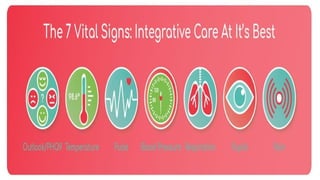
Vital signs reflect essential body functions including:
Heartbeat/Pulse rate
breathing rate (respiration)
Temperature
blood pressure
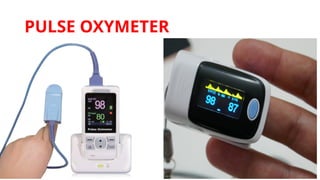
Oxygen saturation
Vital signs are useful in detecting or monitoring medical
problems. It can be measured in a medical setting, at home,
at the site of a medical emergency or elsewhere.
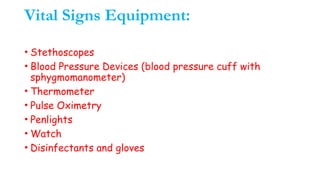
Vital Signs Equipment:
• Stethoscopes
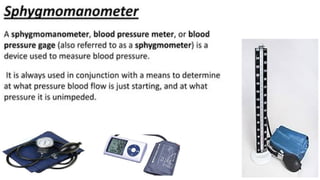
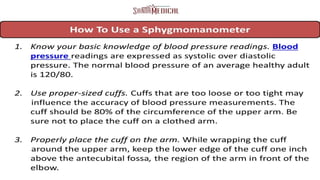
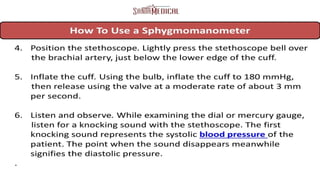
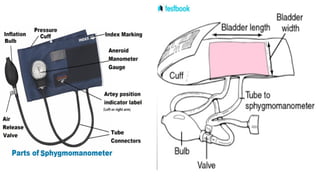
• Blood Pressure Devices (blood pressure cuff with
sphygmomanometer)
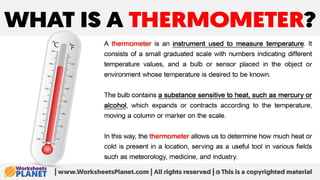
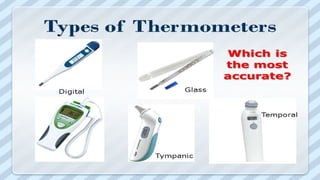
• Thermometer
• Pulse Oximetry
• Penlights
• Watch
• Disinfectants and gloves
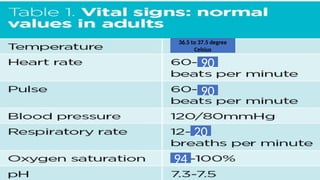
90
90
20
94
36.5 to 37.5 degree
Celsius
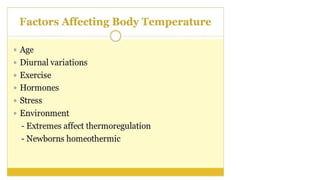
WHAT IS BODY TEMPERATURE?
- THE balance between the HEAT produced and HEAT lost
in the body.
- The NORMAL body temperature of a person varied
depending on gender, recent activity, food and fluid
consumption, time of day, and in women the stage of
menstrual cycle.
- NORMAL BODY TEMPERATURE CAN RANGE FROM 97.8
DEGREES FAHRENHEIT (36.5-37 DEGREES CELSIUS) TO
99 DEGREES F (37.5 DEGREES C) for a healthy adult.
ABNORMAL TEMPERATURE:
HYPERTHERMIA (> 37.5 degrees Celsius)
LOW GRADE:37.5-38 degrees Celsius
MODERATE to HIGH GRADE:38.1-40 Degrees Celsius
HIGH: >40.1 Degrees Celsius and above
HYPOTHERMIA < 35 DEGREES CELSIUS
MILD: 32 – 35 DEGREES CELSIUS
MODERATE: 28-32 DEGREES CELSIUS
SEVERE: <28 DEGREES CELSIUS
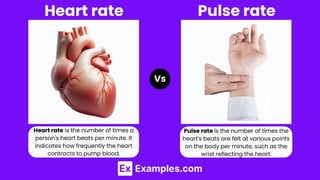
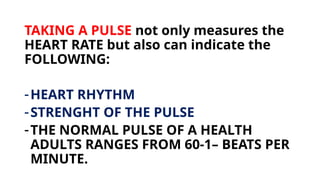
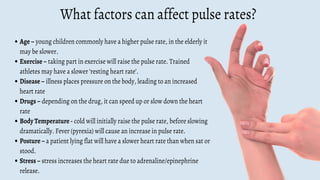
TAKING A PULSE not only measures the
HEART RATE but also can indicate the
FOLLOWING:
-HEART RHYTHM
-STRENGHT OF THE PULSE
-THE NORMAL PULSE OF A HEALTH
ADULTS RANGES FROM 60-1– BEATS PER
MINUTE.
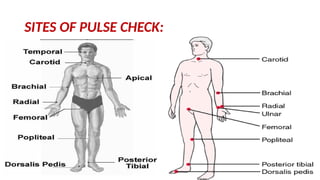
SITES OF PULSE CHECK:
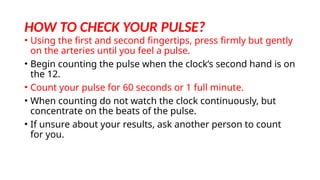
HOW TO CHECK YOUR PULSE?
• Using the first and second fingertips, press firmly but gently
on the arteries until you feel a pulse.
• Begin counting the pulse when the clock’s second hand is on
the 12.
• Count your pulse for 60 seconds or 1 full minute.
• When counting do not watch the clock continuously, but
concentrate on the beats of the pulse.
• If unsure about your results, ask another person to count
for you.
PULSE OXYMETER
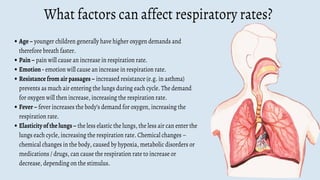
WHAT IS RESPIRATION RATE?
•The RESPIRATION RATE is the number of
breaths a person takes per minute.
•The rate is usually measured when a person is at
rest and simply involves counting the number of
breaths for one minute by counting how many
times the chest rises.
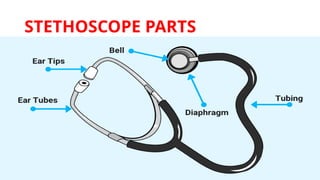
STETHOSCOPE PARTS
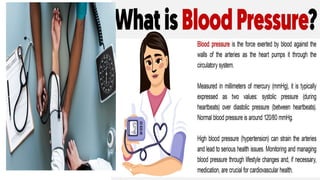
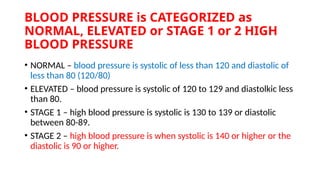
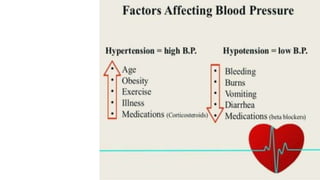
BLOOD PRESSURE is CATEGORIZED as
NORMAL, ELEVATED or STAGE 1 or 2 HIGH
BLOOD PRESSURE
• NORMAL – blood pressure is systolic of less than 120 and diastolic of
less than 80 (120/80)
• ELEVATED – blood pressure is systolic of 120 to 129 and diastolkic less
than 80.
• STAGE 1 – high blood pressure is systolic is 130 to 139 or diastolic
between 80-89.
• STAGE 2 – high blood pressure is when systolic is 140 or higher or the
diastolic is 90 or higher.
VITAL SIGNS POWERPOINT PRESENTATION UPLOAD

VITAL SIGNS POWERPOINT PRESENTATION UPLOAD

  • 1.
    By: MYKA JEANANUNG-ESTREMOS, R.N
  • 3.
    DEFINITION: Vital signs reflectessential body functions including: Heartbeat/Pulse rate breathing rate (respiration) Temperature blood pressure Oxygen saturation Vital signs are useful in detecting or monitoring medical problems. It can be measured in a medical setting, at home, at the site of a medical emergency or elsewhere.
  • 5.
    Vital Signs Equipment: •Stethoscopes • Blood Pressure Devices (blood pressure cuff with sphygmomanometer) • Thermometer • Pulse Oximetry • Penlights • Watch • Disinfectants and gloves
  • 8.
  • 9.
    WHAT IS BODYTEMPERATURE? - THE balance between the HEAT produced and HEAT lost in the body. - The NORMAL body temperature of a person varied depending on gender, recent activity, food and fluid consumption, time of day, and in women the stage of menstrual cycle. - NORMAL BODY TEMPERATURE CAN RANGE FROM 97.8 DEGREES FAHRENHEIT (36.5-37 DEGREES CELSIUS) TO 99 DEGREES F (37.5 DEGREES C) for a healthy adult.
  • 13.
    ABNORMAL TEMPERATURE: HYPERTHERMIA (>37.5 degrees Celsius) LOW GRADE:37.5-38 degrees Celsius MODERATE to HIGH GRADE:38.1-40 Degrees Celsius HIGH: >40.1 Degrees Celsius and above HYPOTHERMIA < 35 DEGREES CELSIUS MILD: 32 – 35 DEGREES CELSIUS MODERATE: 28-32 DEGREES CELSIUS SEVERE: <28 DEGREES CELSIUS
  • 16.
    TAKING A PULSEnot only measures the HEART RATE but also can indicate the FOLLOWING: -HEART RHYTHM -STRENGHT OF THE PULSE -THE NORMAL PULSE OF A HEALTH ADULTS RANGES FROM 60-1– BEATS PER MINUTE.
  • 17.
  • 18.
    HOW TO CHECKYOUR PULSE? • Using the first and second fingertips, press firmly but gently on the arteries until you feel a pulse. • Begin counting the pulse when the clock’s second hand is on the 12. • Count your pulse for 60 seconds or 1 full minute. • When counting do not watch the clock continuously, but concentrate on the beats of the pulse. • If unsure about your results, ask another person to count for you.
  • 19.
  • 21.
    WHAT IS RESPIRATIONRATE? •The RESPIRATION RATE is the number of breaths a person takes per minute. •The rate is usually measured when a person is at rest and simply involves counting the number of breaths for one minute by counting how many times the chest rises.
  • 24.
  • 29.
    BLOOD PRESSURE isCATEGORIZED as NORMAL, ELEVATED or STAGE 1 or 2 HIGH BLOOD PRESSURE • NORMAL – blood pressure is systolic of less than 120 and diastolic of less than 80 (120/80) • ELEVATED – blood pressure is systolic of 120 to 129 and diastolkic less than 80. • STAGE 1 – high blood pressure is systolic is 130 to 139 or diastolic between 80-89. • STAGE 2 – high blood pressure is when systolic is 140 or higher or the diastolic is 90 or higher.