THE
  START-UP
       OF

     YOU
EXECUTIVE SUMMARY
AUTHORS


    REID HOFFMAN            BEN CASNOCHA
Cofounder and Chairman of    Entrepreneur and Author
CHAPTER 1: ALL HUMANS ARE ENTREPRENEURS

CHAPTER 2: DEVELOP A COMPETITIVE ADVANTAGE

CHAPTER 3: PLAN TO ADAPT

CHAPTER 4: IT TAKES A NETWORK

CHAPTER 5: PURSUE BREAKOUT OPPORTUNITIES

CHAPTER 6: TAKE INTELLIGENT RISKS

CHAPTER 7: WHO YOU KNOW IS WHAT YOU KNOW
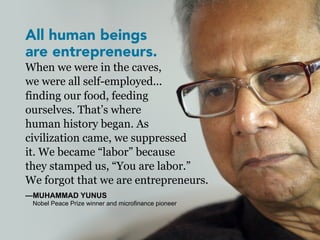
All human beings
are entrepreneurs.
When we were in the caves,
we were all self-employed...
finding our food, feeding
ourselves. That’s where
human history began. As
civilization came, we suppressed
it. We became “labor” because
they stamped us, “You are labor.”
We forgot that we are entrepreneurs.
—MUHAMMAD YUNUS
 Nobel Peace Prize winner and microfinance pioneer
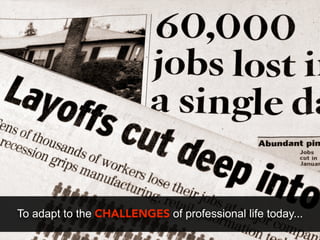
To adapt to the CHALLENGES of professional life today...
We need to rediscover our ENTREPRENEURIAL INSTINCTS
      and use them to forge new sorts of careers.
Whether you’re a lawyer or
doctor or teacher or engineer
 or even a business owner...
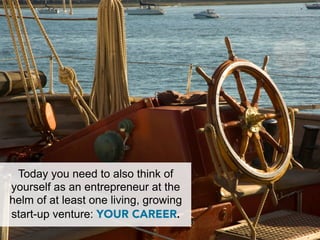
Today you need to also think of
yourself as an entrepreneur at the
helm of at least one living, growing
start-up venture: YOUR CAREER.
The old career escalator is JAMMED.
Age-old assumptions about work have come UNDONE.
There are NEW RULES, and you need to know them
 —or else you may be on track to IRRELEVANCE.
2
The solution has two parts.
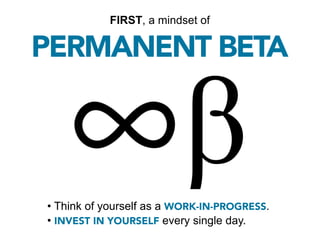
FIRST, a mindset of

PERMANENT BETA
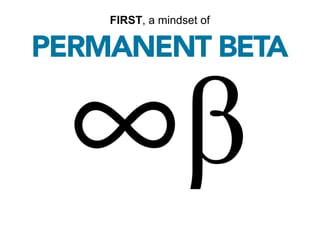
FIRST, a mindset of

PERMANENT BETA
FIRST, a mindset of

PERMANENT BETA


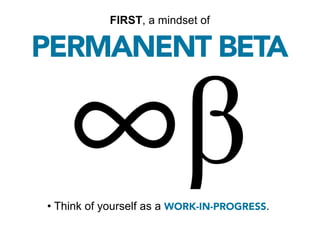
• Think of yourself as a WORK-IN-PROGRESS.
FIRST, a mindset of

PERMANENT BETA


• Think of yourself as a WORK-IN-PROGRESS.
• INVEST IN YOURSELF every single day.
Second, an entrepreneurial, adaptive

      SKILL SET
taken from the very best of Silicon Valley.
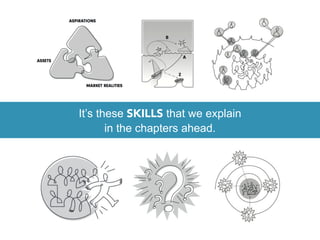
It’s these SKILLS that we explain
       in the chapters ahead.
CHAPTER 1: ALL HUMANS ARE ENTREPRENEURS

CHAPTER 2: DEVELOP A COMPETITIVE ADVANTAGE

CHAPTER 3: PLAN TO ADAPT

CHAPTER 4: IT TAKES A NETWORK

CHAPTER 5: PURSUE BREAKOUT OPPORTUNITIES

CHAPTER 6: TAKE INTELLIGENT RISKS

CHAPTER 7: WHO YOU KNOW IS WHAT YOU KNOW
Differentiate or die.


 To beat the competition,
     companies develop
CLEAR REASONS WHY
  a customer should pick
  them instead of others.
Zappos massively DIFFERENTIATED ITSELF
from other e-commerce companies by offering
  free shipping both ways and 24/7 customer
   service via a locally staffed 1-800 number.
Similarly, in a world where
A MILLION PEOPLE CAN DO YOUR JOB...
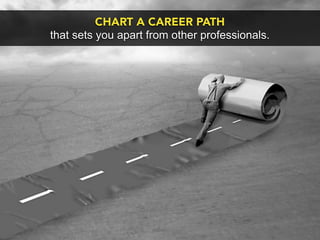
CHART A CAREER PATH
that sets you apart from other professionals.
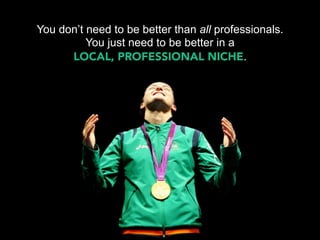
You don’t need to be better than all professionals.
          You just need to be better in a
      LOCAL, PROFESSIONAL NICHE.
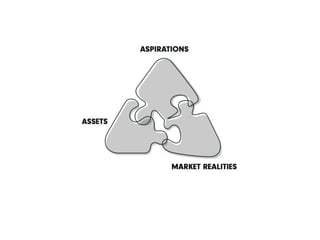
THREE DYNAMIC, CHANGING PUZZLE PIECES
     comprise your position in the market
        and, when paired with a plan,
   determine the course you should head in.
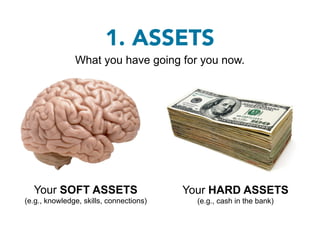
1. ASSETS
What you have going for you now.
1. ASSETS
               What you have going for you now.


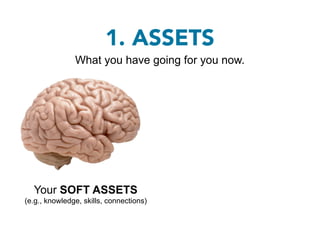
  Your SOFT ASSETS
(e.g., knowledge, skills, connections)
1. ASSETS
               What you have going for you now.


  Your SOFT ASSETS                       Your HARD ASSETS
(e.g., knowledge, skills, connections)     (e.g., cash in the bank)
2. ASPIRATIONS
      & VALUES
     Where you might like
       to go in the future.
3. MARKET REALITIES
What people will actually
pay you for.
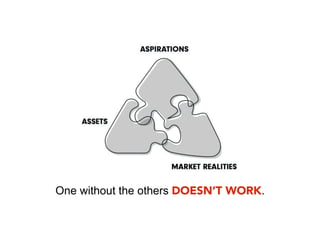
One without the others DOESN’T WORK.
Skills that can’t earn money
WON’T GET YOU VERY FAR.
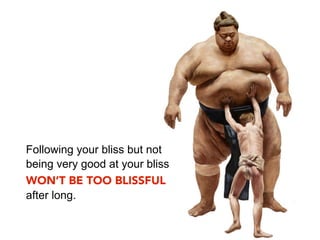
Following your bliss but not
being very good at your bliss
WON’T BE TOO BLISSFUL
after long.
And being a slave to the market regardless of your likes
 and passions ISN’T SUSTAINABLE over the long run.
One way to upgrade your competitive position is by
upgrading your assets—i.e., INVESTING IN YOURSELF.
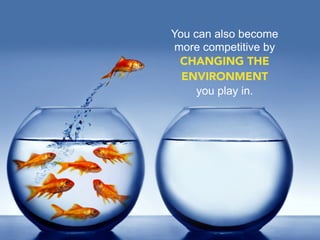
You can also become
 more competitive by
  CHANGING THE
  ENVIRONMENT
     you play in.
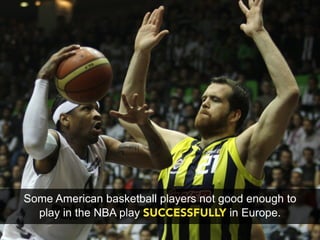
Some American basketball players not good enough to
  play in the NBA play SUCCESSFULLY in Europe.
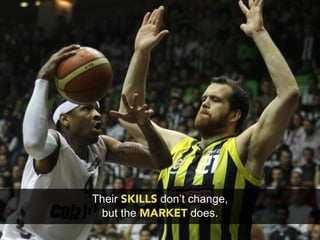
Their SKILLS don’t change,
 but the MARKET does.
Picking a MARKET NICHE
 where you’re better than
 the competition is key to
 entrepreneurial strategy.
CHAPTER 1: ALL HUMANS ARE ENTREPRENEURS

CHAPTER 2: DEVELOP A COMPETITIVE ADVANTAGE

CHAPTER 3: PLAN TO ADAPT

CHAPTER 4: IT TAKES A NETWORK

CHAPTER 5: PURSUE BREAKOUT OPPORTUNITIES

CHAPTER 6: TAKE INTELLIGENT RISKS

CHAPTER 7: WHO YOU KNOW IS WHAT YOU KNOW
POPULAR CAREER PLANNING ADVICE
says you should decide where you want to be in
10 years and then develop a plan for getting there.
POPULAR CAREER PLANNING ADVICE
says you should find your passion
and then pursue it.
These philosophies have serious strengths,
     but also HUGE DRAWBACKS.
They presume A STATIC WORLD.


                  In fact, you CHANGE, the competition
                  CHANGES, and the world CHANGES.
They presume that fixed, accurate self-knowledge
can be easily attained through INTROSPECTION.
They presume that fixed, accurate self-knowledge
can be easily attained through INTROSPECTION.


                In fact, your identity is not found through
               introspection but rather emerges through
                           EXPERIMENTATION.
Entrepreneurial career planning
 and adapting is about being

 FLEXIBLY
PERSISTENT
 always ready to adapt, but also
persistent in driving toward goals.
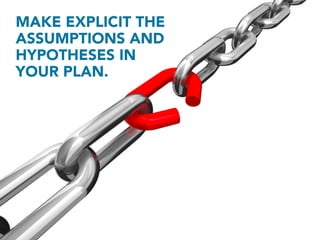
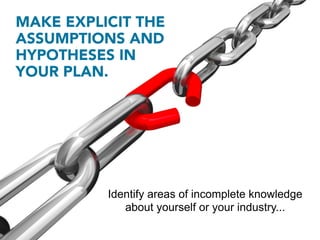
MAKE EXPLICIT THE
ASSUMPTIONS AND
HYPOTHESES IN
YOUR PLAN.
MAKE EXPLICIT THE
ASSUMPTIONS AND
HYPOTHESES IN
YOUR PLAN.


           You’ll never have complete certainty.
MAKE EXPLICIT THE
ASSUMPTIONS AND
HYPOTHESES IN
YOUR PLAN.


          Identify areas of incomplete knowledge
             about yourself or your industry...
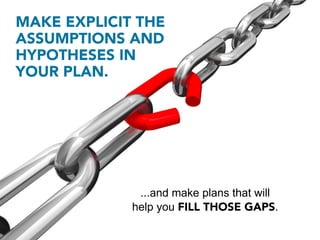
MAKE EXPLICIT THE
ASSUMPTIONS AND
HYPOTHESES IN
YOUR PLAN.


              ...and make plans that will
             help you FILL THOSE GAPS.
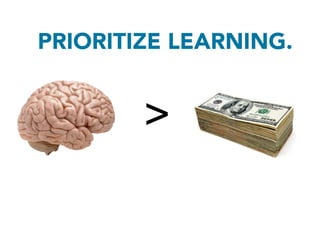
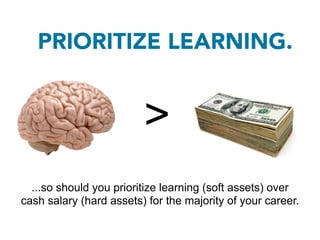
PRIORITIZE LEARNING.


        >
PRIORITIZE LEARNING.


                   >
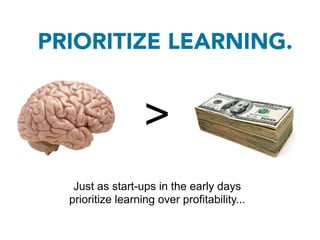
   Just as start-ups in the early days
  prioritize learning over profitability...
PRIORITIZE LEARNING.


                         >
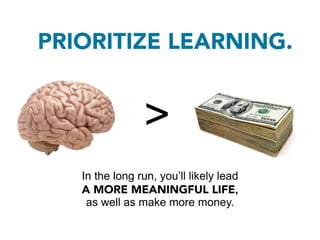
  ...so should you prioritize learning (soft assets) over
cash salary (hard assets) for the majority of your career.
PRIORITIZE LEARNING.


                >
   In the long run, you’ll likely lead
   A MORE MEANINGFUL LIFE,
    as well as make more money.
LEARN
BY DOING.
LEARN
BY DOING.
ACTIONS, NOT PLANS,
will generate the lessons
that help you adapt to
the next phase of your
journey.
THINK TWO
STEPS AHEAD.
THINK TWO
STEPS AHEAD.
What next move will MAXIMIZE
the quantity and quality of
follow-on opportunities?
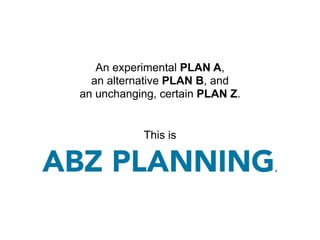
Then craft an experimental PLAN A,
    an alternative PLAN B, and
  an unchanging, certain PLAN Z.
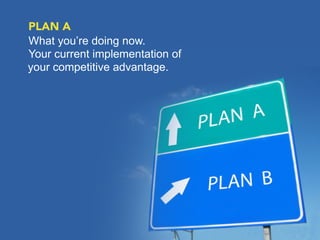
PLAN A
What you’re doing now.
Your current implementation of
your competitive advantage.
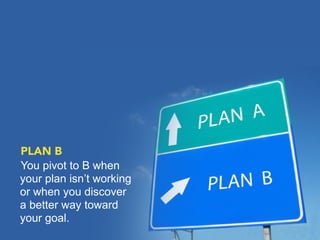
PLAN B
You pivot to B when
your plan isn’t working
or when you discover
a better way toward
your goal.
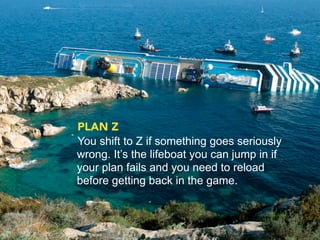
PLAN Z
You shift to Z if something goes seriously
wrong. It’s the lifeboat you can jump in if
your plan fails and you need to reload
before getting back in the game.
Did you know that


started out as a multiplayer online game?
Did you know that


started out as a “digital wallet” for storage only?
Did you know that

      JERRY
    SPRINGER
was mayor of Cincinnati?
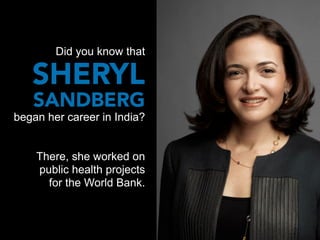
Did you know that

   SHERYL
   SANDBERG
began her career in India?


    There, she worked on
    public health projects
      for the World Bank.
An experimental PLAN A,
an alternative PLAN B, and
An experimental PLAN A,
  an alternative PLAN B, and
an unchanging, certain PLAN Z.
An experimental PLAN A,
   an alternative PLAN B, and
 an unchanging, certain PLAN Z.


            This is

ABZ PLANNING                      .
CHAPTER 1: ALL HUMANS ARE ENTREPRENEURS

CHAPTER 2: DEVELOP A COMPETITIVE ADVANTAGE

CHAPTER 3: PLAN TO ADAPT

CHAPTER 4: IT TAKES A NETWORK

CHAPTER 5: PURSUE BREAKOUT OPPORTUNITIES

CHAPTER 6: TAKE INTELLIGENT RISKS

CHAPTER 7: WHO YOU KNOW IS WHAT YOU KNOW
Relationships matter to your career no matter the
organization or your level of seniority because, ultimately,
EVERY JOB BOILS DOWN TO INTERACTING WITH PEOPLE.
People control
RESOURCES, OPPORTUNITIES, INFORMATION
              and the like.
And THE PEOPLE YOU SPEND TIME WITH
    shape the person you are today and
   the person you aspire to be tomorrow.
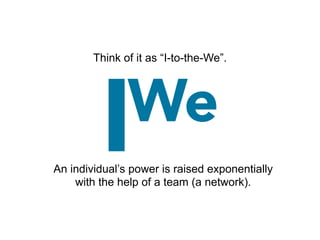
I
        Think of it as “I-to-the-We”.


               We
An individual’s power is raised exponentially
    with the help of a team (a network).
There are people you know in a PERSONAL context.
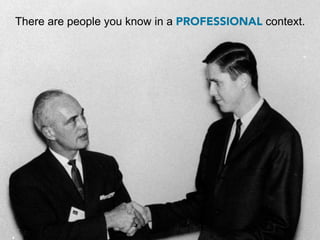
There are people you know in a PROFESSIONAL context.
Generally, you keep the two lives

S E P A R A T E
 for reasons of both etiquette and
   potential conflict of loyalties.
However, sometimes you’re PERSONAL
friends with a PROFESSIONAL colleague.
In these instances,

THE CONTEXT
in which you engage
the person shapes
the right approach.
2
     There are two types of
PROFESSIONAL      RELATIONSHIPS
1. ALLIES
People you consult regularly for advice.
     You trust their JUDGMENT.
Second, you
PROACTIVELY COLLABORATE
  on opportunities together.
You keep your antenna especially attuned to an
 ally’s INTERESTS, and when it makes sense
     to pursue something jointly, you do so.
Third, you talk up an ally to other friends.
    You PROMOTE his or her brand.
When an ally comes into conflict,
 you DEFEND him, and stand up for his reputation.
And he does the same for you when times get tough.
2. WEAKER TIES AND
  ACQUAINTANCES
While not as vital as allies, acquaintances usually
  INTRODUCE DIVERSITY to your network.
They tend to hail from different social circles or
industries and so they can be useful to find opportunities
    or intelligence OUTSIDE YOUR INNER CIRCLE.
While there’s a limit to the number of
people you can ever know at one time...
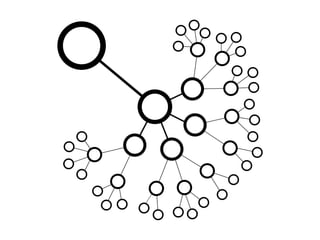
...you are part of a broader network of
       FRIENDS OF FRIENDS and
  FRIENDS OF FRIENDS OF FRIENDS
—second and third degree connections—
for which there is VIRTUALLY NO LIMIT.
Your network is


BIGGER
 than you think.
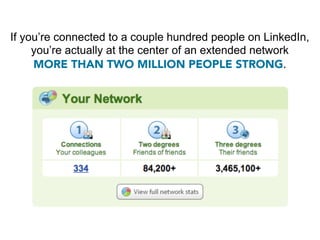
If you’re connected to a couple hundred people on LinkedIn,
     you’re actually at the center of an extended network
     MORE THAN TWO MILLION PEOPLE STRONG.