VISUAL
CRYPTOGRAPHY
Dr. Qaim Mehdi
Department of Computer Science
What is Cryptography?
 Cryptography is the science of information security.
 The main objective of cryptography is information hiding.
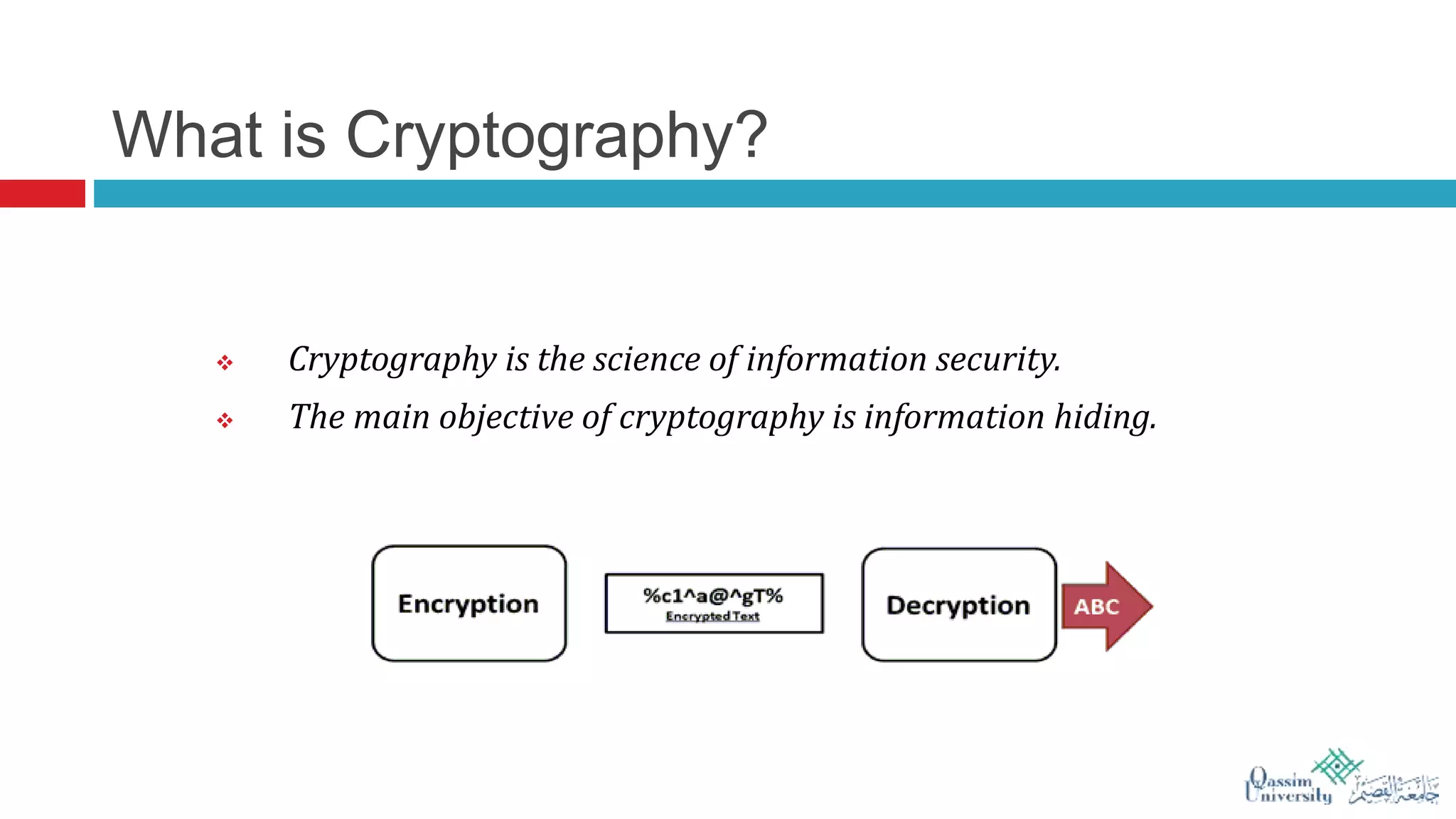
What is Cryptography?
 Cryptography is the science of information security.
 The main objective of cryptography is information hiding.
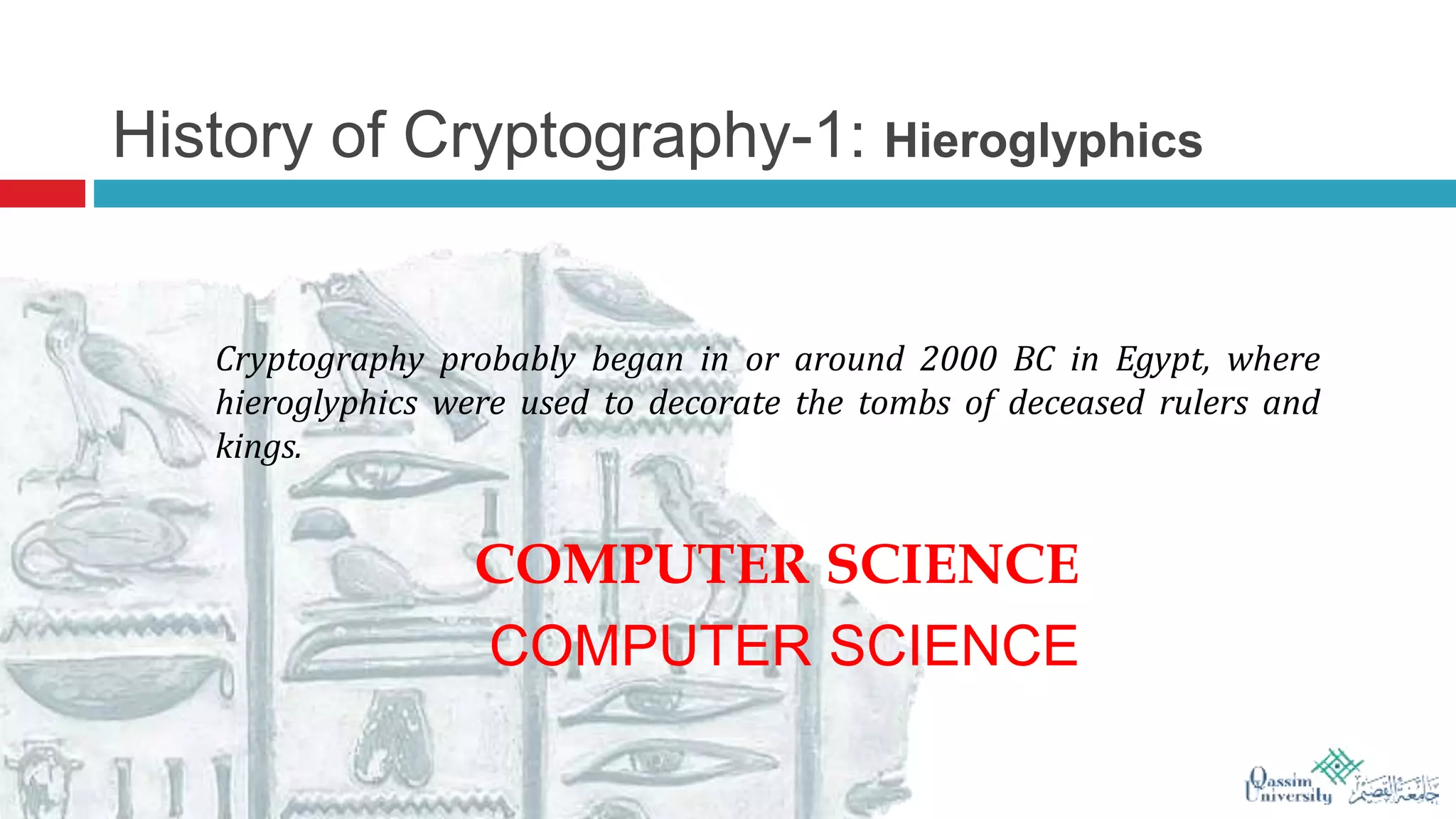
History of Cryptography-1: Hieroglyphics
Cryptography probably began in or around 2000 BC in Egypt, where
hieroglyphics were used to decorate the tombs of deceased rulers and
kings.
COMPUTER SCIENCE
COMPUTER SCIENCE
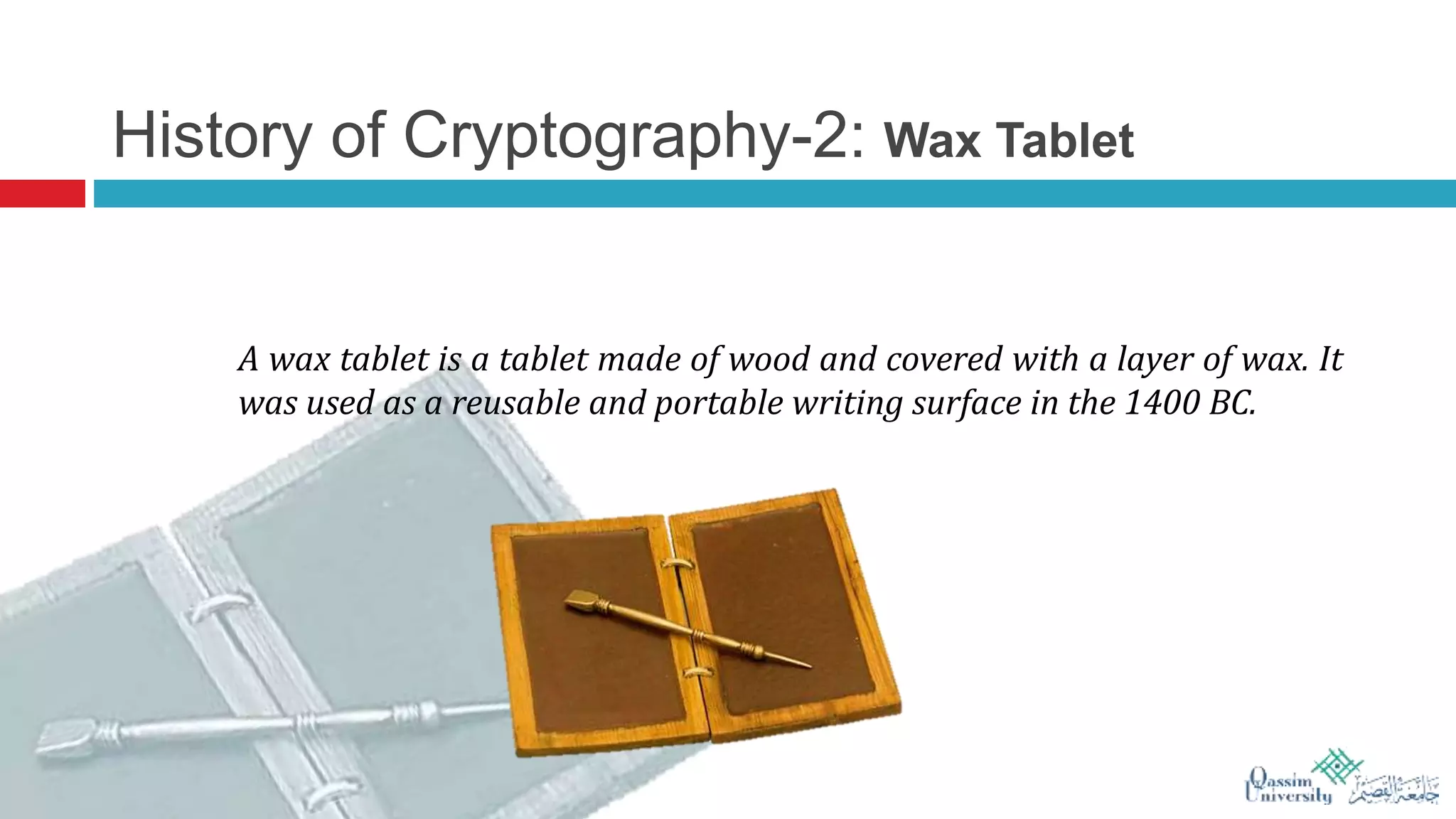
History of Cryptography-2: Wax Tablet
A wax tablet is a tablet made of wood and covered with a layer of wax. It
was used as a reusable and portable writing surface in the 1400 BC.
History of Cryptography-3: Caesar Cipher
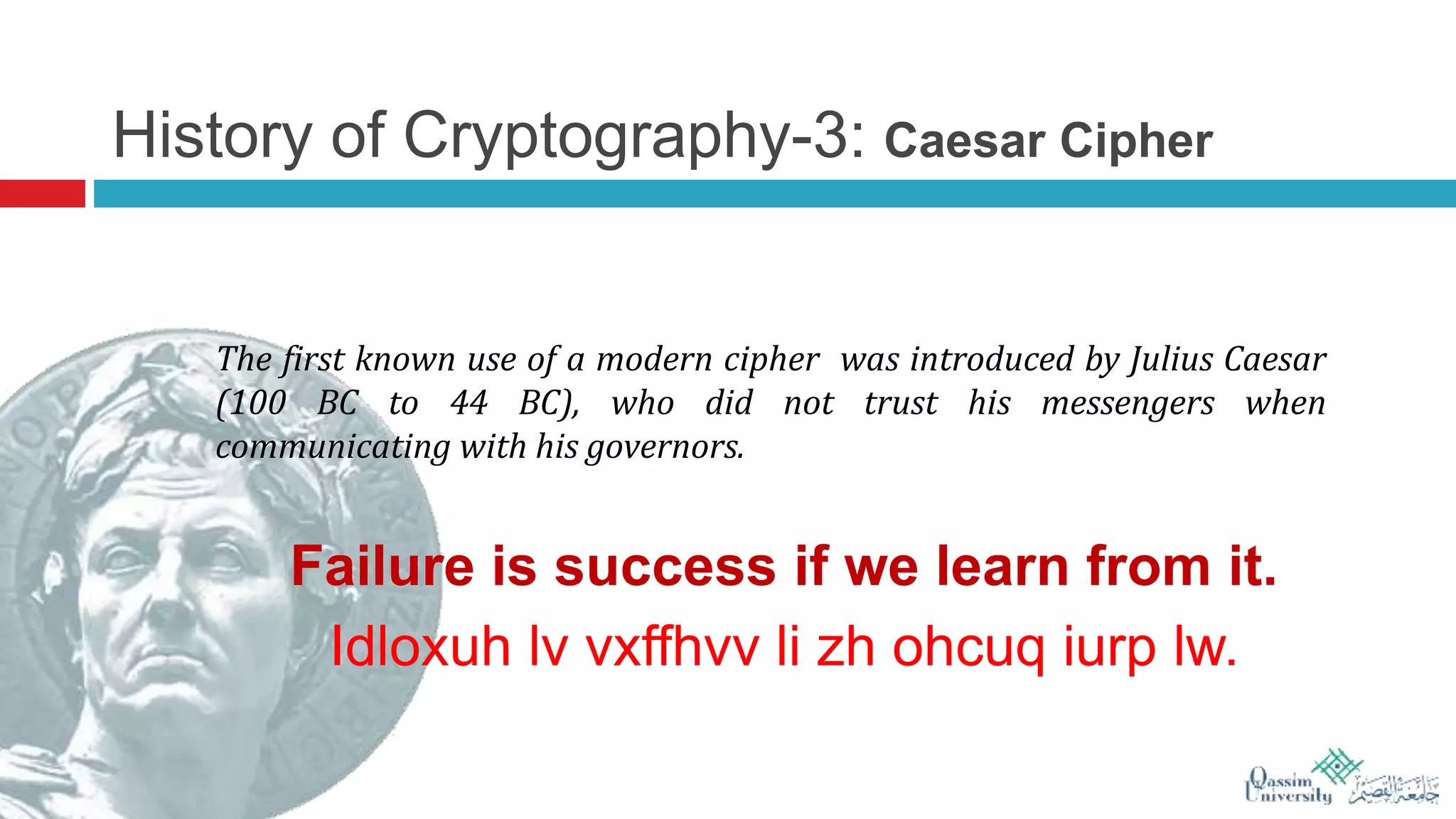
The first known use of a modern cipher was introduced by Julius Caesar
(100 BC to 44 BC), who did not trust his messengers when
communicating with his governors.
Failure is success if we learn from it.
Idloxuh lv vxffhvv li zh ohcuq iurp lw.
Visual Cryptography
It is a new type of cryptographic scheme, which can decode concealed
images without any cryptographic computations. The scheme is perfectly
secure and very easy to implement.
Visual Cryptography
It is a new type of cryptographic scheme, which can decode concealed
images without any cryptographic computations. The scheme is perfectly
secure and very easy to implement.
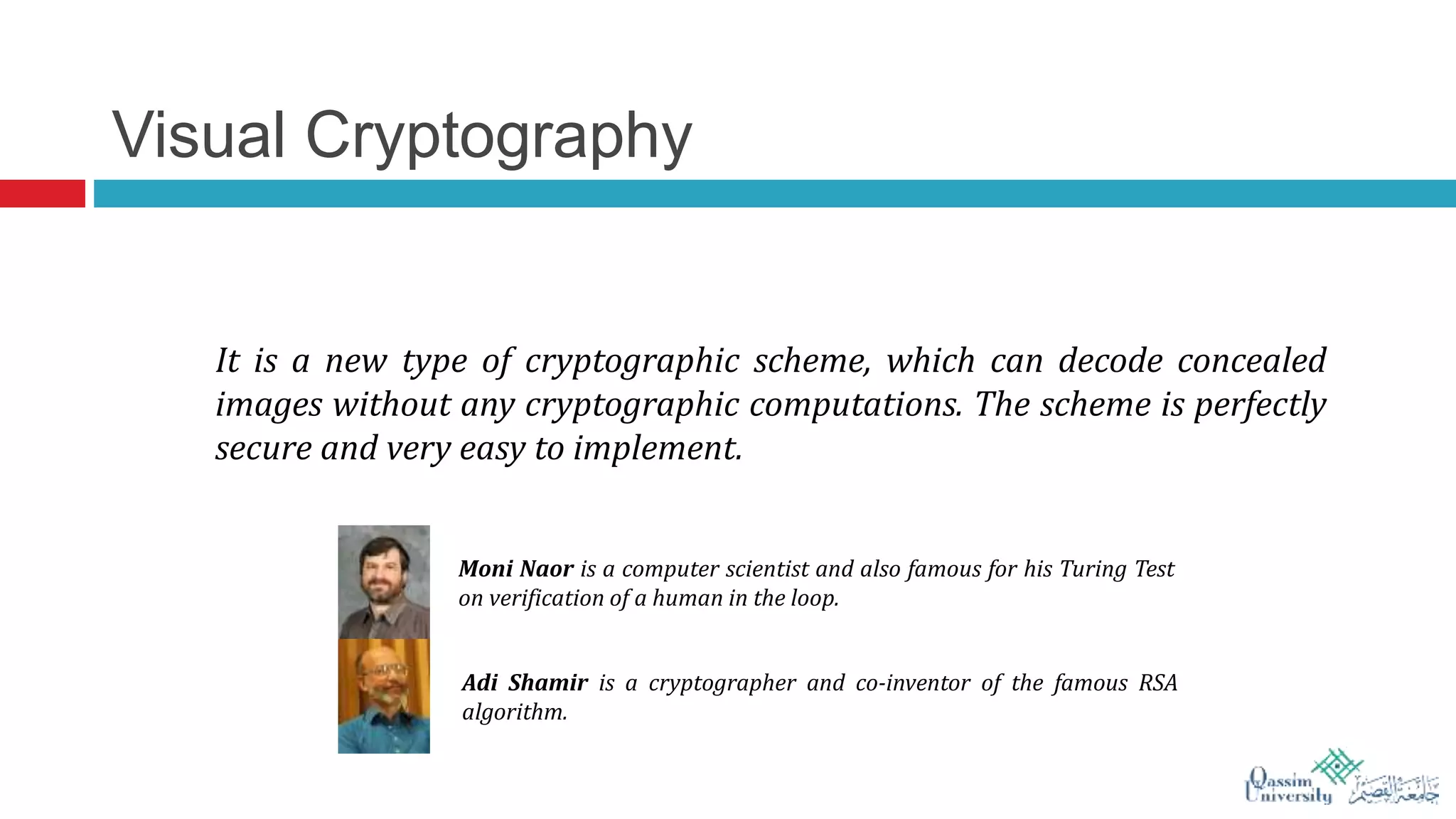
Adi Shamir is a cryptographer and co-inventor of the famous RSA
algorithm.
Moni Naor is a computer scientist and also famous for his Turing Test
on verification of a human in the loop.
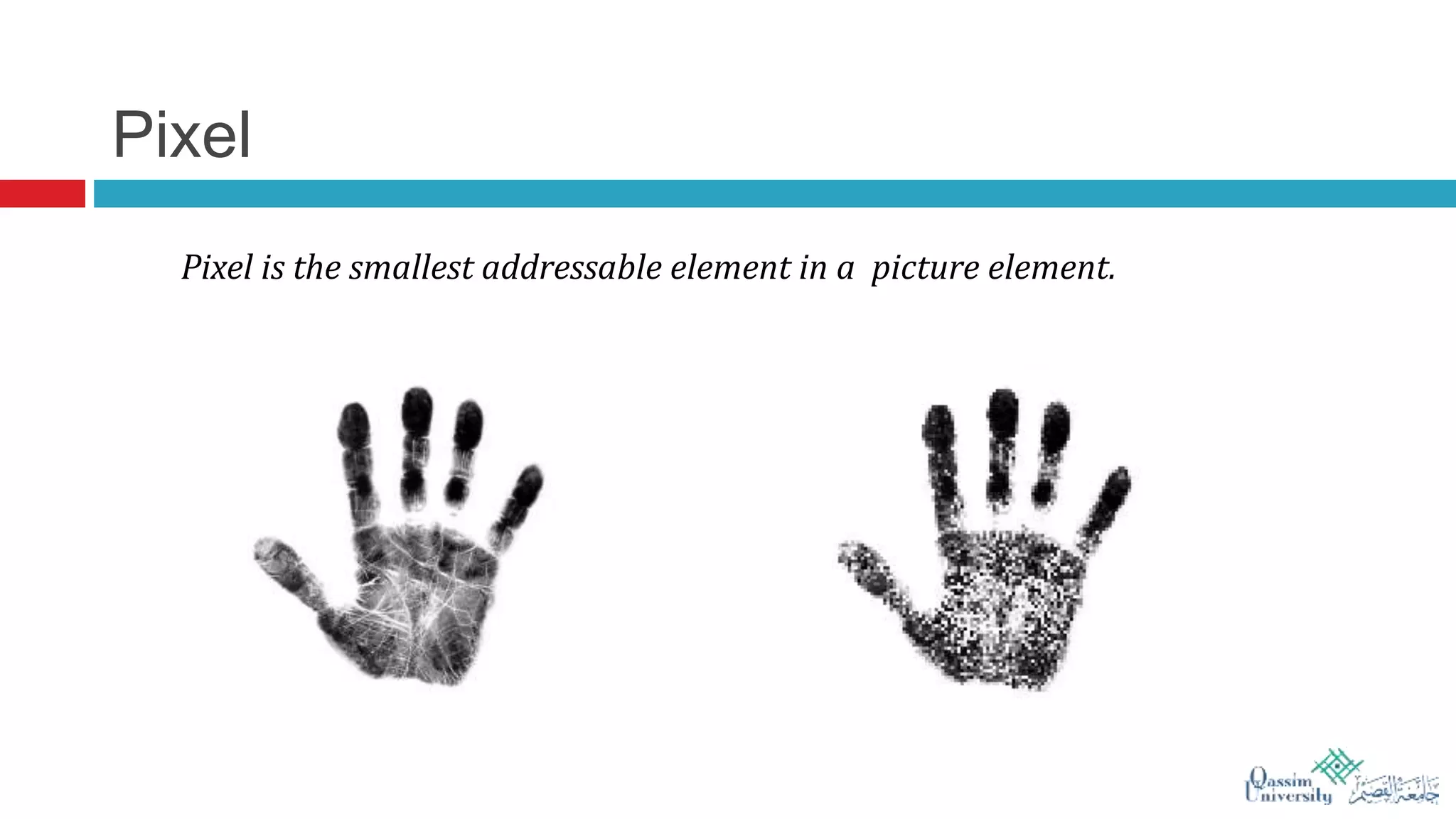
Pixel
Pixel is the smallest addressable element in a picture element.
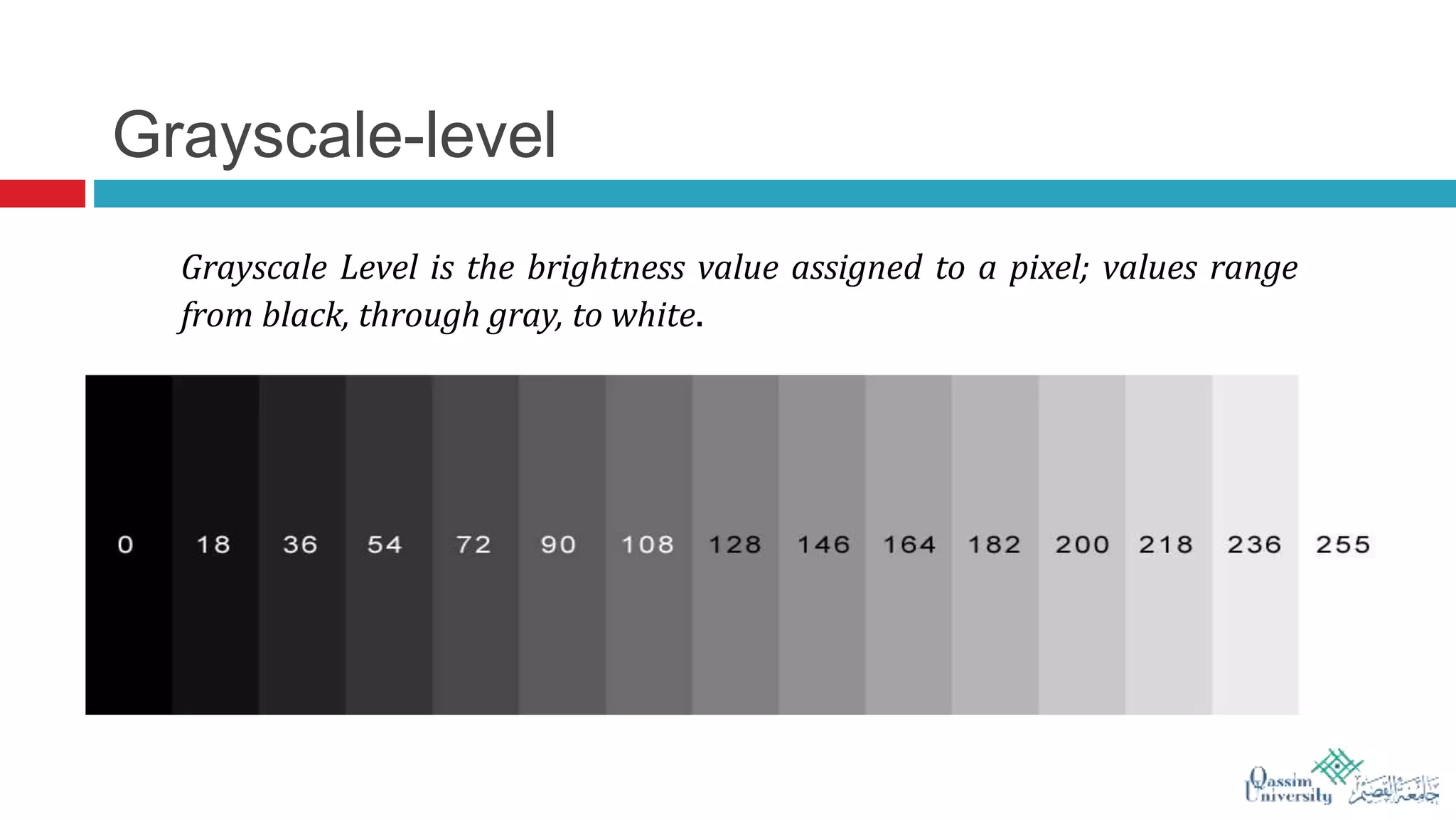
Grayscale-level
Grayscale Level is the brightness value assigned to a pixel; values range
from black, through gray, to white.
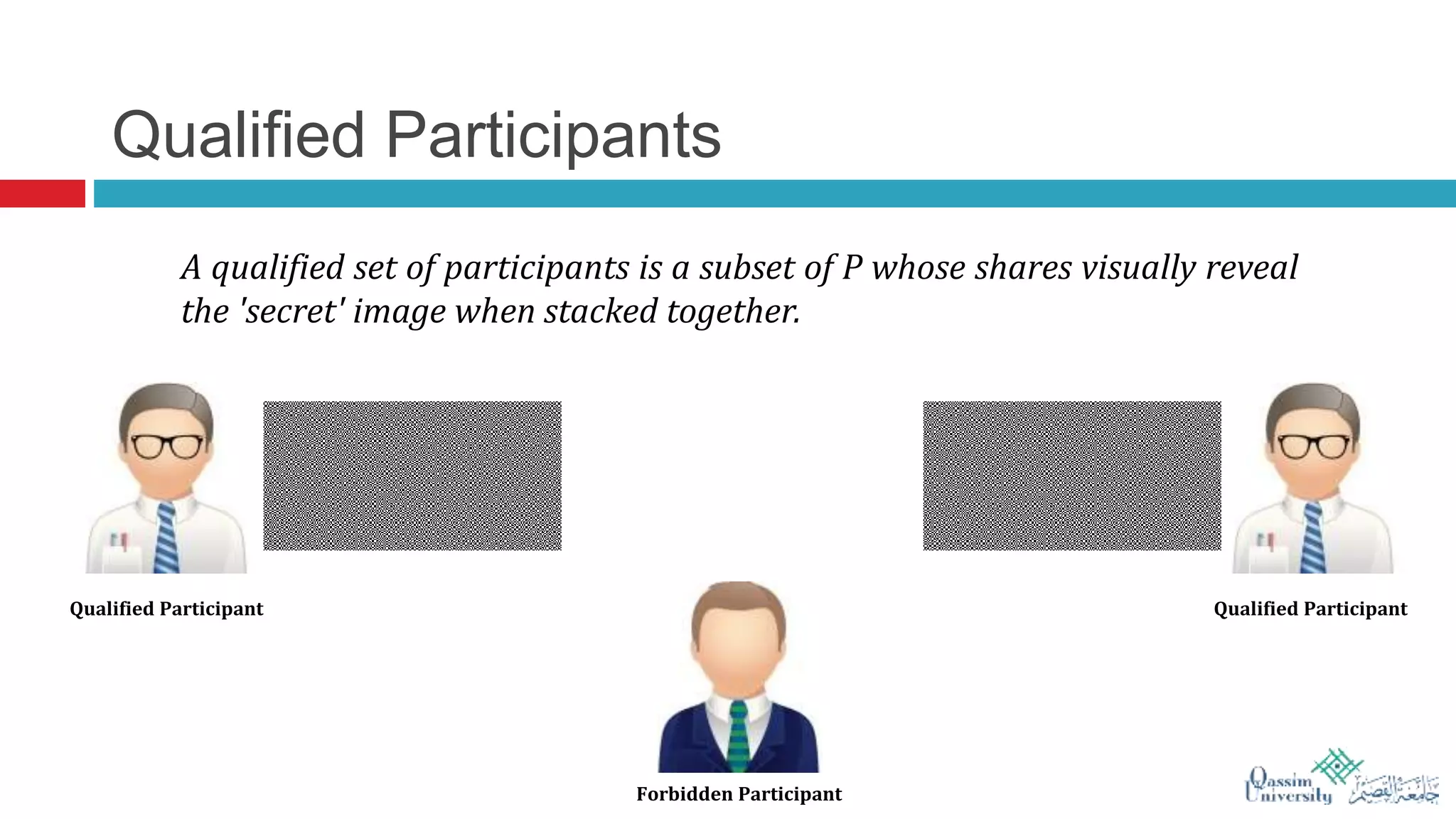
Qualified Participants
A qualified set of participants is a subset of Ρ whose shares visually reveal
the 'secret' image when stacked together.
Qualified Participant Qualified Participant
Forbidden Participant
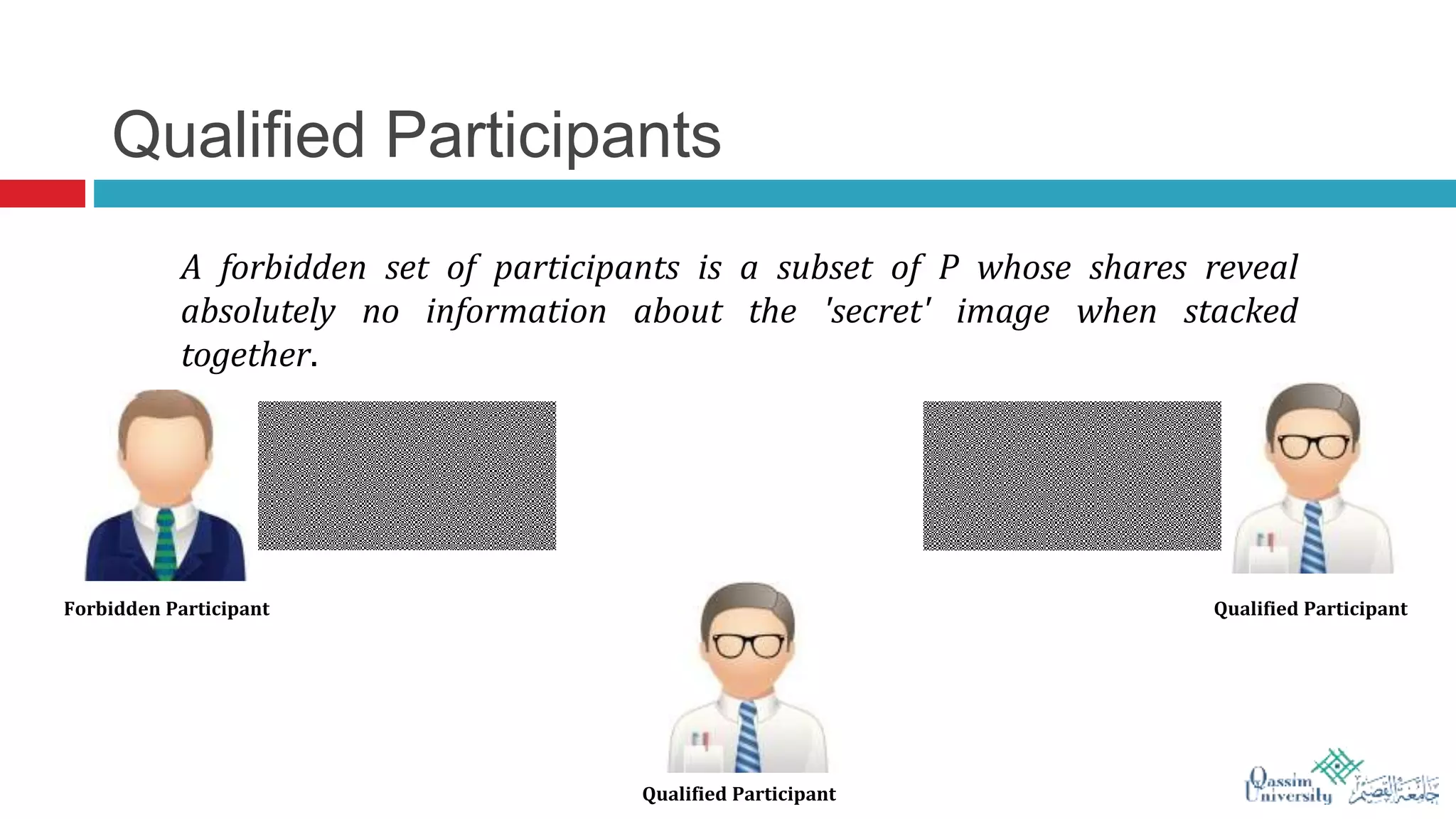
Qualified Participants
A forbidden set of participants is a subset of Ρ whose shares reveal
absolutely no information about the 'secret' image when stacked
together.
Forbidden Participant Qualified Participant
Qualified Participant
Visual Cryptography: The Objective
Encrypting written material (printed text, handwritten notes, pictures,
etc.) in a perfectly secure way which can be decoded directly by the
human visual system.
Visual Cryptography: The Approach
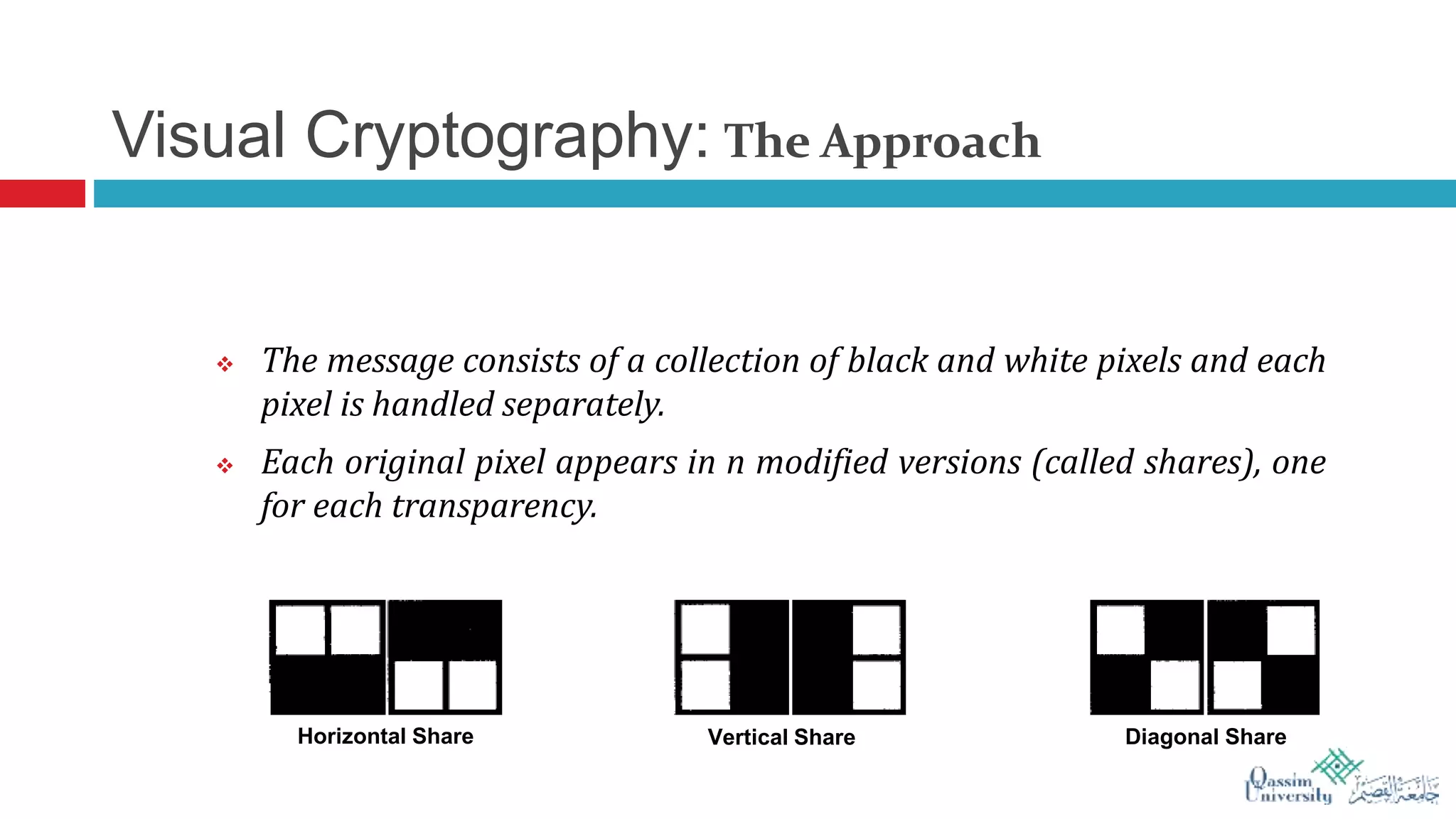
 The message consists of a collection of black and white pixels and each
pixel is handled separately.
 Each original pixel appears in n modified versions (called shares), one
for each transparency.
Visual Cryptography: The Approach
 The message consists of a collection of black and white pixels and each
pixel is handled separately.
 Each original pixel appears in n modified versions (called shares), one
for each transparency.
Horizontal Share Vertical Share Diagonal Share
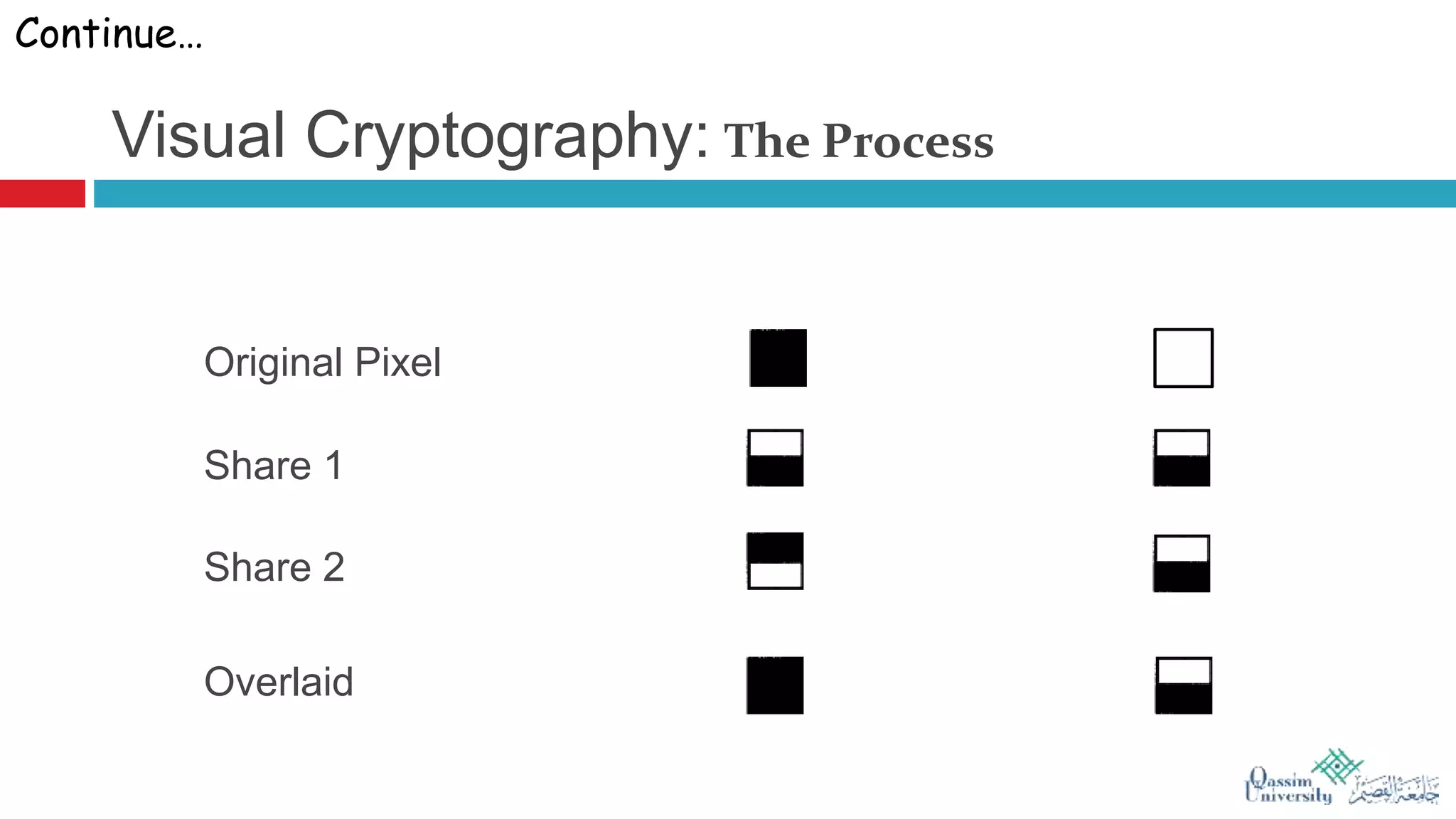
Visual Cryptography: The Process
Continue…
Original Pixel
Share 1
Share 2
Overlaid
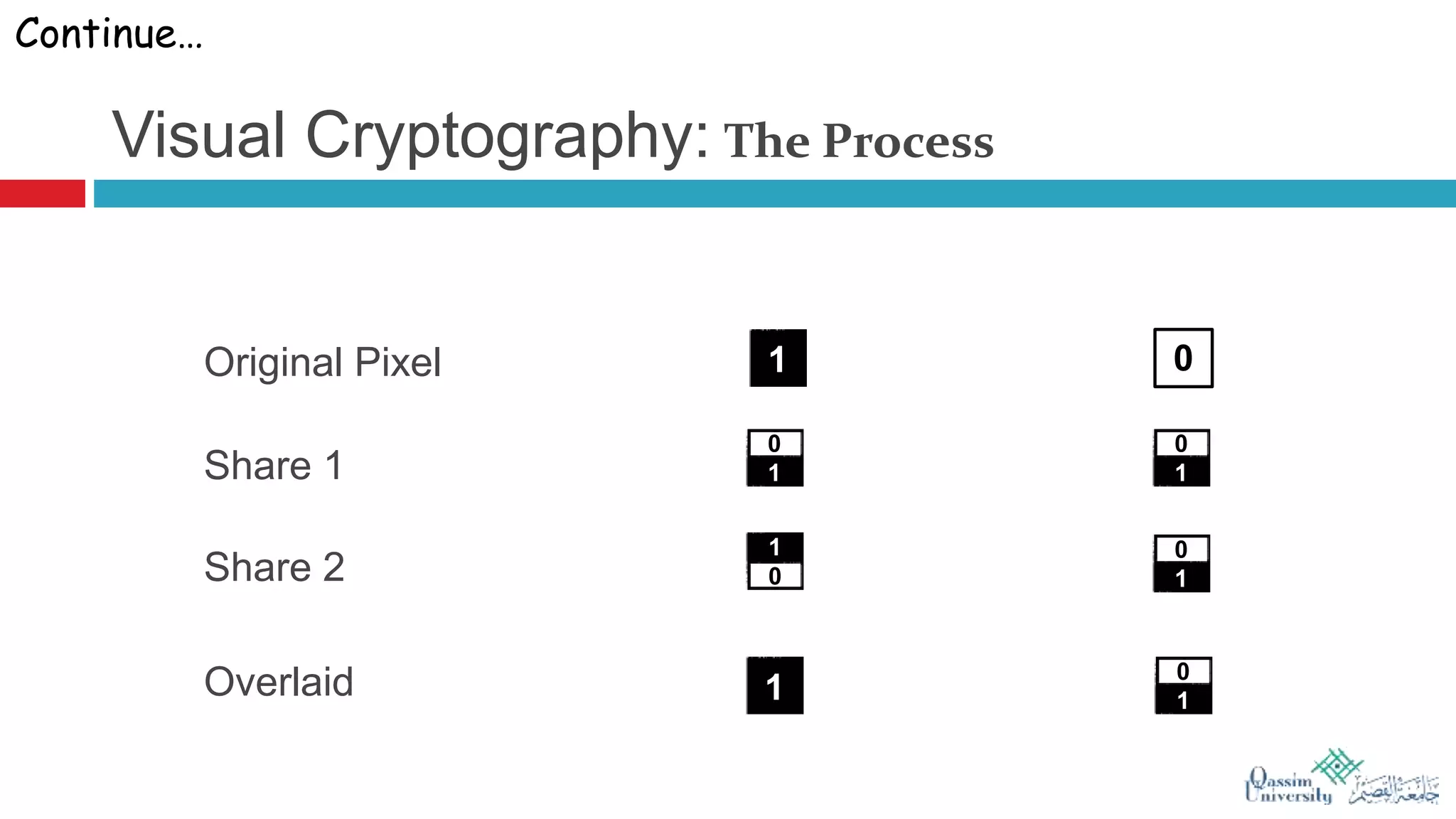
Visual Cryptography: The Process
Original Pixel
Share 1
Share 2
Overlaid
1 0
0
1
0
1
0
1
0
11
1
0
Continue…
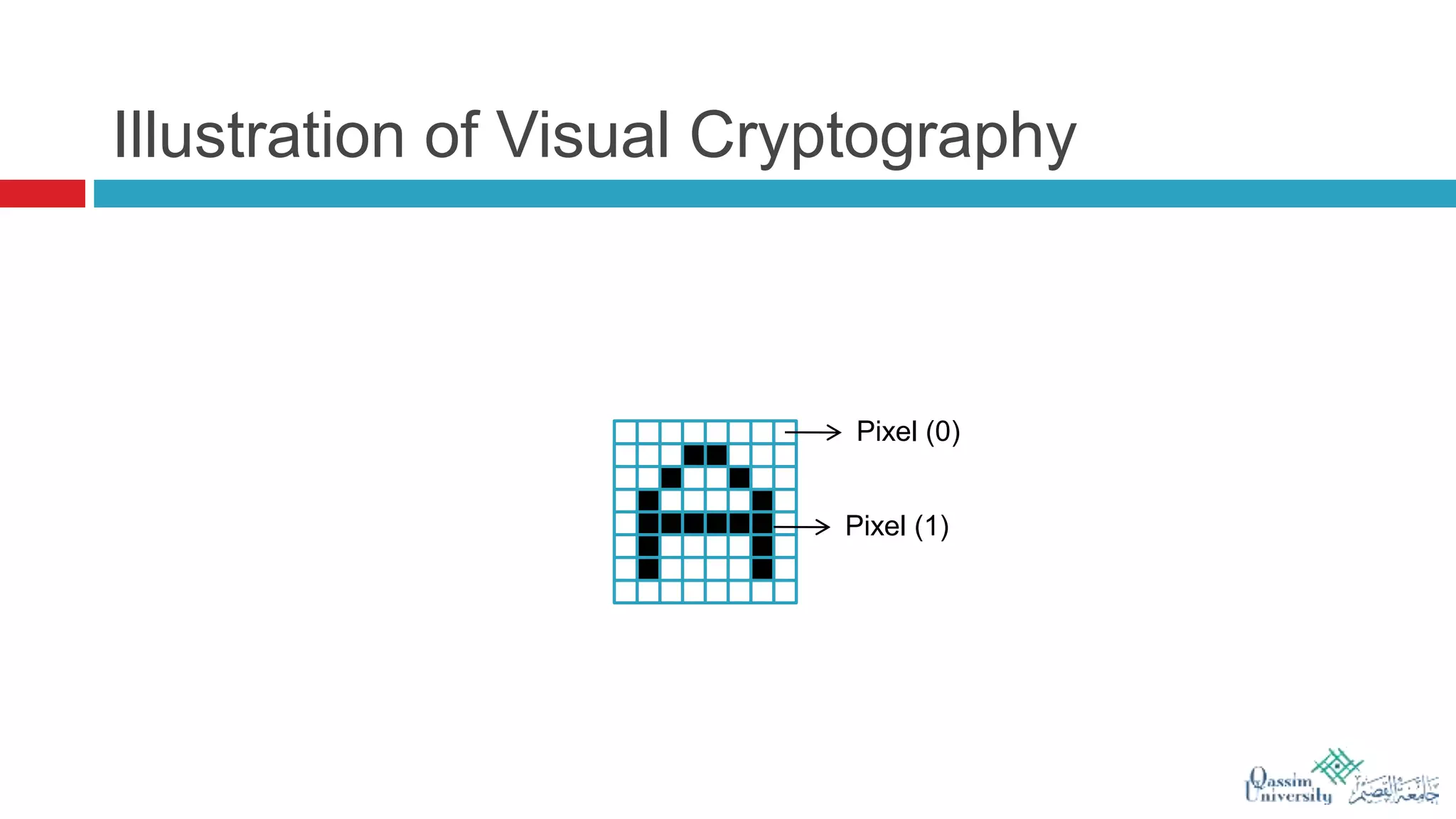
Illustration of Visual Cryptography
Pixel (0)
Pixel (1)
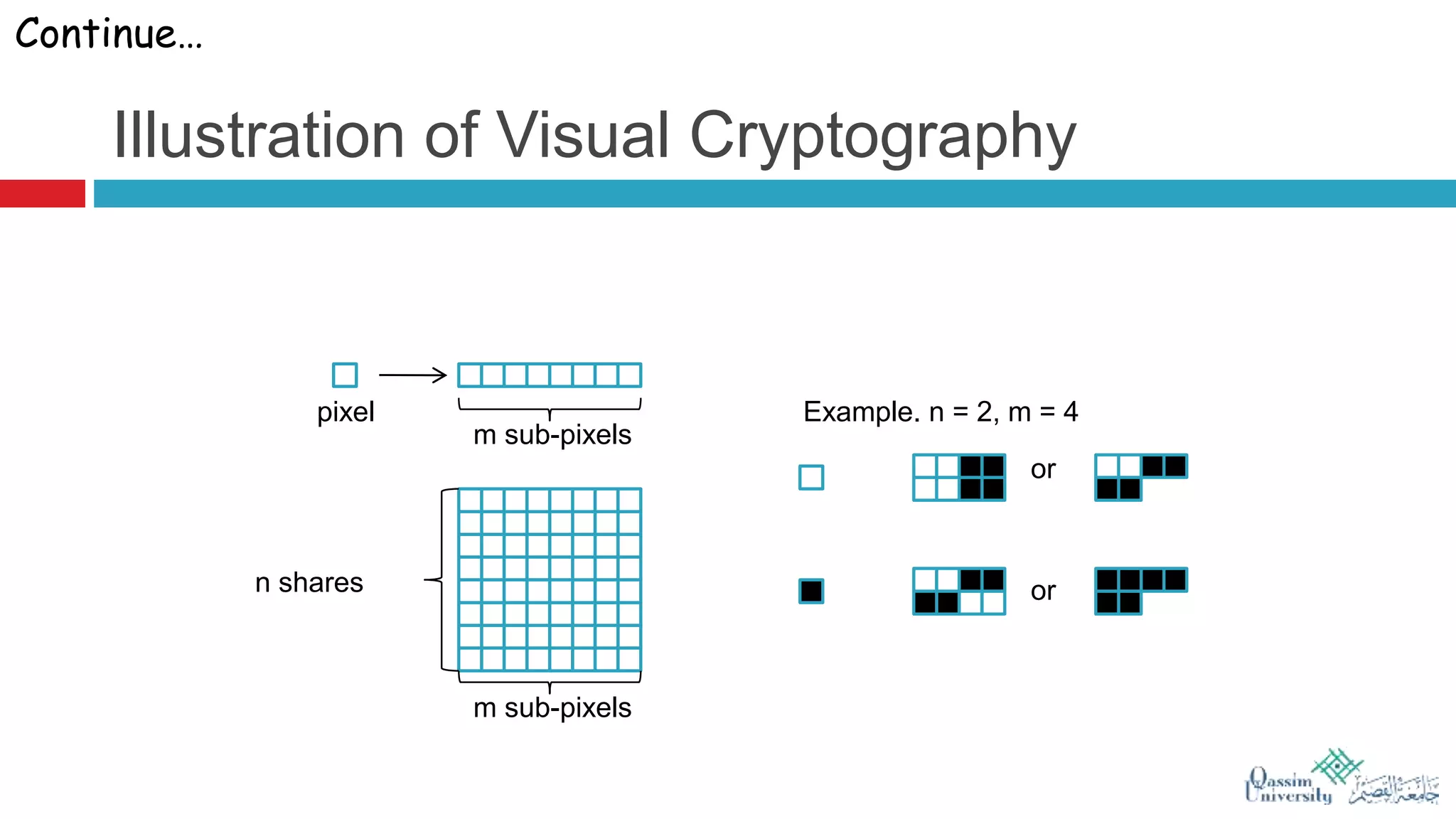
Illustration of Visual Cryptography
m sub-pixels
m sub-pixels
n shares
pixel
or
or
Example. n = 2, m = 4
Continue…
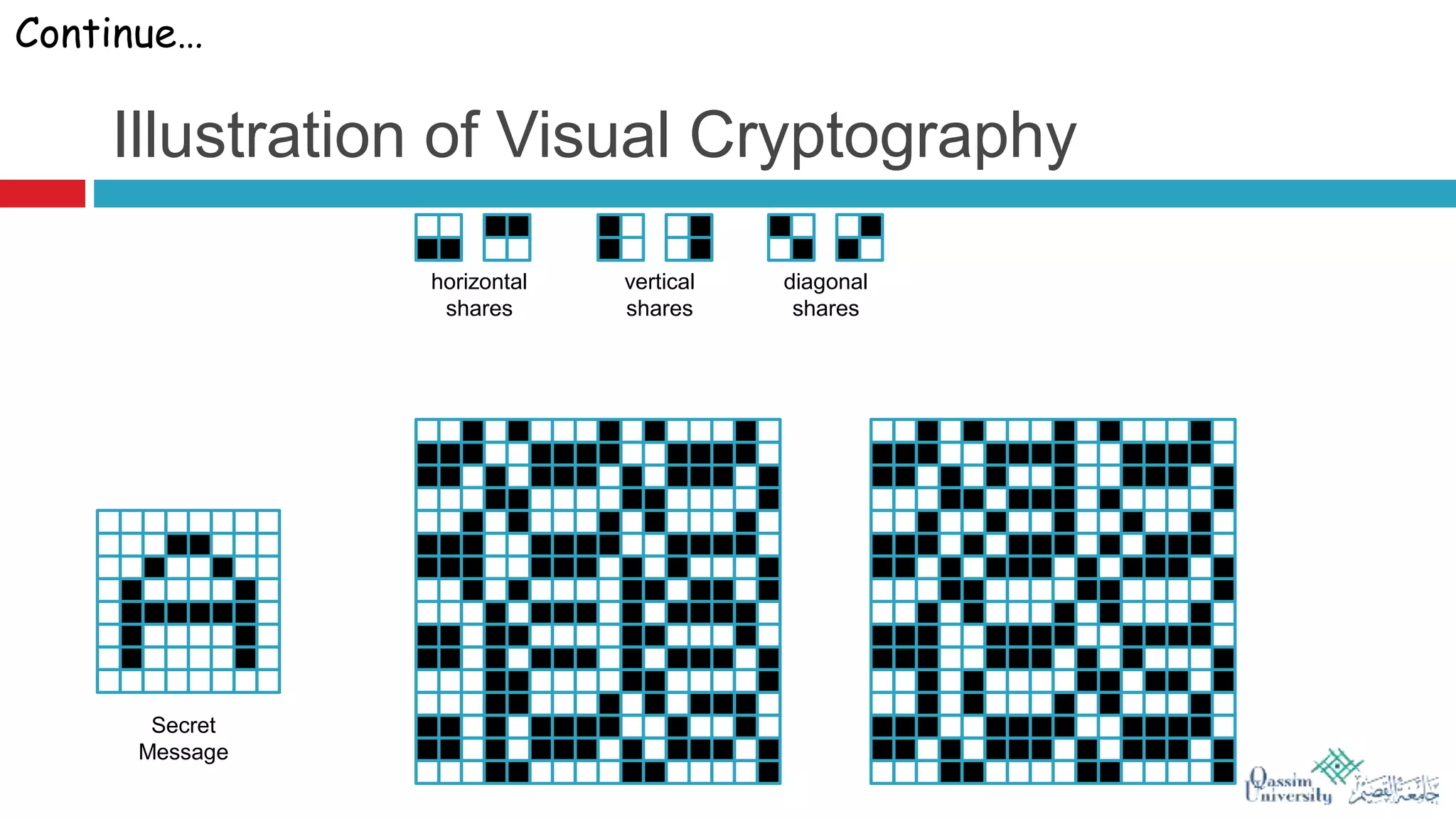
Illustration of Visual Cryptography
horizontal
shares
vertical
shares
diagonal
shares
Secret
Message
Continue…
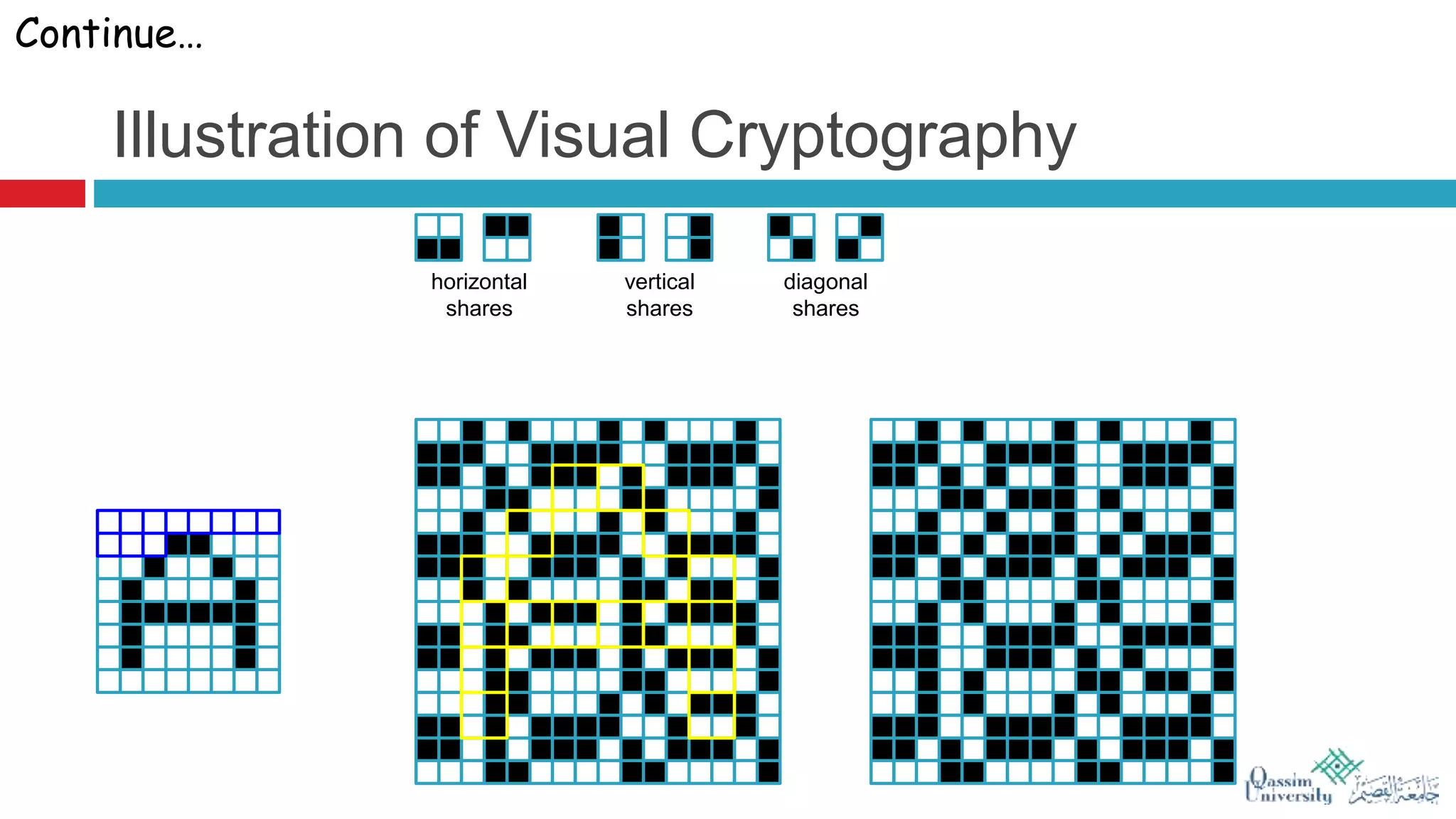
Illustration of Visual Cryptography
horizontal
shares
vertical
shares
diagonal
shares
Continue…
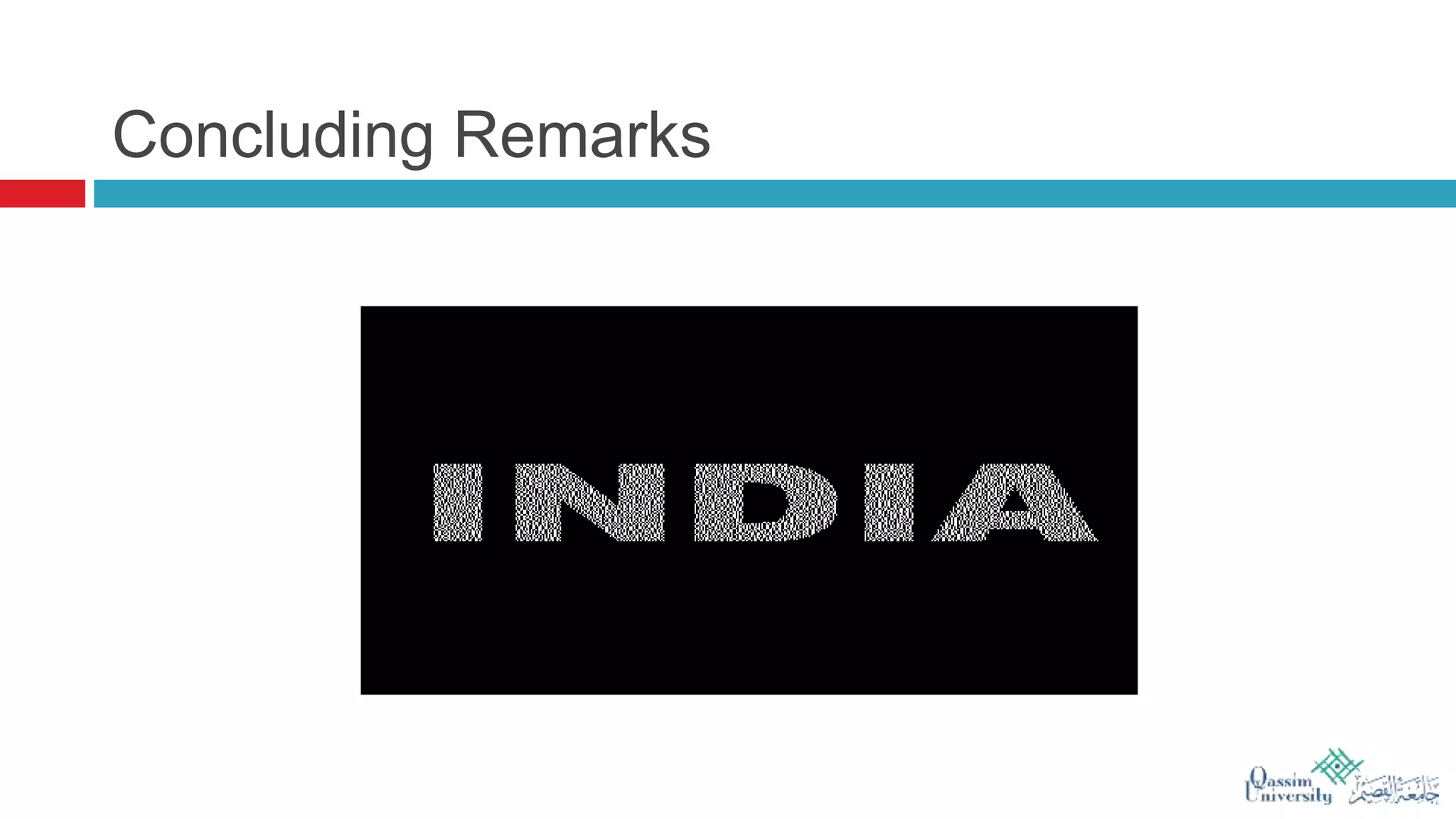
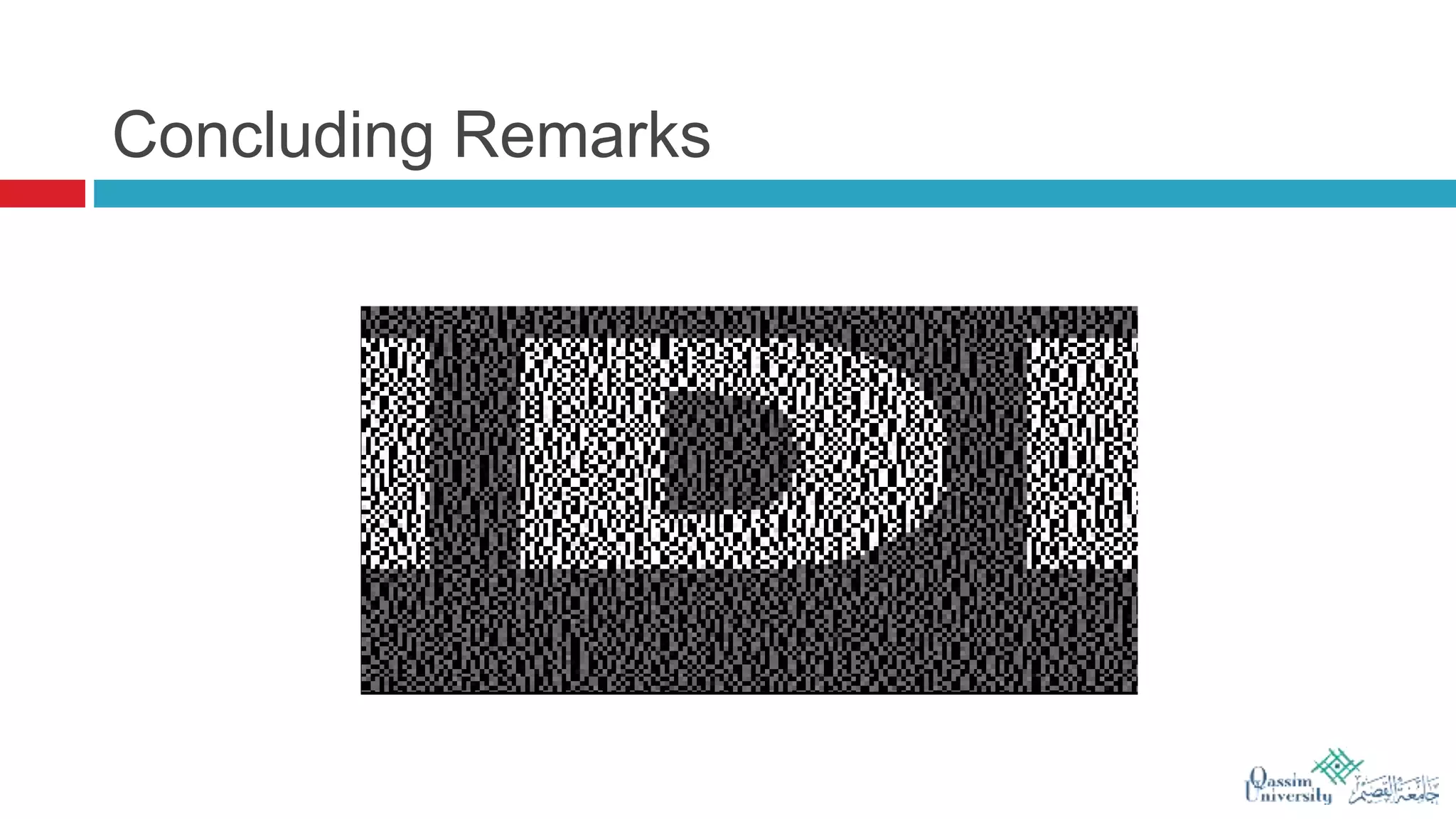
Concluding Remarks
Concluding Remarks
Future Scope
 We can improve result by removing digital noise(gray-shades).
 With some minor changes, we can implement visual cryptography on
color images.
References
 M. Naor and A. Shamir, Visual cryptography, in "Advances in Cryptology { EUROCRYPT '94", A. De Santis, ed., Lecture
Notes in Computer Science 950 (1995), 1-12.
 G. Ateniese, C. Blundo, A. De Santis and D. R. Stinson, Visual cryptography for general access structures, Information
and Computation 129 (1996), 86-106.
 C. Blundo, A. Giorgia Gaggia and D. R. Stinson, On the dealer's randomness required in secret sharing schemes,
Designs, Codes and Cryptography 11 (1997), 107-122.
 W. Hawkes, A. Yasinsac, C. Cline, An Application of Visual Cryptography to Financial Documents, technical report
TR001001, Florida State University (2000).
 Nakajima, M. and Yamaguchi, Y., Extended Visual Cryptography for Natural Images, WSCG02 (2002), 303.
 D Chaum, Secret-ballot receipts: True voter-veriable elections, IEEE Security and Privacy (2004), 38-47.
 A.Klein, M. Wessler, Extended Visual Crypotography Schemes, Science Direct (2007), 716-732.
 A. Bonis and A.Santis, Randomness in secret sharing and visual cryptography schemes, Theoretical Comp. Sci. 314
(2004), 351-374.
Thanks
Queries

Visual Cryptography

  • 1.
  • 2.
    What is Cryptography? Cryptography is the science of information security.  The main objective of cryptography is information hiding.
  • 3.
    What is Cryptography? Cryptography is the science of information security.  The main objective of cryptography is information hiding.
  • 4.
    History of Cryptography-1:Hieroglyphics Cryptography probably began in or around 2000 BC in Egypt, where hieroglyphics were used to decorate the tombs of deceased rulers and kings. COMPUTER SCIENCE COMPUTER SCIENCE
  • 5.
    History of Cryptography-2:Wax Tablet A wax tablet is a tablet made of wood and covered with a layer of wax. It was used as a reusable and portable writing surface in the 1400 BC.
  • 6.
    History of Cryptography-3:Caesar Cipher The first known use of a modern cipher was introduced by Julius Caesar (100 BC to 44 BC), who did not trust his messengers when communicating with his governors. Failure is success if we learn from it. Idloxuh lv vxffhvv li zh ohcuq iurp lw.
  • 7.
    Visual Cryptography It isa new type of cryptographic scheme, which can decode concealed images without any cryptographic computations. The scheme is perfectly secure and very easy to implement.
  • 8.
    Visual Cryptography It isa new type of cryptographic scheme, which can decode concealed images without any cryptographic computations. The scheme is perfectly secure and very easy to implement. Adi Shamir is a cryptographer and co-inventor of the famous RSA algorithm. Moni Naor is a computer scientist and also famous for his Turing Test on verification of a human in the loop.
  • 9.
    Pixel Pixel is thesmallest addressable element in a picture element.
  • 10.
    Grayscale-level Grayscale Level isthe brightness value assigned to a pixel; values range from black, through gray, to white.
  • 11.
    Qualified Participants A qualifiedset of participants is a subset of Ρ whose shares visually reveal the 'secret' image when stacked together. Qualified Participant Qualified Participant Forbidden Participant
  • 12.
    Qualified Participants A forbiddenset of participants is a subset of Ρ whose shares reveal absolutely no information about the 'secret' image when stacked together. Forbidden Participant Qualified Participant Qualified Participant
  • 13.
    Visual Cryptography: TheObjective Encrypting written material (printed text, handwritten notes, pictures, etc.) in a perfectly secure way which can be decoded directly by the human visual system.
  • 14.
    Visual Cryptography: TheApproach  The message consists of a collection of black and white pixels and each pixel is handled separately.  Each original pixel appears in n modified versions (called shares), one for each transparency.
  • 15.
    Visual Cryptography: TheApproach  The message consists of a collection of black and white pixels and each pixel is handled separately.  Each original pixel appears in n modified versions (called shares), one for each transparency. Horizontal Share Vertical Share Diagonal Share
  • 16.
    Visual Cryptography: TheProcess Continue… Original Pixel Share 1 Share 2 Overlaid
  • 17.
    Visual Cryptography: TheProcess Original Pixel Share 1 Share 2 Overlaid 1 0 0 1 0 1 0 1 0 11 1 0 Continue…
  • 18.
    Illustration of VisualCryptography Pixel (0) Pixel (1)
  • 19.
    Illustration of VisualCryptography m sub-pixels m sub-pixels n shares pixel or or Example. n = 2, m = 4 Continue…
  • 20.
    Illustration of VisualCryptography horizontal shares vertical shares diagonal shares Secret Message Continue…
  • 21.
    Illustration of VisualCryptography horizontal shares vertical shares diagonal shares Continue…
  • 22.
  • 23.
  • 24.
    Future Scope  Wecan improve result by removing digital noise(gray-shades).  With some minor changes, we can implement visual cryptography on color images.
  • 25.
    References  M. Naorand A. Shamir, Visual cryptography, in "Advances in Cryptology { EUROCRYPT '94", A. De Santis, ed., Lecture Notes in Computer Science 950 (1995), 1-12.  G. Ateniese, C. Blundo, A. De Santis and D. R. Stinson, Visual cryptography for general access structures, Information and Computation 129 (1996), 86-106.  C. Blundo, A. Giorgia Gaggia and D. R. Stinson, On the dealer's randomness required in secret sharing schemes, Designs, Codes and Cryptography 11 (1997), 107-122.  W. Hawkes, A. Yasinsac, C. Cline, An Application of Visual Cryptography to Financial Documents, technical report TR001001, Florida State University (2000).  Nakajima, M. and Yamaguchi, Y., Extended Visual Cryptography for Natural Images, WSCG02 (2002), 303.  D Chaum, Secret-ballot receipts: True voter-veriable elections, IEEE Security and Privacy (2004), 38-47.  A.Klein, M. Wessler, Extended Visual Crypotography Schemes, Science Direct (2007), 716-732.  A. Bonis and A.Santis, Randomness in secret sharing and visual cryptography schemes, Theoretical Comp. Sci. 314 (2004), 351-374.
  • 26.
  • 27.