1
|
Visual Aids
Presentation Skills
MTL Course Topics
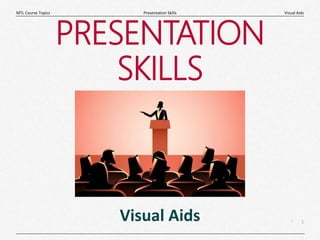
PRESENTATION
SKILLS
Visual Aids
2
|
Visual Aids
Presentation Skills
MTL Course Topics
The Course Topics series from Manage Train Learn is a large collection of topics that will help you as a learner
to quickly and easily master a range of skills in your everyday working life and life outside work. If you are a
trainer, they are perfect for adding to your classroom courses and online learning plans.
COURSE TOPICS FROM MTL
The written content in this Slide Topic belongs exclusively to Manage Train Learn and may only be reprinted
either by attribution to Manage Train Learn or with the express written permission of Manage Train Learn.
They are designed as a series of numbered
slides. As with all programmes on Slide
Topics, these slides are fully editable and
can be used in your own programmes,
royalty-free. Your only limitation is that
you may not re-publish or sell these slides
as your own.
Copyright Manage Train Learn 2020
onwards.
Attribution: All images are from sources
which do not require attribution and may
be used for commercial uses. Sources
include pixabay, unsplash, and freepik.
These images may also be those which are
in the public domain, out of copyright, for
fair use, or allowed under a Creative
Commons license.
3
|
Visual Aids
Presentation Skills
MTL Course Topics
ARE YOU READY?
OK, LET’S START!
4
|
Visual Aids
Presentation Skills
MTL Course Topics
INTRODUCTION
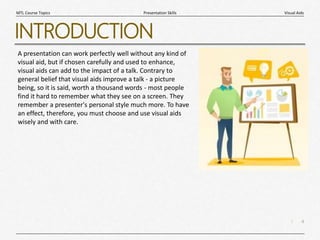
A presentation can work perfectly well without any kind of
visual aid, but if chosen carefully and used to enhance,
visual aids can add to the impact of a talk. Contrary to
general belief that visual aids improve a talk - a picture
being, so it is said, worth a thousand words - most people
find it hard to remember what they see on a screen. They
remember a presenter's personal style much more. To have
an effect, therefore, you must choose and use visual aids
wisely and with care.
5
|
Visual Aids
Presentation Skills
MTL Course Topics
WHY USE VISUAL AIDS?
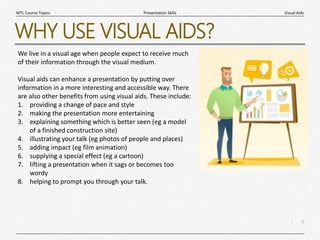
We live in a visual age when people expect to receive much
of their information through the visual medium.
Visual aids can enhance a presentation by putting over
information in a more interesting and accessible way. There
are also other benefits from using visual aids. These include:
1. providing a change of pace and style
2. making the presentation more entertaining
3. explaining something which is better seen (eg a model
of a finished construction site)
4. illustrating your talk (eg photos of people and places)
5. adding impact (eg film animation)
6. supplying a special effect (eg a cartoon)
7. lifting a presentation when it sags or becomes too
wordy
8. helping to prompt you through your talk.
6
|
Visual Aids
Presentation Skills
MTL Course Topics
VISUALS
There are five main kinds of visual aids: props; flipcharts;
overheads; handouts; photographic material. Other visual
aids which can be called on are: LCD and computer screen
displays; audio-cassettes; table-top mini-flipcharts; fixed
white boards.
There are some general rules to bear in mind when using
visual aids:
1. make sure everyone can see your visual aids
2. keep the visual aids simple and to the point
3. avoid too many capital letters; lower case is easier to
read
4. don't overdo the number of visual aids; use them only
where there is no other way to make your point
5. make them dynamic so that people think "Wow!" eg
using a succession of slides on top of each other
6. rehearse their use until you are slick
7. stay in control of the on/off switch of the machine.
7
|
Visual Aids
Presentation Skills
MTL Course Topics
PROPS
Props are any object you use in a presentation to illustrate
your talk. You may display a prop, hand it round or in some
cases allow people to use it.
Some props, such as product samples, may be thought of as
essential to the presentation. Other props may be used for
their novelty value or as gimmicks.
Props add variety to a talk; they are also invaluable as
standbys if you are held up or interrupted.
One of the more interesting uses of a prop was made by a
lecturer on quantum physics who had placed a large
pineapple on the lecture room table. Everyone's attention
was held throughout the 30-minute talk to see what
possible connection there could be between quantum
physics and a pineapple. Of course, there was none and the
lecturer left the spellbound but disappointed audience at
the end of the talk carrying her pineapple away with her.
8
|
Visual Aids
Presentation Skills
MTL Course Topics
PROPPING UP THE TALK
These are illustrations of how props can be used in different
ways in a presentation.
1. an onion cut up (to illustrate market segments)
2. maps
3. money and banknotes: one presenter cut up a £5 note
as a dramatic way to show how the company was
squandering money.
4. newspaper and magazine headlines
5. product samples
6. models of plans
7. human models and actors
8. people: during a presentation on the law of evidence to
newly-appointed judges, an unknown woman walked
quickly through the room in silence. Half an hour later,
the participants were asked to describe her appearance,
thus bringing home to them the difficulty of accurate
witness identification.
9
|
Visual Aids
Presentation Skills
MTL Course Topics
BILL GATES’ UNUSUAL PROP
Despite being the richest businessman in the world, (at an
estimated $79.2 billion in 2015), Bill Gates was never
regarded as an outstanding presenter. When running
Microsoft, Gates rarely presented in the showman-like way
of his counterpart, Steve Jobs of Apple.
Which is why it was all the more surprising when, in the
middle of a TED talk, entitled, "Mosquitos, Malaria, and
Education", Bill Gates did the unthinkable. He galvanised his
audience and made them sit up and pay focused attention.
And he did it by using a prop: mosquitoes which he allowed
to roam round the room.
Andrew Duglan of sixminutes.com says that the prop was
perfect because it met the six requirements of a great prop:
it was totally relevant to his subject, and it was concrete,
unexpected, dramatic, humorous, and entirely memorable.
10
|
Visual Aids
Presentation Skills
MTL Course Topics
FLIPCHARTS
The flipchart is the most versatile of presentation aids. It is
easy to see and move and can be used by anyone anywhere.
IBM boasts that all its offices around the world possess a
flipchart for instant presentations. For the general
presenter, it has replaced the teacher's chalk and
blackboard.
Flipcharts come into their own when you want to build an
idea progressively with your audience using diagram,
illustration or word. They are also excellent for producing
one-page summaries such as mind maps.
The versatility of flipcharts means that pages can be used...
1. to display the name of your presentation
2. to display useful themes around the wall
3. to record audience ideas and questions.
11
|
Visual Aids
Presentation Skills
MTL Course Topics
USING FLIPCHARTS
When presenters fail to follow the simple rules of flipchart
use, their presentation can be ruined. All credibility may be
lost. To look professional when using flipcharts, observe
these rules:
1. don't use the flipchart for information which would be
better given directly, or in a handout, or in discussion
2. position the easel where everyone can see it
3. stand to the side when presenting so that people can
see
4. write from your nearest side (ie stand on the right if you
are right-handed) so people can see what you write
5. don't talk while writing, unless it is to spell out what you
are writing
6. if you are drawing diagrams and pictures or want the
final chart to look a certain way, sketch it in pencil
beforehand so that when you draw over the lines you
look slick and quick.
12
|
Visual Aids
Presentation Skills
MTL Course Topics
OVERHEADS
The overhead transparency has become the standard tool
for presenters, particularly when speaking to large
audiences.
Transparencies are valuable for conveying information which
words cannot adequately describe. This includes pie charts,
graphs, tables of figures and diagrams. Successive slides can
also be used to build a show by adding slides to previous
ones, or by unmasking sections of the slide as you go.
Overheads are also indispensable if you want to show your
audience an idea or theme, such as a picture or drawing,
that you cannot draw yourself or have no time to draw
during the presentation.
If they are used as an integral part of your presentation, you
need to rehearse your overhead show as much as any other
part of your performance.
13
|
Visual Aids
Presentation Skills
MTL Course Topics
USING OVERHEADS
To avoid fumbling with overheads and destroying an
otherwise good presentation, observe these rules:
Do's:
1. do put the slide in position first and then switch the
projector on
2. do plan your slides so you can find them in the dark
3. do focus the projector lens before the presentation
4. do give the audience time to read and absorb the slide
before moving on
Don'ts:
1. don't place the projector where people's view is
obstructed
2. don't slide slides into place, learn to place them on
exactly
3. don't overdo slides which merely repeat what you've
already said.
14
|
Visual Aids
Presentation Skills
MTL Course Topics
THE IMPACT OF OVERHEADS
The impact of an overhead must be immediate. An audience
doesn't want to search a lot of information on an overhead
screen in order to find your message.
There are three rules to follow to help your impact:
1. The 6 x 6 Rule. The 6 x 6 rule states that an overhead
should have no more than six words horizontally and six
words vertically to create maximum impact.
2. Numbers And Words. When you present numerical
information it is better to show the numbers in picture or
graphical format than words.
3. Images And Numbers. Charts and lists of numbers are
practically impossible to read and make sense of. If you want
to use numbers, first turn them into a graph or a graphical
representation, such as a pie chart.
15
|
Visual Aids
Presentation Skills
MTL Course Topics
HANDOUTS
The written handout can accompany a presentation but
there are important pros and cons.
The advantages of a handout are that...
1. they can be welcomed by those who want more
information
2. they save people taking notes
3. they can be a lasting reminder of your talk.
The disadvantages are that...
1. because they have to be prepared in advance, they may
not provide the information people want
2. they are not always read. If distributed during a talk, they
can become a distraction.
3. the quality of copies may be poor and so detract from
the impact of your talk.
If you want your audience to keep their handouts, give them
a reason for doing so. You could add a reference item such as
a phone number, website address, book reference; your
details; or even theirs.
16
|
Visual Aids
Presentation Skills
MTL Course Topics
PICTURES
Photographic material means any visual aid that uses still or
moving images. This means principally the carousel slide
and the video.
There are pluses and minuses in using photographic
material.
Pluses: Slides are excellent for instructional purposes
enabling an audience to go to places they couldn't
otherwise go. They can include colourful diagrams,
animations, movies and of course sound.
Minuses: The cost of producing good photographic material
is high. People now expect TV and film quality in any
photographic presentation. A video limits the amount of
two-way discussion you can have.
17
|
Visual Aids
Presentation Skills
MTL Course Topics
THE COLOURS ON A CHART
Colours on a flipchart or overhead can convey different
shades of meaning, whether they are used in graphics or
text.
Red = urgent, brutal, dangerous, hot, Stop!
Dark blue = traditional, factual, stable, trustworthy, calm
Light blue = cool, refreshing
Green = relaxed, future-oriented, organic, go, money, new
life, healthy
Yellow = light-hearted, sunny, bright, warm
Orange = active, assertive;
Black = serious, heavy, profitable, death
Brown = earthy
Violet = luxurious, regal, mysterious
Pink = soft
Grey = neutral, mature, integrity
White = hopeful, pure, clear.
18
|
Visual Aids
Presentation Skills
MTL Course Topics
USING COLOURS
Here are some tips on using colours...
1. black, blue and green inks have the greatest visibility
2. blue is the most pleasing to look at followed by red
3. don't use red on the whole chart, it's far too
overwhelming and strong
4. avoid purple, brown, pink and yellow
5. permanent markers are the most vivid visual aid pens,
but dry out quickly if you leave the tops off. They often
bleed through to the next chart.
6. water colours are less vivid and squeak.
7. add bright colours to small graphics to make them stand
out
8. add subtle colours to large graphics so they don't
overwhelm.
19
|
Visual Aids
Presentation Skills
MTL Course Topics
THAT’S
IT!
WELL DONE!
20
|
Visual Aids
Presentation Skills
MTL Course Topics
THANK YOU
This has been a Slide Topic from Manage Train Learn

Visual Aids

  • 1.
    1 | Visual Aids Presentation Skills MTLCourse Topics PRESENTATION SKILLS Visual Aids
  • 2.
    2 | Visual Aids Presentation Skills MTLCourse Topics The Course Topics series from Manage Train Learn is a large collection of topics that will help you as a learner to quickly and easily master a range of skills in your everyday working life and life outside work. If you are a trainer, they are perfect for adding to your classroom courses and online learning plans. COURSE TOPICS FROM MTL The written content in this Slide Topic belongs exclusively to Manage Train Learn and may only be reprinted either by attribution to Manage Train Learn or with the express written permission of Manage Train Learn. They are designed as a series of numbered slides. As with all programmes on Slide Topics, these slides are fully editable and can be used in your own programmes, royalty-free. Your only limitation is that you may not re-publish or sell these slides as your own. Copyright Manage Train Learn 2020 onwards. Attribution: All images are from sources which do not require attribution and may be used for commercial uses. Sources include pixabay, unsplash, and freepik. These images may also be those which are in the public domain, out of copyright, for fair use, or allowed under a Creative Commons license.
  • 3.
    3 | Visual Aids Presentation Skills MTLCourse Topics ARE YOU READY? OK, LET’S START!
  • 4.
    4 | Visual Aids Presentation Skills MTLCourse Topics INTRODUCTION A presentation can work perfectly well without any kind of visual aid, but if chosen carefully and used to enhance, visual aids can add to the impact of a talk. Contrary to general belief that visual aids improve a talk - a picture being, so it is said, worth a thousand words - most people find it hard to remember what they see on a screen. They remember a presenter's personal style much more. To have an effect, therefore, you must choose and use visual aids wisely and with care.
  • 5.
    5 | Visual Aids Presentation Skills MTLCourse Topics WHY USE VISUAL AIDS? We live in a visual age when people expect to receive much of their information through the visual medium. Visual aids can enhance a presentation by putting over information in a more interesting and accessible way. There are also other benefits from using visual aids. These include: 1. providing a change of pace and style 2. making the presentation more entertaining 3. explaining something which is better seen (eg a model of a finished construction site) 4. illustrating your talk (eg photos of people and places) 5. adding impact (eg film animation) 6. supplying a special effect (eg a cartoon) 7. lifting a presentation when it sags or becomes too wordy 8. helping to prompt you through your talk.
  • 6.
    6 | Visual Aids Presentation Skills MTLCourse Topics VISUALS There are five main kinds of visual aids: props; flipcharts; overheads; handouts; photographic material. Other visual aids which can be called on are: LCD and computer screen displays; audio-cassettes; table-top mini-flipcharts; fixed white boards. There are some general rules to bear in mind when using visual aids: 1. make sure everyone can see your visual aids 2. keep the visual aids simple and to the point 3. avoid too many capital letters; lower case is easier to read 4. don't overdo the number of visual aids; use them only where there is no other way to make your point 5. make them dynamic so that people think "Wow!" eg using a succession of slides on top of each other 6. rehearse their use until you are slick 7. stay in control of the on/off switch of the machine.
  • 7.
    7 | Visual Aids Presentation Skills MTLCourse Topics PROPS Props are any object you use in a presentation to illustrate your talk. You may display a prop, hand it round or in some cases allow people to use it. Some props, such as product samples, may be thought of as essential to the presentation. Other props may be used for their novelty value or as gimmicks. Props add variety to a talk; they are also invaluable as standbys if you are held up or interrupted. One of the more interesting uses of a prop was made by a lecturer on quantum physics who had placed a large pineapple on the lecture room table. Everyone's attention was held throughout the 30-minute talk to see what possible connection there could be between quantum physics and a pineapple. Of course, there was none and the lecturer left the spellbound but disappointed audience at the end of the talk carrying her pineapple away with her.
  • 8.
    8 | Visual Aids Presentation Skills MTLCourse Topics PROPPING UP THE TALK These are illustrations of how props can be used in different ways in a presentation. 1. an onion cut up (to illustrate market segments) 2. maps 3. money and banknotes: one presenter cut up a £5 note as a dramatic way to show how the company was squandering money. 4. newspaper and magazine headlines 5. product samples 6. models of plans 7. human models and actors 8. people: during a presentation on the law of evidence to newly-appointed judges, an unknown woman walked quickly through the room in silence. Half an hour later, the participants were asked to describe her appearance, thus bringing home to them the difficulty of accurate witness identification.
  • 9.
    9 | Visual Aids Presentation Skills MTLCourse Topics BILL GATES’ UNUSUAL PROP Despite being the richest businessman in the world, (at an estimated $79.2 billion in 2015), Bill Gates was never regarded as an outstanding presenter. When running Microsoft, Gates rarely presented in the showman-like way of his counterpart, Steve Jobs of Apple. Which is why it was all the more surprising when, in the middle of a TED talk, entitled, "Mosquitos, Malaria, and Education", Bill Gates did the unthinkable. He galvanised his audience and made them sit up and pay focused attention. And he did it by using a prop: mosquitoes which he allowed to roam round the room. Andrew Duglan of sixminutes.com says that the prop was perfect because it met the six requirements of a great prop: it was totally relevant to his subject, and it was concrete, unexpected, dramatic, humorous, and entirely memorable.
  • 10.
    10 | Visual Aids Presentation Skills MTLCourse Topics FLIPCHARTS The flipchart is the most versatile of presentation aids. It is easy to see and move and can be used by anyone anywhere. IBM boasts that all its offices around the world possess a flipchart for instant presentations. For the general presenter, it has replaced the teacher's chalk and blackboard. Flipcharts come into their own when you want to build an idea progressively with your audience using diagram, illustration or word. They are also excellent for producing one-page summaries such as mind maps. The versatility of flipcharts means that pages can be used... 1. to display the name of your presentation 2. to display useful themes around the wall 3. to record audience ideas and questions.
  • 11.
    11 | Visual Aids Presentation Skills MTLCourse Topics USING FLIPCHARTS When presenters fail to follow the simple rules of flipchart use, their presentation can be ruined. All credibility may be lost. To look professional when using flipcharts, observe these rules: 1. don't use the flipchart for information which would be better given directly, or in a handout, or in discussion 2. position the easel where everyone can see it 3. stand to the side when presenting so that people can see 4. write from your nearest side (ie stand on the right if you are right-handed) so people can see what you write 5. don't talk while writing, unless it is to spell out what you are writing 6. if you are drawing diagrams and pictures or want the final chart to look a certain way, sketch it in pencil beforehand so that when you draw over the lines you look slick and quick.
  • 12.
    12 | Visual Aids Presentation Skills MTLCourse Topics OVERHEADS The overhead transparency has become the standard tool for presenters, particularly when speaking to large audiences. Transparencies are valuable for conveying information which words cannot adequately describe. This includes pie charts, graphs, tables of figures and diagrams. Successive slides can also be used to build a show by adding slides to previous ones, or by unmasking sections of the slide as you go. Overheads are also indispensable if you want to show your audience an idea or theme, such as a picture or drawing, that you cannot draw yourself or have no time to draw during the presentation. If they are used as an integral part of your presentation, you need to rehearse your overhead show as much as any other part of your performance.
  • 13.
    13 | Visual Aids Presentation Skills MTLCourse Topics USING OVERHEADS To avoid fumbling with overheads and destroying an otherwise good presentation, observe these rules: Do's: 1. do put the slide in position first and then switch the projector on 2. do plan your slides so you can find them in the dark 3. do focus the projector lens before the presentation 4. do give the audience time to read and absorb the slide before moving on Don'ts: 1. don't place the projector where people's view is obstructed 2. don't slide slides into place, learn to place them on exactly 3. don't overdo slides which merely repeat what you've already said.
  • 14.
    14 | Visual Aids Presentation Skills MTLCourse Topics THE IMPACT OF OVERHEADS The impact of an overhead must be immediate. An audience doesn't want to search a lot of information on an overhead screen in order to find your message. There are three rules to follow to help your impact: 1. The 6 x 6 Rule. The 6 x 6 rule states that an overhead should have no more than six words horizontally and six words vertically to create maximum impact. 2. Numbers And Words. When you present numerical information it is better to show the numbers in picture or graphical format than words. 3. Images And Numbers. Charts and lists of numbers are practically impossible to read and make sense of. If you want to use numbers, first turn them into a graph or a graphical representation, such as a pie chart.
  • 15.
    15 | Visual Aids Presentation Skills MTLCourse Topics HANDOUTS The written handout can accompany a presentation but there are important pros and cons. The advantages of a handout are that... 1. they can be welcomed by those who want more information 2. they save people taking notes 3. they can be a lasting reminder of your talk. The disadvantages are that... 1. because they have to be prepared in advance, they may not provide the information people want 2. they are not always read. If distributed during a talk, they can become a distraction. 3. the quality of copies may be poor and so detract from the impact of your talk. If you want your audience to keep their handouts, give them a reason for doing so. You could add a reference item such as a phone number, website address, book reference; your details; or even theirs.
  • 16.
    16 | Visual Aids Presentation Skills MTLCourse Topics PICTURES Photographic material means any visual aid that uses still or moving images. This means principally the carousel slide and the video. There are pluses and minuses in using photographic material. Pluses: Slides are excellent for instructional purposes enabling an audience to go to places they couldn't otherwise go. They can include colourful diagrams, animations, movies and of course sound. Minuses: The cost of producing good photographic material is high. People now expect TV and film quality in any photographic presentation. A video limits the amount of two-way discussion you can have.
  • 17.
    17 | Visual Aids Presentation Skills MTLCourse Topics THE COLOURS ON A CHART Colours on a flipchart or overhead can convey different shades of meaning, whether they are used in graphics or text. Red = urgent, brutal, dangerous, hot, Stop! Dark blue = traditional, factual, stable, trustworthy, calm Light blue = cool, refreshing Green = relaxed, future-oriented, organic, go, money, new life, healthy Yellow = light-hearted, sunny, bright, warm Orange = active, assertive; Black = serious, heavy, profitable, death Brown = earthy Violet = luxurious, regal, mysterious Pink = soft Grey = neutral, mature, integrity White = hopeful, pure, clear.
  • 18.
    18 | Visual Aids Presentation Skills MTLCourse Topics USING COLOURS Here are some tips on using colours... 1. black, blue and green inks have the greatest visibility 2. blue is the most pleasing to look at followed by red 3. don't use red on the whole chart, it's far too overwhelming and strong 4. avoid purple, brown, pink and yellow 5. permanent markers are the most vivid visual aid pens, but dry out quickly if you leave the tops off. They often bleed through to the next chart. 6. water colours are less vivid and squeak. 7. add bright colours to small graphics to make them stand out 8. add subtle colours to large graphics so they don't overwhelm.
  • 19.
    19 | Visual Aids Presentation Skills MTLCourse Topics THAT’S IT! WELL DONE!
  • 20.
    20 | Visual Aids Presentation Skills MTLCourse Topics THANK YOU This has been a Slide Topic from Manage Train Learn