Intelligent and Safer Junctions,
Supporting Safer Cycling
3rd – 4th November, 2016 @ Bolonga Italy
John McLaughlin jmclaughlin@tssg.org, Dr. Steven Davy sdavy@tssg.org,
Frances Cleary fcleary@tssg.org, David Ryan dryan@tssg.org
Programmable Automomous Systems Unit
Introduction,
• About TSSG: TSSG is a telecommunications research
institute attached to Waterford Institute of Technology,
established in 1996, in South East Ireland.
• Aim: The aim of the project was to research a sensor based
system to detect the presence of cyclists at roundabout
junctions and devise a system to generate alerts specific to
the affected area on the junction.
www.tssg.org 2
Intelligent and Safer Junctions, Supporting Safer Cycling
Key Outputs
• To assess if Bluetooth Beacon Technology is suitable for
cyclist detection at roundabout junctions.
• To develop a low cost, light weight system for creating
alerts at the separate junctions on a roundabout based
on the cyclist’s trajectory.
www.tssg.org 3
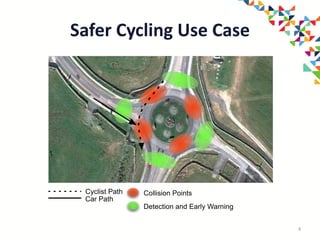
Safer Cycling Use Case
Cyclist Path
Car Path
Collision Points
Detection and Early Warning
4
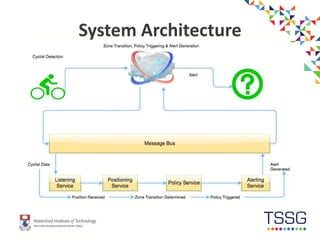
System Architecture
15-Nov-16
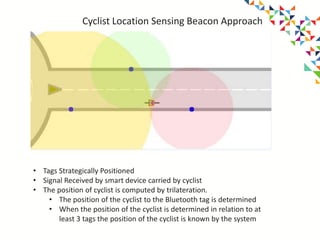
Cyclist Location Sensing Beacon Approach
• Tags Strategically Positioned
• Signal Received by smart device carried by cyclist
• The position of cyclist is computed by trilateration.
• The position of the cyclist to the Bluetooth tag is determined
• When the position of the cyclist is determined in relation to at
least 3 tags the position of the cyclist is known by the system
GPS Location Sensing Approach
• This method exploits GPS technology on device held by the
cyclist.
• A manifest of junctions is sent to the mobile device from the
Listening Service.
• The app determines, using mathematics, the current GPS
position and the manifest, the relevant junction and once
within a nominal distance the application begins to stream the
current GPS position to the Listening Service
www.tssg.org 7
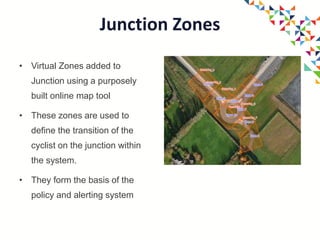
Junction Zones
• Virtual Zones added to
Junction using a purposely
built online map tool
• These zones are used to
define the transition of the
cyclist on the junction within
the system.
• They form the basis of the
policy and alerting system
The policies are a set of rules that,
based on a transition
between zones define what
alerts are sent to the junction
Policies & Alerts
Rule : [Zone 2 -> Zone 3]
ALERTS : [ Zone 5 -> Zone 7 ]
Rule : [Zone 3 -> Zone 7]
ALERTS : [ Zone 8 -> Zone 10 ]
CANCEL : [Zone 2 -> Zone 3]
Rule : [Zone 7 -> Zone 10]
ALERTS : [ Zone 2 -> Zone 3 ]
CANCEL : [Zone 5 -> Zone 7]
Findings
• At speeds of 15km and 20km the cyclist was detected.
• The height of the Bluetooth Beacons were crucial to the detection
with 1.2m being the optimum.
• Sufficient rate of detection was achieved by this method to
accurately detect the cyclist’s trajectory through the junction.
• The detected trajectory determined by trilateration was similar to the
trajectory determined by the Garmin 500 unit that was used as a
comparison.
Bluetooth Beacon Technology Assessment
Findings
• The key component to the system was the zone
transition and policy system.
• GPS Based Location sensing was deemed a more
stable and lower cost solution to the Bluetooth Beacon
Technology
• GPS signal and adequate internet connectivity is key to
the success of the system.
Development of low cost cyclist detection system
Conclusion
• For 100% cyclist detection it requires all cyclists to use the
system i.e. use one of the cyclist detection mechanisms.
• Extra trials required to test the system in a real world scenario
to determine if the system would be suitable in a complex
urban environment.
• From a proof of concept perspective the system provides a
low cost, light weight solution to making roundabout junctions
more intelligent and potentially safer for cyclists
DELIVERING SCIENCE TO SHAPE
YOUR FUTURE.
Any questions?

Safer Cycle

  • 1.
    Intelligent and SaferJunctions, Supporting Safer Cycling 3rd – 4th November, 2016 @ Bolonga Italy John McLaughlin jmclaughlin@tssg.org, Dr. Steven Davy sdavy@tssg.org, Frances Cleary fcleary@tssg.org, David Ryan dryan@tssg.org Programmable Automomous Systems Unit
  • 2.
    Introduction, • About TSSG:TSSG is a telecommunications research institute attached to Waterford Institute of Technology, established in 1996, in South East Ireland. • Aim: The aim of the project was to research a sensor based system to detect the presence of cyclists at roundabout junctions and devise a system to generate alerts specific to the affected area on the junction. www.tssg.org 2 Intelligent and Safer Junctions, Supporting Safer Cycling
  • 3.
    Key Outputs • Toassess if Bluetooth Beacon Technology is suitable for cyclist detection at roundabout junctions. • To develop a low cost, light weight system for creating alerts at the separate junctions on a roundabout based on the cyclist’s trajectory. www.tssg.org 3
  • 4.
    Safer Cycling UseCase Cyclist Path Car Path Collision Points Detection and Early Warning 4
  • 5.
  • 6.
    Cyclist Location SensingBeacon Approach • Tags Strategically Positioned • Signal Received by smart device carried by cyclist • The position of cyclist is computed by trilateration. • The position of the cyclist to the Bluetooth tag is determined • When the position of the cyclist is determined in relation to at least 3 tags the position of the cyclist is known by the system
  • 7.
    GPS Location SensingApproach • This method exploits GPS technology on device held by the cyclist. • A manifest of junctions is sent to the mobile device from the Listening Service. • The app determines, using mathematics, the current GPS position and the manifest, the relevant junction and once within a nominal distance the application begins to stream the current GPS position to the Listening Service www.tssg.org 7
  • 8.
    Junction Zones • VirtualZones added to Junction using a purposely built online map tool • These zones are used to define the transition of the cyclist on the junction within the system. • They form the basis of the policy and alerting system
  • 9.
    The policies area set of rules that, based on a transition between zones define what alerts are sent to the junction Policies & Alerts Rule : [Zone 2 -> Zone 3] ALERTS : [ Zone 5 -> Zone 7 ] Rule : [Zone 3 -> Zone 7] ALERTS : [ Zone 8 -> Zone 10 ] CANCEL : [Zone 2 -> Zone 3] Rule : [Zone 7 -> Zone 10] ALERTS : [ Zone 2 -> Zone 3 ] CANCEL : [Zone 5 -> Zone 7]
  • 10.
    Findings • At speedsof 15km and 20km the cyclist was detected. • The height of the Bluetooth Beacons were crucial to the detection with 1.2m being the optimum. • Sufficient rate of detection was achieved by this method to accurately detect the cyclist’s trajectory through the junction. • The detected trajectory determined by trilateration was similar to the trajectory determined by the Garmin 500 unit that was used as a comparison. Bluetooth Beacon Technology Assessment
  • 11.
    Findings • The keycomponent to the system was the zone transition and policy system. • GPS Based Location sensing was deemed a more stable and lower cost solution to the Bluetooth Beacon Technology • GPS signal and adequate internet connectivity is key to the success of the system. Development of low cost cyclist detection system
  • 12.
    Conclusion • For 100%cyclist detection it requires all cyclists to use the system i.e. use one of the cyclist detection mechanisms. • Extra trials required to test the system in a real world scenario to determine if the system would be suitable in a complex urban environment. • From a proof of concept perspective the system provides a low cost, light weight solution to making roundabout junctions more intelligent and potentially safer for cyclists
  • 13.
    DELIVERING SCIENCE TOSHAPE YOUR FUTURE. Any questions?