Vishu – Festival
of Kerala
© Aviyal Presentations : https://aviyalpresentations.wordpress.com/
VISHU – MALAYALAM NEW YEAR
• Vishu (വിഷു in Malayalam) is the astronomical new year Hindu
festival celebrated in the Indian state of Kerala. It is observed on
the first day of the Medam (a Malayalam month) month.
• It is also celebrated as Bisu in Tulunadu regions like Kasargod
district of Kerala, Mangalore and Udupi districts of Karnataka.
• It is celebrated under other names all over India. It is celebrated
as Baisakhi in Punjab, Bihu in Assam, Poila Baisakh in Bengal,
Puthand in Tamil Nadu, Gudi Padwa in Maharashtra and Ugadi in
Karnataka and Andhra Pradesh.
© Aviyal Presentations : https://aviyalpresentations.wordpress.com/
SIGNIFICANCE
• Vishu is celebrated when the Sun enters the Ashwini nakshatra
(Aries) and is believed to come above the equator.
• It falls on the first day of the Malayalam month Medam (usually
on April 14).
• Vishu literally means “equal” in Sanskrit. On Vishu day, both day
and night are of equal duration. Its the day of equinox.
• It is all about new beginnings for Malayalis.
• On this day, the Sun rises straight from the East.
© Aviyal Presentations : https://aviyalpresentations.wordpress.com/
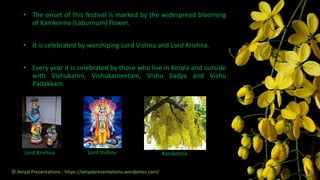
Lord Krishna Lord Vishnu Kanikonna
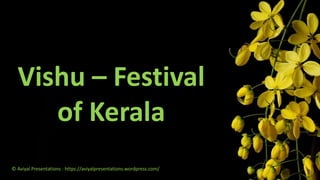
• The onset of this festival is marked by the widespread blooming
of Kanikonna (Laburnum) flower.
• It is celebrated by worshiping Lord Vishnu and Lord Krishna.
• Every year it is celebrated by those who live in Kerala and outside
with Vishukanni, Vishukaineetam, Vishu Sadya and Vishu
Padakkam.
© Aviyal Presentations : https://aviyalpresentations.wordpress.com/
HISTORY & MYTHOLOGY
• Vishu is believed to have been celebrated since 844 AD.
• It is believed that Vishu celebrations began in Kerala during the
reign of Sthanu Ravi who ruled between AD 844 and 855.
• There are several myths related to the celebration of Vishu.
According to one myth Vishu is the day when Lord Krishna killed
Narakasura a demon. As per another belief Vishu is celebrated
as the return of Surya Dev. According to other myths, Ravana
demon King, never allowed Surya Dev or the Sun God to rise
from the East. It was on this day, after the death of Ravana, the
sun started to rise from the East.
© Aviyal Presentations : https://aviyalpresentations.wordpress.com/
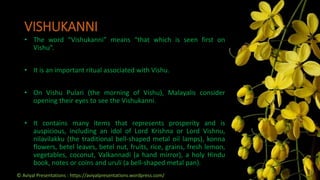
VISHUKANNI
• The word “Vishukanni” means “that which is seen first on
Vishu”.
• It is an important ritual associated with Vishu.
• On Vishu Pulari (the morning of Vishu), Malayalis consider
opening their eyes to see the Vishukanni.
• It contains many items that represents prosperity and is
auspicious, including an idol of Lord Krishna or Lord Vishnu,
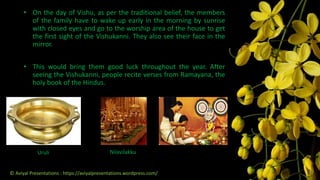
nilavilakku (the traditional bell-shaped metal oil lamps), konna
flowers, betel leaves, betel nut, fruits, rice, grains, fresh lemon,
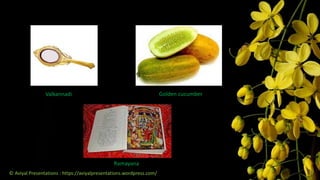
vegetables, coconut, Valkannadi (a hand mirror), a holy Hindu
book, notes or coins and uruli (a bell-shaped metal pan).
© Aviyal Presentations : https://aviyalpresentations.wordpress.com/
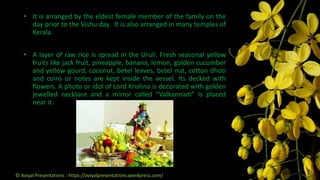
• It is arranged by the eldest female member of the family on the
day prior to the Vishu day. It is also arranged in many temples of
Kerala.
• A layer of raw rice is spread in the Uruli. Fresh seasonal yellow
fruits like jack fruit, pineapple, banana, lemon, golden cucumber
and yellow gourd, coconut, betel leaves, betel nut, cotton dhoti
and coins or notes are kept inside the vessel. Its decked with
flowers. A photo or idol of Lord Krishna is decorated with golden
jewelled necklace and a mirror called “Valkannadi” is placed
near it.
© Aviyal Presentations : https://aviyalpresentations.wordpress.com/
Uruli Nilavilakku
• On the day of Vishu, as per the traditional belief, the members
of the family have to wake up early in the morning by sunrise
with closed eyes and go to the worship area of the house to get
the first sight of the Vishukanni. They also see their face in the
mirror.
• This would bring them good luck throughout the year. After
seeing the Vishukanni, people recite verses from Ramayana, the
holy book of the Hindus.
© Aviyal Presentations : https://aviyalpresentations.wordpress.com/
Valkannadi Golden cucumber
Ramayana
© Aviyal Presentations : https://aviyalpresentations.wordpress.com/
VISHUKAINEETAM
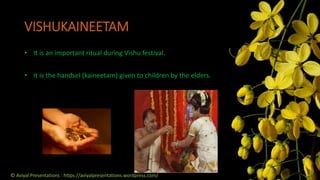
• It is an important ritual during Vishu festival.
• It is the handsel (kaineetam) given to children by the elders.
© Aviyal Presentations : https://aviyalpresentations.wordpress.com/
Sadya Vishu Kanji
VISHU SADYA
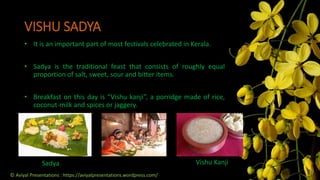
• It is an important part of most festivals celebrated in Kerala.
• Sadya is the traditional feast that consists of roughly equal
proportion of salt, sweet, sour and bitter items.
• Breakfast on this day is “Vishu kanji”, a porridge made of rice,
coconut-milk and spices or jaggery.
© Aviyal Presentations : https://aviyalpresentations.wordpress.com/
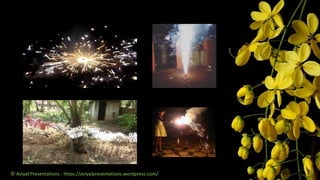
Firecrackers
VISHU PADAKKAM
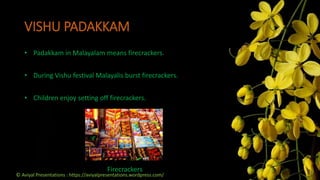
• Padakkam in Malayalam means firecrackers.
• During Vishu festival Malayalis burst firecrackers.
• Children enjoy setting off firecrackers.
© Aviyal Presentations : https://aviyalpresentations.wordpress.com/
OTHER CUSTOMS
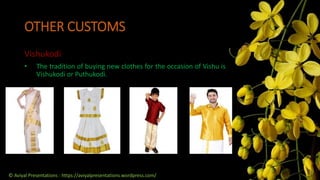
Vishukodi
• The tradition of buying new clothes for the occasion of Vishu is
Vishukodi or Puthukodi.
© Aviyal Presentations : https://aviyalpresentations.wordpress.com/
OLDER CUSTOMS IN VILLAGES
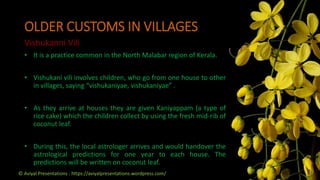
Vishukanni Vili
• It is a practice common in the North Malabar region of Kerala.
• Vishukani vili involves children, who go from one house to other
in villages, saying “vishukaniyae, vishukaniyae” .
• As they arrive at houses they are given Kaniyappam (a type of
rice cake) which the children collect by using the fresh mid-rib of
coconut leaf.
• During this, the local astrologer arrives and would handover the
astrological predictions for one year to each house. The
predictions will be written on coconut leaf.
© Aviyal Presentations : https://aviyalpresentations.wordpress.com/
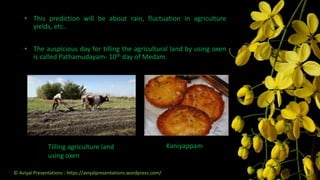
KaniyappamTilling agriculture land
using oxen
• This prediction will be about rain, fluctuation in agriculture
yields, etc..
• The auspicious day for tilling the agricultural land by using oxen
is called Pathamudayam- 10th day of Medam.
© Aviyal Presentations : https://aviyalpresentations.wordpress.com/
Vishu Chal
• Chal means channel in Malayalam.
• The spade is decorated using rice powder and prayers are done.
• The senior most member of the family and others enter the field
with the decorated plough and spade.
• A type of pancake is kept in the field and small channels (chal)
are made in the field.
• This is followed by covering the field with cow dung and green
manure.
© Aviyal Presentations : https://aviyalpresentations.wordpress.com/
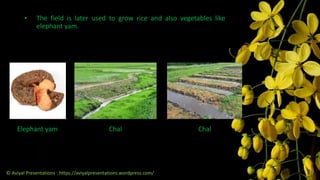
Elephant yam ChalChal
• The field is later used to grow rice and also vegetables like
elephant yam.
© Aviyal Presentations : https://aviyalpresentations.wordpress.com/
VISHU GREETINGS
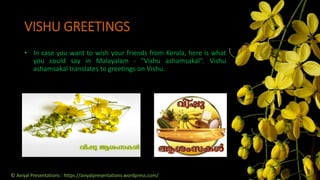
• In case you want to wish your friends from Kerala, here is what
you could say in Malayalam - "Vishu ashamsakal". Vishu
ashamsakal translates to greetings on Vishu.
© Aviyal Presentations : https://aviyalpresentations.wordpress.com/

Vishu

  • 1.
    Vishu – Festival ofKerala © Aviyal Presentations : https://aviyalpresentations.wordpress.com/
  • 2.
    VISHU – MALAYALAMNEW YEAR • Vishu (വിഷു in Malayalam) is the astronomical new year Hindu festival celebrated in the Indian state of Kerala. It is observed on the first day of the Medam (a Malayalam month) month. • It is also celebrated as Bisu in Tulunadu regions like Kasargod district of Kerala, Mangalore and Udupi districts of Karnataka. • It is celebrated under other names all over India. It is celebrated as Baisakhi in Punjab, Bihu in Assam, Poila Baisakh in Bengal, Puthand in Tamil Nadu, Gudi Padwa in Maharashtra and Ugadi in Karnataka and Andhra Pradesh. © Aviyal Presentations : https://aviyalpresentations.wordpress.com/
  • 3.
    SIGNIFICANCE • Vishu iscelebrated when the Sun enters the Ashwini nakshatra (Aries) and is believed to come above the equator. • It falls on the first day of the Malayalam month Medam (usually on April 14). • Vishu literally means “equal” in Sanskrit. On Vishu day, both day and night are of equal duration. Its the day of equinox. • It is all about new beginnings for Malayalis. • On this day, the Sun rises straight from the East. © Aviyal Presentations : https://aviyalpresentations.wordpress.com/
  • 4.
    Lord Krishna LordVishnu Kanikonna • The onset of this festival is marked by the widespread blooming of Kanikonna (Laburnum) flower. • It is celebrated by worshiping Lord Vishnu and Lord Krishna. • Every year it is celebrated by those who live in Kerala and outside with Vishukanni, Vishukaineetam, Vishu Sadya and Vishu Padakkam. © Aviyal Presentations : https://aviyalpresentations.wordpress.com/
  • 5.
    HISTORY & MYTHOLOGY •Vishu is believed to have been celebrated since 844 AD. • It is believed that Vishu celebrations began in Kerala during the reign of Sthanu Ravi who ruled between AD 844 and 855. • There are several myths related to the celebration of Vishu. According to one myth Vishu is the day when Lord Krishna killed Narakasura a demon. As per another belief Vishu is celebrated as the return of Surya Dev. According to other myths, Ravana demon King, never allowed Surya Dev or the Sun God to rise from the East. It was on this day, after the death of Ravana, the sun started to rise from the East. © Aviyal Presentations : https://aviyalpresentations.wordpress.com/
  • 6.
    VISHUKANNI • The word“Vishukanni” means “that which is seen first on Vishu”. • It is an important ritual associated with Vishu. • On Vishu Pulari (the morning of Vishu), Malayalis consider opening their eyes to see the Vishukanni. • It contains many items that represents prosperity and is auspicious, including an idol of Lord Krishna or Lord Vishnu, nilavilakku (the traditional bell-shaped metal oil lamps), konna flowers, betel leaves, betel nut, fruits, rice, grains, fresh lemon, vegetables, coconut, Valkannadi (a hand mirror), a holy Hindu book, notes or coins and uruli (a bell-shaped metal pan). © Aviyal Presentations : https://aviyalpresentations.wordpress.com/
  • 7.
    • It isarranged by the eldest female member of the family on the day prior to the Vishu day. It is also arranged in many temples of Kerala. • A layer of raw rice is spread in the Uruli. Fresh seasonal yellow fruits like jack fruit, pineapple, banana, lemon, golden cucumber and yellow gourd, coconut, betel leaves, betel nut, cotton dhoti and coins or notes are kept inside the vessel. Its decked with flowers. A photo or idol of Lord Krishna is decorated with golden jewelled necklace and a mirror called “Valkannadi” is placed near it. © Aviyal Presentations : https://aviyalpresentations.wordpress.com/
  • 8.
    Uruli Nilavilakku • Onthe day of Vishu, as per the traditional belief, the members of the family have to wake up early in the morning by sunrise with closed eyes and go to the worship area of the house to get the first sight of the Vishukanni. They also see their face in the mirror. • This would bring them good luck throughout the year. After seeing the Vishukanni, people recite verses from Ramayana, the holy book of the Hindus. © Aviyal Presentations : https://aviyalpresentations.wordpress.com/
  • 9.
    Valkannadi Golden cucumber Ramayana ©Aviyal Presentations : https://aviyalpresentations.wordpress.com/
  • 10.
    VISHUKAINEETAM • It isan important ritual during Vishu festival. • It is the handsel (kaineetam) given to children by the elders. © Aviyal Presentations : https://aviyalpresentations.wordpress.com/
  • 11.
    Sadya Vishu Kanji VISHUSADYA • It is an important part of most festivals celebrated in Kerala. • Sadya is the traditional feast that consists of roughly equal proportion of salt, sweet, sour and bitter items. • Breakfast on this day is “Vishu kanji”, a porridge made of rice, coconut-milk and spices or jaggery. © Aviyal Presentations : https://aviyalpresentations.wordpress.com/
  • 12.
    Firecrackers VISHU PADAKKAM • Padakkamin Malayalam means firecrackers. • During Vishu festival Malayalis burst firecrackers. • Children enjoy setting off firecrackers. © Aviyal Presentations : https://aviyalpresentations.wordpress.com/
  • 13.
    © Aviyal Presentations: https://aviyalpresentations.wordpress.com/
  • 14.
    OTHER CUSTOMS Vishukodi • Thetradition of buying new clothes for the occasion of Vishu is Vishukodi or Puthukodi. © Aviyal Presentations : https://aviyalpresentations.wordpress.com/
  • 15.
    OLDER CUSTOMS INVILLAGES Vishukanni Vili • It is a practice common in the North Malabar region of Kerala. • Vishukani vili involves children, who go from one house to other in villages, saying “vishukaniyae, vishukaniyae” . • As they arrive at houses they are given Kaniyappam (a type of rice cake) which the children collect by using the fresh mid-rib of coconut leaf. • During this, the local astrologer arrives and would handover the astrological predictions for one year to each house. The predictions will be written on coconut leaf. © Aviyal Presentations : https://aviyalpresentations.wordpress.com/
  • 16.
    KaniyappamTilling agriculture land usingoxen • This prediction will be about rain, fluctuation in agriculture yields, etc.. • The auspicious day for tilling the agricultural land by using oxen is called Pathamudayam- 10th day of Medam. © Aviyal Presentations : https://aviyalpresentations.wordpress.com/
  • 17.
    Vishu Chal • Chalmeans channel in Malayalam. • The spade is decorated using rice powder and prayers are done. • The senior most member of the family and others enter the field with the decorated plough and spade. • A type of pancake is kept in the field and small channels (chal) are made in the field. • This is followed by covering the field with cow dung and green manure. © Aviyal Presentations : https://aviyalpresentations.wordpress.com/
  • 18.
    Elephant yam ChalChal •The field is later used to grow rice and also vegetables like elephant yam. © Aviyal Presentations : https://aviyalpresentations.wordpress.com/
  • 19.
    VISHU GREETINGS • Incase you want to wish your friends from Kerala, here is what you could say in Malayalam - "Vishu ashamsakal". Vishu ashamsakal translates to greetings on Vishu. © Aviyal Presentations : https://aviyalpresentations.wordpress.com/
  • 20.
    © Aviyal Presentations: https://aviyalpresentations.wordpress.com/