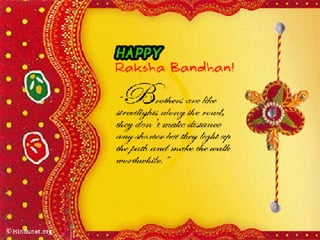
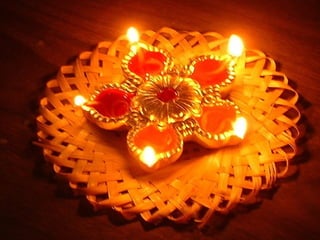
Raksha Bandhan
Raksha Bandhan

       A Hindu Festival

                when
         Brothers and Sisters
strengthen and celebrate their love and
      commitment to each other.
Raksha Bandhan
• Rakhi: The Thread of Love
• In India, festivals are the celebration of
  togetherness, of being one of the family.
• Raksha Bandhan is one such festival that is all
  about affection, fraternity and other sacred and
  sublime sentiments.
• This is an occasion to lavish love, care, affection
  and commitment towards each other and
• To strengthen families and develop a sacred feeling
  of sisterly / brotherly devotion and oneness.
The Bond of Protection
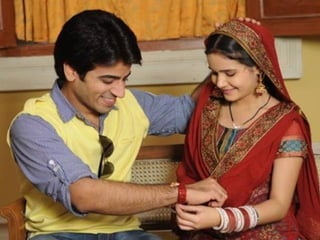
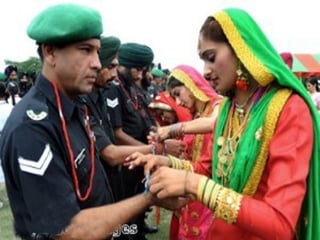
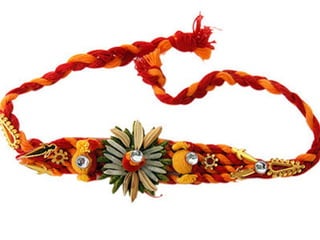
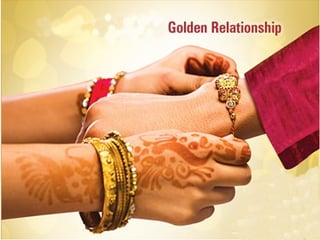
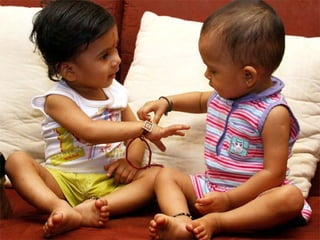
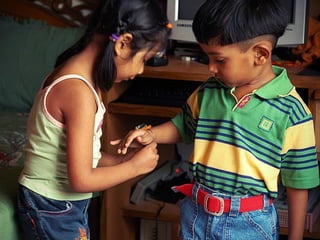
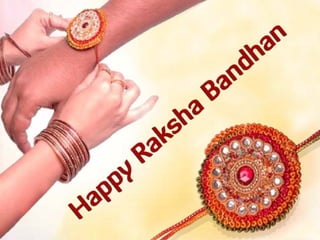
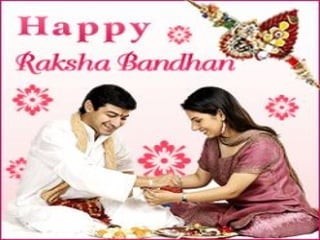
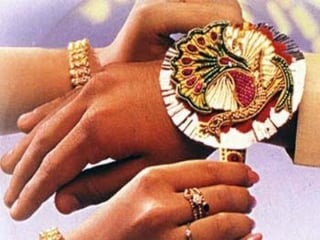
• At this festival, sisters tie a sacred thread
  called a Raksha or Rakhi around the
  wrist of their brother as part of a ‘Puja’ or
  service of worship.
• What exactly is the power of this thread
  and what does Raksha Bandhan mean?
• Raksha is the Sanskrit term for protection
  and Bandhan signifies a tie or
  relationship, so Raksha Bandhan in effect
  signifies a bond of protection between
  two people.
Protection
• It is believed that when a woman ties a
  Rakhi to the wrist of a man on the festive
  day of Raksha Bandhan, he is then bound to
  protect and help her throughout his life. But
  the bond of protection is not a one way
  process. The Rakhi is thought to have a dual
  effect.
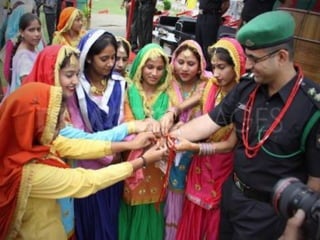
• For the man the Rakhi ensures protection by
  the heavenly forces. In fact, during times of
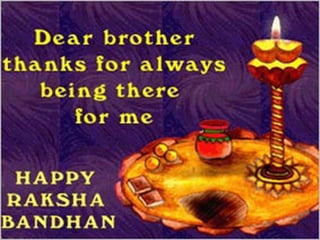
  war, women have tied Rakhis to unknown
  soldiers so that they will be protected from
  harm, and so they will be victorious and
  successful in protecting the nation.
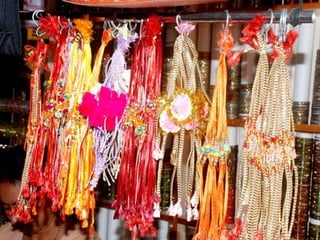
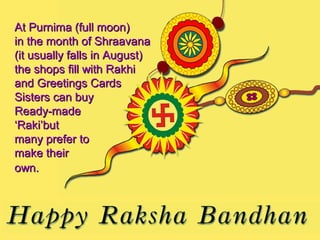
At Purnima (full moon)
in the month of Shraavana
(it usually falls in August)
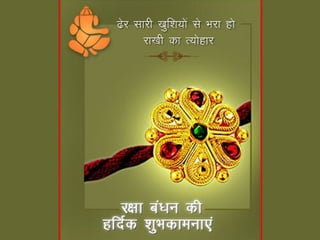
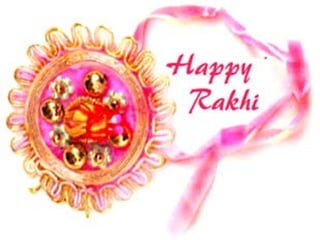
the shops fill with Rakhi
and Greetings Cards
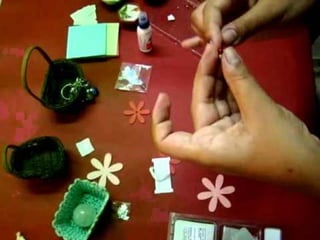
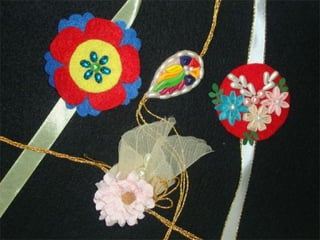
Sisters can buy
Ready-made
‘Raki’but
many prefer to
make their
own.
How Raksha Bandhan is celebrated.
• India is a vast country and the practises vary
  slightly from one part to another but this sacred
  thread is given as part of a ritual of worship. It is
  said that the small thread is stronger than an iron
  chain because it symbolises the unbreakable love
  that brother and sister feel for each other.
• Preparations begin weeks before hand as the house is
  cleaned and both sisters and brothers may want to wear
  new clothes, so there is shopping to do – for clothes and
  cards and the Rakhi itself to buy or make. The brothers will
  be choosing or making presents to give their sisters too.
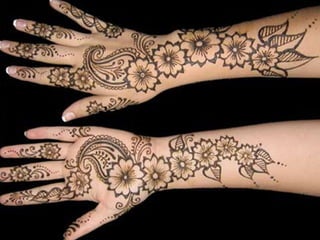
• The sisters may have her hands decorated with Mendhi
  patterns.Mendhi patterns are popular for any special
  occasion.
• As with most things, the more effort you put into
  preparation, the better the result is likely to be.
Practical Rituals of Raksha
                Bandhan
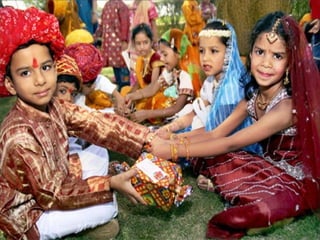
•   On the day of Raksha Bandhan, each sister will tie a raksha (rakhi
    in Hindi) on the right wrist of her brother(s).
•   Before that, she will perform the following rituals of puja because it
    is a sacred ceremony. Puja is an act of Hindu worship.
•   Some Hindus might describe the inner meaning of Raksha Bandhan
    as a pledge to each other made in the ‘sight’ or ‘presence of God’
    blessed by God – as a way also of strengthening their own inner
    relationship with God and opening themselves to His Protection.
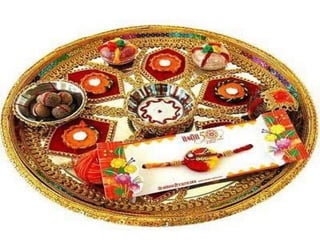
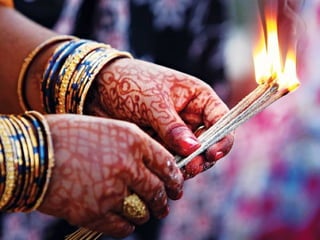
• All the things needed for the ceremony are laid
  out on a tray beforehand.
• A lamp or candle is lit. Incense sticks are lit, all
  making for an atmosphere of prayer and
  worship.
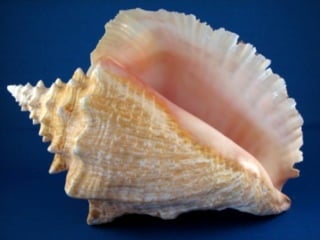
• Puja often begins by ringing a bell or blowing a
  conch-shell trumpet.
Celebrating Raksha Bandhan continued
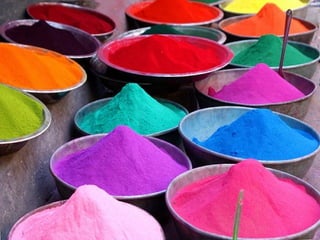
 • First the sister will make a mark on her brother’s
   forehead with a coloured powder called kumkum. This is
   usually made from powdered turmeric or saffron which is
   yellow. (If it is mixed with lime (an alkali) it gives a bright
   red colour. The shops sell powders of many other
   colours too.)
 •   Kumkum is most often applied by Hindus to the forehead. The
     reason for this particular location has to do with the ancient Hindu
     teaching that “the human body is divided into seven vortices of
     energy, called chakras, beginning at the base of the spine and
     ending at the top of the head.
 •   The sixth chakra, also known as the third eye, is centered in the
     forehead directly between the eyebrows and is the channel through
     which humankind opens spiritually to the Divine”.
 •   Thus the kumkum is placed at the location of the body which Hindus
      believe to be the most holy and it reminds them that we have two
     outer eyes to see the outer physical world, but there is another world
     – the inner spiritual world – which is also important. We need to
     open our inner eye to see that.
Celebrating Raksha Bandhan – continued -
 • In some families, the sister then places a flower garland
   around her brother’s neck, a garland which she will
   probably have made herself (girls who are old enough to
   use a needle and thread). You can buy flowers to use to
   make the garlands, in the market.
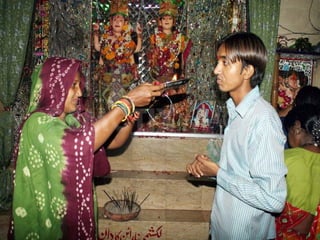
 •   The sister then may take the lamp or candle which is usually placed
     on a tray used for worship – and circle this in front of her brother.
     The candle-flame represents God’s Light and human aspiration - the
     way our inner cry reaches up towards God in prayer.
 •   The flame also symbolises Agni, the Fire God who is invoked during
     most ceremonies of worship in Hinduism. The sister may sing a
     special puja song at that time. But since many of the sisters are
     quite young children, not old enough to handle candles and incense
     safely or know the puja songs, this part is not always carried out.
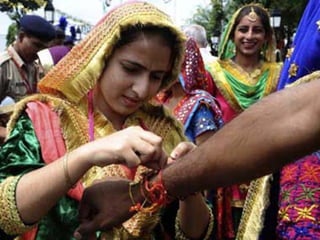
 • Next is the most important part of the puja. The sister
   ties the rakhi on her brother’s right wrist.
 • Finally, the sister feeds her brother – usually placing a
   whole sweet in his mouth.
Celebrating Raksha Bandhan – continued -
• A brother may place his hand on his sister’s head which is a
  way of giving blessings and conveying the deepest love and
  respect – a symbolic gesture to show he appreciates the
  significance of the event and he really will be there for his
  sister should she ever need his help.
• Then, in In return for his sister’s devotion, the brother
  presents a gift to his sister.
• Later that day the whole family celebrate together. They may
  go to visit- or welcome visiting– relatives and end the day
  with a party or a special meal.
         • There is usually a great atmosphere of joy,
                oneness, friendship and love.
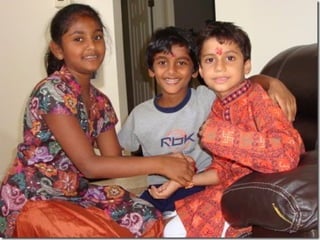
• This exchange of Raksha Bandhan’s is not restricted to
  sister and brother. It represents a bond and a relationship so
  it may be celebrated to strengthen (brotherly rather than
  romantic) friendships, too.
We would like to ackowledge
and thank the many online sources viewed
   in preparing this resource, especially
the websitehttp://www.raksha-bandhan.com
   I hope that all whose photographs have
  been used will be happy and proud to be
 included in this free resource - but should
  any copyright questions arise we will be
happy to make any adjustments necessary.
• If you enjoyed this Slide Show and would
  like a copy in book form -
• or if you have any feedback or comments,
  please contact the author –
            durgamata – www.bluelotus.co

• If you would like DurgaMata to come and give a
  talk to your class, take an Assembly, give a
  workshop on Community Cohesion or on any
  aspect of Religious Education - to your school,
  faith or community group –
    then please do not hesitate to get in touch
             dcbluelotus@gmail.com

           Blue Lotus Enterprises 2013
Raksha bandhan bac

Raksha bandhan bac

  • 1.
  • 2.
    Raksha Bandhan A Hindu Festival when Brothers and Sisters strengthen and celebrate their love and commitment to each other.
  • 4.
    Raksha Bandhan • Rakhi:The Thread of Love • In India, festivals are the celebration of togetherness, of being one of the family. • Raksha Bandhan is one such festival that is all about affection, fraternity and other sacred and sublime sentiments. • This is an occasion to lavish love, care, affection and commitment towards each other and • To strengthen families and develop a sacred feeling of sisterly / brotherly devotion and oneness.
  • 6.
    The Bond ofProtection • At this festival, sisters tie a sacred thread called a Raksha or Rakhi around the wrist of their brother as part of a ‘Puja’ or service of worship. • What exactly is the power of this thread and what does Raksha Bandhan mean? • Raksha is the Sanskrit term for protection and Bandhan signifies a tie or relationship, so Raksha Bandhan in effect signifies a bond of protection between two people.
  • 8.
    Protection • It isbelieved that when a woman ties a Rakhi to the wrist of a man on the festive day of Raksha Bandhan, he is then bound to protect and help her throughout his life. But the bond of protection is not a one way process. The Rakhi is thought to have a dual effect. • For the man the Rakhi ensures protection by the heavenly forces. In fact, during times of war, women have tied Rakhis to unknown soldiers so that they will be protected from harm, and so they will be victorious and successful in protecting the nation.
  • 11.
    At Purnima (fullmoon) in the month of Shraavana (it usually falls in August) the shops fill with Rakhi and Greetings Cards Sisters can buy Ready-made ‘Raki’but many prefer to make their own.
  • 14.
    How Raksha Bandhanis celebrated. • India is a vast country and the practises vary slightly from one part to another but this sacred thread is given as part of a ritual of worship. It is said that the small thread is stronger than an iron chain because it symbolises the unbreakable love that brother and sister feel for each other. • Preparations begin weeks before hand as the house is cleaned and both sisters and brothers may want to wear new clothes, so there is shopping to do – for clothes and cards and the Rakhi itself to buy or make. The brothers will be choosing or making presents to give their sisters too. • The sisters may have her hands decorated with Mendhi patterns.Mendhi patterns are popular for any special occasion. • As with most things, the more effort you put into preparation, the better the result is likely to be.
  • 16.
    Practical Rituals ofRaksha Bandhan • On the day of Raksha Bandhan, each sister will tie a raksha (rakhi in Hindi) on the right wrist of her brother(s). • Before that, she will perform the following rituals of puja because it is a sacred ceremony. Puja is an act of Hindu worship. • Some Hindus might describe the inner meaning of Raksha Bandhan as a pledge to each other made in the ‘sight’ or ‘presence of God’ blessed by God – as a way also of strengthening their own inner relationship with God and opening themselves to His Protection. • All the things needed for the ceremony are laid out on a tray beforehand. • A lamp or candle is lit. Incense sticks are lit, all making for an atmosphere of prayer and worship. • Puja often begins by ringing a bell or blowing a conch-shell trumpet.
  • 20.
    Celebrating Raksha Bandhancontinued • First the sister will make a mark on her brother’s forehead with a coloured powder called kumkum. This is usually made from powdered turmeric or saffron which is yellow. (If it is mixed with lime (an alkali) it gives a bright red colour. The shops sell powders of many other colours too.) • Kumkum is most often applied by Hindus to the forehead. The reason for this particular location has to do with the ancient Hindu teaching that “the human body is divided into seven vortices of energy, called chakras, beginning at the base of the spine and ending at the top of the head. • The sixth chakra, also known as the third eye, is centered in the forehead directly between the eyebrows and is the channel through which humankind opens spiritually to the Divine”. • Thus the kumkum is placed at the location of the body which Hindus believe to be the most holy and it reminds them that we have two outer eyes to see the outer physical world, but there is another world – the inner spiritual world – which is also important. We need to open our inner eye to see that.
  • 23.
    Celebrating Raksha Bandhan– continued - • In some families, the sister then places a flower garland around her brother’s neck, a garland which she will probably have made herself (girls who are old enough to use a needle and thread). You can buy flowers to use to make the garlands, in the market. • The sister then may take the lamp or candle which is usually placed on a tray used for worship – and circle this in front of her brother. The candle-flame represents God’s Light and human aspiration - the way our inner cry reaches up towards God in prayer. • The flame also symbolises Agni, the Fire God who is invoked during most ceremonies of worship in Hinduism. The sister may sing a special puja song at that time. But since many of the sisters are quite young children, not old enough to handle candles and incense safely or know the puja songs, this part is not always carried out. • Next is the most important part of the puja. The sister ties the rakhi on her brother’s right wrist. • Finally, the sister feeds her brother – usually placing a whole sweet in his mouth.
  • 30.
    Celebrating Raksha Bandhan– continued - • A brother may place his hand on his sister’s head which is a way of giving blessings and conveying the deepest love and respect – a symbolic gesture to show he appreciates the significance of the event and he really will be there for his sister should she ever need his help. • Then, in In return for his sister’s devotion, the brother presents a gift to his sister. • Later that day the whole family celebrate together. They may go to visit- or welcome visiting– relatives and end the day with a party or a special meal. • There is usually a great atmosphere of joy, oneness, friendship and love. • This exchange of Raksha Bandhan’s is not restricted to sister and brother. It represents a bond and a relationship so it may be celebrated to strengthen (brotherly rather than romantic) friendships, too.
  • 44.
    We would liketo ackowledge and thank the many online sources viewed in preparing this resource, especially the websitehttp://www.raksha-bandhan.com I hope that all whose photographs have been used will be happy and proud to be included in this free resource - but should any copyright questions arise we will be happy to make any adjustments necessary.
  • 45.
    • If youenjoyed this Slide Show and would like a copy in book form - • or if you have any feedback or comments, please contact the author – durgamata – www.bluelotus.co • If you would like DurgaMata to come and give a talk to your class, take an Assembly, give a workshop on Community Cohesion or on any aspect of Religious Education - to your school, faith or community group – then please do not hesitate to get in touch dcbluelotus@gmail.com Blue Lotus Enterprises 2013