 Odissi is traditionally a
dance-drama genre of
performance art also
referred to as Orissi.
 It is one of the 8th Classical
Dance forms of India.
 Odissi is originated in the
Hindu Temple of Odisha
-an Eastern Coastal part of India.
 According to history, through this Dance, women used
to express religious stories and spiritual ideas
particularly of Viashnavism (Vishnu as Jagarnath).
 Odissi performance have also expressed ideas of
traditions such as those related to Hindu Gods, Shiva
and Surya as well as Hindu Goddess (Shaktism).
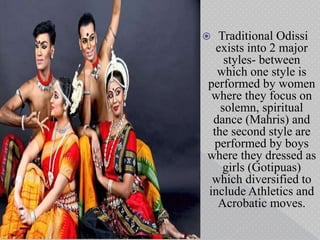
 Traditional Odissi
exists into 2 major
styles- between
which one style is
performed by women
where they focus on
solemn, spiritual
dance (Mahris) and
the second style are
performed by boys
where they dressed as
girls (Gotipuas)
which diversified to
include Athletics and
Acrobatic moves.
 Artists generally
perform this dance to
reveal mythological
stories, Spiritual
messages or devotional
poems from the Hindu
texts, using symbolic
customs, body
movements, Abhinaya
(Expression) and
Mudhars (Gestures and
sign language).
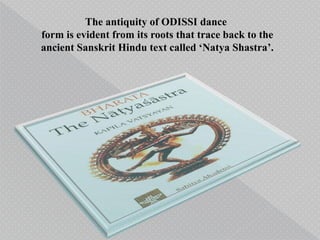
The antiquity of ODISSI dance
form is evident from its roots that trace back to the
ancient Sanskrit Hindu text called ‘Natya Shastra’.
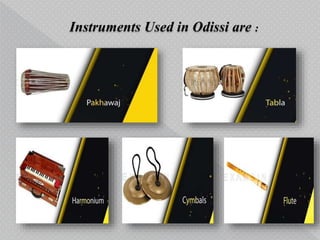
Instruments Used in Odissi are :
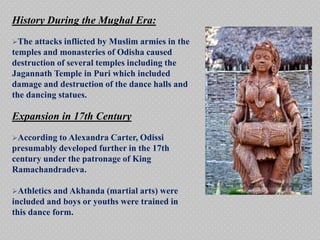
History During the Mughal Era:
The attacks inflicted by Muslim armies in the
temples and monasteries of Odisha caused
destruction of several temples including the
Jagannath Temple in Puri which included
damage and destruction of the dance halls and
the dancing statues.
Expansion in 17th Century
According to Alexandra Carter, Odissi
presumably developed further in the 17th
century under the patronage of King
Ramachandradeva.
Athletics and Akhanda (martial arts) were
included and boys or youths were trained in
this dance form.
DECLINE DURING BRITISH RULE
The Christian missionaries launched anti-dance
movement in 1892 to stop such practice.
The Madras Presidency under the British colonial
government even banned the custom of dancing in
Hindu temples in 1910.
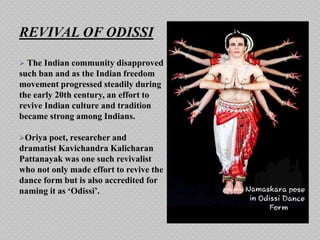
REVIVAL OF ODISSI
 The Indian community disapproved
such ban and as the Indian freedom
movement progressed steadily during
the early 20th century, an effort to
revive Indian culture and tradition
became strong among Indians.
Oriya poet, researcher and
dramatist Kavichandra Kalicharan
Pattanayak was one such revivalist
who not only made effort to revive the
dance form but is also accredited for
naming it as ‘Odissi’.
 Facial expressions, hand gestures and body
movements are used to suggest a certain feeling,
an emotion or one of the nine rasas.
 The techniques of movement are built around the
two basic postures of the Chowk and
the Tribhanga.
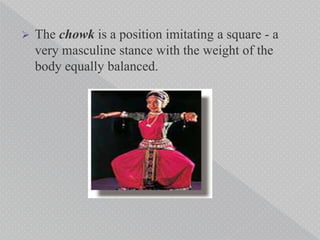
 The chowk is a position imitating a square - a
very masculine stance with the weight of the
body equally balanced.
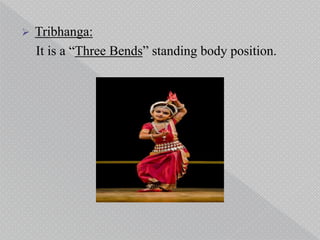
 The tribhanga is a very feminine stance where
the body is deflected at the neck, torso and the
knees.
 Hasta mudra for bee hovering over a flower
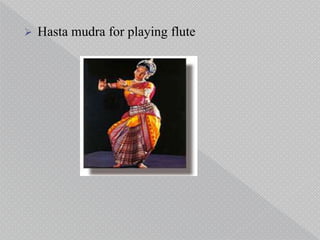
 Hasta mudra for playing flute
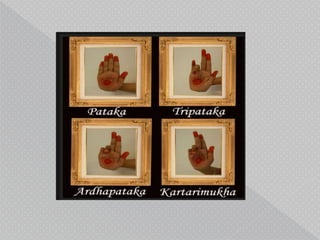
 Different Mudras
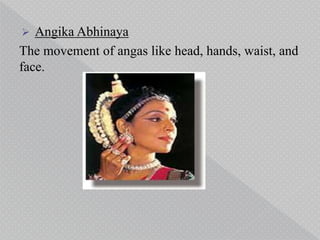
 Angika Abhinaya
The movement of angas like head, hands, waist, and
face.
 Tribhanga:
It is a “Three Bends” standing body position.
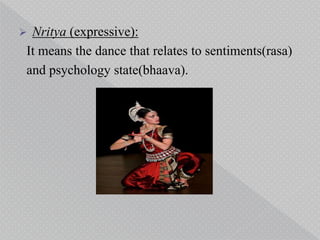
 Nritya (expressive):
It means the dance that relates to sentiments(rasa)
and psychology state(bhaava).
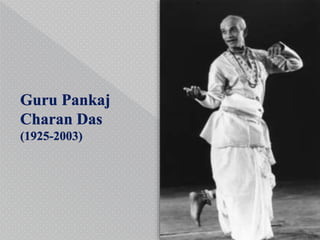
Guru Kelucharan Mohapatra
(1926 –2004)
 The female dancers wear brightly
coloured sari usually made of local
silk adorned with traditional and
local designs such as the Bomkai
Saree and the Sambalpuri Saree.
 The front part of the saree is worn
with pleats or a separate pleated
cloth stitched in front to ensure
flexibility of movements of the
dancer while showcasing excellent
footwork.
 Silver Jewellery adorns her head,
ear, neck, arms and wrists.
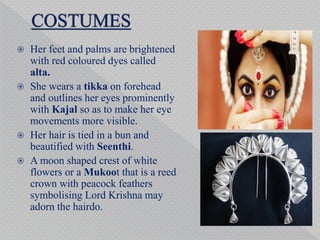
 Her feet and palms are brightened
with red coloured dyes called
alta.
 She wears a tikka on forehead
and outlines her eyes prominently
with Kajal so as to make her eye
movements more visible.
 Her hair is tied in a bun and
beautified with Seenthi.
 A moon shaped crest of white
flowers or a Mukoot that is a reed
crown with peacock feathers
symbolising Lord Krishna may
adorn the hairdo.
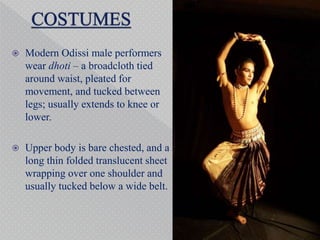
 Modern Odissi male performers
wear dhoti – a broadcloth tied
around waist, pleated for
movement, and tucked between
legs; usually extends to knee or
lower.
 Upper body is bare chested, and a
long thin folded translucent sheet
wrapping over one shoulder and
usually tucked below a wide belt.
 Jewellery as an integral part of dance, from ancient times.
 Not just for beautification of the artist, but it has a predominant
part in the dance vocabulary.
 Some dance jewellery has a functional purpose, generally to fix
clothing or hair in place.
 Odissi dancers wear jewellery made from intricate filigree
silver jewellery pieces, so on and so forth.
 Challenges for the artist to dance with this elaborate system
on their body. It hurts, falls of, needs to be pinned properly etc
 Some jewellery pieces act as a carrier or symbol of meaning –
such as love, mourning, represent a character or even luck. Like
the peacock feather or Mukut which is an essential Odissi dance
jewellery is to used to denote love for Krishna etc
 The traditional Odissi repertoire, like all classical Indian dances,
includes Nritta (pure dance, solo), Nritya (dance with emotions, solo)
and Natya (dramatic dance, group)
 In Odissi dance, important parts are called Padabhada, Bhumi, Chari,
Biramani, Bhangi and Hasta (Mudras) etc.
 The most typical pose of Odissi is the ‘Tribhanga’ where the body is
bent thrice.
 A fundamental posture of Odissi dance is ‘Chawka’. (Drama).
 To understand Odissi better one needs to understand that Odissi was
not a centralized and singular living entity that only existed in the
main ancient cities of Orissa.

Indian Classical Dance Odissi

  • 2.
     Odissi istraditionally a dance-drama genre of performance art also referred to as Orissi.  It is one of the 8th Classical Dance forms of India.  Odissi is originated in the Hindu Temple of Odisha -an Eastern Coastal part of India.
  • 3.
     According tohistory, through this Dance, women used to express religious stories and spiritual ideas particularly of Viashnavism (Vishnu as Jagarnath).  Odissi performance have also expressed ideas of traditions such as those related to Hindu Gods, Shiva and Surya as well as Hindu Goddess (Shaktism).
  • 4.
     Traditional Odissi existsinto 2 major styles- between which one style is performed by women where they focus on solemn, spiritual dance (Mahris) and the second style are performed by boys where they dressed as girls (Gotipuas) which diversified to include Athletics and Acrobatic moves.
  • 5.
     Artists generally performthis dance to reveal mythological stories, Spiritual messages or devotional poems from the Hindu texts, using symbolic customs, body movements, Abhinaya (Expression) and Mudhars (Gestures and sign language).
  • 7.
    The antiquity ofODISSI dance form is evident from its roots that trace back to the ancient Sanskrit Hindu text called ‘Natya Shastra’.
  • 9.
    Instruments Used inOdissi are :
  • 10.
    History During theMughal Era: The attacks inflicted by Muslim armies in the temples and monasteries of Odisha caused destruction of several temples including the Jagannath Temple in Puri which included damage and destruction of the dance halls and the dancing statues. Expansion in 17th Century According to Alexandra Carter, Odissi presumably developed further in the 17th century under the patronage of King Ramachandradeva. Athletics and Akhanda (martial arts) were included and boys or youths were trained in this dance form.
  • 11.
    DECLINE DURING BRITISHRULE The Christian missionaries launched anti-dance movement in 1892 to stop such practice. The Madras Presidency under the British colonial government even banned the custom of dancing in Hindu temples in 1910.
  • 12.
    REVIVAL OF ODISSI The Indian community disapproved such ban and as the Indian freedom movement progressed steadily during the early 20th century, an effort to revive Indian culture and tradition became strong among Indians. Oriya poet, researcher and dramatist Kavichandra Kalicharan Pattanayak was one such revivalist who not only made effort to revive the dance form but is also accredited for naming it as ‘Odissi’.
  • 13.
     Facial expressions,hand gestures and body movements are used to suggest a certain feeling, an emotion or one of the nine rasas.  The techniques of movement are built around the two basic postures of the Chowk and the Tribhanga.
  • 14.
     The chowkis a position imitating a square - a very masculine stance with the weight of the body equally balanced.
  • 15.
     The tribhangais a very feminine stance where the body is deflected at the neck, torso and the knees.
  • 16.
     Hasta mudrafor bee hovering over a flower
  • 17.
     Hasta mudrafor playing flute
  • 18.
  • 21.
     Angika Abhinaya Themovement of angas like head, hands, waist, and face.
  • 22.
     Tribhanga: It isa “Three Bends” standing body position.
  • 23.
     Nritya (expressive): Itmeans the dance that relates to sentiments(rasa) and psychology state(bhaava).
  • 25.
  • 28.
     The femaledancers wear brightly coloured sari usually made of local silk adorned with traditional and local designs such as the Bomkai Saree and the Sambalpuri Saree.  The front part of the saree is worn with pleats or a separate pleated cloth stitched in front to ensure flexibility of movements of the dancer while showcasing excellent footwork.  Silver Jewellery adorns her head, ear, neck, arms and wrists.
  • 29.
     Her feetand palms are brightened with red coloured dyes called alta.  She wears a tikka on forehead and outlines her eyes prominently with Kajal so as to make her eye movements more visible.  Her hair is tied in a bun and beautified with Seenthi.  A moon shaped crest of white flowers or a Mukoot that is a reed crown with peacock feathers symbolising Lord Krishna may adorn the hairdo.
  • 30.
     Modern Odissimale performers wear dhoti – a broadcloth tied around waist, pleated for movement, and tucked between legs; usually extends to knee or lower.  Upper body is bare chested, and a long thin folded translucent sheet wrapping over one shoulder and usually tucked below a wide belt.
  • 31.
     Jewellery asan integral part of dance, from ancient times.  Not just for beautification of the artist, but it has a predominant part in the dance vocabulary.  Some dance jewellery has a functional purpose, generally to fix clothing or hair in place.  Odissi dancers wear jewellery made from intricate filigree silver jewellery pieces, so on and so forth.  Challenges for the artist to dance with this elaborate system on their body. It hurts, falls of, needs to be pinned properly etc  Some jewellery pieces act as a carrier or symbol of meaning – such as love, mourning, represent a character or even luck. Like the peacock feather or Mukut which is an essential Odissi dance jewellery is to used to denote love for Krishna etc
  • 32.
     The traditionalOdissi repertoire, like all classical Indian dances, includes Nritta (pure dance, solo), Nritya (dance with emotions, solo) and Natya (dramatic dance, group)  In Odissi dance, important parts are called Padabhada, Bhumi, Chari, Biramani, Bhangi and Hasta (Mudras) etc.  The most typical pose of Odissi is the ‘Tribhanga’ where the body is bent thrice.  A fundamental posture of Odissi dance is ‘Chawka’. (Drama).  To understand Odissi better one needs to understand that Odissi was not a centralized and singular living entity that only existed in the main ancient cities of Orissa.