Virtual Patients

1st March 2011
NOVICE


C Trace BVetMed MRCVS
eMedia Unit
What is a Virtual Patient (VP)?
• An interactive computer simulation of a patient that is
  used in health care education (AAMC 2008)
Why use VP’s?
• Virtual patients allow the learner to take the role
  of a health care professional and develop clinical
  skills such as making diagnoses and therapeutic
  decisions
• The use of virtual patient programmes is
  increasing in healthcare education, partly in
  response to increasing demands on health care
  professionals and education of students but also
  because they allow opportunity for students to
  practice in a safe environment
Types of VP

• Artificial patient

• Physical simulator

• Case Studies
Sarah Baillie MRCVS
        Most Innovative Teacher of the Year 2009
RCUK Women of Outstanding Achievement in SET 2010
Higher Education Academy National Teaching Fellow 2010


                                         How did it
                                         come to this?


           The Haptic Cow
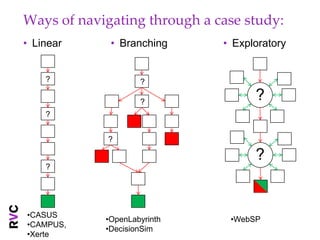
Ways of navigating through a case study:
• Linear     • Branching      • Exploratory


    ?               ?

                    ?
                                    ?
    ?


             ?

                                    ?
    ?


•CASUS
            •OpenLabyrinth     •WebSP
•CAMPUS,
            •DecisionSim
•Xerte
Factors to consider when developing a VP
• Who is your end user?
• Who is required to assist in the development of the VP?
• What do you want your user to achieve with the VP?
• Do you want the user to work independently, or in a group?
• How many people will use the VP?
• Does a tutor need to be present?
And many more…..


               Cost: benefit ratio!
eCases at the RVC

• Currently case details are recorded and captured by
  groups of students on rotations into Powerpoint
  templates. They include text, images, audio clips and
  videos.
• The best of these case records are repurposed into linear
  VP’s, which are published on VetConnect. These are
  going to be used for Directed Learning (DL) sessions for
  the 3rd and 4th year BVetMed.
• In the future these eCases will be made into branching
  VP’s for independent student use
eCases survey
• 78% of students think eCases gave them a better understanding of
  their cases
• 66% of students think eCases helped them better appreciate how to
  approach a case

The second half of the survey assessed how effective/useful eCases were
  after they had been posted onto VetConnect as linear Virtual Patients:
• 72% think eCases helped them understand a similar case
• 59% think eCases were useful for revision

In addition:
• 87% would recommend looking at completed eCases to other
  students;
• 77% would have liked to have been exposed to completed eCases
  before rotations, many saying in 3rd and 4th year teaching.

Virtual patients novice 2011

  • 1.
    Virtual Patients 1st March2011 NOVICE C Trace BVetMed MRCVS eMedia Unit
  • 2.
    What is aVirtual Patient (VP)? • An interactive computer simulation of a patient that is used in health care education (AAMC 2008)
  • 3.
    Why use VP’s? •Virtual patients allow the learner to take the role of a health care professional and develop clinical skills such as making diagnoses and therapeutic decisions • The use of virtual patient programmes is increasing in healthcare education, partly in response to increasing demands on health care professionals and education of students but also because they allow opportunity for students to practice in a safe environment
  • 4.
    Types of VP •Artificial patient • Physical simulator • Case Studies
  • 5.
    Sarah Baillie MRCVS Most Innovative Teacher of the Year 2009 RCUK Women of Outstanding Achievement in SET 2010 Higher Education Academy National Teaching Fellow 2010 How did it come to this? The Haptic Cow
  • 6.
    Ways of navigatingthrough a case study: • Linear • Branching • Exploratory ? ? ? ? ? ? ? ? •CASUS •OpenLabyrinth •WebSP •CAMPUS, •DecisionSim •Xerte
  • 7.
    Factors to considerwhen developing a VP • Who is your end user? • Who is required to assist in the development of the VP? • What do you want your user to achieve with the VP? • Do you want the user to work independently, or in a group? • How many people will use the VP? • Does a tutor need to be present? And many more….. Cost: benefit ratio!
  • 8.
    eCases at theRVC • Currently case details are recorded and captured by groups of students on rotations into Powerpoint templates. They include text, images, audio clips and videos. • The best of these case records are repurposed into linear VP’s, which are published on VetConnect. These are going to be used for Directed Learning (DL) sessions for the 3rd and 4th year BVetMed. • In the future these eCases will be made into branching VP’s for independent student use
  • 9.
    eCases survey • 78%of students think eCases gave them a better understanding of their cases • 66% of students think eCases helped them better appreciate how to approach a case The second half of the survey assessed how effective/useful eCases were after they had been posted onto VetConnect as linear Virtual Patients: • 72% think eCases helped them understand a similar case • 59% think eCases were useful for revision In addition: • 87% would recommend looking at completed eCases to other students; • 77% would have liked to have been exposed to completed eCases before rotations, many saying in 3rd and 4th year teaching.