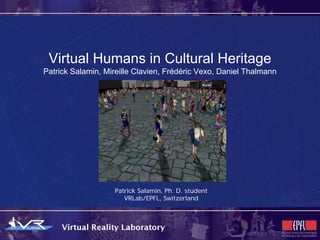
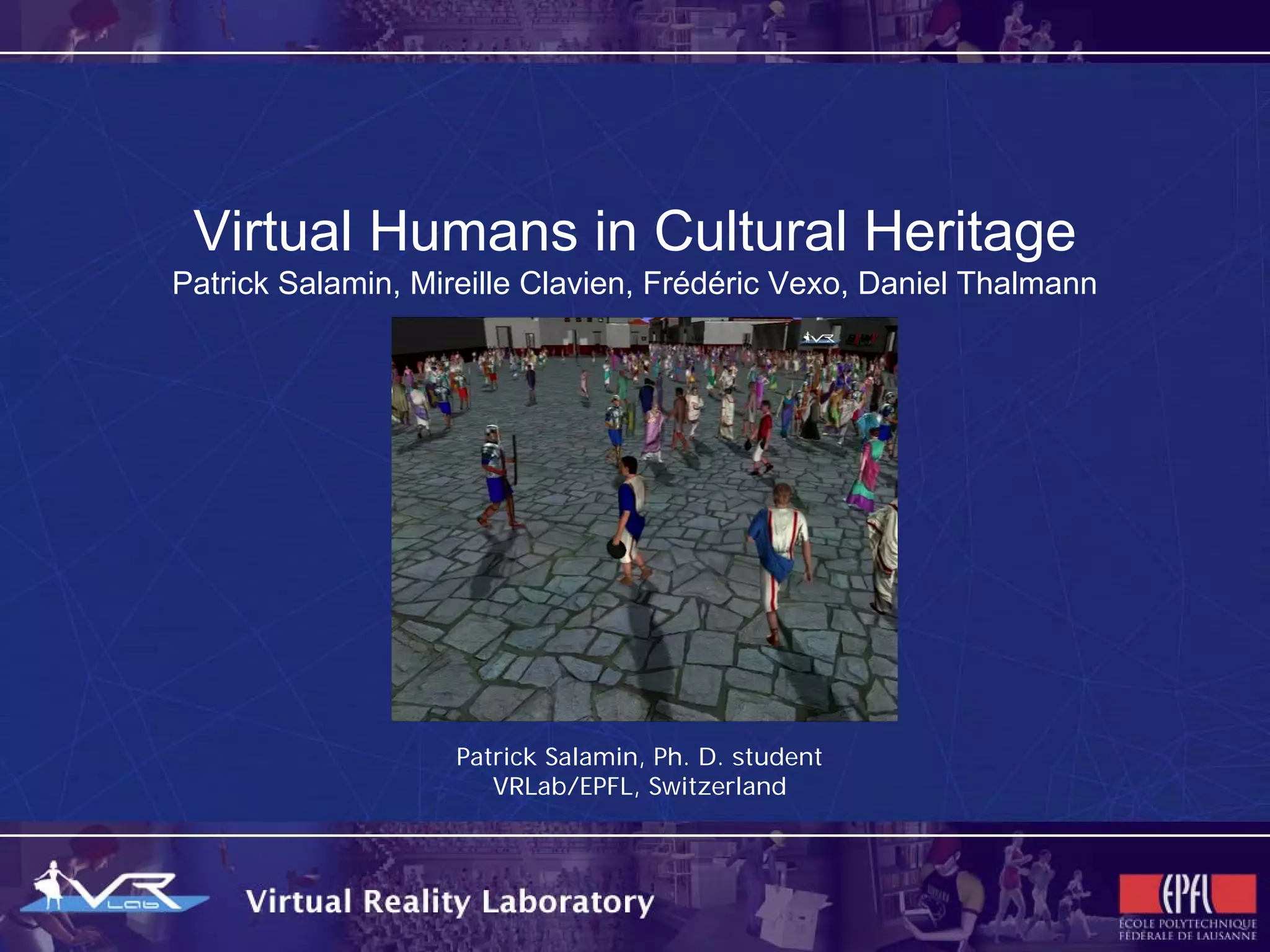
Virtual Humans in Cultural Heritage
Patrick Salamin, Mireille Clavien, Frédéric Vexo, Daniel Thalmann


                   Patrick Salamin, Ph. D. student
                      VRLab/EPFL, Switzerland
2


Outline
• Introduction
• The avatars in Cultural Heritage
   –   Creation of an avatar
   –   Crowds: requirements and constraints
   –   Avatars behavior
   –   Navigation graphs
   –   Creation of a smart environment
• Conclusion
3


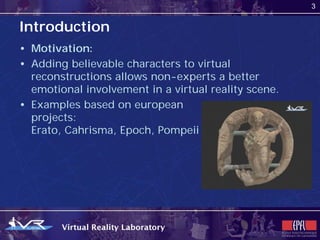
Introduction
• Motivation:
• Adding believable characters to virtual
  reconstructions allows non-experts a better
  emotional involvement in a virtual reality scene.
• Examples based on european
  projects:
  Erato, Cahrisma, Epoch, Pompeii
4


Contributions
• Adding variety
   – Texture and animation
• Providing tools for crowd setting up
   – Brushes
• Automatic navigation graphs
• Interaction with semantic environments
5


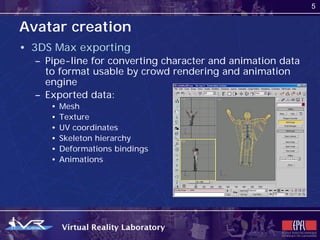
Avatar creation
• 3DS Max exporting
  – Pipe-line for converting character and animation data
    to format usable by crowd rendering and animation
    engine
  – Exported data:
     •   Mesh
     •   Texture
     •   UV coordinates
     •   Skeleton hierarchy
     •   Deformations bindings
     •   Animations
6


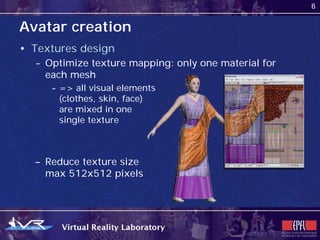
Avatar creation
• Textures design
  - Optimize texture mapping: only one material for
    each mesh
     - => all visual elements
       (clothes, skin, face)
       are mixed in one
       single texture


  – Reduce texture size
    max 512x512 pixels
7


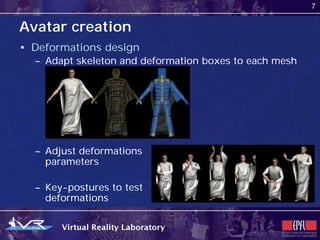
Avatar creation
• Deformations design
  – Adapt skeleton and deformation boxes to each mesh


  – Adjust deformations
    parameters

  – Key-postures to test
    deformations
8


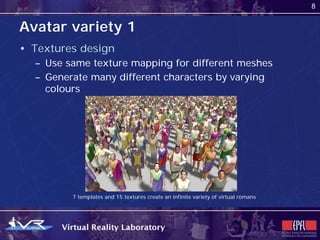
Avatar variety 1
• Textures design
  – Use same texture mapping for different meshes
  – Generate many different characters by varying
    colours


         7 templates and 15 textures create an infinite variety of virtual romans
9


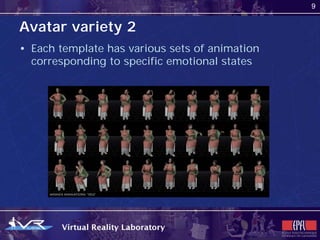
Avatar variety 2
• Each template has various sets of animation
  corresponding to specific emotional states
10


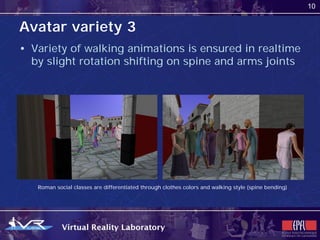
Avatar variety 3
• Variety of walking animations is ensured in realtime
  by slight rotation shifting on spine and arms joints


   Roman social classes are differentiated through clothes colors and walking style (spine bending)
11


Crowd: requirements & constraints
• Technical challenges: increased demand on
  computational resources
  –   Multi-agent: large number of agents
  –   Collision avoidance
  –   Agent-agent interactions
  –   Interaction with environment
  –   Interaction with users
  –   Different from single agent simulations
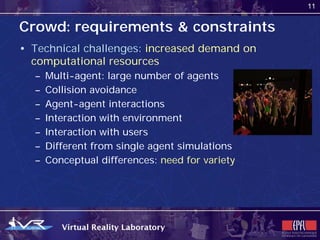
  –   Conceptual differences: need for variety
12


Behavior
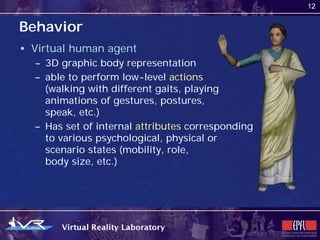
• Virtual human agent
  – 3D graphic body representation
  – able to perform low-level actions
    (walking with different gaits, playing
    animations of gestures, postures,
    speak, etc.)
  – Has set of internal attributes corresponding
    to various psychological, physical or
    scenario states (mobility, role,
    body size, etc.)
13


Behavior
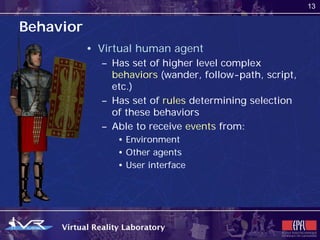
           • Virtual human agent
             – Has set of higher level complex
               behaviors (wander, follow-path, script,
               etc.)
             – Has set of rules determining selection
               of these behaviors
             – Able to receive events from:
                • Environment
                • Other agents
                • User interface
14


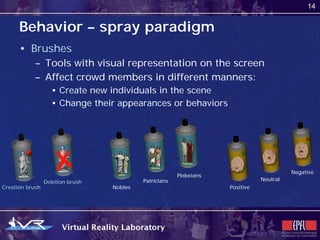
      Behavior – spray paradigm
      • Brushes
            – Tools with visual representation on the screen
            – Affect crowd members in different manners:
                   • Create new individuals in the scene
                   • Change their appearances or behaviors


                                                                                         Negative
                                                        Plebeians
                                           Patricians                          Neutral
                 Deletion brush
Creation brush                    Nobles                            Positive
15


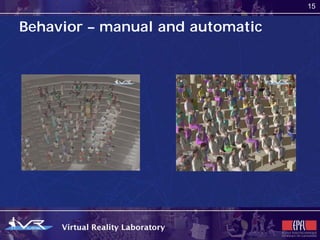
Behavior – manual and automatic
16


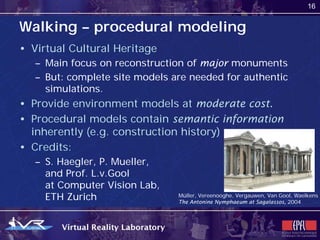
Walking – procedural modeling
• Virtual Cultural Heritage
   – Main focus on reconstruction of major monuments
   – But: complete site models are needed for authentic
     simulations.
• Provide environment models at moderate cost.
• Procedural models contain semantic information
  inherently (e.g. construction history)
• Credits:
   – S. Haegler, P. Mueller,
     and Prof. L.v.Gool
     at Computer Vision Lab,
     ETH Zurich                 Müller, Vereenooghe, Vergauwen, Van Gool, Waelkens
                                The Antonine Nymphaeum at Sagalassos, 2004
17


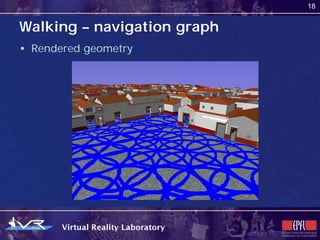
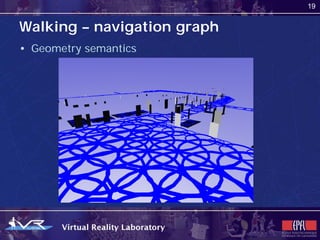
Walking – navigation graph
•   Vertices = walkable space
•   Edges = Gates
•   Navigation Flow = Set of Paths
•   [Pettré et al. 06,07]
18


Walking – navigation graph
• Rendered geometry
19


Walking – navigation graph
• Geometry semantics
20


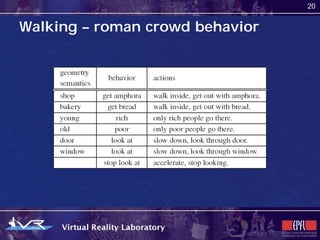
Walking – roman crowd behavior
21


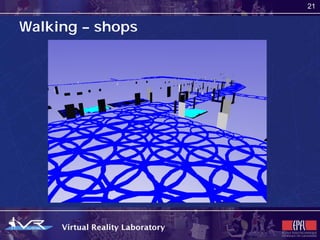
Walking – shops
22


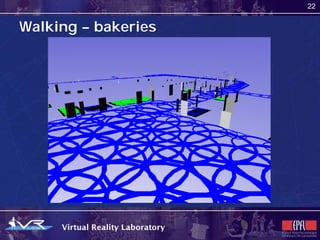
Walking – bakeries
23


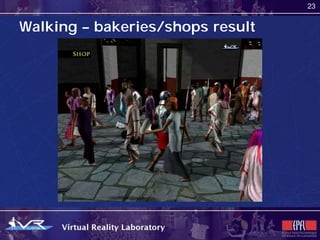
Walking – bakeries/shops result
24


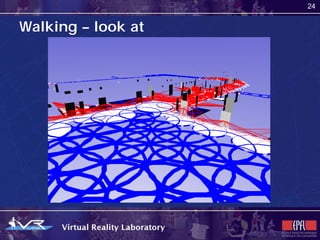
Walking – look at
25


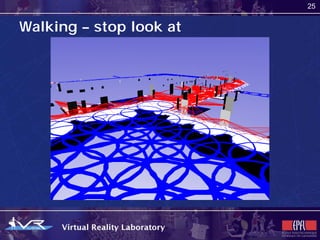
Walking – stop look at
26


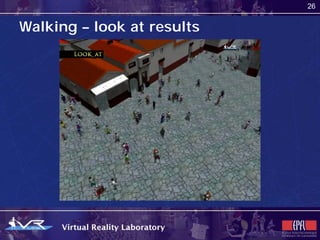
Walking – look at results
27


Walking – final navigation graph
• Navigation graphs automatically generated
  depending on the environment geometry [Pettré et
  al. 06,07]
28


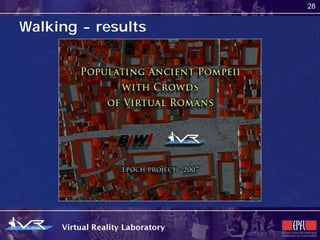
Walking - results
29


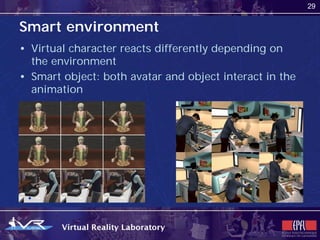
Smart environment
• Virtual character reacts differently depending on
  the environment
• Smart object: both avatar and object interact in the
  animation
30


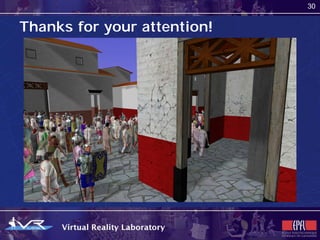
Thanks for your attention!

Virtual Humans in Cultural Heritage

  • 1.
    Virtual Humans inCultural Heritage Patrick Salamin, Mireille Clavien, Frédéric Vexo, Daniel Thalmann Patrick Salamin, Ph. D. student VRLab/EPFL, Switzerland
  • 2.
    2 Outline • Introduction • Theavatars in Cultural Heritage – Creation of an avatar – Crowds: requirements and constraints – Avatars behavior – Navigation graphs – Creation of a smart environment • Conclusion
  • 3.
    3 Introduction • Motivation: • Addingbelievable characters to virtual reconstructions allows non-experts a better emotional involvement in a virtual reality scene. • Examples based on european projects: Erato, Cahrisma, Epoch, Pompeii
  • 4.
    4 Contributions • Adding variety – Texture and animation • Providing tools for crowd setting up – Brushes • Automatic navigation graphs • Interaction with semantic environments
  • 5.
    5 Avatar creation • 3DSMax exporting – Pipe-line for converting character and animation data to format usable by crowd rendering and animation engine – Exported data: • Mesh • Texture • UV coordinates • Skeleton hierarchy • Deformations bindings • Animations
  • 6.
    6 Avatar creation • Texturesdesign - Optimize texture mapping: only one material for each mesh - => all visual elements (clothes, skin, face) are mixed in one single texture – Reduce texture size max 512x512 pixels
  • 7.
    7 Avatar creation • Deformationsdesign – Adapt skeleton and deformation boxes to each mesh – Adjust deformations parameters – Key-postures to test deformations
  • 8.
    8 Avatar variety 1 •Textures design – Use same texture mapping for different meshes – Generate many different characters by varying colours 7 templates and 15 textures create an infinite variety of virtual romans
  • 9.
    9 Avatar variety 2 •Each template has various sets of animation corresponding to specific emotional states
  • 10.
    10 Avatar variety 3 •Variety of walking animations is ensured in realtime by slight rotation shifting on spine and arms joints Roman social classes are differentiated through clothes colors and walking style (spine bending)
  • 11.
    11 Crowd: requirements &constraints • Technical challenges: increased demand on computational resources – Multi-agent: large number of agents – Collision avoidance – Agent-agent interactions – Interaction with environment – Interaction with users – Different from single agent simulations – Conceptual differences: need for variety
  • 12.
    12 Behavior • Virtual humanagent – 3D graphic body representation – able to perform low-level actions (walking with different gaits, playing animations of gestures, postures, speak, etc.) – Has set of internal attributes corresponding to various psychological, physical or scenario states (mobility, role, body size, etc.)
  • 13.
    13 Behavior • Virtual human agent – Has set of higher level complex behaviors (wander, follow-path, script, etc.) – Has set of rules determining selection of these behaviors – Able to receive events from: • Environment • Other agents • User interface
  • 14.
    14 Behavior – spray paradigm • Brushes – Tools with visual representation on the screen – Affect crowd members in different manners: • Create new individuals in the scene • Change their appearances or behaviors Negative Plebeians Patricians Neutral Deletion brush Creation brush Nobles Positive
  • 15.
  • 16.
    16 Walking – proceduralmodeling • Virtual Cultural Heritage – Main focus on reconstruction of major monuments – But: complete site models are needed for authentic simulations. • Provide environment models at moderate cost. • Procedural models contain semantic information inherently (e.g. construction history) • Credits: – S. Haegler, P. Mueller, and Prof. L.v.Gool at Computer Vision Lab, ETH Zurich Müller, Vereenooghe, Vergauwen, Van Gool, Waelkens The Antonine Nymphaeum at Sagalassos, 2004
  • 17.
    17 Walking – navigationgraph • Vertices = walkable space • Edges = Gates • Navigation Flow = Set of Paths • [Pettré et al. 06,07]
  • 18.
    18 Walking – navigationgraph • Rendered geometry
  • 19.
    19 Walking – navigationgraph • Geometry semantics
  • 20.
    20 Walking – romancrowd behavior
  • 21.
  • 22.
  • 23.
  • 24.
  • 25.
  • 26.
  • 27.
    27 Walking – finalnavigation graph • Navigation graphs automatically generated depending on the environment geometry [Pettré et al. 06,07]
  • 28.
  • 29.
    29 Smart environment • Virtualcharacter reacts differently depending on the environment • Smart object: both avatar and object interact in the animation
  • 30.