PRESENTED BY :- DEVAKSHA AHIRE ( 20202A0060)
PARTH KASAR (20201A20016)
ROHIT DHAINJE (20202A0035)
Virtual hard disk
AGENDA
o INTRODUCTION
o HISTROY
o WHAT IS VHD?
o STEPS TO CREATE VHD/VHDX
o HOW TO MOUNT VHD?
o ADVANTAGE AND DISADVANTAGE
o APPLICATION
o CONCLUSION
INTRODUCTION
• VHD (Virtual Hard Disk) and its successor VHDx are File
Format representing a virtual hard disk drive (HDD).
They may contain what is found on a physical HDD,
such as disk partitions and a file system, which in turn
can contain files and folders. They are typically used as
the hard disk of a virtual machine, are built into
modern versions of Windows, and are the native file
format for Microsoft's hypervisor (virtual
machine system), Hyper-V.
HISTORY
• The format was created by Connectix for their
Virtual PC product, known as Microsoft Virtual
PC since Microsoft acquired Connectix in 2003.
• VHDx was introduced subsequently to add
features and flexibility missing in VHD that
had become apparent over time.
• Since June 2005, Microsoft has made the VHD
and VHDx Image Format Specifications
available to third parties under the Microsoft
Open Specification Promise.
WHAT IS VHD?
• A virtual disk is a file or set of files that
appears as a physical disk drive to a guest
operating system. The files can be on the
host machine or on a remote computer. ...
You may also configure virtual disks so all
the disk space is allocated at the time
the virtual disk is created.
STEPS TO CREATE VHD/VHDX
1. Open Start, and search “Disk
Management” or “Computer
Management”.
2. You can also open Disk Management utility
with This PC (My Computer) >> Right Click
>> Open Manage option.
3. Open Disk Management option, and click
on the Action button or create a VHD file.
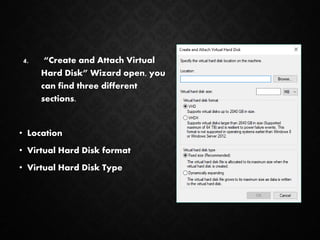
4. “Create and Attach Virtual
Hard Disk” Wizard open, you
can find three different
sections.
• Location
• Virtual Hard Disk format
• Virtual Hard Disk Type
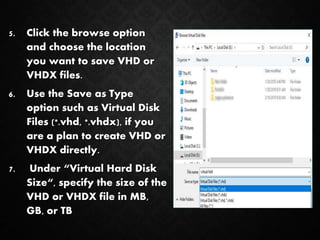
5. Click the browse option
and choose the location
you want to save VHD or
VHDX files.
6. Use the Save as Type
option such as Virtual Disk
Files (*.vhd, *.vhdx), if you
are a plan to create VHD or
VHDX directly.
7. Under “Virtual Hard Disk
Size“, specify the size of the
VHD or VHDX file in MB,
GB, or TB
8. In “Virtual Hard Disk Format” choose
VHD or VHDX option according to
requirement.
9. In “Virtual Hard Disk Type” select VHD
file types such as Fixed Size and
Dynamically Expanding.
10. Now, click on “Ok” option to create
VHDX or VHD files.
HOW TO MOUNT VHD?
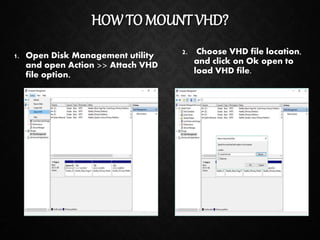
1. Open Disk Management utility
and open Action >> Attach VHD
file option.
2. Choose VHD file location,
and click on Ok open to
load VHD file.
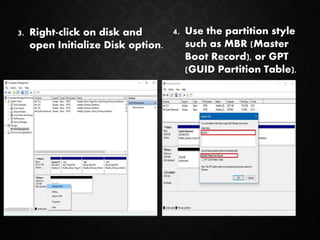
3. Right-click on disk and
open Initialize Disk option.
4. Use the partition style
such as MBR (Master
Boot Record), or GPT
(GUID Partition Table).
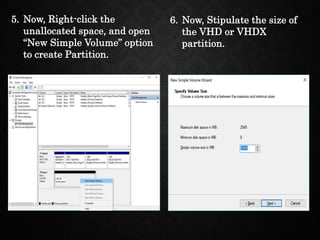
5. Now, Right-click the
unallocated space, and open
“New Simple Volume” option
to create Partition.
6. Now, Stipulate the size of
the VHD or VHDX
partition.
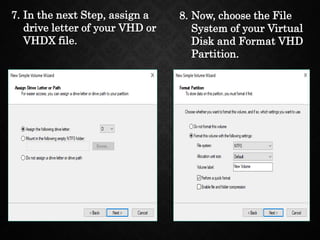
7. In the next Step, assign a
drive letter of your VHD or
VHDX file.
8. Now, choose the File
System of your Virtual
Disk and Format VHD
Partition.
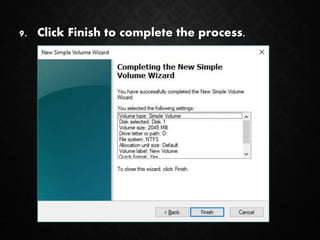
9. Click Finish to complete the process.
ADVANTAGES AND DISADVANTAGES
ADVANTAGES
 Better resource
utilization
 Backups
 Lower operating cost
 Upgrades and
migration-
 Deploying standard
systems
DISADVANTAGES
 Some apps require a
dedicated PC
 Licensing fees
 Better for server
processes than
desktops
APPLICATION
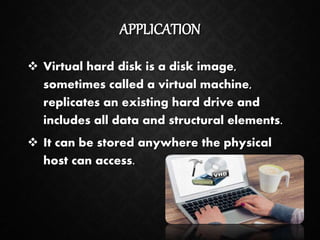
 Virtual hard disk is a disk image,
sometimes called a virtual machine,
replicates an existing hard drive and
includes all data and structural elements.
 It can be stored anywhere the physical
host can access.
CONCLUSION
 A Virtual Hard Disk allows multiple
operating systems to reside on a single
host machine
 This method enables developers to test
software on different operating systems
without the cost or hassle of installing a
second hard disk or partitioning a single
hard disk into multiple volumes
Virtual Hard disk

Virtual Hard disk

  • 1.
    PRESENTED BY :-DEVAKSHA AHIRE ( 20202A0060) PARTH KASAR (20201A20016) ROHIT DHAINJE (20202A0035) Virtual hard disk
  • 2.
    AGENDA o INTRODUCTION o HISTROY oWHAT IS VHD? o STEPS TO CREATE VHD/VHDX o HOW TO MOUNT VHD? o ADVANTAGE AND DISADVANTAGE o APPLICATION o CONCLUSION
  • 3.
    INTRODUCTION • VHD (VirtualHard Disk) and its successor VHDx are File Format representing a virtual hard disk drive (HDD). They may contain what is found on a physical HDD, such as disk partitions and a file system, which in turn can contain files and folders. They are typically used as the hard disk of a virtual machine, are built into modern versions of Windows, and are the native file format for Microsoft's hypervisor (virtual machine system), Hyper-V.
  • 4.
    HISTORY • The formatwas created by Connectix for their Virtual PC product, known as Microsoft Virtual PC since Microsoft acquired Connectix in 2003. • VHDx was introduced subsequently to add features and flexibility missing in VHD that had become apparent over time. • Since June 2005, Microsoft has made the VHD and VHDx Image Format Specifications available to third parties under the Microsoft Open Specification Promise.
  • 5.
    WHAT IS VHD? •A virtual disk is a file or set of files that appears as a physical disk drive to a guest operating system. The files can be on the host machine or on a remote computer. ... You may also configure virtual disks so all the disk space is allocated at the time the virtual disk is created.
  • 6.
    STEPS TO CREATEVHD/VHDX 1. Open Start, and search “Disk Management” or “Computer Management”. 2. You can also open Disk Management utility with This PC (My Computer) >> Right Click >> Open Manage option. 3. Open Disk Management option, and click on the Action button or create a VHD file.
  • 7.
    4. “Create andAttach Virtual Hard Disk” Wizard open, you can find three different sections. • Location • Virtual Hard Disk format • Virtual Hard Disk Type
  • 8.
    5. Click thebrowse option and choose the location you want to save VHD or VHDX files. 6. Use the Save as Type option such as Virtual Disk Files (*.vhd, *.vhdx), if you are a plan to create VHD or VHDX directly. 7. Under “Virtual Hard Disk Size“, specify the size of the VHD or VHDX file in MB, GB, or TB
  • 9.
    8. In “VirtualHard Disk Format” choose VHD or VHDX option according to requirement. 9. In “Virtual Hard Disk Type” select VHD file types such as Fixed Size and Dynamically Expanding. 10. Now, click on “Ok” option to create VHDX or VHD files.
  • 10.
    HOW TO MOUNTVHD? 1. Open Disk Management utility and open Action >> Attach VHD file option. 2. Choose VHD file location, and click on Ok open to load VHD file.
  • 11.
    3. Right-click ondisk and open Initialize Disk option. 4. Use the partition style such as MBR (Master Boot Record), or GPT (GUID Partition Table).
  • 12.
    5. Now, Right-clickthe unallocated space, and open “New Simple Volume” option to create Partition. 6. Now, Stipulate the size of the VHD or VHDX partition.
  • 13.
    7. In thenext Step, assign a drive letter of your VHD or VHDX file. 8. Now, choose the File System of your Virtual Disk and Format VHD Partition.
  • 14.
    9. Click Finishto complete the process.
  • 15.
    ADVANTAGES AND DISADVANTAGES ADVANTAGES Better resource utilization  Backups  Lower operating cost  Upgrades and migration-  Deploying standard systems DISADVANTAGES  Some apps require a dedicated PC  Licensing fees  Better for server processes than desktops
  • 16.
    APPLICATION  Virtual harddisk is a disk image, sometimes called a virtual machine, replicates an existing hard drive and includes all data and structural elements.  It can be stored anywhere the physical host can access.
  • 17.
    CONCLUSION  A VirtualHard Disk allows multiple operating systems to reside on a single host machine  This method enables developers to test software on different operating systems without the cost or hassle of installing a second hard disk or partitioning a single hard disk into multiple volumes