LAUREATE ONLINE EDUCATION /
UNIVERSITY OF LIVERPOOL
FACULTY CONFERENCE
A case study of online students’
affective responses to technology
Eileen Kennedy & Morag Gray
Motivations:
The embodied experience of online learning
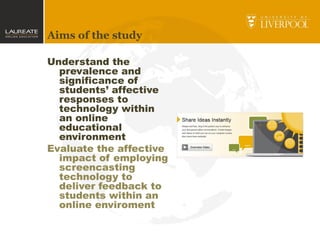
What does it feel
like to learn
online?
What does feedback
feel like?
How does
technology
mediate feelings
and feedback?
Aims of the study
Understand the
prevalence and
significance of
students’ affective
responses to
technology within
an online
educational
environment
Evaluate the affective
impact of employing
screencasting
technology to
deliver feedback to
students within an
online enviroment
Existing Research
Emotions online
emotional language (Gilmore & Warren, 2007)
shame; embarrassment; enthusiasm; excitement;
anger, discomfort, anxiety; apprehension
aloneness, anonymity, nonverbal communication,
trepidations and unknowns Reilly et al. (2012:
101)
Zembylas (2008) argued that it was important
to consider the social and cultural contexts
of the learners
Affect & the Body Online
The embodied experience that exists prior to cognitive
recognition and representation (e.g. as a particular
emotion)
Our emotions are drawn from “within the affective
states in which we already find ourselves”
(Grossberg, 1992: 81)
Online communication immerses us in feedback loops
that characterize “constant-contact media addiction”
(Zaitchik, cited in Dean, 2010: 97)
Kazan (2007) advises us that we should become “hyper-
readers” who actively listen to the other’s bodily
responses online: “there is always more than what
we see on the screen, more than can be contained in
those typed words” (Kazan, 2007: 266)
Feedback
Complex process (Pokorny & Pickford, 2011)
Not always understood because of students’
relationship with academic discourse (Ivanic
et al., 2000)
Entailing increased feeling of inferiority and
insecurity (Brown, 2007)
Written summative feedback not always most
useful
Student-tutor dialogue important (Beaumont
et al., 2011)
Podcasts & Video Podcasts
Savin-Baden (2010) Pros & Cons of
Podcasting Assignment Feedback (PAF)
Screencasting might overcome cons (Mann,
Wong, & Park, 2009)
Procedure:
• Mark up essay;
• Record screen + voice over comments
• Send via weblink
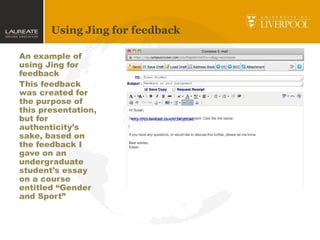
Using Jing for feedback
An example of
using Jing for
feedback
This feedback
was created for
the purpose of
this presentation,
but for
authenticity’s
sake, based on
the feedback I
gave on an
undergraduate
student’s essay
on a course
entitled “Gender
and Sport”
http://screencast.com/t/2A5j0UA6
Research design – 3 stages
An online survey will elicit the past
experiences of affective responses whilst
studying online;
Screencasting technology will be
introduced to feedback on one assessed
piece of work;
Subsequently 10 interviews will be
conducted via Skype
Data Analysis
Online Survey will be subjected to
descriptive statistical analysis
Skype interviews will be recorded with the
participant’s permission
Data will be transcribed and subjected to
thematic analysis
Both sets of data will be used to enhance
the discussion of the findings
Potential impact of the research
Harnessing the potential of technology to
shape positive rather than negative
affective responses
Discovering which technologies and
techniques create the most positive
affective responses
Evaluating the extent to which
screencasting may offer best practice
Any Questions?

A Case Study of Students' Affective Responses to Technology

  • 1.
    LAUREATE ONLINE EDUCATION/ UNIVERSITY OF LIVERPOOL FACULTY CONFERENCE A case study of online students’ affective responses to technology Eileen Kennedy & Morag Gray
  • 2.
    Motivations: The embodied experienceof online learning What does it feel like to learn online? What does feedback feel like? How does technology mediate feelings and feedback?
  • 3.
    Aims of thestudy Understand the prevalence and significance of students’ affective responses to technology within an online educational environment Evaluate the affective impact of employing screencasting technology to deliver feedback to students within an online enviroment
  • 4.
    Existing Research Emotions online emotionallanguage (Gilmore & Warren, 2007) shame; embarrassment; enthusiasm; excitement; anger, discomfort, anxiety; apprehension aloneness, anonymity, nonverbal communication, trepidations and unknowns Reilly et al. (2012: 101) Zembylas (2008) argued that it was important to consider the social and cultural contexts of the learners
  • 5.
    Affect & theBody Online The embodied experience that exists prior to cognitive recognition and representation (e.g. as a particular emotion) Our emotions are drawn from “within the affective states in which we already find ourselves” (Grossberg, 1992: 81) Online communication immerses us in feedback loops that characterize “constant-contact media addiction” (Zaitchik, cited in Dean, 2010: 97) Kazan (2007) advises us that we should become “hyper- readers” who actively listen to the other’s bodily responses online: “there is always more than what we see on the screen, more than can be contained in those typed words” (Kazan, 2007: 266)
  • 6.
    Feedback Complex process (Pokorny& Pickford, 2011) Not always understood because of students’ relationship with academic discourse (Ivanic et al., 2000) Entailing increased feeling of inferiority and insecurity (Brown, 2007) Written summative feedback not always most useful Student-tutor dialogue important (Beaumont et al., 2011)
  • 7.
    Podcasts & VideoPodcasts Savin-Baden (2010) Pros & Cons of Podcasting Assignment Feedback (PAF) Screencasting might overcome cons (Mann, Wong, & Park, 2009) Procedure: • Mark up essay; • Record screen + voice over comments • Send via weblink
  • 8.
    Using Jing forfeedback An example of using Jing for feedback This feedback was created for the purpose of this presentation, but for authenticity’s sake, based on the feedback I gave on an undergraduate student’s essay on a course entitled “Gender and Sport” http://screencast.com/t/2A5j0UA6
  • 9.
    Research design –3 stages An online survey will elicit the past experiences of affective responses whilst studying online; Screencasting technology will be introduced to feedback on one assessed piece of work; Subsequently 10 interviews will be conducted via Skype
  • 10.
    Data Analysis Online Surveywill be subjected to descriptive statistical analysis Skype interviews will be recorded with the participant’s permission Data will be transcribed and subjected to thematic analysis Both sets of data will be used to enhance the discussion of the findings
  • 11.
    Potential impact ofthe research Harnessing the potential of technology to shape positive rather than negative affective responses Discovering which technologies and techniques create the most positive affective responses Evaluating the extent to which screencasting may offer best practice
  • 12.

Editor's Notes

  • #7 7 principles of good feedback (Nicol & Macfarlane-Dick, 2006): clarifying what good performance is; encouraging reflexivity; high quality information about learning; encouraging discussion about learning; being positive; giving opportunities to improve; enabling feedback to tutors to help them improve
  • #8 Students value it It helps improve students’ sense of community It increases teaching presence Largely taken more seriously than written feedback There is an increase in the quality and quantity of feedback students receive It reduced social distance in asynchronous courses Staff generally dislike it It does not necessarily improve student Grades Staff find it more time-consuming to do than written feedback Too much feedback is given so the message of the feedback is often obscured The normal editing process that staff use in written feedback tends to be omitted in PAF Loss of a written feedback sheet accessible for all staff There is lack of annotation on written work