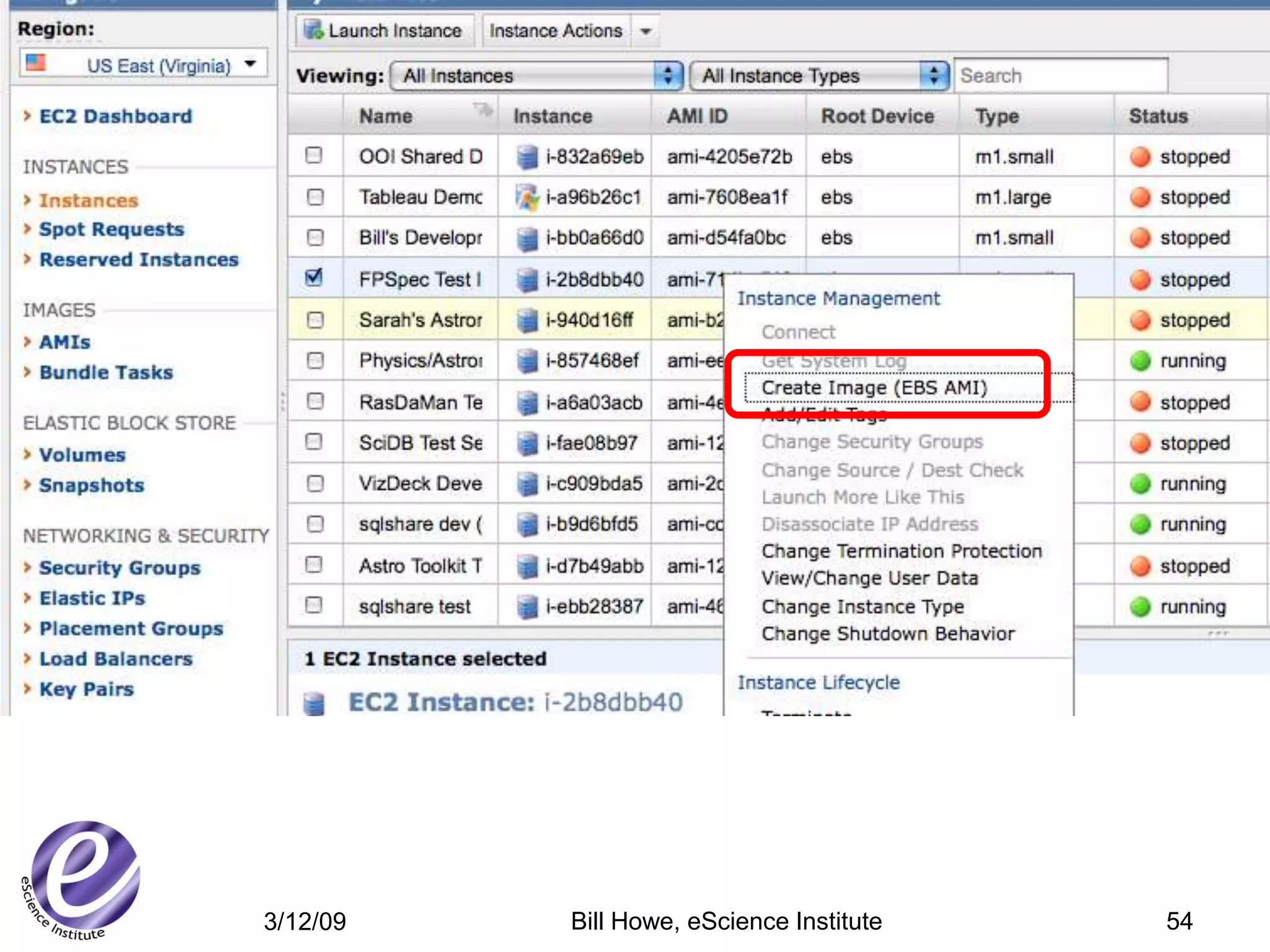

Virtual Appliances, Cloud
  Computing, and Reproducible
  Research

Bill Howe, Phd
eScience Institute, UW
http://escience.washington.ed
An Observation
   There will always be experiments data housed outside of
    a managed environments
       “Free” experimentation is a beautiful property of software
       We should be conservative about constraining the process


   There is no difference between debugging, testing, and
    experiments.
       When it works, it's an experiment.
       When it doesn't, it's debugging.


   Conclusion: We need post hoc approaches
       that can tolerate messy, heterogeneous code and data


              3/12/09             Bill Howe, eScience Institute      3
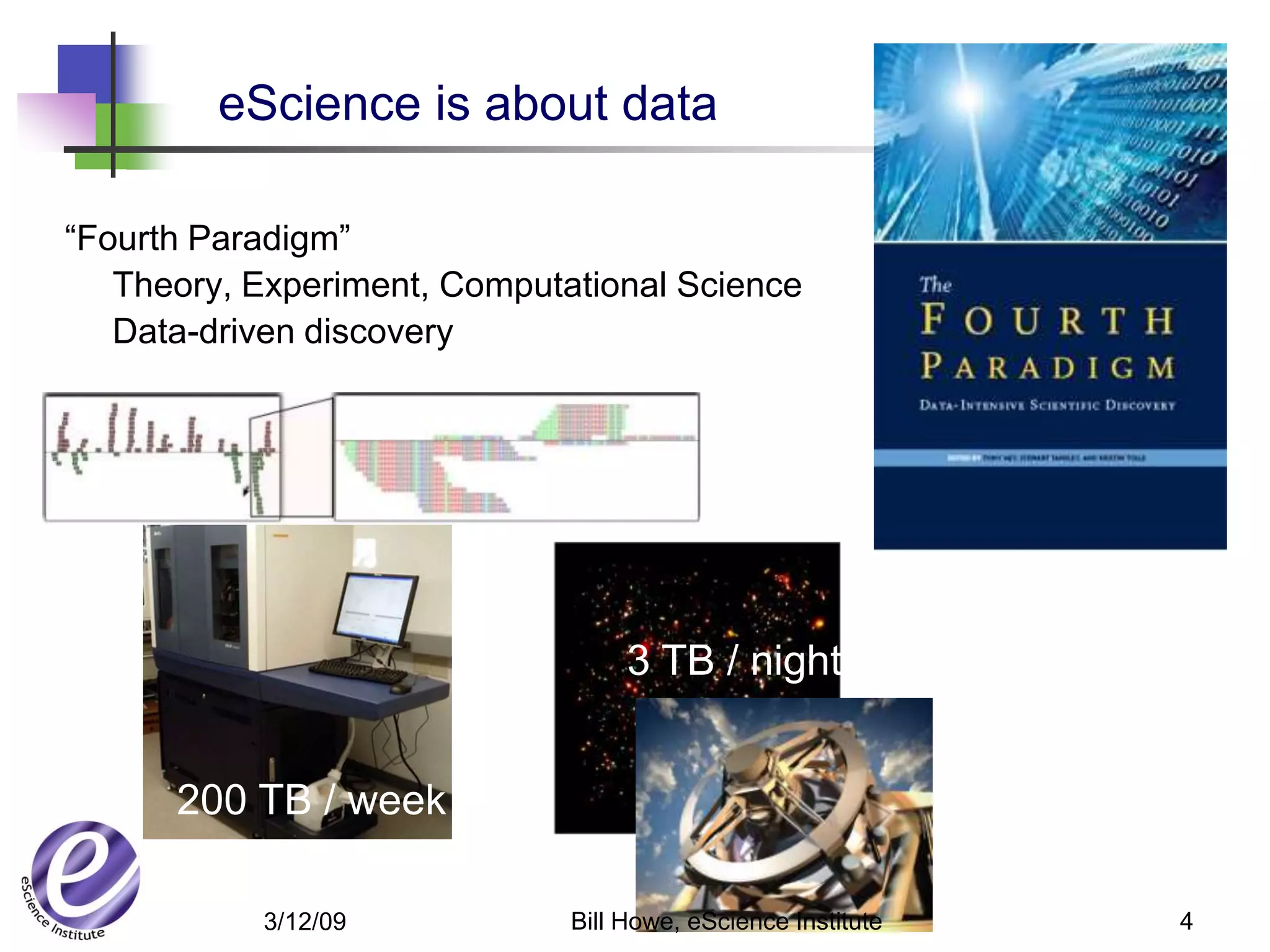
eScience is about data

“Fourth Paradigm”
   Theory, Experiment, Computational Science
   Data-driven discovery


                                   3 TB / night


      200 TB / week

           3/12/09            Bill Howe, eScience Institute   4
eScience is about data

Old model: “Query the world” (Data acquisition coupled to a specific hypothesis)
New model: “Download the world, query the DB” (Data acquired en masse, to support many hypotheses)

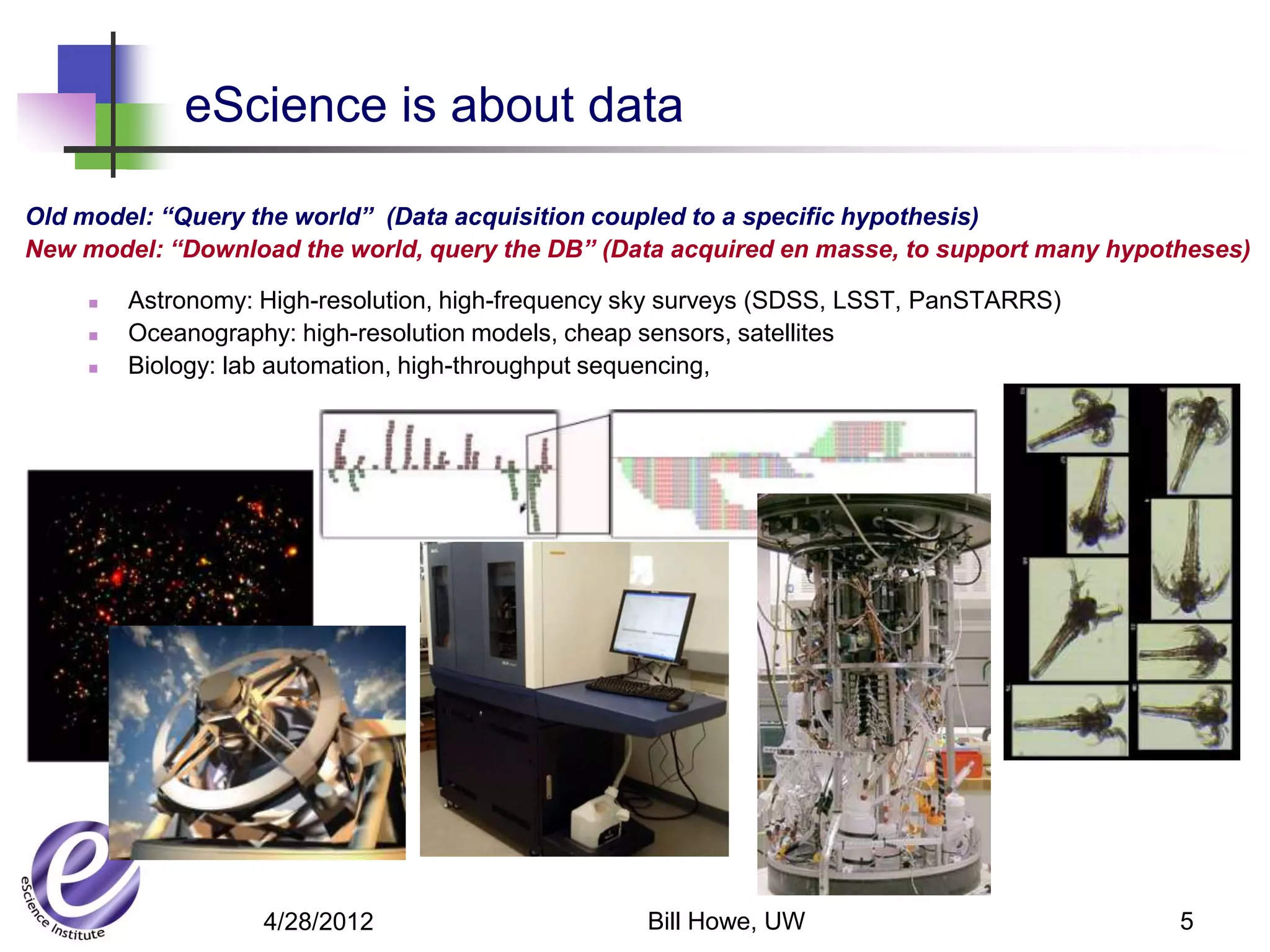
        Astronomy: High-resolution, high-frequency sky surveys (SDSS, LSST, PanSTARRS)
        Oceanography: high-resolution models, cheap sensors, satellites
        Biology: lab automation, high-throughput sequencing,


                    4/28/2012                       Bill Howe, UW                           5
visualization + cloud
        Some projects                                           scientific data integration
                                                                scalable query processing

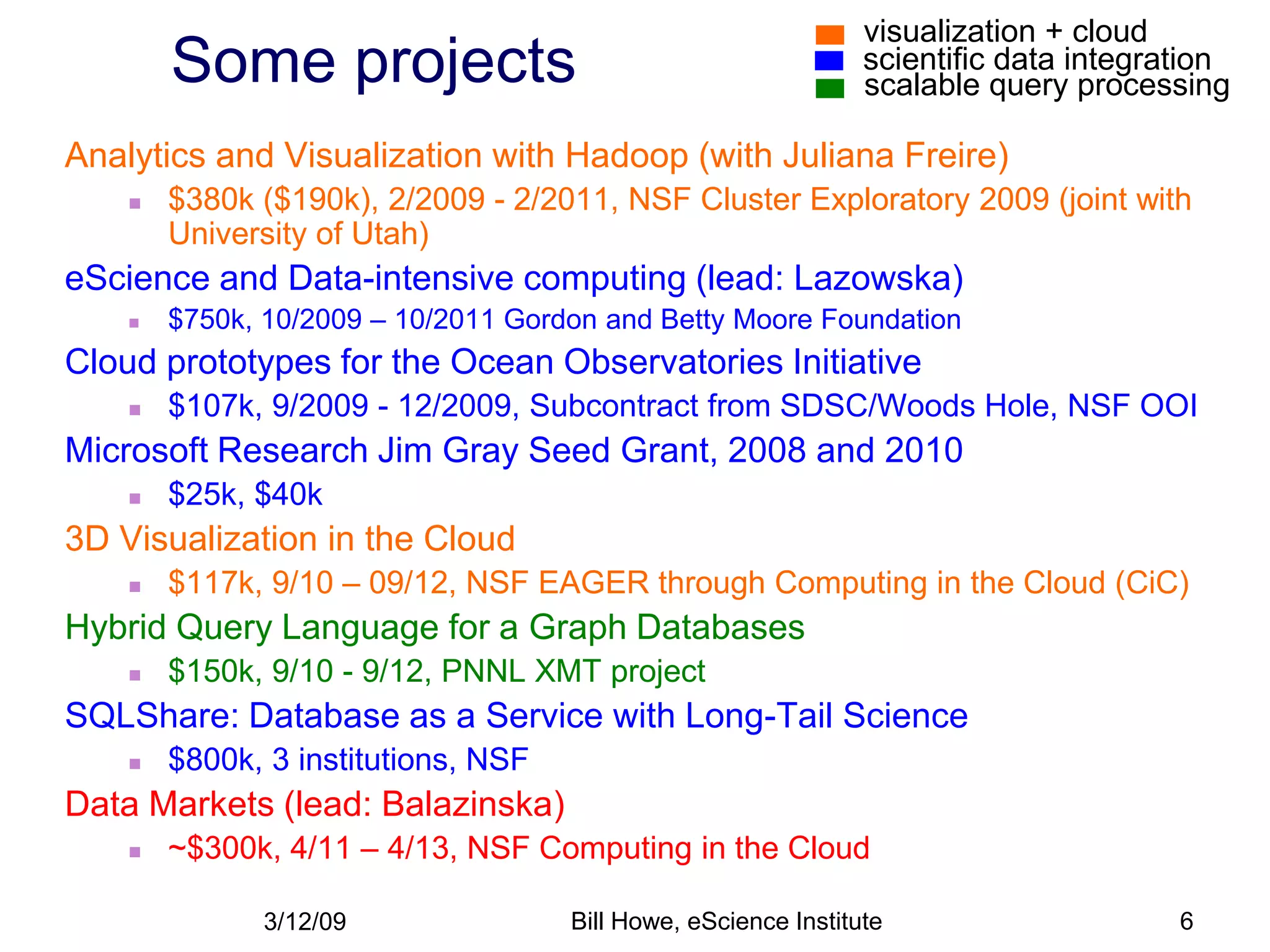
Analytics and Visualization with Hadoop (with Juliana Freire)
       $380k ($190k), 2/2009 - 2/2011, NSF Cluster Exploratory 2009 (joint with
        University of Utah)
eScience and Data-intensive computing (lead: Lazowska)
       $750k, 10/2009 – 10/2011 Gordon and Betty Moore Foundation
Cloud prototypes for the Ocean Observatories Initiative
       $107k, 9/2009 - 12/2009, Subcontract from SDSC/Woods Hole, NSF OOI
Microsoft Research Jim Gray Seed Grant, 2008 and 2010
       $25k, $40k
3D Visualization in the Cloud
       $117k, 9/10 – 09/12, NSF EAGER through Computing in the Cloud (CiC)
Hybrid Query Language for a Graph Databases
       $150k, 9/10 - 9/12, PNNL XMT project
SQLShare: Database as a Service with Long-Tail Science
       $800k, 3 institutions, NSF
Data Markets (lead: Balazinska)
       ~$300k, 4/11 – 4/13, NSF Computing in the Cloud

              3/12/09                Bill Howe, eScience Institute                     6
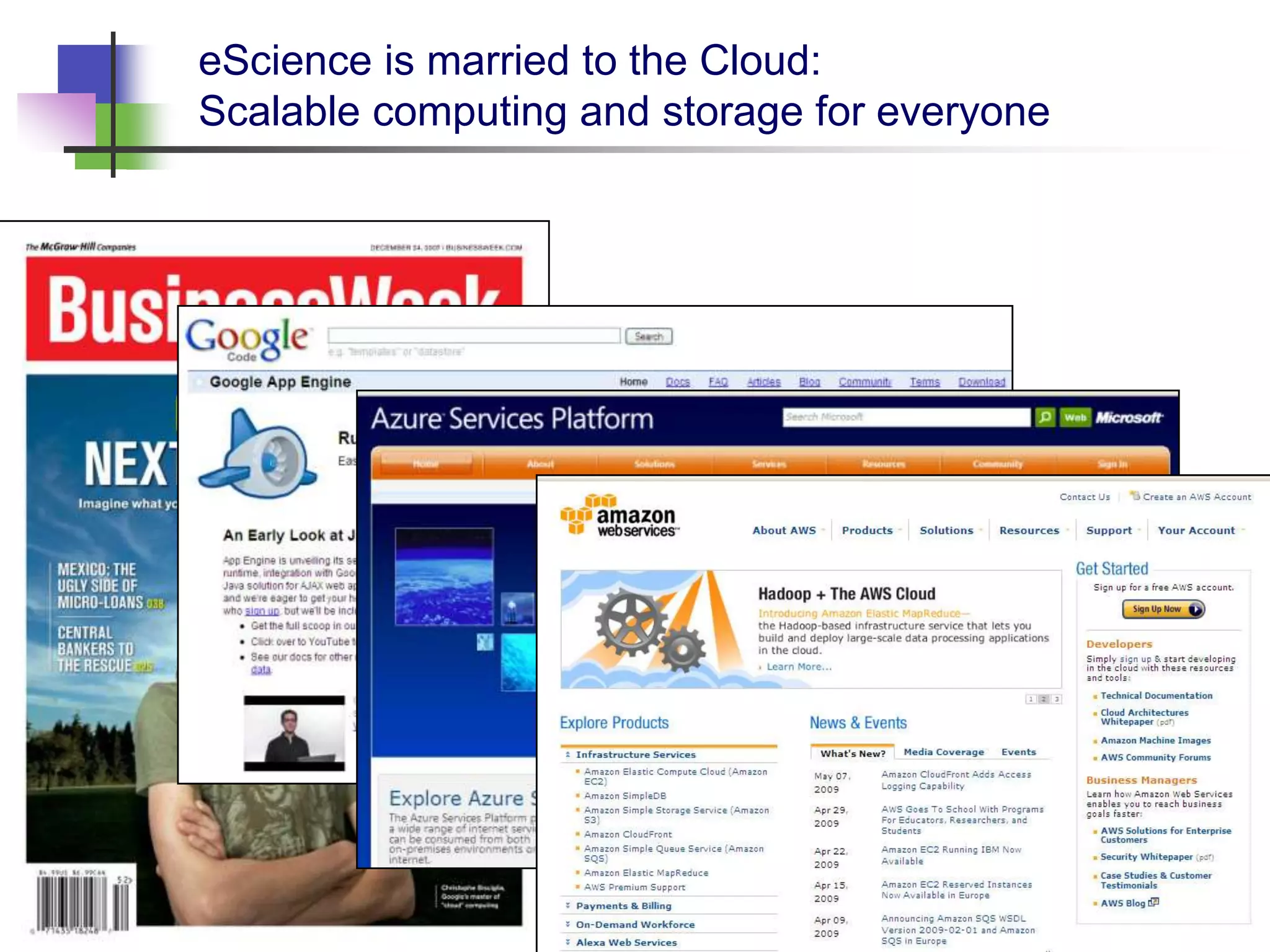
eScience is married to the Cloud:
Scalable computing and storage for everyone


   3/12/09        Bill Howe, eScience Institute   7
The point of this talk


Explore the roles the cloud can play in
reproducible research

“What if everything was in the cloud?”


        3/12/09     Bill Howe, eScience Institute   8
CLOUD IN 2 SLIDES


   3/12/09   Bill Howe, eScience Institute   9
[Slide source: Werner
Generator   Vogels]


  3/12/09      Bill Howe, eScience Institute   10
Growth


“Every day, Amazon buys enough computing
resources to run the entire Amazon.com
infrastructure as of 2001”

-- James Hamilton, Amazon, Inc., SIGMOD 2011 keynote


         3/12/09        Bill Howe, eScience Institute   11
VIRTUALIZATION ANECDOTE


   3/12/09   Bill Howe, eScience Institute   12
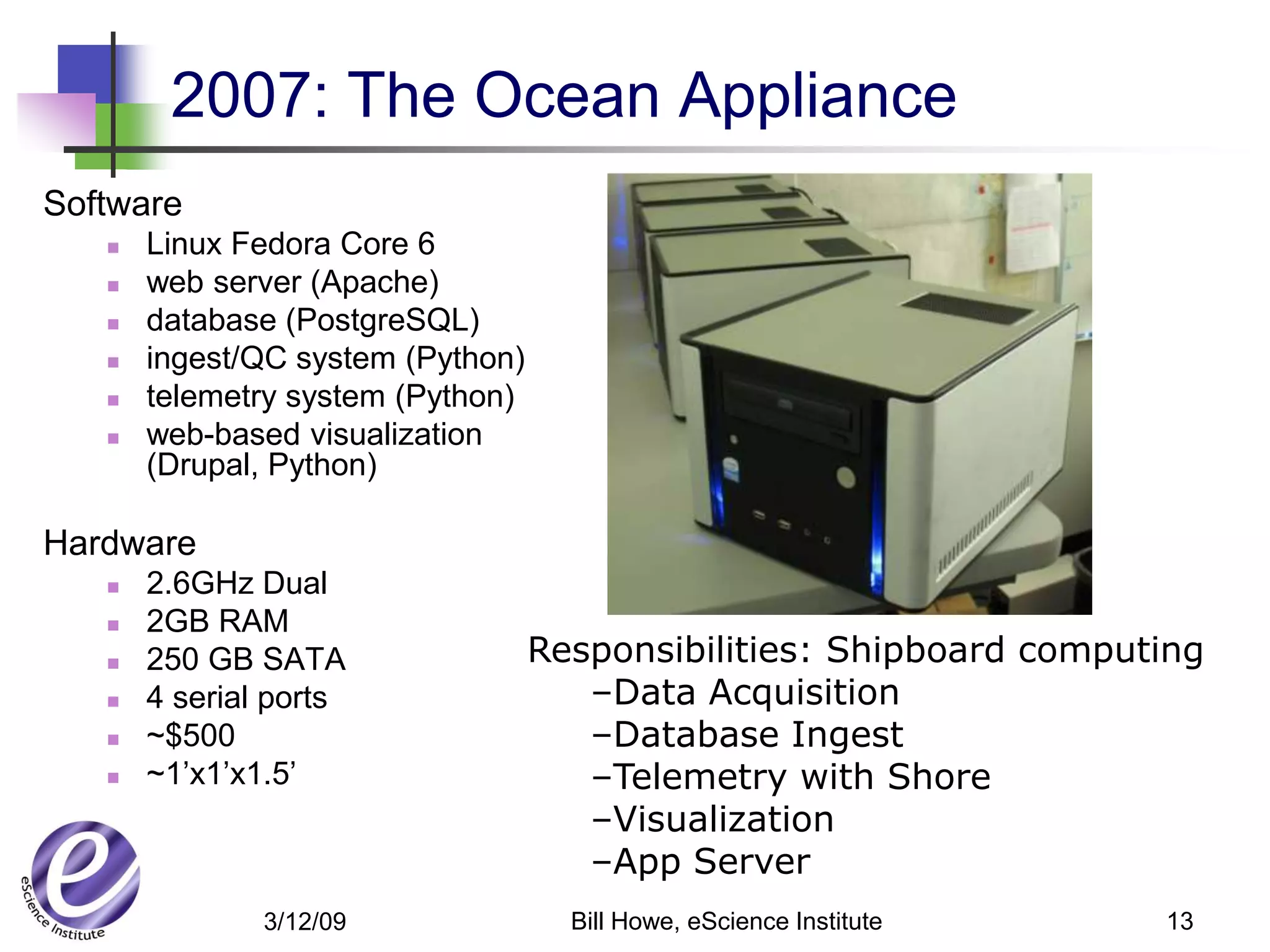
2007: The Ocean Appliance
Software
      Linux Fedora Core 6
      web server (Apache)
      database (PostgreSQL)
      ingest/QC system (Python)
      telemetry system (Python)
      web-based visualization
       (Drupal, Python)

Hardware
      2.6GHz Dual
      2GB RAM
      250 GB SATA                 Responsibilities: Shipboard computing
      4 serial ports                 –Data Acquisition
      ~$500                          –Database Ingest
      ~1’x1’x1.5’                    –Telemetry with Shore
                                      –Visualization
                                      –App Server
               3/12/09               Bill Howe, eScience Institute   13
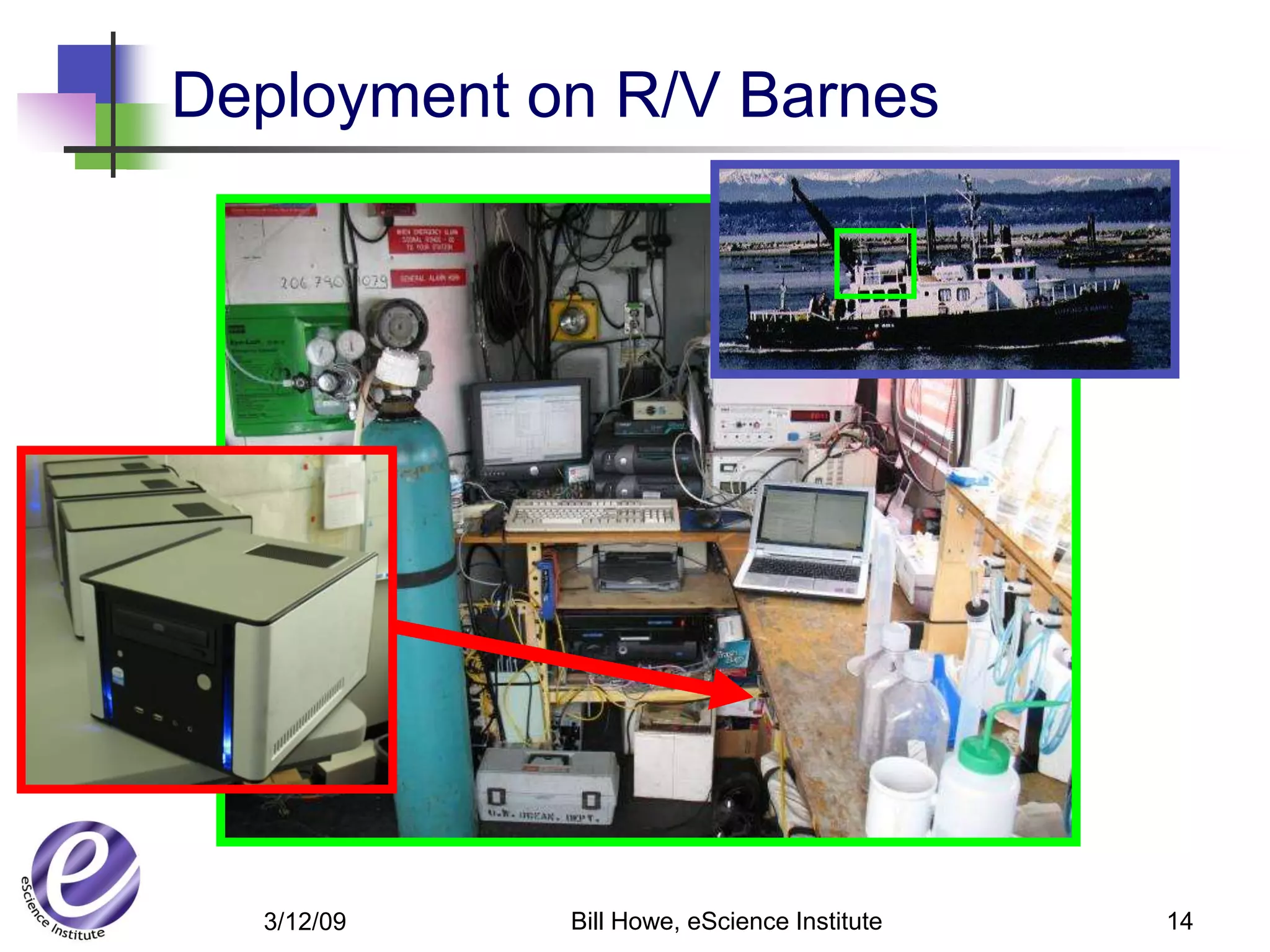
Deployment on R/V Barnes


  3/12/09   Bill Howe, eScience Institute   14
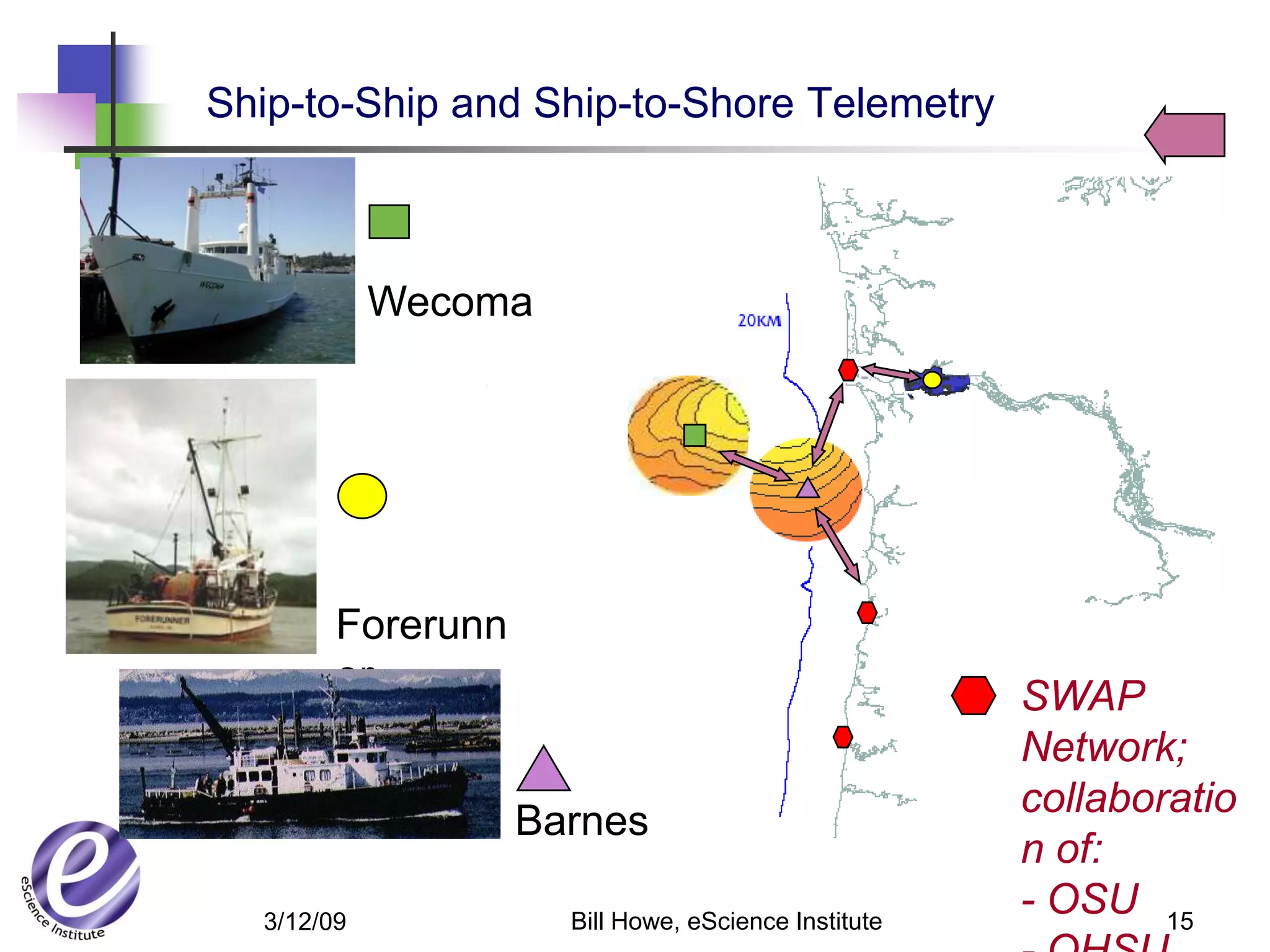
Ship-to-Ship and Ship-to-Shore Telemetry


            Wecoma


        Forerunn
        er                                           SWAP
                                                     Network;
                                                     collaboratio
                   Barnes
                                                     n of:
  3/12/09            Bill Howe, eScience Institute
                                                     - OSU 15
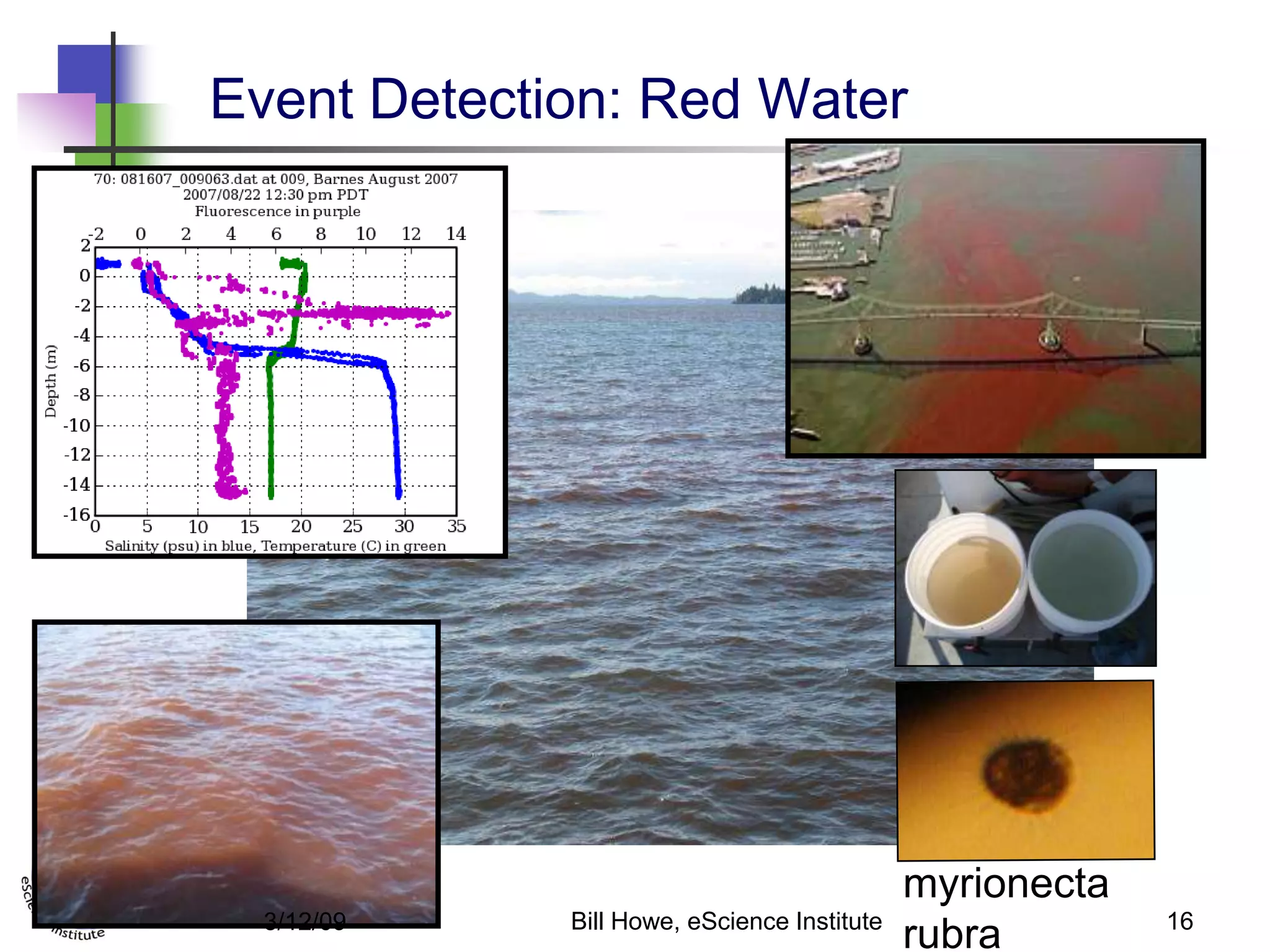
Event Detection: Red Water


                                             myrionecta
  3/12/09    Bill Howe, eScience Institute                16
                                             rubra
Code + Data + Environment

   Easier, cheaper, and safer to build the box
    in the lab and hand it out for free than to
    work with the ships’ admin to get our
    software running.

   Modern analog: Easier to build and
    distribute a virtual appliance than it is to
    support installation of your software.


          3/12/09       Bill Howe, eScience Institute   17
Cloud + RR Overview
   Virtualization = Code + Data + Environment
       Virtualization enables cross-
        platform, generalized, reliable ad hoc (and post hoc)
        environment capture


   Cloud = Virtualization + Resources + Services
       any code, any data (more structure -> more services)
       scalable storage and compute for everyone
       services for processing big data, various data models
       services for managing VMs
       secure, reliable, available
             3/12/09         Bill Howe, eScience Institute      18
Challenges

   Costs and cost-sharing
   Data-intensive science

   Offline discussion
       Security / Privacy
       Long-term Preservation
       Cultural roadblocks


            3/12/09      Bill Howe, eScience Institute   19
OBSERVATIONS ABOUT
CLOUD, VIRTUALIZATION, RR

   3/12/09   Bill Howe, eScience Institute   20
An Observation
   There will always be experiments data housed outside of
    a managed environments
       “Free” experimentation is a beautiful property of software
       We should be conservative about constraining the process


   There is no difference between debugging, testing, and
    experiments.
       When it works, it's an experiment.
       When it doesn't, it's debugging.


   Conclusion: We need post hoc approaches
       that can tolerate messy, heterogeneous code and data


              3/12/09             Bill Howe, eScience Institute      21
An Observation (2)

   Code + Data + Environment + Platform

   “Download it to my laptop” is insufficient
   Ex: de novo assembly
       64 GB RAM, 12 cores


   So we need more than VMs – we need a place to
    run them


            3/12/09       Bill Howe, eScience Institute   22
An Observation (3)

   Experiment environments span multiple
    machines
   Databases, models, web server

   1 VM may not be enough


         3/12/09     Bill Howe, eScience Institute   23
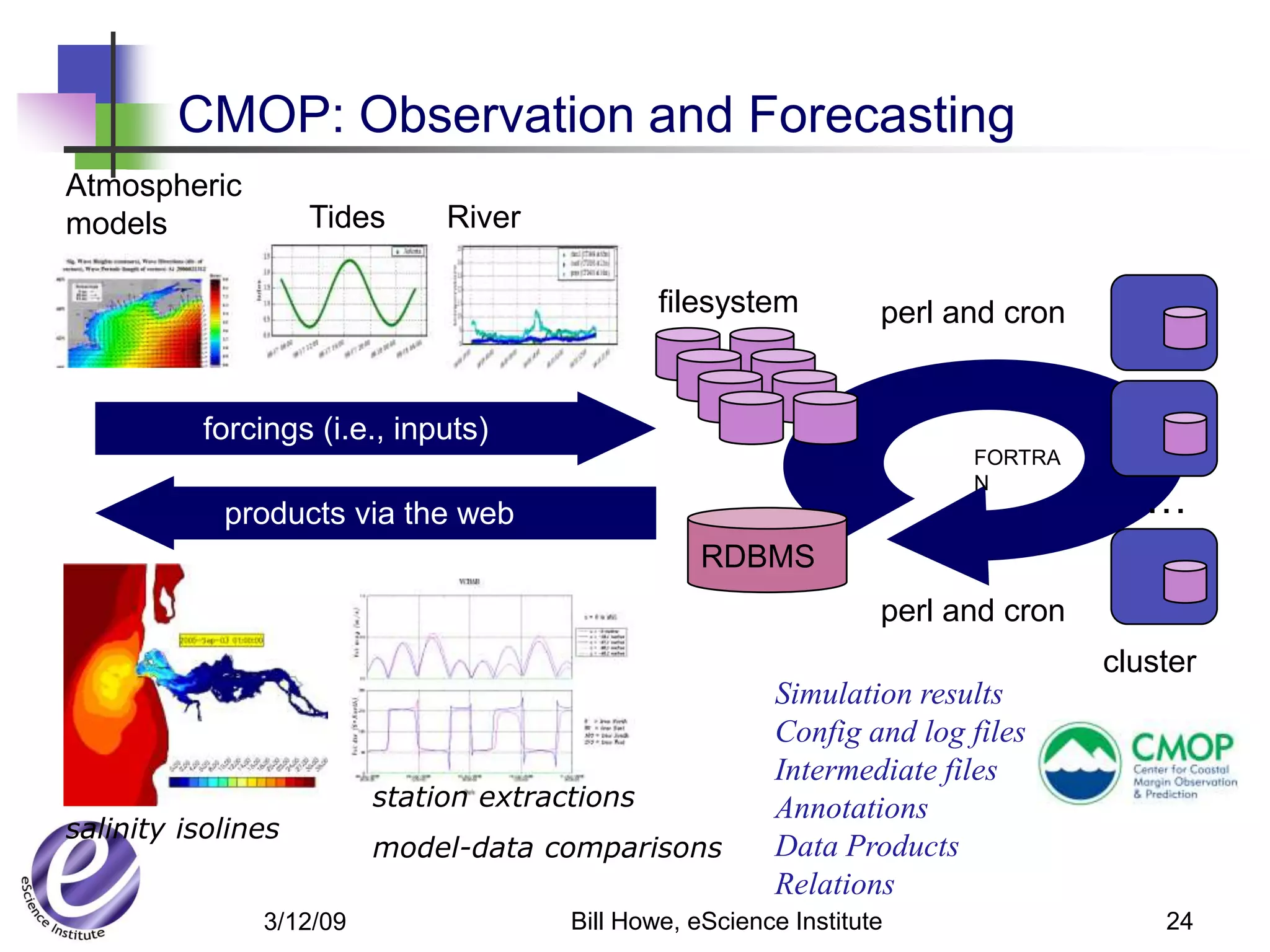
CMOP: Observation and Forecasting
Atmospheric
models              Tides     River
                              discharge
                                               filesystem          perl and cron


          forcings (i.e., inputs)
                                                                         FORTRA

                                                                                      …
                                                                         N
            products via the web
                                                   RDBMS
                                                                   perl and cron
                                                                                   cluster
                                                         Simulation results
                                                         Config and log files
                                                         Intermediate files
                         station extractions             Annotations
salinity isolines
                         model-data comparisons          Data Products
                                                         Relations
               3/12/09                 Bill Howe, eScience Institute                   24
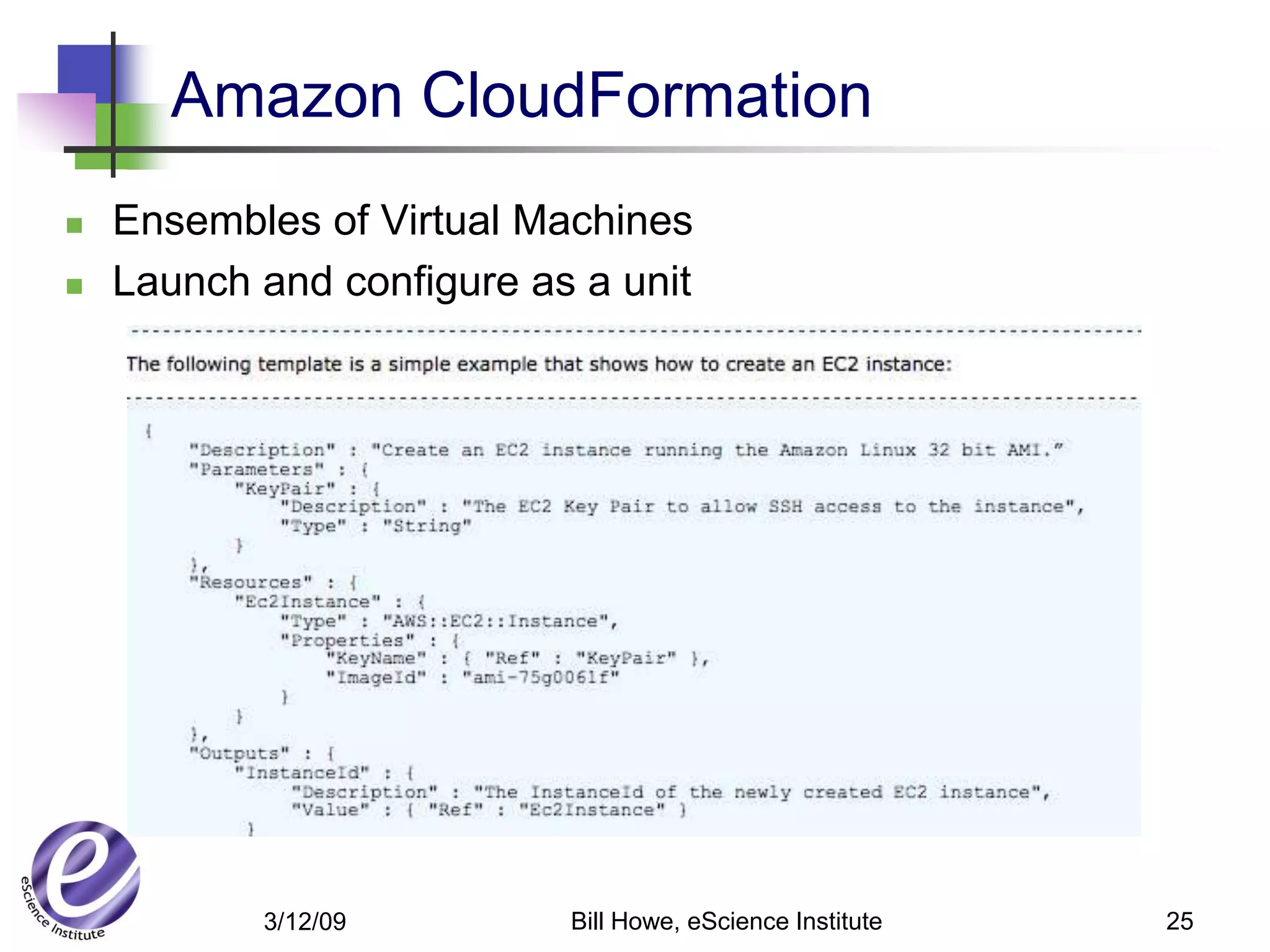
Amazon CloudFormation
   Ensembles of Virtual Machines
   Launch and configure as a unit


           3/12/09         Bill Howe, eScience Institute   25
Observation (3): “Google Docs for developers”

   The cloud offers a “demilitarized zone” for temporary, low-
    overhead collaboration
       A temporary, shared development environment outside of the
        jurisdiction of over-zealous sysadmins
       No bugs closed as “can’t replicate”


   Example: New software for serving oceanographic model
    results, requiring collaboration between
    UW, OPeNDAP.org, and OOI


                                                                 Bill Howe
              3/12/09            Bill Howe, eScience Institute               26
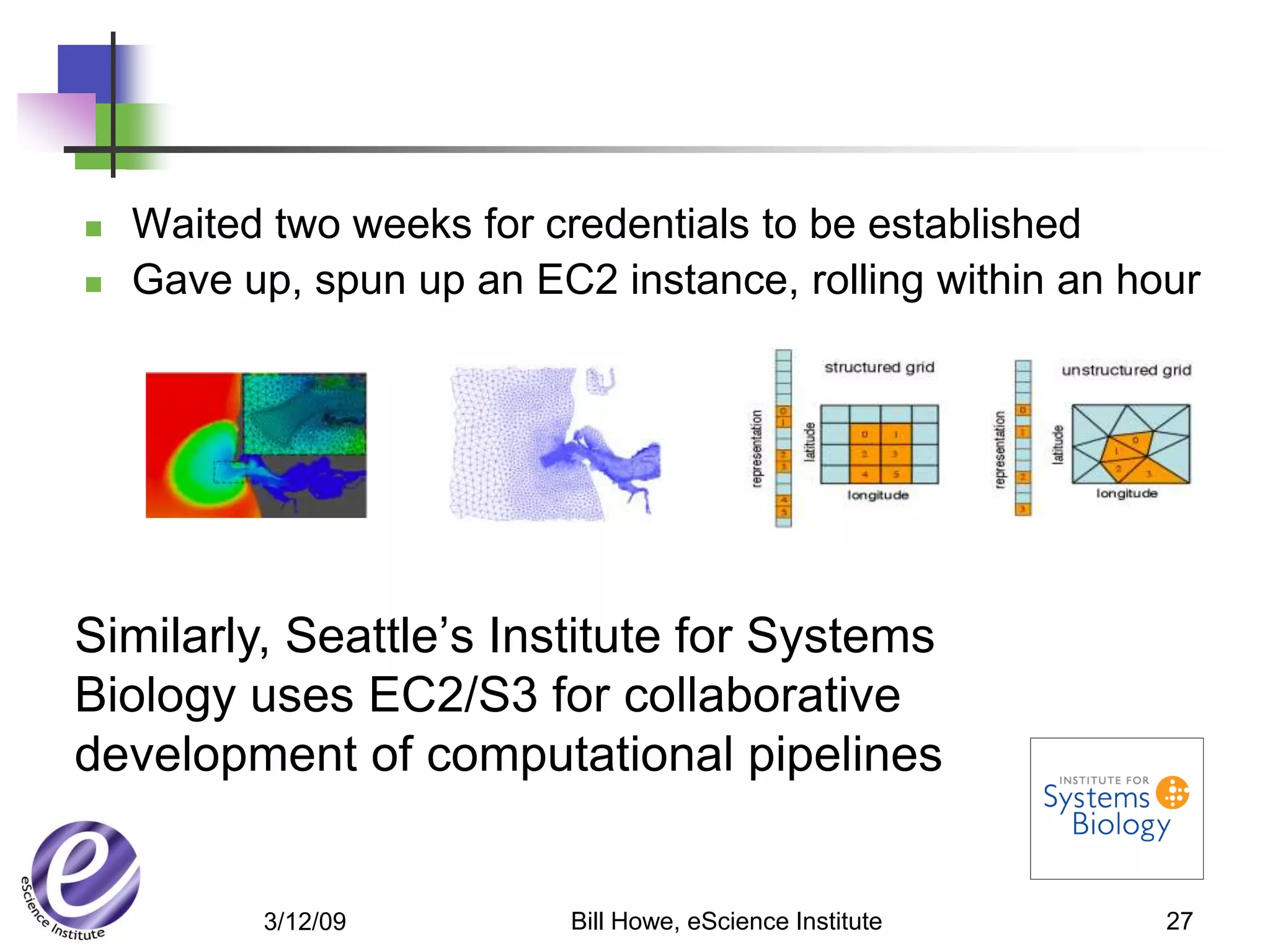
   Waited two weeks for credentials to be established
   Gave up, spun up an EC2 instance, rolling within an hour


Similarly, Seattle’s Institute for Systems
Biology uses EC2/S3 for collaborative
development of computational pipelines


          3/12/09          Bill Howe, eScience Institute   27
COSTS AND COST-SHARING


   3/12/09   Bill Howe, eScience Institute   28
Who pays for reproducibility?

   Costs of hosting code?
   Costs of hosting data?
   Costs of executing code?

   Answer: you, you, them

   Is this affordable?


          3/12/09         Bill Howe, eScience Institute   29
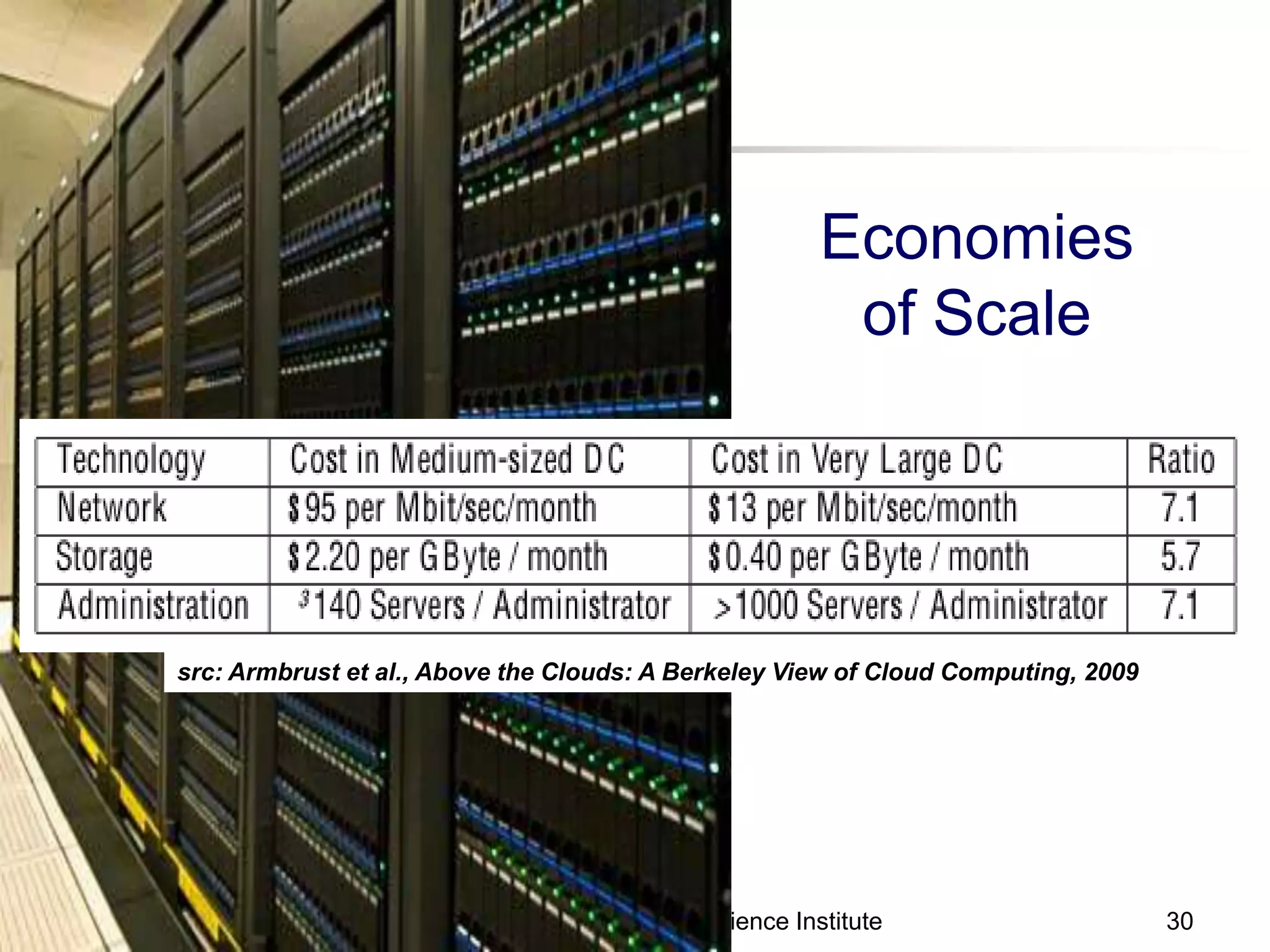
Economies
                                                        of Scale


src: Armbrust et al., Above the Clouds: A Berkeley View of Cloud Computing, 2009


       3/12/09                  Bill Howe, eScience Institute                      30
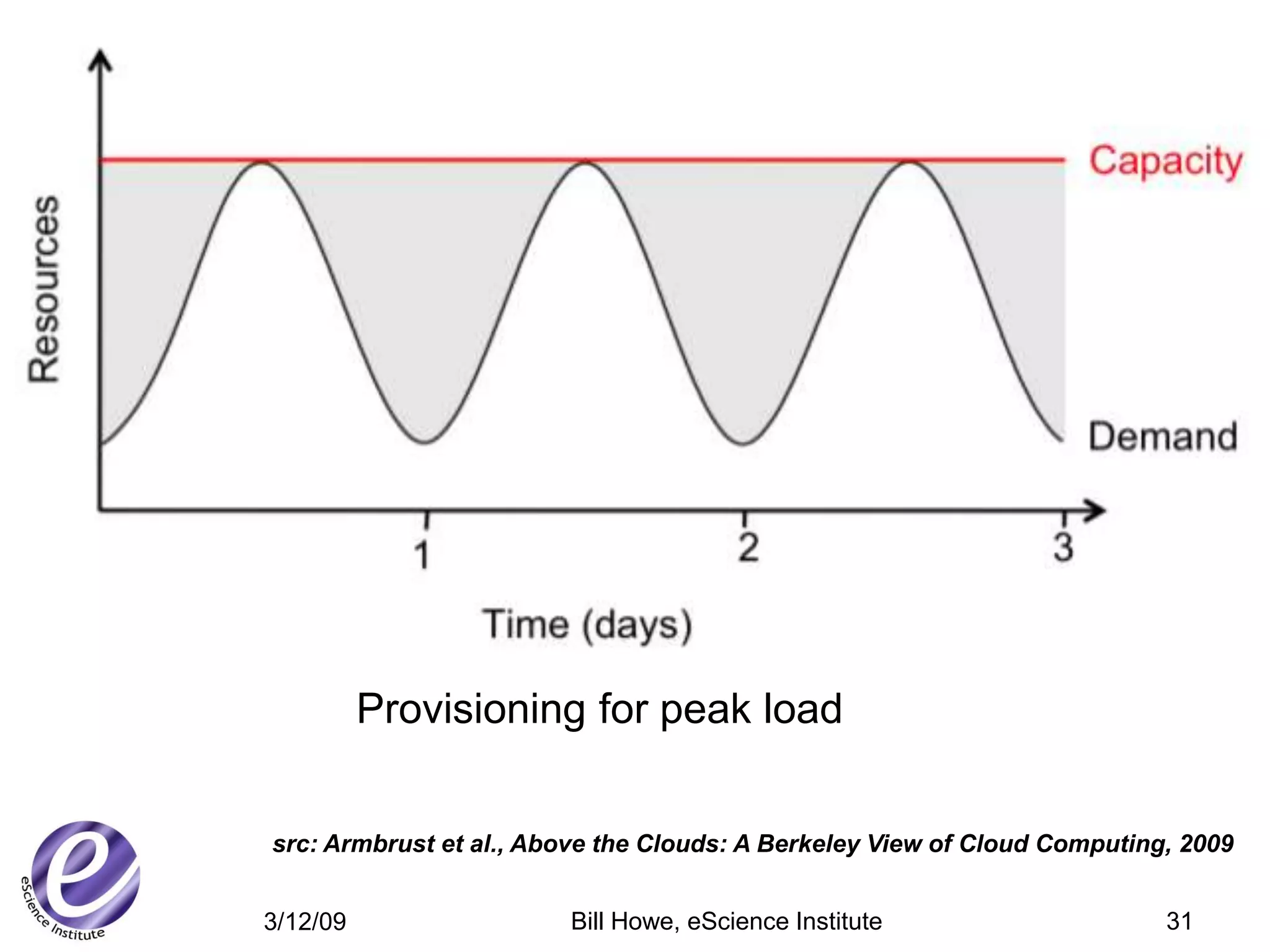
Elasticity


                Provisioning for peak load


       src: Armbrust et al., Above the Clouds: A Berkeley View of Cloud Computing, 2009


      3/12/09                  Bill Howe, eScience Institute                     31
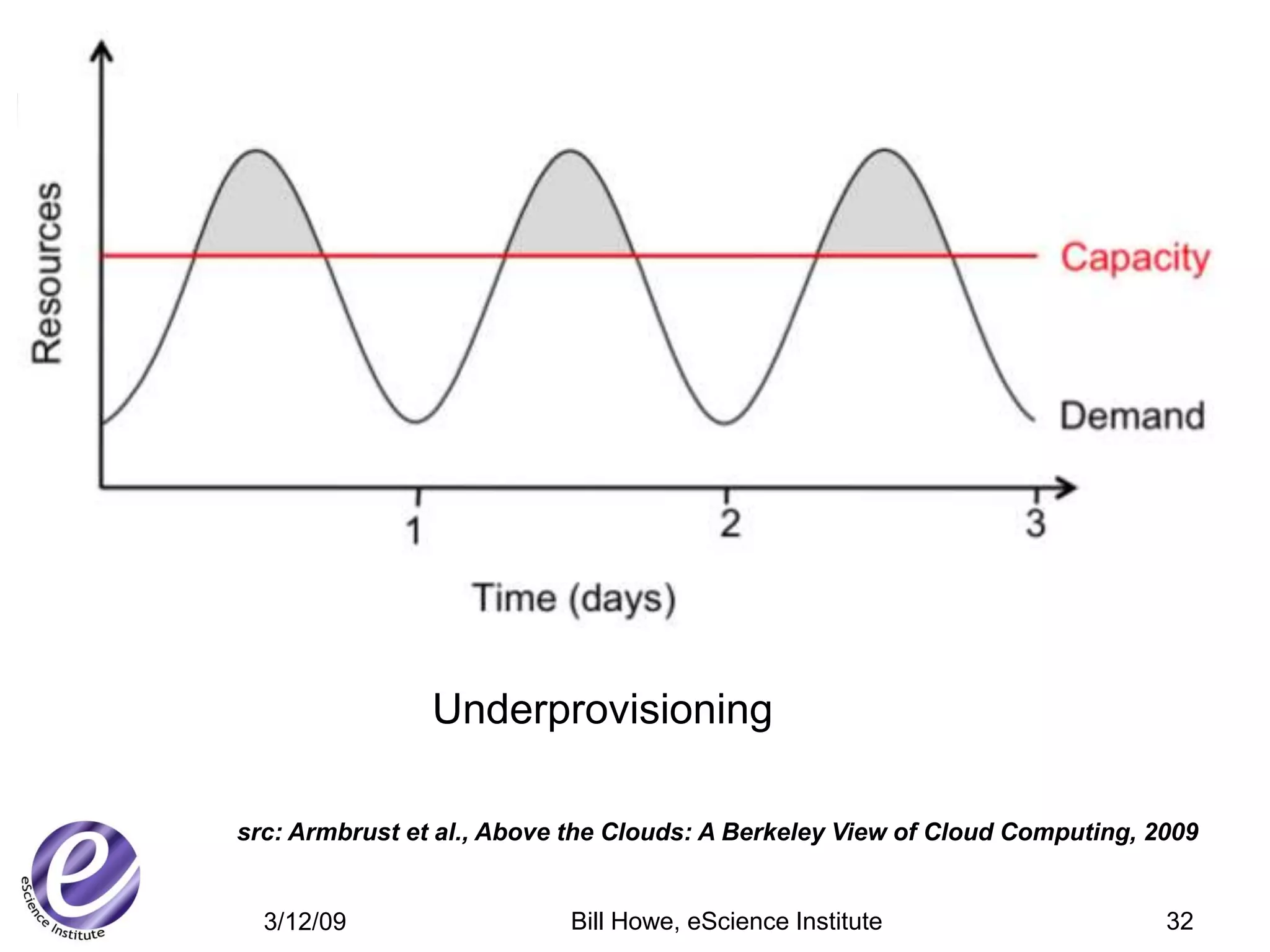
Elasticity


                     Underprovisioning

     src: Armbrust et al., Above the Clouds: A Berkeley View of Cloud Computing, 2009


       3/12/09                  Bill Howe, eScience Institute                     32
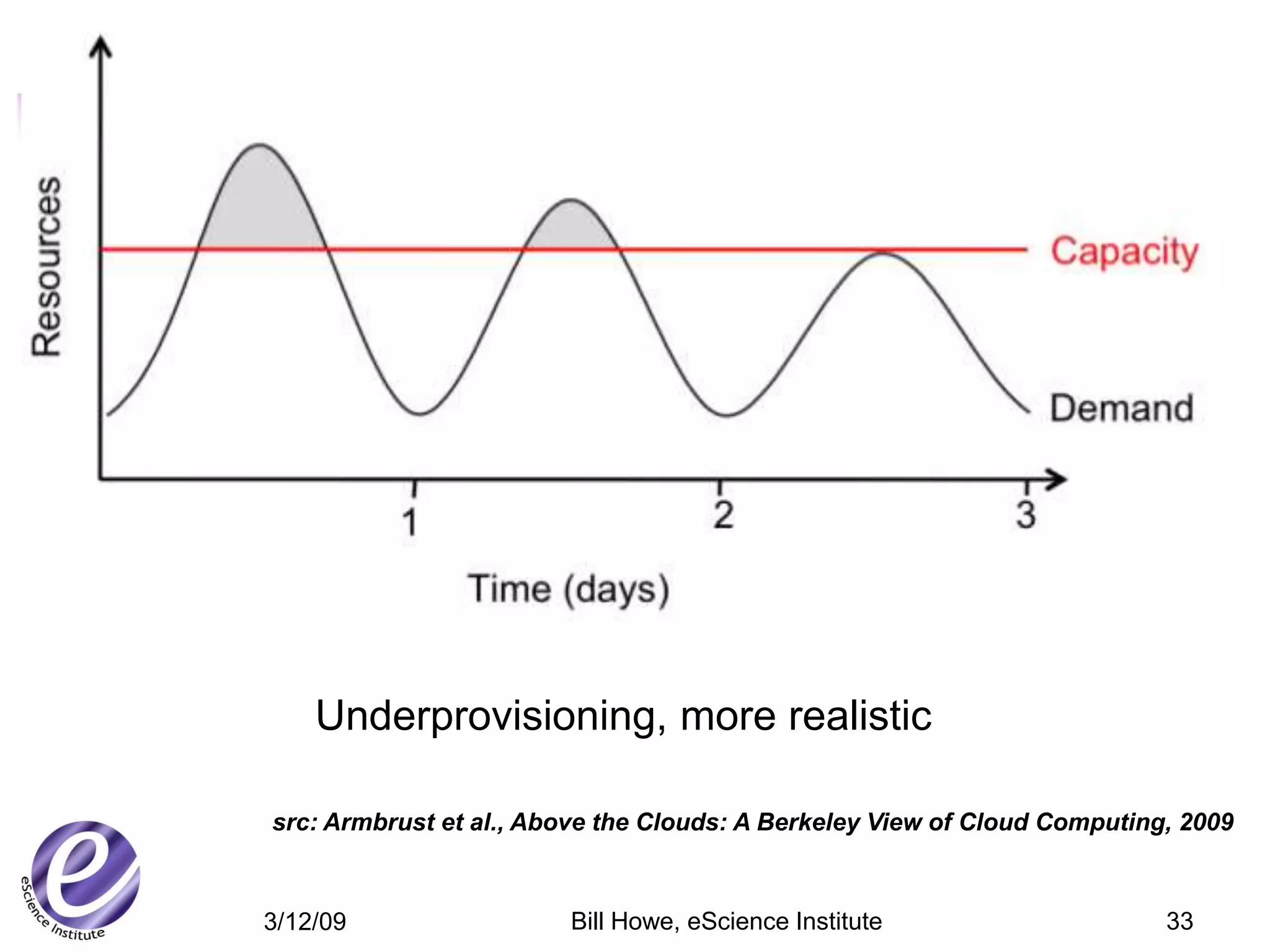
Elasticity


          Underprovisioning, more realistic

       src: Armbrust et al., Above the Clouds: A Berkeley View of Cloud Computing, 2009


      3/12/09                  Bill Howe, eScience Institute                     33
Animoto


  3/12/09                     [Werner
            Bill Howe, eScience Institute   Vogels, Amazon.com]
                                                             34
Periodic


   3/12/09                         [Deepak
             Bill Howe, eScience Institute   Singh, Amazon.com]
                                                           35
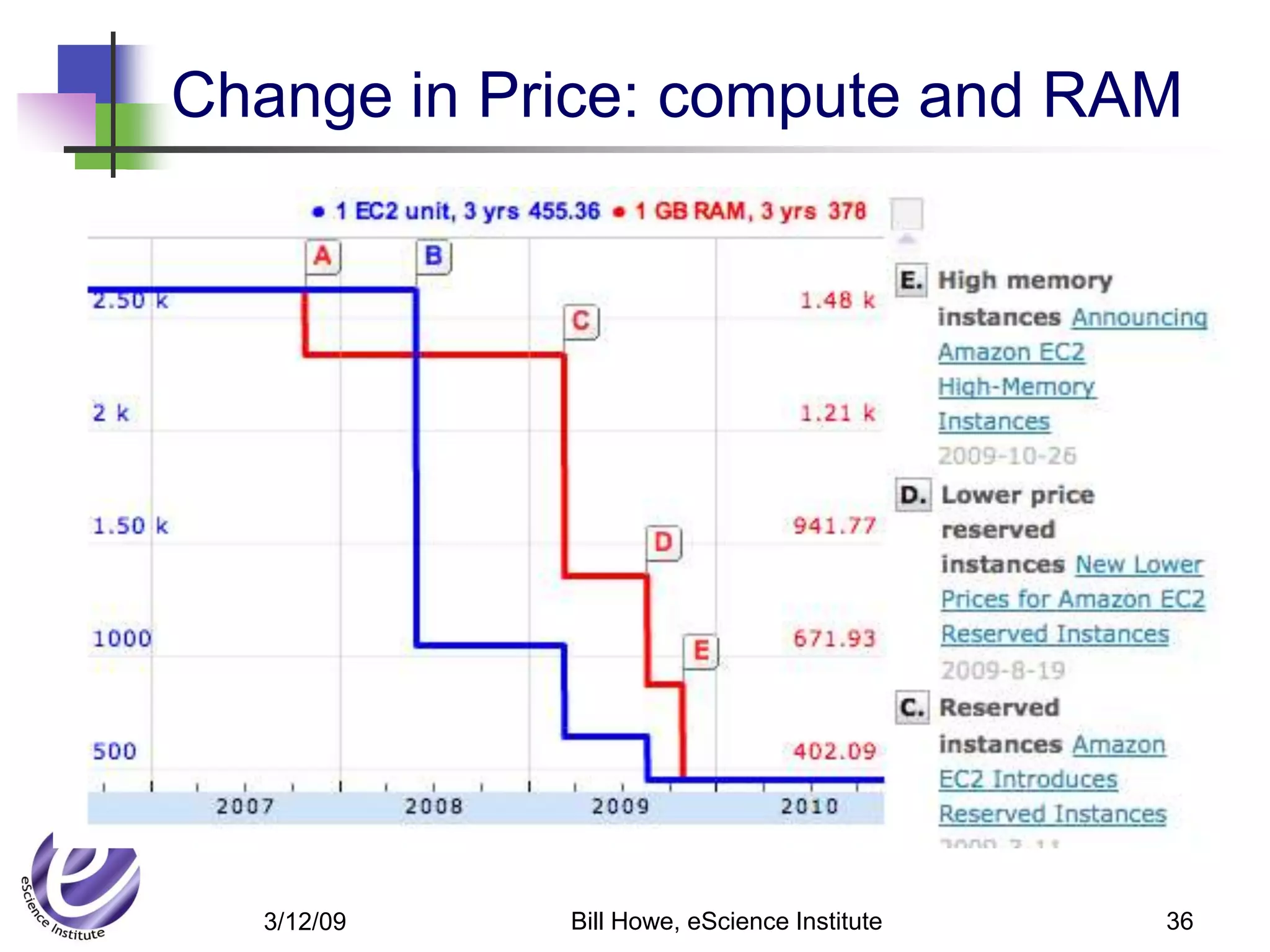
Change in Price: compute and RAM


  3/12/09   Bill Howe, eScience Institute   36
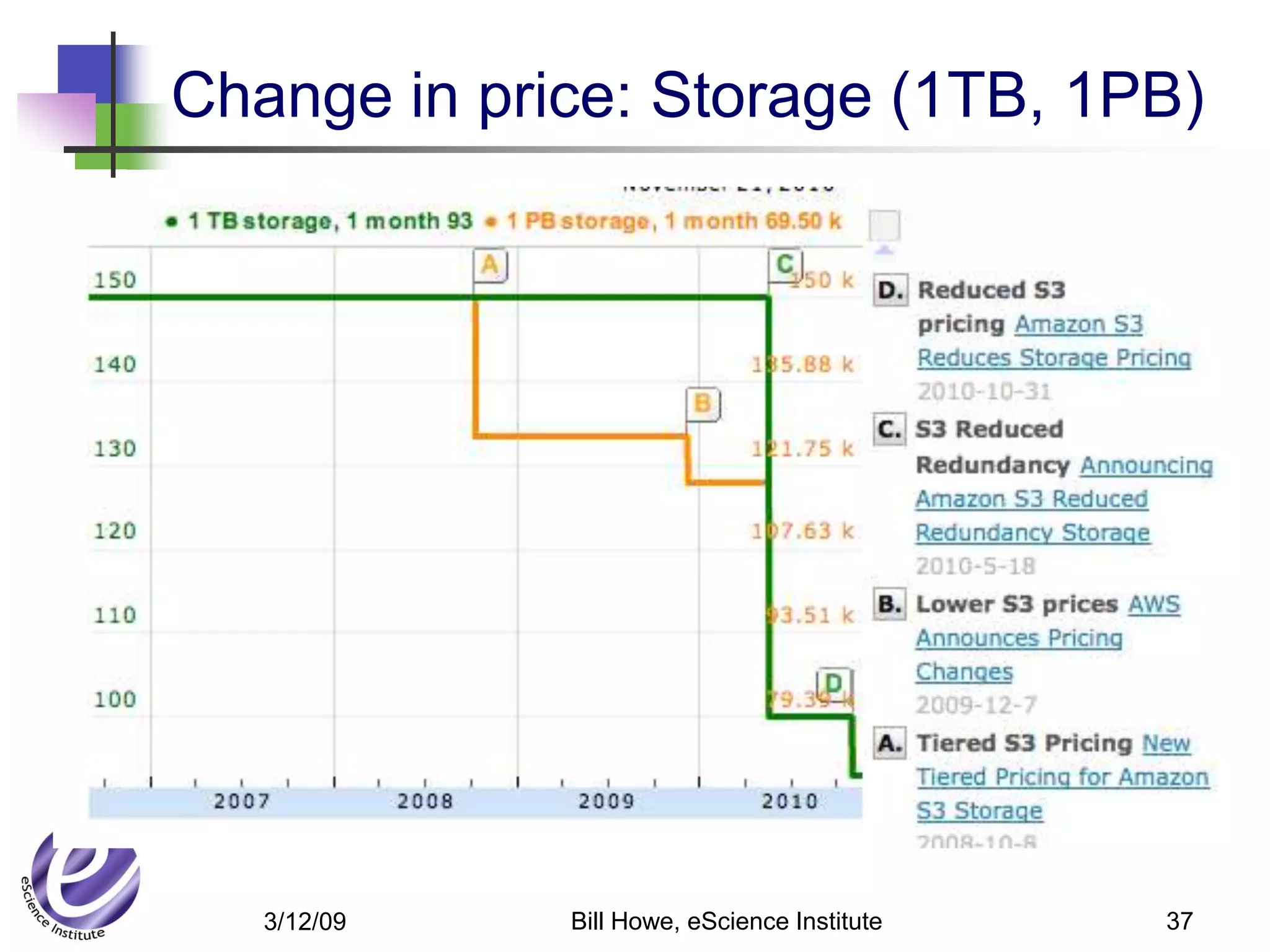
Change in price: Storage (1TB, 1PB)


   3/12/09   Bill Howe, eScience Institute   37
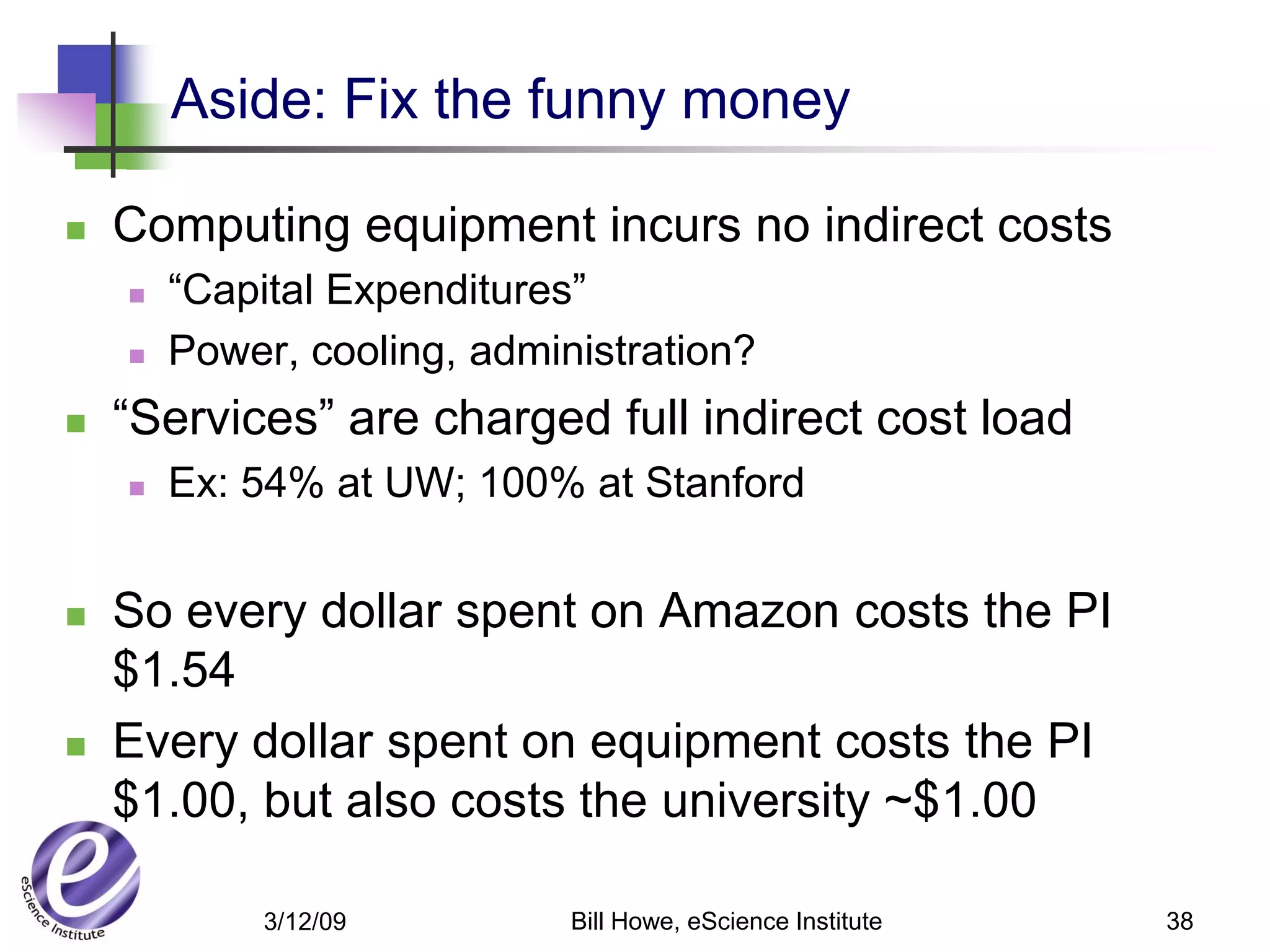
Aside: Fix the funny money

   Computing equipment incurs no indirect costs
       “Capital Expenditures”
       Power, cooling, administration?
   “Services” are charged full indirect cost load
       Ex: 54% at UW; 100% at Stanford


   So every dollar spent on Amazon costs the PI
    $1.54
   Every dollar spent on equipment costs the PI
    $1.00, but also costs the university ~$1.00

             3/12/09         Bill Howe, eScience Institute   38
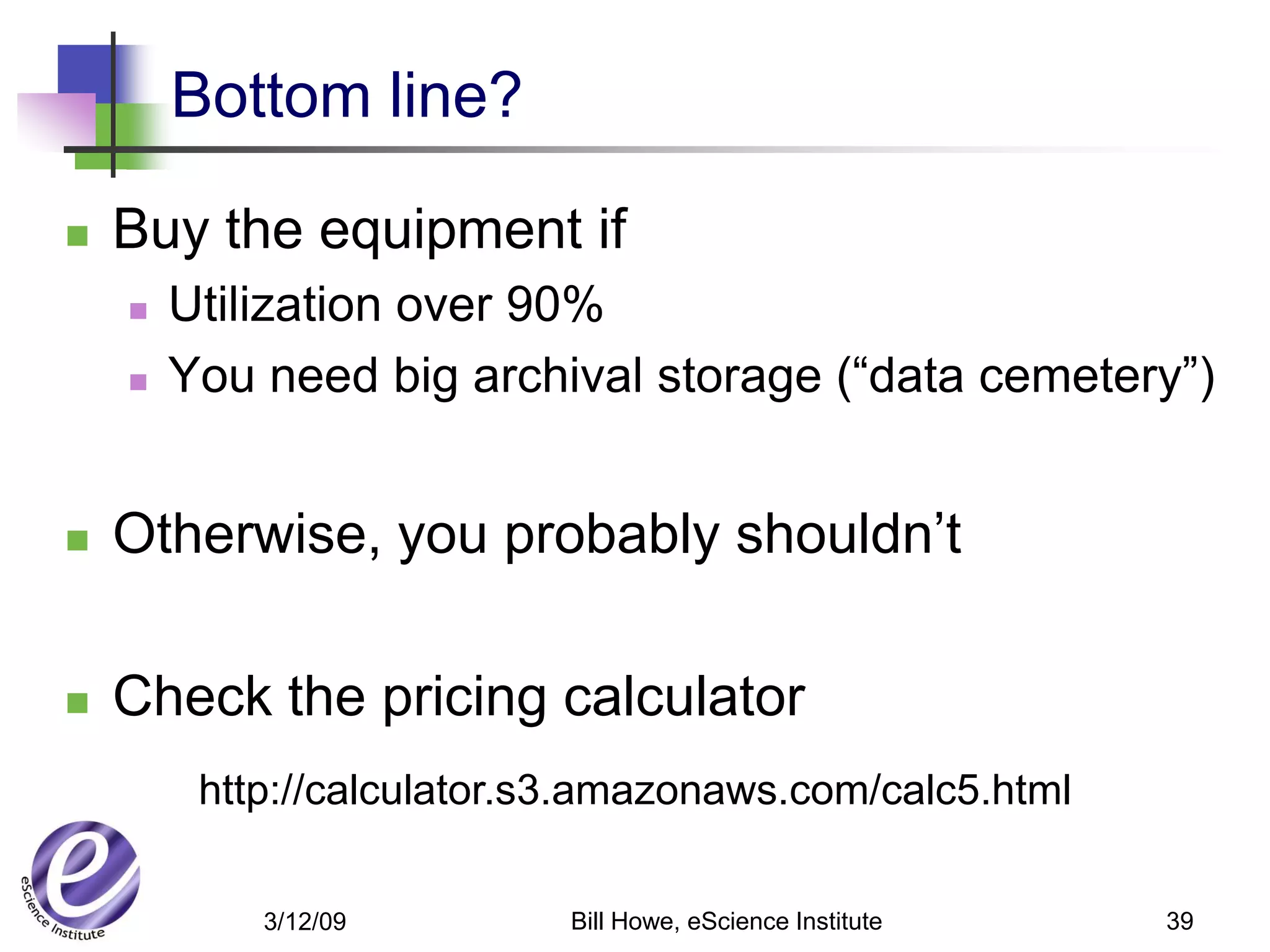
Bottom line?

   Buy the equipment if
       Utilization over 90%
       You need big archival storage (“data cemetery”)


   Otherwise, you probably shouldn’t

   Check the pricing calculator
         http://calculator.s3.amazonaws.com/calc5.html

            3/12/09         Bill Howe, eScience Institute   39
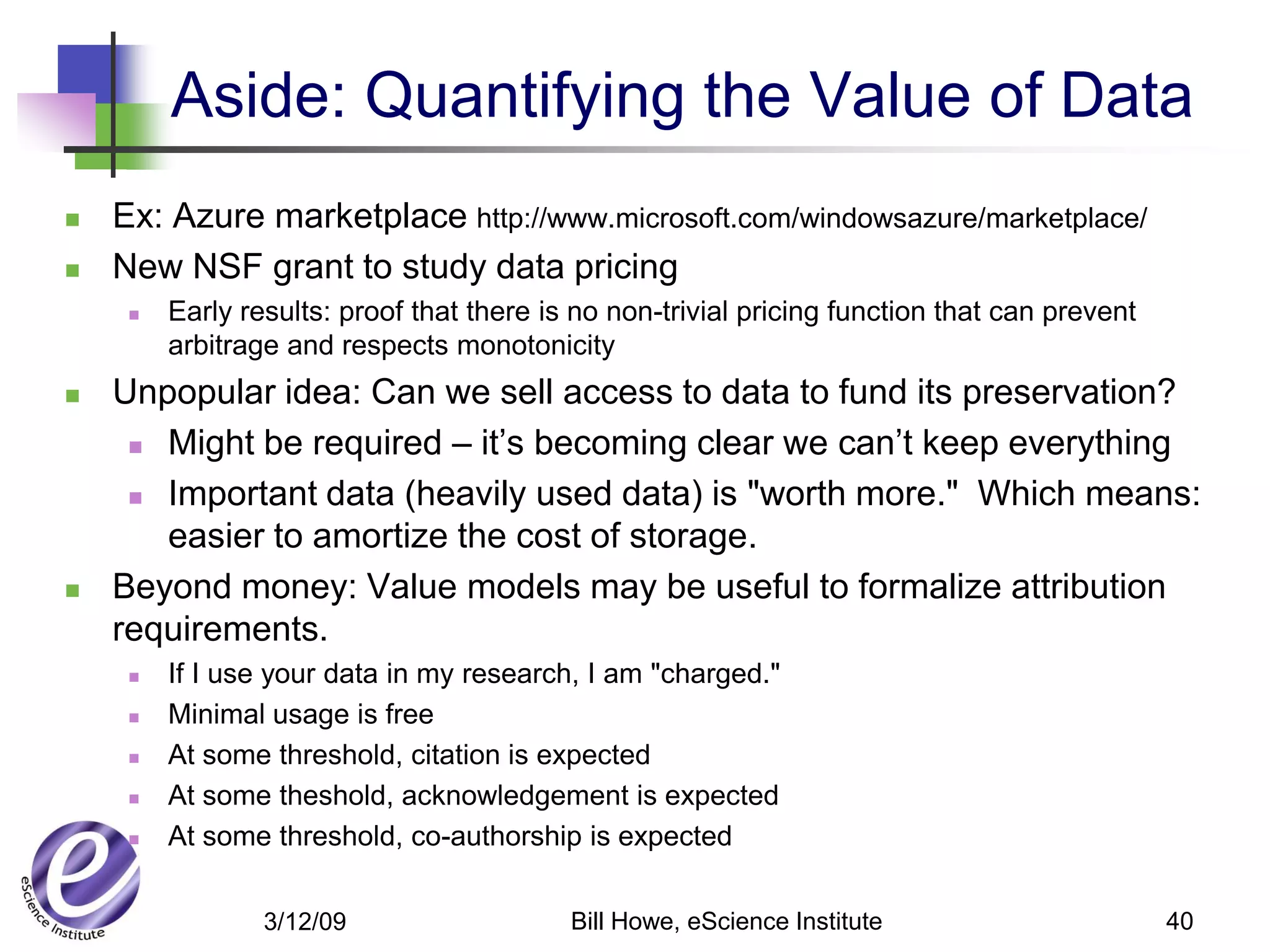
Aside: Quantifying the Value of Data
   Ex: Azure marketplace http://www.microsoft.com/windowsazure/marketplace/
   New NSF grant to study data pricing
        Early results: proof that there is no non-trivial pricing function that can prevent
         arbitrage and respects monotonicity
   Unpopular idea: Can we sell access to data to fund its preservation?
      Might be required – it’s becoming clear we can’t keep everything

      Important data (heavily used data) is "worth more." Which means:

       easier to amortize the cost of storage.
   Beyond money: Value models may be useful to formalize attribution
    requirements.
        If I use your data in my research, I am "charged."
        Minimal usage is free
        At some threshold, citation is expected
        At some theshold, acknowledgement is expected
        At some threshold, co-authorship is expected


                 3/12/09                   Bill Howe, eScience Institute                       40
DATA-INTENSIVE EXPERIMENTS


   3/12/09   Bill Howe, eScience Institute   41
An Observation on Big Data
   The days of FTP are over
       It takes days to transfer 1TB over the Internet, and it
        isn’t likely to succeed.
       Copying a petabyte is operationally impossible
   The only solution: Push the computation to the
    data, rather than push the data to the computation
       Upload your code rather than download the data


             3/12/09          Bill Howe, eScience Institute       42
Another Observation

   RR tends to emphasize computation rather
    than data
   Re-executing “canned” experiments is not
    enough
   Need to support ad hoc, exploratory
    Q&A, which means:
   Queries, not programs
   Databases, not files

         3/12/09     Bill Howe, eScience Institute   43
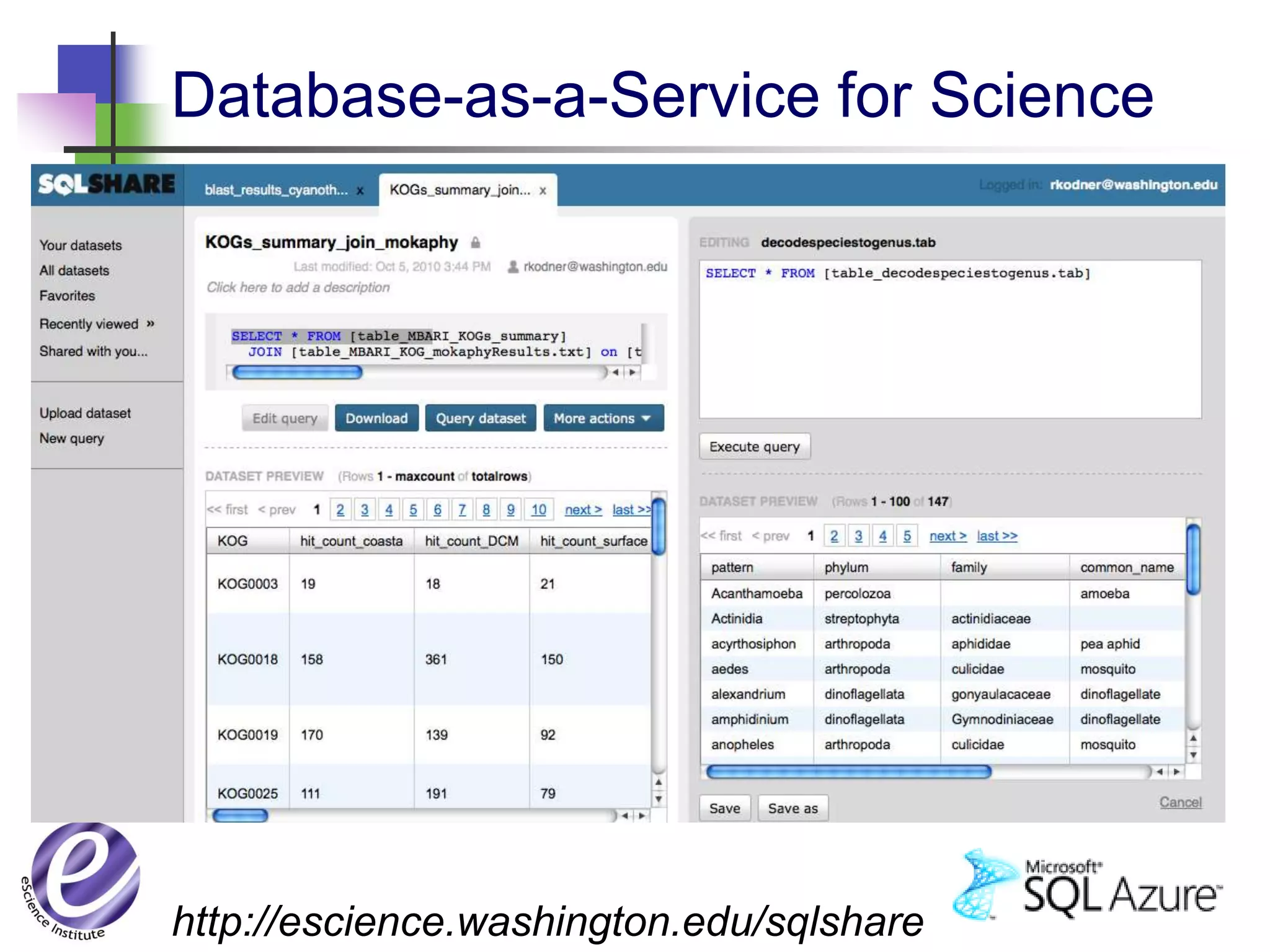
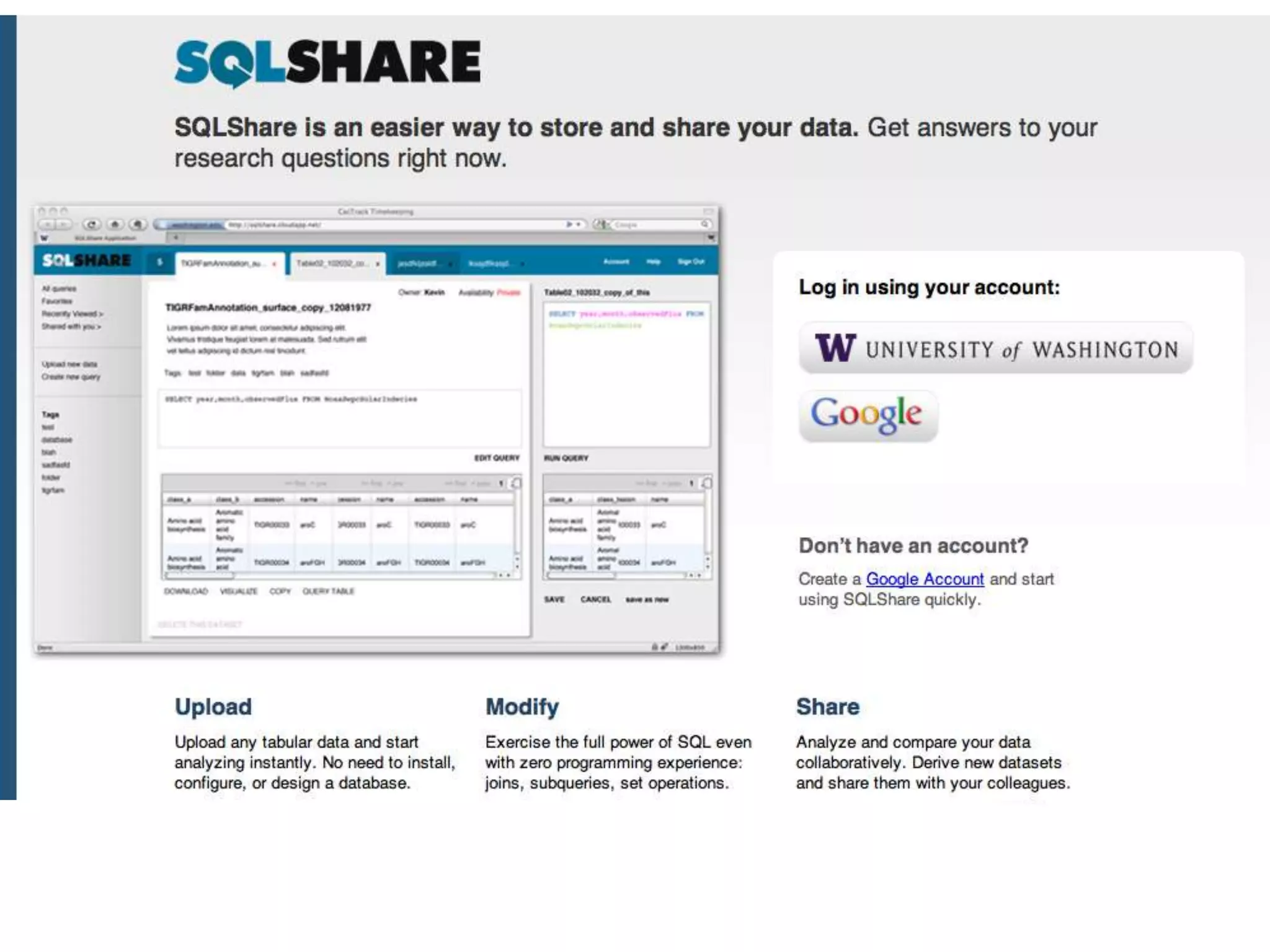
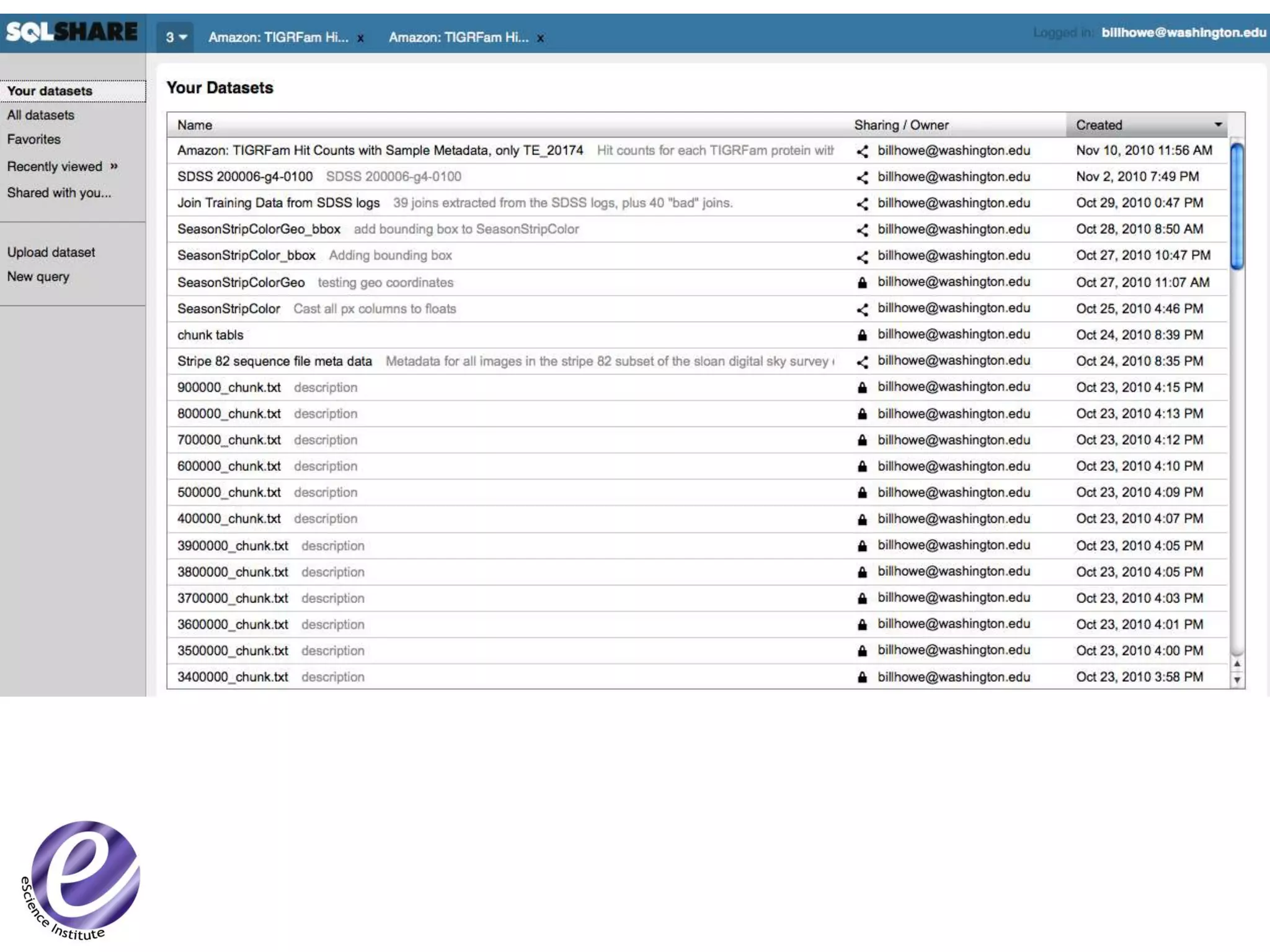
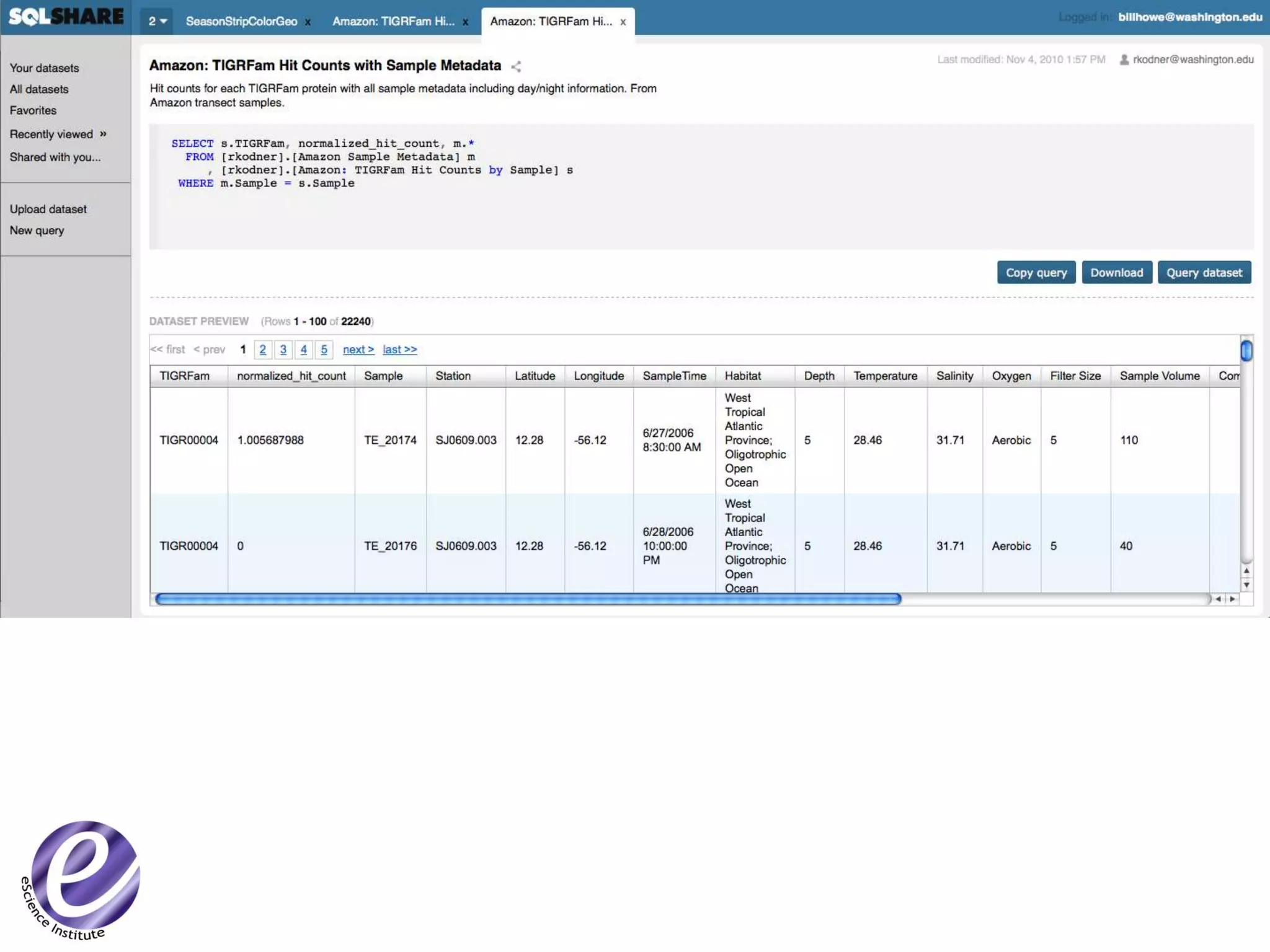
Database-as-a-Service for Science


http://escience.washington.edu/sqlshare
Demo
Why SQL?

   Find all TIGRFam ids (proteins) that are missing from at
    least one of three samples (relations)
          SELECT col0 FROM [refseq_hma_fasta_TGIRfam_refs]
          UNION
          SELECT col0 FROM [est_hma_fasta_TGIRfam_refs]
          UNION
          SELECT col0 FROM [combo_hma_fasta_TGIRfam_refs]

          EXCEPT

          SELECT col0 FROM [refseq_hma_fasta_TGIRfam_refs]
          INTERSECT
          SELECT col0 FROM [est_hma_fasta_TGIRfam_refs]
          INTERSECT
          SELECT col0 FROM [combo_hma_fasta_TGIRfam_refs]
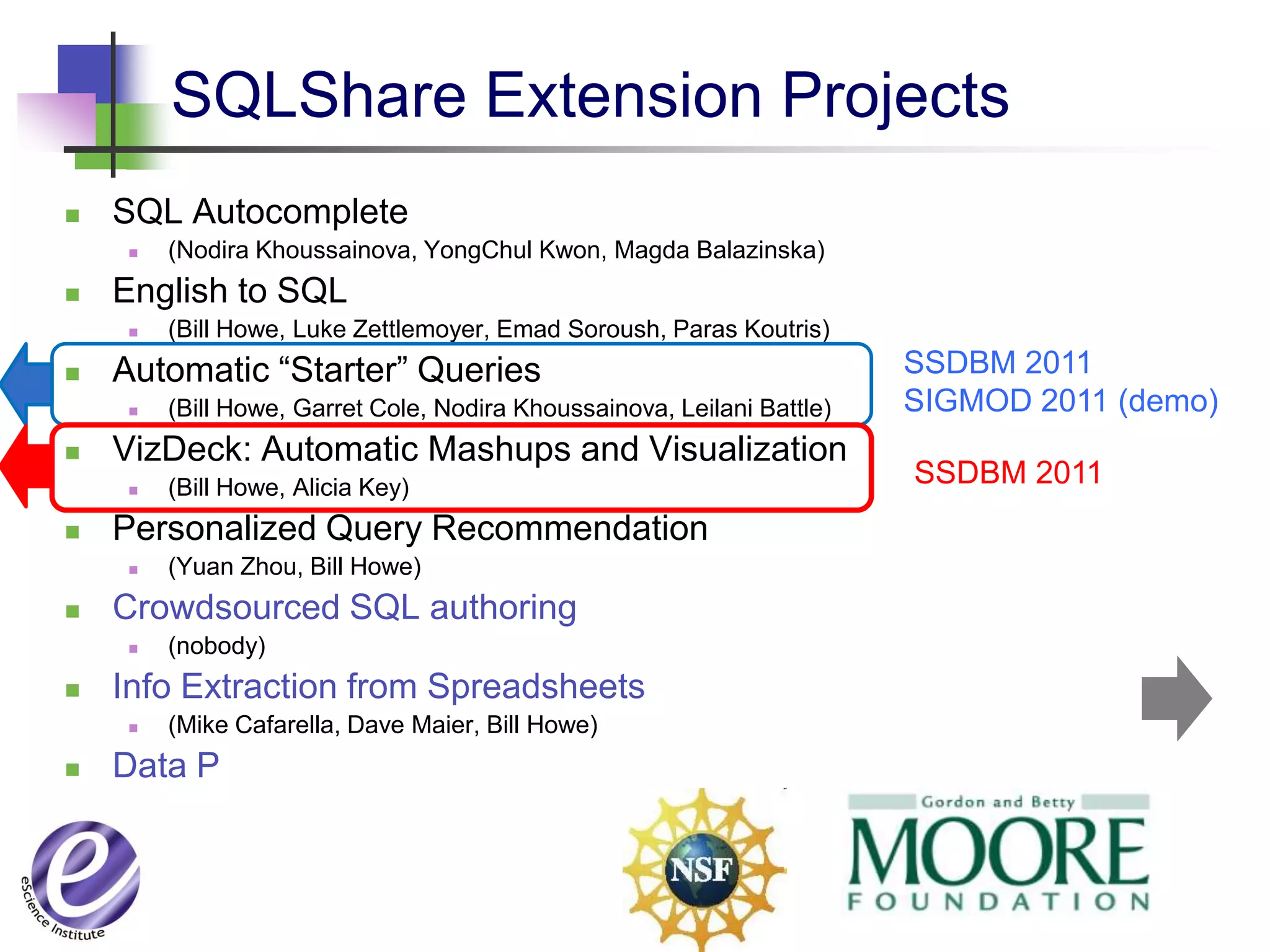
SQLShare Extension Projects
   SQL Autocomplete
       (Nodira Khoussainova, YongChul Kwon, Magda Balazinska)
   English to SQL
       (Bill Howe, Luke Zettlemoyer, Emad Soroush, Paras Koutris)
   Automatic “Starter” Queries                                         SSDBM 2011
       (Bill Howe, Garret Cole, Nodira Khoussainova, Leilani Battle)   SIGMOD 2011 (demo)
   VizDeck: Automatic Mashups and Visualization
       (Bill Howe, Alicia Key)                                         SSDBM 2011
   Personalized Query Recommendation
       (Yuan Zhou, Bill Howe)
   Crowdsourced SQL authoring
       (nobody)
   Info Extraction from Spreadsheets
       (Mike Cafarella, Dave Maier, Bill Howe)
   Data P
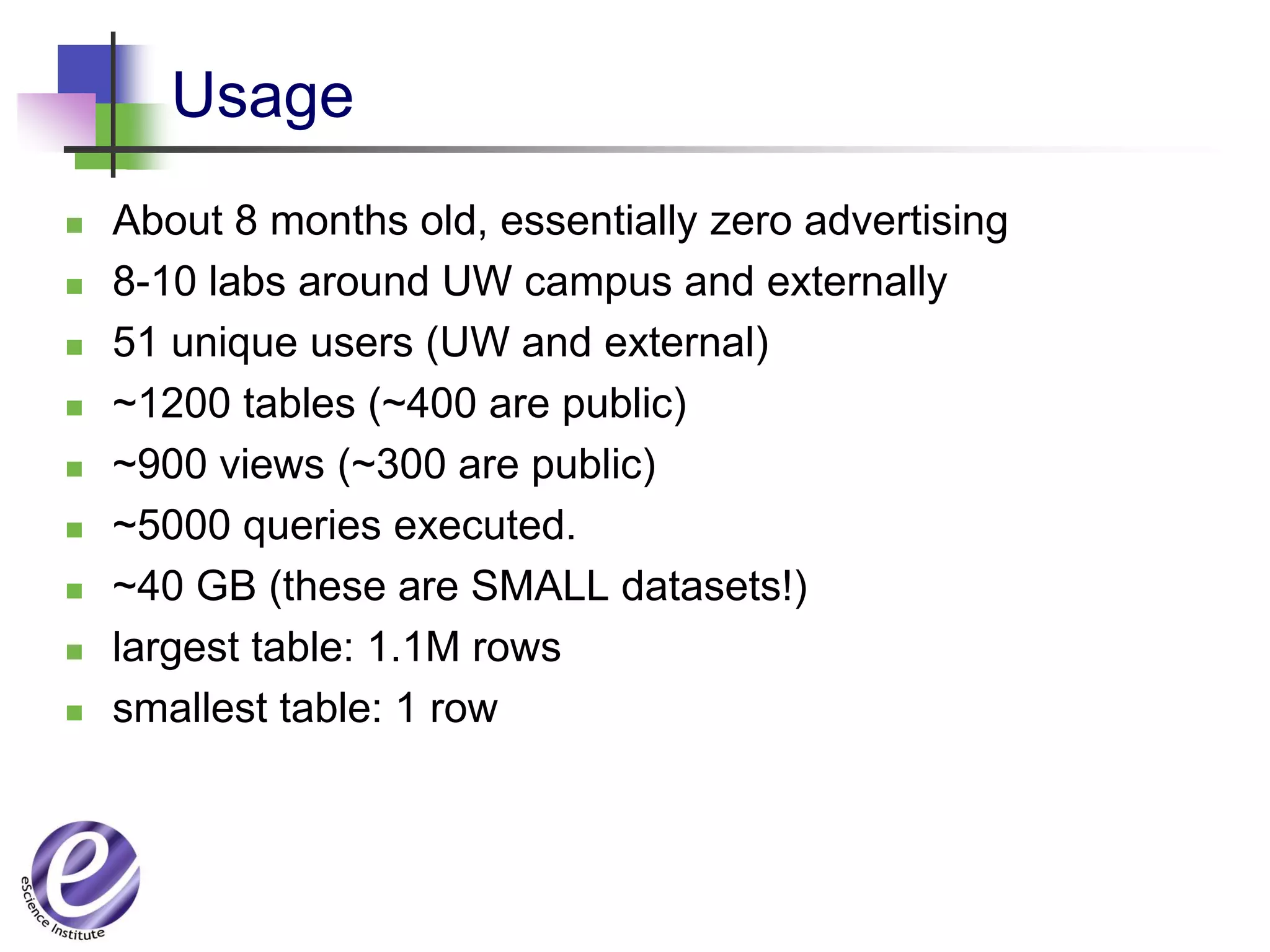
Usage
   About 8 months old, essentially zero advertising
   8-10 labs around UW campus and externally
   51 unique users (UW and external)
   ~1200 tables (~400 are public)
   ~900 views (~300 are public)
   ~5000 queries executed.
   ~40 GB (these are SMALL datasets!)
   largest table: 1.1M rows
   smallest table: 1 row
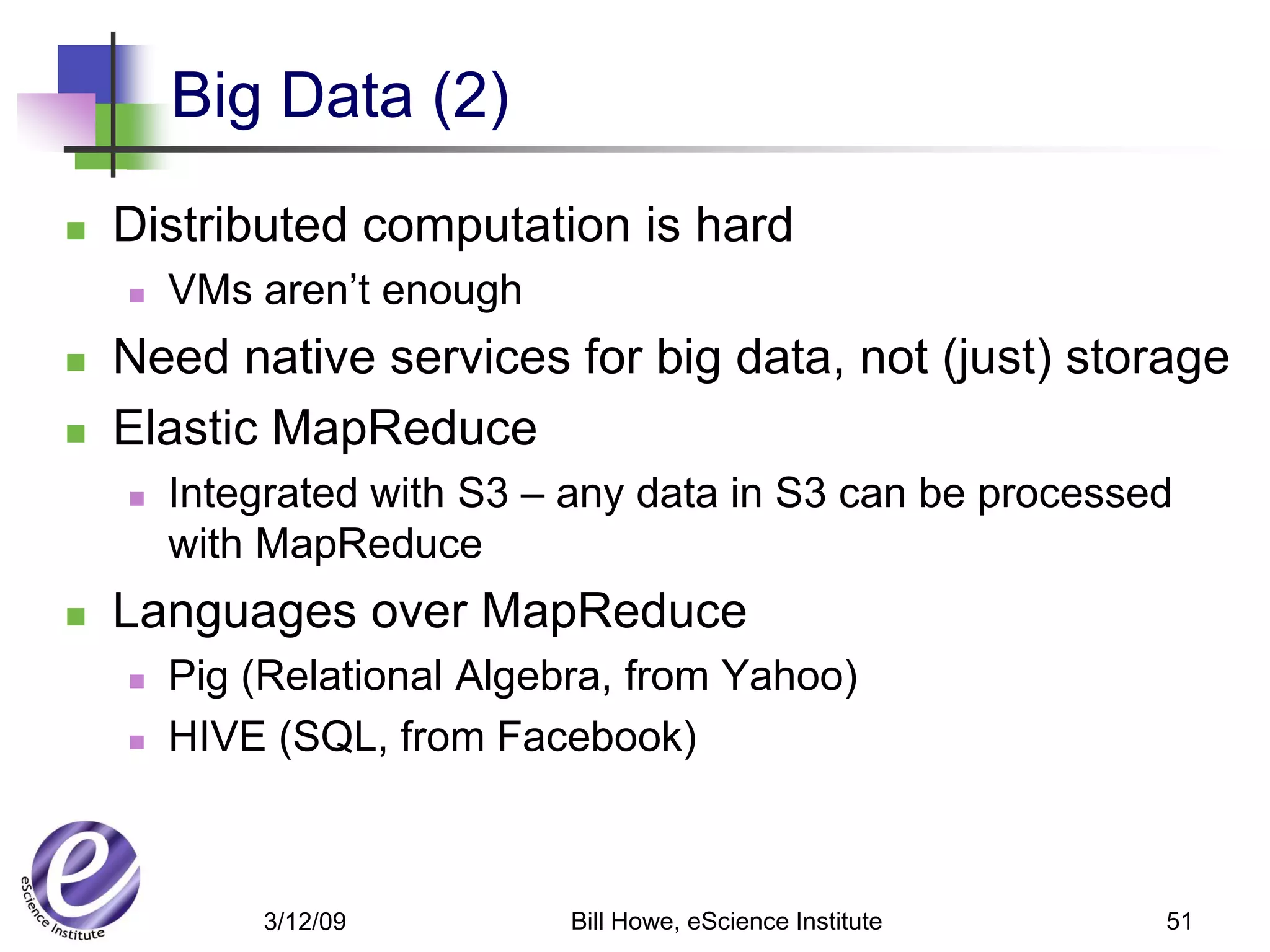
Big Data (2)
   Distributed computation is hard
       VMs aren’t enough
   Need native services for big data, not (just) storage
   Elastic MapReduce
       Integrated with S3 – any data in S3 can be processed
        with MapReduce
   Languages over MapReduce
       Pig (Relational Algebra, from Yahoo)
       HIVE (SQL, from Facebook)


            3/12/09          Bill Howe, eScience Institute   51
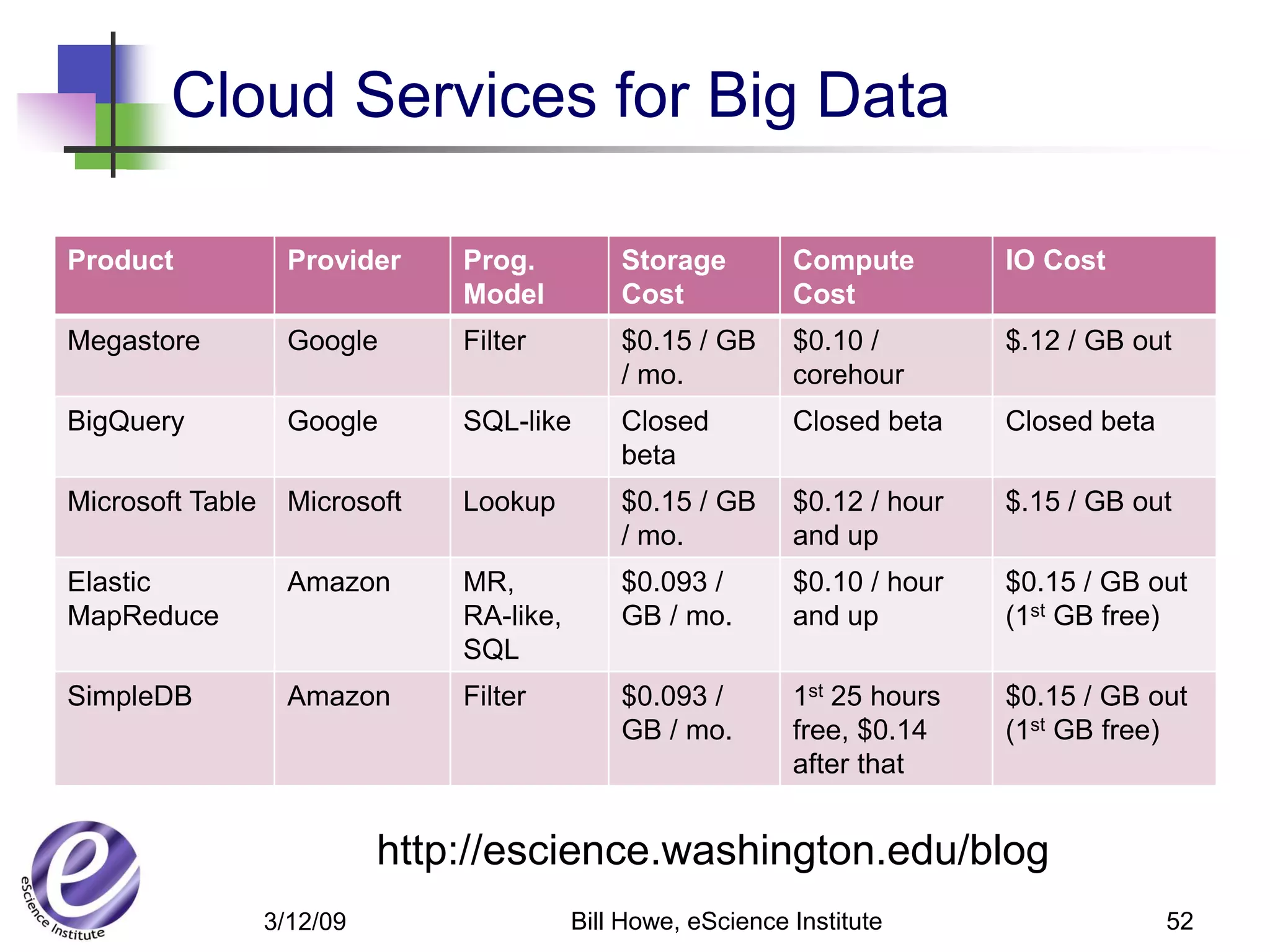
Cloud Services for Big Data

Product            Provider     Prog.          Storage         Compute        IO Cost
                                Model          Cost            Cost
Megastore          Google       Filter         $0.15 / GB      $0.10 /        $.12 / GB out
                                               / mo.           corehour
BigQuery           Google       SQL-like       Closed          Closed beta    Closed beta
                                               beta
Microsoft Table    Microsoft    Lookup         $0.15 / GB      $0.12 / hour   $.15 / GB out
                                               / mo.           and up
Elastic            Amazon       MR,            $0.093 /        $0.10 / hour   $0.15 / GB out
MapReduce                       RA-like,       GB / mo.        and up         (1st GB free)
                                SQL
SimpleDB           Amazon       Filter         $0.093 /        1st 25 hours   $0.15 / GB out
                                               GB / mo.        free, $0.14    (1st GB free)
                                                               after that


                            http://escience.washington.edu/blog
                  3/12/09                  Bill Howe, eScience Institute                    52
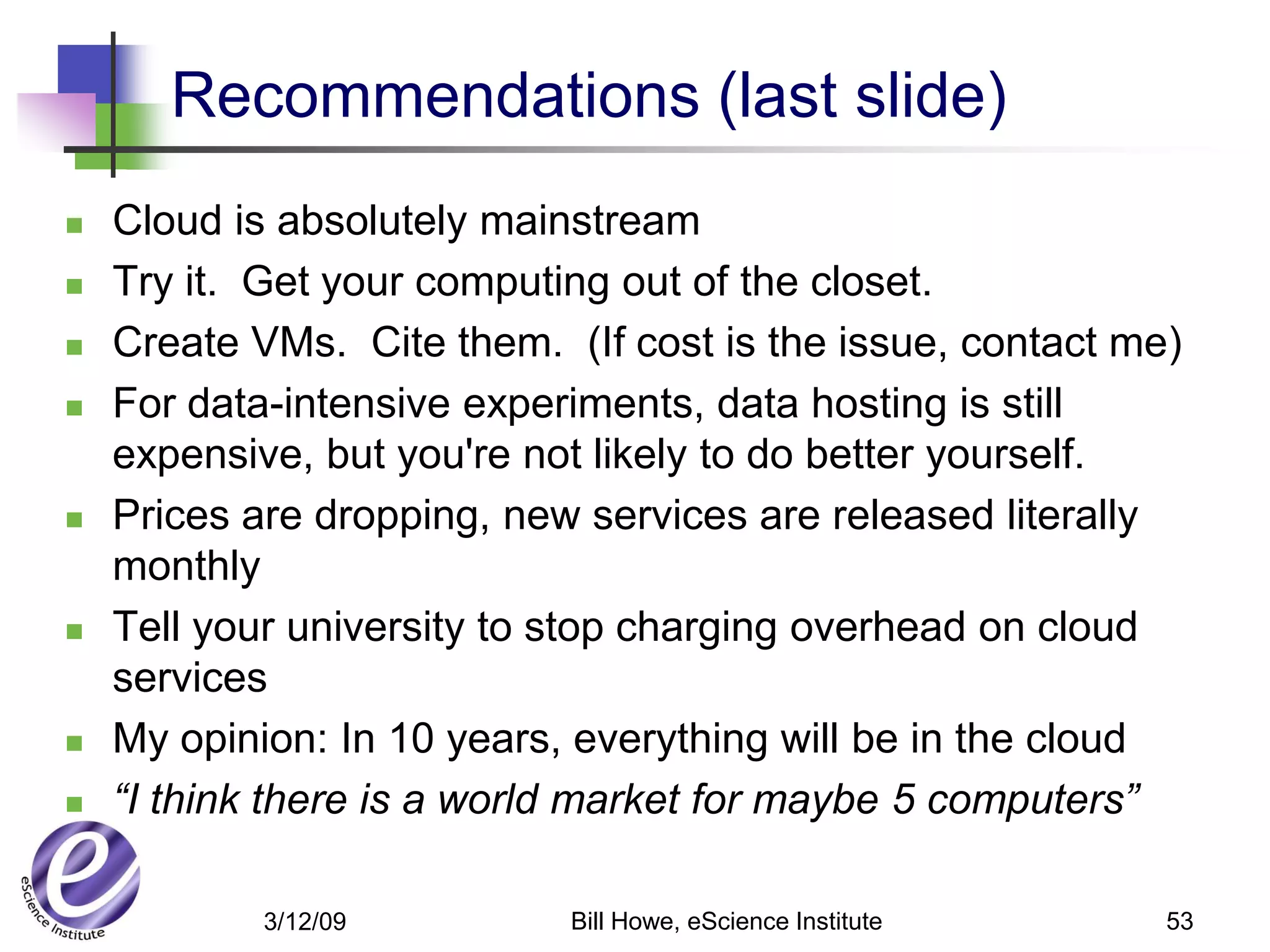
Recommendations (last slide)
   Cloud is absolutely mainstream
   Try it. Get your computing out of the closet.
   Create VMs. Cite them. (If cost is the issue, contact me)
   For data-intensive experiments, data hosting is still
    expensive, but you're not likely to do better yourself.
   Prices are dropping, new services are released literally
    monthly
   Tell your university to stop charging overhead on cloud
    services
   My opinion: In 10 years, everything will be in the cloud
   “I think there is a world market for maybe 5 computers”

            3/12/09         Bill Howe, eScience Institute   53
3/12/09   Bill Howe, eScience Institute   54
Data-Intensive Scalable Science:
Beyond MapReduce

 Bill Howe, UW


  …plus a bunch of people


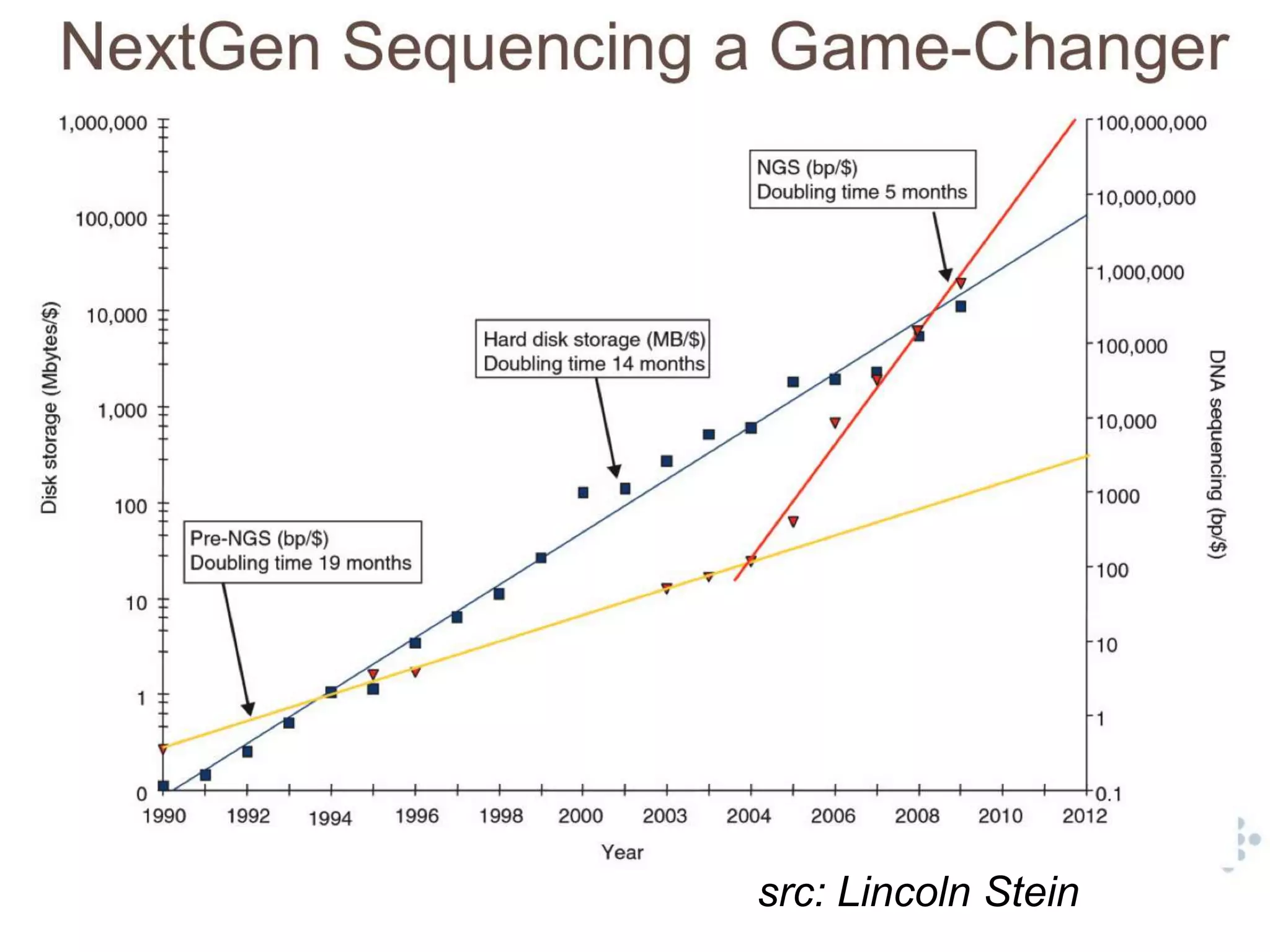
                            src: Lincoln Stein
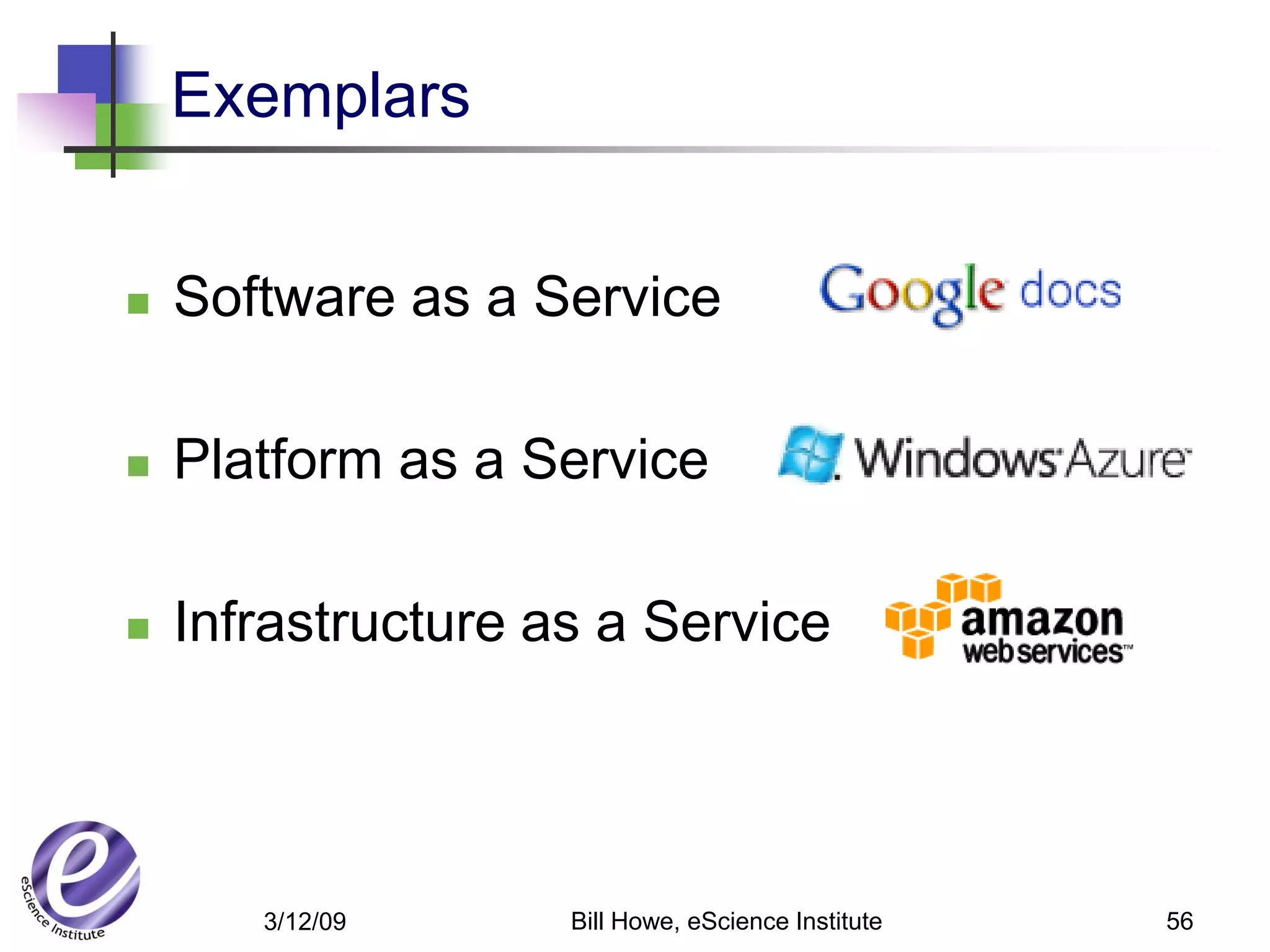
Exemplars


   Software as a Service

   Platform as a Service

   Infrastructure as a Service


       3/12/09      Bill Howe, eScience Institute   56
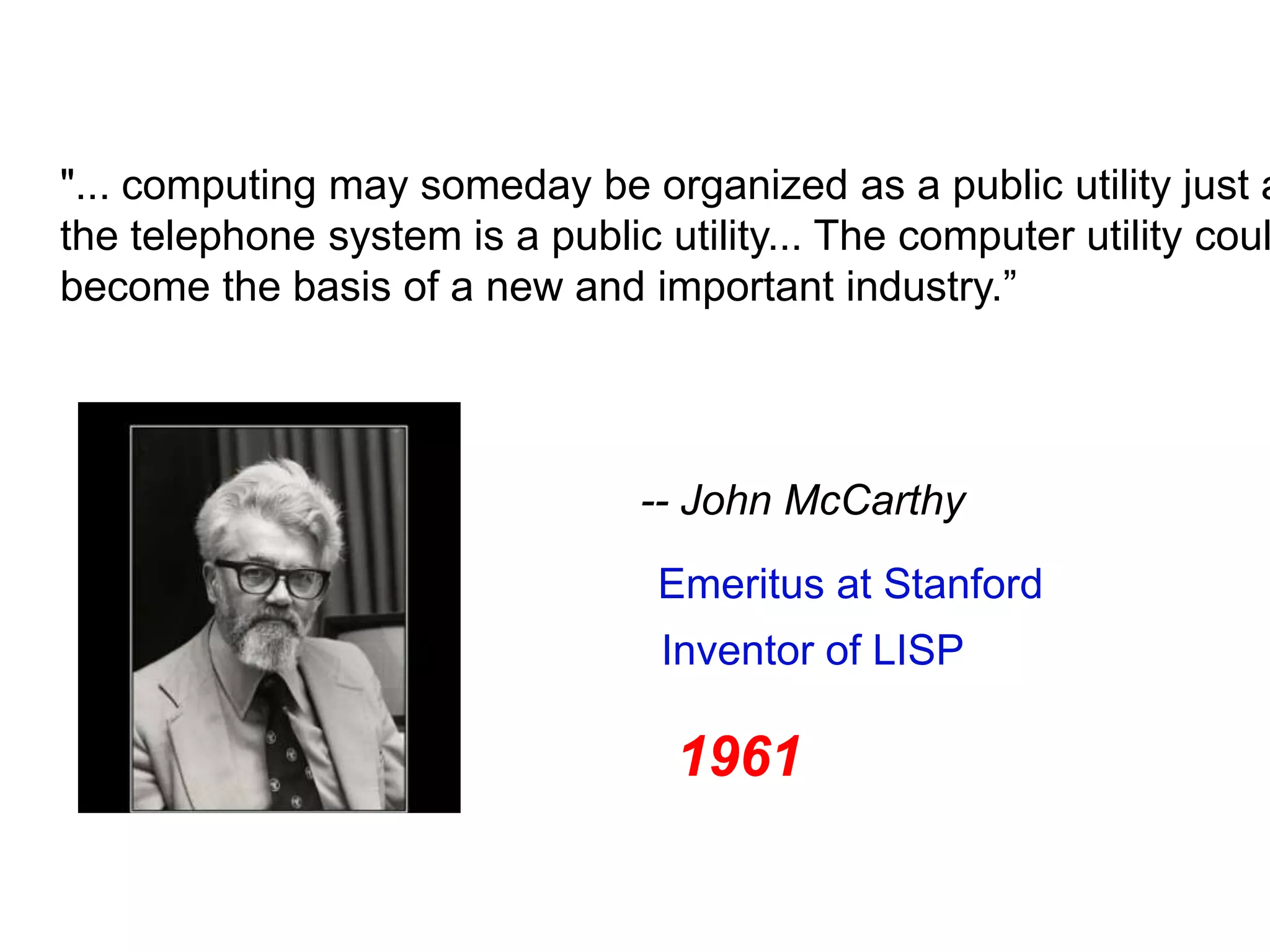
"... computing may someday be organized as a public utility just a
the telephone system is a public utility... The computer utility coul
become the basis of a new and important industry.”


                                  -- John McCarthy
                                    Emeritus at Stanford
                                    Inventor of LISP

                                     1961

           3/12/09          Bill Howe, eScience Institute     57
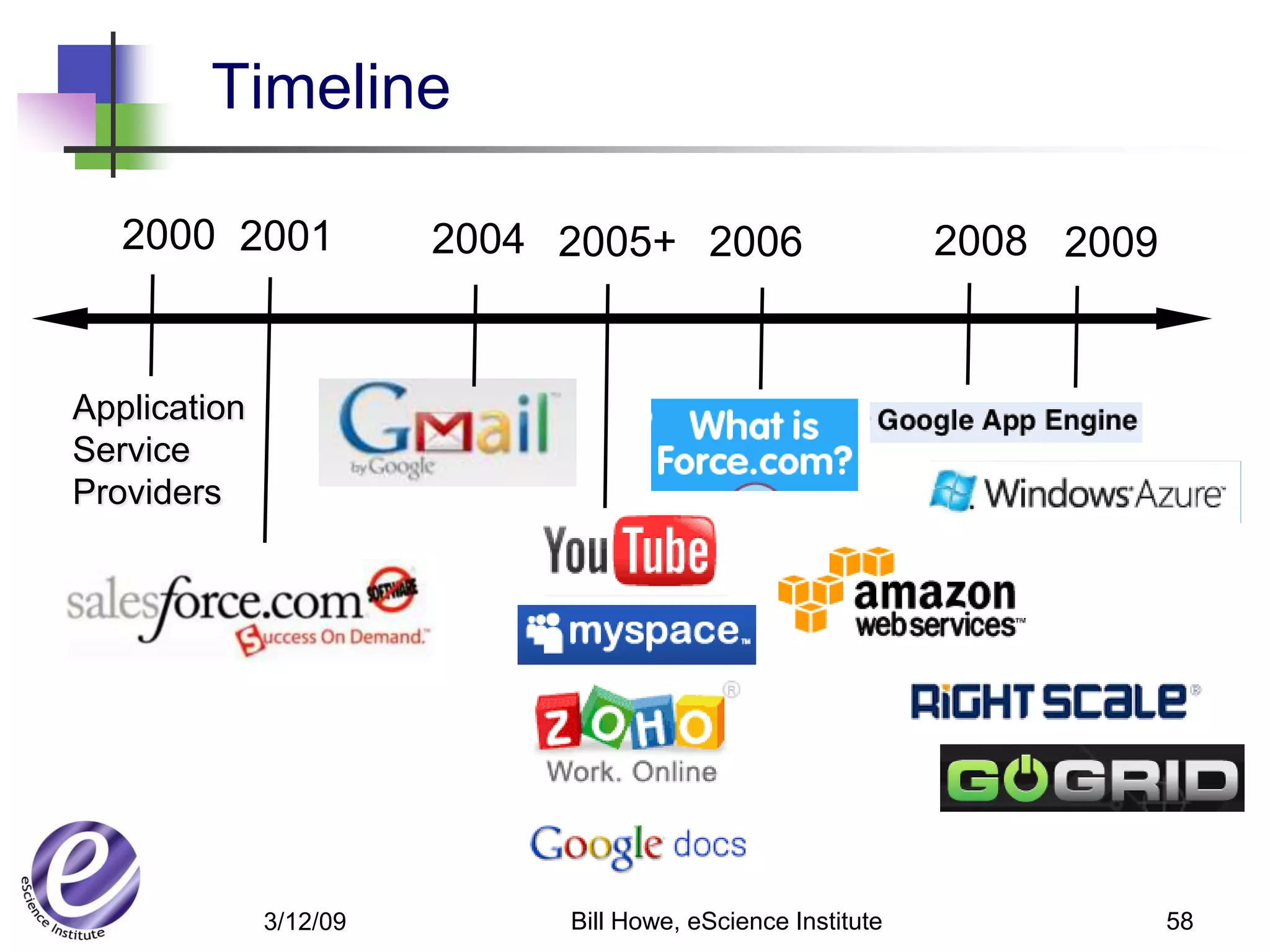
Timeline

   2000 2001            2004 2005+ 2006                      2008 2009


Application
Service
Providers


              3/12/09        Bill Howe, eScience Institute               58
Amazon


  3/12/09                          [Werner
            Bill Howe, eScience Institute    Vogels, Amazon.com]
                                                          59
3/12/09                          [Werner
          Bill Howe, eScience Institute    Vogels, Amazon.com]
                                                        60
The University of Washington
           eScience Institute
   Rationale
        The exponential increase in physical and virtual sensing tech is transitioning all
         fields of science and engineering from data-poor to data-rich
        Techniques and technologies include
             Sensors and sensor networks, data management, data mining, machine

               learning, visualization, cluster/cloud computing
        If these techniques and technologies are not widely available and widely practiced,
         UW will cease to be competitive
   Mission
        Help position the University of Washington and partners at the forefront of
         research both in modern eScience techniques and technologies, and in the fields
         that depend upon them.
   Strategy
        Bootstrap a cadre of Research Scientists
        Add faculty in key fields
        Build out a “consultancy” of students and non-research staff
   Funding
        $650/year direct appropriation from WA State Legislature
        augmented with soft money from NSF, DOE, Gordon and Betty Moore Foundation


               3/12/09                 Bill Howe, eScience Institute                   61
eScience Data Management Group
**Bill Howe, Phd (databases, visualization, data-intensive scalable computing, cloud)


Staff and Post Docs
         Keith Grochow (Visualization, HCI, GIS)
         **Garret Cole (cloud computing (Azure, EC2), databases, web services)
         Marianne Shaw, Phd (health informatics, semantic web, RDF, graph databases)
         Alicia Key (visualization, user-centered design, web applications)
Students
         Nodira Khoussainova (4th yr Phd), databases, machine learning
         Leilani Battle (undergrad), databases, performance evaluation
         Yuan Zhou (masters, Applied Math), machine learning, ranking, recommender systems
         YongChul Kwon (4th yr Phd), databases, DISC, scientific applications
         Meg Whitman (undergrad)
Partners
         **UW Learning and Scholarly Technologies (web applications, QA/support, release mgmt)
         **Cecilia Aragon, Phd, Associate Professor, HCDE (visualization, scientific applications)
         Magda Balazinska, Phd, Assistant Professor, CSE (databases, cloud, DISC)
         Dan Suciu, Phd, Professor, CSE, (probabilistic databases, theory, languages)

                             ** funded in part by eScience core budget
                   3/12/09                      Bill Howe, eScience Institute                         62
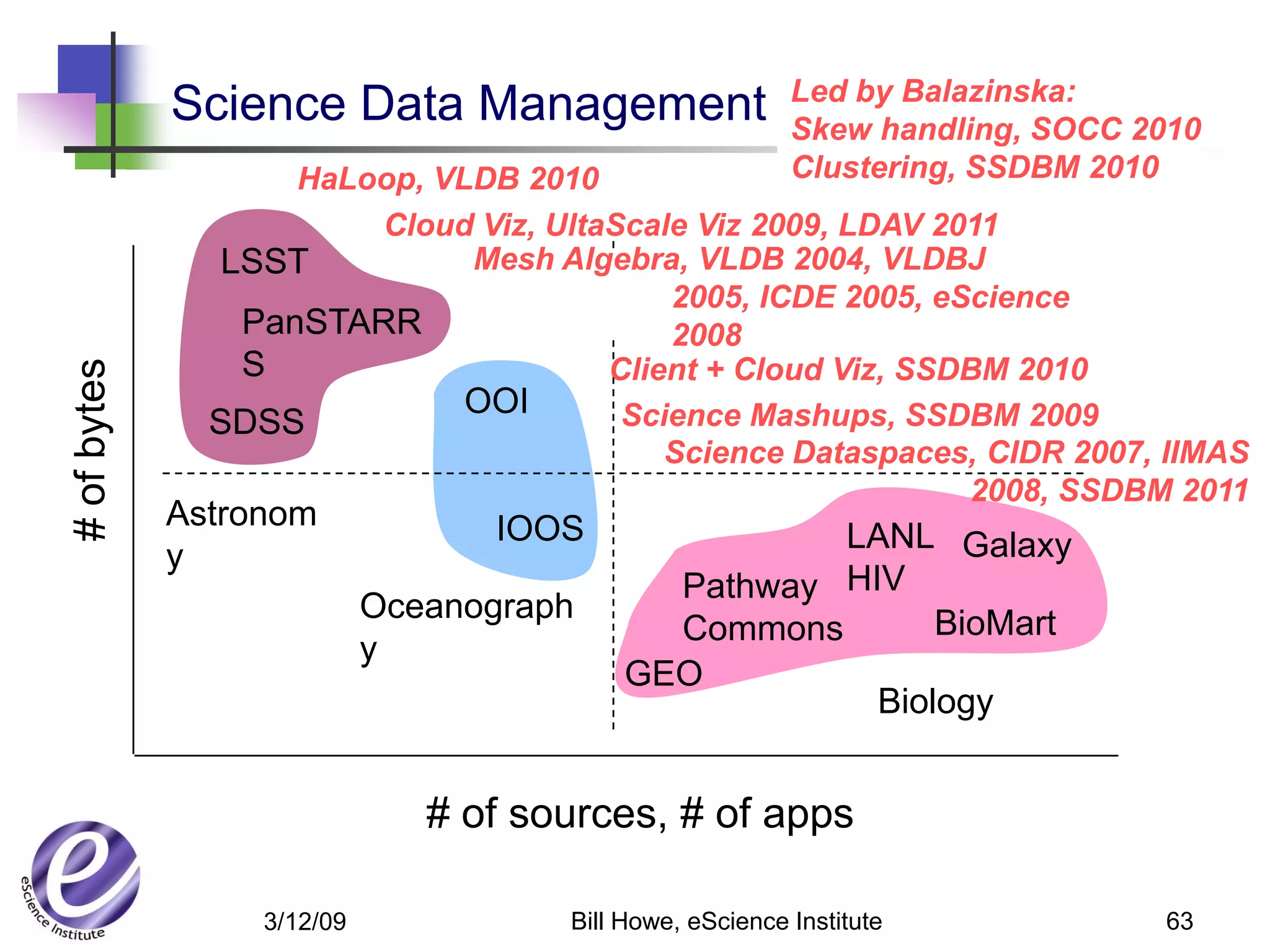
Led by Balazinska:
             Science Data Management                      Skew handling, SOCC 2010
                    HaLoop, VLDB 2010                     Clustering, SSDBM 2010
                        Cloud Viz, UltaScale Viz 2009, LDAV 2011
                LSST          Mesh Algebra, VLDB 2004, VLDBJ
                                           2005, ICDE 2005, eScience
                 PanSTARR                  2008
                 S                     Client + Cloud Viz, SSDBM 2010
# of bytes


                              OOI       Science Mashups, SSDBM 2009
               SDSS
                                           Science Dataspaces, CIDR 2007, IIMAS
                                                              2008, SSDBM 2011
             Astronom              IOOS             LANL Galaxy
             y
                                            Pathway HIV
                            Oceanograph                   BioMart
                                            Commons
                            y
                                          GEO
                                                      Biology


                               # of sources, # of apps

                  3/12/09             Bill Howe, eScience Institute            63
Integrative Analysis
                    [Howe 2010, 2011]

Files                 Tables                   Views                        Visualization
                                                                            s
SAS                                                               visual
           parse                 relational                       analysi
              /                   analysis                           s
Exce       extrac
l             t
                                [Howe 2010]                       [Key
XML                                                               2011]


CSV


                                 SQL Azure

sqlshare.escience.washington.edu
                                                              vizdeck.com

              3/12/09                   Bill Howe, eScience Institute                 64
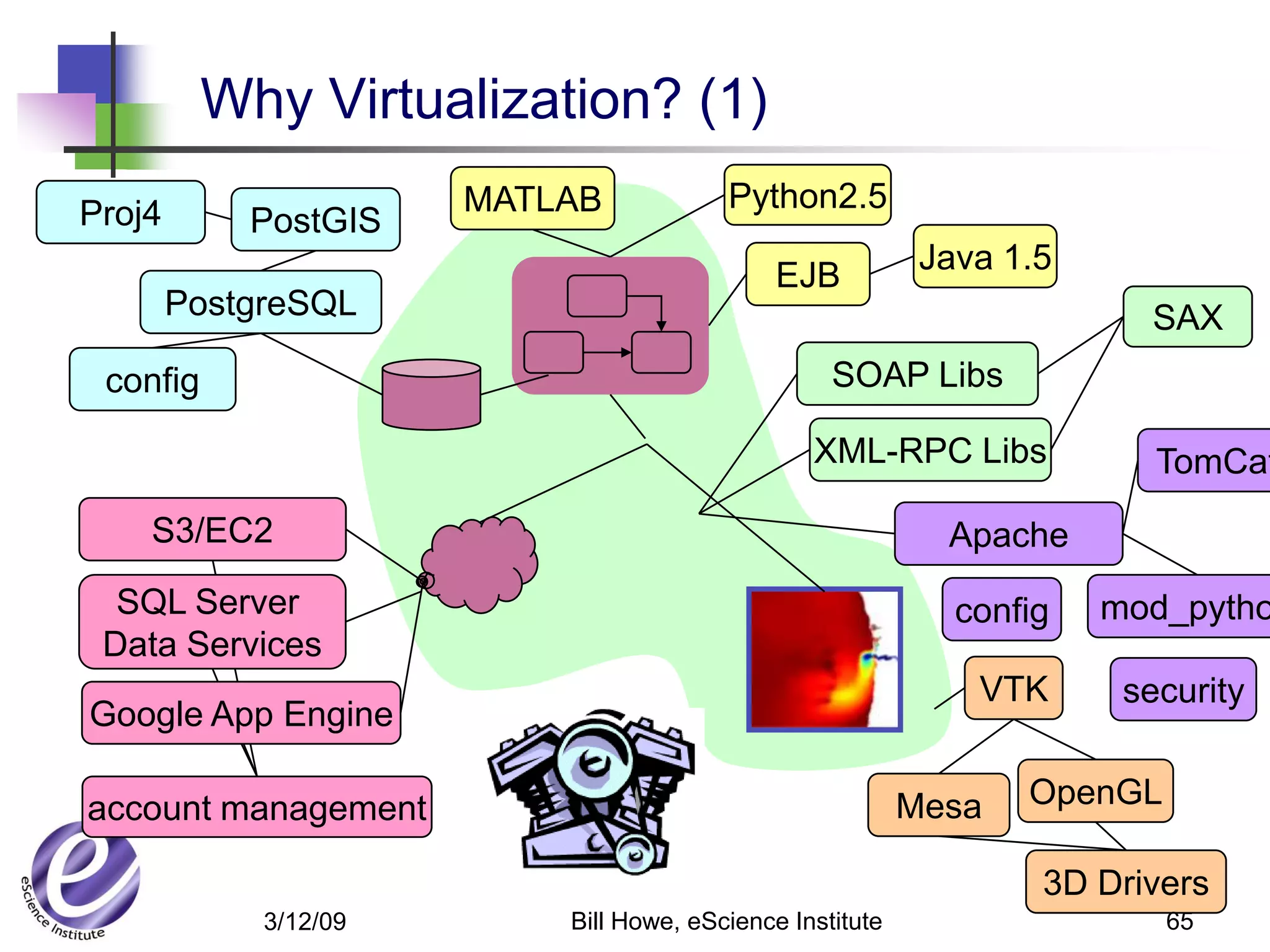
Why Virtualization? (1)
Proj4                  MATLAB            Python2.5
            PostGIS
                                                            Java 1.5
                                              EJB
        PostgreSQL                                                       SAX
 config                                            SOAP Libs

                                                 XML-RPC Libs             TomCat
    S3/EC2                                                   Apache
  SQL Server                                                  config   mod_pytho
 Data Services
                                                               VTK      security
Google App Engine

account management                                         Mesa   OpenGL

                                                                   3D Drivers
             3/12/09       Bill Howe, eScience Institute                   65
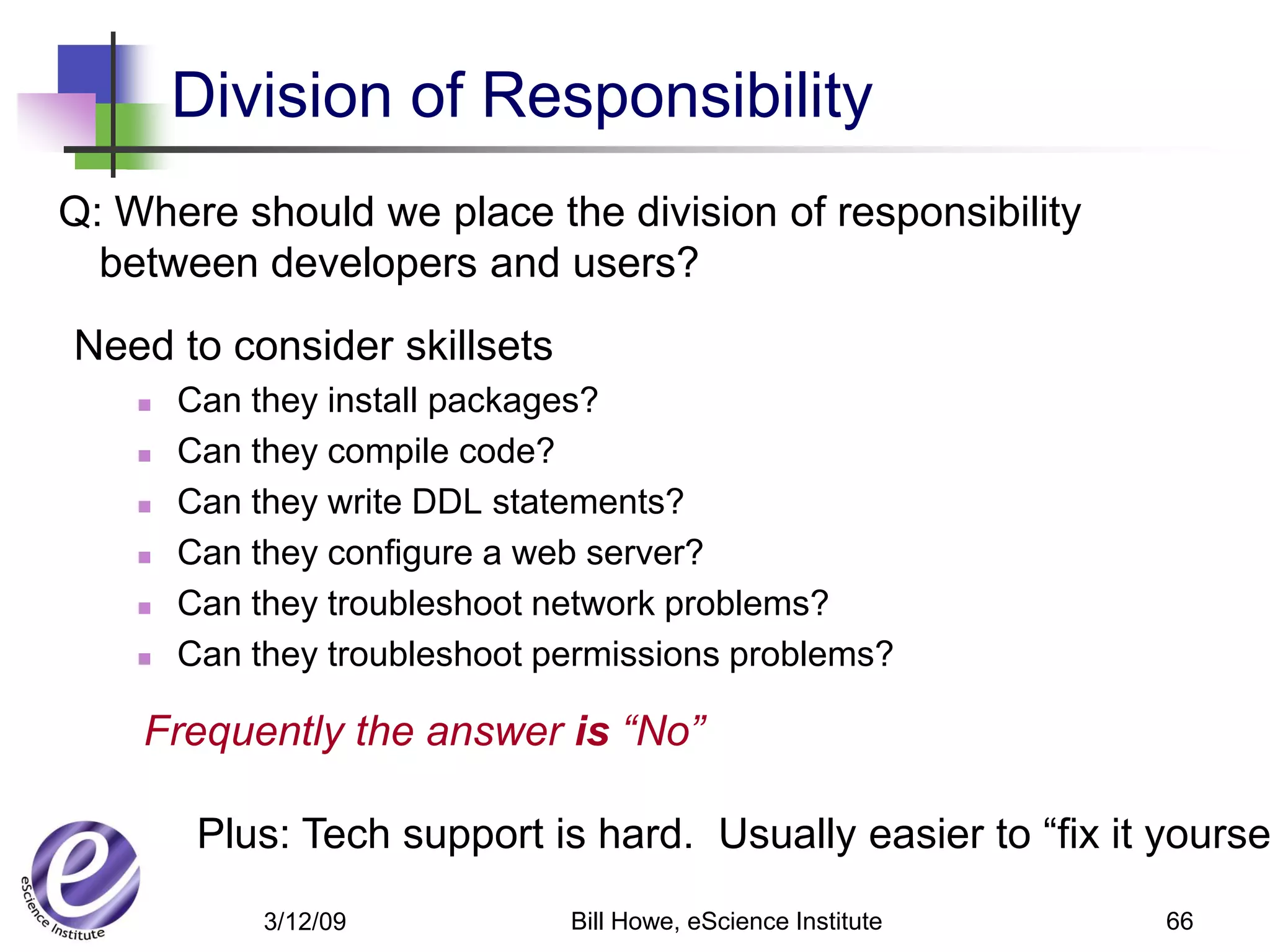
Division of Responsibility
Q: Where should we place the division of responsibility
  between developers and users?
Need to consider skillsets
       Can they install packages?
       Can they compile code?
       Can they write DDL statements?
       Can they configure a web server?
       Can they troubleshoot network problems?
       Can they troubleshoot permissions problems?

    Frequently the answer is “No”

         Plus: Tech support is hard. Usually easier to “fix it yourse
             3/12/09           Bill Howe, eScience Institute   66
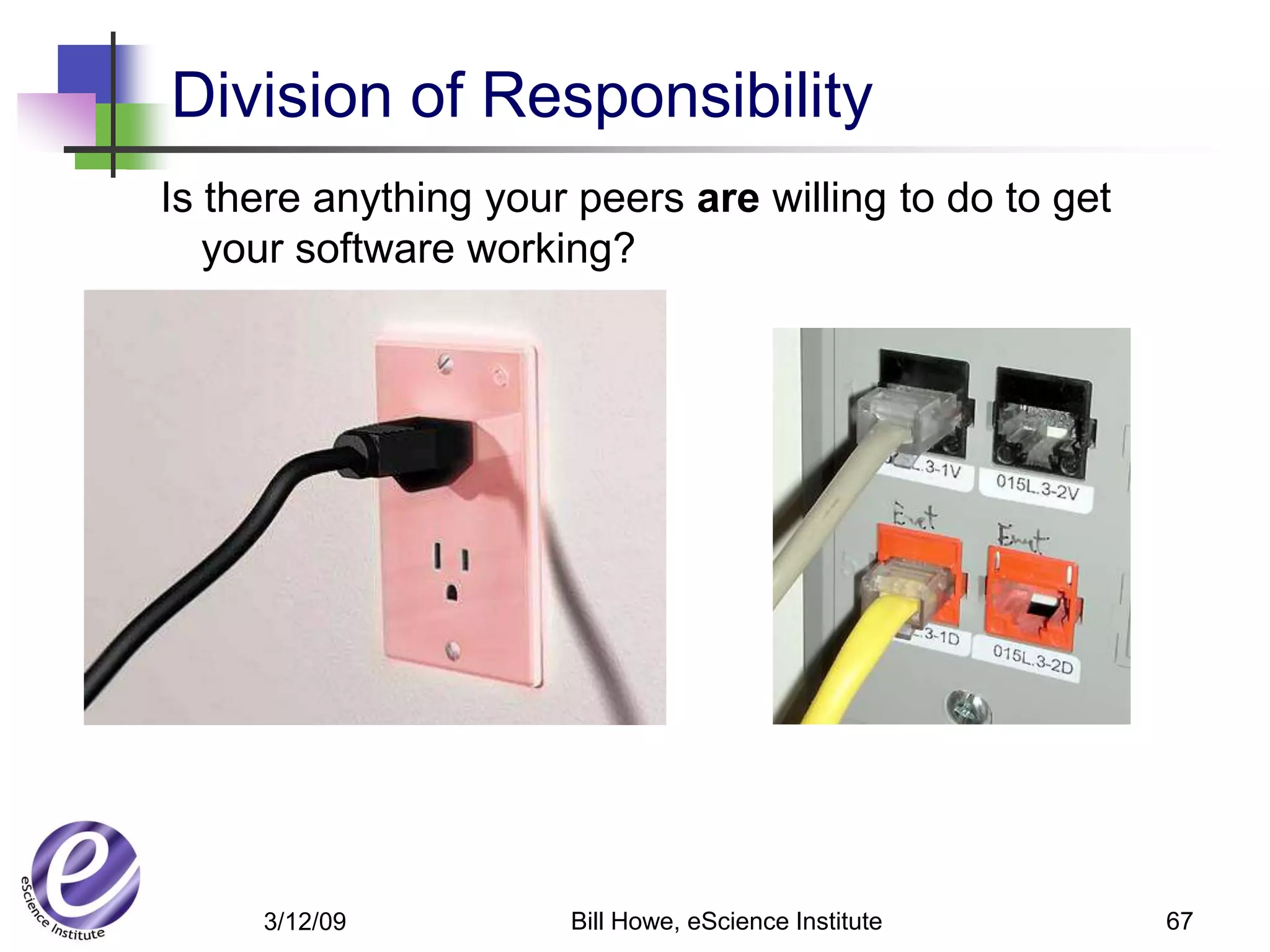
Division of Responsibility
Is there anything your peers are willing to do to get
   your software working?


     3/12/09          Bill Howe, eScience Institute     67
Gold standard

   Your experimental procedures are
    completely unaffected.
   Others use your exact environment as it
    was at the time of the experiment.


         3/12/09      Bill Howe, eScience Institute   68
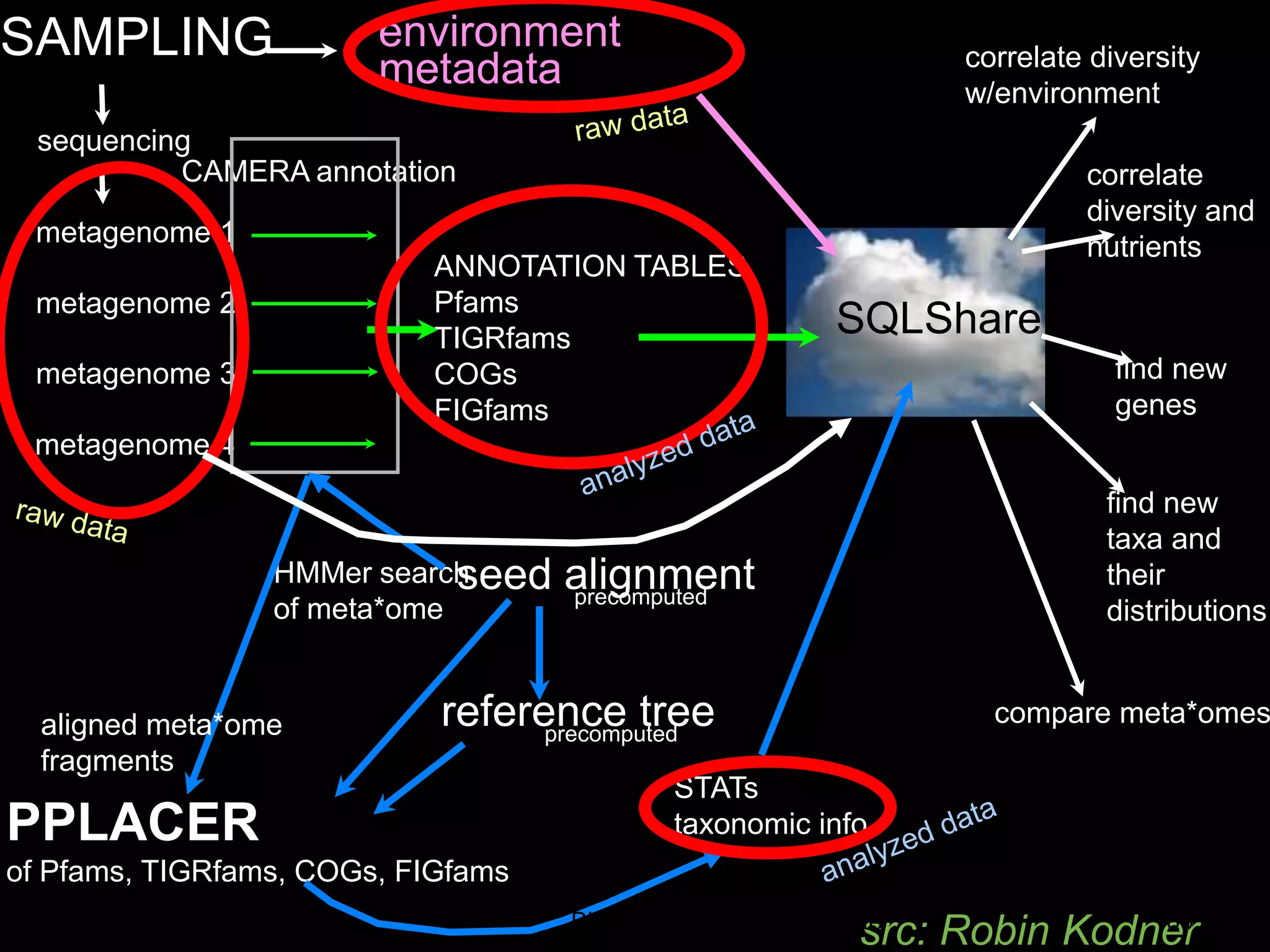
SAMPLING                  environment                               correlate diversity
                          metadata
          Example: Environmental Metagenomics                       w/environment
  sequencing
           CAMERA annotation                                                 correlate
                                                                             diversity and
 metagenome 1                                                                nutrients
                            ANNOTATION TABLES
 metagenome 2               Pfams
                            TIGRfams
                                                            SQLShare
 metagenome 3               COGs                                                find new
                            FIGfams                                             genes
 metagenome 4
                                                                               find new
                                                                               taxa and
                 HMMer searchseed   alignment
                                    precomputed
                                                                               their
                 of meta*ome                                                   distributions


  aligned meta*ome          reference tree
                                  precomputed
                                                                      compare meta*omes
  fragments
                                             STATs
PPLACER                                      taxonomic info
of Pfams, TIGRfams, COGs, FIGfams
                3/12/09             Bill Howe, eScience Institute            69
                                                              src: Robin Kodner
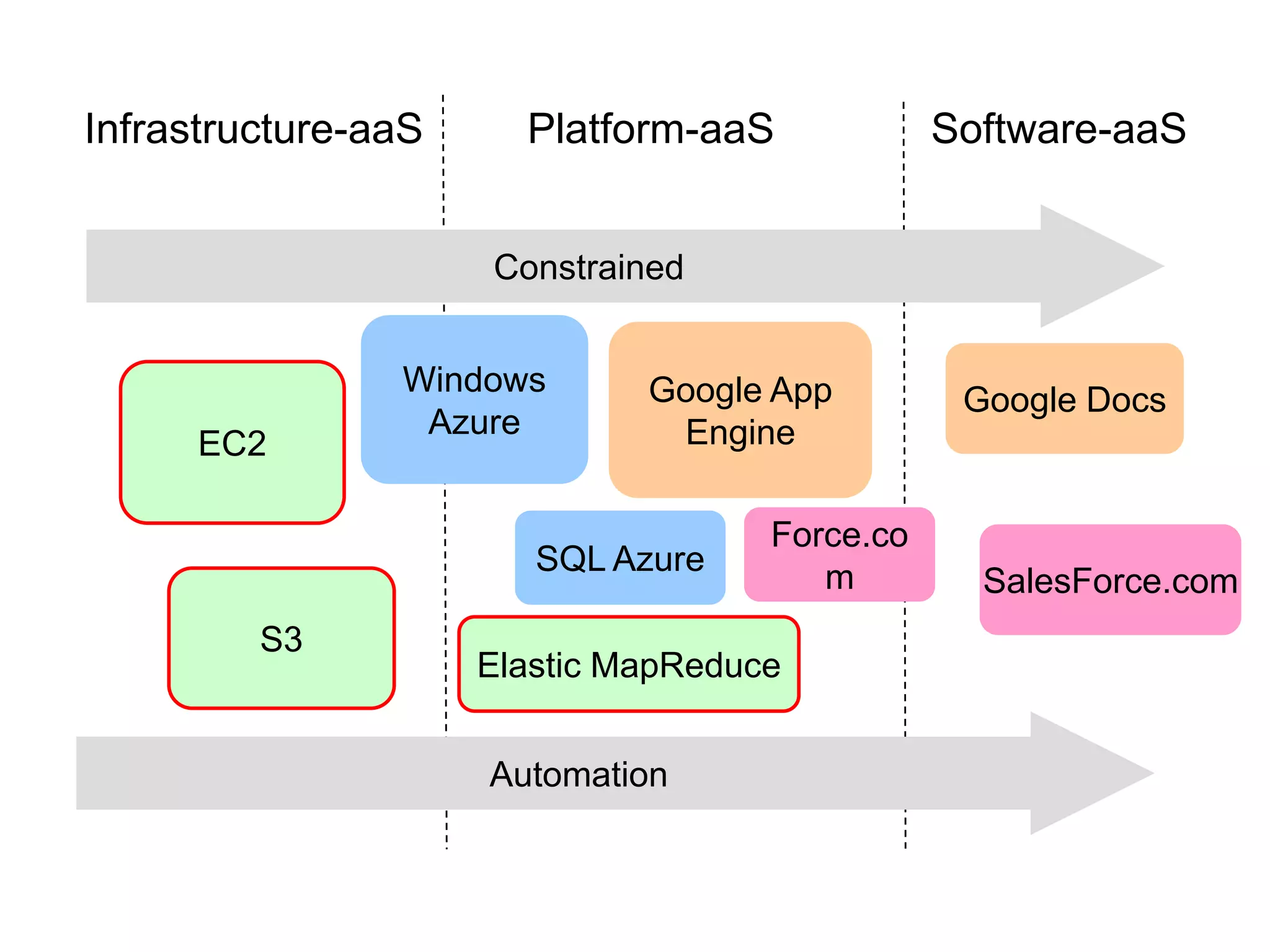
Cloud Services
Infrastructure-aaS Platform-aaS                             Software-aaS


                      Constrained


                  Windows          Google App                Google Docs
                   Azure            Engine
     EC2

                                              Force.co
                        SQL Azure
                                                 m            SalesForce.com
       S3
                     Elastic MapReduce


                      Automation


        3/12/09             Bill Howe, eScience Institute               70
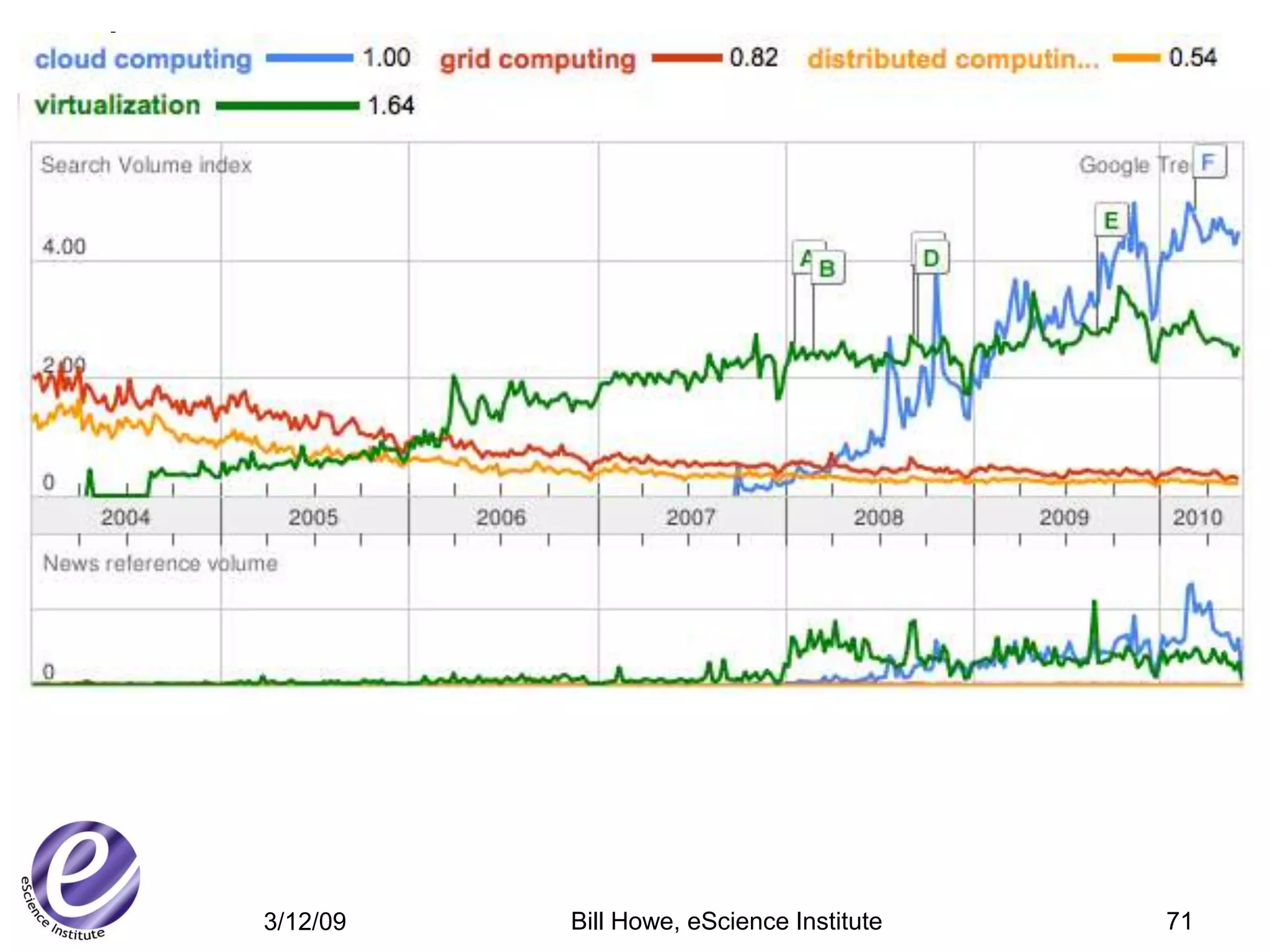
Growth


  3/12/09   Bill Howe, eScience Institute   71
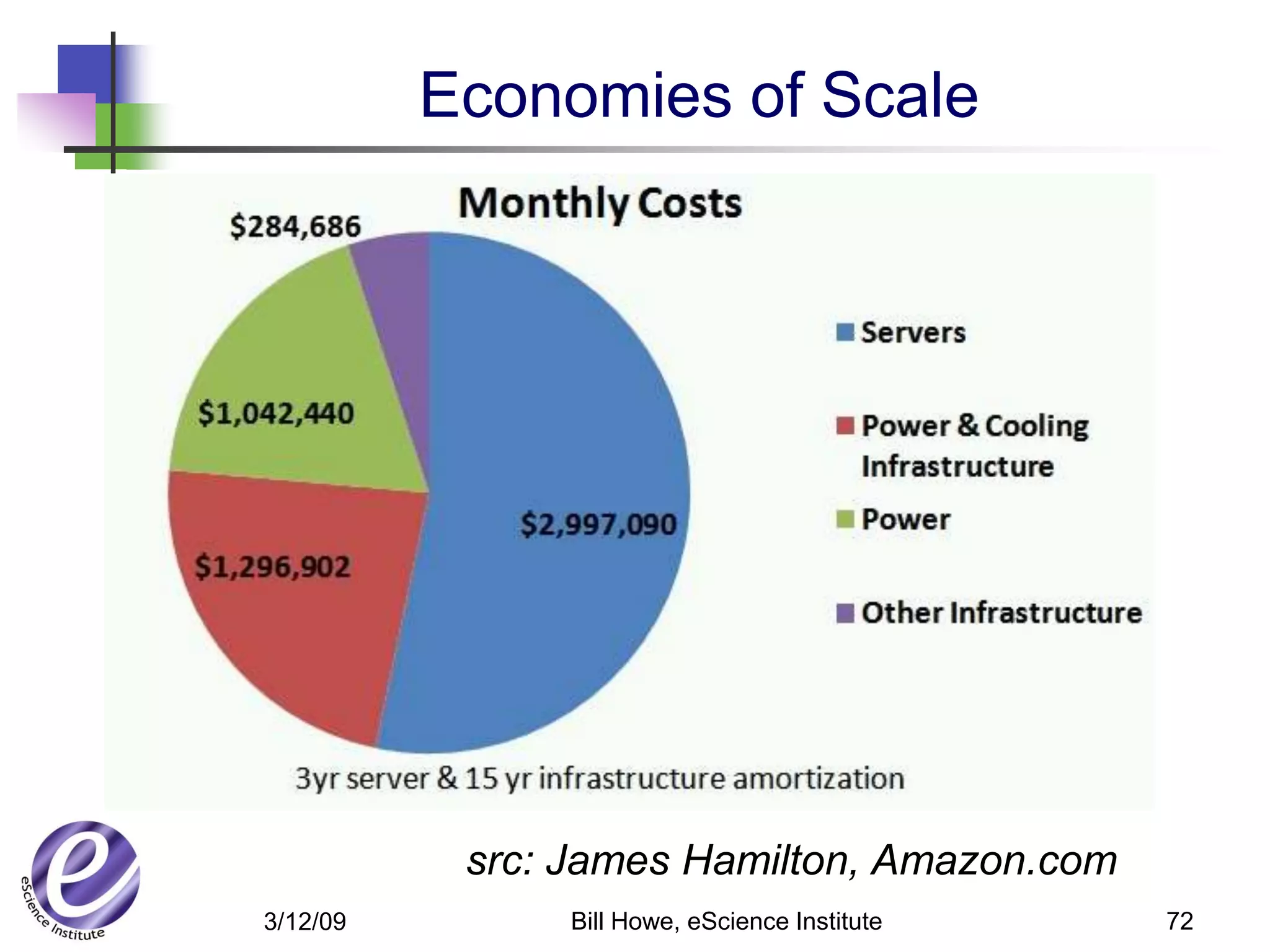
Economies of Scale


           src: James Hamilton, Amazon.com
3/12/09         Bill Howe, eScience Institute   72
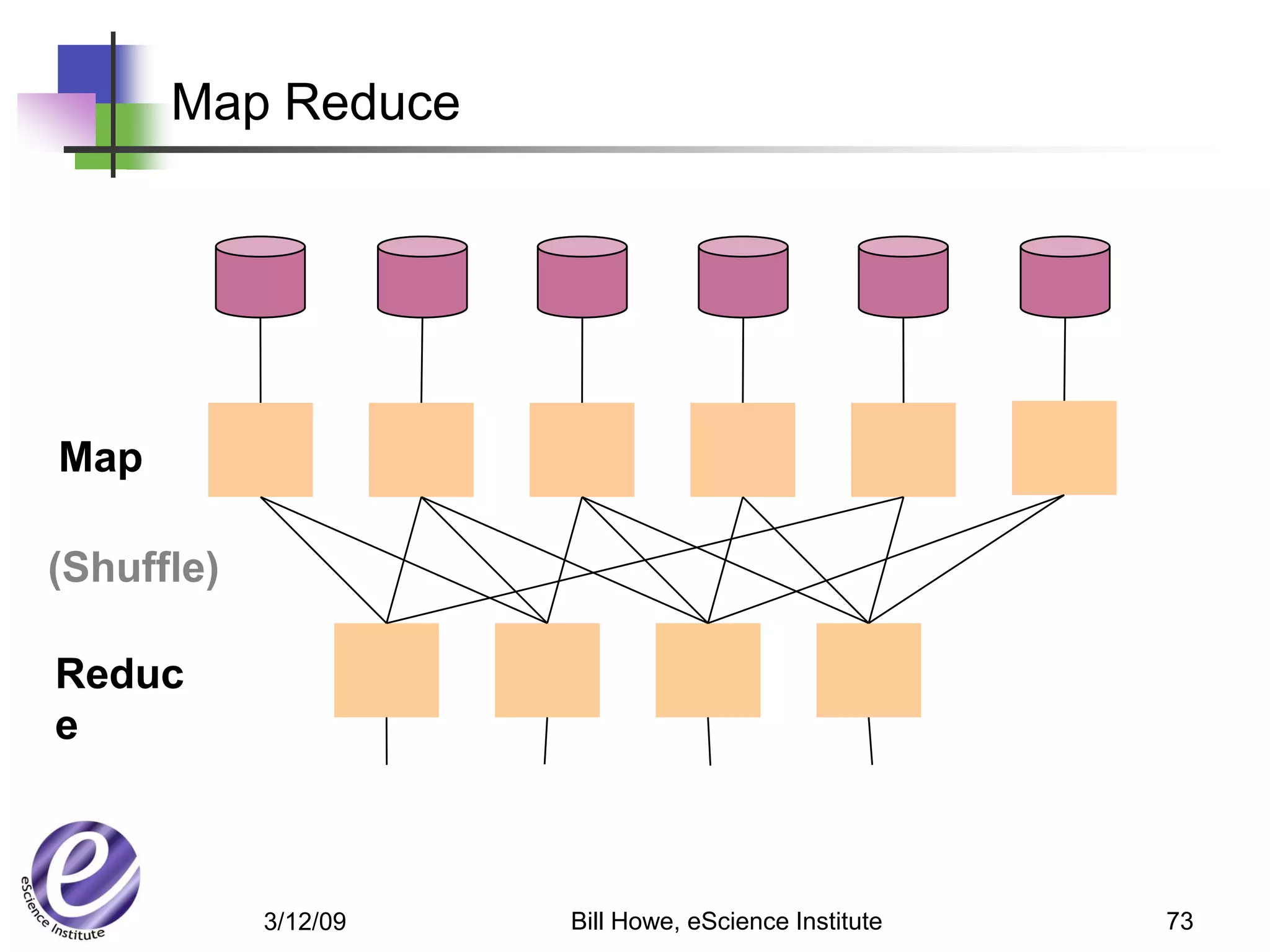
Map Reduce


Map

(Shuffle)

Reduc
e


            3/12/09   Bill Howe, eScience Institute   73

Virtual Appliances, Cloud Computing, and Reproducible Research

  • 1.
    Virtual Appliances, Cloud Computing, and Reproducible Research Bill Howe, Phd eScience Institute, UW
  • 2.
  • 3.
    An Observation  There will always be experiments data housed outside of a managed environments  “Free” experimentation is a beautiful property of software  We should be conservative about constraining the process  There is no difference between debugging, testing, and experiments.  When it works, it's an experiment.  When it doesn't, it's debugging.  Conclusion: We need post hoc approaches  that can tolerate messy, heterogeneous code and data 3/12/09 Bill Howe, eScience Institute 3
  • 4.
    eScience is aboutdata “Fourth Paradigm” Theory, Experiment, Computational Science Data-driven discovery 3 TB / night 200 TB / week 3/12/09 Bill Howe, eScience Institute 4
  • 5.
    eScience is aboutdata Old model: “Query the world” (Data acquisition coupled to a specific hypothesis) New model: “Download the world, query the DB” (Data acquired en masse, to support many hypotheses)  Astronomy: High-resolution, high-frequency sky surveys (SDSS, LSST, PanSTARRS)  Oceanography: high-resolution models, cheap sensors, satellites  Biology: lab automation, high-throughput sequencing, 4/28/2012 Bill Howe, UW 5
  • 6.
    visualization + cloud Some projects scientific data integration scalable query processing Analytics and Visualization with Hadoop (with Juliana Freire)  $380k ($190k), 2/2009 - 2/2011, NSF Cluster Exploratory 2009 (joint with University of Utah) eScience and Data-intensive computing (lead: Lazowska)  $750k, 10/2009 – 10/2011 Gordon and Betty Moore Foundation Cloud prototypes for the Ocean Observatories Initiative  $107k, 9/2009 - 12/2009, Subcontract from SDSC/Woods Hole, NSF OOI Microsoft Research Jim Gray Seed Grant, 2008 and 2010  $25k, $40k 3D Visualization in the Cloud  $117k, 9/10 – 09/12, NSF EAGER through Computing in the Cloud (CiC) Hybrid Query Language for a Graph Databases  $150k, 9/10 - 9/12, PNNL XMT project SQLShare: Database as a Service with Long-Tail Science  $800k, 3 institutions, NSF Data Markets (lead: Balazinska)  ~$300k, 4/11 – 4/13, NSF Computing in the Cloud 3/12/09 Bill Howe, eScience Institute 6
  • 7.
    eScience is marriedto the Cloud: Scalable computing and storage for everyone 3/12/09 Bill Howe, eScience Institute 7
  • 8.
    The point ofthis talk Explore the roles the cloud can play in reproducible research “What if everything was in the cloud?” 3/12/09 Bill Howe, eScience Institute 8
  • 9.
    CLOUD IN 2SLIDES 3/12/09 Bill Howe, eScience Institute 9
  • 10.
    [Slide source: Werner Generator Vogels] 3/12/09 Bill Howe, eScience Institute 10
  • 11.
    Growth “Every day, Amazonbuys enough computing resources to run the entire Amazon.com infrastructure as of 2001” -- James Hamilton, Amazon, Inc., SIGMOD 2011 keynote 3/12/09 Bill Howe, eScience Institute 11
  • 12.
    VIRTUALIZATION ANECDOTE 3/12/09 Bill Howe, eScience Institute 12
  • 13.
    2007: The OceanAppliance Software  Linux Fedora Core 6  web server (Apache)  database (PostgreSQL)  ingest/QC system (Python)  telemetry system (Python)  web-based visualization (Drupal, Python) Hardware  2.6GHz Dual  2GB RAM  250 GB SATA Responsibilities: Shipboard computing  4 serial ports –Data Acquisition  ~$500 –Database Ingest  ~1’x1’x1.5’ –Telemetry with Shore –Visualization –App Server 3/12/09 Bill Howe, eScience Institute 13
  • 14.
    Deployment on R/VBarnes 3/12/09 Bill Howe, eScience Institute 14
  • 15.
    Ship-to-Ship and Ship-to-ShoreTelemetry Wecoma Forerunn er SWAP Network; collaboratio Barnes n of: 3/12/09 Bill Howe, eScience Institute - OSU 15
  • 16.
    Event Detection: RedWater myrionecta 3/12/09 Bill Howe, eScience Institute 16 rubra
  • 17.
    Code + Data+ Environment  Easier, cheaper, and safer to build the box in the lab and hand it out for free than to work with the ships’ admin to get our software running.  Modern analog: Easier to build and distribute a virtual appliance than it is to support installation of your software. 3/12/09 Bill Howe, eScience Institute 17
  • 18.
    Cloud + RROverview  Virtualization = Code + Data + Environment  Virtualization enables cross- platform, generalized, reliable ad hoc (and post hoc) environment capture  Cloud = Virtualization + Resources + Services  any code, any data (more structure -> more services)  scalable storage and compute for everyone  services for processing big data, various data models  services for managing VMs  secure, reliable, available 3/12/09 Bill Howe, eScience Institute 18
  • 19.
    Challenges  Costs and cost-sharing  Data-intensive science  Offline discussion  Security / Privacy  Long-term Preservation  Cultural roadblocks 3/12/09 Bill Howe, eScience Institute 19
  • 20.
    OBSERVATIONS ABOUT CLOUD, VIRTUALIZATION,RR 3/12/09 Bill Howe, eScience Institute 20
  • 21.
    An Observation  There will always be experiments data housed outside of a managed environments  “Free” experimentation is a beautiful property of software  We should be conservative about constraining the process  There is no difference between debugging, testing, and experiments.  When it works, it's an experiment.  When it doesn't, it's debugging.  Conclusion: We need post hoc approaches  that can tolerate messy, heterogeneous code and data 3/12/09 Bill Howe, eScience Institute 21
  • 22.
    An Observation (2)  Code + Data + Environment + Platform  “Download it to my laptop” is insufficient  Ex: de novo assembly  64 GB RAM, 12 cores  So we need more than VMs – we need a place to run them 3/12/09 Bill Howe, eScience Institute 22
  • 23.
    An Observation (3)  Experiment environments span multiple machines  Databases, models, web server  1 VM may not be enough 3/12/09 Bill Howe, eScience Institute 23
  • 24.
    CMOP: Observation andForecasting Atmospheric models Tides River discharge filesystem perl and cron forcings (i.e., inputs) FORTRA … N products via the web RDBMS perl and cron cluster Simulation results Config and log files Intermediate files station extractions Annotations salinity isolines model-data comparisons Data Products Relations 3/12/09 Bill Howe, eScience Institute 24
  • 25.
    Amazon CloudFormation  Ensembles of Virtual Machines  Launch and configure as a unit 3/12/09 Bill Howe, eScience Institute 25
  • 26.
    Observation (3): “GoogleDocs for developers”  The cloud offers a “demilitarized zone” for temporary, low- overhead collaboration  A temporary, shared development environment outside of the jurisdiction of over-zealous sysadmins  No bugs closed as “can’t replicate”  Example: New software for serving oceanographic model results, requiring collaboration between UW, OPeNDAP.org, and OOI Bill Howe 3/12/09 Bill Howe, eScience Institute 26
  • 27.
    Waited two weeks for credentials to be established  Gave up, spun up an EC2 instance, rolling within an hour Similarly, Seattle’s Institute for Systems Biology uses EC2/S3 for collaborative development of computational pipelines 3/12/09 Bill Howe, eScience Institute 27
  • 28.
    COSTS AND COST-SHARING 3/12/09 Bill Howe, eScience Institute 28
  • 29.
    Who pays forreproducibility?  Costs of hosting code?  Costs of hosting data?  Costs of executing code?  Answer: you, you, them  Is this affordable? 3/12/09 Bill Howe, eScience Institute 29
  • 30.
    Economies of Scale src: Armbrust et al., Above the Clouds: A Berkeley View of Cloud Computing, 2009 3/12/09 Bill Howe, eScience Institute 30
  • 31.
    Elasticity Provisioning for peak load src: Armbrust et al., Above the Clouds: A Berkeley View of Cloud Computing, 2009 3/12/09 Bill Howe, eScience Institute 31
  • 32.
    Elasticity Underprovisioning src: Armbrust et al., Above the Clouds: A Berkeley View of Cloud Computing, 2009 3/12/09 Bill Howe, eScience Institute 32
  • 33.
    Elasticity Underprovisioning, more realistic src: Armbrust et al., Above the Clouds: A Berkeley View of Cloud Computing, 2009 3/12/09 Bill Howe, eScience Institute 33
  • 34.
    Animoto 3/12/09 [Werner Bill Howe, eScience Institute Vogels, Amazon.com] 34
  • 35.
    Periodic 3/12/09 [Deepak Bill Howe, eScience Institute Singh, Amazon.com] 35
  • 36.
    Change in Price:compute and RAM 3/12/09 Bill Howe, eScience Institute 36
  • 37.
    Change in price:Storage (1TB, 1PB) 3/12/09 Bill Howe, eScience Institute 37
  • 38.
    Aside: Fix thefunny money  Computing equipment incurs no indirect costs  “Capital Expenditures”  Power, cooling, administration?  “Services” are charged full indirect cost load  Ex: 54% at UW; 100% at Stanford  So every dollar spent on Amazon costs the PI $1.54  Every dollar spent on equipment costs the PI $1.00, but also costs the university ~$1.00 3/12/09 Bill Howe, eScience Institute 38
  • 39.
    Bottom line?  Buy the equipment if  Utilization over 90%  You need big archival storage (“data cemetery”)  Otherwise, you probably shouldn’t  Check the pricing calculator http://calculator.s3.amazonaws.com/calc5.html 3/12/09 Bill Howe, eScience Institute 39
  • 40.
    Aside: Quantifying theValue of Data  Ex: Azure marketplace http://www.microsoft.com/windowsazure/marketplace/  New NSF grant to study data pricing  Early results: proof that there is no non-trivial pricing function that can prevent arbitrage and respects monotonicity  Unpopular idea: Can we sell access to data to fund its preservation?  Might be required – it’s becoming clear we can’t keep everything  Important data (heavily used data) is "worth more." Which means: easier to amortize the cost of storage.  Beyond money: Value models may be useful to formalize attribution requirements.  If I use your data in my research, I am "charged."  Minimal usage is free  At some threshold, citation is expected  At some theshold, acknowledgement is expected  At some threshold, co-authorship is expected 3/12/09 Bill Howe, eScience Institute 40
  • 41.
    DATA-INTENSIVE EXPERIMENTS 3/12/09 Bill Howe, eScience Institute 41
  • 42.
    An Observation onBig Data  The days of FTP are over  It takes days to transfer 1TB over the Internet, and it isn’t likely to succeed.  Copying a petabyte is operationally impossible  The only solution: Push the computation to the data, rather than push the data to the computation  Upload your code rather than download the data 3/12/09 Bill Howe, eScience Institute 42
  • 43.
    Another Observation  RR tends to emphasize computation rather than data  Re-executing “canned” experiments is not enough  Need to support ad hoc, exploratory Q&A, which means:  Queries, not programs  Databases, not files 3/12/09 Bill Howe, eScience Institute 43
  • 44.
  • 47.
  • 48.
    Why SQL?  Find all TIGRFam ids (proteins) that are missing from at least one of three samples (relations) SELECT col0 FROM [refseq_hma_fasta_TGIRfam_refs] UNION SELECT col0 FROM [est_hma_fasta_TGIRfam_refs] UNION SELECT col0 FROM [combo_hma_fasta_TGIRfam_refs] EXCEPT SELECT col0 FROM [refseq_hma_fasta_TGIRfam_refs] INTERSECT SELECT col0 FROM [est_hma_fasta_TGIRfam_refs] INTERSECT SELECT col0 FROM [combo_hma_fasta_TGIRfam_refs]
  • 49.
    SQLShare Extension Projects  SQL Autocomplete  (Nodira Khoussainova, YongChul Kwon, Magda Balazinska)  English to SQL  (Bill Howe, Luke Zettlemoyer, Emad Soroush, Paras Koutris)  Automatic “Starter” Queries SSDBM 2011  (Bill Howe, Garret Cole, Nodira Khoussainova, Leilani Battle) SIGMOD 2011 (demo)  VizDeck: Automatic Mashups and Visualization  (Bill Howe, Alicia Key) SSDBM 2011  Personalized Query Recommendation  (Yuan Zhou, Bill Howe)  Crowdsourced SQL authoring  (nobody)  Info Extraction from Spreadsheets  (Mike Cafarella, Dave Maier, Bill Howe)  Data P
  • 50.
    Usage  About 8 months old, essentially zero advertising  8-10 labs around UW campus and externally  51 unique users (UW and external)  ~1200 tables (~400 are public)  ~900 views (~300 are public)  ~5000 queries executed.  ~40 GB (these are SMALL datasets!)  largest table: 1.1M rows  smallest table: 1 row
  • 51.
    Big Data (2)  Distributed computation is hard  VMs aren’t enough  Need native services for big data, not (just) storage  Elastic MapReduce  Integrated with S3 – any data in S3 can be processed with MapReduce  Languages over MapReduce  Pig (Relational Algebra, from Yahoo)  HIVE (SQL, from Facebook) 3/12/09 Bill Howe, eScience Institute 51
  • 52.
    Cloud Services forBig Data Product Provider Prog. Storage Compute IO Cost Model Cost Cost Megastore Google Filter $0.15 / GB $0.10 / $.12 / GB out / mo. corehour BigQuery Google SQL-like Closed Closed beta Closed beta beta Microsoft Table Microsoft Lookup $0.15 / GB $0.12 / hour $.15 / GB out / mo. and up Elastic Amazon MR, $0.093 / $0.10 / hour $0.15 / GB out MapReduce RA-like, GB / mo. and up (1st GB free) SQL SimpleDB Amazon Filter $0.093 / 1st 25 hours $0.15 / GB out GB / mo. free, $0.14 (1st GB free) after that http://escience.washington.edu/blog 3/12/09 Bill Howe, eScience Institute 52
  • 53.
    Recommendations (last slide)  Cloud is absolutely mainstream  Try it. Get your computing out of the closet.  Create VMs. Cite them. (If cost is the issue, contact me)  For data-intensive experiments, data hosting is still expensive, but you're not likely to do better yourself.  Prices are dropping, new services are released literally monthly  Tell your university to stop charging overhead on cloud services  My opinion: In 10 years, everything will be in the cloud  “I think there is a world market for maybe 5 computers” 3/12/09 Bill Howe, eScience Institute 53
  • 54.
    3/12/09 Bill Howe, eScience Institute 54
  • 55.
    Data-Intensive Scalable Science: BeyondMapReduce Bill Howe, UW …plus a bunch of people src: Lincoln Stein
  • 56.
    Exemplars  Software as a Service  Platform as a Service  Infrastructure as a Service 3/12/09 Bill Howe, eScience Institute 56
  • 57.
    "... computing maysomeday be organized as a public utility just a the telephone system is a public utility... The computer utility coul become the basis of a new and important industry.” -- John McCarthy Emeritus at Stanford Inventor of LISP 1961 3/12/09 Bill Howe, eScience Institute 57
  • 58.
    Timeline 2000 2001 2004 2005+ 2006 2008 2009 Application Service Providers 3/12/09 Bill Howe, eScience Institute 58
  • 59.
    Amazon 3/12/09 [Werner Bill Howe, eScience Institute Vogels, Amazon.com] 59
  • 60.
    3/12/09 [Werner Bill Howe, eScience Institute Vogels, Amazon.com] 60
  • 61.
    The University ofWashington eScience Institute  Rationale  The exponential increase in physical and virtual sensing tech is transitioning all fields of science and engineering from data-poor to data-rich  Techniques and technologies include  Sensors and sensor networks, data management, data mining, machine learning, visualization, cluster/cloud computing  If these techniques and technologies are not widely available and widely practiced, UW will cease to be competitive  Mission  Help position the University of Washington and partners at the forefront of research both in modern eScience techniques and technologies, and in the fields that depend upon them.  Strategy  Bootstrap a cadre of Research Scientists  Add faculty in key fields  Build out a “consultancy” of students and non-research staff  Funding  $650/year direct appropriation from WA State Legislature  augmented with soft money from NSF, DOE, Gordon and Betty Moore Foundation 3/12/09 Bill Howe, eScience Institute 61
  • 62.
    eScience Data ManagementGroup **Bill Howe, Phd (databases, visualization, data-intensive scalable computing, cloud) Staff and Post Docs  Keith Grochow (Visualization, HCI, GIS)  **Garret Cole (cloud computing (Azure, EC2), databases, web services)  Marianne Shaw, Phd (health informatics, semantic web, RDF, graph databases)  Alicia Key (visualization, user-centered design, web applications) Students  Nodira Khoussainova (4th yr Phd), databases, machine learning  Leilani Battle (undergrad), databases, performance evaluation  Yuan Zhou (masters, Applied Math), machine learning, ranking, recommender systems  YongChul Kwon (4th yr Phd), databases, DISC, scientific applications  Meg Whitman (undergrad) Partners  **UW Learning and Scholarly Technologies (web applications, QA/support, release mgmt)  **Cecilia Aragon, Phd, Associate Professor, HCDE (visualization, scientific applications)  Magda Balazinska, Phd, Assistant Professor, CSE (databases, cloud, DISC)  Dan Suciu, Phd, Professor, CSE, (probabilistic databases, theory, languages) ** funded in part by eScience core budget 3/12/09 Bill Howe, eScience Institute 62
  • 63.
    Led by Balazinska: Science Data Management Skew handling, SOCC 2010 HaLoop, VLDB 2010 Clustering, SSDBM 2010 Cloud Viz, UltaScale Viz 2009, LDAV 2011 LSST Mesh Algebra, VLDB 2004, VLDBJ 2005, ICDE 2005, eScience PanSTARR 2008 S Client + Cloud Viz, SSDBM 2010 # of bytes OOI Science Mashups, SSDBM 2009 SDSS Science Dataspaces, CIDR 2007, IIMAS 2008, SSDBM 2011 Astronom IOOS LANL Galaxy y Pathway HIV Oceanograph BioMart Commons y GEO Biology # of sources, # of apps 3/12/09 Bill Howe, eScience Institute 63
  • 64.
    Integrative Analysis [Howe 2010, 2011] Files Tables Views Visualization s SAS visual parse relational analysi / analysis s Exce extrac l t [Howe 2010] [Key XML 2011] CSV SQL Azure sqlshare.escience.washington.edu vizdeck.com 3/12/09 Bill Howe, eScience Institute 64
  • 65.
    Why Virtualization? (1) Proj4 MATLAB Python2.5 PostGIS Java 1.5 EJB PostgreSQL SAX config SOAP Libs XML-RPC Libs TomCat S3/EC2 Apache SQL Server config mod_pytho Data Services VTK security Google App Engine account management Mesa OpenGL 3D Drivers 3/12/09 Bill Howe, eScience Institute 65
  • 66.
    Division of Responsibility Q:Where should we place the division of responsibility between developers and users? Need to consider skillsets  Can they install packages?  Can they compile code?  Can they write DDL statements?  Can they configure a web server?  Can they troubleshoot network problems?  Can they troubleshoot permissions problems? Frequently the answer is “No” Plus: Tech support is hard. Usually easier to “fix it yourse 3/12/09 Bill Howe, eScience Institute 66
  • 67.
    Division of Responsibility Isthere anything your peers are willing to do to get your software working? 3/12/09 Bill Howe, eScience Institute 67
  • 68.
    Gold standard  Your experimental procedures are completely unaffected.  Others use your exact environment as it was at the time of the experiment. 3/12/09 Bill Howe, eScience Institute 68
  • 69.
    SAMPLING environment correlate diversity metadata Example: Environmental Metagenomics w/environment sequencing CAMERA annotation correlate diversity and metagenome 1 nutrients ANNOTATION TABLES metagenome 2 Pfams TIGRfams SQLShare metagenome 3 COGs find new FIGfams genes metagenome 4 find new taxa and HMMer searchseed alignment precomputed their of meta*ome distributions aligned meta*ome reference tree precomputed compare meta*omes fragments STATs PPLACER taxonomic info of Pfams, TIGRfams, COGs, FIGfams 3/12/09 Bill Howe, eScience Institute 69 src: Robin Kodner
  • 70.
    Cloud Services Infrastructure-aaS Platform-aaS Software-aaS Constrained Windows Google App Google Docs Azure Engine EC2 Force.co SQL Azure m SalesForce.com S3 Elastic MapReduce Automation 3/12/09 Bill Howe, eScience Institute 70
  • 71.
    Growth 3/12/09 Bill Howe, eScience Institute 71
  • 72.
    Economies of Scale src: James Hamilton, Amazon.com 3/12/09 Bill Howe, eScience Institute 72
  • 73.
    Map Reduce Map (Shuffle) Reduc e 3/12/09 Bill Howe, eScience Institute 73

Editor's Notes

  • #69 Software allows us to be schizophrenic, unfocused, distractable as we explore a problem -- 25 versions of a program, in multiple languages, using different libraries, at multiple levels of experimental abstraction (batch run, individual experiment, unit test, debugging), all in a few hours or days.This is a beautiful thing. We should be conservative about constraining this process (by language, by platform, by interoperability with a given tool, by available computing resources)
  • #73 The point here is that server costs can still dominate under a 3-year amortization assumption. Power is not the biggest cost, but FULLY BURDENED power – power distribution infrastructure, cooling – is the biggest cost or will be soon.This is what data centers can offer.