Virginia Henderson 
The Principles and Practice of Nursing 
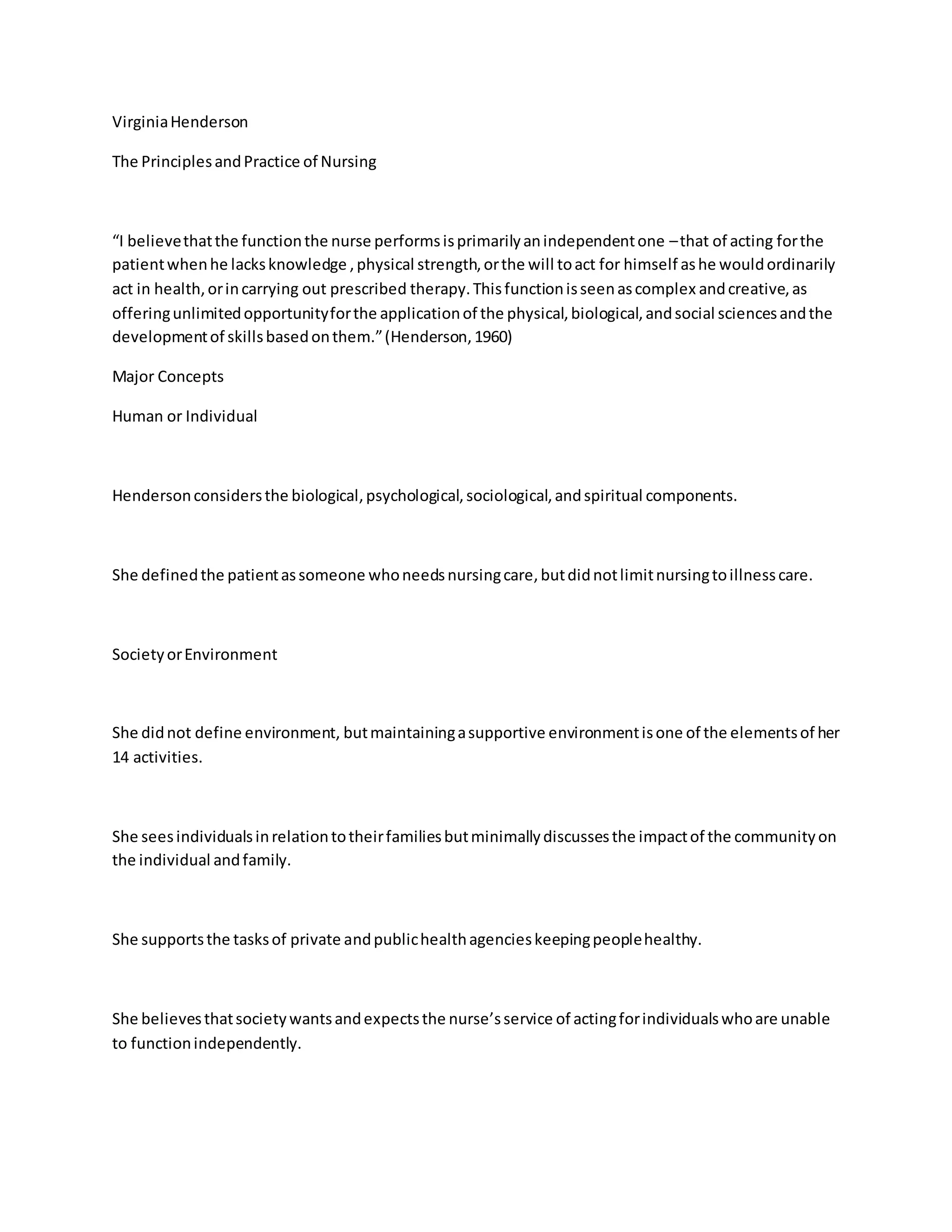
“I believe that the function the nurse performs is primarily an independent one – that of acting for the 
patient when he lacks knowledge , physical strength, or the will to act for himself as he would ordinarily 
act in health, or in carrying out prescribed therapy. This function is seen as complex and creative, as 
offering unlimited opportunity for the application of the physical, biological, and social sciences and the 
development of skills based on them.” (Henderson, 1960) 
Major Concepts 
Human or Individual 
Henderson considers the biological, psychological, sociological, and spiritual components. 
She defined the patient as someone who needs nursing care, but did not limit nursing to illness care. 
Society or Environment 
She did not define environment, but maintaining a supportive environment is one of the elements of her 
14 activities. 
She sees individuals in relation to their families but minimally discusses the impact of the community on 
the individual and family. 
She supports the tasks of private and public health agencies keeping people healthy. 
She believes that society wants and expects the nurse’s service of acting for individuals who are unable 
to function independently.
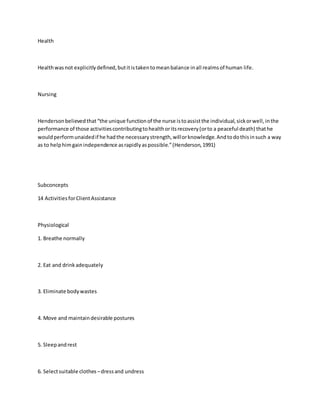
Health 
Health was not explicitly defined, but it is taken to mean balance in all realms of human life. 
Nursing 
Henderson believed that “the unique function of the nurse is to assist the individual, sick or well, in the 
performance of those activities contributing to health or its recovery (or to a peaceful death) that he 
would perform unaided if he had the necessary strength, will or knowledge. And to do this in such a way 
as to help him gain independence as rapidly as possible.” (Henderson, 1991) 
Subconcepts 
14 Activities for Client Assistance 
Physiological 
1. Breathe normally 
2. Eat and drink adequately 
3. Eliminate body wastes 
4. Move and maintain desirable postures 
5. Sleep and rest 
6. Select suitable clothes – dress and undress
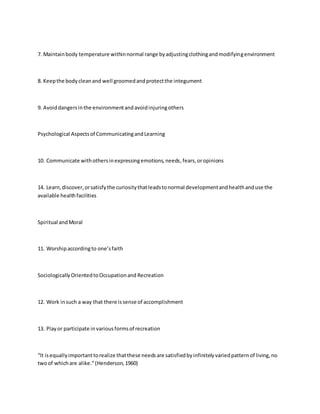
7. Maintain body temperature within normal range by adjusting clothing and modifying environment 
8. Keep the body clean and well groomed and protect the integument 
9. Avoid dangers in the environment and avoid injuring others 
Psychological Aspects of Communicating and Learning 
10. Communicate with others in expressing emotions, needs, fears, or opinions 
14. Learn, discover, or satisfy the curiosity that leads to normal development and health and use the 
available health facilities 
Spiritual and Moral 
11. Worship according to one’s faith 
Sociologically Oriented to Occupation and Recreation 
12. Work in such a way that there is sense of accomplishment 
13. Play or participate in various forms of recreation 
“It is equally important to realize that these needs are satisfied by infinitely varied pattern of living, no 
two of which are alike.” (Henderson, 1960)
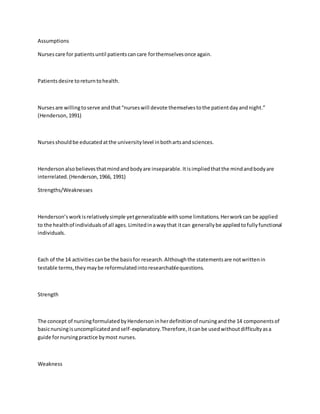
Assumptions 
Nurses care for patients until patients can care for themselves once again. 
Patients desire to return to health. 
Nurses are willing to serve and that “nurses will devote themselves to the patient day and night.” 
(Henderson, 1991) 
Nurses should be educated at the university level in both arts and sciences. 
Henderson also believes that mind and body are inseparable. It is implied that the mind and body are 
interrelated. (Henderson, 1966, 1991) 
Strengths/Weaknesses 
Henderson’s work is relatively simple yet generalizable with some limitations. Her work can be applied 
to the health of individuals of all ages. Limited in a way that it can generally be applied to fully functional 
individuals. 
Each of the 14 activities can be the basis for research. Although the statements are not written in 
testable terms, they may be reformulated into researchable questions. 
Strength 
The concept of nursing formulated by Henderson in her definition of nursing and the 14 components of 
basic nursing is uncomplicated and self-explanatory. Therefore, it can be used without difficulty as a 
guide for nursing practice by most nurses. 
Weakness
A major shortcoming in her work is the lack of a conceptual linkage between physiological and other 
human characteristics. 
Analysis 
One cannot say that every individual who has similar needs indicated in the 14 activities by Henderson 
are the only things that human beings need in attaining health and for survival. With the progress of 
today’s time, there may be added needs that humans are entitled to be provided with by nurses. 
The prioritization of the 14 Activities was not clearly explained whether the first one is prerequisite to 
the other. But still, it is remarkable that Henderson was able to speci fy and characterize some of the 
needs of individuals based on Abraham Maslow’s hierarchy of needs. 
Some of the activities listed in Henderson’s concepts can only be applied to fully functional individuals 
indicating that there would always be patients who always require aided care which is in contrary to the 
goal of nursing indicated in the definition of nursing by Henderson. 
Because of the absence of a conceptual diagram, interconnections between the concepts and 
subconcepts of Henderson’s principle are not clearly delineated. 
(c) 2011 Gonzalo, A. All rights reserved

Virginia henderson

  • 1.
    Virginia Henderson ThePrinciples and Practice of Nursing “I believe that the function the nurse performs is primarily an independent one – that of acting for the patient when he lacks knowledge , physical strength, or the will to act for himself as he would ordinarily act in health, or in carrying out prescribed therapy. This function is seen as complex and creative, as offering unlimited opportunity for the application of the physical, biological, and social sciences and the development of skills based on them.” (Henderson, 1960) Major Concepts Human or Individual Henderson considers the biological, psychological, sociological, and spiritual components. She defined the patient as someone who needs nursing care, but did not limit nursing to illness care. Society or Environment She did not define environment, but maintaining a supportive environment is one of the elements of her 14 activities. She sees individuals in relation to their families but minimally discusses the impact of the community on the individual and family. She supports the tasks of private and public health agencies keeping people healthy. She believes that society wants and expects the nurse’s service of acting for individuals who are unable to function independently.
  • 2.
    Health Health wasnot explicitly defined, but it is taken to mean balance in all realms of human life. Nursing Henderson believed that “the unique function of the nurse is to assist the individual, sick or well, in the performance of those activities contributing to health or its recovery (or to a peaceful death) that he would perform unaided if he had the necessary strength, will or knowledge. And to do this in such a way as to help him gain independence as rapidly as possible.” (Henderson, 1991) Subconcepts 14 Activities for Client Assistance Physiological 1. Breathe normally 2. Eat and drink adequately 3. Eliminate body wastes 4. Move and maintain desirable postures 5. Sleep and rest 6. Select suitable clothes – dress and undress
  • 3.
    7. Maintain bodytemperature within normal range by adjusting clothing and modifying environment 8. Keep the body clean and well groomed and protect the integument 9. Avoid dangers in the environment and avoid injuring others Psychological Aspects of Communicating and Learning 10. Communicate with others in expressing emotions, needs, fears, or opinions 14. Learn, discover, or satisfy the curiosity that leads to normal development and health and use the available health facilities Spiritual and Moral 11. Worship according to one’s faith Sociologically Oriented to Occupation and Recreation 12. Work in such a way that there is sense of accomplishment 13. Play or participate in various forms of recreation “It is equally important to realize that these needs are satisfied by infinitely varied pattern of living, no two of which are alike.” (Henderson, 1960)
  • 4.
    Assumptions Nurses carefor patients until patients can care for themselves once again. Patients desire to return to health. Nurses are willing to serve and that “nurses will devote themselves to the patient day and night.” (Henderson, 1991) Nurses should be educated at the university level in both arts and sciences. Henderson also believes that mind and body are inseparable. It is implied that the mind and body are interrelated. (Henderson, 1966, 1991) Strengths/Weaknesses Henderson’s work is relatively simple yet generalizable with some limitations. Her work can be applied to the health of individuals of all ages. Limited in a way that it can generally be applied to fully functional individuals. Each of the 14 activities can be the basis for research. Although the statements are not written in testable terms, they may be reformulated into researchable questions. Strength The concept of nursing formulated by Henderson in her definition of nursing and the 14 components of basic nursing is uncomplicated and self-explanatory. Therefore, it can be used without difficulty as a guide for nursing practice by most nurses. Weakness
  • 5.
    A major shortcomingin her work is the lack of a conceptual linkage between physiological and other human characteristics. Analysis One cannot say that every individual who has similar needs indicated in the 14 activities by Henderson are the only things that human beings need in attaining health and for survival. With the progress of today’s time, there may be added needs that humans are entitled to be provided with by nurses. The prioritization of the 14 Activities was not clearly explained whether the first one is prerequisite to the other. But still, it is remarkable that Henderson was able to speci fy and characterize some of the needs of individuals based on Abraham Maslow’s hierarchy of needs. Some of the activities listed in Henderson’s concepts can only be applied to fully functional individuals indicating that there would always be patients who always require aided care which is in contrary to the goal of nursing indicated in the definition of nursing by Henderson. Because of the absence of a conceptual diagram, interconnections between the concepts and subconcepts of Henderson’s principle are not clearly delineated. (c) 2011 Gonzalo, A. All rights reserved