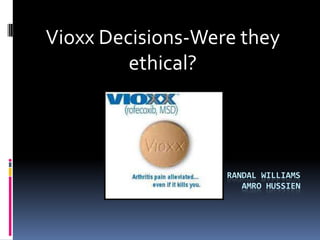
Vioxx Decisions-Were they ethical?Randal williamsamrohussien
The history of MerckThe roots date back to 1827 with Heinrich Emanuel Merck as the founder who began an industrial-scale production of Alkaloids, plant extracts, and other chemicalsThe successful export business in the United States led in 1887 to the establishment of a subsidiary in New York. Under George Merck, a grandson of Heinrich Emmanuel Merck, Merck & Co, was formed in 1891
History of Merck (cont)Merck and Co. became an independent company in the United States after World War IThe two companies are no longer linked today but the one thing that they have in common is the name MerckMerck & Co. holds the rights to the name in North America and outside this region the U.S Company operates as Merck Sharp and Dohme (MSD) or MSD Sharp & Dohme
What is Vioxx?Vioxx is a nonsteroidal anti- inflammatory drug( NSAID) that exhibits anti-inflamitory , analgesic, and antipyretic activitiesNSAIDs are a large class of medications used to treat arthritis pain and inflammationThere are three categories of NSAIDs: Salicylates such as aspirin, the traditional NSAIDs, and the COX-2 selective inhibitors
Vioxx (cont)The FDA approved Vioxx in May 1999 for the reduction of signs and symptoms of osteoarthritis, as well as for acute pain in adultsVioxx has demonstrated significant reduction in joint pain compared to placebo
VIGOR studyAfter Vioxx was approved in 1999, Merck created a VIGOR (VIOXX Gastro Intestinal Outcomes Research) which was designed to look into GI effects which included stomach ulcers and bleedingVIGOR was a randomized, double-blinded study in 8,076 patients with rheumatoid arthritis requiring chronic NSAID. The patients were not allowed to use concomitant aspirin or other anti-platelet drugs.
VIGOR (cont)The study concluded that there was an increase of serious cardiovascular events including heart attacks and strokes, in patients taking Vioxx compared to patients taking naproxen
Lawsuits against VioxxThe first VIOXX lawsuit, was a wrongful death case heard in a Texas courtroom.  The jury decided by 10-2 vote on August 19, 2005, that Merck was liable and awarded $253.4 million to the widow of Robert ErnstUnder Texas law the amount is expected to be reduced to $26.1 million
Lawsuits (cont)Merck eventually settled the lawsuits out of court for $4.85 billionthis agreement settled 27,000 lawsuits for 47,000 plaintiffsThe legal defense for Merck cost them $1.2 billionThe average plaintiff will receive just over $100,000 before fees and expenses, which usually run between 30-50%The plaintiff’s attorneys will receive almost $2 billion in fees
Lawsuits (cont)Merck has also had to settle with unions and insurers for $80 millionShareholders of Merck filed suit against the officers of Merck on behalf of the company and came to an agreement that the officers would pay $12.5 million in legal fees
Lawsuits by the shareholdersThere is a case pending between Merck and its shareholders, on April 27th of this year, the Supreme Court ruled that the lawsuit could proceedMerck stated that under the Sarbanes-Oxley act of 2002, that the statue of limitations had run out on the lawsuit.  Section 804 of the Sarbanes-Oxley act states that in regarding fraud, a lawsuit can be brought within the first two years that the fraud is uncoveredMerck claims that more than two years prior to the filing the plaintiffs had or could have discovered the “facts constituting the violation, and therefore was barred by the applicable statute of limitations”
Problems around the worldCurrently there are lawsuits pending and being decided in Australia against MerckOn March 5th of 2010 the Australian federal court ruled in favor of the Plaintiff (Peterson) and awarded him a settlement of $287,000 Australian dollarsThe judge found that Merck failed to warn his Doctor of the cardiovascular risk associated with Vioxx, the judge cited the VIRGO study and said that Merck had violated Australian trade practices
What the %$#@?Dr. Scott S. Reuben was a Doctor performing studies for Merck and other pharmaceutical companiesReuben has now admitted that he never conducted any of the clinical trials on which his conclusions were based Scientific American has called Reuben the medical equivalent of Bernie MadoffReuben was sentenced in Federal Court to six months in jail (after pleading guilty to one count of health care fraud on February 21, 2010) to be followed by three years of supervised release.  Further, a five-thousand dollar fine was imposed and he was ordered to provide restitution of more then three hundred sixty thousand dollars.
Question 1Utilizing the information provided and available from web sources, use the ethical decision making techniques discussed in the chapter to form an opinion about whether Merck’s decisions regarding Vioxx were ethical? Show your analysis
Question 2	In order to protect the public more fully, what should the FDA do given the Vioxx lessons?

Vioxx project power point presentation

  • 1.
    Vioxx Decisions-Were theyethical?Randal williamsamrohussien
  • 2.
    The history ofMerckThe roots date back to 1827 with Heinrich Emanuel Merck as the founder who began an industrial-scale production of Alkaloids, plant extracts, and other chemicalsThe successful export business in the United States led in 1887 to the establishment of a subsidiary in New York. Under George Merck, a grandson of Heinrich Emmanuel Merck, Merck & Co, was formed in 1891
  • 3.
    History of Merck(cont)Merck and Co. became an independent company in the United States after World War IThe two companies are no longer linked today but the one thing that they have in common is the name MerckMerck & Co. holds the rights to the name in North America and outside this region the U.S Company operates as Merck Sharp and Dohme (MSD) or MSD Sharp & Dohme
  • 4.
    What is Vioxx?Vioxxis a nonsteroidal anti- inflammatory drug( NSAID) that exhibits anti-inflamitory , analgesic, and antipyretic activitiesNSAIDs are a large class of medications used to treat arthritis pain and inflammationThere are three categories of NSAIDs: Salicylates such as aspirin, the traditional NSAIDs, and the COX-2 selective inhibitors
  • 5.
    Vioxx (cont)The FDAapproved Vioxx in May 1999 for the reduction of signs and symptoms of osteoarthritis, as well as for acute pain in adultsVioxx has demonstrated significant reduction in joint pain compared to placebo
  • 6.
    VIGOR studyAfter Vioxxwas approved in 1999, Merck created a VIGOR (VIOXX Gastro Intestinal Outcomes Research) which was designed to look into GI effects which included stomach ulcers and bleedingVIGOR was a randomized, double-blinded study in 8,076 patients with rheumatoid arthritis requiring chronic NSAID. The patients were not allowed to use concomitant aspirin or other anti-platelet drugs.
  • 7.
    VIGOR (cont)The studyconcluded that there was an increase of serious cardiovascular events including heart attacks and strokes, in patients taking Vioxx compared to patients taking naproxen
  • 8.
    Lawsuits against VioxxThefirst VIOXX lawsuit, was a wrongful death case heard in a Texas courtroom. The jury decided by 10-2 vote on August 19, 2005, that Merck was liable and awarded $253.4 million to the widow of Robert ErnstUnder Texas law the amount is expected to be reduced to $26.1 million
  • 9.
    Lawsuits (cont)Merck eventuallysettled the lawsuits out of court for $4.85 billionthis agreement settled 27,000 lawsuits for 47,000 plaintiffsThe legal defense for Merck cost them $1.2 billionThe average plaintiff will receive just over $100,000 before fees and expenses, which usually run between 30-50%The plaintiff’s attorneys will receive almost $2 billion in fees
  • 10.
    Lawsuits (cont)Merck hasalso had to settle with unions and insurers for $80 millionShareholders of Merck filed suit against the officers of Merck on behalf of the company and came to an agreement that the officers would pay $12.5 million in legal fees
  • 11.
    Lawsuits by theshareholdersThere is a case pending between Merck and its shareholders, on April 27th of this year, the Supreme Court ruled that the lawsuit could proceedMerck stated that under the Sarbanes-Oxley act of 2002, that the statue of limitations had run out on the lawsuit. Section 804 of the Sarbanes-Oxley act states that in regarding fraud, a lawsuit can be brought within the first two years that the fraud is uncoveredMerck claims that more than two years prior to the filing the plaintiffs had or could have discovered the “facts constituting the violation, and therefore was barred by the applicable statute of limitations”
  • 12.
    Problems around theworldCurrently there are lawsuits pending and being decided in Australia against MerckOn March 5th of 2010 the Australian federal court ruled in favor of the Plaintiff (Peterson) and awarded him a settlement of $287,000 Australian dollarsThe judge found that Merck failed to warn his Doctor of the cardiovascular risk associated with Vioxx, the judge cited the VIRGO study and said that Merck had violated Australian trade practices
  • 13.
    What the %$#@?Dr.Scott S. Reuben was a Doctor performing studies for Merck and other pharmaceutical companiesReuben has now admitted that he never conducted any of the clinical trials on which his conclusions were based Scientific American has called Reuben the medical equivalent of Bernie MadoffReuben was sentenced in Federal Court to six months in jail (after pleading guilty to one count of health care fraud on February 21, 2010) to be followed by three years of supervised release. Further, a five-thousand dollar fine was imposed and he was ordered to provide restitution of more then three hundred sixty thousand dollars.
  • 14.
    Question 1Utilizing theinformation provided and available from web sources, use the ethical decision making techniques discussed in the chapter to form an opinion about whether Merck’s decisions regarding Vioxx were ethical? Show your analysis
  • 15.
    Question 2 In orderto protect the public more fully, what should the FDA do given the Vioxx lessons?