Video Hyperlinking 
Part B: Video Fragment Creation and Annotation 
for Hyperlinking 
Vasileios Mezaris 
Information Technologies Institute (ITI) 
Centre for Research and Technology Hellas (CERTH) 
IEEE ICIP’14 Tutorial, Oct. 2014 
ACM MM’14 Tutorial, Nov. 2014 
Information Technologies Institute 
Centre for Research and Technology Hellas
Overview 
• Introduction – overall motivation 
• Technologies for media fragment creation and annotation 
– Video temporal segmentation to shots 
– Video temporal segmentation to scenes 
– Visual concept detection 
– Event detection 
– Other potentially relevant technologies 
• Concluding remarks 
For each presented technology, we go through: 
– Problem statement 
– Brief overview of the literature 
– A closer look at one or two approaches 
– Indicative experiments and results, demos 
– Conclusions 
– Additional reading (references) 
Information Technologies Institute 2.2 
Centre for Research and Technology Hellas
Introduction - motivation 
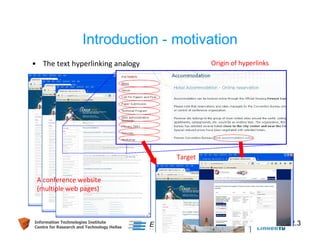
• The text hyperlinking analogy 
A conference website 
(multiple web pages) 
Origin of hyperlinks 
Target 
Information Technologies Institute 2.3 
Centre for Research and Technology Hellas
Introduction - motivation 
• The text hyperlinking analogy 
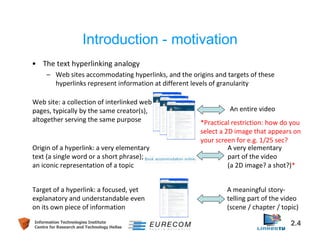
– Web sites accommodating hyperlinks, and the origins and targets of these 
hyperlinks represent information at different levels of granularity 
Web site: a collection of interlinked web 
pages, typically by the same creator(s), 
altogether serving the same purpose 
Origin of a hyperlink: a very elementary 
text (a single word or a short phrase); 
an iconic representation of a topic 
Target of a hyperlink: a focused, yet 
explanatory and understandable even 
on its own piece of information 
An entire video 
*Practical restriction: how do you 
select a 2D image that appears on 
your screen for e.g. 1/25 sec? 
A very elementary 
part of the video 
(a 2D image? a shot?)* 
A meaningful story-telling 
part of the video 
(scene / chapter / topic) 
Information Technologies Institute 2.4 
Centre for Research and Technology Hellas
Introduction - motivation 
• We have: media items (videos) 
• We want to: perform video hyperlinking 
• Thus, we need to: 
– Break down each video to fragments that can serve as the origin and the 
target of hyperlinks 
– Annotate each fragment so that we can identify meaningful pairs of fragments 
(i.e., identify two fragments as the origin and the target of the same link) 
• We could do this either 
– Manually: + accuracy, - speed, cost, effort  only feasible for low-volume, 
high-value media items 
– Automatically: - accuracy, + speed, cost, effort  the only option for handling 
high volume of content 
– …as is often the case, in many real-world applications finding middle ground 
also makes sense: try to automate the process as much as possible, but still 
keep the human in the loop 
Information Technologies Institute 2.5 
Centre for Research and Technology Hellas
Introduction - motivation 
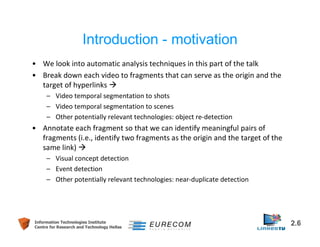
• We look into automatic analysis techniques in this part of the talk 
• Break down each video to fragments that can serve as the origin and the 
target of hyperlinks  
– Video temporal segmentation to shots 
– Video temporal segmentation to scenes 
– Other potentially relevant technologies: object re-detection 
• Annotate each fragment so that we can identify meaningful pairs of 
fragments (i.e., identify two fragments as the origin and the target of the 
same link)  
– Visual concept detection 
– Event detection 
– Other potentially relevant technologies: near-duplicate detection 
Information Technologies Institute 2.6 
Centre for Research and Technology Hellas
Fragment creation: shots 
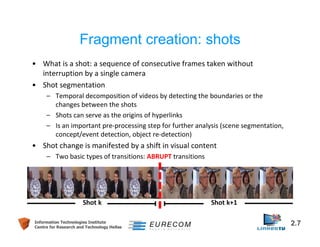
• What is a shot: a sequence of consecutive frames taken without 
interruption by a single camera 
• Shot segmentation 
– Temporal decomposition of videos by detecting the boundaries or the 
changes between the shots 
– Shots can serve as the origins of hyperlinks 
– Is an important pre-processing step for further analysis (scene segmentation, 
concept/event detection, object re-detection) 
• Shot change is manifested by a shift in visual content 
– Two basic types of transitions: ABRUPT transitions 
Shot k Shot k+1 
Information Technologies Institute 2.7 
Centre for Research and Technology Hellas
Fragment creation: shots 
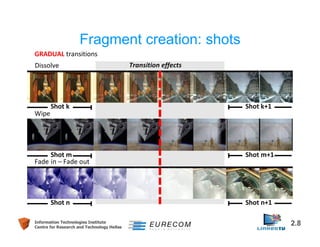
GRADUAL transitions 
Dissolve 
Transition effects 
Shot k Shot k+1 
Wipe 
Shot m Shot m+1 
Fade in – Fade out 
Shot n Shot n+1 
Information Technologies Institute 2.8 
Centre for Research and Technology Hellas
Fragment creation: shots 
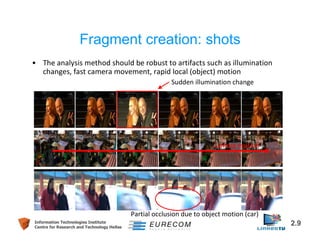
• The analysis method should be robust to artifacts such as illumination 
changes, fast camera movement, rapid local (object) motion 
Sudden illumination change 
Camera motion 
Partial occlusion due to object motion (car) 
Information Technologies Institute 2.9 
Centre for Research and Technology Hellas
Related work 
• Can generally be organized according to 
– Data to work with: uncompressed vs. compressed video 
– Features to use (also depends on the data) 
– Threshold-based vs. learning-based methods 
• Compressed video methods 
– Reduce computational complexity by avoiding decoding, exploiting encoder 
results 
• Macroblock information of specific frames (e.g. intra-coded, skipped) 
• DC coefficients of the compressed images 
• Motion vectors included in the compressed data stream 
– Generally, very fast but not as accurate as uncompressed video methods 
Information Technologies Institute 2.10 
Centre for Research and Technology Hellas
Related work 
• Uncompressed video methods 
– Pair-wise pixel comparisons 
– Global visual feature comparisons (e.g. color histogram comparison) 
– Edge-based approaches, e.g. evaluating an edge change ratio 
– Motion-based approaches 
– Local visual features / Bag of Visual Words 
• Some features more computationally expensive than others 
– Deciding using experimentally-defined thresholds: often hard to tune  the 
alternative is to use machine learning techniques (often Support Vector 
Machines (SVMs)) for learning from different features 
• General remark: high detection accuracy and relatively low computational 
complexity are possible when working with uncompressed data 
Information Technologies Institute 2.11 
Centre for Research and Technology Hellas
An indicative approach 
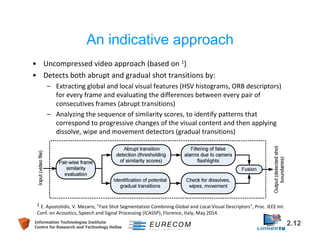
• Uncompressed video approach (based on 1) 
• Detects both abrupt and gradual shot transitions by: 
– Extracting global and local visual features (HSV histograms, ORB descriptors) 
for every frame and evaluating the differences between every pair of 
consecutives frames (abrupt transitions) 
– Analyzing the sequence of similarity scores, to identify patterns that 
correspond to progressive changes of the visual content and then applying 
dissolve, wipe and movement detectors (gradual transitions) 
1 E. Apostolidis, V. Mezaris, "Fast Shot Segmentation Combining Global and Local Visual Descriptors", Proc. IEEE Int. 
Conf. on Acoustics, Speech and Signal Processing (ICASSP), Florence, Italy, May 2014. 
Information Technologies Institute 2.12 
Centre for Research and Technology Hellas
An indicative approach 
• Gradual transition detection 
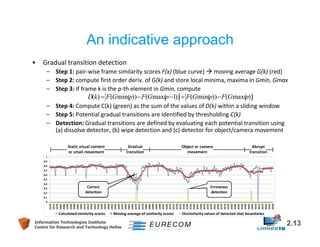
– Step 1: pair-wise frame similarity scores F(x) (blue curve)  moving average G(k) (red) 
– Step 2: compute first order deriv. of G(k) and store local minima, maxima in Gmin, Gmax 
– Step 3: If frame k is the p-th element in Gmin, compute 
– how 
D(k) F(Gmin(p))F(Gmax(p1))  F(Gmin(p))F(Gmax(p)) 
– Step 4: Compute C(k) (green) as the sum of the values of D(k) within a sliding window 
– Step 5: Potential gradual transitions are identified by thresholding C(k) 
– Detection: Gradual transitions are defined by evaluating each potential transition using 
(a) dissolve detector, (b) wipe detection and (c) detector for object/camera movement 
1 
0,9 
0,8 
0,7 
0,6 
0,5 
0,4 
0,3 
0,2 
0,1 
0 
Correct 
detection 
Erroneous 
detection 
2370 
2374 
2378 
2382 
2386 
2390 
2394 
2398 
2402 
2406 
2410 
2414 
2418 
2422 
2426 
2430 
2434 
2438 
2442 
2446 
2450 
2454 
2458 
2462 
2466 
2470 
2474 
2478 
2482 
2486 
2490 
2494 
2498 
2502 
2506 
2510 
2514 
2518 
2522 
2526 
2530 
2534 
2538 
2542 
2546 
2550 
2554 
2558 
2562 
2566 
2570 
2574 
2578 
2582 
2586 
2590 
2594 
2598 
2602 
2606 
2610 
2614 
2618 
2622 
2626 
2630 
Calculated similarity scores Moving average of similarity scores Dissimilarity values of detected shot boundaries 
Information Technologies Institute 2.13 
Centre for Research and Technology Hellas
Indicative experiments and results 
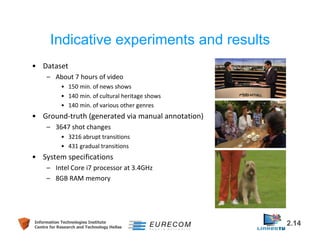
• Dataset 
– About 7 hours of video 
• 150 min. of news shows 
• 140 min. of cultural heritage shows 
• 140 min. of various other genres 
• Ground-truth (generated via manual annotation) 
– 3647 shot changes 
• 3216 abrupt transitions 
• 431 gradual transitions 
• System specifications 
– Intel Core i7 processor at 3.4GHz 
– 8GB RAM memory 
Information Technologies Institute 2.14 
Centre for Research and Technology Hellas
Indicative experiments and results 
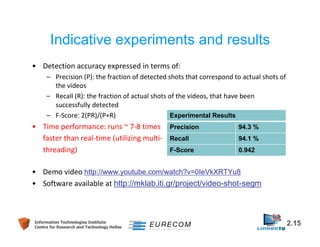
• Detection accuracy expressed in terms of: 
– Precision (P): the fraction of detected shots that correspond to actual shots of 
the videos 
– Recall (R): the fraction of actual shots of the videos, that have been 
successfully detected 
– F-Score: 2(PR)/(P+R) 
• Time performance: runs ~ 7-8 times 
faster than real-time (utilizing multi-threading) 
Experimental Results 
Precision 94.3 % 
Recall 94.1 % 
F-Score 0.942 
• Demo video http://www.youtube.com/watch?v=0IeVkXRTYu8 
• Software available at http://mklab.iti.gr/project/video-shot-segm 
Information Technologies Institute 2.15 
Centre for Research and Technology Hellas
Shot detection conclusions 
• Overall accuracy of shot detection methods is high, sufficient for any 
application 
• Detection of abrupt transitions is very easy; gradual transitions & handling 
of intense motion still a bit more challenging 
• Several times faster-than-real-time processing is feasible 
• More elaborate motion-based analysis is still possible (but would increase 
the computational load) 
Information Technologies Institute 2.16 
Centre for Research and Technology Hellas
Shot detection: additional reading 
• E. Apostolidis, V. Mezaris, "Fast Shot Segmentation Combining Global and Local Visual Descriptors", Proc. IEEE 
Int. Conf. on Acoustics, Speech and Signal Processing (ICASSP), Florence, Italy, May 2014. 
• E. Tsamoura, V. Mezaris, and I. Kompatsiaris, “Gradual transition detection using color coherence and other 
criteria in a video shot meta-segmentation framework”, Proc. 15th IEEE Int. Conf. on Image Processing, 2008. 
• V. Chasanis, A. Likas, and N. Galatsanos, “Simultaneous detection of abrupt cuts and dissolves in videos using 
support vector machines,” Pattern Recogn. Lett., vol. 30, no. 1, pp. 55–65, Jan. 2009. 
• Z. Qu, Y. Liu, L. Ren, Y. Chen, and R. Zheng, “A method of shot detection based on color and edge features,” 
Proc. 1st IEEE Symposium on Web Society, 2009. SWS ’09. 2009, pp. 1–4. 
• J. Lankinen and J.-K. Kamarainen, “Video shot boundary detection using visual bag-of-words,” Proc. Int. Conf. 
on Computer Vision Theory and Applications (VISAPP), Barcelona, Spain, 2013. 
• J. Li, Y. Ding, Y. Shi, and W. Li, “A divide-and-rule scheme for shot boundary detection based on sift,” JDCTA, 
pp. 202–214, 2010. 
• C.-W. Su, H.-Y.M. Liao, H.-R. Tyan, K.-C. Fan, L.-H. Chen, “A motion-tolerant dissolve detection algorithm”, IEEE 
Transactions on Multimedia, vol. 7, no. 6, pp. 1106–1113, 2005. 
• K. D. Seo, S. Park, S. H. Jung, “Wipe scene-change detector based on visual rhythm spectrum”, IEEE 
Transactions on Consumer Electronics, vol. 55, no. 2, pp. 831–838, May 2009. 
• D. Lelescu and D. Schonfeld, “Statistical sequential analysis for real-time video scene change detection on 
compressed multimedia bitstream”, IEEE Transactions on Multimedia,,vol. 5, no. 1, pp. 106–117, 2003. 
• J. H. Nam and A.H. Tewfik, “Detection of gradual transitions in video sequences using b-spline interpolation”, 
IEEE Transactions on Multimedia, vol. 7, no. 4, pp. 667–679, 2005. 
• C. Grana and R. Cucchiara, “Linear transition detection as a unified shot detection approach”, IEEE 
Transactions on Circuits and Systems for Video Technology, vol. 17, no. 4, pp. 483–489, 2007. 
• Z. Cernekova, N. Nikolaidis, and I. Pitas, “Temporal video segmentation by graph partitioning”, Proc. IEEE Int. 
Conf. on Acoustics, Speech and Signal Processing, ICASSP 2006. 
Information Technologies Institute 2.17 
Centre for Research and Technology Hellas
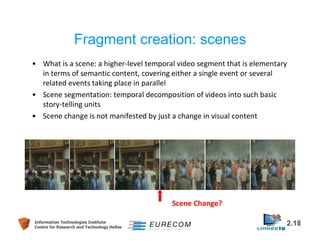
Fragment creation: scenes 
• What is a scene: a higher-level temporal video segment that is elementary 
in terms of semantic content, covering either a single event or several 
related events taking place in parallel 
• Scene segmentation: temporal decomposition of videos into such basic 
• Scene change is not manifested by just a change in visual content 
Scene Change? 
story-telling units 
Information Technologies Institute 2.18 
Centre for Research and Technology Hellas
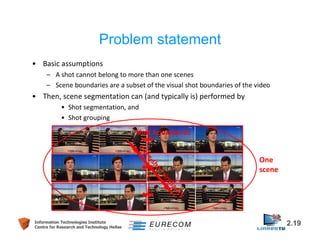
Problem statement 
• Basic assumptions 
– A shot cannot belong to more than one scenes 
– Scene boundaries are a subset of the visual shot boundaries of the video 
• Then, scene segmentation can (and typically is) performed by 
• Shot segmentation, and 
• Shot grouping 
Shot boundaries 
Inter-shot similarity 
One 
scene 
Information Technologies Institute 2.19 
Centre for Research and Technology Hellas
Related work 
• Can generally be organized according to 
– Data to work with: uni-modal vs. multi-modal 
– Dependence or not on specific-domain knowledge; domain of choice 
– Algorithms used 
• Uni-modal vs. multi-modal 
– Uni-modal methods use one type of information, typically visual cues 
– Multi-modal ones may combine visual cues, audio, speech transcripts, … 
• Domain-specific vs. domain-independent 
– Domain-independent methods are generally applicable 
– News-domain (e.g. using knowledge of news structure), TV broadcast domain 
(e.g. based on advertisement detection), etc. 
• Algorithms 
– Graph-based, e.g. the Scene Transition Graph 
– Clustering-based, e.g. using hierarchical clustering 
– Based on statistical methods, e.g. on Markov Chain Monte Carlo (MCMC) 
Information Technologies Institute 2.20 
Centre for Research and Technology Hellas
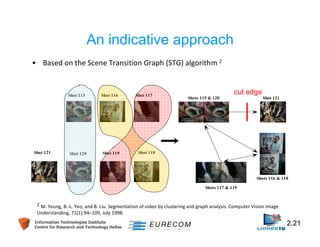
An indicative approach 
• Based on the Scene Transition Graph (STG) algorithm 2 
Shot 115 Shot 116 Shot 117 
Shot 120 Shot 119 Shot 118 
Shot 121 
cut edge 
Shots 116 & 118 
Shots 115 & 120 
Shots 117 & 119 
Shot 121 
2 M. Yeung, B.-L. Yeo, and B. Liu. Segmentation of video by clustering and graph analysis. Computer Vision Image 
Understanding, 71(1):94–109, July 1998. 
Information Technologies Institute 2.21 
Centre for Research and Technology Hellas
An indicative approach 
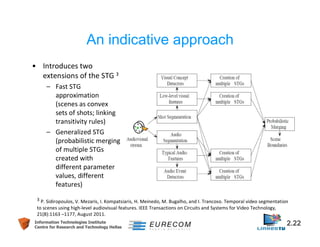
• Introduces two 
extensions of the STG 3 
– Fast STG 
approximation 
(scenes as convex 
sets of shots; linking 
transitivity rules) 
– Generalized STG 
(probabilistic merging 
of multiple STGs 
created with 
different parameter 
values, different 
features) 
3 P. Sidiropoulos, V. Mezaris, I. Kompatsiaris, H. Meinedo, M. Bugalho, and I. Trancoso. Temporal video segmentation 
to scenes using high-level audiovisual features. IEEE Transactions on Circuits and Systems for Video Technology, 
21(8):1163 –1177, August 2011. 
Information Technologies Institute 2.22 
Centre for Research and Technology Hellas
Indicative experiments and results 
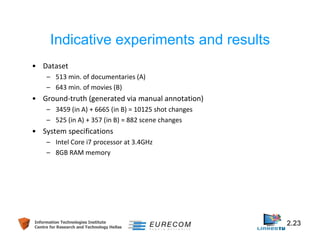
• Dataset 
– 513 min. of documentaries (A) 
– 643 min. of movies (B) 
• Ground-truth (generated via manual annotation) 
– 3459 (in A) + 6665 (in B) = 10125 shot changes 
– 525 (in A) + 357 (in B) = 882 scene changes 
• System specifications 
– Intel Core i7 processor at 3.4GHz 
– 8GB RAM memory 
Information Technologies Institute 2.23 
Centre for Research and Technology Hellas
Indicative experiments and results 
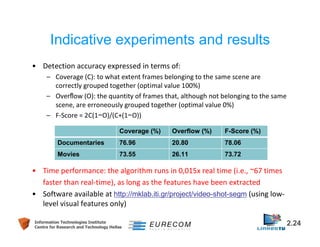
• Detection accuracy expressed in terms of: 
– Coverage (C): to what extent frames belonging to the same scene are 
correctly grouped together (optimal value 100%) 
– Overflow (O): the quantity of frames that, although not belonging to the same 
scene, are erroneously grouped together (optimal value 0%) 
– F-Score = 2C(1−O)/(C+(1−O)) 
Coverage (%) Overflow (%) F-Score (%) 
Documentaries 76.96 20.80 78.06 
Movies 73.55 26.11 73.72 
• Time performance: the algorithm runs in 0,015x real time (i.e., ~67 times 
faster than real-time), as long as the features have been extracted 
• Software available at http://mklab.iti.gr/project/video-shot-segm (using low-level 
visual features only) 
Information Technologies Institute 2.24 
Centre for Research and Technology Hellas
Indicative experiments and results 
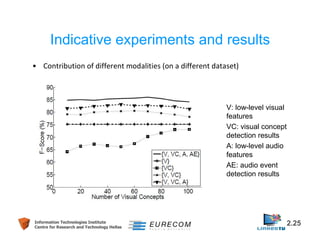
• Contribution of different modalities (on a different dataset) 
V: low-level visual 
features 
VC: visual concept 
detection results 
A: low-level audio 
features 
AE: audio event 
detection results 
Information Technologies Institute 2.25 
Centre for Research and Technology Hellas
Scene detection conclusions 
• Automatic scene segmentation less accurate than shot segmentation… 
• …but the results are good enough for improving access to meaningful 
fragments in various applications (e.g. retrieval, video hyperlinking) 
• Using more than just low-level visual features helps a lot 
• The choice of domain-specific vs. domain-independent method should be 
taken seriously 
Information Technologies Institute 2.26 
Centre for Research and Technology Hellas
Scene detection: additional reading 
• M. Yeung, B.-L. Yeo, and B. Liu, “Segmentation of video by clustering and graph analysis”, Computer Vision Image 
Understanding, vol. 71, no. 1, pp. 94–109, July 1998. 
• P. Sidiropoulos, V. Mezaris, I. Kompatsiaris, H. Meinedo, M. Bugalho, and I. Trancoso, “Temporal video segmentation to 
scenes using high-level audiovisual features”, IEEE Transactions on Circuits and Systems for Video Technology, vol. 21, 
no. 8, pp. 1163 –1177, August 2011. 
• P. Sidiropoulos, V. Mezaris, I. Kompatsiaris, J. Kittler, “Differential Edit Distance: A metric for scene segmentation 
evaluation”, IEEE Transactions on Circuits and Systems for Video Technology, vol. 22, no. 6, pp. 904-914, June 2012. 
• Z. Rasheed and M. Shah, “Detection and representation of scenes in videos”, IEEE Transactions on Multimedia, vol. 7, 
no. 6, pp. 1097–1105, December 2005. 
• C.-W. Ngo, Y.-F. Ma, and H.-J. Zhang, “Video summarization and scene detection by graph modeling”, IEEE Transactions 
on Circuits and Systems for Video Technology, vol. 15, no. 2, pp. 296–305, February 2005. 
• Y. Zhao, T. Wang, P. Wang, W. Hu, Y. Du, Y. Zhang, G. Xu, “Scene segmentation and categorization using N-cuts”, IEEE 
Conf. on Computer Vision and Pattern Recognition, 2007. 
• X. Zhu, A.K. Elmagarmid, X. Xue, L. Wu, and A.C. Catlin, “Insightvideo: toward hierarchical video content organization for 
efficient browsing, summarization and retrieval”, IEEE Transactions on Multimedia, vol. 7, no. 4, pp. 648– 666, August 
2005. 
• B. T. Truong, S. Venkatesh, and C. Dorai, “Scene extraction in motion pictures”, IEEE Transactions on Circuits and 
Systems for Video Technology, vol. 13, no. 1, pp. 5–15, January 2003. 
• X.-S. Hua, L. Lu, and H.-J. Zhang, “Optimization-based automated home video editing system”, IEEE Transactions on 
Circuits and Systems for Video Technology, vol. 14, no. 5, pp. 572–583, May 2004. 
• D. Gatica-Perez, A. Loui, and M.-T. Sun, “Finding structure in consumer videos by probabilistic hierarchical clustering”, 
IEEE Transactions on Circuits and Systems for Video Technology, 2002. 
Information Technologies Institute 2.27 
Centre for Research and Technology Hellas
Scene detection: additional reading 
• J. Liao and B. Zhang, “A robust clustering algorithm for video shots using haar wavelet transformation”, Proc. 
SIGMOD2007 Workshop on Innovative Database Research (IDAR2007), Beijing, China, June 2007. 
• Y. Zhai and M. Shah, “Video scene segmentation using markov chain monte carlo”, IEEE Transactions on Multimedia, 
vol. 8, no. 4, pp. 686–697, August 2006. 
• M. Sugano, K. Hoashi, K. Matsumoto, and Y. Nakajima, “Shot boundary determination on MPEG compressed domain 
and story segmentation experiments for trecvid 2004, in trec video retrieval evaluation forum”, Proc. TREC Video 
Retrieval Evaluation (TRECVID), Washington, DC, USA, pp. 109–120, 2004. 
• L. Xie, P. Xu, S.-F. Chang, A. Divakaran, and H. Sun, “Structure analysis of soccer video with domain knowledge and 
hidden markov models”, Pattern Recogn. Lett., vol. 25, no. 7, pp. 767–775, May 2004. 
• H. Lu, Z. Li, and Y.-P. Tan, “Model-based video scene clustering with noise analysis”, Proc. Int. Symposium on Circuits 
and Systems, ISCAS ’04, vol. 2, pp. 105–108, May 2004. 
• Y. Ariki, M. Kumano, and K. Tsukada, “Highlight scene extraction in real time from baseball live video”, Proc. 5th ACM 
SIGMM international workshop on Multimedia information retrieval, MIR ’03, pp. 209–214, New York, NY, USA, 2003. 
• U. Iurgel, R. Meermeier, S. Eickeler, and G. Rigoll, “New approaches to audio-visual segmentation of tv news for 
automatic topic retrieval”, Proc. IEEE Int. Conf. on the Acoustics, Speech, and Signal Processing (ICASSP ’01), vol. 3, pp. 
1397–1400, Washington, DC, USA, 2001. 
• Y. Cao, W. Tavanapong, K. Kim, and J.H. Oh, “Audio-assisted scene segmentation for story browsing”, Proc. 2nd Int. 
Conf. on Image and Video Retrieval, CIVR’03, pp. 446–455, Springer-Verlag. 
• A. Velivelli, C.-W. Ngo, and T. S. Huang, “Detection of documentary scene changes by audio-visual fusion”, Proc. 2nd Int. 
Conf. on Image and Video Retrieval, CIVR’03, pp. 227–238, Springer-Verlag. 
Information Technologies Institute 2.28 
Centre for Research and Technology Hellas
Fragment annotation: visual 
concept detection 
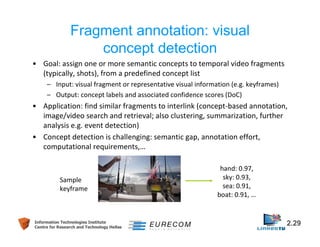
• Goal: assign one or more semantic concepts to temporal video fragments 
(typically, shots), from a predefined concept list 
– Input: visual fragment or representative visual information (e.g. keyframes) 
– Output: concept labels and associated confidence scores (DoC) 
• Application: find similar fragments to interlink (concept-based annotation, 
image/video search and retrieval; also clustering, summarization, further 
analysis e.g. event detection) 
• Concept detection is challenging: semantic gap, annotation effort, 
computational requirements,… 
hand: 0.97, 
sky: 0.93, 
sea: 0.91, 
boat: 0.91, … 
Sample 
keyframe 
Information Technologies Institute 2.29 
Centre for Research and Technology Hellas
Related work 
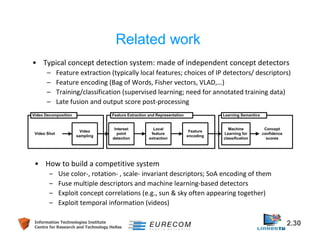
• Typical concept detection system: made of independent concept detectors 
– Feature extraction (typically local features; choices of IP detectors/ descriptors) 
– Feature encoding (Bag of Words, Fisher vectors, VLAD,…) 
– Training/classification (supervised learning; need for annotated training data) 
– Late fusion and output score post-processing 
• How to build a competitive system 
– Use color-, rotation- , scale- invariant descriptors; SoA encoding of them 
– Fuse multiple descriptors and machine learning-based detectors 
– Exploit concept correlations (e.g., sun & sky often appearing together) 
– Exploit temporal information (videos) 
Information Technologies Institute 2.30 
Centre for Research and Technology Hellas
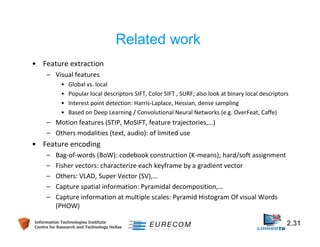
• Feature extraction 
– Visual features 
Related work 
• Global vs. local 
• Popular local descriptors SIFT, Color SIFT , SURF; also look at binary local descriptors 
• Interest point detection: Harris-Laplace, Hessian, dense sampling 
• Based on Deep Learning / Convolutional Neural Networks (e.g. OverFeat, Caffe) 
– Motion features (STIP, MoSIFT, feature trajectories,…) 
– Others modalities (text, audio): of limited use 
• Feature encoding 
– Bag-of-words (BoW): codebook construction (K-means); hard/soft assignment 
– Fisher vectors: characterize each keyframe by a gradient vector 
– Others: VLAD, Super Vector (SV),… 
– Capture spatial information: Pyramidal decomposition,… 
– Capture information at multiple scales: Pyramid Histogram Of visual Words 
(PHOW) 
Information Technologies Institute 2.31 
Centre for Research and Technology Hellas
• Machine learning 
Related work 
– Binary classification: Support Vector Machines (SVMs), Logistic Regression,… 
• Linear vs. kernel methods 
– Multi-label learning approaches; Stacking 
• Fusion 
– Of features (early / late) 
– Of detectors 
• Post-processing: temporal re-ranking,… 
Information Technologies Institute 2.32 
Centre for Research and Technology Hellas
An indicative approach 
• Concept detection using a two-layer stacking architecture 
– 1st layer: Build multiple fast and independent concept detectors 
• Use keyframes, and visual tomographs to capture the motion information 
• Extract high-dimensional feature vectors 
• Train Linear Support Vector Machine / Logistic Regression classifiers 
• Easily scalable but does not capture concept correlations 
– 2nd layer: Exploit concept correlations and refine the scores 
• Construct low-dimensional model vectors 
• Use multi-label learning to capture the concept correlations (e.g. ML-kNN or Label 
Powerset algorithms) 
• Use temporal re-ranking to exploit temporal information 
Information Technologies Institute 2.33 
Centre for Research and Technology Hellas
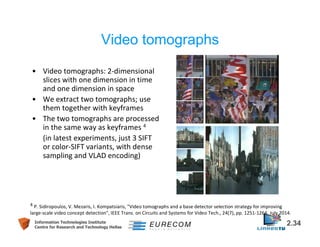
Video tomographs 
• Video tomographs: 2-dimensional 
slices with one dimension in time 
and one dimension in space 
• We extract two tomographs; use 
them together with keyframes 
• The two tomographs are processed 
in the same way as keyframes 4 
(in latest experiments, just 3 SIFT 
or color-SIFT variants, with dense 
sampling and VLAD encoding) 
4 P. Sidiropoulos, V. Mezaris, I. Kompatsiaris, "Video tomographs and a base detector selection strategy for improving 
large-scale video concept detection", IEEE Trans. on Circuits and Systems for Video Tech., 24(7), pp. 1251-1264, July 2014. 
Information Technologies Institute 2.34 
Centre for Research and Technology Hellas
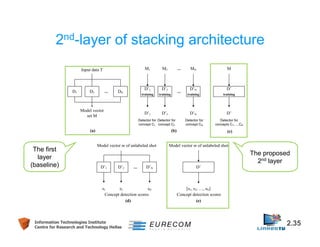
2nd-layer of stacking architecture 
The proposed 
2nd layer 
The first 
layer 
(baseline) 
Information Technologies Institute 2.35 
Centre for Research and Technology Hellas
2nd-layer of stacking architecture 
• Exploit concept correlations 
– Construct model vectors by concatenating the responses of the concept 
detectors on a validation set 
– Use them to train 2nd-layer classifier 
• ML-kNN as the 2nd-layer classifier 5 
– A lazy style multi-label learning algorithm; uses label correlations in the 
neighbourhood of the tested instance to infer posterior probabilities. 
• Label Powersets (LP) as the 2nd-layer classifier 5 
– Searches for subsets of labels that appear together in the training set; 
considers each set as a separate class in order to solve a multi-class problem 
5 F. Markatopoulou, V. Mezaris, I. Kompatsiaris. A Comparative Study on the Use of Multi-Label Classification 
Techniques for Concept-Based Video Indexing and Annotation. Proc. 20th Int. Conf. on Multimedia Modeling 
(MMM'14), Jan. 2014. 
Information Technologies Institute 2.36 
Centre for Research and Technology Hellas
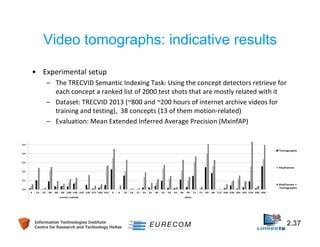
Video tomographs: indicative results 
• Experimental setup 
– The TRECVID Semantic Indexing Task: Using the concept detectors retrieve for 
each concept a ranked list of 2000 test shots that are mostly related with it 
– Dataset: TRECVID 2013 (~800 and ~200 hours of internet archive videos for 
training and testing), 38 concepts (13 of them motion-related) 
– Evaluation: Mean Extended Inferred Average Precision (MxinfAP) 
Information Technologies Institute 2.37 
Centre for Research and Technology Hellas
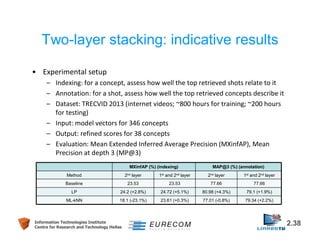
Two-layer stacking: indicative results 
• Experimental setup 
– Indexing: for a concept, assess how well the top retrieved shots relate to it 
– Annotation: for a shot, assess how well the top retrieved concepts describe it 
– Dataset: TRECVID 2013 (internet videos; ~800 hours for training; ~200 hours 
for testing) 
– Input: model vectors for 346 concepts 
– Output: refined scores for 38 concepts 
– Evaluation: Mean Extended Inferred Average Precision (MXinfAP), Mean 
Precision at depth 3 (MP@3) 
MXinfAP (%) (indexing) MAP@3 (%) (annotation) 
Method 2nd layer 1st and 2nd layer 2nd layer 1st and 2nd layer 
Baseline 23.53 23.53 77.66 77.66 
LP 24.2 (+2.8%) 24.72 (+5.1%) 80.98 (+4.3%) 79.1 (+1.9%) 
ML-kNN 18.1 (-23.1%) 23.61 (+0.3%) 77.01 (-0.8%) 79.34 (+2.2%) 
Information Technologies Institute 2.38 
Centre for Research and Technology Hellas
Concept detection conclusions 
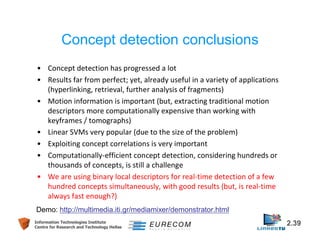
• Concept detection has progressed a lot 
• Results far from perfect; yet, already useful in a variety of applications 
(hyperlinking, retrieval, further analysis of fragments) 
• Motion information is important (but, extracting traditional motion 
descriptors more computationally expensive than working with 
keyframes / tomographs) 
• Linear SVMs very popular (due to the size of the problem) 
• Exploiting concept correlations is very important 
• Computationally-efficient concept detection, considering hundreds or 
thousands of concepts, is still a challenge 
• We are using binary local descriptors for real-time detection of a few 
hundred concepts simultaneously, with good results (but, is real-time 
always fast enough?) 
Demo: http://multimedia.iti.gr/mediamixer/demonstrator.html 
Information Technologies Institute 2.39 
Centre for Research and Technology Hellas
Concept detection: additional reading 
• P. Sidiropoulos, V. Mezaris, and I. Kompatsiaris, “Enhancing video concept detection with the use of tomographs”, Proc. IEEE 
Int. Conference. on Image Processing (ICIP 2013), Melbourne, Australia, 2013. 
• F. Markatopoulou, V. Mezaris, I. Kompatsiaris, “A Comparative Study on the Use of Multi-Label Classification 
Techniques for Concept-Based Video Indexing and Annotation”, Proc. 20th Int. Conf. on Multimedia Modeling (MMM'14), 
Jan. 2014. 
• C. Snoek, M. Worringm, “Concept-Based Video Retrieval”, in Foundations and Trends in Information Retrieval, vol. 2, no. 4, 
pp. 215–322, 2009. 
• A. W. M. Smeulders, M.Worring, S. Santini, A.Gupta, and R. Jain, “Content- based image retrieval at the end of the early 
years”, IEEE Transactions on Pattern Analysis and Machine Intelligence, vol. 22, pp. 1349–1380, 2000. 
• G. Nasierding, A. Kouzani, “Empirical Study of Multi-label Classification Methods for Image Annotation and Retrieval”, Proc. 
2010 Int. Conf. on Digital Image Computing: Techniques and Applications, China, pp. 617–622. 
• G.J. Qi, X.S. Hua, Y. Rui, J. Tang, T. Mei, H. Zhang, “Correlative multi-label video annotation”, Proc. 15th Int. Conf. on 
Multimedia, pp. 17–26. 
• M.-L. Zhang and Z.-H. Zhou, “ML-KNN: A lazy learning approach to multi-label learning”, Pattern Recognition, vol. 40, no. 7, 
2007. 
• A. F. Smeaton, P. Over, and W. Kraaij, “Evaluation campaigns and TRECVid”, Proc. 8th ACM Int. Workshop on Multimedia 
Information Retrieval (MIR '06), pp. 321-330, 2006. 
• B. Safadi and G. Quenot, “Re-ranking by Local Re-Scoring for Video Indexing and Retrieval”, in C. Macdonald, I. Ounis, and I. 
Ruthven, editors, CIKM, pp. 2081-2084, 2011. 
• J. C. Van Gemert, C. J. Veenman, A. Smeulders, J.-M. Geusebroek, “Visual word ambiguity”, IEEE Transactions on Pattern 
Analysis and Machine Intelligence, vol. 32, no. 7, pp. 1271–1283, 2010. 
• G. Csurka and F. Perronnin, “Fisher vectors: Beyond bag-of visual-words image representations”, Computer Vision, Imaging 
and Computer Graphics. Theory and Applications. Springer CCIS vol. 229, 2011. 
• H. Jegou, F. Perronnin, M. Douze, J. Sanchez, P. Perez, and C. Schmid, “Aggregating local image descriptors into compact 
codes”, IEEE Transactions on Pattern Analysis and Machine Intelligence, vol. 34, no. 9, pp. 1704–1716, 2012. 
Information Technologies Institute 2.40 
Centre for Research and Technology Hellas
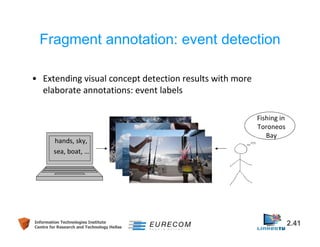
Fragment annotation: event detection 
• Extending visual concept detection results with more 
elaborate annotations: event labels 
hands, sky, 
sea, boat, … 
Fishing in 
Toroneos 
Bay 
Information Technologies Institute 2.41 
Centre for Research and Technology Hellas
Problem statement 
• Objective: 
– Automatically detect high-level events in large video collections 
– Events are defined as “purposeful activities, involving people, acting on 
objects and interacting with each other to achieve some result” 
“Changing a vehicle tire” “Skiing” “Working on a sewing project” 
– Exploit an annotated video dataset 
– Represent videos with suitable feature vectors {(x ,y) є X x {-1,1}} 
– Learn an appropriate event detector f: X → [0,1] 
Information Technologies Institute 2.42 
Centre for Research and Technology Hellas
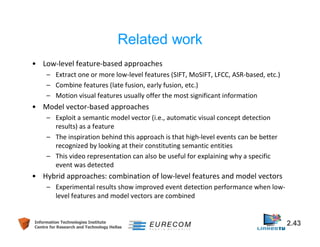
Related work 
• Low-level feature-based approaches 
– Extract one or more low-level features (SIFT, MoSIFT, LFCC, ASR-based, etc.) 
– Combine features (late fusion, early fusion, etc.) 
– Motion visual features usually offer the most significant information 
• Model vector-based approaches 
– Exploit a semantic model vector (i.e., automatic visual concept detection 
results) as a feature 
– The inspiration behind this approach is that high-level events can be better 
recognized by looking at their constituting semantic entities 
– This video representation can also be useful for explaining why a specific 
event was detected 
• Hybrid approaches: combination of low-level features and model vectors 
– Experimental results show improved event detection performance when low-level 
features and model vectors are combined 
Information Technologies Institute 2.43 
Centre for Research and Technology Hellas
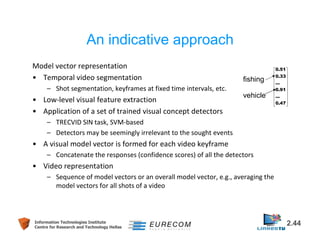
An indicative approach 
Model vector representation 
• Temporal video segmentation 
– Shot segmentation, keyframes at fixed time intervals, etc. 
• Low-level visual feature extraction 
• Application of a set of trained visual concept detectors 
– TRECVID SIN task, SVM-based 
– Detectors may be seemingly irrelevant to the sought events 
• A visual model vector is formed for each video keyframe 
fishing 
vehicle 
– Concatenate the responses (confidence scores) of all the detectors 
• Video representation 
  
  
  
  
  
  
  
  
  
– Sequence of model vectors or an overall model vector, e.g., averaging the 
model vectors for all shots of a video 
0.51 
0.33 
... 
0.91 
... 
0.47 
Information Technologies Institute 2.44 
Centre for Research and Technology Hellas
An indicative approach 
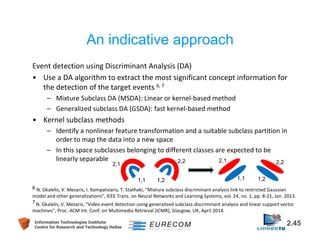
Event detection using Discriminant Analysis (DA) 
• Use a DA algorithm to extract the most significant concept information for 
the detection of the target events 6, 7 
– Mixture Subclass DA (MSDA): Linear or kernel-based method 
– Generalized subclass DA (GSDA): fast kernel-based method 
• Kernel subclass methods 
– Identify a nonlinear feature transformation and a suitable subclass partition in 
order to map the data into a new space 
– In this space subclasses belonging to different classes are expected to be 
linearly separable 
2,1 2,2 2,1 2,2 
1,1 1,2 1,1 1,2 
6 N. Gkalelis, V. Mezaris, I. Kompatsiaris, T. Stathaki, "Mixture subclass discriminant analysis link to restricted Gaussian 
model and other generalizations", IEEE Trans. on Neural Networks and Learning Systems, vol. 24, no. 1, pp. 8-21, Jan. 2013. 
7 N. Gkalelis, V. Mezaris, "Video event detection using generalized subclass discriminant analysis and linear support vector 
machines", Proc. ACM Int. Conf. on Multimedia Retrieval (ICMR), Glasgow, UK, April 2014. 
Information Technologies Institute 2.45 
Centre for Research and Technology Hellas
An indicative approach 
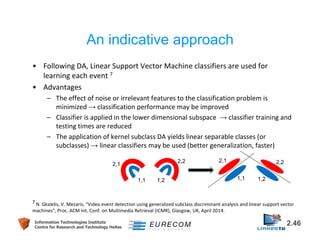
• Following DA, Linear Support Vector Machine classifiers are used for 
learning each event 7 
• Advantages 
– The effect of noise or irrelevant features to the classification problem is 
minimized → classification performance may be improved 
– Classifier is applied in the lower dimensional subspace → classifier training and 
testing times are reduced 
– The application of kernel subclass DA yields linear separable classes (or 
subclasses) → linear classifiers may be used (better generalization, faster) 
2,1 2,2 2,1 2,2 
1,1 1,2 1,1 1,2 
7 N. Gkalelis, V. Mezaris, "Video event detection using generalized subclass discriminant analysis and linear support vector 
machines", Proc. ACM Int. Conf. on Multimedia Retrieval (ICMR), Glasgow, UK, April 2014. 
Information Technologies Institute 2.46 
Centre for Research and Technology Hellas
Indicative experiments and results 
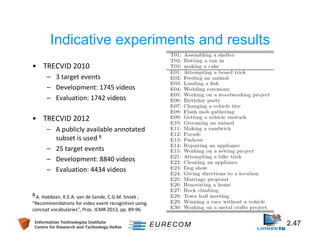
• TRECVID 2010 
– 3 target events 
– Development: 1745 videos 
– Evaluation: 1742 videos 
• TRECVID 2012 
– A publicly available annotated 
subset is used 8 
– 25 target events 
– Development: 8840 videos 
– Evaluation: 4434 videos 
8 A. Habibian, K.E.A. van de Sande, C.G.M. Snoek , 
"Recommendations for video event recognition using 
concept vocabularies", Proc. ICMR 2013, pp. 89-96. 
Information Technologies Institute 2.47 
Centre for Research and Technology Hellas
Indicative experiments and results 
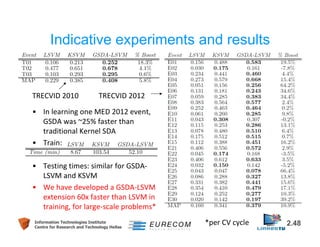
TRECVID 2010 TRECVID 2012 
• In learning one MED 2012 event, 
GSDA was ~25% faster than 
traditional Kernel SDA 
• Train: 
• Testing times: similar for GSDA-LSVM 
and KSVM 
• We have developed a GSDA-LSVM 
extension 60x faster than LSVM in 
training, for large-scale problems* 
*per CV cycle 
Information Technologies Institute 2.48 
Centre for Research and Technology Hellas
Event detection conclusions 
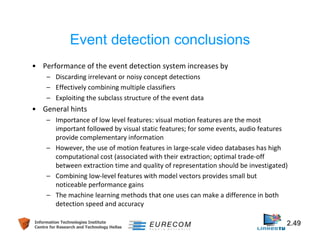
• Performance of the event detection system increases by 
– Discarding irrelevant or noisy concept detections 
– Effectively combining multiple classifiers 
– Exploiting the subclass structure of the event data 
• General hints 
– Importance of low level features: visual motion features are the most 
important followed by visual static features; for some events, audio features 
provide complementary information 
– However, the use of motion features in large-scale video databases has high 
computational cost (associated with their extraction; optimal trade-off 
between extraction time and quality of representation should be investigated) 
– Combining low-level features with model vectors provides small but 
noticeable performance gains 
– The machine learning methods that one uses can make a difference in both 
detection speed and accuracy 
Information Technologies Institute 2.49 
Centre for Research and Technology Hellas
Event detection: additional reading 
• P. Over, J. Fiscus, G. Sanders et. al., "TRECVID 2013 -- An Overview of the Goals, Tasks, Data, Evaluation 
Mechanisms and Metrics", Proc. TRECVID 2013 Workshop, November 2013, Gaithersburg, MD, USA. 
• N. Gkalelis, V. Mezaris, I. Kompatsiaris, T. Stathaki, "Mixture subclass discriminant analysis link to 
restricted Gaussian model and other generalizations", IEEE Transactions on Neural Networks and Learning 
Systems, vol. 24, no. 1, pp. 8-21, January 2013. 
• N. Gkalelis, V. Mezaris, "Video event detection using generalized subclass discriminant analysis and linear 
support vector machines", Proc. ACM Int. Conf. on Multimedia Retrieval (ICMR), Glasgow, UK, April 2014. 
• N. Gkalelis, V. Mezaris, and I. Kompatsiaris, “High-level event detection in video exploiting discriminant 
concepts,” in Proc. 9th Int. Workshop CBMI, Madrid, Spain, June 2011, pp. 85–90. 
• M. Merler, B. Huang, L. Xie, G. Hua, and A. Natsev, “Semantic model vectors for complex video event 
recognition,” IEEE Trans. Multimedia, vol. 14, no. 1, pp. 88–101, Feb. 2012. 
• N. Gkalelis, V. Mezaris, M. Dimopoulos, I. Kompatsiaris, T. Stathaki, "Video event detection using a 
subclass recoding error-correcting output codes framework", Proc. IEEE Int. Conf. on Multimedia and Expo 
(ICME 2013), San Jose, CA, USA, July 2013. 
• Y.-G. Jiang, S. Bhattacharya, S.-F. Chang, and M. Shah, “High-level event recognition in unconstrained 
videos,” Int. J. Multimed. Info. Retr., Nov. 2013. 
• A. Habibian, K. van de Sande, C.G.M. Snoek, "Recommendations for Video Event Recognition Using 
Concept Vocabularies", Proc. ACM Int. Conf. on Multimedia Retrieval, Dallas, Texas, USA, April 2013. 
• Z. Ma, Y. Yang, Z. Xu, N. Sebe, A. Hauptmann, "We Are Not Equally Negative: Fine-grained Labeling for 
Multimedia Event Detection", Proc. ACM Multimedia 2013 (MM’13), Barcelona, Spain, October 2013. 
• C. Tzelepis, N. Gkalelis, V. Mezaris, I. Kompatsiaris, "Improving event detection using related videos and 
Relevance Degree Support Vector Machines", Proc. ACM Multimedia 2013 (MM’13), Barcelona, Spain, 
October 2013. 
Information Technologies Institute 2.50 
Centre for Research and Technology Hellas
Other relevant analysis technologies 
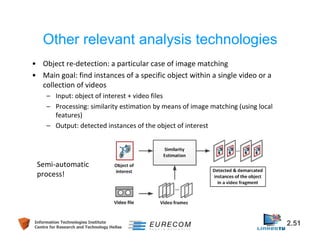
• Object re-detection: a particular case of image matching 
• Main goal: find instances of a specific object within a single video or a 
collection of videos 
– Input: object of interest + video files 
– Processing: similarity estimation by means of image matching (using local 
features) 
– Output: detected instances of the object of interest 
Semi-automatic 
process! 
Information Technologies Institute 2.51 
Centre for Research and Technology Hellas
Other relevant analysis technologies 
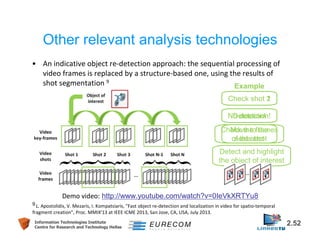
• An indicative object re-detection approach: the sequential processing of 
video frames is replaced by a structure-based one, using the results of 
shot segmentation 9 Example 
Check shot 2 
1 
No Detection! 
detection! 
Move to the 
next shot 
Check the frames 
of this shot 
Detect and highlight 
the object of interest 
Demo video: http://www.youtube.com/watch?v=0IeVkXRTYu8 
9 L. Apostolidis, V. Mezaris, I. Kompatsiaris, "Fast object re-detection and localization in video for spatio-temporal 
fragment creation", Proc. MMIX'13 at IEEE ICME 2013, San Jose, CA, USA, July 2013. 
Information Technologies Institute 2.52 
Centre for Research and Technology Hellas
Other relevant analysis technologies 
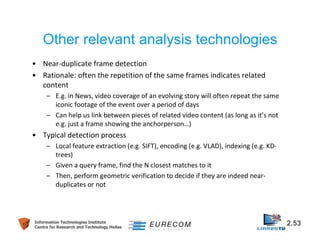
• Near-duplicate frame detection 
• Rationale: often the repetition of the same frames indicates related 
content 
– E.g. in News, video coverage of an evolving story will often repeat the same 
iconic footage of the event over a period of days 
– Can help us link between pieces of related video content (as long as it’s not 
e.g. just a frame showing the anchorperson…) 
• Typical detection process 
– Local feature extraction (e.g. SIFT), encoding (e.g. VLAD), indexing (e.g. KD-trees) 
– Given a query frame, find the N closest matches to it 
– Then, perform geometric verification to decide if they are indeed near-duplicates 
or not 
Information Technologies Institute 2.53 
Centre for Research and Technology Hellas
Concluding remarks 
• We discussed different classes of techniques for video fragmentation and 
annotation, to support video hyperlinking, but others also exist, e.g. 
– Face detection, tracking, clustering, recognition 
– ASR, OCR, and textual transcript analysis 
• Is some cases the automatic analysis results remain far from perfect 
(manual) annotations; yet, these results may still be useful in automating 
the process of video hyperlinking 
• We will see in the next part of the tutorial how most of these results can 
be used for video hyperlinking 
Information Technologies Institute 2.54 
Centre for Research and Technology Hellas
Contributors 
• Mr. Evlampios Apostolodis (CERTH-ITI) 
• Dr. Nikolaos Gkalelis (CERTH-ITI) 
• Ms. Fotini Markatopoulou (CERTH-ITI & QMUL) 
Information Technologies Institute 2.55 
Centre for Research and Technology Hellas
Thank you! 
More information (including links to various demos): 
http://www.iti.gr/~bmezaris 
bmezaris@iti.gr 
Information Technologies Institute 2.56 
Centre for Research and Technology Hellas

Video Hyperlinking Tutorial (Part B)

  • 1.
    Video Hyperlinking PartB: Video Fragment Creation and Annotation for Hyperlinking Vasileios Mezaris Information Technologies Institute (ITI) Centre for Research and Technology Hellas (CERTH) IEEE ICIP’14 Tutorial, Oct. 2014 ACM MM’14 Tutorial, Nov. 2014 Information Technologies Institute Centre for Research and Technology Hellas
  • 2.
    Overview • Introduction– overall motivation • Technologies for media fragment creation and annotation – Video temporal segmentation to shots – Video temporal segmentation to scenes – Visual concept detection – Event detection – Other potentially relevant technologies • Concluding remarks For each presented technology, we go through: – Problem statement – Brief overview of the literature – A closer look at one or two approaches – Indicative experiments and results, demos – Conclusions – Additional reading (references) Information Technologies Institute 2.2 Centre for Research and Technology Hellas
  • 3.
    Introduction - motivation • The text hyperlinking analogy A conference website (multiple web pages) Origin of hyperlinks Target Information Technologies Institute 2.3 Centre for Research and Technology Hellas
  • 4.
    Introduction - motivation • The text hyperlinking analogy – Web sites accommodating hyperlinks, and the origins and targets of these hyperlinks represent information at different levels of granularity Web site: a collection of interlinked web pages, typically by the same creator(s), altogether serving the same purpose Origin of a hyperlink: a very elementary text (a single word or a short phrase); an iconic representation of a topic Target of a hyperlink: a focused, yet explanatory and understandable even on its own piece of information An entire video *Practical restriction: how do you select a 2D image that appears on your screen for e.g. 1/25 sec? A very elementary part of the video (a 2D image? a shot?)* A meaningful story-telling part of the video (scene / chapter / topic) Information Technologies Institute 2.4 Centre for Research and Technology Hellas
  • 5.
    Introduction - motivation • We have: media items (videos) • We want to: perform video hyperlinking • Thus, we need to: – Break down each video to fragments that can serve as the origin and the target of hyperlinks – Annotate each fragment so that we can identify meaningful pairs of fragments (i.e., identify two fragments as the origin and the target of the same link) • We could do this either – Manually: + accuracy, - speed, cost, effort  only feasible for low-volume, high-value media items – Automatically: - accuracy, + speed, cost, effort  the only option for handling high volume of content – …as is often the case, in many real-world applications finding middle ground also makes sense: try to automate the process as much as possible, but still keep the human in the loop Information Technologies Institute 2.5 Centre for Research and Technology Hellas
  • 6.
    Introduction - motivation • We look into automatic analysis techniques in this part of the talk • Break down each video to fragments that can serve as the origin and the target of hyperlinks  – Video temporal segmentation to shots – Video temporal segmentation to scenes – Other potentially relevant technologies: object re-detection • Annotate each fragment so that we can identify meaningful pairs of fragments (i.e., identify two fragments as the origin and the target of the same link)  – Visual concept detection – Event detection – Other potentially relevant technologies: near-duplicate detection Information Technologies Institute 2.6 Centre for Research and Technology Hellas
  • 7.
    Fragment creation: shots • What is a shot: a sequence of consecutive frames taken without interruption by a single camera • Shot segmentation – Temporal decomposition of videos by detecting the boundaries or the changes between the shots – Shots can serve as the origins of hyperlinks – Is an important pre-processing step for further analysis (scene segmentation, concept/event detection, object re-detection) • Shot change is manifested by a shift in visual content – Two basic types of transitions: ABRUPT transitions Shot k Shot k+1 Information Technologies Institute 2.7 Centre for Research and Technology Hellas
  • 8.
    Fragment creation: shots GRADUAL transitions Dissolve Transition effects Shot k Shot k+1 Wipe Shot m Shot m+1 Fade in – Fade out Shot n Shot n+1 Information Technologies Institute 2.8 Centre for Research and Technology Hellas
  • 9.
    Fragment creation: shots • The analysis method should be robust to artifacts such as illumination changes, fast camera movement, rapid local (object) motion Sudden illumination change Camera motion Partial occlusion due to object motion (car) Information Technologies Institute 2.9 Centre for Research and Technology Hellas
  • 10.
    Related work •Can generally be organized according to – Data to work with: uncompressed vs. compressed video – Features to use (also depends on the data) – Threshold-based vs. learning-based methods • Compressed video methods – Reduce computational complexity by avoiding decoding, exploiting encoder results • Macroblock information of specific frames (e.g. intra-coded, skipped) • DC coefficients of the compressed images • Motion vectors included in the compressed data stream – Generally, very fast but not as accurate as uncompressed video methods Information Technologies Institute 2.10 Centre for Research and Technology Hellas
  • 11.
    Related work •Uncompressed video methods – Pair-wise pixel comparisons – Global visual feature comparisons (e.g. color histogram comparison) – Edge-based approaches, e.g. evaluating an edge change ratio – Motion-based approaches – Local visual features / Bag of Visual Words • Some features more computationally expensive than others – Deciding using experimentally-defined thresholds: often hard to tune  the alternative is to use machine learning techniques (often Support Vector Machines (SVMs)) for learning from different features • General remark: high detection accuracy and relatively low computational complexity are possible when working with uncompressed data Information Technologies Institute 2.11 Centre for Research and Technology Hellas
  • 12.
    An indicative approach • Uncompressed video approach (based on 1) • Detects both abrupt and gradual shot transitions by: – Extracting global and local visual features (HSV histograms, ORB descriptors) for every frame and evaluating the differences between every pair of consecutives frames (abrupt transitions) – Analyzing the sequence of similarity scores, to identify patterns that correspond to progressive changes of the visual content and then applying dissolve, wipe and movement detectors (gradual transitions) 1 E. Apostolidis, V. Mezaris, "Fast Shot Segmentation Combining Global and Local Visual Descriptors", Proc. IEEE Int. Conf. on Acoustics, Speech and Signal Processing (ICASSP), Florence, Italy, May 2014. Information Technologies Institute 2.12 Centre for Research and Technology Hellas
  • 13.
    An indicative approach • Gradual transition detection – Step 1: pair-wise frame similarity scores F(x) (blue curve)  moving average G(k) (red) – Step 2: compute first order deriv. of G(k) and store local minima, maxima in Gmin, Gmax – Step 3: If frame k is the p-th element in Gmin, compute – how D(k) F(Gmin(p))F(Gmax(p1))  F(Gmin(p))F(Gmax(p)) – Step 4: Compute C(k) (green) as the sum of the values of D(k) within a sliding window – Step 5: Potential gradual transitions are identified by thresholding C(k) – Detection: Gradual transitions are defined by evaluating each potential transition using (a) dissolve detector, (b) wipe detection and (c) detector for object/camera movement 1 0,9 0,8 0,7 0,6 0,5 0,4 0,3 0,2 0,1 0 Correct detection Erroneous detection 2370 2374 2378 2382 2386 2390 2394 2398 2402 2406 2410 2414 2418 2422 2426 2430 2434 2438 2442 2446 2450 2454 2458 2462 2466 2470 2474 2478 2482 2486 2490 2494 2498 2502 2506 2510 2514 2518 2522 2526 2530 2534 2538 2542 2546 2550 2554 2558 2562 2566 2570 2574 2578 2582 2586 2590 2594 2598 2602 2606 2610 2614 2618 2622 2626 2630 Calculated similarity scores Moving average of similarity scores Dissimilarity values of detected shot boundaries Information Technologies Institute 2.13 Centre for Research and Technology Hellas
  • 14.
    Indicative experiments andresults • Dataset – About 7 hours of video • 150 min. of news shows • 140 min. of cultural heritage shows • 140 min. of various other genres • Ground-truth (generated via manual annotation) – 3647 shot changes • 3216 abrupt transitions • 431 gradual transitions • System specifications – Intel Core i7 processor at 3.4GHz – 8GB RAM memory Information Technologies Institute 2.14 Centre for Research and Technology Hellas
  • 15.
    Indicative experiments andresults • Detection accuracy expressed in terms of: – Precision (P): the fraction of detected shots that correspond to actual shots of the videos – Recall (R): the fraction of actual shots of the videos, that have been successfully detected – F-Score: 2(PR)/(P+R) • Time performance: runs ~ 7-8 times faster than real-time (utilizing multi-threading) Experimental Results Precision 94.3 % Recall 94.1 % F-Score 0.942 • Demo video http://www.youtube.com/watch?v=0IeVkXRTYu8 • Software available at http://mklab.iti.gr/project/video-shot-segm Information Technologies Institute 2.15 Centre for Research and Technology Hellas
  • 16.
    Shot detection conclusions • Overall accuracy of shot detection methods is high, sufficient for any application • Detection of abrupt transitions is very easy; gradual transitions & handling of intense motion still a bit more challenging • Several times faster-than-real-time processing is feasible • More elaborate motion-based analysis is still possible (but would increase the computational load) Information Technologies Institute 2.16 Centre for Research and Technology Hellas
  • 17.
    Shot detection: additionalreading • E. Apostolidis, V. Mezaris, "Fast Shot Segmentation Combining Global and Local Visual Descriptors", Proc. IEEE Int. Conf. on Acoustics, Speech and Signal Processing (ICASSP), Florence, Italy, May 2014. • E. Tsamoura, V. Mezaris, and I. Kompatsiaris, “Gradual transition detection using color coherence and other criteria in a video shot meta-segmentation framework”, Proc. 15th IEEE Int. Conf. on Image Processing, 2008. • V. Chasanis, A. Likas, and N. Galatsanos, “Simultaneous detection of abrupt cuts and dissolves in videos using support vector machines,” Pattern Recogn. Lett., vol. 30, no. 1, pp. 55–65, Jan. 2009. • Z. Qu, Y. Liu, L. Ren, Y. Chen, and R. Zheng, “A method of shot detection based on color and edge features,” Proc. 1st IEEE Symposium on Web Society, 2009. SWS ’09. 2009, pp. 1–4. • J. Lankinen and J.-K. Kamarainen, “Video shot boundary detection using visual bag-of-words,” Proc. Int. Conf. on Computer Vision Theory and Applications (VISAPP), Barcelona, Spain, 2013. • J. Li, Y. Ding, Y. Shi, and W. Li, “A divide-and-rule scheme for shot boundary detection based on sift,” JDCTA, pp. 202–214, 2010. • C.-W. Su, H.-Y.M. Liao, H.-R. Tyan, K.-C. Fan, L.-H. Chen, “A motion-tolerant dissolve detection algorithm”, IEEE Transactions on Multimedia, vol. 7, no. 6, pp. 1106–1113, 2005. • K. D. Seo, S. Park, S. H. Jung, “Wipe scene-change detector based on visual rhythm spectrum”, IEEE Transactions on Consumer Electronics, vol. 55, no. 2, pp. 831–838, May 2009. • D. Lelescu and D. Schonfeld, “Statistical sequential analysis for real-time video scene change detection on compressed multimedia bitstream”, IEEE Transactions on Multimedia,,vol. 5, no. 1, pp. 106–117, 2003. • J. H. Nam and A.H. Tewfik, “Detection of gradual transitions in video sequences using b-spline interpolation”, IEEE Transactions on Multimedia, vol. 7, no. 4, pp. 667–679, 2005. • C. Grana and R. Cucchiara, “Linear transition detection as a unified shot detection approach”, IEEE Transactions on Circuits and Systems for Video Technology, vol. 17, no. 4, pp. 483–489, 2007. • Z. Cernekova, N. Nikolaidis, and I. Pitas, “Temporal video segmentation by graph partitioning”, Proc. IEEE Int. Conf. on Acoustics, Speech and Signal Processing, ICASSP 2006. Information Technologies Institute 2.17 Centre for Research and Technology Hellas
  • 18.
    Fragment creation: scenes • What is a scene: a higher-level temporal video segment that is elementary in terms of semantic content, covering either a single event or several related events taking place in parallel • Scene segmentation: temporal decomposition of videos into such basic • Scene change is not manifested by just a change in visual content Scene Change? story-telling units Information Technologies Institute 2.18 Centre for Research and Technology Hellas
  • 19.
    Problem statement •Basic assumptions – A shot cannot belong to more than one scenes – Scene boundaries are a subset of the visual shot boundaries of the video • Then, scene segmentation can (and typically is) performed by • Shot segmentation, and • Shot grouping Shot boundaries Inter-shot similarity One scene Information Technologies Institute 2.19 Centre for Research and Technology Hellas
  • 20.
    Related work •Can generally be organized according to – Data to work with: uni-modal vs. multi-modal – Dependence or not on specific-domain knowledge; domain of choice – Algorithms used • Uni-modal vs. multi-modal – Uni-modal methods use one type of information, typically visual cues – Multi-modal ones may combine visual cues, audio, speech transcripts, … • Domain-specific vs. domain-independent – Domain-independent methods are generally applicable – News-domain (e.g. using knowledge of news structure), TV broadcast domain (e.g. based on advertisement detection), etc. • Algorithms – Graph-based, e.g. the Scene Transition Graph – Clustering-based, e.g. using hierarchical clustering – Based on statistical methods, e.g. on Markov Chain Monte Carlo (MCMC) Information Technologies Institute 2.20 Centre for Research and Technology Hellas
  • 21.
    An indicative approach • Based on the Scene Transition Graph (STG) algorithm 2 Shot 115 Shot 116 Shot 117 Shot 120 Shot 119 Shot 118 Shot 121 cut edge Shots 116 & 118 Shots 115 & 120 Shots 117 & 119 Shot 121 2 M. Yeung, B.-L. Yeo, and B. Liu. Segmentation of video by clustering and graph analysis. Computer Vision Image Understanding, 71(1):94–109, July 1998. Information Technologies Institute 2.21 Centre for Research and Technology Hellas
  • 22.
    An indicative approach • Introduces two extensions of the STG 3 – Fast STG approximation (scenes as convex sets of shots; linking transitivity rules) – Generalized STG (probabilistic merging of multiple STGs created with different parameter values, different features) 3 P. Sidiropoulos, V. Mezaris, I. Kompatsiaris, H. Meinedo, M. Bugalho, and I. Trancoso. Temporal video segmentation to scenes using high-level audiovisual features. IEEE Transactions on Circuits and Systems for Video Technology, 21(8):1163 –1177, August 2011. Information Technologies Institute 2.22 Centre for Research and Technology Hellas
  • 23.
    Indicative experiments andresults • Dataset – 513 min. of documentaries (A) – 643 min. of movies (B) • Ground-truth (generated via manual annotation) – 3459 (in A) + 6665 (in B) = 10125 shot changes – 525 (in A) + 357 (in B) = 882 scene changes • System specifications – Intel Core i7 processor at 3.4GHz – 8GB RAM memory Information Technologies Institute 2.23 Centre for Research and Technology Hellas
  • 24.
    Indicative experiments andresults • Detection accuracy expressed in terms of: – Coverage (C): to what extent frames belonging to the same scene are correctly grouped together (optimal value 100%) – Overflow (O): the quantity of frames that, although not belonging to the same scene, are erroneously grouped together (optimal value 0%) – F-Score = 2C(1−O)/(C+(1−O)) Coverage (%) Overflow (%) F-Score (%) Documentaries 76.96 20.80 78.06 Movies 73.55 26.11 73.72 • Time performance: the algorithm runs in 0,015x real time (i.e., ~67 times faster than real-time), as long as the features have been extracted • Software available at http://mklab.iti.gr/project/video-shot-segm (using low-level visual features only) Information Technologies Institute 2.24 Centre for Research and Technology Hellas
  • 25.
    Indicative experiments andresults • Contribution of different modalities (on a different dataset) V: low-level visual features VC: visual concept detection results A: low-level audio features AE: audio event detection results Information Technologies Institute 2.25 Centre for Research and Technology Hellas
  • 26.
    Scene detection conclusions • Automatic scene segmentation less accurate than shot segmentation… • …but the results are good enough for improving access to meaningful fragments in various applications (e.g. retrieval, video hyperlinking) • Using more than just low-level visual features helps a lot • The choice of domain-specific vs. domain-independent method should be taken seriously Information Technologies Institute 2.26 Centre for Research and Technology Hellas
  • 27.
    Scene detection: additionalreading • M. Yeung, B.-L. Yeo, and B. Liu, “Segmentation of video by clustering and graph analysis”, Computer Vision Image Understanding, vol. 71, no. 1, pp. 94–109, July 1998. • P. Sidiropoulos, V. Mezaris, I. Kompatsiaris, H. Meinedo, M. Bugalho, and I. Trancoso, “Temporal video segmentation to scenes using high-level audiovisual features”, IEEE Transactions on Circuits and Systems for Video Technology, vol. 21, no. 8, pp. 1163 –1177, August 2011. • P. Sidiropoulos, V. Mezaris, I. Kompatsiaris, J. Kittler, “Differential Edit Distance: A metric for scene segmentation evaluation”, IEEE Transactions on Circuits and Systems for Video Technology, vol. 22, no. 6, pp. 904-914, June 2012. • Z. Rasheed and M. Shah, “Detection and representation of scenes in videos”, IEEE Transactions on Multimedia, vol. 7, no. 6, pp. 1097–1105, December 2005. • C.-W. Ngo, Y.-F. Ma, and H.-J. Zhang, “Video summarization and scene detection by graph modeling”, IEEE Transactions on Circuits and Systems for Video Technology, vol. 15, no. 2, pp. 296–305, February 2005. • Y. Zhao, T. Wang, P. Wang, W. Hu, Y. Du, Y. Zhang, G. Xu, “Scene segmentation and categorization using N-cuts”, IEEE Conf. on Computer Vision and Pattern Recognition, 2007. • X. Zhu, A.K. Elmagarmid, X. Xue, L. Wu, and A.C. Catlin, “Insightvideo: toward hierarchical video content organization for efficient browsing, summarization and retrieval”, IEEE Transactions on Multimedia, vol. 7, no. 4, pp. 648– 666, August 2005. • B. T. Truong, S. Venkatesh, and C. Dorai, “Scene extraction in motion pictures”, IEEE Transactions on Circuits and Systems for Video Technology, vol. 13, no. 1, pp. 5–15, January 2003. • X.-S. Hua, L. Lu, and H.-J. Zhang, “Optimization-based automated home video editing system”, IEEE Transactions on Circuits and Systems for Video Technology, vol. 14, no. 5, pp. 572–583, May 2004. • D. Gatica-Perez, A. Loui, and M.-T. Sun, “Finding structure in consumer videos by probabilistic hierarchical clustering”, IEEE Transactions on Circuits and Systems for Video Technology, 2002. Information Technologies Institute 2.27 Centre for Research and Technology Hellas
  • 28.
    Scene detection: additionalreading • J. Liao and B. Zhang, “A robust clustering algorithm for video shots using haar wavelet transformation”, Proc. SIGMOD2007 Workshop on Innovative Database Research (IDAR2007), Beijing, China, June 2007. • Y. Zhai and M. Shah, “Video scene segmentation using markov chain monte carlo”, IEEE Transactions on Multimedia, vol. 8, no. 4, pp. 686–697, August 2006. • M. Sugano, K. Hoashi, K. Matsumoto, and Y. Nakajima, “Shot boundary determination on MPEG compressed domain and story segmentation experiments for trecvid 2004, in trec video retrieval evaluation forum”, Proc. TREC Video Retrieval Evaluation (TRECVID), Washington, DC, USA, pp. 109–120, 2004. • L. Xie, P. Xu, S.-F. Chang, A. Divakaran, and H. Sun, “Structure analysis of soccer video with domain knowledge and hidden markov models”, Pattern Recogn. Lett., vol. 25, no. 7, pp. 767–775, May 2004. • H. Lu, Z. Li, and Y.-P. Tan, “Model-based video scene clustering with noise analysis”, Proc. Int. Symposium on Circuits and Systems, ISCAS ’04, vol. 2, pp. 105–108, May 2004. • Y. Ariki, M. Kumano, and K. Tsukada, “Highlight scene extraction in real time from baseball live video”, Proc. 5th ACM SIGMM international workshop on Multimedia information retrieval, MIR ’03, pp. 209–214, New York, NY, USA, 2003. • U. Iurgel, R. Meermeier, S. Eickeler, and G. Rigoll, “New approaches to audio-visual segmentation of tv news for automatic topic retrieval”, Proc. IEEE Int. Conf. on the Acoustics, Speech, and Signal Processing (ICASSP ’01), vol. 3, pp. 1397–1400, Washington, DC, USA, 2001. • Y. Cao, W. Tavanapong, K. Kim, and J.H. Oh, “Audio-assisted scene segmentation for story browsing”, Proc. 2nd Int. Conf. on Image and Video Retrieval, CIVR’03, pp. 446–455, Springer-Verlag. • A. Velivelli, C.-W. Ngo, and T. S. Huang, “Detection of documentary scene changes by audio-visual fusion”, Proc. 2nd Int. Conf. on Image and Video Retrieval, CIVR’03, pp. 227–238, Springer-Verlag. Information Technologies Institute 2.28 Centre for Research and Technology Hellas
  • 29.
    Fragment annotation: visual concept detection • Goal: assign one or more semantic concepts to temporal video fragments (typically, shots), from a predefined concept list – Input: visual fragment or representative visual information (e.g. keyframes) – Output: concept labels and associated confidence scores (DoC) • Application: find similar fragments to interlink (concept-based annotation, image/video search and retrieval; also clustering, summarization, further analysis e.g. event detection) • Concept detection is challenging: semantic gap, annotation effort, computational requirements,… hand: 0.97, sky: 0.93, sea: 0.91, boat: 0.91, … Sample keyframe Information Technologies Institute 2.29 Centre for Research and Technology Hellas
  • 30.
    Related work •Typical concept detection system: made of independent concept detectors – Feature extraction (typically local features; choices of IP detectors/ descriptors) – Feature encoding (Bag of Words, Fisher vectors, VLAD,…) – Training/classification (supervised learning; need for annotated training data) – Late fusion and output score post-processing • How to build a competitive system – Use color-, rotation- , scale- invariant descriptors; SoA encoding of them – Fuse multiple descriptors and machine learning-based detectors – Exploit concept correlations (e.g., sun & sky often appearing together) – Exploit temporal information (videos) Information Technologies Institute 2.30 Centre for Research and Technology Hellas
  • 31.
    • Feature extraction – Visual features Related work • Global vs. local • Popular local descriptors SIFT, Color SIFT , SURF; also look at binary local descriptors • Interest point detection: Harris-Laplace, Hessian, dense sampling • Based on Deep Learning / Convolutional Neural Networks (e.g. OverFeat, Caffe) – Motion features (STIP, MoSIFT, feature trajectories,…) – Others modalities (text, audio): of limited use • Feature encoding – Bag-of-words (BoW): codebook construction (K-means); hard/soft assignment – Fisher vectors: characterize each keyframe by a gradient vector – Others: VLAD, Super Vector (SV),… – Capture spatial information: Pyramidal decomposition,… – Capture information at multiple scales: Pyramid Histogram Of visual Words (PHOW) Information Technologies Institute 2.31 Centre for Research and Technology Hellas
  • 32.
    • Machine learning Related work – Binary classification: Support Vector Machines (SVMs), Logistic Regression,… • Linear vs. kernel methods – Multi-label learning approaches; Stacking • Fusion – Of features (early / late) – Of detectors • Post-processing: temporal re-ranking,… Information Technologies Institute 2.32 Centre for Research and Technology Hellas
  • 33.
    An indicative approach • Concept detection using a two-layer stacking architecture – 1st layer: Build multiple fast and independent concept detectors • Use keyframes, and visual tomographs to capture the motion information • Extract high-dimensional feature vectors • Train Linear Support Vector Machine / Logistic Regression classifiers • Easily scalable but does not capture concept correlations – 2nd layer: Exploit concept correlations and refine the scores • Construct low-dimensional model vectors • Use multi-label learning to capture the concept correlations (e.g. ML-kNN or Label Powerset algorithms) • Use temporal re-ranking to exploit temporal information Information Technologies Institute 2.33 Centre for Research and Technology Hellas
  • 34.
    Video tomographs •Video tomographs: 2-dimensional slices with one dimension in time and one dimension in space • We extract two tomographs; use them together with keyframes • The two tomographs are processed in the same way as keyframes 4 (in latest experiments, just 3 SIFT or color-SIFT variants, with dense sampling and VLAD encoding) 4 P. Sidiropoulos, V. Mezaris, I. Kompatsiaris, "Video tomographs and a base detector selection strategy for improving large-scale video concept detection", IEEE Trans. on Circuits and Systems for Video Tech., 24(7), pp. 1251-1264, July 2014. Information Technologies Institute 2.34 Centre for Research and Technology Hellas
  • 35.
    2nd-layer of stackingarchitecture The proposed 2nd layer The first layer (baseline) Information Technologies Institute 2.35 Centre for Research and Technology Hellas
  • 36.
    2nd-layer of stackingarchitecture • Exploit concept correlations – Construct model vectors by concatenating the responses of the concept detectors on a validation set – Use them to train 2nd-layer classifier • ML-kNN as the 2nd-layer classifier 5 – A lazy style multi-label learning algorithm; uses label correlations in the neighbourhood of the tested instance to infer posterior probabilities. • Label Powersets (LP) as the 2nd-layer classifier 5 – Searches for subsets of labels that appear together in the training set; considers each set as a separate class in order to solve a multi-class problem 5 F. Markatopoulou, V. Mezaris, I. Kompatsiaris. A Comparative Study on the Use of Multi-Label Classification Techniques for Concept-Based Video Indexing and Annotation. Proc. 20th Int. Conf. on Multimedia Modeling (MMM'14), Jan. 2014. Information Technologies Institute 2.36 Centre for Research and Technology Hellas
  • 37.
    Video tomographs: indicativeresults • Experimental setup – The TRECVID Semantic Indexing Task: Using the concept detectors retrieve for each concept a ranked list of 2000 test shots that are mostly related with it – Dataset: TRECVID 2013 (~800 and ~200 hours of internet archive videos for training and testing), 38 concepts (13 of them motion-related) – Evaluation: Mean Extended Inferred Average Precision (MxinfAP) Information Technologies Institute 2.37 Centre for Research and Technology Hellas
  • 38.
    Two-layer stacking: indicativeresults • Experimental setup – Indexing: for a concept, assess how well the top retrieved shots relate to it – Annotation: for a shot, assess how well the top retrieved concepts describe it – Dataset: TRECVID 2013 (internet videos; ~800 hours for training; ~200 hours for testing) – Input: model vectors for 346 concepts – Output: refined scores for 38 concepts – Evaluation: Mean Extended Inferred Average Precision (MXinfAP), Mean Precision at depth 3 (MP@3) MXinfAP (%) (indexing) MAP@3 (%) (annotation) Method 2nd layer 1st and 2nd layer 2nd layer 1st and 2nd layer Baseline 23.53 23.53 77.66 77.66 LP 24.2 (+2.8%) 24.72 (+5.1%) 80.98 (+4.3%) 79.1 (+1.9%) ML-kNN 18.1 (-23.1%) 23.61 (+0.3%) 77.01 (-0.8%) 79.34 (+2.2%) Information Technologies Institute 2.38 Centre for Research and Technology Hellas
  • 39.
    Concept detection conclusions • Concept detection has progressed a lot • Results far from perfect; yet, already useful in a variety of applications (hyperlinking, retrieval, further analysis of fragments) • Motion information is important (but, extracting traditional motion descriptors more computationally expensive than working with keyframes / tomographs) • Linear SVMs very popular (due to the size of the problem) • Exploiting concept correlations is very important • Computationally-efficient concept detection, considering hundreds or thousands of concepts, is still a challenge • We are using binary local descriptors for real-time detection of a few hundred concepts simultaneously, with good results (but, is real-time always fast enough?) Demo: http://multimedia.iti.gr/mediamixer/demonstrator.html Information Technologies Institute 2.39 Centre for Research and Technology Hellas
  • 40.
    Concept detection: additionalreading • P. Sidiropoulos, V. Mezaris, and I. Kompatsiaris, “Enhancing video concept detection with the use of tomographs”, Proc. IEEE Int. Conference. on Image Processing (ICIP 2013), Melbourne, Australia, 2013. • F. Markatopoulou, V. Mezaris, I. Kompatsiaris, “A Comparative Study on the Use of Multi-Label Classification Techniques for Concept-Based Video Indexing and Annotation”, Proc. 20th Int. Conf. on Multimedia Modeling (MMM'14), Jan. 2014. • C. Snoek, M. Worringm, “Concept-Based Video Retrieval”, in Foundations and Trends in Information Retrieval, vol. 2, no. 4, pp. 215–322, 2009. • A. W. M. Smeulders, M.Worring, S. Santini, A.Gupta, and R. Jain, “Content- based image retrieval at the end of the early years”, IEEE Transactions on Pattern Analysis and Machine Intelligence, vol. 22, pp. 1349–1380, 2000. • G. Nasierding, A. Kouzani, “Empirical Study of Multi-label Classification Methods for Image Annotation and Retrieval”, Proc. 2010 Int. Conf. on Digital Image Computing: Techniques and Applications, China, pp. 617–622. • G.J. Qi, X.S. Hua, Y. Rui, J. Tang, T. Mei, H. Zhang, “Correlative multi-label video annotation”, Proc. 15th Int. Conf. on Multimedia, pp. 17–26. • M.-L. Zhang and Z.-H. Zhou, “ML-KNN: A lazy learning approach to multi-label learning”, Pattern Recognition, vol. 40, no. 7, 2007. • A. F. Smeaton, P. Over, and W. Kraaij, “Evaluation campaigns and TRECVid”, Proc. 8th ACM Int. Workshop on Multimedia Information Retrieval (MIR '06), pp. 321-330, 2006. • B. Safadi and G. Quenot, “Re-ranking by Local Re-Scoring for Video Indexing and Retrieval”, in C. Macdonald, I. Ounis, and I. Ruthven, editors, CIKM, pp. 2081-2084, 2011. • J. C. Van Gemert, C. J. Veenman, A. Smeulders, J.-M. Geusebroek, “Visual word ambiguity”, IEEE Transactions on Pattern Analysis and Machine Intelligence, vol. 32, no. 7, pp. 1271–1283, 2010. • G. Csurka and F. Perronnin, “Fisher vectors: Beyond bag-of visual-words image representations”, Computer Vision, Imaging and Computer Graphics. Theory and Applications. Springer CCIS vol. 229, 2011. • H. Jegou, F. Perronnin, M. Douze, J. Sanchez, P. Perez, and C. Schmid, “Aggregating local image descriptors into compact codes”, IEEE Transactions on Pattern Analysis and Machine Intelligence, vol. 34, no. 9, pp. 1704–1716, 2012. Information Technologies Institute 2.40 Centre for Research and Technology Hellas
  • 41.
    Fragment annotation: eventdetection • Extending visual concept detection results with more elaborate annotations: event labels hands, sky, sea, boat, … Fishing in Toroneos Bay Information Technologies Institute 2.41 Centre for Research and Technology Hellas
  • 42.
    Problem statement •Objective: – Automatically detect high-level events in large video collections – Events are defined as “purposeful activities, involving people, acting on objects and interacting with each other to achieve some result” “Changing a vehicle tire” “Skiing” “Working on a sewing project” – Exploit an annotated video dataset – Represent videos with suitable feature vectors {(x ,y) є X x {-1,1}} – Learn an appropriate event detector f: X → [0,1] Information Technologies Institute 2.42 Centre for Research and Technology Hellas
  • 43.
    Related work •Low-level feature-based approaches – Extract one or more low-level features (SIFT, MoSIFT, LFCC, ASR-based, etc.) – Combine features (late fusion, early fusion, etc.) – Motion visual features usually offer the most significant information • Model vector-based approaches – Exploit a semantic model vector (i.e., automatic visual concept detection results) as a feature – The inspiration behind this approach is that high-level events can be better recognized by looking at their constituting semantic entities – This video representation can also be useful for explaining why a specific event was detected • Hybrid approaches: combination of low-level features and model vectors – Experimental results show improved event detection performance when low-level features and model vectors are combined Information Technologies Institute 2.43 Centre for Research and Technology Hellas
  • 44.
    An indicative approach Model vector representation • Temporal video segmentation – Shot segmentation, keyframes at fixed time intervals, etc. • Low-level visual feature extraction • Application of a set of trained visual concept detectors – TRECVID SIN task, SVM-based – Detectors may be seemingly irrelevant to the sought events • A visual model vector is formed for each video keyframe fishing vehicle – Concatenate the responses (confidence scores) of all the detectors • Video representation                   – Sequence of model vectors or an overall model vector, e.g., averaging the model vectors for all shots of a video 0.51 0.33 ... 0.91 ... 0.47 Information Technologies Institute 2.44 Centre for Research and Technology Hellas
  • 45.
    An indicative approach Event detection using Discriminant Analysis (DA) • Use a DA algorithm to extract the most significant concept information for the detection of the target events 6, 7 – Mixture Subclass DA (MSDA): Linear or kernel-based method – Generalized subclass DA (GSDA): fast kernel-based method • Kernel subclass methods – Identify a nonlinear feature transformation and a suitable subclass partition in order to map the data into a new space – In this space subclasses belonging to different classes are expected to be linearly separable 2,1 2,2 2,1 2,2 1,1 1,2 1,1 1,2 6 N. Gkalelis, V. Mezaris, I. Kompatsiaris, T. Stathaki, "Mixture subclass discriminant analysis link to restricted Gaussian model and other generalizations", IEEE Trans. on Neural Networks and Learning Systems, vol. 24, no. 1, pp. 8-21, Jan. 2013. 7 N. Gkalelis, V. Mezaris, "Video event detection using generalized subclass discriminant analysis and linear support vector machines", Proc. ACM Int. Conf. on Multimedia Retrieval (ICMR), Glasgow, UK, April 2014. Information Technologies Institute 2.45 Centre for Research and Technology Hellas
  • 46.
    An indicative approach • Following DA, Linear Support Vector Machine classifiers are used for learning each event 7 • Advantages – The effect of noise or irrelevant features to the classification problem is minimized → classification performance may be improved – Classifier is applied in the lower dimensional subspace → classifier training and testing times are reduced – The application of kernel subclass DA yields linear separable classes (or subclasses) → linear classifiers may be used (better generalization, faster) 2,1 2,2 2,1 2,2 1,1 1,2 1,1 1,2 7 N. Gkalelis, V. Mezaris, "Video event detection using generalized subclass discriminant analysis and linear support vector machines", Proc. ACM Int. Conf. on Multimedia Retrieval (ICMR), Glasgow, UK, April 2014. Information Technologies Institute 2.46 Centre for Research and Technology Hellas
  • 47.
    Indicative experiments andresults • TRECVID 2010 – 3 target events – Development: 1745 videos – Evaluation: 1742 videos • TRECVID 2012 – A publicly available annotated subset is used 8 – 25 target events – Development: 8840 videos – Evaluation: 4434 videos 8 A. Habibian, K.E.A. van de Sande, C.G.M. Snoek , "Recommendations for video event recognition using concept vocabularies", Proc. ICMR 2013, pp. 89-96. Information Technologies Institute 2.47 Centre for Research and Technology Hellas
  • 48.
    Indicative experiments andresults TRECVID 2010 TRECVID 2012 • In learning one MED 2012 event, GSDA was ~25% faster than traditional Kernel SDA • Train: • Testing times: similar for GSDA-LSVM and KSVM • We have developed a GSDA-LSVM extension 60x faster than LSVM in training, for large-scale problems* *per CV cycle Information Technologies Institute 2.48 Centre for Research and Technology Hellas
  • 49.
    Event detection conclusions • Performance of the event detection system increases by – Discarding irrelevant or noisy concept detections – Effectively combining multiple classifiers – Exploiting the subclass structure of the event data • General hints – Importance of low level features: visual motion features are the most important followed by visual static features; for some events, audio features provide complementary information – However, the use of motion features in large-scale video databases has high computational cost (associated with their extraction; optimal trade-off between extraction time and quality of representation should be investigated) – Combining low-level features with model vectors provides small but noticeable performance gains – The machine learning methods that one uses can make a difference in both detection speed and accuracy Information Technologies Institute 2.49 Centre for Research and Technology Hellas
  • 50.
    Event detection: additionalreading • P. Over, J. Fiscus, G. Sanders et. al., "TRECVID 2013 -- An Overview of the Goals, Tasks, Data, Evaluation Mechanisms and Metrics", Proc. TRECVID 2013 Workshop, November 2013, Gaithersburg, MD, USA. • N. Gkalelis, V. Mezaris, I. Kompatsiaris, T. Stathaki, "Mixture subclass discriminant analysis link to restricted Gaussian model and other generalizations", IEEE Transactions on Neural Networks and Learning Systems, vol. 24, no. 1, pp. 8-21, January 2013. • N. Gkalelis, V. Mezaris, "Video event detection using generalized subclass discriminant analysis and linear support vector machines", Proc. ACM Int. Conf. on Multimedia Retrieval (ICMR), Glasgow, UK, April 2014. • N. Gkalelis, V. Mezaris, and I. Kompatsiaris, “High-level event detection in video exploiting discriminant concepts,” in Proc. 9th Int. Workshop CBMI, Madrid, Spain, June 2011, pp. 85–90. • M. Merler, B. Huang, L. Xie, G. Hua, and A. Natsev, “Semantic model vectors for complex video event recognition,” IEEE Trans. Multimedia, vol. 14, no. 1, pp. 88–101, Feb. 2012. • N. Gkalelis, V. Mezaris, M. Dimopoulos, I. Kompatsiaris, T. Stathaki, "Video event detection using a subclass recoding error-correcting output codes framework", Proc. IEEE Int. Conf. on Multimedia and Expo (ICME 2013), San Jose, CA, USA, July 2013. • Y.-G. Jiang, S. Bhattacharya, S.-F. Chang, and M. Shah, “High-level event recognition in unconstrained videos,” Int. J. Multimed. Info. Retr., Nov. 2013. • A. Habibian, K. van de Sande, C.G.M. Snoek, "Recommendations for Video Event Recognition Using Concept Vocabularies", Proc. ACM Int. Conf. on Multimedia Retrieval, Dallas, Texas, USA, April 2013. • Z. Ma, Y. Yang, Z. Xu, N. Sebe, A. Hauptmann, "We Are Not Equally Negative: Fine-grained Labeling for Multimedia Event Detection", Proc. ACM Multimedia 2013 (MM’13), Barcelona, Spain, October 2013. • C. Tzelepis, N. Gkalelis, V. Mezaris, I. Kompatsiaris, "Improving event detection using related videos and Relevance Degree Support Vector Machines", Proc. ACM Multimedia 2013 (MM’13), Barcelona, Spain, October 2013. Information Technologies Institute 2.50 Centre for Research and Technology Hellas
  • 51.
    Other relevant analysistechnologies • Object re-detection: a particular case of image matching • Main goal: find instances of a specific object within a single video or a collection of videos – Input: object of interest + video files – Processing: similarity estimation by means of image matching (using local features) – Output: detected instances of the object of interest Semi-automatic process! Information Technologies Institute 2.51 Centre for Research and Technology Hellas
  • 52.
    Other relevant analysistechnologies • An indicative object re-detection approach: the sequential processing of video frames is replaced by a structure-based one, using the results of shot segmentation 9 Example Check shot 2 1 No Detection! detection! Move to the next shot Check the frames of this shot Detect and highlight the object of interest Demo video: http://www.youtube.com/watch?v=0IeVkXRTYu8 9 L. Apostolidis, V. Mezaris, I. Kompatsiaris, "Fast object re-detection and localization in video for spatio-temporal fragment creation", Proc. MMIX'13 at IEEE ICME 2013, San Jose, CA, USA, July 2013. Information Technologies Institute 2.52 Centre for Research and Technology Hellas
  • 53.
    Other relevant analysistechnologies • Near-duplicate frame detection • Rationale: often the repetition of the same frames indicates related content – E.g. in News, video coverage of an evolving story will often repeat the same iconic footage of the event over a period of days – Can help us link between pieces of related video content (as long as it’s not e.g. just a frame showing the anchorperson…) • Typical detection process – Local feature extraction (e.g. SIFT), encoding (e.g. VLAD), indexing (e.g. KD-trees) – Given a query frame, find the N closest matches to it – Then, perform geometric verification to decide if they are indeed near-duplicates or not Information Technologies Institute 2.53 Centre for Research and Technology Hellas
  • 54.
    Concluding remarks •We discussed different classes of techniques for video fragmentation and annotation, to support video hyperlinking, but others also exist, e.g. – Face detection, tracking, clustering, recognition – ASR, OCR, and textual transcript analysis • Is some cases the automatic analysis results remain far from perfect (manual) annotations; yet, these results may still be useful in automating the process of video hyperlinking • We will see in the next part of the tutorial how most of these results can be used for video hyperlinking Information Technologies Institute 2.54 Centre for Research and Technology Hellas
  • 55.
    Contributors • Mr.Evlampios Apostolodis (CERTH-ITI) • Dr. Nikolaos Gkalelis (CERTH-ITI) • Ms. Fotini Markatopoulou (CERTH-ITI & QMUL) Information Technologies Institute 2.55 Centre for Research and Technology Hellas
  • 56.
    Thank you! Moreinformation (including links to various demos): http://www.iti.gr/~bmezaris bmezaris@iti.gr Information Technologies Institute 2.56 Centre for Research and Technology Hellas