VI Chip VTM® Voltage Transformation Module


                                             1
VI Chip Voltage Transformation Module (VTM)
                                                 ›   Isolated Sine Amplitude Converter (SAC) topology
                                                 ›   Fixed, high frequency (>1MHz)
                                                 ›   Efficiency up to 96%
                                                 ›   Fixed ratio converter (VOUT=VIN x K)
                                                     –  Commercial:
                                                       › Input voltage: 26 – 55 V
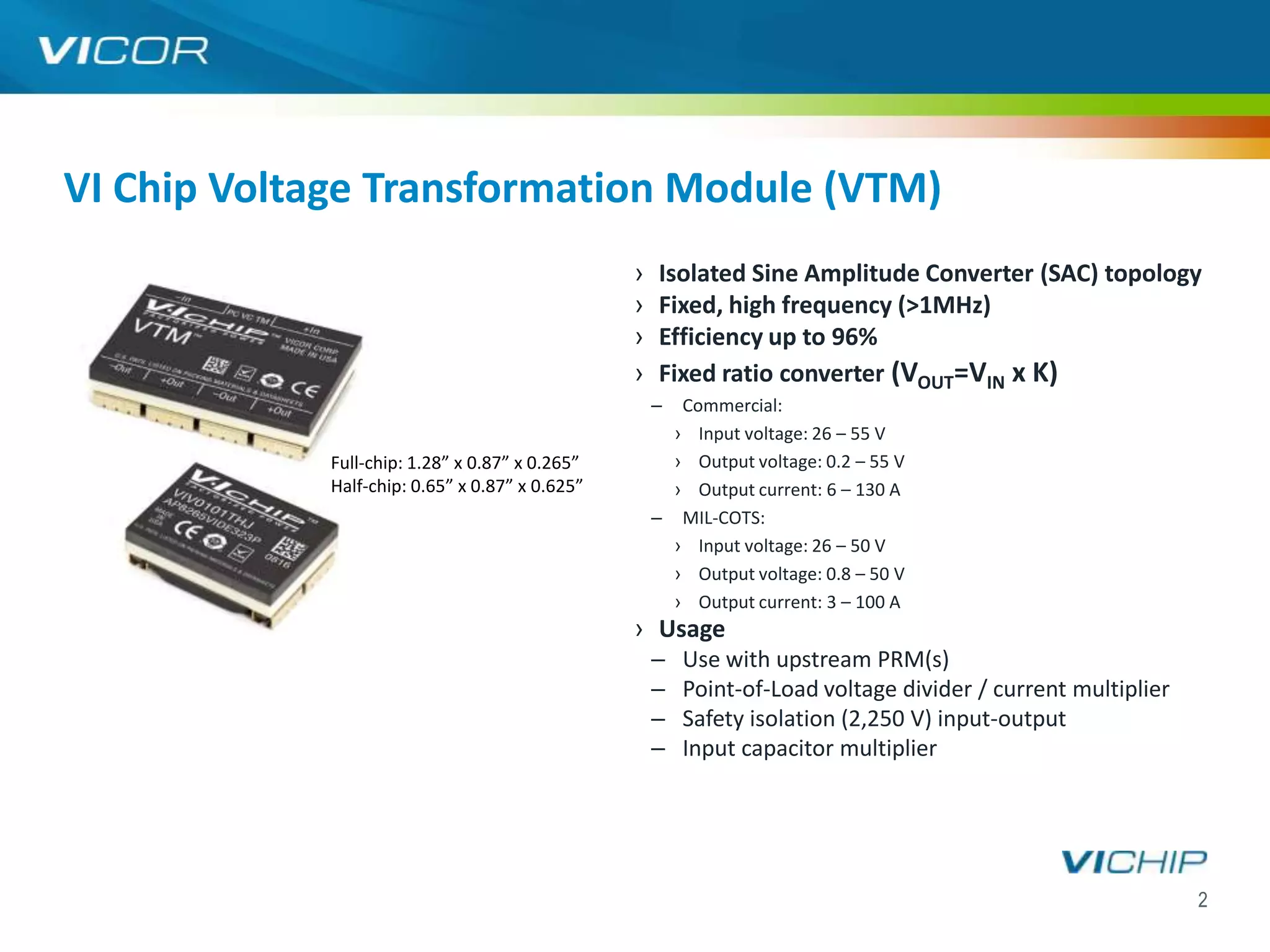
             Full-chip: 1.28” x 0.87” x 0.265”         › Output voltage: 0.2 – 55 V
             Half-chip: 0.65” x 0.87” x 0.625”         › Output current: 6 – 130 A
                                                     – MIL-COTS:
                                                       › Input voltage: 26 – 50 V
                                                       › Output voltage: 0.8 – 50 V
                                                       › Output current: 3 – 100 A
                                                 › Usage
                                                     –   Use with upstream PRM(s)
                                                     –   Point-of-Load voltage divider / current multiplier
                                                     –   Safety isolation (2,250 V) input-output
                                                     –   Input capacitor multiplier


                                                                                                              2
Value Proposition: Power Density
› High power density enables:
 – More functions (Gbps, ports, flops, capacity) in the same space
 – A more powerful system without a larger power supply
 – A more powerful system without a heavier power supply

› VI Chip power density enables:
 – Systems that would be impossible with conventional approaches
 – Systems that would be too large, too heavy or not cost effective with
    a conventional approach

› VI Chips decrease power footprint by 40% today

› Power density increase of 25% every 2.5 years


                                                                           3
Value Proposition: Efficiency
› High efficiency enables:
 – Smaller, cooler, quieter systems
 – Energy cost savings for end user
 – High performance systems with minimal total cost of ownership

› VI Chip architectures reduce hidden power losses
 – A “whole system approach”, not just a focus on one conversion stage

› VI Chip technology continues to raise the efficiency standard
 – IBC has half the power loss compared to industry IBC average
 – Alternative solutions are at the technological limit with
    respect to efficiency improvements
 – New Vicor products cut losses by 20% every 2.5 years


                                                                         4
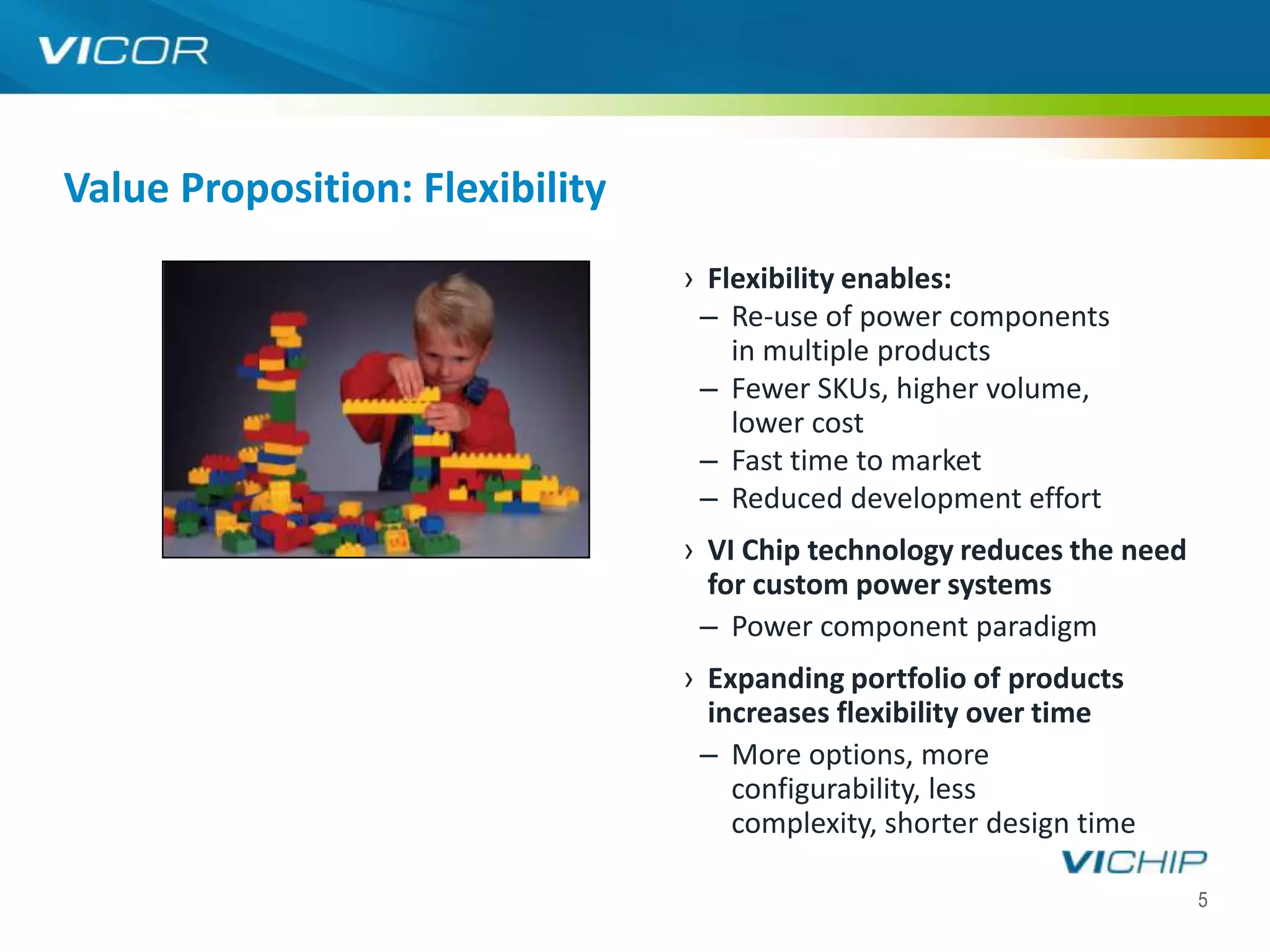
Value Proposition: Flexibility
                                 › Flexibility enables:
                                  – Re-use of power components
                                     in multiple products
                                  – Fewer SKUs, higher volume,
                                     lower cost
                                  – Fast time to market
                                  – Reduced development effort
                                 › VI Chip technology reduces the need
                                   for custom power systems
                                  – Power component paradigm
                                 › Expanding portfolio of products
                                   increases flexibility over time
                                  – More options, more
                                     configurability, less
                                     complexity, shorter design time

                                                                         5
VI Chip Technology
› Advanced Engines
 – Enable high efficiency and superior power density
 – Maximize efficiency of power silicon
   › HV Adaptive Cell topologies cut VI requirements
   › LV Current Multipliers cut Vds requirements:
     –   Buck regulators operating from 12 V bus require 20 V rated MOSFET to supply 0.8 V
     –   VTM require 3 V rated MOSFET to supply 0.8 V

› Advanced architecture (FPA) minimizes power distribution loss
 – Dense, efficient energy storage at 48 V
 – No Bulk Caps at the PoL
 – Highest current density at the PoL frees up precious real estate
› Superior modular product line
 – Substantial IP portfolio covers architectures, topologies, internal components, control, etc…
   › From the AC Wall Plug (or HV Bus) to the PoL (LV, high current)
   › AC-DC and DC-DC
› “Young” technology continues to raise the efficiency and density bars
 – Power loss cut by 25% every 2 years
 – Power density increased by 25% every 2 years

                                                                                                   6

VI Chip VTM® Voltage Transformation Module

  • 1.
    VI Chip VTM®Voltage Transformation Module 1
  • 2.
    VI Chip VoltageTransformation Module (VTM) › Isolated Sine Amplitude Converter (SAC) topology › Fixed, high frequency (>1MHz) › Efficiency up to 96% › Fixed ratio converter (VOUT=VIN x K) – Commercial: › Input voltage: 26 – 55 V Full-chip: 1.28” x 0.87” x 0.265” › Output voltage: 0.2 – 55 V Half-chip: 0.65” x 0.87” x 0.625” › Output current: 6 – 130 A – MIL-COTS: › Input voltage: 26 – 50 V › Output voltage: 0.8 – 50 V › Output current: 3 – 100 A › Usage – Use with upstream PRM(s) – Point-of-Load voltage divider / current multiplier – Safety isolation (2,250 V) input-output – Input capacitor multiplier 2
  • 3.
    Value Proposition: PowerDensity › High power density enables: – More functions (Gbps, ports, flops, capacity) in the same space – A more powerful system without a larger power supply – A more powerful system without a heavier power supply › VI Chip power density enables: – Systems that would be impossible with conventional approaches – Systems that would be too large, too heavy or not cost effective with a conventional approach › VI Chips decrease power footprint by 40% today › Power density increase of 25% every 2.5 years 3
  • 4.
    Value Proposition: Efficiency ›High efficiency enables: – Smaller, cooler, quieter systems – Energy cost savings for end user – High performance systems with minimal total cost of ownership › VI Chip architectures reduce hidden power losses – A “whole system approach”, not just a focus on one conversion stage › VI Chip technology continues to raise the efficiency standard – IBC has half the power loss compared to industry IBC average – Alternative solutions are at the technological limit with respect to efficiency improvements – New Vicor products cut losses by 20% every 2.5 years 4
  • 5.
    Value Proposition: Flexibility › Flexibility enables: – Re-use of power components in multiple products – Fewer SKUs, higher volume, lower cost – Fast time to market – Reduced development effort › VI Chip technology reduces the need for custom power systems – Power component paradigm › Expanding portfolio of products increases flexibility over time – More options, more configurability, less complexity, shorter design time 5
  • 6.
    VI Chip Technology ›Advanced Engines – Enable high efficiency and superior power density – Maximize efficiency of power silicon › HV Adaptive Cell topologies cut VI requirements › LV Current Multipliers cut Vds requirements: – Buck regulators operating from 12 V bus require 20 V rated MOSFET to supply 0.8 V – VTM require 3 V rated MOSFET to supply 0.8 V › Advanced architecture (FPA) minimizes power distribution loss – Dense, efficient energy storage at 48 V – No Bulk Caps at the PoL – Highest current density at the PoL frees up precious real estate › Superior modular product line – Substantial IP portfolio covers architectures, topologies, internal components, control, etc… › From the AC Wall Plug (or HV Bus) to the PoL (LV, high current) › AC-DC and DC-DC › “Young” technology continues to raise the efficiency and density bars – Power loss cut by 25% every 2 years – Power density increased by 25% every 2 years 6