VI Brick® IBC Intermediate Bus Converters


                                            1
Topics of Discussion
› History of Intermediate Bus Architecture (IBA)
› Types of Intermediate Bus Converters (IBC)
› Regulated versus unregulated backplanes
 – Pros and cons
 – Real world examples
› Vicor IBC modules
 – Origin
 – Key attributes
 – Competitive analysis
 – Features versus benefits


                                                   2
History of Intermediate Bus Architecture (IBA)
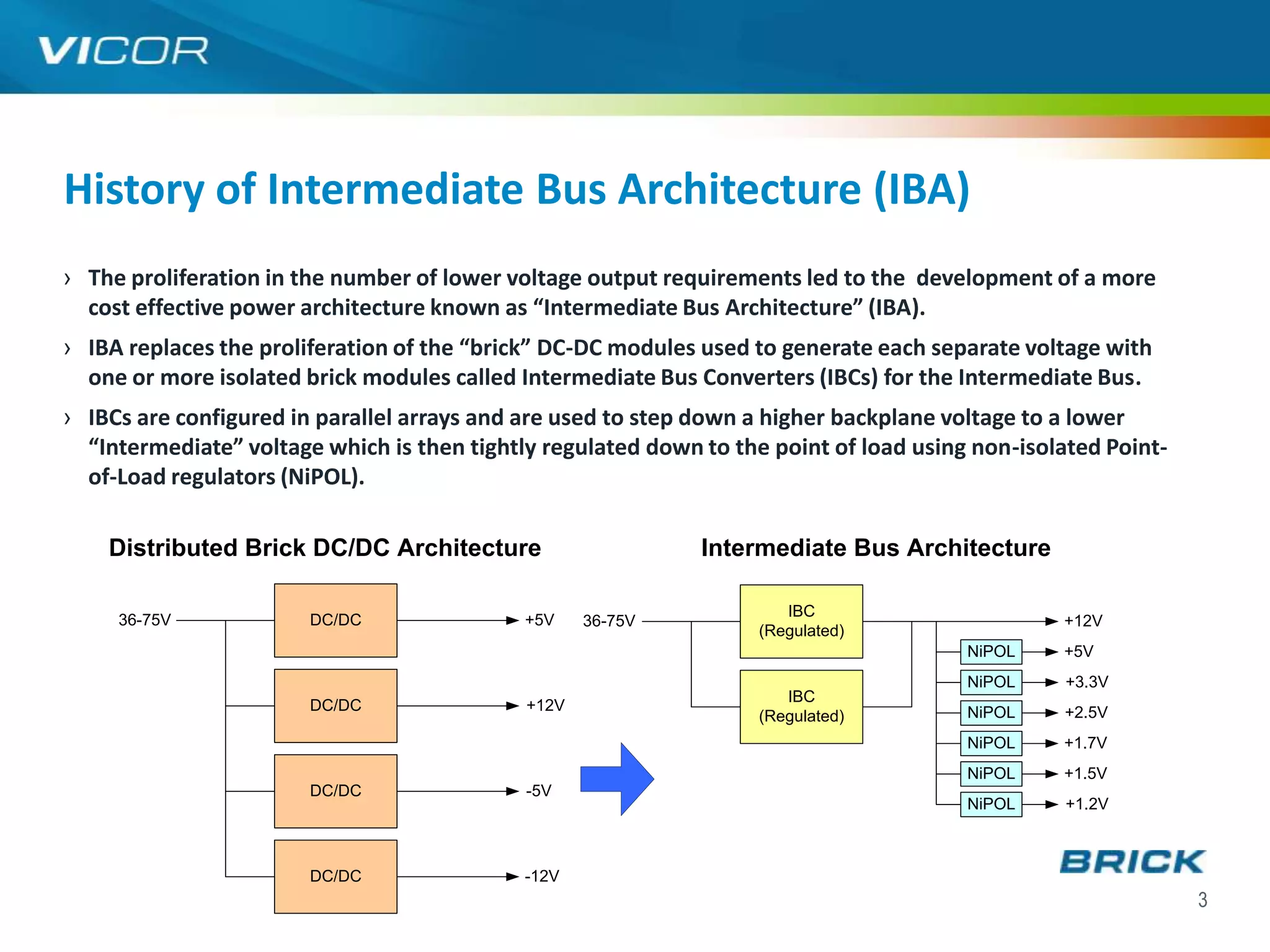
› The proliferation in the number of lower voltage output requirements led to the development of a more
  cost effective power architecture known as “Intermediate Bus Architecture” (IBA).
› IBA replaces the proliferation of the “brick” DC-DC modules used to generate each separate voltage with
  one or more isolated brick modules called Intermediate Bus Converters (IBCs) for the Intermediate Bus.
› IBCs are configured in parallel arrays and are used to step down a higher backplane voltage to a lower
  “Intermediate” voltage which is then tightly regulated down to the point of load using non-isolated Point-
  of-Load regulators (NiPOL).

    Distributed Brick DC/DC Architecture                      Intermediate Bus Architecture

                                                                       IBC
     36-75V             DC/DC                +5V    36-75V                                       +12V
                                                                    (Regulated)
                                                                                        NiPOL    +5V
                                                                                        NiPOL     +3.3V
                                                                       IBC
                        DC/DC                +12V                                       NiPOL    +2.5V
                                                                    (Regulated)
                                                                                        NiPOL    +1.7V
                                                                                        NiPOL    +1.5V
                        DC/DC                -5V
                                                                                        NiPOL     +1.2V


                        DC/DC                -12V
                                                                                                               3
Intermediate Bus Architecture Advantages
› Cost
 – NiPOLs are substantially less expensive than bricks
› Layout
 – Non isolated 48 V is confined to a very small area near the backplane connector
 – Discrete NiPOLs can easily fit on the bottom of the PCB freeing up valuable board
    space for FPGAs, ASICs,…


                                                                                       4
Types of Intermediate Bus Converters (IBC)
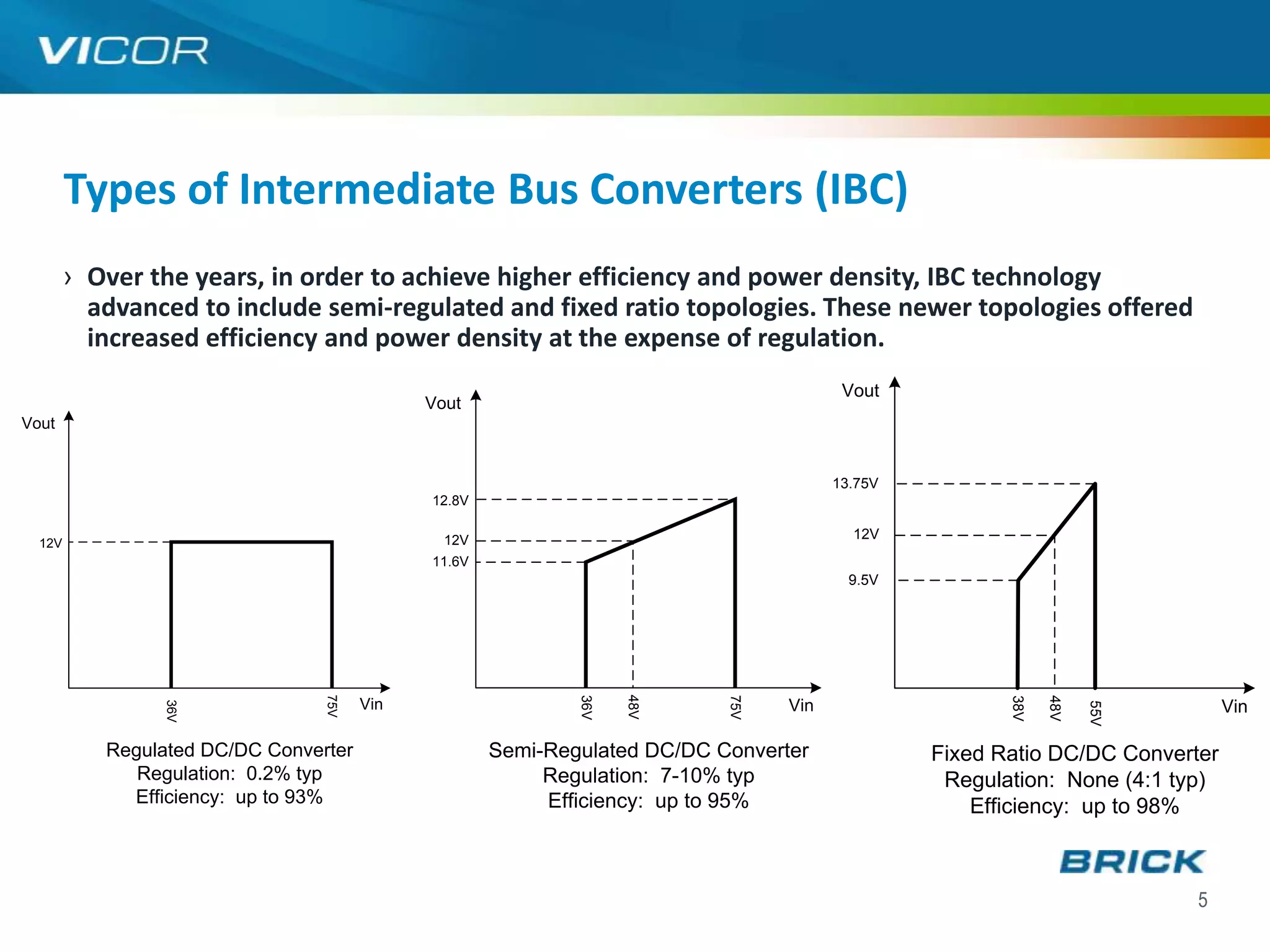
        › Over the years, in order to achieve higher efficiency and power density, IBC technology
          advanced to include semi-regulated and fixed ratio topologies. These newer topologies offered
          increased efficiency and power density at the expense of regulation.
                                                                                        Vout
                                             Vout
Vout


                                                                                       13.75V
                                             12.8V

                                               12V                                       12V
  12V
                                             11.6V
                                                                                         9.5V
                                 75V


                                                                   48V


                                                                           75V
                                                             36V


                                                                                                       38V

                                                                                                             48V
                                       Vin                                       Vin                                          Vin
                36V


                                                                                                                   55V
           Regulated DC/DC Converter                 Semi-Regulated DC/DC Converter             Fixed Ratio DC/DC Converter
              Regulation: 0.2% typ                        Regulation: 7-10% typ                  Regulation: None (4:1 typ)
             Efficiency: up to 93%                        Efficiency: up to 95%                     Efficiency: up to 98%


                                                                                                                         5
So Why Can’t I Get a Wide Input Fixed Ratio IBC?
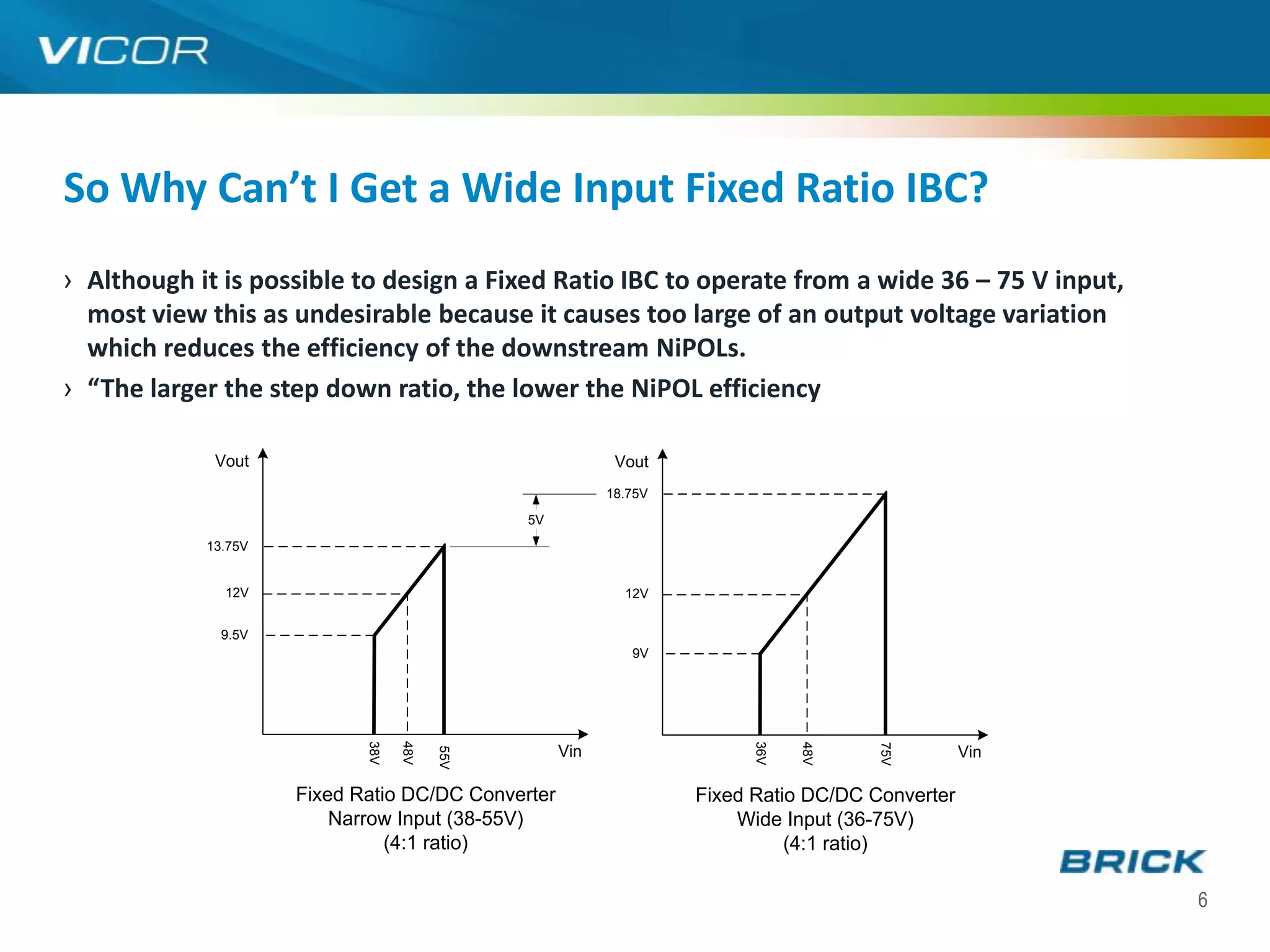
› Although it is possible to design a Fixed Ratio IBC to operate from a wide 36 – 75 V input,
  most view this as undesirable because it causes too large of an output voltage variation
  which reduces the efficiency of the downstream NiPOLs.
› “The larger the step down ratio, the lower the NiPOL efficiency

             Vout                                         Vout
                                                         18.75V
                                              5V
            13.75V


              12V                                          12V


              9.5V
                                                            9V
                            38V

                                  48V


                                                                        36V


                                                                              48V


                                                                                     75V
                                                   Vin                                          Vin
                                        55V


                     Fixed Ratio DC/DC Converter                  Fixed Ratio DC/DC Converter
                         Narrow Input (38-55V)                        Wide Input (36-75V)
                               (4:1 ratio)                                  (4:1 ratio)

                                                                                                      6
Typical Distributed Backplane Voltages
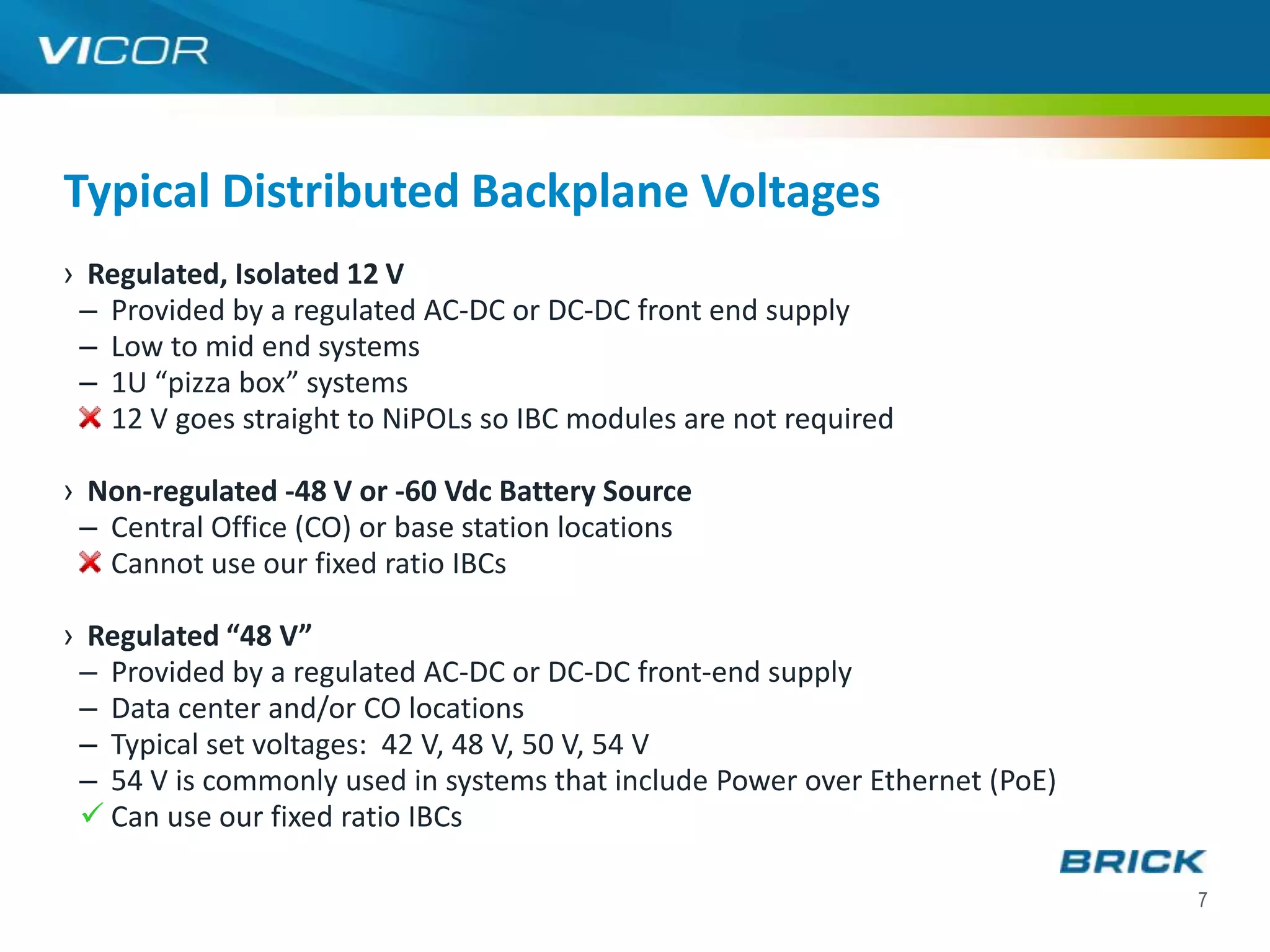
› Regulated, Isolated 12 V
 – Provided by a regulated AC-DC or DC-DC front end supply
 – Low to mid end systems
 – 1U “pizza box” systems
   12 V goes straight to NiPOLs so IBC modules are not required

› Non-regulated -48 V or -60 Vdc Battery Source
 – Central Office (CO) or base station locations
   Cannot use our fixed ratio IBCs

› Regulated “48 V”
 – Provided by a regulated AC-DC or DC-DC front-end supply
 – Data center and/or CO locations
 – Typical set voltages: 42 V, 48 V, 50 V, 54 V
 – 54 V is commonly used in systems that include Power over Ethernet (PoE)
  Can use our fixed ratio IBCs

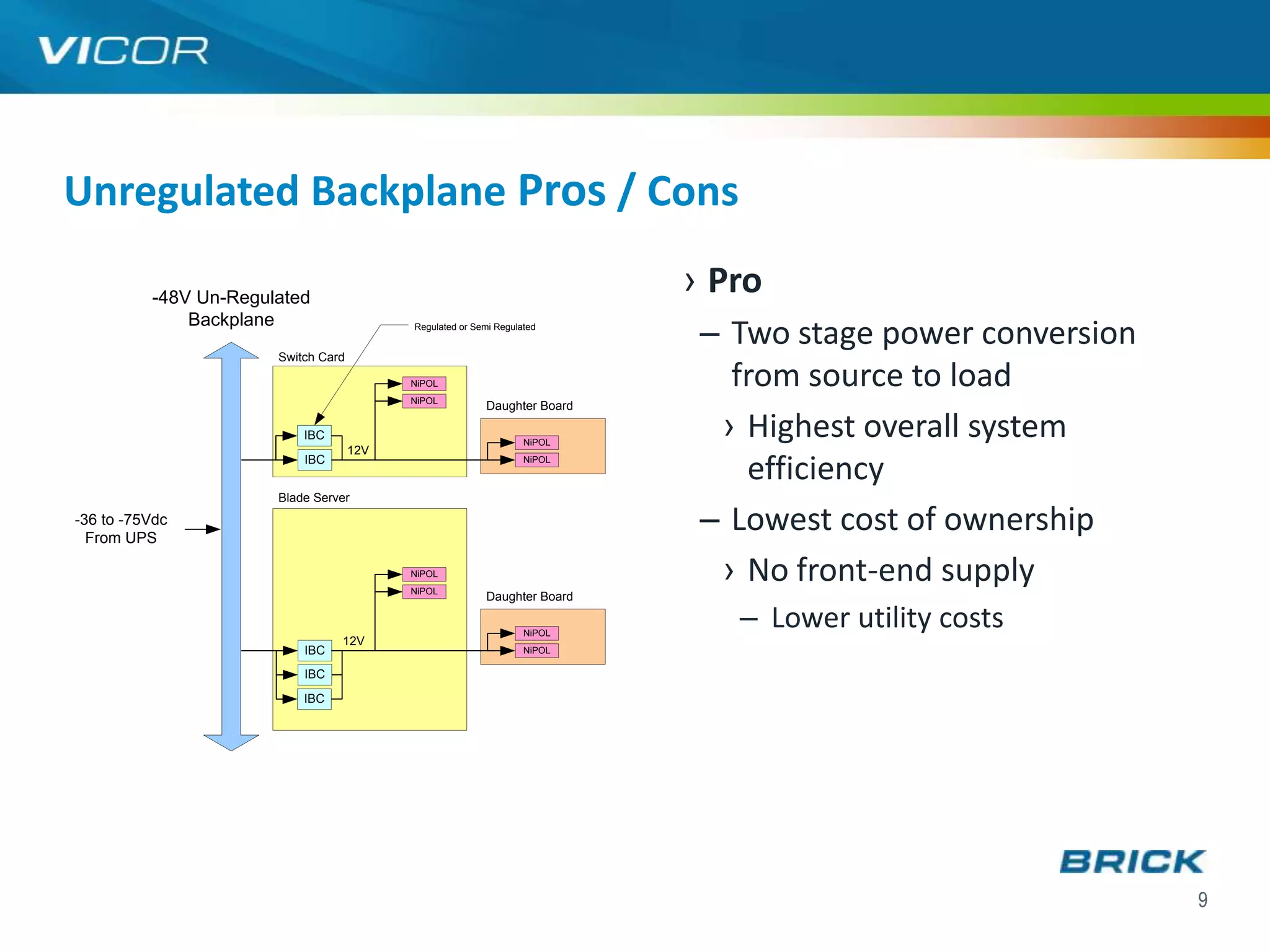
                                                                             7
Unregulated Backplane
          -48V Un-Regulated
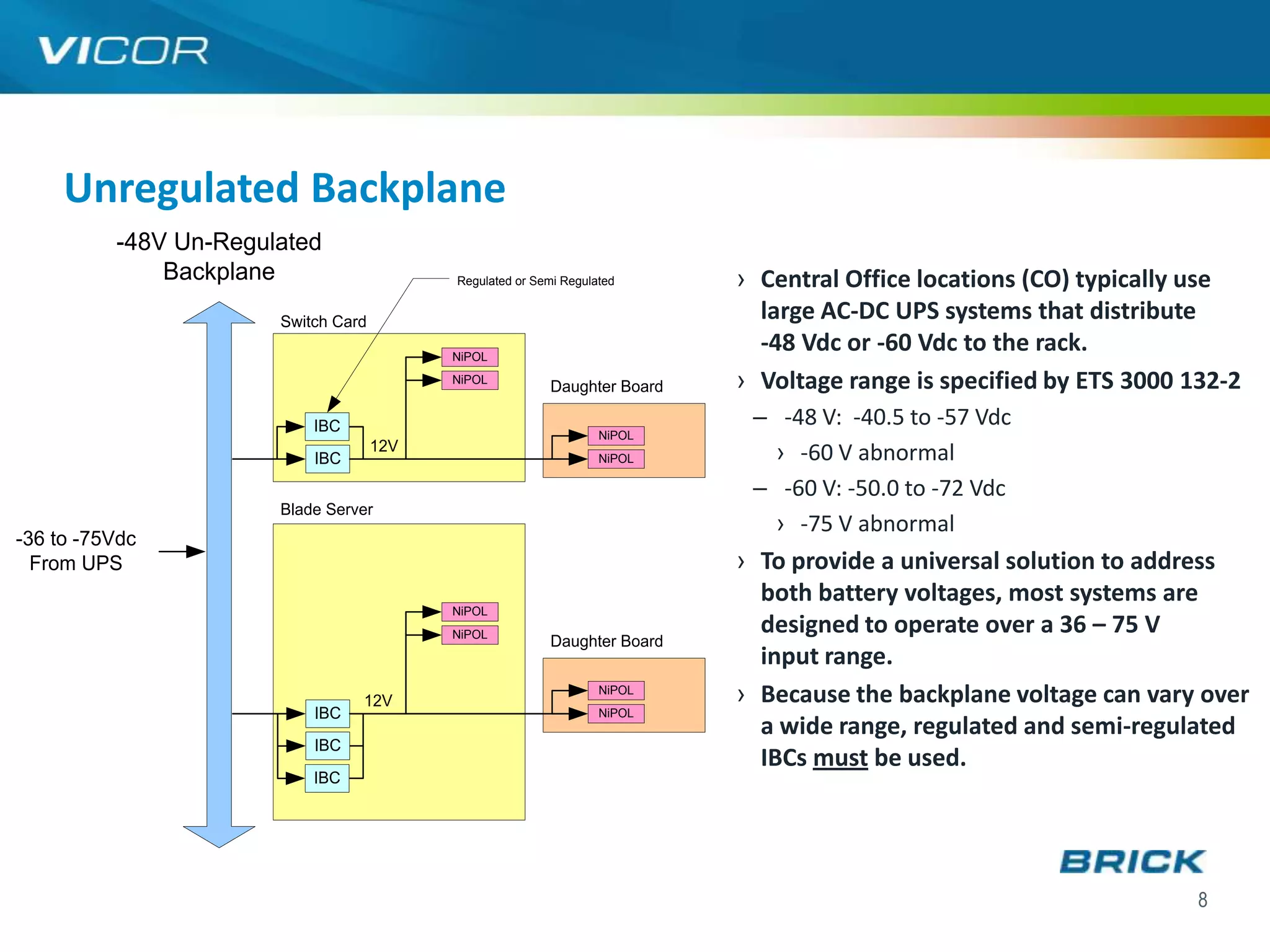
              Backplane                    Regulated or Semi Regulated     › Central Office locations (CO) typically use
                       Switch Card
                                                                             large AC-DC UPS systems that distribute
                                           NiPOL
                                                                             -48 Vdc or -60 Vdc to the rack.
                                           NiPOL
                                                          Daughter Board   › Voltage range is specified by ETS 3000 132-2
                           IBC                                              – -48 V: -40.5 to -57 Vdc
                                                                   NiPOL
                           IBC
                                     12V
                                                                   NiPOL      › -60 V abnormal
                                                                            – -60 V: -50.0 to -72 Vdc
                       Blade Server
                                                                              › -75 V abnormal
-36 to -75Vdc
  From UPS                                                                 › To provide a universal solution to address
                                                                             both battery voltages, most systems are
                                           NiPOL
                                           NiPOL
                                                                             designed to operate over a 36 – 75 V
                                                          Daughter Board
                                                                             input range.
                                 12V
                                                                   NiPOL
                                                                           › Because the backplane voltage can vary over
                           IBC                                     NiPOL
                                                                             a wide range, regulated and semi-regulated
                           IBC
                                                                             IBCs must be used.
                           IBC


                                                                                                                     8
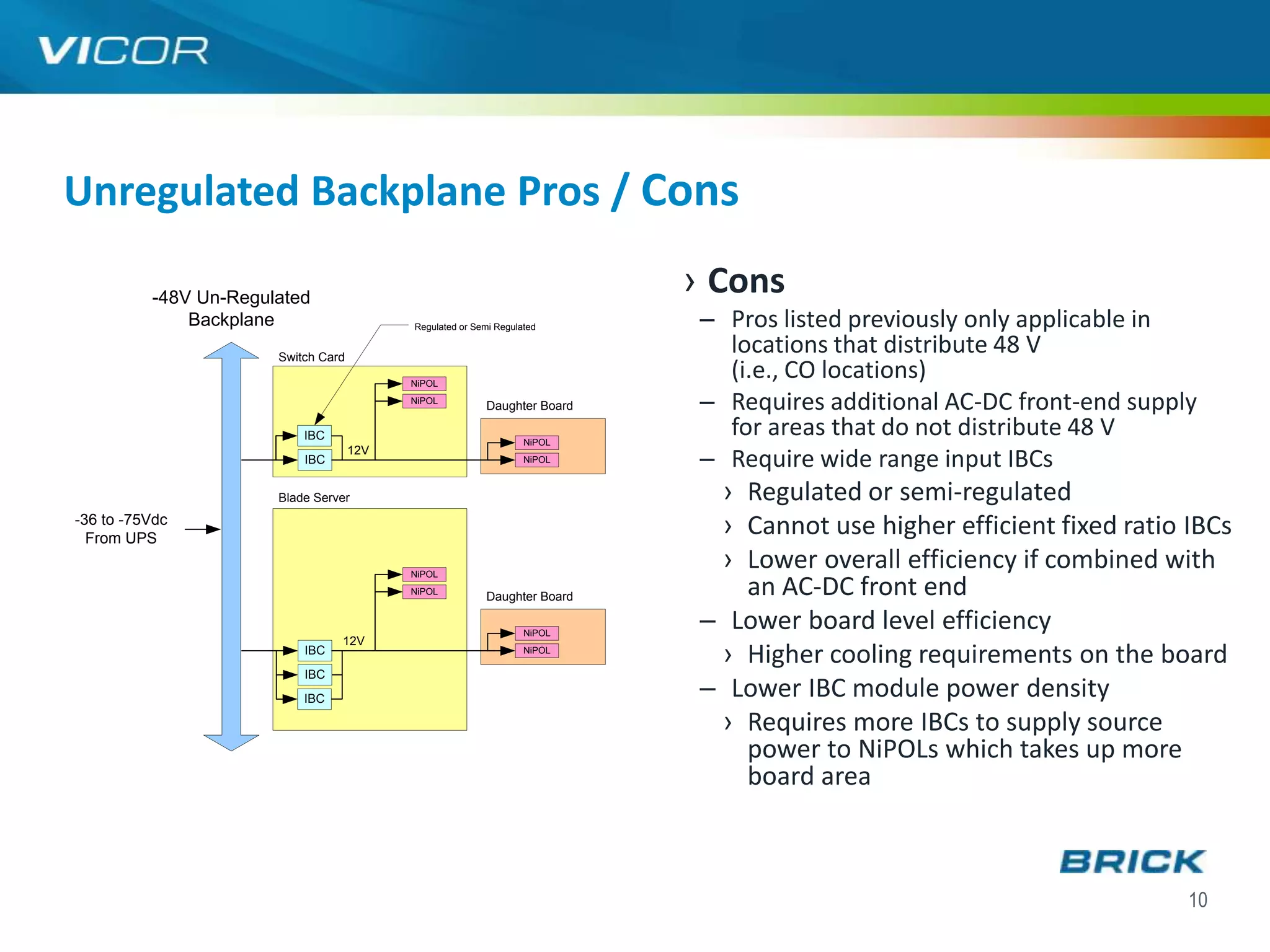
Unregulated Backplane Pros / Cons

          -48V Un-Regulated
                                                                           › Pro
                                                                            – Two stage power conversion
              Backplane                    Regulated or Semi Regulated


                       Switch Card

                                           NiPOL                              from source to load
                                           NiPOL
                                                          Daughter Board

                           IBC
                                     12V
                                                                   NiPOL
                                                                             › Highest overall system
                           IBC                                     NiPOL
                                                                               efficiency
                       Blade Server
-36 to -75Vdc
  From UPS
                                                                            – Lowest cost of ownership
                                           NiPOL
                                           NiPOL
                                                                             › No front-end supply
                                                          Daughter Board

                                                                   NiPOL
                                                                              – Lower utility costs
                                 12V
                           IBC                                     NiPOL

                           IBC
                           IBC


                                                                                                           9
Unregulated Backplane Pros / Cons

          -48V Un-Regulated
                                                                           › Cons
              Backplane                    Regulated or Semi Regulated     – Pros listed previously only applicable in
                       Switch Card
                                                                             locations that distribute 48 V
                                           NiPOL
                                                                             (i.e., CO locations)
                                           NiPOL
                                                          Daughter Board   – Requires additional AC-DC front-end supply
                           IBC                                     NiPOL
                                                                             for areas that do not distribute 48 V
                           IBC
                                     12V
                                                                   NiPOL   – Require wide range input IBCs
                       Blade Server                                          › Regulated or semi-regulated
-36 to -75Vdc
  From UPS
                                                                             › Cannot use higher efficient fixed ratio IBCs
                                           NiPOL
                                                                             › Lower overall efficiency if combined with
                                           NiPOL
                                                          Daughter Board       an AC-DC front end
                                                                   NiPOL
                                                                           – Lower board level efficiency
                                 12V
                           IBC                                     NiPOL
                                                                             › Higher cooling requirements on the board
                           IBC
                           IBC
                                                                           – Lower IBC module power density
                                                                             › Requires more IBCs to supply source
                                                                               power to NiPOLs which takes up more
                                                                               board area


                                                                                                                       10
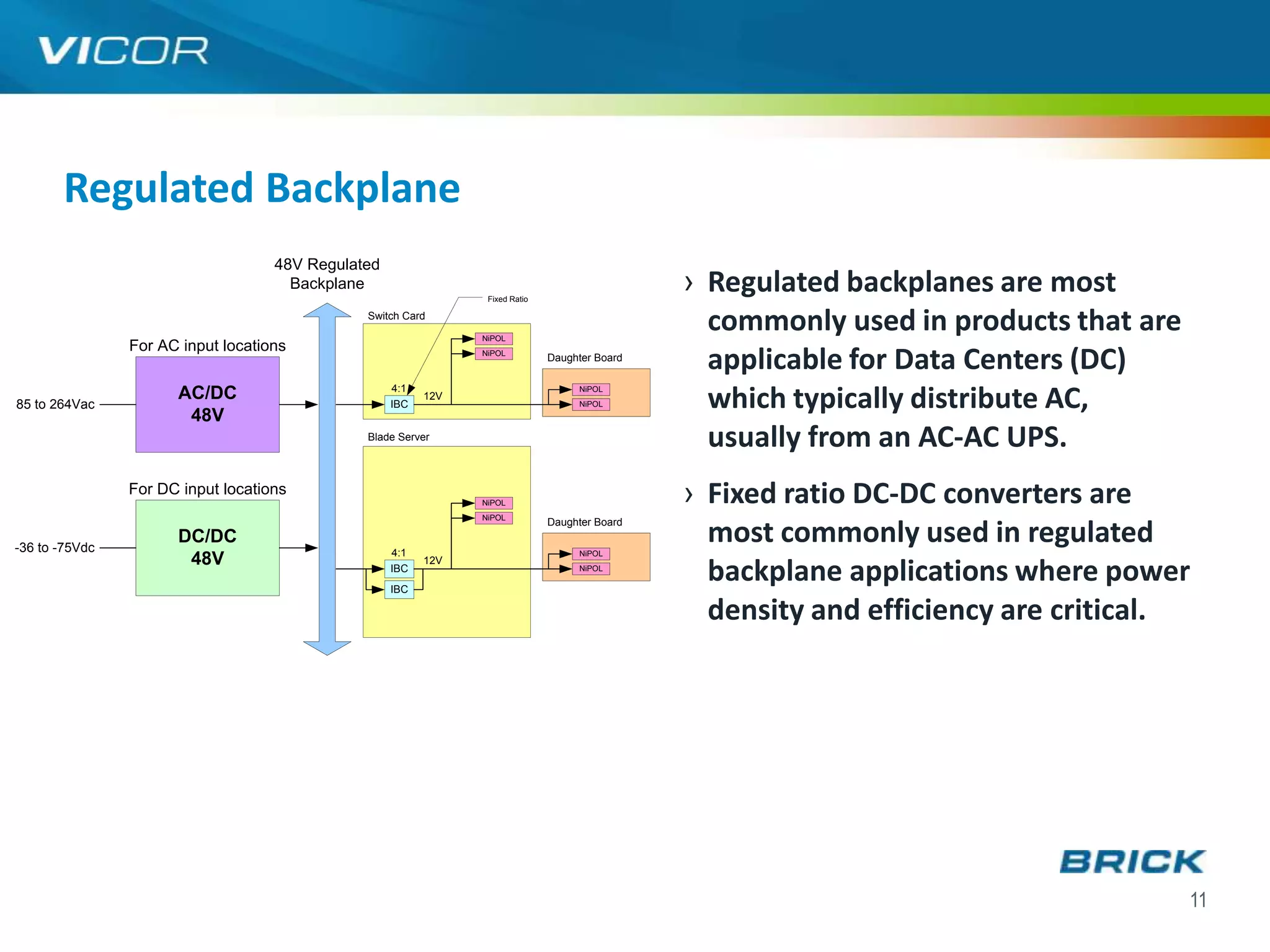
Regulated Backplane
                                    48V Regulated
                                      Backplane
                                                                 Fixed Ratio
                                                                                                › Regulated backplanes are most
                                               Switch Card

                                                                NiPOL
                                                                                                  commonly used in products that are
                For AC input locations                          NiPOL
                                                                               Daughter Board
                                                                                                  applicable for Data Centers (DC)
                                                                                                  which typically distribute AC,
                                                    4:1
                      AC/DC                               12V
                                                                                    NiPOL

85 to 264Vac                                        IBC                             NiPOL
                       48V
                                               Blade Server
                                                                                                  usually from an AC-AC UPS.
                For DC input locations
                                                                NiPOL                           › Fixed ratio DC-DC converters are
                                                                NiPOL
                                                                               Daughter Board

-36 to -75Vdc
                      DC/DC
                                                    4:1                             NiPOL
                                                                                                  most commonly used in regulated
                       48V                                12V
                                                    IBC
                                                    IBC
                                                                                    NiPOL
                                                                                                  backplane applications where power
                                                                                                  density and efficiency are critical.


                                                                                                                                       11
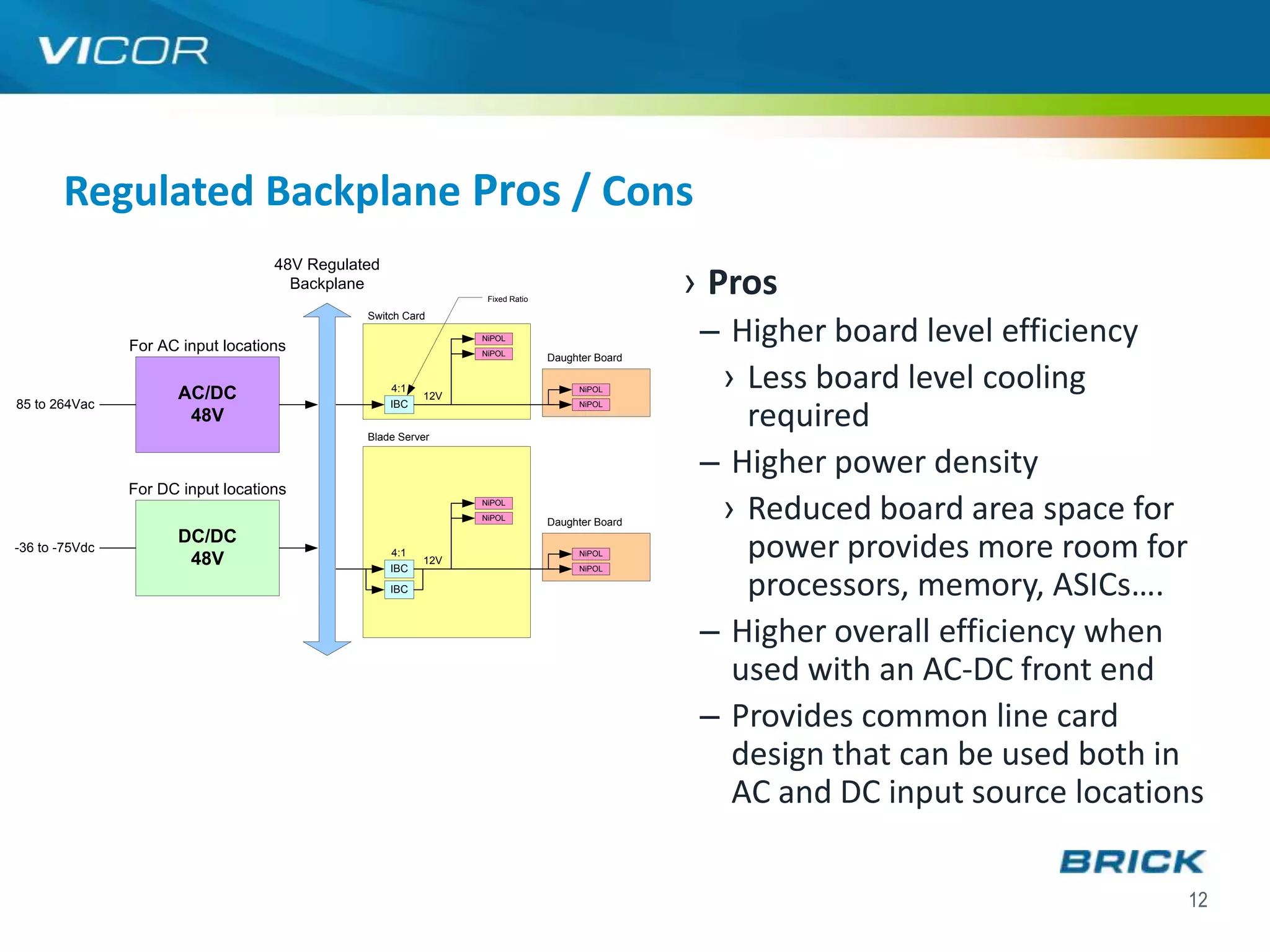
Regulated Backplane Pros / Cons
                                    48V Regulated
                                      Backplane
                                                                 Fixed Ratio
                                                                                                › Pros
                                                                                                 – Higher board level efficiency
                                               Switch Card

                                                                NiPOL
                For AC input locations                          NiPOL
                                                                               Daughter Board


                      AC/DC                         4:1
                                                          12V
                                                                                    NiPOL
                                                                                                  › Less board level cooling
85 to 264Vac
                                                                                                    required
                                                    IBC                             NiPOL
                       48V
                                               Blade Server


                                                                                                 – Higher power density
                For DC input locations
                                                                NiPOL
                                                                NiPOL
                                                                               Daughter Board
                                                                                                  › Reduced board area space for
                      DC/DC
-36 to -75Vdc
                       48V                          4:1
                                                    IBC
                                                          12V
                                                                                    NiPOL
                                                                                    NiPOL
                                                                                                    power provides more room for
                                                    IBC                                             processors, memory, ASICs….
                                                                                                 – Higher overall efficiency when
                                                                                                   used with an AC-DC front end
                                                                                                 – Provides common line card
                                                                                                   design that can be used both in
                                                                                                   AC and DC input source locations

                                                                                                                                 12
Regulated Backplane Pros / Cons
                                    48V Regulated
                                      Backplane
                                               Switch Card
                                                                 Fixed Ratio                    › Cons
                For AC input locations
                                                                NiPOL
                                                                NiPOL
                                                                               Daughter Board
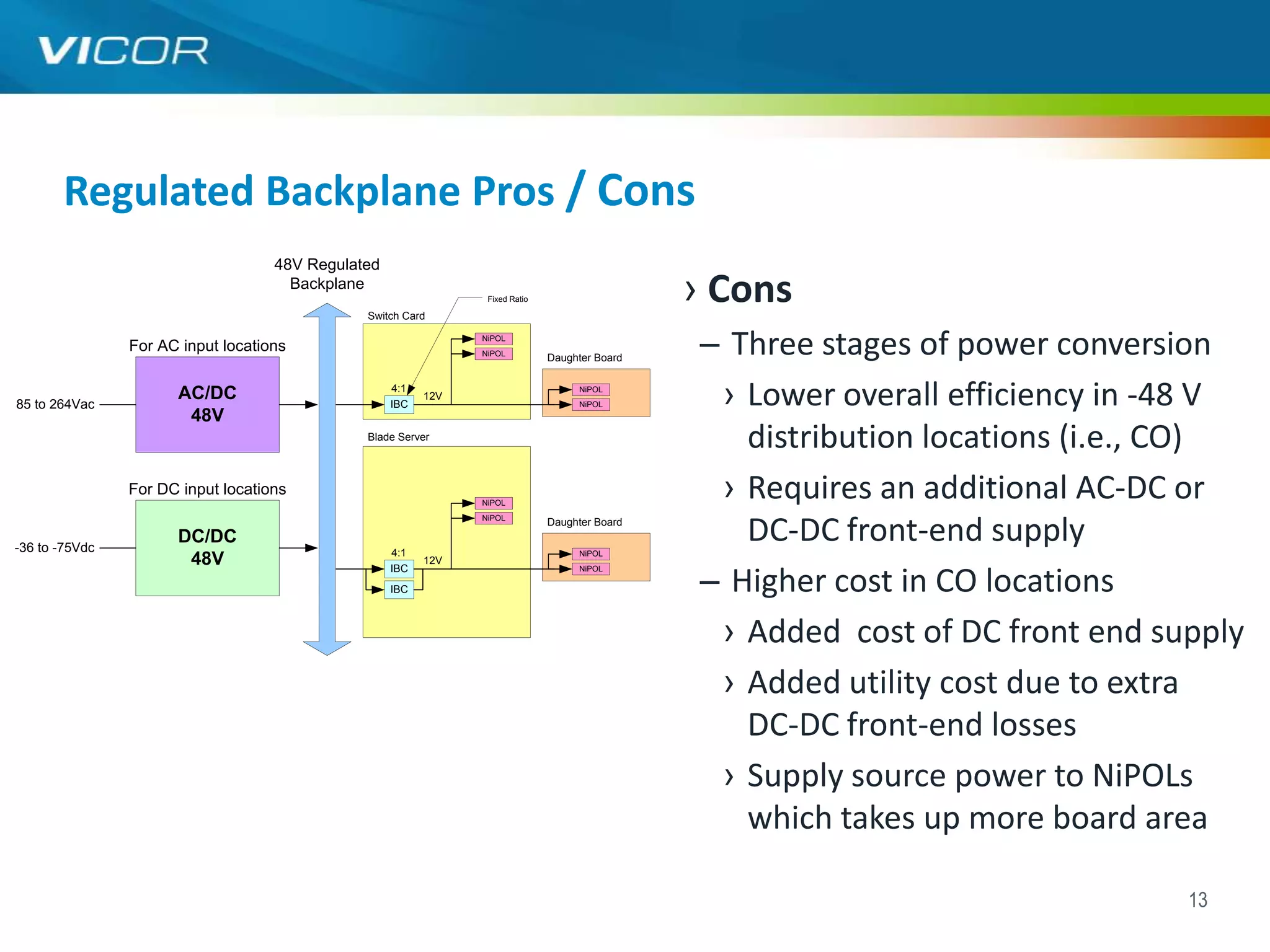
                                                                                                – Three stages of power conversion
85 to 264Vac
                      AC/DC
                       48V
                                                    4:1
                                                    IBC
                                                          12V
                                                                                    NiPOL
                                                                                    NiPOL        › Lower overall efficiency in -48 V
                                               Blade Server
                                                                                                   distribution locations (i.e., CO)
                For DC input locations
                                                                NiPOL
                                                                                                 › Requires an additional AC-DC or
                                                                                                   DC-DC front-end supply
                                                                NiPOL
                                                                               Daughter Board
                      DC/DC
-36 to -75Vdc                                       4:1                             NiPOL
                       48V                                12V

                                                                                                – Higher cost in CO locations
                                                    IBC                             NiPOL

                                                    IBC


                                                                                                 › Added cost of DC front end supply
                                                                                                 › Added utility cost due to extra
                                                                                                   DC-DC front-end losses
                                                                                                 › Supply source power to NiPOLs
                                                                                                   which takes up more board area

                                                                                                                                13
Features and Benefits

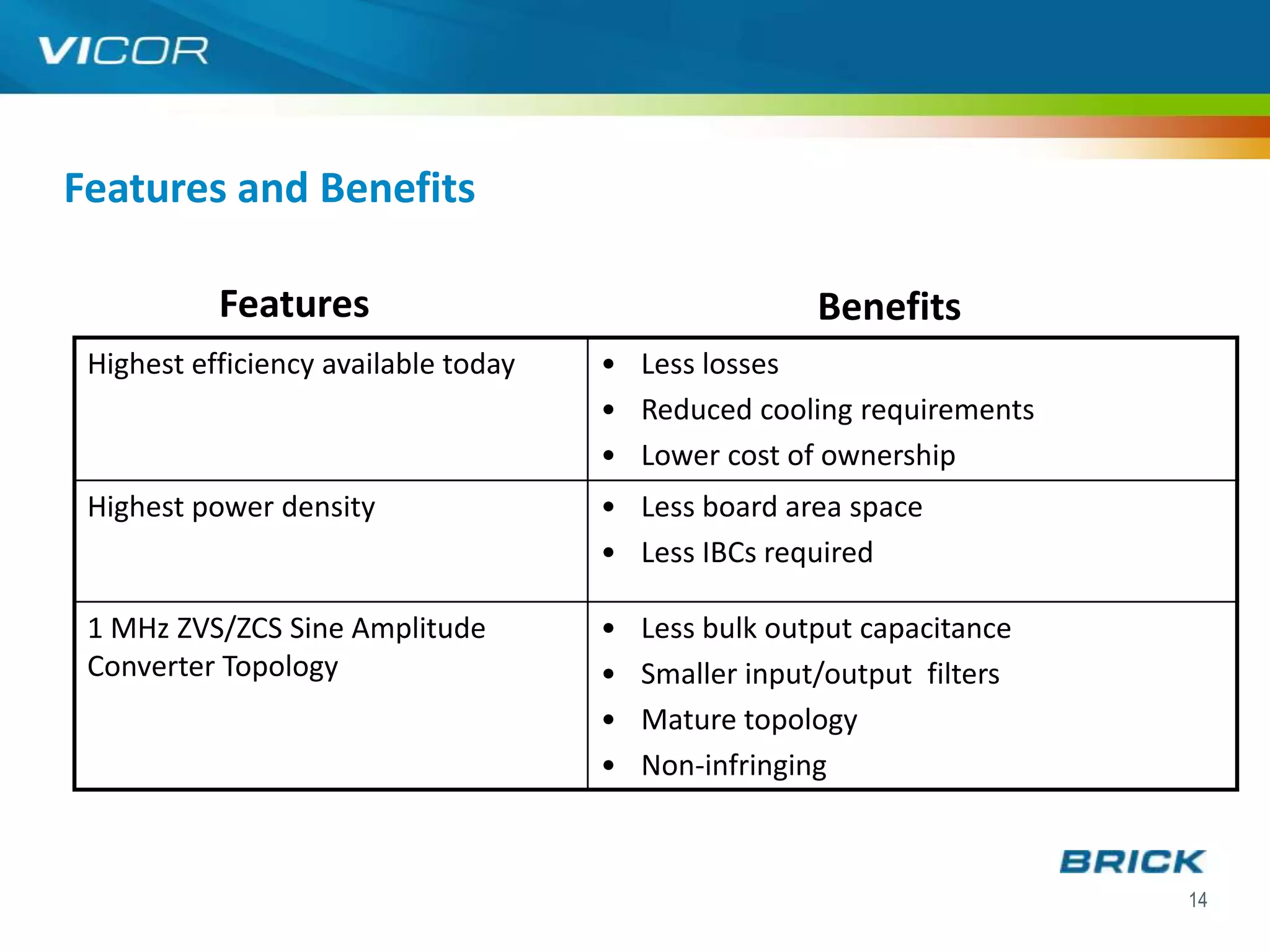
           Features                                    Benefits
 Highest efficiency available today   • Less losses
                                      • Reduced cooling requirements
                                      • Lower cost of ownership
 Highest power density                • Less board area space
                                      • Less IBCs required

 1 MHz ZVS/ZCS Sine Amplitude         •   Less bulk output capacitance
 Converter Topology                   •   Smaller input/output filters
                                      •   Mature topology
                                      •   Non-infringing


                                                                         14
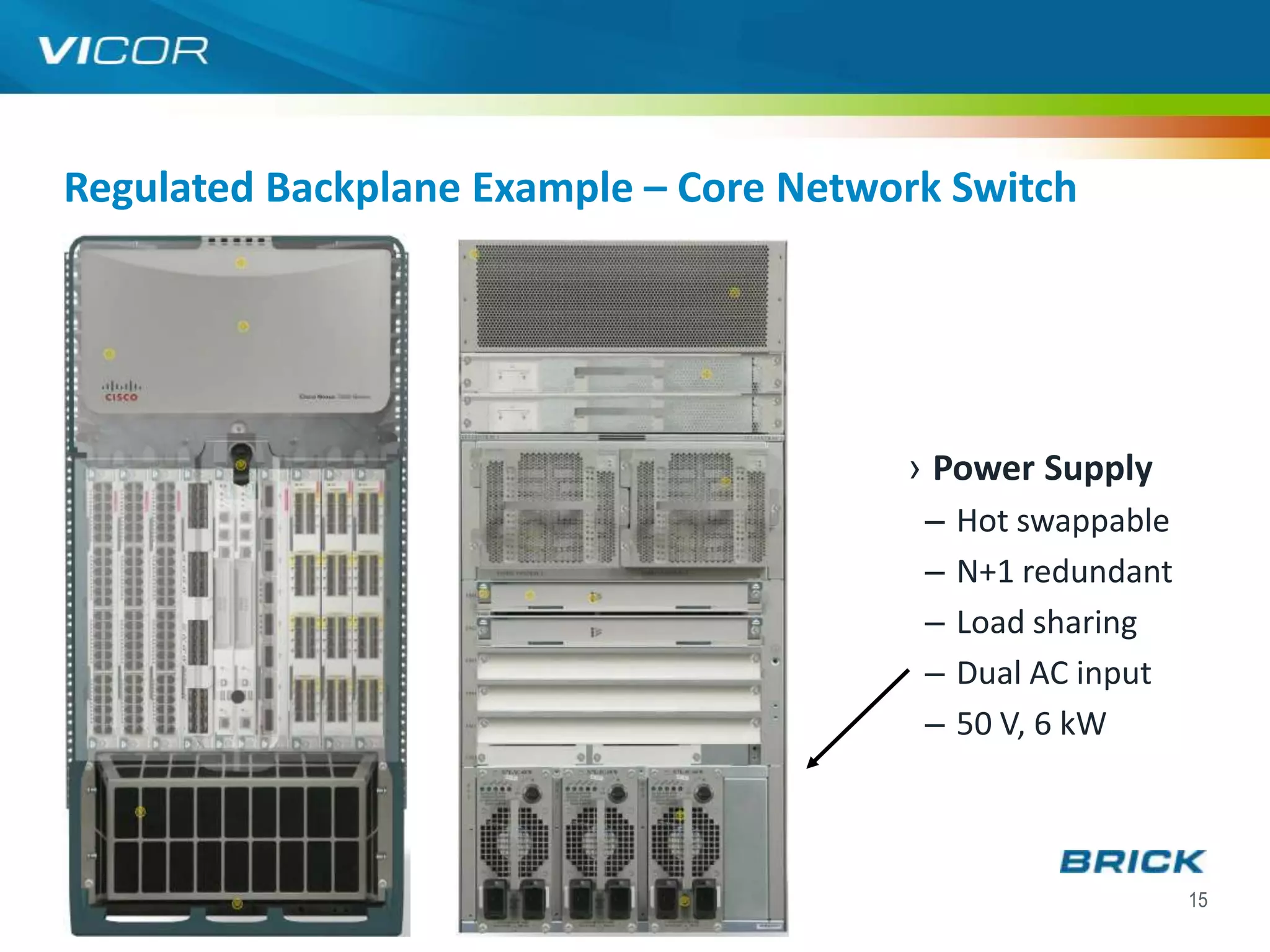
Regulated Backplane Example – Core Network Switch


                                        › Power Supply
                                         –   Hot swappable
                                         –   N+1 redundant
                                         –   Load sharing
                                         –   Dual AC input
                                         –   50 V, 6 kW


                                                             15
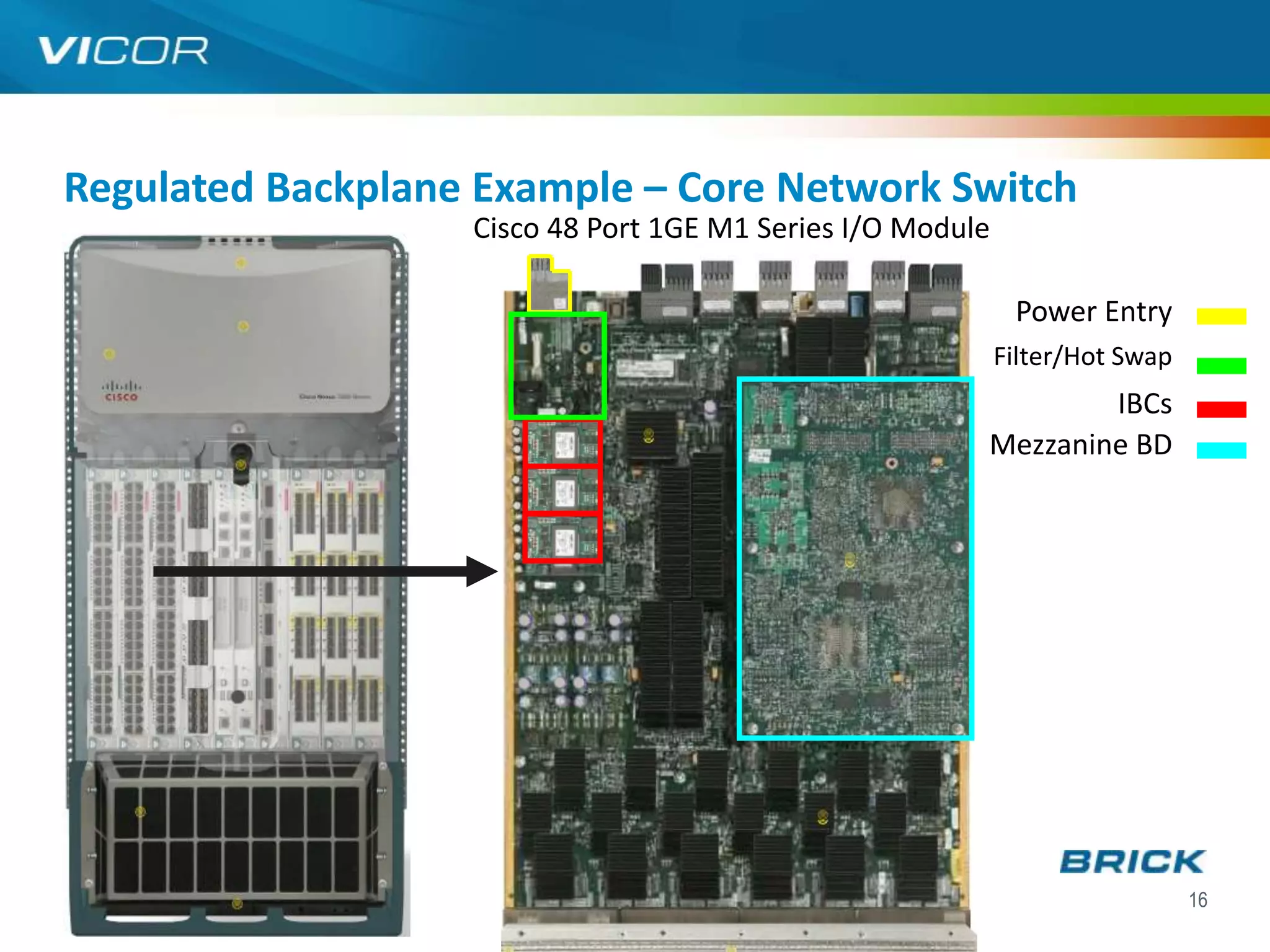
Regulated Backplane Example – Core Network Switch
                   Cisco 48 Port 1GE M1 Series I/O Module

                                                             Power Entry
                                                            Filter/Hot Swap
                                                                IBCs
                                                        Mezzanine BD


                                                                              16
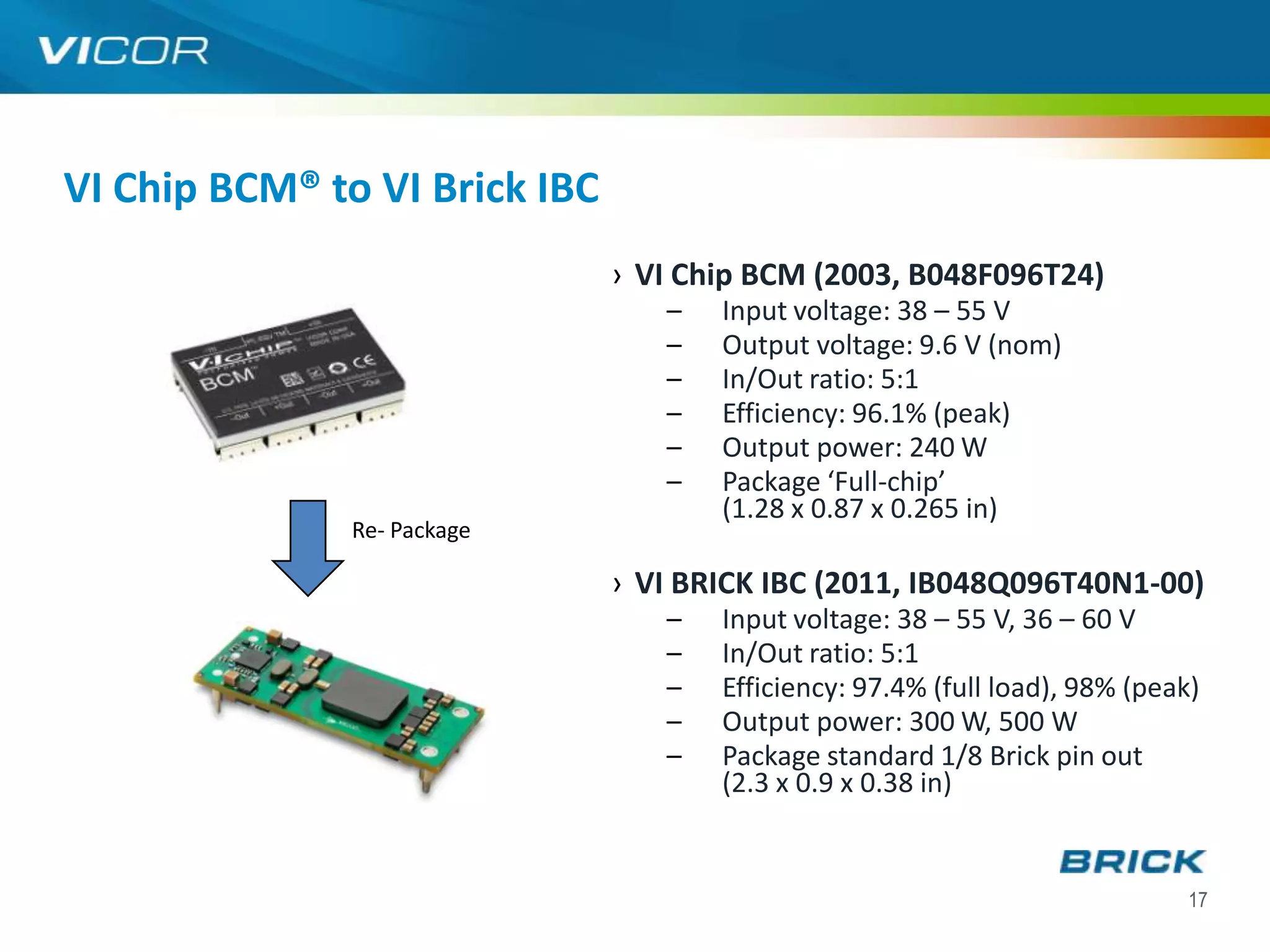
VI Chip BCM® to VI Brick IBC
                               › VI Chip BCM (2003, B048F096T24)
                                  –   Input voltage: 38 – 55 V
                                  –   Output voltage: 9.6 V (nom)
                                  –   In/Out ratio: 5:1
                                  –   Efficiency: 96.1% (peak)
                                  –   Output power: 240 W
                                  –   Package ‘Full-chip’
                                      (1.28 x 0.87 x 0.265 in)
               Re- Package

                               › VI BRICK IBC (2011, IB048Q096T40N1-00)
                                  –   Input voltage: 38 – 55 V, 36 – 60 V
                                  –   In/Out ratio: 5:1
                                  –   Efficiency: 97.4% (full load), 98% (peak)
                                  –   Output power: 300 W, 500 W
                                  –   Package standard 1/8 Brick pin out
                                      (2.3 x 0.9 x 0.38 in)


                                                                              17
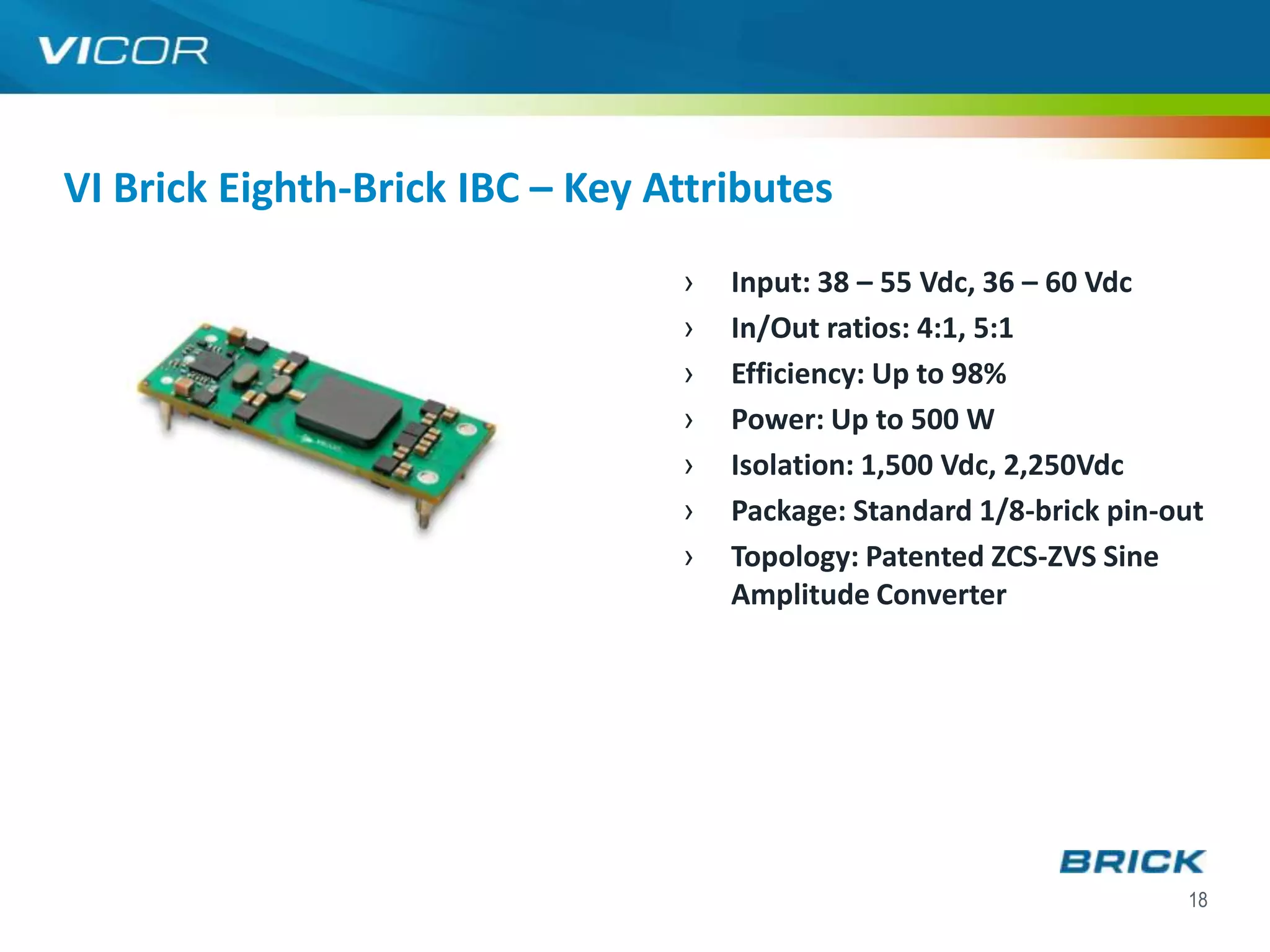
VI Brick Eighth-Brick IBC – Key Attributes
                                 ›   Input: 38 – 55 Vdc, 36 – 60 Vdc
                                 ›   In/Out ratios: 4:1, 5:1
                                 ›   Efficiency: Up to 98%
                                 ›   Power: Up to 500 W
                                 ›   Isolation: 1,500 Vdc, 2,250Vdc
                                 ›   Package: Standard 1/8-brick pin-out
                                 ›   Topology: Patented ZCS-ZVS Sine
                                     Amplitude Converter


                                                                      18
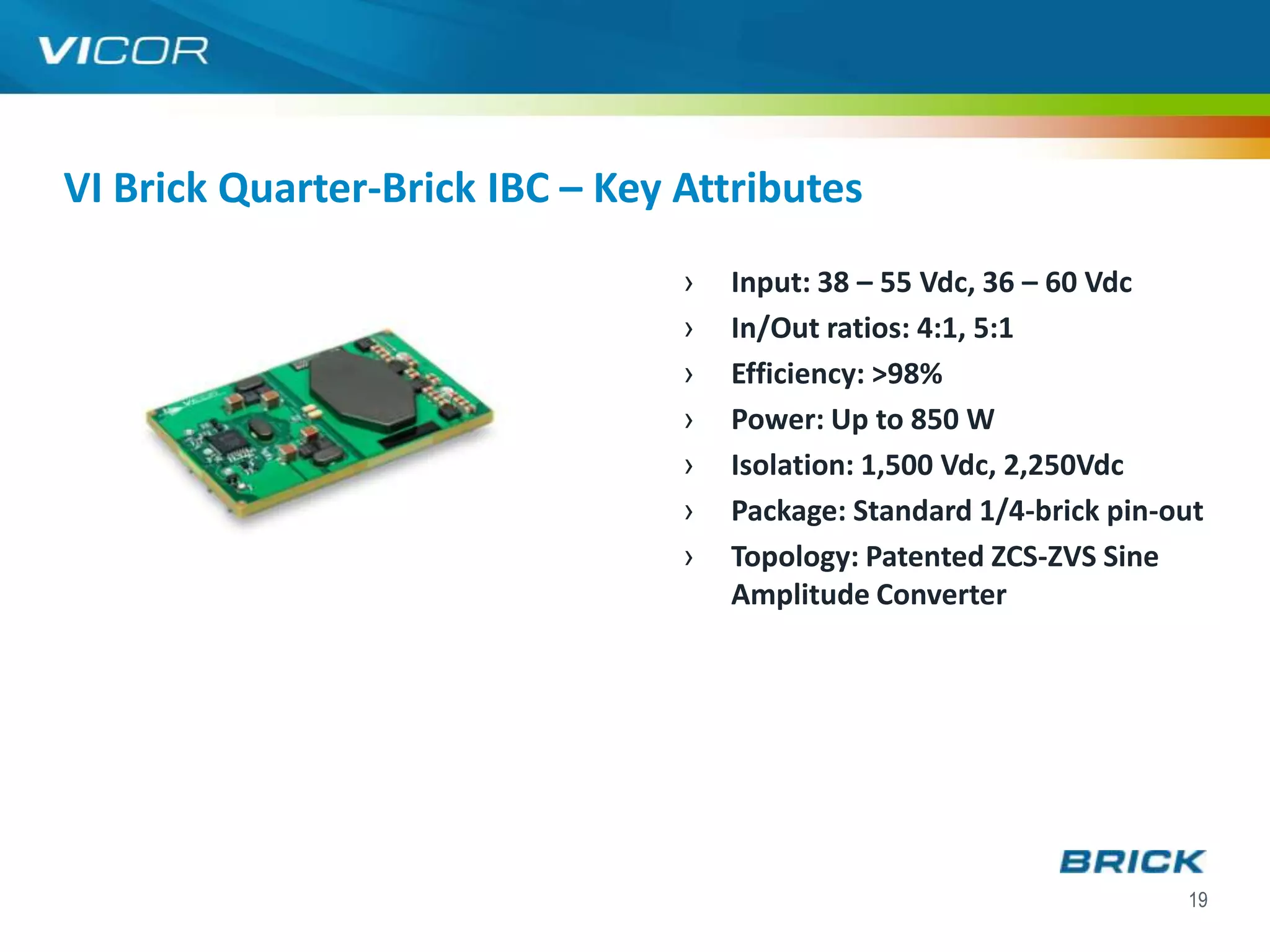
VI Brick Quarter-Brick IBC – Key Attributes
                                 ›   Input: 38 – 55 Vdc, 36 – 60 Vdc
                                 ›   In/Out ratios: 4:1, 5:1
                                 ›   Efficiency: >98%
                                 ›   Power: Up to 850 W
                                 ›   Isolation: 1,500 Vdc, 2,250Vdc
                                 ›   Package: Standard 1/4-brick pin-out
                                 ›   Topology: Patented ZCS-ZVS Sine
                                     Amplitude Converter


                                                                      19
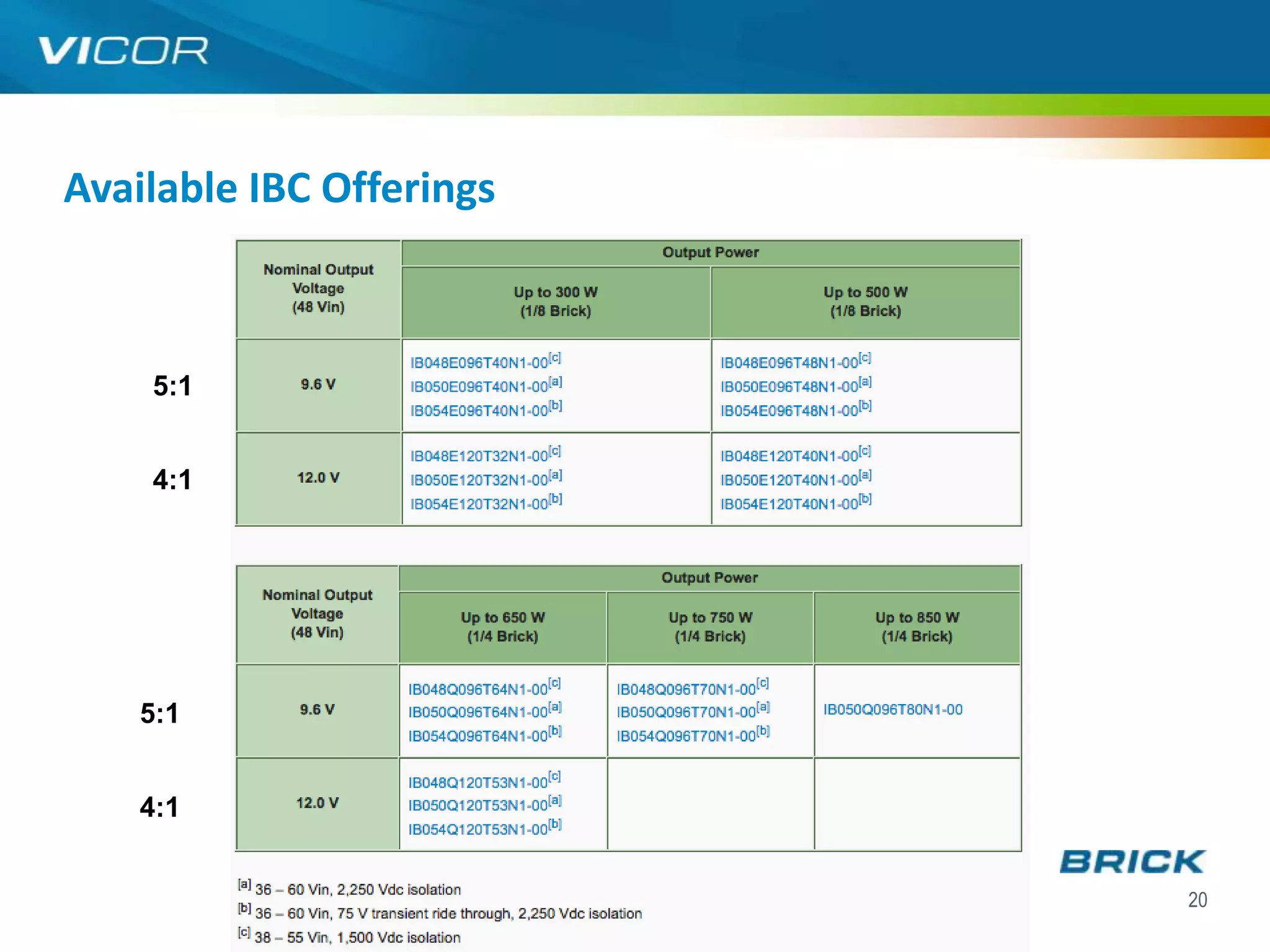
Available IBC Offerings


    5:1


    4:1


    5:1


    4:1


                          20

VI BRICK® IBC Intermediate Bus Converters

  • 1.
    VI Brick® IBCIntermediate Bus Converters 1
  • 2.
    Topics of Discussion ›History of Intermediate Bus Architecture (IBA) › Types of Intermediate Bus Converters (IBC) › Regulated versus unregulated backplanes – Pros and cons – Real world examples › Vicor IBC modules – Origin – Key attributes – Competitive analysis – Features versus benefits 2
  • 3.
    History of IntermediateBus Architecture (IBA) › The proliferation in the number of lower voltage output requirements led to the development of a more cost effective power architecture known as “Intermediate Bus Architecture” (IBA). › IBA replaces the proliferation of the “brick” DC-DC modules used to generate each separate voltage with one or more isolated brick modules called Intermediate Bus Converters (IBCs) for the Intermediate Bus. › IBCs are configured in parallel arrays and are used to step down a higher backplane voltage to a lower “Intermediate” voltage which is then tightly regulated down to the point of load using non-isolated Point- of-Load regulators (NiPOL). Distributed Brick DC/DC Architecture Intermediate Bus Architecture IBC 36-75V DC/DC +5V 36-75V +12V (Regulated) NiPOL +5V NiPOL +3.3V IBC DC/DC +12V NiPOL +2.5V (Regulated) NiPOL +1.7V NiPOL +1.5V DC/DC -5V NiPOL +1.2V DC/DC -12V 3
  • 4.
    Intermediate Bus ArchitectureAdvantages › Cost – NiPOLs are substantially less expensive than bricks › Layout – Non isolated 48 V is confined to a very small area near the backplane connector – Discrete NiPOLs can easily fit on the bottom of the PCB freeing up valuable board space for FPGAs, ASICs,… 4
  • 5.
    Types of IntermediateBus Converters (IBC) › Over the years, in order to achieve higher efficiency and power density, IBC technology advanced to include semi-regulated and fixed ratio topologies. These newer topologies offered increased efficiency and power density at the expense of regulation. Vout Vout Vout 13.75V 12.8V 12V 12V 12V 11.6V 9.5V 75V 48V 75V 36V 38V 48V Vin Vin Vin 36V 55V Regulated DC/DC Converter Semi-Regulated DC/DC Converter Fixed Ratio DC/DC Converter Regulation: 0.2% typ Regulation: 7-10% typ Regulation: None (4:1 typ) Efficiency: up to 93% Efficiency: up to 95% Efficiency: up to 98% 5
  • 6.
    So Why Can’tI Get a Wide Input Fixed Ratio IBC? › Although it is possible to design a Fixed Ratio IBC to operate from a wide 36 – 75 V input, most view this as undesirable because it causes too large of an output voltage variation which reduces the efficiency of the downstream NiPOLs. › “The larger the step down ratio, the lower the NiPOL efficiency Vout Vout 18.75V 5V 13.75V 12V 12V 9.5V 9V 38V 48V 36V 48V 75V Vin Vin 55V Fixed Ratio DC/DC Converter Fixed Ratio DC/DC Converter Narrow Input (38-55V) Wide Input (36-75V) (4:1 ratio) (4:1 ratio) 6
  • 7.
    Typical Distributed BackplaneVoltages › Regulated, Isolated 12 V – Provided by a regulated AC-DC or DC-DC front end supply – Low to mid end systems – 1U “pizza box” systems 12 V goes straight to NiPOLs so IBC modules are not required › Non-regulated -48 V or -60 Vdc Battery Source – Central Office (CO) or base station locations Cannot use our fixed ratio IBCs › Regulated “48 V” – Provided by a regulated AC-DC or DC-DC front-end supply – Data center and/or CO locations – Typical set voltages: 42 V, 48 V, 50 V, 54 V – 54 V is commonly used in systems that include Power over Ethernet (PoE)  Can use our fixed ratio IBCs 7
  • 8.
    Unregulated Backplane -48V Un-Regulated Backplane Regulated or Semi Regulated › Central Office locations (CO) typically use Switch Card large AC-DC UPS systems that distribute NiPOL -48 Vdc or -60 Vdc to the rack. NiPOL Daughter Board › Voltage range is specified by ETS 3000 132-2 IBC – -48 V: -40.5 to -57 Vdc NiPOL IBC 12V NiPOL › -60 V abnormal – -60 V: -50.0 to -72 Vdc Blade Server › -75 V abnormal -36 to -75Vdc From UPS › To provide a universal solution to address both battery voltages, most systems are NiPOL NiPOL designed to operate over a 36 – 75 V Daughter Board input range. 12V NiPOL › Because the backplane voltage can vary over IBC NiPOL a wide range, regulated and semi-regulated IBC IBCs must be used. IBC 8
  • 9.
    Unregulated Backplane Pros/ Cons -48V Un-Regulated › Pro – Two stage power conversion Backplane Regulated or Semi Regulated Switch Card NiPOL from source to load NiPOL Daughter Board IBC 12V NiPOL › Highest overall system IBC NiPOL efficiency Blade Server -36 to -75Vdc From UPS – Lowest cost of ownership NiPOL NiPOL › No front-end supply Daughter Board NiPOL – Lower utility costs 12V IBC NiPOL IBC IBC 9
  • 10.
    Unregulated Backplane Pros/ Cons -48V Un-Regulated › Cons Backplane Regulated or Semi Regulated – Pros listed previously only applicable in Switch Card locations that distribute 48 V NiPOL (i.e., CO locations) NiPOL Daughter Board – Requires additional AC-DC front-end supply IBC NiPOL for areas that do not distribute 48 V IBC 12V NiPOL – Require wide range input IBCs Blade Server › Regulated or semi-regulated -36 to -75Vdc From UPS › Cannot use higher efficient fixed ratio IBCs NiPOL › Lower overall efficiency if combined with NiPOL Daughter Board an AC-DC front end NiPOL – Lower board level efficiency 12V IBC NiPOL › Higher cooling requirements on the board IBC IBC – Lower IBC module power density › Requires more IBCs to supply source power to NiPOLs which takes up more board area 10
  • 11.
    Regulated Backplane 48V Regulated Backplane Fixed Ratio › Regulated backplanes are most Switch Card NiPOL commonly used in products that are For AC input locations NiPOL Daughter Board applicable for Data Centers (DC) which typically distribute AC, 4:1 AC/DC 12V NiPOL 85 to 264Vac IBC NiPOL 48V Blade Server usually from an AC-AC UPS. For DC input locations NiPOL › Fixed ratio DC-DC converters are NiPOL Daughter Board -36 to -75Vdc DC/DC 4:1 NiPOL most commonly used in regulated 48V 12V IBC IBC NiPOL backplane applications where power density and efficiency are critical. 11
  • 12.
    Regulated Backplane Pros/ Cons 48V Regulated Backplane Fixed Ratio › Pros – Higher board level efficiency Switch Card NiPOL For AC input locations NiPOL Daughter Board AC/DC 4:1 12V NiPOL › Less board level cooling 85 to 264Vac required IBC NiPOL 48V Blade Server – Higher power density For DC input locations NiPOL NiPOL Daughter Board › Reduced board area space for DC/DC -36 to -75Vdc 48V 4:1 IBC 12V NiPOL NiPOL power provides more room for IBC processors, memory, ASICs…. – Higher overall efficiency when used with an AC-DC front end – Provides common line card design that can be used both in AC and DC input source locations 12
  • 13.
    Regulated Backplane Pros/ Cons 48V Regulated Backplane Switch Card Fixed Ratio › Cons For AC input locations NiPOL NiPOL Daughter Board – Three stages of power conversion 85 to 264Vac AC/DC 48V 4:1 IBC 12V NiPOL NiPOL › Lower overall efficiency in -48 V Blade Server distribution locations (i.e., CO) For DC input locations NiPOL › Requires an additional AC-DC or DC-DC front-end supply NiPOL Daughter Board DC/DC -36 to -75Vdc 4:1 NiPOL 48V 12V – Higher cost in CO locations IBC NiPOL IBC › Added cost of DC front end supply › Added utility cost due to extra DC-DC front-end losses › Supply source power to NiPOLs which takes up more board area 13
  • 14.
    Features and Benefits Features Benefits Highest efficiency available today • Less losses • Reduced cooling requirements • Lower cost of ownership Highest power density • Less board area space • Less IBCs required 1 MHz ZVS/ZCS Sine Amplitude • Less bulk output capacitance Converter Topology • Smaller input/output filters • Mature topology • Non-infringing 14
  • 15.
    Regulated Backplane Example– Core Network Switch › Power Supply – Hot swappable – N+1 redundant – Load sharing – Dual AC input – 50 V, 6 kW 15
  • 16.
    Regulated Backplane Example– Core Network Switch Cisco 48 Port 1GE M1 Series I/O Module Power Entry Filter/Hot Swap IBCs Mezzanine BD 16
  • 17.
    VI Chip BCM®to VI Brick IBC › VI Chip BCM (2003, B048F096T24) – Input voltage: 38 – 55 V – Output voltage: 9.6 V (nom) – In/Out ratio: 5:1 – Efficiency: 96.1% (peak) – Output power: 240 W – Package ‘Full-chip’ (1.28 x 0.87 x 0.265 in) Re- Package › VI BRICK IBC (2011, IB048Q096T40N1-00) – Input voltage: 38 – 55 V, 36 – 60 V – In/Out ratio: 5:1 – Efficiency: 97.4% (full load), 98% (peak) – Output power: 300 W, 500 W – Package standard 1/8 Brick pin out (2.3 x 0.9 x 0.38 in) 17
  • 18.
    VI Brick Eighth-BrickIBC – Key Attributes › Input: 38 – 55 Vdc, 36 – 60 Vdc › In/Out ratios: 4:1, 5:1 › Efficiency: Up to 98% › Power: Up to 500 W › Isolation: 1,500 Vdc, 2,250Vdc › Package: Standard 1/8-brick pin-out › Topology: Patented ZCS-ZVS Sine Amplitude Converter 18
  • 19.
    VI Brick Quarter-BrickIBC – Key Attributes › Input: 38 – 55 Vdc, 36 – 60 Vdc › In/Out ratios: 4:1, 5:1 › Efficiency: >98% › Power: Up to 850 W › Isolation: 1,500 Vdc, 2,250Vdc › Package: Standard 1/4-brick pin-out › Topology: Patented ZCS-ZVS Sine Amplitude Converter 19
  • 20.
    Available IBC Offerings 5:1 4:1 5:1 4:1 20