Immune checkpoint inhibitors in
Hodgkin lymphoma
Alison Moskowitz, MD
Lymphoma Service
Memorial Sloan KetteringCancer Center
Checkpoint blockade in Hodgkin lymphoma
• Pivotal studies leading to approval in relapsed and refractory
Hodgkin lymphoma
• Mechanism of action
• Efforts to incorporate them into early treatment for HL
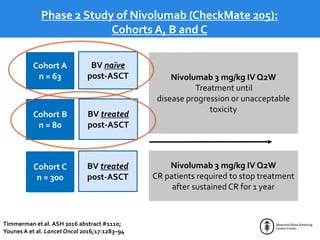
Phase 2 Study of Nivolumab (CheckMate 205):
Cohorts A, B and C
Timmerman et al. ASH 2016 abstract #1110;
YounesA et al. LancetOncol 2016;17:1283–94
Nivolumab 3 mg/kg IV Q2W
Treatment until
disease progression or unacceptable
toxicity
Cohort B
n = 80
Cohort A
n = 63
BV naïve
post-ASCT
BV treated
post-ASCT
Cohort C
n = 300
BV treated
post-ASCT
Nivolumab 3 mg/kg IV Q2W
CR patients required to stop treatment
after sustained CR for 1 year
Baseline Characteristics and Outcomes
Characteristic
BV naïve post-ASCT
Cohort A (n = 63)
Minimal f/u: 9 mo
BV post-ASCT
Cohort B (n = 80)1
Minimal f/u: 12 mo
Age, median (range), years 33 (18–65) 37 (18–72)
Male, n (%) 34 (54) 51 (64)
Patients still on treatment 39 (62) 43 (54)
Overall response, n (%) 43 (68) 54 (68)
Complete response, n (%) 14 (22) 6 (7.5)
Partial response, n (%) 29(46) 48 (60)
1.YounesA et al. LancetOncol 2016;17:1283–94
Progression-Free Survival by Best Response
Cohort B: Nivolumab After BV Post-ASCT
CR
PR
SD
PD
180 3 6 9 12 15
0.0
0.1
0.2
0.3
0.4
0.5
0.6
0.7
0.8
0.9
1.0
ProbabilityofPFS
Months
06 6 5 4 2 1
048 47 37 30 16 3
017 16 10 6 4 0
07 1 0 0 0 0
No. of patients at risk
CR
PR
SD
PD
CR: Median PFS - not reached
PR: Median PFS - 15 mo
SD: Median PFS - 12 mo
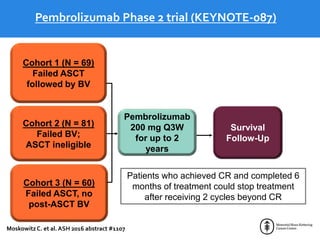
Pembrolizumab Phase 2 trial (KEYNOTE-087)
Cohort 1 (N = 69)
Failed ASCT
followed by BV
Pembrolizumab
200 mg Q3W
for up to 2
years
Cohort 2 (N = 81)
Failed BV;
ASCT ineligible
Cohort 3 (N = 60)
Failed ASCT, no
post-ASCT BV
Survival
Follow-Up
Patients who achieved CR and completed 6
months of treatment could stop treatment
after receiving 2 cycles beyond CR
MoskowitzC. et al. ASH 2016 abstract #1107
ORR by Cohort
Cohort 1
Progressed after
ASCT and
subsequent
BV therapy
N = 69
Cohort 2
Failed salvage
chemotherapy,
ineligible for ASCT
and failed BV therapy
N = 81
Cohort 3
Failed ASCT and not
treated with BV after
transplantation
N = 60
n (%) 95% CI† n (%) 95% CI† n (%) 95% CI†
ORR 51 (73.9) 61.9-83.7 52 (64.2) 52.8-74.6 42 (70.0) 56.8-81.2
Complete
remission‡
15 (21.7) 12.7-33.3 20 (24.7) 15.8-35.5 12 (20.0) 10.8-32.3
Partial remission 36 (52.2) 39.8-64.4 32 (39.5) 28.8-51.0 30 (50.0) 36.8-63.2
Stable disease 11 (15.9) 8.2-26.7 10 (12.3) 6.1-21.5 10 (16.7) 8.3-28.5
Progressive disease 5 (7.2) 2.4-16.1 17 (21.0) 12.7-31.5 8 (13.3) 5.9-24.6
Unable to determine 2 (2.9) 0.4-10.1 2 (2.5) 0.3-8.6 0 (0) –
Pembrolizumab - Adverse Events
Any-Grade AEs
≥5% of patients
Total Population
N = 210
n (%)
Hypothyroidism 26 (12.4)
Pyrexia 22 (10.5)
Fatigue 19 (9.0)
Rash 16 (7.6)
Diarrhea 15 (7.1)
Headache 13 (6.2)
Nausea 12 (5.7)
Cough 12 (5.7)
Neutropenia 11 (5.2)
Grade 3/4 AEs
Total Population
N = 210
n (%)
Any grade 3/4 AE 23 (11)
AEs in ≥2 patients
Neutropenia, grade 3 5 (2.4)
Diarrhea, grade 3 2 (1.0)
Dyspnea, grade 3 2 (1.0)
• 2 deaths occurred
• No treatment-related deaths
• 9 patients discontinued because of treatment-related
AEs
• 1 myocarditis, grade 4
• 1 myelitis, grade 3
• 1 myositis, grade 2
• 4 pneumonitis, grade 2
• 1 infusion-related reaction, grade 2, 1 cytokine
release syndrome, grade 3
• 1 infusion-related reaction, grade 2
AEs of interest in ≥2 patients
Total Population
N = 210
n (%)
Infusion-related reactions, grades
1 and 2
10 (4.8)
Pneumonitis, all grade 2 6 (2.9)
Hyperthyroidism, grades 1 and 2 6 (2.9)
Colitis, grades 2 and 3 2 (1.0)
Myositis, grades 2 and 3 2 (1.0)
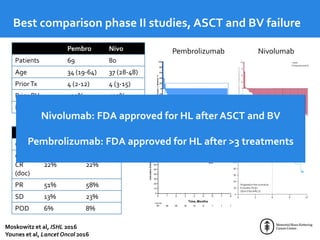
Best comparison phase II studies, ASCT and BV failure
Pembro Nivo
Patients 69 80
Age 34 (19-64) 37 (28-48)
PriorTx 4 (2-12) 4 (3-15)
Prior BV 100% 100%
Prior auto-SCT 100% 100%
Pembro Nivo
ORR 72% 66%
CR (IR)
CR
(doc)
22%
22%
9%
22%
PR 51% 58%
SD 13% 23%
POD 6% 8%
Moskowitz et al, ISHL 2016
Younes et al, LancetOncol 2016
Pembrolizumab Nivolumab
-100
-80
-60
-40
-20
0
20
40
60
80
100
ChangeFromBaseline,%
0
n at risk
1 2 3 4 5 76 8
0
10
20
30
40
50
60
CumulativeEventRate,%
Time,Months
70
90
80
110
100
50 39 39 18 10 9 11 1
Nivolumab: FDA approved for HL after ASCT and BV
Pembrolizumab: FDA approved for HL after >3 treatments
OverallResponseRate(%)
HL
B-NHL
T-NHL
Melanoma NSCLC SCLC TNBC Ovary RCC
HighPD-L1
LowPD-L1
Urothelial
MMRdeficient
MMRproficient
Colorectal
Gastric
Esophageal
HNSC
CHCC
Single agent activity of PD-1/PD-L1 axis
blockade in relapsed/refractory Cancer
87 66 28 17 120 556 655 35 129117131292 394 83 144 40 16 27 21 20 26 34 168 39 28 46 38 33 10 18 39 39 23 99 39No of patients
0
10
20
30
40
50
60
70
80
90
100
MPDL3280A
Pembrolizumab
Nivolumab
Hodgkin
Lymphoma
Matsuki E &YounesA, CurrentTreatmentOptions in Oncology 2016
PD-1 works in HL – is that enough?
• Why is the complete response rate so low?
• Which drugs do we combine them with?
• What role should they play in front-line and second-line
treatment for HL?
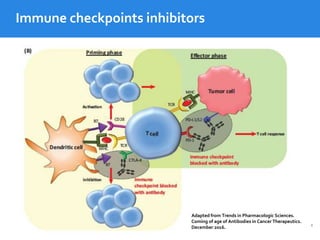
Checkpoint pathways and immune evasion
Adapted from Trends in Pharmacologic Sciences.
Coming of age of Antibodies in Cancer Therapeutics.
December 2016.
Immune checkpoints inhibitors
Adapted from Trends in Pharmacologic Sciences.
Coming of age of Antibodies in Cancer Therapeutics.
December 2016.
Mechanism of PD-1 blockade
• In solid tumors, PD-1 blockade releases the breaks on anti-
tumor immunity
– Expression of PD-L1 predicts response1
– Mediated by CD8+ cytotoxicT cells2
– Intact antigen presentation by MHC-I is required3
1Garon, et al. NEJM, 2015.
2PCTumeh et al. Nature, 2014.
3Zaretsky, et al. NEJM, 2016.
Is this how it works in Hodgkin lymphoma?
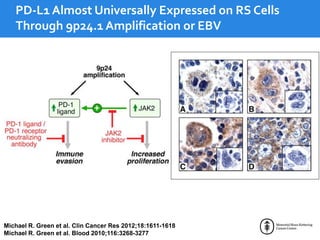
Michael R. Green et al. Clin Cancer Res 2012;18:1611-1618
Michael R. Green et al. Blood 2010;116:3268-3277
PD-L1 Almost Universally Expressed on RS Cells
Through 9p24.1 Amplification or EBV
9p24.1 amplification - enriched in advanced stage and
associated with PFS
Roemer et al,J ClinOncol 2016
Mechanism of PD-1 blockade
• In solid tumors, PD-1 blockade releases the breaks on anti-
tumor immunity
– Expression of PD-L1 predicts response1
– Mediated by CD8+ cytotoxicT cells2
– Intact antigen presentation by MHC-I is required3
Is this how it works in Hodgkin lymphoma?
 Universal PD-L1 expression
1Garon, et al. NEJM, 2015
2PCTumeh et al. Nature, 2014.
3Zaretsky, et al. NEJM, 2016.
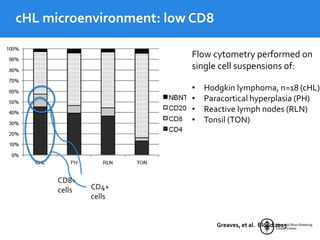
cHL microenvironment: low CD8
Flow cytometry performed on
single cell suspensions of:
• Hodgkin lymphoma, n=18 (cHL)
• Paracortical hyperplasia (PH)
• Reactive lymph nodes (RLN)
• Tonsil (TON)
CD8+
cells CD4+
cells
Greaves, et al. Blood 2013
Mechanism of PD-1 blockade
• In solid tumors, PD-1 blockade releases the breaks on anti-
tumor immunity
– Expression of PD-L1 predicts response1
– Mediated by CD8+ cytotoxicT cells2
– Intact antigen presentation by MHC-I is required3
Is this how it works in Hodgkin lymphoma?
 Universal PD-L1 expression
x Prevalence of CD8+ cells?
1Garon, et al. NEJM, 2015
2PCTumeh et al. Nature, 2014.
3Zaretsky, et al. NEJM, 2016.
Jonathan Reichel et al. Blood 2015;125:1061-1072
B2M Mutations are frequent and result in lack
of MHC-I Expression
B2M neg, 93/145 (64%)
B2M pos, 52/145 (36%)
108 patients on 3
prospective clinical trials
with StanfordV
B2M/MHC-I: 79%
 MHC-II: 67%
Roemer et al. Cancer Immunology
Research. October 2016
Overall high rate of MHC-I/II loss in cHL at baseline
Mechanism of PD-1 blockade
• In solid tumors, PD-1 blockade releases the breaks on anti-
tumor immunity
– Expression of PD-L1 predicts response1
– Mediated by CD8+ cytotoxicT cells2
– Intact antigen presentation by MHC-I is required3
Is this how it works in Hodgkin lymphoma?
 Universal PD-L1 expression
x Prevalence of CD8+ cells?
x MHC-1 expression required?
1Garon, et al. NEJM, 2015
2PCTumeh et al. Nature, 2014.
3Zaretsky, et al. NEJM, 2016.
Anti-PD-1 works in HL…but how?
Vardhana andYounes, Haematologica 2016
Action plan for biopsies from patients treated with PD-1 blockade
Courtesy of SantoshVardhana
Biopsy
Flow cytometry
Immunophenotyping Sorting
Pathology
IHC
TCR
Clonality RNA
expression
profiling
Patients eligible for or receiving anti-PD-1 therapy
Tumor cell
exome
sequencing
HRS cells
T cells
FISH
Will combining PD-1
blockade with other agents
improve the CR rate?
SGN35-025: BV + Nivolumab as a pre-ASCT salvage program
Study schema
Nivo 3mg/kg
BV 1.8 mg/kg
Cycle 1
Weeks 3 7 10
Cycle 2 Cycle 3
13
Cycle 4
CT CT/PET
EOT
ASCT
1 2 4
• Phase 1/2
• N ~55-60
• Study population:
• R/R HL after failure of frontline therapy
• No prior BV or IO
• Primary endpoint is a 50% CR rate via
Deauville score 1-3
HerreraA. et al. ASH 2016
BV-Nivo efficacy
SPD change from baselinea
Max SUV change from baseline
ORR (26/29) = 90%
95% CI: 72.6, 97.8
CR (18/29) = 62%
95% CI: 42.3, 79.3
5-Point Score
Best
Metabolic
Response n (%) Total n (%)
1 CR 8 (28) 18 (62)
2 6 (21)
3 3 (10)
Missing 1 (3)
4 PR 6 (21) 8 (28)
5 2 (7)
5 SD 1 (3) 1 (3)
5 PD 2 (7) 2 (7)
Deauville score (N=29)
HerreraA. et al. ASH 2016
Can PD-1 blockade replace
autologous stem cell
transplant?
Phase II Study of Pembrolizumab + ISRT for
Relapsed ES HL: Study Design
Eligiblity
Histologically confirmed cHL
Initial stage: I-IIA
Prior therapy: Short course with no RT
CMT with relapse outside field
Relapse stage: I-II (1 radiation port)
No bulk > 10 cm
ECOG 0-1
MoskowitzC, personal communication
Pembrolizumab 200 mg q3w x4
Deauville 1-3 D4-5, Responding Deauville 5, POD
20 Gy
Eligible
Relapse cHL
PET-
Sim
PET-
Sim
36-40 Gy30 Gy
Bx
Off Study
Bx
EOT PET
Can PD-1 blockade improve
front-line treatment for high
risk patients?
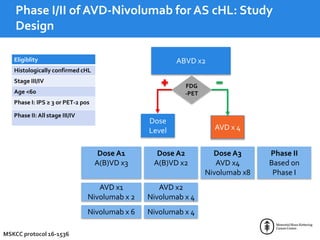
Phase I/II of AVD-Nivolumab for AS cHL: Study
Design
Eligiblity
Histologically confirmed cHL
Stage III/IV
Age <60
Phase I: IPS ≥ 3 or PET-2 pos
Phase II: All stage III/IV
MSKCC protocol 16-1536
Phase II
Based on
Phase I
ABVD x2
FDG
-PET
AVD x 4
Dose
Level
Dose A1
A(B)VD x3
AVD x1
Nivolumab x 2
Nivolumab x 6
Dose A2
A(B)VD x2
AVD x2
Nivolumab x 4
Nivolumab x 4
Dose A3
AVD x4
Nivolumab x8
Checkpoint blockade in Hodgkin lymphoma
• Highly active in relapsed and refractory disease
• Prolonged response duration
• Many unanswered questions
– How do they work?
– What are the predictors of response?
– How do we best incorporate them into our current treatment schema?
Lymphoma Disease Management Team
Lymphoma Service
Connie Batlevi
Philip Caron
Pamela Drulinksy
John Gerecitano
Audrey Hamilton
Paul Hamlin
Steve Horwitz
Andrew Intlekofer
Anital Kumar
Matt Matasar
Alison Moskowitz
Craig Moskowitz
Ariela Noy
Lia Palomba
Carol Portlock
David Straus
SantoshVardhana
AnasYounes, Chief
Andrew Zelenetz
Lymphoma Transplant Program
Matt Matasar
Craig Sauter
Craig Moskowitz
Juliet Barker
Gunjan Shah
Miguel Perales
Sergio Giralt
Hematopathology
Ahmet Dogan, Chief
Maria Arcila
Caleb Ho
Oscar Lin
Peter Maslak
Chris Park
David Park
Filiz Sen
MarikoYabe
Nuclear Medicine
Heiko Schoder, Chief
Neetha Pandit-Tasker
Jorge Carasquillo
Radiation Oncology
JoachimYahalom
Radiology
James Caravelli
Jurgen Rademaker
Gary Ulaner
V_Hematology_Forum_Dr_Moskowitz

V_Hematology_Forum_Dr_Moskowitz

  • 1.
    Immune checkpoint inhibitorsin Hodgkin lymphoma Alison Moskowitz, MD Lymphoma Service Memorial Sloan KetteringCancer Center
  • 2.
    Checkpoint blockade inHodgkin lymphoma • Pivotal studies leading to approval in relapsed and refractory Hodgkin lymphoma • Mechanism of action • Efforts to incorporate them into early treatment for HL
  • 3.
    Phase 2 Studyof Nivolumab (CheckMate 205): Cohorts A, B and C Timmerman et al. ASH 2016 abstract #1110; YounesA et al. LancetOncol 2016;17:1283–94 Nivolumab 3 mg/kg IV Q2W Treatment until disease progression or unacceptable toxicity Cohort B n = 80 Cohort A n = 63 BV naïve post-ASCT BV treated post-ASCT Cohort C n = 300 BV treated post-ASCT Nivolumab 3 mg/kg IV Q2W CR patients required to stop treatment after sustained CR for 1 year
  • 4.
    Baseline Characteristics andOutcomes Characteristic BV naïve post-ASCT Cohort A (n = 63) Minimal f/u: 9 mo BV post-ASCT Cohort B (n = 80)1 Minimal f/u: 12 mo Age, median (range), years 33 (18–65) 37 (18–72) Male, n (%) 34 (54) 51 (64) Patients still on treatment 39 (62) 43 (54) Overall response, n (%) 43 (68) 54 (68) Complete response, n (%) 14 (22) 6 (7.5) Partial response, n (%) 29(46) 48 (60) 1.YounesA et al. LancetOncol 2016;17:1283–94
  • 5.
    Progression-Free Survival byBest Response Cohort B: Nivolumab After BV Post-ASCT CR PR SD PD 180 3 6 9 12 15 0.0 0.1 0.2 0.3 0.4 0.5 0.6 0.7 0.8 0.9 1.0 ProbabilityofPFS Months 06 6 5 4 2 1 048 47 37 30 16 3 017 16 10 6 4 0 07 1 0 0 0 0 No. of patients at risk CR PR SD PD CR: Median PFS - not reached PR: Median PFS - 15 mo SD: Median PFS - 12 mo
  • 6.
    Pembrolizumab Phase 2trial (KEYNOTE-087) Cohort 1 (N = 69) Failed ASCT followed by BV Pembrolizumab 200 mg Q3W for up to 2 years Cohort 2 (N = 81) Failed BV; ASCT ineligible Cohort 3 (N = 60) Failed ASCT, no post-ASCT BV Survival Follow-Up Patients who achieved CR and completed 6 months of treatment could stop treatment after receiving 2 cycles beyond CR MoskowitzC. et al. ASH 2016 abstract #1107
  • 7.
    ORR by Cohort Cohort1 Progressed after ASCT and subsequent BV therapy N = 69 Cohort 2 Failed salvage chemotherapy, ineligible for ASCT and failed BV therapy N = 81 Cohort 3 Failed ASCT and not treated with BV after transplantation N = 60 n (%) 95% CI† n (%) 95% CI† n (%) 95% CI† ORR 51 (73.9) 61.9-83.7 52 (64.2) 52.8-74.6 42 (70.0) 56.8-81.2 Complete remission‡ 15 (21.7) 12.7-33.3 20 (24.7) 15.8-35.5 12 (20.0) 10.8-32.3 Partial remission 36 (52.2) 39.8-64.4 32 (39.5) 28.8-51.0 30 (50.0) 36.8-63.2 Stable disease 11 (15.9) 8.2-26.7 10 (12.3) 6.1-21.5 10 (16.7) 8.3-28.5 Progressive disease 5 (7.2) 2.4-16.1 17 (21.0) 12.7-31.5 8 (13.3) 5.9-24.6 Unable to determine 2 (2.9) 0.4-10.1 2 (2.5) 0.3-8.6 0 (0) –
  • 8.
    Pembrolizumab - AdverseEvents Any-Grade AEs ≥5% of patients Total Population N = 210 n (%) Hypothyroidism 26 (12.4) Pyrexia 22 (10.5) Fatigue 19 (9.0) Rash 16 (7.6) Diarrhea 15 (7.1) Headache 13 (6.2) Nausea 12 (5.7) Cough 12 (5.7) Neutropenia 11 (5.2) Grade 3/4 AEs Total Population N = 210 n (%) Any grade 3/4 AE 23 (11) AEs in ≥2 patients Neutropenia, grade 3 5 (2.4) Diarrhea, grade 3 2 (1.0) Dyspnea, grade 3 2 (1.0) • 2 deaths occurred • No treatment-related deaths • 9 patients discontinued because of treatment-related AEs • 1 myocarditis, grade 4 • 1 myelitis, grade 3 • 1 myositis, grade 2 • 4 pneumonitis, grade 2 • 1 infusion-related reaction, grade 2, 1 cytokine release syndrome, grade 3 • 1 infusion-related reaction, grade 2 AEs of interest in ≥2 patients Total Population N = 210 n (%) Infusion-related reactions, grades 1 and 2 10 (4.8) Pneumonitis, all grade 2 6 (2.9) Hyperthyroidism, grades 1 and 2 6 (2.9) Colitis, grades 2 and 3 2 (1.0) Myositis, grades 2 and 3 2 (1.0)
  • 9.
    Best comparison phaseII studies, ASCT and BV failure Pembro Nivo Patients 69 80 Age 34 (19-64) 37 (28-48) PriorTx 4 (2-12) 4 (3-15) Prior BV 100% 100% Prior auto-SCT 100% 100% Pembro Nivo ORR 72% 66% CR (IR) CR (doc) 22% 22% 9% 22% PR 51% 58% SD 13% 23% POD 6% 8% Moskowitz et al, ISHL 2016 Younes et al, LancetOncol 2016 Pembrolizumab Nivolumab -100 -80 -60 -40 -20 0 20 40 60 80 100 ChangeFromBaseline,% 0 n at risk 1 2 3 4 5 76 8 0 10 20 30 40 50 60 CumulativeEventRate,% Time,Months 70 90 80 110 100 50 39 39 18 10 9 11 1 Nivolumab: FDA approved for HL after ASCT and BV Pembrolizumab: FDA approved for HL after >3 treatments
  • 10.
    OverallResponseRate(%) HL B-NHL T-NHL Melanoma NSCLC SCLCTNBC Ovary RCC HighPD-L1 LowPD-L1 Urothelial MMRdeficient MMRproficient Colorectal Gastric Esophageal HNSC CHCC Single agent activity of PD-1/PD-L1 axis blockade in relapsed/refractory Cancer 87 66 28 17 120 556 655 35 129117131292 394 83 144 40 16 27 21 20 26 34 168 39 28 46 38 33 10 18 39 39 23 99 39No of patients 0 10 20 30 40 50 60 70 80 90 100 MPDL3280A Pembrolizumab Nivolumab Hodgkin Lymphoma Matsuki E &YounesA, CurrentTreatmentOptions in Oncology 2016
  • 11.
    PD-1 works inHL – is that enough? • Why is the complete response rate so low? • Which drugs do we combine them with? • What role should they play in front-line and second-line treatment for HL?
  • 12.
    Checkpoint pathways andimmune evasion Adapted from Trends in Pharmacologic Sciences. Coming of age of Antibodies in Cancer Therapeutics. December 2016.
  • 13.
    Immune checkpoints inhibitors Adaptedfrom Trends in Pharmacologic Sciences. Coming of age of Antibodies in Cancer Therapeutics. December 2016.
  • 14.
    Mechanism of PD-1blockade • In solid tumors, PD-1 blockade releases the breaks on anti- tumor immunity – Expression of PD-L1 predicts response1 – Mediated by CD8+ cytotoxicT cells2 – Intact antigen presentation by MHC-I is required3 1Garon, et al. NEJM, 2015. 2PCTumeh et al. Nature, 2014. 3Zaretsky, et al. NEJM, 2016. Is this how it works in Hodgkin lymphoma?
  • 15.
    Michael R. Greenet al. Clin Cancer Res 2012;18:1611-1618 Michael R. Green et al. Blood 2010;116:3268-3277 PD-L1 Almost Universally Expressed on RS Cells Through 9p24.1 Amplification or EBV
  • 16.
    9p24.1 amplification -enriched in advanced stage and associated with PFS Roemer et al,J ClinOncol 2016
  • 17.
    Mechanism of PD-1blockade • In solid tumors, PD-1 blockade releases the breaks on anti- tumor immunity – Expression of PD-L1 predicts response1 – Mediated by CD8+ cytotoxicT cells2 – Intact antigen presentation by MHC-I is required3 Is this how it works in Hodgkin lymphoma?  Universal PD-L1 expression 1Garon, et al. NEJM, 2015 2PCTumeh et al. Nature, 2014. 3Zaretsky, et al. NEJM, 2016.
  • 18.
    cHL microenvironment: lowCD8 Flow cytometry performed on single cell suspensions of: • Hodgkin lymphoma, n=18 (cHL) • Paracortical hyperplasia (PH) • Reactive lymph nodes (RLN) • Tonsil (TON) CD8+ cells CD4+ cells Greaves, et al. Blood 2013
  • 19.
    Mechanism of PD-1blockade • In solid tumors, PD-1 blockade releases the breaks on anti- tumor immunity – Expression of PD-L1 predicts response1 – Mediated by CD8+ cytotoxicT cells2 – Intact antigen presentation by MHC-I is required3 Is this how it works in Hodgkin lymphoma?  Universal PD-L1 expression x Prevalence of CD8+ cells? 1Garon, et al. NEJM, 2015 2PCTumeh et al. Nature, 2014. 3Zaretsky, et al. NEJM, 2016.
  • 20.
    Jonathan Reichel etal. Blood 2015;125:1061-1072 B2M Mutations are frequent and result in lack of MHC-I Expression B2M neg, 93/145 (64%) B2M pos, 52/145 (36%)
  • 21.
    108 patients on3 prospective clinical trials with StanfordV B2M/MHC-I: 79%  MHC-II: 67% Roemer et al. Cancer Immunology Research. October 2016 Overall high rate of MHC-I/II loss in cHL at baseline
  • 22.
    Mechanism of PD-1blockade • In solid tumors, PD-1 blockade releases the breaks on anti- tumor immunity – Expression of PD-L1 predicts response1 – Mediated by CD8+ cytotoxicT cells2 – Intact antigen presentation by MHC-I is required3 Is this how it works in Hodgkin lymphoma?  Universal PD-L1 expression x Prevalence of CD8+ cells? x MHC-1 expression required? 1Garon, et al. NEJM, 2015 2PCTumeh et al. Nature, 2014. 3Zaretsky, et al. NEJM, 2016.
  • 23.
    Anti-PD-1 works inHL…but how? Vardhana andYounes, Haematologica 2016
  • 24.
    Action plan forbiopsies from patients treated with PD-1 blockade Courtesy of SantoshVardhana Biopsy Flow cytometry Immunophenotyping Sorting Pathology IHC TCR Clonality RNA expression profiling Patients eligible for or receiving anti-PD-1 therapy Tumor cell exome sequencing HRS cells T cells FISH
  • 25.
    Will combining PD-1 blockadewith other agents improve the CR rate?
  • 26.
    SGN35-025: BV +Nivolumab as a pre-ASCT salvage program Study schema Nivo 3mg/kg BV 1.8 mg/kg Cycle 1 Weeks 3 7 10 Cycle 2 Cycle 3 13 Cycle 4 CT CT/PET EOT ASCT 1 2 4 • Phase 1/2 • N ~55-60 • Study population: • R/R HL after failure of frontline therapy • No prior BV or IO • Primary endpoint is a 50% CR rate via Deauville score 1-3 HerreraA. et al. ASH 2016
  • 27.
    BV-Nivo efficacy SPD changefrom baselinea Max SUV change from baseline ORR (26/29) = 90% 95% CI: 72.6, 97.8 CR (18/29) = 62% 95% CI: 42.3, 79.3 5-Point Score Best Metabolic Response n (%) Total n (%) 1 CR 8 (28) 18 (62) 2 6 (21) 3 3 (10) Missing 1 (3) 4 PR 6 (21) 8 (28) 5 2 (7) 5 SD 1 (3) 1 (3) 5 PD 2 (7) 2 (7) Deauville score (N=29) HerreraA. et al. ASH 2016
  • 28.
    Can PD-1 blockadereplace autologous stem cell transplant?
  • 29.
    Phase II Studyof Pembrolizumab + ISRT for Relapsed ES HL: Study Design Eligiblity Histologically confirmed cHL Initial stage: I-IIA Prior therapy: Short course with no RT CMT with relapse outside field Relapse stage: I-II (1 radiation port) No bulk > 10 cm ECOG 0-1 MoskowitzC, personal communication Pembrolizumab 200 mg q3w x4 Deauville 1-3 D4-5, Responding Deauville 5, POD 20 Gy Eligible Relapse cHL PET- Sim PET- Sim 36-40 Gy30 Gy Bx Off Study Bx EOT PET
  • 30.
    Can PD-1 blockadeimprove front-line treatment for high risk patients?
  • 31.
    Phase I/II ofAVD-Nivolumab for AS cHL: Study Design Eligiblity Histologically confirmed cHL Stage III/IV Age <60 Phase I: IPS ≥ 3 or PET-2 pos Phase II: All stage III/IV MSKCC protocol 16-1536 Phase II Based on Phase I ABVD x2 FDG -PET AVD x 4 Dose Level Dose A1 A(B)VD x3 AVD x1 Nivolumab x 2 Nivolumab x 6 Dose A2 A(B)VD x2 AVD x2 Nivolumab x 4 Nivolumab x 4 Dose A3 AVD x4 Nivolumab x8
  • 32.
    Checkpoint blockade inHodgkin lymphoma • Highly active in relapsed and refractory disease • Prolonged response duration • Many unanswered questions – How do they work? – What are the predictors of response? – How do we best incorporate them into our current treatment schema?
  • 33.
    Lymphoma Disease ManagementTeam Lymphoma Service Connie Batlevi Philip Caron Pamela Drulinksy John Gerecitano Audrey Hamilton Paul Hamlin Steve Horwitz Andrew Intlekofer Anital Kumar Matt Matasar Alison Moskowitz Craig Moskowitz Ariela Noy Lia Palomba Carol Portlock David Straus SantoshVardhana AnasYounes, Chief Andrew Zelenetz Lymphoma Transplant Program Matt Matasar Craig Sauter Craig Moskowitz Juliet Barker Gunjan Shah Miguel Perales Sergio Giralt Hematopathology Ahmet Dogan, Chief Maria Arcila Caleb Ho Oscar Lin Peter Maslak Chris Park David Park Filiz Sen MarikoYabe Nuclear Medicine Heiko Schoder, Chief Neetha Pandit-Tasker Jorge Carasquillo Radiation Oncology JoachimYahalom Radiology James Caravelli Jurgen Rademaker Gary Ulaner

Editor's Notes

  • #16 PD-ligand 1 is expressed on antigen presenting cells and engages PD-1 receptor on activated T cells and inhibits T cell receptor signaling, thus turning off immune responses. PD-1L found to be expressed on HL cells with 9p24.1 amplication; here, PD-1L shown on cells dipliod for 9p24.1 implying another mechanism for pd-1 expression (AP-1 activation and EBV infection)
  • #17 Clinical and genetic predictors of progression-free survival (PFS). (A) PFS by clinical stage in patients with classical Hodgkin lymphoma (cHL), early stage favorable (ES-F; n = 33), early stage unfavorable (ES-U; n = 41), and advanced stage (AS; n = 34). P = .002, log-rank test. (B) PFS by 9p24.1 alterations in patients with cHL (disomy, n = 1; polysomy, n = 5; copy gain, n = 61; amplification, n = 39; translocation, n = 2; P < .001, log-rank test). (C) Percentage of patients with 9p24.1 disomy (1%), polysomy (5%), copy gain (56%), amplification (36%), and translocation (1%) in the current series. (D) Frequency of 9p24.1 alterations (polysomy, copy gain, amplification, translocation, or disomy) by clinical stage (ES-F, ES-U, and AS) in this series. The incidence of 9p24.1 amplification is significantly different in clinically staged patients (ES-F, 24%; ES-U, 34%; AS, 50%; P = .024, Kruskal-Wallis test).
  • #19 PH – paracortical hyperplasia RLN – reactive LN TON - tonsil
  • #21 SNP and indel analysis reveal recurrent alterations and subsets. Unsupervised clustering (asymmetric binary distance matrix and complete linkage hierarchical clustering) based on mutation status of the 104 genes that were mutated in at least 2 cases divides 10 sequenced cases of cHL into 2 molecular subgroups—one of which is exclusively wild-type for B2M; the other exclusively mutated for B2M.
  • #24 Despite the impressive activity of PD-1 blockade in HL, it remains unclear how this drug induces anti-tumor responses. In solid tumors, PD-1 blockade leads to de-repression of CD8 T-cell dependent immune responses. However, in relapsed HL the tumors have loss expression of MHC-I in nearly 100% of cases (A). However, there are other potential mechanisms by which PD-1 blockade could act in HL: -- by leading to activation of NK cells, which can recognize and kill MHC-I deficient tumor cells (A) -- by leading to activation of CD4 T cells, which can recognize tumor antigens cross-presented by other antigen presenting cells in the microenvironment -- by suppressing the inhibitory activity of regulatory T cells within the tumor microenvironment
  • #25 We have generated a plan to attempt to learn how PD-1 blockade works, or fails to work, in patients with HL. We are making an effort to biopsy as many patients as possible both prior to and while on therapy with PD-1 blockade. Once we obtain the biopsy we are able to perform a number of tests: Formalin-fixed tissue is sent to our pathology department for immunohistochemistry (IHC) and fluorescence in-situ hybridization (FISH) Single cell suspensions are generated from fresh tissue and sent to our clinical flow cytometry department. There, the cells undergo immunophenotyping and subsequently the tumor cells and T cells are separately sorted. The sorted T cells are further characterized using high throughout sequencing of their T-cell receptor gene to evaluate for clonality as well as RNA expression profiling to evaluate for changes in their phenotype. The sorted tumor cells can undergo whole exome sequencing to evaluate for mutations (including neoantigens) that might predict response to immunotherapy.