Prognostic factors and treatment of
Follicular Lymphoma
K Pavithran; MD,DM,FRCP
Department of Medical oncology/hematology
Amrita Institute of Medical Sciences
Kochi, Kerala, India
Outline
Follicular Lymphoma (FL)
Prognostic factors
First-line Management
Relapsed/Refractory FL
Investigational Agents in Relapsed/Refractory FL
Background
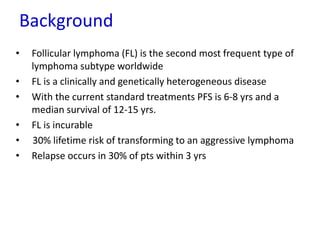
• Follicular lymphoma (FL) is the second most frequent type of
lymphoma subtype worldwide
• FL is a clinically and genetically heterogeneous disease
• With the current standard treatments PFS is 6-8 yrs and a
median survival of 12-15 yrs.
• FL is incurable
• 30% lifetime risk of transforming to an aggressive lymphoma
• Relapse occurs in 30% of pts within 3 yrs
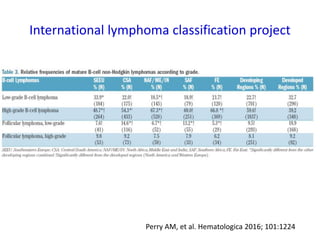
International lymphoma classification project
Perry AM, et al. Hematologica 2016; 101:1224
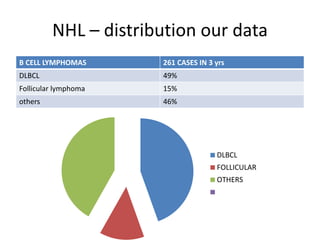
NHL – distribution our data
B CELL LYMPHOMAS 261 CASES IN 3 yrs
DLBCL 49%
Follicular lymphoma 15%
others 46%
DLBCL
FOLLICULAR
OTHERS
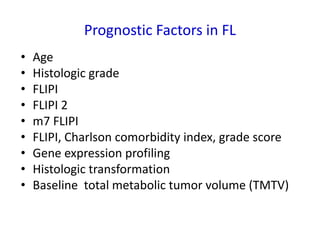
Prognostic Factors in FL
• Age
• Histologic grade
• FLIPI
• FLIPI 2
• m7 FLIPI
• FLIPI, Charlson comorbidity index, grade score
• Gene expression profiling
• Histologic transformation
• Baseline total metabolic tumor volume (TMTV)
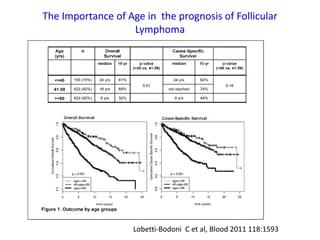
The Importance of Age in the prognosis of Follicular
Lymphoma
Lobetti-Bodoni C et al, Blood 2011 118:1593
Grade IIIGrade I Grade II
Centrocytes Mixed Centroblasts
Follicular Lymphoma Grading
>15 centroblasts/HPF6-15 centroblasts/HPF0-5 centroblasts/HPF
“Small cleaved follicle cells” “large blastic follicle cells”Blood. 1997;89:3909-3918.
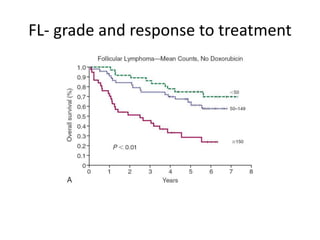
FL- grade and response to treatment
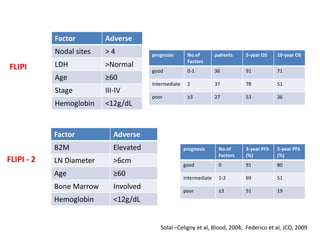
Factor Adverse
Nodal sites > 4
LDH >Normal
Age ≥60
Stage III-IV
Hemoglobin <12g/dL
prognosis No.of
Factors
patients 5-year OS 10-year OS
good 0-1 36 91 71
Intermediate 2 37 78 51
poor ≥3 27 53 36
Factor Adverse
B2M Elevated
LN Diameter >6cm
Age ≥60
Bone Marrow Involved
Hemoglobin <12g/dL
prognosis No.of
Factors
3-year PFS
(%)
5-year PFS
(%)
good 0 91 80
Intermediate 1-2 69 51
poor ≥3 51 19
FLIPI
FLIPI - 2
Solal –Celigny et al, Blood, 2004; Federico et al, JCO, 2009
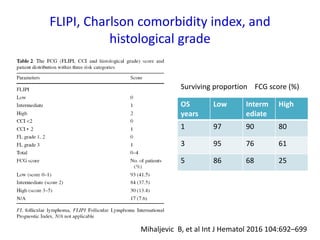
FLIPI, Charlson comorbidity index, and
histological grade
OS
years
Low Interm
ediate
High
1 97 90 80
3 95 76 61
5 86 68 25
Mihaljevic B, et al Int J Hematol 2016 104:692–699
Surviving proportion FCG score (%)
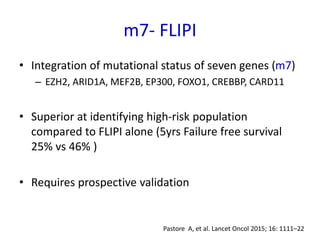
m7- FLIPI
• Integration of mutational status of seven genes (m7)
– EZH2, ARID1A, MEF2B, EP300, FOXO1, CREBBP, CARD11
• Superior at identifying high-risk population
compared to FLIPI alone (5yrs Failure free survival
25% vs 46% )
• Requires prospective validation
Pastore A, et al. Lancet Oncol 2015; 16: 1111–22
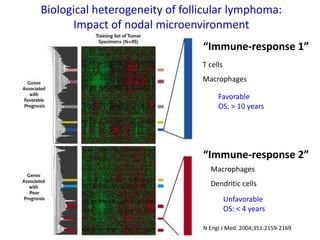
T cells
Macrophages
Macrophages
Dendritic cells
“Immune-response 1”
“Immune-response 2”
Favorable
OS: > 10 years
Unfavorable
OS: < 4 years
Biological heterogeneity of follicular lymphoma:
Impact of nodal microenvironment
N Engl J Med. 2004;351:2159-2169
FL histologic transformation
• 2% per annum frequency of transformation in the first
decade
• Rate of transformation ranges from 16% to 60%
• More than half (58%) of the total documented cases of HT
occurred within the first year of follow-up
• Predictors of transformation
– Poor PS
– Anemia
– High FLIPI risk score
– Grade 3
– Increased LDH at diagnosis
J Clin Oncol 2016; 34:2575-2582
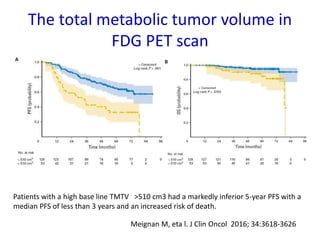
The total metabolic tumor volume in
FDG PET scan
Patients with a high base line TMTV >510 cm3 had a markedly inferior 5-year PFS with a
median PFS of less than 3 years and an increased risk of death.
Meignan M, eta l. J Clin Oncol 2016; 34:3618-3626
What is first line standard of care in FL
2017 ?
• Limited Stage Disease (LSD) :
Excision +/- local 24Gy RT
• Advanced Stage Asymptomatic (ASA):
Watch and Wait
• Advanced Stage Symptomatic (ASS) :
R-Chemo + R maintenance
What is the aim of therapy in FL?
• “Clinical benefit”
– Symptom relief
– Quality of life
• Physical: decreased transfusions, decreased infections, etc.
• Psychological: “…better to be in remission…..”
– Change the natural history of disease
• Transformation, Overall survival
• Delay need for toxic therapy
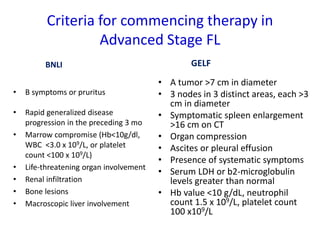
Criteria for commencing therapy in
Advanced Stage FL
BNLI
• B symptoms or pruritus
• Rapid generalized disease
progression in the preceding 3 mo
• Marrow compromise (Hb<10g/dl,
WBC <3.0 x 10⁹/L, or platelet
count <100 x 109/L)
• Life-threatening organ involvement
• Renal infiltration
• Bone lesions
• Macroscopic liver involvement
GELF
• A tumor >7 cm in diameter
• 3 nodes in 3 distinct areas, each >3
cm in diameter
• Symptomatic spleen enlargement
>16 cm on CT
• Organ compression
• Ascites or pleural effusion
• Presence of systematic symptoms
• Serum LDH or b2-microglobulin
levels greater than normal
• Hb value <10 g/dL, neutrophil
count 1.5 x 10⁹/L, platelet count
100 x109/L
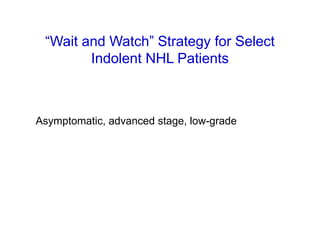
“Wait and Watch” Strategy for Select
Indolent NHL Patients
Asymptomatic, advanced stage, low-grade
Wait and Watch
Randomized Trials: Low-Grade NHL
Pre –Rituximab Era
Trial Regimens  FFS  OS
Young 1988[1] ProMACE-MOPP + TNI vs watch and wait Yes No
Brice 1997[2] Prednimustine vs IF vs watch and wait No No
Ardeshna 2003[3] Chl vs watch and wait Yes No
1. Young RC, et al. Semin Hematol. 1988;25(2 suppl 2):11-16.
2. Brice P, et al. J Clin Oncol. 1997;15:1110-1117.
3. Ardeshna KM, et al. Lancet. 2003;362:516-522.
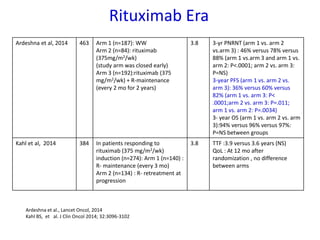
Rituximab Era
Ardeshna et al, 2014 463 Arm 1 (n=187): WW
Arm 2 (n=84): rituximab
(375mg/m2/wk)
(study arm was closed early)
Arm 3 (n=192):rituximab (375
mg/m2/wk) + R-maintenance
(every 2 mo for 2 years)
3.8 3-yr PNRNT (arm 1 vs. arm 2
vs.arm 3) : 46% versus 78% versus
88% (arm 1 vs.arm 3 and arm 1 vs.
arm 2: P<.0001; arm 2 vs. arm 3:
P=NS)
3-year PFS (arm 1 vs. arm 2 vs.
arm 3): 36% versus 60% versus
82% (arm 1 vs. arm 3: P<
.0001;arm 2 vs. arm 3: P=.011;
arm 1 vs. arm 2: P=.0034)
3- year OS (arm 1 vs. arm 2 vs. arm
3):94% versus 96% versus 97%:
P=NS between groups
Kahl et al, 2014 384 In patients responding to
rituximab (375 mg/m2/wk)
induction (n=274): Arm 1 (n=140) :
R- maintenance (every 3 mo)
Arm 2 (n=134) : R- retreatment at
progression
3.8 TTF :3.9 versus 3.6 years (NS)
QoL : At 12 mo after
randomization , no difference
between arms
Ardeshna et al., Lancet Oncol, 2014
Kahl BS, et al. J Clin Oncol 2014; 32:3096-3102
Addition of Rituximab to chemo
improves RR and survival
• CVP vs R-CVP[1]
• CHOP vs R-CHOP[2]
• MCP vs R-MCP[3]
1. Marcus R, et al. J Clin Oncol. 2008;26:4579-4586.
2. Hiddemann W, et al. Blood. 2005;106:3725-3732.
3. Herold M, et al. J Clin Oncol. 2007;25:1986-1992.
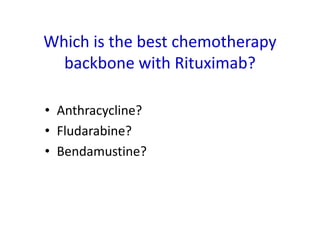
Which is the best chemotherapy
backbone with Rituximab?
• Anthracycline?
• Fludarabine?
• Bendamustine?
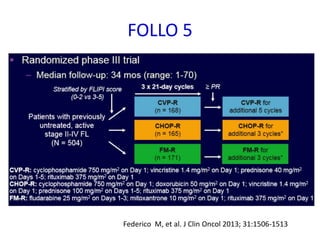
FOLLO 5
Federico M, et al. J Clin Oncol 2013; 31:1506-1513
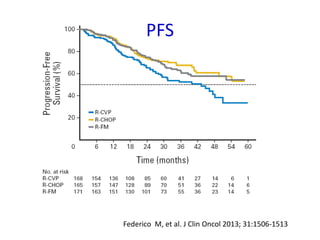
PFS
Federico M, et al. J Clin Oncol 2013; 31:1506-1513
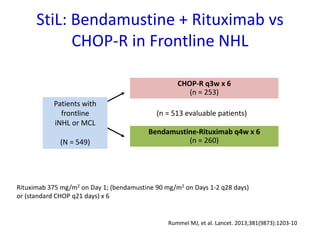
StiL: Bendamustine + Rituximab vs
CHOP-R in Frontline NHL
Patients with
frontline
iNHL or MCL
(N = 549)
CHOP-R q3w x 6
(n = 253)
Bendamustine-Rituximab q4w x 6
(n = 260)
(n = 513 evaluable patients)
Rituximab 375 mg/m2 on Day 1; (bendamustine 90 mg/m2 on Days 1-2 q28 days)
or (standard CHOP q21 days) x 6
Rummel MJ, et al. Lancet. 2013;381(9873):1203-10
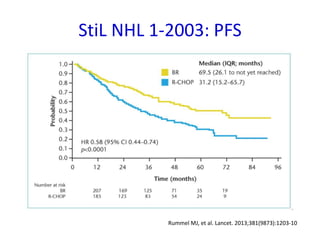
StiL NHL 1-2003: PFS
Rummel MJ, et al. Lancet. 2013;381(9873):1203-10
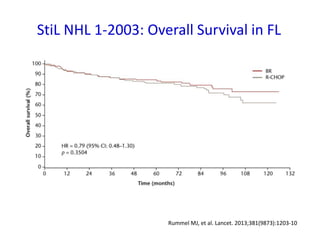
StiL NHL 1-2003: Overall Survival in FL
Rummel MJ, et al. Lancet. 2013;381(9873):1203-10
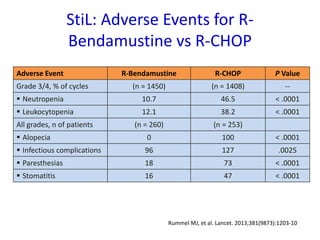
StiL: Adverse Events for R-
Bendamustine vs R-CHOP
Adverse Event R-Bendamustine R-CHOP P Value
Grade 3/4, % of cycles (n = 1450) (n = 1408) --
 Neutropenia 10.7 46.5 < .0001
 Leukocytopenia 12.1 38.2 < .0001
All grades, n of patients (n = 260) (n = 253)
 Alopecia 0 100 < .0001
 Infectious complications 96 127 .0025
 Paresthesias 18 73 < .0001
 Stomatitis 16 47 < .0001
Rummel MJ, et al. Lancet. 2013;381(9873):1203-10
• Based on the StiL and confirmatory BRIGHT study,
the recommended chemoimmunotherapy for first-
line symptomatic advanced stage FL is Rituximab +
Bendamustine for a total of 6 cycles
Maintenance therapy
• Low tumor burden – No role- ECOG study
• High tumor burden
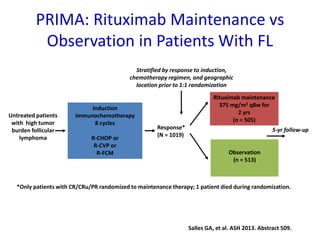
PRIMA
Untreated patients
with high tumor
burden follicular
lymphoma
Induction
Immunochemotherapy
8 cycles
R-CHOP or
R-CVP or
R-FCM
Rituximab maintenance
375 mg/m2 q8w for
2 yrs
(n = 505)
Observation
(n = 513)
Response*
(N = 1019)
*Only patients with CR/CRu/PR randomized to maintenance therapy; 1 patient died during randomization.
Stratified by response to induction,
chemotherapy regimen, and geographic
location prior to 1:1 randomization
5-yr follow-up
Salles GA, et al. ASH 2013. Abstract 509.
PRIMA: Rituximab Maintenance vs
Observation in Patients With FL
PRIMA: 6 yr follow up data
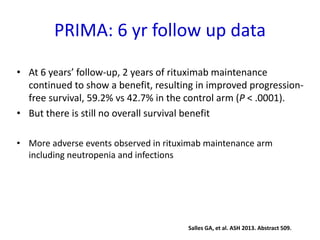
• At 6 years’ follow-up, 2 years of rituximab maintenance
continued to show a benefit, resulting in improved progression-
free survival, 59.2% vs 42.7% in the control arm (P < .0001).
• But there is still no overall survival benefit
• More adverse events observed in rituximab maintenance arm
including neutropenia and infections
Salles GA, et al. ASH 2013. Abstract 509.
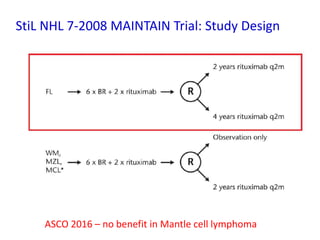
StiL NHL 7-2008 MAINTAIN Trial: Study Design
ASCO 2016 – no benefit in Mantle cell lymphoma
Obinutuzumab
Follicular lymphoma - first-line treatment with
obinutuzumab or rituximab-based immuno
chemotherapy
Phase III GALLIUM study
Christiane Pott,et al. ASH 2016
37
[
Study design
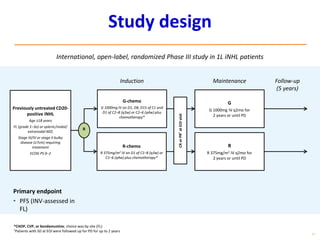
International, open-label, randomized Phase III study in 1L iNHL patients
Previously untreated CD20-
positive iNHL
Age ≥18 years
FL (grade 1–3a) or splenic/nodal/
extranodal MZL
Stage III/IV or stage II bulky
disease (≥7cm) requiring
treatment
ECOG PS 0–2
G-chemo
G 1000mg IV on D1, D8, D15 of C1 and
D1 of C2–8 (q3w) or C2–6 (q4w) plus
chemotherapy*
R-chemo
R 375mg/m2 IV on D1 of C1–8 (q3w) or
C1–6 (q4w) plus chemotherapy*
G
G 1000mg IV q2mo for
2 years or until PD
R
R 375mg/m2 IV q2mo for
2 years or until PD
CRorPR†atEOIvisit
Induction Maintenance
Primary endpoint
• PFS (INV-assessed in
FL)
R
Follow-up
(5 years)
*CHOP, CVP, or bendamustine; choice was by site (FL)
†Patients with SD at EOI were followed up for PD for up to 2 years
38
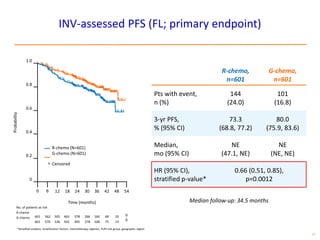
INV-assessed PFS (FL; primary endpoint)
R-chemo,
n=601
G-chemo,
n=601
Pts with event,
n (%)
144
(24.0)
101
(16.8)
3-yr PFS,
% (95% CI)
73.3
(68.8, 77.2)
80.0
(75.9, 83.6)
Median,
mo (95% CI)
NE
(47.1, NE)
NE
(NE, NE)
HR (95% CI),
stratified p-value*
0.66 (0.51, 0.85),
p=0.0012
Median follow-up: 34.5 months
0.8
0.6
0.4
0.2
0
1.0
Probability
R-chemo (N=601)
G-chemo (N=601)
+
Time (months)
12 18 24 30 36 42 48 5460
No. of patients at risk
R-chemo
G-chemo 505
536
463
502
378
405
266
278
160
168
68
75
10
13
562
570
601
601
0
0
Censored
*Stratified analysis; stratification factors: chemotherapy regimen, FLIPI risk group, geographic region
Concerns
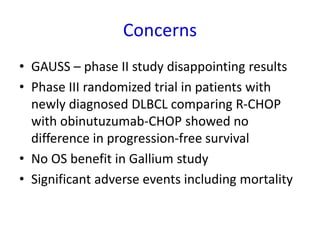
• GAUSS – phase II study disappointing results
• Phase III randomized trial in patients with
newly diagnosed DLBCL comparing R-CHOP
with obinutuzumab-CHOP showed no
difference in progression-free survival
• No OS benefit in Gallium study
• Significant adverse events including mortality
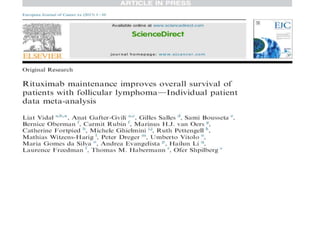
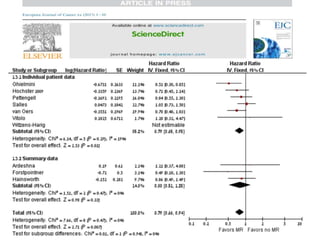
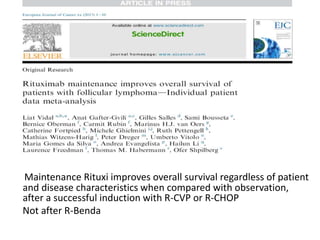
Maintenance Rituxi improves overall survival regardless of patient
and disease characteristics when compared with observation,
after a successful induction with R-CVP or R-CHOP
Not after R-Benda
Relapsed/Refractory Follicular
Lymphoma
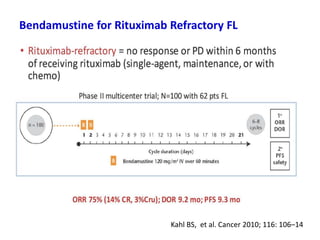
Bendamustine for Rituximab Refractory FL
Kahl BS, et al. Cancer 2010; 116: 106–14
Radiolabeled Antibodies
(Radioimmunotherapy)
• 90Y-ibritumomab tiuxetan
• 131I-tositumomab- stopped production in 2014
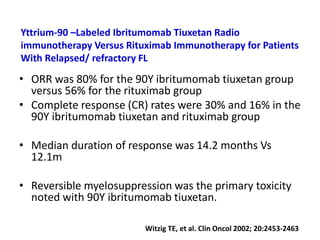
Yttrium-90 –Labeled Ibritumomab Tiuxetan Radio
immunotherapy Versus Rituximab Immunotherapy for Patients
With Relapsed/ refractory FL
• ORR was 80% for the 90Y ibritumomab tiuxetan group
versus 56% for the rituximab group
• Complete response (CR) rates were 30% and 16% in the
90Y ibritumomab tiuxetan and rituximab group
• Median duration of response was 14.2 months Vs
12.1m
• Reversible myelosuppression was the primary toxicity
noted with 90Y ibritumomab tiuxetan.
Witzig TE, et al. Clin Oncol 2002; 20:2453-2463
Obinutuzumab + Benda -> Obinutuzumab
maintenance Vs bendamustine alone in
patients with rituximab-refractory indolent
NHL: updated results of the GADOLIN study
Bruce D Cheson, et al. ASH 2016
48
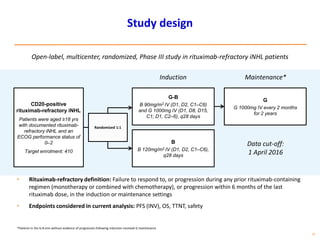
Study design
*Patients in the G-B arm without evidence of progression following induction received G maintenance
• Rituximab-refractory definition: Failure to respond to, or progression during any prior rituximab-containing
regimen (monotherapy or combined with chemotherapy), or progression within 6 months of the last
rituximab dose, in the induction or maintenance settings
• Endpoints considered in current analysis: PFS (INV), OS, TTNT, safety
Open-label, multicenter, randomized, Phase III study in rituximab-refractory iNHL patients
CD20-positive
rituximab-refractory iNHL
Patients were aged ≥18 yrs
with documented rituximab-
refractory iNHL and an
ECOG performance status of
0–2
Target enrolment: 410
G
G 1000mg IV every 2 months
for 2 years
G-B
B 90mg/m2 IV (D1, D2, C1–C6)
and G 1000mg IV (D1, D8, D15,
C1; D1, C2–6), q28 days
B
B 120mg/m2 IV (D1, D2, C1–C6),
q28 days
Induction Maintenance*
Data cut-off:
1 April 2016
Randomized 1:1
49
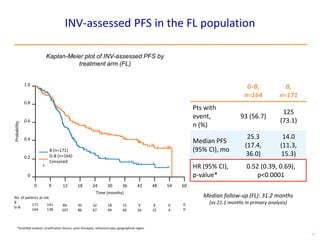
INV-assessed PFS in the FL population
*Stratified analysis; stratification factors: prior therapies, refractory type, geographical region
G-B,
n=164
B,
n=171
Pts with
event,
n (%)
93 (56.7)
125
(73.1)
Median PFS
(95% CI), mo
25.3
(17.4,
36.0)
14.0
(11.3,
15.3)
HR (95% CI),
p-value*
0.52 (0.39, 0.69),
p<0.0001
Median follow-up (FL): 31.2 months
(vs 21.1 months in primary analysis)
Kaplan-Meier plot of INV-assessed PFS by
treatment arm (FL)
No. of patients at risk
B
G-B
0.8
0.6
0.4
0.2
0
1.0
Probability
84
107
45
86
32
67
18
49
15
40
9
26
141
138
171
164
Time (months)
12 18 24 30 36 42 48 6060
B (n=171)
G-B (n=164)
Censored
+
54
4
15
0
4
0
0
50
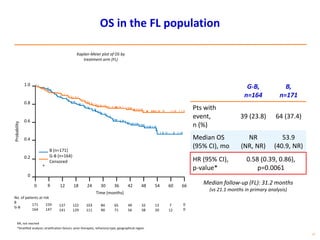
OS in the FL population
NR, not reached
*Stratified analysis; stratification factors: prior therapies, refractory type, geographical region
G-B,
n=164
B,
n=171
Pts with
event,
n (%)
39 (23.8) 64 (37.4)
Median OS
(95% CI), mo
NR
(NR, NR)
53.9
(40.9, NR)
HR (95% CI),
p-value*
0.58 (0.39, 0.86),
p=0.0061
Kaplan-Meier plot of OS by
treatment arm (FL)
Median follow-up (FL): 31.2 months
(vs 21.1 months in primary analysis)
No. of patients at risk
B
G-B
0.8
0.6
0.4
0.2
0
1.0
Probability
137
141
122
129
103
111
84
90
65
71
49
56
159
147
171
164
Time (months)
12 18 24 30 36 42 48 6660
B (n=171)
G-B (n=164)
Censored
+
54
32
38
7
12
60
13
20
0
0
51
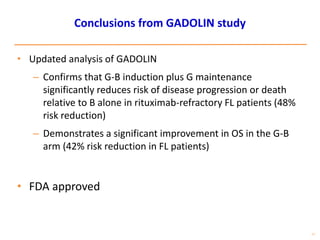
Conclusions from GADOLIN study
• Updated analysis of GADOLIN
– Confirms that G-B induction plus G maintenance
significantly reduces risk of disease progression or death
relative to B alone in rituximab-refractory FL patients (48%
risk reduction)
– Demonstrates a significant improvement in OS in the G-B
arm (42% risk reduction in FL patients)
• FDA approved
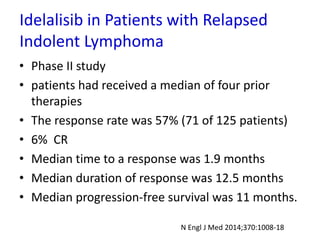
Idelalisib in Patients with Relapsed
Indolent Lymphoma
• Phase II study
• patients had received a median of four prior
therapies
• The response rate was 57% (71 of 125 patients)
• 6% CR
• Median time to a response was 1.9 months
• Median duration of response was 12.5 months
• Median progression-free survival was 11 months.
N Engl J Med 2014;370:1008-18
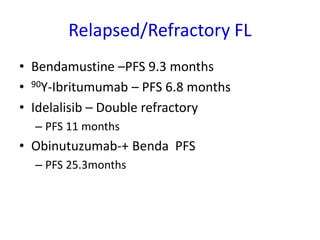
Relapsed/Refractory FL
• Bendamustine –PFS 9.3 months
• 90Y-Ibritumumab – PFS 6.8 months
• Idelalisib – Double refractory
– PFS 11 months
• Obinutuzumab-+ Benda PFS
– PFS 25.3months
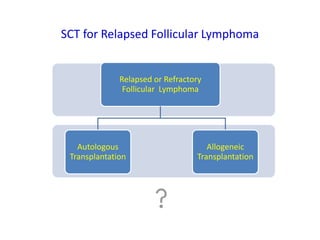
Relapsed or Refractory
Follicular Lymphoma
Autologous
Transplantation
Allogeneic
Transplantation
SCT for Relapsed Follicular Lymphoma
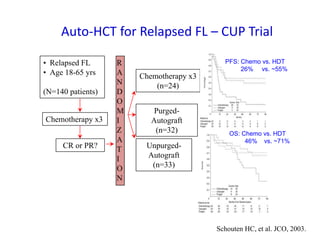
Auto-HCT for Relapsed FL – CUP Trial
• Relapsed FL
• Age 18-65 yrs
(N=140 patients)
R
A
N
D
O
M
I
Z
A
T
I
O
N
Chemotherapy x3
(n=24)
Schouten HC, et al. JCO, 2003.
Chemotherapy x3
CR or PR?
Purged-
Autograft
(n=32)
Unpurged-
Autograft
(n=33)
PFS: Chemo vs. HDT
26% vs. ~55%
OS: Chemo vs. HDT
46% vs. ~71%
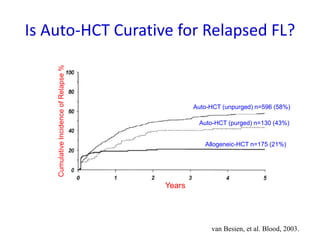
Is Auto-HCT Curative for Relapsed FL?
Years
CumulativeIncidenceofRelapse%
Auto-HCT (unpurged) n=596 (58%)
Auto-HCT (purged) n=130 (43%)
Allogeneic-HCT n=175 (21%)
van Besien, et al. Blood, 2003.
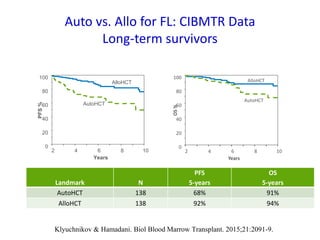
Auto vs. Allo for FL: CIBMTR Data
Long-term survivors
Landmark N
PFS
5-years
OS
5-years
AutoHCT 138 68% 91%
AlloHCT 138 92% 94%
100
0
20
40
60
80
OS%
Years
AlloHCT
AutoHCT
2 6 1084
100
0
20
40
60
80
PFS%
Years
AlloHCT
AutoHCT
2 6 1084
Klyuchnikov & Hamadani. Biol Blood Marrow Transplant. 2015;21:2091-9.
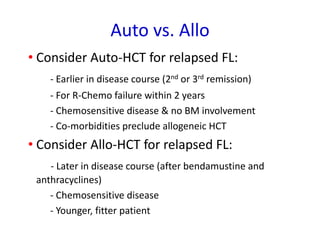
Auto vs. Allo
• Consider Auto-HCT for relapsed FL:
- Earlier in disease course (2nd or 3rd remission)
- For R-Chemo failure within 2 years
- Chemosensitive disease & no BM involvement
- Co-morbidities preclude allogeneic HCT
• Consider Allo-HCT for relapsed FL:
- Later in disease course (after bendamustine and
anthracyclines)
- Chemosensitive disease
- Younger, fitter patient
Summary
• 1st PFS in FL now > 6 years
• (Nearly ) all patients will eventually relapse
• Approximately 20% will relapse on therapy
• Transplantation remains a useful option
either or Allo/Auto in a small minority of
patients
• Newer and non toxic therapies beginning to
enter clinical practice

V_Hematology_Forum_Dr_Pavithran

  • 1.
    Prognostic factors andtreatment of Follicular Lymphoma K Pavithran; MD,DM,FRCP Department of Medical oncology/hematology Amrita Institute of Medical Sciences Kochi, Kerala, India
  • 2.
    Outline Follicular Lymphoma (FL) Prognosticfactors First-line Management Relapsed/Refractory FL Investigational Agents in Relapsed/Refractory FL
  • 3.
    Background • Follicular lymphoma(FL) is the second most frequent type of lymphoma subtype worldwide • FL is a clinically and genetically heterogeneous disease • With the current standard treatments PFS is 6-8 yrs and a median survival of 12-15 yrs. • FL is incurable • 30% lifetime risk of transforming to an aggressive lymphoma • Relapse occurs in 30% of pts within 3 yrs
  • 4.
    International lymphoma classificationproject Perry AM, et al. Hematologica 2016; 101:1224
  • 5.
    NHL – distributionour data B CELL LYMPHOMAS 261 CASES IN 3 yrs DLBCL 49% Follicular lymphoma 15% others 46% DLBCL FOLLICULAR OTHERS
  • 6.
    Prognostic Factors inFL • Age • Histologic grade • FLIPI • FLIPI 2 • m7 FLIPI • FLIPI, Charlson comorbidity index, grade score • Gene expression profiling • Histologic transformation • Baseline total metabolic tumor volume (TMTV)
  • 7.
    The Importance ofAge in the prognosis of Follicular Lymphoma Lobetti-Bodoni C et al, Blood 2011 118:1593
  • 8.
    Grade IIIGrade IGrade II Centrocytes Mixed Centroblasts Follicular Lymphoma Grading >15 centroblasts/HPF6-15 centroblasts/HPF0-5 centroblasts/HPF “Small cleaved follicle cells” “large blastic follicle cells”Blood. 1997;89:3909-3918.
  • 9.
    FL- grade andresponse to treatment
  • 10.
    Factor Adverse Nodal sites> 4 LDH >Normal Age ≥60 Stage III-IV Hemoglobin <12g/dL prognosis No.of Factors patients 5-year OS 10-year OS good 0-1 36 91 71 Intermediate 2 37 78 51 poor ≥3 27 53 36 Factor Adverse B2M Elevated LN Diameter >6cm Age ≥60 Bone Marrow Involved Hemoglobin <12g/dL prognosis No.of Factors 3-year PFS (%) 5-year PFS (%) good 0 91 80 Intermediate 1-2 69 51 poor ≥3 51 19 FLIPI FLIPI - 2 Solal –Celigny et al, Blood, 2004; Federico et al, JCO, 2009
  • 11.
    FLIPI, Charlson comorbidityindex, and histological grade OS years Low Interm ediate High 1 97 90 80 3 95 76 61 5 86 68 25 Mihaljevic B, et al Int J Hematol 2016 104:692–699 Surviving proportion FCG score (%)
  • 12.
    m7- FLIPI • Integrationof mutational status of seven genes (m7) – EZH2, ARID1A, MEF2B, EP300, FOXO1, CREBBP, CARD11 • Superior at identifying high-risk population compared to FLIPI alone (5yrs Failure free survival 25% vs 46% ) • Requires prospective validation Pastore A, et al. Lancet Oncol 2015; 16: 1111–22
  • 13.
    T cells Macrophages Macrophages Dendritic cells “Immune-response1” “Immune-response 2” Favorable OS: > 10 years Unfavorable OS: < 4 years Biological heterogeneity of follicular lymphoma: Impact of nodal microenvironment N Engl J Med. 2004;351:2159-2169
  • 14.
    FL histologic transformation •2% per annum frequency of transformation in the first decade • Rate of transformation ranges from 16% to 60% • More than half (58%) of the total documented cases of HT occurred within the first year of follow-up • Predictors of transformation – Poor PS – Anemia – High FLIPI risk score – Grade 3 – Increased LDH at diagnosis J Clin Oncol 2016; 34:2575-2582
  • 15.
    The total metabolictumor volume in FDG PET scan Patients with a high base line TMTV >510 cm3 had a markedly inferior 5-year PFS with a median PFS of less than 3 years and an increased risk of death. Meignan M, eta l. J Clin Oncol 2016; 34:3618-3626
  • 16.
    What is firstline standard of care in FL 2017 ? • Limited Stage Disease (LSD) : Excision +/- local 24Gy RT • Advanced Stage Asymptomatic (ASA): Watch and Wait • Advanced Stage Symptomatic (ASS) : R-Chemo + R maintenance
  • 17.
    What is theaim of therapy in FL? • “Clinical benefit” – Symptom relief – Quality of life • Physical: decreased transfusions, decreased infections, etc. • Psychological: “…better to be in remission…..” – Change the natural history of disease • Transformation, Overall survival • Delay need for toxic therapy
  • 18.
    Criteria for commencingtherapy in Advanced Stage FL BNLI • B symptoms or pruritus • Rapid generalized disease progression in the preceding 3 mo • Marrow compromise (Hb<10g/dl, WBC <3.0 x 10⁹/L, or platelet count <100 x 109/L) • Life-threatening organ involvement • Renal infiltration • Bone lesions • Macroscopic liver involvement GELF • A tumor >7 cm in diameter • 3 nodes in 3 distinct areas, each >3 cm in diameter • Symptomatic spleen enlargement >16 cm on CT • Organ compression • Ascites or pleural effusion • Presence of systematic symptoms • Serum LDH or b2-microglobulin levels greater than normal • Hb value <10 g/dL, neutrophil count 1.5 x 10⁹/L, platelet count 100 x109/L
  • 19.
    “Wait and Watch”Strategy for Select Indolent NHL Patients Asymptomatic, advanced stage, low-grade
  • 20.
    Wait and Watch RandomizedTrials: Low-Grade NHL Pre –Rituximab Era Trial Regimens  FFS  OS Young 1988[1] ProMACE-MOPP + TNI vs watch and wait Yes No Brice 1997[2] Prednimustine vs IF vs watch and wait No No Ardeshna 2003[3] Chl vs watch and wait Yes No 1. Young RC, et al. Semin Hematol. 1988;25(2 suppl 2):11-16. 2. Brice P, et al. J Clin Oncol. 1997;15:1110-1117. 3. Ardeshna KM, et al. Lancet. 2003;362:516-522.
  • 21.
    Rituximab Era Ardeshna etal, 2014 463 Arm 1 (n=187): WW Arm 2 (n=84): rituximab (375mg/m2/wk) (study arm was closed early) Arm 3 (n=192):rituximab (375 mg/m2/wk) + R-maintenance (every 2 mo for 2 years) 3.8 3-yr PNRNT (arm 1 vs. arm 2 vs.arm 3) : 46% versus 78% versus 88% (arm 1 vs.arm 3 and arm 1 vs. arm 2: P<.0001; arm 2 vs. arm 3: P=NS) 3-year PFS (arm 1 vs. arm 2 vs. arm 3): 36% versus 60% versus 82% (arm 1 vs. arm 3: P< .0001;arm 2 vs. arm 3: P=.011; arm 1 vs. arm 2: P=.0034) 3- year OS (arm 1 vs. arm 2 vs. arm 3):94% versus 96% versus 97%: P=NS between groups Kahl et al, 2014 384 In patients responding to rituximab (375 mg/m2/wk) induction (n=274): Arm 1 (n=140) : R- maintenance (every 3 mo) Arm 2 (n=134) : R- retreatment at progression 3.8 TTF :3.9 versus 3.6 years (NS) QoL : At 12 mo after randomization , no difference between arms Ardeshna et al., Lancet Oncol, 2014 Kahl BS, et al. J Clin Oncol 2014; 32:3096-3102
  • 22.
    Addition of Rituximabto chemo improves RR and survival • CVP vs R-CVP[1] • CHOP vs R-CHOP[2] • MCP vs R-MCP[3] 1. Marcus R, et al. J Clin Oncol. 2008;26:4579-4586. 2. Hiddemann W, et al. Blood. 2005;106:3725-3732. 3. Herold M, et al. J Clin Oncol. 2007;25:1986-1992.
  • 23.
    Which is thebest chemotherapy backbone with Rituximab? • Anthracycline? • Fludarabine? • Bendamustine?
  • 24.
    FOLLO 5 Federico M,et al. J Clin Oncol 2013; 31:1506-1513
  • 25.
    PFS Federico M, etal. J Clin Oncol 2013; 31:1506-1513
  • 26.
    StiL: Bendamustine +Rituximab vs CHOP-R in Frontline NHL Patients with frontline iNHL or MCL (N = 549) CHOP-R q3w x 6 (n = 253) Bendamustine-Rituximab q4w x 6 (n = 260) (n = 513 evaluable patients) Rituximab 375 mg/m2 on Day 1; (bendamustine 90 mg/m2 on Days 1-2 q28 days) or (standard CHOP q21 days) x 6 Rummel MJ, et al. Lancet. 2013;381(9873):1203-10
  • 27.
    StiL NHL 1-2003:PFS Rummel MJ, et al. Lancet. 2013;381(9873):1203-10
  • 28.
    StiL NHL 1-2003:Overall Survival in FL Rummel MJ, et al. Lancet. 2013;381(9873):1203-10
  • 29.
    StiL: Adverse Eventsfor R- Bendamustine vs R-CHOP Adverse Event R-Bendamustine R-CHOP P Value Grade 3/4, % of cycles (n = 1450) (n = 1408) --  Neutropenia 10.7 46.5 < .0001  Leukocytopenia 12.1 38.2 < .0001 All grades, n of patients (n = 260) (n = 253)  Alopecia 0 100 < .0001  Infectious complications 96 127 .0025  Paresthesias 18 73 < .0001  Stomatitis 16 47 < .0001 Rummel MJ, et al. Lancet. 2013;381(9873):1203-10
  • 30.
    • Based onthe StiL and confirmatory BRIGHT study, the recommended chemoimmunotherapy for first- line symptomatic advanced stage FL is Rituximab + Bendamustine for a total of 6 cycles
  • 31.
    Maintenance therapy • Lowtumor burden – No role- ECOG study • High tumor burden PRIMA
  • 32.
    Untreated patients with hightumor burden follicular lymphoma Induction Immunochemotherapy 8 cycles R-CHOP or R-CVP or R-FCM Rituximab maintenance 375 mg/m2 q8w for 2 yrs (n = 505) Observation (n = 513) Response* (N = 1019) *Only patients with CR/CRu/PR randomized to maintenance therapy; 1 patient died during randomization. Stratified by response to induction, chemotherapy regimen, and geographic location prior to 1:1 randomization 5-yr follow-up Salles GA, et al. ASH 2013. Abstract 509. PRIMA: Rituximab Maintenance vs Observation in Patients With FL
  • 33.
    PRIMA: 6 yrfollow up data • At 6 years’ follow-up, 2 years of rituximab maintenance continued to show a benefit, resulting in improved progression- free survival, 59.2% vs 42.7% in the control arm (P < .0001). • But there is still no overall survival benefit • More adverse events observed in rituximab maintenance arm including neutropenia and infections Salles GA, et al. ASH 2013. Abstract 509.
  • 34.
    StiL NHL 7-2008MAINTAIN Trial: Study Design ASCO 2016 – no benefit in Mantle cell lymphoma
  • 35.
  • 36.
    Follicular lymphoma -first-line treatment with obinutuzumab or rituximab-based immuno chemotherapy Phase III GALLIUM study Christiane Pott,et al. ASH 2016
  • 37.
    37 [ Study design International, open-label,randomized Phase III study in 1L iNHL patients Previously untreated CD20- positive iNHL Age ≥18 years FL (grade 1–3a) or splenic/nodal/ extranodal MZL Stage III/IV or stage II bulky disease (≥7cm) requiring treatment ECOG PS 0–2 G-chemo G 1000mg IV on D1, D8, D15 of C1 and D1 of C2–8 (q3w) or C2–6 (q4w) plus chemotherapy* R-chemo R 375mg/m2 IV on D1 of C1–8 (q3w) or C1–6 (q4w) plus chemotherapy* G G 1000mg IV q2mo for 2 years or until PD R R 375mg/m2 IV q2mo for 2 years or until PD CRorPR†atEOIvisit Induction Maintenance Primary endpoint • PFS (INV-assessed in FL) R Follow-up (5 years) *CHOP, CVP, or bendamustine; choice was by site (FL) †Patients with SD at EOI were followed up for PD for up to 2 years
  • 38.
    38 INV-assessed PFS (FL;primary endpoint) R-chemo, n=601 G-chemo, n=601 Pts with event, n (%) 144 (24.0) 101 (16.8) 3-yr PFS, % (95% CI) 73.3 (68.8, 77.2) 80.0 (75.9, 83.6) Median, mo (95% CI) NE (47.1, NE) NE (NE, NE) HR (95% CI), stratified p-value* 0.66 (0.51, 0.85), p=0.0012 Median follow-up: 34.5 months 0.8 0.6 0.4 0.2 0 1.0 Probability R-chemo (N=601) G-chemo (N=601) + Time (months) 12 18 24 30 36 42 48 5460 No. of patients at risk R-chemo G-chemo 505 536 463 502 378 405 266 278 160 168 68 75 10 13 562 570 601 601 0 0 Censored *Stratified analysis; stratification factors: chemotherapy regimen, FLIPI risk group, geographic region
  • 39.
    Concerns • GAUSS –phase II study disappointing results • Phase III randomized trial in patients with newly diagnosed DLBCL comparing R-CHOP with obinutuzumab-CHOP showed no difference in progression-free survival • No OS benefit in Gallium study • Significant adverse events including mortality
  • 42.
    Maintenance Rituxi improvesoverall survival regardless of patient and disease characteristics when compared with observation, after a successful induction with R-CVP or R-CHOP Not after R-Benda
  • 43.
  • 44.
    Bendamustine for RituximabRefractory FL Kahl BS, et al. Cancer 2010; 116: 106–14
  • 45.
    Radiolabeled Antibodies (Radioimmunotherapy) • 90Y-ibritumomabtiuxetan • 131I-tositumomab- stopped production in 2014
  • 46.
    Yttrium-90 –Labeled IbritumomabTiuxetan Radio immunotherapy Versus Rituximab Immunotherapy for Patients With Relapsed/ refractory FL • ORR was 80% for the 90Y ibritumomab tiuxetan group versus 56% for the rituximab group • Complete response (CR) rates were 30% and 16% in the 90Y ibritumomab tiuxetan and rituximab group • Median duration of response was 14.2 months Vs 12.1m • Reversible myelosuppression was the primary toxicity noted with 90Y ibritumomab tiuxetan. Witzig TE, et al. Clin Oncol 2002; 20:2453-2463
  • 47.
    Obinutuzumab + Benda-> Obinutuzumab maintenance Vs bendamustine alone in patients with rituximab-refractory indolent NHL: updated results of the GADOLIN study Bruce D Cheson, et al. ASH 2016
  • 48.
    48 Study design *Patients inthe G-B arm without evidence of progression following induction received G maintenance • Rituximab-refractory definition: Failure to respond to, or progression during any prior rituximab-containing regimen (monotherapy or combined with chemotherapy), or progression within 6 months of the last rituximab dose, in the induction or maintenance settings • Endpoints considered in current analysis: PFS (INV), OS, TTNT, safety Open-label, multicenter, randomized, Phase III study in rituximab-refractory iNHL patients CD20-positive rituximab-refractory iNHL Patients were aged ≥18 yrs with documented rituximab- refractory iNHL and an ECOG performance status of 0–2 Target enrolment: 410 G G 1000mg IV every 2 months for 2 years G-B B 90mg/m2 IV (D1, D2, C1–C6) and G 1000mg IV (D1, D8, D15, C1; D1, C2–6), q28 days B B 120mg/m2 IV (D1, D2, C1–C6), q28 days Induction Maintenance* Data cut-off: 1 April 2016 Randomized 1:1
  • 49.
    49 INV-assessed PFS inthe FL population *Stratified analysis; stratification factors: prior therapies, refractory type, geographical region G-B, n=164 B, n=171 Pts with event, n (%) 93 (56.7) 125 (73.1) Median PFS (95% CI), mo 25.3 (17.4, 36.0) 14.0 (11.3, 15.3) HR (95% CI), p-value* 0.52 (0.39, 0.69), p<0.0001 Median follow-up (FL): 31.2 months (vs 21.1 months in primary analysis) Kaplan-Meier plot of INV-assessed PFS by treatment arm (FL) No. of patients at risk B G-B 0.8 0.6 0.4 0.2 0 1.0 Probability 84 107 45 86 32 67 18 49 15 40 9 26 141 138 171 164 Time (months) 12 18 24 30 36 42 48 6060 B (n=171) G-B (n=164) Censored + 54 4 15 0 4 0 0
  • 50.
    50 OS in theFL population NR, not reached *Stratified analysis; stratification factors: prior therapies, refractory type, geographical region G-B, n=164 B, n=171 Pts with event, n (%) 39 (23.8) 64 (37.4) Median OS (95% CI), mo NR (NR, NR) 53.9 (40.9, NR) HR (95% CI), p-value* 0.58 (0.39, 0.86), p=0.0061 Kaplan-Meier plot of OS by treatment arm (FL) Median follow-up (FL): 31.2 months (vs 21.1 months in primary analysis) No. of patients at risk B G-B 0.8 0.6 0.4 0.2 0 1.0 Probability 137 141 122 129 103 111 84 90 65 71 49 56 159 147 171 164 Time (months) 12 18 24 30 36 42 48 6660 B (n=171) G-B (n=164) Censored + 54 32 38 7 12 60 13 20 0 0
  • 51.
    51 Conclusions from GADOLINstudy • Updated analysis of GADOLIN – Confirms that G-B induction plus G maintenance significantly reduces risk of disease progression or death relative to B alone in rituximab-refractory FL patients (48% risk reduction) – Demonstrates a significant improvement in OS in the G-B arm (42% risk reduction in FL patients) • FDA approved
  • 52.
    Idelalisib in Patientswith Relapsed Indolent Lymphoma • Phase II study • patients had received a median of four prior therapies • The response rate was 57% (71 of 125 patients) • 6% CR • Median time to a response was 1.9 months • Median duration of response was 12.5 months • Median progression-free survival was 11 months. N Engl J Med 2014;370:1008-18
  • 53.
    Relapsed/Refractory FL • Bendamustine–PFS 9.3 months • 90Y-Ibritumumab – PFS 6.8 months • Idelalisib – Double refractory – PFS 11 months • Obinutuzumab-+ Benda PFS – PFS 25.3months
  • 54.
    Relapsed or Refractory FollicularLymphoma Autologous Transplantation Allogeneic Transplantation SCT for Relapsed Follicular Lymphoma
  • 55.
    Auto-HCT for RelapsedFL – CUP Trial • Relapsed FL • Age 18-65 yrs (N=140 patients) R A N D O M I Z A T I O N Chemotherapy x3 (n=24) Schouten HC, et al. JCO, 2003. Chemotherapy x3 CR or PR? Purged- Autograft (n=32) Unpurged- Autograft (n=33) PFS: Chemo vs. HDT 26% vs. ~55% OS: Chemo vs. HDT 46% vs. ~71%
  • 56.
    Is Auto-HCT Curativefor Relapsed FL? Years CumulativeIncidenceofRelapse% Auto-HCT (unpurged) n=596 (58%) Auto-HCT (purged) n=130 (43%) Allogeneic-HCT n=175 (21%) van Besien, et al. Blood, 2003.
  • 57.
    Auto vs. Allofor FL: CIBMTR Data Long-term survivors Landmark N PFS 5-years OS 5-years AutoHCT 138 68% 91% AlloHCT 138 92% 94% 100 0 20 40 60 80 OS% Years AlloHCT AutoHCT 2 6 1084 100 0 20 40 60 80 PFS% Years AlloHCT AutoHCT 2 6 1084 Klyuchnikov & Hamadani. Biol Blood Marrow Transplant. 2015;21:2091-9.
  • 58.
    Auto vs. Allo •Consider Auto-HCT for relapsed FL: - Earlier in disease course (2nd or 3rd remission) - For R-Chemo failure within 2 years - Chemosensitive disease & no BM involvement - Co-morbidities preclude allogeneic HCT • Consider Allo-HCT for relapsed FL: - Later in disease course (after bendamustine and anthracyclines) - Chemosensitive disease - Younger, fitter patient
  • 59.
    Summary • 1st PFSin FL now > 6 years • (Nearly ) all patients will eventually relapse • Approximately 20% will relapse on therapy • Transplantation remains a useful option either or Allo/Auto in a small minority of patients • Newer and non toxic therapies beginning to enter clinical practice