FREDERICK HAGEMEISTER, MD
Houston, USA
• Professor of Medicine, Dept of Lymphoma/
Myeloma at the University of Texas MD Anderson
Cancer Center
• Dr Hagemeister is a leading authority in the field of
Lymphoma. He has performed pioneering work in
Hodgkin’s lymphoma and has published oevr 200
peer-reviewed papers in leading medical journals. Dr
Hagemeister is also a great supporter of fellows in
training and junior faculty. He serves as a mentor to
large number of rottating students and faculty.
Anti-PD-1 and Anti-CD30 Antibodies
for Hodgkin Lymphoma:
An ASH Update
F B Hagemeister, MD
Department of Lymphoma/Myeloma
M. D. Anderson Cancer Center
Beijing, China, February 1, 2015
Anti-PD-1 and Anti-CD30 Antibodies for HL:
An ASH Update
• Phase I Nivolumab for Relapsed/Refractory HL
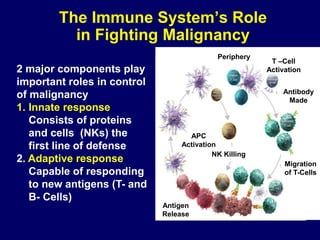
The Immune System’s Role
in Fighting Malignancy
2 major components play
important roles in control
of malignancy
1. Innate response
Consists of proteins
and cells (NKs) the
first line of defense
2. Adaptive response
Capable of responding
to new antigens (T- and
B- Cells)
Antibody
Made
Migration
of T-Cells
Periphery
Antigen
Release
NK Killing
APC
Activation
T –Cell
Activation
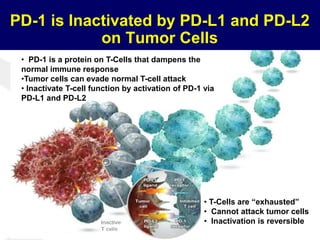
PD-1 is Inactivated by PD-L1 and PD-L2
on Tumor Cells
• PD-1 is a protein on T-Cells that dampens the
normal immune response
•Tumor cells can evade normal T-cell attack
• Inactivate T-cell function by activation of PD-1 via
PD-L1 and PD-L2
• T-Cells are “exhausted”
• Cannot attack tumor cells
• Inactivation is reversible
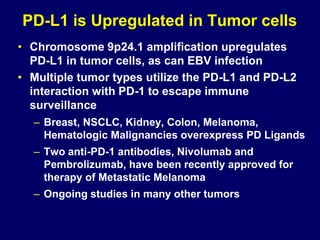
PD-L1 is Upregulated in Tumor cells
• Chromosome 9p24.1 amplification upregulates
PD-L1 in tumor cells, as can EBV infection
• Multiple tumor types utilize the PD-L1 and PD-L2
interaction with PD-1 to escape immune
surveillance
– Breast, NSCLC, Kidney, Colon, Melanoma,
Hematologic Malignancies overexpress PD Ligands
– Two anti-PD-1 antibodies, Nivolumab and
Pembrolizumab, have been recently approved for
therapy of Metastatic Melanoma
– Ongoing studies in many other tumors
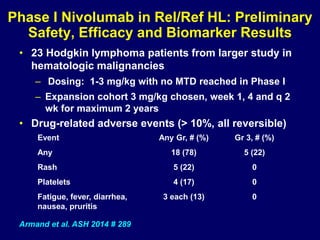
Phase I Nivolumab in Rel/Ref HL: Preliminary
Safety, Efficacy and Biomarker Results
• 23 Hodgkin lymphoma patients from larger study in
hematologic malignancies
– Dosing: 1-3 mg/kg with no MTD reached in Phase I
– Expansion cohort 3 mg/kg chosen, week 1, 4 and q 2
wk for maximum 2 years
• Drug-related adverse events (> 10%, all reversible)
Armand et al. ASH 2014 # 289
Event Any Gr, # (%) Gr 3, # (%)
Any 18 (78) 5 (22)
Rash 5 (22) 0
Platelets 4 (17) 0
Fatigue, fever, diarrhea,
nausea, pruritis
3 each (13) 0
Phase I Nivolumab in Rel/Ref HL: Preliminary
Safety, Efficacy and Biomarker Results
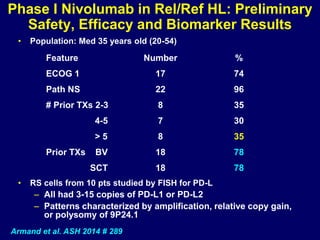
• Population: Med 35 years old (20-54)
• RS cells from 10 pts studied by FISH for PD-L
– All had 3-15 copies of PD-L1 or PD-L2
– Patterns characterized by amplification, relative copy gain,
or polysomy of 9P24.1
Armand et al. ASH 2014 # 289
Feature Number %
ECOG 1 17 74
Path NS 22 96
# Prior TXs 2-3 8 35
4-5 7 30
> 5 8 35
Prior TXs BV 18 78
SCT 18 78
Armand et al. ASH 2014 # 289
Phase I Nivolumab in Rel/Ref HL: Preliminary
Safety, Efficacy and Biomarker Results
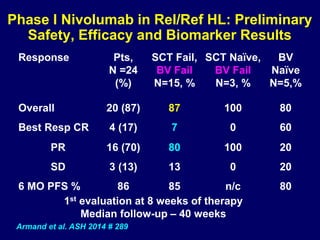
Response Pts,
N =24
(%)
SCT Fail,
BV Fail
N=15, %
SCT Naïve,
BV Fail
N=3, %
BV
Naïve
N=5,%
Overall 20 (87) 87 100 80
Best Resp CR 4 (17) 7 0 60
PR 16 (70) 80 100 20
SD 3 (13) 13 0 20
6 MO PFS % 86 85 n/c 80
1st evaluation at 8 weeks of therapy
Median follow-up – 40 weeks
Anti-PD-1 and Anti-CD30 Antibodies for HL:
An ASH Update
• Phase I Nivolumab for Relapsed/Refractory HL
• Phase Ib Pembrolizumab for Relapsed/Refractory
HL After Brentuximab Failure
Phase Ib Pembrolizumab (MK-3475) for HL after
Brentuximab Failure: KEYNOTE-013
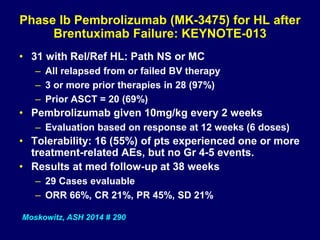
• 31 with Rel/Ref HL: Path NS or MC
– All relapsed from or failed BV therapy
– 3 or more prior therapies in 28 (97%)
– Prior ASCT = 20 (69%)
• Pembrolizumab given 10mg/kg every 2 weeks
– Evaluation based on response at 12 weeks (6 doses)
• Tolerability: 16 (55%) of pts experienced one or more
treatment-related AEs, but no Gr 4-5 events.
• Results at med follow-up at 38 weeks
– 29 Cases evaluable
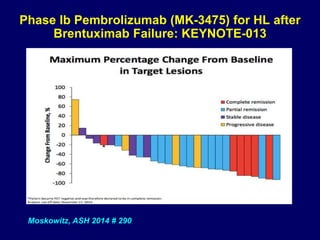
– ORR 66%, CR 21%, PR 45%, SD 21%
Moskowitz, ASH 2014 # 290
Phase Ib Pembrolizumab (MK-3475) for HL after
Brentuximab Failure: KEYNOTE-013
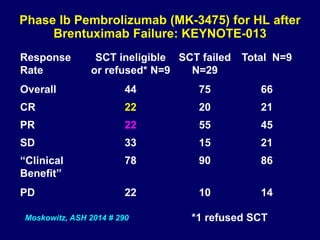
Moskowitz, ASH 2014 # 290
Response
Rate
SCT ineligible
or refused* N=9
SCT failed
N=29
Total N=9
Overall 44 75 66
CR 22 20 21
PR 22 55 45
SD 33 15 21
“Clinical
Benefit”
78 90 86
PD 22 10 14
*1 refused SCT
Phase Ib Pembrolizumab (MK-3475) for HL after
Brentuximab Failure: KEYNOTE-013
Moskowitz, ASH 2014 # 290
Anti-PD-1 and Anti-CD30 Antibodies for HL:
An ASH Update
• Phase I Nivolumab for Relapsed/Refractory HL
• Phase Ib Pembrolizumab for Relapsed/Refractory
HL After Brentuximab Failure
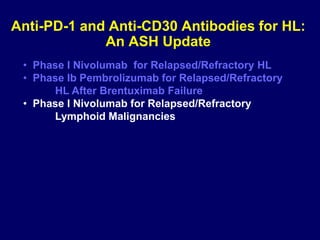
• Phase I Nivolumab for Relapsed/Refractory
Lymphoid Malignancies
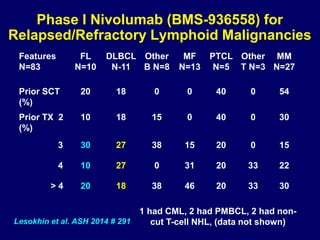
Phase I Nivolumab (BMS-936558) for
Relapsed/Refractory Lymphoid Malignancies
Lesokhin et al. ASH 2014 # 291
Features
N=83
FL
N=10
DLBCL
N-11
Other
B N=8
MF
N=13
PTCL
N=5
Other
T N=3
MM
N=27
Prior SCT
(%)
20 18 0 0 40 0 54
Prior TX 2
(%)
10 18 15 0 40 0 30
3 30 27 38 15 20 0 15
4 10 27 0 31 20 33 22
> 4 20 18 38 46 20 33 30
1 had CML, 2 had PMBCL, 2 had non-
cut T-cell NHL, (data not shown)
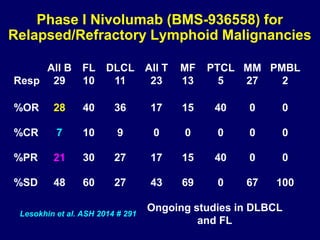
Phase I Nivolumab (BMS-936558) for
Relapsed/Refractory Lymphoid Malignancies
Lesokhin et al. ASH 2014 # 291
Resp
All B
29
FL
10
DLCL
11
All T
23
MF
13
PTCL
5
MM
27
PMBL
2
%OR 28 40 36 17 15 40 0 0
%CR 7 10 9 0 0 0 0 0
%PR 21 30 27 17 15 40 0 0
%SD 48 60 27 43 69 0 67 100
Ongoing studies in DLBCL
and FL
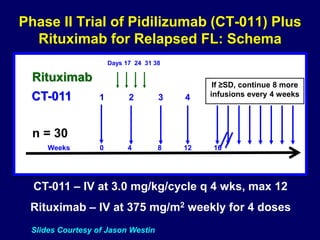
Phase II Trial of Pidilizumab (CT-011) Plus
Rituximab for Relapsed FL: Schema
CT-011 – IV at 3.0 mg/kg/cycle q 4 wks, max 12
Rituximab – IV at 375 mg/m2 weekly for 4 doses
Days 17 24 31 38
CT-011 1 2 3 4
n = 30
Rituximab
If ≥SD, continue 8 more
infusions every 4 weeks
Weeks 0 4 8 12 16
Slides Courtesy of Jason Westin
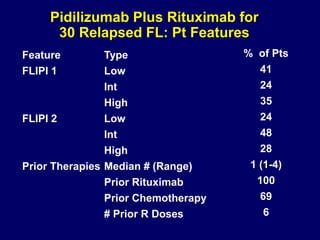
Pidilizumab Plus Rituximab for
30 Relapsed FL: Pt Features
Feature Type % of Pts
FLIPI 1 Low 41
Int 24
High 35
FLIPI 2 Low 24
Int 48
High 28
Prior Therapies Median # (Range) 1 (1-4)
Prior Rituximab 100
Prior Chemotherapy 69
# Prior R Doses 6
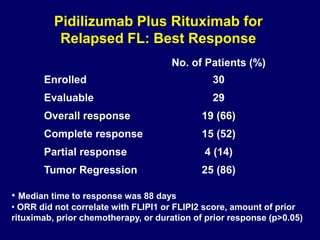
Pidilizumab Plus Rituximab for
Relapsed FL: Best Response
No. of Patients (%)
Enrolled 30
Evaluable 29
Overall response 19 (66)
Complete response 15 (52)
Partial response 4 (14)
Tumor Regression 25 (86)
• Median time to response was 88 days
• ORR did not correlate with FLIPI1 or FLIPI2 score, amount of prior
rituximab, prior chemotherapy, or duration of prior response (p>0.05)
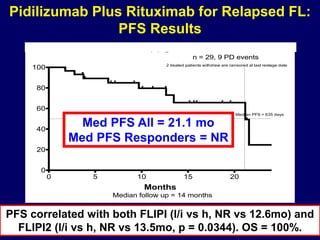
PFS
0 5 10 15 20
0
20
40
60
80
100
Months
n = 29, 9 PD events
2 treated patients withdrew are censored at last restage date
Median PFS = 635 days
Median follow up = 14 months
Med PFS All = 21.1 mo
Med PFS Responders = NR
PFS correlated with both FLIPI (l/i vs h, NR vs 12.6mo) and
FLIPI2 (l/i vs h, NR vs 13.5mo, p = 0.0344). OS = 100%.
Pidilizumab Plus Rituximab for Relapsed FL:
PFS Results
Anti-PD-1 and Anti-CD30 Antibodies for HL:
An ASH Update
• Phase I Nivolumab for Relapsed/Refractory HL
• Phase Ib Pembrolizumab for Relapsed/Refractory
HL After Brentuximab Failure
• Phase I Nivolumab for Relapsed/Refractory
Lymphoid Malignancies
• Brentuximab Vedotin Plus ABVD or AVD for
Untreated Advanced HL
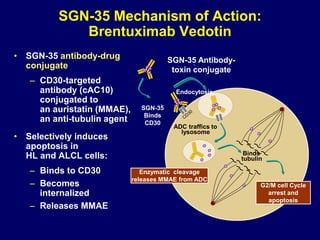
SGN-35 Mechanism of Action:
Brentuximab Vedotin
• SGN-35 antibody-drug
conjugate
– CD30-targeted
antibody (cAC10)
conjugated to
an auristatin (MMAE),
an anti-tubulin agent
• Selectively induces
apoptosis in
HL and ALCL cells:
– Binds to CD30
– Becomes
internalized
– Releases MMAE
-
-
ADC traffics to
lysosome
Enzymatic
linker cleavage
releases MMAE
from ADC
MMAE binds
tubulin
G2/M cell
cycle arrest
& apoptosis
-
SGN-35
Binds
CD30
Endocytosis
ADC traffics to
lysosome
Enzymatic cleavage
releases MMAE from ADC
Binds
tubulin
G2/M cell Cycle
arrest and
apoptosis
SGN-35 Antibody-
toxin conjugate
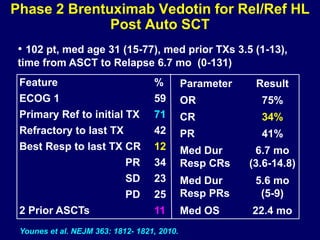
Phase 2 Brentuximab Vedotin for Rel/Ref HL
Post Auto SCT
Feature %
ECOG 1 59
Primary Ref to initial TX 71
Refractory to last TX 42
Best Resp to last TX CR 12
PR 34
SD 23
PD 25
2 Prior ASCTs 11
• 102 pt, med age 31 (15-77), med prior TXs 3.5 (1-13),
time from ASCT to Relapse 6.7 mo (0-131)
Younes et al. NEJM 363: 1812- 1821, 2010.
Parameter Result
OR 75%
CR 34%
PR 41%
Med Dur
Resp CRs
6.7 mo
(3.6-14.8)
Med Dur
Resp PRs
5.6 mo
(5-9)
Med OS 22.4 mo
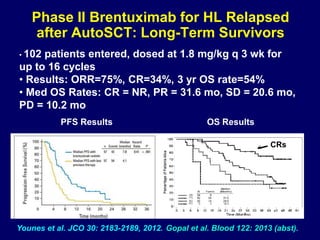
Phase II Brentuximab for HL Relapsed
after AutoSCT: Long-Term Survivors
Gopal et al. Blood 122: 2013 (abst).
• 102 patients entered, dosed at 1.8 mg/kg q 3 wk for
up to 16 cycles
• Results: ORR=75%, CR=34%, 3 yr OS rate=54%
• Med OS Rates: CR = NR, PR = 31.6 mo, SD = 20.6 mo,
PD = 10.2 mo
Younes et al. JCO 30: 2183-2189, 2012.
PFS Results OS Results
CRss
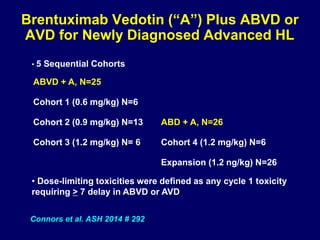
• 5 Sequential Cohorts
• Dose-limiting toxicities were defined as any cycle 1 toxicity
requiring > 7 delay in ABVD or AVD
Brentuximab Vedotin (“A”) Plus ABVD or
AVD for Newly Diagnosed Advanced HL
Connors et al. ASH 2014 # 292
ABVD + A, N=25
Cohort 1 (0.6 mg/kg) N=6
Cohort 2 (0.9 mg/kg) N=13 ABD + A, N=26
Cohort 3 (1.2 mg/kg) N= 6 Cohort 4 (1.2 mg/kg) N=6
Expansion (1.2 ng/kg) N=26
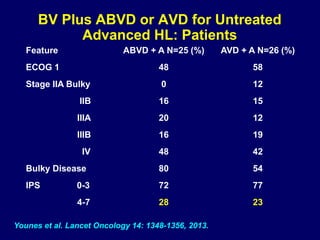
BV Plus ABVD or AVD for Untreated
Advanced HL: Patients
Younes et al. Lancet Oncology 14: 1348-1356, 2013.
Feature ABVD + A N=25 (%) AVD + A N=26 (%)
ECOG 1 48 58
Stage IIA Bulky 0 12
IIB 16 15
IIIA 20 12
IIIB 16 19
IV 48 42
Bulky Disease 80 54
IPS 0-3 72 77
4-7 28 23
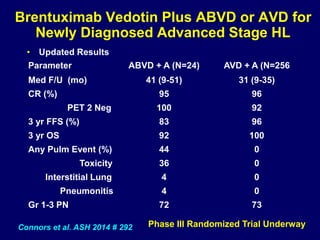
• Updated Results
Brentuximab Vedotin Plus ABVD or AVD for
Newly Diagnosed Advanced Stage HL
Parameter ABVD + A (N=24) AVD + A (N=256
Med F/U (mo) 41 (9-51) 31 (9-35)
CR (%) 95 96
PET 2 Neg 100 92
3 yr FFS (%) 83 96
3 yr OS 92 100
Any Pulm Event (%) 44 0
Toxicity 36 0
Interstitial Lung 4 0
Pneumonitis 4 0
Gr 1-3 PN 72 73
Connors et al. ASH 2014 # 292 Phase III Randomized Trial Underway
Anti-PD-1 and Anti-CD30 Antibodies for HL:
An ASH Update
• Phase I Nivolumab for Relapsed/Refractory HL
• Phase Ib Pembrolizumab for Relapsed/Refractory
HL After Brentuximab Failure
• Phase I Nivolumab for Relapsed/Refractory
Lymphoid Malignancies
• Brentuximab Vedotin Plus ABVD or AVD for
Untreated Advanced HL
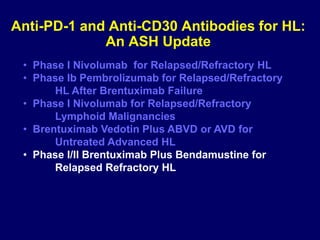
• Phase I/II Brentuximab Plus Bendamustine for
Relapsed Refractory HL
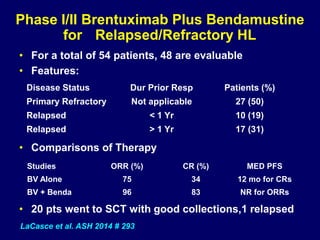
Phase I/II Brentuximab Plus Bendamustine
for Relapsed/Refractory HL
• For a total of 54 patients, 48 are evaluable
• Features:
• Comparisons of Therapy
• 20 pts went to SCT with good collections,1 relapsed
Disease Status Dur Prior Resp Patients (%)
Primary Refractory Not applicable 27 (50)
Relapsed < 1 Yr 10 (19)
Relapsed > 1 Yr 17 (31)
Studies ORR (%) CR (%) MED PFS
BV Alone 75 34 12 mo for CRs
BV + Benda 96 83 NR for ORRs
LaCasce et al. ASH 2014 # 293
Anti-PD-1 and Anti-CD30 Antibodies for HL:
An ASH Update
• Phase I Nivolumab for Relapsed/Refractory HL
• Phase Ib Pembrolizumab for Relapsed/Refractory
HL After Brentuximab Failure
• Phase I Nivolumab for Relapsed/Refractory
Lymphoid Malignancies
• Brentuximab Vedotin Plus ABVD or AVD for
Untreated Advanced HL
• Phase I/II Brentuximab Plus Bendamustine for
Relapsed Refractory HL
• Phase Brentuximab Plus Dacarbazine for
Untreated HL in Patients > 60
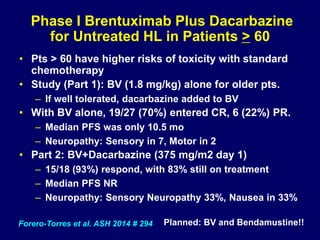
Phase I Brentuximab Plus Dacarbazine
for Untreated HL in Patients > 60
• Pts > 60 have higher risks of toxicity with standard
chemotherapy
• Study (Part 1): BV (1.8 mg/kg) alone for older pts.
– If well tolerated, dacarbazine added to BV
• With BV alone, 19/27 (70%) entered CR, 6 (22%) PR.
– Median PFS was only 10.5 mo
– Neuropathy: Sensory in 7, Motor in 2
• Part 2: BV+Dacarbazine (375 mg/m2 day 1)
– 15/18 (93%) respond, with 83% still on treatment
– Median PFS NR
– Neuropathy: Sensory Neuropathy 33%, Nausea in 33%
Forero-Torres et al. ASH 2014 # 294 Planned: BV and Bendamustine!!
PD-1 and Anti-CD30 Antibodies for
Hodgkin Lymphoma:
An ASH Update
F B Hagemeister, MD
Department of Lymphoma/Myeloma
M. D. Anderson Cancer Center
Beijing, China, Feb 1, 2015

6 frederick

  • 1.
    FREDERICK HAGEMEISTER, MD Houston,USA • Professor of Medicine, Dept of Lymphoma/ Myeloma at the University of Texas MD Anderson Cancer Center • Dr Hagemeister is a leading authority in the field of Lymphoma. He has performed pioneering work in Hodgkin’s lymphoma and has published oevr 200 peer-reviewed papers in leading medical journals. Dr Hagemeister is also a great supporter of fellows in training and junior faculty. He serves as a mentor to large number of rottating students and faculty.
  • 2.
    Anti-PD-1 and Anti-CD30Antibodies for Hodgkin Lymphoma: An ASH Update F B Hagemeister, MD Department of Lymphoma/Myeloma M. D. Anderson Cancer Center Beijing, China, February 1, 2015
  • 3.
    Anti-PD-1 and Anti-CD30Antibodies for HL: An ASH Update • Phase I Nivolumab for Relapsed/Refractory HL
  • 4.
    The Immune System’sRole in Fighting Malignancy 2 major components play important roles in control of malignancy 1. Innate response Consists of proteins and cells (NKs) the first line of defense 2. Adaptive response Capable of responding to new antigens (T- and B- Cells) Antibody Made Migration of T-Cells Periphery Antigen Release NK Killing APC Activation T –Cell Activation
  • 5.
    PD-1 is Inactivatedby PD-L1 and PD-L2 on Tumor Cells • PD-1 is a protein on T-Cells that dampens the normal immune response •Tumor cells can evade normal T-cell attack • Inactivate T-cell function by activation of PD-1 via PD-L1 and PD-L2 • T-Cells are “exhausted” • Cannot attack tumor cells • Inactivation is reversible
  • 6.
    PD-L1 is Upregulatedin Tumor cells • Chromosome 9p24.1 amplification upregulates PD-L1 in tumor cells, as can EBV infection • Multiple tumor types utilize the PD-L1 and PD-L2 interaction with PD-1 to escape immune surveillance – Breast, NSCLC, Kidney, Colon, Melanoma, Hematologic Malignancies overexpress PD Ligands – Two anti-PD-1 antibodies, Nivolumab and Pembrolizumab, have been recently approved for therapy of Metastatic Melanoma – Ongoing studies in many other tumors
  • 7.
    Phase I Nivolumabin Rel/Ref HL: Preliminary Safety, Efficacy and Biomarker Results • 23 Hodgkin lymphoma patients from larger study in hematologic malignancies – Dosing: 1-3 mg/kg with no MTD reached in Phase I – Expansion cohort 3 mg/kg chosen, week 1, 4 and q 2 wk for maximum 2 years • Drug-related adverse events (> 10%, all reversible) Armand et al. ASH 2014 # 289 Event Any Gr, # (%) Gr 3, # (%) Any 18 (78) 5 (22) Rash 5 (22) 0 Platelets 4 (17) 0 Fatigue, fever, diarrhea, nausea, pruritis 3 each (13) 0
  • 8.
    Phase I Nivolumabin Rel/Ref HL: Preliminary Safety, Efficacy and Biomarker Results • Population: Med 35 years old (20-54) • RS cells from 10 pts studied by FISH for PD-L – All had 3-15 copies of PD-L1 or PD-L2 – Patterns characterized by amplification, relative copy gain, or polysomy of 9P24.1 Armand et al. ASH 2014 # 289 Feature Number % ECOG 1 17 74 Path NS 22 96 # Prior TXs 2-3 8 35 4-5 7 30 > 5 8 35 Prior TXs BV 18 78 SCT 18 78
  • 9.
    Armand et al.ASH 2014 # 289 Phase I Nivolumab in Rel/Ref HL: Preliminary Safety, Efficacy and Biomarker Results Response Pts, N =24 (%) SCT Fail, BV Fail N=15, % SCT Naïve, BV Fail N=3, % BV Naïve N=5,% Overall 20 (87) 87 100 80 Best Resp CR 4 (17) 7 0 60 PR 16 (70) 80 100 20 SD 3 (13) 13 0 20 6 MO PFS % 86 85 n/c 80 1st evaluation at 8 weeks of therapy Median follow-up – 40 weeks
  • 10.
    Anti-PD-1 and Anti-CD30Antibodies for HL: An ASH Update • Phase I Nivolumab for Relapsed/Refractory HL • Phase Ib Pembrolizumab for Relapsed/Refractory HL After Brentuximab Failure
  • 11.
    Phase Ib Pembrolizumab(MK-3475) for HL after Brentuximab Failure: KEYNOTE-013 • 31 with Rel/Ref HL: Path NS or MC – All relapsed from or failed BV therapy – 3 or more prior therapies in 28 (97%) – Prior ASCT = 20 (69%) • Pembrolizumab given 10mg/kg every 2 weeks – Evaluation based on response at 12 weeks (6 doses) • Tolerability: 16 (55%) of pts experienced one or more treatment-related AEs, but no Gr 4-5 events. • Results at med follow-up at 38 weeks – 29 Cases evaluable – ORR 66%, CR 21%, PR 45%, SD 21% Moskowitz, ASH 2014 # 290
  • 12.
    Phase Ib Pembrolizumab(MK-3475) for HL after Brentuximab Failure: KEYNOTE-013 Moskowitz, ASH 2014 # 290 Response Rate SCT ineligible or refused* N=9 SCT failed N=29 Total N=9 Overall 44 75 66 CR 22 20 21 PR 22 55 45 SD 33 15 21 “Clinical Benefit” 78 90 86 PD 22 10 14 *1 refused SCT
  • 13.
    Phase Ib Pembrolizumab(MK-3475) for HL after Brentuximab Failure: KEYNOTE-013 Moskowitz, ASH 2014 # 290
  • 14.
    Anti-PD-1 and Anti-CD30Antibodies for HL: An ASH Update • Phase I Nivolumab for Relapsed/Refractory HL • Phase Ib Pembrolizumab for Relapsed/Refractory HL After Brentuximab Failure • Phase I Nivolumab for Relapsed/Refractory Lymphoid Malignancies
  • 15.
    Phase I Nivolumab(BMS-936558) for Relapsed/Refractory Lymphoid Malignancies Lesokhin et al. ASH 2014 # 291 Features N=83 FL N=10 DLBCL N-11 Other B N=8 MF N=13 PTCL N=5 Other T N=3 MM N=27 Prior SCT (%) 20 18 0 0 40 0 54 Prior TX 2 (%) 10 18 15 0 40 0 30 3 30 27 38 15 20 0 15 4 10 27 0 31 20 33 22 > 4 20 18 38 46 20 33 30 1 had CML, 2 had PMBCL, 2 had non- cut T-cell NHL, (data not shown)
  • 16.
    Phase I Nivolumab(BMS-936558) for Relapsed/Refractory Lymphoid Malignancies Lesokhin et al. ASH 2014 # 291 Resp All B 29 FL 10 DLCL 11 All T 23 MF 13 PTCL 5 MM 27 PMBL 2 %OR 28 40 36 17 15 40 0 0 %CR 7 10 9 0 0 0 0 0 %PR 21 30 27 17 15 40 0 0 %SD 48 60 27 43 69 0 67 100 Ongoing studies in DLBCL and FL
  • 17.
    Phase II Trialof Pidilizumab (CT-011) Plus Rituximab for Relapsed FL: Schema CT-011 – IV at 3.0 mg/kg/cycle q 4 wks, max 12 Rituximab – IV at 375 mg/m2 weekly for 4 doses Days 17 24 31 38 CT-011 1 2 3 4 n = 30 Rituximab If ≥SD, continue 8 more infusions every 4 weeks Weeks 0 4 8 12 16 Slides Courtesy of Jason Westin
  • 18.
    Pidilizumab Plus Rituximabfor 30 Relapsed FL: Pt Features Feature Type % of Pts FLIPI 1 Low 41 Int 24 High 35 FLIPI 2 Low 24 Int 48 High 28 Prior Therapies Median # (Range) 1 (1-4) Prior Rituximab 100 Prior Chemotherapy 69 # Prior R Doses 6
  • 19.
    Pidilizumab Plus Rituximabfor Relapsed FL: Best Response No. of Patients (%) Enrolled 30 Evaluable 29 Overall response 19 (66) Complete response 15 (52) Partial response 4 (14) Tumor Regression 25 (86) • Median time to response was 88 days • ORR did not correlate with FLIPI1 or FLIPI2 score, amount of prior rituximab, prior chemotherapy, or duration of prior response (p>0.05)
  • 20.
    PFS 0 5 1015 20 0 20 40 60 80 100 Months n = 29, 9 PD events 2 treated patients withdrew are censored at last restage date Median PFS = 635 days Median follow up = 14 months Med PFS All = 21.1 mo Med PFS Responders = NR PFS correlated with both FLIPI (l/i vs h, NR vs 12.6mo) and FLIPI2 (l/i vs h, NR vs 13.5mo, p = 0.0344). OS = 100%. Pidilizumab Plus Rituximab for Relapsed FL: PFS Results
  • 21.
    Anti-PD-1 and Anti-CD30Antibodies for HL: An ASH Update • Phase I Nivolumab for Relapsed/Refractory HL • Phase Ib Pembrolizumab for Relapsed/Refractory HL After Brentuximab Failure • Phase I Nivolumab for Relapsed/Refractory Lymphoid Malignancies • Brentuximab Vedotin Plus ABVD or AVD for Untreated Advanced HL
  • 22.
    SGN-35 Mechanism ofAction: Brentuximab Vedotin • SGN-35 antibody-drug conjugate – CD30-targeted antibody (cAC10) conjugated to an auristatin (MMAE), an anti-tubulin agent • Selectively induces apoptosis in HL and ALCL cells: – Binds to CD30 – Becomes internalized – Releases MMAE - - ADC traffics to lysosome Enzymatic linker cleavage releases MMAE from ADC MMAE binds tubulin G2/M cell cycle arrest & apoptosis - SGN-35 Binds CD30 Endocytosis ADC traffics to lysosome Enzymatic cleavage releases MMAE from ADC Binds tubulin G2/M cell Cycle arrest and apoptosis SGN-35 Antibody- toxin conjugate
  • 23.
    Phase 2 BrentuximabVedotin for Rel/Ref HL Post Auto SCT Feature % ECOG 1 59 Primary Ref to initial TX 71 Refractory to last TX 42 Best Resp to last TX CR 12 PR 34 SD 23 PD 25 2 Prior ASCTs 11 • 102 pt, med age 31 (15-77), med prior TXs 3.5 (1-13), time from ASCT to Relapse 6.7 mo (0-131) Younes et al. NEJM 363: 1812- 1821, 2010. Parameter Result OR 75% CR 34% PR 41% Med Dur Resp CRs 6.7 mo (3.6-14.8) Med Dur Resp PRs 5.6 mo (5-9) Med OS 22.4 mo
  • 24.
    Phase II Brentuximabfor HL Relapsed after AutoSCT: Long-Term Survivors Gopal et al. Blood 122: 2013 (abst). • 102 patients entered, dosed at 1.8 mg/kg q 3 wk for up to 16 cycles • Results: ORR=75%, CR=34%, 3 yr OS rate=54% • Med OS Rates: CR = NR, PR = 31.6 mo, SD = 20.6 mo, PD = 10.2 mo Younes et al. JCO 30: 2183-2189, 2012. PFS Results OS Results CRss
  • 25.
    • 5 SequentialCohorts • Dose-limiting toxicities were defined as any cycle 1 toxicity requiring > 7 delay in ABVD or AVD Brentuximab Vedotin (“A”) Plus ABVD or AVD for Newly Diagnosed Advanced HL Connors et al. ASH 2014 # 292 ABVD + A, N=25 Cohort 1 (0.6 mg/kg) N=6 Cohort 2 (0.9 mg/kg) N=13 ABD + A, N=26 Cohort 3 (1.2 mg/kg) N= 6 Cohort 4 (1.2 mg/kg) N=6 Expansion (1.2 ng/kg) N=26
  • 26.
    BV Plus ABVDor AVD for Untreated Advanced HL: Patients Younes et al. Lancet Oncology 14: 1348-1356, 2013. Feature ABVD + A N=25 (%) AVD + A N=26 (%) ECOG 1 48 58 Stage IIA Bulky 0 12 IIB 16 15 IIIA 20 12 IIIB 16 19 IV 48 42 Bulky Disease 80 54 IPS 0-3 72 77 4-7 28 23
  • 27.
    • Updated Results BrentuximabVedotin Plus ABVD or AVD for Newly Diagnosed Advanced Stage HL Parameter ABVD + A (N=24) AVD + A (N=256 Med F/U (mo) 41 (9-51) 31 (9-35) CR (%) 95 96 PET 2 Neg 100 92 3 yr FFS (%) 83 96 3 yr OS 92 100 Any Pulm Event (%) 44 0 Toxicity 36 0 Interstitial Lung 4 0 Pneumonitis 4 0 Gr 1-3 PN 72 73 Connors et al. ASH 2014 # 292 Phase III Randomized Trial Underway
  • 28.
    Anti-PD-1 and Anti-CD30Antibodies for HL: An ASH Update • Phase I Nivolumab for Relapsed/Refractory HL • Phase Ib Pembrolizumab for Relapsed/Refractory HL After Brentuximab Failure • Phase I Nivolumab for Relapsed/Refractory Lymphoid Malignancies • Brentuximab Vedotin Plus ABVD or AVD for Untreated Advanced HL • Phase I/II Brentuximab Plus Bendamustine for Relapsed Refractory HL
  • 29.
    Phase I/II BrentuximabPlus Bendamustine for Relapsed/Refractory HL • For a total of 54 patients, 48 are evaluable • Features: • Comparisons of Therapy • 20 pts went to SCT with good collections,1 relapsed Disease Status Dur Prior Resp Patients (%) Primary Refractory Not applicable 27 (50) Relapsed < 1 Yr 10 (19) Relapsed > 1 Yr 17 (31) Studies ORR (%) CR (%) MED PFS BV Alone 75 34 12 mo for CRs BV + Benda 96 83 NR for ORRs LaCasce et al. ASH 2014 # 293
  • 30.
    Anti-PD-1 and Anti-CD30Antibodies for HL: An ASH Update • Phase I Nivolumab for Relapsed/Refractory HL • Phase Ib Pembrolizumab for Relapsed/Refractory HL After Brentuximab Failure • Phase I Nivolumab for Relapsed/Refractory Lymphoid Malignancies • Brentuximab Vedotin Plus ABVD or AVD for Untreated Advanced HL • Phase I/II Brentuximab Plus Bendamustine for Relapsed Refractory HL • Phase Brentuximab Plus Dacarbazine for Untreated HL in Patients > 60
  • 31.
    Phase I BrentuximabPlus Dacarbazine for Untreated HL in Patients > 60 • Pts > 60 have higher risks of toxicity with standard chemotherapy • Study (Part 1): BV (1.8 mg/kg) alone for older pts. – If well tolerated, dacarbazine added to BV • With BV alone, 19/27 (70%) entered CR, 6 (22%) PR. – Median PFS was only 10.5 mo – Neuropathy: Sensory in 7, Motor in 2 • Part 2: BV+Dacarbazine (375 mg/m2 day 1) – 15/18 (93%) respond, with 83% still on treatment – Median PFS NR – Neuropathy: Sensory Neuropathy 33%, Nausea in 33% Forero-Torres et al. ASH 2014 # 294 Planned: BV and Bendamustine!!
  • 32.
    PD-1 and Anti-CD30Antibodies for Hodgkin Lymphoma: An ASH Update F B Hagemeister, MD Department of Lymphoma/Myeloma M. D. Anderson Cancer Center Beijing, China, Feb 1, 2015