INJECTION REACTIONS
INJECTION REACTIONS
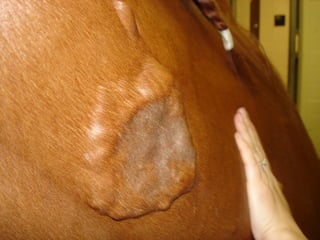
• Inflammation
• Cellulitis
• Myositis
• Vasculitis /thrombophlebitis
• Abscess
• Inappropriate route of administration
• Intra-arterial injection
• Intra-vascular
• Extravascular leakage of irritant
• Intrarrhachidian cervical injection*
• Clostridial myonecrosis
• Anaphylaxis
• REPORT ADVERSE DRUG REACTIONS!
INFLAMMATION/INFECTION
• Medical terminology reflects site
• Cellulitis
• Myositis
• Vasculitis
• May be inflammatory or infectious
• diffuse (cellulitis/infectious cellulitis)
• focal (seroma/abscess)
• May be life threatening
• Therapy
• Anti-inflammatory agents: NSAID, topical DMSO
• Hot pack
• +/- antibiotics
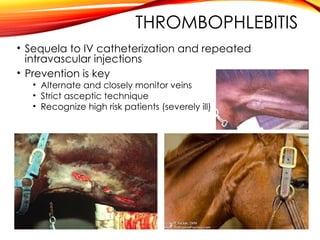
THROMBOPHLEBITIS
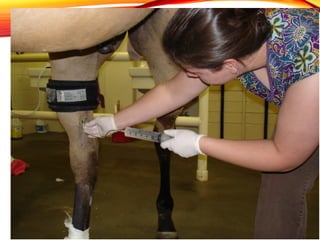
• Sequela to IV catheterization and repeated
intravascular injections
• Prevention is key
• Alternate and closely monitor veins
• Strict asceptic technique
• Recognize high risk patients (severely ill)
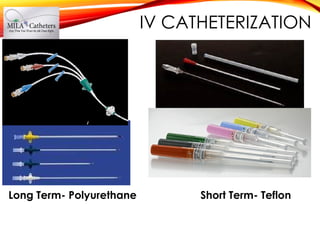
IV CATHETERIZATION
Long Term- Polyurethane Short Term- Teflon
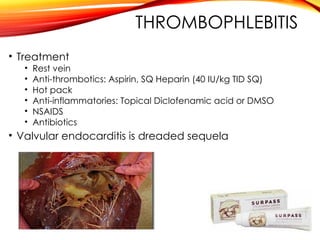
THROMBOPHLEBITIS
• Treatment
• Rest vein
• Anti-thrombotics: Aspirin, SQ Heparin (40 IU/kg TID SQ)
• Hot pack
• Anti-inflammatories: Topical Diclofenamic acid or DMSO
• NSAIDS
• Antibiotics
• Valvular endocarditis is dreaded sequela
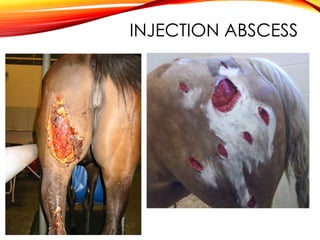
INJECTION ABSCESS
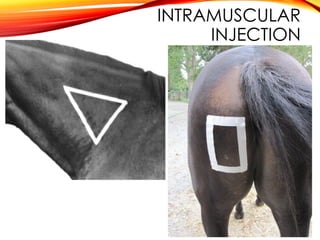
• Common routes of injection
• Which route most associated with abscess formation?
• Injection abscess prevention?
INTRAMUSCULAR
INJECTION
INJECTION ABSCESS
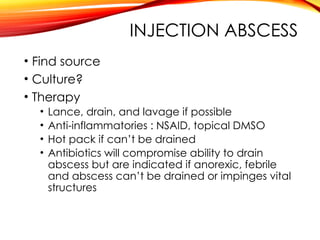
INJECTION ABSCESS
• Find source
• Culture?
• Therapy
• Lance, drain, and lavage if possible
• Anti-inflammatories : NSAID, topical DMSO
• Hot pack if can’t be drained
• Antibiotics will compromise ability to drain
abscess but are indicated if anorexic, febrile
and abscess can’t be drained or impinges vital
structures
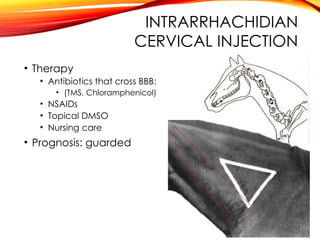
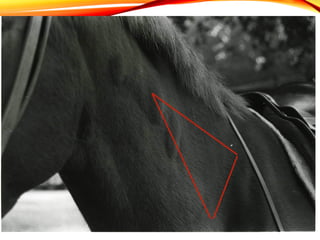
INTRARRHACHIDIAN
CERVICAL INJECTION
• Injection between cervical vertebrae that
penetrates meninges (intraspinal)
• History is critical
• Sequelae to incorrect IM injection in neck
• Clinical Signs: referrable to NECK PAIN
• Reluctant to move
• Won’t lower head to eat
• improperly called anorexia
• Forelimb lameness
• usually unilateral on side of injection
• Pyrexia
• Heat/pain/swelling at injection site are variable
INTRARRHACHIDIAN
CERVICAL INJECTION
• Therapy
• Antibiotics that cross BBB:
• (TMS, Chloramphenicol)
• NSAIDs
• Topical DMSO
• Nursing care
• Prognosis: guarded
INTRA-ARTERIAL INJECTION
• Carotid artery
• more superficial
• near head
• caudal 2/3 of the neck
• Accidental injection results in
• Recumbence within 30 seconds
• Seizures, paddling
• Blindness
• Treatment
• Immediately tranquilize with xylaxine (0.44 mg/kg)
• Phenobarbitol (5-12mg/kg IV)
• Choal Hydrate (to effect)
• Supportive care – minimize self trauma
• Most animals recover without deficits
• Morbidity due to injury
• falling or synovial structure laceration
INTRA-ARTERIAL INJECTION
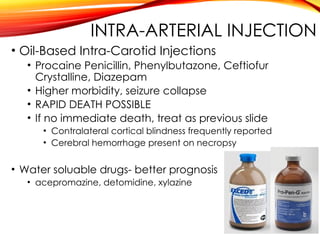
• Oil-Based Intra-Carotid Injections
• Procaine Penicillin, Phenylbutazone, Ceftiofur
Crystalline, Diazepam
• Higher morbidity, seizure collapse
• RAPID DEATH POSSIBLE
• If no immediate death, treat as previous slide
• Contralateral cortical blindness frequently reported
• Cerebral hemorrhage present on necropsy
• Water soluable drugs- better prognosis
• acepromazine, detomidine, xylazine
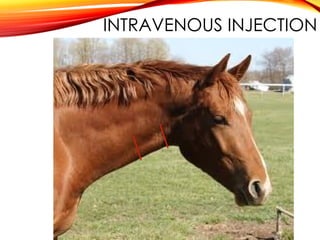
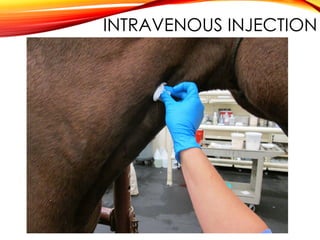
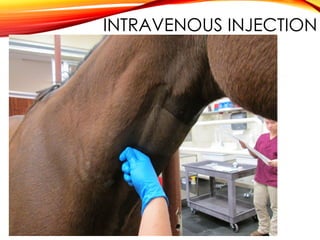
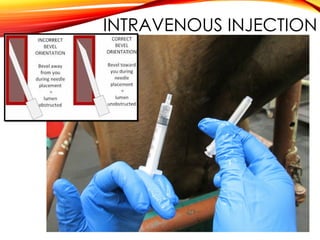
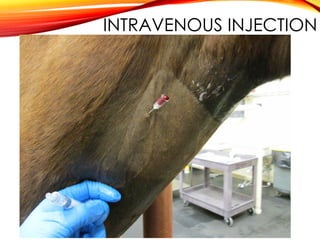
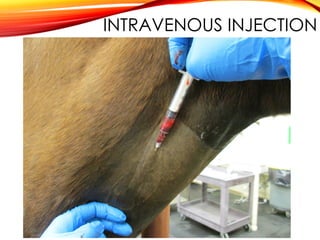
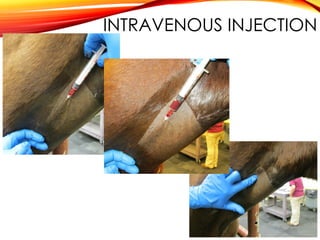
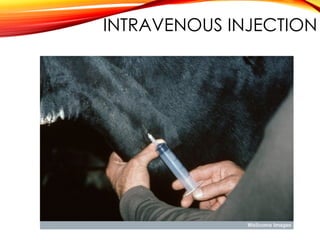
INTRAVENOUS INJECTION
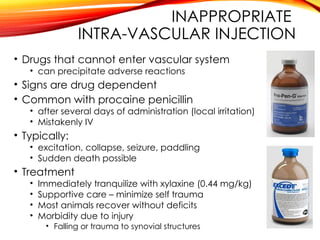
INAPPROPRIATE
INTRA-VASCULAR INJECTION
• Drugs that cannot enter vascular system
• can precipitate adverse reactions
• Signs are drug dependent
• Common with procaine penicillin
• after several days of administration (local irritation)
• Mistakenly IV
• Typically:
• excitation, collapse, seizure, paddling
• Sudden death possible
• Treatment
• Immediately tranquilize with xylaxine (0.44 mg/kg)
• Supportive care – minimize self trauma
• Most animals recover without deficits
• Morbidity due to injury
• Falling or trauma to synovial structures
EXTRAVASCULAR
LEAKAGE
• Extravascular (perivascular) drug deposition
• Causes local irritation and tissue necrosis
• Can take several days to fully develop
• Phenylbutazone is most common
• Drugs with High or low pH more likely to irritate
• Prevention is key!!!
• Re-evaluate needle placement frequently
• During injection and if animal moves
• Treatment: ‘dilution is the solution to pollution’
• Locally infiltrate area with saline (10-15mL)
• +/- dexamethasone, procaine penicillin
• Hot pack
• Consider ventral drainage if large volume perivascular
HYPERSENSITIVITY
• State of excessive reactivity to an antigen
• Allergy often used as synonym
• Outcome is deleterious rather than protective
• Gell and Coombs Classification:
• 4 main types of hypersensitivity (I-IV)
• Classification based on:
• nature of inflammatory response
• tissue damage
• Covered in depth next semester
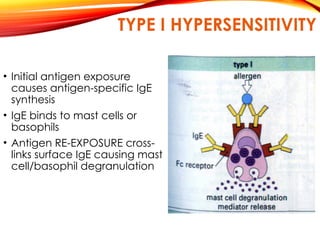
TYPE I HYPERSENSITIVITY
• Initial antigen exposure
causes antigen-specific IgE
synthesis
• IgE binds to mast cells or
basophils
• Antigen RE-EXPOSURE cross-
links surface IgE causing mast
cell/basophil degranulation
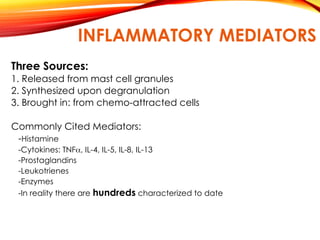
INFLAMMATORY MEDIATORS
Three Sources:
1. Released from mast cell granules
2. Synthesized upon degranulation
3. Brought in: from chemo-attracted cells
Commonly Cited Mediators:
-Histamine
-Cytokines: TNF, IL-4, IL-5, IL-8, IL-13
-Prostaglandins
-Leukotrienes
-Enzymes
-In reality there are hundreds characterized to date
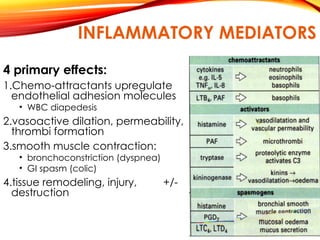
INFLAMMATORY MEDIATORS
4 primary effects:
1.Chemo-attractants upregulate
endothelial adhesion molecules
• WBC diapedesis
2.vasoactive dilation, permeability,
thrombi formation
3.smooth muscle contraction:
• bronchoconstriction (dyspnea)
• GI spasm (colic)
4.tissue remodeling, injury, +/-
destruction
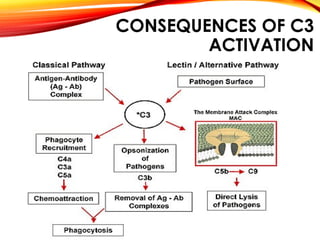
CONSEQUENCES OF C3
ACTIVATION
INFLAMMATORY MEDIATOR
EFFECTS
•Mediators have defined physiologic effects
•Clinical outcome of type I reactions depends upon
•Characteristics of individual
• amount of IgE present
• Individual responsiveness to mediators (varies)
•Characteristics of allergen
• dose
• potency
•Site of allergen introduction and degree of
dissemination
• SYSTEMIC
• LOCALIZED
PHYSIOLOGIC EFFECT OF
MEDIATORS
•Direct Ag introduction to blood or rapid absorption
widespread activation of connective tissue mast
cells in vessels and systemic anaphylaxis
•Ag inhalation
 upper respiratory: rhinitis
 lower respiratory: recurrent airway obstruction
•Skin
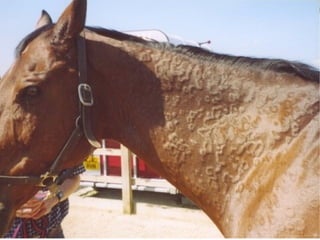
Localized injection- wheal and flare
Disseminated from GI absorption: urticaria
PHYSIOLOGIC EFFECT OF
MEDIATORS
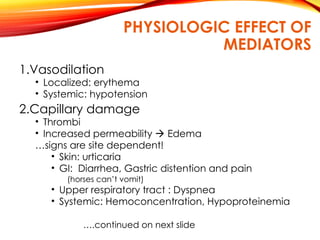
1.Vasodilation
• Localized: erythema
• Systemic: hypotension
2.Capillary damage
• Thrombi
• Increased permeability  Edema
…signs are site dependent!
• Skin: urticaria
• GI: Diarrhea, Gastric distention and pain
(horses can’t vomit)
• Upper respiratory tract : Dyspnea
• Systemic: Hemoconcentration, Hypoproteinemia
….continued on next slide
PHYSIOLOGIC EFFECT OF
MEDIATORS
3. Smooth muscle contraction
• GI: spasm (Colic)
• lung: dyspnea, poor oxygenation, decreased pO2, increased
pCO2
4. Complement and coagulation pathway activation
• Localized: clotting, tissue disruption
• Systemmic: disseminated intravascular coagulation
5. Mucous, gastric acid and catecholamine secretion
• Lungs: dyspnea and compromised ventilation
• GI: ileus
6. Chemotaxis
TYPE I EQUINE
HYPERSENSITIVITY
Exact role of IgE mediated hypersensitivity in horses
becomes sketchy:
• reagents for equine IgE research have limited availability
• Systemic anaphylaxis
• Many urticarial reactions
• Local anaphylaxis
• Insect and parasite hypersensitivities
• Atopic dermatitis
• Feed Hypersensitivity
• Respiratory manifestations
• Atopic respiratory disease
• Inflammatory Airway disease
• Recurrent Airway obstruction
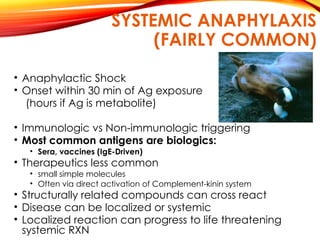
SYSTEMIC ANAPHYLAXIS
(FAIRLY COMMON)
• Anaphylactic Shock
• Onset within 30 min of Ag exposure
(hours if Ag is metabolite)
• Immunologic vs Non-immunologic triggering
• Most common antigens are biologics:
• Sera, vaccines (IgE-Driven)
• Therapeutics less common
• small simple molecules
• Often via direct activation of Complement-kinin system
• Structurally related compounds can cross react
• Disease can be localized or systemic
• Localized reaction can progress to life threatening
systemic RXN
SYSTEMIC ANAPHYLAXIS
• Any drug, via any route, at any time
• Longer duration, higher dose increases risk
• Atopic individuals higher risk (IL-4, IL-13/Th2)
• Examples:
• thiamine, vitamin E, Selenium
• anthelmintics
• penicillin, TMS, chloramphenicol, aminoglycosides,
tetracyclines
• halothane, guaifenesin
SYSTEMIC ANAPHYLAXIS
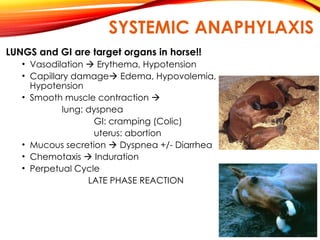
LUNGS and GI are target organs in horse!!
• Vasodilation  Erythema, Hypotension
• Capillary damage Edema, Hypovolemia,
Hypotension
• Smooth muscle contraction 
lung: dyspnea
GI: cramping (Colic)
uterus: abortion
• Mucous secretion  Dyspnea +/- Diarrhea
• Chemotaxis  Induration
• Perpetual Cycle
LATE PHASE REACTION
ANAPHYLAXIS
• Differentials:
• Drug interactions
• Inappropriate route
• Others specific to signs demonstrated
• Colic differentials
• Respiratory disease
• Other (uriticaria differentials…etc)
• Diagnostics
• Signs and history
• CBC and serum biochemistries are variable
• ECG: can develop signs of hypoxemia
• prolonged QRS, ST depression
TREATMENT
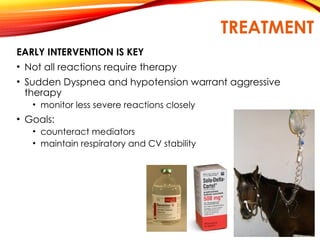
EARLY INTERVENTION IS KEY
• Not all reactions require therapy
• Sudden Dyspnea and hypotension warrant aggressive
therapy
• monitor less severe reactions closely
• Goals:
• counteract mediators
• maintain respiratory and CV stability
TREATMENT
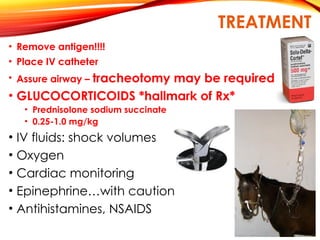
• Remove antigen!!!!
• Place IV catheter
• Assure airway – tracheotomy may be required
• GLUCOCORTICOIDS *hallmark of Rx*
• Prednisolone sodium succinate
• 0.25-1.0 mg/kg
• IV fluids: shock volumes
• Oxygen
• Cardiac monitoring
• Epinephrine…with caution
• Antihistamines, NSAIDS
EPINEPHRINE THERAPY
IN HORSES
• Why? sympathetic stimulant: α1, α2, β 1, β2
• KNOW how the drugs work
• Excitement
• IV admin to standing horse is ill advised
• IM (10-20 ug/kg = 5-10 ml of 1:1000)
• If dyspnea or hypotension are mild
• IV (3-5 ug/kg = 1.5-2.25 ml of 1:1000)
• If severe dyspnea or hypotension
• Endotracheal if no venous access
• Repeat every 15 minutes until hypotension improves
• Refractory cases may need epinephrine or
norepinephrine CRI
Questions?

Veterinary Medicine- Injection reactions

  • 1.
  • 2.
    INJECTION REACTIONS • Inflammation •Cellulitis • Myositis • Vasculitis /thrombophlebitis • Abscess • Inappropriate route of administration • Intra-arterial injection • Intra-vascular • Extravascular leakage of irritant • Intrarrhachidian cervical injection* • Clostridial myonecrosis • Anaphylaxis • REPORT ADVERSE DRUG REACTIONS!
  • 3.
    INFLAMMATION/INFECTION • Medical terminologyreflects site • Cellulitis • Myositis • Vasculitis • May be inflammatory or infectious • diffuse (cellulitis/infectious cellulitis) • focal (seroma/abscess) • May be life threatening • Therapy • Anti-inflammatory agents: NSAID, topical DMSO • Hot pack • +/- antibiotics
  • 4.
    THROMBOPHLEBITIS • Sequela toIV catheterization and repeated intravascular injections • Prevention is key • Alternate and closely monitor veins • Strict asceptic technique • Recognize high risk patients (severely ill)
  • 5.
    IV CATHETERIZATION Long Term-Polyurethane Short Term- Teflon
  • 7.
    THROMBOPHLEBITIS • Treatment • Restvein • Anti-thrombotics: Aspirin, SQ Heparin (40 IU/kg TID SQ) • Hot pack • Anti-inflammatories: Topical Diclofenamic acid or DMSO • NSAIDS • Antibiotics • Valvular endocarditis is dreaded sequela
  • 8.
    INJECTION ABSCESS • Commonroutes of injection • Which route most associated with abscess formation? • Injection abscess prevention?
  • 9.
  • 11.
  • 12.
    INJECTION ABSCESS • Findsource • Culture? • Therapy • Lance, drain, and lavage if possible • Anti-inflammatories : NSAID, topical DMSO • Hot pack if can’t be drained • Antibiotics will compromise ability to drain abscess but are indicated if anorexic, febrile and abscess can’t be drained or impinges vital structures
  • 14.
    INTRARRHACHIDIAN CERVICAL INJECTION • Injectionbetween cervical vertebrae that penetrates meninges (intraspinal) • History is critical • Sequelae to incorrect IM injection in neck • Clinical Signs: referrable to NECK PAIN • Reluctant to move • Won’t lower head to eat • improperly called anorexia • Forelimb lameness • usually unilateral on side of injection • Pyrexia • Heat/pain/swelling at injection site are variable
  • 15.
    INTRARRHACHIDIAN CERVICAL INJECTION • Therapy •Antibiotics that cross BBB: • (TMS, Chloramphenicol) • NSAIDs • Topical DMSO • Nursing care • Prognosis: guarded
  • 17.
    INTRA-ARTERIAL INJECTION • Carotidartery • more superficial • near head • caudal 2/3 of the neck • Accidental injection results in • Recumbence within 30 seconds • Seizures, paddling • Blindness • Treatment • Immediately tranquilize with xylaxine (0.44 mg/kg) • Phenobarbitol (5-12mg/kg IV) • Choal Hydrate (to effect) • Supportive care – minimize self trauma • Most animals recover without deficits • Morbidity due to injury • falling or synovial structure laceration
  • 18.
    INTRA-ARTERIAL INJECTION • Oil-BasedIntra-Carotid Injections • Procaine Penicillin, Phenylbutazone, Ceftiofur Crystalline, Diazepam • Higher morbidity, seizure collapse • RAPID DEATH POSSIBLE • If no immediate death, treat as previous slide • Contralateral cortical blindness frequently reported • Cerebral hemorrhage present on necropsy • Water soluable drugs- better prognosis • acepromazine, detomidine, xylazine
  • 19.
  • 20.
  • 21.
  • 22.
  • 23.
  • 24.
  • 25.
  • 26.
  • 27.
    INAPPROPRIATE INTRA-VASCULAR INJECTION • Drugsthat cannot enter vascular system • can precipitate adverse reactions • Signs are drug dependent • Common with procaine penicillin • after several days of administration (local irritation) • Mistakenly IV • Typically: • excitation, collapse, seizure, paddling • Sudden death possible • Treatment • Immediately tranquilize with xylaxine (0.44 mg/kg) • Supportive care – minimize self trauma • Most animals recover without deficits • Morbidity due to injury • Falling or trauma to synovial structures
  • 28.
    EXTRAVASCULAR LEAKAGE • Extravascular (perivascular)drug deposition • Causes local irritation and tissue necrosis • Can take several days to fully develop • Phenylbutazone is most common • Drugs with High or low pH more likely to irritate • Prevention is key!!! • Re-evaluate needle placement frequently • During injection and if animal moves • Treatment: ‘dilution is the solution to pollution’ • Locally infiltrate area with saline (10-15mL) • +/- dexamethasone, procaine penicillin • Hot pack • Consider ventral drainage if large volume perivascular
  • 29.
    HYPERSENSITIVITY • State ofexcessive reactivity to an antigen • Allergy often used as synonym • Outcome is deleterious rather than protective • Gell and Coombs Classification: • 4 main types of hypersensitivity (I-IV) • Classification based on: • nature of inflammatory response • tissue damage • Covered in depth next semester
  • 30.
    TYPE I HYPERSENSITIVITY •Initial antigen exposure causes antigen-specific IgE synthesis • IgE binds to mast cells or basophils • Antigen RE-EXPOSURE cross- links surface IgE causing mast cell/basophil degranulation
  • 31.
    INFLAMMATORY MEDIATORS Three Sources: 1.Released from mast cell granules 2. Synthesized upon degranulation 3. Brought in: from chemo-attracted cells Commonly Cited Mediators: -Histamine -Cytokines: TNF, IL-4, IL-5, IL-8, IL-13 -Prostaglandins -Leukotrienes -Enzymes -In reality there are hundreds characterized to date
  • 32.
    INFLAMMATORY MEDIATORS 4 primaryeffects: 1.Chemo-attractants upregulate endothelial adhesion molecules • WBC diapedesis 2.vasoactive dilation, permeability, thrombi formation 3.smooth muscle contraction: • bronchoconstriction (dyspnea) • GI spasm (colic) 4.tissue remodeling, injury, +/- destruction
  • 33.
  • 34.
    INFLAMMATORY MEDIATOR EFFECTS •Mediators havedefined physiologic effects •Clinical outcome of type I reactions depends upon •Characteristics of individual • amount of IgE present • Individual responsiveness to mediators (varies) •Characteristics of allergen • dose • potency •Site of allergen introduction and degree of dissemination • SYSTEMIC • LOCALIZED
  • 35.
    PHYSIOLOGIC EFFECT OF MEDIATORS •DirectAg introduction to blood or rapid absorption widespread activation of connective tissue mast cells in vessels and systemic anaphylaxis •Ag inhalation  upper respiratory: rhinitis  lower respiratory: recurrent airway obstruction •Skin Localized injection- wheal and flare Disseminated from GI absorption: urticaria
  • 38.
    PHYSIOLOGIC EFFECT OF MEDIATORS 1.Vasodilation •Localized: erythema • Systemic: hypotension 2.Capillary damage • Thrombi • Increased permeability  Edema …signs are site dependent! • Skin: urticaria • GI: Diarrhea, Gastric distention and pain (horses can’t vomit) • Upper respiratory tract : Dyspnea • Systemic: Hemoconcentration, Hypoproteinemia ….continued on next slide
  • 39.
    PHYSIOLOGIC EFFECT OF MEDIATORS 3.Smooth muscle contraction • GI: spasm (Colic) • lung: dyspnea, poor oxygenation, decreased pO2, increased pCO2 4. Complement and coagulation pathway activation • Localized: clotting, tissue disruption • Systemmic: disseminated intravascular coagulation 5. Mucous, gastric acid and catecholamine secretion • Lungs: dyspnea and compromised ventilation • GI: ileus 6. Chemotaxis
  • 40.
    TYPE I EQUINE HYPERSENSITIVITY Exactrole of IgE mediated hypersensitivity in horses becomes sketchy: • reagents for equine IgE research have limited availability • Systemic anaphylaxis • Many urticarial reactions • Local anaphylaxis • Insect and parasite hypersensitivities • Atopic dermatitis • Feed Hypersensitivity • Respiratory manifestations • Atopic respiratory disease • Inflammatory Airway disease • Recurrent Airway obstruction
  • 41.
    SYSTEMIC ANAPHYLAXIS (FAIRLY COMMON) •Anaphylactic Shock • Onset within 30 min of Ag exposure (hours if Ag is metabolite) • Immunologic vs Non-immunologic triggering • Most common antigens are biologics: • Sera, vaccines (IgE-Driven) • Therapeutics less common • small simple molecules • Often via direct activation of Complement-kinin system • Structurally related compounds can cross react • Disease can be localized or systemic • Localized reaction can progress to life threatening systemic RXN
  • 42.
    SYSTEMIC ANAPHYLAXIS • Anydrug, via any route, at any time • Longer duration, higher dose increases risk • Atopic individuals higher risk (IL-4, IL-13/Th2) • Examples: • thiamine, vitamin E, Selenium • anthelmintics • penicillin, TMS, chloramphenicol, aminoglycosides, tetracyclines • halothane, guaifenesin
  • 43.
    SYSTEMIC ANAPHYLAXIS LUNGS andGI are target organs in horse!! • Vasodilation  Erythema, Hypotension • Capillary damage Edema, Hypovolemia, Hypotension • Smooth muscle contraction  lung: dyspnea GI: cramping (Colic) uterus: abortion • Mucous secretion  Dyspnea +/- Diarrhea • Chemotaxis  Induration • Perpetual Cycle LATE PHASE REACTION
  • 44.
    ANAPHYLAXIS • Differentials: • Druginteractions • Inappropriate route • Others specific to signs demonstrated • Colic differentials • Respiratory disease • Other (uriticaria differentials…etc) • Diagnostics • Signs and history • CBC and serum biochemistries are variable • ECG: can develop signs of hypoxemia • prolonged QRS, ST depression
  • 45.
    TREATMENT EARLY INTERVENTION ISKEY • Not all reactions require therapy • Sudden Dyspnea and hypotension warrant aggressive therapy • monitor less severe reactions closely • Goals: • counteract mediators • maintain respiratory and CV stability
  • 46.
    TREATMENT • Remove antigen!!!! •Place IV catheter • Assure airway – tracheotomy may be required • GLUCOCORTICOIDS *hallmark of Rx* • Prednisolone sodium succinate • 0.25-1.0 mg/kg • IV fluids: shock volumes • Oxygen • Cardiac monitoring • Epinephrine…with caution • Antihistamines, NSAIDS
  • 47.
    EPINEPHRINE THERAPY IN HORSES •Why? sympathetic stimulant: α1, α2, β 1, β2 • KNOW how the drugs work • Excitement • IV admin to standing horse is ill advised • IM (10-20 ug/kg = 5-10 ml of 1:1000) • If dyspnea or hypotension are mild • IV (3-5 ug/kg = 1.5-2.25 ml of 1:1000) • If severe dyspnea or hypotension • Endotracheal if no venous access • Repeat every 15 minutes until hypotension improves • Refractory cases may need epinephrine or norepinephrine CRI
  • 48.

Editor's Notes

  • #4 Most commonly Jugular, other places- RLP sites. Septic vs non-septic
  • #5 Long Term- Polyurethane Short Term- Teflon
  • #14 Intra-ra-kid-ean
  • #17 Water soluable drugs- better prognosis (acepromazine, detomidine, xylazine) Oil-Based Drugs- rapid death possible (procaine penicillin, Ceftiofur crystalline- Exceed, diazepam)
  • #18 Water soluable drugs- better prognosis (acepromazine, detomidine, xylazine) Oil-Based Drugs- rapid death possible (procaine penicillin, Ceftiofur crystalline- Exceed, diazepam)
  • #19 Alcohol, hold off
  • #41 Can be activation of IgE (larger molecules, previous sensitization) or- direct activation of complement-kinin system by some part of the drug (usually smaller molecules)