Dental Vestibular Abscess and
Drainage
INDIANA UNIVERSITY Mehul Patel
Oral & Maxillofacial Surgery
INDIANA UNIVERSITY
Common Etiologies
• Cysts that become infected
• Gingival Infections
• Periodontal/Periapical infections
• Root fractures
• Dental Caries
INDIANA UNIVERSITY
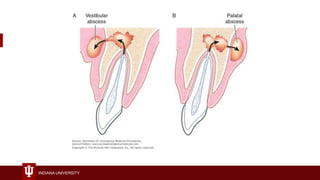
Anatomy and Pathophysiology
INDIANA UNIVERSITY
INDIANA UNIVERSITY
Physical Exam Findings
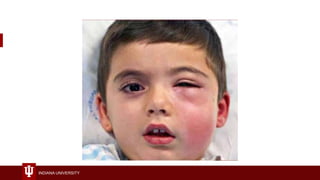
1. Swelling
2. Erythema
3. Intraoral drainage
4. Foul Taste
5. Fullness/Fluctuance along vestibule
6. Severe pain during palpation/percussion of the tooth
INDIANA UNIVERSITY
INDIANA UNIVERSITY
INDIANA UNIVERSITY
INDIANA UNIVERSITY
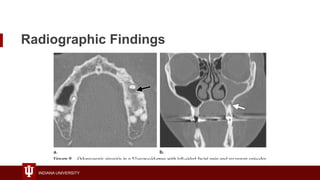
Radiographic Findings
INDIANA UNIVERSITY
Radiographic Findings
INDIANA UNIVERSITY
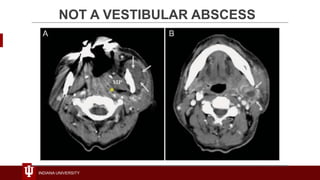
NOT A VESTIBULAR ABSCESS
INDIANA UNIVERSITY
NOT A VESTIBULAR ABSCESS
INDIANA UNIVERSITY
NOT A VESTIBULAR ABSCESS
INDIANA UNIVERSITY
Buzz Words on Impression Reports
1. Subperiosteal abscess
2. Buccal dehiscence
3. Fluid collection/Rim enhancing along buccal cortex
INDIANA UNIVERSITY
Contraindications
1. No absolute contraindications
2. May need to optimize patient with coagulopathies
INDIANA UNIVERSITY
Equipment
• #15 blade
• Suction source and tubing
• Hemostat
• Suture and ¼’’ penrose drain (optional)
• Tongue Blade
• Gauze
• Light source, overhead, or headlamp
INDIANA UNIVERSITY
Patient Preparation
1. Explain r/b/a and obtain appropriate consent
2. Provide adequate anesthesia
3. Prep and drape the patient (does not have to be completely sterile)
INDIANA UNIVERSITY
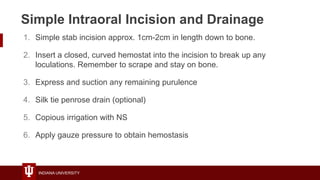
Simple Intraoral Incision and Drainage
1. Simple stab incision approx. 1cm-2cm in length down to bone.
2. Insert a closed, curved hemostat into the incision to break up any
loculations. Remember to scrape and stay on bone.
3. Express and suction any remaining purulence
4. Silk tie penrose drain (optional)
5. Copious irrigation with NS
6. Apply gauze pressure to obtain hemostasis
INDIANA UNIVERSITY
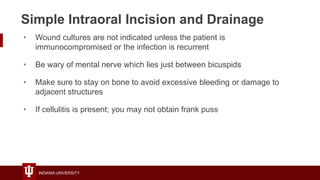
Simple Intraoral Incision and Drainage
• Wound cultures are not indicated unless the patient is
immunocompromised or the infection is recurrent
• Be wary of mental nerve which lies just between bicuspids
• Make sure to stay on bone to avoid excessive bleeding or damage to
adjacent structures
• If cellulitis is present; you may not obtain frank puss
INDIANA UNIVERSITY
INDIANA UNIVERSITY
INDIANA UNIVERSITY
INDIANA UNIVERSITY
Complications
1. Minor postoperative pain, swelling, bleeding, drainage, and possibly bruising
can be expected following the incision and drainage of a dental abscess.
2. Significant postprocedural bleeding can be controlled with pressure, a
vasoconstricting local anesthetic agent, or topical Gelfoam.

Vestibular Abscess.pptx

Editor's Notes

  • #3 Rigid fixation showing great promise in reduction of relapse, greater patient comfort, earlier jaw mobilization, and quicker return to function
  • #4 Dental abscesses arise when bacteria penetrate the normal anatomic and physiologic barriers of the tooth and surrounding structures. Periapical and periodontal abscesses require no immediate treatment in the ED and can be referred to the dentist for Root Canal, cleaning, or cavity filling.
  • #5 If left unchecked, it can lead to a progressive destruction of the dental supporting tissues, including the alveolar bone An incision and drainage procedure is warranted if the infectious process extends outside the alveolar bone and involves the soft tissues It may perforate laterally to form a vestibular abscess. Alternatively, it may perforate medially to form a palatal or lingual abscess.
  • #21 Rigid fixation showing great promise in reduction of relapse, greater patient comfort, earlier jaw mobilization, and quicker return to function
  • #22 Rigid fixation showing great promise in reduction of relapse, greater patient comfort, earlier jaw mobilization, and quicker return to function
  • #23 Rigid fixation showing great promise in reduction of relapse, greater patient comfort, earlier jaw mobilization, and quicker return to function