Stochastic Modeling of
Transit Vessel Traffic
through the 

Strait of Istanbul
Safak Ozkan
Photo: Paul Work
Department of Civil Engineering
Bosphorus University
OBJECTIVES:
• to quantify casualty risk
variation…
1)…along the Strait
2)…among different vessel sizes
SCOPE:
• Pilotage errors
• Currents are assumed to be the
predominant factor for vessel
drift
• Vessel lengths are limited to 50
- 200 m
Present Study
the Strait of İstanbul
• exchange of two distinct water
systems between BLACK SEA –
MEDDITERANEAN SEA
the simulation program rather acts like a
numerical test in order to quantify the casualty
risk relatively
Present Study
METHODOLOGY:
• Stochastic Model
• Random parameters include
LOA and pilotage error
• the autopilot
• Physics Based Mathematical
Simulation
• 12 maneuver points
• the turn angles are
@ Üsküdar, Ortaköy and
Büyükdere ∼ 45o

@ Yeniköy ∼ 80o
• At Kandilli and Yeniköy the
forward sight is blocked by
the bends
• Currents mount up to

7-8 knots whilst northerly
winds
• narrowest section at Kandilli
(app. 700 m)
courtesy of Yüce, 1995
Physical Characteristics of the Strait
Hydrodynamics of the Strait
• Count Marsigli
identified a two layer
flow in the Strait in
year 1679
• The surface flow is 

driven by sea-level
differences, Δη
• The lower layer flow
is driven by density
differences,
ρMed – ρBS
Courtesy of London Science Museum, Photo: Emre Otay
Department of Navigation, Hydrography and Oceanography, map no 9001
Surface Currents
(Akyarlı and Arısoy, 1994)
• Quantitative observations on sea
level differences being made since
1918
• mean(Δη) ~ 30 – 35 cm (Büyükay, 1990)
• Instantaneous difference -5 cm to
77 cm. (Akyarlı, 1997)
• transient changes in Δη, and
winds causes orkoz currents be
formed.
(Örs, 1998)
Surface Currents
Department of Navigation, Hydrography and Oceanography, map no 9001
MODEL:
• Shallow water equations
• Slip boundary conditions at
the solid boundaries
• Reynolds number is
artificially lowered (Laminar
flow)
REALITY:
• Transient nature
• Under certain
circumstances north-
going counter
currents may develop
(orkoz).
Casualty Statistics
• over 300 vessels
involved in
casualties
• Annually 50,000
vessels transit 

the Strait
• 10% of them are
tankers with liquid
cargo
• Approximately
every 12 minutes a
vessel enters the
Strait
(Gören, 2002)
Present Regulations
• Traffic Separation
Scheme issued in 1994
• Maximum speed 

10 knots
• Vessels longer than
200 m cannot keep
within the lanes
• For vessels longer than
300 m, opposite direction
is suspended for all
vessel types
Therefore vessels longer than 200
m are out of the scope of the
present study
Ship Hydrodynamics
• ship motion is
represented with 3 DOF
xDp RmFF xx
=+
yDp RmFF yy
=+
zzcurrh IMM φ=+/
Hydrodynamic forces on ship parts are
analyzed separately :
• Hull forces
• Propeller forces
• Rudder forces
Equations of Motion
∫ ∫
+
⎥
⎥
⎦
⎤
⎢
⎢
⎣
⎡
+
+
=Δ
Tt
t
ox
t
t
Dpx
x
o
o o
x
dttRdt
m
tFtF
R )(
)()(
∫ ∫
+
⎥
⎥
⎦
⎤
⎢
⎢
⎣
⎡
+
+
=Δ
Tt
t
oy
t
t
Dpy
y
o
o o
y
dttRdt
m
tFtF
R )(
)()(
∫ ∫
+
⎥
⎥
⎦
⎤
⎢
⎢
⎣
⎡
+
+
=Δ
Tt
t
oz
t
t
currh
z
o
o o
dttdt
m
tMtM
)(
)()(/
φφ
xDp RmFF xx
=+
yDp RmFF yy
=+
zzcurrh IMM φ=+/
Hull Forces
• Hull forces are computed along
the longitudinal axis and
transverse axis of the vessel
• The empirical equations are
suitable for maneuvering vessels
at low velocities.
• Hull forces are due to viscous drag
and lift forces
tctvt eVVYF ,)( φ⋅−=
φφρ eeVVACCF ctwsrfl ⋅⋅−+−=
2
2
1 )()(
• Propeller thrust is set constant
such that the linear velocity of the
vessel is around 10 knots during the
navigation
• For southbound vessels, calm water
velocity is 8 knots
• For southbound vessels, calm water
velocity is 12 knots
LOAsouthbound=125 m, complete navigation
Propeller Forces
courtesy of Schilling Rudder Systems
• Rudder is a
symmetrical hydrofoil
shadowed by the hull
augmented by the
propeller
• Force developed on
rudder is proportional
to square of the inflow
velocity
Rudder Forces
2
nflowiL UF ∝
Rudder Forces
courtesy of Schilling Rudder Systems
• FL results in a turning moment
on the hull
• At stall point CL is maximum
• Conventional rudders have stall
angles at 35o
• Beyond the stall point CL
Photo: Conny Wickberg
Ship Maneuverability
Turning Circle Test:
A measurement of
ship maneuverability
Turning Circle Test
925 m965 m
Tactical
Diameter
360 m394 mTransfer
1015 m1068 mAdvance
Real
Parameters
(ESSO
OSAKA)
Simulation
– simulation –
IMO specifications (2002) on ship
maneuverability require that the
turning circle parameters be
linearly related to vessel length
• The Strait is meshed
with stations into 10 

sub-regions where major
course alterations take
place.
• Navigation runs are
carried out in between
every two successive
stations separately.
• Regions are meshed
with checklines
• Vessel positions are
recorded where their
Principals of the Simulation
ASSUMPTIONS & METHODOLOGY:
• Main philosophy is to evaluate the
mapping of the position distributions
from one checkline to the next
• Vessels are handled by an
autopilot
• The autopilot acts with a constant
level of error in a region of course
alteration
• Surface current includes no eddies
• Constant currents act at all points
around the ship hull
• The navigation of vessels is
independent of the opposite
direction traffic.
Principals of the Simulation
RANDOM VARIABLES:
• vessel length f(LOA), 

all the vessel related parameters are related to
LOA
Principals of the Simulation
• initial position f(xin)
• autopilot error parameters
f(ε ), f(τ )
Principals of the Simulation
DISCRETIZATION of the INPUT
VARIABLES:
• Initial conditions, , are
correlated to xin by curve fitting)
• Whenever a random distribution is
discretized, the shape of the
distribution within the discretized bin
is approximated with a constant
shape function
Principals of the Simulation
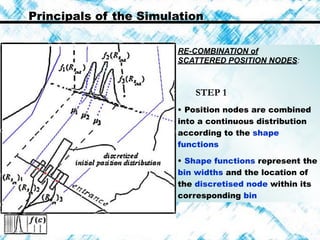
RE-COMBINATION of
SCATTERED POSITION NODES:
• the set of discrete position
nodes have to be drawn back
into a continuous form at the
entrance of a navigation region
• When the navigation run is
completed we have a set of
discrete position points
scattered along the line
(checkline or station)
• this is achieved in two steps
Principals of the Simulation
RE-COMBINATION of
SCATTERED POSITION NODES:
STEP 1
• Since the pilotage error is
originally a continuous
distribution, the position nodes
originating from one single
initial vessel represents a
continuous distribution on the
checkline
Principals of the Simulation
RE-COMBINATION of
SCATTERED POSITION NODES:
STEP 1
• Position nodes are combined
into a continuous distribution
according to the shape
functions
• Shape functions represent the
bin widths and the location of
the discretised node within its
corresponding bin
Principals of the Simulation
RE-COMBINATION of
SCATTERED POSITION NODES
STEP 2
• In the end we have a number
of continuous position
distributions – for each initial vessel
position – to be composed into
the ultimate position
distribution
Routes According to TSS
• Routes are developed by
locating the mid-lines of the
TSS lanes
• All vessel sizes
incorporated in the
program, i.e.

(50 m < LOA < 200 m)
are assumed to follow the
same pre-determined
routes
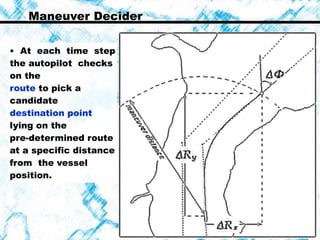
• At each time step
the autopilot checks
on the 

route to pick a
candidate 

destination point
lying on the
pre-determined route
at a specific distance
from the vessel
position.
Maneuver Decider
Maneuver Decider
• When an
isosceles triangle
is formed
between vessel
position and
destination point
maneuver is
initiated
• The autopilot is
provided with the
constraint
variables 

ΔRx ΔRy and Δφz
Autopilot
∫ ∫
+
⎥
⎥
⎦
⎤
⎢
⎢
⎣
⎡
+
+
=Δ
Tt
t
ox
t
t
Dp
x
o
o o
xx
dttRdt
m
tFtF
R )(
)()(
∫ ∫
+
⎥
⎥
⎦
⎤
⎢
⎢
⎣
⎡
+
+
=Δ
Tt
t
oy
t
t
Dp
y
o
o o
yy
dttRdt
m
tFtF
R )(
)()(
∫ ∫
+
⎥
⎥
⎦
⎤
⎢
⎢
⎣
⎡
+
+
=Δ
Tt
t
oz
t
t
currp
z
o
o o
dttdt
m
tMtM
)(
)()(/
φφ
• The autopilot physically
has the control of the
rudder angle, γ (t)
• There are 3 constraint
equations to be satisfied
• Therefore a physical
model for γ (t) must be
constructed which must
bring in only 3 unknowns.
( )2
21
2
22 TTTTl o Δ−Δ−
+
=Δ+
γγ
γ
( )2
21
1
1 TTTTl oo Δ−Δ−
+
=Δ+
γγ
γ
• The physical model for γ`(t)
is a partially defined function
which includes
only 3 unknowns:
γ1 , γ2 , T
a Physical Model for γ (t)
• 3 equations – 3 unknowns
• the equations are implicit
integral equations
• discretization of the
equations yield non-linear
terms
• Newton-Raphson method is
used
a Physical Model for γ (t)
∫ ∫
+
⎥
⎥
⎦
⎤
⎢
⎢
⎣
⎡
+
+
=Δ
Tt
t
ox
t
t
Dp
x
o
o o
xx
dttRdt
m
tFtF
R )(
)()(
∫ ∫
+
⎥
⎥
⎦
⎤
⎢
⎢
⎣
⎡
+
+
=Δ
Tt
t
oy
t
t
Dp
y
o
o o
yy
dttRdt
m
tFtF
R )(
)()(
∫ ∫
+
⎥
⎥
⎦
⎤
⎢
⎢
⎣
⎡
+
+
=Δ
Tt
t
oz
t
t
currp
z
o
o o
dttdt
m
tMtM
)(
)()(/
φφ
Equations:
Unknowns:
γ1
γ2
T
Human errors are primarily
classified in two categories
• lack of ship-handling skills
• lack of knowledge
(Poyraz and Paksoy, 1998; Oğuzülgen 1995)
• ε, (handling error), 

set γ(t) = ε ⋅ γ`(t)
• τ, (delay error),

during the computations of γ`(t),
the magnitude and the direction
of surface currents are
perceived with a time delay
Autopilot Error Parameters τ and ε
perfect pilotage corresponds to ε =
100%, τ = 0 sec.
pure handling, ε , and
pure delay, τ , errors
Position Distributions
• All the
simulation
program does is 

evaluate the
probability
distributions of
vessels along the
checklines
• The casualty
risks are
evaluated
afterwards in a
post-processing
Ramming and Grounding
INPUT:
• Q=50,000 vessels/year
• f(LOA)
Investigate the casualty risk
variation
• vessel length, LOA
• travel direction
• casualty type
• regions of the Strait
Casualty Model – Collision Risk
x
{ } dxXxSdxXxN SN
)()(∫ ∫=ξ
groundingzone
collision
zone
2
Q∝ξ
Casualty Model – Collision Risk
High risk regions are
(simulation)
•Yeniköy
•Büyükdere – Sarıyer
•Kandilli
Casualty Model – Ramming and Grounding
groundingzone
∫=Λ dxXxN N
)(
Q∝Λ
Casualty Model – Ramming and Grounding
High risk regions are
(simulation)
•Ortaköy – Kanlıca
Comparison with Statistical Data
• Collision risk is overestimated for larger
vessels (Probably due to better ship-handling provided
for larger vessels)
– simulation –
– statistical data –
(Gören, 2002)
Comparison with Statistical Data
(Gören, 2002)
SIMULATION:
31.1≅
Λ
ξ
MEASURED:
95.1≅
Λ
ξ
• R/G seem to be
over-estimated
(Error is primarily due
to constant shape
functions)
Conclusion
• CRG risk is evaluated with stochastic simulation
• southbound vessels are at a more disadvantageous
situation in terms of rudder control
• vessel lengths directly correlate with CRG risk
• High risk regions: Yeniköy, Kandilli and Büyükdere
• Collision risk is higher than R/G risk
• ξ ∝ Q2
• Λ ∝ Q
• Higher order shape functions must be
incorporated
• Different routes lying within the TSS lanes may
be incorporated
• Water currents be solved numerically as a
function of Δη and ρMed – ρBS
• Ship hydrodynamic forces be elaborated to
include the shallow water and narrow channel
effects
• A detailed bathymetry data can be supplied for
better representation of grounding zones for
Further Improvements of the Simulation
Future Prospects Offered by This Study
• Real time simulations can be
implemented with extensive
simultaneous surface current
measurements
• Similar channels can be
analyzed with this mathematical
simulation program for
quantitative risk level
comparison with the Strait of
İstanbul

Vessel Traffic Model

  • 1.
    Stochastic Modeling of TransitVessel Traffic through the 
 Strait of Istanbul Safak Ozkan Photo: Paul Work Department of Civil Engineering Bosphorus University
  • 2.
    OBJECTIVES: • to quantifycasualty risk variation… 1)…along the Strait 2)…among different vessel sizes SCOPE: • Pilotage errors • Currents are assumed to be the predominant factor for vessel drift • Vessel lengths are limited to 50 - 200 m Present Study
  • 3.
    the Strait ofİstanbul • exchange of two distinct water systems between BLACK SEA – MEDDITERANEAN SEA
  • 4.
    the simulation programrather acts like a numerical test in order to quantify the casualty risk relatively Present Study METHODOLOGY: • Stochastic Model • Random parameters include LOA and pilotage error • the autopilot • Physics Based Mathematical Simulation
  • 5.
    • 12 maneuverpoints • the turn angles are @ Üsküdar, Ortaköy and Büyükdere ∼ 45o
 @ Yeniköy ∼ 80o • At Kandilli and Yeniköy the forward sight is blocked by the bends • Currents mount up to
 7-8 knots whilst northerly winds • narrowest section at Kandilli (app. 700 m) courtesy of Yüce, 1995 Physical Characteristics of the Strait
  • 6.
    Hydrodynamics of theStrait • Count Marsigli identified a two layer flow in the Strait in year 1679 • The surface flow is 
 driven by sea-level differences, Δη • The lower layer flow is driven by density differences, ρMed – ρBS Courtesy of London Science Museum, Photo: Emre Otay
  • 7.
    Department of Navigation,Hydrography and Oceanography, map no 9001 Surface Currents (Akyarlı and Arısoy, 1994) • Quantitative observations on sea level differences being made since 1918 • mean(Δη) ~ 30 – 35 cm (Büyükay, 1990) • Instantaneous difference -5 cm to 77 cm. (Akyarlı, 1997) • transient changes in Δη, and winds causes orkoz currents be formed.
  • 8.
    (Örs, 1998) Surface Currents Departmentof Navigation, Hydrography and Oceanography, map no 9001 MODEL: • Shallow water equations • Slip boundary conditions at the solid boundaries • Reynolds number is artificially lowered (Laminar flow) REALITY: • Transient nature • Under certain circumstances north- going counter currents may develop (orkoz).
  • 9.
    Casualty Statistics • over300 vessels involved in casualties • Annually 50,000 vessels transit 
 the Strait • 10% of them are tankers with liquid cargo • Approximately every 12 minutes a vessel enters the Strait (Gören, 2002)
  • 10.
    Present Regulations • TrafficSeparation Scheme issued in 1994 • Maximum speed 
 10 knots • Vessels longer than 200 m cannot keep within the lanes • For vessels longer than 300 m, opposite direction is suspended for all vessel types Therefore vessels longer than 200 m are out of the scope of the present study
  • 11.
    Ship Hydrodynamics • shipmotion is represented with 3 DOF xDp RmFF xx =+ yDp RmFF yy =+ zzcurrh IMM φ=+/ Hydrodynamic forces on ship parts are analyzed separately : • Hull forces • Propeller forces • Rudder forces
  • 12.
    Equations of Motion ∫∫ + ⎥ ⎥ ⎦ ⎤ ⎢ ⎢ ⎣ ⎡ + + =Δ Tt t ox t t Dpx x o o o x dttRdt m tFtF R )( )()( ∫ ∫ + ⎥ ⎥ ⎦ ⎤ ⎢ ⎢ ⎣ ⎡ + + =Δ Tt t oy t t Dpy y o o o y dttRdt m tFtF R )( )()( ∫ ∫ + ⎥ ⎥ ⎦ ⎤ ⎢ ⎢ ⎣ ⎡ + + =Δ Tt t oz t t currh z o o o dttdt m tMtM )( )()(/ φφ xDp RmFF xx =+ yDp RmFF yy =+ zzcurrh IMM φ=+/
  • 13.
    Hull Forces • Hullforces are computed along the longitudinal axis and transverse axis of the vessel • The empirical equations are suitable for maneuvering vessels at low velocities. • Hull forces are due to viscous drag and lift forces tctvt eVVYF ,)( φ⋅−= φφρ eeVVACCF ctwsrfl ⋅⋅−+−= 2 2 1 )()(
  • 14.
    • Propeller thrustis set constant such that the linear velocity of the vessel is around 10 knots during the navigation • For southbound vessels, calm water velocity is 8 knots • For southbound vessels, calm water velocity is 12 knots LOAsouthbound=125 m, complete navigation Propeller Forces
  • 15.
    courtesy of SchillingRudder Systems • Rudder is a symmetrical hydrofoil shadowed by the hull augmented by the propeller • Force developed on rudder is proportional to square of the inflow velocity Rudder Forces 2 nflowiL UF ∝
  • 16.
    Rudder Forces courtesy ofSchilling Rudder Systems • FL results in a turning moment on the hull • At stall point CL is maximum • Conventional rudders have stall angles at 35o • Beyond the stall point CL
  • 17.
    Photo: Conny Wickberg ShipManeuverability Turning Circle Test: A measurement of ship maneuverability
  • 18.
    Turning Circle Test 925m965 m Tactical Diameter 360 m394 mTransfer 1015 m1068 mAdvance Real Parameters (ESSO OSAKA) Simulation – simulation – IMO specifications (2002) on ship maneuverability require that the turning circle parameters be linearly related to vessel length
  • 19.
    • The Straitis meshed with stations into 10 
 sub-regions where major course alterations take place. • Navigation runs are carried out in between every two successive stations separately. • Regions are meshed with checklines • Vessel positions are recorded where their Principals of the Simulation
  • 20.
    ASSUMPTIONS & METHODOLOGY: •Main philosophy is to evaluate the mapping of the position distributions from one checkline to the next • Vessels are handled by an autopilot • The autopilot acts with a constant level of error in a region of course alteration • Surface current includes no eddies • Constant currents act at all points around the ship hull • The navigation of vessels is independent of the opposite direction traffic. Principals of the Simulation
  • 21.
    RANDOM VARIABLES: • vessellength f(LOA), 
 all the vessel related parameters are related to LOA Principals of the Simulation • initial position f(xin) • autopilot error parameters f(ε ), f(τ )
  • 22.
    Principals of theSimulation DISCRETIZATION of the INPUT VARIABLES: • Initial conditions, , are correlated to xin by curve fitting) • Whenever a random distribution is discretized, the shape of the distribution within the discretized bin is approximated with a constant shape function
  • 23.
    Principals of theSimulation RE-COMBINATION of SCATTERED POSITION NODES: • the set of discrete position nodes have to be drawn back into a continuous form at the entrance of a navigation region • When the navigation run is completed we have a set of discrete position points scattered along the line (checkline or station) • this is achieved in two steps
  • 24.
    Principals of theSimulation RE-COMBINATION of SCATTERED POSITION NODES: STEP 1 • Since the pilotage error is originally a continuous distribution, the position nodes originating from one single initial vessel represents a continuous distribution on the checkline
  • 25.
    Principals of theSimulation RE-COMBINATION of SCATTERED POSITION NODES: STEP 1 • Position nodes are combined into a continuous distribution according to the shape functions • Shape functions represent the bin widths and the location of the discretised node within its corresponding bin
  • 26.
    Principals of theSimulation RE-COMBINATION of SCATTERED POSITION NODES STEP 2 • In the end we have a number of continuous position distributions – for each initial vessel position – to be composed into the ultimate position distribution
  • 27.
    Routes According toTSS • Routes are developed by locating the mid-lines of the TSS lanes • All vessel sizes incorporated in the program, i.e.
 (50 m < LOA < 200 m) are assumed to follow the same pre-determined routes
  • 28.
    • At eachtime step the autopilot checks on the 
 route to pick a candidate 
 destination point lying on the pre-determined route at a specific distance from the vessel position. Maneuver Decider
  • 29.
    Maneuver Decider • Whenan isosceles triangle is formed between vessel position and destination point maneuver is initiated • The autopilot is provided with the constraint variables 
 ΔRx ΔRy and Δφz
  • 30.
    Autopilot ∫ ∫ + ⎥ ⎥ ⎦ ⎤ ⎢ ⎢ ⎣ ⎡ + + =Δ Tt t ox t t Dp x o o o xx dttRdt m tFtF R)( )()( ∫ ∫ + ⎥ ⎥ ⎦ ⎤ ⎢ ⎢ ⎣ ⎡ + + =Δ Tt t oy t t Dp y o o o yy dttRdt m tFtF R )( )()( ∫ ∫ + ⎥ ⎥ ⎦ ⎤ ⎢ ⎢ ⎣ ⎡ + + =Δ Tt t oz t t currp z o o o dttdt m tMtM )( )()(/ φφ • The autopilot physically has the control of the rudder angle, γ (t) • There are 3 constraint equations to be satisfied • Therefore a physical model for γ (t) must be constructed which must bring in only 3 unknowns.
  • 31.
    ( )2 21 2 22 TTTTlo Δ−Δ− + =Δ+ γγ γ ( )2 21 1 1 TTTTl oo Δ−Δ− + =Δ+ γγ γ • The physical model for γ`(t) is a partially defined function which includes only 3 unknowns: γ1 , γ2 , T a Physical Model for γ (t)
  • 32.
    • 3 equations– 3 unknowns • the equations are implicit integral equations • discretization of the equations yield non-linear terms • Newton-Raphson method is used a Physical Model for γ (t) ∫ ∫ + ⎥ ⎥ ⎦ ⎤ ⎢ ⎢ ⎣ ⎡ + + =Δ Tt t ox t t Dp x o o o xx dttRdt m tFtF R )( )()( ∫ ∫ + ⎥ ⎥ ⎦ ⎤ ⎢ ⎢ ⎣ ⎡ + + =Δ Tt t oy t t Dp y o o o yy dttRdt m tFtF R )( )()( ∫ ∫ + ⎥ ⎥ ⎦ ⎤ ⎢ ⎢ ⎣ ⎡ + + =Δ Tt t oz t t currp z o o o dttdt m tMtM )( )()(/ φφ Equations: Unknowns: γ1 γ2 T
  • 33.
    Human errors areprimarily classified in two categories • lack of ship-handling skills • lack of knowledge (Poyraz and Paksoy, 1998; Oğuzülgen 1995) • ε, (handling error), 
 set γ(t) = ε ⋅ γ`(t) • τ, (delay error),
 during the computations of γ`(t), the magnitude and the direction of surface currents are perceived with a time delay Autopilot Error Parameters τ and ε perfect pilotage corresponds to ε = 100%, τ = 0 sec.
  • 34.
    pure handling, ε, and pure delay, τ , errors
  • 35.
    Position Distributions • Allthe simulation program does is 
 evaluate the probability distributions of vessels along the checklines • The casualty risks are evaluated afterwards in a post-processing
  • 36.
    Ramming and Grounding INPUT: •Q=50,000 vessels/year • f(LOA) Investigate the casualty risk variation • vessel length, LOA • travel direction • casualty type • regions of the Strait
  • 37.
    Casualty Model –Collision Risk x { } dxXxSdxXxN SN )()(∫ ∫=ξ groundingzone collision zone 2 Q∝ξ
  • 38.
    Casualty Model –Collision Risk High risk regions are (simulation) •Yeniköy •Büyükdere – Sarıyer •Kandilli
  • 39.
    Casualty Model –Ramming and Grounding groundingzone ∫=Λ dxXxN N )( Q∝Λ
  • 40.
    Casualty Model –Ramming and Grounding High risk regions are (simulation) •Ortaköy – Kanlıca
  • 41.
    Comparison with StatisticalData • Collision risk is overestimated for larger vessels (Probably due to better ship-handling provided for larger vessels) – simulation – – statistical data – (Gören, 2002)
  • 42.
    Comparison with StatisticalData (Gören, 2002) SIMULATION: 31.1≅ Λ ξ MEASURED: 95.1≅ Λ ξ • R/G seem to be over-estimated (Error is primarily due to constant shape functions)
  • 43.
    Conclusion • CRG riskis evaluated with stochastic simulation • southbound vessels are at a more disadvantageous situation in terms of rudder control • vessel lengths directly correlate with CRG risk • High risk regions: Yeniköy, Kandilli and Büyükdere • Collision risk is higher than R/G risk • ξ ∝ Q2 • Λ ∝ Q
  • 44.
    • Higher ordershape functions must be incorporated • Different routes lying within the TSS lanes may be incorporated • Water currents be solved numerically as a function of Δη and ρMed – ρBS • Ship hydrodynamic forces be elaborated to include the shallow water and narrow channel effects • A detailed bathymetry data can be supplied for better representation of grounding zones for Further Improvements of the Simulation
  • 45.
    Future Prospects Offeredby This Study • Real time simulations can be implemented with extensive simultaneous surface current measurements • Similar channels can be analyzed with this mathematical simulation program for quantitative risk level comparison with the Strait of İstanbul