- By zoomania
• Vertebrate,
• also called Craniata, any animal of the subphylum
Vertebrata.
• The predominant subphylum of the
phylum Chordata.
• They have backbones, from which they derive their
name.
• The vertebrates are also characterized by a
muscular system.
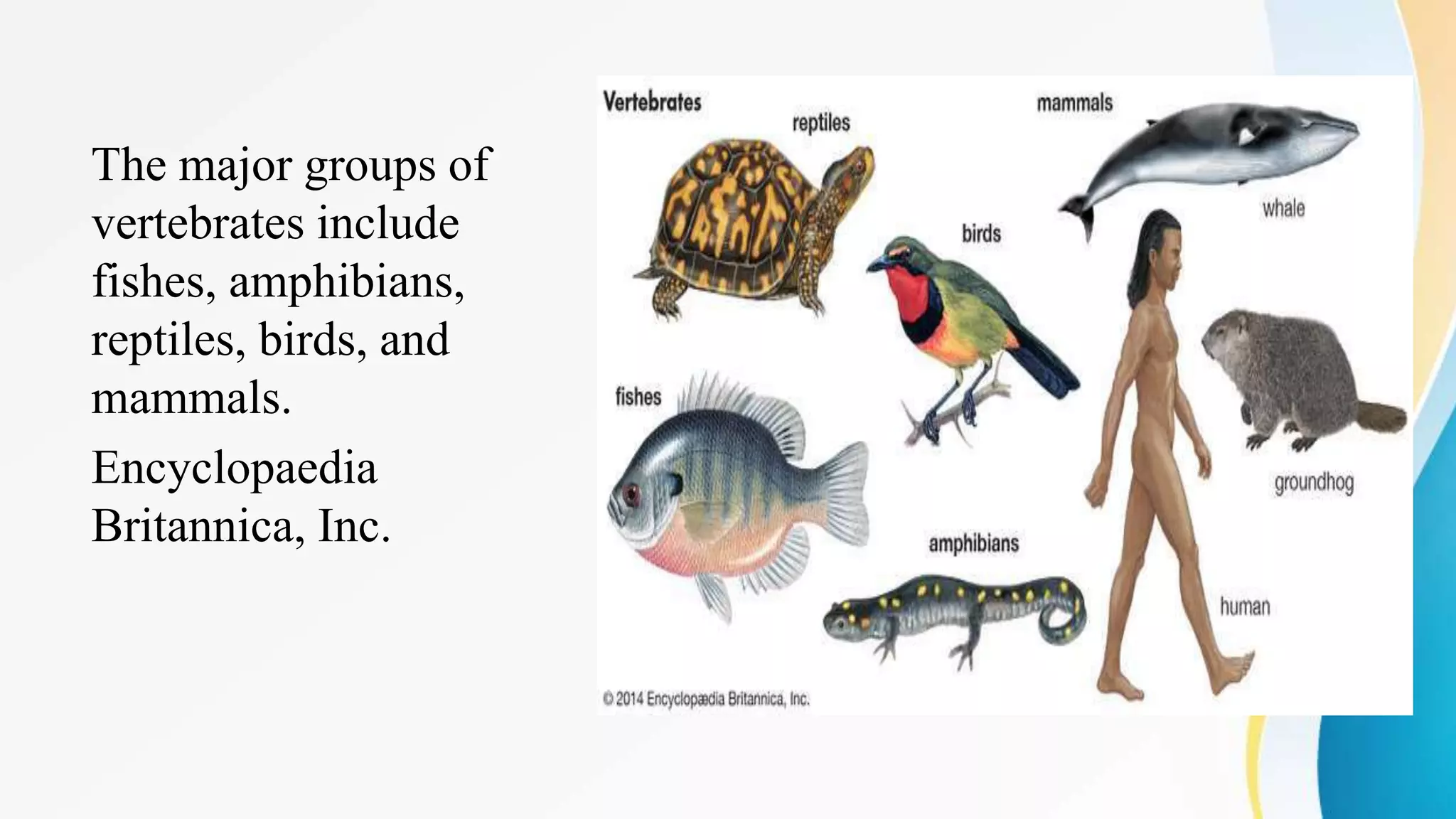
The major groups of
vertebrates include
fishes, amphibians,
reptiles, birds, and
mammals.
Encyclopaedia
Britannica, Inc.
• The body divided into trunk and tail region.
• High metabolic rate due to pharyngial gills slits and gills.
• Celom is present in trunk region.
• A distinct anteroventral to liver.
• Closed circulatory vessels consist.
• Aproxmately 45000 living species
constitute the vertebrate.
Vertebrate faunas are important to human
for food and recreation
Origin of vertebrate
In order to give a broad and comparative view of
theis life histories the vertebrates are subdivided into major
groups based on morphology,
I. The cyclostomes (jawless fishes),
II. the chondrichthyes (cartilaginous fishes),
III. the teleostomes (bony fishes),
IV. and the tetrapods.
The cyclostomes
Observe the
hagfish's horny
teeth and
scaleless exterior
covering a
cartilaginous
skeletonHagfishes
are primitive,
jawless fish.
Chondrichthyes Teleostoem
Bull shark (Carcharhinus leucas).
Cartilaginous fish
American paddlefish (Polyodon
spathula)American paddlefish (Polyodon
spathula) is the only living member of family
Polyodontidae.
Vertebrates pptx

Vertebrates pptx

  • 1.
  • 2.
    • Vertebrate, • alsocalled Craniata, any animal of the subphylum Vertebrata. • The predominant subphylum of the phylum Chordata. • They have backbones, from which they derive their name. • The vertebrates are also characterized by a muscular system.
  • 3.
    The major groupsof vertebrates include fishes, amphibians, reptiles, birds, and mammals. Encyclopaedia Britannica, Inc.
  • 4.
    • The bodydivided into trunk and tail region. • High metabolic rate due to pharyngial gills slits and gills. • Celom is present in trunk region. • A distinct anteroventral to liver. • Closed circulatory vessels consist.
  • 5.
    • Aproxmately 45000living species constitute the vertebrate. Vertebrate faunas are important to human for food and recreation
  • 6.
    Origin of vertebrate Inorder to give a broad and comparative view of theis life histories the vertebrates are subdivided into major groups based on morphology, I. The cyclostomes (jawless fishes), II. the chondrichthyes (cartilaginous fishes), III. the teleostomes (bony fishes), IV. and the tetrapods.
  • 7.
    The cyclostomes Observe the hagfish'shorny teeth and scaleless exterior covering a cartilaginous skeletonHagfishes are primitive, jawless fish.
  • 8.
    Chondrichthyes Teleostoem Bull shark(Carcharhinus leucas). Cartilaginous fish American paddlefish (Polyodon spathula)American paddlefish (Polyodon spathula) is the only living member of family Polyodontidae.