.
• Draw animals and paste them on the
correct spot in the blank chart given by
the teacher. Then explain your work after
finishing the activity.
Cut out some pictures of animals. Decide if they belong
to vertebrate or invertebrate and paste them in the
correct spot. Explain your work after finishing the
activity.
Vertebrate Invertebrate
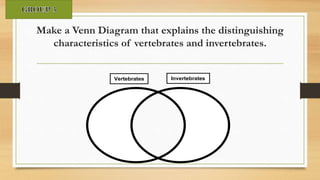
Make a Venn Diagram that explains the distinguishing
characteristics of vertebrates and invertebrates.
Vertebrates Invertebrates
Vertebrates
• A vertebrate is an animal with a backbone.
Fishes, amphibians, reptiles, birds, and mammals,
• Vertebrates share some basic characteristics. A hollow
backbone and the cranium, or skull, protect the spinal cord
and brain of most vertebrates. All vertebrates reproduce by
mating between males and females.
Vertebrates
• Fish
• Amphibians
• Reptiles
• Birds
• Mammals
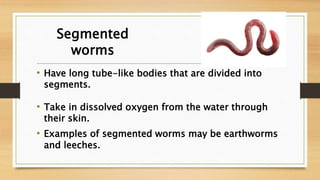
Segmented
worms
• Have long tube-like bodies that are divided into
segments.
• Take in dissolved oxygen from the water through
their skin.
• Examples of segmented worms may be earthworms
and leeches.
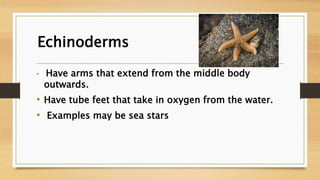
Echinoderms
• Have arms that extend from the middle body
outwards.
• Have tube feet that take in oxygen from the water.
• Examples may be sea stars
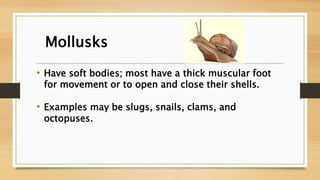
Mollusks
• Have soft bodies; most have a thick muscular foot
for movement or to open and close their shells.
• Examples may be slugs, snails, clams, and
octopuses.
• Vertebrates are creatures made by bones of a spinal
column and a backbone. The term derives from
vertebrae, the bones that make up the spines. The
skeleton keeps an animal's body up and covers it.
Vertebrates share some essential characteristics. A
hollow backbone and the cranium, or skull, shield
most vertebrates' spinal cord and brain. By mating
between males and females, all vertebrates
reproduce.
•An invertebrate is a cold-blooded animal
with no backbone. Invertebrates can live on
land—like insects, spiders, and worms—or
in water. Marine invertebrates include
crustaceans (such as crabs and lobsters),
mollusks (such as squids and clams), and
coral.
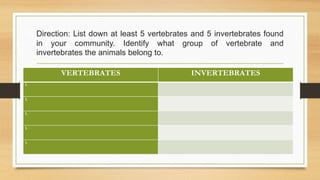
Direction: List down at least 5 vertebrates and 5 invertebrates found
in your community. Identify what group of vertebrate and
invertebrates the animals belong to.
VERTEBRATES INVERTEBRATES
1.
1.
1.
1.
1.
ASSIGNMENT
• Cut pictures of different animals and identify
them according to their group, paste it in your
notebook.
`

SCIENCE LESSON PLAN.pptx

  • 2.
    . • Draw animalsand paste them on the correct spot in the blank chart given by the teacher. Then explain your work after finishing the activity.
  • 3.
    Cut out somepictures of animals. Decide if they belong to vertebrate or invertebrate and paste them in the correct spot. Explain your work after finishing the activity. Vertebrate Invertebrate
  • 4.
    Make a VennDiagram that explains the distinguishing characteristics of vertebrates and invertebrates. Vertebrates Invertebrates
  • 5.
    Vertebrates • A vertebrateis an animal with a backbone. Fishes, amphibians, reptiles, birds, and mammals,
  • 6.
    • Vertebrates sharesome basic characteristics. A hollow backbone and the cranium, or skull, protect the spinal cord and brain of most vertebrates. All vertebrates reproduce by mating between males and females.
  • 7.
    Vertebrates • Fish • Amphibians •Reptiles • Birds • Mammals
  • 8.
    Segmented worms • Have longtube-like bodies that are divided into segments. • Take in dissolved oxygen from the water through their skin. • Examples of segmented worms may be earthworms and leeches.
  • 9.
    Echinoderms • Have armsthat extend from the middle body outwards. • Have tube feet that take in oxygen from the water. • Examples may be sea stars
  • 10.
    Mollusks • Have softbodies; most have a thick muscular foot for movement or to open and close their shells. • Examples may be slugs, snails, clams, and octopuses.
  • 11.
    • Vertebrates arecreatures made by bones of a spinal column and a backbone. The term derives from vertebrae, the bones that make up the spines. The skeleton keeps an animal's body up and covers it. Vertebrates share some essential characteristics. A hollow backbone and the cranium, or skull, shield most vertebrates' spinal cord and brain. By mating between males and females, all vertebrates reproduce.
  • 12.
    •An invertebrate isa cold-blooded animal with no backbone. Invertebrates can live on land—like insects, spiders, and worms—or in water. Marine invertebrates include crustaceans (such as crabs and lobsters), mollusks (such as squids and clams), and coral.
  • 13.
    Direction: List downat least 5 vertebrates and 5 invertebrates found in your community. Identify what group of vertebrate and invertebrates the animals belong to. VERTEBRATES INVERTEBRATES 1. 1. 1. 1. 1.
  • 14.
    ASSIGNMENT • Cut picturesof different animals and identify them according to their group, paste it in your notebook.
  • 15.