How can sustainability science
achieve impact for wicked problems
such as climate change?
Bruce Campbell and Sonja Vermeulen
CGIAR Research Program on Climate
Change, Agriculture and Food Security
(CCAFS), CCAFS Coordinating Unit,
University of Copenhagen, Denmark
Outline of the talk
• What are wicked problems? The example of
agriculture under climate change
• What do we know about tackling wicked
problems?
• How can these principles and tools be applied
to management of science in the CGIAR?
complicated
complex
simple
The modern dilemma
• Growing recognition that
– Natural resource systems and social systems are
complex, unpredictable and highly dynamic
– Different people and groups have different values,
viewpoints and priorities that are equally valid
• Yet we continue to search for standard
solutions that achieve steady states
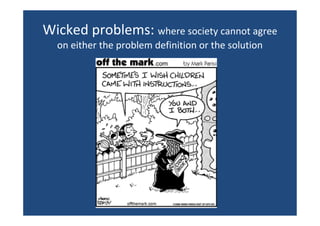
Wicked problems: where society cannot agree
on either the problem definition or the solution
How is climate change a
“wicked problem”?
controversy
system complexity
institutional complexity
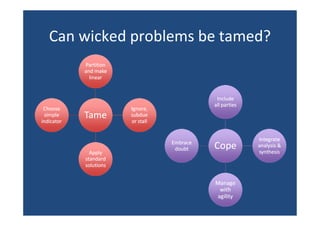
Can wicked problems be tamed?
What to focus on when dealing
with wicked problems
• Teams
• Politics
• Behaviors
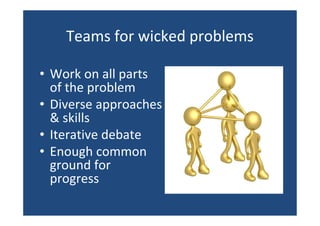
Teams for wicked problems
• Work on all parts
of the problem
• Diverse approaches
& skills
• Iterative debate
• Enough common
ground for
progress
Competition
Authority
Cooperation
Politics of
wicked
problems:
where the
power lies
Behavior change for wicked problems
So if the CGIAR is
going to help
solve wicked
problems,
what needs to
be done more?
Sunday morning ideas
Monday morning action
Principles for wicked problem science
• ‘Good enough is best’ principle
• ‘Consensus beats reality’ principle
• ‘Trust beats certainty’ principle
• ‘The three-thirds’ principle
• ‘No neutral gear’ principle
Adapted from Fullana et al, 2011
1. ‘Good enough is best’ principle
•Don’t close off possibilities too early
•Learn by doing: apply solutions with
stakeholders when they still have lots
of problems
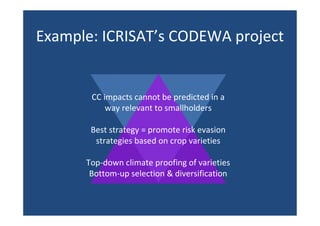
Example: ICRISAT’s CODEWA project
CC impacts cannot be predicted in a
way relevant to smallholders
Best strategy = promote risk evasion
strategies based on crop varieties
Top-down climate proofing of varieties
Bottom-up selection & diversification
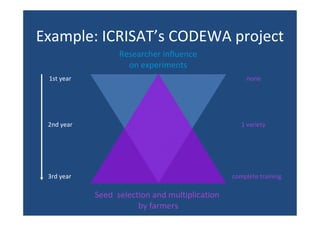
Example: ICRISAT’s CODEWA project
1st year
2nd year
3rd year
Researcher influence
on experiments
none
1 variety
complete training
Seed selection and multiplication
by farmers
2. ‘Consensus beats reality’ principle
• Don’t build technologies and toolkits
in isolation
• Use impact pathways, with realistic
theories of change and partnerships,
as “living documents” for the entire
team
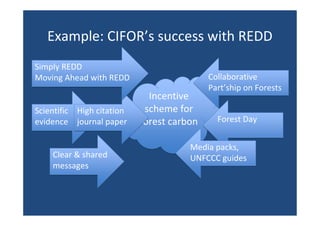
Example: CIFOR’s success with REDD
Incentive
scheme for
forest carbon
Incentive
scheme for
forest carbon
Collaborative
Part’ship on Forests
Collaborative
Part’ship on Forests
Scientific
evidence
Scientific
evidence
High citation
journal paper
High citation
journal paper Forest DayForest Day
Media packs,
UNFCCC guides
Media packs,
UNFCCC guidesClear & shared
messages
Clear & shared
messages
Simply REDD
Moving Ahead with REDD
Simply REDD
Moving Ahead with REDD
3. ‘Three thirds’ principle
• Radically rethink allocation of
resources between research and
stakeholder engagement
• Invest wisely in the right partnerships
based on shared objectives and
complementary skill sets
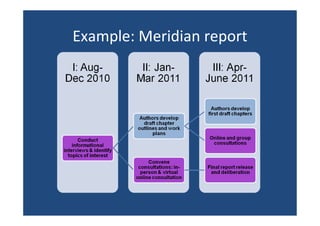
Example: Meridian report
4. ‘No neutral gear’ principle
• Drop the language of “win-win-win”
and be frank about trade-offs,
winners and losers
• Get serious about social diversity and
power
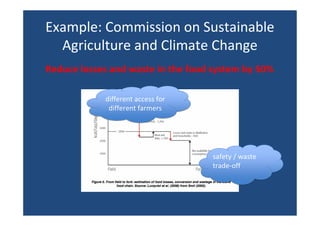
Example: Commission on Sustainable
Agriculture and Climate Change
Reduce losses and waste in the food system by 50%
safety / waste
trade-off
safety / waste
trade-off
different access for
different farmers
different access for
different farmers
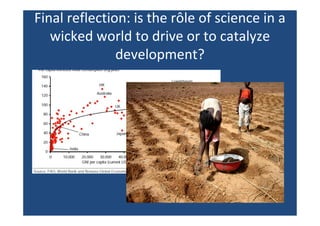
Final reflection: is the rôle of science in a
wicked world to drive or to catalyze
development?
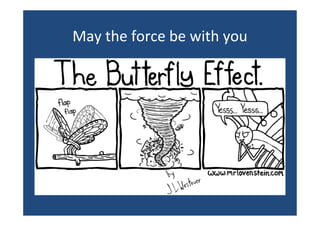
May the force be with you
Recommended reading
Dilemmas in a General Theory of Planning
http://www.metu.edu.tr/~baykan/arch467/Rittel+Webber+Dilemm
as.pdf
Tackling Wicked Problems
www.apsc.gov.au/publications07/wickedproblems.pdf

Vermeulen S, Campbell B: How can sustainability science achieve impact for wicked problems such as climate change?

  • 1.
    How can sustainabilityscience achieve impact for wicked problems such as climate change? Bruce Campbell and Sonja Vermeulen CGIAR Research Program on Climate Change, Agriculture and Food Security (CCAFS), CCAFS Coordinating Unit, University of Copenhagen, Denmark
  • 2.
    Outline of thetalk • What are wicked problems? The example of agriculture under climate change • What do we know about tackling wicked problems? • How can these principles and tools be applied to management of science in the CGIAR?
  • 3.
  • 4.
    The modern dilemma •Growing recognition that – Natural resource systems and social systems are complex, unpredictable and highly dynamic – Different people and groups have different values, viewpoints and priorities that are equally valid • Yet we continue to search for standard solutions that achieve steady states
  • 5.
    Wicked problems: wheresociety cannot agree on either the problem definition or the solution
  • 6.
    How is climatechange a “wicked problem”? controversy system complexity institutional complexity
  • 7.
  • 8.
    What to focuson when dealing with wicked problems • Teams • Politics • Behaviors
  • 9.
    Teams for wickedproblems • Work on all parts of the problem • Diverse approaches & skills • Iterative debate • Enough common ground for progress
  • 10.
  • 11.
    Behavior change forwicked problems
  • 12.
    So if theCGIAR is going to help solve wicked problems, what needs to be done more? Sunday morning ideas Monday morning action
  • 13.
    Principles for wickedproblem science • ‘Good enough is best’ principle • ‘Consensus beats reality’ principle • ‘Trust beats certainty’ principle • ‘The three-thirds’ principle • ‘No neutral gear’ principle Adapted from Fullana et al, 2011
  • 14.
    1. ‘Good enoughis best’ principle •Don’t close off possibilities too early •Learn by doing: apply solutions with stakeholders when they still have lots of problems
  • 15.
    Example: ICRISAT’s CODEWAproject CC impacts cannot be predicted in a way relevant to smallholders Best strategy = promote risk evasion strategies based on crop varieties Top-down climate proofing of varieties Bottom-up selection & diversification
  • 16.
    Example: ICRISAT’s CODEWAproject 1st year 2nd year 3rd year Researcher influence on experiments none 1 variety complete training Seed selection and multiplication by farmers
  • 17.
    2. ‘Consensus beatsreality’ principle • Don’t build technologies and toolkits in isolation • Use impact pathways, with realistic theories of change and partnerships, as “living documents” for the entire team
  • 18.
    Example: CIFOR’s successwith REDD Incentive scheme for forest carbon Incentive scheme for forest carbon Collaborative Part’ship on Forests Collaborative Part’ship on Forests Scientific evidence Scientific evidence High citation journal paper High citation journal paper Forest DayForest Day Media packs, UNFCCC guides Media packs, UNFCCC guidesClear & shared messages Clear & shared messages Simply REDD Moving Ahead with REDD Simply REDD Moving Ahead with REDD
  • 19.
    3. ‘Three thirds’principle • Radically rethink allocation of resources between research and stakeholder engagement • Invest wisely in the right partnerships based on shared objectives and complementary skill sets
  • 20.
  • 21.
    4. ‘No neutralgear’ principle • Drop the language of “win-win-win” and be frank about trade-offs, winners and losers • Get serious about social diversity and power
  • 22.
    Example: Commission onSustainable Agriculture and Climate Change Reduce losses and waste in the food system by 50% safety / waste trade-off safety / waste trade-off different access for different farmers different access for different farmers
  • 23.
    Final reflection: isthe rôle of science in a wicked world to drive or to catalyze development?
  • 24.
    May the forcebe with you
  • 25.
    Recommended reading Dilemmas ina General Theory of Planning http://www.metu.edu.tr/~baykan/arch467/Rittel+Webber+Dilemm as.pdf Tackling Wicked Problems www.apsc.gov.au/publications07/wickedproblems.pdf