Performance Analysis of Ternary Ripple Carry
Adder designs using proposed Ternary 3:1 MUX
and Proposed Ternary Half adder
Presented by
M .Tech (VLSI&ES))
Under the esteemed guidance of
Professor
Department of ECE
SVPEC
INDEX
• ABSTRACT
• INTRODUCTION
• TERNARY LOGIC FUNDAMENTALS
• THE CMOS TERNARY GATES
• LOGIC GATES BASED ON TERNARY
• COMBINATIONAL CIRCUITS BASED ON TERNARY LOGIC
• PROPOSED WORK
• PROPOSED 3:1 TERNARY MULTIPLEXER
• PROPOSED TERNARY HALF ADDER (THA)
• ADVANTAGES
• APPLICATIONS
• REFERENCES
ABSTRACT
• This project proposes a novel circuit design of a Ternary Ripple Carry Adder (TRCA)
using a proposed Ternary 3:1 multiplexer (3:1 TMUX) and proposed Ternary Half Adder
(THA).
• This research focuses on achieving low power consumption and propagation latency in
these proposed circuits.
• The proposed Ternary Full Adder circuit is compared with existing circuits and
demonstrates superior performance based on their performance metrics.
• The circuit analysis and simulations were conducted using Tanner EDA design
environment at 90 nm technology.
• The simulation results indicate that the proposed designs outperform other existing circuits
in terms of latency and power-delay product (PDP) and are suitable for high-performance
Ternary computational circuits.
INTRODUCTION
• Application-specific processing is appealing related to its general-purpose cousin due to the
steadily rising need for battery-operated sophisticated movable embedded electronic
devices.
• The main obstacle to achieving the stated goal is fast processing combined with minimal
power requirement.
• Currently, binary digital processing is used, although multivalued logic systems can be used
in place of binary logic.
• Since the radix number in binary logic is 2, the binary system only uses the numbers 0 and 1
as symbols.
• The radix number in multi valued logic is an example that is greater than 2. ternary logic,
which uses the radix '3' of the number system.
INTRODUCTION
• Utilizing the three symbols 0, 1, and 2, the ternary number system allows for the depiction
of three states of logic. Ternary logic is preferable to binary logic in terms of area
optimization and speed [1].
• The speed and space issues can be resolved by ternary logic since it can be used for more
function realizations with a provided quantity of inputs than binary logic Voltage levels are
a suitable representation of ternary logic.
• These states 0, 1, and 2 are denoted, respectively, by voltage levels of 0, Vdd/2, and Vdd (2-
3].The following are some benefits of ternary (radix 3) logie over binary (radix 2) logie:
Ternary Logic Fundamentals
• P and N-channel transistors complementary structures were employed symmetrically to provide three
separate logic levels in the initial MOSFETs-based ternary (radix 2) basic gates design.
• The supply of power was significantly greater than the transistor's threshold voltage at the same time, which
increased the intricacy of the circuit and the amount of power used [4-5].
• The above-mentioned ternary circuits, which require the use of resistors, can result in a certain level of static
power consumption.
• Due to this, situations have suggested two ternary basic logic gate design methods that use only four different
types of MOS transistors and do not require resistors, hence lowering the circuit's static power consumption
and simplifying the circuit's component list.
Ternary Logic Fundamentals
• At the same time, it shortens the propagation latency. One significant aspect is that ternary digital logic offers
a new and practical approach to various applied difficulties.
• For instance, in the context of digital control circuits, ternary logic can be used to represent the "on," "off,"
and "idle" states of an item of equipment.
• Ternary logic consists of two categories: unbalanced representation techniques and balanced representation
techniques [6]. The unbalanced ternaries include positive and negative ternaries with the logical sign-relevant
numbers 0, 1, and 2.
• A balanced ternary is represented by the numbers 1, 0, and 1. In this tutorial, we'll focus on designing
unbalanced ternary logic circuits [7-8].
The CMOS Ternary Gates
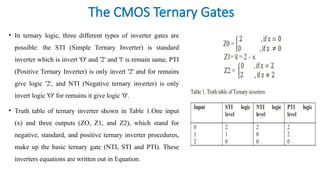
• In ternary logic, three different types of inverter gates are
possible: the STI (Simple Ternary Inverter) is standard
inverter which is invert 'O' and '2' and 'l' is remain same, PTI
(Positive Ternary Inverter) is only invert '2' and for remains
give logic '2', and NTI (Negative ternary inverter) is only
invert logic 'O' for remains it give logic '0'.
• Truth table of ternary inverter shown in Table 1.One input
(x) and three outputs (ZO, Z1, and Z2), which stand for
negative, standard, and positive ternary inverter procedures,
make up the basic ternary gate (NTI, STI and PTI). These
inverters equations are written out in Equation.
Logic Gates based on Ternary
• T-NAND, T-NOR, and other ternary logics are also employed in a variety of circuits. Equations are provided
below for certain logics [6].
Combinational circuits based on Ternary Logic
• If talk about binary half adder two radix number 0 and 1, if want to design 2 bit half adder can only
represent 4outcomes. In ternary use 9 outcomes instead of 4 [1] [18].
• If increase the bit value the difference between binary and ternary is become large. Truth table of THA is
given below in Table.
PROPOSED WORK
• This section includes all the proposed combinational circuits these are Proposed 3:1 TMUX, ternary half adder and ternary
full adder. In this section the design of proposed circuits is presented and their analysis is explained.
A. Proposed 3:1 Ternary multiplexer
The design in Figure operates in a straight forward manner.
Depending on the voltage on the select line S of the multiplexer
(input I0, I1 and 12 of the 1 to 3 decoder), only one Transmission
gate based AND gate output will be operational at one time. For
instance, if the logic on Select line is "1," output out 1 will be high
("2") and the rest will be low (logic"0"). According to the
transmission gate based AND gate truth table shown in Table 2, the
output of transmission AND gates with inputs set to logic 'O' will be
low [20].
Figure: Design of proposed Ternary 3:1 MUX
PROPOSED WORK
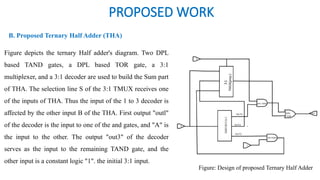
B. Proposed Ternary Half Adder (THA)
Figure depicts the ternary Half adder's diagram. Two DPL
based TAND gates, a DPL based TOR gate, a 3:1
multiplexer, and a 3:1 decoder are used to build the Sum part
of THA. The selection line S of the 3:1 TMUX receives one
of the inputs of THA. Thus the input of the 1 to 3 decoder is
affected by the other input B of the THA. First output "outl"
of the decoder is the input to one of the and gates, and "A" is
the input to the other. The output "out3" of the decoder
serves as the input to the remaining TAND gate, and the
other input is a constant logic "1". the initial 3:1 input.
Figure: Design of proposed Ternary Half Adder
ADVANTAGES
• Reduced Transistor Count
• Faster Operations
• Lower Power Consumption
• Smaller Chip Area
• Improved Noise Margins
• Energy Efficiency
APPLICATIONS
• Low-Power Arithmetic Circuits
• Digital Signal Processing (DSP)
• Energy-Efficient VLSI Systems
• High-Speed Computing
• Communication Systems
• Error Detection and Correction Systems
REFERENCE
1. Mohd Ziauddin Jahangir and J. Mounika, "Design and simulation of an innovative CMOS ternary 3 to 1
multiplexer and the design of ternary half adder using ternary 3 to 1 multiplexer", Microelectronics
Journal, vol. 90, pp. 82-87, 2019.
2. Jinghang Liang, Linbin Chen and Jie Han, "Design and evaluation of multi valued logic gates using
Pseudo N-type carbon Nanotube FETS", IEEE Proc., vol. 13, no. 4, pp. 695-708, July 2014.
3. A.P. Dhande, Satish, S. Narkhede, Shridhar and S. Dumdam, "VLSI implementation of ternary gates
using tanner tools", 2014 2nd International Conference on Devices Circuits and Systems.
4. Viswa Saidutt, Srinivas, Sai Phaneendra and Moorthy Muthukrishnan, "Design of encoder for ternary
logic circuits", Asia Pacific Conference on Postgraduate Research in Microelectronics & Electronics
(PRIMEASIA), pp. 85, 2012.
5. Shamshad Ahmad and Mansaf Alam, "Balanced-ternary logic for improved and advanced computing", Int
J Comput Sci Inf Technol, vol. 5, no. 4, pp. 5157-5160, 2014
THANK YOU

Ternary Logic Based Halfadder and full adder

  • 1.
    Performance Analysis ofTernary Ripple Carry Adder designs using proposed Ternary 3:1 MUX and Proposed Ternary Half adder Presented by M .Tech (VLSI&ES)) Under the esteemed guidance of Professor Department of ECE SVPEC
  • 2.
    INDEX • ABSTRACT • INTRODUCTION •TERNARY LOGIC FUNDAMENTALS • THE CMOS TERNARY GATES • LOGIC GATES BASED ON TERNARY • COMBINATIONAL CIRCUITS BASED ON TERNARY LOGIC • PROPOSED WORK • PROPOSED 3:1 TERNARY MULTIPLEXER • PROPOSED TERNARY HALF ADDER (THA) • ADVANTAGES • APPLICATIONS • REFERENCES
  • 3.
    ABSTRACT • This projectproposes a novel circuit design of a Ternary Ripple Carry Adder (TRCA) using a proposed Ternary 3:1 multiplexer (3:1 TMUX) and proposed Ternary Half Adder (THA). • This research focuses on achieving low power consumption and propagation latency in these proposed circuits. • The proposed Ternary Full Adder circuit is compared with existing circuits and demonstrates superior performance based on their performance metrics. • The circuit analysis and simulations were conducted using Tanner EDA design environment at 90 nm technology. • The simulation results indicate that the proposed designs outperform other existing circuits in terms of latency and power-delay product (PDP) and are suitable for high-performance Ternary computational circuits.
  • 4.
    INTRODUCTION • Application-specific processingis appealing related to its general-purpose cousin due to the steadily rising need for battery-operated sophisticated movable embedded electronic devices. • The main obstacle to achieving the stated goal is fast processing combined with minimal power requirement. • Currently, binary digital processing is used, although multivalued logic systems can be used in place of binary logic. • Since the radix number in binary logic is 2, the binary system only uses the numbers 0 and 1 as symbols. • The radix number in multi valued logic is an example that is greater than 2. ternary logic, which uses the radix '3' of the number system.
  • 5.
    INTRODUCTION • Utilizing thethree symbols 0, 1, and 2, the ternary number system allows for the depiction of three states of logic. Ternary logic is preferable to binary logic in terms of area optimization and speed [1]. • The speed and space issues can be resolved by ternary logic since it can be used for more function realizations with a provided quantity of inputs than binary logic Voltage levels are a suitable representation of ternary logic. • These states 0, 1, and 2 are denoted, respectively, by voltage levels of 0, Vdd/2, and Vdd (2- 3].The following are some benefits of ternary (radix 3) logie over binary (radix 2) logie:
  • 6.
    Ternary Logic Fundamentals •P and N-channel transistors complementary structures were employed symmetrically to provide three separate logic levels in the initial MOSFETs-based ternary (radix 2) basic gates design. • The supply of power was significantly greater than the transistor's threshold voltage at the same time, which increased the intricacy of the circuit and the amount of power used [4-5]. • The above-mentioned ternary circuits, which require the use of resistors, can result in a certain level of static power consumption. • Due to this, situations have suggested two ternary basic logic gate design methods that use only four different types of MOS transistors and do not require resistors, hence lowering the circuit's static power consumption and simplifying the circuit's component list.
  • 7.
    Ternary Logic Fundamentals •At the same time, it shortens the propagation latency. One significant aspect is that ternary digital logic offers a new and practical approach to various applied difficulties. • For instance, in the context of digital control circuits, ternary logic can be used to represent the "on," "off," and "idle" states of an item of equipment. • Ternary logic consists of two categories: unbalanced representation techniques and balanced representation techniques [6]. The unbalanced ternaries include positive and negative ternaries with the logical sign-relevant numbers 0, 1, and 2. • A balanced ternary is represented by the numbers 1, 0, and 1. In this tutorial, we'll focus on designing unbalanced ternary logic circuits [7-8].
  • 8.
    The CMOS TernaryGates • In ternary logic, three different types of inverter gates are possible: the STI (Simple Ternary Inverter) is standard inverter which is invert 'O' and '2' and 'l' is remain same, PTI (Positive Ternary Inverter) is only invert '2' and for remains give logic '2', and NTI (Negative ternary inverter) is only invert logic 'O' for remains it give logic '0'. • Truth table of ternary inverter shown in Table 1.One input (x) and three outputs (ZO, Z1, and Z2), which stand for negative, standard, and positive ternary inverter procedures, make up the basic ternary gate (NTI, STI and PTI). These inverters equations are written out in Equation.
  • 9.
    Logic Gates basedon Ternary • T-NAND, T-NOR, and other ternary logics are also employed in a variety of circuits. Equations are provided below for certain logics [6].
  • 10.
    Combinational circuits basedon Ternary Logic • If talk about binary half adder two radix number 0 and 1, if want to design 2 bit half adder can only represent 4outcomes. In ternary use 9 outcomes instead of 4 [1] [18]. • If increase the bit value the difference between binary and ternary is become large. Truth table of THA is given below in Table.
  • 11.
    PROPOSED WORK • Thissection includes all the proposed combinational circuits these are Proposed 3:1 TMUX, ternary half adder and ternary full adder. In this section the design of proposed circuits is presented and their analysis is explained. A. Proposed 3:1 Ternary multiplexer The design in Figure operates in a straight forward manner. Depending on the voltage on the select line S of the multiplexer (input I0, I1 and 12 of the 1 to 3 decoder), only one Transmission gate based AND gate output will be operational at one time. For instance, if the logic on Select line is "1," output out 1 will be high ("2") and the rest will be low (logic"0"). According to the transmission gate based AND gate truth table shown in Table 2, the output of transmission AND gates with inputs set to logic 'O' will be low [20]. Figure: Design of proposed Ternary 3:1 MUX
  • 12.
    PROPOSED WORK B. ProposedTernary Half Adder (THA) Figure depicts the ternary Half adder's diagram. Two DPL based TAND gates, a DPL based TOR gate, a 3:1 multiplexer, and a 3:1 decoder are used to build the Sum part of THA. The selection line S of the 3:1 TMUX receives one of the inputs of THA. Thus the input of the 1 to 3 decoder is affected by the other input B of the THA. First output "outl" of the decoder is the input to one of the and gates, and "A" is the input to the other. The output "out3" of the decoder serves as the input to the remaining TAND gate, and the other input is a constant logic "1". the initial 3:1 input. Figure: Design of proposed Ternary Half Adder
  • 13.
    ADVANTAGES • Reduced TransistorCount • Faster Operations • Lower Power Consumption • Smaller Chip Area • Improved Noise Margins • Energy Efficiency
  • 14.
    APPLICATIONS • Low-Power ArithmeticCircuits • Digital Signal Processing (DSP) • Energy-Efficient VLSI Systems • High-Speed Computing • Communication Systems • Error Detection and Correction Systems
  • 15.
    REFERENCE 1. Mohd ZiauddinJahangir and J. Mounika, "Design and simulation of an innovative CMOS ternary 3 to 1 multiplexer and the design of ternary half adder using ternary 3 to 1 multiplexer", Microelectronics Journal, vol. 90, pp. 82-87, 2019. 2. Jinghang Liang, Linbin Chen and Jie Han, "Design and evaluation of multi valued logic gates using Pseudo N-type carbon Nanotube FETS", IEEE Proc., vol. 13, no. 4, pp. 695-708, July 2014. 3. A.P. Dhande, Satish, S. Narkhede, Shridhar and S. Dumdam, "VLSI implementation of ternary gates using tanner tools", 2014 2nd International Conference on Devices Circuits and Systems. 4. Viswa Saidutt, Srinivas, Sai Phaneendra and Moorthy Muthukrishnan, "Design of encoder for ternary logic circuits", Asia Pacific Conference on Postgraduate Research in Microelectronics & Electronics (PRIMEASIA), pp. 85, 2012. 5. Shamshad Ahmad and Mansaf Alam, "Balanced-ternary logic for improved and advanced computing", Int J Comput Sci Inf Technol, vol. 5, no. 4, pp. 5157-5160, 2014
  • 16.