Recognizing VerbalsRecognizing Verbals
A verbal is a verb that is being used as another
part of speech rather than as a verb.
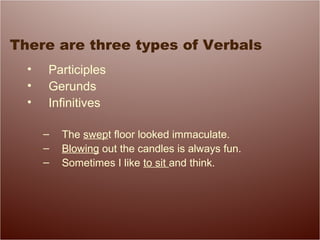
There are three types of Verbals
• Participles
• Gerunds
• Infinitives
– The swept floor looked immaculate.
– Blowing out the candles is always fun.
– Sometimes I like to sit and think.
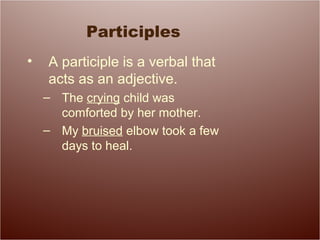
Participles
• A participle is a verbal that
acts as an adjective.
– The crying child was
comforted by her mother.
– My bruised elbow took a few
days to heal.
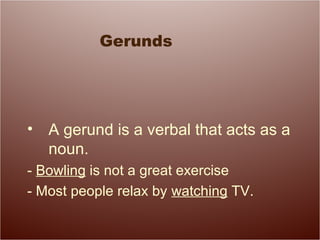
Gerunds
• A gerund is a verbal that acts as a
noun.
- Bowling is not a great exercise
- Most people relax by watching TV.
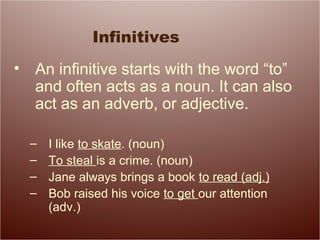
Infinitives
• An infinitive starts with the word “to”
and often acts as a noun. It can also
act as an adverb, or adjective.
– I like to skate. (noun)
– To steal is a crime. (noun)
– Jane always brings a book to read (adj.)
– Bob raised his voice to get our attention
(adv.)
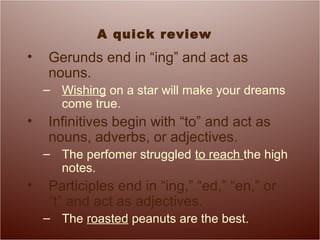
A quick review
• Gerunds end in “ing” and act as
nouns.
– Wishing on a star will make your dreams
come true.
• Infinitives begin with “to” and act as
nouns, adverbs, or adjectives.
– The perfomer struggled to reach the high
notes.
• Participles end in “ing,” “ed,” “en,” or
“t” and act as adjectives.
– The roasted peanuts are the best.
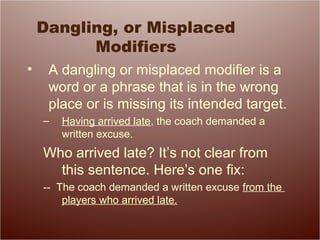
Dangling, or Misplaced
Modifiers
• A dangling or misplaced modifier is a
word or a phrase that is in the wrong
place or is missing its intended target.
– Having arrived late, the coach demanded a
written excuse.
Who arrived late? It’s not clear from
this sentence. Here’s one fix:
-- The coach demanded a written excuse from the
players who arrived late.
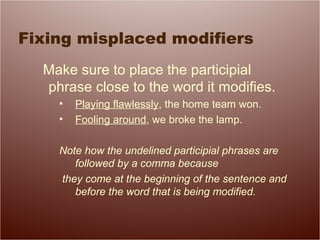
Fixing misplaced modifiers
Make sure to place the participial
phrase close to the word it modifies.
• Playing flawlessly, the home team won.
• Fooling around, we broke the lamp.
Note how the undelined participial phrases are
followed by a comma because
they come at the beginning of the sentence and
before the word that is being modified.

Verbals and misplaced modifiers

  • 1.
    Recognizing VerbalsRecognizing Verbals Averbal is a verb that is being used as another part of speech rather than as a verb.
  • 2.
    There are threetypes of Verbals • Participles • Gerunds • Infinitives – The swept floor looked immaculate. – Blowing out the candles is always fun. – Sometimes I like to sit and think.
  • 3.
    Participles • A participleis a verbal that acts as an adjective. – The crying child was comforted by her mother. – My bruised elbow took a few days to heal.
  • 4.
    Gerunds • A gerundis a verbal that acts as a noun. - Bowling is not a great exercise - Most people relax by watching TV.
  • 5.
    Infinitives • An infinitivestarts with the word “to” and often acts as a noun. It can also act as an adverb, or adjective. – I like to skate. (noun) – To steal is a crime. (noun) – Jane always brings a book to read (adj.) – Bob raised his voice to get our attention (adv.)
  • 6.
    A quick review •Gerunds end in “ing” and act as nouns. – Wishing on a star will make your dreams come true. • Infinitives begin with “to” and act as nouns, adverbs, or adjectives. – The perfomer struggled to reach the high notes. • Participles end in “ing,” “ed,” “en,” or “t” and act as adjectives. – The roasted peanuts are the best.
  • 7.
    Dangling, or Misplaced Modifiers •A dangling or misplaced modifier is a word or a phrase that is in the wrong place or is missing its intended target. – Having arrived late, the coach demanded a written excuse. Who arrived late? It’s not clear from this sentence. Here’s one fix: -- The coach demanded a written excuse from the players who arrived late.
  • 8.
    Fixing misplaced modifiers Makesure to place the participial phrase close to the word it modifies. • Playing flawlessly, the home team won. • Fooling around, we broke the lamp. Note how the undelined participial phrases are followed by a comma because they come at the beginning of the sentence and before the word that is being modified.