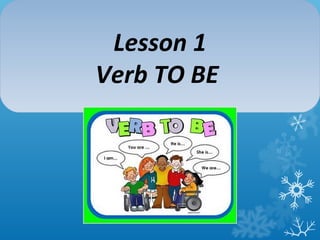
Lesson 1
Verb TO BE
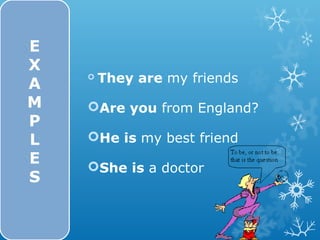
 They are my friends
Are you from England?
He is my best friend
She is a doctor
E
X
A
M
P
L
E
S
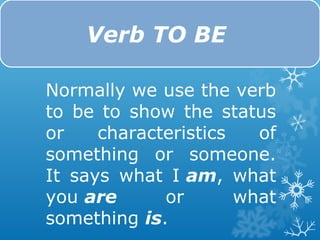
Normally we use the verb
to be to show the status
or characteristics of
something or someone.
It says what I am, what
you are or what
something is.
Verb TO BE
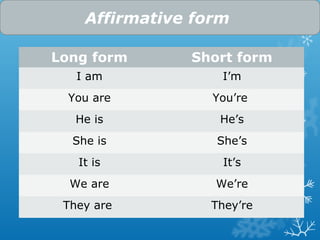
Long form Short form
I am I’m
You are You’re
He is He’s
She is She’s
It is It’s
We are We’re
They are They’re
Affirmative form
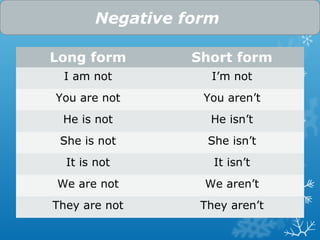
Negative form
Long form Short form
I am not I’m not
You are not You aren’t
He is not He isn’t
She is not She isn’t
It is not It isn’t
We are not We aren’t
They are not They aren’t
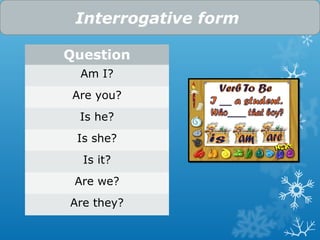
Question
Am I?
Are you?
Is he?
Is she?
Is it?
Are we?
Are they?
Interrogative form
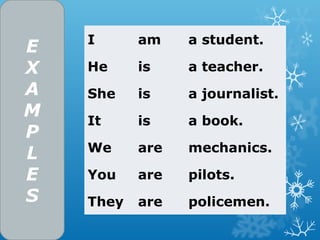
I am a student.
He is a teacher.
She is a journalist.
It is a book.
We are mechanics.
You are pilots.
They are policemen.
E
X
A
M
P
L
E
S
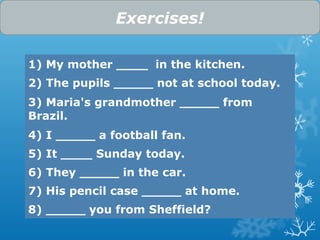
Exercises!
1) My mother ____ in the kitchen.
2) The pupils _____ not at school today.
3) Maria's grandmother _____ from
Brazil.
4) I _____ a football fan.
5) It ____ Sunday today.
6) They _____ in the car.
7) His pencil case _____ at home.
8) _____ you from Sheffield?
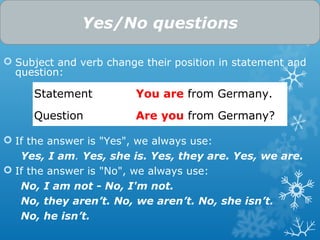
 Subject and verb change their position in statement and
question:
 If the answer is "Yes", we always use:
Yes, I am. Yes, she is. Yes, they are. Yes, we are.
 If the answer is "No", we always use:
No, I am not - No, I'm not.
No, they aren’t. No, we aren’t. No, she isn’t.
No, he isn’t.
Yes/No questions
Statement You are from Germany.
Question Are you from Germany?
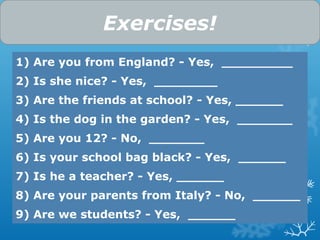
1) Are you from England? - Yes, _________
2) Is she nice? - Yes, ________
3) Are the friends at school? - Yes, ______
4) Is the dog in the garden? - Yes, _______
5) Are you 12? - No, _______
6) Is your school bag black? - Yes, ______
7) Is he a teacher? - Yes, ______
8) Are your parents from Italy? - No, ______
9) Are we students? - Yes, ______
Exercises!
Practice at home!

Verb to be

  • 1.
  • 2.
     They aremy friends Are you from England? He is my best friend She is a doctor E X A M P L E S
  • 3.
    Normally we usethe verb to be to show the status or characteristics of something or someone. It says what I am, what you are or what something is. Verb TO BE
  • 4.
    Long form Shortform I am I’m You are You’re He is He’s She is She’s It is It’s We are We’re They are They’re Affirmative form
  • 5.
    Negative form Long formShort form I am not I’m not You are not You aren’t He is not He isn’t She is not She isn’t It is not It isn’t We are not We aren’t They are not They aren’t
  • 6.
    Question Am I? Are you? Ishe? Is she? Is it? Are we? Are they? Interrogative form
  • 7.
    I am astudent. He is a teacher. She is a journalist. It is a book. We are mechanics. You are pilots. They are policemen. E X A M P L E S
  • 8.
    Exercises! 1) My mother____ in the kitchen. 2) The pupils _____ not at school today. 3) Maria's grandmother _____ from Brazil. 4) I _____ a football fan. 5) It ____ Sunday today. 6) They _____ in the car. 7) His pencil case _____ at home. 8) _____ you from Sheffield?
  • 9.
     Subject andverb change their position in statement and question:  If the answer is "Yes", we always use: Yes, I am. Yes, she is. Yes, they are. Yes, we are.  If the answer is "No", we always use: No, I am not - No, I'm not. No, they aren’t. No, we aren’t. No, she isn’t. No, he isn’t. Yes/No questions Statement You are from Germany. Question Are you from Germany?
  • 10.
    1) Are youfrom England? - Yes, _________ 2) Is she nice? - Yes, ________ 3) Are the friends at school? - Yes, ______ 4) Is the dog in the garden? - Yes, _______ 5) Are you 12? - No, _______ 6) Is your school bag black? - Yes, ______ 7) Is he a teacher? - Yes, ______ 8) Are your parents from Italy? - No, ______ 9) Are we students? - Yes, ______ Exercises!
  • 11.